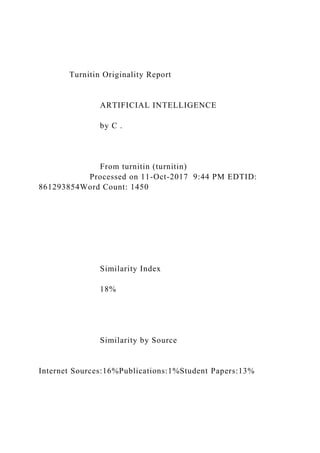
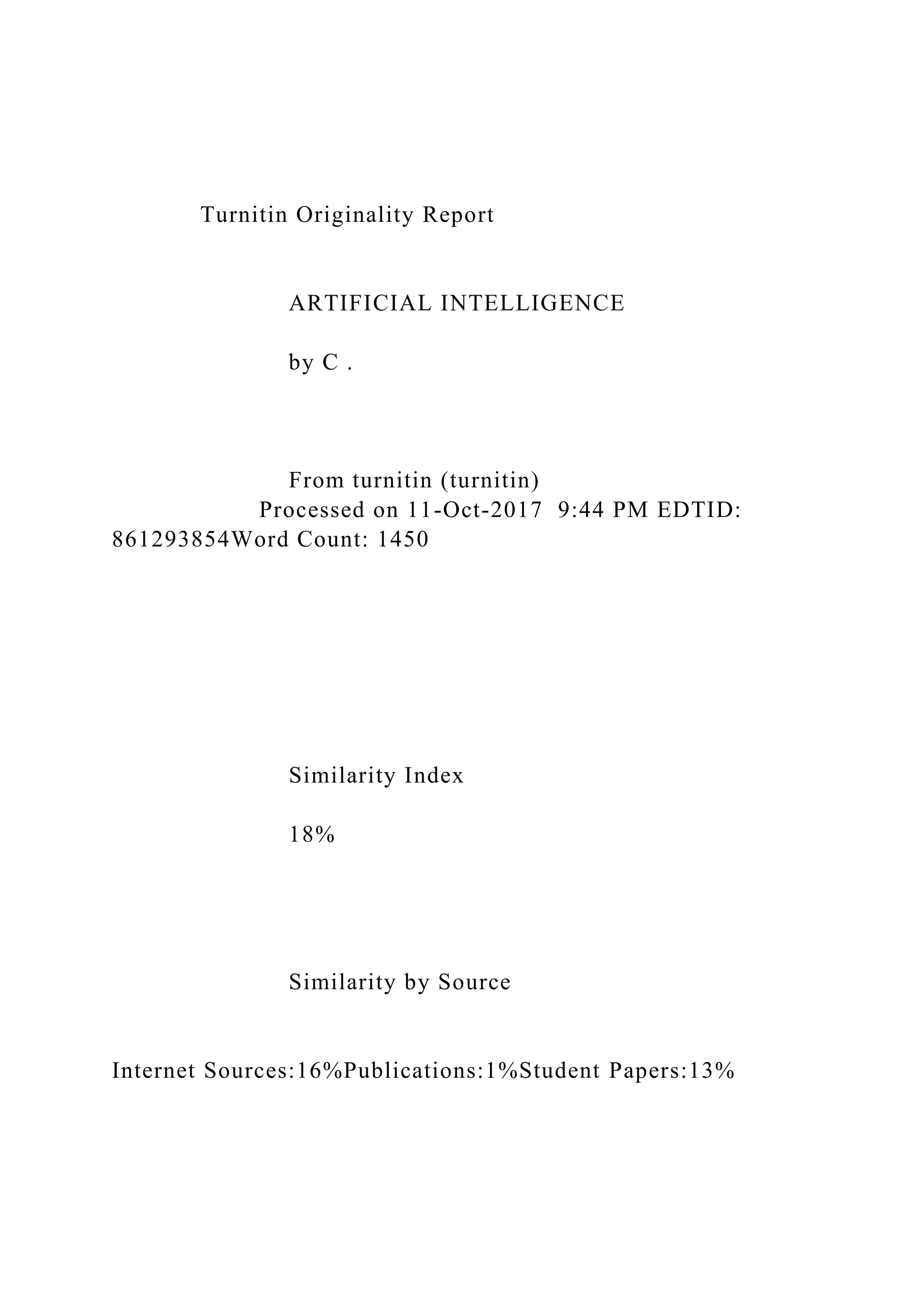
Turnitin Originality Report
ARTIFICIAL INTELLIGENCE
by C .
From turnitin (turnitin)
Processed on 11-Oct-2017 9:44 PM EDTID:
861293854Word Count: 1450
Similarity Index
18%
Similarity by Source
Internet Sources:16%Publications:1%Student Papers:13%
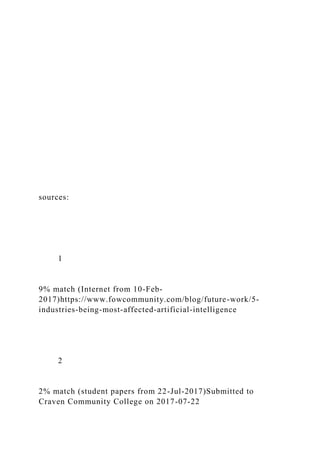
sources:
1
9% match (Internet from 10-Feb-
2017)https://www.fowcommunity.com/blog/future-work/5-
industries-being-most-affected-artificial-intelligence
2
2% match (student papers from 22-Jul-2017)Submitted to
Craven Community College on 2017-07-22
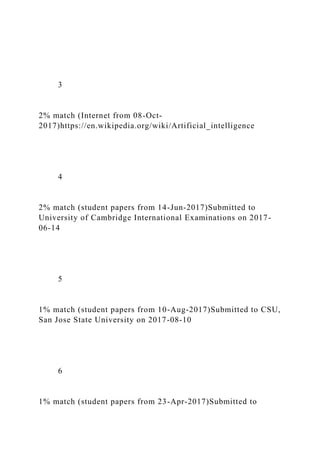
3
2% match (Internet from 08-Oct-
2017)https://en.wikipedia.org/wiki/Artificial_intelligence
4
2% match (student papers from 14-Jun-2017)Submitted to
University of Cambridge International Examinations on 2017-
06-14
5
1% match (student papers from 10-Aug-2017)Submitted to CSU,
San Jose State University on 2017-08-10
6
1% match (student papers from 23-Apr-2017)Submitted to
University College London on 2017-04-23
paper text:
ARTIFICIAL INTELLIGENCE Chen Yang Professor Quigley
10/14/17 Artificial intelligence Introduction In the world, things
might happen in two different ways. One way that things do
happen is natural and the other is the artificial. The natural is
whereby there is no control over that while on the artificial one
can be able to control and predetermine the outcome of the
event. The same applies when it comes to intelligence. There is
a natural intelligence and also artificial intelligence. This paper
talks about the artificial intelligence and its effects and some of
the effects that it can lead to if not well managed in the
industry. Artificial intelligence therefore can be described as
the apparent behavior 3by machines, rather than natural
intelligence of humans and other animals. In fact this
intelligence is done by use of machines where it is controlled
and one can be able to predetermine the outcome Also the
machines are given direction on how to carry out the research
(Kerr, 2016). When it comes to the field of computer science,
research that is carried out is usually 3defined as the study of
intelligent agents whereby it is any device that can be able to
perceive the environmental changes and be able to interpret the
changes and make some conclusion. In fact, 4the term artificial
intelligence is usually applied when a machine mimics cognitive
functions that humans associate with other human minds, such
as learning and problem solving. The artificial intelligence has
become the routine technology whereby the optical character
recognition is frequently not included. This 3artificial
intelligence was found as an academic discipline sometimes
back and has experienced some waves of optimism. There has
been several changes in the industry of artificial intelligence. In
the 21st century, the technology industry has helped in solving
many challenging problems in computer science hence the
artificial intelligence (Kerr, 2016). Industries to be affected by
artificial intelligence It may sound like science is helping the
world so much, 1but a world full of robots and artificial
intelligence is not right around the corner. In fact, many
industries today have turned to artificial intelligence. The rate
that the artificial intelligence is rising, it is estimated that by
the year 2029, it will have reached the level of human
intelligence (Strauss, 2016). The following industries have been
affected by the artificial intelligence: The first industry that has
been affected by the artificial intelligence is the healthcare. In
this industry, 1companies are harnessing the power of artificial
intelligence and they end up reaping great results. Doctor is
able to oversee several machines while performing different
tasks on human, and this make 1the cost much less than a
dedicated human anesthesiologist (Kerr, 2016). Also, at various
stages of testing and approval for diagnosing disease, there are
quite number of robots that perform that duty. The other
industry that is being affected by the artificial intelligence is
the manufacturing industry. This industry is the first one to
harness the use of 1robots to assemble products and package
them for shipment. In fact, the robots are assembling more
complicated products and this might take things to the next
level. Though the very artificial intelligence tools that are there
requires the 2human support and supervision, we are headed
towards a largely robotic manufacturing industry (Gurney,
2017). Transportation has been another industry that the
artificial intelligence is affecting very much. It is very populous
and very risky to be replaced by artificial intelligence. It is
believed to be the very safest industry when it will be replaced
by the artificial industry. The self-driven 1cars are in testing
and early production from companies like Google, Tesla and
Uber. They are expected to be out soon and be presented to the
market before the year 2020 (Strauss, 2016). Human beings
have become so lazy and things currently are changing. The
customer service industry is being affected by the artificial
intelligence. Currently, the artificial intelligence is more
efficient that using the customer care service. The services have
been automated and they are very fast unlike the human service
whereby they work according to the body state. The artificial
intelligence can 1mimic human speech patterns to provide
service that is quick and easy for consumers and much less
expensive for companies (Kerr, 2016). With the rapidly
increasing amount of financial data, many financial services
companies are turning to artificial intelligence to keep up with
demand. This means that the finance industry is being affected
by the artificial industry. Robots today are being used to predict
1systems and markets data to forecast stock trends and manage
finances, especially much quicker than human counterparts. In
fact, robots are able to 2use a variety of algorithms to provide
recommendations that best meet clients’ spending, saving and
investment habits. What the leading economists and tech
industries say about artificial intelligence Every time, human
beings try to improve the existing technology. In fact, human
beings do research on hoe best the new technology can be very
helpful when improvised. With the high rise in the artificial
intelligence, there are is so much that is being talked about on
artificial intelligence starting from the economists to the tech
industries. The economist say that the artificial intelligence is
very economic compared to the human output. The robots will
be able to perform a task that can require more than one human
to do the same task. With this argument, they claim that it will
lead to more savings. In fact, the economists are in the forefront
in supporting this move to the artificial intelligence (Gurney,
2017). The tech industry is very much committed to see an
introduction of better and improved robots that will be 99%
same as the human capability. The tech industry actually is
trying to see whether it can do away with human services and
get involved in the artificial intelligence. The tech industry is
arguing that the artificial intelligence is smart and very efficient
when under instructions and supervision from humans. Within a
short period, the tech industry is targeting to hit its objective
where most of the services will be computer generated and
replace the human services (Strauss, 2016). Though this will
happen, it have a great effect to the human nature. It will lead
to many being jobless and thus the poverty level will increase.
How will artificial intelligence affect the chose industries?
When it comes to the health industry, we know that this is very
sensitive sector and needs total seriousness. It is known that
humans are usually fond of errors and at times they do make
mistakes where are not needed. Introduction of technology will
effect the health industry positively though it will have some
negative effects. The robots or the machines used 1have a
higher accuracy rate for diagnoses than human doctors so the
accuracy will be ensure. The negative effect is that it will lead
to les doctors being employed. With manufacturing industry, the
number of employees will be retrenched to a small number. This
is a negative effect since it will make the employed to be
jobless (Gurney, 2017). In transportation industry, the
technology will have positive effect. It is known that most
accidents do occur due to human nature and errors (Strauss,
2016). It is believed that, if the self-driven cars start operating,
the number of accidents on the roads will be reduced by 99%.
When it comes to customer service industry, the technology will
lead to negative effects of retrenching some workers. Most
human beings have a problem when it comes to management of
finances, there is need for some machines to be there to take the
initiative of giving advice to people. Therefore, the robots will
really help, the people in making the right decisions with their
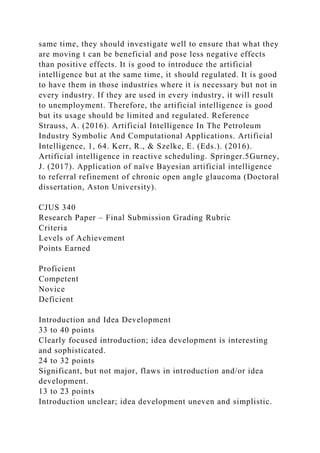
finance. What have learnt form the assignment? It is good for
people to transform from analogue to digital world but at the
same time, they should investigate well to ensure that what they
are moving t can be beneficial and pose less negative effects
than positive effects. It is good to introduce the artificial
intelligence but at the same time, it should regulated. It is good
to have them in those industries where it is necessary but not in
every industry. If they are used in every industry, it will result
to unemployment. Therefore, the artificial intelligence is good
but its usage should be limited and regulated. Reference
Strauss, A. (2016). Artificial Intelligence In The Petroleum
Industry Symbolic And Computational Applications. Artificial
Intelligence, 1, 64. Kerr, R., & Szelke, E. (Eds.). (2016).
Artificial intelligence in reactive scheduling. Springer.5Gurney,
J. (2017). Application of naïve Bayesian artificial intelligence
to referral refinement of chronic open angle glaucoma (Doctoral
dissertation, Aston University).
CJUS 340
Research Paper – Final Submission Grading Rubric
Criteria
Levels of Achievement
Points Earned
Proficient
Competent
Novice
Deficient
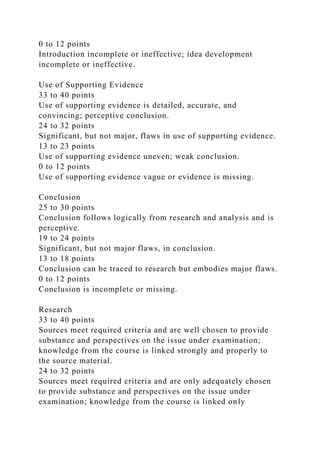
Introduction and Idea Development
33 to 40 points
Clearly focused introduction; idea development is interesting
and sophisticated.
24 to 32 points
Significant, but not major, flaws in introduction and/or idea
development.
13 to 23 points
Introduction unclear; idea development uneven and simplistic.
0 to 12 points
Introduction incomplete or ineffective; idea development
incomplete or ineffective.
Use of Supporting Evidence
33 to 40 points
Use of supporting evidence is detailed, accurate, and
convincing; perceptive conclusion.
24 to 32 points
Significant, but not major, flaws in use of supporting evidence.
13 to 23 points
Use of supporting evidence uneven; weak conclusion.
0 to 12 points
Use of supporting evidence vague or evidence is missing.
Conclusion
25 to 30 points
Conclusion follows logically from research and analysis and is
perceptive.
19 to 24 points
Significant, but not major flaws, in conclusion.
13 to 18 points
Conclusion can be traced to research but embodies major flaws.
0 to 12 points
Conclusion is incomplete or missing.
Research
33 to 40 points
Sources meet required criteria and are well chosen to provide
substance and perspectives on the issue under examination;
knowledge from the course is linked strongly and properly to
the source material.
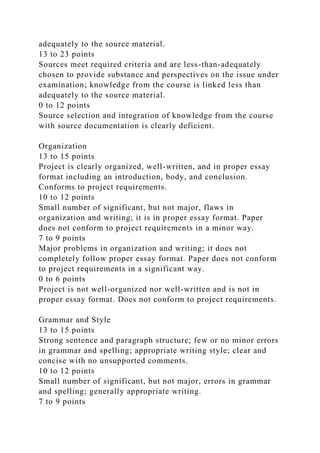
24 to 32 points
Sources meet required criteria and are only adequately chosen
to provide substance and perspectives on the issue under
examination; knowledge from the course is linked only
adequately to the source material.
13 to 23 points
Sources meet required criteria and are less-than-adequately
chosen to provide substance and perspectives on the issue under
examination; knowledge from the course is linked less than
adequately to the source material.
0 to 12 points
Source selection and integration of knowledge from the course
with source documentation is clearly deficient.
Organization
13 to 15 points
Project is clearly organized, well-written, and in proper essay
format including an introduction, body, and conclusion.
Conforms to project requirements.
10 to 12 points
Small number of significant, but not major, flaws in
organization and writing; it is in proper essay format. Paper
does not conform to project requirements in a minor way.
7 to 9 points
Major problems in organization and writing; it does not
completely follow proper essay format. Paper does not conform
to project requirements in a significant way.
0 to 6 points
Project is not well-organized nor well-written and is not in
proper essay format. Does not conform to project requirements.
Grammar and Style
13 to 15 points
Strong sentence and paragraph structure; few or no minor errors
in grammar and spelling; appropriate writing style; clear and
concise with no unsupported comments.
10 to 12 points
Small number of significant, but not major, errors in grammar
and spelling; generally appropriate writing.
7 to 9 points
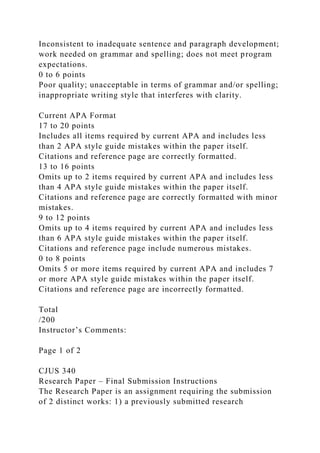
Inconsistent to inadequate sentence and paragraph development;
work needed on grammar and spelling; does not meet program
expectations.
0 to 6 points
Poor quality; unacceptable in terms of grammar and/or spelling;
inappropriate writing style that interferes with clarity.
Current APA Format
17 to 20 points
Includes all items required by current APA and includes less
than 2 APA style guide mistakes within the paper itself.
Citations and reference page are correctly formatted.
13 to 16 points
Omits up to 2 items required by current APA and includes less
than 4 APA style guide mistakes within the paper itself.
Citations and reference page are correctly formatted with minor
mistakes.
9 to 12 points
Omits up to 4 items required by current APA and includes less
than 6 APA style guide mistakes within the paper itself.
Citations and reference page include numerous mistakes.
0 to 8 points
Omits 5 or more items required by current APA and includes 7
or more APA style guide mistakes within the paper itself.
Citations and reference page are incorrectly formatted.
Total
/200
Instructor’s Comments:
Page 1 of 2
CJUS 340
Research Paper – Final Submission Instructions
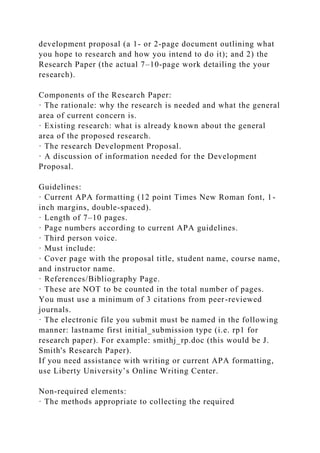
The Research Paper is an assignment requiring the submission
of 2 distinct works: 1) a previously submitted research
development proposal (a 1- or 2-page document outlining what
you hope to research and how you intend to do it); and 2) the
Research Paper (the actual 7–10-page work detailing the your
research).
Components of the Research Paper:
· The rationale: why the research is needed and what the general
area of current concern is.
· Existing research: what is already known about the general
area of the proposed research.
· The research Development Proposal.
· A discussion of information needed for the Development
Proposal.
Guidelines:
· Current APA formatting (12 point Times New Roman font, 1-
inch margins, double-spaced).
· Length of 7–10 pages.
· Page numbers according to current APA guidelines.
· Third person voice.
· Must include:
· Cover page with the proposal title, student name, course name,
and instructor name.
· References/Bibliography Page.
· These are NOT to be counted in the total number of pages.
You must use a minimum of 3 citations from peer-reviewed
journals.
· The electronic file you submit must be named in the following
manner: lastname first initial_submission type (i.e. rp1 for
research paper). For example: smithj_rp.doc (this would be J.
Smith's Research Paper).
If you need assistance with writing or current APA formatting,
use Liberty University’s Online Writing Center.
Non-required elements:
· The methods appropriate to collecting the required
information.
· The sources of information (size and type of sample, etc.).
· The timescale and sequence of various parts of the research.
· A statement of what you intend the outcomes to be (reports,
discussion papers, contributions to theory, materials, etc.).
· Description of who will do what and at what cost (if funding is
being sought).
Submit your Research Paper

Turnitin Originality Report .docx

  • 1.
    Turnitin Originality Report ARTIFICIALINTELLIGENCE by C . From turnitin (turnitin) Processed on 11-Oct-2017 9:44 PM EDTID: 861293854Word Count: 1450 Similarity Index 18% Similarity by Source Internet Sources:16%Publications:1%Student Papers:13%
  • 2.
    sources: 1 9% match (Internetfrom 10-Feb- 2017)https://www.fowcommunity.com/blog/future-work/5- industries-being-most-affected-artificial-intelligence 2 2% match (student papers from 22-Jul-2017)Submitted to Craven Community College on 2017-07-22
  • 3.
    3 2% match (Internetfrom 08-Oct- 2017)https://en.wikipedia.org/wiki/Artificial_intelligence 4 2% match (student papers from 14-Jun-2017)Submitted to University of Cambridge International Examinations on 2017- 06-14 5 1% match (student papers from 10-Aug-2017)Submitted to CSU, San Jose State University on 2017-08-10 6 1% match (student papers from 23-Apr-2017)Submitted to
  • 4.
    University College Londonon 2017-04-23 paper text: ARTIFICIAL INTELLIGENCE Chen Yang Professor Quigley 10/14/17 Artificial intelligence Introduction In the world, things might happen in two different ways. One way that things do happen is natural and the other is the artificial. The natural is whereby there is no control over that while on the artificial one can be able to control and predetermine the outcome of the event. The same applies when it comes to intelligence. There is a natural intelligence and also artificial intelligence. This paper talks about the artificial intelligence and its effects and some of the effects that it can lead to if not well managed in the industry. Artificial intelligence therefore can be described as the apparent behavior 3by machines, rather than natural intelligence of humans and other animals. In fact this intelligence is done by use of machines where it is controlled and one can be able to predetermine the outcome Also the machines are given direction on how to carry out the research (Kerr, 2016). When it comes to the field of computer science, research that is carried out is usually 3defined as the study of intelligent agents whereby it is any device that can be able to perceive the environmental changes and be able to interpret the changes and make some conclusion. In fact, 4the term artificial intelligence is usually applied when a machine mimics cognitive functions that humans associate with other human minds, such
  • 5.
    as learning andproblem solving. The artificial intelligence has become the routine technology whereby the optical character recognition is frequently not included. This 3artificial intelligence was found as an academic discipline sometimes back and has experienced some waves of optimism. There has been several changes in the industry of artificial intelligence. In the 21st century, the technology industry has helped in solving many challenging problems in computer science hence the artificial intelligence (Kerr, 2016). Industries to be affected by artificial intelligence It may sound like science is helping the world so much, 1but a world full of robots and artificial intelligence is not right around the corner. In fact, many industries today have turned to artificial intelligence. The rate that the artificial intelligence is rising, it is estimated that by the year 2029, it will have reached the level of human intelligence (Strauss, 2016). The following industries have been affected by the artificial intelligence: The first industry that has been affected by the artificial intelligence is the healthcare. In this industry, 1companies are harnessing the power of artificial intelligence and they end up reaping great results. Doctor is able to oversee several machines while performing different tasks on human, and this make 1the cost much less than a dedicated human anesthesiologist (Kerr, 2016). Also, at various stages of testing and approval for diagnosing disease, there are quite number of robots that perform that duty. The other industry that is being affected by the artificial intelligence is the manufacturing industry. This industry is the first one to harness the use of 1robots to assemble products and package them for shipment. In fact, the robots are assembling more complicated products and this might take things to the next level. Though the very artificial intelligence tools that are there requires the 2human support and supervision, we are headed towards a largely robotic manufacturing industry (Gurney, 2017). Transportation has been another industry that the artificial intelligence is affecting very much. It is very populous and very risky to be replaced by artificial intelligence. It is
  • 6.
    believed to bethe very safest industry when it will be replaced by the artificial industry. The self-driven 1cars are in testing and early production from companies like Google, Tesla and Uber. They are expected to be out soon and be presented to the market before the year 2020 (Strauss, 2016). Human beings have become so lazy and things currently are changing. The customer service industry is being affected by the artificial intelligence. Currently, the artificial intelligence is more efficient that using the customer care service. The services have been automated and they are very fast unlike the human service whereby they work according to the body state. The artificial intelligence can 1mimic human speech patterns to provide service that is quick and easy for consumers and much less expensive for companies (Kerr, 2016). With the rapidly increasing amount of financial data, many financial services companies are turning to artificial intelligence to keep up with demand. This means that the finance industry is being affected by the artificial industry. Robots today are being used to predict 1systems and markets data to forecast stock trends and manage finances, especially much quicker than human counterparts. In fact, robots are able to 2use a variety of algorithms to provide recommendations that best meet clients’ spending, saving and investment habits. What the leading economists and tech industries say about artificial intelligence Every time, human beings try to improve the existing technology. In fact, human beings do research on hoe best the new technology can be very helpful when improvised. With the high rise in the artificial intelligence, there are is so much that is being talked about on artificial intelligence starting from the economists to the tech industries. The economist say that the artificial intelligence is very economic compared to the human output. The robots will be able to perform a task that can require more than one human to do the same task. With this argument, they claim that it will lead to more savings. In fact, the economists are in the forefront in supporting this move to the artificial intelligence (Gurney, 2017). The tech industry is very much committed to see an
  • 7.
    introduction of betterand improved robots that will be 99% same as the human capability. The tech industry actually is trying to see whether it can do away with human services and get involved in the artificial intelligence. The tech industry is arguing that the artificial intelligence is smart and very efficient when under instructions and supervision from humans. Within a short period, the tech industry is targeting to hit its objective where most of the services will be computer generated and replace the human services (Strauss, 2016). Though this will happen, it have a great effect to the human nature. It will lead to many being jobless and thus the poverty level will increase. How will artificial intelligence affect the chose industries? When it comes to the health industry, we know that this is very sensitive sector and needs total seriousness. It is known that humans are usually fond of errors and at times they do make mistakes where are not needed. Introduction of technology will effect the health industry positively though it will have some negative effects. The robots or the machines used 1have a higher accuracy rate for diagnoses than human doctors so the accuracy will be ensure. The negative effect is that it will lead to les doctors being employed. With manufacturing industry, the number of employees will be retrenched to a small number. This is a negative effect since it will make the employed to be jobless (Gurney, 2017). In transportation industry, the technology will have positive effect. It is known that most accidents do occur due to human nature and errors (Strauss, 2016). It is believed that, if the self-driven cars start operating, the number of accidents on the roads will be reduced by 99%. When it comes to customer service industry, the technology will lead to negative effects of retrenching some workers. Most human beings have a problem when it comes to management of finances, there is need for some machines to be there to take the initiative of giving advice to people. Therefore, the robots will really help, the people in making the right decisions with their finance. What have learnt form the assignment? It is good for people to transform from analogue to digital world but at the
  • 8.
    same time, theyshould investigate well to ensure that what they are moving t can be beneficial and pose less negative effects than positive effects. It is good to introduce the artificial intelligence but at the same time, it should regulated. It is good to have them in those industries where it is necessary but not in every industry. If they are used in every industry, it will result to unemployment. Therefore, the artificial intelligence is good but its usage should be limited and regulated. Reference Strauss, A. (2016). Artificial Intelligence In The Petroleum Industry Symbolic And Computational Applications. Artificial Intelligence, 1, 64. Kerr, R., & Szelke, E. (Eds.). (2016). Artificial intelligence in reactive scheduling. Springer.5Gurney, J. (2017). Application of naïve Bayesian artificial intelligence to referral refinement of chronic open angle glaucoma (Doctoral dissertation, Aston University). CJUS 340 Research Paper – Final Submission Grading Rubric Criteria Levels of Achievement Points Earned Proficient Competent Novice Deficient Introduction and Idea Development 33 to 40 points Clearly focused introduction; idea development is interesting and sophisticated. 24 to 32 points Significant, but not major, flaws in introduction and/or idea development. 13 to 23 points Introduction unclear; idea development uneven and simplistic.
  • 9.
    0 to 12points Introduction incomplete or ineffective; idea development incomplete or ineffective. Use of Supporting Evidence 33 to 40 points Use of supporting evidence is detailed, accurate, and convincing; perceptive conclusion. 24 to 32 points Significant, but not major, flaws in use of supporting evidence. 13 to 23 points Use of supporting evidence uneven; weak conclusion. 0 to 12 points Use of supporting evidence vague or evidence is missing. Conclusion 25 to 30 points Conclusion follows logically from research and analysis and is perceptive. 19 to 24 points Significant, but not major flaws, in conclusion. 13 to 18 points Conclusion can be traced to research but embodies major flaws. 0 to 12 points Conclusion is incomplete or missing. Research 33 to 40 points Sources meet required criteria and are well chosen to provide substance and perspectives on the issue under examination; knowledge from the course is linked strongly and properly to the source material. 24 to 32 points Sources meet required criteria and are only adequately chosen to provide substance and perspectives on the issue under examination; knowledge from the course is linked only
  • 10.
    adequately to thesource material. 13 to 23 points Sources meet required criteria and are less-than-adequately chosen to provide substance and perspectives on the issue under examination; knowledge from the course is linked less than adequately to the source material. 0 to 12 points Source selection and integration of knowledge from the course with source documentation is clearly deficient. Organization 13 to 15 points Project is clearly organized, well-written, and in proper essay format including an introduction, body, and conclusion. Conforms to project requirements. 10 to 12 points Small number of significant, but not major, flaws in organization and writing; it is in proper essay format. Paper does not conform to project requirements in a minor way. 7 to 9 points Major problems in organization and writing; it does not completely follow proper essay format. Paper does not conform to project requirements in a significant way. 0 to 6 points Project is not well-organized nor well-written and is not in proper essay format. Does not conform to project requirements. Grammar and Style 13 to 15 points Strong sentence and paragraph structure; few or no minor errors in grammar and spelling; appropriate writing style; clear and concise with no unsupported comments. 10 to 12 points Small number of significant, but not major, errors in grammar and spelling; generally appropriate writing. 7 to 9 points
  • 11.
    Inconsistent to inadequatesentence and paragraph development; work needed on grammar and spelling; does not meet program expectations. 0 to 6 points Poor quality; unacceptable in terms of grammar and/or spelling; inappropriate writing style that interferes with clarity. Current APA Format 17 to 20 points Includes all items required by current APA and includes less than 2 APA style guide mistakes within the paper itself. Citations and reference page are correctly formatted. 13 to 16 points Omits up to 2 items required by current APA and includes less than 4 APA style guide mistakes within the paper itself. Citations and reference page are correctly formatted with minor mistakes. 9 to 12 points Omits up to 4 items required by current APA and includes less than 6 APA style guide mistakes within the paper itself. Citations and reference page include numerous mistakes. 0 to 8 points Omits 5 or more items required by current APA and includes 7 or more APA style guide mistakes within the paper itself. Citations and reference page are incorrectly formatted. Total /200 Instructor’s Comments: Page 1 of 2 CJUS 340 Research Paper – Final Submission Instructions The Research Paper is an assignment requiring the submission of 2 distinct works: 1) a previously submitted research
  • 12.
    development proposal (a1- or 2-page document outlining what you hope to research and how you intend to do it); and 2) the Research Paper (the actual 7–10-page work detailing the your research). Components of the Research Paper: · The rationale: why the research is needed and what the general area of current concern is. · Existing research: what is already known about the general area of the proposed research. · The research Development Proposal. · A discussion of information needed for the Development Proposal. Guidelines: · Current APA formatting (12 point Times New Roman font, 1- inch margins, double-spaced). · Length of 7–10 pages. · Page numbers according to current APA guidelines. · Third person voice. · Must include: · Cover page with the proposal title, student name, course name, and instructor name. · References/Bibliography Page. · These are NOT to be counted in the total number of pages. You must use a minimum of 3 citations from peer-reviewed journals. · The electronic file you submit must be named in the following manner: lastname first initial_submission type (i.e. rp1 for research paper). For example: smithj_rp.doc (this would be J. Smith's Research Paper). If you need assistance with writing or current APA formatting, use Liberty University’s Online Writing Center. Non-required elements: · The methods appropriate to collecting the required
  • 13.
    information. · The sourcesof information (size and type of sample, etc.). · The timescale and sequence of various parts of the research. · A statement of what you intend the outcomes to be (reports, discussion papers, contributions to theory, materials, etc.). · Description of who will do what and at what cost (if funding is being sought). Submit your Research Paper