Dec. 11 2010 College of Governance, Business & Economics Department of Business Administration FINANCIAL MANAGEMENT Prof. R. Gabuya  ahYan Pegason Atty. DarwinTenaja
overview Data Funders Order Management Did u know Order Management Cycle Strategic Information System Succeed Online The OMC E.g.
Successful Online IT Competitive Intelligence E.g. using Porter’s Model Strategic IT Planning Global Competition Customer Service Customer Relation Mgt. 4 steps in implementing CRM overview
overview 3 levels of a product 4 distinct dimension of CS Founder of Facebook Y used FB Issues pertaining to online profiles: Surveys, Top sites &  aYn 5 I’s about FB Video clips (2) & S.I.L.
Data a collection of facts from which conclusions may be drawn. One possible conclusion: your organization deserves  some money!
The best appeals for funding, whether to an individual or a foundation, are based in fact. Most importantly, funders must know that the community your program serves is in need. It is that community need that sets a tone of  empathy  and  urgency  to support the programs you provide. However, data to support these statements of need are often missing or not well-articulated when speaking with or writing to funders. Sample Needs Statement Without Data
Order management  means many things to many people. Given the level of business complexity, requirement for cross-functional processes, and the need to leverage existing investments, enterprises seek a common definition which encapsulates the opportunity-to-cash process. Common definition for order management cycle (OMC)  provides a framework for evaluation  and  discussion among vendors and enterprises . Key components in OMC include order channels, presentation framework, business process modules, core application foundation, and data and infrastructure. As enterprises make the  shift from functional silos to cross-business enterprises , the challenge is to find one vendor that can deliver a complete OMC solution.
Did you know OVER 70% of consumers start their search for information on home improvements by visiting the Internet first? Wow!!!!
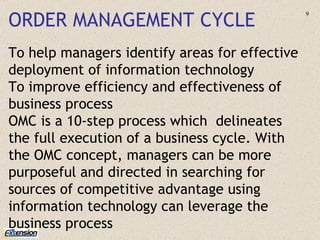
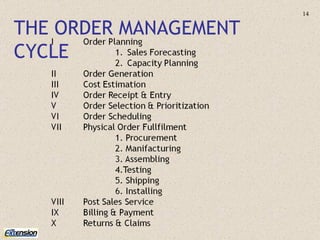
ORDER MANAGEMENT CYCLE To help managers identify areas for effective deployment of information technology  To improve efficiency and effectiveness of business process OMC is a 10-step process which  delineates the full execution of a business cycle. With the OMC concept, managers can be more purposeful and directed in searching for sources of competitive advantage using information technology can leverage the business process
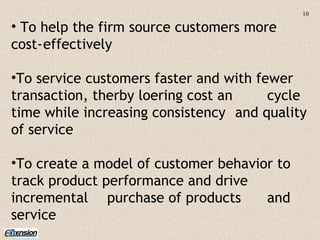
To help the firm source customers more  cost- effectively  To service customers faster and with fewer  transaction, therby loering cost an  cycle time while increasing consistency  and quality of service To create a model of customer behavior to  track product performance and drive  incremental  purchase of products  and service
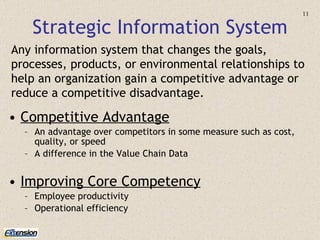
Strategic Information System Competitive Advantage An advantage over competitors in some measure such as cost, quality, or speed A difference in the Value Chain Data Improving Core Competency Employee productivity Operational efficiency Any information system   that changes the goals, processes, products, or environmental relationships to help an organization gain a competitive advantage or reduce a competitive disadvantage.
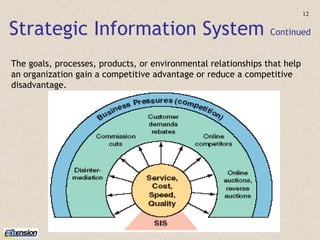
Strategic Information System  Continued The goals, processes, products, or environmental relationships that help an organization gain a competitive advantage or reduce a competitive disadvantage.
THE ORDER MANAGEMENT CYCLE
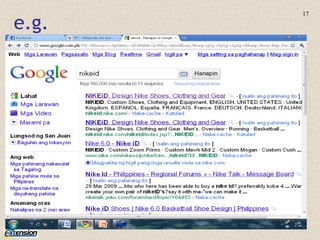
e.g.
Information Technology  – Supports Strategic Management Innovative applications:   Create innovative applications that provide direct strategic advantage to organizations. Competitive weapons:   Information systems themselves are recognized as a competitive weapon Changes in processes:   IT supports changes in business processes that translate to strategic advantage Links with business partners:   IT links a company with its business partners effectively and efficiently .
MSIS 5623 Chapter 12 Cost reductions:   IT enables companies to reduce costs. Relationships with suppliers and customers:   IT can be used to lock in suppliers and customers, or to build in switching costs. New products:   A firm can leverage its investment in IT to create new products that are in demand in the marketplace. Competitive intelligence:   IT provides competitive (business) intelligence by collecting and analyzing information about products, markets, competitors, and environmental changes   .  Information Technology  – Supports Strategic Management
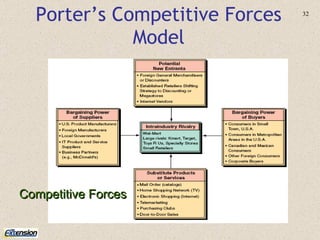
Competitive Intelligence Such information-gathering drives business performance  by increasing market knowledge  improving knowledge management   raising the quality of strategic planning One of the most important aspects in developing a competitive advantage is to acquire information on the activities and actions of competitors. However once the data has been gathered it must be processed into information and subsequently business intelligence.  Porters 5 Forces  is a well-known framework that aids in this analysis.
Porter’s Competitive Forces Model Competitive Forces
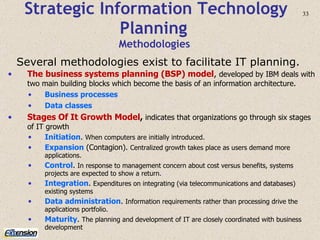
Strategic Information Technology Planning   Methodologies   The   business systems   planning (BSP) model ,  developed by IBM deals with two main building blocks which become the basis of an information architecture. Business processes  Data classes Stages Of It Growth Model ,  indicates that organizations go through six stages of IT growth Initiation .  When computers are initially introduced. Expansion  (Contagion).  Centralized growth takes place as users demand more applications. Control .  In response to management concern about cost versus benefits, systems projects are expected to show a return. Integration .  Expenditures on integrating (via telecommunications and databases) existing systems Data administration .  Information requirements rather than processing drive the applications portfolio. Maturity .   The planning and development of IT are closely coordinated with business development Several methodologies exist to facilitate IT planning.
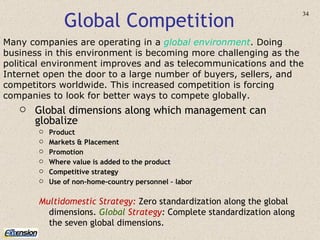
Global Competition Many companies are operating in a  global environment .   Doing business in this environment is becoming more challenging as the political environment improves and as telecommunications and the Internet open the door to a large number of buyers, sellers, and competitors worldwide. This increased competition is forcing companies to look for better ways to compete globally. Global dimensions along which management can globalize Product Markets & Placement Promotion Where value is added to the product Competitive strategy Use of non-home-country personnel – labor Multidomestic Strategy:   Zero standardization along the global dimensions.  Global  Strategy :  Complete standardization along the seven global dimensions.
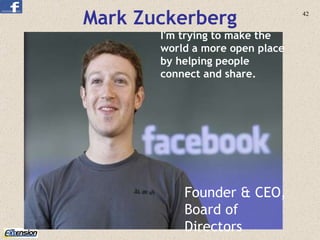
Mark Zuckerberg Founder & CEO, Board of Directors I'm trying to make the world a more open place by helping people connect and share.
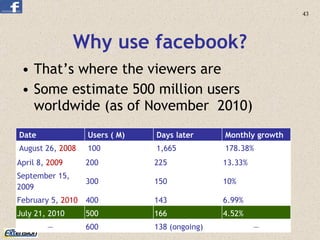
Why use facebook? That’s where the viewers are Some estimate 500 million users worldwide (as of November  2010)  Date Users ( M) Days later Monthly growth August 26,  2008 100 1,665 178.38% April 8,  2009 200 225 13.33% September 15, 2009 300 150 10% February 5,  2010 400 143 6.99% July 21, 2010 500 166 4.52% — 600 138 (ongoing) —
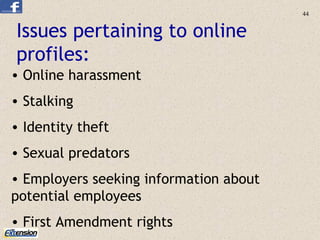
Issues pertaining to online profiles: Online harassment Stalking  Identity theft Sexual predators Employers seeking information about  potential employees First Amendment rights
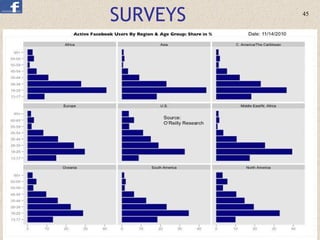
SURVEYS
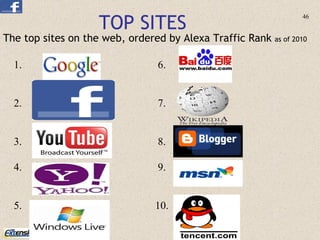
TOP SITES The top sites on the web, ordered by Alexa Traffic Rank  as of 2010  1. 2. 3. 4. 5. 6. 7. 8. 9. 10.
ntegrating nnovating nteracting nteresting nspiring
Success leads to both personal and  legal  complications
: )
 
Turning data into $

Turning data into $

  • 1.
    Dec. 11 2010College of Governance, Business & Economics Department of Business Administration FINANCIAL MANAGEMENT Prof. R. Gabuya ahYan Pegason Atty. DarwinTenaja
  • 2.
    overview Data FundersOrder Management Did u know Order Management Cycle Strategic Information System Succeed Online The OMC E.g.
  • 3.
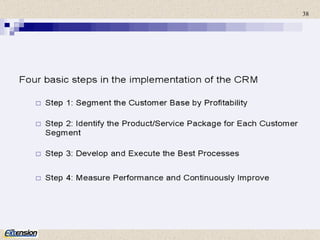
    Successful Online ITCompetitive Intelligence E.g. using Porter’s Model Strategic IT Planning Global Competition Customer Service Customer Relation Mgt. 4 steps in implementing CRM overview
  • 4.
    overview 3 levelsof a product 4 distinct dimension of CS Founder of Facebook Y used FB Issues pertaining to online profiles: Surveys, Top sites & aYn 5 I’s about FB Video clips (2) & S.I.L.
  • 5.
    Data a collectionof facts from which conclusions may be drawn. One possible conclusion: your organization deserves some money!
  • 6.
    The best appealsfor funding, whether to an individual or a foundation, are based in fact. Most importantly, funders must know that the community your program serves is in need. It is that community need that sets a tone of empathy and urgency to support the programs you provide. However, data to support these statements of need are often missing or not well-articulated when speaking with or writing to funders. Sample Needs Statement Without Data
  • 7.
    Order management means many things to many people. Given the level of business complexity, requirement for cross-functional processes, and the need to leverage existing investments, enterprises seek a common definition which encapsulates the opportunity-to-cash process. Common definition for order management cycle (OMC) provides a framework for evaluation and discussion among vendors and enterprises . Key components in OMC include order channels, presentation framework, business process modules, core application foundation, and data and infrastructure. As enterprises make the shift from functional silos to cross-business enterprises , the challenge is to find one vendor that can deliver a complete OMC solution.
  • 8.
    Did you knowOVER 70% of consumers start their search for information on home improvements by visiting the Internet first? Wow!!!!
  • 9.
    ORDER MANAGEMENT CYCLETo help managers identify areas for effective deployment of information technology To improve efficiency and effectiveness of business process OMC is a 10-step process which delineates the full execution of a business cycle. With the OMC concept, managers can be more purposeful and directed in searching for sources of competitive advantage using information technology can leverage the business process
  • 10.
    To help thefirm source customers more cost- effectively To service customers faster and with fewer transaction, therby loering cost an cycle time while increasing consistency and quality of service To create a model of customer behavior to track product performance and drive incremental purchase of products and service
  • 11.
    Strategic Information SystemCompetitive Advantage An advantage over competitors in some measure such as cost, quality, or speed A difference in the Value Chain Data Improving Core Competency Employee productivity Operational efficiency Any information system that changes the goals, processes, products, or environmental relationships to help an organization gain a competitive advantage or reduce a competitive disadvantage.
  • 12.
    Strategic Information System Continued The goals, processes, products, or environmental relationships that help an organization gain a competitive advantage or reduce a competitive disadvantage.
  • 14.
  • 17.
  • 29.
    Information Technology – Supports Strategic Management Innovative applications: Create innovative applications that provide direct strategic advantage to organizations. Competitive weapons: Information systems themselves are recognized as a competitive weapon Changes in processes: IT supports changes in business processes that translate to strategic advantage Links with business partners: IT links a company with its business partners effectively and efficiently .
  • 30.
    MSIS 5623 Chapter12 Cost reductions: IT enables companies to reduce costs. Relationships with suppliers and customers: IT can be used to lock in suppliers and customers, or to build in switching costs. New products: A firm can leverage its investment in IT to create new products that are in demand in the marketplace. Competitive intelligence: IT provides competitive (business) intelligence by collecting and analyzing information about products, markets, competitors, and environmental changes . Information Technology – Supports Strategic Management
  • 31.
    Competitive Intelligence Suchinformation-gathering drives business performance by increasing market knowledge improving knowledge management raising the quality of strategic planning One of the most important aspects in developing a competitive advantage is to acquire information on the activities and actions of competitors. However once the data has been gathered it must be processed into information and subsequently business intelligence. Porters 5 Forces is a well-known framework that aids in this analysis.
  • 32.
    Porter’s Competitive ForcesModel Competitive Forces
  • 33.
    Strategic Information TechnologyPlanning Methodologies The business systems planning (BSP) model , developed by IBM deals with two main building blocks which become the basis of an information architecture. Business processes Data classes Stages Of It Growth Model , indicates that organizations go through six stages of IT growth Initiation . When computers are initially introduced. Expansion (Contagion). Centralized growth takes place as users demand more applications. Control . In response to management concern about cost versus benefits, systems projects are expected to show a return. Integration . Expenditures on integrating (via telecommunications and databases) existing systems Data administration . Information requirements rather than processing drive the applications portfolio. Maturity . The planning and development of IT are closely coordinated with business development Several methodologies exist to facilitate IT planning.
  • 34.
    Global Competition Manycompanies are operating in a global environment . Doing business in this environment is becoming more challenging as the political environment improves and as telecommunications and the Internet open the door to a large number of buyers, sellers, and competitors worldwide. This increased competition is forcing companies to look for better ways to compete globally. Global dimensions along which management can globalize Product Markets & Placement Promotion Where value is added to the product Competitive strategy Use of non-home-country personnel – labor Multidomestic Strategy: Zero standardization along the global dimensions. Global Strategy : Complete standardization along the seven global dimensions.
  • 42.
    Mark Zuckerberg Founder& CEO, Board of Directors I'm trying to make the world a more open place by helping people connect and share.
  • 43.
    Why use facebook?That’s where the viewers are Some estimate 500 million users worldwide (as of November 2010) Date Users ( M) Days later Monthly growth August 26, 2008 100 1,665 178.38% April 8, 2009 200 225 13.33% September 15, 2009 300 150 10% February 5, 2010 400 143 6.99% July 21, 2010 500 166 4.52% — 600 138 (ongoing) —
  • 44.
    Issues pertaining toonline profiles: Online harassment Stalking Identity theft Sexual predators Employers seeking information about potential employees First Amendment rights
  • 45.
  • 46.
    TOP SITES Thetop sites on the web, ordered by Alexa Traffic Rank as of 2010 1. 2. 3. 4. 5. 6. 7. 8. 9. 10.
  • 47.
  • 48.
    Success leads toboth personal and legal complications
  • 49.
  • 50.