

















TUHAF UL-UQOUL

                         THE MASTERPIECES OF THE MIND


                                   Compiler:


         Abu Mohammed Al-Hasan bin Ali bin Al-Hussein
                  bin Shu’ba Al-Harrani


                                   Translator:


                                  Badr Shahin
Presented by www.ziaraat.com
IN THE NAME OF ALLAH


                  THE COMPASSIONATE THE MERCIFUL


Presented by www.ziaraat.com
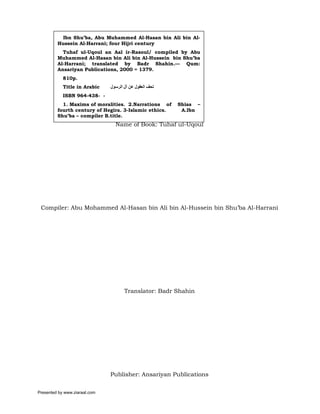
Ibn Shu’ba, Abu Muhammed Al-Hasan bin Ali bin Al-
         Hussein Al-Harrani; four Hijri century
           Tuhaf ul-Uqoul an Aal ir-Rasoul/ compiled by Abu
         Muhammed Al-Hasan bin Ali bin Al-Hussein bin Shu’ba
         Al-Harrani; translated by Badr Shahin.— Qum:
         Ansariyan Publications, 2000 = 1379.
            810p.
            Title in Arabic    ‫ﺗﺤﻒ اﻟﻌﻘﻮل ﻋﻦ ﺁل اﻟﺮﺳﻮل‬
            ISBN 964-438- -
           1. Maxims of moralities. 2.Narrations of      Shias –
         fourth century of Hegira. 3-Islamic ethics.      A.Ibn
                                  ‫ﺗﺤﻒ اﻟﻌﻘﻮل ﻋﻦ ﺁل اﻟﺮﺳﻮل‬
         Shu’ba – compiler B.title.
                                 Name of Book: Tuhaf ul-Uqoul


 Compiler: Abu Mohammed Al-Hasan bin Ali bin Al-Hussein bin Shu’ba Al-Harrani


                                      Translator: Badr Shahin


                               Publisher: Ansariyan Publications

Presented by www.ziaraat.com
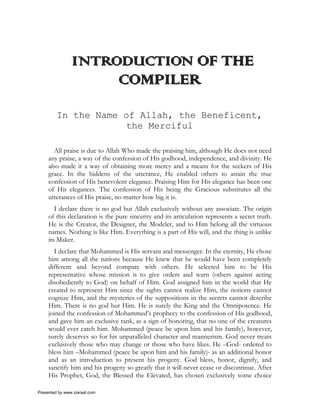
INTRODUCTION OF THE
                                 COMPILER
         In the Name of Allah, the Beneficent,
                      the Merciful

       All praise is due to Allah Who made the praising him, although He does not need
     any praise, a way of the confession of His godhood, independence, and divinity. He
     also made it a way of obtaining more mercy and a means for the seekers of His
     grace. In the hiddens of the utterance, He enabled others to attain the true
     confession of His benevolent elegance. Praising Him for His elegance has been one
     of His elegances. The confession of His being the Gracious substitutes all the
     utterances of His praise, no matter how big it is.
        I declare there is no god but Allah exclusively without any associate. The origin
     of this declaration is the pure sincerity and its articulation represents a secret truth.
     He is the Creator, the Designer, the Modeler, and to Him belong all the virtuous
     names. Nothing is like Him. Everything is a part of His will, and the thing is unlike
     its Maker.
       I declare that Mohammed is His servant and messenger. In the eternity, He chose
     him among all the nations because He knew that he would have been completely
     different and beyond compare with others. He selected him to be His
     representative whose mission is to give orders and warn (others against acting
     disobediently to God) on behalf of Him. God assigned him in the world that He
     created to represent Him since the sights cannot realize Him, the notions cannot
     cognize Him, and the mysteries of the suppositions in the secrets cannot describe
     Him. There is no god but Him. He is surely the King and the Omnipotence. He
     joined the confession of Mohammed’s prophecy to the confession of His godhood,
     and gave him an exclusive rank, as a sign of honoring, that no one of the creatures
     would ever catch him. Mohammed (peace be upon him and his family), however,
     surely deserves so for his unparalleled character and mannerism. God never treats
     exclusively those who may change or those who have likes. He –God- ordered to
     bless him –Mohammed (peace be upon him and his family)- as an additional honor
     and as an introduction to present his progeny. God bless, honor, dignify, and
     sanctify him and his progeny so greatly that it will never cease or discontinue. After
     His Prophet, God, the Blessed the Elevated, has chosen exclusively some choice

Presented by www.ziaraat.com
ones whom He elevated out of His elevation, took them highly to the rank of His
     elation, and made them the heralds and the guides to Him. They have been sinless,
     virtuous, and perfect imams whom God has made the claims against the creatures
     and chosen as His heralds. By His permission, they are the interceders who never
     precede Him in speech and according to His commandment only do they act. They
     judge according to His rules, follow His regulations, execute the doctrinal
     provisions that He constitutes, and fulfill the incumbent rituals (that He imposed)
     so that he who would perish will perish by a clear proof and he who would live will
     live by a clear proof. The blessings of God and the noble angels be upon
     Mohammed and his virtuous progeny.
        As I looked deeply and carefully in the (verbal) traditions that we have received
     from the Prophet, his successor, and their sons (All peace, mercy, and blessings be
     upon them), I could conclude that we have received only a few of what they had
     actually said. It is surely very few if compared with what they had said but we could
     not receive. I could understand that these traditions contain the worldly and the
     religious affairs and join the good of this life and the life to come. The truth is
     found only with them individually, the right is taken only from them separately, and
     the veracity is seen only with them exclusively. Besides, I noticed that the former
     Shiite scholars had compiled their sayings regarding the legal and the illegal matters
     in addition to the obligatory rituals and the recommendable practices. God will
     surely record the rewards of these compilations that sufficed the next generations
     from shouldering the burdens of compilation. I could notice excellent words of
     wisdom and curative sermons that are within the instructions of the Imams (peace
     be upon them). These words urge desiring for what will permanently remain and
     leaving what will eventually expire. They also bear good tidings, threatening,
     encouragement on the good traits and manners, warning against the ill manners,
     motivation to the religiosity, and driving to abstinence. I also found that they
     (peace be upon them) had referred to many sentences regarding the previous
     aspects through their prolonged commandments, speeches, sermons, and advises.
     The relaters have likewise reported many short words of unparalleled references to
     these meanings and advantageous significances. I have not received any book that
     our Shiite scholars have authored regarding these meanings so that I might pursue
     its way of compilation and with which I might satisfy myself. Thus, I compiled the
     words of such meanings and added to them their likes and matches from the
     fascinating reports and the good indications, seeking the favor of God, the Worthy
     of exalted praise, and asking for His rewards. I applied these words of wisdom,
     maxims, and instructions to myself first. This is because I hope for obtaining the
     rewards and I fear the penalty. Likewise, these words and maxims would alert me in
     the times of inadvertence and remind me in the times of oblivion. I also expected
     that a faithful believer would look in them –after I would compile them in this
     book- and learn lessons from the maxims that he would understand and benefit by
     what he does not understand exactly. Hence, I will have a share in the rewards that
     he will get for his applying what he has learnt, since these words and maxims
     contain the principals as well as the secondary pillars of the religion in addition to

Presented by www.ziaraat.com
the chapters and the general affairs of the right. They also comprise the general
     ethics of the Sunna, the words of wisdom and deeds of the Imams (peace be upon
     them), the admirable advantages, and the excellent reports. I arranged the book
     according to the succession of the Imams (peace be upon them) before I moved to
     mention four commandments that conform to the book. I neglected the series of
     relations for simplification and brief. However, most of the reports have been
     received directly because they are words of ethics and wisdom that they themselves
     witness their veracity. I did not compile this work for the dissidents and those who
     deny (the divine ranks of the Imams, peace be upon them), but I compile it for the
     use of the believers, who succumb to the Imams (peace be upon them), confess of
     their (supreme) standings, accede to their sayings, and refer to them in questions.
     These meanings are too many to be counted and too wide to be banned. What we
     have previously mentioned is completely persuasive for those who have a heart or
     listen carefully. It is also sufficient for those who have minds.
       O followers of the Imams, Look deeply in what your Imams (peace be upon
     them) said and what they recommended and advised. Look at these matters in the
     eyes of your hearts, listen to them in opened ears, and understand them with what
     God has given to you and made the claims against you: your sound minds and
     accurate comprehensions. Do not be like your opponents who hear the binding
     evidences and the eloquent proofs, but they look at them negligently, and like their
     eloquence only. They do not benefit by the admonition. Furthermore, they neither
     desire for that which God drives to nor do they stop committing the matters
     against which they are warned. They are condemned by clear evidence and,
     therefore, their grief will be endless.
       O believers, Cling firmly to what has come to you from those whose obedience is
     obligatory upon you (namely the Imams, peace be upon them). Listen to and
     comply with the maxims and words that the trusty narrators have related to the
     master Imams (peace be upon them). Beware of being negligent and confess of
     your imperfection.
       O believers, Work hard for seeking the knowledge of that which you ignore and
     apply that which you know to your conducts so that your words will always agree
     to your deeds. The salvation and the good life are obtained only by means of the
     instructions of the Imams (peace be upon them) through whom God has
     constituted the claim, showed the very (right) path, and blocked any excuse. They
     ordered to take all of the courses that take to God, recommended to adhere to all
     of the reasons that lead to His contentment, and referred to all of the ways that
     carry to Paradise. They defined these ways and reasons publicly and secretly and
     showed them openly and suggestively. They warned against any trend that leads to
     acts of disobedience to God, approximates to His wrath, and nears to His
     punishment. They showed these trends and warned people against them so that
     people will not have a justifiable excuse before God. The very happy is he whom
     God leads to follow, pursue, and accede to their sayings. The very unhappy is he
     who opposes them, pursues another course, and leaves them intentionally. They -

Presented by www.ziaraat.com
the Imams (peace be upon him)- are surely the firmest handle and the bond of God
     that the Messenger of God (peace be upon him and his family) ordered us to cling
     to them. They are also the ship of salvation and the authorized persons whom God
     ordered us t obey. God says:
      O you who believe, Obey God and obey the Apostle and those in
     authority from among you; then if you quarrel about anything, refer it to
     God and the Apostle, if you believe in God and the last day; this is better
     and very good in the end.1
       They are also the true ones whom God ordained us to be with. He, the Exalted,
     says:
       O you who believe, Be careful of (your duty to) God and be with the
     true ones.2
        Strive, O you believers, in carrying out whatever they –the Imams (peace be upon
     them)- ordered, no matter how small or big it is, and beware of whatever they
     warned against, no matter how small or big it is. He who clings to the small matters
     will surely advance to the big ones. Likewise, he whoever commits few sins will
     surely commit many. It is said, “Beware of the insignificant sins. They are the wish
     if you would not commit any other sin.” It is also said, “Do not consider the
     insignificance of the sin. You should consider the One Whom you disobey. He is
     surely God, the Exalted the Great.” When God knows His servant’s pure intention
     of obedience to Him and the seeking of His satisfaction and the avoidance of His
     wrath, He will surely grant him success, aid him, and open his heart increasingly.
     Deeds are subject to the intentions. May God lead you and us to the best of deeds
     and the best wording, and help us in the affairs of this world and the life to come,
     include us with those who thank when they are endowed, and tolerate when they
     are afflicted, and seek forgiveness when they make a mistake. May Allah make our
     faith, profession of His oneness, and pursuance of the Imams (peace be upon
     them) be fixed, not shaky, in our hearts. He is surely All-benevolent and All-
     generous.


     1
         The Holy Quran, Sura of An-Nisa’ (4) Verse (59)
     2
         The Holy Quran, Sura of At-Tawba (9) Verse (119)


Presented by www.ziaraat.com
MAXIMS OF THE PROPHET
         The following are the long maxims and words of wisdom that are related
           to the Prophet Mohammed (peace be upon him and his family).


                               Long Maxims of the Prophet


                  The Prophet’s Commandment for Imam Ali

       O Ali, to avoid pleasing anyone and discontenting God, thanking anyone
     for a favor that God has given to you, and reproaching anyone for something
     that God has not given to you—these are parts of the conviction. The
     sustenance cannot be obtained through (any sort of) niggardliness and will
     not be ceased when someone hates it. Out of His wisdom and grace, God has
     made relief and delight lie in conviction and satisfaction, and made care and
     grief lie in suspect and malice.

       O Ali, no poverty is harsher than ignorance, no fortune better than the
     intellect, no loneliness drearier than pride, no victory like counseling, no
     intellect like moderation, no lineage like good manners, and no worship like
     pondering (over things).

       O Ali, untruth is the epidemic of talking, oblivion is the epidemic of
     knowledge, laziness is the epidemic of worship, to remind reproachfully (of
     your favors) is the epidemic of leniency, despot is the epidemic of courage,
     showing off is the epidemic of handsomeness, and pride is the epidemic of
     (belonging to good) ancestry.

       O Ali, keep up saying the truth and your mouth should never utter any
     single lie. Never approach any treason. Fear God as if you see Him before
     you. Sacrifice your property and soul for the sake of your religion. Ride the
     good manners and avoid the ill manners.

       O Ali, the most favorable deeds to God are three: the best worshipper is he
     who fulfills the obligatory duties of God properly. The most pious of people is
     he who abstains from the forbidden matters. The wealthiest of people is he
     who satisfies himself with that which God has given to him.

Presented by www.ziaraat.com
O Ali, three characters are the high moral standards: they are to regard
     him who ruptured his relations with you, give him who deprived you (of his
     bestowals), and pardon him who wronged you.
       O Ali, three matters save you: (They are) to control your tongue (stop
     saying obscene language or stop reviling at people), to weep for your sins,
     and to contend with your home.
       O Ali, three characters are the masters of deeds: they are to treat people
     fairly, justify your friends, and to praise God under any condition.
        O Ali, three categories (of people) are the guests of God: they are a man
     who visits his faithful brother for God’s sake. This man is certainly God’s
     guest, and it is incumbent upon God to honor His guests and satisfy their
     needs. The second is a man who offers a prayer and immediately offers
     another. He is surely God’s guest and it is incumbent upon God to honor His
     guest. The hajji and the performer of umrah are the delegations to God, and
     it is incumbent upon God to honor His delegations.
       O Ali, three matters are rewarded in this world and the world to come: the
     hajj eradicates poverty, the almsgiving eradicates catastrophes, and regard
     of the relatives increases the age.
       O Ali, the deeds of those who do not enjoy the following three characters
     are nil: piety that impedes against committing acts of disobedience to God
     the Glorified the Majestic, knowledge that protects against the ignorance of
     the foolish ones, and an intellect that helps in associating with people
     courteously.
        O Ali, three men will be stood under the shade of the (Divine) Throne on
     the Day of Resurrection: they are a man who likes for his friend whatever he
     likes for himself, a man who stops doing any thing before he realizes whether
     it pleases or displeases God, and a man who does not find fault with his
     friends before he himself gets rid of that fault. A man will find a new fault
     with himself whenever he gets rid of one. It is quite sufficient for a man to
     engage with himself.
       O Ali, three matters are within the doors to charity: they are generosity,
     good wording, and steadfastness against harm.
       O Ali, it is written in the Torah that four matters always accompany other
     four ones. He who begins his day with acquisitiveness is beginning his day
     with discontentment to God. He who complains about misfortune is
     complaining his Lord. Two thirds of the religion of him who declines before a
     rich man are gone. The people of this umma who will be in Hell are surely
     those who deride and disregard the Verses (or signs) of God.
       Four matters always accompany other four ones. He who holds a position
     of leadership will surely act arbitrarily. He who does not seek others’ advice
     will surely regret. As you subjugate, you will surely be subjugated. Poverty is
     the grand death.
       The Prophet (peace be upon him and his family) was asked whether the intended
     poverty is the financial neediness. He answered:

Presented by www.ziaraat.com
No, it is the poverty of the religion.


       O Ali, except three, every eye will be weeping on the Day of Resurrection.
     These three are an eye that spent a night sleeplessly for God’s sake, an eye
     that is lowered before what God has prohibited to gaze, and an eye that shed
     tears due to fearing God.


       O Ali, blessed be the face (of an individual) that God notices (him) weeping
     for a sin, which no one has seen except Him.


       O Ali, three matters are destructive and three others are rescuing. The
     three destructive matters are the pursued passion, the obeyed niggardliness,
     and the self-conceit. The three rescuing matters are to treat (others) fairly in
     both situations of satisfaction and displeasure, to be moderate in both
     situations of richness and poverty, and to fear God secretly and openly. Fear
     God as if you see Him. If you do not see Him, He can surely see you.


       O Ali, untruth may be acceptable only in three situations; in the stratagem
     of wars, promising the wife, and for reconciliation between people.


       O Ali, truth is discommended in three situations; in states of talebearing,
     informing the husband of what he does not like to hear about his wife, and
     telling the falsity of a speech of goodness.


       O Ali, four matters go uselessly: to eat after (attaining) satiety, to light a
     lamp in the moonlit, to seed in the briny land, and to do favors to the
     undeserved.


       O Ali, four matters are the quickest in punishment: to recompense the
     favor with mistreatment, to trespass him who does not show hostility, to
     break the faith of the party who keeps up his faith, and to rupturing the
     relations with the relatives who regard you properly.


       O Ali, those who keep these four characters enjoy perfect Islam. These
     characters are telling truth only, showing gratitude, prudence, and good
     mannerism.


       O Ali, the present richness is surely the fewness of asking from people. To
     ask from people frequently is surely humility. It is also the present poverty.


Presented by www.ziaraat.com
Another Brief Commandment of the Prophet for
                                Imam Ali

       O Ali, a faithful believer must enjoy three characteristics: they are fasting,
     offering prayers, and almsgiving. Likewise, the false believer enjoys three
     characteristics: he flatters slavishly when he witnesses (a situation),
     backbites, and rejoices over the others’ misfortunes.
       The unjust people must enjoy three characteristics: they dominate him
     who is less powerful than they are by means of their powers, they dominate
     him who is more powerful than they are by means of acts of disobedience (to
     God), and they support the oppressors.
       The showy has three characteristics: he activates among people, he
     becomes lazy when he is alone, and he desires to be praised in all states.
       The hypocrite has three characteristics: he lies in speech, breaches his
     trusts, and breaks his promise.
       The indolent has three characteristics: he slackens until he neglects,
     neglects until he wastes, and wastes until he commits a sin.
       The intelligent ones should always be active except in three situations; in
     seeking the worldly earnings, stepping for a reward, and gaining a legal
     pleasure.
       O Ali, no poverty is harsher than ignorance, no fortune is more useful than
     the mind, no loneliness is gloomier than self-esteem, no activity like
     moderation, no piety like abstinence, and no ancestry like good mannerism.
       Untruth is the epidemic of speech, oblivion is the epidemic of knowledge,
     reminding (others of your favors) reproachfully is the epidemic of leniency.
       O Ali, whenever your sight falls on the new moon, you should say ‘Allahu
     Akbar’1 three times, and say: ‘All praise be to God Who created you and me
     and made you on various stages and made you a sign for all peoples.’2
       O Ali, whenever you look in a mirror, you should say ‘Allahu Akbar’ three
     times, and say: O Allah, Better my morals in the same way You bettered my
     creation.3

     1
         ‘Allahu Akbar’ means Allah is the most greatest.
     2
         The original text of this statement is as follows:
     ‫.اﻟﺤﻤ ﺪ ﷲ اﻟ ﺬي ﺧﻠﻘ ﻨﻲ وﺧﻠﻘ ﻚ وﻗ ﺪرك ﻣﻨ ﺎزل وﺟﻌﻠ ﻚ ﺁﻳ ﺔ ﻟﻠﻌ ﺎﻟﻤﻴﻦ‬
     “Alhamdu lillahil lathi khalaqani wa klalaqak(a) wa qaddaraka menaazila wa ja’alaka aayatan
     lil’aalameen”
     3
         The original text of this statement is as follows:
     ‫.اﻟﻠﻬﻢ آﻤﺎ ﺣﺴﻨﺖ َﻠﻘﻲ ﻓﺤ ّﻦ ُﻠﻘﻲ‬
        ‫ﺴ ﺧ‬        ‫ﺧ‬
     “allaahumma kema hassanta khalqee fahassin khuluqi.”


Presented by www.ziaraat.com
O Ali, whenever you a matter frightens you, you should say: O Allah, (I
     implore to You) by the right of Mohammed and Mohammed’s family, relieve
     my fear.1
       Ali (peace be upon him) said: I asked, “O God’s messenger, what are the words
     that are intended in God’s saying: Then Adam received (some) words from his
     Lord?2 The Prophet (peace be upon him and his family) answered:
       O Ali, God brought down Adam (from Paradise) in India, Eve in Jeddah3,
     the snake in Isfahan4, and the Shaitan in Maysan.5 In Paradise, nothing was
     better than the snake, which had four legs like a camel, and the peacock.
     The Shaitan entered in the interior of the snake and could deceive Adam.
     Hence, God got angry at the snake. He amputated its legs and said: “I will
     make the dust as your earnings and will make you walk on your belly. I will
     not compassionate anyone who treats you kindly.” He also got angry at the
     peacock because it showed the Shaitan the tree. Hence, He took its sound
     and two legs. For one hundred years, Adam stayed -in India- unable to raise
     the head to the heavens. He used to put the hands on the head weeping for
     his guilt. Then, God sent Gabriel the angel to tell him that the Exalted Lord
     sends His greetings to him and say: “O Adam, have I not created you with
     My hand? Have I not blown you from My soul? Have I not made the angels
     bow before you? Have I not given My servant, Eve, to you in marriage? Have I
     not lodged you in My Paradise? What for are you weeping, then? You should
     utter these words and God will surely accept your repentance. Say: All praise
     is due to You. There is no god but You. I had done wrong and wronged
     myself. Accept my repentance. You are surely the Oft-returning, the
     Merciful.” (These were the words that Adam received from his Lord Who
     accepted his repentance.)
       O Ali, if you feel a snake in your luggage, you should allow it three times.
     In the fourth, you should kill it, because it, in this case, is atheist.
       O Ali, you should kill any snake that you see in your way. I have taken a
     pledge on the jinn that they should never be in the appearance of a snake.
      O Ali, four characters are signs of unhappiness: they are solidity of the eye,
     hardheartedness, long hope, and fondness of the worldly pleasures.


     1
         The original text of this statement is as follows:
     ‫.اﻟﻠﻬ ﻢ ﺑﺤ ﻖ ﻣﺤﻤ ﺪ وﺁل ﻣﺤﻤ ﺪ إﻻ ﻓﺮﺟ ﺖ ﻋ ﻨﻲ‬
     “allaahumma bihaqqi muhammadin wa aali muhammad(in) illa farrajte anni.”
     2
         The Holy Quran, Sura of Al-Baqara (2) Verse (37)
     3
         Jeddah is a seaport on the Red Sea coast of Saudi Arabia, near Mecca.
     4
         Isfahan is a city in central Iran.
     5
         Maysan is a city southern Mesopotamia.


Presented by www.ziaraat.com
O Ali, whenever someone praises you face to face, you should say: “O
     Allah, make me better than what he thinks of me, forgive my sins that he
     does not know, and do not blame me for what he has said.”1
       O Ali, whenever you copulate with your wife, you should say: “In the Name
     of Allah. O Allah, take the Shaitan away from us and from what you will
     grant.”2 If it is ordained that you will be given a baby, the Shaitan will never
     hurt it (if you say these words).
       O Ali, begin (your meals) with the salt and end with it. Salt is surely the
     cure of seventy diseases the least of which is psychosis and leprosy.
       O Ali, use the olive oil. The Shaitan will not approach those who use the
     olive oil for forty nights.
       O Ali, do not copulate on the night before the fifteenth of every –lunar-
     month and the night before the first of every –lunar- month. Have you not
     noticed that the insane are often affected on these two nights?
       O Ali, if you have a baby, you should recite azan, in his right ear and recite
     iqama3 in the left. Thus, the Shaitan will never affect him.
          O Ali, may I inform you of the evilest people?
       Ali (peace be upon him): I said, “Yes, you may, God’s Messenger.” He (peace be
     upon him and his family) said:
      They are those who never forgive and never overlook. May I inform of those
     who are worse than those people are?
       Ali (peace be upon him): I said, “Yes, you may, God’s Messenger.” He (peace be
     upon him and his family) said:
       They are those whose evil is not secured and good is not expected from
     them.


     1
         The original text of this statement is as follows:
     ‫.ﻋﻠﻤ ﻮن وﻻ ﺗﺆاﺧ ﺬﻧﻲ ﺑﻤ ﺎ ﻳﻘﻮﻟ ﻮناﻟﻠﻬﻢ اﺟﻌﻠﻨﻲ ﺧﻴﺮا ﻣﻤﺎ ﻳﻈﻨﻮن واﻏﻔﺮ ﻟﻲ ﻣﺎ ﻻ ي‬
                               ً
     “allaahumma (i)j’alnee khairan mimma yazhunnoun(a) wa (i)ghfir lee ma la ya’lamoun(a) wala
     tu’aakhithnee bima yaqouloun.”
     2
         The original text of this statement is as follows:
     ‫.ﺑﺴ ﻢ اﷲ اﻟﻠﻬ ﻢ ﺟﻨﺒﻨ ﺎ اﻟﺸ ﻴﻄﺎن وﺟﻨ ﺐ اﻟﺸ ﻴﻄﺎن ﻣ ﺎ رزﻗﺘ ﻨﻲ‬
     “bismillah, allaahumma jannibna (ash)shaitan(a) wa jannib (ish)shaitana ma razaqtanee.”
     3
         See Islamic Terms


Presented by www.ziaraat.com
Another Commandment of the Prophet to Imam Ali

       O Ali, do not go to the bathroom naked. Damn are those who go to the
     bathroom naked and those who look at them.
       O Ali, do not wear a ring in the forefinger or the middle finger. People of Lot
     the prophet (peace be upon him)1 used to wear their rings in those two
     fingers. You should never disrobe the pinkie (A ring should always be in your
     pinkie).
       O Ali, God surely likes the servant who says, “O Lord, forgive me. Except
     You, no one forgives the sins.”2 In this case, the Lord says: “O My angels, My
     servant has known that except Me, no one forgives the sins. Be the
     witnesses, I have forgiven him.”
        O Ali, beware of telling untruths, for it blackens the face then the teller of
     lies will be recorded with God as liar. Honesty whitens the face and the
     honest will be recorded with God as truthful. You should know that honesty
     is blessed and lie is ill-omened.
       O Ali, beware of backbiting and talebearing. Backbiting breaks the –ritual-
     fasting and talebearing causes the burial punishment.
       O Ali, do not swear by God whether you say the truth or not except in
     cases of emergency. Do not make God the subject of your oath, for God will
     never keep or compassionate him who swears by His Name falsely.
        O Ali, do not care for tomorrow’s livelihood. Every tomorrow comes with its
     livelihood.
       O Ali, beware of disputation, for begins with ignorance and ends with
     regret.
       O Ali, persist in using the toothbrush, for it purifies the mouth, satisfies
     the Lord, and betters the sight. Cleaning the teeth (with a special stick called
     khilal) makes the angels approach you, for they dislike the malodor of those
     who do not clean their mouths after eating.
       O Ali, do not be angry (under any circumstances). If you are enraged, you
     should sit down and think of the Lord’s power over His servants; yet, He
     treats them leniently. If someone says to you, “Fear God,” you should try to
     relinquish your rage and cling to your (feeling of) clemency.


     1
       People of Sodom (a town in ancient Palestine, probably south of the Dead Sea, destroyed by fire
     from heaven, for the wickedness of its inhabitants) in the time of Lot the prophet (peace be upon him).
     2
         The original text of this statement is as follows:
     ‫.رب اﻏﻔﺮ ﻟﻲ ﻓﺈﻧﻪ ﻻ ﻳﻐﻔﺮ اﻟﺬﻧﻮب إﻻ أﻧﺖ‬
                                       ّ
     “rabbi (i)ghfir lee fa’innahu la yaghfiru (ath)thunouba illa ant.”


Presented by www.ziaraat.com
O Ali, whatever you spend for yourself, you will surely find it saved (for
     you) with God.
        O Ali, show good mannerism to your folks, neighbors, associates, and
     friends, so that God will record the highest grades for you.
        O Ali, you should dislike for others whatever you dislike for yourself and
     like for them whatever you like for yourself. This will make you a just
     arbitrator and a fair judge. Furthermore, the inhabitants of the heavens will
     favor you and the inhabitants of the earth will love you. You should keep my
     commandments, inshallah1.


     1
         See Islamic Terms.


Presented by www.ziaraat.com
Maxims and Words of Wisdom of the Prophet

       The following is only a part of a long narrative and many questions that a monk,
     named Shimon bin Lawi bin Yahuda, had asked the Prophet (peace be upon him
     and his family) who answered all the question in spite of their too numerous
     number. On that account, the monk believed and gave full credit to the Prophet
     (peace be upon him and his family). We, here, refer to some of these questions.
       The monk asked: Tell me about the intellect. What and how is it, and what
     originates and what does not originate form it? Describe all of its parts in detail.
       The Prophet (peace be upon him and his family) said:
       The intellect is a barrier against ignorance. The soul is the like of the most
     malicious animal. It will surely be confused if it is not controlled. The
     intellect is a barrier against ignorance. When God created the intellect, He
     said to him: “Approach (by Me).” The intellect approached. God said: “Go
     away.” The intellect went away. Then, God the Blessed the Elevated said: “By
     My glory and loftiness I swear, I have never created anything that is greater
     and more obedient than you are. By you, I will begin and repeat. The reward
     will be for you and the punishment will fall on you.”
       Clemency was ramified from the intellect. Knowledge was ramified from
     clemency. Reason was ramified from knowledge. Chastity was ramified from
     reason. Self-respect was ramified from chastity. Pudency was ramified from
     self-respect. Sedateness was ramified from pudency. Persistence in goodwill
     was ramified from sedateness. Antipathy for evil was ramified from
     persistence in goodwill. Listening to the advice was ramified from the
     antipathy for evil. These were ten categories of good. Each of them has ten
     types.
       The branches of clemency that the intellect originates are taking in the
     favor, associating with the pious ones, rising from humility and meanness,
     stimulating the good, approaching to the noble ranks, pardon, respite, good
     turn, and silence.
       The branches of knowledge are richness despite poverty, generosity despite
     niggardliness, dignity despite weakness, safety despite illness, closeness
     despite distance, shyness despite boasting, elevation despite humility, honor
     despite lowliness, wisdom, and high rank. These are the branches of
     knowledge that the intellect originates. Blessed are those who possess minds
     and knowledge.
       The branches of reason are straightness, guidance, piety, God-fearing,
     obtainment, temperance, economy, generosity, and acquaintance with God’s
     religion. The intelligent gain these things through reason. Blessed are those
     who adhere to reason through their courses.
       The branches of chastity are contentment, modesty, abundance, rest,
     consideration, reverence, remembrance, pondering, generosity, and

Presented by www.ziaraat.com
liberality. The intelligent obtain these matters due to chastity, as they are
     satisfied with God and the fates.
       The branches of self-respect are righteousness, modesty, piety, turning to
     God, understanding, good manners, charity, friendliness, virtue, and
     courtesy. The intelligent obtain these matters due to self-respect. Blessed are
     those whose Master (God) endow them with self-respect.
       The branches of pudency are leniency, kindness, regarding God secretly
     and openly, safety, avoiding the evil, happy mien, clemency, victory, and the
     good reputation. The intelligent obtain these matters due to shyness. Blessed
     are those who accept God’s advice and fear His scandal.
       The branches of sedateness are gentleness, firmness, the fulfillment of the
     trusts, leaving treachery, true-telling, chasteness, gaining legal fortunes,
     readying for the enemy, forbidding the evil, and avoiding foolishness. The
     intelligent gain these matters due to sedateness. Blessed are the serious who
     do not show any levity or ignorance and who pardon and forgive.
       The branches of persistence in goodwill are avoiding the adultery, going
     away from recklessness, refraining from ill matters, conviction, the love of
     salvation, obeying the Beneficent, glorifying the proof, evading the Shaitan,
     responding to the justice, and saying the right. The intelligent gain these
     matters through the persistence in goodwill. Blessed are those who
     permanently mention the coming and the resurrection and learn from the
     demise.
       The branches of antipathy for evil are gravity, patience, victory,
     straightness on the course, persistence in reason, believing in God, keeping
     the sacred matters, sincerity, leaving the unconcerned, and keeping the
     useful affairs. The intelligent gain these matters through the antipathy for
     evil. Blessed are those who constitute God’s right and cling to the handles of
     His path.
       The branches of listening to the advice are the increasing of the reason,
     perfection of the mind, good results, salvation from meanness, consent,
     cordiality, ease, fairness, advancement in the affairs, and the ability of
     obeying God. Blessed are those who save themselves from the traps of
     fancies. These were the branches of the intellect.
       Shimon said: Tell me about the marks of the ignorant.
       The Prophet (peace be upon him and his family) replied:
       The ignorant is that who hurts you when you accompany him, reviles at
     you if you leave him, binds you with his favors if he gives you something and
     shows ingratitude if he is given something, betrays if you tell him a secret,
     and accuses you (of divulging his secrets) if he tells you a secret. He becomes
     ungrateful, coarse, and rude if he is rich, denies God’s graces openly if he is
     poor, exceeds the limits if he is happy, despairs if he is sad, guffaws if he
     laughs, and lows if he weeps. The ignorant reviles at the pious ones. He
     neither loves nor regards God. He is neither ashamed of God nor does he
     remember Him. He will praise you excessively if you please him; otherwise he

Presented by www.ziaraat.com
will cancel the praising and accuse you of things that you do not have. This
     is the habit of the ignorant.
       Shimon asked: What about the mark of Islam?
       The Prophet (peace be upon him and his family) answered:
       The marks of Islam are faith, knowledge, and work.
       Shimon asked: What are the marks of faith, knowledge, and work?
       The Prophet (peace be upon him and his family) replied:
       The marks of faith are four: they are the declaration of God’s oneness,
     believing in Him, believing in His Books, and believing in His apostles.
       The marks of knowledge are four: they are having knowledge of God,
     having knowledge of His disciples, having knowledge of the duties, and
     keeping on performing them.
       The marks of work are the prayer, the fasting, the almsgiving, and the
     sincerity.
       Shimon asked: What about the marks of the honest, the faithful believer, the
     patient, the repentant, the thankful, the submissive, the virtuous, the adviser, the
     certain, the sincere, the abstinent, the pious, the God-fearing, the hurtful, the
     unjust, the ostentatious, the hypocrite, the envious, the spendthrift, the inadvertent,
     the traitor, the indolent, the liar, and the dissolute?
       The Prophet (peace be upon him and his family) said:
       The marks of the honest are four: they are truthfulness, believing in God’s
     promise and threat, fulfillment of the pledge, and the avoidance of cheating.
       The marks of the (faithful) believer are kindness, understanding, and
     shyness.
      The marks of the patient are four: they are steadfastness against
     misfortunes, determination in the good deeds, modesty, and clemency.
       The marks of the repentant are four: they are offering advices for God’s
     sake, abandonment of the wrong, adherence to the right, and care for
     charity.
       The marks of the thankful are four: they are showing gratitude for the
     graces, steadfastness against misfortunes, satisfaction with acts of God, and
     glorifying and praising no one but God.
       The marks of the submissive are four: they are considering God exclusively
     in hidden and open situations, opting for the good, pondering over the Day of
     Resurrection, and confiding to God (secretly).
       The marks of the virtuous are four: they are to purify the heart and
     enhance the (good) deeds and the earnings as well as all the affairs.
        The marks of the sincere are four: he judges fairly, submits to the right,
     likes for people whatever he likes for himself, and never oppresses anyone.

Presented by www.ziaraat.com
The marks of the certain are six: he believes in God after he has been
     certain of His existence, bewares of death after he has been certain of its
     falling, fears the scandal after he has been certain of the Day of
     Resurrection, longs for Paradise after he has been certain of its inevitable
     coming, strives hard for avoiding Hell after he has been certain of its
     existence, and settles an account with himself after he has been certain of
     the Final Judgment.
       The marks of the sincere are four: his heart is sound, his organs are
     sound, he offers goodness limitlessly, and saves everybody from his evil.
       The marks of the abstinent are ten: he abstains from the prohibited
     matters, saves everybody from his evil, performs obligatory duties of his
     Lord, obeys properly if he is a slave, manages properly if he is a master,
     bears neither zealotry nor malice, treats kindly those who mistreated him,
     benefits those who injured him, pardons those who wronged him, and
     behaves modestly for God’s right.
       The marks of the pious are ten. He loves, hates, associates, departs, riles,
     pleases, acts, urges, and submits—all for the sake of God. He is always
     fearful, scared, pure, faithful, responsive, and careful. He, finally, is
     charitable for the sake of God.
       The marks of the God-fearing are six: he fears God and cares for His
     reprimand; he begins and ends his day as if he can see God before him; he is
     not interested in the worldly pleasures and he cares for nothing because of
     his high traits.
       The marks of the false believer are four: he intrudes in matters that do not
     concern him, disputes those who are higher than him, seeks what he cannot
     gain, and engages himself in matters that do not benefit him.
       The marks of the unjust ones are four: he uses acts of disobedience (to
     God) in order to wrong those who are higher than he is, uses his prevalence
     in order to control those who are lower than he is, hates the right, and
     extends injustice.1
       The marks of the showy are four: he works hard if someone watches him
     and becomes lazy when he is alone; he seeks for others’ praise in every
     activity he does and uses denial (of every unanimous matter) to be
     distinguished.
       The marks of the hypocrites are four: his reality is corrupted; his tongue
     (wording) is contrary to his heart (intention); his saying is contrary to his
     deed; his interior is contrary to his appearance. Woe to the hypocrite who
     will definitely suffer the fire of Hell.


     1
         In other copies of this book, this statement is recorded in the following form:
     “… and supports the unjust people.”


Presented by www.ziaraat.com
The marks of the envious are four: they are backbiting, adulation, and
     schadenfreude.1
       The marks of the spendthrift are four: they take pride in false matters,
     consume that which they do not possess, abstain from doing favors, and
     deny whatever does not benefit them.
       The marks of the inadvertent are four: they are blindness, inattentiveness,
     negligence, and oblivion.
       The marks of the indolent are four: he slackens until he neglects, neglects
     until he wastes, wastes until he feels sick, and feels sick until he commits
     sins.
       The marks of the liar are four: he neither says a truth nor trusts others; he
     sows dissentions between people and slanders.
       The marks of the sinful are four: they are negligence, nonsense, hostility,
     and defamation.
       The marks of the traitor are four: they are to commit acts of disobedience
     to the Beneficent, annoy the neighbors, hate the matches, and approach the
     tyrannical (ones).
       Shimon said: Surely, you have cured and opened my eyes. Please, lead me to
     courses through which I may be guided.
         The Prophet (peace be upon him and his family) instructed:
       You have enemies who chase and fight you for seizing your religion. They
     are human beings and jinn. The human enemies are those people who will
     be insignificant in the world to come and do not desire for the gifts of God.
     They only care for finding faults with people. They neither find faults with
     themselves nor care for their evildoings. They will envy and accuse of
     showing off if they notice a virtuous man. They will criticize if they notice a
     sinful man.
       The jinni enemies are Eblis and his party. If he comes and tells you that
     your son has died (so as to make you lose your self-possession and show
     dissatisfaction to God), you should answer: “the alive are created to die. It is
     my pleasure that a part of me will be in Paradise.”
       If he comes to you and tell you that your fortune has been lost, you should
     say: “Praise be to God Who gave and took, and saved me from (defraying) the
     zakat.”
       If he comes to you and says that people are wronging you while you treat
     them kindly, you should say: “On the Day of Resurrection, the claim will be
     upon those who wrong others. The charitable ones will not be interrogated.”


     1
       It seems the fourth mark of the envious was deleted or the word ‘four’ was a wrong dictation of
     ‘three’. Anyhow, in his commandments for his son, Luqman says: “The envious must enjoy three
     characters: they backbite the absent, adulate the present, and shows rejoice at others’ misfortunes.”


Presented by www.ziaraat.com
If he comes to you and shows the admiration of your charity, so as to
     cause you feel proud of your good-doing, you should say: “My evildoings are
     more numerous than my good-doings.”
       If he comes to you to show his admiration of your prayers, you should say:
     “My carelessness (toward the duties of God) covers my prayers.”
       If he comes to you and shows his admiration of your almsgiving, you
     should say: “I take more than what I give.”
       If he comes to you and tells that many are those who wronged you, you
     should say: “I wronged a bigger number of people.”
       If he comes to you and shows his admiration of your deeds, you should
     answer: “I have disobeyed in many situations.”
       If he comes to you and orders you to consume wine, you should answer: “I
     do not commit sins.”
       If he comes to you and asks you to love the pleasures of this world, you
     should say: “I do not love them after the world had deceived many others.”
        O Shimon, associate with the pious ones and follow the prophets—Jacob,
     Joseph, and David. When God the Blessed the Elevated created the lower
     world, it took pride, cheered, and said, “Nothing will overcome me.” Thus,
     God created the earth to be on its back. Therefore, the lower world
     submitted. The earth, then, felt proud, and said, “Nothing will overcome me.”
     Hence, God created the mountains and fixed them on the back of the earth
     so that it would not swing. Thus, the earth submitted and settled. The
     mountains, then, were proud. They towered and said, “Nothing will overcome
     us.” Hence, God created the iron to cut the mountains. Thus, they
     submitted. Then the iron said proudly, “Nothing will overcome me.” Hence,
     God created fire to dissolve the iron. The fire gasped and said proudly,
     “Nothing will overcome me.” Therefore, God created water to extinguish the
     fire. The water, then, said proudly, “Nothing will overcome me.” Hence, God
     created the wind that moved the waves of water and aroused what is lying in
     its depths and stopped it from flowing. The water submitted, and the wind
     blew and said proudly, “Nothing will overcome me.” Hence, God created man
     to build what prevents and stops the wind. Thus, the wind submitted. Man
     then exceeded the bounds and said tyrannically, “Nothing is more powerful
     than I am.” Hence, God created death, and man submitted. Then death took
     pride, but Almighty God said, “Never take pride at yourself. I will slaughter
     you between the two parties; people of Paradise and people of Hell. I will not
     revive you forever.” Hence, death feared.
       The Prophet (peace be upon him and his family) then said:
       Clemency overcomes anger,         mercy    overcomes        dissatisfaction,   and
     almsgiving overcomes the sin.


Presented by www.ziaraat.com
The Commandment of the Prophet for Me’aath bin
                          Jabal
                       when he assigned him as the governor of Yemen


       O Me’aath, teach them the Book of God and the high traits. Treat each
     according to his rank, whether good or evil. Carry out God’s orders regarding
     them and never be negligent in this regard. Do not favor anyone in the
     questions regarding (the fair distribution of) the estates of God. They are not
     yours or your concern. Fulfill their trusts disregarding how big or small they
     are. Show clemency and pardon on condition that you will not neglect the
     right. The ignorant may say that you have neglected the right of God. Offer
     apologies in every act in which you expect a fault would fall, so that people
     will acquit you (of negligence). Deaden the pre-Islamic customs except those
     that Islam ordained.
        Show the whole affairs of Islam, whether small or big. The prayer should
     be the most important matter that you care for, because it is the head of
     Islam after the confession of the religion. Remind people of God and the life
     to come. Pursue the admonitions because they are the most affective in the
     field of urging (people) doing actions that God favors. Distribute the educated
     ones among people. Worship God to Whom you will be taken and do not care
     for any blame in doing matters that He pleases.
       I command you to fear God, say the truth, fulfill the pledges, give the
     deposits back to their possessors, avoid treason, show lenient wording, begin
     in greeting people, regard the neighbors, compassionate the orphans, work
     hard, neglect hopes, long for the life to come, worry about the Final
     Judgment, adhere to the faith, learn the Quran, suppress your rage, and
     behave with humility.
       Beware of reviling at any Muslim, complying with any sinful, disobeying
     any just leader, belying any truthful, and believing any liar. Mention your
     Lord in any situation and show repentance whenever you commit any sin.
     Show secret repentance for the secret sins and open repentance for the open
     sins.
       O Me’aath, I will shorten my commandments if I am certain we will not
     meat each other until the Day of Resurrection, but I see we will not meet
     ever again. Surely, the most favorable of you to me is that who will meet me
     while he bears the same beliefs and qualities on which I left him.


Presented by www.ziaraat.com
Some Words of the Prophet

       The Prophet (peace be upon him and his family) sermonized:
       Everything has its honor, and the honor of sessions is that in which the
     direction of Kiblah is taken. He who wants to be the mightiest of people
     should fear God, he who wants to be the most powerful of people should
     depend upon God, and he who wants to be the wealthiest of people should
     trust in what is in God’s hand more than what is in his hand.
       May I inform of the evilest of people?
       The attendants said: “Yes, you may, God’s Messenger.” He (peace be upon him
     and his family) said:
       The evilest of people are those who live alone, whose charity does not reach
     people, and who whip their servants. May I inform you of the people that are
     eviler than the previous?
       The attendants said: “Yes, you may, God’s Messenger.” He (peace be upon him
     and his family) said:
       The people that are eviler than the previous are those whose favor is not
     expected and whose evil is not secured. May I inform you of the people that
     are eviler than the previous?
       The attendants said: “Yes, you may, God’s Messenger.” He (peace be upon him
     and his family) said:
       The people that are eviler than the previous are those who dislike people
     and people dislike them.
       Once, Jesus (peace be upon him) orated before the Israelites. He said:
       “O children of Israel, do not speak words of wisdom before the ignorant so
     that you will not wrong these words. Do not prevent the wise people from
     receiving the wisdom lest, you will wrong those people. Do not reward the
     unjust ones otherwise, your favors will be null.
       O children of Israel, matters must be one of three: a clearly right matter
     that you should follow, a clearly wrong matter that you should avoid, or a
     confused matter that you should commend to God.”
       O people, you have definite marks and identified ends: therefore, you
     should stop at your marks and reach at only your ends. A faithful believer
     should live between two points of fear: one is his past deeds that he ignores
     what God will do about them and the second is the remaining life that he
     ignores what God has arranged for it. The servant (of God) should take from
     himself for himself, his worldly life for his life to come, his youth for his old
     age, and his life for his death. By the Prevailing of my soul I take the oath,
     no blame will be after death. Except for Paradise and Hell, no abode will be
     there after this worldly life.

Presented by www.ziaraat.com
The Prophet’s Reference to Knowledge, Intellect, and
                              Ignorance

          The Prophet (peace be upon him and his family) instructed:
       Learn the knowledge, for to learn it is an advantage, to study it is (a
     feature of) glorification of God, to search for it is (a sort of) jihad, to teach it
     (to the ignorant ones) is charity, to instruct it freely is a pious act because it
     is the sign of the halal and haram.1 It leads its seekers to Paradise,
     entertains in loneliness, and associates in estrangement. It is a guide in joy,
     a weapon against the enemies, and the beauty of the friends. By knowledge,
     God raises some people to make them the guides to goodness to the degree
     that their conducts are taken as examples and their practices as lessons and
     the angels desire for befriending them. Knowledge is the life of the hearts
     and the light of the sights. It is the power of the weak bodies. God takes the
     bearers of knowledge to the ranks of the beloved ones and grants them the
     association with the virtuous one in this world and the life to come.
       Through knowledge, God is obeyed, worshipped, acknowledged, and
     confessed of His being One. Through knowledge, likewise, relations are
     regarded and halal and haram are realized. Knowledge is the leader of the
     intellect.
       God grants the intellect to the happy ones and deprives the unhappy of it.
     The character of the intelligent is that he overlooks the ignorant, pardons the
     wrongdoers, behaves modestly with the lower-rank ones, and competes with
     the higher-rank ones for seeking charity. The intelligent thinks before he
     utters: he will win when he speaks good wording and will be saved when he
     abstains from speaking evil. He clings to God firmly when he has to
     encounter a seditious matter; therefore, he stops his hand (deeds) and
     tongue (words). He hurries to the virtue wherever he notices it. He never
     leaves shyness and never shows acquisitiveness. These ten characters
     distinguish the intelligent.
       The ignorant wrongs his who associates with him, oppresses him who is
     less than he is, and attacks (wrongly) him who is higher than he is. He utters
     without thinking in what he says. He commits sins whenever he speaks and
     forgets when he keeps silent. He hurries to every seditious matter that would
     certainly befall him and neglects and slows down for the virtue. He does not
     care for the past sins and does not refrain from committing new ones. He
     slows down from doing charitable acts. He does not care for what passed and
     what he had lost. These ten characters distinguish the ignorant.


     1
         See Islamic Terms.


Presented by www.ziaraat.com
An Advice

          The Prophet (peace be upon him and his family) said:
       Why do I notice that the fondness of this world has overcome most of
     people as if death has been afflicted to other than them and the right in this
     world has been ordained on other than them? You are not eternal after those
     whose news of death reach you and you are just like traveling people who
     will soon return home. You have put the dead ones in their graves and seized
     their heritage. Do you think you will be eternal after them? Too far it is! Too
     far it is! Will the present not learn a lesson from the past? They ignored and
     forgot every lesson in God’s Book and trusted the evil of every bad result.
     They did not expect the falling of a catastrophe or misfortune.
          Blessed are those whose fear of God engages them from fearing people.
       Blessed are those whose earnings are acceptable, inner and outer selves
     are sound, and morals are straight.
       Blessed are those who give the surplus of their money as alms and prevent
     the surplus of their speech.
       Blessed are those who behave modestly for God’s sake, renounce the
     worldly pleasures without refusing my Sunnah1, refuse the delight of this
     world without the desire for ignoring my practices, follow my pious progeny
     after me, associate with the people of knowledge and wisdom, and treat the
     poor kindly.
       Blessed are those who earn money from the believers without need to act
     disobediently to God, spend it in fields that do not cause acting disobediently
     to God, give it to the poor, and leave the proud, the arrogant, the greedy, the
     heresiarch, and the changers of my Sunnah.
       Blessed are those who treat people with good mannerism, provide support,
     and save them from evil.


     1
         See Islamic Terms


Presented by www.ziaraat.com
The Prophet’s Sermon of the Farewell Pilgrimage1

       In the Farewell Pilgrimage, The Prophet (peace be upon him and his family)
     sermonized:
       All praise is due to God. We praise Him, seek His aid and forgiveness, and
     repent to Him. We seek His guard against the evils of our wrongdoings and
     ourselves. No one will be able to deviate those whom God guides and no one
     will be able to guide those whom God causes to deviate. I declare there is no
     god but Allah exclusively without any associate, and declare that
     Mohammed is His servant and messenger.
       O slaves of God, I command you to adhere to God-fearing and urge you
     obeying Him. I begin with God Who is the source of every good.
      O people, listen to what I will show to you. I do not know whether I will
     meet you the next year in this situation or not.
       O people, your souls and honors are as sanctified as this day in this
     country among you up to the day on which you will meet your Lord. Have I
     conveyed? O Allah, Be the witness.
       He whom is trusted with a deposit should fulfill his trust. The usury of the
     pre-Islamic age is revoked. The first usury that I will revoke is Al-Abbas bin
     Abdil-Muttelib’s.
       The revenge of the pre-Islamic age is revoked. The first revenge that I will
     revoke is the Aamir bin Rabi’a bin Al-Harith bin Abdil-Muttelib’s.
       The whole traditions of the pre-Islamic age are canceled except the custody
     –of the Holy House of God- and the watering (of the pilgrims).
       Retaliation is the judge of the premeditated murder. The ruling of quasi-
     murder, such as those whom are killed by a stick or a stone unintentionally,
     is a one hundred camels –to be paid as blood money-. Any additional
     number is a part of the pre-Islamic practices.
       O people, the Shaitan despaired of being obeyed on this land, but he
     accepted to be obeyed through your insignificant evildoings.
       O people, “Postponing (of the sacred month) is only an addition in unbelief,
     wherewith those who disbelieve are led astray, violating it one year and keeping it
     sacred another, that they may agree in the number (of months) that Allah has made
     sacred.”2 The time has rotated as same as the day on which God created the
     heavens and the earth. “Surely the number of months with Allah is twelve months
     in Allah's ordinance since the day when He created the heavens and the earth, of


     1
       The Farewell Pilgrimage is the last pilgrimage (hajj) of the Prophet (peace be upon him and his
     family).
     2
         The Holy Quran,Sura of At-Ttawba (9) Verse (37)


Presented by www.ziaraat.com
these four being sacred;”1 three are consecutive and one is odd. They are
     Dhu’l-Qa’da, Dhu’l-Hijja, Muharram, and Rajab, which falls between
     Jumada and Shaban. Have I conveyed? O Allah, Be the witness.
       O people, your women enjoy obligations that are imposed upon you, and
     you enjoy obligations that are imposed upon them.
       The obligations that are imposed upon them are that they should never
     take anybody to your beds, should never let anybody that you hate enter
     your houses before they take your permission, and should never commit any
     evildoing. If they do so, God has permitted you to prevent them, leave them
     alone in the sleeping-places, and beat them, but not so harmfully. If they
     desist and obey you, you should assume their livelihood and clothing
     adequately. You have taken them by the trust of God and they have been
     lawful to you by the Book of God. Therefore, fear God in the questions
     regarding women and advise each other for their good.
        O people, “the believers are each others’ brothers.”2 It is illicit for anyone to
     behave in (someone’s) money before he obtains the owner’s permission. Have
     I conveyed? O Allah, be the witness.
       After me, do not return to atheism by killing each other. I have left among
     you what will protect you against deviation if you only adhere to. It is the
     Book of God and my family—my household. O Allah, be the witness.
       O people, your Lord is one and your father is one. You all are from Adam
     and Adam was created from dust. “The best of you to Allah is the most God–
     fearing.”3 Except by means of God-fearing, no Arab person is preferred to a
     non-Arab. Have I conveyed? The witness must convey this to the absent.
       O people, God has constituted the share of every heir. It is illicit for any
     testator to will more than one third of the estate. The baby is for the owner of
     the bed, and the share of the prostitute is the stone. The curse of God, the
     angels, and all of people be upon those whoever claim of being the sons of
     other than their fathers and those who claim of being the subjects of other
     than their masters.4 God will not accept from such individuals any excuse or
     compensation.
          Peace and God’s mercy and blessings be upon you.


     1
         The Holy Quran,Sura of At-Ttawba (9) Verse (36)
     2
         The Holy Quran,Sura of Al-Hujurat (49) Verse (10)
     3
         The Holy Quran,Sura of Al-Hujurat (49) Verse (13)
     4
         Sheikh As-Saduq, in his Al-Faqih, relates the following narrative:
     Aban bin Othman reported: Imam As-Sadiq (peace be upon him) asked Ibrahim As-Sayqal: “Do you
     know to whom did the Prophet (peace be upon him and his family) refer in his saying –in the sermon
     of the Farewell Pilgrimage- ‘masters?’” “No,” answered Ibrahim, “I do not know.” The Imam (peace
     be upon him) answered: “‘Masters’ stands from the Prophet’s family.”


Presented by www.ziaraat.com
Short Maxims of the Prophet

     1.        The Prophet (peace be upon him and his family) said:
               Death is a sufficient admonisher, God-fearing is a sufficient wealth,
               worship is a sufficient occupation, the Day of Resurrection is a
               sufficient appointment and God is a sufficient Rewarder.
     2.        The Prophet (peace be upon him and his family) said:
               To believing in God and to benefit His servants are the highest two
               characters of piety. Polytheism and injuring the servants are the evilest
               characters.
     3.        As a man asked for words by which God may benefit him, the Prophet
               (peace be upon him and his family) said:
               Remember death repeatedly. This will save you from longing for the
               worldly pleasures. Show gratitude frequently and this will increase the
               graces upon you. Pray to God so recurrently, because you do not know
               in which time God will respond for your prayer. Beware of tyranny, for
               God has ordained that He will support those whom are oppressed. He
               said:
               O men, your rebellion is against your own souls.1
               Beware of the evil plans, for God has ordained:
               The evil plans shall not beset any save the authors of it.2
     4.        The Prophet (peace be upon him and his family) said:
               You will care excessively for (positions of) power. Then it will be an
               affliction upon you and regret for you. How well is the wet nurse, and
               how bad is the weaner!3
     5.        The Prophet (peace be upon him and his family) said:
               Any people who commend their affairs to a woman will never see
               prosperity.
     6.        The Prophet was asked about the best friends. He (peace be upon him and
               his family) answered:
               The best friends are those who help you when you mention (a matter)
               and remind you when you forget. He then was asked about the worst
               people. He (peace be upon him and his family) answered:
               The worst people are the scholars when they commit sins.
     7.        The Prophet (peace be upon him and his family) said:
               My Lord commanded me to adhere to nine things: He commanded me
               to be sincere in hidden and open situations, just in (situations of)


     1
         The Holy Quran,Sura of Younus (10) Verse (23)
     2
         The Holy Quran,Sura of Fattir (35) Verse (43)
     3
         ‘The wet nurse’ may refer to the good use of leadership while ‘the weaner’ is the bad use of it.


Presented by www.ziaraat.com
satisfaction and anger, temperate in poverty and richness, pardon him
             who wronged me, give him who deprived me (of his bestowals), regard
             him who ruptured relations with me, ponder over things while I am
             silent, mention Him whenever I utter, and learn lessons from things
             that I see.
     8.      The Prophet (peace be upon him and his family) said:
             Retain the knowledge by recording.
     9.      The Prophet (peace be upon him and his family) said:
             Catastrophes should be expected when the sinful become masters, the
             masters become the humblest, and the sinful ones are respected.
     10.     The Prophet (peace be upon him and his family) said:
             Speedy walking removes the beauty of the believers.
     11.     The Prophet (peace be upon him and his family) said:
             The one who was exposed to a theft will insist on accusing innocent
             people to the degree that his sin becomes greater than the thief is.
     12.     The Prophet (peace be upon him and his family) said:
             God surely loves him who performs His duties munificently.
     13.     The Prophet (peace be upon him and his family) said:
             If your leaders are the best of you, the wealthy are the kindest of you,
             and your affairs are subject to consultation, then the surface of the
             earth is better for you than its interior. But if your leaders are the
             evilest of you, the wealthy are the most niggardly of you, and your
             affairs become in the hands of your women, then the interior of the
             earth is better for you than its surface.
     14.     The Prophet (peace be upon him and his family) said:
             The grace of this world is perfect for those who begin and end their day
             while enjoying three matters: a healthy body, a safe course, and a
             secured maintenance. The graces of this world and the world to come
             are complete for those who enjoy an additional matter. It is the faith.
     15.     The Prophet (peace be upon him and his family) said:
             Be kind to the noble who suffers humility (after his nobility), the
             wealthy who loses (his wealth), and the knowledgeable who becomes in
             the hands of ignorant people.
     16.     The Prophet (peace be upon him and his family) said:
             Most people are examined in two characters. They are good health and
             peace of mind.
     17.     The Prophet (peace be upon him and his family) said:
             Hearts are molded on cherishing those who treat them charitably and
             abhorring those who treat them nastily.
     18.     The Prophet (peace be upon him and his family) said:
             We, the prophets, are ordered to associate with people according to
             their understandings.

Presented by www.ziaraat.com
19.     The Prophet (peace be upon him and his family) said:
             Cursed be him who imposes his burdens on others.

     20.     The Prophet (peace be upon him and his family) said:
             Worship is of seven parts, the best of which is seeking legal earnings.

     21.     The Prophet (peace be upon him and his family) said:
             God does not force anyone to obey Him. To disobey Him does not mean
             that He is overcome. He does not neglect the servants who possessed.
             He controls what He has granted to them and possesses what he has
             given them in possession. Nothing will oppose or preclude His
             obedience if the servants order each other to cling to it. He is able to
             prevent the servants from disobeying Him. This does not mean that He
             drags them to the acts of disobedience to him.

     22.     As his son Ibrahim was dying, the Prophet (peace be upon him and his
             family) said:
             We will surely grieve for you, Ibrahim. But the late is the introductory
             of the present and the last will definitely catch up with the first.
             Then, he (peace be upon him and his family) shed tears and said:
             The eyes shed tears and the heart grieves, but we will say nothing but
             what pleases the Lord. We are surely grievous for you, Ibrahim.

     23.     The Prophet (peace be upon him and his family) said:
             Beauty is in the tongue (wording).

     24.     The Prophet (peace be upon him and his family) said:
             Knowledge is not stripped from people, but the knowledgeable
             individuals are taken. When the knowledgeable ones are no longer
             existent among people, the ignorant ones, then, will be betaken as
             leaders and they will issue verdicts ignorantly. Then they will deviate
             and mislead the others.

     25.     The Prophet (peace be upon him and his family) said:
             Expecting the Relief is the best jihad of my umma.

     26.     The Prophet (peace be upon him and his family) said:
             The morals of us—the family of the prophesy- are pardoning those who
             wronged us and giving those who deprived us.

     27.     The Prophet (peace be upon him and his family) said:
             The most favorable disciples of my umma to me are the witty that pray
             considerably and worship the Lord secretly. They are unknown for
             people as their sustenance is hardly sufficient for them, but they keep
             up steadfastness until death comes to them. Their heritage is little and
             their mourners are few.

     28.     The Prophet (peace be upon him and his family) said:
             God will forgive the sins of every believer because of suffering from any
             sort of fatigue, pain, grief, or care.

Presented by www.ziaraat.com
29.     The Prophet (peace be upon him and his family) said:
             God will never take care of those who have, dress, and ride whatever
             they desire, unless they desist.

     30.     The Prophet (peace be upon him and his family) said:
             The like of the believer is the ear: he once falls and once stands erect.
             The like of the disbeliever is the cedar: he has a steady state that he
             never feels.

     31.     The Prophet (peace be upon him and his family) said:
             The most examined (by being afflicted by worldly misfortunes so that
             the Lord will test their faithfulness) people are the prophets followed by
             their likes. A faithful believer is afflicted according to the degree of his
             loyalty, believing, and good deed. Those who enjoy a true faith and
             good deeds will be intensively afflicted, while those who bear
             insignificant faith and commit evildoings are afflicted trivially.

     32.     The Prophet (peace be upon him and his family) said:
             God will not give any atheist or hypocrite anything of this world if it
             equals for Him the amount of a mosquito’s wing.

     33.     The Prophet (peace be upon him and his family) said:
             The world rotates. Your share will reach you even if you are weak, and
             the misfortune will reach you even if you are so powerful. He who
             despairs of what has passed him will enjoy a restful body. He who
             satisfies himself with that which God has decided for him will have a
             delightful eye.

     34.     The Prophet (peace be upon him and his family) said:
             By God I swear, I have told you and warned you against any deed that
             takes you to Hell and urged taking in all of the deeds that take you to
             Paradise. The Faithful Spirit inspired to me that no soul will expire
             before it completes its earnings. Slow down in seeking earnings. The
             slow of the earnings should never make you seek God’s sustenance
             through acts of disobedience to God. The only way of obtaining God’s
             sustenance is to act obediently to Him.

     35.     The Prophet (peace be upon him and his family) said:
             Allah hates two sounds. They are the noise of mourning when a
             misfortune falls and the sound of a pipe when a blessing falls.

     36.     The Prophet (peace be upon him and his family) said:
             Cheep prices and just rulers are signs of God’s satisfaction with His
             servants. Unjust rulers and expensive prices are signs of His
             dissatisfaction with the servants.

     37.     The Prophet (peace be upon him and his family) said:
             He who enjoys four characters will be lying in the grandest illumination
             of God: to depend upon the declaration that there is no god but Allah
             and Mohammed is being His messenger in all affairs, to say, ‘We are

Presented by www.ziaraat.com
surely Allah’s and to Him we shall return’1 in misfortunes, say, ‘All
               praise be to Allah’2 in situations of welfare, and say, ‘I seek the
               forgiveness of God and to Him I repent’3 in situations of committing
               sins.
     38.       The Prophet (peace be upon him and his family) said:
               He who is given four things will not be deprived of four others: he who
               is granted seeking the forgiveness of God will not be deprived of being
               pardoned; he who is granted thankfulness will not be deprived of
               increase; he who is granted repentance will not be deprived of
               acceptance; he who is granted supplication to God will not be deprived
               of response.
     39.       The Prophet (peace be upon him and his family) said:
               Knowledge is kept in stores the keys of which is questioning. Ask as
               much as possible, God compassionate you. The reward of asking is
               recorded for four; the asker, the speaker, the listener, and the favorer.
     40.       The Prophet (peace be upon him and his family) said:
               Ask the scholars, speak with the wise, and sit with the poor.
     41.       The Prophet (peace be upon him and his family) said:
               I prefer the merits of knowledge to those of worship. Piety is the best of
               your religion.
     42.       The Prophet (peace be upon him and his family) said:
               The angels of the heavens and the earth curse those who issue verdicts
               baselessly.
     43.       The Prophet (peace be upon him and his family) said:
               The reward is obtained according to the volume of the examination (of
               God). God will afflict (hardship) upon those whom He loves. God’s
               satisfaction is gained only by those whose hearts are content, while His
               dissatisfaction is the share of those whose hearts are dissatisfied.
     44.       A man came to the Prophet (peace be upon him and his family) and said: “O
               God’s Messenger, instruct me.” He said:
               Never associate anyone (or anything) with God, even if you suffer
               burning or harsh torture, except in case that your heart is full of faith.

     1
         The original text of this statement is as follows:
     ‫.إ ّﺎ ﷲ وإ ّﺎ إﻟﻴﻪ راﺟﻌﻮن‬
                  ‫ﻧ‬       ‫ﻧ‬
     ‘inna lillahi wa inna ilayhi raji’uun’
     2
         The original text of this statement is as follows:
     ‫. ﷲ اﻟﺤﻤ ﺪ‬
     ‘alhamdu lillah(i)’
     3
         The original text of this statement is as follows:
     ‫ﺘﻐﻔﺮ‬     ‫.إﻟﻴ ﻪ وأﺗ ﻮب اﷲ أﺳ‬
     ‘astaghfirullaha wa atoubu ilayh(i)’


Presented by www.ziaraat.com
Obey and treat your parents kindly whether they are alive or dead. You
              should carry out even if they order you to leave your family and
              fortune, for this is a part of faith. Never neglect an obligatory prayer
              intentionally. The custody of God does not include those who neglect
              an obligatory prayer intentionally. Beware of consuming wine or any
              intoxicant, for they are the keys to every evil.
     45.      A man from Bani -the tribe of- Tamim named Abu Umaya came to the
              Prophet (peace be upon him and his family) and asked: “O Mohammed, to
              what are you soliciting people?” The Prophet (peace be upon him and his
              family) answered:
              “I call to Allah. I and those who follow me being certain.”1 I call to Him who
              relieves your injury if you supplicate to Him, supports when any
              anguished one seeks His help, and richens when any poor implores to
              Him.
              The man then asked for instructions, the Prophet (peace be upon him and his
              family) said:
              Never be angry.
              The man asked for more, and the Prophet (peace be upon him and his family)
              said:
              Please people in the same way you want them to please you.
              The man asked for more, and the Prophet (peace be upon him and his family)
              said:
              Never revile at people so that they will not be your enemies.
              The man asked for more, and the Prophet (peace be upon him and his family)
              said:
              Never slow down in doing favors to the deservers.
              The man asked for more, and the Prophet (peace be upon him and his family)
              said:
              People will surely love you if you love them.
              The man asked for more, and the Prophet (peace be upon him and his family)
              said:
              Meet your friend with a smiling face. Never feel bored. Boringness
              deprives you of the welfare of this world and the next world. Make your
              dress cover the half of your leg. Beware of loosing the buttons and the
              shirts, for that is a fashion of conceit. God does not like conceit.
     46.      The Prophet (peace be upon him and his family) said:
              God dislikes the old man that commits adultery, the rich man that
              wrongs others, the proud poor man, and the insistent beggar. God,
              likewise, revokes the rewards of the giver who always reminds others of
              what he has given to them and hates those who spend extravagantly,
              the shameless, and the liars.
     47.      The Prophet (peace be upon him and his family) said:
              He who pretends of being poor will be poor.


     1
         The Holy Quran,Sura of Yousuf (12) Verse (108)


Presented by www.ziaraat.com
48.      The Prophet (peace be upon him and his family) said:
              Courtesy with people is the half of faith and leniency with them is the
              half of livelihood.
     49.      The Prophet (peace be upon him and his family) said:
              After believing in God, the head of intelligence is courtesy, provided
              that no right is neglected. Wit is a happy yield.
     50.      The Prophet (peace be upon him and his family) said:
              After idolatry, the most insistent matter that I have been warned
              against is the heated argument.
     51.      The Prophet (peace be upon him and his family) said:
              He who cheats, injures, or deceives a Muslim is not one of our party.
     52.      In Al-Khaif Mosque, the Prophet (peace be upon him and his family) orated:

              God give victory to every servant who will listen to my words,
              comprehend them, and convey to the absent. A recipient of knowledge
              may benefit by it more than its conveyor. It happens that a conveyor of
              knowledge is uneducated. A Muslim’s heart should never cheat in
              these three matters: they are working sincerely for the sake of God,
              bearing goodwill for the imams of the Muslims, and clinging to their
              party. The believers are brothers of equal souls. They should be one
              hand against their enemies. The high-class Muslims should respect the
              pledge of the lower class ones.
     53.      The Prophet (peace be upon him and his family) said:
              When a Muslim deals with a Dhimmi,1 he should say, “O Allah, precede
              my good to his.” But when he deals with another Muslim, he should
              say, “O Allah, precede the good of both of us.”
     54.      The Prophet (peace be upon him and his family) said:
              God bless the servant who speaks out good wording to gain (the
              reward) or withholds his bad wording to be saved.
     55.      The Prophet (peace be upon him and his family) said:
              The characters of faith are complete for those who enjoy three
              characters: those whose satisfaction does not lead them to the wrong,
              whose displeasure does not take them out of the right, and whose
              ability does not lead them to seize what is not theirs.
     56.      The Prophet (peace be upon him and his family) said:
              He who attains any bound unrightfully is one of the aggressors.
     57.      The Prophet (peace be upon him and his family) said:
              To recite (some of) the Quran during the prayers is preferred to be
              recited in other situations. To mention God is preferred to almsgiving.
              Almsgiving is preferred to fasting. Fasting is a good advantage.
              The Prophet (peace be upon him and his family) then added:

     1
         See Islamic Terms.


Presented by www.ziaraat.com
No word is accepted unless it is applied practically. No word and no
              deed (are accepted) without intention. No word, no deed, and no
              intention without meeting the Sunnah.
     58.      The Prophet (peace be upon him and his family) said:
              The source of deliberateness is God and the source of hastiness is the
              Shaitan.
     59.      The Prophet (peace be upon him and his family) said:
              As for those who learns (knowledge) for the purpose of disputing with
              the foolish ones, vying proudly with the scholars, or attracting people’s
              attentions so that they will deify them, they should find themselves a
              place in Hell. Leadership is not fit except for God and the proper people
              (of leadership). God hates them who put themselves in other than the
              places that God decides for them. Likewise, He will not take care of
              those who claim of being leaders of people until they retract or repent
              to Him.
     60.      The Prophet (peace be upon him and his family) said:
              Jesus, son of Merriam (peace be upon them), said to the disciples:
              “Show affection to God and curry favor with Him.” “How can we do so?”
              asked they. “By detesting those who commit acts of disobedience to
              Him,” he taught, and added, “Seek God’s satisfaction through bearing
              malice toward them who disobey Him.” “Whom should we associate,
              then?” asked they. He instructed, “Associate with those whose
              appearances remind you of God, whose speech increases your good
              deeds, and whose deeds make you desirous for the life to come.”
     61.      The Prophet (peace be upon him and his family) said:
              The obscene, the niggardly, and the vulgar are the remotest from my
              morals.
     62.      The Prophet (peace be upon him and his family) said:
              Misbehavior is evil omen.
     63.      The Prophet (peace be upon him and his family) said:
              A man who does not care for his speech or for what is said to him is
              surely a bastard or a devil.
     64.      The Prophet (peace be upon him and his family) said:
              For every obscene, indecent, and shameless individual who does not
              care for his speech or for what is said to him, God has banned them
              from being in Paradise. If you search for the family of such individuals,
              you will find them bastards or semi-sons of devils.
              “O God’s Messenger,” some asked, “Are there devils among people?” The
              Prophet (peace be upon him and his family) answered them:
              There are devils among people. Listen to God’s saying (as an address to
              the Shaitan):
              …And share with them in wealth and children.1


     1
         The Holy Quran,Sura of Al-Israa (17) Verse (64)


Presented by www.ziaraat.com
65.     The Prophet (peace be upon him and his family) said:
             He whom you help will help you. He who does not choose patience for
             encountering the misfortunes will fail. People will surely defame those
             who defame them. They, however, will not leave alone those who leave
             them alone.
             “What should we do in this case, God’s Messenger?” asked the attendants. The
             Prophet (peace be upon him and his family) answered:
             You should save them for your times of poverty.
     66.     The Prophet (peace be upon him and his family) said:
             May I lead you to the best moralities of this world and the life to come?
             These moralities are to regard him who disregarded you, give him who
             deprived you (of his bestowals), and pardon him who wronged you.
     67.     One day, the Prophet (peace be upon him and his family) went out and saw
             some people trying to roll a rock (as a competition of power). He (peace be
             upon him and his family) commented:
             The most powerful of you are those who possess themselves in
             situations of rage and the true champions are those who pardon
             (others’ faults) when they become more prevalent.
     68.     The Prophet (peace be upon him and his family) said:
             God says: I have accepted this religion for Myself. Except generosity
             and good manners, nothing will raise it. You should honor the religion
             by these two traits as long as you accompany it.
     69.     The Prophet (peace be upon him and his family) said:
             The most faithful of you are the most well-mannered.
     70.     The Prophet (peace be upon him and his family) said:
             High manners elevate (those who embrace them) to the rank of the
             fasting people who pass their nights with worship.
             “What is the best gift that the servants obtained?” The Prophet (peace be upon
             him and his family) was asked. He answered:
             The high mannerism is the best gift that the servants (of God) ever
             obtained.
     71.     The Prophet (peace be upon him and his family) said:
             The high mannerism achieves cordiality.
     72.     The Prophet (peace be upon him and his family) said:
             Happy mien removes malice.
     73.     The Prophet (peace be upon him and his family) said:
             The best of you are the most well-mannered ones who go on intimate
             terms with people and people go on intimate terms with them.
     74.     The Prophet (peace be upon him and his family) said:
             Hands are three; the begging hand, the giving hand, and the grasping
             hand. The best of hands is the giving hand.
     75.     The Prophet (peace be upon him and his family) said:
             Pudency is of two categories; pudency of intelligence and pudency of

Presented by www.ziaraat.com
idiocy. Knowledge is the pudency of intelligence, and ignorance is the
             pudency of idiocy.
     76.     The Prophet (peace be upon him and his family) said:
             Backbiting is licit against those who strip the dress of pudency.
     77.     The Prophet (peace be upon him and his family) said:
             He who believes in God and the Day of Resurrection should fulfill the
             promise.
     78.     The Prophet (peace be upon him and his family) said:
             Keeping others’ deposits brings sustenance and breach of trusts brings
             poverty.
     79.     The Prophet (peace be upon him and his family) said:
             Sons’ affectionate look at their parents is a sort of worship.
     80.     The Prophet (peace be upon him and his family) said:
             The most catastrophic situations are to be decapitated compulsorily, to
             be captured by the enemies, and to find a man laying on one’s wife.
     81.     The Prophet (peace be upon him and his family) said:
             Knowledge is the comrade of the believer, clemency is his supporter,
             intelligence is his guide, patience is the commander of his army,
             lenience is his father, and charity is his brother. Adam is his lineage
             and God-fearing is his ancestry. The seeking for legal earning is the
             personality.
     82.     As a man served the Prophet (peace be upon him and his family) with milk
             and honey together, he said:
             It is enough to have only one of these two drinks. I neither drink them
             both nor ban them. I behave modestly before God, for He will honor
             him who behaves modestly before Him, humiliate him who behaves
             arrogantly, grant earnings to the moderate, and will impoverish the
             wasters. Finally, God will reward those who mention him frequently.
     83.     The Prophet (peace be upon him and his family) said:
             The nearest to me on the Day of Resurrection will be the most honest,
             the most faithful for the trusts, the most well-mannered, and the
             closest to people.
     84.     The Prophet (peace be upon him and his family) said:
             The Divine Throne shakes and the Lord becomes irate whenever a
             sinful (individual) is praised.
     85.     “What is prudence?” a man asked Prophet (peace be upon him and his family),
             who answered:
             Prudence is to obey the wise man after you seek his counsel.
     86.     One day, the Prophet (peace be upon him and his family) asked, “O people,
             which individuals do you regard as heirless?” They answered, “Those who die
             without leaving any descendant are the heirless.” The Prophet (peace be
             upon him and his family) said:
             The true heirless is that who dies before he dedicates one of his sons –

Presented by www.ziaraat.com
no matter how many they are- to the course of God.
             He then asked, “O people, which individuals do you regard as pauper?” They
             answered, “Those who do not possess any fortune are the paupers.” The
             Prophet (peace be upon him and his family) said:
             The true pauper is that who does not provide anything of his wealth –
             no matter how big it is- for the sake of God.
             He then asked, “O people, which individuals do you regard as strong?” They
             answered, “Those who are too physically powerful to be overcome are the
             strong ones.” The Prophet (peace be upon him and his family) said:
             The true strong one is that whose self-possession dominates his wrath
             that the Shaitan plants in his heart.
     87.     The Prophet (peace be upon him and his family) said:
             He who acts ignorantly thwarts more than doing well.
     88.     The Prophet (peace be upon him and his family) said:
             Sitting in a mosque in waiting for the prayer is a sort of worship unless
             a matter is committed?
             “What is that matter, God’s Messenger?” asked the attendants. The Prophet
             (peace be upon him and his family) answered:
             That matter is backbiting.
     89.     The Prophet (peace be upon him and his family) said:
             The fasting person is in state of worship even if he is sleeping in bed
             unless he commits backbiting.
     90.     The Prophet (peace be upon him and his family) said:
             He who publicizes an evildoing is (regarded) as same as the originator
             (of that evildoing). A man who imputes dishonor to a Muslim for a
             matter will not die before that matter is stuck to him.
     91.     The Prophet (peace be upon him and his family) said:
             Three categories will wrong you if you do not wrong them: they are the
             lows, the wife, and the servant.
     92.     The Prophet (peace be upon him and his family) said:
             Solidity of the eye, hardheartedness, excessive acquisitiveness, and
             insistence on committing a sin are signs of unhappiness.
     93.     As a man asked for instructions, the Prophet (peace be upon him and his
             family) said:
             Never be angry.
             As the man asked for more, the Prophet (peace be upon him and his family)
             repeated:
             Never be angry.
             The Prophet (peace be upon him and his family) then added:
             The true powerful man is not that who throws others down. It is that
             who possess himself in (states of) rage.
     94.     The Prophet (peace be upon him and his family) said:
             The most complete believer is the most well-mannered.

Presented by www.ziaraat.com
95.     The Prophet (peace be upon him and his family) said:
             Kindness gives embellishment to everything it joins, and clumsiness
             ruins everything it joins.
     96.     The Prophet (peace be upon him and his family) said:
             The well clothing expresses richness. Treating the servants kindly
             suppresses the enemy.
     97.     The Prophet (peace be upon him and his family) said:
             I have been ordered (by God) to deal with people courteously in the
             same degree of emphasis on delivering the Divine Message.
     98.     The Prophet (peace be upon him and his family) said:
             Seek the means of concealment for settling your affairs. Envy chases
             every grace.
     99.     The Prophet (peace be upon him and his family) said:
             Faith is two halves; one half is lying in patience and the other in
             thankfulness.
     100. The Prophet (peace be upon him and his family) said:
          The proper fulfillment of the pledges is a part of faith.
     101. The Prophet (peace be upon him and his family) said:
          Eating in marts is lowness.
     102. The Prophet (peace be upon him and his family) said:
          All the needs are in God’s hand while their means are in people’s. Seek
          the needs from God through people. You should be patient in praying
          to God to settle you needs even if people settle them.
     103. The Prophet (peace be upon him and his family) said:
          How strange is the (faithful) believer! Any matter that God imposes
          upon him, whether good or bad, is for his good. Misfortunes that befall
          him remit his sins. If God bestows upon him or honors him, this
          means that He favors him.
     104. The Prophet (peace be upon him and his family) said:
          As for those who consider the life to come as their greatest concern all
          over their times, God will institute feeling of richness in their heart,
          arrange their affairs, and prolongs their ages until they receive the
          sustenance that is dedicated to them completely. As for those who
          consider the attainment of the worldly pleasures as their greatest
          concern, God will institute poverty between their eyes, disarrange their
          affairs, and give them nothing more than their limited shares.
     105. As a man asked him about the party of his umma, the Prophet (peace be
             upon him and his family) said:
             The party of my umma is the community of the right, regardless of
             their little number.
     106. The Prophet (peace be upon him and his family) said:
          God will definitely fulfill the promise that He takes, but if He threatens
          a punishment, He will have the option to do it or not.

Presented by www.ziaraat.com
107. The Prophet (peace be upon him and his family) asked:
          May I inform of the closest to my mannerism?
             “Yes, you man, God’s messenger,” said the attendants. He (peace be upon
             him and his family) expressed:
             The closest to my mannerism are the most well-mannered, the most
             self-possessed, the kindest to their relatives, and the fairest in
             situations of rage or situation.
     108. The Prophet (peace be upon him and his family) said:
          He who eats and thanks is preferred to him who fasts silently –i.e. does
          not thank the grace-.
     109. The Prophet (peace be upon him and his family) said:
          To cherish a believer for the sake of God is one of the greatest classes of
          faith. He who loves, hates, gives, and bans—all for the sake of God is
          surely one of the choices.
     110. The Prophet (peace be upon him and his family) said:
          God loves most the servants who benefit others, carry out His right
          properly, and make people like doing favors.
     111. The Prophet (peace be upon him and his family) said:
          You should reward them who do you favors. If you cannot reward
          them, you should thank. Showing gratitude is a sort of rewarding.
     112. The Prophet (peace be upon him and his family) said:
          He who is deprived of kindness is deprived of goodness entirely.
     113. The Prophet (peace be upon him and his family) said:
          Never dispute or joke with your friend and do not breach your promise
          to him.
     114. The Prophet (peace be upon him and his family) said:
          It is incumbent upon every believer to respect and fulfill the sanctities
          of the religion, ethics, and food.
     115. The Prophet (peace be upon him and his family) said:
          The believer is chipper and joker, while the hypocrites are rude and
          quick-tempered.
     116. The Prophet (peace be upon him and his family) said:
          Richness is a most excellent help on God-fearing.
     117. The Prophet (peace be upon him and his family) said:
          Aggression is the quickest in punishment.
     118. The Prophet (peace be upon him and his family) said:
          The present is of three sorts; a present for rewarding, a present for
          flattering, and a present for the sake of God.
     119. The Prophet (peace be upon him and his family) said:
          Blessed are those who leave a current passion for obtaining a promised
          one that they have not seen yet.

Presented by www.ziaraat.com
120. The Prophet (peace be upon him and his family) said:
          He who reckons tomorrow with the days of his age misbehaves with
          death.
     121. The Prophet (peace be upon him and his family) said:
          What will you do when your women become corrupt, your youth
          become sinful, and you neither enjoin good nor forbid evil?
             “Will that occur, God’s messenger?” they asked. The Prophet (peace be upon
             him and his family) answered:
             This and eviler than it will fall. What will you do when you forbid good
             and enjoin evil?
             “Will that occur, God’s messenger?” they asked. The Prophet (peace be upon
             him and his family) answered:
             This and eviler than this will fall. What will you do when you consider
             the evil as good and the good as evil?
     122. The Prophet (peace be upon him and his family) said:
          Care not for the evil omen. Do not carry out something that you
          suspect. Do not oppress when you envy.
     123. The Prophet (peace be upon him and his family) said:
          My umma (people) are not blamed for nine things: for situations of the
          unintentional flaw, oblivion, compulsion, ignorance, intolerability,
          emergency, envy, evil omen, and the devilish insinuation regarding
          people unless it is spoken.
     124. The Prophet (peace be upon him and his family) said:
          You should not be sad when you can no longer dream. The highly
          educated ones cannot see visions.
     125. The Prophet (peace be upon him and his family) said:
          All my people will be virtuous if two classes of them become virtuous
          and will be reprobate if these two classes become reprobate: they are
          the jurists and leaders.
     126. The Prophet (peace be upon him and his family) said:
          The most intelligent of people are the most fearful of God and the most
          obedient to Him. The most unintelligent of people are the most fearful
          of the rulers and the most obedient to them.
     127. The Prophet (peace be upon him and his family) said:
          To Sit with three categories of people is to cause your heart to die: they
          are the lows, women, and the rich.
     128. The Prophet (peace be upon him and his family) said:
          The signs of the people at whom God is angry but He does not afflict
          direct agony upon them are: the high cost of their livings, short ages,
          loss of their business, decay of their fruits, rarity of water in their
          rivers, rainlessness, and overpowering of the evil ones over them.
     129. The Prophet (peace be upon him and his family) said:
          If fornication is widespread after me, sudden death will be common. If
          people give a deficient measures, God will impose years of drought and

Presented by www.ziaraat.com
shortage upon them. If they desist from defraying the zakat, the
              blessings of the plants, fruits, and minerals will be stopped. If they rule
              unfairly, they will support each other on wronging and aggression. If
              they breach their pledges, God will appoint their enemies as their
              masters. If they rupture their (mutual) relations, their fortunes will be
              in the hands of the evilest of them. If they do not enjoin good, forbid
              evil, or follow the Immaculates (the Imams) of my family, God will
              appoint the evilest of them as their masters and the prayers of the
              pious men will not be responded.
     130. When the Lord revealed: “And do not stretch your eyes after that with which
          We have provided different classes of them, (of) the splendor of this world's
          life, that We may thereby try them; and the sustenance (given) by your Lord is
          better and more abiding,”1 the Prophet (peace be upon him and his family)
              said:
              He whosever heart is not full of patience for the sake of God will expire
              while he bemoans for the worldly affairs. He who stretches the eyes to
              what is in people’s hands will have a long grief, be dissatisfied with
              what God has decided for him, and suffer an embittered life. Those who
              think that God has not bestowed upon them with His graces except in
              eating and drinking are surely ignorant and ungrateful. Moreover, their
              efforts are surely nonsense and the punishment is very close to them.
     131. The Prophet (peace be upon him and his family) said:
          Except Muslims, no one will be in Paradise.
              “O God’s messenger,” asked Abu Tharr, “What is Islam?” The Prophet
              (peace be upon him and his family) answered:
              Islam is naked, God-fearing is its cover, guidance is its underwear,
              pudency is its garment, piety is its fashion, religiousness is its
              perfection, and good deed is its fruit. Everything has a base, and the
              base of Islam is to cherish us; the Prophet’s family.
     132. The Prophet (peace be upon him and his family) said:
          Those who try to satisfy a created being by means that cause the
          Creator’s dissatisfaction, God will set up on them that created being as
          absolute master.
     133. The Prophet (peace be upon him and his family) said:
          God has created some people for settling the others’ needs. They like
          doing favors and consider generosity as glory. God surely loves the
          nobilities of character.
     134. The Prophet (peace be upon him and his family) said:
          There are some servants (of God) to whom people resort in needs. They
          will be safe from the agony of God on the Day of Resurrection.
     135. The Prophet (peace be upon him and his family) said:
          A (faithful) believer should act upon the moralities that God favors. He


     1
         The Holy Quran,Sura of Taha (20) Verse (131)


Presented by www.ziaraat.com
should give people when God bestows upon him and withhold when
             God withholds.
     136. The Prophet (peace be upon him and his family) said:
          People will surely live in an age in which a man will not care whether
          his religious affairs are proper or not as long as his worldly pleasures
          are satisfactory.
     137. The Prophet (peace be upon him and his family) said:
          God has molded the hearts of His creatures on cherishing those who
          treat them charitably and abhorring those who treat them nastily.
     138. The Prophet (peace be upon him and his family) said:
          Misfortunes will befall my people if they do fifteen acts.
             “O God’s Messenger,” they asked, “What are these fifteen acts. The Prophet
             (peace be upon him and his family) answered:
             If they dedicate the profits to themselves exclusively, betake the
             deposits as profits, consider the almsgiving as burdens, comply with
             their wives, become undutiful to their mothers, respect their friends
             and disobey their fathers, raise their voices (of disputation) in mosques,
             respect an evil man so as to avoid his evildoing, appoint the lowliest of
             people as their chiefs, dress silky clothes, consume wines, play on
             musical instruments, and the present curse the past. When these
             matters occur, you should then expect three events: the red wind,
             deformation, and decadency.
     139. The Prophet (peace be upon him and his family) said:
          This world is the prison of the believers and the paradise of the
          disbelievers.
     140. The Prophet (peace be upon him and his family) said:
          People will live in an age when they will turn into wolves. He who will
          not be a wolf will be ravened be wolves.
     141. The Prophet (peace be upon him and his family) said:
          The most uncommon (two) things in the last age (of time) are a
          trustworthy friend and a legal-gotten dirham.
     142. The Prophet (peace be upon him and his family) said:
          Guard yourselves against people through mistrusting them.
     143. The Prophet (peace be upon him and his family) said:
          The whole welfare is obtained by intelligence only. The mindless have
          no religion.
     144. In the presence of the Prophet (peace be upon him and his family), some
             people praised a man so commendably that they ascribed to him all the good
             characters. The Prophet (peace be upon him and his family) asked, “How
             was the intelligence of that man?” They said, “O God’s messenger, we are
             talking about his distinguishable adoration and charity, and you ask us about
             his intelligence.” The Prophet (peace be upon him and his family) worded:


Presented by www.ziaraat.com
Due to his idiocy, the foolish may commit sins that are greater than
             those sins committed by the lewd ones. According to their intelligence,
             the servants will have higher ranks and be close to their Lord.
     145. The Prophet (peace be upon him and his family) said:
          God has divided the intellect into three parts. Those who enjoy these
          three parts altogether are enjoying perfect minds, while the mindless
          are those who do not have any of these parts. They are: good
          acquaintance with God, good obedience to God, and good steadfastness
          against the acts of God.
     146. A Christian man of Najran came to Medina. He enjoyed a noticeable
             eloquence, gravity, and grandeur; therefore, somebody addressed to the
             Prophet, “O God’s messenger, how intelligent that man is!” The Prophet
             (peace be upon him and his family) reproached the sayer and said:
             The intelligent individuals are only those who confess of the Oneness of
             God and act upon the obedience to Him.
     147. The Prophet (peace be upon him and his family) said:
          Knowledge is the intimate friend of the believer, clemency is his
          supporter, intelligence is his guide, work is his custodian, patience is
          the commander of his troops, kindness is his father, piety is his
          brother, Adam is the lineage, God-fearing is the ancestry, and the
          seeking for legal earning is the personality.
     148. The Prophet (peace be upon him and his family) said:
          You must reward the hand of help that is extended to you. Thanks
          must be introduced if rewarding is impossible. If thank is also
          neglected, then it is surely ingratitude.
     149. The Prophet (peace be upon him and his family) said:
          Shake hands with each other, for it removes malice.
     150. The Prophet (peace be upon him and his family) said:
          A faithful believer may get used to any character except telling lies and
          treachery.
     151. The Prophet (peace be upon him and his family) said:
          Some poetry is (words of) wisdom and some speech has magical
          influence.
     152. The Prophet (peace be upon him and his family) asked Abu Tharr, “Which is
             the firmest handle of faith?” “God and His Messenger are the most
             knowledgeable,” answered Abu Tharr. The Prophet (peace be upon him and
             his family) said:
             The firmest handle of faith is to support, hate, and give—all for the
             sake of God.
     153. The Prophet (peace be upon him and his family) said:
          To Seek goodness from God and to satisfy oneself with what He
          decides—these two matters achieve happiness to man. To leave seeking

Presented by www.ziaraat.com
goodness from God and to show dissatisfaction with what God
             decides—these two matters bring unhappiness to man.
     154. The Prophet (peace be upon him and his family) said:
          Sorrow is repentance.
     155. The Prophet (peace be upon him and his family) said:
          Those who injure the sanctity of the Quran do not believe in it.
     156. As a man asked for an instruction, the Prophet (peace be upon him and his
             family) said:
             Keep your tongue (from saying bad wording).
             The man asked for more, and the Prophet (peace be upon him and his
             family) repeated:
             Keep your tongue.
             The man asked for more, and the Prophet (peace be upon him and his
             family) repeated:
             Keep your tongue. Woe to you! Except the harvest of their tongues,
             nothing overturns people on their noses in Hell.
     157. The Prophet (peace be upon him and his family) said:
          Doing favors protects against violent death, secret almsgiving
          extinguishes the ire of the Lord, and regard of the relatives prolongs the
          age. Every favor is charity. People of charity in this world will be also
          the people of charity in the world to come. Similarly, people of evil in
          this world will be the people of evil in the world to come. People of
          charity will be in Paradise before others.
     158. The Prophet (peace be upon him and his family) said:
          God likes to see the signs of His graces on the servants. He hates
          misery and pretense of misery.
     159. The Prophet (peace be upon him and his family) said:
          Good request is half of knowledge, and leniency is half of the livelihood.
     160. The Prophet (peace be upon him and his family) said:
          As he gets older, son of Adam –human being- will enjoy two characters;
          greed and hope.
     161. The Prophet (peace be upon him and his family) said:
          Pudency is a part of faith.
     162. The Prophet (peace be upon him and his family) said:
          In the Day of Resurrection, a servant’s feet will not move before he is
          asked about four matters. He will be asked how he had finished his
          age, how he had spent the age of his youth, what earnings he had got,
          where from he had got them, how he had spent them, and he will be
          also asked about his affection to us; the Prophet’s family.
     163. The Prophet (peace be upon him and his family) said:
          For those who treat people fairly, speak with them truly, and fulfill
          their promises, their personality is perfect, their decency is apparent,
          their rewards are incumbent, and it is forbidden to backbite them.

Presented by www.ziaraat.com
164. The Prophet (peace be upon him and his family) said:
          It is illicit to violate anything of the believer: his honor, wealth, and
          blood—all are sanctified.
     165. The Prophet (peace be upon him and his family) said:
          Regard your relatives even by means of mere greeting.
     166. The Prophet (peace be upon him and his family) said:
          Faith is a determination in the heart, saying with the tongue, and
          performance of the pillars –of the religion-.
     167. The Prophet (peace be upon him and his family) said:
          Richness is not the abundance of profits. It is the self-sufficiency.
     168. The Prophet (peace be upon him and his family) said:
          To desist from evildoing is charity.
     169. Each intelligent and mindful individual of my umma is bound of four
          matters.
             “What are they, God’s messenger?” asked they. The Prophet (peace be upon
             him and his family) explained:
             They are to listen to knowledge, retain, spread, and act upon it.
     170. The Prophet (peace be upon him and his family) said:
          Some speech has magical influence, some knowledge has ignorance,
          and some sayings are miraculous.
     171. The Prophet (peace be upon him and his family) said:
          There are two categories of prophetic practices: one is in the obligatory
          duties. To commit oneself to such practices is guidance (to the right)
          and to leave it is deviation. The other is the practices that are not in
          the obligatory duties. To commit oneself to such practices is virtue and
          to neglect them is not a sin.
     172. The Prophet (peace be upon him and his family) said:
          Those who please a ruler by means that cause God’s dissatisfaction are
          out of God’s religion.
     173. The Prophet (peace be upon him and his family) said:
          The offerer of charity is better than the charity itself, and the committer
          of an evildoing is worse than the evil itself.
     174. The Prophet (peace be upon him and his family) said:
          As God moves some people from the humility of the acts of
          disobedience to Him, to the honor of acts of obedience to Him, He
          enriches them without wealth, supports them without need of a clan,
          and entertains without need to a bosom friend. He who fears God, God
          will make everything fear him and will make him who does not fear
          Him fear everything. God accepts the few deeds of those who satisfy
          themselves with few earnings from Him. For those who have the
          courage of seeking legal earnings, their provisions will be easily
          obtainable, they will be quite restful, and their dependants will be
          luxurious. For those who abstain from pursuing the worldly pleasures,
          God will fix wisdom in their minds, make it glide on their tongues,

Presented by www.ziaraat.com
show them the malady and remedy of the worldly defects, and move
             them from this world to the eternal abode safely.
     175. The Prophet (peace be upon him and his family) said:
          Overlook the faults of the mistaken.
     176. The Prophet (peace be upon him and his family) said:
          Ascetics is to disregard hopes, thank for every favor, and refrain from
          committing any forbidden thing.
     177. The Prophet (peace be upon him and his family) said:
          Never do any charity showily and never neglect it because you feel shy.
     178. The Prophet (peace be upon him and his family) said:
          I fear for my people to encountering three              matters:   obeyed
          niggardliness, pursued fancy, and deviate leaders.
     179. The Prophet (peace be upon him and his family) said:
          The physical state of those who live in permanent worry is always
          unstable. The mentality of the ill-mannered individuals is always bad.
          The personality and dignity of those who dispute are missing.
     180. The Prophet (peace be upon him and his family) said:
          The evilest of my people are those whom people respect for avoiding
          their evildoing. He whom people respect for avoiding their evildoings
          are surely not included with my umma.
     181. The Prophet (peace be upon him and his family) said:
          He who begins his day thinking of something other than God is not one
          of the people of God. He who does not care for the affairs of the
          believers is not one of them. He who succumbs to humility is not with
          us; the Prophet’s family.
     182. The Prophet (peace be upon him and his family) wrote a missive to Me’aath
             bin Jabal, consoling for the death of his son:
             From: Mohammed the Messenger of God.
             To: Me’aath bin Jabal.
             Peace be upon you. All praise is due to God but Whom there is no god.

             So then, I have received the news of your grief for your son whom God
             took out of His act. Your son was one of God’s pleasant gifts and loans
             that He deposited with you. He enjoyed you with him for a period then
             took him back in the limited time. We are surely Allah’s and to Him we
             shall return. Your grief should never waste your rewards. If you only
             had known of the great rewards for this misfortune that befell you, you
             would have realized that the misfortune had been too short to meet the
             great rewards of God for people of submission –to Him- and
             steadfastness. You should know that grief will never return the dead or
             stop the fate. You should do well with consolation and work for
             obtaining the promised rewards. You should never grieve for what will
             unquestionably come to you, as well as all creatures. Peace and God’s
             mercy and blessings be upon you.

Presented by www.ziaraat.com
183. The Prophet (peace be upon him and his family) said:
          The signs of the Hour of Resurrection are the great numbers of the
          reciters of the Quran and the littleness of the jurists, the great
          numbers of the rulers and the littleness of the trustees, and the great
          quantity of rain and the littleness of plants.

     184. The Prophet (peace be upon him and his family) said:
          You should convey to me the questions of those who cannot reach me.
          On the Day of Resurrection, God will grant the conveyers of the
          questions of those who cannot reach the rulers a secure foothold on
          the Path.

     185. The Prophet (peace be upon him and his family) said:
          Two words are strange: they are a word of wisdom uttered by a foolish.
          You should accept it. The other is a foolish word uttered by a wise
          man. You should pardon it.

     186. The Prophet (peace be upon him and his family) said:
          The lazy have three signs: he slows until he neglects, neglects until he
          wastes, and wastes until he commits a sin.

     187. The Prophet (peace be upon him and his family) said:
          For them who have the courage of seeking legal earnings, they will
          benefit themselves, their provisions will be easily obtainable, and they
          will save themselves from arrogance.
          God accepts the few deeds of those who satisfy themselves with the few
          earnings that are received from Him.
          God will blind the heart of those who desire for the worldly pleasures
          and trust the world excessively, each according to the measure of his
          desire. For those who abstain from seeking the worldly pleasures and
          disregard worldly expectations, God will endow them with knowledge
          that they will obtain without need for learning, show them the right
          way without need for a guide, and will save them from blindness as He
          makes them discerning people.
          After me, there shall come peoples who will not overpower people
          except by means of killing and arrogance, will not have wealth except
          by stinginess, and will not gain respect except by means of pursuing
          their whims and disregarding the religious affairs. God will give the
          rewards of fifty veracious men to those who live in that time and
          tolerate poverty while they can be rich, tolerate humility while they can
          be masters, and tolerate people’s dislike while they can obtain their
          respect; provided that all are intended for the sake of God and for
          obtaining the reward of the world to come.

     188. The Prophet (peace be upon him and his family) said:
          Beware of the piety of hypocrisy: it is to pretend of piety while the heart
          is not pious.

     189. The Prophet (peace be upon him and his family) said:
          Mercy falls upon the dispraised charitable ones.

Presented by www.ziaraat.com
190. The Prophet (peace be upon him and his family) said:
          Accept the presents. The best present is the odor. It is light and sweet-
          smelling.
     191. The Prophet (peace be upon him and his family) said:
          Favors should be done to the religious or the highborn people.1
          Jihad of the weak is the hajj, and jihad of women is their good behavior
          with their husbands.
          Endearment is the half of the religion.
          The moderate will never be poor.
          Seek earnings through almsgiving.
          God does not accept to make the earnings of their faithful servants
          come from the sources that they expect.
     192. A servant of God will not attain the position of God-fearing before he
          leaves the licit if suspected so as not to commit an illicit matter.


          NARRATIONS OF IMAM ALI
       The reports that related the long maxims and words of wisdom of Imam Ali bin
     Abi Talib Amirul Muminin (peace be upon him) are too many to the degree that if
     we want to amass his sermons and words of one topic only, monotheism for
     example, we will compile a volume that is not thinner than this one altogether.
     However, we will refer to one sermon only in the field of monotheism, then move
     to refer to other most common sermons and sayings that fit the topics of our book
     only and are regarded as the most favorable by the specialists as well as ordinary
     people. That will be sufficient, inshallah.

     1
         In ‘Men la Yahzuruhul Faqeeh’ H.5904, the following narrative is recorded:
     “Favors are meaningless unless they are done to the highborn or the religious people.”
     In Uyounu Akhbarir Reza’ Vol.2 p.124, the following narrative is related to the Prophet (peace be
     upon him and his family):
     “Do favors to the deserving and the undeserving. If you do it to the deserving, then you have done it to
     its people. If you do it to the undeserving, then you are one of its people.”


Presented by www.ziaraat.com
Imam Ali’s Sermon of the Sincerity of Believing in
                        the Oneness of Allah

        The foremost in the worship of Allah is the acknowledgement of Him. The
     origin of acknowledging Him is to believe in His oneness. The system of
     believing in His oneness is to deny His being enjoying attributes, because the
     minds testify that every attribute or attributed is new in creation. Every
     creature testifies that it has a creator that is neither an attribute nor an
     attributed. Every attribute and attributed testifies that is has likes.
     Everything that has a like is new. Every new thing testifies it has not been
     eternal, because eternity prevents newness. Who recognizes Allah’s essence
     does not recognize Him. Who decides an end to Allah does not believe in His
     oneness. Who compares Him –to anything- does not believe in Him. Who
     likens him –to anything- does not recognize His actuality. Who imagines Him
     does not mean Him. Who claims of fathoming Him does believe in His
     oneness. Who states that He has an end does not believe in Him. Who points
     at Him does not believe in His eternity. Who admits limitations for Him does
     not refer to Him. Who recognizes parts for Him does not succumb to Him.
     Every idiosyncratic matter is made. Except Him, every existent matter is
     imperfect.
       The evidence on the existence of Allah is His made. The intellects recognize
     the acknowledgement of Him. The conception proves His claim. His portents
     are His evidences against His servants. When Allah created the creatures, He
     made a screen between them and Him. His distinction proves that He is
     different from them. The proof of His being free of materiality is His creating
     the creatures from materials. The materials are evidences on the neediness
     of the creatures. The proof of His being foremost is His originating the
     creatures. Every originated substance is unable to originate others.
        His names are expressions. His deeds are means of understanding. His
     essence is a truth. His quintessence distinguishes Him from the creatures.
     Thus, whoever states a description for Allah ignores Him, and whoever states
     a like for Him misses Him, and whoever states an essence for Him passes
     Him up. To ask, “Where is Allah?” is to state a definite place for Him, and to
     ask, “In which substance is He?” is to include Him –to another thing-, and to
     ask, “Since when is He?” is to define an end for Him, and to ask, “For what is
     He existent?” is to state a reason for Him, and to ask, “How is He?” is to
     liken Him –to other things-, and to ask, “When is He?” is to state a definite
     time for Him, and to ask, “Till when is He?” is to state a definite deadline to
     Him. To state a definite deadline to Allah is to part Him. To part Him means
     to describe Him, and to describe him leads to disbelieving in Him. He
     whoever divides Him is going away from Him.
       Allah does not change when His creatures change and does not acquire
     limits when others acquire such limits. He is single but not a number. He is
     peculiar but not with the partition of needs. He is unseen but not being
     inside a substance. He is evident but not in physical nearness. He is clear

Presented by www.ziaraat.com
but not seeable. He is Aware but not having corporeality. He acts but
     without connotation of movements. He is arranging without intellectual
     planning. He is managing without need to movements. He hears without
     sense and sees without instrumentality. He is near without physical
     closeness and remote without distance. He is existent but not after
     nonexistence. Times do not accompany Him. Places do not include Him.
     Changes do not affect Him. Descriptions do not limit Him. Tools do not
     restrain Him. His being preceded times. His existence preceded
     nonexistence. Origin is His eternity.
       As He created the feelings, it is known that He does not need feelings. As
     he created the essences, it is known that He does not have essence (like the
     others). As He originated the creatures, it is known that He had no
     originator. As He is different from things, it is known that nothing matches
     Him. As he created comparable things, it is known that nothing compares
     Him. He compared light to darkness and coldness to hotness. He formed the
     opposites of these things and approximated their different things. Difference
     refers to its Maker and comparison refers to its comparer. He, the Glorified,
     made them the evidences on His godhood and witnesses on His being not
     seen and speakers of His wisdom. The composition of these matters speaks
     of their being created. Their existence speaks of their nonexistence. Their
     movement speaks of their transience. Their expiry declares that their Creator
     will never expire. This is Allah’s saying: “And of everything we have created two
     pairs that you may be intelligent.”1 He made difference between ‘before’ and
     ‘after’ so that it will be recognized that nothing was before Him and nothing
     will be after Him. The instincts of the creatures prove that their Maker has
     no instinct. The changeability of the creatures proves that the Maker of their
     changes is unchangeable. The timing of the creatures proves that the Maker
     of their timing is timeless. He made screens among the creatures so that
     they will realize that there is no screen between them and Him. The
     confirmation of godhood had been proved to Him before the creation of the
     servants. The truth of lordship had been proved to Him before the existence
     of the slaves. The interpretation of hearing had been proved to Him before
     the existence of anything that is heard. The meaning of knowledge had been
     proved to Him before the existence of anything that is known. The obligation
     of capability had been proved to Him before the existence of anything that is
     under capability. He deserved the name of ‘the Creator’ before He created the
     creatures, and deserved the name of ‘the Maker’ before He originated things.
     He distinguished the things without any means and collected them without
     any means. He arranged them without any efforts. Thoughts do not reach
     His essence and understandings do not comprehend His quintessence.
     “When?” does not apply to Him, “may” does not make Him nearer, “probably”
     does not screen Him, “with” does not compare Him, and “He” does not
     comprise Him. Tools limit themselves only. Instrumentality refers to its likes.
     Deeds are found in the things themselves. Apparatuses tell of their
     neediness. Opposition tells of the opposite. Matches refer to their likes.
     Times refer to the events. Descriptions are distinguishable by the help of the


     1
         The Holy Quran,Sura of Ath-Thariyat (51) Verse (49)


Presented by www.ziaraat.com
names. The matches were discriminated from them. Their events referred to
     them. “Since” prevented them from eternity. “May” stopped against their
     infinity. “Unless” denied its fatalism. As they –things- separated, they
     referred to their separator. As they varied, they referred to the originator of
     their variation. The Creator is obvious to the minds through the things. He
     hid from sight through them. Things proved that the Creator is more exalted
     than being realized by thoughts. They proved the lessons. Evidences were
     extracted from them. Through minds, the believing in Allah is proved, and
     through declaration of Allah, the faith is perfected.
       There is no religion without recognition. There is no recognition without
     believing. There is no believing without pure monotheism –believing in
     Allah’s oneness-. There is no monotheism without sincerity. No sincerity if
     there is anthropomorphism. No denial occurs with the believing in the
     descriptions –of the Lord-. No pure believing occurs without dismissing the
     denial totally. Proving a part of anthropomorphism proves the whole. The
     whole believing in Allah’s oneness does not materialize some of the denial.
     Declaration is the denial of rejection. Sincerity cannot be reached if there is
     any amount of denial. Everything that is found in a created matter is
     nonexistent to the creator –of that matter-. Everything that is possibly
     occurring to a created matter is impossibly occurring to the creator –of that
     matter-. Motion, parting, and contacts are not applicable to the Creator. How
     is it acceptable that a matter that He created can apply to Him, a matter that
     He originated can affect Him, or a matter that He launched can occur to
     Him? Otherwise, His essence would be variable, His quintessence would be
     divisible, and eternity would not be described to Him. Moreover, eternity
     would not have a meaning other than expiry, and the creator would not have
     a meaning other than the created. If He had back, he would have front. If He
     seeks perfection, He will be imperfect. How is it then acceptable for a matter
     that is variable to have the name of eternity? How is it then acceptable for a
     thing that is affected by events and years to deserve perpetuity? How is it
     acceptable for a thing that has parts to originate parts? In this case, He
     would be having tools, and He would be changed into a guided thing after He
     had been a guide, and His description would be compared to the others’
     descriptions. The impossible hypothesis in not evidence and no answer can
     be found for the impossible question.
       That was a brief part of the Imam’s sermon.


Presented by www.ziaraat.com
Imam Ali’s Commandment for his son Hasan bin Ali1

       From the father who is (shortly) to die, who acknowledges the hardships of
     the times, who has turned away from life, who has submitted himself to the
     (calamities of) time, who realizes the evils of the worlds who is living in the
     abodes of the dead and is due to depart from them any day; to the son who
     yearns for what is not to be achieved, who is treading the path of those who
     have died, who is the victim of ailments, who is entangled in the (worries of
     the) days, who is a target of hardships, a slave of the world, a trader of its
     deception, a debtor of wishes, a prisoner of mortality, an ally of worries, a
     neighbor of griefs, a victim of distresses, who has been overpowered by
     desires, and who is a successor of the dead.
        Now, (you should know that) what I have learnt from the turning away of
     this world from me, the onslaught of time over me and the advancing of the
     next world towards me is enough to prevent me from remembering anyone
     except myself and from thinking beyond myself. But when I confined myself
     to my own worries leaving the worries of others, my intelligence saved me
     and protected me from my desires. It clarified to me my affairs and led me to
     seriousness wherein there was no trickery and truth, which was not
     tarnished by falsehood. Here, I found you a part of myself, rather I found you
     my whole, so much so that if anything befell you, it was as though it befell
     me and if death came to you it was as though it came to me. Consequently,
     your affairs meant to me what my own matters meant to me. So, I have
     written this piece of advice (to you) as an instrument of seeking help through
     it, whether I remain alive for you or cease to exist.
        I advise you to fear Allah, O my child, to abide by His commands, to fill
     your heart with remembrance of Him and to cling to hope from Him. No
     connection is more reliable than the connection between you and Allah
     provided you take hold of it. Enliven your heart with preaching, kill it by
     renunciation, energize it with firm belief, humiliate it by recalling death,
     make it believe in mortality, make it see the misfortunes of this world, make
     it fear the authority of the time and the severity of some changes during the
     nights and the days, place before it the events of past people, recall to it
     what befell those who were before you and walk among their cities and
     ruins, then see what they did and from what they have gone away and where
     they have gone and stayed. You will find that they departed from (their)
     friends and lodged in the house of loneliness. Call in their houses: O empty

     1
         This is quoted from Ali Reza’s translation of Nahjul Balagha. (The Translator)


Presented by www.ziaraat.com
houses, Where are your habitants? Then stop on their graves and say: O
     ragged bodies and separated organs, How have you found the lodge in which
     you are living? O my son, Shortly, you too will be like one of them. Therefore,
     plan for your place of stay and do not sell your next life with this world.
        Give up discussing what you do not know and speaking about what does
     not concern you. Keep off the track from which you fear to go astray because
     refraining (from moving) when there is fear of straying is better than
     embarking on dangers. Ask others to do good; you will thus be among the
     good doers. Desist others from evil with your action as well as your speech
     and keep off, to the best of your ability, from he who commits it. Struggle for
     Allah as is His due; and the reviling of a reviler should not deter you in
     matters of Allah. Leap into dangers for the sake of right wherever it be.
     Acquire insight into religious law. Habituate yourself to endure hardships. In
     all your affairs, resign yourself to Allah, because you will thus be resigning
     yourself to a secure shelter and a strong protector. You should ask only from
     your Lord because in His hand is all the giving and depriving. Seek good
     (from Allah) as much as you can. Understand my advice and do not turn
     away from it, because the best saying is that which benefits. Know there is
     no good in knowledge, which does not benefit, and if knowledge is not made
     use of then its acquisition is not justified.
       O my child, when I noticed that you were of goodly age and noticed that I
     was increasing in weakness, I hastened with my will for you and wrote down
     salient points of it lest death overtakes me before I divulge to you what I have
     in my heart, or lest my wit be affected as my body has been affected, or the
     forces of passions or the mischiefs of the world overtake you making you like
     a stubborn camel. Certainly, the heart of a young man is like uncultivated
     land. It accepts whatever is strewn on it. So, I hastened to mould you
     properly before your heart hardened up and your mind became occupied, so
     that you might be ready to accept through your intelligence the results of the
     experience of others and be saved from going through these experiences
     yourself. In this way, you would avoid the hardship of seeking them and the
     difficulties of experimenting. Thus, you are getting to know what we had
     experienced and even those things are becoming clear to you, which we
     might have missed.
       O my child, even though I have not reached the age which those before me
     had; yet I looked into their behavior and thought over events of their lives. I
     walked among their ruins till I was as one of them. In fact, by virtue of those
     of their affairs that have become known to me it is as though I have lived
     with them from the first to the last. I have therefore been able to discern the
     impure from the clean and the benefit from the harm.
       I have selected for you the choicest of those matters, and collected for you
     their good points and have kept away from you their useless points. Since I
     feel for you affairs as a compassionate father should feel and I aim at giving
     you training, I thought it should be at a time when you are advancing in age
     and new on the stage of the world, possessing upright intention and clean
     heart and that I should begin with the teaching of the Book of Allah and its
     interpretation, the laws of Islam and its commands, its lawful matters and

Presented by www.ziaraat.com
unlawful matters and that I should not go beyond these for you. Then I
     feared lest you should get confused as other people had been confused on
     account of their passions and (different) views. Therefore, in spite of my
     dislike for you being so warned, I thought it better for me to make this
     position strong rather than leave you in a position where I do not regard you
     safe from falling into destruction. I hoped that Allah would help you in your
     straight-forwardness and guide you in your resoluteness. Consequently, I
     wrote this piece of my will for you.
       O my child, what I love most for you to adopt from my will is to fear Allah,
     to confine yourself to what Allah has made obligatory on you, and to follow
     the actions of your forefathers and the virtuous people of your folks, because
     they did not fall short in seeing for themselves what you will see for yourself,
     and they did about their affairs as you would like to think (about your
     affairs). Thereafter, their thinking led them to discharge the obligations they
     came to know of and to desist from what they were not required to do. If
     your heart does not accept this without acquiring knowledge as they
     acquired it, then your search should first be by way of understanding and
     learning and not by falling into doubts or getting entangled in quarrels.
       Before you probe into this, you should begin by seeking Allah’s help and
     turning to Him for competence and keeping aloof from everything that
     throws you into doubt or flings you towards misguidance. When you have
     made sure that your heart is clean and humble and your thoughts have
     come together and you have only one thought which is about this matter,
     you should see what I have explained to you; but if you have not been able to
     achieve that piece of observation and thinking which you would like to have,
     then know that you are only stamping the ground like a blind she-camel and
     falling into darkness while a seeker of religion should not grope in the dark
     or create confusion. It is better to avoid this.
       The first and the last of my wording is that I praise the Lord of your
     fathers, as well as you and my. He is the Lord of the heavens and the earth. I
     praise Him with what He deserves and as He deserves and as He loves and
     as it should be. We implore Him to bless our Prophet (peace be upon him
     and his family) and his family and all of the prophets and apostles of Allah
     as the blessing of all of those who blessed him. We also implore Him to
     complete His grace on us in what He has guided us in asking Him and
     responding to us. The virtues are complete only through His grace.
       Appreciate my advice, O my child, and know that He Who is the Master of
     death is also the Master of life, that the Creator causes death as well; that
     He Who destroys is also the restorer of life and that He Who inflicts disease
     is also the curer. This world continues in the way Allah has made it with
     regard to its pleasures, trials, rewards on the Day of Judgment, and all that
     He wishes and you do not know. If anything of this advice is not understood
     by you then attribute it to your ignorance of it, because when you were first
     born you were born ignorant. Thereafter, you acquired knowledge. There are
     many matters of which you are ignorant and in which your sight first
     wonders and your eye wonders then after this you see them. Therefore, cling
     to Him Who created you, fed you, and put you in order. Your worship should

Presented by www.ziaraat.com
be for Him, your eagerness should be towards Him, and your fear should be
     of Him.
       Know, O my child, that no one received messages from Allah, the Glorified,
     as the Prophet (may Allah bless him and his family) did. Therefore, regard
     him as your forerunner and leader towards deliverance. Certainly, I shall
     spare no effort in giving you advice and surely even if you try you cannot
     acquire that insight for your welfare as I have for you.
       Know, O my child, that if there had been a partner with your Lord, his
     messengers too should have come to you and you would have seen signs of
     his authority and power and you should have known his deeds and qualities.
     But He is only One God as He has described Himself. No one can dispute
     with Him in His authority. He is the Creator of everything. He is too great to
     have His divinity proved by the encompassing heart or eye. When you have
     understood this then you should do what is done by him who is like you by
     way of his low position, his lack of authority, his increasing incapability, and
     his great need of his Lord for seeking His obedience, fearing His
     chastisement and apprehending His anger, because He does not command
     you save for virtue and does not refrain you save from evil.
        O my child, I have informed you about the world, its condition, its decay
     and its passing away and I have informed you of the next world and of what
     has been provided in it for its people. I have recounted to you parables about
     it so that you may draw instruction from them and act upon them. The
     example of those who have understood the world is like those travelers who,
     being disgusted with drought-stricken places set off for greenery and a
     fruitful place. Then they endured difficulties on the way, separation from
     friends, hardships of the journey and unwholesome-some food in order to
     reach their fields of plenty and place of stay. Consequently, they do not feel
     any pain in all this and do not regard any expenditure to be waste. Nothing
     is more loveable to them than what carries them closer to their place of stay.
     (Against this), the example of those who are deceived by this world is like the
     people who were in a green place but they became disgusted with it and
     went to a drought-stricken place. Therefore, for them nothing is more
     detestable or abominable than to leave the place where they were to go to a
     place, which they will reach unexpectedly and for which they are heading.
       I have accused you of various sorts of ignorance, so that you will not
     reckon yourself with the scholars, then you will take pride in yourself when
     you solve a problem. The actual well-educated is that who realizes that he
     ignores more than what he knows; hence, he reckons himself with the
     ignorant and receives more knowledge by seeking it painstakingly. He keeps
     on being scholar, by desiring getting more information, benefiting by what he
     learns, revering his teachers, keeping silence, bewaring of faults, and feeling
     ashamed of mistakes. If he confronts what he does not know, he will not
     deny his unawareness because he has already declared his being ignorant.
     The actual ignorant is that who reckons himself with the scholars -although
     he ignores many things- and depends on his opinion. He is so far away from
     the scholars whom he disgraces. He accuses everyone who does not agree
     with him of error and misguides in the matters that he ignores. He denies

Presented by www.ziaraat.com
and belies the matters that he ignores, and says: I do not know this, and I
     see it is not accurate and it will never be accurate. This is because such an
     ignorant is overconfident of his opinion and less aware of his ignorance. He
     is always involved in his confusing opinions, listening to his ignorance,
     denying the right, perplexing in his unawareness, and exalting from seeking
     knowledge.
       O my child, try to understand my commandment and make yourself the
     measure (for dealings) between you and others. Thus, you should desire for
     others what you desire for yourself and hate for others what you hate for
     yourself. Do not oppress as you do not like to be oppressed. Do good to
     others as you would like good to be done to you. Regard bad for yourself
     whatever you regard bad for others. Accept that (treatment) from others,
     which you would like others to accept from you. Do not talk about what you
     do not know even though what you know be very little. Do not say to others
     what you do not like to be said to you.
       Know that self-admiration is contrary to propriety (of action) and is a
     calamity for the mind. When you have been guided on the right path,
     humble yourself before Allah as much as you can.
        Know that in front of you lies a road of long distance and severe hardship
     and that you cannot avoid seeking it. Take your requirements of provision
     keeping the burden light. Do not load your back beyond your power lest its
     weight become a mischief for you. Whenever you come across a needy person
     who can carry for you your provision to hand it back to you on the Day of
     Judgment when you will need it, then accept him as good opportunity and
     get him to carry it. Put in that provision as much as you are able to, for it is
     likely that if you may need him (afterwards), you may not get hold of him. If
     a person is willing to borrow from you in the days of your affluence to pay it
     back to you at the time of your need then make use of this opportunity.
     Know that in front of you lies an impassable valley, your terminating point at
     the other end of this passage will necessarily be either Paradise or Hell,
     wherein the light-burdened man will be in a better condition than the heavy-
     burden one. Therefore, prepare the place before getting down.
       Know that He Who owns the treasuries of the heavens and the earth has
     permitted you to pray to Him and has promised you acceptance of the
     prayer. He has commanded you to beg from Him in order that He may give
     you and to seek His mercy in order that He may have mercy on you. He has
     not placed anything between you and Him that may veil Him from you.
       He has not required you to get a mediator for you to Him, and if you err,
     He has not prevented you from repentance. He does not hasten with
     punishment. He does not taunt you for repenting, nor does He humiliate you
     when humiliation is more appropriate for you. He has not been harsh in
     accepting repentance. He does not severely question you about your sins. He
     does not disappoint you of His mercy. Rather He regards abstention from sin
     as a virtue. He counts your one sin as one while He counts your one virtue
     as ten.
       He has opened for you the door of repentance. Therefore, whenever you
     call Him He hears your call, and whenever you whisper to Him He knows the

Presented by www.ziaraat.com
whispers. You place before Him your needs, unveil yourself before Him,
     complain to Him of your worries, beseech Him to remove your troubles, seek
     His help in your affairs and ask from the treasuries of His mercy that which
     no one else has power to give, namely length of life, health of body and
     increase in sustenance. Then He has placed the keys of His treasuries in
     your hands in the sense that He has shown you the way to ask Him.
       Therefore, wherever you wish, open the doors of His favor with prayer. and
     let the abundant rains of His mercy fall on you. Delay in acceptance of the
     prayer should not disappoint you because the grant of prayer is according to
     the measure of (your) intention. Sometimes acceptance (of prayer) is delayed
     with a view to its being a source of greater reward to the asker and of better
     gifts to the expectant. Sometimes you ask for a thing but it is not given to
     you, and a better thing is given to you later or a thing is taken away from
     you for some greater good of yours, because sometimes you ask for a thing
     which contains ruin for your religion if it is given to you. Therefore, your
     request should be for things whose beauty should be lasting and whose
     burden should remain away from you. As for wealth it will not last for you
     nor will you live for it.
        O my child, know that you have been created for the next world, not for
     this world, for destruction (in this world) not for lasting, and for dying not for
     living. You are in a place, which does not belong to you, a house for making
     preparations and a passage towards the next world. You are being chased by
     death from which the runner-away cannot escape, as it would surely
     overtake him. So, be on guard against it least it overtakes you at a time
     when you are in a sinful state and you are thinking of repenting but it
     creates obstruction between you and repentance. In such a case you will
     ruin yourself.
       O my child, remember death very much and the place where you have to
     go suddenly and reach after death, so that when it comes you are already on
     your guard against it and have prepared yourself for it and it does not come
     to you all of a sudden and surprise you. Beware lest, you become deceived
     by the leanings of the people towards worldly attraction and their rushing
     upon it. Allah has warned you about it and the world has informed you of its
     mortal character and unveiled to you its evils.
        Surely, those (who go) after it are like barking dogs or devouring carnivore
     who hate each other. The stronger among them eat away the weaker and the
     big among them tramples over the small. Some are like tied cattle and some
     like untied cattle who have lost their wits and are running in unknown
     directions. They are flocks of calamities wandering in rugged valleys. There is
     no herdsman to detain them. The world has put them on the track of
     blindness and taken away their eyes from the beacons of guidance. They
     have therefore been perplexed in its bewilderings and sunk in its pleasures.
     They took it as a god so it played with them. They too played with it and
     forgot what is beyond it. Darkness is disappearing gradually. Now it is as
     though travelers have got down and the hasteners will soon meet.
       Beware, O my child lest, the abundance of its flaws dishonors you.

Presented by www.ziaraat.com
Know, O my child, that everyone who is riding on the carriage of night and
     day is being carried by them even though he may be stationary, and he is
     covering the distance even though he is staying and resting. Allah has
     accepted nothing but ruining this world and prospering the next world.
       O my child, you should abstain from the worldly affairs against which
     Allah has warned you. If you will not accept my advise, you should know
     with certainty that you cannot achieve your desire and cannot exceed your
     destined life. You are on the track of those before you. Therefore, be humble
     in seeking and moderate in earning because often seeking leads to
     deprivation. Every seeker of livelihood does not get it, nor is everyone who is
     moderate in seeking deprived. Keep yourself away from every low thing even
     though they may take you to your desired aims, because you will not get any
     return for your own respect, which you spend. Do not be the slave of others
     for Allah had made you free. There is no good in good which is achieved
     through evil and no good in comfort that is achieved through (disgracing)
     hardship.
       Beware lest bearers of greed should carry you and make you descend down
     to the springs of destruction. If you can manage that there be no wealthy
     person between yourself and Allah, do so, because in any case you will find
     what is for you and get your share. A little received directly from Allah the
     Glorified, is more dignified than that which is more but is received through
     (the obligation of) His creatures, although (really) all is from Allah.
       If you see –and Allah’s is the highest example- in what you seek from the
     kings and from the lowly people, you will realize that the few amounts that
     you receive from the kings is pride for you, while the much amount that you
     receive from the lowly people is dishonor. Use economy in your affairs and
     you will have a good result. No price will equate anything of your religion and
     honor. The actual defrauded is that who refused his share that Allah
     decides. Take only what comes to you from the worldly affairs and leave what
     do not come to you. If not, you should economize in seeking earnings.
        Beware of associating with those whom you expect to ruin your religion.
     Keep away from the rulers. Do not secure the Shaitan’s trickeries and say
     that you will desist when you see evil. This is the way that led those who
     were before you to devastation. They believed in the Judgment and did not
     accept to sell their next world with this one, but the Shaitan shook them in
     his trickeries and deception. Hence, they were involved in his destruction in
     front of a scanty benefit of this world. The Shaitan moved them from an evil
     into another till he made them despair of Allah’s mercy and took them into
     disappointment. Finally, they turned their faces to what violated Islam and
     its rulings.
       If you are attracted to the worldly pleasures by currying favor with the
     rulers and violate what I have warned you against, then you should tie your
     tongue. Rulers are not guaranteed in rage. You should also not follow their
     news, divulge their secrets, and intrude yourself among them.
       Safety lies in silence. It is easier to rectify what you miss by silence than to
     secure what you lose by speaking. Whatever is in a pot can be retained by
     closing the lid. I should prefer you to retain what is in your hands rather to

Presented by www.ziaraat.com
seek what is in other’s hands. Report only the sayings of a truthful lest, you
     will be a liar. Falsehood is humility. Subsistence with economy is better for
     you than many earnings with extravagance. Bitterness of disappointment is
     better than seeking from people. Manual labor with chastity is better than
     the riches of a vicious life. A man is the best guard of his own secrets. Often
     a man strives for that harms him. He who speaks much speaks nonsense.
     Whoever ponders perceives. The virtuous acquaintance is the best luck a
     man may target. Associate with people of virtue; you will become one of
     them. Keep aloof from people of vice; you will remain safe from them.
     Distrust should never control you because it will destroy any association
     between others and you. Some say that distrust is a part of prudence. The
     worst food is that which is unlawful. Oppressing the weak is the worst
     oppression. Adultery is as its name. Standing the misfortunes protects the
     heart –from flaws-. Where leniency is unsuitable, harshness is lenience.
     Often cure is illness and illness is cure. Often the ill-wisher gives correct
     advice while the well-wisher cheats. Do not depend upon hopes because
     hopes are the mainstay of fools. Kindle your mind with morality like fire
     when kindled with wood. Do not be like the collector of firewood at night and
     the scum of a flood. Ingratitude is meanness. Befriending the ignorant is evil
     omen. It is wise to preserve one’s experience. Your best experience is that
     which teaches you a lesson. Lenience in behavior is generosity. Make use of
     leisure before it changes into (the hour of) grief. Determination is prudence.
     Slowness is a cause of deprivation. Not every seeker achieves (what he
     seeks); and not every departer returns. To lose provision means ruin. Every
     matter has a consequence. Often a small quantity is more beneficial than a
     large quantity. What is destined for you will shortly come to you. A trader
     undertakes a risk. There is no good in an ignoble helper. Never trust a
     matter the end of which is unknown. Self-possession achieves prevalence.
     Understanding achieves proliferation. Meeting with people of virtue prospers
     the heart. Be compliant with the world as long as it is in your grip. Beware of
     ride the pack animal of disputation. Hurry in obliterating a sin by
     repentance. Never betray those who trust you even if they betray. Never
     divulge a secret even if its owner divulges. Do not put yourself to risk as
     regards anything in expectation for more than that. Seek insistently and you
     will receive what is destined for you. Accept the glorification. Give
     generously. Use good wording with people.
       The most inclusive word of wisdom is surely that you should love for
     people what you love for yourself and hate for them what you hate for
     yourself.
       Know that fulfilling the pledges and defending the horror are parts of
     generosity. Disaffection is the sign of malice. The many excuses are the sign
     of niggardliness. It may happen that withholding with kindness is better
     than giving with severity. To build good relations with the relatives is a part
     of favoring. No one will depend upon you or trust your relations if you
     rupture your relations with the relatives. Accusation is the face of enmity.
       Bear yourself towards your brother in such a way that if he disregards
     kinship, you keep to it; when he turns away, be kind to him and draw near
     to him; when he withholds spend for him; when he goes away approach him;

Presented by www.ziaraat.com
when he is harsh be lenient; when he commits wrong think of (his) excuse
     for it, so much as though you are a slave of him and he is the benevolent
     master over you. But take care that this should not be done inappropriately,
     and that you should not behave so with an undeserving person. Do not take
     the enemy of your friend as a friend because you will thus antagonize your
     friend. Never use trickery. It is the character of the evil ones. Give true
     advice to your brother, be it good or bitter. Help your brother in any case,
     and go with him wherever he goes, and never retaliate him even if he throws
     dust in your mouth. Prevail your enemy by doing favor to him. This is more
     successful. You will save yourself from people by good manners and
     swallowing the anger. I did not find a sweeter thing than swallowing one’s
     anger in the end, and nothing more pleasant in consequence. Never suspect
     in your brother and never leave him without blaming. Be lenient to him who
     is harsh to you for it is likely that he will shortly become lenient to you.
     Rupture of relations is very ugly. What an ugly thing is the alienation after
     brotherhood, enmity after affection, betraying those who trust you,
     disappointing those who expect your good, and cheating those who confide
     in you!
        If you intend to cut yourself off from a friend, leave some scope for him
     from your side by which he may resume friendship if it so occurs to him
     some day. If anyone has a good idea about you prove it to be true. Do not
     disregard the interests of your brother depending upon your terms with him,
     for he is not your brother if you disregard his interests. Your family should
     not become the most miserable people because of you. Do not lean towards
     him who turns away from you. Do not turn away from him who leans
     towards you when he deserves association. Your brother should not be
     firmer in his disregard of kinship than you in paying regard to it. You should
     exceed in doing good to him than is evil to you, giving to him than is
     withholding, and favoring him than is ceasing. Do not feel too much the
     oppression of a person who oppresses you, because he is only busy in
     harming himself and benefiting you. The reward of him who pleases you is
     not that you displease him. Livelihood is of two kinds -a livelihood that you
     seek and a livelihood that seeks you, which is such that if you do not reach
     it, it will come to you.
       Know, O my child, time is changeable. Do not be one of those who blame
     too much and are excused too little. How bad it is to bend down at the time
     of need and to be harsh in riches. You should have from this world only that
     with which you can adorn your permanent abode. Spend properly and do not
     be the treasurer of others. If you cry over what has gone out of your hands
     then also cry for what has not at all come to you. Infer about what has not
     yet happened from what has already happened, because occurrences are
     ever similar. Never show ingratitude to them who do favor to you. Ingratitude
     is the vilest atheism. Accept others’ apology. Do not be like those whom
     preaching does not benefit unless you inflict pain on them, because the wise
     take instruction from teaching while beasts learn only from beating.
        Respect the rights of those who respect your rights whether they were
     high-ranking or lowly. Ward off from yourself the onslaught of worries by
     firmness of endurance and purity of belief. He who gives up moderation

Presented by www.ziaraat.com
commits excess. The best share of a man is satisfaction. Envy is the evilest
     companion. Despair brings about negligence. Niggardliness brings about
     blame. A companion is like a relation. A friend is he whose absence also
     proves the friendship. Passion is a partner of distress. Suspension at
     situations of perplexity is success. Conviction is the best expeller of care.
     Censure is the outcome of falsehood. Safety lies only in honesty. The
     outcome of telling lies is the worst. Often the near ones are remoter than the
     distant ones, and often the distant ones are nearer than the near ones. A
     stranger is he who has no friend. Mistrust should not make you lose your
     intimate friend. He who diets will gain cure. He who transgresses right
     narrows his own passage. He who stays in his position remains constant
     upon it. The best trait is doing favor to others. The vilest evil is transgressing
     the less powerful. Pudency is the course to every fine thing. The firmest
     handle is piety. The most trustworthy intermediary is that which you adopt
     between yourself and Allah. He who accepts your excuse is doing favor to
     you. Excessive censure kindles the fires of disputation. Many diseased
     persons were cured and many healthy ones passed away. When greed leads
     to ruin, deprivation is an achievement. Not every defect can be reviewed, and
     not every opportunity recurs.
        Often a person with eyes misses the track while a blind person finds the
     correct path. Not every seeker gains his objective, and not every one that is
     on his guard can be saved. Delay an evil because you will be able to hasten it
     whenever you desire. You should treat others kindly if you want them to
     treat you kindly. Bear your brother in spite of his defects. Do not censure
     excessively, because this creates malice and drags to hatred. Seek the
     censure of those who find you excuses. The disregard of kinship of the
     ignorant is equal to the regard for kinship of the wise. Protecting the honor is
     a sort of generosity. Whoever regards the world as great, it will humiliate
     him. He whomever puts himself under censure will be enraged. Dishonor is
     so near to people of transgression. It is fitter to breach loyalty with him who
     betrays. The deadliest slip is that of the cautious ones. The cause of telling
     lies is the worst. Lechery ruins the much amount. Economy develops the few
     amounts. Fewness is humility. It is well-natured to respect the parents.
     Errors pursue haste. A pleasure that begets sorrow is worthless. The actual
     wise is that who benefits by experiments. Guidance removes blindness. Your
     tongue is the translator of your mind. No harmony occurs when there is
     incongruity. Visiting the neighbors is a pattern of good-neighbor. He who
     uses economy will never fail. He who abstains –from the worldly pleasures-
     will never suffer poverty. The surface evinces the        hidden. A seeker may
     seek his death. Never substitute confidence for hope. Not every fearful thing
     is harmful. It happens that joking is changed into seriousness. This world
     will betray those who trust it and will humiliate those who glorify it and will
     defeat those who try to prevail it and will disappoint those who seek its
     refuge. Not every one who shoots will hit. When authority changes, the time
     changes too. The best of your family members is he who supports you.
     Joking creates hatred. A careful one often skimps. The true conviction is the
     head of religion. Avoidance of disobediences is the perfection of sincerity. The
     best wording is that which is supported by deeds. Safety always
     accompanies righteousness. Supplication –to God- is the key to mercy.

Presented by www.ziaraat.com
Consult the friend before adopting a course and the neighbor before taking a
     house. Consider this world as a temporary lodging. Receive those who visit
     you. Accept the excuses of those who make apology. Accept the surplus of
     people. Do not show anyone what he dislikes. Obey your brother even if he
     disobeys you, and build good relations with him even if he ruptures relations
     with you. Habituate yourself to leniency and opt for the best moralities. Good
     mannerism is a custom. Beware lest, you mention in your speech what may
     be dirty or rouse laughter even though you may be relating it from others.
     Judge on yourself before others judge on it.
       Do not consult women because their view is weak and their determination
     is unstable. Cover their eyes by keeping them under the veil because
     strictness of veiling keeps them and you for long. Their coming out is not
     worse than your allowing an unreliable man to visit them. If you can manage
     that they should not know anyone other than you, do so. Do not allow a
     woman matters other than those about herself. This is better for achieving
     prosperous and peaceful life and permanent beauty. A woman is a flower not
     an administrator. Do not pay her regard beyond herself. Do not encourage
     her to intercede for others lest, she will be with that party against you. Do
     not associate women for a long time so that you will not feed up with them
     and they will not feed up with you. Keep a part of abstinence from them in
     yourself. To abstain from women while they realize your ability to associate
     with them is better than their being more powerful than you are. Do not
     show suspicion out of place, because this leads a correct woman to evil. You
     should use wisdom in treating them; you should punish when they make a
     big or a small mistake. Do not punish so excessively that you make the guilt
     seem to be grand and disgrace censure.
       Use good manners with the servants. Lessen your rage and do not use
     excessive censure when there is no sin. If any of them makes guilt, you
     should blame them. Blaming with amnesty is more effective than physical
     punishment for the intelligent. Do not hold the mindless. Lessen retaliation.
     For everyone among your servants fix a work for which you may hold him
     responsible. In this way, they will not fling the work one over the other.
       Respect your relatives because they are your wing with which you fly, the
     origin towards which you return, and your hands with which you attack.
     They are the propensity in time of crises. You should honor the generous
     among them, visit the ailed, take part in their affairs, and alleviate their
     problems. Seek Allah’s aid in all your affairs. He is surely the best supporter.
       Place your religion and your world at Allah’s disposal and beg Him to
     ordain the best for you in respect of the near and the far, this world and the
     next; and that is an end to the matter.


Presented by www.ziaraat.com
Imam Ali’s Commandment for his son Hussein bin
                             Ali

       O son, I command you to fear God in richness and poverty, cling to the
     word of right in satisfaction and rage, be moderate in richness and poverty,
     be fair to your friends and enemies, work in activity and laziness, and satisfy
     yourself with Allah is crises and luxury.
       O son, an evil that is followed by Paradise is not a true evil, and a welfare
     that is followed by Hell is not a true welfare. Every comfort other than
     Paradise is valueless and every misfortune other than Hell is a good health.
       You should know, O my son, that he who notices his own flaws will give up
     chasing others’ flaws. Nothing will cover those who strip the covers of piety.
     He who satisfies himself with Allah’s distribution (of sustenance) will not be
     sad for that which misses him. He who unsheathes the sword of aggression
     will be killed with it. He who digs a well for his brother will fall in it. The
     screens of the houses of those who tear others’ screens will be exposed. He
     who neglects his sin will see the others’ sins as great. He who overdoes will
     be exhausted. He who pushes himself in the risks will be sunken. He who
     prefers his opinion will deviate. He who clings only to his own views will
     make mistakes. He who shows arrogance against people will be humiliated.
     He who associates with the scholars will be respected. He who associates
     with the mean ones will be disgraced. He who belittles people will be
     insulted. He who intrudes himself in evils will be accused. He who jokes will
     be disrespected. He who gives much of something will be known of it. Much
     speech leads to much erring. Much erring leads to decreased pudency. Little
     pudency leads to decreased piety. Little piety deadens the heart. The dead-
     hearted will be in Hell.
       O son, the actual foolish is he who looks in people’s defects and accepts
     the same defects for himself. He who ponders (over things) will surely learn
     lessons. He who learns lessons will surely retire. He who retires will be in
     safe. He who neglects the passions will live in freedom. People will bear love
     to those who leave envy.
       O son, the honor of the (faithful) believer is to dispense with people.
     Satisfaction is a never-ending treasure. He who mentions death frequently
     will satisfy himself with little worldly pleasures. He who realizes that his
     words are within his deeds will speak of nothing except what benefits him.
       O son, how strange that who fears the punishment and does not cease –
     from doing evil- is! How strange that who wishes for the rewards and does
     not repent or work is!
       O son, intelligence casts on illumination, inadvertence casts on gloom, and
     ignorance casts on deviation. The actual happy is that who learns lessons
     from the others. Morality is the best heritage. The best friend is the good

Presented by www.ziaraat.com
mannerism. No growth can be expected from rupturing relations with the
     relatives and no wealth should be waited from lechery.
       O son, good health is of ten parts, nine of which lies in silence except in
     situations of reference to Allah, and one lies in the abandonment of
     associating with the foolish ones.
       O son, for those who dress the acts of disobedience to Allah in their
     meetings, Allah will cast humility on them. He who seeks studies will surely
     learn.
       O son, lenience is the head of knowledge, and idiocy is its epidemic.
     Patience in misfortunes is one of the treasures of faith. Continence is the
     adornment of poverty. Thanking is the adornment of richness. Excessive
     visits create boredom. Tranquility is the opposite of prudence if it precedes
     awareness. Self-esteem refers to weak-mindedness.
       O son, many views have brought sorrow, and many words have deprived of
     grace.
       O son, there is no honor higher than Islam, no generosity more glorious
     than God-fearing, no fortress more protective than piety, no interceder more
     successful than repentance, no dress fitter than good health, and no wealth
     more sufficient than satisfaction with the sustenance. He who confines
     himself to the minimum necessity will have rest before others and will find
     himself a place in the tranquil life.
       O son, acquisitiveness is the key to fatigue, the mount of exhaustion, and
     the leader to the commitment of sins. Avidity is the comprehensive of
     defects. The matters that you abominate from others should be sufficient
     discipliners for you. Your friend should enjoy the same rights that you enjoy.
     He who engages himself in an affair before examining the outcome will suffer
     misfortunes. Planning before working saves from sorrow. He who propounds
     the opinions will realize the places of errors. Patience is a protector against
     poverty. Niggardliness is the dress of misery. Acquisitiveness is the sign of
     destitution. A poor man who keeps good relations is better than a wealthy
     one who breaks his relations (with others). Everything has a food. Son of
     Adam –man- is the food of death.
       O son, do not make a sinner despair. Many adopters of sins enjoy a happy
     end and many benevolent ones rupture their deeds and deserve Hell. Allah
     may protect us from Hell.
       O son, many disobedient ones may be saved and many benevolent ones
     may fail. The provisions of those who adhere to honesty will be easily
     attainable. The good lies in defying the passions. Hours reduce the age. Woe
     to the aggressors, because of the presence of the best of judges and the
     knower of the hidden of those who hide.
       O son, violence against the servants –of Allah- is the worst supplies to the
     world to come. Every dose has a choke and every meal has a lump in the
     throat. No grace can be obtained unless another is missed. Rest is very close
     to fatigue, misery is very close to bliss, death is very close to life, and illness
     is very close to health. Blessed be those who behave faithfully to Allah in

Presented by www.ziaraat.com
action, knowledge, love, hatred, receipt, leave, speech, silence, deeds, and
     words. Excellent is the knowledgeable who acts seriously and gets ready as
     he fears death. He gives advice when he is asked, and keeps peace when he
     is neglected. His wording is true and his silence is an answer without
     exhaustion. Woe to those who suffer deprivation, disappointment, and
     disobedience. They satisfy themselves with what they hate from others and
     disgrace people for doing what they themselves do.
        O son, you should know that the affection of those whose wording is
     lenient is obligatory.
       May Allah guide you to your prosperity and reckon you with the people of
     his obedience, by the help of His potency. He is surely All-benevolent and
     All-generous.


                               Imam Ali’s Sermon of Wasila

       We will have only a part of it that is necessary for our topics.
       All praise is due to Allah who ceased the illusions to comprehend but His
     existence, and screened the intellects to imagine His essence because it is
     impossible for His essence to have a like or a form. His essence does not vary
     or divide like figures, due to His perfection. He parted with the things, not in
     places, adjoined them, not in a form of mixing, and knew them, not by an
     instrumentality that is the only means of knowing. There is no any other’s
     knowledge lying between the known things and Him, that He needs it to
     know them. If “was” is attached to Him, it should refer to the eternity of
     existence. If “still” is attached to Him, it should refer to the nullity of
     nonexistence. Glory be to Him, and highly exalted is He above the sayings of
     those who worshipped things other than Him and betook them as gods. We
     praise Him with the praise that He accepted from His servants and the praise
     that he imposed its acceptance upon Himself. I declare there is no god but
     Allah exclusively without any associate, and declare that Mohammed is His

Presented by www.ziaraat.com
servant and messenger. These two declarations promote the word and put
     down the deed. The scale from which these two declarations are taken is
     flimsy, and the scale in which they are put is weighty. The obtainment of
     Paradise, the salvation from Hell, and the passing the Path successfully are
     gained through these two declarations. You will enter Paradise by the
     declaration, and attain the –divine- mercy by the prayer. Hence, give much of
     blessing your Prophet. “Surely Allah and His angels bless the Prophet; O you who
     believe, call for (Divine) blessings on him and salute him with a (becoming)
     salutation.”1
       O people, surely there is no honor higher than Islam, no generosity is more
     glorified than God-fearing, no stronghold is more protective than piety, no
     interceder is more beneficial than repentance, no dress is loftier than good
     health, no protection is more shielding than safety, and no wealth more
     defensive against poverty than satisfaction. He who confines himself to the
     minimum necessity will have orderly rest. Desire is the key to fatigue.
     Monopoly is the means of exhaustion. Envy is the epidemic of the religion.
     Acquisitiveness is the guide to inserting in sins as well as deprivation.
     Aggression drives into perdition. Gluttony is the comprehensive of the evilest
     defects. Greed often disappoints. Hope is often false. Wish often leads to
     deprivation. Commerce often ends with loss. He who engages himself in
     affairs without looking in their outcomes will suffer scandalous misfortunes.
     Debt is the worst necklace for the faithful believers.2
       O people, surely there is no treasure more beneficial than knowledge, no
     glory more helpful than self-possession, no nobility more attainable than
     mannerism, no beauty better than intelligence, no acquaintance eviler than
     ignorance, no defect worse than falsehood, no guardian more preserving
     than silence, and no absent closer than death.
       O people, he who notices his own flaws will give up chasing others’ flaws.
     He who satisfies himself with the endowments of Allah will not be sad for
     what is in the others’ hands. He who unsheathes the sword of aggression will
     be killed with it. He who digs a well for his brother will fall in it. The screens
     of the houses of those who tear others’ screens will be exposed. He who
     neglects his sin will see the others’ sins as great. He who prefers his opinion
     will deviate. He who clings only to his own views will make mistakes. He who
     uses arrogance with people will be humiliated. He who belittles people will be
     insulted. He who associates with the scholars will be respected. He who
     associates with the mean ones will be disgraced. He who overdoes will be
     exhausted.
       O people, there is no wealth more favorable than the intellect, no poverty
     harsher than ignorance, no preacher more attainable than advice, no
     intelligence like planning, no worship like pondering, no support firmer than


     1
         The Holy Quran,Sura of Al-Ahzab (33) Verse (56)
     2
         In Rawdhatul-Kafi, Sheikh Al-Kuleini records this statement in the following form:
     “Sin is the worst necklace for the faithful believers..”


Presented by www.ziaraat.com
seeking consult, no loneliness more desolate than self-esteem, no piety like
     subsistence, and no self-possession like tolerance and silence.
       O people, Man enjoys ten characters that the tongue reveals. Hence, the
     tongue is a witness that divulges the hidden, a judge that forms an opinion,
     a speaker that provides answers, an interceder by which the needs are
     settled, a describer by which things are recognized, a commander that
     enjoins good, a preacher that forbids evil, a consolatory that calms the grief,
     a thankful by which hatred is removed, and a soother that amuses the
     hearings.
      O people, to keep silence in judgments and to speak ignorantly are
     worthless.
       O people, you should know that he who does not control his tongue will be
     sorry, he who does not learn will be ignorant, he who does not possess
     himself will lose indulgence, he who does not stop –from doing evil- will not
     be intelligent, he who is not intelligent will humiliate, he who humiliates will
     not be respected, he who fears God will be saved, he who gets illegal property
     will spend it without reward, he who does not leave people when they respect
     him will be having to leave them while they debase him, he who does not give
     people when he is wealthy will be deprived when he is needy, and he who
     seeks glory dishonestly will be humble. Weakness is the companion of those
     who oppose the right. People revere those who seek studies and demean
     those who seek arrogance. No one will praise him who does not do well.
       O people, death should be preferred to humility, tolerance to inertness,
     and grave to poverty. Blindness is better than much looks. Time is two days;
     one is yours and the other is against you. You should opt for endurance in
     the two, because both are tests.
       O people, man’s most surprising organ is the heart. It has matters of
     wisdom and opposites. If hope occurs to him, greed will humiliate him. If
     greed excites him, acquisitiveness will perish him. If despair controls him,
     sorrow will kill him. If rage arises in him, fury will intensify in him. If he is
     pleased due to satisfaction, he will neglect preservation. If fear prevails him,
     grief will concern him. If security covers him, arrogance will rule him. If a
     grace comes to him, pride will restrain him. If some money moves toward
     him, richness will make him tyrannical. If poverty bites him, misfortune will
     engage him. If a catastrophe hits him, intolerance will uncover him. If
     intolerance fags him, weakness will disable him. If he overeats, dyspepsia
     will attack him. Any negligence harms him and every immoderation injures
     him.
       O people, he whose charity is few will be humble. He who does well will
     dominate. He whose wealth is much will preside over others. He whose self-
     possession is high will be noble. He who thinks of Allah’s Essence will be
     atheist. He who gives much of something will be known of it. He who jokes
     much will be disrespected. He whose laughter is excessive will lose dignity.
     The ancestry of the impolite is of no value. The best deed is protecting the
     honor through wealth. He who associates with the ignorant is mindless. He
     who associates with the ignorant should prepare himself for receiving

Presented by www.ziaraat.com
gossips. Neither the wealth of the rich nor will the poverty of the poor save
     them from death.
       O people, hearts have witnesses that prevent from joining the negligent
     people. The accurate understanding of the admonitions leads to be on the
     lookout of falling in mistakes. Souls have imaginations of the fancy, while
     minds restrain and warn against –the ill deeds-. There is hidden knowledge
     in the experiments. Learning lessons –from things- drives into well-
     mindedness. The matters that you abominate from others should be
     sufficient discipliners for you. Your friend should enjoy the same rights that
     you enjoy. He who pursues his opinions exclusively is risking.
        Planning before acting saves against regret. He who surveys the other
     opinions will recognize the situations of error. The minds will rectify the
     opinions of him who abstains from curiosity. He who contains his passions
     will protect his prestige. He who controls his tongue will be secured and will
     meet his needs. The inwardness of men is realized in the vicissitudes of time.
     Days show you the hidden secrets. The swift lightning cannot awaken him
     who plunges into gloom. Eyes of reverence and respect gaze at him who is
     well known of wisdom. The most honorable wealth is to neglect hopes.
     Tolerance is a shelter against poverty. Acquisitiveness is the sign of poverty.
     Niggardliness is the dress of destitution. Affection is an advantageous
     kinship. A poor man who regards his relations with you is better than a
     wealthy one who breaks his relations with you. Exhortation is a cave for him
     who retains it. The sorrow of him who releases his sight is very much. He
     who is impatient is unbearable by his family. He who gets will seek more and
     more. Hopes rarely come true. Modesty adorns with dignity. The treasures of
     sustenance lie in the good mannerism. The flaws of him whose dress is
     covered by timidity are hidden. Use reasonable words. The provisions
     become easily obtainable for those who seek reasonable words. Rationality
     lies in opposing the fancies. He who realizes the (vicissitudes of) time truly
     will not bypass readiness. Every dose has a choke and every meal has a
     lump in the throat. No grace can be obtained unless another is missed.
     Every breath of life has a provision and every seed has an eater. You are the
     food of death.
       O people, you should know that everyone who walks on the surface of this
     earth will eventually go beneath it. Night and day are expediting in ruining
     the ages.
       O people, ingratitude is meanness. Association with the ignorant is ill
     omen. Kind wording is generosity. Beware of cheating. It is the character of
     the mean. Not every sought matter can be gain and not every absent may
     come back. Never curry favor with him who forsook you. Often a remote one
     is in fact closer than the near. Consult the friend before adopting a course
     and the neighbor before taking a house. Cover your friend’s flaw that you
     have its like. Overlook your friend’s fault for this will help you on the day
     when your enemy overcomes you. He who is angry with him who cannot
     harm will have a long grief and hurt himself. He who fears his Lord will stop
     his wrongdoing. He who cannot distinguish good from evil is as same as an
     animal. Spreading the supplies is a form of lechery. The worldly misfortunes

Presented by www.ziaraat.com
are so scanty if compared with the huge neediness of tomorrow. Your enmity
     is surely the reason of your much commitment of sins and acts of
     disobedience to God. Rest is very close to fatigue, and misery is very close to
     change. Any evil that is followed by Paradise is not a true evil, and any
     welfare that is followed by Hell is not a true welfare. Every comfort other
     than Paradise is valueless, and every misfortune other than Hell is a good
     health. The grand sins appear only when the conscience pricks. Sincerity in
     a deed is more laborious than the deed itself. Goodwill is more laborious
     than a long jihad. Unless it was piety, I would be the most cunning of the
     Arabs. I command you to fear Allah in richness and poverty, cling to the
     word of right in satisfaction and rage, use moderation in richness and
     poverty, be fair to your friends and enemies, work in activity and laziness,
     and satisfy yourselves with acts of Allah in crises and luxury. Much speech
     leads to much erring. Much erring leads to decreased pudency. Little
     pudency leads to decreased piety. Little piety deadens the heart. The dead-
     hearted will be in Hell. He who ponders over things will surely learn lessons.
     He who learns lessons will surely retire. He who retires will be in safe. He
     who neglects the passions will live in freedom. People will bear love to those
     who leave envy. The honor of the faithful believer is dispensing with people.
     Satisfaction is a never-ending treasure. He who mentions death frequently
     will satisfy himself with little worldly pleasures. He who realizes that his
     words are within his deeds will speak of nothing except what benefits him.
     How strange that who fears the punishment and does not cease –from doing
     evil- is! How strange that who wishes for the rewards and does not repent or
     work is! Intelligence casts on illumination. Inadvertence casts on gloom.
     Ignorance casts on deviation. The actual happy is that who learns lessons
     from others. Morality is the best heritage. The best friend is good
     mannerism. No growth can be expected from rupturing relations with
     relatives. No wealth should be waited from lechery. Good health is of ten
     parts, nine of which lies in silence except in situations of mentioning Allah,
     and one lies in neglecting associating with the ill-minded ones. Lenience is
     the head of knowledge, and idiocy is its epidemic. Patience in misfortunes is
     one of the treasures of faith. Continence is the adornment of poverty.
     Thanking is the adornment of richness. Excessive visits create boredom.
     Tranquility is the opposite of prudence if it precedes awareness. Self-esteem
     refers to weak-mindedness. Never make a sinner despair. Many adopters of
     sins enjoy a happy end. Many benevolent ones rupture their deeds and
     deserve Hell. Violence against the servants –of Allah- is the worst supplies to
     the world to come. Blessed be those who act faithfully to Allah in action,
     knowledge, love, hatred, receipt, leave, speech, silence, deeds, and words. A
     Muslim is not a true Muslim before he becomes pious. He cannot be pious
     before he becomes abstinent. He cannot be abstinent before he becomes
     prudent. He cannot be prudent before he becomes intelligent. The actual
     intelligent is only that who receives Allah’s commandments heedfully and
     works sincerely for the world to come. May Allah bless Mohammed the
     Prophet and his immaculate family.


Presented by www.ziaraat.com
Imam Ali’s Instructions to his Companions

                      Four Hundred Topics of Religious and Worldly Affairs
       Cupping recovers the body and strengthens the mind.
       To have the mustache cut is a part of cleanness and a part of the Sunna.
       To odorize the mustache is an honor for the Recording Angels. It is also a
     part of the Sunna.
       Oiling softens the skin, strengthens the mind and the brain, eases the
     organs of ablution, removes disheveling, and purifies the color.
       Brushing the teeth pleases the Lord and freshens the mouth. It is a part of
     the Sunna.
       Washing the head with the mud of rivers removes the dirt and purifies
     from uncleanness.
      Rinsing water in the mouth and the nose during performing the ablutions
     purifies the mouth and the nose.
       Using the sneezewort oil heals the head and cures the body as well as all
     sorts of headache.
       Hair remover powders strengthen and purify the body.
       Nail-clipping immunizes against the greatest disease and brings earnings
     affluently.
       Tearing out the armpit hair removes malodor. It is a purifier and a part of
     the Sunna.
       To wash the hands before and after eating increases the earnings.
       Bathing in the eids purifies those who want to supplicate to God. It is
     observance of the Sunna.
       Night worship heals the body, pleases the Lord, brings mercy, and it is
     adherence to the prophets’ ethics.
       Eating apples perfumes the stomach.
      Chewing gums strengthens the teeth, removes the phlegm, and stops the
     malodor of mouths.
       To sit in mosques from dawn to sunrise brings earnings better than
     roaming around the world –for seeking earnings-.
       Eating quince strengthens the weak hearts, cures the stomach, kindles the
     heart, gives courage to the coward, and gives beauty to the fetus.
       Eating twenty-one red raisins every day before breakfast saves from all
     diseases except death.
       It is recommendable for Muslims to copulate with their wives on the first
     night of Ramadan, for God’s saying:

Presented by www.ziaraat.com
It is made lawful for you, during the nights of fasting, to have carnal relations with
     your wives.1
       Do not wear other than the silver rings on the fingers, for the Prophet
     (peace be upon him and his family) said: “God will never purify the hand
     with iron ring.”
       If you carve one of the Divine Names on the ring, you should shift it from
     the hand that you use for cleaning after defecation.
       Whenever you look in the mirror, you should say: “All praise be to Allah
     Who created me perfectly, formed me perfectly, gave me perfect things that
     others have had imperfect, and honored me with Islam.”2
       You should be in your best adornment when you meet your friends like
     that when you meet the strangers that you want to be in the best style before
     them.
       To fast for three days every month, as well as for the month of Shaban,
     removes the doubts of the minds and the scruples of the hearts.
       To clean the organs of defecation with cold water -after toileting- cuts the
     hemorrhoids.
          The cleaning of dresses removes care and purifies for the prayers.
          Do not tear out the gray hair because it is illumination.
       Every single hair that grows gray in Islam will be illumination on the Day
     of Resurrection.
        Muslims should never sleep while being ceremonially impure. They should
     sleep only after cleaning themselves. If water is absent, they may use the dry
     ablution3. In sleeping, the believers’ souls ascend to God to accept and bless
     them. If their time of death is falling, God will make that soul in the best
     form. If it is not, He will take them back with the angels in charge of this
     liability to the body.
       Muslims should not spit in the direction of the kiblah. If they do it
     inattentively, they should seek God’s forgiveness.
       You should not puff in the place of the prostration of the ritual prayers,
     nor in the food, drink, or amulet.
        You should not excrete on the public ways or urinate on a roof or in
     flowing water. If you do so, you then should blame no one but yourselves if
     something bad occurs to you. Water, as well as air, has its people.

     1
         The Holy Quran,Sura of Al-Baqara (2) Verse (187)
     2
         The original text of this statement is as follows:
     ‫اﻟﺤﻤ ﺪ ﷲ اﻟ ﺬي ﺧﻠﻘ ﻨﻲ ﻓﺄﺣﺴ ﻦ ﺧﻠﻘ ﻲ ، وﺻ ﻮرﻧﻲ ﻓﺄﺣﺴ ﻦ ﺻ ﻮرﺗﻲ ، وزان ﻣ ﻨﻲ ﻣ ﺎ ﺷ ﺎن ﻣ ﻦ ﻏ ﻴﺮي ، وأآﺮﻣ ﻨﻲ‬
     ‫.ﺑﺎﻹﺳ ﻼم‬
     ‘alhamdu lillah(i) allathi khalaqani fa ahsana khalqi wa ssawwarani fa ahsana sourati wa zan minni
     ma shana min ghayri wa akramani bil islam’
     3
         Dry ablution is definite actions done with dust in case water is not found.


Presented by www.ziaraat.com
You should not swing with your urination or urinate against the wind.
          You should not lie on the back1.
          You should not offer the prayers when you are lazy and indolent.
       You should stop engaging your minds when you stand before your Lord –in
     prayers-, since the accepted parts of your prayers are only those that are
     offered attentively.
          Do not stop mentioning God in any place or situation.
       Do not turn the faces in the prayers. God will say to the servant that turns
     his face in the prayer, “Be with Me, My servant, I am certainly better for you
     than that which you are turning to.”
       Eat the food that is left beyond the dining tables, because it is the remedy
     of every malady, by God’s permission, for those who seek cure.
      Dress cotton clothes, for it is the Prophet’s dress. He used not to dress
     wool or hairy clothes except when they are described as medicine.
       Whenever you suck your fingers after having food, God the Majestic will
     say: Blessed be you.
          God loves beauty and loves to see the traces of His graces on the servants.
          Regard your relatives even by greeting. God says:
       Have fear of God by whose Name you swear to settle your differences and have
     respect for your relatives.2
      Do not spend your days with mentioning your deeds and with gossips.
     There are surely keeping angels with you.
          Mention God in every situation.
       Bless the Prophet and his family, because God will respond to your
     supplications when you mention the Prophet (peace be upon him and his
     family) gently.
       Do not have the hot food until it is cooled. As hot food was served to him,
     the Prophet (peace be upon him and his family) said, “Do not eat it until it is
     cooled and becomes eatable. God will not accept to feed us hot food when He
     put the blessings –advantage- in the cold food.”
       Teach your boys the knowledge due to which God will benefit them, so that
     the apostates will not overcome them –in discussions-.
          O people, control your tongues and submit to God completely.
          Return and keep the deposits of everybody even the killers of the prophets.


     1
       In Al-Khissal, the following narrative is recorded: “You should not lie on your faces.” In Uyounu
     Akhbaarir-Ridha Section 24 Hadith 1, the following is recorded: “The prophets do not like on the
     back.” In De’aaimul-Islam, however, the following prophetic narrative is recorded: “You should not
     lie on the backs when you are eating and drinking.” From the previous narratives, we may conclude
     that there is a corrigendum occurred to the statement.
     2
         The Holy Quran,Sura of An-Nisaa (4) Verse (1)


Presented by www.ziaraat.com
Mention God very much when you are in marts and when people are
     engaged in their trades. The reference to God repeals the sins and increases
     the advantages.
          Do not be with the inadvertent.
       The servants (of God) should not travel when the month of Ramadan is
     approaching. This is for God’s saying:
       Anyone of you who knows that the month of Ramadan has begun, he must start to
     fast.1
       No taqiyah2 -pious dissimulation- in drinking the intoxicants and passing
     the hand over the slippers –in the ritual ablution-.
       Confess that we –the imams- are servants of God and say anything about
     our standings.
       He who cherishes us should imitate our acts and seek the help of piety. It
     is surely the best helper in this world and the world to come.
       Do not sit with anyone who reviles at us, and do not praise us in public
     lest the rulers will humiliate you because you show adoration to us.
          Stick to honesty, because it is savior.
       Seek importunately from God and work for obtaining His satisfaction and
     for carrying out the acts of obedience to Him painstakingly.
          It is so hideous for the believers to be in Paradise after being bare.
      Do not engage us in seeking intercession for you on the Day of
     Resurrection due to what you have committed.
          Do not expose yourselves before your enemies on the Day of Resurrection.
       Do not prove the opposite of your enjoying a great standing with God
     through your adherence to the valueless pleasures of this world.
       Cling to the commandments of God. There is nothing standing between
     your pleasures and you but the arrival of God’s messenger –the angel of
     death- with the good tidings that delight you and make you eager to meet
     God. The means of enjoyment, which you will receive from God in the life to
     come, will be better and everlasting.
        Do not disrespect your weak friends. God will surely disgrace him whoever
     disgraces a believer and will not gather them in the same place on the Day of
     Resurrection unless repentance is shown.
       You should not make your brothers ask you for their needs if you have
     recently known them.
        Exchange visits, treat each other mercifully, give each other, and do not be
     like the hypocrites who say what they do not do.


     1
         The Holy Quran,Sura of An-Nisaa (2) Verse (185)
     2
         See Islamic Terms.


Presented by www.ziaraat.com
You should marry, because the Prophet (peace be upon him and his
     family) said:
       “For those who desire for following my Sunna, they should marry. Marriage
     is a part of my Sunna.”
       Sire many sons, because I will take pride in your great numbers.
       Save your babies from the milk of the prostitutes and the mad women,
     because milk transmits the wet nurse’s –genetic- properties.
       Save yourselves from having the meat of the birds that have no gizzard,
     back nail, or craw.
      Avoid having the meat of every beast that has a canine and every bird that
     has a claw.
       Do not eat the spleen because it is originated from the putrid blood.
       Do not wear in black, because it is the fashion of the Pharaoh.
       Beware of the glands in the meat, because they activate the artery of
     leprosy.
       Do not use comparison in the religious affairs. The religion is out of
     comparison. There will come some people who will use comparison in the
     religious affairs. They are surely the enemies of the religion. The foremost in
     comparison was Eblis.
      Do not wear acuminate slippers, because it is the Pharaoh’s shoe. The
     Pharaoh was the first man who acuminated such shoes.
       Oppose the consumers of intoxicants.
       Eat dates because it is the remedy of the maladies.
       Pursue the Prophet (peace be upon him and his family), who says:
       “For those who open to themselves a door of beggary, God will open to
     them a door of poverty.”
       Seek God’s forgiveness very frequently, because it brings about earnings.
       Do charitable acts as much as possible and you will find their rewards in
     the day to come.
       Beware of disputation, because it causes suspect.
       Anyone who has a need to ask from God should choose one of three
     hours—one is on Fridays, one is in midday when the wind blows, the portals
     of the heavens are open, the mercy is descended, and the birds are singing,
     and one is the last hour of night when dawn emerges. In this hour, two
     angels are shouting (on behalf of God): Is there a repentant to be accepted?
     Is there a beggar to be given? Is there a seeker of forgiveness to be forgiven?
     Is there a seeker of a need?
       Respond to the callers of God and seek earnings in the time between dawn
     and sunrise. To ask God for earnings in this time is better than wandering in
     lands –seeking for earnings-. It is also the very time in which God distributes
     the earnings of His servants.

Presented by www.ziaraat.com
Expect the Relief and never despair of receiving comfort from God. The
     most favorable act to God is the expectation of the Relief and the acts that
     are pursued steadily.
       Depend upon God after performing the two rak’as of the Fajr Prayer. The
     demands are settled during that prayer.
       Do not go to the Holy Precinct with your swords. Do not offer prayers while
     a sword is put before you, for the kiblah is security.
       Encompass the Prophet (peace be upon him and his family) during the
     hajj. To leave the Prophet (peace be upon him and his family) is alienation.
     You are ordered not to alienate the Prophet (peace be upon him and his
     family).
       Encircle the graves the rights of whose people are obligatory upon you, and
     visit them and seek earnings there, because the dead will be delighted if you
     visit them. You should ask your need near the graves of your parents after
     supplicating to God for them.
       Do not disregard the insignificant sins when there is no way to commit the
     grand ones. The insignificant will be added to each other and reckoned with
     the grand ones.
       Prostrate yourselves –to God- for long times. He who prostrates himself for
     a long time will obey God and, hence, will be saved.
       Mention very much death, the day on which you will be taken out of your
     graves, and the day on which you will be stashed before your Lord, so that
     your misfortunes will be alleviated.
      For those who suffer an ache in the eye, they should recite the Verse of
     Kursi1 and believe that they will be cured. Inshallah, they will be cured.
       Be wary of committing sins. The reason of any misfortune, lack of
     earnings, or even a scratch, injury or a wound is surely the commitment of a
     sin. God the Majestic says:
       Whatever hardship befalls you is the result of your own deeds. God pardons many
     of your sins.2
       Mention God very much during having food. Do not talk while you have
     food, because it is one of God’s graces and earnings for which you should
     thank and praise Him.
       Associate with the graces properly before they vanish and testify against
     you.
       As for those who are satisfied with the few earnings of God, God will surely
     accept their few deeds.
          Beware of negligence, because it causes regret when regret is useless.


     1
         The Verse of Kursi is the Verse (255) of Sura of Al-Baqara (2).
     2
         The Holy Quran,Sura of Ash-Shura (42) Verse (30)


Presented by www.ziaraat.com
When you meet with your enemies, you should speak little, mention God
     very much, and avoid fleeing lest, you will enrage God and expose yourselves
     to His chastisement.
       If you notice that one of your party is wounded, engaged in a trouble, or
     targeted by the enemy, you should strengthen him by your powers.
          Do favor as much as possible, because it saves from violent death.
       If you want to know your standings with God, you should first notice God’s
     standing with you when you commit sins.
       The best domestic animal is the ewe. As for those who have one ewe in the
     house, the angels will sanctify them once a day. For those who have two
     ewes, the angles will sanctify them twice a day, and so on. Besides, God will
     bless them.
       The unhealthy Muslims should have meat with yogurt. God has made
     power in meat and yogurt.
       You should buy the needs of your journey to hajj yourselves. God the
     Blessed says:
          Had they wanted to join you, they would have prepared themselves.1
       Turn your backs to the sunlight, because it does away with the profound
     diseases.
       In hajj, gaze at the Holy Hose of God very frequently, because God
     dedicates one hundred and twenty states of mercy to the Holy House, sixty
     of which are for the circumambulators –around the Kaaba-, forty for the
     offerers of prayers there, and twenty for the gazers.
       Confess of your sins that you can remember at the Holy House of God.
     Regarding those that you do not retain, you should say: “O Lord, forgive us
     for the sins that you have recorded but we have forgotten.”2 It will be
     incumbent upon God to forgive those who confess of their sins, mention
     them in details and seek His forgiveness in that place.
       Advance with supplications before the falling of misfortunes. The portals of
     the heavens are open in six times—in rainfall, jihad, azan, recitation of the
     Quran, midday, and dawn.
       It is obligatory upon those who touch a cold dead body to perform the
     obligatory bathing.
        For those who wash corpses ceremonially, they should perform the ritual
     bathing after enshrouding the corpse. They should not touch the corpse lest,
     it will be obligatory upon them to perform the ritual bathing.


     1
         The Holy Quran, Sura of At-Tawba (9) Verse (46)
     2
         The original text of this statement is as follows:
     ‫.ﻣﺎ ﺣﻔﻈﺘﻪ ﻳﺎ رب ﻋﻠﻴﻨﺎ وﻧﺴﻴﻨﺎﻩ ﻓﺎﻏﻔﺮﻩ ﻟﻨﺎ‬
                              ّ
     ‘ma hafiztahu ya rabbi alayna wa naseenahu faghfirhu lana’


Presented by www.ziaraat.com
Except camphor, you should not use any perfume for the corpse. The
     corpse is as same as a garbing of the Hajj uniform.
       Instruct your folks to speak only good wording near the corpse. As the
     harem of Bani Hashim asked her to poetize near her father’s corpse, Fatima,
     the daughter of the Prophet (peace be upon him and his family), said, “Leave
     mourning and supplicate to God.”
       Muslims should be the mirrors of each other. When you notice a flaw of
     your friend, you should guide, advise, and treat him leniently. You should
     not oppose him.
          Beware of disagreement, because it is deviation.
          Cling to moderation and treat each other kindly and mercifully.
       Before you ride the riding animals for a journey, you should feed and water
     them. Do not whip the animals on their faces because they praise their Lord.
       If you lose the way or fear something in journeys, you should cry, “O
     Virtuous, aid me.”1 Some of your jinni brothers, if they hear you, will
     respond, lead the astray, and keep your riding animals for you.
       If you anticipate beasts will attack you, your riding animals, or your sheep,
     you should draw a line around your animals and say: “O God, the Lord of
     Daniel, the Well, and every beast, Guard my sheep and me.”2
          If you anticipate drowning, you should recite God’s sayings:
          In God’s Name it will sail and in His Name it will cast anchor.3
       They have not paid due respect to God. The whole earth will be gripped in His
     hands on the Day of Judgment and the heavens will be just like a scroll in His right
     hand. God is too Glorious and High to be considered equal to their idols.4
          If you fear the sting of scorpion, you should recite God’s saying:
        Peace be with Noah among all men in the worlds. Thus do We reward the
     righteous ones. He was one of Our believing servants.5
       Offer a sacrifice to God on behalf of your male babies on the seventh day of
     their age. When you have their hair shaved, you should give silver alms as
     heavy as the weight of their cut hair. This is obligatory upon every Muslim.


     1
         The original text of this statement is as follows:
     ‫.ﻳ ﺎ ﺻ ﺎﻟﺢ أﻏﺜ ﻨﻲ‬
     ‘ya salihu eghithni’
     2
         The original text of this statement is as follows:
     ‫.ﻳ ﺎل واﻟﺠ ﺐ وآ ﻞ أﺳ ﺪ ﻣﺴﺘﺄﺳ ﺪ اﺣﻔﻈ ﻨﻲ وﻏﻨﻤ ﻲاﻟﻠﻬﻢ رب دان‬
         ّ
     ‘allahumma rabba daniaala waljubba wa kulla asadin musta’sid(in) ihfazhni waghanami’
     3
         The Holy Quran, Sura of Houd (11) Verse (41)
     4
         The Holy Quran, Sura of Az-Zumar (39) Verse (67)
     5
         The Holy Quran, Sura of As-Saaffat (37) Verses (79, 80-1)


Presented by www.ziaraat.com
The Prophet (peace be upon him and his family) did this to Al-Hasan and Al-
     Hussein.
       When you hand over alms to a beggar, you should ask him to supplicate to
     God for you, because his supplication for you will be responded while his
     supplication for himself may not be responded because beggars often lie.
       When you want to give alms, you should first kiss the alms because it
     reaches God’s hand before it is handed over to the beggar’s. God the Exalted
     says:
          It is God who receives the welfare funds.1
          Give alms at night, because the night alms extinguish the Lord’s wrath.
      If you compare your words to your deeds, you will not speak but good
     wording.
       Spend for the cause of God out of what He has provided to you. The
     spender enjoys the same rank of the mujahid supporting for the cause of
     God. He who is certain of the reward will surely spend generously.
       You should keep on your conviction if suspicion occurs to you. Suspicion
     neither refutes nor repeals the conviction.
          Do not perjure yourselves.
       Do not sit to a table on which there is wine, because no one can guess the
     very hour in which his soul is grasped.
       When you sit to have a meal, you should sit like slaves and eat on the
     ground. Avoid sitting cross-legged or putting one leg on the other. God surely
     hates those who sit cross-legged.
       The prophets used to have dinner after darkness –of the night-. Hence, you
     should not leave dinner lest your bodies will be unhealthy.
       Fever is the pioneer of death and the jail of God on the earth. God puts
     whomever He wills to His jail. Besides, it scraps off the sins like the hair of a
     camel’s hump when scrapped off.
       The source of every malady is the interior of the body, except injuries and
     fever. They appear to the body.
       Subside the heat of fever with viola and cold water. The source of the heat
     of fever is Hell; therefore, Muslims will be cured from it only after it
     overcomes their health.
      Supplication obstructs the decisive act of God; hence, you should prepare
     well and persevere with supplications.
       Ten advantages are the reward of ablution after cleaning the body. Keep
     your bodies clean.
          Beware of laziness, because the lazy will not carry out God’s rights.


     1
         The Holy Quran, Sura of At-Tawba (9) Verse (104)


Presented by www.ziaraat.com
Remove malodors with water and keep your bodies clean, because God
     hates the servants to be dirty and having the malodor that hurts their
     associates.
       You should not play with your beard or anything else during prayers so
     that your attentions will not be drawn away.
       Take the initiative in doing charity before you become engaged in other
     acts.
       The true believer should exhaust himself and give rest to people.
       Your wording should be mainly concerning God.
       Beware of sinning. A sin may cause the earnings to be obstructed.
       Treat your sick folks with almsgiving.
       Guard your wealth by defraying the zakat.
       Prayer is the offertory of the pious.
       Hajj is the jihad of the weak.
       Correctitude with husbands is the jihad of women.
       Poverty is the grandest death.
       Fewness of dependants is one of the two facilities.
       Moderation is half of the livelihood.
       Care is half of senility.
       Moderation protects from neediness.
       Consultation protects from perdition.
       Favors are worthless unless they are done to the highborn and the
     religious.
       Everything has its fruit. The fruit of doing favor is to present it as soon as
     possible.
       He who is certain of the reward will give generously.
       As for those who beat the hand on the thigh in misfortunes, their rewards
     will be cancelled.
       The best deed of the believers is expecting the Relief.
       To depress the parents is impiety to them.
       Seek earnings through almsgiving.
       Stop the various sorts of misfortune by supplication to God.
       Persist on supplicating to God before the falling of misfortunes. I swear by
     Him Who split the seed and created the soul, misfortunes are quicker to the
     believers than the falling of floods downward a hill and speedier than
     workhorses.
       Supplicate to God to endow you safety from hardships. It surely causes the
     religion to vanish.

Presented by www.ziaraat.com
The true happy is that who learns lessons from others.
       Subdue yourselves to the good manners. The faithful servant may attain
     the rank of the fasting worshipper through his good manners.
      God will cause anyone who consumes wine intentionally to have from the
     mixture of blood and mud, even if he shows repentance.
          Vows of acts of disobedience to God are invalid.
          Oaths for rupture of relations are invalid.
       The instructors who do not apply their instructions to themselves are like
     those who try to shoot without having a string.
          Wives should beautify themselves for their husbands.
          Those who are killed during defending the wealth are martyrs.
          The offended are neither praised nor rewarded.
          The oath of sons and wives regarding their fathers and husbands is void.
          To keep silent for a whole day up to night is void.
       Migration after the conquest of Mecca is void. Migration to the non-Muslim
     countries –after living in a Muslim country-is void.
      Seek what is with God, because it will suffice you from what is in people’s
     hands.
          God loves the honest craftsmen.
       Prayer is the most favorable deed to God. The worldly pleasures should
     never engage you from offering the prayers in their proper times. God has
     censured those who disregarded the times of their prayers. He says:
          Woe to the praying ones, who are unintelligent of their prayers.1
       You should know that the best of your enemies are showing off before each
     other. This is because God the Majestic will never prosper them. He accepts
     only what is intended to Him exclusively.
          Act of charity will never corrode and the guilt will never be forgotten.
          God is certainly with the pious and the righteous ones.2
       The believers should not dishonor, betray, accuse, disappoint, or disavow
     each other.
          Accept your friend’s excuse. You should justify him if he is excuseless.
       To move a mountain from its place is easier than trying to ruin a power in
     other than its deadline.
       Seek help from God and exercise patience. The earth belongs to Him and He has
     made it the heritage of whichever of His servants He chooses. The final victory is for
     the pious ones.1

     1
         The Holy Quran, Sura of Al-Ma’uun (107) Verse (4-5)
     2
         The Holy Quran, Sura of An-Nahl (16) Verse (128)


Presented by www.ziaraat.com
Do not exercise a matter before attaining its proper time lest, you will be
     regretful.
      You should not have a great hope in your lives lest, you will be
     hardhearted.
          Treat the weak mercifully and seek mercy from God the Majestic.
       Beware of backbiting. True Muslims should never backbite each other,
     because God forbids this in His saying:
          Would any of you like to eat the disgusting dead flesh of your brother?2
       The believers should not put one hand on the other during standing erect
     in prayers like the disbelievers.
       You should not drink water while you are standing erect, because this will
     causes you to be affected by the cureless malady, unless God gives health.
       If you notice a stinging worm during offering a prayer, you should bury,
     spit, or hold it in the dress until you finish the prayer.
       Notable turning invalidates the prayer. If you turn your face notably in
     prayers, you should restart with the azan, iqama, and takbir.3
       He who recites suras of Tawhid and Qadr and the Verse of Kursi ten times
     before sunrise will guard his wealth against any threatening matter.
       He who recites suras of Tawhid and Qadr before sunrise will not commit
     any sin even if Eblis exerts all efforts for driving him to commit sins.
          Seek God’s guard against the overcoming of the debts.
      The like of the Prophet’s family is the ark of Noah. He whoever fails to
     embark will certainly be losing.
       To tuck up the clothes is purity for offering the prayers. God the Exalted
     says:
          Cleanse your clothes.4
          This means tuck up your clothes.
          Licking the honey is healing. God says:
       From out of their bellies comes a drink of different color in which there is a cure for
     the human being.5
       Begin and end with salt in every meal. If people realize the benefits of salt,
     they will prefer it to the antidote. God will save him who begins and ends
     with salt in every meal from seventy unknown maladies.


     1
         The Holy Quran, Sura of Al-A’raaf (7) Verse (128)
     2
         The Holy Quran, Sura of Al-Hujurat (49) Verse (12)
     3
         See Islamic Terms.
     4
         The Holy Quran, Sura of Al-Muddethir (74) Verse (4)
     5
         The Holy Quran, Sura of An-Nahl (16) Verse (69)


Presented by www.ziaraat.com
Fast for three days every month, because this will be as if you are fasting
     all your days of life.
       We fast two Thursdays –the first and the last Thursdays of the month- and
     one Wednesday between them, because God created Hell on Wednesday.
     Seek God’s protection against Hell.
       If you have a need to settle, you should opt for early Thursday, because
     the Prophet (peace be upon him and his family) said, “O Allah, bless my
     people in the first hours of Thursdays.”
        As soon as you leave your houses, you should recite God's saying: “The
     creation of the heavens and the earth and the alternation of the day and the night are
     evidence (of the existence of God) for people of reason. It is these who
     commemorate God while standing, sitting, or resting on their sides and who think
     about the creation of the heavens and the earth and say, "Lord, you have not created
     all this without reason. Glory be to you. Lord, save us from the torment of the fire."
     Those whom You submit to the fire are certainly disgraced. There is no helper for the
     unjust. "Lord, we have heard the person calling to the faith and have accepted his
     call. Forgive our sins, expiate our bad deeds, and let us die with the righteous ones.
     Lord, grant us the victory that You have promised your Messenger and do not
     disgrace us on the Day of Judgment; You are the One who never ignores His
     promise.”1
       You should also recite the Verse of Kursi, suras of Qadr and Fatihah,
     because the settlement of needs of this world and the world to come lies in
     the reciting of these Quranic Verses.
       Dress thick clothes, because the religion of those who wear soft clothes will
     be weak.
       You should not stand before your Lord the Majestic while you are wearing
     transparent clothes.
       Repent to God and find yourselves a place in the adoration to Him. God
     surely loves the repentant and the pure. The believers should always refer to
     God and repent to Him.
       If a believer grumbles in the face of his brother, their ties will be cut. If a
     believer ascribes atheism to his brother, one of them will be surely atheist.
     The believers should avoid accusing each other lest, their faith will be
     dissolving like salt when dissolved in water.
      The portals of repentance are open for everybody. Hence, repent to God
     purely so that your Lord may forgive your sins.
          Fulfill your pledges.
       The reason of the removal of any grace or luxury of any people was surely
     the commitment of a sin. God is not unfair to the servants. Had they
     supplicated to God, their graces would not have been removed. Had they
     proceeded to God sincerely and intentionally without showing slowdown or


     1
         The Holy Quran, Sura of Aal Imran (3) Verse (190-4)


Presented by www.ziaraat.com
excess, God would have certainly saved them from misfortunes and given
     them back what they had lost.
       In troubles, Muslims should not complain about their Lord. They should
     complain to Him, because He possesses the keys and arrangements of
     matters in the heavens, the earth, and whatever is between them. He is
     surely the Lord of the Grand Throne. All praise is due to Allah the Lord of the
     worlds.
       As soon as you wake up, you should say –before you leave the bed-:
     “Sufficient unto me is the Lord against he servants. Sufficient unto me is He.
     God is the Sufficient as the best Guardian.”1
       If you wake at night, you should gaze at the terminal points of the sky and
     recite God’s saying:
        The creation of the heavens and the earth and the alternation of the day and the
     night are evidence (of the existence of God) for people of reason. It is these who
     commemorate God while standing, sitting, or resting on their sides and who think
     about the creation of the heavens and the earth and say, "Lord, you have not created
     all this without reason. Glory be to you. Lord, save us from the torment of the fire."
     Those whom You submit to the fire are certainly disgraced. There is no helper for the
     unjust. "Lord, we have heard the person calling to the faith and have accepted his
     call. Forgive our sins, expiate our bad deeds, and let us die with the righteous ones.
     Lord, grant us the victory that You have promised your Messenger and do not
     disgrace us on the Day of Judgment; You are the One who never ignores His
     promise.2
       To look in Well Zamzam is a cure from maladies. Drink from its water from
     the corner of the Black Stone.
       The Euphrates, the Nile, Sayhan, and Jayhan—these four rivers are within
     the rivers of Paradise.
       Muslims should not participate in battles under the leadership of one that
     is not having full acquaintance of the Islamic laws and does not follow God’s
     commandments regarding the spoils of war. Muslims whom are killed in
     such battles are regarded as supporters of our enemies in the question of
     refraining from giving us our rights (of leadership) and shedding our blood.
     Moreover, they will be reckoned as those who died before Islam.
       The reference to us; the Prophet’s family, is the cure of hesitation,
     diseases, and inspirations of suspect.
          The adoration to us; the Prophet’s family, is the Lord’s assent.
       He who rests upon our affairs, course, and sect will be with us in the
     garden of Paradise.


     1
         The original text of this statement is as follows:
     ‫.ﺣﺴ ﺒﻲ اﻟ ﺮب ﻣ ﻦ اﻟﻌﺒ ﺎد ، ﺣﺴ ﺒﻲ ه ﻮ ﺣﺴ ﺒﻲ وﻧﻌ ﻢ اﻟﻮآﻴ ﻞ‬
     ‘hasbiya (ar)rabbu minel’ibad, hasbi huwa hasbi wa ni’ma (a)lwakeel’
     2
         The Holy Quran, Sura of Aal Imran (3) Verse (190-4)


Presented by www.ziaraat.com
The expectant of our Event is as same as him who sacrifices himself for
     God’s sake.
       As for those who stayed away from supporting us after they had heard our
     call for help in war, God will turn them on the nasals in Hell.
       We are the door of Paradise when you will be resurrected and the situation
     will be too hard to find an exit. We are the door of forgiveness and peace. He
     who enters from that door will be saved, and he who lags will be perishing.
     God began the creation with us, and will seal it with us, too. For us, He
     cancels whatever He wills and by us, He saves against crises. For us, rainfall
     is descended. Do not let the Shaitan urge you against God.
        When the advent of our Qa’im –Executor- will fall, the heavens will cause
     its drops to descend, the lands will grow its plants, the malice will disappear
     from the hearts of the servants, and animals and beasts will be harmless in
     such a way that a woman will walk from Iraq to Syria, putting the basket on
     the head and treading only on green lands, without fearing or being troubled
     by a beast.
       You will be very delighted if you know your rewards for your residence
     among your enemies and steadfastness against the harm that you
     encounter.
       After my passing, you will suffer harsh injustice, oppression,
     discrimination, depreciation in God’s rights, and insecurity to the degree
     that you will hope were you dead. When that will fall, you should cling to the
     bond of God and avoid discrepancy.
      Adhere to patience, prayers, and taqiyah. You should realize that God
     hates the fickle servants.
       Never leave the right and its people. He whoever prefers anything to us will
     surely suffer perdition, miss the worldly pleasures, and leave this world
     overburdened with sins.
       Whenever you enter your houses, you should greet your folks. If there is
     nobody, you should say: “Peace of our Lord be upon us.”1 You should also
     recite sura of Tawhid. This will save you from poverty.
       Teach your boys how to pray. When they are eight year old, you should
     discipline them if they neglect the prayers.
       Refrain from approaching dogs. You should wet your dress whenever dry
     dogs touch you. In case dogs are wet, you should wash the dress.
      You should stop discussing our sayings that you do not understand2.
     When the right is proved, you should submit to it. Do not rush in


     1
         The original text of this statement is as follows:
     ‫.اﻟﺴ ﻼم ﻋﻠﻴﻨ ﺎ ﻣ ﻦ رﺑﻨ ﺎ‬
     ‘assalaamu alayna mirrebbina’
     2
         This is in case you are certain that the saying was spoken by one of the Imams.


Presented by www.ziaraat.com
broadcasting the news (Regarding out secrets). The exaggerative will be
     ascribed to us and the negligent will be attached to us.
       He whoever adheres to us will catch up, and whoever lags behind will be
     crushed.
       He whoever follows our course will be catching up, and whoever takes any
     other course will be trodden.
       For our followers, there will be groups of God’s mercy, while our enemies’
     are groups of God’s wrath.
          Moderation is our course, and true guidance is our affair.
       Inadvertence is illicit in the Watr Prayer, the first two rak’as of every
     obligatory prayer, including the Fajr and Maghrib Prayers, and every
     obligatory two-rak’a prayer even in traveling.
       The intelligent should not recite the Quran unless he cleans himself –
     ceremonially- from impurity.
          Give every sura its proper kneeling and prostration in prayers.
       Men should not offer the prayers wearing a sash, because this was one of
     people of Sodom’s habits.
       It is acceptable for men to offer the prayers wearing one dress by knotting
     the two margins on the neck. It is also acceptable to offer the prayers
     wearing a thick shirt by buttoning it up.
       It is unacceptable for men to prostrate themselves on pictures or pictured
     rug. It is licit only when the picture is under the feet or covered by
     something.
       It is unacceptable for men to put pictured dirhams in the pocket during
     offering the prayers. It is licit to put the dirham in a bag or a clear dress.
       It is unacceptable for men to prostrate themselves on a bag of wheat or
     barley, an eatable thing, or bread.
       When you go to toilet, you should first say: “In the Name of God. O Allah,
     take harm away from me and protect me from the cursed Shaitan.”1 When
     you sit in the toilet, you should say: “O Allah, as you fed me and caused me
     to digest, save me from its harm.”2 When you finish and look at your
     excretion, you should say: “O Allah, provide me with the legally gotten and
     save me from the ill-gotten.”3 The Prophet (peace be upon him and his


     1
         The original text of this statement is as follows:
     ‫.ﺑﺴ ﻢ اﷲ اﻟﻠﻬ ﻢ أﻣ ﻂ ﻋ ﻨﻲ اﻷذى وأﻋ ﺬﻧﻲ ﻣ ﻦ اﻟﺸ ﻴﻄﺎن اﻟ ﺮﺟﻴﻢ‬
     ‘bismillah allahumma amitt anni al atha wa a’ithni min ash-shaitan (ir)rajeem’
     2
         The original text of this statement is as follows:
     ‫.اﻟﻠﻬﻢ آﻤﺎ أﻃﻌﻤﺘﻨﻴﻪ ﻃﻴﺒﺎ وﺳﻮﻏﺘﻨﻴﻪ ﻓﺎآﻔﻨﻴﻪ‬
                      ً
     ‘allahumma kama att’amtineehi tayyiben wa sawwaghtineehi fakfineeh’
     3
         The original text of this statement is as follows:


Presented by www.ziaraat.com
family) said: “For every servant there is an angel the function of whom is
     twisting the neck down so that the servant’s eyes will fall on his excretion.
     Then he says to him, ‘O son of Adam, this is what you have exerted your
     efforts for. See how you have got it and what it has become.’ Therefore, you
     should ask God for the legally gotten provisions.”
       For the ritual ablution, you should say before you touch the water: “In the
     Name of God. O Allah, join me with the repentant and the pure ones.”1 When
     you finish the ablution, you should say: “I declare there is no god but Allah
     exclusively without any associate and declare that Mohammed (peace be
     upon him and his family) is His servant and apostle.”2 Then you will deserve
     God’s forgiveness.
      God will forgive those who offer the prayer with full recognition of its
     worth.
       Avoid offering a recommendable prayer in the time of an obligatory one.
     You should also not leave offering the nafilas unless there is an accepted
     excuse. You may settle the missed nafilas afterwards. God the Majestic says:
          …The constant in their prayers.3
       The constant in their prayers are those who settle the prayers that they
     missed at night in days and settle the prayers that they missed in days at
     night.
       Do not settle the nafilas in the time of the obligatory prayers. You should
     offer the obligatory prayers first and then offer any other prayer.
       A single prayer in the two Precincts –Mecca and Medina- is equal to one
     thousand prayers in other places.
       To spend one dirham as alms in (the season of) hajj is equal to one
     thousand dirhams (that are given as alms in other situations).
       You should show reverence during offering the prayers. To show reverence
     in one rak’a means to have the whole prayer flawless.
        Qunut should be practiced before the kneeling of the second rak’a of every
     two-rak’a prayer except the Friday Prayer, which has two qunuts—one in the
     first rak’a and the other in the second. In the first rak’a of the Friday Prayer,


     ‫.اﻟﻠﻬ ﻢ ارزﻗ ﻨﻲ اﻟﺤ ﻼل وﺟﻨﺒ ﻨﻲ اﻟﺤ ﺮام‬
     ‘ahhahumma (i)rzuqni (a)l-halal wa jannibni (a)l-haram’
     1
         The original text of this statement is as follows:
     ‫.اﻟﻠﻬ ﻢ اﺟﻌﻠ ﻨﻲ ﻣ ﻦ اﻟﺘ ﻮاﺑﻴﻦ واﺟﻌﻠ ﻨﻲ ﻣ ﻦ اﻟﻤﺘﻄﻬ ﺮﻳﻦ‬
     ‘allahumma (i)j’alni min at-tawwabeena wa (i)j’alni mni al-mutattahhirin’
     2
         The original text of this statement is as follows:
     ‫.أﺷﻬﺪ أن ﻻ إﻟﻪ إﻻ اﷲ وﺣﺪﻩ ﻻ ﺷﺮﻳﻚ ﻟﻪ وأن ﻣﺤﻤﺪا ﻋﺒﺪﻩ ورﺳﻮﻟﻪ‬
                 ً     ّ
     ‘ash’hadu an la ilaha illa (a)llahu wahdahu la shareeka lahu wa anna muhammadan abduhu wa
     rasouluh(u)’
     3
         The Holy Quran, Sura of Al-Ma’aarij (70) Verse (23)


Presented by www.ziaraat.com
you should recite suras of Fatihah and Jumu’a. In the second, you should
     recite suras of Fatihah and Munafiqun.
       After the two sajdas –of the prayers-, you should sit until your organs
     repose, then you may stand up. This is our practice.
          With the commencement of the prayers, raise your hands to the chest.
       When you want to stand before your Lord –in the prayers-, you should face
     the kiblah and stand erectly without bending.
       When you finish your prayers, you should raise your hands upward for
     supplication and sit erectly.1
       Ibn Saba asked, “O Amirul Muminin, it is true that God is everywhere, is it not?”
     “Yes, it is true,” answered Imam Ali (peace be upon him). “Why do we then raise
     our hands to the heavens?” wondered Ibn Saba. The Imam answered:
     Recite God’s saying: In the heavens there is your sustenance and (it is) that which
     you were promised.2
       We should seek the sustenance from its center. It is that of which God
     promises in the heavens.
       The prayers will not be accepted unless their offerers ask God to place
     them in Paradise, protect them against Hell, and give them the women of
     Paradise in marriage.
          You should regard any prayer as the last.
          Smiling does not interrupt the prayers, while guffaw interrupts it.
          If sleep overcomes the heart, the ablution will be obligatory.
       If sleep overcomes you during the prayer, you should interrupt and take a
     sleep, because you may supplicate to God against yourself inattentively.
       For those who loved us in secret, supported us by words, and fought with
     us with their hands, they will be with us in Paradise and will be given a rank
     as same as ours.
       For those who loved us in secret but neither supported us by words nor
     fought with us, they will be one rank lower than the previous.
       For those who loved us in secret, but neither supported us by words nor
     deeds, they will be with us in Paradise.
       For those who hated us and disappointed us by words and deeds, they will
     be in the lowest point of Hell.
       For those who hated us and disappointed us by words, not deeds, they will
     be one level of Hell higher than the previous.


     1
         In the book of Al-Khissal, this narrative is recorded in this form:
     “When you finish your prayers, you should raise your hand upward for supplication painstakingly till
     you feel tired.”
     2
         The Holy Quran, Sura of Ath-Thariyat (51) Verse (22)


Presented by www.ziaraat.com
For those who hated us but did not disappoint us by words or deeds, the
     will be in Hell.
       The people of Paradise will look at the positions of our adherents –Shia- in
     the same way you look to the stars in the sky.
       If you recite any part of the suras that begin with tasbih1, you should say:
     “Praise is due to my Lord the Highest.”2
       If you recite God’s saying: “God showers His blessings upon the Prophet and
     the angels seek forgiveness for him. Believers, pray for the Prophet and greet him
     with, ‘Peace be with you,’”3 you should say, “Peace be upon him and his
     family,” very frequently in prayers and other situations.
        The less thankful organ of the body is the eye; therefore, do not respond to
     it so that you will not be diverted from mentioning God the Majestic.
          When you finish reciting sura of Tin, say: “We also testify so.”4
       When you recited God’s saying: “(Muslims), say: We believe in God and what
     He has revealed to us and to Abraham, Ishmael, Isaac, and their descendants, and
     what was revealed to Moses, Jesus, and the Prophets from their Lord. We make no
     distinction among them and to God we have submitted ourselves,”5 you should
     say: “We believe in God and what He has revealed to us and to Abraham,
     Ishmael, Isaac, and their descendants, and what was revealed to Moses,
     Jesus, and the Prophets from their Lord. We make no distinction among
     them and to God we have submitted ourselves.”
       The following saying, in the last tashahhud of the obligatory prayer,
     accomplishes the prayer properly even an invalidating event occurs
     afterwards. The saying is: “I declare there is no god but Allah exclusively
     without any associate, Mohammed is His servant and apostle, the Hour –of
     the Resurrection- is undoubtedly to come, and God will resurrect them who
     are in the graves.”6
          Walking to the prayers is the best form of the worship of God the Majestic.

     1
         Refer to Islamic Terms.
     2
         The original text of this statement is as follows:
     ‫.ﺳ ﺒﺤﺎن رﺑ ﻲ اﻷﻋﻠ ﻰ‬
     ‘subhaana rabbi (a)l-a’la’
     3
         The Holy Quran, Sura of Al-Ahzab (33) Verse (56)
     4
         The original text of this statement is as follows:
     ‫.وﻧﺤ ﻦ ﻋﻠ ﻰ ذﻟ ﻚ ﻣ ﻦ اﻟﺸ ﺎهﺪﻳﻦ‬
     ‘wa nahnu ala thaalika min (ash)shahideen’
     5
         The Holy Quran, Sura of Al-Baqara (2) Verse (136)
     6
         The original text of this statement is as follows:
     ‫.أﺷﻬﺪ أن ﻻ إﻟﻪ إﻻ اﷲ وﺣﺪﻩ ﻻ ﺷﺮﻳﻚ ﻟﻪ وأن ﻣﺤﻤﺪا ﻋﺒﺪﻩ ورﺳﻮﻟﻪ وأن اﻟﺴﺎﻋﺔ ﺁﺗﻴﺔ ﻻ رﻳﺐ ﻓﻴﻬﺎ وأن اﷲ ﻳﺒﻌﺚ ﻣﻦ ﻓﻲ اﻟﻘﺒﻮر‬
                                                                     ً
     ‘ash-hadu an la ilaaha illa (a)llahu wahdahu la shareeka lahu wa anna muhammadan abduhu wa
     rasouluhu wa anna (as)saa’ata aatiyatun la rayba feeha wa anna (a)llaha yab’athu man fil qubour’


Presented by www.ziaraat.com
Seek welfare from the necks and feet of camels when they come and go.1
        As an amount of raisin was presented to him from Ta'if2, the Prophet
     (peace be upon him and his family) ordered to soak it in Well Zamzam so
     that its bitterness would disappear. Thus, it was called ‘siqaya’. Do not drink
     it when it is mellowed.
       If one of you takes all the clothes off, the Shaitan will look at him greedily.
     Hence, you should always screen your bodies. It is inappropriate for men to
     tuck the clothes up the knees when they sit with others.
       If you have eaten any of the bad smell food –such as onion and garlic-, you
     should not attend in mosques.
          In prostration of the prayers, raise your backs up.
          If you want to wash yourselves, begin with the arms.
       If you offer a prayer alone, you should raise your voices with the qira’a3,
     takbir, and tasbih, so that you can hear them.
          Take the right side when you finish from offering the prayers.
      Supply yourselves with God-fearing, because it is the best supply in this
     world.
       It is incumbent upon God to cure him who conceals his ailment for three
     days and complains about it to God only.
       The remotest servants from God are those whose main concern is to satisfy
     the belly and the sexual appetite.
       You should not travel when you anticipate an injury in your religious
     affairs.
       In supplication, raise the voice in four matters—blessing the Prophet and
     his family, asking the Lord for Paradise, seeking His protection against Hell,
     and asking for marrying you women of Paradise. The supplication of those
     who ignore blessing the Prophet will be rejected. Paradise will hear the
     servant who asks it from God, and will ask God to respond to him. Hell will
     also hear the servant who supplicates to God to save him from it, and will
     ask God to protect that servant from it. Likewise, women of Paradise will
     hear the servant who asks God to give them to him in marriage, and will ask
     God to give him what he asks.
          Singing is the mourning of Eblis for missing Paradise.
       When you want to sleep, you should put the right hand under the right
     cheek and say: “In the Name of God. I put my side for God, on the belief of
     Abraham, the religion of Mohammed, and the leadership of those whose
     leadership is imposed on my by God. God’s will will only occur, and what He


     1
         This may refer to the trade of camels or traveling and loading on their backs.
          2 Ta’if is a city situated to the south-east of Mecca.
     3
         See the Islamic Terms.


Presented by www.ziaraat.com
does not will will never occur.”1 He who says so before sleep will be guarded
     against thieves and ruination, and the angels will ask God to forgive him
     until he wakes up.
        As for those who recite sura of Tawhid before they sleep, God will assign
     fifty thousand angels for guarding them on that night.
          You should not lie down for sleeping before you say:
       “I seek the guard of God’s majesty, greatness, omnipotence, power, mercy,
     compassion, forgiveness, might, influence, unique Godhead, pillars, made,
     gathering, Apostle (peace be upon him and his family), and all-powerfulness
     on myself, family, religion, wealth, sons, results of my deeds, and my Lord’s
     authority and provisions against the evils of poisonous pests, vermin, jinn,
     mankind, whatsoever is walking on the surface of this earth, whatsoever is
     going out of it, whatsoever is descending from the heavens, whatsoever is
     ascending there, and every creature the destiny of which is under my Lord’s
     control. Surely my Lord knows the right path. He is All-Powerful over
     everything. All might and power belongs to God.”2
       The Prophet (peace be upon him and his family) used to recite these words
     as amulets for Al-Hasan and Al-Hussein. He ordered us to do so.
       We –the Prophet’s family- are the keepers of God’s religion and the
     lanterns of knowledge. Whenever a great figure of us passes away, another
     will appear. He whoever follows us will never deviate, and whoever denies us
     will never be guided, and whoever supports our enemies against us will
     never be saved, and whoever disappoints us will never be aided, and whoever
     prefers the pleasures of this deserted world to us will not find tranquility. As
     for them who prefer the worldly pleasures to us, their regret will be very
     great on the Day of Resurrection. This is proved through God’s saying:


     1
         The original text of this statement is as follows:
     ‫ﺑﺴ ﻢ اﷲ وﺿ ﻌﺖ ﺟﻨ ﺒﻲ ﷲ ﻋﻠ ﻰ ﻣﻠ ﺔ إﺑ ﺮاهﻴﻢ ودﻳ ﻦ ﻣﺤﻤ ﺪ ووﻻﻳ ﺔ ﻣ ﻦ اﻓ ﺘﺮض اﷲ ﻃﺎﻋﺘ ﻪ ، ﻣ ﺎ ﺷ ﺎء اﷲ آ ﺎن وﻣ ﺎ‬
     ‫.ﻟ ﻢ ﻳﺸ ﺄ ﻟ ﻢ ﻳﻜ ﻦ‬
     ‘bismillah wadha’tu janbi lillah ala milleti ibrahima wa deeni muhammadin wa wilaayati men
     iftaradha (a)llahu ttaa’atahu, ma sha’allahu kana wa ma lam yasha’ lam yakun’
     2
         The original text of this statement is as follows:
     ‫أﻋﻴ ﺬ ﻧﻔﺴ ﻲ وأهﻠ ﻲ ودﻳ ﻨﻲ وﻣ ﺎﻟﻲ ووﻟ ﺪي وﺧ ﻮاﺗﻴﻢ ﻋﻤﻠ ﻲ وﻣ ﺎ ﺧﻮﻟ ﻨﻲ رﺑ ﻲ ورزﻗ ﻨﻲ ﺑﻌ ﺰة اﷲ وﻋﻈﻤ ﺔ اﷲ‬
     ‫ﻻ اﷲ وأرآ ﺎن اﷲوﺟ ﺒﺮوت اﷲ وﺳ ﻠﻄﺎن اﷲ ورﺣﻤ ﺔ اﷲ وراﻓ ﺔ اﷲ وﻏﻔ ﺮان اﷲ وﻗ ﻮة اﷲ وﻗ ﺪرة اﷲ وﻻ إﻟ ﻪ إ‬
     ‫وﺻ ﻨﻊ اﷲ وﺟﻤ ﻊ اﷲ وﺑﺮﺳ ﻮل اﷲ )ﺻ ﻠﻰ اﷲ ﻋﻠﻴ ﻪ وﺁﻟ ﻪ( وﺑﻘﺪرﺗ ﻪ ﻋﻠ ﻰ ﻣ ﺎ ﻳﺸ ﺎء ﻣ ﻦ ﺷ ﺮ اﻟﺴ ﺎﻣﺔ واﻟﻬﺎﻣ ﺔ وﻣ ﻦ‬
     ‫ﺷ ﺮ اﻟﺠ ﻦ واﻹﻧ ﺲ وﻣ ﻦ ﺷ ﺮ ﻣ ﺎ ذرء ﻓ ﻲ اﻷرض وﻣ ﺎ ﻳﺨ ﺮج ﻣﻨﻬ ﺎ وﻣ ﻦ ﺷ ﺮ ﻣ ﺎ ﻳ ﻨﺰل ﻣ ﻦ اﻟﺴ ﻤﺎء وﻣ ﺎ ﻳﻌ ﺮج ﻓﻴﻬ ﺎ وﻣ ﻦ ﺷ ﺮ‬
     ‫.ﻣﺴ ﺘﻘﻴﻢ وﻻ ﺣ ﻮل وﻻ ﻗ ﻮة إﻻ ﺑ ﺎﷲ آ ﻞ داﺑ ﺔ ه ﻮ ﺁﺧ ﺬ ﺑﻨﺎﺻ ﻴﺘﻬﺎ إن رﺑ ﻲ ﻋﻠ ﻰ ﺻ ﺮاط‬
     ‘u’eethu nafsi wa ahli wa deeni wa mali wa wuldi wa khawateemi amali wa ma khawwalani rabbi wa
     razaqani bi’izzatillah wa azhamatillah wa jabaroutillah wa sulttanillah wa rahmatillah wa ra’fatillah
     wa ghufranillah wa quwwatillah wa qudratillah ala ilaaha illallah wa arkaanillah wa sun’illah wa
     jam’illah wa bi rasoulillah salla (a)llahu alayhi wa aalihi wa biqudratihi ala ma yashaa’u min sharri
     (s)sammeti wal haammeti wa min sharri (al)jinni wa (al) insi wa mi sharri ma thara’a fi (al)ardhi wa
     ma yakhruju minha wa min sharri ma yanzilu min (as)samaa’I wa ma ya’ruju feeha wa min sharri
     kulli daabbetin huwa aakhithun binassiyatiha inna rabbi ala siraatin mustaqeem wa la hawla wa la
     quwwata illa billah’


Presented by www.ziaraat.com
Turn to God in repentance before a soul says, "Woe to me because of my failure to
     fulfill my duties to God. Woe to me for mocking God's guidance!"1
       Clean your babies from the fats. The Shaitan smells the fats and causes
     your babies to cry in sleep. Moreover, the two recording angels disgust the
     babies’ fats.
       Your first look at –strange- women is overlookable. You should not add
     another. Beware of charm.
          God will treat the alcoholics as same as the idolaters.
       “O Amirul Muminin,” asked Hujr bin Edi, “Who are the alcoholics?” The Imam
     (peace be upon him) answered:
       The alcoholics are those who consume intoxicants whenever they find
     some.
       For forty nights, the prayers of those who consume intoxicants will not be
     accepted.
       God will detain anyone who intends to despise a Muslim’s personality by a
     saying, unless he submits an excuse, in the mixture of clay and blood.
       Men should not sleep together under one cover. Women also should not
     sleep together under one cover. Doctrinal lashing is the chastisement of
     committing so.
       Eat calabash, because it broadens the brain. Besides, the Prophet (peace
     be upon him and his family) liked calabash.
       Eat citron before and after meals. The Prophet’s family (peace be upon
     them) used to eat citron.
          Pear purifies the heart and alleviates its troubles by God’s permission.
       When you ready yourselves for offering a prayer, the Shaitan comes to look
     at you enviously for he notices how God’s mercy is covering you.
          The worst of matters are the most recent.
          The best of matters are those that achieve God’s satisfaction.
       He who adores to the worldly pleasures and prefers them to the world to
     come will suffer insalubrious end result.
       If the offerers of prayers are aware of God’s mercy that cover them, they
     will not come to the end of the prayers and will not accept to raise the head
     after being prostrate.
       Beware of negligence of your duties. You should do them as soon as
     possible.
       The sustenance that is decided for you will reach you even if you are
     weak, and you will never stop the misfortune that is decided for you even if
     you exert all efforts.


     1
         The Holy Quran, Sura of Az-Zumar (39) Verse (56)


Presented by www.ziaraat.com
Enjoin good and forbid evil.
          When you put your feet in the stirrup, you should recite -God’s saying-:
       Glory belongs to Him who has made it subservient to us when we would not have
     been able to do so ourselves. To our Lord we shall all return.1
          Before you begin a journey, you should say:
       “O Allah, You are the companion in journeys, the helper in transport, and
     the guard of the wife, property, and sons.”2
          When you reside in a place, you should say:
       “O Allah, grant me a blessed landing. You are the One who provides the
     safest landing.”3
          When you are in marts for shopping, you should say:
       “I declare there is no god but Allah uniquely without any associate, and
     declare that Mohammed is His servant and messenger. O Allah, I seek Your
     safety from losing deals and perjury, and seek Your safety from stagnancy.”4
       Anyone who waits for the prayer time after the Asr Prayer is visiting God. It
     is appropriate for God to honor His visitors and meet their needs.
       Hajjis and performers of Umrah are the delegations to God. It is
     appropriate for God to honor His delegation and favor them with forgiveness.
      For those who serve undiscerning boys wine, God will detain them in the
     mixture of clay and blood, unless they provide a justifiable excuse.
       Almsgiving is a great shelter. It sets a screen between the believers and
     Hell. For the disbelievers, almsgiving saves their fortune from loss, advances
     the remuneration, and saves the body from diseases while they –the
     disbelievers- will have nothing on the Day of Resurrection.


     1
         The Holy Quran, Sura of Az-Zukhruf (43) Verse (14)
     2
         The original text of this statement is as follows:
     ‫.اﻟﻠﻬ ﻢ أﻧ ﺖ اﻟﺼ ﺎﺣﺐ ﻓ ﻲ اﻟﺴ ﻔﺮ واﻟﺤﺎﻣ ﻞ ﻋﻠ ﻰ اﻟﻈﻬ ﺮ واﻟﺨﻠﻴﻔ ﺔ ﻓ ﻲ اﻷه ﻞ واﻟﻤ ﺎل واﻟﻮﻟ ﺪ‬
     ‘allahumma anta (as)sahibu fi (a)ssafar wa (a)l-hamil ala (ad)dhahr wa (al)khaleefatu fi (al)ahli wa
     (a)l-maali wa (a)l-walad’
     3
         The original text of this statement is as follows:
     ‫.اﻟﻠﻬﻢ أﻧﺰﻟﻨﻲ ﻣﻨﺰﻻ ﻣﺒﺎرآﺎ وأﻧﺖ ﺧﻴﺮ اﻟﻤﻨﺰﻟﻴﻦ‬
                       ً      ً
     ‘allahummaanzilni manzilen mubaraken wa anta khayru (a)l-munzileen’
     4
         The original text of this statement is as follows:
      ‫أﺷﻬﺪ أن ﻻ إﻟﻪ إﻻ اﷲ وﺣﺪﻩ ﻻ ﺷﺮﻳﻚ ﻟﻪ وأن ﻣﺤﻤﺪا ﻋﺒﺪﻩ ورﺳﻮﻟﻪ اﻟﻠﻬﻢ إﻧﻲ أﻋﻮذ ﺑﻚ ﻣﻦ ﺻﻔﻘﺔ ﺧﺎﺳﺮة وﻳﻤﻴﻦ ﻓﺎﺟﺮة وأﻋﻮذ ﺑﻚ ﻣﻦ‬
                                                                          ً     ّ
     ‫.ﺑ ﻮار اﻷﻳ ﻢ‬
     ‘ash’hadu an la ilaha illa (a)llahu wahdahu la shareeka lahu wa anna muhammadan abduhu wa
     rasouluh(u) allahumma inni a’outhu bika min safqatin khasiratin wa yameenin fajira(tin) wa a’outhu
     bika min bawaari (a)l-ayyim’


Presented by www.ziaraat.com
Because of their tongues, people of Hell will be in Hell and people of the
     graves will have light. Keep your tongues and engage them in the reference
     to God.
      The makers of pictures will be asked about them on the Day of
     Resurrection.
       You should say those who solve your problems: “God may move away from
     you whatever you detest.”
       Answer those who address to you, “Nice bathing,” after bathing, with: “God
     may comfort your mind.” For those who address to you, “God greet you with
     peace,” you should answer them: “God may greet you with peace and lodge
     you in the eternal residence.”
       Asking should follow praising; therefore, praise and extol God the Exalted
     before you ask Him for meeting your needs.
       O suppliant, do not supplicate to God for matters that are impossible.
       To congratulate for having a male baby, you should say: “God may bless
     His gift, cause him to attain maturity, and bestow upon you with his
     goodness.”
       When you welcome somebody who has just arrived from Mecca –hajj-, you
     should kiss his eyes and mouth with which he kissed the Black Stone, which
     the Prophet (peace be upon him and his family) had kissed. You should also
     kiss his organ of prostration and his forehead.
        To congratulate the fresh hajji, you should say: “God may accept your
     rites, appreciate your efforts, recompense your expenditures, and give you
     another opportunity to visit the Holy House of God.”
       Beware of the lowly, because they do not fear God the Majestic.
       As God examined the creatures, He selected us and selected our adherents
     –Shia- who support us, become happy when we are happy, unhappy when
     we are unhappy, and offer their fortunes and souls for our cause. They are
     from us and are attached to us.
       Any Shiite who commits a sin against which we had warned will not die
     before he is inflicted by a misfortune in his fortune, sons, or himself, so that
     he will meet God guiltless. If such misfortune does not meet all his sins,
     death will be very violent for him until all the sins are erased.
       The dead Shiite is veracious and martyr, because he believed in our affairs,
     loved, and hated for our sake, seeking God’s favors purely and believing in
     God and His Apostle.
       For those who publicize our secrets, God will expose them to the
     sharpness of swords.
       Circumcise your male babies on their seventh day of age. Do not excuse for
     hot or cold weather, because circumcision purifies the body. Moreover, the
     land on which an uncircumcised individual urinates calls for the help of God
     noisily.

Presented by www.ziaraat.com
Drunkenness is of four kinds: they are drunkenness of youth,
     drunkenness of fortune, drunkenness of sleep, and drunkenness of power.
       I like for the believers to use the hair remover powders once every fifteen
     days.
       Reduce having fish, because it dissolve the body, causes much phlegm,
     and blocks normal breathing.
          To drink milk in doses is the cure of every malady except death.
       Eat pomegranate with its inner tissues. This will strengthen the stomach,
     refresh the heart, and save from the Shaitan’s evil inspirations.
          Eat endive. Every morning, a drop of Paradise covers each grain of endive.
      Drink from rainfall, because it purifies the body and saves from diseases.
     God the Majestic says:
       “He showered water from the sky over you to clean you and remove satanic
     wickedness from you.”1
          Black cumin has a share in the remedy of every malady, except death.
          Beef is a malady the remedy of which is milk and fats of cows.
          The best food for the expectants is ripe dates. God says:
       “If you shake the trunk of the palm tree, it will provide you with fresh ripe
     dates.”2
      Use dates for the backbones of your babies, because the Prophet (peace be
     upon him and his family) did this to Al-Hasan and Al-Hussein.
       If you want to copulate with your ladies, you should wait until they have
     the same desire that you have.
       If your eyes fall on a charming woman, you should come to your lady and
     copulate with her, because all women have the same. You should also avoid
     allowing the Shaitan to control you in any way. Finally, turn your sight away
     from charming women. If you are bachelor, you should offer a
     recommendable two-rak’a prayer and thank God a lot.
       In copulation with your lady, you should speak as little as possible,
     because speaking during copulation may cause deafness.
          Do not look inside your lady’s vagina, because this may cause leprosy.
          Before you touch your lady, you should say:
       “O Allah, I have her vagina legal for me due to Your commandment and
     have accepted her by Your security. If You decide to give us a son, make him
     a sound male baby and do not let the Shaitan have a share in its
     composition.”3


     1
         The Holy Quran, Sura of Al-Anfal (8) Verse (11)
     2
         The Holy Quran, Sura of Mariyam (19) Verse (25)
     3
         The original text of this statement is as follows:


Presented by www.ziaraat.com
Injection is one of the four medicines that the Prophet (peace be upon him
     and his family) mentioned. It is the best medicine you ever use. It extends
     the belly, cures from internal illnesses, and strengthens the body.
       Use viola for the nasal troubles. The Prophet (peace be upon him and his
     family) said: “If people are aware of what is there in viola, they will take it in
     doses.”
       In the first and middle nights of the –Hijri- months, do not copulate with
     your ladies, because the Shaitan search for sons in such times.
       Avoid cupping on Wednesdays and Fridays. One of the hours of
     Wednesdays is continuous ill omen. Besides, Hell was created on
     Wednesday. Likewise, he whoever applies cupping in a definite hour on
     Fridays will surely die.


     ‫.اﻟﻠﻬﻢ إﻧﻲ اﺳﺘﺤﻠﻠﺖ ﻓﺮﺟﻬﺎ ﺑﺄﻣﺮك وﻗﺒﻠﺘﻬﺎ ﺑﺄﻣﺎﻧﻚ ﻓﺈن ﻗﻀﻴﺖ ﻣﻨﻬﺎ وﻟﺪا ﻓﺎﺟﻌﻠﻪ ذآﺮا ﺳﻮﻳﺎ وﻻ ﺗﺠﻌﻞ ﻟﻠﺸﻴﻄﺎن ﻓﻴﻪ ﺷﺮآﺎ وﻻ ﻧﺼﻴﺒﺎ‬
     ً        ً                        ً    ً           ً
     ‘allahumma inni (i)stahlaltu farjaha bi amrika wa qabiltuha bi amaanika fa’in qadhayta minha
     waladen faj’alhu thakaran sawiyyan wa la taj’al lishaitani feehi shirken wa la nasseeba(n)’


Presented by www.ziaraat.com
Imam Ali’s Document of Instructions for Malik Al-
        Ashtar When He Appointed Him as the Governor of
                  Egypt and the Surroundings

       This is what Allah’s servant Ali Amirul Muminin has ordered Malik bin al-
     Harith al-Ashtar in his instrument for him when he appointed him as the
     governor of Egypt for the collection of its revenues, fighting against its
     enemies, seeking the good of its people and making its cities prosperous.
       He has ordered him to fear Allah, to prefer obedience to Him, and to follow
     what He has commanded in His Book out of His obligatory and elective
     commands, without following which one cannot achieve virtue, nor (can one)
     be evil save by opposing them and ignoring them, and to help Allah the
     Glorified, with his heart, hand and tongue, because Allah takes the
     responsibility for helping him who helps Him, and for protecting him who
     gives Him support. He is Strong and Mighty.
       He also orders him to break his heart off from passions. Most surely,
     (man's) self is wont to command (him to do) evil, except such as my Lord has
     had mercy on; surely, my Lord is Forgiving, Merciful. He also orders him to
     refer to Allah’s Book in situations of seditious matters. It explains clearly
     everything, and it is a guidance and mercy and good news for those who
     believe. He orders him also to seek God’s satisfaction and avoid enraging
     Him and insisting on disobeying Him. It is surely there is no escape from
     God except at Him.
        Then, know O Malik that I have sent you to an area where there have been
     governments before you, both just as well as oppressive. People will now
     watch your dealings as you used to watch the dealings of the rulers before
     you, and they (people) will criticize you as you criticized them (rulers).
     Surely, the virtuous are known by the reputation that Allah circulates for
     them through the tongues of His creatures. Therefore, the best collection
     with you should be the collection of good deeds through being moderate in
     what you collect and in the way of treating your people. So, control your
     passions and check your heart from doing what is not lawful for you,
     because checking the heart means detaining it just half way between what it
     likes and dislikes.
       Habituate your heart to mercy for the subjects and to affection and
     kindness for them. Do not stand over them like greedy beasts who feel it is
     enough to devour them, since they are of two kinds, either your brother in
     religion or one like you in creation. They will commit slips and encounter
     mistakes. They may act wrongly, willfully, or by neglect. So, extend to them
     your forgiveness and pardon, in the same way as you would like Allah to
     extend His forgiveness and pardon to you, because you are over them and
     your responsible Commander (Imam) is over you while Allah is over him who
     has appointed you through what He has given to you of the knowledge of His
     Book and the practices of His Prophet (peace be upon him and his family).

Presented by www.ziaraat.com
Do not set yourself to fight Allah because you have no power before His
     power and you cannot do without His pardon and mercy. Do not repent of
     forgiving or be merciful in punishing. Do not act hastily during anger if you
     can find way out of it. Do not say, “I have been given authority, I should be
     obeyed when I order,” because it engenders confusion in the heart, weakens
     the religion, and takes one near ruin. Seek God’s guard against the lowest
     rank of despondency. If the authority in which you are placed produces pride
     or vanity in you then look at the greatness of the realm of Allah over you and
     His might the like of which might you do not even possess over yourself. This
     will curb your haughtiness, cure you of your high temper, and bring back to
     you your wisdom, which had gone away from you.
       Beware of comparing yourself to Allah in His greatness or likening yourself
     to Him in His power, for Allah humiliates every claimant of power and
     disgraces every one who is haughty.
       Do justice for Allah and do justice towards the people, as against yourself,
     your near ones and those of your subjects for whom you have a liking,
     because if you do not do so you will be oppressive, and when a person
     oppresses the creatures of Allah then, instead of His creatures, Allah
     becomes his opponent, and when Allah is the opponent of a person He
     tramples his plea; and he will remain in the position of being at war with
     Allah until he gives it up and repents. Nothing is more inductive of the
     reversal of Allah’s bounty or for the hastening of His retribution than
     continuance in oppression, because Allah hears the prayer of the oppressed
     and is on the look out for the oppressors. For those who opt for such a way,
     they will be the hostage of ruin in this world and the world to come.
       The way most coveted by you should be that which is the most equitable
     for the right, the most universal by way of justice, and the most
     comprehensive with regard to the agreement among those under you,
     because the disagreement among the common people sweeps away the
     arguments of the chiefs can be disregarded when compared with the
     agreement of the common people. No one among those under you is more
     burdensome to the ruler in the comfort of life, less helpful in distress, more
     disliking of equitable treatment, more tricky in asking favors, less thankful
     at the time of giving, less appreciative of reasons at the time of refusal, and
     weaker in endurance at the time of the discomforts of life than the chiefs. It
     is the common people of the community who are the pillars of the religion,
     the power of the Muslims, and the defense against the enemies. Your
     leanings should therefore be towards them and your inclination with them.
     Seek the most beneficial and the most prosperous results. All power is God’s.
       The one among the people under you who is furthest from you and the
     worst of them in your view should be he who is the most inquisitive of the
     shortcomings of the people, because people do have shortcomings and the
     ruler is the most appropriate person to cover them. Do not disclose whatever
     of it is hidden from you because your obligation is to correct what is
     manifest to you, while Allah will deal with whatever is hidden from you.
     Therefore, cover shortcomings so far as you can; Allah would cover those of
     your shortcomings, which you should like to remain under cover from your

Presented by www.ziaraat.com
subjects. Unfasten every knot of hatred in the people and cut away from
     yourself the cause of every enmity. Accept the excuses and ward off the
     suspected matters by the doctrinal punishments. Feign ignorance from what
     is not clear to you. Do not hasten to second a backbiter, because a backbiter
     is a cheat although he looks like those who wish well.
       Do not include among those you consult a miser who would keep you back
     from being generous and caution you against destitution, nor a coward who
     would make you feel too weak for your affairs, nor a greedy person who
     would make beautiful to you the collection of wealth by evil ways. This is
     because although miserliness, cowardice, and greed are different qualities,
     yet they are common in having an incorrect idea about Allah.
       The worst minister for you is he who has been a minister for mischievous
     persons before you, who joined them in sins, and managed their affairs in
     the country. Therefore, he should not be your chief man that they participate
     in carrying the trusts of which you are bound. They had taken part in the
     authority of others and annihilated them or led them to violent ends. They
     are abettors of sinners, brothers of the oppressors, and the centers of every
     greed and injustice. You can find good substitutes for them who will be like
     them in their views and influence, who tested the entire affairs and had the
     ability of distinguishing the good from the bad. They will give you the least
     trouble and the best support. They will be most considerate towards you and
     the least inclined towards others. They have never assisted an oppressor in
     his oppression or a sinner in his sin. They had not had previous conducts
     that oppressed the Muslims and the Dhimmis. Therefore, make them your
     chief companions in privacy as well as in public.
       Then, more preferable among them for you should be those who openly
     speak better truths before you, who are the fairest to the weak people, and
     who support you least in those of your actions, which Allah does not approve
     in His friends, even though they may be according to your wishes. They lead
     you to the right and make you see what benefits you. Associate yourself with
     the God-fearing, the truthful, the intelligent, and people of high ancestry;
     then educate them, so that they should not praise you or please you by
     reason of an action you did not perform, because excess of praise produces
     pride and drives you near haughtiness. Inclination to these matters causes
     God’s hatred.
       The virtuous and the vicious should not be in equal position before you
     because this means dissuasion of the virtuous from virtue and persuasion of
     the vicious to vice. Keep everyone in the position that is his. You will benefit
     your supporters and yourself by doing so.
       You should know that the most conducive thing for the good impression of
     the ruler on his subjects is that he should extend good behavior towards
     them, lighten their hardships, and avoid putting them to unbearable
     troubles. You should therefore, in this way follow a course by which you will
     leave a good impression with your subjects, because such good ideas will
     relieve you of great worries. Certainly, the most appropriate for good
     impression of you is he to whom your behavior has not been good. The most
     appropriate for having bad impression of you is he to whom your behavior

Presented by www.ziaraat.com
has been ill. If you realize this state for and against you, you will be more
     cognizant in doing good and having good impression with people in addition
     to what God will reward you in the world to come.
       Do not discontinue the good lives in which the earlier people of this
     community had been acting, by virtue of which there was general unity and
     through which the subjects prospered. Do not innovate any line of action,
     which injures these earlier ways because (in that case) the reward for those
     who had established those ways will continue, but the burden for
     discontinuing them will be on you. Keep on increasing your conversations
     with the scholars and discussions with the wise to stabilize the prosperity of
     the areas under you, and to continue with that in which the earlier people
     had remained steadfast. This will steady the right and refute the wrong. It is
     surely a sufficient evidence and example. The right lines of action are the
     course to obedience of God.
       Know that the people consist of classes who prosper only with the help of
     one another, and they are not independent of one another. Among them are
     the army of Allah, then the secretarial workers of the common people and
     the chiefs, then the dispensers of justice, then those engaged in law and
     order, then the payers of head tax (Jizya) and land tax (kharaj) from the
     protected unbelievers and the common Muslims, then there are the traders
     and the men of industry and then the lowest class of the needy and the
     destitute. Allah has fixed the share of every one of them and laid down His
     precepts about the limits of each in His Book and the Sunna of His Prophet
     by way of a settlement, which is preserved with us.
       Now the army is, by the will of Allah, the fortress of the subjects, the
     ornament of the ruler, the strength of the religion and the means of peace.
     The subjects cannot exist without them while the army can be maintained
     only by the funds fixed by Allah in the revenues, through which they acquire
     the strength to fight the enemies, on which they depend for their prosperity,
     and with which they meet their needs. These two classes cannot exist
     without the third class namely the judges, the executives, and the
     secretaries who pass judgments about contracts, collect revenues, and are
     depended upon in special and general matters.
       These classes cannot exist except with the traders and men of industry,
     who provide necessities for them, establish markets, and make it possible for
     others not to do all this with their own hands. Then is the lowest class of the
     needy and the destitute support of and help for whom is an obligation, and
     every one of them has (a share in) livelihood in the name of Allah. Every one
     of them has a right on the ruler according to what is needed for his
     prosperity. The ruler cannot acquit himself of the obligations laid on him by
     Allah in this matter except by striving and seeking help from Allah and by
     training himself to adhere to the right and by enduring on that account all
     that is light or hard.
       Put in command of your forces the man who in your view is the best well-
     wisher of Allah, His Prophet, and your Imam. The chestiest of them in heart,
     the highest of them in endurance, and the most learnt of knowledge and
     policy is he who is slow in getting enraged, accepts excuses, is kind to the

Presented by www.ziaraat.com
weak, and is strict with the strong; violence should not raise his temper and
     weakness should not keep him sitting.

       Also associate with considerate people from high families, virtuous houses,
     and decent traditions, then people of courage, valor, generosity, and
     benevolence, because they are repositories of honor and springs of virtues.
     They guide to having good idea of Allah and believing in His act. Strive for
     their matters as the parents strive for their child. Do not regard anything
     that you do to strengthen them as big nor consider anything that you have
     agreed to do for them as little (so as to give it up), even though it may be
     small, because this will make them your well-wishers and create a good
     impression of you. Do not neglect to attend to their small matters, confining
     yourself to their important matters, because your small favors will also be of
     benefit to them while the important ones are such that they cannot ignore
     them.

       That commander of the army should have such a position before you that
     he renders help to them equitably and spends from his money on them and
     on those of their families who remain behind so that all their worries
     converge on the one worry for fighting the enemy. You should make them
     know your preferring them to yourself, caring for their affairs, and promising
     of more endowments, and materialize so by your good deeds, evidences, and
     kindness. Your kindness to them will turn their hearts to you. The most
     pleasant thing for the rulers is the establishment of justice in their areas and
     the manifestation of the love of their subjects, but the subjects’ love
     manifests itself only when their hearts are clean. Their good wishes prove
     correct only when they surround their commanders (to protect them). Do not
     regard their positions to be a burden over them and do not keep watching for
     the end of their tenure. Do not give your army only their shares of the spoils.
     Moreover, you should give each a share of the public treasure. Thus, you will
     guarantee their help, and they will be motivated for supporting God and His
     religion. Treat the distinctive courageous men exclusively by endowment and
     praise. Continue praising them and recounting the good deeds of those who
     have shown such deeds, because the mention of good actions shakes the
     brave and rouses the weak, if Allah so wills.

       You should appoint the most trustful and the righteous of them as secret
     agents so that they will inform of the behaviors of each. Hence, they will
     realize that you have full acquaintance with their performance. Appreciate
     the performance of every one of them, do not attribute the performance of
     one to the other, and do not minimize the reward below the level of the
     performance. The high position of a man should not lead you to regard his
     small deeds as big, nor should the low position of a man make you regard
     his big deeds as small. A sudden flaw or an ill speech should not deform the
     picture of a man of previous good performance. Might is God’s; He gives it to
     whomever He wishes, and the good result is the God-fearing one’s.

       If one of your soldiers or distinctive warriors is martyred, you should treat
     his family as same as a kind trusted custodian’s treatment, so that they will
     not show any sign of loneliness. This will bring about the hearts of your

Presented by www.ziaraat.com
people to you and they will feel it is important to obey you and will make it
     easy for them to encounter misfortunes during your governorship.
       The Prophet (peace be upon him and his family) practiced some actions
     with the polytheists. We have practices some with the wrong ones, who
     turned their faces towards our kiblah and recorded themselves in the record
     of our religion, after him. Addressing the people whom Allah the Sublime,
     wishes to guide, He said:
       O you who believe, obey Allah and obey the Prophet and those vested with
     authority from among you; and then if you quarrel about anything refer it to Allah and
     the Prophet if you believe in Allah and in the Last Day of Judgment.1
          He also said:
        …and if they had referred it to the Apostle and to those in authority among them,
     those among them who can search out the knowledge of it would have known it, and
     were it not for the grace of Allah upon you and His mercy, you would have certainly
     followed the Shaitan save a few.2 Referring to Allah means to act according to
     what is clear in His Book, and referring to the Prophet means to follow his
     unanimously agreed Sunna –traditions- in regard to which there are no
     differences. We are the Prophet’s people who extract the decisive matters
     from the Book and distinguish the allegorical ones and know the repealing
     that Allah has repealed and canceled its burden.
      Deal with your enemies in the same way that we had with our enemies.
     Keep on sending us letters in which you may inform us of every event so that
     we will send you a general commandment. Allah is the helper.
       Look in the matters of judge among people in a good intention. The true
     judge is give back the rights of the oppressed from the oppressors,
     supporting the weak against the strong, and instituting God’s doctrinal
     provisions according to their proper ways and courses. This will make right
     God’s servants and lands.
       For the settlement of disputes among people select him who is the most
     distinguished of your subjects in your view, and the fittest in fields of
     knowledge, pudency, piety, and generosity. The cases (coming before him)
     should not vex him, he should not insist on any wrong point, and should not
     grudge accepting the truth when he perceives it; he should not lean towards
     greed and should not content himself with a cursory understanding (of a
     matter) without going thoroughly into it. He should be most ready to stop (to
     ponder) on doubtful points, most regardful of arguments, least disgusted at
     the quarrel of litigants, most patient at probing into matters and most
     fearless at the time of passing judgment. Praise should not make him vain,
     elation should not make him lean (to any side), and propagation should not
     attract him. Appoint such people as the judges. Yet, they are very few.
       Then, very often check his decisions and allow him so much money (as
     remuneration) that he has no excuse worth hearing (for not being honest)

     1
         The Holy Quran, Sura of An-Nisaa (4) Verse (59)
     2
         The Holy Quran, Sura of An-Nisaa (4) Verse (83)


Presented by www.ziaraat.com
and there remains no occasion for him to go to others for his needs. Give
     him that rank in your audience for which no one else among your chiefs
     aspires, so that he remains safe from the harm of those around you. You
     should revere him when you associate with him, favor him in sessions, agree
     to his judge, implement his rulings, support him, and choose the best of his
     matches as his supporters. They should be jurisprudents and people of piety
     and advise for the sake of God and His servants. He may argue with them in
     any doubtful question, refer to them in what he dos not attend, and they
     should be witnesses on his settlement of disputations, God willing.

       You should do the best for inspect the reporters of judge. They should not
     disagree nor dispute regarding the judgment of God and the traditions of the
     Prophet (peace be upon him and his family). Disagreement is waste of
     justice, inadvertence in the religion, and cause of divergence. God has shown
     what to do, what to spend, and ordered to refer to those with whom God has
     entrusted the knowledge of His Book and authorized for issuing rulings, in
     the unfamiliar questions. Divergence of judges occurs when tyranny controls
     them and each depends on his own opinion without referring to those whose
     leadership is imposed by God. Neither the religion nor will its followers be
     righteous by such behaviors. Judges should issue verdicts according to what
     they know from the Prophet’s traditions and practices. If it is impossible for
     them to judge in a question, they should refer to the people of judging. If
     people of judging are absent, they should discuss the question with the
     Muslims’ jurisprudents. They should not refer to other categories of people.
     Two judges should never issue different rulings regarding one question
     before they file it before the Leader. Hence, the Leader will judge in the
     question according to his knowledge that he received from God. The two
     judges then should agree on the Leader’s ruling whether it corresponds or
     differs their opinions. You should have a piercing eye in this matter because
     this religion has formerly been a prisoner in the hands of vicious persons
     when action was taken according to passion, and worldly wealth was sought.
     Write letters to the judges of your regions ordering them to provide before
     you any question of judgment about which they dispute. You should look in
     these rulings and authorize any ruling that you find accordant to God’s
     Book, the Prophet’s traditions, and the Imam’s indication, and order the
     judges to follow. Regarding matters that you suspect, you should gather the
     jurisprudents before you and discuss the matter with them. Authorize what
     they agree upon unanimously. Each matter about which the subjects
     dispute should be referred to the imam. The imam should seek God’s aid
     and do his best for instituting the doctrinal provisions and imposing the
     subjects to follow his commandment. No power can be obtained unless
     through God.

       Look into the affairs of your executives. Give them appointment after tests
     and do not appoint them according to partiality or favoritism, because these
     two things constitute sources of injustice, treachery, and injuring people.
     Matters cannot be amended through unfairness. Elect people of piety,
     knowledge, and policy for managing your affairs. Select among them those
     who are people of experience and modesty, hailing from virtuous houses,
     having been previously in Islam, because such persons possess high

Presented by www.ziaraat.com
manners and untarnished honor. They are the least inclined towards greed
     and always have their eyes on the ends of matters.
       Give them an abundant livelihood (by way of salary) because this gives
     them the strength to maintain themselves in order not to have an eye upon
     the funds in their custody, and it would be an argument against them if they
     disobeyed your orders or misappropriated your trust. You should also check
     their activities and have people who report on them who should be truthful
     and faithful, because your watching their actions secretly will urge them to
     preserve trust with and to be kind to the people. Be careful of assistants. If
     any one of them extends his hands towards misappropriation and the
     reports of your reporters reaching you confirm it, that should be regarded
     enough evidence. You should then inflict corporal punishment on him and
     recover what he has misappropriated. You should put him in a place of
     disgrace, blacklist him with (the charge of) misappropriation and make him
     wear the necklace of shame for his offence.
       Look after the revenue (land tax) affairs in such a way that those engaged
     in it remain prosperous because in their prosperity lies the prosperity of all
     others. The others cannot prosper without them, because all people are
     dependent on revenue and its payers. You should also keep an eye on the
     cultivation of the land more than on the collection of revenue because
     revenue cannot be had without cultivation and whoever asks for revenue
     without cultivation, ruins the area and brings death to the people. His rule
     will not last only a moment.
       Gather people of revenue all over the regions under your dominion, and
     order them to inform you of the manners of their regions including ways of
     prosperity and collection of the revenues. Then you should ask the experts
     about what they had informed. If they complain of the heaviness (of the
     revenue) or of diseases, or dearth of water, or excess of water or of a change
     in the condition of the land either due to flood or to drought or pestilence,
     you should remit the revenue to the extent that you hope will improve their
     position. If they seek help in prospering what they can do it with their
     fortunes, you should satisfy its provisions. The result of your satisfying the
     provisions is their prosperity. The remission granted by you for the removal
     of distress from them should not be grudged by you, because it is an
     investment which they will return to you in the shape of the prosperity of
     your country and the progress of your domain in addition to earning their
     praise, well intentions, and happiness for meeting out justice to them. The
     land tax cannot be gotten through fatigue and exhaustion, yet it is knots
     upon which you depend. If a matter occurs, you can depend upon their
     strength because of the investment made by you in them through catering to
     their convenience, and can have confidence in them because of the justice
     extended to them by being kind and fair to them and their realizing your
     excuses. Circumstances may so turn that you may have asked for their
     assistance, when they will bear it happily, for prosperity is capable of bearing
     whatever you load on it. The ruin of the land is caused by the poverty of the
     cultivators, while the cultivators become poor when the officers concentrate
     on the collection (of money), having little hope for continuance (in their
     posts) and deriving no benefit from objects of warning. Thus, you should

Presented by www.ziaraat.com
behave like him who desires to spare the praise of the subjects, the reward of
     God, and the satisfaction of the Imam. No power can be obtained except
     through God.

       Then you should take care of your secretarial workers. You should
     recognize the manners of each of them regarding what each needs. Classify
     them into different ranks. Put the best of them in charge of your affairs.
     Entrust those of your letters, which contain your policies and secrets, to him
     who possesses the best character, who is the fittest for consulting in the big
     matters among people of good opinions, advice, and intelligence, the best
     keeper of the secrets, and is not elated by honors lest, he dares speak
     against you in common audiences. He should also not be negligent in
     presenting the communications of your officers before you and issuing
     correct replies to them on your behalf and in matters of your receipts and
     payments. He should not make any damaging agreement on your behalf and
     should not fail in repudiating an agreement against you. He should not be
     ignorant of the extent of his own position in matters because he who is
     ignorant of his own position is (even) more ignorant of the position of others.
     Appoint for the lower positions, including the records of the taxes and the
     army, the people that you strive in electing them because these positions are
     the most comprehensive in the benefits of your subjects and you. Your
     selection of these people should not be on the basis of your understanding
     (of them), confidence, and your good impression, because people catch the
     ideas of the officers through affectation and personal service and there is
     nothing in it which is like well-wishing or trustfulness. You should rather
     test them by what they did under the virtuous people before you. Take a
     decision in favor of one who has a good name among the common people
     and is the most renowned in nobility and trustworthiness, because this will
     be a proof of your regard for Allah and for him on whose behalf you have
     been appointed to this position (namely your Imam). Then order them to use
     their positions fairly and to be lenient. Establish one chief for every
     department of work. He should not be incapable of big matters, and a rush
     of work should not perplex him. Then inspect their manners that you missed
     as well as the affairs of the needy and those whose messengers come to you
     frequently. You should also inspect the manner of their office and how they
     accept their leader and argument. Most of the secretaries are known of
     grumbling, loftiness, and self-esteem except him whom God protects. People
     have no way other than seeking their needs. Whenever there is a defect in
     your secretaries, which you overlook, then you will be held responsible for it,
     and any good behavior of them will be attributed to you in addition to the
     great reward that you will win from God.

       Now take some advice about traders and industrialists. Give them good
     counsel whether they be settled (shop-keepers) or traders or physical
     laborers because they are sources of profit and the means of the provision of
     useful articles. They bring them from distant and far-flung areas throughout
     the land and sea, plains or mountains, from where people cannot come and
     to where they do not dare to go, like the countries of your enemies. They are
     the craftsmen, by whose hands God has made the professions operative.

Presented by www.ziaraat.com
Keep their sanctity, secure their paths, and give them back their rights, for
     they are peaceful and there is no fear of revolt from them.
       Their most favorable affairs are the most secure and the most profitable.
     Look after their affairs before yourself or wherever they may be in your area.
     Know, along with this, that most of them are very narrow-minded, awfully
     avaricious. They hoard goods for profiteering and fix high prices for goods.
     This is a source of harm to the people and a blot on the officers in charge.
     Stop people from hoarding, because the Messenger of Allah (peace be upon
     him and his family) has prohibited it. The sale should be smooth, with
     correct weights and prices, not harmful to either party, the seller or the
     purchaser; whoever commits hoarding after you prohibit it, give him
     exemplary but not excessive punishment, because the Prophet (peace be
     upon him and his family) did so.
       Fear Allah and keep Allah in view in respect of the lowest class, consisting
     of those who have few means: the poor, the destitute, the penniless and the
     disabled; because in this class are both the discontented and those who beg.
     Take care for the sake of Allah of His obligations towards them for which He
     has made you responsible. Fix for them a share from the public funds and a
     share from the crops of lands taken over as booty for Islam in every area,
     because in it the remote ones have the same shares as the near ones. All
     these people are those whose rights have been placed in your charge.
     Therefore, a luxurious life should not keep you away from them. You cannot
     be excused for ignoring small matters because you were deciding big
     problems. Consequently, do not be unintelligent of them, nor turn your face
     from them out of vanity. Be modest for the sake of God and God will exalt
     you. Treat the weak ones modestly, and deal with them as if you are in need
     of them. Take care of the affairs of those of them who do not approach you
     because they are of unsightly appearance or those whom people regard as
     low. Appoint for them some trusted people who are God-fearing and humble.
     They should inform you of these people’s conditions. Then deal with them
     with a sense of responsibility to Allah on the day you will meet Him, because
     of all the subjects these people are the most deserving of equitable
     treatment, while for others also you should fulfill their rights so as to render
     account to Allah.
       Take care of the orphans and the aged who have no means (for livelihood)
     nor are they ready for begging. Arrange salaries for them. They are the
     servants of God. Seek God’s favors through acting sincerely to those people
     and keeping them in their proper positions in provisions and rights. Deeds
     are regarded sincere when they are well intended. People, or some of them,
     will not be tranquil even if you settle their needs and fulfill their rights
     completely; therefore, they will ask you for their needs openly. This is heavy
     on the officers; in fact, every right is heavy. Allah lightens it for those who
     seek the next world and so they endure (hardships) upon themselves and
     trust on the truthfulness of Allah’s promise to them. Be one of those people
     and seek God’s help. Fix a time for complainants wherein you make yourself
     free for them, and sit for them in common audience and feel humble therein
     for the sake of Allah who raised you. (On that occasion) you should keep
     away your army and your assistants such as the guards and the police so

Presented by www.ziaraat.com
that anyone who likes to speak may speak to you without fear, because I
     have heard the Messenger of Allah (peace be upon him and his family) say in
     more than one place, “The people among whom the right of the weak is not
     secured from the strong without fear will never achieve purity.” Tolerate their
     awkwardness and inability to speak. Keep away from you narrowness and
     haughtiness; Allah would, on this account, spread over you the skirts of His
     mercy and assign the reward of His obedience for you. Whatever you give,
     give it joyfully, but when you refuse, do it handsomely and with excuses.
       Then there are certain matters, which you cannot avoid performing
     yourself. For example, replying to your officers when your secretaries are
     unable to do so, disposing of the complaints of the people when your
     assistants shirk them, and being acquaintance of whatever reaches the
     secretarial workers. Do not neglect or postpone such tasks. Appoint for each
     affair one who discusses it with the officers in charge so that your heart and
     mind will be quite tranquil. Whenever you want to determine a matter, you
     should do it after you have discussed it completely, reviewed it, and sought
     the consult of those to whom it may concern, without shyness or inclining to
     an opinion the opposite of which will prevail. Finish every day the work
     meant for it, because every day has its own work. Keep for yourself the better
     and greater portion of these periods for the worship of Allah, although all
     these items are for Allah provided the intention is pure and the subjects
     prosper thereby. The particular thing by which you should purify your
     religion for Allah should be the fulfillment of those obligations, which are
     especially for Him. Therefore, devote to Allah some of your physical activity
     during the night and the day. God has imposed the extra worship –nafila-
     exclusively on His Apostle. He said:
       Say your special (tahajjud) prayer during some part of the night as an additional
     (obligatory) prayer for you alone so that perhaps your Lord will raise you to a highly
     praiseworthy position.1
       In other words, this is a special matter that God has imposed exclusively on
     His Apostle as honor. For others, it is optional. God says:
          And whoever does good spontaneously, then surely Allah is Grateful, Knowing.2
       Spare what you have provided for the sake of God and His honor, and
     whatever (worship) you perform for seeking nearness to Allah should be
     complete, without defect or deficiency, whatsoever physical exertion it may
     involve. When you lead the prayers for the people it should be neither (too
     long as to be) boring nor (too short as to be) wasteful, because among the
     people there are the sick as well as those who have needs of their own. When
     the Messenger of Allah (peace be upon him and his family) sent me to Yemen
     I enquired how I should offer prayers with them and he replied, “Say the
     prayers as the weakest of them would say, and be considerate to the
     believers.”


     1
         The Holy Quran, Sura of Al-Israa (16) Verse (79)
     2
         The Holy Quran, Sura of Al-Baqara (2) Verse (158)


Presented by www.ziaraat.com
Then, do not keep yourself secluded from the people for a long time,
     because the seclusion of those in authority from the subjects is a kind of
     narrow-sightedness and causes ignorance about their affairs. Seclusion from
     them also prevents them from the knowledge of those things, which they do
     not know and as a result they begin to regard big matters as small and small
     matters as big, good matters as bad and bad matters as good, while the
     truth becomes confused with falsehood. After all, a governor is a human
     being and cannot have knowledge of things which people keep hidden from
     him.
       No writ is big on the face of truth to differentiate its various expressions
     from falsehood. Protect yourself against breaching people’s rights by using
     transparent seclusion. Then you can be one of two kinds of men. Either you
     may be generous in granting rights; and then why this hiding in spite of
     (your) discharging the obligations and good acts that you perform? Or you
     are a victim of stinginess; in that case people will soon give up asking you
     since they will lose hope of generous treatment from you. In spite of that
     there are many needs of the people towards you, which do not involve any
     hardship on you, such as the complaint against oppression or the request
     for justice in a matter. Let the matters that I have described for you be very
     useful for you. Surrender yourself only with what achieves guidance and
     prosperity for you, God willing.
       Further, a governor has favorites and people of easy access to him. They
     misappropriate things, are high-handed and do not observe justice in
     matters. You should destroy the root of evil in the people by cutting away the
     causes of these defects. Do not make any land grants to your hangers on or
     supporters. They should not expect from you the possession of land, which
     may cause harm to adjoining people over the question of irrigation or
     common services whose burden, the grantees place on others. In this way,
     the benefit will be rather theirs than yours, and the blame will lie on you in
     this world and the next.
       Cling to fairness in judgment when you are in charge. Allow rights to
     whomsoever it is due, whether near you or far from you. In this matter, you
     should be enduring and watchful even though it may involve your relations
     and favorites, and keep in view the reward of that which appears
     burdensome on you because its reward is handsome.
       If the subjects suspect you of high-handedness, explain to them your
     position openly and remove their suspicion with your explanation, because
     this would mean exercise for your soul and consideration to the subjects
     while this explanation will secure your aim of keeping them firm in truth.
       D o not reject peace to which your enemy may call you and wherein there
     is the pleasure of Allah, because peace brings rest to your army and relief
     from your worries and safety for your country. But after peace there is great
     apprehension from the enemy because often the enemy offers peace to
     benefit by your negligence. Therefore, be cautious and guard yourself against
     any fearful matter. In God is the trust in every matter.
       If you conclude an agreement between yourself and your enemy or enter
     into a pledge with him then fulfill your agreement and discharge your pledge

Presented by www.ziaraat.com
faithfully. Place yourself as a shield against whatever you have pledged
     because among the obligations of Allah there is nothing on which people are
     more strongly united despite the difference of their ideas and variation of
     their views than respect for fulfilling pledges. Besides Muslims, even
     unbelievers have abided by agreements because they realized the dangers,
     which would come in the wake of violation (thereof). Therefore, do not breach
     your pledge. Do not break your promise. Do not deceive your enemy,
     because no one can offend Allah save the ignorant. Allah made His
     agreement and pledge the sign of security, which He has spread over His
     creatures through His mercy and an asylum in which they stay in His
     protection and seek the benefit of nearness to Him. Therefore, there should
     be no deceit, cunning, or duplicity in it.
       If an agreement of Allah involves you in hardship do not seek its
     repudiation, because the bearing of hardships through which you expect
     relief and a handsome result is better than a violation whose consequence
     you fear, and that you fear that you will be called upon by Allah to account
     for it and you will not be able to seek forgiveness for it in this world or the
     next.
       You should avoid shedding blood without justification, because nothing is
     more inviting of Divine retribution, greater in (evil) consequence, and more
     effective in the decline of prosperity and cutting short of life than the
     shedding of blood without justification. On the Day of Judgment Allah the
     Glorified, will commence giving His judgment among the people with the
     cases of bloodshed committed by them. Therefore, do not strengthen your
     authority by shedding prohibited blood because this will destroy and shift
     the authority. Beware of encountering God’s wrath. God has appointed a
     custodian for the killed, and given him wide authority. He says:
       And whoever is slain unjustly, We have indeed given to his heir authority, so let him
     not exceed the just limits in slaying; surely he is aided.1
       You cannot offer any excuse before Allah or before me for willful killing
     because there must be the question or revenge in it. If you are involved in it
     by error and you exceed in the use of your whip or sword, or are hard in
     inflicting punishment, as sometimes even a blow by the fist or a smaller
     stroke causes death, then the haughtiness of your authority should not
     prevent you from paying the blood price to the successors of the killed
     person.
       You should avoid self-admiration, having reliance in what appears good in
     yourself, and love of exaggerated praise, because this is one of the most
     reliable opportunities for Shaitan to obliterate the good deeds of the virtuous.
       Avoid showing (the existence of) obligation on your subjects for having
     done good to them, praising your own actions, making promises and then
     breaking them, or speaking badly to them, because showing (the existence
     of) obligation destroys good and self-praise takes away the light of truth.
     Allah the Glorified says:


     1
         The Holy Quran, Sura of Al-Israa (16) Verses (33)


Presented by www.ziaraat.com
Most hateful is it unto Allah that you say what you yourselves do it not.1
       Avoid haste in matters before their time, slowness in their proper time,
     insistence on them when the propriety of action is not known or weakens
     when it becomes clear. Assign every matter its proper place and do every job
     at the appropriate time.
       Do not appropriate to yourself that in which the people have an equal
     share, nor be regardless of matters, which have come to light with the
     excuse that you are accountable for others. Shortly, it will be taken from you
     and given to others, and the curtains of all matters will be raised from your
     view and you will be required to render redress to the oppressed. Have
     control over your sense of prestige, any outburst of anger, the might of your
     arm, and the sharpness of your tongue. Guard against all this by avoiding
     haste and by delaying severe action. Raise your sight to the heavens when
     anything of this controls you so that your anger subsides and you gain your
     self-control. You cannot withhold yourself from this unless you bear in mind
     that you have to return to Allah.
       If God wills for you guidance and prosperity, you should know that I have
     collected for you in this commandment variety of matters that I expect they
     will guide you. You should recall how matters went with us, including a just
     government, a great tradition, a precedent of our Prophet (peace be upon
     him and his family), or the obligatory commands contained in the Book of
     Allah. Your leadership should depend upon these matters. Then you should
     follow them as you have seen us acting upon them and should exert yourself
     in following that I have enjoined upon you in this document in which I have
     exhausted my pleas on you, so that if your heart advances towards its
     passions you may have no plea in its support. Except Allah the Praised,
     nothing protects against evil and leads to welfare. Within the
     commandments of the Prophet (peace be upon him and his family) that he
     had aid to me was his assertion of performing the prayers, paying the poor-
     rate and treating the bondservants kindly. I will finish my commandment
     with these matters.
       I ask Allah through the extent of His mercy and the greatness of His power
     of giving a good inclination that He may prompt me and you to advance a
     clear plea before Him and His creatures in a manner that may attract His
     pleasure along with handsome praise among the people, good effect in the
     country, an increase in prosperity and a heightening of honor; and that He
     may allow me and you to die a death of virtue and martyrdom. Surely, we
     have to return to Him. Peace be on the Messenger of Allah (May Allah show
     His blessings and plentiful salutation on him and his pure and chaste
     descendants) and that is an end to the matter.


     1
         The Holy Quran, Sura of As-Saff (61) Verses (3)


Presented by www.ziaraat.com
Imam Ali’s Sermon of Dibadge

       All praise is due to Allah the Maker of the creatures, the Creator of
     mornings, the Enlivener of the dead, and the Resurrector of the inhabitants
     of graves. I declare there is no god but Allah uniquely without any associate,
     and Mohammed is His slave and apostle, peace be upon him and his family.
       O servants of God, the best means by which seekers of nearness to Allah
     the Glorified the Exalted seek nearness is the belief in Him and His Prophet
     and what they brought, fighting in His cause, for it is the high pinnacle of
     Islam, and (to believe) in the expression of Divine purification for it is just
     nature and the establishment of prayer for it is the basis of community,
     payment of zakat for it is a compulsory obligation, fasting for the month of
     Ramadan for it is the shield against chastisement, the performance of Hajj of
     the House of Allah and its Umrah for these two acts banish poverty and
     wash away sins and imply Paradise, regard for kinship for it increases
     wealth and length of life and multiplication of numbers, to giving alms
     secretly for it covers shortcomings and extinguishes the Lord’s wrath, giving
     alms openly for it protects against a bad death and extending benefits (to
     people) for it saves from positions of disgrace.
       Go ahead with the remembrance of Allah for it is the best remembrance
     security from hypocrisy, release from Hell, reminding of its sayer whenever
     there is a distribution of welfare that God the Majestic decides. It has a boom
     under the Divine Throne. Long for that which God has promised to the
     pious, for His promise is the truest promise. Whatever He has promised will
     inevitably fall as exactly as He has promised. Tread the course of the Prophet
     (peace be upon him and his family) for it is the most distinguished course.
     Follow the Sunna of the Prophet for it is the most right of all behaviors.
     Learn the Book of God –the Quran- for it is the fairest of discourses and the
     most far-reaching admonition, and understand it thoroughly for it is the best
     blossoming of hearts. Seek cure with its light for it is the cure for hearts.
     Recite it beautifully for it is the most beautiful narration.
      Whenever the Quran is recited (to you), listen to it quietly so that you may receive
     mercy.1
       If you are guided to its knowledge, you should apply what you know of it so
     that you may be successful. You should know, O servant of God, certainly a
     scholar who acts not according to his knowledge is like the off-headed
     ignorant who does not find relief from his ignorance, but on the learned the
     plea of Allah is greater and grief more incumbent, and he is more
     blameworthy before Allah. However, both the ignorant and the learnt are
     perplexed, negligent, deviant, engaged in sedition, having ill consequence,
     and encountering void practices.


     1
         The Holy Quran, Sura of Al-A’raaf (7) Verse (204)


Presented by www.ziaraat.com
O servants of God, do not hesitate so that you will not suspect. Do not
     suspect so that you will not disbelieve. Do not disbelieve so that you will not
     be regret. Do not be forbearing with yourselves so that you will not overlook
     excessively and, consequently, you will perish as your mildness towards
     things will misguide you to the courses of the wrongdoers. If you realize the
     right, you should never disregard it so that you will not suffer a clear loss.

       O servants of God, it is a part of determination to fear God, and it is firm to
     avoid exceeding the limits of depending upon God.

       O servants of God, the most self-sincere is the most submissive to God,
     and the most self-deceitful is the most rebellious to God.

       O servants of God, certainly he who obeys God will be secured and
     delighted, and whoever disobeys will be disappointed, regretful, and unsafe.

       O servants of God, ask God for conviction, for it is the head of the religion,
     and beseech to Him for good health for it is surely the best grace; therefore,
     seize it for settling your worldly and religious affairs. Beseech to Him for
     success for it is a firm pillar. Know that conviction is the best comrade of the
     heart. God-fearing is the best of conviction. The best affairs of the right are
     the determined, and the evilest of it are the most recent. Every recent change
     is heresy, and every heresy is deviation. Heresies ruin the Sunna.

       The true unlucky is that who maltreats his religion, while the lucky is that
     whose religion is steady and conviction is sound. The true happy is that who
     learns lessons from others. The true unhappy is that whose whims cheat
     him.

        O servants of God, know that little showing off is polytheism. Conviction is
     the sincerity of doing. Passions lead to Hell. Sitting with people of evil
     amusement causes the Quran to be forgotten and invites the Shaitan.
     Postponement of the sacred months is an increase of atheism. Acts of
     disobedience to God bring about the wrath of the Beneficent. The wrath of
     the Beneficent drives to Hell. Conversation with women causes misfortunes
     and deviates the hearts. Secret gazing at women extinguishes the
     illuminations of the hearts. Glimpse of eyes are the traps of the Shaitan.
     Sitting with the unjust rulers kindles the fires of Hell.

       O servants of God, be honest, because God is certainly with the honest,
     and avoid speaking lies because this is the opposite of faith. The honest is
     lying on the honor of safety and dignity, while the liars are lying on the edge
     of deep wholes and perdition. Say the right so that you will be ascribed to it
     and practice it so that you will be with its people. Return the deposits of
     everybody so properly. Regard your kinship even if your kinsmen disregard
     you. Do favors to those who maltreated you. Fulfill your pledges. Be fair
     when you are arbiters. Be tolerant when you are oppressed. Pardon and
     overlook him who wronged you as same as you desire to be pardoned and
     overlooked. Do not take pride in your fathers.

Presented by www.ziaraat.com
Let not anyone of you defame another. How terrible is the defamation after having
     true faith.1
       Do not mock each other, do not enrage each other, and do not take pride
     against each other in your affairs.
       Do not backbite each other. Would any of you like to eat the disgusting dead flesh
     of your brother?2
       Do not envy each other, for envy consumes the faith like fire when
     consumes wood. Do not bear malice against each other, because malice is
     the shaver –of the good attributes-. Meet people with salaams. Respond
     others’ greetings in a way better than its addressing. Treat the widows and
     the orphans mercifully. Help the weak, the oppressed, the indebted, in God’s
     cause, the wayfarer, the beggar, the slave, the contractee slave, and the
     poor. Support the oppressed ones, defray the obligatory taxes, and strive
     yourselves for God’s sake so suitably for God is surely harsh in punishment.
     Strive for God’s sake, receive the guests hospitably, perform the ritual
     ablution properly, and offer the five obligatory prayers in their times because
     they occupy a remarkable standing with God.
          Good deeds performed on one's own initiative will be rewarded.3
          God is All-knowing and Fully Appreciative.4
          Co-operate with each other in righteousness and piety, not in sin and hostility. 5
       Have fear of God as you should and die only as Muslims having submitted to the
     will of God.6
       O servants of God, you should know that hope rescinds the mind, breaks
     the promise, urges on inadvertence, and causes regret. Disdain hope for it is
     deception and the adherents to it will be sinful. Act in situations of hope in
     the same way you act in situations of fear of God. You should thank when
     an act that you hope for comes to you, and add another hope to it, because
     God has promised the Muslims of good rewarding and promised to multiply
     for the thankful. I have surely not seen a coveter for Paradise asleep nor
     have I seen a dreader from Hell to be asleep. I have not seen a thing more
     profitable than saving supplies for the day on which the hidden will be
     revealed. He whom right does not benefit must suffer the harm of the wrong,
     and he whom guidance does not keep firm will be led away by misguidance
     towards destruction, and he whom conviction does not benefit must suffer
     doubt. Beware, you have been ordered insistently to march and been guided


     1
         The Holy Quran, Sura of Al-Hujurat (49) Verse (11)
     2
         The Holy Quran, Sura of Al-Hujurat (49) Verse (12)
     3
         The Holy Quran, Sura of Al-Baqara (2) Verse (184)
     4
         The Holy Quran, Sura of Al-Baqara (2) Verse (158)
     5
         The Holy Quran, Sura of Al-Ma’ida (5) Verse (2)
     6
         The Holy Quran, Sura of Aal Imran (3) Verse (102)


Presented by www.ziaraat.com
how to provide for the journey. Surely, the most frightening thing, which I
     am afraid of about you, is to follow desires and to widen the hopes.
       So now, surely this world has turned its back and announced its
     departure while the next world has appeared forward and proclaimed its
     approach. Today is the day of preparation while tomorrow is the day of race.
     The place to proceed to is Paradise while the place of doom is Hell. Surely,
     you are in the days of hopes behind which stands hastening death. Whoever
     acts during the days of his hope before approach of his death, his action
     would benefit him and his death would not harm him. But he who fails to
     act during the period of hope before the approach of death his action is a
     loss and his death is harm to him.
       O servants of God, hurry up to erect the pillars of your religion through
     offering the –obligatory- prayers in their times, defraying the zakat in its
     proper times, invocation and submission –to God-, regard of the kinship, fear
     of the day to come, giving the beggars, showing respect to the weak, learning
     and applying the Quran with its instructions, telling truth only, fulfilling the
     pledges, and keeping the deposits till you give them back to their owners.
       Work desirably for obtaining God’s reward, and fear His chastisement.
     Offer your wealth and souls for God’s sake. Equip yourselves with effects as
     many as saving you. Do the good so that you will be rewarded with it on the
     day when the doers of good will win the good. As I come to the end, I seek
     God’s forgiveness for you and me.


          Imam Ali’s Maxims and Words of Encouragement,
                     Warning, and Admonition

       So now, surely slyness and cheating will be in Hell. Fear God and be
     cautious of His power. God does not accept to surprise the servants with
     destructions before He warns them. From this cause, a servant slackens the
     efforts until he forgets the pledge –God’s warning- and thinks he is doing
     well. Thus, a servant sinks in guess, hope, and inattentiveness of what has

Presented by www.ziaraat.com
come to him. He ties himself in many knots, destroys himself through
     exerting all efforts while God grants him a respite for the pledge between
     them. He falls with the mindless, walks with the sinful, disputes the
     believers about their obedience to God, and prefers the falsification of the
     indifferent. These are the people whose hearts are open for doubts. They
     dare forge lies against others and regard their deeds as a way of seeking
     God’s favor, because they pursued their whims and changed and distorted
     the words of the wise people ignorantly and blindly, seeking reputation and
     showing off, without right paths, circulating indications, or familiar marks of
     their final hours or final point of their lives. When God discloses the reward
     of their policies and strips their cloaks of inadvertence, they welcomed that
     which will fade away and turned the backs to that which is to come. They
     could not get use of the wishes and demands when they attained them and
     did not benefit by the times that they have had. Moreover, this was changed
     into misfortunes for them. Now, they are escaping what they were seeking.
       I warn you against this slippery ground and order you to fear God other
     than whom nothing is helpful. The honest should help themselves if they are
     truly honest. The true perceptive is that who listens, ponders, thinks,
     understands, learns lessons, takes clear course that saves him from falling
     behind, evades the path of misguidance, and does not give any opportunity
     for the seducers to control him by means of abusing the right, speaking
     incorrectly, or changing a truth. All power belongs to God.
       Say only what is said to you, submit to what is narrated to you, and do not
     impose on others what is not imposed upon you, because the result will be
     against you due to your own deeds, words, and intentions. Beware of doubt,
     because it was arranged for testing you. Seek ease. Use good deeds and
     words for each other. Opt for submission –to God-. Feel fearful and
     subservient to God. Treat each other modestly, fairly, generously, and
     calmly. This is God’s commandment. Beware of envying each other or
     bearing malice, because they are the traditions of the pre-Islamic era
     (Jahilism).
       A soul must see what it has done for the future. Have fear of God for He is All-
     aware of what you do.1
       You, O people, should know certainly that God will not permit a servant to
     do more than what has been counted to him in the Wise Reminder, even if
     he exerts excessive efforts, finds more ways, and practices exaggerative
     endeavors. Likewise, God will never preclude what has been counted in the
     Wise Reminder for a servant despite his weakness and lack of practice.
       O people, neither skill nor will idiocy add or reduce a single atom of one’s
     (previously decided) lot. He who realizes this fact and acts upon it will surely
     be the calmest in profits, while he who disregards this fact will be the
     weariest in loss. It often happens that he whom is bestowed with graces is
     waylaid through that bestowment, while he whom people see as unlucky is
     in fact fortunate.


     1
         The Holy Quran, Sura of Al-Hashr (59) Verse (18)


Presented by www.ziaraat.com
Sober up, O listener, from your inebriety, wake up from your inadvertence,
     slow down your haste, and ponder over God’s words that are not reneged
     and that are inescapable and unavoidable. Then forsake your pride, leave
     your arrogance, take heed, and remember your grave and abode, because it
     will be your passage and destiny. You will be treated as you treat and you
     will harvest only what you sowed, and whatever you did will be done to you.
     Tomorrow, you will indisputably find only (the results of) what you did.
     Benefit by considering the admonition that has been provided to you.
     Understand what you have listened to and what you have been promised,
     because, through this, you will be undoubtedly engaged in one of two
     matters—either to obey God and follow what you have heard, or to have
     God’s claim instituted against you and you should submit to it according to
     your knowledge.
          Beware, and keep up seriousness.
          Not one can tell you the truth in the way that an expert reporter can do.1
        One of the firm decisions of Allah in the Wise Reminder upon which He
     bestows reward or gives punishment, and through which He likes or dislikes
     is that it will not benefit a man, even though he exerts himself and acts
     sincerely if he leaves this world to meet Allah with one of these acts without
     repenting, namely that he believed in a partner with Allah during his
     obligatory worship, or appeased his own anger by killing an individual, or
     declared an act but he opted for another, or sought fulfillment of his needs
     from people by introducing an innovation in his religion, or met people with
     a double face, or moved among them with a double tongue, or using
     arrogance or pride. Understand this because an illustration is a guide for its
     like.
        Beasts are concerned with their bellies. Carnivores are concerned with
     assaulting others. Women are concerned with the adornments of this ignoble
     life and the creation of mischief herein. On the other hand, believers are
     humble, admonishers and afraid of Allah.


     1
         The Holy Quran, Sura of Fattir (35) Verse (14)


Presented by www.ziaraat.com
Imam Ali’s Admonition and Description of the
                              Negligent


       Do not be like him who hopes for (bliss in) the next life without action and
     delays repentance by lengthening desires, who utters words like ascetics in
     this world but acts like those who are eager for it. If he is allowed something
     from it he does not feel satisfied. If he is denied he is not content. He is not
     grateful for what begets and covets for increase in whatever remains with
     him. He refrains others but not himself. He commands others for what he
     himself does not do. He loves the virtuous but does not behave like them. He
     hates the vicious but he himself is one of them. He dislikes death because of
     the excess of his sins but adheres to that for which he is afraid of death. He
     says: why do I work and get tired? I should repose and wish. He wishes for
     forgiveness, but preserves in disobedience. He attained an age quite enough
     for remembrance. He says about what he missed: had I worked
     painstakingly, it would have been better for me. But he wastes time bravely
     and inadvertently. If he falls ill he feels sorry for his past negligence. When
     he recovers from illness he feels vain about himself; when he is afflicted he
     loses hope. His whims overcome him in the suspected questions, but he does
     not overcome his whims in the certain questions. He is not satisfied with his
     provisions and does not trust what is guaranteed for him. He does not
     perform the imposed acts –of worship-. He doubts himself. If he becomes
     wealthy he becomes self-conscious and falls into vice. If he becomes poor he
     despairs and becomes weak. He has many sins and graces. He seeks more
     but does not show gratitude. He regards the sins of others as big but
     considers the same things for himself as small. When passion overtakes him
     he is quick in committing sin but delays repentance, and he does not how
     that will fall. His desire does not satisfy him, and his caution does not stop
     him. He goes too far when he is begging and he is too negligent in actions.
     He is tall in speaking but short in action. He hopes for winning the prizes of
     deeds that he did not do and is disregards the punishment of the ill deeds
     that he did. He aspires for –worldly- things that will perish and ignores
     things that will last for good. He fears death but does nothing in its
     anticipation. He deems excessive people’s acts of obedience but he deems
     insignificant his acts of disobedience that are greater than people’s. If he
     does something in obedience to Allah he considers it much but if others do
     the same he considers it small. For others he is afraid of small sins, but for
     himself he expects more reward than his performance. He therefore rebukes
     others but flatters himself. He fulfills the obligations only when he is healthy
     and pleased, but he betrays when he is displeased and inflicted by
     misfortunes. If he is cured, he thinks that his repentance was accepted, but
     when a misfortune befalls him, he thinks he is punished. He delays fasting
     and hurries to sleep. He does not spend the night with worship and does not
     spend the day with fast. In morning, he cares only for the breakfast while he
     did not stay up last night. In evening, he cares only for the dinner while he
     was fasting. He seeks God’s protection against them who are less powerful

Presented by www.ziaraat.com
than him, but does not seek God’s protection against the more powerful. He
     wants others to obey him but he himself disobeys God. Entertainment in the
     company of the wealthy is dearer to him than remembrance of God with the
     poor. He is angry when he is given little sustenance, but he commits many
     sins. He prefers himself to others but never prefers others to himself. He
     wants others to obey him and never disobey. He seeks fulfillment of
     obligations towards himself but does not fulfill his obligations towards
     others. He guides others and misguides himself. He fears the people and
     acts for other than his Lord and does not fear his Lord in his dealings with
     the people. He deems his wrongdoing and good and deems his good deeds as
     wrong. He neither praises his Lord for His graces nor thanks Him for the
     increase. He neither enjoins good nor forbids evil. He lives in confusion. If he
     is ill, he acts sincerely and shows repentance. If he is cured, he behaves
     severely and returns to his acts of disobedience. He always against himself
     and is never with it. He does not know where will his ill deeds take him. How
     long and until when will he be in such manners? O Allah, make us rear You.


Presented by www.ziaraat.com
Imam Ali’s Description of the God-Fearing

       All praise and gratitude are due to God.
       The God-fearing in this world are the people of distinction. Their speech is
     to the point, their dress is moderate and their gait is humble. They submit to
     God with obedience. They keep their eyes closed to what Allah has made
     unlawful for them, and they put their ears to knowledge. They remain in the
     time of trials as though they remain in comfort due to their satisfaction with
     the act of God. If there had not been fixed periods of life ordained for each,
     their spirits would not have remained in their bodies even for the twinkling
     of an eye because of their eagerness for the reward and fear of chastisement.
     The greatness of the Creator is seated in their heart, and so, everything else
     appears small in their eyes. Thus, to them, Paradise is as though they see it
     and are enjoying its favors. To them, Hell is also as if they see it and are
     suffering punishment in it.
       Their hearts are grieved, they are protected against evils, their bodies are
     thin, their needs are scanty, their souls are chaste, and their supporting
     Islam is great. They endured hardship for a short while, and in consequence
     they secured comfort for a long time. It is a beneficial transaction that the
     Generous Lord made easy for them. The world aimed at them, but they did
     not aim at it. It captured them, but they freed themselves from it by a
     ransom.
        During a night they are upstanding on their feet reading portions of the
     Quran and reciting it in a well-measured way, creating through it grief for
     themselves and seeking by it the cure for their ailments. Their griefs are
     stirred as they weep for their sins and the pains of their wounds and
     injuries. If they come across a verse creating eagerness for Paradise they
     pursue it avidly, and their spirits turn towards it eagerly, and they feel as if
     it is in front of them. And when they come across a verse, which contains
     fear of Hell they bend the ears of their hearts towards it, and feel as though
     the sound of Hell and its cries are reaching their ears. They bend themselves
     from their backs, prostrate themselves on their foreheads, their palms, and
     their toes, and beseech Allah the Sublime for their deliverance. During the
     day they are wise, learned, virtuous and God-fearing. Fear of Allah has made
     them thin like arrows. If any one looks at them he believes they are sick,
     although they are not sick, and he says that they have gone mad. In fact,
     great concern (i.e., fear) has made them mad. If they remember the sublimity
     of God the Exalted and the stability of His omnipotence, in addition to the
     mention of death and the horrors of the Day of Resurrection, their hearts are
     dreaded, their views are agitated, and their minds are bewildered. If they feel
     fearful, they hurry to God through good acts.
       They are not satisfied with their meager good acts, and do not regard their
     major acts as great. They always blame themselves and are afraid of their
     deeds. When anyone of them is spoken of highly, he says: “I know myself
     better than others, and my Lord knows me better than I know. O Allah do

Presented by www.ziaraat.com
not deal with me according to what they say, and make me better than they
     think of me and forgive me those shortcomings which they do not know. You
     are the All-Knowing of the unknown.”
        The peculiarity of anyone of them is that you will see that he has strength
     in religion, determination along with leniency, faith with conviction,
     eagerness in seeking knowledge, courtesy in lenience, clemency in
     almsgiving, understanding in awareness, knowledge in forbearance,
     moderation in riches, devotion in worship, gracefulness in starvation,
     endurance in hardship, mercy for the exhausted, fulfillment of the right,
     leniency in earning, desire for the lawful, pleasure in guidance, hatred from
     greed, piety in straightforwardness, and abstinence in appetites. The
     approval of him who ignores him does not deceive him. He does not stop
     judging his deeds. He performs virtuous deeds but still feels afraid. In the
     evening he is anxious to offer thanks to Allah. In the morning his anxiety is
     to remember Allah. He passes the night in fear and rises in the morning in
     joy—fear lest night is passed in forgetfulness, and joy over the favor and
     mercy received by him. If his self refuses to endure a thing, which it does not
     like, he does not grant its request towards what it likes. The coolness of his
     eye lies in what is to last forever, while from the things of this world that will
     not last he keeps aloof. He transfuses knowledge with forbearance, and
     speech with action.
       You will see his laziness aloof, his activity uninterrupted, his hopes simple,
     his shortcomings few, heart fearing, his spirit contented, his ignorance
     absent, his affairs simple, his religion safe, his desires dead, his anger
     suppressed, his mannerism pure. He does not brief about what is kept secret
     with him. He does not conceal the testimony against he enemies. He does
     not do any practice ostentatiously. He does not leave anything shyly. Good
     alone is expected from him. Evil from him is not to be feared. Even if he is
     found among those who forget Allah he is counted among those who
     remember Him. He forgives him who is unjust to him, and he gives to him
     who deprives him. He behaves well with him who behaves ill with him.
       His forbearance is not absent. He does not neglect what adorns him.
     Indecent speech is far from him, his utterance is lenient, his evils are non-
     existent, his virtues are ever present, his good is ahead, and mischief has
     turned its face from him. He is dignified during calamities, patient in
     distresses, and thankful during ease. He does not commit excess over him
     whom he hates, and does not commit sin for the sake of him whom he loves.
     He does not claim the possession of things that are not his. He does not deny
     others’ rights that are obligatory upon him. He admits truth before evidence
     is brought against him. He does not misappropriate what is placed in his
     custody. He does not call others bad names. He does not oppress or threaten
     others. He does not cause harm to his neighbor, he does not feel happy at
     others misfortunes. He hurries to the right. He fulfills the trusts. He is slow
     in ill deeds. He enjoins good and forbids evil. He does not enter into the
     worldly pleasures wrongly and does not go out of right.
       If he is silent his silence does not grieve him, if he laughs he does not raise
     his voice. He satisfies with what is his. Malice does not agitate him. Whims

Presented by www.ziaraat.com
do not overcome him. Stinginess does not prevail him. He does not desire for
     what is not his. He associates with people so as to learn. He keeps silent so
     as to be safe. He asks so as to understand. He does not listen to the good
     wording so that others will not find themselves neglectful in comparison with
     him. He does not speak of his good actions so as to avoid taking pride in it
     before others. If he is wronged he endures till Allah takes revenge on his
     behalf. His own self is in distress because of him, while the people are in
     ease from him. He puts himself in hardship for the sake of his next life, and
     makes people feel safe from himself. His keeping away from others is by way
     of asceticism and purification, and his nearness to those to whom he is near
     is by way of leniency and mercifulness. His keeping away is not by way of
     vanity or feeling of greatness, nor his nearness by way of deceit and
     cheating. He follows the example of the past men of virtue and he is the
     example of the coming people of virtue.


Presented by www.ziaraat.com
Imam Ali’s sermon of faith

       In this sermon, Imam Ali (peace be upon him) refers to faith and its supports
     and aspects, and atheism and its supports and aspects.
        When God began the matters, He chose for Himself what he willed and
     extracted what He liked. Within the matters that He liked was faith. He
     accepted it; therefore, he derived the name of faith from His Name and gifted
     it with whomever He loved among His creatures. He then showed it. Hence,
     He made its springs within reach for whoever wants to have it and made its
     supports difficult for the opposites to penetrate. He also made faith the fort
     of him whoever is loyal to it, the security of him whoever wants to enter into
     it, the guidance of him whoever betakes himself to it, the adornment of him
     whoever wants to have its beauty, the religion of him whoever braces it, the
     refuge of him whoever seeks its refuge, the bond of him whoever clings to it,
     the evidence of him whoever speaks of it, the honor of him who knows it, the
     wisdom of him whoever utters it, the light of him whoever seeks light from it,
     the proof of him whoever discusses about it, the claim of him whoever
     advances it as plea, the knowledge of him who understands, the narration of
     him who relates, the rule of him who judges, the forbearance of him who
     recounts, the reason of him who ponder over things, the understanding of
     him who meditates, the conviction of him who recognizes, the insight of him
     who determines, the sign of him who scrutinizes, the lesson of him who
     learns lessons, the salvation of him who believes in it, the Lord’s love for him
     who is virtuous, the nearness of him who seeks nearness, the confidence of
     him who depends (upon God), the rest of him who entrusts (with God), the
     color of him who does charitably, the welfare of him who takes haste steps
     (toward God), the shelter of him who endures, the dress of him who fears
     (God), the purification of him who seeks right guidance, the safety of him
     who submits (to God), and the spirit of the honest.
       Faith is the principal of right. Right guidance is the way of the principal of
     right. Righteousness is its quality and glory is its feat. The course of faith is
     bright. Its signpost is brilliant. Its lights are luminous. Its extreme is high.
     Its racetrack is easy. Its milking is ready. Its prize is very precious. Its people
     are old. Its knights are noble. The virtuous deeds are its signboard. Chastity
     is its lights. Death is its extreme. The world is its racetrack. The
     Resurrection is its milking. Paradise is its prize. Hell is its punishment. God-
     fearing is its equipage. The charitable are its knights. By way of faith, the
     virtuous deeds are shown. By way of the virtuous deeds, the understanding
     is gained. By way of understanding, death is feared. Death is the seal of the
     world. Through the world, the other life is approached. Through the
     Resurrection, Paradise is loomed. Paradise is the regret of the people of Hell.
     Hell is the admonition of God-fearing. God-fearing is the origin of charity.
     God-fearing is a purpose the follower of which will never lose. Likewise, he
     who applied God-fearing to himself will never be regret because it is the
     course through which the winners achieved triumph. The losers were beaten

Presented by www.ziaraat.com
because of disobedience. Will the intelligent learn and the God-fearing ones
     remember?
        Faith stands on four supports: on endurance, conviction, justice, and
     jihad.
       Endurance again has four aspects: eagerness, fear, abstention (from the
     world) and anticipation (of death). So, whoever is eager for Paradise will
     ignore the passions; whoever fears the Fire (of Hell) will refrain from
     prohibited acts; whoever abstains from the world takes hardships lightly;
     and whoever anticipates death will hasten towards good deeds.
       Conviction also has four aspects: prudent perception, intelligence and
     understanding, drawing lessons from instructive things and following the
     precedents of past people. So, whoever perceives with prudence, wise
     knowledge will be manifest to him, and to whomsoever wise knowledge
     becomes manifest he appreciates instructive objects, and whoever
     appreciates instructive objects he is just like past people.
       Justice also has four aspects: keen understanding, deep knowledge, good
     power of decision and firm forbearance. Therefore, whoever understands
     comes to acquire depth of knowledge; whoever acquires depth of knowledge
     drinks from the spring of judgment; and whoever exercises forbearance never
     commits evil actions in his affairs and leads a praiseworthy life among the
     people.
       Jihad also has four aspects: to ask others to do good, to keep away others
     from doing evil, to fight (in the way of Allah) sincerely and firmly on all
     occasions, and to detest the vicious. So, whoever asks others to do good
     provides strength to the believers; whoever desists others from evil
     humiliates the unbelievers; whoever fights sincerely on all occasions
     discharges all his obligations; and whoever detests the vicious and becomes
     angry for the sake of Allah, then Allah will be angry in favor of him and will
     keep him pleased on the Day of Judgment.
       Unbelief stands on four supports: on lechery, exaggeration, doubt, and
     sedition.
       Lechery has four aspects — coarseness, blindness, inadvertence, and
     rebellion. The coarse will disgrace the believers, hate the jurists, and insist
     on guilt. The blind will disregard the remembrance, have ill mannerism,
     challenge the Creator, and be stirred by the Shaitan. The inadvertent will
     aggrieve themselves, turn over their backs, regard their seductions as
     rightness, be deceived by expectations, be befallen by regret, be uncovered,
     and will suffer what he has not supposed. He who rebels against God will
     doubt. God will exalt on anyone who doubts. Then He will humiliate him by
     His power and disgrace him by His Majesty. This is because he neglected
     and disregarded the Generous Lord.
       Exaggeration has also four aspects: hankering after whims, mutual
     quarrelling, deviation from the truth, and dissension. So, whoever hankers
     after whims does not incline towards right. Except sinking in the whims, he
     will not obtain anything more. Whenever a seditious matter leaves him,
     another will cover him. He is living in confusion. He whoever quarrels and

Presented by www.ziaraat.com
disputes will be befallen by failure and his affairs will be ragged. He whoever
     deviates from truth, for him good becomes evil and evil becomes good and he
     remains intoxicated with misguidance. He whoever makes a breach (with
     Allah and His Messenger), his path becomes difficult, his affairs become
     complicated, and his way of escape becomes narrow. He who takes a course
     other than the believers will surely be apostatizing his religion.
       Doubt has also four aspects: unreasonableness, fear, wavering, and undue
     submission to every thing. So, about which of the bounties of your Lord can
     the disputers persistently dispute? He who is afraid of what befalls him has
     to run on his heels. He who wavers in doubt the tardy will left him behind,
     the last will catch up with him, and the Shaitans will trample him under
     their feet. He who submits to the destruction of this and the next world will
     perish in them both. Only the bearers of conviction may be saved.
        Sedition has four aspects: fondness of the adornment, self-enticement,
     crooked interpretation, and confusion of the right and the wrong. Adornment
     will preclude evidence. Self-enticement leads to passion. Crookedness takes
     its adopter to a twisted inclination. Confusion is complicated groups of
     darkness. This is atheism and its supports and aspects.
       Hypocrisy stands on four supports: whims, carelessness, rancor, and
     greed.
       Whim has four aspects: oppression, aggression, passion, and
     insubordination. For those whoever oppress, their problems will be
     increasing and they will be disappointed and defeated. For those who
     aggress against other, they will not be secured against misfortunes, and
     their hearts will not be sound. He who does not stop against his whims will
     plunge into griefs. He who disobeys (God) will be intentionally deviating
     lacking any excuse or evidence.
       The aspects of carelessness are arrogance, pride, negligence, and excessive
     expectation. Arrogance takes away from the right. Taking pride in the
     present leads to negligence of the coming. Negligence is an involvement in
     blindness. Because of expectation, man will have knowledge of the account
     of his present manners. If he knows the account of his present manners, he
     will die secretly due to the horror and fear that he concludes.
       The aspects of rancor are conceit, boast, zeal, and tribalism. The conceited
     will fall behind. The boastful are dissolute. The zealous are stubborn. The
     tribalist is unfair. How bad is the matter that is lying among falling behind,
     dissolution, and stubbornness.
       The aspects of greed are complacency, fun, disputation, and haughtiness.
     Complacency is abominated for God. Fun is vanity. Disputation is
     misfortune for it drives to sinning. Haughtiness is ill amusement, play,
     engagement, and substituting the bad for the good.
       That was hypocrisy with its supports and aspects.
       God is prevailing over His servants. His mentioning is exalted, His
     authority is upright, His power is firm, His blessing is widespread, His
     wisdom is luminous, His claim is evident, His religion is pure, His word is

Presented by www.ziaraat.com
accurate, His ranks are present, His attribution is wholesome, His scales is
     fair, His messages are conveyed, and His keeping angels are attendant. He
     then made the sin as guilt, the guilt as sedition, and the sedition as
     profanity. He also made kindness as profit, apology as repentance, and
     repentance as purity. He whoever repents to God will be guided. He whoever
     follows seditious matters will surely be deviant unless he repents to God,
     confesses of his guilt, and believes in the kindness. God will not ruin except
     the perishing.

       What great is God! How extensive are his repentance, mercy, good tidings,
     and forbearance! How intense are the fetters, fire, power, omnipotence, and
     vengeance the He has! He whoever wins obedience to God will choose for His
     honor, and he whoever is keeping himself in disobedience to Him will taste
     the harsh torture of His punishment. There is lying the blissful end.


Presented by www.ziaraat.com
Imam Ali’s Words to Kumayl bin Ziyad

       O Kumayl, these hearts are containers. The best of them is that which
     preserves (its contents). So, preserve what I say to you. People are of three
     types: One is the scholar and divine. Then the seeker of knowledge who is
     also on the way to deliverance. Then (lastly) the common rot who run after
     every caller and bend in the direction of every wind. They seek not light from
     the effulgence of knowledge so as to be guided, and do not take protection of
     any reliable support so that they will be saved.

       O Kumayl, knowledge is better than wealth. Knowledge guards you, while
     you have to guard the wealth. Wealth decreases by spending, while
     knowledge multiplies by spending. Knowledge is the ruler while wealth is
     ruled upon.

       O Kumayl, adoration to the knowledgeable is belief, which is acted upon.
     With it man acquires obedience during his life and a good name after his
     death. The benefit of wealth vanishes when wealth vanishes. Those who
     amass wealth are dead even though they may be living while those endowed
     with knowledge will remain as long as the world lives. Their bodies are not
     available but their figures exist in the hearts. Look, here is a heap of
     knowledge (and Amirul-Muminin pointed to his bosom). I wish I could get
     someone to bear it. Yes, I did find (such a one); but either he was one who
     could not be relied upon. He would exploit the religion for worldly gains, and
     by virtue of Allah’s favors on him he would domineer over the people and
     through Allah’s pleas he would lord over His devotees. Or he was one who
     was obedient to the hearers of truth but there was no intelligence in his
     bosom. At the first appearance of doubt he would entertain misgivings in his
     heart.

       So, neither this nor that was good enough. Either the man is eager for
     pleasures, easily led away by passions, or is covetous for collecting and
     hoarding wealth. Neither of them has any regard for religion or wisdom and
     conviction in any matter. The nearest example of these is the loose cattle.
     This is the way that knowledge dies away with the death of its bearers.

       O my Allah, Yes; but the earth is never devoid of those who maintain
     Allah’s plea either openly and reputedly or being afraid. As hidden in order
     that Allah’s pleas, proofs, and relaters of His Book should not be rebutted.
     Where are they? By Allah, they are few in number, but they are great in
     esteem before Allah. Through them Allah guards His pleas and proofs till
     they entrust them to others like themselves and sow the seeds thereof in the
     hearts of those who are similar to them. Knowledge has led them to true
     understanding and so they have associated themselves with the spirit of
     conviction. They take easy what the easygoing regard as hard. They endear
     what the ignorant take as strange. They live in this world with their bodies
     here but their spirits resting in the high above.

Presented by www.ziaraat.com
O Kumayl, they are the trustees of God on His creatures, and the
     vicegerents of Allah on His earth, His lamps in His countries, and callers to
     His religion. Oh, oh, how I yearn to see them! I seek God’s forgiveness for
     you and me.


Presented by www.ziaraat.com
Imam Ali’s Brief Commandment for Kuayl bin Ziyad

     1.       O Kumayl, begin every day with mentioning God’s Name and saying, “All
              might and power belong to God.”1 Depend upon God. Mention us, utter
              our names, and seek God’s blessings for us. With the previous sayings,
              encircle yourself and whatever is under your custody so that you will be
              saved from the evil of that day.
     2.       O Kumayl, God educated the Prophet (peace be upon him and his
              family); he educated me and I educate the believers and leave behind me
              the good education to the honorable people.
     3.       O Kumayl, I am the originator of every aspect of knowledge and Al-
              Qa’im (peace be upon him) will be the sealer. O Kumayl, we are the
              offspring of one another. God is All-hearing and All-seeing. O Kumayl,
              follow no one but us, and you will be one of us.
     4.       O Kumayl, you need knowledge in every movement.
     5.       O Kumayl, before you have food, mention the Name of Him whose Name
              bans every malady and presents remedy for any ailment.
     6.       O Kumayl, share others with you on dining tables generously, because
              you will never endow anything to people. If you do so, God will reward
              you widely. When others sit with you for a meal, use good traits, relieve
              your sitter, and do not blame your servant.
     7.       O Kumayl, when you are on a dining table, take as long as possible time
              so that your companion will have his sufficiency and others will be
              bestowed from your food.
     8.       O Kumayl, when you have enough food, praise God for His provisions to
              you raising your voice, so that others will imitate you and your reward
              will be doubled.
     9.       O Kumayl, do not fill in your stomach with food, and leave a place for
              water and flatus. Do not leave a meal unless you still covet it. This will
              bring you health, since the source of physical health is few food and
              water.
     10. O Kumayl, blessing is in the wealth of him who defrays zakat, offers to
         the believers what they need, and regards the relatives.
     11. O Kumayl, give your faithful relatives more than what you give to the
         other faithful believers. In addition, treat them more compassionately
         and more kindly. Give alms to the poor.


     1
         The original text of this statement is as follows:
     ‫.ﻻ ﺣ ﻮل وﻻ ﻗ ﻮة إﻻ ﺑ ﺎﷲ‬
     ‘la hawla wa la quwwata illa billah’


Presented by www.ziaraat.com
12. O Kumayl, never disappoint a beggar. Give him even a grain of grapes or
         a half single date. With God, the almsgiving are growing.
     13. O Kumayl, modesty is the best dress of the believers, chastity is his best
         beauty, learning is his honor, and negligence of gossips is his dignity.
     14. O Kumayl, there is a degree of superiority with every people. Beware of
         discussing with the lowly even if they invite you to a discussion. Be
         tolerant and be one of those whom God describes in His saying: “When
         addressed by the ignorant ones, their only response is, ‘Peace be with you.’”1
     15. O Kumayl, say the truth in every situation. Cherish the God-fearing
         ones, desert the sinful ones, avoid the hypocrites, and dissociate with
         the traitors.
     16. O Kumayl, do not knock the doors of the unjust for associating with
         them and earning from them. Beware of respecting them or attend their
         sessions for God’s wrath will befall you. If you have to attend there, you
         should mention God uninterruptedly, depend upon Him, and seek His
         guard against them. Turn the head down, deny their deeds secretly, and
         glorify God openly so that you will be supported and saved against their
         evils.
     17. Chastity, tolerance, and patience are the most favorable characters that
         the servants offer to God after their faith in Him and His vicegerents.
     18. O Kumayl, do not show your poverty to people. Forbear it for God’s sake
         dignifiedly and secretly.
     19. O Kumayl, you can inform your brotherly friend of your secret. Who is
         your true brotherly friend? He is that who does not disappoint you in
         misfortunes, does not leave you alone in troubles and sins, does not
         wait until you ask him for help, and does not let you inform him of your
         problem. You may lead him to straightforwardness when he is leaning.
     20. O Kumayl, the believers should be the mirrors of each other; when they
         look at others, they should meet the needs and settle the problems.
     21. O Kumayl, the believers are brothers. Brothers should never prefer
         anything to each other.
     22. O Kumayl, if you do not like your brother, then you are not his brother.
         The true believer is he who follows our sayings. He who fails to reach
         him is acting imperfectly to us. He whoever acts imperfectly to us will
         not catch up with us. He whoever is not with us will be in the lowest
         class of Hell.
     23. O Kumayl, every concealed matter should be divulged in some way. If
         we divulge one of our secrets to you and order you to keep it, you
         should never show it to others. If you do so, then no repentance will
         promote you. When no repentance will promote you, your fate will be
         Laza –a class of Hell-.


     1
         The Holy Quran, Sura of Al-Furqaan (25) Verse (63)


Presented by www.ziaraat.com
24. O Kumayl, the divulgement of the secrets of Mohammed’s family (peace
         be upon them) is unforgivable and intolerable. Except the faithful
         believers, do not narrate their sayings to anyone.
     25. O Kumayl, in problems, say: “All might and power belong         to God,”1 so
         that they will be solved. In graces, say: “All praise is due    to God,”2 so
         that they will be doubled for you. If your sustenance is        slowed, you
         should seek God’s forgiveness so that it will be increased to   you.
     26. O Kumayl, by being loyal to us, save yourself from letting the Shaitan
         have a share in your wealth and sons.
     27. O Kumayl, faith is either steady or shaky. Beware of having shaky faith.
         You will have steady faith only if you fit tightly to the patent path that
         will not lead you to a bend and will not take you away from the course.
     28. O Kumayl, in obligatory acts, there is no permission. In recommendable
         acts, there is no force.
     29. O Kumayl, your sins are more than your good deeds. Your oblivion is
         more than you reference to God. God’s graces to you are more than your
         deeds.
     30. O Kumayl, there is no single piece in you empty of God’s graces and
         bestowment of good health. You should never neglect commending,
         glorifying, praising, thanking, and mentioning Him in every situation.
     31. O Kumayl, do not be one from them about whom God says:
         They forget about God. He will make them forget themselves.3
         Hence, He ascribes sinfulness to them. He says:
         These are the sinful people.4
     32. O Kumayl, the high ranks will not be obtained through offering the
         prayers, fasting, and giving alms. The most important is to offer the
         prayer with pure intendment, acceptable act, and sound submission.
         You should regard when and what for you are offering the prayer. If it is
         not offered correctly and legally, it will not be accepted.
     33. O Kumayl, the tongue receives from the heart, and the heart supplies
         the soul. Consider that with which you feed your heart and body. If the
         source is illegal, God will not accept your praising and thanking Him.


     1
         The original text of this statement is as follows:
     ‫.ﻻ ﺣ ﻮل وﻻ ﻗ ﻮة إﻻ ﺑ ﺎﷲ‬
     ‘la hawla wa la quwwata illa billah’
     2
         The original text of this statement is as follows:
     ‫.اﻟﺤﻤ ﺪ ﷲ‬
     ‘alhamdu lillah’
     3
         The Holy Quran, Sura of Al-Hashr (59) Verses (19)
     4
         The Holy Quran, Sura of Al-Hashr (59) Verses (19)


Presented by www.ziaraat.com
34. O Kumayl, you should realize and know that we do not permit anybody
         to breach the trust of anybody. He whoever relates that I have permitted
         anybody to breach the trust is surely wrong and sinful and his result
         will be Hell. I swear I heard the Prophet (peace be upon him and his
         family) say to me frequently just one hour before his death: “O Abul-
         Hasan, give back what you are entrusted to its owner, whether he is
         pious or sinful, in big and small things even if it is a thread or a needle.”
         He repeated this thrice each time he said it.
     35. O Kumayl, jihad should be only under the leadership of the just imam
         and spoils are legal only if a virtuous imam gives.
     36. O Kumayl, without the advent of a prophet, the advocacy to God of any
         person including the pious believers will be either right or wrong.
         Moreover, it will be surely wrong unless God selects him for such an
         advocacy.
     37. O Kumayl, the religion is God’s; therefore, He does not accept for
         anyone to call for it except the apostles, prophets, and successors of
         prophets.
     38. O Kumayl, God is certainly generous, clement, great, and merciful. He
         attracts our attentions to His traits and orders us to follow them and
         invite people to adopt them. We did perform without slackness, put
         them into practice without hypocrisy, believe in them without disloyalty,
         and accept them without doubt.
     39. O Kumayl, by God I am not slavish flatterer so as to be obeyed, I am not
         awakener of desires so as not to be disobeyed, and I am not coveting the
         food of the Bedouins –money of zakat- so as to be called and given the
         name of ‘Amirul-Muminin’ (Leader of the believers).
     40. O Kumayl, the seekers of the worldly pleasures will gain a vanishing
         and ending life, while we will gain a steady and continuous life.
     41. O Kumayl, the all will be to the next life. We only hope for God’s assent
         and the high ranks of Paradise that He gives to the God-fearing only.
     42. O Kumayl, he who will not live in Paradise will surely suffer a painful
         agony and permanent shame.
     43. O Kumayl, thank God for His giving you success and for everything.


Presented by www.ziaraat.com
Imam Ali’s Commandment for Mohammed bin Abi
                           Bakr
                       when assigned him as governor of Egypt


      This is the commandment of Ali Amirul-Muminin to Mohammed bin Abi
     Bakr when assigned him as the governor of Egypt.
       Fear God and obey Him secretly and openly. Devote to God in unseen and
     public situations. I order you to treat Muslims leniently, the sinful intensely,
     and Dhimmis fairly. I also order you to give back the wronged their rights,
     punish the wrong severely, pardon people, and do charitably as much as
     possible. God will reward the charitable and will punish the sinful.
       I order you to call people who are under his power to obey God and accede
     to union. If they do so, they will gain good health and reward that are too
     great to be estimated or realized.
       I order you to behave with people modestly, give them the same estimation
     and meet them in the same way, regard the close and the remote equally,
     judge among people with fair, avoid pursuing the whims, and avoid caring
     for any blame for God’s sake. God will surely be with him who fears Him,
     prefers obedience and commandment of Him to anything else.
       Abdullah bin Abi Rafi’ was the writer of this commandment.
       Amirul Muminin, peace be upon him, then wrote to the people of Egypt the
     following commandment (We will refer to it briefly):
       From: God’s slave; Ali Amirul Muminin.
       To: Mohammed bin Abi Bakr and people of Egypt:
       Peace be upon you.
       So now, I have received your missive, understood your question, admired
     your interest in that of which it is obligatory upon you to take care and
     except which nothing will be the most appropriate for the Muslims, and
     believed that it was a well intention and innocent opinion that had driven
     you to ask such a question.
       Cling to God-fearing in your standing, sitting, secret, and public affairs. If
     you judge among people, you should treat them with gentleness, treat them
     leniently, relax your face before them, and use equal looks at them so that
     the chief will not expect your injustice for their sake and the weak will not
     despair of your fairness with them. Ask the claimant for evidence and the
     defendant to oath. Pass the reconciliation of two persons unless it includes
     the ban of a legal matter or the allowance of a prohibited matter. Favor the
     jurists, the honest, the faithful, the diffident, and the pious to the lecherous,
     the liars, and the cheaters. Betake the virtuous pious ones as brothers and
     the lecherous cheaters as enemies. The most favorable of my friends is the

Presented by www.ziaraat.com
best engaged in mentioning God and the most fearful of Him. I hope I would
     be one of them, inshallah.
       I command you to fear God regarding the questions about which you will
     be asked and which you will be inevitably facing. God, in His Book, says:
          Every soul will be in captivity for its deeds.1
          He also says:
          God warns you about Himself. To God do all things return.2
          He also says:
          By the Lord, We will hold them all responsible for what they have done.3
       Thus, adhere to God-fearing because it joins goodness together to you in
     an unprecedented way, and is the means of catching up with the whole good
     of this world and the world to come in a distinctive way. God says:
       The pious ones will be asked, "What did your Lord reveal to you?" They will reply,
     "He revealed only good." The share of the righteous ones is virtue in this world and
     greater virtue in the life to come. How blessed will be the dwelling of the pious ones!4
       Know, O creatures of Allah, that the God-fearing have shared the joys of
     this transient world as well as the coming world, for they shared with the
     people of this world in their worldly matters while the people did not share
     with them in the matters of the next world. God the Majestic says:
       Ask them, "Who has made it unlawful to maintain beauty and to eat the pure foods
     which God has created for His servants? They are made for the believers in this
     world and are exclusively for them in the life hereafter." Thus do We explain Our
     revelations to the people who have knowledge.5
       They lived in this world in the best manner of living and ate the choicest
     food.
       Know, servants of Allah, if you fear God and respected His Prophet (peace
     be upon him and his family) by way of regarding his family, then you will
     worship Him the best worship, refer to Him in the best mentioning, thank
     Him in the best way of thanking, pursue the best of tolerance and thank,
     practice the best diligence, even if others are offering prayers that are longer
     than yours, fasting during days more numerous than these during which
     you fast, and giving alms more than yours. This is because you are more
     loyal to God and more well-wisher to God’s disciples and the people of
     authority among the family of the Prophet (peace be upon him and his
     family).


     1
         The Holy Quran, Sura of Al-Muddethir (74) Verse (38)
     2
         The Holy Quran, Sura of Aal Imran (3) Verse (28)
     3
         The Holy Quran, Sura of Al-Hijr (15) Verse (92-3)
     4
         The Holy Quran, Sura of An-Nahl (16) Verse (30)
     5
         The Holy Quran, Sura of Al-A’raaf (7) Verse (32)


Presented by www.ziaraat.com
Therefore, O creatures of Allah, be afraid of death and its imminence,
     dilemmas, and agonies. Keep ready all that is needed for it. It will come as a
     big event and a great affair, either as a good in which there will never be any
     evil, or an evil in which there will never be any good. Who is nearer to
     Paradise than he who works towards it, and who is nearer to Hell than he
     who works for it? Refer to death as much as possible whenever your souls
     drag you away from it. I heard the Prophet (peace be upon him and his
     family) say: “Mention the remover of the pleasures very often.” You should
     know that for those whom God will not forgive and treat mercifully, what is
     after death will be bitterer than death itself.
       O Mohammad (bin Abi Bakr), know that I have given you charge of Egypt,
     which is my biggest force. So you are duty-bound to oppose your passions
     and serve as a shield against your religion even though you may get only an
     hour in the world; and do not enrage Allah for pleasing others because
     (Allah) is such that He may take the place of others, but others cannot take
     the place of Allah. Use severity with the oppressors and stop them. Be
     lenient to the charitable, draw them near to you, and select them as retinue
     and brothers.
       Evaluate your prayer, because you are imam –leader of collective prayers-.
     The responsibility of any flaw that occurs in the prayers of the followers (of
     an imam) will be on their imam. Likewise, the imam will gain the same
     rewards of the imperfect or perfect performance of the followers’ prayers, and
     they will receive their rewards completely. Evaluate your ablution, because it
     is the complementary of the prayers. The prayers of those whose ablution is
     rejected are rejected, too. Remember that every act of yours is dependent on
     your prayer. You should know also that he whoever neglects his prayer will
     surely neglect the other obligatory rites of Islam.
       O people of Egypt, try your bests to apply your words to your deeds and
     your secret beliefs to your public deeds, and let your tongues not oppose you
     actions. The Messenger of Allah (peace be upon him and his family) has
     said: “In respect of my people I am afraid neither of a believer nor of an
     unbeliever. As for the believer, Allah will afford him protection because of his
     belief, and as for the unbeliever, Allah will humiliate him because of his
     unbelief. But I am afraid about every one of you who is hypocrite in his heart
     and learned of speech. He speaks what you hold good but does what you
     dislike.” He is very clear. The Prophet (peace be upon him and his family)
     also said: “The true believer is he who feels pleased for his good deeds and
     feels unhappy for his ill deeds.” “The hypocrites will not have two characters
     together: good humor and knowledgeability of a prophetic tradition.”
       You should also know, O Mohammed bin Abi Bakr, that the best of
     understanding is piety in God’s religion and exercise the acts of obedience to
     God. God may help you and us to thank and mention Him, fulfill His
     obligatory acts, and exercise the acts of obedience to Him. He is surely All-
     Hearing and Near.
      You should know that this world is the place of misfortune and extinction,
     while the life to come is the place of continuity and reward. If you can prefer
     what will remain to what will extinct, then do it. God may give us the ability

Presented by www.ziaraat.com
to see what He shows us and understand what He makes us to understand
     so that we will not show shortcoming towards His commandments and will
     not commit what He forbids. You will inevitably gain your share from this
     world, but you need your share of the next life more. If you have to choose
     one of two matters—either a worldly affair or an affair regarding the next life,
     you should begin with the affair of the next life. If you can have a great
     desire for doing favors with pure intention, then do it. God surely gives a
     servant according to his intention if he likes charity and its people. If he
     cannot do it, then may God regard him as the doers of charity, if He wills.
       I command you to fear God and other nine characters that are the
     comprehensive of Islam: fear God and do not fear people in questions related
     to God, the best wording is that which is confirmed by deeds, do not issue
     two different rules in the same case lest your affairs will be contrary and you
     will diverge from the right, like for your subjects whatever you like for
     yourself and household, settle the plea with God and lead your subject to
     righteousness, engage yourself in adversities for the sake of the right, do not
     fear any blame for the sake of God and perform God’s duties, offer advise to
     the Muslim who seeks your counsel, be the example of the near and the
     remote Muslims, and make others do good. Prevent them from doing evil. Be
     patient in hardship. Patience comes from faith and determination.1
          Peace and God’s mercy and blessings be upon you.


     1
         The Holy Quran, Sura of Luqman (31) Verse (17)


Presented by www.ziaraat.com
Imam Ali’s Words of Asceticism and Dispraise of this
                   World and its Present Pleasures

        I warn you against this world because it is sweet and dewy. It is
     surrounded by passions, preferred for its immediateness, built with hopes,
     and adorned with deceit. Its joy is impermanent and its disasters are
     befalling without any expectation. It is surely deceitful, harmful, transient,
     fleeting, destructive, and traitorous. In its ultimate nearness to those who
     desire and are satisfied with it, it is no more than being as God the Majestic
     says about it:
       This world resembles the (seasonal) plants that blossom by the help of the water
     which God sends from the sky. After a short time all of them fade away and the winds
     scatter them (and turns them into dust). God has power over all things.1
        Nevertheless, if it gives joy to somebody it will follow it up with distress. If
     it faces with ease it will turns the back with difficulty. If it comes with a
     drizzle of comfort, it will shock with a downpour of misfortunes. If it gives
     victory in the morning, it disappoints in the evening. If one side of it becomes
     sweet and pleasing, the other side will be bitter and unpleasing. If it covers
     somebody with security, it will put him under the most horrible fear. It is
     surely deceptive and everything in it is deception. It is surely passing and
     everything in it will pass away. Except God-fearing, nothing of its supplies is
     advantageous. He who takes as few as possible of its affairs will be having as
     much as possible security. He who takes much of its pleasures will not have
     them continuous and they will vanish shortly. Many were those who trusted
     the world, but it disillusioned them. Many were tranquil with it, but it
     defeated them. Many were cautious of it, but it cheated them. Many were
     masters in it, but it humiliated them. Many were proud in it, but it famished
     and impoverished them. Many were crowned in it, but it overthrew them. Its
     power is humility, its living is gloomy and grimy, its freshness is salty, and
     its sweetness is bitter. The alive in it is in the target of death, the healthy in
     it is in the target of ailment, and the secure in it is in the target of wronging
     and injustice. Its authority is usurped. The well-fortified in it is overpowered.
     Its security is ill-fated. Its fellow is beaten. After all, there is the death
     struggle, agonies of death, the horror of the resurrection, and the standing
     before the Just Judge so that “God will recompense the evil doers for their deeds
     and reward the righteous ones for their deeds.”2
       Are you not occupying the houses of those who were older, more far-
     reaching, more numerous, more powerful, and more stubborn than you?
     They worked for the world so excessively and preferred it so extremely to
     anything else. Then they had to leave it with their humility. Do you prefer
     this one? Or do you care for it? Or do you trust in it? God says:

     1
         The Holy Quran, Sura of Al-Kahf (18) Verse (45)
     2
         The Holy Quran, Sura of An-Najm (53) Verse (31)


Presented by www.ziaraat.com
Those who choose the worldly life and its pleasures will be given proper
     recompense for their deeds in this life and will not suffer any loss. Such people will
     receive nothing in the next life except Hell fire. Their deeds will be made devoid of all
     virtue and their efforts will be in vain.1
       How bad this lodging is for those who are not watchful and do not beware
     of it! You should know –yet, you do know- that you will unquestionably be
     leaving it. It is just like God’s saying:
      The worldly life is only a game, a temporary attraction, a means of boastfulness
     among yourselves and a place for multiplying your wealth and children.2
       Learn lessons from those who used to build on every height a monument
     out of frivolity and make strong fortresses that perhaps they may live forever
     and those who said: “Who is more powerful than we are?” In addition, learn
     lessons from your friends whom you have noticed how they are taken to their
     graves; no one offer to reach them and put to the ground and no one offer to
     receive them as guests. Their graves are their houses, dust is their coffin, and
     the mortal remains are their neighbors. They are surely neighbors who do not
     answer a call, protect against aggression, or exchange visits. They became
     clement as their rancor went away and became ignorant as their malice faded
     away. Their evil is not anticipated and their support is not expected. They
     became as if they had not existed. They are just as God says about them:
      Those are their homes which were not inhabited thereafter except for a short time.
     Only We were their heirs.3
       They substituted the interior of the earth for its surface, the narrowness for
     the extent, the strangers for their family, and the darkness for the light. They
     left the world as same as they came to it; barefooted and naked. They moved
     away from it with their deeds to the permanent life and endless eternity. God
     the Most High says:
       We roll up the heavens as if it were a written scroll and bring it back into existence
     just as though We had created it for the first time. This is what We have promised
     and We have always been true to Our promise.4


     1
         The Holy Quran, Sura of Houd (11) Verse (15-6)
     2
         The Holy Quran, Sura of Al-Hadid (57) Verses (21)
     3
         The Holy Quran, Sura of Al-Qassas (28) Verses (58)
     4
         The Holy Quran, Sura of Al-Anbiyaa (21) Verse (104)


Presented by www.ziaraat.com
Imam Ali’s Sermon When Some People Protested
     Against His having Distributed Booty Equally Among
                            People

       So now, O people, we praise our Lord; Allah and the source of our clear
     and unknown boons, which we obtain not for our efforts and endeavors, but
     for His favor and grace so as to test us whether we would thank or show
     ingratitude. He will give more to those who thank, while He will punish him
     whoever shows ingratitude. I declare there is no god but Allah uniquely
     without any associate. He is One and Absolute. I also declare that
     Mohammed is His servant and messenger. God sent him as mercy for the
     slaves, lands, beasts, and animals. He offers this mercy out of His grace and
     favor. Peace and blessings be upon Mohammed and his family.
       O people, the best of people with God are the most regardful for Him, the
     most submissive to His commandment, the most painstaking in the
     obedience to Him, the best follower of the Sunna of the Prophet (peace be
     upon him and his family), and the best compliant with God’s Book. No one of
     God’s creature has a preference to another except through the obedience to
     God and His Apostle and the compliance with God’s Book and the Prophet’s
     Sunna. This is God’s Book among us. The Prophet’s commandments and
     traditions are with us. Only the ignorant, apostate, and rebellious, no one is
     unaware of them. God says:
        People, We have created you all male and female and have made you nations and
     tribes so that you would recognize each other. The most honorable among you in the
     sight of God is the most pious of you.1
       He who fears God is the true honorable, dignified, and favored. The same
     thing is said about the obedient to God and His Apostle. God says:
       If you love God, follow me. God will love you and forgive your sins. God is All-
     forgiving and All-merciful.2
      Tell them, "Obey God and the Messenger." If they turn away (let it be known) that
     God does not love the unbeliever.3
          Then Amirul Muminin (peace be upon him) shouted:
       O Muhajirs, Ansar, and Muslims, do you think God owes you a great deal
     for your embracing Islam? It is surely you who owe God and His Apostle a
     great deal if you are truthful.
      We will apply the rules of the Quran and the shares of Islam to everyone
     who turns the face towards our kiblah, has only the meat of the animals that


     1
         The Holy Quran, Sura of Al-Hujurat (49) Verse (14)
     2
         The Holy Quran, Sura of Aal Imran (3) Verse (31)
     3
         The Holy Quran, Sura of Al-Baqara (2) Verse (32)


Presented by www.ziaraat.com
are slaughtered according to our rites, and declares there is no god but Allah
     and Mohammed is His servant and messenger. Except by the means of
     fearing and obeying God, no one is preferred to another. God may reckon
     you and us with the God-fearing ones, His disciples, and His dears who will
     not be subjected to fear and will not be aggrieved.


       Certainly, this world for which you desire and covet while it admonishes
     and discards you is not your home or house for which you were created and
     invited. It will not last for you and you will not stay in it forever. Do not be
     deceived by its immediate pleasures after you were warned against it, it was
     described for you, and you did try it. Thus, you are not expecting for it a
     good end. Vie with each other –God’s mercy may be upon you- to reach your
     abodes, which you are ordered to construct, because they are the
     constructive that will never ruin and the never-ending that will never fade
     away. God has aroused your interests in these abodes, invited you to them,
     and settled your rewards there.


        O Muhajirs, Ansar, and people of God’s religion, consider the attributes
     that are ascribed to you in God’s Book, the rank that you attained with the
     Prophet (peace be upon him and his family), and the efforts that you exerted
     for the sake of God. Do you think you have won so because of your ancestry
     and lineage? Or was it because of your efforts and acts of obedience to God?
     Seek the perfection of God’s graces upon you –God’s mercy may be upon
     you- through preserving yourselves and keeping God’s Book that He ordered
     you to keep. If you carry out God’s commandments and adhere to God-
     fearing, nothing of the humiliation of your life will harm you. If you do not
     abide by God-fearing, then nothing of the worldly pleasures that you pursue
     will benefit you. O servants of God, adhere to submission to God’s
     commandment, satisfaction with His act, and steadfastness against His
     misfortunes.


       Regarding this booty, no one should enjoy precedence in the shares of the
     booty. God the Majestic has completed its distribution. It is God’s
     possession, and you are the Muslim servants of Him. This is the Book of
     God; we recognize it, declare it, and submit to it. Our Prophet’s covenant is
     with us. Hence, submit to the matter –God’s mercy may be upon you-
     because he whoever does not yield to this matter may leave us in any way he
     chooses. He whoever acts upon God’s obedience and judges according to
     God’s rules will not feel alone. They will have neither fear nor grief. Those are
     the successful. We beseech to our Lord and God to include you and us with
     the people of His obedience and dedicate your and our desires to His
     rewards. In the end, I seek God’s forgiveness for you and me.


Presented by www.ziaraat.com
Imam Ali’s Wording about Equal Distribution of
                              Wealth


        As they noticed how Muawiya gave those who joined his army generously, some
     of the soldiers of Amirul Muminin –in the battle of Siffine- suggested to him to
     offer assets to the chiefs and the individuals that he anticipated their mutiny and
     flight exclusively. When matters would be settled, he would return to his course of
     equal distribution. As Imam Ali (peace be upon him) heard this suggestion, he
     spoke:


       Do you command me that I should seek support by oppressing those over
     whom I have been placed? By Allah, I will not do so as long as the world goes
     on and as long as one star follows another in the sky. Even if it were my
     property, I would have distributed it equally among them, then why not
     when the property is that of Allah.


       He then paused for a while, and went on:


        I warn them who have a property against corruption. Certainly, that giving
     of wealth without any right for it is wastefulness and lavishness. It honors
     him before people, but disgraces him with Allah. If a man gives his property
     to those who have no right for it or do not deserve it, Allah deprives him of
     their gratefulness, and their love too would be for others. Only the slavish
     flatterers and the liars will show him false gratitude. These two individuals
     do so only for obtaining the same previous gifts. Then if he fell on bad days
     and needed their help, they would prove the worst comrades and ignoble
     friends. They will address to him the sayings of the ignorant as long as he
     gifts them while he closes the hand with God. Is there then any fate more ill-
     omened than this? And is there such a profitless and losing favor? He who
     receives some money should use it for regarding the relatives, receiving the
     guests hospitably, releasing the pauper and the prisoners, and relieving the
     indebted, the wayfarers, the poor, and the emigrants. He should also be
     clement for winning the rewards and the rights. If he follows so, he will win a
     good reputation in this world and the rewards of the world to come.


Presented by www.ziaraat.com
Imam Ali’s Description of the World for the God-
                               Fearing

       Jabir bin Abdillah al-Ansari related: We were mentioning the defects of this
     world when Amirul Muminin (peace be upon him) came to us, after midnight, and
     asked about our question of discussion after he had finished from fighting his
     enemies in Basra. As he knew we had been dispraising this world, he said:
       All praise and thanks be to God.
        So now, why are some people dispraising this world? Is it for they pursued
     asceticism from it? This world is the lodging of honesty for them who act
     honestly with it. It is the lodging of good health for them who understand it.
     It is the lodging of richness for them who supply themselves with it. It is the
     place of the prostration of God’s prophets (peace be upon them), the place of
     the descend of God’s revelation, the place of the Angels’ prayers, the house of
     the God’s adorers, and the place of the trade of God’s disciples. In this world,
     the disciples acquire God’s mercy and win Paradise. Who can then offend
     this world, Jabir? It declared its departure, informed of its discontinuity,
     announced its vanishing, exhibited its misfortune in the exhibition of
     misfortune, urged pleasure through its pleasure, ended its day with a
     misfortune, and began it with grace and good health as a signs of frightening
     and attraction of desires. Some people are dispraising it after they felt sorry.
     It served them honestly, reminded them and they remembered, admonished
     them and they learned, frightened them and they feared, and attracted their
     desires and they were desirous.
       O you who dispraise the world but you are deceived by its deception, in
     which situations did the world deserve your dispraise? In which situations
     did it attract your desire towards it? Was it when your forefathers were
     changed into tatter? Or was it when your foremothers laid their heads on
     dust? Very often you were the nurse of many people as you watched for their
     cure, prescribed medicine for them, and fetched them physicians. But you
     could not achieve your request, and your hopes did not come true. In fact,
     the world represented the truth for you in the situation of such people and
     presented that your manner would be like them when your dearest people
     will not benefit you, your calls will be not answered. This is when agonies of
     death attain their climax when moaning is useless and wailing is ineffectual.
     When the mediastinum presses them forcibly and the throat suffocates with
     them. Then, no call you will hear and no tune will terrify. How long grief will
     occur when the deadline falls. Then you will be carried in a casket by four
     hands to settle in the grave forever in a narrow place. Thus, the power has
     gone, the period –of life- come to end, the kind people left, and the amicable
     brothers interrupted. In addition, the close friends have no longer
     approached, the visitors have no longer attended, the house has no longer
     extended. The practices are no longer possible and the news are no longer
     available. The heirs hurried to have their shares of the heritage, the woe is

Presented by www.ziaraat.com
falling, and the sins are encircling. If you did good acts during your life, your
     prize will be pleasant. If you did evil, then the result will be anguish. How is
     it useful for souls to settle when death is the inevitable result and grave is
     the inevitable house? This is surely a sufficient admonisher.
       Jabir said: Then Amirul Muminin (peace be upon him) asked me to visit the
     graves. There, he spoke:
       O occupants of dust, O occupants of strangeness, your houses have been
     abided, your heritage has been distributed, and your wives have been
     married. There are the news that we carry for you. What are the news that
     you have for us?
       The Imam spoke after a considerable while:
       I swear by Him Who raised the heavens and they were exalted, and
     extended the earth and it was extended, if they are permitted to speak, they
     will say: We found that the best supplies is God-fearing.
       O Jabir, you may return.


          Imam Ali’s Sermon of Faith, Spirits, and Variety of
                              Spirits

       A man said to Imam Ali, peace be upon him: There are some people claiming
     that faithful servants will not commit fornication, drink intoxicants, use usury, or
     shed forbidden blood. I could not accept so. It is surely difficult for me to claim
     that the servant, who offers prayers and will burry me when I die and I will burry
     him when he is dead, is unfaithful just because he committed an insignificant sin.
     Imam Ali, peace be upon him, said:

Presented by www.ziaraat.com
Yes, it is. This is true. I heard the Prophet (peace be upon him and his
     family) say: “God created people on three characters, and made them three
     classes.” This is God’s saying:
      The people of the right hand. How happy they will be! The people of the left hand.
     How miserable they will be! The foremost ones will be the nearest ones to God.1
        The foremost ones to whom God refers are the prophets –whether
     messengers or not-. God supplied them with five spirits: spirit of holiness,
     spirit of faith, spirit of power, spirit of passion, and physical spirit. With the
     spirit of holiness, they were sent as prophets and messengers. With the spirit
     of faith, they worshipped God exclusively without betaking any associate
     with Him. With the spirit of power, they fought their enemies and made their
     livings. With the spirit of passion, they enjoyed the sweetness of food and
     drink and married women legally. With the physical spirit, they grew up and
     took their courses. Those are forgiven and their sins are overlooked. For
     them, God says:
       We gave some of Our Messengers preference over others. To some of them God
     spoke and He raised the rank of some others. We gave authoritative proofs to Jesus,
     son of Mary, and supported him by the Holy Spirit.2
          About them, God also says:
          … And supported them by a Spirit from Himself.3
       By this spirit, God honored and favored them to the others. They are
     forgiven.
       God then refers to the people of the right hand. They are the faithful
     believers. God supplied them with four spirits: spirit of faith, spirit of power,
     spirit of passion, and physical spirit.
       A servant is still keeping these four spirits perfectly until he encounters
     some manners.
          “What are these manners?” asked the man.
          Imam Ali (peace be upon him) answered:
          The first manner is that to which God refers in His saying:
       Some of you will grow to an extremely old age and lose your memory. God is All-
     knowing and Almighty.4
       Thus, all the spirits will disappear due to such an extreme old age.
     However, he does not desert faith, because it is God who caused him to
     encounter such an extreme old age due to which he could not recognize the
     times of prayers, practice the night worship, or fast during days. This is a
     reduction of the spirit of faith although it will not harm, God willing.

     1
         The Holy Quran, Sura of Al-Waqi’a (55) Verses (8-11)
     2
         The Holy Quran, Sura of Al-Baqara (2) Verse (253)
     3
         The Holy Quran, Sura of Al-Mujadila (58) Verse (21)
     4
         The Holy Quran, Sura of An-Nahl (16) Verse (70)


Presented by www.ziaraat.com
The spirit of passion is also reduced to the degree that even if the most
     beautiful woman passes by him he will not any desire towards her. The
     physical spirit, by which he moves and advances in age until death
     overcomes, only remains. This is the good manner, because it is God who
     does this to him. He may pass by manners in his power and youth. When he
     intends to commit a sin, the spirit of power encourages him, the spirit of
     passion makes it attractive, and the physical spirit leads him to commit the
     sin. If he commits it, he will separate from faith and faith will separate from
     him. He will not regain the faith unless he repents. If he repents and
     recognizes the (obligatory) loyalty –to the Prophet and his family-, God will
     accept his repentance. If he commits the sin again, he then will be in Hell
     because he will be disloyal –to the Prophet and his family-.
      The people of the left hand are the Jews and the Christians. God the
     Majestic says:
       Those to whom We have given the Book (Bible), know you –i.e. they know the
     obligatory loyalty to the Prophet and his family that is recorded in the Torah
     and the Bible- just as a well as they know their sons –in their houses-. It is certain
     that some of them deliberately hide the truth. Never doubt that the essence of truth
     comes from your Lord.1
       When they denied what they had known, God punished them for so. He
     seized the spirit of holiness from them and made their bodies carry three
     spirits only: spirit of power, spirit of passion, and physical spirit. God then
     attached them to the animals. He says:
          They are like cattle…2
       This is because animals carry things with the spirit of power, eat with the
     spirit of passion, and walk with the physical spirit.
          “You have surely enlivened my heart,” said the asker.


     1
         The Holy Quran, Sura of Al-Baqara (2) Verse (147)
     2
         The Holy Quran, Sura of Al-Furqaan (25) Verse (44)


Presented by www.ziaraat.com
Imam Ali’s Commandment for Ziyad bin Annadr
     when assigned him as the commander of his army in the Battle of Siffine


       Fear God in every morning and evening. Be cautious of being deceived. Do
     not feel secured from misfortunes. You should know that if you do not
     deprive yourself of many of your desires, as fear of the bad result, your
     whims will drive you into many injuries until you move away. Prevent
     yourself from oppression, tyranny, aggression, and hostility. I have given you
     the commandment of this army. Do not humiliate them or use arrogance
     against them. Certainly, the best of you is the most God-fearing. Acquire
     knowledge from the scholars among them, teach the ignorant among them,
     and show clemency to the foolish. You will gain welfare only through
     knowledge and abstinence from harm and ignorance.


       The Imam (peace be upon him) then sent another missive of commandment and
     admonition:


       You should know that the vanguards are the overseers, and the overseers
     are the front. If you leave your country and approach your enemy, you
     should not feel weary from addressing the front to every side and to some of
     the defiles, woods, and secret places as well as every area so that your
     enemies will not raid or trap you. Do not give the orders of directing the
     battalions and tribes from morning to evening unless there are covering
     powers beyond them. If a matter occurs or a trouble befalls you, you will
     have covering powers. If you raid your enemies or if they raid you, your camp
     should be on the heights, versants of mountains, or in rivers so that they
     will form fortresses for you and will prevent your enemies from reaching you.
     Your fighting should be in one and two faces. Order the overseers to settle on
     the summits of mountains, heights, and on the edges of rivers. They should
     oversee for you so that the enemies will not attack you from an expected or
     secured place. If you want to reside, you should reside collectively, and when
     you want to continue your march, you should continue collectively. When
     you reside at night, you should encompass your camp with spears and
     armors. The archers should protect the carriers of armors so that you will
     not be taken surprisingly or inattentively. Guard your army yourself.
     Beware, you should not sleep unbrokenly and should not pass a night with
     deep sleep. You should keep up this tradition until you meet your enemy.
     You should be slow in fighting. You may hurry only when a good opportunity
     is granted for you. Do not fight before the enemy attacks you or you receive
     my order. Peace and God’s mercy and blessings be upon you.


Presented by www.ziaraat.com
Imam Ali’s Description of the Relaters of Narratives

       Sulaim bin Qais said to Amirul Muminin (peace be upon him): I have heard
     Salman, Abutharr, and al-Miqdad speaking of matters regarding the exegesis of the
     Quran and the sayings and narratives of the Prophet (peace be upon him and his
     family). Then I hear you testifying so. I also noticed many other matters regarding
     the Quranic exegeses and the prophetic narratives in people’s hands, but they
     opposed them while others were forging lies willfully and interpreting the Quran
     out of their own impressions. What is the reality of this matter?
       Imam Ali (peace be upon him) answered:
       You have asked; so, listen to the answer. Certainly, what is current among
     the people are right and wrong, true and false, repealing and repealed,
     general and particular, definite and indefinite, exact and surmised. Even
     during the Prophet’s days false sayings had been attributed to him, so much
     so that he had to say during his sermon: “Whoever attributes falsehoods to
     me makes his abode in Hell.” However, many forged lies against him after his
     death. Those who relate traditions are of four categories, no more:
       The hypocrite is a person who makes a show of faith and adopts the
     appearance of a Muslim; he does not hesitate in sinning nor does he keep
     aloof from vice; he willfully attributes false things against the Messenger of
     Allah — may Allah bless him and his descendants. If people knew that he
     was a hypocrite and a liar, they would not accept anything from him and
     would not confirm what he says.
       Rather they say that he is the companion of the Prophet, has met him,
     heard (his sayings) from him and acquired (knowledge) from him. They
     therefore do not recognize his reality when they acceded to his knowledge.
     Allah too had warned well about the hypocrites and described them fully. He
     says:
       “Their physical appearance attracts you when you see them and when they
     speak, you carefully listen to them.”
       They have continued after the Holy Prophet as they spread in many
     countries. They gained positions with the leaders of misguidance and callers
     towards Hell through falsehoods and slanderings. So, they put them in high
     posts and judiciary positions, made them officers over the heads of the
     people, and amassed wealth through them. People are always with the rulers
     and after this world that they regard as their goal, except those to whom
     Allah affords protection. This is the first of the four categories.
       Then there is the individual who heard (a saying) from the Holy Prophet
     but did not memorize it as it was, but surmised it. He does not lie willfully.
     Now, he carries the saying with him and relates it, acts upon it and claims
     that: “I heard it from the Messenger of Allah (peace be upon him and his
     family).” If the Muslims come to know that he has committed a mistake in it,

Presented by www.ziaraat.com
they will not accept it from him, and if he himself knows that he is on the
     wrong he will give it up.
        The third man is he who heard the Prophet (peace be upon him and his
     family) ordering to do a thing and later the Prophet refrained the people from
     doing it, but this man did not know it, or he heard the Prophet refraining
     people from a thing and later he allowed it, but this man did not know it. In
     this way he retained in his mind what had been repealed, and did not retain
     the repealing tradition. If he knew that it had been repealed he would reject
     it, or if the Muslims knew, when they heard it from him, that it had been
     repealed they would reject it. This is the third category.
        The last, namely the fourth man, is he who does not speak a lie against
     Allah or against His Prophet. He hates falsehood out of fear for Allah and
     respect for the Messenger of Allah (peace be upon him and his family), and
     does not commit mistakes, but retains (in his mind) exactly what he heard
     (from the Prophet), and he relates it as he heard it without adding anything
     or omitting anything. He heard the repealing tradition, he retained it and
     acted upon it, and he heard the repealed tradition and rejected it. The
     traditions of the Prophet (peace be upon him and his family) are as same as
     the Quran in the face that some of them are repealed and some are
     repealing. Likewise, some of them are decisive and some are allegorical. Like
     the Quran, the wording of the Prophet (peace be upon him and his family) is
     of two kinds—one is particular and one is general. God the Majestic says:
          Take only what the Messenger gives to you and desist from what he forbids you.1
       Sometimes a man would hear him but he would not know what Allah, the
     Glorified, meant by it or what the Messenger of Allah meant by it. In this way
     the listener carries it and memorizes it without knowing its meaning and its
     true intention, or what was its reason. Among the companions of the
     Messenger of Allah (peace be upon him and his family) all were not in the
     habit of putting him questions and ask him the meanings, indeed they
     always wished that some Bedouin or stranger might come and ask him
     (peace be upon him) so that they would also listen.
       I used to visit him once a day and he used to keep me alone with him to
     plunge in everything in which he plunged. All the companions knew that the
     Prophet (peace be upon him and his family) did this only to me exclusively.
     Sometimes, he used to come to my house. Whenever I was before him, he
     used to ask the others to leave and ask his wives to let him alone. Whenever
     I asked, he answered me. Whenever I kept silent or had my questions
     finished, he opened a matter of discussion with me. Whenever a Verse was
     revealed to him, whether at night or daylight, in a heaven or the earth, in the
     world or the world to come, in Paradise or Hell, in a plain or a mountain, or
     in light or gloom, he used to recite it before me, teach me its interpretation,
     exegesis, repealing, repealed, decisive, allegorical, particular, and general
     matters. He also used to teach me where and what for was it revealed until
     the Day of Resurrection.


     1
         The Holy Quran, Sura of Al-Hashr (59) Verse (7)


Presented by www.ziaraat.com
Imam Ali’s Wording of Grounds of Islam and the
             Reality of Repentance and Seeking Forgiveness1

       Kumayl bin Ziyad related: I asked Amirul Muminin (peace be upon him) about
     the grounds of Islam. He answered:
       The grounds of Islam are seven. The first of them is the mind on which
     tolerance is based. The second is the preservation of the honor and the
     truthfulness. The third is reciting the Quran properly. The fourth is to love
     and hate for God’s sake. The fifth is the recognition of the family of
     Mohammed (peace be upon him and his family) and the loyalty to their
     leadership. The sixth is the fulfillment of the friends’ rights and the
     protection of them. The seventh is to show good neighborhood with people.
        Kumayl bin Ziyad said: I asked, “It happens that a servant –of God- commits a
     sin then seeks the forgiveness of God. What is the limit of seeking God’s
     forgiveness?” Imam Ali (peace be upon him) answered: “It is repentance, son of
     Ziyad.” “Only?” wondered I. “No,” answered he. “How then?” I asked. He
     answered, “When a servant commits a sin, he says, ‘I seek God’s forgiveness,’ by
     movement.” “What is that movement?” asked I. Imam Ali (peace be upon him)
     answered, “It is the movement of the two lips and the tongue. He should attach the
     reality to that movement.” “What is that reality?” I asked. “It is a certification in the
     heart and a determination of avoiding committing the sin from which it was
     repented,” answered the Imam. “If I do so, will I be regarded as one of the
     repentant?” asked I. “No,” answered the Imam. “How is that?” wondered I. “This
     is because you have not attained the origin yet,” explained the Imam. “What is the
     origin of seeking God’s forgiveness, then?” asked I. The Imam replied:
        The origin of seeking forgiveness of God is to refer to the repentance from
     the sin from which you have sought God’s forgiveness. This is the first grade
     of the worshippers. The abandonment of sins and the seeking of God’s
     forgiveness have six indications. First is to feel sorry for the past deeds.
     Second is to determine not to commit that sin ever again. Third is to fulfill
     the rights of the other creatures that are obligatory upon you. Fourth is to
     fulfill the rights of God in every obligatory matter. Fifth is to dissolve the
     flesh, which was composed due to forbidden and ill-gotten things, until the
     skin touches the bones. Only then you may start to build new flesh. Sixth is
     to cause your body to suffer the pain of acts of obedience of God as harshly
     as that when you caused it to taste the pleasures of acts of disobedience to
     God.


     1
         The following paragraphs are chosen from a long wording of Imam Ali (peace be upon him).


Presented by www.ziaraat.com
Imam Ali’s Will to Al-Hasan His Son1

          This is the will of Ali bin Abi Talib:
       I advise the believers to declare that there is no god but Allah exclusively
     without any associate and that Muhammad is His servant and messenger.
     He sent him with guidance and the right religion so as to make it prevail all
     the other religions even if the polytheists detest it. Allah’s blessings and
     compliments be upon Mohammed. Then my prayer, sacrifice, life, and death
     are all for God, the Lord of the universe. Nothing is equal to Him. Thus are
     the commandments, which I have received and I am the first Muslim
     (submitted to the will of God.)
       I advise you, O Hasan, as well as all my sons, family members, and every
     believer who receives this will, to fear Allah your Lord and do not die before
     you are Muslims. Cling to the tie of God altogether and do not be discrepant
     for I have heard the Holy Prophet (peace be upon him and his family) saying:
     “Settlement of mutual differences is better than the general prayers and
     fasting, while the true fatal thing, which is also the shaver of the religion, is
     the rupture of the mutual relations.” All power belongs to God.
      Look after your relatives and build good relations with them and God will
     make your trial –on the Day of Resurrection- easy.
       (Fear) Allah (and) keep Allah in view in the matter of orphans. So, they
     should not be ruined in your presence. I heard the Prophet (peace be upon
     him and his family) saying: “For him whoever provides for an orphan till he
     attains independency, God will make Paradise his inevitable abode as He will
     make Hell the inevitable abode of those who wrongfully consume the
     property of orphans.”
       (Fear) Allah (and) keep Allah in view in the matter of the Quran. No one
     should excel you in acting upon it.
       (Fear) Allah (and) keep Allah in view in the matter of your neighbors,
     because they were the subject of the Prophet’s advice. He went on advising
     in their favor till we thought he would allow them a share in inheritance.
       (Fear) Allah (and) keep Allah in view in the matter of your Lord’s House
     (Kaaba). Do not forsake it so long as you live, because if it is abandoned you
     will not be spared. The least thing that the pilgrim will gain after returning
     from hajj is the forgiveness of all his past sins.
       (Fear) Allah (and) keep Allah in view in the matter of prayer, because it is
     the best of the deeds and the pillar of your religion.
       (Fear) Allah (and) keep Allah in view in the matter of the zakat because it
     extinguishes the wrath of your Lord.


     1
         We choose only the paragraph of the will that fit our subject.


Presented by www.ziaraat.com
(Fear) Allah (and) keep Allah in view in the matter of fasting for the month
     of Ramadan because it is a protection against the fire of Hell.


       (Fear) Allah (and) keep Allah in view in the matter of the paupers and the
     poor. You should make them have shares in your livings.


        (Fear) Allah (and) keep Allah in view in the matter of jihad with the help of
     your property, lives and tongues in the way of Allah. Those who practice
     jihad are only two categories—either an imam of guidance or an obedient of
     an imam who pursues his guidance.


       (Fear) Allah (and) keep Allah in view in the matter of the progeny of your
     Prophet (peace be upon him and his family). They should never let them be
     wronged among you when you are able to protect them.


       (Fear) Allah (and) keep Allah in view in the matter of the companions of
     your Prophet (peace be upon him and his family) who neither commit a
     dissent nor did they succor a heretic. the Prophet (peace be upon him and
     his family) ordered to keep them and cursed those who commit a dissent or
     succor a heretic whether among them or among others.


       (Fear) Allah (and) keep Allah in view in the matter of your women and
     bondmaids. The last word of your Prophet was his saying: “I advise you to
     keep the two weak— women and bondmaids.”


       Keep the prayers, keep the prayers, keep the prayers. Do not care for any
     blame from anybody in the sake of God so that God will protect you against
     whoever intends to hurt or wrong you. Use good wording with people as God
     ordered you. Do not give up bidding for good and forbidding from evil lest the
     mischievous gain positions over you, and then if you will pray to God against
     them, the prayers will not be granted.


       O my sons, You should keep to a respect for kinship, spending for others,
     and mutual collaboration. Avoid turning away from one another, severing
     mutual relations, and discrepancy. Cooperate with each other in
     righteousness and piety, not in sin and hostility. Have fear of God; He is
     stern in His retribution. May God save you, as a household, and save your
     Prophet among you. I deposit you with God and recite upon you peace and
     God’s mercy and blessings.


       He then kept saying: “There is no god but Allah,” till he passed away.

Presented by www.ziaraat.com
Imam Ali’s Preference of Knowledge


       O people, you should know that the perfection of the religion is the seeking
     of knowledge and exercising it. The seeking of knowledge is more incumbent
     than seeking earnings. As a matter of fact, the earnings are already
     distributed among you and guaranteed for you. They were distributed and
     guaranteed by the Just One Who will unquestionably fulfill the distribution
     and the guarantee. Knowledge is hoarded with its people and you are asked
     to seek it from them. Seek it and know that the abundance of wealth will
     ruin the religion and harden the heart. The abundance of knowledge and its
     application will improve the religion and lead to Paradise. Expenditure
     reduces the wealth while knowledge increases when it is spent –carried to
     others-. The expenditure of knowledge is to reach it to its retainers and
     relaters.


        You should know also that the association and the pursuance of the
     knowledgeable is a followed religion. As well, the obedience to the
     knowledgeable yields the good advantages and erases the bad advantages. It
     is also a supply for the believers as it raises them to a high rank during their
     lifetimes and grants them a good reputation after their death. Knowledge has
     many advantages. Modesty is its head, acquittal of envy is its eye, perception
     is its ear, truthfulness is its tongue, scrutiny is its memory, well intention is
     its heart, the recognition of the causes of things is its mind, mercy is its
     hand, safety is its determination, visiting the knowledgeable is its foot, piety
     is its wisdom, salvation is its settlement, good health is its captain, loyalty is
     its ship, nice wording is its weapon, satisfaction is its sword, courtesy is its
     string, discussion with the knowledgeable is its army, good mannerism is its
     wealth, avoidance of committing sins is its hoard, favor is its provisions,
     amicability is its succor, right way is its guide, and association with the
     pious is its companion.


Presented by www.ziaraat.com
Short Maxims of Imam Ali

     1.      Imam Ali (peace be upon him) said:
             Piety, concealment of the good actions, steadfastness against
             disasters, and suppression of the misfortunes are within the treasures
             of Paradise.
     2.      Imam Ali (peace be upon him) said:
             The best friend is good mannerism. It is the title of the believers’
             record books.
     3.      Imam Ali (peace be upon him) said:
             The true abstinent in this world is he whose tolerance is not overcome
             by the ill-gotten matters and whose gratitude is not engaged by the
             legal gotten matters.
     4.      Imam Ali (peace be upon him) wrote to Abdullah bin Abbas:
             So then, a man becomes delighted if he catches up the things that he
             would never miss and becomes unhappy if he misses the things that
             he would never catch up. You should be delighted only for the things
             of the next life that you have caught up, and should be sorry only for
             the things of the next life that you have missed. Do not be excessively
             happy for gaining a worldly pleasure and do not be excessively
             unhappy for missing it. All your concern should be for that which will
             occur to you after death.
     5.      Imam Ali (peace be upon him) said about the censure of this world:
             It begins with hardship and ends with decline. Judgment will be set for
             its legally gotten things and punishment will be sentenced for its ill-
             gotten things. If somebody is healthy in it, he will feel secure, and if he
             becomes ill, he will be sorrowful. If he becomes wealthy, he will be
             seditious and if he becomes poor, he will be sad. He whoever runs for
             it will miss it, and he whoever disregards it will gain it. It will blind
             him whoever gazes at it and will teach him whoever looks at it
             properly.
     6.      Imam Ali (peace be upon him) said:
             When you cherish someone you should cherish him moderately for he
             may be your enemy someday, and when you hate someone you should
             hate him moderately for he may be your friend someday.
     7.      Imam Ali (peace be upon him) said:
             No wealth like intelligence and no poverty harsher than ignorance.
     8.      Imam Ali (peace be upon him) said:
             The value of a man is what he does expertly.
     9.      Imam Ali (peace be upon him) said:
             Fear is attached to disappointment, and pudency is attached to

Presented by www.ziaraat.com
deprivation. Wisdom is the lost of the believer who should seek it even
             if it is found with the evil ones.
     10.     Imam Ali (peace be upon him) said:
             Had the scholars carried knowledge properly, God and the angels as
             well as all people of obedience would have cherished them.
             Unfortunately, they carried knowledge for seeking worldly pleasures;
             therefore, God abominated them and people disgraced them.
     11.     Imam Ali (peace be upon him) said:
             Tolerance, silence, and expecting the Relief are the best of worship.
     12.     Imam Ali (peace be upon him) said:
             Each crisis has an end at which it will definitely fade away. If you are
             encountering a crisis, you should submit and be patient until it passes
             away. Any attempt to find a solution will not solve the problem. It will
             make it worse.
     13.     Imam Ali (peace be upon him) said to Malik al-Ashtar:
             O Malik, retain and understand the following wording: O Malik, the
             owners of weak conviction are disregarding their personality. He
             whoever takes greed as his slogan is disgracing himself. He whoever
             publicizes his problem is satisfied with humility. He whoever shows
             others his secrets is disrespecting himself. He whoever makes his
             tongue as his leader is perishing himself. Greed is the butcher of the
             personality. He who intrudes himself in various sorts of acts will surely
             be disappointed by his desire. Stinginess is dishonor. Cowardice is
             shortcoming. Piety is a shelter. Thankfulness is fortune. Patience is
             bravery. The poor is strange in his homeland. Poverty prevents the
             intelligent from providing his arguments. Satisfaction is the best
             comrade. Good manners are new garments. The rank of a man is his
             mind. A man’s chest is the store of his secrets. Verification is
             prudence. Thinking is a fine mirror. Forbearance is a virtuous
             character. Almsgiving is an effective medicine. The current actions will
             be in front of their doers later on. Learning examples is a good warner.
             Good humor is the trap of amiability.
     14.     Imam Ali (peace be upon him) said:
             The rank of patience to faith is as same as the rank of the head to the
             body. Hence, the impatient are faithless.
     15.     Imam Ali (peace be upon him) said:
             You are in respite followed by a deadline. With you there is the hope
             that precludes you from acting –good deeds-. Seize the opportunity of
             respite, take the initiative to the deadline, distrust the hope, and do as
             much as possible. Is there an opportunity of avoidance, escape,
             getaway, shelter, or refuge or not? How are you then turned away?
     16.     Imam Ali (peace be upon him) said:
             I command you to adhere to God-fearing because it is surely the
             delight of the suppliant seeker –of God’s mercy and favors- and the
             confidence of the homeless seeker of asylum. Betake God-fearing as a

Presented by www.ziaraat.com
hidden slogan and mention God so purely that you will have the best
               life and will be lead to the courses of safety. Look at this world with the
               eye of the abstinent that is about to leave it, because it surely
               dislodges the relaxed resident and distresses the secure luxurious.
               Whatever passes away from it is no longer expected and whatever is to
               come is not realized so that it will be awaited. Its comfort is connected
               to its trouble and its survival is connected to its bereavement. Its
               pleasure is mixed with grief and its survival is mixed with weakness
               and feebleness.
     17.       Imam Ali (peace be upon him) said:
               Vanity comes from tyranny. Tyranny comes from arrogance. Arrogance
               comes from conceit. The Shaitan is a present enemy who promises
               falsely. Muslims are brothers. Do not disappoint each other and do not
               impute dishonor to each other. The canons of the religion are the same
               and its courses are clear. He who embraces these courses will catch
               up, he who departs them will surely fall behind, and he who leaves
               them will surely apostatize. A Muslim should never say untruth when
               he speaks, never breach when he promises, and never betray when
               something is deposited with him.
     18.       Imam Ali (peace be upon him) said:
               Intelligence is the intimate friend of the believer, clemency is his
               supporter, clemency is his father, and lenience is his brother. The
               intelligent must enjoy three characters—he must think of his affairs,
               control his tongue (against saying bad wording), and realizes the
               nature of the time he is living in. Certainly, poverty is a branch of
               misfortune. Illness of bodies is harsher than poverty. Ill-heartedness is
               harsher than illness of body. Certainly, financial prosperity is one of
               the graces. Physical soundness is better than financial prosperity. The
               true God-fearing is better than physical soundness.
     19.       Imam Ali (peace be upon him) said:
               A believer should divide his time into three parts—he should
               supplicate to his Lord secretly in one, settle an account with himself in
               the second, and permit himself to enjoy the good and legal pleasures
               in the third. The intelligent should not be attentive except in three
               manners — when he tries to improve his livelihood, when he tries to
               step forward for the life to come, and when he tries to gain a lawful
               pleasure.
     20.       Imam Ali (peace be upon him) said:
               Many are those whom are tempted by receiving graces, many are those
               whom are trapped by the concealment of their flaws, and many are
               those whom are cheated by wording of praise. God has never used a
               means of test more infelicitous than respite. God the Majestic says:
               We only give them time to let them increase their sins.1


     1
         The Holy Quran, Sura of Aal Imran (3) Verse (178)


Presented by www.ziaraat.com
21.     Imam Ali (peace be upon him) said:
             You should gather in your heart the need for people and the
             dispensing with them. You may have the need for people through
             showing good wording and good humor with them, and you may have
             the dispensing with them through the candor of your honor and the
             continuity of your power.
     22.     Imam Ali (peace be upon him) said:
             Do not be angry and do not enrage others. Exchange greetings and use
             good wording.
     23.     Imam Ali (peace be upon him) said:
             The generous becomes lenient when his clemency is beseeched, but
             the mean becomes more severe when he is treated kindly.
     24.     Imam Ali (peace be upon him) said:
             May I tell you of the true scholar? He is that who does not permit
             people to act disobediently to God and does not make them despair of
             His mercy, does not make them feel secure from God’s retribution and
             does not substitute anything for the Quran. Adoration without
             comprehension, knowledge without pondering (over things), and
             recitation without understanding—all these are valueless.
     25.     Imam Ali (peace be upon him) said:
             When God will gather people –for judgment- a caller will declare: O
             people, today, the most favorable to God will be the most fearful of
             Him. The most preferable to God will be the best doers of good acts.
             The closest to God will be the most desirous for gaining what He has in
             possession through acting. The most honorable to God will be the
             most God-fearing.
     26.     Imam Ali (peace be upon him) said:
             I wonder at those who protect themselves against having harmful food,
             how do they not protect themselves from committing sins so that they
             will be saved from Hell? I wonder at those who purchase slaves with
             their money, why do they not purchase the free through doing favors
             to them? Good and evil cannot be recognized with any means other
             than people. If you want to recognize good, you should do it so as to
             know its people, and if you want to recognize evil, you should do it so
             as to know its people.
     27.     Imam Ali (peace be upon him) said:
             For you, I am only afraid of two things—prolonged hope and
             pursuance of passions. The prolonged hope makes you forget the life
             to come, and the pursuance of passions precludes you from the right.
     28.     A man from Basra asked Imam Ali (peace be upon him) about the
             qualifications of friends. He answered:
             There are two kinds of friends—friends of confidence and friends of
             grimace. The friends of confidence are the refuge, the wing, the folks,
             and the wealth. If you confide in your friend, you should provide your
             wealth and help to him. You should also befriend him who befriends

Presented by www.ziaraat.com
him and antagonize him who antagonizes him. You should keep his
             secrets and defects and publicize his good conducts. You should know,
             O asker, that the friends of confidence are as scanty as red sulfur.
             Regarding the friends of grimace, you gain from them only your
             pleasure; therefore, you should not deprive them of your pleasure. Do
             not ask them for any further thing. Give them happy mien and good
             wording as long as they give you their happy mien and good wording.
     29.     Imam Ali (peace be upon him) said:
             Do not befriend the enemy of your friend lest you become the enemy of
             your friend.
     30.     Imam Ali (peace be upon him) said:
             Do not desert your friend due to suspicion and do not leave him before
             you blame him.
     31.     Imam Ali (peace be upon him) said:
             A Muslim should avoid befriending three categories of people: the
             sinful, the foolish, and the liars. The sinful shows you his evildoings as
             good deeds, wants you to be like him, and does not help you in the
             affairs of your religion and your life to come. It is rude and tough to
             befriend such an individual whose visit to you brings you dishonor.
             The foolish does not advise you of good and is not expected to save you
             from any problem even if he does his best. Moreover, he may harm you
             as he intends to benefit you. His death is better than his life, his
             silence is better than his words, and his remoteness is better than his
             closeness. The liar will deprive you of any pleasant life with him. He
             tells others of your conducts and relates to you the others’ conducts.
             Whenever he finishes from telling a lie, he invents another to the
             degree that even his true sayings cannot be believed. He sows enmity
             between people to plant malice in their hearts. Fear God and consider
             for yourselves.
     32.     Imam Ali (peace be upon him) said:
             Do not care when you associate with the intelligent even if you are
             deprived of his generosity. You may benefit by his intelligence, but be
             cautions of his ill manners. Do not neglect associating with the
             generous even if you are deprived of benefiting by his intelligence. You
             may benefit by his generosity for your mind. Escape as remote as
             possible from the mean foolish individuals.
     33.     Imam Ali (peace be upon him) said:
             Steadfastness is of three sorts—steadfastness against misfortunes,
             steadfastness in (performing) the acts of obedience to God, and
             steadfastness by the avoidance of the acts of disobedience to Him.
     34.     Imam Ali (peace be upon him) said:
             It will be quite worthy for those who are able to prevent themselves
             from enjoying the following four characters to be saved from
             encountering any detestable matter. These four characters are
             rashness, disputation, self-conceit, and indolence.

Presented by www.ziaraat.com
35.     Imam Ali (peace be upon him) said:
             Deeds are either obligatory, recommendable, or acts of disobedience.
             Regarding the obligatory deeds, the servants –of God- practice them
             under God’s order, will, satisfaction, knowledge, and arrangement.
             Hence, they save themselves –from God’s punishment- through
             carrying out such obligatory deeds. The recommendable deeds are not
             God’s order, yet they are done under His will, satisfaction, knowledge,
             and arrangement. As the servants act such deeds, they are rewarded
             for them. Regarding the acts of disobedience (to God), they are done
             not for God’s order, will, and satisfaction. Yet, they are done under His
             knowledge and arrangement. He arranges their times but the servants
             commit them optionally; therefore, God punishes them for committing
             such acts of disobedience. This is because God has warned the
             servants against them, but they did not obey.
     36.     Imam Ali (peace be upon him) said:
             O people, God enjoys a right (that is incumbent upon you) in every
             favor He bestows. He will increase them who thank Him (for that
             favor), while those who do not show gratitude are risking the removal
             of these favors and dragging God’s punishment nearer to them. You
             should show God that you are fearful of the removal of the favors and
             terrible for committing sins.
     37.     Imam Ali (peace be upon him) said:
             He who encounters poverty and does not believe that such a situation
             has been God’s favor to him is surely wasting an expected errand. He
             who is given wealth but does not believe that it has been a means of
             test is feeling secure from an alarmed matter.
     38.     Imam Ali (peace be upon him) said:
             O people, supplicate to God to provide you with conviction and
             beseech to Him to grant you good health. Good health is surely the
             best of graces, and Conviction is the best thing that perpetuates in the
             heart. The true wronged is that who wrongs his religion. The true
             happy is that whose conviction is proper.
     39.     Imam Ali (peace be upon him) said:
             No one can find the true taste of faith before he believes that whatever
             befalls him would never miss him and whatever missed him would
             never befall him.
     40.     Imam Ali (peace be upon him) said:
             The harshest misfortunes that a believer may suffer are the
             deprivation of three things—the consolation with wealth, self-equity,
             and very much reference to God. I do not mean that you mention God
             by phrases such as ‘Praise to God’ and ‘Glory to God’, but you should
             refer to Him by adhering to the halal and refraining from the haram.
     41.     Imam Ali (peace be upon him) said:
             He who satisfies himself with only what suffices him from the worldly
             affairs will be sufficed with the least of it, but whoever is dissatisfied
             with what suffices him nothing at all will suffice him.

Presented by www.ziaraat.com
42.        Imam Ali (peace be upon him) said:
                Death is preferred to meanness and endurance is preferred to anxiety.
                This life consists of two days —one for you and one against you. On
                the day that is for you, you should not behave vainly, and on the day
                that is against you, you should not be grieved because both days are
                tests for you.
     43.        Imam Ali (peace be upon him) said:
                Do favor to whomever you want and he will be your prisoner.
     44.        Imam Ali (peace be upon him) said:
                Flattery and envy are not within the characters of a believer except
                when they are used for seeking studies.
     45.        Imam Ali (peace be upon him) said:
                The supports of atheism are four. They are desire –for the worldly
                pleasures-, fear –from missing any worldly pleasure-, dissatisfaction –
                with the acts of God-, and anger.
     46.        Imam Ali (peace be upon him) said:
                Patience is the key to the achievement, and success is the end result
                of the patient. For every seeker of a matter there is a definite time that
                is controlled by the destiny.
     47.        Imam Ali (peace be upon him) said:
                Tongue is a measure that is lowered by ignorance and outweighed by
                mind.
     48.        Imam Ali (peace be upon him) said:
                For those who avenge themselves improperly, God will inflict humility
                upon them. Certainly, God is the enemy of whatever He detests.
     49.        Imam Ali (peace be upon him) said:
                He who seeks good will never feel perplexed and he who seeks –others’-
                consult will never feel sorry.
     50.        Imam Ali (peace be upon him) said:
                Countries were constructed because of patriotism.
     51.        Imam Ali (peace be upon him) said:
                He who observes the following three matters will be happy:    You should
                thank God for every grace that you gain, you should           seek God’s
                forgiveness whenever your earnings fail to reach you, and     you should
                say, ‘All power and might belong to God’1 whenever a          misfortune
                inflicts you.
     52.        Imam Ali (peace be upon him) said:
                Sciences are three—jurisprudence for the knowledge of religions,


     1
         The original text of this statement is as follows:
     ‫.ﻻ ﺣ ﻮل وﻻ ﻗ ﻮة إﻻ ﺑ ﺎﷲ‬
     ‘la hawla wa la quwwata illa billah’


Presented by www.ziaraat.com
medicine for the cure of the bodies, and grammar for the correction of
             the language.
     53.     Imam Ali (peace be upon him) said:
             God’s rights (that are incumbent upon His servants) in difficulty are
             satisfaction and patience, and His rights in ease are praise and
             gratitude.
     54.     Imam Ali (peace be upon him) said:
             Avoidance of sins is easier than seeking (the acceptance of)
             repentance. Often a one-hour passion may bring about a time-
             consuming grief. Death is the sign of the scandal and valueless of this
             world. It did not leave any moment of happiness for the intelligent and
             did not leave any moment of pleasure for the attentive.
     55.     Imam Ali (peace be upon him) said:
             Knowledge is the leader, act is the driver, and the soul is balky.
     56.     Imam Ali (peace be upon him) said:
             You should hope for the unexpected more than the expected. As he
             went for fetching a kindle of fire for his family, Moses (peace be upon
             him) was back with prophecy after God had spoken with him. As she
             went out, the queen of Sheba converted to Islam with Solomon the
             prophet (peace be upon him). Similarly, the sorcerers of the Pharaoh
             went for supporting the king, but they went back with faith.
     57.     Imam Ali (peace be upon him) said:
             People’s similarity to their rulers is more than their similarity to their
             fathers.
     58.     Imam Ali (peace be upon him) said:
             O people, you should know that he who is upset because of a false
             wording that is said about him is not intelligent, and whoever is
             satisfied with the praise of the ignorant is not wise. People are the sons
             of what they do expertly. The value of every man is what he does
             expertly. Discuss matters of knowledge so that your posts will be
             recognized.
     59.     Imam Ali (peace be upon him) said:
             God’s mercy be upon him who observes his Lord, abstains from
             committing sins, challenges his passions, distrusts his expectations,
             ties himself to God-fearing with reins, and binds himself to the fear of
             the Lord with bridles to lead it to the obedience with its reins and
             prevents it from committing acts of disobedience with its bridle. He
             raises his sight to the world to come, expects death in any moment,
             thinks ceaselessly, stays up for nights, abstains from the worldly
             pleasures, works hard for the life to come, and betakes patience as the
             pack animal of his safety and God-fearing as the provisions of his
             death and the remedy of his malady. As he pondered and measured,
             he knew the reality of this world and people. He learns for
             understanding and opting for straightforwardness. His heart is pierced
             by the mention of the world to come; therefore, he folded his bed and

Presented by www.ziaraat.com
deserted his pillow. His desire for what is there with God is so great,
             and his fear from God is so intense. He shows less than what he
             conceals and suffices with less than what he knows. Such individuals
             are surely God’s deposits on the earth and the means by whom He
             saves the servants from misfortunes. They fulfill their pledges with
             God so perfectly. The last of their prayer is ‘All praise is due to Allah
             the Lord of the worlds.’

     60.     Imam Ali (peace be upon him) said:
             Earnings are given the authority on foolishness, deprivation is bound
             to mind, and misfortune is bound to patience.

     61.     As a consolation for the death of Abdurrahman, Al-Ash’ath’s brother, Imam
             Ali (peace be upon him) said to him:
             If you show impatience, then you are fulfilling the right of
             Abdurrahman (that is incumbent upon you). But if you show patience
             then you are fulfilling the right of God. Nevertheless, if you show
             patience, you will suffer the matter while you are praised, and if you
             show impatience, you will suffer it while you are dispraised.
             Al-Ash’ath said: We are Allah’s and to Him we will return. Imam Ali (peace
             be upon him) asked: Do you know the interpretation of your saying? Al-
             Ash’ath replied: You are surely the utmost and best of knowledge. The
             Imam (peace be upon him) said:
             Your saying, ‘We are Allah’s,’ is a confession of God’s possession –of
             everything-, while your saying, ‘To Him we will return,’ is a confession
             of death.

     62.     One day, Imam Ali (peace be upon him) rode a pack animal and some
             people walked with him. As he noticed so, he said:
             Do you not know that walking with the rider ruins the –manners of-
             the rider and humiliate the walker? Leave me now.

     63.     Imam Ali (peace be upon him) said:
             Matters are of three kinds: a matter the guidance of which is clear;
             hence, you should follow it, a matter the misguidance of which is
             clear; hence, you should avoid it, or a matter that is confused; hence,
             you should refer to those who can solve its confusion.

     64.     One day, Jabir asked Imam Ali (peace be upon him): “How was your
             morning, Amirul Muminin?” He answered:
             We began this morning with the innumerable graces of our Lord while
             we have innumerable acts of disobedience to Him. We do not know
             whether we should first thank Him for the nice graces that He is
             dispersing on us or for our bad deeds that He is covering up.

     65.     As he consoled Abdullah bin Abbas for the death of one of his babies,
             Imam Ali (peace be upon him) said:
             A misfortune that inflicts someone other than you while its reward is
             yours is better for me than a misfortune that inflicts you while its
             reward is another’s. Hence, the reward is yours not by you, and the

Presented by www.ziaraat.com
consolation is said to you not because of you, and God may
             recompense you in the same way that He recompensed from you.

     66.     As he was asked about he pure repentance, Imam Ali (peace be upon him)
             said:
             A pure repentance is feeling of sorrow in the heart, seeking forgiveness
             with the tongue (by utterance), and the intention not to do so ever
             again.

     67.     Imam Ali (peace be upon him) said:
             You have been created by ability and you have (been under the power
             of) the Lord compulsorily. You will inevitably lean in graves, become
             debris, be resurrected individually, and be condemned in judgment.
             God’s mercy be upon the servant who confesses of his commitment (of
             sins), acts due to his fear (of God), watches out and takes the initiative
             (in doing good deeds), notices the examples and learns lessons from
             them, listens to the warning and abstains (from doing evil), responds
             and returns (to God), seeks guidance and patterns (after the example),
             searches by means of seeking, escapes by means of running away,
             takes supplies, has relaxed conscience, readies for the day to come,
             equips himself for the day of his departure, direction of his course,
             manner of his need, and place of his poverty, and supplies himself
             with what he will need for his eternal abode. Arrange for yourselves.
             The people of the youth’s opulence should not wait for anything other
             than the bending of senility, people of good health should wait for
             nothing other than the mishaps of ailment, and people of survival
             should not wait for anything other than the surprise of termination,
             nearness of the deadline, and the imminence of doom.

     68.     Imam Ali (peace be upon him) said:
             Fear God like the fear of him who disrobes everything and prepares
             himself for it, strives distinctively, shrinks leisurely, worries fearfully,
             and regards the unavoidable turn, the end result, and the
             consequence of the deeds. God is surely sufficient punisher and
             supporter, Paradise is sufficient reward and attainment, Hell is definite
             punishment and example, and God’s Book is sufficient arguer and
             adversary.

     69.     As a man asked Imam Ali (peace be upon him) about Sunna, heresy,
             discrepancy, and congruity, he answered:
             The Sunna is the traditions of the Prophet (peace be upon him and his
             family). Heresy is whatsoever opposes the Sunna. Discrepancy is the
             wrong party regardless of their great numbers. Congruity is the right
             party regardless of their little number.
             A servant –of God- should not hope for anything other than his Lord
             and should not fear anything other than his guilt. Scholars should not
             be embarrassed by saying, ‘God is the most knowledgeable,’ when they
             cannot find an answer for the question that is addressed to him. The
             rank of patience for faith is as same as the rank of the head for the
             body.

Presented by www.ziaraat.com
70.     As a man asked him for an advice, Imam Ali (peace be upon him) said to
             him:
             I advise you not to state a limit for the numerousness of deeds of
             charity and not to state a limit for the scantiness of acts of
             disobedience to God.
     71.     As a man asked him for an advice, Imam Ali (peace be upon him) said to
             him:
             Do not think of poverty and longevity.
     72.     Imam Ali (peace be upon him) said:
             The religious people enjoy certain distinctive features: truthfulness,
             custody of deposits, fulfillment of pledges, regard of the relatives,
             merciful treatment for the weak, lack of copulation –with their wives-,
             doing favors, good mannerism, broad-mindedness, and pursuance of
             knowledge as well as whatever brings near to God. They will receive
             abundant blessings and the best eternal dwelling.
     73.     Imam Ali (peace be upon him) said:
             Long hope will unavoidably lead to the negligence of acting –good
             deeds-.
     74.     Imam Ali (peace be upon him) said:
             The most similar thing to son of Adam –man- is the scales, since
             people are either imperfect due to ignorance or outbalancing due to
             knowledge.
     75.     Imam Ali (peace be upon him) said:
             To revile at the believers is defection, to fight them is atheism, and
             their wealth is as sacred as their blood (soul).
     76.     Imam Ali (peace be upon him) said:
             Offer your soul and wealth to your friend, offer your equity and
             fairness for your enemy, and offer your courtesy and charity for
             people. Greet people so that they will greet you.
     77.     Imam Ali (peace be upon him) said:
             In this world, the masters of people are the openhanded, while in the
             world to come the God-fearing will be the masters.
     78.     Imam Ali (peace be upon him) said:
             Definitely, I encounter one of two things. One is not mine. It was not
             given to me in the past and I will not hope for it in the future. The
             other thing is mine. I will never obtain it in other than its proper time
             even if I use the entire power of the heavens and the earth. Then, why
             should I cause my life to fade away for any of these two matters?
     79.     Imam Ali (peace be upon him) said:
             The true believer is that who learns lessons from what he sees,
             ponders over things when he is silent, mentions God when he speaks,
             thanks (God) when he is rich, and becomes patient when a trouble
             befalls him. He is near to satisfaction and far from discontent. He is
             pleased with the few gifts of God and does not show frustration for the

Presented by www.ziaraat.com
many troubles. His good intentions are too many to be applied. He
             intends a lot of good but can do only a part of them and sighs for the
             good              deeds           that            he            missed.
             The hypocrite, on the other hand, is that who plays when he sees,
             omits when he is silent, talks nonsense when he speaks, exceeds the
             bonds when he is rich, and wails when a misfortune befalls him. He is
             near to discontent and far from satisfaction. He is displeased when he
             receives few gifts from God and is not satisfied with the much. He
             intends many evildoings but he can do only a part of them and sighs
             for the ill deeds that he missed.
     80.     Imam Ali (peace be upon him) said:
             This world and the next world are two hostile antagonists and two
             opposing courses. He whoever loves and accedes to this world will hate
             and antagonize the world to come. They are like east and west. He
             whoever walks between them will be remoter and remoter from one of
             them when he draws near to the other.
     81.     Imam Ali (peace be upon him) said:
             He who fears the threat –of God- will see the remote as close to him.
             He who is not satiated with the food of this world will not be sufficient
             with whatever he collects. He who runs after this world will surely
             miss it and whoever leaves it will surely catch it. This world is just like
             a shadow that is extended to a limited time. God’s mercy be upon the
             servant who comprehends the wording of wisdom that he listens to,
             draws near to the guidance to which he is called, clings to the neck of
             a true guide to save himself, provides well-intended deeds, acts good
             deeds, supplies for himself, avoids the inconvenience, hits the target,
             gains a remuneration, challenges his passion, distrusts his hope,
             takes patience as the pack animal of his safety and God-fearing as the
             equipment of his death, adheres to the venerable course and the clear
             way, seizes the opportunity, prepares or the time to come, and
             supplies himself with as much as possible deeds.
     82.     Imam Ali (peace be upon him) asked a man about his manner. The man
             answered, “We hope and fear.” The Imam (peace be upon him) spoke:
             He who hopes for something should seek it, and whoever fears
             something should escape it. I do not know the reality of the fear of a
             man who does not neglect the passion that he faces and I do not know
             the reality of the hope of a man who does not show steadfastness
             against a misfortune that befalls him for the sake of obtaining what he
             hopes for.
     83.     Abaya bin Rab’i asked Imam Ali (peace be upon him) about the ability by
             which we can stand erect, sit, and do things. The Imam (peace be upon him)
             answered, “You asked about the ability. Do you possess it with or without
             God?” Abaya could not find any answer. The Imam then said, “If you claim
             you possess it without God, I will kill you. And if you claim you possess it
             with God, I will kill you, too.” “What should I say, then?” asked Abaya. The
             Imam said:

Presented by www.ziaraat.com
You possess it by the way of God who possesses it exclusively. If He
               gives you a part of it, then He is bestowing upon you, and if He seizes
               it from you, that will be a kind of His test. He is the possessor of the
               ability that He gives to you and He is the prevailing on the matters
               that you can do.
     84.       Al-Asbagh bin Nubata said: I heard Amirul Muminin (peace be upon him)
               saying, “I will speak of the wording that every Muslim should comprehend.”
               He then approached us and said:
               Allah is too generous and glorious to punish anew the believer that He
               punishes in this world. Likewise, He is too generous and glorious to
               cancel the forgiveness that He provides for a believer in this world
               when He covers up his defect. God may strike a misfortune in the
               body, wealth, or family member.
               He then recited God’s saying:
               Whatever hardship befalls you is the result of your own deeds. God pardons
               many of your sins.1
               Before he recited the last statement, Imam Ali (peace be upon him)
               contained his hands and repeated the statement three times.
     85.       Imam Ali (peace be upon him) said:
               Shutting the mouth is the first stage of rupture of relations. Never feel
               sorry for the bored. The ugliest reward is the bad turn.
     86.       Imam Ali (peace be upon him) said:
               The first of self-conceitedness is the ruin of the mind. He who can
               control his tongue will be safe from the problems that it originates. He
               who cannot amend his manners will suffer many defects. He whose
               manners are ill will be detested by his family members. A single word
               often spoils the grace. Thanks is a shelter against sedition. Dignity is
               the head of personality. Submission is the interceder of the guilty. The
               origin of determination is the avoidance of going into suspicious
               matters. The treasures of provisions lie in the broadness of
               mannerism.
     87.       Imam Ali (peace be upon him) said:
               Misfortunes are distributed among the creatures equally. Do not
               despair because of your sin while the portals of repentance are open.
               Right guidance lies in the opposition of passions. Death is the history
               of hope. Looking at the stingy causes hard-heartedness. Looking at the
               foolish darkens the eye. Generosity is intelligence and meanness is
               inadvertence.
     88.       Imam Ali (peace be upon him) said:
               Poverty is the grand death. Fewness of the dependants is one of the
               two facilities. It is the half of the livelihood. Care is the half of senility.
               The moderate will never be needy and the seeker of others’ consult will
               never fail. Favors are worthless unless they are done to the highborn


     1
         The Holy Quran, Sura of Ash-Shura (42) Verse (30)


Presented by www.ziaraat.com
or the religious. The very happy is that who learns lessons from
             others. The wronged is neither praised nor rewarded. Piety is
             everlasting and the sin will not be overlooked.
     89.     Imam Ali (peace be upon him) said:
             Do favors and you will gain admiration. Carry gratefulness as slogan
             and the intelligent will perceive you. Avoid curiosity and the foolish will
             leave you. Respect your sitters and your sessions will be full (of
             attendants). Protect the foreigner and your neighborhood will be
             desirable. Treat people fairly and you will be trusted. Adhere to the
             high traits because they are exaltation. Beware of the mean manners
             because they humiliate the masters and ruin the glory.
     90.     Imam Ali (peace be upon him) said:
             Satisfy yourself and you will gain dignity.
     91.     Imam Ali (peace be upon him) said:
             Patience is a shelter against poverty. Care is the sign of destitute.
             Moderation is the avoidance of indigence. Admonition is the haven of
             him who seeks its refuge.
     92.     Imam Ali (peace be upon him) said:
             He whose dress is chosen by knowledge will have his defects screened
             from people.
     93.     Imam Ali (peace be upon him) said:
             The envious cannot enjoy nice life. The bored cannot be given
             amiability. The liars are lacking personality.
     94.     Imam Ali (peace be upon him) said:
             Keep your dignity up by means of loneliness.
     95.     Imam Ali (peace be upon him) said:
             Every powerful that is under –God’s- control is humble.
     96.     Imam Ali (peace be upon him) said:
             People perish due to two things—fear of poverty and seeking of pride.
     97.     Imam Ali (peace be upon him) said:
             O people, beware of fondness of this world, because it is the head of
             every sin, the door to every misfortune, the companion of every
             sedition, and the caller to every disaster.
     98.     Imam Ali (peace be upon him) said:
             The whole good is gathered in three characters—consideration, silence,
             and wording. Every consideration that lacks learning lessons is
             inattention, every silence that lacks thinking is inadvertence, and
             every wording that lacks the mention of God is nonsense. Blessed are
             those whose consideration teaches them lessons, whose silence causes
             them to think, whose wording is mention of God, who weep for their
             sins, and save people from their evil.
     99.     Imam Ali (peace be upon him) said:
             How strange is this man! He becomes happy when he gains that which

Presented by www.ziaraat.com
would never miss him, and becomes sad when he misses that which
             he would never catch. Had he thought, he would have realized that
             everything is planned and his earnings are predestined. He would have
             also sufficed with the available and would not have gone into the hard.
     100. As he passed by marts, Imam Ali Amirul Muminin (peace be upon him) used
             to say:
             O tradesmen, seek good from God before doing anything else, seek
             blessing by dealing with people leniently, come near to the purchasers,
             adorn yourselves with clemency, avoid swearing, avoid telling lies, be
             away from oppression, be fair with the oppressed, do not approach
             usury, give a full measure, weigh (things) with a right balance, do not
             wrong men of their things, and do not act corruptly in the earth,
             making mischief.
     101. As he was asked about the best and the worst creations of God, Imam Ali
             (peace be upon him) answered:
             Wording is the best and the worst thing that God created. By means of
             wording, some faces become white and by means of wording, some
             faces become black.
     102. Imam Ali (peace be upon him) said:
          Say good wording and it will be your distinctive feature. Do good deeds
          and you will be reckoned with its people.
     103. Imam Ali (peace be upon him) said:
          When a misfortune befalls you, sacrifice your wealth for your souls.
          When a disaster befalls you, sacrifice your souls for your religion. You
          should realize that the very perishing one is that who causes his
          religion to spoil and the very usurped one is that whose religion is
          stolen from him. It is surely there will be no poverty after Paradise and
          no prosperity after Hell.
     104. Imam Ali (peace be upon him) said:
          No one will find the true taste of faith before he neglects telling lies
          whether seriously or jokingly.
     105. Imam Ali (peace be upon him) said:
          A Muslim should avoid associating with the liars, because the liars will
          not be believed even when they tell truths.
     106. Imam Ali (peace be upon him) said:
          The gravest sin is to seize the wealth of a Muslim wrongly.
     107. Imam Ali (peace be upon him) said:
          He who fears retaliation will abstain from oppressing people.
     108. Imam Ali (peace be upon him) said:
          I have never seen like the wrong envious who is most similar to the
          wronged.
     109. Imam Ali (peace be upon him) said:
          The wrongdoer, his supporter, and the one who desires for wrongdoing
          are three partners of the same evil.

Presented by www.ziaraat.com
110. Imam Ali (peace be upon him) said:
          Steadfastness is of two forms: steadfastness against misfortunes. It is
          good and fair. Steadfastness that is better and fairer is the ability to
          avoid what God has forbidden for you. Similarly, the reference to God
          is of two forms. There is the mention of God when a misfortune befalls.
          It is surely good and fair. The mention of God that is better and fairer
          is to mention Him before matters that He has forbidden you to do.
          Therein, the mention of God will screen you from committing such
          deeds.
     111. Imam Ali (peace be upon him) said:
          O Allah, do not cause me to need any of the evils. When I need, make
          my need with the most good humored, the most generous, the most
          eloquent, and the less referrer to the favor that he has done to me.
     112. Imam Ali (peace be upon him) said:
          Blessed are those who exchange intimate terms with people for the
          sake of obedience to God.
     113. Imam Ali (peace be upon him) said:
          A form of the true faith is that a servant should prefer honesty until he
          stops telling lies totally even in situations when lie is helpful. A man
          should not say anything with which he does not have full knowledge.
     114. Imam Ali (peace be upon him) said:
          Keep the deposits even if their owners were the murderers of the
          prophets’ sons.
     115. Imam Ali (peace be upon him) said:
          God-fearing is the origin of faith.
     116. Imam Ali (peace be upon him) said:
          The humiliation of obedience to God is more favorable than the honor
          of the disobedience to God.
     117. Imam Ali (peace be upon him) said:
          Wealth and sons are the harvest of this world, and the good deed is
          the harvest of the world to come. God has given some people the both.
     118. Imam Ali (peace be upon him) said:
          On a page of the Torah, the following words are inscribed:
          He who begins his day with grief for a worldly affair is surely
          dissatisfied with God’s act. Any believer who complains a misfortune
          that befalls him to a person of another belief is surely complaining
          against his Lord to the enemies. Two thirds of the religion of him who
          behaves humbly before a rich man so as to get his prize. The dead
          reciters of the Quran whom are sent to Hell are certainly those who
          mock the Verses of God.
          On another page (of the Torah), the following words are inscribed:
          He who does not seek the advice of others will surely be sorry. He who
          prefers money to everything else is destroying himself. Poverty is the
          grand death.

Presented by www.ziaraat.com
119. Imam Ali (peace be upon him) said:
          The core of a man is his tongue, his mind is his religion, and his
          personality is the situation that he chooses for himself. Earnings are
          distributed. Days are changeable. To Adam, all people return equally.
     120. Imam Ali (peace be upon him) said to Kumayl bin Ziyad:
          Slow down and you will not suffer scandals. Hide your personality and
          you will not be mentioned. Learn and you will know. Keep silent and
          you will be safe. When God guides you to the religion, you should not
          care whether people know you or you know them.
     121. Imam Ali (peace be upon him) said:
          He who does not humor those who he has to humor is not wise.
     122. Imam Ali (peace be upon him) said:
          You should hope for no one other than the Lord, not fear anything
          other than your guilt, not be embarrassed to say, ‘I do not know’ when
          you do not know, and you should not feel too haughty to learn what
          you do not know. These four matters are so great that it is so easy for
          you to ride for long time so as to get them.
     123. Imam Ali (peace be upon him) wrote to Abdullah bin Al-Abbas:
          So then, seek only what concerns you and leave what does not
          concern you. Through leaving what does not concern you, you will get
          what concerns you. You will be tried for what you have done, not what
          you have left behind you. Opt for the deeds by the results of which you
          will benefit in the morrow. Peace be upon you.
     124. Imam Ali (peace be upon him) said:
          The best things that cause people love each other and remove hatred
          from the hearts of the enemies are showing good humor in meetings,
          asking about them when they are absent, and receiving them with
          happy miens when they are present.
     125. Imam Ali (peace be upon him) said:
          No one can find the true taste of faith before he believes that whatever
          befalls him would never miss him and whatever missed him would
          never befall him.
     126. Imam Ali (peace be upon him) said:
          O Lord, how unlucky is he whose eye and heart do not consider the
          greatness of Your royalty and power beside the greatness of Your
          royalty and power that his eye and heart did not see! The more
          unlucky is surely that whose eye and heart do not belittle Your royalty
          and power that he saw and did not see beside Your greatness and
          glory. Lord, You are the Only God Whom I glorify. I have certainly done
          wrong to myself.
     127. Imam Ali (peace be upon him) said:
          This world is only termination, suffering, raids, and lessons. As a form
          of its termination is that you see that the bows of time are strung, its
          arrows are put to use, its spears are not missing the target, and its
          wounds are incurable. It hits the healthy with ailment and hits the

Presented by www.ziaraat.com
alive with death. As a form of the suffering of this world is that man
             gathers while he will not have what he gathers and builds but he will
             not reside in what he builds. Then he leaves to God without being able
             to carry the wealth or use his building. As a form of the raids of this
             world is that you imminently see the lucky change into unlucky and
             the unlucky change into lucky. Between the two, there is nothing more
             than the luxury that vanished and the misery that befell. As a form of
             the lessons of this world is that a man becomes very near to achieve
             his expectation but suddenly death captures him. Thus, neither the
             expectation is achievable nor the hopeful is left free. Glory be to God!
             Its pleasure is so cheating, its satiation is so thirsting, and its shade is
             so unattainable, as if whatever is in it did not exist, and whatever will
             occur in it had already occurred. However, the life to come is the abode
             of the eternal residence and settlement where there is Paradise and
             Hell. Due to patience, the disciples of God will obtain their rewards
             and will achieve their hopes through their good deeds.

     128. Imam Ali (peace be upon him) said:
          The most favorable way to God is two doses: the does of ire that is
          refuted by clemency and the dose of grief that is refuted by patience.
          The most favorable way to God is two drops: a drop of tear in midnight
          and a drop of blood (that is offered) for God’s sake. The most favorable
          way to God is two steps: a step of the Muslim towards strengthening
          the rows of the fighters for God’s sake and a step to regard the
          relatives. This step is preferred to the first.

     129. Imam Ali (peace be upon him) said:
          A true friend is that who regards in misfortunes, absence, and after
          death.

     130. Imam Ali (peace be upon him) said:
          The hearts of the ignorant are stirred up by greed, captured by hopes,
          and locked up by trickeries.

     131. Imam Ali (peace be upon him) said:
          I will pardon him who enjoys a good character, but I will not pardon
          those who lose their mind or religion. This is because the loss of
          religion means the loss of security. Life with fear is worthless.
          Likewise, loss of mind means loss of life. Hence, the losers of life are
          compared only to the dead.

     132. Imam Ali (peace be upon him) said:
          He who puts himself in situations of accusation should not blame
          those who doubt him. He who conceals his secrets will have his
          decisions in the hand.

     133. Imam Ali (peace be upon him) said:
          God will punish the Arabs for their extremism, the lords for their
          arrogance, the rulers for their inequity, the scholars for their envy, the
          tradesmen for their fraud, and the villagers for their ignorance.

Presented by www.ziaraat.com
134. Imam Ali (peace be upon him) said:
          O people, fear God. The steadfastness in God-fearing is surely more
          acceptable than God’s punishment.
     135. Imam Ali (peace be upon him) said:
          The ascesis in this world is to neglect expectation, thank (God) for
          every grace, and refrain from whatever God has forbidden.
     136. Imam Ali (peace be upon him) said:
          When things were combined, indolence and incapacity combined and
          produced poverty.
     137. Imam Ali (peace be upon him) said:
          Days are surely three. One passed and you do not hope for it, the
          second is present and you will unavoidably meet it, and the third is
          the day to come and you cannot trust it. Yesterday was admonition,
          today is a good opportunity, and tomorrow is unknown who will live
          for it. Yesterday was an accepted witness, today is faithful keeper, and
          tomorrow will leave you as soon as you catch it. Its absence will be
          long. It will come to you and you will not go to it.
          O people, survival will certainly come after termination. It is just we
          have inherited those who preceded us and we will be inherited by the
          coming ones. By means of that which you will surely leave, reform that
          which you will surely come to encounter. Take the courses of good and
          do not feel lonely because of the fewness of the people who take such
          courses. Remember God’s good companionship in such courses. The
          loans should be given today so that the prizes will be gained tomorrow.
          We are only the branches of those origins that departed. How can the
          branches continue after their origins?
          O people, if you prefer this world to the life to come you will take quick
          steps towards responding to the lowermost vanities, and the mounts of
          your hopes will take you to the endless point to water you from these
          springs which cause you sorrow and make you suffer the same pains
          of the past nations and the bygone ages who underwent the changes of
          manners and the punishments.
     138. Imam Ali (peace be upon him) said:
          Prayer is the offertory of the pious. Hajj is the jihad of the weak.
          Everything has its tax, and the tax of bodies is fasting. The best deed
          of a man is the expectation of the Relief. The instructors who do not
          apply their instructions to themselves are like those who try to shoot
          without having a string. He who is certain of the reward will give
          generously. Seek earnings through almsgiving. Protect your wealth by
          defraying the zakat. The moderate will never suffer neediness.
          Moderation is the half of livelihood. Amicability is the half of
          intelligence. Care is the half of senility. Fewness of dependants is one
          of the two facilities. To depress the parents is impiety to them. As for
          those who beat the hand on the thigh in misfortunes, their rewards
          will be cancelled. Favors are worthless unless they are done to the
          highborn or the religious. God endows with patience inasmuch as the
          (measure of) misfortune. God will endow the moderate with earnings

Presented by www.ziaraat.com
and will deprive the squanderer of them. Keeping of the trusts brings
               about earnings and treachery brings about poverty. If God wants the
               good of an ant, He will not create a wing for it.
     139. Imam Ali (peace be upon him) said:
          The pleasures of this world are trash and its heritage is only a jumble.
          Subsistence in this world is better than amassment. To neglect it is
          safer than to feel secure of it. Poverty is the sentence of those who seek
          excessive pleasures from it. Rest is the result of those who desert it. It
          will cause blindness to anyone who is admired by its beauty, and will
          fill in the heart of anyone who feels fond of it with griefs that dance on
          the core of his heart like the dancing of butter on the edges of a water
          skin. He will suffer a grief that saddens him and another that engages
          him until he loses forbearance and the aortas of his heart are incised.
          Then he will be laid on the ground and it is surely easy for God to
          catch his soul and for the pious to find him a place of burial. The
          believer should look at this world with the eye of learning lessons,
          have from its food like the obliged, and lend it the ear of hatred.
     140. Imam Ali (peace be upon him) said:
          Show clemency, for it is the intimate friend and the supporter of the
          believer. Likewise, knowledge is his guide, lenience is his brother,
          intelligence is his comrade, and patience is the commander of his
          troops.
     141. As he noticed a man who exceeded the limits of asceticism, Imam Ali (peace
               be upon him) said to him:
               O you, have not heard God’s saying: “And proclaim the bounties of your
               Lord?”1 By God I swear, to thank God’s favors by means of deeds is
               certainly better than thanking them by means of words.
     142. Imam Ali said to his son Al-Hasan (peace be upon them):
          I command you to fear God, offer the prayers in their proper time, and
          defray the zakat in their proper forms. I also command you to pardon
          the wrong, control your anger, regard your relatives, possess yourself
          before the ignorant, learn the religious affairs, verify (matters), lean to
          the Quran, opt for good neighborhood, bid good, forbid evil, and avoid
          all the evildoings and the acts of disobedience to God.
     143. Imam Ali (peace be upon him) said:
          This world rests upon four supports: a scholar who applies his
          knowledge (to himself), a rich man who does favors generously, an
          ignorant who is not too arrogant to learn, and a poor man who does
          not vend his life to come with others’ worldly pleasures. Woe are the
          scholars who suspend acting upon their knowledge, the rich men who
          withhold giving, the ignorant who feel arrogant against learning, and
          the poor men who vend their lives to come with others’ worldly
          pleasures.


     1
         The Holy Quran, Sura of Ad-Dhuha (93) Verse (11)


Presented by www.ziaraat.com
144. Imam Ali (peace be upon him) said:
          It will be quite worthy for those who are able to prevent themselves
          from enjoying the following four characters to be saved from suffering
          any detestable matter. These four characters are rashness,
          disputation, self-conceit, and indolence.
     145. Imam Ali (peace be upon him) said:
          O servants of God, you should know that God-fearing is a well-fortified
          garrison while wickedness is an unprotected garrison that is too short
          to defend its people or save anyone who seeks its succor. Through
          God-fearing, the stings of sins are healed, through steadfastness in the
          obedience to God, His rewards are attained, and through conviction,
          the furthest target is hit. O servants of God, as He attracted the
          attentions of His disciples to the ways of salvation, God has not
          banned them from attaining such ways. Likewise, He has not made
          them despair of His mercy for their commitment of acts of
          disobedience to Him if they show repentance to Him.
     146. Imam Ali (peace be upon him) said:
          Silence is wisdom, abstinence from          speaking   is   safety,   and
          concealment is a part of happiness.
     147. Imam Ali (peace be upon him) said:
          All matters are submissive to the predestined until defect occurs to the
          management.
     148. Imam Ali (peace be upon him) said:
          A man’s personality is imperfect before he learns the religious
          questions, manages the affairs of his livelihood moderately, tolerates
          the misfortunes that befall him, and finds sweet the bitterness of his
          friends.
     149. As he was asked about personality, Imam Ali (peace be upon him) said:
          Personality is to avoid doing a matter secretly if you feel embarrassed
          to do it openly.
     150. Imam Ali (peace be upon him) said:
          Seeking God’s forgiveness along with the insistence on committing the
          sin –from which you seek forgiveness- are additional sins.
     151. Imam Ali (peace be upon him) said:
          Settle the acknowledgement of what you worship in yourselves so that
          the movements of your organs will benefit you in the worship of what
          you acknowledge.
     152. Imam Ali (peace be upon him) said:
          For him who dedicates his religion to the obtainment of his worldly
          pleasures, his reward will be only that which he has benefited through
          his religion.
     153. Imam Ali (peace be upon him) said:
          Faith is accepted saying, applied action, and acknowledgement in the
          minds.

Presented by www.ziaraat.com
154. Imam Ali (peace be upon him) said:
          Faith stands on four supports: they are dependence upon God,
          entrustment with God, submission to the decision of God, and
          satisfaction with the acts of God.
          Disbelief stands on four supports: they are the desire for the worldly
          pleasures, fear from missing any worldly pleasure, anger, and passion.
     155. Imam Ali (peace be upon him) said:
          As for those who abstain from receiving the worldly pleasures, show
          steadfastness against the worldly humiliation, and do not compete
          with others on the worldly reputation, God will guide them without the
          mediation of anybody, instruct them directly, fix wisdom in their
          hearts, and make them speak of wisdom.
     156. Imam Ali (peace be upon him) said:
          There are the servants of God who acted with their Lord purely
          secretly; therefore, He thanked their efforts purely appreciatively. On
          the Day of Resurrection, the records of those groups will pass empty.
          Then they stand before God, He will fill in them with what they acted
          with Him purely secretly.1
     157. Imam Ali (peace be upon him) said:
          Master your manners by the high traits, drive them into the nobilities
          of character, familiarize them with clemency, be steadfast against
          preferring others to your selves in the things that you most like, do not
          doubt people while you deal with them, raise your personalities by
          means of negligence of the mean affairs, keep the weak barely alive by
          the means of your positions and your support if you are unable to
          supply them with what they hope from you, do not investigate the
          hidden lest many people will investigate what is hidden from your
          affairs, keep yourselves away from lying for it is the meanest manner.
          It is also a sort of evil and a form of meanness. Elevate yourselves
          against analyzing matters that do not concern you.
     158. Imam Ali (peace be upon him) said:
          Term of death is certainly a sufficient protector. For every human
          being, God has assigned some angels to keep him so that he will not
          fall in a well, a wall will not fall on him, or a beast will not raven him.
          When his term of death falls, the keeping angels will leave him.


     1
         The following is the continuation of this saying as recorded in Irshadul Quloub:
     Al-Mufaddhal bin Salih said: I said to Abu Abdillah as-Sadiq (peace be upon him), “O Master, how is
     that?” He answered, “God will raise them by means of preventing the Keeping Angels from having
     knowledge of that which is between such servants and their Lord.”


Presented by www.ziaraat.com
MAXIMS OF IMAM AL-
                        HASAN
       The following sayings, maxims, and words of wisdom are related to the pious
     grandson of the Prophet (peace be upon him and his family) Abu Mohammed Al-
     Hasan bin Ali (peace be upon them).
      The following are his answers about questions that were put by his father Amirul
     Muminin –or others- regarding various subjects.
                         In the Name of Allah, the Beneficent the Merciful
       - What is asceticism?
      - Asceticism is the desire for God-fearing and the abstinence from the
     worldly pleasures.
       - What is clemency?
       - Clemency is the suppression of one’s anger and self-possession.
       - What is appositeness?
       - Appositeness is to shove evil by means of goodness.
       - What is honor?
       - Honor is to regard the clan and assume a part of their misdeeds.
       - What is relief?
       - Relief is to protect the refugee, to be firm in misfortunes, and to be
     courageous in crises.
       - What is glory?
       - Glory is to give in loss and forgive the sin.
       - What is chivalry?
       - Chivalry is to keep the religion, promote the personality, be lenient,
     sustain in doing favors, fulfill the rights, and behave amicably with people.
       - What is generosity?
       - Generosity is to begin with providing the gift before it is asked from you
     and serve food in times of famine.
       - What is vice?
       - Vice is to take care in worthless things and refrain from giving the few.

Presented by www.ziaraat.com
-What is meanness?
       - Meanness is the fewness of giving and the speech of obscene language.
       - What is indulgence?
       - Indulgence is to give in sorrow and in joy.
       - What is avarice?
      - Avarice is to consider what you have in hand as an honor and what you
     have spent as waste.
       - What is fraternity?
       - Fraternity is to keep fraternity in misfortune and luxury.
       - What is cowardice?
       - Cowardice is to dare the friend and fear the enemy.
       - What is opulence?
       - Opulence is to satisfy with the fated regardless of its quantity.
       - What is poverty?
       - Poverty is to be greedy to everything.
       - What is liberality?
       - Liberality is to do the best.
       - What is generosity?
       - Generosity is to preserve in good and bad situations.
       - What is intrepidity?
       - Intrepidity is to challenge the opponents.
       - What is might?
       - Might is the intensity of power and the contest against the strong men.
       - What is humility?
       - Humility is to feel fearful in situations of frankness.
       - What is clumsiness?
       - Clumsiness is to confront the ruler and that who is more powerful than
     you.
       - What is sublimity?
       - Sublimity is to do the good and avoid the evil.
       - What is determination?
       - Determination is to be long-suffering, behave leniently with the rulers,
     and be cautious against all people.
       - What is honor?

Presented by www.ziaraat.com
- Honor is to accede to the friends and regard the neighbors.
       - What is deprivation?
       - Deprivation is to shun the opportunity when you are able to seize it.
       - What is foolishness?
       - Foolishness is to pursue the mean and associate the seducers.
       - What is faltering?
       - Faltering is to play with your beard and to hem excessively before you
     speak.
       - What is courage?
        - Courage is to challenge the opponents and to be steadfast during
     fighting.
       - What is overacting?
       - Overacting is to intrude in unconcerned matters.
       - What is stupidity?
       - Stupidity is to behave foolishly with the wealth and to disregard the
     honor.
       - What is lowliness?
       - Lowliness is to will to have everything for oneself and to dissociate with
     the companion.


Presented by www.ziaraat.com
Words of Wisdom of Imam al-Hasan

          Imam Al-Hasan (peace be upon him) said:
       O people, he who advises for God’s sake and betakes His sayings as
     guidance will surely be led to the most upright way and God will grant him
     success to the right guidance and will direct him to the best. The disciple of
     God is certainly secured and preserved while His enemy is surely fearful and
     disappointed. Be cautious of God by very much mention of Him, fear Him by
     means of God-fearing, and approach to Him through obedience to Him, for
     He is surely near and replying.
          God the Blessed the Elevated says:
       If any of My servants ask you about Me, tell them that the Lord says, "I am near; I
     accept the prayers of those who pray." Let My servants answer My call and believe in
     Me so that perhaps they may know the right direction.1
       Answer God and believe in Him because it is improper for anyone who
     acknowledges God’s greatness to behave arrogantly. The sublimity of those
     who acknowledge God’s greatness is certainly their modesty, the dignity of
     those who acknowledge God’s majesty is their submission to Him, and the
     safety of those who acknowledge God’s power is to acquiesce to Him and to
     avoid denying after acknowledgement and deviating after guidance.
       You should know convectively that you will not recognize God-fearing
     before you realize the character of guidance, you will not hold on the bond of
     the Book before you know those who deserted it, and you will not recite the
     Book so properly before you know those who distorted it. After you know all
     these, you will know heresies and overacting, will see forgery against God
     and distortion, and will know how the declining ones fell. Let not the
     ignorant engage you in their ignorance. Seek these from their proper people,
     for they are surely the light by which enlightenment is sought and the
     leaders whose examples should be followed. By them, knowledge survives
     and ignorance fades away. Their clemency refers to their ignorance, their
     utterance of wisdom refers to their silence, and their appearance refers to
     their hidden. They neither oppose the right nor do they disagree about it.
     Different traditions existed before them and God’s decision passed before
     them. This is surely a reminder for those who mention. When you hear it,
     you should understand it heedfully, not just for relation. The relaters are
     certainly numerous while the heedful are few. God is the One Whose help is
     sought.


     1
         The Holy Quran, Sura of Al-Baqara (2) Verse (186)


Presented by www.ziaraat.com
Imam Al-Hasan’s Answers of Some Questions1

       Muawiya sent a disguised man to Al-Kufa to ask Amirul Muminin (peace be
     upon him) for the answers of certain questions that the King of the Romans
     addressed at him. The Imam could recognize the man who confessed of his reality
     as soon as he was interrogated.
       Amirul Muminin (peace be upon him) said, “God may curse son of that who ate
     the livers2. He, as well as his followers, is extremely deviant. God curse him. He
     manumitted a bondmaid. It was preferable for him to marry her. May God be the
     judge between this nation and me. They disregarded my kinship, discounted my
     great rank, and wasted my characters.” He then summoned Al-Hasan, Al-Hussein,
     and Mohammed –bin Al-Hanafiya-. As they were before him, the Imam said, “O
     Syrian brother, these two are the Prophet’s sons and this one is mine. You may ask
     anyone of them.”
       The man referred to Imam Al-Hasan (peace be upon him), then put his
     questions:
       “What is the distance between the right and the wrong? What is the distance
     between the heavens and the earth? What is the distance between the east and the
     west? What is that colorless spot seen in the moon? What is the rainbow? What is
     this galaxy? What was the first thing that sprinkled on the earth? What was the first
     thing that shook on the earth? What is the spring at which all the spirits of the
     believers and the disbelievers lodge? What is the hermaphrodite? What are the ten
     things one of which is stronger than the other?”
          Imam Al-Hasan (peace be upon him) answered:
       O Syrian brother, what is between the right and the wrong is only the
     distance of four fingers. The right is only what is seen with the eye, whereas
     you may hear very much wrong with the ears. What lies between the
     heavens and the earth are the supplication of the wronged and the extension
     of the sight.
       He whoever says anything else is lying. What lies between the east and the
     west is a day with steady movement of the sun. You wait for sunrise and
     then wait for sunset. He whoever says anything else is lying.
       This galaxy is the rips of the heavens and the place from which the
     torrential water ascended to Noah the prophet (peace be upon him).
     Regarding the rainbow, you should not name it ‘Qawsu Quzah –the bow of

     1
         We selected only a number of the statements of this narration.
     2
      Muawiya’s mother –Hind- ate the liver of Hamza; the Prophet’s uncle, when he was killed in the
     battle of Uhud, as a means of expressing her limitless hatred to the Prophet and his relatives after they
     had killed her father, brother, and uncle in the battle of Badr.


Presented by www.ziaraat.com
Quzah-’ because ‘Quzah’ is the name of a devil. You should name it
     ‘Qawsullah –the bow of God-’. It is security against drowning.
       Regarding the colorful spots of the moon, the moonlight was as shiny as
     sunlight, but God erased it. This is His saying:
       We have made the sign of the night to pass away and We have made the sign of
     the day manifest.1
       The first thing that sprinkled on the earth was a valley of gloom. The first
     thing that shook on the earth was the date-palm tree. The spring at which
     the spirits of the believers lodge is a spring named Salma. The spring at
     which the spirits of the disbelievers lodge is called Barahout. The
     hermaphrodite is the human being that is unknown whether he is male or
     female. He should be waited until attaining maturity. If bosoms appear to
     him, he is then woman. If a beard appears to him, he is then man. If this is
     unsuccessful, he should be examined by urinating on a wall. If his urination
     hits the wall, he is man then. If it shrinks like a camel’s urination, he is
     woman then. The ten things one of which is stronger than the other are as
     follows. The strongest creation of God was the stone. Iron is stronger than
     the stone. Fire is stronger than iron. Water is stronger than fire. Clouds are
     stronger than water. Wind is stronger than clouds. The angels are stronger
     than wind. The angel of death is stronger than the other angels. Death is
     stronger than the angel of death. God’s act is stronger than death.
       The Syrian man said: “I declare that you are surely the son of the Prophet (peace
     be upon him and his family) and I declare that Ali is surely Mohammed’s
     successor.” He then wrote down the answers and took them to Muawiya who sent
     them to the king of the Romans. As the latter received them, he said, “I am sure
     this is not Muawiya’s. These are surely the answers of the house of prophethood.


     1
         The Holy Quran, Sura of Al-Israa (17) Verse (12)


Presented by www.ziaraat.com
Imam Al-Hasan’s Wording about the Source of
                               Power


      Al-Hasan bin Abul-Hasan Al-Basri wrote the following missive to Abu
     Mohammed Al-Hasan bin Ali (peace be upon him):


       So then, you, the Hashemites, are the progressing ships in the high waves, the
     celebrated illuminative signs, and the ark of Noah (peace be upon him) on which
     the believers embark and by which the Muslims are saved. I write to you, son of the
     Prophet, about out argument about fate and our perplexity about the source of
     power. I wish you would tell us of the opinion of your fathers and yours. It is surely
     that your knowledge is a part of God’s, and you are the witnesses on people and
     God is the witness on you. You are the offspring of one another, and God is All-
     hearing and All-seeing.


       Imam Al-Hasan (peace be upon him) answered:


       In the Name of Allah, the Beneficent, the Merciful.


       I have received your missive. Only because you referred to the perplexity of
     you and those who passed, I will explain the question to you. He who does
     not believe in the fact that God has full acquaintance with the good and the
     evil of the fate is disbeliever. He who refers the doing of the acts of
     disobedience to Him is sinful. God has not been obeyed by force and has not
     been defied due to His being overcome. He has not respited the servants
     uselessly. He is surely the possessor of what He has given to them in
     possession and controls what He has empowered. His commandments are
     optional and His warnings are means of caution. If the servants cling to the
     obedience to God, they will not find any barrier in their way and if they
     disobey, God may do them favor by precluding them from doing such acts of
     disobedience. If he does not do, then it is not He who encourages them
     committing so by force or compulsorily. On the contrary, He does them the
     favor of informing, advising, warning, ordering, and telling them not to do so.
     He does not frame them to obey Him like the angels and does not oblige
     them to commit acts of disobedience to Him. Final authority belongs only to
     God. Had He wanted, He would have given you all guidance. Peace be upon
     those who follow the right guidance.


Presented by www.ziaraat.com
Imam Al-Hasan’s Admonition

       You should know that God has not created you vainly and will not let you
     pass to nothing. He limited your terms of death and arranged your livings so
     that every intelligent will realize his actual position and realize that whatever
     God has disposed for him will unavoidably befall him and whatever is taken
     away from him will never hit him. God has saved you from running after the
     sustenance of this world, given you all the time for worshipping Him, urged
     you thanking Him, ordained you to mention Him, advised you to fear Him,
     and made fear of Him the utmost purpose of His satisfaction. Certainly, God-
     fearing is the door to all repentance, the head of all wisdom, and the honor of
     all actions. God–fearing is the means by which triumph is achieved. God
     says:
          The pious ones will be triumphant.1
       God will save the pious ones because of their virtuous deeds. No hardship will
     touch them nor will they be grieved.2
       O servants of God, fear God and know that he whoever fears God will have
     an exit from seditious matters and God will direct him in his affairs, prepare
     for his guidance, support him with argument, whiten his face, and achieve
     all his hopes with those whom receive God’s grace, such as the prophets, the
     veracious, the martyrs, and the virtuous. They are the best friends one can
     have.


     1
         The Holy Quran Sura of An-Naba (78) Verse 31
     2
         The Holy Quran, Sura of Az-Zumar (39) Verse 61


Presented by www.ziaraat.com
Imam Al-Hasan’s Sermon1

         All praise and thanks belong to God.
         Peace be upon Mohammed the Prophet and his family.
       This is I for those who know me. For those who do not know me, I say that
     I am Al-Hasan, the son of the messenger of God (peace be upon him and his
     family). I am the son of the proclaimer of the good tidings and the warner. I
     am the son of the chosen for the Divine Message. I am the son of that whom
     the angels have blessed. I am the son of that by whom the umma have been
     honored. I am the son of that to whom Gabriel the angel was the emissary of
     God. I am the son of that whom was sent as mercy for the peoples. All peace
     and blessings be upon him and his family.
       As Muawiya could not control his malice and envy, he said to the Imam (peace
     be upon him), “O Hasan, describe ripe dates for us.”
         Imam Al-Hasan (peace be upon him) said:
         Yes, Muawiya, I will do.
      Ripe dates are pollinated by the wind, puffed by the sun, colored by the
     moon, ripened by hot weather, and cooled by night.
         Imam Al-Hasan (peace be upon him) then was back to continue his sermon:
       I am the son of that whose supplication is answered. I am the son of that
     who was as close to his Lord as the distance of two bows, or even less. I am
     the son of the obeyed interceder. I am the son of Mecca and Mina. I am the
     son of that to whom the people of Koreish submitted unwillingly. I am the
     son of that whose follower will be happy and whose disappointer will be
     unhappy. I am the son of that to whom the earth has been made a place of
     prostration and pure. I am the son of that to whom the news of the heavens
     came successively. I am the son of those from whom God has removed filth
     and purified them thoroughly.
         Muawiya said: “O Hasan, I think you are willing for the position of caliphate!”
         Imam Al-Hasan (peace be upon him) answered:
       Woe is you, Muawiya. The true caliph is that who pursues the practices of
     the Messenger of God (peace be upon him and his family) and acts upon the
     obedience to God. I swear by my life, we are surely the signs of guidance and
     the light marks of God-fearing. You, Muawiya, are one of those who
     extinguished the (prophetic) traditions, livened up heresies, betook God’s
     servants as slaves and God’s wealth as means of play. Hence, He caused
     your affairs to be obscure and you will live for a short time and burden the


     1
     Imam Al-Hasan (peace be upon him) delivered this sermon after signing the peace treaty with
     Muawiya when the latter said, “Refer to our merits.”


Presented by www.ziaraat.com
consequences of your evildoings. O Muawiya, God has created two cities —
     one in the east and the other in the west. He named them Jabulqa and
     Jabulsa. Except my grandfather the Prophet (peace be upon him and his
     family), God has never sent anyone to these cities.


       Muawiya then asked, “O Abu Mohammed, tell us about the Qadr Night.”

       The Imam (peace be upon him) said:

       Yes, you should ask such questions.


       God created seven heavens, created the jinn from seven (things), and
     created the human beings from seven. Thus, you should seek the Qadr Night
     from the twenty-third (night of Ramadan) up to the twenty-seventh.


       The Imam (peace be upon him) then left.


Presented by www.ziaraat.com
Short Maxims of Imam Al-hasan

     1.    Imam Al-Hasan (peace be upon him) said:
           The people who consult for their affairs will surely be guided to the
           right.
     2.    Imam Al-Hasan (peace be upon him) said:              Meanness is to avoid
           thanking the grace.
     3.    Imam Al-Hasan (peace be upon him) said to one of his sons:
           O son, do not befriend anyone before you know his means and sources.
           When you try him and please to associate with him, you should then
           befriend him on bases of pardoning his faults and consoling him in
           misfortunes.
     4.    Imam Al-Hasan (peace be upon him) said:
           Do not fight the demand like the fighting of the triumphant and do not
           depend upon the destiny like the surrendering. To seek the graces is a
           prophetic tradition and to seek moderately is a form of chastity.
           However, neither chastity will stop the earnings nor will acquisitiveness
           bring any surplus. The earnings are already divided and acquisitiveness
           leads to sins.
     5.    Imam Al-Hasan (peace be upon him) said:
           The true close is that whom is drawn near by cordiality despite the far
           kinship, and the true remote is that whom is taken away by cordiality
           despite the near kinship. Nothing is closer to the body than the hand.
           Hands may be amputated and cut due to betrayal.
     6.    Imam Al-Hasan (peace be upon him) said:
           He who depends upon God’s good option for him will not wish to be in a
           situation other than that which God opts for him.
     7.    Imam Al-Hasan (peace be upon him) said:
           Dishonor is less bearable than the fire (of Hell).
     8.    Imam Al-Hasan (peace be upon him) said:
           The good that lacks evil is to thank the grace and to tolerate the
           misfortune.
     9.    Imam Al-Hasan (peace be upon him) said to a man who had just been cured
           from a disease:
           God has mentioned you; therefore, you should mention Him, and has
           pardoned you; therefore, you should thank Him.
     10. Imam Al-Hasan (peace be upon him) said when he concluded the peace treaty
           with Muawiya:
           By God, it was not doubt or sorrow that made us stop confronting
           people of Syria. We could fight the Syrian people with safety and
           steadfastness. Today, enmity, unfortunately, seized the safety and

Presented by www.ziaraat.com
intolerance seized the steadfastness. When you fought in (the battle of)
             Siffine, your religion was preceded to your worldly life. Today, your
             worldly life is preceded to your religion.
     11. Imam Al-Hasan (peace be upon him) said:
         I do not know anyone who is not foolish in his relation to His Lord.
     12. As someone accused him of enjoying haughtiness, Imam Al-Hasan (peace be
             upon him) said:
             No, I enjoy honor. God says:
             Honor belongs to God, His Messenger and the believers.1
     13. Describing the features of one of his virtuous friends,2 Imam Al-Hasan (peace
             be upon him) said:
             He was the greatest of people in my eye. The head of his characters that
             made him great in my eye was the insignificancy of this world in his
             eyes. He was beyond the power of ignorance. He extended his hand to
             no one except the trustful and only for a profit. He was not complaining,
             showing dissatisfaction, or repining. He spent most of his time with
             silence; but when he spoke, he was excelling the speakers. He was weak
             and feeble, but in situations of seriousness, he was as same as an
             attacking lion. When he was sitting with the scholars, he was abiding by
             listening more than speaking. He was not overcome in silence even if he
             was overcome in speaking. He was not saying what he would not do and
             was doing what he did not say. When he ignored which of the two
             matters, which he encountered, was the nearer to his Lord, he used to
             notice the one that was nearer to his passion so that he would take in
             the other. He avoided blaming anyone for a matter the like of which
             might be excused.
     14. Imam Al-Hasan (peace be upon him) said:
         He who frequents to the mosque will gain one of eight things — a
         decisive (Quranic) Verse, a useful friend, an original information, an
         expected mercy, a word that guides to the right, a word that saves from
         perdition, or a desertion of sins whether shyly or fearfully.
     15. People of Koreish visited Imam Al-Hasan (peace be upon him) for the birth
             of a male baby. They said (their usual expression of congratulation in such an
             occasion): “Enjoy the existence of this knight.” He answered, “What is this
             saying? Who knows, he may be walking.” “O son of God’s Messenger,” said
             Jabir, “What should we say then?”


     1
         The Holy Quran, Sura of Al-Munafiqun (63) Verse 8
     2
       The annotators of this saying differed in identifying the one to whom the Imam (peace be upon him)
     referred in this saying. Some said that it was his father, Imam Ali (peace be upon him), but he could
     not mention his name openly for definite reasons regarding to the good of the Muslims at that time.
     Others claimed that the Imam (peace be upon him) referred to Abu Therr Al-Ghifari or Othman bin
     Madh’oun. Others explained that the Imam (peace be upon him) did not refer to any individual
     specifically, but he intended to mention the characters of the idle personality, since the Arabs used to
     present such a style whenever they intend to refer to definite characters.


Presented by www.ziaraat.com
The Imam (peace be upon him) answered:
           To congratulate for a male newborn, you should say: May you thank the
           Endower, blessed be this gift, and God may cause him to attain
           maturity and bestow upon you with his earnings.

     16. As he was asked about chivalry, Imam Al-Hasan (peace be upon him)
           answered:
           Chivalry is to cling to the religion, recondition the wealth, and fulfill the
           duties completely.

     17. Imam Al-Hasan (peace be upon him) said:
         The most discerning sight is that which is most piercing in the good.
         The most perceptive hearing is that which retains the reminding and
         makes benefits. The soundest heart is that which is pure from
         suspicions.

     18. As a man asked him for advice, Imam Al-Hasan (peace be upon him) said:
           Avoid praising me because I know myself better than you do. Avoid
           belying me because the opinions of those whom are belied are valueless.
           Avoid backbiting anyone before me.
           As the man asked the Imam’s permission to leave, the Imam (peace be upon
           him) permitted him.

     19. Imam Al-Hasan (peace be upon him) said:
         He who seeks worship should clean himself for it. Decline the
         recommendable rites if they injure the obligatory ones. Conviction is
         refuge for safety. He who considers the long journey will surely prepare
         for it. The intelligent should not cheat those who seek advice. Between
         the admonition and you lies the screen of haughtiness. Knowledge
         invalidates the excuses of the learners. Every anticipated (one) asks for
         respite and every respited busies himself with negligence.

     20. Imam Al-Hasan (peace be upon him) said:
         O servants of God, fear God, seek (from Him) seriously and escape (His
         punishment). Enter upon acting before the befalling of the punishment
         and the coming of the destroyer of the pleasures. The comfort of this
         world is not ceaseless, its misfortunes cannot be trusted, and its
         troubles cannot be avoided. It is surely an unsteady delusion and a
         slanting pillar. O servants of God, you should therefore take a warning
         from the examples, learn lessons from the transmitted events, refrain
         from committing sins for the sake of Paradise, and benefit by the
         admonitions. God is a sufficient protector and supporter, the Book (of
         God) is sufficient arguer and adversary, Paradise is a sufficient reward,
         and Hell is a sufficient penalty and evil result.

     21. Imam Al-Hasan (peace be upon him) said:
         When you meet your friends, you should kiss them on the place of light
         in the forehead.

Presented by www.ziaraat.com
22. As he passed by some people who were playing and laughing on the Eid
         ul-Fitr1, Imam Al-Hasan (peace be upon him) stopped at them and said:

             God has made the month of Ramadan the racetrack of His creation so
             that they will compete with each other in acts of obedience to Him to
             attain His satisfaction. Some people preceded others and could win,
             while others dropped behind and failed. How strange that who plays
             and laughs on the day when the good-doers are rewarded and the
             wrongdoers are losing is! By God I take the oath, if the cover is removed,
             they will realize that the good-doers are engaged in their advantages and
             the evildoers are engaged in their sins.
             The       Imam        (peace     be      upon      him)      then     left.


     1
         See Islamic Terms.


Presented by www.ziaraat.com
MAXIMS OF IMAM AL-
                        HUSSEIN
      The following sayings are related to the pious Imam, the Prophet’s grandson, the
     martyr Abu Abdillah Al-Hussein bin Ali (peace be upon them).


                       Imam Al-Hussein’s sermon
              Regarding enjoining good and forbidding evil1

      O people, take lessons from the matters that God has cited as warnings for
     His disciples when he dispraised the rabbis in His saying:
      Why did the men of God and rabbis not forbid them from following their sinful
     words and their consuming of unlawful gains?2
        The unbelievers among the Israelites, because of their disobedience and
     transgression, were condemned by David and Jesus, the son of Mary, for their
     disobedience; they were transgressors. They did not prevent each other from
     committing sins nor would they themselves stay away from them. Evil was what they
     had done!3
       God dishonored them because they did not forbid the wrongdoers from
     doing evil and committing sins while they were among them, for they had
     desired for gaining more gifts from the wrongdoers and they had feared
     them. God says:
          Do not be afraid of people but have fear of Me.4
       The believers, both male and female, are each other's guardians. They try to make
     others do good and prevent them from committing sins.5
       God has begun with enjoining good and forbidding evil because He has
     known that if these two matters are carried out thoroughly, all the other
     obligatory duties, including the easy and the difficult, will be carried out


     1
         This sermon is also related to Amirul Muminin (peace be upon him).
     2
         The Holy Quran, Sura of Al-Ma’ida (5) Verse (63)
     3
         The Holy Quran, Sura of Al-Ma’ida (5) Verses (78-9)
     4
         The Holy Quran, Sura of Al-Ma’ida (5) Verse (44)
     5
         The Holy Quran, Sura of At-Tawba (9) Verse (71)


Presented by www.ziaraat.com
thoroughly. This is because enjoining good and forbidding evil is advocacy to
     Islam, restoration of the grievances, opposition of the wrongdoer, (just)
     allotment of the booty and the spoils, and taking the alms to put them in
     their proper places.
     You are the company that are famous for knowledge, mentioned in goodness,
     renowned with advice, and respected by people through God. The masters
     stand in awe of you, the weak honor you, and those whom you have not
     done favors and who do not need you prefer you to others. You intercede for
     settling people’s needs when they are deprived. You walk in the ways with
     gravity of kings and dignity of celebrities. You have attained all these just
     because you are expected to fulfill the rights of God; yet, you omitted most of
     His rights when you disregarded the rights of the Imams, threw away the
     rights of the weak, and sought only your claimed rights. You have not spent
     any wealth, risked your souls for their Creator, or opposed your clan for sake
     of God. You are looking forward to gaining Paradise, the neighborhood of
     God’s apostles, and the salvation from His punishment. I anticipate you, who
     hope God, will suffer a form of God’s retribution because you, through the
     favors of God, have attained such a rank by which you are preferred to
     other. You are respected among people by means of God. However, you
     notice that the traditions of God are omitted, but you do not move for it,
     while you may move when any of your fathers’ traditions is violated. The
     traditions of the Prophet (peace be upon him and his family) are broken. The
     blind, the deaf, and the chronically ill are left without help in the cities. You
     neither behave mercifully nor do you use your positions. You do not aid
     those who assume such deeds and you achieve your safety from the
     wrongdoers (or the unjust rulers) by means of flattery and cajolery. God has
     warned you against all these conducts but you are negligent while you will
     be responsible more than the others because you enjoy the positions of
     scholars. Had you only felt of so! Moreover, the courses of affairs and rulings
     are under the control of the scholars who are the keepers of the legal and the
     illegal affairs of God. This standing is surely seized from you just because
     you have gone in different direction away from the right and disagreed about
     the Sunna after the clear exposition of the evidences. If you tolerated the
     harm and bore the burdens for God’s sake, all the affairs of God would arrive
     at your hands, emanate from you, and devolve upon you. But you have made
     the unjust rulers occupy your positions and handed over the affairs of God
     to them. They are acting suspiciously and pursuing their passions. Your
     escape from death and adherence to this life, which will sooner or later leave
     you, gave them a free hand on doing so. Thus, you forsook the weak ones
     some of whom were enslaved compulsorily and others were suffering under
     the control of the straits of livelihood. The unjust rulers therefore are rolling
     in royalty with their own opinions and disgracing others by their own
     passions as they follow the examples of the evil and dare the All-omnipotent
     (God). In every country, they are assigning an eloquent orator on the pulpits
     of God. Lands are vacant for them as their hands are prevailing everything
     and people are taken as their slaves because they lack the power to defend
     themselves. They are either a transgressing tyrant or a domineering, coarse
     to the weak, and obeyed who does not acknowledge the Initiator the
     Recreator. How strange this is! I should astonish at such affairs when the


Presented by www.ziaraat.com
lands are prevailed by tyrannical cheaters, wrongful bribers, or unmerciful
     governors. God is the judge in our question of disputation and His judgment
     will pass over our controversy.
       O Allah, You know that it was not a matter of conflict for power or request
     of the worldly wreckage (that made me say so), but it was just for showing
     the signs of Your religion and spreading betterment on Your lands so that
     the wronged servants will be secured and Your ordinances, traditions, and
     laws will be acted.
       Because you had not supported or treated us fairly, the wrongdoers
     overcame you and wrought towards extinguishing the illumination of your
     Prophet (peace be upon him and his family). God is sufficient protector for
     us. Upon Him we depend, to Him we refer, and to Him will be our return.1


     1
      As a commentary on this sermon, Mr. Ghaffari says that the sermon seems to be addressed at certain
     celebrated individuals who burdened the responsibility of the Islamic umma. It also seems that the
     sermon was said in Mina, not Medina, after Muawiya’s death.


Presented by www.ziaraat.com
Imam Al-Hussein’s Admonition


        I advise you to adhere to God-fearing, warn you against the difficult days,
     and show you the signs of God. The feared (death) is about to come with its
     frightful arrival, drastic befalling, and horrible taste. It will lap your souls
     and impede you from acting. As long as you enjoy sound physiques and
     enough time, take the initiative in acting because you may suffer the sudden
     visit of death that takes you from the surface of the earth to its inside, from
     its highest point to the lowest, from its affability to its loneliness, from its
     ease and light to its gloom, and from its wideness to its narrowness where
     the intimate friend cannot be visited, the ill cannot be called on, and the
     seeker of help cannot be aided.


       God may help you and us stand the horrors of that day, save you and us
     from His punishment, and grant you and us the profuse reward.


       O servants of God, if that was your target and the end of your advance, it
     would be sufficient for one to find a work that empties his griefs, engages
     him from his world, and increases his fatigue for seeking escape from it. How
     it will be then when man is subject to what he earned and detained for
     judgment? There will be no supporter to protect and no helper to preserve.
     On that day, the belief of any soul will be of no avail to it unless some good
     deeds have been done with it, or it has been formed before the coming of
     such a day. Tell them, “Wait and we, too, are waiting.”


       I command you to fear God because He has guaranteed for those who fear
     him to take them from what they detest to what they like and to provide
     them with sustenance in a way that they will not even notice. Beware of
     being one of those who concern for people’s sins and feel safety from the
     punishment for their own sins. God, the Blessed the Exalted, will not be
     cheated in matters regarding His Paradise and no one will get what He has
     in possession except through obedience to Him, if He wills.


Presented by www.ziaraat.com
Imam Al-Hussein’s Message to People of Al-Kufa
         when he noticed their disappointment after he had begun his march to
                                        them1


        So then, fie and grief be on you, O group. When you appealed for our help
     grievously and we hurried for your help exhaustingly, you unsheathed
     against us a sword that had been in our right hands and ignited against us
     the fire that we had struck against your and our enemy. You therefore
     formed groups surrounding your allies and became the support of your
     enemies although they did not spread justice among you and you lost any
     hope in them. In addition, you noticed no heresy or new opinion that came
     out of us. Why did you –woe to you!- not leave us when swords were
     sheathed, malice was hidden, and the decision was not taken. But you
     hurried to the sedition like locusts and fell on it like the falling of butterflies
     (in fire). Damn and away with the idols of the umma, irregulars of the
     parties, deserters of the Book, expectorants of the Shaitan, distorters of the
     meanings, extinguishers of the traditions, avowers of the bastards, and the
     mockers who divided the Quran believing in some parts and rejecting others.
     By God I swear, your disloyalty is expected because it is entwined with your
     arteries and it recurred in your origins. You therefore are the bitterest fruit
     that causes its caretaker to choke and gives good taste for its usurper. God
     curse the disloyal ones who disregard their firm oaths after they have
     already appointed God as their Guarantor.
       The bastard, son of the bastard, has forced me to choose one of two things
     — either the religion or ignominy. Ignominy is impossible for us. God, His
     Apostle, the (faithful) believers, chaste laps, jealous noses (individuals), and
     noble souls (personalities) refuse for us to prefer obedience to the mean to
     the death of the honorable. I am advancing to them with this family despite
     the alliance of the enemies, their great numbers, and the betrayal of the
     supporters. They will soon ride their horses, war will flare up, and the necks
     will be lapped. My father (peace be upon him) foretold me of so. So, plan
     against me without delay. I trust God who is my Lord as well as yours. It is
     God who controls the destiny of all living creatures. It is my Lord who knows
     the right path.


     1
         In Al-Lahouf, Ibn Tawous affirms that this sermon was addressed on Ashura – see the Islamic Terms.


Presented by www.ziaraat.com
Imam Al-Hussein’s Answers
          of the Questions Put By the King of the Romans that
                He Sent to Yazid bin Muawiya and Him1

       The king of the Romans asked about the galaxy and seven creatures that were not
     created in a womb. Imam Al-Hussein (peace be upon him) laughed. He was asked
     about his laughing, and he answered that these questions are as small as a mote in
     an ocean. He (peace be upon him) then answered2:
       The galaxy is the bow of God. The seven things that were not created in a
     womb are Adam, Eve, the crow, the ram of Abraham (peace be upon him),
     the she-camel of God, the stick of Moses (peace be upon him), and the bird
     that was created by Jesus son of Mary (peace be upon them).
       He then was asked about the sustenance of the servants. The Imam (peace be
     upon him) answered:
       The sustenance of the servants are in the fourth heaven. God descends
     and extends them in definite quantities.
       He was then asked about the place where the believers’ souls gather. The Imam
     (peace be upon him) answered:
       The believers’ souls gather under the stone of Jerusalem on Friday nights.
     This site is the minor throne of God. This stone is the center of the extension
     of the earth and the point at which God will fold the earth and He
     established His dominance over the heavens.
       The disbelievers’ souls gather –in this world- in Hadhramaut beyond
     Yemen. Then God will send fire from the east and the west between which
     there will be two winds that crowd people to that stone of Jerusalem and
     detain them to the right of the stone. There, Paradise will be brought near for
     the God-fearing individuals. Hell will be to the left of the stone in the depths
     of the earth where there are the bastinado and the Sijjin. The creatures will
     be separated at that stone. Those who will win Paradise will enter it from
     that stone, and those whose share is Hell will enter it from that stone, too.


     1
         We choose only a part of this long narration.
     2
       This narration is also related to Imam Al-Hasan (peace be upon him). It seems there occurred an
     error in writing the name of Al-Hasan and the name of Yazid.


Presented by www.ziaraat.com
Forms of Jihad

      As he was asked whether jihad is obligatory or recommendable, Imam Al-
     Hussein (peace be upon him) answered:
        Jihad is of four forms — two are obligatory, one is recommendable but
     performed only with the obligatory, and one is independently
     recommendable. One of the two obligatory jihads is self-control against
     committing acts of disobedience to God. It is surely the greatest form of
     jihad. The other obligatory jihad is fighting the near disbelievers. The jihad
     that is recommendable but performed only with the obligatory is fighting the
     enemy. It is obligatory upon everybody. If they neglect fighting the enemies,
     punishment will befall them. Meanwhile, fighting the enemies is
     recommendable for the Imam who is permitted to fight the enemies with
     people. The jihad that is independently recommendable is every (good)
     tradition that a man founds and exerts efforts for instituting, achieving, and
     enlivening it. Activities and efforts that are exercised for achieving such
     traditions are the best deeds because they represent the restoration of the
     traditions. The Prophet (peace be upon him and his family) said: He who
     introduces a good tradition will be gaining the reward of that tradition in
     addition to the rewards of everybody who follows it up to the Day of
     Resurrection without any imperfection in their rewards.


                                    Monotheism

       Beware, O people, of those apostates who anthropomorphize. They copy
     the sayings of the disbelieving Christians and Jews. He is Allah. There is
     certainly nothing like Him. He is All-hearing and All-aware. No mortal eyes
     can see Him, but He can see all eyes. He is All-kind and All-aware. He
     devotes monotheism and omnipotence to Him and finalizes volition, will,
     power, and knowledge with whatever will happen. No one can dispute with
     Him about any of His matters. There is no one equal to Him, there is no
     opposite that disputes with Him, there is no opponent that resembles Him,
     and there is no one like Him. Affairs cannot affect Him, changes cannot
     influence Him, and events cannot befall Him. Describers cannot depict the
     essence of His greatness and hearts cannot recall the edge of His
     omnipotence because He is not like anything else. Scholars and people of
     thought cannot comprehend Him except by means of believing in the
     unseen, because the descriptions of the creatures are not applicable to Him.
     He is the One the Absolute. He is the contrary of anything that is ideated in
     the illusions. He is not lord if He is a matter of discussion. He is also not
     worshipped if He exists in the air or any other place. He exists in things, but
     not encompassed by them. He is far away from things, but not absent from
     them. He is not powerful if He is compared to an opponent or equaled by an

Presented by www.ziaraat.com
adversary. His sempiternity was not from time and His existence is not in the
     places. He concealed from the minds as well as sights. His concealment from
     the inhabitants of the heavens is identical concealment from the inhabitants
     of the earth. His nearness is His honoring and His remoteness is His
     offending. He has no place in ‘in’ –adverb of place-, has no time in ‘when’ –
     adverb of time-, and has no submission to ‘if’ –hesitation-. His elevation does
     not need ascent and His coming does not need motion. He originates the
     nonexistent and eliminates the existent. Except for Him, no one can have
     two attributes in the same time. The intellect can only believe in His
     existence. The existence of believing is not the existence of attributes. The
     attributes are described through Him, but He is described by these
     attributes. Knowledge is known through Him, but He is not known by
     knowledge. That is Allah to Whom there is no namesake. All glory to Him.
     There is certainly nothing like Him. He is All-hearing and All-aware.


Presented by www.ziaraat.com
Short Maxims of Imam Al-Hussein

     1. On his way to Karbala1, Imam Al-Hussein (peace be upon him) said:
        This world has changed, snubbed, and its good has turned tail. Nothing
        has remained from it except a thing that is as scanty as the leftover of a
        cup and a mean life that is like a noxious grazing. Have you not noticed
        that the right is ignored and the evil is not forbidden? This is sufficient
        for making the believers desire for meeting God rightfully. I consider
        death as happiness and life with the wrongdoers as boredom. People are
        certainly the slaves of this world. The religion is only a slaver on their
        tongues. They turn it wherever their livelihood demands. If they are
        examined by misfortunes, the religious will be very little.
     2. Imam Al-Hussein (peace be upon him) said to a man who backbit another
            before him:
            O you, stop backbiting, for it is the daily meal of the dogs of Hell.
     3. Before Imam Al-Hussein (peace be upon him), a man said that favors are
            worthless if they are done to other than its people. The Imam commented:
            No, this is accurate. Favors should be like the heavy rain that covers the
            pious and the sinful.
     4. Imam Al-Hussein (peace be upon him) said:
        Whenever God seizes the power of somebody, He will surely free him
        from acts of obedience to Him, and whenever He seizes the ability of
        somebody, He will surely save him from the burdens.
     5. Imam Al-Hussein (peace be upon him) said:
        Some people worshipped God for the purpose of gaining His gifts. This is
        the worship of the merchants. Some worshipped Him for the purpose of
        avoiding His punishment. This is the worship of the slaves. Some
        worshipped Him as showing gratitude to Him. This is the worship of the
        genuine ones. It is the best worship.
     6. A man received Imam Al-Hussein (peace be upon him) with saying, “How are
            you? God may grant you good health.” The Imam instructed him:
            Salaam –greeting- should precede wording. God may grant you good
            health. Do not permit anybody before he says salaam.
     7. Imam Al-Hussein (peace be upon him) said:
        When God wills to lead a servant to destruction gradually, He bestows
        upon him with graces and does not favor him show gratitude –for these
        graces-.


     1
         At-Tabari relates the following to Uqba bin Al-Aizar:
     In –a place called- ThiHasm, Al-Hussein said, after he had praised and thanked God:
     So then, the matter that you are noticing has befallen us. the world has changed…


Presented by www.ziaraat.com
8. Imam Al-Hussein (peace be upon him) wrote the following missive to
            Abdullah bin Al-Abbas when Abdullah bin Az-Zubair banished him to
            Yemen1:
            So then, I have been informed that Abdullah bin Az-Zubbair banished
            you to Ta’if. God has so therefore raised your reputation and pardoned a
            sin for so. It is only the virtuous ones who suffer afflictions. If you are
            rewarded only for what you like, the reward then will be little. God may
            grant you and us steadfastness against afflictions and gratitude in
            graces. God may save you and us from the schadenfreude of any envious
            enemy. Peace be upon you.
     9. Imam Al-Hussein (peace be upon him) said to a man who begged him:
        Asking for –financial- help is acceptable only in big loss, extreme poverty,
        or horrible guarantee.
            The man said: Because of one of these I came.
            Hence, the Imam (peace be upon him) ordered to be given one hundred dinars.
     10. Imam Al-Hussein said to His son Ali (peace be upon them):
         O son, beware of wronging him who does not have a supporter except
         God the Majestic.
     11. As a man asked for the exegesis of God’s saying, “Proclaim the bounties of your
         Lord,”2 Imam Al-Hussein (peace be upon him) said:
         God orders him to proclaim the religious graces.
     12. A man from Ansar wanted to ask Imam Al-Hussein (peace be upon him) for –
            financial- help, but the Imam said:
            O brother of Ansar, protect your face from the humility of seeking others’
            help. You may write your need in a paper and I will respond to it
            pleasantly, God willing.
            The man wrote to the Imam (peace be upon him) that he owed a certain
            individual five hundred dinars and that man insisted on receiving his money
            soon. He also asked the Imam to speak to persuade that man to grant him a
            respite until he becomes able to defray the sum. As Imam Al-Hussein (peace be
            upon him) read the paper, he entered his house to take out a bale containing
            one thousand dinars. He handed them to the man and said: You may defray the
            debt and use the other five hundred dinars for settling your financial problems.

            Do not say your need to anybody except three — a religious, a
            chivalrous, or a highborn individual. The religious will try to keep his
            religion pure, the chivalrous will be embarrassed by his chivalry, and the


     1
        The ascription of this missive to Imam Al-Hussein (peace be upon him) seems inaccurate, for
     Abdullah bin Al-Abbas was banished after the martyrdom of Imam Al-Hussein (peace be upon him).
     It is more likely to say that this missive was written by Imam Ali bin Al-Hussein As-Sejjad (peace be
     upon him), but an error in writing occurred. In addition, Abdullah bin Al-Abbas was banished to Ta’if,
     not Yemen. This seems to be another error in writing.
     2
         The Holy Quran, Sura of Ad-Dhuha (93) Verse (11)


Presented by www.ziaraat.com
highborn will feel that you have not kept your face from asking for your
          need; therefore, he will protect your face against disappointing you.
     13. Imam Al-Hussein (peace be upon him) said:
         There are four kinds of friends: there is the friend who is for you and for
         himself, the friend who is for you, the friend who is against you, and the
         friend who is neither for you nor for himself.
          As he was asked an explanation, Imam Al-Hussein (peace be upon him) said:

          The friend who is for you and for himself is that who seeks the continuity
          of your friendship through fraternity and does not seek the interruption
          of your friendship through fraternity. This friend is for you and for
          himself. This is because the life of both of you will be pleasant as long as
          your fraternity is achieved, but when fraternity encounters contradiction,
          everything will be valueless.
          The friend who is for you is that who moves from the state of greed to the
          state of desire. He does not feel greedy to the worldly affairs as long as he
          desire for fraternity. Such a friend will completely save you from any
          defect.
          The friend who is against you is that who waylays you, conceals his
          reality, forges lies against you among the clans, and looks at you
          enviously. The One curse such a friend.
          The friend who is neither for you nor for himself is that whom God has
          filled with idiocy and thrown away. Thus, you see him prefer himself to
          you and his eye is focused on your wealth.
     14. Imam Al-Hussein (peace be upon him) said:
         Sitting with the intelligent is a sing of successfulness. Disputation with
         other than the disbelievers is a sign of ignorance. A sign of a scholar is
         his self-criticism of his sayings and his acquaintance with the various
         hypotheses.
     15. Imam Al-Hussein (peace be upon him) said:
         The true believer is that who betakes God as his defender and betakes
         his wording as his mirror. He once looks in the qualities of the believers
         and once in the qualities of the haughty. He therefore relieves his
         character and discovers himself. He is also sure of his intelligence and
         capable of respecting himself.
     16. Imam Al-Hussein (peace be upon him) said:
         Beware of things for which you apologize. The true believer should not
         make mistakes and should not apologize. The hypocrite makes mistakes
         and apologizes everyday.
     17. Imam Al-Hussein (peace be upon him) said:
         There are seventy advantages for the greeting. Sixty-nine are given to the
         one who greets first and one is given to the one who responds to the
         greeting.
     18. Imam Al-Hussein (peace be upon him) said:
         The true stingy is that who refrains from greeting.

Presented by www.ziaraat.com
19. Imam Al-Hussein (peace be upon him) said:
         He who tries to achieve something through acting disobediently to God
         will miss what he expects and fall in what he fears.


Presented by www.ziaraat.com
MAXIMS OF IMAM AS-
                        SEJJAD
       The following sayings are related to Imam Ali bin Al-Hussein (peace be upon
     him), master of the worshippers.


                        Imam As-Sejjad’s Advice
               to his companions and adherents on Fridays

       O people, fear God and know that you will inevitably return to Him, when
     every one will see his good and bad deeds right before his very eyes, he will
     wish for the longest period of time to separate himself from his bad deeds.
     God warns you about Himself.
       Woe is you, son of Adam. You are negligent but not neglected. Your death
     is the hastiest to you. It is approaching you with sure steps. It is targeting at
     you and is about to hit you and you will soon take your age in full, the angel
     of death seizes your soul, and you will be alone in your grave. There, your
     soul will be given back to you and the two angels, namely Munkar and
     Nakeer, will break in to your grave to examine and interrogate you so
     difficultly.
       First of all, they will ask you about the lord that you were worshipping, the
     prophet whom was sent to you, the religion that you were following, the book
     that you were reciting (and taking as guide), and the imam to whom you
     were adhering loyally. Moreover, they will ask you how you have finished
     your age, and the source of your wealth and the fields in which you have
     spent your wealth.
       Be cautious, look upon yourself, and prepare answers for the test,
     examination, and interrogations.
       If you are faithful, knowledgeable of your religion, loyal to the truthful, and
     following God’s disciples, God will prompt you to provide acceptable
     confirmation and will make you speak accurately, so that you will say the
     correct answer and you will be foretold of gaining Paradise and God’s
     consent and the angels will receive you with comfort and happiness.
       If you are not, your tongue will stammer, your proof will be rejected, you
     will be unable to answer, Hell will be advanced to you, and the angels will
     receive you with the anguish of the dwelling of boiling water and heat of Hell.

Presented by www.ziaraat.com
Furthermore, you—son of Adam—should realize that what is to come on
     the Day of Resurrection will be greater, more terrible, and more
     heartbreaking. On that day, all people will be gathered and others will be
     witnessing it. God, therein, will gather the ancient people and the later
     generations. On that day, the trumpet will be sounded and the graves will be
     turned over. That is the day of approaching when, because of hardship and
     frustration, their hearts will almost reach up to their throats. On that day,
     stumbles will not be raised, ransoms will not be accepted, apologies will not
     be excused, and repentance will not be admitted. Nothing will be there
     except the rewarding for the good deeds and the punishment for the
     evildoings. Any believer who has done a good deed that is as slight as an
     atom’s weight will find its reward, and any believer who has done an
     evildoing that is as slight as an atom’s weight will find its punishment.
       Beware, O people, of sins and acts of disobedience (to God) against which
     God has warned and exhorted in the truthful Book and the articulate
     rhetoric. Do not feel secure from the retribution and destruction of God
     when the Shaitan urges you enjoying the transitory passions and pleasures
     of this world. God says:
       When a satanic thought starts to bother the pious ones, they understand and see
     the light.1
       Take God-fearing as the slogan of your hearts and always remember that
     God promised you of the good rewarding and warned you against the painful
     anguish when you will be returned to Him. He whoever fears something will
     certainly beware of it, and whoever bewares of something will desert it.
       Do not be with the inadvertent ones who incline to the temporary
     pleasures of this world and who devised evil plans. God the Exalted says:
       Can they who have devised evil plans expect to be safe from the command of God
     to the earth to swallow them up, or from a torment which might strike them from an
     unexpected direction? Are they confident that God will not seize them while they are
     on a journey? They will not be able to escape from God. Are they confident that God
     will not slowly destroy them?2
       I warn you lest you will encounter the same retribution that God imposed
     upon the unjust ones and mentioned in the Book. Do not feel safe from
     suffering a part of the anguish with which God threatened the unjust people
     in His Book. God has surely provided other people as means of admonition
     to you. The very happy is that who learns lessons from others. God, in the
     Book, has also attracted your attentions to the punishments that He
     imposed upon the unjust people who preceded you. He says:
       How many unjust towns did We destroy and replace them with other nations. When
     they found Our torment approaching them they started to run away from the town.
     We told them, "Do not run away. Come back to your luxuries and your houses so that


     1
         The Holy Quran, Sura of Al-A’raaf (7) Verse (201)
     2
         The Holy Quran, Sura of An-Nahl (16) Verse (45-7)


Presented by www.ziaraat.com
you can be questioned." (When agony befell them,) They said, "Woe to us! We
     have been unjust.1
          You, people, may claim that these Verses refer to the polytheists only.
          God says:
       We shall maintain proper justice on the Day of Judgment. No soul will be wronged
     the least. For a deed even as small as a mustard seed, one will duly be
     recompensed. We are efficient in maintaining the account.2
       You should know, O servants of God, that the proper scales and the
     records will not be maintained or opened for the polytheists, for they will be
     taken to Hell in hoards. The proper scales and the records will be maintained
     and opened for the Muslims.
       Fear God, O servants, and know that God the Exalted has not like for any
     of His disciples to enjoy this world. Besides, He has not attracted their
     attentions to its pleasures, transitory amusements, or surface enjoyments.
     As a matter of fact, God has created this world as a field of testing people so
     that He will see which of them is most virtuous in the deeds.
       By God I swear, examples were cited for you and a variety of evidences are
     shown to the heedful ones. O believers, include yourselves with the heedful
     ones.
          All power belongs to God.
       Abstain from the transitory pleasures of this world from which God has
     ordered you to abstain. He, the Most Truthful, says:
       The example of the worldly life is like the water sent down from the sky which
     becomes mixed with the earth's produce that people and cattle consume. When the
     land becomes fertile and pleasant, people think that they have control over it. At Our
     command during the night or day, the land becomes as barren as if it had no richness
     the day before. Thus, do We explain the evidence (of the truth) for the people who
     reflect.3
      Do not be inclined to this world, for God has said to Mohammed (peace be
     upon him and his family):
      Do not be inclined towards the unjust ones lest you will be afflicted by Hell. Besides
     God, no one can be your protector nor will anyone be able to help you.4
        Do not imitate those who are inclined to this world as if it is their
     permanent residential place and settlement. This world is certainly a short-
     lived lodging, a transitory house, and an abode of working. Supply
     yourselves with the good deeds before the scattering of this world’s days and
     before God gives the permission to ruin it. As He created and originated it,


     1
         The Holy Quran, Sura of Al-Anbiyaa (21) Verse (11-4)
     2
         The Holy Quran, Sura of Al-Anbiyaa (21) Verse (47)
     3
         The Holy Quran, Sura of Younus (10) Verse (24)
     4
         The Holy Quran, Sura of Houd (11) Verse (113)


Presented by www.ziaraat.com
God can ruin it, for He is its custodian and can give it in inheritance to
     anyone He wishes.


       God provide you and us with aid to supply with God-fearing and
     asceticism, make you and us with the abstinent from the transitory
     pleasures of this world and the desirous for the reward of the life to come.
     We are only for Him, and through Him can we do. Peace and God’s mercy
     and blessings be upon you.


Presented by www.ziaraat.com
Wording of Admonition, Ascetics, and Wisdom

       God guard you and us against the trickeries of the oppressors, the tyranny
     of the envious, and the violence of the despots.

       O believers, do not be misled by the tyrannical rulers and their fellows who
     are desiring only for the pleasures of this world, tending to it, deceived by its
     attractions, approaching it as well as its destruction and smashes which will
     certainly terminate and be ruined in the morrow.

       Beware of matters against which God has warned you. Abstain from
     matters from which God has ordered you to abstain. Do not copy the
     inclination of those who regarded this world as a permanent abode.

       All that which is in this world is evidence on its lowliness. Its
     ornamentation, changeability of manners, variableness of conditions,
     lessons, playing with people—all these are proofs on its lowliness.

       It surely exalts the mean and demeans the noble. It will drive some people
     into Hell. This is an efficient lesson, trial, and warning for the heedful.

       The everyday conditions, including the gloomy seditious affairs, the
     heresies, the consecutive authorities of injustice, the misfortunes, the fear
     from the rulers, and the incitement of the Shaitan—all these shake the pure
     intentions of the hearts and stop against the existent right guidance and the
     recognition of the rightful, except the hearts of those whom God the Majestic
     protects. Surely, no one can realize the changeability and the variableness of
     the worldly conditions, as well as the result of its harmful sedition, except
     those whom God has protected. They are those who took the very right path
     and followed the straight way. They, then, sought the aid of abstinence
     through thorough pondering (over things) and learning lessons from others.
     So, they abstained form receiving the transitory pleasures of this world,
     deserted its lusts, desired for the bounty of the life to come, worked hard for
     obtaining them, watched for death, and refused to live the life with the
     oppressors. Thus, they looked at this world with eagle eye and keen sight
     and understood the seditious events, heretic deviation, and rulers’ injustice.

       By God, You have been shown sufficient proofs, through the misfortunes
     that befell the ancient people, on the necessity of avoiding the misleading
     ones as well as people of heresies, tyranny, and (amiss) commitment of sins
     on this earth.

       Seek God’s help and return to the obedience to Him and those whose
     obedience should be preferred to those whom are currently followed and
     obeyed.

       Be thoroughly careful before you suffer regret and sorrow when you will be
     taken to God to stand before him (for maintaining judgment).

Presented by www.ziaraat.com
By God I take the oath, any people who direct to the disobedience to God
     will surely suffer His agony, and any people who prefer the worldly pleasures
     to the life to come will surely suffer grievous end and ill fate.
       The acknowledgement of God and the pursuance of the acts of obedience
     to Him are connected to each other. He whoever acknowledges God will fear
     Him, and whoever fears God will be urged acting obediently to Him.
       Scholars and their disciples worked hard for the sake of God and desired
     for Him after they had acknowledged Him.
          In this regard, God says:
          Only God's knowledgeable servants fear Him.1
       Do not receive anything from the pleasures of this world through
     committing an act of disobedience to God. Spend your times with performing
     acts of obedience to God, seize the opportunities of this world, and work for
     matters due to which you will be saved from the agony of God. This way will
     decrease your sins, make your apologies more excusable, and increase your
     opportunities of salvation.
       Precede the fulfillment of God’s instructions and the acts of obedience to
     Him and to them whose obedience is incumbent upon you to your other
     affairs.
       Do not precede the acts of obedience to the tyrannical rulers and the
     pleasures of this world to the fulfillment of God’s instructions and the acts of
     obedience to Him and to them whose obedience is incumbent upon you.
       You should know that you, as well as we, are the servants of God, Who
     prevails us and will be the Only Judge tomorrow when He will subjugate you
     to interrogation. Prepare the answers for that interrogation before it falls and
     before you are standing ahead of the Lord of the worlds. On that day, no one
     will speak before obtaining His permission.
       You should also know that God will not believe the liars, belie the truthful,
     reject the excusable apology, or excuse the unjustifiable apology. God’s is the
     whole argument against the creatures through His messengers and their
     successors.
       Fear God and keep on reforming yourselves, performing acts of obedience
     to Him and to His representatives. It happens that one feels sorry for his
     past negligence and omission of God’s dues and rights. Seek God’s
     forgiveness and repent to Him, for He accepts the repentance, pardons the
     evildoings, and knows well whatever you do.
       Beware of associating with the disobedient (to God), supporting the
     oppressors, and neighboring the sinful. Beware of the seditious affairs of
     such people and be away from their fields. You should know that those who
     oppose the disciples of God, opt for a religion other than God’s, and prefer
     their own opinions to the opinions of God’s disciples (the Imams) will be
     suffering flaming fire (in Hell) that will consume their bodies [from which the

     1
         The Holy Quran, Sura of Fattir (35) Verse (28)


Presented by www.ziaraat.com
souls are absent] and whose hardheartedness overcame them; [therefore,
     they are dead as they do not feel the heat of Hell].


       Learn lessons, people of sights, and thank God for His guiding you. You
     should know that you cannot move away from the control of God’s ability to
     anything else. God will watch your actions and you will be gathered before
     Him. Benefit by the lessons and imitate the ethics of the virtuous ones.


Presented by www.ziaraat.com
The Treatise of Rights*

       Know –God have mercy upon you- that God has rights against you and
     that these encompass you in every movement you make, every stillness you
     choose, every place in which you reside, every limb which you employ, and
     every instrument which you put to work. Some of these rights are greater
     and some less.
       The greatest of God’s right against you is the right, which He the Blessed
     the Exalted has made incumbent upon you for Himself and which is the root
     of all rights and from which every right branched forth, then those that He
     has made incumbent upon you in yourself, from your crown to your foot, in
     keeping with the diversity of your organs. He has given your eye right against
     you, your tongue right against you, your hearing a right against you, your
     leg a right against you, your hand a right against you, your stomach a right
     against you, and your private part a right against you. These are the seven
     organs through which acts take place.
       Then He the Majestic gave your acts rights against you: He gave your ritual
     prayer a right against you, your fasting a right against you, your charity a
     right against you, and your offering a right against you.
       Then these rights extend out from you to others who have rights against
     you. The most incumbent of them against you are the rights toward your
     leaders (Imams), then the rights toward your subjects, then the rights
     toward your relatives.
       From these rights branch out other rights. The rights of your leaders are
     three: the most incumbent upon you is the right of him who trains you
     through authority, then of him who trains you through knowledge, then of
     him who trains you through property. Each trainer is a leader.
       The rights of your subjects are three: the most incumbent upon you is the
     right of those who are your subjects through authority, then the right of
     those who are your subjects through knowledge—for the man of ignorance is
     the subject of the man of knowledge—then the right of those who are your
     subjects through property, such as wives and what is owned by the right
     hand (slaves).
       The rights of your relatives are many; they are connected to you in the
     measure of the connection of the nearness of the relationship. The most
     incumbent upon you is the right of your mother, then the right of your
     father, then the right of your child, then the right of your brother, then the
     next nearest, then the next nearest—the most worthy, then the next most
     worthy.
       Then there is the right of your master who favors you (by freeing you from
     slavery), then the right of the slave whose favors reach you (by the fact that

     *
         Most of the translations of this ‘Treatise of Rights’ are William C. Chittick’s.


Presented by www.ziaraat.com
you free him), then the right of him who does a kindly act toward you, then
     the right of the muezzin who calls you to the ritual prayer, then the right of
     the imam who leads the prayer, then the right of your sitting companion,
     then the right of your neighbor, then the right of your companion, then the
     right of your partner, then the right of your property, then the right of him
     who has a debt he must pay back to you, then the right of him whom you
     owe a debt, then the right of your mate, then the right of your adversary who
     has a claim against you, then the right of your adversary against whom you
     have a claim, then the right of him who asks you for advice, then the right of
     him whom you ask for advice, then the right of him who asks your counsel,
     then the right of him who counsels you, then the right of him who is older
     than you, then the right of him who is younger than you, then the right of
     him who asks from you, then the right of him from whom you ask, then the
     right of him who does something evil to you through word or deed,
     intentionally or unintentionally, then the right of the people of your creed,
     then the right of the people under your protection, then all rights in the
     measure of the causes of the states and the occurrence of events. Therefore
     happy is he whom God aids in the rights, which He has made incumbent
     upon him and whom He gives success therein and points in the proper
     direction.

                               RIGHTS OF GOD AGAINST ONESELF

       1. The greatest right of God against you is that you worship Him without
     associating anything with Him. When you do that with sincerity, He has
     made it binding upon Himself to you sufficiency in the affair of this world
     and the next and to keep for you whatever you like from the pleasures of this
     world and the life to come.

       2. The right of your self against you is that you employ it in obeying God;
     then you deliver to your tongue its right, to your hearing its right, to your
     sight its right, to your hand its right, to your leg its right, to your stomach its
     right, to your private part its right, and you seek help from God in all that.

       3. The right of the tongue is that you consider it too noble for obscenity,
     accustom it to good, familiarize it to moralities, dedicate it to the situations
     of needs and benefits of this world and the life to come, refrain from any
     meddling in which there is nothing to be gained and a harm is expected. It is
     the witness and the evidence on the existence of intelligence. The tongue is
     also the ornament of the intelligent and the maker of good reputations.

       All power belongs to God the High the Great.

       4. The right of hearing is to keep it pure from making it the direct way to
     your heart unless a good wording that influences your heart sympathetically
     or acquaints you a noble character is said. Hearing is the door to the heart
     through which various matters, including good and bad characters, find its
     way to the heart.

       All power belongs to God

Presented by www.ziaraat.com
5. The right of sight is that you lower it before everything which is unlawful
     to you, and that you leave using it except in situations that act as lessons or
     instructors for you. Sight is certainly the door to learning lessons.
       6. The right of your two legs is that you walk not with them toward that
     which is unlawful to you. You should not use them in the way that will not
     lead its takers. Your legs will carry you to lead you to the course of the
     religion and make you win the prize.
       All power belongs to God.
       7. The right of your hand is that you stretch in not toward that which is
     unlawful to you lest you will suffer God’s punishment afterwards and suffer
     people’s censure currently. You should not grip your hand against what God
     had imposed upon it, but you should reverence it by gripping it against
     many lawful things and open it for many recommendable things. If it is
     respected and honored in this world, it will be binding for it to gain the good
     rewarding afterwards.
       8. The right of your stomach is that you make it not into a container for
     that which is unlawful to you, whether much or little. You should treat it
     moderately, avoid move it from the extent of strengthening to the extent of
     weakening and removal of personality, and control it when it fells hungry
     and thirsty, for excessive satiation causes laziness, indolence, and
     prevention from every act of piety and charity. Similarly, the excessive
     quenching of thirst causes idiocy, ignorance, and lack of personality.
       9. The right of your private part is that you protect it from everything that
     is unlawful for you and seek help by lowering the sight—for it is surely the
     best helper-mentioning death frequently, and threatening and warning
     oneself with and against God’s agony. All guard, support, and power are
     God’s.
                                   RIGHTS OF ACTS
       10. The right of your ritual prayer is that you know that it is an arrival
     before God and that through it you are standing before Him. When you know
     that, then you will stand in the station of him who is lowly, vile, beseeching,
     trembling, hopeful, fearful, and abased, and you will magnify Him who is
     before you through stillness and dignity, reverence of the limbs, the good
     secret discourse (with God), and beseeching Him to save your neck which is
     surrounded by your faults.
       All power belongs to God.
       11. The right of fasting is that you know it is a veil, which God has set up
     over our tongue, your hearing, your sight, your stomach, and your private
     part to protect you from the Fire (of Hell). This meaning is asserted in the
     hadith: “Fasting is a shelter against the fire (of Hell).” If your limbs settle
     beyond the screen of fasting, you will wish for being screened (from Hell). If
     you leave your limbs shaking behind the screen and raising its margins to
     look at matters that are unlawful for them to look, since they incite to an
     appetite, and exceed the limits of God-fearing, you will have torn God’s
     protective covering away from yourself.

Presented by www.ziaraat.com
All power belongs to God.
       12. The right of charity is that you know it is a storing away with your Lord
     and a deposit from which you will have no need for witnesses. If you know
     that and deposit it in secret, you will be more confident of it than if you
     deposit it in public. You will also be worthy of keeping the matters that you
     publicize secret with God and making all your affairs of charity secret with
     God in every condition. You should also not let your hearing and sight
     witness the alms that you give as if they are more confidential and as if you
     do not guarantee that your deposits will be given back to you. Finally, you
     should not remind others of your favors because you have done these favors
     for yourself, not anyone else. If you remind others of your favors, you will not
     be saved against being reminded of others’ favors to you. Moreover, this will
     prove that your intendment of giving charity was not purely for yourself. If
     you have intended yourself purely, you will not feel that others owe you great
     obligation for your giving alms.
       13. The right of the offering is that through it, you desire God exclusively
     and through it, you desire only the exposure of your soul to God’s mercy and
     acceptance, not the observers’ eyes. If you are so, you will not be excessive or
     artificial. You will only intend for God’s sake. You should know that God is
     sought through moderation, not excessiveness. He also wants His creatures
     to offer Him easily, not excessively. In the same manner, modesty is
     preferred to arrogance, for the latter causes excessiveness and artificiality.
     Modesty and humility are empty of excessiveness and artificiality because
     they are the scenery and they exist in nature.
         All power belongs to God.1
                                           RIGHTS OF IMAMS
       14. The right of the possessor of authority is that you know that God has
     made you a trial from him. God is testing him through the authority He has
     given him over you. You should provide him your advice purely. You should
     not expose yourself to his displeasure when he has full dominance over you,
     for thereby you cast yourself by your own hands into destruction and you
     will also cause him destruction. You should be humble and kind so that you
     will show him satisfaction due to which he will not harm you and you will
     save your religion from injury. Seek God’s help in this regard. Do not oppose
     him in his power and do not resist him. If you do so, you will have behaved
     improperly with him and yourself by exposing it to encounter his detested


     1
      The Imam’s reference to the details of the right of hajj is mentioned in all other copies of ‘the treatise
     of rights’. It seems it was erased from this copy unintentionally; hence, we are to refer to it as
     excerpted from ‘As-Sahifat Al-Sajjadiyya (the Psalms of Islam); Imam Zayn al-Abidin Ali ibn al-
     Husayn – Translated with an introduction and annotation by William C. Chittick. Ansariyan
     Publications – First Edition:
     The right of the hajj is that you know it is an arrival before your Lord and a flight to Him from your
     sins; through it your repentance is accepted and you perform an obligation made incumbent upon you
     by God.


Presented by www.ziaraat.com
punishment and expose him to destruction. Moreover, you will become his
     partner in his sin when he brings evil down upon you.
       All power belongs to God.
       15. The right of the one who trains you through knowledge is magnifying
     him, respecting his sessions, listening well to him, attending to him with
     devotion, and help him convey to you the knowledge that you need
     indispensably. You can do so by emptying your mind for (receiving) his
     information, lend him your comprehension, purify your heart for him; open
     your eyes widely before him by means of abandoning the appetites and
     deserting the passions. You should also know that you are considered as his
     messenger when you will convey the information that he provides you to the
     ignorant ones that you meet. Therefore, it is binding upon you to convey on
     his behalf properly, avoid betraying him when you are conveying his message
     and representing him.
       All power belongs to God.
       16. The right of him who trains you through property is as same as the
     possessor of authority upon you. The difference between the both is that you
     are bound to obey this one in every matter, whether small or big, unless
     obeying him would displease God or would preclude you from fulfilling the
     rights of God and His creatures. If you fulfill these rights, you will be able to
     engage yourself with fulfilling his rights.
       All power belongs to God.

                                RIGHTS OF SUBJECTS
       17. The right of your subjects through authority is that you should know
     that you have been given authority upon them due to your power and they
     have been made subjects through their weakness and humility. Thence,
     nothing should be preferred to those who saved you from their evil through
     their humility and weakness, became your subjects, and became submissive
     to your judgments. They do not possess power and authority due to which
     they can protect themselves from you. They cannot find a supporter against
     your power except God through mercy, prudence, and clemency.
       You should also be basically thankful for God Who has given you such
     power and predominance over them through which you have controlled
     others. God will increase His graces to those who thank Him.
       All power belongs to God.
       18. The right of your subjects through knowledge is that you should know
     that God made you a caretaker over them only through the knowledge He
     has given you and His storehouses, which He has opened up to you. If you
     do well the missions that God has chosen you for, treat them as same as the
     treatment of the merciful caretaker who respects his master in the affairs of
     the slaves and the clement steadfast one who always offers money for the
     needy ones, then you will be on the right way faithfully, otherwise you will be
     regarded as betrayal, unjust to the creatures, and expose yourself to
     encounter God’s seizing His graces and power from you.

Presented by www.ziaraat.com
19. The right of your subject through matrimonial contract, namely the
     wife, is that you know that God has made her repose, a comfort, a delight,
     and a shelter for you. Each of you should thank God for the other and
     realizes that the other is God’s favor toward him. It is obligatory to care for
     God’s favors well and to honor her and treat her gently. Yet, her right toward
     you is more incumbent and she should obey you in every matter that you
     like or detest except in acts of disobedience to God. She should enjoy the
     rights of mercy and amicability. You should care for her in the through the
     consummation of the lust that should be consummated. That is surely great.
       All power belongs to God.
       20. The right of your slave is that you should know that he is the creature
     of your Lord and your flesh and blood. You own him, but you did not make
     him; God made him. You did not create his hearing and sight, nor do you
     provide him with his sustenance; on the contrary, God gives you the
     sufficiency for that. Then He subjugated him to you, entrusted him to you,
     and deposited him with you so that you may be safeguarded by the good you
     give to him and feed him what you eat and clothe him what you garb. Do not
     overburden him. If you dislike him, replace him, but do not torment a
     creature of God.
       All power belongs to God.

                               RIGHTS OF RELATIVES
       21. The right of your mother is that you know that she carried you where
     no one carries anyone, she gave to you the fruit of her heart that which no
     one gives to anyone, and she protected you with her hearing, sight, hand,
     leg, hair, and skin as well as all her organs. She was highly delighted, happy,
     eager, and enduring the harm, pains, heaviness, and grief until the hand of
     power saved her from you and took you out to this earth. She did not care if
     she went hungry as long as you ate, if she was naked as long as you were
     clothed, if she was thirsty as long as you drank, is she was in the sun as
     long as you were in the shade, if she was miserable as long as you were
     happy, and if she was deprived of sleeping as long as you were resting. Her
     abdomen was your container, her lap your seat, her breast your container of
     drink, and her soul was your fort. She protected you from heat and cold. You
     should thank her for all that. You will not be able to show her gratitude
     unless through God’s help and giving success.
       22. The right of your father is that you know that he is your root and you
     are his branch. Without him, you would not be. Whenever you see anything
     in yourself which pleases you, know that your father is the root of its
     blessing upon you. Therefore, praise God and thank Him in that measure.
       All power belongs to God.
       23. The right of your child is that you should know that he is from you and
     will be ascribed to you, through both his good and his evil, in the immediate
     affairs of this world. You are responsible for what has been entrusted to you,
     such as educating him in good conduct, pointing him in the direction of his
     Lord, and helping him to obey Him. So, act toward him with the action of

Presented by www.ziaraat.com
one who knows that he will be rewarded for good doing toward him and
     punished for evildoing. In his affairs, act like the actions of those who adorn
     their children with their good deeds and those who are justified before their
     Lord as long as they did well in the discipline and the custody of their sons.
       All power belongs to God.
       24. The right of your brother is that you know that he is your hand that
     you extend, your back to whom you seek refuge, your power upon whom you
     rely, and your might with which you move. Take him not as a weapon with
     which to disobey God, nor as equipment with which to wrong God’s
     creatures. Do not neglect to help him against his ill intentions and enemy,
     prevent him from joining his devils, give him good counsel, and associate
     him for God’s sake. If he obeys God and responds to Him properly, well and
     good, but if not, you should prefer and honor God more than him.
       All power belongs to God.

                                RIGHTS OF OTHERS
       25. The right of your master who has favored you (by freeing you from
     slavery) is that you know that he has spent his property for you and brought
     you out of the abasement and estrangement of bondage to the exaltation and
     comfort of freedom. He has freed you from the captivity of possession and
     loosened the bonds of slavery form you. He has made you smell the perfume
     of honor, brought you out of prison of weakness, saved you from hardship,
     extended to you the tongue of fairness, made you behave freely in the whole
     world, given you ownership of yourself, freed you from captivity, and given
     you leisure to worship you Lord. For all the previous, he has encountered
     decrease of his fortune. You should know that he is, after your near
     relatives, the closest of God’s creatures to you in your life and your death
     and that he is the most meritorious of your aid, support, and help in God’s
     sake. Do not prefer yourself to him in anything he needs.
       26. The right of the slave whom you have favored by freeing him is that
     you know that God has made you his protector, shelter, supporter, and
     refuge and made your freeing him a means of access to Him and made. This
     is a sufficient reason to consider him as a veil against the Fire (of Hell). Your
     immediate reward is to inherit for him—if he does not have any maternal
     relatives—as a compensation for the property you have spent from him and
     fulfilling his rights thereafter. If you do not fulfill his rights, it will be
     expected that you will not take pleasure in his inheritance.
       All power belongs to God.
       27. The right of him who does a kindly act toward you is that you thank
     him and mention his kindness; you reward him with beautiful words and
     you supplicate to him sincerely in that which is between you and God. If you
     do that, you have thanked him secretly and openly. Then, if you are able to
     repay him one day, you repay him. If not, you should be his loyal protector.
       28. The right of the muezzin is that you know that he is reminding you of
     your Lord, calling you to your good fortune, and helping you to accomplish
     what God has made obligatory upon you. So, thank him for that just as you

Presented by www.ziaraat.com
thank one who does good to you. If you are grieved at your house, you
     should not accuse God (of being the source of that grief). You should know
     that everything that befalls you is undoubtedly one of God’s graces.
     Associate the graces of God properly, by showing gratitude, in every
     condition.
       All power belongs to God.
       29. The right of your imam in your ritual prayer is that you know that he
     has taken on the role of mediator between you and your Lord and has visited
     God on behalf of you. He speaks for you, but you do not speak for him; he
     supplicates for you, but you do not supplicate for him; he has beseeched for
     you and you do not beseech for him. He has spared you the terror of
     standing before God and the question of interrogation for the prayer, but you
     do not spare him that. If he performs the prayer imperfectly, that belongs to
     him and not to you; if he commits a sin during the prayer, you will not be his
     partner. He had no excellence over you. So, protect yourself through him,
     protect your prayer through his prayer, and thank him in that measure.
       All power belongs to God.
       30. The right of your sitting companion is that you treat him mildly,
     behave with him leniently, show fairness toward him while vying with him in
     discourse, not look at him deeply, use a language that he understands, and
     do not stand up from sitting with him without his permission. However, it is
     permissible form him who sits with you to leave without asking your
     permission, but you should not leave him before asking his permission.
       31. The right of your neighbor is that you guard him when he is absent,
     honor him when he is present, and aid and support him in the two states
     (whether he is absent or present). You do not pursue anything of his that is
     shameful and do not try to know his faults; if you know of any evil from him
     unintentionally or accidentally, you should take the role of the fortified
     stronghold and the veiling screen. You should keep him in such a manner
     that nothing of his defects should be found even if they are inspected
     through spears. Do not listen any wording that is said about him when he is
     absent. Do not disappoint him in hardship. Do not envy him for a favor.
     Release him from his stumble and forgive his sins. Do not hide your
     clemency when he behaves ignorantly with you. Treat him peacefully in every
     situation: answer those who revile at him, frustrate the trickeries against
     him, and associate with him gently.
       All power belongs to God.
       32. The right of the companion is that you act as his companion with
     bounty whenever it is possible. If not, you should treat him with fairness.
     You honor him as he honors you, guard him as he guards you, and you do
     not let him be the first to act with generosity. If he is the first, you repay
     him. Do not neglect any part of amicability that he deserves. Commit
     yourself to advise him, associate with him, help him perform the acts of
     obedience to his Lord, and protect him against committing any act of
     disobedience to his Lord. Be a mercy for him, not a chastisement.
       All power belongs to God.

Presented by www.ziaraat.com
33. The right of the partner is that if he should be absent, you suffice him
     in his affairs, and if he should be present, you show regard for him. You
     make no decision without his decision and you do nothing on the basis of
     your own opinion before you discuss it with him. Safeguard his wealth and
     save him from betrayal in that of his affair, which is difficult, or of little
     importance, for God’s hand is above the hands of two partners as long as
     they do not betray each other.
       All power belongs to God.
        34. The right of your property is that you take it only from what is lawful
     and you spend it only in what is proper. Do not use it in other than its
     proper places and do not spend it in other than rightful situations. Do not
     make its expenditure to anyone other than God, for God is its source. Make
     it a way taking to God. Through it, you should not prefer over yourself those
     who will not praise you, for they may do not represent you well in your
     inheritance or they may spend it in fields other than these of obedience to
     God and, hence, you will be their partner in such ill deeds. You may
     bequeath your property to a person who expends it in fields of obedience to
     God in a way better than yours and, therefore, he will gain the reward while
     your share will be sin, regret, and sorrow in addition to the punishment.
       All power belongs to God.
       35. The right of him to whom you owe a debt is that, if you have the
     means, you pay him back, meet his need, make him rich, and avoid delaying
     and procrastinating him, for the Prophet (peace be upon him and his family)
     said: “The procrastination of the rich is wrongdoing.” If you are in straitened
     circumstances, you satisfy him with good words, ask him (for respite)
     tenderly, send him away with gentleness, and avoid adding your
     maltreatment to your being the reason of the vanishing of his property. That
     will be surely meanness.
       All power belongs to God.
       36. The right of the mate is that you should not deceive, cheat, lie to, fool,
     and trick him. Moreover, you should not behave with him like the behavior
     of the enemy who alienates all his friends. If he is sure of you, you should
     prefer him to yourself. You should realize that to betray the inattentive is (a
     sort of) usury.
       All power belongs to God.
       37. The right of the adversary who has a claim against you is that, if what
     he claims against you is true, you submit to his proof and avoid acting for
     canceling his petition. You should dispute yourself for proving his due, be
     the fair judge against yourself, and give witness to it against yourself. That is
     the right of God, which is incumbent upon you. If what he claims against
     you is false, you act with kindness toward him and you show nothing in his
     affair other than kindness; you do not displease your Lord in his affair.
       All power belongs to God.
       38. The right of the adversary who is defendant is that, if your claim was
     right, you should use nice wording while you are filing your claim, for the

Presented by www.ziaraat.com
claim is harsh for the defendant. You should also provide your evidences
     with lenience, respite, best statement, and complete gentleness. You should
     not dispute with him about gossips lest, your proofs will be weakened and
     will lose opportunity to prove them.
       All power belongs to God.
       39. The right of him who asks you for advice is that, if you can supply him
     with a correct opinion, you exert all efforts for advising him and suggest to
     him to opt for the matter that you will choose if you were him. You should do
     so with lenience and kind style, for lenience entertains the estranged while
     unkindness estrange in situations of cordiality. If you do not have an
     accurate opinion to supply him with, you direct him to someone that you
     trust and are sure he has the proper opinion. In this case, you do your best
     for advising him and exert all efforts to lead him to the good.
       All power belongs to God.
       40. The right of him whom you ask for advice is that you do not make
     accusations against him for an opinion that does not conform to your own
     opinion. It is natural that the opinions are divergent and people have various
     views about their affairs. Therefore, you should have the freedom of choice in
     the question of acting upon his advice if you doubt it. However, it is
     unacceptable for you to accuse him of ill advice as long as you regard him as
     one of those whose opinions are worthy of being followed. Do not leave
     thanking him for the good opinions with which he supplies you. If his
     opinion fits you, you should thank God for so and appreciate it for your
     brother by means of thankfulness and remuneration.
       All power belongs to God.
       41. The right of him who asks your counsel is that you give him your
     counsel that you think it will benefit him. You should opt for the lenient
     wording that he receives acceptably and use the language that is suitable to
     his intelligence, for each mind has a definite class of language for which it
     responds and recognize. Choose mercy as your course.
       All power belongs to God.
       42. The right of your counselor is that you act gently toward him, give ear
     to him, and open your hearing for him so that you understand his counsel
     and look in it deeply. If he presents you with the right course, you praise
     God, accept the advice from him, and acknowledge his favor. If he does not
     agree with you, you should use compassion toward him and make no
     accusations against him; you should know that he spared no efforts for
     supplying with the best advice, but he has made a mistake, and you do not
     take him to task for that, unless he should be deserving of accusation. Then
     attach no more importance to his affair.
       All power belongs to God.
       43. The right of him who is older than you is that you show reverence
     toward him because of his age and you honor him because he converted into
     Islam if he has been one of those who preceded others to Islam. You leave off
     confronting him in a dispute, you do not precede him in a path, you do not

Presented by www.ziaraat.com
go ahead of him, and you do not consider him foolish. If he should act
     foolishly toward you, you put up with him and you honor him because of the
     right of Islam and the respect due to it. The right of age should be considered
     when compared with the measure of Islam.
          All power belongs to God.
       44. The right of him who is younger is that you show compassion toward
     him, teach him, educate him, pardon him, cover his faults, be kind to him,
     help him, cover up the sins of his juvenility because he accepts repentance,
     be courteous with him, and leave wrangling him. That will bring him near to
     righteousness.
       45. The right of him who asks from you is that you give to him if you are
     certain he is truthful and able to meet his need. You should also supplicate
     to God to relieve him from his misfortune, and help him settle his needs. If
     you doubt his truthfulness, accuse him (of dishonesty), and determine not to
     give him since he may be one of the trickeries of the Shaitan, try to deprive
     you from your share, and prevent you from offering to God, then you should
     not uncover him and you should reject his demand gently. If you overcome
     your passions in his regard and give him what he asked for, then that is a
     part of faith and determination.
        46. The right of him from whom you ask is that you accept from him with
     gratitude and recognition of his bounty if he gives, and you accept his excuse
     if he withholds and think well of him. You should realize that if he withholds,
     he is withholding his own property, and he cannot be blamed for withholding
     his own property. If he was wrong, then man is certainly wrong and
     disbelieving.
       47. The right of him through whom God makes you happy is that you first
     praise God—if he made you happy intentionally— and then you thank him
     according to the measure of his gift, reward him for his favor of incipiency (in
     gifting), and dedicate a prize to him. If he has brought you happiness
     unintentionally or accidentally, you praise God, thank him (the person),
     realize that he chose you exclusively for that and loved so because he has
     been one of the causes of God’s graces upon you. You should hope for him
     only goodness. The causes of graces are certainly blessings wherever they
     are, even if they are provided unintentionally.
          All power belongs to God.
       48. The right of him who does evil to you, through a word or a deed, is that
     you pardon him if you know that he did (or said) so intentionally. Pardon, in
     fact, is more acceptable, because it brings about restraint and good
     mannerism as well as many other nobilities of character. God says:
       Those who successfully defend themselves after being wronged will not be
     questioned. Only those who do injustice to people and commit rebellion on earth for
     no reason will be questioned. They will suffer a painful torment. To exercise patience
     and forgive (the wrong done to one) is the proof of genuine determination.1


     1
         The Holy Quran, Sura of Ash-Shura (42) Verses (41-3)


Presented by www.ziaraat.com
He, the Majestic, also says:
       If you want retaliation, let it be equal to that which you faced. But if you exercise
     patience it will be better for you.1
       If he who does evil to you has done it unintentionally, you should not
     oppress him by insisting on retaliation lest, you will be punishing him
     intentionally for something that he had done unintentionally. You should
     also be kind with him and answer him as gently, as possible.
       49. The right of the people of your creed is harboring safety for them,
     showing compassion toward them, showing kindness toward their evildoer,
     treating them with friendliness, seeking their well-being, and thanking him
     who does favor to you and himself, for he whoever does favor to himself is
     doing you favor as he keeps his harm away from you, saves you from settling
     his sustenance, and detains his evildoing from you. Include them (people of
     your creed) all in your supplication to God and back them all with your
     support. You should regard each of them in the place he deserves: their old
     men stand in the place of your father, their children in the place of your
     sons, and their youths in the place of your brothers. You should care for him
     who comes to you so gently and compassionately. Regard your brother as
     properly as possible.
       50. The right of the people under the protection of Islam (Dhimmis) is that
     you accept from them what God has accepted for them, fulfill their rights
     that God pledged and assured, entrust them to God in the matters that they
     are asked to carry out, judge among them with the judgments of God that He
     commanded in the conditions of treating with them, and you do no wrong to
     them as long as they fulfill God’s covenant. The pledge of the Prophet (peace
     be upon him and his family) is a barrier against oppressing them, for he (the
     Prophet, peace be upon him and his family) is reported to have said: “I am
     the adversary party of him whoever oppresses a Dhimmi.” Fear God.
          All power belongs to God.
       These have been fifty rights that surround you and you cannot avoid in
     any condition. It is incumbent upon you to care for them and exert all efforts
     for carrying them out. You should seek the help of God the Majestic in that
     regard.
          All power belongs to God.
          All praise is due to Allah the Lord of the worlds.


     1
         The Holy Quran, Sura of An-Nahl (16) Verse (126)


Presented by www.ziaraat.com
Imam As-Sejjad’s Wording of Abstinence

          Imam Ali As-Sejjad (peace be upon him) said:
       The character of the abstinent from the worldly pleasures and the desirous
     for the life to come is that they desert every mate and associate, and they
     abandon every friend that does not take their trend. The very wisher for the
     reward of the life to come is the abstinent from the transitory pleasures of
     this world, the ready for death, and the hardworking who precede caution
     before the fall of death and the coming of the inevitable event. God the
     Majestic says:
       When death approaches one of the unbelievers, he says, ‘Lord, send me back
     again so that perhaps I shall act righteously for the rest of my life.’1
      You should regard your residence in this world as the residence of that
     who is returned to it and feeling regret for the past negligence of good doing.
       O servants of God, you should know that he who anticipates waylaying
     leaves (laying on) the pillow, refrains from sleeping, and abstains from some
     of food and drink. This is for those who fear a powerful one in this world.
     Woe to you, son of Adam, How should you behave when you anticipate the
     waylaying of the powerful Lord, His painful attack, and His ambush for the
     committers of sins and acts of disobedience to Him, including the strikers of
     death at night and in day? That is surely the inescapable waylaying from
     which there is no shelter or getaway.
      O believers, imitate the people of conviction and God-fearing in their fear of
     God’s waylaying, for God says:
          This is for those who are afraid of Me and of My warning.2
       Beware of the pleasures, deceit, and evils of this world and remember the
     harm that is originated from inclination to it, for its ornamentation is a trial
     and the fondness of it is a sin.
       Woe is you, son of Adam, The severity of the gluttony, nature of the
     inclination (to this world), drunkenness of the satiation, deception of
     authority—all these matters cause laziness and tardiness from acting, make
     one forget the reference (to God), and divert from the imminence of death.
     Those who are afflicted with the fondness of this world are as same as the
     mad out of inebriety.
       The mindful of God, the fearful of Him, and the hardworking for His sake
     train themselves and accustom to tolerate starvation, so that they will not
     long for satiation, in the same way racehorses are trained for competitions.


     1
         The Holy Quran, Sura of Al-Muminoun (23) Verses (99-100)
     2
         The Holy Quran, Sura of Ibrahim (14) Verse (14)


Presented by www.ziaraat.com
O servants of God, fear God like the fearing of those who desire for gaining
     His rewards and those who shrink from His punishment. God has certainly
     had enough excuses, warned, wrought up, and frightened. Nevertheless, you
     neither long for the abundant reward of which He has promised and work for
     it, nor do you fear the painful punishment with which He has threatened
     and stop. In His Book, He has told you that, “The reward of the righteously
     striving believers will not be neglected. We are keeping the record of their good
     deeds.”1
       He, the Exalted, then cited examples for you in His Book and simplified the
     evidences so that you may beware of the transitory pleasures of this world.
     He said:
       Your property and children are a trial for you, but the reward (which one may
     receive from God) is great.2
          Fear God as much as possible, listen, and obey.
          Fear God and learn lessons from the examples that God cite.
       I am sure that most of you were fagged by the consequences of your acts of
     disobedience to God before you could beware of them. Moreover, they (these
     acts of disobedience to God) injured the religion of most of you before you
     detest them. You should have heard God censuring and belittling them as
     He says:
        Know that the worldly life is only a game, a temporary attraction, a means of
     boastfulness among yourselves and a place for multiplying your wealth and children.
     It is like the rain, which produces plants that are attractive to the unbelievers. These
     plants flourish, turn yellow, and then become crushed bits of straw. In the life
     hereafter there will be severe torment or forgiveness and mercy from God. The
     worldly life is only an illusion. Compete with one another to achieve forgiveness from
     your Lord and to reach Paradise, which is as vast as the heavens and the earth, and
     is prepared for those who believe in God and His Messenger. This is the blessing of
     God and He grants it to whomever He wants. The blessings of God are great.3
          God also says:
       Believers, have fear of God. A soul must see what it has done for the future. Have
     fear of God for He is All-aware of what you do. Do not be like those who forget about
     God. He will make them forget themselves. These are the sinful people.4
        O servants of God, fear God, ponder over Him, and work for that for which
     you have been created. God has definitely not created you out of play and He
     will not leave you vainly after He has introduced Himself to you, sent His
     messengers, and revealed His Book in which He has presented the legal and
     illegal matters in addition to His arguments and examples.


     1
         The Holy Quran, Sura of Al-Anbiyaa (21) Verse (94)
     2
         The Holy Quran, Sura of At-Taghabun (64) Verse (15)
     3
         The Holy Quran, Sura of Al-Hadid (57) Verses (20-1)
     4
         The Holy Quran, Sura of Al-Hashr (59) Verses (18-9)


Presented by www.ziaraat.com
Fear God Who has claimed against you (thoroughly). He said:
       Have We not given him two eyes, a tongue, and two lips? Have We not shown him
     the ways of good and evil?1
          This is God’s claim against you.
       Do your best in the field of fearing God as long as all power belongs to Him
     and all entrustment is to Him.
          God bless Mohammed the Prophet and his family.


     1
         The Holy Quran, Sura of Al-Balad (90) Verses (8-10)


Presented by www.ziaraat.com
Imam As-Sejjad’s Message of Admonition
                      to Mohammed bin Muslim Az-Zuhri

       God save you and us from seditious matters and guard you against the
     Fire (of Hell) out of His mercy. You have been enjoying a state due to which it
     is serving for anyone who knows you to show compassion to you. You have
     been overburdened with the graces of God Who has given you a good
     physical health and a long age. Furthermore, He has constituted His claims
     against you when He charged you with the responsibility of His Book, made
     you understand His religion, introduced to you the traditions of His Prophet
     Mohammed (peace be upon him and his family). He has also imposed upon
     you a responsibility in every favor that He has done to you and every claim
     that He has instituted against you. He has tested your gratitude in every
     matter that He has done to you and every grace through which He has
     shown His favors to you. He says:
       If you give thanks, I shall give you greater (favors), but if you show ingratitude,
     know that My retribution is severe.1
       Consider to which party you will be added when you will (inevitably) stand
     before God Who will ask you about His graces; how you acted upon them,
     and about His claims; how you treated them. Never think that God will
     accept your unjustifiable excuses or will be satisfied with your negligence.
     Too far is that! Too far is that! It is definitely not in that manner.
        God has ordered the scholars (to show people and not to hide any part of
     it) in His Book when He said:
       When God made a covenant with the People of the Book saying: Tell the people
     about it without hiding any part.
       You should know that the least of concealing knowledge and the lightest
     burden is to entertain the estrangement of an unjust person and pave the
     way of seduction to him through responding to him when he sought your
     nearness and called upon you. I am too afraid that you will acknowledge
     your sins with the betrayers tomorrow and will be asked about whatever you
     have gotten due to your supporting the unjust in oppression, since you have
     taken the gift that was not yours, you have been close to him who did not
     give back anyone’s right, you have not rejected a wrongdoing when he
     approached you, and you have responded to him who antagonized God.
       As the unjust ones invited you, they make you the axis of the hand-mill of
     their wrongdoings, the bridge on which they cross to their misfortunes, and
     the stairs to their deviation.
       You have been the propagandist of their temptation when you took their
     courses. They have employed you as the means through which they aroused


     1
         The Holy Quran, Sura of Ibrahim (14) Verse (7)


Presented by www.ziaraat.com
doubts against the scholars and dragged the hearts of the ignorant to them.
     The best one in their government and the most powerful of them could not
     achieve success like that which you have attained through showing their
     corrupt affairs as honest and attracting the attentions of the celebrities as
     well as the ordinary people to you.
       If you compare what you have done to them with what they have given to
     you, you will find it too little. Likewise, they have built for you very trivial
     thing while they ruined your great things.
      Look in yourself, for no one will look in you except you yourself, and
     maintain judgment with yourself as if you are the judge.
       Look into your gratitude to Him Who nourished you with His graces when
     you were little and when you became old. I am too afraid you will be one of
     those about whom God says in His Book:
        Their descendants who inherited the Book gained (by bribery only) worthless things
     from the worldly life saying, "We shall be forgiven (for what we have done).1
       You are not living in a permanent abode; you are in a temporary house
     that you will leave soon. How does a man stay after the departure of his
     matches? Blessed be those who are fearful of this world. How miserable
     those who die and leave their sins after them are!
       Beware; you have been told. Take the initiative; you have been respited.
     You are dealing with Him Who is never ignorant. He who counts your deeds
     is never remiss. Supply yourself (with the necessary provisions); the long
     journey is approaching you. Correct your guilt; it has been inflicted by a
     cureless malady.
       Do not think that I wanted only to censure, reproach, and dishonor you. I
     only wanted God to revive the opinions that you have missed and give you
     back your religious affairs that you have lost. This is because I remembered
     God’s saying:
          Keep on reminding them. This benefits the believers.2
      You neglected the reference to your old men and friends who passed away
     while you remained after them like a hornless sheep.
       See whether they had suffered what you suffered or faced what you faced.
     Had they neglected a good-deed that you did or had they been unaware of
     something that you retained?
       The only difference between you and them is that you have occupied a
     distinctive standing in people’s minds that they have been pursuing your
     opinions and carrying out your orders. They deem lawful anything that you
     deem lawful and deem unlawful anything that you deem unlawful. You are
     not fit enough for so. It is, in fact, the departure of their scholars, the
     prevalence of ignorance upon them and you, the fondness of leadership, and


     1
         The Holy Quran, Sura of Al-A’raaf (6) Verse (169)
     2
         The Holy Quran, Sura of Ath-Thariyat (51) Verse (55)


Presented by www.ziaraat.com
the seeking of the worldly pleasures that they, as well as you, enjoy—these
     matters made them overcome you through their desire to gain what you have
     in possession.
       Can you not feel the ignorance and deception that you live, while people
     are indulging into misfortunes and sedition? You have exposed them to
     misfortunes and tempted them by precluding them from their earnings
     because of what they have seen from you. Hence, they longed for attaining
     the level of knowledge that you have attained or obtaining, through it, what
     you have obtained. They therefore have drowned in a bottomless ocean and
     an immeasurable misfortune.
          God give you and us. He is the One Whose help is sought.
       So then, leave all that in which you are engaged so that you may catch up
     with the virtuous ones whom were buried with their tatters while their bellies
     were stuck to their backs. No screen was put between God and them. The
     worldly pleasures could not charm them and they paid no attention to them
     (such pleasures). They longed for (God), sought (Him), and soon caught up
     (with Him).
       If this world makes you in such a manner, while you are attaining such an
     age, enjoying such a deep-rooted knowledge, and being so near of death, how
     can then a juvenile be saved (against the worldly pleasures), while he is
     ignorant, weak-minded, and brainless?
          We are Allah’s and to Him we will return.
          Upon whom should we depend? Whom should we blame?
       We should only complain of our grief and what are we suffering to God. We
     only charge our misfortune about you to God’s account.
       Look into your gratitude to Him Who nourished you with His graces when
     you were little and when you became old, your magnifying Him Who makes
     you handsome among people through His religion, your preserving the dress
     of Him Who covered you up among people through His dress, and your
     closeness or remoteness from Him Who ordered you to come near and be
     modest to Him.
       Why do you not wake up from your slumber, and reform yourself after
     your stumble? You should have said: By God I swear, I have not done any
     act for the sake of God and for stimulating one of the rites of His religion or
     terminating one of the wrong customs.
          Do you show gratitude to Him Who settled all your needs in this way?
          I am too afraid you are one of those about whom God the Exalted says:
       (They) neglected their prayers and followed their worldly desires. They will certainly
     be lost.1


     1
         The Holy Quran, Sura of Merriam (19) Verse (59)


Presented by www.ziaraat.com
God has ordered you to carry His Book and deposited His knowledge with
     you, but you have wasted them both. We thank God Who has saved us from
     that with which He has inflicted you.


       Salaam.


Presented by www.ziaraat.com
Short Maxims of Imam As-Sejjad

     1. Imam As-Sejjad (peace be upon him) said:
        The highest grade of conviction is to satisfy yourself with the detested act
        of God.
     2. Imam As-Sejjad (peace be upon him) said:
        He who honors himself will debase the worldly life.
     3. As he was asked to define the greatest of people, Imam As-Sejjad (peace be
          upon him) said:
          The greatest of people is that who does not see the world as great.
     4. Before Imam As-Sejjad (peace be upon him), a man said: “O Allah, make me
          do without people.” The Imam instructed:
          This is not accurate. People are in the service of each other. You should
          say: O Allah, make me do without the evil ones.
     5. Imam As-Sejjad (peace be upon him) said:
        The richest of people is that who is satisfied with what God has chosen
        for him.
     6. Imam As-Sejjad (peace be upon him) said:
        A deed that accompanies God-fearing will not be decreased. How can an
        accepted deed be decreased?
     7. Imam As-Sejjad (peace be upon him) said:
        Avoid telling lies, whether they were significant or venial, or in serious or
        humorous situations, for a man who tells a trivial lie will surely dare to
        tell a big one.
     8. Imam As-Sejjad (peace be upon him) said:
        To see your enemy plunging in acts of disobedience to God because of
        you is a sufficient victory from God to you.
     9. Imam As-Sejjad (peace be upon him) said:
        The whole goodness is to protect yourself (against all that which is
        unacceptable).
     10. Imam As-Sejjad (peace be upon him) said to one of his sons:
         O son, God has accepted me (as a father) for you and has not accepted
         you (as a son) for me; hence, He has commanded you (to obey me) and
         has not commanded me (to obey you). Adhere to charity; it is surely a
         small gift.
     11. Imam As-Sejjad (peace be upon him) answered the man who asked him a
          definition for ascetics:
          Ascetics is of ten grades the highest of which is the lowest grade of piety.
          The highest grade of piety is the lowest grade of conviction. The highest
          grade of conviction is the lowest grade of satisfaction. Ascetics is

Presented by www.ziaraat.com
(summarized) in God’s saying: “…so that you would not grieve over what you
            have lost nor become too happy about what God has granted to you.”1
     12. Imam As-Sejjad (peace be upon him) said:
         Asking from people is the humility of life, the remover of pudency, and
         the debasement of reverence. It is the permanent poverty. Lack of asking
         from people is the permanent richness.
     13. Imam As-Sejjad (peace be upon him) said:
         The most favorable of you to God is certainly the owner of the best deeds.
         The doer of the best deed to God is the most desirous (for God’s bounty
         and rewards). The most saved from God’s agony is the most fearful of
         God. The closest to God is the most well-mannered. The most acceptable
         by God is the most generous to His family members. The most honorable
         for God is the most God-fearing.
     14. Imam As-Sejjad (peace be upon him) said to one of his sons:
         O son, do not associate, talk, or accompany five classes of people.
            “Who are they, father?” asked the son, and the Imam (peace be upon him)
            answered:
            Beware of associating with the liar, for he is as same as mirage: he shows
            you the near as remote and shows you the remote as near. Beware of
            associating with the sinful, for he will disappoint you for a single bite or
            even something less valuable. Beware of associating with the stingy, for
            he will let you down when you are in urgent need of his property. Beware
            of associating the foolish, for he harms you when he intends to do you
            favor. Beware of associating with the disregardful of his relatives, for I
            found him cursed in the Book of God.
     15. Imam As-Sejjad (peace be upon him) said:
         Knowledge and the perfect religion is to avoid intruding into unconcerned
         matters, dispute others rarely, show clemency and steadfastness, and be
         well-mannered.
     16. Imam As-Sejjad (peace be upon him) said:
         O son of Adam –man-: You are on the right as long as you are
         admonished by your own self, care very much for maintaining judgment
         with yourself, and betake fear as your slogan and caution as your
         garment. O son of Adam: You will unquestionably be dead, resurrected,
         and standing before your Lord the Majestic. You should prepare an
         answer for all that.
     17. Imam As-Sejjad (peace be upon him) said:
         No Koreishite and no Arab (should take pride in his) lineage without
         modesty. No generosity without God-fearing. No deed without (honest)
         intention. No worship without knowledge. The most hated of people to
         God is he who believes in an imam’s traditions but does not copy his
         deeds.


     1
         The Holy Quran, Sura of Al-Hadid (57) Verses (23)


Presented by www.ziaraat.com
18. Imam As-Sejjad (peace be upon him) said:
         For his supplication (to God), the believer gains one of three things: the
         supplication is saved for him, he is responded immediately, or he is
         saved for the befalling of an imminent misfortune.
     19. Imam As-Sejjad (peace be upon him) said:
         The very hypocrite is that who warns people (against evil deeds) but he
         does not stop committing them and orders them (to do good acts) but he
         does not do (such acts). When he stands for offering the prayer he turns
         right and left, when he genuflects (in the prayer) he huddles, and when
         he prostrates himself, he pecks. In evenings, his only concern is dinner
         while he was not fasting. In mornings, his only concern is to sleep while
         he     has     not   passed     (the     last)  night     with    worship.
         The believer, on the other hand, mixes his acts with clemency; he sits
         down so that he may learn (something); he keeps silent so that he may
         save himself; he does not divulge his secrets before his friends (even); he
         does not conceal witnessing for the strangers; he does not act any
         rightful action out of showing off; he does not neglect any act out of
         pudency; if he is praised, he fears sayings of the eulogists and seeks
         God’s forgiveness for what they do not know; he does not care for the
         ignorance of those who ignore him.
     20. Imam As-Sejjad (peace be upon him) said to a man who had just been cured
          from an ailment:
          Congratulations for the acquittal of the sins. God has referred to you;
          therefore, you should mention Him, and has saved you; therefore, you
          should thank it for Him.
     21. Imam As-Sejjad (peace be upon him) said:
         If you ride for obtaining these five things, you will extremely fatigue your
         riding animals before you can attain them. They are as follows:
         The servant (of God) should fear nothing except his sins and hope for
         nothing except his Lord. The ignorant (of a certain question) should not
         be too shy to learn.1 The relation of patience to faith is same as the
         relation of a head to a body. On that account, the impatient are faithless.
     22. Imam As-Sejjad (peace be upon him) said:
         God says: O son of Adam, satisfy yourself with that which I have given to
         you and you will be the most abstinent of people. O son of Adam, carry
         out the duties that I have made incumbent upon you and you will be the
         best worshipper of people. O son of Adam, avoid acting matters that I
         have deemed forbidden and you will be the most pious of people.


     1
       In other copies, this saying is related in the following forms, which should be regarded as more
     accurate:
     -    The unknowledgeable of a question should not be too shy to learn what he ignores.
     - The scholar should not be too shy to confess of their ignorance of a question about which they are
     asked.


Presented by www.ziaraat.com
23. Imam As-Sejjad (peace be upon him) said:
         Many are those whom are deceived by commendation. Many are those
         whom are swindled by the firm covering up (of their sins). Many are
         those whom are trapped by favors and graces that they receive.
     24. Imam As-Sejjad (peace be upon him) said:
         How bad are those whose ones overcome their tens.1 (One good deed will
         be rewarded tenfold, while bad deeds will be recompensed one for one.)
     25. Imam As-Sejjad (peace be upon him) said:
         This world is about to turn tail and the life to come is about to approach.
         Each this world and the life to come has its sons. Thus, line up with the
         sons of the life to come and do not be the sons of this world. Be with
         those who abstain from (chasing) the worldly pleasures and desire for the
         (permanent bliss of the) life to come. The abstinent are those who betake
         the land of God as mat, dust as bed, rocks as pillow, water as odor, and
         they cut their livelihood in this world. You should know that he whoever
         longs for Paradise dashes to the good deeds and forgets the passions.
         Whoever is concerned about the Fire (of Hell) takes the initiative to
         repent to God from the sins and stops committing the forbidden matters.
         Whoever disregards this world will look upon its misfortunes as
         ineffectual and will not hate it. There are the servants of God whose
         hearts are deeply attracted to the life to come and its rewards. They
         behave as if they have seen the people of Paradise living therein eternally
         with ultimate bliss and seen the people of Hell suffering agony therein.
         People are saved from the evils and troubles of such ones, because their
         hearts are engaged in fear of God and away from people. Their sights are
         lowered against the forbidden and their needs for people are light. They
         satisfied themselves with the few livelihood of God—namely the food.
         They tolerated short days for the sake of being saved from the long regret
         on the Day of Resurrection.
     26. As a man said to him, “I love you very much for God’s sake,” Imam As-Sejjad
          (peace be upon him) nodded the head down and said:
          O Allah, I seek your guard against my being loved for Your sake while
          You dislike me.
          The Imam kept silent for a while, then he (peace be upon him) said:
          I love you for Him for the sake of Whom you love me.
     27. Imam As-Sejjad (peace be upon him) said:
         God certainly dislikes the stingy that asks others importunately.
     28. Imam As-Sejjad (peace be upon him) said:
         Many are those who are deceptively proud. They begin their days with
         amusement and guffaw. They eat and drink blissfully while they do not
         know that God has become discontent with them so intensely that they
         will surely endure the fire of Hell.

     1
      This is an indication to God’s saying: —in the Holy Quran, Sura of Al-An’aam (6) Verse (160)—
     “For a single good deed, one will be rewarded tenfold. But the recompense for a bad deed
     will be equal to that of the deed and no injustice will be done to anyone.”


Presented by www.ziaraat.com
29. Imam As-Sejjad (peace be upon him) said:
         To spend moderately in times of poverty, give generously in times of
         luxury, treat people fairly, and greet them initiatively—these manners are
         within the characters of the believers.
     30. Imam As-Sejjad (peace be upon him) said:
         Three conducts save the believers: to stop saying bad wording or
         backbiting people, engage oneself in matters that will benefit in the Last
         Judgment as well as this world, and weep heavily for one’s guilt.
     31. Imam As-Sejjad (peace be upon him) said:
         Looks of mutual affection and amiability between the believers is a sort
         of worship.
     32. Imam As-Sejjad (peace be upon him) said:
         A believer who enjoys the following three characters will be under the
         care of God Who will cast a shadow over him on the Day of Resurrection
         under His Divine Throne and will save him from the horror of the Grand
         Day. These three characters are to offer people what you ask them to
         offer you, to stop extending a hand or treading a single step before you
         know whether they will be in the obedience or disobedience to God, and
         to stop finding a fault with somebody before you get rid of that fault. A
         man’s faults are sufficient concerns that engage from plunging into
         others’ faults.
     33. Imam As-Sejjad (peace be upon him) said:
         After the acknowledgement of God, nothing is more favorable for Him
         than moderation in eating and (sexual) chastity. The most favorable act
         to God is to supplicate to Him.
     34. Imam As-Sejjad said to his son Mohammed (peace be upon them):
         Do favor to everybody who asks for it; if he deserves it, then you have hit
         the target, otherwise you have become one of people of favors. Accept the
         apology of him who reviled at you from your right side, then turned to
         your left to make an apology.
     35. Imam As-Sejjad (peace be upon him) said:
         Sitting with the virtuous ones urges virtue, adherence to the ethics of the
         scholars improves intelligence, compliance with the men of authority
         (namely the sinless Imams, peace be upon them) is the perfect dignity,
         investment of the property is the perfect personality, guiding the seeker
         of counsel is a fulfillment of the rights of graces, and abstinence from
         harming people is a part of the perfection of mind. It also achieves the
         immediate and gradual physical comfort.
     36. Imam As-Sejjad (peace be upon him) used to say whenever he recited God’s
         saying: “Had you wanted to count the bounties of God, you would not have been
         able to do it;”1
         All praise be to Him Who has not enabled anybody to acknowledge all His


     1
         The Holy Quran, Sura of Ibrahim (14) Verse (34)


Presented by www.ziaraat.com
favors except through the acknowledgement of the failure to acknowledge
          them properly. He also has not enabled anybody to acknowledge His
          Essence properly except through the knowledge that God is beyond
          knowledge. He, the All-powerful the Majestic, has thanked the
          acknowledgement of the knowledgeable one’s being too short to know
          Him perfectly. He has also regarded their acknowledgement of their
          failure to acknowledge Him perfectly as their showing Him gratitude.
          Similarly, God has regarded the knowledgeable one’s acknowledgement
          of His being beyond knowledge as faithful believing (in Him). This is
          because He has comprehended the servants’ limits that they cannot
          exceed.


     37. Imam As-Sejjad (peace be upon him) said:
         All praise be to Him Who has regarded the acknowledgement of His
         favors as praise. All praise be to Him Who has regarded the
         acknowledgement of the failure to thank Him properly as showing him
         gratitude.

Presented by www.ziaraat.com
NARRATIVES OF IMAM AL-
                BAQIR
      The following maxims and words of wisdom are related to Imam Abu Ja’far
     Mohammed bin Ali Al-Baqir (peace be upon him).


         Imam Al-Baqir’s Commandment for Jabir bin Yazid
                            Al-Ju’fi

       It is related that Imam Al-Baqir (peace be upon him) said to Jabir:
       O Jabir, you should win five matters from the people of your time: They
     will not know you when you are present (in a gathering), they will not miss
     you when you are absent, they will not seek your consult when you witness
     a matter, and they will not listen to you when you provide an opinion.
       I advise you to cling to five matters: you should not oppress him who
     oppressed you; you should not cheat him who cheated you; you should not
     be angry when you are belied; you should not be happy when you are
     praised; you should not be miserable when you are dispraised. Think of the
     dispraise that is said about you. If it is true, then it will be more catastrophic
     for you to be disregarded by God than being disregarded by people when you
     decline the right. If it was incorrect, then it will be a reward that you gained
     without exerting any effort.
        You should know that if all the people of your region say unanimously that
     you are bad, this should not shake you, and if they all say unanimously that
     you are good, this should not please you and make you one of our followers.
     To be our follower, you should measure yourself according to the criteria of
     God’s Book. If you take its path, abstain from what it warns, desire for what
     it urges, and fear of what it cautions, then you should be stable and glad. In
     this case, whatever is said against you will not injure you. If you oppose the
     instructions of the Quran, then in what are you proud? The faithful believer
     should engage himself in fighting against his desires for overcoming his
     passions. Once, he wins and opposes his passion for God’s sake, and once
     his passions overcome him. Thus, he follows his whims, but he will live
     again as God grants him a new life and will remember as God pardons his
     flaws. As he seeks the refuge of repentance and God-fearing, he will be
     supplied with guidance and knowledge as much as he fears God. This is
     because God says:

Presented by www.ziaraat.com
Surely those who guard against evil, when a visitation from the Shaitan afflicts them
     they become intelligent, then lo! They see.1
       O Jabir, regard God’s few sustenance as very much so as to be able to
     thank Him suitably. Regard your many acts of obedience to God as few so as
     to lower yourself (before God) and seek His pardon. Refute the present evil by
     the present knowledge. Use the present knowledge for achieving honesty in
     your deeds. In the honesty of deeds, protect yourself against the great
     inadvertence through the tension of wakefulness. Bring the tension of
     wakefulness by the sincerity of fear. Beware of the contentedness of
     ornamentation with the presence of life. Be careful of the adventures of the
     whims by referring to the indications of the mind. Stop at the overcome of
     the whim by seeking the guidance of knowledge. Spare the well-intended
     deeds to the Day of Judgment. Push yourself into the fields of satisfaction by
     guarding against acquisitiveness. Refute the great acquisitiveness by the
     preference of satisfaction. Obtain the sweetness of abstinence through the
     disregard of hope. Cut off the causes of avarice with the coolness of despair.
     Block the path of arrogance with self-realization. Conclude to self-
     satisfaction by the sound commendation to God. Seek the physical
     relaxation through freedom from care. Obtain the freedom from care through
     fewness of mistakes. Attain soft-heartedness by the very much mentioning of
     God in seclusions. Get the illumination of heart from the continuance of
     sadness. Protect (yourself) against the Shaitan by the honest God-fearing.
     Beware of the false expectation, because it traps you in serious fear. Adorn
     for God through sincerity of deeds. Approach God by means of asking for
     meeting Him as soon as possible. Beware of negligence, because it is an
     ocean in which the unsuccessful ones will sink. Beware of inadvertence,
     because it is the source of hardheartedness. Beware of slowness in matters
     that are unexcused, because it is the path of the regretful. Remember the
     past sins through the tense sorrow and the plenty of seeking forgiveness.
     Meet God’s mercy and pardon by the good review with Him. Seek the aid of
     the well-intended supplications and the secret beseeching in darkness for
     achieving the good review with God. Reach the great thankfulness through
     regarding the little sustenance as great and regarding the many acts of
     obedience to God as few. Bring the increase of graces through the great
     thanking. Beg to the great thanking through fearing the vanishing of graces.
     Seek the continuance of honor through killing avarices. Refute the humility
     of greed by the honor of despair. Get the honor of despair from the strength
     of mind. Supply for yourself from this world through the disregard of hope.
     Take the initiative in seizing the opportunities whenever they are available.
     No opportunity like the leisure times with good health. Beware of trusting
     the dishonest. Evil is a custom such as the custom of having food.
       Know that no knowledge like seeking safety no safety like the safety of
     heart, no intelligence like opposing the whims, no fear like the fear of him
     who avoid sinning, no hope like the hope of the supporter, no poverty like
     the heart poverty, no richness like self-sufficiency, no strength like
     overcoming the whims, no illumination like the illumination of conviction, no

     1
         The Holy Quran, Sura of Al-A’raaf (7) Verse (201)


Presented by www.ziaraat.com
conviction like belittling the worldly pleasures, no knowledge like self-
     realization, no grace like good health, no health like supporting for
     prosperity, no honor like willpower, no abstinence like disregard of hope, no
     diligence like competition for (attaining) the (highest) ranks, no justice like
     fairness, no aggression like prejudice, no prejudice like accordance with the
     whims, no obedience like performing the obligatory rites, no fear like grief,
     no misfortune like unintelligence, no unintelligence like littleness of
     conviction, no littleness of conviction like loss of fear, no loss of fear like
     littleness of grief for loss of fear, no misfortune like belittling the sin and
     satisfying with the current conditions, no virtue like jihad, no jihad like
     struggling against the whims, no power like stopping the rage, no
     disobedience like love of survival, and no humility like the humility of greed.


       Beware of the negligence of given opportunities, because it is a field of loss.


Presented by www.ziaraat.com
Another Words of Imam Al-Baqir with Jabir

        Jabir narrated: one day, Imam al-Baqir (peace be upon him) went out saying, “O
     Jabir, by God, I am grieved and my heart is so engaged.” “What grieves you and in
     what is your heart engaged? May God make me your sacrifice. Is it for the world?”
     I asked.
       He (peace be upon him) answered:
       No, Jabir, It is the grief for the care of the world to come. He whose heart is
     occupied by the pure reality of faith will be far away from the worldly
     pleasures. The adornment of this world is only playing and fun. The Last
     Lodge is the true life.
       O Jabir, The faithful believer should not incline and feel secure with the
     adornment of the world. You should know that the seekers of the worldly
     affairs are people of inadvertence, deception, and ignorance, while the
     seekers of the life to come are the faithful believers, who work and abstain
     from this world’s pleasures. They are the people of knowledge,
     jurisprudence, pondering, learning lessons, and test. They never tire of
     mentioning God.
       You should know, Jabir, that the true rich men are the God-fearing people.
     They are sufficed with the little worldly means. Their burdens are light. They
     remind you, if you forget, of charity, and help you do it. They postponed their
     lusts and desires and preferred the acts of obedience to their Lord. They
     looked for the course of charity and the loyalty to the disciples of God; they
     loved, pursued, and followed them.
       Consider this world as a lodging in which you reside for one hour only and
     then you will leave, or as a funds that you got in dream and made you
     happy, but when you woke up it was nothing. I exemplified for you so that
     you will be intelligent, as you will practice it, if God prospers you. Retain, O
     Jabir, these matters of the religion and the Lord’s words of wisdom that I am
     entrusting with you. Offer advice for yourself and look in the standings that
     God has deposited with you with you in your life. In the same way, you will
     find your pledge with Him when you will be returned to Him. See if the world
     is the opposite of what I have described for you, you should shift to the
     lodging of the blame, today. It happens that one gets what he desires from
     the worldly affairs, but it becomes the source of misfortune and unhappiness
     for him. Likewise, it happens that one disliked a matter of the world to come,
     but when he got it, it was the source of happiness for him.


Presented by www.ziaraat.com
Imam Al-Baqir’s Description of Swords

      As a man of his adherents asked him about the battles of Imam Ali Amirul
     Muminin, peace be upon him, Imam Al-Baqir (peace be upon him) said:
        God sent the Prophet Mohammed, peace be upon him and his family, with
     five swords three of which are unsheathed until wars are ceased. Wars will
     not ceased unless the sun will rise from the west. When this will fall, all
     people will be secured. On that day, “Its faith shall not profit a soul which did not
     believe before, or earn good through its faith.”1 The fourth sword is detained. The
     fifth is unsheathed; others unsheathe it and we judge in it.
          The three unsheathed swords are as follows:
          One is unsheathed against the Arab polytheists. God the Glorified says:
       Slay the idolaters wherever you find them, and take them captives and besiege
     them and lie in wait for them in every ambush.2
       But if they repent –i.e. they believe- and keep up prayer and pay the poor-rate, they
     are your brethren in faith.3
       These people are either killed or convert to Islam. Their fortunes are
     regarded as spoils. Their progenies are captives according to the practices of
     the Prophet (peace be upon him and his family). He captured, overlooked,
     and accepted atonement.
          The second sword is against the Dhimmis. God the Praised says:
          And you shall speak to men –i.e. the Dhimmis- good words.4
          This Verse was repealed afterwards by God’s saying:
       Fight those who do not believe in Allah, nor in the latter day, nor do they prohibit
     what Allah and His Apostle have prohibited, nor follow the religion of truth, out of
     those who have been given the Book, until they pay the tax in acknowledgment of
     superiority and they are in a state of subjection.5
       Nothing will be accepted from the Dhimmis, who are enjoying the
     protection of the Islamic state, except the tribute otherwise, they are killed,
     their fortunes taken as spoils, and their progenies as captives. If they accept
     to pay the tribute, it will be prohibited to take them as captives and to seize
     their fortunes. In addition, it will be lawful to marry from them. For those
     who declare war against us, it is lawful for us to capture them and seize


     1
         The Holy Quran, Sura of Al-An’aam (6) Verse (158)
     2
         The Holy Quran, Sura of At-Tawba (9) Verse (5)
     3
         The Holy Quran, Sura of At-Tawba (9) Verse (11)
     4
         The Holy Quran, Sura of Al-Baqara (2) Verse (83)
     5
         The Holy Quran, Sura of At-Tawba (9) Verse (29)


Presented by www.ziaraat.com
their fortunes. In addition, it is prohibited to marry from them. Nothing will
     be accepted from them except converting to Islam, paying the tribute, or
     being fought to death.
       The third sword is against the non-Arab polytheists, like the Turks,
     Daylam, and Khazar. In the beginning of the sura in which He mentions the
     affairs of the atheists, God says:
       If you encounter the disbelievers in a battle, strike-off their heads. Take them as
     captives when they are defeated. Then you may set them free –after capture- as a
     favor to them, with or without a ransom –between the Muslims and them-, when
     the battle is over.1
       Nothing will be accepted from these people except being killed or
     converting to Islam. It is unlawful for us to marry from them as long as they
     are in state of war against us.
       The detained sword is that against people of rebel and interpretation. God
     says:
       If two parties among the believers start to fight against each other, restore peace
     among them. If one party rebels against the other, fight against the rebellious one
     until he surrenders to the command of God.2
       When this Verse was revealed, the Prophet (peace be upon him and his
     family) said: “One of you will fight for the interpretation of the Quran in the
     same way I fought for its revelations.” As he was asked about that one, he
     (peace be upon him and his family) said: “He is the repairer of the slippers –
     Imam Ali Amirul Muminin (peace be upon him)-.”
       Ammar bin Yasir said: “I fought under this pennon three times with the
     Prophet (peace be upon him and his family). This is the fourth. By God I
     swear, if they beat us to take us back to Hagar –a region-, we will be sure
     that we are the right party and they are the wrong.”
       With these people, Amirul Muminin (peace be upon him) followed the same
     practices that the Prophet (peace be upon him and his family) with the
     people of Mecca when he conquered it. He did not capture their families. The
     Prophet (peace be upon him and his family) said: “He who closes his door
     and keep himself indoors will be safe. He who disarms himself will be safe.”
     In the same way, Amirul Muminin (peace be upon him) instructed his army –
     after the victory in the battle of Jamal- not to capture any one, kill any
     wounded, or chase any absconder. He who disarmed himself would be safe.
          The unsheathed sword is that of retaliation. God the Glorified said:
          Capital punishment for the murder of a person; an eye for an eye…3
       The custodians of the victim (the killed person) unsheathe this sword while
     the judge is ours.


     1
         The Holy Quran, Sura of Mohammed —Al-Qital— (47) Verse (4)
     2
         The Holy Quran,Sura of Al-Hujurat (49) Verse (9)
     3
         The Holy Quran,Sura of Al-Ma’ida (5) Verse (45)


Presented by www.ziaraat.com
These were the swords with which God sent Mohammed (peace be upon
     him and his family). He who denies them or even one of them or anything of
     their narration or rulings will be reckoned as disbelieving in that which God
     the Elevated revealed to His Prophet Mohammed (peace be upon him and his
     family).


Presented by www.ziaraat.com
Admonition

       One day, Imam al-Baqir (peace be upon him) was instructing and warning a
     group of his adherents, who were encompassing him, while they were absent-
     minded. The Imam (peace be upon him) felt angry; therefore, he nodded the head
     down, then raised it and said:
       Had a small part of my wording fallen in the heart of one of you, he would
     have been surely dead. You are only soulless ghosts and lightless wicks. You
     are like propped up hollow trunks of wood and manufactured statues. Why
     do you not extract gold from stones? Why do you not take light from the
     brightest illumination? Why do you not take the gem from the sea? Take the
     good wording from him who said it even if he does not apply it to himself.
     God says:
       Those who listen to the word, then follow the best of it; those are they whom Allah
     has guided.1
       Woe to you, deceitful persons, why do you not thank Him Who gives you
     the everlasting while you give Him the passing? One dirham will pass away,
     while it will be compensated with ten dirhams up to seven hundred folds
     that are doubled by the All-generous the All-openhanded. God gave you in
     remuneration while it is He Who feeds you, waters you, dresses you, heals
     you, protects you, and guards you against him who chases you. Moreover,
     He shields you in day and night, answers you in misfortunes, and intends to
     guide you through tests. It seems you have forgotten the nights of your pains
     and fears. You supplicated to Him and He responded. This obliges you to
     show Him gratitude for His good deeds. Although, you forgot Him while He is
     the only worthy of mentioning, and violated His orders. Woe to you, you are
     only a thief among the thieves of sins. You hurry for committing any
     passionate act or sin that is shown before you. Due to your ignorance, you
     commit the sins as if you are not in God’s sight or as if God is not watching
     you.
       O seeker of Paradise, Your sleep is too extended, your riding animal is too
     tardy, and your determination is too feeble. What sort of seeker and sought
     you are!
       O avoider of Hell, your riding animal is taking you hastily to Hell and you
     are acquiring that which drives you into it rapidly. Look at the graves. Their
     structures are near to each other while their inhabitants are very far from
     each other. They constructed then destructed, achieved tranquil then felt
     lonely, lodged then were troubled, and lived then left. Except people of the
     graves, have you ever heard of remote neighbor, near isolated, destructed
     former, troubled resident, and leaving inhabitant?


     1
         The Holy Quran, Sura of Az-Zumar (39) Verse (18)


Presented by www.ziaraat.com
You are the son of three days; your birthday, the day on which you will be
     taken to your grave, and the day on which you will be resurrected to meet
     your Lord. That will be surely a horrible day.
       O you owners of admirable masses and camels kneeling near the springs!
     Why do I notice that your bodies are constructive while your hearts and
     destroyed? By God I swear, if your sights fall on what will you
     unquestionably meet, you will say: “Would that we could return to the
     worldly life. We would never reject any of our Lord's revelations and we
     would be true believers.”1
          God the Majestic says:
      Whatever they had concealed will be revealed to them. If they were to return to (the
     worldly life), they would again worship idols, for they are liars.2


     1
         Excerpted from the Holy Quran, Sura of Al-An’aam (7) Verse (27)
     2
         The Holy Quran, Sura of Al-An’aam (7) Verse (28)


Presented by www.ziaraat.com
Short Maxims of Imam Al-baqir

     1.    Imam Al-Baqir (peace be upon him) said:
           Use kind words with the hypocrite, love the faithful believer sincerely,
           and regard your association with (even) the Jew who sits with you.
     2.    Imam Al-Baqir (peace be upon him) said:
           No mixture is better than the mixture of clemency and knowledge.
     3.    Imam Al-Baqir (peace be upon him) said:
           The whole perfection is knowledgeability of the religious affairs,
           steadfastness against misfortunes, and moderation in living.
     4.    Imam Al-Baqir (peace be upon him) said:
           By God (I swear), the arrogant is trying to strip God.
     5.    Imam Al-Baqir (peace be upon him), one day, asked the attendants, “What is
           personality?” Each of them provided his own opinion. Afterwards, he (peace
           be upon him) said:
           Personality is to avoid greed so as not to be humble, avoid begging so as
           not to be disgraced, avoid niggardliness so as not to be insulted, and
           avoid ignorance so as not to be opposed.
           “Who can do all these?” wondered they. He (peace be upon him) answered:

           He who wants to be like him who looks into the pupil of the eye, the
           musk in an odor, and enjoys the same standing of a present caliph –
           king- will be able to do so.
     6.    Before Imam Al-Baqir (peace be upon him), a man said: “O Allah, make us do
           without people.” The Imam instructed:
           Do not say such a statement; you should say: O Allah, make us do
           without the evil ones. A faithful brother cannot do without his brother.
     7.    Imam Al-Baqir (peace be upon him) said:
           Do the right and seclude from whatever does not concern you. Avoid
           your enemy. Beware of your friend except the honest ones who fear God.
           Never accompany the sinful and never show him your secrets. Seek the
           consult of those who fear God.
     8.    Imam Al-Baqir (peace be upon him) said:
           A twenty-year friendship is kinship.
     9.    Imam Al-Baqir (peace be upon him) said:
           You would better deal with no one except him whom you did a favor.
     10. Imam Al-Baqir (peace be upon him) said:
         Three manners are the charities of this world and the world to come:
         they are to pardon him who oppressed you, regard him who ruptured

Presented by www.ziaraat.com
relations with you, and possess yourself when one’s ignorance inflicts
           you.
     11. Imam Al-Baqir (peace be upon him) said:
         Oppression is of three sorts; a sort God will not forgive, another God will
         forgive, and a third God will not overlook it. Regarding the first one, it is
         polytheism. The second is the secret oppression of oneself. The third is
         the servants’ oppressing each other.
     12. Imam Al-Baqir (peace be upon him) said:
         The servant (of God) who abstains from supporting his brother and
         exerting efforts for settling his need will suffer from exerting efforts for
         settling a need that causes him to commit a sin and deprives him of the
         reward. The servant who abstains from spending alms that pleases the
         Lord will spend many folds of those alms in a field that displeases God.
     13. Imam Al-Baqir (peace be upon him) said:
         Anything of God’s act is good for the faithful believer.
     14. Imam Al-Baqir (peace be upon him) said:
         God dislikes people who beg each other importunately, but he loves it
         for Himself. Hence, God the Glorified likes people to beg Him and ask for
         what He has in possession.
     15. Imam Al-Baqir (peace be upon him) said:
         People’s admonitions will not benefit him whom God does not make him
         learn lessons of admonition from his own self.
     16. Imam Al-Baqir (peace be upon him) said:
         The scale of him whose outer appearance is more preferable than his
         conscience is weightless.
     17. Imam Al-Baqir (peace be upon him) said:
         It happens that you address to a man, ‘May God fling your enemy,’
         while that man’s only enemy is God.
     18. Imam Al-Baqir (peace be upon him) said:
         Three categories of people should not say salaam: they are those who
         are in their ways for offering the (congregational) Friday Prayer, those
         who walk in a funeral, and those who sit in a public bathroom.
     19. Imam Al-Baqir (peace be upon him) said:
         A scholar whose knowledge is advantageous (for people) is better than
         seventy thousand worshippers.
     20. Imam Al-Baqir (peace be upon him) said:
         A servant will not be scholar before he gets rid of envying those who
         precede him and belittling those who are less than him in (grade) of
         knowledge.
     21. Imam Al-Baqir (peace be upon him) said:
         He who disobeys God does not know Him.
           He (peace be upon him) then recited the following poetic verses:
           You disobey the Lord and show his love.

Presented by www.ziaraat.com
This is surely strange deed.
           If your love is sincere, you will obey Him.
           Certainly, the lover obeys the one he loves.
     22. Imam Al-Baqir (peace be upon him) said:
         The need for him who has newly been wealthy is like a dirham in a
         snake’s mouth; you need it but you fear the snake.
     23. Imam Al-Baqir (peace be upon him) said:
         The bearers of three ill characters will not die before they suffer the
         consequence of such characters: they are oppression, disregard of the
         relatives, and perjury against God. The reward of the regard of the
         relatives is the most hastened. Even the sinful people will be enriched
         and wealthy when they regard each other (by means of good mutual
         relations). Perjury and disregard of the relatives change countries into
         deserted wastelands.
     24. Imam Al-Baqir (peace be upon him) said:
         Deeds without knowledge are not accepted. Knowledge is valueless
         unless it is matched to deeds. Knowledge guides its bearers to act (good
         deeds). The deeds of the unknowing persons are worthless.
     25. Imam Al-Baqir (peace be upon him) said:
         God has appointed a group of His creatures for doing favors. He made
         them love favors and love practicing them. He also guided the seekers of
         favor to seek it from them, and facilitated doing favors for them in the
         same way He made the rainfall drop on the barren lands to enliven its
         people as well as them. He also has appointed a group of His creatures
         for opposing the favors. He made them hate favors and hate practice
         them. He banned the seekers of favor from reaching them and banned
         them from doing favors in the same way He bans rainfall from reaching
         the barren lands in order to kill its people and them. However, God
         overlooks very much.
     26. Imam Al-Baqir (peace be upon him) said:
         You can realize the love that your brother bears for you through the love
         that you bear for him.
     27. Imam Al-Baqir (peace be upon him) said:
         Faith is love and hatred.
     28. Imam Al-Baqir (peace be upon him) said:
         Our adherents –Shia- are only those who fear and obey God. Their signs
         are modesty, piety, fulfillment of the trusts, very much reference to God,
         fasting, offering prayers, piety to (their) parents, aiding the neighbors
         especially the poor, the destitute, the indebted, and the orphans, truth,
         reciting the Quran, and avoiding mentioning people except for praising.
         In addition, they are the most trustful of the people of their tribes.
     29. Imam Al-Baqir (peace be upon him) said:
         Four characters are within the treasures of charity: they are the
         concealment of neediness, secret almsgiving, suppression of pains, and
         containment of misfortunes.

Presented by www.ziaraat.com
30. Imam Al-Baqir (peace be upon him) said:
         The deeds of the truthful are chaste. The provisions of the well-intended
         ones are increasable. The ages of those who are benevolent to their
         wives are addable.
     31. Imam Al-Baqir (peace be upon him) said:
         Beware of laziness and tedium. They are the keys to every evil. The lazy
         will not fulfill the rights (that are incumbent upon them) and the tedious
         will not submit to the right.
     32. Imam Al-Baqir (peace be upon him) said:
         For those who establish good relations with somebody for the sake of
         God and their friendship is depended upon believing in God and being
         loyal to their friends—all in the cause of seeking God’s satisfaction, they
         will obtain a glimmer of the illumination of God, security from His
         punishment, an argument that make them happy on the Day of
         Resurrection, an enduring honor, and a growing praise. The faithful
         believer is neither connected nor detached to God the Exalted.
           As he was asked about an explanations, Imam Al-Baqir (peace be upon him)
           said:
           ‘Connected’ means that the faithful believer is not a part of (the essence
           of) God, and “detached” means that he is not a part of another thing.
     33. Imam Al-Baqir (peace be upon him) said:
         It is quite sufficient self-cheating for a man to notice people’s flaws that
         he himself enjoys, vilify someone for a defect that he himself cannot
         abandon, or hurt his associates by intruding in matters that do not
         concern him.
     34. Imam Al-Baqir (peace be upon him) said:
         Modesty is to accept to sit in a place other than the first row of a
         session, to greet whomever you meet, and to avoid disputation even if
         you are right.
     35. Imam Al-Baqir (peace be upon him) said:
         The (faithful) believers are brothers of each other. They should not
         insult, deprive, or mistrust each other.
     36. Imam Al-Baqir (peace be upon him) said to his son:
         Submit the right, for he whoever refrains from giving something in its
         right way will give its two-folds in a wrong way.
     37. Imam Al-Baqir (peace be upon him) said:
         Faith will be screened from him who is given idiocy.
     38. Imam Al-Baqir (peace be upon him) said:
         Certainly, God hates the speaker of obscene language.
     39. Imam Al-Baqir (peace be upon him) said:
         God punishes physically and mentally, such as harsh livelihood and
         incapability of worshipping. However, no punishment is harsher than
         hardheartedness.

Presented by www.ziaraat.com
40. Imam Al-Baqir (peace be upon him) said:
         On the Day of Resurrection, an angel will shout, ‘Where are the tolerant
         ones?’ Few people will stand up. Then, he will shout, ‘Where are the
         withholders?’ Few people will stand up
           (The reporter of this narration:) “What are the tolerant and what are the
           withholders?” I asked. The Imam (peace be upon him) answered:
           The tolerant ones are those who put up with performing the obligatory
           rituals. The withholders are those who withhold themselves from
           committing the prohibited matters.
     41. Imam Al-Baqir (peace be upon him) said:
         God says: O son of Adam, if you avoid what I have made unlawful, you
         will be the most pious of people.
     42. Imam Al-Baqir (peace be upon him) said:
         The best adoration is the chastity of the belly and the genitals.
     43. Imam Al-Baqir (peace be upon him) said:
         Good-humouredness and bright-facedness achieve the others’ affection
         and approaches to God. Bad-humouredness and gloomy-facedness
         achieve the others’ hatred and take away from God.
     44. Imam Al-Baqir (peace be upon him) said:
         I will surely attach my favor with another so that the latter will keep the
         previous. To prevent from doing new favors is to cut off the thanks for
         the previous ones. My prestige has never allowed me to ignore settling
         the fresh needs.
     45. Imam Al-Baqir (peace be upon him) said:
         Pudency and faith are knotted in one bind; whenever one (of them) goes,
         the other will follow.
     46. Imam Al-Baqir (peace be upon him) said:
         This world is given for the good and the evil, while God dedicates this
         religion to certain people.
     47. Imam Al-Baqir (peace be upon him) said:
         Faith is declaration and act. Islam is declaration without act. Faith is
         the concern of the heart. Islam is the laws of marriage, legacy, and
         stopping bloodshed. Faith is a part of Islam while Islam is not
         necessarily a part of faith.
     48. Imam Al-Baqir (peace be upon him) said:
         Those who teach a field of knowledge will be rewarded with the same
         gifts of those who act upon it without any shortage in their rewards. In
         the same way, those who lead to a theme of deviation will undergo the
         same penalties that the followers of such a theme will undergo without
         any lack of their penalties.
     49. Imam Al-Baqir (peace be upon him) said:
         Flattering and envy are not within the faithful believers’ traits unless
         they are used for the sake of seeking studies.

Presented by www.ziaraat.com
50. Imam Al-Baqir (peace be upon him) said:
         Only the scholars are permitted to say, ‘God is the most knowledgeable,’
         when they cannot answer a question.
           According to another narrative:
           Only the scholars are permitted to say, ‘I do not know,’ when they
           cannot answer a question so that the asker will not doubt.
     51. Imam Al-Baqir (peace be upon him) said:
         The first man whose tongue spoke the Arabic was Ishmael –the prophet-
         son of Abraham –the prophet- (peace be upon them). He was thirteen
         year old. Before so, he had spoken the language of his father and
         brother. He is the Slaughtered.
     52. Imam Al-Baqir (peace be upon him) said:
         May I tell you of the thing that will take the unjust rulers and the
         Shaitan away from you if you do it?
           Abu Hamza said: “Yes, you may, so that we will apply it (to out conducts).”

           It is the almsgiving. Give alms as early as possible. Almsgiving blackens
           the Shaitan’s face and stops the unjust ruler’s resentment against you
           on that day. Cling to cherishing each other for the sake of God and
           helping each other in fields of charity. This will cut off the unjust ruler
           and the Shaitan. Persist on seeking God’s forgiveness because it erases
           the sins.
     53. Imam Al-Baqir (peace be upon him) said:
         The tongue is surely the key to every good and evil. You should seal
         your tongues as you seal your money.
         The Prophet (peace be upon him and his family) said: “May God’s mercy
         be upon the faithful believer who withholds his tongue from saying any
         evil saying. This will be the like of giving alms to himself.”
         No one will be saved from committing sins before he seals his tongue.
     54. Imam Al-Baqir (peace be upon him) said:
         It is a sort of backbiting to mention your brother’s defects that God has
         concealed. It is not problematic to mention his explicit flaws, such as
         nervousness, hastiness, and the like. Falsehood is to accuse your
         brother of a character that he does not have.
     55. Imam Al-Baqir (peace be upon him) said:
         He who describes the right course for people while he takes the other
         will be the most regretful on the Day of Resurrection.
     56. Imam Al-Baqir (peace be upon him) said:
         Abide by piety, diligence, honesty, and fulfillment of the trusts of the
         charitable as well as the sinful. If the killer of Ali bin Abi Talib (peace be
         upon him) deposits with me a trust, I will surely keep it for him.
     57. Imam Al-Baqir (peace be upon him) said:
         The regard of the relatives purifies the deeds, increases the fortune,
         refutes the catastrophes, makes the judgment easy, and postpones the
         death.

Presented by www.ziaraat.com
58. Imam Al-Baqir (peace be upon him) said:
         O people! You are targets of the death in this world. You will not receive
         a new day of the age unless after the expiry of another (that takes you
         near of death). Which meal is empty of choking? Which drink is empty
         of throttling? Reform that which you are going to face by means of that
         which you are leaving behind. Today is profit while the owner of
         tomorrow is unknown. People of this world are travelers who open their
         luggage in other world. The principals that we are their branches fade
         away. How will the branches remain after their principals? Where are
         those whose ages were longer than ours and hopes were greater than
         ours? Surely will come to you, son of Adam, that which you will not be
         able to challenge, and went away from you that which you will not be
         able to regain. Never regard the incomplete living every pleasure of
         which approaches you to death and draws you near your expiry. You
         will soon be the missed beloved and the soulless body. Hence, you
         should take care of yourself only and leave whatever does not mean you.
         Seek God’s help and He will help you.
     59. Imam Al-Baqir (peace be upon him) said:
         He who does the like of what was done to him is rewarding properly. He
         who doubles the favor is regarded as thankful, and he who thanks is
         regarded as generous. He who realizes that the favors that he has done
         were, first of all, for his good will not expect people’s gratitude and will
         not anticipate their affection to him. Do not expect that the others will
         thank what you have done for yourself to protect your prestige. You
         should know that he who asks you for a favor has not honored his face
         against asking you; therefore, you should honor your face against
         rejecting him.
     60. Imam Al-Baqir (peace be upon him) said:
         God arranges hardships for the faithful servant like the traveler who
         arranges presents for his people. Likewise, He protects him against the
         worldly temptations like physicians who protect their patients.
     61. Imam Al-Baqir (peace be upon him) said:
         God gives this worldly pleasures to whom He likes and whom He
         dislikes equally; but He gives the religion to whom He likes only.
     62. Imam Al-Baqir (peace be upon him) said:
         The Shias –adherents- of Ali (peace be upon him) are surely those who
         meet the needs of each other for the sake of (their loyalty to) our
         leadership, love each other for the sake of our cherishment, and
         exchange visits for the sake of proclaiming our affairs. They do not
         oppress when they are enraged and do not exaggerate when they are
         pleased. They are blessing for their neighbors and peace for their
         associates.
     63. Imam Al-Baqir (peace be upon him) said:
         Laziness injures both the worldly and the religious affairs.
     64. Imam Al-Baqir (peace be upon him) said:
         Had the beggars realized the reality of beggary, they would not have

Presented by www.ziaraat.com
begged for anything. Had those who do not settle others’ needs known
           the reality of their deed, they would have settled every need.

     65. Imam Al-Baqir (peace be upon him) said:
         Within the servants of God, there are the blessed who live simply and
         people live in their neighborhood. They are like rainfall for God’s
         servants. On the other hand, there are the accursed and inauspicious
         ones who neither live peacefully nor let people live peacefully. They are
         like locust for God’s servants. They ruin everything they meet.

     66. Imam Al-Baqir (peace be upon him) said:
         Receive people with the best things with which you like to be received.
         God surely hates him who damns very much, vilifies, reviles at the
         faithful believers, speaks and spreads obscene language, and insists on
         beggary. God likes the bashful, the indulgent, the chaste, and the
         seeker of chastity.

     67. God surely likes exchanging salaams.


Presented by www.ziaraat.com
MAXIMS OF IMAM AS-
                        SADIQ
       The following maxims and words of wisdom are related to Imam Abu Abdillah
     Ja’far bin Mohammed As-Sadiq (peace be upon him).


           Imam As-Sadiq’s Commandment for Abdullah bin
                             Jundab

       It is related that Imam As-Sadiq (peace be upon him) said:
       O Abdullah, the Shaitan has arranged his traps in this deceitful world to
     target our disciples only, but the world to come is too great in their eyes to
     seek a substitute for it. Oh, for hearts that are stuffed with illumination. For
     them, this world is as same as a poisonous snake and an outlandish enemy.
     They found amiability with God and they found strange that with which the
     luxurious ones found amusement. They are surely my disciples. They
     uncover every seditious matter and relieve every misfortune.
       O son of Jundab, tt is obligatory upon every Muslim, who claims of
     knowing us, to maintain judgment with his deeds everyday; if he notices that
     he has done a good deed, he should do it increasingly, and if he notices that
     he has committed an evildoing, he should seek God’s forgiving it so that he
     will not be disgraced on the Day of Resurrection. Blessed be the servant –of
     God- who does not envy the wrongdoers for their having the worldly
     pleasures. Blessed be the servant who sought the world to come
     painstakingly. Blessed be him who is not cheated by the false expectations.
     God’s mercy be upon those who were lanterns and lights. They advocated us
     through their deeds and all efforts. They are unlike him who divulges our
     secrets.
       O son of Jundab, the true faithful believers are those who fear God and
     work hard so as the guidance they have been given will not be taken from
     them. If they remember God and His grace, they feel apprehensive and
     fearful. If God’s Verses are recited before them, they will increase their faith
     due to the power that He shows, and they depend upon their Lord.
       O son of Jundab, in the old time, ignorance was erected and based. This is
     because they betook God’s religion playfully and jokingly to the degree that
     he whoever did something for God’s sake was intending someone else. Those
     are surely the unjust.

Presented by www.ziaraat.com
O son of Jundab, if our Shias –adherents- opt for righteousness, the
     angels will shake hands with them, they will get provisions from above –the
     heavens- and below –the earth-, and God will respond to all their
     supplications.
        O son of Jundab, speak only good wording about the sinful people of your
     sect. You should supplicate to God importunately to guide them and accept
     their repentance. He whoever proposes us, follows us, shuns our enemies,
     says only what he knows, and says nothing about what he ignores or deems
     it problematic will be in Paradise.
       O son of Jundab, decline is the result of him who depends upon his acts.
     He who commits sins and depends totally upon God’s mercy will not be
     saved. The safe are those who are in a situation between hope and fear,
     whose hearts are as if they are in a claw of a bird due to their eagerness for
     the reward and fear from the penalty.
       O son of Jundab, he who is pleased that God will give him the women of
     Paradise in marriage and crown him with the light should please his faithful
     brother.
       O son of Jundab, sleep little at night and speak little in day. The less
     thankful organs are the eye and the tongue. Mother of Solomon the prophet
     (peace be upon him) instructed him, saying: “O son, beware of sleeping. It
     make you needy on that day when people will be in importunate need for
     their deeds.”
       O son of Jundab, the Shaitan has some traps with which he traps the
     others. Keep yourselves safe against his snares and traps.
       (Abdullah bin Jundab related) I asked, “O son of the messenger of God, what are
     these traps and snares?” Imam As-Sadiq (peace be upon him) answered:
       The trap of the Shaitan is withholding from doing charity to the friends,
     while his snare is sleeping away the settlement of the obligatory prayers.
     Certainly, no worship is preferred to walking for visiting and providing
     charity to the friends. Woe to those who are inadvertent against their
     prayers, sleep inattentively, and mock at God and His marks. They shall be
     weightless on the Day of Resurrection, and God will not speak to them nor will
     He look at them on the Day of Judgment nor will He purify them. They will face a
     painful torment.1
       O son of Jundab, God will ease him who begins his day thinking only how
     to save himself from Hell and seeking few profits from his Lord. God will
     make Hell the lodge of him who cheats, debases, and aggresses his friend.
     Like salt dissolving in water, faith will dissolve in the hearts of those who
     envy a faithful believer.


     1
         This sentence is excerpted from the Holy Quran, Sura of Aal Imran (3) Verse (77).


Presented by www.ziaraat.com
O son of Jundab, he who makes efforts for settling his friend’s need is as
     same as that who roams between Safa and Marwa1. He who settels the need
     of his friend is regarded as same as those whose blood was shed in the
     battles of Badr and Uhud for God’s sake2. God did not punish a nation
     before they had disregarded the rights of the poor among them.
       O son of Jundab, inform our Shias –adherents- not to be highly tranquil.
     Pursuance to our leadership is not obtained without piety, painstakingness,
     and consoling the brothers for God’s sake. He whoever oppresses people is
     not within our adherents.
       O son of Jundab, the characters of our Shias are many: they are
     generosity, openhandedness with the friends, and offering fifty rak’as in day
     and night (seventeen rak’as of the obligatory prayers and thirty-three rak’as
     of the nafilas). Our Shias neither shout like dogs nor are they avaricious like
     crows. They never lodge next to our enemies and never beg him who hates
     us even if they starve. Our Shias never have the meat of eel and never pass
     their hands over their slipper during the ritual ablution. They keep up the
     offering of the Dhuhr –midday- Prayer and do not drink any intoxicant.
        (Abdullah bin Jundab related) I asked, “God make me your sacrifice, where can I
     find such Shias?” Imam As-Sadiq (peace be upon him) answered:
       You will find them on the summits of mountains and in outskirts.
     Whenever you are in a city, you will know the faithful by asking about the
     one whom the people of the city do not neighbor nor does he neighbor them.
     That is the faithful believer. This is in the Holy Quran. God says: “A man
     came running from the farthest part of the city.”3
          That was Habib the carpenter. He was the only faithful believer.
       O son of Jundab, all sins are forgivable except mistreating the people of
     your sect. Every charity is acceptable except that which is done for showing
     off.
       O son of Jundab, love (others) for God’s sake. Cling to the firmest handle.
     Stick on the guidance so that your deeds will be accepted. God says:
        I am All-forgiving to the righteously striving believers who repent and follow the
     right guidance.4
       Hence, nothing except faith will be accepted, no faith without deed, no
     deed without conviction, and no conviction without submission. The master
     of all these is guidance. The deeds of him who follows the right guidance will
     be accepted and ascended to the Divine Realm.
          God guides to the right path whomever He wants.1


     1
       Safa and Marwa are two places near the Kaaba –the Holy House of God- in Mecca. Roaming
     between Safa and Marwa is within the obligatory rites of the ritual Pilgrimage (hajj).
     2
         Badr and Uhud are the two foremost battles of the Prophet (peace be upon him and his progeny).
     3
         The Holy Quran, Sura of Yasin (36) Verses (20)
     4
         The Holy Quran, Sura of Taha (20) Verse (82)


Presented by www.ziaraat.com
O son of Jundab, if you desire for neighboring the Glorified God and
     residing in the Elevated Paradise in His vicinity, you should demean the
     worldly pleasures, regard death permanently, and spare nothing for
     tomorrow. You should know that you will get the reward of whatever you
     precede –in charity- and get the punishment of whatever you delay.
       O son of Jundab, he whoever deprives himself of enjoying his earnings is
     collecting for others. He whoever complies with his passions is complying
     with his enemy. For those who trust in Him, God will settle their worldly
     affairs as well as the affairs of the world to come and keep for them whatever
     they miss. He who does not choose steadfastness for facing every misfortune,
     thanks for every grace, and easiness for every complexity will surely be too
     short to continue. Be broad-minded whenever a misfortune inflicts you,
     whether in your son, wealth, or other matters. The fact of every misfortune is
     that God receives his loan and takes his gift back so as to test your tolerance
     and thanking. Trust in God in a way that you will not dare to disobey Him.
     Fear Him in a way that you do not despair of His mercy. Do not believe the
     saying and praise of the ignorant so that you will not be arrogant, tyrant,
     and esteem your deeds exaggeratedly. Adoration and modesty are the best of
     deeds. Do not waste your fortune and put up the others’ fortunes through
     what you are going to leave for them. Satisfy yourself with what God is giving
     you. Never look to what others have. Never expect (the good of) what you will
     not get. He who satisfies himself will surely attain self-sufficiency. He who is
     not pleased will never satiate. Take your share of the world to come. Never be
     arrogant when you are rich and intolerant when you are poor. Never be so
     crude that people desist from approaching you. Never be so humble that you
     will be disgraced by whoever knows you. Never quarrel with him who is
     higher than you. Never mock at him who is lower than you. Never dispute
     about a matter whose rightful owners are the opposite party. Never listen to
     the foolish. Never humiliate yourself before any person. Never depend upon
     anyone’s protection. Stop engaging yourself in a matter before you check it
     completely and realize its entrance and exit so as to avoid sorrow. Consider
     your mind as a kinsman whose opinion you seek. Consider your knowledge
     as the father that you follow. Consider your self as the enemy that you fight
     and the loan that you will defray. You are assigned as the doctor of yourself
     and shown the prescription of health, the malady, and the remedy. See how
     you will treat yourself. If you have done favor to someone, you should not
     violate it by mentioning it and showing the obligation on him. You should
     attach another favor to the previous. This will be more fitting for you and will
     make your reward in the world to come more fixed. Keep silent and you will
     be reckoned as indulgent whether you were knowledgeable or ignorant.
     Silence is an ornament before the scholars and a screen before the ignorant.
       O son of Jundab, once, Jesus son of Mary (peace be upon them) asked his
     companions: “Supposing you pass by one of your friends and find that his
     dress was raised and a part of his genitals was shown. Will you screen him
     or reveal the genitals completely?” “We will surely screen him,” answered
     they. “No, you will reveal the genitals completely,” he replied. Hence, they

     1
         The Holy Quran, Sura of Al-Baqara (2) Verse (213)


Presented by www.ziaraat.com
realized that he had provided them a proverb. “O Spirit of God, How is that?”
     they asked. He (peace be upon him) explained, “As you notice your friend’s
     flaw, you do not cover him. I tell you truthfully that you will not get what you
     want unless you leave your desires. Likewise, you will not attain your hopes
     unless you become steadfast against matters that you hate. Beware of
     looking (at foreign women even one time), because it sets sexual appetite in
     the heart. This will sufficiently be sedition. Blessed are those whose sight is
     in their hearts not in their eyes. Do not go after people’s defects as if you are
     lords. You should inspect your defects like the slaves. People are either sick
     or healthy. Be kind to the sick and thank God for the health.”
       O son of Jundab, regard him who ruptured relations with you, give him
     who deprived you (of his bestowals), treat kindly him who mistreated you,
     greet him who reviled at you, be just to him who disputed with you, and
     pardon him who wronged you in the same way you like others to pardon
     you. Take lessons from God’s pardoning you; do you not see that His sun is
     covering the pious and the licentious and His rain is falling on the virtuous
     and the wrongdoers?
       O son of Jundab, do not give alms openly for the purpose of making people
     second you. If you do so, then you have taken your reward. You should not
     let your left hand know that your right hand has given alms. He to whom
     you are giving alms secretly will surely reward you openly before all people
     on the day on which it will not be harmful for you that people witness your
     almsgiving. Low you voice because your Lord, Who knows whatever you say
     secretly or openly, has already known your question before you ask it. When
     you fast, you should not backbite anybody. Do not oppress anyone while you
     are fasting. Do not be like those who fast for showing off; their faces are
     dusty, hair is disheveled, and mouths are dry just for making people know
     that they are fasting.
       O son of Jundab, all the good and all the evil are in front of you. You will
     see the true good and the true evil after the world to come. God the Glorified
     put all the good in Paradise and all the evil in Hell, because they will persist.
     It is an obligation upon him whom God has gifted guidance, honored with
     faith, granted intelligence, supplied with a brain with which the graces are
     recognized, and given knowledge and wisdom with which the worldly and
     religious affairs are managed, it is an obligation on him to deem obligatory
     upon himself to thank God, never show ingratitude, never forget, obey, and
     never challenge Him. This obligation is for the old graces that the Lord
     considered perfectly, the new ones that He gave after creation, the great
     rewards that He promised, and the favor of imposing only the possible and
     guaranteeing to help do it. He also called man to seek His help to perform
     the fewest of what He imposed upon him. Nevertheless, man is ignoring and
     unable to do what God ordered him to do. He dressed the garb of belittling
     the bond between the Lord and him, pursued his whims, went on complying
     with his lusts, and preferred the world to the world to come; yet, he hopes to
     be in the Highest Paradise. You should never expect to have the ranks of the
     doers of charity while you practice the deeds of the evildoers. When the
     Falling Event will come to pass, the Resurrection will arise, the Great
     Predominating Calamity comes, the All-omnipotent will maintain the scale for

Presented by www.ziaraat.com
judgment and the creatures will be resurrected for the Day of Judgment, only
     then you will realize whose is the honor and exaltation and whose is sorrow
     and disappointment. Hence, work in this world so that you will win in the
     world to come.
       O son of Jundab, in one of His revelations, God, the Majestic the Glorified,
     said: “I will accept only the prayers of him who humiliates himself before My
     greatness, abstains from the pleasures for My sake, spends his day with
     referring to Me, never tyrannizes My creatures, serves the hungry, attires the
     naked, treats the injured kindly, and finds a place for the strange. The light
     of such people will shine like sunlight. I will give him light in the gloom and
     composure in the situations of ignorance. I will protect them by My might
     and assign My angels as their guards. I will respond when they call on Me
     and give when they ask Me. They are the like of the Highest Paradise; its
     fruits are unparalleled and it never changes.”
       O son of Jundab, Islam is naked; pudency is its dress, decorum is its
     adornment, good deed is its personality, and piety is its pillar. Everything
     should have a basis. The basis of Islam is the adoration to us—the Prophet’s
     family.
       O son of Jundab, God, the Blessed the Exalted, has a wall of light that is
     framed with aquamarine and silk and decorated with fine green silk. This
     wall is fixed between our enemies and our followers. When the brains will
     boil, the hearts will reach the throats, and the livers will be fired due to the
     long period of the situation of the Resurrection, the disciples of God will be
     taken into that wall. They will be under God’s security and protection. They
     will have whatever they desire and whatever their eyes find sweet. The
     enemies of God will be muffled by the sweat and thrilled by fear. They will
     look at what God will arrange for them and say: “Why is it that we cannot
     see men whom we had considered as wicked?”1 Then, God’s disciples will
     look and laugh at them. This is God’s sayings:
          We mocked at them. Can our eyes not find them?2
       On the Day of Judgment, the believers will laugh at the disbelievers, while reclining
     on couches and reviewing the bounties given to them.3
       At that time, God will take everyone who supported any of our disciples,
     even by a single word, to Paradise without judgment.


     1
         This statement is excerpted from the Holy Quran, Sura of Ssad (38) Verse (62)
     2
         The Holy Quran, Sura of Ssad (38) Verse (63)
     3
         The Holy Quran, Sura of Ssad (83) Verses (34-5)


Presented by www.ziaraat.com
Imam As-Sadiq’s Commandment for Abu Ja’far
                  Muhammad Bin Annu’man Al-Ahwal

          Abu Ja’far said: Imam as-Sadiq (peace be upon him) said to me:
       God the Glorified imputed dishonor to some people in the Quran because
     they divulged secrets.
       Abu Ja’far said: “God make me your sacrifice, where is that (in the Quran)?”
     asked I. The Imam (peace be upon him) answered:
          This is in His saying:
          When they receive any news of peace or war, they announce it in public.1
          He (peace be upon him) then added:
       The divulgers of our secrets are as same as those who unsheathe swords
     in our faces. God’s mercy be upon him who buries under the feet whatever
     he hears from our concealed issues. I swear by God, I know the evil among
     you more accurately than a veterinarian’s knowledge of his sick animals. The
     evil ones among you are those who recite the Quran only in public, offer the
     prayers in the final of their times, and do not control their tongues. When Al-
     Hasan bin Ali (peace be upon them) was stabbed and people mutinied, he
     conceded to Muawiya. Hence, his followers came to him and said: “Peace be
     upon you, disgracer of the believers!” He (peace be upon him) said: “I am not
     the disgracer of the believers. I am their consolidator. When I noticed that
     you were weaker than them, I conceded so that you, as well as I, would
     remain among them. This is the same reason that made the Scholar crack
     the ship so that it would be kept for its owners2.”
       O son of Annu’man, as I say something to one of you, he relates it to me
     before others. This will make him deserve my curse and disavowal. My father
     used to say: “Nothing is more delightful than taqiyyah3. It is the shelter of
     the faithful believers. Without taqiyyah, God would not have been
     worshipped.” God says in this regard:
       The believers must not establish friendship with the unbelievers in preference to
     the faithful. Whoever does so has nothing to hope for from God unless he does it out
     of fear or pious dissimulation –taqiyyah-.4


     1
         The Holy Quran, Sura of An-Nisaa (4) Verse (83)
     2
      This is an indication to the story of Moses the prophet and the Scholar that is mentioned in the Holy
     Quran; Sura of Kahf, Verses 65-82.
     3
       Taqiyyah stands for using courtesy with the enemies so as to be saved from their harm. This courtesy
     includes conforming the enemies by deeds and sayings even if this requires opposing one’s own
     principals.
     4
         The Holy Quran, Sura of Aal Imran (3) Verse (28)


Presented by www.ziaraat.com
O son of Annu’man, beware of contention, because it makes void your
     deeds. Beware of disputation, because it destroys you. Beware of
     quarrelsomeness, because it takes you away from God. Those who preceded
     you used to keep silence, while you are learning how to speak. If one of them
     wanted to dedicate his efforts to worship, he would have to learn keeping
     silent ten years before so. If he learnt it adequately, he would go
     worshipping. Otherwise, he would say: No, I am not fit enough for so.
       Only he who keeps silent against obscenity and tolerates harm in the
     unjust state will be saved. These are the chaste, the pure, and the true
     disciples. Moreover, they are the faithful believers. The most hated to me are
     the distributors of the news, the gossiping, and those who envy their friends.
     They are not from me and I am not from them. My disciples are only those
     who submit to our affairs, pursue our tracks, and rest upon us in every
     matter. I swear by God, if you provide gold as much as this earth for God’s
     sake and then envy a believer, you will be ironed with that gold after it will
     be heated in Hell.
       O son of Annu’man, the divulger of our secrets is more sinful than him
     who kills us with his sword. He is surely more sinful. He is surely more
     sinful.
       O son of Annu’man, he whoever relates a narrative to us is murdering us
     intentionally, not unintentionally.
       O son of Annu’man, in the shadows of the unjust ruling regime, you
     should receive everybody that you fear warmly. He who opposes the unjust
     government is killing and destroying himself. God says:
          Do not push yourselves into perdition.1
       O son of Annu’man, the Shaitan is still attaching to us -the prophet’s
     family- those who are neither with us nor with our religion. When such an
     individual is raised and regarded by people, the Shaitan will order him to
     fabricate lies against us. Whenever such an individual goes, another will
     come forth.
       O son of Annu’man, he who says, ‘I do not know,’ if he does not find the
     answer of a question is behaving fairly to knowledge. The faithful believers
     who bear malice in a situation should get rid of that malice as soon as that
     situation ends.
       O son of Annu’man, the scholar2 cannot tell you of everything he knows,
     because he is God’s secret that He revealed to Gabriel the angel. Gabriel
     revealed it to Mohammed (peace be upon him and his family), and he
     revealed to Ali (peace be upon him) who revealed it to Al-Hasan (peace be
     upon him). Al-Hasan revealed to al-Hussein (peace be upon him) who
     revealed to Ali (peace be upon him). Ali (peace be upon him) revealed it to
     Mohammed (peace be upon him) who revealed it to someone. Do not be


     1
         The Holy Quran, Sura of Al-Baqara (2) Verse (195)
     2
         The scholar, here, is the sinless Imam.


Presented by www.ziaraat.com
hasty. This issue1 was about to be come forth three times, but it was
     postponed because you declared it publicly.
          Your enemies are more acquainted with your secrets.
       O son of Annu’man, Keep yourself safe. You have disobeyed me. Do not
     divulge my secrets. Al-Mughira bin Saeed forged lies against my father and
     divulged his secrets; therefore, God caused him to suffer the heat of iron.
     Likewise, Abul-Khattab forged lies against me and divulged my secrets;
     therefore, God caused him to suffer the heat of iron. For those who conceal
     our affairs, God will adorn them with our affair in this world and the world to
     come, give them their shares, and guard them against the heat of iron and
     the narrow detention.
       Once, the Israelis were inflicted with such a harsh famine that their
     animals and children perished. Hence, Moses the prophet (peace be upon
     him) supplicated to God to save them. God said: “O Moses, they have made
     public fornication and usury, constructed the churches, and wasted the
     almsgiving.”
       Moses said: “O Lord, be merciful to them out of your compassion. They do
     not understand.”
       Thus, God told Moses that He would send rainfall on them and test them
     for forty days. But they publicized this matter; hence, God ceased rainfall for
     forty years. In the same way, as your issue was about to come forth, you
     publicized the matter in your sessions.
       O Abu Ja’far, what is your business with people? Leave them alone and do
     not call anyone to this matter. I swear by God, if the inhabitants of the
     heavens and the earth support each other on deviating a servant whom God
     wants to guide, they will not be able to do it. Let people alone and do not say
     this is my brother, uncle, or neighbor. When God the Glorified wants the
     good of somebody, He will make his soul so fertile that he accepts any good
     matter and refuse any evil. Then God will strike his heart with a word that
     corrects his matter totally.
       O son of Annu’man, if you want your friend to keep your friendship, you
     should not joke or dispute with him, show him pride, or mistreat him. Do
     not inform your friend of all of your secrets except those which will not harm
     you if your enemy knows them, because it is possible that your friend
     becomes your enemy someday.
       O son of Annu’man, a servant will not be a faithful believer before he
     learns three characters; one from God, one from His Messenger, and one
     from the Imam. The character that he should learn from God is the
     concealment of secrets. God the Glorified says:
          He knows the unseen and He does not allow anyone to know His secrets…2


     1
         The issue is the advent of Mahdi the Expected (peace be upon him).
     2
         The Holy Quran, Sura of Al-Jinn (72) Verse (28)


Presented by www.ziaraat.com
The character that he should learn from the Prophet (peace be upon him
     and his family) is that he should treat people courteously.

       The character that he should learn from the Imam (peace be upon him) is
     to be steadfast against situations of misfortune and crises until relief comes
     about.

       O son of Annu’man, eloquence is neither the sharpness of the tongue nor
     the much speaking. It is targeting the meaning and going for the evidence.

       O son of Annu’man, he whoever sits with those who revile at God’s
     disciples is disobeying God. He whoever suppresses his rage for our sake
     since he cannot show it will be with us on the Highest Peak. God will cause
     to suffer the heat of iron and the narrow detention those who begin their
     days with divulging our secrets.

       O son of Annu’man, do not seek knowledge for showing off, pride, and
     disputation. Do not leave it for the desire of ignorance, belittlement of
     knowledge, and feeling shy of people. The protected knowledge is the like of a
     covered torch.

       O son of Annu’man, when God the Glorified wants to do good to a servant,
     He situates a white mark in his heart. Hence, the heart will be in search of
     the right. Then he will be as hasty as a bird going back to its nest for
     achieving your affair.

       O son of Annu’man, God causes the adoration to us –the Prophet’s family-
     to descend from the heavens. It is situated in warehouses, like those of gold
     and silver, under the Divine Throne. He descends it in limited quantities and
     gives it to the best of His creatures only. It is in a cloud similar to that of
     rain. When God wants to give it exclusively to whom He loves, he permits
     that cloud to pour. It then pours, like rainfall, on the fetuses in their
     mothers’ wombs.


Presented by www.ziaraat.com
Imam As-Sadiq’s Message to a Group of His
                      Adherents and Companions

       Ask God for good health. Adhere to courtesy, decorum, tranquility, and
     pudency, and promote yourselves against what the virtuous ones among you
     promote themselves against. Remark favorably on the wrong people: be
     steadfast against their oppression, beware of opposing them, and use
     taqiyyah of which God ordered you when you sit, associate, and discuss with
     them. You have to sit, associate, and discuss with them. They will surely
     hurt you if they notice that you deny their beliefs. They will surely subjugate
     you unless God protect you against them. Their hearts bear malice and
     hatred against you more than what they show. You have to associate with
     them.
       The servant that God created as faithful believer will not die before he
     hates and go away from evil. He whom God causes to hate and go away from
     evil will be saved from arrogance and pride. Hence, his mannerism and
     features will be well and his face will be smiling. He will acquire the
     decorum, tranquility, and reverence of Islam, keep himself away from
     matters that God forbids, and evade matters that enrage God. Moreover, God
     will endow him with people’s affection and courtesy and save him from
     boycotting people and engaging in disputations.
       The servant that God created him as disbeliever will not die before he loves
     and favors evil. He whom God causes to love and favor evil will be arrogant
     and proud. Hence, he will be hard-hearted, vicious, rude-faced, famed of
     vulgarity, and shameless. God will dishonor him as nothing will prevent him
     from committing the prohibited matters and the acts of disobedience to God.
     He will hate obedience to God and its people. Far away are the believers’
     manners from the disbelievers’. Ask God for good health and seek it from
     Him. All power and might belong to God.
       Supplicate to God very frequently. He loves the servants who supplicate to
     Him. He promised them of response. On the Day of Resurrection, God will
     change the believers’ supplications into deeds due to which their ranks of
     Paradise will be added. Refer to God very much in every hour of every day
     and night. He ordered to mention Him frequently and He will mention the
     believers who mention Him. God will remember graciously every believer who
     mentions Him.
       Keep us the prayers in general and the middle prayer in specific, and
     stand up while offering prayers in obedience to God, as God ordered the
     faithful believers before you in His Book. You should love the poor Muslims.
     He whoever debases and humbles them will deviate from God’s religion and
     God will debase him. Our father the Prophet (peace be upon him and his
     family) said:
       “My Lord ordered me to love the poor Muslims.”

Presented by www.ziaraat.com
You must know that God will throw hatred and belittlement upon him
     whoever humiliates any of the Muslims, so that people will hate him
     intensely. Fear God in regard to the poor Muslims; your brothers. It is
     obligatory upon you to love them, since God ordered His Prophet (peace be
     upon him and his family) to love them. He whoever dislikes those whom God
     ordered His Prophet (peace be upon him and his family) to love is disobeying
     God and His Messenger. He who disobeys God and His Messenger to death
     will be reckoned as one of those who returned into a rebel.


       Beware of pride and arrogance, because arrogance is God’s dress, and He
     will surely subdue and humiliate him whoever tries to take His dress.


       Beware of oppressing each other, because this is not a character of the
     virtuous. God will make the results of any oppression against the originator
     of that oppression and will give His victory to the wronged party. He whom is
     given God’s victory will surely overcome and prosper.


       Beware of envying each other, because it is the origin of atheism.


       Beware of standing against the wronged Muslim, because God will respond
     to him when he supplicates to Him. Our father the Prophet (peace be upon
     him and his family) said:


       “The supplication of the wronged Muslim is responded.”


       Beware of desiring for anything that God forbids. God will deprive those
     who violate the prohibited matters of Paradise and its pleasures, delights,
     and everlasting awards.


Presented by www.ziaraat.com
Imam As-Sadiq’s ‘Dispersal of Gem’

       Some of the Shias name the following words of Imam As-Sadiq (peace be upon
     him) as ‘dispersal of gems’:
     1.    Inconsiderate judgment causes discrepancy, criticism causes enmity,
           lack of tolerance causes scandal, divulgement of secrets causes
           meanness, generosity causes cleverness, and niggardliness is
           inadvertence.
     2.    To adhere to God, satisfy with His act, and trust Him—these three
           matters gather the good of this world and the world to come for him
           whoever holds fast to them.
     3.    He who neglects three characters will be deprived: they are to ask from
           the generous, associate with the scholars, and attract the attention of
           the powerful.
     4.    Religiousness, modesty, and generosity—these three matters bring
           about the affection of others.
     5.    He who disavows three will attain three: he who disavows evil will attain
           dignity; he who disavows arrogance will attain nobility; he who disavows
           niggardliness will attain honor.
     6.    Three characters bring about hatred: hypocrisy, oppression, and self-
           conceit.
     7.    He who does not have one of three characters is not regarded as noble:
           they are a mind that beautifies him, a fortune that dispenses him of
           people, or a clan that supports him.
     8.    Envy, talebearing, frivolity—these three matters cause degradation.
     9.    Three characters are not known only in three situations: the clement
           are known only in situations of rage, the courageous are known only in
           wars, and brothers are known only in situations of neediness.
     10.   He whoever enjoys three characters is certainly hypocrite even if he
           offers prayers and fasts: he who lies when he speaks, breaches his
           promises, and violates the trusts.
     11.   Beware of three categories of people: the traitor, the oppressor, and the
           talebearer. He who betrays others for your sake will surely betray you,
           he who oppresses others for your sake will surely oppress you, and he
           who bears others’ news to you will surely bear your news to others.
     12.   No one should be regarded as trustful before he keeps three things:
           funds, secrets, and honors. He who keeps two and betrays a third is not
           trustful.
     13.   Do not consult the foolish, seek the help of the liar, or trust in the
           affection of the weary. The liar brings near the remote and makes the
           near remote, the foolish does his best for you but cannot attain

Presented by www.ziaraat.com
anything, and the weary disappoints you in your most reliable matter
             and breaks your most associated matter.
     14.     Four things do not have sufficiency with four matters: the land never
             has its sufficiency from rainfall, the eye never has its sufficiency from
             looking, the female never has its sufficiency from the male, and the
             scholar never has his sufficiency from knowledge.
     15.     Four conducts bring old age before its time: they are eating dried meat,
             sitting on wetlands, scaling the stairs, and copulating with old women.
     16.     Women are of three categories: one is for you, the other is for you and
             against you, and the third is against you. The one that is for you is the
             virgin. The one that is for you and against you is the non-virgin. The one
             that is against you is the mother of sons of another man.
     17.     He who enjoys three characters is surely a master: they are suppression
             of the rage, pardoning the wrongdoings, and regard (others) by means of
             soul and property.
     18.     Three things will inevitably suffer three matters: the horse will inevitably
             suffer a stumble, the sword will inevitably suffer a false strike, and the
             wise will inevitably suffer a slight fault.
     19.     Eloquence is in three matters: to approach the intended meaning, evade
             surplus wording, and explain big meanings with little words.
     20.     Safety lies in three matters: controlling the tongue, extent of the house,
             and feeling sorry for the faults.
     21.     Ignorance is in three matters; change of the friends, unproved
             seclusion, and spying on unconcerned affairs.
     22.     He who enjoys three characters will suffer from their bad turns: they are
             evil plots, breach, and rebellion. This is proved through God’s sayings:

             Evil plots only affect the plotters.1
             Consider the result of their plot. We destroyed them and their people
             altogether.2
             As for those who disregard their pledge, they do so only against their own
             souls.3
             People, your rebellion will only harm yourselves. You may enjoy the worldly
             life.4
     23.     Three matters stop man from seeking rise: they are lack of self-
             determination, lack of management, and lack of opinion.
     24.     Determination should be in three matters: they are serving the powerful,
             obeying the father, and submission to the master.

     1
         The Holy Quran, Sura of Fattir (35) Verse (43)
     2
         The Holy Quran, Sura of An-Naml (27) Verse (51)
     3
         The Holy Quran, Sura of Al-Fat’h (48) Verse (10)
     4
         The Holy Quran, Sura of Younus (10) Verse (23)


Presented by www.ziaraat.com
25.   Amiability is found with three individuals: they are the compliant wife,
           the pious son, and the good friend.
     26.   He whom is given three characters will obtain three things: satisfaction
           with what is given, despair of what is in people’s possession, and
           avoidance of curiosity.
     27.   Generosity is worthless unless three characters are done: being
           openhanded in situations of prosperity and dearth, giving to the
           deservers, and believing that the thanks that he received from those
           whom he endowed is more valuable than what he had given to them.
     28.   Man is not excused in three matters: counseling with the well-wishers,
           treating the envious courteously, and showing affection to people.
     29.   Intelligence cannot be attained unless three matters are achieved:
           submission to the right whomever its party is, acceptance for people
           whatever is accepted for oneself, and treating the wrongdoer
           considerately.
     30.   Favors will not remain unless three characters are enjoyed: knowledge
           of matters that is incumbent for God the Praised in regard to the favors,
           showing gratitude for them, and avoidance of finding faults with them.
     31.   If you are inflicted with one of three matter, you will hope were you
           dead: ceaseless, scandalous indignity, and overcoming enemy.
     32.   He who refuses three will be inflicted with three: he who refuses safety
           will be inflicted with disappointment, he who refuses a favor will be
           inflicted with sorrow, and he who refuses having many friends will be
           inflicted with loss.
     33.   It is obligatory upon everyone to avoid three matters: associating with
           the evildoers, talking with women, and sitting to the heretic people.
     34.   Generosity is proved through three matters: well mannerism,
           suppression of anger, and turning the sight –from the forbidden views-.
     35.   He who trusts three is cheated: he who believes the impossible, depends
           upon the distrustful, and acts greedily upon what he does not possess.
     36.   He who uses three characters is spoiling his religion and his world: he
           who mistrusts everything, believes every matter he hears, and accepts
           to be controlled by his wife.
     37.   The best kings are those who enjoy three characters: kindness,
           generosity, and justice.
     38.   Kings should never neglect three matters: protecting the borders,
           looking closely into the affairs of the subjects, and selecting the virtuous
           for the official jobs.
     39.   Three matters are obligatory upon the kings’ friends and subjects: the
           obedience to them, advising them in their presence and absence, and
           supplicating to God to give them victory and goodness.
     40.   Three matters are obligatory on the rulers for both the chiefs and the
           subjects: they must reward the doers of charity perfectly so that they

Presented by www.ziaraat.com
will be urged doing charity increasingly, cover up the wrongdoers’ deeds
           so that they will repent and stop bad behavior, and combine all the
           subjects with fairness and justice.
     41.   Three kinds of people will surely worsen if the kings neglect them: a
           mischievous lazy individual who strays from the commons, a caller to a
           heresy whose slogan is enjoining good and forbidding evil, and people of
           a city who vote for a chief who prevents the king from applying the laws
           on them.
     42.   The intelligent should not underestimate anybody. The most people
           whom should never be underestimated are three: the scholars, the
           rulers, and the friends. He who underestimates the scholars will spoil
           his religion, he who underestimates the rulers will spoil his worldly
           pleasures, and he who underestimates his friends will spoil his
           personality.
     43.   The clique of the rulers is of three classes. One is charitable. It is the
           blessing of the ruler as well as the subjects. The second is caring for
           guarding what is in their hand only. They are neither praised nor
           dispraised. Yet, they are nearer to censure. The third is the vicious.
           They are doomed. The ruler is dispraised because of the existence of
           such a class.
     44.   All people require three things: security, justice, and fertility.
     45.   Three persons disturb the life: the unjust ruler, the bad neighbor, and
           the bad-tongued wife.
     46.   Residence is valueless without three things: gentle wind, profuse fresh
           water, and a productive land.
     47.   Three matters result in sorrow: boasting, pride, and competition in
           power.
     48.   Three characters are stuck to son of Adam: envy, acquisitiveness, and
           appetite.
     49.   If one of three characters is found in an individual, he will have them all
           in his excellence, solemnity, and beauty. They are piety, clemency, and
           bravery.
     50.   He whom is given three characters will be perfect: intelligence, beauty,
           and eloquence.
     51.   Safety will be the share of three categories until they attain their
           purpose. They are women until they give birth, kings until they die, and
           the absent until they return.
     52.   Three characters beget deprivation: insistence in beggary, backbiting,
           and mockery.
     53.   The end of three matters is bad: the heroes’ attack during wars in
           inappropriate opportunities even if they triumph, to have medicine while
           enjoying good health even safety is gained, and to ask the ruler even if
           they settle the needs.

Presented by www.ziaraat.com
54.   Every man claims accuracy of three matters: his religion, his whim that
           overcomes him, and his policy of life.
     55.   People are of three classes: obeyed masters, equal individuals, and
           opposed people.
     56.   The pillars of this world are three: fire, salt, and water.
     57.   He who seeks three things wrongly will be deprived of three things fairly:
           he who seeks the worldly pleasures wrongly will be deprived of the world
           to come fairly, he who seeks leadership wrongly will be deprived of
           obedience fairly, and he who seeks fortunes wrongly will be deprived of
           having it permanently fairly.
     58.   Strong-minded individuals should not do three matters: they should not
           have poison as an experiment even if they will be saved, should not tell
           their envious kinsmen of their secrets even if they will not divulge, and
           should not work in seas even if their richness lies there.
     59.   People of any town should not dispense with three individuals for
           seeking their opinion regarding the affairs of their living and religion. If
           they lack the existence of such individuals, they will be regarded as
           uncivilized. Those are a pious knowledgeable jurist, an obeyed virtuous
           ruler, and a trustful erudite physician.
     60.   A friend is tested through three matters. If he does them then he is a
           true friend, otherwise he is false. You should ask him for some money,
           deposit some money with him, and cause him to participate in an
           unfavorable matter.
     61.   If people are saved from three things, they will be saved
           comprehensively: the obscene tongues, the bad hands, and the bad
           deeds.
     62.   A master will never feel quiet if his servant does not enjoy anyone of
           three characters: a religion that guides him (to the right), mannerism
           that makes him polite, and fear that precludes him (from committing
           evildoings).
     63.   Man needs three characters in order to live peacefully in his house with
           his dependants. He should stick himself to them even if they are not his
           nature: nice association, moderate affluence, and reasonable jealousy.
     64.   Every craftsman requires three characters without which he will not get
           earnings: skillfulness of his craft, fulfillment of the trusts, and
           attracting the customers.
     65.   The mind of him who suffers one of three misfortunes will surely be
           missing: a departing grace, an immoral wife, and a disaster in a dear
           person.
     66.   Courage depends upon three characters each of which has an
           advantage that the others do not have: generosity of souls, refusal of
           humility, and seeking fame. If a hero has these characters together, he
           will be the unbeatable champion and the most famous intrepid. If he

Presented by www.ziaraat.com
enjoys them all in different degrees, he will be more courageous and
           more intrepid.
     67.   Three matters are obligatory upon sons regarding their parents:
           showing gratitude to them for any situation, obeying them in every
           matter they order or warn against except acts of disobedience to God,
           and advising them secretly and openly.
     68.   Three matters are obligatory upon the fathers regarding their sons:
           choosing good mother, choosing good name, and exaggerative discipline.
     69.   Brothers are in need of three characters so that their fraternity will
           endure lest, they will differ and hate each other: treating each other
           fairly, treating each other mercifully, and avoiding envy.
     70.   Relatives will surely suffer weakness and schadenfreude of their
           enemies if they ignore three matters: they should avoid envying each
           other so that they will not be various parties and, accordingly, lack
           unity, should exchange visits so that they will enjoy intimacy, and
           should cooperate so as to gain strength.
     71.   Husbands should never dispense with three matters in the course of
           their relations with their wives: they should use adaptability so as to
           gain the wives’ compliance, amiability, love, and morality, should use
           good demeanor as a means of gaining their love, and should improve
           their livelihood.
     72.   Wives should never dispense with three characters in the course of their
           relations with their good-natured husbands: they should guard
           themselves against any filth so that they win their husbands’ confidence
           in good and bad situations, should take care of them so that this will
           save them when they make a fault, and should show love to them
           through coquetry and good appearance.
     73.   Favor is not perfect without three matters: it is not perfect unless it is
           done as early as possible, regarded as little even if it is much, and not
           regarded as an obligation on the one to whom it is done.
     74.   Pleasure is in three matters only: in loyalty, fulfillment of rights, and
           offering help in misfortunes.
     75.   The evidence on judiciousness of views is three matters: good reception,
           good listening, and good response.
     76.   Men are three: intelligent, foolish, and wicked. The intelligent is that
           who replies when he is addressed, is right when he speaks, and
           understands when he listens. The foolish is that who rushes when he
           speaks, stuns when he talks, and does evil when he is incited. The
           wicked is that who betrays when he is entrusted and insults when he
           talks.
     77.   Brothers are on three categories: one is like food that you need every
           time. This is the intelligent. The other is like the malady. This is the
           foolish. The third is like remedy. This is the shrewd.

Presented by www.ziaraat.com
78.   Three things confirm the status of their chooser: the messenger shows
           the status of his selector, the gift shows the status of its chooser, and
           the book refers to the status of its writer.

     79.   Knowledge is three: a decisive Verse, a fair duty, and a practiced
           tradition.

     80.   People are of three categories: an ignorant that refuses learning, a
           scholar whose knowledge weakened him, and a intelligent who works for
           this world as well as the world to come.

     81.   Strangeness is absent in three characters: good mannerism, abstinence
           of harm, and evasion of suspect.

     82.   Days are three: one is past and unattainable, another is present and
           should be used, and the third is not coming yet, and people have its
           hope only.

     83.   Faith will not promote those who do not enjoy three characters:
           clemency with which ignorance is refuted, piety prevents from seeking
           the prohibited things, and ethics with which people are treated
           courteously.

     84.   Faith of those who enjoy three characters is perfect: they are those
           whose rage does not take them out of the right, whose satisfaction does
           not take to the wrong, and who pardon when they are powerful.

     85.   People of this world need three characters: luxury without tiredness,
           abundance with satisfaction, and courage without laziness.

     86.   The intelligent should never forget three things: the expiry of this world,
           the change of conditions, and the unexpected disasters.

     87.   Faith, intelligence, and painstaking are three matters that are not
           perfect in anybody.

     88.   Brothers are of three kinds: one is that who offers his soul for you and
           the other offers his wealth for you. These two kinds of brothers are
           genuine. The third is that who takes from you what he wants and needs
           you for enjoyment. You should not reckon him with the trustful
           (friends).

     89.   The servants will not attain the reality of faith before they enjoy three
           characters: knowledge of religion, moderation of livelihood, and
           steadfastness against misfortunes. All power belong to God the High the
           Great.

Presented by www.ziaraat.com
Imam As-Sadiq’s Wording of the Quality of
         Adoration to the Prophet’s Progeny, Monotheism,
                 Faith, Islam, Atheism, And Evil

       Imam as-Sadiq (peace be upon him) asked the man who attended before him
     about his manner. ‘I am one of your followers and adherents,’ answered the man.
     Imam As-Sadiq (peace be upon him) said:
       God will surely accept the servant whom He loves and will surely give
     Paradise to him whom He accepts.

       ‘Which class of our followers are you?’ asked the Imam (peace be upon him).
     The man found no answer. Sadir intruded to ask the Imam (peace be upon him),
     ‘How many classes are your followers, son of the Prophet?’ Imam as-Sadiq spoke:
       Our followers are three classes. A class is those who pretend themselves
     our followers while the reality is the opposite, a class is those who cherish us
     secretly and do not follow us in public, and a class is those who cherish us
     openly and secretly. They are the highest group. They drank from the fresh
     water and had knowledge of the interpretation of the Book (of God), the
     distinction between the right and the wrong, and the causes of everything.
     Therefore, they have become the highest group. Poverty, destitution, and the
     varieties of crises are hastier than racehorses to them. They have suffered
     hardship and damage and they have been shaken and tested. Hence, they
     have been wounded and slain, scattering in the remote countries. Through
     them, God heals the ailed and richens the deprived. Moreover, you gain
     victory, rainfall, and earnings only through them. They are the fewest, but
     the owners of the greatest standings with God. The third class is the lowest
     group. They loved us in public, but they pursued the kings’ practices. Their
     tongues are with us while their swords are unsheathed in our faces. The
     second class is the middle group. They loved us secretly and ignored us
     openly. I swear if they love us secretly not openly, they are the fasting in
     days and the worshippers at night. The signs of seclusion are shown on their
     faces. They are peaceful and submissive people.

       The man declared, ‘I am one of those who love you secretly and openly.’ The
     Imam (peace be upon him) said:
      Our followers in secret and openness enjoy a number of indications with
     which they are realized.

       As the man asked about these indications, the Imam (peace be upon him) said:
       These are certain characters the first of which is that they knew
     monotheism perfectly, they excelled in the rules of God’s oneness, and finally
     they believed in God’s oneness and its description. Then they recognized the
     outlines, facts, provisions, and interpretation of faith.

Presented by www.ziaraat.com
Sadir intruded, ‘O son of God’s messenger, I have never heard you describing
     faith in such a form before.’ The Imam (peace be upon him) answered: Yes, Sadir.
     The asker should not ask about faith before he knows the One in Whom he must
     believe.’ ‘O son of God’s messenger,’ asked Sadir, ‘Would you please explain what
     you have said?’ The Imam (peace be upon him) spoke:
       He who claims that he knows God due to the imprint of the heart is
     polytheist. He who claims that knows God by name, not meaning, is
     declaring the contrary, because the name is new (created). He who claims
     that he worships the name and the meaning is associating others with God.
     He who claims that he worships the meaning by the description, not
     realization, is referring to something absent. He who claims that he worships
     the description and the described is nullifying God’s oneness because
     description is something other than the described. He who claims that he
     adds the described to the description is belittling the great. They have no
     true respect of God.
       ‘What is the course to the true believing in God’s oneness, then?’ some asked. He
     (peace be upon him) said:
       The door of search is opened and the pursuit of the exit is existing. The
     knowledge of the present should precede his description while the knowledge
     of the description of the absent should precede the knowledge of him.
       ‘How can we know the witness before we know his descriptions?’ they asked. He
     (peace be upon him) answered:
       You should first know him, know his knowledge, and know yourself
     through him. You should not know yourself through yourself. You should
     also know that whatever he has is to him and through him. As an example of
     this is Joseph’s brothers when they addressed to him, ‘Are you Joseph?’ He
     said, ‘Yes, I am Joseph and this is my brother.’ They knew him through him.
     They neither knew him through others nor did they know him by themselves
     due to the imprints of their hearts. God says:
          You could not even plant one tree.1
       This means that you should not appoint a leader for yourselves out of your
     whims and wills. As for three categories, God will not speak to them, will not
     look at them on the Day of Resurrection, will not second them, and will
     arrange for them a painful chastisement. They are those who plant a tree
     that God did not plant, i.e. those who appoint a leader for themselves out of
     their own whims, those who deny a leader that God appoints, and those who
     claim that those two persons have anything to do with Islam. God says:
       Your Lord creates and chooses to whomever He wants. They do not have the
     choice to choose whatever they want.2


     1
         The Holy Quran, Sura of An-Naml (27) Verse (60)
     2
         The Holy Quran, Sura of Al-Qassas (28) Verse (68)


Presented by www.ziaraat.com
The Quality of Faith

          Imam As-Sadiq (peace be upon him) said:
       The meaning of the quality of faith is the declaration, submission to God
     and seeking His favors through the declaration, and the fulfillment to Him
     through having knowledge of every obligatory matter, whether big or small,
     beginning with the outline of God’s oneness up to the last chapter of
     obedience without missing anyone. All this should be connected and
     matched up to each other. If a servant fulfills what is imposed upon him
     according to what we have recently explained, he will then deserve the
     quality of faith and will deserve the reward duly. This is because the
     meaning of faith is the declaration and the meaning of declaration is the
     sincerity of obedience. This proves that obedience as a whole is related to
     each other. A believer loses the quality of faith only when he ignores the
     matters due to which he deserved to have that quality. He deserved the
     name and meaning of belief meritoriously only when he fulfilled the grand
     duties connectedly and neglected and avoided the disobediences. He also will
     not abandon the quality of faith when he commits insignificant acts of
     disobedience to God and ignores the insignificant acts of obedience. God
     says:
       If you avoid the grand violating that which has been prohibited, your sins will be
     forgiven and you will be admitted into an exalted dwelling.1
       This holy saying proves the fact that we have recently indicated.
     Accordingly, forgiveness is obtained when the grand sins are avoided. If a
     grand sin is committed, all of the acts of disobedience, whether grand or
     insignificant, will be taken in the consideration of judgment. Hence,
     castigation and penalty of all the acts of disobedience (to God) will fall. This
     is the quality of faith and the quality of a believer who deserves the reward
     duly.


     1
         The Holy Quran, Sura of An-Nisaa (4) Verse (31)


Presented by www.ziaraat.com
The Quality of Islam

       The meaning of the quality of Islam is the submission and fulfillment of all
     the acts of obedience whose judgment is clear. If one declares the all acts of
     obedience publicly, even if he does not believe with the heart, he will deserve
     the name and meaning of Islam, warrant the public friendship, his testimony
     will be accepted, the rulings of inheritance will be valid for him, and he will
     enjoy the rights and obligations of the Muslims. This is the quality of Islam.
     The difference between the believer and the Muslim is that the latter will be
     believer when he is obedient intentionally along with his public declaration.
     If he obeys publicly only, he will be Muslim. If he obeys publicly and
     intentionally, he will be believer provided that submission and seeking favors
     through knowledge will be present. It happens that a servant is Muslim but
     not believer. No one can be believer unless he is Muslim.


                               The Quality of Quitting Islam

       Quitting Islam occur when one of five matters, all of which are similar and
     familiar, falls. These five matters are atheism, polytheism, deviation,
     immorality, and commitment of the grand sins.
       Atheism is every deed by which God is disobeyed due to renouncement,
     denial, disparagement, and underestimation, whether that deed is small or
     big. The doer of such deeds is atheist and bears the quality of atheism.
     Everyone, regardless of the religion or the sect, who commits disobedience of
     such characters, is atheist.
       Polytheism is every act of disobedience that is committed and taken as a
     creed, whether small or big. The doer of such an act of disobedience is
     polytheist.
       Deviation is the ignorance of the obligatory matters. It stands for ignoring
     one of the grand acts of obedience, without which faith is not materialized,

Presented by www.ziaraat.com
despite the existence of proofs and evidences. The neglector of such an act is
     neither denying such acts’ being obligatory nor betaking the denial of such
     obligatory acts as creed. He neglects them due to laziness, inadvertence, and
     engagement in other affairs. He is deviant and swerving from the course of
     faith due to ignorance and misguidance. Thus, he deserves the name and
     meaning of deviation as long as the previous description applies to him. If
     the doer inclines to any aspect of disobedience desirably due to denial,
     belittlement, and negligence, he will be regarded as atheist. If he inclines to
     betake his own interpretations, pursuance, submission, and acceptance of
     the words of the fathers and forefathers as creed, he then will be regarded as
     polytheist. A man that pursues a deviation will rarely get rid of the
     inclination whimsically to having some of the above-mentioned qualities.


       Immorality is every grand act of disobedience that is committed due to
     appetite, lust, and prevailing desire. The doer of such acts is regarded as
     immoral and swerving from the course of faith due to his immorality. He
     would be regarded as atheist if he kept on such immorality until he came
     under the forms of negligence and belittlement.


        The commitment of the grand sins that voids the faith is the engagement
     wholly in committing the grand acts of disobedience without denial, taking
     as creed, appetite, or lust, but it is only due to fanaticism and rage that
     makes one accuse, vilify, kill, seize fortunes, hold up rights, and commit the
     like grand sins that are perpetrated for reasons other than pursuance of
     appetite. Perjury, usury, and the like sins that are committed for motives
     other than pursuing the appetite, such as consuming intoxicants,
     fornication, and forbidden amusement. The committer of such grand sins
     violates his faith and swerves from it while he is not polytheist, atheist, or
     deviant. He deserves the quality of ignorance if the descriptions are applied
     to him. If he inclines to the qualities of what we have described, the quality
     will attach him.


Presented by www.ziaraat.com
Imam As-Sadiq’s Answers about the Kinds of
                           People’s Livings

      ‘How many kinds of livings that people earn and deal with each other are there?
     What are the ways of expenses?’ a man asked Imam as-Sadiq (peace be upon him),
     who answered:
       All the livings that people earn and deal with each other are four.
       ‘Are all these legal? Are they all illegal? Or are some legal and some illegal?’ asked
     the man. The Imam (peace be upon him) answered:
       These four kinds may be legal from one side and illegal from another.
     These kinds are known and familiar. First of all, there is work in
     governmental offices. The first of this kind is the jobs of the rulers down to
     the least job of individuals. Then comes the trade including all sorts of deals,
     such as vending and purchase. Then come the industries along with all of
     their kinds. Then come the contracts of lease. All these kinds are legal from
     one side and illegal from another. God’s obligation on servants is to follow
     and practice the legal forms of these kinds only and avoid the illegal.
         Explanation of Work in Governmental Offices
       Work in governmental offices is of two forms. One is the office of the just
     authorities whom God ordered to assign as rulers and ordered people to
     follow them. Within them are their officials and administrators down to the
     least official. The other form is the office of the unjust people and their
     officials down to the least unjust official.
       The legality of this kind is the office of the just rulers whom God ordered to
     recognize and elect as leaders, and working in their main and secondary
     offices by following God’s instructions to the just rulers without adding,
     reducing, distorting, or neglecting anything of His revelation. If such just
     rulers who meet the previous qualities exist, then work in their offices will be
     legal and it will be completely legal to work, support, and hold them. In
     addition, the gain from such jobs will be legal. Working with such rulers and
     their officials will enliven every rightful and fair matter and kill every wrong,
     injustice, and corruption. Therefore, to support, help, and work with such
     rulers is as same as calling to the acts of obedience to God and
     strengthening His religion.
       The illegality of work in governmental offices stands for the leadership of
     the unjust rulers and their officials beginning with the chief down to the
     novice. Working with them and gaining earnings from them are prohibited
     and illegal. The workers and gainers of such earnings will suffer
     punishment, apart from the amount of the work or the earnings. Every act
     that is seen as support for the unjust rulers is a grand sin, because the rule
     of the unjust rulers kills the right wholly and enlivens the wrong wholly. It
     also spreads injustice, oppression, and corruption, stays the laws of the

Presented by www.ziaraat.com
Divine Books, kills the prophets and believers, destroys the mosques, and
     distorts God’s norms and principles. Accordingly, it is prohibited to work
     with them, support them, and seek earnings from their leadership saving in
     cases of necessity that is similar to the necessity of having blood or meat of
     corpses.
         Explanation of the commerce
       Regarding the categories of vendition and the legal and illegal purchase
     and vendition, all the laws are arranged for saving the nourishment of the
     servants (of God) and achieving their prosperity concerning their food, drink,
     dress, marriage, property, and the dependent affairs. It is licit for them to
     traffic in all the profitable matters that are indispensable for them and
     achieve their prosperity. Vendition, purchase, possession, exploitation,
     endowment, and loan of the above-mentioned matters are licit.
       The illegality of transaction includes every matter that is prohibited and
     causes corruption by way of eating, drinking, earning, marrying, possessing,
     using, endowing, or loaning it or any matter that causes corruption, such as
     usurious vendition, which causes corruption, and vendition of corpses,
     blood, pork, meat and skins of beasts including wild animals and birds,
     wine, or any other impure thing. These matters are illicit and prohibited.
     God has prohibited eating, drinking, dressing, possessing, using, and
     disposing of these things because this causes corruption. In other words,
     any disposition of such things is illegal. In addition, every vendition of illegal
     amusement is illegal. It is illegal and prohibited to vend, purchase, use,
     possess, endow, loan, or dispose in any prohibited substance that is used for
     seeking the favors of other than God or supporting atheism and polytheism
     by all ways of acts of disobedience or any way that supports any path of
     deviation or wrong or weakens the right, except in cases of necessity.
         Explanation of Contracts of Lease
        Contracts of lease include working as employee and hiring the property as
     well as those who are under guardianship, the animal, or the dress in a legal
     way of lease. It is licit to work as employee or let the house, the land, or one
     of the properties that is profitable. It is acceptable to be wageworker or give
     the son, slave, or hireling in lease provided that he himself is not the
     representative or the guardian on the guardian. It is also acceptable to work
     as employee or give the son, the kinsmen, the slave, or the representative in
     lease, because the previous categories are the representatives of the hireling.
     They are not the guardians of the guardian. As example of this is the porter
     who carries definite things to definite places; hence, he can port that thing –
     provided that it is legal- himself or by his servant or animal, or he himself
     does that act or hire his servant, kinsman, or hireling. These are the forms of
     contracts of lease. They are legal for all people, whether they were servants,
     populace, atheists, or believers. The lease and earnings of such ways of lease
     are legal. The examples of the illegal contracts of lease are to hire oneself for
     porting prohibited things, such as prohibited food, drink, and dress, or to
     manufacture, keep, or use such illegal things, or destroy mosques, or kill
     illegally, or carry pictures, statues, musical instruments, wine, pork,
     corpses, blood, or any feature of corruption that is prohibited on ways other

Presented by www.ziaraat.com
than lease. It is illicit to hire oneself for any prohibited matter or any part of
     it except in cases of legal profits, such as employing for carrying a corpse so
     as to save oneself or others from its harm or the like profits. The difference
     between work in governmental offices and contracts of lease is that the
     previous means to work for the officials of the rulers and their officials as
     their representative out of their power following what they enjoin and what
     they forbid. It also stands for supporting and backing the rulers. Hence, the
     governmental official is the representative of his chief. They are considered
     as same as their masters who control people by killing and spreading
     injustice and corruption. The contracts of lease, on the other hand, stand
     for, as we have previously explained, hiring from others. Hence, the hirer will
     not have control over the hireling before he meets the regulations of lease.
     The contracts of lease are legal as we have previously shown.
         Explanation of the Industries
       Industries include every profession that the servants (of God) learn or
     teach others, such as writing, mathematics, trade, goldsmithery, saddlery,
     building, weaving, bleaching, dressmaking, the different sorts of picturing
     except picturing soulful creatures, and manufacturing the various
     instruments that people need and benefit. Doing, teaching, and working in
     all these varieties of industries are legal even if some instruments are used
     for corruption, acts of disobedience, and support for the wrong against the
     right, such as writing which may be used for supporting and backing the
     unjust rulers. The same thing can be said about knives, swords, and the like
     tools that are used for both good and evil. Hence, it is not unacceptable to
     learn, teach, take wages, and work in the good side of such industries.
     Likewise, it is forbidden to use these industries in evil and harmful ways. In
     this case, neither the master nor will the student be considered as sinful for
     using such industries in evil. The guilty will be those who misuse such
     industries. God has forbidden only the industries that are wholly illegal and
     that are harmful, such as the manufacturing of musical instruments, chess,
     every instrument of illegal amusement, crosses, statues, and the like
     industries in addition to the industries of forbidden drinks and those that
     produce illegal things purely without benefiting by any part of them. It is
     forbidden to teach, learn, work, and take wages for engaging in such
     industries as well as to manage any part of such industries.
         Ways of Expenses
        Ways of legal expenses are twenty-four: seven are for personal expenditure,
     five are socially obligatory, three are religiously obligatory, five are
     recommendable for building good relations, and four are favorable for
     amicability.
       Regarding the seven ways of the personal expenditure, they are the
     expenditure for personal food, drink, dress, marriage, services, defraying the
     wages of the hirelings who keep or carry the personal belongings, and the
     expenditure of domestic needs or means of settling the personal needs.
       Regarding the five ways of the socially obligatory expenditure, they are
     covering the needs of the sons, the parents, the wife, and the slaves whether
     in luxury or hardship.

Presented by www.ziaraat.com
Regarding the three ways of the religiously obligatory expenditure, they are
     the obligatory zakat that is defrayed annually, the expenditures of the
     obligatory hajj, and the expenditures of the jihad in its proper time.
       Regarding the five ways of expenditure on building good relations, they are
     the expenditure for regarding the higher rank people, the relatives, and the
     believers and spending in almsgiving, charity, and manumission.
       Regarding the four ways of amicable expenditure, they are settling the
     debts, loan, borrowing, and hospitability. These four matters are obligatory
     prophetic traditions.
         The Legally Eatable food
       It is lawful for man to have three kinds of food that the earth produces.
       The first kind is the seeds. Wheat, barley, rice, and chickpea as well as the
     other kinds of sesame and the like—all these are legally eatable as long as
     they form food for people and strengthen the body. Except in cases of
     emergency, everything that harms the human body is illegal to have.
       The second kind is all the kinds of fruits that form food for human bodies
     and strengths. All these kinds are legally eatable. The forbidden are only
     those that form harm.
       The third kind is all classes of greens and plants that benefit human
     beings and form food for them. All these classes are legal to have. The other
     classes of greens that harm the human body, such as the poisonous legumes
     and oleander, are illegal to have.
       The legally eatable meat is the meat of cows, sheep, camels and the other
     beasts except those having tusks or claws. Regarding the birds, the meat of
     every bird that has gizzard is legally eatable. Accordingly, the meat of every
     bird that does not have gizzard is illegal. No harm in having the different
     kinds of locust.
       Every egg the edges of which are uneven is legally eatable, while the eggs
     the edges of which are equal are illegal.
      Regarding the fish, it is legal to have the meat of every fish that has shells
     while it is illegal to have the meat of every fish that does not have shells.
       Regarding the drinks, it is legal to drink any beverage provided that the
     much quantity of which will not preoccupy the mind. Thus, it is illegal to
     drink little quantity of the beverage the much quantity of which occupies the
     minds.
       Regarding the dresses, it is acceptable to dress and offer the prayers while
     dressing any cloth that is made of plants. It is also acceptable to dress the
     clothing that is made of the skin, wool, or hair of the legally slaughtered
     animals that are legally eatable. It is acceptable to dress and offer the
     prayers dressing the clothing that is made of the wool, hair, or feather of the
     legally dead or slaughtered animals. It is illicit to offer the prayers or
     prostrate oneself (in the ritual prayers) on anything that is considered as
     food, drink, or dress. It is legal to prostrate oneself (in the ritual prayers)

Presented by www.ziaraat.com
only on the fruitless plants of the earth before being yarns. Except in cases
     of necessity, it is illegal to prostrate oneself on spun plants.


       Regarding the legal forms of matrimony, there are four forms of legal
     matrimony. They are the heritable matrimony –the permanent marriage-, the
     non-heritable matrimony –the temporary marriage-, the bond matrimony –
     marrying the bondwomen-, and the permitted bond matrimony –marrying a
     bondwoman by the permission of her master-.


       Regarding the legal property, there are six ways of legal possession. They
     are the possession by spoils of wars, the possession by purchase, the
     possession by heritage, the possession by gift, the possession by loan, and
     the possession by lease.


       The previous have been the various ways of the legal obligatory and
     recommendable expenditure.


Presented by www.ziaraat.com
Imam As-Sadiq’s Treatise re the Spoils of Wars and
                     the Obligation of Khums

       … I understand what you have mentioned concerning your interest in
     having knowledge of the conditions of God’s satisfaction and how the share
     of the Prophet’s relatives was withheld. Now, listen attentively and consider
     intelligently, then be fair with yourself. This will surely be saving you before
     your Lord whose instructions and warnings have been presented to you. May
     God prosper you and us.
          You should know that Allah, your and my lord, has missed nothing.
          Your Lord is not forgetful.1
       He has neglected nothing in the Book and He has provided everything in
     details. God the Exalted explained the obtaining of His riches as clearly as
     explaining the shares of these riches and the ways of expending them.
     Whenever God refers to the obligatory rules of this issue, He follows up with
     mentioning the ways without making any distinction between the rules and
     their ways. He made the shares obligatory for those to whom He referred.
     These shares will not become invalid or inoperative. The shares of the old
     men, the destitute and the wayfarers will be canceled when they become
     senile, rich, or return home, respectively. The obligation of the hajj was
     confirmed by means of instructions and this obligation was canceled for
     them who cannot perform it out of hardship or any other barrier. The alms
     were the first thing whose ways were manifested in details. God, the Majestic
     the Powerful, said:
       Welfare funds (zakat) are only for the poor, the destitute, the tax collectors, those
     whose hearts are inclined (towards Islam), the slaves, those who cannot pay their
     debts, for the cause of God, and for those who have become needy on a journey.
     Paying zakat is an obligation that God has decreed. God is All-knowing and All-wise.2
       Through the previous Verse, God informed His Prophet (peace be upon him
     and his family) of they proper places of the alms and instructed him not to
     give them to anyone other than the above-mentioned classes. Meanwhile,
     God the Majestic saves His Prophet and his relatives from receiving the alms
     and dirt of people. This is for the alms.
       Regarding the spoils of war, before the waging of war of Badr, the Prophet
     (peace be upon him and his family) promised his army of precious gifts that
     would be taken as spoils for any killing or captivity. He also declared: “God
     has promised me to give my conquest over them and make me seize their
     equipments as spoils.”


     1
         The Holy Quran, Sura of Merriam (19) Verse (64)
     2
         The Holy Quran, Sura of At-Tawba (9) Verse (60)


Presented by www.ziaraat.com
When God defeated the polytheists and their spoils were gathered together,
     a man from Ansar stood up and said to the Prophet (peace be upon him and
     his family): “O God’s messenger, you ordered us to fight the polytheists
     importunately and promised to give certain gifts, from the spoils, to everyone
     who captures or kills one of their army. I killed two of them and took one as
     captive and I can prove it. Now, we demand with that which you promised
     us, God’s messenger.”
       When the man sat down, Sa’d bin Ubada raised himself and said: “O God’s
     messenger, it was not a matter of cowardice at confronting the enemy or
     negligence of the money or the spoils that prevented us from gaining what
     those individuals had gained. In fact, we anticipated that the army of the
     polytheists might have attacked you if we would take positions that are away
     from you or that they might have injured you if they noticed that you were
     along. If you give such individuals the shares that you have promised, the
     other Muslims will return without gaining anything of the spoils.”
       When he sat, the first man stood up and repeated his saying. When he
     finished, Sa’d stood up again and repeated his saying, each three times.
       The Prophet (peace be upon him and his family) was turning his face away
     from them. after a while, God the Majestic revealed:
       They (the believers) ask you (Muhammad) about Al-Anfal: the booty captured (from
     the enemies) during a war.1
       Al-Anfal is a name comprising everything that the believers gained on that
     day, such as the things that are meant in God’s sayings:
          Whatever God grants to His Messenger (out of the property)…2
          Know that whatever property you may gain…3
          God then said:
      Tell them, "It belongs to God and the Messengers. If you have faith, have fear of
     God. Settle the disputes among yourselves and obey God and His Messengers.4
      On that account, God took the spoils from their hands and put it in the
     hands of His Apostle and His. He then said:
      If you have faith, have fear of God. Settle the disputes among yourselves and obey
     God and His Messengers.5
      As soon as the Prophet (peace be upon him and his family) arrived in
     Medina, God revealed to him:
      Know that whatever property you may gain, one fifth belongs to God, the
     Messenger, the kindred, orphans, the needy and those who need money while on a

     1
         The Holy Quran, Sura of Al-Anfal (8) Verse (1)
     2
         The Holy Quran, Sura of Al-Hashr (59) Verse (8)
     3
         The Holy Quran, Sura of Al-Anfal (8) Verse (41)
     4
         The Holy Quran, Sura of Al-Anfal (8) Verse (1)
     5
         The Holy Quran, Sura of Al-Anfal (8) Verse (1)


Presented by www.ziaraat.com
journey. (This is the law) if you believe in God and what We revealed to Our Servant
     on the Day of Distinction (Badr) when the armies confronted each other.1
       God’s saying, ‘belongs to God,’ is similar to the ordinary saying, ‘this thing
     belongs to God and to you,’ but he does not dedicate anything to God.
       The Messenger of God (peace be upon him and his family) divided the
     spoils into five shares. He took the share of God for himself and dedicated it
     to the reference of God, yet it would be inherited after him. A share was
     given to the Prophet’s relatives, namely sons of Abdul-Muttalib. Two shares
     were given to the Muslim orphans, one share to the poor, and one to the
     Muslim wayfarers whose journeys were not intended for commerce. These
     were the shares of the spoils on the battle of Badr, and this is the way of the
     spoils that are gained by fighting.
       Regarding the spoils for the gaining of which neither horses nor camels
     were exhausted, when Muhajirs, who were about one hundred individuals,
     arrived in Medina, Ansar gave them half of their properties, including
     houses. When the Prophet was given triumph against the clans of Quraizha
     and Annazheer and he could seize their properties, he (peace be upon him
     and his family) said to Ansar: “You may take Muhajirs out of your properties
     and houses and I will distribute these spoils among them exclusively. If not,
     I may distribute them among you all.” Ansar suggested: “You may give them
     these spoils exclusively and leave them enjoying our properties and houses.”
     Hence, God, the Blessed the Exalted, revealed:
       Whatever God grants to His Messenger (out of the property) of the people of the
     towns…2
       This is an indication to the clans of Quraizha and Annazheer. “Since you did
     not have to exhaust your horses and camels…”3 They were living in Medina;
     hence, they were too near to need for horses and camels for invading them.
          God then says:
       The poor immigrants who were deprived of their homes and property, who seek
     favors and pleasures from God, and help Him and His Messenger will also have (a
     share in the said property). These people are the truthful ones.4
       Thus, God dedicated these spoils to the Koreishites who emigrated with the
     Prophet (peace be upon him and his family) and showed sincerity. Moreover,
     God excluded the emigrants of the other Arab clans. This is clear in His
     saying: “the immigrants who were deprived of their homes and property.” The
     Koreishite chiefs used to confiscate the properties and homes of those who
     emigrated, but the other Arab clans did not do so with their members who
     emigrated.


     1
         The Holy Quran, Sura of Al-Anfal (8) Verse (41)
     2
         The Holy Quran, Sura of Al-Hashr (59) Verse (7)
     3
         The Holy Quran, Sura of Al-Hashr (59) Verse (6)
     4
         The Holy Quran, Sura of Al-Hashr (59) Verse (8)


Presented by www.ziaraat.com
Then God praised Muhajirs to whom He dedicated the khums and
     acquitted them of hypocrisy for they had believed in him. This is clear in His
     saying: “These people are the truthful ones.”
       After that, God praised Ansar as He referred to their distinctive deeds,
     affection to the emigrants whom they preferred to themselves without
     showing and sort of envy or malice towards them. Thus, God praised them
     so highly in His saying:
       Those who established a community center and embraced the faith before the
     arrival of the immigrants love those who have come to their town. They are not
     jealous of what is given to the immigrants. They give preference to them over
     themselves - even concerning the things that they themselves urgently need.
     Whoever controls his greed will have everlasting happiness.1
       After the conquest of Mecca, some men were very malicious for the
     Muslims who overcame them in the battles and seized their properties, but
     when they converted to Islam with full loyalty, they sought God’s forgiveness
     for their previous polytheism. They also prayed to Him to clean their heart
     from such feelings of malice against those who preceded them to faith. They
     also supplicated to God to forgive those believers so that their hearts will be
     thoroughly clean and the two became brothers.
          God, accordingly, praised those people exclusively. He said:
       Those who came later say: Lord, forgive us and our brothers who preceded us in
     the faith, and clear our hearts of any ill will against the believers. Lord, You are
     Compassionate and All-merciful.2
       The Prophet (peace be upon him and his family) gave the Koreishite
     muhajirs each according to his need that he estimated, because the spoils
     were not divided into five shares equally. He (peace be upon him and his
     family) gave all the spoils to the Koreishite muhajirs and two men of the
     Ansar, namely Sahl bin Hunayf and Simak bin Kharasha (Abu Dudgana) for
     their urgent need. He gave them out of his own share. He also dedicated
     seven gardens from the spoils of the clans of Quraizha and Annazheer, that
     no horses or camels were exhausted for capturing them, to himself. Fadak
     was one of these gardens which no horses or camels were exhausted for
     capturing it.
       Khaybar was a city three-day walk away from Medina. It was within the
     properties of the Jews, but it was seized after a war. Therefore, the Prophet
     (peace be upon him and his family) divided its properties as same as the
     distribution of the spoils of the battle of Badr. In this regard, God says:
       Whatever God grants to His Messenger (out of the property) of the people of the
     towns, belongs to God, the Messenger, the kinsfolk, the orphans, the destitute and to
     those who may become needy while on a journey, so that it will not circulate only in


     1
         The Holy Quran, Sura of Al-Hashr (59) Verse (9)
     2
         The Holy Quran, Sura of Al-Hashr (59) Verse (10)


Presented by www.ziaraat.com
the hands of rich ones among them. Take only what the Messenger gives to you and
     desist from what he forbids you. Have fear of God; God is severe in His retribution.1
          These were the ways of the distributions of the other kind of spoils.
          Ali bin Abi Talib (peace be upon him) related:
       We were receiving our shares that are decided in this Verse, which begins
     with instructions and ends with refraining, until the khums of Shush and
     Jundishapur2 came to Omar. The Muslims, Al-Abbas, and I were there when
     Omar said to us: “You have received many shares of khums. Today, you are
     not in need for them while the Muslims are in urgent need. Borrow us your
     shares of this property and we will give it back to you as soon as God issues
     for the Muslims (additional) spoils.”
       I did not want to answer him because I was afraid he, if we dispute with
     him about it, would say about our shares of khums the same thing that he
     had said about that which was greater than khums, namely the heritage of
     our Prophet (peace be upon him and his family) when we insisted on
     receiving it.
        Al-Abbas said: “O Omar, do not violate our shares, because God confirmed
     it to us in a way more manifest than the shares of heritage.”
       Omar said: “You are the foremost in showing kindness to the Muslims.” He
     also sought my intercession in this question so importunately until he could
     seize our shares. After that, we did not receive anything as a settlement of
     that loan until Omar was dead. After him, we could not demand with our
     shares.
       God forbade His Apostle (peace be upon him and his family) to receive the
     alms. As compensation, He gave his a share in the khums. In like manner, it
     was illegal for the Prophet’s family exclusively to receive the alms. Therefore,
     their little and big, male and female, poor, attendant, and absent—all these
     have shares in the khums, because their kinship to the Prophet will not
     change or vanish.
       All praise is due to God Who made the Prophet from us and made us from
     him.
       The Prophet (peace be upon him and his family) did not give anyone any
     share of the khums except us, our allies, and our adherents. This is because
     they are from us. He also gave some people a part of his share for the
     covenants that were concluded between them.
       Previously, I have shown the ways of the four anfal (spoils of wars) that
     God manifested, ordered, and clarified by means of healing wording and
     luminous proof that was provided by the descended revelation and the
     Prophet (peace be upon him and his family) applied.


     1
         The Holy Quran, Sura of Al-Hashr (59) Verse (7)
     2
         Two cities of Persia.


Presented by www.ziaraat.com
He who distorts the words of God after he listened and understood, the sin
     will be afflicting only those who distort and God will be their adversary party
     in this regard.


       Peace and God’s mercy and blessings be upon you.


Presented by www.ziaraat.com
Imam As-Sadiq’s Discussion With the Sufis Who
                 Instruct People Not to Seek Earnings

       Sufian Athawri related: As I saw Abu Abdillah (peace be upon him) putting
     dresses as white as eggs, I said: “This is not your dress.” The Imam (peace be upon
     him) answered:
       Listen to me carefully so that you will be benefited in this world as well as
     the life to come if you depart this life keeping the true Sunna and right, not
     heresy. I tell you that the Prophet (peace be upon him and his family) was in
     time of famine and poverty. In times of affluence, the pious not the vicious,
     the believers not the hypocrites, and the Muslims not the atheists, will be
     the most meritorious in enjoying the pleasures. What have you denied,
     Athawri? By God I swear, despite what you see, no single morning or evening
     has come to me and found me leaving one of God’s rights (that are
     incumbent upon me) without perfect fulfillment since I attained maturity.
       After that, some people showing abstinence and calling people to be like them
     attended and said to the Imam (peace be upon him), ‘Our acquaintance could not
     answer you because his evidences were not present.’ ‘Well,’ said the Imam, ‘submit
     your evidences.’ ‘Our evidences are from the Book of God,’ said they. ‘Adduce
     them, then. Truly, they should be the most followed and practiced,’ said the Imam
     (peace be upon him). They said, ‘As he talks about the manners of some of the
     Prophet’s companions, God the Blessed says:
       They give preference to them over themselves - even concerning the things that
     they themselves urgently need.1
          In another place in the Quran, God says:
          They feed the destitute, orphans, and captives for the love of God.2
          We suffice with these two evidences.’
       One of the attendants intruded, ‘We have not noticed you abstain from the
     delicious foods, however you order people to leave their fortunes so that you will
     have joy with them.’
       Abu Abdillah (peace be upon him) spoke, ‘Leave the worthless wording.’ He
     then turned to the group and said, ‘You should tell me whether you have any
     knowledge of the distinction between the repealing and the repealed Verses of the
     Quran and the decisive and the allegorical ones, about which many deviated and
     many others perished.’ ‘We have some knowledge,’ answered they, ‘We do not have
     thorough knowledge.’ ‘So,’ said the Imam (peace be upon him):


     1
         The Holy Quran, Sura of Al-Hashr (59) Verse (9)
     2
         The Holy Quran, Sura of Al-Insan (Ad-Dahr) (76) Verse (8)


Presented by www.ziaraat.com
This is the very point of refuting your evidences. Naturally, you do not have
     thorough knowledge of the Sunna, do you not? Regarding what you
     mentioned about God’s telling us of the good manners of those people, this
     question is concerning a matter that was allowed for them. They were not
     forbidden from doing such thing. They will obtain their prizes from God.
     After that, God the Glorified ordered to do the opposite of their deed. Hence,
     His order repealed their deed. God warned against following such deeds out
     of His mercy to the believers and so that they will not harm their dependants
     and themselves as long as there are, within their family members, the
     children, the juveniles, the senile men, and the old women. Those are too
     weak to tolerate hunger. They will surely perish if I, their breadwinner, give
     my only loaf of bread as alms and leave them starving. In view of that, the
     Prophet (peace be upon him and his family) said: “The five dates, loaves of
     bread, dinars, or dirhams that are given as alms should be first provided to
     the parents, second to the dependants or oneself, third to the relatives and
     the faithful believing friends, fourth to the poor neighbors, and fifth for God’s
     sake, which is the less in rewarding.”
       The Prophet (peace be upon him and his family) also said about that dead
     man of Ansar who manumitted all his five or six slaves while he left his
     children living in destitution: “Had that you informed me of this deed, I
     would not have let you burry him with the Muslims.”
       My father told me that the Prophet (peace be upon him and his family) had
     said: “Begin –in expenditure- with your dependants according to their degree
     of closeness to you.”
       In addition, the Book (of God) has also refuted your saying and warned
     against it. God, the Majestic the Wise, says:
      …who in their spending are neither extravagant nor stingy but maintain
     moderation.1
       Have not seen that God the Elevated disgrace the act of preferring others
     that you are appealing to, and describe those who prefer others to
     themselves as excessive. In more than one occasion, God says in the Quran:
          God does not love those who are excessive.2
       God warns against excessiveness and stinginess. He instructs to attain
     moderation. One should not give all what he has as alms and then pray to
     God to give him, because, in such cases, God will not respond to him. This is
     proved through the hadith that is related to the Prophet (peace be upon him
     and his family): “ Certain categories of people of my umma will not be
     answered when they supplicate (to God): a man who curses his parents, a
     man who curses him who took his property without (formal) contract and
     witnesses, a man who curses his wife while he can divorce her, and a man
     who sits in his house and pray to God to give him sustenance and avoid
     going out for seeking earnings. For such a man, God, the Majestic the


     1
         The Holy Quran, Sura of Al-Furqan (25) Verse (67)
     2
         The Holy Quran, Sura of Al-An’aam (6) Verse (141)


Presented by www.ziaraat.com
Powerful, says: ‘O My servant, I have made it possible for you to take courses
     into seeking earnings, I have given you enough power, when I gave you
     sound organs, for roaming in lands (for working); therefore, you have no
     excuse to avoid seeking earnings and following my instructions, so that you
     will not be an additional burden on your folks. I may bestow upon you if I
     will and may deprive you if I will. Finally, you are not enjoying any obligation
     that is incumbent upon Me in this regard.’ Another category of people whose
     supplications are not answered is that man whom God had bestowed upon
     him with abundant sustenance, but he spent all of it as alms then he was
     praying to God to give him sustenance. For such a man, God says: ‘I have
     given you abundance sustenance. You should have dealt with your wealth
     moderately as I ordered you to do. You should not have been so exaggerative
     after I warned you against exaggeration.’
      The last category of people whose supplication is not answered is those
     who supplicate to God in a matter that results in disregard of relations.”
       After that, God instructed His Prophet (peace be upon him and his family)
     how to spend as alms.
       The Prophet was not relieved as long as he was about to spend a whole
     night keeping an oke of gold in his house; therefore, he gave it as alms before
     morning. The next morning, a beggar came to him, but he did not have
     anything to give. The beggar then blamed him for so and he (peace be upon
     him and his family) felt depressed, because he was so merciful and
     compassionate. Hence, God instructed His Prophet (peace be upon him and
     his family) by saying:
          Do not be stingy nor over generous lest you become empty handed and bankrupt.1
       This means that people usually ask from you and would not excuse you (if
     you have nothing to give them). If you give all of that which you have under
     your hands, you will have nothing to give.
       The previous were the sayings of the Prophet (peace be upon him and his
     family) that are testified by the Book (of God) that is testified by its faithful
     people.
       When he was asked to bequeath, Abu Bakr, who was dying, said: “I
     bequeath the one-fifth although it is too much. God has satisfied with the
     one-fifth.”
       Hence, he bequeathed the one-fifth while God permits him to bequeath the
     one-third. He would have bequeathed the one-third if he had known it would
     be better for him.
      Similar acts were opted by such virtuous and abstinent men, such as
     Salman and Abu Tharr (pleased be them).
      Salman used to devote his annuity from his share of the public treasures
     until he would receive his share of the coming year. Some asked him: “O Abu
     Abdillah, you are known of such incomparable abstinence and you do not


     1
         The Holy Quran, Sura of Al-Israa (17) Verse (29)


Presented by www.ziaraat.com
know whether you will die this year or not; however, you are devoting your
     annuity.” He answered: “Why do you not hope for me to live for another year
     while you anticipate my death? O ignorant people, you should have known
     that the soul will be slow in responding to its owner if he does not secure for
     it a source of revenue enough for achieving its living. If the soul feels that its
     livings are secured, it will feel secure and tranquil.”

       Abu Tharr had few she-camels and few ewes that he used to milk them
     and slaughter when his dependants craved for meat, guests visited him, or
     his neighbors suffered famine. In such cases, he used to distribute the meat
     among them equally and have a share for himself as same as theirs.

       No one was more abstinent that those individuals about whom the
     Messenger of God (peace be upon him and his family) said all these
     (splendid) words. Nevertheless, they did not reach a state in which they had
     not possess anything at all while you are, now, instructing people to throw
     out their properties and possessions and prefer others to their dependants
     and themselves.

       You, O group, should know also that I have heard my father relating on
     the authority of his fathers (peace be upon them) that the Prophet (peace be
     upon him and his family) said: “The strangest thing that I have ever seen is
     the faithful believer: if he is severed with saws, it will be for his good and if
     he is given that whichever is between the east and west in possession is for
     his good, too. Everything that God does to the faithful believer is for his
     good.”

       Now, will my explanations that I have previously submitted for you
     influence in your belief or should I provide more?

       You should have known that God, the Majestic, imposed on every believer,
     in the beginning of Islam, to fight ten individuals of the polytheists and
     ordered them not to turn the backs, for he whoever absconds should find
     himself a place in Hell. Afterwards, God changed this decision out of His
     mercy and imposed upon each believer to fight only two individuals of the
     polytheists. That was a sort of alleviation. Hence, ten was repealed by two.

       Likewise, tell me whether it was unfair for the judges to impose on
     husbands to cover the needs of their wives, for some of them may claim that
     they are abstinent and having nothing in possession? If you say it is unfair
     for them, then you are imputing injustice to the people of Islam. If you claim
     that it was fair for them, then you are contradicting yourselves. What should
     you say about the judges who refuse the bequeathal of those who dedicate
     more than one-third of their properties to the poor?

       Supposing that all people are as abstinent as you are and dispensing with
     the others’ properties, to whom should the funds that are obligatorily
     defrayed as penances of breaking the oaths and vows and the alms of the
     zakat that is imposed upon those who possess (definite numbers of) camels,
     sheep, and cows as well as gold, silver, date-palm trees, raisins, and the
     others yields that are subjective to the zakat?

Presented by www.ziaraat.com
If your opinions are accurate, then it is inappropriate for anyone to have
     anything of the worldly affairs in possession even if he is in urgent need of
     that thing.
       Very bad were your opinions to which you have called people out of your
     ignorance of the Book of God the Majestic and the traditions of the Prophet
     (peace be upon him and his family) as well as his hadiths that are testified
     by the Revealed Book. Similarly, very bad was your negligence of looking in
     the figurative questions of the Quran, including the exegesis of the repealing
     and the repealed, the decisive and the allegorical, and the orders and the
     warnings of the Quran.
        Tell about Solomon son of David the prophets (peace be upon them) when
     he asked God to grant him a kingdom that no one after him can have the
     like of it. God (glorified be His Name) gave him that kingdom. Nevertheless,
     Solomon (peace be upon him) was calling to the right and acting its deed.
     Beside, neither God nor anyone of the believers criticized him for that
     kingdom. Before him, David the prophet (peace be upon him) had a great
     kingdom and power.
       Joseph the prophet (peace be upon him) is another example. He said to the
     king of Egypt: “Put me in charge of the treasuries of the land. I know how to
     manage them.”1 Hence, he was given the kingdom of the king and its
     surroundings to Yemen in responsibility. All people were seeking provisions
     from him when they suffered famine. Nevertheless, he (peace be upon him)
     was calling to the right and acting his deeds. Besides, no one blamed him for
     such a kingdom.
       Zulqarnayn is another example. He loved God and God loved him, made
     everything easy for him, and granted him the kingdom of the east and the
     west of the earth. However, he was calling to the right and working its deeds.
     Besides, no one blamed him for such kingdoms.
       Afterall, O group, imitate the moralities that God the Majestic instructed
     for the believers, stop at the matters that God ordered or warned, neglect the
     affairs that you doubt and do not know, commend knowledge to its proper
     people so that you will be rewarded and excused by God, the Blessed the
     Elevated, and study the knowledge of the repealing, the repealed, the
     decisive, and the allegorical texts of the Quran in addition to the distinction
     between the questions that God made halal in the Quran from these that are
     haram. This will surely make you near to God and take you away from
     ignorance. Leave unenlightenment to its people, for the people of ignorance
     are too many while the people of knowledge are too little. God said:
          Over every knowledgeable person is one more knowing.2


     1
         This sentence is excerpted from the Holy Quran, Sura of Yousuf (12) Verse (55)
     2
         The Holy Quran, Sura of Yousuf (12) Verse (76)


Presented by www.ziaraat.com
Imam As-Sadiq’s Wording about the Creation and
                         Structure of Man

         Imam As-Sadiq (peace be upon him) said:
       Self-acknowledgment is realized through four natures, four supports, and
     four pillars. The natures are blood, bile, wind, and phlegm. The supports are
     intelligence parts of which are understanding and maintenance.1 The pillars
     are light, fire, soul, and water. The feature of man is his nature. He could see
     through light, eat and drink through fire, copulated and moved through the
     soul, and found the taste of every tasted thing and food through water. This
     is the basis of man’s feature. A man whose intelligence is supported by light
     becomes knowledgeable, retainer, clever, shrewd, and thoughtful. He should
     also recognize the real situation that he is in, the source of his situation, the
     reason beyond his existence, and the fate that he will inevitably encounter,
     through the sincere belief of God’s oneness and the submission to the
     obedience (to Him).
       The soul may move in him with its heat or coldness. When heat of the soul
     influences that man, he will behave evilly and arrogantly, feel comfortable,
     kill, rob, feel pleasant and dashing, commits sins and fornication, and spend
     lavishly.
       When the soul covers that man with its coldness, he feels depressed, sad,
     submissive, withered, and oblivious. These are the symptoms that cause
     diseases. This coldness is originated only when the individuals commit a sin
     and have a drink or food in an hour that is not appropriate to that drink or
     food—all in the same time; therefore, this will create a certain pain.
         Imam As-Sadiq (peace be upon him) explained the topic in other words. He said:
       Man drinks, eats, and works through the fire; hears and smells through
     the wind; enjoys the taste of food and drink through the water; moves
     through the soul. Food and drink cannot be digested in the interior body
     without the existence of the fire in the stomach. Without the existence of the
     wind, the fire of the stomach cannot be flamed and the dregs cannot find an
     exit out of the abdomen. Without the existence of the soul, man cannot come
     and go; i.e. move. Without the existence of the cold water (in the stomach),
     the fire of the stomach would burn (man). Without the existence of light,
     man cannot sight or understand. Clay is his nature. The role of bones in the
     human body is as same as the role of trees on the surface of the earth. The


     1
       It seems that this statement was distorted or written inaccurately. The true text of this statement is as
     follows (excerpted from Ilelush-Sharaayi’):
     The supports are the intelligence, and from intelligence four matters are extracted: cleverness,
     understanding maintenance, and knowledge.


Presented by www.ziaraat.com
hairs on the skin play the same role of the grass on the earth. The nerves of
     the human body play the same role of the bark on trees. The blood of the
     human body plays the same role of water on the earth. The earth cannot
     endure without water. In like fashion, the human body cannot endure
     without the blood. The brain is the fat and the foam of blood.
        This is the human being who was created from matters of this world and
     matters of the world to come. If God combines these matters, man’s life will
     be on the surface of the earth, because he descended from the matters of the
     heavens to the world. When God disconnects these matters by means of
     death, the matters of the heavens go back to their source; the heavens. The
     life is on the earth and death is in the heavens by means of separating the
     soul from the body. The soul and the light are taken back to the foremost
     power and the body is left, because it is composed from matters of the world.
     The body disintegrates in this world because the wind dries water and the
     clay becomes debris and old and return to its first core. The soul moves in
     the breath whose movement is out of the wind. The breath of the believers is
     light that is supported by the mind while the breath of the disbelievers is fire
     that is supported by devilry. This is the nature of its fire and the earlier is
     the nature of its light. Death is God’s mercy from the believers and God’s
     punishment on the disbelievers.
       God has two punishments; the soul is the source of one and people’s
     predomination on each other is the source of the other. Ailment and poverty
     are the punishments whose source is the soul while agony is the
     punishment whose source is people’s predomination on each other. This is
     indicated in God’s saying:
       Thus do We make the unjust ones predominate one another because of their evil
     deeds.1
          These evil deeds are their sins.
       The punishment of the sins whose source is the soul is ailment and
     poverty, while the punishment of the sins the source of which is people’s
     predomination on each other is the agony. All these are punishment and
     agony for the believers in this world. For the disbelievers, these are
     punishment in this world and harsh agony in the world to come. The reason
     for any punishment is a sin and the source of every sin is passion. The sins
     of the believers are flaws and matters of oblivion or compulsory and
     unendurable. For the disbelievers, their sins are intentional, denial,
     aggression, and envy. This is indicated in God’s saying:
       Once you have accepted the faith, many of the People of the Book would love, out
     of envy, to turn you back to disbelief, even after the Truth has become evident to
     them. Have forgiveness and bear with them until God issues His order. God has
     power over all things.2


     1
         The Holy Quran, Sura of Al-An’aam (6) Verse (129)
     2
         The Holy Quran, Sura of Al-Baqara (2) Verse (109)


Presented by www.ziaraat.com
Imam As-Sadiq’s Words of Wisdom

         Imam As-Sadiq (peace be upon him) said:
       The unintelligent is fit for nothing and the unknowledgeable is
     unintelligent. He who understands will be excellent and he who is clement
     will be triumphant. Knowledge is protection, honesty is glory, ignorance is
     humility, understanding is honor, openhandedness is success, and good
     mannerism achieves affection. The knowing of manners of his time will not
     be attacked by the mysteries. Judiciousness is the lantern of doubt. God is
     the custodian of him who knows Him and the enemy of him who ignores
     Him. The intelligent should be forgiver and the ignorant is treacherous. If
     you want to be respected, you should be lenient and if you want to be
     disrespected, you may be severe. The heart of him whose lineage is
     honorable is surely soft while he whose race is ignoble is surely hard-
     hearted. He who neglects will be engaged (in troubles). He who cares for the
     result will acts slowly in matters that he ignores. He who involves himself in
     a matter with which he does not have full acquaintance will debase himself.
     He who does not know will not understand, he who does not understand will
     not be safe, he who is not safe will not be respected, he who is not respected
     will feel disappointed, he who feels disappointed will be blamed, and he who
     is blamed will be worthy of regret. If you can hide your personality from
     people, do it. You should care if people do not praise you and you should not
     care if people disregard you when God honors you. Amirul Muminin (peace
     be upon him) used to say: “Life is worthless for everyone except two men: a
     man whose acts of charity are day by day increasable and a man who
     corrects his death1 by means of repentance.” If you can keep yourself
     indoors, do it. When you go out (of your house), you should avoid backbiting,
     telling untruths, envying, showing off, flattering, and sweet-talking. The cell
     of the believer is his house where he detains himself, his sight, his tongue,
     and his genitals. He who acknowledges the favors of God in his heart before
     he expresses his gratitude by words deserves increase of God.
         Imam As-Sadiq (peace be upon him) then added:
       Many are those whom are tempted by receiving graces of God, many are
     those whom are trapped by the concealment of their flaws, and many are
     those whom are cheated by wordings of praise. I hope for everybody who


     1
       Most copies of this book refer to this meaning, while in some copies of Al-Kafi, this statement is
     recorded in the following form:
     “… a man who corrects his evildoing by means of repentance.”
     In Al-Khissal, the narrative that is related to Imam As-Sadiq (peace be upon him) is recorded in the
     following form:
     “… a man who corrects his guilt by means of repentance.”


Presented by www.ziaraat.com
acknowledges our rights (of the loyalty to our leadership that is incumbent
     upon people) except three: the friends of the unjust rulers, the followers of
     their whims, and the sinful who commit sins openly. For those who love the
     worldly pleasures and follow anyone other than us, they, by God I swear, do
     not love God. For those who acknowledge our rights and love us, they surely
     love God. Choose to be subordinate, not head. The Prophet (peace be upon
     him and his family) said: “The fearful are unable to speak.”


Presented by www.ziaraat.com
Short Maxims of Imam As-Sadiq

     1.      Imam As-Sadiq (peace be upon him) said:
             He who treats people kindly will be accepted as arbiter.
     2.      Imam As-Sadiq (peace be upon him) said:
             To trust everybody in times of injustice and cheating is disability.
     3.      Imam As-Sadiq (peace be upon him) said:
             If problems are added to each other, they will give birth of relief.
     4.      Imam As-Sadiq (peace be upon him) said:
             To recognize the actuality of your friend, you should enrage him. If he
             keeps up his friendship, he is true friend lest, he is false.
     5.      Imam As-Sadiq (peace be upon him) said:
             Do not appreciate one’s affection before you enrage him three times.
     6.      Imam As-Sadiq (peace be upon him) said:
             Do not trust your friend perfectly, because the knockdown of the
             trustful is incurable.
     7.      Imam As-Sadiq (peace be upon him) said:
             Islam is a definite rank. Faith is one rank higher than Islam.
             Conviction is one rank higher than faith. People have been given a
             rank lower than conviction.
     8.      Imam As-Sadiq (peace be upon him) said:
             To remove a mountain is easier than removing faith.
     9.      Imam As-Sadiq (peace be upon him) said:
             Faith is in heart and conviction is a number of inspirations.
     10.     Imam As-Sadiq (peace be upon him) said:
             The desire for the worldly pleasures causes grief and sadness.
             Abstinence from the worldly pleasures brings about the rest of both
             heart and body.
     11.     Imam As-Sadiq (peace be upon him) said:
             Life is to rent a house and buy bread.
     12.     Imam As-Sadiq (peace be upon him) said:
             He who gains oppression is not gaining welfare. He who mistreats
             people should not complain when people mistreat him.
     13.     Imam As-Sadiq (peace be upon him) said:
             In homelands, exchanging visits is the means of association. In travel,
             correspondence is the means of association.
     14.     Imam As-Sadiq (peace be upon him) said:
             A believer is not perfectly virtuous unless he enjoys three characters—

Presented by www.ziaraat.com
knowledgeability of the religious affairs, moderation in living, and
             steadfastness against misfortunes.
     15.     Imam As-Sadiq (peace be upon him) said:
             An actual believer is that whose sexual appetite does not overcome
             him and whose stomach does not shame him.
     16.     Imam As-Sadiq (peace be upon him) said:
             A twenty-year friendship is kinship.
     17.     Imam As-Sadiq (peace be upon him) said:
             Favors should be done only to the highborn or the religious. Those
             who show gratitude are very few.
     18.     Imam As-Sadiq (peace be upon him) said:
             Enjoining good and forbidding evil should be practiced with a faithful
             believer that he would learn a lesson, or an ignorant that he would
             earn. Enjoining good and forbidding evil become surely worthless
             when they are applied with the powerful tyrants.
     19.     Imam As-Sadiq (peace be upon him) said:
             Those who enjoin good and forbid evil should enjoy three characters:
             they should be aware of the matters that they enjoin and the matters
             that they forbid, fair in the matters that they enjoin and the matters
             that they forbid, and lenient in the matters that they enjoin and the
             matters that they forbid.
     20.     Imam As-Sadiq (peace be upon him) said:
             He who suffers a misfortune due to obtruding upon an unjust ruler
             will be neither rewarded nor endowed with patience.
     21.     Imam As-Sadiq (peace be upon him) said:
             As some people showed ingratitude for God’s graces, He changed the
             graces into crises. As other people showed steadfastness against the
             misfortunes that inflicted them, God changed the misfortunes into
             graces.
     22.     Imam As-Sadiq (peace be upon him) said:
             The prosperity of coexistence and association are three thirds: two
             thirds are acumen and one is overlooking.
     23.     Imam As-Sadiq (peace be upon him) said:
             Revenging on the pauper is extremely ugly.
     24.     Imam As-Sadiq (peace be upon him) was asked about personality, he
             answered:
             Personality stands for that God should not see you in situations
             against which He warned, and miss you in situations of which He
             ordered.
     25.     Imam As-Sadiq (peace be upon him) said:
             Thank him who did you favor, and confer upon him who thanked you.
             Graces that are shown gratitide will not removed while those that are

Presented by www.ziaraat.com
shown ingratitude will not persist. Thanks increase the graces and
             saves against poverty.
     26.     Imam As-Sadiq (peace be upon him) said:
             To miss a need is better than asking it from other than its people. Bad
             mannerism in a misfortune is more catastrophic than the misfortune
             itself.
     27.     As a man asked him a short item of instruction that collects the welfare of
             this world and the world to come, the Imam, peace be upon him, said:
             Never tell untruths.
     28.     Imam As-Sadiq (peace be upon him) was asked about eloqunece. He
             answered:
             Eloquence is to express the idea in as few as possible words. The
             eloquent is that who attains his demand in the least effort.
     29.     Imam As-Sadiq (peace be upon him) said:
             Debt is grief at night and humility in day.
     30.     Imam As-Sadiq (peace be upon him) said:
             If your worldly demands are attainable, you should check your
             religion.
     31.     Imam As-Sadiq (peace be upon him) said:
             Treat your fathers piously so that your sons will treat you piously.
             Keep yourselves away from the strange women so that your harem will
             be chaste.
     32.     Imam As-Sadiq (peace be upon him) said:
             He who entrusts a betrayer with a deposit will be deprived of God’s
             warranty.
     33.     Imam As-Sadiq (peace be upon him) said to Humran bin A’yun:
             O Humran, look to him who is less powerful that you are and do not
             look at him who is more powerful so that you will be more satisfied
             with what God has allotted for you and will be a greater motive to
             deserve the Lord’s increase. Know that little permanent deed with
             conviction is more favorable to God than the many deeds that are
             lacking conviction. You should know also that no piety is more
             profitable than avoiding committing the prohibited matters and the
             abstinence from harming and backbiting the believers. No living is
             more pleasant than good mannerism, no fortune is more advantageous
             than satisfaction with the sufficient and the little, and no ignorance is
             more harmful than self-conceit.
     34.     Imam As-Sadiq (peace be upon him) said:
             Pudency is of two faces— one is weakness while the other is power,
             submission, and faith.
     35.     Imam As-Sadiq (peace be upon him) said:      Negligence of others’ rights
             is humility. Certainly, the neglector of rights needs for forgery in this
             regard.

Presented by www.ziaraat.com
36.     Imam As-Sadiq (peace be upon him) said:
             It is sufficient for one of the group to salute. Similarly, it is sufficient
             for one of the group to respond the salutation.
     37.     Imam As-Sadiq (peace be upon him) said:
             Salutation is voluntary while responding is obligatory.
     38.     Imam As-Sadiq (peace be upon him) said:
             Do not answer those who speak before they greet you.
     39.     Imam As-Sadiq (peace be upon him) said:
             Shaking hands is the perfect greeting of the resident and embracement
             is the perfect greeting of the traveler.
     40.     Imam As-Sadiq (peace be upon him) said:
             Shake hands, because this will confiscate malice.
     41.     Imam As-Sadiq (peace be upon him) said:
             Fear God even if to some extent. Construct a screen between Him and
             you even if transparent.
     42.     Imam As-Sadiq (peace be upon him) said:
             As for those who control themselves in rage, desire, fear, and lust, God
             will prevent Hell from burning their bodies.
     43.     Imam As-Sadiq (peace be upon him) said:
             Good health is a light grace; it is forgotten when found and mentioned
             when missed.
     44.     Imam As-Sadiq (peace be upon him) said:
             In good days, God endows with the grace of consent. In distress, He
             endows with the grace of purification.
     45.     Imam As-Sadiq (peace be upon him) said:
             It often happens that God endows a servant with a grace that he does
             not expect. It also happens that one hopes for something while his
             goodness is in its opposite. It also may happen that one is running for
             his doom, while he goes slowly for his goodness.
     46.     Imam As-Sadiq (peace be upon him) said:
             He who does not arrange show steadfastness agains every misfortune,
             show gratitude for every grace, and show easiness for every complexity
             will surely be too short to continue. Be broad-minded whenever a
             misfortune inflicts you, whether in your son, wealth, or other matters.
             The fact of every misfortune is that God receives his loan and takes his
             gift back so as to test your tolerance and thanking.
     47.     Imam As-Sadiq (peace be upon him) said:       Everything has limits. The
             limit of conviction is not to fear anything besides God.
     48.     Imam As-Sadiq (peace be upon him) said:
             The (faithful) believer should enjoy eight characters; he should be
             venerable in shaking situations, steadfast against misfortunes,
             thankful in luxury, satisfied with what God has decided to him, avoid

Presented by www.ziaraat.com
oppressing the enemies, avoid overtaxing the associates, should
               fatigue his body, and make people feel glad with him.
     49.       Imam As-Sadiq (peace be upon him) said:   Knowledge is the comrade
               of the faithful believer, clemency is his supporter, patience is the
               commander of his army, lenience is his brother, and charity is his
               father.
     50.       Imam As-Sadiq (peace be upon him) said to Abu Ubayda who asked him to
               supplicate to God for saving him from making his earnings pass by the
               mediation of the servants:
               God has arranged to make people’s earnings in other people’s hands.
               You should supplicate to God to make your earnings in the hands of
               the charitable people, because this is a sort of happiness, and not to
               make your earnings in the hands of the vicious, because it is a sort of
               despondency.
     51.       Imam As-Sadiq (peace be upon him) said:
               As for those who practice without guidance, they are like him who
               walks without choosing a definite path. The more he walks, the
               remoter he becomes.
     52.       Imam As-Sadiq (peace be upon him) said:
               The meaning of God’s saying, “Have fear of God as you should be,”1 is
               that God should be obeyed in such a way that He should not be
               disobeyed, mentioned in such a way that He should not be neglected,
               and thanked in such a way that He should not be shown ingratitude.
     53.       Imam As-Sadiq (peace be upon him) said:
               He who recognizes God accurately will fear Him. He who fears God
               accurately will disregard the worldly pleasures.
     54.       Imam As-Sadiq (peace be upon him) said:
               The actual fearful is that who cannot speak due to the intensity of
               fear.
     55.       Imam As-Sadiq (peace be upon him) was asked about the manners of some
               people who were committing the acts of disobedience to God and claiming
               that they were desiring for the mercy of God and kept on doing so until
               death attacked them. He (peace be upon him) said:
               As for those who act disobediently and claim expecting God’s mercy
               until they die, they are rocking on hopes. They are surely liars. They
               do not expect God’s mercy. He who expects something should seek it.
               Likewise, he who fears something should escape it.
     56.       Imam As-Sadiq (peace be upon him) said:
               We love those who are intelligent, knowledgeable, perceptive, expert,
               clement, courteous, patient, veracious, and loyal. God gave the noble
               characters exclusively to the prophets (peace be upon them). He who


     1
         The Holy Quran, Sura Aal Imran (3) Verse (102)


Presented by www.ziaraat.com
enjoys such characters should thank God for them. He who does not
               enjoy them should supplicate to God for them.
               As he was asked about these noble characters, Imam As-Sadiq (peace be
               upon him) said:
               The noble characters are piety, satisfaction, patience, gratefulness,
               clemency, pudency, generosity, bravery, enthusiasm, veracity, charity,
               fulfillment of the trusts, conviction, good mannerism, and chivalry.
     57.       Imam As-Sadiq (peace be upon him) said:
               The firmest handle of faith is to love, hate, give, and deprive—all for
               God’s sake.
     58.       Imam As-Sadiq (peace be upon him) said:
               Nothing will follow a dead person except three things: an alms that
               God gave permanently in his life and it will follow him after death, a
               norm of guidance that others pursue, and a virtuous son that
               supplicates to God for his favor.
     59.       Imam As-Sadiq (peace be upon him) said:
               Lying invalidates the ablution (for the prayers) and breaks the fasting.

               The attendants said: “But we use to tell lies.” He (peace be upon him) said:

               I do not mean lying due to garrulity, but I mean forging lies against
               God, His Apostle, and the Imams (peace be upon them).
               The Imam (peace be upon him) then added:
               Fasting is not abstaining from food or drink only. Mary (peace be upon
               her) said, -as the Quran reported- “I have promised the Beneficent God
               to fast.”1 This means to keep silent. Thus, you should keep silent, turn
               the sights away (from whatever God has forbidden), and stop envying
               and disputing with each other. Envy consumes the faith like the fire
               when consumes the wood.
     60.       Imam As-Sadiq (peace be upon him) said: The Divine Throne will be
               shaken when one makes God the witness of a false matter2.
     61.       Imam As-Sadiq (peace be upon him) said:
               God knew that sin is better for the believer than self-conceit lest, God
               will never test the believers through the commitment of sins.
     62.       Imam As-Sadiq (peace be upon him) said:
               He whose conducts are bad is tormenting himself.
     63.       Imam As-Sadiq (peace be upon him) said:
               Favor is well-known. Except its reward, nothing is better than doing
               favor. It is God’s gift to the servants. Not everyone who likes to do
               people favor can do it, not everyone who desires for doing favor will be

     1
         The Holy Quran, Sura of Merriam (19) Verse (26)
     2
       In Al-Kafi, this saying is related in this form: “The Divine Throne will be quivering for esteeming
     those who say, ‘God is the most knowledgeable’ when they ignore a question.”


Presented by www.ziaraat.com
able to do it, and not everyone who can do favor will be permitted to do
             it. If God wills to offer a grace to a servant, He gathers the desire,
             ability, and permission to do favor for him. This is the perfect pleasure
             and honor for both the seeker and the doer.
     64.     Imam As-Sadiq (peace be upon him) said:
             Nothing like thanks in increasing the favorable matters and nothing
             like patience in decreasing the unfavorable matters.
     65.     Imam As-Sadiq (peace be upon him) said:
             The most effective soldiers of Eblis are women and rage.
     66.     Imam As-Sadiq (peace be upon him) said:
             The world is the believer’s jail, patience is his fortress, and Paradise is
             his residence. The world is the disbeliever’s paradise, grave is his jail,
             and Hell is his residence.
     67.     Imam As-Sadiq (peace be upon him) said:
             God has not created doubtless conviction more similar to unspoiled
             doubt than death.
     68.     Imam As-Sadiq (peace be upon him) said:
             Whenever you see a servant (of God) pursuing people’s flaws and
             neglecting his own flaws, you should then realize that he has been
             trapped (by the Shaitan).
     69.     Imam As-Sadiq (peace be upon him) said:
             The server of food who thanks (God for so) will be rewarded as same as
             those who fast just for gaining the rewards of God, and the individual
             who is cured and thanks (God for curing him) will be rewarded as
             same as the diseased one who is steadfast against that disease (for the
             sake of God).
     70.     Imam As-Sadiq (peace be upon him) said:
             Those who are not scholars should not be regarded as happy, those
             who are not amiable should not be regarded as laudable, and those
             who are not tolerant should not be regarded as perfect. Those who do
             not guard themselves against the scholars’ blame and censure should
             not be expected to gain the welfare of this world and the world to
             come. The intelligent should be veracious and thankful so that their
             sayings will be trusted and they will be given increasingly.
     71.     Imam As-Sadiq (peace be upon him) said:
             You should not trust the betrayer after you had tested him and you
             should not accuse him whom you trusted.
     72.     Imam As-Sadiq (peace be upon him) was asked about the people who are
             most respected by God. He answered:
             The people who are most respected by God are those who mention and
             obey Him more than the others.
             He, then, was asked about the people that are most disrespected by God,
             Imam As-Sadiq (peace be upon him) answered:
             The people that are most disprespected by God are those who accuse

Presented by www.ziaraat.com
Him.
             “Is there anyone who accuses God?” I asked. The Imam (peace be upon
             him) said:
             He who seeks God’s decision and dissatisfies himself with it when it
             comes opposite to his will is accusing God.
             “Who else?” asked I. He (peace be upon him) answered:
             Then come those who complain against God.
             “Is there anyone who complaimns against God?” I asked. The Imam (peace
             be upon him) said:
             They are those who exaggerate in complaining about the misfortunes
             that they are suffering.
             “Who else?” asked I. He (peace be upon him) answered:
             Then come those who neglect showing gratitude when they are
             endowed with a grace and show intolerance when they are inflicted by
             a problem.
             “Who are the most respected by God?” asked I. He (peace be upon him)
             answered:
             The most respected people are those who show gratitude when they
             are given a grace and treat with their problems tolerantly.

     73.     Imam As-Sadiq (peace be upon him) said:
             The weary are friendless and the envious are fortuneless. Much
             looking into wisdom pollinates the mind.

     74.     Imam As-Sadiq (peace be upon him) said:
             Fear of God is sufficient knowledge and deceit is sufficient ignorance.

     75.     Imam As-Sadiq (peace be upon him) said:
             The best adoration is to know God and behave humbly with Him.

     76.     Imam As-Sadiq (peace be upon him) said:
             One scholar is better than one thousand worshippers, one thousand
             ascetics, and one thousand hardworking persons in worship.

     77.     Imam As-Sadiq (peace be upon him) said:        Everything has its tax and
             the tax of knowledge is to teach its people.

     78.     Imam As-Sadiq (peace be upon him) said:
             Judges are four categories three of whom will be in Hell while one only
             will be in Paradise. The judge who judges unjustly intentionally will
             surely be in Hell. The Judge who judges unjustly inadvertently will be
             in Hell. The judge who judges justly but unintentionally will be in Hell.
             The judge who judges justly intentionally will be in Paradise.

     79.     Imam As-Sadiq (peace be upon him) was asked about the character of
             decency. He said:
             The decent is that who turns his sight away from the forbidden views,
             holds up his tongue from the ill wording, and abstains from
             oppressing others.

Presented by www.ziaraat.com
80.     Imam As-Sadiq (peace be upon him) said:
             God will not ask people about things that are screened from them
             before He identifies them.
     81.     Imam As-Sadiq (peace be upon him) said:
             To put your hand to the elbow between the jaws of a dragon is better
             than asking those who have newly had fortune.
     82.     Imam As-Sadiq (peace be upon him) said:
             The settlement of needs is God’s, but the ways are in the people’s
             hands. You should thank God for the settlement of your needs, and
             you should submit, accept, and tolerate if they are not settled.
             Unsettlement of a need may be for your good. God knows your good
             while you do not know.
     83.     Imam As-Sadiq (peace be upon him) said:
             A man’s begging from another man is an ordeal: if he gains what he
             asked for he will then thank the one who did not give him and if he is
             refuted, he will censure the one who did not refute him.
     84.     Imam As-Sadiq (peace be upon him) said:
             God has installed the whole goodness in leniency and courtesy.
     85.     Imam As-Sadiq (peace be upon him) said:
             Beware of associating with the lowly, because the association with
             them will never lead to welfare.
     86.     Imam As-Sadiq (peace be upon him) said:
             As a man worries about a little humility, this may engage him into a
             greater one.
     87.     Imam As-Sadiq (peace be upon him) said:
             The most advantageous thing is to precede people to the recognition of
             your own flaws. The heaviest thing is to hide your poverty. The less
             fortunate thing is to provide the advice to him who refuses it and to
             live next to an acquisitive individual. The most relaxing thing is to
             despair of people’s giving. Never be weary or obscure. Be modest by
             submitting to the opinions of him who is higher than you (in rank) and
             who did you favors when such opinions oppose yours. You have
             submitted to his being higher than you so as to avoid disagreeing with
             him. He who does not submit to anybody’s favor is surely self-
             conceited. You should know that he who does not humble himself
             before God will never gain pride and he who is not modest before God
             will never gain haughtiness.
     88.     Imam As-Sadiq (peace be upon him) said:
             To wear rings on the fingers is a prophetic tradition.
     89.     Imam As-Sadiq (peace be upon him) said:
             The most favorable friend to me is that who shows me my flaws.
     90.     Imam As-Sadiq (peace be upon him) said:  Friendship is nil unless its
             limits are kept. He who does not keep these limits should not be
             regarded as friend. The first limit is that the inner self and the

Presented by www.ziaraat.com
appearance should be identical. The second limit is that the friend
             should regard your goodness and his goodness and your evil as his
             evil. The third limit of friendship is that a position or fortunes should
             not change the friend’s relation with his friends. The fourth limit is
             that the friend should not deprive his friend of anything that he is
             capable of doing. The fifth limit –which is the most comprehensive-, is
             that the friend should never leave his friend alone in calamities.
     91.     Imam As-Sadiq (peace be upon him) said:
             Comity is one third of the mind.
     92.     Imam As-Sadiq (peace be upon him) said:
             The believers’ laughter should be only a smile.
     93.     Imam As-Sadiq (peace be upon him) said:
             There is no difference between depositing a trust with a betrayer or a
             negligent.
     94.     Imam As-Sadiq (peace be upon him) said to Al-Mufaddel:
             I instruct you to stick on six characters and relate them to my
             adherents –Shia-. You should fulfill the trust of him who entrusts you
             with anything. You should like for your brother whatever you like for
             yourself. You should know that every matter has an end; therefore,
             you should beware of the outcomes of matters. Similarly, every matter
             has a sudden event; hence, beware of the sudden events. Beware of
             climbing an easy mountain if its slope is uneven. Never promise your
             brother of a matter that you cannot fulfill.
     95.     Imam As-Sadiq (peace be upon him) said:
             God has not permitted people in three matters: they should treat the
             parents kindly whether they are righteous or wicked, abide by the
             pledge whether to the righteous or the wicked, and fulfill the trust
             whether to the righteous or the wicked.
     96.     Imam As-Sadiq (peace be upon him) said:
             I feel sympathetic to three classes of people. Anyhow, they should be
             treated mercifully. They are those who suffered humiliation after
             honor, those who became needy after having been wealthy, and the
             scholars whom have been belittled by their folks and the ignorant
             people.
     97.     Imam As-Sadiq (peace be upon him) said:
             He whosever heart is attached to the fondness of this world will be
             suffering three matters—an everlasting care, an unattainable hope,
             and an unachievable expectation.
     98.     Imam As-Sadiq (peace be upon him) said:
             Lying and treachery are not within the ethics of the believers. Two
             characters are not found together in the hypocrites: they are good-
             looking and understanding of a tradition.
     99.     Imam As-Sadiq (peace be upon him) said:
             People are equal like the teeth of a comb. With the support of his

Presented by www.ziaraat.com
brothers, a man can be regarded as great. No goodness is expected in
               the friendship of those who do not like for their friends whatever they
               like for themselves.
     100. Imam As-Sadiq (peace be upon him) said:    Understanding      is  the
          ornament of faith, self-possession is the ornament of understanding,
          kindness is the ornament of self-possession, leniency is the ornament
          of kindness, and easiness is the ornament of leniency.
     101. Imam As-Sadiq (peace be upon him) said:
          You should regard him who became angry with you three times
          without addressing any bad saying to you as a true friend.
     102. Imam As-Sadiq (peace be upon him) said:
          People will live in a time when nothing will be dearer than a good
          friend and a legally gotten dirham.
     103. Imam As-Sadiq (peace be upon him) said:
          He who intrudes in situations of accusation should never blame those
          who mistrust him. He who conceals his secrets will possess the
          options. Every secret that exceeds more than two persons will spread.
          Regard the best meaning of your brother’s saying and never search for
          an ill meaning in his saying if there is a probability of good intention.
          You should adhere to the veracious friends because they will be the
          allies in good days and the shelter in misfortunes. Regarding your
          affairs, you should counsel with those who fear God. You should
          regard your friends according to their God-fearing. Keep yourself away
          from the vicious women and beware of the good-natured ones. If they
          enjoin a good matter, you should oppose them so that they will not
          seek the evil for you.
     104. Imam As-Sadiq (peace be upon him) said:
          The hypocrites will surely forge lies if they relate something to God and
          His Apostle, will break their promises to God and His Apostle, and will
          betray God and His Apostle if they become rulers. This is God’s saying:

               God will, for their disregard of their promise and their telling lies, place
               hypocrisy in their hearts which will not leave them until they face the
               consequences of their deeds.1
               Do not be surprised that they want to be dishonest with you; they have always
               been dishonest with God. However, He has power over them. God is All-
               knowing and All-wise.2
     105. Imam As-Sadiq (peace be upon him) said:
          It is a sufficient disgrace to wear a scandalous dress or ride on a
          scandalous aimal.
               Imam As-Sadiq (peace be upon him) was asked about the scandalous riding


     1
         The Holy Quran, Sura of At-Tawba (9) Verse (77)
     2
         The Holy Quran, Sura of Al-Anfal (8) Verse (71)


Presented by www.ziaraat.com
animal. He said:
               The scandalous riding animal is the piebald animal.
     106. Imam As-Sadiq (peace be upon him) said:
          You will not attain the actual faith unless you love the remotest and
          hate the nearest all for God’s sake.
     107. Imam As-Sadiq (peace be upon him) said:
          He who attributes the grace that he acknowledges to God is showing
          gratefulness properly even if he does not use the tongue (for verbal
          thanks). He who believes that God will punish him for the sin that he
          committed is seeking God’s forgiveness even if he does not say it
          orally.
               The Imam (peace be upon him) then recited God’s saying:
                God will call you to account for all that you may reveal from your souls and all
               that you may conceal. God will forgive or punish whomever He wants. God
               has power over all things.1
     108. Imam As-Sadiq (peace be upon him) said:
          Beware of the two annihilating characters—they are issuing verdicts
          out of your own opinion and betaking what you do not know as creed.
     109. Imam As-Sadiq (peace be upon him) said to Abu Baseer:
          O Abu Mohammed, do not spy on people’s beliefs lest you will become
          friendless.
     110. Imam As-Sadiq (peace be upon him) said:
          The gracious forgiveness is to stop punishing for a sin and the
          gracious patience is that which is empty of complaint.
     111. Imam As-Sadiq (peace be upon him) said:
          He who enjoys veracity, pudency, good mannerism, and gratitude is a
          faithful believer even if he is fully sinful.
     112. Imam As-Sadiq (peace be upon him) said:
          You will not be faithful believer before you become fearful and hopeful.
          You will not be fearful and hopeful before you work for what you fear
          and hope.
     113. Imam As-Sadiq (peace be upon him) said:
          Faith is not identified through outer appearances and hopes. Faith is
          that which is pure in the hearts and assured by deeds.
     114. Imam As-Sadiq (peace be upon him) said:
          If a man is more than thirty year old, he is middle-aged. If he is more
          than forty year old, he is old man.
     115. Imam As-Sadiq (peace be upon him) said:
          Regarding monotheism, people are of three classes: believer, denier,
          and anthropomorphist. The denier is wrong, the believer is faithful,
          and the anthropomorphist is polytheist.

     1
         The Holy Quran, Sura of Al-Baqara (2) Verse (284)


Presented by www.ziaraat.com
116. Imam As-Sadiq (peace be upon him) said:
          Faith is declaration, practice, and intent. Islam is declaration and
          practice.

     117. Imam As-Sadiq (peace be upon him) said:
          Never break the respect between your friends and you. If respect is
          broken between you, pudency will vanish. Your amiability will endure
          as long as there is respect.

     118. Imam As-Sadiq (peace be upon him) said:
          He who puts his friend to shame will be deprived of his relationship
          with him. He who grieves his friend will lose respect.

     119. Imam As-Sadiq (peace be upon him) answered those who asked him about
             his seclusion in Wadi Aqeeq –a place- (or with one of his wives whose name
             was Aqeeq):
             If you taste the good flavor of seclusion, you will feel an aversion for
             even yourself. At least, seclusion saves you from treating people
             punctiliously.

     120. Imam As-Sadiq (peace be upon him) said:
          Whenever God opens a door to the worldly pleasures, He will open two
          to acquisitiveness.

     121. Imam As-Sadiq (peace be upon him) said:
          The believer is strange in this world. He should not feel worry of its
          humility and should not compete with its people for gaining its honor.

     122. Imam As-Sadiq (peace be upon him) was asked about he path of rest. He
             answered:
             The path of rest is the opposite of whims.
             The Imam (peace be upon him) then was asked when would the sertvants
             find rest. He answered:
             The servants (of God) will find rest on the first day in Paradise.

     123. Imam As-Sadiq (peace be upon him) said:
          God does not gather good-looking, understandability, and good
          mannerism for the hypocrites and the corruptive.

     124. Imam As-Sadiq (peace be upon him) said:
          The flavor of water is life and the flavor of bread is power. The source
          of the physical weakness and power is the fats of the kidneys. The
          place of the mind is the brain while severity and tenderness are in the
          heart.

     125. Imam As-Sadiq (peace be upon him) said:
          Envy is of two sorts: the seditious envy and the inadvertent envy. As
          an example of the latter sort is the angels’ saying to God, when He
          decided to choose a deputy on earth, “Are you going to appoint one
          who will commit corruption and bloodshed therein, even though we

Presented by www.ziaraat.com
(are the only ones who) commemorate Your Name and glorify You?”1
               This means that they suggested that the deputy should be one of
               them. This suggestion was not out of seditious, rejecting, and denial
               envy to Adam. As an example of the previous sort of envy, which
               causes atheism and polytheism, is the Shaitan’s envying Adam (peace
               be upon him) and refuting God’s order when he rejected to prostrate
               (himself before Adam).
     126. Imam As-Sadiq (peace be upon him) said:
          Regarding the concept of fatalism and indeterminism, people opt three
          different opinions. Those who claim that everything is optional are
          belittling God’s predominance. They are wrong. Those who claim that
          God dragged the servants to disobey Him and charged people with
          what is over their capability are misjudging Him. They are wrong, too.
          There are also those who claim that God charged the servants with
          what they can do and did not oblige them to do what they cannot;
          hence, the servants thank Him when they do good and seek His
          forgiveness when they do wrong. These are surely the proper Muslims.
     127. Imam As-Sadiq (peace be upon him) said:
          Hasty walking removes the believers’ brightness and extinguishes their
          illumination.
     128. Imam As-Sadiq (peace be upon him) said:
          God surely hates the oppressive wealthy man.
     129. Imam As-Sadiq (peace be upon him) said:
          Rage eliminates the intelligence of the wise. He who cannot control his
          rage will not be able to control his mind.
     130. Al-Fudhayl bin Ayadh related: Abu Abdillah (As-Sadiq) (peace be upon him)
               asked me, ‘Do you know who is the avaricious?’ ‘The avaricious is the
               niggardly,’ I answered. He (peace be upon him) said:
               The avaricious is eviler than the niggardly. The niggardly withholds
               what is in his hand, while the avaricious resents people to gain
               something and withholds what is in his hand. He wishes he would
               gain whatever is there in people’s possession whether legally or
               illegally. Moreover, the avaricious is never satisfied and never profits
               by what God gives.
     131. Imam As-Sadiq (peace be upon him) said:
          The niggardly is that who gains wealth illegally and spends it
          unsuitably.
     132. Imam As-Sadiq (peace be upon him) asked one of his adherents about the
               reason why one of his friends had been complaining against him. The man
               said, ‘He complained just because I had demanded him with my rights
               wholly.’ The Imam (peace be upon him) became angry as he said:
               Do you think that demanding with the whole rights is not offense?


     1
         The Holy Quran, Sura of Al-Baqara (2) Verse (30)


Presented by www.ziaraat.com
Have you seen those people about whom God said, “They fear the bad
               judgment?”1 Do they fear that their Lord may oppress them? No, at all.
               They fear that their Lord will demand with the rights perfectly. Hence,
               He named it, ‘the bad judgment’. Surely, demanding with the whole
               rights is offense.
     133. Imam As-Sadiq (peace be upon him) said:
          Muchness of the ill-gotten properties will eradicate the earnings.
     134. Imam As-Sadiq (peace be upon him) said:          Misdemeanor is embittered
          life.
     135. Imam As-Sadiq (peace be upon him) said:
          Faith is one rank higher than Islam and God-fearing is one rank
          higher than faith. However, they are parts of one another. It happens
          that a believer speaks some bad wording of which God did not
          threaten Hell. God says:
          If you avoid violating the grand sins that which has been prohibited, your sins
          will be forgiven and you will be admitted into an exalted dwelling.2
          It also happens that another believer, who is more quick-witted, is
          more sinful. However, both are believers. Conviction is one rank higher
          than God-fearing. Conviction is the most difficult thing ever given to
          people. Some people are more certain than others. Some are more
          steadfast against misfortunes, poverty, ailment, and fear than others.
     136. Imam As-Sadiq (peace be upon him) said:
          Richness and dignity are touring. Whenever they notice a place of
          depending on God, they reside there.
     137. Imam As-Sadiq (peace be upon him) said:
          Good mannerism is a part of the religion. It increases the earnings.
     138. Imam As-Sadiq (peace be upon him) said:
          Morals are of two forms: one is intent while the other is nature.
               Imam As-Sadiq (peace be upon him) was asked, ‘Which of them is better
               than the other?’ He answered:
               The intentional morals are better than the natural, because the owner
               of natural morals cannot change them, while the owner of the
               intentional morals is preserving the acts of obedience (to God).
     139. Imam As-Sadiq (peace be upon him) said:
          The hearts of the pious harmonize with each other as velocious as the
          mixture of the water of rivers and the rainfall, even if they do not show
          harmony. The hearts of the irreverent disagree with each other like the
          animals when they show conflict after eating in one manger, even if
          they show agreement.


     1
         The Holy Quran, Sura of Ar-Ra’d (13) Verse (21)
     2
         The Holy Quran, Sura of An-Nisaa (4) Verse (31)


Presented by www.ziaraat.com
140. Imam As-Sadiq (peace be upon him) said:
          The actual generous charitable individual is that who spends his
          wealth for fulfilling the rights of God.
     141. Imam As-Sadiq (peace be upon him) said:
          O people of faith and deposits of concealment! Ponder over things and
          remember when the oblivious are inadvertent.
     142. Al-Mufaddel bin Omar said: I asked Abu Abdullah (peace be upon him)
               about ancestry, generosity, and sovereignty. He (peace be upon him) said:

               Ancestry is the fortune, generosity is God-fearing, and sovereignty is
               openhandedness. Have you not noticed that Hatem1 became the
               master of his people because he was not the most generous?
     143. Imam As-Sadiq (peace be upon him) said:
          Personality is of two sorts. The personality of residence is the recital of
          the Quran, presence in mosques, association with the good people,
          and studying the jurisprudence. The personality of traveling is to offer
          victuals, joke in matters other than these which cause God’s
          satisfaction, reduce disagreement with the companions, and reduce
          accusing them of bad things when you leave them.
     144. Imam As-Sadiq (peace be upon him) said:
          You should know I will fulfill the trust of even the killer of Ali (peace be
          upon him) if he deposits something with me or seeks my advice or
          consultation.
     145. Sufian said: I asked Abu Abdullah (peace be upon him) whether it is
               acceptable to praise oneself or not. He answered:
               It is acceptable to praise oneself in cases of necessity. Joseph the
               prophet (peace be upon him) said: “Put me in charge of the treasuries
               of the land. I know how to manage them.”2 The virtuous servant (of
               God) also said: “I am a trustworthy advisor for you.”3
     146. Imam As-Sadiq (peace be upon him) said:
          God revealed to David the prophet (peace be upon him): O David, you
          will and I will. If you satisfy yourself with that which I will, I will
          provide you with what you will. If you reject that which I will and seek
          that which you will, I will exhaust you without gaining what you will,
          and there will be only that which I will.
     147. Mohammed bin Qays said: I asked Abu Abdullah (peace be upon him)
               whether it is acceptable to sell weapon to the two parties both of whom is
               wrong. He (peace be upon him) said:


     1
         Hatem, the master of the Arabic tribe of Tayy, is the ever most famous man of generosity.
     2
         The Holy Quran, Sura of Yousuf (12) Verse (55)
     3
         The Holy Quran, Sura of Al-A’raaf (7) Verse (68)


Presented by www.ziaraat.com
Sell to them only defensive weapons: armors, shields, helmets, and the
               like.
     148. Imam As-Sadiq (peace be upon him) said:     Four characters are invalid
          in four situations: treachery, seizing excessive shares, stealth, and
          usury are invalid in hajj, umrah, jihad, and almsgiving.
     149. Imam As-Sadiq (peace be upon him) said:
          God gives the worldly pleasures to those whom He loves as well as
          those whom He dislikes, while He gives the faith only to whom He
          selects among the creatures.
     150. Imam As-Sadiq (peace be upon him) said:
          He who declares himself as the leader while there is someone who is
          more knowledgeable is heresiarch and deviant.
     151. Imam As-Sadiq (peace be upon him) was asked about the commandment of
               Luqman. He answered:
               In the commandment of Luqman for his son, there were the marvels.
               The most marvelous statement of that commandment was his saying
               to his son: “Fear God so intensely as if He will punish you even if you
               provide the good deeds of all people and all jinn, and trust Him so
               perfectly as if He will be merciful to you even if you burden on your
               back the sins of all people and all jinn.”
               Imam As-Sadiq (peace be upon him) then said:
               Every believer inevitably has two illuminations in the heart: one is the
               illumination of fear and the other is the illumination of hope. These
               two illuminations are so equal that one will never be heavier than the
               other in any amount.
     152. Abu Basseer related: I asked Abu Abdullah (peace be upon him) about faith
               and Islam. He answered:
               Faith is the avoidance of acts of disobedience to God. Islam is to
               practice our rites and slaughter animals as we do.
     153. Imam As-Sadiq (peace be upon him) said:
          He whosever word of guidance is followed will be gaining the same
          reward of those who follow it. He whosever word of deviation is
          followed will be charged of the same punishment of those who follow it.
     154. As some mentioned that the Christians claim that Jesus (peace be upon him)
               was born on the twenty forth of December, Imam as-Sadiq (peace be upon
               him) commented:
               They lied. Jesus the Christ was born in the middle of June. Day and
               night become equal in the middle of March.
     155. Imam As-Sadiq (peace be upon him) said:
          Ishmael was five years older than Isaac. He was ‘the slain’. Listen to
          the saying of Abraham (the prophet, peace be upon him):
          Lord, grant me a righteous son.1

     1
         The Holy Quran, Sura of As-Saaffat (37) Verse (100)


Presented by www.ziaraat.com
This means that Abraham is supplicating to God to give him a
               righteous son. God says in Sura of As-Saaffat:
               We gave him the glad news of the birth of a forbearing son.1
               This refers to Ishmael. Then God says:
               We gave him the glad news of the birth of Isaac, one of the righteous
               prophets.2
               Hence, he who claims that Isaac was older than Ishmael is belying
               what God revealed in the Quran.
     156. Imam As-Sadiq (peace be upon him) said:
          Piety, openhandedness, steadfastness against misfortunes, and
          administration of the believers’ rights—these four characters are
          within the ethics of the prophets.
     157. Imam As-Sadiq (peace be upon him) said:
          You should not regard a misfortune against which you are granted
          steadfastness and due to which you are rewarded as a true
          misfortune. The true misfortune is that which you are deprived of its
          reward and prize.
     158. Imam As-Sadiq (peace be upon him) said:
          There are definite servants of God on this earth to whom people
          beseech for settling their needs of this world and the world to come.
          They are the true faithful believers. They will be secured on the Day of
          Resurrection. Certainly, the most favorable believers to God are those
          who meet the living needs of the poor believers and those who support,
          benefit, and protect the believers against evil.
     159. Imam As-Sadiq (peace be upon him) said:    Exchanging visits with the
          relatives and charity will make the Judgment easier and guard against
          sins. Hence, Build good relations with your brothers and treat them
          charitably by good greeting and response at least.
     160. Sufian Athawri related: I visited As-Sadiq (peace be upon him) and asked for
               a commandment that I would apply on myself after him. ‘Will you surely
               apply it, Suffian?’ wondered Imam as-Sadiq (peace be upon him). ‘Yes, son
               of the Prophet’s daughter, I will,’ answered I. The Imam (peace be upon
               him) spoke:
               O Sufian, the liars enjoy no personality, the envious are persistently
               restless, the kings keep no fraternity, the proud keep no friends, and
               the ill-mannered should not enjoy leadership.
               As the Imam stopped, I asked for more. He (peace be upon him) added:
               O Suffian, trust in God and you will be knowing. Satisfy yourself with
               that which God has allotted for you and you will be rich. Associate
               with others in the same way they associate with you and you will have
               more faith. Do not accompany the lecher so that they will not teach
               you matters of their lechery. Seek the advice of those who fear God the

     1
         The Holy Quran, Sura of As-Saaffat (37) Verse (101)
     2
         The Holy Quran, Sura of As-Saaffat (37) Verse (112)


Presented by www.ziaraat.com
Glorified.
             As the Imam stopped, I asked for more. He (peace be upon him) said:
              O Suffian, he who searches for honor without sovereignty, might
             without need of brothers, and dignity without possessing wealth
             should shift from the humility of the acts of disobedience to God to the
             nobility of His obedience.
             As he stopped, I asked for more. He (peace be upon him) said:
             O Suffian, my father instructed me three matters and warned me
             against three. He instructed me that whoever associate with the
             vicious will not be saved, he who does not opt for good wording will
             regret, and he who intrudes himself in bad matters will be indicted.
             O son of the Prophet’s daughter,’ I asked, ‘What about the three against
             whom your father warned you?’ He (peace be upon him) spoke:
             My father warned me against associating with the envious, those who
             rejoice at others’ misfortunes, and the talebearers.
     161. Imam As-Sadiq (peace be upon him) said:
          Bad-temperedness, bad humor, envy, obduracy, and oppression—
          these six characters should never be in the believers’ behavior.
     162. Imam As-Sadiq (peace be upon him) said:
          The believer should live between two fears—the past sin that he does
          not know what God will do about it and the remaining days that he
          does not know what misfortunes he will encounter through them.
          Thus, the believer begins his day fearfully and ends his day fearfully.
          Except fear, nothing mends the believer.
     163. Imam As-Sadiq (peace be upon him) said:
          God will accept the few deeds of those who satisfy themselves with the
          little sustenance. He who satisfies himself with the few legal gotten
          sustenance will have light burdens and pure earnings and will be
          released from the frame of incapability.
     164. Suffian Athawri related: I attended before Abu Abdullah (peace be upon
             him) and said, ‘O son of the prophet’s daughter, how is your morning?’ He
             answered:
             Truly, I am grieved and my heart is engaged.
             I asked, ‘What made you grief and what engaged your heart? He (peace be
             upon him) answered:
             O Athawri, he whose heart is occupied by the purity of the decency of
             God’s religion will surely be distracted from everything. O Athawri,
             what is the world? What is its reality? Is it more than a meal that you
             had, a dress that you put on, or a pack animal that you rode? The
             believers do not trust the world and always expect the imminent
             coming of the world to come. This world is the place of the fated lapse
             while the world to come is the place of the eternal settlement. The
             people of this world are the people of inadvertence. The God-fearing
             ones are the people of the lightest burden and the most supportive.
             When you are oblivious, they remind you and when they remind you,
             they lead you to knowledge. You should regard this world as a lodging

Presented by www.ziaraat.com
that you are temporary taking and you will sooner or later leave it, or
               as a fortune that you got in dreams, but when you woke up you found
               nothing of it in your hands. It often happens that the matters for
               which the desirous have often longed would distress them. It also
               happens that the neglectors of matters will find happiness with them
               when they have them effortlessly.
     165. The Imam (peace be upon him) was asked about the evidence on the
               existence of the One God. He answered:
                The evidence is the need of the creatures to Him.
     166. Imam As-Sadiq (peace be upon him) said:
          You will not be regarded as (true) believers before you see the
          misfortunes as graces and the luxury as disaster.
     167. Imam As-Sadiq (peace be upon him) said:
          The possession of four thousand dirhams is fortune. The possession of
          twelve thousand dirhams is treasuring up. Twenty thousand dirhams
          cannot be amassed by legal ways. The possessor of thirty thousand
          dirhams will surely be suffering perdition. The possessors of one
          hundred thousand dirhams are definitely not reckoned with our
          adherents –Shia-.
     168. Imam As-Sadiq (peace be upon him) said:
          The signs of the accuracy of a Muslim’s conviction is to avoid pleasing
          people by means that enrage God, thanking them for receiving God’s
          sustenance, and blaming them for matters that God has stopped. The
          earnings of the Muslims cannot be driven into them due to somebody’s
          acquisitiveness and cannot be stopped due to somebody’s refutation. If
          you try to escape getting your earnings as same as you escape from
          death, it will surely catch up with you as same as death when it will
          unquestionably catch up with you.
     169. Imam as-Sadiq (peace be upon him) said:
          Among our adherents –Shia- are those whose voices do not exceed
          their hearing and whose detestation does not exceed their bodies1.
          They avoid praising us declaratorily, regarding those who hate us,
          disputing with our supporters, and sitting with those who revile at us.

               Mihzam asked: “What about those who claim being Shia?” The Imam (peace
               be upon him) answered:
               They will be distinguished, discriminated, and inflicted by misfortunes.
               In few years, they will be perishing, suffering plague, which will kill
               them, and encountering disagreements that will scatter them. Our
               true adherents do not bark like dogs, covet like craws, or beg even if
               they starve.
               Someone asked: “Where can I find such adherents?” The Imam (peace be
               upon him) answered:

     1
         This means that they are so quiet and so self-possessed.


Presented by www.ziaraat.com
You will find them living in the outskirts. Their living is hardly
               sufficient. Their dwellings are roving. When they are present, they are
               not recognized. When they are absent, they are not missed. When they
               are ailed, nobody visit them. When they betroth, nobody agree to them.
               When they noticed an evil, they show displeasure. When the ignorant
               dispute with them, they say, ‘salaam’ (or use nice wording with them).
               When the needy seek their support, they treat mercifully. When death
               comes near to them, they do not show grief. Although they live in
               different countries, their hearts will not be different.
     170. Imam As-Sadiq (peace be upon him) said:
          He who desires for enjoying a long age should do things precisely. He
          who desires for having his burdens –sins- lightened should put the
          screen of pudency. He who desires for being praised and estimated
          should hide his beliefs.
     171. Imam as-Sadiq (peace be upon him) said:
          The best deeds of the servants are three: they are to treat the believers
          fairly, to console the friends, and to mention God in every situation.

               Some asked: “What is the meaning of mentioning God in every situation?”
               The Imam (peace be upon him) answered:
               This means to mention God when you want to commit a sin so that He
               will prevent you from committing it.
     172. Imam As-Sadiq (peace be upon him) said:
          Hamza -A symbol in the Arabic script representing the glottal stop- is
          an addition in the Quran1.
     173. Imam As-Sadiq (peace be upon him) said:
          Beware of joking, because it causes rancor and drives into malice.
          Joking is the lesser revilement.
     174. Al-Hasan bin Rashid reported: Abu Abdillah (peace be upon him) said:
          When a misfortune inflicts you, you should not complain about it to
          the embracers of other sects. You should complain about it to your
          brothers. You will certainly gain one of four: you will either find a
          solution, get a financial help, win a responded supplication, or have a
          counsel of wisdom.
     175. Imam As-Sadiq (peace be upon him) said:
          Do not roam in marts frequently. Do not buy the minute things
          yourself. It is abominable for the religious and the highborn to buy the
          minute things themselves except in three states: buying the real
          estates, the slaves, and the camels.
     176. Imam As-Sadiq (peace be upon him) said:
          Do not discuss matters that do not concern you. Leave discussing
          most of the matters that concern you until you find the appropriate


     1
         For the explanation of this saying, refer to Bihar ul-Anwar Vol.78 p.264.


Presented by www.ziaraat.com
time. It often happens that the rightful discusser of a matter that
             concerns him will be exhausted because he uses improper time. Do
             not dispute anyone; whether foolish or clement. The clement
             overcomes you and the ignorant embarrass you. Mention your absent
             friends in the same way you like him to mention you when you are
             absent. This is the true action. When you act, you should be certain
             that you will be rewarded for good deeds and punished for evildoings.

     177. Younus related: Before Imam as-Sadiq (peace be upon him) I said: “My
             loyalty to you –the Prophet’s family- and recognition of your rights are most
             favorable to me than this world with all of its insides.” I noticed the Imam
             was enraged. After a while, he (peace be upon him) said:
             “O Younus, you have evaluated us in an improper measurement. What
             is the world and what are its insides? It is no more than relief of a
             trouble or screening of a defect. By loyalty to us, you are gaining the
             endless life.

     178. Imam As-Sadiq (peace be upon him) said:
          O adherents of Mohammed’s family, for those who do not possess
          themselves in rage, those who do not respect the companionship and
          association and compromise of their companions and associates and
          parties, and those who do not oppose others in a peaceful way, all
          these are not belonging to us. O adherents of Mohammed’s family,
          exert all your efforts in fearing God. All might and power belong to
          God.

     179. Abdul-A’la reported: Abu Abdillah (peace be upon him) asked me whether I
             had been associating the people of Medina. I answered affirmatively. He told
             me to inform him of their news. I told that once I was sitting among people
             of Medina when they were talking about openhandedness. A man, named
             Abu Dukein, spoke, ‘It is surely Ja’far except that he is like this.’ He then
             closed his hand. As he listened to this story, the Imam (peace be upon him)
             commented:
             Woe to Abu Dukein! His like is the feather; the wind flights it whenever
             it blows.
             After a pause, he (peace be upon him) added:
             The Prophet (peace be upon him and his family) said: “Any favor is
             charity. The best alms is that which does not influence one’s
             expenditure of his family members. Begin, when you give alms, with
             those whose provisions are obligatory upon you. The hand of the giver
             is better than the hand of the receiver. God does not censure for the
             minimum sustenance.” Do you think that God is ungenerous or there
             is something more generous than Him? The true generous and master
             is that who carries out God’s rights correctly. He who gains money
             illegally and spends it unrightfully is not generous. Most surely, I
             desire for meeting God without taking anything that is illicit for me. I
             have fulfilled the rights of God entirely. I passed no single night
             without defraying God’s rights in my fortune.

Presented by www.ziaraat.com
180. Imam As-Sadiq (peace be upon him) said:
          Suckling after weaning is void. Continuous fasting is void. Orphanage
          after maturity is void. Keeping silent a day up to night is void.
          Migration after the conquest of Mecca is void. Migration to the non-
          Muslim countries (after living in a Muslim country) is void.
          Divorcement before marriage is void. Manumission before slavery is
          void. The oath of sons, slaves, and wives regarding their fathers,
          masters, and husbands is void. Vow of an act of disobedience (to God)
          is void. Oath of rupturing relations is void.


     181. Imam As-Sadiq (peace be upon him) said:
          No one can attain good livelihood –even if he is so lucky- without
          passing through misfortunes. Days will usurp the opportunities of
          those who waste today’s opportunity due to their expectation of
          tomorrow’s opportunities. Days’ custom is the usurpation of
          opportunities and the habit of time is wasting them.


     182. Imam As-Sadiq (peace be upon him) said:
          Doing favors is the tax of graces, intercession is the tax of the power,
          diseases are the tax of bodies, and forgiveness is the tax of success.
          Everything whose tax is defrayed will be guarded against loss.


     183. In misfortunes, Imam as-Sadiq (peace be upon him) used to say:
          All praise is due to Allah Who did not make my misfortune in my
          religious affairs. All praise is due to Allah Who could, if He willed,
          make my misfortune more catastrophic than what it is now. All praise
          is due to Allah for the matter that He willed to be, and it was as He
          willed.


     184. Imam As-Sadiq (peace be upon him) said:
          God says: For him who saves a confused individual, I will consider him
          as thankful and will lodge him in My Paradise.


     185. Imam As-Sadiq (peace be upon him) said:
          If the world advances to some people, it will garb them with the others’
          charms. If it leaves some people, it usurps their own charms.


     186. Imam As-Sadiq (peace be upon him) said:
          Daughters are advantages and sons are graces. You will be rewarded
          for the advantages and asked about the graces.

Presented by www.ziaraat.com
MAXIMS OF IMAM AL-
                        KADHIM
       The following maxims and words of wisdom are related to the honest Imam Abu
     Ibrahim (or Abul-Hasan) Musa bin Ja’far Al-Kadhim (peace be upon him)


           Imam Al-Kadhim’s Commandment for Husham and
                     the Depiction of the Mind

       God the Elevated portends good to the people of reason and understanding
     in His Book. He says:
       Give the glad news to those of Our servants who listen to the words and only follow
     the best ones. Tell them that they are those whom God has guided. They are the
     people of understanding.1
       O Husham bin Al-Hakam, God the Majestic has certainly submitted His
     arguments to people perfectly through minds, explained everything
     completely to them, and led people to His godhead through the guides. He
     says:
       Your Lord is the only Lord. There is no God but He, the Beneficent and Merciful.
     The creation of the heavens and the earth, the alternation of nights and days, the
     ships that sail in the sea for the benefit of the people, the water that God sends from
     the sky to revive the dead earth where He has scattered all kinds of animals, the
     winds of all directions, and the clouds rendered for service between the sky and the
     earth are all evidence (of His existence) for those who use their reason.2
       O Husaham, God the Majestic provides the people’s having a Manager as
     the evidence on the acknowledgement of Him. He says:
       God has made the day and the night, the sun and the moon, and all the stars
     subservient to you by His command. In this there is evidence of the truth for people of
     understanding.3
          God says:


     1
         The Holy Quran, Sura of Az-Zumar (39) Verses (17-8)
     2
         The Holy Quran, Sura of Al-Baqara (2) Verses (12)
     3
         The Holy Quran, Sura of An-Nahl (16) Verses (163-4)


Presented by www.ziaraat.com
Ha Mim. I swear by the illustrious Book. We have made it an Arabic reading text so
     that perhaps you may understand.1
          God also says:
       Also, of the evidence of His existence are His showing you lightening which gives
     you fear and hope and His sending water down from the sky, which revives the earth
     after its death. In this there is evidence (of the truth) for the people of understanding.2
       O Husham, God then preaches to the people of reason and makes them
     desirous to the world to come. He says:
       The worldly life is but useless amusement and sport (compared to) the life
     hereafter, which is far better and is only for the pious. Will you not then understand?3
          God also says:
       Whatever you (people) have been given are only the means for enjoyment and
     beauty of the worldly life, but the means of enjoyment (which you will receive from
     God) in the life to come will be better and everlasting. Will you then not take heed?4
       O Husham, God then warns the unintelligent against His chastisement. He
     the Majestic says:
      Then We totally destroyed the others. You pass by (their ruined town) in the
     morning and at night. Will you then not understand?5
      O Husham, God then expounds that mind is always favoring knowledge.
     He says:
       These are parables, which We tell to human being, but only the learned ones
     understand them.6
      O Husham, God then                       dispraises         those   who   are   incapable   of
     understanding. He says:
       When some people are asked to follow the revelations of God, they say, "We
     would rather follow what our fathers have followed," even though their fathers had no
     understanding and could not find the true guidance.7
          God says:
       The wickedest beasts in the sight of God are the deaf and the dumb who have no
     understanding.8
          God says:


     1
         The Holy Quran, Sura of Az-Zukhruf (43) Verses (1-3)
     2
         The Holy Quran, Sura of Ar-Roum (30) Verses (24)
     3
         The Holy Quran, Sura of Al-An’aam (6) Verses (32)
     4
         The Holy Quran, Sura of Al-Qassas (28) Verses (60)
     5
         The Holy Quran, Sura of As-Saaffat (37) Verses (136-8)
     6
         The Holy Quran, Sura of Al-Ankabout (29) Verses (43)
     7
         The Holy Quran, Sura of Al-Baqara (2) Verses (170)
     8
         The Holy Quran, Sura of Al-Anfal (8) Verses (22)


Presented by www.ziaraat.com
If you ask them, "Who has created the heavens and the earth," they will certainly
     say, "God has created them." Say, "It is only God who deserves all praise, but most
     of them do not know.1
          God then dispraises the majority. He says:
       Most of the people in the land will lead you away from God's guidance if you follow
     them.2
          …But many of them are ignorant.3
          Hence, most of them have no feeling.
          O Husham, God then praises minority. He says:
          Very few of My servants are grateful.4
          … Except for the righteously striving believers who are very few.5
          No one believed in him, except a few.6
      O Husham, God then mentions the people of the reasonable
     understanding in the best way of praise and describes them in the best
     wording. He says:
       God gives wisdom to anyone whom He wants. Whoever is given wisdom, certainly,
     has received much good. Only people of reason can grasp this.7
          God also says:
          This is a reminder for everyone who has a heart.8
          ‘Heart’ in the previous Verse stands for the capability of understanding.
          God also says:
          We gave wisdom to Luqman.9
          ‘Wisdom’ stands for understandability and intelligence.
       O Husham, Luqman said to his son: “Show modesty before the right and
     you will be the most reasonable. O son, this world is a deep ocean in which
     many people have sunk. God-fearing should be your ship in this ocean, faith
     the cargo, depending upon God its sail, reason its captain, knowledge its
     guide, and patience the anchor.”


     1
         The Holy Quran, Sura of Luqman (25) Verses (31)
     2
         The Holy Quran, Sura of Al-An’aam (6) Verses (116)
     3
         The Holy Quran, Sura of Al-An’aam (6) Verses (37)
     4
         The Holy Quran, Sura of Saba’ (34) Verses (13)
     5
         The Holy Quran, Sura of Ssad (38) Verses (24)
     6
         The Holy Quran, Sura of Houd (11) Verses (40)
     7
         The Holy Quran, Sura of Al-Baqara (2) Verses (296)
     8
         The Holy Quran, Sura of Qaaf (50) Verses (37)
     9
         The Holy Quran, Sura of Luqman (31) Verses (12)


Presented by www.ziaraat.com
O Husham, everything has its evidence. The evidence of being intelligent is
     pondering (over things) and the evidence on pondering is silence. Likewise,
     everything has its pack animal, and modesty is the pack animal of the
     intelligent. It is sufficient ignorant to ride on that which you are told not to
     ride.
       O Husham, if people tell that you have a pearl in your hand while you are
     sure it is a nut, not pearl, this should not advantage you. If people tell that
     you have a nut in the hand while you are sure it is a pearl, not nut, this also
     should not harm you.
       O Husham, the main reason beyond God’s sending prophets and apostles
     is that people will understand the commandments of God and His apostles.
     The best responsive people will be the most understanding, the most
     knowledgeable of God’s commandments will be the most intelligent, and the
     most intelligent then will be the most high-ranking in this world and the
     world to come.
       O Husham, for every servant (of God), there is an angel invested with full
     power over him. Whenever that servant shows modesty for the sake of God,
     the angel will elevate him, and whenever he shows arrogance, the angel will
     humiliate him.1
       O Husham, God has two arguments against people—one is explicit and the
     other is implicit. The explicit arguments of God are the apostles, prophets,
     and imams. The implicit arguments are the minds.
       O Husham, the true intelligent is he whose legal-gotten provisions do not
     divert him from thanking God and whose illegal-gotten provisions do not
     divert him from being tolerant.
       O Husham, as for those who extinguish the illumination of thinking with
     the long expectations, erase the novels of wisdom with the curious wording,
     and extinguish the lights of learning with the personal whims, they will back
     their whims to ruin their brains. Those who ruin their minds will surely
     devastate their worldly and religious affairs.
       O Husham, how come do you expect that God will accept your deeds while
     you are involving your mind with matters that are away from God’s
     commandments and you are complying with your whims and letting them
     overcome your mind?
       O Husham, the steadfastness against seclusions is a proof on willpower.
     He who understands the commandments of God, the Blessed the Exalted,
     will surely withdraw from the people of the worldly pleasures. He will also be
     desirous for that which God has promised and will regard God as the


     1
      In Thawab ul-A’maal, the following narrative is related to Imam Ali Amirul Muminin (peace be
     upon him):
         There is an angel holding fast on every human being’s neck. If that person becomes arrogance, the
         angel will pull his neck down and say: Be modest. God may humiliate you. If he is modest, then the
         angel will pull his neck up and say, “Now you should raise your head. God may elevate you since
         you have been modest for His sake.”


Presented by www.ziaraat.com
sociable in seclusion, the companion in loneliness, the fortune in poverty,
     and the supporter instead of the clan.
       O Husham, the creatures have been formed for obeying God. No safety is
     obtained without obedience. The course of obedience is knowledgeability and
     the course of knowledgeability is learning. Learning is possible through
     mind. There should be a godly scholar who is the source of knowledge. Such
     scholars can be recognized through the mind.
       O Husham, the few deeds of the intelligent will be accepted and doubled,
     while the many deeds of the followers of passions and the ignorant will be
     rejected.
       O Husham, the true intelligent is that who agrees to have minimum
     worldly needs with wisdom. He does not agree to have little wisdom with all
     of the worldly pleasures. Therefore, his trade has been profitable.
        O Husham, if you think it is fortunate for you to have only what suffices
     you then you will be sufficed with the least needs of this world. If you think
     it is not sufficient for you to have the minimum needs of this world then all
     the worldly pleasures will not suffice you.
       O Husham, the intelligent have left the pleasures of this world. How is it
     then for the sins? The abstinence from the worldly surplus pleasures is
     recommendable while the desistance from committing sins is obligatory.
       O Husham, the intelligent have abstained from the worldly pleasures and
     desired for the world to come because they have known that world, as well
     as the world to come, is demanding and demanded1. The world will surely
     trace the seeker of the world to come to give him his provisions perfectly. The
     world to come will trace the seeker of the worldly pleasures when death
     overcomes him to deprive him of the pleasures of this world and the world to
     come.
       O Husham, as for those who desire for being rich without fortune, having
     peace of mind against envy, and enjoying safety of the religion, they are
     advised to beseech to God imploringly for granting them perfect intelligence,
     for the intelligent will surely satisfy themselves with only what is sufficient
     for them. Consequently, he who satisfies himself with only what is sufficient
     for him will be surely rich. Those who do not satisfy themselves with what is
     sufficient for them will never obtain richness.
      O Husham, as describing the manners of virtuous people, God the Majestic
     mentions that they are used to saying:
       Lord, do not cause our hearts to deviate from Your guidance, and grant us mercy.
     You are the Most Awarding One.2


     1
       Allama al-Mejlisi commented: The world is demanding because it tracks its people till they reach the
     day on which they will depart it –the world-. It is also demanded because people wish to have more
     than what is limited for them. The world to come is demanding people till trap them when the day on
     which they depart this life falls. It is demanded because everyone longs for winning the pleasure there.
     2
         The Holy Quran, Sura of Aal Imran (3) Verses (8)


Presented by www.ziaraat.com
This is because they realized that hearts might be deviated or might regain
     their blindness and ruination.
       He who does not understand God’s commandments will not fear Him.
     Similarly, he who does not understand God’s commandments will not have a
     mind that is founded on constant knowledge that he considers and finds its
     factuality. Except those whose words and implicit beliefs agree with their
     deeds and appearances, no one can enjoy the previous characters. God has
     referred to the implicit affairs of the mind only through indicative
     appearances.
      O Husham, Amirul Muminin used to say: “The most favorable way of
     worshipping God is the intelligentness”1.
        Mind is not perfect for a man unless he enjoys many qualities: he should
     save people from his atheism and evil and make them expect his reason and
     good. His wealth should be offered and he should avoid useless wording. His
     food should be his share from the worldly pleasures. He should never stop
     seeking knowledge. He should prefer humility and modesty with God to
     credit and honor with others. He should regard any favor that he does as
     little and see all people better than him and he is the most vicious among
     them. The enjoyment of such qualities is surely the perfection of intelligence
     and the perfection of personality.
       O Husham, the deeds of the truthful will be purified, the provisions of the
     well-meaning will be increased, and the age of those how treat their friends
     and folks charitably will be elongated.
       O Husham, do not speak wording of wisdom before the ignorant so that
     you will not wrong it. Do not prevent the wise from receiving the wisdom lest
     you will wrong them.
       O Husham, as they left wisdom for you, you should leave the worldly
     pleasures for them.
       O Husham, those who lack personality are surely lacking the religion and
     those who are unintelligent are surely lacking personality. The most high-
     ranking people are those who disregard the worldly pleasures completely.
     Paradise is the only price of your bodies; do not sell them with anything
     other than Paradise.
       O Husham, Amirul Muminin (peace be upon him) used to say: “No one
     should sit in the forefront of a session except those who can answer when
     they are questioned, speak when others cannot, and own the most
     successful opinion. He who does not enjoy these three characters and allow
     himself to sit in the forefront of a session is surely idiot.
       Al-Hasan bin Ali (peace be upon him) used to say: ‘You should seek needs
     only from their proper people.’ ‘O son of the Messenger of God,’ some asked


     1
        Allama Mejlisi commented: This means that pondering and meditation are the best ways of
     worshipping God. Intelligentness, in this regard, stands for the knowledge of the Essence and
     attributes of God.


Presented by www.ziaraat.com
him, ‘Who are the proper people of needs?’ He (peace be upon him)
     answered:
          They are those whom God mentions in His Book and says about them:
          Only the people of reason take heed.1
          They are the owners of mind.
          Ali bin Al-Hussein (peace be upon him) used to say:
       To sit with the virtuous will invite to virtue, to sit with the scholars will
     increase the mind, the obedience to the just rulers is the perfection of honor,
     the investment of the wealth is the perfection of personality, to guide the
     seeker of counsel is fulfillment of the rights of favors, and the desistance
     from harm is a sign of the perfection of mind. It will, sooner or later, achieve
     physical relaxation.
       O Husham, the intelligent should not talk to the individuals that they
     anticipate they will belie him, ask from individuals that they anticipate they
     will not give, promise of things that they cannot do, hope for things that
     harm them, or take the initiative in doing what they anticipate they will not
     be able to accomplish.
          Amirul Muminin (peace be upon him) used to say to his companions:
       I command you to fear God in secret and in public, be fair in both states of
     satisfaction and rage, earn provisions in richness and poverty, regard them
     who ruptured their relations with you, pardon them who oppressed you, and
     treat them who ignored you kindly. All your sights should be learning
     lessons, all your silence should be pondering over things, all your wordings
     should be mention of God, and all your nature should be generosity, for no
     stingy will be in Paradise and no generous will be in Hell.
       O Husham, God will compassionate them who feel properly embarrassed
     from Him by keeping the head with what it contains (like the eye, the ear,
     and the tongue) and the abdomen with what is in it, retain death and
     misfortune, and realize that Paradise is surrounded by misfortunes and Hell
     is surrounded by the appetites.
       O Husham, for those who abstain from engaging themselves in people’s
     honors, God will protect them from slipping on the Day of Resurrection. For
     those who save people from (the results of) their rage, God will save them
     from His wrath on the Day of Resurrection.
      O Husham, the true intelligent should never tell lies even if it accords his
     whim.
          O Husham, in the wisp of the Prophet’s sword, there is written:
       The most insolent of people is that who beats other than the one who beat
     him and kill other than the one who killed him. He who votes for other than
     his true masters is disbelieving in what God has revealed to His Prophet
     Mohammed (peace be upon him and his family). As for those who bring a


     1
         The Holy Quran, Sura of Az-Zumar (38) Verses (9)


Presented by www.ziaraat.com
heresiarch matter or shelter an originator of a heresy, God will not accept
     their remuneration or apology on the Day of Resurrection.
       O Husham, after the acknowledgement of God, the best acts of the
     offertory to God are the prayers, piety to the parents, and evasion of envy,
     self-conceit, and pride.
       O Husham, get ready for your coming days and prepare the answers for
     them. You will be inevitably judged and interrogated. Learn lessons from this
     world and its people. This life is surely long and short. You should act as if
     you can see the rewards of your acts in your hands, so that you will be urged
     acting so more importunately. Understand God’s commandments and learn
     from the changeability of this world and its manners. The coming days of
     this world are certainly as same as those which passed away; therefore, you
     should take examples from these days.
       Ali bin Al-Hussein (peace be upon him) used to say:
       All things that are under the sunlight in the east and west, in oceans and
     lands, and plains and mountains; all these are just like a shadow for the
     true disciples of God and the people of the acknowledgement of Him. Is there
     no free man who will leave this valueless world to its people? Paradise is the
     only price of your bodies; hence, you should avoid selling them with any
     other price. He who satisfies themselves with the worldly pleasures is surely
     satisfying himself with the worthless.
        O Husham, all people look at the stars, but no one can realize their ways
     and places except those who have full acquaintance with astronomy. In like
     fashion, you all study wisdom, but no one can benefit by it except those who
     apply it practically.
       O Husham, the Christ (peace be upon him) said to his disciples:
       O bad servants, the height of a palm tree terrifies you as you remember its
     thorns and the difficulty of climbing it, but you forget its good fruits and
     benefits. The same thing is said about the world. As you remember the
     supplies of the acts of the world to come, you remember its long time and
     forget the bliss, illumination, and fruits that you will obtain there. O bad
     servants! To find the sweetest taste of wheat, you should first cull its grains,
     clean, and mill them properly. The same thing is said about faith. To find the
     best taste of faith and to benefit by its results, you should first have it as
     sincere and perfect as possible.
        Truly I say to you: If you have found a torch the fuel of which is tar, in a
     gloomy night, you will surely seek its light disregarding its malodor. In a like
     manner, you should receive the wisdom from anybody with whom you find
     it, disregarding the scope of his desire for it.
       Truly I say to you, O slaves of this world! You will not attain the honor of
     the world to come unless you abstain from whatever you desire. Never
     postpone repentance to tomorrow. Before tomorrow, there is a day and a
     night during which God’s act is coming and going.
       Truly I say to you: Those who are not indebted are surely less grievous
     than the indebted even if they defray their debts properly. In the same way,

Presented by www.ziaraat.com
those who avoid committing sins are more relaxing and less grievous than
     the committers of sins even if they purely repent and return to God. The
     insignificant sins are the traps of the Shaitan who persuades you to
     disregard such sins until they are amassed and surround you.
       Truly I say to you: In wisdom, people are of two kinds; one is that who says
     the wisdom utterly and applies it to his deeds, and the other is that who
     says it utterly but wastes it through his evildoings. How difference between
     the two! Blessed are the scholars by deeds. Woe to the scholars by words.
       O bad servants! Betake the mosques of your Lord as prisons of your bodies
     and foreheads. Make your hearts the residences of God-fearing. Do not make
     them the shelters of lusts. The most intolerant against misfortunes will be
     certainly the fondest of the worldly pleasures, and the most tolerant is the
     most abstinent.
       O bad slaves! Do not behave like the swift gledes, the sly foxes, the
     perfidious wolves, or the wild lions with their preys. Your conducts with
     people are in this form. You hurry to some, cheat others, and betray others.
       Truly I say to you: It is useless to have a sound physique while the interior
     is corrupted. Hence, your sound bodies should not admire you when your
     hearts are tainted. It is also useless to purify your skins when your hearts
     are dirty. Do not be like sieves that let the good flour pass and hold the bran.
     Likewise, you should not speak of wisdom while treason is filling in your
     hearts.
       O slaves of this world! Your like is the lamp when it gives light to others
     and burns itself.
       O sons of Israel! Compete with each other in attending the scholars’
     sessions even if you will have to kneel. God will surely enliven the dead
     hearts by the illumination of wisdom like the rainfall when it enlivens the
     derelict lands.
       O Husham, the following is written in the Bible:
       Blessed be those who treat each other mercifully, for they will be treated
     mercifully on the Day of Resurrection. Blessed be the makers of peace
     between people, for they will be exclusively favored on the Day of
     Resurrection. Blessed be the pure-hearted, for they will be the pious on the
     Day of Resurrection. Blessed be the modest in this world, for they will be
     scaling the pulpits of majesty on the Day of Resurrection.
       O Husham, fewness of wording is a great wisdom. You should keep silent,
     for it is a good charity, a little burden, and a lightness of the sins. Fortify the
     door of self-possession because patience is the door of self-possession. God
     the Majestic surely hates those who laugh motivelessly and those who walk
     aimlessly. The rulers should be acting like the shepherds whose eyes are not
     turned away from their herd. They also should not treat their subjects
     arrogantly. Be ashamed of God in secrets in the same way you feel ashamed
     from people in public. You should know that the wording of wisdom is the
     believers’ lost. Adhere to the knowledge before it is removed. The removal of
     knowledge is the absence of its people.

Presented by www.ziaraat.com
O Husham, learn whatever you ignore and teach the ignorant your
     knowledge. Respect the scholars for their knowledge and avoid disputing
     with them, and disrespect the ignorant for their ignorance and do not
     dismiss them. You should approximate and teach them.
       O Husham, the favors that you do not thank God for them are as same as
     the sins for which you will be punished. Amirul Muminin (peace be upon
     him) said:
       There are the slaves of God whose hearts are broken due to fearing Him.
     Hence, they keep silent while they are eloquent and intelligent. They compete
     with each other on offering the pure deeds to God. They do not content with
     their many deeds and do not accept for themselves the few deeds. They see
     themselves as vicious while they are good and virtuous.
       O Husham, pudency is a part of faith and faith is a part of Paradise while
     obscenity is a part of aversion and aversion is in Hell.
       O Husham, speakers are one of three: winning, safe, or perishing. The
     winning speakers are those who mention God. The safe speakers are those
     who keep silent. The perishing speakers are those who are engaged in bad
     wording. God has certainly forbidden Paradise from including the impudent
     speakers of bad wording who do not care for what they say and what is said
     about them.
       Abu Tharr (God please him) used to say:
       O seeker of knowledge, the tongue is the key to both good and evil. You
     should seal your mouth as you seal your gold and currencies.
       O Husham, the worst servants (of God) are those who are two-faced and
     two-tongued. They are those who praise their friends when they meet them
     and backbite them when they are absent. They envy their friends who obtain
     graces and disappoint them when they are suffering a misfortune.
       Charity is the foremost in rewarding and oppression is the foremost in
     punishment. The most vicious slaves of God are those whom you hate to sit
     with for their obscenity.
       Except the harvest of the tongues, nothing overturns people on their noses
     in Hell.
       To leave what does not concern you is a sign of the proper Islam –
     submission to God-.
       O Husham, you will not be true believer unless to are fearful (of God’s
     punishment) and hopeful (for God’s reward). You will not be true fearful and
     true hopeful unless you avoid what you fear and work for what you hope.
       O Husham, God the Majestic says:
       I swear by My majesty, glory, might, potency, magnificence, and elevation,
     for the servants who prefer My biddings to their biddings, I will install
     opulence in their minds, make the world to come their concern, take the
     charge of saving their livelihood, make their provisions in the heavens and
     the earth, and guarantee their shares of profits in every transaction.”

Presented by www.ziaraat.com
O Husham, anger is the key to every evil. The most perfect faithful
     believers are the most well-mannered. If possible, you should associate only
     with those whom you have done favors.
       O Husham, lenience is felicity and clumsiness is evil portent. Lenience,
     charity, and well mannerism boom the lodgings and increase the provisions.
          O Husham, God says:
          Can any thing else be a response to a favor but a favor?1
       This holy saying is applicable to the believers and the disbelievers and the
     charitable and the lecherous.
       He whom has been done a favor should reward for it. To do favor to that
     who did you favor is not a suitable reward, because he will have the merit of
     commencing with doing the favor before you.
       O Husham, the like of this world is the snake—it is soft to the touch but
     bearing poison in the interior. The intelligent men fear the snake while the
     boys hurry to take it by the hands.
       O Husham, be tolerant in the acts of obedience to God and be steadfast
     against the acts of disobedience to Him. This world is no more than an hour.
     You will not find the pleasures of what has passed away and you will not be
     able to recognize what is coming. Be patient in that hour and you will attain
     bliss.
      O Husham, the like of this world is the seawater—it leads the thirsty to
     more thirst until it kills him.
       O Husham, beware of arrogance. He who feels arrogant, even if as small as
     a grain of mustard seed, in the heart will not see Paradise. Pride is God’s
     dress and God will surely overturn those who try to take off His dress on the
     faces in Hell.
       O Husham, he who does not settle an account with himself every day, so
     that he would seek more of the good deeds and seek God’s forgiveness and
     acceptance of repentance for the bad deeds, is not one of us.
       O Husham, the world came to the Christ (peace be upon him) in the form
     of a blue lady. He asked her, ‘How many men did you marry?’ ‘Many,’
     answered the world. ‘Did they all divorce you?’ asked the Christ. ‘No,’ she
     replied, ‘I killed all of them.’ the Christ said, ‘Woe to the rest of your
     husbands. Why do they not learn lessons from the past ones?’
       O Husham, the light of the body is in the eyes. If the sight is luminous, the
     whole body will be bright. The light of the spirit is in the brain. If the servant
     is intelligent, he will be having acknowledgement of his Lord. If he has
     acknowledgement of his Lord, he will see his religion obviously. If he ignores
     the affairs of his Lord, he will be having no religion. Like the body that does
     not live without a living soul, the religion does not live without the true
     intendment. The true intendment is proved through mind only.


     1
         The Holy Quran, Sura of Ar-Rahman (55) Verses (60)


Presented by www.ziaraat.com
O Husham, plants grow in plain, not rocky, lands. In the same way,
     wisdom will grow in the hearts of the modest, not the arrogant, because God
     has made modesty the instrument of the mind and made arrogance the
     instrument of ignorance. Do you not notice that he who raises the head to
     the ceiling will have his head broken? Likewise, he who hands down will
     enjoy the shades and the protection of the ceiling. Similarly, God will
     disgrace those who do not behave humbly to Him and will exalt those who
     humble themselves for Him.
       O Husham, how ugly poverty after richness is! How ugly the commitment
     of sins after religiousness is! Moreover, to leave the adoration of God after
     worship is uglier than the previous.
        O Husham, except for either a heedful listener or a speaker of knowledge,
     life is surely worthless.
        O Husham, God has not distributed among the servant anything better
     than intelligence. The sleep of the intelligent is preferred to the staying up of
     the ignorant. God specified intelligence as a qualification of the prophets so
     that their minds will be preferred to all of the efforts of the diligent ones
     together. A servant will not fulfill any of God’s rights before he understands
     it.
       O Husham, the Prophet (peace be upon him and his family) said:
       You should approach the silent believer, because he will surely provide you
     with wisdom. The faithful believer should talk very little and act very much.
     The hypocrite talks very much and acts very little.
       O Husham, God the Exalted revealed to David the prophet (peace be upon
     him):
       Ask My servants not to make between them and Me scholars that are
     seduced by the worldly pleasures. They will surely preclude the servants
     from mentioning Me and block the way to My adoration and supplication.
     Such scholars are the bandits of My servants. The least thing that I will do to
     them is that I will take the charm of My adoration and supplication from
     their hearts.
       O Husham, the angels of the heavens and the angels of the earth will curse
     those who feel self-conceit. He who treats his friends arrogantly and
     haughtily is certainly opposing God. He who claims falsely is dragging
     himself away from his good.
       O Husham, God the Exalted revealed to David the prophet (peace be upon
     him):
       O David, warn and advise your companions against the fondness of
     passions. The hearts of those who are fond of passions are certainly
     screened from Me.
       O Husham, beware of showing pride to my disciples and using your
     knowledge against them lest, God will hate you and, then, neither your world
     nor will your world to come stead you. Regard this world as a temporary
     lodging that you are waiting for leaving it.

Presented by www.ziaraat.com
O Husham, to sit to the religious is the honor of this world and the world
     to come and to counsel with the intelligent and the well-wishers is good
     omen, blessing, rationality, and success from God. Beware of opposing the
     advise of the intelligent and the well-wishers so as to avoid perdition.
       O Husham, beware of associating with everybody except the intelligent and
     the trustful. You should be friendly with these two persons only. You should
     escape the others like escaping from beasts. The intelligent should be too
     ashamed from God to associate others in the intent of his deed, because God
     is the only endower of the graces. If you encounter two matters that you
     ignore which of them is the most correct and acceptable, you should leave
     the matter that is more favorable to the whim. The very much rightness lies
     in opposing the whims. Beware of challenging the wisdom and giving it to the
     people of ignorance.
       Husham said: I asked the Imam (peace be upon him), ‘What should I do if I find
     somebody seeking wisdom but his mind is too narrow to receive it?’ He answered:
       You should, in this case, deliver wisdom to him so kindly. If his heart is
     too narrow to receive it, you should avoid seditious matters. You should also
     avoid the answers of the arrogant. Knowledge will be disgraced if it is given
     to the unconscious.
       Husham said: ‘What should I do if I cannot find a person who asks about
     wisdom properly?’ said I to the Imam (peace be upon him), and he answered:
       You should take the opportunity of the ignorance of wisdom so as to be
     saved from the seditious wording and the great sedition of the answer. You
     should also realize that God did not elevate the modest people measure of
     their modesty, but He elevated them according to the measure of His might
     and glory. He did not secure the fearful according to their fear, but He
     secured them out of His compassion and mercy. What do you think about
     the Compassionate the Merciful Who curries favor with those who harm His
     disciple? How will He then behave to those whom are hurt due to their
     adherence to Him? What do you think about the Oft-Returning the Merciful
     Who accepts the repentance of His enemies? How will He then behave to
     those who accept Him and suffer people’s enmity for His sake?
       O Husham, the fear of the world to come will remove from the hearts of
     those who favor the worldly pleasures. He who favors the worldly affairs
     whenever he receives more knowledge will be remoter and remoter from God
     and God will consequently intensify His wrath on him.
       O Husham, the true intelligent is that who avoids what he cannot do. Most
     of correctitude lies in opposing the passions. For those who depend upon
     hopes, their deeds will be worse.
       O Husham, if you consider the march of the death, you will be diverted
     from hopes.
       O Husham, beware of greed. Never expect having what is in people’s
     hands. Deaden your expectation from the creatures. Certainly, greed is the
     key to humiliation. It reduces the mind, kills the acts of personality, soils the
     honors, and cancels knowledgeability. Abide by adherence and depending

Presented by www.ziaraat.com
upon God. Strive your whims so as to prevent your essence from ruination.
     This is as obligatory as striving the enemies.
      Husham said: I asked the Imam (peace be upon him) about the kind of enemies
     whom should be striven before others. He answered:
       You should begin with the nearest to you, the most inimical, the most
     harmful, the most aggressive, and the most hidden despite his closeness to
     you. It is Eblis who is instigating your enemies against you and the source of
     the hearts’ ill inspirations. You should regard him as the most antagonistic
     enemy and you should be more tolerant in striving him than him as he is
     trying to lead you to perdition. He is surely less supported than you are and
     less harmful despite his great evil, provided that you cling to God so as to be
     guided to a straight path.
       O Husham, God is surely doing great favors to those whom He endows
     with a mind that controls their whims, knowledge that controls their
     ignorance, and opulence that controls their poverty.
       O Husham, beware of this world and its people. People are four classes:
     one is falling behind as he is embracing his whims, one is self-conceited due
     to his knowledge and the more he learns, the more arrogant he becomes. He
     towers up conceitedly before the less knowledgeable due to his being more
     learned. One (of the four classes) is ignorant worshipper who looks
     disgracefully to the less dutiful and desires for being respected and
     reverenced. The fourth is heedful, knowledgeable, and knowing, but he
     cannot drag people to the straight path because he is either powerless or
     beaten. He is also grievous because he cannot practice his knowledge. This
     one is the most ideal and the most intelligent of people.
       O Husham, discern the mind and its soldiers and the ignorance and its
     soldiers and you will be guided.
       Husham said: I said, ‘May God make me your sacrifice. We will not know unless
     you instruct us. Hence, the Imam (peace be upon him) answered:
       O Husham, the first thing of the mystical creatures that God created was
     the mind. He was on the right side of the Divine Throne. As God asked him
     to go, he went. As He asked him to come, he came. Hence, God the Majestic
     said: I created you as great and preferred you to all of My creatures.
       Then God created ignorance from the gloomy salty ocean and asked it to
     go, and it went. But when God asked him to come, it refused. Hence, God
     cursed it because it had behaved arrogantly.
       God then arranged seventy-five soldiers for the mind. The ignorance,
     seeing what God had given honorably to the mind, felt malicious and said: O
     God, this is a creature as same as I, but you honored and supported him
     while I, its opposite, am powerless. Support me with soldiers like him.
       God the Exalted answered: Yes, I will, but if you disobey Me, I will take
     your soldiers and you out of My mercy.
       As the ignorance agreed to the condition, God gave it seventy-five soldiers.

Presented by www.ziaraat.com
Within the seventy-five soldiers of the mind was goodness, which is the
     supporter of the mind. In the other side, God made evil as the supporter of
     the ignorance.
       The soldiers of the mind and the ignorance are faith and disbelieving, belief
     and unbelief, sincerity and hypocrisy, hope and despair, justice and
     prejudice, satisfaction and displeasure, thanks and ingratitude, moderation
     and greed, trust and acquisitiveness, compassion and rudeness, knowledge
     and ignorance, chastity and profligacy, abstinence and desirousness,
     lenience and clumsiness, self-respect and taunt, modesty and arrogance,
     deliberation and rashness, composure and imprudence, silence and chatter,
     submission and challenge, compliance and defiance, pardon and malice,
     mercy and coarseness, conviction and suspect, forbearance and bigotry,
     overlooking and revenge, opulence and neediness, pondering and
     inadvertence, consciousness and oblivion, relation and alienation,
     contentment and avidity, giving and deprivation, amicability and enmity,
     loyalty and betrayal, obedience and disobedience, succumbing and daring,
     affluence and scarcity, understanding and idiocy, recognition and denial,
     humoring and nastiness, purity and cheating, concealment and divulging,
     piety and irreverence, factuality and falseness, favor and bad turn,
     circumspection and publicizing, fairness and injury, God-fearing and envy,
     cleanness and dirtiness, pudency and insolence, temperance and excess,
     rest and fatigue, ease and difficulty, good health and ailment, sufficiency and
     overindulgence, wisdom and capriciousness, sense of worth and levity,
     pleasure and grief, repentance and insistence, attention and negligence,
     supplication and disdain, activity and laziness, delight and discontent,
     harmony and disagreement, and courtesy and foolishness.
       O Husham, these good attributes cannot come together in a personality
     other than the personalities of the prophets, their successors, or faithful
     believers who passed God’s exam of faith. The other believers should have
     some of the soldiers of the mind so that they will have a perfect intelligence
     and get rid of the soldiers of ignorance. Only then, they may catch the
     highest rank of the prophets and their successors. God may lead you and us
     to His obedience.


                       Imam Al-Kadhim’s Words of Wisdom

       It was related that Imam Al-Kadhim (peace be upon him) had said:

Presented by www.ziaraat.com
The nafilas are the offertories of every believer to God.
          Hajj is the jihad of every weak.
       Everything has its tax and the tax of the body is the recommendable
     fasting.
          After the acknowledgement of God, the best worship is expecting the Relief.
       He who supplicates to God before he praises Him and blesses the Prophet
     (peace be upon him and his family) is as same as throwing an arrow without
     the existence of a string.
          He who is certain of the reward will give generously.
          The moderate will never be needy.
          Moderation is the half of the livelihood.
          Amicability is half of the intelligence.
          Very much care drives into senility.
          Hastiness is the true clumsiness.
          Fewness of the dependants is one of the two facilities.
          To depress the parents is impiety to them.
      As for those who beat the hand on the thigh or strike the hands together in
     misfortunes, their rewards will be cancelled.
       No one will gain the reward of suffering a misfortune unless he who
     forbears it and says: We are Allah’s, and to Him we will return1.
          Favors are worthless unless they are done to the highborn or the religious.
       God aids inasmuch as the need and endows with steadfastness inasmuch
     as the misfortune.
          The graces will persist for the moderate and the satisfied.
          The graces will be removed from the immoderate and the exaggerative.
       The fulfillment of the trusts and honesty bring earnings, while treachery
     and fabrication cause poverty and hypocrisy.
       When God wills to punish a worm, He gives it two wings so that it will fly
     and a bird will kill it.
       The believers’ favors are worthless unless they are disregarded, veiled, and
     provided as soon as possible. He who disregards his favors is surely revering
     his friend to whom he has done the favor, he who considers his favors is
     surely disgracing his friend to whom he has done the favor, he who covers
     up the favors that he does is surely honoring his deeds, and he who fulfills
     his promises as soon as possible is surely giving pleasant gifts.


     1
         ‘inna lillaahi wa inna ilayhi raji’oun’


Presented by www.ziaraat.com
Imam Al-Kadhim’s Wording to Harun ar-Rashid

       Imam Al-Kadhim (peace be upon him) visited Harun Ar-Rashid* who had
     intended to arrest him for accusations that were forged against the Imam.2 Ar-
     Rashid gave the Imam (peace be upon him) a long roll that contained many sayings
     that were falsely ascribed to Shiism.
          After he had read the content, the Imam (peace be upon him) spoke:
       O Amirul Muminin, we are the household who had to face fabricated lies.
     Our Lord is forgiving and coverer. He does not accept to reveal the secrets of
     His servants before the day when He will settle the account with them. “The
     day on which property will not avail, nor sons. Except him who comes to Allah
     with a heart free from evil.”3
       My father told me that his father told him that Ali told that the Prophet
     (peace be upon him and his family) said: “When two individuals of the same
     family touch each other, their kinship will be stirred up and them relax.”
     Now, Amirul Muminin can cause our kinship to stir up by shaking hands
     with me.
       As soon as he heard these words, Ar-Rashid jumped from his seat and extended
     his hand to the Imam (peace be upon him). Then he took him from the right hand,
     embraced him, and asked him to sit to his right. He then spoke, “I declare that you
     are honest, your father was honest, your grandfather was honest, and the
     Messenger of God (peace be upon him and his family) was honest. When you first
     visited me, I was the most malicious and enraged with you because of what has
     been said to me about you. But when you uttered your words and shook hand with
     me, I was relieved and my rage was changed into satisfaction.
       After a while, Ar-Rashid said to the Imam (peace be upon him), “I would like to
     ask you why was Ali preceded to Al-Abbas4 in the matter of the heritage of the
     Prophet (peace be upon him and his family), while Al-Abbas was the Prophet’s
     uncle and his father’s brother. The Imam asked the caliph to release him from
     answering this question. “No,” insisted the caliph, “By God, I will not allow you
     avoid answering this question. You should answer it, now.” Therefore, the Imam
     said, “If you will not free me from answering this question, will you then guarantee
     my safety?” “Yes,” said Ar-Rashid, “I guarantee your safety.”
          The Imam (peace be upon him) spoke:


     1
         Harun ar-Rashid (763-809) is the fifth Abbasid caliph of Baghdad 786-809.
     2
         We choose definite statements of this long narration.
     3
         The Holy Quran, Sura of Ashu’araa (26) Verses 89-90.
     4
         Al-Abbas bin Abdul-Muttalib is the Prophet’s uncle and the forefather of Harun Ar-Rashid.


Presented by www.ziaraat.com
The Prophet (peace be upon him and his family) did not bequeath those
     who did not migrate (to Medina) while they were able to migrate. Al-Abbas,
     your father, believed but did not migrate, while Ali believed and migrated.
     God says:
       The believers who did not leave their homes are not your guardians until they too
     leave their homes.1
       The color of Harun’s face changed. Hence, he asked, “Why are you not ascribed
     to Ali your father, but ascribed to the Messenger of God (peace be upon him and
     his family) who is your grandfather?”
          The Imam (peace be upon him) answered:
       God ascribes Jesus to Abraham the intimate (peace be upon them) from
     the side of his mother the Virgin Mary –whom was never touched by any
     human being-. This is clear in God’s saying:
       We gave (Abraham) Isaac and Jacob. Both had received Our guidance. Noah
     received Our guidance before Abraham and so did his descendants: David, Solomon,
     Job, Joseph, Moses, and Aaron. Thus is the reward for the righteous people. We also
     gave guidance to Zechariah, John, Jesus, and Elias, who were all pious people.2
       God ascribes Jesus to Abraham from the side of his mother only. In the
     same way, God ascribes David, Solomon, Job, Moses, and Aaron to Abraham
     from the side of both their fathers and mothers so that God will give Jesus
     an exclusive characteristic and an elevated standing for his mother alone.
     This is in God’s saying about Mary (peace be upon her):
       "Behold," the angels told Mary, "God had chosen you, purified you, and given you
     distinction over all women.3
       God gave Mary distinction over all women by the Christ who was born
     without the means of a father.
       Likewise, our Lord chose Fatima (peace be upon her), purified her, and
     gave her distinction over all women by Al-Hasan and Al-Hussein (peace be
     upon them), the masters of the youth of Paradise.
       Harun was confused by what he had heard. Therefore, he asked the Imam, “How
     do you claim that an illegitimacy may occur on the part of women or fathers to the
     man who does not settle the Khums?” The Imam (peace be upon him and his
     family) said:
       Except you, no ruler, including Taim (Abu Bakr), Edi (Omar), and the
     Umayyads at all asked such a question. No one of my fathers was asked
     about such a question; therefore, do not cause me to divulge it.
       Harun threatened, “I will cancel my pledge of safety to you if I know that you
     have divulged it.” “I agree,” said the Imam (peace be upon him).

     1
         The Holy Quran, Sura of Al-Anfal (8) Verse (72)
     2
         The Holy Quran, Sura of Al-An’aam (6) Verses 84-5
     3
         The Holy Quran, Sura of Aal Imran (3) Verse 42


Presented by www.ziaraat.com
Harun asked, “Numbers of the miscreants are increasing in Islam. The
     miscreants whom are brought to us are ascribed to you. For you, the Prophet’s
     family, what is the miscreant?” The Imam (peace be upon him) answered:
       The miscreants are everyone who rejects God and His Messenger. They are
     those who oppose God and His Messenger. God says:
       You will not find any people of faith in God and the Day of Judgment who would
     establish friendship with those who oppose God and His Messenger, even if it would
     be in the interest of their fathers, sons, brothers, and kinsmen. God has established
     faith in their hearts and supported them by a Spirit from Himself.1
          They are also the apostates who deviated from monotheism into atheism.
       Harun asked the Imam about the first one who apostatized and became an
     atheist. The Imam (peace be upon him) answered:
       The first one who apostatized and became an atheist in the heavens was
     Eblis the cursed. He showed arrogance and took pride in himself against
     Adam (peace be upon him) the choice and confidant of God. The cursed said
     –as it is mentioned in the Quran-:
          I am better than Adam, for You have created me out of fire and Adam out of clay.2
       Thus, he rejected the Lord’s orders and became atheist. His offspring
     inherited atheism from him.
       Harun wondered whether Eblis has offspring. The Imam (peace be upon him)
     answered:
          Eblis has offspring. Listen to God’s saying:
       When We told the angels to prostrate before Adam they all obeyed except Eblis.
     He was a jinn and he sinned against the command of his Lord. Why do you (people)
     obey him and his offspring instead of Me, even though they are your enemies? How
     terrible will be the recompense that the wrong doers will receive! I did not call (the
     unjust) to witness the creation of the heavens and earth nor to witness their own
     creation nor did I want to be helped by those who lead people astray.3
       They mislead the offspring of Adam through their false vanities and lies.
     Meanwhile, they declare that there is no god but Allah. God describes them
     in His following saying:
       If you ask them, "Who has created the heavens and the earth," they will certainly
     say, "God has created them." Say, "It is only God who deserves all praise, but most
     of them do not know."4
       This means that they declare so only with their tongues because they used
     to say so as one of their customs. He who does not believe, even if he


     1
         The Holy Quran, Sura of Al-Mujadila (58) Verse (22)
     2
         The Holy Quran, Sura of Al-A’raf (7) Verse (12)
     3
         The Holy Quran, Sura of Al-Kahf (18) Verses (50-1)
     4
         The Holy Quran, Sura of Luqman (31) Verse (26)


Presented by www.ziaraat.com
declares with the tongue, will be suspicious, envious, and resistant. The
     Arabs therefore used to say: “He who had no knowledge of something will
     antagonize it, and he who cannot attain something will dishonor and
     disbelieve in it.” This is because he is ignorant, not knowledgeable.1
       Then Harun Ar-Rashid requested, “By the right of your forefathers I beseech
     you, brief for us comprehensive statements regarding what we have discussed.”
     The Imam agreed. An inkwell and papers were fetched. The Imam (peace be upon
     him) recorded:
          In the Name of Allah, the Beneficent, the Merciful.
          All the matters of the religions are gathered in four forms:
       First, there is the unanimous matter. It is the consensus of the umma on
     the necessary matters that they have to face.
       Second, there are the generally accepted narrations. All the suspicious
     matters are advanced to such narrations, and every result is extracted from
     them, for they are the consensus of the umma.
       Third, there is the matter that may be doubted or denied. Such a matter
     should be treated through providing evidence, from the Book of God,
     provided that its interpretation is unanimous, or evidence from the Prophet’s
     tradition provided that it is unanimously accepted.
       Fourth, there is the law that the intelligent accede to its justice and neither
     the scholars nor the ordinary people can suspect or deny it. These two
     matters relate to the question of monotheism and whatever comes below and
     the question of the retaliation of a scratching and whatever comes above.
     The previous has been the matters to which the religious affairs are
     advanced. You should opt for only what is proved evidently and should shun
     what is suspected or obscure. Any of these three matters (the Book of God,
     the Prophet’s tradition, and the logical law) is the final authority to which
     God refers in His saying:
       Say, "Final authority belongs only to God. Had He wanted, He would have given
     you all guidance.2
       The final authority is attained by both the ignorant through his ignorance
     and the knowledgeable through his knowledge. This is because God is Just
     and He will never treat anybody wrongly. He provides to His creatures
     attainable arguments and call them to what they know, not ignore or deny.
          Harun Ar-Rashid offered gifts to the Imam (peace be upon him)…


     1
      The Imam (peace be upon him) then had a long discussion with Abu Yousuf the Judge. We do not
     refer to that discussion because it is not our subject.
     2
         The Holy Quran, Sura of Al-An’aam (6) Verse (149)


Presented by www.ziaraat.com
Short Maxims of Imam Al-Kadhim

     1.    Imam Al-Kadhim (peace be upon him) said:
           Anyone who acknowledges God should not complain when his earnings
           are delayed and should not accuse God of His acts.
     2.    As a man asked him about conviction, Imam Al-Kadhim (peace be upon him)
           answered:
           The conviction is to depend upon God, submit to Him, consent to His
           acts, and entrust Him with the affairs.
     3.    Abdullah bin Yahya said: Within the supplication that I wrote to Imam Al-
           Kadhim (peace be upon him), there was the sentence, ‘Praise be to God as
           much as the utmost of His knowledge.’ The Imam answered my missive
           saying:
           Do not say, ‘the utmost of His knowledge,’ because His knowledge has
           no limits. You may say, ‘the utmost of His satisfaction.’
     4.    As a man asked him about the munificent, Imam Al-Kadhim (peace be upon
           him) answered:
           Your question has two references. If you refer to the created munificent,
           I can tell you that he is the one who fulfills what God has imposed upon
           him, while the miserly is the one who withholds what God has imposed
           upon him. If you refer to the All-munificent God, I can tell you that He is
           the All-munificent whether He gives or not. If He gives, He gives you
           what is not yours, and if He does not give, He deprives you of what in
           not yours.
     5.    Imam Al-Kadhim (peace be upon him) said to one of his adherents:
           Fear God and say the truth even if it will cause you to perish, for your
           salvation lies in telling the truth. Fear God and leave the wrong even if it
           will save you, for your perdition lies in telling the wrong.
     6.    As his agent swore he had not betrayed him, Imam Al-Kadhim (peace be
           upon him) said to him:
           To betray me and waste my wealth are the same. However, betrayal is
           more harmful for you.
     7.    Imam Al-Kadhim (peace be upon him) said:
           Beware of depriving anyone in fields of obedience to God lest, you will
           lose two folds in fields of disobedience to God.
     8.    Imam Al-Kadhim (peace be upon him) said:
           The believer is like the two pans of a balance — the more faith he enjoys
           the more misfortunes he faces.
     9.    Imam Al-Kadhim (peace be upon him) said as he stopped near a grave:
           It is quite proper to leave the first of a matter the end of which is this

Presented by www.ziaraat.com
(grave). It is also quite proper to fear the end of a thing the first of which
           is this (grave).
     10. Imam Al-Kadhim (peace be upon him) said:
         He who speaks in the Essence of God will perish, he who seeks power
         will perish, and he who feels self-conceited will perish.
     11. Imam Al-Kadhim (peace be upon him) said:
         The supplies of this world and the religion are difficult. Whenever you
         extend your hand towards any source of the worldly supplies, you will
         found out that a sinful has preceded you there. When you intend to
         obtain a source of the religious supplies, you will not find anyone
         helping you.
     12. Imam Al-Kadhim (peace be upon him) said:
         Four deeds are originated from extreme solicitude. They are eating soil,
         crumbling the clay, clipping the nails with the teeth, and biting the hair
         of the beard. Looking at three things improves the sight. They are
         verdure, flowing water, and handsome faces.
     13. Imam Al-Kadhim (peace be upon him) said:
         Good neighborhood is not abstinence from harm. It is to tolerate the
         harm (of the neighbors).
     14. Imam Al-Kadhim (peace be upon him) said:
         Do not take liberties with your friend. You should keep any quantity of
         respect among you lest you will lose pudency.
     15. Imam Al-Kadhim (peace be upon him) said to one of his sons:
         O son, let not God see you committing an act of disobedience against
         which He warned you, and let Him not miss you in an act of obedience
         to Him of which He ordered you. Keep serious and do not convince
         yourself that you are worshipping and obeying God perfectly, because
         no one can achieve perfection in the fields of worshipping God. Beware
         of joking because it extinguishes the illumination of your faith and
         disgraces you personality. Beware of indolence and laziness because
         they both prevent you from receiving your shares of the pleasures of this
         world and the world to come.
     16. Imam Al-Kadhim (peace be upon him) said:
         When injustice predominates over the right, it is unacceptable to expect
         good from anybody before investigation.
     17. Imam Al-Kadhim (peace be upon him) said:
         Kissing on the mouth is not acceptable except from the wife and the
         little child.
     18. Imam Al-Kadhim (peace be upon him) said:
         Try to divide your time into four parts. The first part should be
         dedicated to (secret) supplication to God, the second to seeking
         earnings, the third to associating with the friends and the trusty people
         who show you your defects and treat you sincerely, and the fourth to
         your legal pleasures. Through this part, you can manage the other three

Presented by www.ziaraat.com
parts. Do not think of poverty and long age. He who thinks of poverty
           will be stingy and he who thinks of long age will be acquisitive. Offer a
           share of the worldly pleasures to yourselves by enjoying moderately the
           legal pleasures that do not injure your personality. Make such pleasures
           help you fulfill your religious duties perfectly. It is said that, “As for
           those who neglect the legal worldly pleasures completely and adhere to
           the religious duties or neglect the religious duties and adhere to the
           worldly affairs, they are not from us.
     19. Imam Al-Kadhim (peace be upon him) said:
         Learn the religious question, for jurisprudence is the key of intelligence,
         the perfection of worship, and the means to the high standings and the
         respectful positions in this world and the world to come. The priority of
         the knowledgeable over the worshipper is as same as the priority of the
         sun over the stars. God will not accept the deeds of those who avoid
         learning the religious questions.
     20. Imam Al-Kadhim (peace be upon him) said to Ali bin Yaqttin:
         The expiation of working with the (unjust) rulers is to treat the friends
         with kindness.
     21. Imam Al-Kadhim (peace be upon him) said:
         Whenever people perpetrate unprecedented sins, God will inflict upon
         them unexpected misfortunes.
     22. Imam Al-Kadhim (peace be upon him) said:
         In the time of the just ruler, you should thank and he will gain rewards.
         In the time of the unjust ruler, you should tolerate and he will burden
         the punishment of the sin.
     23. Abu Hanifa related: After I had performed the hajj I went to Medina to visit
           Abu Abdillah As-Sadiq (peace be upon him). I entered his house and sat in the
           entrance waiting for his permission. After a while, a male toddler went out. “O
           boy,” I asked, “where should the stranger excrete in your country?” The boy
           asked for a respite before he sat to a wall and spoke:
           You should be away from riversides, places were fruits fall, yards of
           mosques, and roadbeds. You should also hide against a wall, lift up
           your dress, avoid turning the face or the back to the kiblah, and then
           you can excrete anywhere.
           I was highly admired by the wording of that boy. I therefore asked about his
           name. “I am Musa bin Ja’far bin Mohammed bin Ali bin Al-Hussein bin Ali
           bin Abi Talib,” answered he. I then asked him about the source of the acts of
           disobedience to God. He answered:
           The source of any sin is unquestionably one of three: either the God, the
           God and the servant, or the servant. If God is the source of sins –yet He
           is not-, then it is improper for Him to punish the servants for what they
           did not commit. If God and the servants are together the source of sin –
           yet this is not accurate-, then it is improper for the stronger partner to
           wrong the weak partner. If the servant is the source of the sins –and
           this is quite accurate-, then the Lord may pardon out of His generosity
           and liberty or punish for the commitment of such a sin.

Presented by www.ziaraat.com
After I had heard so, I left before I could meet Abu Abdillah since that
             wording was sufficient for me.
     24. Abu Ahmed Al-Khurasani asked Imam Al-Kadhim (peace be upon him)
             whether atheism preceded polytheism or the opposite. ‘You have not been
             accustomed to ask such questions,’ answered the Imam, ‘I do not know that
             you intrude yourself in the theological discussions.’ Abu Ahmed confessed
             that it had been Husham bin Al-Hakam who ordered him to put such a
             question before the Imam. The Imam, then, answered:
             Atheism preceded polytheism. The foremost atheist was Eblis about
             whom God says:
             He refused and he was proud, and he was one of the unbelievers –atheists-.1
             Atheism is one thing while polytheism is not. Polytheism is to believe in
             one (god) and associate others with him.
     25. As he noticed two men reviling at each other, Imam Al-Kadhim (peace be
             upon him) commented:
             The first person to revile is the more wrongful. He should burden –the
             inconvenience- of his sin as well as the sin of the other unless the other
             was the aggressor.
     26. Imam Al-Kadhim (peace be upon him) said:
         On the Day of Resurrection, a caller will summon those whose rewards
         should be presented by God individually. Except those who forgave and
         reformed themselves, no one will attend.
     27. Imam Al-Kadhim (peace be upon him) said:
         The liberal well-mannered ones are in the shelter of God Who will not
         abandon them until they reside in Paradise. Prophets of God are all
         liberal. My father incessantly commanded me to hold on liberality and
         noble manners until he departed.
     28. As-Sindi bin Shahek2 narrated: When Imam Al-Kadhim (peace be upon him)
             was dying, I offered to enshroud him. He answered:
             We, the Prophet’s family, should cover the expenditure of our first
             pilgrimage, the dowries of our women, and our coffins from our legal
             fortunes.
     29. Imam Al-Kadhim (peace be upon him) said to Fadhl bin Younus:
         Convey the good, say the good, and do not be yes-man.
             “What is yes-man?” asked Fadhl, and the Imam instructed:
             Do not say, ‘I am with people,’ or ‘I am like others,’ for the Prophet
             (peace be upon him and his family) said: “O people, they are only two
             ways — either good or evil. Do not prefer the way of evil to that of good.”


     1
         The Holy Quran, Sura of Al-Baqara (2) Verse (35)
     2
       As-Sindi bin Shahek was appointed by Harun Ar-Rashid as the jailer of Imam Musa Al-Kadhim
     (peace be upon him).


Presented by www.ziaraat.com
30. Imam Al-Kadhim (peace be upon him) passed by an ugly villager, greeted him,
           sat with him, talked with him for a considerable time, and then asked him to
           settle his needs when he will be in need for him. Some said, “O son of God’s
           Messenger, how do you sit with this one and ask him to settle your needs
           while he is in need for you?” The Imam (peace be upon him) answered:
           He was one of God’s servants, a brother in the Book of God, and a
           neighbor in the lands of God. He and we enjoy the same best father —
           Adam (peace be upon him) and the same best religion that is Islam.
           Perhaps, our need will someday be in his hand and we will have to sit
           modestly before him.
            Imam Al-Kadhim (peace be upon him) then recited a poetic verse:
           We regard even those who do not deserve our regard so that we will not
           be friendless.

     31. Imam Al-Kadhim (peace be upon him) said:
         Asking for –financial- help is acceptable only in blood money that is
         imposed on an insolvent, heavy debts, and extreme poverty.

     32. Imam Al-Kadhim (peace be upon him) said:
         The best kind of almsgiving is to help the weak.

     33. Imam Al-Kadhim (peace be upon him) said:
         The astonishment of the ignorant at the intelligent is greater than the
         astonishment of the intelligent at the ignorant.

     34. Imam Al-Kadhim (peace be upon him) said:
         For the steadfast, the misfortune is one, while it is two for the impatient.

     35. Imam Al-Kadhim (peace be upon him) said:
         Only the sufferers of injustice can realize its intensity.


Presented by www.ziaraat.com
MAXIMS OF IMAM AR-REZA
      The following maxims are related to the gallant Imam Abul-Hasan Ali bin Musa
     Ar-Reza (peace be upon him).


                    Imam Ar-Reza’s Answers to Al-Ma’mun
                        in relation to the comprehensives of the Sharia1


       Al-Maumun (The Abbasid caliph) sent Al-Fadhl bin Sahl Thurriyasatain, his
     vizier, to summon Imam Ar-Reza (peace be upon him). When the Imam attended,
     the caliph said, “I like you to summarize for me the legal and the illegal matters in
     addition to the obligatory and the recommendable practices of Islam, for you are
     certainly the argument of God against His creatures and the core of knowledge.”
     Imam Ar-Reza (peace be upon him) agreed and asked for an inkwell and a paper.
     He then asked Al-Fadhl to write down:
                               In the Name of Allah, the Beneficent, the Merciful
       We are sufficed with the confession that there is no god but Allah the One
     the absolute Who did not have a wife or a son. He is self-Existent, All-
     hearing, All-seeing, Almighty, All-existing, Everlasting, Light, All-knowing
     Who is not ignorant, All-powerful Who is not incapable, All-sufficient Who
     needs no one, and All-just Who does not wrong anyone. He created
     everything. Nothing is like Him. There is no one match, opponent, opposite,
     or equal to Him.
       I declare that Mohammed is His servant, messenger, trusty, and choice
     among the creatures. He is the master of the messengers, the seal of the
     prophets, and the best in the worlds. There is no prophet after him and there
     is no conversion or change to his religion. I declare that everything with
     which Mohammed (peace be upon him and his family) came is the evident
     right. We believe in him as well as all the messengers, prophets, and
     evidences of God that preceded him. We believe in his truthful Book that
     “Falsehood can not reach it from any direction. It is the revelation from the All-wise,
     Praiseworthy One.”2 We also believe that his Book is the prevalent over all the
     (heavenly) Books and that it is all right from its beginning up to its end. We
     believe in its decisive (Verses), allegorical, particular, general, promise,


     1
         See Islamic Terms.
     2
         The Holy Quran, Sura of Fussilet (41) Verse (42)


Presented by www.ziaraat.com
threat, repealing, repealed, and news. No creature can ever bring its
     equivalent.
       We declare that the evidence and argument on the believers after the
     Prophet (peace be upon him and his family), the manager of the Muslims’
     affairs, the spokesman of the Quran, and the knowledgeable of its rulings is
     his brother, successor, and trustee whose relation to him is as same as
     Aaron’s relation to Moses; Ali bin Abi Talib (peace be upon him). He is the
     commander of the faithful believers, the imam of the God-fearing, the leader
     of the white-forheaded honorables, the drone (head) of the believers, and the
     best of the successors of the prophets. After him come Al-Hasan and Al-
     Hussein (peace be upon them) successively up to now. They are the
     Prophet’s progeny, the most knowledgeable with the Book (of God) and the
     Sunna, the fairest in issues, the most favorable for leadership in every time,
     the firmest handle, the imams of right guidance, and the argument against
     people of this world until God seizes the earth and those living in it. He is
     surely the best of the seizers.
       We believe that anyone who opposes them (the Imams) is deviant,
     misleading, and deserter of the right and the guidance. They (the Imams) are
     the interpreters of the Quran and the spokespersons of the Prophet with
     directness. He whoever dies before he acknowledges and follows them by
     names is regarded as one of those who died before Islam.
       Piety, chastity, honesty, goodness, diligence, keeping the deposit of the
     pious and the sinful, lengthy prostration (to God), night worship, avoidance
     of the forbidden acts, expectation of the Relief by means of patience, good
     companionship, good neighborhood, doing favors limitlessly, abstinence from
     injury, and treating the believers with happy mien, advice, and mercy — all
     these are among the features of the Imams’ religion.
       The ritual ablution –as God instructed in His Book- is washing the face
     and the hands and passing water over the head and the feet. To do each
     action one time is the obligatory, and to do each action twice is
     recommendable. Any addition is a rewardless sin. Invalidators of the
     ablution are fart, urination, excretion, sleep, and ceremonial impurity.
       Anyone who passes water over the slippers (in the ritual ablution) is
     opposing God, His messenger, and His Book. Besides, his ablution will be
     invalid.
       When Omar heard that Ali (peace be upon him) opposed people who used
     to pass water over their slippers, he said to him, ‘I saw the Prophet (peace be
     upon him and his family) pass water over the slippers.’ ‘Was it that before or
     after the revelation of Sura of Al-Ma’ida?’ asked Ali (peace be upon him). ‘I do
     not know,’ answered Omar. Then Ali (peace be upon him) said, ‘I am sure
     that the Prophet (peace be upon him and his family) did not pass water over
     the slippers since the revelation of Sura of Al-Ma’ida.’
       Bathing after the ceremonial impurity, wet dreams, and menstruation, in
     addition to the bathing of those who wash the dead, are obligatory.
      Friday bathing, the two eids bathing, bathing before arrival in Mecca and
     Medina, bathing of the umrah, bathing of ihram, bathing of Arafa Day, and

Presented by www.ziaraat.com
bathings on firs, nineteenth, twenty-first, and twenty-third of Ramadan — all
     these bathings are recommendable.
          The obligatory prayers are as follows:
       The Dhuhr Prayer is four rak’as, the Asr Prayer is four rak’as, the Maghrib
     Prayer is three rak’as, the Esha’ Prayer is four rak’as, and the Fajr Prayer is
     two rak’as. These are seventeen obligatory rak’as. The recommendable rak’as
     are thirty-four. Eight rak’as are performed before the Dhuhr Prayer, eight are
     performed after it, four are performed after the Maghrib Prayer, two
     (although considered as one) are performed –while sitting- after the Esha’
     Prayer, and eight are performed after midnight. Watr prayer is three rak’as
     followed by two.
       The prayers should be performed as soon as their times fall. Every single
     rak’a that is performed collectively is equal to two thousand rak’as that are
     performed individually. Do not follow a sinful imam (of a collective prayer).
     Follow –in the collective prayers- only those who believe in the Wilaya1 (the
     Imamites2). Do not offer the prayers while you are wearing skins of dead
     animals3 or beasts.
       Shortening the prayers is valid after a traveler is four farsakhs4 away from
     his home country. Four bareeds5 back and four forth. When prayers are
     shortened, fasting should be broken. Qunut is in four prayers — the Dhuhr
     Prayer, the Maghrib and Esha’ Prayers, the Friday prayer, and the Asr
     Prayer. Qunuts are performed before ruku’ after qira’a.
       The Funeral Prayer is five takbirs. It is empty of taslim because taslim is
     performed only when there is ruku’ and sujoud6, and the Funeral Prayer has
     no ruku’ or sujoud. The graves should be squared, not humped. Voices
     should be raised when ‘bismillahir rahmanir rahim –in the Name of Allah, the
     Beneficent the Merciful-’ is recited with Sura of Fatihah.
        The obligatory zakat is five (silver) dirhams for each two hundred dirhams.
     It is not obligatory in less than this quantity. For quantities more than the
     previous, the zakat is one (golden) dirham for every forty dirhams. It is not
     obligatory in less than forty dirhams. It is obligatory only when a whole year
     lapses. It should be given only to the Imamites. For the golden dinars, the
     obligatory zakat is half a dinar for every twenty.


     1
       Wilaya has various meanings in Arabic. It may refer to leadership, loyalty…etc. In this regard, it
     refers to believing in the divine leadership of the twelve sinless Imams.
     2
         Imamite is another name said to the Shia. It means the followers of the Imams.
     3
       A skin of an animal cannot be tanned and worn unless that animal is dead. However, ‘dead animal’,
     here, stands for the animals whose flesh in legally eatable but were not slaughtered according to the
     Islamic Sharia, such as the animals that are found dead.
     4
         See Islamic Terms.
     5
         Bareed is a unit of distance that equals 12 miles. One bareed equals four farsakhs.
     6
         See Islamic Terms.


Presented by www.ziaraat.com
The khums is paid only one time from the profits. The obligatory zakat of
     wheat, barley, dates, raisins, and any grain the quantity of which is five
     wasqs –a measurement- is one tenth provided that it is irrigated by rainfall
     or a river. In case it is irrigated by pails, the zakat then is half a tithe for
     both the insolvent and the solvent. The zakat of the other grains is one or
     two handfuls. This is because God does not impose on any soul a
     responsibility beyond its ability and He does not overburden the servants.
     One wasq is sixty saas. One saa is sixty rotls and four mudds. A mudd is
     two and quarter Iraqi rotls. Imam As-Sadiq (peace be upon him) said: “It is
     nine Iraqi rotls which is equal to six Medinian rotls.”
       Zakat ul-Fitr1 is obligatory on everybody apart from the age or the social
     class. It is half a saa of wheat and one saa of dates and raisins. Because it is
     obligatory, it is illicit to give the zakat ul-Fitr to other than the Imamites.
       Period of menstruation is between ten and three days. The semi-
     menstruant should perform the ritual bathing before she performs any
     prayer. The menstruant leaves performing the prayers and does not settle
     the prayers that she misses during her period of menstruation, but she
     should settle the days of fast that she misses.
       Fasting should be observed during month of Ramadan only when the new
     moon is seen and should be stopped when the new moon (of the next month)
     is seen. It is invalid to offer the Tarawih Prayer2 collectively. It is
     recommendable to fast during three days every month — one day for every
     ten days; a Thursday from the first ten, a Wednesday from the middle ten,
     and a Thursday from the last ten –days of a month-. It is fine and
     recommendable to fast during month of Shaban. The Messenger of God
     (peace be upon him and his family) said: “Shaban is my month and
     Ramadan is God’s.” It is acceptable to settle the missed fast of Ramadan in
     different days.
       The hajj to the Holy House –of God- is obligatory upon anyone who finds a
     way to it. ‘Way’ in this regard stands for supplies and a riding animal –a
     means of transportation-. Except for people of Mecca, any form of hajj except
     that of tamattu’ is illict. It is also illicit to opt for hajj of ifrad and hajj of
     qiran3 that the others perform. Ihram is illicit before attaining the miqat. God
     says:
          Complete the hajj and umrah in obedience to God.4
       It is illicit to immolate a castrate sheep because it is imperfect. It is
     acceptable to immolate a sheep whose testicles are pressed between two
     rocks so that it will lose libido.


     1
         See Islamic Terms.
     2
         See Islamic Terms.
     3
       Hajj of tamattu’, ifrad, and qiran are the three major forms each with certain rites and for certain
     circumstances that are detailed in the Risalas –books concerning the Islamic laws-.
     4
         The Holy Quran, Sura of Al-Baqara (2) Verse (196)


Presented by www.ziaraat.com
Jihad is obligatory only under the leadership of a just imam. The killed for
     defending their wealth, baggage, or themselves are martyrs. It is illicit to kill
     any disbeliever in time of taqiyah, except the murderers and the aggressors
     when safety is guaranteed. It is also illicit to use the wealth of people,
     whether of other sects or not, wrongly. Taqiyah is obligatory in its proper
     time -when it becomes necessary-. Those who perjure out of taqiyah so as to
     save themselves against harm are not to undergo the doctrinal provision.
       Divorce is valid only when it is implemented according to the Islamic laws
     that God the Majestic mentioned in His Book or the Prophet (peace be upon
     him and his family) referred to in his Sunna. Any other form of divorce is
     invalid, including the forms that oppose the Book. Similarly, any form of
     marriage that opposes the Sunna is invalid. It is illicit to marry more than
     four mistresses in one time. It is illicit for husbands who divorced their wives
     three times, according to the Sharia, to have them as wives anew before they
     marry other husbands. Amirul Muminin (peace be upon him) said: “Be away
     from women whom are divorced three times in one situation, for they are still
     wives.”
       It is recommendable to send blessings to the Prophet (peace be upon him
     and his family) in every situation, including blowing of the wind1, sneezing
     and so on.
      It is obligatory to cherish the disciples of God and their disciples and to
     hate and disavow the enemies of God and their masters.
       It is obligatory to treat the parents piously. In case they are polytheists,
     you may not obey them, but maintain lawful relations with them, because
     God says:
        Give thanks to Me first and then to your parents, to Me all things proceed. If they
     try to force you to consider things equal to Me, which you cannot justify, do not obey
     them.2
       Amirul Muminin (peace be upon him) said: “Those who were described as
     worshipping others besides God did not pray or fast for their sake. They only
     obeyed them when they ordered to act disobediently to God. I heard the
     Messenger of God (peace be upon him and his family) saying: ‘He whoever
     obeys any creature in acts other than those of obedience to God the Majestic
     is converting to atheism and betaking a god other than Allah.’”3


     1
       It seems that an error in writing occurred here. According to the book titled ‘Uyounu Akhbarir Reza’,
     the word ‘Theba’ih –slaughtered animals- is recorded instead of ‘Riah’ –wind-. Hence, the sentence
     should be in the following form:
     Sending blessing to the Prophet (peace be upon him and his progeny) is acceptable in every situation
     including slaughtering animals, sneezing and so on.
     2
         The Holy Quran, Sura of Luqman (31) Verses (14-5)
     3
       Imam Ali (peace be upon him) uttered this statement while he was explaining God’s saying: “They
     (unconditionally) obeyed the rabbis and the monks and worshipped the Messiah, son of Mary, as they
     should have obeyed God.” –Sura of At-Tawba (9) Verse (31)- Hence, the Imam’s saying, “they
     worshipped others,” is a reference to the rabbis and the monks.


Presented by www.ziaraat.com
The legality of a fetus (of an eatable animal) is materialized when the
     legality of (slaughtering of) its mother is materialized.
       The faults of the prophets are regarded as insignificant and pardoned for
     their prophecy.
       The laws of inheritance are errorless provided that they are applied as
     exactly as God has enacted. Except the husband or the wife, no one will
     inherit (a dead person) with the parents and the sons. Those whom are given
     shares according to the Book of God are more meritorious than those whom
     are not. The inheritance of the agnation is not in the religion of God.
       An immolated animal for the newborn baby, whether male or female,
     should be slaughtered on the seventh day of age. On the same day, the baby
     should be had his hair cut, his name should be chosen, and a golden or
     silver alms that is as weighty as his cut hair should be given.
       Deeds of the servants are created optionally not compulsorily. Do not
     believe in fatalism or indeterminism. God the Majestic does not punish an
     innocent for a sin that is committed by a sinful. Likewise, He does not
     torment sons and children for the sins of their fathers. He the Exalted says:
          No one will be considered responsible for another's sins.1
       …nor can man achieve anything except that he had exerted his own efforts in
     acting.2
       God forgives, never treats unjustly, never orders the servants to obey
     somebody that He knows he will oppress and deviate them, and never
     chooses for conveying His message anyone that He knows he would
     disbelieve and follow the Shaitan. Islam is something different from faith.
     Every faithful believer is Muslim but not every Muslim is faithful believer.
       A larcener is faithless in the moment he commits larceny, a drunken is
     faithless in the moment he drinks –alcohol-, and a murderer is faithless in
     the moment he kills a respectful soul. The individuals that are subject to the
     doctrinal provisions are neither believers nor atheists.
       God will not submit the faithful believers to Hell after He promised them
     Paradise and eternal abode in it. He whomever is submitted to Hell out of
     hypocrisy, sinfulness, or a grand sin will not be joined with the faithful
     believers. Hell will surround only the disbelievers. Any guilt due to which its
     committer will be submitted to Hell is sin. The polytheists, disbelievers,
     hypocrites, and committers of grand sins will be submitted to Hell.
          Intercession is permissible for the seekers of intercession.
          It is obligatory to enjoin good and forbid evil by way of the tongue.


     1
         The Holy Quran, Sura of Al-An’aam (6) Verse (164)
     2
         The Holy Quran, Sura of An-Najm (53) Verse (39)


Presented by www.ziaraat.com
Faith stands for the fulfillment of the ritual duties and the abstinence from
     the forbidden acts. It is acknowledgement of the heart, uttered declaration,
     and the application of the organs.
       Takbir in Eid ul-Adha comes after ten prayers beginning with the Dhuhr
     Prayer of Day of Immolation (the tenth of Dhu’l-Hijja1). Takbir in Eid ul-Fitr
     comes after five prayers beginning with the Maghrib Prayer of the night
     before breaking the fast.
       The puerperal should leave the prayers for twenty days no more. She
     should offer prayers if she becomes clean before this period, otherwise she
     should complete the twenty days. Then, she should wash herself and apply
     the acts of the semi-menstruant.
       It is obligatory to believe in the tomb agony, Munkar and Nakeer, the
     resurrection after death, the Judgment, the Balance, and the Path. It is also
     obligatory to believe in the disavowal of the leaders of deviation and their
     followers, compliance with the disciples of God, forbiddance of the alcohol.
     The few amount of any beverage the much amount of which is intoxicating is
     haram. The individual under constraint ought not to drink wine because it
     may kill him. It is also obligatory to believe in the forbiddance of having the
     meat of any animal that has a canine tooth and every bird that has a claw,
     and the forbiddance of (eating) the spleen because it is blood, any fish other
     than the shellfish, and any bird that does not have a gizzard. Regarding
     eggs, it is halal to have any egg whose edges are uneven and it is haram to
     have any egg whose edges are equal.
       It is also obligatory to believe in (the necessity of) the abstinence from the
     forbidden matters, which are killing the soul that God forbade, drinking
     alcohol, impiety to the parents, flight from fighting the enemy, wrongful
     consuming of the orphans’ property, having the dead meat, the blood, the
     pork, and any animal that is slaughtered and consecrated in the name of
     someone (or something) other than God except in states of necessity. It is
     furthermore obligatory to believe in the forbiddance of usury, unlawful trade
     after a proof is demonstrated, gambling, cheating in weighing and
     measuring, false accusation of married ladies, fornication, sodomy, perjury,
     despair of receiving comfort from God, feeling of being secure from God’s
     unexpected plans, losing hope in God’s mercy, supporting and approach to
     the unjust rulers, false swearing, detention of the rights in solvency,
     arrogance, atheism, squandering, treachery, concealment of testimony,
     diversions that prevent from mentioning God such as singing and playing
     music, and finally insistence on the insignificant sins.
          The previous were the principals of the religion.
          All praise is due to Allah the Lord or the worlds.
          All peace and blessings be upon the Lord’s Messenger and his family.


     1
         See Islamic Terms


Presented by www.ziaraat.com
Imam Ar-Reza’s Wording of Monotheism

       The following are excerptions from the long narration and the well-known
     session in which Imam Ar-Reza (peace be upon him) overcame all the theologians
     of the various sects opposing Islam whom were gathered by Al-Ma’mun for
     disputation.
       …Imran As-Sabi said to Imam Ar-Reza (peace be upon him): Do we declare the
     oneness of God by reality or by description?
          Imam Ar-Reza (peace be upon him) answered:
       Certainly, God the Light, the Initiator of this cosmos, and the Foremost is
     One without any associate or any accompanying thing. He is Unique without
     a second. He is neither realized nor unknown. He is neither decisive nor
     allegorical. He is neither mentioned nor forgotten. He is not a thing that a
     familiar name can fit Him. The Initiator has been self-Existent and light that
     is dispending with everything. He did not exist in a definite time and will not
     last for a definite time. He has not existed in anything, has not hidden
     Himself to anything, and has not resorted to anything. No sayer can invent a
     statement describing Him even if he thinks of light, example, ghost, or
     shadow. All that was before the creation and in the situation where there
     was nothing but Him. The same situation is in this position. There are only
     imaginary attributes and a translation of a picture in the mind purposed for
     making others understand. Did you understand, Imran?
          Imran answered affirmatively.
          The Imam (peace be upon him) then went on:
       You should know that imagination1, volition, and will have the same
     meaning although they are three expressions. The foremost of His
     imagination, volition, and will is the letters that He made the origin of
     everything and the answer for every problem. He has not decided in His
     imagination a meaning, other than the finite and existent, for the letters,
     because they are imaginary and God has preceded imagination because
     nothing was before or with Him. Imagination, however, preceded the letters;
     therefore, they became new by means of the imagination. The imagination
     was existent when there was no trend before God. The imagination of God is
     something different from Him. On that account, the action of a thing is
     something different from it, the edge of a thing is something different from it,
     the feature of a thing is something different from the thing that is described
     with that feature, and the border of a thing is something different from the
     thing that is related to that border. Letters are broken up and scattered
     things that have no single indication. When they are combined in a definite
     arrangement, they will refer to other things like names and features.


     1
         In ‘Uyounu Akhbarir Reza’, the word ‘imagination’ is substituted for ‘innovation’.


Presented by www.ziaraat.com
You should know also that there is no feature to the indescribable, no
     name to the meaningless, and no edge to the edgeless. All the names and
     features refer to perfection and existence, but do not refer to encirclement,
     like their referring to the terms such as squares, circles, and triangles,
     because God can be recognized through names and attributes and not
     through terms. God is not subject to any terms; therefore, the creatures
     cannot recognize Him in the same way they recognize themselves. If His
     attributes and names do not refer to Him, then the creatures are
     worshipping His names and attributes, not their meanings. If this is true,
     the worshipped god will be someone other than Allah, since His attributes
     refer to something other than Him.


       Imran asked: Is imagination a created being or not?


       Imam Ar-Reza (peace be upon him) answered:


        Imagination is a created inactive being that cannot be realized by
     inactivity. It is a created being just because it is originated by God. Because
     it is called a thing, it becomes a created being. There are only two things—
     God and His creatures. A created being can be inactive, moving, variable,
     static, familiar, or obscure. Any being that acquires a name is created.


Presented by www.ziaraat.com
Imam Ar-Reza’s Wording of Selection

       Imam Ar-Reza (peace be upon him) was attendant in a session that included the
     best scholars of Iraq and Khurasan when Al-Ma’mun asked them about the
     exegesis of God’s saying:
        We gave the Book as an inheritance to Our chosen servants, among whom some
     are unjust against their souls, some are moderate, and some are exceedingly
     virtuous by the permission of God. This is indeed a great favor.1
          They answered that the Verse refers to all the umma.
       Al-Ma’mun then turned to Imam Ar-Reza (peace be upon him) and asked for his
     opinion. The Imam answered:
       I do not agree with them. I say that God the Blessed refers to the
     immaculate progeny of the Prophet (peace be upon him and his family)
     exclusively.
          Al-Ma’mun asked for an explanation. The Imam (peace be upon him) explained:
       If God referred to the umma, they all should be in Paradise. This is for His
     saying:
       …among whom some are unjust against their souls, some are moderate, and
     some are exceedingly virtuous by the permission of God. This is indeed a great favor.
          God then informs that all of them will be in Paradise. He the Majestic said:
          They will enter the gardens of Eden…2
      Thus, the Verse refers to the immaculate progeny of the Prophet (peace be
     upon him and his family) exclusively.
          Imam Ar-Reza (peace be upon him) then added:
       The immaculate progeny are those whom God describes in His Book by
     saying:
       People of the house, God wants to remove all kinds of uncleanness from you and
     to purify you thoroughly.3
          The Prophet (peace be upon him and his family) said about them:
       “I am leaving among you the two weighty things— the Book of God and my
     progeny; my family. They will not depart each other until they will join me on
     the Divine Pool. Consider how will you regard me in treating them. O people,
     do not suggest to them, because they are more knowledgeable than you.


     1
         The Holy Quran, Sura of Fattir (35) Verse (32)
     2
         The Holy Quran, Sura of Fattir (35) Verse (33)
     3
         The Holy Quran, Sura of Al-Ahzab (33) Verse (33)


Presented by www.ziaraat.com
The scholars asked Abul-Hasan (peace be upon him) whether the progeny of the
     Prophet and the Prophet’s family are the same.
          The Imam (peace be upon him) answered that they are the same.
       The scholars claimed that the Prophet (peace be upon him and his family) is
     related to have said, “My umma is my family,” and the Prophet’s companions
     agreed unanimously on the fact that Mohammed’s family is his umma.
          Imam Ar-Reza (peace be upon him) worded:
       Well, tell me whether it is lawful for Mohammed’s family to have any alms
     in possession.
       “No, it is unlawful,” answered the scholars. Then the Imam (peace be upon him)
     asked:
          Tell me whether it is lawful for the umma to have the alms in possession.
          “Yes, it is lawful for them,” answered they.
          The Imam (peace be upon him) commented:
       This is one difference between Mohammed’s family and the umma. Woe to
     you! Where are you misled? Do you ignore the Quran or are you
     transgressing people? Have you not known that this narrative is obviously
     dedicated to the guided choice ones exclusively?1
          “How can you prove this, Abul-Hasan?” asked the scholars.
          The Imam (peace be upon him) answered:
          This is clear in God’s saying:
       We sent Noah and Abraham and placed prophethood and the Book among their
     offsprings, some of whom have the right guidance. However, most of them are
     evildoers.2
       Hence, the inheritance of the Book is dedicated to the guided ones, not the
     evildoers.
          In his supplication to his Lord, Noah said –as God relates in the Quran-:
       Lord, my son is a member of my family. Your promise is always true and you are
     the best Judge.3
      He said so after God had promised to save his family and him. However,
     God the Exalted answered him:


     1
         In ‘Uyounu Akhbarir Reza’, this statement is recorded in the following form:
     “Have you not known that the inheritance –of the Book that is mentioned in the first Verse- and the
     purity –that is mentioned in the second- are dedicated to the guided choice ones?”
     The statement that is recorded in ‘Uyounu Akhbarir Reza’, seems to be more accurate.
     2
         The Holy Quran, Sura of Al-Hadid (57) Verse (26)
     3
         The Holy Quran, Sura of Hud (11) Verse (45)


Presented by www.ziaraat.com
He is not one of your family. He is a man of unrighteous deeds. Do not ask me
     about that which you have no knowledge. I advise you not to become an ignorant
     person.1
       Al-Ma’mun asked: “Did God give distinction to the Prophet’s progeny over
     people?”
          The Imam (peace be upon him) answered:
       God the Majestic the Omnipotent gave distinction of the Prophet’s progeny
     over people in the Wise Book.
          Al-Ma’mun asked for examples, and the Imam (peace be upon him) cited:
          God says:
       God chose (and gave distinction to) Adam, Noah, the family of Abraham, and
     Imran over all the people of the world. They were the offspring of one another.2
          In another place in the Quran, God says:
       Are they jealous of the favors that God has done to some people? We have given
     to the family of Abraham the Book, Wisdom, and a great Kingdom.3
          Then God refers this to the believers at whom he addressed:
          Believers, obey God, His Messenger, and your (qualified) leaders.4
       In the previous Verse, God refers to the qualified leaders to whom He gave
     the Book and wisdom in inheritance, but people envied them for these two
     things as He affirms in His saying: “Are they jealous of the favors that God has
     done to some people? We have given to the family of Abraham the Book, Wisdom,
     and a great Kingdom.” The favors stand for the (obligatory) obedience to the
     immaculate choice ones and the great kingdom stands for the obedience to
     them.
      “Does God the Elevated explains this selection in the Book?” asked the scholars.
     The Imam (peace be upon him) answered:
       God explains this selection obviously in twelve Verses in the Book and
     refers to it in many Verses whose meanings are hidden.
          First, it is explained in God’s saying:
          And warn your nearest relations.5
       Ubay bin Ka’b adds6 ‘and your selected family,’ to the previous Verse, and
     the addition is recorded in Abdullah bin Mas’ud’s copy of the Holy Quran.

     1
         The Holy Quran, Sura of Hud (11) Verse (46)
     2
         The Holy Quran, Sura of Aal Imran (3) Verse (33-4)
     3
         The Holy Quran, Sura of An-Nisa’ (4) Verse (54)
     4
         The Holy Quran, Sura of An-Nisa’ (4) Verse (59)
     5
         The Holy Quran, Sura of Ashuara (26) Verse (214)
     6
       Muslims generally and Shias particularly believe that the Quran is only what is between the two
     covers of the current copies of the Holy Quran without any addition or imperfection. However, this

Presented by www.ziaraat.com
When Othman (bin Affan) ordered Zaid bin Thabit to compile the Quran, he
     bypassed that statement, which is certainly a sublime standing, a great
     excellence, and a grand honor for the Prophet’s family whom are exclusively
     stated in the previous Verse.
          The second Verse of the selection is God’s saying:
       People of the house, God wants to remove all kinds of uncleanness from you and
     to purify you thoroughly.1
       Except the obstinate, no one can deny this merit because it is obviously
     clear.
       The third Verse of selection is that in which God gave distinction to the
     Immaculates over all others and ordered His Prophet in His saying:
       If anyone disputes (your prophesy) after knowledge has come to you, say, "Let
     each of us bring our children, women, and ourselves to one place and pray to God to
     condemn the liars among us."2
       The Prophet (peace be upon him and his family) carried out this order
     when he brought Ali, Al-Hasan, Al-Hussein, and Fatima (peace be upon
     them) for praying to God for condemning the lying party. Thus, God added
     them to the Prophet. Do you know the indication of God’s saying: “…and
     ourselves…?”
          The scholars said: “This is the Prophet’s personality.”
          Imam Ar-Reza (peace be upon him) commented:
       This is not accurate. It is an indication to Ali (peace be upon him). This can
     be proved by the Prophet’s saying: “Let the Luhai’as keep on doing so and I
     will subjugate them to a man who is like myself—Ali.” No one can precede
     this particularity, disagree about this virtue, or overtake this honor. Thus,
     the Prophet (peace be upon him and his family) compared Ali’s personality to
     his.
       The fourth Verse of selection is that when the Prophet ordered everybody
     to leave the Mosque3 except his family. People showed dissatisfaction for


     point was a matter of disagreement and exchangeable accusation among the different sects of
     Muslims, because of many reasons some of which is the existence of many reports and narratives
     claiming the distortion of the Quran in addition to the existence of a number of different copies of the
     Holy Quran each is referred to one of the Prophet’s companions, such as Ubay bin Ka’b, Abdullah bin
     Mas’ud and others. Anyhow, when a statement is reported to have been added to a Quranic Verse, this
     means that the statement is only an explanation of the Verse, not a part of it, but was deleted or
     distorted.
     1
         The Holy Quran, Sura of Al-Ahzab (33) Verse (33)
     2
         The Holy Quran, Sura of Aal Imran (3) Verse (61)
     3
       The Prophet’s companions whose houses were encompassing the Prophet’s Mosque opened doors
     from their houses to the Mosque. They were passing by the Mosque while they were ceremonially
     impure. The Prophet therefore ordered them to close all these doors except the door that takes to Ali
     bin Abi Talib’s house. This is the meaning of dismissing all people out of the Mosque except Ali
     (peace be upon him).


Presented by www.ziaraat.com
such a procedure and Al-Abbas discussed the Prophet (peace be upon him
     and his family) in the question, but the Prophet answered: “It was not I who
     dismissed you all except Ali. It was God who did so.” This is a clear
     explanation of the Prophet’s saying to Ali: “Your relation to me is as same as
     Aaron’s to Moses.”
          “What is the relation between this and the Quran?” asked the scholars.
          Imam Ar-Reza (peace be upon him) answered:
          This is in the Quran in God’s saying:
       We sent a revelation to Moses and his brother to build houses for their people in
     the Pharaoh's town and to build them facing one another.1
       This Verse shows Aaron’s relation to Moses. It also shows Ali’s standing to
     the Prophet (peace be upon him and his family). Besides, there is a clear
     evidence in the Prophet’s saying: “Except Mohammed and Mohammed’s
     family, all the ceremonially impure and the menstruant are forbidden from
     entering this Mosque.”
       “This explanation and evidence cannot be found with anyone other than you, the
     Prophet’s family,” said the scholars.
          Imam Ar-Reza (peace be upon him) commented:
       Who can deny this fact? The Prophet (peace be upon him and his family)
     said: “I am the city of knowledge, and Ali is its portal. He whoever betakes
     himself to the city of knowledge should first see its portal.”
       The previous clear explanation of the virtue, honor, preference, selection,
     and immaculacy cannot be denied by anyone except the obstinate. All praise
     belongs to God for so.
          The fifth Verse of selection is God’s saying:
          Give the relatives their dues.2
       Almighty God gave this particularity to the Prophet’s family exclusively as
     a sign of their distinction over the umma. When this Verse was revealed to
     the Prophet (peace be upon him and his family), he summoned Fatima, his
     daughter, and said to her, “Fadak is one of the territories that we did not
     exhaust our horses or camels to seize them; therefore, it is mine exclusively3.
     Now, I gift it to you and your offspring according to God’s instructions.”


     Another point is that when this occurrence happened, Al-Abbas, the Prophet’s uncle, was still living in
     Mecca. Hence, it was another person who discussed the Prophet in this question.
     1
         The Holy Quran, Sura of Younus (10) Verse (87)
     2
         The Holy Quran, Sura of Al-Israa (17) Verse (26)

     3
         This is an indication to God’s saying –in Sura of Al-Hashr (59) Verse (6):

     “Since you did not have to exhaust your horses and camels or (even fight), God granted to His
     Messenger their property. God gives authority to His Messenger over whomever He wants. God has
     power over all things.”

Presented by www.ziaraat.com
The sixth Verse of the selection is God’s saying:
       (Muhammad), say, "I do not ask you for any payment for my preaching to you
     except (your) love of (my near) relatives."1
       This is a particularity for the Prophet (peace be upon him and his family)
     and his family exclusively. Relating the sayings of Noah (peace be upon him),
     God the Majestic says:
       My people, I do not ask any payment for what I preach to you. No one except God
     has to give me any reward. I do not drive away those who have faith (in my teaching);
     they will all receive mercy from their Lord. I know that you are ignorant people.2
          Relating the sayings of Hood the prophet (peace be upon him), God says:
       My people, I do not ask any reward for what I have preached to you. No one can
     give me my reward except my Creator. Will you then not take heed?3
       For the Prophet Mohammed (peace be upon him and his family), God
     orders him:
       Say, "I do not ask you for any payment for my preaching to you except (your) love
     of (my near) relatives."
       God imposed the love of the Prophet’s relatives only when He knows that
     they will never apostatize and they will never deviate.
       It happens that a man may bear any bit of malice in the heart for another,
     who is an intimate friend of him, when a member of the family of the
     previous is an opponent to the latter. On that account, God wants to make
     the Prophet’s heart completely free of malice against the believers; therefore,
     he ordered them to love the Prophet’s family. The Prophet then will not hate
     anybody who loves his family and him. In the same manner, the Prophet
     (peace be upon him and his family) will hate those who dislike his family,
     because they have ignored one of the duties of God. This is surely the most
     prominent honor.
       When the previous Verse was revealed, the Prophet (peace be upon him
     and his family) addressed a sermon before his companions. He said: “All
     praise and gratitude is due to Allah. O people, God has imposed upon you a
     matter. Will you carry it out?” No one answered him. He therefore repeated
     the same on the second day. But nobody answered him, too. On the third
     day, he added: “O people, it is not gold, silver, food, or drink that you should
     pay.” Thus, they asked what it was. The Prophet (peace be upon him and his
     family) then recited the Verse -“(Muhammad), say, "I do not ask you for any
     payment for my preaching to you except (your) love of (my near) relatives."”-.
     They agreed to carry out this commandment. Unfortunately, most of them
     broke it.


     1
         The Holy Quran, Sura of Ash-Shura (42) Verse (23)
     2
         The Holy Quran, Sura of Hud (11) Verse (29)
     3
         The Holy Quran, Sura of Hud (11) Verse (51)


Presented by www.ziaraat.com
My father related to me his fathers’ relation that Al-Hussein bin Ali (peace
     be upon him) had narrated the following:
       Muhajirs and Ansar came to the Prophet (peace be upon him and his
     family) to offer him their estates and souls since –as they claimed- he had to
     spend great sums of his own wealth for his personal expenditures in addition
     to the continuous visits of the delegations. As a result, God the Majestic sent
     the Faithful Spirit –the Angel Gabriel- to convey to the Prophet His saying:
     “(Muhammad), say, "I do not ask you for any payment for my preaching to you
     except (your) love of (my near) relatives."” This means that you should not
     hurt my relatives after my death.
       As they left, some of them murmured, “He rejected our offers only for
     urging us accepting (the leadership of) his relatives after his death. This was
     surely something he himself invented in that session. They also said horrible
     things that made God reveal His saying:
       They say, "(Muhammad) has invented it by himself." Say, "Had I invented it, you
     would not have been able to rescue me from God. He knows best what you say
     about it. He is our witness and He is All-forgiving and All-merciful"1
       Accordingly, the Prophet (peace be upon him and his family) summoned
     them and wondered whether they had done something due to which the
     Verse was revealed. They confessed that they had said horrible things. When
     the Prophet (peace be upon him and his family) recited the Verse before
     them, they wept heavily. Hence, God revealed:
       It is He who accepts the repentance of His servants, forgives their evil deeds and
     knows all about what you do.2
          The seventh Verse of selection is God’s saying:
       God showers His blessings upon the Prophet and the angels seek forgiveness for
     him. Believers, pray for the Prophet and greet him with, "Peace be with you."3
       All the obstinate realize that when this Verse was revealed, some people
     came to the Prophet and asked him to teach them how to pray for him. He
     (peace be upon him and his family) instructed, “Say: O Allah, bless
     Mohammed and Mohammed’s family the way You blessed Abraham and
     Abraham’s family. You are surely Praiseworthy and Glorious.”
          Can any one of you disagree to this?
       “No, no one can,” answered the scholars. Al-Ma’mun said, “This is a unanimous
     thing. However, we need something more evident about the Prophet’s family
     excerpted from the Quran.”
          Imam A-Reza (peace be upon him) said:
          God says:


     1
         The Holy Quran, Sura of Al-Ahqaf (46) Verse (8)
     2
         The Holy Quran, Sura of Ash-Shura (42) Verse (25)
     3
         The Holy Quran, Sura of Ahzab (33) Verse (56)


Presented by www.ziaraat.com
Yasin, by the Quran, the Book of wisdom, you are a Messenger and you follow the
     right path.1
          Who is that Yasin?
          “Undoubtedly,” said the scholars, “Yasin is Mohammed.”
          Imam Ar-Reza (peace be upon him) commented:
       God has given to Mohammed and his family (peace be upon them) a
     characteristic that, except the heedful, no one can attain its meaning. In the
     Quran, God blesses no one save the prophets (peace be upon them). He the
     Exalted says:
          Peace be with Noah among all men in the worlds.2
          Peace be with Abraham.3
          Peace be with Moses and Aaron.4
       God, thus, does not bless the family of Noah, Abraham, or Moses. But He
     blesses Mohammed’s family in His saying:
          Peace be with the family of Yasin.5
          Yasin is Mohammed (peace be upon him and his family).
       Al-Ma’mun expressed, “I have already known that only the core of the prophecy
     can explain this clearly.”
          Imam Ar-Reza (peace be upon him) went on:
          The eighth Verse of selection is God’s saying:
       Know that whatever property you may gain, one fifth belongs to God, the
     Messenger, the kindred, orphans, the needy and those who need money while on a
     journey.6
       In the previous Verse, God adds the share of the Prophet’s family to his
     share as well as the share of His Messenger. This is the distinction between
     the Prophet’s family and the umma whom God has situated in a place and
     situated the Prophet’s family in another higher place. Besides, Almighty God
     chooses to the Prophet’s family what He chooses for Himself as He selected
     them. He begins with mentioning Himself, His Messenger, and then the
     kindred. This is operative not only in the distribution of the spoils of war,
     but also in everything that God accepts for Himself and for them.
          God says:


     1
         The Holy Quran, Sura of Yasin (36) Verses (1-4)
     2
         The Holy Quran, Sura of As-Saaffat (37) Verse (79)
     3
         The Holy Quran, Sura of As-Saaffat (37) Verse (109)
     4
         The Holy Quran, Sura of As-Saaffat (37) Verse (120)
     5
         The Holy Quran, Sura of As-Saaffat (37) Verse (130)
     6
         The Holy Quran, Sura of Al-Anfal (8) Verse (41)


Presented by www.ziaraat.com
Know that whatever property you may gain, one fifth belongs to God, the
     Messenger, the kindred…
       This holy saying is an affirmative declaration and an everlasting
     commandment for them in the Book of God that, “Falsehood can not reach it
     from any direction. It is the revelation from the All-wise, Praiseworthy One.”1
       Regarding God’s reference to the orphans and the needy, it is natural that
     the share of the orphan should be stopped when the feature of orphanage
     ceases to exist. The same thing can be said about the share of the needy.
     While, on the other hand, the share of the Prophet’s kindred, whether they
     are needy or not, is incessant up to the Day of Resurrection, because no one
     is wealthier than God or the Prophet; however, their shares are incessant.
     God the Majestic has decided for the Prophet’s family anything that He
     decides for Himself and His Messenger. As He decides for Himself and His
     Messenger a share in the spoils of war, He decides for the Prophet’s family a
     share. He begins with Himself, His Messenger, and then His Messenger’s
     family.
       The same thing can be said about the commandment of obedience. God
     the Exalted says:
          Believers, obey God, His Messenger, and your (qualified) leaders.2
       In the previous Verse, God begins with Himself, His Messenger, and then
     His Messenger’s family. The same thing occurs in the Verse of Wilaya. God
     says:
       Only God, His Messenger, and the true believers who are steadfast in prayer and
     pay alms while they kneel during prayer, are your guardians –leaders-.3
       In the previous Verse, God makes the leadership of the Prophet’s family
     and the obedience to the Prophet connected to the obedience to Him.
     Likewise, He makes His share as well as His Messenger’s share of spoils of
     war connected to the shares of the Prophet’s family. All praise is due to Allah
     Who has given the Prophet’s family the greatest grace.
      As God refers to the classes to whom the alms should be given, He deems
     Himself, His Messenger, and the prophet’s family far above them. He the
     Exalted says:
       Alms are only for the poor, the destitute, the tax collectors, those whose hearts are
     inclined (towards Islam), the slaves, those who cannot pay their debts, for the cause
     of God, and for those who have become needy on a journey. It is an obligation that
     God has decreed. God is All-knowing and All-wise.4
       You cannot find any indication to God, His Messenger, and the Prophet’s
     family with the above-mentioned classes. This is because God has deemed


     1
         The Holy Quran, Sura of Fussilet (41) Verse (42)
     2
         The Holy Quran, Sura of An-Nisa’ (4) Verse (59)
     3
         The Holy Quran, Sura of Al-Ma’ida (5) Verse (55)
     4
         The Holy Quran, Sura of At-Tawba (9) Verse (60)


Presented by www.ziaraat.com
Himself, His Messenger, and The Messenger’s family far above receiving the
     alms. Moreover, He has deemed unlawful for Mohammed and his family to
     receive anything of the alms, because alms are only the dirt of people, and it
     is unlawful for the Prophet and his family to enjoy the dirt of people because
     they are purified against any dirt or filth. In fine, because God has purified
     and selected the Prophet’s family exclusively, He accepts for them only what
     He accepts for Himself and dislikes for them only what He dislikes for
     Himself.
          The ninth verse of selection is God’s saying:
          Ask the people of the Reminder if you do not know.1
          We –the Prophet’s family- are the people of the Reminder.
          “In this Verse,” spoke the scholars, “God refers to the Christians and the Jews.”
          Imam Ar-Reza (peace be upon him) answered:
       How is this acceptable? If it so, then God is asking us to follow their
     religion, and they can claim that their religion is better than Islam!
       “O Abul-Hasan,” said Al-Ma’mun, “Do you have an explanation opposing the
     scholars’?”
          Imam Ar-Reza (peace be upon him) spoke:
       The Reminder in the Verse is God’s Messenger. We are his people. This is
     clear in the Book of God. See God’s saying in Sura of At-Talaq:
       People of understanding and believers, have fear of God. God has certainly sent
     you a reminder—a Messenger who recites to you the illustrious revelations of God.2
          Thus, the reminder is God’s Messenger and we are his people.
          The tenth Verse of selection is God’s saying:
       You are forbidden to marry your mothers, daughters, sisters, paternal aunts,
     maternal aunts, nieces, your foster-mothers, your foster-sisters, your mothers-in-law,
     your step-daughters whom you have brought up and with whose mothers you have
     had carnal relations. It would not be a sin to marry her if you did not have carnal
     relations with her mother. You are forbidden to marry the wives of your own sons and
     to marry two sisters at the same time without any adverse affect to the such relations
     of the past. God is All-forgiving and All-merciful.”3
        Supposing the Prophet (peace be upon him and his family) is alive, is it
     licit for him to marry my daughter, my granddaughter, or my offspring?
          “No,” answered they, “It is unlawful.”
          Imam Ar-Reza (peace be upon him) continued:
          Is it licit for him to marry the daughter of any of you?”


     1
         The Holy Quran, Sura of An-Nahl (16) Verse (43)
     2
         The Holy Quran, Sura of At-Talaq (65) Verses (10-1)
     3
         The Holy Quran, Sura of An-Nisa (4) Verse (23)


Presented by www.ziaraat.com
“Yes,” answered they, “It is lawful.”
          The Imam (peace be upon him), then, said:
      This is sufficiently clear evidence that I am one of the Prophet’s family
     members while you are not.
       If you are the Prophet’s family, then it is unlawful for him to marry your
     daughters. It is unlawful for him to marry my daughter because I am one of
     his family members while you are members of his umma. This is another
     distinction between the Prophet’s family and the umma. The Prophet’s family
     is a part of him while the umma members are not unless they are his family.
          The eleventh Verse of selection is God’s saying:
         A believing person from the people of the Pharaoh who concealed his faith said,
     "Would you kill a man just because he says God is my Lord? He has brought you
     illustrious miracles from your Lord. If he speaks lies, it will only harm him, but if he
     speaks the Truth, some of his warnings may affect you. God does not guide a
     transgressing liar.”1
       That man was the maternal cousin of the Pharaoh; therefore, God relates
     him to the Pharaoh due to this relation, not religion. The same thing can be
     said about us. We are the Prophet’s because we are his family, particularly,
     and followers of his religion, generally. This is another distinction between
     the Prophet’s family and the umma.
          The twelfth Verse of selection is God’s saying:
          Instruct your family to pray and be steadfast in worship.2
       In this Verse, God joins us with the Prophet (peace be upon him and his
     family) in the same commandment. This is a distinction over the umma.
     After the revelation of this Verse, the Prophet (peace be upon him and his
     family) used to come near to the door of the house of Ali and Fatima (peace
     be upon them) five times a day for nine months. He was shouting: “The
     prayer! God’s mercy be upon you.”
       God has not bestowed upon any of the prophets’ progenies with such an
     honored virtue that He has given exclusively to us. This is another
     distinction between the Prophet’s family and the umma.
          All praise is due to Allah, the Lord of the worlds.
          All peace be with Mohammed, the Prophet of God.


     1
         The Holy Quran, Sura of Ghafir –Al-Mu’min- (40) Verse (28)
     2
         The Holy Quran, Sura of Taha (20) Verse (132)


Presented by www.ziaraat.com
Imam Ar-Reza’s Account of Imamate, Imam, and
                        Position of the Imams

       Abdul-Azeez bin Muslim related: We were accompanying Imam Ar-Reza (peace
     be upon him) in Marw. Once, we were in the central mosque when people
     discussed the matter of imamate and referred to the great variance of people’s
     opinions in this regard. I then visited my master Ar-Reza (peace be upon him) to
     inform him of people’s discussion. He then smiled and said:
       O Abdul-Azeez, people are ignorant and unaware of their religion. Almighty
     God did not made His Prophet (peace be upon him and his family) die before
     He had perfected the religion for him. He revealed to him the Quran in which
     there is the explanation of everything and the manifestation of the halal,
     haram, doctrinal provisions, rulings, and everything tha people may need
     completely. God the Majestic says:
          Nothing is left without a mention in the Book.1
        During the Farewell Pilgrimage, which was the last days of the Prophet’s
     lifetime, God revealed to him:
       On this day I have perfected your religion, completed My favors to you, and have
     chosen Islam as your religion.2
          The imamate is a part of the perfection of the religion.
       The Prophet (peace be upon him and his family) did not depart this world
     before he had manifested to his umma the points of their religion, showed
     them the –right- courses that they should take, situated them on the right
     path, and assigned Ali (peace be upon him) as the leader and Imam for them.
     As a matter of fact, the Prophet (peace be upon him and his family) did not
     leave anything without thorough manifestation. He whoever claims that God
     has not perfected His religion is denying the Book, and whoever denies the
     Book is converting to atheism.
      Do they acknowledge the true standing of Imamate and its position in the
     umma, before they choose for themselves?
       God gave Abraham the prophet (peace be upon him) imamate as a third
     rank after prophecy and intimacy and as a virtue by which He conferred
     honor upon him –Abraham- and praised him. God says:
       When his Lord tested Abraham's faith, (by His words) and he satisfied the test, He
     said, "I am appointing you as the imam of mankind." Abraham asked, "Will this


     1
         The Holy Quran, Sura of Al-An’aam (6) Verse (38)
     2
         The Holy Quran, Sura of Al-Ma’ida (5) Verse (3)


Presented by www.ziaraat.com
imamate also continue through my descendants?" The Lord replied, "The unjust do
     not have the right to exercise My authority."1
       Abraham the prophet (peace be upon him) was highly delighted for gaining
     this rank; therefore, he hoped it would be passed to his descendants.
       This Verse cancels the imamate of any unjust one until the Day of
     Resurrection, and dedicates it to the choice ones exclusively. Then God
     honors this imamate when He decides it to be in the offspring of the
     immaculate choice ones. He says:
       We granted him –Abraham- Isaac and Jacob as a gift and helped both of them to
     become righteous people. We appointed them as imams to guide the people through
     Our command and sent them revelation to strive for good deeds, worship their Lord,
     and pay religious tax. Both of them were Our worshipping servants.2
       The successive generations kept on receiving the imamate in inheritance in
     that order until it reached the Prophet Mohammed (peace be upon him and
     his family).
          In this regard, God says:
       The nearest people to Abraham, among mankind, are those who followed him, this
     Prophet (Muhammad) and the true believers.3
       In this manner, the imamate became exclusive for them.4 Then the Prophet
     (peace be upon him and his family) gave it to Ali (peace be upon him) to be
     successive in his choice offspring upon whom God conferred knowledge and
     faith. This is indicated in God’s saying:
       Those who have received knowledge and have faith will say, "By the decree of
     God, you have remained for the exact period which was mentioned in the Book of
     God about the Day of Resurrection. This is the Day of Resurrection, but you did not
     know."5
       This Verse shows the decree of God regarding the question of imamate that
     will persist in the Prophet’s progeny until the Day of Resurrection, since
     there will be no prophet after the Prophet Mohammed (peace be upon him
     and his family).
       After all, how can those ignorant people choose for imamate out of their
     opinions?
       Imamate is the rank of the prophets and the heritage of the prophets’
     successors.

     1
         The Holy Quran, Sura of Al-Baqara (2) Verse (124)
     2
         The Holy Quran, Sura of Al-Anbiyaa (21) Verses (73-4)
     3
         The Holy Quran, Sura of Aal Imran (3) Verse (68)
     4
       This very form is also recorded in ‘Uyounu Akhbarir Reza’ and An-Nu’mani’s ‘Al-Ghaiba’, but in
     ‘Al-Kafi’, it is recorded in this form:
     In this manner, the imamate became exclusive for him –the Prophet (peace be upon him and his
     progeny)-. This form seems to be more suitable.
     5
         The Holy Quran, Sura of Ar-Roum (30) Verse (56)


Presented by www.ziaraat.com
Imamate is the representation of God the Majestic and His Messenger
     (peace be upon him and his family), the position of Amirul Muminin, and the
     succession1 of Al-Hasan and Al-Hussein (peace be upon them).
       The Imam is the head of the religious affairs, the system of the Muslims,
     the goodness of the world, the stronghold of the believers.
         The Imam is the rising principal and the noble branch of Islam.
       The accomplishment of the prayers, zakat, fasting, hajj, jihad, the
     availability of spoils and alms, the execution of the doctrinal provisions and
     the rules, and the protections of the fronts and the borders—all these are
     achieved through the Imam.
        The Imam legalizes whatever God deems legal, forbids whatever God deems
     illegal, executes the doctrinal provisions that God enacts, protects the
     religion of God, and calls to the path of God through wisdom, good advice,
     and strong evidence.
       The Imam is as same as the shining sun whose light covers the whole
     world while it stands erect in the horizon and neither sights nor hands can
     catch it.
       The Imam is the luminous full moon, the bright lamp, the rising light, the
     guiding star in tenebrous gloom, the guide to the right, and the savior from
     demise.
       The Imam is the guiding fire on highlands, the heat to the seekers of
     warmth, and the rescuer from dangers. He whoever departs the Imam will
     surely perish.
       The Imam is the raining clouds, the torrential downpour, the shady sky,
     the plain land, the abundant spring, the brook, and the garden.
        The Imam is the lenient custodian, the humane father, the full brother, the
     like of the sympathetic mother to her baby, and the shelter of the servants.
      The Imam is the trustee of God on His land and creatures, the argument of
     God against the servants, the successor of God in His countries, the caller to
     God, and the protector of the sanctities of God.
       The Imam is purified from sins, freed from defects, given knowledge
     exclusively, characterized with forbearance, the system of the religion, the
     stronghold of the believers, the punishment of the hypocrites, and the
     perdition of the disbelievers.
        The Imam is the unique in his time. No one can catch up with him and no
     scholar can amount to him. There is no substitute for him and there are no
     like or match to him. The whole virtue is dedicated to him without seeking or
     acquisition. It is only the choice of the Favorer Endower God.
       How is it then possible for anybody to understand the reality and the
     quality of the Imam? How impossible this is! Minds are too astray, intellects


     1
       In ‘Uyounu Akhbarir Reza’, ‘Al-Ghaiba’, and ‘Al-Kafi’, the word ‘inheritance’ is recorded instead of
     ‘succession’.


Presented by www.ziaraat.com
are too lost, wits are too perplexed, the speakers are too mute, the poets are
     too unversed, the authors are too impotent, the eloquent are too wordless,
     and the scholars are too weak to describe a single feature or a single virtue
     of the Imam’s features and virtues. As a consequence, they confessed of their
     shortcoming and inadequacy to do so. How is it then possible to describe
     him as a whole or portray his manners? How it is possible to find anyone
     who can do his role or represent him? How is this possible while the Imam is
     as far as stars from the reach of the debaters and the describers? Do they
     think they can find imamate in anybody other than the Prophet’s family?
       They are deceived by their opinions and they are indulging in the false
     hopes. They are surely climbing a rugged ascent and a slippery mount that
     will surely cause them to stumble to the rock bottom because they have
     intended to nominate an imam out of their opinions. How can they nominate
     an imam while the true Imam is permanently knowledgeable that ignorance
     never reaches him and a custodian that never betrays? He is the core of the
     prophecy whose lineage is too honorable to be criticized and no highborn
     individual can ever dare him. The Imam’s tribe is Koreish, his clan is
     Hashim, his root is the Messenger of God (peace be upon him and his
     family), the master of the celebrities, and he is the offspring of Abd Menaf.
       The Imam is that whose knowledge is increasing and whose forbearance is
     perfect. He is cognizant of policy and worthy of leadership. The obedience to
     him is obligatory. He is the executor of God’s commandments and the
     adviser of God’s servants.
       God leads the prophets and their successors (peace be upon them) to
     success and the right, and gives them (a part of His stored) knowledge and
     wisdom exclusively so that they become the most knowledgeable of people.
     God the Majestic says:
       Is the one who guides to the Truth a proper guide or one who himself cannot find
     guidance unless he is guided (by others)? What is wrong with you that you judge (so
     unjustly)?1
          Relating the story of Saul, God says:
       God has chosen him as your ruler and has given him physical power and
     knowledge. God grants His authority to anyone whom He wants.2
          About David the prophet (peace be upon him), God says:
       David slew Goliath and God granted David the kingdom and wisdom and also
     taught him whatever He wanted.3
      Addressing to the Prophet Mohammed (peace be upon him and his family),
     God says:
      God has revealed the Book to you, has given you wisdom, and has taught you
     what you did not know. Certainly God's favor to you has been great.1

     1
         The Holy Quran, Sura of Younus (10) Verse (35)
     2
         The Holy Quran, Sura of Al-Baqara (2) Verse (247)
     3
         The Holy Quran, Sura of Al-Baqara (2) Verse (251)


Presented by www.ziaraat.com
About the Imams of the Prophet’s family, progeny, and offspring, God says:
       Are they jealous of the favors that God has done to some people (the Imams)? We
     have given to the family of Abraham the Book, Wisdom, and a great Kingdom. Some
     have believed, others have disbelieved and tried to prevent people from believing.
     For these people, only the intense fire of hell is a sufficient punishment.2
       When God selects someone (the Imam) for managing the affairs of His
     servants, He grants him the inclination to do so, fills in his heart with
     springs of wisdom, and bestows upon him with fluency. Hence, he will have
     the ability to answer any question and will say nothing but the truth. The
     Imam is therefore granted successfulness, right guidance, and advocacy and
     will be saved from error and flaw.
       He is given such characteristics so that he will be an argument against the
     creatures and a witness on the servants (of God). Can they then ensure such
     characters for the one they choose as imam out of their opinions?


                               Short Maxims of Imam Ar-Reza

     1.      Imam Ar-Reza (peace be upon him) said:
             The character of faith is achieved only when the believer enjoys three
             qualities from his Lord, the Prophet (peace be upon him and his family),
             and the leader –the Imam- (peace be upon him). The quality that he
             should learn from his Lord is the concealment of secrets, the quality
             that he should learn from the Prophet (peace be upon him and his
             family) is the courteous behavior, and the quality that he should learn
             from the leader (peace be upon him) is steadfastness against poverty
             and distress.
     2.      Imam Ar-Reza (peace be upon him) said:
             It is obligatory upon the wealthy to improve the standard of living of his
             family.
     3.      Imam Ar-Reza (peace be upon him) said:
             Praying and fasting is not the true worship. The true worship is the
             pondering over God.
     4.      Imam Ar-Reza (peace be upon him) said:
             Cleanness is one of the prophets’ customs.
     5.      Imam Ar-Reza (peace be upon him) said:
             Perfuming, hairstyling, and polygamy—these three matters are within
             the customs of the apostles of God.

     1
         The Holy Quran, Sura of An-Nisa (4) Verse (113)
     2
         The Holy Quran, Sura of An-Nisa (4) Verse (54-5)


Presented by www.ziaraat.com
6.    Imam Ar-Reza (peace be upon him) said:
           The honest has not betrayed you, but you have trusted the betrayal.
     7.    Imam Ar-Reza (peace be upon him) said:
           When God wants to do an action, He seizes the minds of the servants
           and does that action perfectly. Then, He gives them their minds back.
           Therefore, they wonder how and when such an action occurred.
     8.    Imam Ar-Reza (peace be upon him) said:
           Silence is one of the doors of wisdom. It yields amicability and leads to
           every goodness.
     9.    Imam Ar-Reza (peace be upon him) said:
           Every unnecessary act requires surplusage.
     10. Imam Ar-Reza (peace be upon him) said:
         The elder brother is as same as the father.
     11. Imam Ar-Reza (peace be upon him) said when he was asked about the lowly
           ones:
           The lowly are those who possess things that engage them from God.
     12. Imam Ar-Reza (peace be upon him) used to dust the letters and say:This is
           unproblematic. When he wanted to list his affairs for memorization, he (peace
           be upon him) used to begin with ‘In the Name of Allah, the Beneficent, the
           Merciful. I will remember, inshallah.’
     13. Imam Ar-Reza (peace be upon him) said:
         When you want to mention a present person, you should use his
         surname, but when you refer to an absent person, you should use his
         name.
     14. Imam Ar-Reza (peace be upon him) said:
         The friend of any individual is his mind and his enemy is his ignorance.
     15. Imam Ar-Reza (peace be upon him) said:
         Endearment to people is half of intelligence.
     16. Imam Ar-Reza (peace be upon him) said:
         God surely hates gossips, squandering, and asking -for financial help-
         from the enemies.
     17. Imam Ar-Reza (peace be upon him) said:
         A Muslim’s mind is imperfect before he enjoys ten characters—good is
         expected from him, evil is far away from him, he regards others’ little
         good deed as great favor and regards his great favor as little, he is not
         disturbed by people who ask him to settle their needs, he does not feel
         tired of seeking knowledge all his lifetime, he prefers poverty for God’s
         sake to richness, prefers humility with God to honor with His enemies,
         and prefers obscurity to fame. The tenth character! Do you know what
         is it?
           They asked, ‘What is it?’
           It is to regard anyone as better and more pious than him. He classifies

Presented by www.ziaraat.com
people into two kinds; either better and more pious than him or eviler
             and lowlier than him. If he meets one of those who are eviler and lowlier
             than him, he wishes the good of that man might be hidden, and this will
             be better for him, while his own evil is apparent, and this will be worse
             for him. When he meets one of those who are better and more pious
             than him, he behaves modestly so that he may join him. If he does so,
             his glory will be lofty, good deeds will be acceptable, and his reputation
             will be good. Besides, he will be the master of people.
     18. As a man asked him about the exegesis of God’s saying: “God is Sufficient for the
             needs of whoever trusts in Him,”1 Imam Ar-Reza (peace be upon him) said:

             Trusting in God is of various grades, one of which is to trust in whatever
             He does to you totally. You should satisfy yourself with whatever occurs
             to you, since you believe that God will not fail to bestow upon you with
             His good and custody and believe that everything is subject to His
             estimation; therefore, you should trust in Him by charging with Him
             whatever befalls you. Another grade of trusting in God is to believe in
             the unseen acts of God that you cannot comprehend, entrust their
             comprehension to Him as well as His custodians on them, and rely on
             him in such acts as well as others.
     19. Ahmed bin Najm asked Imam Ar-Reza (peace be upon him) about the self-
             conceit that invalidates one’s actions. The Imam answered:
             Self-conceit is of various grades, one of which is that when the evil
             deeds seem to be attractive and virtuous; hence, the doer becomes self-
             conceited because he thinks he is doing well. Another grade of self-
             conceit is to believe that God owes you a great deal because you
             believed in Him. In fact, you owe God a great deal because He guided
             you to believe in Him.
     20. Al-Fadhl related: I told Abul-Hasan Ar-Reza (peace be upon him) that
             Younus bin Abdurrahman claimed that knowledge is an acquired thing. The
             Imam (peace be upon him) answered:
             No, it is not. This is inaccurate. God gives knowledge (or faith) to
             whomever He wishes. He fixes it with a group and deposits with others.
             God will never seize it from those with whom it is fixed, but he will seize
             it from those with whom it is deposited.
     21. Safwan bin Yahya said: I asked Imam Ar-Reza (peace be upon him) whether
             knowledge is given to the servants out of efforts that they themselves exert.
             He answered negatively. I also whether they will receive any reward due to
             their knowledge. The Imam (peace be upon him) answered:
             God has given them knowledge out of His grace and will reward them for
             it out of his grace, too.
     22. Al-Fudhail bin Yasar said: I asked Imam Ar-Reza (peace be upon him)
             whether the acts of the servants (of God) are created or not. He answered:

     1
         The Holy Quran, Sura of At-Talaq (65) Verse (3)


Presented by www.ziaraat.com
By God, the acts are created (the planning for the acts, not their
             bringing into being).
             The Imam (peace be upon him) then added:
             Faith precedes Islam in one degree and God-fearing precedes faith in
             one degree. Conviction is the ever-best thing that has been given to sons
             of Adam –human beings-.
     23. In his indication to the best servants, Imam Ar-Reza (peace be upon him) said:

             The best servants (of God) are those who feel delighted whenever they do
             a good deed, seek God’s forgiveness whenever they commit an evildoing,
             thank God whenever they obtain something, behave steadfastly
             whenever a misfortune befalls them, and pardon whenever they are
             enraged.
     24. As he was asked about the limit of trusting in God, Imam Ar-Reza (peace be
             upon him) answered:
             The limit of trusting in God in to fear nobody except Him.
     25. Imam Ar-Reza (peace be upon him) said:
         The banquet of wedding ceremony is a recommendable tradition.
     26. Imam Ar-Reza (peace be upon him) said:
         Faith stands on four supports—trusting in God, satisfaction with His
         acts, submission to His commandments, and entrusting Him with all
         the affairs. The virtuous servant said (as the Quran relates):
         I entrust God with my affairs. God is Well Aware of His servants. God protected
         him against their evil plans.1
     27. Imam Ar-Reza (peace be upon him) said:
         Regard your relatives even by (providing them) a mouthful of water. The
         best form of regarding your relatives is to save them from your evil. God
         says:
         Do not make your charities fruitless by reproachfully reminding the recipient of
         your favor or making them feel insulted.2
     28. Imam Ar-Reza (peace be upon him) said:
         Forbearance and knowledge are within the signs of understanding.
         Silence is one of the doors of wisdom. It yields amicability and leads to
         every goodness.
     29. Imam Ar-Reza (peace be upon him) said:
         The reward of the one who seeks earnings just for meeting the needs of
         his dependants is greater than the reward of the fighter for God’s sake.
     30. Someone said to Imam Ar-Reza (peace be upon him): “How is your
             morning?”3 He answered:

     1
         The Holy Quran, Sura of Ghafir (40) Verses (43-4)
     2
         The Holy Quran, Sura of Al-Baqara (2) Verse (264)
     3
         This statement is the Arabic greeting of morning.


Presented by www.ziaraat.com
I begin my day with a descending lifetime and recorded deeds. Death is
           inevitable for us, Hell is behind us, and we do not know what will
           happen to us.
     31. Imam Ar-Reza (peace be upon him) said:
         You should not have any hope, whether for a worldly or a religious
         affair, in those who lack five characters: original lineage, generous
         quality, sedate manner, noble personality, and God-fearing.
     32. Imam Ar-Reza (peace be upon him) said:
         Victory is always the confederate of the more forgiving party.
     33. Imam Ar-Reza (peace be upon him) said:
         The generous call people’s invitations to meals so that they will call his
         invitations, while the stingy does not call their invitations so as to save
         himself from inviting them.
     34. Imam Ar-Reza (peace be upon him) said:
         We, the Prophet’s family, consider our promises as debts that we must
         defray. This is the way of the Messenger of God (peace be upon him and
         his family).
     35. Imam Ar-Reza (peace be upon him) said:
         People will live an age in which good health will be divided into ten
         divisions, nine of which will lie in seclusion and one in silence.
     36. Muammar bin Khellad said to Imam Ar-Reza (peace be upon him): God
           advance your relief. The Imam commented:
           O Muammar, that is surely your relief. Mine is no more than a
           knapsack of a sealed handful of flour.
     37. Imam Ar-Reza (peace be upon him) said:
         To help the weak is the best almsgiving.
     38. Imam Ar-Reza (peace be upon him) said:
         The servants (of God) will not attain the reality of faith before they enjoy
         three characters—knowledge of the religious affairs, moderation in
         livelihood, and patience in misfortunes.
     39. Imam Ar-Reza (peace be upon him) said to Abu Hashim Dawud bin Al-
           Qasim Al-Ja’fari:
           O Dawud, we have rights that are imposed upon you through the
           Messenger of God (peace be upon him and his family), and you have
           rights that are imposed upon us. We regard the rights of those who
           acknowledge our rights, while we have nothing to do with those who do
           not acknowledge our rights.
     40. Imam Ar-Reza (peace be upon him) was someday attendant in the session of
           Al-Ma’mun when people, including Al-Fadhl bin Sahl Thurriyasatain, were
           discussing whether night preceded day in creation or not. Al-Fadhl addressed
           the question at Imam Ar-Reza (peace be upon him). “Do you want me to
           extract the answer from God’s Book or the astronomical estimations?” “I like
           you to mention the astronomical estimations first,” said Al-Fadhl. The Imam

Presented by www.ziaraat.com
(peace be upon him) spoke:
             You claim that the world began with Cancer and the stars were in its
             prospect. On that account, Saturn was in Libra, Jupiter in Cancer,
             Mars in Capricorn, Venus in Pisces, the moon in Taurus, and the sun in
             Aries in the middle of the sky. This occurs only in daylight.
             “What about the Book of God?” asked Al-Fadhl.
             Imam Ar-Reza (peace be upon him) answered:
             The answer is in God’s saying:
             The sun is not supposed to catch-up with the moon, nor is the night to precede
             the day.1
             This means that day preceded night.
     41. Ali bin Shuaib said: I, once, visited Abul-Hasan Ar-Reza (peace be upon him).
             He asked, “O Ali, do you know who is the best earner of livelihood among
             people?” I answered, “You, my master, is more knowledgeable than me.” He
             (peace be upon him) said:
             The best earner of livelihood among people is that who improves others’
             livelihoods out of his livelihood.
     42. Imam Ar-Reza, peace be upon him, asked Ali bin Shuaib, “O Ali, do you
             know who is the worst earner of livelihood among people?” “You are more
             knowledgeable?” answered Ali. The Imam (peace be upon him) said:
             The worst earner of livelihood is that who deprives others of improving
             their livelihoods through his earnings.
     43. O Ali, use good neighborhood with the graces, for they are wild—they
         will not return if they leave.
     44. O Ali, the evilest of people is that who deprives others of his aid, eats
         alone, and lashes his slave.
     45. In the Eid ul-Fitr, a man told Imam Ar-Reza (peace be upon him) that he had
             broken his fast with dates and dust of the tomb.2 The Imam answered:
             You have joined the prophetic tradition to the blessing.
     46. Imam Ar-Reza (peace be upon him) said to Abu Hashim Al-Ja’fari:
         O Abu Hashim, intelligence is the gift of God while the ethics are
         obtained through exertion of efforts. Thus, he whoever exerts efforts for
         obtaining ethics will surely obtain them while those who exert efforts for
         obtaining intelligence will not obtain anything except increasing
         ignorance.
     47. Ahmed bin Omar and Al-Husain bin Yazid related: We visited Imam Ar-Reza
             (peace be upon him) and complained against the living changes that we
             encountered after we had lived in luxury and comfort, and asked him to
             supplicate to God to return our past luxury and comfort to us. The Imam
             spoke:

     1
         The Holy Quran, Sura of Yasin (36) Verse (40)
     2
         Dust of the tomb seems to refer to the dust of Imam Al-Hussein’s tomb.


Presented by www.ziaraat.com
Which extent do you want to attain exactly? Do you want to be kings?
             Are you pleased to have the same royalty of Tahir and Harthama while
             your current beliefs are seized from you?
             “No,” we answered, “We will never be pleased to have gold and silver as
             much as this world with all its contents if this causes us to change our current
             beliefs.”
             He (peace be upon him) then added:
             God says:
             Give thanks, O family of David, And very few of My servants are grateful.1
             Anticipate good from God, for God will treat those who anticipate good
             from Him according to their anticipations. God will accept the few deeds
             of those who satisfy themselves with the little sustenance. He who
             satisfies himself with the few legal gotten sustenance will have light
             burdens, his family will be living in comfort, and God will show him the
             maladies and the remedies of this world and will cause him to leave this
             world peacefully to move to the Abode of Peace.
     48. Ibn As-Sikkeet asked Imam Ar-Reza (peace be upon him) about God’s
             current argument against people. The Imam answered:
             God’s current argument against people is the mind. It is the means by
             which the honest with God and the liar are recognized.
             “This is by God the most accurate answer,” confessed Ibn As-Sikkeet.
     49. Imam Ar-Reza (peace be upon him) said:
         You should not kiss the hand of anyone, because kissing somebody’s
         hand is as same as praying to him.
     50. Imam Ar-Reza (peace be upon him) said:
         The mother is kissed on the mouth, the daughter on the cheek, and the
         Imam between the eyes.
     51. Imam Ar-Reza (peace be upon him) said:
         The stingy do not enjoy comfort, the envious cannot enjoy pleasure, the
         enslaved cannot be loyal, and the liars do not have personality.


     1
         The Holy Quran, Sura of Saba’ (34) Verse (13)


Presented by www.ziaraat.com
MAXIMS OF IMAM AL-
                        JAWAD
       The following narrations are related to Imam Abu Ja’far Mohammed bin Ali Al-
     Jawad (peace be upon him).


                            Imam Al-Jawad’s Answer
                         about a Muhrim That Kills a game

       When the Abbasid caliph Al-Ma’mun decided to give his daughter, Ummul-
     Fadhl, in marriage to Abu Ja’far Mohammed bin Ali (peace be upon him), his
     household objected and said, “O Amirul Muminin, we beseech to you not to
     deprive us of the matter that we prevailed and the honor that we dressed ourselves
     with. You know the old and new enmity between the family of Ali (bin Abi Talib)
     and us.”
      Al-Ma’mun, however, asked them not to speak of this matter any more since he
     would not listen to any objector.
       They then said, “Will you, Amirul Muminin, marry your daughter and your eye’s
     delight to a boy who lacks knowledge of the religious affairs and cannot distinguish
     between halal and haram or tell between the obligatory and the recommendable?
     We suggest to you to suspend this matter until the boy –who was nine year old-
     learns reciting the Quran and the halal and haram questions.”
       “He is more knowledgeable than you are in the questions of the religion,”
     declared Al-Ma’mun, “and more educated in questions regarding God, His
     Messenger, the Sunna, and the rulings. Besides, he recites the Quran better than
     you do and has full acquaintance with the decisive, allegorical, repealing, repealed,
     appearing, hidden, particular, and general Quranic Verses. Moreover, he recognizes
     the revelation and the interpretation of the Quran better than you do. You can ask
     him. If it is proved that the qualities you have mentioned are true, I will comply
     with your suggestions. If not, I will go ahead in my decision.”
       As soon as they left the caliph, Al-Maumun’s household summoned Yahya bin
     Aktham, who was the chief justice, and promised precious gifts if he would set a
     religious question that would perplex Abu Ja’far (peace be upon him).

Presented by www.ziaraat.com
Abu Ja’far, as well as the others, was attendant in the appointed time when Al-
     Ma’mun’s household sought the caliph’s permitting Yahya the chief justice to put a
     religious question.
       “Yes, Yahya,” said the caliph, “you may ask Abu Ja’far a religious question so
     that we can test the scope of his knowledgeability in the religious questions.”
      “O Abu Ja’far,” asked Yahya, “God guide you to virtue, what do you say about a
     muhrim who killed a game?”
       The Imam (peace be upon him) said, “Did that muhrim kill the game in the Holy
     Precinct or out of it? Was he discerning or ignorant? Was he willful or
     unintentional? Was he slave or master? Was he a boy or a man? Was it the first time
     or not? Was the game a bird or not? Was the game young or old? Was the muhrim
     insisting –after killing the game- or regretful? Did he kill the game at night when it
     was in its nest or in daylight openly? Was the muhrim intending to perform the hajj
     or the Umrah?”
       The perplexity of Yahya was too clear to be unnoticed by everybody. People also
     could not hide their astonishment at the details to which Abu Ja’far (peace be upon
     him) referred.
       Then, Al-Ma’mun asked the Imam (peace be upon him) to speak –or betroth his
     daughter-1. The Imam said:
       All praise is due to God as an acknowledgement of His grace. All praise is
     due to God as an honor of His almightiness. God bless Mohammed and his
     family whenever he is mentioned. One of God’s commandments for His
     servants was that He presents them the lawful ways so that they will not
     need for the unlawful. He the Majestic says:
       Marry the single people among you and the righteous slaves and slave-girls. If you
     are poor, God will make you rich through His favor; He is Bountiful and All-knowing.2
       Mohammed bin Ali betrothed Ummul-Fadhl bint Abdullah (Al-Ma’mun) and
     paid five hundred dirhams as dowry.
       Al-Ma’mun invited people to a banquet on that occasion and presented prizes to
     people each according to his position—the upper class, the ordinary people, the
     celebrities, and the officials. He also gave awards to everyone according to his class.
       When most of people left, Al-Ma’mun asked Abu Ja’far (peace be upon him) to
     mention the ruling of each class of the muhrims who kill a game to which he had
     previously referred. The Imam (peace be upon him) said:
       The muhrim who kills a game that is a big bird out of the Holy Precinct
     should undergo a sheep (as an expiation). If he kills it in the Holy Precinct
     with the same previous conditions, the expiation will be doubled. If the


     1
         The Arabic verb ‘Ukhtub’ has two meanings—‘sermonize’ and ‘betroth’.
     2
         The Holy Quran, Sura of An-Nour (24) Verse (32)


Presented by www.ziaraat.com
muhrim kills a young bird out of the Holy Precinct, he should undergo a
     lamb as expiation. Yet, he should not pay the value of the killed young bird.
     If the muhrim kills the young bird in the Holy Precinct, he should then
     undergo a lamb as expiation in addition to the value of the killed bird. If the
     killed game was a zebra, the muhrim should undergo a cow as expiation and
     if it was an ostriches, he should undergo a camel. In case it is impossible for
     the muhrim to undergo such expiations, he should then serve food for sixty
     poor people. If this is also impossible for him, he should then fast during
     eighteen days. If the killed game was a cow, the muhrim should undergo a
     cow as expiation. If it is impossible, he should serve food for thirty poor
     people. If this is also impossible, he should fast during nine days. If the
     killed game was an antelope, the muhrim should undergo a sheep. If it is
     impossible, he should serve food for ten poor men. If this is also impossible,
     he should fast during three days. The expiation will be doubled if the games
     are killed in the Holy Precinct. The expiatory animal should be obligatorily
     offered to Kaaba, and, for those who perform the hajj of Mina, should be
     slaughtered where people slaughter their sacrificial animals. If it was during
     the umrah, the expiatory animal should be slaughtered in Mecca in the yard
     of Kaaba. Moreover, the muhrim should give alms as much as the price of
     that animal so that the expiation will be double.
       For the muhrims who kill a hare or a fox, they should undergo a sheep as
     expiation and give the price of a sheep as alms. The muhrims who kill any of
     the pigeons of the Holy Precinct should give a dirham as alms and should
     buy food for the pigeons of the Holy Precinct in the value of one dirham. Half
     a dirham should be undergone if a young pigeon is killed. As expiation of a
     pigeon’s egg, a quarter of a dirham should be undergone. The muhrims are
     not asked to undergo anything for any act that they do ignorantly or
     unintentionally, except the game for which they should pay expiation
     whether they were ignoring the ruling or having acquaintance with it, or
     whether they were attentive or inattentive. The masters should undergo the
     whole expiations that are imposed upon their slaves. No expiation is imposed
     on the juveniles who kill a game, but if they repeat this act again, God will
     punish them. The muhrims who referred to the place of a game that,
     consequently, was killed should undergo a ransom. The insistent (on killing
     a game in ihram after undergoing a ransom) will face punishment in the
     world to come. The regretful (for killing a game in ihram) will be acquitted
     after he undergoes a ransom.
      If a muhrim kills a game in its nest at night inattentively, he should not
     undergo anything unless he was intending to hunt a game. The muhrims
     who intend to hunt at night or in day should undergo a ransom. The
     muhrim for the hajj should slaughter the expiatory animal in Mecca.1
       Al-Ma’mun then gave his orders to record the previous explanations of Abu
     Ja’far (Imam Al-Jawad, peace be upon him). He then turned his face to his
     household, who had criticized him for marrying his daughter to the Imam, and

     1
      This ruling is contrary to the previous; therefore, we should consider this statement as an error in
     writing.


Presented by www.ziaraat.com
asked, “Can anyone of you find such answers?” “No, by God,” they answered,
     “Even the chief justice cannot.” Then they said to Al-Ma’mun, “O Amirul
     Muminin, you knew him so accurately while we did not. How was that?”


       Al-Ma’mun answered, “Woe to you! Do you not know that he, as well as his
     family, is not ordinary people? Do you not know that the Prophet (peace be upon
     him and his family) accepted the pledge of allegiance of Al-Hasan and Al-Hussein
     while they were juveniles, and did not accept it from any other boy? Do you not
     know that the father of that household, Ali (peace be upon him), believed in the
     Messenger of God (peace be upon him and his family) when he was only nine year
     old? However, God and the Prophet accepted his faith exclusively. Besides, the
     Prophet did not call any boy other than Ali to Islam. Do you not know that those
     are the progeny of each other and whatever is applied to the first will be applied to
     the last?”


Presented by www.ziaraat.com
Strange Question


       Al-Ma’mun asked Yahya bin Aktham to ask Abu Ja’far Mohammed bin Ali
     (peace be upon him) a strange question that he cannot find its answer. Hence,
     Yahya asked the Imam whether it is lawful for a man to marry a lady after he had
     committed fornication with her. The Imam (peace be upon him) answered:

       He should leave her for sometime until she is cleaned from his and others’
     unlawful sperms. Like her committing fornication with that man, she might
     have committed fornications with others. After that, he can marry her. Such
     a lady is as same as a date palm tree that a man had eaten from its fruits
     unlawfully before he bought it to have its fruits lawfully.

       Hence, Yahya could not say anything. The Imam (peace be upon him and his
     family) then asked Yahya a question:

       O Abu Mohammed, A woman was unlawful for a man (to treat her as a
     wife) in the morning, then became lawful (for him to treat her as a wife) in
     the forenoon, then became unlawful in midday, then became lawful in the
     noon, then became unlawful in the afternoon, then became lawful in the
     sunset, then became unlawful in midnight, then became lawful in the dawn,
     then became unlawful in the daybreak, and then became lawful in midday.
     What can you say about this?

       Yahya, as well as the other attendants, could not utter a single word out of their
     astonishment. “O Abu Ja’far,” said Al-Ma’mun, “God boost you, solve this
     question.” The Imam (peace be upon him) said:

       That was a man who gazed at a bondmaid of another. It was unlawful for
     him to gaze at her. He then purchased her and it became lawful for him to
     treat her as a wife. He then manumitted her and she became unlawful for
     him. He then married her and she became lawful for him. He then
     renounced her by calling her mother and she became unlawful for him. He
     then underwent the expiation of renouncing wives by calling them as
     mothers and she became lawful for him. He then divorced her once and she
     became unlawful for him. He then revoked the divorce and she became
     lawful for him. He then apostatized from Islam and she became unlawful for
     him. He then repented and reconverted into Islam and she became lawful for
     him according to the previous matrimonial contract. The Prophet (peace be
     upon him and his family) declared the validity of the first matrimonial
     contract between Zainab and Abul-Aas bin Ar-Rabi’ when he reconverted
     into Islam.

Presented by www.ziaraat.com
Short Maxims of Imam Al-Jawad

     1.    As a man asked him for an advice, Imam Al-Jawad said:
           Put your head on steadfastness, embrace poverty, reject the lusts,
           oppose your passions, and know that you cannot be out of God’s sight.
           Consider how you should behave, then.
     2.    Imam Al-Jawad (peace be upon him) said:
           God revealed to one of His prophets: Your asceticism will give you
           comfort. Your devotion to Me will endear you to Me. But, did you
           antagonize My enemies and cherish My disciples?
     3.    It was related that highway robbers stole the large amounts of cloth that
           belonged to Imam Al-Jawad (peace
Tuhaf ul uqool
Tuhaf ul uqool
Tuhaf ul uqool
Tuhaf ul uqool
Tuhaf ul uqool
Tuhaf ul uqool
Tuhaf ul uqool
Tuhaf ul uqool
Tuhaf ul uqool
Tuhaf ul uqool
Tuhaf ul uqool
Tuhaf ul uqool
Tuhaf ul uqool
Tuhaf ul uqool
Tuhaf ul uqool
Tuhaf ul uqool
Tuhaf ul uqool
Tuhaf ul uqool
Tuhaf ul uqool
Tuhaf ul uqool
Tuhaf ul uqool
Tuhaf ul uqool
Tuhaf ul uqool
Tuhaf ul uqool
Tuhaf ul uqool
Tuhaf ul uqool
Tuhaf ul uqool
Tuhaf ul uqool
Tuhaf ul uqool
Tuhaf ul uqool
Tuhaf ul uqool
Tuhaf ul uqool
Tuhaf ul uqool
Tuhaf ul uqool
Tuhaf ul uqool
Tuhaf ul uqool
Tuhaf ul uqool
Tuhaf ul uqool
Tuhaf ul uqool
Tuhaf ul uqool
Tuhaf ul uqool
Tuhaf ul uqool
Tuhaf ul uqool
Tuhaf ul uqool
Tuhaf ul uqool
Tuhaf ul uqool
Tuhaf ul uqool
Tuhaf ul uqool
Tuhaf ul uqool
Tuhaf ul uqool
Tuhaf ul uqool
Tuhaf ul uqool
Tuhaf ul uqool
Tuhaf ul uqool
Tuhaf ul uqool
Tuhaf ul uqool
Tuhaf ul uqool
Tuhaf ul uqool
Tuhaf ul uqool
Tuhaf ul uqool
Tuhaf ul uqool
Tuhaf ul uqool
Tuhaf ul uqool
Tuhaf ul uqool
Tuhaf ul uqool
Tuhaf ul uqool
Tuhaf ul uqool
Tuhaf ul uqool
Tuhaf ul uqool
Tuhaf ul uqool
Tuhaf ul uqool

Tuhaf ul uqool

  • 1.
    TUHAF UL-UQOUL THE MASTERPIECES OF THE MIND Compiler: Abu Mohammed Al-Hasan bin Ali bin Al-Hussein bin Shu’ba Al-Harrani Translator: Badr Shahin Presented by www.ziaraat.com
  • 2.
  • 3.
    IN THE NAMEOF ALLAH THE COMPASSIONATE THE MERCIFUL Presented by www.ziaraat.com
  • 4.
    Ibn Shu’ba, AbuMuhammed Al-Hasan bin Ali bin Al- Hussein Al-Harrani; four Hijri century Tuhaf ul-Uqoul an Aal ir-Rasoul/ compiled by Abu Muhammed Al-Hasan bin Ali bin Al-Hussein bin Shu’ba Al-Harrani; translated by Badr Shahin.— Qum: Ansariyan Publications, 2000 = 1379. 810p. Title in Arabic ‫ﺗﺤﻒ اﻟﻌﻘﻮل ﻋﻦ ﺁل اﻟﺮﺳﻮل‬ ISBN 964-438- - 1. Maxims of moralities. 2.Narrations of Shias – fourth century of Hegira. 3-Islamic ethics. A.Ibn ‫ﺗﺤﻒ اﻟﻌﻘﻮل ﻋﻦ ﺁل اﻟﺮﺳﻮل‬ Shu’ba – compiler B.title. Name of Book: Tuhaf ul-Uqoul Compiler: Abu Mohammed Al-Hasan bin Ali bin Al-Hussein bin Shu’ba Al-Harrani Translator: Badr Shahin Publisher: Ansariyan Publications Presented by www.ziaraat.com
  • 5.
    INTRODUCTION OF THE COMPILER In the Name of Allah, the Beneficent, the Merciful All praise is due to Allah Who made the praising him, although He does not need any praise, a way of the confession of His godhood, independence, and divinity. He also made it a way of obtaining more mercy and a means for the seekers of His grace. In the hiddens of the utterance, He enabled others to attain the true confession of His benevolent elegance. Praising Him for His elegance has been one of His elegances. The confession of His being the Gracious substitutes all the utterances of His praise, no matter how big it is. I declare there is no god but Allah exclusively without any associate. The origin of this declaration is the pure sincerity and its articulation represents a secret truth. He is the Creator, the Designer, the Modeler, and to Him belong all the virtuous names. Nothing is like Him. Everything is a part of His will, and the thing is unlike its Maker. I declare that Mohammed is His servant and messenger. In the eternity, He chose him among all the nations because He knew that he would have been completely different and beyond compare with others. He selected him to be His representative whose mission is to give orders and warn (others against acting disobediently to God) on behalf of Him. God assigned him in the world that He created to represent Him since the sights cannot realize Him, the notions cannot cognize Him, and the mysteries of the suppositions in the secrets cannot describe Him. There is no god but Him. He is surely the King and the Omnipotence. He joined the confession of Mohammed’s prophecy to the confession of His godhood, and gave him an exclusive rank, as a sign of honoring, that no one of the creatures would ever catch him. Mohammed (peace be upon him and his family), however, surely deserves so for his unparalleled character and mannerism. God never treats exclusively those who may change or those who have likes. He –God- ordered to bless him –Mohammed (peace be upon him and his family)- as an additional honor and as an introduction to present his progeny. God bless, honor, dignify, and sanctify him and his progeny so greatly that it will never cease or discontinue. After His Prophet, God, the Blessed the Elevated, has chosen exclusively some choice Presented by www.ziaraat.com
  • 6.
    ones whom Heelevated out of His elevation, took them highly to the rank of His elation, and made them the heralds and the guides to Him. They have been sinless, virtuous, and perfect imams whom God has made the claims against the creatures and chosen as His heralds. By His permission, they are the interceders who never precede Him in speech and according to His commandment only do they act. They judge according to His rules, follow His regulations, execute the doctrinal provisions that He constitutes, and fulfill the incumbent rituals (that He imposed) so that he who would perish will perish by a clear proof and he who would live will live by a clear proof. The blessings of God and the noble angels be upon Mohammed and his virtuous progeny. As I looked deeply and carefully in the (verbal) traditions that we have received from the Prophet, his successor, and their sons (All peace, mercy, and blessings be upon them), I could conclude that we have received only a few of what they had actually said. It is surely very few if compared with what they had said but we could not receive. I could understand that these traditions contain the worldly and the religious affairs and join the good of this life and the life to come. The truth is found only with them individually, the right is taken only from them separately, and the veracity is seen only with them exclusively. Besides, I noticed that the former Shiite scholars had compiled their sayings regarding the legal and the illegal matters in addition to the obligatory rituals and the recommendable practices. God will surely record the rewards of these compilations that sufficed the next generations from shouldering the burdens of compilation. I could notice excellent words of wisdom and curative sermons that are within the instructions of the Imams (peace be upon them). These words urge desiring for what will permanently remain and leaving what will eventually expire. They also bear good tidings, threatening, encouragement on the good traits and manners, warning against the ill manners, motivation to the religiosity, and driving to abstinence. I also found that they (peace be upon them) had referred to many sentences regarding the previous aspects through their prolonged commandments, speeches, sermons, and advises. The relaters have likewise reported many short words of unparalleled references to these meanings and advantageous significances. I have not received any book that our Shiite scholars have authored regarding these meanings so that I might pursue its way of compilation and with which I might satisfy myself. Thus, I compiled the words of such meanings and added to them their likes and matches from the fascinating reports and the good indications, seeking the favor of God, the Worthy of exalted praise, and asking for His rewards. I applied these words of wisdom, maxims, and instructions to myself first. This is because I hope for obtaining the rewards and I fear the penalty. Likewise, these words and maxims would alert me in the times of inadvertence and remind me in the times of oblivion. I also expected that a faithful believer would look in them –after I would compile them in this book- and learn lessons from the maxims that he would understand and benefit by what he does not understand exactly. Hence, I will have a share in the rewards that he will get for his applying what he has learnt, since these words and maxims contain the principals as well as the secondary pillars of the religion in addition to Presented by www.ziaraat.com
  • 7.
    the chapters andthe general affairs of the right. They also comprise the general ethics of the Sunna, the words of wisdom and deeds of the Imams (peace be upon them), the admirable advantages, and the excellent reports. I arranged the book according to the succession of the Imams (peace be upon them) before I moved to mention four commandments that conform to the book. I neglected the series of relations for simplification and brief. However, most of the reports have been received directly because they are words of ethics and wisdom that they themselves witness their veracity. I did not compile this work for the dissidents and those who deny (the divine ranks of the Imams, peace be upon them), but I compile it for the use of the believers, who succumb to the Imams (peace be upon them), confess of their (supreme) standings, accede to their sayings, and refer to them in questions. These meanings are too many to be counted and too wide to be banned. What we have previously mentioned is completely persuasive for those who have a heart or listen carefully. It is also sufficient for those who have minds. O followers of the Imams, Look deeply in what your Imams (peace be upon them) said and what they recommended and advised. Look at these matters in the eyes of your hearts, listen to them in opened ears, and understand them with what God has given to you and made the claims against you: your sound minds and accurate comprehensions. Do not be like your opponents who hear the binding evidences and the eloquent proofs, but they look at them negligently, and like their eloquence only. They do not benefit by the admonition. Furthermore, they neither desire for that which God drives to nor do they stop committing the matters against which they are warned. They are condemned by clear evidence and, therefore, their grief will be endless. O believers, Cling firmly to what has come to you from those whose obedience is obligatory upon you (namely the Imams, peace be upon them). Listen to and comply with the maxims and words that the trusty narrators have related to the master Imams (peace be upon them). Beware of being negligent and confess of your imperfection. O believers, Work hard for seeking the knowledge of that which you ignore and apply that which you know to your conducts so that your words will always agree to your deeds. The salvation and the good life are obtained only by means of the instructions of the Imams (peace be upon them) through whom God has constituted the claim, showed the very (right) path, and blocked any excuse. They ordered to take all of the courses that take to God, recommended to adhere to all of the reasons that lead to His contentment, and referred to all of the ways that carry to Paradise. They defined these ways and reasons publicly and secretly and showed them openly and suggestively. They warned against any trend that leads to acts of disobedience to God, approximates to His wrath, and nears to His punishment. They showed these trends and warned people against them so that people will not have a justifiable excuse before God. The very happy is he whom God leads to follow, pursue, and accede to their sayings. The very unhappy is he who opposes them, pursues another course, and leaves them intentionally. They - Presented by www.ziaraat.com
  • 8.
    the Imams (peacebe upon him)- are surely the firmest handle and the bond of God that the Messenger of God (peace be upon him and his family) ordered us to cling to them. They are also the ship of salvation and the authorized persons whom God ordered us t obey. God says: O you who believe, Obey God and obey the Apostle and those in authority from among you; then if you quarrel about anything, refer it to God and the Apostle, if you believe in God and the last day; this is better and very good in the end.1 They are also the true ones whom God ordained us to be with. He, the Exalted, says: O you who believe, Be careful of (your duty to) God and be with the true ones.2 Strive, O you believers, in carrying out whatever they –the Imams (peace be upon them)- ordered, no matter how small or big it is, and beware of whatever they warned against, no matter how small or big it is. He who clings to the small matters will surely advance to the big ones. Likewise, he whoever commits few sins will surely commit many. It is said, “Beware of the insignificant sins. They are the wish if you would not commit any other sin.” It is also said, “Do not consider the insignificance of the sin. You should consider the One Whom you disobey. He is surely God, the Exalted the Great.” When God knows His servant’s pure intention of obedience to Him and the seeking of His satisfaction and the avoidance of His wrath, He will surely grant him success, aid him, and open his heart increasingly. Deeds are subject to the intentions. May God lead you and us to the best of deeds and the best wording, and help us in the affairs of this world and the life to come, include us with those who thank when they are endowed, and tolerate when they are afflicted, and seek forgiveness when they make a mistake. May Allah make our faith, profession of His oneness, and pursuance of the Imams (peace be upon them) be fixed, not shaky, in our hearts. He is surely All-benevolent and All- generous. 1 The Holy Quran, Sura of An-Nisa’ (4) Verse (59) 2 The Holy Quran, Sura of At-Tawba (9) Verse (119) Presented by www.ziaraat.com
  • 9.
    MAXIMS OF THEPROPHET The following are the long maxims and words of wisdom that are related to the Prophet Mohammed (peace be upon him and his family). Long Maxims of the Prophet The Prophet’s Commandment for Imam Ali O Ali, to avoid pleasing anyone and discontenting God, thanking anyone for a favor that God has given to you, and reproaching anyone for something that God has not given to you—these are parts of the conviction. The sustenance cannot be obtained through (any sort of) niggardliness and will not be ceased when someone hates it. Out of His wisdom and grace, God has made relief and delight lie in conviction and satisfaction, and made care and grief lie in suspect and malice. O Ali, no poverty is harsher than ignorance, no fortune better than the intellect, no loneliness drearier than pride, no victory like counseling, no intellect like moderation, no lineage like good manners, and no worship like pondering (over things). O Ali, untruth is the epidemic of talking, oblivion is the epidemic of knowledge, laziness is the epidemic of worship, to remind reproachfully (of your favors) is the epidemic of leniency, despot is the epidemic of courage, showing off is the epidemic of handsomeness, and pride is the epidemic of (belonging to good) ancestry. O Ali, keep up saying the truth and your mouth should never utter any single lie. Never approach any treason. Fear God as if you see Him before you. Sacrifice your property and soul for the sake of your religion. Ride the good manners and avoid the ill manners. O Ali, the most favorable deeds to God are three: the best worshipper is he who fulfills the obligatory duties of God properly. The most pious of people is he who abstains from the forbidden matters. The wealthiest of people is he who satisfies himself with that which God has given to him. Presented by www.ziaraat.com
  • 10.
    O Ali, threecharacters are the high moral standards: they are to regard him who ruptured his relations with you, give him who deprived you (of his bestowals), and pardon him who wronged you. O Ali, three matters save you: (They are) to control your tongue (stop saying obscene language or stop reviling at people), to weep for your sins, and to contend with your home. O Ali, three characters are the masters of deeds: they are to treat people fairly, justify your friends, and to praise God under any condition. O Ali, three categories (of people) are the guests of God: they are a man who visits his faithful brother for God’s sake. This man is certainly God’s guest, and it is incumbent upon God to honor His guests and satisfy their needs. The second is a man who offers a prayer and immediately offers another. He is surely God’s guest and it is incumbent upon God to honor His guest. The hajji and the performer of umrah are the delegations to God, and it is incumbent upon God to honor His delegations. O Ali, three matters are rewarded in this world and the world to come: the hajj eradicates poverty, the almsgiving eradicates catastrophes, and regard of the relatives increases the age. O Ali, the deeds of those who do not enjoy the following three characters are nil: piety that impedes against committing acts of disobedience to God the Glorified the Majestic, knowledge that protects against the ignorance of the foolish ones, and an intellect that helps in associating with people courteously. O Ali, three men will be stood under the shade of the (Divine) Throne on the Day of Resurrection: they are a man who likes for his friend whatever he likes for himself, a man who stops doing any thing before he realizes whether it pleases or displeases God, and a man who does not find fault with his friends before he himself gets rid of that fault. A man will find a new fault with himself whenever he gets rid of one. It is quite sufficient for a man to engage with himself. O Ali, three matters are within the doors to charity: they are generosity, good wording, and steadfastness against harm. O Ali, it is written in the Torah that four matters always accompany other four ones. He who begins his day with acquisitiveness is beginning his day with discontentment to God. He who complains about misfortune is complaining his Lord. Two thirds of the religion of him who declines before a rich man are gone. The people of this umma who will be in Hell are surely those who deride and disregard the Verses (or signs) of God. Four matters always accompany other four ones. He who holds a position of leadership will surely act arbitrarily. He who does not seek others’ advice will surely regret. As you subjugate, you will surely be subjugated. Poverty is the grand death. The Prophet (peace be upon him and his family) was asked whether the intended poverty is the financial neediness. He answered: Presented by www.ziaraat.com
  • 11.
    No, it isthe poverty of the religion. O Ali, except three, every eye will be weeping on the Day of Resurrection. These three are an eye that spent a night sleeplessly for God’s sake, an eye that is lowered before what God has prohibited to gaze, and an eye that shed tears due to fearing God. O Ali, blessed be the face (of an individual) that God notices (him) weeping for a sin, which no one has seen except Him. O Ali, three matters are destructive and three others are rescuing. The three destructive matters are the pursued passion, the obeyed niggardliness, and the self-conceit. The three rescuing matters are to treat (others) fairly in both situations of satisfaction and displeasure, to be moderate in both situations of richness and poverty, and to fear God secretly and openly. Fear God as if you see Him. If you do not see Him, He can surely see you. O Ali, untruth may be acceptable only in three situations; in the stratagem of wars, promising the wife, and for reconciliation between people. O Ali, truth is discommended in three situations; in states of talebearing, informing the husband of what he does not like to hear about his wife, and telling the falsity of a speech of goodness. O Ali, four matters go uselessly: to eat after (attaining) satiety, to light a lamp in the moonlit, to seed in the briny land, and to do favors to the undeserved. O Ali, four matters are the quickest in punishment: to recompense the favor with mistreatment, to trespass him who does not show hostility, to break the faith of the party who keeps up his faith, and to rupturing the relations with the relatives who regard you properly. O Ali, those who keep these four characters enjoy perfect Islam. These characters are telling truth only, showing gratitude, prudence, and good mannerism. O Ali, the present richness is surely the fewness of asking from people. To ask from people frequently is surely humility. It is also the present poverty. Presented by www.ziaraat.com
  • 12.
    Another Brief Commandmentof the Prophet for Imam Ali O Ali, a faithful believer must enjoy three characteristics: they are fasting, offering prayers, and almsgiving. Likewise, the false believer enjoys three characteristics: he flatters slavishly when he witnesses (a situation), backbites, and rejoices over the others’ misfortunes. The unjust people must enjoy three characteristics: they dominate him who is less powerful than they are by means of their powers, they dominate him who is more powerful than they are by means of acts of disobedience (to God), and they support the oppressors. The showy has three characteristics: he activates among people, he becomes lazy when he is alone, and he desires to be praised in all states. The hypocrite has three characteristics: he lies in speech, breaches his trusts, and breaks his promise. The indolent has three characteristics: he slackens until he neglects, neglects until he wastes, and wastes until he commits a sin. The intelligent ones should always be active except in three situations; in seeking the worldly earnings, stepping for a reward, and gaining a legal pleasure. O Ali, no poverty is harsher than ignorance, no fortune is more useful than the mind, no loneliness is gloomier than self-esteem, no activity like moderation, no piety like abstinence, and no ancestry like good mannerism. Untruth is the epidemic of speech, oblivion is the epidemic of knowledge, reminding (others of your favors) reproachfully is the epidemic of leniency. O Ali, whenever your sight falls on the new moon, you should say ‘Allahu Akbar’1 three times, and say: ‘All praise be to God Who created you and me and made you on various stages and made you a sign for all peoples.’2 O Ali, whenever you look in a mirror, you should say ‘Allahu Akbar’ three times, and say: O Allah, Better my morals in the same way You bettered my creation.3 1 ‘Allahu Akbar’ means Allah is the most greatest. 2 The original text of this statement is as follows: ‫.اﻟﺤﻤ ﺪ ﷲ اﻟ ﺬي ﺧﻠﻘ ﻨﻲ وﺧﻠﻘ ﻚ وﻗ ﺪرك ﻣﻨ ﺎزل وﺟﻌﻠ ﻚ ﺁﻳ ﺔ ﻟﻠﻌ ﺎﻟﻤﻴﻦ‬ “Alhamdu lillahil lathi khalaqani wa klalaqak(a) wa qaddaraka menaazila wa ja’alaka aayatan lil’aalameen” 3 The original text of this statement is as follows: ‫.اﻟﻠﻬﻢ آﻤﺎ ﺣﺴﻨﺖ َﻠﻘﻲ ﻓﺤ ّﻦ ُﻠﻘﻲ‬ ‫ﺴ ﺧ‬ ‫ﺧ‬ “allaahumma kema hassanta khalqee fahassin khuluqi.” Presented by www.ziaraat.com
  • 13.
    O Ali, wheneveryou a matter frightens you, you should say: O Allah, (I implore to You) by the right of Mohammed and Mohammed’s family, relieve my fear.1 Ali (peace be upon him) said: I asked, “O God’s messenger, what are the words that are intended in God’s saying: Then Adam received (some) words from his Lord?2 The Prophet (peace be upon him and his family) answered: O Ali, God brought down Adam (from Paradise) in India, Eve in Jeddah3, the snake in Isfahan4, and the Shaitan in Maysan.5 In Paradise, nothing was better than the snake, which had four legs like a camel, and the peacock. The Shaitan entered in the interior of the snake and could deceive Adam. Hence, God got angry at the snake. He amputated its legs and said: “I will make the dust as your earnings and will make you walk on your belly. I will not compassionate anyone who treats you kindly.” He also got angry at the peacock because it showed the Shaitan the tree. Hence, He took its sound and two legs. For one hundred years, Adam stayed -in India- unable to raise the head to the heavens. He used to put the hands on the head weeping for his guilt. Then, God sent Gabriel the angel to tell him that the Exalted Lord sends His greetings to him and say: “O Adam, have I not created you with My hand? Have I not blown you from My soul? Have I not made the angels bow before you? Have I not given My servant, Eve, to you in marriage? Have I not lodged you in My Paradise? What for are you weeping, then? You should utter these words and God will surely accept your repentance. Say: All praise is due to You. There is no god but You. I had done wrong and wronged myself. Accept my repentance. You are surely the Oft-returning, the Merciful.” (These were the words that Adam received from his Lord Who accepted his repentance.) O Ali, if you feel a snake in your luggage, you should allow it three times. In the fourth, you should kill it, because it, in this case, is atheist. O Ali, you should kill any snake that you see in your way. I have taken a pledge on the jinn that they should never be in the appearance of a snake. O Ali, four characters are signs of unhappiness: they are solidity of the eye, hardheartedness, long hope, and fondness of the worldly pleasures. 1 The original text of this statement is as follows: ‫.اﻟﻠﻬ ﻢ ﺑﺤ ﻖ ﻣﺤﻤ ﺪ وﺁل ﻣﺤﻤ ﺪ إﻻ ﻓﺮﺟ ﺖ ﻋ ﻨﻲ‬ “allaahumma bihaqqi muhammadin wa aali muhammad(in) illa farrajte anni.” 2 The Holy Quran, Sura of Al-Baqara (2) Verse (37) 3 Jeddah is a seaport on the Red Sea coast of Saudi Arabia, near Mecca. 4 Isfahan is a city in central Iran. 5 Maysan is a city southern Mesopotamia. Presented by www.ziaraat.com
  • 14.
    O Ali, wheneversomeone praises you face to face, you should say: “O Allah, make me better than what he thinks of me, forgive my sins that he does not know, and do not blame me for what he has said.”1 O Ali, whenever you copulate with your wife, you should say: “In the Name of Allah. O Allah, take the Shaitan away from us and from what you will grant.”2 If it is ordained that you will be given a baby, the Shaitan will never hurt it (if you say these words). O Ali, begin (your meals) with the salt and end with it. Salt is surely the cure of seventy diseases the least of which is psychosis and leprosy. O Ali, use the olive oil. The Shaitan will not approach those who use the olive oil for forty nights. O Ali, do not copulate on the night before the fifteenth of every –lunar- month and the night before the first of every –lunar- month. Have you not noticed that the insane are often affected on these two nights? O Ali, if you have a baby, you should recite azan, in his right ear and recite iqama3 in the left. Thus, the Shaitan will never affect him. O Ali, may I inform you of the evilest people? Ali (peace be upon him): I said, “Yes, you may, God’s Messenger.” He (peace be upon him and his family) said: They are those who never forgive and never overlook. May I inform of those who are worse than those people are? Ali (peace be upon him): I said, “Yes, you may, God’s Messenger.” He (peace be upon him and his family) said: They are those whose evil is not secured and good is not expected from them. 1 The original text of this statement is as follows: ‫.ﻋﻠﻤ ﻮن وﻻ ﺗﺆاﺧ ﺬﻧﻲ ﺑﻤ ﺎ ﻳﻘﻮﻟ ﻮناﻟﻠﻬﻢ اﺟﻌﻠﻨﻲ ﺧﻴﺮا ﻣﻤﺎ ﻳﻈﻨﻮن واﻏﻔﺮ ﻟﻲ ﻣﺎ ﻻ ي‬ ً “allaahumma (i)j’alnee khairan mimma yazhunnoun(a) wa (i)ghfir lee ma la ya’lamoun(a) wala tu’aakhithnee bima yaqouloun.” 2 The original text of this statement is as follows: ‫.ﺑﺴ ﻢ اﷲ اﻟﻠﻬ ﻢ ﺟﻨﺒﻨ ﺎ اﻟﺸ ﻴﻄﺎن وﺟﻨ ﺐ اﻟﺸ ﻴﻄﺎن ﻣ ﺎ رزﻗﺘ ﻨﻲ‬ “bismillah, allaahumma jannibna (ash)shaitan(a) wa jannib (ish)shaitana ma razaqtanee.” 3 See Islamic Terms Presented by www.ziaraat.com
  • 15.
    Another Commandment ofthe Prophet to Imam Ali O Ali, do not go to the bathroom naked. Damn are those who go to the bathroom naked and those who look at them. O Ali, do not wear a ring in the forefinger or the middle finger. People of Lot the prophet (peace be upon him)1 used to wear their rings in those two fingers. You should never disrobe the pinkie (A ring should always be in your pinkie). O Ali, God surely likes the servant who says, “O Lord, forgive me. Except You, no one forgives the sins.”2 In this case, the Lord says: “O My angels, My servant has known that except Me, no one forgives the sins. Be the witnesses, I have forgiven him.” O Ali, beware of telling untruths, for it blackens the face then the teller of lies will be recorded with God as liar. Honesty whitens the face and the honest will be recorded with God as truthful. You should know that honesty is blessed and lie is ill-omened. O Ali, beware of backbiting and talebearing. Backbiting breaks the –ritual- fasting and talebearing causes the burial punishment. O Ali, do not swear by God whether you say the truth or not except in cases of emergency. Do not make God the subject of your oath, for God will never keep or compassionate him who swears by His Name falsely. O Ali, do not care for tomorrow’s livelihood. Every tomorrow comes with its livelihood. O Ali, beware of disputation, for begins with ignorance and ends with regret. O Ali, persist in using the toothbrush, for it purifies the mouth, satisfies the Lord, and betters the sight. Cleaning the teeth (with a special stick called khilal) makes the angels approach you, for they dislike the malodor of those who do not clean their mouths after eating. O Ali, do not be angry (under any circumstances). If you are enraged, you should sit down and think of the Lord’s power over His servants; yet, He treats them leniently. If someone says to you, “Fear God,” you should try to relinquish your rage and cling to your (feeling of) clemency. 1 People of Sodom (a town in ancient Palestine, probably south of the Dead Sea, destroyed by fire from heaven, for the wickedness of its inhabitants) in the time of Lot the prophet (peace be upon him). 2 The original text of this statement is as follows: ‫.رب اﻏﻔﺮ ﻟﻲ ﻓﺈﻧﻪ ﻻ ﻳﻐﻔﺮ اﻟﺬﻧﻮب إﻻ أﻧﺖ‬ ّ “rabbi (i)ghfir lee fa’innahu la yaghfiru (ath)thunouba illa ant.” Presented by www.ziaraat.com
  • 16.
    O Ali, whateveryou spend for yourself, you will surely find it saved (for you) with God. O Ali, show good mannerism to your folks, neighbors, associates, and friends, so that God will record the highest grades for you. O Ali, you should dislike for others whatever you dislike for yourself and like for them whatever you like for yourself. This will make you a just arbitrator and a fair judge. Furthermore, the inhabitants of the heavens will favor you and the inhabitants of the earth will love you. You should keep my commandments, inshallah1. 1 See Islamic Terms. Presented by www.ziaraat.com
  • 17.
    Maxims and Wordsof Wisdom of the Prophet The following is only a part of a long narrative and many questions that a monk, named Shimon bin Lawi bin Yahuda, had asked the Prophet (peace be upon him and his family) who answered all the question in spite of their too numerous number. On that account, the monk believed and gave full credit to the Prophet (peace be upon him and his family). We, here, refer to some of these questions. The monk asked: Tell me about the intellect. What and how is it, and what originates and what does not originate form it? Describe all of its parts in detail. The Prophet (peace be upon him and his family) said: The intellect is a barrier against ignorance. The soul is the like of the most malicious animal. It will surely be confused if it is not controlled. The intellect is a barrier against ignorance. When God created the intellect, He said to him: “Approach (by Me).” The intellect approached. God said: “Go away.” The intellect went away. Then, God the Blessed the Elevated said: “By My glory and loftiness I swear, I have never created anything that is greater and more obedient than you are. By you, I will begin and repeat. The reward will be for you and the punishment will fall on you.” Clemency was ramified from the intellect. Knowledge was ramified from clemency. Reason was ramified from knowledge. Chastity was ramified from reason. Self-respect was ramified from chastity. Pudency was ramified from self-respect. Sedateness was ramified from pudency. Persistence in goodwill was ramified from sedateness. Antipathy for evil was ramified from persistence in goodwill. Listening to the advice was ramified from the antipathy for evil. These were ten categories of good. Each of them has ten types. The branches of clemency that the intellect originates are taking in the favor, associating with the pious ones, rising from humility and meanness, stimulating the good, approaching to the noble ranks, pardon, respite, good turn, and silence. The branches of knowledge are richness despite poverty, generosity despite niggardliness, dignity despite weakness, safety despite illness, closeness despite distance, shyness despite boasting, elevation despite humility, honor despite lowliness, wisdom, and high rank. These are the branches of knowledge that the intellect originates. Blessed are those who possess minds and knowledge. The branches of reason are straightness, guidance, piety, God-fearing, obtainment, temperance, economy, generosity, and acquaintance with God’s religion. The intelligent gain these things through reason. Blessed are those who adhere to reason through their courses. The branches of chastity are contentment, modesty, abundance, rest, consideration, reverence, remembrance, pondering, generosity, and Presented by www.ziaraat.com
  • 18.
    liberality. The intelligentobtain these matters due to chastity, as they are satisfied with God and the fates. The branches of self-respect are righteousness, modesty, piety, turning to God, understanding, good manners, charity, friendliness, virtue, and courtesy. The intelligent obtain these matters due to self-respect. Blessed are those whose Master (God) endow them with self-respect. The branches of pudency are leniency, kindness, regarding God secretly and openly, safety, avoiding the evil, happy mien, clemency, victory, and the good reputation. The intelligent obtain these matters due to shyness. Blessed are those who accept God’s advice and fear His scandal. The branches of sedateness are gentleness, firmness, the fulfillment of the trusts, leaving treachery, true-telling, chasteness, gaining legal fortunes, readying for the enemy, forbidding the evil, and avoiding foolishness. The intelligent gain these matters due to sedateness. Blessed are the serious who do not show any levity or ignorance and who pardon and forgive. The branches of persistence in goodwill are avoiding the adultery, going away from recklessness, refraining from ill matters, conviction, the love of salvation, obeying the Beneficent, glorifying the proof, evading the Shaitan, responding to the justice, and saying the right. The intelligent gain these matters through the persistence in goodwill. Blessed are those who permanently mention the coming and the resurrection and learn from the demise. The branches of antipathy for evil are gravity, patience, victory, straightness on the course, persistence in reason, believing in God, keeping the sacred matters, sincerity, leaving the unconcerned, and keeping the useful affairs. The intelligent gain these matters through the antipathy for evil. Blessed are those who constitute God’s right and cling to the handles of His path. The branches of listening to the advice are the increasing of the reason, perfection of the mind, good results, salvation from meanness, consent, cordiality, ease, fairness, advancement in the affairs, and the ability of obeying God. Blessed are those who save themselves from the traps of fancies. These were the branches of the intellect. Shimon said: Tell me about the marks of the ignorant. The Prophet (peace be upon him and his family) replied: The ignorant is that who hurts you when you accompany him, reviles at you if you leave him, binds you with his favors if he gives you something and shows ingratitude if he is given something, betrays if you tell him a secret, and accuses you (of divulging his secrets) if he tells you a secret. He becomes ungrateful, coarse, and rude if he is rich, denies God’s graces openly if he is poor, exceeds the limits if he is happy, despairs if he is sad, guffaws if he laughs, and lows if he weeps. The ignorant reviles at the pious ones. He neither loves nor regards God. He is neither ashamed of God nor does he remember Him. He will praise you excessively if you please him; otherwise he Presented by www.ziaraat.com
  • 19.
    will cancel thepraising and accuse you of things that you do not have. This is the habit of the ignorant. Shimon asked: What about the mark of Islam? The Prophet (peace be upon him and his family) answered: The marks of Islam are faith, knowledge, and work. Shimon asked: What are the marks of faith, knowledge, and work? The Prophet (peace be upon him and his family) replied: The marks of faith are four: they are the declaration of God’s oneness, believing in Him, believing in His Books, and believing in His apostles. The marks of knowledge are four: they are having knowledge of God, having knowledge of His disciples, having knowledge of the duties, and keeping on performing them. The marks of work are the prayer, the fasting, the almsgiving, and the sincerity. Shimon asked: What about the marks of the honest, the faithful believer, the patient, the repentant, the thankful, the submissive, the virtuous, the adviser, the certain, the sincere, the abstinent, the pious, the God-fearing, the hurtful, the unjust, the ostentatious, the hypocrite, the envious, the spendthrift, the inadvertent, the traitor, the indolent, the liar, and the dissolute? The Prophet (peace be upon him and his family) said: The marks of the honest are four: they are truthfulness, believing in God’s promise and threat, fulfillment of the pledge, and the avoidance of cheating. The marks of the (faithful) believer are kindness, understanding, and shyness. The marks of the patient are four: they are steadfastness against misfortunes, determination in the good deeds, modesty, and clemency. The marks of the repentant are four: they are offering advices for God’s sake, abandonment of the wrong, adherence to the right, and care for charity. The marks of the thankful are four: they are showing gratitude for the graces, steadfastness against misfortunes, satisfaction with acts of God, and glorifying and praising no one but God. The marks of the submissive are four: they are considering God exclusively in hidden and open situations, opting for the good, pondering over the Day of Resurrection, and confiding to God (secretly). The marks of the virtuous are four: they are to purify the heart and enhance the (good) deeds and the earnings as well as all the affairs. The marks of the sincere are four: he judges fairly, submits to the right, likes for people whatever he likes for himself, and never oppresses anyone. Presented by www.ziaraat.com
  • 20.
    The marks ofthe certain are six: he believes in God after he has been certain of His existence, bewares of death after he has been certain of its falling, fears the scandal after he has been certain of the Day of Resurrection, longs for Paradise after he has been certain of its inevitable coming, strives hard for avoiding Hell after he has been certain of its existence, and settles an account with himself after he has been certain of the Final Judgment. The marks of the sincere are four: his heart is sound, his organs are sound, he offers goodness limitlessly, and saves everybody from his evil. The marks of the abstinent are ten: he abstains from the prohibited matters, saves everybody from his evil, performs obligatory duties of his Lord, obeys properly if he is a slave, manages properly if he is a master, bears neither zealotry nor malice, treats kindly those who mistreated him, benefits those who injured him, pardons those who wronged him, and behaves modestly for God’s right. The marks of the pious are ten. He loves, hates, associates, departs, riles, pleases, acts, urges, and submits—all for the sake of God. He is always fearful, scared, pure, faithful, responsive, and careful. He, finally, is charitable for the sake of God. The marks of the God-fearing are six: he fears God and cares for His reprimand; he begins and ends his day as if he can see God before him; he is not interested in the worldly pleasures and he cares for nothing because of his high traits. The marks of the false believer are four: he intrudes in matters that do not concern him, disputes those who are higher than him, seeks what he cannot gain, and engages himself in matters that do not benefit him. The marks of the unjust ones are four: he uses acts of disobedience (to God) in order to wrong those who are higher than he is, uses his prevalence in order to control those who are lower than he is, hates the right, and extends injustice.1 The marks of the showy are four: he works hard if someone watches him and becomes lazy when he is alone; he seeks for others’ praise in every activity he does and uses denial (of every unanimous matter) to be distinguished. The marks of the hypocrites are four: his reality is corrupted; his tongue (wording) is contrary to his heart (intention); his saying is contrary to his deed; his interior is contrary to his appearance. Woe to the hypocrite who will definitely suffer the fire of Hell. 1 In other copies of this book, this statement is recorded in the following form: “… and supports the unjust people.” Presented by www.ziaraat.com
  • 21.
    The marks ofthe envious are four: they are backbiting, adulation, and schadenfreude.1 The marks of the spendthrift are four: they take pride in false matters, consume that which they do not possess, abstain from doing favors, and deny whatever does not benefit them. The marks of the inadvertent are four: they are blindness, inattentiveness, negligence, and oblivion. The marks of the indolent are four: he slackens until he neglects, neglects until he wastes, wastes until he feels sick, and feels sick until he commits sins. The marks of the liar are four: he neither says a truth nor trusts others; he sows dissentions between people and slanders. The marks of the sinful are four: they are negligence, nonsense, hostility, and defamation. The marks of the traitor are four: they are to commit acts of disobedience to the Beneficent, annoy the neighbors, hate the matches, and approach the tyrannical (ones). Shimon said: Surely, you have cured and opened my eyes. Please, lead me to courses through which I may be guided. The Prophet (peace be upon him and his family) instructed: You have enemies who chase and fight you for seizing your religion. They are human beings and jinn. The human enemies are those people who will be insignificant in the world to come and do not desire for the gifts of God. They only care for finding faults with people. They neither find faults with themselves nor care for their evildoings. They will envy and accuse of showing off if they notice a virtuous man. They will criticize if they notice a sinful man. The jinni enemies are Eblis and his party. If he comes and tells you that your son has died (so as to make you lose your self-possession and show dissatisfaction to God), you should answer: “the alive are created to die. It is my pleasure that a part of me will be in Paradise.” If he comes to you and tell you that your fortune has been lost, you should say: “Praise be to God Who gave and took, and saved me from (defraying) the zakat.” If he comes to you and says that people are wronging you while you treat them kindly, you should say: “On the Day of Resurrection, the claim will be upon those who wrong others. The charitable ones will not be interrogated.” 1 It seems the fourth mark of the envious was deleted or the word ‘four’ was a wrong dictation of ‘three’. Anyhow, in his commandments for his son, Luqman says: “The envious must enjoy three characters: they backbite the absent, adulate the present, and shows rejoice at others’ misfortunes.” Presented by www.ziaraat.com
  • 22.
    If he comesto you and shows the admiration of your charity, so as to cause you feel proud of your good-doing, you should say: “My evildoings are more numerous than my good-doings.” If he comes to you to show his admiration of your prayers, you should say: “My carelessness (toward the duties of God) covers my prayers.” If he comes to you and shows his admiration of your almsgiving, you should say: “I take more than what I give.” If he comes to you and tells that many are those who wronged you, you should say: “I wronged a bigger number of people.” If he comes to you and shows his admiration of your deeds, you should answer: “I have disobeyed in many situations.” If he comes to you and orders you to consume wine, you should answer: “I do not commit sins.” If he comes to you and asks you to love the pleasures of this world, you should say: “I do not love them after the world had deceived many others.” O Shimon, associate with the pious ones and follow the prophets—Jacob, Joseph, and David. When God the Blessed the Elevated created the lower world, it took pride, cheered, and said, “Nothing will overcome me.” Thus, God created the earth to be on its back. Therefore, the lower world submitted. The earth, then, felt proud, and said, “Nothing will overcome me.” Hence, God created the mountains and fixed them on the back of the earth so that it would not swing. Thus, the earth submitted and settled. The mountains, then, were proud. They towered and said, “Nothing will overcome us.” Hence, God created the iron to cut the mountains. Thus, they submitted. Then the iron said proudly, “Nothing will overcome me.” Hence, God created fire to dissolve the iron. The fire gasped and said proudly, “Nothing will overcome me.” Therefore, God created water to extinguish the fire. The water, then, said proudly, “Nothing will overcome me.” Hence, God created the wind that moved the waves of water and aroused what is lying in its depths and stopped it from flowing. The water submitted, and the wind blew and said proudly, “Nothing will overcome me.” Hence, God created man to build what prevents and stops the wind. Thus, the wind submitted. Man then exceeded the bounds and said tyrannically, “Nothing is more powerful than I am.” Hence, God created death, and man submitted. Then death took pride, but Almighty God said, “Never take pride at yourself. I will slaughter you between the two parties; people of Paradise and people of Hell. I will not revive you forever.” Hence, death feared. The Prophet (peace be upon him and his family) then said: Clemency overcomes anger, mercy overcomes dissatisfaction, and almsgiving overcomes the sin. Presented by www.ziaraat.com
  • 23.
    The Commandment ofthe Prophet for Me’aath bin Jabal when he assigned him as the governor of Yemen O Me’aath, teach them the Book of God and the high traits. Treat each according to his rank, whether good or evil. Carry out God’s orders regarding them and never be negligent in this regard. Do not favor anyone in the questions regarding (the fair distribution of) the estates of God. They are not yours or your concern. Fulfill their trusts disregarding how big or small they are. Show clemency and pardon on condition that you will not neglect the right. The ignorant may say that you have neglected the right of God. Offer apologies in every act in which you expect a fault would fall, so that people will acquit you (of negligence). Deaden the pre-Islamic customs except those that Islam ordained. Show the whole affairs of Islam, whether small or big. The prayer should be the most important matter that you care for, because it is the head of Islam after the confession of the religion. Remind people of God and the life to come. Pursue the admonitions because they are the most affective in the field of urging (people) doing actions that God favors. Distribute the educated ones among people. Worship God to Whom you will be taken and do not care for any blame in doing matters that He pleases. I command you to fear God, say the truth, fulfill the pledges, give the deposits back to their possessors, avoid treason, show lenient wording, begin in greeting people, regard the neighbors, compassionate the orphans, work hard, neglect hopes, long for the life to come, worry about the Final Judgment, adhere to the faith, learn the Quran, suppress your rage, and behave with humility. Beware of reviling at any Muslim, complying with any sinful, disobeying any just leader, belying any truthful, and believing any liar. Mention your Lord in any situation and show repentance whenever you commit any sin. Show secret repentance for the secret sins and open repentance for the open sins. O Me’aath, I will shorten my commandments if I am certain we will not meat each other until the Day of Resurrection, but I see we will not meet ever again. Surely, the most favorable of you to me is that who will meet me while he bears the same beliefs and qualities on which I left him. Presented by www.ziaraat.com
  • 24.
  • 25.
    Some Words ofthe Prophet The Prophet (peace be upon him and his family) sermonized: Everything has its honor, and the honor of sessions is that in which the direction of Kiblah is taken. He who wants to be the mightiest of people should fear God, he who wants to be the most powerful of people should depend upon God, and he who wants to be the wealthiest of people should trust in what is in God’s hand more than what is in his hand. May I inform of the evilest of people? The attendants said: “Yes, you may, God’s Messenger.” He (peace be upon him and his family) said: The evilest of people are those who live alone, whose charity does not reach people, and who whip their servants. May I inform you of the people that are eviler than the previous? The attendants said: “Yes, you may, God’s Messenger.” He (peace be upon him and his family) said: The people that are eviler than the previous are those whose favor is not expected and whose evil is not secured. May I inform you of the people that are eviler than the previous? The attendants said: “Yes, you may, God’s Messenger.” He (peace be upon him and his family) said: The people that are eviler than the previous are those who dislike people and people dislike them. Once, Jesus (peace be upon him) orated before the Israelites. He said: “O children of Israel, do not speak words of wisdom before the ignorant so that you will not wrong these words. Do not prevent the wise people from receiving the wisdom lest, you will wrong those people. Do not reward the unjust ones otherwise, your favors will be null. O children of Israel, matters must be one of three: a clearly right matter that you should follow, a clearly wrong matter that you should avoid, or a confused matter that you should commend to God.” O people, you have definite marks and identified ends: therefore, you should stop at your marks and reach at only your ends. A faithful believer should live between two points of fear: one is his past deeds that he ignores what God will do about them and the second is the remaining life that he ignores what God has arranged for it. The servant (of God) should take from himself for himself, his worldly life for his life to come, his youth for his old age, and his life for his death. By the Prevailing of my soul I take the oath, no blame will be after death. Except for Paradise and Hell, no abode will be there after this worldly life. Presented by www.ziaraat.com
  • 26.
  • 27.
    The Prophet’s Referenceto Knowledge, Intellect, and Ignorance The Prophet (peace be upon him and his family) instructed: Learn the knowledge, for to learn it is an advantage, to study it is (a feature of) glorification of God, to search for it is (a sort of) jihad, to teach it (to the ignorant ones) is charity, to instruct it freely is a pious act because it is the sign of the halal and haram.1 It leads its seekers to Paradise, entertains in loneliness, and associates in estrangement. It is a guide in joy, a weapon against the enemies, and the beauty of the friends. By knowledge, God raises some people to make them the guides to goodness to the degree that their conducts are taken as examples and their practices as lessons and the angels desire for befriending them. Knowledge is the life of the hearts and the light of the sights. It is the power of the weak bodies. God takes the bearers of knowledge to the ranks of the beloved ones and grants them the association with the virtuous one in this world and the life to come. Through knowledge, God is obeyed, worshipped, acknowledged, and confessed of His being One. Through knowledge, likewise, relations are regarded and halal and haram are realized. Knowledge is the leader of the intellect. God grants the intellect to the happy ones and deprives the unhappy of it. The character of the intelligent is that he overlooks the ignorant, pardons the wrongdoers, behaves modestly with the lower-rank ones, and competes with the higher-rank ones for seeking charity. The intelligent thinks before he utters: he will win when he speaks good wording and will be saved when he abstains from speaking evil. He clings to God firmly when he has to encounter a seditious matter; therefore, he stops his hand (deeds) and tongue (words). He hurries to the virtue wherever he notices it. He never leaves shyness and never shows acquisitiveness. These ten characters distinguish the intelligent. The ignorant wrongs his who associates with him, oppresses him who is less than he is, and attacks (wrongly) him who is higher than he is. He utters without thinking in what he says. He commits sins whenever he speaks and forgets when he keeps silent. He hurries to every seditious matter that would certainly befall him and neglects and slows down for the virtue. He does not care for the past sins and does not refrain from committing new ones. He slows down from doing charitable acts. He does not care for what passed and what he had lost. These ten characters distinguish the ignorant. 1 See Islamic Terms. Presented by www.ziaraat.com
  • 28.
    An Advice The Prophet (peace be upon him and his family) said: Why do I notice that the fondness of this world has overcome most of people as if death has been afflicted to other than them and the right in this world has been ordained on other than them? You are not eternal after those whose news of death reach you and you are just like traveling people who will soon return home. You have put the dead ones in their graves and seized their heritage. Do you think you will be eternal after them? Too far it is! Too far it is! Will the present not learn a lesson from the past? They ignored and forgot every lesson in God’s Book and trusted the evil of every bad result. They did not expect the falling of a catastrophe or misfortune. Blessed are those whose fear of God engages them from fearing people. Blessed are those whose earnings are acceptable, inner and outer selves are sound, and morals are straight. Blessed are those who give the surplus of their money as alms and prevent the surplus of their speech. Blessed are those who behave modestly for God’s sake, renounce the worldly pleasures without refusing my Sunnah1, refuse the delight of this world without the desire for ignoring my practices, follow my pious progeny after me, associate with the people of knowledge and wisdom, and treat the poor kindly. Blessed are those who earn money from the believers without need to act disobediently to God, spend it in fields that do not cause acting disobediently to God, give it to the poor, and leave the proud, the arrogant, the greedy, the heresiarch, and the changers of my Sunnah. Blessed are those who treat people with good mannerism, provide support, and save them from evil. 1 See Islamic Terms Presented by www.ziaraat.com
  • 29.
    The Prophet’s Sermonof the Farewell Pilgrimage1 In the Farewell Pilgrimage, The Prophet (peace be upon him and his family) sermonized: All praise is due to God. We praise Him, seek His aid and forgiveness, and repent to Him. We seek His guard against the evils of our wrongdoings and ourselves. No one will be able to deviate those whom God guides and no one will be able to guide those whom God causes to deviate. I declare there is no god but Allah exclusively without any associate, and declare that Mohammed is His servant and messenger. O slaves of God, I command you to adhere to God-fearing and urge you obeying Him. I begin with God Who is the source of every good. O people, listen to what I will show to you. I do not know whether I will meet you the next year in this situation or not. O people, your souls and honors are as sanctified as this day in this country among you up to the day on which you will meet your Lord. Have I conveyed? O Allah, Be the witness. He whom is trusted with a deposit should fulfill his trust. The usury of the pre-Islamic age is revoked. The first usury that I will revoke is Al-Abbas bin Abdil-Muttelib’s. The revenge of the pre-Islamic age is revoked. The first revenge that I will revoke is the Aamir bin Rabi’a bin Al-Harith bin Abdil-Muttelib’s. The whole traditions of the pre-Islamic age are canceled except the custody –of the Holy House of God- and the watering (of the pilgrims). Retaliation is the judge of the premeditated murder. The ruling of quasi- murder, such as those whom are killed by a stick or a stone unintentionally, is a one hundred camels –to be paid as blood money-. Any additional number is a part of the pre-Islamic practices. O people, the Shaitan despaired of being obeyed on this land, but he accepted to be obeyed through your insignificant evildoings. O people, “Postponing (of the sacred month) is only an addition in unbelief, wherewith those who disbelieve are led astray, violating it one year and keeping it sacred another, that they may agree in the number (of months) that Allah has made sacred.”2 The time has rotated as same as the day on which God created the heavens and the earth. “Surely the number of months with Allah is twelve months in Allah's ordinance since the day when He created the heavens and the earth, of 1 The Farewell Pilgrimage is the last pilgrimage (hajj) of the Prophet (peace be upon him and his family). 2 The Holy Quran,Sura of At-Ttawba (9) Verse (37) Presented by www.ziaraat.com
  • 30.
    these four beingsacred;”1 three are consecutive and one is odd. They are Dhu’l-Qa’da, Dhu’l-Hijja, Muharram, and Rajab, which falls between Jumada and Shaban. Have I conveyed? O Allah, Be the witness. O people, your women enjoy obligations that are imposed upon you, and you enjoy obligations that are imposed upon them. The obligations that are imposed upon them are that they should never take anybody to your beds, should never let anybody that you hate enter your houses before they take your permission, and should never commit any evildoing. If they do so, God has permitted you to prevent them, leave them alone in the sleeping-places, and beat them, but not so harmfully. If they desist and obey you, you should assume their livelihood and clothing adequately. You have taken them by the trust of God and they have been lawful to you by the Book of God. Therefore, fear God in the questions regarding women and advise each other for their good. O people, “the believers are each others’ brothers.”2 It is illicit for anyone to behave in (someone’s) money before he obtains the owner’s permission. Have I conveyed? O Allah, be the witness. After me, do not return to atheism by killing each other. I have left among you what will protect you against deviation if you only adhere to. It is the Book of God and my family—my household. O Allah, be the witness. O people, your Lord is one and your father is one. You all are from Adam and Adam was created from dust. “The best of you to Allah is the most God– fearing.”3 Except by means of God-fearing, no Arab person is preferred to a non-Arab. Have I conveyed? The witness must convey this to the absent. O people, God has constituted the share of every heir. It is illicit for any testator to will more than one third of the estate. The baby is for the owner of the bed, and the share of the prostitute is the stone. The curse of God, the angels, and all of people be upon those whoever claim of being the sons of other than their fathers and those who claim of being the subjects of other than their masters.4 God will not accept from such individuals any excuse or compensation. Peace and God’s mercy and blessings be upon you. 1 The Holy Quran,Sura of At-Ttawba (9) Verse (36) 2 The Holy Quran,Sura of Al-Hujurat (49) Verse (10) 3 The Holy Quran,Sura of Al-Hujurat (49) Verse (13) 4 Sheikh As-Saduq, in his Al-Faqih, relates the following narrative: Aban bin Othman reported: Imam As-Sadiq (peace be upon him) asked Ibrahim As-Sayqal: “Do you know to whom did the Prophet (peace be upon him and his family) refer in his saying –in the sermon of the Farewell Pilgrimage- ‘masters?’” “No,” answered Ibrahim, “I do not know.” The Imam (peace be upon him) answered: “‘Masters’ stands from the Prophet’s family.” Presented by www.ziaraat.com
  • 31.
    Short Maxims ofthe Prophet 1. The Prophet (peace be upon him and his family) said: Death is a sufficient admonisher, God-fearing is a sufficient wealth, worship is a sufficient occupation, the Day of Resurrection is a sufficient appointment and God is a sufficient Rewarder. 2. The Prophet (peace be upon him and his family) said: To believing in God and to benefit His servants are the highest two characters of piety. Polytheism and injuring the servants are the evilest characters. 3. As a man asked for words by which God may benefit him, the Prophet (peace be upon him and his family) said: Remember death repeatedly. This will save you from longing for the worldly pleasures. Show gratitude frequently and this will increase the graces upon you. Pray to God so recurrently, because you do not know in which time God will respond for your prayer. Beware of tyranny, for God has ordained that He will support those whom are oppressed. He said: O men, your rebellion is against your own souls.1 Beware of the evil plans, for God has ordained: The evil plans shall not beset any save the authors of it.2 4. The Prophet (peace be upon him and his family) said: You will care excessively for (positions of) power. Then it will be an affliction upon you and regret for you. How well is the wet nurse, and how bad is the weaner!3 5. The Prophet (peace be upon him and his family) said: Any people who commend their affairs to a woman will never see prosperity. 6. The Prophet was asked about the best friends. He (peace be upon him and his family) answered: The best friends are those who help you when you mention (a matter) and remind you when you forget. He then was asked about the worst people. He (peace be upon him and his family) answered: The worst people are the scholars when they commit sins. 7. The Prophet (peace be upon him and his family) said: My Lord commanded me to adhere to nine things: He commanded me to be sincere in hidden and open situations, just in (situations of) 1 The Holy Quran,Sura of Younus (10) Verse (23) 2 The Holy Quran,Sura of Fattir (35) Verse (43) 3 ‘The wet nurse’ may refer to the good use of leadership while ‘the weaner’ is the bad use of it. Presented by www.ziaraat.com
  • 32.
    satisfaction and anger,temperate in poverty and richness, pardon him who wronged me, give him who deprived me (of his bestowals), regard him who ruptured relations with me, ponder over things while I am silent, mention Him whenever I utter, and learn lessons from things that I see. 8. The Prophet (peace be upon him and his family) said: Retain the knowledge by recording. 9. The Prophet (peace be upon him and his family) said: Catastrophes should be expected when the sinful become masters, the masters become the humblest, and the sinful ones are respected. 10. The Prophet (peace be upon him and his family) said: Speedy walking removes the beauty of the believers. 11. The Prophet (peace be upon him and his family) said: The one who was exposed to a theft will insist on accusing innocent people to the degree that his sin becomes greater than the thief is. 12. The Prophet (peace be upon him and his family) said: God surely loves him who performs His duties munificently. 13. The Prophet (peace be upon him and his family) said: If your leaders are the best of you, the wealthy are the kindest of you, and your affairs are subject to consultation, then the surface of the earth is better for you than its interior. But if your leaders are the evilest of you, the wealthy are the most niggardly of you, and your affairs become in the hands of your women, then the interior of the earth is better for you than its surface. 14. The Prophet (peace be upon him and his family) said: The grace of this world is perfect for those who begin and end their day while enjoying three matters: a healthy body, a safe course, and a secured maintenance. The graces of this world and the world to come are complete for those who enjoy an additional matter. It is the faith. 15. The Prophet (peace be upon him and his family) said: Be kind to the noble who suffers humility (after his nobility), the wealthy who loses (his wealth), and the knowledgeable who becomes in the hands of ignorant people. 16. The Prophet (peace be upon him and his family) said: Most people are examined in two characters. They are good health and peace of mind. 17. The Prophet (peace be upon him and his family) said: Hearts are molded on cherishing those who treat them charitably and abhorring those who treat them nastily. 18. The Prophet (peace be upon him and his family) said: We, the prophets, are ordered to associate with people according to their understandings. Presented by www.ziaraat.com
  • 33.
    19. The Prophet (peace be upon him and his family) said: Cursed be him who imposes his burdens on others. 20. The Prophet (peace be upon him and his family) said: Worship is of seven parts, the best of which is seeking legal earnings. 21. The Prophet (peace be upon him and his family) said: God does not force anyone to obey Him. To disobey Him does not mean that He is overcome. He does not neglect the servants who possessed. He controls what He has granted to them and possesses what he has given them in possession. Nothing will oppose or preclude His obedience if the servants order each other to cling to it. He is able to prevent the servants from disobeying Him. This does not mean that He drags them to the acts of disobedience to him. 22. As his son Ibrahim was dying, the Prophet (peace be upon him and his family) said: We will surely grieve for you, Ibrahim. But the late is the introductory of the present and the last will definitely catch up with the first. Then, he (peace be upon him and his family) shed tears and said: The eyes shed tears and the heart grieves, but we will say nothing but what pleases the Lord. We are surely grievous for you, Ibrahim. 23. The Prophet (peace be upon him and his family) said: Beauty is in the tongue (wording). 24. The Prophet (peace be upon him and his family) said: Knowledge is not stripped from people, but the knowledgeable individuals are taken. When the knowledgeable ones are no longer existent among people, the ignorant ones, then, will be betaken as leaders and they will issue verdicts ignorantly. Then they will deviate and mislead the others. 25. The Prophet (peace be upon him and his family) said: Expecting the Relief is the best jihad of my umma. 26. The Prophet (peace be upon him and his family) said: The morals of us—the family of the prophesy- are pardoning those who wronged us and giving those who deprived us. 27. The Prophet (peace be upon him and his family) said: The most favorable disciples of my umma to me are the witty that pray considerably and worship the Lord secretly. They are unknown for people as their sustenance is hardly sufficient for them, but they keep up steadfastness until death comes to them. Their heritage is little and their mourners are few. 28. The Prophet (peace be upon him and his family) said: God will forgive the sins of every believer because of suffering from any sort of fatigue, pain, grief, or care. Presented by www.ziaraat.com
  • 34.
    29. The Prophet (peace be upon him and his family) said: God will never take care of those who have, dress, and ride whatever they desire, unless they desist. 30. The Prophet (peace be upon him and his family) said: The like of the believer is the ear: he once falls and once stands erect. The like of the disbeliever is the cedar: he has a steady state that he never feels. 31. The Prophet (peace be upon him and his family) said: The most examined (by being afflicted by worldly misfortunes so that the Lord will test their faithfulness) people are the prophets followed by their likes. A faithful believer is afflicted according to the degree of his loyalty, believing, and good deed. Those who enjoy a true faith and good deeds will be intensively afflicted, while those who bear insignificant faith and commit evildoings are afflicted trivially. 32. The Prophet (peace be upon him and his family) said: God will not give any atheist or hypocrite anything of this world if it equals for Him the amount of a mosquito’s wing. 33. The Prophet (peace be upon him and his family) said: The world rotates. Your share will reach you even if you are weak, and the misfortune will reach you even if you are so powerful. He who despairs of what has passed him will enjoy a restful body. He who satisfies himself with that which God has decided for him will have a delightful eye. 34. The Prophet (peace be upon him and his family) said: By God I swear, I have told you and warned you against any deed that takes you to Hell and urged taking in all of the deeds that take you to Paradise. The Faithful Spirit inspired to me that no soul will expire before it completes its earnings. Slow down in seeking earnings. The slow of the earnings should never make you seek God’s sustenance through acts of disobedience to God. The only way of obtaining God’s sustenance is to act obediently to Him. 35. The Prophet (peace be upon him and his family) said: Allah hates two sounds. They are the noise of mourning when a misfortune falls and the sound of a pipe when a blessing falls. 36. The Prophet (peace be upon him and his family) said: Cheep prices and just rulers are signs of God’s satisfaction with His servants. Unjust rulers and expensive prices are signs of His dissatisfaction with the servants. 37. The Prophet (peace be upon him and his family) said: He who enjoys four characters will be lying in the grandest illumination of God: to depend upon the declaration that there is no god but Allah and Mohammed is being His messenger in all affairs, to say, ‘We are Presented by www.ziaraat.com
  • 35.
    surely Allah’s andto Him we shall return’1 in misfortunes, say, ‘All praise be to Allah’2 in situations of welfare, and say, ‘I seek the forgiveness of God and to Him I repent’3 in situations of committing sins. 38. The Prophet (peace be upon him and his family) said: He who is given four things will not be deprived of four others: he who is granted seeking the forgiveness of God will not be deprived of being pardoned; he who is granted thankfulness will not be deprived of increase; he who is granted repentance will not be deprived of acceptance; he who is granted supplication to God will not be deprived of response. 39. The Prophet (peace be upon him and his family) said: Knowledge is kept in stores the keys of which is questioning. Ask as much as possible, God compassionate you. The reward of asking is recorded for four; the asker, the speaker, the listener, and the favorer. 40. The Prophet (peace be upon him and his family) said: Ask the scholars, speak with the wise, and sit with the poor. 41. The Prophet (peace be upon him and his family) said: I prefer the merits of knowledge to those of worship. Piety is the best of your religion. 42. The Prophet (peace be upon him and his family) said: The angels of the heavens and the earth curse those who issue verdicts baselessly. 43. The Prophet (peace be upon him and his family) said: The reward is obtained according to the volume of the examination (of God). God will afflict (hardship) upon those whom He loves. God’s satisfaction is gained only by those whose hearts are content, while His dissatisfaction is the share of those whose hearts are dissatisfied. 44. A man came to the Prophet (peace be upon him and his family) and said: “O God’s Messenger, instruct me.” He said: Never associate anyone (or anything) with God, even if you suffer burning or harsh torture, except in case that your heart is full of faith. 1 The original text of this statement is as follows: ‫.إ ّﺎ ﷲ وإ ّﺎ إﻟﻴﻪ راﺟﻌﻮن‬ ‫ﻧ‬ ‫ﻧ‬ ‘inna lillahi wa inna ilayhi raji’uun’ 2 The original text of this statement is as follows: ‫. ﷲ اﻟﺤﻤ ﺪ‬ ‘alhamdu lillah(i)’ 3 The original text of this statement is as follows: ‫ﺘﻐﻔﺮ‬ ‫.إﻟﻴ ﻪ وأﺗ ﻮب اﷲ أﺳ‬ ‘astaghfirullaha wa atoubu ilayh(i)’ Presented by www.ziaraat.com
  • 36.
    Obey and treatyour parents kindly whether they are alive or dead. You should carry out even if they order you to leave your family and fortune, for this is a part of faith. Never neglect an obligatory prayer intentionally. The custody of God does not include those who neglect an obligatory prayer intentionally. Beware of consuming wine or any intoxicant, for they are the keys to every evil. 45. A man from Bani -the tribe of- Tamim named Abu Umaya came to the Prophet (peace be upon him and his family) and asked: “O Mohammed, to what are you soliciting people?” The Prophet (peace be upon him and his family) answered: “I call to Allah. I and those who follow me being certain.”1 I call to Him who relieves your injury if you supplicate to Him, supports when any anguished one seeks His help, and richens when any poor implores to Him. The man then asked for instructions, the Prophet (peace be upon him and his family) said: Never be angry. The man asked for more, and the Prophet (peace be upon him and his family) said: Please people in the same way you want them to please you. The man asked for more, and the Prophet (peace be upon him and his family) said: Never revile at people so that they will not be your enemies. The man asked for more, and the Prophet (peace be upon him and his family) said: Never slow down in doing favors to the deservers. The man asked for more, and the Prophet (peace be upon him and his family) said: People will surely love you if you love them. The man asked for more, and the Prophet (peace be upon him and his family) said: Meet your friend with a smiling face. Never feel bored. Boringness deprives you of the welfare of this world and the next world. Make your dress cover the half of your leg. Beware of loosing the buttons and the shirts, for that is a fashion of conceit. God does not like conceit. 46. The Prophet (peace be upon him and his family) said: God dislikes the old man that commits adultery, the rich man that wrongs others, the proud poor man, and the insistent beggar. God, likewise, revokes the rewards of the giver who always reminds others of what he has given to them and hates those who spend extravagantly, the shameless, and the liars. 47. The Prophet (peace be upon him and his family) said: He who pretends of being poor will be poor. 1 The Holy Quran,Sura of Yousuf (12) Verse (108) Presented by www.ziaraat.com
  • 37.
    48. The Prophet (peace be upon him and his family) said: Courtesy with people is the half of faith and leniency with them is the half of livelihood. 49. The Prophet (peace be upon him and his family) said: After believing in God, the head of intelligence is courtesy, provided that no right is neglected. Wit is a happy yield. 50. The Prophet (peace be upon him and his family) said: After idolatry, the most insistent matter that I have been warned against is the heated argument. 51. The Prophet (peace be upon him and his family) said: He who cheats, injures, or deceives a Muslim is not one of our party. 52. In Al-Khaif Mosque, the Prophet (peace be upon him and his family) orated: God give victory to every servant who will listen to my words, comprehend them, and convey to the absent. A recipient of knowledge may benefit by it more than its conveyor. It happens that a conveyor of knowledge is uneducated. A Muslim’s heart should never cheat in these three matters: they are working sincerely for the sake of God, bearing goodwill for the imams of the Muslims, and clinging to their party. The believers are brothers of equal souls. They should be one hand against their enemies. The high-class Muslims should respect the pledge of the lower class ones. 53. The Prophet (peace be upon him and his family) said: When a Muslim deals with a Dhimmi,1 he should say, “O Allah, precede my good to his.” But when he deals with another Muslim, he should say, “O Allah, precede the good of both of us.” 54. The Prophet (peace be upon him and his family) said: God bless the servant who speaks out good wording to gain (the reward) or withholds his bad wording to be saved. 55. The Prophet (peace be upon him and his family) said: The characters of faith are complete for those who enjoy three characters: those whose satisfaction does not lead them to the wrong, whose displeasure does not take them out of the right, and whose ability does not lead them to seize what is not theirs. 56. The Prophet (peace be upon him and his family) said: He who attains any bound unrightfully is one of the aggressors. 57. The Prophet (peace be upon him and his family) said: To recite (some of) the Quran during the prayers is preferred to be recited in other situations. To mention God is preferred to almsgiving. Almsgiving is preferred to fasting. Fasting is a good advantage. The Prophet (peace be upon him and his family) then added: 1 See Islamic Terms. Presented by www.ziaraat.com
  • 38.
    No word isaccepted unless it is applied practically. No word and no deed (are accepted) without intention. No word, no deed, and no intention without meeting the Sunnah. 58. The Prophet (peace be upon him and his family) said: The source of deliberateness is God and the source of hastiness is the Shaitan. 59. The Prophet (peace be upon him and his family) said: As for those who learns (knowledge) for the purpose of disputing with the foolish ones, vying proudly with the scholars, or attracting people’s attentions so that they will deify them, they should find themselves a place in Hell. Leadership is not fit except for God and the proper people (of leadership). God hates them who put themselves in other than the places that God decides for them. Likewise, He will not take care of those who claim of being leaders of people until they retract or repent to Him. 60. The Prophet (peace be upon him and his family) said: Jesus, son of Merriam (peace be upon them), said to the disciples: “Show affection to God and curry favor with Him.” “How can we do so?” asked they. “By detesting those who commit acts of disobedience to Him,” he taught, and added, “Seek God’s satisfaction through bearing malice toward them who disobey Him.” “Whom should we associate, then?” asked they. He instructed, “Associate with those whose appearances remind you of God, whose speech increases your good deeds, and whose deeds make you desirous for the life to come.” 61. The Prophet (peace be upon him and his family) said: The obscene, the niggardly, and the vulgar are the remotest from my morals. 62. The Prophet (peace be upon him and his family) said: Misbehavior is evil omen. 63. The Prophet (peace be upon him and his family) said: A man who does not care for his speech or for what is said to him is surely a bastard or a devil. 64. The Prophet (peace be upon him and his family) said: For every obscene, indecent, and shameless individual who does not care for his speech or for what is said to him, God has banned them from being in Paradise. If you search for the family of such individuals, you will find them bastards or semi-sons of devils. “O God’s Messenger,” some asked, “Are there devils among people?” The Prophet (peace be upon him and his family) answered them: There are devils among people. Listen to God’s saying (as an address to the Shaitan): …And share with them in wealth and children.1 1 The Holy Quran,Sura of Al-Israa (17) Verse (64) Presented by www.ziaraat.com
  • 39.
    65. The Prophet (peace be upon him and his family) said: He whom you help will help you. He who does not choose patience for encountering the misfortunes will fail. People will surely defame those who defame them. They, however, will not leave alone those who leave them alone. “What should we do in this case, God’s Messenger?” asked the attendants. The Prophet (peace be upon him and his family) answered: You should save them for your times of poverty. 66. The Prophet (peace be upon him and his family) said: May I lead you to the best moralities of this world and the life to come? These moralities are to regard him who disregarded you, give him who deprived you (of his bestowals), and pardon him who wronged you. 67. One day, the Prophet (peace be upon him and his family) went out and saw some people trying to roll a rock (as a competition of power). He (peace be upon him and his family) commented: The most powerful of you are those who possess themselves in situations of rage and the true champions are those who pardon (others’ faults) when they become more prevalent. 68. The Prophet (peace be upon him and his family) said: God says: I have accepted this religion for Myself. Except generosity and good manners, nothing will raise it. You should honor the religion by these two traits as long as you accompany it. 69. The Prophet (peace be upon him and his family) said: The most faithful of you are the most well-mannered. 70. The Prophet (peace be upon him and his family) said: High manners elevate (those who embrace them) to the rank of the fasting people who pass their nights with worship. “What is the best gift that the servants obtained?” The Prophet (peace be upon him and his family) was asked. He answered: The high mannerism is the best gift that the servants (of God) ever obtained. 71. The Prophet (peace be upon him and his family) said: The high mannerism achieves cordiality. 72. The Prophet (peace be upon him and his family) said: Happy mien removes malice. 73. The Prophet (peace be upon him and his family) said: The best of you are the most well-mannered ones who go on intimate terms with people and people go on intimate terms with them. 74. The Prophet (peace be upon him and his family) said: Hands are three; the begging hand, the giving hand, and the grasping hand. The best of hands is the giving hand. 75. The Prophet (peace be upon him and his family) said: Pudency is of two categories; pudency of intelligence and pudency of Presented by www.ziaraat.com
  • 40.
    idiocy. Knowledge isthe pudency of intelligence, and ignorance is the pudency of idiocy. 76. The Prophet (peace be upon him and his family) said: Backbiting is licit against those who strip the dress of pudency. 77. The Prophet (peace be upon him and his family) said: He who believes in God and the Day of Resurrection should fulfill the promise. 78. The Prophet (peace be upon him and his family) said: Keeping others’ deposits brings sustenance and breach of trusts brings poverty. 79. The Prophet (peace be upon him and his family) said: Sons’ affectionate look at their parents is a sort of worship. 80. The Prophet (peace be upon him and his family) said: The most catastrophic situations are to be decapitated compulsorily, to be captured by the enemies, and to find a man laying on one’s wife. 81. The Prophet (peace be upon him and his family) said: Knowledge is the comrade of the believer, clemency is his supporter, intelligence is his guide, patience is the commander of his army, lenience is his father, and charity is his brother. Adam is his lineage and God-fearing is his ancestry. The seeking for legal earning is the personality. 82. As a man served the Prophet (peace be upon him and his family) with milk and honey together, he said: It is enough to have only one of these two drinks. I neither drink them both nor ban them. I behave modestly before God, for He will honor him who behaves modestly before Him, humiliate him who behaves arrogantly, grant earnings to the moderate, and will impoverish the wasters. Finally, God will reward those who mention him frequently. 83. The Prophet (peace be upon him and his family) said: The nearest to me on the Day of Resurrection will be the most honest, the most faithful for the trusts, the most well-mannered, and the closest to people. 84. The Prophet (peace be upon him and his family) said: The Divine Throne shakes and the Lord becomes irate whenever a sinful (individual) is praised. 85. “What is prudence?” a man asked Prophet (peace be upon him and his family), who answered: Prudence is to obey the wise man after you seek his counsel. 86. One day, the Prophet (peace be upon him and his family) asked, “O people, which individuals do you regard as heirless?” They answered, “Those who die without leaving any descendant are the heirless.” The Prophet (peace be upon him and his family) said: The true heirless is that who dies before he dedicates one of his sons – Presented by www.ziaraat.com
  • 41.
    no matter howmany they are- to the course of God. He then asked, “O people, which individuals do you regard as pauper?” They answered, “Those who do not possess any fortune are the paupers.” The Prophet (peace be upon him and his family) said: The true pauper is that who does not provide anything of his wealth – no matter how big it is- for the sake of God. He then asked, “O people, which individuals do you regard as strong?” They answered, “Those who are too physically powerful to be overcome are the strong ones.” The Prophet (peace be upon him and his family) said: The true strong one is that whose self-possession dominates his wrath that the Shaitan plants in his heart. 87. The Prophet (peace be upon him and his family) said: He who acts ignorantly thwarts more than doing well. 88. The Prophet (peace be upon him and his family) said: Sitting in a mosque in waiting for the prayer is a sort of worship unless a matter is committed? “What is that matter, God’s Messenger?” asked the attendants. The Prophet (peace be upon him and his family) answered: That matter is backbiting. 89. The Prophet (peace be upon him and his family) said: The fasting person is in state of worship even if he is sleeping in bed unless he commits backbiting. 90. The Prophet (peace be upon him and his family) said: He who publicizes an evildoing is (regarded) as same as the originator (of that evildoing). A man who imputes dishonor to a Muslim for a matter will not die before that matter is stuck to him. 91. The Prophet (peace be upon him and his family) said: Three categories will wrong you if you do not wrong them: they are the lows, the wife, and the servant. 92. The Prophet (peace be upon him and his family) said: Solidity of the eye, hardheartedness, excessive acquisitiveness, and insistence on committing a sin are signs of unhappiness. 93. As a man asked for instructions, the Prophet (peace be upon him and his family) said: Never be angry. As the man asked for more, the Prophet (peace be upon him and his family) repeated: Never be angry. The Prophet (peace be upon him and his family) then added: The true powerful man is not that who throws others down. It is that who possess himself in (states of) rage. 94. The Prophet (peace be upon him and his family) said: The most complete believer is the most well-mannered. Presented by www.ziaraat.com
  • 42.
    95. The Prophet (peace be upon him and his family) said: Kindness gives embellishment to everything it joins, and clumsiness ruins everything it joins. 96. The Prophet (peace be upon him and his family) said: The well clothing expresses richness. Treating the servants kindly suppresses the enemy. 97. The Prophet (peace be upon him and his family) said: I have been ordered (by God) to deal with people courteously in the same degree of emphasis on delivering the Divine Message. 98. The Prophet (peace be upon him and his family) said: Seek the means of concealment for settling your affairs. Envy chases every grace. 99. The Prophet (peace be upon him and his family) said: Faith is two halves; one half is lying in patience and the other in thankfulness. 100. The Prophet (peace be upon him and his family) said: The proper fulfillment of the pledges is a part of faith. 101. The Prophet (peace be upon him and his family) said: Eating in marts is lowness. 102. The Prophet (peace be upon him and his family) said: All the needs are in God’s hand while their means are in people’s. Seek the needs from God through people. You should be patient in praying to God to settle you needs even if people settle them. 103. The Prophet (peace be upon him and his family) said: How strange is the (faithful) believer! Any matter that God imposes upon him, whether good or bad, is for his good. Misfortunes that befall him remit his sins. If God bestows upon him or honors him, this means that He favors him. 104. The Prophet (peace be upon him and his family) said: As for those who consider the life to come as their greatest concern all over their times, God will institute feeling of richness in their heart, arrange their affairs, and prolongs their ages until they receive the sustenance that is dedicated to them completely. As for those who consider the attainment of the worldly pleasures as their greatest concern, God will institute poverty between their eyes, disarrange their affairs, and give them nothing more than their limited shares. 105. As a man asked him about the party of his umma, the Prophet (peace be upon him and his family) said: The party of my umma is the community of the right, regardless of their little number. 106. The Prophet (peace be upon him and his family) said: God will definitely fulfill the promise that He takes, but if He threatens a punishment, He will have the option to do it or not. Presented by www.ziaraat.com
  • 43.
    107. The Prophet(peace be upon him and his family) asked: May I inform of the closest to my mannerism? “Yes, you man, God’s messenger,” said the attendants. He (peace be upon him and his family) expressed: The closest to my mannerism are the most well-mannered, the most self-possessed, the kindest to their relatives, and the fairest in situations of rage or situation. 108. The Prophet (peace be upon him and his family) said: He who eats and thanks is preferred to him who fasts silently –i.e. does not thank the grace-. 109. The Prophet (peace be upon him and his family) said: To cherish a believer for the sake of God is one of the greatest classes of faith. He who loves, hates, gives, and bans—all for the sake of God is surely one of the choices. 110. The Prophet (peace be upon him and his family) said: God loves most the servants who benefit others, carry out His right properly, and make people like doing favors. 111. The Prophet (peace be upon him and his family) said: You should reward them who do you favors. If you cannot reward them, you should thank. Showing gratitude is a sort of rewarding. 112. The Prophet (peace be upon him and his family) said: He who is deprived of kindness is deprived of goodness entirely. 113. The Prophet (peace be upon him and his family) said: Never dispute or joke with your friend and do not breach your promise to him. 114. The Prophet (peace be upon him and his family) said: It is incumbent upon every believer to respect and fulfill the sanctities of the religion, ethics, and food. 115. The Prophet (peace be upon him and his family) said: The believer is chipper and joker, while the hypocrites are rude and quick-tempered. 116. The Prophet (peace be upon him and his family) said: Richness is a most excellent help on God-fearing. 117. The Prophet (peace be upon him and his family) said: Aggression is the quickest in punishment. 118. The Prophet (peace be upon him and his family) said: The present is of three sorts; a present for rewarding, a present for flattering, and a present for the sake of God. 119. The Prophet (peace be upon him and his family) said: Blessed are those who leave a current passion for obtaining a promised one that they have not seen yet. Presented by www.ziaraat.com
  • 44.
    120. The Prophet(peace be upon him and his family) said: He who reckons tomorrow with the days of his age misbehaves with death. 121. The Prophet (peace be upon him and his family) said: What will you do when your women become corrupt, your youth become sinful, and you neither enjoin good nor forbid evil? “Will that occur, God’s messenger?” they asked. The Prophet (peace be upon him and his family) answered: This and eviler than it will fall. What will you do when you forbid good and enjoin evil? “Will that occur, God’s messenger?” they asked. The Prophet (peace be upon him and his family) answered: This and eviler than this will fall. What will you do when you consider the evil as good and the good as evil? 122. The Prophet (peace be upon him and his family) said: Care not for the evil omen. Do not carry out something that you suspect. Do not oppress when you envy. 123. The Prophet (peace be upon him and his family) said: My umma (people) are not blamed for nine things: for situations of the unintentional flaw, oblivion, compulsion, ignorance, intolerability, emergency, envy, evil omen, and the devilish insinuation regarding people unless it is spoken. 124. The Prophet (peace be upon him and his family) said: You should not be sad when you can no longer dream. The highly educated ones cannot see visions. 125. The Prophet (peace be upon him and his family) said: All my people will be virtuous if two classes of them become virtuous and will be reprobate if these two classes become reprobate: they are the jurists and leaders. 126. The Prophet (peace be upon him and his family) said: The most intelligent of people are the most fearful of God and the most obedient to Him. The most unintelligent of people are the most fearful of the rulers and the most obedient to them. 127. The Prophet (peace be upon him and his family) said: To Sit with three categories of people is to cause your heart to die: they are the lows, women, and the rich. 128. The Prophet (peace be upon him and his family) said: The signs of the people at whom God is angry but He does not afflict direct agony upon them are: the high cost of their livings, short ages, loss of their business, decay of their fruits, rarity of water in their rivers, rainlessness, and overpowering of the evil ones over them. 129. The Prophet (peace be upon him and his family) said: If fornication is widespread after me, sudden death will be common. If people give a deficient measures, God will impose years of drought and Presented by www.ziaraat.com
  • 45.
    shortage upon them.If they desist from defraying the zakat, the blessings of the plants, fruits, and minerals will be stopped. If they rule unfairly, they will support each other on wronging and aggression. If they breach their pledges, God will appoint their enemies as their masters. If they rupture their (mutual) relations, their fortunes will be in the hands of the evilest of them. If they do not enjoin good, forbid evil, or follow the Immaculates (the Imams) of my family, God will appoint the evilest of them as their masters and the prayers of the pious men will not be responded. 130. When the Lord revealed: “And do not stretch your eyes after that with which We have provided different classes of them, (of) the splendor of this world's life, that We may thereby try them; and the sustenance (given) by your Lord is better and more abiding,”1 the Prophet (peace be upon him and his family) said: He whosever heart is not full of patience for the sake of God will expire while he bemoans for the worldly affairs. He who stretches the eyes to what is in people’s hands will have a long grief, be dissatisfied with what God has decided for him, and suffer an embittered life. Those who think that God has not bestowed upon them with His graces except in eating and drinking are surely ignorant and ungrateful. Moreover, their efforts are surely nonsense and the punishment is very close to them. 131. The Prophet (peace be upon him and his family) said: Except Muslims, no one will be in Paradise. “O God’s messenger,” asked Abu Tharr, “What is Islam?” The Prophet (peace be upon him and his family) answered: Islam is naked, God-fearing is its cover, guidance is its underwear, pudency is its garment, piety is its fashion, religiousness is its perfection, and good deed is its fruit. Everything has a base, and the base of Islam is to cherish us; the Prophet’s family. 132. The Prophet (peace be upon him and his family) said: Those who try to satisfy a created being by means that cause the Creator’s dissatisfaction, God will set up on them that created being as absolute master. 133. The Prophet (peace be upon him and his family) said: God has created some people for settling the others’ needs. They like doing favors and consider generosity as glory. God surely loves the nobilities of character. 134. The Prophet (peace be upon him and his family) said: There are some servants (of God) to whom people resort in needs. They will be safe from the agony of God on the Day of Resurrection. 135. The Prophet (peace be upon him and his family) said: A (faithful) believer should act upon the moralities that God favors. He 1 The Holy Quran,Sura of Taha (20) Verse (131) Presented by www.ziaraat.com
  • 46.
    should give peoplewhen God bestows upon him and withhold when God withholds. 136. The Prophet (peace be upon him and his family) said: People will surely live in an age in which a man will not care whether his religious affairs are proper or not as long as his worldly pleasures are satisfactory. 137. The Prophet (peace be upon him and his family) said: God has molded the hearts of His creatures on cherishing those who treat them charitably and abhorring those who treat them nastily. 138. The Prophet (peace be upon him and his family) said: Misfortunes will befall my people if they do fifteen acts. “O God’s Messenger,” they asked, “What are these fifteen acts. The Prophet (peace be upon him and his family) answered: If they dedicate the profits to themselves exclusively, betake the deposits as profits, consider the almsgiving as burdens, comply with their wives, become undutiful to their mothers, respect their friends and disobey their fathers, raise their voices (of disputation) in mosques, respect an evil man so as to avoid his evildoing, appoint the lowliest of people as their chiefs, dress silky clothes, consume wines, play on musical instruments, and the present curse the past. When these matters occur, you should then expect three events: the red wind, deformation, and decadency. 139. The Prophet (peace be upon him and his family) said: This world is the prison of the believers and the paradise of the disbelievers. 140. The Prophet (peace be upon him and his family) said: People will live in an age when they will turn into wolves. He who will not be a wolf will be ravened be wolves. 141. The Prophet (peace be upon him and his family) said: The most uncommon (two) things in the last age (of time) are a trustworthy friend and a legal-gotten dirham. 142. The Prophet (peace be upon him and his family) said: Guard yourselves against people through mistrusting them. 143. The Prophet (peace be upon him and his family) said: The whole welfare is obtained by intelligence only. The mindless have no religion. 144. In the presence of the Prophet (peace be upon him and his family), some people praised a man so commendably that they ascribed to him all the good characters. The Prophet (peace be upon him and his family) asked, “How was the intelligence of that man?” They said, “O God’s messenger, we are talking about his distinguishable adoration and charity, and you ask us about his intelligence.” The Prophet (peace be upon him and his family) worded: Presented by www.ziaraat.com
  • 47.
    Due to hisidiocy, the foolish may commit sins that are greater than those sins committed by the lewd ones. According to their intelligence, the servants will have higher ranks and be close to their Lord. 145. The Prophet (peace be upon him and his family) said: God has divided the intellect into three parts. Those who enjoy these three parts altogether are enjoying perfect minds, while the mindless are those who do not have any of these parts. They are: good acquaintance with God, good obedience to God, and good steadfastness against the acts of God. 146. A Christian man of Najran came to Medina. He enjoyed a noticeable eloquence, gravity, and grandeur; therefore, somebody addressed to the Prophet, “O God’s messenger, how intelligent that man is!” The Prophet (peace be upon him and his family) reproached the sayer and said: The intelligent individuals are only those who confess of the Oneness of God and act upon the obedience to Him. 147. The Prophet (peace be upon him and his family) said: Knowledge is the intimate friend of the believer, clemency is his supporter, intelligence is his guide, work is his custodian, patience is the commander of his troops, kindness is his father, piety is his brother, Adam is the lineage, God-fearing is the ancestry, and the seeking for legal earning is the personality. 148. The Prophet (peace be upon him and his family) said: You must reward the hand of help that is extended to you. Thanks must be introduced if rewarding is impossible. If thank is also neglected, then it is surely ingratitude. 149. The Prophet (peace be upon him and his family) said: Shake hands with each other, for it removes malice. 150. The Prophet (peace be upon him and his family) said: A faithful believer may get used to any character except telling lies and treachery. 151. The Prophet (peace be upon him and his family) said: Some poetry is (words of) wisdom and some speech has magical influence. 152. The Prophet (peace be upon him and his family) asked Abu Tharr, “Which is the firmest handle of faith?” “God and His Messenger are the most knowledgeable,” answered Abu Tharr. The Prophet (peace be upon him and his family) said: The firmest handle of faith is to support, hate, and give—all for the sake of God. 153. The Prophet (peace be upon him and his family) said: To Seek goodness from God and to satisfy oneself with what He decides—these two matters achieve happiness to man. To leave seeking Presented by www.ziaraat.com
  • 48.
    goodness from Godand to show dissatisfaction with what God decides—these two matters bring unhappiness to man. 154. The Prophet (peace be upon him and his family) said: Sorrow is repentance. 155. The Prophet (peace be upon him and his family) said: Those who injure the sanctity of the Quran do not believe in it. 156. As a man asked for an instruction, the Prophet (peace be upon him and his family) said: Keep your tongue (from saying bad wording). The man asked for more, and the Prophet (peace be upon him and his family) repeated: Keep your tongue. The man asked for more, and the Prophet (peace be upon him and his family) repeated: Keep your tongue. Woe to you! Except the harvest of their tongues, nothing overturns people on their noses in Hell. 157. The Prophet (peace be upon him and his family) said: Doing favors protects against violent death, secret almsgiving extinguishes the ire of the Lord, and regard of the relatives prolongs the age. Every favor is charity. People of charity in this world will be also the people of charity in the world to come. Similarly, people of evil in this world will be the people of evil in the world to come. People of charity will be in Paradise before others. 158. The Prophet (peace be upon him and his family) said: God likes to see the signs of His graces on the servants. He hates misery and pretense of misery. 159. The Prophet (peace be upon him and his family) said: Good request is half of knowledge, and leniency is half of the livelihood. 160. The Prophet (peace be upon him and his family) said: As he gets older, son of Adam –human being- will enjoy two characters; greed and hope. 161. The Prophet (peace be upon him and his family) said: Pudency is a part of faith. 162. The Prophet (peace be upon him and his family) said: In the Day of Resurrection, a servant’s feet will not move before he is asked about four matters. He will be asked how he had finished his age, how he had spent the age of his youth, what earnings he had got, where from he had got them, how he had spent them, and he will be also asked about his affection to us; the Prophet’s family. 163. The Prophet (peace be upon him and his family) said: For those who treat people fairly, speak with them truly, and fulfill their promises, their personality is perfect, their decency is apparent, their rewards are incumbent, and it is forbidden to backbite them. Presented by www.ziaraat.com
  • 49.
    164. The Prophet(peace be upon him and his family) said: It is illicit to violate anything of the believer: his honor, wealth, and blood—all are sanctified. 165. The Prophet (peace be upon him and his family) said: Regard your relatives even by means of mere greeting. 166. The Prophet (peace be upon him and his family) said: Faith is a determination in the heart, saying with the tongue, and performance of the pillars –of the religion-. 167. The Prophet (peace be upon him and his family) said: Richness is not the abundance of profits. It is the self-sufficiency. 168. The Prophet (peace be upon him and his family) said: To desist from evildoing is charity. 169. Each intelligent and mindful individual of my umma is bound of four matters. “What are they, God’s messenger?” asked they. The Prophet (peace be upon him and his family) explained: They are to listen to knowledge, retain, spread, and act upon it. 170. The Prophet (peace be upon him and his family) said: Some speech has magical influence, some knowledge has ignorance, and some sayings are miraculous. 171. The Prophet (peace be upon him and his family) said: There are two categories of prophetic practices: one is in the obligatory duties. To commit oneself to such practices is guidance (to the right) and to leave it is deviation. The other is the practices that are not in the obligatory duties. To commit oneself to such practices is virtue and to neglect them is not a sin. 172. The Prophet (peace be upon him and his family) said: Those who please a ruler by means that cause God’s dissatisfaction are out of God’s religion. 173. The Prophet (peace be upon him and his family) said: The offerer of charity is better than the charity itself, and the committer of an evildoing is worse than the evil itself. 174. The Prophet (peace be upon him and his family) said: As God moves some people from the humility of the acts of disobedience to Him, to the honor of acts of obedience to Him, He enriches them without wealth, supports them without need of a clan, and entertains without need to a bosom friend. He who fears God, God will make everything fear him and will make him who does not fear Him fear everything. God accepts the few deeds of those who satisfy themselves with few earnings from Him. For those who have the courage of seeking legal earnings, their provisions will be easily obtainable, they will be quite restful, and their dependants will be luxurious. For those who abstain from pursuing the worldly pleasures, God will fix wisdom in their minds, make it glide on their tongues, Presented by www.ziaraat.com
  • 50.
    show them themalady and remedy of the worldly defects, and move them from this world to the eternal abode safely. 175. The Prophet (peace be upon him and his family) said: Overlook the faults of the mistaken. 176. The Prophet (peace be upon him and his family) said: Ascetics is to disregard hopes, thank for every favor, and refrain from committing any forbidden thing. 177. The Prophet (peace be upon him and his family) said: Never do any charity showily and never neglect it because you feel shy. 178. The Prophet (peace be upon him and his family) said: I fear for my people to encountering three matters: obeyed niggardliness, pursued fancy, and deviate leaders. 179. The Prophet (peace be upon him and his family) said: The physical state of those who live in permanent worry is always unstable. The mentality of the ill-mannered individuals is always bad. The personality and dignity of those who dispute are missing. 180. The Prophet (peace be upon him and his family) said: The evilest of my people are those whom people respect for avoiding their evildoing. He whom people respect for avoiding their evildoings are surely not included with my umma. 181. The Prophet (peace be upon him and his family) said: He who begins his day thinking of something other than God is not one of the people of God. He who does not care for the affairs of the believers is not one of them. He who succumbs to humility is not with us; the Prophet’s family. 182. The Prophet (peace be upon him and his family) wrote a missive to Me’aath bin Jabal, consoling for the death of his son: From: Mohammed the Messenger of God. To: Me’aath bin Jabal. Peace be upon you. All praise is due to God but Whom there is no god. So then, I have received the news of your grief for your son whom God took out of His act. Your son was one of God’s pleasant gifts and loans that He deposited with you. He enjoyed you with him for a period then took him back in the limited time. We are surely Allah’s and to Him we shall return. Your grief should never waste your rewards. If you only had known of the great rewards for this misfortune that befell you, you would have realized that the misfortune had been too short to meet the great rewards of God for people of submission –to Him- and steadfastness. You should know that grief will never return the dead or stop the fate. You should do well with consolation and work for obtaining the promised rewards. You should never grieve for what will unquestionably come to you, as well as all creatures. Peace and God’s mercy and blessings be upon you. Presented by www.ziaraat.com
  • 51.
    183. The Prophet(peace be upon him and his family) said: The signs of the Hour of Resurrection are the great numbers of the reciters of the Quran and the littleness of the jurists, the great numbers of the rulers and the littleness of the trustees, and the great quantity of rain and the littleness of plants. 184. The Prophet (peace be upon him and his family) said: You should convey to me the questions of those who cannot reach me. On the Day of Resurrection, God will grant the conveyers of the questions of those who cannot reach the rulers a secure foothold on the Path. 185. The Prophet (peace be upon him and his family) said: Two words are strange: they are a word of wisdom uttered by a foolish. You should accept it. The other is a foolish word uttered by a wise man. You should pardon it. 186. The Prophet (peace be upon him and his family) said: The lazy have three signs: he slows until he neglects, neglects until he wastes, and wastes until he commits a sin. 187. The Prophet (peace be upon him and his family) said: For them who have the courage of seeking legal earnings, they will benefit themselves, their provisions will be easily obtainable, and they will save themselves from arrogance. God accepts the few deeds of those who satisfy themselves with the few earnings that are received from Him. God will blind the heart of those who desire for the worldly pleasures and trust the world excessively, each according to the measure of his desire. For those who abstain from seeking the worldly pleasures and disregard worldly expectations, God will endow them with knowledge that they will obtain without need for learning, show them the right way without need for a guide, and will save them from blindness as He makes them discerning people. After me, there shall come peoples who will not overpower people except by means of killing and arrogance, will not have wealth except by stinginess, and will not gain respect except by means of pursuing their whims and disregarding the religious affairs. God will give the rewards of fifty veracious men to those who live in that time and tolerate poverty while they can be rich, tolerate humility while they can be masters, and tolerate people’s dislike while they can obtain their respect; provided that all are intended for the sake of God and for obtaining the reward of the world to come. 188. The Prophet (peace be upon him and his family) said: Beware of the piety of hypocrisy: it is to pretend of piety while the heart is not pious. 189. The Prophet (peace be upon him and his family) said: Mercy falls upon the dispraised charitable ones. Presented by www.ziaraat.com
  • 52.
    190. The Prophet(peace be upon him and his family) said: Accept the presents. The best present is the odor. It is light and sweet- smelling. 191. The Prophet (peace be upon him and his family) said: Favors should be done to the religious or the highborn people.1 Jihad of the weak is the hajj, and jihad of women is their good behavior with their husbands. Endearment is the half of the religion. The moderate will never be poor. Seek earnings through almsgiving. God does not accept to make the earnings of their faithful servants come from the sources that they expect. 192. A servant of God will not attain the position of God-fearing before he leaves the licit if suspected so as not to commit an illicit matter. NARRATIONS OF IMAM ALI The reports that related the long maxims and words of wisdom of Imam Ali bin Abi Talib Amirul Muminin (peace be upon him) are too many to the degree that if we want to amass his sermons and words of one topic only, monotheism for example, we will compile a volume that is not thinner than this one altogether. However, we will refer to one sermon only in the field of monotheism, then move to refer to other most common sermons and sayings that fit the topics of our book only and are regarded as the most favorable by the specialists as well as ordinary people. That will be sufficient, inshallah. 1 In ‘Men la Yahzuruhul Faqeeh’ H.5904, the following narrative is recorded: “Favors are meaningless unless they are done to the highborn or the religious people.” In Uyounu Akhbarir Reza’ Vol.2 p.124, the following narrative is related to the Prophet (peace be upon him and his family): “Do favors to the deserving and the undeserving. If you do it to the deserving, then you have done it to its people. If you do it to the undeserving, then you are one of its people.” Presented by www.ziaraat.com
  • 53.
  • 54.
    Imam Ali’s Sermonof the Sincerity of Believing in the Oneness of Allah The foremost in the worship of Allah is the acknowledgement of Him. The origin of acknowledging Him is to believe in His oneness. The system of believing in His oneness is to deny His being enjoying attributes, because the minds testify that every attribute or attributed is new in creation. Every creature testifies that it has a creator that is neither an attribute nor an attributed. Every attribute and attributed testifies that is has likes. Everything that has a like is new. Every new thing testifies it has not been eternal, because eternity prevents newness. Who recognizes Allah’s essence does not recognize Him. Who decides an end to Allah does not believe in His oneness. Who compares Him –to anything- does not believe in Him. Who likens him –to anything- does not recognize His actuality. Who imagines Him does not mean Him. Who claims of fathoming Him does believe in His oneness. Who states that He has an end does not believe in Him. Who points at Him does not believe in His eternity. Who admits limitations for Him does not refer to Him. Who recognizes parts for Him does not succumb to Him. Every idiosyncratic matter is made. Except Him, every existent matter is imperfect. The evidence on the existence of Allah is His made. The intellects recognize the acknowledgement of Him. The conception proves His claim. His portents are His evidences against His servants. When Allah created the creatures, He made a screen between them and Him. His distinction proves that He is different from them. The proof of His being free of materiality is His creating the creatures from materials. The materials are evidences on the neediness of the creatures. The proof of His being foremost is His originating the creatures. Every originated substance is unable to originate others. His names are expressions. His deeds are means of understanding. His essence is a truth. His quintessence distinguishes Him from the creatures. Thus, whoever states a description for Allah ignores Him, and whoever states a like for Him misses Him, and whoever states an essence for Him passes Him up. To ask, “Where is Allah?” is to state a definite place for Him, and to ask, “In which substance is He?” is to include Him –to another thing-, and to ask, “Since when is He?” is to define an end for Him, and to ask, “For what is He existent?” is to state a reason for Him, and to ask, “How is He?” is to liken Him –to other things-, and to ask, “When is He?” is to state a definite time for Him, and to ask, “Till when is He?” is to state a definite deadline to Him. To state a definite deadline to Allah is to part Him. To part Him means to describe Him, and to describe him leads to disbelieving in Him. He whoever divides Him is going away from Him. Allah does not change when His creatures change and does not acquire limits when others acquire such limits. He is single but not a number. He is peculiar but not with the partition of needs. He is unseen but not being inside a substance. He is evident but not in physical nearness. He is clear Presented by www.ziaraat.com
  • 55.
    but not seeable.He is Aware but not having corporeality. He acts but without connotation of movements. He is arranging without intellectual planning. He is managing without need to movements. He hears without sense and sees without instrumentality. He is near without physical closeness and remote without distance. He is existent but not after nonexistence. Times do not accompany Him. Places do not include Him. Changes do not affect Him. Descriptions do not limit Him. Tools do not restrain Him. His being preceded times. His existence preceded nonexistence. Origin is His eternity. As He created the feelings, it is known that He does not need feelings. As he created the essences, it is known that He does not have essence (like the others). As He originated the creatures, it is known that He had no originator. As He is different from things, it is known that nothing matches Him. As he created comparable things, it is known that nothing compares Him. He compared light to darkness and coldness to hotness. He formed the opposites of these things and approximated their different things. Difference refers to its Maker and comparison refers to its comparer. He, the Glorified, made them the evidences on His godhood and witnesses on His being not seen and speakers of His wisdom. The composition of these matters speaks of their being created. Their existence speaks of their nonexistence. Their movement speaks of their transience. Their expiry declares that their Creator will never expire. This is Allah’s saying: “And of everything we have created two pairs that you may be intelligent.”1 He made difference between ‘before’ and ‘after’ so that it will be recognized that nothing was before Him and nothing will be after Him. The instincts of the creatures prove that their Maker has no instinct. The changeability of the creatures proves that the Maker of their changes is unchangeable. The timing of the creatures proves that the Maker of their timing is timeless. He made screens among the creatures so that they will realize that there is no screen between them and Him. The confirmation of godhood had been proved to Him before the creation of the servants. The truth of lordship had been proved to Him before the existence of the slaves. The interpretation of hearing had been proved to Him before the existence of anything that is heard. The meaning of knowledge had been proved to Him before the existence of anything that is known. The obligation of capability had been proved to Him before the existence of anything that is under capability. He deserved the name of ‘the Creator’ before He created the creatures, and deserved the name of ‘the Maker’ before He originated things. He distinguished the things without any means and collected them without any means. He arranged them without any efforts. Thoughts do not reach His essence and understandings do not comprehend His quintessence. “When?” does not apply to Him, “may” does not make Him nearer, “probably” does not screen Him, “with” does not compare Him, and “He” does not comprise Him. Tools limit themselves only. Instrumentality refers to its likes. Deeds are found in the things themselves. Apparatuses tell of their neediness. Opposition tells of the opposite. Matches refer to their likes. Times refer to the events. Descriptions are distinguishable by the help of the 1 The Holy Quran,Sura of Ath-Thariyat (51) Verse (49) Presented by www.ziaraat.com
  • 56.
    names. The matcheswere discriminated from them. Their events referred to them. “Since” prevented them from eternity. “May” stopped against their infinity. “Unless” denied its fatalism. As they –things- separated, they referred to their separator. As they varied, they referred to the originator of their variation. The Creator is obvious to the minds through the things. He hid from sight through them. Things proved that the Creator is more exalted than being realized by thoughts. They proved the lessons. Evidences were extracted from them. Through minds, the believing in Allah is proved, and through declaration of Allah, the faith is perfected. There is no religion without recognition. There is no recognition without believing. There is no believing without pure monotheism –believing in Allah’s oneness-. There is no monotheism without sincerity. No sincerity if there is anthropomorphism. No denial occurs with the believing in the descriptions –of the Lord-. No pure believing occurs without dismissing the denial totally. Proving a part of anthropomorphism proves the whole. The whole believing in Allah’s oneness does not materialize some of the denial. Declaration is the denial of rejection. Sincerity cannot be reached if there is any amount of denial. Everything that is found in a created matter is nonexistent to the creator –of that matter-. Everything that is possibly occurring to a created matter is impossibly occurring to the creator –of that matter-. Motion, parting, and contacts are not applicable to the Creator. How is it acceptable that a matter that He created can apply to Him, a matter that He originated can affect Him, or a matter that He launched can occur to Him? Otherwise, His essence would be variable, His quintessence would be divisible, and eternity would not be described to Him. Moreover, eternity would not have a meaning other than expiry, and the creator would not have a meaning other than the created. If He had back, he would have front. If He seeks perfection, He will be imperfect. How is it then acceptable for a matter that is variable to have the name of eternity? How is it then acceptable for a thing that is affected by events and years to deserve perpetuity? How is it acceptable for a thing that has parts to originate parts? In this case, He would be having tools, and He would be changed into a guided thing after He had been a guide, and His description would be compared to the others’ descriptions. The impossible hypothesis in not evidence and no answer can be found for the impossible question. That was a brief part of the Imam’s sermon. Presented by www.ziaraat.com
  • 57.
    Imam Ali’s Commandmentfor his son Hasan bin Ali1 From the father who is (shortly) to die, who acknowledges the hardships of the times, who has turned away from life, who has submitted himself to the (calamities of) time, who realizes the evils of the worlds who is living in the abodes of the dead and is due to depart from them any day; to the son who yearns for what is not to be achieved, who is treading the path of those who have died, who is the victim of ailments, who is entangled in the (worries of the) days, who is a target of hardships, a slave of the world, a trader of its deception, a debtor of wishes, a prisoner of mortality, an ally of worries, a neighbor of griefs, a victim of distresses, who has been overpowered by desires, and who is a successor of the dead. Now, (you should know that) what I have learnt from the turning away of this world from me, the onslaught of time over me and the advancing of the next world towards me is enough to prevent me from remembering anyone except myself and from thinking beyond myself. But when I confined myself to my own worries leaving the worries of others, my intelligence saved me and protected me from my desires. It clarified to me my affairs and led me to seriousness wherein there was no trickery and truth, which was not tarnished by falsehood. Here, I found you a part of myself, rather I found you my whole, so much so that if anything befell you, it was as though it befell me and if death came to you it was as though it came to me. Consequently, your affairs meant to me what my own matters meant to me. So, I have written this piece of advice (to you) as an instrument of seeking help through it, whether I remain alive for you or cease to exist. I advise you to fear Allah, O my child, to abide by His commands, to fill your heart with remembrance of Him and to cling to hope from Him. No connection is more reliable than the connection between you and Allah provided you take hold of it. Enliven your heart with preaching, kill it by renunciation, energize it with firm belief, humiliate it by recalling death, make it believe in mortality, make it see the misfortunes of this world, make it fear the authority of the time and the severity of some changes during the nights and the days, place before it the events of past people, recall to it what befell those who were before you and walk among their cities and ruins, then see what they did and from what they have gone away and where they have gone and stayed. You will find that they departed from (their) friends and lodged in the house of loneliness. Call in their houses: O empty 1 This is quoted from Ali Reza’s translation of Nahjul Balagha. (The Translator) Presented by www.ziaraat.com
  • 58.
    houses, Where areyour habitants? Then stop on their graves and say: O ragged bodies and separated organs, How have you found the lodge in which you are living? O my son, Shortly, you too will be like one of them. Therefore, plan for your place of stay and do not sell your next life with this world. Give up discussing what you do not know and speaking about what does not concern you. Keep off the track from which you fear to go astray because refraining (from moving) when there is fear of straying is better than embarking on dangers. Ask others to do good; you will thus be among the good doers. Desist others from evil with your action as well as your speech and keep off, to the best of your ability, from he who commits it. Struggle for Allah as is His due; and the reviling of a reviler should not deter you in matters of Allah. Leap into dangers for the sake of right wherever it be. Acquire insight into religious law. Habituate yourself to endure hardships. In all your affairs, resign yourself to Allah, because you will thus be resigning yourself to a secure shelter and a strong protector. You should ask only from your Lord because in His hand is all the giving and depriving. Seek good (from Allah) as much as you can. Understand my advice and do not turn away from it, because the best saying is that which benefits. Know there is no good in knowledge, which does not benefit, and if knowledge is not made use of then its acquisition is not justified. O my child, when I noticed that you were of goodly age and noticed that I was increasing in weakness, I hastened with my will for you and wrote down salient points of it lest death overtakes me before I divulge to you what I have in my heart, or lest my wit be affected as my body has been affected, or the forces of passions or the mischiefs of the world overtake you making you like a stubborn camel. Certainly, the heart of a young man is like uncultivated land. It accepts whatever is strewn on it. So, I hastened to mould you properly before your heart hardened up and your mind became occupied, so that you might be ready to accept through your intelligence the results of the experience of others and be saved from going through these experiences yourself. In this way, you would avoid the hardship of seeking them and the difficulties of experimenting. Thus, you are getting to know what we had experienced and even those things are becoming clear to you, which we might have missed. O my child, even though I have not reached the age which those before me had; yet I looked into their behavior and thought over events of their lives. I walked among their ruins till I was as one of them. In fact, by virtue of those of their affairs that have become known to me it is as though I have lived with them from the first to the last. I have therefore been able to discern the impure from the clean and the benefit from the harm. I have selected for you the choicest of those matters, and collected for you their good points and have kept away from you their useless points. Since I feel for you affairs as a compassionate father should feel and I aim at giving you training, I thought it should be at a time when you are advancing in age and new on the stage of the world, possessing upright intention and clean heart and that I should begin with the teaching of the Book of Allah and its interpretation, the laws of Islam and its commands, its lawful matters and Presented by www.ziaraat.com
  • 59.
    unlawful matters andthat I should not go beyond these for you. Then I feared lest you should get confused as other people had been confused on account of their passions and (different) views. Therefore, in spite of my dislike for you being so warned, I thought it better for me to make this position strong rather than leave you in a position where I do not regard you safe from falling into destruction. I hoped that Allah would help you in your straight-forwardness and guide you in your resoluteness. Consequently, I wrote this piece of my will for you. O my child, what I love most for you to adopt from my will is to fear Allah, to confine yourself to what Allah has made obligatory on you, and to follow the actions of your forefathers and the virtuous people of your folks, because they did not fall short in seeing for themselves what you will see for yourself, and they did about their affairs as you would like to think (about your affairs). Thereafter, their thinking led them to discharge the obligations they came to know of and to desist from what they were not required to do. If your heart does not accept this without acquiring knowledge as they acquired it, then your search should first be by way of understanding and learning and not by falling into doubts or getting entangled in quarrels. Before you probe into this, you should begin by seeking Allah’s help and turning to Him for competence and keeping aloof from everything that throws you into doubt or flings you towards misguidance. When you have made sure that your heart is clean and humble and your thoughts have come together and you have only one thought which is about this matter, you should see what I have explained to you; but if you have not been able to achieve that piece of observation and thinking which you would like to have, then know that you are only stamping the ground like a blind she-camel and falling into darkness while a seeker of religion should not grope in the dark or create confusion. It is better to avoid this. The first and the last of my wording is that I praise the Lord of your fathers, as well as you and my. He is the Lord of the heavens and the earth. I praise Him with what He deserves and as He deserves and as He loves and as it should be. We implore Him to bless our Prophet (peace be upon him and his family) and his family and all of the prophets and apostles of Allah as the blessing of all of those who blessed him. We also implore Him to complete His grace on us in what He has guided us in asking Him and responding to us. The virtues are complete only through His grace. Appreciate my advice, O my child, and know that He Who is the Master of death is also the Master of life, that the Creator causes death as well; that He Who destroys is also the restorer of life and that He Who inflicts disease is also the curer. This world continues in the way Allah has made it with regard to its pleasures, trials, rewards on the Day of Judgment, and all that He wishes and you do not know. If anything of this advice is not understood by you then attribute it to your ignorance of it, because when you were first born you were born ignorant. Thereafter, you acquired knowledge. There are many matters of which you are ignorant and in which your sight first wonders and your eye wonders then after this you see them. Therefore, cling to Him Who created you, fed you, and put you in order. Your worship should Presented by www.ziaraat.com
  • 60.
    be for Him,your eagerness should be towards Him, and your fear should be of Him. Know, O my child, that no one received messages from Allah, the Glorified, as the Prophet (may Allah bless him and his family) did. Therefore, regard him as your forerunner and leader towards deliverance. Certainly, I shall spare no effort in giving you advice and surely even if you try you cannot acquire that insight for your welfare as I have for you. Know, O my child, that if there had been a partner with your Lord, his messengers too should have come to you and you would have seen signs of his authority and power and you should have known his deeds and qualities. But He is only One God as He has described Himself. No one can dispute with Him in His authority. He is the Creator of everything. He is too great to have His divinity proved by the encompassing heart or eye. When you have understood this then you should do what is done by him who is like you by way of his low position, his lack of authority, his increasing incapability, and his great need of his Lord for seeking His obedience, fearing His chastisement and apprehending His anger, because He does not command you save for virtue and does not refrain you save from evil. O my child, I have informed you about the world, its condition, its decay and its passing away and I have informed you of the next world and of what has been provided in it for its people. I have recounted to you parables about it so that you may draw instruction from them and act upon them. The example of those who have understood the world is like those travelers who, being disgusted with drought-stricken places set off for greenery and a fruitful place. Then they endured difficulties on the way, separation from friends, hardships of the journey and unwholesome-some food in order to reach their fields of plenty and place of stay. Consequently, they do not feel any pain in all this and do not regard any expenditure to be waste. Nothing is more loveable to them than what carries them closer to their place of stay. (Against this), the example of those who are deceived by this world is like the people who were in a green place but they became disgusted with it and went to a drought-stricken place. Therefore, for them nothing is more detestable or abominable than to leave the place where they were to go to a place, which they will reach unexpectedly and for which they are heading. I have accused you of various sorts of ignorance, so that you will not reckon yourself with the scholars, then you will take pride in yourself when you solve a problem. The actual well-educated is that who realizes that he ignores more than what he knows; hence, he reckons himself with the ignorant and receives more knowledge by seeking it painstakingly. He keeps on being scholar, by desiring getting more information, benefiting by what he learns, revering his teachers, keeping silence, bewaring of faults, and feeling ashamed of mistakes. If he confronts what he does not know, he will not deny his unawareness because he has already declared his being ignorant. The actual ignorant is that who reckons himself with the scholars -although he ignores many things- and depends on his opinion. He is so far away from the scholars whom he disgraces. He accuses everyone who does not agree with him of error and misguides in the matters that he ignores. He denies Presented by www.ziaraat.com
  • 61.
    and belies thematters that he ignores, and says: I do not know this, and I see it is not accurate and it will never be accurate. This is because such an ignorant is overconfident of his opinion and less aware of his ignorance. He is always involved in his confusing opinions, listening to his ignorance, denying the right, perplexing in his unawareness, and exalting from seeking knowledge. O my child, try to understand my commandment and make yourself the measure (for dealings) between you and others. Thus, you should desire for others what you desire for yourself and hate for others what you hate for yourself. Do not oppress as you do not like to be oppressed. Do good to others as you would like good to be done to you. Regard bad for yourself whatever you regard bad for others. Accept that (treatment) from others, which you would like others to accept from you. Do not talk about what you do not know even though what you know be very little. Do not say to others what you do not like to be said to you. Know that self-admiration is contrary to propriety (of action) and is a calamity for the mind. When you have been guided on the right path, humble yourself before Allah as much as you can. Know that in front of you lies a road of long distance and severe hardship and that you cannot avoid seeking it. Take your requirements of provision keeping the burden light. Do not load your back beyond your power lest its weight become a mischief for you. Whenever you come across a needy person who can carry for you your provision to hand it back to you on the Day of Judgment when you will need it, then accept him as good opportunity and get him to carry it. Put in that provision as much as you are able to, for it is likely that if you may need him (afterwards), you may not get hold of him. If a person is willing to borrow from you in the days of your affluence to pay it back to you at the time of your need then make use of this opportunity. Know that in front of you lies an impassable valley, your terminating point at the other end of this passage will necessarily be either Paradise or Hell, wherein the light-burdened man will be in a better condition than the heavy- burden one. Therefore, prepare the place before getting down. Know that He Who owns the treasuries of the heavens and the earth has permitted you to pray to Him and has promised you acceptance of the prayer. He has commanded you to beg from Him in order that He may give you and to seek His mercy in order that He may have mercy on you. He has not placed anything between you and Him that may veil Him from you. He has not required you to get a mediator for you to Him, and if you err, He has not prevented you from repentance. He does not hasten with punishment. He does not taunt you for repenting, nor does He humiliate you when humiliation is more appropriate for you. He has not been harsh in accepting repentance. He does not severely question you about your sins. He does not disappoint you of His mercy. Rather He regards abstention from sin as a virtue. He counts your one sin as one while He counts your one virtue as ten. He has opened for you the door of repentance. Therefore, whenever you call Him He hears your call, and whenever you whisper to Him He knows the Presented by www.ziaraat.com
  • 62.
    whispers. You placebefore Him your needs, unveil yourself before Him, complain to Him of your worries, beseech Him to remove your troubles, seek His help in your affairs and ask from the treasuries of His mercy that which no one else has power to give, namely length of life, health of body and increase in sustenance. Then He has placed the keys of His treasuries in your hands in the sense that He has shown you the way to ask Him. Therefore, wherever you wish, open the doors of His favor with prayer. and let the abundant rains of His mercy fall on you. Delay in acceptance of the prayer should not disappoint you because the grant of prayer is according to the measure of (your) intention. Sometimes acceptance (of prayer) is delayed with a view to its being a source of greater reward to the asker and of better gifts to the expectant. Sometimes you ask for a thing but it is not given to you, and a better thing is given to you later or a thing is taken away from you for some greater good of yours, because sometimes you ask for a thing which contains ruin for your religion if it is given to you. Therefore, your request should be for things whose beauty should be lasting and whose burden should remain away from you. As for wealth it will not last for you nor will you live for it. O my child, know that you have been created for the next world, not for this world, for destruction (in this world) not for lasting, and for dying not for living. You are in a place, which does not belong to you, a house for making preparations and a passage towards the next world. You are being chased by death from which the runner-away cannot escape, as it would surely overtake him. So, be on guard against it least it overtakes you at a time when you are in a sinful state and you are thinking of repenting but it creates obstruction between you and repentance. In such a case you will ruin yourself. O my child, remember death very much and the place where you have to go suddenly and reach after death, so that when it comes you are already on your guard against it and have prepared yourself for it and it does not come to you all of a sudden and surprise you. Beware lest, you become deceived by the leanings of the people towards worldly attraction and their rushing upon it. Allah has warned you about it and the world has informed you of its mortal character and unveiled to you its evils. Surely, those (who go) after it are like barking dogs or devouring carnivore who hate each other. The stronger among them eat away the weaker and the big among them tramples over the small. Some are like tied cattle and some like untied cattle who have lost their wits and are running in unknown directions. They are flocks of calamities wandering in rugged valleys. There is no herdsman to detain them. The world has put them on the track of blindness and taken away their eyes from the beacons of guidance. They have therefore been perplexed in its bewilderings and sunk in its pleasures. They took it as a god so it played with them. They too played with it and forgot what is beyond it. Darkness is disappearing gradually. Now it is as though travelers have got down and the hasteners will soon meet. Beware, O my child lest, the abundance of its flaws dishonors you. Presented by www.ziaraat.com
  • 63.
    Know, O mychild, that everyone who is riding on the carriage of night and day is being carried by them even though he may be stationary, and he is covering the distance even though he is staying and resting. Allah has accepted nothing but ruining this world and prospering the next world. O my child, you should abstain from the worldly affairs against which Allah has warned you. If you will not accept my advise, you should know with certainty that you cannot achieve your desire and cannot exceed your destined life. You are on the track of those before you. Therefore, be humble in seeking and moderate in earning because often seeking leads to deprivation. Every seeker of livelihood does not get it, nor is everyone who is moderate in seeking deprived. Keep yourself away from every low thing even though they may take you to your desired aims, because you will not get any return for your own respect, which you spend. Do not be the slave of others for Allah had made you free. There is no good in good which is achieved through evil and no good in comfort that is achieved through (disgracing) hardship. Beware lest bearers of greed should carry you and make you descend down to the springs of destruction. If you can manage that there be no wealthy person between yourself and Allah, do so, because in any case you will find what is for you and get your share. A little received directly from Allah the Glorified, is more dignified than that which is more but is received through (the obligation of) His creatures, although (really) all is from Allah. If you see –and Allah’s is the highest example- in what you seek from the kings and from the lowly people, you will realize that the few amounts that you receive from the kings is pride for you, while the much amount that you receive from the lowly people is dishonor. Use economy in your affairs and you will have a good result. No price will equate anything of your religion and honor. The actual defrauded is that who refused his share that Allah decides. Take only what comes to you from the worldly affairs and leave what do not come to you. If not, you should economize in seeking earnings. Beware of associating with those whom you expect to ruin your religion. Keep away from the rulers. Do not secure the Shaitan’s trickeries and say that you will desist when you see evil. This is the way that led those who were before you to devastation. They believed in the Judgment and did not accept to sell their next world with this one, but the Shaitan shook them in his trickeries and deception. Hence, they were involved in his destruction in front of a scanty benefit of this world. The Shaitan moved them from an evil into another till he made them despair of Allah’s mercy and took them into disappointment. Finally, they turned their faces to what violated Islam and its rulings. If you are attracted to the worldly pleasures by currying favor with the rulers and violate what I have warned you against, then you should tie your tongue. Rulers are not guaranteed in rage. You should also not follow their news, divulge their secrets, and intrude yourself among them. Safety lies in silence. It is easier to rectify what you miss by silence than to secure what you lose by speaking. Whatever is in a pot can be retained by closing the lid. I should prefer you to retain what is in your hands rather to Presented by www.ziaraat.com
  • 64.
    seek what isin other’s hands. Report only the sayings of a truthful lest, you will be a liar. Falsehood is humility. Subsistence with economy is better for you than many earnings with extravagance. Bitterness of disappointment is better than seeking from people. Manual labor with chastity is better than the riches of a vicious life. A man is the best guard of his own secrets. Often a man strives for that harms him. He who speaks much speaks nonsense. Whoever ponders perceives. The virtuous acquaintance is the best luck a man may target. Associate with people of virtue; you will become one of them. Keep aloof from people of vice; you will remain safe from them. Distrust should never control you because it will destroy any association between others and you. Some say that distrust is a part of prudence. The worst food is that which is unlawful. Oppressing the weak is the worst oppression. Adultery is as its name. Standing the misfortunes protects the heart –from flaws-. Where leniency is unsuitable, harshness is lenience. Often cure is illness and illness is cure. Often the ill-wisher gives correct advice while the well-wisher cheats. Do not depend upon hopes because hopes are the mainstay of fools. Kindle your mind with morality like fire when kindled with wood. Do not be like the collector of firewood at night and the scum of a flood. Ingratitude is meanness. Befriending the ignorant is evil omen. It is wise to preserve one’s experience. Your best experience is that which teaches you a lesson. Lenience in behavior is generosity. Make use of leisure before it changes into (the hour of) grief. Determination is prudence. Slowness is a cause of deprivation. Not every seeker achieves (what he seeks); and not every departer returns. To lose provision means ruin. Every matter has a consequence. Often a small quantity is more beneficial than a large quantity. What is destined for you will shortly come to you. A trader undertakes a risk. There is no good in an ignoble helper. Never trust a matter the end of which is unknown. Self-possession achieves prevalence. Understanding achieves proliferation. Meeting with people of virtue prospers the heart. Be compliant with the world as long as it is in your grip. Beware of ride the pack animal of disputation. Hurry in obliterating a sin by repentance. Never betray those who trust you even if they betray. Never divulge a secret even if its owner divulges. Do not put yourself to risk as regards anything in expectation for more than that. Seek insistently and you will receive what is destined for you. Accept the glorification. Give generously. Use good wording with people. The most inclusive word of wisdom is surely that you should love for people what you love for yourself and hate for them what you hate for yourself. Know that fulfilling the pledges and defending the horror are parts of generosity. Disaffection is the sign of malice. The many excuses are the sign of niggardliness. It may happen that withholding with kindness is better than giving with severity. To build good relations with the relatives is a part of favoring. No one will depend upon you or trust your relations if you rupture your relations with the relatives. Accusation is the face of enmity. Bear yourself towards your brother in such a way that if he disregards kinship, you keep to it; when he turns away, be kind to him and draw near to him; when he withholds spend for him; when he goes away approach him; Presented by www.ziaraat.com
  • 65.
    when he isharsh be lenient; when he commits wrong think of (his) excuse for it, so much as though you are a slave of him and he is the benevolent master over you. But take care that this should not be done inappropriately, and that you should not behave so with an undeserving person. Do not take the enemy of your friend as a friend because you will thus antagonize your friend. Never use trickery. It is the character of the evil ones. Give true advice to your brother, be it good or bitter. Help your brother in any case, and go with him wherever he goes, and never retaliate him even if he throws dust in your mouth. Prevail your enemy by doing favor to him. This is more successful. You will save yourself from people by good manners and swallowing the anger. I did not find a sweeter thing than swallowing one’s anger in the end, and nothing more pleasant in consequence. Never suspect in your brother and never leave him without blaming. Be lenient to him who is harsh to you for it is likely that he will shortly become lenient to you. Rupture of relations is very ugly. What an ugly thing is the alienation after brotherhood, enmity after affection, betraying those who trust you, disappointing those who expect your good, and cheating those who confide in you! If you intend to cut yourself off from a friend, leave some scope for him from your side by which he may resume friendship if it so occurs to him some day. If anyone has a good idea about you prove it to be true. Do not disregard the interests of your brother depending upon your terms with him, for he is not your brother if you disregard his interests. Your family should not become the most miserable people because of you. Do not lean towards him who turns away from you. Do not turn away from him who leans towards you when he deserves association. Your brother should not be firmer in his disregard of kinship than you in paying regard to it. You should exceed in doing good to him than is evil to you, giving to him than is withholding, and favoring him than is ceasing. Do not feel too much the oppression of a person who oppresses you, because he is only busy in harming himself and benefiting you. The reward of him who pleases you is not that you displease him. Livelihood is of two kinds -a livelihood that you seek and a livelihood that seeks you, which is such that if you do not reach it, it will come to you. Know, O my child, time is changeable. Do not be one of those who blame too much and are excused too little. How bad it is to bend down at the time of need and to be harsh in riches. You should have from this world only that with which you can adorn your permanent abode. Spend properly and do not be the treasurer of others. If you cry over what has gone out of your hands then also cry for what has not at all come to you. Infer about what has not yet happened from what has already happened, because occurrences are ever similar. Never show ingratitude to them who do favor to you. Ingratitude is the vilest atheism. Accept others’ apology. Do not be like those whom preaching does not benefit unless you inflict pain on them, because the wise take instruction from teaching while beasts learn only from beating. Respect the rights of those who respect your rights whether they were high-ranking or lowly. Ward off from yourself the onslaught of worries by firmness of endurance and purity of belief. He who gives up moderation Presented by www.ziaraat.com
  • 66.
    commits excess. Thebest share of a man is satisfaction. Envy is the evilest companion. Despair brings about negligence. Niggardliness brings about blame. A companion is like a relation. A friend is he whose absence also proves the friendship. Passion is a partner of distress. Suspension at situations of perplexity is success. Conviction is the best expeller of care. Censure is the outcome of falsehood. Safety lies only in honesty. The outcome of telling lies is the worst. Often the near ones are remoter than the distant ones, and often the distant ones are nearer than the near ones. A stranger is he who has no friend. Mistrust should not make you lose your intimate friend. He who diets will gain cure. He who transgresses right narrows his own passage. He who stays in his position remains constant upon it. The best trait is doing favor to others. The vilest evil is transgressing the less powerful. Pudency is the course to every fine thing. The firmest handle is piety. The most trustworthy intermediary is that which you adopt between yourself and Allah. He who accepts your excuse is doing favor to you. Excessive censure kindles the fires of disputation. Many diseased persons were cured and many healthy ones passed away. When greed leads to ruin, deprivation is an achievement. Not every defect can be reviewed, and not every opportunity recurs. Often a person with eyes misses the track while a blind person finds the correct path. Not every seeker gains his objective, and not every one that is on his guard can be saved. Delay an evil because you will be able to hasten it whenever you desire. You should treat others kindly if you want them to treat you kindly. Bear your brother in spite of his defects. Do not censure excessively, because this creates malice and drags to hatred. Seek the censure of those who find you excuses. The disregard of kinship of the ignorant is equal to the regard for kinship of the wise. Protecting the honor is a sort of generosity. Whoever regards the world as great, it will humiliate him. He whomever puts himself under censure will be enraged. Dishonor is so near to people of transgression. It is fitter to breach loyalty with him who betrays. The deadliest slip is that of the cautious ones. The cause of telling lies is the worst. Lechery ruins the much amount. Economy develops the few amounts. Fewness is humility. It is well-natured to respect the parents. Errors pursue haste. A pleasure that begets sorrow is worthless. The actual wise is that who benefits by experiments. Guidance removes blindness. Your tongue is the translator of your mind. No harmony occurs when there is incongruity. Visiting the neighbors is a pattern of good-neighbor. He who uses economy will never fail. He who abstains –from the worldly pleasures- will never suffer poverty. The surface evinces the hidden. A seeker may seek his death. Never substitute confidence for hope. Not every fearful thing is harmful. It happens that joking is changed into seriousness. This world will betray those who trust it and will humiliate those who glorify it and will defeat those who try to prevail it and will disappoint those who seek its refuge. Not every one who shoots will hit. When authority changes, the time changes too. The best of your family members is he who supports you. Joking creates hatred. A careful one often skimps. The true conviction is the head of religion. Avoidance of disobediences is the perfection of sincerity. The best wording is that which is supported by deeds. Safety always accompanies righteousness. Supplication –to God- is the key to mercy. Presented by www.ziaraat.com
  • 67.
    Consult the friendbefore adopting a course and the neighbor before taking a house. Consider this world as a temporary lodging. Receive those who visit you. Accept the excuses of those who make apology. Accept the surplus of people. Do not show anyone what he dislikes. Obey your brother even if he disobeys you, and build good relations with him even if he ruptures relations with you. Habituate yourself to leniency and opt for the best moralities. Good mannerism is a custom. Beware lest, you mention in your speech what may be dirty or rouse laughter even though you may be relating it from others. Judge on yourself before others judge on it. Do not consult women because their view is weak and their determination is unstable. Cover their eyes by keeping them under the veil because strictness of veiling keeps them and you for long. Their coming out is not worse than your allowing an unreliable man to visit them. If you can manage that they should not know anyone other than you, do so. Do not allow a woman matters other than those about herself. This is better for achieving prosperous and peaceful life and permanent beauty. A woman is a flower not an administrator. Do not pay her regard beyond herself. Do not encourage her to intercede for others lest, she will be with that party against you. Do not associate women for a long time so that you will not feed up with them and they will not feed up with you. Keep a part of abstinence from them in yourself. To abstain from women while they realize your ability to associate with them is better than their being more powerful than you are. Do not show suspicion out of place, because this leads a correct woman to evil. You should use wisdom in treating them; you should punish when they make a big or a small mistake. Do not punish so excessively that you make the guilt seem to be grand and disgrace censure. Use good manners with the servants. Lessen your rage and do not use excessive censure when there is no sin. If any of them makes guilt, you should blame them. Blaming with amnesty is more effective than physical punishment for the intelligent. Do not hold the mindless. Lessen retaliation. For everyone among your servants fix a work for which you may hold him responsible. In this way, they will not fling the work one over the other. Respect your relatives because they are your wing with which you fly, the origin towards which you return, and your hands with which you attack. They are the propensity in time of crises. You should honor the generous among them, visit the ailed, take part in their affairs, and alleviate their problems. Seek Allah’s aid in all your affairs. He is surely the best supporter. Place your religion and your world at Allah’s disposal and beg Him to ordain the best for you in respect of the near and the far, this world and the next; and that is an end to the matter. Presented by www.ziaraat.com
  • 68.
  • 69.
    Imam Ali’s Commandmentfor his son Hussein bin Ali O son, I command you to fear God in richness and poverty, cling to the word of right in satisfaction and rage, be moderate in richness and poverty, be fair to your friends and enemies, work in activity and laziness, and satisfy yourself with Allah is crises and luxury. O son, an evil that is followed by Paradise is not a true evil, and a welfare that is followed by Hell is not a true welfare. Every comfort other than Paradise is valueless and every misfortune other than Hell is a good health. You should know, O my son, that he who notices his own flaws will give up chasing others’ flaws. Nothing will cover those who strip the covers of piety. He who satisfies himself with Allah’s distribution (of sustenance) will not be sad for that which misses him. He who unsheathes the sword of aggression will be killed with it. He who digs a well for his brother will fall in it. The screens of the houses of those who tear others’ screens will be exposed. He who neglects his sin will see the others’ sins as great. He who overdoes will be exhausted. He who pushes himself in the risks will be sunken. He who prefers his opinion will deviate. He who clings only to his own views will make mistakes. He who shows arrogance against people will be humiliated. He who associates with the scholars will be respected. He who associates with the mean ones will be disgraced. He who belittles people will be insulted. He who intrudes himself in evils will be accused. He who jokes will be disrespected. He who gives much of something will be known of it. Much speech leads to much erring. Much erring leads to decreased pudency. Little pudency leads to decreased piety. Little piety deadens the heart. The dead- hearted will be in Hell. O son, the actual foolish is he who looks in people’s defects and accepts the same defects for himself. He who ponders (over things) will surely learn lessons. He who learns lessons will surely retire. He who retires will be in safe. He who neglects the passions will live in freedom. People will bear love to those who leave envy. O son, the honor of the (faithful) believer is to dispense with people. Satisfaction is a never-ending treasure. He who mentions death frequently will satisfy himself with little worldly pleasures. He who realizes that his words are within his deeds will speak of nothing except what benefits him. O son, how strange that who fears the punishment and does not cease – from doing evil- is! How strange that who wishes for the rewards and does not repent or work is! O son, intelligence casts on illumination, inadvertence casts on gloom, and ignorance casts on deviation. The actual happy is that who learns lessons from the others. Morality is the best heritage. The best friend is the good Presented by www.ziaraat.com
  • 70.
    mannerism. No growthcan be expected from rupturing relations with the relatives and no wealth should be waited from lechery. O son, good health is of ten parts, nine of which lies in silence except in situations of reference to Allah, and one lies in the abandonment of associating with the foolish ones. O son, for those who dress the acts of disobedience to Allah in their meetings, Allah will cast humility on them. He who seeks studies will surely learn. O son, lenience is the head of knowledge, and idiocy is its epidemic. Patience in misfortunes is one of the treasures of faith. Continence is the adornment of poverty. Thanking is the adornment of richness. Excessive visits create boredom. Tranquility is the opposite of prudence if it precedes awareness. Self-esteem refers to weak-mindedness. O son, many views have brought sorrow, and many words have deprived of grace. O son, there is no honor higher than Islam, no generosity more glorious than God-fearing, no fortress more protective than piety, no interceder more successful than repentance, no dress fitter than good health, and no wealth more sufficient than satisfaction with the sustenance. He who confines himself to the minimum necessity will have rest before others and will find himself a place in the tranquil life. O son, acquisitiveness is the key to fatigue, the mount of exhaustion, and the leader to the commitment of sins. Avidity is the comprehensive of defects. The matters that you abominate from others should be sufficient discipliners for you. Your friend should enjoy the same rights that you enjoy. He who engages himself in an affair before examining the outcome will suffer misfortunes. Planning before working saves from sorrow. He who propounds the opinions will realize the places of errors. Patience is a protector against poverty. Niggardliness is the dress of misery. Acquisitiveness is the sign of destitution. A poor man who keeps good relations is better than a wealthy one who breaks his relations (with others). Everything has a food. Son of Adam –man- is the food of death. O son, do not make a sinner despair. Many adopters of sins enjoy a happy end and many benevolent ones rupture their deeds and deserve Hell. Allah may protect us from Hell. O son, many disobedient ones may be saved and many benevolent ones may fail. The provisions of those who adhere to honesty will be easily attainable. The good lies in defying the passions. Hours reduce the age. Woe to the aggressors, because of the presence of the best of judges and the knower of the hidden of those who hide. O son, violence against the servants –of Allah- is the worst supplies to the world to come. Every dose has a choke and every meal has a lump in the throat. No grace can be obtained unless another is missed. Rest is very close to fatigue, misery is very close to bliss, death is very close to life, and illness is very close to health. Blessed be those who behave faithfully to Allah in Presented by www.ziaraat.com
  • 71.
    action, knowledge, love,hatred, receipt, leave, speech, silence, deeds, and words. Excellent is the knowledgeable who acts seriously and gets ready as he fears death. He gives advice when he is asked, and keeps peace when he is neglected. His wording is true and his silence is an answer without exhaustion. Woe to those who suffer deprivation, disappointment, and disobedience. They satisfy themselves with what they hate from others and disgrace people for doing what they themselves do. O son, you should know that the affection of those whose wording is lenient is obligatory. May Allah guide you to your prosperity and reckon you with the people of his obedience, by the help of His potency. He is surely All-benevolent and All-generous. Imam Ali’s Sermon of Wasila We will have only a part of it that is necessary for our topics. All praise is due to Allah who ceased the illusions to comprehend but His existence, and screened the intellects to imagine His essence because it is impossible for His essence to have a like or a form. His essence does not vary or divide like figures, due to His perfection. He parted with the things, not in places, adjoined them, not in a form of mixing, and knew them, not by an instrumentality that is the only means of knowing. There is no any other’s knowledge lying between the known things and Him, that He needs it to know them. If “was” is attached to Him, it should refer to the eternity of existence. If “still” is attached to Him, it should refer to the nullity of nonexistence. Glory be to Him, and highly exalted is He above the sayings of those who worshipped things other than Him and betook them as gods. We praise Him with the praise that He accepted from His servants and the praise that he imposed its acceptance upon Himself. I declare there is no god but Allah exclusively without any associate, and declare that Mohammed is His Presented by www.ziaraat.com
  • 72.
    servant and messenger.These two declarations promote the word and put down the deed. The scale from which these two declarations are taken is flimsy, and the scale in which they are put is weighty. The obtainment of Paradise, the salvation from Hell, and the passing the Path successfully are gained through these two declarations. You will enter Paradise by the declaration, and attain the –divine- mercy by the prayer. Hence, give much of blessing your Prophet. “Surely Allah and His angels bless the Prophet; O you who believe, call for (Divine) blessings on him and salute him with a (becoming) salutation.”1 O people, surely there is no honor higher than Islam, no generosity is more glorified than God-fearing, no stronghold is more protective than piety, no interceder is more beneficial than repentance, no dress is loftier than good health, no protection is more shielding than safety, and no wealth more defensive against poverty than satisfaction. He who confines himself to the minimum necessity will have orderly rest. Desire is the key to fatigue. Monopoly is the means of exhaustion. Envy is the epidemic of the religion. Acquisitiveness is the guide to inserting in sins as well as deprivation. Aggression drives into perdition. Gluttony is the comprehensive of the evilest defects. Greed often disappoints. Hope is often false. Wish often leads to deprivation. Commerce often ends with loss. He who engages himself in affairs without looking in their outcomes will suffer scandalous misfortunes. Debt is the worst necklace for the faithful believers.2 O people, surely there is no treasure more beneficial than knowledge, no glory more helpful than self-possession, no nobility more attainable than mannerism, no beauty better than intelligence, no acquaintance eviler than ignorance, no defect worse than falsehood, no guardian more preserving than silence, and no absent closer than death. O people, he who notices his own flaws will give up chasing others’ flaws. He who satisfies himself with the endowments of Allah will not be sad for what is in the others’ hands. He who unsheathes the sword of aggression will be killed with it. He who digs a well for his brother will fall in it. The screens of the houses of those who tear others’ screens will be exposed. He who neglects his sin will see the others’ sins as great. He who prefers his opinion will deviate. He who clings only to his own views will make mistakes. He who uses arrogance with people will be humiliated. He who belittles people will be insulted. He who associates with the scholars will be respected. He who associates with the mean ones will be disgraced. He who overdoes will be exhausted. O people, there is no wealth more favorable than the intellect, no poverty harsher than ignorance, no preacher more attainable than advice, no intelligence like planning, no worship like pondering, no support firmer than 1 The Holy Quran,Sura of Al-Ahzab (33) Verse (56) 2 In Rawdhatul-Kafi, Sheikh Al-Kuleini records this statement in the following form: “Sin is the worst necklace for the faithful believers..” Presented by www.ziaraat.com
  • 73.
    seeking consult, noloneliness more desolate than self-esteem, no piety like subsistence, and no self-possession like tolerance and silence. O people, Man enjoys ten characters that the tongue reveals. Hence, the tongue is a witness that divulges the hidden, a judge that forms an opinion, a speaker that provides answers, an interceder by which the needs are settled, a describer by which things are recognized, a commander that enjoins good, a preacher that forbids evil, a consolatory that calms the grief, a thankful by which hatred is removed, and a soother that amuses the hearings. O people, to keep silence in judgments and to speak ignorantly are worthless. O people, you should know that he who does not control his tongue will be sorry, he who does not learn will be ignorant, he who does not possess himself will lose indulgence, he who does not stop –from doing evil- will not be intelligent, he who is not intelligent will humiliate, he who humiliates will not be respected, he who fears God will be saved, he who gets illegal property will spend it without reward, he who does not leave people when they respect him will be having to leave them while they debase him, he who does not give people when he is wealthy will be deprived when he is needy, and he who seeks glory dishonestly will be humble. Weakness is the companion of those who oppose the right. People revere those who seek studies and demean those who seek arrogance. No one will praise him who does not do well. O people, death should be preferred to humility, tolerance to inertness, and grave to poverty. Blindness is better than much looks. Time is two days; one is yours and the other is against you. You should opt for endurance in the two, because both are tests. O people, man’s most surprising organ is the heart. It has matters of wisdom and opposites. If hope occurs to him, greed will humiliate him. If greed excites him, acquisitiveness will perish him. If despair controls him, sorrow will kill him. If rage arises in him, fury will intensify in him. If he is pleased due to satisfaction, he will neglect preservation. If fear prevails him, grief will concern him. If security covers him, arrogance will rule him. If a grace comes to him, pride will restrain him. If some money moves toward him, richness will make him tyrannical. If poverty bites him, misfortune will engage him. If a catastrophe hits him, intolerance will uncover him. If intolerance fags him, weakness will disable him. If he overeats, dyspepsia will attack him. Any negligence harms him and every immoderation injures him. O people, he whose charity is few will be humble. He who does well will dominate. He whose wealth is much will preside over others. He whose self- possession is high will be noble. He who thinks of Allah’s Essence will be atheist. He who gives much of something will be known of it. He who jokes much will be disrespected. He whose laughter is excessive will lose dignity. The ancestry of the impolite is of no value. The best deed is protecting the honor through wealth. He who associates with the ignorant is mindless. He who associates with the ignorant should prepare himself for receiving Presented by www.ziaraat.com
  • 74.
    gossips. Neither thewealth of the rich nor will the poverty of the poor save them from death. O people, hearts have witnesses that prevent from joining the negligent people. The accurate understanding of the admonitions leads to be on the lookout of falling in mistakes. Souls have imaginations of the fancy, while minds restrain and warn against –the ill deeds-. There is hidden knowledge in the experiments. Learning lessons –from things- drives into well- mindedness. The matters that you abominate from others should be sufficient discipliners for you. Your friend should enjoy the same rights that you enjoy. He who pursues his opinions exclusively is risking. Planning before acting saves against regret. He who surveys the other opinions will recognize the situations of error. The minds will rectify the opinions of him who abstains from curiosity. He who contains his passions will protect his prestige. He who controls his tongue will be secured and will meet his needs. The inwardness of men is realized in the vicissitudes of time. Days show you the hidden secrets. The swift lightning cannot awaken him who plunges into gloom. Eyes of reverence and respect gaze at him who is well known of wisdom. The most honorable wealth is to neglect hopes. Tolerance is a shelter against poverty. Acquisitiveness is the sign of poverty. Niggardliness is the dress of destitution. Affection is an advantageous kinship. A poor man who regards his relations with you is better than a wealthy one who breaks his relations with you. Exhortation is a cave for him who retains it. The sorrow of him who releases his sight is very much. He who is impatient is unbearable by his family. He who gets will seek more and more. Hopes rarely come true. Modesty adorns with dignity. The treasures of sustenance lie in the good mannerism. The flaws of him whose dress is covered by timidity are hidden. Use reasonable words. The provisions become easily obtainable for those who seek reasonable words. Rationality lies in opposing the fancies. He who realizes the (vicissitudes of) time truly will not bypass readiness. Every dose has a choke and every meal has a lump in the throat. No grace can be obtained unless another is missed. Every breath of life has a provision and every seed has an eater. You are the food of death. O people, you should know that everyone who walks on the surface of this earth will eventually go beneath it. Night and day are expediting in ruining the ages. O people, ingratitude is meanness. Association with the ignorant is ill omen. Kind wording is generosity. Beware of cheating. It is the character of the mean. Not every sought matter can be gain and not every absent may come back. Never curry favor with him who forsook you. Often a remote one is in fact closer than the near. Consult the friend before adopting a course and the neighbor before taking a house. Cover your friend’s flaw that you have its like. Overlook your friend’s fault for this will help you on the day when your enemy overcomes you. He who is angry with him who cannot harm will have a long grief and hurt himself. He who fears his Lord will stop his wrongdoing. He who cannot distinguish good from evil is as same as an animal. Spreading the supplies is a form of lechery. The worldly misfortunes Presented by www.ziaraat.com
  • 75.
    are so scantyif compared with the huge neediness of tomorrow. Your enmity is surely the reason of your much commitment of sins and acts of disobedience to God. Rest is very close to fatigue, and misery is very close to change. Any evil that is followed by Paradise is not a true evil, and any welfare that is followed by Hell is not a true welfare. Every comfort other than Paradise is valueless, and every misfortune other than Hell is a good health. The grand sins appear only when the conscience pricks. Sincerity in a deed is more laborious than the deed itself. Goodwill is more laborious than a long jihad. Unless it was piety, I would be the most cunning of the Arabs. I command you to fear Allah in richness and poverty, cling to the word of right in satisfaction and rage, use moderation in richness and poverty, be fair to your friends and enemies, work in activity and laziness, and satisfy yourselves with acts of Allah in crises and luxury. Much speech leads to much erring. Much erring leads to decreased pudency. Little pudency leads to decreased piety. Little piety deadens the heart. The dead- hearted will be in Hell. He who ponders over things will surely learn lessons. He who learns lessons will surely retire. He who retires will be in safe. He who neglects the passions will live in freedom. People will bear love to those who leave envy. The honor of the faithful believer is dispensing with people. Satisfaction is a never-ending treasure. He who mentions death frequently will satisfy himself with little worldly pleasures. He who realizes that his words are within his deeds will speak of nothing except what benefits him. How strange that who fears the punishment and does not cease –from doing evil- is! How strange that who wishes for the rewards and does not repent or work is! Intelligence casts on illumination. Inadvertence casts on gloom. Ignorance casts on deviation. The actual happy is that who learns lessons from others. Morality is the best heritage. The best friend is good mannerism. No growth can be expected from rupturing relations with relatives. No wealth should be waited from lechery. Good health is of ten parts, nine of which lies in silence except in situations of mentioning Allah, and one lies in neglecting associating with the ill-minded ones. Lenience is the head of knowledge, and idiocy is its epidemic. Patience in misfortunes is one of the treasures of faith. Continence is the adornment of poverty. Thanking is the adornment of richness. Excessive visits create boredom. Tranquility is the opposite of prudence if it precedes awareness. Self-esteem refers to weak-mindedness. Never make a sinner despair. Many adopters of sins enjoy a happy end. Many benevolent ones rupture their deeds and deserve Hell. Violence against the servants –of Allah- is the worst supplies to the world to come. Blessed be those who act faithfully to Allah in action, knowledge, love, hatred, receipt, leave, speech, silence, deeds, and words. A Muslim is not a true Muslim before he becomes pious. He cannot be pious before he becomes abstinent. He cannot be abstinent before he becomes prudent. He cannot be prudent before he becomes intelligent. The actual intelligent is only that who receives Allah’s commandments heedfully and works sincerely for the world to come. May Allah bless Mohammed the Prophet and his immaculate family. Presented by www.ziaraat.com
  • 76.
    Imam Ali’s Instructionsto his Companions Four Hundred Topics of Religious and Worldly Affairs Cupping recovers the body and strengthens the mind. To have the mustache cut is a part of cleanness and a part of the Sunna. To odorize the mustache is an honor for the Recording Angels. It is also a part of the Sunna. Oiling softens the skin, strengthens the mind and the brain, eases the organs of ablution, removes disheveling, and purifies the color. Brushing the teeth pleases the Lord and freshens the mouth. It is a part of the Sunna. Washing the head with the mud of rivers removes the dirt and purifies from uncleanness. Rinsing water in the mouth and the nose during performing the ablutions purifies the mouth and the nose. Using the sneezewort oil heals the head and cures the body as well as all sorts of headache. Hair remover powders strengthen and purify the body. Nail-clipping immunizes against the greatest disease and brings earnings affluently. Tearing out the armpit hair removes malodor. It is a purifier and a part of the Sunna. To wash the hands before and after eating increases the earnings. Bathing in the eids purifies those who want to supplicate to God. It is observance of the Sunna. Night worship heals the body, pleases the Lord, brings mercy, and it is adherence to the prophets’ ethics. Eating apples perfumes the stomach. Chewing gums strengthens the teeth, removes the phlegm, and stops the malodor of mouths. To sit in mosques from dawn to sunrise brings earnings better than roaming around the world –for seeking earnings-. Eating quince strengthens the weak hearts, cures the stomach, kindles the heart, gives courage to the coward, and gives beauty to the fetus. Eating twenty-one red raisins every day before breakfast saves from all diseases except death. It is recommendable for Muslims to copulate with their wives on the first night of Ramadan, for God’s saying: Presented by www.ziaraat.com
  • 77.
    It is madelawful for you, during the nights of fasting, to have carnal relations with your wives.1 Do not wear other than the silver rings on the fingers, for the Prophet (peace be upon him and his family) said: “God will never purify the hand with iron ring.” If you carve one of the Divine Names on the ring, you should shift it from the hand that you use for cleaning after defecation. Whenever you look in the mirror, you should say: “All praise be to Allah Who created me perfectly, formed me perfectly, gave me perfect things that others have had imperfect, and honored me with Islam.”2 You should be in your best adornment when you meet your friends like that when you meet the strangers that you want to be in the best style before them. To fast for three days every month, as well as for the month of Shaban, removes the doubts of the minds and the scruples of the hearts. To clean the organs of defecation with cold water -after toileting- cuts the hemorrhoids. The cleaning of dresses removes care and purifies for the prayers. Do not tear out the gray hair because it is illumination. Every single hair that grows gray in Islam will be illumination on the Day of Resurrection. Muslims should never sleep while being ceremonially impure. They should sleep only after cleaning themselves. If water is absent, they may use the dry ablution3. In sleeping, the believers’ souls ascend to God to accept and bless them. If their time of death is falling, God will make that soul in the best form. If it is not, He will take them back with the angels in charge of this liability to the body. Muslims should not spit in the direction of the kiblah. If they do it inattentively, they should seek God’s forgiveness. You should not puff in the place of the prostration of the ritual prayers, nor in the food, drink, or amulet. You should not excrete on the public ways or urinate on a roof or in flowing water. If you do so, you then should blame no one but yourselves if something bad occurs to you. Water, as well as air, has its people. 1 The Holy Quran,Sura of Al-Baqara (2) Verse (187) 2 The original text of this statement is as follows: ‫اﻟﺤﻤ ﺪ ﷲ اﻟ ﺬي ﺧﻠﻘ ﻨﻲ ﻓﺄﺣﺴ ﻦ ﺧﻠﻘ ﻲ ، وﺻ ﻮرﻧﻲ ﻓﺄﺣﺴ ﻦ ﺻ ﻮرﺗﻲ ، وزان ﻣ ﻨﻲ ﻣ ﺎ ﺷ ﺎن ﻣ ﻦ ﻏ ﻴﺮي ، وأآﺮﻣ ﻨﻲ‬ ‫.ﺑﺎﻹﺳ ﻼم‬ ‘alhamdu lillah(i) allathi khalaqani fa ahsana khalqi wa ssawwarani fa ahsana sourati wa zan minni ma shana min ghayri wa akramani bil islam’ 3 Dry ablution is definite actions done with dust in case water is not found. Presented by www.ziaraat.com
  • 78.
    You should notswing with your urination or urinate against the wind. You should not lie on the back1. You should not offer the prayers when you are lazy and indolent. You should stop engaging your minds when you stand before your Lord –in prayers-, since the accepted parts of your prayers are only those that are offered attentively. Do not stop mentioning God in any place or situation. Do not turn the faces in the prayers. God will say to the servant that turns his face in the prayer, “Be with Me, My servant, I am certainly better for you than that which you are turning to.” Eat the food that is left beyond the dining tables, because it is the remedy of every malady, by God’s permission, for those who seek cure. Dress cotton clothes, for it is the Prophet’s dress. He used not to dress wool or hairy clothes except when they are described as medicine. Whenever you suck your fingers after having food, God the Majestic will say: Blessed be you. God loves beauty and loves to see the traces of His graces on the servants. Regard your relatives even by greeting. God says: Have fear of God by whose Name you swear to settle your differences and have respect for your relatives.2 Do not spend your days with mentioning your deeds and with gossips. There are surely keeping angels with you. Mention God in every situation. Bless the Prophet and his family, because God will respond to your supplications when you mention the Prophet (peace be upon him and his family) gently. Do not have the hot food until it is cooled. As hot food was served to him, the Prophet (peace be upon him and his family) said, “Do not eat it until it is cooled and becomes eatable. God will not accept to feed us hot food when He put the blessings –advantage- in the cold food.” Teach your boys the knowledge due to which God will benefit them, so that the apostates will not overcome them –in discussions-. O people, control your tongues and submit to God completely. Return and keep the deposits of everybody even the killers of the prophets. 1 In Al-Khissal, the following narrative is recorded: “You should not lie on your faces.” In Uyounu Akhbaarir-Ridha Section 24 Hadith 1, the following is recorded: “The prophets do not like on the back.” In De’aaimul-Islam, however, the following prophetic narrative is recorded: “You should not lie on the backs when you are eating and drinking.” From the previous narratives, we may conclude that there is a corrigendum occurred to the statement. 2 The Holy Quran,Sura of An-Nisaa (4) Verse (1) Presented by www.ziaraat.com
  • 79.
    Mention God verymuch when you are in marts and when people are engaged in their trades. The reference to God repeals the sins and increases the advantages. Do not be with the inadvertent. The servants (of God) should not travel when the month of Ramadan is approaching. This is for God’s saying: Anyone of you who knows that the month of Ramadan has begun, he must start to fast.1 No taqiyah2 -pious dissimulation- in drinking the intoxicants and passing the hand over the slippers –in the ritual ablution-. Confess that we –the imams- are servants of God and say anything about our standings. He who cherishes us should imitate our acts and seek the help of piety. It is surely the best helper in this world and the world to come. Do not sit with anyone who reviles at us, and do not praise us in public lest the rulers will humiliate you because you show adoration to us. Stick to honesty, because it is savior. Seek importunately from God and work for obtaining His satisfaction and for carrying out the acts of obedience to Him painstakingly. It is so hideous for the believers to be in Paradise after being bare. Do not engage us in seeking intercession for you on the Day of Resurrection due to what you have committed. Do not expose yourselves before your enemies on the Day of Resurrection. Do not prove the opposite of your enjoying a great standing with God through your adherence to the valueless pleasures of this world. Cling to the commandments of God. There is nothing standing between your pleasures and you but the arrival of God’s messenger –the angel of death- with the good tidings that delight you and make you eager to meet God. The means of enjoyment, which you will receive from God in the life to come, will be better and everlasting. Do not disrespect your weak friends. God will surely disgrace him whoever disgraces a believer and will not gather them in the same place on the Day of Resurrection unless repentance is shown. You should not make your brothers ask you for their needs if you have recently known them. Exchange visits, treat each other mercifully, give each other, and do not be like the hypocrites who say what they do not do. 1 The Holy Quran,Sura of An-Nisaa (2) Verse (185) 2 See Islamic Terms. Presented by www.ziaraat.com
  • 80.
    You should marry,because the Prophet (peace be upon him and his family) said: “For those who desire for following my Sunna, they should marry. Marriage is a part of my Sunna.” Sire many sons, because I will take pride in your great numbers. Save your babies from the milk of the prostitutes and the mad women, because milk transmits the wet nurse’s –genetic- properties. Save yourselves from having the meat of the birds that have no gizzard, back nail, or craw. Avoid having the meat of every beast that has a canine and every bird that has a claw. Do not eat the spleen because it is originated from the putrid blood. Do not wear in black, because it is the fashion of the Pharaoh. Beware of the glands in the meat, because they activate the artery of leprosy. Do not use comparison in the religious affairs. The religion is out of comparison. There will come some people who will use comparison in the religious affairs. They are surely the enemies of the religion. The foremost in comparison was Eblis. Do not wear acuminate slippers, because it is the Pharaoh’s shoe. The Pharaoh was the first man who acuminated such shoes. Oppose the consumers of intoxicants. Eat dates because it is the remedy of the maladies. Pursue the Prophet (peace be upon him and his family), who says: “For those who open to themselves a door of beggary, God will open to them a door of poverty.” Seek God’s forgiveness very frequently, because it brings about earnings. Do charitable acts as much as possible and you will find their rewards in the day to come. Beware of disputation, because it causes suspect. Anyone who has a need to ask from God should choose one of three hours—one is on Fridays, one is in midday when the wind blows, the portals of the heavens are open, the mercy is descended, and the birds are singing, and one is the last hour of night when dawn emerges. In this hour, two angels are shouting (on behalf of God): Is there a repentant to be accepted? Is there a beggar to be given? Is there a seeker of forgiveness to be forgiven? Is there a seeker of a need? Respond to the callers of God and seek earnings in the time between dawn and sunrise. To ask God for earnings in this time is better than wandering in lands –seeking for earnings-. It is also the very time in which God distributes the earnings of His servants. Presented by www.ziaraat.com
  • 81.
    Expect the Reliefand never despair of receiving comfort from God. The most favorable act to God is the expectation of the Relief and the acts that are pursued steadily. Depend upon God after performing the two rak’as of the Fajr Prayer. The demands are settled during that prayer. Do not go to the Holy Precinct with your swords. Do not offer prayers while a sword is put before you, for the kiblah is security. Encompass the Prophet (peace be upon him and his family) during the hajj. To leave the Prophet (peace be upon him and his family) is alienation. You are ordered not to alienate the Prophet (peace be upon him and his family). Encircle the graves the rights of whose people are obligatory upon you, and visit them and seek earnings there, because the dead will be delighted if you visit them. You should ask your need near the graves of your parents after supplicating to God for them. Do not disregard the insignificant sins when there is no way to commit the grand ones. The insignificant will be added to each other and reckoned with the grand ones. Prostrate yourselves –to God- for long times. He who prostrates himself for a long time will obey God and, hence, will be saved. Mention very much death, the day on which you will be taken out of your graves, and the day on which you will be stashed before your Lord, so that your misfortunes will be alleviated. For those who suffer an ache in the eye, they should recite the Verse of Kursi1 and believe that they will be cured. Inshallah, they will be cured. Be wary of committing sins. The reason of any misfortune, lack of earnings, or even a scratch, injury or a wound is surely the commitment of a sin. God the Majestic says: Whatever hardship befalls you is the result of your own deeds. God pardons many of your sins.2 Mention God very much during having food. Do not talk while you have food, because it is one of God’s graces and earnings for which you should thank and praise Him. Associate with the graces properly before they vanish and testify against you. As for those who are satisfied with the few earnings of God, God will surely accept their few deeds. Beware of negligence, because it causes regret when regret is useless. 1 The Verse of Kursi is the Verse (255) of Sura of Al-Baqara (2). 2 The Holy Quran,Sura of Ash-Shura (42) Verse (30) Presented by www.ziaraat.com
  • 82.
    When you meetwith your enemies, you should speak little, mention God very much, and avoid fleeing lest, you will enrage God and expose yourselves to His chastisement. If you notice that one of your party is wounded, engaged in a trouble, or targeted by the enemy, you should strengthen him by your powers. Do favor as much as possible, because it saves from violent death. If you want to know your standings with God, you should first notice God’s standing with you when you commit sins. The best domestic animal is the ewe. As for those who have one ewe in the house, the angels will sanctify them once a day. For those who have two ewes, the angles will sanctify them twice a day, and so on. Besides, God will bless them. The unhealthy Muslims should have meat with yogurt. God has made power in meat and yogurt. You should buy the needs of your journey to hajj yourselves. God the Blessed says: Had they wanted to join you, they would have prepared themselves.1 Turn your backs to the sunlight, because it does away with the profound diseases. In hajj, gaze at the Holy Hose of God very frequently, because God dedicates one hundred and twenty states of mercy to the Holy House, sixty of which are for the circumambulators –around the Kaaba-, forty for the offerers of prayers there, and twenty for the gazers. Confess of your sins that you can remember at the Holy House of God. Regarding those that you do not retain, you should say: “O Lord, forgive us for the sins that you have recorded but we have forgotten.”2 It will be incumbent upon God to forgive those who confess of their sins, mention them in details and seek His forgiveness in that place. Advance with supplications before the falling of misfortunes. The portals of the heavens are open in six times—in rainfall, jihad, azan, recitation of the Quran, midday, and dawn. It is obligatory upon those who touch a cold dead body to perform the obligatory bathing. For those who wash corpses ceremonially, they should perform the ritual bathing after enshrouding the corpse. They should not touch the corpse lest, it will be obligatory upon them to perform the ritual bathing. 1 The Holy Quran, Sura of At-Tawba (9) Verse (46) 2 The original text of this statement is as follows: ‫.ﻣﺎ ﺣﻔﻈﺘﻪ ﻳﺎ رب ﻋﻠﻴﻨﺎ وﻧﺴﻴﻨﺎﻩ ﻓﺎﻏﻔﺮﻩ ﻟﻨﺎ‬ ّ ‘ma hafiztahu ya rabbi alayna wa naseenahu faghfirhu lana’ Presented by www.ziaraat.com
  • 83.
    Except camphor, youshould not use any perfume for the corpse. The corpse is as same as a garbing of the Hajj uniform. Instruct your folks to speak only good wording near the corpse. As the harem of Bani Hashim asked her to poetize near her father’s corpse, Fatima, the daughter of the Prophet (peace be upon him and his family), said, “Leave mourning and supplicate to God.” Muslims should be the mirrors of each other. When you notice a flaw of your friend, you should guide, advise, and treat him leniently. You should not oppose him. Beware of disagreement, because it is deviation. Cling to moderation and treat each other kindly and mercifully. Before you ride the riding animals for a journey, you should feed and water them. Do not whip the animals on their faces because they praise their Lord. If you lose the way or fear something in journeys, you should cry, “O Virtuous, aid me.”1 Some of your jinni brothers, if they hear you, will respond, lead the astray, and keep your riding animals for you. If you anticipate beasts will attack you, your riding animals, or your sheep, you should draw a line around your animals and say: “O God, the Lord of Daniel, the Well, and every beast, Guard my sheep and me.”2 If you anticipate drowning, you should recite God’s sayings: In God’s Name it will sail and in His Name it will cast anchor.3 They have not paid due respect to God. The whole earth will be gripped in His hands on the Day of Judgment and the heavens will be just like a scroll in His right hand. God is too Glorious and High to be considered equal to their idols.4 If you fear the sting of scorpion, you should recite God’s saying: Peace be with Noah among all men in the worlds. Thus do We reward the righteous ones. He was one of Our believing servants.5 Offer a sacrifice to God on behalf of your male babies on the seventh day of their age. When you have their hair shaved, you should give silver alms as heavy as the weight of their cut hair. This is obligatory upon every Muslim. 1 The original text of this statement is as follows: ‫.ﻳ ﺎ ﺻ ﺎﻟﺢ أﻏﺜ ﻨﻲ‬ ‘ya salihu eghithni’ 2 The original text of this statement is as follows: ‫.ﻳ ﺎل واﻟﺠ ﺐ وآ ﻞ أﺳ ﺪ ﻣﺴﺘﺄﺳ ﺪ اﺣﻔﻈ ﻨﻲ وﻏﻨﻤ ﻲاﻟﻠﻬﻢ رب دان‬ ّ ‘allahumma rabba daniaala waljubba wa kulla asadin musta’sid(in) ihfazhni waghanami’ 3 The Holy Quran, Sura of Houd (11) Verse (41) 4 The Holy Quran, Sura of Az-Zumar (39) Verse (67) 5 The Holy Quran, Sura of As-Saaffat (37) Verses (79, 80-1) Presented by www.ziaraat.com
  • 84.
    The Prophet (peacebe upon him and his family) did this to Al-Hasan and Al- Hussein. When you hand over alms to a beggar, you should ask him to supplicate to God for you, because his supplication for you will be responded while his supplication for himself may not be responded because beggars often lie. When you want to give alms, you should first kiss the alms because it reaches God’s hand before it is handed over to the beggar’s. God the Exalted says: It is God who receives the welfare funds.1 Give alms at night, because the night alms extinguish the Lord’s wrath. If you compare your words to your deeds, you will not speak but good wording. Spend for the cause of God out of what He has provided to you. The spender enjoys the same rank of the mujahid supporting for the cause of God. He who is certain of the reward will surely spend generously. You should keep on your conviction if suspicion occurs to you. Suspicion neither refutes nor repeals the conviction. Do not perjure yourselves. Do not sit to a table on which there is wine, because no one can guess the very hour in which his soul is grasped. When you sit to have a meal, you should sit like slaves and eat on the ground. Avoid sitting cross-legged or putting one leg on the other. God surely hates those who sit cross-legged. The prophets used to have dinner after darkness –of the night-. Hence, you should not leave dinner lest your bodies will be unhealthy. Fever is the pioneer of death and the jail of God on the earth. God puts whomever He wills to His jail. Besides, it scraps off the sins like the hair of a camel’s hump when scrapped off. The source of every malady is the interior of the body, except injuries and fever. They appear to the body. Subside the heat of fever with viola and cold water. The source of the heat of fever is Hell; therefore, Muslims will be cured from it only after it overcomes their health. Supplication obstructs the decisive act of God; hence, you should prepare well and persevere with supplications. Ten advantages are the reward of ablution after cleaning the body. Keep your bodies clean. Beware of laziness, because the lazy will not carry out God’s rights. 1 The Holy Quran, Sura of At-Tawba (9) Verse (104) Presented by www.ziaraat.com
  • 85.
    Remove malodors withwater and keep your bodies clean, because God hates the servants to be dirty and having the malodor that hurts their associates. You should not play with your beard or anything else during prayers so that your attentions will not be drawn away. Take the initiative in doing charity before you become engaged in other acts. The true believer should exhaust himself and give rest to people. Your wording should be mainly concerning God. Beware of sinning. A sin may cause the earnings to be obstructed. Treat your sick folks with almsgiving. Guard your wealth by defraying the zakat. Prayer is the offertory of the pious. Hajj is the jihad of the weak. Correctitude with husbands is the jihad of women. Poverty is the grandest death. Fewness of dependants is one of the two facilities. Moderation is half of the livelihood. Care is half of senility. Moderation protects from neediness. Consultation protects from perdition. Favors are worthless unless they are done to the highborn and the religious. Everything has its fruit. The fruit of doing favor is to present it as soon as possible. He who is certain of the reward will give generously. As for those who beat the hand on the thigh in misfortunes, their rewards will be cancelled. The best deed of the believers is expecting the Relief. To depress the parents is impiety to them. Seek earnings through almsgiving. Stop the various sorts of misfortune by supplication to God. Persist on supplicating to God before the falling of misfortunes. I swear by Him Who split the seed and created the soul, misfortunes are quicker to the believers than the falling of floods downward a hill and speedier than workhorses. Supplicate to God to endow you safety from hardships. It surely causes the religion to vanish. Presented by www.ziaraat.com
  • 86.
    The true happyis that who learns lessons from others. Subdue yourselves to the good manners. The faithful servant may attain the rank of the fasting worshipper through his good manners. God will cause anyone who consumes wine intentionally to have from the mixture of blood and mud, even if he shows repentance. Vows of acts of disobedience to God are invalid. Oaths for rupture of relations are invalid. The instructors who do not apply their instructions to themselves are like those who try to shoot without having a string. Wives should beautify themselves for their husbands. Those who are killed during defending the wealth are martyrs. The offended are neither praised nor rewarded. The oath of sons and wives regarding their fathers and husbands is void. To keep silent for a whole day up to night is void. Migration after the conquest of Mecca is void. Migration to the non-Muslim countries –after living in a Muslim country-is void. Seek what is with God, because it will suffice you from what is in people’s hands. God loves the honest craftsmen. Prayer is the most favorable deed to God. The worldly pleasures should never engage you from offering the prayers in their proper times. God has censured those who disregarded the times of their prayers. He says: Woe to the praying ones, who are unintelligent of their prayers.1 You should know that the best of your enemies are showing off before each other. This is because God the Majestic will never prosper them. He accepts only what is intended to Him exclusively. Act of charity will never corrode and the guilt will never be forgotten. God is certainly with the pious and the righteous ones.2 The believers should not dishonor, betray, accuse, disappoint, or disavow each other. Accept your friend’s excuse. You should justify him if he is excuseless. To move a mountain from its place is easier than trying to ruin a power in other than its deadline. Seek help from God and exercise patience. The earth belongs to Him and He has made it the heritage of whichever of His servants He chooses. The final victory is for the pious ones.1 1 The Holy Quran, Sura of Al-Ma’uun (107) Verse (4-5) 2 The Holy Quran, Sura of An-Nahl (16) Verse (128) Presented by www.ziaraat.com
  • 87.
    Do not exercisea matter before attaining its proper time lest, you will be regretful. You should not have a great hope in your lives lest, you will be hardhearted. Treat the weak mercifully and seek mercy from God the Majestic. Beware of backbiting. True Muslims should never backbite each other, because God forbids this in His saying: Would any of you like to eat the disgusting dead flesh of your brother?2 The believers should not put one hand on the other during standing erect in prayers like the disbelievers. You should not drink water while you are standing erect, because this will causes you to be affected by the cureless malady, unless God gives health. If you notice a stinging worm during offering a prayer, you should bury, spit, or hold it in the dress until you finish the prayer. Notable turning invalidates the prayer. If you turn your face notably in prayers, you should restart with the azan, iqama, and takbir.3 He who recites suras of Tawhid and Qadr and the Verse of Kursi ten times before sunrise will guard his wealth against any threatening matter. He who recites suras of Tawhid and Qadr before sunrise will not commit any sin even if Eblis exerts all efforts for driving him to commit sins. Seek God’s guard against the overcoming of the debts. The like of the Prophet’s family is the ark of Noah. He whoever fails to embark will certainly be losing. To tuck up the clothes is purity for offering the prayers. God the Exalted says: Cleanse your clothes.4 This means tuck up your clothes. Licking the honey is healing. God says: From out of their bellies comes a drink of different color in which there is a cure for the human being.5 Begin and end with salt in every meal. If people realize the benefits of salt, they will prefer it to the antidote. God will save him who begins and ends with salt in every meal from seventy unknown maladies. 1 The Holy Quran, Sura of Al-A’raaf (7) Verse (128) 2 The Holy Quran, Sura of Al-Hujurat (49) Verse (12) 3 See Islamic Terms. 4 The Holy Quran, Sura of Al-Muddethir (74) Verse (4) 5 The Holy Quran, Sura of An-Nahl (16) Verse (69) Presented by www.ziaraat.com
  • 88.
    Fast for threedays every month, because this will be as if you are fasting all your days of life. We fast two Thursdays –the first and the last Thursdays of the month- and one Wednesday between them, because God created Hell on Wednesday. Seek God’s protection against Hell. If you have a need to settle, you should opt for early Thursday, because the Prophet (peace be upon him and his family) said, “O Allah, bless my people in the first hours of Thursdays.” As soon as you leave your houses, you should recite God's saying: “The creation of the heavens and the earth and the alternation of the day and the night are evidence (of the existence of God) for people of reason. It is these who commemorate God while standing, sitting, or resting on their sides and who think about the creation of the heavens and the earth and say, "Lord, you have not created all this without reason. Glory be to you. Lord, save us from the torment of the fire." Those whom You submit to the fire are certainly disgraced. There is no helper for the unjust. "Lord, we have heard the person calling to the faith and have accepted his call. Forgive our sins, expiate our bad deeds, and let us die with the righteous ones. Lord, grant us the victory that You have promised your Messenger and do not disgrace us on the Day of Judgment; You are the One who never ignores His promise.”1 You should also recite the Verse of Kursi, suras of Qadr and Fatihah, because the settlement of needs of this world and the world to come lies in the reciting of these Quranic Verses. Dress thick clothes, because the religion of those who wear soft clothes will be weak. You should not stand before your Lord the Majestic while you are wearing transparent clothes. Repent to God and find yourselves a place in the adoration to Him. God surely loves the repentant and the pure. The believers should always refer to God and repent to Him. If a believer grumbles in the face of his brother, their ties will be cut. If a believer ascribes atheism to his brother, one of them will be surely atheist. The believers should avoid accusing each other lest, their faith will be dissolving like salt when dissolved in water. The portals of repentance are open for everybody. Hence, repent to God purely so that your Lord may forgive your sins. Fulfill your pledges. The reason of the removal of any grace or luxury of any people was surely the commitment of a sin. God is not unfair to the servants. Had they supplicated to God, their graces would not have been removed. Had they proceeded to God sincerely and intentionally without showing slowdown or 1 The Holy Quran, Sura of Aal Imran (3) Verse (190-4) Presented by www.ziaraat.com
  • 89.
    excess, God wouldhave certainly saved them from misfortunes and given them back what they had lost. In troubles, Muslims should not complain about their Lord. They should complain to Him, because He possesses the keys and arrangements of matters in the heavens, the earth, and whatever is between them. He is surely the Lord of the Grand Throne. All praise is due to Allah the Lord of the worlds. As soon as you wake up, you should say –before you leave the bed-: “Sufficient unto me is the Lord against he servants. Sufficient unto me is He. God is the Sufficient as the best Guardian.”1 If you wake at night, you should gaze at the terminal points of the sky and recite God’s saying: The creation of the heavens and the earth and the alternation of the day and the night are evidence (of the existence of God) for people of reason. It is these who commemorate God while standing, sitting, or resting on their sides and who think about the creation of the heavens and the earth and say, "Lord, you have not created all this without reason. Glory be to you. Lord, save us from the torment of the fire." Those whom You submit to the fire are certainly disgraced. There is no helper for the unjust. "Lord, we have heard the person calling to the faith and have accepted his call. Forgive our sins, expiate our bad deeds, and let us die with the righteous ones. Lord, grant us the victory that You have promised your Messenger and do not disgrace us on the Day of Judgment; You are the One who never ignores His promise.2 To look in Well Zamzam is a cure from maladies. Drink from its water from the corner of the Black Stone. The Euphrates, the Nile, Sayhan, and Jayhan—these four rivers are within the rivers of Paradise. Muslims should not participate in battles under the leadership of one that is not having full acquaintance of the Islamic laws and does not follow God’s commandments regarding the spoils of war. Muslims whom are killed in such battles are regarded as supporters of our enemies in the question of refraining from giving us our rights (of leadership) and shedding our blood. Moreover, they will be reckoned as those who died before Islam. The reference to us; the Prophet’s family, is the cure of hesitation, diseases, and inspirations of suspect. The adoration to us; the Prophet’s family, is the Lord’s assent. He who rests upon our affairs, course, and sect will be with us in the garden of Paradise. 1 The original text of this statement is as follows: ‫.ﺣﺴ ﺒﻲ اﻟ ﺮب ﻣ ﻦ اﻟﻌﺒ ﺎد ، ﺣﺴ ﺒﻲ ه ﻮ ﺣﺴ ﺒﻲ وﻧﻌ ﻢ اﻟﻮآﻴ ﻞ‬ ‘hasbiya (ar)rabbu minel’ibad, hasbi huwa hasbi wa ni’ma (a)lwakeel’ 2 The Holy Quran, Sura of Aal Imran (3) Verse (190-4) Presented by www.ziaraat.com
  • 90.
    The expectant ofour Event is as same as him who sacrifices himself for God’s sake. As for those who stayed away from supporting us after they had heard our call for help in war, God will turn them on the nasals in Hell. We are the door of Paradise when you will be resurrected and the situation will be too hard to find an exit. We are the door of forgiveness and peace. He who enters from that door will be saved, and he who lags will be perishing. God began the creation with us, and will seal it with us, too. For us, He cancels whatever He wills and by us, He saves against crises. For us, rainfall is descended. Do not let the Shaitan urge you against God. When the advent of our Qa’im –Executor- will fall, the heavens will cause its drops to descend, the lands will grow its plants, the malice will disappear from the hearts of the servants, and animals and beasts will be harmless in such a way that a woman will walk from Iraq to Syria, putting the basket on the head and treading only on green lands, without fearing or being troubled by a beast. You will be very delighted if you know your rewards for your residence among your enemies and steadfastness against the harm that you encounter. After my passing, you will suffer harsh injustice, oppression, discrimination, depreciation in God’s rights, and insecurity to the degree that you will hope were you dead. When that will fall, you should cling to the bond of God and avoid discrepancy. Adhere to patience, prayers, and taqiyah. You should realize that God hates the fickle servants. Never leave the right and its people. He whoever prefers anything to us will surely suffer perdition, miss the worldly pleasures, and leave this world overburdened with sins. Whenever you enter your houses, you should greet your folks. If there is nobody, you should say: “Peace of our Lord be upon us.”1 You should also recite sura of Tawhid. This will save you from poverty. Teach your boys how to pray. When they are eight year old, you should discipline them if they neglect the prayers. Refrain from approaching dogs. You should wet your dress whenever dry dogs touch you. In case dogs are wet, you should wash the dress. You should stop discussing our sayings that you do not understand2. When the right is proved, you should submit to it. Do not rush in 1 The original text of this statement is as follows: ‫.اﻟﺴ ﻼم ﻋﻠﻴﻨ ﺎ ﻣ ﻦ رﺑﻨ ﺎ‬ ‘assalaamu alayna mirrebbina’ 2 This is in case you are certain that the saying was spoken by one of the Imams. Presented by www.ziaraat.com
  • 91.
    broadcasting the news(Regarding out secrets). The exaggerative will be ascribed to us and the negligent will be attached to us. He whoever adheres to us will catch up, and whoever lags behind will be crushed. He whoever follows our course will be catching up, and whoever takes any other course will be trodden. For our followers, there will be groups of God’s mercy, while our enemies’ are groups of God’s wrath. Moderation is our course, and true guidance is our affair. Inadvertence is illicit in the Watr Prayer, the first two rak’as of every obligatory prayer, including the Fajr and Maghrib Prayers, and every obligatory two-rak’a prayer even in traveling. The intelligent should not recite the Quran unless he cleans himself – ceremonially- from impurity. Give every sura its proper kneeling and prostration in prayers. Men should not offer the prayers wearing a sash, because this was one of people of Sodom’s habits. It is acceptable for men to offer the prayers wearing one dress by knotting the two margins on the neck. It is also acceptable to offer the prayers wearing a thick shirt by buttoning it up. It is unacceptable for men to prostrate themselves on pictures or pictured rug. It is licit only when the picture is under the feet or covered by something. It is unacceptable for men to put pictured dirhams in the pocket during offering the prayers. It is licit to put the dirham in a bag or a clear dress. It is unacceptable for men to prostrate themselves on a bag of wheat or barley, an eatable thing, or bread. When you go to toilet, you should first say: “In the Name of God. O Allah, take harm away from me and protect me from the cursed Shaitan.”1 When you sit in the toilet, you should say: “O Allah, as you fed me and caused me to digest, save me from its harm.”2 When you finish and look at your excretion, you should say: “O Allah, provide me with the legally gotten and save me from the ill-gotten.”3 The Prophet (peace be upon him and his 1 The original text of this statement is as follows: ‫.ﺑﺴ ﻢ اﷲ اﻟﻠﻬ ﻢ أﻣ ﻂ ﻋ ﻨﻲ اﻷذى وأﻋ ﺬﻧﻲ ﻣ ﻦ اﻟﺸ ﻴﻄﺎن اﻟ ﺮﺟﻴﻢ‬ ‘bismillah allahumma amitt anni al atha wa a’ithni min ash-shaitan (ir)rajeem’ 2 The original text of this statement is as follows: ‫.اﻟﻠﻬﻢ آﻤﺎ أﻃﻌﻤﺘﻨﻴﻪ ﻃﻴﺒﺎ وﺳﻮﻏﺘﻨﻴﻪ ﻓﺎآﻔﻨﻴﻪ‬ ً ‘allahumma kama att’amtineehi tayyiben wa sawwaghtineehi fakfineeh’ 3 The original text of this statement is as follows: Presented by www.ziaraat.com
  • 92.
    family) said: “Forevery servant there is an angel the function of whom is twisting the neck down so that the servant’s eyes will fall on his excretion. Then he says to him, ‘O son of Adam, this is what you have exerted your efforts for. See how you have got it and what it has become.’ Therefore, you should ask God for the legally gotten provisions.” For the ritual ablution, you should say before you touch the water: “In the Name of God. O Allah, join me with the repentant and the pure ones.”1 When you finish the ablution, you should say: “I declare there is no god but Allah exclusively without any associate and declare that Mohammed (peace be upon him and his family) is His servant and apostle.”2 Then you will deserve God’s forgiveness. God will forgive those who offer the prayer with full recognition of its worth. Avoid offering a recommendable prayer in the time of an obligatory one. You should also not leave offering the nafilas unless there is an accepted excuse. You may settle the missed nafilas afterwards. God the Majestic says: …The constant in their prayers.3 The constant in their prayers are those who settle the prayers that they missed at night in days and settle the prayers that they missed in days at night. Do not settle the nafilas in the time of the obligatory prayers. You should offer the obligatory prayers first and then offer any other prayer. A single prayer in the two Precincts –Mecca and Medina- is equal to one thousand prayers in other places. To spend one dirham as alms in (the season of) hajj is equal to one thousand dirhams (that are given as alms in other situations). You should show reverence during offering the prayers. To show reverence in one rak’a means to have the whole prayer flawless. Qunut should be practiced before the kneeling of the second rak’a of every two-rak’a prayer except the Friday Prayer, which has two qunuts—one in the first rak’a and the other in the second. In the first rak’a of the Friday Prayer, ‫.اﻟﻠﻬ ﻢ ارزﻗ ﻨﻲ اﻟﺤ ﻼل وﺟﻨﺒ ﻨﻲ اﻟﺤ ﺮام‬ ‘ahhahumma (i)rzuqni (a)l-halal wa jannibni (a)l-haram’ 1 The original text of this statement is as follows: ‫.اﻟﻠﻬ ﻢ اﺟﻌﻠ ﻨﻲ ﻣ ﻦ اﻟﺘ ﻮاﺑﻴﻦ واﺟﻌﻠ ﻨﻲ ﻣ ﻦ اﻟﻤﺘﻄﻬ ﺮﻳﻦ‬ ‘allahumma (i)j’alni min at-tawwabeena wa (i)j’alni mni al-mutattahhirin’ 2 The original text of this statement is as follows: ‫.أﺷﻬﺪ أن ﻻ إﻟﻪ إﻻ اﷲ وﺣﺪﻩ ﻻ ﺷﺮﻳﻚ ﻟﻪ وأن ﻣﺤﻤﺪا ﻋﺒﺪﻩ ورﺳﻮﻟﻪ‬ ً ّ ‘ash’hadu an la ilaha illa (a)llahu wahdahu la shareeka lahu wa anna muhammadan abduhu wa rasouluh(u)’ 3 The Holy Quran, Sura of Al-Ma’aarij (70) Verse (23) Presented by www.ziaraat.com
  • 93.
    you should recitesuras of Fatihah and Jumu’a. In the second, you should recite suras of Fatihah and Munafiqun. After the two sajdas –of the prayers-, you should sit until your organs repose, then you may stand up. This is our practice. With the commencement of the prayers, raise your hands to the chest. When you want to stand before your Lord –in the prayers-, you should face the kiblah and stand erectly without bending. When you finish your prayers, you should raise your hands upward for supplication and sit erectly.1 Ibn Saba asked, “O Amirul Muminin, it is true that God is everywhere, is it not?” “Yes, it is true,” answered Imam Ali (peace be upon him). “Why do we then raise our hands to the heavens?” wondered Ibn Saba. The Imam answered: Recite God’s saying: In the heavens there is your sustenance and (it is) that which you were promised.2 We should seek the sustenance from its center. It is that of which God promises in the heavens. The prayers will not be accepted unless their offerers ask God to place them in Paradise, protect them against Hell, and give them the women of Paradise in marriage. You should regard any prayer as the last. Smiling does not interrupt the prayers, while guffaw interrupts it. If sleep overcomes the heart, the ablution will be obligatory. If sleep overcomes you during the prayer, you should interrupt and take a sleep, because you may supplicate to God against yourself inattentively. For those who loved us in secret, supported us by words, and fought with us with their hands, they will be with us in Paradise and will be given a rank as same as ours. For those who loved us in secret but neither supported us by words nor fought with us, they will be one rank lower than the previous. For those who loved us in secret, but neither supported us by words nor deeds, they will be with us in Paradise. For those who hated us and disappointed us by words and deeds, they will be in the lowest point of Hell. For those who hated us and disappointed us by words, not deeds, they will be one level of Hell higher than the previous. 1 In the book of Al-Khissal, this narrative is recorded in this form: “When you finish your prayers, you should raise your hand upward for supplication painstakingly till you feel tired.” 2 The Holy Quran, Sura of Ath-Thariyat (51) Verse (22) Presented by www.ziaraat.com
  • 94.
    For those whohated us but did not disappoint us by words or deeds, the will be in Hell. The people of Paradise will look at the positions of our adherents –Shia- in the same way you look to the stars in the sky. If you recite any part of the suras that begin with tasbih1, you should say: “Praise is due to my Lord the Highest.”2 If you recite God’s saying: “God showers His blessings upon the Prophet and the angels seek forgiveness for him. Believers, pray for the Prophet and greet him with, ‘Peace be with you,’”3 you should say, “Peace be upon him and his family,” very frequently in prayers and other situations. The less thankful organ of the body is the eye; therefore, do not respond to it so that you will not be diverted from mentioning God the Majestic. When you finish reciting sura of Tin, say: “We also testify so.”4 When you recited God’s saying: “(Muslims), say: We believe in God and what He has revealed to us and to Abraham, Ishmael, Isaac, and their descendants, and what was revealed to Moses, Jesus, and the Prophets from their Lord. We make no distinction among them and to God we have submitted ourselves,”5 you should say: “We believe in God and what He has revealed to us and to Abraham, Ishmael, Isaac, and their descendants, and what was revealed to Moses, Jesus, and the Prophets from their Lord. We make no distinction among them and to God we have submitted ourselves.” The following saying, in the last tashahhud of the obligatory prayer, accomplishes the prayer properly even an invalidating event occurs afterwards. The saying is: “I declare there is no god but Allah exclusively without any associate, Mohammed is His servant and apostle, the Hour –of the Resurrection- is undoubtedly to come, and God will resurrect them who are in the graves.”6 Walking to the prayers is the best form of the worship of God the Majestic. 1 Refer to Islamic Terms. 2 The original text of this statement is as follows: ‫.ﺳ ﺒﺤﺎن رﺑ ﻲ اﻷﻋﻠ ﻰ‬ ‘subhaana rabbi (a)l-a’la’ 3 The Holy Quran, Sura of Al-Ahzab (33) Verse (56) 4 The original text of this statement is as follows: ‫.وﻧﺤ ﻦ ﻋﻠ ﻰ ذﻟ ﻚ ﻣ ﻦ اﻟﺸ ﺎهﺪﻳﻦ‬ ‘wa nahnu ala thaalika min (ash)shahideen’ 5 The Holy Quran, Sura of Al-Baqara (2) Verse (136) 6 The original text of this statement is as follows: ‫.أﺷﻬﺪ أن ﻻ إﻟﻪ إﻻ اﷲ وﺣﺪﻩ ﻻ ﺷﺮﻳﻚ ﻟﻪ وأن ﻣﺤﻤﺪا ﻋﺒﺪﻩ ورﺳﻮﻟﻪ وأن اﻟﺴﺎﻋﺔ ﺁﺗﻴﺔ ﻻ رﻳﺐ ﻓﻴﻬﺎ وأن اﷲ ﻳﺒﻌﺚ ﻣﻦ ﻓﻲ اﻟﻘﺒﻮر‬ ً ‘ash-hadu an la ilaaha illa (a)llahu wahdahu la shareeka lahu wa anna muhammadan abduhu wa rasouluhu wa anna (as)saa’ata aatiyatun la rayba feeha wa anna (a)llaha yab’athu man fil qubour’ Presented by www.ziaraat.com
  • 95.
    Seek welfare fromthe necks and feet of camels when they come and go.1 As an amount of raisin was presented to him from Ta'if2, the Prophet (peace be upon him and his family) ordered to soak it in Well Zamzam so that its bitterness would disappear. Thus, it was called ‘siqaya’. Do not drink it when it is mellowed. If one of you takes all the clothes off, the Shaitan will look at him greedily. Hence, you should always screen your bodies. It is inappropriate for men to tuck the clothes up the knees when they sit with others. If you have eaten any of the bad smell food –such as onion and garlic-, you should not attend in mosques. In prostration of the prayers, raise your backs up. If you want to wash yourselves, begin with the arms. If you offer a prayer alone, you should raise your voices with the qira’a3, takbir, and tasbih, so that you can hear them. Take the right side when you finish from offering the prayers. Supply yourselves with God-fearing, because it is the best supply in this world. It is incumbent upon God to cure him who conceals his ailment for three days and complains about it to God only. The remotest servants from God are those whose main concern is to satisfy the belly and the sexual appetite. You should not travel when you anticipate an injury in your religious affairs. In supplication, raise the voice in four matters—blessing the Prophet and his family, asking the Lord for Paradise, seeking His protection against Hell, and asking for marrying you women of Paradise. The supplication of those who ignore blessing the Prophet will be rejected. Paradise will hear the servant who asks it from God, and will ask God to respond to him. Hell will also hear the servant who supplicates to God to save him from it, and will ask God to protect that servant from it. Likewise, women of Paradise will hear the servant who asks God to give them to him in marriage, and will ask God to give him what he asks. Singing is the mourning of Eblis for missing Paradise. When you want to sleep, you should put the right hand under the right cheek and say: “In the Name of God. I put my side for God, on the belief of Abraham, the religion of Mohammed, and the leadership of those whose leadership is imposed on my by God. God’s will will only occur, and what He 1 This may refer to the trade of camels or traveling and loading on their backs. 2 Ta’if is a city situated to the south-east of Mecca. 3 See the Islamic Terms. Presented by www.ziaraat.com
  • 96.
    does not willwill never occur.”1 He who says so before sleep will be guarded against thieves and ruination, and the angels will ask God to forgive him until he wakes up. As for those who recite sura of Tawhid before they sleep, God will assign fifty thousand angels for guarding them on that night. You should not lie down for sleeping before you say: “I seek the guard of God’s majesty, greatness, omnipotence, power, mercy, compassion, forgiveness, might, influence, unique Godhead, pillars, made, gathering, Apostle (peace be upon him and his family), and all-powerfulness on myself, family, religion, wealth, sons, results of my deeds, and my Lord’s authority and provisions against the evils of poisonous pests, vermin, jinn, mankind, whatsoever is walking on the surface of this earth, whatsoever is going out of it, whatsoever is descending from the heavens, whatsoever is ascending there, and every creature the destiny of which is under my Lord’s control. Surely my Lord knows the right path. He is All-Powerful over everything. All might and power belongs to God.”2 The Prophet (peace be upon him and his family) used to recite these words as amulets for Al-Hasan and Al-Hussein. He ordered us to do so. We –the Prophet’s family- are the keepers of God’s religion and the lanterns of knowledge. Whenever a great figure of us passes away, another will appear. He whoever follows us will never deviate, and whoever denies us will never be guided, and whoever supports our enemies against us will never be saved, and whoever disappoints us will never be aided, and whoever prefers the pleasures of this deserted world to us will not find tranquility. As for them who prefer the worldly pleasures to us, their regret will be very great on the Day of Resurrection. This is proved through God’s saying: 1 The original text of this statement is as follows: ‫ﺑﺴ ﻢ اﷲ وﺿ ﻌﺖ ﺟﻨ ﺒﻲ ﷲ ﻋﻠ ﻰ ﻣﻠ ﺔ إﺑ ﺮاهﻴﻢ ودﻳ ﻦ ﻣﺤﻤ ﺪ ووﻻﻳ ﺔ ﻣ ﻦ اﻓ ﺘﺮض اﷲ ﻃﺎﻋﺘ ﻪ ، ﻣ ﺎ ﺷ ﺎء اﷲ آ ﺎن وﻣ ﺎ‬ ‫.ﻟ ﻢ ﻳﺸ ﺄ ﻟ ﻢ ﻳﻜ ﻦ‬ ‘bismillah wadha’tu janbi lillah ala milleti ibrahima wa deeni muhammadin wa wilaayati men iftaradha (a)llahu ttaa’atahu, ma sha’allahu kana wa ma lam yasha’ lam yakun’ 2 The original text of this statement is as follows: ‫أﻋﻴ ﺬ ﻧﻔﺴ ﻲ وأهﻠ ﻲ ودﻳ ﻨﻲ وﻣ ﺎﻟﻲ ووﻟ ﺪي وﺧ ﻮاﺗﻴﻢ ﻋﻤﻠ ﻲ وﻣ ﺎ ﺧﻮﻟ ﻨﻲ رﺑ ﻲ ورزﻗ ﻨﻲ ﺑﻌ ﺰة اﷲ وﻋﻈﻤ ﺔ اﷲ‬ ‫ﻻ اﷲ وأرآ ﺎن اﷲوﺟ ﺒﺮوت اﷲ وﺳ ﻠﻄﺎن اﷲ ورﺣﻤ ﺔ اﷲ وراﻓ ﺔ اﷲ وﻏﻔ ﺮان اﷲ وﻗ ﻮة اﷲ وﻗ ﺪرة اﷲ وﻻ إﻟ ﻪ إ‬ ‫وﺻ ﻨﻊ اﷲ وﺟﻤ ﻊ اﷲ وﺑﺮﺳ ﻮل اﷲ )ﺻ ﻠﻰ اﷲ ﻋﻠﻴ ﻪ وﺁﻟ ﻪ( وﺑﻘﺪرﺗ ﻪ ﻋﻠ ﻰ ﻣ ﺎ ﻳﺸ ﺎء ﻣ ﻦ ﺷ ﺮ اﻟﺴ ﺎﻣﺔ واﻟﻬﺎﻣ ﺔ وﻣ ﻦ‬ ‫ﺷ ﺮ اﻟﺠ ﻦ واﻹﻧ ﺲ وﻣ ﻦ ﺷ ﺮ ﻣ ﺎ ذرء ﻓ ﻲ اﻷرض وﻣ ﺎ ﻳﺨ ﺮج ﻣﻨﻬ ﺎ وﻣ ﻦ ﺷ ﺮ ﻣ ﺎ ﻳ ﻨﺰل ﻣ ﻦ اﻟﺴ ﻤﺎء وﻣ ﺎ ﻳﻌ ﺮج ﻓﻴﻬ ﺎ وﻣ ﻦ ﺷ ﺮ‬ ‫.ﻣﺴ ﺘﻘﻴﻢ وﻻ ﺣ ﻮل وﻻ ﻗ ﻮة إﻻ ﺑ ﺎﷲ آ ﻞ داﺑ ﺔ ه ﻮ ﺁﺧ ﺬ ﺑﻨﺎﺻ ﻴﺘﻬﺎ إن رﺑ ﻲ ﻋﻠ ﻰ ﺻ ﺮاط‬ ‘u’eethu nafsi wa ahli wa deeni wa mali wa wuldi wa khawateemi amali wa ma khawwalani rabbi wa razaqani bi’izzatillah wa azhamatillah wa jabaroutillah wa sulttanillah wa rahmatillah wa ra’fatillah wa ghufranillah wa quwwatillah wa qudratillah ala ilaaha illallah wa arkaanillah wa sun’illah wa jam’illah wa bi rasoulillah salla (a)llahu alayhi wa aalihi wa biqudratihi ala ma yashaa’u min sharri (s)sammeti wal haammeti wa min sharri (al)jinni wa (al) insi wa mi sharri ma thara’a fi (al)ardhi wa ma yakhruju minha wa min sharri ma yanzilu min (as)samaa’I wa ma ya’ruju feeha wa min sharri kulli daabbetin huwa aakhithun binassiyatiha inna rabbi ala siraatin mustaqeem wa la hawla wa la quwwata illa billah’ Presented by www.ziaraat.com
  • 97.
    Turn to Godin repentance before a soul says, "Woe to me because of my failure to fulfill my duties to God. Woe to me for mocking God's guidance!"1 Clean your babies from the fats. The Shaitan smells the fats and causes your babies to cry in sleep. Moreover, the two recording angels disgust the babies’ fats. Your first look at –strange- women is overlookable. You should not add another. Beware of charm. God will treat the alcoholics as same as the idolaters. “O Amirul Muminin,” asked Hujr bin Edi, “Who are the alcoholics?” The Imam (peace be upon him) answered: The alcoholics are those who consume intoxicants whenever they find some. For forty nights, the prayers of those who consume intoxicants will not be accepted. God will detain anyone who intends to despise a Muslim’s personality by a saying, unless he submits an excuse, in the mixture of clay and blood. Men should not sleep together under one cover. Women also should not sleep together under one cover. Doctrinal lashing is the chastisement of committing so. Eat calabash, because it broadens the brain. Besides, the Prophet (peace be upon him and his family) liked calabash. Eat citron before and after meals. The Prophet’s family (peace be upon them) used to eat citron. Pear purifies the heart and alleviates its troubles by God’s permission. When you ready yourselves for offering a prayer, the Shaitan comes to look at you enviously for he notices how God’s mercy is covering you. The worst of matters are the most recent. The best of matters are those that achieve God’s satisfaction. He who adores to the worldly pleasures and prefers them to the world to come will suffer insalubrious end result. If the offerers of prayers are aware of God’s mercy that cover them, they will not come to the end of the prayers and will not accept to raise the head after being prostrate. Beware of negligence of your duties. You should do them as soon as possible. The sustenance that is decided for you will reach you even if you are weak, and you will never stop the misfortune that is decided for you even if you exert all efforts. 1 The Holy Quran, Sura of Az-Zumar (39) Verse (56) Presented by www.ziaraat.com
  • 98.
    Enjoin good andforbid evil. When you put your feet in the stirrup, you should recite -God’s saying-: Glory belongs to Him who has made it subservient to us when we would not have been able to do so ourselves. To our Lord we shall all return.1 Before you begin a journey, you should say: “O Allah, You are the companion in journeys, the helper in transport, and the guard of the wife, property, and sons.”2 When you reside in a place, you should say: “O Allah, grant me a blessed landing. You are the One who provides the safest landing.”3 When you are in marts for shopping, you should say: “I declare there is no god but Allah uniquely without any associate, and declare that Mohammed is His servant and messenger. O Allah, I seek Your safety from losing deals and perjury, and seek Your safety from stagnancy.”4 Anyone who waits for the prayer time after the Asr Prayer is visiting God. It is appropriate for God to honor His visitors and meet their needs. Hajjis and performers of Umrah are the delegations to God. It is appropriate for God to honor His delegation and favor them with forgiveness. For those who serve undiscerning boys wine, God will detain them in the mixture of clay and blood, unless they provide a justifiable excuse. Almsgiving is a great shelter. It sets a screen between the believers and Hell. For the disbelievers, almsgiving saves their fortune from loss, advances the remuneration, and saves the body from diseases while they –the disbelievers- will have nothing on the Day of Resurrection. 1 The Holy Quran, Sura of Az-Zukhruf (43) Verse (14) 2 The original text of this statement is as follows: ‫.اﻟﻠﻬ ﻢ أﻧ ﺖ اﻟﺼ ﺎﺣﺐ ﻓ ﻲ اﻟﺴ ﻔﺮ واﻟﺤﺎﻣ ﻞ ﻋﻠ ﻰ اﻟﻈﻬ ﺮ واﻟﺨﻠﻴﻔ ﺔ ﻓ ﻲ اﻷه ﻞ واﻟﻤ ﺎل واﻟﻮﻟ ﺪ‬ ‘allahumma anta (as)sahibu fi (a)ssafar wa (a)l-hamil ala (ad)dhahr wa (al)khaleefatu fi (al)ahli wa (a)l-maali wa (a)l-walad’ 3 The original text of this statement is as follows: ‫.اﻟﻠﻬﻢ أﻧﺰﻟﻨﻲ ﻣﻨﺰﻻ ﻣﺒﺎرآﺎ وأﻧﺖ ﺧﻴﺮ اﻟﻤﻨﺰﻟﻴﻦ‬ ً ً ‘allahummaanzilni manzilen mubaraken wa anta khayru (a)l-munzileen’ 4 The original text of this statement is as follows: ‫أﺷﻬﺪ أن ﻻ إﻟﻪ إﻻ اﷲ وﺣﺪﻩ ﻻ ﺷﺮﻳﻚ ﻟﻪ وأن ﻣﺤﻤﺪا ﻋﺒﺪﻩ ورﺳﻮﻟﻪ اﻟﻠﻬﻢ إﻧﻲ أﻋﻮذ ﺑﻚ ﻣﻦ ﺻﻔﻘﺔ ﺧﺎﺳﺮة وﻳﻤﻴﻦ ﻓﺎﺟﺮة وأﻋﻮذ ﺑﻚ ﻣﻦ‬ ً ّ ‫.ﺑ ﻮار اﻷﻳ ﻢ‬ ‘ash’hadu an la ilaha illa (a)llahu wahdahu la shareeka lahu wa anna muhammadan abduhu wa rasouluh(u) allahumma inni a’outhu bika min safqatin khasiratin wa yameenin fajira(tin) wa a’outhu bika min bawaari (a)l-ayyim’ Presented by www.ziaraat.com
  • 99.
    Because of theirtongues, people of Hell will be in Hell and people of the graves will have light. Keep your tongues and engage them in the reference to God. The makers of pictures will be asked about them on the Day of Resurrection. You should say those who solve your problems: “God may move away from you whatever you detest.” Answer those who address to you, “Nice bathing,” after bathing, with: “God may comfort your mind.” For those who address to you, “God greet you with peace,” you should answer them: “God may greet you with peace and lodge you in the eternal residence.” Asking should follow praising; therefore, praise and extol God the Exalted before you ask Him for meeting your needs. O suppliant, do not supplicate to God for matters that are impossible. To congratulate for having a male baby, you should say: “God may bless His gift, cause him to attain maturity, and bestow upon you with his goodness.” When you welcome somebody who has just arrived from Mecca –hajj-, you should kiss his eyes and mouth with which he kissed the Black Stone, which the Prophet (peace be upon him and his family) had kissed. You should also kiss his organ of prostration and his forehead. To congratulate the fresh hajji, you should say: “God may accept your rites, appreciate your efforts, recompense your expenditures, and give you another opportunity to visit the Holy House of God.” Beware of the lowly, because they do not fear God the Majestic. As God examined the creatures, He selected us and selected our adherents –Shia- who support us, become happy when we are happy, unhappy when we are unhappy, and offer their fortunes and souls for our cause. They are from us and are attached to us. Any Shiite who commits a sin against which we had warned will not die before he is inflicted by a misfortune in his fortune, sons, or himself, so that he will meet God guiltless. If such misfortune does not meet all his sins, death will be very violent for him until all the sins are erased. The dead Shiite is veracious and martyr, because he believed in our affairs, loved, and hated for our sake, seeking God’s favors purely and believing in God and His Apostle. For those who publicize our secrets, God will expose them to the sharpness of swords. Circumcise your male babies on their seventh day of age. Do not excuse for hot or cold weather, because circumcision purifies the body. Moreover, the land on which an uncircumcised individual urinates calls for the help of God noisily. Presented by www.ziaraat.com
  • 100.
    Drunkenness is offour kinds: they are drunkenness of youth, drunkenness of fortune, drunkenness of sleep, and drunkenness of power. I like for the believers to use the hair remover powders once every fifteen days. Reduce having fish, because it dissolve the body, causes much phlegm, and blocks normal breathing. To drink milk in doses is the cure of every malady except death. Eat pomegranate with its inner tissues. This will strengthen the stomach, refresh the heart, and save from the Shaitan’s evil inspirations. Eat endive. Every morning, a drop of Paradise covers each grain of endive. Drink from rainfall, because it purifies the body and saves from diseases. God the Majestic says: “He showered water from the sky over you to clean you and remove satanic wickedness from you.”1 Black cumin has a share in the remedy of every malady, except death. Beef is a malady the remedy of which is milk and fats of cows. The best food for the expectants is ripe dates. God says: “If you shake the trunk of the palm tree, it will provide you with fresh ripe dates.”2 Use dates for the backbones of your babies, because the Prophet (peace be upon him and his family) did this to Al-Hasan and Al-Hussein. If you want to copulate with your ladies, you should wait until they have the same desire that you have. If your eyes fall on a charming woman, you should come to your lady and copulate with her, because all women have the same. You should also avoid allowing the Shaitan to control you in any way. Finally, turn your sight away from charming women. If you are bachelor, you should offer a recommendable two-rak’a prayer and thank God a lot. In copulation with your lady, you should speak as little as possible, because speaking during copulation may cause deafness. Do not look inside your lady’s vagina, because this may cause leprosy. Before you touch your lady, you should say: “O Allah, I have her vagina legal for me due to Your commandment and have accepted her by Your security. If You decide to give us a son, make him a sound male baby and do not let the Shaitan have a share in its composition.”3 1 The Holy Quran, Sura of Al-Anfal (8) Verse (11) 2 The Holy Quran, Sura of Mariyam (19) Verse (25) 3 The original text of this statement is as follows: Presented by www.ziaraat.com
  • 101.
    Injection is oneof the four medicines that the Prophet (peace be upon him and his family) mentioned. It is the best medicine you ever use. It extends the belly, cures from internal illnesses, and strengthens the body. Use viola for the nasal troubles. The Prophet (peace be upon him and his family) said: “If people are aware of what is there in viola, they will take it in doses.” In the first and middle nights of the –Hijri- months, do not copulate with your ladies, because the Shaitan search for sons in such times. Avoid cupping on Wednesdays and Fridays. One of the hours of Wednesdays is continuous ill omen. Besides, Hell was created on Wednesday. Likewise, he whoever applies cupping in a definite hour on Fridays will surely die. ‫.اﻟﻠﻬﻢ إﻧﻲ اﺳﺘﺤﻠﻠﺖ ﻓﺮﺟﻬﺎ ﺑﺄﻣﺮك وﻗﺒﻠﺘﻬﺎ ﺑﺄﻣﺎﻧﻚ ﻓﺈن ﻗﻀﻴﺖ ﻣﻨﻬﺎ وﻟﺪا ﻓﺎﺟﻌﻠﻪ ذآﺮا ﺳﻮﻳﺎ وﻻ ﺗﺠﻌﻞ ﻟﻠﺸﻴﻄﺎن ﻓﻴﻪ ﺷﺮآﺎ وﻻ ﻧﺼﻴﺒﺎ‬ ً ً ً ً ً ‘allahumma inni (i)stahlaltu farjaha bi amrika wa qabiltuha bi amaanika fa’in qadhayta minha waladen faj’alhu thakaran sawiyyan wa la taj’al lishaitani feehi shirken wa la nasseeba(n)’ Presented by www.ziaraat.com
  • 102.
    Imam Ali’s Documentof Instructions for Malik Al- Ashtar When He Appointed Him as the Governor of Egypt and the Surroundings This is what Allah’s servant Ali Amirul Muminin has ordered Malik bin al- Harith al-Ashtar in his instrument for him when he appointed him as the governor of Egypt for the collection of its revenues, fighting against its enemies, seeking the good of its people and making its cities prosperous. He has ordered him to fear Allah, to prefer obedience to Him, and to follow what He has commanded in His Book out of His obligatory and elective commands, without following which one cannot achieve virtue, nor (can one) be evil save by opposing them and ignoring them, and to help Allah the Glorified, with his heart, hand and tongue, because Allah takes the responsibility for helping him who helps Him, and for protecting him who gives Him support. He is Strong and Mighty. He also orders him to break his heart off from passions. Most surely, (man's) self is wont to command (him to do) evil, except such as my Lord has had mercy on; surely, my Lord is Forgiving, Merciful. He also orders him to refer to Allah’s Book in situations of seditious matters. It explains clearly everything, and it is a guidance and mercy and good news for those who believe. He orders him also to seek God’s satisfaction and avoid enraging Him and insisting on disobeying Him. It is surely there is no escape from God except at Him. Then, know O Malik that I have sent you to an area where there have been governments before you, both just as well as oppressive. People will now watch your dealings as you used to watch the dealings of the rulers before you, and they (people) will criticize you as you criticized them (rulers). Surely, the virtuous are known by the reputation that Allah circulates for them through the tongues of His creatures. Therefore, the best collection with you should be the collection of good deeds through being moderate in what you collect and in the way of treating your people. So, control your passions and check your heart from doing what is not lawful for you, because checking the heart means detaining it just half way between what it likes and dislikes. Habituate your heart to mercy for the subjects and to affection and kindness for them. Do not stand over them like greedy beasts who feel it is enough to devour them, since they are of two kinds, either your brother in religion or one like you in creation. They will commit slips and encounter mistakes. They may act wrongly, willfully, or by neglect. So, extend to them your forgiveness and pardon, in the same way as you would like Allah to extend His forgiveness and pardon to you, because you are over them and your responsible Commander (Imam) is over you while Allah is over him who has appointed you through what He has given to you of the knowledge of His Book and the practices of His Prophet (peace be upon him and his family). Presented by www.ziaraat.com
  • 103.
    Do not setyourself to fight Allah because you have no power before His power and you cannot do without His pardon and mercy. Do not repent of forgiving or be merciful in punishing. Do not act hastily during anger if you can find way out of it. Do not say, “I have been given authority, I should be obeyed when I order,” because it engenders confusion in the heart, weakens the religion, and takes one near ruin. Seek God’s guard against the lowest rank of despondency. If the authority in which you are placed produces pride or vanity in you then look at the greatness of the realm of Allah over you and His might the like of which might you do not even possess over yourself. This will curb your haughtiness, cure you of your high temper, and bring back to you your wisdom, which had gone away from you. Beware of comparing yourself to Allah in His greatness or likening yourself to Him in His power, for Allah humiliates every claimant of power and disgraces every one who is haughty. Do justice for Allah and do justice towards the people, as against yourself, your near ones and those of your subjects for whom you have a liking, because if you do not do so you will be oppressive, and when a person oppresses the creatures of Allah then, instead of His creatures, Allah becomes his opponent, and when Allah is the opponent of a person He tramples his plea; and he will remain in the position of being at war with Allah until he gives it up and repents. Nothing is more inductive of the reversal of Allah’s bounty or for the hastening of His retribution than continuance in oppression, because Allah hears the prayer of the oppressed and is on the look out for the oppressors. For those who opt for such a way, they will be the hostage of ruin in this world and the world to come. The way most coveted by you should be that which is the most equitable for the right, the most universal by way of justice, and the most comprehensive with regard to the agreement among those under you, because the disagreement among the common people sweeps away the arguments of the chiefs can be disregarded when compared with the agreement of the common people. No one among those under you is more burdensome to the ruler in the comfort of life, less helpful in distress, more disliking of equitable treatment, more tricky in asking favors, less thankful at the time of giving, less appreciative of reasons at the time of refusal, and weaker in endurance at the time of the discomforts of life than the chiefs. It is the common people of the community who are the pillars of the religion, the power of the Muslims, and the defense against the enemies. Your leanings should therefore be towards them and your inclination with them. Seek the most beneficial and the most prosperous results. All power is God’s. The one among the people under you who is furthest from you and the worst of them in your view should be he who is the most inquisitive of the shortcomings of the people, because people do have shortcomings and the ruler is the most appropriate person to cover them. Do not disclose whatever of it is hidden from you because your obligation is to correct what is manifest to you, while Allah will deal with whatever is hidden from you. Therefore, cover shortcomings so far as you can; Allah would cover those of your shortcomings, which you should like to remain under cover from your Presented by www.ziaraat.com
  • 104.
    subjects. Unfasten everyknot of hatred in the people and cut away from yourself the cause of every enmity. Accept the excuses and ward off the suspected matters by the doctrinal punishments. Feign ignorance from what is not clear to you. Do not hasten to second a backbiter, because a backbiter is a cheat although he looks like those who wish well. Do not include among those you consult a miser who would keep you back from being generous and caution you against destitution, nor a coward who would make you feel too weak for your affairs, nor a greedy person who would make beautiful to you the collection of wealth by evil ways. This is because although miserliness, cowardice, and greed are different qualities, yet they are common in having an incorrect idea about Allah. The worst minister for you is he who has been a minister for mischievous persons before you, who joined them in sins, and managed their affairs in the country. Therefore, he should not be your chief man that they participate in carrying the trusts of which you are bound. They had taken part in the authority of others and annihilated them or led them to violent ends. They are abettors of sinners, brothers of the oppressors, and the centers of every greed and injustice. You can find good substitutes for them who will be like them in their views and influence, who tested the entire affairs and had the ability of distinguishing the good from the bad. They will give you the least trouble and the best support. They will be most considerate towards you and the least inclined towards others. They have never assisted an oppressor in his oppression or a sinner in his sin. They had not had previous conducts that oppressed the Muslims and the Dhimmis. Therefore, make them your chief companions in privacy as well as in public. Then, more preferable among them for you should be those who openly speak better truths before you, who are the fairest to the weak people, and who support you least in those of your actions, which Allah does not approve in His friends, even though they may be according to your wishes. They lead you to the right and make you see what benefits you. Associate yourself with the God-fearing, the truthful, the intelligent, and people of high ancestry; then educate them, so that they should not praise you or please you by reason of an action you did not perform, because excess of praise produces pride and drives you near haughtiness. Inclination to these matters causes God’s hatred. The virtuous and the vicious should not be in equal position before you because this means dissuasion of the virtuous from virtue and persuasion of the vicious to vice. Keep everyone in the position that is his. You will benefit your supporters and yourself by doing so. You should know that the most conducive thing for the good impression of the ruler on his subjects is that he should extend good behavior towards them, lighten their hardships, and avoid putting them to unbearable troubles. You should therefore, in this way follow a course by which you will leave a good impression with your subjects, because such good ideas will relieve you of great worries. Certainly, the most appropriate for good impression of you is he to whom your behavior has not been good. The most appropriate for having bad impression of you is he to whom your behavior Presented by www.ziaraat.com
  • 105.
    has been ill.If you realize this state for and against you, you will be more cognizant in doing good and having good impression with people in addition to what God will reward you in the world to come. Do not discontinue the good lives in which the earlier people of this community had been acting, by virtue of which there was general unity and through which the subjects prospered. Do not innovate any line of action, which injures these earlier ways because (in that case) the reward for those who had established those ways will continue, but the burden for discontinuing them will be on you. Keep on increasing your conversations with the scholars and discussions with the wise to stabilize the prosperity of the areas under you, and to continue with that in which the earlier people had remained steadfast. This will steady the right and refute the wrong. It is surely a sufficient evidence and example. The right lines of action are the course to obedience of God. Know that the people consist of classes who prosper only with the help of one another, and they are not independent of one another. Among them are the army of Allah, then the secretarial workers of the common people and the chiefs, then the dispensers of justice, then those engaged in law and order, then the payers of head tax (Jizya) and land tax (kharaj) from the protected unbelievers and the common Muslims, then there are the traders and the men of industry and then the lowest class of the needy and the destitute. Allah has fixed the share of every one of them and laid down His precepts about the limits of each in His Book and the Sunna of His Prophet by way of a settlement, which is preserved with us. Now the army is, by the will of Allah, the fortress of the subjects, the ornament of the ruler, the strength of the religion and the means of peace. The subjects cannot exist without them while the army can be maintained only by the funds fixed by Allah in the revenues, through which they acquire the strength to fight the enemies, on which they depend for their prosperity, and with which they meet their needs. These two classes cannot exist without the third class namely the judges, the executives, and the secretaries who pass judgments about contracts, collect revenues, and are depended upon in special and general matters. These classes cannot exist except with the traders and men of industry, who provide necessities for them, establish markets, and make it possible for others not to do all this with their own hands. Then is the lowest class of the needy and the destitute support of and help for whom is an obligation, and every one of them has (a share in) livelihood in the name of Allah. Every one of them has a right on the ruler according to what is needed for his prosperity. The ruler cannot acquit himself of the obligations laid on him by Allah in this matter except by striving and seeking help from Allah and by training himself to adhere to the right and by enduring on that account all that is light or hard. Put in command of your forces the man who in your view is the best well- wisher of Allah, His Prophet, and your Imam. The chestiest of them in heart, the highest of them in endurance, and the most learnt of knowledge and policy is he who is slow in getting enraged, accepts excuses, is kind to the Presented by www.ziaraat.com
  • 106.
    weak, and isstrict with the strong; violence should not raise his temper and weakness should not keep him sitting. Also associate with considerate people from high families, virtuous houses, and decent traditions, then people of courage, valor, generosity, and benevolence, because they are repositories of honor and springs of virtues. They guide to having good idea of Allah and believing in His act. Strive for their matters as the parents strive for their child. Do not regard anything that you do to strengthen them as big nor consider anything that you have agreed to do for them as little (so as to give it up), even though it may be small, because this will make them your well-wishers and create a good impression of you. Do not neglect to attend to their small matters, confining yourself to their important matters, because your small favors will also be of benefit to them while the important ones are such that they cannot ignore them. That commander of the army should have such a position before you that he renders help to them equitably and spends from his money on them and on those of their families who remain behind so that all their worries converge on the one worry for fighting the enemy. You should make them know your preferring them to yourself, caring for their affairs, and promising of more endowments, and materialize so by your good deeds, evidences, and kindness. Your kindness to them will turn their hearts to you. The most pleasant thing for the rulers is the establishment of justice in their areas and the manifestation of the love of their subjects, but the subjects’ love manifests itself only when their hearts are clean. Their good wishes prove correct only when they surround their commanders (to protect them). Do not regard their positions to be a burden over them and do not keep watching for the end of their tenure. Do not give your army only their shares of the spoils. Moreover, you should give each a share of the public treasure. Thus, you will guarantee their help, and they will be motivated for supporting God and His religion. Treat the distinctive courageous men exclusively by endowment and praise. Continue praising them and recounting the good deeds of those who have shown such deeds, because the mention of good actions shakes the brave and rouses the weak, if Allah so wills. You should appoint the most trustful and the righteous of them as secret agents so that they will inform of the behaviors of each. Hence, they will realize that you have full acquaintance with their performance. Appreciate the performance of every one of them, do not attribute the performance of one to the other, and do not minimize the reward below the level of the performance. The high position of a man should not lead you to regard his small deeds as big, nor should the low position of a man make you regard his big deeds as small. A sudden flaw or an ill speech should not deform the picture of a man of previous good performance. Might is God’s; He gives it to whomever He wishes, and the good result is the God-fearing one’s. If one of your soldiers or distinctive warriors is martyred, you should treat his family as same as a kind trusted custodian’s treatment, so that they will not show any sign of loneliness. This will bring about the hearts of your Presented by www.ziaraat.com
  • 107.
    people to youand they will feel it is important to obey you and will make it easy for them to encounter misfortunes during your governorship. The Prophet (peace be upon him and his family) practiced some actions with the polytheists. We have practices some with the wrong ones, who turned their faces towards our kiblah and recorded themselves in the record of our religion, after him. Addressing the people whom Allah the Sublime, wishes to guide, He said: O you who believe, obey Allah and obey the Prophet and those vested with authority from among you; and then if you quarrel about anything refer it to Allah and the Prophet if you believe in Allah and in the Last Day of Judgment.1 He also said: …and if they had referred it to the Apostle and to those in authority among them, those among them who can search out the knowledge of it would have known it, and were it not for the grace of Allah upon you and His mercy, you would have certainly followed the Shaitan save a few.2 Referring to Allah means to act according to what is clear in His Book, and referring to the Prophet means to follow his unanimously agreed Sunna –traditions- in regard to which there are no differences. We are the Prophet’s people who extract the decisive matters from the Book and distinguish the allegorical ones and know the repealing that Allah has repealed and canceled its burden. Deal with your enemies in the same way that we had with our enemies. Keep on sending us letters in which you may inform us of every event so that we will send you a general commandment. Allah is the helper. Look in the matters of judge among people in a good intention. The true judge is give back the rights of the oppressed from the oppressors, supporting the weak against the strong, and instituting God’s doctrinal provisions according to their proper ways and courses. This will make right God’s servants and lands. For the settlement of disputes among people select him who is the most distinguished of your subjects in your view, and the fittest in fields of knowledge, pudency, piety, and generosity. The cases (coming before him) should not vex him, he should not insist on any wrong point, and should not grudge accepting the truth when he perceives it; he should not lean towards greed and should not content himself with a cursory understanding (of a matter) without going thoroughly into it. He should be most ready to stop (to ponder) on doubtful points, most regardful of arguments, least disgusted at the quarrel of litigants, most patient at probing into matters and most fearless at the time of passing judgment. Praise should not make him vain, elation should not make him lean (to any side), and propagation should not attract him. Appoint such people as the judges. Yet, they are very few. Then, very often check his decisions and allow him so much money (as remuneration) that he has no excuse worth hearing (for not being honest) 1 The Holy Quran, Sura of An-Nisaa (4) Verse (59) 2 The Holy Quran, Sura of An-Nisaa (4) Verse (83) Presented by www.ziaraat.com
  • 108.
    and there remainsno occasion for him to go to others for his needs. Give him that rank in your audience for which no one else among your chiefs aspires, so that he remains safe from the harm of those around you. You should revere him when you associate with him, favor him in sessions, agree to his judge, implement his rulings, support him, and choose the best of his matches as his supporters. They should be jurisprudents and people of piety and advise for the sake of God and His servants. He may argue with them in any doubtful question, refer to them in what he dos not attend, and they should be witnesses on his settlement of disputations, God willing. You should do the best for inspect the reporters of judge. They should not disagree nor dispute regarding the judgment of God and the traditions of the Prophet (peace be upon him and his family). Disagreement is waste of justice, inadvertence in the religion, and cause of divergence. God has shown what to do, what to spend, and ordered to refer to those with whom God has entrusted the knowledge of His Book and authorized for issuing rulings, in the unfamiliar questions. Divergence of judges occurs when tyranny controls them and each depends on his own opinion without referring to those whose leadership is imposed by God. Neither the religion nor will its followers be righteous by such behaviors. Judges should issue verdicts according to what they know from the Prophet’s traditions and practices. If it is impossible for them to judge in a question, they should refer to the people of judging. If people of judging are absent, they should discuss the question with the Muslims’ jurisprudents. They should not refer to other categories of people. Two judges should never issue different rulings regarding one question before they file it before the Leader. Hence, the Leader will judge in the question according to his knowledge that he received from God. The two judges then should agree on the Leader’s ruling whether it corresponds or differs their opinions. You should have a piercing eye in this matter because this religion has formerly been a prisoner in the hands of vicious persons when action was taken according to passion, and worldly wealth was sought. Write letters to the judges of your regions ordering them to provide before you any question of judgment about which they dispute. You should look in these rulings and authorize any ruling that you find accordant to God’s Book, the Prophet’s traditions, and the Imam’s indication, and order the judges to follow. Regarding matters that you suspect, you should gather the jurisprudents before you and discuss the matter with them. Authorize what they agree upon unanimously. Each matter about which the subjects dispute should be referred to the imam. The imam should seek God’s aid and do his best for instituting the doctrinal provisions and imposing the subjects to follow his commandment. No power can be obtained unless through God. Look into the affairs of your executives. Give them appointment after tests and do not appoint them according to partiality or favoritism, because these two things constitute sources of injustice, treachery, and injuring people. Matters cannot be amended through unfairness. Elect people of piety, knowledge, and policy for managing your affairs. Select among them those who are people of experience and modesty, hailing from virtuous houses, having been previously in Islam, because such persons possess high Presented by www.ziaraat.com
  • 109.
    manners and untarnishedhonor. They are the least inclined towards greed and always have their eyes on the ends of matters. Give them an abundant livelihood (by way of salary) because this gives them the strength to maintain themselves in order not to have an eye upon the funds in their custody, and it would be an argument against them if they disobeyed your orders or misappropriated your trust. You should also check their activities and have people who report on them who should be truthful and faithful, because your watching their actions secretly will urge them to preserve trust with and to be kind to the people. Be careful of assistants. If any one of them extends his hands towards misappropriation and the reports of your reporters reaching you confirm it, that should be regarded enough evidence. You should then inflict corporal punishment on him and recover what he has misappropriated. You should put him in a place of disgrace, blacklist him with (the charge of) misappropriation and make him wear the necklace of shame for his offence. Look after the revenue (land tax) affairs in such a way that those engaged in it remain prosperous because in their prosperity lies the prosperity of all others. The others cannot prosper without them, because all people are dependent on revenue and its payers. You should also keep an eye on the cultivation of the land more than on the collection of revenue because revenue cannot be had without cultivation and whoever asks for revenue without cultivation, ruins the area and brings death to the people. His rule will not last only a moment. Gather people of revenue all over the regions under your dominion, and order them to inform you of the manners of their regions including ways of prosperity and collection of the revenues. Then you should ask the experts about what they had informed. If they complain of the heaviness (of the revenue) or of diseases, or dearth of water, or excess of water or of a change in the condition of the land either due to flood or to drought or pestilence, you should remit the revenue to the extent that you hope will improve their position. If they seek help in prospering what they can do it with their fortunes, you should satisfy its provisions. The result of your satisfying the provisions is their prosperity. The remission granted by you for the removal of distress from them should not be grudged by you, because it is an investment which they will return to you in the shape of the prosperity of your country and the progress of your domain in addition to earning their praise, well intentions, and happiness for meeting out justice to them. The land tax cannot be gotten through fatigue and exhaustion, yet it is knots upon which you depend. If a matter occurs, you can depend upon their strength because of the investment made by you in them through catering to their convenience, and can have confidence in them because of the justice extended to them by being kind and fair to them and their realizing your excuses. Circumstances may so turn that you may have asked for their assistance, when they will bear it happily, for prosperity is capable of bearing whatever you load on it. The ruin of the land is caused by the poverty of the cultivators, while the cultivators become poor when the officers concentrate on the collection (of money), having little hope for continuance (in their posts) and deriving no benefit from objects of warning. Thus, you should Presented by www.ziaraat.com
  • 110.
    behave like himwho desires to spare the praise of the subjects, the reward of God, and the satisfaction of the Imam. No power can be obtained except through God. Then you should take care of your secretarial workers. You should recognize the manners of each of them regarding what each needs. Classify them into different ranks. Put the best of them in charge of your affairs. Entrust those of your letters, which contain your policies and secrets, to him who possesses the best character, who is the fittest for consulting in the big matters among people of good opinions, advice, and intelligence, the best keeper of the secrets, and is not elated by honors lest, he dares speak against you in common audiences. He should also not be negligent in presenting the communications of your officers before you and issuing correct replies to them on your behalf and in matters of your receipts and payments. He should not make any damaging agreement on your behalf and should not fail in repudiating an agreement against you. He should not be ignorant of the extent of his own position in matters because he who is ignorant of his own position is (even) more ignorant of the position of others. Appoint for the lower positions, including the records of the taxes and the army, the people that you strive in electing them because these positions are the most comprehensive in the benefits of your subjects and you. Your selection of these people should not be on the basis of your understanding (of them), confidence, and your good impression, because people catch the ideas of the officers through affectation and personal service and there is nothing in it which is like well-wishing or trustfulness. You should rather test them by what they did under the virtuous people before you. Take a decision in favor of one who has a good name among the common people and is the most renowned in nobility and trustworthiness, because this will be a proof of your regard for Allah and for him on whose behalf you have been appointed to this position (namely your Imam). Then order them to use their positions fairly and to be lenient. Establish one chief for every department of work. He should not be incapable of big matters, and a rush of work should not perplex him. Then inspect their manners that you missed as well as the affairs of the needy and those whose messengers come to you frequently. You should also inspect the manner of their office and how they accept their leader and argument. Most of the secretaries are known of grumbling, loftiness, and self-esteem except him whom God protects. People have no way other than seeking their needs. Whenever there is a defect in your secretaries, which you overlook, then you will be held responsible for it, and any good behavior of them will be attributed to you in addition to the great reward that you will win from God. Now take some advice about traders and industrialists. Give them good counsel whether they be settled (shop-keepers) or traders or physical laborers because they are sources of profit and the means of the provision of useful articles. They bring them from distant and far-flung areas throughout the land and sea, plains or mountains, from where people cannot come and to where they do not dare to go, like the countries of your enemies. They are the craftsmen, by whose hands God has made the professions operative. Presented by www.ziaraat.com
  • 111.
    Keep their sanctity,secure their paths, and give them back their rights, for they are peaceful and there is no fear of revolt from them. Their most favorable affairs are the most secure and the most profitable. Look after their affairs before yourself or wherever they may be in your area. Know, along with this, that most of them are very narrow-minded, awfully avaricious. They hoard goods for profiteering and fix high prices for goods. This is a source of harm to the people and a blot on the officers in charge. Stop people from hoarding, because the Messenger of Allah (peace be upon him and his family) has prohibited it. The sale should be smooth, with correct weights and prices, not harmful to either party, the seller or the purchaser; whoever commits hoarding after you prohibit it, give him exemplary but not excessive punishment, because the Prophet (peace be upon him and his family) did so. Fear Allah and keep Allah in view in respect of the lowest class, consisting of those who have few means: the poor, the destitute, the penniless and the disabled; because in this class are both the discontented and those who beg. Take care for the sake of Allah of His obligations towards them for which He has made you responsible. Fix for them a share from the public funds and a share from the crops of lands taken over as booty for Islam in every area, because in it the remote ones have the same shares as the near ones. All these people are those whose rights have been placed in your charge. Therefore, a luxurious life should not keep you away from them. You cannot be excused for ignoring small matters because you were deciding big problems. Consequently, do not be unintelligent of them, nor turn your face from them out of vanity. Be modest for the sake of God and God will exalt you. Treat the weak ones modestly, and deal with them as if you are in need of them. Take care of the affairs of those of them who do not approach you because they are of unsightly appearance or those whom people regard as low. Appoint for them some trusted people who are God-fearing and humble. They should inform you of these people’s conditions. Then deal with them with a sense of responsibility to Allah on the day you will meet Him, because of all the subjects these people are the most deserving of equitable treatment, while for others also you should fulfill their rights so as to render account to Allah. Take care of the orphans and the aged who have no means (for livelihood) nor are they ready for begging. Arrange salaries for them. They are the servants of God. Seek God’s favors through acting sincerely to those people and keeping them in their proper positions in provisions and rights. Deeds are regarded sincere when they are well intended. People, or some of them, will not be tranquil even if you settle their needs and fulfill their rights completely; therefore, they will ask you for their needs openly. This is heavy on the officers; in fact, every right is heavy. Allah lightens it for those who seek the next world and so they endure (hardships) upon themselves and trust on the truthfulness of Allah’s promise to them. Be one of those people and seek God’s help. Fix a time for complainants wherein you make yourself free for them, and sit for them in common audience and feel humble therein for the sake of Allah who raised you. (On that occasion) you should keep away your army and your assistants such as the guards and the police so Presented by www.ziaraat.com
  • 112.
    that anyone wholikes to speak may speak to you without fear, because I have heard the Messenger of Allah (peace be upon him and his family) say in more than one place, “The people among whom the right of the weak is not secured from the strong without fear will never achieve purity.” Tolerate their awkwardness and inability to speak. Keep away from you narrowness and haughtiness; Allah would, on this account, spread over you the skirts of His mercy and assign the reward of His obedience for you. Whatever you give, give it joyfully, but when you refuse, do it handsomely and with excuses. Then there are certain matters, which you cannot avoid performing yourself. For example, replying to your officers when your secretaries are unable to do so, disposing of the complaints of the people when your assistants shirk them, and being acquaintance of whatever reaches the secretarial workers. Do not neglect or postpone such tasks. Appoint for each affair one who discusses it with the officers in charge so that your heart and mind will be quite tranquil. Whenever you want to determine a matter, you should do it after you have discussed it completely, reviewed it, and sought the consult of those to whom it may concern, without shyness or inclining to an opinion the opposite of which will prevail. Finish every day the work meant for it, because every day has its own work. Keep for yourself the better and greater portion of these periods for the worship of Allah, although all these items are for Allah provided the intention is pure and the subjects prosper thereby. The particular thing by which you should purify your religion for Allah should be the fulfillment of those obligations, which are especially for Him. Therefore, devote to Allah some of your physical activity during the night and the day. God has imposed the extra worship –nafila- exclusively on His Apostle. He said: Say your special (tahajjud) prayer during some part of the night as an additional (obligatory) prayer for you alone so that perhaps your Lord will raise you to a highly praiseworthy position.1 In other words, this is a special matter that God has imposed exclusively on His Apostle as honor. For others, it is optional. God says: And whoever does good spontaneously, then surely Allah is Grateful, Knowing.2 Spare what you have provided for the sake of God and His honor, and whatever (worship) you perform for seeking nearness to Allah should be complete, without defect or deficiency, whatsoever physical exertion it may involve. When you lead the prayers for the people it should be neither (too long as to be) boring nor (too short as to be) wasteful, because among the people there are the sick as well as those who have needs of their own. When the Messenger of Allah (peace be upon him and his family) sent me to Yemen I enquired how I should offer prayers with them and he replied, “Say the prayers as the weakest of them would say, and be considerate to the believers.” 1 The Holy Quran, Sura of Al-Israa (16) Verse (79) 2 The Holy Quran, Sura of Al-Baqara (2) Verse (158) Presented by www.ziaraat.com
  • 113.
    Then, do notkeep yourself secluded from the people for a long time, because the seclusion of those in authority from the subjects is a kind of narrow-sightedness and causes ignorance about their affairs. Seclusion from them also prevents them from the knowledge of those things, which they do not know and as a result they begin to regard big matters as small and small matters as big, good matters as bad and bad matters as good, while the truth becomes confused with falsehood. After all, a governor is a human being and cannot have knowledge of things which people keep hidden from him. No writ is big on the face of truth to differentiate its various expressions from falsehood. Protect yourself against breaching people’s rights by using transparent seclusion. Then you can be one of two kinds of men. Either you may be generous in granting rights; and then why this hiding in spite of (your) discharging the obligations and good acts that you perform? Or you are a victim of stinginess; in that case people will soon give up asking you since they will lose hope of generous treatment from you. In spite of that there are many needs of the people towards you, which do not involve any hardship on you, such as the complaint against oppression or the request for justice in a matter. Let the matters that I have described for you be very useful for you. Surrender yourself only with what achieves guidance and prosperity for you, God willing. Further, a governor has favorites and people of easy access to him. They misappropriate things, are high-handed and do not observe justice in matters. You should destroy the root of evil in the people by cutting away the causes of these defects. Do not make any land grants to your hangers on or supporters. They should not expect from you the possession of land, which may cause harm to adjoining people over the question of irrigation or common services whose burden, the grantees place on others. In this way, the benefit will be rather theirs than yours, and the blame will lie on you in this world and the next. Cling to fairness in judgment when you are in charge. Allow rights to whomsoever it is due, whether near you or far from you. In this matter, you should be enduring and watchful even though it may involve your relations and favorites, and keep in view the reward of that which appears burdensome on you because its reward is handsome. If the subjects suspect you of high-handedness, explain to them your position openly and remove their suspicion with your explanation, because this would mean exercise for your soul and consideration to the subjects while this explanation will secure your aim of keeping them firm in truth. D o not reject peace to which your enemy may call you and wherein there is the pleasure of Allah, because peace brings rest to your army and relief from your worries and safety for your country. But after peace there is great apprehension from the enemy because often the enemy offers peace to benefit by your negligence. Therefore, be cautious and guard yourself against any fearful matter. In God is the trust in every matter. If you conclude an agreement between yourself and your enemy or enter into a pledge with him then fulfill your agreement and discharge your pledge Presented by www.ziaraat.com
  • 114.
    faithfully. Place yourselfas a shield against whatever you have pledged because among the obligations of Allah there is nothing on which people are more strongly united despite the difference of their ideas and variation of their views than respect for fulfilling pledges. Besides Muslims, even unbelievers have abided by agreements because they realized the dangers, which would come in the wake of violation (thereof). Therefore, do not breach your pledge. Do not break your promise. Do not deceive your enemy, because no one can offend Allah save the ignorant. Allah made His agreement and pledge the sign of security, which He has spread over His creatures through His mercy and an asylum in which they stay in His protection and seek the benefit of nearness to Him. Therefore, there should be no deceit, cunning, or duplicity in it. If an agreement of Allah involves you in hardship do not seek its repudiation, because the bearing of hardships through which you expect relief and a handsome result is better than a violation whose consequence you fear, and that you fear that you will be called upon by Allah to account for it and you will not be able to seek forgiveness for it in this world or the next. You should avoid shedding blood without justification, because nothing is more inviting of Divine retribution, greater in (evil) consequence, and more effective in the decline of prosperity and cutting short of life than the shedding of blood without justification. On the Day of Judgment Allah the Glorified, will commence giving His judgment among the people with the cases of bloodshed committed by them. Therefore, do not strengthen your authority by shedding prohibited blood because this will destroy and shift the authority. Beware of encountering God’s wrath. God has appointed a custodian for the killed, and given him wide authority. He says: And whoever is slain unjustly, We have indeed given to his heir authority, so let him not exceed the just limits in slaying; surely he is aided.1 You cannot offer any excuse before Allah or before me for willful killing because there must be the question or revenge in it. If you are involved in it by error and you exceed in the use of your whip or sword, or are hard in inflicting punishment, as sometimes even a blow by the fist or a smaller stroke causes death, then the haughtiness of your authority should not prevent you from paying the blood price to the successors of the killed person. You should avoid self-admiration, having reliance in what appears good in yourself, and love of exaggerated praise, because this is one of the most reliable opportunities for Shaitan to obliterate the good deeds of the virtuous. Avoid showing (the existence of) obligation on your subjects for having done good to them, praising your own actions, making promises and then breaking them, or speaking badly to them, because showing (the existence of) obligation destroys good and self-praise takes away the light of truth. Allah the Glorified says: 1 The Holy Quran, Sura of Al-Israa (16) Verses (33) Presented by www.ziaraat.com
  • 115.
    Most hateful isit unto Allah that you say what you yourselves do it not.1 Avoid haste in matters before their time, slowness in their proper time, insistence on them when the propriety of action is not known or weakens when it becomes clear. Assign every matter its proper place and do every job at the appropriate time. Do not appropriate to yourself that in which the people have an equal share, nor be regardless of matters, which have come to light with the excuse that you are accountable for others. Shortly, it will be taken from you and given to others, and the curtains of all matters will be raised from your view and you will be required to render redress to the oppressed. Have control over your sense of prestige, any outburst of anger, the might of your arm, and the sharpness of your tongue. Guard against all this by avoiding haste and by delaying severe action. Raise your sight to the heavens when anything of this controls you so that your anger subsides and you gain your self-control. You cannot withhold yourself from this unless you bear in mind that you have to return to Allah. If God wills for you guidance and prosperity, you should know that I have collected for you in this commandment variety of matters that I expect they will guide you. You should recall how matters went with us, including a just government, a great tradition, a precedent of our Prophet (peace be upon him and his family), or the obligatory commands contained in the Book of Allah. Your leadership should depend upon these matters. Then you should follow them as you have seen us acting upon them and should exert yourself in following that I have enjoined upon you in this document in which I have exhausted my pleas on you, so that if your heart advances towards its passions you may have no plea in its support. Except Allah the Praised, nothing protects against evil and leads to welfare. Within the commandments of the Prophet (peace be upon him and his family) that he had aid to me was his assertion of performing the prayers, paying the poor- rate and treating the bondservants kindly. I will finish my commandment with these matters. I ask Allah through the extent of His mercy and the greatness of His power of giving a good inclination that He may prompt me and you to advance a clear plea before Him and His creatures in a manner that may attract His pleasure along with handsome praise among the people, good effect in the country, an increase in prosperity and a heightening of honor; and that He may allow me and you to die a death of virtue and martyrdom. Surely, we have to return to Him. Peace be on the Messenger of Allah (May Allah show His blessings and plentiful salutation on him and his pure and chaste descendants) and that is an end to the matter. 1 The Holy Quran, Sura of As-Saff (61) Verses (3) Presented by www.ziaraat.com
  • 116.
  • 117.
    Imam Ali’s Sermonof Dibadge All praise is due to Allah the Maker of the creatures, the Creator of mornings, the Enlivener of the dead, and the Resurrector of the inhabitants of graves. I declare there is no god but Allah uniquely without any associate, and Mohammed is His slave and apostle, peace be upon him and his family. O servants of God, the best means by which seekers of nearness to Allah the Glorified the Exalted seek nearness is the belief in Him and His Prophet and what they brought, fighting in His cause, for it is the high pinnacle of Islam, and (to believe) in the expression of Divine purification for it is just nature and the establishment of prayer for it is the basis of community, payment of zakat for it is a compulsory obligation, fasting for the month of Ramadan for it is the shield against chastisement, the performance of Hajj of the House of Allah and its Umrah for these two acts banish poverty and wash away sins and imply Paradise, regard for kinship for it increases wealth and length of life and multiplication of numbers, to giving alms secretly for it covers shortcomings and extinguishes the Lord’s wrath, giving alms openly for it protects against a bad death and extending benefits (to people) for it saves from positions of disgrace. Go ahead with the remembrance of Allah for it is the best remembrance security from hypocrisy, release from Hell, reminding of its sayer whenever there is a distribution of welfare that God the Majestic decides. It has a boom under the Divine Throne. Long for that which God has promised to the pious, for His promise is the truest promise. Whatever He has promised will inevitably fall as exactly as He has promised. Tread the course of the Prophet (peace be upon him and his family) for it is the most distinguished course. Follow the Sunna of the Prophet for it is the most right of all behaviors. Learn the Book of God –the Quran- for it is the fairest of discourses and the most far-reaching admonition, and understand it thoroughly for it is the best blossoming of hearts. Seek cure with its light for it is the cure for hearts. Recite it beautifully for it is the most beautiful narration. Whenever the Quran is recited (to you), listen to it quietly so that you may receive mercy.1 If you are guided to its knowledge, you should apply what you know of it so that you may be successful. You should know, O servant of God, certainly a scholar who acts not according to his knowledge is like the off-headed ignorant who does not find relief from his ignorance, but on the learned the plea of Allah is greater and grief more incumbent, and he is more blameworthy before Allah. However, both the ignorant and the learnt are perplexed, negligent, deviant, engaged in sedition, having ill consequence, and encountering void practices. 1 The Holy Quran, Sura of Al-A’raaf (7) Verse (204) Presented by www.ziaraat.com
  • 118.
    O servants ofGod, do not hesitate so that you will not suspect. Do not suspect so that you will not disbelieve. Do not disbelieve so that you will not be regret. Do not be forbearing with yourselves so that you will not overlook excessively and, consequently, you will perish as your mildness towards things will misguide you to the courses of the wrongdoers. If you realize the right, you should never disregard it so that you will not suffer a clear loss. O servants of God, it is a part of determination to fear God, and it is firm to avoid exceeding the limits of depending upon God. O servants of God, the most self-sincere is the most submissive to God, and the most self-deceitful is the most rebellious to God. O servants of God, certainly he who obeys God will be secured and delighted, and whoever disobeys will be disappointed, regretful, and unsafe. O servants of God, ask God for conviction, for it is the head of the religion, and beseech to Him for good health for it is surely the best grace; therefore, seize it for settling your worldly and religious affairs. Beseech to Him for success for it is a firm pillar. Know that conviction is the best comrade of the heart. God-fearing is the best of conviction. The best affairs of the right are the determined, and the evilest of it are the most recent. Every recent change is heresy, and every heresy is deviation. Heresies ruin the Sunna. The true unlucky is that who maltreats his religion, while the lucky is that whose religion is steady and conviction is sound. The true happy is that who learns lessons from others. The true unhappy is that whose whims cheat him. O servants of God, know that little showing off is polytheism. Conviction is the sincerity of doing. Passions lead to Hell. Sitting with people of evil amusement causes the Quran to be forgotten and invites the Shaitan. Postponement of the sacred months is an increase of atheism. Acts of disobedience to God bring about the wrath of the Beneficent. The wrath of the Beneficent drives to Hell. Conversation with women causes misfortunes and deviates the hearts. Secret gazing at women extinguishes the illuminations of the hearts. Glimpse of eyes are the traps of the Shaitan. Sitting with the unjust rulers kindles the fires of Hell. O servants of God, be honest, because God is certainly with the honest, and avoid speaking lies because this is the opposite of faith. The honest is lying on the honor of safety and dignity, while the liars are lying on the edge of deep wholes and perdition. Say the right so that you will be ascribed to it and practice it so that you will be with its people. Return the deposits of everybody so properly. Regard your kinship even if your kinsmen disregard you. Do favors to those who maltreated you. Fulfill your pledges. Be fair when you are arbiters. Be tolerant when you are oppressed. Pardon and overlook him who wronged you as same as you desire to be pardoned and overlooked. Do not take pride in your fathers. Presented by www.ziaraat.com
  • 119.
    Let not anyoneof you defame another. How terrible is the defamation after having true faith.1 Do not mock each other, do not enrage each other, and do not take pride against each other in your affairs. Do not backbite each other. Would any of you like to eat the disgusting dead flesh of your brother?2 Do not envy each other, for envy consumes the faith like fire when consumes wood. Do not bear malice against each other, because malice is the shaver –of the good attributes-. Meet people with salaams. Respond others’ greetings in a way better than its addressing. Treat the widows and the orphans mercifully. Help the weak, the oppressed, the indebted, in God’s cause, the wayfarer, the beggar, the slave, the contractee slave, and the poor. Support the oppressed ones, defray the obligatory taxes, and strive yourselves for God’s sake so suitably for God is surely harsh in punishment. Strive for God’s sake, receive the guests hospitably, perform the ritual ablution properly, and offer the five obligatory prayers in their times because they occupy a remarkable standing with God. Good deeds performed on one's own initiative will be rewarded.3 God is All-knowing and Fully Appreciative.4 Co-operate with each other in righteousness and piety, not in sin and hostility. 5 Have fear of God as you should and die only as Muslims having submitted to the will of God.6 O servants of God, you should know that hope rescinds the mind, breaks the promise, urges on inadvertence, and causes regret. Disdain hope for it is deception and the adherents to it will be sinful. Act in situations of hope in the same way you act in situations of fear of God. You should thank when an act that you hope for comes to you, and add another hope to it, because God has promised the Muslims of good rewarding and promised to multiply for the thankful. I have surely not seen a coveter for Paradise asleep nor have I seen a dreader from Hell to be asleep. I have not seen a thing more profitable than saving supplies for the day on which the hidden will be revealed. He whom right does not benefit must suffer the harm of the wrong, and he whom guidance does not keep firm will be led away by misguidance towards destruction, and he whom conviction does not benefit must suffer doubt. Beware, you have been ordered insistently to march and been guided 1 The Holy Quran, Sura of Al-Hujurat (49) Verse (11) 2 The Holy Quran, Sura of Al-Hujurat (49) Verse (12) 3 The Holy Quran, Sura of Al-Baqara (2) Verse (184) 4 The Holy Quran, Sura of Al-Baqara (2) Verse (158) 5 The Holy Quran, Sura of Al-Ma’ida (5) Verse (2) 6 The Holy Quran, Sura of Aal Imran (3) Verse (102) Presented by www.ziaraat.com
  • 120.
    how to providefor the journey. Surely, the most frightening thing, which I am afraid of about you, is to follow desires and to widen the hopes. So now, surely this world has turned its back and announced its departure while the next world has appeared forward and proclaimed its approach. Today is the day of preparation while tomorrow is the day of race. The place to proceed to is Paradise while the place of doom is Hell. Surely, you are in the days of hopes behind which stands hastening death. Whoever acts during the days of his hope before approach of his death, his action would benefit him and his death would not harm him. But he who fails to act during the period of hope before the approach of death his action is a loss and his death is harm to him. O servants of God, hurry up to erect the pillars of your religion through offering the –obligatory- prayers in their times, defraying the zakat in its proper times, invocation and submission –to God-, regard of the kinship, fear of the day to come, giving the beggars, showing respect to the weak, learning and applying the Quran with its instructions, telling truth only, fulfilling the pledges, and keeping the deposits till you give them back to their owners. Work desirably for obtaining God’s reward, and fear His chastisement. Offer your wealth and souls for God’s sake. Equip yourselves with effects as many as saving you. Do the good so that you will be rewarded with it on the day when the doers of good will win the good. As I come to the end, I seek God’s forgiveness for you and me. Imam Ali’s Maxims and Words of Encouragement, Warning, and Admonition So now, surely slyness and cheating will be in Hell. Fear God and be cautious of His power. God does not accept to surprise the servants with destructions before He warns them. From this cause, a servant slackens the efforts until he forgets the pledge –God’s warning- and thinks he is doing well. Thus, a servant sinks in guess, hope, and inattentiveness of what has Presented by www.ziaraat.com
  • 121.
    come to him.He ties himself in many knots, destroys himself through exerting all efforts while God grants him a respite for the pledge between them. He falls with the mindless, walks with the sinful, disputes the believers about their obedience to God, and prefers the falsification of the indifferent. These are the people whose hearts are open for doubts. They dare forge lies against others and regard their deeds as a way of seeking God’s favor, because they pursued their whims and changed and distorted the words of the wise people ignorantly and blindly, seeking reputation and showing off, without right paths, circulating indications, or familiar marks of their final hours or final point of their lives. When God discloses the reward of their policies and strips their cloaks of inadvertence, they welcomed that which will fade away and turned the backs to that which is to come. They could not get use of the wishes and demands when they attained them and did not benefit by the times that they have had. Moreover, this was changed into misfortunes for them. Now, they are escaping what they were seeking. I warn you against this slippery ground and order you to fear God other than whom nothing is helpful. The honest should help themselves if they are truly honest. The true perceptive is that who listens, ponders, thinks, understands, learns lessons, takes clear course that saves him from falling behind, evades the path of misguidance, and does not give any opportunity for the seducers to control him by means of abusing the right, speaking incorrectly, or changing a truth. All power belongs to God. Say only what is said to you, submit to what is narrated to you, and do not impose on others what is not imposed upon you, because the result will be against you due to your own deeds, words, and intentions. Beware of doubt, because it was arranged for testing you. Seek ease. Use good deeds and words for each other. Opt for submission –to God-. Feel fearful and subservient to God. Treat each other modestly, fairly, generously, and calmly. This is God’s commandment. Beware of envying each other or bearing malice, because they are the traditions of the pre-Islamic era (Jahilism). A soul must see what it has done for the future. Have fear of God for He is All- aware of what you do.1 You, O people, should know certainly that God will not permit a servant to do more than what has been counted to him in the Wise Reminder, even if he exerts excessive efforts, finds more ways, and practices exaggerative endeavors. Likewise, God will never preclude what has been counted in the Wise Reminder for a servant despite his weakness and lack of practice. O people, neither skill nor will idiocy add or reduce a single atom of one’s (previously decided) lot. He who realizes this fact and acts upon it will surely be the calmest in profits, while he who disregards this fact will be the weariest in loss. It often happens that he whom is bestowed with graces is waylaid through that bestowment, while he whom people see as unlucky is in fact fortunate. 1 The Holy Quran, Sura of Al-Hashr (59) Verse (18) Presented by www.ziaraat.com
  • 122.
    Sober up, Olistener, from your inebriety, wake up from your inadvertence, slow down your haste, and ponder over God’s words that are not reneged and that are inescapable and unavoidable. Then forsake your pride, leave your arrogance, take heed, and remember your grave and abode, because it will be your passage and destiny. You will be treated as you treat and you will harvest only what you sowed, and whatever you did will be done to you. Tomorrow, you will indisputably find only (the results of) what you did. Benefit by considering the admonition that has been provided to you. Understand what you have listened to and what you have been promised, because, through this, you will be undoubtedly engaged in one of two matters—either to obey God and follow what you have heard, or to have God’s claim instituted against you and you should submit to it according to your knowledge. Beware, and keep up seriousness. Not one can tell you the truth in the way that an expert reporter can do.1 One of the firm decisions of Allah in the Wise Reminder upon which He bestows reward or gives punishment, and through which He likes or dislikes is that it will not benefit a man, even though he exerts himself and acts sincerely if he leaves this world to meet Allah with one of these acts without repenting, namely that he believed in a partner with Allah during his obligatory worship, or appeased his own anger by killing an individual, or declared an act but he opted for another, or sought fulfillment of his needs from people by introducing an innovation in his religion, or met people with a double face, or moved among them with a double tongue, or using arrogance or pride. Understand this because an illustration is a guide for its like. Beasts are concerned with their bellies. Carnivores are concerned with assaulting others. Women are concerned with the adornments of this ignoble life and the creation of mischief herein. On the other hand, believers are humble, admonishers and afraid of Allah. 1 The Holy Quran, Sura of Fattir (35) Verse (14) Presented by www.ziaraat.com
  • 123.
  • 124.
    Imam Ali’s Admonitionand Description of the Negligent Do not be like him who hopes for (bliss in) the next life without action and delays repentance by lengthening desires, who utters words like ascetics in this world but acts like those who are eager for it. If he is allowed something from it he does not feel satisfied. If he is denied he is not content. He is not grateful for what begets and covets for increase in whatever remains with him. He refrains others but not himself. He commands others for what he himself does not do. He loves the virtuous but does not behave like them. He hates the vicious but he himself is one of them. He dislikes death because of the excess of his sins but adheres to that for which he is afraid of death. He says: why do I work and get tired? I should repose and wish. He wishes for forgiveness, but preserves in disobedience. He attained an age quite enough for remembrance. He says about what he missed: had I worked painstakingly, it would have been better for me. But he wastes time bravely and inadvertently. If he falls ill he feels sorry for his past negligence. When he recovers from illness he feels vain about himself; when he is afflicted he loses hope. His whims overcome him in the suspected questions, but he does not overcome his whims in the certain questions. He is not satisfied with his provisions and does not trust what is guaranteed for him. He does not perform the imposed acts –of worship-. He doubts himself. If he becomes wealthy he becomes self-conscious and falls into vice. If he becomes poor he despairs and becomes weak. He has many sins and graces. He seeks more but does not show gratitude. He regards the sins of others as big but considers the same things for himself as small. When passion overtakes him he is quick in committing sin but delays repentance, and he does not how that will fall. His desire does not satisfy him, and his caution does not stop him. He goes too far when he is begging and he is too negligent in actions. He is tall in speaking but short in action. He hopes for winning the prizes of deeds that he did not do and is disregards the punishment of the ill deeds that he did. He aspires for –worldly- things that will perish and ignores things that will last for good. He fears death but does nothing in its anticipation. He deems excessive people’s acts of obedience but he deems insignificant his acts of disobedience that are greater than people’s. If he does something in obedience to Allah he considers it much but if others do the same he considers it small. For others he is afraid of small sins, but for himself he expects more reward than his performance. He therefore rebukes others but flatters himself. He fulfills the obligations only when he is healthy and pleased, but he betrays when he is displeased and inflicted by misfortunes. If he is cured, he thinks that his repentance was accepted, but when a misfortune befalls him, he thinks he is punished. He delays fasting and hurries to sleep. He does not spend the night with worship and does not spend the day with fast. In morning, he cares only for the breakfast while he did not stay up last night. In evening, he cares only for the dinner while he was fasting. He seeks God’s protection against them who are less powerful Presented by www.ziaraat.com
  • 125.
    than him, butdoes not seek God’s protection against the more powerful. He wants others to obey him but he himself disobeys God. Entertainment in the company of the wealthy is dearer to him than remembrance of God with the poor. He is angry when he is given little sustenance, but he commits many sins. He prefers himself to others but never prefers others to himself. He wants others to obey him and never disobey. He seeks fulfillment of obligations towards himself but does not fulfill his obligations towards others. He guides others and misguides himself. He fears the people and acts for other than his Lord and does not fear his Lord in his dealings with the people. He deems his wrongdoing and good and deems his good deeds as wrong. He neither praises his Lord for His graces nor thanks Him for the increase. He neither enjoins good nor forbids evil. He lives in confusion. If he is ill, he acts sincerely and shows repentance. If he is cured, he behaves severely and returns to his acts of disobedience. He always against himself and is never with it. He does not know where will his ill deeds take him. How long and until when will he be in such manners? O Allah, make us rear You. Presented by www.ziaraat.com
  • 126.
    Imam Ali’s Descriptionof the God-Fearing All praise and gratitude are due to God. The God-fearing in this world are the people of distinction. Their speech is to the point, their dress is moderate and their gait is humble. They submit to God with obedience. They keep their eyes closed to what Allah has made unlawful for them, and they put their ears to knowledge. They remain in the time of trials as though they remain in comfort due to their satisfaction with the act of God. If there had not been fixed periods of life ordained for each, their spirits would not have remained in their bodies even for the twinkling of an eye because of their eagerness for the reward and fear of chastisement. The greatness of the Creator is seated in their heart, and so, everything else appears small in their eyes. Thus, to them, Paradise is as though they see it and are enjoying its favors. To them, Hell is also as if they see it and are suffering punishment in it. Their hearts are grieved, they are protected against evils, their bodies are thin, their needs are scanty, their souls are chaste, and their supporting Islam is great. They endured hardship for a short while, and in consequence they secured comfort for a long time. It is a beneficial transaction that the Generous Lord made easy for them. The world aimed at them, but they did not aim at it. It captured them, but they freed themselves from it by a ransom. During a night they are upstanding on their feet reading portions of the Quran and reciting it in a well-measured way, creating through it grief for themselves and seeking by it the cure for their ailments. Their griefs are stirred as they weep for their sins and the pains of their wounds and injuries. If they come across a verse creating eagerness for Paradise they pursue it avidly, and their spirits turn towards it eagerly, and they feel as if it is in front of them. And when they come across a verse, which contains fear of Hell they bend the ears of their hearts towards it, and feel as though the sound of Hell and its cries are reaching their ears. They bend themselves from their backs, prostrate themselves on their foreheads, their palms, and their toes, and beseech Allah the Sublime for their deliverance. During the day they are wise, learned, virtuous and God-fearing. Fear of Allah has made them thin like arrows. If any one looks at them he believes they are sick, although they are not sick, and he says that they have gone mad. In fact, great concern (i.e., fear) has made them mad. If they remember the sublimity of God the Exalted and the stability of His omnipotence, in addition to the mention of death and the horrors of the Day of Resurrection, their hearts are dreaded, their views are agitated, and their minds are bewildered. If they feel fearful, they hurry to God through good acts. They are not satisfied with their meager good acts, and do not regard their major acts as great. They always blame themselves and are afraid of their deeds. When anyone of them is spoken of highly, he says: “I know myself better than others, and my Lord knows me better than I know. O Allah do Presented by www.ziaraat.com
  • 127.
    not deal withme according to what they say, and make me better than they think of me and forgive me those shortcomings which they do not know. You are the All-Knowing of the unknown.” The peculiarity of anyone of them is that you will see that he has strength in religion, determination along with leniency, faith with conviction, eagerness in seeking knowledge, courtesy in lenience, clemency in almsgiving, understanding in awareness, knowledge in forbearance, moderation in riches, devotion in worship, gracefulness in starvation, endurance in hardship, mercy for the exhausted, fulfillment of the right, leniency in earning, desire for the lawful, pleasure in guidance, hatred from greed, piety in straightforwardness, and abstinence in appetites. The approval of him who ignores him does not deceive him. He does not stop judging his deeds. He performs virtuous deeds but still feels afraid. In the evening he is anxious to offer thanks to Allah. In the morning his anxiety is to remember Allah. He passes the night in fear and rises in the morning in joy—fear lest night is passed in forgetfulness, and joy over the favor and mercy received by him. If his self refuses to endure a thing, which it does not like, he does not grant its request towards what it likes. The coolness of his eye lies in what is to last forever, while from the things of this world that will not last he keeps aloof. He transfuses knowledge with forbearance, and speech with action. You will see his laziness aloof, his activity uninterrupted, his hopes simple, his shortcomings few, heart fearing, his spirit contented, his ignorance absent, his affairs simple, his religion safe, his desires dead, his anger suppressed, his mannerism pure. He does not brief about what is kept secret with him. He does not conceal the testimony against he enemies. He does not do any practice ostentatiously. He does not leave anything shyly. Good alone is expected from him. Evil from him is not to be feared. Even if he is found among those who forget Allah he is counted among those who remember Him. He forgives him who is unjust to him, and he gives to him who deprives him. He behaves well with him who behaves ill with him. His forbearance is not absent. He does not neglect what adorns him. Indecent speech is far from him, his utterance is lenient, his evils are non- existent, his virtues are ever present, his good is ahead, and mischief has turned its face from him. He is dignified during calamities, patient in distresses, and thankful during ease. He does not commit excess over him whom he hates, and does not commit sin for the sake of him whom he loves. He does not claim the possession of things that are not his. He does not deny others’ rights that are obligatory upon him. He admits truth before evidence is brought against him. He does not misappropriate what is placed in his custody. He does not call others bad names. He does not oppress or threaten others. He does not cause harm to his neighbor, he does not feel happy at others misfortunes. He hurries to the right. He fulfills the trusts. He is slow in ill deeds. He enjoins good and forbids evil. He does not enter into the worldly pleasures wrongly and does not go out of right. If he is silent his silence does not grieve him, if he laughs he does not raise his voice. He satisfies with what is his. Malice does not agitate him. Whims Presented by www.ziaraat.com
  • 128.
    do not overcomehim. Stinginess does not prevail him. He does not desire for what is not his. He associates with people so as to learn. He keeps silent so as to be safe. He asks so as to understand. He does not listen to the good wording so that others will not find themselves neglectful in comparison with him. He does not speak of his good actions so as to avoid taking pride in it before others. If he is wronged he endures till Allah takes revenge on his behalf. His own self is in distress because of him, while the people are in ease from him. He puts himself in hardship for the sake of his next life, and makes people feel safe from himself. His keeping away from others is by way of asceticism and purification, and his nearness to those to whom he is near is by way of leniency and mercifulness. His keeping away is not by way of vanity or feeling of greatness, nor his nearness by way of deceit and cheating. He follows the example of the past men of virtue and he is the example of the coming people of virtue. Presented by www.ziaraat.com
  • 129.
    Imam Ali’s sermonof faith In this sermon, Imam Ali (peace be upon him) refers to faith and its supports and aspects, and atheism and its supports and aspects. When God began the matters, He chose for Himself what he willed and extracted what He liked. Within the matters that He liked was faith. He accepted it; therefore, he derived the name of faith from His Name and gifted it with whomever He loved among His creatures. He then showed it. Hence, He made its springs within reach for whoever wants to have it and made its supports difficult for the opposites to penetrate. He also made faith the fort of him whoever is loyal to it, the security of him whoever wants to enter into it, the guidance of him whoever betakes himself to it, the adornment of him whoever wants to have its beauty, the religion of him whoever braces it, the refuge of him whoever seeks its refuge, the bond of him whoever clings to it, the evidence of him whoever speaks of it, the honor of him who knows it, the wisdom of him whoever utters it, the light of him whoever seeks light from it, the proof of him whoever discusses about it, the claim of him whoever advances it as plea, the knowledge of him who understands, the narration of him who relates, the rule of him who judges, the forbearance of him who recounts, the reason of him who ponder over things, the understanding of him who meditates, the conviction of him who recognizes, the insight of him who determines, the sign of him who scrutinizes, the lesson of him who learns lessons, the salvation of him who believes in it, the Lord’s love for him who is virtuous, the nearness of him who seeks nearness, the confidence of him who depends (upon God), the rest of him who entrusts (with God), the color of him who does charitably, the welfare of him who takes haste steps (toward God), the shelter of him who endures, the dress of him who fears (God), the purification of him who seeks right guidance, the safety of him who submits (to God), and the spirit of the honest. Faith is the principal of right. Right guidance is the way of the principal of right. Righteousness is its quality and glory is its feat. The course of faith is bright. Its signpost is brilliant. Its lights are luminous. Its extreme is high. Its racetrack is easy. Its milking is ready. Its prize is very precious. Its people are old. Its knights are noble. The virtuous deeds are its signboard. Chastity is its lights. Death is its extreme. The world is its racetrack. The Resurrection is its milking. Paradise is its prize. Hell is its punishment. God- fearing is its equipage. The charitable are its knights. By way of faith, the virtuous deeds are shown. By way of the virtuous deeds, the understanding is gained. By way of understanding, death is feared. Death is the seal of the world. Through the world, the other life is approached. Through the Resurrection, Paradise is loomed. Paradise is the regret of the people of Hell. Hell is the admonition of God-fearing. God-fearing is the origin of charity. God-fearing is a purpose the follower of which will never lose. Likewise, he who applied God-fearing to himself will never be regret because it is the course through which the winners achieved triumph. The losers were beaten Presented by www.ziaraat.com
  • 130.
    because of disobedience.Will the intelligent learn and the God-fearing ones remember? Faith stands on four supports: on endurance, conviction, justice, and jihad. Endurance again has four aspects: eagerness, fear, abstention (from the world) and anticipation (of death). So, whoever is eager for Paradise will ignore the passions; whoever fears the Fire (of Hell) will refrain from prohibited acts; whoever abstains from the world takes hardships lightly; and whoever anticipates death will hasten towards good deeds. Conviction also has four aspects: prudent perception, intelligence and understanding, drawing lessons from instructive things and following the precedents of past people. So, whoever perceives with prudence, wise knowledge will be manifest to him, and to whomsoever wise knowledge becomes manifest he appreciates instructive objects, and whoever appreciates instructive objects he is just like past people. Justice also has four aspects: keen understanding, deep knowledge, good power of decision and firm forbearance. Therefore, whoever understands comes to acquire depth of knowledge; whoever acquires depth of knowledge drinks from the spring of judgment; and whoever exercises forbearance never commits evil actions in his affairs and leads a praiseworthy life among the people. Jihad also has four aspects: to ask others to do good, to keep away others from doing evil, to fight (in the way of Allah) sincerely and firmly on all occasions, and to detest the vicious. So, whoever asks others to do good provides strength to the believers; whoever desists others from evil humiliates the unbelievers; whoever fights sincerely on all occasions discharges all his obligations; and whoever detests the vicious and becomes angry for the sake of Allah, then Allah will be angry in favor of him and will keep him pleased on the Day of Judgment. Unbelief stands on four supports: on lechery, exaggeration, doubt, and sedition. Lechery has four aspects — coarseness, blindness, inadvertence, and rebellion. The coarse will disgrace the believers, hate the jurists, and insist on guilt. The blind will disregard the remembrance, have ill mannerism, challenge the Creator, and be stirred by the Shaitan. The inadvertent will aggrieve themselves, turn over their backs, regard their seductions as rightness, be deceived by expectations, be befallen by regret, be uncovered, and will suffer what he has not supposed. He who rebels against God will doubt. God will exalt on anyone who doubts. Then He will humiliate him by His power and disgrace him by His Majesty. This is because he neglected and disregarded the Generous Lord. Exaggeration has also four aspects: hankering after whims, mutual quarrelling, deviation from the truth, and dissension. So, whoever hankers after whims does not incline towards right. Except sinking in the whims, he will not obtain anything more. Whenever a seditious matter leaves him, another will cover him. He is living in confusion. He whoever quarrels and Presented by www.ziaraat.com
  • 131.
    disputes will bebefallen by failure and his affairs will be ragged. He whoever deviates from truth, for him good becomes evil and evil becomes good and he remains intoxicated with misguidance. He whoever makes a breach (with Allah and His Messenger), his path becomes difficult, his affairs become complicated, and his way of escape becomes narrow. He who takes a course other than the believers will surely be apostatizing his religion. Doubt has also four aspects: unreasonableness, fear, wavering, and undue submission to every thing. So, about which of the bounties of your Lord can the disputers persistently dispute? He who is afraid of what befalls him has to run on his heels. He who wavers in doubt the tardy will left him behind, the last will catch up with him, and the Shaitans will trample him under their feet. He who submits to the destruction of this and the next world will perish in them both. Only the bearers of conviction may be saved. Sedition has four aspects: fondness of the adornment, self-enticement, crooked interpretation, and confusion of the right and the wrong. Adornment will preclude evidence. Self-enticement leads to passion. Crookedness takes its adopter to a twisted inclination. Confusion is complicated groups of darkness. This is atheism and its supports and aspects. Hypocrisy stands on four supports: whims, carelessness, rancor, and greed. Whim has four aspects: oppression, aggression, passion, and insubordination. For those whoever oppress, their problems will be increasing and they will be disappointed and defeated. For those who aggress against other, they will not be secured against misfortunes, and their hearts will not be sound. He who does not stop against his whims will plunge into griefs. He who disobeys (God) will be intentionally deviating lacking any excuse or evidence. The aspects of carelessness are arrogance, pride, negligence, and excessive expectation. Arrogance takes away from the right. Taking pride in the present leads to negligence of the coming. Negligence is an involvement in blindness. Because of expectation, man will have knowledge of the account of his present manners. If he knows the account of his present manners, he will die secretly due to the horror and fear that he concludes. The aspects of rancor are conceit, boast, zeal, and tribalism. The conceited will fall behind. The boastful are dissolute. The zealous are stubborn. The tribalist is unfair. How bad is the matter that is lying among falling behind, dissolution, and stubbornness. The aspects of greed are complacency, fun, disputation, and haughtiness. Complacency is abominated for God. Fun is vanity. Disputation is misfortune for it drives to sinning. Haughtiness is ill amusement, play, engagement, and substituting the bad for the good. That was hypocrisy with its supports and aspects. God is prevailing over His servants. His mentioning is exalted, His authority is upright, His power is firm, His blessing is widespread, His wisdom is luminous, His claim is evident, His religion is pure, His word is Presented by www.ziaraat.com
  • 132.
    accurate, His ranksare present, His attribution is wholesome, His scales is fair, His messages are conveyed, and His keeping angels are attendant. He then made the sin as guilt, the guilt as sedition, and the sedition as profanity. He also made kindness as profit, apology as repentance, and repentance as purity. He whoever repents to God will be guided. He whoever follows seditious matters will surely be deviant unless he repents to God, confesses of his guilt, and believes in the kindness. God will not ruin except the perishing. What great is God! How extensive are his repentance, mercy, good tidings, and forbearance! How intense are the fetters, fire, power, omnipotence, and vengeance the He has! He whoever wins obedience to God will choose for His honor, and he whoever is keeping himself in disobedience to Him will taste the harsh torture of His punishment. There is lying the blissful end. Presented by www.ziaraat.com
  • 133.
    Imam Ali’s Wordsto Kumayl bin Ziyad O Kumayl, these hearts are containers. The best of them is that which preserves (its contents). So, preserve what I say to you. People are of three types: One is the scholar and divine. Then the seeker of knowledge who is also on the way to deliverance. Then (lastly) the common rot who run after every caller and bend in the direction of every wind. They seek not light from the effulgence of knowledge so as to be guided, and do not take protection of any reliable support so that they will be saved. O Kumayl, knowledge is better than wealth. Knowledge guards you, while you have to guard the wealth. Wealth decreases by spending, while knowledge multiplies by spending. Knowledge is the ruler while wealth is ruled upon. O Kumayl, adoration to the knowledgeable is belief, which is acted upon. With it man acquires obedience during his life and a good name after his death. The benefit of wealth vanishes when wealth vanishes. Those who amass wealth are dead even though they may be living while those endowed with knowledge will remain as long as the world lives. Their bodies are not available but their figures exist in the hearts. Look, here is a heap of knowledge (and Amirul-Muminin pointed to his bosom). I wish I could get someone to bear it. Yes, I did find (such a one); but either he was one who could not be relied upon. He would exploit the religion for worldly gains, and by virtue of Allah’s favors on him he would domineer over the people and through Allah’s pleas he would lord over His devotees. Or he was one who was obedient to the hearers of truth but there was no intelligence in his bosom. At the first appearance of doubt he would entertain misgivings in his heart. So, neither this nor that was good enough. Either the man is eager for pleasures, easily led away by passions, or is covetous for collecting and hoarding wealth. Neither of them has any regard for religion or wisdom and conviction in any matter. The nearest example of these is the loose cattle. This is the way that knowledge dies away with the death of its bearers. O my Allah, Yes; but the earth is never devoid of those who maintain Allah’s plea either openly and reputedly or being afraid. As hidden in order that Allah’s pleas, proofs, and relaters of His Book should not be rebutted. Where are they? By Allah, they are few in number, but they are great in esteem before Allah. Through them Allah guards His pleas and proofs till they entrust them to others like themselves and sow the seeds thereof in the hearts of those who are similar to them. Knowledge has led them to true understanding and so they have associated themselves with the spirit of conviction. They take easy what the easygoing regard as hard. They endear what the ignorant take as strange. They live in this world with their bodies here but their spirits resting in the high above. Presented by www.ziaraat.com
  • 134.
    O Kumayl, theyare the trustees of God on His creatures, and the vicegerents of Allah on His earth, His lamps in His countries, and callers to His religion. Oh, oh, how I yearn to see them! I seek God’s forgiveness for you and me. Presented by www.ziaraat.com
  • 135.
    Imam Ali’s BriefCommandment for Kuayl bin Ziyad 1. O Kumayl, begin every day with mentioning God’s Name and saying, “All might and power belong to God.”1 Depend upon God. Mention us, utter our names, and seek God’s blessings for us. With the previous sayings, encircle yourself and whatever is under your custody so that you will be saved from the evil of that day. 2. O Kumayl, God educated the Prophet (peace be upon him and his family); he educated me and I educate the believers and leave behind me the good education to the honorable people. 3. O Kumayl, I am the originator of every aspect of knowledge and Al- Qa’im (peace be upon him) will be the sealer. O Kumayl, we are the offspring of one another. God is All-hearing and All-seeing. O Kumayl, follow no one but us, and you will be one of us. 4. O Kumayl, you need knowledge in every movement. 5. O Kumayl, before you have food, mention the Name of Him whose Name bans every malady and presents remedy for any ailment. 6. O Kumayl, share others with you on dining tables generously, because you will never endow anything to people. If you do so, God will reward you widely. When others sit with you for a meal, use good traits, relieve your sitter, and do not blame your servant. 7. O Kumayl, when you are on a dining table, take as long as possible time so that your companion will have his sufficiency and others will be bestowed from your food. 8. O Kumayl, when you have enough food, praise God for His provisions to you raising your voice, so that others will imitate you and your reward will be doubled. 9. O Kumayl, do not fill in your stomach with food, and leave a place for water and flatus. Do not leave a meal unless you still covet it. This will bring you health, since the source of physical health is few food and water. 10. O Kumayl, blessing is in the wealth of him who defrays zakat, offers to the believers what they need, and regards the relatives. 11. O Kumayl, give your faithful relatives more than what you give to the other faithful believers. In addition, treat them more compassionately and more kindly. Give alms to the poor. 1 The original text of this statement is as follows: ‫.ﻻ ﺣ ﻮل وﻻ ﻗ ﻮة إﻻ ﺑ ﺎﷲ‬ ‘la hawla wa la quwwata illa billah’ Presented by www.ziaraat.com
  • 136.
    12. O Kumayl,never disappoint a beggar. Give him even a grain of grapes or a half single date. With God, the almsgiving are growing. 13. O Kumayl, modesty is the best dress of the believers, chastity is his best beauty, learning is his honor, and negligence of gossips is his dignity. 14. O Kumayl, there is a degree of superiority with every people. Beware of discussing with the lowly even if they invite you to a discussion. Be tolerant and be one of those whom God describes in His saying: “When addressed by the ignorant ones, their only response is, ‘Peace be with you.’”1 15. O Kumayl, say the truth in every situation. Cherish the God-fearing ones, desert the sinful ones, avoid the hypocrites, and dissociate with the traitors. 16. O Kumayl, do not knock the doors of the unjust for associating with them and earning from them. Beware of respecting them or attend their sessions for God’s wrath will befall you. If you have to attend there, you should mention God uninterruptedly, depend upon Him, and seek His guard against them. Turn the head down, deny their deeds secretly, and glorify God openly so that you will be supported and saved against their evils. 17. Chastity, tolerance, and patience are the most favorable characters that the servants offer to God after their faith in Him and His vicegerents. 18. O Kumayl, do not show your poverty to people. Forbear it for God’s sake dignifiedly and secretly. 19. O Kumayl, you can inform your brotherly friend of your secret. Who is your true brotherly friend? He is that who does not disappoint you in misfortunes, does not leave you alone in troubles and sins, does not wait until you ask him for help, and does not let you inform him of your problem. You may lead him to straightforwardness when he is leaning. 20. O Kumayl, the believers should be the mirrors of each other; when they look at others, they should meet the needs and settle the problems. 21. O Kumayl, the believers are brothers. Brothers should never prefer anything to each other. 22. O Kumayl, if you do not like your brother, then you are not his brother. The true believer is he who follows our sayings. He who fails to reach him is acting imperfectly to us. He whoever acts imperfectly to us will not catch up with us. He whoever is not with us will be in the lowest class of Hell. 23. O Kumayl, every concealed matter should be divulged in some way. If we divulge one of our secrets to you and order you to keep it, you should never show it to others. If you do so, then no repentance will promote you. When no repentance will promote you, your fate will be Laza –a class of Hell-. 1 The Holy Quran, Sura of Al-Furqaan (25) Verse (63) Presented by www.ziaraat.com
  • 137.
    24. O Kumayl,the divulgement of the secrets of Mohammed’s family (peace be upon them) is unforgivable and intolerable. Except the faithful believers, do not narrate their sayings to anyone. 25. O Kumayl, in problems, say: “All might and power belong to God,”1 so that they will be solved. In graces, say: “All praise is due to God,”2 so that they will be doubled for you. If your sustenance is slowed, you should seek God’s forgiveness so that it will be increased to you. 26. O Kumayl, by being loyal to us, save yourself from letting the Shaitan have a share in your wealth and sons. 27. O Kumayl, faith is either steady or shaky. Beware of having shaky faith. You will have steady faith only if you fit tightly to the patent path that will not lead you to a bend and will not take you away from the course. 28. O Kumayl, in obligatory acts, there is no permission. In recommendable acts, there is no force. 29. O Kumayl, your sins are more than your good deeds. Your oblivion is more than you reference to God. God’s graces to you are more than your deeds. 30. O Kumayl, there is no single piece in you empty of God’s graces and bestowment of good health. You should never neglect commending, glorifying, praising, thanking, and mentioning Him in every situation. 31. O Kumayl, do not be one from them about whom God says: They forget about God. He will make them forget themselves.3 Hence, He ascribes sinfulness to them. He says: These are the sinful people.4 32. O Kumayl, the high ranks will not be obtained through offering the prayers, fasting, and giving alms. The most important is to offer the prayer with pure intendment, acceptable act, and sound submission. You should regard when and what for you are offering the prayer. If it is not offered correctly and legally, it will not be accepted. 33. O Kumayl, the tongue receives from the heart, and the heart supplies the soul. Consider that with which you feed your heart and body. If the source is illegal, God will not accept your praising and thanking Him. 1 The original text of this statement is as follows: ‫.ﻻ ﺣ ﻮل وﻻ ﻗ ﻮة إﻻ ﺑ ﺎﷲ‬ ‘la hawla wa la quwwata illa billah’ 2 The original text of this statement is as follows: ‫.اﻟﺤﻤ ﺪ ﷲ‬ ‘alhamdu lillah’ 3 The Holy Quran, Sura of Al-Hashr (59) Verses (19) 4 The Holy Quran, Sura of Al-Hashr (59) Verses (19) Presented by www.ziaraat.com
  • 138.
    34. O Kumayl,you should realize and know that we do not permit anybody to breach the trust of anybody. He whoever relates that I have permitted anybody to breach the trust is surely wrong and sinful and his result will be Hell. I swear I heard the Prophet (peace be upon him and his family) say to me frequently just one hour before his death: “O Abul- Hasan, give back what you are entrusted to its owner, whether he is pious or sinful, in big and small things even if it is a thread or a needle.” He repeated this thrice each time he said it. 35. O Kumayl, jihad should be only under the leadership of the just imam and spoils are legal only if a virtuous imam gives. 36. O Kumayl, without the advent of a prophet, the advocacy to God of any person including the pious believers will be either right or wrong. Moreover, it will be surely wrong unless God selects him for such an advocacy. 37. O Kumayl, the religion is God’s; therefore, He does not accept for anyone to call for it except the apostles, prophets, and successors of prophets. 38. O Kumayl, God is certainly generous, clement, great, and merciful. He attracts our attentions to His traits and orders us to follow them and invite people to adopt them. We did perform without slackness, put them into practice without hypocrisy, believe in them without disloyalty, and accept them without doubt. 39. O Kumayl, by God I am not slavish flatterer so as to be obeyed, I am not awakener of desires so as not to be disobeyed, and I am not coveting the food of the Bedouins –money of zakat- so as to be called and given the name of ‘Amirul-Muminin’ (Leader of the believers). 40. O Kumayl, the seekers of the worldly pleasures will gain a vanishing and ending life, while we will gain a steady and continuous life. 41. O Kumayl, the all will be to the next life. We only hope for God’s assent and the high ranks of Paradise that He gives to the God-fearing only. 42. O Kumayl, he who will not live in Paradise will surely suffer a painful agony and permanent shame. 43. O Kumayl, thank God for His giving you success and for everything. Presented by www.ziaraat.com
  • 139.
  • 140.
    Imam Ali’s Commandmentfor Mohammed bin Abi Bakr when assigned him as governor of Egypt This is the commandment of Ali Amirul-Muminin to Mohammed bin Abi Bakr when assigned him as the governor of Egypt. Fear God and obey Him secretly and openly. Devote to God in unseen and public situations. I order you to treat Muslims leniently, the sinful intensely, and Dhimmis fairly. I also order you to give back the wronged their rights, punish the wrong severely, pardon people, and do charitably as much as possible. God will reward the charitable and will punish the sinful. I order you to call people who are under his power to obey God and accede to union. If they do so, they will gain good health and reward that are too great to be estimated or realized. I order you to behave with people modestly, give them the same estimation and meet them in the same way, regard the close and the remote equally, judge among people with fair, avoid pursuing the whims, and avoid caring for any blame for God’s sake. God will surely be with him who fears Him, prefers obedience and commandment of Him to anything else. Abdullah bin Abi Rafi’ was the writer of this commandment. Amirul Muminin, peace be upon him, then wrote to the people of Egypt the following commandment (We will refer to it briefly): From: God’s slave; Ali Amirul Muminin. To: Mohammed bin Abi Bakr and people of Egypt: Peace be upon you. So now, I have received your missive, understood your question, admired your interest in that of which it is obligatory upon you to take care and except which nothing will be the most appropriate for the Muslims, and believed that it was a well intention and innocent opinion that had driven you to ask such a question. Cling to God-fearing in your standing, sitting, secret, and public affairs. If you judge among people, you should treat them with gentleness, treat them leniently, relax your face before them, and use equal looks at them so that the chief will not expect your injustice for their sake and the weak will not despair of your fairness with them. Ask the claimant for evidence and the defendant to oath. Pass the reconciliation of two persons unless it includes the ban of a legal matter or the allowance of a prohibited matter. Favor the jurists, the honest, the faithful, the diffident, and the pious to the lecherous, the liars, and the cheaters. Betake the virtuous pious ones as brothers and the lecherous cheaters as enemies. The most favorable of my friends is the Presented by www.ziaraat.com
  • 141.
    best engaged inmentioning God and the most fearful of Him. I hope I would be one of them, inshallah. I command you to fear God regarding the questions about which you will be asked and which you will be inevitably facing. God, in His Book, says: Every soul will be in captivity for its deeds.1 He also says: God warns you about Himself. To God do all things return.2 He also says: By the Lord, We will hold them all responsible for what they have done.3 Thus, adhere to God-fearing because it joins goodness together to you in an unprecedented way, and is the means of catching up with the whole good of this world and the world to come in a distinctive way. God says: The pious ones will be asked, "What did your Lord reveal to you?" They will reply, "He revealed only good." The share of the righteous ones is virtue in this world and greater virtue in the life to come. How blessed will be the dwelling of the pious ones!4 Know, O creatures of Allah, that the God-fearing have shared the joys of this transient world as well as the coming world, for they shared with the people of this world in their worldly matters while the people did not share with them in the matters of the next world. God the Majestic says: Ask them, "Who has made it unlawful to maintain beauty and to eat the pure foods which God has created for His servants? They are made for the believers in this world and are exclusively for them in the life hereafter." Thus do We explain Our revelations to the people who have knowledge.5 They lived in this world in the best manner of living and ate the choicest food. Know, servants of Allah, if you fear God and respected His Prophet (peace be upon him and his family) by way of regarding his family, then you will worship Him the best worship, refer to Him in the best mentioning, thank Him in the best way of thanking, pursue the best of tolerance and thank, practice the best diligence, even if others are offering prayers that are longer than yours, fasting during days more numerous than these during which you fast, and giving alms more than yours. This is because you are more loyal to God and more well-wisher to God’s disciples and the people of authority among the family of the Prophet (peace be upon him and his family). 1 The Holy Quran, Sura of Al-Muddethir (74) Verse (38) 2 The Holy Quran, Sura of Aal Imran (3) Verse (28) 3 The Holy Quran, Sura of Al-Hijr (15) Verse (92-3) 4 The Holy Quran, Sura of An-Nahl (16) Verse (30) 5 The Holy Quran, Sura of Al-A’raaf (7) Verse (32) Presented by www.ziaraat.com
  • 142.
    Therefore, O creaturesof Allah, be afraid of death and its imminence, dilemmas, and agonies. Keep ready all that is needed for it. It will come as a big event and a great affair, either as a good in which there will never be any evil, or an evil in which there will never be any good. Who is nearer to Paradise than he who works towards it, and who is nearer to Hell than he who works for it? Refer to death as much as possible whenever your souls drag you away from it. I heard the Prophet (peace be upon him and his family) say: “Mention the remover of the pleasures very often.” You should know that for those whom God will not forgive and treat mercifully, what is after death will be bitterer than death itself. O Mohammad (bin Abi Bakr), know that I have given you charge of Egypt, which is my biggest force. So you are duty-bound to oppose your passions and serve as a shield against your religion even though you may get only an hour in the world; and do not enrage Allah for pleasing others because (Allah) is such that He may take the place of others, but others cannot take the place of Allah. Use severity with the oppressors and stop them. Be lenient to the charitable, draw them near to you, and select them as retinue and brothers. Evaluate your prayer, because you are imam –leader of collective prayers-. The responsibility of any flaw that occurs in the prayers of the followers (of an imam) will be on their imam. Likewise, the imam will gain the same rewards of the imperfect or perfect performance of the followers’ prayers, and they will receive their rewards completely. Evaluate your ablution, because it is the complementary of the prayers. The prayers of those whose ablution is rejected are rejected, too. Remember that every act of yours is dependent on your prayer. You should know also that he whoever neglects his prayer will surely neglect the other obligatory rites of Islam. O people of Egypt, try your bests to apply your words to your deeds and your secret beliefs to your public deeds, and let your tongues not oppose you actions. The Messenger of Allah (peace be upon him and his family) has said: “In respect of my people I am afraid neither of a believer nor of an unbeliever. As for the believer, Allah will afford him protection because of his belief, and as for the unbeliever, Allah will humiliate him because of his unbelief. But I am afraid about every one of you who is hypocrite in his heart and learned of speech. He speaks what you hold good but does what you dislike.” He is very clear. The Prophet (peace be upon him and his family) also said: “The true believer is he who feels pleased for his good deeds and feels unhappy for his ill deeds.” “The hypocrites will not have two characters together: good humor and knowledgeability of a prophetic tradition.” You should also know, O Mohammed bin Abi Bakr, that the best of understanding is piety in God’s religion and exercise the acts of obedience to God. God may help you and us to thank and mention Him, fulfill His obligatory acts, and exercise the acts of obedience to Him. He is surely All- Hearing and Near. You should know that this world is the place of misfortune and extinction, while the life to come is the place of continuity and reward. If you can prefer what will remain to what will extinct, then do it. God may give us the ability Presented by www.ziaraat.com
  • 143.
    to see whatHe shows us and understand what He makes us to understand so that we will not show shortcoming towards His commandments and will not commit what He forbids. You will inevitably gain your share from this world, but you need your share of the next life more. If you have to choose one of two matters—either a worldly affair or an affair regarding the next life, you should begin with the affair of the next life. If you can have a great desire for doing favors with pure intention, then do it. God surely gives a servant according to his intention if he likes charity and its people. If he cannot do it, then may God regard him as the doers of charity, if He wills. I command you to fear God and other nine characters that are the comprehensive of Islam: fear God and do not fear people in questions related to God, the best wording is that which is confirmed by deeds, do not issue two different rules in the same case lest your affairs will be contrary and you will diverge from the right, like for your subjects whatever you like for yourself and household, settle the plea with God and lead your subject to righteousness, engage yourself in adversities for the sake of the right, do not fear any blame for the sake of God and perform God’s duties, offer advise to the Muslim who seeks your counsel, be the example of the near and the remote Muslims, and make others do good. Prevent them from doing evil. Be patient in hardship. Patience comes from faith and determination.1 Peace and God’s mercy and blessings be upon you. 1 The Holy Quran, Sura of Luqman (31) Verse (17) Presented by www.ziaraat.com
  • 144.
    Imam Ali’s Wordsof Asceticism and Dispraise of this World and its Present Pleasures I warn you against this world because it is sweet and dewy. It is surrounded by passions, preferred for its immediateness, built with hopes, and adorned with deceit. Its joy is impermanent and its disasters are befalling without any expectation. It is surely deceitful, harmful, transient, fleeting, destructive, and traitorous. In its ultimate nearness to those who desire and are satisfied with it, it is no more than being as God the Majestic says about it: This world resembles the (seasonal) plants that blossom by the help of the water which God sends from the sky. After a short time all of them fade away and the winds scatter them (and turns them into dust). God has power over all things.1 Nevertheless, if it gives joy to somebody it will follow it up with distress. If it faces with ease it will turns the back with difficulty. If it comes with a drizzle of comfort, it will shock with a downpour of misfortunes. If it gives victory in the morning, it disappoints in the evening. If one side of it becomes sweet and pleasing, the other side will be bitter and unpleasing. If it covers somebody with security, it will put him under the most horrible fear. It is surely deceptive and everything in it is deception. It is surely passing and everything in it will pass away. Except God-fearing, nothing of its supplies is advantageous. He who takes as few as possible of its affairs will be having as much as possible security. He who takes much of its pleasures will not have them continuous and they will vanish shortly. Many were those who trusted the world, but it disillusioned them. Many were tranquil with it, but it defeated them. Many were cautious of it, but it cheated them. Many were masters in it, but it humiliated them. Many were proud in it, but it famished and impoverished them. Many were crowned in it, but it overthrew them. Its power is humility, its living is gloomy and grimy, its freshness is salty, and its sweetness is bitter. The alive in it is in the target of death, the healthy in it is in the target of ailment, and the secure in it is in the target of wronging and injustice. Its authority is usurped. The well-fortified in it is overpowered. Its security is ill-fated. Its fellow is beaten. After all, there is the death struggle, agonies of death, the horror of the resurrection, and the standing before the Just Judge so that “God will recompense the evil doers for their deeds and reward the righteous ones for their deeds.”2 Are you not occupying the houses of those who were older, more far- reaching, more numerous, more powerful, and more stubborn than you? They worked for the world so excessively and preferred it so extremely to anything else. Then they had to leave it with their humility. Do you prefer this one? Or do you care for it? Or do you trust in it? God says: 1 The Holy Quran, Sura of Al-Kahf (18) Verse (45) 2 The Holy Quran, Sura of An-Najm (53) Verse (31) Presented by www.ziaraat.com
  • 145.
    Those who choosethe worldly life and its pleasures will be given proper recompense for their deeds in this life and will not suffer any loss. Such people will receive nothing in the next life except Hell fire. Their deeds will be made devoid of all virtue and their efforts will be in vain.1 How bad this lodging is for those who are not watchful and do not beware of it! You should know –yet, you do know- that you will unquestionably be leaving it. It is just like God’s saying: The worldly life is only a game, a temporary attraction, a means of boastfulness among yourselves and a place for multiplying your wealth and children.2 Learn lessons from those who used to build on every height a monument out of frivolity and make strong fortresses that perhaps they may live forever and those who said: “Who is more powerful than we are?” In addition, learn lessons from your friends whom you have noticed how they are taken to their graves; no one offer to reach them and put to the ground and no one offer to receive them as guests. Their graves are their houses, dust is their coffin, and the mortal remains are their neighbors. They are surely neighbors who do not answer a call, protect against aggression, or exchange visits. They became clement as their rancor went away and became ignorant as their malice faded away. Their evil is not anticipated and their support is not expected. They became as if they had not existed. They are just as God says about them: Those are their homes which were not inhabited thereafter except for a short time. Only We were their heirs.3 They substituted the interior of the earth for its surface, the narrowness for the extent, the strangers for their family, and the darkness for the light. They left the world as same as they came to it; barefooted and naked. They moved away from it with their deeds to the permanent life and endless eternity. God the Most High says: We roll up the heavens as if it were a written scroll and bring it back into existence just as though We had created it for the first time. This is what We have promised and We have always been true to Our promise.4 1 The Holy Quran, Sura of Houd (11) Verse (15-6) 2 The Holy Quran, Sura of Al-Hadid (57) Verses (21) 3 The Holy Quran, Sura of Al-Qassas (28) Verses (58) 4 The Holy Quran, Sura of Al-Anbiyaa (21) Verse (104) Presented by www.ziaraat.com
  • 146.
    Imam Ali’s SermonWhen Some People Protested Against His having Distributed Booty Equally Among People So now, O people, we praise our Lord; Allah and the source of our clear and unknown boons, which we obtain not for our efforts and endeavors, but for His favor and grace so as to test us whether we would thank or show ingratitude. He will give more to those who thank, while He will punish him whoever shows ingratitude. I declare there is no god but Allah uniquely without any associate. He is One and Absolute. I also declare that Mohammed is His servant and messenger. God sent him as mercy for the slaves, lands, beasts, and animals. He offers this mercy out of His grace and favor. Peace and blessings be upon Mohammed and his family. O people, the best of people with God are the most regardful for Him, the most submissive to His commandment, the most painstaking in the obedience to Him, the best follower of the Sunna of the Prophet (peace be upon him and his family), and the best compliant with God’s Book. No one of God’s creature has a preference to another except through the obedience to God and His Apostle and the compliance with God’s Book and the Prophet’s Sunna. This is God’s Book among us. The Prophet’s commandments and traditions are with us. Only the ignorant, apostate, and rebellious, no one is unaware of them. God says: People, We have created you all male and female and have made you nations and tribes so that you would recognize each other. The most honorable among you in the sight of God is the most pious of you.1 He who fears God is the true honorable, dignified, and favored. The same thing is said about the obedient to God and His Apostle. God says: If you love God, follow me. God will love you and forgive your sins. God is All- forgiving and All-merciful.2 Tell them, "Obey God and the Messenger." If they turn away (let it be known) that God does not love the unbeliever.3 Then Amirul Muminin (peace be upon him) shouted: O Muhajirs, Ansar, and Muslims, do you think God owes you a great deal for your embracing Islam? It is surely you who owe God and His Apostle a great deal if you are truthful. We will apply the rules of the Quran and the shares of Islam to everyone who turns the face towards our kiblah, has only the meat of the animals that 1 The Holy Quran, Sura of Al-Hujurat (49) Verse (14) 2 The Holy Quran, Sura of Aal Imran (3) Verse (31) 3 The Holy Quran, Sura of Al-Baqara (2) Verse (32) Presented by www.ziaraat.com
  • 147.
    are slaughtered accordingto our rites, and declares there is no god but Allah and Mohammed is His servant and messenger. Except by the means of fearing and obeying God, no one is preferred to another. God may reckon you and us with the God-fearing ones, His disciples, and His dears who will not be subjected to fear and will not be aggrieved. Certainly, this world for which you desire and covet while it admonishes and discards you is not your home or house for which you were created and invited. It will not last for you and you will not stay in it forever. Do not be deceived by its immediate pleasures after you were warned against it, it was described for you, and you did try it. Thus, you are not expecting for it a good end. Vie with each other –God’s mercy may be upon you- to reach your abodes, which you are ordered to construct, because they are the constructive that will never ruin and the never-ending that will never fade away. God has aroused your interests in these abodes, invited you to them, and settled your rewards there. O Muhajirs, Ansar, and people of God’s religion, consider the attributes that are ascribed to you in God’s Book, the rank that you attained with the Prophet (peace be upon him and his family), and the efforts that you exerted for the sake of God. Do you think you have won so because of your ancestry and lineage? Or was it because of your efforts and acts of obedience to God? Seek the perfection of God’s graces upon you –God’s mercy may be upon you- through preserving yourselves and keeping God’s Book that He ordered you to keep. If you carry out God’s commandments and adhere to God- fearing, nothing of the humiliation of your life will harm you. If you do not abide by God-fearing, then nothing of the worldly pleasures that you pursue will benefit you. O servants of God, adhere to submission to God’s commandment, satisfaction with His act, and steadfastness against His misfortunes. Regarding this booty, no one should enjoy precedence in the shares of the booty. God the Majestic has completed its distribution. It is God’s possession, and you are the Muslim servants of Him. This is the Book of God; we recognize it, declare it, and submit to it. Our Prophet’s covenant is with us. Hence, submit to the matter –God’s mercy may be upon you- because he whoever does not yield to this matter may leave us in any way he chooses. He whoever acts upon God’s obedience and judges according to God’s rules will not feel alone. They will have neither fear nor grief. Those are the successful. We beseech to our Lord and God to include you and us with the people of His obedience and dedicate your and our desires to His rewards. In the end, I seek God’s forgiveness for you and me. Presented by www.ziaraat.com
  • 148.
    Imam Ali’s Wordingabout Equal Distribution of Wealth As they noticed how Muawiya gave those who joined his army generously, some of the soldiers of Amirul Muminin –in the battle of Siffine- suggested to him to offer assets to the chiefs and the individuals that he anticipated their mutiny and flight exclusively. When matters would be settled, he would return to his course of equal distribution. As Imam Ali (peace be upon him) heard this suggestion, he spoke: Do you command me that I should seek support by oppressing those over whom I have been placed? By Allah, I will not do so as long as the world goes on and as long as one star follows another in the sky. Even if it were my property, I would have distributed it equally among them, then why not when the property is that of Allah. He then paused for a while, and went on: I warn them who have a property against corruption. Certainly, that giving of wealth without any right for it is wastefulness and lavishness. It honors him before people, but disgraces him with Allah. If a man gives his property to those who have no right for it or do not deserve it, Allah deprives him of their gratefulness, and their love too would be for others. Only the slavish flatterers and the liars will show him false gratitude. These two individuals do so only for obtaining the same previous gifts. Then if he fell on bad days and needed their help, they would prove the worst comrades and ignoble friends. They will address to him the sayings of the ignorant as long as he gifts them while he closes the hand with God. Is there then any fate more ill- omened than this? And is there such a profitless and losing favor? He who receives some money should use it for regarding the relatives, receiving the guests hospitably, releasing the pauper and the prisoners, and relieving the indebted, the wayfarers, the poor, and the emigrants. He should also be clement for winning the rewards and the rights. If he follows so, he will win a good reputation in this world and the rewards of the world to come. Presented by www.ziaraat.com
  • 149.
    Imam Ali’s Descriptionof the World for the God- Fearing Jabir bin Abdillah al-Ansari related: We were mentioning the defects of this world when Amirul Muminin (peace be upon him) came to us, after midnight, and asked about our question of discussion after he had finished from fighting his enemies in Basra. As he knew we had been dispraising this world, he said: All praise and thanks be to God. So now, why are some people dispraising this world? Is it for they pursued asceticism from it? This world is the lodging of honesty for them who act honestly with it. It is the lodging of good health for them who understand it. It is the lodging of richness for them who supply themselves with it. It is the place of the prostration of God’s prophets (peace be upon them), the place of the descend of God’s revelation, the place of the Angels’ prayers, the house of the God’s adorers, and the place of the trade of God’s disciples. In this world, the disciples acquire God’s mercy and win Paradise. Who can then offend this world, Jabir? It declared its departure, informed of its discontinuity, announced its vanishing, exhibited its misfortune in the exhibition of misfortune, urged pleasure through its pleasure, ended its day with a misfortune, and began it with grace and good health as a signs of frightening and attraction of desires. Some people are dispraising it after they felt sorry. It served them honestly, reminded them and they remembered, admonished them and they learned, frightened them and they feared, and attracted their desires and they were desirous. O you who dispraise the world but you are deceived by its deception, in which situations did the world deserve your dispraise? In which situations did it attract your desire towards it? Was it when your forefathers were changed into tatter? Or was it when your foremothers laid their heads on dust? Very often you were the nurse of many people as you watched for their cure, prescribed medicine for them, and fetched them physicians. But you could not achieve your request, and your hopes did not come true. In fact, the world represented the truth for you in the situation of such people and presented that your manner would be like them when your dearest people will not benefit you, your calls will be not answered. This is when agonies of death attain their climax when moaning is useless and wailing is ineffectual. When the mediastinum presses them forcibly and the throat suffocates with them. Then, no call you will hear and no tune will terrify. How long grief will occur when the deadline falls. Then you will be carried in a casket by four hands to settle in the grave forever in a narrow place. Thus, the power has gone, the period –of life- come to end, the kind people left, and the amicable brothers interrupted. In addition, the close friends have no longer approached, the visitors have no longer attended, the house has no longer extended. The practices are no longer possible and the news are no longer available. The heirs hurried to have their shares of the heritage, the woe is Presented by www.ziaraat.com
  • 150.
    falling, and thesins are encircling. If you did good acts during your life, your prize will be pleasant. If you did evil, then the result will be anguish. How is it useful for souls to settle when death is the inevitable result and grave is the inevitable house? This is surely a sufficient admonisher. Jabir said: Then Amirul Muminin (peace be upon him) asked me to visit the graves. There, he spoke: O occupants of dust, O occupants of strangeness, your houses have been abided, your heritage has been distributed, and your wives have been married. There are the news that we carry for you. What are the news that you have for us? The Imam spoke after a considerable while: I swear by Him Who raised the heavens and they were exalted, and extended the earth and it was extended, if they are permitted to speak, they will say: We found that the best supplies is God-fearing. O Jabir, you may return. Imam Ali’s Sermon of Faith, Spirits, and Variety of Spirits A man said to Imam Ali, peace be upon him: There are some people claiming that faithful servants will not commit fornication, drink intoxicants, use usury, or shed forbidden blood. I could not accept so. It is surely difficult for me to claim that the servant, who offers prayers and will burry me when I die and I will burry him when he is dead, is unfaithful just because he committed an insignificant sin. Imam Ali, peace be upon him, said: Presented by www.ziaraat.com
  • 151.
    Yes, it is.This is true. I heard the Prophet (peace be upon him and his family) say: “God created people on three characters, and made them three classes.” This is God’s saying: The people of the right hand. How happy they will be! The people of the left hand. How miserable they will be! The foremost ones will be the nearest ones to God.1 The foremost ones to whom God refers are the prophets –whether messengers or not-. God supplied them with five spirits: spirit of holiness, spirit of faith, spirit of power, spirit of passion, and physical spirit. With the spirit of holiness, they were sent as prophets and messengers. With the spirit of faith, they worshipped God exclusively without betaking any associate with Him. With the spirit of power, they fought their enemies and made their livings. With the spirit of passion, they enjoyed the sweetness of food and drink and married women legally. With the physical spirit, they grew up and took their courses. Those are forgiven and their sins are overlooked. For them, God says: We gave some of Our Messengers preference over others. To some of them God spoke and He raised the rank of some others. We gave authoritative proofs to Jesus, son of Mary, and supported him by the Holy Spirit.2 About them, God also says: … And supported them by a Spirit from Himself.3 By this spirit, God honored and favored them to the others. They are forgiven. God then refers to the people of the right hand. They are the faithful believers. God supplied them with four spirits: spirit of faith, spirit of power, spirit of passion, and physical spirit. A servant is still keeping these four spirits perfectly until he encounters some manners. “What are these manners?” asked the man. Imam Ali (peace be upon him) answered: The first manner is that to which God refers in His saying: Some of you will grow to an extremely old age and lose your memory. God is All- knowing and Almighty.4 Thus, all the spirits will disappear due to such an extreme old age. However, he does not desert faith, because it is God who caused him to encounter such an extreme old age due to which he could not recognize the times of prayers, practice the night worship, or fast during days. This is a reduction of the spirit of faith although it will not harm, God willing. 1 The Holy Quran, Sura of Al-Waqi’a (55) Verses (8-11) 2 The Holy Quran, Sura of Al-Baqara (2) Verse (253) 3 The Holy Quran, Sura of Al-Mujadila (58) Verse (21) 4 The Holy Quran, Sura of An-Nahl (16) Verse (70) Presented by www.ziaraat.com
  • 152.
    The spirit ofpassion is also reduced to the degree that even if the most beautiful woman passes by him he will not any desire towards her. The physical spirit, by which he moves and advances in age until death overcomes, only remains. This is the good manner, because it is God who does this to him. He may pass by manners in his power and youth. When he intends to commit a sin, the spirit of power encourages him, the spirit of passion makes it attractive, and the physical spirit leads him to commit the sin. If he commits it, he will separate from faith and faith will separate from him. He will not regain the faith unless he repents. If he repents and recognizes the (obligatory) loyalty –to the Prophet and his family-, God will accept his repentance. If he commits the sin again, he then will be in Hell because he will be disloyal –to the Prophet and his family-. The people of the left hand are the Jews and the Christians. God the Majestic says: Those to whom We have given the Book (Bible), know you –i.e. they know the obligatory loyalty to the Prophet and his family that is recorded in the Torah and the Bible- just as a well as they know their sons –in their houses-. It is certain that some of them deliberately hide the truth. Never doubt that the essence of truth comes from your Lord.1 When they denied what they had known, God punished them for so. He seized the spirit of holiness from them and made their bodies carry three spirits only: spirit of power, spirit of passion, and physical spirit. God then attached them to the animals. He says: They are like cattle…2 This is because animals carry things with the spirit of power, eat with the spirit of passion, and walk with the physical spirit. “You have surely enlivened my heart,” said the asker. 1 The Holy Quran, Sura of Al-Baqara (2) Verse (147) 2 The Holy Quran, Sura of Al-Furqaan (25) Verse (44) Presented by www.ziaraat.com
  • 153.
    Imam Ali’s Commandmentfor Ziyad bin Annadr when assigned him as the commander of his army in the Battle of Siffine Fear God in every morning and evening. Be cautious of being deceived. Do not feel secured from misfortunes. You should know that if you do not deprive yourself of many of your desires, as fear of the bad result, your whims will drive you into many injuries until you move away. Prevent yourself from oppression, tyranny, aggression, and hostility. I have given you the commandment of this army. Do not humiliate them or use arrogance against them. Certainly, the best of you is the most God-fearing. Acquire knowledge from the scholars among them, teach the ignorant among them, and show clemency to the foolish. You will gain welfare only through knowledge and abstinence from harm and ignorance. The Imam (peace be upon him) then sent another missive of commandment and admonition: You should know that the vanguards are the overseers, and the overseers are the front. If you leave your country and approach your enemy, you should not feel weary from addressing the front to every side and to some of the defiles, woods, and secret places as well as every area so that your enemies will not raid or trap you. Do not give the orders of directing the battalions and tribes from morning to evening unless there are covering powers beyond them. If a matter occurs or a trouble befalls you, you will have covering powers. If you raid your enemies or if they raid you, your camp should be on the heights, versants of mountains, or in rivers so that they will form fortresses for you and will prevent your enemies from reaching you. Your fighting should be in one and two faces. Order the overseers to settle on the summits of mountains, heights, and on the edges of rivers. They should oversee for you so that the enemies will not attack you from an expected or secured place. If you want to reside, you should reside collectively, and when you want to continue your march, you should continue collectively. When you reside at night, you should encompass your camp with spears and armors. The archers should protect the carriers of armors so that you will not be taken surprisingly or inattentively. Guard your army yourself. Beware, you should not sleep unbrokenly and should not pass a night with deep sleep. You should keep up this tradition until you meet your enemy. You should be slow in fighting. You may hurry only when a good opportunity is granted for you. Do not fight before the enemy attacks you or you receive my order. Peace and God’s mercy and blessings be upon you. Presented by www.ziaraat.com
  • 154.
    Imam Ali’s Descriptionof the Relaters of Narratives Sulaim bin Qais said to Amirul Muminin (peace be upon him): I have heard Salman, Abutharr, and al-Miqdad speaking of matters regarding the exegesis of the Quran and the sayings and narratives of the Prophet (peace be upon him and his family). Then I hear you testifying so. I also noticed many other matters regarding the Quranic exegeses and the prophetic narratives in people’s hands, but they opposed them while others were forging lies willfully and interpreting the Quran out of their own impressions. What is the reality of this matter? Imam Ali (peace be upon him) answered: You have asked; so, listen to the answer. Certainly, what is current among the people are right and wrong, true and false, repealing and repealed, general and particular, definite and indefinite, exact and surmised. Even during the Prophet’s days false sayings had been attributed to him, so much so that he had to say during his sermon: “Whoever attributes falsehoods to me makes his abode in Hell.” However, many forged lies against him after his death. Those who relate traditions are of four categories, no more: The hypocrite is a person who makes a show of faith and adopts the appearance of a Muslim; he does not hesitate in sinning nor does he keep aloof from vice; he willfully attributes false things against the Messenger of Allah — may Allah bless him and his descendants. If people knew that he was a hypocrite and a liar, they would not accept anything from him and would not confirm what he says. Rather they say that he is the companion of the Prophet, has met him, heard (his sayings) from him and acquired (knowledge) from him. They therefore do not recognize his reality when they acceded to his knowledge. Allah too had warned well about the hypocrites and described them fully. He says: “Their physical appearance attracts you when you see them and when they speak, you carefully listen to them.” They have continued after the Holy Prophet as they spread in many countries. They gained positions with the leaders of misguidance and callers towards Hell through falsehoods and slanderings. So, they put them in high posts and judiciary positions, made them officers over the heads of the people, and amassed wealth through them. People are always with the rulers and after this world that they regard as their goal, except those to whom Allah affords protection. This is the first of the four categories. Then there is the individual who heard (a saying) from the Holy Prophet but did not memorize it as it was, but surmised it. He does not lie willfully. Now, he carries the saying with him and relates it, acts upon it and claims that: “I heard it from the Messenger of Allah (peace be upon him and his family).” If the Muslims come to know that he has committed a mistake in it, Presented by www.ziaraat.com
  • 155.
    they will notaccept it from him, and if he himself knows that he is on the wrong he will give it up. The third man is he who heard the Prophet (peace be upon him and his family) ordering to do a thing and later the Prophet refrained the people from doing it, but this man did not know it, or he heard the Prophet refraining people from a thing and later he allowed it, but this man did not know it. In this way he retained in his mind what had been repealed, and did not retain the repealing tradition. If he knew that it had been repealed he would reject it, or if the Muslims knew, when they heard it from him, that it had been repealed they would reject it. This is the third category. The last, namely the fourth man, is he who does not speak a lie against Allah or against His Prophet. He hates falsehood out of fear for Allah and respect for the Messenger of Allah (peace be upon him and his family), and does not commit mistakes, but retains (in his mind) exactly what he heard (from the Prophet), and he relates it as he heard it without adding anything or omitting anything. He heard the repealing tradition, he retained it and acted upon it, and he heard the repealed tradition and rejected it. The traditions of the Prophet (peace be upon him and his family) are as same as the Quran in the face that some of them are repealed and some are repealing. Likewise, some of them are decisive and some are allegorical. Like the Quran, the wording of the Prophet (peace be upon him and his family) is of two kinds—one is particular and one is general. God the Majestic says: Take only what the Messenger gives to you and desist from what he forbids you.1 Sometimes a man would hear him but he would not know what Allah, the Glorified, meant by it or what the Messenger of Allah meant by it. In this way the listener carries it and memorizes it without knowing its meaning and its true intention, or what was its reason. Among the companions of the Messenger of Allah (peace be upon him and his family) all were not in the habit of putting him questions and ask him the meanings, indeed they always wished that some Bedouin or stranger might come and ask him (peace be upon him) so that they would also listen. I used to visit him once a day and he used to keep me alone with him to plunge in everything in which he plunged. All the companions knew that the Prophet (peace be upon him and his family) did this only to me exclusively. Sometimes, he used to come to my house. Whenever I was before him, he used to ask the others to leave and ask his wives to let him alone. Whenever I asked, he answered me. Whenever I kept silent or had my questions finished, he opened a matter of discussion with me. Whenever a Verse was revealed to him, whether at night or daylight, in a heaven or the earth, in the world or the world to come, in Paradise or Hell, in a plain or a mountain, or in light or gloom, he used to recite it before me, teach me its interpretation, exegesis, repealing, repealed, decisive, allegorical, particular, and general matters. He also used to teach me where and what for was it revealed until the Day of Resurrection. 1 The Holy Quran, Sura of Al-Hashr (59) Verse (7) Presented by www.ziaraat.com
  • 156.
  • 157.
    Imam Ali’s Wordingof Grounds of Islam and the Reality of Repentance and Seeking Forgiveness1 Kumayl bin Ziyad related: I asked Amirul Muminin (peace be upon him) about the grounds of Islam. He answered: The grounds of Islam are seven. The first of them is the mind on which tolerance is based. The second is the preservation of the honor and the truthfulness. The third is reciting the Quran properly. The fourth is to love and hate for God’s sake. The fifth is the recognition of the family of Mohammed (peace be upon him and his family) and the loyalty to their leadership. The sixth is the fulfillment of the friends’ rights and the protection of them. The seventh is to show good neighborhood with people. Kumayl bin Ziyad said: I asked, “It happens that a servant –of God- commits a sin then seeks the forgiveness of God. What is the limit of seeking God’s forgiveness?” Imam Ali (peace be upon him) answered: “It is repentance, son of Ziyad.” “Only?” wondered I. “No,” answered he. “How then?” I asked. He answered, “When a servant commits a sin, he says, ‘I seek God’s forgiveness,’ by movement.” “What is that movement?” asked I. Imam Ali (peace be upon him) answered, “It is the movement of the two lips and the tongue. He should attach the reality to that movement.” “What is that reality?” I asked. “It is a certification in the heart and a determination of avoiding committing the sin from which it was repented,” answered the Imam. “If I do so, will I be regarded as one of the repentant?” asked I. “No,” answered the Imam. “How is that?” wondered I. “This is because you have not attained the origin yet,” explained the Imam. “What is the origin of seeking God’s forgiveness, then?” asked I. The Imam replied: The origin of seeking forgiveness of God is to refer to the repentance from the sin from which you have sought God’s forgiveness. This is the first grade of the worshippers. The abandonment of sins and the seeking of God’s forgiveness have six indications. First is to feel sorry for the past deeds. Second is to determine not to commit that sin ever again. Third is to fulfill the rights of the other creatures that are obligatory upon you. Fourth is to fulfill the rights of God in every obligatory matter. Fifth is to dissolve the flesh, which was composed due to forbidden and ill-gotten things, until the skin touches the bones. Only then you may start to build new flesh. Sixth is to cause your body to suffer the pain of acts of obedience of God as harshly as that when you caused it to taste the pleasures of acts of disobedience to God. 1 The following paragraphs are chosen from a long wording of Imam Ali (peace be upon him). Presented by www.ziaraat.com
  • 158.
    Imam Ali’s Willto Al-Hasan His Son1 This is the will of Ali bin Abi Talib: I advise the believers to declare that there is no god but Allah exclusively without any associate and that Muhammad is His servant and messenger. He sent him with guidance and the right religion so as to make it prevail all the other religions even if the polytheists detest it. Allah’s blessings and compliments be upon Mohammed. Then my prayer, sacrifice, life, and death are all for God, the Lord of the universe. Nothing is equal to Him. Thus are the commandments, which I have received and I am the first Muslim (submitted to the will of God.) I advise you, O Hasan, as well as all my sons, family members, and every believer who receives this will, to fear Allah your Lord and do not die before you are Muslims. Cling to the tie of God altogether and do not be discrepant for I have heard the Holy Prophet (peace be upon him and his family) saying: “Settlement of mutual differences is better than the general prayers and fasting, while the true fatal thing, which is also the shaver of the religion, is the rupture of the mutual relations.” All power belongs to God. Look after your relatives and build good relations with them and God will make your trial –on the Day of Resurrection- easy. (Fear) Allah (and) keep Allah in view in the matter of orphans. So, they should not be ruined in your presence. I heard the Prophet (peace be upon him and his family) saying: “For him whoever provides for an orphan till he attains independency, God will make Paradise his inevitable abode as He will make Hell the inevitable abode of those who wrongfully consume the property of orphans.” (Fear) Allah (and) keep Allah in view in the matter of the Quran. No one should excel you in acting upon it. (Fear) Allah (and) keep Allah in view in the matter of your neighbors, because they were the subject of the Prophet’s advice. He went on advising in their favor till we thought he would allow them a share in inheritance. (Fear) Allah (and) keep Allah in view in the matter of your Lord’s House (Kaaba). Do not forsake it so long as you live, because if it is abandoned you will not be spared. The least thing that the pilgrim will gain after returning from hajj is the forgiveness of all his past sins. (Fear) Allah (and) keep Allah in view in the matter of prayer, because it is the best of the deeds and the pillar of your religion. (Fear) Allah (and) keep Allah in view in the matter of the zakat because it extinguishes the wrath of your Lord. 1 We choose only the paragraph of the will that fit our subject. Presented by www.ziaraat.com
  • 159.
    (Fear) Allah (and)keep Allah in view in the matter of fasting for the month of Ramadan because it is a protection against the fire of Hell. (Fear) Allah (and) keep Allah in view in the matter of the paupers and the poor. You should make them have shares in your livings. (Fear) Allah (and) keep Allah in view in the matter of jihad with the help of your property, lives and tongues in the way of Allah. Those who practice jihad are only two categories—either an imam of guidance or an obedient of an imam who pursues his guidance. (Fear) Allah (and) keep Allah in view in the matter of the progeny of your Prophet (peace be upon him and his family). They should never let them be wronged among you when you are able to protect them. (Fear) Allah (and) keep Allah in view in the matter of the companions of your Prophet (peace be upon him and his family) who neither commit a dissent nor did they succor a heretic. the Prophet (peace be upon him and his family) ordered to keep them and cursed those who commit a dissent or succor a heretic whether among them or among others. (Fear) Allah (and) keep Allah in view in the matter of your women and bondmaids. The last word of your Prophet was his saying: “I advise you to keep the two weak— women and bondmaids.” Keep the prayers, keep the prayers, keep the prayers. Do not care for any blame from anybody in the sake of God so that God will protect you against whoever intends to hurt or wrong you. Use good wording with people as God ordered you. Do not give up bidding for good and forbidding from evil lest the mischievous gain positions over you, and then if you will pray to God against them, the prayers will not be granted. O my sons, You should keep to a respect for kinship, spending for others, and mutual collaboration. Avoid turning away from one another, severing mutual relations, and discrepancy. Cooperate with each other in righteousness and piety, not in sin and hostility. Have fear of God; He is stern in His retribution. May God save you, as a household, and save your Prophet among you. I deposit you with God and recite upon you peace and God’s mercy and blessings. He then kept saying: “There is no god but Allah,” till he passed away. Presented by www.ziaraat.com
  • 160.
  • 161.
    Imam Ali’s Preferenceof Knowledge O people, you should know that the perfection of the religion is the seeking of knowledge and exercising it. The seeking of knowledge is more incumbent than seeking earnings. As a matter of fact, the earnings are already distributed among you and guaranteed for you. They were distributed and guaranteed by the Just One Who will unquestionably fulfill the distribution and the guarantee. Knowledge is hoarded with its people and you are asked to seek it from them. Seek it and know that the abundance of wealth will ruin the religion and harden the heart. The abundance of knowledge and its application will improve the religion and lead to Paradise. Expenditure reduces the wealth while knowledge increases when it is spent –carried to others-. The expenditure of knowledge is to reach it to its retainers and relaters. You should know also that the association and the pursuance of the knowledgeable is a followed religion. As well, the obedience to the knowledgeable yields the good advantages and erases the bad advantages. It is also a supply for the believers as it raises them to a high rank during their lifetimes and grants them a good reputation after their death. Knowledge has many advantages. Modesty is its head, acquittal of envy is its eye, perception is its ear, truthfulness is its tongue, scrutiny is its memory, well intention is its heart, the recognition of the causes of things is its mind, mercy is its hand, safety is its determination, visiting the knowledgeable is its foot, piety is its wisdom, salvation is its settlement, good health is its captain, loyalty is its ship, nice wording is its weapon, satisfaction is its sword, courtesy is its string, discussion with the knowledgeable is its army, good mannerism is its wealth, avoidance of committing sins is its hoard, favor is its provisions, amicability is its succor, right way is its guide, and association with the pious is its companion. Presented by www.ziaraat.com
  • 162.
    Short Maxims ofImam Ali 1. Imam Ali (peace be upon him) said: Piety, concealment of the good actions, steadfastness against disasters, and suppression of the misfortunes are within the treasures of Paradise. 2. Imam Ali (peace be upon him) said: The best friend is good mannerism. It is the title of the believers’ record books. 3. Imam Ali (peace be upon him) said: The true abstinent in this world is he whose tolerance is not overcome by the ill-gotten matters and whose gratitude is not engaged by the legal gotten matters. 4. Imam Ali (peace be upon him) wrote to Abdullah bin Abbas: So then, a man becomes delighted if he catches up the things that he would never miss and becomes unhappy if he misses the things that he would never catch up. You should be delighted only for the things of the next life that you have caught up, and should be sorry only for the things of the next life that you have missed. Do not be excessively happy for gaining a worldly pleasure and do not be excessively unhappy for missing it. All your concern should be for that which will occur to you after death. 5. Imam Ali (peace be upon him) said about the censure of this world: It begins with hardship and ends with decline. Judgment will be set for its legally gotten things and punishment will be sentenced for its ill- gotten things. If somebody is healthy in it, he will feel secure, and if he becomes ill, he will be sorrowful. If he becomes wealthy, he will be seditious and if he becomes poor, he will be sad. He whoever runs for it will miss it, and he whoever disregards it will gain it. It will blind him whoever gazes at it and will teach him whoever looks at it properly. 6. Imam Ali (peace be upon him) said: When you cherish someone you should cherish him moderately for he may be your enemy someday, and when you hate someone you should hate him moderately for he may be your friend someday. 7. Imam Ali (peace be upon him) said: No wealth like intelligence and no poverty harsher than ignorance. 8. Imam Ali (peace be upon him) said: The value of a man is what he does expertly. 9. Imam Ali (peace be upon him) said: Fear is attached to disappointment, and pudency is attached to Presented by www.ziaraat.com
  • 163.
    deprivation. Wisdom isthe lost of the believer who should seek it even if it is found with the evil ones. 10. Imam Ali (peace be upon him) said: Had the scholars carried knowledge properly, God and the angels as well as all people of obedience would have cherished them. Unfortunately, they carried knowledge for seeking worldly pleasures; therefore, God abominated them and people disgraced them. 11. Imam Ali (peace be upon him) said: Tolerance, silence, and expecting the Relief are the best of worship. 12. Imam Ali (peace be upon him) said: Each crisis has an end at which it will definitely fade away. If you are encountering a crisis, you should submit and be patient until it passes away. Any attempt to find a solution will not solve the problem. It will make it worse. 13. Imam Ali (peace be upon him) said to Malik al-Ashtar: O Malik, retain and understand the following wording: O Malik, the owners of weak conviction are disregarding their personality. He whoever takes greed as his slogan is disgracing himself. He whoever publicizes his problem is satisfied with humility. He whoever shows others his secrets is disrespecting himself. He whoever makes his tongue as his leader is perishing himself. Greed is the butcher of the personality. He who intrudes himself in various sorts of acts will surely be disappointed by his desire. Stinginess is dishonor. Cowardice is shortcoming. Piety is a shelter. Thankfulness is fortune. Patience is bravery. The poor is strange in his homeland. Poverty prevents the intelligent from providing his arguments. Satisfaction is the best comrade. Good manners are new garments. The rank of a man is his mind. A man’s chest is the store of his secrets. Verification is prudence. Thinking is a fine mirror. Forbearance is a virtuous character. Almsgiving is an effective medicine. The current actions will be in front of their doers later on. Learning examples is a good warner. Good humor is the trap of amiability. 14. Imam Ali (peace be upon him) said: The rank of patience to faith is as same as the rank of the head to the body. Hence, the impatient are faithless. 15. Imam Ali (peace be upon him) said: You are in respite followed by a deadline. With you there is the hope that precludes you from acting –good deeds-. Seize the opportunity of respite, take the initiative to the deadline, distrust the hope, and do as much as possible. Is there an opportunity of avoidance, escape, getaway, shelter, or refuge or not? How are you then turned away? 16. Imam Ali (peace be upon him) said: I command you to adhere to God-fearing because it is surely the delight of the suppliant seeker –of God’s mercy and favors- and the confidence of the homeless seeker of asylum. Betake God-fearing as a Presented by www.ziaraat.com
  • 164.
    hidden slogan andmention God so purely that you will have the best life and will be lead to the courses of safety. Look at this world with the eye of the abstinent that is about to leave it, because it surely dislodges the relaxed resident and distresses the secure luxurious. Whatever passes away from it is no longer expected and whatever is to come is not realized so that it will be awaited. Its comfort is connected to its trouble and its survival is connected to its bereavement. Its pleasure is mixed with grief and its survival is mixed with weakness and feebleness. 17. Imam Ali (peace be upon him) said: Vanity comes from tyranny. Tyranny comes from arrogance. Arrogance comes from conceit. The Shaitan is a present enemy who promises falsely. Muslims are brothers. Do not disappoint each other and do not impute dishonor to each other. The canons of the religion are the same and its courses are clear. He who embraces these courses will catch up, he who departs them will surely fall behind, and he who leaves them will surely apostatize. A Muslim should never say untruth when he speaks, never breach when he promises, and never betray when something is deposited with him. 18. Imam Ali (peace be upon him) said: Intelligence is the intimate friend of the believer, clemency is his supporter, clemency is his father, and lenience is his brother. The intelligent must enjoy three characters—he must think of his affairs, control his tongue (against saying bad wording), and realizes the nature of the time he is living in. Certainly, poverty is a branch of misfortune. Illness of bodies is harsher than poverty. Ill-heartedness is harsher than illness of body. Certainly, financial prosperity is one of the graces. Physical soundness is better than financial prosperity. The true God-fearing is better than physical soundness. 19. Imam Ali (peace be upon him) said: A believer should divide his time into three parts—he should supplicate to his Lord secretly in one, settle an account with himself in the second, and permit himself to enjoy the good and legal pleasures in the third. The intelligent should not be attentive except in three manners — when he tries to improve his livelihood, when he tries to step forward for the life to come, and when he tries to gain a lawful pleasure. 20. Imam Ali (peace be upon him) said: Many are those whom are tempted by receiving graces, many are those whom are trapped by the concealment of their flaws, and many are those whom are cheated by wording of praise. God has never used a means of test more infelicitous than respite. God the Majestic says: We only give them time to let them increase their sins.1 1 The Holy Quran, Sura of Aal Imran (3) Verse (178) Presented by www.ziaraat.com
  • 165.
    21. Imam Ali (peace be upon him) said: You should gather in your heart the need for people and the dispensing with them. You may have the need for people through showing good wording and good humor with them, and you may have the dispensing with them through the candor of your honor and the continuity of your power. 22. Imam Ali (peace be upon him) said: Do not be angry and do not enrage others. Exchange greetings and use good wording. 23. Imam Ali (peace be upon him) said: The generous becomes lenient when his clemency is beseeched, but the mean becomes more severe when he is treated kindly. 24. Imam Ali (peace be upon him) said: May I tell you of the true scholar? He is that who does not permit people to act disobediently to God and does not make them despair of His mercy, does not make them feel secure from God’s retribution and does not substitute anything for the Quran. Adoration without comprehension, knowledge without pondering (over things), and recitation without understanding—all these are valueless. 25. Imam Ali (peace be upon him) said: When God will gather people –for judgment- a caller will declare: O people, today, the most favorable to God will be the most fearful of Him. The most preferable to God will be the best doers of good acts. The closest to God will be the most desirous for gaining what He has in possession through acting. The most honorable to God will be the most God-fearing. 26. Imam Ali (peace be upon him) said: I wonder at those who protect themselves against having harmful food, how do they not protect themselves from committing sins so that they will be saved from Hell? I wonder at those who purchase slaves with their money, why do they not purchase the free through doing favors to them? Good and evil cannot be recognized with any means other than people. If you want to recognize good, you should do it so as to know its people, and if you want to recognize evil, you should do it so as to know its people. 27. Imam Ali (peace be upon him) said: For you, I am only afraid of two things—prolonged hope and pursuance of passions. The prolonged hope makes you forget the life to come, and the pursuance of passions precludes you from the right. 28. A man from Basra asked Imam Ali (peace be upon him) about the qualifications of friends. He answered: There are two kinds of friends—friends of confidence and friends of grimace. The friends of confidence are the refuge, the wing, the folks, and the wealth. If you confide in your friend, you should provide your wealth and help to him. You should also befriend him who befriends Presented by www.ziaraat.com
  • 166.
    him and antagonizehim who antagonizes him. You should keep his secrets and defects and publicize his good conducts. You should know, O asker, that the friends of confidence are as scanty as red sulfur. Regarding the friends of grimace, you gain from them only your pleasure; therefore, you should not deprive them of your pleasure. Do not ask them for any further thing. Give them happy mien and good wording as long as they give you their happy mien and good wording. 29. Imam Ali (peace be upon him) said: Do not befriend the enemy of your friend lest you become the enemy of your friend. 30. Imam Ali (peace be upon him) said: Do not desert your friend due to suspicion and do not leave him before you blame him. 31. Imam Ali (peace be upon him) said: A Muslim should avoid befriending three categories of people: the sinful, the foolish, and the liars. The sinful shows you his evildoings as good deeds, wants you to be like him, and does not help you in the affairs of your religion and your life to come. It is rude and tough to befriend such an individual whose visit to you brings you dishonor. The foolish does not advise you of good and is not expected to save you from any problem even if he does his best. Moreover, he may harm you as he intends to benefit you. His death is better than his life, his silence is better than his words, and his remoteness is better than his closeness. The liar will deprive you of any pleasant life with him. He tells others of your conducts and relates to you the others’ conducts. Whenever he finishes from telling a lie, he invents another to the degree that even his true sayings cannot be believed. He sows enmity between people to plant malice in their hearts. Fear God and consider for yourselves. 32. Imam Ali (peace be upon him) said: Do not care when you associate with the intelligent even if you are deprived of his generosity. You may benefit by his intelligence, but be cautions of his ill manners. Do not neglect associating with the generous even if you are deprived of benefiting by his intelligence. You may benefit by his generosity for your mind. Escape as remote as possible from the mean foolish individuals. 33. Imam Ali (peace be upon him) said: Steadfastness is of three sorts—steadfastness against misfortunes, steadfastness in (performing) the acts of obedience to God, and steadfastness by the avoidance of the acts of disobedience to Him. 34. Imam Ali (peace be upon him) said: It will be quite worthy for those who are able to prevent themselves from enjoying the following four characters to be saved from encountering any detestable matter. These four characters are rashness, disputation, self-conceit, and indolence. Presented by www.ziaraat.com
  • 167.
    35. Imam Ali (peace be upon him) said: Deeds are either obligatory, recommendable, or acts of disobedience. Regarding the obligatory deeds, the servants –of God- practice them under God’s order, will, satisfaction, knowledge, and arrangement. Hence, they save themselves –from God’s punishment- through carrying out such obligatory deeds. The recommendable deeds are not God’s order, yet they are done under His will, satisfaction, knowledge, and arrangement. As the servants act such deeds, they are rewarded for them. Regarding the acts of disobedience (to God), they are done not for God’s order, will, and satisfaction. Yet, they are done under His knowledge and arrangement. He arranges their times but the servants commit them optionally; therefore, God punishes them for committing such acts of disobedience. This is because God has warned the servants against them, but they did not obey. 36. Imam Ali (peace be upon him) said: O people, God enjoys a right (that is incumbent upon you) in every favor He bestows. He will increase them who thank Him (for that favor), while those who do not show gratitude are risking the removal of these favors and dragging God’s punishment nearer to them. You should show God that you are fearful of the removal of the favors and terrible for committing sins. 37. Imam Ali (peace be upon him) said: He who encounters poverty and does not believe that such a situation has been God’s favor to him is surely wasting an expected errand. He who is given wealth but does not believe that it has been a means of test is feeling secure from an alarmed matter. 38. Imam Ali (peace be upon him) said: O people, supplicate to God to provide you with conviction and beseech to Him to grant you good health. Good health is surely the best of graces, and Conviction is the best thing that perpetuates in the heart. The true wronged is that who wrongs his religion. The true happy is that whose conviction is proper. 39. Imam Ali (peace be upon him) said: No one can find the true taste of faith before he believes that whatever befalls him would never miss him and whatever missed him would never befall him. 40. Imam Ali (peace be upon him) said: The harshest misfortunes that a believer may suffer are the deprivation of three things—the consolation with wealth, self-equity, and very much reference to God. I do not mean that you mention God by phrases such as ‘Praise to God’ and ‘Glory to God’, but you should refer to Him by adhering to the halal and refraining from the haram. 41. Imam Ali (peace be upon him) said: He who satisfies himself with only what suffices him from the worldly affairs will be sufficed with the least of it, but whoever is dissatisfied with what suffices him nothing at all will suffice him. Presented by www.ziaraat.com
  • 168.
    42. Imam Ali (peace be upon him) said: Death is preferred to meanness and endurance is preferred to anxiety. This life consists of two days —one for you and one against you. On the day that is for you, you should not behave vainly, and on the day that is against you, you should not be grieved because both days are tests for you. 43. Imam Ali (peace be upon him) said: Do favor to whomever you want and he will be your prisoner. 44. Imam Ali (peace be upon him) said: Flattery and envy are not within the characters of a believer except when they are used for seeking studies. 45. Imam Ali (peace be upon him) said: The supports of atheism are four. They are desire –for the worldly pleasures-, fear –from missing any worldly pleasure-, dissatisfaction – with the acts of God-, and anger. 46. Imam Ali (peace be upon him) said: Patience is the key to the achievement, and success is the end result of the patient. For every seeker of a matter there is a definite time that is controlled by the destiny. 47. Imam Ali (peace be upon him) said: Tongue is a measure that is lowered by ignorance and outweighed by mind. 48. Imam Ali (peace be upon him) said: For those who avenge themselves improperly, God will inflict humility upon them. Certainly, God is the enemy of whatever He detests. 49. Imam Ali (peace be upon him) said: He who seeks good will never feel perplexed and he who seeks –others’- consult will never feel sorry. 50. Imam Ali (peace be upon him) said: Countries were constructed because of patriotism. 51. Imam Ali (peace be upon him) said: He who observes the following three matters will be happy: You should thank God for every grace that you gain, you should seek God’s forgiveness whenever your earnings fail to reach you, and you should say, ‘All power and might belong to God’1 whenever a misfortune inflicts you. 52. Imam Ali (peace be upon him) said: Sciences are three—jurisprudence for the knowledge of religions, 1 The original text of this statement is as follows: ‫.ﻻ ﺣ ﻮل وﻻ ﻗ ﻮة إﻻ ﺑ ﺎﷲ‬ ‘la hawla wa la quwwata illa billah’ Presented by www.ziaraat.com
  • 169.
    medicine for thecure of the bodies, and grammar for the correction of the language. 53. Imam Ali (peace be upon him) said: God’s rights (that are incumbent upon His servants) in difficulty are satisfaction and patience, and His rights in ease are praise and gratitude. 54. Imam Ali (peace be upon him) said: Avoidance of sins is easier than seeking (the acceptance of) repentance. Often a one-hour passion may bring about a time- consuming grief. Death is the sign of the scandal and valueless of this world. It did not leave any moment of happiness for the intelligent and did not leave any moment of pleasure for the attentive. 55. Imam Ali (peace be upon him) said: Knowledge is the leader, act is the driver, and the soul is balky. 56. Imam Ali (peace be upon him) said: You should hope for the unexpected more than the expected. As he went for fetching a kindle of fire for his family, Moses (peace be upon him) was back with prophecy after God had spoken with him. As she went out, the queen of Sheba converted to Islam with Solomon the prophet (peace be upon him). Similarly, the sorcerers of the Pharaoh went for supporting the king, but they went back with faith. 57. Imam Ali (peace be upon him) said: People’s similarity to their rulers is more than their similarity to their fathers. 58. Imam Ali (peace be upon him) said: O people, you should know that he who is upset because of a false wording that is said about him is not intelligent, and whoever is satisfied with the praise of the ignorant is not wise. People are the sons of what they do expertly. The value of every man is what he does expertly. Discuss matters of knowledge so that your posts will be recognized. 59. Imam Ali (peace be upon him) said: God’s mercy be upon him who observes his Lord, abstains from committing sins, challenges his passions, distrusts his expectations, ties himself to God-fearing with reins, and binds himself to the fear of the Lord with bridles to lead it to the obedience with its reins and prevents it from committing acts of disobedience with its bridle. He raises his sight to the world to come, expects death in any moment, thinks ceaselessly, stays up for nights, abstains from the worldly pleasures, works hard for the life to come, and betakes patience as the pack animal of his safety and God-fearing as the provisions of his death and the remedy of his malady. As he pondered and measured, he knew the reality of this world and people. He learns for understanding and opting for straightforwardness. His heart is pierced by the mention of the world to come; therefore, he folded his bed and Presented by www.ziaraat.com
  • 170.
    deserted his pillow.His desire for what is there with God is so great, and his fear from God is so intense. He shows less than what he conceals and suffices with less than what he knows. Such individuals are surely God’s deposits on the earth and the means by whom He saves the servants from misfortunes. They fulfill their pledges with God so perfectly. The last of their prayer is ‘All praise is due to Allah the Lord of the worlds.’ 60. Imam Ali (peace be upon him) said: Earnings are given the authority on foolishness, deprivation is bound to mind, and misfortune is bound to patience. 61. As a consolation for the death of Abdurrahman, Al-Ash’ath’s brother, Imam Ali (peace be upon him) said to him: If you show impatience, then you are fulfilling the right of Abdurrahman (that is incumbent upon you). But if you show patience then you are fulfilling the right of God. Nevertheless, if you show patience, you will suffer the matter while you are praised, and if you show impatience, you will suffer it while you are dispraised. Al-Ash’ath said: We are Allah’s and to Him we will return. Imam Ali (peace be upon him) asked: Do you know the interpretation of your saying? Al- Ash’ath replied: You are surely the utmost and best of knowledge. The Imam (peace be upon him) said: Your saying, ‘We are Allah’s,’ is a confession of God’s possession –of everything-, while your saying, ‘To Him we will return,’ is a confession of death. 62. One day, Imam Ali (peace be upon him) rode a pack animal and some people walked with him. As he noticed so, he said: Do you not know that walking with the rider ruins the –manners of- the rider and humiliate the walker? Leave me now. 63. Imam Ali (peace be upon him) said: Matters are of three kinds: a matter the guidance of which is clear; hence, you should follow it, a matter the misguidance of which is clear; hence, you should avoid it, or a matter that is confused; hence, you should refer to those who can solve its confusion. 64. One day, Jabir asked Imam Ali (peace be upon him): “How was your morning, Amirul Muminin?” He answered: We began this morning with the innumerable graces of our Lord while we have innumerable acts of disobedience to Him. We do not know whether we should first thank Him for the nice graces that He is dispersing on us or for our bad deeds that He is covering up. 65. As he consoled Abdullah bin Abbas for the death of one of his babies, Imam Ali (peace be upon him) said: A misfortune that inflicts someone other than you while its reward is yours is better for me than a misfortune that inflicts you while its reward is another’s. Hence, the reward is yours not by you, and the Presented by www.ziaraat.com
  • 171.
    consolation is saidto you not because of you, and God may recompense you in the same way that He recompensed from you. 66. As he was asked about he pure repentance, Imam Ali (peace be upon him) said: A pure repentance is feeling of sorrow in the heart, seeking forgiveness with the tongue (by utterance), and the intention not to do so ever again. 67. Imam Ali (peace be upon him) said: You have been created by ability and you have (been under the power of) the Lord compulsorily. You will inevitably lean in graves, become debris, be resurrected individually, and be condemned in judgment. God’s mercy be upon the servant who confesses of his commitment (of sins), acts due to his fear (of God), watches out and takes the initiative (in doing good deeds), notices the examples and learns lessons from them, listens to the warning and abstains (from doing evil), responds and returns (to God), seeks guidance and patterns (after the example), searches by means of seeking, escapes by means of running away, takes supplies, has relaxed conscience, readies for the day to come, equips himself for the day of his departure, direction of his course, manner of his need, and place of his poverty, and supplies himself with what he will need for his eternal abode. Arrange for yourselves. The people of the youth’s opulence should not wait for anything other than the bending of senility, people of good health should wait for nothing other than the mishaps of ailment, and people of survival should not wait for anything other than the surprise of termination, nearness of the deadline, and the imminence of doom. 68. Imam Ali (peace be upon him) said: Fear God like the fear of him who disrobes everything and prepares himself for it, strives distinctively, shrinks leisurely, worries fearfully, and regards the unavoidable turn, the end result, and the consequence of the deeds. God is surely sufficient punisher and supporter, Paradise is sufficient reward and attainment, Hell is definite punishment and example, and God’s Book is sufficient arguer and adversary. 69. As a man asked Imam Ali (peace be upon him) about Sunna, heresy, discrepancy, and congruity, he answered: The Sunna is the traditions of the Prophet (peace be upon him and his family). Heresy is whatsoever opposes the Sunna. Discrepancy is the wrong party regardless of their great numbers. Congruity is the right party regardless of their little number. A servant –of God- should not hope for anything other than his Lord and should not fear anything other than his guilt. Scholars should not be embarrassed by saying, ‘God is the most knowledgeable,’ when they cannot find an answer for the question that is addressed to him. The rank of patience for faith is as same as the rank of the head for the body. Presented by www.ziaraat.com
  • 172.
    70. As a man asked him for an advice, Imam Ali (peace be upon him) said to him: I advise you not to state a limit for the numerousness of deeds of charity and not to state a limit for the scantiness of acts of disobedience to God. 71. As a man asked him for an advice, Imam Ali (peace be upon him) said to him: Do not think of poverty and longevity. 72. Imam Ali (peace be upon him) said: The religious people enjoy certain distinctive features: truthfulness, custody of deposits, fulfillment of pledges, regard of the relatives, merciful treatment for the weak, lack of copulation –with their wives-, doing favors, good mannerism, broad-mindedness, and pursuance of knowledge as well as whatever brings near to God. They will receive abundant blessings and the best eternal dwelling. 73. Imam Ali (peace be upon him) said: Long hope will unavoidably lead to the negligence of acting –good deeds-. 74. Imam Ali (peace be upon him) said: The most similar thing to son of Adam –man- is the scales, since people are either imperfect due to ignorance or outbalancing due to knowledge. 75. Imam Ali (peace be upon him) said: To revile at the believers is defection, to fight them is atheism, and their wealth is as sacred as their blood (soul). 76. Imam Ali (peace be upon him) said: Offer your soul and wealth to your friend, offer your equity and fairness for your enemy, and offer your courtesy and charity for people. Greet people so that they will greet you. 77. Imam Ali (peace be upon him) said: In this world, the masters of people are the openhanded, while in the world to come the God-fearing will be the masters. 78. Imam Ali (peace be upon him) said: Definitely, I encounter one of two things. One is not mine. It was not given to me in the past and I will not hope for it in the future. The other thing is mine. I will never obtain it in other than its proper time even if I use the entire power of the heavens and the earth. Then, why should I cause my life to fade away for any of these two matters? 79. Imam Ali (peace be upon him) said: The true believer is that who learns lessons from what he sees, ponders over things when he is silent, mentions God when he speaks, thanks (God) when he is rich, and becomes patient when a trouble befalls him. He is near to satisfaction and far from discontent. He is pleased with the few gifts of God and does not show frustration for the Presented by www.ziaraat.com
  • 173.
    many troubles. Hisgood intentions are too many to be applied. He intends a lot of good but can do only a part of them and sighs for the good deeds that he missed. The hypocrite, on the other hand, is that who plays when he sees, omits when he is silent, talks nonsense when he speaks, exceeds the bonds when he is rich, and wails when a misfortune befalls him. He is near to discontent and far from satisfaction. He is displeased when he receives few gifts from God and is not satisfied with the much. He intends many evildoings but he can do only a part of them and sighs for the ill deeds that he missed. 80. Imam Ali (peace be upon him) said: This world and the next world are two hostile antagonists and two opposing courses. He whoever loves and accedes to this world will hate and antagonize the world to come. They are like east and west. He whoever walks between them will be remoter and remoter from one of them when he draws near to the other. 81. Imam Ali (peace be upon him) said: He who fears the threat –of God- will see the remote as close to him. He who is not satiated with the food of this world will not be sufficient with whatever he collects. He who runs after this world will surely miss it and whoever leaves it will surely catch it. This world is just like a shadow that is extended to a limited time. God’s mercy be upon the servant who comprehends the wording of wisdom that he listens to, draws near to the guidance to which he is called, clings to the neck of a true guide to save himself, provides well-intended deeds, acts good deeds, supplies for himself, avoids the inconvenience, hits the target, gains a remuneration, challenges his passion, distrusts his hope, takes patience as the pack animal of his safety and God-fearing as the equipment of his death, adheres to the venerable course and the clear way, seizes the opportunity, prepares or the time to come, and supplies himself with as much as possible deeds. 82. Imam Ali (peace be upon him) asked a man about his manner. The man answered, “We hope and fear.” The Imam (peace be upon him) spoke: He who hopes for something should seek it, and whoever fears something should escape it. I do not know the reality of the fear of a man who does not neglect the passion that he faces and I do not know the reality of the hope of a man who does not show steadfastness against a misfortune that befalls him for the sake of obtaining what he hopes for. 83. Abaya bin Rab’i asked Imam Ali (peace be upon him) about the ability by which we can stand erect, sit, and do things. The Imam (peace be upon him) answered, “You asked about the ability. Do you possess it with or without God?” Abaya could not find any answer. The Imam then said, “If you claim you possess it without God, I will kill you. And if you claim you possess it with God, I will kill you, too.” “What should I say, then?” asked Abaya. The Imam said: Presented by www.ziaraat.com
  • 174.
    You possess itby the way of God who possesses it exclusively. If He gives you a part of it, then He is bestowing upon you, and if He seizes it from you, that will be a kind of His test. He is the possessor of the ability that He gives to you and He is the prevailing on the matters that you can do. 84. Al-Asbagh bin Nubata said: I heard Amirul Muminin (peace be upon him) saying, “I will speak of the wording that every Muslim should comprehend.” He then approached us and said: Allah is too generous and glorious to punish anew the believer that He punishes in this world. Likewise, He is too generous and glorious to cancel the forgiveness that He provides for a believer in this world when He covers up his defect. God may strike a misfortune in the body, wealth, or family member. He then recited God’s saying: Whatever hardship befalls you is the result of your own deeds. God pardons many of your sins.1 Before he recited the last statement, Imam Ali (peace be upon him) contained his hands and repeated the statement three times. 85. Imam Ali (peace be upon him) said: Shutting the mouth is the first stage of rupture of relations. Never feel sorry for the bored. The ugliest reward is the bad turn. 86. Imam Ali (peace be upon him) said: The first of self-conceitedness is the ruin of the mind. He who can control his tongue will be safe from the problems that it originates. He who cannot amend his manners will suffer many defects. He whose manners are ill will be detested by his family members. A single word often spoils the grace. Thanks is a shelter against sedition. Dignity is the head of personality. Submission is the interceder of the guilty. The origin of determination is the avoidance of going into suspicious matters. The treasures of provisions lie in the broadness of mannerism. 87. Imam Ali (peace be upon him) said: Misfortunes are distributed among the creatures equally. Do not despair because of your sin while the portals of repentance are open. Right guidance lies in the opposition of passions. Death is the history of hope. Looking at the stingy causes hard-heartedness. Looking at the foolish darkens the eye. Generosity is intelligence and meanness is inadvertence. 88. Imam Ali (peace be upon him) said: Poverty is the grand death. Fewness of the dependants is one of the two facilities. It is the half of the livelihood. Care is the half of senility. The moderate will never be needy and the seeker of others’ consult will never fail. Favors are worthless unless they are done to the highborn 1 The Holy Quran, Sura of Ash-Shura (42) Verse (30) Presented by www.ziaraat.com
  • 175.
    or the religious.The very happy is that who learns lessons from others. The wronged is neither praised nor rewarded. Piety is everlasting and the sin will not be overlooked. 89. Imam Ali (peace be upon him) said: Do favors and you will gain admiration. Carry gratefulness as slogan and the intelligent will perceive you. Avoid curiosity and the foolish will leave you. Respect your sitters and your sessions will be full (of attendants). Protect the foreigner and your neighborhood will be desirable. Treat people fairly and you will be trusted. Adhere to the high traits because they are exaltation. Beware of the mean manners because they humiliate the masters and ruin the glory. 90. Imam Ali (peace be upon him) said: Satisfy yourself and you will gain dignity. 91. Imam Ali (peace be upon him) said: Patience is a shelter against poverty. Care is the sign of destitute. Moderation is the avoidance of indigence. Admonition is the haven of him who seeks its refuge. 92. Imam Ali (peace be upon him) said: He whose dress is chosen by knowledge will have his defects screened from people. 93. Imam Ali (peace be upon him) said: The envious cannot enjoy nice life. The bored cannot be given amiability. The liars are lacking personality. 94. Imam Ali (peace be upon him) said: Keep your dignity up by means of loneliness. 95. Imam Ali (peace be upon him) said: Every powerful that is under –God’s- control is humble. 96. Imam Ali (peace be upon him) said: People perish due to two things—fear of poverty and seeking of pride. 97. Imam Ali (peace be upon him) said: O people, beware of fondness of this world, because it is the head of every sin, the door to every misfortune, the companion of every sedition, and the caller to every disaster. 98. Imam Ali (peace be upon him) said: The whole good is gathered in three characters—consideration, silence, and wording. Every consideration that lacks learning lessons is inattention, every silence that lacks thinking is inadvertence, and every wording that lacks the mention of God is nonsense. Blessed are those whose consideration teaches them lessons, whose silence causes them to think, whose wording is mention of God, who weep for their sins, and save people from their evil. 99. Imam Ali (peace be upon him) said: How strange is this man! He becomes happy when he gains that which Presented by www.ziaraat.com
  • 176.
    would never misshim, and becomes sad when he misses that which he would never catch. Had he thought, he would have realized that everything is planned and his earnings are predestined. He would have also sufficed with the available and would not have gone into the hard. 100. As he passed by marts, Imam Ali Amirul Muminin (peace be upon him) used to say: O tradesmen, seek good from God before doing anything else, seek blessing by dealing with people leniently, come near to the purchasers, adorn yourselves with clemency, avoid swearing, avoid telling lies, be away from oppression, be fair with the oppressed, do not approach usury, give a full measure, weigh (things) with a right balance, do not wrong men of their things, and do not act corruptly in the earth, making mischief. 101. As he was asked about the best and the worst creations of God, Imam Ali (peace be upon him) answered: Wording is the best and the worst thing that God created. By means of wording, some faces become white and by means of wording, some faces become black. 102. Imam Ali (peace be upon him) said: Say good wording and it will be your distinctive feature. Do good deeds and you will be reckoned with its people. 103. Imam Ali (peace be upon him) said: When a misfortune befalls you, sacrifice your wealth for your souls. When a disaster befalls you, sacrifice your souls for your religion. You should realize that the very perishing one is that who causes his religion to spoil and the very usurped one is that whose religion is stolen from him. It is surely there will be no poverty after Paradise and no prosperity after Hell. 104. Imam Ali (peace be upon him) said: No one will find the true taste of faith before he neglects telling lies whether seriously or jokingly. 105. Imam Ali (peace be upon him) said: A Muslim should avoid associating with the liars, because the liars will not be believed even when they tell truths. 106. Imam Ali (peace be upon him) said: The gravest sin is to seize the wealth of a Muslim wrongly. 107. Imam Ali (peace be upon him) said: He who fears retaliation will abstain from oppressing people. 108. Imam Ali (peace be upon him) said: I have never seen like the wrong envious who is most similar to the wronged. 109. Imam Ali (peace be upon him) said: The wrongdoer, his supporter, and the one who desires for wrongdoing are three partners of the same evil. Presented by www.ziaraat.com
  • 177.
    110. Imam Ali(peace be upon him) said: Steadfastness is of two forms: steadfastness against misfortunes. It is good and fair. Steadfastness that is better and fairer is the ability to avoid what God has forbidden for you. Similarly, the reference to God is of two forms. There is the mention of God when a misfortune befalls. It is surely good and fair. The mention of God that is better and fairer is to mention Him before matters that He has forbidden you to do. Therein, the mention of God will screen you from committing such deeds. 111. Imam Ali (peace be upon him) said: O Allah, do not cause me to need any of the evils. When I need, make my need with the most good humored, the most generous, the most eloquent, and the less referrer to the favor that he has done to me. 112. Imam Ali (peace be upon him) said: Blessed are those who exchange intimate terms with people for the sake of obedience to God. 113. Imam Ali (peace be upon him) said: A form of the true faith is that a servant should prefer honesty until he stops telling lies totally even in situations when lie is helpful. A man should not say anything with which he does not have full knowledge. 114. Imam Ali (peace be upon him) said: Keep the deposits even if their owners were the murderers of the prophets’ sons. 115. Imam Ali (peace be upon him) said: God-fearing is the origin of faith. 116. Imam Ali (peace be upon him) said: The humiliation of obedience to God is more favorable than the honor of the disobedience to God. 117. Imam Ali (peace be upon him) said: Wealth and sons are the harvest of this world, and the good deed is the harvest of the world to come. God has given some people the both. 118. Imam Ali (peace be upon him) said: On a page of the Torah, the following words are inscribed: He who begins his day with grief for a worldly affair is surely dissatisfied with God’s act. Any believer who complains a misfortune that befalls him to a person of another belief is surely complaining against his Lord to the enemies. Two thirds of the religion of him who behaves humbly before a rich man so as to get his prize. The dead reciters of the Quran whom are sent to Hell are certainly those who mock the Verses of God. On another page (of the Torah), the following words are inscribed: He who does not seek the advice of others will surely be sorry. He who prefers money to everything else is destroying himself. Poverty is the grand death. Presented by www.ziaraat.com
  • 178.
    119. Imam Ali(peace be upon him) said: The core of a man is his tongue, his mind is his religion, and his personality is the situation that he chooses for himself. Earnings are distributed. Days are changeable. To Adam, all people return equally. 120. Imam Ali (peace be upon him) said to Kumayl bin Ziyad: Slow down and you will not suffer scandals. Hide your personality and you will not be mentioned. Learn and you will know. Keep silent and you will be safe. When God guides you to the religion, you should not care whether people know you or you know them. 121. Imam Ali (peace be upon him) said: He who does not humor those who he has to humor is not wise. 122. Imam Ali (peace be upon him) said: You should hope for no one other than the Lord, not fear anything other than your guilt, not be embarrassed to say, ‘I do not know’ when you do not know, and you should not feel too haughty to learn what you do not know. These four matters are so great that it is so easy for you to ride for long time so as to get them. 123. Imam Ali (peace be upon him) wrote to Abdullah bin Al-Abbas: So then, seek only what concerns you and leave what does not concern you. Through leaving what does not concern you, you will get what concerns you. You will be tried for what you have done, not what you have left behind you. Opt for the deeds by the results of which you will benefit in the morrow. Peace be upon you. 124. Imam Ali (peace be upon him) said: The best things that cause people love each other and remove hatred from the hearts of the enemies are showing good humor in meetings, asking about them when they are absent, and receiving them with happy miens when they are present. 125. Imam Ali (peace be upon him) said: No one can find the true taste of faith before he believes that whatever befalls him would never miss him and whatever missed him would never befall him. 126. Imam Ali (peace be upon him) said: O Lord, how unlucky is he whose eye and heart do not consider the greatness of Your royalty and power beside the greatness of Your royalty and power that his eye and heart did not see! The more unlucky is surely that whose eye and heart do not belittle Your royalty and power that he saw and did not see beside Your greatness and glory. Lord, You are the Only God Whom I glorify. I have certainly done wrong to myself. 127. Imam Ali (peace be upon him) said: This world is only termination, suffering, raids, and lessons. As a form of its termination is that you see that the bows of time are strung, its arrows are put to use, its spears are not missing the target, and its wounds are incurable. It hits the healthy with ailment and hits the Presented by www.ziaraat.com
  • 179.
    alive with death.As a form of the suffering of this world is that man gathers while he will not have what he gathers and builds but he will not reside in what he builds. Then he leaves to God without being able to carry the wealth or use his building. As a form of the raids of this world is that you imminently see the lucky change into unlucky and the unlucky change into lucky. Between the two, there is nothing more than the luxury that vanished and the misery that befell. As a form of the lessons of this world is that a man becomes very near to achieve his expectation but suddenly death captures him. Thus, neither the expectation is achievable nor the hopeful is left free. Glory be to God! Its pleasure is so cheating, its satiation is so thirsting, and its shade is so unattainable, as if whatever is in it did not exist, and whatever will occur in it had already occurred. However, the life to come is the abode of the eternal residence and settlement where there is Paradise and Hell. Due to patience, the disciples of God will obtain their rewards and will achieve their hopes through their good deeds. 128. Imam Ali (peace be upon him) said: The most favorable way to God is two doses: the does of ire that is refuted by clemency and the dose of grief that is refuted by patience. The most favorable way to God is two drops: a drop of tear in midnight and a drop of blood (that is offered) for God’s sake. The most favorable way to God is two steps: a step of the Muslim towards strengthening the rows of the fighters for God’s sake and a step to regard the relatives. This step is preferred to the first. 129. Imam Ali (peace be upon him) said: A true friend is that who regards in misfortunes, absence, and after death. 130. Imam Ali (peace be upon him) said: The hearts of the ignorant are stirred up by greed, captured by hopes, and locked up by trickeries. 131. Imam Ali (peace be upon him) said: I will pardon him who enjoys a good character, but I will not pardon those who lose their mind or religion. This is because the loss of religion means the loss of security. Life with fear is worthless. Likewise, loss of mind means loss of life. Hence, the losers of life are compared only to the dead. 132. Imam Ali (peace be upon him) said: He who puts himself in situations of accusation should not blame those who doubt him. He who conceals his secrets will have his decisions in the hand. 133. Imam Ali (peace be upon him) said: God will punish the Arabs for their extremism, the lords for their arrogance, the rulers for their inequity, the scholars for their envy, the tradesmen for their fraud, and the villagers for their ignorance. Presented by www.ziaraat.com
  • 180.
    134. Imam Ali(peace be upon him) said: O people, fear God. The steadfastness in God-fearing is surely more acceptable than God’s punishment. 135. Imam Ali (peace be upon him) said: The ascesis in this world is to neglect expectation, thank (God) for every grace, and refrain from whatever God has forbidden. 136. Imam Ali (peace be upon him) said: When things were combined, indolence and incapacity combined and produced poverty. 137. Imam Ali (peace be upon him) said: Days are surely three. One passed and you do not hope for it, the second is present and you will unavoidably meet it, and the third is the day to come and you cannot trust it. Yesterday was admonition, today is a good opportunity, and tomorrow is unknown who will live for it. Yesterday was an accepted witness, today is faithful keeper, and tomorrow will leave you as soon as you catch it. Its absence will be long. It will come to you and you will not go to it. O people, survival will certainly come after termination. It is just we have inherited those who preceded us and we will be inherited by the coming ones. By means of that which you will surely leave, reform that which you will surely come to encounter. Take the courses of good and do not feel lonely because of the fewness of the people who take such courses. Remember God’s good companionship in such courses. The loans should be given today so that the prizes will be gained tomorrow. We are only the branches of those origins that departed. How can the branches continue after their origins? O people, if you prefer this world to the life to come you will take quick steps towards responding to the lowermost vanities, and the mounts of your hopes will take you to the endless point to water you from these springs which cause you sorrow and make you suffer the same pains of the past nations and the bygone ages who underwent the changes of manners and the punishments. 138. Imam Ali (peace be upon him) said: Prayer is the offertory of the pious. Hajj is the jihad of the weak. Everything has its tax, and the tax of bodies is fasting. The best deed of a man is the expectation of the Relief. The instructors who do not apply their instructions to themselves are like those who try to shoot without having a string. He who is certain of the reward will give generously. Seek earnings through almsgiving. Protect your wealth by defraying the zakat. The moderate will never suffer neediness. Moderation is the half of livelihood. Amicability is the half of intelligence. Care is the half of senility. Fewness of dependants is one of the two facilities. To depress the parents is impiety to them. As for those who beat the hand on the thigh in misfortunes, their rewards will be cancelled. Favors are worthless unless they are done to the highborn or the religious. God endows with patience inasmuch as the (measure of) misfortune. God will endow the moderate with earnings Presented by www.ziaraat.com
  • 181.
    and will deprivethe squanderer of them. Keeping of the trusts brings about earnings and treachery brings about poverty. If God wants the good of an ant, He will not create a wing for it. 139. Imam Ali (peace be upon him) said: The pleasures of this world are trash and its heritage is only a jumble. Subsistence in this world is better than amassment. To neglect it is safer than to feel secure of it. Poverty is the sentence of those who seek excessive pleasures from it. Rest is the result of those who desert it. It will cause blindness to anyone who is admired by its beauty, and will fill in the heart of anyone who feels fond of it with griefs that dance on the core of his heart like the dancing of butter on the edges of a water skin. He will suffer a grief that saddens him and another that engages him until he loses forbearance and the aortas of his heart are incised. Then he will be laid on the ground and it is surely easy for God to catch his soul and for the pious to find him a place of burial. The believer should look at this world with the eye of learning lessons, have from its food like the obliged, and lend it the ear of hatred. 140. Imam Ali (peace be upon him) said: Show clemency, for it is the intimate friend and the supporter of the believer. Likewise, knowledge is his guide, lenience is his brother, intelligence is his comrade, and patience is the commander of his troops. 141. As he noticed a man who exceeded the limits of asceticism, Imam Ali (peace be upon him) said to him: O you, have not heard God’s saying: “And proclaim the bounties of your Lord?”1 By God I swear, to thank God’s favors by means of deeds is certainly better than thanking them by means of words. 142. Imam Ali said to his son Al-Hasan (peace be upon them): I command you to fear God, offer the prayers in their proper time, and defray the zakat in their proper forms. I also command you to pardon the wrong, control your anger, regard your relatives, possess yourself before the ignorant, learn the religious affairs, verify (matters), lean to the Quran, opt for good neighborhood, bid good, forbid evil, and avoid all the evildoings and the acts of disobedience to God. 143. Imam Ali (peace be upon him) said: This world rests upon four supports: a scholar who applies his knowledge (to himself), a rich man who does favors generously, an ignorant who is not too arrogant to learn, and a poor man who does not vend his life to come with others’ worldly pleasures. Woe are the scholars who suspend acting upon their knowledge, the rich men who withhold giving, the ignorant who feel arrogant against learning, and the poor men who vend their lives to come with others’ worldly pleasures. 1 The Holy Quran, Sura of Ad-Dhuha (93) Verse (11) Presented by www.ziaraat.com
  • 182.
    144. Imam Ali(peace be upon him) said: It will be quite worthy for those who are able to prevent themselves from enjoying the following four characters to be saved from suffering any detestable matter. These four characters are rashness, disputation, self-conceit, and indolence. 145. Imam Ali (peace be upon him) said: O servants of God, you should know that God-fearing is a well-fortified garrison while wickedness is an unprotected garrison that is too short to defend its people or save anyone who seeks its succor. Through God-fearing, the stings of sins are healed, through steadfastness in the obedience to God, His rewards are attained, and through conviction, the furthest target is hit. O servants of God, as He attracted the attentions of His disciples to the ways of salvation, God has not banned them from attaining such ways. Likewise, He has not made them despair of His mercy for their commitment of acts of disobedience to Him if they show repentance to Him. 146. Imam Ali (peace be upon him) said: Silence is wisdom, abstinence from speaking is safety, and concealment is a part of happiness. 147. Imam Ali (peace be upon him) said: All matters are submissive to the predestined until defect occurs to the management. 148. Imam Ali (peace be upon him) said: A man’s personality is imperfect before he learns the religious questions, manages the affairs of his livelihood moderately, tolerates the misfortunes that befall him, and finds sweet the bitterness of his friends. 149. As he was asked about personality, Imam Ali (peace be upon him) said: Personality is to avoid doing a matter secretly if you feel embarrassed to do it openly. 150. Imam Ali (peace be upon him) said: Seeking God’s forgiveness along with the insistence on committing the sin –from which you seek forgiveness- are additional sins. 151. Imam Ali (peace be upon him) said: Settle the acknowledgement of what you worship in yourselves so that the movements of your organs will benefit you in the worship of what you acknowledge. 152. Imam Ali (peace be upon him) said: For him who dedicates his religion to the obtainment of his worldly pleasures, his reward will be only that which he has benefited through his religion. 153. Imam Ali (peace be upon him) said: Faith is accepted saying, applied action, and acknowledgement in the minds. Presented by www.ziaraat.com
  • 183.
    154. Imam Ali(peace be upon him) said: Faith stands on four supports: they are dependence upon God, entrustment with God, submission to the decision of God, and satisfaction with the acts of God. Disbelief stands on four supports: they are the desire for the worldly pleasures, fear from missing any worldly pleasure, anger, and passion. 155. Imam Ali (peace be upon him) said: As for those who abstain from receiving the worldly pleasures, show steadfastness against the worldly humiliation, and do not compete with others on the worldly reputation, God will guide them without the mediation of anybody, instruct them directly, fix wisdom in their hearts, and make them speak of wisdom. 156. Imam Ali (peace be upon him) said: There are the servants of God who acted with their Lord purely secretly; therefore, He thanked their efforts purely appreciatively. On the Day of Resurrection, the records of those groups will pass empty. Then they stand before God, He will fill in them with what they acted with Him purely secretly.1 157. Imam Ali (peace be upon him) said: Master your manners by the high traits, drive them into the nobilities of character, familiarize them with clemency, be steadfast against preferring others to your selves in the things that you most like, do not doubt people while you deal with them, raise your personalities by means of negligence of the mean affairs, keep the weak barely alive by the means of your positions and your support if you are unable to supply them with what they hope from you, do not investigate the hidden lest many people will investigate what is hidden from your affairs, keep yourselves away from lying for it is the meanest manner. It is also a sort of evil and a form of meanness. Elevate yourselves against analyzing matters that do not concern you. 158. Imam Ali (peace be upon him) said: Term of death is certainly a sufficient protector. For every human being, God has assigned some angels to keep him so that he will not fall in a well, a wall will not fall on him, or a beast will not raven him. When his term of death falls, the keeping angels will leave him. 1 The following is the continuation of this saying as recorded in Irshadul Quloub: Al-Mufaddhal bin Salih said: I said to Abu Abdillah as-Sadiq (peace be upon him), “O Master, how is that?” He answered, “God will raise them by means of preventing the Keeping Angels from having knowledge of that which is between such servants and their Lord.” Presented by www.ziaraat.com
  • 184.
  • 185.
  • 186.
    MAXIMS OF IMAMAL- HASAN The following sayings, maxims, and words of wisdom are related to the pious grandson of the Prophet (peace be upon him and his family) Abu Mohammed Al- Hasan bin Ali (peace be upon them). The following are his answers about questions that were put by his father Amirul Muminin –or others- regarding various subjects. In the Name of Allah, the Beneficent the Merciful - What is asceticism? - Asceticism is the desire for God-fearing and the abstinence from the worldly pleasures. - What is clemency? - Clemency is the suppression of one’s anger and self-possession. - What is appositeness? - Appositeness is to shove evil by means of goodness. - What is honor? - Honor is to regard the clan and assume a part of their misdeeds. - What is relief? - Relief is to protect the refugee, to be firm in misfortunes, and to be courageous in crises. - What is glory? - Glory is to give in loss and forgive the sin. - What is chivalry? - Chivalry is to keep the religion, promote the personality, be lenient, sustain in doing favors, fulfill the rights, and behave amicably with people. - What is generosity? - Generosity is to begin with providing the gift before it is asked from you and serve food in times of famine. - What is vice? - Vice is to take care in worthless things and refrain from giving the few. Presented by www.ziaraat.com
  • 187.
    -What is meanness? - Meanness is the fewness of giving and the speech of obscene language. - What is indulgence? - Indulgence is to give in sorrow and in joy. - What is avarice? - Avarice is to consider what you have in hand as an honor and what you have spent as waste. - What is fraternity? - Fraternity is to keep fraternity in misfortune and luxury. - What is cowardice? - Cowardice is to dare the friend and fear the enemy. - What is opulence? - Opulence is to satisfy with the fated regardless of its quantity. - What is poverty? - Poverty is to be greedy to everything. - What is liberality? - Liberality is to do the best. - What is generosity? - Generosity is to preserve in good and bad situations. - What is intrepidity? - Intrepidity is to challenge the opponents. - What is might? - Might is the intensity of power and the contest against the strong men. - What is humility? - Humility is to feel fearful in situations of frankness. - What is clumsiness? - Clumsiness is to confront the ruler and that who is more powerful than you. - What is sublimity? - Sublimity is to do the good and avoid the evil. - What is determination? - Determination is to be long-suffering, behave leniently with the rulers, and be cautious against all people. - What is honor? Presented by www.ziaraat.com
  • 188.
    - Honor isto accede to the friends and regard the neighbors. - What is deprivation? - Deprivation is to shun the opportunity when you are able to seize it. - What is foolishness? - Foolishness is to pursue the mean and associate the seducers. - What is faltering? - Faltering is to play with your beard and to hem excessively before you speak. - What is courage? - Courage is to challenge the opponents and to be steadfast during fighting. - What is overacting? - Overacting is to intrude in unconcerned matters. - What is stupidity? - Stupidity is to behave foolishly with the wealth and to disregard the honor. - What is lowliness? - Lowliness is to will to have everything for oneself and to dissociate with the companion. Presented by www.ziaraat.com
  • 189.
    Words of Wisdomof Imam al-Hasan Imam Al-Hasan (peace be upon him) said: O people, he who advises for God’s sake and betakes His sayings as guidance will surely be led to the most upright way and God will grant him success to the right guidance and will direct him to the best. The disciple of God is certainly secured and preserved while His enemy is surely fearful and disappointed. Be cautious of God by very much mention of Him, fear Him by means of God-fearing, and approach to Him through obedience to Him, for He is surely near and replying. God the Blessed the Elevated says: If any of My servants ask you about Me, tell them that the Lord says, "I am near; I accept the prayers of those who pray." Let My servants answer My call and believe in Me so that perhaps they may know the right direction.1 Answer God and believe in Him because it is improper for anyone who acknowledges God’s greatness to behave arrogantly. The sublimity of those who acknowledge God’s greatness is certainly their modesty, the dignity of those who acknowledge God’s majesty is their submission to Him, and the safety of those who acknowledge God’s power is to acquiesce to Him and to avoid denying after acknowledgement and deviating after guidance. You should know convectively that you will not recognize God-fearing before you realize the character of guidance, you will not hold on the bond of the Book before you know those who deserted it, and you will not recite the Book so properly before you know those who distorted it. After you know all these, you will know heresies and overacting, will see forgery against God and distortion, and will know how the declining ones fell. Let not the ignorant engage you in their ignorance. Seek these from their proper people, for they are surely the light by which enlightenment is sought and the leaders whose examples should be followed. By them, knowledge survives and ignorance fades away. Their clemency refers to their ignorance, their utterance of wisdom refers to their silence, and their appearance refers to their hidden. They neither oppose the right nor do they disagree about it. Different traditions existed before them and God’s decision passed before them. This is surely a reminder for those who mention. When you hear it, you should understand it heedfully, not just for relation. The relaters are certainly numerous while the heedful are few. God is the One Whose help is sought. 1 The Holy Quran, Sura of Al-Baqara (2) Verse (186) Presented by www.ziaraat.com
  • 190.
    Imam Al-Hasan’s Answersof Some Questions1 Muawiya sent a disguised man to Al-Kufa to ask Amirul Muminin (peace be upon him) for the answers of certain questions that the King of the Romans addressed at him. The Imam could recognize the man who confessed of his reality as soon as he was interrogated. Amirul Muminin (peace be upon him) said, “God may curse son of that who ate the livers2. He, as well as his followers, is extremely deviant. God curse him. He manumitted a bondmaid. It was preferable for him to marry her. May God be the judge between this nation and me. They disregarded my kinship, discounted my great rank, and wasted my characters.” He then summoned Al-Hasan, Al-Hussein, and Mohammed –bin Al-Hanafiya-. As they were before him, the Imam said, “O Syrian brother, these two are the Prophet’s sons and this one is mine. You may ask anyone of them.” The man referred to Imam Al-Hasan (peace be upon him), then put his questions: “What is the distance between the right and the wrong? What is the distance between the heavens and the earth? What is the distance between the east and the west? What is that colorless spot seen in the moon? What is the rainbow? What is this galaxy? What was the first thing that sprinkled on the earth? What was the first thing that shook on the earth? What is the spring at which all the spirits of the believers and the disbelievers lodge? What is the hermaphrodite? What are the ten things one of which is stronger than the other?” Imam Al-Hasan (peace be upon him) answered: O Syrian brother, what is between the right and the wrong is only the distance of four fingers. The right is only what is seen with the eye, whereas you may hear very much wrong with the ears. What lies between the heavens and the earth are the supplication of the wronged and the extension of the sight. He whoever says anything else is lying. What lies between the east and the west is a day with steady movement of the sun. You wait for sunrise and then wait for sunset. He whoever says anything else is lying. This galaxy is the rips of the heavens and the place from which the torrential water ascended to Noah the prophet (peace be upon him). Regarding the rainbow, you should not name it ‘Qawsu Quzah –the bow of 1 We selected only a number of the statements of this narration. 2 Muawiya’s mother –Hind- ate the liver of Hamza; the Prophet’s uncle, when he was killed in the battle of Uhud, as a means of expressing her limitless hatred to the Prophet and his relatives after they had killed her father, brother, and uncle in the battle of Badr. Presented by www.ziaraat.com
  • 191.
    Quzah-’ because ‘Quzah’is the name of a devil. You should name it ‘Qawsullah –the bow of God-’. It is security against drowning. Regarding the colorful spots of the moon, the moonlight was as shiny as sunlight, but God erased it. This is His saying: We have made the sign of the night to pass away and We have made the sign of the day manifest.1 The first thing that sprinkled on the earth was a valley of gloom. The first thing that shook on the earth was the date-palm tree. The spring at which the spirits of the believers lodge is a spring named Salma. The spring at which the spirits of the disbelievers lodge is called Barahout. The hermaphrodite is the human being that is unknown whether he is male or female. He should be waited until attaining maturity. If bosoms appear to him, he is then woman. If a beard appears to him, he is then man. If this is unsuccessful, he should be examined by urinating on a wall. If his urination hits the wall, he is man then. If it shrinks like a camel’s urination, he is woman then. The ten things one of which is stronger than the other are as follows. The strongest creation of God was the stone. Iron is stronger than the stone. Fire is stronger than iron. Water is stronger than fire. Clouds are stronger than water. Wind is stronger than clouds. The angels are stronger than wind. The angel of death is stronger than the other angels. Death is stronger than the angel of death. God’s act is stronger than death. The Syrian man said: “I declare that you are surely the son of the Prophet (peace be upon him and his family) and I declare that Ali is surely Mohammed’s successor.” He then wrote down the answers and took them to Muawiya who sent them to the king of the Romans. As the latter received them, he said, “I am sure this is not Muawiya’s. These are surely the answers of the house of prophethood. 1 The Holy Quran, Sura of Al-Israa (17) Verse (12) Presented by www.ziaraat.com
  • 192.
    Imam Al-Hasan’s Wordingabout the Source of Power Al-Hasan bin Abul-Hasan Al-Basri wrote the following missive to Abu Mohammed Al-Hasan bin Ali (peace be upon him): So then, you, the Hashemites, are the progressing ships in the high waves, the celebrated illuminative signs, and the ark of Noah (peace be upon him) on which the believers embark and by which the Muslims are saved. I write to you, son of the Prophet, about out argument about fate and our perplexity about the source of power. I wish you would tell us of the opinion of your fathers and yours. It is surely that your knowledge is a part of God’s, and you are the witnesses on people and God is the witness on you. You are the offspring of one another, and God is All- hearing and All-seeing. Imam Al-Hasan (peace be upon him) answered: In the Name of Allah, the Beneficent, the Merciful. I have received your missive. Only because you referred to the perplexity of you and those who passed, I will explain the question to you. He who does not believe in the fact that God has full acquaintance with the good and the evil of the fate is disbeliever. He who refers the doing of the acts of disobedience to Him is sinful. God has not been obeyed by force and has not been defied due to His being overcome. He has not respited the servants uselessly. He is surely the possessor of what He has given to them in possession and controls what He has empowered. His commandments are optional and His warnings are means of caution. If the servants cling to the obedience to God, they will not find any barrier in their way and if they disobey, God may do them favor by precluding them from doing such acts of disobedience. If he does not do, then it is not He who encourages them committing so by force or compulsorily. On the contrary, He does them the favor of informing, advising, warning, ordering, and telling them not to do so. He does not frame them to obey Him like the angels and does not oblige them to commit acts of disobedience to Him. Final authority belongs only to God. Had He wanted, He would have given you all guidance. Peace be upon those who follow the right guidance. Presented by www.ziaraat.com
  • 193.
    Imam Al-Hasan’s Admonition You should know that God has not created you vainly and will not let you pass to nothing. He limited your terms of death and arranged your livings so that every intelligent will realize his actual position and realize that whatever God has disposed for him will unavoidably befall him and whatever is taken away from him will never hit him. God has saved you from running after the sustenance of this world, given you all the time for worshipping Him, urged you thanking Him, ordained you to mention Him, advised you to fear Him, and made fear of Him the utmost purpose of His satisfaction. Certainly, God- fearing is the door to all repentance, the head of all wisdom, and the honor of all actions. God–fearing is the means by which triumph is achieved. God says: The pious ones will be triumphant.1 God will save the pious ones because of their virtuous deeds. No hardship will touch them nor will they be grieved.2 O servants of God, fear God and know that he whoever fears God will have an exit from seditious matters and God will direct him in his affairs, prepare for his guidance, support him with argument, whiten his face, and achieve all his hopes with those whom receive God’s grace, such as the prophets, the veracious, the martyrs, and the virtuous. They are the best friends one can have. 1 The Holy Quran Sura of An-Naba (78) Verse 31 2 The Holy Quran, Sura of Az-Zumar (39) Verse 61 Presented by www.ziaraat.com
  • 194.
    Imam Al-Hasan’s Sermon1 All praise and thanks belong to God. Peace be upon Mohammed the Prophet and his family. This is I for those who know me. For those who do not know me, I say that I am Al-Hasan, the son of the messenger of God (peace be upon him and his family). I am the son of the proclaimer of the good tidings and the warner. I am the son of the chosen for the Divine Message. I am the son of that whom the angels have blessed. I am the son of that by whom the umma have been honored. I am the son of that to whom Gabriel the angel was the emissary of God. I am the son of that whom was sent as mercy for the peoples. All peace and blessings be upon him and his family. As Muawiya could not control his malice and envy, he said to the Imam (peace be upon him), “O Hasan, describe ripe dates for us.” Imam Al-Hasan (peace be upon him) said: Yes, Muawiya, I will do. Ripe dates are pollinated by the wind, puffed by the sun, colored by the moon, ripened by hot weather, and cooled by night. Imam Al-Hasan (peace be upon him) then was back to continue his sermon: I am the son of that whose supplication is answered. I am the son of that who was as close to his Lord as the distance of two bows, or even less. I am the son of the obeyed interceder. I am the son of Mecca and Mina. I am the son of that to whom the people of Koreish submitted unwillingly. I am the son of that whose follower will be happy and whose disappointer will be unhappy. I am the son of that to whom the earth has been made a place of prostration and pure. I am the son of that to whom the news of the heavens came successively. I am the son of those from whom God has removed filth and purified them thoroughly. Muawiya said: “O Hasan, I think you are willing for the position of caliphate!” Imam Al-Hasan (peace be upon him) answered: Woe is you, Muawiya. The true caliph is that who pursues the practices of the Messenger of God (peace be upon him and his family) and acts upon the obedience to God. I swear by my life, we are surely the signs of guidance and the light marks of God-fearing. You, Muawiya, are one of those who extinguished the (prophetic) traditions, livened up heresies, betook God’s servants as slaves and God’s wealth as means of play. Hence, He caused your affairs to be obscure and you will live for a short time and burden the 1 Imam Al-Hasan (peace be upon him) delivered this sermon after signing the peace treaty with Muawiya when the latter said, “Refer to our merits.” Presented by www.ziaraat.com
  • 195.
    consequences of yourevildoings. O Muawiya, God has created two cities — one in the east and the other in the west. He named them Jabulqa and Jabulsa. Except my grandfather the Prophet (peace be upon him and his family), God has never sent anyone to these cities. Muawiya then asked, “O Abu Mohammed, tell us about the Qadr Night.” The Imam (peace be upon him) said: Yes, you should ask such questions. God created seven heavens, created the jinn from seven (things), and created the human beings from seven. Thus, you should seek the Qadr Night from the twenty-third (night of Ramadan) up to the twenty-seventh. The Imam (peace be upon him) then left. Presented by www.ziaraat.com
  • 196.
    Short Maxims ofImam Al-hasan 1. Imam Al-Hasan (peace be upon him) said: The people who consult for their affairs will surely be guided to the right. 2. Imam Al-Hasan (peace be upon him) said: Meanness is to avoid thanking the grace. 3. Imam Al-Hasan (peace be upon him) said to one of his sons: O son, do not befriend anyone before you know his means and sources. When you try him and please to associate with him, you should then befriend him on bases of pardoning his faults and consoling him in misfortunes. 4. Imam Al-Hasan (peace be upon him) said: Do not fight the demand like the fighting of the triumphant and do not depend upon the destiny like the surrendering. To seek the graces is a prophetic tradition and to seek moderately is a form of chastity. However, neither chastity will stop the earnings nor will acquisitiveness bring any surplus. The earnings are already divided and acquisitiveness leads to sins. 5. Imam Al-Hasan (peace be upon him) said: The true close is that whom is drawn near by cordiality despite the far kinship, and the true remote is that whom is taken away by cordiality despite the near kinship. Nothing is closer to the body than the hand. Hands may be amputated and cut due to betrayal. 6. Imam Al-Hasan (peace be upon him) said: He who depends upon God’s good option for him will not wish to be in a situation other than that which God opts for him. 7. Imam Al-Hasan (peace be upon him) said: Dishonor is less bearable than the fire (of Hell). 8. Imam Al-Hasan (peace be upon him) said: The good that lacks evil is to thank the grace and to tolerate the misfortune. 9. Imam Al-Hasan (peace be upon him) said to a man who had just been cured from a disease: God has mentioned you; therefore, you should mention Him, and has pardoned you; therefore, you should thank Him. 10. Imam Al-Hasan (peace be upon him) said when he concluded the peace treaty with Muawiya: By God, it was not doubt or sorrow that made us stop confronting people of Syria. We could fight the Syrian people with safety and steadfastness. Today, enmity, unfortunately, seized the safety and Presented by www.ziaraat.com
  • 197.
    intolerance seized thesteadfastness. When you fought in (the battle of) Siffine, your religion was preceded to your worldly life. Today, your worldly life is preceded to your religion. 11. Imam Al-Hasan (peace be upon him) said: I do not know anyone who is not foolish in his relation to His Lord. 12. As someone accused him of enjoying haughtiness, Imam Al-Hasan (peace be upon him) said: No, I enjoy honor. God says: Honor belongs to God, His Messenger and the believers.1 13. Describing the features of one of his virtuous friends,2 Imam Al-Hasan (peace be upon him) said: He was the greatest of people in my eye. The head of his characters that made him great in my eye was the insignificancy of this world in his eyes. He was beyond the power of ignorance. He extended his hand to no one except the trustful and only for a profit. He was not complaining, showing dissatisfaction, or repining. He spent most of his time with silence; but when he spoke, he was excelling the speakers. He was weak and feeble, but in situations of seriousness, he was as same as an attacking lion. When he was sitting with the scholars, he was abiding by listening more than speaking. He was not overcome in silence even if he was overcome in speaking. He was not saying what he would not do and was doing what he did not say. When he ignored which of the two matters, which he encountered, was the nearer to his Lord, he used to notice the one that was nearer to his passion so that he would take in the other. He avoided blaming anyone for a matter the like of which might be excused. 14. Imam Al-Hasan (peace be upon him) said: He who frequents to the mosque will gain one of eight things — a decisive (Quranic) Verse, a useful friend, an original information, an expected mercy, a word that guides to the right, a word that saves from perdition, or a desertion of sins whether shyly or fearfully. 15. People of Koreish visited Imam Al-Hasan (peace be upon him) for the birth of a male baby. They said (their usual expression of congratulation in such an occasion): “Enjoy the existence of this knight.” He answered, “What is this saying? Who knows, he may be walking.” “O son of God’s Messenger,” said Jabir, “What should we say then?” 1 The Holy Quran, Sura of Al-Munafiqun (63) Verse 8 2 The annotators of this saying differed in identifying the one to whom the Imam (peace be upon him) referred in this saying. Some said that it was his father, Imam Ali (peace be upon him), but he could not mention his name openly for definite reasons regarding to the good of the Muslims at that time. Others claimed that the Imam (peace be upon him) referred to Abu Therr Al-Ghifari or Othman bin Madh’oun. Others explained that the Imam (peace be upon him) did not refer to any individual specifically, but he intended to mention the characters of the idle personality, since the Arabs used to present such a style whenever they intend to refer to definite characters. Presented by www.ziaraat.com
  • 198.
    The Imam (peacebe upon him) answered: To congratulate for a male newborn, you should say: May you thank the Endower, blessed be this gift, and God may cause him to attain maturity and bestow upon you with his earnings. 16. As he was asked about chivalry, Imam Al-Hasan (peace be upon him) answered: Chivalry is to cling to the religion, recondition the wealth, and fulfill the duties completely. 17. Imam Al-Hasan (peace be upon him) said: The most discerning sight is that which is most piercing in the good. The most perceptive hearing is that which retains the reminding and makes benefits. The soundest heart is that which is pure from suspicions. 18. As a man asked him for advice, Imam Al-Hasan (peace be upon him) said: Avoid praising me because I know myself better than you do. Avoid belying me because the opinions of those whom are belied are valueless. Avoid backbiting anyone before me. As the man asked the Imam’s permission to leave, the Imam (peace be upon him) permitted him. 19. Imam Al-Hasan (peace be upon him) said: He who seeks worship should clean himself for it. Decline the recommendable rites if they injure the obligatory ones. Conviction is refuge for safety. He who considers the long journey will surely prepare for it. The intelligent should not cheat those who seek advice. Between the admonition and you lies the screen of haughtiness. Knowledge invalidates the excuses of the learners. Every anticipated (one) asks for respite and every respited busies himself with negligence. 20. Imam Al-Hasan (peace be upon him) said: O servants of God, fear God, seek (from Him) seriously and escape (His punishment). Enter upon acting before the befalling of the punishment and the coming of the destroyer of the pleasures. The comfort of this world is not ceaseless, its misfortunes cannot be trusted, and its troubles cannot be avoided. It is surely an unsteady delusion and a slanting pillar. O servants of God, you should therefore take a warning from the examples, learn lessons from the transmitted events, refrain from committing sins for the sake of Paradise, and benefit by the admonitions. God is a sufficient protector and supporter, the Book (of God) is sufficient arguer and adversary, Paradise is a sufficient reward, and Hell is a sufficient penalty and evil result. 21. Imam Al-Hasan (peace be upon him) said: When you meet your friends, you should kiss them on the place of light in the forehead. Presented by www.ziaraat.com
  • 199.
    22. As hepassed by some people who were playing and laughing on the Eid ul-Fitr1, Imam Al-Hasan (peace be upon him) stopped at them and said: God has made the month of Ramadan the racetrack of His creation so that they will compete with each other in acts of obedience to Him to attain His satisfaction. Some people preceded others and could win, while others dropped behind and failed. How strange that who plays and laughs on the day when the good-doers are rewarded and the wrongdoers are losing is! By God I take the oath, if the cover is removed, they will realize that the good-doers are engaged in their advantages and the evildoers are engaged in their sins. The Imam (peace be upon him) then left. 1 See Islamic Terms. Presented by www.ziaraat.com
  • 200.
  • 201.
    MAXIMS OF IMAMAL- HUSSEIN The following sayings are related to the pious Imam, the Prophet’s grandson, the martyr Abu Abdillah Al-Hussein bin Ali (peace be upon them). Imam Al-Hussein’s sermon Regarding enjoining good and forbidding evil1 O people, take lessons from the matters that God has cited as warnings for His disciples when he dispraised the rabbis in His saying: Why did the men of God and rabbis not forbid them from following their sinful words and their consuming of unlawful gains?2 The unbelievers among the Israelites, because of their disobedience and transgression, were condemned by David and Jesus, the son of Mary, for their disobedience; they were transgressors. They did not prevent each other from committing sins nor would they themselves stay away from them. Evil was what they had done!3 God dishonored them because they did not forbid the wrongdoers from doing evil and committing sins while they were among them, for they had desired for gaining more gifts from the wrongdoers and they had feared them. God says: Do not be afraid of people but have fear of Me.4 The believers, both male and female, are each other's guardians. They try to make others do good and prevent them from committing sins.5 God has begun with enjoining good and forbidding evil because He has known that if these two matters are carried out thoroughly, all the other obligatory duties, including the easy and the difficult, will be carried out 1 This sermon is also related to Amirul Muminin (peace be upon him). 2 The Holy Quran, Sura of Al-Ma’ida (5) Verse (63) 3 The Holy Quran, Sura of Al-Ma’ida (5) Verses (78-9) 4 The Holy Quran, Sura of Al-Ma’ida (5) Verse (44) 5 The Holy Quran, Sura of At-Tawba (9) Verse (71) Presented by www.ziaraat.com
  • 202.
    thoroughly. This isbecause enjoining good and forbidding evil is advocacy to Islam, restoration of the grievances, opposition of the wrongdoer, (just) allotment of the booty and the spoils, and taking the alms to put them in their proper places. You are the company that are famous for knowledge, mentioned in goodness, renowned with advice, and respected by people through God. The masters stand in awe of you, the weak honor you, and those whom you have not done favors and who do not need you prefer you to others. You intercede for settling people’s needs when they are deprived. You walk in the ways with gravity of kings and dignity of celebrities. You have attained all these just because you are expected to fulfill the rights of God; yet, you omitted most of His rights when you disregarded the rights of the Imams, threw away the rights of the weak, and sought only your claimed rights. You have not spent any wealth, risked your souls for their Creator, or opposed your clan for sake of God. You are looking forward to gaining Paradise, the neighborhood of God’s apostles, and the salvation from His punishment. I anticipate you, who hope God, will suffer a form of God’s retribution because you, through the favors of God, have attained such a rank by which you are preferred to other. You are respected among people by means of God. However, you notice that the traditions of God are omitted, but you do not move for it, while you may move when any of your fathers’ traditions is violated. The traditions of the Prophet (peace be upon him and his family) are broken. The blind, the deaf, and the chronically ill are left without help in the cities. You neither behave mercifully nor do you use your positions. You do not aid those who assume such deeds and you achieve your safety from the wrongdoers (or the unjust rulers) by means of flattery and cajolery. God has warned you against all these conducts but you are negligent while you will be responsible more than the others because you enjoy the positions of scholars. Had you only felt of so! Moreover, the courses of affairs and rulings are under the control of the scholars who are the keepers of the legal and the illegal affairs of God. This standing is surely seized from you just because you have gone in different direction away from the right and disagreed about the Sunna after the clear exposition of the evidences. If you tolerated the harm and bore the burdens for God’s sake, all the affairs of God would arrive at your hands, emanate from you, and devolve upon you. But you have made the unjust rulers occupy your positions and handed over the affairs of God to them. They are acting suspiciously and pursuing their passions. Your escape from death and adherence to this life, which will sooner or later leave you, gave them a free hand on doing so. Thus, you forsook the weak ones some of whom were enslaved compulsorily and others were suffering under the control of the straits of livelihood. The unjust rulers therefore are rolling in royalty with their own opinions and disgracing others by their own passions as they follow the examples of the evil and dare the All-omnipotent (God). In every country, they are assigning an eloquent orator on the pulpits of God. Lands are vacant for them as their hands are prevailing everything and people are taken as their slaves because they lack the power to defend themselves. They are either a transgressing tyrant or a domineering, coarse to the weak, and obeyed who does not acknowledge the Initiator the Recreator. How strange this is! I should astonish at such affairs when the Presented by www.ziaraat.com
  • 203.
    lands are prevailedby tyrannical cheaters, wrongful bribers, or unmerciful governors. God is the judge in our question of disputation and His judgment will pass over our controversy. O Allah, You know that it was not a matter of conflict for power or request of the worldly wreckage (that made me say so), but it was just for showing the signs of Your religion and spreading betterment on Your lands so that the wronged servants will be secured and Your ordinances, traditions, and laws will be acted. Because you had not supported or treated us fairly, the wrongdoers overcame you and wrought towards extinguishing the illumination of your Prophet (peace be upon him and his family). God is sufficient protector for us. Upon Him we depend, to Him we refer, and to Him will be our return.1 1 As a commentary on this sermon, Mr. Ghaffari says that the sermon seems to be addressed at certain celebrated individuals who burdened the responsibility of the Islamic umma. It also seems that the sermon was said in Mina, not Medina, after Muawiya’s death. Presented by www.ziaraat.com
  • 204.
    Imam Al-Hussein’s Admonition I advise you to adhere to God-fearing, warn you against the difficult days, and show you the signs of God. The feared (death) is about to come with its frightful arrival, drastic befalling, and horrible taste. It will lap your souls and impede you from acting. As long as you enjoy sound physiques and enough time, take the initiative in acting because you may suffer the sudden visit of death that takes you from the surface of the earth to its inside, from its highest point to the lowest, from its affability to its loneliness, from its ease and light to its gloom, and from its wideness to its narrowness where the intimate friend cannot be visited, the ill cannot be called on, and the seeker of help cannot be aided. God may help you and us stand the horrors of that day, save you and us from His punishment, and grant you and us the profuse reward. O servants of God, if that was your target and the end of your advance, it would be sufficient for one to find a work that empties his griefs, engages him from his world, and increases his fatigue for seeking escape from it. How it will be then when man is subject to what he earned and detained for judgment? There will be no supporter to protect and no helper to preserve. On that day, the belief of any soul will be of no avail to it unless some good deeds have been done with it, or it has been formed before the coming of such a day. Tell them, “Wait and we, too, are waiting.” I command you to fear God because He has guaranteed for those who fear him to take them from what they detest to what they like and to provide them with sustenance in a way that they will not even notice. Beware of being one of those who concern for people’s sins and feel safety from the punishment for their own sins. God, the Blessed the Exalted, will not be cheated in matters regarding His Paradise and no one will get what He has in possession except through obedience to Him, if He wills. Presented by www.ziaraat.com
  • 205.
    Imam Al-Hussein’s Messageto People of Al-Kufa when he noticed their disappointment after he had begun his march to them1 So then, fie and grief be on you, O group. When you appealed for our help grievously and we hurried for your help exhaustingly, you unsheathed against us a sword that had been in our right hands and ignited against us the fire that we had struck against your and our enemy. You therefore formed groups surrounding your allies and became the support of your enemies although they did not spread justice among you and you lost any hope in them. In addition, you noticed no heresy or new opinion that came out of us. Why did you –woe to you!- not leave us when swords were sheathed, malice was hidden, and the decision was not taken. But you hurried to the sedition like locusts and fell on it like the falling of butterflies (in fire). Damn and away with the idols of the umma, irregulars of the parties, deserters of the Book, expectorants of the Shaitan, distorters of the meanings, extinguishers of the traditions, avowers of the bastards, and the mockers who divided the Quran believing in some parts and rejecting others. By God I swear, your disloyalty is expected because it is entwined with your arteries and it recurred in your origins. You therefore are the bitterest fruit that causes its caretaker to choke and gives good taste for its usurper. God curse the disloyal ones who disregard their firm oaths after they have already appointed God as their Guarantor. The bastard, son of the bastard, has forced me to choose one of two things — either the religion or ignominy. Ignominy is impossible for us. God, His Apostle, the (faithful) believers, chaste laps, jealous noses (individuals), and noble souls (personalities) refuse for us to prefer obedience to the mean to the death of the honorable. I am advancing to them with this family despite the alliance of the enemies, their great numbers, and the betrayal of the supporters. They will soon ride their horses, war will flare up, and the necks will be lapped. My father (peace be upon him) foretold me of so. So, plan against me without delay. I trust God who is my Lord as well as yours. It is God who controls the destiny of all living creatures. It is my Lord who knows the right path. 1 In Al-Lahouf, Ibn Tawous affirms that this sermon was addressed on Ashura – see the Islamic Terms. Presented by www.ziaraat.com
  • 206.
    Imam Al-Hussein’s Answers of the Questions Put By the King of the Romans that He Sent to Yazid bin Muawiya and Him1 The king of the Romans asked about the galaxy and seven creatures that were not created in a womb. Imam Al-Hussein (peace be upon him) laughed. He was asked about his laughing, and he answered that these questions are as small as a mote in an ocean. He (peace be upon him) then answered2: The galaxy is the bow of God. The seven things that were not created in a womb are Adam, Eve, the crow, the ram of Abraham (peace be upon him), the she-camel of God, the stick of Moses (peace be upon him), and the bird that was created by Jesus son of Mary (peace be upon them). He then was asked about the sustenance of the servants. The Imam (peace be upon him) answered: The sustenance of the servants are in the fourth heaven. God descends and extends them in definite quantities. He was then asked about the place where the believers’ souls gather. The Imam (peace be upon him) answered: The believers’ souls gather under the stone of Jerusalem on Friday nights. This site is the minor throne of God. This stone is the center of the extension of the earth and the point at which God will fold the earth and He established His dominance over the heavens. The disbelievers’ souls gather –in this world- in Hadhramaut beyond Yemen. Then God will send fire from the east and the west between which there will be two winds that crowd people to that stone of Jerusalem and detain them to the right of the stone. There, Paradise will be brought near for the God-fearing individuals. Hell will be to the left of the stone in the depths of the earth where there are the bastinado and the Sijjin. The creatures will be separated at that stone. Those who will win Paradise will enter it from that stone, and those whose share is Hell will enter it from that stone, too. 1 We choose only a part of this long narration. 2 This narration is also related to Imam Al-Hasan (peace be upon him). It seems there occurred an error in writing the name of Al-Hasan and the name of Yazid. Presented by www.ziaraat.com
  • 207.
  • 208.
    Forms of Jihad As he was asked whether jihad is obligatory or recommendable, Imam Al- Hussein (peace be upon him) answered: Jihad is of four forms — two are obligatory, one is recommendable but performed only with the obligatory, and one is independently recommendable. One of the two obligatory jihads is self-control against committing acts of disobedience to God. It is surely the greatest form of jihad. The other obligatory jihad is fighting the near disbelievers. The jihad that is recommendable but performed only with the obligatory is fighting the enemy. It is obligatory upon everybody. If they neglect fighting the enemies, punishment will befall them. Meanwhile, fighting the enemies is recommendable for the Imam who is permitted to fight the enemies with people. The jihad that is independently recommendable is every (good) tradition that a man founds and exerts efforts for instituting, achieving, and enlivening it. Activities and efforts that are exercised for achieving such traditions are the best deeds because they represent the restoration of the traditions. The Prophet (peace be upon him and his family) said: He who introduces a good tradition will be gaining the reward of that tradition in addition to the rewards of everybody who follows it up to the Day of Resurrection without any imperfection in their rewards. Monotheism Beware, O people, of those apostates who anthropomorphize. They copy the sayings of the disbelieving Christians and Jews. He is Allah. There is certainly nothing like Him. He is All-hearing and All-aware. No mortal eyes can see Him, but He can see all eyes. He is All-kind and All-aware. He devotes monotheism and omnipotence to Him and finalizes volition, will, power, and knowledge with whatever will happen. No one can dispute with Him about any of His matters. There is no one equal to Him, there is no opposite that disputes with Him, there is no opponent that resembles Him, and there is no one like Him. Affairs cannot affect Him, changes cannot influence Him, and events cannot befall Him. Describers cannot depict the essence of His greatness and hearts cannot recall the edge of His omnipotence because He is not like anything else. Scholars and people of thought cannot comprehend Him except by means of believing in the unseen, because the descriptions of the creatures are not applicable to Him. He is the One the Absolute. He is the contrary of anything that is ideated in the illusions. He is not lord if He is a matter of discussion. He is also not worshipped if He exists in the air or any other place. He exists in things, but not encompassed by them. He is far away from things, but not absent from them. He is not powerful if He is compared to an opponent or equaled by an Presented by www.ziaraat.com
  • 209.
    adversary. His sempiternitywas not from time and His existence is not in the places. He concealed from the minds as well as sights. His concealment from the inhabitants of the heavens is identical concealment from the inhabitants of the earth. His nearness is His honoring and His remoteness is His offending. He has no place in ‘in’ –adverb of place-, has no time in ‘when’ – adverb of time-, and has no submission to ‘if’ –hesitation-. His elevation does not need ascent and His coming does not need motion. He originates the nonexistent and eliminates the existent. Except for Him, no one can have two attributes in the same time. The intellect can only believe in His existence. The existence of believing is not the existence of attributes. The attributes are described through Him, but He is described by these attributes. Knowledge is known through Him, but He is not known by knowledge. That is Allah to Whom there is no namesake. All glory to Him. There is certainly nothing like Him. He is All-hearing and All-aware. Presented by www.ziaraat.com
  • 210.
    Short Maxims ofImam Al-Hussein 1. On his way to Karbala1, Imam Al-Hussein (peace be upon him) said: This world has changed, snubbed, and its good has turned tail. Nothing has remained from it except a thing that is as scanty as the leftover of a cup and a mean life that is like a noxious grazing. Have you not noticed that the right is ignored and the evil is not forbidden? This is sufficient for making the believers desire for meeting God rightfully. I consider death as happiness and life with the wrongdoers as boredom. People are certainly the slaves of this world. The religion is only a slaver on their tongues. They turn it wherever their livelihood demands. If they are examined by misfortunes, the religious will be very little. 2. Imam Al-Hussein (peace be upon him) said to a man who backbit another before him: O you, stop backbiting, for it is the daily meal of the dogs of Hell. 3. Before Imam Al-Hussein (peace be upon him), a man said that favors are worthless if they are done to other than its people. The Imam commented: No, this is accurate. Favors should be like the heavy rain that covers the pious and the sinful. 4. Imam Al-Hussein (peace be upon him) said: Whenever God seizes the power of somebody, He will surely free him from acts of obedience to Him, and whenever He seizes the ability of somebody, He will surely save him from the burdens. 5. Imam Al-Hussein (peace be upon him) said: Some people worshipped God for the purpose of gaining His gifts. This is the worship of the merchants. Some worshipped Him for the purpose of avoiding His punishment. This is the worship of the slaves. Some worshipped Him as showing gratitude to Him. This is the worship of the genuine ones. It is the best worship. 6. A man received Imam Al-Hussein (peace be upon him) with saying, “How are you? God may grant you good health.” The Imam instructed him: Salaam –greeting- should precede wording. God may grant you good health. Do not permit anybody before he says salaam. 7. Imam Al-Hussein (peace be upon him) said: When God wills to lead a servant to destruction gradually, He bestows upon him with graces and does not favor him show gratitude –for these graces-. 1 At-Tabari relates the following to Uqba bin Al-Aizar: In –a place called- ThiHasm, Al-Hussein said, after he had praised and thanked God: So then, the matter that you are noticing has befallen us. the world has changed… Presented by www.ziaraat.com
  • 211.
    8. Imam Al-Hussein(peace be upon him) wrote the following missive to Abdullah bin Al-Abbas when Abdullah bin Az-Zubair banished him to Yemen1: So then, I have been informed that Abdullah bin Az-Zubbair banished you to Ta’if. God has so therefore raised your reputation and pardoned a sin for so. It is only the virtuous ones who suffer afflictions. If you are rewarded only for what you like, the reward then will be little. God may grant you and us steadfastness against afflictions and gratitude in graces. God may save you and us from the schadenfreude of any envious enemy. Peace be upon you. 9. Imam Al-Hussein (peace be upon him) said to a man who begged him: Asking for –financial- help is acceptable only in big loss, extreme poverty, or horrible guarantee. The man said: Because of one of these I came. Hence, the Imam (peace be upon him) ordered to be given one hundred dinars. 10. Imam Al-Hussein said to His son Ali (peace be upon them): O son, beware of wronging him who does not have a supporter except God the Majestic. 11. As a man asked for the exegesis of God’s saying, “Proclaim the bounties of your Lord,”2 Imam Al-Hussein (peace be upon him) said: God orders him to proclaim the religious graces. 12. A man from Ansar wanted to ask Imam Al-Hussein (peace be upon him) for – financial- help, but the Imam said: O brother of Ansar, protect your face from the humility of seeking others’ help. You may write your need in a paper and I will respond to it pleasantly, God willing. The man wrote to the Imam (peace be upon him) that he owed a certain individual five hundred dinars and that man insisted on receiving his money soon. He also asked the Imam to speak to persuade that man to grant him a respite until he becomes able to defray the sum. As Imam Al-Hussein (peace be upon him) read the paper, he entered his house to take out a bale containing one thousand dinars. He handed them to the man and said: You may defray the debt and use the other five hundred dinars for settling your financial problems. Do not say your need to anybody except three — a religious, a chivalrous, or a highborn individual. The religious will try to keep his religion pure, the chivalrous will be embarrassed by his chivalry, and the 1 The ascription of this missive to Imam Al-Hussein (peace be upon him) seems inaccurate, for Abdullah bin Al-Abbas was banished after the martyrdom of Imam Al-Hussein (peace be upon him). It is more likely to say that this missive was written by Imam Ali bin Al-Hussein As-Sejjad (peace be upon him), but an error in writing occurred. In addition, Abdullah bin Al-Abbas was banished to Ta’if, not Yemen. This seems to be another error in writing. 2 The Holy Quran, Sura of Ad-Dhuha (93) Verse (11) Presented by www.ziaraat.com
  • 212.
    highborn will feelthat you have not kept your face from asking for your need; therefore, he will protect your face against disappointing you. 13. Imam Al-Hussein (peace be upon him) said: There are four kinds of friends: there is the friend who is for you and for himself, the friend who is for you, the friend who is against you, and the friend who is neither for you nor for himself. As he was asked an explanation, Imam Al-Hussein (peace be upon him) said: The friend who is for you and for himself is that who seeks the continuity of your friendship through fraternity and does not seek the interruption of your friendship through fraternity. This friend is for you and for himself. This is because the life of both of you will be pleasant as long as your fraternity is achieved, but when fraternity encounters contradiction, everything will be valueless. The friend who is for you is that who moves from the state of greed to the state of desire. He does not feel greedy to the worldly affairs as long as he desire for fraternity. Such a friend will completely save you from any defect. The friend who is against you is that who waylays you, conceals his reality, forges lies against you among the clans, and looks at you enviously. The One curse such a friend. The friend who is neither for you nor for himself is that whom God has filled with idiocy and thrown away. Thus, you see him prefer himself to you and his eye is focused on your wealth. 14. Imam Al-Hussein (peace be upon him) said: Sitting with the intelligent is a sing of successfulness. Disputation with other than the disbelievers is a sign of ignorance. A sign of a scholar is his self-criticism of his sayings and his acquaintance with the various hypotheses. 15. Imam Al-Hussein (peace be upon him) said: The true believer is that who betakes God as his defender and betakes his wording as his mirror. He once looks in the qualities of the believers and once in the qualities of the haughty. He therefore relieves his character and discovers himself. He is also sure of his intelligence and capable of respecting himself. 16. Imam Al-Hussein (peace be upon him) said: Beware of things for which you apologize. The true believer should not make mistakes and should not apologize. The hypocrite makes mistakes and apologizes everyday. 17. Imam Al-Hussein (peace be upon him) said: There are seventy advantages for the greeting. Sixty-nine are given to the one who greets first and one is given to the one who responds to the greeting. 18. Imam Al-Hussein (peace be upon him) said: The true stingy is that who refrains from greeting. Presented by www.ziaraat.com
  • 213.
    19. Imam Al-Hussein(peace be upon him) said: He who tries to achieve something through acting disobediently to God will miss what he expects and fall in what he fears. Presented by www.ziaraat.com
  • 214.
  • 215.
    MAXIMS OF IMAMAS- SEJJAD The following sayings are related to Imam Ali bin Al-Hussein (peace be upon him), master of the worshippers. Imam As-Sejjad’s Advice to his companions and adherents on Fridays O people, fear God and know that you will inevitably return to Him, when every one will see his good and bad deeds right before his very eyes, he will wish for the longest period of time to separate himself from his bad deeds. God warns you about Himself. Woe is you, son of Adam. You are negligent but not neglected. Your death is the hastiest to you. It is approaching you with sure steps. It is targeting at you and is about to hit you and you will soon take your age in full, the angel of death seizes your soul, and you will be alone in your grave. There, your soul will be given back to you and the two angels, namely Munkar and Nakeer, will break in to your grave to examine and interrogate you so difficultly. First of all, they will ask you about the lord that you were worshipping, the prophet whom was sent to you, the religion that you were following, the book that you were reciting (and taking as guide), and the imam to whom you were adhering loyally. Moreover, they will ask you how you have finished your age, and the source of your wealth and the fields in which you have spent your wealth. Be cautious, look upon yourself, and prepare answers for the test, examination, and interrogations. If you are faithful, knowledgeable of your religion, loyal to the truthful, and following God’s disciples, God will prompt you to provide acceptable confirmation and will make you speak accurately, so that you will say the correct answer and you will be foretold of gaining Paradise and God’s consent and the angels will receive you with comfort and happiness. If you are not, your tongue will stammer, your proof will be rejected, you will be unable to answer, Hell will be advanced to you, and the angels will receive you with the anguish of the dwelling of boiling water and heat of Hell. Presented by www.ziaraat.com
  • 216.
    Furthermore, you—son ofAdam—should realize that what is to come on the Day of Resurrection will be greater, more terrible, and more heartbreaking. On that day, all people will be gathered and others will be witnessing it. God, therein, will gather the ancient people and the later generations. On that day, the trumpet will be sounded and the graves will be turned over. That is the day of approaching when, because of hardship and frustration, their hearts will almost reach up to their throats. On that day, stumbles will not be raised, ransoms will not be accepted, apologies will not be excused, and repentance will not be admitted. Nothing will be there except the rewarding for the good deeds and the punishment for the evildoings. Any believer who has done a good deed that is as slight as an atom’s weight will find its reward, and any believer who has done an evildoing that is as slight as an atom’s weight will find its punishment. Beware, O people, of sins and acts of disobedience (to God) against which God has warned and exhorted in the truthful Book and the articulate rhetoric. Do not feel secure from the retribution and destruction of God when the Shaitan urges you enjoying the transitory passions and pleasures of this world. God says: When a satanic thought starts to bother the pious ones, they understand and see the light.1 Take God-fearing as the slogan of your hearts and always remember that God promised you of the good rewarding and warned you against the painful anguish when you will be returned to Him. He whoever fears something will certainly beware of it, and whoever bewares of something will desert it. Do not be with the inadvertent ones who incline to the temporary pleasures of this world and who devised evil plans. God the Exalted says: Can they who have devised evil plans expect to be safe from the command of God to the earth to swallow them up, or from a torment which might strike them from an unexpected direction? Are they confident that God will not seize them while they are on a journey? They will not be able to escape from God. Are they confident that God will not slowly destroy them?2 I warn you lest you will encounter the same retribution that God imposed upon the unjust ones and mentioned in the Book. Do not feel safe from suffering a part of the anguish with which God threatened the unjust people in His Book. God has surely provided other people as means of admonition to you. The very happy is that who learns lessons from others. God, in the Book, has also attracted your attentions to the punishments that He imposed upon the unjust people who preceded you. He says: How many unjust towns did We destroy and replace them with other nations. When they found Our torment approaching them they started to run away from the town. We told them, "Do not run away. Come back to your luxuries and your houses so that 1 The Holy Quran, Sura of Al-A’raaf (7) Verse (201) 2 The Holy Quran, Sura of An-Nahl (16) Verse (45-7) Presented by www.ziaraat.com
  • 217.
    you can bequestioned." (When agony befell them,) They said, "Woe to us! We have been unjust.1 You, people, may claim that these Verses refer to the polytheists only. God says: We shall maintain proper justice on the Day of Judgment. No soul will be wronged the least. For a deed even as small as a mustard seed, one will duly be recompensed. We are efficient in maintaining the account.2 You should know, O servants of God, that the proper scales and the records will not be maintained or opened for the polytheists, for they will be taken to Hell in hoards. The proper scales and the records will be maintained and opened for the Muslims. Fear God, O servants, and know that God the Exalted has not like for any of His disciples to enjoy this world. Besides, He has not attracted their attentions to its pleasures, transitory amusements, or surface enjoyments. As a matter of fact, God has created this world as a field of testing people so that He will see which of them is most virtuous in the deeds. By God I swear, examples were cited for you and a variety of evidences are shown to the heedful ones. O believers, include yourselves with the heedful ones. All power belongs to God. Abstain from the transitory pleasures of this world from which God has ordered you to abstain. He, the Most Truthful, says: The example of the worldly life is like the water sent down from the sky which becomes mixed with the earth's produce that people and cattle consume. When the land becomes fertile and pleasant, people think that they have control over it. At Our command during the night or day, the land becomes as barren as if it had no richness the day before. Thus, do We explain the evidence (of the truth) for the people who reflect.3 Do not be inclined to this world, for God has said to Mohammed (peace be upon him and his family): Do not be inclined towards the unjust ones lest you will be afflicted by Hell. Besides God, no one can be your protector nor will anyone be able to help you.4 Do not imitate those who are inclined to this world as if it is their permanent residential place and settlement. This world is certainly a short- lived lodging, a transitory house, and an abode of working. Supply yourselves with the good deeds before the scattering of this world’s days and before God gives the permission to ruin it. As He created and originated it, 1 The Holy Quran, Sura of Al-Anbiyaa (21) Verse (11-4) 2 The Holy Quran, Sura of Al-Anbiyaa (21) Verse (47) 3 The Holy Quran, Sura of Younus (10) Verse (24) 4 The Holy Quran, Sura of Houd (11) Verse (113) Presented by www.ziaraat.com
  • 218.
    God can ruinit, for He is its custodian and can give it in inheritance to anyone He wishes. God provide you and us with aid to supply with God-fearing and asceticism, make you and us with the abstinent from the transitory pleasures of this world and the desirous for the reward of the life to come. We are only for Him, and through Him can we do. Peace and God’s mercy and blessings be upon you. Presented by www.ziaraat.com
  • 219.
    Wording of Admonition,Ascetics, and Wisdom God guard you and us against the trickeries of the oppressors, the tyranny of the envious, and the violence of the despots. O believers, do not be misled by the tyrannical rulers and their fellows who are desiring only for the pleasures of this world, tending to it, deceived by its attractions, approaching it as well as its destruction and smashes which will certainly terminate and be ruined in the morrow. Beware of matters against which God has warned you. Abstain from matters from which God has ordered you to abstain. Do not copy the inclination of those who regarded this world as a permanent abode. All that which is in this world is evidence on its lowliness. Its ornamentation, changeability of manners, variableness of conditions, lessons, playing with people—all these are proofs on its lowliness. It surely exalts the mean and demeans the noble. It will drive some people into Hell. This is an efficient lesson, trial, and warning for the heedful. The everyday conditions, including the gloomy seditious affairs, the heresies, the consecutive authorities of injustice, the misfortunes, the fear from the rulers, and the incitement of the Shaitan—all these shake the pure intentions of the hearts and stop against the existent right guidance and the recognition of the rightful, except the hearts of those whom God the Majestic protects. Surely, no one can realize the changeability and the variableness of the worldly conditions, as well as the result of its harmful sedition, except those whom God has protected. They are those who took the very right path and followed the straight way. They, then, sought the aid of abstinence through thorough pondering (over things) and learning lessons from others. So, they abstained form receiving the transitory pleasures of this world, deserted its lusts, desired for the bounty of the life to come, worked hard for obtaining them, watched for death, and refused to live the life with the oppressors. Thus, they looked at this world with eagle eye and keen sight and understood the seditious events, heretic deviation, and rulers’ injustice. By God, You have been shown sufficient proofs, through the misfortunes that befell the ancient people, on the necessity of avoiding the misleading ones as well as people of heresies, tyranny, and (amiss) commitment of sins on this earth. Seek God’s help and return to the obedience to Him and those whose obedience should be preferred to those whom are currently followed and obeyed. Be thoroughly careful before you suffer regret and sorrow when you will be taken to God to stand before him (for maintaining judgment). Presented by www.ziaraat.com
  • 220.
    By God Itake the oath, any people who direct to the disobedience to God will surely suffer His agony, and any people who prefer the worldly pleasures to the life to come will surely suffer grievous end and ill fate. The acknowledgement of God and the pursuance of the acts of obedience to Him are connected to each other. He whoever acknowledges God will fear Him, and whoever fears God will be urged acting obediently to Him. Scholars and their disciples worked hard for the sake of God and desired for Him after they had acknowledged Him. In this regard, God says: Only God's knowledgeable servants fear Him.1 Do not receive anything from the pleasures of this world through committing an act of disobedience to God. Spend your times with performing acts of obedience to God, seize the opportunities of this world, and work for matters due to which you will be saved from the agony of God. This way will decrease your sins, make your apologies more excusable, and increase your opportunities of salvation. Precede the fulfillment of God’s instructions and the acts of obedience to Him and to them whose obedience is incumbent upon you to your other affairs. Do not precede the acts of obedience to the tyrannical rulers and the pleasures of this world to the fulfillment of God’s instructions and the acts of obedience to Him and to them whose obedience is incumbent upon you. You should know that you, as well as we, are the servants of God, Who prevails us and will be the Only Judge tomorrow when He will subjugate you to interrogation. Prepare the answers for that interrogation before it falls and before you are standing ahead of the Lord of the worlds. On that day, no one will speak before obtaining His permission. You should also know that God will not believe the liars, belie the truthful, reject the excusable apology, or excuse the unjustifiable apology. God’s is the whole argument against the creatures through His messengers and their successors. Fear God and keep on reforming yourselves, performing acts of obedience to Him and to His representatives. It happens that one feels sorry for his past negligence and omission of God’s dues and rights. Seek God’s forgiveness and repent to Him, for He accepts the repentance, pardons the evildoings, and knows well whatever you do. Beware of associating with the disobedient (to God), supporting the oppressors, and neighboring the sinful. Beware of the seditious affairs of such people and be away from their fields. You should know that those who oppose the disciples of God, opt for a religion other than God’s, and prefer their own opinions to the opinions of God’s disciples (the Imams) will be suffering flaming fire (in Hell) that will consume their bodies [from which the 1 The Holy Quran, Sura of Fattir (35) Verse (28) Presented by www.ziaraat.com
  • 221.
    souls are absent]and whose hardheartedness overcame them; [therefore, they are dead as they do not feel the heat of Hell]. Learn lessons, people of sights, and thank God for His guiding you. You should know that you cannot move away from the control of God’s ability to anything else. God will watch your actions and you will be gathered before Him. Benefit by the lessons and imitate the ethics of the virtuous ones. Presented by www.ziaraat.com
  • 222.
    The Treatise ofRights* Know –God have mercy upon you- that God has rights against you and that these encompass you in every movement you make, every stillness you choose, every place in which you reside, every limb which you employ, and every instrument which you put to work. Some of these rights are greater and some less. The greatest of God’s right against you is the right, which He the Blessed the Exalted has made incumbent upon you for Himself and which is the root of all rights and from which every right branched forth, then those that He has made incumbent upon you in yourself, from your crown to your foot, in keeping with the diversity of your organs. He has given your eye right against you, your tongue right against you, your hearing a right against you, your leg a right against you, your hand a right against you, your stomach a right against you, and your private part a right against you. These are the seven organs through which acts take place. Then He the Majestic gave your acts rights against you: He gave your ritual prayer a right against you, your fasting a right against you, your charity a right against you, and your offering a right against you. Then these rights extend out from you to others who have rights against you. The most incumbent of them against you are the rights toward your leaders (Imams), then the rights toward your subjects, then the rights toward your relatives. From these rights branch out other rights. The rights of your leaders are three: the most incumbent upon you is the right of him who trains you through authority, then of him who trains you through knowledge, then of him who trains you through property. Each trainer is a leader. The rights of your subjects are three: the most incumbent upon you is the right of those who are your subjects through authority, then the right of those who are your subjects through knowledge—for the man of ignorance is the subject of the man of knowledge—then the right of those who are your subjects through property, such as wives and what is owned by the right hand (slaves). The rights of your relatives are many; they are connected to you in the measure of the connection of the nearness of the relationship. The most incumbent upon you is the right of your mother, then the right of your father, then the right of your child, then the right of your brother, then the next nearest, then the next nearest—the most worthy, then the next most worthy. Then there is the right of your master who favors you (by freeing you from slavery), then the right of the slave whose favors reach you (by the fact that * Most of the translations of this ‘Treatise of Rights’ are William C. Chittick’s. Presented by www.ziaraat.com
  • 223.
    you free him),then the right of him who does a kindly act toward you, then the right of the muezzin who calls you to the ritual prayer, then the right of the imam who leads the prayer, then the right of your sitting companion, then the right of your neighbor, then the right of your companion, then the right of your partner, then the right of your property, then the right of him who has a debt he must pay back to you, then the right of him whom you owe a debt, then the right of your mate, then the right of your adversary who has a claim against you, then the right of your adversary against whom you have a claim, then the right of him who asks you for advice, then the right of him whom you ask for advice, then the right of him who asks your counsel, then the right of him who counsels you, then the right of him who is older than you, then the right of him who is younger than you, then the right of him who asks from you, then the right of him from whom you ask, then the right of him who does something evil to you through word or deed, intentionally or unintentionally, then the right of the people of your creed, then the right of the people under your protection, then all rights in the measure of the causes of the states and the occurrence of events. Therefore happy is he whom God aids in the rights, which He has made incumbent upon him and whom He gives success therein and points in the proper direction. RIGHTS OF GOD AGAINST ONESELF 1. The greatest right of God against you is that you worship Him without associating anything with Him. When you do that with sincerity, He has made it binding upon Himself to you sufficiency in the affair of this world and the next and to keep for you whatever you like from the pleasures of this world and the life to come. 2. The right of your self against you is that you employ it in obeying God; then you deliver to your tongue its right, to your hearing its right, to your sight its right, to your hand its right, to your leg its right, to your stomach its right, to your private part its right, and you seek help from God in all that. 3. The right of the tongue is that you consider it too noble for obscenity, accustom it to good, familiarize it to moralities, dedicate it to the situations of needs and benefits of this world and the life to come, refrain from any meddling in which there is nothing to be gained and a harm is expected. It is the witness and the evidence on the existence of intelligence. The tongue is also the ornament of the intelligent and the maker of good reputations. All power belongs to God the High the Great. 4. The right of hearing is to keep it pure from making it the direct way to your heart unless a good wording that influences your heart sympathetically or acquaints you a noble character is said. Hearing is the door to the heart through which various matters, including good and bad characters, find its way to the heart. All power belongs to God Presented by www.ziaraat.com
  • 224.
    5. The rightof sight is that you lower it before everything which is unlawful to you, and that you leave using it except in situations that act as lessons or instructors for you. Sight is certainly the door to learning lessons. 6. The right of your two legs is that you walk not with them toward that which is unlawful to you. You should not use them in the way that will not lead its takers. Your legs will carry you to lead you to the course of the religion and make you win the prize. All power belongs to God. 7. The right of your hand is that you stretch in not toward that which is unlawful to you lest you will suffer God’s punishment afterwards and suffer people’s censure currently. You should not grip your hand against what God had imposed upon it, but you should reverence it by gripping it against many lawful things and open it for many recommendable things. If it is respected and honored in this world, it will be binding for it to gain the good rewarding afterwards. 8. The right of your stomach is that you make it not into a container for that which is unlawful to you, whether much or little. You should treat it moderately, avoid move it from the extent of strengthening to the extent of weakening and removal of personality, and control it when it fells hungry and thirsty, for excessive satiation causes laziness, indolence, and prevention from every act of piety and charity. Similarly, the excessive quenching of thirst causes idiocy, ignorance, and lack of personality. 9. The right of your private part is that you protect it from everything that is unlawful for you and seek help by lowering the sight—for it is surely the best helper-mentioning death frequently, and threatening and warning oneself with and against God’s agony. All guard, support, and power are God’s. RIGHTS OF ACTS 10. The right of your ritual prayer is that you know that it is an arrival before God and that through it you are standing before Him. When you know that, then you will stand in the station of him who is lowly, vile, beseeching, trembling, hopeful, fearful, and abased, and you will magnify Him who is before you through stillness and dignity, reverence of the limbs, the good secret discourse (with God), and beseeching Him to save your neck which is surrounded by your faults. All power belongs to God. 11. The right of fasting is that you know it is a veil, which God has set up over our tongue, your hearing, your sight, your stomach, and your private part to protect you from the Fire (of Hell). This meaning is asserted in the hadith: “Fasting is a shelter against the fire (of Hell).” If your limbs settle beyond the screen of fasting, you will wish for being screened (from Hell). If you leave your limbs shaking behind the screen and raising its margins to look at matters that are unlawful for them to look, since they incite to an appetite, and exceed the limits of God-fearing, you will have torn God’s protective covering away from yourself. Presented by www.ziaraat.com
  • 225.
    All power belongsto God. 12. The right of charity is that you know it is a storing away with your Lord and a deposit from which you will have no need for witnesses. If you know that and deposit it in secret, you will be more confident of it than if you deposit it in public. You will also be worthy of keeping the matters that you publicize secret with God and making all your affairs of charity secret with God in every condition. You should also not let your hearing and sight witness the alms that you give as if they are more confidential and as if you do not guarantee that your deposits will be given back to you. Finally, you should not remind others of your favors because you have done these favors for yourself, not anyone else. If you remind others of your favors, you will not be saved against being reminded of others’ favors to you. Moreover, this will prove that your intendment of giving charity was not purely for yourself. If you have intended yourself purely, you will not feel that others owe you great obligation for your giving alms. 13. The right of the offering is that through it, you desire God exclusively and through it, you desire only the exposure of your soul to God’s mercy and acceptance, not the observers’ eyes. If you are so, you will not be excessive or artificial. You will only intend for God’s sake. You should know that God is sought through moderation, not excessiveness. He also wants His creatures to offer Him easily, not excessively. In the same manner, modesty is preferred to arrogance, for the latter causes excessiveness and artificiality. Modesty and humility are empty of excessiveness and artificiality because they are the scenery and they exist in nature. All power belongs to God.1 RIGHTS OF IMAMS 14. The right of the possessor of authority is that you know that God has made you a trial from him. God is testing him through the authority He has given him over you. You should provide him your advice purely. You should not expose yourself to his displeasure when he has full dominance over you, for thereby you cast yourself by your own hands into destruction and you will also cause him destruction. You should be humble and kind so that you will show him satisfaction due to which he will not harm you and you will save your religion from injury. Seek God’s help in this regard. Do not oppose him in his power and do not resist him. If you do so, you will have behaved improperly with him and yourself by exposing it to encounter his detested 1 The Imam’s reference to the details of the right of hajj is mentioned in all other copies of ‘the treatise of rights’. It seems it was erased from this copy unintentionally; hence, we are to refer to it as excerpted from ‘As-Sahifat Al-Sajjadiyya (the Psalms of Islam); Imam Zayn al-Abidin Ali ibn al- Husayn – Translated with an introduction and annotation by William C. Chittick. Ansariyan Publications – First Edition: The right of the hajj is that you know it is an arrival before your Lord and a flight to Him from your sins; through it your repentance is accepted and you perform an obligation made incumbent upon you by God. Presented by www.ziaraat.com
  • 226.
    punishment and exposehim to destruction. Moreover, you will become his partner in his sin when he brings evil down upon you. All power belongs to God. 15. The right of the one who trains you through knowledge is magnifying him, respecting his sessions, listening well to him, attending to him with devotion, and help him convey to you the knowledge that you need indispensably. You can do so by emptying your mind for (receiving) his information, lend him your comprehension, purify your heart for him; open your eyes widely before him by means of abandoning the appetites and deserting the passions. You should also know that you are considered as his messenger when you will convey the information that he provides you to the ignorant ones that you meet. Therefore, it is binding upon you to convey on his behalf properly, avoid betraying him when you are conveying his message and representing him. All power belongs to God. 16. The right of him who trains you through property is as same as the possessor of authority upon you. The difference between the both is that you are bound to obey this one in every matter, whether small or big, unless obeying him would displease God or would preclude you from fulfilling the rights of God and His creatures. If you fulfill these rights, you will be able to engage yourself with fulfilling his rights. All power belongs to God. RIGHTS OF SUBJECTS 17. The right of your subjects through authority is that you should know that you have been given authority upon them due to your power and they have been made subjects through their weakness and humility. Thence, nothing should be preferred to those who saved you from their evil through their humility and weakness, became your subjects, and became submissive to your judgments. They do not possess power and authority due to which they can protect themselves from you. They cannot find a supporter against your power except God through mercy, prudence, and clemency. You should also be basically thankful for God Who has given you such power and predominance over them through which you have controlled others. God will increase His graces to those who thank Him. All power belongs to God. 18. The right of your subjects through knowledge is that you should know that God made you a caretaker over them only through the knowledge He has given you and His storehouses, which He has opened up to you. If you do well the missions that God has chosen you for, treat them as same as the treatment of the merciful caretaker who respects his master in the affairs of the slaves and the clement steadfast one who always offers money for the needy ones, then you will be on the right way faithfully, otherwise you will be regarded as betrayal, unjust to the creatures, and expose yourself to encounter God’s seizing His graces and power from you. Presented by www.ziaraat.com
  • 227.
    19. The rightof your subject through matrimonial contract, namely the wife, is that you know that God has made her repose, a comfort, a delight, and a shelter for you. Each of you should thank God for the other and realizes that the other is God’s favor toward him. It is obligatory to care for God’s favors well and to honor her and treat her gently. Yet, her right toward you is more incumbent and she should obey you in every matter that you like or detest except in acts of disobedience to God. She should enjoy the rights of mercy and amicability. You should care for her in the through the consummation of the lust that should be consummated. That is surely great. All power belongs to God. 20. The right of your slave is that you should know that he is the creature of your Lord and your flesh and blood. You own him, but you did not make him; God made him. You did not create his hearing and sight, nor do you provide him with his sustenance; on the contrary, God gives you the sufficiency for that. Then He subjugated him to you, entrusted him to you, and deposited him with you so that you may be safeguarded by the good you give to him and feed him what you eat and clothe him what you garb. Do not overburden him. If you dislike him, replace him, but do not torment a creature of God. All power belongs to God. RIGHTS OF RELATIVES 21. The right of your mother is that you know that she carried you where no one carries anyone, she gave to you the fruit of her heart that which no one gives to anyone, and she protected you with her hearing, sight, hand, leg, hair, and skin as well as all her organs. She was highly delighted, happy, eager, and enduring the harm, pains, heaviness, and grief until the hand of power saved her from you and took you out to this earth. She did not care if she went hungry as long as you ate, if she was naked as long as you were clothed, if she was thirsty as long as you drank, is she was in the sun as long as you were in the shade, if she was miserable as long as you were happy, and if she was deprived of sleeping as long as you were resting. Her abdomen was your container, her lap your seat, her breast your container of drink, and her soul was your fort. She protected you from heat and cold. You should thank her for all that. You will not be able to show her gratitude unless through God’s help and giving success. 22. The right of your father is that you know that he is your root and you are his branch. Without him, you would not be. Whenever you see anything in yourself which pleases you, know that your father is the root of its blessing upon you. Therefore, praise God and thank Him in that measure. All power belongs to God. 23. The right of your child is that you should know that he is from you and will be ascribed to you, through both his good and his evil, in the immediate affairs of this world. You are responsible for what has been entrusted to you, such as educating him in good conduct, pointing him in the direction of his Lord, and helping him to obey Him. So, act toward him with the action of Presented by www.ziaraat.com
  • 228.
    one who knowsthat he will be rewarded for good doing toward him and punished for evildoing. In his affairs, act like the actions of those who adorn their children with their good deeds and those who are justified before their Lord as long as they did well in the discipline and the custody of their sons. All power belongs to God. 24. The right of your brother is that you know that he is your hand that you extend, your back to whom you seek refuge, your power upon whom you rely, and your might with which you move. Take him not as a weapon with which to disobey God, nor as equipment with which to wrong God’s creatures. Do not neglect to help him against his ill intentions and enemy, prevent him from joining his devils, give him good counsel, and associate him for God’s sake. If he obeys God and responds to Him properly, well and good, but if not, you should prefer and honor God more than him. All power belongs to God. RIGHTS OF OTHERS 25. The right of your master who has favored you (by freeing you from slavery) is that you know that he has spent his property for you and brought you out of the abasement and estrangement of bondage to the exaltation and comfort of freedom. He has freed you from the captivity of possession and loosened the bonds of slavery form you. He has made you smell the perfume of honor, brought you out of prison of weakness, saved you from hardship, extended to you the tongue of fairness, made you behave freely in the whole world, given you ownership of yourself, freed you from captivity, and given you leisure to worship you Lord. For all the previous, he has encountered decrease of his fortune. You should know that he is, after your near relatives, the closest of God’s creatures to you in your life and your death and that he is the most meritorious of your aid, support, and help in God’s sake. Do not prefer yourself to him in anything he needs. 26. The right of the slave whom you have favored by freeing him is that you know that God has made you his protector, shelter, supporter, and refuge and made your freeing him a means of access to Him and made. This is a sufficient reason to consider him as a veil against the Fire (of Hell). Your immediate reward is to inherit for him—if he does not have any maternal relatives—as a compensation for the property you have spent from him and fulfilling his rights thereafter. If you do not fulfill his rights, it will be expected that you will not take pleasure in his inheritance. All power belongs to God. 27. The right of him who does a kindly act toward you is that you thank him and mention his kindness; you reward him with beautiful words and you supplicate to him sincerely in that which is between you and God. If you do that, you have thanked him secretly and openly. Then, if you are able to repay him one day, you repay him. If not, you should be his loyal protector. 28. The right of the muezzin is that you know that he is reminding you of your Lord, calling you to your good fortune, and helping you to accomplish what God has made obligatory upon you. So, thank him for that just as you Presented by www.ziaraat.com
  • 229.
    thank one whodoes good to you. If you are grieved at your house, you should not accuse God (of being the source of that grief). You should know that everything that befalls you is undoubtedly one of God’s graces. Associate the graces of God properly, by showing gratitude, in every condition. All power belongs to God. 29. The right of your imam in your ritual prayer is that you know that he has taken on the role of mediator between you and your Lord and has visited God on behalf of you. He speaks for you, but you do not speak for him; he supplicates for you, but you do not supplicate for him; he has beseeched for you and you do not beseech for him. He has spared you the terror of standing before God and the question of interrogation for the prayer, but you do not spare him that. If he performs the prayer imperfectly, that belongs to him and not to you; if he commits a sin during the prayer, you will not be his partner. He had no excellence over you. So, protect yourself through him, protect your prayer through his prayer, and thank him in that measure. All power belongs to God. 30. The right of your sitting companion is that you treat him mildly, behave with him leniently, show fairness toward him while vying with him in discourse, not look at him deeply, use a language that he understands, and do not stand up from sitting with him without his permission. However, it is permissible form him who sits with you to leave without asking your permission, but you should not leave him before asking his permission. 31. The right of your neighbor is that you guard him when he is absent, honor him when he is present, and aid and support him in the two states (whether he is absent or present). You do not pursue anything of his that is shameful and do not try to know his faults; if you know of any evil from him unintentionally or accidentally, you should take the role of the fortified stronghold and the veiling screen. You should keep him in such a manner that nothing of his defects should be found even if they are inspected through spears. Do not listen any wording that is said about him when he is absent. Do not disappoint him in hardship. Do not envy him for a favor. Release him from his stumble and forgive his sins. Do not hide your clemency when he behaves ignorantly with you. Treat him peacefully in every situation: answer those who revile at him, frustrate the trickeries against him, and associate with him gently. All power belongs to God. 32. The right of the companion is that you act as his companion with bounty whenever it is possible. If not, you should treat him with fairness. You honor him as he honors you, guard him as he guards you, and you do not let him be the first to act with generosity. If he is the first, you repay him. Do not neglect any part of amicability that he deserves. Commit yourself to advise him, associate with him, help him perform the acts of obedience to his Lord, and protect him against committing any act of disobedience to his Lord. Be a mercy for him, not a chastisement. All power belongs to God. Presented by www.ziaraat.com
  • 230.
    33. The rightof the partner is that if he should be absent, you suffice him in his affairs, and if he should be present, you show regard for him. You make no decision without his decision and you do nothing on the basis of your own opinion before you discuss it with him. Safeguard his wealth and save him from betrayal in that of his affair, which is difficult, or of little importance, for God’s hand is above the hands of two partners as long as they do not betray each other. All power belongs to God. 34. The right of your property is that you take it only from what is lawful and you spend it only in what is proper. Do not use it in other than its proper places and do not spend it in other than rightful situations. Do not make its expenditure to anyone other than God, for God is its source. Make it a way taking to God. Through it, you should not prefer over yourself those who will not praise you, for they may do not represent you well in your inheritance or they may spend it in fields other than these of obedience to God and, hence, you will be their partner in such ill deeds. You may bequeath your property to a person who expends it in fields of obedience to God in a way better than yours and, therefore, he will gain the reward while your share will be sin, regret, and sorrow in addition to the punishment. All power belongs to God. 35. The right of him to whom you owe a debt is that, if you have the means, you pay him back, meet his need, make him rich, and avoid delaying and procrastinating him, for the Prophet (peace be upon him and his family) said: “The procrastination of the rich is wrongdoing.” If you are in straitened circumstances, you satisfy him with good words, ask him (for respite) tenderly, send him away with gentleness, and avoid adding your maltreatment to your being the reason of the vanishing of his property. That will be surely meanness. All power belongs to God. 36. The right of the mate is that you should not deceive, cheat, lie to, fool, and trick him. Moreover, you should not behave with him like the behavior of the enemy who alienates all his friends. If he is sure of you, you should prefer him to yourself. You should realize that to betray the inattentive is (a sort of) usury. All power belongs to God. 37. The right of the adversary who has a claim against you is that, if what he claims against you is true, you submit to his proof and avoid acting for canceling his petition. You should dispute yourself for proving his due, be the fair judge against yourself, and give witness to it against yourself. That is the right of God, which is incumbent upon you. If what he claims against you is false, you act with kindness toward him and you show nothing in his affair other than kindness; you do not displease your Lord in his affair. All power belongs to God. 38. The right of the adversary who is defendant is that, if your claim was right, you should use nice wording while you are filing your claim, for the Presented by www.ziaraat.com
  • 231.
    claim is harshfor the defendant. You should also provide your evidences with lenience, respite, best statement, and complete gentleness. You should not dispute with him about gossips lest, your proofs will be weakened and will lose opportunity to prove them. All power belongs to God. 39. The right of him who asks you for advice is that, if you can supply him with a correct opinion, you exert all efforts for advising him and suggest to him to opt for the matter that you will choose if you were him. You should do so with lenience and kind style, for lenience entertains the estranged while unkindness estrange in situations of cordiality. If you do not have an accurate opinion to supply him with, you direct him to someone that you trust and are sure he has the proper opinion. In this case, you do your best for advising him and exert all efforts to lead him to the good. All power belongs to God. 40. The right of him whom you ask for advice is that you do not make accusations against him for an opinion that does not conform to your own opinion. It is natural that the opinions are divergent and people have various views about their affairs. Therefore, you should have the freedom of choice in the question of acting upon his advice if you doubt it. However, it is unacceptable for you to accuse him of ill advice as long as you regard him as one of those whose opinions are worthy of being followed. Do not leave thanking him for the good opinions with which he supplies you. If his opinion fits you, you should thank God for so and appreciate it for your brother by means of thankfulness and remuneration. All power belongs to God. 41. The right of him who asks your counsel is that you give him your counsel that you think it will benefit him. You should opt for the lenient wording that he receives acceptably and use the language that is suitable to his intelligence, for each mind has a definite class of language for which it responds and recognize. Choose mercy as your course. All power belongs to God. 42. The right of your counselor is that you act gently toward him, give ear to him, and open your hearing for him so that you understand his counsel and look in it deeply. If he presents you with the right course, you praise God, accept the advice from him, and acknowledge his favor. If he does not agree with you, you should use compassion toward him and make no accusations against him; you should know that he spared no efforts for supplying with the best advice, but he has made a mistake, and you do not take him to task for that, unless he should be deserving of accusation. Then attach no more importance to his affair. All power belongs to God. 43. The right of him who is older than you is that you show reverence toward him because of his age and you honor him because he converted into Islam if he has been one of those who preceded others to Islam. You leave off confronting him in a dispute, you do not precede him in a path, you do not Presented by www.ziaraat.com
  • 232.
    go ahead ofhim, and you do not consider him foolish. If he should act foolishly toward you, you put up with him and you honor him because of the right of Islam and the respect due to it. The right of age should be considered when compared with the measure of Islam. All power belongs to God. 44. The right of him who is younger is that you show compassion toward him, teach him, educate him, pardon him, cover his faults, be kind to him, help him, cover up the sins of his juvenility because he accepts repentance, be courteous with him, and leave wrangling him. That will bring him near to righteousness. 45. The right of him who asks from you is that you give to him if you are certain he is truthful and able to meet his need. You should also supplicate to God to relieve him from his misfortune, and help him settle his needs. If you doubt his truthfulness, accuse him (of dishonesty), and determine not to give him since he may be one of the trickeries of the Shaitan, try to deprive you from your share, and prevent you from offering to God, then you should not uncover him and you should reject his demand gently. If you overcome your passions in his regard and give him what he asked for, then that is a part of faith and determination. 46. The right of him from whom you ask is that you accept from him with gratitude and recognition of his bounty if he gives, and you accept his excuse if he withholds and think well of him. You should realize that if he withholds, he is withholding his own property, and he cannot be blamed for withholding his own property. If he was wrong, then man is certainly wrong and disbelieving. 47. The right of him through whom God makes you happy is that you first praise God—if he made you happy intentionally— and then you thank him according to the measure of his gift, reward him for his favor of incipiency (in gifting), and dedicate a prize to him. If he has brought you happiness unintentionally or accidentally, you praise God, thank him (the person), realize that he chose you exclusively for that and loved so because he has been one of the causes of God’s graces upon you. You should hope for him only goodness. The causes of graces are certainly blessings wherever they are, even if they are provided unintentionally. All power belongs to God. 48. The right of him who does evil to you, through a word or a deed, is that you pardon him if you know that he did (or said) so intentionally. Pardon, in fact, is more acceptable, because it brings about restraint and good mannerism as well as many other nobilities of character. God says: Those who successfully defend themselves after being wronged will not be questioned. Only those who do injustice to people and commit rebellion on earth for no reason will be questioned. They will suffer a painful torment. To exercise patience and forgive (the wrong done to one) is the proof of genuine determination.1 1 The Holy Quran, Sura of Ash-Shura (42) Verses (41-3) Presented by www.ziaraat.com
  • 233.
    He, the Majestic,also says: If you want retaliation, let it be equal to that which you faced. But if you exercise patience it will be better for you.1 If he who does evil to you has done it unintentionally, you should not oppress him by insisting on retaliation lest, you will be punishing him intentionally for something that he had done unintentionally. You should also be kind with him and answer him as gently, as possible. 49. The right of the people of your creed is harboring safety for them, showing compassion toward them, showing kindness toward their evildoer, treating them with friendliness, seeking their well-being, and thanking him who does favor to you and himself, for he whoever does favor to himself is doing you favor as he keeps his harm away from you, saves you from settling his sustenance, and detains his evildoing from you. Include them (people of your creed) all in your supplication to God and back them all with your support. You should regard each of them in the place he deserves: their old men stand in the place of your father, their children in the place of your sons, and their youths in the place of your brothers. You should care for him who comes to you so gently and compassionately. Regard your brother as properly as possible. 50. The right of the people under the protection of Islam (Dhimmis) is that you accept from them what God has accepted for them, fulfill their rights that God pledged and assured, entrust them to God in the matters that they are asked to carry out, judge among them with the judgments of God that He commanded in the conditions of treating with them, and you do no wrong to them as long as they fulfill God’s covenant. The pledge of the Prophet (peace be upon him and his family) is a barrier against oppressing them, for he (the Prophet, peace be upon him and his family) is reported to have said: “I am the adversary party of him whoever oppresses a Dhimmi.” Fear God. All power belongs to God. These have been fifty rights that surround you and you cannot avoid in any condition. It is incumbent upon you to care for them and exert all efforts for carrying them out. You should seek the help of God the Majestic in that regard. All power belongs to God. All praise is due to Allah the Lord of the worlds. 1 The Holy Quran, Sura of An-Nahl (16) Verse (126) Presented by www.ziaraat.com
  • 234.
  • 235.
    Imam As-Sejjad’s Wordingof Abstinence Imam Ali As-Sejjad (peace be upon him) said: The character of the abstinent from the worldly pleasures and the desirous for the life to come is that they desert every mate and associate, and they abandon every friend that does not take their trend. The very wisher for the reward of the life to come is the abstinent from the transitory pleasures of this world, the ready for death, and the hardworking who precede caution before the fall of death and the coming of the inevitable event. God the Majestic says: When death approaches one of the unbelievers, he says, ‘Lord, send me back again so that perhaps I shall act righteously for the rest of my life.’1 You should regard your residence in this world as the residence of that who is returned to it and feeling regret for the past negligence of good doing. O servants of God, you should know that he who anticipates waylaying leaves (laying on) the pillow, refrains from sleeping, and abstains from some of food and drink. This is for those who fear a powerful one in this world. Woe to you, son of Adam, How should you behave when you anticipate the waylaying of the powerful Lord, His painful attack, and His ambush for the committers of sins and acts of disobedience to Him, including the strikers of death at night and in day? That is surely the inescapable waylaying from which there is no shelter or getaway. O believers, imitate the people of conviction and God-fearing in their fear of God’s waylaying, for God says: This is for those who are afraid of Me and of My warning.2 Beware of the pleasures, deceit, and evils of this world and remember the harm that is originated from inclination to it, for its ornamentation is a trial and the fondness of it is a sin. Woe is you, son of Adam, The severity of the gluttony, nature of the inclination (to this world), drunkenness of the satiation, deception of authority—all these matters cause laziness and tardiness from acting, make one forget the reference (to God), and divert from the imminence of death. Those who are afflicted with the fondness of this world are as same as the mad out of inebriety. The mindful of God, the fearful of Him, and the hardworking for His sake train themselves and accustom to tolerate starvation, so that they will not long for satiation, in the same way racehorses are trained for competitions. 1 The Holy Quran, Sura of Al-Muminoun (23) Verses (99-100) 2 The Holy Quran, Sura of Ibrahim (14) Verse (14) Presented by www.ziaraat.com
  • 236.
    O servants ofGod, fear God like the fearing of those who desire for gaining His rewards and those who shrink from His punishment. God has certainly had enough excuses, warned, wrought up, and frightened. Nevertheless, you neither long for the abundant reward of which He has promised and work for it, nor do you fear the painful punishment with which He has threatened and stop. In His Book, He has told you that, “The reward of the righteously striving believers will not be neglected. We are keeping the record of their good deeds.”1 He, the Exalted, then cited examples for you in His Book and simplified the evidences so that you may beware of the transitory pleasures of this world. He said: Your property and children are a trial for you, but the reward (which one may receive from God) is great.2 Fear God as much as possible, listen, and obey. Fear God and learn lessons from the examples that God cite. I am sure that most of you were fagged by the consequences of your acts of disobedience to God before you could beware of them. Moreover, they (these acts of disobedience to God) injured the religion of most of you before you detest them. You should have heard God censuring and belittling them as He says: Know that the worldly life is only a game, a temporary attraction, a means of boastfulness among yourselves and a place for multiplying your wealth and children. It is like the rain, which produces plants that are attractive to the unbelievers. These plants flourish, turn yellow, and then become crushed bits of straw. In the life hereafter there will be severe torment or forgiveness and mercy from God. The worldly life is only an illusion. Compete with one another to achieve forgiveness from your Lord and to reach Paradise, which is as vast as the heavens and the earth, and is prepared for those who believe in God and His Messenger. This is the blessing of God and He grants it to whomever He wants. The blessings of God are great.3 God also says: Believers, have fear of God. A soul must see what it has done for the future. Have fear of God for He is All-aware of what you do. Do not be like those who forget about God. He will make them forget themselves. These are the sinful people.4 O servants of God, fear God, ponder over Him, and work for that for which you have been created. God has definitely not created you out of play and He will not leave you vainly after He has introduced Himself to you, sent His messengers, and revealed His Book in which He has presented the legal and illegal matters in addition to His arguments and examples. 1 The Holy Quran, Sura of Al-Anbiyaa (21) Verse (94) 2 The Holy Quran, Sura of At-Taghabun (64) Verse (15) 3 The Holy Quran, Sura of Al-Hadid (57) Verses (20-1) 4 The Holy Quran, Sura of Al-Hashr (59) Verses (18-9) Presented by www.ziaraat.com
  • 237.
    Fear God Whohas claimed against you (thoroughly). He said: Have We not given him two eyes, a tongue, and two lips? Have We not shown him the ways of good and evil?1 This is God’s claim against you. Do your best in the field of fearing God as long as all power belongs to Him and all entrustment is to Him. God bless Mohammed the Prophet and his family. 1 The Holy Quran, Sura of Al-Balad (90) Verses (8-10) Presented by www.ziaraat.com
  • 238.
    Imam As-Sejjad’s Messageof Admonition to Mohammed bin Muslim Az-Zuhri God save you and us from seditious matters and guard you against the Fire (of Hell) out of His mercy. You have been enjoying a state due to which it is serving for anyone who knows you to show compassion to you. You have been overburdened with the graces of God Who has given you a good physical health and a long age. Furthermore, He has constituted His claims against you when He charged you with the responsibility of His Book, made you understand His religion, introduced to you the traditions of His Prophet Mohammed (peace be upon him and his family). He has also imposed upon you a responsibility in every favor that He has done to you and every claim that He has instituted against you. He has tested your gratitude in every matter that He has done to you and every grace through which He has shown His favors to you. He says: If you give thanks, I shall give you greater (favors), but if you show ingratitude, know that My retribution is severe.1 Consider to which party you will be added when you will (inevitably) stand before God Who will ask you about His graces; how you acted upon them, and about His claims; how you treated them. Never think that God will accept your unjustifiable excuses or will be satisfied with your negligence. Too far is that! Too far is that! It is definitely not in that manner. God has ordered the scholars (to show people and not to hide any part of it) in His Book when He said: When God made a covenant with the People of the Book saying: Tell the people about it without hiding any part. You should know that the least of concealing knowledge and the lightest burden is to entertain the estrangement of an unjust person and pave the way of seduction to him through responding to him when he sought your nearness and called upon you. I am too afraid that you will acknowledge your sins with the betrayers tomorrow and will be asked about whatever you have gotten due to your supporting the unjust in oppression, since you have taken the gift that was not yours, you have been close to him who did not give back anyone’s right, you have not rejected a wrongdoing when he approached you, and you have responded to him who antagonized God. As the unjust ones invited you, they make you the axis of the hand-mill of their wrongdoings, the bridge on which they cross to their misfortunes, and the stairs to their deviation. You have been the propagandist of their temptation when you took their courses. They have employed you as the means through which they aroused 1 The Holy Quran, Sura of Ibrahim (14) Verse (7) Presented by www.ziaraat.com
  • 239.
    doubts against thescholars and dragged the hearts of the ignorant to them. The best one in their government and the most powerful of them could not achieve success like that which you have attained through showing their corrupt affairs as honest and attracting the attentions of the celebrities as well as the ordinary people to you. If you compare what you have done to them with what they have given to you, you will find it too little. Likewise, they have built for you very trivial thing while they ruined your great things. Look in yourself, for no one will look in you except you yourself, and maintain judgment with yourself as if you are the judge. Look into your gratitude to Him Who nourished you with His graces when you were little and when you became old. I am too afraid you will be one of those about whom God says in His Book: Their descendants who inherited the Book gained (by bribery only) worthless things from the worldly life saying, "We shall be forgiven (for what we have done).1 You are not living in a permanent abode; you are in a temporary house that you will leave soon. How does a man stay after the departure of his matches? Blessed be those who are fearful of this world. How miserable those who die and leave their sins after them are! Beware; you have been told. Take the initiative; you have been respited. You are dealing with Him Who is never ignorant. He who counts your deeds is never remiss. Supply yourself (with the necessary provisions); the long journey is approaching you. Correct your guilt; it has been inflicted by a cureless malady. Do not think that I wanted only to censure, reproach, and dishonor you. I only wanted God to revive the opinions that you have missed and give you back your religious affairs that you have lost. This is because I remembered God’s saying: Keep on reminding them. This benefits the believers.2 You neglected the reference to your old men and friends who passed away while you remained after them like a hornless sheep. See whether they had suffered what you suffered or faced what you faced. Had they neglected a good-deed that you did or had they been unaware of something that you retained? The only difference between you and them is that you have occupied a distinctive standing in people’s minds that they have been pursuing your opinions and carrying out your orders. They deem lawful anything that you deem lawful and deem unlawful anything that you deem unlawful. You are not fit enough for so. It is, in fact, the departure of their scholars, the prevalence of ignorance upon them and you, the fondness of leadership, and 1 The Holy Quran, Sura of Al-A’raaf (6) Verse (169) 2 The Holy Quran, Sura of Ath-Thariyat (51) Verse (55) Presented by www.ziaraat.com
  • 240.
    the seeking ofthe worldly pleasures that they, as well as you, enjoy—these matters made them overcome you through their desire to gain what you have in possession. Can you not feel the ignorance and deception that you live, while people are indulging into misfortunes and sedition? You have exposed them to misfortunes and tempted them by precluding them from their earnings because of what they have seen from you. Hence, they longed for attaining the level of knowledge that you have attained or obtaining, through it, what you have obtained. They therefore have drowned in a bottomless ocean and an immeasurable misfortune. God give you and us. He is the One Whose help is sought. So then, leave all that in which you are engaged so that you may catch up with the virtuous ones whom were buried with their tatters while their bellies were stuck to their backs. No screen was put between God and them. The worldly pleasures could not charm them and they paid no attention to them (such pleasures). They longed for (God), sought (Him), and soon caught up (with Him). If this world makes you in such a manner, while you are attaining such an age, enjoying such a deep-rooted knowledge, and being so near of death, how can then a juvenile be saved (against the worldly pleasures), while he is ignorant, weak-minded, and brainless? We are Allah’s and to Him we will return. Upon whom should we depend? Whom should we blame? We should only complain of our grief and what are we suffering to God. We only charge our misfortune about you to God’s account. Look into your gratitude to Him Who nourished you with His graces when you were little and when you became old, your magnifying Him Who makes you handsome among people through His religion, your preserving the dress of Him Who covered you up among people through His dress, and your closeness or remoteness from Him Who ordered you to come near and be modest to Him. Why do you not wake up from your slumber, and reform yourself after your stumble? You should have said: By God I swear, I have not done any act for the sake of God and for stimulating one of the rites of His religion or terminating one of the wrong customs. Do you show gratitude to Him Who settled all your needs in this way? I am too afraid you are one of those about whom God the Exalted says: (They) neglected their prayers and followed their worldly desires. They will certainly be lost.1 1 The Holy Quran, Sura of Merriam (19) Verse (59) Presented by www.ziaraat.com
  • 241.
    God has orderedyou to carry His Book and deposited His knowledge with you, but you have wasted them both. We thank God Who has saved us from that with which He has inflicted you. Salaam. Presented by www.ziaraat.com
  • 242.
    Short Maxims ofImam As-Sejjad 1. Imam As-Sejjad (peace be upon him) said: The highest grade of conviction is to satisfy yourself with the detested act of God. 2. Imam As-Sejjad (peace be upon him) said: He who honors himself will debase the worldly life. 3. As he was asked to define the greatest of people, Imam As-Sejjad (peace be upon him) said: The greatest of people is that who does not see the world as great. 4. Before Imam As-Sejjad (peace be upon him), a man said: “O Allah, make me do without people.” The Imam instructed: This is not accurate. People are in the service of each other. You should say: O Allah, make me do without the evil ones. 5. Imam As-Sejjad (peace be upon him) said: The richest of people is that who is satisfied with what God has chosen for him. 6. Imam As-Sejjad (peace be upon him) said: A deed that accompanies God-fearing will not be decreased. How can an accepted deed be decreased? 7. Imam As-Sejjad (peace be upon him) said: Avoid telling lies, whether they were significant or venial, or in serious or humorous situations, for a man who tells a trivial lie will surely dare to tell a big one. 8. Imam As-Sejjad (peace be upon him) said: To see your enemy plunging in acts of disobedience to God because of you is a sufficient victory from God to you. 9. Imam As-Sejjad (peace be upon him) said: The whole goodness is to protect yourself (against all that which is unacceptable). 10. Imam As-Sejjad (peace be upon him) said to one of his sons: O son, God has accepted me (as a father) for you and has not accepted you (as a son) for me; hence, He has commanded you (to obey me) and has not commanded me (to obey you). Adhere to charity; it is surely a small gift. 11. Imam As-Sejjad (peace be upon him) answered the man who asked him a definition for ascetics: Ascetics is of ten grades the highest of which is the lowest grade of piety. The highest grade of piety is the lowest grade of conviction. The highest grade of conviction is the lowest grade of satisfaction. Ascetics is Presented by www.ziaraat.com
  • 243.
    (summarized) in God’ssaying: “…so that you would not grieve over what you have lost nor become too happy about what God has granted to you.”1 12. Imam As-Sejjad (peace be upon him) said: Asking from people is the humility of life, the remover of pudency, and the debasement of reverence. It is the permanent poverty. Lack of asking from people is the permanent richness. 13. Imam As-Sejjad (peace be upon him) said: The most favorable of you to God is certainly the owner of the best deeds. The doer of the best deed to God is the most desirous (for God’s bounty and rewards). The most saved from God’s agony is the most fearful of God. The closest to God is the most well-mannered. The most acceptable by God is the most generous to His family members. The most honorable for God is the most God-fearing. 14. Imam As-Sejjad (peace be upon him) said to one of his sons: O son, do not associate, talk, or accompany five classes of people. “Who are they, father?” asked the son, and the Imam (peace be upon him) answered: Beware of associating with the liar, for he is as same as mirage: he shows you the near as remote and shows you the remote as near. Beware of associating with the sinful, for he will disappoint you for a single bite or even something less valuable. Beware of associating with the stingy, for he will let you down when you are in urgent need of his property. Beware of associating the foolish, for he harms you when he intends to do you favor. Beware of associating with the disregardful of his relatives, for I found him cursed in the Book of God. 15. Imam As-Sejjad (peace be upon him) said: Knowledge and the perfect religion is to avoid intruding into unconcerned matters, dispute others rarely, show clemency and steadfastness, and be well-mannered. 16. Imam As-Sejjad (peace be upon him) said: O son of Adam –man-: You are on the right as long as you are admonished by your own self, care very much for maintaining judgment with yourself, and betake fear as your slogan and caution as your garment. O son of Adam: You will unquestionably be dead, resurrected, and standing before your Lord the Majestic. You should prepare an answer for all that. 17. Imam As-Sejjad (peace be upon him) said: No Koreishite and no Arab (should take pride in his) lineage without modesty. No generosity without God-fearing. No deed without (honest) intention. No worship without knowledge. The most hated of people to God is he who believes in an imam’s traditions but does not copy his deeds. 1 The Holy Quran, Sura of Al-Hadid (57) Verses (23) Presented by www.ziaraat.com
  • 244.
    18. Imam As-Sejjad(peace be upon him) said: For his supplication (to God), the believer gains one of three things: the supplication is saved for him, he is responded immediately, or he is saved for the befalling of an imminent misfortune. 19. Imam As-Sejjad (peace be upon him) said: The very hypocrite is that who warns people (against evil deeds) but he does not stop committing them and orders them (to do good acts) but he does not do (such acts). When he stands for offering the prayer he turns right and left, when he genuflects (in the prayer) he huddles, and when he prostrates himself, he pecks. In evenings, his only concern is dinner while he was not fasting. In mornings, his only concern is to sleep while he has not passed (the last) night with worship. The believer, on the other hand, mixes his acts with clemency; he sits down so that he may learn (something); he keeps silent so that he may save himself; he does not divulge his secrets before his friends (even); he does not conceal witnessing for the strangers; he does not act any rightful action out of showing off; he does not neglect any act out of pudency; if he is praised, he fears sayings of the eulogists and seeks God’s forgiveness for what they do not know; he does not care for the ignorance of those who ignore him. 20. Imam As-Sejjad (peace be upon him) said to a man who had just been cured from an ailment: Congratulations for the acquittal of the sins. God has referred to you; therefore, you should mention Him, and has saved you; therefore, you should thank it for Him. 21. Imam As-Sejjad (peace be upon him) said: If you ride for obtaining these five things, you will extremely fatigue your riding animals before you can attain them. They are as follows: The servant (of God) should fear nothing except his sins and hope for nothing except his Lord. The ignorant (of a certain question) should not be too shy to learn.1 The relation of patience to faith is same as the relation of a head to a body. On that account, the impatient are faithless. 22. Imam As-Sejjad (peace be upon him) said: God says: O son of Adam, satisfy yourself with that which I have given to you and you will be the most abstinent of people. O son of Adam, carry out the duties that I have made incumbent upon you and you will be the best worshipper of people. O son of Adam, avoid acting matters that I have deemed forbidden and you will be the most pious of people. 1 In other copies, this saying is related in the following forms, which should be regarded as more accurate: - The unknowledgeable of a question should not be too shy to learn what he ignores. - The scholar should not be too shy to confess of their ignorance of a question about which they are asked. Presented by www.ziaraat.com
  • 245.
    23. Imam As-Sejjad(peace be upon him) said: Many are those whom are deceived by commendation. Many are those whom are swindled by the firm covering up (of their sins). Many are those whom are trapped by favors and graces that they receive. 24. Imam As-Sejjad (peace be upon him) said: How bad are those whose ones overcome their tens.1 (One good deed will be rewarded tenfold, while bad deeds will be recompensed one for one.) 25. Imam As-Sejjad (peace be upon him) said: This world is about to turn tail and the life to come is about to approach. Each this world and the life to come has its sons. Thus, line up with the sons of the life to come and do not be the sons of this world. Be with those who abstain from (chasing) the worldly pleasures and desire for the (permanent bliss of the) life to come. The abstinent are those who betake the land of God as mat, dust as bed, rocks as pillow, water as odor, and they cut their livelihood in this world. You should know that he whoever longs for Paradise dashes to the good deeds and forgets the passions. Whoever is concerned about the Fire (of Hell) takes the initiative to repent to God from the sins and stops committing the forbidden matters. Whoever disregards this world will look upon its misfortunes as ineffectual and will not hate it. There are the servants of God whose hearts are deeply attracted to the life to come and its rewards. They behave as if they have seen the people of Paradise living therein eternally with ultimate bliss and seen the people of Hell suffering agony therein. People are saved from the evils and troubles of such ones, because their hearts are engaged in fear of God and away from people. Their sights are lowered against the forbidden and their needs for people are light. They satisfied themselves with the few livelihood of God—namely the food. They tolerated short days for the sake of being saved from the long regret on the Day of Resurrection. 26. As a man said to him, “I love you very much for God’s sake,” Imam As-Sejjad (peace be upon him) nodded the head down and said: O Allah, I seek your guard against my being loved for Your sake while You dislike me. The Imam kept silent for a while, then he (peace be upon him) said: I love you for Him for the sake of Whom you love me. 27. Imam As-Sejjad (peace be upon him) said: God certainly dislikes the stingy that asks others importunately. 28. Imam As-Sejjad (peace be upon him) said: Many are those who are deceptively proud. They begin their days with amusement and guffaw. They eat and drink blissfully while they do not know that God has become discontent with them so intensely that they will surely endure the fire of Hell. 1 This is an indication to God’s saying: —in the Holy Quran, Sura of Al-An’aam (6) Verse (160)— “For a single good deed, one will be rewarded tenfold. But the recompense for a bad deed will be equal to that of the deed and no injustice will be done to anyone.” Presented by www.ziaraat.com
  • 246.
    29. Imam As-Sejjad(peace be upon him) said: To spend moderately in times of poverty, give generously in times of luxury, treat people fairly, and greet them initiatively—these manners are within the characters of the believers. 30. Imam As-Sejjad (peace be upon him) said: Three conducts save the believers: to stop saying bad wording or backbiting people, engage oneself in matters that will benefit in the Last Judgment as well as this world, and weep heavily for one’s guilt. 31. Imam As-Sejjad (peace be upon him) said: Looks of mutual affection and amiability between the believers is a sort of worship. 32. Imam As-Sejjad (peace be upon him) said: A believer who enjoys the following three characters will be under the care of God Who will cast a shadow over him on the Day of Resurrection under His Divine Throne and will save him from the horror of the Grand Day. These three characters are to offer people what you ask them to offer you, to stop extending a hand or treading a single step before you know whether they will be in the obedience or disobedience to God, and to stop finding a fault with somebody before you get rid of that fault. A man’s faults are sufficient concerns that engage from plunging into others’ faults. 33. Imam As-Sejjad (peace be upon him) said: After the acknowledgement of God, nothing is more favorable for Him than moderation in eating and (sexual) chastity. The most favorable act to God is to supplicate to Him. 34. Imam As-Sejjad said to his son Mohammed (peace be upon them): Do favor to everybody who asks for it; if he deserves it, then you have hit the target, otherwise you have become one of people of favors. Accept the apology of him who reviled at you from your right side, then turned to your left to make an apology. 35. Imam As-Sejjad (peace be upon him) said: Sitting with the virtuous ones urges virtue, adherence to the ethics of the scholars improves intelligence, compliance with the men of authority (namely the sinless Imams, peace be upon them) is the perfect dignity, investment of the property is the perfect personality, guiding the seeker of counsel is a fulfillment of the rights of graces, and abstinence from harming people is a part of the perfection of mind. It also achieves the immediate and gradual physical comfort. 36. Imam As-Sejjad (peace be upon him) used to say whenever he recited God’s saying: “Had you wanted to count the bounties of God, you would not have been able to do it;”1 All praise be to Him Who has not enabled anybody to acknowledge all His 1 The Holy Quran, Sura of Ibrahim (14) Verse (34) Presented by www.ziaraat.com
  • 247.
    favors except throughthe acknowledgement of the failure to acknowledge them properly. He also has not enabled anybody to acknowledge His Essence properly except through the knowledge that God is beyond knowledge. He, the All-powerful the Majestic, has thanked the acknowledgement of the knowledgeable one’s being too short to know Him perfectly. He has also regarded their acknowledgement of their failure to acknowledge Him perfectly as their showing Him gratitude. Similarly, God has regarded the knowledgeable one’s acknowledgement of His being beyond knowledge as faithful believing (in Him). This is because He has comprehended the servants’ limits that they cannot exceed. 37. Imam As-Sejjad (peace be upon him) said: All praise be to Him Who has regarded the acknowledgement of His favors as praise. All praise be to Him Who has regarded the acknowledgement of the failure to thank Him properly as showing him gratitude. Presented by www.ziaraat.com
  • 248.
  • 249.
    NARRATIVES OF IMAMAL- BAQIR The following maxims and words of wisdom are related to Imam Abu Ja’far Mohammed bin Ali Al-Baqir (peace be upon him). Imam Al-Baqir’s Commandment for Jabir bin Yazid Al-Ju’fi It is related that Imam Al-Baqir (peace be upon him) said to Jabir: O Jabir, you should win five matters from the people of your time: They will not know you when you are present (in a gathering), they will not miss you when you are absent, they will not seek your consult when you witness a matter, and they will not listen to you when you provide an opinion. I advise you to cling to five matters: you should not oppress him who oppressed you; you should not cheat him who cheated you; you should not be angry when you are belied; you should not be happy when you are praised; you should not be miserable when you are dispraised. Think of the dispraise that is said about you. If it is true, then it will be more catastrophic for you to be disregarded by God than being disregarded by people when you decline the right. If it was incorrect, then it will be a reward that you gained without exerting any effort. You should know that if all the people of your region say unanimously that you are bad, this should not shake you, and if they all say unanimously that you are good, this should not please you and make you one of our followers. To be our follower, you should measure yourself according to the criteria of God’s Book. If you take its path, abstain from what it warns, desire for what it urges, and fear of what it cautions, then you should be stable and glad. In this case, whatever is said against you will not injure you. If you oppose the instructions of the Quran, then in what are you proud? The faithful believer should engage himself in fighting against his desires for overcoming his passions. Once, he wins and opposes his passion for God’s sake, and once his passions overcome him. Thus, he follows his whims, but he will live again as God grants him a new life and will remember as God pardons his flaws. As he seeks the refuge of repentance and God-fearing, he will be supplied with guidance and knowledge as much as he fears God. This is because God says: Presented by www.ziaraat.com
  • 250.
    Surely those whoguard against evil, when a visitation from the Shaitan afflicts them they become intelligent, then lo! They see.1 O Jabir, regard God’s few sustenance as very much so as to be able to thank Him suitably. Regard your many acts of obedience to God as few so as to lower yourself (before God) and seek His pardon. Refute the present evil by the present knowledge. Use the present knowledge for achieving honesty in your deeds. In the honesty of deeds, protect yourself against the great inadvertence through the tension of wakefulness. Bring the tension of wakefulness by the sincerity of fear. Beware of the contentedness of ornamentation with the presence of life. Be careful of the adventures of the whims by referring to the indications of the mind. Stop at the overcome of the whim by seeking the guidance of knowledge. Spare the well-intended deeds to the Day of Judgment. Push yourself into the fields of satisfaction by guarding against acquisitiveness. Refute the great acquisitiveness by the preference of satisfaction. Obtain the sweetness of abstinence through the disregard of hope. Cut off the causes of avarice with the coolness of despair. Block the path of arrogance with self-realization. Conclude to self- satisfaction by the sound commendation to God. Seek the physical relaxation through freedom from care. Obtain the freedom from care through fewness of mistakes. Attain soft-heartedness by the very much mentioning of God in seclusions. Get the illumination of heart from the continuance of sadness. Protect (yourself) against the Shaitan by the honest God-fearing. Beware of the false expectation, because it traps you in serious fear. Adorn for God through sincerity of deeds. Approach God by means of asking for meeting Him as soon as possible. Beware of negligence, because it is an ocean in which the unsuccessful ones will sink. Beware of inadvertence, because it is the source of hardheartedness. Beware of slowness in matters that are unexcused, because it is the path of the regretful. Remember the past sins through the tense sorrow and the plenty of seeking forgiveness. Meet God’s mercy and pardon by the good review with Him. Seek the aid of the well-intended supplications and the secret beseeching in darkness for achieving the good review with God. Reach the great thankfulness through regarding the little sustenance as great and regarding the many acts of obedience to God as few. Bring the increase of graces through the great thanking. Beg to the great thanking through fearing the vanishing of graces. Seek the continuance of honor through killing avarices. Refute the humility of greed by the honor of despair. Get the honor of despair from the strength of mind. Supply for yourself from this world through the disregard of hope. Take the initiative in seizing the opportunities whenever they are available. No opportunity like the leisure times with good health. Beware of trusting the dishonest. Evil is a custom such as the custom of having food. Know that no knowledge like seeking safety no safety like the safety of heart, no intelligence like opposing the whims, no fear like the fear of him who avoid sinning, no hope like the hope of the supporter, no poverty like the heart poverty, no richness like self-sufficiency, no strength like overcoming the whims, no illumination like the illumination of conviction, no 1 The Holy Quran, Sura of Al-A’raaf (7) Verse (201) Presented by www.ziaraat.com
  • 251.
    conviction like belittlingthe worldly pleasures, no knowledge like self- realization, no grace like good health, no health like supporting for prosperity, no honor like willpower, no abstinence like disregard of hope, no diligence like competition for (attaining) the (highest) ranks, no justice like fairness, no aggression like prejudice, no prejudice like accordance with the whims, no obedience like performing the obligatory rites, no fear like grief, no misfortune like unintelligence, no unintelligence like littleness of conviction, no littleness of conviction like loss of fear, no loss of fear like littleness of grief for loss of fear, no misfortune like belittling the sin and satisfying with the current conditions, no virtue like jihad, no jihad like struggling against the whims, no power like stopping the rage, no disobedience like love of survival, and no humility like the humility of greed. Beware of the negligence of given opportunities, because it is a field of loss. Presented by www.ziaraat.com
  • 252.
    Another Words ofImam Al-Baqir with Jabir Jabir narrated: one day, Imam al-Baqir (peace be upon him) went out saying, “O Jabir, by God, I am grieved and my heart is so engaged.” “What grieves you and in what is your heart engaged? May God make me your sacrifice. Is it for the world?” I asked. He (peace be upon him) answered: No, Jabir, It is the grief for the care of the world to come. He whose heart is occupied by the pure reality of faith will be far away from the worldly pleasures. The adornment of this world is only playing and fun. The Last Lodge is the true life. O Jabir, The faithful believer should not incline and feel secure with the adornment of the world. You should know that the seekers of the worldly affairs are people of inadvertence, deception, and ignorance, while the seekers of the life to come are the faithful believers, who work and abstain from this world’s pleasures. They are the people of knowledge, jurisprudence, pondering, learning lessons, and test. They never tire of mentioning God. You should know, Jabir, that the true rich men are the God-fearing people. They are sufficed with the little worldly means. Their burdens are light. They remind you, if you forget, of charity, and help you do it. They postponed their lusts and desires and preferred the acts of obedience to their Lord. They looked for the course of charity and the loyalty to the disciples of God; they loved, pursued, and followed them. Consider this world as a lodging in which you reside for one hour only and then you will leave, or as a funds that you got in dream and made you happy, but when you woke up it was nothing. I exemplified for you so that you will be intelligent, as you will practice it, if God prospers you. Retain, O Jabir, these matters of the religion and the Lord’s words of wisdom that I am entrusting with you. Offer advice for yourself and look in the standings that God has deposited with you with you in your life. In the same way, you will find your pledge with Him when you will be returned to Him. See if the world is the opposite of what I have described for you, you should shift to the lodging of the blame, today. It happens that one gets what he desires from the worldly affairs, but it becomes the source of misfortune and unhappiness for him. Likewise, it happens that one disliked a matter of the world to come, but when he got it, it was the source of happiness for him. Presented by www.ziaraat.com
  • 253.
  • 254.
    Imam Al-Baqir’s Descriptionof Swords As a man of his adherents asked him about the battles of Imam Ali Amirul Muminin, peace be upon him, Imam Al-Baqir (peace be upon him) said: God sent the Prophet Mohammed, peace be upon him and his family, with five swords three of which are unsheathed until wars are ceased. Wars will not ceased unless the sun will rise from the west. When this will fall, all people will be secured. On that day, “Its faith shall not profit a soul which did not believe before, or earn good through its faith.”1 The fourth sword is detained. The fifth is unsheathed; others unsheathe it and we judge in it. The three unsheathed swords are as follows: One is unsheathed against the Arab polytheists. God the Glorified says: Slay the idolaters wherever you find them, and take them captives and besiege them and lie in wait for them in every ambush.2 But if they repent –i.e. they believe- and keep up prayer and pay the poor-rate, they are your brethren in faith.3 These people are either killed or convert to Islam. Their fortunes are regarded as spoils. Their progenies are captives according to the practices of the Prophet (peace be upon him and his family). He captured, overlooked, and accepted atonement. The second sword is against the Dhimmis. God the Praised says: And you shall speak to men –i.e. the Dhimmis- good words.4 This Verse was repealed afterwards by God’s saying: Fight those who do not believe in Allah, nor in the latter day, nor do they prohibit what Allah and His Apostle have prohibited, nor follow the religion of truth, out of those who have been given the Book, until they pay the tax in acknowledgment of superiority and they are in a state of subjection.5 Nothing will be accepted from the Dhimmis, who are enjoying the protection of the Islamic state, except the tribute otherwise, they are killed, their fortunes taken as spoils, and their progenies as captives. If they accept to pay the tribute, it will be prohibited to take them as captives and to seize their fortunes. In addition, it will be lawful to marry from them. For those who declare war against us, it is lawful for us to capture them and seize 1 The Holy Quran, Sura of Al-An’aam (6) Verse (158) 2 The Holy Quran, Sura of At-Tawba (9) Verse (5) 3 The Holy Quran, Sura of At-Tawba (9) Verse (11) 4 The Holy Quran, Sura of Al-Baqara (2) Verse (83) 5 The Holy Quran, Sura of At-Tawba (9) Verse (29) Presented by www.ziaraat.com
  • 255.
    their fortunes. Inaddition, it is prohibited to marry from them. Nothing will be accepted from them except converting to Islam, paying the tribute, or being fought to death. The third sword is against the non-Arab polytheists, like the Turks, Daylam, and Khazar. In the beginning of the sura in which He mentions the affairs of the atheists, God says: If you encounter the disbelievers in a battle, strike-off their heads. Take them as captives when they are defeated. Then you may set them free –after capture- as a favor to them, with or without a ransom –between the Muslims and them-, when the battle is over.1 Nothing will be accepted from these people except being killed or converting to Islam. It is unlawful for us to marry from them as long as they are in state of war against us. The detained sword is that against people of rebel and interpretation. God says: If two parties among the believers start to fight against each other, restore peace among them. If one party rebels against the other, fight against the rebellious one until he surrenders to the command of God.2 When this Verse was revealed, the Prophet (peace be upon him and his family) said: “One of you will fight for the interpretation of the Quran in the same way I fought for its revelations.” As he was asked about that one, he (peace be upon him and his family) said: “He is the repairer of the slippers – Imam Ali Amirul Muminin (peace be upon him)-.” Ammar bin Yasir said: “I fought under this pennon three times with the Prophet (peace be upon him and his family). This is the fourth. By God I swear, if they beat us to take us back to Hagar –a region-, we will be sure that we are the right party and they are the wrong.” With these people, Amirul Muminin (peace be upon him) followed the same practices that the Prophet (peace be upon him and his family) with the people of Mecca when he conquered it. He did not capture their families. The Prophet (peace be upon him and his family) said: “He who closes his door and keep himself indoors will be safe. He who disarms himself will be safe.” In the same way, Amirul Muminin (peace be upon him) instructed his army – after the victory in the battle of Jamal- not to capture any one, kill any wounded, or chase any absconder. He who disarmed himself would be safe. The unsheathed sword is that of retaliation. God the Glorified said: Capital punishment for the murder of a person; an eye for an eye…3 The custodians of the victim (the killed person) unsheathe this sword while the judge is ours. 1 The Holy Quran, Sura of Mohammed —Al-Qital— (47) Verse (4) 2 The Holy Quran,Sura of Al-Hujurat (49) Verse (9) 3 The Holy Quran,Sura of Al-Ma’ida (5) Verse (45) Presented by www.ziaraat.com
  • 256.
    These were theswords with which God sent Mohammed (peace be upon him and his family). He who denies them or even one of them or anything of their narration or rulings will be reckoned as disbelieving in that which God the Elevated revealed to His Prophet Mohammed (peace be upon him and his family). Presented by www.ziaraat.com
  • 257.
    Admonition One day, Imam al-Baqir (peace be upon him) was instructing and warning a group of his adherents, who were encompassing him, while they were absent- minded. The Imam (peace be upon him) felt angry; therefore, he nodded the head down, then raised it and said: Had a small part of my wording fallen in the heart of one of you, he would have been surely dead. You are only soulless ghosts and lightless wicks. You are like propped up hollow trunks of wood and manufactured statues. Why do you not extract gold from stones? Why do you not take light from the brightest illumination? Why do you not take the gem from the sea? Take the good wording from him who said it even if he does not apply it to himself. God says: Those who listen to the word, then follow the best of it; those are they whom Allah has guided.1 Woe to you, deceitful persons, why do you not thank Him Who gives you the everlasting while you give Him the passing? One dirham will pass away, while it will be compensated with ten dirhams up to seven hundred folds that are doubled by the All-generous the All-openhanded. God gave you in remuneration while it is He Who feeds you, waters you, dresses you, heals you, protects you, and guards you against him who chases you. Moreover, He shields you in day and night, answers you in misfortunes, and intends to guide you through tests. It seems you have forgotten the nights of your pains and fears. You supplicated to Him and He responded. This obliges you to show Him gratitude for His good deeds. Although, you forgot Him while He is the only worthy of mentioning, and violated His orders. Woe to you, you are only a thief among the thieves of sins. You hurry for committing any passionate act or sin that is shown before you. Due to your ignorance, you commit the sins as if you are not in God’s sight or as if God is not watching you. O seeker of Paradise, Your sleep is too extended, your riding animal is too tardy, and your determination is too feeble. What sort of seeker and sought you are! O avoider of Hell, your riding animal is taking you hastily to Hell and you are acquiring that which drives you into it rapidly. Look at the graves. Their structures are near to each other while their inhabitants are very far from each other. They constructed then destructed, achieved tranquil then felt lonely, lodged then were troubled, and lived then left. Except people of the graves, have you ever heard of remote neighbor, near isolated, destructed former, troubled resident, and leaving inhabitant? 1 The Holy Quran, Sura of Az-Zumar (39) Verse (18) Presented by www.ziaraat.com
  • 258.
    You are theson of three days; your birthday, the day on which you will be taken to your grave, and the day on which you will be resurrected to meet your Lord. That will be surely a horrible day. O you owners of admirable masses and camels kneeling near the springs! Why do I notice that your bodies are constructive while your hearts and destroyed? By God I swear, if your sights fall on what will you unquestionably meet, you will say: “Would that we could return to the worldly life. We would never reject any of our Lord's revelations and we would be true believers.”1 God the Majestic says: Whatever they had concealed will be revealed to them. If they were to return to (the worldly life), they would again worship idols, for they are liars.2 1 Excerpted from the Holy Quran, Sura of Al-An’aam (7) Verse (27) 2 The Holy Quran, Sura of Al-An’aam (7) Verse (28) Presented by www.ziaraat.com
  • 259.
    Short Maxims ofImam Al-baqir 1. Imam Al-Baqir (peace be upon him) said: Use kind words with the hypocrite, love the faithful believer sincerely, and regard your association with (even) the Jew who sits with you. 2. Imam Al-Baqir (peace be upon him) said: No mixture is better than the mixture of clemency and knowledge. 3. Imam Al-Baqir (peace be upon him) said: The whole perfection is knowledgeability of the religious affairs, steadfastness against misfortunes, and moderation in living. 4. Imam Al-Baqir (peace be upon him) said: By God (I swear), the arrogant is trying to strip God. 5. Imam Al-Baqir (peace be upon him), one day, asked the attendants, “What is personality?” Each of them provided his own opinion. Afterwards, he (peace be upon him) said: Personality is to avoid greed so as not to be humble, avoid begging so as not to be disgraced, avoid niggardliness so as not to be insulted, and avoid ignorance so as not to be opposed. “Who can do all these?” wondered they. He (peace be upon him) answered: He who wants to be like him who looks into the pupil of the eye, the musk in an odor, and enjoys the same standing of a present caliph – king- will be able to do so. 6. Before Imam Al-Baqir (peace be upon him), a man said: “O Allah, make us do without people.” The Imam instructed: Do not say such a statement; you should say: O Allah, make us do without the evil ones. A faithful brother cannot do without his brother. 7. Imam Al-Baqir (peace be upon him) said: Do the right and seclude from whatever does not concern you. Avoid your enemy. Beware of your friend except the honest ones who fear God. Never accompany the sinful and never show him your secrets. Seek the consult of those who fear God. 8. Imam Al-Baqir (peace be upon him) said: A twenty-year friendship is kinship. 9. Imam Al-Baqir (peace be upon him) said: You would better deal with no one except him whom you did a favor. 10. Imam Al-Baqir (peace be upon him) said: Three manners are the charities of this world and the world to come: they are to pardon him who oppressed you, regard him who ruptured Presented by www.ziaraat.com
  • 260.
    relations with you,and possess yourself when one’s ignorance inflicts you. 11. Imam Al-Baqir (peace be upon him) said: Oppression is of three sorts; a sort God will not forgive, another God will forgive, and a third God will not overlook it. Regarding the first one, it is polytheism. The second is the secret oppression of oneself. The third is the servants’ oppressing each other. 12. Imam Al-Baqir (peace be upon him) said: The servant (of God) who abstains from supporting his brother and exerting efforts for settling his need will suffer from exerting efforts for settling a need that causes him to commit a sin and deprives him of the reward. The servant who abstains from spending alms that pleases the Lord will spend many folds of those alms in a field that displeases God. 13. Imam Al-Baqir (peace be upon him) said: Anything of God’s act is good for the faithful believer. 14. Imam Al-Baqir (peace be upon him) said: God dislikes people who beg each other importunately, but he loves it for Himself. Hence, God the Glorified likes people to beg Him and ask for what He has in possession. 15. Imam Al-Baqir (peace be upon him) said: People’s admonitions will not benefit him whom God does not make him learn lessons of admonition from his own self. 16. Imam Al-Baqir (peace be upon him) said: The scale of him whose outer appearance is more preferable than his conscience is weightless. 17. Imam Al-Baqir (peace be upon him) said: It happens that you address to a man, ‘May God fling your enemy,’ while that man’s only enemy is God. 18. Imam Al-Baqir (peace be upon him) said: Three categories of people should not say salaam: they are those who are in their ways for offering the (congregational) Friday Prayer, those who walk in a funeral, and those who sit in a public bathroom. 19. Imam Al-Baqir (peace be upon him) said: A scholar whose knowledge is advantageous (for people) is better than seventy thousand worshippers. 20. Imam Al-Baqir (peace be upon him) said: A servant will not be scholar before he gets rid of envying those who precede him and belittling those who are less than him in (grade) of knowledge. 21. Imam Al-Baqir (peace be upon him) said: He who disobeys God does not know Him. He (peace be upon him) then recited the following poetic verses: You disobey the Lord and show his love. Presented by www.ziaraat.com
  • 261.
    This is surelystrange deed. If your love is sincere, you will obey Him. Certainly, the lover obeys the one he loves. 22. Imam Al-Baqir (peace be upon him) said: The need for him who has newly been wealthy is like a dirham in a snake’s mouth; you need it but you fear the snake. 23. Imam Al-Baqir (peace be upon him) said: The bearers of three ill characters will not die before they suffer the consequence of such characters: they are oppression, disregard of the relatives, and perjury against God. The reward of the regard of the relatives is the most hastened. Even the sinful people will be enriched and wealthy when they regard each other (by means of good mutual relations). Perjury and disregard of the relatives change countries into deserted wastelands. 24. Imam Al-Baqir (peace be upon him) said: Deeds without knowledge are not accepted. Knowledge is valueless unless it is matched to deeds. Knowledge guides its bearers to act (good deeds). The deeds of the unknowing persons are worthless. 25. Imam Al-Baqir (peace be upon him) said: God has appointed a group of His creatures for doing favors. He made them love favors and love practicing them. He also guided the seekers of favor to seek it from them, and facilitated doing favors for them in the same way He made the rainfall drop on the barren lands to enliven its people as well as them. He also has appointed a group of His creatures for opposing the favors. He made them hate favors and hate practice them. He banned the seekers of favor from reaching them and banned them from doing favors in the same way He bans rainfall from reaching the barren lands in order to kill its people and them. However, God overlooks very much. 26. Imam Al-Baqir (peace be upon him) said: You can realize the love that your brother bears for you through the love that you bear for him. 27. Imam Al-Baqir (peace be upon him) said: Faith is love and hatred. 28. Imam Al-Baqir (peace be upon him) said: Our adherents –Shia- are only those who fear and obey God. Their signs are modesty, piety, fulfillment of the trusts, very much reference to God, fasting, offering prayers, piety to (their) parents, aiding the neighbors especially the poor, the destitute, the indebted, and the orphans, truth, reciting the Quran, and avoiding mentioning people except for praising. In addition, they are the most trustful of the people of their tribes. 29. Imam Al-Baqir (peace be upon him) said: Four characters are within the treasures of charity: they are the concealment of neediness, secret almsgiving, suppression of pains, and containment of misfortunes. Presented by www.ziaraat.com
  • 262.
    30. Imam Al-Baqir(peace be upon him) said: The deeds of the truthful are chaste. The provisions of the well-intended ones are increasable. The ages of those who are benevolent to their wives are addable. 31. Imam Al-Baqir (peace be upon him) said: Beware of laziness and tedium. They are the keys to every evil. The lazy will not fulfill the rights (that are incumbent upon them) and the tedious will not submit to the right. 32. Imam Al-Baqir (peace be upon him) said: For those who establish good relations with somebody for the sake of God and their friendship is depended upon believing in God and being loyal to their friends—all in the cause of seeking God’s satisfaction, they will obtain a glimmer of the illumination of God, security from His punishment, an argument that make them happy on the Day of Resurrection, an enduring honor, and a growing praise. The faithful believer is neither connected nor detached to God the Exalted. As he was asked about an explanations, Imam Al-Baqir (peace be upon him) said: ‘Connected’ means that the faithful believer is not a part of (the essence of) God, and “detached” means that he is not a part of another thing. 33. Imam Al-Baqir (peace be upon him) said: It is quite sufficient self-cheating for a man to notice people’s flaws that he himself enjoys, vilify someone for a defect that he himself cannot abandon, or hurt his associates by intruding in matters that do not concern him. 34. Imam Al-Baqir (peace be upon him) said: Modesty is to accept to sit in a place other than the first row of a session, to greet whomever you meet, and to avoid disputation even if you are right. 35. Imam Al-Baqir (peace be upon him) said: The (faithful) believers are brothers of each other. They should not insult, deprive, or mistrust each other. 36. Imam Al-Baqir (peace be upon him) said to his son: Submit the right, for he whoever refrains from giving something in its right way will give its two-folds in a wrong way. 37. Imam Al-Baqir (peace be upon him) said: Faith will be screened from him who is given idiocy. 38. Imam Al-Baqir (peace be upon him) said: Certainly, God hates the speaker of obscene language. 39. Imam Al-Baqir (peace be upon him) said: God punishes physically and mentally, such as harsh livelihood and incapability of worshipping. However, no punishment is harsher than hardheartedness. Presented by www.ziaraat.com
  • 263.
    40. Imam Al-Baqir(peace be upon him) said: On the Day of Resurrection, an angel will shout, ‘Where are the tolerant ones?’ Few people will stand up. Then, he will shout, ‘Where are the withholders?’ Few people will stand up (The reporter of this narration:) “What are the tolerant and what are the withholders?” I asked. The Imam (peace be upon him) answered: The tolerant ones are those who put up with performing the obligatory rituals. The withholders are those who withhold themselves from committing the prohibited matters. 41. Imam Al-Baqir (peace be upon him) said: God says: O son of Adam, if you avoid what I have made unlawful, you will be the most pious of people. 42. Imam Al-Baqir (peace be upon him) said: The best adoration is the chastity of the belly and the genitals. 43. Imam Al-Baqir (peace be upon him) said: Good-humouredness and bright-facedness achieve the others’ affection and approaches to God. Bad-humouredness and gloomy-facedness achieve the others’ hatred and take away from God. 44. Imam Al-Baqir (peace be upon him) said: I will surely attach my favor with another so that the latter will keep the previous. To prevent from doing new favors is to cut off the thanks for the previous ones. My prestige has never allowed me to ignore settling the fresh needs. 45. Imam Al-Baqir (peace be upon him) said: Pudency and faith are knotted in one bind; whenever one (of them) goes, the other will follow. 46. Imam Al-Baqir (peace be upon him) said: This world is given for the good and the evil, while God dedicates this religion to certain people. 47. Imam Al-Baqir (peace be upon him) said: Faith is declaration and act. Islam is declaration without act. Faith is the concern of the heart. Islam is the laws of marriage, legacy, and stopping bloodshed. Faith is a part of Islam while Islam is not necessarily a part of faith. 48. Imam Al-Baqir (peace be upon him) said: Those who teach a field of knowledge will be rewarded with the same gifts of those who act upon it without any shortage in their rewards. In the same way, those who lead to a theme of deviation will undergo the same penalties that the followers of such a theme will undergo without any lack of their penalties. 49. Imam Al-Baqir (peace be upon him) said: Flattering and envy are not within the faithful believers’ traits unless they are used for the sake of seeking studies. Presented by www.ziaraat.com
  • 264.
    50. Imam Al-Baqir(peace be upon him) said: Only the scholars are permitted to say, ‘God is the most knowledgeable,’ when they cannot answer a question. According to another narrative: Only the scholars are permitted to say, ‘I do not know,’ when they cannot answer a question so that the asker will not doubt. 51. Imam Al-Baqir (peace be upon him) said: The first man whose tongue spoke the Arabic was Ishmael –the prophet- son of Abraham –the prophet- (peace be upon them). He was thirteen year old. Before so, he had spoken the language of his father and brother. He is the Slaughtered. 52. Imam Al-Baqir (peace be upon him) said: May I tell you of the thing that will take the unjust rulers and the Shaitan away from you if you do it? Abu Hamza said: “Yes, you may, so that we will apply it (to out conducts).” It is the almsgiving. Give alms as early as possible. Almsgiving blackens the Shaitan’s face and stops the unjust ruler’s resentment against you on that day. Cling to cherishing each other for the sake of God and helping each other in fields of charity. This will cut off the unjust ruler and the Shaitan. Persist on seeking God’s forgiveness because it erases the sins. 53. Imam Al-Baqir (peace be upon him) said: The tongue is surely the key to every good and evil. You should seal your tongues as you seal your money. The Prophet (peace be upon him and his family) said: “May God’s mercy be upon the faithful believer who withholds his tongue from saying any evil saying. This will be the like of giving alms to himself.” No one will be saved from committing sins before he seals his tongue. 54. Imam Al-Baqir (peace be upon him) said: It is a sort of backbiting to mention your brother’s defects that God has concealed. It is not problematic to mention his explicit flaws, such as nervousness, hastiness, and the like. Falsehood is to accuse your brother of a character that he does not have. 55. Imam Al-Baqir (peace be upon him) said: He who describes the right course for people while he takes the other will be the most regretful on the Day of Resurrection. 56. Imam Al-Baqir (peace be upon him) said: Abide by piety, diligence, honesty, and fulfillment of the trusts of the charitable as well as the sinful. If the killer of Ali bin Abi Talib (peace be upon him) deposits with me a trust, I will surely keep it for him. 57. Imam Al-Baqir (peace be upon him) said: The regard of the relatives purifies the deeds, increases the fortune, refutes the catastrophes, makes the judgment easy, and postpones the death. Presented by www.ziaraat.com
  • 265.
    58. Imam Al-Baqir(peace be upon him) said: O people! You are targets of the death in this world. You will not receive a new day of the age unless after the expiry of another (that takes you near of death). Which meal is empty of choking? Which drink is empty of throttling? Reform that which you are going to face by means of that which you are leaving behind. Today is profit while the owner of tomorrow is unknown. People of this world are travelers who open their luggage in other world. The principals that we are their branches fade away. How will the branches remain after their principals? Where are those whose ages were longer than ours and hopes were greater than ours? Surely will come to you, son of Adam, that which you will not be able to challenge, and went away from you that which you will not be able to regain. Never regard the incomplete living every pleasure of which approaches you to death and draws you near your expiry. You will soon be the missed beloved and the soulless body. Hence, you should take care of yourself only and leave whatever does not mean you. Seek God’s help and He will help you. 59. Imam Al-Baqir (peace be upon him) said: He who does the like of what was done to him is rewarding properly. He who doubles the favor is regarded as thankful, and he who thanks is regarded as generous. He who realizes that the favors that he has done were, first of all, for his good will not expect people’s gratitude and will not anticipate their affection to him. Do not expect that the others will thank what you have done for yourself to protect your prestige. You should know that he who asks you for a favor has not honored his face against asking you; therefore, you should honor your face against rejecting him. 60. Imam Al-Baqir (peace be upon him) said: God arranges hardships for the faithful servant like the traveler who arranges presents for his people. Likewise, He protects him against the worldly temptations like physicians who protect their patients. 61. Imam Al-Baqir (peace be upon him) said: God gives this worldly pleasures to whom He likes and whom He dislikes equally; but He gives the religion to whom He likes only. 62. Imam Al-Baqir (peace be upon him) said: The Shias –adherents- of Ali (peace be upon him) are surely those who meet the needs of each other for the sake of (their loyalty to) our leadership, love each other for the sake of our cherishment, and exchange visits for the sake of proclaiming our affairs. They do not oppress when they are enraged and do not exaggerate when they are pleased. They are blessing for their neighbors and peace for their associates. 63. Imam Al-Baqir (peace be upon him) said: Laziness injures both the worldly and the religious affairs. 64. Imam Al-Baqir (peace be upon him) said: Had the beggars realized the reality of beggary, they would not have Presented by www.ziaraat.com
  • 266.
    begged for anything.Had those who do not settle others’ needs known the reality of their deed, they would have settled every need. 65. Imam Al-Baqir (peace be upon him) said: Within the servants of God, there are the blessed who live simply and people live in their neighborhood. They are like rainfall for God’s servants. On the other hand, there are the accursed and inauspicious ones who neither live peacefully nor let people live peacefully. They are like locust for God’s servants. They ruin everything they meet. 66. Imam Al-Baqir (peace be upon him) said: Receive people with the best things with which you like to be received. God surely hates him who damns very much, vilifies, reviles at the faithful believers, speaks and spreads obscene language, and insists on beggary. God likes the bashful, the indulgent, the chaste, and the seeker of chastity. 67. God surely likes exchanging salaams. Presented by www.ziaraat.com
  • 267.
    MAXIMS OF IMAMAS- SADIQ The following maxims and words of wisdom are related to Imam Abu Abdillah Ja’far bin Mohammed As-Sadiq (peace be upon him). Imam As-Sadiq’s Commandment for Abdullah bin Jundab It is related that Imam As-Sadiq (peace be upon him) said: O Abdullah, the Shaitan has arranged his traps in this deceitful world to target our disciples only, but the world to come is too great in their eyes to seek a substitute for it. Oh, for hearts that are stuffed with illumination. For them, this world is as same as a poisonous snake and an outlandish enemy. They found amiability with God and they found strange that with which the luxurious ones found amusement. They are surely my disciples. They uncover every seditious matter and relieve every misfortune. O son of Jundab, tt is obligatory upon every Muslim, who claims of knowing us, to maintain judgment with his deeds everyday; if he notices that he has done a good deed, he should do it increasingly, and if he notices that he has committed an evildoing, he should seek God’s forgiving it so that he will not be disgraced on the Day of Resurrection. Blessed be the servant –of God- who does not envy the wrongdoers for their having the worldly pleasures. Blessed be the servant who sought the world to come painstakingly. Blessed be him who is not cheated by the false expectations. God’s mercy be upon those who were lanterns and lights. They advocated us through their deeds and all efforts. They are unlike him who divulges our secrets. O son of Jundab, the true faithful believers are those who fear God and work hard so as the guidance they have been given will not be taken from them. If they remember God and His grace, they feel apprehensive and fearful. If God’s Verses are recited before them, they will increase their faith due to the power that He shows, and they depend upon their Lord. O son of Jundab, in the old time, ignorance was erected and based. This is because they betook God’s religion playfully and jokingly to the degree that he whoever did something for God’s sake was intending someone else. Those are surely the unjust. Presented by www.ziaraat.com
  • 268.
    O son ofJundab, if our Shias –adherents- opt for righteousness, the angels will shake hands with them, they will get provisions from above –the heavens- and below –the earth-, and God will respond to all their supplications. O son of Jundab, speak only good wording about the sinful people of your sect. You should supplicate to God importunately to guide them and accept their repentance. He whoever proposes us, follows us, shuns our enemies, says only what he knows, and says nothing about what he ignores or deems it problematic will be in Paradise. O son of Jundab, decline is the result of him who depends upon his acts. He who commits sins and depends totally upon God’s mercy will not be saved. The safe are those who are in a situation between hope and fear, whose hearts are as if they are in a claw of a bird due to their eagerness for the reward and fear from the penalty. O son of Jundab, he who is pleased that God will give him the women of Paradise in marriage and crown him with the light should please his faithful brother. O son of Jundab, sleep little at night and speak little in day. The less thankful organs are the eye and the tongue. Mother of Solomon the prophet (peace be upon him) instructed him, saying: “O son, beware of sleeping. It make you needy on that day when people will be in importunate need for their deeds.” O son of Jundab, the Shaitan has some traps with which he traps the others. Keep yourselves safe against his snares and traps. (Abdullah bin Jundab related) I asked, “O son of the messenger of God, what are these traps and snares?” Imam As-Sadiq (peace be upon him) answered: The trap of the Shaitan is withholding from doing charity to the friends, while his snare is sleeping away the settlement of the obligatory prayers. Certainly, no worship is preferred to walking for visiting and providing charity to the friends. Woe to those who are inadvertent against their prayers, sleep inattentively, and mock at God and His marks. They shall be weightless on the Day of Resurrection, and God will not speak to them nor will He look at them on the Day of Judgment nor will He purify them. They will face a painful torment.1 O son of Jundab, God will ease him who begins his day thinking only how to save himself from Hell and seeking few profits from his Lord. God will make Hell the lodge of him who cheats, debases, and aggresses his friend. Like salt dissolving in water, faith will dissolve in the hearts of those who envy a faithful believer. 1 This sentence is excerpted from the Holy Quran, Sura of Aal Imran (3) Verse (77). Presented by www.ziaraat.com
  • 269.
    O son ofJundab, he who makes efforts for settling his friend’s need is as same as that who roams between Safa and Marwa1. He who settels the need of his friend is regarded as same as those whose blood was shed in the battles of Badr and Uhud for God’s sake2. God did not punish a nation before they had disregarded the rights of the poor among them. O son of Jundab, inform our Shias –adherents- not to be highly tranquil. Pursuance to our leadership is not obtained without piety, painstakingness, and consoling the brothers for God’s sake. He whoever oppresses people is not within our adherents. O son of Jundab, the characters of our Shias are many: they are generosity, openhandedness with the friends, and offering fifty rak’as in day and night (seventeen rak’as of the obligatory prayers and thirty-three rak’as of the nafilas). Our Shias neither shout like dogs nor are they avaricious like crows. They never lodge next to our enemies and never beg him who hates us even if they starve. Our Shias never have the meat of eel and never pass their hands over their slipper during the ritual ablution. They keep up the offering of the Dhuhr –midday- Prayer and do not drink any intoxicant. (Abdullah bin Jundab related) I asked, “God make me your sacrifice, where can I find such Shias?” Imam As-Sadiq (peace be upon him) answered: You will find them on the summits of mountains and in outskirts. Whenever you are in a city, you will know the faithful by asking about the one whom the people of the city do not neighbor nor does he neighbor them. That is the faithful believer. This is in the Holy Quran. God says: “A man came running from the farthest part of the city.”3 That was Habib the carpenter. He was the only faithful believer. O son of Jundab, all sins are forgivable except mistreating the people of your sect. Every charity is acceptable except that which is done for showing off. O son of Jundab, love (others) for God’s sake. Cling to the firmest handle. Stick on the guidance so that your deeds will be accepted. God says: I am All-forgiving to the righteously striving believers who repent and follow the right guidance.4 Hence, nothing except faith will be accepted, no faith without deed, no deed without conviction, and no conviction without submission. The master of all these is guidance. The deeds of him who follows the right guidance will be accepted and ascended to the Divine Realm. God guides to the right path whomever He wants.1 1 Safa and Marwa are two places near the Kaaba –the Holy House of God- in Mecca. Roaming between Safa and Marwa is within the obligatory rites of the ritual Pilgrimage (hajj). 2 Badr and Uhud are the two foremost battles of the Prophet (peace be upon him and his progeny). 3 The Holy Quran, Sura of Yasin (36) Verses (20) 4 The Holy Quran, Sura of Taha (20) Verse (82) Presented by www.ziaraat.com
  • 270.
    O son ofJundab, if you desire for neighboring the Glorified God and residing in the Elevated Paradise in His vicinity, you should demean the worldly pleasures, regard death permanently, and spare nothing for tomorrow. You should know that you will get the reward of whatever you precede –in charity- and get the punishment of whatever you delay. O son of Jundab, he whoever deprives himself of enjoying his earnings is collecting for others. He whoever complies with his passions is complying with his enemy. For those who trust in Him, God will settle their worldly affairs as well as the affairs of the world to come and keep for them whatever they miss. He who does not choose steadfastness for facing every misfortune, thanks for every grace, and easiness for every complexity will surely be too short to continue. Be broad-minded whenever a misfortune inflicts you, whether in your son, wealth, or other matters. The fact of every misfortune is that God receives his loan and takes his gift back so as to test your tolerance and thanking. Trust in God in a way that you will not dare to disobey Him. Fear Him in a way that you do not despair of His mercy. Do not believe the saying and praise of the ignorant so that you will not be arrogant, tyrant, and esteem your deeds exaggeratedly. Adoration and modesty are the best of deeds. Do not waste your fortune and put up the others’ fortunes through what you are going to leave for them. Satisfy yourself with what God is giving you. Never look to what others have. Never expect (the good of) what you will not get. He who satisfies himself will surely attain self-sufficiency. He who is not pleased will never satiate. Take your share of the world to come. Never be arrogant when you are rich and intolerant when you are poor. Never be so crude that people desist from approaching you. Never be so humble that you will be disgraced by whoever knows you. Never quarrel with him who is higher than you. Never mock at him who is lower than you. Never dispute about a matter whose rightful owners are the opposite party. Never listen to the foolish. Never humiliate yourself before any person. Never depend upon anyone’s protection. Stop engaging yourself in a matter before you check it completely and realize its entrance and exit so as to avoid sorrow. Consider your mind as a kinsman whose opinion you seek. Consider your knowledge as the father that you follow. Consider your self as the enemy that you fight and the loan that you will defray. You are assigned as the doctor of yourself and shown the prescription of health, the malady, and the remedy. See how you will treat yourself. If you have done favor to someone, you should not violate it by mentioning it and showing the obligation on him. You should attach another favor to the previous. This will be more fitting for you and will make your reward in the world to come more fixed. Keep silent and you will be reckoned as indulgent whether you were knowledgeable or ignorant. Silence is an ornament before the scholars and a screen before the ignorant. O son of Jundab, once, Jesus son of Mary (peace be upon them) asked his companions: “Supposing you pass by one of your friends and find that his dress was raised and a part of his genitals was shown. Will you screen him or reveal the genitals completely?” “We will surely screen him,” answered they. “No, you will reveal the genitals completely,” he replied. Hence, they 1 The Holy Quran, Sura of Al-Baqara (2) Verse (213) Presented by www.ziaraat.com
  • 271.
    realized that hehad provided them a proverb. “O Spirit of God, How is that?” they asked. He (peace be upon him) explained, “As you notice your friend’s flaw, you do not cover him. I tell you truthfully that you will not get what you want unless you leave your desires. Likewise, you will not attain your hopes unless you become steadfast against matters that you hate. Beware of looking (at foreign women even one time), because it sets sexual appetite in the heart. This will sufficiently be sedition. Blessed are those whose sight is in their hearts not in their eyes. Do not go after people’s defects as if you are lords. You should inspect your defects like the slaves. People are either sick or healthy. Be kind to the sick and thank God for the health.” O son of Jundab, regard him who ruptured relations with you, give him who deprived you (of his bestowals), treat kindly him who mistreated you, greet him who reviled at you, be just to him who disputed with you, and pardon him who wronged you in the same way you like others to pardon you. Take lessons from God’s pardoning you; do you not see that His sun is covering the pious and the licentious and His rain is falling on the virtuous and the wrongdoers? O son of Jundab, do not give alms openly for the purpose of making people second you. If you do so, then you have taken your reward. You should not let your left hand know that your right hand has given alms. He to whom you are giving alms secretly will surely reward you openly before all people on the day on which it will not be harmful for you that people witness your almsgiving. Low you voice because your Lord, Who knows whatever you say secretly or openly, has already known your question before you ask it. When you fast, you should not backbite anybody. Do not oppress anyone while you are fasting. Do not be like those who fast for showing off; their faces are dusty, hair is disheveled, and mouths are dry just for making people know that they are fasting. O son of Jundab, all the good and all the evil are in front of you. You will see the true good and the true evil after the world to come. God the Glorified put all the good in Paradise and all the evil in Hell, because they will persist. It is an obligation upon him whom God has gifted guidance, honored with faith, granted intelligence, supplied with a brain with which the graces are recognized, and given knowledge and wisdom with which the worldly and religious affairs are managed, it is an obligation on him to deem obligatory upon himself to thank God, never show ingratitude, never forget, obey, and never challenge Him. This obligation is for the old graces that the Lord considered perfectly, the new ones that He gave after creation, the great rewards that He promised, and the favor of imposing only the possible and guaranteeing to help do it. He also called man to seek His help to perform the fewest of what He imposed upon him. Nevertheless, man is ignoring and unable to do what God ordered him to do. He dressed the garb of belittling the bond between the Lord and him, pursued his whims, went on complying with his lusts, and preferred the world to the world to come; yet, he hopes to be in the Highest Paradise. You should never expect to have the ranks of the doers of charity while you practice the deeds of the evildoers. When the Falling Event will come to pass, the Resurrection will arise, the Great Predominating Calamity comes, the All-omnipotent will maintain the scale for Presented by www.ziaraat.com
  • 272.
    judgment and thecreatures will be resurrected for the Day of Judgment, only then you will realize whose is the honor and exaltation and whose is sorrow and disappointment. Hence, work in this world so that you will win in the world to come. O son of Jundab, in one of His revelations, God, the Majestic the Glorified, said: “I will accept only the prayers of him who humiliates himself before My greatness, abstains from the pleasures for My sake, spends his day with referring to Me, never tyrannizes My creatures, serves the hungry, attires the naked, treats the injured kindly, and finds a place for the strange. The light of such people will shine like sunlight. I will give him light in the gloom and composure in the situations of ignorance. I will protect them by My might and assign My angels as their guards. I will respond when they call on Me and give when they ask Me. They are the like of the Highest Paradise; its fruits are unparalleled and it never changes.” O son of Jundab, Islam is naked; pudency is its dress, decorum is its adornment, good deed is its personality, and piety is its pillar. Everything should have a basis. The basis of Islam is the adoration to us—the Prophet’s family. O son of Jundab, God, the Blessed the Exalted, has a wall of light that is framed with aquamarine and silk and decorated with fine green silk. This wall is fixed between our enemies and our followers. When the brains will boil, the hearts will reach the throats, and the livers will be fired due to the long period of the situation of the Resurrection, the disciples of God will be taken into that wall. They will be under God’s security and protection. They will have whatever they desire and whatever their eyes find sweet. The enemies of God will be muffled by the sweat and thrilled by fear. They will look at what God will arrange for them and say: “Why is it that we cannot see men whom we had considered as wicked?”1 Then, God’s disciples will look and laugh at them. This is God’s sayings: We mocked at them. Can our eyes not find them?2 On the Day of Judgment, the believers will laugh at the disbelievers, while reclining on couches and reviewing the bounties given to them.3 At that time, God will take everyone who supported any of our disciples, even by a single word, to Paradise without judgment. 1 This statement is excerpted from the Holy Quran, Sura of Ssad (38) Verse (62) 2 The Holy Quran, Sura of Ssad (38) Verse (63) 3 The Holy Quran, Sura of Ssad (83) Verses (34-5) Presented by www.ziaraat.com
  • 273.
    Imam As-Sadiq’s Commandmentfor Abu Ja’far Muhammad Bin Annu’man Al-Ahwal Abu Ja’far said: Imam as-Sadiq (peace be upon him) said to me: God the Glorified imputed dishonor to some people in the Quran because they divulged secrets. Abu Ja’far said: “God make me your sacrifice, where is that (in the Quran)?” asked I. The Imam (peace be upon him) answered: This is in His saying: When they receive any news of peace or war, they announce it in public.1 He (peace be upon him) then added: The divulgers of our secrets are as same as those who unsheathe swords in our faces. God’s mercy be upon him who buries under the feet whatever he hears from our concealed issues. I swear by God, I know the evil among you more accurately than a veterinarian’s knowledge of his sick animals. The evil ones among you are those who recite the Quran only in public, offer the prayers in the final of their times, and do not control their tongues. When Al- Hasan bin Ali (peace be upon them) was stabbed and people mutinied, he conceded to Muawiya. Hence, his followers came to him and said: “Peace be upon you, disgracer of the believers!” He (peace be upon him) said: “I am not the disgracer of the believers. I am their consolidator. When I noticed that you were weaker than them, I conceded so that you, as well as I, would remain among them. This is the same reason that made the Scholar crack the ship so that it would be kept for its owners2.” O son of Annu’man, as I say something to one of you, he relates it to me before others. This will make him deserve my curse and disavowal. My father used to say: “Nothing is more delightful than taqiyyah3. It is the shelter of the faithful believers. Without taqiyyah, God would not have been worshipped.” God says in this regard: The believers must not establish friendship with the unbelievers in preference to the faithful. Whoever does so has nothing to hope for from God unless he does it out of fear or pious dissimulation –taqiyyah-.4 1 The Holy Quran, Sura of An-Nisaa (4) Verse (83) 2 This is an indication to the story of Moses the prophet and the Scholar that is mentioned in the Holy Quran; Sura of Kahf, Verses 65-82. 3 Taqiyyah stands for using courtesy with the enemies so as to be saved from their harm. This courtesy includes conforming the enemies by deeds and sayings even if this requires opposing one’s own principals. 4 The Holy Quran, Sura of Aal Imran (3) Verse (28) Presented by www.ziaraat.com
  • 274.
    O son ofAnnu’man, beware of contention, because it makes void your deeds. Beware of disputation, because it destroys you. Beware of quarrelsomeness, because it takes you away from God. Those who preceded you used to keep silence, while you are learning how to speak. If one of them wanted to dedicate his efforts to worship, he would have to learn keeping silent ten years before so. If he learnt it adequately, he would go worshipping. Otherwise, he would say: No, I am not fit enough for so. Only he who keeps silent against obscenity and tolerates harm in the unjust state will be saved. These are the chaste, the pure, and the true disciples. Moreover, they are the faithful believers. The most hated to me are the distributors of the news, the gossiping, and those who envy their friends. They are not from me and I am not from them. My disciples are only those who submit to our affairs, pursue our tracks, and rest upon us in every matter. I swear by God, if you provide gold as much as this earth for God’s sake and then envy a believer, you will be ironed with that gold after it will be heated in Hell. O son of Annu’man, the divulger of our secrets is more sinful than him who kills us with his sword. He is surely more sinful. He is surely more sinful. O son of Annu’man, he whoever relates a narrative to us is murdering us intentionally, not unintentionally. O son of Annu’man, in the shadows of the unjust ruling regime, you should receive everybody that you fear warmly. He who opposes the unjust government is killing and destroying himself. God says: Do not push yourselves into perdition.1 O son of Annu’man, the Shaitan is still attaching to us -the prophet’s family- those who are neither with us nor with our religion. When such an individual is raised and regarded by people, the Shaitan will order him to fabricate lies against us. Whenever such an individual goes, another will come forth. O son of Annu’man, he who says, ‘I do not know,’ if he does not find the answer of a question is behaving fairly to knowledge. The faithful believers who bear malice in a situation should get rid of that malice as soon as that situation ends. O son of Annu’man, the scholar2 cannot tell you of everything he knows, because he is God’s secret that He revealed to Gabriel the angel. Gabriel revealed it to Mohammed (peace be upon him and his family), and he revealed to Ali (peace be upon him) who revealed it to Al-Hasan (peace be upon him). Al-Hasan revealed to al-Hussein (peace be upon him) who revealed to Ali (peace be upon him). Ali (peace be upon him) revealed it to Mohammed (peace be upon him) who revealed it to someone. Do not be 1 The Holy Quran, Sura of Al-Baqara (2) Verse (195) 2 The scholar, here, is the sinless Imam. Presented by www.ziaraat.com
  • 275.
    hasty. This issue1was about to be come forth three times, but it was postponed because you declared it publicly. Your enemies are more acquainted with your secrets. O son of Annu’man, Keep yourself safe. You have disobeyed me. Do not divulge my secrets. Al-Mughira bin Saeed forged lies against my father and divulged his secrets; therefore, God caused him to suffer the heat of iron. Likewise, Abul-Khattab forged lies against me and divulged my secrets; therefore, God caused him to suffer the heat of iron. For those who conceal our affairs, God will adorn them with our affair in this world and the world to come, give them their shares, and guard them against the heat of iron and the narrow detention. Once, the Israelis were inflicted with such a harsh famine that their animals and children perished. Hence, Moses the prophet (peace be upon him) supplicated to God to save them. God said: “O Moses, they have made public fornication and usury, constructed the churches, and wasted the almsgiving.” Moses said: “O Lord, be merciful to them out of your compassion. They do not understand.” Thus, God told Moses that He would send rainfall on them and test them for forty days. But they publicized this matter; hence, God ceased rainfall for forty years. In the same way, as your issue was about to come forth, you publicized the matter in your sessions. O Abu Ja’far, what is your business with people? Leave them alone and do not call anyone to this matter. I swear by God, if the inhabitants of the heavens and the earth support each other on deviating a servant whom God wants to guide, they will not be able to do it. Let people alone and do not say this is my brother, uncle, or neighbor. When God the Glorified wants the good of somebody, He will make his soul so fertile that he accepts any good matter and refuse any evil. Then God will strike his heart with a word that corrects his matter totally. O son of Annu’man, if you want your friend to keep your friendship, you should not joke or dispute with him, show him pride, or mistreat him. Do not inform your friend of all of your secrets except those which will not harm you if your enemy knows them, because it is possible that your friend becomes your enemy someday. O son of Annu’man, a servant will not be a faithful believer before he learns three characters; one from God, one from His Messenger, and one from the Imam. The character that he should learn from God is the concealment of secrets. God the Glorified says: He knows the unseen and He does not allow anyone to know His secrets…2 1 The issue is the advent of Mahdi the Expected (peace be upon him). 2 The Holy Quran, Sura of Al-Jinn (72) Verse (28) Presented by www.ziaraat.com
  • 276.
    The character thathe should learn from the Prophet (peace be upon him and his family) is that he should treat people courteously. The character that he should learn from the Imam (peace be upon him) is to be steadfast against situations of misfortune and crises until relief comes about. O son of Annu’man, eloquence is neither the sharpness of the tongue nor the much speaking. It is targeting the meaning and going for the evidence. O son of Annu’man, he whoever sits with those who revile at God’s disciples is disobeying God. He whoever suppresses his rage for our sake since he cannot show it will be with us on the Highest Peak. God will cause to suffer the heat of iron and the narrow detention those who begin their days with divulging our secrets. O son of Annu’man, do not seek knowledge for showing off, pride, and disputation. Do not leave it for the desire of ignorance, belittlement of knowledge, and feeling shy of people. The protected knowledge is the like of a covered torch. O son of Annu’man, when God the Glorified wants to do good to a servant, He situates a white mark in his heart. Hence, the heart will be in search of the right. Then he will be as hasty as a bird going back to its nest for achieving your affair. O son of Annu’man, God causes the adoration to us –the Prophet’s family- to descend from the heavens. It is situated in warehouses, like those of gold and silver, under the Divine Throne. He descends it in limited quantities and gives it to the best of His creatures only. It is in a cloud similar to that of rain. When God wants to give it exclusively to whom He loves, he permits that cloud to pour. It then pours, like rainfall, on the fetuses in their mothers’ wombs. Presented by www.ziaraat.com
  • 277.
    Imam As-Sadiq’s Messageto a Group of His Adherents and Companions Ask God for good health. Adhere to courtesy, decorum, tranquility, and pudency, and promote yourselves against what the virtuous ones among you promote themselves against. Remark favorably on the wrong people: be steadfast against their oppression, beware of opposing them, and use taqiyyah of which God ordered you when you sit, associate, and discuss with them. You have to sit, associate, and discuss with them. They will surely hurt you if they notice that you deny their beliefs. They will surely subjugate you unless God protect you against them. Their hearts bear malice and hatred against you more than what they show. You have to associate with them. The servant that God created as faithful believer will not die before he hates and go away from evil. He whom God causes to hate and go away from evil will be saved from arrogance and pride. Hence, his mannerism and features will be well and his face will be smiling. He will acquire the decorum, tranquility, and reverence of Islam, keep himself away from matters that God forbids, and evade matters that enrage God. Moreover, God will endow him with people’s affection and courtesy and save him from boycotting people and engaging in disputations. The servant that God created him as disbeliever will not die before he loves and favors evil. He whom God causes to love and favor evil will be arrogant and proud. Hence, he will be hard-hearted, vicious, rude-faced, famed of vulgarity, and shameless. God will dishonor him as nothing will prevent him from committing the prohibited matters and the acts of disobedience to God. He will hate obedience to God and its people. Far away are the believers’ manners from the disbelievers’. Ask God for good health and seek it from Him. All power and might belong to God. Supplicate to God very frequently. He loves the servants who supplicate to Him. He promised them of response. On the Day of Resurrection, God will change the believers’ supplications into deeds due to which their ranks of Paradise will be added. Refer to God very much in every hour of every day and night. He ordered to mention Him frequently and He will mention the believers who mention Him. God will remember graciously every believer who mentions Him. Keep us the prayers in general and the middle prayer in specific, and stand up while offering prayers in obedience to God, as God ordered the faithful believers before you in His Book. You should love the poor Muslims. He whoever debases and humbles them will deviate from God’s religion and God will debase him. Our father the Prophet (peace be upon him and his family) said: “My Lord ordered me to love the poor Muslims.” Presented by www.ziaraat.com
  • 278.
    You must knowthat God will throw hatred and belittlement upon him whoever humiliates any of the Muslims, so that people will hate him intensely. Fear God in regard to the poor Muslims; your brothers. It is obligatory upon you to love them, since God ordered His Prophet (peace be upon him and his family) to love them. He whoever dislikes those whom God ordered His Prophet (peace be upon him and his family) to love is disobeying God and His Messenger. He who disobeys God and His Messenger to death will be reckoned as one of those who returned into a rebel. Beware of pride and arrogance, because arrogance is God’s dress, and He will surely subdue and humiliate him whoever tries to take His dress. Beware of oppressing each other, because this is not a character of the virtuous. God will make the results of any oppression against the originator of that oppression and will give His victory to the wronged party. He whom is given God’s victory will surely overcome and prosper. Beware of envying each other, because it is the origin of atheism. Beware of standing against the wronged Muslim, because God will respond to him when he supplicates to Him. Our father the Prophet (peace be upon him and his family) said: “The supplication of the wronged Muslim is responded.” Beware of desiring for anything that God forbids. God will deprive those who violate the prohibited matters of Paradise and its pleasures, delights, and everlasting awards. Presented by www.ziaraat.com
  • 279.
    Imam As-Sadiq’s ‘Dispersalof Gem’ Some of the Shias name the following words of Imam As-Sadiq (peace be upon him) as ‘dispersal of gems’: 1. Inconsiderate judgment causes discrepancy, criticism causes enmity, lack of tolerance causes scandal, divulgement of secrets causes meanness, generosity causes cleverness, and niggardliness is inadvertence. 2. To adhere to God, satisfy with His act, and trust Him—these three matters gather the good of this world and the world to come for him whoever holds fast to them. 3. He who neglects three characters will be deprived: they are to ask from the generous, associate with the scholars, and attract the attention of the powerful. 4. Religiousness, modesty, and generosity—these three matters bring about the affection of others. 5. He who disavows three will attain three: he who disavows evil will attain dignity; he who disavows arrogance will attain nobility; he who disavows niggardliness will attain honor. 6. Three characters bring about hatred: hypocrisy, oppression, and self- conceit. 7. He who does not have one of three characters is not regarded as noble: they are a mind that beautifies him, a fortune that dispenses him of people, or a clan that supports him. 8. Envy, talebearing, frivolity—these three matters cause degradation. 9. Three characters are not known only in three situations: the clement are known only in situations of rage, the courageous are known only in wars, and brothers are known only in situations of neediness. 10. He whoever enjoys three characters is certainly hypocrite even if he offers prayers and fasts: he who lies when he speaks, breaches his promises, and violates the trusts. 11. Beware of three categories of people: the traitor, the oppressor, and the talebearer. He who betrays others for your sake will surely betray you, he who oppresses others for your sake will surely oppress you, and he who bears others’ news to you will surely bear your news to others. 12. No one should be regarded as trustful before he keeps three things: funds, secrets, and honors. He who keeps two and betrays a third is not trustful. 13. Do not consult the foolish, seek the help of the liar, or trust in the affection of the weary. The liar brings near the remote and makes the near remote, the foolish does his best for you but cannot attain Presented by www.ziaraat.com
  • 280.
    anything, and theweary disappoints you in your most reliable matter and breaks your most associated matter. 14. Four things do not have sufficiency with four matters: the land never has its sufficiency from rainfall, the eye never has its sufficiency from looking, the female never has its sufficiency from the male, and the scholar never has his sufficiency from knowledge. 15. Four conducts bring old age before its time: they are eating dried meat, sitting on wetlands, scaling the stairs, and copulating with old women. 16. Women are of three categories: one is for you, the other is for you and against you, and the third is against you. The one that is for you is the virgin. The one that is for you and against you is the non-virgin. The one that is against you is the mother of sons of another man. 17. He who enjoys three characters is surely a master: they are suppression of the rage, pardoning the wrongdoings, and regard (others) by means of soul and property. 18. Three things will inevitably suffer three matters: the horse will inevitably suffer a stumble, the sword will inevitably suffer a false strike, and the wise will inevitably suffer a slight fault. 19. Eloquence is in three matters: to approach the intended meaning, evade surplus wording, and explain big meanings with little words. 20. Safety lies in three matters: controlling the tongue, extent of the house, and feeling sorry for the faults. 21. Ignorance is in three matters; change of the friends, unproved seclusion, and spying on unconcerned affairs. 22. He who enjoys three characters will suffer from their bad turns: they are evil plots, breach, and rebellion. This is proved through God’s sayings: Evil plots only affect the plotters.1 Consider the result of their plot. We destroyed them and their people altogether.2 As for those who disregard their pledge, they do so only against their own souls.3 People, your rebellion will only harm yourselves. You may enjoy the worldly life.4 23. Three matters stop man from seeking rise: they are lack of self- determination, lack of management, and lack of opinion. 24. Determination should be in three matters: they are serving the powerful, obeying the father, and submission to the master. 1 The Holy Quran, Sura of Fattir (35) Verse (43) 2 The Holy Quran, Sura of An-Naml (27) Verse (51) 3 The Holy Quran, Sura of Al-Fat’h (48) Verse (10) 4 The Holy Quran, Sura of Younus (10) Verse (23) Presented by www.ziaraat.com
  • 281.
    25. Amiability is found with three individuals: they are the compliant wife, the pious son, and the good friend. 26. He whom is given three characters will obtain three things: satisfaction with what is given, despair of what is in people’s possession, and avoidance of curiosity. 27. Generosity is worthless unless three characters are done: being openhanded in situations of prosperity and dearth, giving to the deservers, and believing that the thanks that he received from those whom he endowed is more valuable than what he had given to them. 28. Man is not excused in three matters: counseling with the well-wishers, treating the envious courteously, and showing affection to people. 29. Intelligence cannot be attained unless three matters are achieved: submission to the right whomever its party is, acceptance for people whatever is accepted for oneself, and treating the wrongdoer considerately. 30. Favors will not remain unless three characters are enjoyed: knowledge of matters that is incumbent for God the Praised in regard to the favors, showing gratitude for them, and avoidance of finding faults with them. 31. If you are inflicted with one of three matter, you will hope were you dead: ceaseless, scandalous indignity, and overcoming enemy. 32. He who refuses three will be inflicted with three: he who refuses safety will be inflicted with disappointment, he who refuses a favor will be inflicted with sorrow, and he who refuses having many friends will be inflicted with loss. 33. It is obligatory upon everyone to avoid three matters: associating with the evildoers, talking with women, and sitting to the heretic people. 34. Generosity is proved through three matters: well mannerism, suppression of anger, and turning the sight –from the forbidden views-. 35. He who trusts three is cheated: he who believes the impossible, depends upon the distrustful, and acts greedily upon what he does not possess. 36. He who uses three characters is spoiling his religion and his world: he who mistrusts everything, believes every matter he hears, and accepts to be controlled by his wife. 37. The best kings are those who enjoy three characters: kindness, generosity, and justice. 38. Kings should never neglect three matters: protecting the borders, looking closely into the affairs of the subjects, and selecting the virtuous for the official jobs. 39. Three matters are obligatory upon the kings’ friends and subjects: the obedience to them, advising them in their presence and absence, and supplicating to God to give them victory and goodness. 40. Three matters are obligatory on the rulers for both the chiefs and the subjects: they must reward the doers of charity perfectly so that they Presented by www.ziaraat.com
  • 282.
    will be urgeddoing charity increasingly, cover up the wrongdoers’ deeds so that they will repent and stop bad behavior, and combine all the subjects with fairness and justice. 41. Three kinds of people will surely worsen if the kings neglect them: a mischievous lazy individual who strays from the commons, a caller to a heresy whose slogan is enjoining good and forbidding evil, and people of a city who vote for a chief who prevents the king from applying the laws on them. 42. The intelligent should not underestimate anybody. The most people whom should never be underestimated are three: the scholars, the rulers, and the friends. He who underestimates the scholars will spoil his religion, he who underestimates the rulers will spoil his worldly pleasures, and he who underestimates his friends will spoil his personality. 43. The clique of the rulers is of three classes. One is charitable. It is the blessing of the ruler as well as the subjects. The second is caring for guarding what is in their hand only. They are neither praised nor dispraised. Yet, they are nearer to censure. The third is the vicious. They are doomed. The ruler is dispraised because of the existence of such a class. 44. All people require three things: security, justice, and fertility. 45. Three persons disturb the life: the unjust ruler, the bad neighbor, and the bad-tongued wife. 46. Residence is valueless without three things: gentle wind, profuse fresh water, and a productive land. 47. Three matters result in sorrow: boasting, pride, and competition in power. 48. Three characters are stuck to son of Adam: envy, acquisitiveness, and appetite. 49. If one of three characters is found in an individual, he will have them all in his excellence, solemnity, and beauty. They are piety, clemency, and bravery. 50. He whom is given three characters will be perfect: intelligence, beauty, and eloquence. 51. Safety will be the share of three categories until they attain their purpose. They are women until they give birth, kings until they die, and the absent until they return. 52. Three characters beget deprivation: insistence in beggary, backbiting, and mockery. 53. The end of three matters is bad: the heroes’ attack during wars in inappropriate opportunities even if they triumph, to have medicine while enjoying good health even safety is gained, and to ask the ruler even if they settle the needs. Presented by www.ziaraat.com
  • 283.
    54. Every man claims accuracy of three matters: his religion, his whim that overcomes him, and his policy of life. 55. People are of three classes: obeyed masters, equal individuals, and opposed people. 56. The pillars of this world are three: fire, salt, and water. 57. He who seeks three things wrongly will be deprived of three things fairly: he who seeks the worldly pleasures wrongly will be deprived of the world to come fairly, he who seeks leadership wrongly will be deprived of obedience fairly, and he who seeks fortunes wrongly will be deprived of having it permanently fairly. 58. Strong-minded individuals should not do three matters: they should not have poison as an experiment even if they will be saved, should not tell their envious kinsmen of their secrets even if they will not divulge, and should not work in seas even if their richness lies there. 59. People of any town should not dispense with three individuals for seeking their opinion regarding the affairs of their living and religion. If they lack the existence of such individuals, they will be regarded as uncivilized. Those are a pious knowledgeable jurist, an obeyed virtuous ruler, and a trustful erudite physician. 60. A friend is tested through three matters. If he does them then he is a true friend, otherwise he is false. You should ask him for some money, deposit some money with him, and cause him to participate in an unfavorable matter. 61. If people are saved from three things, they will be saved comprehensively: the obscene tongues, the bad hands, and the bad deeds. 62. A master will never feel quiet if his servant does not enjoy anyone of three characters: a religion that guides him (to the right), mannerism that makes him polite, and fear that precludes him (from committing evildoings). 63. Man needs three characters in order to live peacefully in his house with his dependants. He should stick himself to them even if they are not his nature: nice association, moderate affluence, and reasonable jealousy. 64. Every craftsman requires three characters without which he will not get earnings: skillfulness of his craft, fulfillment of the trusts, and attracting the customers. 65. The mind of him who suffers one of three misfortunes will surely be missing: a departing grace, an immoral wife, and a disaster in a dear person. 66. Courage depends upon three characters each of which has an advantage that the others do not have: generosity of souls, refusal of humility, and seeking fame. If a hero has these characters together, he will be the unbeatable champion and the most famous intrepid. If he Presented by www.ziaraat.com
  • 284.
    enjoys them allin different degrees, he will be more courageous and more intrepid. 67. Three matters are obligatory upon sons regarding their parents: showing gratitude to them for any situation, obeying them in every matter they order or warn against except acts of disobedience to God, and advising them secretly and openly. 68. Three matters are obligatory upon the fathers regarding their sons: choosing good mother, choosing good name, and exaggerative discipline. 69. Brothers are in need of three characters so that their fraternity will endure lest, they will differ and hate each other: treating each other fairly, treating each other mercifully, and avoiding envy. 70. Relatives will surely suffer weakness and schadenfreude of their enemies if they ignore three matters: they should avoid envying each other so that they will not be various parties and, accordingly, lack unity, should exchange visits so that they will enjoy intimacy, and should cooperate so as to gain strength. 71. Husbands should never dispense with three matters in the course of their relations with their wives: they should use adaptability so as to gain the wives’ compliance, amiability, love, and morality, should use good demeanor as a means of gaining their love, and should improve their livelihood. 72. Wives should never dispense with three characters in the course of their relations with their good-natured husbands: they should guard themselves against any filth so that they win their husbands’ confidence in good and bad situations, should take care of them so that this will save them when they make a fault, and should show love to them through coquetry and good appearance. 73. Favor is not perfect without three matters: it is not perfect unless it is done as early as possible, regarded as little even if it is much, and not regarded as an obligation on the one to whom it is done. 74. Pleasure is in three matters only: in loyalty, fulfillment of rights, and offering help in misfortunes. 75. The evidence on judiciousness of views is three matters: good reception, good listening, and good response. 76. Men are three: intelligent, foolish, and wicked. The intelligent is that who replies when he is addressed, is right when he speaks, and understands when he listens. The foolish is that who rushes when he speaks, stuns when he talks, and does evil when he is incited. The wicked is that who betrays when he is entrusted and insults when he talks. 77. Brothers are on three categories: one is like food that you need every time. This is the intelligent. The other is like the malady. This is the foolish. The third is like remedy. This is the shrewd. Presented by www.ziaraat.com
  • 285.
    78. Three things confirm the status of their chooser: the messenger shows the status of his selector, the gift shows the status of its chooser, and the book refers to the status of its writer. 79. Knowledge is three: a decisive Verse, a fair duty, and a practiced tradition. 80. People are of three categories: an ignorant that refuses learning, a scholar whose knowledge weakened him, and a intelligent who works for this world as well as the world to come. 81. Strangeness is absent in three characters: good mannerism, abstinence of harm, and evasion of suspect. 82. Days are three: one is past and unattainable, another is present and should be used, and the third is not coming yet, and people have its hope only. 83. Faith will not promote those who do not enjoy three characters: clemency with which ignorance is refuted, piety prevents from seeking the prohibited things, and ethics with which people are treated courteously. 84. Faith of those who enjoy three characters is perfect: they are those whose rage does not take them out of the right, whose satisfaction does not take to the wrong, and who pardon when they are powerful. 85. People of this world need three characters: luxury without tiredness, abundance with satisfaction, and courage without laziness. 86. The intelligent should never forget three things: the expiry of this world, the change of conditions, and the unexpected disasters. 87. Faith, intelligence, and painstaking are three matters that are not perfect in anybody. 88. Brothers are of three kinds: one is that who offers his soul for you and the other offers his wealth for you. These two kinds of brothers are genuine. The third is that who takes from you what he wants and needs you for enjoyment. You should not reckon him with the trustful (friends). 89. The servants will not attain the reality of faith before they enjoy three characters: knowledge of religion, moderation of livelihood, and steadfastness against misfortunes. All power belong to God the High the Great. Presented by www.ziaraat.com
  • 286.
  • 287.
    Imam As-Sadiq’s Wordingof the Quality of Adoration to the Prophet’s Progeny, Monotheism, Faith, Islam, Atheism, And Evil Imam as-Sadiq (peace be upon him) asked the man who attended before him about his manner. ‘I am one of your followers and adherents,’ answered the man. Imam As-Sadiq (peace be upon him) said: God will surely accept the servant whom He loves and will surely give Paradise to him whom He accepts. ‘Which class of our followers are you?’ asked the Imam (peace be upon him). The man found no answer. Sadir intruded to ask the Imam (peace be upon him), ‘How many classes are your followers, son of the Prophet?’ Imam as-Sadiq spoke: Our followers are three classes. A class is those who pretend themselves our followers while the reality is the opposite, a class is those who cherish us secretly and do not follow us in public, and a class is those who cherish us openly and secretly. They are the highest group. They drank from the fresh water and had knowledge of the interpretation of the Book (of God), the distinction between the right and the wrong, and the causes of everything. Therefore, they have become the highest group. Poverty, destitution, and the varieties of crises are hastier than racehorses to them. They have suffered hardship and damage and they have been shaken and tested. Hence, they have been wounded and slain, scattering in the remote countries. Through them, God heals the ailed and richens the deprived. Moreover, you gain victory, rainfall, and earnings only through them. They are the fewest, but the owners of the greatest standings with God. The third class is the lowest group. They loved us in public, but they pursued the kings’ practices. Their tongues are with us while their swords are unsheathed in our faces. The second class is the middle group. They loved us secretly and ignored us openly. I swear if they love us secretly not openly, they are the fasting in days and the worshippers at night. The signs of seclusion are shown on their faces. They are peaceful and submissive people. The man declared, ‘I am one of those who love you secretly and openly.’ The Imam (peace be upon him) said: Our followers in secret and openness enjoy a number of indications with which they are realized. As the man asked about these indications, the Imam (peace be upon him) said: These are certain characters the first of which is that they knew monotheism perfectly, they excelled in the rules of God’s oneness, and finally they believed in God’s oneness and its description. Then they recognized the outlines, facts, provisions, and interpretation of faith. Presented by www.ziaraat.com
  • 288.
    Sadir intruded, ‘Oson of God’s messenger, I have never heard you describing faith in such a form before.’ The Imam (peace be upon him) answered: Yes, Sadir. The asker should not ask about faith before he knows the One in Whom he must believe.’ ‘O son of God’s messenger,’ asked Sadir, ‘Would you please explain what you have said?’ The Imam (peace be upon him) spoke: He who claims that he knows God due to the imprint of the heart is polytheist. He who claims that knows God by name, not meaning, is declaring the contrary, because the name is new (created). He who claims that he worships the name and the meaning is associating others with God. He who claims that he worships the meaning by the description, not realization, is referring to something absent. He who claims that he worships the description and the described is nullifying God’s oneness because description is something other than the described. He who claims that he adds the described to the description is belittling the great. They have no true respect of God. ‘What is the course to the true believing in God’s oneness, then?’ some asked. He (peace be upon him) said: The door of search is opened and the pursuit of the exit is existing. The knowledge of the present should precede his description while the knowledge of the description of the absent should precede the knowledge of him. ‘How can we know the witness before we know his descriptions?’ they asked. He (peace be upon him) answered: You should first know him, know his knowledge, and know yourself through him. You should not know yourself through yourself. You should also know that whatever he has is to him and through him. As an example of this is Joseph’s brothers when they addressed to him, ‘Are you Joseph?’ He said, ‘Yes, I am Joseph and this is my brother.’ They knew him through him. They neither knew him through others nor did they know him by themselves due to the imprints of their hearts. God says: You could not even plant one tree.1 This means that you should not appoint a leader for yourselves out of your whims and wills. As for three categories, God will not speak to them, will not look at them on the Day of Resurrection, will not second them, and will arrange for them a painful chastisement. They are those who plant a tree that God did not plant, i.e. those who appoint a leader for themselves out of their own whims, those who deny a leader that God appoints, and those who claim that those two persons have anything to do with Islam. God says: Your Lord creates and chooses to whomever He wants. They do not have the choice to choose whatever they want.2 1 The Holy Quran, Sura of An-Naml (27) Verse (60) 2 The Holy Quran, Sura of Al-Qassas (28) Verse (68) Presented by www.ziaraat.com
  • 289.
    The Quality ofFaith Imam As-Sadiq (peace be upon him) said: The meaning of the quality of faith is the declaration, submission to God and seeking His favors through the declaration, and the fulfillment to Him through having knowledge of every obligatory matter, whether big or small, beginning with the outline of God’s oneness up to the last chapter of obedience without missing anyone. All this should be connected and matched up to each other. If a servant fulfills what is imposed upon him according to what we have recently explained, he will then deserve the quality of faith and will deserve the reward duly. This is because the meaning of faith is the declaration and the meaning of declaration is the sincerity of obedience. This proves that obedience as a whole is related to each other. A believer loses the quality of faith only when he ignores the matters due to which he deserved to have that quality. He deserved the name and meaning of belief meritoriously only when he fulfilled the grand duties connectedly and neglected and avoided the disobediences. He also will not abandon the quality of faith when he commits insignificant acts of disobedience to God and ignores the insignificant acts of obedience. God says: If you avoid the grand violating that which has been prohibited, your sins will be forgiven and you will be admitted into an exalted dwelling.1 This holy saying proves the fact that we have recently indicated. Accordingly, forgiveness is obtained when the grand sins are avoided. If a grand sin is committed, all of the acts of disobedience, whether grand or insignificant, will be taken in the consideration of judgment. Hence, castigation and penalty of all the acts of disobedience (to God) will fall. This is the quality of faith and the quality of a believer who deserves the reward duly. 1 The Holy Quran, Sura of An-Nisaa (4) Verse (31) Presented by www.ziaraat.com
  • 290.
    The Quality ofIslam The meaning of the quality of Islam is the submission and fulfillment of all the acts of obedience whose judgment is clear. If one declares the all acts of obedience publicly, even if he does not believe with the heart, he will deserve the name and meaning of Islam, warrant the public friendship, his testimony will be accepted, the rulings of inheritance will be valid for him, and he will enjoy the rights and obligations of the Muslims. This is the quality of Islam. The difference between the believer and the Muslim is that the latter will be believer when he is obedient intentionally along with his public declaration. If he obeys publicly only, he will be Muslim. If he obeys publicly and intentionally, he will be believer provided that submission and seeking favors through knowledge will be present. It happens that a servant is Muslim but not believer. No one can be believer unless he is Muslim. The Quality of Quitting Islam Quitting Islam occur when one of five matters, all of which are similar and familiar, falls. These five matters are atheism, polytheism, deviation, immorality, and commitment of the grand sins. Atheism is every deed by which God is disobeyed due to renouncement, denial, disparagement, and underestimation, whether that deed is small or big. The doer of such deeds is atheist and bears the quality of atheism. Everyone, regardless of the religion or the sect, who commits disobedience of such characters, is atheist. Polytheism is every act of disobedience that is committed and taken as a creed, whether small or big. The doer of such an act of disobedience is polytheist. Deviation is the ignorance of the obligatory matters. It stands for ignoring one of the grand acts of obedience, without which faith is not materialized, Presented by www.ziaraat.com
  • 291.
    despite the existenceof proofs and evidences. The neglector of such an act is neither denying such acts’ being obligatory nor betaking the denial of such obligatory acts as creed. He neglects them due to laziness, inadvertence, and engagement in other affairs. He is deviant and swerving from the course of faith due to ignorance and misguidance. Thus, he deserves the name and meaning of deviation as long as the previous description applies to him. If the doer inclines to any aspect of disobedience desirably due to denial, belittlement, and negligence, he will be regarded as atheist. If he inclines to betake his own interpretations, pursuance, submission, and acceptance of the words of the fathers and forefathers as creed, he then will be regarded as polytheist. A man that pursues a deviation will rarely get rid of the inclination whimsically to having some of the above-mentioned qualities. Immorality is every grand act of disobedience that is committed due to appetite, lust, and prevailing desire. The doer of such acts is regarded as immoral and swerving from the course of faith due to his immorality. He would be regarded as atheist if he kept on such immorality until he came under the forms of negligence and belittlement. The commitment of the grand sins that voids the faith is the engagement wholly in committing the grand acts of disobedience without denial, taking as creed, appetite, or lust, but it is only due to fanaticism and rage that makes one accuse, vilify, kill, seize fortunes, hold up rights, and commit the like grand sins that are perpetrated for reasons other than pursuance of appetite. Perjury, usury, and the like sins that are committed for motives other than pursuing the appetite, such as consuming intoxicants, fornication, and forbidden amusement. The committer of such grand sins violates his faith and swerves from it while he is not polytheist, atheist, or deviant. He deserves the quality of ignorance if the descriptions are applied to him. If he inclines to the qualities of what we have described, the quality will attach him. Presented by www.ziaraat.com
  • 292.
    Imam As-Sadiq’s Answersabout the Kinds of People’s Livings ‘How many kinds of livings that people earn and deal with each other are there? What are the ways of expenses?’ a man asked Imam as-Sadiq (peace be upon him), who answered: All the livings that people earn and deal with each other are four. ‘Are all these legal? Are they all illegal? Or are some legal and some illegal?’ asked the man. The Imam (peace be upon him) answered: These four kinds may be legal from one side and illegal from another. These kinds are known and familiar. First of all, there is work in governmental offices. The first of this kind is the jobs of the rulers down to the least job of individuals. Then comes the trade including all sorts of deals, such as vending and purchase. Then come the industries along with all of their kinds. Then come the contracts of lease. All these kinds are legal from one side and illegal from another. God’s obligation on servants is to follow and practice the legal forms of these kinds only and avoid the illegal. Explanation of Work in Governmental Offices Work in governmental offices is of two forms. One is the office of the just authorities whom God ordered to assign as rulers and ordered people to follow them. Within them are their officials and administrators down to the least official. The other form is the office of the unjust people and their officials down to the least unjust official. The legality of this kind is the office of the just rulers whom God ordered to recognize and elect as leaders, and working in their main and secondary offices by following God’s instructions to the just rulers without adding, reducing, distorting, or neglecting anything of His revelation. If such just rulers who meet the previous qualities exist, then work in their offices will be legal and it will be completely legal to work, support, and hold them. In addition, the gain from such jobs will be legal. Working with such rulers and their officials will enliven every rightful and fair matter and kill every wrong, injustice, and corruption. Therefore, to support, help, and work with such rulers is as same as calling to the acts of obedience to God and strengthening His religion. The illegality of work in governmental offices stands for the leadership of the unjust rulers and their officials beginning with the chief down to the novice. Working with them and gaining earnings from them are prohibited and illegal. The workers and gainers of such earnings will suffer punishment, apart from the amount of the work or the earnings. Every act that is seen as support for the unjust rulers is a grand sin, because the rule of the unjust rulers kills the right wholly and enlivens the wrong wholly. It also spreads injustice, oppression, and corruption, stays the laws of the Presented by www.ziaraat.com
  • 293.
    Divine Books, killsthe prophets and believers, destroys the mosques, and distorts God’s norms and principles. Accordingly, it is prohibited to work with them, support them, and seek earnings from their leadership saving in cases of necessity that is similar to the necessity of having blood or meat of corpses. Explanation of the commerce Regarding the categories of vendition and the legal and illegal purchase and vendition, all the laws are arranged for saving the nourishment of the servants (of God) and achieving their prosperity concerning their food, drink, dress, marriage, property, and the dependent affairs. It is licit for them to traffic in all the profitable matters that are indispensable for them and achieve their prosperity. Vendition, purchase, possession, exploitation, endowment, and loan of the above-mentioned matters are licit. The illegality of transaction includes every matter that is prohibited and causes corruption by way of eating, drinking, earning, marrying, possessing, using, endowing, or loaning it or any matter that causes corruption, such as usurious vendition, which causes corruption, and vendition of corpses, blood, pork, meat and skins of beasts including wild animals and birds, wine, or any other impure thing. These matters are illicit and prohibited. God has prohibited eating, drinking, dressing, possessing, using, and disposing of these things because this causes corruption. In other words, any disposition of such things is illegal. In addition, every vendition of illegal amusement is illegal. It is illegal and prohibited to vend, purchase, use, possess, endow, loan, or dispose in any prohibited substance that is used for seeking the favors of other than God or supporting atheism and polytheism by all ways of acts of disobedience or any way that supports any path of deviation or wrong or weakens the right, except in cases of necessity. Explanation of Contracts of Lease Contracts of lease include working as employee and hiring the property as well as those who are under guardianship, the animal, or the dress in a legal way of lease. It is licit to work as employee or let the house, the land, or one of the properties that is profitable. It is acceptable to be wageworker or give the son, slave, or hireling in lease provided that he himself is not the representative or the guardian on the guardian. It is also acceptable to work as employee or give the son, the kinsmen, the slave, or the representative in lease, because the previous categories are the representatives of the hireling. They are not the guardians of the guardian. As example of this is the porter who carries definite things to definite places; hence, he can port that thing – provided that it is legal- himself or by his servant or animal, or he himself does that act or hire his servant, kinsman, or hireling. These are the forms of contracts of lease. They are legal for all people, whether they were servants, populace, atheists, or believers. The lease and earnings of such ways of lease are legal. The examples of the illegal contracts of lease are to hire oneself for porting prohibited things, such as prohibited food, drink, and dress, or to manufacture, keep, or use such illegal things, or destroy mosques, or kill illegally, or carry pictures, statues, musical instruments, wine, pork, corpses, blood, or any feature of corruption that is prohibited on ways other Presented by www.ziaraat.com
  • 294.
    than lease. Itis illicit to hire oneself for any prohibited matter or any part of it except in cases of legal profits, such as employing for carrying a corpse so as to save oneself or others from its harm or the like profits. The difference between work in governmental offices and contracts of lease is that the previous means to work for the officials of the rulers and their officials as their representative out of their power following what they enjoin and what they forbid. It also stands for supporting and backing the rulers. Hence, the governmental official is the representative of his chief. They are considered as same as their masters who control people by killing and spreading injustice and corruption. The contracts of lease, on the other hand, stand for, as we have previously explained, hiring from others. Hence, the hirer will not have control over the hireling before he meets the regulations of lease. The contracts of lease are legal as we have previously shown. Explanation of the Industries Industries include every profession that the servants (of God) learn or teach others, such as writing, mathematics, trade, goldsmithery, saddlery, building, weaving, bleaching, dressmaking, the different sorts of picturing except picturing soulful creatures, and manufacturing the various instruments that people need and benefit. Doing, teaching, and working in all these varieties of industries are legal even if some instruments are used for corruption, acts of disobedience, and support for the wrong against the right, such as writing which may be used for supporting and backing the unjust rulers. The same thing can be said about knives, swords, and the like tools that are used for both good and evil. Hence, it is not unacceptable to learn, teach, take wages, and work in the good side of such industries. Likewise, it is forbidden to use these industries in evil and harmful ways. In this case, neither the master nor will the student be considered as sinful for using such industries in evil. The guilty will be those who misuse such industries. God has forbidden only the industries that are wholly illegal and that are harmful, such as the manufacturing of musical instruments, chess, every instrument of illegal amusement, crosses, statues, and the like industries in addition to the industries of forbidden drinks and those that produce illegal things purely without benefiting by any part of them. It is forbidden to teach, learn, work, and take wages for engaging in such industries as well as to manage any part of such industries. Ways of Expenses Ways of legal expenses are twenty-four: seven are for personal expenditure, five are socially obligatory, three are religiously obligatory, five are recommendable for building good relations, and four are favorable for amicability. Regarding the seven ways of the personal expenditure, they are the expenditure for personal food, drink, dress, marriage, services, defraying the wages of the hirelings who keep or carry the personal belongings, and the expenditure of domestic needs or means of settling the personal needs. Regarding the five ways of the socially obligatory expenditure, they are covering the needs of the sons, the parents, the wife, and the slaves whether in luxury or hardship. Presented by www.ziaraat.com
  • 295.
    Regarding the threeways of the religiously obligatory expenditure, they are the obligatory zakat that is defrayed annually, the expenditures of the obligatory hajj, and the expenditures of the jihad in its proper time. Regarding the five ways of expenditure on building good relations, they are the expenditure for regarding the higher rank people, the relatives, and the believers and spending in almsgiving, charity, and manumission. Regarding the four ways of amicable expenditure, they are settling the debts, loan, borrowing, and hospitability. These four matters are obligatory prophetic traditions. The Legally Eatable food It is lawful for man to have three kinds of food that the earth produces. The first kind is the seeds. Wheat, barley, rice, and chickpea as well as the other kinds of sesame and the like—all these are legally eatable as long as they form food for people and strengthen the body. Except in cases of emergency, everything that harms the human body is illegal to have. The second kind is all the kinds of fruits that form food for human bodies and strengths. All these kinds are legally eatable. The forbidden are only those that form harm. The third kind is all classes of greens and plants that benefit human beings and form food for them. All these classes are legal to have. The other classes of greens that harm the human body, such as the poisonous legumes and oleander, are illegal to have. The legally eatable meat is the meat of cows, sheep, camels and the other beasts except those having tusks or claws. Regarding the birds, the meat of every bird that has gizzard is legally eatable. Accordingly, the meat of every bird that does not have gizzard is illegal. No harm in having the different kinds of locust. Every egg the edges of which are uneven is legally eatable, while the eggs the edges of which are equal are illegal. Regarding the fish, it is legal to have the meat of every fish that has shells while it is illegal to have the meat of every fish that does not have shells. Regarding the drinks, it is legal to drink any beverage provided that the much quantity of which will not preoccupy the mind. Thus, it is illegal to drink little quantity of the beverage the much quantity of which occupies the minds. Regarding the dresses, it is acceptable to dress and offer the prayers while dressing any cloth that is made of plants. It is also acceptable to dress the clothing that is made of the skin, wool, or hair of the legally slaughtered animals that are legally eatable. It is acceptable to dress and offer the prayers dressing the clothing that is made of the wool, hair, or feather of the legally dead or slaughtered animals. It is illicit to offer the prayers or prostrate oneself (in the ritual prayers) on anything that is considered as food, drink, or dress. It is legal to prostrate oneself (in the ritual prayers) Presented by www.ziaraat.com
  • 296.
    only on thefruitless plants of the earth before being yarns. Except in cases of necessity, it is illegal to prostrate oneself on spun plants. Regarding the legal forms of matrimony, there are four forms of legal matrimony. They are the heritable matrimony –the permanent marriage-, the non-heritable matrimony –the temporary marriage-, the bond matrimony – marrying the bondwomen-, and the permitted bond matrimony –marrying a bondwoman by the permission of her master-. Regarding the legal property, there are six ways of legal possession. They are the possession by spoils of wars, the possession by purchase, the possession by heritage, the possession by gift, the possession by loan, and the possession by lease. The previous have been the various ways of the legal obligatory and recommendable expenditure. Presented by www.ziaraat.com
  • 297.
    Imam As-Sadiq’s Treatisere the Spoils of Wars and the Obligation of Khums … I understand what you have mentioned concerning your interest in having knowledge of the conditions of God’s satisfaction and how the share of the Prophet’s relatives was withheld. Now, listen attentively and consider intelligently, then be fair with yourself. This will surely be saving you before your Lord whose instructions and warnings have been presented to you. May God prosper you and us. You should know that Allah, your and my lord, has missed nothing. Your Lord is not forgetful.1 He has neglected nothing in the Book and He has provided everything in details. God the Exalted explained the obtaining of His riches as clearly as explaining the shares of these riches and the ways of expending them. Whenever God refers to the obligatory rules of this issue, He follows up with mentioning the ways without making any distinction between the rules and their ways. He made the shares obligatory for those to whom He referred. These shares will not become invalid or inoperative. The shares of the old men, the destitute and the wayfarers will be canceled when they become senile, rich, or return home, respectively. The obligation of the hajj was confirmed by means of instructions and this obligation was canceled for them who cannot perform it out of hardship or any other barrier. The alms were the first thing whose ways were manifested in details. God, the Majestic the Powerful, said: Welfare funds (zakat) are only for the poor, the destitute, the tax collectors, those whose hearts are inclined (towards Islam), the slaves, those who cannot pay their debts, for the cause of God, and for those who have become needy on a journey. Paying zakat is an obligation that God has decreed. God is All-knowing and All-wise.2 Through the previous Verse, God informed His Prophet (peace be upon him and his family) of they proper places of the alms and instructed him not to give them to anyone other than the above-mentioned classes. Meanwhile, God the Majestic saves His Prophet and his relatives from receiving the alms and dirt of people. This is for the alms. Regarding the spoils of war, before the waging of war of Badr, the Prophet (peace be upon him and his family) promised his army of precious gifts that would be taken as spoils for any killing or captivity. He also declared: “God has promised me to give my conquest over them and make me seize their equipments as spoils.” 1 The Holy Quran, Sura of Merriam (19) Verse (64) 2 The Holy Quran, Sura of At-Tawba (9) Verse (60) Presented by www.ziaraat.com
  • 298.
    When God defeatedthe polytheists and their spoils were gathered together, a man from Ansar stood up and said to the Prophet (peace be upon him and his family): “O God’s messenger, you ordered us to fight the polytheists importunately and promised to give certain gifts, from the spoils, to everyone who captures or kills one of their army. I killed two of them and took one as captive and I can prove it. Now, we demand with that which you promised us, God’s messenger.” When the man sat down, Sa’d bin Ubada raised himself and said: “O God’s messenger, it was not a matter of cowardice at confronting the enemy or negligence of the money or the spoils that prevented us from gaining what those individuals had gained. In fact, we anticipated that the army of the polytheists might have attacked you if we would take positions that are away from you or that they might have injured you if they noticed that you were along. If you give such individuals the shares that you have promised, the other Muslims will return without gaining anything of the spoils.” When he sat, the first man stood up and repeated his saying. When he finished, Sa’d stood up again and repeated his saying, each three times. The Prophet (peace be upon him and his family) was turning his face away from them. after a while, God the Majestic revealed: They (the believers) ask you (Muhammad) about Al-Anfal: the booty captured (from the enemies) during a war.1 Al-Anfal is a name comprising everything that the believers gained on that day, such as the things that are meant in God’s sayings: Whatever God grants to His Messenger (out of the property)…2 Know that whatever property you may gain…3 God then said: Tell them, "It belongs to God and the Messengers. If you have faith, have fear of God. Settle the disputes among yourselves and obey God and His Messengers.4 On that account, God took the spoils from their hands and put it in the hands of His Apostle and His. He then said: If you have faith, have fear of God. Settle the disputes among yourselves and obey God and His Messengers.5 As soon as the Prophet (peace be upon him and his family) arrived in Medina, God revealed to him: Know that whatever property you may gain, one fifth belongs to God, the Messenger, the kindred, orphans, the needy and those who need money while on a 1 The Holy Quran, Sura of Al-Anfal (8) Verse (1) 2 The Holy Quran, Sura of Al-Hashr (59) Verse (8) 3 The Holy Quran, Sura of Al-Anfal (8) Verse (41) 4 The Holy Quran, Sura of Al-Anfal (8) Verse (1) 5 The Holy Quran, Sura of Al-Anfal (8) Verse (1) Presented by www.ziaraat.com
  • 299.
    journey. (This isthe law) if you believe in God and what We revealed to Our Servant on the Day of Distinction (Badr) when the armies confronted each other.1 God’s saying, ‘belongs to God,’ is similar to the ordinary saying, ‘this thing belongs to God and to you,’ but he does not dedicate anything to God. The Messenger of God (peace be upon him and his family) divided the spoils into five shares. He took the share of God for himself and dedicated it to the reference of God, yet it would be inherited after him. A share was given to the Prophet’s relatives, namely sons of Abdul-Muttalib. Two shares were given to the Muslim orphans, one share to the poor, and one to the Muslim wayfarers whose journeys were not intended for commerce. These were the shares of the spoils on the battle of Badr, and this is the way of the spoils that are gained by fighting. Regarding the spoils for the gaining of which neither horses nor camels were exhausted, when Muhajirs, who were about one hundred individuals, arrived in Medina, Ansar gave them half of their properties, including houses. When the Prophet was given triumph against the clans of Quraizha and Annazheer and he could seize their properties, he (peace be upon him and his family) said to Ansar: “You may take Muhajirs out of your properties and houses and I will distribute these spoils among them exclusively. If not, I may distribute them among you all.” Ansar suggested: “You may give them these spoils exclusively and leave them enjoying our properties and houses.” Hence, God, the Blessed the Exalted, revealed: Whatever God grants to His Messenger (out of the property) of the people of the towns…2 This is an indication to the clans of Quraizha and Annazheer. “Since you did not have to exhaust your horses and camels…”3 They were living in Medina; hence, they were too near to need for horses and camels for invading them. God then says: The poor immigrants who were deprived of their homes and property, who seek favors and pleasures from God, and help Him and His Messenger will also have (a share in the said property). These people are the truthful ones.4 Thus, God dedicated these spoils to the Koreishites who emigrated with the Prophet (peace be upon him and his family) and showed sincerity. Moreover, God excluded the emigrants of the other Arab clans. This is clear in His saying: “the immigrants who were deprived of their homes and property.” The Koreishite chiefs used to confiscate the properties and homes of those who emigrated, but the other Arab clans did not do so with their members who emigrated. 1 The Holy Quran, Sura of Al-Anfal (8) Verse (41) 2 The Holy Quran, Sura of Al-Hashr (59) Verse (7) 3 The Holy Quran, Sura of Al-Hashr (59) Verse (6) 4 The Holy Quran, Sura of Al-Hashr (59) Verse (8) Presented by www.ziaraat.com
  • 300.
    Then God praisedMuhajirs to whom He dedicated the khums and acquitted them of hypocrisy for they had believed in him. This is clear in His saying: “These people are the truthful ones.” After that, God praised Ansar as He referred to their distinctive deeds, affection to the emigrants whom they preferred to themselves without showing and sort of envy or malice towards them. Thus, God praised them so highly in His saying: Those who established a community center and embraced the faith before the arrival of the immigrants love those who have come to their town. They are not jealous of what is given to the immigrants. They give preference to them over themselves - even concerning the things that they themselves urgently need. Whoever controls his greed will have everlasting happiness.1 After the conquest of Mecca, some men were very malicious for the Muslims who overcame them in the battles and seized their properties, but when they converted to Islam with full loyalty, they sought God’s forgiveness for their previous polytheism. They also prayed to Him to clean their heart from such feelings of malice against those who preceded them to faith. They also supplicated to God to forgive those believers so that their hearts will be thoroughly clean and the two became brothers. God, accordingly, praised those people exclusively. He said: Those who came later say: Lord, forgive us and our brothers who preceded us in the faith, and clear our hearts of any ill will against the believers. Lord, You are Compassionate and All-merciful.2 The Prophet (peace be upon him and his family) gave the Koreishite muhajirs each according to his need that he estimated, because the spoils were not divided into five shares equally. He (peace be upon him and his family) gave all the spoils to the Koreishite muhajirs and two men of the Ansar, namely Sahl bin Hunayf and Simak bin Kharasha (Abu Dudgana) for their urgent need. He gave them out of his own share. He also dedicated seven gardens from the spoils of the clans of Quraizha and Annazheer, that no horses or camels were exhausted for capturing them, to himself. Fadak was one of these gardens which no horses or camels were exhausted for capturing it. Khaybar was a city three-day walk away from Medina. It was within the properties of the Jews, but it was seized after a war. Therefore, the Prophet (peace be upon him and his family) divided its properties as same as the distribution of the spoils of the battle of Badr. In this regard, God says: Whatever God grants to His Messenger (out of the property) of the people of the towns, belongs to God, the Messenger, the kinsfolk, the orphans, the destitute and to those who may become needy while on a journey, so that it will not circulate only in 1 The Holy Quran, Sura of Al-Hashr (59) Verse (9) 2 The Holy Quran, Sura of Al-Hashr (59) Verse (10) Presented by www.ziaraat.com
  • 301.
    the hands ofrich ones among them. Take only what the Messenger gives to you and desist from what he forbids you. Have fear of God; God is severe in His retribution.1 These were the ways of the distributions of the other kind of spoils. Ali bin Abi Talib (peace be upon him) related: We were receiving our shares that are decided in this Verse, which begins with instructions and ends with refraining, until the khums of Shush and Jundishapur2 came to Omar. The Muslims, Al-Abbas, and I were there when Omar said to us: “You have received many shares of khums. Today, you are not in need for them while the Muslims are in urgent need. Borrow us your shares of this property and we will give it back to you as soon as God issues for the Muslims (additional) spoils.” I did not want to answer him because I was afraid he, if we dispute with him about it, would say about our shares of khums the same thing that he had said about that which was greater than khums, namely the heritage of our Prophet (peace be upon him and his family) when we insisted on receiving it. Al-Abbas said: “O Omar, do not violate our shares, because God confirmed it to us in a way more manifest than the shares of heritage.” Omar said: “You are the foremost in showing kindness to the Muslims.” He also sought my intercession in this question so importunately until he could seize our shares. After that, we did not receive anything as a settlement of that loan until Omar was dead. After him, we could not demand with our shares. God forbade His Apostle (peace be upon him and his family) to receive the alms. As compensation, He gave his a share in the khums. In like manner, it was illegal for the Prophet’s family exclusively to receive the alms. Therefore, their little and big, male and female, poor, attendant, and absent—all these have shares in the khums, because their kinship to the Prophet will not change or vanish. All praise is due to God Who made the Prophet from us and made us from him. The Prophet (peace be upon him and his family) did not give anyone any share of the khums except us, our allies, and our adherents. This is because they are from us. He also gave some people a part of his share for the covenants that were concluded between them. Previously, I have shown the ways of the four anfal (spoils of wars) that God manifested, ordered, and clarified by means of healing wording and luminous proof that was provided by the descended revelation and the Prophet (peace be upon him and his family) applied. 1 The Holy Quran, Sura of Al-Hashr (59) Verse (7) 2 Two cities of Persia. Presented by www.ziaraat.com
  • 302.
    He who distortsthe words of God after he listened and understood, the sin will be afflicting only those who distort and God will be their adversary party in this regard. Peace and God’s mercy and blessings be upon you. Presented by www.ziaraat.com
  • 303.
    Imam As-Sadiq’s DiscussionWith the Sufis Who Instruct People Not to Seek Earnings Sufian Athawri related: As I saw Abu Abdillah (peace be upon him) putting dresses as white as eggs, I said: “This is not your dress.” The Imam (peace be upon him) answered: Listen to me carefully so that you will be benefited in this world as well as the life to come if you depart this life keeping the true Sunna and right, not heresy. I tell you that the Prophet (peace be upon him and his family) was in time of famine and poverty. In times of affluence, the pious not the vicious, the believers not the hypocrites, and the Muslims not the atheists, will be the most meritorious in enjoying the pleasures. What have you denied, Athawri? By God I swear, despite what you see, no single morning or evening has come to me and found me leaving one of God’s rights (that are incumbent upon me) without perfect fulfillment since I attained maturity. After that, some people showing abstinence and calling people to be like them attended and said to the Imam (peace be upon him), ‘Our acquaintance could not answer you because his evidences were not present.’ ‘Well,’ said the Imam, ‘submit your evidences.’ ‘Our evidences are from the Book of God,’ said they. ‘Adduce them, then. Truly, they should be the most followed and practiced,’ said the Imam (peace be upon him). They said, ‘As he talks about the manners of some of the Prophet’s companions, God the Blessed says: They give preference to them over themselves - even concerning the things that they themselves urgently need.1 In another place in the Quran, God says: They feed the destitute, orphans, and captives for the love of God.2 We suffice with these two evidences.’ One of the attendants intruded, ‘We have not noticed you abstain from the delicious foods, however you order people to leave their fortunes so that you will have joy with them.’ Abu Abdillah (peace be upon him) spoke, ‘Leave the worthless wording.’ He then turned to the group and said, ‘You should tell me whether you have any knowledge of the distinction between the repealing and the repealed Verses of the Quran and the decisive and the allegorical ones, about which many deviated and many others perished.’ ‘We have some knowledge,’ answered they, ‘We do not have thorough knowledge.’ ‘So,’ said the Imam (peace be upon him): 1 The Holy Quran, Sura of Al-Hashr (59) Verse (9) 2 The Holy Quran, Sura of Al-Insan (Ad-Dahr) (76) Verse (8) Presented by www.ziaraat.com
  • 304.
    This is thevery point of refuting your evidences. Naturally, you do not have thorough knowledge of the Sunna, do you not? Regarding what you mentioned about God’s telling us of the good manners of those people, this question is concerning a matter that was allowed for them. They were not forbidden from doing such thing. They will obtain their prizes from God. After that, God the Glorified ordered to do the opposite of their deed. Hence, His order repealed their deed. God warned against following such deeds out of His mercy to the believers and so that they will not harm their dependants and themselves as long as there are, within their family members, the children, the juveniles, the senile men, and the old women. Those are too weak to tolerate hunger. They will surely perish if I, their breadwinner, give my only loaf of bread as alms and leave them starving. In view of that, the Prophet (peace be upon him and his family) said: “The five dates, loaves of bread, dinars, or dirhams that are given as alms should be first provided to the parents, second to the dependants or oneself, third to the relatives and the faithful believing friends, fourth to the poor neighbors, and fifth for God’s sake, which is the less in rewarding.” The Prophet (peace be upon him and his family) also said about that dead man of Ansar who manumitted all his five or six slaves while he left his children living in destitution: “Had that you informed me of this deed, I would not have let you burry him with the Muslims.” My father told me that the Prophet (peace be upon him and his family) had said: “Begin –in expenditure- with your dependants according to their degree of closeness to you.” In addition, the Book (of God) has also refuted your saying and warned against it. God, the Majestic the Wise, says: …who in their spending are neither extravagant nor stingy but maintain moderation.1 Have not seen that God the Elevated disgrace the act of preferring others that you are appealing to, and describe those who prefer others to themselves as excessive. In more than one occasion, God says in the Quran: God does not love those who are excessive.2 God warns against excessiveness and stinginess. He instructs to attain moderation. One should not give all what he has as alms and then pray to God to give him, because, in such cases, God will not respond to him. This is proved through the hadith that is related to the Prophet (peace be upon him and his family): “ Certain categories of people of my umma will not be answered when they supplicate (to God): a man who curses his parents, a man who curses him who took his property without (formal) contract and witnesses, a man who curses his wife while he can divorce her, and a man who sits in his house and pray to God to give him sustenance and avoid going out for seeking earnings. For such a man, God, the Majestic the 1 The Holy Quran, Sura of Al-Furqan (25) Verse (67) 2 The Holy Quran, Sura of Al-An’aam (6) Verse (141) Presented by www.ziaraat.com
  • 305.
    Powerful, says: ‘OMy servant, I have made it possible for you to take courses into seeking earnings, I have given you enough power, when I gave you sound organs, for roaming in lands (for working); therefore, you have no excuse to avoid seeking earnings and following my instructions, so that you will not be an additional burden on your folks. I may bestow upon you if I will and may deprive you if I will. Finally, you are not enjoying any obligation that is incumbent upon Me in this regard.’ Another category of people whose supplications are not answered is that man whom God had bestowed upon him with abundant sustenance, but he spent all of it as alms then he was praying to God to give him sustenance. For such a man, God says: ‘I have given you abundance sustenance. You should have dealt with your wealth moderately as I ordered you to do. You should not have been so exaggerative after I warned you against exaggeration.’ The last category of people whose supplication is not answered is those who supplicate to God in a matter that results in disregard of relations.” After that, God instructed His Prophet (peace be upon him and his family) how to spend as alms. The Prophet was not relieved as long as he was about to spend a whole night keeping an oke of gold in his house; therefore, he gave it as alms before morning. The next morning, a beggar came to him, but he did not have anything to give. The beggar then blamed him for so and he (peace be upon him and his family) felt depressed, because he was so merciful and compassionate. Hence, God instructed His Prophet (peace be upon him and his family) by saying: Do not be stingy nor over generous lest you become empty handed and bankrupt.1 This means that people usually ask from you and would not excuse you (if you have nothing to give them). If you give all of that which you have under your hands, you will have nothing to give. The previous were the sayings of the Prophet (peace be upon him and his family) that are testified by the Book (of God) that is testified by its faithful people. When he was asked to bequeath, Abu Bakr, who was dying, said: “I bequeath the one-fifth although it is too much. God has satisfied with the one-fifth.” Hence, he bequeathed the one-fifth while God permits him to bequeath the one-third. He would have bequeathed the one-third if he had known it would be better for him. Similar acts were opted by such virtuous and abstinent men, such as Salman and Abu Tharr (pleased be them). Salman used to devote his annuity from his share of the public treasures until he would receive his share of the coming year. Some asked him: “O Abu Abdillah, you are known of such incomparable abstinence and you do not 1 The Holy Quran, Sura of Al-Israa (17) Verse (29) Presented by www.ziaraat.com
  • 306.
    know whether youwill die this year or not; however, you are devoting your annuity.” He answered: “Why do you not hope for me to live for another year while you anticipate my death? O ignorant people, you should have known that the soul will be slow in responding to its owner if he does not secure for it a source of revenue enough for achieving its living. If the soul feels that its livings are secured, it will feel secure and tranquil.” Abu Tharr had few she-camels and few ewes that he used to milk them and slaughter when his dependants craved for meat, guests visited him, or his neighbors suffered famine. In such cases, he used to distribute the meat among them equally and have a share for himself as same as theirs. No one was more abstinent that those individuals about whom the Messenger of God (peace be upon him and his family) said all these (splendid) words. Nevertheless, they did not reach a state in which they had not possess anything at all while you are, now, instructing people to throw out their properties and possessions and prefer others to their dependants and themselves. You, O group, should know also that I have heard my father relating on the authority of his fathers (peace be upon them) that the Prophet (peace be upon him and his family) said: “The strangest thing that I have ever seen is the faithful believer: if he is severed with saws, it will be for his good and if he is given that whichever is between the east and west in possession is for his good, too. Everything that God does to the faithful believer is for his good.” Now, will my explanations that I have previously submitted for you influence in your belief or should I provide more? You should have known that God, the Majestic, imposed on every believer, in the beginning of Islam, to fight ten individuals of the polytheists and ordered them not to turn the backs, for he whoever absconds should find himself a place in Hell. Afterwards, God changed this decision out of His mercy and imposed upon each believer to fight only two individuals of the polytheists. That was a sort of alleviation. Hence, ten was repealed by two. Likewise, tell me whether it was unfair for the judges to impose on husbands to cover the needs of their wives, for some of them may claim that they are abstinent and having nothing in possession? If you say it is unfair for them, then you are imputing injustice to the people of Islam. If you claim that it was fair for them, then you are contradicting yourselves. What should you say about the judges who refuse the bequeathal of those who dedicate more than one-third of their properties to the poor? Supposing that all people are as abstinent as you are and dispensing with the others’ properties, to whom should the funds that are obligatorily defrayed as penances of breaking the oaths and vows and the alms of the zakat that is imposed upon those who possess (definite numbers of) camels, sheep, and cows as well as gold, silver, date-palm trees, raisins, and the others yields that are subjective to the zakat? Presented by www.ziaraat.com
  • 307.
    If your opinionsare accurate, then it is inappropriate for anyone to have anything of the worldly affairs in possession even if he is in urgent need of that thing. Very bad were your opinions to which you have called people out of your ignorance of the Book of God the Majestic and the traditions of the Prophet (peace be upon him and his family) as well as his hadiths that are testified by the Revealed Book. Similarly, very bad was your negligence of looking in the figurative questions of the Quran, including the exegesis of the repealing and the repealed, the decisive and the allegorical, and the orders and the warnings of the Quran. Tell about Solomon son of David the prophets (peace be upon them) when he asked God to grant him a kingdom that no one after him can have the like of it. God (glorified be His Name) gave him that kingdom. Nevertheless, Solomon (peace be upon him) was calling to the right and acting its deed. Beside, neither God nor anyone of the believers criticized him for that kingdom. Before him, David the prophet (peace be upon him) had a great kingdom and power. Joseph the prophet (peace be upon him) is another example. He said to the king of Egypt: “Put me in charge of the treasuries of the land. I know how to manage them.”1 Hence, he was given the kingdom of the king and its surroundings to Yemen in responsibility. All people were seeking provisions from him when they suffered famine. Nevertheless, he (peace be upon him) was calling to the right and acting his deeds. Besides, no one blamed him for such a kingdom. Zulqarnayn is another example. He loved God and God loved him, made everything easy for him, and granted him the kingdom of the east and the west of the earth. However, he was calling to the right and working its deeds. Besides, no one blamed him for such kingdoms. Afterall, O group, imitate the moralities that God the Majestic instructed for the believers, stop at the matters that God ordered or warned, neglect the affairs that you doubt and do not know, commend knowledge to its proper people so that you will be rewarded and excused by God, the Blessed the Elevated, and study the knowledge of the repealing, the repealed, the decisive, and the allegorical texts of the Quran in addition to the distinction between the questions that God made halal in the Quran from these that are haram. This will surely make you near to God and take you away from ignorance. Leave unenlightenment to its people, for the people of ignorance are too many while the people of knowledge are too little. God said: Over every knowledgeable person is one more knowing.2 1 This sentence is excerpted from the Holy Quran, Sura of Yousuf (12) Verse (55) 2 The Holy Quran, Sura of Yousuf (12) Verse (76) Presented by www.ziaraat.com
  • 308.
    Imam As-Sadiq’s Wordingabout the Creation and Structure of Man Imam As-Sadiq (peace be upon him) said: Self-acknowledgment is realized through four natures, four supports, and four pillars. The natures are blood, bile, wind, and phlegm. The supports are intelligence parts of which are understanding and maintenance.1 The pillars are light, fire, soul, and water. The feature of man is his nature. He could see through light, eat and drink through fire, copulated and moved through the soul, and found the taste of every tasted thing and food through water. This is the basis of man’s feature. A man whose intelligence is supported by light becomes knowledgeable, retainer, clever, shrewd, and thoughtful. He should also recognize the real situation that he is in, the source of his situation, the reason beyond his existence, and the fate that he will inevitably encounter, through the sincere belief of God’s oneness and the submission to the obedience (to Him). The soul may move in him with its heat or coldness. When heat of the soul influences that man, he will behave evilly and arrogantly, feel comfortable, kill, rob, feel pleasant and dashing, commits sins and fornication, and spend lavishly. When the soul covers that man with its coldness, he feels depressed, sad, submissive, withered, and oblivious. These are the symptoms that cause diseases. This coldness is originated only when the individuals commit a sin and have a drink or food in an hour that is not appropriate to that drink or food—all in the same time; therefore, this will create a certain pain. Imam As-Sadiq (peace be upon him) explained the topic in other words. He said: Man drinks, eats, and works through the fire; hears and smells through the wind; enjoys the taste of food and drink through the water; moves through the soul. Food and drink cannot be digested in the interior body without the existence of the fire in the stomach. Without the existence of the wind, the fire of the stomach cannot be flamed and the dregs cannot find an exit out of the abdomen. Without the existence of the soul, man cannot come and go; i.e. move. Without the existence of the cold water (in the stomach), the fire of the stomach would burn (man). Without the existence of light, man cannot sight or understand. Clay is his nature. The role of bones in the human body is as same as the role of trees on the surface of the earth. The 1 It seems that this statement was distorted or written inaccurately. The true text of this statement is as follows (excerpted from Ilelush-Sharaayi’): The supports are the intelligence, and from intelligence four matters are extracted: cleverness, understanding maintenance, and knowledge. Presented by www.ziaraat.com
  • 309.
    hairs on theskin play the same role of the grass on the earth. The nerves of the human body play the same role of the bark on trees. The blood of the human body plays the same role of water on the earth. The earth cannot endure without water. In like fashion, the human body cannot endure without the blood. The brain is the fat and the foam of blood. This is the human being who was created from matters of this world and matters of the world to come. If God combines these matters, man’s life will be on the surface of the earth, because he descended from the matters of the heavens to the world. When God disconnects these matters by means of death, the matters of the heavens go back to their source; the heavens. The life is on the earth and death is in the heavens by means of separating the soul from the body. The soul and the light are taken back to the foremost power and the body is left, because it is composed from matters of the world. The body disintegrates in this world because the wind dries water and the clay becomes debris and old and return to its first core. The soul moves in the breath whose movement is out of the wind. The breath of the believers is light that is supported by the mind while the breath of the disbelievers is fire that is supported by devilry. This is the nature of its fire and the earlier is the nature of its light. Death is God’s mercy from the believers and God’s punishment on the disbelievers. God has two punishments; the soul is the source of one and people’s predomination on each other is the source of the other. Ailment and poverty are the punishments whose source is the soul while agony is the punishment whose source is people’s predomination on each other. This is indicated in God’s saying: Thus do We make the unjust ones predominate one another because of their evil deeds.1 These evil deeds are their sins. The punishment of the sins whose source is the soul is ailment and poverty, while the punishment of the sins the source of which is people’s predomination on each other is the agony. All these are punishment and agony for the believers in this world. For the disbelievers, these are punishment in this world and harsh agony in the world to come. The reason for any punishment is a sin and the source of every sin is passion. The sins of the believers are flaws and matters of oblivion or compulsory and unendurable. For the disbelievers, their sins are intentional, denial, aggression, and envy. This is indicated in God’s saying: Once you have accepted the faith, many of the People of the Book would love, out of envy, to turn you back to disbelief, even after the Truth has become evident to them. Have forgiveness and bear with them until God issues His order. God has power over all things.2 1 The Holy Quran, Sura of Al-An’aam (6) Verse (129) 2 The Holy Quran, Sura of Al-Baqara (2) Verse (109) Presented by www.ziaraat.com
  • 310.
    Imam As-Sadiq’s Wordsof Wisdom Imam As-Sadiq (peace be upon him) said: The unintelligent is fit for nothing and the unknowledgeable is unintelligent. He who understands will be excellent and he who is clement will be triumphant. Knowledge is protection, honesty is glory, ignorance is humility, understanding is honor, openhandedness is success, and good mannerism achieves affection. The knowing of manners of his time will not be attacked by the mysteries. Judiciousness is the lantern of doubt. God is the custodian of him who knows Him and the enemy of him who ignores Him. The intelligent should be forgiver and the ignorant is treacherous. If you want to be respected, you should be lenient and if you want to be disrespected, you may be severe. The heart of him whose lineage is honorable is surely soft while he whose race is ignoble is surely hard- hearted. He who neglects will be engaged (in troubles). He who cares for the result will acts slowly in matters that he ignores. He who involves himself in a matter with which he does not have full acquaintance will debase himself. He who does not know will not understand, he who does not understand will not be safe, he who is not safe will not be respected, he who is not respected will feel disappointed, he who feels disappointed will be blamed, and he who is blamed will be worthy of regret. If you can hide your personality from people, do it. You should care if people do not praise you and you should not care if people disregard you when God honors you. Amirul Muminin (peace be upon him) used to say: “Life is worthless for everyone except two men: a man whose acts of charity are day by day increasable and a man who corrects his death1 by means of repentance.” If you can keep yourself indoors, do it. When you go out (of your house), you should avoid backbiting, telling untruths, envying, showing off, flattering, and sweet-talking. The cell of the believer is his house where he detains himself, his sight, his tongue, and his genitals. He who acknowledges the favors of God in his heart before he expresses his gratitude by words deserves increase of God. Imam As-Sadiq (peace be upon him) then added: Many are those whom are tempted by receiving graces of God, many are those whom are trapped by the concealment of their flaws, and many are those whom are cheated by wordings of praise. I hope for everybody who 1 Most copies of this book refer to this meaning, while in some copies of Al-Kafi, this statement is recorded in the following form: “… a man who corrects his evildoing by means of repentance.” In Al-Khissal, the narrative that is related to Imam As-Sadiq (peace be upon him) is recorded in the following form: “… a man who corrects his guilt by means of repentance.” Presented by www.ziaraat.com
  • 311.
    acknowledges our rights(of the loyalty to our leadership that is incumbent upon people) except three: the friends of the unjust rulers, the followers of their whims, and the sinful who commit sins openly. For those who love the worldly pleasures and follow anyone other than us, they, by God I swear, do not love God. For those who acknowledge our rights and love us, they surely love God. Choose to be subordinate, not head. The Prophet (peace be upon him and his family) said: “The fearful are unable to speak.” Presented by www.ziaraat.com
  • 312.
    Short Maxims ofImam As-Sadiq 1. Imam As-Sadiq (peace be upon him) said: He who treats people kindly will be accepted as arbiter. 2. Imam As-Sadiq (peace be upon him) said: To trust everybody in times of injustice and cheating is disability. 3. Imam As-Sadiq (peace be upon him) said: If problems are added to each other, they will give birth of relief. 4. Imam As-Sadiq (peace be upon him) said: To recognize the actuality of your friend, you should enrage him. If he keeps up his friendship, he is true friend lest, he is false. 5. Imam As-Sadiq (peace be upon him) said: Do not appreciate one’s affection before you enrage him three times. 6. Imam As-Sadiq (peace be upon him) said: Do not trust your friend perfectly, because the knockdown of the trustful is incurable. 7. Imam As-Sadiq (peace be upon him) said: Islam is a definite rank. Faith is one rank higher than Islam. Conviction is one rank higher than faith. People have been given a rank lower than conviction. 8. Imam As-Sadiq (peace be upon him) said: To remove a mountain is easier than removing faith. 9. Imam As-Sadiq (peace be upon him) said: Faith is in heart and conviction is a number of inspirations. 10. Imam As-Sadiq (peace be upon him) said: The desire for the worldly pleasures causes grief and sadness. Abstinence from the worldly pleasures brings about the rest of both heart and body. 11. Imam As-Sadiq (peace be upon him) said: Life is to rent a house and buy bread. 12. Imam As-Sadiq (peace be upon him) said: He who gains oppression is not gaining welfare. He who mistreats people should not complain when people mistreat him. 13. Imam As-Sadiq (peace be upon him) said: In homelands, exchanging visits is the means of association. In travel, correspondence is the means of association. 14. Imam As-Sadiq (peace be upon him) said: A believer is not perfectly virtuous unless he enjoys three characters— Presented by www.ziaraat.com
  • 313.
    knowledgeability of thereligious affairs, moderation in living, and steadfastness against misfortunes. 15. Imam As-Sadiq (peace be upon him) said: An actual believer is that whose sexual appetite does not overcome him and whose stomach does not shame him. 16. Imam As-Sadiq (peace be upon him) said: A twenty-year friendship is kinship. 17. Imam As-Sadiq (peace be upon him) said: Favors should be done only to the highborn or the religious. Those who show gratitude are very few. 18. Imam As-Sadiq (peace be upon him) said: Enjoining good and forbidding evil should be practiced with a faithful believer that he would learn a lesson, or an ignorant that he would earn. Enjoining good and forbidding evil become surely worthless when they are applied with the powerful tyrants. 19. Imam As-Sadiq (peace be upon him) said: Those who enjoin good and forbid evil should enjoy three characters: they should be aware of the matters that they enjoin and the matters that they forbid, fair in the matters that they enjoin and the matters that they forbid, and lenient in the matters that they enjoin and the matters that they forbid. 20. Imam As-Sadiq (peace be upon him) said: He who suffers a misfortune due to obtruding upon an unjust ruler will be neither rewarded nor endowed with patience. 21. Imam As-Sadiq (peace be upon him) said: As some people showed ingratitude for God’s graces, He changed the graces into crises. As other people showed steadfastness against the misfortunes that inflicted them, God changed the misfortunes into graces. 22. Imam As-Sadiq (peace be upon him) said: The prosperity of coexistence and association are three thirds: two thirds are acumen and one is overlooking. 23. Imam As-Sadiq (peace be upon him) said: Revenging on the pauper is extremely ugly. 24. Imam As-Sadiq (peace be upon him) was asked about personality, he answered: Personality stands for that God should not see you in situations against which He warned, and miss you in situations of which He ordered. 25. Imam As-Sadiq (peace be upon him) said: Thank him who did you favor, and confer upon him who thanked you. Graces that are shown gratitide will not removed while those that are Presented by www.ziaraat.com
  • 314.
    shown ingratitude willnot persist. Thanks increase the graces and saves against poverty. 26. Imam As-Sadiq (peace be upon him) said: To miss a need is better than asking it from other than its people. Bad mannerism in a misfortune is more catastrophic than the misfortune itself. 27. As a man asked him a short item of instruction that collects the welfare of this world and the world to come, the Imam, peace be upon him, said: Never tell untruths. 28. Imam As-Sadiq (peace be upon him) was asked about eloqunece. He answered: Eloquence is to express the idea in as few as possible words. The eloquent is that who attains his demand in the least effort. 29. Imam As-Sadiq (peace be upon him) said: Debt is grief at night and humility in day. 30. Imam As-Sadiq (peace be upon him) said: If your worldly demands are attainable, you should check your religion. 31. Imam As-Sadiq (peace be upon him) said: Treat your fathers piously so that your sons will treat you piously. Keep yourselves away from the strange women so that your harem will be chaste. 32. Imam As-Sadiq (peace be upon him) said: He who entrusts a betrayer with a deposit will be deprived of God’s warranty. 33. Imam As-Sadiq (peace be upon him) said to Humran bin A’yun: O Humran, look to him who is less powerful that you are and do not look at him who is more powerful so that you will be more satisfied with what God has allotted for you and will be a greater motive to deserve the Lord’s increase. Know that little permanent deed with conviction is more favorable to God than the many deeds that are lacking conviction. You should know also that no piety is more profitable than avoiding committing the prohibited matters and the abstinence from harming and backbiting the believers. No living is more pleasant than good mannerism, no fortune is more advantageous than satisfaction with the sufficient and the little, and no ignorance is more harmful than self-conceit. 34. Imam As-Sadiq (peace be upon him) said: Pudency is of two faces— one is weakness while the other is power, submission, and faith. 35. Imam As-Sadiq (peace be upon him) said: Negligence of others’ rights is humility. Certainly, the neglector of rights needs for forgery in this regard. Presented by www.ziaraat.com
  • 315.
    36. Imam As-Sadiq (peace be upon him) said: It is sufficient for one of the group to salute. Similarly, it is sufficient for one of the group to respond the salutation. 37. Imam As-Sadiq (peace be upon him) said: Salutation is voluntary while responding is obligatory. 38. Imam As-Sadiq (peace be upon him) said: Do not answer those who speak before they greet you. 39. Imam As-Sadiq (peace be upon him) said: Shaking hands is the perfect greeting of the resident and embracement is the perfect greeting of the traveler. 40. Imam As-Sadiq (peace be upon him) said: Shake hands, because this will confiscate malice. 41. Imam As-Sadiq (peace be upon him) said: Fear God even if to some extent. Construct a screen between Him and you even if transparent. 42. Imam As-Sadiq (peace be upon him) said: As for those who control themselves in rage, desire, fear, and lust, God will prevent Hell from burning their bodies. 43. Imam As-Sadiq (peace be upon him) said: Good health is a light grace; it is forgotten when found and mentioned when missed. 44. Imam As-Sadiq (peace be upon him) said: In good days, God endows with the grace of consent. In distress, He endows with the grace of purification. 45. Imam As-Sadiq (peace be upon him) said: It often happens that God endows a servant with a grace that he does not expect. It also happens that one hopes for something while his goodness is in its opposite. It also may happen that one is running for his doom, while he goes slowly for his goodness. 46. Imam As-Sadiq (peace be upon him) said: He who does not arrange show steadfastness agains every misfortune, show gratitude for every grace, and show easiness for every complexity will surely be too short to continue. Be broad-minded whenever a misfortune inflicts you, whether in your son, wealth, or other matters. The fact of every misfortune is that God receives his loan and takes his gift back so as to test your tolerance and thanking. 47. Imam As-Sadiq (peace be upon him) said: Everything has limits. The limit of conviction is not to fear anything besides God. 48. Imam As-Sadiq (peace be upon him) said: The (faithful) believer should enjoy eight characters; he should be venerable in shaking situations, steadfast against misfortunes, thankful in luxury, satisfied with what God has decided to him, avoid Presented by www.ziaraat.com
  • 316.
    oppressing the enemies,avoid overtaxing the associates, should fatigue his body, and make people feel glad with him. 49. Imam As-Sadiq (peace be upon him) said: Knowledge is the comrade of the faithful believer, clemency is his supporter, patience is the commander of his army, lenience is his brother, and charity is his father. 50. Imam As-Sadiq (peace be upon him) said to Abu Ubayda who asked him to supplicate to God for saving him from making his earnings pass by the mediation of the servants: God has arranged to make people’s earnings in other people’s hands. You should supplicate to God to make your earnings in the hands of the charitable people, because this is a sort of happiness, and not to make your earnings in the hands of the vicious, because it is a sort of despondency. 51. Imam As-Sadiq (peace be upon him) said: As for those who practice without guidance, they are like him who walks without choosing a definite path. The more he walks, the remoter he becomes. 52. Imam As-Sadiq (peace be upon him) said: The meaning of God’s saying, “Have fear of God as you should be,”1 is that God should be obeyed in such a way that He should not be disobeyed, mentioned in such a way that He should not be neglected, and thanked in such a way that He should not be shown ingratitude. 53. Imam As-Sadiq (peace be upon him) said: He who recognizes God accurately will fear Him. He who fears God accurately will disregard the worldly pleasures. 54. Imam As-Sadiq (peace be upon him) said: The actual fearful is that who cannot speak due to the intensity of fear. 55. Imam As-Sadiq (peace be upon him) was asked about the manners of some people who were committing the acts of disobedience to God and claiming that they were desiring for the mercy of God and kept on doing so until death attacked them. He (peace be upon him) said: As for those who act disobediently and claim expecting God’s mercy until they die, they are rocking on hopes. They are surely liars. They do not expect God’s mercy. He who expects something should seek it. Likewise, he who fears something should escape it. 56. Imam As-Sadiq (peace be upon him) said: We love those who are intelligent, knowledgeable, perceptive, expert, clement, courteous, patient, veracious, and loyal. God gave the noble characters exclusively to the prophets (peace be upon them). He who 1 The Holy Quran, Sura Aal Imran (3) Verse (102) Presented by www.ziaraat.com
  • 317.
    enjoys such charactersshould thank God for them. He who does not enjoy them should supplicate to God for them. As he was asked about these noble characters, Imam As-Sadiq (peace be upon him) said: The noble characters are piety, satisfaction, patience, gratefulness, clemency, pudency, generosity, bravery, enthusiasm, veracity, charity, fulfillment of the trusts, conviction, good mannerism, and chivalry. 57. Imam As-Sadiq (peace be upon him) said: The firmest handle of faith is to love, hate, give, and deprive—all for God’s sake. 58. Imam As-Sadiq (peace be upon him) said: Nothing will follow a dead person except three things: an alms that God gave permanently in his life and it will follow him after death, a norm of guidance that others pursue, and a virtuous son that supplicates to God for his favor. 59. Imam As-Sadiq (peace be upon him) said: Lying invalidates the ablution (for the prayers) and breaks the fasting. The attendants said: “But we use to tell lies.” He (peace be upon him) said: I do not mean lying due to garrulity, but I mean forging lies against God, His Apostle, and the Imams (peace be upon them). The Imam (peace be upon him) then added: Fasting is not abstaining from food or drink only. Mary (peace be upon her) said, -as the Quran reported- “I have promised the Beneficent God to fast.”1 This means to keep silent. Thus, you should keep silent, turn the sights away (from whatever God has forbidden), and stop envying and disputing with each other. Envy consumes the faith like the fire when consumes the wood. 60. Imam As-Sadiq (peace be upon him) said: The Divine Throne will be shaken when one makes God the witness of a false matter2. 61. Imam As-Sadiq (peace be upon him) said: God knew that sin is better for the believer than self-conceit lest, God will never test the believers through the commitment of sins. 62. Imam As-Sadiq (peace be upon him) said: He whose conducts are bad is tormenting himself. 63. Imam As-Sadiq (peace be upon him) said: Favor is well-known. Except its reward, nothing is better than doing favor. It is God’s gift to the servants. Not everyone who likes to do people favor can do it, not everyone who desires for doing favor will be 1 The Holy Quran, Sura of Merriam (19) Verse (26) 2 In Al-Kafi, this saying is related in this form: “The Divine Throne will be quivering for esteeming those who say, ‘God is the most knowledgeable’ when they ignore a question.” Presented by www.ziaraat.com
  • 318.
    able to doit, and not everyone who can do favor will be permitted to do it. If God wills to offer a grace to a servant, He gathers the desire, ability, and permission to do favor for him. This is the perfect pleasure and honor for both the seeker and the doer. 64. Imam As-Sadiq (peace be upon him) said: Nothing like thanks in increasing the favorable matters and nothing like patience in decreasing the unfavorable matters. 65. Imam As-Sadiq (peace be upon him) said: The most effective soldiers of Eblis are women and rage. 66. Imam As-Sadiq (peace be upon him) said: The world is the believer’s jail, patience is his fortress, and Paradise is his residence. The world is the disbeliever’s paradise, grave is his jail, and Hell is his residence. 67. Imam As-Sadiq (peace be upon him) said: God has not created doubtless conviction more similar to unspoiled doubt than death. 68. Imam As-Sadiq (peace be upon him) said: Whenever you see a servant (of God) pursuing people’s flaws and neglecting his own flaws, you should then realize that he has been trapped (by the Shaitan). 69. Imam As-Sadiq (peace be upon him) said: The server of food who thanks (God for so) will be rewarded as same as those who fast just for gaining the rewards of God, and the individual who is cured and thanks (God for curing him) will be rewarded as same as the diseased one who is steadfast against that disease (for the sake of God). 70. Imam As-Sadiq (peace be upon him) said: Those who are not scholars should not be regarded as happy, those who are not amiable should not be regarded as laudable, and those who are not tolerant should not be regarded as perfect. Those who do not guard themselves against the scholars’ blame and censure should not be expected to gain the welfare of this world and the world to come. The intelligent should be veracious and thankful so that their sayings will be trusted and they will be given increasingly. 71. Imam As-Sadiq (peace be upon him) said: You should not trust the betrayer after you had tested him and you should not accuse him whom you trusted. 72. Imam As-Sadiq (peace be upon him) was asked about the people who are most respected by God. He answered: The people who are most respected by God are those who mention and obey Him more than the others. He, then, was asked about the people that are most disrespected by God, Imam As-Sadiq (peace be upon him) answered: The people that are most disprespected by God are those who accuse Presented by www.ziaraat.com
  • 319.
    Him. “Is there anyone who accuses God?” I asked. The Imam (peace be upon him) said: He who seeks God’s decision and dissatisfies himself with it when it comes opposite to his will is accusing God. “Who else?” asked I. He (peace be upon him) answered: Then come those who complain against God. “Is there anyone who complaimns against God?” I asked. The Imam (peace be upon him) said: They are those who exaggerate in complaining about the misfortunes that they are suffering. “Who else?” asked I. He (peace be upon him) answered: Then come those who neglect showing gratitude when they are endowed with a grace and show intolerance when they are inflicted by a problem. “Who are the most respected by God?” asked I. He (peace be upon him) answered: The most respected people are those who show gratitude when they are given a grace and treat with their problems tolerantly. 73. Imam As-Sadiq (peace be upon him) said: The weary are friendless and the envious are fortuneless. Much looking into wisdom pollinates the mind. 74. Imam As-Sadiq (peace be upon him) said: Fear of God is sufficient knowledge and deceit is sufficient ignorance. 75. Imam As-Sadiq (peace be upon him) said: The best adoration is to know God and behave humbly with Him. 76. Imam As-Sadiq (peace be upon him) said: One scholar is better than one thousand worshippers, one thousand ascetics, and one thousand hardworking persons in worship. 77. Imam As-Sadiq (peace be upon him) said: Everything has its tax and the tax of knowledge is to teach its people. 78. Imam As-Sadiq (peace be upon him) said: Judges are four categories three of whom will be in Hell while one only will be in Paradise. The judge who judges unjustly intentionally will surely be in Hell. The Judge who judges unjustly inadvertently will be in Hell. The judge who judges justly but unintentionally will be in Hell. The judge who judges justly intentionally will be in Paradise. 79. Imam As-Sadiq (peace be upon him) was asked about the character of decency. He said: The decent is that who turns his sight away from the forbidden views, holds up his tongue from the ill wording, and abstains from oppressing others. Presented by www.ziaraat.com
  • 320.
    80. Imam As-Sadiq (peace be upon him) said: God will not ask people about things that are screened from them before He identifies them. 81. Imam As-Sadiq (peace be upon him) said: To put your hand to the elbow between the jaws of a dragon is better than asking those who have newly had fortune. 82. Imam As-Sadiq (peace be upon him) said: The settlement of needs is God’s, but the ways are in the people’s hands. You should thank God for the settlement of your needs, and you should submit, accept, and tolerate if they are not settled. Unsettlement of a need may be for your good. God knows your good while you do not know. 83. Imam As-Sadiq (peace be upon him) said: A man’s begging from another man is an ordeal: if he gains what he asked for he will then thank the one who did not give him and if he is refuted, he will censure the one who did not refute him. 84. Imam As-Sadiq (peace be upon him) said: God has installed the whole goodness in leniency and courtesy. 85. Imam As-Sadiq (peace be upon him) said: Beware of associating with the lowly, because the association with them will never lead to welfare. 86. Imam As-Sadiq (peace be upon him) said: As a man worries about a little humility, this may engage him into a greater one. 87. Imam As-Sadiq (peace be upon him) said: The most advantageous thing is to precede people to the recognition of your own flaws. The heaviest thing is to hide your poverty. The less fortunate thing is to provide the advice to him who refuses it and to live next to an acquisitive individual. The most relaxing thing is to despair of people’s giving. Never be weary or obscure. Be modest by submitting to the opinions of him who is higher than you (in rank) and who did you favors when such opinions oppose yours. You have submitted to his being higher than you so as to avoid disagreeing with him. He who does not submit to anybody’s favor is surely self- conceited. You should know that he who does not humble himself before God will never gain pride and he who is not modest before God will never gain haughtiness. 88. Imam As-Sadiq (peace be upon him) said: To wear rings on the fingers is a prophetic tradition. 89. Imam As-Sadiq (peace be upon him) said: The most favorable friend to me is that who shows me my flaws. 90. Imam As-Sadiq (peace be upon him) said: Friendship is nil unless its limits are kept. He who does not keep these limits should not be regarded as friend. The first limit is that the inner self and the Presented by www.ziaraat.com
  • 321.
    appearance should beidentical. The second limit is that the friend should regard your goodness and his goodness and your evil as his evil. The third limit of friendship is that a position or fortunes should not change the friend’s relation with his friends. The fourth limit is that the friend should not deprive his friend of anything that he is capable of doing. The fifth limit –which is the most comprehensive-, is that the friend should never leave his friend alone in calamities. 91. Imam As-Sadiq (peace be upon him) said: Comity is one third of the mind. 92. Imam As-Sadiq (peace be upon him) said: The believers’ laughter should be only a smile. 93. Imam As-Sadiq (peace be upon him) said: There is no difference between depositing a trust with a betrayer or a negligent. 94. Imam As-Sadiq (peace be upon him) said to Al-Mufaddel: I instruct you to stick on six characters and relate them to my adherents –Shia-. You should fulfill the trust of him who entrusts you with anything. You should like for your brother whatever you like for yourself. You should know that every matter has an end; therefore, you should beware of the outcomes of matters. Similarly, every matter has a sudden event; hence, beware of the sudden events. Beware of climbing an easy mountain if its slope is uneven. Never promise your brother of a matter that you cannot fulfill. 95. Imam As-Sadiq (peace be upon him) said: God has not permitted people in three matters: they should treat the parents kindly whether they are righteous or wicked, abide by the pledge whether to the righteous or the wicked, and fulfill the trust whether to the righteous or the wicked. 96. Imam As-Sadiq (peace be upon him) said: I feel sympathetic to three classes of people. Anyhow, they should be treated mercifully. They are those who suffered humiliation after honor, those who became needy after having been wealthy, and the scholars whom have been belittled by their folks and the ignorant people. 97. Imam As-Sadiq (peace be upon him) said: He whosever heart is attached to the fondness of this world will be suffering three matters—an everlasting care, an unattainable hope, and an unachievable expectation. 98. Imam As-Sadiq (peace be upon him) said: Lying and treachery are not within the ethics of the believers. Two characters are not found together in the hypocrites: they are good- looking and understanding of a tradition. 99. Imam As-Sadiq (peace be upon him) said: People are equal like the teeth of a comb. With the support of his Presented by www.ziaraat.com
  • 322.
    brothers, a mancan be regarded as great. No goodness is expected in the friendship of those who do not like for their friends whatever they like for themselves. 100. Imam As-Sadiq (peace be upon him) said: Understanding is the ornament of faith, self-possession is the ornament of understanding, kindness is the ornament of self-possession, leniency is the ornament of kindness, and easiness is the ornament of leniency. 101. Imam As-Sadiq (peace be upon him) said: You should regard him who became angry with you three times without addressing any bad saying to you as a true friend. 102. Imam As-Sadiq (peace be upon him) said: People will live in a time when nothing will be dearer than a good friend and a legally gotten dirham. 103. Imam As-Sadiq (peace be upon him) said: He who intrudes in situations of accusation should never blame those who mistrust him. He who conceals his secrets will possess the options. Every secret that exceeds more than two persons will spread. Regard the best meaning of your brother’s saying and never search for an ill meaning in his saying if there is a probability of good intention. You should adhere to the veracious friends because they will be the allies in good days and the shelter in misfortunes. Regarding your affairs, you should counsel with those who fear God. You should regard your friends according to their God-fearing. Keep yourself away from the vicious women and beware of the good-natured ones. If they enjoin a good matter, you should oppose them so that they will not seek the evil for you. 104. Imam As-Sadiq (peace be upon him) said: The hypocrites will surely forge lies if they relate something to God and His Apostle, will break their promises to God and His Apostle, and will betray God and His Apostle if they become rulers. This is God’s saying: God will, for their disregard of their promise and their telling lies, place hypocrisy in their hearts which will not leave them until they face the consequences of their deeds.1 Do not be surprised that they want to be dishonest with you; they have always been dishonest with God. However, He has power over them. God is All- knowing and All-wise.2 105. Imam As-Sadiq (peace be upon him) said: It is a sufficient disgrace to wear a scandalous dress or ride on a scandalous aimal. Imam As-Sadiq (peace be upon him) was asked about the scandalous riding 1 The Holy Quran, Sura of At-Tawba (9) Verse (77) 2 The Holy Quran, Sura of Al-Anfal (8) Verse (71) Presented by www.ziaraat.com
  • 323.
    animal. He said: The scandalous riding animal is the piebald animal. 106. Imam As-Sadiq (peace be upon him) said: You will not attain the actual faith unless you love the remotest and hate the nearest all for God’s sake. 107. Imam As-Sadiq (peace be upon him) said: He who attributes the grace that he acknowledges to God is showing gratefulness properly even if he does not use the tongue (for verbal thanks). He who believes that God will punish him for the sin that he committed is seeking God’s forgiveness even if he does not say it orally. The Imam (peace be upon him) then recited God’s saying: God will call you to account for all that you may reveal from your souls and all that you may conceal. God will forgive or punish whomever He wants. God has power over all things.1 108. Imam As-Sadiq (peace be upon him) said: Beware of the two annihilating characters—they are issuing verdicts out of your own opinion and betaking what you do not know as creed. 109. Imam As-Sadiq (peace be upon him) said to Abu Baseer: O Abu Mohammed, do not spy on people’s beliefs lest you will become friendless. 110. Imam As-Sadiq (peace be upon him) said: The gracious forgiveness is to stop punishing for a sin and the gracious patience is that which is empty of complaint. 111. Imam As-Sadiq (peace be upon him) said: He who enjoys veracity, pudency, good mannerism, and gratitude is a faithful believer even if he is fully sinful. 112. Imam As-Sadiq (peace be upon him) said: You will not be faithful believer before you become fearful and hopeful. You will not be fearful and hopeful before you work for what you fear and hope. 113. Imam As-Sadiq (peace be upon him) said: Faith is not identified through outer appearances and hopes. Faith is that which is pure in the hearts and assured by deeds. 114. Imam As-Sadiq (peace be upon him) said: If a man is more than thirty year old, he is middle-aged. If he is more than forty year old, he is old man. 115. Imam As-Sadiq (peace be upon him) said: Regarding monotheism, people are of three classes: believer, denier, and anthropomorphist. The denier is wrong, the believer is faithful, and the anthropomorphist is polytheist. 1 The Holy Quran, Sura of Al-Baqara (2) Verse (284) Presented by www.ziaraat.com
  • 324.
    116. Imam As-Sadiq(peace be upon him) said: Faith is declaration, practice, and intent. Islam is declaration and practice. 117. Imam As-Sadiq (peace be upon him) said: Never break the respect between your friends and you. If respect is broken between you, pudency will vanish. Your amiability will endure as long as there is respect. 118. Imam As-Sadiq (peace be upon him) said: He who puts his friend to shame will be deprived of his relationship with him. He who grieves his friend will lose respect. 119. Imam As-Sadiq (peace be upon him) answered those who asked him about his seclusion in Wadi Aqeeq –a place- (or with one of his wives whose name was Aqeeq): If you taste the good flavor of seclusion, you will feel an aversion for even yourself. At least, seclusion saves you from treating people punctiliously. 120. Imam As-Sadiq (peace be upon him) said: Whenever God opens a door to the worldly pleasures, He will open two to acquisitiveness. 121. Imam As-Sadiq (peace be upon him) said: The believer is strange in this world. He should not feel worry of its humility and should not compete with its people for gaining its honor. 122. Imam As-Sadiq (peace be upon him) was asked about he path of rest. He answered: The path of rest is the opposite of whims. The Imam (peace be upon him) then was asked when would the sertvants find rest. He answered: The servants (of God) will find rest on the first day in Paradise. 123. Imam As-Sadiq (peace be upon him) said: God does not gather good-looking, understandability, and good mannerism for the hypocrites and the corruptive. 124. Imam As-Sadiq (peace be upon him) said: The flavor of water is life and the flavor of bread is power. The source of the physical weakness and power is the fats of the kidneys. The place of the mind is the brain while severity and tenderness are in the heart. 125. Imam As-Sadiq (peace be upon him) said: Envy is of two sorts: the seditious envy and the inadvertent envy. As an example of the latter sort is the angels’ saying to God, when He decided to choose a deputy on earth, “Are you going to appoint one who will commit corruption and bloodshed therein, even though we Presented by www.ziaraat.com
  • 325.
    (are the onlyones who) commemorate Your Name and glorify You?”1 This means that they suggested that the deputy should be one of them. This suggestion was not out of seditious, rejecting, and denial envy to Adam. As an example of the previous sort of envy, which causes atheism and polytheism, is the Shaitan’s envying Adam (peace be upon him) and refuting God’s order when he rejected to prostrate (himself before Adam). 126. Imam As-Sadiq (peace be upon him) said: Regarding the concept of fatalism and indeterminism, people opt three different opinions. Those who claim that everything is optional are belittling God’s predominance. They are wrong. Those who claim that God dragged the servants to disobey Him and charged people with what is over their capability are misjudging Him. They are wrong, too. There are also those who claim that God charged the servants with what they can do and did not oblige them to do what they cannot; hence, the servants thank Him when they do good and seek His forgiveness when they do wrong. These are surely the proper Muslims. 127. Imam As-Sadiq (peace be upon him) said: Hasty walking removes the believers’ brightness and extinguishes their illumination. 128. Imam As-Sadiq (peace be upon him) said: God surely hates the oppressive wealthy man. 129. Imam As-Sadiq (peace be upon him) said: Rage eliminates the intelligence of the wise. He who cannot control his rage will not be able to control his mind. 130. Al-Fudhayl bin Ayadh related: Abu Abdillah (As-Sadiq) (peace be upon him) asked me, ‘Do you know who is the avaricious?’ ‘The avaricious is the niggardly,’ I answered. He (peace be upon him) said: The avaricious is eviler than the niggardly. The niggardly withholds what is in his hand, while the avaricious resents people to gain something and withholds what is in his hand. He wishes he would gain whatever is there in people’s possession whether legally or illegally. Moreover, the avaricious is never satisfied and never profits by what God gives. 131. Imam As-Sadiq (peace be upon him) said: The niggardly is that who gains wealth illegally and spends it unsuitably. 132. Imam As-Sadiq (peace be upon him) asked one of his adherents about the reason why one of his friends had been complaining against him. The man said, ‘He complained just because I had demanded him with my rights wholly.’ The Imam (peace be upon him) became angry as he said: Do you think that demanding with the whole rights is not offense? 1 The Holy Quran, Sura of Al-Baqara (2) Verse (30) Presented by www.ziaraat.com
  • 326.
    Have you seenthose people about whom God said, “They fear the bad judgment?”1 Do they fear that their Lord may oppress them? No, at all. They fear that their Lord will demand with the rights perfectly. Hence, He named it, ‘the bad judgment’. Surely, demanding with the whole rights is offense. 133. Imam As-Sadiq (peace be upon him) said: Muchness of the ill-gotten properties will eradicate the earnings. 134. Imam As-Sadiq (peace be upon him) said: Misdemeanor is embittered life. 135. Imam As-Sadiq (peace be upon him) said: Faith is one rank higher than Islam and God-fearing is one rank higher than faith. However, they are parts of one another. It happens that a believer speaks some bad wording of which God did not threaten Hell. God says: If you avoid violating the grand sins that which has been prohibited, your sins will be forgiven and you will be admitted into an exalted dwelling.2 It also happens that another believer, who is more quick-witted, is more sinful. However, both are believers. Conviction is one rank higher than God-fearing. Conviction is the most difficult thing ever given to people. Some people are more certain than others. Some are more steadfast against misfortunes, poverty, ailment, and fear than others. 136. Imam As-Sadiq (peace be upon him) said: Richness and dignity are touring. Whenever they notice a place of depending on God, they reside there. 137. Imam As-Sadiq (peace be upon him) said: Good mannerism is a part of the religion. It increases the earnings. 138. Imam As-Sadiq (peace be upon him) said: Morals are of two forms: one is intent while the other is nature. Imam As-Sadiq (peace be upon him) was asked, ‘Which of them is better than the other?’ He answered: The intentional morals are better than the natural, because the owner of natural morals cannot change them, while the owner of the intentional morals is preserving the acts of obedience (to God). 139. Imam As-Sadiq (peace be upon him) said: The hearts of the pious harmonize with each other as velocious as the mixture of the water of rivers and the rainfall, even if they do not show harmony. The hearts of the irreverent disagree with each other like the animals when they show conflict after eating in one manger, even if they show agreement. 1 The Holy Quran, Sura of Ar-Ra’d (13) Verse (21) 2 The Holy Quran, Sura of An-Nisaa (4) Verse (31) Presented by www.ziaraat.com
  • 327.
    140. Imam As-Sadiq(peace be upon him) said: The actual generous charitable individual is that who spends his wealth for fulfilling the rights of God. 141. Imam As-Sadiq (peace be upon him) said: O people of faith and deposits of concealment! Ponder over things and remember when the oblivious are inadvertent. 142. Al-Mufaddel bin Omar said: I asked Abu Abdullah (peace be upon him) about ancestry, generosity, and sovereignty. He (peace be upon him) said: Ancestry is the fortune, generosity is God-fearing, and sovereignty is openhandedness. Have you not noticed that Hatem1 became the master of his people because he was not the most generous? 143. Imam As-Sadiq (peace be upon him) said: Personality is of two sorts. The personality of residence is the recital of the Quran, presence in mosques, association with the good people, and studying the jurisprudence. The personality of traveling is to offer victuals, joke in matters other than these which cause God’s satisfaction, reduce disagreement with the companions, and reduce accusing them of bad things when you leave them. 144. Imam As-Sadiq (peace be upon him) said: You should know I will fulfill the trust of even the killer of Ali (peace be upon him) if he deposits something with me or seeks my advice or consultation. 145. Sufian said: I asked Abu Abdullah (peace be upon him) whether it is acceptable to praise oneself or not. He answered: It is acceptable to praise oneself in cases of necessity. Joseph the prophet (peace be upon him) said: “Put me in charge of the treasuries of the land. I know how to manage them.”2 The virtuous servant (of God) also said: “I am a trustworthy advisor for you.”3 146. Imam As-Sadiq (peace be upon him) said: God revealed to David the prophet (peace be upon him): O David, you will and I will. If you satisfy yourself with that which I will, I will provide you with what you will. If you reject that which I will and seek that which you will, I will exhaust you without gaining what you will, and there will be only that which I will. 147. Mohammed bin Qays said: I asked Abu Abdullah (peace be upon him) whether it is acceptable to sell weapon to the two parties both of whom is wrong. He (peace be upon him) said: 1 Hatem, the master of the Arabic tribe of Tayy, is the ever most famous man of generosity. 2 The Holy Quran, Sura of Yousuf (12) Verse (55) 3 The Holy Quran, Sura of Al-A’raaf (7) Verse (68) Presented by www.ziaraat.com
  • 328.
    Sell to themonly defensive weapons: armors, shields, helmets, and the like. 148. Imam As-Sadiq (peace be upon him) said: Four characters are invalid in four situations: treachery, seizing excessive shares, stealth, and usury are invalid in hajj, umrah, jihad, and almsgiving. 149. Imam As-Sadiq (peace be upon him) said: God gives the worldly pleasures to those whom He loves as well as those whom He dislikes, while He gives the faith only to whom He selects among the creatures. 150. Imam As-Sadiq (peace be upon him) said: He who declares himself as the leader while there is someone who is more knowledgeable is heresiarch and deviant. 151. Imam As-Sadiq (peace be upon him) was asked about the commandment of Luqman. He answered: In the commandment of Luqman for his son, there were the marvels. The most marvelous statement of that commandment was his saying to his son: “Fear God so intensely as if He will punish you even if you provide the good deeds of all people and all jinn, and trust Him so perfectly as if He will be merciful to you even if you burden on your back the sins of all people and all jinn.” Imam As-Sadiq (peace be upon him) then said: Every believer inevitably has two illuminations in the heart: one is the illumination of fear and the other is the illumination of hope. These two illuminations are so equal that one will never be heavier than the other in any amount. 152. Abu Basseer related: I asked Abu Abdullah (peace be upon him) about faith and Islam. He answered: Faith is the avoidance of acts of disobedience to God. Islam is to practice our rites and slaughter animals as we do. 153. Imam As-Sadiq (peace be upon him) said: He whosever word of guidance is followed will be gaining the same reward of those who follow it. He whosever word of deviation is followed will be charged of the same punishment of those who follow it. 154. As some mentioned that the Christians claim that Jesus (peace be upon him) was born on the twenty forth of December, Imam as-Sadiq (peace be upon him) commented: They lied. Jesus the Christ was born in the middle of June. Day and night become equal in the middle of March. 155. Imam As-Sadiq (peace be upon him) said: Ishmael was five years older than Isaac. He was ‘the slain’. Listen to the saying of Abraham (the prophet, peace be upon him): Lord, grant me a righteous son.1 1 The Holy Quran, Sura of As-Saaffat (37) Verse (100) Presented by www.ziaraat.com
  • 329.
    This means thatAbraham is supplicating to God to give him a righteous son. God says in Sura of As-Saaffat: We gave him the glad news of the birth of a forbearing son.1 This refers to Ishmael. Then God says: We gave him the glad news of the birth of Isaac, one of the righteous prophets.2 Hence, he who claims that Isaac was older than Ishmael is belying what God revealed in the Quran. 156. Imam As-Sadiq (peace be upon him) said: Piety, openhandedness, steadfastness against misfortunes, and administration of the believers’ rights—these four characters are within the ethics of the prophets. 157. Imam As-Sadiq (peace be upon him) said: You should not regard a misfortune against which you are granted steadfastness and due to which you are rewarded as a true misfortune. The true misfortune is that which you are deprived of its reward and prize. 158. Imam As-Sadiq (peace be upon him) said: There are definite servants of God on this earth to whom people beseech for settling their needs of this world and the world to come. They are the true faithful believers. They will be secured on the Day of Resurrection. Certainly, the most favorable believers to God are those who meet the living needs of the poor believers and those who support, benefit, and protect the believers against evil. 159. Imam As-Sadiq (peace be upon him) said: Exchanging visits with the relatives and charity will make the Judgment easier and guard against sins. Hence, Build good relations with your brothers and treat them charitably by good greeting and response at least. 160. Sufian Athawri related: I visited As-Sadiq (peace be upon him) and asked for a commandment that I would apply on myself after him. ‘Will you surely apply it, Suffian?’ wondered Imam as-Sadiq (peace be upon him). ‘Yes, son of the Prophet’s daughter, I will,’ answered I. The Imam (peace be upon him) spoke: O Sufian, the liars enjoy no personality, the envious are persistently restless, the kings keep no fraternity, the proud keep no friends, and the ill-mannered should not enjoy leadership. As the Imam stopped, I asked for more. He (peace be upon him) added: O Suffian, trust in God and you will be knowing. Satisfy yourself with that which God has allotted for you and you will be rich. Associate with others in the same way they associate with you and you will have more faith. Do not accompany the lecher so that they will not teach you matters of their lechery. Seek the advice of those who fear God the 1 The Holy Quran, Sura of As-Saaffat (37) Verse (101) 2 The Holy Quran, Sura of As-Saaffat (37) Verse (112) Presented by www.ziaraat.com
  • 330.
    Glorified. As the Imam stopped, I asked for more. He (peace be upon him) said: O Suffian, he who searches for honor without sovereignty, might without need of brothers, and dignity without possessing wealth should shift from the humility of the acts of disobedience to God to the nobility of His obedience. As he stopped, I asked for more. He (peace be upon him) said: O Suffian, my father instructed me three matters and warned me against three. He instructed me that whoever associate with the vicious will not be saved, he who does not opt for good wording will regret, and he who intrudes himself in bad matters will be indicted. O son of the Prophet’s daughter,’ I asked, ‘What about the three against whom your father warned you?’ He (peace be upon him) spoke: My father warned me against associating with the envious, those who rejoice at others’ misfortunes, and the talebearers. 161. Imam As-Sadiq (peace be upon him) said: Bad-temperedness, bad humor, envy, obduracy, and oppression— these six characters should never be in the believers’ behavior. 162. Imam As-Sadiq (peace be upon him) said: The believer should live between two fears—the past sin that he does not know what God will do about it and the remaining days that he does not know what misfortunes he will encounter through them. Thus, the believer begins his day fearfully and ends his day fearfully. Except fear, nothing mends the believer. 163. Imam As-Sadiq (peace be upon him) said: God will accept the few deeds of those who satisfy themselves with the little sustenance. He who satisfies himself with the few legal gotten sustenance will have light burdens and pure earnings and will be released from the frame of incapability. 164. Suffian Athawri related: I attended before Abu Abdullah (peace be upon him) and said, ‘O son of the prophet’s daughter, how is your morning?’ He answered: Truly, I am grieved and my heart is engaged. I asked, ‘What made you grief and what engaged your heart? He (peace be upon him) answered: O Athawri, he whose heart is occupied by the purity of the decency of God’s religion will surely be distracted from everything. O Athawri, what is the world? What is its reality? Is it more than a meal that you had, a dress that you put on, or a pack animal that you rode? The believers do not trust the world and always expect the imminent coming of the world to come. This world is the place of the fated lapse while the world to come is the place of the eternal settlement. The people of this world are the people of inadvertence. The God-fearing ones are the people of the lightest burden and the most supportive. When you are oblivious, they remind you and when they remind you, they lead you to knowledge. You should regard this world as a lodging Presented by www.ziaraat.com
  • 331.
    that you aretemporary taking and you will sooner or later leave it, or as a fortune that you got in dreams, but when you woke up you found nothing of it in your hands. It often happens that the matters for which the desirous have often longed would distress them. It also happens that the neglectors of matters will find happiness with them when they have them effortlessly. 165. The Imam (peace be upon him) was asked about the evidence on the existence of the One God. He answered: The evidence is the need of the creatures to Him. 166. Imam As-Sadiq (peace be upon him) said: You will not be regarded as (true) believers before you see the misfortunes as graces and the luxury as disaster. 167. Imam As-Sadiq (peace be upon him) said: The possession of four thousand dirhams is fortune. The possession of twelve thousand dirhams is treasuring up. Twenty thousand dirhams cannot be amassed by legal ways. The possessor of thirty thousand dirhams will surely be suffering perdition. The possessors of one hundred thousand dirhams are definitely not reckoned with our adherents –Shia-. 168. Imam As-Sadiq (peace be upon him) said: The signs of the accuracy of a Muslim’s conviction is to avoid pleasing people by means that enrage God, thanking them for receiving God’s sustenance, and blaming them for matters that God has stopped. The earnings of the Muslims cannot be driven into them due to somebody’s acquisitiveness and cannot be stopped due to somebody’s refutation. If you try to escape getting your earnings as same as you escape from death, it will surely catch up with you as same as death when it will unquestionably catch up with you. 169. Imam as-Sadiq (peace be upon him) said: Among our adherents –Shia- are those whose voices do not exceed their hearing and whose detestation does not exceed their bodies1. They avoid praising us declaratorily, regarding those who hate us, disputing with our supporters, and sitting with those who revile at us. Mihzam asked: “What about those who claim being Shia?” The Imam (peace be upon him) answered: They will be distinguished, discriminated, and inflicted by misfortunes. In few years, they will be perishing, suffering plague, which will kill them, and encountering disagreements that will scatter them. Our true adherents do not bark like dogs, covet like craws, or beg even if they starve. Someone asked: “Where can I find such adherents?” The Imam (peace be upon him) answered: 1 This means that they are so quiet and so self-possessed. Presented by www.ziaraat.com
  • 332.
    You will findthem living in the outskirts. Their living is hardly sufficient. Their dwellings are roving. When they are present, they are not recognized. When they are absent, they are not missed. When they are ailed, nobody visit them. When they betroth, nobody agree to them. When they noticed an evil, they show displeasure. When the ignorant dispute with them, they say, ‘salaam’ (or use nice wording with them). When the needy seek their support, they treat mercifully. When death comes near to them, they do not show grief. Although they live in different countries, their hearts will not be different. 170. Imam As-Sadiq (peace be upon him) said: He who desires for enjoying a long age should do things precisely. He who desires for having his burdens –sins- lightened should put the screen of pudency. He who desires for being praised and estimated should hide his beliefs. 171. Imam as-Sadiq (peace be upon him) said: The best deeds of the servants are three: they are to treat the believers fairly, to console the friends, and to mention God in every situation. Some asked: “What is the meaning of mentioning God in every situation?” The Imam (peace be upon him) answered: This means to mention God when you want to commit a sin so that He will prevent you from committing it. 172. Imam As-Sadiq (peace be upon him) said: Hamza -A symbol in the Arabic script representing the glottal stop- is an addition in the Quran1. 173. Imam As-Sadiq (peace be upon him) said: Beware of joking, because it causes rancor and drives into malice. Joking is the lesser revilement. 174. Al-Hasan bin Rashid reported: Abu Abdillah (peace be upon him) said: When a misfortune inflicts you, you should not complain about it to the embracers of other sects. You should complain about it to your brothers. You will certainly gain one of four: you will either find a solution, get a financial help, win a responded supplication, or have a counsel of wisdom. 175. Imam As-Sadiq (peace be upon him) said: Do not roam in marts frequently. Do not buy the minute things yourself. It is abominable for the religious and the highborn to buy the minute things themselves except in three states: buying the real estates, the slaves, and the camels. 176. Imam As-Sadiq (peace be upon him) said: Do not discuss matters that do not concern you. Leave discussing most of the matters that concern you until you find the appropriate 1 For the explanation of this saying, refer to Bihar ul-Anwar Vol.78 p.264. Presented by www.ziaraat.com
  • 333.
    time. It oftenhappens that the rightful discusser of a matter that concerns him will be exhausted because he uses improper time. Do not dispute anyone; whether foolish or clement. The clement overcomes you and the ignorant embarrass you. Mention your absent friends in the same way you like him to mention you when you are absent. This is the true action. When you act, you should be certain that you will be rewarded for good deeds and punished for evildoings. 177. Younus related: Before Imam as-Sadiq (peace be upon him) I said: “My loyalty to you –the Prophet’s family- and recognition of your rights are most favorable to me than this world with all of its insides.” I noticed the Imam was enraged. After a while, he (peace be upon him) said: “O Younus, you have evaluated us in an improper measurement. What is the world and what are its insides? It is no more than relief of a trouble or screening of a defect. By loyalty to us, you are gaining the endless life. 178. Imam As-Sadiq (peace be upon him) said: O adherents of Mohammed’s family, for those who do not possess themselves in rage, those who do not respect the companionship and association and compromise of their companions and associates and parties, and those who do not oppose others in a peaceful way, all these are not belonging to us. O adherents of Mohammed’s family, exert all your efforts in fearing God. All might and power belong to God. 179. Abdul-A’la reported: Abu Abdillah (peace be upon him) asked me whether I had been associating the people of Medina. I answered affirmatively. He told me to inform him of their news. I told that once I was sitting among people of Medina when they were talking about openhandedness. A man, named Abu Dukein, spoke, ‘It is surely Ja’far except that he is like this.’ He then closed his hand. As he listened to this story, the Imam (peace be upon him) commented: Woe to Abu Dukein! His like is the feather; the wind flights it whenever it blows. After a pause, he (peace be upon him) added: The Prophet (peace be upon him and his family) said: “Any favor is charity. The best alms is that which does not influence one’s expenditure of his family members. Begin, when you give alms, with those whose provisions are obligatory upon you. The hand of the giver is better than the hand of the receiver. God does not censure for the minimum sustenance.” Do you think that God is ungenerous or there is something more generous than Him? The true generous and master is that who carries out God’s rights correctly. He who gains money illegally and spends it unrightfully is not generous. Most surely, I desire for meeting God without taking anything that is illicit for me. I have fulfilled the rights of God entirely. I passed no single night without defraying God’s rights in my fortune. Presented by www.ziaraat.com
  • 334.
    180. Imam As-Sadiq(peace be upon him) said: Suckling after weaning is void. Continuous fasting is void. Orphanage after maturity is void. Keeping silent a day up to night is void. Migration after the conquest of Mecca is void. Migration to the non- Muslim countries (after living in a Muslim country) is void. Divorcement before marriage is void. Manumission before slavery is void. The oath of sons, slaves, and wives regarding their fathers, masters, and husbands is void. Vow of an act of disobedience (to God) is void. Oath of rupturing relations is void. 181. Imam As-Sadiq (peace be upon him) said: No one can attain good livelihood –even if he is so lucky- without passing through misfortunes. Days will usurp the opportunities of those who waste today’s opportunity due to their expectation of tomorrow’s opportunities. Days’ custom is the usurpation of opportunities and the habit of time is wasting them. 182. Imam As-Sadiq (peace be upon him) said: Doing favors is the tax of graces, intercession is the tax of the power, diseases are the tax of bodies, and forgiveness is the tax of success. Everything whose tax is defrayed will be guarded against loss. 183. In misfortunes, Imam as-Sadiq (peace be upon him) used to say: All praise is due to Allah Who did not make my misfortune in my religious affairs. All praise is due to Allah Who could, if He willed, make my misfortune more catastrophic than what it is now. All praise is due to Allah for the matter that He willed to be, and it was as He willed. 184. Imam As-Sadiq (peace be upon him) said: God says: For him who saves a confused individual, I will consider him as thankful and will lodge him in My Paradise. 185. Imam As-Sadiq (peace be upon him) said: If the world advances to some people, it will garb them with the others’ charms. If it leaves some people, it usurps their own charms. 186. Imam As-Sadiq (peace be upon him) said: Daughters are advantages and sons are graces. You will be rewarded for the advantages and asked about the graces. Presented by www.ziaraat.com
  • 335.
    MAXIMS OF IMAMAL- KADHIM The following maxims and words of wisdom are related to the honest Imam Abu Ibrahim (or Abul-Hasan) Musa bin Ja’far Al-Kadhim (peace be upon him) Imam Al-Kadhim’s Commandment for Husham and the Depiction of the Mind God the Elevated portends good to the people of reason and understanding in His Book. He says: Give the glad news to those of Our servants who listen to the words and only follow the best ones. Tell them that they are those whom God has guided. They are the people of understanding.1 O Husham bin Al-Hakam, God the Majestic has certainly submitted His arguments to people perfectly through minds, explained everything completely to them, and led people to His godhead through the guides. He says: Your Lord is the only Lord. There is no God but He, the Beneficent and Merciful. The creation of the heavens and the earth, the alternation of nights and days, the ships that sail in the sea for the benefit of the people, the water that God sends from the sky to revive the dead earth where He has scattered all kinds of animals, the winds of all directions, and the clouds rendered for service between the sky and the earth are all evidence (of His existence) for those who use their reason.2 O Husaham, God the Majestic provides the people’s having a Manager as the evidence on the acknowledgement of Him. He says: God has made the day and the night, the sun and the moon, and all the stars subservient to you by His command. In this there is evidence of the truth for people of understanding.3 God says: 1 The Holy Quran, Sura of Az-Zumar (39) Verses (17-8) 2 The Holy Quran, Sura of Al-Baqara (2) Verses (12) 3 The Holy Quran, Sura of An-Nahl (16) Verses (163-4) Presented by www.ziaraat.com
  • 336.
    Ha Mim. Iswear by the illustrious Book. We have made it an Arabic reading text so that perhaps you may understand.1 God also says: Also, of the evidence of His existence are His showing you lightening which gives you fear and hope and His sending water down from the sky, which revives the earth after its death. In this there is evidence (of the truth) for the people of understanding.2 O Husham, God then preaches to the people of reason and makes them desirous to the world to come. He says: The worldly life is but useless amusement and sport (compared to) the life hereafter, which is far better and is only for the pious. Will you not then understand?3 God also says: Whatever you (people) have been given are only the means for enjoyment and beauty of the worldly life, but the means of enjoyment (which you will receive from God) in the life to come will be better and everlasting. Will you then not take heed?4 O Husham, God then warns the unintelligent against His chastisement. He the Majestic says: Then We totally destroyed the others. You pass by (their ruined town) in the morning and at night. Will you then not understand?5 O Husham, God then expounds that mind is always favoring knowledge. He says: These are parables, which We tell to human being, but only the learned ones understand them.6 O Husham, God then dispraises those who are incapable of understanding. He says: When some people are asked to follow the revelations of God, they say, "We would rather follow what our fathers have followed," even though their fathers had no understanding and could not find the true guidance.7 God says: The wickedest beasts in the sight of God are the deaf and the dumb who have no understanding.8 God says: 1 The Holy Quran, Sura of Az-Zukhruf (43) Verses (1-3) 2 The Holy Quran, Sura of Ar-Roum (30) Verses (24) 3 The Holy Quran, Sura of Al-An’aam (6) Verses (32) 4 The Holy Quran, Sura of Al-Qassas (28) Verses (60) 5 The Holy Quran, Sura of As-Saaffat (37) Verses (136-8) 6 The Holy Quran, Sura of Al-Ankabout (29) Verses (43) 7 The Holy Quran, Sura of Al-Baqara (2) Verses (170) 8 The Holy Quran, Sura of Al-Anfal (8) Verses (22) Presented by www.ziaraat.com
  • 337.
    If you askthem, "Who has created the heavens and the earth," they will certainly say, "God has created them." Say, "It is only God who deserves all praise, but most of them do not know.1 God then dispraises the majority. He says: Most of the people in the land will lead you away from God's guidance if you follow them.2 …But many of them are ignorant.3 Hence, most of them have no feeling. O Husham, God then praises minority. He says: Very few of My servants are grateful.4 … Except for the righteously striving believers who are very few.5 No one believed in him, except a few.6 O Husham, God then mentions the people of the reasonable understanding in the best way of praise and describes them in the best wording. He says: God gives wisdom to anyone whom He wants. Whoever is given wisdom, certainly, has received much good. Only people of reason can grasp this.7 God also says: This is a reminder for everyone who has a heart.8 ‘Heart’ in the previous Verse stands for the capability of understanding. God also says: We gave wisdom to Luqman.9 ‘Wisdom’ stands for understandability and intelligence. O Husham, Luqman said to his son: “Show modesty before the right and you will be the most reasonable. O son, this world is a deep ocean in which many people have sunk. God-fearing should be your ship in this ocean, faith the cargo, depending upon God its sail, reason its captain, knowledge its guide, and patience the anchor.” 1 The Holy Quran, Sura of Luqman (25) Verses (31) 2 The Holy Quran, Sura of Al-An’aam (6) Verses (116) 3 The Holy Quran, Sura of Al-An’aam (6) Verses (37) 4 The Holy Quran, Sura of Saba’ (34) Verses (13) 5 The Holy Quran, Sura of Ssad (38) Verses (24) 6 The Holy Quran, Sura of Houd (11) Verses (40) 7 The Holy Quran, Sura of Al-Baqara (2) Verses (296) 8 The Holy Quran, Sura of Qaaf (50) Verses (37) 9 The Holy Quran, Sura of Luqman (31) Verses (12) Presented by www.ziaraat.com
  • 338.
    O Husham, everythinghas its evidence. The evidence of being intelligent is pondering (over things) and the evidence on pondering is silence. Likewise, everything has its pack animal, and modesty is the pack animal of the intelligent. It is sufficient ignorant to ride on that which you are told not to ride. O Husham, if people tell that you have a pearl in your hand while you are sure it is a nut, not pearl, this should not advantage you. If people tell that you have a nut in the hand while you are sure it is a pearl, not nut, this also should not harm you. O Husham, the main reason beyond God’s sending prophets and apostles is that people will understand the commandments of God and His apostles. The best responsive people will be the most understanding, the most knowledgeable of God’s commandments will be the most intelligent, and the most intelligent then will be the most high-ranking in this world and the world to come. O Husham, for every servant (of God), there is an angel invested with full power over him. Whenever that servant shows modesty for the sake of God, the angel will elevate him, and whenever he shows arrogance, the angel will humiliate him.1 O Husham, God has two arguments against people—one is explicit and the other is implicit. The explicit arguments of God are the apostles, prophets, and imams. The implicit arguments are the minds. O Husham, the true intelligent is he whose legal-gotten provisions do not divert him from thanking God and whose illegal-gotten provisions do not divert him from being tolerant. O Husham, as for those who extinguish the illumination of thinking with the long expectations, erase the novels of wisdom with the curious wording, and extinguish the lights of learning with the personal whims, they will back their whims to ruin their brains. Those who ruin their minds will surely devastate their worldly and religious affairs. O Husham, how come do you expect that God will accept your deeds while you are involving your mind with matters that are away from God’s commandments and you are complying with your whims and letting them overcome your mind? O Husham, the steadfastness against seclusions is a proof on willpower. He who understands the commandments of God, the Blessed the Exalted, will surely withdraw from the people of the worldly pleasures. He will also be desirous for that which God has promised and will regard God as the 1 In Thawab ul-A’maal, the following narrative is related to Imam Ali Amirul Muminin (peace be upon him): There is an angel holding fast on every human being’s neck. If that person becomes arrogance, the angel will pull his neck down and say: Be modest. God may humiliate you. If he is modest, then the angel will pull his neck up and say, “Now you should raise your head. God may elevate you since you have been modest for His sake.” Presented by www.ziaraat.com
  • 339.
    sociable in seclusion,the companion in loneliness, the fortune in poverty, and the supporter instead of the clan. O Husham, the creatures have been formed for obeying God. No safety is obtained without obedience. The course of obedience is knowledgeability and the course of knowledgeability is learning. Learning is possible through mind. There should be a godly scholar who is the source of knowledge. Such scholars can be recognized through the mind. O Husham, the few deeds of the intelligent will be accepted and doubled, while the many deeds of the followers of passions and the ignorant will be rejected. O Husham, the true intelligent is that who agrees to have minimum worldly needs with wisdom. He does not agree to have little wisdom with all of the worldly pleasures. Therefore, his trade has been profitable. O Husham, if you think it is fortunate for you to have only what suffices you then you will be sufficed with the least needs of this world. If you think it is not sufficient for you to have the minimum needs of this world then all the worldly pleasures will not suffice you. O Husham, the intelligent have left the pleasures of this world. How is it then for the sins? The abstinence from the worldly surplus pleasures is recommendable while the desistance from committing sins is obligatory. O Husham, the intelligent have abstained from the worldly pleasures and desired for the world to come because they have known that world, as well as the world to come, is demanding and demanded1. The world will surely trace the seeker of the world to come to give him his provisions perfectly. The world to come will trace the seeker of the worldly pleasures when death overcomes him to deprive him of the pleasures of this world and the world to come. O Husham, as for those who desire for being rich without fortune, having peace of mind against envy, and enjoying safety of the religion, they are advised to beseech to God imploringly for granting them perfect intelligence, for the intelligent will surely satisfy themselves with only what is sufficient for them. Consequently, he who satisfies himself with only what is sufficient for him will be surely rich. Those who do not satisfy themselves with what is sufficient for them will never obtain richness. O Husham, as describing the manners of virtuous people, God the Majestic mentions that they are used to saying: Lord, do not cause our hearts to deviate from Your guidance, and grant us mercy. You are the Most Awarding One.2 1 Allama al-Mejlisi commented: The world is demanding because it tracks its people till they reach the day on which they will depart it –the world-. It is also demanded because people wish to have more than what is limited for them. The world to come is demanding people till trap them when the day on which they depart this life falls. It is demanded because everyone longs for winning the pleasure there. 2 The Holy Quran, Sura of Aal Imran (3) Verses (8) Presented by www.ziaraat.com
  • 340.
    This is becausethey realized that hearts might be deviated or might regain their blindness and ruination. He who does not understand God’s commandments will not fear Him. Similarly, he who does not understand God’s commandments will not have a mind that is founded on constant knowledge that he considers and finds its factuality. Except those whose words and implicit beliefs agree with their deeds and appearances, no one can enjoy the previous characters. God has referred to the implicit affairs of the mind only through indicative appearances. O Husham, Amirul Muminin used to say: “The most favorable way of worshipping God is the intelligentness”1. Mind is not perfect for a man unless he enjoys many qualities: he should save people from his atheism and evil and make them expect his reason and good. His wealth should be offered and he should avoid useless wording. His food should be his share from the worldly pleasures. He should never stop seeking knowledge. He should prefer humility and modesty with God to credit and honor with others. He should regard any favor that he does as little and see all people better than him and he is the most vicious among them. The enjoyment of such qualities is surely the perfection of intelligence and the perfection of personality. O Husham, the deeds of the truthful will be purified, the provisions of the well-meaning will be increased, and the age of those how treat their friends and folks charitably will be elongated. O Husham, do not speak wording of wisdom before the ignorant so that you will not wrong it. Do not prevent the wise from receiving the wisdom lest you will wrong them. O Husham, as they left wisdom for you, you should leave the worldly pleasures for them. O Husham, those who lack personality are surely lacking the religion and those who are unintelligent are surely lacking personality. The most high- ranking people are those who disregard the worldly pleasures completely. Paradise is the only price of your bodies; do not sell them with anything other than Paradise. O Husham, Amirul Muminin (peace be upon him) used to say: “No one should sit in the forefront of a session except those who can answer when they are questioned, speak when others cannot, and own the most successful opinion. He who does not enjoy these three characters and allow himself to sit in the forefront of a session is surely idiot. Al-Hasan bin Ali (peace be upon him) used to say: ‘You should seek needs only from their proper people.’ ‘O son of the Messenger of God,’ some asked 1 Allama Mejlisi commented: This means that pondering and meditation are the best ways of worshipping God. Intelligentness, in this regard, stands for the knowledge of the Essence and attributes of God. Presented by www.ziaraat.com
  • 341.
    him, ‘Who arethe proper people of needs?’ He (peace be upon him) answered: They are those whom God mentions in His Book and says about them: Only the people of reason take heed.1 They are the owners of mind. Ali bin Al-Hussein (peace be upon him) used to say: To sit with the virtuous will invite to virtue, to sit with the scholars will increase the mind, the obedience to the just rulers is the perfection of honor, the investment of the wealth is the perfection of personality, to guide the seeker of counsel is fulfillment of the rights of favors, and the desistance from harm is a sign of the perfection of mind. It will, sooner or later, achieve physical relaxation. O Husham, the intelligent should not talk to the individuals that they anticipate they will belie him, ask from individuals that they anticipate they will not give, promise of things that they cannot do, hope for things that harm them, or take the initiative in doing what they anticipate they will not be able to accomplish. Amirul Muminin (peace be upon him) used to say to his companions: I command you to fear God in secret and in public, be fair in both states of satisfaction and rage, earn provisions in richness and poverty, regard them who ruptured their relations with you, pardon them who oppressed you, and treat them who ignored you kindly. All your sights should be learning lessons, all your silence should be pondering over things, all your wordings should be mention of God, and all your nature should be generosity, for no stingy will be in Paradise and no generous will be in Hell. O Husham, God will compassionate them who feel properly embarrassed from Him by keeping the head with what it contains (like the eye, the ear, and the tongue) and the abdomen with what is in it, retain death and misfortune, and realize that Paradise is surrounded by misfortunes and Hell is surrounded by the appetites. O Husham, for those who abstain from engaging themselves in people’s honors, God will protect them from slipping on the Day of Resurrection. For those who save people from (the results of) their rage, God will save them from His wrath on the Day of Resurrection. O Husham, the true intelligent should never tell lies even if it accords his whim. O Husham, in the wisp of the Prophet’s sword, there is written: The most insolent of people is that who beats other than the one who beat him and kill other than the one who killed him. He who votes for other than his true masters is disbelieving in what God has revealed to His Prophet Mohammed (peace be upon him and his family). As for those who bring a 1 The Holy Quran, Sura of Az-Zumar (38) Verses (9) Presented by www.ziaraat.com
  • 342.
    heresiarch matter orshelter an originator of a heresy, God will not accept their remuneration or apology on the Day of Resurrection. O Husham, after the acknowledgement of God, the best acts of the offertory to God are the prayers, piety to the parents, and evasion of envy, self-conceit, and pride. O Husham, get ready for your coming days and prepare the answers for them. You will be inevitably judged and interrogated. Learn lessons from this world and its people. This life is surely long and short. You should act as if you can see the rewards of your acts in your hands, so that you will be urged acting so more importunately. Understand God’s commandments and learn from the changeability of this world and its manners. The coming days of this world are certainly as same as those which passed away; therefore, you should take examples from these days. Ali bin Al-Hussein (peace be upon him) used to say: All things that are under the sunlight in the east and west, in oceans and lands, and plains and mountains; all these are just like a shadow for the true disciples of God and the people of the acknowledgement of Him. Is there no free man who will leave this valueless world to its people? Paradise is the only price of your bodies; hence, you should avoid selling them with any other price. He who satisfies themselves with the worldly pleasures is surely satisfying himself with the worthless. O Husham, all people look at the stars, but no one can realize their ways and places except those who have full acquaintance with astronomy. In like fashion, you all study wisdom, but no one can benefit by it except those who apply it practically. O Husham, the Christ (peace be upon him) said to his disciples: O bad servants, the height of a palm tree terrifies you as you remember its thorns and the difficulty of climbing it, but you forget its good fruits and benefits. The same thing is said about the world. As you remember the supplies of the acts of the world to come, you remember its long time and forget the bliss, illumination, and fruits that you will obtain there. O bad servants! To find the sweetest taste of wheat, you should first cull its grains, clean, and mill them properly. The same thing is said about faith. To find the best taste of faith and to benefit by its results, you should first have it as sincere and perfect as possible. Truly I say to you: If you have found a torch the fuel of which is tar, in a gloomy night, you will surely seek its light disregarding its malodor. In a like manner, you should receive the wisdom from anybody with whom you find it, disregarding the scope of his desire for it. Truly I say to you, O slaves of this world! You will not attain the honor of the world to come unless you abstain from whatever you desire. Never postpone repentance to tomorrow. Before tomorrow, there is a day and a night during which God’s act is coming and going. Truly I say to you: Those who are not indebted are surely less grievous than the indebted even if they defray their debts properly. In the same way, Presented by www.ziaraat.com
  • 343.
    those who avoidcommitting sins are more relaxing and less grievous than the committers of sins even if they purely repent and return to God. The insignificant sins are the traps of the Shaitan who persuades you to disregard such sins until they are amassed and surround you. Truly I say to you: In wisdom, people are of two kinds; one is that who says the wisdom utterly and applies it to his deeds, and the other is that who says it utterly but wastes it through his evildoings. How difference between the two! Blessed are the scholars by deeds. Woe to the scholars by words. O bad servants! Betake the mosques of your Lord as prisons of your bodies and foreheads. Make your hearts the residences of God-fearing. Do not make them the shelters of lusts. The most intolerant against misfortunes will be certainly the fondest of the worldly pleasures, and the most tolerant is the most abstinent. O bad slaves! Do not behave like the swift gledes, the sly foxes, the perfidious wolves, or the wild lions with their preys. Your conducts with people are in this form. You hurry to some, cheat others, and betray others. Truly I say to you: It is useless to have a sound physique while the interior is corrupted. Hence, your sound bodies should not admire you when your hearts are tainted. It is also useless to purify your skins when your hearts are dirty. Do not be like sieves that let the good flour pass and hold the bran. Likewise, you should not speak of wisdom while treason is filling in your hearts. O slaves of this world! Your like is the lamp when it gives light to others and burns itself. O sons of Israel! Compete with each other in attending the scholars’ sessions even if you will have to kneel. God will surely enliven the dead hearts by the illumination of wisdom like the rainfall when it enlivens the derelict lands. O Husham, the following is written in the Bible: Blessed be those who treat each other mercifully, for they will be treated mercifully on the Day of Resurrection. Blessed be the makers of peace between people, for they will be exclusively favored on the Day of Resurrection. Blessed be the pure-hearted, for they will be the pious on the Day of Resurrection. Blessed be the modest in this world, for they will be scaling the pulpits of majesty on the Day of Resurrection. O Husham, fewness of wording is a great wisdom. You should keep silent, for it is a good charity, a little burden, and a lightness of the sins. Fortify the door of self-possession because patience is the door of self-possession. God the Majestic surely hates those who laugh motivelessly and those who walk aimlessly. The rulers should be acting like the shepherds whose eyes are not turned away from their herd. They also should not treat their subjects arrogantly. Be ashamed of God in secrets in the same way you feel ashamed from people in public. You should know that the wording of wisdom is the believers’ lost. Adhere to the knowledge before it is removed. The removal of knowledge is the absence of its people. Presented by www.ziaraat.com
  • 344.
    O Husham, learnwhatever you ignore and teach the ignorant your knowledge. Respect the scholars for their knowledge and avoid disputing with them, and disrespect the ignorant for their ignorance and do not dismiss them. You should approximate and teach them. O Husham, the favors that you do not thank God for them are as same as the sins for which you will be punished. Amirul Muminin (peace be upon him) said: There are the slaves of God whose hearts are broken due to fearing Him. Hence, they keep silent while they are eloquent and intelligent. They compete with each other on offering the pure deeds to God. They do not content with their many deeds and do not accept for themselves the few deeds. They see themselves as vicious while they are good and virtuous. O Husham, pudency is a part of faith and faith is a part of Paradise while obscenity is a part of aversion and aversion is in Hell. O Husham, speakers are one of three: winning, safe, or perishing. The winning speakers are those who mention God. The safe speakers are those who keep silent. The perishing speakers are those who are engaged in bad wording. God has certainly forbidden Paradise from including the impudent speakers of bad wording who do not care for what they say and what is said about them. Abu Tharr (God please him) used to say: O seeker of knowledge, the tongue is the key to both good and evil. You should seal your mouth as you seal your gold and currencies. O Husham, the worst servants (of God) are those who are two-faced and two-tongued. They are those who praise their friends when they meet them and backbite them when they are absent. They envy their friends who obtain graces and disappoint them when they are suffering a misfortune. Charity is the foremost in rewarding and oppression is the foremost in punishment. The most vicious slaves of God are those whom you hate to sit with for their obscenity. Except the harvest of the tongues, nothing overturns people on their noses in Hell. To leave what does not concern you is a sign of the proper Islam – submission to God-. O Husham, you will not be true believer unless to are fearful (of God’s punishment) and hopeful (for God’s reward). You will not be true fearful and true hopeful unless you avoid what you fear and work for what you hope. O Husham, God the Majestic says: I swear by My majesty, glory, might, potency, magnificence, and elevation, for the servants who prefer My biddings to their biddings, I will install opulence in their minds, make the world to come their concern, take the charge of saving their livelihood, make their provisions in the heavens and the earth, and guarantee their shares of profits in every transaction.” Presented by www.ziaraat.com
  • 345.
    O Husham, angeris the key to every evil. The most perfect faithful believers are the most well-mannered. If possible, you should associate only with those whom you have done favors. O Husham, lenience is felicity and clumsiness is evil portent. Lenience, charity, and well mannerism boom the lodgings and increase the provisions. O Husham, God says: Can any thing else be a response to a favor but a favor?1 This holy saying is applicable to the believers and the disbelievers and the charitable and the lecherous. He whom has been done a favor should reward for it. To do favor to that who did you favor is not a suitable reward, because he will have the merit of commencing with doing the favor before you. O Husham, the like of this world is the snake—it is soft to the touch but bearing poison in the interior. The intelligent men fear the snake while the boys hurry to take it by the hands. O Husham, be tolerant in the acts of obedience to God and be steadfast against the acts of disobedience to Him. This world is no more than an hour. You will not find the pleasures of what has passed away and you will not be able to recognize what is coming. Be patient in that hour and you will attain bliss. O Husham, the like of this world is the seawater—it leads the thirsty to more thirst until it kills him. O Husham, beware of arrogance. He who feels arrogant, even if as small as a grain of mustard seed, in the heart will not see Paradise. Pride is God’s dress and God will surely overturn those who try to take off His dress on the faces in Hell. O Husham, he who does not settle an account with himself every day, so that he would seek more of the good deeds and seek God’s forgiveness and acceptance of repentance for the bad deeds, is not one of us. O Husham, the world came to the Christ (peace be upon him) in the form of a blue lady. He asked her, ‘How many men did you marry?’ ‘Many,’ answered the world. ‘Did they all divorce you?’ asked the Christ. ‘No,’ she replied, ‘I killed all of them.’ the Christ said, ‘Woe to the rest of your husbands. Why do they not learn lessons from the past ones?’ O Husham, the light of the body is in the eyes. If the sight is luminous, the whole body will be bright. The light of the spirit is in the brain. If the servant is intelligent, he will be having acknowledgement of his Lord. If he has acknowledgement of his Lord, he will see his religion obviously. If he ignores the affairs of his Lord, he will be having no religion. Like the body that does not live without a living soul, the religion does not live without the true intendment. The true intendment is proved through mind only. 1 The Holy Quran, Sura of Ar-Rahman (55) Verses (60) Presented by www.ziaraat.com
  • 346.
    O Husham, plantsgrow in plain, not rocky, lands. In the same way, wisdom will grow in the hearts of the modest, not the arrogant, because God has made modesty the instrument of the mind and made arrogance the instrument of ignorance. Do you not notice that he who raises the head to the ceiling will have his head broken? Likewise, he who hands down will enjoy the shades and the protection of the ceiling. Similarly, God will disgrace those who do not behave humbly to Him and will exalt those who humble themselves for Him. O Husham, how ugly poverty after richness is! How ugly the commitment of sins after religiousness is! Moreover, to leave the adoration of God after worship is uglier than the previous. O Husham, except for either a heedful listener or a speaker of knowledge, life is surely worthless. O Husham, God has not distributed among the servant anything better than intelligence. The sleep of the intelligent is preferred to the staying up of the ignorant. God specified intelligence as a qualification of the prophets so that their minds will be preferred to all of the efforts of the diligent ones together. A servant will not fulfill any of God’s rights before he understands it. O Husham, the Prophet (peace be upon him and his family) said: You should approach the silent believer, because he will surely provide you with wisdom. The faithful believer should talk very little and act very much. The hypocrite talks very much and acts very little. O Husham, God the Exalted revealed to David the prophet (peace be upon him): Ask My servants not to make between them and Me scholars that are seduced by the worldly pleasures. They will surely preclude the servants from mentioning Me and block the way to My adoration and supplication. Such scholars are the bandits of My servants. The least thing that I will do to them is that I will take the charm of My adoration and supplication from their hearts. O Husham, the angels of the heavens and the angels of the earth will curse those who feel self-conceit. He who treats his friends arrogantly and haughtily is certainly opposing God. He who claims falsely is dragging himself away from his good. O Husham, God the Exalted revealed to David the prophet (peace be upon him): O David, warn and advise your companions against the fondness of passions. The hearts of those who are fond of passions are certainly screened from Me. O Husham, beware of showing pride to my disciples and using your knowledge against them lest, God will hate you and, then, neither your world nor will your world to come stead you. Regard this world as a temporary lodging that you are waiting for leaving it. Presented by www.ziaraat.com
  • 347.
    O Husham, tosit to the religious is the honor of this world and the world to come and to counsel with the intelligent and the well-wishers is good omen, blessing, rationality, and success from God. Beware of opposing the advise of the intelligent and the well-wishers so as to avoid perdition. O Husham, beware of associating with everybody except the intelligent and the trustful. You should be friendly with these two persons only. You should escape the others like escaping from beasts. The intelligent should be too ashamed from God to associate others in the intent of his deed, because God is the only endower of the graces. If you encounter two matters that you ignore which of them is the most correct and acceptable, you should leave the matter that is more favorable to the whim. The very much rightness lies in opposing the whims. Beware of challenging the wisdom and giving it to the people of ignorance. Husham said: I asked the Imam (peace be upon him), ‘What should I do if I find somebody seeking wisdom but his mind is too narrow to receive it?’ He answered: You should, in this case, deliver wisdom to him so kindly. If his heart is too narrow to receive it, you should avoid seditious matters. You should also avoid the answers of the arrogant. Knowledge will be disgraced if it is given to the unconscious. Husham said: ‘What should I do if I cannot find a person who asks about wisdom properly?’ said I to the Imam (peace be upon him), and he answered: You should take the opportunity of the ignorance of wisdom so as to be saved from the seditious wording and the great sedition of the answer. You should also realize that God did not elevate the modest people measure of their modesty, but He elevated them according to the measure of His might and glory. He did not secure the fearful according to their fear, but He secured them out of His compassion and mercy. What do you think about the Compassionate the Merciful Who curries favor with those who harm His disciple? How will He then behave to those whom are hurt due to their adherence to Him? What do you think about the Oft-Returning the Merciful Who accepts the repentance of His enemies? How will He then behave to those who accept Him and suffer people’s enmity for His sake? O Husham, the fear of the world to come will remove from the hearts of those who favor the worldly pleasures. He who favors the worldly affairs whenever he receives more knowledge will be remoter and remoter from God and God will consequently intensify His wrath on him. O Husham, the true intelligent is that who avoids what he cannot do. Most of correctitude lies in opposing the passions. For those who depend upon hopes, their deeds will be worse. O Husham, if you consider the march of the death, you will be diverted from hopes. O Husham, beware of greed. Never expect having what is in people’s hands. Deaden your expectation from the creatures. Certainly, greed is the key to humiliation. It reduces the mind, kills the acts of personality, soils the honors, and cancels knowledgeability. Abide by adherence and depending Presented by www.ziaraat.com
  • 348.
    upon God. Striveyour whims so as to prevent your essence from ruination. This is as obligatory as striving the enemies. Husham said: I asked the Imam (peace be upon him) about the kind of enemies whom should be striven before others. He answered: You should begin with the nearest to you, the most inimical, the most harmful, the most aggressive, and the most hidden despite his closeness to you. It is Eblis who is instigating your enemies against you and the source of the hearts’ ill inspirations. You should regard him as the most antagonistic enemy and you should be more tolerant in striving him than him as he is trying to lead you to perdition. He is surely less supported than you are and less harmful despite his great evil, provided that you cling to God so as to be guided to a straight path. O Husham, God is surely doing great favors to those whom He endows with a mind that controls their whims, knowledge that controls their ignorance, and opulence that controls their poverty. O Husham, beware of this world and its people. People are four classes: one is falling behind as he is embracing his whims, one is self-conceited due to his knowledge and the more he learns, the more arrogant he becomes. He towers up conceitedly before the less knowledgeable due to his being more learned. One (of the four classes) is ignorant worshipper who looks disgracefully to the less dutiful and desires for being respected and reverenced. The fourth is heedful, knowledgeable, and knowing, but he cannot drag people to the straight path because he is either powerless or beaten. He is also grievous because he cannot practice his knowledge. This one is the most ideal and the most intelligent of people. O Husham, discern the mind and its soldiers and the ignorance and its soldiers and you will be guided. Husham said: I said, ‘May God make me your sacrifice. We will not know unless you instruct us. Hence, the Imam (peace be upon him) answered: O Husham, the first thing of the mystical creatures that God created was the mind. He was on the right side of the Divine Throne. As God asked him to go, he went. As He asked him to come, he came. Hence, God the Majestic said: I created you as great and preferred you to all of My creatures. Then God created ignorance from the gloomy salty ocean and asked it to go, and it went. But when God asked him to come, it refused. Hence, God cursed it because it had behaved arrogantly. God then arranged seventy-five soldiers for the mind. The ignorance, seeing what God had given honorably to the mind, felt malicious and said: O God, this is a creature as same as I, but you honored and supported him while I, its opposite, am powerless. Support me with soldiers like him. God the Exalted answered: Yes, I will, but if you disobey Me, I will take your soldiers and you out of My mercy. As the ignorance agreed to the condition, God gave it seventy-five soldiers. Presented by www.ziaraat.com
  • 349.
    Within the seventy-fivesoldiers of the mind was goodness, which is the supporter of the mind. In the other side, God made evil as the supporter of the ignorance. The soldiers of the mind and the ignorance are faith and disbelieving, belief and unbelief, sincerity and hypocrisy, hope and despair, justice and prejudice, satisfaction and displeasure, thanks and ingratitude, moderation and greed, trust and acquisitiveness, compassion and rudeness, knowledge and ignorance, chastity and profligacy, abstinence and desirousness, lenience and clumsiness, self-respect and taunt, modesty and arrogance, deliberation and rashness, composure and imprudence, silence and chatter, submission and challenge, compliance and defiance, pardon and malice, mercy and coarseness, conviction and suspect, forbearance and bigotry, overlooking and revenge, opulence and neediness, pondering and inadvertence, consciousness and oblivion, relation and alienation, contentment and avidity, giving and deprivation, amicability and enmity, loyalty and betrayal, obedience and disobedience, succumbing and daring, affluence and scarcity, understanding and idiocy, recognition and denial, humoring and nastiness, purity and cheating, concealment and divulging, piety and irreverence, factuality and falseness, favor and bad turn, circumspection and publicizing, fairness and injury, God-fearing and envy, cleanness and dirtiness, pudency and insolence, temperance and excess, rest and fatigue, ease and difficulty, good health and ailment, sufficiency and overindulgence, wisdom and capriciousness, sense of worth and levity, pleasure and grief, repentance and insistence, attention and negligence, supplication and disdain, activity and laziness, delight and discontent, harmony and disagreement, and courtesy and foolishness. O Husham, these good attributes cannot come together in a personality other than the personalities of the prophets, their successors, or faithful believers who passed God’s exam of faith. The other believers should have some of the soldiers of the mind so that they will have a perfect intelligence and get rid of the soldiers of ignorance. Only then, they may catch the highest rank of the prophets and their successors. God may lead you and us to His obedience. Imam Al-Kadhim’s Words of Wisdom It was related that Imam Al-Kadhim (peace be upon him) had said: Presented by www.ziaraat.com
  • 350.
    The nafilas arethe offertories of every believer to God. Hajj is the jihad of every weak. Everything has its tax and the tax of the body is the recommendable fasting. After the acknowledgement of God, the best worship is expecting the Relief. He who supplicates to God before he praises Him and blesses the Prophet (peace be upon him and his family) is as same as throwing an arrow without the existence of a string. He who is certain of the reward will give generously. The moderate will never be needy. Moderation is the half of the livelihood. Amicability is half of the intelligence. Very much care drives into senility. Hastiness is the true clumsiness. Fewness of the dependants is one of the two facilities. To depress the parents is impiety to them. As for those who beat the hand on the thigh or strike the hands together in misfortunes, their rewards will be cancelled. No one will gain the reward of suffering a misfortune unless he who forbears it and says: We are Allah’s, and to Him we will return1. Favors are worthless unless they are done to the highborn or the religious. God aids inasmuch as the need and endows with steadfastness inasmuch as the misfortune. The graces will persist for the moderate and the satisfied. The graces will be removed from the immoderate and the exaggerative. The fulfillment of the trusts and honesty bring earnings, while treachery and fabrication cause poverty and hypocrisy. When God wills to punish a worm, He gives it two wings so that it will fly and a bird will kill it. The believers’ favors are worthless unless they are disregarded, veiled, and provided as soon as possible. He who disregards his favors is surely revering his friend to whom he has done the favor, he who considers his favors is surely disgracing his friend to whom he has done the favor, he who covers up the favors that he does is surely honoring his deeds, and he who fulfills his promises as soon as possible is surely giving pleasant gifts. 1 ‘inna lillaahi wa inna ilayhi raji’oun’ Presented by www.ziaraat.com
  • 351.
    Imam Al-Kadhim’s Wordingto Harun ar-Rashid Imam Al-Kadhim (peace be upon him) visited Harun Ar-Rashid* who had intended to arrest him for accusations that were forged against the Imam.2 Ar- Rashid gave the Imam (peace be upon him) a long roll that contained many sayings that were falsely ascribed to Shiism. After he had read the content, the Imam (peace be upon him) spoke: O Amirul Muminin, we are the household who had to face fabricated lies. Our Lord is forgiving and coverer. He does not accept to reveal the secrets of His servants before the day when He will settle the account with them. “The day on which property will not avail, nor sons. Except him who comes to Allah with a heart free from evil.”3 My father told me that his father told him that Ali told that the Prophet (peace be upon him and his family) said: “When two individuals of the same family touch each other, their kinship will be stirred up and them relax.” Now, Amirul Muminin can cause our kinship to stir up by shaking hands with me. As soon as he heard these words, Ar-Rashid jumped from his seat and extended his hand to the Imam (peace be upon him). Then he took him from the right hand, embraced him, and asked him to sit to his right. He then spoke, “I declare that you are honest, your father was honest, your grandfather was honest, and the Messenger of God (peace be upon him and his family) was honest. When you first visited me, I was the most malicious and enraged with you because of what has been said to me about you. But when you uttered your words and shook hand with me, I was relieved and my rage was changed into satisfaction. After a while, Ar-Rashid said to the Imam (peace be upon him), “I would like to ask you why was Ali preceded to Al-Abbas4 in the matter of the heritage of the Prophet (peace be upon him and his family), while Al-Abbas was the Prophet’s uncle and his father’s brother. The Imam asked the caliph to release him from answering this question. “No,” insisted the caliph, “By God, I will not allow you avoid answering this question. You should answer it, now.” Therefore, the Imam said, “If you will not free me from answering this question, will you then guarantee my safety?” “Yes,” said Ar-Rashid, “I guarantee your safety.” The Imam (peace be upon him) spoke: 1 Harun ar-Rashid (763-809) is the fifth Abbasid caliph of Baghdad 786-809. 2 We choose definite statements of this long narration. 3 The Holy Quran, Sura of Ashu’araa (26) Verses 89-90. 4 Al-Abbas bin Abdul-Muttalib is the Prophet’s uncle and the forefather of Harun Ar-Rashid. Presented by www.ziaraat.com
  • 352.
    The Prophet (peacebe upon him and his family) did not bequeath those who did not migrate (to Medina) while they were able to migrate. Al-Abbas, your father, believed but did not migrate, while Ali believed and migrated. God says: The believers who did not leave their homes are not your guardians until they too leave their homes.1 The color of Harun’s face changed. Hence, he asked, “Why are you not ascribed to Ali your father, but ascribed to the Messenger of God (peace be upon him and his family) who is your grandfather?” The Imam (peace be upon him) answered: God ascribes Jesus to Abraham the intimate (peace be upon them) from the side of his mother the Virgin Mary –whom was never touched by any human being-. This is clear in God’s saying: We gave (Abraham) Isaac and Jacob. Both had received Our guidance. Noah received Our guidance before Abraham and so did his descendants: David, Solomon, Job, Joseph, Moses, and Aaron. Thus is the reward for the righteous people. We also gave guidance to Zechariah, John, Jesus, and Elias, who were all pious people.2 God ascribes Jesus to Abraham from the side of his mother only. In the same way, God ascribes David, Solomon, Job, Moses, and Aaron to Abraham from the side of both their fathers and mothers so that God will give Jesus an exclusive characteristic and an elevated standing for his mother alone. This is in God’s saying about Mary (peace be upon her): "Behold," the angels told Mary, "God had chosen you, purified you, and given you distinction over all women.3 God gave Mary distinction over all women by the Christ who was born without the means of a father. Likewise, our Lord chose Fatima (peace be upon her), purified her, and gave her distinction over all women by Al-Hasan and Al-Hussein (peace be upon them), the masters of the youth of Paradise. Harun was confused by what he had heard. Therefore, he asked the Imam, “How do you claim that an illegitimacy may occur on the part of women or fathers to the man who does not settle the Khums?” The Imam (peace be upon him and his family) said: Except you, no ruler, including Taim (Abu Bakr), Edi (Omar), and the Umayyads at all asked such a question. No one of my fathers was asked about such a question; therefore, do not cause me to divulge it. Harun threatened, “I will cancel my pledge of safety to you if I know that you have divulged it.” “I agree,” said the Imam (peace be upon him). 1 The Holy Quran, Sura of Al-Anfal (8) Verse (72) 2 The Holy Quran, Sura of Al-An’aam (6) Verses 84-5 3 The Holy Quran, Sura of Aal Imran (3) Verse 42 Presented by www.ziaraat.com
  • 353.
    Harun asked, “Numbersof the miscreants are increasing in Islam. The miscreants whom are brought to us are ascribed to you. For you, the Prophet’s family, what is the miscreant?” The Imam (peace be upon him) answered: The miscreants are everyone who rejects God and His Messenger. They are those who oppose God and His Messenger. God says: You will not find any people of faith in God and the Day of Judgment who would establish friendship with those who oppose God and His Messenger, even if it would be in the interest of their fathers, sons, brothers, and kinsmen. God has established faith in their hearts and supported them by a Spirit from Himself.1 They are also the apostates who deviated from monotheism into atheism. Harun asked the Imam about the first one who apostatized and became an atheist. The Imam (peace be upon him) answered: The first one who apostatized and became an atheist in the heavens was Eblis the cursed. He showed arrogance and took pride in himself against Adam (peace be upon him) the choice and confidant of God. The cursed said –as it is mentioned in the Quran-: I am better than Adam, for You have created me out of fire and Adam out of clay.2 Thus, he rejected the Lord’s orders and became atheist. His offspring inherited atheism from him. Harun wondered whether Eblis has offspring. The Imam (peace be upon him) answered: Eblis has offspring. Listen to God’s saying: When We told the angels to prostrate before Adam they all obeyed except Eblis. He was a jinn and he sinned against the command of his Lord. Why do you (people) obey him and his offspring instead of Me, even though they are your enemies? How terrible will be the recompense that the wrong doers will receive! I did not call (the unjust) to witness the creation of the heavens and earth nor to witness their own creation nor did I want to be helped by those who lead people astray.3 They mislead the offspring of Adam through their false vanities and lies. Meanwhile, they declare that there is no god but Allah. God describes them in His following saying: If you ask them, "Who has created the heavens and the earth," they will certainly say, "God has created them." Say, "It is only God who deserves all praise, but most of them do not know."4 This means that they declare so only with their tongues because they used to say so as one of their customs. He who does not believe, even if he 1 The Holy Quran, Sura of Al-Mujadila (58) Verse (22) 2 The Holy Quran, Sura of Al-A’raf (7) Verse (12) 3 The Holy Quran, Sura of Al-Kahf (18) Verses (50-1) 4 The Holy Quran, Sura of Luqman (31) Verse (26) Presented by www.ziaraat.com
  • 354.
    declares with thetongue, will be suspicious, envious, and resistant. The Arabs therefore used to say: “He who had no knowledge of something will antagonize it, and he who cannot attain something will dishonor and disbelieve in it.” This is because he is ignorant, not knowledgeable.1 Then Harun Ar-Rashid requested, “By the right of your forefathers I beseech you, brief for us comprehensive statements regarding what we have discussed.” The Imam agreed. An inkwell and papers were fetched. The Imam (peace be upon him) recorded: In the Name of Allah, the Beneficent, the Merciful. All the matters of the religions are gathered in four forms: First, there is the unanimous matter. It is the consensus of the umma on the necessary matters that they have to face. Second, there are the generally accepted narrations. All the suspicious matters are advanced to such narrations, and every result is extracted from them, for they are the consensus of the umma. Third, there is the matter that may be doubted or denied. Such a matter should be treated through providing evidence, from the Book of God, provided that its interpretation is unanimous, or evidence from the Prophet’s tradition provided that it is unanimously accepted. Fourth, there is the law that the intelligent accede to its justice and neither the scholars nor the ordinary people can suspect or deny it. These two matters relate to the question of monotheism and whatever comes below and the question of the retaliation of a scratching and whatever comes above. The previous has been the matters to which the religious affairs are advanced. You should opt for only what is proved evidently and should shun what is suspected or obscure. Any of these three matters (the Book of God, the Prophet’s tradition, and the logical law) is the final authority to which God refers in His saying: Say, "Final authority belongs only to God. Had He wanted, He would have given you all guidance.2 The final authority is attained by both the ignorant through his ignorance and the knowledgeable through his knowledge. This is because God is Just and He will never treat anybody wrongly. He provides to His creatures attainable arguments and call them to what they know, not ignore or deny. Harun Ar-Rashid offered gifts to the Imam (peace be upon him)… 1 The Imam (peace be upon him) then had a long discussion with Abu Yousuf the Judge. We do not refer to that discussion because it is not our subject. 2 The Holy Quran, Sura of Al-An’aam (6) Verse (149) Presented by www.ziaraat.com
  • 355.
    Short Maxims ofImam Al-Kadhim 1. Imam Al-Kadhim (peace be upon him) said: Anyone who acknowledges God should not complain when his earnings are delayed and should not accuse God of His acts. 2. As a man asked him about conviction, Imam Al-Kadhim (peace be upon him) answered: The conviction is to depend upon God, submit to Him, consent to His acts, and entrust Him with the affairs. 3. Abdullah bin Yahya said: Within the supplication that I wrote to Imam Al- Kadhim (peace be upon him), there was the sentence, ‘Praise be to God as much as the utmost of His knowledge.’ The Imam answered my missive saying: Do not say, ‘the utmost of His knowledge,’ because His knowledge has no limits. You may say, ‘the utmost of His satisfaction.’ 4. As a man asked him about the munificent, Imam Al-Kadhim (peace be upon him) answered: Your question has two references. If you refer to the created munificent, I can tell you that he is the one who fulfills what God has imposed upon him, while the miserly is the one who withholds what God has imposed upon him. If you refer to the All-munificent God, I can tell you that He is the All-munificent whether He gives or not. If He gives, He gives you what is not yours, and if He does not give, He deprives you of what in not yours. 5. Imam Al-Kadhim (peace be upon him) said to one of his adherents: Fear God and say the truth even if it will cause you to perish, for your salvation lies in telling the truth. Fear God and leave the wrong even if it will save you, for your perdition lies in telling the wrong. 6. As his agent swore he had not betrayed him, Imam Al-Kadhim (peace be upon him) said to him: To betray me and waste my wealth are the same. However, betrayal is more harmful for you. 7. Imam Al-Kadhim (peace be upon him) said: Beware of depriving anyone in fields of obedience to God lest, you will lose two folds in fields of disobedience to God. 8. Imam Al-Kadhim (peace be upon him) said: The believer is like the two pans of a balance — the more faith he enjoys the more misfortunes he faces. 9. Imam Al-Kadhim (peace be upon him) said as he stopped near a grave: It is quite proper to leave the first of a matter the end of which is this Presented by www.ziaraat.com
  • 356.
    (grave). It isalso quite proper to fear the end of a thing the first of which is this (grave). 10. Imam Al-Kadhim (peace be upon him) said: He who speaks in the Essence of God will perish, he who seeks power will perish, and he who feels self-conceited will perish. 11. Imam Al-Kadhim (peace be upon him) said: The supplies of this world and the religion are difficult. Whenever you extend your hand towards any source of the worldly supplies, you will found out that a sinful has preceded you there. When you intend to obtain a source of the religious supplies, you will not find anyone helping you. 12. Imam Al-Kadhim (peace be upon him) said: Four deeds are originated from extreme solicitude. They are eating soil, crumbling the clay, clipping the nails with the teeth, and biting the hair of the beard. Looking at three things improves the sight. They are verdure, flowing water, and handsome faces. 13. Imam Al-Kadhim (peace be upon him) said: Good neighborhood is not abstinence from harm. It is to tolerate the harm (of the neighbors). 14. Imam Al-Kadhim (peace be upon him) said: Do not take liberties with your friend. You should keep any quantity of respect among you lest you will lose pudency. 15. Imam Al-Kadhim (peace be upon him) said to one of his sons: O son, let not God see you committing an act of disobedience against which He warned you, and let Him not miss you in an act of obedience to Him of which He ordered you. Keep serious and do not convince yourself that you are worshipping and obeying God perfectly, because no one can achieve perfection in the fields of worshipping God. Beware of joking because it extinguishes the illumination of your faith and disgraces you personality. Beware of indolence and laziness because they both prevent you from receiving your shares of the pleasures of this world and the world to come. 16. Imam Al-Kadhim (peace be upon him) said: When injustice predominates over the right, it is unacceptable to expect good from anybody before investigation. 17. Imam Al-Kadhim (peace be upon him) said: Kissing on the mouth is not acceptable except from the wife and the little child. 18. Imam Al-Kadhim (peace be upon him) said: Try to divide your time into four parts. The first part should be dedicated to (secret) supplication to God, the second to seeking earnings, the third to associating with the friends and the trusty people who show you your defects and treat you sincerely, and the fourth to your legal pleasures. Through this part, you can manage the other three Presented by www.ziaraat.com
  • 357.
    parts. Do notthink of poverty and long age. He who thinks of poverty will be stingy and he who thinks of long age will be acquisitive. Offer a share of the worldly pleasures to yourselves by enjoying moderately the legal pleasures that do not injure your personality. Make such pleasures help you fulfill your religious duties perfectly. It is said that, “As for those who neglect the legal worldly pleasures completely and adhere to the religious duties or neglect the religious duties and adhere to the worldly affairs, they are not from us. 19. Imam Al-Kadhim (peace be upon him) said: Learn the religious question, for jurisprudence is the key of intelligence, the perfection of worship, and the means to the high standings and the respectful positions in this world and the world to come. The priority of the knowledgeable over the worshipper is as same as the priority of the sun over the stars. God will not accept the deeds of those who avoid learning the religious questions. 20. Imam Al-Kadhim (peace be upon him) said to Ali bin Yaqttin: The expiation of working with the (unjust) rulers is to treat the friends with kindness. 21. Imam Al-Kadhim (peace be upon him) said: Whenever people perpetrate unprecedented sins, God will inflict upon them unexpected misfortunes. 22. Imam Al-Kadhim (peace be upon him) said: In the time of the just ruler, you should thank and he will gain rewards. In the time of the unjust ruler, you should tolerate and he will burden the punishment of the sin. 23. Abu Hanifa related: After I had performed the hajj I went to Medina to visit Abu Abdillah As-Sadiq (peace be upon him). I entered his house and sat in the entrance waiting for his permission. After a while, a male toddler went out. “O boy,” I asked, “where should the stranger excrete in your country?” The boy asked for a respite before he sat to a wall and spoke: You should be away from riversides, places were fruits fall, yards of mosques, and roadbeds. You should also hide against a wall, lift up your dress, avoid turning the face or the back to the kiblah, and then you can excrete anywhere. I was highly admired by the wording of that boy. I therefore asked about his name. “I am Musa bin Ja’far bin Mohammed bin Ali bin Al-Hussein bin Ali bin Abi Talib,” answered he. I then asked him about the source of the acts of disobedience to God. He answered: The source of any sin is unquestionably one of three: either the God, the God and the servant, or the servant. If God is the source of sins –yet He is not-, then it is improper for Him to punish the servants for what they did not commit. If God and the servants are together the source of sin – yet this is not accurate-, then it is improper for the stronger partner to wrong the weak partner. If the servant is the source of the sins –and this is quite accurate-, then the Lord may pardon out of His generosity and liberty or punish for the commitment of such a sin. Presented by www.ziaraat.com
  • 358.
    After I hadheard so, I left before I could meet Abu Abdillah since that wording was sufficient for me. 24. Abu Ahmed Al-Khurasani asked Imam Al-Kadhim (peace be upon him) whether atheism preceded polytheism or the opposite. ‘You have not been accustomed to ask such questions,’ answered the Imam, ‘I do not know that you intrude yourself in the theological discussions.’ Abu Ahmed confessed that it had been Husham bin Al-Hakam who ordered him to put such a question before the Imam. The Imam, then, answered: Atheism preceded polytheism. The foremost atheist was Eblis about whom God says: He refused and he was proud, and he was one of the unbelievers –atheists-.1 Atheism is one thing while polytheism is not. Polytheism is to believe in one (god) and associate others with him. 25. As he noticed two men reviling at each other, Imam Al-Kadhim (peace be upon him) commented: The first person to revile is the more wrongful. He should burden –the inconvenience- of his sin as well as the sin of the other unless the other was the aggressor. 26. Imam Al-Kadhim (peace be upon him) said: On the Day of Resurrection, a caller will summon those whose rewards should be presented by God individually. Except those who forgave and reformed themselves, no one will attend. 27. Imam Al-Kadhim (peace be upon him) said: The liberal well-mannered ones are in the shelter of God Who will not abandon them until they reside in Paradise. Prophets of God are all liberal. My father incessantly commanded me to hold on liberality and noble manners until he departed. 28. As-Sindi bin Shahek2 narrated: When Imam Al-Kadhim (peace be upon him) was dying, I offered to enshroud him. He answered: We, the Prophet’s family, should cover the expenditure of our first pilgrimage, the dowries of our women, and our coffins from our legal fortunes. 29. Imam Al-Kadhim (peace be upon him) said to Fadhl bin Younus: Convey the good, say the good, and do not be yes-man. “What is yes-man?” asked Fadhl, and the Imam instructed: Do not say, ‘I am with people,’ or ‘I am like others,’ for the Prophet (peace be upon him and his family) said: “O people, they are only two ways — either good or evil. Do not prefer the way of evil to that of good.” 1 The Holy Quran, Sura of Al-Baqara (2) Verse (35) 2 As-Sindi bin Shahek was appointed by Harun Ar-Rashid as the jailer of Imam Musa Al-Kadhim (peace be upon him). Presented by www.ziaraat.com
  • 359.
    30. Imam Al-Kadhim(peace be upon him) passed by an ugly villager, greeted him, sat with him, talked with him for a considerable time, and then asked him to settle his needs when he will be in need for him. Some said, “O son of God’s Messenger, how do you sit with this one and ask him to settle your needs while he is in need for you?” The Imam (peace be upon him) answered: He was one of God’s servants, a brother in the Book of God, and a neighbor in the lands of God. He and we enjoy the same best father — Adam (peace be upon him) and the same best religion that is Islam. Perhaps, our need will someday be in his hand and we will have to sit modestly before him. Imam Al-Kadhim (peace be upon him) then recited a poetic verse: We regard even those who do not deserve our regard so that we will not be friendless. 31. Imam Al-Kadhim (peace be upon him) said: Asking for –financial- help is acceptable only in blood money that is imposed on an insolvent, heavy debts, and extreme poverty. 32. Imam Al-Kadhim (peace be upon him) said: The best kind of almsgiving is to help the weak. 33. Imam Al-Kadhim (peace be upon him) said: The astonishment of the ignorant at the intelligent is greater than the astonishment of the intelligent at the ignorant. 34. Imam Al-Kadhim (peace be upon him) said: For the steadfast, the misfortune is one, while it is two for the impatient. 35. Imam Al-Kadhim (peace be upon him) said: Only the sufferers of injustice can realize its intensity. Presented by www.ziaraat.com
  • 360.
  • 361.
    MAXIMS OF IMAMAR-REZA The following maxims are related to the gallant Imam Abul-Hasan Ali bin Musa Ar-Reza (peace be upon him). Imam Ar-Reza’s Answers to Al-Ma’mun in relation to the comprehensives of the Sharia1 Al-Maumun (The Abbasid caliph) sent Al-Fadhl bin Sahl Thurriyasatain, his vizier, to summon Imam Ar-Reza (peace be upon him). When the Imam attended, the caliph said, “I like you to summarize for me the legal and the illegal matters in addition to the obligatory and the recommendable practices of Islam, for you are certainly the argument of God against His creatures and the core of knowledge.” Imam Ar-Reza (peace be upon him) agreed and asked for an inkwell and a paper. He then asked Al-Fadhl to write down: In the Name of Allah, the Beneficent, the Merciful We are sufficed with the confession that there is no god but Allah the One the absolute Who did not have a wife or a son. He is self-Existent, All- hearing, All-seeing, Almighty, All-existing, Everlasting, Light, All-knowing Who is not ignorant, All-powerful Who is not incapable, All-sufficient Who needs no one, and All-just Who does not wrong anyone. He created everything. Nothing is like Him. There is no one match, opponent, opposite, or equal to Him. I declare that Mohammed is His servant, messenger, trusty, and choice among the creatures. He is the master of the messengers, the seal of the prophets, and the best in the worlds. There is no prophet after him and there is no conversion or change to his religion. I declare that everything with which Mohammed (peace be upon him and his family) came is the evident right. We believe in him as well as all the messengers, prophets, and evidences of God that preceded him. We believe in his truthful Book that “Falsehood can not reach it from any direction. It is the revelation from the All-wise, Praiseworthy One.”2 We also believe that his Book is the prevalent over all the (heavenly) Books and that it is all right from its beginning up to its end. We believe in its decisive (Verses), allegorical, particular, general, promise, 1 See Islamic Terms. 2 The Holy Quran, Sura of Fussilet (41) Verse (42) Presented by www.ziaraat.com
  • 362.
    threat, repealing, repealed,and news. No creature can ever bring its equivalent. We declare that the evidence and argument on the believers after the Prophet (peace be upon him and his family), the manager of the Muslims’ affairs, the spokesman of the Quran, and the knowledgeable of its rulings is his brother, successor, and trustee whose relation to him is as same as Aaron’s relation to Moses; Ali bin Abi Talib (peace be upon him). He is the commander of the faithful believers, the imam of the God-fearing, the leader of the white-forheaded honorables, the drone (head) of the believers, and the best of the successors of the prophets. After him come Al-Hasan and Al- Hussein (peace be upon them) successively up to now. They are the Prophet’s progeny, the most knowledgeable with the Book (of God) and the Sunna, the fairest in issues, the most favorable for leadership in every time, the firmest handle, the imams of right guidance, and the argument against people of this world until God seizes the earth and those living in it. He is surely the best of the seizers. We believe that anyone who opposes them (the Imams) is deviant, misleading, and deserter of the right and the guidance. They (the Imams) are the interpreters of the Quran and the spokespersons of the Prophet with directness. He whoever dies before he acknowledges and follows them by names is regarded as one of those who died before Islam. Piety, chastity, honesty, goodness, diligence, keeping the deposit of the pious and the sinful, lengthy prostration (to God), night worship, avoidance of the forbidden acts, expectation of the Relief by means of patience, good companionship, good neighborhood, doing favors limitlessly, abstinence from injury, and treating the believers with happy mien, advice, and mercy — all these are among the features of the Imams’ religion. The ritual ablution –as God instructed in His Book- is washing the face and the hands and passing water over the head and the feet. To do each action one time is the obligatory, and to do each action twice is recommendable. Any addition is a rewardless sin. Invalidators of the ablution are fart, urination, excretion, sleep, and ceremonial impurity. Anyone who passes water over the slippers (in the ritual ablution) is opposing God, His messenger, and His Book. Besides, his ablution will be invalid. When Omar heard that Ali (peace be upon him) opposed people who used to pass water over their slippers, he said to him, ‘I saw the Prophet (peace be upon him and his family) pass water over the slippers.’ ‘Was it that before or after the revelation of Sura of Al-Ma’ida?’ asked Ali (peace be upon him). ‘I do not know,’ answered Omar. Then Ali (peace be upon him) said, ‘I am sure that the Prophet (peace be upon him and his family) did not pass water over the slippers since the revelation of Sura of Al-Ma’ida.’ Bathing after the ceremonial impurity, wet dreams, and menstruation, in addition to the bathing of those who wash the dead, are obligatory. Friday bathing, the two eids bathing, bathing before arrival in Mecca and Medina, bathing of the umrah, bathing of ihram, bathing of Arafa Day, and Presented by www.ziaraat.com
  • 363.
    bathings on firs,nineteenth, twenty-first, and twenty-third of Ramadan — all these bathings are recommendable. The obligatory prayers are as follows: The Dhuhr Prayer is four rak’as, the Asr Prayer is four rak’as, the Maghrib Prayer is three rak’as, the Esha’ Prayer is four rak’as, and the Fajr Prayer is two rak’as. These are seventeen obligatory rak’as. The recommendable rak’as are thirty-four. Eight rak’as are performed before the Dhuhr Prayer, eight are performed after it, four are performed after the Maghrib Prayer, two (although considered as one) are performed –while sitting- after the Esha’ Prayer, and eight are performed after midnight. Watr prayer is three rak’as followed by two. The prayers should be performed as soon as their times fall. Every single rak’a that is performed collectively is equal to two thousand rak’as that are performed individually. Do not follow a sinful imam (of a collective prayer). Follow –in the collective prayers- only those who believe in the Wilaya1 (the Imamites2). Do not offer the prayers while you are wearing skins of dead animals3 or beasts. Shortening the prayers is valid after a traveler is four farsakhs4 away from his home country. Four bareeds5 back and four forth. When prayers are shortened, fasting should be broken. Qunut is in four prayers — the Dhuhr Prayer, the Maghrib and Esha’ Prayers, the Friday prayer, and the Asr Prayer. Qunuts are performed before ruku’ after qira’a. The Funeral Prayer is five takbirs. It is empty of taslim because taslim is performed only when there is ruku’ and sujoud6, and the Funeral Prayer has no ruku’ or sujoud. The graves should be squared, not humped. Voices should be raised when ‘bismillahir rahmanir rahim –in the Name of Allah, the Beneficent the Merciful-’ is recited with Sura of Fatihah. The obligatory zakat is five (silver) dirhams for each two hundred dirhams. It is not obligatory in less than this quantity. For quantities more than the previous, the zakat is one (golden) dirham for every forty dirhams. It is not obligatory in less than forty dirhams. It is obligatory only when a whole year lapses. It should be given only to the Imamites. For the golden dinars, the obligatory zakat is half a dinar for every twenty. 1 Wilaya has various meanings in Arabic. It may refer to leadership, loyalty…etc. In this regard, it refers to believing in the divine leadership of the twelve sinless Imams. 2 Imamite is another name said to the Shia. It means the followers of the Imams. 3 A skin of an animal cannot be tanned and worn unless that animal is dead. However, ‘dead animal’, here, stands for the animals whose flesh in legally eatable but were not slaughtered according to the Islamic Sharia, such as the animals that are found dead. 4 See Islamic Terms. 5 Bareed is a unit of distance that equals 12 miles. One bareed equals four farsakhs. 6 See Islamic Terms. Presented by www.ziaraat.com
  • 364.
    The khums ispaid only one time from the profits. The obligatory zakat of wheat, barley, dates, raisins, and any grain the quantity of which is five wasqs –a measurement- is one tenth provided that it is irrigated by rainfall or a river. In case it is irrigated by pails, the zakat then is half a tithe for both the insolvent and the solvent. The zakat of the other grains is one or two handfuls. This is because God does not impose on any soul a responsibility beyond its ability and He does not overburden the servants. One wasq is sixty saas. One saa is sixty rotls and four mudds. A mudd is two and quarter Iraqi rotls. Imam As-Sadiq (peace be upon him) said: “It is nine Iraqi rotls which is equal to six Medinian rotls.” Zakat ul-Fitr1 is obligatory on everybody apart from the age or the social class. It is half a saa of wheat and one saa of dates and raisins. Because it is obligatory, it is illicit to give the zakat ul-Fitr to other than the Imamites. Period of menstruation is between ten and three days. The semi- menstruant should perform the ritual bathing before she performs any prayer. The menstruant leaves performing the prayers and does not settle the prayers that she misses during her period of menstruation, but she should settle the days of fast that she misses. Fasting should be observed during month of Ramadan only when the new moon is seen and should be stopped when the new moon (of the next month) is seen. It is invalid to offer the Tarawih Prayer2 collectively. It is recommendable to fast during three days every month — one day for every ten days; a Thursday from the first ten, a Wednesday from the middle ten, and a Thursday from the last ten –days of a month-. It is fine and recommendable to fast during month of Shaban. The Messenger of God (peace be upon him and his family) said: “Shaban is my month and Ramadan is God’s.” It is acceptable to settle the missed fast of Ramadan in different days. The hajj to the Holy House –of God- is obligatory upon anyone who finds a way to it. ‘Way’ in this regard stands for supplies and a riding animal –a means of transportation-. Except for people of Mecca, any form of hajj except that of tamattu’ is illict. It is also illicit to opt for hajj of ifrad and hajj of qiran3 that the others perform. Ihram is illicit before attaining the miqat. God says: Complete the hajj and umrah in obedience to God.4 It is illicit to immolate a castrate sheep because it is imperfect. It is acceptable to immolate a sheep whose testicles are pressed between two rocks so that it will lose libido. 1 See Islamic Terms. 2 See Islamic Terms. 3 Hajj of tamattu’, ifrad, and qiran are the three major forms each with certain rites and for certain circumstances that are detailed in the Risalas –books concerning the Islamic laws-. 4 The Holy Quran, Sura of Al-Baqara (2) Verse (196) Presented by www.ziaraat.com
  • 365.
    Jihad is obligatoryonly under the leadership of a just imam. The killed for defending their wealth, baggage, or themselves are martyrs. It is illicit to kill any disbeliever in time of taqiyah, except the murderers and the aggressors when safety is guaranteed. It is also illicit to use the wealth of people, whether of other sects or not, wrongly. Taqiyah is obligatory in its proper time -when it becomes necessary-. Those who perjure out of taqiyah so as to save themselves against harm are not to undergo the doctrinal provision. Divorce is valid only when it is implemented according to the Islamic laws that God the Majestic mentioned in His Book or the Prophet (peace be upon him and his family) referred to in his Sunna. Any other form of divorce is invalid, including the forms that oppose the Book. Similarly, any form of marriage that opposes the Sunna is invalid. It is illicit to marry more than four mistresses in one time. It is illicit for husbands who divorced their wives three times, according to the Sharia, to have them as wives anew before they marry other husbands. Amirul Muminin (peace be upon him) said: “Be away from women whom are divorced three times in one situation, for they are still wives.” It is recommendable to send blessings to the Prophet (peace be upon him and his family) in every situation, including blowing of the wind1, sneezing and so on. It is obligatory to cherish the disciples of God and their disciples and to hate and disavow the enemies of God and their masters. It is obligatory to treat the parents piously. In case they are polytheists, you may not obey them, but maintain lawful relations with them, because God says: Give thanks to Me first and then to your parents, to Me all things proceed. If they try to force you to consider things equal to Me, which you cannot justify, do not obey them.2 Amirul Muminin (peace be upon him) said: “Those who were described as worshipping others besides God did not pray or fast for their sake. They only obeyed them when they ordered to act disobediently to God. I heard the Messenger of God (peace be upon him and his family) saying: ‘He whoever obeys any creature in acts other than those of obedience to God the Majestic is converting to atheism and betaking a god other than Allah.’”3 1 It seems that an error in writing occurred here. According to the book titled ‘Uyounu Akhbarir Reza’, the word ‘Theba’ih –slaughtered animals- is recorded instead of ‘Riah’ –wind-. Hence, the sentence should be in the following form: Sending blessing to the Prophet (peace be upon him and his progeny) is acceptable in every situation including slaughtering animals, sneezing and so on. 2 The Holy Quran, Sura of Luqman (31) Verses (14-5) 3 Imam Ali (peace be upon him) uttered this statement while he was explaining God’s saying: “They (unconditionally) obeyed the rabbis and the monks and worshipped the Messiah, son of Mary, as they should have obeyed God.” –Sura of At-Tawba (9) Verse (31)- Hence, the Imam’s saying, “they worshipped others,” is a reference to the rabbis and the monks. Presented by www.ziaraat.com
  • 366.
    The legality ofa fetus (of an eatable animal) is materialized when the legality of (slaughtering of) its mother is materialized. The faults of the prophets are regarded as insignificant and pardoned for their prophecy. The laws of inheritance are errorless provided that they are applied as exactly as God has enacted. Except the husband or the wife, no one will inherit (a dead person) with the parents and the sons. Those whom are given shares according to the Book of God are more meritorious than those whom are not. The inheritance of the agnation is not in the religion of God. An immolated animal for the newborn baby, whether male or female, should be slaughtered on the seventh day of age. On the same day, the baby should be had his hair cut, his name should be chosen, and a golden or silver alms that is as weighty as his cut hair should be given. Deeds of the servants are created optionally not compulsorily. Do not believe in fatalism or indeterminism. God the Majestic does not punish an innocent for a sin that is committed by a sinful. Likewise, He does not torment sons and children for the sins of their fathers. He the Exalted says: No one will be considered responsible for another's sins.1 …nor can man achieve anything except that he had exerted his own efforts in acting.2 God forgives, never treats unjustly, never orders the servants to obey somebody that He knows he will oppress and deviate them, and never chooses for conveying His message anyone that He knows he would disbelieve and follow the Shaitan. Islam is something different from faith. Every faithful believer is Muslim but not every Muslim is faithful believer. A larcener is faithless in the moment he commits larceny, a drunken is faithless in the moment he drinks –alcohol-, and a murderer is faithless in the moment he kills a respectful soul. The individuals that are subject to the doctrinal provisions are neither believers nor atheists. God will not submit the faithful believers to Hell after He promised them Paradise and eternal abode in it. He whomever is submitted to Hell out of hypocrisy, sinfulness, or a grand sin will not be joined with the faithful believers. Hell will surround only the disbelievers. Any guilt due to which its committer will be submitted to Hell is sin. The polytheists, disbelievers, hypocrites, and committers of grand sins will be submitted to Hell. Intercession is permissible for the seekers of intercession. It is obligatory to enjoin good and forbid evil by way of the tongue. 1 The Holy Quran, Sura of Al-An’aam (6) Verse (164) 2 The Holy Quran, Sura of An-Najm (53) Verse (39) Presented by www.ziaraat.com
  • 367.
    Faith stands forthe fulfillment of the ritual duties and the abstinence from the forbidden acts. It is acknowledgement of the heart, uttered declaration, and the application of the organs. Takbir in Eid ul-Adha comes after ten prayers beginning with the Dhuhr Prayer of Day of Immolation (the tenth of Dhu’l-Hijja1). Takbir in Eid ul-Fitr comes after five prayers beginning with the Maghrib Prayer of the night before breaking the fast. The puerperal should leave the prayers for twenty days no more. She should offer prayers if she becomes clean before this period, otherwise she should complete the twenty days. Then, she should wash herself and apply the acts of the semi-menstruant. It is obligatory to believe in the tomb agony, Munkar and Nakeer, the resurrection after death, the Judgment, the Balance, and the Path. It is also obligatory to believe in the disavowal of the leaders of deviation and their followers, compliance with the disciples of God, forbiddance of the alcohol. The few amount of any beverage the much amount of which is intoxicating is haram. The individual under constraint ought not to drink wine because it may kill him. It is also obligatory to believe in the forbiddance of having the meat of any animal that has a canine tooth and every bird that has a claw, and the forbiddance of (eating) the spleen because it is blood, any fish other than the shellfish, and any bird that does not have a gizzard. Regarding eggs, it is halal to have any egg whose edges are uneven and it is haram to have any egg whose edges are equal. It is also obligatory to believe in (the necessity of) the abstinence from the forbidden matters, which are killing the soul that God forbade, drinking alcohol, impiety to the parents, flight from fighting the enemy, wrongful consuming of the orphans’ property, having the dead meat, the blood, the pork, and any animal that is slaughtered and consecrated in the name of someone (or something) other than God except in states of necessity. It is furthermore obligatory to believe in the forbiddance of usury, unlawful trade after a proof is demonstrated, gambling, cheating in weighing and measuring, false accusation of married ladies, fornication, sodomy, perjury, despair of receiving comfort from God, feeling of being secure from God’s unexpected plans, losing hope in God’s mercy, supporting and approach to the unjust rulers, false swearing, detention of the rights in solvency, arrogance, atheism, squandering, treachery, concealment of testimony, diversions that prevent from mentioning God such as singing and playing music, and finally insistence on the insignificant sins. The previous were the principals of the religion. All praise is due to Allah the Lord or the worlds. All peace and blessings be upon the Lord’s Messenger and his family. 1 See Islamic Terms Presented by www.ziaraat.com
  • 368.
    Imam Ar-Reza’s Wordingof Monotheism The following are excerptions from the long narration and the well-known session in which Imam Ar-Reza (peace be upon him) overcame all the theologians of the various sects opposing Islam whom were gathered by Al-Ma’mun for disputation. …Imran As-Sabi said to Imam Ar-Reza (peace be upon him): Do we declare the oneness of God by reality or by description? Imam Ar-Reza (peace be upon him) answered: Certainly, God the Light, the Initiator of this cosmos, and the Foremost is One without any associate or any accompanying thing. He is Unique without a second. He is neither realized nor unknown. He is neither decisive nor allegorical. He is neither mentioned nor forgotten. He is not a thing that a familiar name can fit Him. The Initiator has been self-Existent and light that is dispending with everything. He did not exist in a definite time and will not last for a definite time. He has not existed in anything, has not hidden Himself to anything, and has not resorted to anything. No sayer can invent a statement describing Him even if he thinks of light, example, ghost, or shadow. All that was before the creation and in the situation where there was nothing but Him. The same situation is in this position. There are only imaginary attributes and a translation of a picture in the mind purposed for making others understand. Did you understand, Imran? Imran answered affirmatively. The Imam (peace be upon him) then went on: You should know that imagination1, volition, and will have the same meaning although they are three expressions. The foremost of His imagination, volition, and will is the letters that He made the origin of everything and the answer for every problem. He has not decided in His imagination a meaning, other than the finite and existent, for the letters, because they are imaginary and God has preceded imagination because nothing was before or with Him. Imagination, however, preceded the letters; therefore, they became new by means of the imagination. The imagination was existent when there was no trend before God. The imagination of God is something different from Him. On that account, the action of a thing is something different from it, the edge of a thing is something different from it, the feature of a thing is something different from the thing that is described with that feature, and the border of a thing is something different from the thing that is related to that border. Letters are broken up and scattered things that have no single indication. When they are combined in a definite arrangement, they will refer to other things like names and features. 1 In ‘Uyounu Akhbarir Reza’, the word ‘imagination’ is substituted for ‘innovation’. Presented by www.ziaraat.com
  • 369.
    You should knowalso that there is no feature to the indescribable, no name to the meaningless, and no edge to the edgeless. All the names and features refer to perfection and existence, but do not refer to encirclement, like their referring to the terms such as squares, circles, and triangles, because God can be recognized through names and attributes and not through terms. God is not subject to any terms; therefore, the creatures cannot recognize Him in the same way they recognize themselves. If His attributes and names do not refer to Him, then the creatures are worshipping His names and attributes, not their meanings. If this is true, the worshipped god will be someone other than Allah, since His attributes refer to something other than Him. Imran asked: Is imagination a created being or not? Imam Ar-Reza (peace be upon him) answered: Imagination is a created inactive being that cannot be realized by inactivity. It is a created being just because it is originated by God. Because it is called a thing, it becomes a created being. There are only two things— God and His creatures. A created being can be inactive, moving, variable, static, familiar, or obscure. Any being that acquires a name is created. Presented by www.ziaraat.com
  • 370.
    Imam Ar-Reza’s Wordingof Selection Imam Ar-Reza (peace be upon him) was attendant in a session that included the best scholars of Iraq and Khurasan when Al-Ma’mun asked them about the exegesis of God’s saying: We gave the Book as an inheritance to Our chosen servants, among whom some are unjust against their souls, some are moderate, and some are exceedingly virtuous by the permission of God. This is indeed a great favor.1 They answered that the Verse refers to all the umma. Al-Ma’mun then turned to Imam Ar-Reza (peace be upon him) and asked for his opinion. The Imam answered: I do not agree with them. I say that God the Blessed refers to the immaculate progeny of the Prophet (peace be upon him and his family) exclusively. Al-Ma’mun asked for an explanation. The Imam (peace be upon him) explained: If God referred to the umma, they all should be in Paradise. This is for His saying: …among whom some are unjust against their souls, some are moderate, and some are exceedingly virtuous by the permission of God. This is indeed a great favor. God then informs that all of them will be in Paradise. He the Majestic said: They will enter the gardens of Eden…2 Thus, the Verse refers to the immaculate progeny of the Prophet (peace be upon him and his family) exclusively. Imam Ar-Reza (peace be upon him) then added: The immaculate progeny are those whom God describes in His Book by saying: People of the house, God wants to remove all kinds of uncleanness from you and to purify you thoroughly.3 The Prophet (peace be upon him and his family) said about them: “I am leaving among you the two weighty things— the Book of God and my progeny; my family. They will not depart each other until they will join me on the Divine Pool. Consider how will you regard me in treating them. O people, do not suggest to them, because they are more knowledgeable than you. 1 The Holy Quran, Sura of Fattir (35) Verse (32) 2 The Holy Quran, Sura of Fattir (35) Verse (33) 3 The Holy Quran, Sura of Al-Ahzab (33) Verse (33) Presented by www.ziaraat.com
  • 371.
    The scholars askedAbul-Hasan (peace be upon him) whether the progeny of the Prophet and the Prophet’s family are the same. The Imam (peace be upon him) answered that they are the same. The scholars claimed that the Prophet (peace be upon him and his family) is related to have said, “My umma is my family,” and the Prophet’s companions agreed unanimously on the fact that Mohammed’s family is his umma. Imam Ar-Reza (peace be upon him) worded: Well, tell me whether it is lawful for Mohammed’s family to have any alms in possession. “No, it is unlawful,” answered the scholars. Then the Imam (peace be upon him) asked: Tell me whether it is lawful for the umma to have the alms in possession. “Yes, it is lawful for them,” answered they. The Imam (peace be upon him) commented: This is one difference between Mohammed’s family and the umma. Woe to you! Where are you misled? Do you ignore the Quran or are you transgressing people? Have you not known that this narrative is obviously dedicated to the guided choice ones exclusively?1 “How can you prove this, Abul-Hasan?” asked the scholars. The Imam (peace be upon him) answered: This is clear in God’s saying: We sent Noah and Abraham and placed prophethood and the Book among their offsprings, some of whom have the right guidance. However, most of them are evildoers.2 Hence, the inheritance of the Book is dedicated to the guided ones, not the evildoers. In his supplication to his Lord, Noah said –as God relates in the Quran-: Lord, my son is a member of my family. Your promise is always true and you are the best Judge.3 He said so after God had promised to save his family and him. However, God the Exalted answered him: 1 In ‘Uyounu Akhbarir Reza’, this statement is recorded in the following form: “Have you not known that the inheritance –of the Book that is mentioned in the first Verse- and the purity –that is mentioned in the second- are dedicated to the guided choice ones?” The statement that is recorded in ‘Uyounu Akhbarir Reza’, seems to be more accurate. 2 The Holy Quran, Sura of Al-Hadid (57) Verse (26) 3 The Holy Quran, Sura of Hud (11) Verse (45) Presented by www.ziaraat.com
  • 372.
    He is notone of your family. He is a man of unrighteous deeds. Do not ask me about that which you have no knowledge. I advise you not to become an ignorant person.1 Al-Ma’mun asked: “Did God give distinction to the Prophet’s progeny over people?” The Imam (peace be upon him) answered: God the Majestic the Omnipotent gave distinction of the Prophet’s progeny over people in the Wise Book. Al-Ma’mun asked for examples, and the Imam (peace be upon him) cited: God says: God chose (and gave distinction to) Adam, Noah, the family of Abraham, and Imran over all the people of the world. They were the offspring of one another.2 In another place in the Quran, God says: Are they jealous of the favors that God has done to some people? We have given to the family of Abraham the Book, Wisdom, and a great Kingdom.3 Then God refers this to the believers at whom he addressed: Believers, obey God, His Messenger, and your (qualified) leaders.4 In the previous Verse, God refers to the qualified leaders to whom He gave the Book and wisdom in inheritance, but people envied them for these two things as He affirms in His saying: “Are they jealous of the favors that God has done to some people? We have given to the family of Abraham the Book, Wisdom, and a great Kingdom.” The favors stand for the (obligatory) obedience to the immaculate choice ones and the great kingdom stands for the obedience to them. “Does God the Elevated explains this selection in the Book?” asked the scholars. The Imam (peace be upon him) answered: God explains this selection obviously in twelve Verses in the Book and refers to it in many Verses whose meanings are hidden. First, it is explained in God’s saying: And warn your nearest relations.5 Ubay bin Ka’b adds6 ‘and your selected family,’ to the previous Verse, and the addition is recorded in Abdullah bin Mas’ud’s copy of the Holy Quran. 1 The Holy Quran, Sura of Hud (11) Verse (46) 2 The Holy Quran, Sura of Aal Imran (3) Verse (33-4) 3 The Holy Quran, Sura of An-Nisa’ (4) Verse (54) 4 The Holy Quran, Sura of An-Nisa’ (4) Verse (59) 5 The Holy Quran, Sura of Ashuara (26) Verse (214) 6 Muslims generally and Shias particularly believe that the Quran is only what is between the two covers of the current copies of the Holy Quran without any addition or imperfection. However, this Presented by www.ziaraat.com
  • 373.
    When Othman (binAffan) ordered Zaid bin Thabit to compile the Quran, he bypassed that statement, which is certainly a sublime standing, a great excellence, and a grand honor for the Prophet’s family whom are exclusively stated in the previous Verse. The second Verse of the selection is God’s saying: People of the house, God wants to remove all kinds of uncleanness from you and to purify you thoroughly.1 Except the obstinate, no one can deny this merit because it is obviously clear. The third Verse of selection is that in which God gave distinction to the Immaculates over all others and ordered His Prophet in His saying: If anyone disputes (your prophesy) after knowledge has come to you, say, "Let each of us bring our children, women, and ourselves to one place and pray to God to condemn the liars among us."2 The Prophet (peace be upon him and his family) carried out this order when he brought Ali, Al-Hasan, Al-Hussein, and Fatima (peace be upon them) for praying to God for condemning the lying party. Thus, God added them to the Prophet. Do you know the indication of God’s saying: “…and ourselves…?” The scholars said: “This is the Prophet’s personality.” Imam Ar-Reza (peace be upon him) commented: This is not accurate. It is an indication to Ali (peace be upon him). This can be proved by the Prophet’s saying: “Let the Luhai’as keep on doing so and I will subjugate them to a man who is like myself—Ali.” No one can precede this particularity, disagree about this virtue, or overtake this honor. Thus, the Prophet (peace be upon him and his family) compared Ali’s personality to his. The fourth Verse of selection is that when the Prophet ordered everybody to leave the Mosque3 except his family. People showed dissatisfaction for point was a matter of disagreement and exchangeable accusation among the different sects of Muslims, because of many reasons some of which is the existence of many reports and narratives claiming the distortion of the Quran in addition to the existence of a number of different copies of the Holy Quran each is referred to one of the Prophet’s companions, such as Ubay bin Ka’b, Abdullah bin Mas’ud and others. Anyhow, when a statement is reported to have been added to a Quranic Verse, this means that the statement is only an explanation of the Verse, not a part of it, but was deleted or distorted. 1 The Holy Quran, Sura of Al-Ahzab (33) Verse (33) 2 The Holy Quran, Sura of Aal Imran (3) Verse (61) 3 The Prophet’s companions whose houses were encompassing the Prophet’s Mosque opened doors from their houses to the Mosque. They were passing by the Mosque while they were ceremonially impure. The Prophet therefore ordered them to close all these doors except the door that takes to Ali bin Abi Talib’s house. This is the meaning of dismissing all people out of the Mosque except Ali (peace be upon him). Presented by www.ziaraat.com
  • 374.
    such a procedureand Al-Abbas discussed the Prophet (peace be upon him and his family) in the question, but the Prophet answered: “It was not I who dismissed you all except Ali. It was God who did so.” This is a clear explanation of the Prophet’s saying to Ali: “Your relation to me is as same as Aaron’s to Moses.” “What is the relation between this and the Quran?” asked the scholars. Imam Ar-Reza (peace be upon him) answered: This is in the Quran in God’s saying: We sent a revelation to Moses and his brother to build houses for their people in the Pharaoh's town and to build them facing one another.1 This Verse shows Aaron’s relation to Moses. It also shows Ali’s standing to the Prophet (peace be upon him and his family). Besides, there is a clear evidence in the Prophet’s saying: “Except Mohammed and Mohammed’s family, all the ceremonially impure and the menstruant are forbidden from entering this Mosque.” “This explanation and evidence cannot be found with anyone other than you, the Prophet’s family,” said the scholars. Imam Ar-Reza (peace be upon him) commented: Who can deny this fact? The Prophet (peace be upon him and his family) said: “I am the city of knowledge, and Ali is its portal. He whoever betakes himself to the city of knowledge should first see its portal.” The previous clear explanation of the virtue, honor, preference, selection, and immaculacy cannot be denied by anyone except the obstinate. All praise belongs to God for so. The fifth Verse of selection is God’s saying: Give the relatives their dues.2 Almighty God gave this particularity to the Prophet’s family exclusively as a sign of their distinction over the umma. When this Verse was revealed to the Prophet (peace be upon him and his family), he summoned Fatima, his daughter, and said to her, “Fadak is one of the territories that we did not exhaust our horses or camels to seize them; therefore, it is mine exclusively3. Now, I gift it to you and your offspring according to God’s instructions.” Another point is that when this occurrence happened, Al-Abbas, the Prophet’s uncle, was still living in Mecca. Hence, it was another person who discussed the Prophet in this question. 1 The Holy Quran, Sura of Younus (10) Verse (87) 2 The Holy Quran, Sura of Al-Israa (17) Verse (26) 3 This is an indication to God’s saying –in Sura of Al-Hashr (59) Verse (6): “Since you did not have to exhaust your horses and camels or (even fight), God granted to His Messenger their property. God gives authority to His Messenger over whomever He wants. God has power over all things.” Presented by www.ziaraat.com
  • 375.
    The sixth Verseof the selection is God’s saying: (Muhammad), say, "I do not ask you for any payment for my preaching to you except (your) love of (my near) relatives."1 This is a particularity for the Prophet (peace be upon him and his family) and his family exclusively. Relating the sayings of Noah (peace be upon him), God the Majestic says: My people, I do not ask any payment for what I preach to you. No one except God has to give me any reward. I do not drive away those who have faith (in my teaching); they will all receive mercy from their Lord. I know that you are ignorant people.2 Relating the sayings of Hood the prophet (peace be upon him), God says: My people, I do not ask any reward for what I have preached to you. No one can give me my reward except my Creator. Will you then not take heed?3 For the Prophet Mohammed (peace be upon him and his family), God orders him: Say, "I do not ask you for any payment for my preaching to you except (your) love of (my near) relatives." God imposed the love of the Prophet’s relatives only when He knows that they will never apostatize and they will never deviate. It happens that a man may bear any bit of malice in the heart for another, who is an intimate friend of him, when a member of the family of the previous is an opponent to the latter. On that account, God wants to make the Prophet’s heart completely free of malice against the believers; therefore, he ordered them to love the Prophet’s family. The Prophet then will not hate anybody who loves his family and him. In the same manner, the Prophet (peace be upon him and his family) will hate those who dislike his family, because they have ignored one of the duties of God. This is surely the most prominent honor. When the previous Verse was revealed, the Prophet (peace be upon him and his family) addressed a sermon before his companions. He said: “All praise and gratitude is due to Allah. O people, God has imposed upon you a matter. Will you carry it out?” No one answered him. He therefore repeated the same on the second day. But nobody answered him, too. On the third day, he added: “O people, it is not gold, silver, food, or drink that you should pay.” Thus, they asked what it was. The Prophet (peace be upon him and his family) then recited the Verse -“(Muhammad), say, "I do not ask you for any payment for my preaching to you except (your) love of (my near) relatives."”-. They agreed to carry out this commandment. Unfortunately, most of them broke it. 1 The Holy Quran, Sura of Ash-Shura (42) Verse (23) 2 The Holy Quran, Sura of Hud (11) Verse (29) 3 The Holy Quran, Sura of Hud (11) Verse (51) Presented by www.ziaraat.com
  • 376.
    My father relatedto me his fathers’ relation that Al-Hussein bin Ali (peace be upon him) had narrated the following: Muhajirs and Ansar came to the Prophet (peace be upon him and his family) to offer him their estates and souls since –as they claimed- he had to spend great sums of his own wealth for his personal expenditures in addition to the continuous visits of the delegations. As a result, God the Majestic sent the Faithful Spirit –the Angel Gabriel- to convey to the Prophet His saying: “(Muhammad), say, "I do not ask you for any payment for my preaching to you except (your) love of (my near) relatives."” This means that you should not hurt my relatives after my death. As they left, some of them murmured, “He rejected our offers only for urging us accepting (the leadership of) his relatives after his death. This was surely something he himself invented in that session. They also said horrible things that made God reveal His saying: They say, "(Muhammad) has invented it by himself." Say, "Had I invented it, you would not have been able to rescue me from God. He knows best what you say about it. He is our witness and He is All-forgiving and All-merciful"1 Accordingly, the Prophet (peace be upon him and his family) summoned them and wondered whether they had done something due to which the Verse was revealed. They confessed that they had said horrible things. When the Prophet (peace be upon him and his family) recited the Verse before them, they wept heavily. Hence, God revealed: It is He who accepts the repentance of His servants, forgives their evil deeds and knows all about what you do.2 The seventh Verse of selection is God’s saying: God showers His blessings upon the Prophet and the angels seek forgiveness for him. Believers, pray for the Prophet and greet him with, "Peace be with you."3 All the obstinate realize that when this Verse was revealed, some people came to the Prophet and asked him to teach them how to pray for him. He (peace be upon him and his family) instructed, “Say: O Allah, bless Mohammed and Mohammed’s family the way You blessed Abraham and Abraham’s family. You are surely Praiseworthy and Glorious.” Can any one of you disagree to this? “No, no one can,” answered the scholars. Al-Ma’mun said, “This is a unanimous thing. However, we need something more evident about the Prophet’s family excerpted from the Quran.” Imam A-Reza (peace be upon him) said: God says: 1 The Holy Quran, Sura of Al-Ahqaf (46) Verse (8) 2 The Holy Quran, Sura of Ash-Shura (42) Verse (25) 3 The Holy Quran, Sura of Ahzab (33) Verse (56) Presented by www.ziaraat.com
  • 377.
    Yasin, by theQuran, the Book of wisdom, you are a Messenger and you follow the right path.1 Who is that Yasin? “Undoubtedly,” said the scholars, “Yasin is Mohammed.” Imam Ar-Reza (peace be upon him) commented: God has given to Mohammed and his family (peace be upon them) a characteristic that, except the heedful, no one can attain its meaning. In the Quran, God blesses no one save the prophets (peace be upon them). He the Exalted says: Peace be with Noah among all men in the worlds.2 Peace be with Abraham.3 Peace be with Moses and Aaron.4 God, thus, does not bless the family of Noah, Abraham, or Moses. But He blesses Mohammed’s family in His saying: Peace be with the family of Yasin.5 Yasin is Mohammed (peace be upon him and his family). Al-Ma’mun expressed, “I have already known that only the core of the prophecy can explain this clearly.” Imam Ar-Reza (peace be upon him) went on: The eighth Verse of selection is God’s saying: Know that whatever property you may gain, one fifth belongs to God, the Messenger, the kindred, orphans, the needy and those who need money while on a journey.6 In the previous Verse, God adds the share of the Prophet’s family to his share as well as the share of His Messenger. This is the distinction between the Prophet’s family and the umma whom God has situated in a place and situated the Prophet’s family in another higher place. Besides, Almighty God chooses to the Prophet’s family what He chooses for Himself as He selected them. He begins with mentioning Himself, His Messenger, and then the kindred. This is operative not only in the distribution of the spoils of war, but also in everything that God accepts for Himself and for them. God says: 1 The Holy Quran, Sura of Yasin (36) Verses (1-4) 2 The Holy Quran, Sura of As-Saaffat (37) Verse (79) 3 The Holy Quran, Sura of As-Saaffat (37) Verse (109) 4 The Holy Quran, Sura of As-Saaffat (37) Verse (120) 5 The Holy Quran, Sura of As-Saaffat (37) Verse (130) 6 The Holy Quran, Sura of Al-Anfal (8) Verse (41) Presented by www.ziaraat.com
  • 378.
    Know that whateverproperty you may gain, one fifth belongs to God, the Messenger, the kindred… This holy saying is an affirmative declaration and an everlasting commandment for them in the Book of God that, “Falsehood can not reach it from any direction. It is the revelation from the All-wise, Praiseworthy One.”1 Regarding God’s reference to the orphans and the needy, it is natural that the share of the orphan should be stopped when the feature of orphanage ceases to exist. The same thing can be said about the share of the needy. While, on the other hand, the share of the Prophet’s kindred, whether they are needy or not, is incessant up to the Day of Resurrection, because no one is wealthier than God or the Prophet; however, their shares are incessant. God the Majestic has decided for the Prophet’s family anything that He decides for Himself and His Messenger. As He decides for Himself and His Messenger a share in the spoils of war, He decides for the Prophet’s family a share. He begins with Himself, His Messenger, and then His Messenger’s family. The same thing can be said about the commandment of obedience. God the Exalted says: Believers, obey God, His Messenger, and your (qualified) leaders.2 In the previous Verse, God begins with Himself, His Messenger, and then His Messenger’s family. The same thing occurs in the Verse of Wilaya. God says: Only God, His Messenger, and the true believers who are steadfast in prayer and pay alms while they kneel during prayer, are your guardians –leaders-.3 In the previous Verse, God makes the leadership of the Prophet’s family and the obedience to the Prophet connected to the obedience to Him. Likewise, He makes His share as well as His Messenger’s share of spoils of war connected to the shares of the Prophet’s family. All praise is due to Allah Who has given the Prophet’s family the greatest grace. As God refers to the classes to whom the alms should be given, He deems Himself, His Messenger, and the prophet’s family far above them. He the Exalted says: Alms are only for the poor, the destitute, the tax collectors, those whose hearts are inclined (towards Islam), the slaves, those who cannot pay their debts, for the cause of God, and for those who have become needy on a journey. It is an obligation that God has decreed. God is All-knowing and All-wise.4 You cannot find any indication to God, His Messenger, and the Prophet’s family with the above-mentioned classes. This is because God has deemed 1 The Holy Quran, Sura of Fussilet (41) Verse (42) 2 The Holy Quran, Sura of An-Nisa’ (4) Verse (59) 3 The Holy Quran, Sura of Al-Ma’ida (5) Verse (55) 4 The Holy Quran, Sura of At-Tawba (9) Verse (60) Presented by www.ziaraat.com
  • 379.
    Himself, His Messenger,and The Messenger’s family far above receiving the alms. Moreover, He has deemed unlawful for Mohammed and his family to receive anything of the alms, because alms are only the dirt of people, and it is unlawful for the Prophet and his family to enjoy the dirt of people because they are purified against any dirt or filth. In fine, because God has purified and selected the Prophet’s family exclusively, He accepts for them only what He accepts for Himself and dislikes for them only what He dislikes for Himself. The ninth verse of selection is God’s saying: Ask the people of the Reminder if you do not know.1 We –the Prophet’s family- are the people of the Reminder. “In this Verse,” spoke the scholars, “God refers to the Christians and the Jews.” Imam Ar-Reza (peace be upon him) answered: How is this acceptable? If it so, then God is asking us to follow their religion, and they can claim that their religion is better than Islam! “O Abul-Hasan,” said Al-Ma’mun, “Do you have an explanation opposing the scholars’?” Imam Ar-Reza (peace be upon him) spoke: The Reminder in the Verse is God’s Messenger. We are his people. This is clear in the Book of God. See God’s saying in Sura of At-Talaq: People of understanding and believers, have fear of God. God has certainly sent you a reminder—a Messenger who recites to you the illustrious revelations of God.2 Thus, the reminder is God’s Messenger and we are his people. The tenth Verse of selection is God’s saying: You are forbidden to marry your mothers, daughters, sisters, paternal aunts, maternal aunts, nieces, your foster-mothers, your foster-sisters, your mothers-in-law, your step-daughters whom you have brought up and with whose mothers you have had carnal relations. It would not be a sin to marry her if you did not have carnal relations with her mother. You are forbidden to marry the wives of your own sons and to marry two sisters at the same time without any adverse affect to the such relations of the past. God is All-forgiving and All-merciful.”3 Supposing the Prophet (peace be upon him and his family) is alive, is it licit for him to marry my daughter, my granddaughter, or my offspring? “No,” answered they, “It is unlawful.” Imam Ar-Reza (peace be upon him) continued: Is it licit for him to marry the daughter of any of you?” 1 The Holy Quran, Sura of An-Nahl (16) Verse (43) 2 The Holy Quran, Sura of At-Talaq (65) Verses (10-1) 3 The Holy Quran, Sura of An-Nisa (4) Verse (23) Presented by www.ziaraat.com
  • 380.
    “Yes,” answered they,“It is lawful.” The Imam (peace be upon him), then, said: This is sufficiently clear evidence that I am one of the Prophet’s family members while you are not. If you are the Prophet’s family, then it is unlawful for him to marry your daughters. It is unlawful for him to marry my daughter because I am one of his family members while you are members of his umma. This is another distinction between the Prophet’s family and the umma. The Prophet’s family is a part of him while the umma members are not unless they are his family. The eleventh Verse of selection is God’s saying: A believing person from the people of the Pharaoh who concealed his faith said, "Would you kill a man just because he says God is my Lord? He has brought you illustrious miracles from your Lord. If he speaks lies, it will only harm him, but if he speaks the Truth, some of his warnings may affect you. God does not guide a transgressing liar.”1 That man was the maternal cousin of the Pharaoh; therefore, God relates him to the Pharaoh due to this relation, not religion. The same thing can be said about us. We are the Prophet’s because we are his family, particularly, and followers of his religion, generally. This is another distinction between the Prophet’s family and the umma. The twelfth Verse of selection is God’s saying: Instruct your family to pray and be steadfast in worship.2 In this Verse, God joins us with the Prophet (peace be upon him and his family) in the same commandment. This is a distinction over the umma. After the revelation of this Verse, the Prophet (peace be upon him and his family) used to come near to the door of the house of Ali and Fatima (peace be upon them) five times a day for nine months. He was shouting: “The prayer! God’s mercy be upon you.” God has not bestowed upon any of the prophets’ progenies with such an honored virtue that He has given exclusively to us. This is another distinction between the Prophet’s family and the umma. All praise is due to Allah, the Lord of the worlds. All peace be with Mohammed, the Prophet of God. 1 The Holy Quran, Sura of Ghafir –Al-Mu’min- (40) Verse (28) 2 The Holy Quran, Sura of Taha (20) Verse (132) Presented by www.ziaraat.com
  • 381.
  • 382.
    Imam Ar-Reza’s Accountof Imamate, Imam, and Position of the Imams Abdul-Azeez bin Muslim related: We were accompanying Imam Ar-Reza (peace be upon him) in Marw. Once, we were in the central mosque when people discussed the matter of imamate and referred to the great variance of people’s opinions in this regard. I then visited my master Ar-Reza (peace be upon him) to inform him of people’s discussion. He then smiled and said: O Abdul-Azeez, people are ignorant and unaware of their religion. Almighty God did not made His Prophet (peace be upon him and his family) die before He had perfected the religion for him. He revealed to him the Quran in which there is the explanation of everything and the manifestation of the halal, haram, doctrinal provisions, rulings, and everything tha people may need completely. God the Majestic says: Nothing is left without a mention in the Book.1 During the Farewell Pilgrimage, which was the last days of the Prophet’s lifetime, God revealed to him: On this day I have perfected your religion, completed My favors to you, and have chosen Islam as your religion.2 The imamate is a part of the perfection of the religion. The Prophet (peace be upon him and his family) did not depart this world before he had manifested to his umma the points of their religion, showed them the –right- courses that they should take, situated them on the right path, and assigned Ali (peace be upon him) as the leader and Imam for them. As a matter of fact, the Prophet (peace be upon him and his family) did not leave anything without thorough manifestation. He whoever claims that God has not perfected His religion is denying the Book, and whoever denies the Book is converting to atheism. Do they acknowledge the true standing of Imamate and its position in the umma, before they choose for themselves? God gave Abraham the prophet (peace be upon him) imamate as a third rank after prophecy and intimacy and as a virtue by which He conferred honor upon him –Abraham- and praised him. God says: When his Lord tested Abraham's faith, (by His words) and he satisfied the test, He said, "I am appointing you as the imam of mankind." Abraham asked, "Will this 1 The Holy Quran, Sura of Al-An’aam (6) Verse (38) 2 The Holy Quran, Sura of Al-Ma’ida (5) Verse (3) Presented by www.ziaraat.com
  • 383.
    imamate also continuethrough my descendants?" The Lord replied, "The unjust do not have the right to exercise My authority."1 Abraham the prophet (peace be upon him) was highly delighted for gaining this rank; therefore, he hoped it would be passed to his descendants. This Verse cancels the imamate of any unjust one until the Day of Resurrection, and dedicates it to the choice ones exclusively. Then God honors this imamate when He decides it to be in the offspring of the immaculate choice ones. He says: We granted him –Abraham- Isaac and Jacob as a gift and helped both of them to become righteous people. We appointed them as imams to guide the people through Our command and sent them revelation to strive for good deeds, worship their Lord, and pay religious tax. Both of them were Our worshipping servants.2 The successive generations kept on receiving the imamate in inheritance in that order until it reached the Prophet Mohammed (peace be upon him and his family). In this regard, God says: The nearest people to Abraham, among mankind, are those who followed him, this Prophet (Muhammad) and the true believers.3 In this manner, the imamate became exclusive for them.4 Then the Prophet (peace be upon him and his family) gave it to Ali (peace be upon him) to be successive in his choice offspring upon whom God conferred knowledge and faith. This is indicated in God’s saying: Those who have received knowledge and have faith will say, "By the decree of God, you have remained for the exact period which was mentioned in the Book of God about the Day of Resurrection. This is the Day of Resurrection, but you did not know."5 This Verse shows the decree of God regarding the question of imamate that will persist in the Prophet’s progeny until the Day of Resurrection, since there will be no prophet after the Prophet Mohammed (peace be upon him and his family). After all, how can those ignorant people choose for imamate out of their opinions? Imamate is the rank of the prophets and the heritage of the prophets’ successors. 1 The Holy Quran, Sura of Al-Baqara (2) Verse (124) 2 The Holy Quran, Sura of Al-Anbiyaa (21) Verses (73-4) 3 The Holy Quran, Sura of Aal Imran (3) Verse (68) 4 This very form is also recorded in ‘Uyounu Akhbarir Reza’ and An-Nu’mani’s ‘Al-Ghaiba’, but in ‘Al-Kafi’, it is recorded in this form: In this manner, the imamate became exclusive for him –the Prophet (peace be upon him and his progeny)-. This form seems to be more suitable. 5 The Holy Quran, Sura of Ar-Roum (30) Verse (56) Presented by www.ziaraat.com
  • 384.
    Imamate is therepresentation of God the Majestic and His Messenger (peace be upon him and his family), the position of Amirul Muminin, and the succession1 of Al-Hasan and Al-Hussein (peace be upon them). The Imam is the head of the religious affairs, the system of the Muslims, the goodness of the world, the stronghold of the believers. The Imam is the rising principal and the noble branch of Islam. The accomplishment of the prayers, zakat, fasting, hajj, jihad, the availability of spoils and alms, the execution of the doctrinal provisions and the rules, and the protections of the fronts and the borders—all these are achieved through the Imam. The Imam legalizes whatever God deems legal, forbids whatever God deems illegal, executes the doctrinal provisions that God enacts, protects the religion of God, and calls to the path of God through wisdom, good advice, and strong evidence. The Imam is as same as the shining sun whose light covers the whole world while it stands erect in the horizon and neither sights nor hands can catch it. The Imam is the luminous full moon, the bright lamp, the rising light, the guiding star in tenebrous gloom, the guide to the right, and the savior from demise. The Imam is the guiding fire on highlands, the heat to the seekers of warmth, and the rescuer from dangers. He whoever departs the Imam will surely perish. The Imam is the raining clouds, the torrential downpour, the shady sky, the plain land, the abundant spring, the brook, and the garden. The Imam is the lenient custodian, the humane father, the full brother, the like of the sympathetic mother to her baby, and the shelter of the servants. The Imam is the trustee of God on His land and creatures, the argument of God against the servants, the successor of God in His countries, the caller to God, and the protector of the sanctities of God. The Imam is purified from sins, freed from defects, given knowledge exclusively, characterized with forbearance, the system of the religion, the stronghold of the believers, the punishment of the hypocrites, and the perdition of the disbelievers. The Imam is the unique in his time. No one can catch up with him and no scholar can amount to him. There is no substitute for him and there are no like or match to him. The whole virtue is dedicated to him without seeking or acquisition. It is only the choice of the Favorer Endower God. How is it then possible for anybody to understand the reality and the quality of the Imam? How impossible this is! Minds are too astray, intellects 1 In ‘Uyounu Akhbarir Reza’, ‘Al-Ghaiba’, and ‘Al-Kafi’, the word ‘inheritance’ is recorded instead of ‘succession’. Presented by www.ziaraat.com
  • 385.
    are too lost,wits are too perplexed, the speakers are too mute, the poets are too unversed, the authors are too impotent, the eloquent are too wordless, and the scholars are too weak to describe a single feature or a single virtue of the Imam’s features and virtues. As a consequence, they confessed of their shortcoming and inadequacy to do so. How is it then possible to describe him as a whole or portray his manners? How it is possible to find anyone who can do his role or represent him? How is this possible while the Imam is as far as stars from the reach of the debaters and the describers? Do they think they can find imamate in anybody other than the Prophet’s family? They are deceived by their opinions and they are indulging in the false hopes. They are surely climbing a rugged ascent and a slippery mount that will surely cause them to stumble to the rock bottom because they have intended to nominate an imam out of their opinions. How can they nominate an imam while the true Imam is permanently knowledgeable that ignorance never reaches him and a custodian that never betrays? He is the core of the prophecy whose lineage is too honorable to be criticized and no highborn individual can ever dare him. The Imam’s tribe is Koreish, his clan is Hashim, his root is the Messenger of God (peace be upon him and his family), the master of the celebrities, and he is the offspring of Abd Menaf. The Imam is that whose knowledge is increasing and whose forbearance is perfect. He is cognizant of policy and worthy of leadership. The obedience to him is obligatory. He is the executor of God’s commandments and the adviser of God’s servants. God leads the prophets and their successors (peace be upon them) to success and the right, and gives them (a part of His stored) knowledge and wisdom exclusively so that they become the most knowledgeable of people. God the Majestic says: Is the one who guides to the Truth a proper guide or one who himself cannot find guidance unless he is guided (by others)? What is wrong with you that you judge (so unjustly)?1 Relating the story of Saul, God says: God has chosen him as your ruler and has given him physical power and knowledge. God grants His authority to anyone whom He wants.2 About David the prophet (peace be upon him), God says: David slew Goliath and God granted David the kingdom and wisdom and also taught him whatever He wanted.3 Addressing to the Prophet Mohammed (peace be upon him and his family), God says: God has revealed the Book to you, has given you wisdom, and has taught you what you did not know. Certainly God's favor to you has been great.1 1 The Holy Quran, Sura of Younus (10) Verse (35) 2 The Holy Quran, Sura of Al-Baqara (2) Verse (247) 3 The Holy Quran, Sura of Al-Baqara (2) Verse (251) Presented by www.ziaraat.com
  • 386.
    About the Imamsof the Prophet’s family, progeny, and offspring, God says: Are they jealous of the favors that God has done to some people (the Imams)? We have given to the family of Abraham the Book, Wisdom, and a great Kingdom. Some have believed, others have disbelieved and tried to prevent people from believing. For these people, only the intense fire of hell is a sufficient punishment.2 When God selects someone (the Imam) for managing the affairs of His servants, He grants him the inclination to do so, fills in his heart with springs of wisdom, and bestows upon him with fluency. Hence, he will have the ability to answer any question and will say nothing but the truth. The Imam is therefore granted successfulness, right guidance, and advocacy and will be saved from error and flaw. He is given such characteristics so that he will be an argument against the creatures and a witness on the servants (of God). Can they then ensure such characters for the one they choose as imam out of their opinions? Short Maxims of Imam Ar-Reza 1. Imam Ar-Reza (peace be upon him) said: The character of faith is achieved only when the believer enjoys three qualities from his Lord, the Prophet (peace be upon him and his family), and the leader –the Imam- (peace be upon him). The quality that he should learn from his Lord is the concealment of secrets, the quality that he should learn from the Prophet (peace be upon him and his family) is the courteous behavior, and the quality that he should learn from the leader (peace be upon him) is steadfastness against poverty and distress. 2. Imam Ar-Reza (peace be upon him) said: It is obligatory upon the wealthy to improve the standard of living of his family. 3. Imam Ar-Reza (peace be upon him) said: Praying and fasting is not the true worship. The true worship is the pondering over God. 4. Imam Ar-Reza (peace be upon him) said: Cleanness is one of the prophets’ customs. 5. Imam Ar-Reza (peace be upon him) said: Perfuming, hairstyling, and polygamy—these three matters are within the customs of the apostles of God. 1 The Holy Quran, Sura of An-Nisa (4) Verse (113) 2 The Holy Quran, Sura of An-Nisa (4) Verse (54-5) Presented by www.ziaraat.com
  • 387.
    6. Imam Ar-Reza (peace be upon him) said: The honest has not betrayed you, but you have trusted the betrayal. 7. Imam Ar-Reza (peace be upon him) said: When God wants to do an action, He seizes the minds of the servants and does that action perfectly. Then, He gives them their minds back. Therefore, they wonder how and when such an action occurred. 8. Imam Ar-Reza (peace be upon him) said: Silence is one of the doors of wisdom. It yields amicability and leads to every goodness. 9. Imam Ar-Reza (peace be upon him) said: Every unnecessary act requires surplusage. 10. Imam Ar-Reza (peace be upon him) said: The elder brother is as same as the father. 11. Imam Ar-Reza (peace be upon him) said when he was asked about the lowly ones: The lowly are those who possess things that engage them from God. 12. Imam Ar-Reza (peace be upon him) used to dust the letters and say:This is unproblematic. When he wanted to list his affairs for memorization, he (peace be upon him) used to begin with ‘In the Name of Allah, the Beneficent, the Merciful. I will remember, inshallah.’ 13. Imam Ar-Reza (peace be upon him) said: When you want to mention a present person, you should use his surname, but when you refer to an absent person, you should use his name. 14. Imam Ar-Reza (peace be upon him) said: The friend of any individual is his mind and his enemy is his ignorance. 15. Imam Ar-Reza (peace be upon him) said: Endearment to people is half of intelligence. 16. Imam Ar-Reza (peace be upon him) said: God surely hates gossips, squandering, and asking -for financial help- from the enemies. 17. Imam Ar-Reza (peace be upon him) said: A Muslim’s mind is imperfect before he enjoys ten characters—good is expected from him, evil is far away from him, he regards others’ little good deed as great favor and regards his great favor as little, he is not disturbed by people who ask him to settle their needs, he does not feel tired of seeking knowledge all his lifetime, he prefers poverty for God’s sake to richness, prefers humility with God to honor with His enemies, and prefers obscurity to fame. The tenth character! Do you know what is it? They asked, ‘What is it?’ It is to regard anyone as better and more pious than him. He classifies Presented by www.ziaraat.com
  • 388.
    people into twokinds; either better and more pious than him or eviler and lowlier than him. If he meets one of those who are eviler and lowlier than him, he wishes the good of that man might be hidden, and this will be better for him, while his own evil is apparent, and this will be worse for him. When he meets one of those who are better and more pious than him, he behaves modestly so that he may join him. If he does so, his glory will be lofty, good deeds will be acceptable, and his reputation will be good. Besides, he will be the master of people. 18. As a man asked him about the exegesis of God’s saying: “God is Sufficient for the needs of whoever trusts in Him,”1 Imam Ar-Reza (peace be upon him) said: Trusting in God is of various grades, one of which is to trust in whatever He does to you totally. You should satisfy yourself with whatever occurs to you, since you believe that God will not fail to bestow upon you with His good and custody and believe that everything is subject to His estimation; therefore, you should trust in Him by charging with Him whatever befalls you. Another grade of trusting in God is to believe in the unseen acts of God that you cannot comprehend, entrust their comprehension to Him as well as His custodians on them, and rely on him in such acts as well as others. 19. Ahmed bin Najm asked Imam Ar-Reza (peace be upon him) about the self- conceit that invalidates one’s actions. The Imam answered: Self-conceit is of various grades, one of which is that when the evil deeds seem to be attractive and virtuous; hence, the doer becomes self- conceited because he thinks he is doing well. Another grade of self- conceit is to believe that God owes you a great deal because you believed in Him. In fact, you owe God a great deal because He guided you to believe in Him. 20. Al-Fadhl related: I told Abul-Hasan Ar-Reza (peace be upon him) that Younus bin Abdurrahman claimed that knowledge is an acquired thing. The Imam (peace be upon him) answered: No, it is not. This is inaccurate. God gives knowledge (or faith) to whomever He wishes. He fixes it with a group and deposits with others. God will never seize it from those with whom it is fixed, but he will seize it from those with whom it is deposited. 21. Safwan bin Yahya said: I asked Imam Ar-Reza (peace be upon him) whether knowledge is given to the servants out of efforts that they themselves exert. He answered negatively. I also whether they will receive any reward due to their knowledge. The Imam (peace be upon him) answered: God has given them knowledge out of His grace and will reward them for it out of his grace, too. 22. Al-Fudhail bin Yasar said: I asked Imam Ar-Reza (peace be upon him) whether the acts of the servants (of God) are created or not. He answered: 1 The Holy Quran, Sura of At-Talaq (65) Verse (3) Presented by www.ziaraat.com
  • 389.
    By God, theacts are created (the planning for the acts, not their bringing into being). The Imam (peace be upon him) then added: Faith precedes Islam in one degree and God-fearing precedes faith in one degree. Conviction is the ever-best thing that has been given to sons of Adam –human beings-. 23. In his indication to the best servants, Imam Ar-Reza (peace be upon him) said: The best servants (of God) are those who feel delighted whenever they do a good deed, seek God’s forgiveness whenever they commit an evildoing, thank God whenever they obtain something, behave steadfastly whenever a misfortune befalls them, and pardon whenever they are enraged. 24. As he was asked about the limit of trusting in God, Imam Ar-Reza (peace be upon him) answered: The limit of trusting in God in to fear nobody except Him. 25. Imam Ar-Reza (peace be upon him) said: The banquet of wedding ceremony is a recommendable tradition. 26. Imam Ar-Reza (peace be upon him) said: Faith stands on four supports—trusting in God, satisfaction with His acts, submission to His commandments, and entrusting Him with all the affairs. The virtuous servant said (as the Quran relates): I entrust God with my affairs. God is Well Aware of His servants. God protected him against their evil plans.1 27. Imam Ar-Reza (peace be upon him) said: Regard your relatives even by (providing them) a mouthful of water. The best form of regarding your relatives is to save them from your evil. God says: Do not make your charities fruitless by reproachfully reminding the recipient of your favor or making them feel insulted.2 28. Imam Ar-Reza (peace be upon him) said: Forbearance and knowledge are within the signs of understanding. Silence is one of the doors of wisdom. It yields amicability and leads to every goodness. 29. Imam Ar-Reza (peace be upon him) said: The reward of the one who seeks earnings just for meeting the needs of his dependants is greater than the reward of the fighter for God’s sake. 30. Someone said to Imam Ar-Reza (peace be upon him): “How is your morning?”3 He answered: 1 The Holy Quran, Sura of Ghafir (40) Verses (43-4) 2 The Holy Quran, Sura of Al-Baqara (2) Verse (264) 3 This statement is the Arabic greeting of morning. Presented by www.ziaraat.com
  • 390.
    I begin myday with a descending lifetime and recorded deeds. Death is inevitable for us, Hell is behind us, and we do not know what will happen to us. 31. Imam Ar-Reza (peace be upon him) said: You should not have any hope, whether for a worldly or a religious affair, in those who lack five characters: original lineage, generous quality, sedate manner, noble personality, and God-fearing. 32. Imam Ar-Reza (peace be upon him) said: Victory is always the confederate of the more forgiving party. 33. Imam Ar-Reza (peace be upon him) said: The generous call people’s invitations to meals so that they will call his invitations, while the stingy does not call their invitations so as to save himself from inviting them. 34. Imam Ar-Reza (peace be upon him) said: We, the Prophet’s family, consider our promises as debts that we must defray. This is the way of the Messenger of God (peace be upon him and his family). 35. Imam Ar-Reza (peace be upon him) said: People will live an age in which good health will be divided into ten divisions, nine of which will lie in seclusion and one in silence. 36. Muammar bin Khellad said to Imam Ar-Reza (peace be upon him): God advance your relief. The Imam commented: O Muammar, that is surely your relief. Mine is no more than a knapsack of a sealed handful of flour. 37. Imam Ar-Reza (peace be upon him) said: To help the weak is the best almsgiving. 38. Imam Ar-Reza (peace be upon him) said: The servants (of God) will not attain the reality of faith before they enjoy three characters—knowledge of the religious affairs, moderation in livelihood, and patience in misfortunes. 39. Imam Ar-Reza (peace be upon him) said to Abu Hashim Dawud bin Al- Qasim Al-Ja’fari: O Dawud, we have rights that are imposed upon you through the Messenger of God (peace be upon him and his family), and you have rights that are imposed upon us. We regard the rights of those who acknowledge our rights, while we have nothing to do with those who do not acknowledge our rights. 40. Imam Ar-Reza (peace be upon him) was someday attendant in the session of Al-Ma’mun when people, including Al-Fadhl bin Sahl Thurriyasatain, were discussing whether night preceded day in creation or not. Al-Fadhl addressed the question at Imam Ar-Reza (peace be upon him). “Do you want me to extract the answer from God’s Book or the astronomical estimations?” “I like you to mention the astronomical estimations first,” said Al-Fadhl. The Imam Presented by www.ziaraat.com
  • 391.
    (peace be uponhim) spoke: You claim that the world began with Cancer and the stars were in its prospect. On that account, Saturn was in Libra, Jupiter in Cancer, Mars in Capricorn, Venus in Pisces, the moon in Taurus, and the sun in Aries in the middle of the sky. This occurs only in daylight. “What about the Book of God?” asked Al-Fadhl. Imam Ar-Reza (peace be upon him) answered: The answer is in God’s saying: The sun is not supposed to catch-up with the moon, nor is the night to precede the day.1 This means that day preceded night. 41. Ali bin Shuaib said: I, once, visited Abul-Hasan Ar-Reza (peace be upon him). He asked, “O Ali, do you know who is the best earner of livelihood among people?” I answered, “You, my master, is more knowledgeable than me.” He (peace be upon him) said: The best earner of livelihood among people is that who improves others’ livelihoods out of his livelihood. 42. Imam Ar-Reza, peace be upon him, asked Ali bin Shuaib, “O Ali, do you know who is the worst earner of livelihood among people?” “You are more knowledgeable?” answered Ali. The Imam (peace be upon him) said: The worst earner of livelihood is that who deprives others of improving their livelihoods through his earnings. 43. O Ali, use good neighborhood with the graces, for they are wild—they will not return if they leave. 44. O Ali, the evilest of people is that who deprives others of his aid, eats alone, and lashes his slave. 45. In the Eid ul-Fitr, a man told Imam Ar-Reza (peace be upon him) that he had broken his fast with dates and dust of the tomb.2 The Imam answered: You have joined the prophetic tradition to the blessing. 46. Imam Ar-Reza (peace be upon him) said to Abu Hashim Al-Ja’fari: O Abu Hashim, intelligence is the gift of God while the ethics are obtained through exertion of efforts. Thus, he whoever exerts efforts for obtaining ethics will surely obtain them while those who exert efforts for obtaining intelligence will not obtain anything except increasing ignorance. 47. Ahmed bin Omar and Al-Husain bin Yazid related: We visited Imam Ar-Reza (peace be upon him) and complained against the living changes that we encountered after we had lived in luxury and comfort, and asked him to supplicate to God to return our past luxury and comfort to us. The Imam spoke: 1 The Holy Quran, Sura of Yasin (36) Verse (40) 2 Dust of the tomb seems to refer to the dust of Imam Al-Hussein’s tomb. Presented by www.ziaraat.com
  • 392.
    Which extent doyou want to attain exactly? Do you want to be kings? Are you pleased to have the same royalty of Tahir and Harthama while your current beliefs are seized from you? “No,” we answered, “We will never be pleased to have gold and silver as much as this world with all its contents if this causes us to change our current beliefs.” He (peace be upon him) then added: God says: Give thanks, O family of David, And very few of My servants are grateful.1 Anticipate good from God, for God will treat those who anticipate good from Him according to their anticipations. God will accept the few deeds of those who satisfy themselves with the little sustenance. He who satisfies himself with the few legal gotten sustenance will have light burdens, his family will be living in comfort, and God will show him the maladies and the remedies of this world and will cause him to leave this world peacefully to move to the Abode of Peace. 48. Ibn As-Sikkeet asked Imam Ar-Reza (peace be upon him) about God’s current argument against people. The Imam answered: God’s current argument against people is the mind. It is the means by which the honest with God and the liar are recognized. “This is by God the most accurate answer,” confessed Ibn As-Sikkeet. 49. Imam Ar-Reza (peace be upon him) said: You should not kiss the hand of anyone, because kissing somebody’s hand is as same as praying to him. 50. Imam Ar-Reza (peace be upon him) said: The mother is kissed on the mouth, the daughter on the cheek, and the Imam between the eyes. 51. Imam Ar-Reza (peace be upon him) said: The stingy do not enjoy comfort, the envious cannot enjoy pleasure, the enslaved cannot be loyal, and the liars do not have personality. 1 The Holy Quran, Sura of Saba’ (34) Verse (13) Presented by www.ziaraat.com
  • 393.
    MAXIMS OF IMAMAL- JAWAD The following narrations are related to Imam Abu Ja’far Mohammed bin Ali Al- Jawad (peace be upon him). Imam Al-Jawad’s Answer about a Muhrim That Kills a game When the Abbasid caliph Al-Ma’mun decided to give his daughter, Ummul- Fadhl, in marriage to Abu Ja’far Mohammed bin Ali (peace be upon him), his household objected and said, “O Amirul Muminin, we beseech to you not to deprive us of the matter that we prevailed and the honor that we dressed ourselves with. You know the old and new enmity between the family of Ali (bin Abi Talib) and us.” Al-Ma’mun, however, asked them not to speak of this matter any more since he would not listen to any objector. They then said, “Will you, Amirul Muminin, marry your daughter and your eye’s delight to a boy who lacks knowledge of the religious affairs and cannot distinguish between halal and haram or tell between the obligatory and the recommendable? We suggest to you to suspend this matter until the boy –who was nine year old- learns reciting the Quran and the halal and haram questions.” “He is more knowledgeable than you are in the questions of the religion,” declared Al-Ma’mun, “and more educated in questions regarding God, His Messenger, the Sunna, and the rulings. Besides, he recites the Quran better than you do and has full acquaintance with the decisive, allegorical, repealing, repealed, appearing, hidden, particular, and general Quranic Verses. Moreover, he recognizes the revelation and the interpretation of the Quran better than you do. You can ask him. If it is proved that the qualities you have mentioned are true, I will comply with your suggestions. If not, I will go ahead in my decision.” As soon as they left the caliph, Al-Maumun’s household summoned Yahya bin Aktham, who was the chief justice, and promised precious gifts if he would set a religious question that would perplex Abu Ja’far (peace be upon him). Presented by www.ziaraat.com
  • 394.
    Abu Ja’far, aswell as the others, was attendant in the appointed time when Al- Ma’mun’s household sought the caliph’s permitting Yahya the chief justice to put a religious question. “Yes, Yahya,” said the caliph, “you may ask Abu Ja’far a religious question so that we can test the scope of his knowledgeability in the religious questions.” “O Abu Ja’far,” asked Yahya, “God guide you to virtue, what do you say about a muhrim who killed a game?” The Imam (peace be upon him) said, “Did that muhrim kill the game in the Holy Precinct or out of it? Was he discerning or ignorant? Was he willful or unintentional? Was he slave or master? Was he a boy or a man? Was it the first time or not? Was the game a bird or not? Was the game young or old? Was the muhrim insisting –after killing the game- or regretful? Did he kill the game at night when it was in its nest or in daylight openly? Was the muhrim intending to perform the hajj or the Umrah?” The perplexity of Yahya was too clear to be unnoticed by everybody. People also could not hide their astonishment at the details to which Abu Ja’far (peace be upon him) referred. Then, Al-Ma’mun asked the Imam (peace be upon him) to speak –or betroth his daughter-1. The Imam said: All praise is due to God as an acknowledgement of His grace. All praise is due to God as an honor of His almightiness. God bless Mohammed and his family whenever he is mentioned. One of God’s commandments for His servants was that He presents them the lawful ways so that they will not need for the unlawful. He the Majestic says: Marry the single people among you and the righteous slaves and slave-girls. If you are poor, God will make you rich through His favor; He is Bountiful and All-knowing.2 Mohammed bin Ali betrothed Ummul-Fadhl bint Abdullah (Al-Ma’mun) and paid five hundred dirhams as dowry. Al-Ma’mun invited people to a banquet on that occasion and presented prizes to people each according to his position—the upper class, the ordinary people, the celebrities, and the officials. He also gave awards to everyone according to his class. When most of people left, Al-Ma’mun asked Abu Ja’far (peace be upon him) to mention the ruling of each class of the muhrims who kill a game to which he had previously referred. The Imam (peace be upon him) said: The muhrim who kills a game that is a big bird out of the Holy Precinct should undergo a sheep (as an expiation). If he kills it in the Holy Precinct with the same previous conditions, the expiation will be doubled. If the 1 The Arabic verb ‘Ukhtub’ has two meanings—‘sermonize’ and ‘betroth’. 2 The Holy Quran, Sura of An-Nour (24) Verse (32) Presented by www.ziaraat.com
  • 395.
    muhrim kills ayoung bird out of the Holy Precinct, he should undergo a lamb as expiation. Yet, he should not pay the value of the killed young bird. If the muhrim kills the young bird in the Holy Precinct, he should then undergo a lamb as expiation in addition to the value of the killed bird. If the killed game was a zebra, the muhrim should undergo a cow as expiation and if it was an ostriches, he should undergo a camel. In case it is impossible for the muhrim to undergo such expiations, he should then serve food for sixty poor people. If this is also impossible for him, he should then fast during eighteen days. If the killed game was a cow, the muhrim should undergo a cow as expiation. If it is impossible, he should serve food for thirty poor people. If this is also impossible, he should fast during nine days. If the killed game was an antelope, the muhrim should undergo a sheep. If it is impossible, he should serve food for ten poor men. If this is also impossible, he should fast during three days. The expiation will be doubled if the games are killed in the Holy Precinct. The expiatory animal should be obligatorily offered to Kaaba, and, for those who perform the hajj of Mina, should be slaughtered where people slaughter their sacrificial animals. If it was during the umrah, the expiatory animal should be slaughtered in Mecca in the yard of Kaaba. Moreover, the muhrim should give alms as much as the price of that animal so that the expiation will be double. For the muhrims who kill a hare or a fox, they should undergo a sheep as expiation and give the price of a sheep as alms. The muhrims who kill any of the pigeons of the Holy Precinct should give a dirham as alms and should buy food for the pigeons of the Holy Precinct in the value of one dirham. Half a dirham should be undergone if a young pigeon is killed. As expiation of a pigeon’s egg, a quarter of a dirham should be undergone. The muhrims are not asked to undergo anything for any act that they do ignorantly or unintentionally, except the game for which they should pay expiation whether they were ignoring the ruling or having acquaintance with it, or whether they were attentive or inattentive. The masters should undergo the whole expiations that are imposed upon their slaves. No expiation is imposed on the juveniles who kill a game, but if they repeat this act again, God will punish them. The muhrims who referred to the place of a game that, consequently, was killed should undergo a ransom. The insistent (on killing a game in ihram after undergoing a ransom) will face punishment in the world to come. The regretful (for killing a game in ihram) will be acquitted after he undergoes a ransom. If a muhrim kills a game in its nest at night inattentively, he should not undergo anything unless he was intending to hunt a game. The muhrims who intend to hunt at night or in day should undergo a ransom. The muhrim for the hajj should slaughter the expiatory animal in Mecca.1 Al-Ma’mun then gave his orders to record the previous explanations of Abu Ja’far (Imam Al-Jawad, peace be upon him). He then turned his face to his household, who had criticized him for marrying his daughter to the Imam, and 1 This ruling is contrary to the previous; therefore, we should consider this statement as an error in writing. Presented by www.ziaraat.com
  • 396.
    asked, “Can anyoneof you find such answers?” “No, by God,” they answered, “Even the chief justice cannot.” Then they said to Al-Ma’mun, “O Amirul Muminin, you knew him so accurately while we did not. How was that?” Al-Ma’mun answered, “Woe to you! Do you not know that he, as well as his family, is not ordinary people? Do you not know that the Prophet (peace be upon him and his family) accepted the pledge of allegiance of Al-Hasan and Al-Hussein while they were juveniles, and did not accept it from any other boy? Do you not know that the father of that household, Ali (peace be upon him), believed in the Messenger of God (peace be upon him and his family) when he was only nine year old? However, God and the Prophet accepted his faith exclusively. Besides, the Prophet did not call any boy other than Ali to Islam. Do you not know that those are the progeny of each other and whatever is applied to the first will be applied to the last?” Presented by www.ziaraat.com
  • 397.
    Strange Question Al-Ma’mun asked Yahya bin Aktham to ask Abu Ja’far Mohammed bin Ali (peace be upon him) a strange question that he cannot find its answer. Hence, Yahya asked the Imam whether it is lawful for a man to marry a lady after he had committed fornication with her. The Imam (peace be upon him) answered: He should leave her for sometime until she is cleaned from his and others’ unlawful sperms. Like her committing fornication with that man, she might have committed fornications with others. After that, he can marry her. Such a lady is as same as a date palm tree that a man had eaten from its fruits unlawfully before he bought it to have its fruits lawfully. Hence, Yahya could not say anything. The Imam (peace be upon him and his family) then asked Yahya a question: O Abu Mohammed, A woman was unlawful for a man (to treat her as a wife) in the morning, then became lawful (for him to treat her as a wife) in the forenoon, then became unlawful in midday, then became lawful in the noon, then became unlawful in the afternoon, then became lawful in the sunset, then became unlawful in midnight, then became lawful in the dawn, then became unlawful in the daybreak, and then became lawful in midday. What can you say about this? Yahya, as well as the other attendants, could not utter a single word out of their astonishment. “O Abu Ja’far,” said Al-Ma’mun, “God boost you, solve this question.” The Imam (peace be upon him) said: That was a man who gazed at a bondmaid of another. It was unlawful for him to gaze at her. He then purchased her and it became lawful for him to treat her as a wife. He then manumitted her and she became unlawful for him. He then married her and she became lawful for him. He then renounced her by calling her mother and she became unlawful for him. He then underwent the expiation of renouncing wives by calling them as mothers and she became lawful for him. He then divorced her once and she became unlawful for him. He then revoked the divorce and she became lawful for him. He then apostatized from Islam and she became unlawful for him. He then repented and reconverted into Islam and she became lawful for him according to the previous matrimonial contract. The Prophet (peace be upon him and his family) declared the validity of the first matrimonial contract between Zainab and Abul-Aas bin Ar-Rabi’ when he reconverted into Islam. Presented by www.ziaraat.com
  • 398.
  • 399.
    Short Maxims ofImam Al-Jawad 1. As a man asked him for an advice, Imam Al-Jawad said: Put your head on steadfastness, embrace poverty, reject the lusts, oppose your passions, and know that you cannot be out of God’s sight. Consider how you should behave, then. 2. Imam Al-Jawad (peace be upon him) said: God revealed to one of His prophets: Your asceticism will give you comfort. Your devotion to Me will endear you to Me. But, did you antagonize My enemies and cherish My disciples? 3. It was related that highway robbers stole the large amounts of cloth that belonged to Imam Al-Jawad (peace