Tuğçe Taşgit
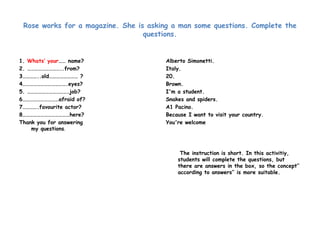
Rose works for a magazine. She is asking a man some questions. Complete the 
questions. 
1. Whats’ your…… name? 
2. ………………………..from? 
3…………..old…………………… ? 
4……………………………….eyes? 
5. …………………………….job? 
6…………………………afraid of? 
7………….favourite actor? 
8…………………………………here? 
Thank you for answering 
my questions. 
Alberto Simonetti. 
Italy. 
20. 
Brown. 
I'm a student. 
Snakes and spiders. 
A1 Pacino. 
Because I want to visit your country. 
You're welcome 
The instruction is short. In this activitiy, 
students will complete the questions, but 
there are answers in the box, so the concept’’ 
according to answers’’ is more suitable.
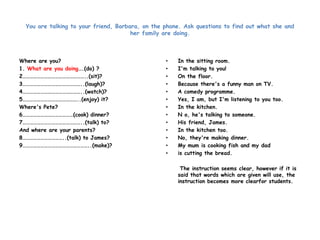
You are talking to your friend, Barbara, on the phone. Ask questions to find out what she and 
her family are doing. 
Where are you? 
1. What are you doing….(do) ? 
2……………………………………………..(sit)? 
3…………………………………………..(laugh)? 
4…………………………………………..(watch)? 
5………………………………………..(enjoy) it? 
Where's Pete? 
6……………………………………(cook) dinner? 
7…………………………………………..(talk) to? 
And where are your parents? 
8……………………………..(talk) to James? 
9………………………………………………..(make)? 
• In the sitting room. 
• I'm talking to you! 
• On the floor. 
• Because there's a funny man on TV. 
• A comedy programme. 
• Yes, I am, but I'm listening to you too. 
• In the kitchen. 
• N o, he's talking to someone. 
• His friend, James. 
• In the kitchen too. 
• No, they're making dinner. 
• My mum is cooking fish and my dad 
• is cutting the bread. 
The instruction seems clear, however if it is 
said that words which are given will use, the 
instruction becomes more clearfor students.
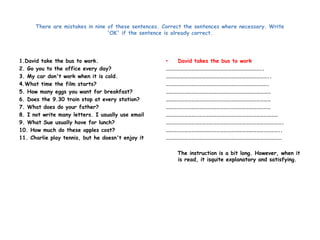
There are mistakes in nine of these sentences. Correct the sentences where necessary. Write 
'OK' if the sentence is already correct. 
1.David take the bus to work. 
2. Go you to the office every day? 
3. My car don't work when it is cold. 
4.What time the film starts? 
5. How many eggs you want for breakfast? 
6. Does the 9.30 train stop at every station? 
7. What does do your father? 
8. I not write many letters. I usually use email 
9. What Sue usually have for lunch? 
10. How much do these apples cost? 
11. Charlie play tennis, but he doesn't enjoy it 
• David takes the bus to work 
…………………………………………………………………….. 
………………………………………………………………………….. 
…………………………………………………………………………. 
…………………………………………………………………………… 
…………………………………………………………………………… 
…………………………………………………………………………… 
………………………………………………………………………………… 
……………………………………………………………………………………. 
………………………………………………………………………………….. 
…………………………………………………………………………………… 
The instruction is a bit long. However, when it 
is read, it isquite explanatory and satisfying.
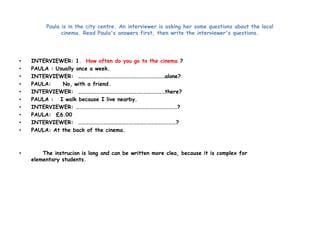
Paula is in the city centre. An interviewer is asking her some questions about the local 
cinema. Read Paula's answers first, then write the interviewer's questions. 
• INTERVIEWER: 1. How often do you go to the cinema ? 
• PAULA : Usually once a week. 
• INTERVIEWER: ………………………………………………………………alone? 
• PAULA: No, with a friend. 
• INTERVIEWER: ………………………………………………………………there? 
• PAULA : I walk because I live nearby. 
• INTERVIEWER: …………………………………………………………………………? 
• PAULA: £6.00 
• INTERVIEWER: ………………………………………………………………………? 
• PAULA: At the back of the cinema. 
• The instrucion is long and can be written more clea, because it is complex for 
elementary students.
Write questions from these words. Put the verbs in the present simple (do you have etc.) or the 
present continuous (are you having etc.). Then write your own positive or negative short answers. 
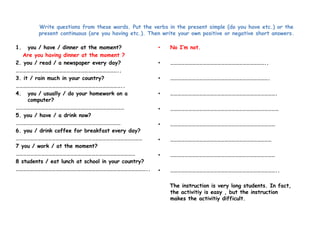
1. you / have / dinner at the moment? 
Are you having dinner at the moment ? 
2. you / read / a newspaper every day? 
………………………………………………………………………….. 
3. it / rain much in your country? 
…………………………………………………………………………….. 
4. you / usually / do your homework on a 
computer? 
……………………………………………………………………………… 
5. you / have / a drink now? 
…………………………………………………………………………… 
6. you / drink coffee for breakfast every day? 
…………………………………………………………………………………………… 
7 you / work / at the moment? 
……………………………………………………………………………………… 
8 students / eat lunch at school in your country? 
……………………………………………………………………………………………….. 
• No I’m not. 
• …………………………………………………………………….. 
• ………………………………………………………………………. 
• ……………………………………………………………………………. 
• ……………………………………………………………………………… 
• …………………………………………………………………………… 
• ………………………………………………………………………… 
• …………………………………………………………………………… 
• …………………………………………………………………………….. 
The instruction is very long students. In fact, 
the activitiy is easy , but the instruction 
makes the activitiy difficult.
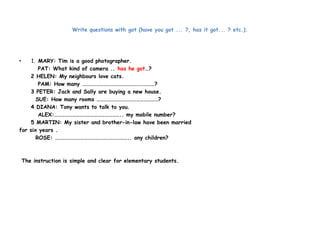
Write questions with got (have you got ... ?, has it got... ? etc.). 
• 1. MARY: Tim is a good photographer. 
PAT: What kind of camera .. has he got…? 
2 HELEN: My neighbours love cats. 
PAM: How many ……………………………………………………? 
3 PETER: Jack and Sally are buying a new house. 
SUE: How many rooms ……………………………………………? 
4 DIANA: Tony wants to talk to you. 
ALEX:……………………………………………….. my mobile number? 
5 MARTIN: My sister and brother-in-law have been married 
for six years . 
ROSE: …………………………………………………….. any children? 
The instruction is simple and clear for elementary students.
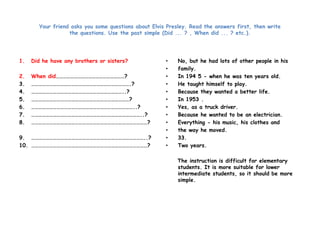
Your friend asks you some questions about Elvis Presley. Read the answers first, then write 
the questions. Use the past simple (Did ... ? , When did ... ? etc.). 
1. Did he have any brothers or sisters? 
2. When did…………………………………………………? 
3. ……………………………………………………………………….? 
4. …………………………………………………………………..? 
5. ………………………………………………………………………? 
6. …………………………………………………………………………..? 
7. ………………………………………………………………………………..? 
8. ……………………………………………………………………………………? 
9. …………………………………………………………………………………..? 
10. ……………………………………………………………………………………? 
• No, but he had lots of other people in his 
• family. 
• In 194 5 - when he was ten years old. 
• He taught himself to play. 
• Because they wanted a better life. 
• In 1953 . 
• Yes, as a truck driver. 
• Because he wanted to be an electrician. 
• Everything - his music, his clothes and 
• the way he moved. 
• 33. 
• Two years. 
The instruction is difficult for elementary 
students. It is more suitable for lower 
intermediate students, so it should be more 
simple.
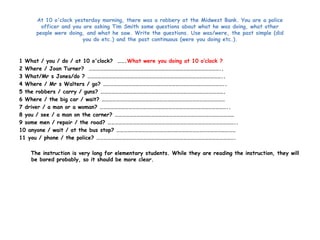
At 10 o'clock yesterday morning, there was a robbery at the Midwest Bank. You are a police 
officer and you are asking Tim Smith some questions about what he was doing, what other 
people were doing, and what he saw. Write the questions. Use was/were, the past simple (did 
you do etc.) and the past continuous (were you doing etc.). 
1 What / you / do / at 10 o'clock? …….What were you doing at 10 o’clock ? 
2 Where / Joan Turner? ……………………………………………………………………………………………….. 
3 What/Mr s Jones/do ? ………………………………………………………………………………………………….. 
4 Where / Mr s Walters / go? ……………………………………………………………………………………….. 
5 the robbers / carry / guns? …………………………………………………………………………………………. 
6 Where / the big car / wait? ………………………………………………………………………………………… 
7 driver / a man or a woman? …………………………………………………………………………………………….. 
8 you / see / a man on the corner? ……………………………………………………………………………………… 
9 some men / repair / the road? …………………………………………………………………………………………….. 
10 anyone / wait / at the bus stop? ……………………………………………………………………………………… 
11 you / phone / the police? ……………………………………………………………………………………………………. 
The instruction is very long for elementary students. While they are reading the instruction, they will 
be bored probably, so it should be more clear.
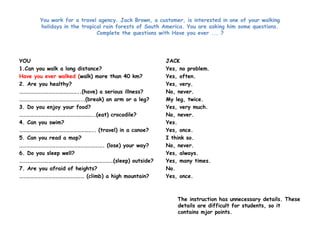
You work for a travel agency. Jack Brown, a customer, is interested in one of your walking 
holidays in the tropical rain forests of South America. You are asking him some questions. 
Complete the questions with Have you ever ... ? 
YOU 
1.Can you walk a long distance? 
Have you ever walked (walk) more than 40 km? 
2. Are you healthy? 
…………………………………………..(have) a serious illness? 
……………………………………………..(break) an arm or a leg? 
3. Do you enjoy your food? 
……………………………………………………..(eat) crocodile? 
4. Can you swim? 
…………………………………………………….. (travel) in a canoe? 
5. Can you read a map? 
……………………………………………………………. (lose) your way? 
6. Do you sleep well? 
……………………………………………………………………(sleep) outside? 
7. Are you afraid of heights? 
……………………………………………… (climb) a high mountain? 
JACK 
Yes, no problem. 
Yes, often. 
Yes, very. 
No, never. 
My leg, twice. 
Yes, very much. 
No, never. 
Yes. 
Yes, once. 
I think so. 
No, never. 
Yes, always. 
Yes, many times. 
No. 
Yes, once. 
The instruction has unnecessary details. These 
details are difficult for students, so it 
contains mjor points.
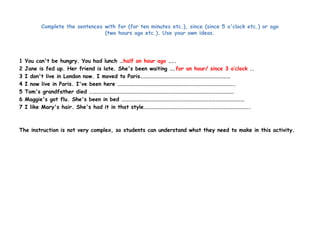
Complete the sentences with for (for ten minutes etc.), since (since 5 o'clock etc.) or ago 
(two hours ago etc.). Use your own ideas. 
1 You can't be hungry. You had lunch …half an hour ago ….. 
2 Jane is fed up. Her friend is late. She's been waiting ….for an hour/ since 3 o’clock .. 
3 I don't live in London now. I moved to Paris………………………………………………………………… 
4 I now live in Paris. I've been here ……………………………………………………………………………………. 
5 Tom's grandfather died ………………………………………………………………………………………………………… 
6 Maggie's got flu. She's been in bed ………………………………………………………………………………………… 
7 I like Mary's hair. She's had it in that style……………………………………………………………………………. 
The instruction is not very complex, so students can understand what they need to make in this activity.

Tuğçe taşgit instructions

  • 1.
  • 2.
    Rose works fora magazine. She is asking a man some questions. Complete the questions. 1. Whats’ your…… name? 2. ………………………..from? 3…………..old…………………… ? 4……………………………….eyes? 5. …………………………….job? 6…………………………afraid of? 7………….favourite actor? 8…………………………………here? Thank you for answering my questions. Alberto Simonetti. Italy. 20. Brown. I'm a student. Snakes and spiders. A1 Pacino. Because I want to visit your country. You're welcome The instruction is short. In this activitiy, students will complete the questions, but there are answers in the box, so the concept’’ according to answers’’ is more suitable.
  • 3.
    You are talkingto your friend, Barbara, on the phone. Ask questions to find out what she and her family are doing. Where are you? 1. What are you doing….(do) ? 2……………………………………………..(sit)? 3…………………………………………..(laugh)? 4…………………………………………..(watch)? 5………………………………………..(enjoy) it? Where's Pete? 6……………………………………(cook) dinner? 7…………………………………………..(talk) to? And where are your parents? 8……………………………..(talk) to James? 9………………………………………………..(make)? • In the sitting room. • I'm talking to you! • On the floor. • Because there's a funny man on TV. • A comedy programme. • Yes, I am, but I'm listening to you too. • In the kitchen. • N o, he's talking to someone. • His friend, James. • In the kitchen too. • No, they're making dinner. • My mum is cooking fish and my dad • is cutting the bread. The instruction seems clear, however if it is said that words which are given will use, the instruction becomes more clearfor students.
  • 4.
    There are mistakesin nine of these sentences. Correct the sentences where necessary. Write 'OK' if the sentence is already correct. 1.David take the bus to work. 2. Go you to the office every day? 3. My car don't work when it is cold. 4.What time the film starts? 5. How many eggs you want for breakfast? 6. Does the 9.30 train stop at every station? 7. What does do your father? 8. I not write many letters. I usually use email 9. What Sue usually have for lunch? 10. How much do these apples cost? 11. Charlie play tennis, but he doesn't enjoy it • David takes the bus to work …………………………………………………………………….. ………………………………………………………………………….. …………………………………………………………………………. …………………………………………………………………………… …………………………………………………………………………… …………………………………………………………………………… ………………………………………………………………………………… ……………………………………………………………………………………. ………………………………………………………………………………….. …………………………………………………………………………………… The instruction is a bit long. However, when it is read, it isquite explanatory and satisfying.
  • 5.
    Paula is inthe city centre. An interviewer is asking her some questions about the local cinema. Read Paula's answers first, then write the interviewer's questions. • INTERVIEWER: 1. How often do you go to the cinema ? • PAULA : Usually once a week. • INTERVIEWER: ………………………………………………………………alone? • PAULA: No, with a friend. • INTERVIEWER: ………………………………………………………………there? • PAULA : I walk because I live nearby. • INTERVIEWER: …………………………………………………………………………? • PAULA: £6.00 • INTERVIEWER: ………………………………………………………………………? • PAULA: At the back of the cinema. • The instrucion is long and can be written more clea, because it is complex for elementary students.
  • 6.
    Write questions fromthese words. Put the verbs in the present simple (do you have etc.) or the present continuous (are you having etc.). Then write your own positive or negative short answers. 1. you / have / dinner at the moment? Are you having dinner at the moment ? 2. you / read / a newspaper every day? ………………………………………………………………………….. 3. it / rain much in your country? …………………………………………………………………………….. 4. you / usually / do your homework on a computer? ……………………………………………………………………………… 5. you / have / a drink now? …………………………………………………………………………… 6. you / drink coffee for breakfast every day? …………………………………………………………………………………………… 7 you / work / at the moment? ……………………………………………………………………………………… 8 students / eat lunch at school in your country? ……………………………………………………………………………………………….. • No I’m not. • …………………………………………………………………….. • ………………………………………………………………………. • ……………………………………………………………………………. • ……………………………………………………………………………… • …………………………………………………………………………… • ………………………………………………………………………… • …………………………………………………………………………… • …………………………………………………………………………….. The instruction is very long students. In fact, the activitiy is easy , but the instruction makes the activitiy difficult.
  • 7.
    Write questions withgot (have you got ... ?, has it got... ? etc.). • 1. MARY: Tim is a good photographer. PAT: What kind of camera .. has he got…? 2 HELEN: My neighbours love cats. PAM: How many ……………………………………………………? 3 PETER: Jack and Sally are buying a new house. SUE: How many rooms ……………………………………………? 4 DIANA: Tony wants to talk to you. ALEX:……………………………………………….. my mobile number? 5 MARTIN: My sister and brother-in-law have been married for six years . ROSE: …………………………………………………….. any children? The instruction is simple and clear for elementary students.
  • 8.
    Your friend asksyou some questions about Elvis Presley. Read the answers first, then write the questions. Use the past simple (Did ... ? , When did ... ? etc.). 1. Did he have any brothers or sisters? 2. When did…………………………………………………? 3. ……………………………………………………………………….? 4. …………………………………………………………………..? 5. ………………………………………………………………………? 6. …………………………………………………………………………..? 7. ………………………………………………………………………………..? 8. ……………………………………………………………………………………? 9. …………………………………………………………………………………..? 10. ……………………………………………………………………………………? • No, but he had lots of other people in his • family. • In 194 5 - when he was ten years old. • He taught himself to play. • Because they wanted a better life. • In 1953 . • Yes, as a truck driver. • Because he wanted to be an electrician. • Everything - his music, his clothes and • the way he moved. • 33. • Two years. The instruction is difficult for elementary students. It is more suitable for lower intermediate students, so it should be more simple.
  • 9.
    At 10 o'clockyesterday morning, there was a robbery at the Midwest Bank. You are a police officer and you are asking Tim Smith some questions about what he was doing, what other people were doing, and what he saw. Write the questions. Use was/were, the past simple (did you do etc.) and the past continuous (were you doing etc.). 1 What / you / do / at 10 o'clock? …….What were you doing at 10 o’clock ? 2 Where / Joan Turner? ……………………………………………………………………………………………….. 3 What/Mr s Jones/do ? ………………………………………………………………………………………………….. 4 Where / Mr s Walters / go? ……………………………………………………………………………………….. 5 the robbers / carry / guns? …………………………………………………………………………………………. 6 Where / the big car / wait? ………………………………………………………………………………………… 7 driver / a man or a woman? …………………………………………………………………………………………….. 8 you / see / a man on the corner? ……………………………………………………………………………………… 9 some men / repair / the road? …………………………………………………………………………………………….. 10 anyone / wait / at the bus stop? ……………………………………………………………………………………… 11 you / phone / the police? ……………………………………………………………………………………………………. The instruction is very long for elementary students. While they are reading the instruction, they will be bored probably, so it should be more clear.
  • 10.
    You work fora travel agency. Jack Brown, a customer, is interested in one of your walking holidays in the tropical rain forests of South America. You are asking him some questions. Complete the questions with Have you ever ... ? YOU 1.Can you walk a long distance? Have you ever walked (walk) more than 40 km? 2. Are you healthy? …………………………………………..(have) a serious illness? ……………………………………………..(break) an arm or a leg? 3. Do you enjoy your food? ……………………………………………………..(eat) crocodile? 4. Can you swim? …………………………………………………….. (travel) in a canoe? 5. Can you read a map? ……………………………………………………………. (lose) your way? 6. Do you sleep well? ……………………………………………………………………(sleep) outside? 7. Are you afraid of heights? ……………………………………………… (climb) a high mountain? JACK Yes, no problem. Yes, often. Yes, very. No, never. My leg, twice. Yes, very much. No, never. Yes. Yes, once. I think so. No, never. Yes, always. Yes, many times. No. Yes, once. The instruction has unnecessary details. These details are difficult for students, so it contains mjor points.
  • 11.
    Complete the sentenceswith for (for ten minutes etc.), since (since 5 o'clock etc.) or ago (two hours ago etc.). Use your own ideas. 1 You can't be hungry. You had lunch …half an hour ago ….. 2 Jane is fed up. Her friend is late. She's been waiting ….for an hour/ since 3 o’clock .. 3 I don't live in London now. I moved to Paris………………………………………………………………… 4 I now live in Paris. I've been here ……………………………………………………………………………………. 5 Tom's grandfather died ………………………………………………………………………………………………………… 6 Maggie's got flu. She's been in bed ………………………………………………………………………………………… 7 I like Mary's hair. She's had it in that style……………………………………………………………………………. The instruction is not very complex, so students can understand what they need to make in this activity.