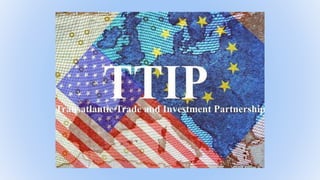
• Eliminate both tariff and non-tariff barriers on goods
– including agriculture, industrial, and consumer products.
• Lower trade barriers on services.
• Eliminate customs duties on digital commerce and IT
– including movies, music, TV shows, video games, etc.
• Grant comparable rights to U.S. investors in the EU and
vice versa.
• Reduce or eliminate artificial or trade-distorting barriers.
• Enhance customs cooperation between the U.S. and the
EU.
• Ensure equal labour rights in the U.S. and the EU, with the
objective of avoiding unfair labour competition.
• Obtain mutual agreement on environmental standards,
intellectual property rights and product standards.
MAIN OBJECTIVES OF THE TTIP:
DOES THE TTIP MAKE TRADE TOO LIBERAL?
AREAS OF CONCERN:
• FOOD → Risks: growth hormones, pesticides,
antibiotics, etc. The proof of the safety of a product
could be given by those who seek to sell it.
• TOXICS → Lack of a precautionary principle: all
chemicals are safe, unless proven otherwise.
• CLIMATE → EU rules to combat climate change seen
as barriers to trade.
• TRANSPARENCY → TTIP negotiating rounds take
place behind closed doors.

TTIP: pros and cons

  • 2.
    • Eliminate bothtariff and non-tariff barriers on goods – including agriculture, industrial, and consumer products. • Lower trade barriers on services. • Eliminate customs duties on digital commerce and IT – including movies, music, TV shows, video games, etc. • Grant comparable rights to U.S. investors in the EU and vice versa. • Reduce or eliminate artificial or trade-distorting barriers. • Enhance customs cooperation between the U.S. and the EU. • Ensure equal labour rights in the U.S. and the EU, with the objective of avoiding unfair labour competition. • Obtain mutual agreement on environmental standards, intellectual property rights and product standards. MAIN OBJECTIVES OF THE TTIP:
  • 3.
    DOES THE TTIPMAKE TRADE TOO LIBERAL? AREAS OF CONCERN: • FOOD → Risks: growth hormones, pesticides, antibiotics, etc. The proof of the safety of a product could be given by those who seek to sell it. • TOXICS → Lack of a precautionary principle: all chemicals are safe, unless proven otherwise. • CLIMATE → EU rules to combat climate change seen as barriers to trade. • TRANSPARENCY → TTIP negotiating rounds take place behind closed doors.