Tertiary School in Business Administration
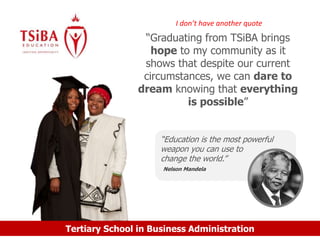
“Graduating from TSiBA brings
hope to my community as it
shows that despite our current
circumstances, we can dare to
dream knowing that everything
is possible”
“Education is the most powerful
weapon you can use to
change the world.”
Nelson Mandela
I don’t have another quote
Youth Unemployment in South Africa
Source: South Africa Labour Force Survey Data 2014 /
Higher Education & Training
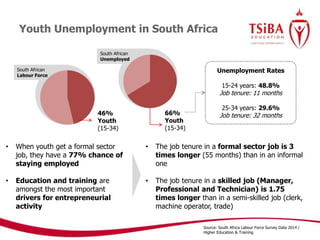
• When youth get a formal sector
job, they have a 77% chance of
staying employed
• Education and training are
amongst the most important
drivers for entrepreneurial
activity
South African
Labour Force
46%
Youth
(15-34)
Unemployment Rates
15-24 years: 48.8%
Job tenure: 11 months
25-34 years: 29.6%
Job tenure: 32 months
• The job tenure in a formal sector job is 3
times longer (55 months) than in an informal
one
• The job tenure in a skilled job (Manager,
Professional and Technician) is 1.75
times longer than in a semi-skilled job (clerk,
machine operator, trade)
South African
Unemployed
66%
Youth
(15-34)
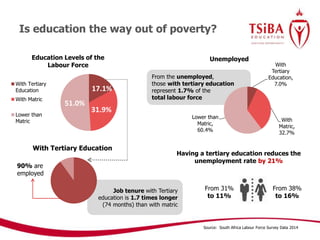
Job tenure with Tertiary
education is 1.7 times longer
(74 months) than with matric
From the unemployed,
those with tertiary education
represent 1.7% of the
total labour force
With Tertiary Education
Is education the way out of poverty?
Source: South Africa Labour Force Survey Data 2014
17.1%
31.9%
51.0%
Education Levels of the
Labour Force
With Tertiary
Education
With Matric
Lower than
Matric
90% are
employed
With
Tertiary
Education,
7.0%
With
Matric,
32.7%
Lower than
Matric,
60.4%
Unemployed
Having a tertiary education reduces the
unemployment rate by 21%
From 38%
to 16%
From 31%
to 11%
National Relevance: TSiBA in alignment with
the National Skills Development Strategy III
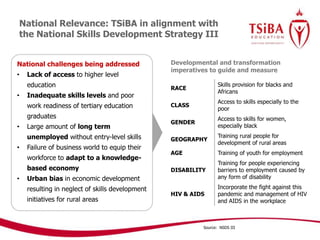
Developmental and transformation
imperatives to guide and measure
RACE
Skills provision for blacks and
Africans
CLASS
Access to skills especially to the
poor
GENDER
Access to skills for women,
especially black
GEOGRAPHY
Training rural people for
development of rural areas
AGE Training of youth for employment
DISABILITY
Training for people experiencing
barriers to employment caused by
any form of disability
HIV & AIDS
Incorporate the fight against this
pandemic and management of HIV
and AIDS in the workplace
National challenges being addressed
• Lack of access to higher level
education
• Inadequate skills levels and poor
work readiness of tertiary education
graduates
• Large amount of long term
unemployed without entry-level skills
• Failure of business world to equip their
workforce to adapt to a knowledge-
based economy
• Urban bias in economic development
resulting in neglect of skills development
initiatives for rural areas
Source: NSDS III
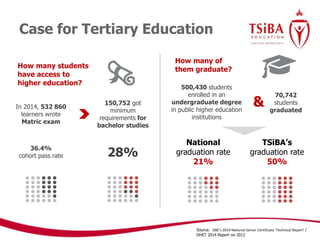
Case for Tertiary Education
70,742
students
graduated
National
graduation rate
21%
Source: DBE’s 2014 National Senior Certificate ‘Technical Report’ /
DHET 2014 Report on 2012
150,752 got
minimum
requirements for
bachelor studies
28%
In 2014, 532 860
learners wrote
Matric exam
36.4%
cohort pass rate
How many students
have access to
higher education?
How many of
them graduate?
500,430 students
enrolled in an
undergraduate degree
in public higher education
institutions
&
TSiBA’s
graduation rate
50%
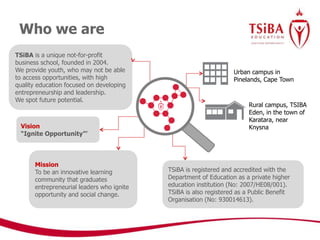
Who we are
TSiBA is a unique not-for-profit
business school, founded in 2004.
We provide youth, who may not be able
to access opportunities, with high
quality education focused on developing
entrepreneurship and leadership.
We spot future potential.
Vision
“Ignite Opportunity”’
Mission
To be an innovative learning
community that graduates
entrepreneurial leaders who ignite
opportunity and social change.
TSiBA is registered and accredited with the
Department of Education as a private higher
education institution (No: 2007/HE08/001).
TSiBA is also registered as a Public Benefit
Organisation (No: 930014613).
Urban campus in
Pinelands, Cape Town
Rural campus, TSIBA
Eden, in the town of
Karatara, near
Knysna
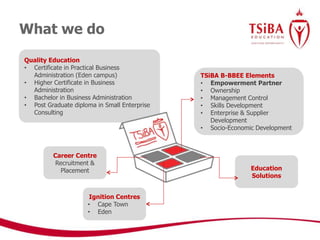
Quality Education
• Certificate in Practical Business
Administration (Eden campus)
• Higher Certificate in Business
Administration
• Bachelor in Business Administration
• Post Graduate diploma in Small Enterprise
Consulting
What we do
Education
Solutions
Career Centre
Recruitment &
Placement
Ignition Centres
• Cape Town
• Eden
TSiBA B-BBEE Elements
• Empowerment Partner
• Ownership
• Management Control
• Skills Development
• Enterprise & Supplier
Development
• Socio-Economic Development
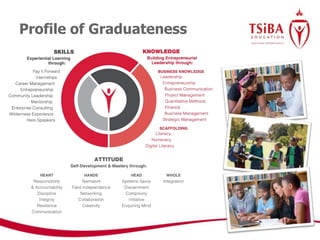
Profile of Graduateness
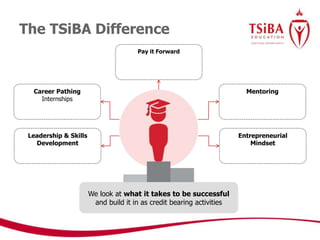
We look at what it takes to be successful
and build it in as credit bearing activities
The TSiBA Difference
Pay it Forward
Leadership & Skills
Development
Career Pathing
Internships
Entrepreneurial
Mindset
Mentoring
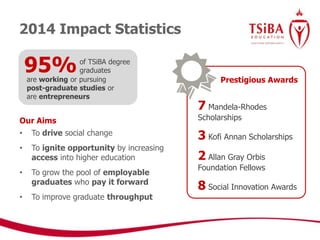
2014 Impact Statistics
Our Aims
• To drive social change
• To ignite opportunity by increasing
access into higher education
• To grow the pool of employable
graduates who pay it forward
• To improve graduate throughput
95%are working or pursuing
post-graduate studies or
are entrepreneurs
of TSiBA degree
graduates
7 Mandela-Rhodes
Scholarships
3 Kofi Annan Scholarships
2 Allan Gray Orbis
Foundation Fellows
8 Social Innovation Awards
Prestigious Awards
Thank You
www.tsiba.org.za
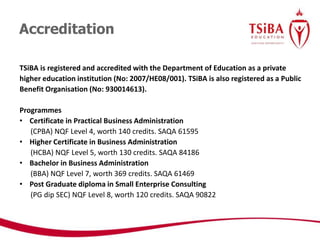
TSiBA is registered and accredited with the Department of Education as a private
higher education institution (No: 2007/HE08/001). TSiBA is also registered as a Public
Benefit Organisation (No: 930014613).
Programmes
• Certificate in Practical Business Administration
(CPBA) NQF Level 4, worth 140 credits. SAQA 61595
• Higher Certificate in Business Administration
(HCBA) NQF Level 5, worth 130 credits. SAQA 84186
• Bachelor in Business Administration
(BBA) NQF Level 7, worth 369 credits. SAQA 61469
• Post Graduate diploma in Small Enterprise Consulting
(PG dip SEC) NQF Level 8, worth 120 credits. SAQA 90822
Accreditation

TSiBA 2015 vGeneral powerpoint

  • 1.
    Tertiary School inBusiness Administration “Graduating from TSiBA brings hope to my community as it shows that despite our current circumstances, we can dare to dream knowing that everything is possible” “Education is the most powerful weapon you can use to change the world.” Nelson Mandela I don’t have another quote
  • 2.
    Youth Unemployment inSouth Africa Source: South Africa Labour Force Survey Data 2014 / Higher Education & Training • When youth get a formal sector job, they have a 77% chance of staying employed • Education and training are amongst the most important drivers for entrepreneurial activity South African Labour Force 46% Youth (15-34) Unemployment Rates 15-24 years: 48.8% Job tenure: 11 months 25-34 years: 29.6% Job tenure: 32 months • The job tenure in a formal sector job is 3 times longer (55 months) than in an informal one • The job tenure in a skilled job (Manager, Professional and Technician) is 1.75 times longer than in a semi-skilled job (clerk, machine operator, trade) South African Unemployed 66% Youth (15-34)
  • 3.
    Job tenure withTertiary education is 1.7 times longer (74 months) than with matric From the unemployed, those with tertiary education represent 1.7% of the total labour force With Tertiary Education Is education the way out of poverty? Source: South Africa Labour Force Survey Data 2014 17.1% 31.9% 51.0% Education Levels of the Labour Force With Tertiary Education With Matric Lower than Matric 90% are employed With Tertiary Education, 7.0% With Matric, 32.7% Lower than Matric, 60.4% Unemployed Having a tertiary education reduces the unemployment rate by 21% From 38% to 16% From 31% to 11%
  • 4.
    National Relevance: TSiBAin alignment with the National Skills Development Strategy III Developmental and transformation imperatives to guide and measure RACE Skills provision for blacks and Africans CLASS Access to skills especially to the poor GENDER Access to skills for women, especially black GEOGRAPHY Training rural people for development of rural areas AGE Training of youth for employment DISABILITY Training for people experiencing barriers to employment caused by any form of disability HIV & AIDS Incorporate the fight against this pandemic and management of HIV and AIDS in the workplace National challenges being addressed • Lack of access to higher level education • Inadequate skills levels and poor work readiness of tertiary education graduates • Large amount of long term unemployed without entry-level skills • Failure of business world to equip their workforce to adapt to a knowledge- based economy • Urban bias in economic development resulting in neglect of skills development initiatives for rural areas Source: NSDS III
  • 5.
    Case for TertiaryEducation 70,742 students graduated National graduation rate 21% Source: DBE’s 2014 National Senior Certificate ‘Technical Report’ / DHET 2014 Report on 2012 150,752 got minimum requirements for bachelor studies 28% In 2014, 532 860 learners wrote Matric exam 36.4% cohort pass rate How many students have access to higher education? How many of them graduate? 500,430 students enrolled in an undergraduate degree in public higher education institutions & TSiBA’s graduation rate 50%
  • 6.
    Who we are TSiBAis a unique not-for-profit business school, founded in 2004. We provide youth, who may not be able to access opportunities, with high quality education focused on developing entrepreneurship and leadership. We spot future potential. Vision “Ignite Opportunity”’ Mission To be an innovative learning community that graduates entrepreneurial leaders who ignite opportunity and social change. TSiBA is registered and accredited with the Department of Education as a private higher education institution (No: 2007/HE08/001). TSiBA is also registered as a Public Benefit Organisation (No: 930014613). Urban campus in Pinelands, Cape Town Rural campus, TSIBA Eden, in the town of Karatara, near Knysna
  • 7.
    Quality Education • Certificatein Practical Business Administration (Eden campus) • Higher Certificate in Business Administration • Bachelor in Business Administration • Post Graduate diploma in Small Enterprise Consulting What we do Education Solutions Career Centre Recruitment & Placement Ignition Centres • Cape Town • Eden TSiBA B-BBEE Elements • Empowerment Partner • Ownership • Management Control • Skills Development • Enterprise & Supplier Development • Socio-Economic Development
  • 8.
  • 9.
    We look atwhat it takes to be successful and build it in as credit bearing activities The TSiBA Difference Pay it Forward Leadership & Skills Development Career Pathing Internships Entrepreneurial Mindset Mentoring
  • 10.
    2014 Impact Statistics OurAims • To drive social change • To ignite opportunity by increasing access into higher education • To grow the pool of employable graduates who pay it forward • To improve graduate throughput 95%are working or pursuing post-graduate studies or are entrepreneurs of TSiBA degree graduates 7 Mandela-Rhodes Scholarships 3 Kofi Annan Scholarships 2 Allan Gray Orbis Foundation Fellows 8 Social Innovation Awards Prestigious Awards
  • 11.
  • 12.
    TSiBA is registeredand accredited with the Department of Education as a private higher education institution (No: 2007/HE08/001). TSiBA is also registered as a Public Benefit Organisation (No: 930014613). Programmes • Certificate in Practical Business Administration (CPBA) NQF Level 4, worth 140 credits. SAQA 61595 • Higher Certificate in Business Administration (HCBA) NQF Level 5, worth 130 credits. SAQA 84186 • Bachelor in Business Administration (BBA) NQF Level 7, worth 369 credits. SAQA 61469 • Post Graduate diploma in Small Enterprise Consulting (PG dip SEC) NQF Level 8, worth 120 credits. SAQA 90822 Accreditation

Editor's Notes

  • #8 Certificate in Practical Business Administration (CPBA) NQF Level 4, worth 140 credits. SAQA 61595 Higher Certificate in Business Administration (HCBA) NQF Level 5, worth 130 credits. SAQA 84186 Bachelor in Business Administration (BBA) NQF Level 7, worth 369 credits. SAQA 61469 Post Graduate diploma in Small Enterprise Consulting (PG dip SEC) NQF Level 8, worth 120 credits. SAQA 90822