This course is prepared under the Erasmus+ KA-210-YOU Project titled
«Skilling Youth for the Next Generation Air Transport Management»
Terminal Service Systems
Management
Baggage Handling
Kristjan Roosipõld
Baggage Handling 2
Terminal Service Systems Management
Course Subject 1 Introduction to the course, Capacity definitions, Airport definitions
Course Subject 2 Terminal service systems components
Course Subject 3 Passenger processing
Course Subject 4 Baggage handling
Course Subject 5 Passenger flow management at different service stages
Course Subject 6 Emergency response planning
Course Subject 7 Developing terminal service strategies, terminal capacity planning
Total Workload 110 h
Course Evaluation No exam, only Certiticate of Completion will be provided.
Participant University in
Charge
Estonian Aviation Academy
Course Coordinator(s) Kristjan Roosipõld, Allan Nõmmik
Baggage Handling 3
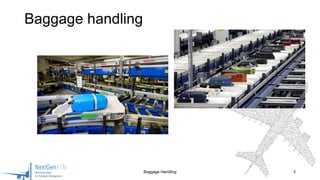
Baggage handling
• Cabin baggage / hand baggage – baggage, which the passenger
retains custody.
• Checked baggage / registered baggage – baggage, which the carrier
takes sole custody and for which carrier has issued a baggage
check.
• DAA baggage (Delivery at Aircraft) – cabin baggage, which cannot
be loaded in the passenger cabin due to aircraft space limitations.
DAA-baggage is handed over during the boarding for loading into the
aircraft hold and will be returned to the passenger during the
disembarkation.
• Transfer baggage – baggage arriving at a point on one flight and
continuing its journey therefrom on another flight within a defined
time limit.
Baggage Handling 4
Types of baggage
Check in - As baggage is checked in it will be divided into three
main categories:
• On-Time Checked Baggage
• Late Checked Baggage
• Exception Baggage
○ out of gauge (OOG) baggage
Baggage Handling 5
Baggage handling process
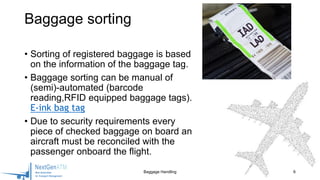
• Sorting of registered baggage is based
on the information of the baggage tag.
• Baggage sorting can be manual of
(semi)-automated (barcode
reading,RFID equipped baggage tags).
E-ink bag tag
• Due to security requirements every
piece of checked baggage on board an
aircraft must be reconciled with the
passenger onboard the flight.
6
Baggage sorting
Baggage Handling
• Benefits of automated baggage sorting system:
○ Less labor expenditure
○ Less chance of mistakes caused by human factor
○ Bigger capacity and throughput of of baggage
sorting area
○ „Visibility“ and tracing of baggage pieces
• Example
Baggage Handling 7
Baggage sorting systems
Make-up.
The main categories of baggage make-up are:
• Sorting by flight and destination
• Separation - local baggage, transfer baggage
• Separation by class of service
• Elite Frequent Flyer Status
8
Baggage Handling process
Baggage Handling
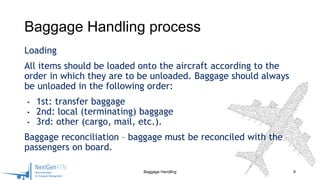
Loading
All items should be loaded onto the aircraft according to the
order in which they are to be unloaded. Baggage should always
be unloaded in the following order:
• 1st: transfer baggage
• 2nd: local (terminating) baggage
• 3rd: other (cargo, mail, etc.).
Baggage reconciliation – baggage must be reconciled with the
passengers on board.
9
Baggage Handling process
Baggage Handling
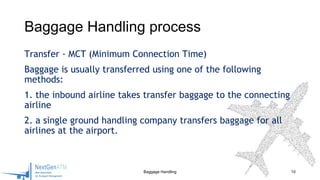
Transfer - MCT (Minimum Connection Time)
Baggage is usually transferred using one of the following
methods:
1. the inbound airline takes transfer baggage to the connecting
airline
2. a single ground handling company transfers baggage for all
airlines at the airport.
10
Baggage Handling process
Baggage Handling
Arrival baggage handling
• Delivery of baggage to the passengers from
arrived Flight.
• Dealing with claims
11
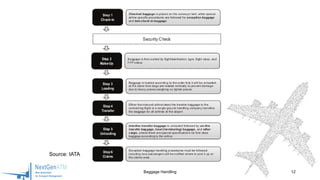
Baggage Handling process
Baggage Handling
12
Source: IATA
Baggage Handling
13
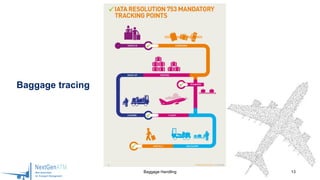
Baggage tracing
Baggage Handling
14
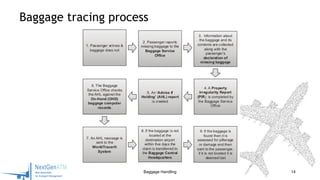
Baggage tracing process
Baggage Handling
• Describe how you see the baggage handling challenges and
solutions in passenger processing. Justify your opinion on the
basis of at least 5 additional sources, 3 of which are scientific
articles.
15
Task 4-1
Baggage Handling

ts-04x01.pdf

  • 1.
    This course isprepared under the Erasmus+ KA-210-YOU Project titled «Skilling Youth for the Next Generation Air Transport Management» Terminal Service Systems Management Baggage Handling Kristjan Roosipõld
  • 2.
    Baggage Handling 2 TerminalService Systems Management Course Subject 1 Introduction to the course, Capacity definitions, Airport definitions Course Subject 2 Terminal service systems components Course Subject 3 Passenger processing Course Subject 4 Baggage handling Course Subject 5 Passenger flow management at different service stages Course Subject 6 Emergency response planning Course Subject 7 Developing terminal service strategies, terminal capacity planning Total Workload 110 h Course Evaluation No exam, only Certiticate of Completion will be provided. Participant University in Charge Estonian Aviation Academy Course Coordinator(s) Kristjan Roosipõld, Allan Nõmmik
  • 3.
  • 4.
    • Cabin baggage/ hand baggage – baggage, which the passenger retains custody. • Checked baggage / registered baggage – baggage, which the carrier takes sole custody and for which carrier has issued a baggage check. • DAA baggage (Delivery at Aircraft) – cabin baggage, which cannot be loaded in the passenger cabin due to aircraft space limitations. DAA-baggage is handed over during the boarding for loading into the aircraft hold and will be returned to the passenger during the disembarkation. • Transfer baggage – baggage arriving at a point on one flight and continuing its journey therefrom on another flight within a defined time limit. Baggage Handling 4 Types of baggage
  • 5.
    Check in -As baggage is checked in it will be divided into three main categories: • On-Time Checked Baggage • Late Checked Baggage • Exception Baggage ○ out of gauge (OOG) baggage Baggage Handling 5 Baggage handling process
  • 6.
    • Sorting ofregistered baggage is based on the information of the baggage tag. • Baggage sorting can be manual of (semi)-automated (barcode reading,RFID equipped baggage tags). E-ink bag tag • Due to security requirements every piece of checked baggage on board an aircraft must be reconciled with the passenger onboard the flight. 6 Baggage sorting Baggage Handling
  • 7.
    • Benefits ofautomated baggage sorting system: ○ Less labor expenditure ○ Less chance of mistakes caused by human factor ○ Bigger capacity and throughput of of baggage sorting area ○ „Visibility“ and tracing of baggage pieces • Example Baggage Handling 7 Baggage sorting systems
  • 8.
    Make-up. The main categoriesof baggage make-up are: • Sorting by flight and destination • Separation - local baggage, transfer baggage • Separation by class of service • Elite Frequent Flyer Status 8 Baggage Handling process Baggage Handling
  • 9.
    Loading All items shouldbe loaded onto the aircraft according to the order in which they are to be unloaded. Baggage should always be unloaded in the following order: • 1st: transfer baggage • 2nd: local (terminating) baggage • 3rd: other (cargo, mail, etc.). Baggage reconciliation – baggage must be reconciled with the passengers on board. 9 Baggage Handling process Baggage Handling
  • 10.
    Transfer - MCT(Minimum Connection Time) Baggage is usually transferred using one of the following methods: 1. the inbound airline takes transfer baggage to the connecting airline 2. a single ground handling company transfers baggage for all airlines at the airport. 10 Baggage Handling process Baggage Handling
  • 11.
    Arrival baggage handling •Delivery of baggage to the passengers from arrived Flight. • Dealing with claims 11 Baggage Handling process Baggage Handling
  • 12.
  • 13.
  • 14.
  • 15.
    • Describe howyou see the baggage handling challenges and solutions in passenger processing. Justify your opinion on the basis of at least 5 additional sources, 3 of which are scientific articles. 15 Task 4-1 Baggage Handling