The Concept of    TRUST Raquel Câmara 2010 in  International Relations
Trusting Relationship Definition a relationship “into which actors enter knowing that as a consequence they increase their vulnerability to other actors whose behaviour they do not control, with potentially negative consequences for themselves” Approaches - Rationalist : the importance of interests and pay-off structures to establish trusting relationships. - Binding:   the importance of normative values and the belief in promises to maintain a relationship based on trust.
Nuclear Non-Proliferation Treaty Original bargain :   "Nations with nuclear weapons have the responsability to move towards disarmament and those without them have the responsability to forsake them.” Thus, by accepting certain vulnerability, the States increase international stability. Treaty’s Weakness: The treaty is discriminatory. The possibility of weaponization due to the spread of civil nuclear fuel-cycles. There has been little progress towards disarmament. There is still a lack of confidence in the relations between Nuclear Weapon States, Non-Nuclear Weapon States and Non-signatories.
Iran and the problem of trust  Iran is a NPT signatory country, and it claims to research nuclear energy for peaceful purposes only. However, other countries see this situation as a threat because: it refuses to cooperate with the IAEA.  it has defied international pressure to suspend uranium enrichment activities. Iran threats USA’s interests in the Middle East. the country has kept its nuclear program secret until 2002. On the other hand, the NPT’s article IV allows States to develop nuclear programs for energy purposes.  The security problem is presented: discrimination on one side, obscurity on the other =  distrust.
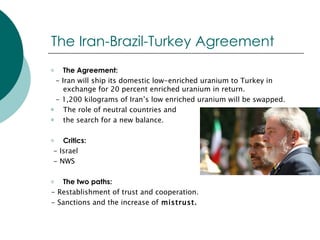
The Iran-Brazil-Turkey Agreement The Agreement: - Iran will ship its domestic low-enriched uranium to Turkey in exchange for 20 percent enriched uranium in return.  - 1,200 kilograms of Iran’s low enriched uranium will be swapped. The role of neutral countries and  the search for a new balance. Critics: - Israel - NWS The two paths: - Restablishment of trust and cooperation. - Sanctions and the increase of  mistrust.
Conclusion The Brazil-Iran-Turkey agreement represents a major step towards the rebuilding of trust in the international community and the strenghening of the NPT. Other political issues must still be resolved to spread TRUST, including the overcoming of the NPT’s weaknesses. The security dilemma in the Middle East will persist while the Israeli-Palestinian question is not solved.

Trust and i b-t agreement

  • 1.
    The Concept of TRUST Raquel Câmara 2010 in International Relations
  • 2.
    Trusting Relationship Definitiona relationship “into which actors enter knowing that as a consequence they increase their vulnerability to other actors whose behaviour they do not control, with potentially negative consequences for themselves” Approaches - Rationalist : the importance of interests and pay-off structures to establish trusting relationships. - Binding: the importance of normative values and the belief in promises to maintain a relationship based on trust.
  • 3.
    Nuclear Non-Proliferation TreatyOriginal bargain : "Nations with nuclear weapons have the responsability to move towards disarmament and those without them have the responsability to forsake them.” Thus, by accepting certain vulnerability, the States increase international stability. Treaty’s Weakness: The treaty is discriminatory. The possibility of weaponization due to the spread of civil nuclear fuel-cycles. There has been little progress towards disarmament. There is still a lack of confidence in the relations between Nuclear Weapon States, Non-Nuclear Weapon States and Non-signatories.
  • 4.
    Iran and theproblem of trust Iran is a NPT signatory country, and it claims to research nuclear energy for peaceful purposes only. However, other countries see this situation as a threat because: it refuses to cooperate with the IAEA. it has defied international pressure to suspend uranium enrichment activities. Iran threats USA’s interests in the Middle East. the country has kept its nuclear program secret until 2002. On the other hand, the NPT’s article IV allows States to develop nuclear programs for energy purposes. The security problem is presented: discrimination on one side, obscurity on the other = distrust.
  • 5.
    The Iran-Brazil-Turkey AgreementThe Agreement: - Iran will ship its domestic low-enriched uranium to Turkey in exchange for 20 percent enriched uranium in return. - 1,200 kilograms of Iran’s low enriched uranium will be swapped. The role of neutral countries and the search for a new balance. Critics: - Israel - NWS The two paths: - Restablishment of trust and cooperation. - Sanctions and the increase of mistrust.
  • 6.
    Conclusion The Brazil-Iran-Turkeyagreement represents a major step towards the rebuilding of trust in the international community and the strenghening of the NPT. Other political issues must still be resolved to spread TRUST, including the overcoming of the NPT’s weaknesses. The security dilemma in the Middle East will persist while the Israeli-Palestinian question is not solved.