

YICC-2011 Solution


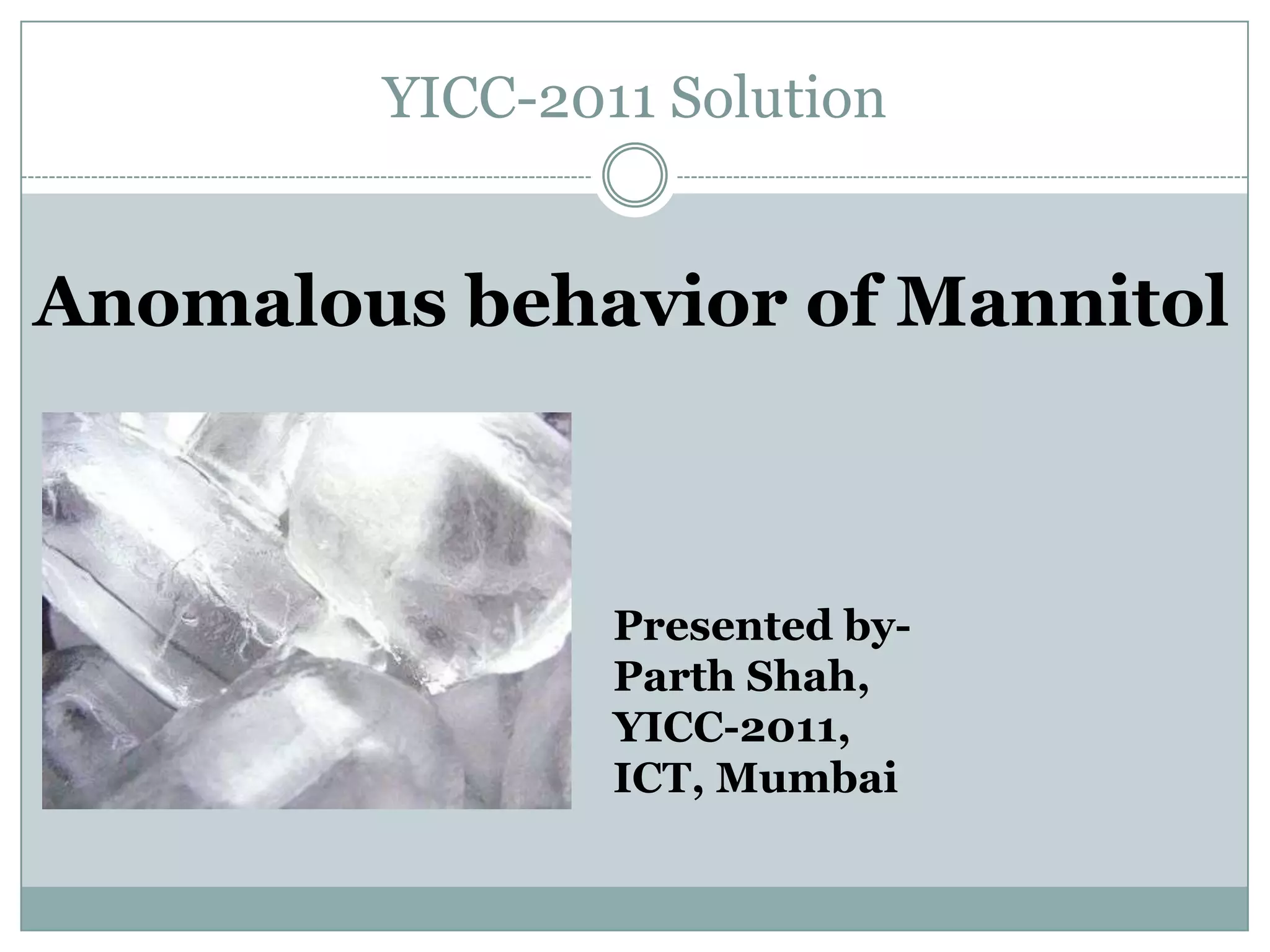
Anomalous behavior of Mannitol


                Presented by-
                Parth Shah,
                YICC-2011,
                ICT, Mumbai
INTRODUCTION
 MANNITOL : mainly used as bulking agent
    and cryoprotectant.
   CRITERIA FOR USING BULKING AGENT: API<2%
   ADVANTAGE : When formulation frozen slowly produce
    crystals which supports API and prevent loss of product
   USUALLY NON-REACTIVE WITH ACTIVE
    CONSTITUENT
   Provides more stable cake of API as compared to lactose
   DISADVANTAGE: Mannitol interacts with proteins and
    forms turbid and hazy solution on storage
 Selection of excipient depends on interaction with API .


 Mannitol is a hexahydric alcohol that has been
  extensively used as an excipient for the freeze drying of
  pharmaceuticals
 Mannitol differs from other cryo- or lyo-protectant in
  that it tends to recrystallize on drying, supposedly via
  eutectic formation with water in contrast to the behavior
  of materials such as sucrose and trehalose that form
  amorphous products after completion of the drying
  process.
STRUCTURAL BEHAVIOUR

 Mannitol is believed to exist in three forms designated as
  α, β, and δ
 δ polymorph has loose carbon
  backbone but strong H-bond
 β polymorph has strong
  C-backbone but weak H-bond
 Polar -OH group of water
  breaks strong H-bonding of δ
  polymorph and leads to
  convert to stable β form.
MANNITOL
 Polymorph formation depends on protocol and conc. Of
    mannitol used.
   Parameters:
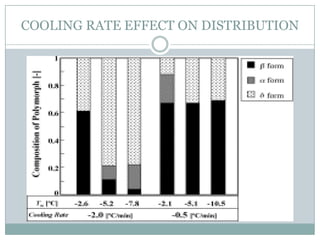
   Ice crystal nucleation temp. and cooling rate
   Nucleation at higher temp gives stable compound Tn:
    -2.6oC gives 60%wt stable β product
   Nucleation at lower temp. less stable compound Tn:
    -7.8oC gives only 2% stable product
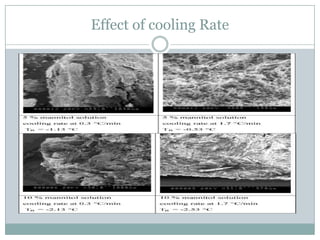
   Cooling rate plays crucial role
   Fast rate: low stability (-2oC/min)
   Slow rate: High stability(-0.5oC/min)
COOLING RATE EFFECT ON DISTRIBUTION
PROCESS VARIABLES

 Effect of conc. Variation: 1.5%, 3%w/w yields β form where
  as higher conc. Like 7.5%,10% yields mix α,β form.This 10%
  system after fast cooling gives δ form.
 Effect of Annealing temp.:annealing step i.e slow rate of
  cooling temp. is essential for 100% crystalinity
 With increase in conc. From 1.5,3,5,7,10% w/v amount of
  crystaline product increase
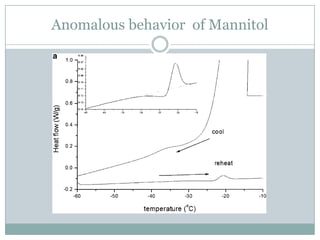
 Annamolus behaviour of mannitol: Unlike all other sugars in
  thermodynamic graph of mannitol 3% solution through DSC
  plot cooling from 10 o showed exotherm at -21o followed by
  smaller isotherm at -29o.But degree of reproducibilty was -24o
Anomalous behavior of Mannitol
Effect of cooling Rate
Why could this problem have occurred?

 This problem could be due to formation of β
  polymorph which has low solubility due to its
  crystalline nature
 This problem may even divert to interaction between
  mannitol and API if the anti cancer drug is
  protenious in nature
 The other possibility is crystallization of buffer used
  such as sodium acetate in our case which crystalise
  during freeze drying but form complex which has low
  probability of hydration
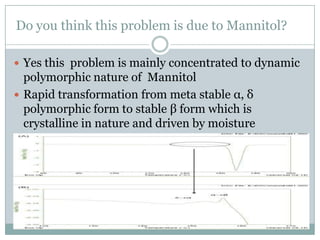
Do you think this problem is due to Mannitol?

 Yes this problem is mainly concentrated to dynamic
  polymorphic nature of Mannitol
 Rapid transformation from meta stable α, δ
  polymorphic form to stable β form which is
  crystalline in nature and driven by moisture
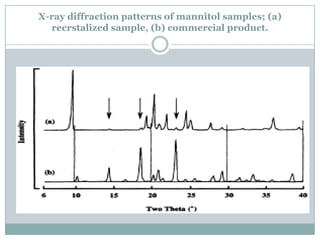
X-ray diffraction patterns of mannitol samples; (a)
  recrstalized sample, (b) commercial product.
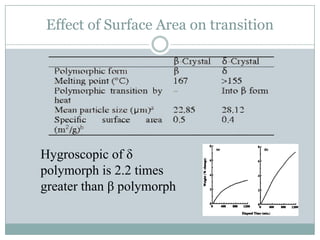
Effect of Surface Area on transition


Hygroscopic of δ
polymorph is 2.2 times
greater than β polymorph
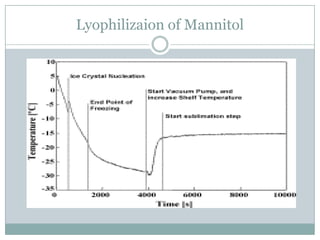
Lyophilizaion of Mannitol
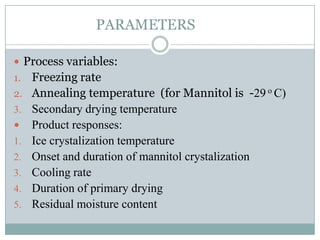
PARAMETERS

 Process variables:
1.   Freezing rate
2.   Annealing temperature (for Mannitol is -29 o C)
3.   Secondary drying temperature
    Product responses:
1.   Ice crystalization temperature
2.   Onset and duration of mannitol crystalization
3.   Cooling rate
4.   Duration of primary drying
5.   Residual moisture content
Approaches for prevention of fibers

 Solvent used for mannitol freeze drying process is
  mixture of acetone/ water
 Mannitol is not soluble in acetone and its stability is
  6 months
 This approach will help to produce and preserve δ
  polymorph which is amorphous in nature and hence
  will resolve the fibre problem if it is due to crystaline
  nature of β polymorph
2nd Approach

 For the increase in stability of protein drugs using a mixture of
  excipient like mannitol/sorbtol and mannitol/trehalose . In the
  mannitol/sorbitol co-solute systems the spray dried samples
  containing lysozyme and trypsin showed a decrease in
   stability with an increase in sorbitol content of the initial sample.
  The enzymatic assays revealed that addition of sorbitol to
  the initial mixture caused a decrease in retained activity
  immediately after production and after storage for four weeks at
  75%
 RH and 40°C. Loss of structural integrity was confirmed from
  Raman data. Co-spray drying the proteins with

 trehalose/mannitol gave a higher retained activity both before and
  after exposure than the mannitol/sorbitol samples.
ANNALYTICAL APPROACH

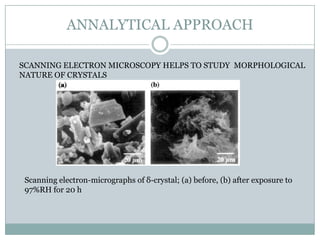
SCANNING ELECTRON MICROSCOPY HELPS TO STUDY MORPHOLOGICAL
NATURE OF CRYSTALS


 Scanning electron-micrographs of δ-crystal; (a) before, (b) after exposure to
 97%RH for 20 h
XPRD
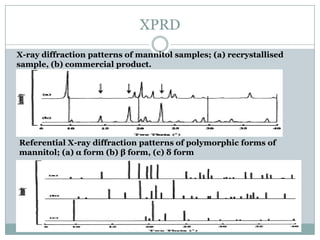
X-ray diffraction patterns of mannitol samples; (a) recrystallised
sample, (b) commercial product.


Referential X-ray diffraction patterns of polymorphic forms of
mannitol; (a) α form (b) β form, (c) δ form
CONCLUSION

 FIBER FORMATION CAN BE EITHER
  PREVENTED BY FORMING AND PRESEVING
  AMORPHOUS STAGE WHICH HAS SOLUBILITY
  IN AQUEOUS STATE
 BY FORMING COSOLVENTS SUCH AS
  MANNITOL/TREHALOSE IS FOUND TO BE
  SUCCESFUL
 BY ARRANGING DESSICANT IN VIAL STOPPER
  SO THAT IT MAINTAIN DESIRED MOISTURE
  LEVEL SO THAT δ POLYMORH IS PRESEVED
REFERENCE

1.   International Journal of Pharmaceutics Volume 247, Issues
     1-2, 24 October 2002, Pages 69-77.
2.   Chemical Engineering Research and Design Volume
     87, Issue 8, August 2009, Pages 1017-1027
3.   Lyophilization Introduction and basic principles,Thomas
     Jenning
4.   JOURNAL OF PHARMACEUTICAL SCIENCES, VOL.
     92, NO. 9, SEPTEMBER 2003
5.   T. Yoshinari1, R. T. Forbes1, M. Mercer2, P. York1
     1University of Bradford: Bradford, United Kingdom ; 2Hiden
     Analytical Ltd.: Warrington, United Kingdom
6.   R. forbes1, W. hulse1, M. bonner1, S. burgess2
7.   pharmacy, university of bradford, 2merck speciality
     chemicals, merck uk

Troubleshooting to Freeze drying fiber formation problem

  • 1.
    YICC-2011 Solution Anomalous behaviorof Mannitol Presented by- Parth Shah, YICC-2011, ICT, Mumbai
  • 2.
    INTRODUCTION  MANNITOL :mainly used as bulking agent and cryoprotectant.  CRITERIA FOR USING BULKING AGENT: API<2%  ADVANTAGE : When formulation frozen slowly produce crystals which supports API and prevent loss of product  USUALLY NON-REACTIVE WITH ACTIVE CONSTITUENT  Provides more stable cake of API as compared to lactose  DISADVANTAGE: Mannitol interacts with proteins and forms turbid and hazy solution on storage
  • 3.
     Selection ofexcipient depends on interaction with API .  Mannitol is a hexahydric alcohol that has been extensively used as an excipient for the freeze drying of pharmaceuticals  Mannitol differs from other cryo- or lyo-protectant in that it tends to recrystallize on drying, supposedly via eutectic formation with water in contrast to the behavior of materials such as sucrose and trehalose that form amorphous products after completion of the drying process.
  • 4.
    STRUCTURAL BEHAVIOUR  Mannitolis believed to exist in three forms designated as α, β, and δ  δ polymorph has loose carbon backbone but strong H-bond  β polymorph has strong C-backbone but weak H-bond  Polar -OH group of water breaks strong H-bonding of δ polymorph and leads to convert to stable β form.
  • 5.
    MANNITOL  Polymorph formationdepends on protocol and conc. Of mannitol used.  Parameters:  Ice crystal nucleation temp. and cooling rate  Nucleation at higher temp gives stable compound Tn: -2.6oC gives 60%wt stable β product  Nucleation at lower temp. less stable compound Tn: -7.8oC gives only 2% stable product  Cooling rate plays crucial role  Fast rate: low stability (-2oC/min)  Slow rate: High stability(-0.5oC/min)
  • 6.
    COOLING RATE EFFECTON DISTRIBUTION
  • 7.
    PROCESS VARIABLES  Effectof conc. Variation: 1.5%, 3%w/w yields β form where as higher conc. Like 7.5%,10% yields mix α,β form.This 10% system after fast cooling gives δ form.  Effect of Annealing temp.:annealing step i.e slow rate of cooling temp. is essential for 100% crystalinity  With increase in conc. From 1.5,3,5,7,10% w/v amount of crystaline product increase  Annamolus behaviour of mannitol: Unlike all other sugars in thermodynamic graph of mannitol 3% solution through DSC plot cooling from 10 o showed exotherm at -21o followed by smaller isotherm at -29o.But degree of reproducibilty was -24o
  • 8.
  • 9.
  • 10.
    Why could thisproblem have occurred?  This problem could be due to formation of β polymorph which has low solubility due to its crystalline nature  This problem may even divert to interaction between mannitol and API if the anti cancer drug is protenious in nature  The other possibility is crystallization of buffer used such as sodium acetate in our case which crystalise during freeze drying but form complex which has low probability of hydration
  • 11.
    Do you thinkthis problem is due to Mannitol?  Yes this problem is mainly concentrated to dynamic polymorphic nature of Mannitol  Rapid transformation from meta stable α, δ polymorphic form to stable β form which is crystalline in nature and driven by moisture
  • 12.
    X-ray diffraction patternsof mannitol samples; (a) recrstalized sample, (b) commercial product.
  • 13.
    Effect of SurfaceArea on transition Hygroscopic of δ polymorph is 2.2 times greater than β polymorph
  • 14.
  • 15.
    PARAMETERS  Process variables: 1. Freezing rate 2. Annealing temperature (for Mannitol is -29 o C) 3. Secondary drying temperature  Product responses: 1. Ice crystalization temperature 2. Onset and duration of mannitol crystalization 3. Cooling rate 4. Duration of primary drying 5. Residual moisture content
  • 16.
    Approaches for preventionof fibers  Solvent used for mannitol freeze drying process is mixture of acetone/ water  Mannitol is not soluble in acetone and its stability is 6 months  This approach will help to produce and preserve δ polymorph which is amorphous in nature and hence will resolve the fibre problem if it is due to crystaline nature of β polymorph
  • 17.
    2nd Approach  Forthe increase in stability of protein drugs using a mixture of excipient like mannitol/sorbtol and mannitol/trehalose . In the mannitol/sorbitol co-solute systems the spray dried samples containing lysozyme and trypsin showed a decrease in stability with an increase in sorbitol content of the initial sample. The enzymatic assays revealed that addition of sorbitol to the initial mixture caused a decrease in retained activity immediately after production and after storage for four weeks at 75%  RH and 40°C. Loss of structural integrity was confirmed from Raman data. Co-spray drying the proteins with  trehalose/mannitol gave a higher retained activity both before and after exposure than the mannitol/sorbitol samples.
  • 18.
    ANNALYTICAL APPROACH SCANNING ELECTRONMICROSCOPY HELPS TO STUDY MORPHOLOGICAL NATURE OF CRYSTALS Scanning electron-micrographs of δ-crystal; (a) before, (b) after exposure to 97%RH for 20 h
  • 19.
    XPRD X-ray diffraction patternsof mannitol samples; (a) recrystallised sample, (b) commercial product. Referential X-ray diffraction patterns of polymorphic forms of mannitol; (a) α form (b) β form, (c) δ form
  • 20.
    CONCLUSION  FIBER FORMATIONCAN BE EITHER PREVENTED BY FORMING AND PRESEVING AMORPHOUS STAGE WHICH HAS SOLUBILITY IN AQUEOUS STATE  BY FORMING COSOLVENTS SUCH AS MANNITOL/TREHALOSE IS FOUND TO BE SUCCESFUL  BY ARRANGING DESSICANT IN VIAL STOPPER SO THAT IT MAINTAIN DESIRED MOISTURE LEVEL SO THAT δ POLYMORH IS PRESEVED
  • 21.
    REFERENCE 1. International Journal of Pharmaceutics Volume 247, Issues 1-2, 24 October 2002, Pages 69-77. 2. Chemical Engineering Research and Design Volume 87, Issue 8, August 2009, Pages 1017-1027 3. Lyophilization Introduction and basic principles,Thomas Jenning 4. JOURNAL OF PHARMACEUTICAL SCIENCES, VOL. 92, NO. 9, SEPTEMBER 2003 5. T. Yoshinari1, R. T. Forbes1, M. Mercer2, P. York1 1University of Bradford: Bradford, United Kingdom ; 2Hiden Analytical Ltd.: Warrington, United Kingdom 6. R. forbes1, W. hulse1, M. bonner1, S. burgess2 7. pharmacy, university of bradford, 2merck speciality chemicals, merck uk