TRIBAL STUDIES
INSTITUTION IN
INDIA
By Rabindra Nath Nayak
Designation of the Chair Professor : Rajiv Gandhi Professor

◦ Appointment of the Rajiv Gandhi Professor
(i) Qualification/Experience : An academic of outstanding track record
who has made scholarship in the designated areas of studies.
(ii) Age : 50-65 years
(iii) Scale of Pay : Rs.18400-22400 (in case of superannuated
professors, the Government of India rules for re-employment shall apply)
(iv) Period of Appointment : 5 years
(in case the university wants to get the expertise of 2 or 3 persons for
shorter duration, the period can be adjusted accordingly)
(v) Mode of Appointment : Through Search Committee or by invitation on
the recommendation of the Search Committee (to be decided by the
University). (A 3-member Search Committee constituted by the ViceChancellor with one nominee of the Chairman, UGC)

Norms and procedures for the operation of Rajiv
Gandhi Chairs in contemporary studies in 10 selected
universities
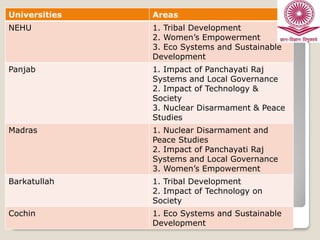
Universities

Areas

NEHU

1. Tribal Development
2. Women’s Empowerment
3. Eco Systems and Sustainable
Development

Panjab

1. Impact of Panchayati Raj
Systems and Local Governance
2. Impact of Technology &
Society
3. Nuclear Disarmament & Peace
Studies

Madras

1. Nuclear Disarmament and
Peace Studies
2. Impact of Panchayati Raj
Systems and Local Governance
3. Women’s Empowerment

Barkatullah

1. Tribal Development
2. Impact of Technology on
Society

Areas Studies of the Chair

Cochin

1. Eco Systems and Sustainable
Development
Universities

Areas

Delhi

1. Impact of Technology on
Society
2. Protection of Child Rights

Kashmir

1. Livelihood & Food Security
2. Women’s Empowerment
3. Eco-Systems & Sustainable
Development

Allahabad

1. Nuclear Disarmament
2. Secularism and Nation Building
3. Social Justice

Bombay

1. Impact of Panchayati Raj
Systems and Local Governance
2. Impact of Technology on
Society
3. Secularism & Nation Building

Areas Studies of the Chair
Calcutta

1. Eco Systems and Sustainable
Development
1 Professor in the grade o Professor in
National Institutes
 1 Post-doctoral Research Associate (UGC
norms)
3
Junior Research Fellowships with
provisions for up-gradation to SRF as per
UGC norms
2
Technical
Assistant
level
positions/support for field works


Organizational Set up
To coordinate and to provide a think tank in the area of studies
drawing expertise and inputs from academics experts from other
sectors like Government and other National/International NGOs.
 To provide a forum for inter-university/inter-collegiate PG and
research level dialogues, discussion meetings, summer/winter
institutes, involving other universities/autonomous institutions/PG
centres.
 To design and execute capacity-building programmes for teachers
in higher education focused towards the designated discipline of
the Chair.
 To strengthen the role of Universities/Academics in Public Policy
making.
 To conduct short-term courses in the concerned disciplines.
 Publications of proceedings
 There will not be any full-time regular course leading to undergraduate or post-graduate degree except for the Ph.D.
programme and related course works.


Academic Functions











Providing autonomy with definite provisions for the
University administration to coordinate the activities
ensuring accountability
Recognition as a research centre for Ph.D.
Making the Centre/Chair eligible for availing grant from
National/International Govt./Non-Govt. agencies.
Providing opportunities for the Chair to give courses in
other departments suiting their discipline and suiting the
requirements of the University.
University can consider granting autonomy to this
department as envisaged for SAP and also as envisaged in
the CABE Committee report on Autonomy.
A University level advisory body for the Chair involving
experts from other sectors as well.

Universities’ Facilitation of the
Chairs
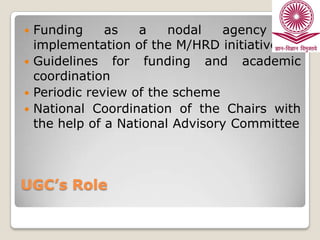
Funding
as
a
nodal
agency
or
implementation of the M/HRD initiative
 Guidelines for funding and academic
coordination
 Periodic review of the scheme
 National Coordination of the Chairs with
the help of a National Advisory Committee


UGC’s Role











100% funding for the positions of Professor, Postdoctoral Research Associate and 3 Junior Research
Fellows for 5 years as per UGC norms.
Consolidated assistance toward employing two
technical
assistant
level
positions/support
for
fieldwork.
Library Grant Rs.1.00 lakh p.a.
Contingencies and office expenses: Rs.1.00 lakh p.a.
Conduct of Seminars/Conference/Workshops as per
UGC guidelines.
Travel : Rs.50,000/- p.a.
In addition, the Chair is eligible for all the academic
schemes of the UGC.

Funding


The Chair conducts studies and research on themes close to the
heart of former Prime Minister Rajiv Gandhi.



The objective of the Chair is to create national centres for
academic deliberations and action-oriented research in the
frontier areas of contemporary relevance for improving the
quality of life and life management systems.
◦
◦
◦
◦
◦
◦
◦
◦
◦

In particular, the Chair focuses on the themes of
Panchayati Raj Systems and local governance,
women empowerment,
impact of technology on society,
eco-systems and sustainable development,
livelihood and food security,
nuclear disarmament and peace studies,
tribal development,
protection of child rights, social justice, and secularism and nation building.

Rajiv Gandhi Chair for Contemporary
Studies








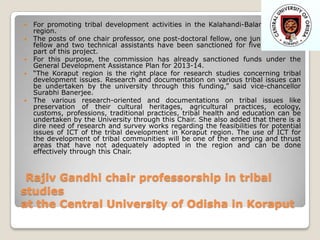
For promoting tribal development activities in the Kalahandi-Balangir-Koraput
region.
The posts of one chair professor, one post-doctoral fellow, one junior research
fellow and two technical assistants have been sanctioned for five years as a
part of this project.
For this purpose, the commission has already sanctioned funds under the
General Development Assistance Plan for 2013-14.
“The Koraput region is the right place for research studies concerning tribal
development issues. Research and documentation on various tribal issues can
be undertaken by the university through this funding,” said vice-chancellor
Surabhi Banerjee.
The various research-oriented and documentations on tribal issues like
preservation of their cultural heritages, agricultural practices, ecology,
customs, professions, traditional practices, tribal health and education can be
undertaken by the University through this Chair. She also added that there is a
dire need of research and survey works regarding the feasibilities for potential
issues of ICT of the tribal development in Koraput region. The use of ICT for
the development of tribal communities will be one of the emerging and thrust
areas that have not adequately adopted in the region and can be done
effectively through this Chair.

Rajiv Gandhi chair professorship in tribal
studies
at the Central University of Odisha in Koraput
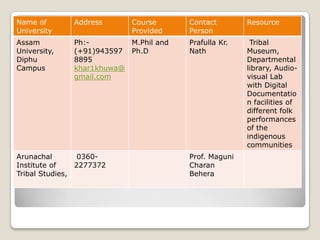
Name of
University

Address

Assam
University,
Diphu
Campus

Ph:M.Phil and
(+91)943597 Ph.D
8895
khar1khuwa@
gmail.com

Arunachal
0360Institute of
2277372
Tribal Studies,

Course
Provided

Contact
Person

Resource

Prafulla Kr.
Nath

Tribal
Museum,
Departmental
library, Audiovisual Lab
with Digital
Documentatio
n facilities of
different folk
performances
of the
indigenous
communities

Prof. Maguni
Charan
Behera
Dept of Folklore
and Tribal
Studies,
Dravidian
University
Srinivasa
Vanam
Kuppam-517
425,
Chittoor Dist. (
A.P.)

08570 - 202677

Department of
Tribal
Studies, Kannad
a
University, Ham
pi,
Vidyaranya-583
276, Hospet
(Taluk) , Bellary
(Dist.)
Karnataka
(State). INDIA.

08394 - 241337
Ext. 340, Fax :
08394 241334
Email:kanandau
niversity@gmail
.com , mail@ka
nnadauniversity
.org

M.A, M.Phil and
Ph.D

Prof. P.
Subbachary,
Head of the
Department,

Dr. A.S.
Prabhakara
Institute of Tribal
Studies (ITS),
Himachal Pradesh
University, Shimla

5818,
0177:
2830445,
2830635,
2830709,
2830741,
2831637,
2831727,
2831742,
2831998
deanstudies
@gmail.com

Post-graduate
Diploma in
Tribal Studies
that covers
tribal History,
Society,
Economy and
Culture with a
focus on the
Tribes and
Tribal areas of
Himachal
Pradesh

Tata Institute of
Social Sciences
V.N. Purav Marg
Deonar
Mumbai - 400 088

022 - 2552
5252,
pgadmission
@tiss.edu

M. A. Social
Work in Dalit &
Tribal Studies
and Action

Prof.(Ms.)
Aparna Negi
North Orissa
UniversityNorth
Orissa
University

Master of
Science
(Anthropology
and Tribal
Studies)

Centre for Tribal
and Folk
Studies
(CTFS), Vikram
a Simhapuri
University
(VSU)

post graduation
course in tribal
studies

Department of
Sociology &
Social
Anthropology,
Indira Gandhi
National Tribal
University,
Amarkantak

09425140294
eMail
: jayantabehera
90@gmail.com
(07629)
280801,
280802,
280803,
280810,
280811

Dr. Jayanta
Kumar Behera
National
Institute of
Rural
Developmen
t
Rajendranag
ar,Hyderaba
d-500030

Tel : 0402400 8520
Fax : 0402400 8585
E-mail:
pgtdm2012
@gmail.com

PG Diploma
in Tribal
Developmen
t
Managemen
t

Dr. G.V.
Krishna Lohi
Das
Associate
Programme
Coordinator
, PGD-TDM
Distance
Education
Cell

Tribal studies

  • 1.
  • 2.
    Designation of theChair Professor : Rajiv Gandhi Professor ◦ Appointment of the Rajiv Gandhi Professor (i) Qualification/Experience : An academic of outstanding track record who has made scholarship in the designated areas of studies. (ii) Age : 50-65 years (iii) Scale of Pay : Rs.18400-22400 (in case of superannuated professors, the Government of India rules for re-employment shall apply) (iv) Period of Appointment : 5 years (in case the university wants to get the expertise of 2 or 3 persons for shorter duration, the period can be adjusted accordingly) (v) Mode of Appointment : Through Search Committee or by invitation on the recommendation of the Search Committee (to be decided by the University). (A 3-member Search Committee constituted by the ViceChancellor with one nominee of the Chairman, UGC) Norms and procedures for the operation of Rajiv Gandhi Chairs in contemporary studies in 10 selected universities
  • 3.
    Universities Areas NEHU 1. Tribal Development 2.Women’s Empowerment 3. Eco Systems and Sustainable Development Panjab 1. Impact of Panchayati Raj Systems and Local Governance 2. Impact of Technology & Society 3. Nuclear Disarmament & Peace Studies Madras 1. Nuclear Disarmament and Peace Studies 2. Impact of Panchayati Raj Systems and Local Governance 3. Women’s Empowerment Barkatullah 1. Tribal Development 2. Impact of Technology on Society Areas Studies of the Chair Cochin 1. Eco Systems and Sustainable Development
  • 4.
    Universities Areas Delhi 1. Impact ofTechnology on Society 2. Protection of Child Rights Kashmir 1. Livelihood & Food Security 2. Women’s Empowerment 3. Eco-Systems & Sustainable Development Allahabad 1. Nuclear Disarmament 2. Secularism and Nation Building 3. Social Justice Bombay 1. Impact of Panchayati Raj Systems and Local Governance 2. Impact of Technology on Society 3. Secularism & Nation Building Areas Studies of the Chair Calcutta 1. Eco Systems and Sustainable Development
  • 5.
    1 Professor inthe grade o Professor in National Institutes  1 Post-doctoral Research Associate (UGC norms) 3 Junior Research Fellowships with provisions for up-gradation to SRF as per UGC norms 2 Technical Assistant level positions/support for field works  Organizational Set up
  • 6.
    To coordinate andto provide a think tank in the area of studies drawing expertise and inputs from academics experts from other sectors like Government and other National/International NGOs.  To provide a forum for inter-university/inter-collegiate PG and research level dialogues, discussion meetings, summer/winter institutes, involving other universities/autonomous institutions/PG centres.  To design and execute capacity-building programmes for teachers in higher education focused towards the designated discipline of the Chair.  To strengthen the role of Universities/Academics in Public Policy making.  To conduct short-term courses in the concerned disciplines.  Publications of proceedings  There will not be any full-time regular course leading to undergraduate or post-graduate degree except for the Ph.D. programme and related course works.  Academic Functions
  • 7.
          Providing autonomy withdefinite provisions for the University administration to coordinate the activities ensuring accountability Recognition as a research centre for Ph.D. Making the Centre/Chair eligible for availing grant from National/International Govt./Non-Govt. agencies. Providing opportunities for the Chair to give courses in other departments suiting their discipline and suiting the requirements of the University. University can consider granting autonomy to this department as envisaged for SAP and also as envisaged in the CABE Committee report on Autonomy. A University level advisory body for the Chair involving experts from other sectors as well. Universities’ Facilitation of the Chairs
  • 8.
    Funding as a nodal agency or implementation of theM/HRD initiative  Guidelines for funding and academic coordination  Periodic review of the scheme  National Coordination of the Chairs with the help of a National Advisory Committee  UGC’s Role
  • 9.
           100% funding forthe positions of Professor, Postdoctoral Research Associate and 3 Junior Research Fellows for 5 years as per UGC norms. Consolidated assistance toward employing two technical assistant level positions/support for fieldwork. Library Grant Rs.1.00 lakh p.a. Contingencies and office expenses: Rs.1.00 lakh p.a. Conduct of Seminars/Conference/Workshops as per UGC guidelines. Travel : Rs.50,000/- p.a. In addition, the Chair is eligible for all the academic schemes of the UGC. Funding
  • 10.
     The Chair conductsstudies and research on themes close to the heart of former Prime Minister Rajiv Gandhi.  The objective of the Chair is to create national centres for academic deliberations and action-oriented research in the frontier areas of contemporary relevance for improving the quality of life and life management systems. ◦ ◦ ◦ ◦ ◦ ◦ ◦ ◦ ◦ In particular, the Chair focuses on the themes of Panchayati Raj Systems and local governance, women empowerment, impact of technology on society, eco-systems and sustainable development, livelihood and food security, nuclear disarmament and peace studies, tribal development, protection of child rights, social justice, and secularism and nation building. Rajiv Gandhi Chair for Contemporary Studies
  • 11.
         For promoting tribaldevelopment activities in the Kalahandi-Balangir-Koraput region. The posts of one chair professor, one post-doctoral fellow, one junior research fellow and two technical assistants have been sanctioned for five years as a part of this project. For this purpose, the commission has already sanctioned funds under the General Development Assistance Plan for 2013-14. “The Koraput region is the right place for research studies concerning tribal development issues. Research and documentation on various tribal issues can be undertaken by the university through this funding,” said vice-chancellor Surabhi Banerjee. The various research-oriented and documentations on tribal issues like preservation of their cultural heritages, agricultural practices, ecology, customs, professions, traditional practices, tribal health and education can be undertaken by the University through this Chair. She also added that there is a dire need of research and survey works regarding the feasibilities for potential issues of ICT of the tribal development in Koraput region. The use of ICT for the development of tribal communities will be one of the emerging and thrust areas that have not adequately adopted in the region and can be done effectively through this Chair. Rajiv Gandhi chair professorship in tribal studies at the Central University of Odisha in Koraput
  • 12.
    Name of University Address Assam University, Diphu Campus Ph:M.Phil and (+91)943597Ph.D 8895 khar1khuwa@ gmail.com Arunachal 0360Institute of 2277372 Tribal Studies, Course Provided Contact Person Resource Prafulla Kr. Nath Tribal Museum, Departmental library, Audiovisual Lab with Digital Documentatio n facilities of different folk performances of the indigenous communities Prof. Maguni Charan Behera
  • 13.
    Dept of Folklore andTribal Studies, Dravidian University Srinivasa Vanam Kuppam-517 425, Chittoor Dist. ( A.P.) 08570 - 202677 Department of Tribal Studies, Kannad a University, Ham pi, Vidyaranya-583 276, Hospet (Taluk) , Bellary (Dist.) Karnataka (State). INDIA. 08394 - 241337 Ext. 340, Fax : 08394 241334 Email:kanandau niversity@gmail .com , mail@ka nnadauniversity .org M.A, M.Phil and Ph.D Prof. P. Subbachary, Head of the Department, Dr. A.S. Prabhakara
  • 14.
    Institute of Tribal Studies(ITS), Himachal Pradesh University, Shimla 5818, 0177: 2830445, 2830635, 2830709, 2830741, 2831637, 2831727, 2831742, 2831998 deanstudies @gmail.com Post-graduate Diploma in Tribal Studies that covers tribal History, Society, Economy and Culture with a focus on the Tribes and Tribal areas of Himachal Pradesh Tata Institute of Social Sciences V.N. Purav Marg Deonar Mumbai - 400 088 022 - 2552 5252, pgadmission @tiss.edu M. A. Social Work in Dalit & Tribal Studies and Action Prof.(Ms.) Aparna Negi
  • 15.
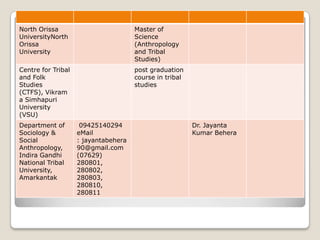
    North Orissa UniversityNorth Orissa University Master of Science (Anthropology andTribal Studies) Centre for Tribal and Folk Studies (CTFS), Vikram a Simhapuri University (VSU) post graduation course in tribal studies Department of Sociology & Social Anthropology, Indira Gandhi National Tribal University, Amarkantak 09425140294 eMail : jayantabehera 90@gmail.com (07629) 280801, 280802, 280803, 280810, 280811 Dr. Jayanta Kumar Behera
  • 16.
    National Institute of Rural Developmen t Rajendranag ar,Hyderaba d-500030 Tel :0402400 8520 Fax : 0402400 8585 E-mail: pgtdm2012 @gmail.com PG Diploma in Tribal Developmen t Managemen t Dr. G.V. Krishna Lohi Das Associate Programme Coordinator , PGD-TDM Distance Education Cell

Editor's Notes

  • #11 http://www.ignou.ac.in/ignou/aboutignou/chair/mhrdrajivgandhichair/introduction
  • #12 http://www.telegraphindia.com/1131011/jsp/odisha/story_17446196.jsp#.UmNuUvml7-s