PRESTIGE INSTITUTE OF MANAGEMENT AND RESEARCH, INDORE
(An Autonomous Institution Established in 1994, Accredited with grade ‘A++’ NAAC (UGC)
ISO 9001: 2008 Certified Institute, AICTE/ UGC Approved Programs affiliated to DAVV, Indore)
Trending technology
Presentation
MBA FT (D)
SUBMITTED BY :- Scholar No:-
Harsh lakhera (1121215708)
Gourav Vaishnav (1121215756)
Garima Saiwal (1121215747)
Gaurav Kadwane (1121215705)
Divya Agrawal (1121215784)
Faculty Coordinator :
Archana Nag mam
Deployment Models
of Cloud Computing
Introduction
• In cloud computing , we have access to shared pool of computer
resources ( servers , storage , programs , and so on ) in the clous
• Your cloud provider is in charge of all upkeep
• It functions as a virtual computing environment with a deployment
architecture that varies depending on the amount of data you want to
store and who has access to the infrastructure
DEPLOYMENT MODELS
• Private cloud
• Public cloud
• Hybrid cloud
• Community cloud
• Multi-cloud
PUBLIC CLOUD
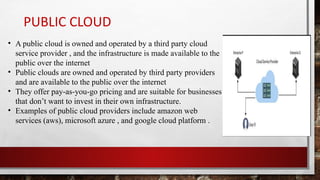
• A public cloud is owned and operated by a third party cloud
service provider , and the infrastructure is made available to the
public over the internet
• Public clouds are owned and operated by third party providers
and are available to the public over the internet
• They offer pay-as-you-go pricing and are suitable for businesses
that don’t want to invest in their own infrastructure.
• Examples of public cloud providers include amazon web
services (aws), microsoft azure , and google cloud platform .
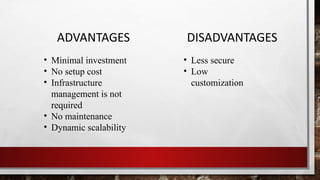
ADVANTAGES
• Minimal investment
• No setup cost
• Infrastructure
management is not
required
• No maintenance
• Dynamic scalability
• Less secure
• Low
customization
DISADVANTAGES
PRIVATE CLOUD
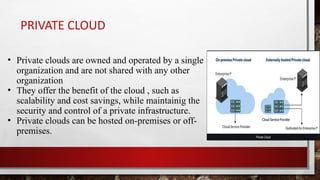
• Private clouds are owned and operated by a single
organization and are not shared with any other
organization
• They offer the benefit of the cloud , such as
scalability and cost savings, while maintainig the
security and control of a private infrastructure.
• Private clouds can be hosted on-premises or off-
premises.
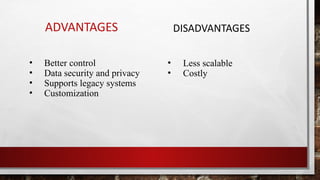
ADVANTAGES DISADVANTAGES
• Better control
• Data security and privacy
• Supports legacy systems
• Customization
• Less scalable
• Costly
HYBRID CLOUD
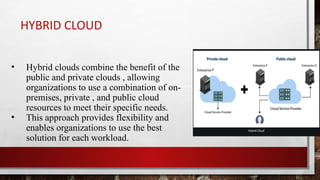
• Hybrid clouds combine the benefit of the
public and private clouds , allowing
organizations to use a combination of on-
premises, private , and public cloud
resources to meet their specific needs.
• This approach provides flexibility and
enables organizations to use the best
solution for each workload.
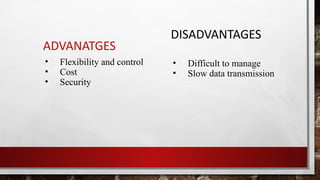
ADVANATGES
• Flexibility and control
• Cost
• Security
• Difficult to manage
• Slow data transmission
DISADVANTAGES
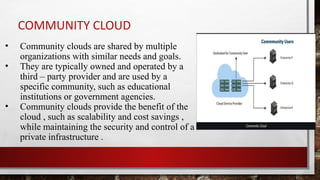
COMMUNITY CLOUD
• Community clouds are shared by multiple
organizations with similar needs and goals.
• They are typically owned and operated by a
third – party provider and are used by a
specific community, such as educational
institutions or government agencies.
• Community clouds provide the benefit of the
cloud , such as scalability and cost savings ,
while maintaining the security and control of a
private infrastructure .
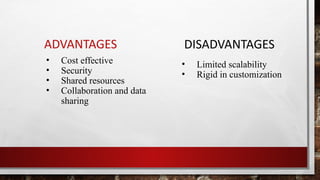
ADVANTAGES DISADVANTAGES
• Limited scalability
• Rigid in customization
• Cost effective
• Security
• Shared resources
• Collaboration and data
sharing
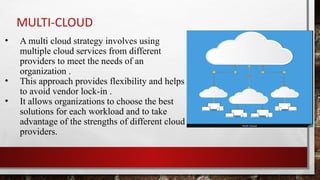
MULTI-CLOUD
• A multi cloud strategy involves using
multiple cloud services from different
providers to meet the needs of an
organization .
• This approach provides flexibility and helps
to avoid vendor lock-in .
• It allows organizations to choose the best
solutions for each workload and to take
advantage of the strengths of different cloud
providers.
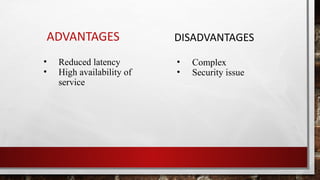
ADVANTAGES DISADVANTAGES
• Reduced latency
• High availability of
service
• Complex
• Security issue
THANKYOU

TRENDING TECHNOLOGY PRESENTATION....pptx

  • 1.
    PRESTIGE INSTITUTE OFMANAGEMENT AND RESEARCH, INDORE (An Autonomous Institution Established in 1994, Accredited with grade ‘A++’ NAAC (UGC) ISO 9001: 2008 Certified Institute, AICTE/ UGC Approved Programs affiliated to DAVV, Indore) Trending technology Presentation MBA FT (D) SUBMITTED BY :- Scholar No:- Harsh lakhera (1121215708) Gourav Vaishnav (1121215756) Garima Saiwal (1121215747) Gaurav Kadwane (1121215705) Divya Agrawal (1121215784) Faculty Coordinator : Archana Nag mam
  • 2.
  • 3.
    Introduction • In cloudcomputing , we have access to shared pool of computer resources ( servers , storage , programs , and so on ) in the clous • Your cloud provider is in charge of all upkeep • It functions as a virtual computing environment with a deployment architecture that varies depending on the amount of data you want to store and who has access to the infrastructure
  • 4.
    DEPLOYMENT MODELS • Privatecloud • Public cloud • Hybrid cloud • Community cloud • Multi-cloud
  • 5.
    PUBLIC CLOUD • Apublic cloud is owned and operated by a third party cloud service provider , and the infrastructure is made available to the public over the internet • Public clouds are owned and operated by third party providers and are available to the public over the internet • They offer pay-as-you-go pricing and are suitable for businesses that don’t want to invest in their own infrastructure. • Examples of public cloud providers include amazon web services (aws), microsoft azure , and google cloud platform .
  • 6.
    ADVANTAGES • Minimal investment •No setup cost • Infrastructure management is not required • No maintenance • Dynamic scalability • Less secure • Low customization DISADVANTAGES
  • 7.
    PRIVATE CLOUD • Privateclouds are owned and operated by a single organization and are not shared with any other organization • They offer the benefit of the cloud , such as scalability and cost savings, while maintainig the security and control of a private infrastructure. • Private clouds can be hosted on-premises or off- premises.
  • 8.
    ADVANTAGES DISADVANTAGES • Bettercontrol • Data security and privacy • Supports legacy systems • Customization • Less scalable • Costly
  • 9.
    HYBRID CLOUD • Hybridclouds combine the benefit of the public and private clouds , allowing organizations to use a combination of on- premises, private , and public cloud resources to meet their specific needs. • This approach provides flexibility and enables organizations to use the best solution for each workload.
  • 10.
    ADVANATGES • Flexibility andcontrol • Cost • Security • Difficult to manage • Slow data transmission DISADVANTAGES
  • 11.
    COMMUNITY CLOUD • Communityclouds are shared by multiple organizations with similar needs and goals. • They are typically owned and operated by a third – party provider and are used by a specific community, such as educational institutions or government agencies. • Community clouds provide the benefit of the cloud , such as scalability and cost savings , while maintaining the security and control of a private infrastructure .
  • 12.
    ADVANTAGES DISADVANTAGES • Limitedscalability • Rigid in customization • Cost effective • Security • Shared resources • Collaboration and data sharing
  • 13.
    MULTI-CLOUD • A multicloud strategy involves using multiple cloud services from different providers to meet the needs of an organization . • This approach provides flexibility and helps to avoid vendor lock-in . • It allows organizations to choose the best solutions for each workload and to take advantage of the strengths of different cloud providers.
  • 14.
    ADVANTAGES DISADVANTAGES • Reducedlatency • High availability of service • Complex • Security issue
  • 15.