Capacity for Humanity Conference
Arusha, Tanzania
8 February, 2018
Forest Garden Project Phases
Forest Garden Approach
• A multi-layered integrated agricultural system
• Combines both plants and animals
• Maximizes use of horizontal and vertical space
• Incorporates agroforestry techniques with vegetable
gardening
Forest Garden Approach
Year 1
• Living fence – agroforestry species
• Alley cropping – agroforestry species
• Vegetable beds
Year 2
• Fruit trees – intercropped
Year 3
• Timber trees – intercropped or woodlot
Forest Garden Design - Vertical
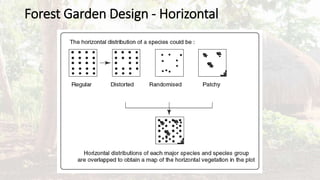
Forest Garden Design - Horizontal
Mapping Exercise – Breakout Groups
• Break into groups of 5
• Make sure you have:
- flipchart
- markers
- pencil
• Overview of mapping instructions
• Group Forest Garden designs (15 minutes)
• Report out (10 minutes)
Mapping Exercise – “Farmer Wairimu”
Plot Characteristics (handout)
• 1 acre
• Southern boundary next to busy road
• Half acre in maize and beans
• Quarter acre on 30% slope in Napier grass (dairy cow fodder)
• Quarter acre in coffee
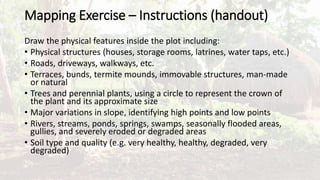
Mapping Exercise – Instructions (handout)
Draw the physical features inside the plot including:
• Physical structures (houses, storage rooms, latrines, water taps, etc.)
• Roads, driveways, walkways, etc.
• Terraces, bunds, termite mounds, immovable structures, man-made
or natural
• Trees and perennial plants, using a circle to represent the crown of
the plant and its approximate size
• Major variations in slope, identifying high points and low points
• Rivers, streams, ponds, springs, swamps, seasonally flooded areas,
gullies, and severely eroded or degraded areas
• Soil type and quality (e.g. very healthy, healthy, degraded, very
degraded)
Mapping Exercise - Instructions (handout)
Draw the physical features outside the plot, including things next to the
field that may affect the Forest Garden, including:
• Neighbors who are rearing bees
• Roads, businesses
• Dead trees or piles of brush next to the field that may attract pests
• Fields where pesticides are sprayed
Mapping Exercise – Key
Forest Garden Legend
Agroforestry trees = A
Fruit trees = F
Timber trees = T
Vegetables = X
Crops = M (for maize or first letter for any other crop)
Bees = B
Structures (boundary, roads, house) = draw as is
Mapping Exercise - Example
Forest Garden Design Summary
Forest Gardens offer:
• lower labor input
• better utilization of resources
• diversified range of products
• higher sustained incomes
• enhanced food security and nutrition
• better environmental management
Forest Garden Projects
Objectives for farming families:
1) Increase food security and nutrition
2) Increase cash income
3) Establish environmentally-friendly farming practices
Currently have 13 projects in five countries:
Senegal, Cameroon, Kenya, Tanzania and Uganda
Forest Garden Projects
• Four years
• 200 – 400 farmers
• Two local technicians
• Country coordinator
• 15 training modules
• Seeds and tools
• 1-2 acre plots
Forest Garden Training Modules
Year 1
Forest Garden Design
Growing Agroforestry Seedlings
Outplanting Agroforestry Seedlings
Composting
Permagardening for the Family
Forest Garden Review & Planning
Forest Garden Training Modules
Year 2
Growing Fruit Tree Seedlings
Planting Fruit Tree Seedlings
Grafting
Harvesting and Planting Suckers
Permagardening for the Market
Forest Garden Review & Planning: Field Optimization
Forest Garden Training Modules
Year 3
Growing Timber Trees
Pruning & Harvesting
Permagardening for the Future
Forest Garden Review & Planning: Advanced
Optimization
Forest Garden Training Modules
Year 4
Sustainability Planning
Graduation
Training of Trainers Program
• Systematic transfer of core knowledge and skills
• Packaged appropriately for target audience
• Certification
• Materials:
- Technical Manual
- Facilitator’s Guide
- Training of Trainers Guide
- Farmer Workbooks
- Certification
Training of Trainers Materials
Technical Manual
• Defining body of knowledge on all aspects of the Forest
Garden
• 15 chapters which include:
- Introduction to the Forest Garden Approach
- Seedling propagation
- Agroforestry technologies
- Cut and carry livestock management
Training of Trainers Materials
Facilitator’s Guide
• Appropriate for low- and non-literate farmers
• Flexible and applicable across various language and cultural
contexts
• Ensure standards for women’s participation
• Focus on small group work to build working relationships
• Market-based
• Inquiry-based
Training of Trainers Materials
Training of Trainers Guide
• Facilitation Styles
• Core Skills
• Conducting the Training of Trainers
Training of Trainer Materials
Farmer Workbooks
• Access important information easily
• Notetaking
• Make plans & prioritize
• Track and collect data
• Keep records of inputs and production
Training of Trainer Materials
Certification
• Online exam
• Based on the Technical Manual
• 75 randomly-generated questions
• Benefits: professionalizing Forest Garden skills, online
resources and practitioner network
Forest Garden Training Center
• Lead Extension Activities
• Improve Agroforestry Skills
• Master Participatory Facilitation
• Farmer Workbooks
• Get Certified
Forest Garden Training Center
• Universal reporting
• Market record-keeping
• Integrated Pest Management (IPM)
• Nutrition enhancement
• Offline app
Questions & Answers
Asanteni Sana!
Links
• Forest Garden Training Center: http://
training.trees.org
• Best Practices in Training Design blog: https://
trees.org/post/bestpractices
• 2017 Impact Report:
https://trees.org/impactreport/images/TFF-Impact-
Report.pdf

Trees for the Future

  • 1.
    Capacity for HumanityConference Arusha, Tanzania 8 February, 2018
  • 2.
  • 3.
    Forest Garden Approach •A multi-layered integrated agricultural system • Combines both plants and animals • Maximizes use of horizontal and vertical space • Incorporates agroforestry techniques with vegetable gardening
  • 4.
    Forest Garden Approach Year1 • Living fence – agroforestry species • Alley cropping – agroforestry species • Vegetable beds Year 2 • Fruit trees – intercropped Year 3 • Timber trees – intercropped or woodlot
  • 5.
  • 7.
  • 9.
    Mapping Exercise –Breakout Groups • Break into groups of 5 • Make sure you have: - flipchart - markers - pencil • Overview of mapping instructions • Group Forest Garden designs (15 minutes) • Report out (10 minutes)
  • 10.
    Mapping Exercise –“Farmer Wairimu” Plot Characteristics (handout) • 1 acre • Southern boundary next to busy road • Half acre in maize and beans • Quarter acre on 30% slope in Napier grass (dairy cow fodder) • Quarter acre in coffee
  • 11.
    Mapping Exercise –Instructions (handout) Draw the physical features inside the plot including: • Physical structures (houses, storage rooms, latrines, water taps, etc.) • Roads, driveways, walkways, etc. • Terraces, bunds, termite mounds, immovable structures, man-made or natural • Trees and perennial plants, using a circle to represent the crown of the plant and its approximate size • Major variations in slope, identifying high points and low points • Rivers, streams, ponds, springs, swamps, seasonally flooded areas, gullies, and severely eroded or degraded areas • Soil type and quality (e.g. very healthy, healthy, degraded, very degraded)
  • 12.
    Mapping Exercise -Instructions (handout) Draw the physical features outside the plot, including things next to the field that may affect the Forest Garden, including: • Neighbors who are rearing bees • Roads, businesses • Dead trees or piles of brush next to the field that may attract pests • Fields where pesticides are sprayed
  • 13.
    Mapping Exercise –Key Forest Garden Legend Agroforestry trees = A Fruit trees = F Timber trees = T Vegetables = X Crops = M (for maize or first letter for any other crop) Bees = B Structures (boundary, roads, house) = draw as is
  • 14.
  • 15.
    Forest Garden DesignSummary Forest Gardens offer: • lower labor input • better utilization of resources • diversified range of products • higher sustained incomes • enhanced food security and nutrition • better environmental management
  • 16.
    Forest Garden Projects Objectivesfor farming families: 1) Increase food security and nutrition 2) Increase cash income 3) Establish environmentally-friendly farming practices Currently have 13 projects in five countries: Senegal, Cameroon, Kenya, Tanzania and Uganda
  • 17.
    Forest Garden Projects •Four years • 200 – 400 farmers • Two local technicians • Country coordinator • 15 training modules • Seeds and tools • 1-2 acre plots
  • 18.
    Forest Garden TrainingModules Year 1 Forest Garden Design Growing Agroforestry Seedlings Outplanting Agroforestry Seedlings Composting Permagardening for the Family Forest Garden Review & Planning
  • 19.
    Forest Garden TrainingModules Year 2 Growing Fruit Tree Seedlings Planting Fruit Tree Seedlings Grafting Harvesting and Planting Suckers Permagardening for the Market Forest Garden Review & Planning: Field Optimization
  • 20.
    Forest Garden TrainingModules Year 3 Growing Timber Trees Pruning & Harvesting Permagardening for the Future Forest Garden Review & Planning: Advanced Optimization
  • 21.
    Forest Garden TrainingModules Year 4 Sustainability Planning Graduation
  • 22.
    Training of TrainersProgram • Systematic transfer of core knowledge and skills • Packaged appropriately for target audience • Certification • Materials: - Technical Manual - Facilitator’s Guide - Training of Trainers Guide - Farmer Workbooks - Certification
  • 23.
    Training of TrainersMaterials Technical Manual • Defining body of knowledge on all aspects of the Forest Garden • 15 chapters which include: - Introduction to the Forest Garden Approach - Seedling propagation - Agroforestry technologies - Cut and carry livestock management
  • 24.
    Training of TrainersMaterials Facilitator’s Guide • Appropriate for low- and non-literate farmers • Flexible and applicable across various language and cultural contexts • Ensure standards for women’s participation • Focus on small group work to build working relationships • Market-based • Inquiry-based
  • 25.
    Training of TrainersMaterials Training of Trainers Guide • Facilitation Styles • Core Skills • Conducting the Training of Trainers
  • 26.
    Training of TrainerMaterials Farmer Workbooks • Access important information easily • Notetaking • Make plans & prioritize • Track and collect data • Keep records of inputs and production
  • 27.
    Training of TrainerMaterials Certification • Online exam • Based on the Technical Manual • 75 randomly-generated questions • Benefits: professionalizing Forest Garden skills, online resources and practitioner network
  • 28.
    Forest Garden TrainingCenter • Lead Extension Activities • Improve Agroforestry Skills • Master Participatory Facilitation • Farmer Workbooks • Get Certified
  • 29.
    Forest Garden TrainingCenter • Universal reporting • Market record-keeping • Integrated Pest Management (IPM) • Nutrition enhancement • Offline app
  • 30.
  • 31.
    Asanteni Sana! Links • ForestGarden Training Center: http:// training.trees.org • Best Practices in Training Design blog: https:// trees.org/post/bestpractices • 2017 Impact Report: https://trees.org/impactreport/images/TFF-Impact- Report.pdf

Editor's Notes

  • #2 **Preparation: Print outs of mapping instruction All supplies on table and instructions on tables Set up PPT and FGTC website in background on projector laptop Notes with slides, stand where? Good Morning, thank you for coming. Welcome to Trees for the Future’s (TREES) session on “How to Design a Training of Trainers’ Certification that Works” My name is Corrie Mauldin, I am the East Africa Director of Trees for the Future, based in Nairobi, Kenya, and my colleague, Michael Muthui, the Kenya Country Coordinator, is my co-presenter. Our session today will be in 3 different parts: An interactive mapping exercise to learn more about our Forest Garden Approach with smallholder farmers A discussion about our Forest Garden Projects and our training program and materials An overview of our new online Forest Garden Training Center We’ll start off with Michael leading us through the Forest Garden mapping activity. After the projector is attached to your laptop, go to Start > control panel > display > connect to a projector > extend. The next step is to make the projector the primary screen and your laptop the secondary:  click on display settings, click on the projector display (likely #2) and then check “make this my main display.” When you run PowerPoint, be sure that it is showing on the laptop before you start the presentation. When you start the show, the presentation slides show on the projector, but your editing view with notes will be on your laptop.
  • #3 ** name each year for each phase Why we came up the Forest Garden Approach Mobilization Farmers are mobilized to groups by our technicians for about 90 days Groups identify their lead farmers Protection During this phase farmers establish green wall “Live fence” mainly planting agroforestry trees round perimeter of their farms establishing living fence of the FG is to secure farmers produce from pests, livestock and thieves. Diversification This happens torwards end of year 2, Farmer learn to plant permagardens and fill them with diverse and nutritious vegetables during diversification phase farmers begin to plant higher value vegetables, Fruit,nuts and timber trees Optimization In the final implementation phase farmers focus on enhancing the use of space, time sunlight and water as well sustainability planning Farmers adopt a forest Garden management and conservation techniques that optimize the long term health and productivity of the land Graduation At the end of the fourth year successful farmers are issued with master gardener certificates
  • #4 **permaculture definition FG is an integrated agricultural systems Its multilayered because it has several layers and utilizes both horizontal and vertical spaces FG incorporates agroforestry techniques and vegetable gardening Promotes symbiotic relationships between animals and plants in one plot
  • #5 **Make sure to note that what is shown here is INTRODUCED each year, they all continue year to year once introduced…. Y1 We promote planting of agroforestry species( Calliandra, leacena, sesbania) along the perimeter of the plot We also promote alley cropping of same agroforestry species to stablise and enrich the soil Farmers are also supported with assorted vegeble seeds e.g amaranths, Carrots, kales, etc Y2 In year 2 we introduce Fruit trees both grafted and non grafted e.g mangoes, TC bananas, papaya, Tree tomato etc YR 3 Farmers plant timber as woodlots all along the alleys e.g Grevillia, Melia trichedra ect
  • #6 ** moringa not the best example since its taller, mainly herbs here? Herbiceaous Layer- Often edible and medicinal plants like moringa Shrubs vines large bushes like coffee and tea Small trees –incles papaya and banana Lage trees these can include nut trees. Timber species that grow quickly and produce shade
  • #7 **Don’t mention 3 years here, just that they graduated and this is the final established garden… Description of Ikinu I Farmer and layers: showing different layers and crop integration Timber top Canopy of gravellia Fruit includes papaya, avacodo and bananas Living fence comprising of sesbania, leucena and calliandra Crops maize, Vegetables kales, amaranth, spinach and carrots
  • #8 **Give examples for each kind of distribution This is an example of horizontal design for our Forest Gardens, you yourselves will be deigning your own Forest Gardens in a few moments. Horizontally looking from above GD follow the above patterns or combination Framers can adopt any of this depending on needs and resources
  • #9 As an example, this is a birds’ eye view of the kusamala training center in Malawi showing grown FG with live fence, vegetable and crop
  • #10 ** just need to read through this slide, nothing else… Please break out into groups of 5 Make sure you have all of the necessary supplies We will give an example of a famer’s plot and your group will design her plot according to the Forest Garden Approach. Make the design includes all layers, or how it should look by the end of the project. Your group will have 15 minutes to create the map and then we will have one person for a few groups report out.
  • #11 ** mention that this is an example of a Kenyan farmer, not real… This is also on each table
  • #12 **You are now going to take this one acre plot and design a full Forest Garden Design including all of the layers you learned about from our approach: Living fences of agroforestry trees Vegetable beds Fruit and timber trees. **Remember that this is an imaginary plot, you should keep to the noted characteristics, but you are free to add other items in the farm, houses, roads, water ways, etc. Highlight the physical features inside the plot.
  • #13 Highlight the features inside the plot
  • #14 ** each letter for each plant or tree, or use multiple letters to cover an area of the farm
  • #15 ** Will call on 2 groups to report out after 15 minutes to describe their designs Keep this Slide up for the break out groups to refer to
  • #17 Thank you Michael. This Forest Garden Design training and mapping exercise is how thousands of farmers have started their journey with us as participants in our Forest Garden Projects. Trees for the Future is an NGO in Silver Spring, Maryland, USA. Since 1989, we have assisted thousands of communities in planting over 100 million trees through various agroforestry programs in more than 30 countries. Our Forest Garden Approach which officially began four years ago was created out of a desire to offer our project participants a holistic set of tools and knowledge to transform their lives. The three main objectives of the Forest Garden Project are for participants and their families to experience an increase in: -food security and nutrition -consistent cash income and -an increase in the quality of natural resources – including soil and water – by farming organically We currently have Forest Garden Projects in five countries: Senegal, Cameroon, Kenya, Tanzania and Uganda.
  • #18 Each of our 13 Projects in East and West Africa consists of between 200-400 farmers. We are very intimate with our participants to ensure they receive optimal support, hiring two local Technicians to live in the same community with the farmers during the four year project and oversee every aspect of their learning and the establishment of their Forest Gardens. Seed and materials for growing the Forest Garden is given in conjunction with our 15 training modules (visual) Forest Gardens are 1-2 acres in size to allow for intensive management of the Garden
  • #19 Michael reviewed the Phased Approach of our Forest Garden: Mobilization Protection Diversification Optimization Graduation After farmer groups are mobilized we begin training. The Protection and Diversification phases overlap in years 1 and 2. In Year 1 we train on Forest Garden Design, which includes the mapping activity you did earlier to guide the farmer on the outplanting strategy through the four years We also train on establishing their first nursery of agroforestry trees which typically include fast-growing multipurpose species for fuel, fodder and soil fertilization. These include Leucena and Acacia species. Farmers outplant these trees in living fences around the Forest Garden boundary to secure the plot and fertilize the soil. We give our first vegetable gardening training which focuses on planting those vegetables are lacking in the families’ daily diet to fill nutrition gaps. A review of the first year is then conducted and each farmer’s Forest Garden map is reviewed for Year 2 planting.
  • #20 Year 2 focuses on nursing and outplanting both grafted and non-grafted fruit trees such as mango, avocado and papaya. For some projects, where applicable we train on how to plant banana and plantain suckers. And the second vegetable gardening training is given which looks as which varieties are best to grow for local markets. Then we wrap up the year with another review of what was learned and planted and how we are going to continue diversification design into Year 3.
  • #21 In year 3 the Protection phase should be complete with a full living fence around the plot. We continue the Diversification phase by planting timber trees such as Grevellia robusta and Jacaranda mimosifola are nursed and planted. Because planting timber species are similar to planting the agroforestry species, we don’t train farmers on planting timber specifically. We also training farmers on pruning and harvesting their fast-growing agroforestry species And the last training on vegetable gardening is given, focusing on issues such as growing vegetables during the off-season and advanced pest management techniques. The final Forest Garden Review and planning workshop is conducted where we train farmers on creating a crop calendar and using various contouring techniques to increase production efficiency.
  • #22 Year 4 is about optimizing everything our farmers have learned over the previous 3 years and ensuring that farmers individually and collectively as a group understand how best to select, nurse, outplant, harvest and sell the various vegetables and tree products they are now growing intensively in a single ecosystem. In our Sustainability Planning workshop, farmers learn how to identify key actors and structures of value chains, the benefits of buying and selling as a group, and create a sustainability plan to meet the specific input needs of each group and increase their access to markets.
  • #23 Based on our impact data, we have been able to confirm that the Forest Garden Project can generate significant increases in economic resilience and food security among farmers. We therefore wanted to be able to scale up the Forest Garden Approach not just within our own organization’s Projects, but through other organizations as well working with smallholder farmers and interested individuals. Last year, through a USAID TOPS (spell out) grant, we were able to develop our Training of Trainers program to train our Forest Garden Project Technicians, as well train other interested development practioners. TREES’ Training of Trainers Program philosophy includes: -The program should be a very deliberate, calculated and systematic transfer of core knowledge and skills through trainers to reach the people who need it most. -The program should be packaged for the target audience according to best practices and trainers taught how to deliver the training according to set standards. -Certification should be incorporated into the program to ensure that those receiving the training are able to disseminate the information to their own communities.   Based on this philosophy and our experience, we created the following materials for our Training of Trainers program: Technical Manual Facilitator’s Guide Training of Trainers Guide Farmer Workbooks Certification exam  
  • #24 Our Technical Manual is the defining the body of knowledge written for our Forest Garden Project Technicians. The Manual is split into 15 sections which cover the basic technical aspects of agroforestry and the Forest Garden Approach. It includes an introduction to the Forest Garden Approach and Design and the 3 phases of Protection, Diversification and Optimization. It also includes things like seedling propagation (nursery construction and pretreatment of seed). And agroforestry technologies (windbreaks and contours) and cut and carry feeding systems for livestock.
  • #25 Our Facilitator’s Guide includes all of the training modules which our Technicians need to guide our farmers through learning and planning activities each of the four years. Our modules are written in a simple, concise way so that Technicians are able to relay otherwise overly-technical details into easy-to-understand steps. This includes practical hands-on demonstrations so that farmers learn by doing and are able to correctly replicate activities back on their Forest Garden site.   Technicians are also encouraged to not simply talk at the participants and regurgitate technical information, but to ask questions, draw out and validate farmer’s knowledge, and encourage them to answer their own questions. Farmers who learn together well do business together well.   Considerations in developing our training modules included designing activities which: Are appropriate for low- and non-literate farmers Are flexible and applicable across various language and cultural contexts Ensure standards for women’s participation Focus on small group work to build working relationships among farmers Market-based (clear?) Inquiry-based (clear?)
  • #26 The Training of Trainers Guide highlights best practices for master trainers in facilitation styles, core skills and appropriate ways to organize and communicate information for new trainers in the Forest Garden Approach. This Guide covers in detail the role of a facilitator in teaching this method, how to use participatory techniques to thoroughly engage participants in the training, manage time and clarify goals and the day to day logistics of covering all of the material in an efficient and effective manner.
  • #27 While our Technical Manual, Facilitator Guide and Training of Trainers Guide are designed for our Technicians, our Farmer Workbooks are given to Forest Garden participants. We distribute a new Workbook to them each of the four years, which outlines the training modules they will be receiving. Each activity outlined in the Workbook help the farmer and his/ her family to: -Access important information easily -Organize notes -Make plans and prioritize -Track and collect data -Help keep records of inputs and produce   The Workbook also includes things like: Cheat sheets for planting measurements in centimeters A bylaws template for graduating farmer groups to formalize their group Over 150 visual aids through the various activity such as Forest Garden mapping designs, vegetable species lists and rotation planning calendars
  • #28 Because our Forest Garden Projects are holistic in their approach and are learned across landscapes, cultures and languages, implementation can be complex.   Our Technicians must become certified to confirm they have learned the necessary information and how to facilitate it so we can ensure quality control across our projects and countries as we scale up.   Certification consists of a single exam taken online through our Forest Garden Training Center. There are multiple decks on 75 randomly generated questions. These questions are based on our Technical Manual, Facilitator’s Guide and Training of Trainers Guide. A score of 49 is needed to pass and receive the certificate which is good for 3 years. Benefits for certified practioners are: To demonstrate commitment to professionalizing your Forest Garden skills; Joining a community of practitioners holding themselves and each other to high standards of competence in the Forest Garden Approach; and To benefit from a structure for continuing professional education to maintain and further develop relevant Forest Garden knowledge and skills over time.
  • #29 We will now take a look at our new online Forest Garden Training Center where all of these training materials and certification comes together. You go to training.trees.org The landing page is split into four different sections, we’ll take a quick look at each: 1) Improve Agroforestry Skills – is all of the sections of the Technical Manual and you can download each corresponding chapter 2) Lead Extension Activities – is the Facilitator’s Guide and you can download each chapter here as well 3) Master Participatory Facilitation – is the Training of Trainers Guide gives best practices on how to facilitate the modules for your audience, you can download the chapters as well 4) Farmer Workbooks – Go to Download Books, to download the whole of each manual, you must first register Once registered, an organization or individual is able to download the Technical Manual, Facilitator’s Guide and Farmer Workbooks to implement the Forest Garden Approach within their own projects. Registered participants also receive monthly email updates from TREES about the work being done in our own Forest Garden Projects. 5) Get certified – where you take the online exam for certification, you must first register to then take the exam Currently, our online materials are in English and French.
  • #30 We also currently have some new tools and developments underway for the Training Center including: Universal reporting: while our own Forest Garden projects undergo a significant amount of data collection, we are creating a streamlined version for all practioners who get certified through our Training Center. Data collected will include: personal contact information Photos #Acres planted with the FG Approach # of Trees planted GPS points of the location of the FG plots We also plan to create a leaderboard on the Training Center website which will depict those practioners who have made the greatest impact in terms of acres and tree planted. We are working on a variety of other initiatives to enhance the content of materials included in the Training Center. These include: - Market record-keeping tools to decrease costs, add value, and increase sales for practioners - Integrated Pest Management (IPM) resources to assist practioners in determining the best organic pesticides and herbicides to use in their Forest Gardens - Nutrition Enhancement information where we will gather information from practioners to more strategically recommend local vegetables to be planted in Forest Gardens We hope to engage our community of online practioners in developing these tools and resources, requesting they contribute their on-the-ground insight and experience to better create realistic, user-friendly resources. And sometime this year we hope to shift our entire Training Center website into an app format which will be able to be accessed offline, allowing for easy field access by most practioners.