1 of 19 © Boardworks Ltd 2016
Transverse and
Longitudinal Waves
2 of 19 © Boardworks Ltd 2016
Transverse and Longitudinal Waves
3 of 19 © Boardworks Ltd 2016
Waves come in many different forms but they all transfer
energy from one place to another. For example:
Seismic waves carry
energy from earthquakes
through the Earth, which
shake the ground.
Sound waves are emitted
from vibrating
loudspeakers making our
eardrums vibrate.
All types of wave are caused by a vibrating source, and
transfer energy without transferring matter. All waves can
be reflected, refracted and diffracted.
What is a wave?
4 of 19 © Boardworks Ltd 2016
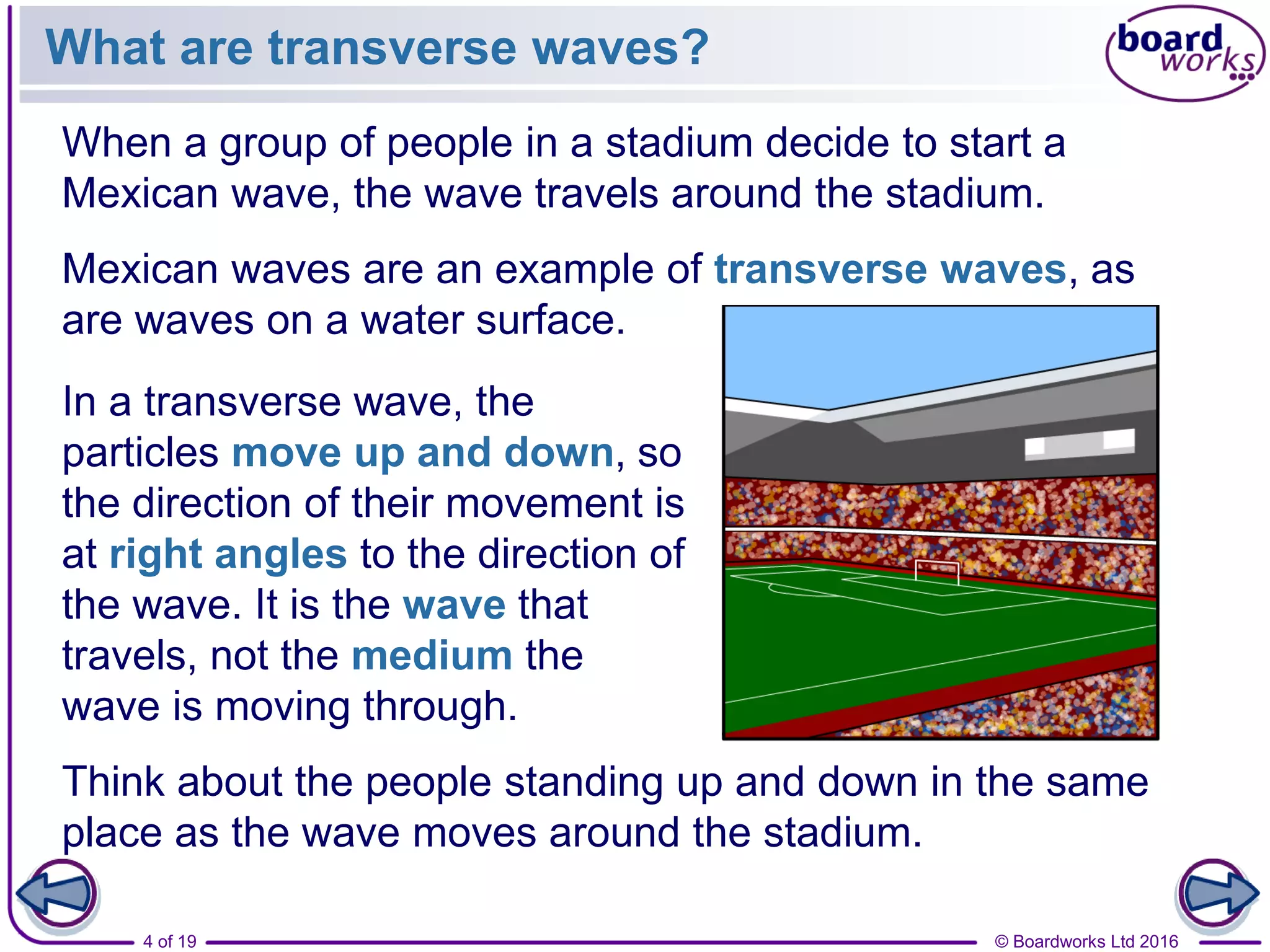
When a group of people in a stadium decide to start a
Mexican wave, the wave travels around the stadium.
Mexican waves are an example of transverse waves, as
are waves on a water surface.
In a transverse wave, the
particles move up and down, so
the direction of their movement is
at right angles to the direction of
the wave. It is the wave that
travels, not the medium the
wave is moving through.
Think about the people standing up and down in the same
place as the wave moves around the stadium.
What are transverse waves?
5 of 19 © Boardworks Ltd 2016
A water wave is an example of a transverse wave.
As a water wave moves through water, particles in the
water move up and down, at right angles to the direction
of the wave. The particles do not travel with the wave, but
move about a fixed position.
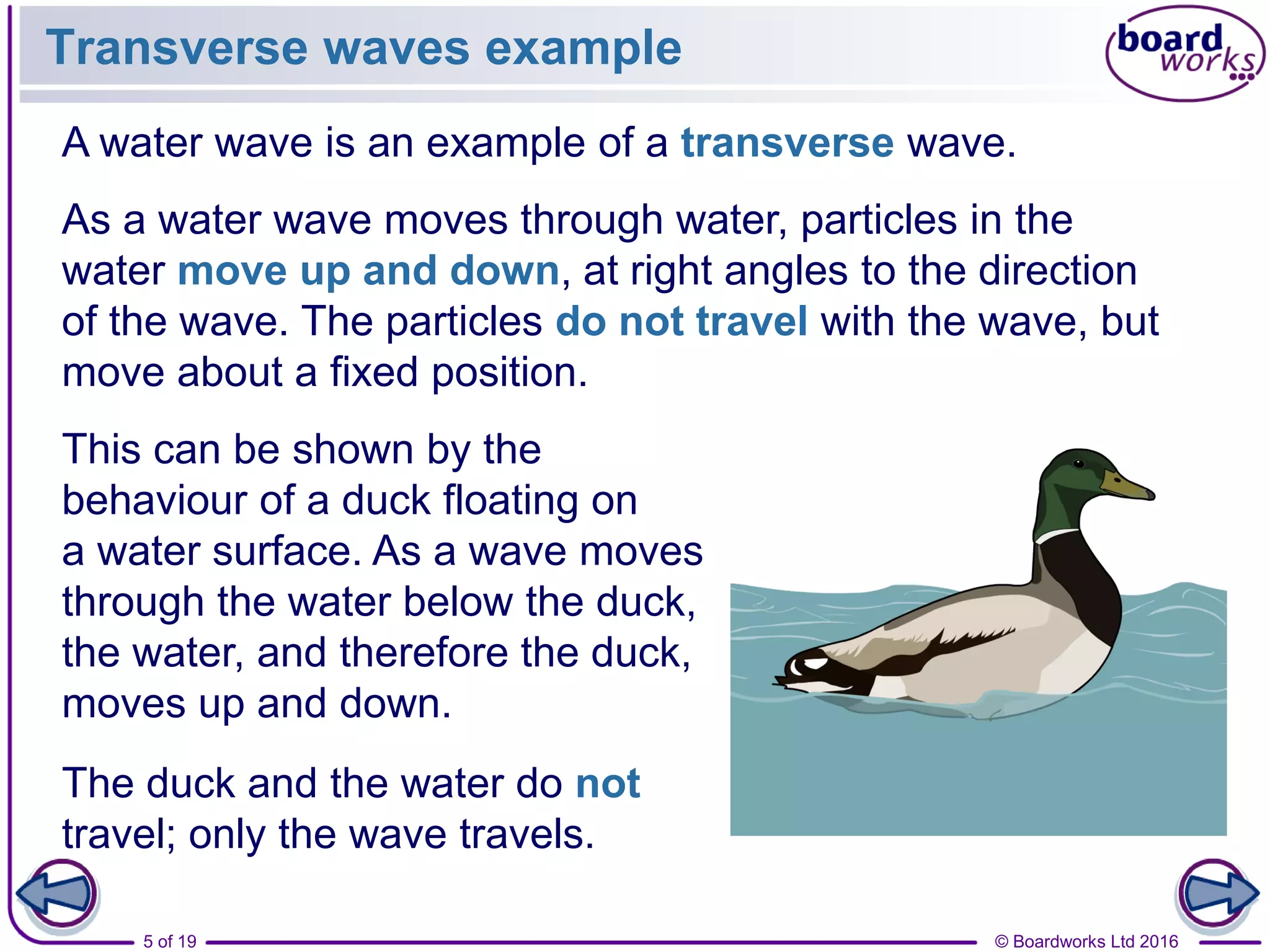
This can be shown by the
behaviour of a duck floating on
a water surface. As a wave moves
through the water below the duck,
the water, and therefore the duck,
moves up and down.
The duck and the water do not
travel; only the wave travels.
Transverse waves example
6 of 19 © Boardworks Ltd 2016
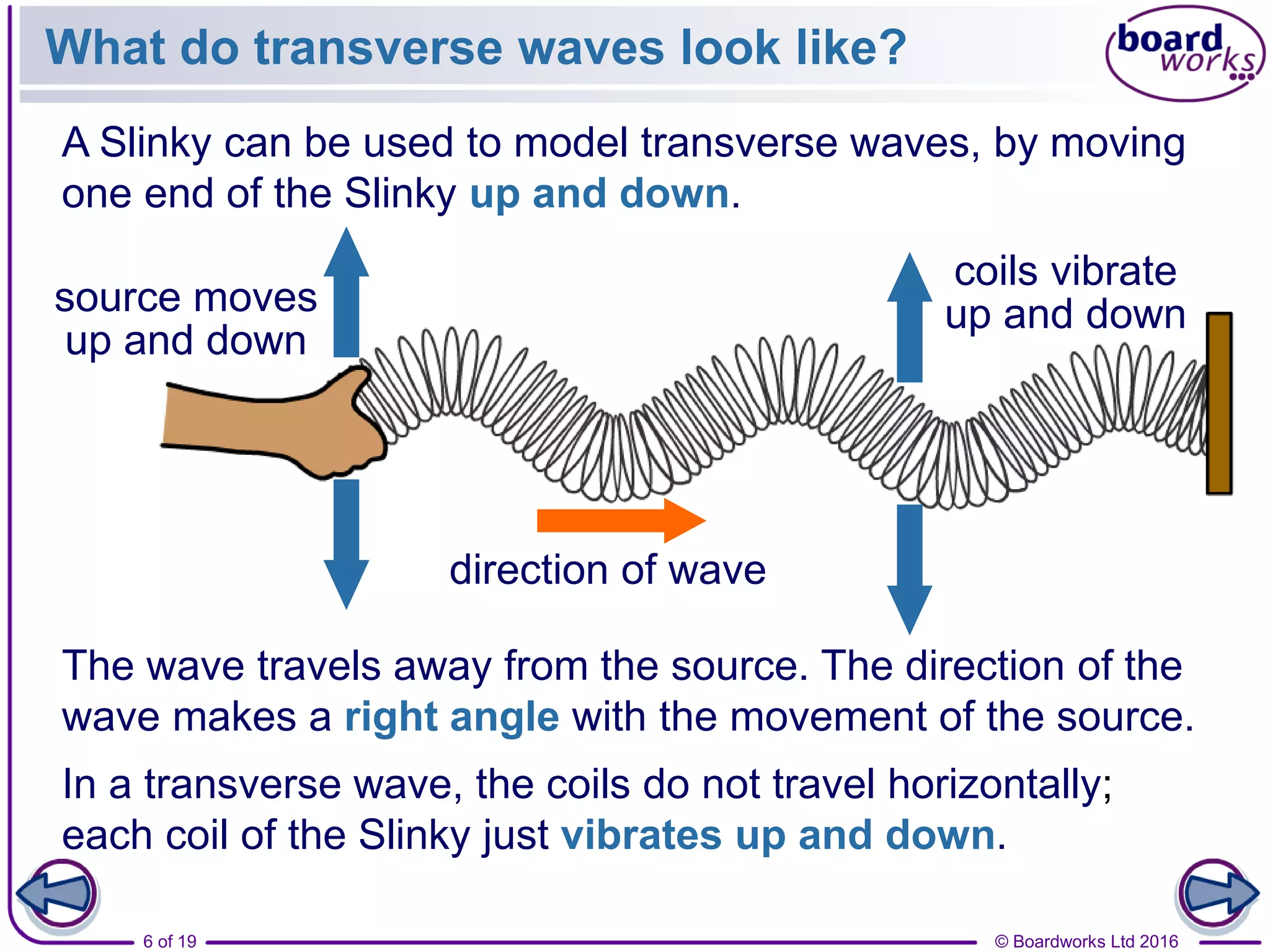
A Slinky can be used to model transverse waves, by moving
one end of the Slinky up and down.
What do transverse waves look like?
The wave travels away from the source. The direction of the
wave makes a right angle with the movement of the source.
source moves
up and down
direction of wave
coils vibrate
up and down
In a transverse wave, the coils do not travel horizontally;
each coil of the Slinky just vibrates up and down.
7 of 19 © Boardworks Ltd 2016
Simulation of a transverse wave
8 of 19 © Boardworks Ltd 2016
Transverse and Longitudinal Waves
9 of 19 © Boardworks Ltd 2016
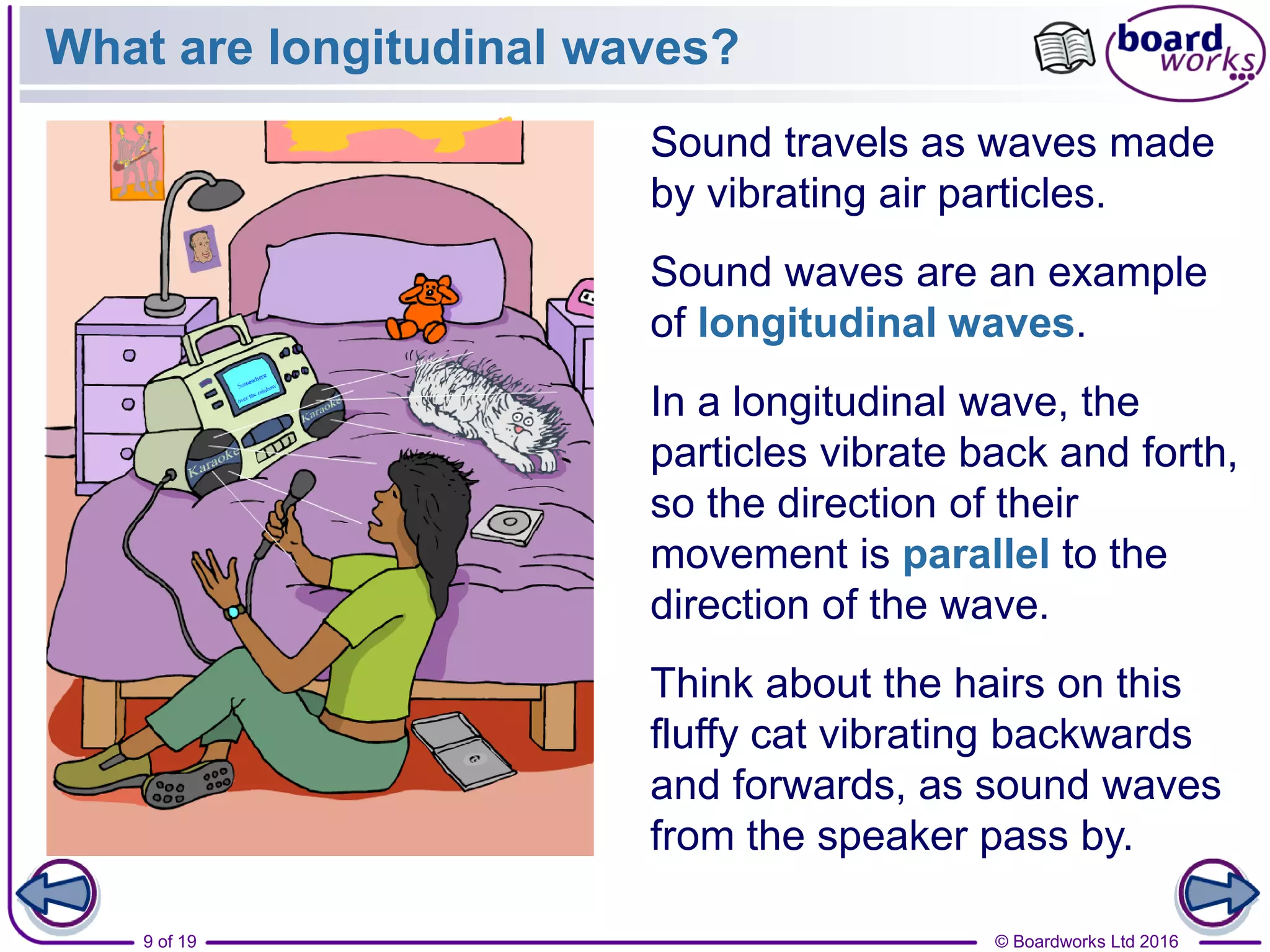
Sound travels as waves made
by vibrating air particles.
What are longitudinal waves?
PAT ARTWORK PC14_2
Sound waves are an example
of longitudinal waves.
In a longitudinal wave, the
particles vibrate back and forth,
so the direction of their
movement is parallel to the
direction of the wave.
Think about the hairs on this
fluffy cat vibrating backwards
and forwards, as sound waves
from the speaker pass by.
10 of 19 © Boardworks Ltd 2016
What do longitudinal waves look like?
A Slinky can be used to model longitudinal waves, by moving
one end of the Slinky left and right.
The wave travels away from the source. The direction of the
wave is parallel to the movement of the source.
source moves
left and right
coils vibrate
left and right
direction of wave
In a longitudinal wave, the coils do not travel horizontally;
each coil of the Slinky just vibrates left and right.
11 of 19 © Boardworks Ltd 2016
Certain parts of a longitudinal wave have special names.
compression
rarefaction
What are the parts of a longitudinal wave?
Sound waves are longitudinal waves. When someone
speaks, the air particles vibrate as a longitudinal wave and
so compressions and rarefactions are formed in the air.
P waves, the primary waves produced by earthquakes, are
also longitudinal waves, which push and pull the Earth.
Sections that are pushed together are called compressions,
and those that are stretched out are called rarefactions.
12 of 19 © Boardworks Ltd 2016
Simulation of a longitudinal wave
13 of 19 © Boardworks Ltd 2016
Transverse and Longitudinal Waves
14 of 19 © Boardworks Ltd 2016
Transverse or longitudinal waves?
15 of 19 © Boardworks Ltd 2016
Transverse and longitudinal waves
16 of 19 © Boardworks Ltd 2016
Transverse and Longitudinal Waves
17 of 19 © Boardworks Ltd 2016
Glossary
18 of 19 © Boardworks Ltd 2016
Anagrams
19 of 19 © Boardworks Ltd 2016
Multiple-choice quiz

Transverse-and-Longitudinal-Waves.pdf

  • 1.
    1 of 19© Boardworks Ltd 2016 Transverse and Longitudinal Waves
  • 2.
    2 of 19© Boardworks Ltd 2016 Transverse and Longitudinal Waves
  • 3.
    3 of 19© Boardworks Ltd 2016 Waves come in many different forms but they all transfer energy from one place to another. For example: Seismic waves carry energy from earthquakes through the Earth, which shake the ground. Sound waves are emitted from vibrating loudspeakers making our eardrums vibrate. All types of wave are caused by a vibrating source, and transfer energy without transferring matter. All waves can be reflected, refracted and diffracted. What is a wave?
  • 4.
    4 of 19© Boardworks Ltd 2016 When a group of people in a stadium decide to start a Mexican wave, the wave travels around the stadium. Mexican waves are an example of transverse waves, as are waves on a water surface. In a transverse wave, the particles move up and down, so the direction of their movement is at right angles to the direction of the wave. It is the wave that travels, not the medium the wave is moving through. Think about the people standing up and down in the same place as the wave moves around the stadium. What are transverse waves?
  • 5.
    5 of 19© Boardworks Ltd 2016 A water wave is an example of a transverse wave. As a water wave moves through water, particles in the water move up and down, at right angles to the direction of the wave. The particles do not travel with the wave, but move about a fixed position. This can be shown by the behaviour of a duck floating on a water surface. As a wave moves through the water below the duck, the water, and therefore the duck, moves up and down. The duck and the water do not travel; only the wave travels. Transverse waves example
  • 6.
    6 of 19© Boardworks Ltd 2016 A Slinky can be used to model transverse waves, by moving one end of the Slinky up and down. What do transverse waves look like? The wave travels away from the source. The direction of the wave makes a right angle with the movement of the source. source moves up and down direction of wave coils vibrate up and down In a transverse wave, the coils do not travel horizontally; each coil of the Slinky just vibrates up and down.
  • 7.
    7 of 19© Boardworks Ltd 2016 Simulation of a transverse wave
  • 8.
    8 of 19© Boardworks Ltd 2016 Transverse and Longitudinal Waves
  • 9.
    9 of 19© Boardworks Ltd 2016 Sound travels as waves made by vibrating air particles. What are longitudinal waves? PAT ARTWORK PC14_2 Sound waves are an example of longitudinal waves. In a longitudinal wave, the particles vibrate back and forth, so the direction of their movement is parallel to the direction of the wave. Think about the hairs on this fluffy cat vibrating backwards and forwards, as sound waves from the speaker pass by.
  • 10.
    10 of 19© Boardworks Ltd 2016 What do longitudinal waves look like? A Slinky can be used to model longitudinal waves, by moving one end of the Slinky left and right. The wave travels away from the source. The direction of the wave is parallel to the movement of the source. source moves left and right coils vibrate left and right direction of wave In a longitudinal wave, the coils do not travel horizontally; each coil of the Slinky just vibrates left and right.
  • 11.
    11 of 19© Boardworks Ltd 2016 Certain parts of a longitudinal wave have special names. compression rarefaction What are the parts of a longitudinal wave? Sound waves are longitudinal waves. When someone speaks, the air particles vibrate as a longitudinal wave and so compressions and rarefactions are formed in the air. P waves, the primary waves produced by earthquakes, are also longitudinal waves, which push and pull the Earth. Sections that are pushed together are called compressions, and those that are stretched out are called rarefactions.
  • 12.
    12 of 19© Boardworks Ltd 2016 Simulation of a longitudinal wave
  • 13.
    13 of 19© Boardworks Ltd 2016 Transverse and Longitudinal Waves
  • 14.
    14 of 19© Boardworks Ltd 2016 Transverse or longitudinal waves?
  • 15.
    15 of 19© Boardworks Ltd 2016 Transverse and longitudinal waves
  • 16.
    16 of 19© Boardworks Ltd 2016 Transverse and Longitudinal Waves
  • 17.
    17 of 19© Boardworks Ltd 2016 Glossary
  • 18.
    18 of 19© Boardworks Ltd 2016 Anagrams
  • 19.
    19 of 19© Boardworks Ltd 2016 Multiple-choice quiz