The past, present and future of transparency. “Infodemocracy, and what it means for your brand”
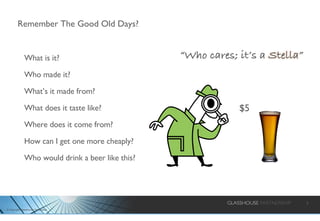
Remember The Good Old Days? $5 What is it? Who made it? What’s it made from? What does it taste like? Where does it come from? How can I get one more cheaply? Who would drink a beer like this?
1950s-70s.  The  Opacity  System…Focused on features and benefits.  A great model for an industrial economy. Opaque  customers – marketing is based on inspired guesswork Opaque  products – any colour you like, as long as it’s what we have in stock Opaque  organisations – a golden age for conglomerates and aspiring monopolists Opaque  markets – persuasion ethos. Consumers trapped by choice, location, transportation and social class
Brand value =  Opacity   Premium (n) Branding: the art of making money by  concealing knowledge  from  targeted customers
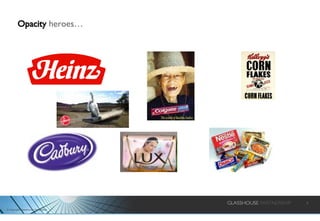
Opacity  heroes…
So why on earth would you change all that…? Opacity : Enhances economic premiums Protects competitive advantage Develops deep emotional bonds and repeat purchase Obscures dubious sourcing, pricing and employment practices
So why change…? Because  Opacity : is anti-customer locks you into a single static proposition blindsides you to alternative value models STOP PRESS… Retailers   start to destroy opaque brands by copying SUPERFICIAL FEATURES… Opaque Brands concentrate and multiply risk
The 80s and 90s.  The   Translucency  system.  Focused on experiences. A great model for the service-economy. Translucent   customers – guesswork replaced by data-driven speculation.  The rise, demise and repr i se of CRM … Translucent   products – previously hidden ingredients and processes move ‘front of brand ‘(wholegrain, small batch, gluten-free, low fat, freshly-baked, in store…) …  Translucent  organisations – TBL/ESG reporting, philanthropy, and community appeasement programmes…  Translucent   markets – challenges to supplier-fixed pricing, price comparison sites, widespread re-intermediation…
Brand value =  Translucency   Premium (n) Branding: the art of making money by  selectively sharing knowledge   with  self-selecting customers
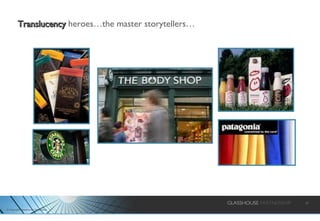
Translucency  heroes…the master storytellers…
So why on earth would you change all that…? Translucency : envalues corporate purpose showcases deep-seated organisational assets enables multiple disruptive entry-points into new segments offers much more resilient competitive advantage (more authentic and difficult  to copy) creates a broad, values-based ‘platform’ for customer intimacy, enabling cross-selling and upselling
So why change…? Because  Translucency : is grounded in stories -  not stakeholder needs or organisational purpose is  still  anti-customer –  just selling bigger dreams still  locks you into static propositions –  only with higher cost of change still  blinds you to alternative models –  only reinforcing self-delusion…. STOP PRESS…  Consumer advocates destroy translucent brand advantage by telling MORE TRANSPARENT STORIES… Translucent brands defuse and diffuse short-term risk at the expense of long-term risk
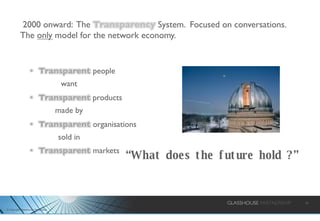
“ What does the future hold ?”
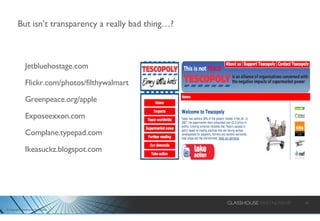
Jetbluehostage.com Flickr.com/photos/filthywalmart Greenpeace.org/apple Exposeexxon.com Complane.typepad.com Ikeasuckz.blogspot.com But isn’t transparency a really bad thing…?
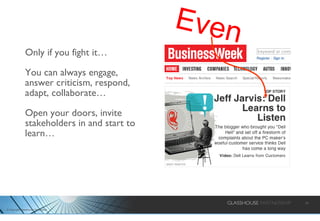
Only if you fight it…  You can always engage, answer criticism, respond, adapt, collaborate… Open your doors, invite stakeholders in and start to learn… Even
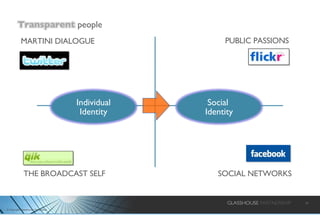
SOCIAL NETWORKS PUBLIC PASSIONS THE BROADCAST SELF MARTINI DIALOGUE Social  Identity Individual Identity
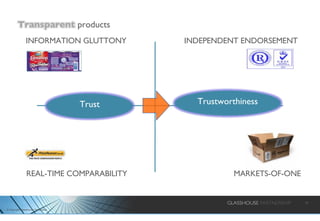
REAL-TIME COMPARABILITY INDEPENDENT ENDORSEMENT INFORMATION GLUTTONY MARKETS-OF-ONE Trust Trustworthiness
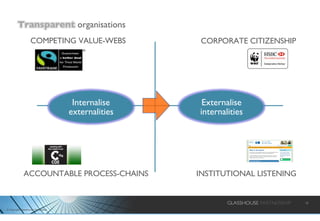
CORPORATE CITIZENSHIP ACCOUNTABLE PROCESS-CHAINS COMPETING VALUE-WEBS INSTITUTIONAL LISTENING Internalise externalities Externalise internalities
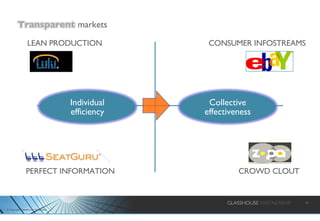
PERFECT INFORMATION LEAN PRODUCTION CONSUMER INFOSTREAMS CROWD CLOUT Individual efficiency Collective effectiveness
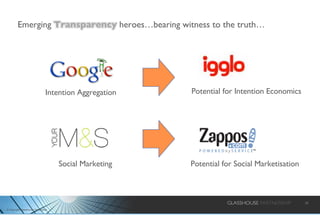
Potential for Intention Economics Intention Aggregation Social Marketing Potential for Social Marketisation
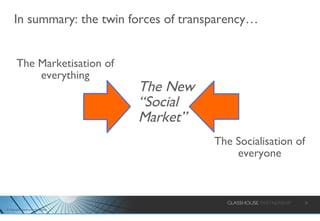
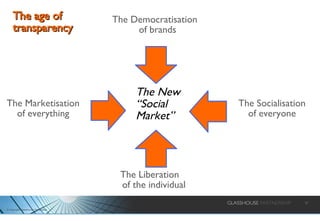
The Marketisation of everything The Socialisation of everyone The New “Social Market” In summary: the twin forces of transparency…
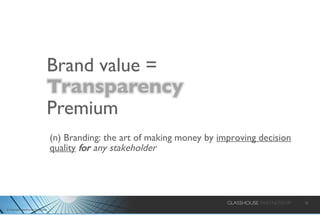
(n) Branding: the art of making money by  improving decision quality   for  any stakeholder
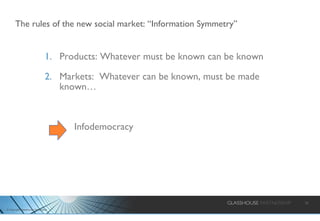
The rules of the new social market: “Information Symmetry” Products: Whatever must be known can be known Markets:  Whatever can be known, must be made known…   Infodemocracy
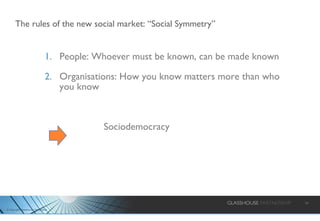
The rules of the new social market: “Social Symmetry” People: Whoever must be known, can be made known  Organisations: How you know matters more than who you know Sociodemocracy
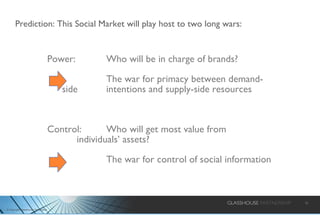
Prediction: This Social Market will play host to two long wars: Power:  Who will be in charge of brands?  The war for primacy between demand-side  intentions and supply-side resources Control:  Who will get most value from  individuals’ assets? The war for control of social information
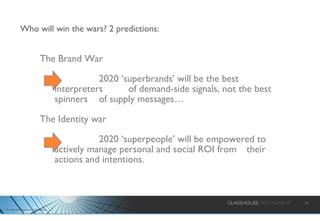
The Brand War 2020 ‘superbrands’ will be the best interpreters  of demand-side signals, not the best spinners  of supply messages… The Identity war  2020 ‘superpeople’ will be empowered to  actively manage personal and social ROI from  their actions and intentions. Who will win the wars? 2 predictions:
The Marketisation of everything The Socialisation of everyone The New “Social Market” The Liberation  of the individual The Democratisation  of brands The age of transparency
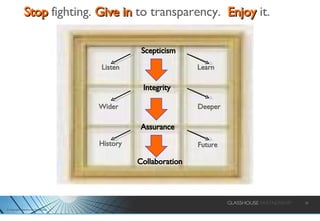
Wider Assurance History Learn Scepticism Integrity Deeper Listen Future Stop   fighting.  Give in  to transparency.  Enjoy  it. Collaboration
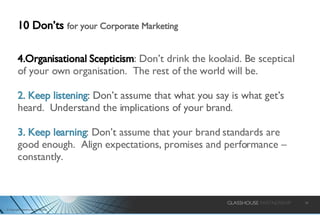
10 Don’ts  for your Corporate Marketing Organisational Scepticism :  Don’t drink the koolaid. Be sceptical of your own organisation.  The rest of the world will be. 2. Keep listening :   Don’t assume that what you say is what get’s heard.  Understand the implications of your brand. 3. Keep learning : Don’t assume that your brand standards are good enough.  Align expectations, promises and performance – constantly.
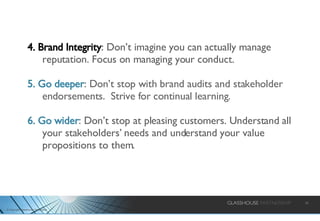
4. Brand Integrity :  Don’t imagine you can actually manage reputation. Focus on managing your conduct. 5. Go deeper : Don’t stop with brand audits and stakeholder endorsements.  Strive for continual learning. 6. Go wider : Don’t stop at pleasing customers. Understand all your stakeholders’ needs and understand your value propositions to them.
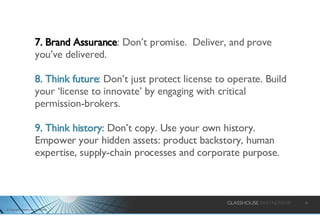
7. Brand Assurance : Don’t promise.  Deliver, and prove you’ve delivered. 8. Think future : Don’t just protect license to operate. Build your ‘license to innovate’ by engaging with critical permission-brokers. 9. Think history : Don’t copy. Use your own history. Empower your hidden assets: product backstory, human expertise, supply-chain processes and corporate purpose.
10. Stakeholder Collaboration : Don’t compete on the resources you own; compete on the resources you can connect.

TRANSPARENCY "THE FULL STORY"

  • 1.
    The past, presentand future of transparency. “Infodemocracy, and what it means for your brand”
  • 2.
    Remember The GoodOld Days? $5 What is it? Who made it? What’s it made from? What does it taste like? Where does it come from? How can I get one more cheaply? Who would drink a beer like this?
  • 3.
    1950s-70s. The Opacity System…Focused on features and benefits. A great model for an industrial economy. Opaque customers – marketing is based on inspired guesswork Opaque products – any colour you like, as long as it’s what we have in stock Opaque organisations – a golden age for conglomerates and aspiring monopolists Opaque markets – persuasion ethos. Consumers trapped by choice, location, transportation and social class
  • 4.
    Brand value = Opacity Premium (n) Branding: the art of making money by concealing knowledge from targeted customers
  • 5.
  • 6.
    So why onearth would you change all that…? Opacity : Enhances economic premiums Protects competitive advantage Develops deep emotional bonds and repeat purchase Obscures dubious sourcing, pricing and employment practices
  • 7.
    So why change…?Because Opacity : is anti-customer locks you into a single static proposition blindsides you to alternative value models STOP PRESS… Retailers start to destroy opaque brands by copying SUPERFICIAL FEATURES… Opaque Brands concentrate and multiply risk
  • 8.
    The 80s and90s. The Translucency system. Focused on experiences. A great model for the service-economy. Translucent customers – guesswork replaced by data-driven speculation. The rise, demise and repr i se of CRM … Translucent products – previously hidden ingredients and processes move ‘front of brand ‘(wholegrain, small batch, gluten-free, low fat, freshly-baked, in store…) … Translucent organisations – TBL/ESG reporting, philanthropy, and community appeasement programmes… Translucent markets – challenges to supplier-fixed pricing, price comparison sites, widespread re-intermediation…
  • 9.
    Brand value = Translucency Premium (n) Branding: the art of making money by selectively sharing knowledge with self-selecting customers
  • 10.
    Translucency heroes…themaster storytellers…
  • 11.
    So why onearth would you change all that…? Translucency : envalues corporate purpose showcases deep-seated organisational assets enables multiple disruptive entry-points into new segments offers much more resilient competitive advantage (more authentic and difficult to copy) creates a broad, values-based ‘platform’ for customer intimacy, enabling cross-selling and upselling
  • 12.
    So why change…?Because Translucency : is grounded in stories - not stakeholder needs or organisational purpose is still anti-customer – just selling bigger dreams still locks you into static propositions – only with higher cost of change still blinds you to alternative models – only reinforcing self-delusion…. STOP PRESS… Consumer advocates destroy translucent brand advantage by telling MORE TRANSPARENT STORIES… Translucent brands defuse and diffuse short-term risk at the expense of long-term risk
  • 13.
    “ What doesthe future hold ?”
  • 14.
    Jetbluehostage.com Flickr.com/photos/filthywalmart Greenpeace.org/appleExposeexxon.com Complane.typepad.com Ikeasuckz.blogspot.com But isn’t transparency a really bad thing…?
  • 15.
    Only if youfight it… You can always engage, answer criticism, respond, adapt, collaborate… Open your doors, invite stakeholders in and start to learn… Even
  • 16.
    SOCIAL NETWORKS PUBLICPASSIONS THE BROADCAST SELF MARTINI DIALOGUE Social Identity Individual Identity
  • 17.
    REAL-TIME COMPARABILITY INDEPENDENTENDORSEMENT INFORMATION GLUTTONY MARKETS-OF-ONE Trust Trustworthiness
  • 18.
    CORPORATE CITIZENSHIP ACCOUNTABLEPROCESS-CHAINS COMPETING VALUE-WEBS INSTITUTIONAL LISTENING Internalise externalities Externalise internalities
  • 19.
    PERFECT INFORMATION LEANPRODUCTION CONSUMER INFOSTREAMS CROWD CLOUT Individual efficiency Collective effectiveness
  • 20.
    Potential for IntentionEconomics Intention Aggregation Social Marketing Potential for Social Marketisation
  • 21.
    The Marketisation ofeverything The Socialisation of everyone The New “Social Market” In summary: the twin forces of transparency…
  • 22.
    (n) Branding: theart of making money by improving decision quality for any stakeholder
  • 23.
    The rules ofthe new social market: “Information Symmetry” Products: Whatever must be known can be known Markets: Whatever can be known, must be made known… Infodemocracy
  • 24.
    The rules ofthe new social market: “Social Symmetry” People: Whoever must be known, can be made known Organisations: How you know matters more than who you know Sociodemocracy
  • 25.
    Prediction: This SocialMarket will play host to two long wars: Power: Who will be in charge of brands? The war for primacy between demand-side intentions and supply-side resources Control: Who will get most value from individuals’ assets? The war for control of social information
  • 26.
    The Brand War2020 ‘superbrands’ will be the best interpreters of demand-side signals, not the best spinners of supply messages… The Identity war 2020 ‘superpeople’ will be empowered to actively manage personal and social ROI from their actions and intentions. Who will win the wars? 2 predictions:
  • 27.
    The Marketisation ofeverything The Socialisation of everyone The New “Social Market” The Liberation of the individual The Democratisation of brands The age of transparency
  • 28.
    Wider Assurance HistoryLearn Scepticism Integrity Deeper Listen Future Stop fighting. Give in to transparency. Enjoy it. Collaboration
  • 29.
    10 Don’ts for your Corporate Marketing Organisational Scepticism : Don’t drink the koolaid. Be sceptical of your own organisation. The rest of the world will be. 2. Keep listening : Don’t assume that what you say is what get’s heard. Understand the implications of your brand. 3. Keep learning : Don’t assume that your brand standards are good enough. Align expectations, promises and performance – constantly.
  • 30.
    4. Brand Integrity: Don’t imagine you can actually manage reputation. Focus on managing your conduct. 5. Go deeper : Don’t stop with brand audits and stakeholder endorsements. Strive for continual learning. 6. Go wider : Don’t stop at pleasing customers. Understand all your stakeholders’ needs and understand your value propositions to them.
  • 31.
    7. Brand Assurance: Don’t promise. Deliver, and prove you’ve delivered. 8. Think future : Don’t just protect license to operate. Build your ‘license to innovate’ by engaging with critical permission-brokers. 9. Think history : Don’t copy. Use your own history. Empower your hidden assets: product backstory, human expertise, supply-chain processes and corporate purpose.
  • 32.
    10. Stakeholder Collaboration: Don’t compete on the resources you own; compete on the resources you can connect.