Translating Compliance Requirements into Action Items –
340B Program
1. What is 340B
2. HRSA requirements for grantees and hospitals
3. Taking action:
• HRSA Requirements
• Diversion
• Duplicate Discounts
• Auditable Records
Overview
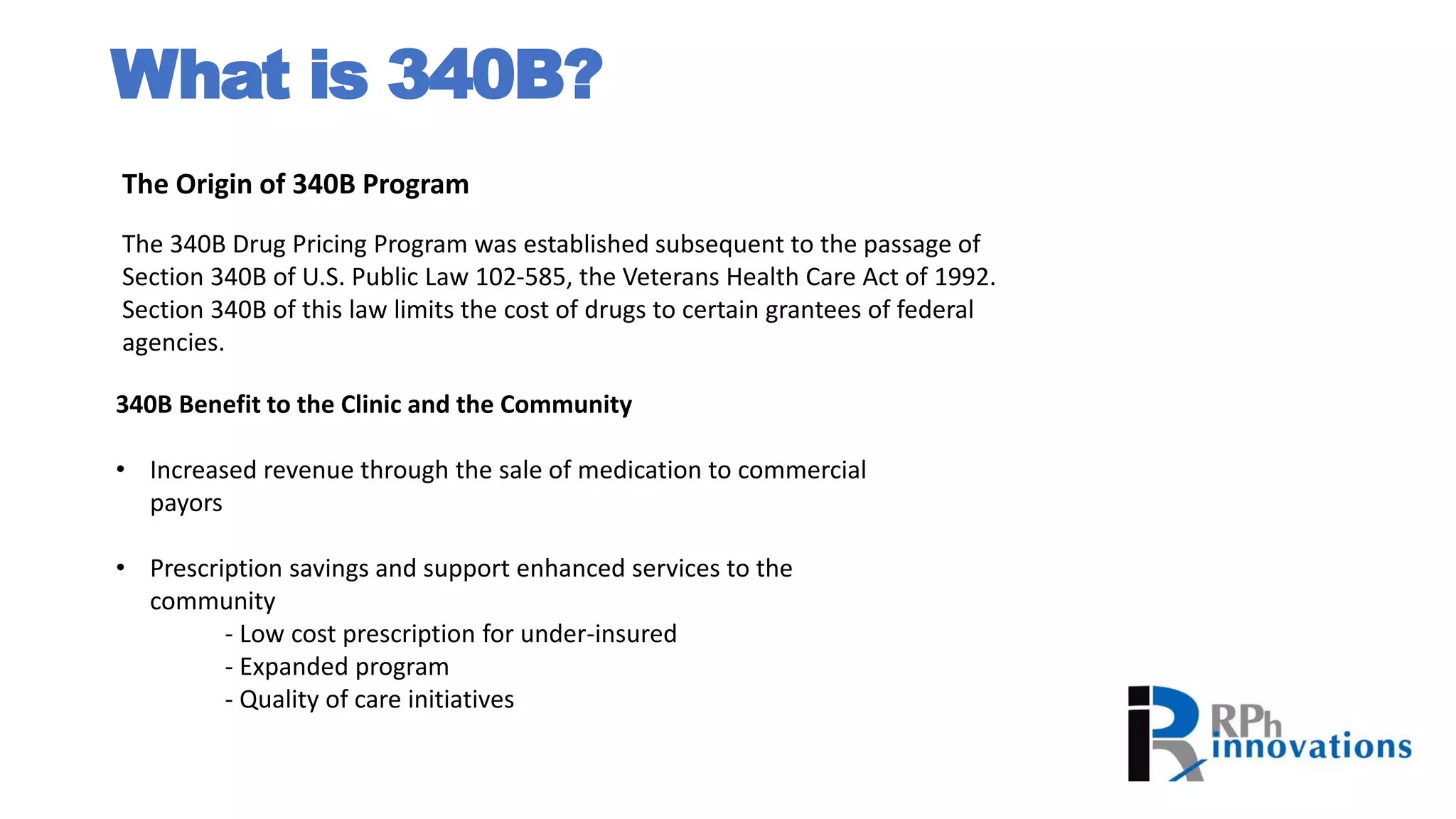
What is 340B?
340B Benefit to the Clinic and the Community
• Increased revenue through the sale of medication to commercial
payors
• Prescription savings and support enhanced services to the
community
- Low cost prescription for under-insured
- Expanded program
- Quality of care initiatives
The Origin of 340B Program
The 340B Drug Pricing Program was established subsequent to the passage of
Section 340B of U.S. Public Law 102-585, the Veterans Health Care Act of 1992.
Section 340B of this law limits the cost of drugs to certain grantees of federal
agencies.
• Thou Shall NOT Divert
• Thou Shall NOT Duplicate Discount
• Thou SHALL Follow the Rules
…………………. And,
Responsibility to ensure compliance with 340B Program requirements rests solely with covered entities and manufacturers
that participate. Information received from vendors, consultants and other third parties cannot be assumed to be compliant
with HRSA policy.
Relative to other Federal programs, rules and expectations around 340B evolve rapidly and are significantly less clear. At
the same time, oversight is increasing substantially.
Commandments of Compliance
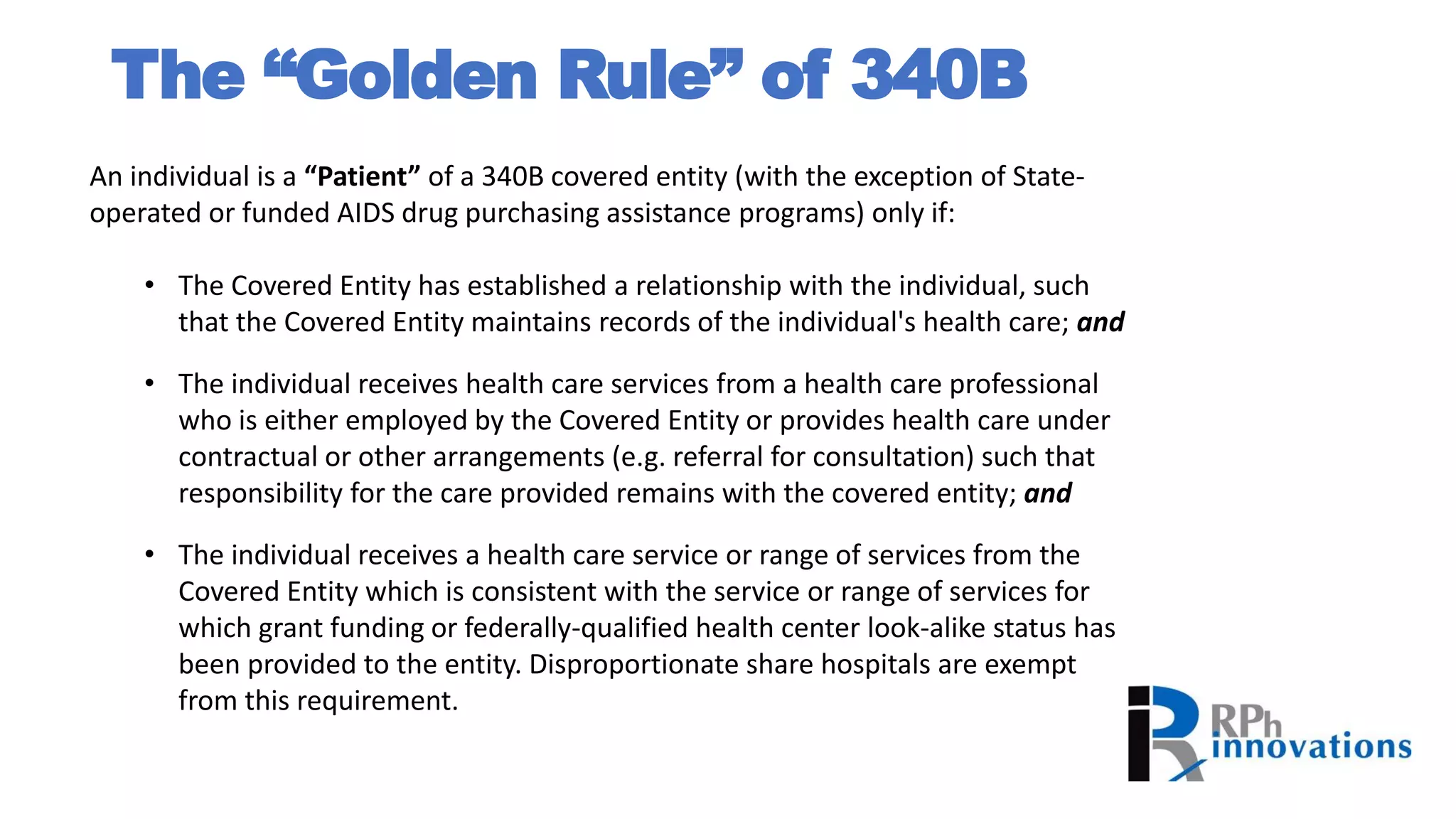
The “Golden Rule” of 340B
An individual is a “Patient” of a 340B covered entity (with the exception of State-
operated or funded AIDS drug purchasing assistance programs) only if:
• The Covered Entity has established a relationship with the individual, such
that the Covered Entity maintains records of the individual's health care; and
• The individual receives health care services from a health care professional
who is either employed by the Covered Entity or provides health care under
contractual or other arrangements (e.g. referral for consultation) such that
responsibility for the care provided remains with the covered entity; and
• The individual receives a health care service or range of services from the
Covered Entity which is consistent with the service or range of services for
which grant funding or federally-qualified health center look-alike status has
been provided to the entity. Disproportionate share hospitals are exempt
from this requirement.
Did you know…
Categories of compliance
1. OPAIS database administration
2. Recertification
3. Preventing diversion
4. Preventing Duplicate Discount prohibition.
5. Ongoing oversight/Audit preparation
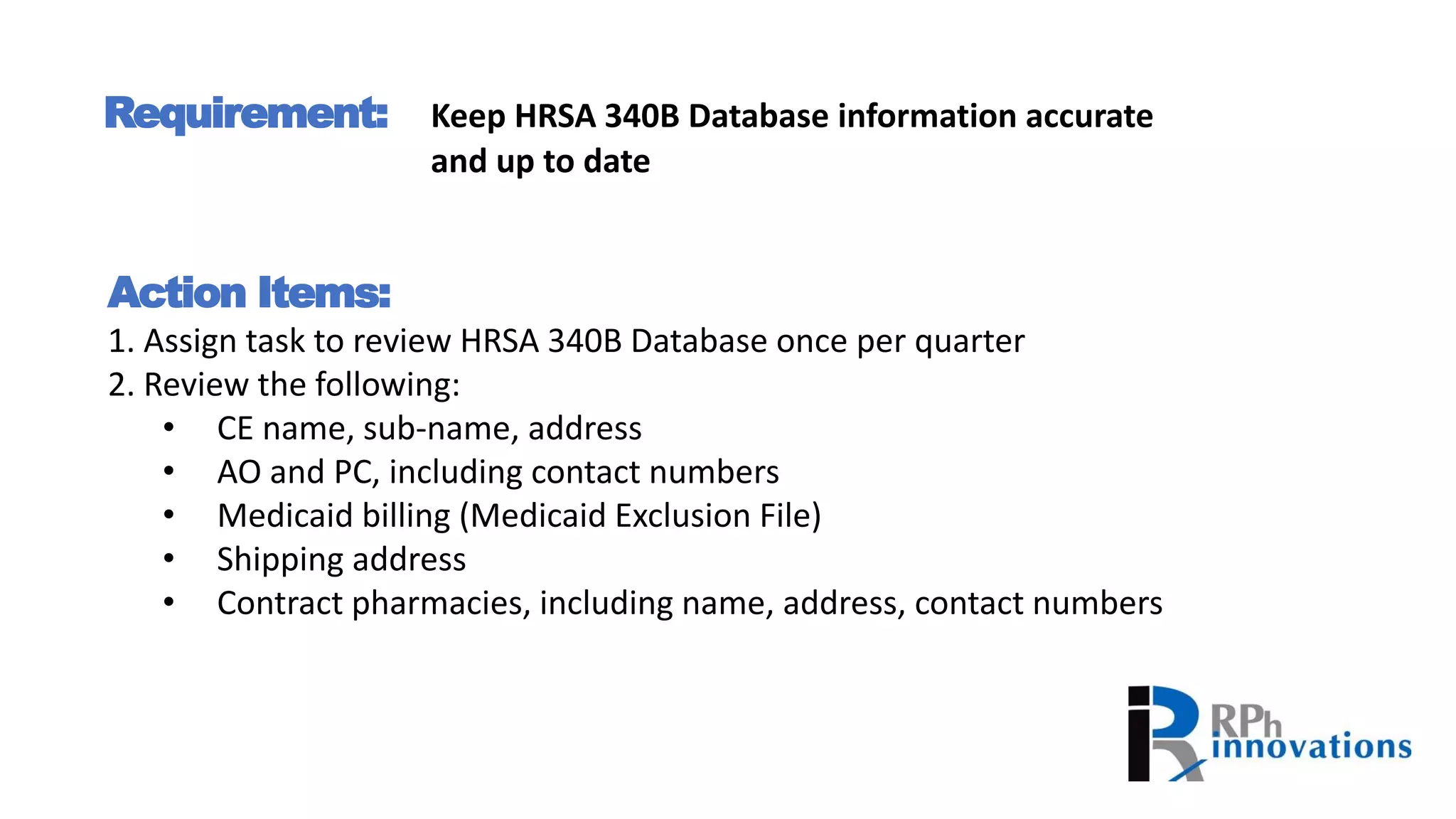
Requirement: Keep HRSA 340B Database information accurate
and up to date
Action Items:
1. Assign task to review HRSA 340B Database once per quarter
2. Review the following:
• CE name, sub-name, address
• AO and PC, including contact numbers
• Medicaid billing (Medicaid Exclusion File)
• Shipping address
• Contract pharmacies, including name, address, contact numbers
Requirement: Recertify Eligibility Every Year
Action Items:
1. Confirm your Authorizing Official (AO) and does he/she
understand what to do with emails from HRSA’s OPA?
2. Establish a workflow/procedure for such emails
• AO and Primary Contact (PC) will receive emails
• ONLY AO can perform recertification
• Must recertify within given period of time
Requirement:
PreventDiversiontoIneligiblePatients
Action Items:
1. Know and understand your eligibility rules
• Patient definition
• Eligible provider
• Eligible encounter
• Visits
• Prescribing events
• Referrals (CE visit date, referral, specialist visit date, specialist prescription, return CE visit)
2. Establish solid data-sharing processes:
• Who, what, when, how
3) Internal, self-auditing must happen
Requirement:
PreventDiversiontoIneligiblePatients
Common indicators of diversion risk:
1. Using limited qualification criteria such as an exclusive
provider list, or date range
2. Inability to distinguish between ineligible and eligible
locations
3. Site locations not properly registered
4. Incomplete documentation of referrals
HRSA audits will require 100% accuracy. Just one error
could result in a finding
Requirement:
DuplicateDiscountProhibition
Considerations:
1. Regardless of state policy, HRSA audits will focus on compliance
of Medicaid Exclusion File (MEF)
2. Do NOT confuse Medicaid Fee-for-Service (FFS) with Medicaid
Managed Care Organization (MCO).
• The scope of Entities requirement to block all Managed Medicaid claims is not 100% clear.
• HRSA expects CEs to follow state rules for preventing 340B MCO duplicate discounts
Requirement:
DuplicateDiscountProhibition
Action Items:
1. Check HRSA 340B Database to verify that your registered sites have accurate Medicaid
information - Carve-in status, NPI, and Medicaid Billing number
2. Obtain BIN/PCN/Group for Medicaid FFS from state’s Technical Contact (Use Resource Links)
and verify your TPA is blocking those payors
3. Locate your state’s Medicaid policy to ensure proper billing for 340B (Use Resources Links)
4. Ensure that you do NOT use 340B for Medicaid patients at contract pharmacy (unless you
have notified HRSA of an arrangement with state to prevent duplicate discounts)
5. Complete a 100% internal, self-audit check for duplicate discounts.
• Applies to contract pharmacy, in-house closed or open retail, and physician administered drugs
Resource Links:
Apexus Medicaid 340B State Details. Select state(s) served in drop down menu.
https://www.340bpvp.com/resource-center/medicaid
Medicaid Technical Contact Database
https://data.medicaid.gov/Uncategorized/Medicaid-Drug-Rebate-Program-State-Contact-Informa/dk6x-j4tf/data
Requirement:
PrepareforProgramAudits
Action Items:
1. Assign team members and create workflow to review, revise, and re-approve
Policies and Procedures.
2. 2. Maintain and review all contracts with all 340B stakeholders (contract
pharmacies, third-party administrators, wholesalers, program support groups)
• Are contracts fully executed and complete?
• Ensure contracts are not expired?
• Are all addresses of registered contract pharmacies documented in executed contracts?
3. Ensure HRSA 340B Database is up-to-date
4. Maintain records for easy access:
• Claims data
• Provider Lists
• Wholesaler invoices and accumulation records
Requirement:
PrepareforProgramAudits,contd.
Action Items:
4. Maintain records for easy access (contd.):
• Internal, self-audit records
• External, independent audits:
• HRSA 2010: “…it is the expectation of HRSA that covered entities will fulfill
their ongoing obligation by the utilization of independent audits”.
• HRSA 2014: “All covered entities are required to maintain auditable records
and are expected to conduct annual audits of contract pharmacies that are
performed by an independent auditor”.
HRSA will give you approximately 30 days to produce the data
requested in their Data Request List.
Sample HRSA Data Request List:
https://docs.340bpvp.com/documents/public/resourcecenter/sample-hrsa-340b-audit-data-request-for-covered-entities.pdf
Contact Information
630-963-0024
rjohnson@rphinnovations.com
Robert Johnson
Chief Executive Officer

Translating compliance requirements into action items 340B

  • 2.
    Translating Compliance Requirementsinto Action Items – 340B Program
  • 3.
    1. What is340B 2. HRSA requirements for grantees and hospitals 3. Taking action: • HRSA Requirements • Diversion • Duplicate Discounts • Auditable Records Overview
  • 4.
    What is 340B? 340BBenefit to the Clinic and the Community • Increased revenue through the sale of medication to commercial payors • Prescription savings and support enhanced services to the community - Low cost prescription for under-insured - Expanded program - Quality of care initiatives The Origin of 340B Program The 340B Drug Pricing Program was established subsequent to the passage of Section 340B of U.S. Public Law 102-585, the Veterans Health Care Act of 1992. Section 340B of this law limits the cost of drugs to certain grantees of federal agencies.
  • 5.
    • Thou ShallNOT Divert • Thou Shall NOT Duplicate Discount • Thou SHALL Follow the Rules …………………. And, Responsibility to ensure compliance with 340B Program requirements rests solely with covered entities and manufacturers that participate. Information received from vendors, consultants and other third parties cannot be assumed to be compliant with HRSA policy. Relative to other Federal programs, rules and expectations around 340B evolve rapidly and are significantly less clear. At the same time, oversight is increasing substantially. Commandments of Compliance
  • 6.
    The “Golden Rule”of 340B An individual is a “Patient” of a 340B covered entity (with the exception of State- operated or funded AIDS drug purchasing assistance programs) only if: • The Covered Entity has established a relationship with the individual, such that the Covered Entity maintains records of the individual's health care; and • The individual receives health care services from a health care professional who is either employed by the Covered Entity or provides health care under contractual or other arrangements (e.g. referral for consultation) such that responsibility for the care provided remains with the covered entity; and • The individual receives a health care service or range of services from the Covered Entity which is consistent with the service or range of services for which grant funding or federally-qualified health center look-alike status has been provided to the entity. Disproportionate share hospitals are exempt from this requirement.
  • 7.
    Did you know… Categoriesof compliance 1. OPAIS database administration 2. Recertification 3. Preventing diversion 4. Preventing Duplicate Discount prohibition. 5. Ongoing oversight/Audit preparation
  • 8.
    Requirement: Keep HRSA340B Database information accurate and up to date Action Items: 1. Assign task to review HRSA 340B Database once per quarter 2. Review the following: • CE name, sub-name, address • AO and PC, including contact numbers • Medicaid billing (Medicaid Exclusion File) • Shipping address • Contract pharmacies, including name, address, contact numbers
  • 9.
    Requirement: Recertify EligibilityEvery Year Action Items: 1. Confirm your Authorizing Official (AO) and does he/she understand what to do with emails from HRSA’s OPA? 2. Establish a workflow/procedure for such emails • AO and Primary Contact (PC) will receive emails • ONLY AO can perform recertification • Must recertify within given period of time
  • 10.
    Requirement: PreventDiversiontoIneligiblePatients Action Items: 1. Knowand understand your eligibility rules • Patient definition • Eligible provider • Eligible encounter • Visits • Prescribing events • Referrals (CE visit date, referral, specialist visit date, specialist prescription, return CE visit) 2. Establish solid data-sharing processes: • Who, what, when, how 3) Internal, self-auditing must happen
  • 11.
    Requirement: PreventDiversiontoIneligiblePatients Common indicators ofdiversion risk: 1. Using limited qualification criteria such as an exclusive provider list, or date range 2. Inability to distinguish between ineligible and eligible locations 3. Site locations not properly registered 4. Incomplete documentation of referrals HRSA audits will require 100% accuracy. Just one error could result in a finding
  • 12.
    Requirement: DuplicateDiscountProhibition Considerations: 1. Regardless ofstate policy, HRSA audits will focus on compliance of Medicaid Exclusion File (MEF) 2. Do NOT confuse Medicaid Fee-for-Service (FFS) with Medicaid Managed Care Organization (MCO). • The scope of Entities requirement to block all Managed Medicaid claims is not 100% clear. • HRSA expects CEs to follow state rules for preventing 340B MCO duplicate discounts
  • 13.
    Requirement: DuplicateDiscountProhibition Action Items: 1. CheckHRSA 340B Database to verify that your registered sites have accurate Medicaid information - Carve-in status, NPI, and Medicaid Billing number 2. Obtain BIN/PCN/Group for Medicaid FFS from state’s Technical Contact (Use Resource Links) and verify your TPA is blocking those payors 3. Locate your state’s Medicaid policy to ensure proper billing for 340B (Use Resources Links) 4. Ensure that you do NOT use 340B for Medicaid patients at contract pharmacy (unless you have notified HRSA of an arrangement with state to prevent duplicate discounts) 5. Complete a 100% internal, self-audit check for duplicate discounts. • Applies to contract pharmacy, in-house closed or open retail, and physician administered drugs Resource Links: Apexus Medicaid 340B State Details. Select state(s) served in drop down menu. https://www.340bpvp.com/resource-center/medicaid Medicaid Technical Contact Database https://data.medicaid.gov/Uncategorized/Medicaid-Drug-Rebate-Program-State-Contact-Informa/dk6x-j4tf/data
  • 14.
    Requirement: PrepareforProgramAudits Action Items: 1. Assignteam members and create workflow to review, revise, and re-approve Policies and Procedures. 2. 2. Maintain and review all contracts with all 340B stakeholders (contract pharmacies, third-party administrators, wholesalers, program support groups) • Are contracts fully executed and complete? • Ensure contracts are not expired? • Are all addresses of registered contract pharmacies documented in executed contracts? 3. Ensure HRSA 340B Database is up-to-date 4. Maintain records for easy access: • Claims data • Provider Lists • Wholesaler invoices and accumulation records
  • 15.
    Requirement: PrepareforProgramAudits,contd. Action Items: 4. Maintainrecords for easy access (contd.): • Internal, self-audit records • External, independent audits: • HRSA 2010: “…it is the expectation of HRSA that covered entities will fulfill their ongoing obligation by the utilization of independent audits”. • HRSA 2014: “All covered entities are required to maintain auditable records and are expected to conduct annual audits of contract pharmacies that are performed by an independent auditor”. HRSA will give you approximately 30 days to produce the data requested in their Data Request List. Sample HRSA Data Request List: https://docs.340bpvp.com/documents/public/resourcecenter/sample-hrsa-340b-audit-data-request-for-covered-entities.pdf
  • 16.