Top Form 5A Condition
“Gotchas” and How to Avoid Them
Michelle Layton BSN, MBA
Infidium Healthcare Solutions, LLC
michellel@infidiumhs.com
Disclaimers
 This presentation is not endorsed by Management
Strategists Consulting Group (MSCG).
 This presentation is not endorsed by Health Resources
Services Administration (HRSA) or the Bureau of
Primary Health Care (BPHC).
 Not employed by MSCG or BPHC.
 Independent Consultant who is contracted to conduct
Operational SiteVisits (OSV), provide Technical
Assistance and assist health centers prepare for their
OSV.
 This information should not be considered legal advice.
Confidentiality Notice: This document is confidential and contains proprietary information and intellectual
property of Infidium Healthcare Solutions. Neither this document nor any of the information contained herein
may be reproduced or disclosed under any circumstances without the express written permission of the
aforementioned party. 2
Agenda
 What We Already Know About Form 5A
 What has Changed during COVID-19
 Top Five “Gotchas”
 What Goes Where?
 Tips to Avoid a “Gotcha”
 Question and Answer Session
What We Already Know
What is Scope of Project?
A health center’s scope of project defines the activities
supported by the Health Center Program project
budget. Specifically, scope of project defines the
approved service sites, services, providers, service
area(s) and target population(s).
https://bphc.hrsa.gov/programrequirements/scope.html
What is Scope of Project?
A health center’s scope of project is reflected on
the following forms in the Service Area
Competition (SAC) Application
 Form 5A - Services
 Form 5B - Sites
 Form 5C - Other Activities
What is Scope of Project?
 Form 5A defines the service being provided, as
well as the method of service delivery.
 Form 5B identifies the sites where the services
on Form 5A are being provided.
 Form 5C identifies other activities the health
center may be conducting, such as hospital
admitting and health fairs.
Why is Scope of Project Important?
 Scope demonstrates the health center’s
commitment to HRSA.
 Scope is reflective of the operations of the
health center
 Scope must be accurate for purposes of:
◦ Medicare/Medicaid FQHC Reimbursement
◦ FTCA Coverage
◦ 340B Drug Pricing Program Benefits
What Has Changed
During COVID-19
Post-COVID-19
 Postponement of onsite Operational SiteVisits (OSVs).
 Sudden surge in the use of telehealth to deliver
services.
 Confusion regarding how to correctly document
telehealth services on Form 5A.
 The need to continue to maintain compliance with
Scope of Project throughout the Pandemic.
 The implementation of theVirtual OSV process.
Top Five Gotchas
Gotcha #1:
1099 Staff and Contracted
Organizations
Form 5A
What GoesWhere?
• Column I – Services are provided directly by W-2
employees of the health center or National Health
Service Corps.
• Column II – Services are provided through a formal
written contract/agreement which the health center
pays for. This includes 1099 staff who provide services
on-site.
• Column III – Services are provided through a formal
written referral arrangement which the health center
does NOT pay for.
Gotcha #2:
Contract Language
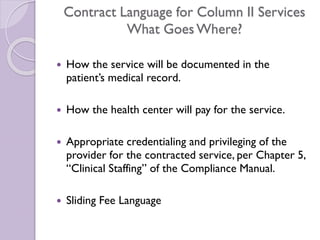
Contract Language for Column II Services
What Goes Where?
 How the service will be documented in the
patient’s medical record.
 How the health center will pay for the service.
 Appropriate credentialing and privileging of the
provider for the contracted service, per Chapter 5,
“Clinical Staffing” of the Compliance Manual.
 Sliding Fee Language
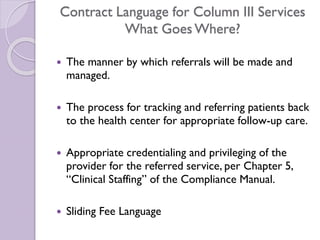
Contract Language for Column III Services
What Goes Where?
 The manner by which referrals will be made and
managed.
 The process for tracking and referring patients back
to the health center for appropriate follow-up care.
 Appropriate credentialing and privileging of the
provider for the referred service, per Chapter 5,
“Clinical Staffing” of the Compliance Manual.
 Sliding Fee Language
Gotcha #3:
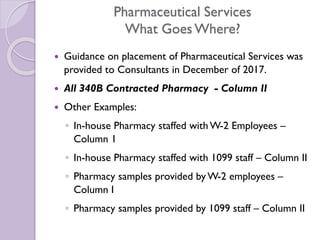
Pharmaceutical Services
What Goes Where?
 Guidance on placement of Pharmaceutical Services was
provided to Consultants in December of 2017.
 All 340B Contracted Pharmacy - Column II
 Other Examples:
◦ In-house Pharmacy staffed withW-2 Employees –
Column 1
◦ In-house Pharmacy staffed with 1099 staff – Column II
◦ Pharmacy samples provided by W-2 employees –
Column I
◦ Pharmacy samples provided by 1099 staff – Column II
Gotcha #4:
Telehealth
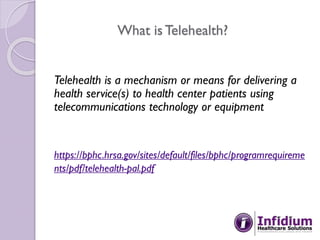
What is Telehealth?
Telehealth is a mechanism or means for delivering a
health service(s) to health center patients using
telecommunications technology or equipment
https://bphc.hrsa.gov/sites/default/files/bphc/programrequireme
nts/pdf/telehealth-pal.pdf
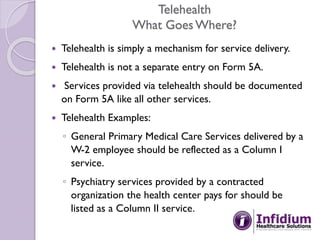
Telehealth
What GoesWhere?
 Telehealth is simply a mechanism for service delivery.
 Telehealth is not a separate entry on Form 5A.
 Services provided via telehealth should be documented
on Form 5A like all other services.
 Telehealth Examples:
◦ General Primary Medical Care Services delivered by a
W-2 employee should be reflected as a Column I
service.
◦ Psychiatry services provided by a contracted
organization the health center pays for should be
listed as a Column II service.
Gotcha #5:
Transportation
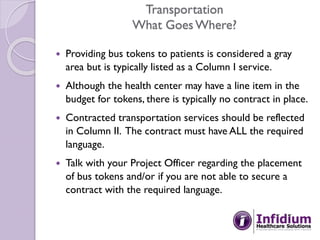
Transportation
What GoesWhere?
 Providing bus tokens to patients is considered a gray
area but is typically listed as a Column I service.
 Although the health center may have a line item in the
budget for tokens, there is typically no contract in place.
 Contracted transportation services should be reflected
in Column II. The contract must have ALL the required
language.
 Talk with your Project Officer regarding the placement
of bus tokens and/or if you are not able to secure a
contract with the required language.
Tips to Avoid a “Gotcha”
Clinical Reviewer Considerations
 Complete the Health Center Self-Assessment Worksheet on the
HRSA website.
 Utilize the Service Descriptors and Column Descriptors when
completing Form 5A.

 Involve multiple staff members when completing Form 5A.
 Review all Column II and Column III agreements for required
language.
 If you are unsure of which Column a service should be listed in,
always contact your Project Officer.
 Remember that Form 5A should be a working document and will
change as the health center adds or removes services.
Resources
 Compliatric
https://www.compliatric.com/
 Policy Information Notice (PIN) 2008-01
Scope of Project Policy Information Notice
 Program Assistance Letter (PAL) 2020-01
Telehealth Program Assistance Letter
 Health Center Self-AssessmentWorksheet
Self-AssessmentWorksheet
Resources
 Form 5A Service Descriptors
Form 5A Service Descriptors
 Form 5A Column Descriptors
Form 5A Column Descriptors
Questions & Answers
Michelle Layton BSN, MBA
Infidium Healthcare Solutions, LLC
michellel@infidiumhs.com

Top form 5A gotchas and how to avoid them

  • 1.
    Top Form 5ACondition “Gotchas” and How to Avoid Them Michelle Layton BSN, MBA Infidium Healthcare Solutions, LLC michellel@infidiumhs.com
  • 2.
    Disclaimers  This presentationis not endorsed by Management Strategists Consulting Group (MSCG).  This presentation is not endorsed by Health Resources Services Administration (HRSA) or the Bureau of Primary Health Care (BPHC).  Not employed by MSCG or BPHC.  Independent Consultant who is contracted to conduct Operational SiteVisits (OSV), provide Technical Assistance and assist health centers prepare for their OSV.  This information should not be considered legal advice. Confidentiality Notice: This document is confidential and contains proprietary information and intellectual property of Infidium Healthcare Solutions. Neither this document nor any of the information contained herein may be reproduced or disclosed under any circumstances without the express written permission of the aforementioned party. 2
  • 3.
    Agenda  What WeAlready Know About Form 5A  What has Changed during COVID-19  Top Five “Gotchas”  What Goes Where?  Tips to Avoid a “Gotcha”  Question and Answer Session
  • 4.
  • 5.
    What is Scopeof Project? A health center’s scope of project defines the activities supported by the Health Center Program project budget. Specifically, scope of project defines the approved service sites, services, providers, service area(s) and target population(s). https://bphc.hrsa.gov/programrequirements/scope.html
  • 6.
    What is Scopeof Project? A health center’s scope of project is reflected on the following forms in the Service Area Competition (SAC) Application  Form 5A - Services  Form 5B - Sites  Form 5C - Other Activities
  • 7.
    What is Scopeof Project?  Form 5A defines the service being provided, as well as the method of service delivery.  Form 5B identifies the sites where the services on Form 5A are being provided.  Form 5C identifies other activities the health center may be conducting, such as hospital admitting and health fairs.
  • 8.
    Why is Scopeof Project Important?  Scope demonstrates the health center’s commitment to HRSA.  Scope is reflective of the operations of the health center  Scope must be accurate for purposes of: ◦ Medicare/Medicaid FQHC Reimbursement ◦ FTCA Coverage ◦ 340B Drug Pricing Program Benefits
  • 9.
  • 10.
    Post-COVID-19  Postponement ofonsite Operational SiteVisits (OSVs).  Sudden surge in the use of telehealth to deliver services.  Confusion regarding how to correctly document telehealth services on Form 5A.  The need to continue to maintain compliance with Scope of Project throughout the Pandemic.  The implementation of theVirtual OSV process.
  • 11.
  • 12.
    Gotcha #1: 1099 Staffand Contracted Organizations
  • 13.
    Form 5A What GoesWhere? •Column I – Services are provided directly by W-2 employees of the health center or National Health Service Corps. • Column II – Services are provided through a formal written contract/agreement which the health center pays for. This includes 1099 staff who provide services on-site. • Column III – Services are provided through a formal written referral arrangement which the health center does NOT pay for.
  • 14.
  • 15.
    Contract Language forColumn II Services What Goes Where?  How the service will be documented in the patient’s medical record.  How the health center will pay for the service.  Appropriate credentialing and privileging of the provider for the contracted service, per Chapter 5, “Clinical Staffing” of the Compliance Manual.  Sliding Fee Language
  • 16.
    Contract Language forColumn III Services What Goes Where?  The manner by which referrals will be made and managed.  The process for tracking and referring patients back to the health center for appropriate follow-up care.  Appropriate credentialing and privileging of the provider for the referred service, per Chapter 5, “Clinical Staffing” of the Compliance Manual.  Sliding Fee Language
  • 17.
  • 18.
    Pharmaceutical Services What GoesWhere?  Guidance on placement of Pharmaceutical Services was provided to Consultants in December of 2017.  All 340B Contracted Pharmacy - Column II  Other Examples: ◦ In-house Pharmacy staffed withW-2 Employees – Column 1 ◦ In-house Pharmacy staffed with 1099 staff – Column II ◦ Pharmacy samples provided by W-2 employees – Column I ◦ Pharmacy samples provided by 1099 staff – Column II
  • 19.
  • 20.
    What is Telehealth? Telehealthis a mechanism or means for delivering a health service(s) to health center patients using telecommunications technology or equipment https://bphc.hrsa.gov/sites/default/files/bphc/programrequireme nts/pdf/telehealth-pal.pdf
  • 21.
    Telehealth What GoesWhere?  Telehealthis simply a mechanism for service delivery.  Telehealth is not a separate entry on Form 5A.  Services provided via telehealth should be documented on Form 5A like all other services.  Telehealth Examples: ◦ General Primary Medical Care Services delivered by a W-2 employee should be reflected as a Column I service. ◦ Psychiatry services provided by a contracted organization the health center pays for should be listed as a Column II service.
  • 22.
  • 23.
    Transportation What GoesWhere?  Providingbus tokens to patients is considered a gray area but is typically listed as a Column I service.  Although the health center may have a line item in the budget for tokens, there is typically no contract in place.  Contracted transportation services should be reflected in Column II. The contract must have ALL the required language.  Talk with your Project Officer regarding the placement of bus tokens and/or if you are not able to secure a contract with the required language.
  • 24.
    Tips to Avoida “Gotcha”
  • 25.
    Clinical Reviewer Considerations Complete the Health Center Self-Assessment Worksheet on the HRSA website.  Utilize the Service Descriptors and Column Descriptors when completing Form 5A.  Involve multiple staff members when completing Form 5A.  Review all Column II and Column III agreements for required language.  If you are unsure of which Column a service should be listed in, always contact your Project Officer.  Remember that Form 5A should be a working document and will change as the health center adds or removes services.
  • 26.
    Resources  Compliatric https://www.compliatric.com/  PolicyInformation Notice (PIN) 2008-01 Scope of Project Policy Information Notice  Program Assistance Letter (PAL) 2020-01 Telehealth Program Assistance Letter  Health Center Self-AssessmentWorksheet Self-AssessmentWorksheet
  • 27.
    Resources  Form 5AService Descriptors Form 5A Service Descriptors  Form 5A Column Descriptors Form 5A Column Descriptors
  • 28.
  • 29.
    Michelle Layton BSN,MBA Infidium Healthcare Solutions, LLC michellel@infidiumhs.com