TRANSACTIONAL
MODEL
Created by: Fiona Bunag
INTRODUCTION
The transactional model, unlike the linear,
recognizes that communication is a
simultaneous process and therefore
switched both the terms “sender” and
“receiver” to “communicator.”
It also adds “environment,” which embraces
not only physical location, but also personal
experiences and cultural backgrounds.
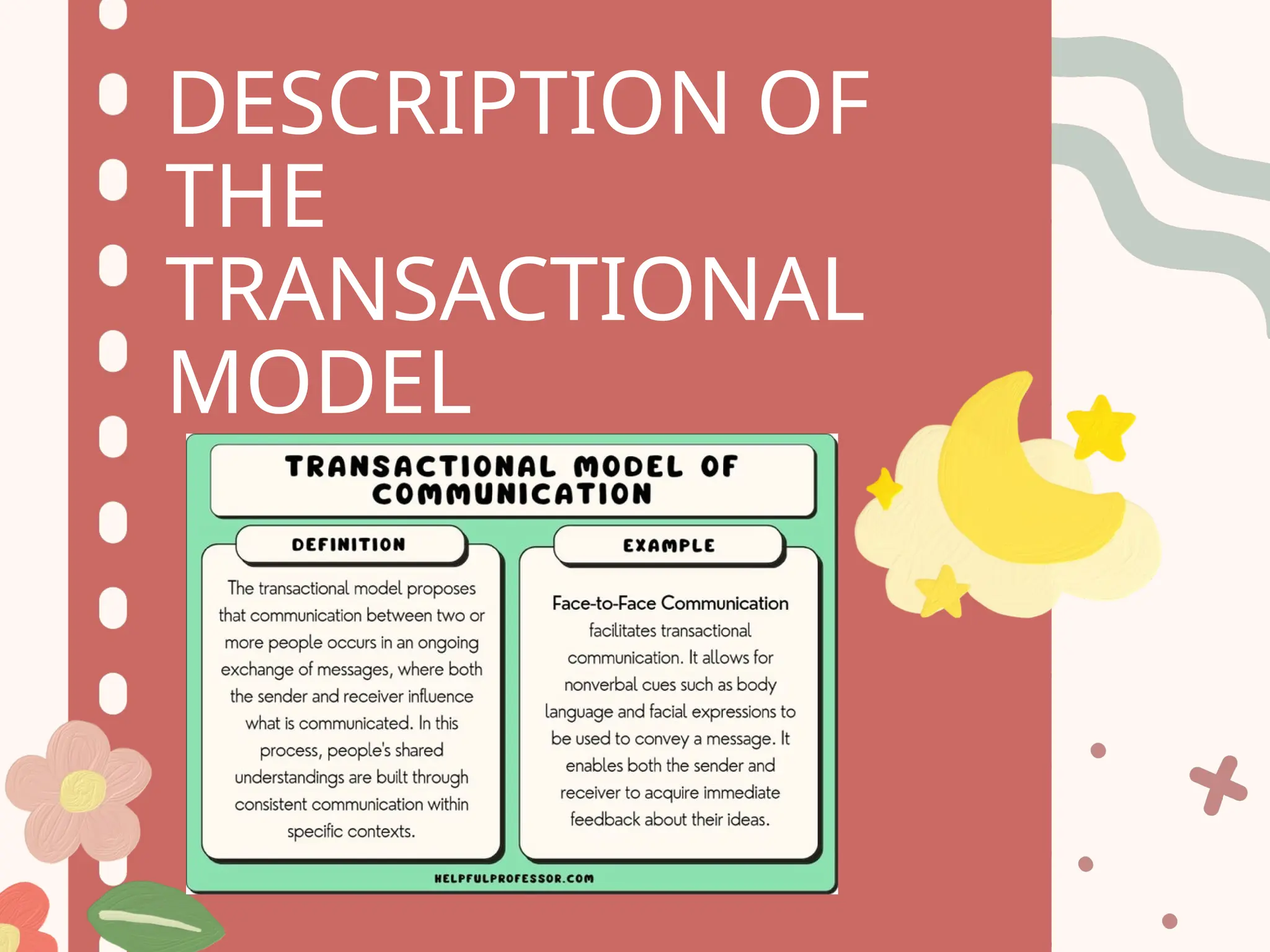
DESCRIPTION OF
THE
TRANSACTIONAL
MODEL
DISCUSSION
Transactional model of communication is the exchange of messages
between sender and receiver where each take turns to send or receive
messages. Here, both "sender" and "receiver" are known as
"communicators" and their role reverses each time in the
communication process as both processes of sending and receiving
occurs at the same time.
The communicators can be humans or machines but humans are taken
as communicators in this article to analyze general communication
between humans. The model is mostly used for
interpersonal communication and is also called circular model of
communication.
The transactional model is the most general model of communication.
Everyday talk and interactions are also a form of transactional model
communication. It is more efficient for communicators with similar
environment and individual aspects. For instance, communication
between people who know each other is more efficient as they share
same social system.
CRITICISMS OF
TRANSACTIONAL MODEL
Without verbal response, the sender can not be sure that the
receiver got the message as intended. Feedback is an important
component in the communication process, especially in
interpersonal communication as it gives a space to clarify
misunderstandings.
The transactional model gives the opportunity for a lot of noise
because the communication is simultaneous. For example, when
many people are talking at the same time in a meeting, the
objective of the meeting will not be fulfilled.
• Social Context - Social context in communication refers to
the norms, values, laws and other restrictions of a society to
communicate within a specific limit.
• Cultural Context - Cultural context is the lifestyle and
identity of a person. Caste, class, race, ethnicity, gender, etc
are the contexts which promotes communication.
• Relational Context - relates to relationship history and
manners. A person talks with an old friend differently than
a stranger.
FACTORS!!
Pros: This approach offers more deep and understanding of
how intra-personal, inter-personal, and contextual factors are
at play in communication. People often make assumptions
predicated on these contextual factors, and therefore it is
important to acknowledge these elements in practising and
learning about good communication.
Cons: This approach requires analysis and critical reflection. It
requires a broader understanding of historical, political, and
social structures that affect communication. The specific
factors affecting a particular communication encounter may or
may not be possible to uncover.
PROS & CONS
Transactional model relates communication to social
reality of an individual or a group of people in social,
cultural and relational contexts. Their responses
cannot be predicted because they all have different
backgrounds and mental conditions.
Communication pattern depends on various factors
such as physical, cultural, environmental, social,
psychological, emotional, etc. Cultural systems, social
systems and relational situations are the most over-
powering elements of the communication in
transactional model, while physical and psychological
context has considerable effect on the
communication, enhancing or undermining it.
CONCLUSION
REVIEW
OF THE
TOPIC
How does it occur?
We can describe the
Transactional Model
by asking some
questions, such as..
When does it occur?
What is the Transactional
Model?
Who is involved?
THANK
YOU
I hope you can get useful
knowledge from this
presentation. Good luck !

Transactional Model in oral communication.pptx

  • 1.
  • 2.
    INTRODUCTION The transactional model,unlike the linear, recognizes that communication is a simultaneous process and therefore switched both the terms “sender” and “receiver” to “communicator.” It also adds “environment,” which embraces not only physical location, but also personal experiences and cultural backgrounds.
  • 3.
  • 4.
    DISCUSSION Transactional model ofcommunication is the exchange of messages between sender and receiver where each take turns to send or receive messages. Here, both "sender" and "receiver" are known as "communicators" and their role reverses each time in the communication process as both processes of sending and receiving occurs at the same time. The communicators can be humans or machines but humans are taken as communicators in this article to analyze general communication between humans. The model is mostly used for interpersonal communication and is also called circular model of communication. The transactional model is the most general model of communication. Everyday talk and interactions are also a form of transactional model communication. It is more efficient for communicators with similar environment and individual aspects. For instance, communication between people who know each other is more efficient as they share same social system.
  • 5.
    CRITICISMS OF TRANSACTIONAL MODEL Withoutverbal response, the sender can not be sure that the receiver got the message as intended. Feedback is an important component in the communication process, especially in interpersonal communication as it gives a space to clarify misunderstandings. The transactional model gives the opportunity for a lot of noise because the communication is simultaneous. For example, when many people are talking at the same time in a meeting, the objective of the meeting will not be fulfilled.
  • 6.
    • Social Context- Social context in communication refers to the norms, values, laws and other restrictions of a society to communicate within a specific limit. • Cultural Context - Cultural context is the lifestyle and identity of a person. Caste, class, race, ethnicity, gender, etc are the contexts which promotes communication. • Relational Context - relates to relationship history and manners. A person talks with an old friend differently than a stranger. FACTORS!!
  • 7.
    Pros: This approachoffers more deep and understanding of how intra-personal, inter-personal, and contextual factors are at play in communication. People often make assumptions predicated on these contextual factors, and therefore it is important to acknowledge these elements in practising and learning about good communication. Cons: This approach requires analysis and critical reflection. It requires a broader understanding of historical, political, and social structures that affect communication. The specific factors affecting a particular communication encounter may or may not be possible to uncover. PROS & CONS
  • 8.
    Transactional model relatescommunication to social reality of an individual or a group of people in social, cultural and relational contexts. Their responses cannot be predicted because they all have different backgrounds and mental conditions. Communication pattern depends on various factors such as physical, cultural, environmental, social, psychological, emotional, etc. Cultural systems, social systems and relational situations are the most over- powering elements of the communication in transactional model, while physical and psychological context has considerable effect on the communication, enhancing or undermining it. CONCLUSION
  • 9.
    REVIEW OF THE TOPIC How doesit occur? We can describe the Transactional Model by asking some questions, such as.. When does it occur? What is the Transactional Model? Who is involved?
  • 10.
    THANK YOU I hope youcan get useful knowledge from this presentation. Good luck !