Pooja Kumari
Assistant Professor (Commerce)
CMG GCW, Bhodia Khera (Fatehabad)
Transaction Processing
System (TPS)
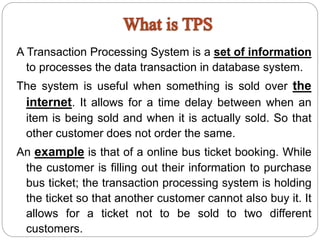
A Transaction Processing System is a set of information
to processes the data transaction in database system.
The system is useful when something is sold over the
internet. It allows for a time delay between when an
item is being sold and when it is actually sold. So that
other customer does not order the same.
An example is that of a online bus ticket booking. While
the customer is filling out their information to purchase
bus ticket; the transaction processing system is holding
the ticket so that another customer cannot also buy it. It
allows for a ticket not to be sold to two different
customers.
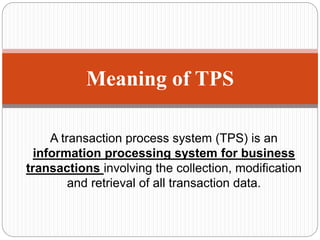
A transaction process system (TPS) is an
information processing system for business
transactions involving the collection, modification
and retrieval of all transaction data.
Meaning of TPS
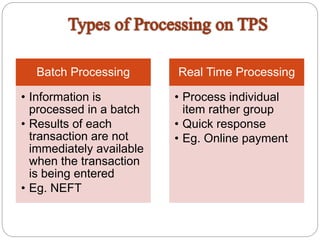
Batch Processing
• Information is
processed in a batch
• Results of each
transaction are not
immediately available
when the transaction
is being entered
• Eg. NEFT
Real Time Processing
• Process individual
item rather group
• Quick response
• Eg. Online payment
 Performance: Depends upon number of
transaction performed.
 Continuous availability: System will be
available even if other transaction is being
processed.
 Data integrity: Data would remain same. Eg.
two users can not book same seat of PVR.
 Ease of use: It is very simple and easy to
understand thus use.
 Retrieval of information anytime: As back up
system exist.
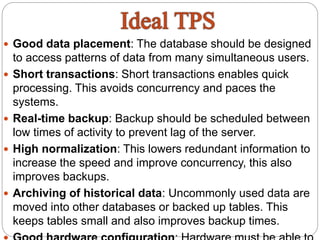
 Good data placement: The database should be designed
to access patterns of data from many simultaneous users.
 Short transactions: Short transactions enables quick
processing. This avoids concurrency and paces the
systems.
 Real-time backup: Backup should be scheduled between
low times of activity to prevent lag of the server.
 High normalization: This lowers redundant information to
increase the speed and improve concurrency, this also
improves backups.
 Archiving of historical data: Uncommonly used data are
moved into other databases or backed up tables. This
keeps tables small and also improves backup times.

Transaction processing system (tps)

  • 1.
    Pooja Kumari Assistant Professor(Commerce) CMG GCW, Bhodia Khera (Fatehabad) Transaction Processing System (TPS)
  • 2.
    A Transaction ProcessingSystem is a set of information to processes the data transaction in database system. The system is useful when something is sold over the internet. It allows for a time delay between when an item is being sold and when it is actually sold. So that other customer does not order the same. An example is that of a online bus ticket booking. While the customer is filling out their information to purchase bus ticket; the transaction processing system is holding the ticket so that another customer cannot also buy it. It allows for a ticket not to be sold to two different customers.
  • 3.
    A transaction processsystem (TPS) is an information processing system for business transactions involving the collection, modification and retrieval of all transaction data. Meaning of TPS
  • 4.
    Batch Processing • Informationis processed in a batch • Results of each transaction are not immediately available when the transaction is being entered • Eg. NEFT Real Time Processing • Process individual item rather group • Quick response • Eg. Online payment
  • 5.
     Performance: Dependsupon number of transaction performed.  Continuous availability: System will be available even if other transaction is being processed.  Data integrity: Data would remain same. Eg. two users can not book same seat of PVR.  Ease of use: It is very simple and easy to understand thus use.  Retrieval of information anytime: As back up system exist.
  • 6.
     Good dataplacement: The database should be designed to access patterns of data from many simultaneous users.  Short transactions: Short transactions enables quick processing. This avoids concurrency and paces the systems.  Real-time backup: Backup should be scheduled between low times of activity to prevent lag of the server.  High normalization: This lowers redundant information to increase the speed and improve concurrency, this also improves backups.  Archiving of historical data: Uncommonly used data are moved into other databases or backed up tables. This keeps tables small and also improves backup times.