McGraw-Hill/Irwin © 2005 The McGraw-Hill Companies, Inc. All rights reserved. 6 - 1
Module 3
Training Evaluation
McGraw-Hill/Irwin © 2005 The McGraw-Hill Companies, Inc. All rights reserved. 6 - 2
• Evaluating a training program-
approaches
• Methods of Training: Job Instructed
Training , Coaching, Mentoring, Job
Rotation, Apprenticeship training
• Learning Theories – Jaen Piaget’s
theory, Social Learning theory,
Kolb’s model on Learning style of
individuals
McGraw-Hill/Irwin © 2005 The McGraw-Hill Companies, Inc. All rights reserved. 6 - 3
3
INSTRUCTIONAL SYSTEMS DESIGN
MODEL
McGraw-Hill/Irwin © 2005 The McGraw-Hill Companies, Inc. All rights reserved. 6 - 4
4
INSTRUCTIONAL SYSTEMS DESIGN
MODEL
Training evaluation is the third step of the ISD model and
consists of two parts:
 The evaluation criteria (what is being measured)
 Evaluation design (how it will be measured)
 Each has a specific and important role to play in the
effective evaluation of training and the completion of
the ISD model
McGraw-Hill/Irwin © 2005 The McGraw-Hill Companies, Inc. All rights reserved. 6 - 5
Introduction (1 of 2)
Training effectiveness refers to the benefits that
the company and the trainees receive from
training
Training outcomes or criteria refer to measures
that the trainer and the company use to evaluate
training programs
McGraw-Hill/Irwin © 2005 The McGraw-Hill Companies, Inc. All rights reserved. 6 - 6
Introduction (2 of 2)
Training evaluation refers to the process of
collecting the outcomes needed to determine if
training is effective
Evaluation design refers to from whom, what,
when, and how information needed for
determining the effectiveness of the training
program will be collected
McGraw-Hill/Irwin © 2005 The McGraw-Hill Companies, Inc. All rights reserved. 6 - 7
Reasons for Evaluating Training (1 of 2)
Companies are investing millions of dollars in
training programs to help gain a competitive
advantage
Training investment is increasing because
learning creates knowledge which differentiates
between those companies and employees who are
successful and those who are not
McGraw-Hill/Irwin © 2005 The McGraw-Hill Companies, Inc. All rights reserved. 6 - 8
Reasons for Evaluating Training (2 of 2)
Because companies have made large dollar
investments in training and education and view
training as a strategy to be successful, they
expect the outcomes or benefits related to
training to be measurable.
McGraw-Hill/Irwin © 2005 The McGraw-Hill Companies, Inc. All rights reserved. 6 - 9
Formative Evaluation
Types of Evaluation
1.Formative evaluation – evaluation conducted
to improve the training process
Helps to ensure that:
the training program is well organized and runs
smoothly
trainees learn and are satisfied with the program
Provides information about how to make the
program better
McGraw-Hill/Irwin © 2005 The McGraw-Hill Companies, Inc. All rights reserved. 6 - 10
Summative Evaluation
2. Summative evaluation – evaluation
conducted to determine the extent to which
trainees have changed as a result of participating
in the training program
May also measure the return on investment (ROI)
that the company receives from the training
program
McGraw-Hill/Irwin © 2005 The McGraw-Hill Companies, Inc. All rights reserved. 6 - 11
Why Should A Training Program Be
Evaluated? (1 of 2)
To identify the program’s strengths and
weaknesses
To assess whether content, organization, and
administration of the program contribute to
learning and the use of training content on the job
To identify which trainees benefited most or least
from the program
McGraw-Hill/Irwin © 2005 The McGraw-Hill Companies, Inc. All rights reserved. 6 - 12
Why Should A Training Program Be
Evaluated? (2 of 2)
To gather data to assist in marketing training
programs
To determine the financial benefits and costs of
the programs
To compare the costs and benefits of training
versus non-training investments
To compare the costs and benefits of different
training programs to choose the best program
McGraw-Hill/Irwin © 2005 The McGraw-Hill Companies, Inc. All rights reserved. 6 - 13
The Evaluation Process
Conduct a Needs Analysis
Develop Measurable Learning Outcomes
and Analyze Transfer of Training
Develop Outcome Measures
Choose an Evaluation Strategy
Plan and Execute the Evaluation
McGraw-Hill/Irwin © 2005 The McGraw-Hill Companies, Inc. All rights reserved. 6 - 14
What are training evaluation models?
 Training evaluation models are systematic frameworks for investigating and
analyzing the effectiveness of training or learning journeys. Different models
target different things but in general, they look at things such as:
 Was the training successful?
 What did the participants learn?
 Did the participants use what they learned on-the-job?
 What was the impact on the organization?
 Was the training a good investment?
 Did the training offer value for money?
 Could the training be improved?
McGraw-Hill/Irwin © 2005 The McGraw-Hill Companies, Inc. All rights reserved. 6 - 15
15
McGraw-Hill/Irwin © 2005 The McGraw-Hill Companies, Inc. All rights reserved. 6 - 16
Training Outcomes: Kirkpatrick’s Four-Level
Framework of Evaluation Criteria
Level Criteria Focus
1 Reactions Trainee satisfaction
2 Learning Acquisition of knowledge, skills, attitudes, behavior
3 Behavior Improvement of behavior on the job
4 Results Business results achieved by trainees
McGraw-Hill/Irwin © 2005 The McGraw-Hill Companies, Inc. All rights reserved. 6 - 17
Level 1: Reaction
This level helps you determine how the participants responded to the training. This helps identify whether the
conditions for learning were present in the training.
Level 2: Learning
Through the use of short quizzes or practical tests, this stage helps you determine what,( if anything,) the
participants learned from the training.
Level 3: Behavior
The third stage takes place a while after the training has finished. Using various assessment methods, you try to
assess whether the course participants put what they learned into practice on-the-job.
Level 4: Results
The Kirkpatrick model measures results against stakeholder’s expectations. This is known as ROE (Return on
Expectations).
In summary, the Kirkpatrick Model is the most common training evaluation model in use worldwide today. As
we’ll see, it has provided the base for many other training evaluation models.
McGraw-Hill/Irwin © 2005 The McGraw-Hill Companies, Inc. All rights reserved. 6 - 18
The CIRO Model
In 1970, Peter Warr, Michael Bird, and Neil
Rackham published their book, Evaluation of
management training. Their framework for
evaluating training became known as the ‘CIRO
model’ and offers businesses a way of evaluating
training needs and results.
Unlike other models such as Kirkpatrick’s Model
that can be applied to a broad range of training
and evaluation programs, the CIRO model is
specifically aimed at evaluating management
McGraw-Hill/Irwin © 2005 The McGraw-Hill Companies, Inc. All rights reserved. 6 - 19
CIRO - Acronym
Context
Input
Reaction
Output
The CIRO model is hierarchical, meaning that
practitioners must start by studying ‘Context’,
before moving through ‘Input’, ‘Reaction’ and
‘Output’.
McGraw-Hill/Irwin © 2005 The McGraw-Hill Companies, Inc. All rights reserved. 6 - 20
CIRO model contd..
McGraw-Hill/Irwin © 2005 The McGraw-Hill Companies, Inc. All rights reserved. 6 - 21
CIRO contd..
McGraw-Hill/Irwin © 2005 The McGraw-Hill Companies, Inc. All rights reserved. 6 - 22
CIRO contd..
McGraw-Hill/Irwin © 2005 The McGraw-Hill Companies, Inc. All rights reserved. 6 - 23
CIRO contd..
McGraw-Hill/Irwin © 2005 The McGraw-Hill Companies, Inc. All rights reserved. 6 - 24
The Phillips ROI Model
As the Kirkpatrick Model grew in popularity
during the 1970s, many academics and business
practitioners wanted to build and expand on it.
Among them was Jack Phillips, who published
his own book, Return on Investment in Training
and Performance, in 1980. Phillips wanted to
build on Don Kirkpatrick’s work and address
several of what he perceived to be its
shortcomings. Over time, Phillip’s approach to
training evaluation became known as the Phillips
ROI Model.
McGraw-Hill/Irwin © 2005 The McGraw-Hill Companies, Inc. All rights reserved. 6 - 25
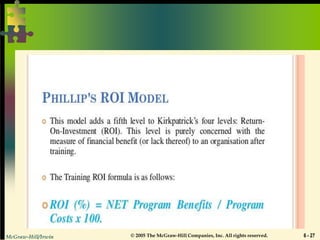
The most commonly quoted aspects of the
Phillips ROI Model is the addition of a fifth level.
This expands upon the Kirkpatrick Model and
offers organizations a way of calculating the ROI
of their training. The Phillips model has five
levels that broadly follow the scope and sequence
of the Kirkpatrick model.
McGraw-Hill/Irwin © 2005 The McGraw-Hill Companies, Inc. All rights reserved. 6 - 26
Level 1: Reaction
In common with the Kirkpatrick Model, the Phillips ROI Model begins by evaluating the participants’ reaction to the
training they received.
Level 2: Learning
The second level of the Philips ROI Model evaluates what, if any, learning took place during the training.
Level 3: Application and Implementation
Like the Kirkpatrick Model, the Phillips ROI Model looks at whether the participants used what they learned during the
training when they returned to the workplace. However, Phillips approach helps an organization determine whether an issue
(if there is one) lies with the application of the learning or its implementation. This represents a subtle but crucial
improvement over the Kirkpatrick Model.
Level 4: Impact
While the fourth level of the Kirkpatrick taxonomy focuses purely on results, the Phillips ROI model is much broader and
looks at the impact of the training. This helps identify whether factors other than training were responsible for delivering
the outcomes.
Level 5: Return on investment (ROI)
Unlike the Kirkpatrick Model that simply measures training results again stakeholder expectations (ROE), the Phillips ROI
model contains a fifth level. This is designed to measure ‘return on investment’, or ROI. This level uses cost-benefit
analysis to determine the value of training programs.
McGraw-Hill/Irwin © 2005 The McGraw-Hill Companies, Inc. All rights reserved. 6 - 27
McGraw-Hill/Irwin © 2005 The McGraw-Hill Companies, Inc. All rights reserved. 6 - 28
The Phillips ROI Model found favor with
organizations who wanted to assign a monetary
value to the results of the training.
Given the cost and complexity of applying an
ROI analysis, however, only around five to ten
percent of training courses actually require a full,
five-level evaluation.
McGraw-Hill/Irwin © 2005 The McGraw-Hill Companies, Inc. All rights reserved. 6 - 29
29
EVALUATION - VARIABLES
A. Reactions
B. Learning
C. Behaviour
D. Motivation
E. Self-efficacy
F. Perceived/anticipated support
G. Organizational perceptions
H. Organizational results
McGraw-Hill/Irwin © 2005 The McGraw-Hill Companies, Inc. All rights reserved. 6 - 30
30
VARIABLES
A. Reactions
1. Affective reactions: Measures that assess trainees’
likes and dislikes of a training program
2. Utility reactions: Measures that assess the
perceived usefulness of a training program
McGraw-Hill/Irwin © 2005 The McGraw-Hill Companies, Inc. All rights reserved. 6 - 31
31
VARIABLES
B. Learning
Learning outcomes can be measured by:
1. Declarative learning: Refers to the acquisition of
facts and information, and is
by far the most frequently assessed learning
measure
2. Procedural learning: Refers to the organization
of facts and information into a smooth
behavioural sequence
McGraw-Hill/Irwin © 2005 The McGraw-Hill Companies, Inc. All rights reserved. 6 - 32
32
VARIABLES
C. Behaviour
Behaviours can be measured using three
approaches:
1. Self-reports
2. Observations
3. Production indicators
McGraw-Hill/Irwin © 2005 The McGraw-Hill Companies, Inc. All rights reserved. 6 - 33
33
VARIABLES
D. Motivation
Two types of motivation in the training
context:
1. Motivation to learn
2. Motivation to apply the skill on-the-job (transfer)
E. Self-Efficacy
Beliefs that trainees have about their ability to
perform the behaviours that were taught in a
training program
McGraw-Hill/Irwin © 2005 The McGraw-Hill Companies, Inc. All rights reserved. 6 - 34
34
VARIABLES
F. Perceived and/or Anticipated Support
Two important measures of support:
1. Perceived support: The degree to which the trainee
reports receiving support in attempts to transfer the
learned skills
2. Anticipated support: The degree to which the
trainee expects to supported in attempts to transfer
the learned skills
McGraw-Hill/Irwin © 2005 The McGraw-Hill Companies, Inc. All rights reserved. 6 - 35
35
VARIABLES
G. Organizational Perceptions
Two scales designed to measure perceptions:
1. Transfer climate: Can be assessed via a
questionnaire that identifies eight sets of “cues”
2. Continuous learning culture: Can be assessed via
questionnaire
McGraw-Hill/Irwin © 2005 The McGraw-Hill Companies, Inc. All rights reserved. 6 - 36
36
VARIABLES
G. Organizational Perceptions (cont'd)
Transfer climate cues include:
 Goal cues
 Social cues
 Task and structural cues
 Positive feedback
 Negative feedback
 Punishment
 No feedback
 Self-control
McGraw-Hill/Irwin © 2005 The McGraw-Hill Companies, Inc. All rights reserved. 6 - 37
37
VARIABLES
H. Organizational Results
Results information includes:
1. Hard data: Results measured objectively (e.g.,
number of items sold)
2. Soft data: Results assessed through perceptions
and judgments (e.g., attitudes)
3. Return on expectations: Measurement of a
training program’s ability to meet managerial
expectations
McGraw-Hill/Irwin © 2005 The McGraw-Hill Companies, Inc. All rights reserved. 6 - 38
Outcomes Used in Evaluating Training
Programs: (1 of 4)
Affective
Outcomes
Results
Return on
Investment
Cognitive
Outcomes
Skill-Based
Outcomes
McGraw-Hill/Irwin © 2005 The McGraw-Hill Companies, Inc. All rights reserved. 6 - 39
Outcomes Used in Evaluating Training
Programs: (2 of 4)
Cognitive Outcomes
Determine the degree to which trainees are familiar
with the principles, facts, techniques, procedures, or
processes emphasized in the training program
Measure what knowledge trainees learned in the
program
Skill-Based Outcomes
Assess the level of technical or motor skills
Include acquisition or learning of skills and use of
skills on the job
McGraw-Hill/Irwin © 2005 The McGraw-Hill Companies, Inc. All rights reserved. 6 - 40
Outcomes Used in Evaluating Training
Programs: (3 of 4)
Affective Outcomes
Include attitudes and motivation
Trainees’ perceptions of the program including the
facilities, trainers, and content
Results
Determine the training program’s payoff for the
company
McGraw-Hill/Irwin © 2005 The McGraw-Hill Companies, Inc. All rights reserved. 6 - 41
Outcomes Used in Evaluating Training
Programs: (4 of 4)
Return on Investment (ROI)
Comparing the training’s monetary benefits with the
cost of the training
direct costs
indirect costs
benefits
McGraw-Hill/Irwin © 2005 The McGraw-Hill Companies, Inc. All rights reserved. 6 - 42
McGraw-Hill/Irwin © 2005 The McGraw-Hill Companies, Inc. All rights reserved. 6 - 43
McGraw-Hill/Irwin © 2005 The McGraw-Hill Companies, Inc. All rights reserved. 6 - 44
McGraw-Hill/Irwin © 2005 The McGraw-Hill Companies, Inc. All rights reserved. 6 - 45
McGraw-Hill/Irwin © 2005 The McGraw-Hill Companies, Inc. All rights reserved. 6 - 46
Methods of Training:
Job Instructed Training
Coaching
Mentoring
Job Rotation
Apprenticeship training
McGraw-Hill/Irwin © 2005 The McGraw-Hill Companies, Inc. All rights reserved. 6 - 47
Job Rotation: banking sector for the probationary
officers
Advantages and Disadvantages of job rotation
Coaching : The trainee is placed under a
particular supervisor who functions as a coach in
training the individual.
Job Instruction: training step by step. trainer explains
the trainee the way of doing the jobs, job knowledge and
skills and allows him to do the job. The trainer appraises
the performance of the trainee, provides feedback
information and corrects the trainee.
McGraw-Hill/Irwin © 2005 The McGraw-Hill Companies, Inc. All rights reserved. 6 - 48
Apprenticeship: a formalized method of training
curriculum program that combines classroom
education with on-the-job work under close
supervision.
Appropriate for training in crafts, trades and
technical areas, especially when proficiency in a
job is the result of a relatively long training or
apprenticeship period, e.g., job of a craftsman, a
machinist, a printer, a tool maker, a pattern
designer, a mechanic, etc.
McGraw-Hill/Irwin © 2005 The McGraw-Hill Companies, Inc. All rights reserved. 6 - 49
Mentoring
Mentoring is the Employee training system under
which a senior or more experienced person (the
mentor) is assigned to act as an advisor,
counselor, or guide to a junior or trainee -
providing support and feedback
Mentoring is the process of sharing knowledge
and experience with a junior employee.
McGraw-Hill/Irwin © 2005 The McGraw-Hill Companies, Inc. All rights reserved. 6 - 50
Learning Theories – Jaen Piaget’s theory, Social
Learning theory, Kolb’s model on Learning style
of individuals
McGraw-Hill/Irwin © 2005 The McGraw-Hill Companies, Inc. All rights reserved. 6 - 51
Piaget’s Psychological
Development
McGraw-Hill/Irwin © 2005 The McGraw-Hill Companies, Inc. All rights reserved. 6 - 52
Piaget (1896 - 1980)
Swiss Psychologist, worked for
several decades on understanding
children’s cognitive development
Most widely known theory of cognitive
development.
Was intrigued by kids’ thoughts & behavior,
& worked to understand their cognitive
development
McGraw-Hill/Irwin © 2005 The McGraw-Hill Companies, Inc. All rights reserved. 6 - 53
Constructivism
Assumption that learning is an active process of
construction rather than a passive assimilation
of information or rote memorization.
McGraw-Hill/Irwin © 2005 The McGraw-Hill Companies, Inc. All rights reserved. 6 - 54
Piaget & Learning
Two main states – equilibrium & disequilibrium
Believed that we are driven or motivated to learn
when we are in disequilibrium
We want to understand things
McGraw-Hill/Irwin © 2005 The McGraw-Hill Companies, Inc. All rights reserved. 6 - 55
Piaget & Learning
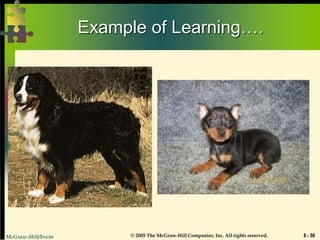
• Equilibration: assimilation & accommodation
• We adjust our ideas to make sense of reality
• Assimilation:
• process of matching external reality to an
existing cognitive structure.
• Accommodation:
• When there’s an inconsistency between the
learner’s cognitive structure & the thing being
learned the child will reorganize her thoughts
McGraw-Hill/Irwin © 2005 The McGraw-Hill Companies, Inc. All rights reserved. 6 - 56
Example of Learning….
McGraw-Hill/Irwin © 2005 The McGraw-Hill Companies, Inc. All rights reserved. 6 - 57
Piaget’s Four Stages
Believed that all children develop according to four
stages based on how they see the world.
He thought the age may vary some, but that we all go
through the stages in the same order.
1. Sensori-motor (birth –2 years)
2. Preoperational (~2-7)
3. Concrete operational (~7-11)
4. Formal operations (~12-15)
McGraw-Hill/Irwin © 2005 The McGraw-Hill Companies, Inc. All rights reserved. 6 - 58
Sensorimotor Stage
Birth to about 2 years, rapid change is seen
throughout
The child will:
Explore the world through senses & motor
activity
Early on, baby can’t tell difference between
themselves & the environment
If they can’t see something then it doesn’t exist
Begin to understand cause & effect
Can later follow something with their eyes
McGraw-Hill/Irwin © 2005 The McGraw-Hill Companies, Inc. All rights reserved. 6 - 59
Preoperational Stage
About 2 to about 7
Better speech communication
Can imagine the future & reflect on the past
Develop basic numerical abilities
Still pretty egocentric, but learning to be able to
delay gratification
Can’t understand conservation of matter
Has difficulty distinguishing fantasy from reality
(ex: cartoon characters are real people).
McGraw-Hill/Irwin © 2005 The McGraw-Hill Companies, Inc. All rights reserved. 6 - 60
Concrete Operational Stage
From about 7 to about 11
Abstract reasoning ability & ability to generalize
from the concrete increases
Understands conservation of matter
McGraw-Hill/Irwin © 2005 The McGraw-Hill Companies, Inc. All rights reserved. 6 - 61
Formal Operations
From about 12 to about 15
Be able to think about hypothetical situations
Form & test hypotheses
Organize information
Reason scientifically
McGraw-Hill/Irwin © 2005 The McGraw-Hill Companies, Inc. All rights reserved. 6 - 62
… Piaget’s Development
Development happens from one stage to
another through interaction with the
environment.
Changes from stage to stage may occur
abruptly and kids will differ in how long they
are in each stage.
Cognitive development can only happen after
genetically controlled biological growth occurs.
McGraw-Hill/Irwin © 2005 The McGraw-Hill Companies, Inc. All rights reserved. 6 - 63
…Piaget’s Development
Development leads to learning
Drive for development is internal
The child can only learn certain things when she is at
the right developmental stage
Environmental factors can influence but not direct
development
Development will happen naturally through regular
interaction with social environment
McGraw-Hill/Irwin © 2005 The McGraw-Hill Companies, Inc. All rights reserved. 6 - 64
Piaget & Education
Piaget did not think it was possible to hurry along
or skip stages through education
McGraw-Hill/Irwin © 2005 The McGraw-Hill Companies, Inc. All rights reserved. 6 - 65
Social Learning theory - Alan
Bandura
Social learning theory is based upon the work of
Albert Bandura. It is also referred to as Social
Cognitive Theory (SCT)
This theory attempts to understand the process
that is involved in explaining how we learn from
each other
It focuses on learning that occurs by direct
experience by observing, imitating, and modeling
It provides a framework for understanding,
predicting and potentially changing human
behaviour.
Aspects of Bandura’s theory are that:
o children learn by observing others,
o the same set of stimuli may provoke different
responses from different people, or from the
same people at different times
o the environment and a person’s behaviour are
interlinked;
o personality is an interaction between three
factors: the environment, behaviour, and a
person’s psychological processes.
All 3 play an important role in the learning
process. They are constantly influencing each
other
Environmental factors would include
Social aspects - peers, family and teachers
and Physical factors - the layout or size of
the class room or the temperature of the
room
McGraw-Hill/Irwin © 2005 The McGraw-Hill Companies, Inc. All rights reserved. 6 - 66
What is effective modeling?
Four conditions are necessary for effective modeling to occur
Attention: the person must first pay attention to the model.
Retention: the observer must be able to remember the behavior
that has been observed. One way of increasing this is using the
technique of rehearsal.
Motor reproduction: the third condition is the ability to
replicate the behavior that the model has just demonstrated.
Motivation: the final condition for modeling to occur is
motivation, learners must want to demonstrate what they have
learned.
McGraw-Hill/Irwin © 2005 The McGraw-Hill Companies, Inc. All rights reserved. 6 - 67
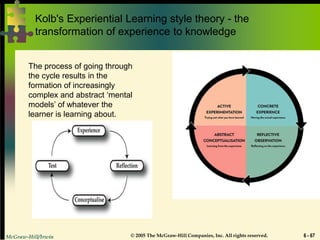
Kolb's Experiential Learning style theory - the
transformation of experience to knowledge
The process of going through
the cycle results in the
formation of increasingly
complex and abstract ‘mental
models’ of whatever the
learner is learning about.
McGraw-Hill/Irwin © 2005 The McGraw-Hill Companies, Inc. All rights reserved. 6 - 68
Kolb's learning theory
(1984) -four distinct
learning styles, based
on a four-stage
learning cycle
McGraw-Hill/Irwin © 2005 The McGraw-Hill Companies, Inc. All rights reserved. 6 - 69
1. Concrete Experience - the learner encounters a concrete experience. This
might be a new experience or situation, or a reinterpretation of existing
experience in the light of new concepts.
2. Reflective Observation of the New Experience - the learner reflects on the
new experience in the light of their existing knowledge. Of particular
importance are any inconsistencies between experience and understanding.
3. Abstract Conceptualization - reflection gives rise to a new idea, or a
modification of an existing abstract concept (the person has learned from their
experience).
4. Active Experimentation - the newly created or modified concepts give rise to
experimentation. The learner applies their idea(s) to the world around them to
see what happens.

Training Evaluation -IRWIN-Module 3.pptx

  • 1.
    McGraw-Hill/Irwin © 2005The McGraw-Hill Companies, Inc. All rights reserved. 6 - 1 Module 3 Training Evaluation
  • 2.
    McGraw-Hill/Irwin © 2005The McGraw-Hill Companies, Inc. All rights reserved. 6 - 2 • Evaluating a training program- approaches • Methods of Training: Job Instructed Training , Coaching, Mentoring, Job Rotation, Apprenticeship training • Learning Theories – Jaen Piaget’s theory, Social Learning theory, Kolb’s model on Learning style of individuals
  • 3.
    McGraw-Hill/Irwin © 2005The McGraw-Hill Companies, Inc. All rights reserved. 6 - 3 3 INSTRUCTIONAL SYSTEMS DESIGN MODEL
  • 4.
    McGraw-Hill/Irwin © 2005The McGraw-Hill Companies, Inc. All rights reserved. 6 - 4 4 INSTRUCTIONAL SYSTEMS DESIGN MODEL Training evaluation is the third step of the ISD model and consists of two parts:  The evaluation criteria (what is being measured)  Evaluation design (how it will be measured)  Each has a specific and important role to play in the effective evaluation of training and the completion of the ISD model
  • 5.
    McGraw-Hill/Irwin © 2005The McGraw-Hill Companies, Inc. All rights reserved. 6 - 5 Introduction (1 of 2) Training effectiveness refers to the benefits that the company and the trainees receive from training Training outcomes or criteria refer to measures that the trainer and the company use to evaluate training programs
  • 6.
    McGraw-Hill/Irwin © 2005The McGraw-Hill Companies, Inc. All rights reserved. 6 - 6 Introduction (2 of 2) Training evaluation refers to the process of collecting the outcomes needed to determine if training is effective Evaluation design refers to from whom, what, when, and how information needed for determining the effectiveness of the training program will be collected
  • 7.
    McGraw-Hill/Irwin © 2005The McGraw-Hill Companies, Inc. All rights reserved. 6 - 7 Reasons for Evaluating Training (1 of 2) Companies are investing millions of dollars in training programs to help gain a competitive advantage Training investment is increasing because learning creates knowledge which differentiates between those companies and employees who are successful and those who are not
  • 8.
    McGraw-Hill/Irwin © 2005The McGraw-Hill Companies, Inc. All rights reserved. 6 - 8 Reasons for Evaluating Training (2 of 2) Because companies have made large dollar investments in training and education and view training as a strategy to be successful, they expect the outcomes or benefits related to training to be measurable.
  • 9.
    McGraw-Hill/Irwin © 2005The McGraw-Hill Companies, Inc. All rights reserved. 6 - 9 Formative Evaluation Types of Evaluation 1.Formative evaluation – evaluation conducted to improve the training process Helps to ensure that: the training program is well organized and runs smoothly trainees learn and are satisfied with the program Provides information about how to make the program better
  • 10.
    McGraw-Hill/Irwin © 2005The McGraw-Hill Companies, Inc. All rights reserved. 6 - 10 Summative Evaluation 2. Summative evaluation – evaluation conducted to determine the extent to which trainees have changed as a result of participating in the training program May also measure the return on investment (ROI) that the company receives from the training program
  • 11.
    McGraw-Hill/Irwin © 2005The McGraw-Hill Companies, Inc. All rights reserved. 6 - 11 Why Should A Training Program Be Evaluated? (1 of 2) To identify the program’s strengths and weaknesses To assess whether content, organization, and administration of the program contribute to learning and the use of training content on the job To identify which trainees benefited most or least from the program
  • 12.
    McGraw-Hill/Irwin © 2005The McGraw-Hill Companies, Inc. All rights reserved. 6 - 12 Why Should A Training Program Be Evaluated? (2 of 2) To gather data to assist in marketing training programs To determine the financial benefits and costs of the programs To compare the costs and benefits of training versus non-training investments To compare the costs and benefits of different training programs to choose the best program
  • 13.
    McGraw-Hill/Irwin © 2005The McGraw-Hill Companies, Inc. All rights reserved. 6 - 13 The Evaluation Process Conduct a Needs Analysis Develop Measurable Learning Outcomes and Analyze Transfer of Training Develop Outcome Measures Choose an Evaluation Strategy Plan and Execute the Evaluation
  • 14.
    McGraw-Hill/Irwin © 2005The McGraw-Hill Companies, Inc. All rights reserved. 6 - 14 What are training evaluation models?  Training evaluation models are systematic frameworks for investigating and analyzing the effectiveness of training or learning journeys. Different models target different things but in general, they look at things such as:  Was the training successful?  What did the participants learn?  Did the participants use what they learned on-the-job?  What was the impact on the organization?  Was the training a good investment?  Did the training offer value for money?  Could the training be improved?
  • 15.
    McGraw-Hill/Irwin © 2005The McGraw-Hill Companies, Inc. All rights reserved. 6 - 15 15
  • 16.
    McGraw-Hill/Irwin © 2005The McGraw-Hill Companies, Inc. All rights reserved. 6 - 16 Training Outcomes: Kirkpatrick’s Four-Level Framework of Evaluation Criteria Level Criteria Focus 1 Reactions Trainee satisfaction 2 Learning Acquisition of knowledge, skills, attitudes, behavior 3 Behavior Improvement of behavior on the job 4 Results Business results achieved by trainees
  • 17.
    McGraw-Hill/Irwin © 2005The McGraw-Hill Companies, Inc. All rights reserved. 6 - 17 Level 1: Reaction This level helps you determine how the participants responded to the training. This helps identify whether the conditions for learning were present in the training. Level 2: Learning Through the use of short quizzes or practical tests, this stage helps you determine what,( if anything,) the participants learned from the training. Level 3: Behavior The third stage takes place a while after the training has finished. Using various assessment methods, you try to assess whether the course participants put what they learned into practice on-the-job. Level 4: Results The Kirkpatrick model measures results against stakeholder’s expectations. This is known as ROE (Return on Expectations). In summary, the Kirkpatrick Model is the most common training evaluation model in use worldwide today. As we’ll see, it has provided the base for many other training evaluation models.
  • 18.
    McGraw-Hill/Irwin © 2005The McGraw-Hill Companies, Inc. All rights reserved. 6 - 18 The CIRO Model In 1970, Peter Warr, Michael Bird, and Neil Rackham published their book, Evaluation of management training. Their framework for evaluating training became known as the ‘CIRO model’ and offers businesses a way of evaluating training needs and results. Unlike other models such as Kirkpatrick’s Model that can be applied to a broad range of training and evaluation programs, the CIRO model is specifically aimed at evaluating management
  • 19.
    McGraw-Hill/Irwin © 2005The McGraw-Hill Companies, Inc. All rights reserved. 6 - 19 CIRO - Acronym Context Input Reaction Output The CIRO model is hierarchical, meaning that practitioners must start by studying ‘Context’, before moving through ‘Input’, ‘Reaction’ and ‘Output’.
  • 20.
    McGraw-Hill/Irwin © 2005The McGraw-Hill Companies, Inc. All rights reserved. 6 - 20 CIRO model contd..
  • 21.
    McGraw-Hill/Irwin © 2005The McGraw-Hill Companies, Inc. All rights reserved. 6 - 21 CIRO contd..
  • 22.
    McGraw-Hill/Irwin © 2005The McGraw-Hill Companies, Inc. All rights reserved. 6 - 22 CIRO contd..
  • 23.
    McGraw-Hill/Irwin © 2005The McGraw-Hill Companies, Inc. All rights reserved. 6 - 23 CIRO contd..
  • 24.
    McGraw-Hill/Irwin © 2005The McGraw-Hill Companies, Inc. All rights reserved. 6 - 24 The Phillips ROI Model As the Kirkpatrick Model grew in popularity during the 1970s, many academics and business practitioners wanted to build and expand on it. Among them was Jack Phillips, who published his own book, Return on Investment in Training and Performance, in 1980. Phillips wanted to build on Don Kirkpatrick’s work and address several of what he perceived to be its shortcomings. Over time, Phillip’s approach to training evaluation became known as the Phillips ROI Model.
  • 25.
    McGraw-Hill/Irwin © 2005The McGraw-Hill Companies, Inc. All rights reserved. 6 - 25 The most commonly quoted aspects of the Phillips ROI Model is the addition of a fifth level. This expands upon the Kirkpatrick Model and offers organizations a way of calculating the ROI of their training. The Phillips model has five levels that broadly follow the scope and sequence of the Kirkpatrick model.
  • 26.
    McGraw-Hill/Irwin © 2005The McGraw-Hill Companies, Inc. All rights reserved. 6 - 26 Level 1: Reaction In common with the Kirkpatrick Model, the Phillips ROI Model begins by evaluating the participants’ reaction to the training they received. Level 2: Learning The second level of the Philips ROI Model evaluates what, if any, learning took place during the training. Level 3: Application and Implementation Like the Kirkpatrick Model, the Phillips ROI Model looks at whether the participants used what they learned during the training when they returned to the workplace. However, Phillips approach helps an organization determine whether an issue (if there is one) lies with the application of the learning or its implementation. This represents a subtle but crucial improvement over the Kirkpatrick Model. Level 4: Impact While the fourth level of the Kirkpatrick taxonomy focuses purely on results, the Phillips ROI model is much broader and looks at the impact of the training. This helps identify whether factors other than training were responsible for delivering the outcomes. Level 5: Return on investment (ROI) Unlike the Kirkpatrick Model that simply measures training results again stakeholder expectations (ROE), the Phillips ROI model contains a fifth level. This is designed to measure ‘return on investment’, or ROI. This level uses cost-benefit analysis to determine the value of training programs.
  • 27.
    McGraw-Hill/Irwin © 2005The McGraw-Hill Companies, Inc. All rights reserved. 6 - 27
  • 28.
    McGraw-Hill/Irwin © 2005The McGraw-Hill Companies, Inc. All rights reserved. 6 - 28 The Phillips ROI Model found favor with organizations who wanted to assign a monetary value to the results of the training. Given the cost and complexity of applying an ROI analysis, however, only around five to ten percent of training courses actually require a full, five-level evaluation.
  • 29.
    McGraw-Hill/Irwin © 2005The McGraw-Hill Companies, Inc. All rights reserved. 6 - 29 29 EVALUATION - VARIABLES A. Reactions B. Learning C. Behaviour D. Motivation E. Self-efficacy F. Perceived/anticipated support G. Organizational perceptions H. Organizational results
  • 30.
    McGraw-Hill/Irwin © 2005The McGraw-Hill Companies, Inc. All rights reserved. 6 - 30 30 VARIABLES A. Reactions 1. Affective reactions: Measures that assess trainees’ likes and dislikes of a training program 2. Utility reactions: Measures that assess the perceived usefulness of a training program
  • 31.
    McGraw-Hill/Irwin © 2005The McGraw-Hill Companies, Inc. All rights reserved. 6 - 31 31 VARIABLES B. Learning Learning outcomes can be measured by: 1. Declarative learning: Refers to the acquisition of facts and information, and is by far the most frequently assessed learning measure 2. Procedural learning: Refers to the organization of facts and information into a smooth behavioural sequence
  • 32.
    McGraw-Hill/Irwin © 2005The McGraw-Hill Companies, Inc. All rights reserved. 6 - 32 32 VARIABLES C. Behaviour Behaviours can be measured using three approaches: 1. Self-reports 2. Observations 3. Production indicators
  • 33.
    McGraw-Hill/Irwin © 2005The McGraw-Hill Companies, Inc. All rights reserved. 6 - 33 33 VARIABLES D. Motivation Two types of motivation in the training context: 1. Motivation to learn 2. Motivation to apply the skill on-the-job (transfer) E. Self-Efficacy Beliefs that trainees have about their ability to perform the behaviours that were taught in a training program
  • 34.
    McGraw-Hill/Irwin © 2005The McGraw-Hill Companies, Inc. All rights reserved. 6 - 34 34 VARIABLES F. Perceived and/or Anticipated Support Two important measures of support: 1. Perceived support: The degree to which the trainee reports receiving support in attempts to transfer the learned skills 2. Anticipated support: The degree to which the trainee expects to supported in attempts to transfer the learned skills
  • 35.
    McGraw-Hill/Irwin © 2005The McGraw-Hill Companies, Inc. All rights reserved. 6 - 35 35 VARIABLES G. Organizational Perceptions Two scales designed to measure perceptions: 1. Transfer climate: Can be assessed via a questionnaire that identifies eight sets of “cues” 2. Continuous learning culture: Can be assessed via questionnaire
  • 36.
    McGraw-Hill/Irwin © 2005The McGraw-Hill Companies, Inc. All rights reserved. 6 - 36 36 VARIABLES G. Organizational Perceptions (cont'd) Transfer climate cues include:  Goal cues  Social cues  Task and structural cues  Positive feedback  Negative feedback  Punishment  No feedback  Self-control
  • 37.
    McGraw-Hill/Irwin © 2005The McGraw-Hill Companies, Inc. All rights reserved. 6 - 37 37 VARIABLES H. Organizational Results Results information includes: 1. Hard data: Results measured objectively (e.g., number of items sold) 2. Soft data: Results assessed through perceptions and judgments (e.g., attitudes) 3. Return on expectations: Measurement of a training program’s ability to meet managerial expectations
  • 38.
    McGraw-Hill/Irwin © 2005The McGraw-Hill Companies, Inc. All rights reserved. 6 - 38 Outcomes Used in Evaluating Training Programs: (1 of 4) Affective Outcomes Results Return on Investment Cognitive Outcomes Skill-Based Outcomes
  • 39.
    McGraw-Hill/Irwin © 2005The McGraw-Hill Companies, Inc. All rights reserved. 6 - 39 Outcomes Used in Evaluating Training Programs: (2 of 4) Cognitive Outcomes Determine the degree to which trainees are familiar with the principles, facts, techniques, procedures, or processes emphasized in the training program Measure what knowledge trainees learned in the program Skill-Based Outcomes Assess the level of technical or motor skills Include acquisition or learning of skills and use of skills on the job
  • 40.
    McGraw-Hill/Irwin © 2005The McGraw-Hill Companies, Inc. All rights reserved. 6 - 40 Outcomes Used in Evaluating Training Programs: (3 of 4) Affective Outcomes Include attitudes and motivation Trainees’ perceptions of the program including the facilities, trainers, and content Results Determine the training program’s payoff for the company
  • 41.
    McGraw-Hill/Irwin © 2005The McGraw-Hill Companies, Inc. All rights reserved. 6 - 41 Outcomes Used in Evaluating Training Programs: (4 of 4) Return on Investment (ROI) Comparing the training’s monetary benefits with the cost of the training direct costs indirect costs benefits
  • 42.
    McGraw-Hill/Irwin © 2005The McGraw-Hill Companies, Inc. All rights reserved. 6 - 42
  • 43.
    McGraw-Hill/Irwin © 2005The McGraw-Hill Companies, Inc. All rights reserved. 6 - 43
  • 44.
    McGraw-Hill/Irwin © 2005The McGraw-Hill Companies, Inc. All rights reserved. 6 - 44
  • 45.
    McGraw-Hill/Irwin © 2005The McGraw-Hill Companies, Inc. All rights reserved. 6 - 45
  • 46.
    McGraw-Hill/Irwin © 2005The McGraw-Hill Companies, Inc. All rights reserved. 6 - 46 Methods of Training: Job Instructed Training Coaching Mentoring Job Rotation Apprenticeship training
  • 47.
    McGraw-Hill/Irwin © 2005The McGraw-Hill Companies, Inc. All rights reserved. 6 - 47 Job Rotation: banking sector for the probationary officers Advantages and Disadvantages of job rotation Coaching : The trainee is placed under a particular supervisor who functions as a coach in training the individual. Job Instruction: training step by step. trainer explains the trainee the way of doing the jobs, job knowledge and skills and allows him to do the job. The trainer appraises the performance of the trainee, provides feedback information and corrects the trainee.
  • 48.
    McGraw-Hill/Irwin © 2005The McGraw-Hill Companies, Inc. All rights reserved. 6 - 48 Apprenticeship: a formalized method of training curriculum program that combines classroom education with on-the-job work under close supervision. Appropriate for training in crafts, trades and technical areas, especially when proficiency in a job is the result of a relatively long training or apprenticeship period, e.g., job of a craftsman, a machinist, a printer, a tool maker, a pattern designer, a mechanic, etc.
  • 49.
    McGraw-Hill/Irwin © 2005The McGraw-Hill Companies, Inc. All rights reserved. 6 - 49 Mentoring Mentoring is the Employee training system under which a senior or more experienced person (the mentor) is assigned to act as an advisor, counselor, or guide to a junior or trainee - providing support and feedback Mentoring is the process of sharing knowledge and experience with a junior employee.
  • 50.
    McGraw-Hill/Irwin © 2005The McGraw-Hill Companies, Inc. All rights reserved. 6 - 50 Learning Theories – Jaen Piaget’s theory, Social Learning theory, Kolb’s model on Learning style of individuals
  • 51.
    McGraw-Hill/Irwin © 2005The McGraw-Hill Companies, Inc. All rights reserved. 6 - 51 Piaget’s Psychological Development
  • 52.
    McGraw-Hill/Irwin © 2005The McGraw-Hill Companies, Inc. All rights reserved. 6 - 52 Piaget (1896 - 1980) Swiss Psychologist, worked for several decades on understanding children’s cognitive development Most widely known theory of cognitive development. Was intrigued by kids’ thoughts & behavior, & worked to understand their cognitive development
  • 53.
    McGraw-Hill/Irwin © 2005The McGraw-Hill Companies, Inc. All rights reserved. 6 - 53 Constructivism Assumption that learning is an active process of construction rather than a passive assimilation of information or rote memorization.
  • 54.
    McGraw-Hill/Irwin © 2005The McGraw-Hill Companies, Inc. All rights reserved. 6 - 54 Piaget & Learning Two main states – equilibrium & disequilibrium Believed that we are driven or motivated to learn when we are in disequilibrium We want to understand things
  • 55.
    McGraw-Hill/Irwin © 2005The McGraw-Hill Companies, Inc. All rights reserved. 6 - 55 Piaget & Learning • Equilibration: assimilation & accommodation • We adjust our ideas to make sense of reality • Assimilation: • process of matching external reality to an existing cognitive structure. • Accommodation: • When there’s an inconsistency between the learner’s cognitive structure & the thing being learned the child will reorganize her thoughts
  • 56.
    McGraw-Hill/Irwin © 2005The McGraw-Hill Companies, Inc. All rights reserved. 6 - 56 Example of Learning….
  • 57.
    McGraw-Hill/Irwin © 2005The McGraw-Hill Companies, Inc. All rights reserved. 6 - 57 Piaget’s Four Stages Believed that all children develop according to four stages based on how they see the world. He thought the age may vary some, but that we all go through the stages in the same order. 1. Sensori-motor (birth –2 years) 2. Preoperational (~2-7) 3. Concrete operational (~7-11) 4. Formal operations (~12-15)
  • 58.
    McGraw-Hill/Irwin © 2005The McGraw-Hill Companies, Inc. All rights reserved. 6 - 58 Sensorimotor Stage Birth to about 2 years, rapid change is seen throughout The child will: Explore the world through senses & motor activity Early on, baby can’t tell difference between themselves & the environment If they can’t see something then it doesn’t exist Begin to understand cause & effect Can later follow something with their eyes
  • 59.
    McGraw-Hill/Irwin © 2005The McGraw-Hill Companies, Inc. All rights reserved. 6 - 59 Preoperational Stage About 2 to about 7 Better speech communication Can imagine the future & reflect on the past Develop basic numerical abilities Still pretty egocentric, but learning to be able to delay gratification Can’t understand conservation of matter Has difficulty distinguishing fantasy from reality (ex: cartoon characters are real people).
  • 60.
    McGraw-Hill/Irwin © 2005The McGraw-Hill Companies, Inc. All rights reserved. 6 - 60 Concrete Operational Stage From about 7 to about 11 Abstract reasoning ability & ability to generalize from the concrete increases Understands conservation of matter
  • 61.
    McGraw-Hill/Irwin © 2005The McGraw-Hill Companies, Inc. All rights reserved. 6 - 61 Formal Operations From about 12 to about 15 Be able to think about hypothetical situations Form & test hypotheses Organize information Reason scientifically
  • 62.
    McGraw-Hill/Irwin © 2005The McGraw-Hill Companies, Inc. All rights reserved. 6 - 62 … Piaget’s Development Development happens from one stage to another through interaction with the environment. Changes from stage to stage may occur abruptly and kids will differ in how long they are in each stage. Cognitive development can only happen after genetically controlled biological growth occurs.
  • 63.
    McGraw-Hill/Irwin © 2005The McGraw-Hill Companies, Inc. All rights reserved. 6 - 63 …Piaget’s Development Development leads to learning Drive for development is internal The child can only learn certain things when she is at the right developmental stage Environmental factors can influence but not direct development Development will happen naturally through regular interaction with social environment
  • 64.
    McGraw-Hill/Irwin © 2005The McGraw-Hill Companies, Inc. All rights reserved. 6 - 64 Piaget & Education Piaget did not think it was possible to hurry along or skip stages through education
  • 65.
    McGraw-Hill/Irwin © 2005The McGraw-Hill Companies, Inc. All rights reserved. 6 - 65 Social Learning theory - Alan Bandura Social learning theory is based upon the work of Albert Bandura. It is also referred to as Social Cognitive Theory (SCT) This theory attempts to understand the process that is involved in explaining how we learn from each other It focuses on learning that occurs by direct experience by observing, imitating, and modeling It provides a framework for understanding, predicting and potentially changing human behaviour. Aspects of Bandura’s theory are that: o children learn by observing others, o the same set of stimuli may provoke different responses from different people, or from the same people at different times o the environment and a person’s behaviour are interlinked; o personality is an interaction between three factors: the environment, behaviour, and a person’s psychological processes. All 3 play an important role in the learning process. They are constantly influencing each other Environmental factors would include Social aspects - peers, family and teachers and Physical factors - the layout or size of the class room or the temperature of the room
  • 66.
    McGraw-Hill/Irwin © 2005The McGraw-Hill Companies, Inc. All rights reserved. 6 - 66 What is effective modeling? Four conditions are necessary for effective modeling to occur Attention: the person must first pay attention to the model. Retention: the observer must be able to remember the behavior that has been observed. One way of increasing this is using the technique of rehearsal. Motor reproduction: the third condition is the ability to replicate the behavior that the model has just demonstrated. Motivation: the final condition for modeling to occur is motivation, learners must want to demonstrate what they have learned.
  • 67.
    McGraw-Hill/Irwin © 2005The McGraw-Hill Companies, Inc. All rights reserved. 6 - 67 Kolb's Experiential Learning style theory - the transformation of experience to knowledge The process of going through the cycle results in the formation of increasingly complex and abstract ‘mental models’ of whatever the learner is learning about.
  • 68.
    McGraw-Hill/Irwin © 2005The McGraw-Hill Companies, Inc. All rights reserved. 6 - 68 Kolb's learning theory (1984) -four distinct learning styles, based on a four-stage learning cycle
  • 69.
    McGraw-Hill/Irwin © 2005The McGraw-Hill Companies, Inc. All rights reserved. 6 - 69 1. Concrete Experience - the learner encounters a concrete experience. This might be a new experience or situation, or a reinterpretation of existing experience in the light of new concepts. 2. Reflective Observation of the New Experience - the learner reflects on the new experience in the light of their existing knowledge. Of particular importance are any inconsistencies between experience and understanding. 3. Abstract Conceptualization - reflection gives rise to a new idea, or a modification of an existing abstract concept (the person has learned from their experience). 4. Active Experimentation - the newly created or modified concepts give rise to experimentation. The learner applies their idea(s) to the world around them to see what happens.

Editor's Notes

  • #66 Bandura theory asserts that the environment plays a greater role in shaping our behavior than genetics
  • #68 Kolb's experiential learning style theory is typically represented by a four-stage learning cycle in which the learner 'touches all the bases':