6 - 1
Copyright © 2002 by The McGraw-Hill Companies, Inc. All rights reserved.
6
Chapter
Training Evaluation
6 - 2
Copyright © 2002 by The McGraw-Hill Companies, Inc. All rights reserved.
Objectives
Objectives
After reading this chapter, you should be able to:
1. Explain why evaluation is important.
2. Identify and choose outcomes to evaluate a
training program.
3. Discuss the process used to plan and
implement a good training evaluation.
4. Discuss the strengths and weaknesses of
different evaluation designs.
6 - 3
Copyright © 2002 by The McGraw-Hill Companies, Inc. All rights reserved.
Objectives
Objectives (continued)
(continued)
5. Choose the appropriate evaluation design
based on the characteristics of the company
and the importance and purpose of the
training.
6. Conduct a cost-benefit analysis for a training
program.
6 - 4
Copyright © 2002 by The McGraw-Hill Companies, Inc. All rights reserved.
Introduction
Introduction
 Walgreen Company wanted to determine if
the time, money, and effort devoted to
training technicians actually made a
difference.
It was interested in assessing the
effectiveness of the training program.
6 - 5
Copyright © 2002 by The McGraw-Hill Companies, Inc. All rights reserved.
Introduction
Introduction (continued)
(continued)
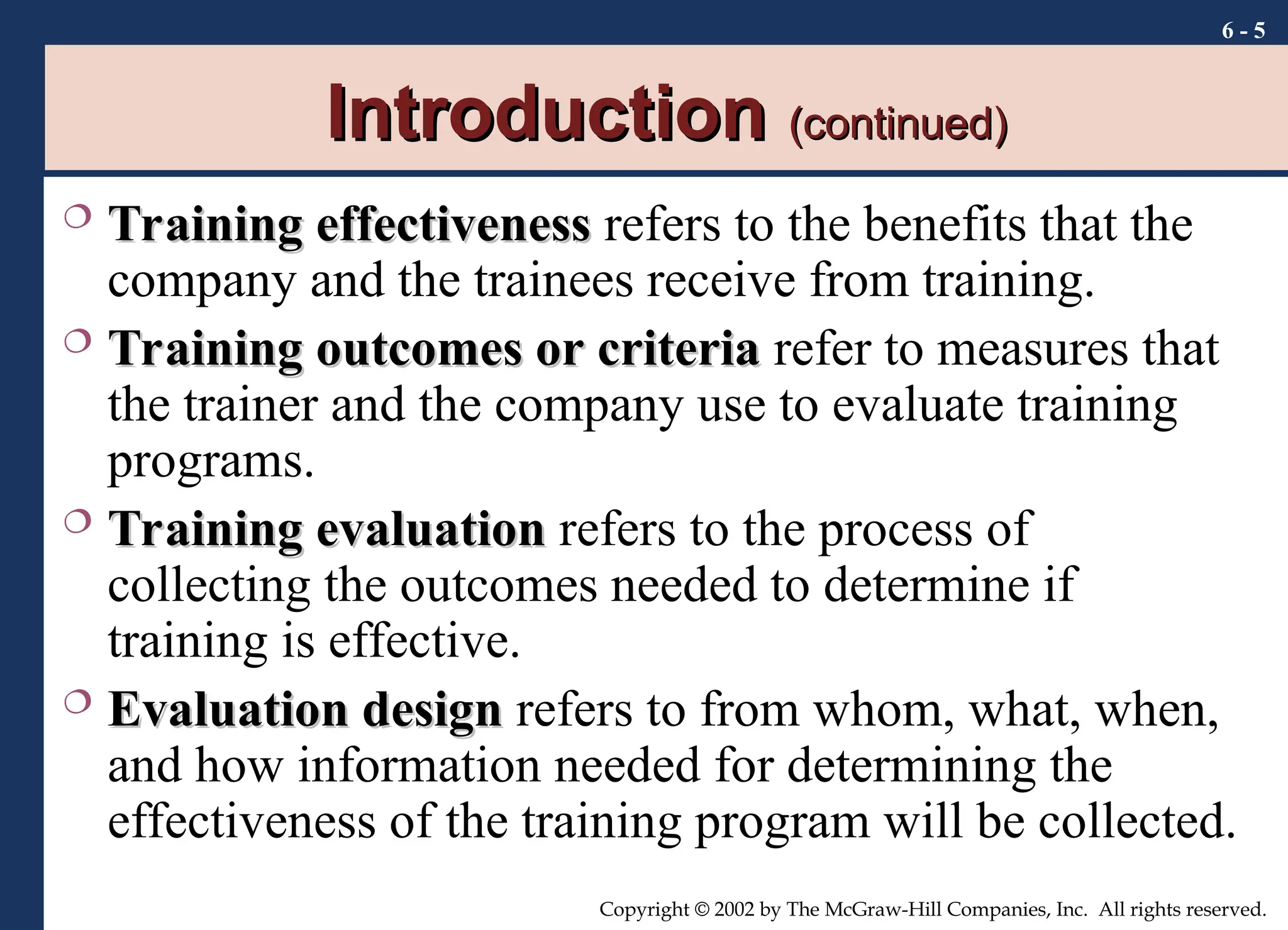
 Training effectiveness
Training effectiveness refers to the benefits that the
company and the trainees receive from training.
 Training outcomes or criteria
Training outcomes or criteria refer to measures that
the trainer and the company use to evaluate training
programs.
 Training evaluation
Training evaluation refers to the process of
collecting the outcomes needed to determine if
training is effective.
 Evaluation design
Evaluation design refers to from whom, what, when,
and how information needed for determining the
effectiveness of the training program will be collected.
6 - 6
Copyright © 2002 by The McGraw-Hill Companies, Inc. All rights reserved.
Reasons for Evaluating Training
 Companies are investing millions of dollars in
training programs to help gain a competitive
advantage.
 Training investment is increasing because
learning creates knowledge which
differentiates between those companies and
employees who are successful and those who
are not.
6 - 7
Copyright © 2002 by The McGraw-Hill Companies, Inc. All rights reserved.
Reasons for Evaluating Training
(continued)
(continued)
Because companies have made large dollar
investments in training and education and
view training as a strategy to be successful,
they expect the outcomes or benefits
related to training to be measurable.
6 - 8
Copyright © 2002 by The McGraw-Hill Companies, Inc. All rights reserved.
Training evaluation involves:
 Formative evaluation –
Formative evaluation – evaluation conducted
to improve the training process.
 Summative evaluation –
Summative evaluation – evaluation conducted
to determine the extent to which trainees have
changed as a result of participating in the
training program.
6 - 9
Copyright © 2002 by The McGraw-Hill Companies, Inc. All rights reserved.
Why Should A Training Program Be
Evaluated?
Evaluated?
 To identify the program’s strengths and
weaknesses.
 To assess whether content, organization, and
administration of the program contribute to
learning and the use of training content on the
job.
 To identify which trainees benefited most or
least from the program.
6 - 10
Copyright © 2002 by The McGraw-Hill Companies, Inc. All rights reserved.
Why Should A Training Program Be
Evaluated?
Evaluated? (continued)
(continued)
 To gather data to assist in marketing training
programs.
 To determine the financial benefits and costs of
the programs.
 To compare the costs and benefits of training
versus non-training investments.
 To compare the costs and benefits of different
training programs to choose the best program.
6 - 11
Copyright © 2002 by The McGraw-Hill Companies, Inc. All rights reserved.
The Evaluation Process
Conduct a Needs Analysis
Develop Measurable Learning Outcomes
Develop Outcome Measures
Choose an Evaluation Strategy
Plan and Execute the Evaluation
6 - 12
Copyright © 2002 by The McGraw-Hill Companies, Inc. All rights reserved.
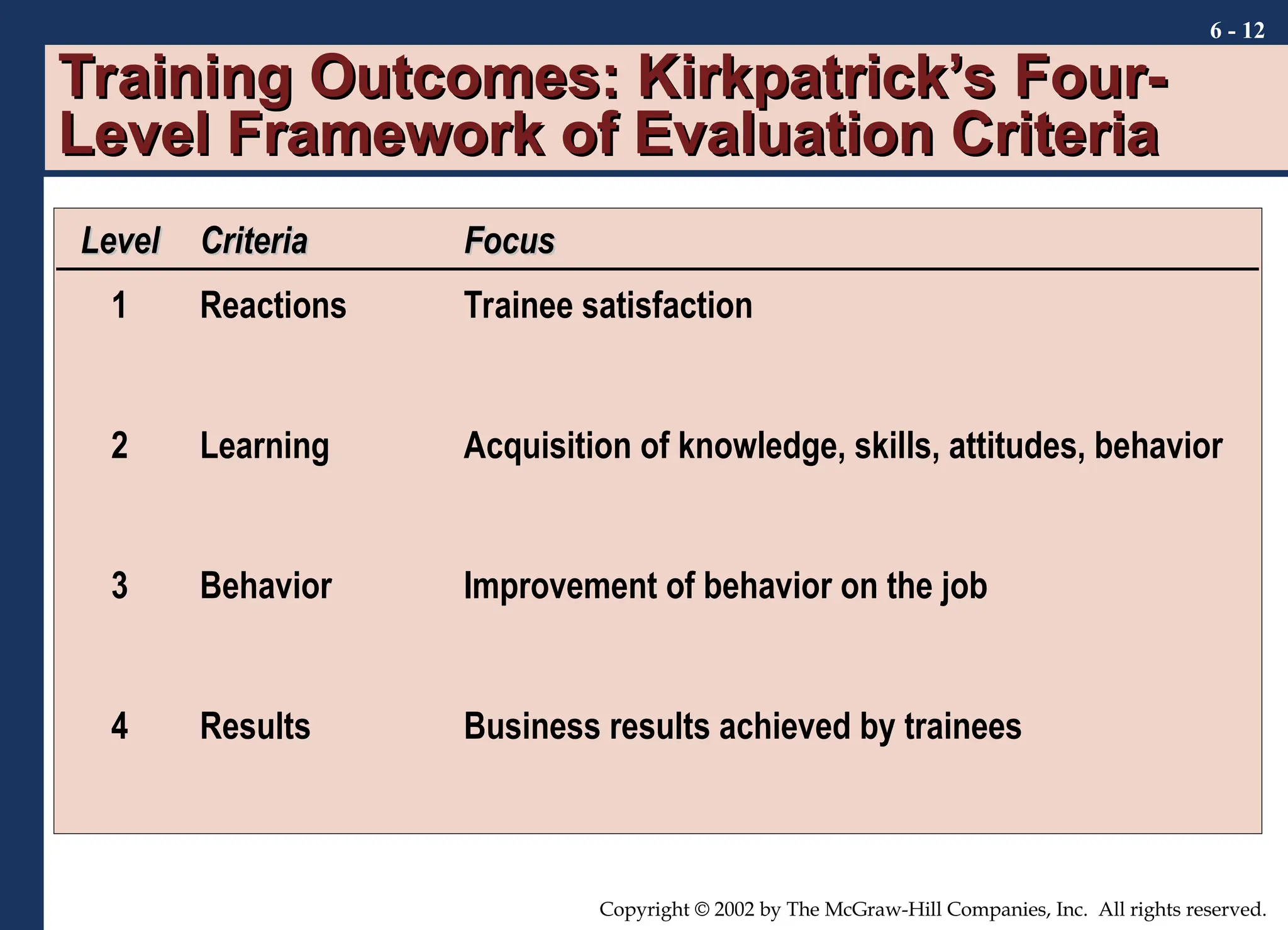
Training Outcomes: Kirkpatrick’s Four-
Level Framework of Evaluation Criteria
Level
Level Criteria
Criteria Focus
Focus
1 Reactions Trainee satisfaction
2 Learning Acquisition of knowledge, skills, attitudes, behavior
3 Behavior Improvement of behavior on the job
4 Results Business results achieved by trainees
6 - 13
Copyright © 2002 by The McGraw-Hill Companies, Inc. All rights reserved.
Outcomes Used in Evaluating Training
Programs:
Programs:
Cognitive
Outcomes Skill-Based
Outcomes
Affective
Outcomes
Results
Return on
Investment
6 - 14
Copyright © 2002 by The McGraw-Hill Companies, Inc. All rights reserved.
Outcomes Used in Evaluating Training
Programs:
Programs: (continued)
(continued)
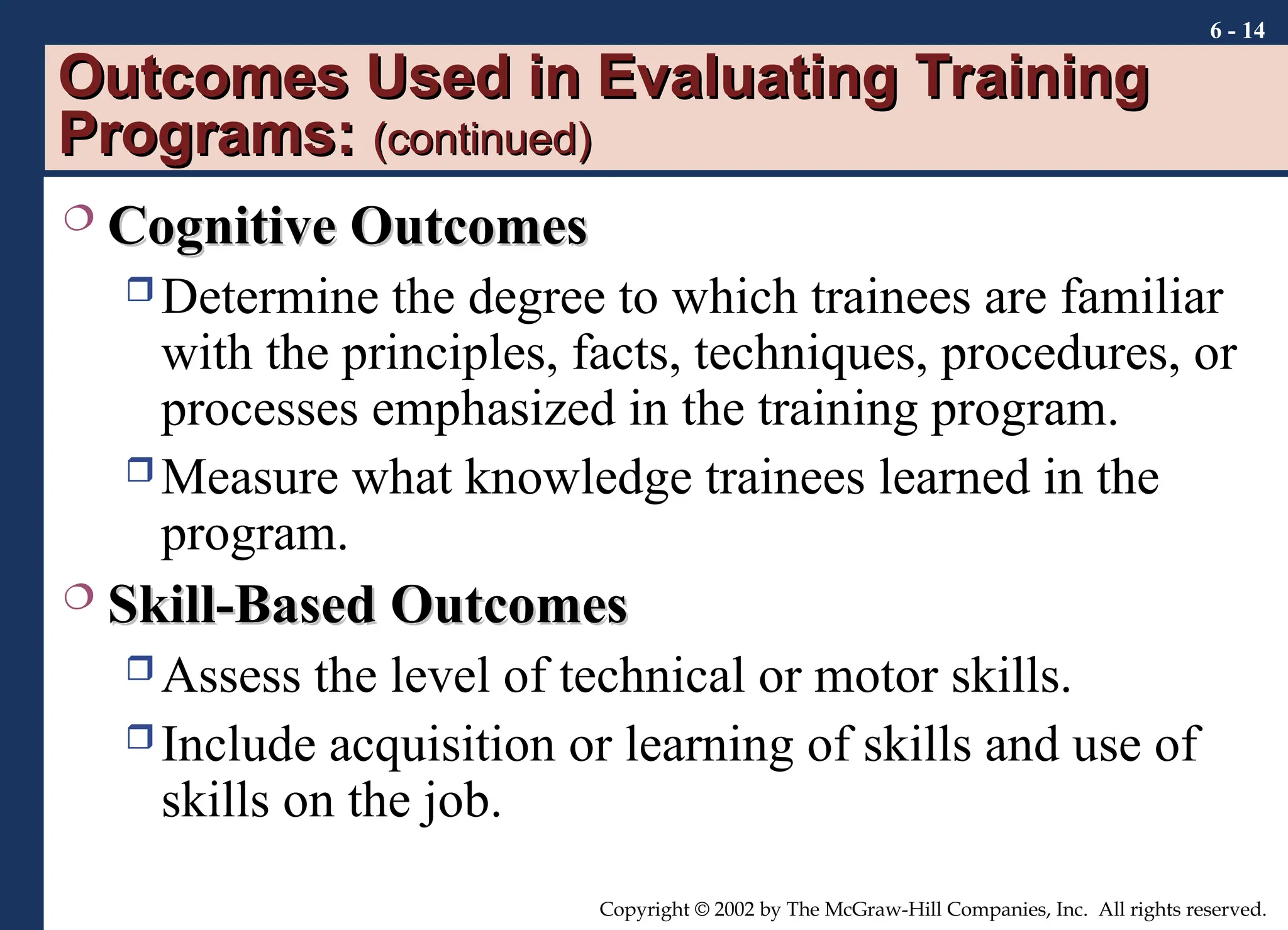
 Cognitive Outcomes
Cognitive Outcomes
 Determine the degree to which trainees are familiar
with the principles, facts, techniques, procedures, or
processes emphasized in the training program.
 Measure what knowledge trainees learned in the
program.
 Skill-Based Outcomes
Skill-Based Outcomes
 Assess the level of technical or motor skills.
 Include acquisition or learning of skills and use of
skills on the job.
6 - 15
Copyright © 2002 by The McGraw-Hill Companies, Inc. All rights reserved.
Outcomes Used in Evaluating Training
Programs:
Programs: (continued)
(continued)
 Affective Outcomes
Affective Outcomes
 Include attitudes and motivation.
 Trainees’ perceptions of the program including the
facilities, trainers, and content.
 Results
Results
 Determine the training program’s payoff for the
company.
6 - 16
Copyright © 2002 by The McGraw-Hill Companies, Inc. All rights reserved.
Outcomes Used in Evaluating Training
Programs:
Programs: (continued)
(continued)
 Return on Investment (ROI)
 Comparing the training’s monetary benefits with
the cost of the training.
Direct costs
Indirect costs
Benefits
6 - 17
Copyright © 2002 by The McGraw-Hill Companies, Inc. All rights reserved.
How do you know if your outcomes are
good?
good?
Good training outcomes need to be:
 Relevant
 Reliable
 Discriminate
 Practical
6 - 18
Copyright © 2002 by The McGraw-Hill Companies, Inc. All rights reserved.
Good Outcomes: Relevance
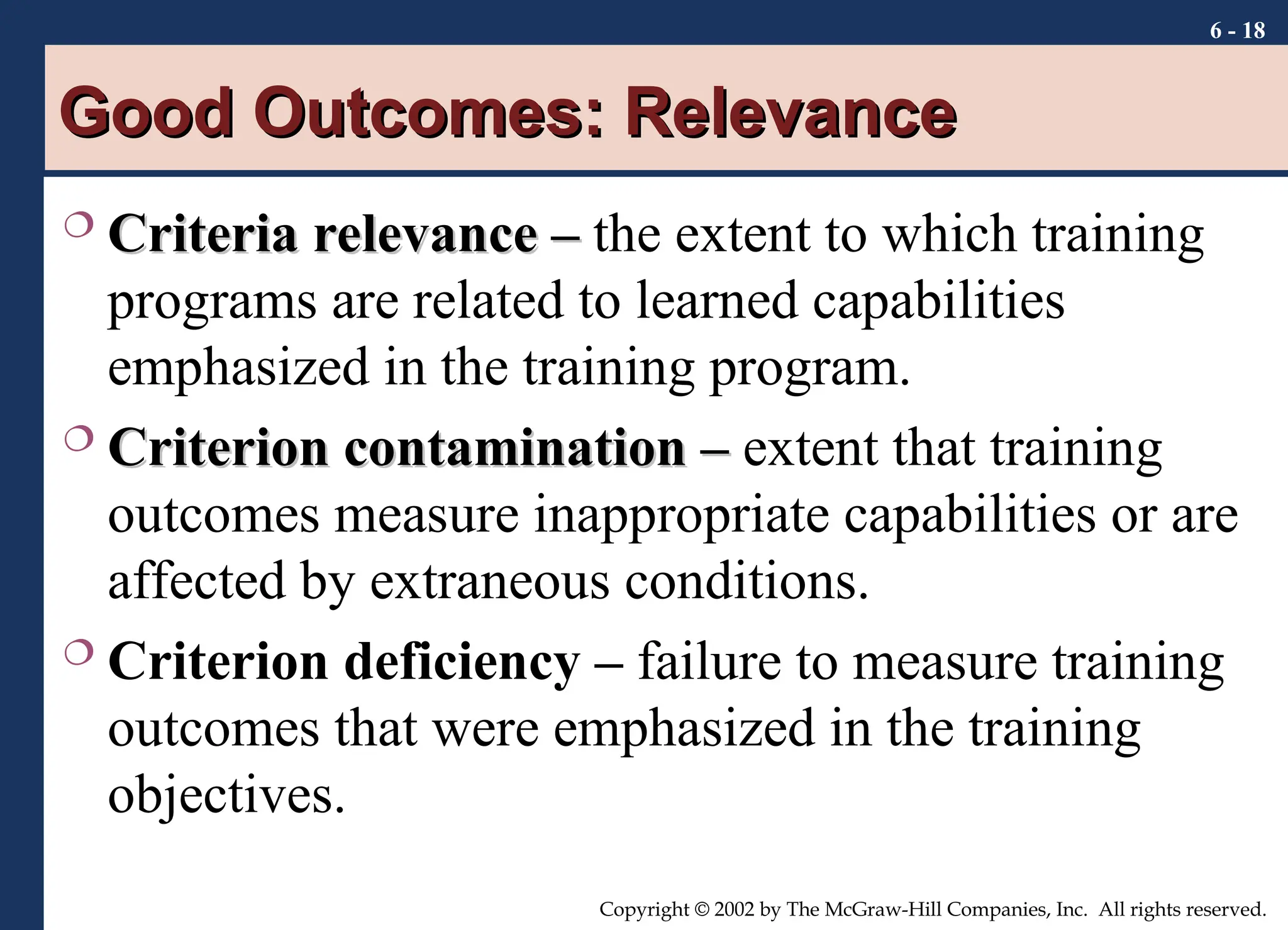
 Criteria relevance –
Criteria relevance – the extent to which training
programs are related to learned capabilities
emphasized in the training program.
 Criterion contamination –
Criterion contamination – extent that training
outcomes measure inappropriate capabilities or are
affected by extraneous conditions.
 Criterion deficiency – failure to measure training
outcomes that were emphasized in the training
objectives.
6 - 19
Copyright © 2002 by The McGraw-Hill Companies, Inc. All rights reserved.
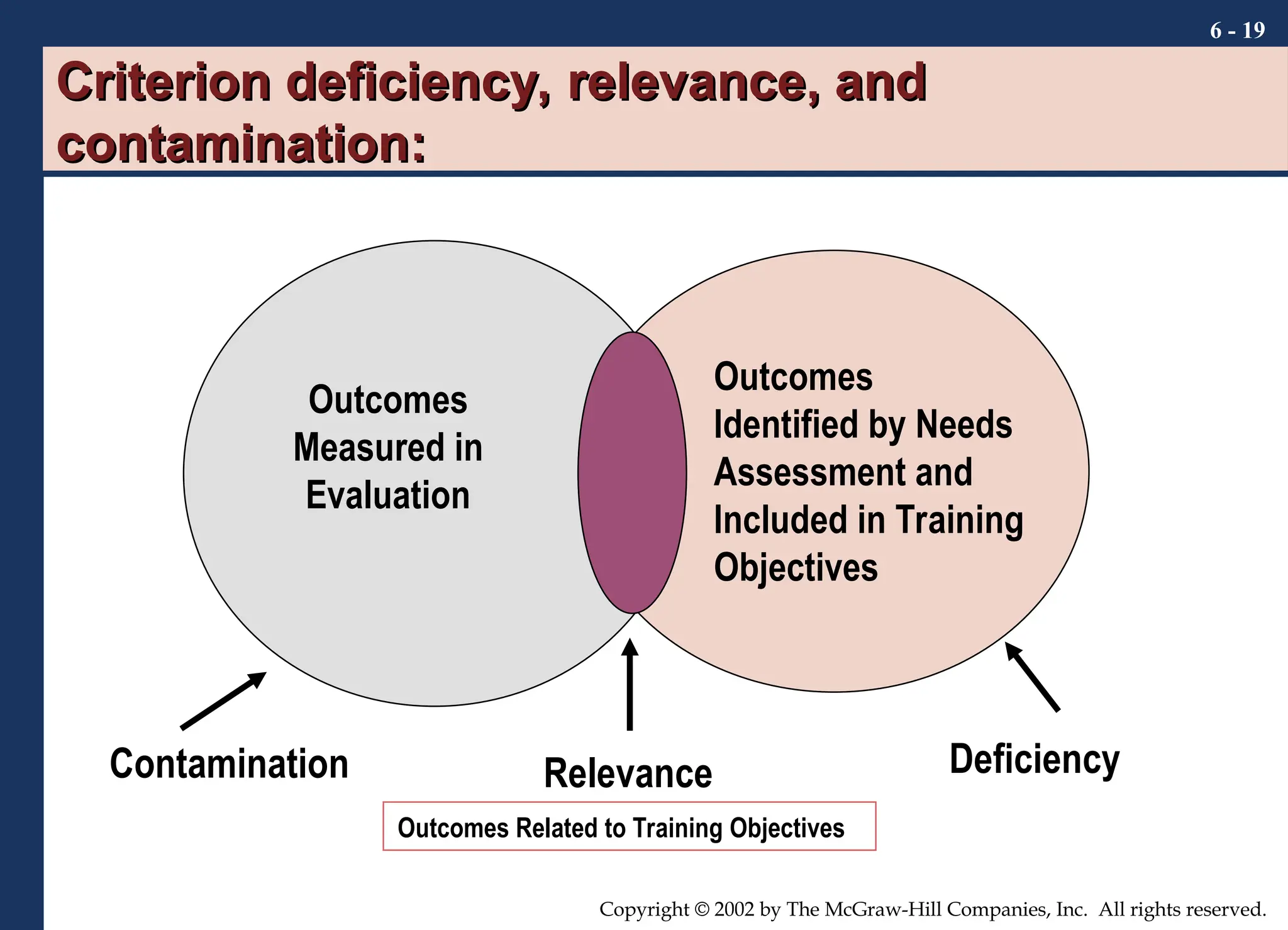
Criterion deficiency, relevance, and
contamination:
contamination:
Relevance
Outcomes
Identified by Needs
Assessment and
Included in Training
Objectives
Outcomes
Measured in
Evaluation
Deficiency
Contamination
Outcomes Related to Training Objectives
6 - 20
Copyright © 2002 by The McGraw-Hill Companies, Inc. All rights reserved.
Good Outcomes
Good Outcomes (continued)
(continued)
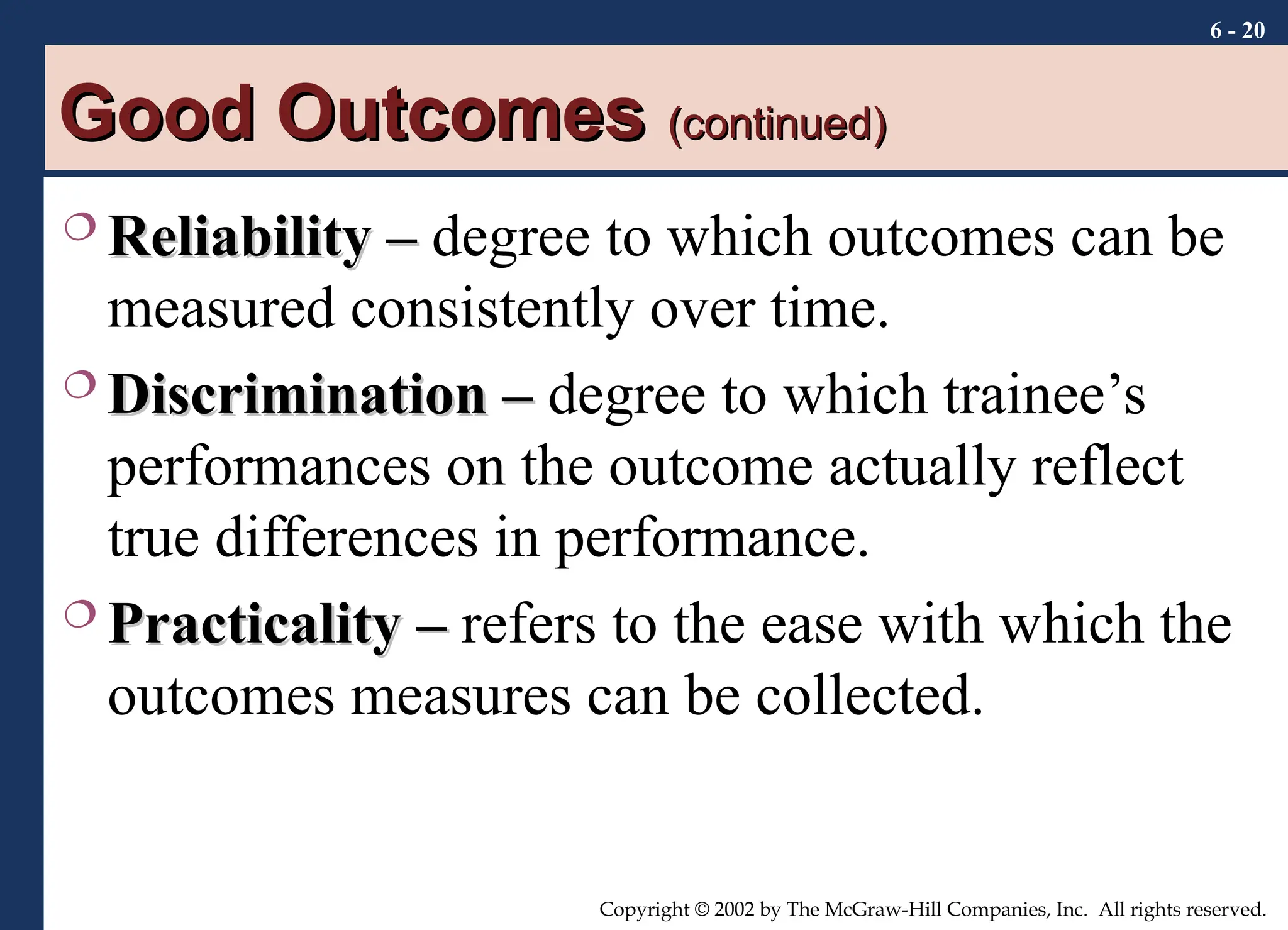
 Reliability –
Reliability – degree to which outcomes can be
measured consistently over time.
 Discrimination –
Discrimination – degree to which trainee’s
performances on the outcome actually reflect
true differences in performance.
 Practicality –
Practicality – refers to the ease with which the
outcomes measures can be collected.
6 - 21
Copyright © 2002 by The McGraw-Hill Companies, Inc. All rights reserved.
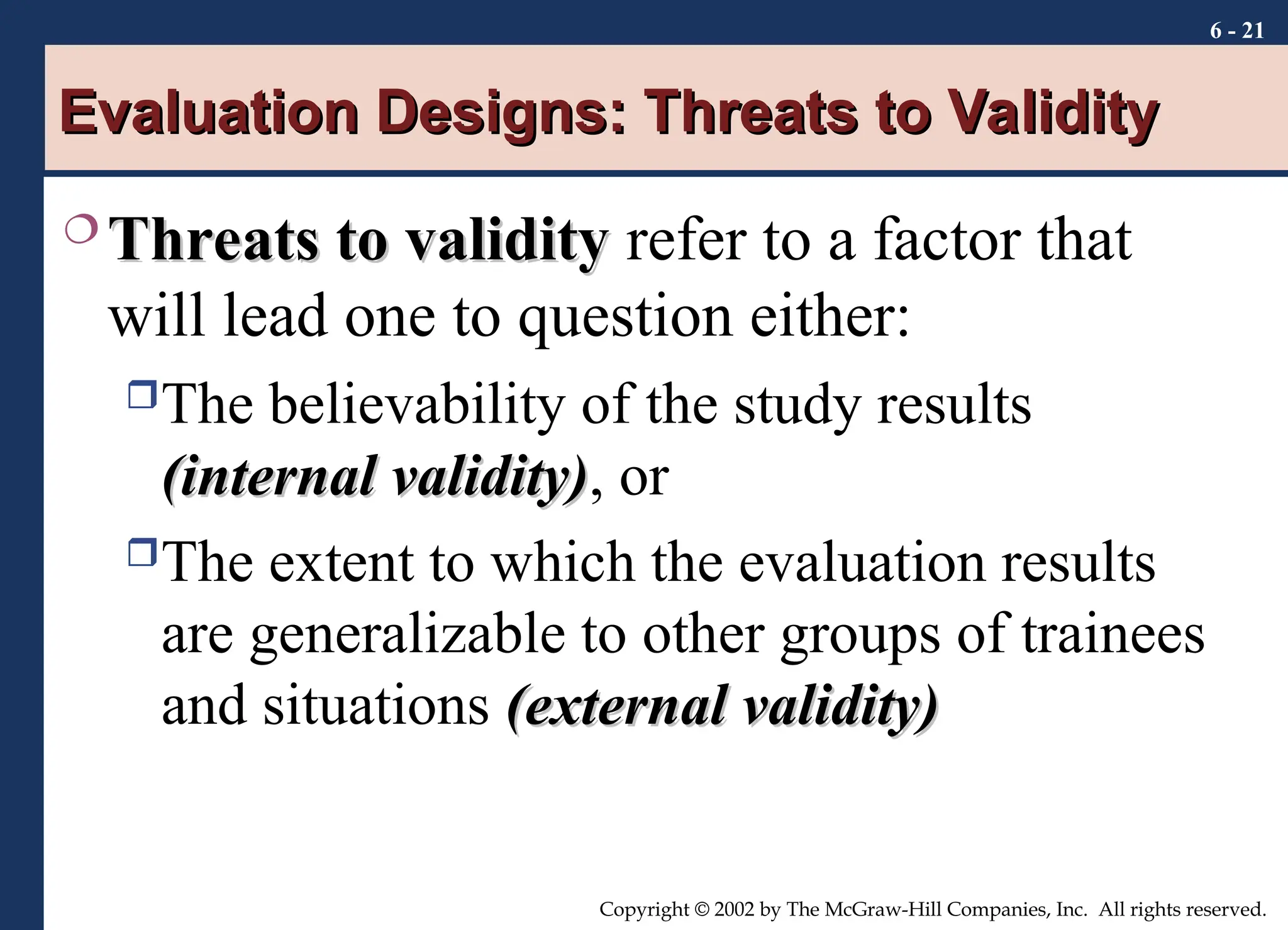
Evaluation Designs: Threats to Validity
 Threats to validity
Threats to validity refer to a factor that
will lead one to question either:
The believability of the study results
(internal validity)
(internal validity), or
The extent to which the evaluation results
are generalizable to other groups of trainees
and situations (external validity)
(external validity)
6 - 22
Copyright © 2002 by The McGraw-Hill Companies, Inc. All rights reserved.
Threats to Validity
Threats to Validity
 Threats To Internal Validity
 Company
 Persons
 Outcome Measures
 Threats To External Validity
 Reaction to pretest
 Reaction to evaluation
 Interaction of selection and training
 Interaction of methods
6 - 23
Copyright © 2002 by The McGraw-Hill Companies, Inc. All rights reserved.
Methods to Control for Threats to Validity
Pre- and Posttests
Use of Comparison Groups
Random Assignment
6 - 24
Copyright © 2002 by The McGraw-Hill Companies, Inc. All rights reserved.
Types of Evaluation Designs
 Posttest – only
 Pretest / posttest
 Posttest – only with
Comparison group
 Pretest / posttest with
Comparison group
 Time series
 Time series with
Comparison group and
Reversal
 Solomon Four – group
6 - 25
Copyright © 2002 by The McGraw-Hill Companies, Inc. All rights reserved.
Factors That Influence the Type of
Evaluation Design
Evaluation Design
Factor
Factor How Factor Influences Type of Evaluation Design
How Factor Influences Type of Evaluation Design
Change potential Can program be modified?
Importance Does ineffective training affect customer service, product development,
or relationships between employees?
Scale How many trainees are involved?
Purpose of training Is training conducted for learning, results, or both?
Organization culture Is demonstrating results part of company norms and expectations?
Expertise Can a complex study be analyzed?
Cost Is evaluation too expensive?
Time frame When do we need the information?
6 - 26
Copyright © 2002 by The McGraw-Hill Companies, Inc. All rights reserved.
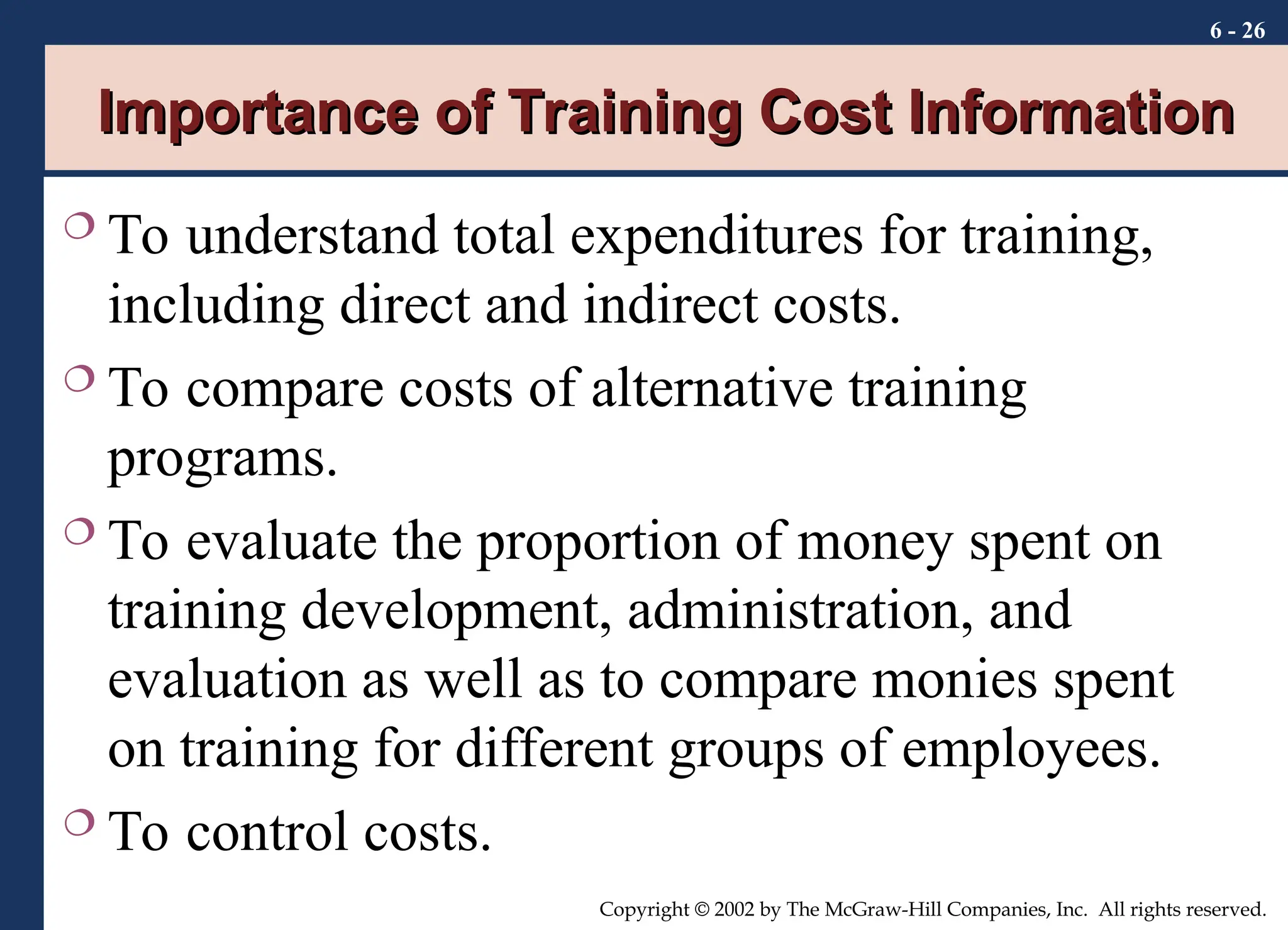
Importance of Training Cost Information
 To understand total expenditures for training,
including direct and indirect costs.
 To compare costs of alternative training
programs.
 To evaluate the proportion of money spent on
training development, administration, and
evaluation as well as to compare monies spent
on training for different groups of employees.
 To control costs.
6 - 27
Copyright © 2002 by The McGraw-Hill Companies, Inc. All rights reserved.
To calculate return on investment (ROI),
follow these steps:
follow these steps:
1. Identify outcome(s) (e.g., quality, accidents)
2. Place a value on the outcome(s)
3. Determine the change in performance after
eliminating other potential influences on
training results.
4. Obtain an annual amount of benefits
(operational results) from training by comparing
results after training to results before training (in
dollars)
6 - 28
Copyright © 2002 by The McGraw-Hill Companies, Inc. All rights reserved.
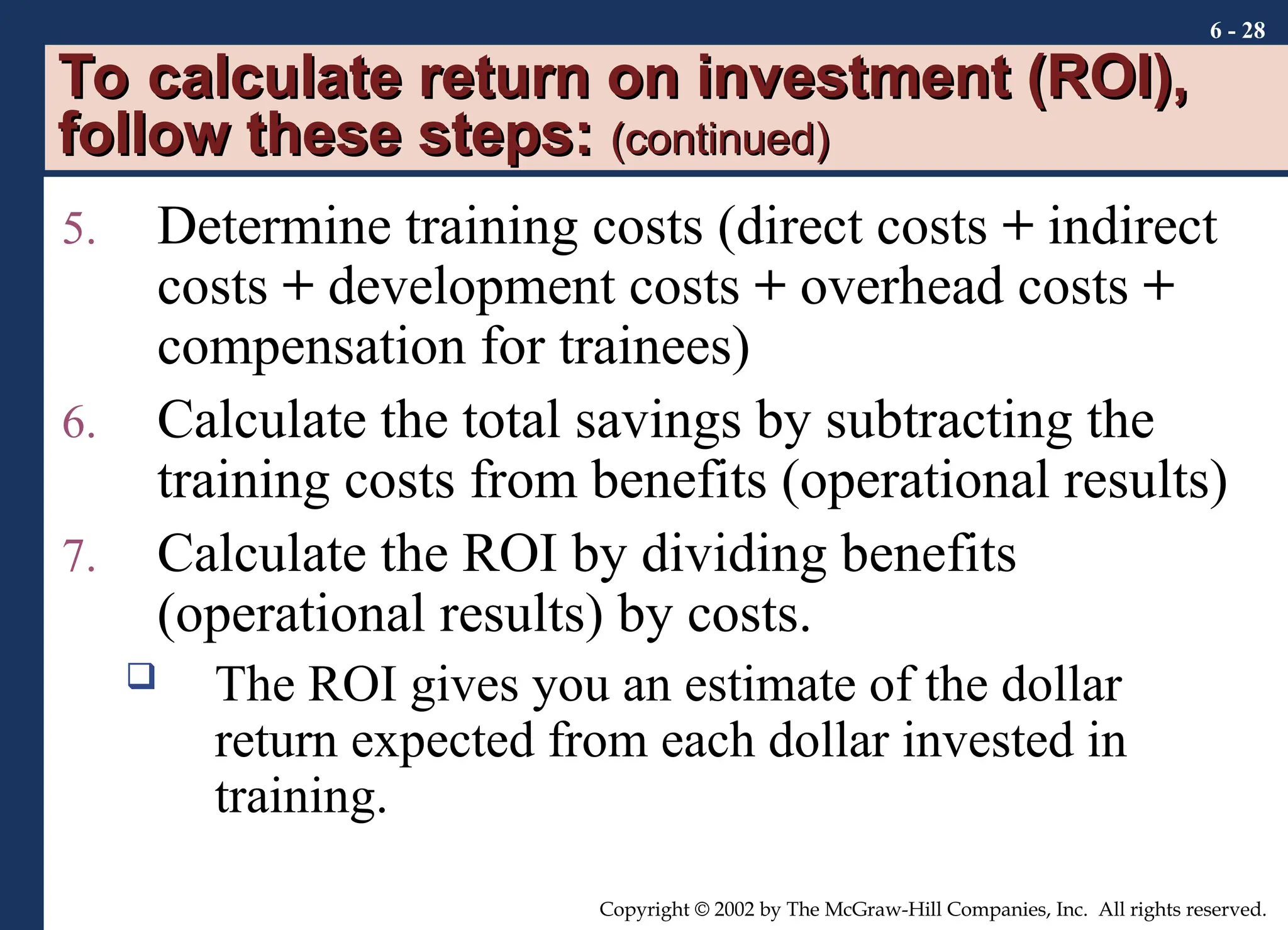
To calculate return on investment (ROI),
follow these steps:
follow these steps: (continued)
(continued)
5. Determine training costs (direct costs + indirect
costs + development costs + overhead costs +
compensation for trainees)
6. Calculate the total savings by subtracting the
training costs from benefits (operational results)
7. Calculate the ROI by dividing benefits
(operational results) by costs.
 The ROI gives you an estimate of the dollar
return expected from each dollar invested in
training.
6 - 29
Copyright © 2002 by The McGraw-Hill Companies, Inc. All rights reserved.
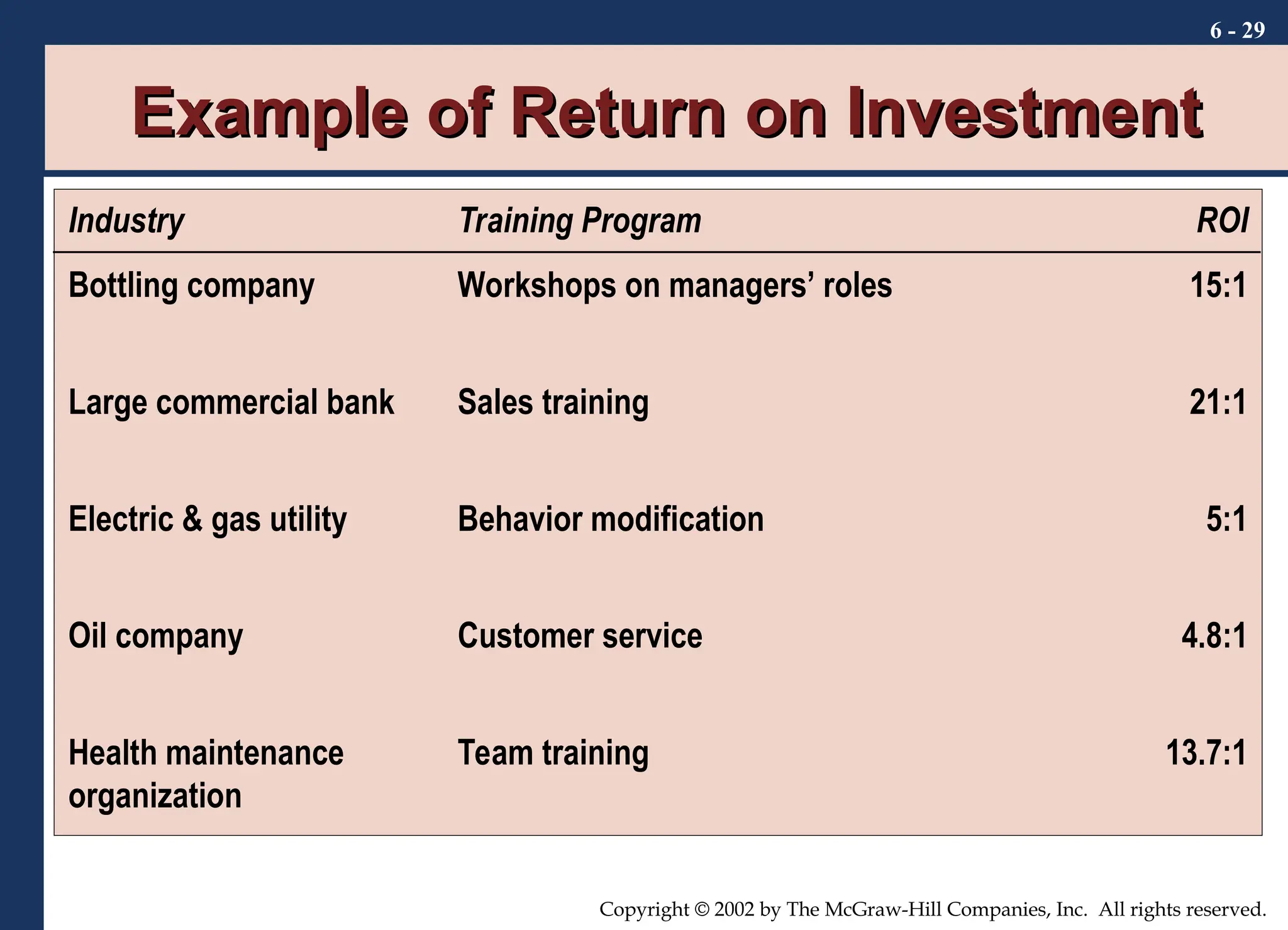
Example of Return on Investment
Industry Training Program ROI
Bottling company Workshops on managers’ roles 15:1
Large commercial bank Sales training 21:1
Electric & gas utility Behavior modification 5:1
Oil company Customer service 4.8:1
Health maintenance
organization
Team training 13.7:1

chap06- Training Evaluation (HRM) 123.ppt

  • 1.
    6 - 1 Copyright© 2002 by The McGraw-Hill Companies, Inc. All rights reserved. 6 Chapter Training Evaluation
  • 2.
    6 - 2 Copyright© 2002 by The McGraw-Hill Companies, Inc. All rights reserved. Objectives Objectives After reading this chapter, you should be able to: After reading this chapter, you should be able to: 1. Explain why evaluation is important. 2. Identify and choose outcomes to evaluate a training program. 3. Discuss the process used to plan and implement a good training evaluation. 4. Discuss the strengths and weaknesses of different evaluation designs.
  • 3.
    6 - 3 Copyright© 2002 by The McGraw-Hill Companies, Inc. All rights reserved. Objectives Objectives (continued) (continued) 5. Choose the appropriate evaluation design based on the characteristics of the company and the importance and purpose of the training. 6. Conduct a cost-benefit analysis for a training program.
  • 4.
    6 - 4 Copyright© 2002 by The McGraw-Hill Companies, Inc. All rights reserved. Introduction Introduction  Walgreen Company wanted to determine if the time, money, and effort devoted to training technicians actually made a difference. It was interested in assessing the effectiveness of the training program.
  • 5.
    6 - 5 Copyright© 2002 by The McGraw-Hill Companies, Inc. All rights reserved. Introduction Introduction (continued) (continued)  Training effectiveness Training effectiveness refers to the benefits that the company and the trainees receive from training.  Training outcomes or criteria Training outcomes or criteria refer to measures that the trainer and the company use to evaluate training programs.  Training evaluation Training evaluation refers to the process of collecting the outcomes needed to determine if training is effective.  Evaluation design Evaluation design refers to from whom, what, when, and how information needed for determining the effectiveness of the training program will be collected.
  • 6.
    6 - 6 Copyright© 2002 by The McGraw-Hill Companies, Inc. All rights reserved. Reasons for Evaluating Training Reasons for Evaluating Training  Companies are investing millions of dollars in training programs to help gain a competitive advantage.  Training investment is increasing because learning creates knowledge which differentiates between those companies and employees who are successful and those who are not.
  • 7.
    6 - 7 Copyright© 2002 by The McGraw-Hill Companies, Inc. All rights reserved. Reasons for Evaluating Training Reasons for Evaluating Training (continued) (continued) Because companies have made large dollar investments in training and education and view training as a strategy to be successful, they expect the outcomes or benefits related to training to be measurable.
  • 8.
    6 - 8 Copyright© 2002 by The McGraw-Hill Companies, Inc. All rights reserved. Training evaluation involves: Training evaluation involves:  Formative evaluation – Formative evaluation – evaluation conducted to improve the training process.  Summative evaluation – Summative evaluation – evaluation conducted to determine the extent to which trainees have changed as a result of participating in the training program.
  • 9.
    6 - 9 Copyright© 2002 by The McGraw-Hill Companies, Inc. All rights reserved. Why Should A Training Program Be Why Should A Training Program Be Evaluated? Evaluated?  To identify the program’s strengths and weaknesses.  To assess whether content, organization, and administration of the program contribute to learning and the use of training content on the job.  To identify which trainees benefited most or least from the program.
  • 10.
    6 - 10 Copyright© 2002 by The McGraw-Hill Companies, Inc. All rights reserved. Why Should A Training Program Be Why Should A Training Program Be Evaluated? Evaluated? (continued) (continued)  To gather data to assist in marketing training programs.  To determine the financial benefits and costs of the programs.  To compare the costs and benefits of training versus non-training investments.  To compare the costs and benefits of different training programs to choose the best program.
  • 11.
    6 - 11 Copyright© 2002 by The McGraw-Hill Companies, Inc. All rights reserved. The Evaluation Process The Evaluation Process Conduct a Needs Analysis Develop Measurable Learning Outcomes Develop Outcome Measures Choose an Evaluation Strategy Plan and Execute the Evaluation
  • 12.
    6 - 12 Copyright© 2002 by The McGraw-Hill Companies, Inc. All rights reserved. Training Outcomes: Kirkpatrick’s Four- Training Outcomes: Kirkpatrick’s Four- Level Framework of Evaluation Criteria Level Framework of Evaluation Criteria Level Level Criteria Criteria Focus Focus 1 Reactions Trainee satisfaction 2 Learning Acquisition of knowledge, skills, attitudes, behavior 3 Behavior Improvement of behavior on the job 4 Results Business results achieved by trainees
  • 13.
    6 - 13 Copyright© 2002 by The McGraw-Hill Companies, Inc. All rights reserved. Outcomes Used in Evaluating Training Outcomes Used in Evaluating Training Programs: Programs: Cognitive Outcomes Skill-Based Outcomes Affective Outcomes Results Return on Investment
  • 14.
    6 - 14 Copyright© 2002 by The McGraw-Hill Companies, Inc. All rights reserved. Outcomes Used in Evaluating Training Outcomes Used in Evaluating Training Programs: Programs: (continued) (continued)  Cognitive Outcomes Cognitive Outcomes  Determine the degree to which trainees are familiar with the principles, facts, techniques, procedures, or processes emphasized in the training program.  Measure what knowledge trainees learned in the program.  Skill-Based Outcomes Skill-Based Outcomes  Assess the level of technical or motor skills.  Include acquisition or learning of skills and use of skills on the job.
  • 15.
    6 - 15 Copyright© 2002 by The McGraw-Hill Companies, Inc. All rights reserved. Outcomes Used in Evaluating Training Outcomes Used in Evaluating Training Programs: Programs: (continued) (continued)  Affective Outcomes Affective Outcomes  Include attitudes and motivation.  Trainees’ perceptions of the program including the facilities, trainers, and content.  Results Results  Determine the training program’s payoff for the company.
  • 16.
    6 - 16 Copyright© 2002 by The McGraw-Hill Companies, Inc. All rights reserved. Outcomes Used in Evaluating Training Outcomes Used in Evaluating Training Programs: Programs: (continued) (continued)  Return on Investment (ROI)  Comparing the training’s monetary benefits with the cost of the training. Direct costs Indirect costs Benefits
  • 17.
    6 - 17 Copyright© 2002 by The McGraw-Hill Companies, Inc. All rights reserved. How do you know if your outcomes are How do you know if your outcomes are good? good? Good training outcomes need to be:  Relevant  Reliable  Discriminate  Practical
  • 18.
    6 - 18 Copyright© 2002 by The McGraw-Hill Companies, Inc. All rights reserved. Good Outcomes: Relevance Good Outcomes: Relevance  Criteria relevance – Criteria relevance – the extent to which training programs are related to learned capabilities emphasized in the training program.  Criterion contamination – Criterion contamination – extent that training outcomes measure inappropriate capabilities or are affected by extraneous conditions.  Criterion deficiency – failure to measure training outcomes that were emphasized in the training objectives.
  • 19.
    6 - 19 Copyright© 2002 by The McGraw-Hill Companies, Inc. All rights reserved. Criterion deficiency, relevance, and Criterion deficiency, relevance, and contamination: contamination: Relevance Outcomes Identified by Needs Assessment and Included in Training Objectives Outcomes Measured in Evaluation Deficiency Contamination Outcomes Related to Training Objectives
  • 20.
    6 - 20 Copyright© 2002 by The McGraw-Hill Companies, Inc. All rights reserved. Good Outcomes Good Outcomes (continued) (continued)  Reliability – Reliability – degree to which outcomes can be measured consistently over time.  Discrimination – Discrimination – degree to which trainee’s performances on the outcome actually reflect true differences in performance.  Practicality – Practicality – refers to the ease with which the outcomes measures can be collected.
  • 21.
    6 - 21 Copyright© 2002 by The McGraw-Hill Companies, Inc. All rights reserved. Evaluation Designs: Threats to Validity Evaluation Designs: Threats to Validity  Threats to validity Threats to validity refer to a factor that will lead one to question either: The believability of the study results (internal validity) (internal validity), or The extent to which the evaluation results are generalizable to other groups of trainees and situations (external validity) (external validity)
  • 22.
    6 - 22 Copyright© 2002 by The McGraw-Hill Companies, Inc. All rights reserved. Threats to Validity Threats to Validity  Threats To Internal Validity  Company  Persons  Outcome Measures  Threats To External Validity  Reaction to pretest  Reaction to evaluation  Interaction of selection and training  Interaction of methods
  • 23.
    6 - 23 Copyright© 2002 by The McGraw-Hill Companies, Inc. All rights reserved. Methods to Control for Threats to Validity Methods to Control for Threats to Validity Pre- and Posttests Use of Comparison Groups Random Assignment
  • 24.
    6 - 24 Copyright© 2002 by The McGraw-Hill Companies, Inc. All rights reserved. Types of Evaluation Designs Types of Evaluation Designs  Posttest – only  Pretest / posttest  Posttest – only with Comparison group  Pretest / posttest with Comparison group  Time series  Time series with Comparison group and Reversal  Solomon Four – group
  • 25.
    6 - 25 Copyright© 2002 by The McGraw-Hill Companies, Inc. All rights reserved. Factors That Influence the Type of Factors That Influence the Type of Evaluation Design Evaluation Design Factor Factor How Factor Influences Type of Evaluation Design How Factor Influences Type of Evaluation Design Change potential Can program be modified? Importance Does ineffective training affect customer service, product development, or relationships between employees? Scale How many trainees are involved? Purpose of training Is training conducted for learning, results, or both? Organization culture Is demonstrating results part of company norms and expectations? Expertise Can a complex study be analyzed? Cost Is evaluation too expensive? Time frame When do we need the information?
  • 26.
    6 - 26 Copyright© 2002 by The McGraw-Hill Companies, Inc. All rights reserved. Importance of Training Cost Information Importance of Training Cost Information  To understand total expenditures for training, including direct and indirect costs.  To compare costs of alternative training programs.  To evaluate the proportion of money spent on training development, administration, and evaluation as well as to compare monies spent on training for different groups of employees.  To control costs.
  • 27.
    6 - 27 Copyright© 2002 by The McGraw-Hill Companies, Inc. All rights reserved. To calculate return on investment (ROI), To calculate return on investment (ROI), follow these steps: follow these steps: 1. Identify outcome(s) (e.g., quality, accidents) 2. Place a value on the outcome(s) 3. Determine the change in performance after eliminating other potential influences on training results. 4. Obtain an annual amount of benefits (operational results) from training by comparing results after training to results before training (in dollars)
  • 28.
    6 - 28 Copyright© 2002 by The McGraw-Hill Companies, Inc. All rights reserved. To calculate return on investment (ROI), To calculate return on investment (ROI), follow these steps: follow these steps: (continued) (continued) 5. Determine training costs (direct costs + indirect costs + development costs + overhead costs + compensation for trainees) 6. Calculate the total savings by subtracting the training costs from benefits (operational results) 7. Calculate the ROI by dividing benefits (operational results) by costs.  The ROI gives you an estimate of the dollar return expected from each dollar invested in training.
  • 29.
    6 - 29 Copyright© 2002 by The McGraw-Hill Companies, Inc. All rights reserved. Example of Return on Investment Example of Return on Investment Industry Training Program ROI Bottling company Workshops on managers’ roles 15:1 Large commercial bank Sales training 21:1 Electric & gas utility Behavior modification 5:1 Oil company Customer service 4.8:1 Health maintenance organization Team training 13.7:1