Customs and TraditionsCustoms and Traditions
• So many countries so many customs, an English proverb says.
The combination of the words tradition & custom means a usual
manner of doing something, a believe of principal, of conduct
passed on from generation to generation. English traditions can
be subdivided into the traditions dealing with private life of the
English national & religious holidays, public celebrations,
traditional ceremonies & traditional sporting events. A great
number of customs & traditions date back to the early days of
GB & we can justly say that they are the reflection of the
country's history & . To know the customs & traditions means to
understand the people, their art & culture better. From
Scotland to Cornwall, Britain is full of customs and traditions. A
lot of them have very long histories. Some are funny and some
are strange. But they're all interesting.
Now, let us present for youNow, let us present for you
some famous Britishsome famous British
celebrationscelebrations
Halloween Christmas
Happy
New Year
October 31st is Halloween,
and you can expect to
meet witches and ghosts
that night. Halloween is
an old word for "Hallows
Evening",
the night before
"All Hallows" or
"All Saints' Day"
On that one night of the
year, ghosts and
witches are free. Well,
that's the traditional
story. A long time ago
people were afraid and
stayed at home on
Halloween.
But now in Britain itsatimefor fun.
Therearealwaysalot of partieson
October 31st. At thesepartiespeople
wear masksand they dressasghostsand
witches, or asDraculaor Frankenstein's
monster. And somepeoplemakespecial
Halloween lampsfrom alargefruit the
pumpkin. First they takeout themiddleof
thepumpkin. Then they cut holesfor the
eyes, noseand mouth. Finally they put a
candleinsidethepumpkin.
ChristmasChristmas
The word "Christmas" is
derived from the words
"Christ's Mass" - the
celebration of the birth of
Jesus Christ. But although
Christmas is undoubtedly a
Christian celebration, it is
also true to say that it is
an unusual combination of
pagan and Christian
festivities.
An older tradition is Christmas
mistletoe. People put a piece of this
green plant with its white berries
over a door. Mistletoe brings good
luck, people say. Also, at Christmas
British people kiss their friends and
family under the mistletoe.
Before Christmas, groups of
singers go from house to house.
They collect money and sing
traditional Christmas songs or
carols.
There are a lot of
very popular British
Christmas carols.
Three famous ones
are: "Good King
Wenceslas", "The
Holly and The Ivy"
and "We Three
Kings".
A Christmas tree stands in
everybody's living room at
Christmas, shining its good cheer
around the room. Sitting on the very
top of the tree is a silver star
surrounded by tiny lights. All the
branches are hung with silver bells,
tinsel and sparkling lights. Around
the base of the tree lie the gifts
and toys wrapped up in bright
colorful paper.
British children don't open their presents on December 24th.
Father Christmas brings their presents in the night. Then they
open them on the morning of the 25th.
There's another name for Father Christmas in Britain - Santa
Claus. That comes from the European name for him - Saint
Nicholas. In the traditional story he lives at the North Pole. But
now he lives in big shops in towns and cities all over Britain. Well,
that's where children see him in November and December. Then
on Christmas Eve he visits every house. He climbs down the
chimney and leaves lots of presents. Some people leave something
for him, too. A glass of wine and some biscuits, for example.
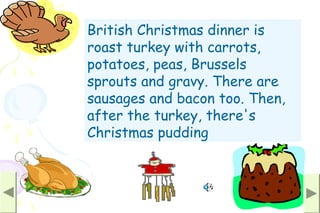
British Christmas dinner is
roast turkey with carrots,
potatoes, peas, Brussels
sprouts and gravy. There are
sausages and bacon too. Then,
after the turkey, there's
Christmas pudding
Happy New YearHappy New Year
The celebration of New Year's day
varies according to the district. In the
south of England, the festival of
Christmas, lasting 12 days from
December 25th, runs on well into the
New Year. The decorations of coloured
streamers and holly, put up round the
walls, and of course the fir-tree, with
its candles or lights, are not packed
away until January 5th. On the
evening of December 31st, people
gather in one another's homes, in clubs,
in pubs, in restaurants, and hotels, in
dance halls and institutes, to "see the
On New Year's day all English schoolchildren
make New Year resolutions. They make up lists
of shortcomings which they intend to correct.
The children. their mothers and fathers, and their
friends laugh and have a good time when they
read them The children promise to keep them.
British holidays
British holidays

British holidays

  • 2.
    Customs and TraditionsCustomsand Traditions • So many countries so many customs, an English proverb says. The combination of the words tradition & custom means a usual manner of doing something, a believe of principal, of conduct passed on from generation to generation. English traditions can be subdivided into the traditions dealing with private life of the English national & religious holidays, public celebrations, traditional ceremonies & traditional sporting events. A great number of customs & traditions date back to the early days of GB & we can justly say that they are the reflection of the country's history & . To know the customs & traditions means to understand the people, their art & culture better. From Scotland to Cornwall, Britain is full of customs and traditions. A lot of them have very long histories. Some are funny and some are strange. But they're all interesting.
  • 3.
    Now, let uspresent for youNow, let us present for you some famous Britishsome famous British celebrationscelebrations Halloween Christmas Happy New Year
  • 5.
    October 31st isHalloween, and you can expect to meet witches and ghosts that night. Halloween is an old word for "Hallows Evening", the night before "All Hallows" or "All Saints' Day"
  • 6.
    On that onenight of the year, ghosts and witches are free. Well, that's the traditional story. A long time ago people were afraid and stayed at home on Halloween.
  • 7.
    But now inBritain itsatimefor fun. Therearealwaysalot of partieson October 31st. At thesepartiespeople wear masksand they dressasghostsand witches, or asDraculaor Frankenstein's monster. And somepeoplemakespecial Halloween lampsfrom alargefruit the pumpkin. First they takeout themiddleof thepumpkin. Then they cut holesfor the eyes, noseand mouth. Finally they put a candleinsidethepumpkin.
  • 9.
    ChristmasChristmas The word "Christmas"is derived from the words "Christ's Mass" - the celebration of the birth of Jesus Christ. But although Christmas is undoubtedly a Christian celebration, it is also true to say that it is an unusual combination of pagan and Christian festivities.
  • 10.
    An older traditionis Christmas mistletoe. People put a piece of this green plant with its white berries over a door. Mistletoe brings good luck, people say. Also, at Christmas British people kiss their friends and family under the mistletoe.
  • 11.
    Before Christmas, groupsof singers go from house to house. They collect money and sing traditional Christmas songs or carols. There are a lot of very popular British Christmas carols. Three famous ones are: "Good King Wenceslas", "The Holly and The Ivy" and "We Three Kings".
  • 12.
    A Christmas treestands in everybody's living room at Christmas, shining its good cheer around the room. Sitting on the very top of the tree is a silver star surrounded by tiny lights. All the branches are hung with silver bells, tinsel and sparkling lights. Around the base of the tree lie the gifts and toys wrapped up in bright colorful paper.
  • 13.
    British children don'topen their presents on December 24th. Father Christmas brings their presents in the night. Then they open them on the morning of the 25th. There's another name for Father Christmas in Britain - Santa Claus. That comes from the European name for him - Saint Nicholas. In the traditional story he lives at the North Pole. But now he lives in big shops in towns and cities all over Britain. Well, that's where children see him in November and December. Then on Christmas Eve he visits every house. He climbs down the chimney and leaves lots of presents. Some people leave something for him, too. A glass of wine and some biscuits, for example.
  • 14.
    British Christmas dinneris roast turkey with carrots, potatoes, peas, Brussels sprouts and gravy. There are sausages and bacon too. Then, after the turkey, there's Christmas pudding
  • 16.
    Happy New YearHappyNew Year The celebration of New Year's day varies according to the district. In the south of England, the festival of Christmas, lasting 12 days from December 25th, runs on well into the New Year. The decorations of coloured streamers and holly, put up round the walls, and of course the fir-tree, with its candles or lights, are not packed away until January 5th. On the evening of December 31st, people gather in one another's homes, in clubs, in pubs, in restaurants, and hotels, in dance halls and institutes, to "see the
  • 17.
    On New Year'sday all English schoolchildren make New Year resolutions. They make up lists of shortcomings which they intend to correct. The children. their mothers and fathers, and their friends laugh and have a good time when they read them The children promise to keep them.