1 Requirements
Gather all details about software needs
2 Design
Plan how the software will work
3 Implementation
Write the actual code
4 Testing
Check for issues in the software
5 Deployment
Release the software to users
6 Maintenance
Fix issues after release
Traditional System
Development
BSEF21M030 – Alsa Munir Ul Hasan
BSEF21M031 – Zeeshan Haider
BSEF21M032 – Inzamam Amjad
Traditional System
Development: A Comprehensive
Overview
Traditional System Development encompasses time-tested methodologies for creating software, organizing work into
distinct stages. These approaches, while older, still hold relevance in certain project scenarios. This presentation will
explore the key traditional approaches, their characteristics, advantages, and limitations.
Understanding Traditional System Development
Traditional System Development refers to older, step-by-step methods used to create software. These methods organize work into clear stages like planning,
designing, building, and testing, following a specific order. The main goal is to keep projects organized and manageable, working well for projects with fixed
requirements. This approach ensures careful planning and documentation, making the process predictable and controlled.
1 Planning
Outline project goals and requirements
2 Designing
Create detailed system blueprints
3 Building
Develop the software according to design
4 Testing
Verify system functionality and performance
Key Traditional Approaches
The three main traditional approaches we will discuss are the Waterfall Model, Incremental Model, and Iterative Model.
Each approach has its unique way of organizing development, chosen based on the type and needs of the project.
Waterfall Model
Linear, sequential approach
Incremental Model
Step-by-step development
Iterative Model
Repeated cycles of development
The Waterfall Model
The Waterfall Model is a step-by-step process where each phase must be completed before moving to the next. It's like a flowchart that flows downward, hence the name "Waterfall." The main phases
include Requirements, Design, Implementation, Testing, Deployment, and Maintenance. Each phase is completed fully before proceeding to the next, making it a linear and sequential approach to software
development.
1 Requirements
Gather all details about software needs
2 Design
Plan how the software will work
3 Implementation
Write the actual code
4 Testing
Check for issues in the software
5 Deployment
Release the software to users
6 Maintenance
Fix issues after release
Advantages and Limitations of the Waterfall
Model
The Waterfall Model offers predictability and ease of management, making it suitable for stable projects with
unchanging requirements. However, it lacks flexibility and delays testing, which can be problematic for complex or
evolving projects.
Advantages
• Predictable timeline
• Easy to manage
• Good for stable projects
Limitations
• Inflexible to changes
• Delayed testing
• Not ideal for complex projects
The Incremental Model
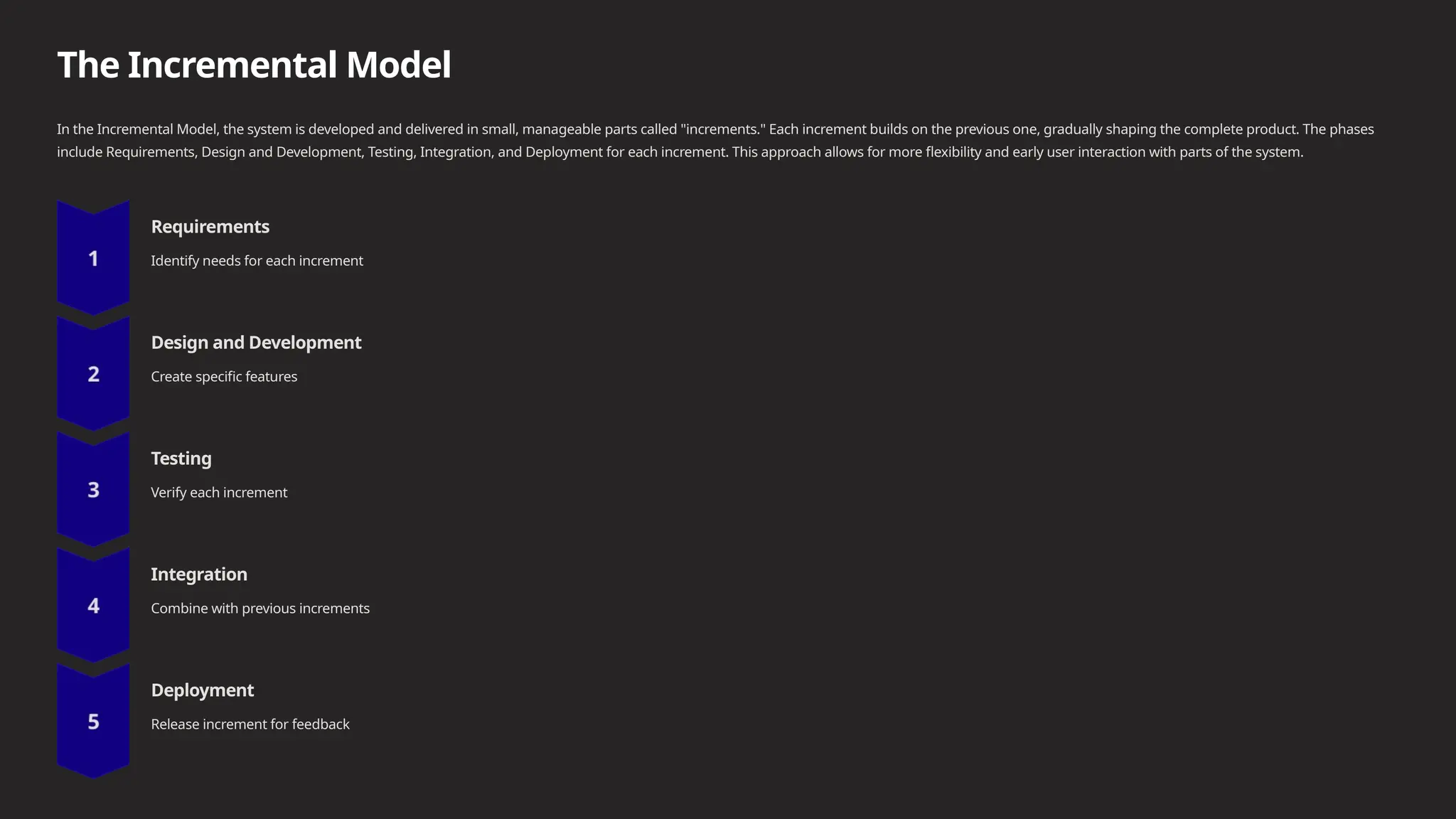
In the Incremental Model, the system is developed and delivered in small, manageable parts called "increments." Each increment builds on the previous one, gradually shaping the complete product. The phases
include Requirements, Design and Development, Testing, Integration, and Deployment for each increment. This approach allows for more flexibility and early user interaction with parts of the system.
Requirements
Identify needs for each increment
Design and Development
Create specific features
Testing
Verify each increment
Integration
Combine with previous increments
Deployment
Release increment for feedback
Advantages and Limitations of the
Incremental Model
The Incremental Model offers flexibility, early results, and easier testing. However, it can become complex to manage,
requires careful integration, and risks losing focus on the overall structure.
Flexible
Changes can be made to each
increment as development
progresses.
Early Results
Users can start using parts of the
software early in development.
Easy to Test
Each increment is small, making
testing more manageable.
Complexity
Managing many small increments can become complicated.
The Iterative Model
The Iterative Model involves developing software in repeated cycles, or "iterations." Each cycle improves and expands on the last one, gradually building up the system. The phases
include Initial Requirements Gathering, Initial Design and Development, Testing and Evaluation, Refinement and Iteration, and repeating until the final version. This approach allows
for easy incorporation of feedback and changes with each new iteration.
1 Initial Requirements
Gather core requirements
2 Design and Development
Create basic version
3 Testing and Evaluation
Gather feedback
4 Refinement
Improve based on feedback
5 Repeat
Continue until final version
Advantages and Limitations of the Iterative
Model
The Iterative Model is adaptable to change, allows for early issue detection, and incorporates user feedback effectively.
However, it can be costly, complex to manage, and risks scope creep.
Advantages
• Adaptable to change
• Early issue detection
• Incorporates user feedback
Limitations
• Can be costly
• Complex to manage
• Risk of scope creep
Comparison
Traditional development models have distinct advantages in structure and documentation but can be inflexible and
slower to adapt. The Waterfall Model suits simple, stable projects; the Incremental Model is ideal for quick basic
releases with updates; and the Iterative Model works well for uncertain requirements. While these methods remain
valuable for certain projects, modern approaches like Agile and DevOps have gained popularity for their speed and
flexibility in dynamic environments.
Model Best For Key Advantage Main Drawback
Waterfall Simple, stable projects Predictability Inflexibility
Incremental Quick basic releases Early results Integration complexity
Iterative Uncertain requirements Adaptability Potential scope creep
Pros and Cons Summary
Advantages of Traditional Methods
• Structured and Predictable: Each model has clear phases and a predictable
schedule.
• Thorough Documentation: These models focus heavily on documenting every
phase, helping with project control.
Drawbacks of Traditional Methods
• Inflexible: Hard to make changes once development has started.
• Slower: Adapting to changes or user feedback is slower than in modern
methods.
Conclusion:
Summary: Traditional development models still have value for
certain projects, especially those with fixed requirements and a
clear end goal. However, as technology has advanced, modern,
iterative approaches are increasingly preferred for their
adaptability and speed.

Traditional-System-Development Human COmputer Interaction.pptx

  • 1.
    1 Requirements Gather alldetails about software needs 2 Design Plan how the software will work 3 Implementation Write the actual code 4 Testing Check for issues in the software 5 Deployment Release the software to users 6 Maintenance Fix issues after release Traditional System Development BSEF21M030 – Alsa Munir Ul Hasan BSEF21M031 – Zeeshan Haider BSEF21M032 – Inzamam Amjad
  • 2.
    Traditional System Development: AComprehensive Overview Traditional System Development encompasses time-tested methodologies for creating software, organizing work into distinct stages. These approaches, while older, still hold relevance in certain project scenarios. This presentation will explore the key traditional approaches, their characteristics, advantages, and limitations.
  • 3.
    Understanding Traditional SystemDevelopment Traditional System Development refers to older, step-by-step methods used to create software. These methods organize work into clear stages like planning, designing, building, and testing, following a specific order. The main goal is to keep projects organized and manageable, working well for projects with fixed requirements. This approach ensures careful planning and documentation, making the process predictable and controlled. 1 Planning Outline project goals and requirements 2 Designing Create detailed system blueprints 3 Building Develop the software according to design 4 Testing Verify system functionality and performance
  • 4.
    Key Traditional Approaches Thethree main traditional approaches we will discuss are the Waterfall Model, Incremental Model, and Iterative Model. Each approach has its unique way of organizing development, chosen based on the type and needs of the project. Waterfall Model Linear, sequential approach Incremental Model Step-by-step development Iterative Model Repeated cycles of development
  • 5.
    The Waterfall Model TheWaterfall Model is a step-by-step process where each phase must be completed before moving to the next. It's like a flowchart that flows downward, hence the name "Waterfall." The main phases include Requirements, Design, Implementation, Testing, Deployment, and Maintenance. Each phase is completed fully before proceeding to the next, making it a linear and sequential approach to software development. 1 Requirements Gather all details about software needs 2 Design Plan how the software will work 3 Implementation Write the actual code 4 Testing Check for issues in the software 5 Deployment Release the software to users 6 Maintenance Fix issues after release
  • 6.
    Advantages and Limitationsof the Waterfall Model The Waterfall Model offers predictability and ease of management, making it suitable for stable projects with unchanging requirements. However, it lacks flexibility and delays testing, which can be problematic for complex or evolving projects. Advantages • Predictable timeline • Easy to manage • Good for stable projects Limitations • Inflexible to changes • Delayed testing • Not ideal for complex projects
  • 8.
    The Incremental Model Inthe Incremental Model, the system is developed and delivered in small, manageable parts called "increments." Each increment builds on the previous one, gradually shaping the complete product. The phases include Requirements, Design and Development, Testing, Integration, and Deployment for each increment. This approach allows for more flexibility and early user interaction with parts of the system. Requirements Identify needs for each increment Design and Development Create specific features Testing Verify each increment Integration Combine with previous increments Deployment Release increment for feedback
  • 9.
    Advantages and Limitationsof the Incremental Model The Incremental Model offers flexibility, early results, and easier testing. However, it can become complex to manage, requires careful integration, and risks losing focus on the overall structure. Flexible Changes can be made to each increment as development progresses. Early Results Users can start using parts of the software early in development. Easy to Test Each increment is small, making testing more manageable. Complexity Managing many small increments can become complicated.
  • 10.
    The Iterative Model TheIterative Model involves developing software in repeated cycles, or "iterations." Each cycle improves and expands on the last one, gradually building up the system. The phases include Initial Requirements Gathering, Initial Design and Development, Testing and Evaluation, Refinement and Iteration, and repeating until the final version. This approach allows for easy incorporation of feedback and changes with each new iteration. 1 Initial Requirements Gather core requirements 2 Design and Development Create basic version 3 Testing and Evaluation Gather feedback 4 Refinement Improve based on feedback 5 Repeat Continue until final version
  • 11.
    Advantages and Limitationsof the Iterative Model The Iterative Model is adaptable to change, allows for early issue detection, and incorporates user feedback effectively. However, it can be costly, complex to manage, and risks scope creep. Advantages • Adaptable to change • Early issue detection • Incorporates user feedback Limitations • Can be costly • Complex to manage • Risk of scope creep
  • 12.
    Comparison Traditional development modelshave distinct advantages in structure and documentation but can be inflexible and slower to adapt. The Waterfall Model suits simple, stable projects; the Incremental Model is ideal for quick basic releases with updates; and the Iterative Model works well for uncertain requirements. While these methods remain valuable for certain projects, modern approaches like Agile and DevOps have gained popularity for their speed and flexibility in dynamic environments. Model Best For Key Advantage Main Drawback Waterfall Simple, stable projects Predictability Inflexibility Incremental Quick basic releases Early results Integration complexity Iterative Uncertain requirements Adaptability Potential scope creep
  • 13.
    Pros and ConsSummary Advantages of Traditional Methods • Structured and Predictable: Each model has clear phases and a predictable schedule. • Thorough Documentation: These models focus heavily on documenting every phase, helping with project control. Drawbacks of Traditional Methods • Inflexible: Hard to make changes once development has started. • Slower: Adapting to changes or user feedback is slower than in modern methods.
  • 14.
    Conclusion: Summary: Traditional developmentmodels still have value for certain projects, especially those with fixed requirements and a clear end goal. However, as technology has advanced, modern, iterative approaches are increasingly preferred for their adaptability and speed.