North East Nursing College
South surma , Sylhet
Sub: behavioral science
TRADITIONAL MEDICINES
1
OUTLINE
 Definitions
 History
 TraditionalMedicinePractices
 Traditional Healers
 Traditionalmedicinesvs. Orthodoxmedicines
 Casefor &againstTraditional medicines
 summary
 Conclusion
 Acknowledgement andreferences
2
DEFINITIONS
⚫T
raditional medicine(also knownasalternative,
complimentary,indigenousorfolkmedicine)comprises
knowledgesystemsthat developedover generations within
varioussocietiesbeforetheeraof modern medicine.
⚫ TheWorldHealthOrganization(WHO)definestraditional
medicineas"thesumtotal of theknowledge,skills, and
practicesbasedonthetheories,beliefs,andexperiences
indigenousto differentcultures, whetherexplicableornot,used
inthemaintenanceof healthaswell asintheprevention,
diagnosis, improvement ortreatment of physical andmental
illness.
3
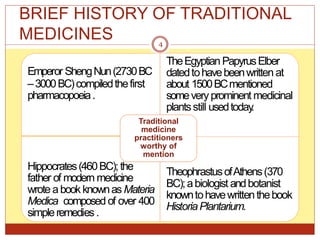
BRIEF HISTORY OF TRADITIONAL
MEDICINES
Emperor ShengNun(2730BC
–3000BC)compiledthefirst
pharmacopoeia.
TheEgyptianPapyrusElber
datedtohavebeenwritten at
about 1500BCmentioned
someveryprominent medicinal
plantsstill usedtoday
.
Hippocrates(460BC);the
father of modern medicine
wrote abookknownas Materia
Medica composed of over 400
simpleremedies.
BC);abiologist andbotanist
knowntohavewrittenthebook
HistoriaPlantarium.
Traditional
medicine
practitioners
worthy of
mention
TheophrastusofAthens(370
4
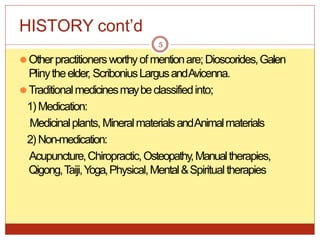
HISTORY cont’d
⚫Otherpractitioners worthyofmentionare;Dioscorides,Galen
Plinytheelder, ScriboniusLargusandAvicenna.
⚫Traditionalmedicinesmaybeclassifiedinto;
1) Medication:
Medicinalplants, MineralmaterialsandAnimalmaterials
2) Non-medication:
Acupuncture,Chiropractic,Osteopathy,Manualtherapies,
Qigong,Taiji,Y
oga,Physical,Mental&Spiritualtherapies
5
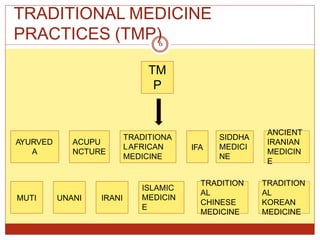
TRADITIONAL MEDICINE
PRACTICES (TMP)
TM
P
AYURVED
A
ACUPU
NCTURE
TRADITIONA
LAFRICAN
MEDICINE
SIDDHA
MEDICI
NE
ANCIENT
IRANIAN
MEDICIN
E
IRANI
IFA
UNANI
ISLAMIC
MEDICIN
E
TRADITION
AL
CHINESE
MEDICINE
TRADITION
AL
KOREAN
MEDICINE
MUTI
6
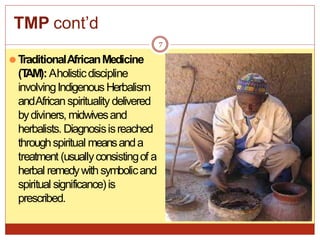
TMP cont’d
7
⚫T
raditionalAfricanMedicine
(T
AM):Aholisticdiscipline
involvingIndigenousHerbalism
andAfricanspiritualitydelivered
bydiviners, midwivesand
herbalists. Diagnosisisreached
throughspiritual meansanda
treatment (usuallyconsistingof a
herbal remedywithsymbolicand
spiritual significance)is
prescribed.
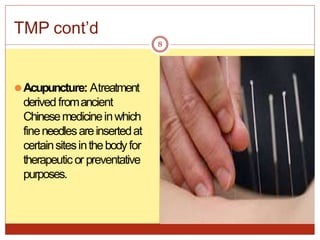
⚫Acupuncture: Atreatment
derived fromancient
Chinesemedicineinwhich
fineneedlesareinsertedat
certainsitesinthebodyfor
therapeuticor preventative
purposes.
8
TMP cont’d
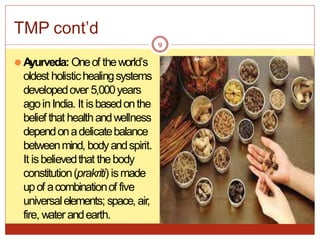
⚫Ayurveda: Oneof theworld’s
oldest holistichealingsystems
developedover 5,000years
agoinIndia. It isbasedonthe
belief that healthandwellness
dependonadelicatebalance
betweenmind, bodyandspirit.
It isbelievedthat thebody
constitution(prakriti) ismade
upof acombinationof five
universalelements; space, air,
fire, water andearth.
9
TMP cont’d
TMP cont’d
⚫TraditionalChineseMedicine(TCM):Asystemof primary
health carethat includesAcupuncture,Chinese herbal medicine,
Remedial massage(anmotuina), Exercise&breathingtherapy
(e.g qigong),DietandLifestyleadvice. It originatedfromChina
datingbackthousandsof years.Theprimary featureof modern
TCMisthepremisethat goodhealthrelies ontherestoration
andmaintenanceof harmony
, balanceandorder tothe
individual.
⚫Coredisciplineswhichstudytraditional medicineinclude;
Herbalism, Ethnomedicine, Ethnobotany
, andMedical
anthropology
10
TRADITIONAL HEALERS (TH)
Thefollowing arethecategories ofTH;
Herbalists
Traditional birthattendants
Bone-setters
Traditional medicinal ingredient dealers
Traditional psychiatrists
Practitionersof therapeuticoccultism
11
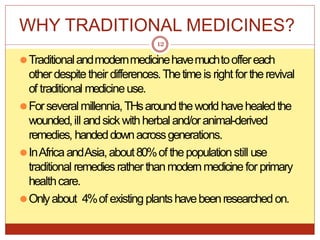
WHY TRADITIONAL MEDICINES?
⚫Traditionalandmodernmedicinehavemuchtooffereach
otherdespitetheir differences.Thetimeis right for therevival
of traditional medicineuse.
⚫Forseveralmillennia,THsaroundtheworld havehealedthe
wounded,ill andsickwithherbaland/oranimal-derived
remedies, handeddownacrossgenerations.
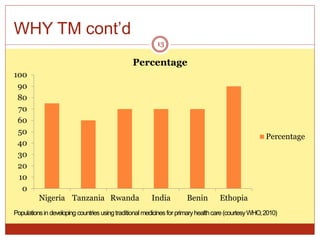
⚫InAfricaandAsia,about80%of thepopulationstill use
traditional remediesrather thanmodernmedicinefor primary
healthcare.
⚫Onlyabout 4%of existingplantshavebeenresearchedon.
12
WHY TM cont’d
100
90
80
70
60
50
40
30
20
10
0
Nigeria Tanzania Rwanda India Benin Ethopia
Populationsin developing countriesusingtraditionalmedicinesforprimaryhealthcare(courtesyWHO,2010)
Percentage
13
Percentage
WHY TM cont’d
10
0
30
20
40
90
80
70
60
50
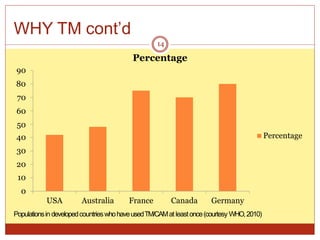
USA Australia France Canada Germany
Populationsin developedcountrieswhohaveusedTM/CAMat leastonce(courtesy WHO,2010)
Percentage
14
Percentage
WHY TM cont’d
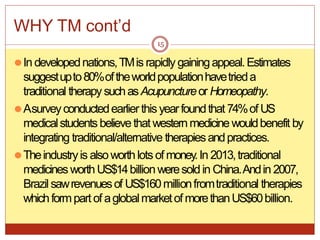
⚫In developednations,TMis rapidly gainingappeal.Estimates
suggestupto80%oftheworldpopulationhavetrieda
traditional therapy suchasAcupunctureor Homeopathy.
⚫Asurveyconductedearlierthis yearfoundthat 74%of US
medicalstudents believe thatwesternmedicine wouldbenefit by
integrating traditional/alternative therapiesandpractices.
⚫Theindustryis alsoworthlots of money.In 2013,traditional
medicinesworthUS$14billionweresoldin China.Andin 2007,
Brazilsawrevenuesof US$160millionfromtraditional therapies
whichformpart of aglobalmarketof morethanUS$60billion.
15
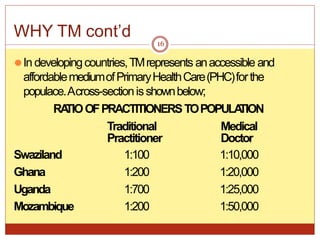
WHY TM cont’d
⚫In developingcountries,TMrepresents anaccessible and
affordablemediumofPrimaryHealthCare(PHC)forthe
populace.Across-sectionisshownbelow;
RA
TIOOFPRACTITIONERSTOPOPULA
TION
Traditional Medical
Practitioner Doctor
Swaziland 1:100 1:10,000
Ghana 1:200 1:20,000
Uganda 1:700 1:25,000
Mozambique 1:200 1:50,000
16
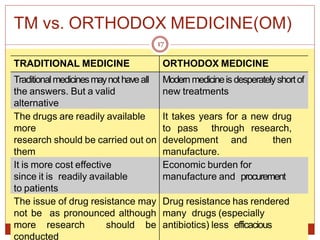
TM vs. ORTHODOX MEDICINE(OM)
TRADITIONAL MEDICINE ORTHODOX MEDICINE
Traditionalmedicinesmaynothaveall
the answers. But a valid
alternative
Modernmedicineis desperatelyshortof
new treatments
The drugs are readily available
more
research should be carried out on
them
It takes years for a new drug
to pass through research,
development and then
manufacture.
It is more cost effective
since it is readily available
to patients
Economic burden for
manufacture and procurement
The issue of drug resistance may
not be as pronounced although
more research should be
conducted
Drug resistance has rendered
many drugs (especially
antibiotics) less efficacious
17
TM vs. OM cont’d
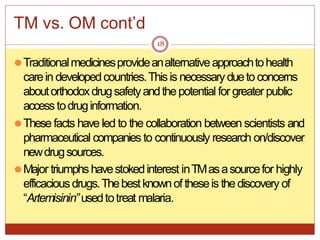
⚫Traditionalmedicinesprovideanalternativeapproachtohealth
carein developedcountries.Thisis necessaryduetoconcerns
aboutorthodoxdrugsafetyandthepotential for greater public
accesstodruginformation.
⚫These facts have led to the collaboration between scientists and
pharmaceutical companies to continuously research on/discover
newdrugsources.
⚫Major triumphshavestokedinterest inTMasasourcefor highly
efficaciousdrugs.Thebestknownof theseis thediscovery of
“Artemisinin” usedtotreat malaria.
18
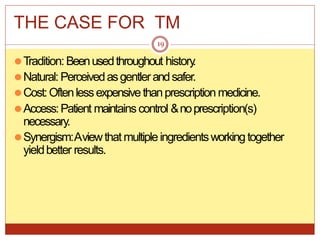
THE CASE FOR TM
⚫Tradition:Beenusedthroughout history
.
⚫Natural: Perceivedasgentlerandsafer.
⚫Cost:Oftenlessexpensivethanprescription medicine.
⚫Access:Patient maintainscontrol &noprescription(s)
necessary.
⚫Synergism:Aviewthatmultipleingredientsworkingtogether
yieldbetter results.
19
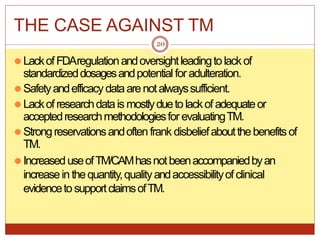
THE CASE AGAINST TM
⚫LackofFDAregulationandoversightleadingtolackof
standardizeddosagesandpotentialfor adulteration.
⚫Safetyandefficacydataarenotalwayssufficient.
⚫Lackof researchdatais mostlydueto lackof adequateor
acceptedresearchmethodologiesfor evaluatingTM.
⚫Strongreservationsandoften frank disbeliefaboutthebenefits of
TM.
⚫IncreaseduseofTM/CAMhasnotbeenaccompaniedbyan
increaseinthequantity,qualityandaccessibilityof clinical
evidencetosupportclaimsofTM.
20
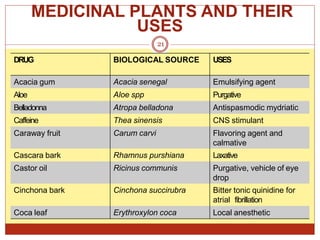
MEDICINAL PLANTS AND THEIR
USES
21
DRUG BIOLOGICAL SOURCE USES
Acacia gum Acacia senegal Emulsifying agent
Aloe Aloe spp Purgative
Belladonna Atropa belladona Antispasmodic mydriatic
Caffeine Thea sinensis CNS stimulant
Caraway fruit Carum carvi Flavoring agent and
calmative
Cascara bark Rhamnus purshiana Laxative
Castor oil Ricinus communis Purgative, vehicle of eye
drop
Cinchona bark Cinchona succirubra Bitter tonic quinidine for
atrial fibrillation
Coca leaf Erythroxylon coca Local anesthetic
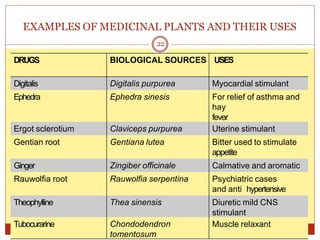
EXAMPLES OF MEDICINAL PLANTS AND THEIR USES
22
DRUGS BIOLOGICAL SOURCES USES
Digitalis Digitalis purpurea Myocardial stimulant
Ephedra Ephedra sinesis For relief of asthma and
hay
fever
Ergot sclerotium Claviceps purpurea Uterine stimulant
Gentian root Gentiana lutea Bitter used to stimulate
appetite
Ginger Zingiber officinale Calmative and aromatic
Rauwolfia root Rauwolfia serpentina Psychiatric cases
and anti hypertensive
Theophylline Thea sinensis Diuretic mild CNS
stimulant
Tubocurarine Chondodendron
tomentosum
Muscle relaxant
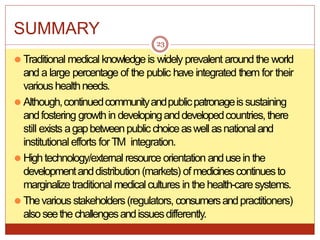
SUMMARY
⚫ Traditional medical knowledge is widely prevalent around the world
and a large percentage of the public have integrated them for their
varioushealthneeds.
⚫ Although,continuedcommunityandpublicpatronageissustaining
andfostering growthin developinganddevelopedcountries,there
still exists agapbetweenpublicchoiceaswell asnationaland
institutional efforts forTM integration.
⚫ Hightechnology/external resource orientation andusein the
developmentanddistribution (markets) of medicinescontinuesto
marginalizetraditional medicalcultures in the health-caresystems.
⚫ Thevarious stakeholders(regulators, consumersandpractitioners)
alsoseethe challengesandissuesdifferently.
23
SUMMARY Cont’d
⚫It is evident that any model of health-care based on a single
systemof medicinewill find it difficult to copewith the health
caredemandsinthenear future.
⚫It is alsoobviousthat traditional andcultural medicalknowledge
hasacatalyzing effect in meetinghealth sector development
objectivesandwill continuetobeso.
⚫Thereexistsmajordifferences in theusageofTMin the
developedanddevelopingnations.Whilesafetyis theprimary
concernindevelopedcountries,accessandcostseemtobe
critical issuesindevelopingcountries.
24
CONCLUSION
⚫ThereisscantdataonutilizationofTMandadearthofresearch
policyandgoodintegrationmodelsinthesector.
⚫It is essentialnotto romanticizeTMusebutseriouslyconsider
issuesof safety,efficacyandquality,accessandrational use.
⚫ Integratetheminto themainstreamhealthsystemwithout
compromisingthediversity anduniqueaspects.
25
ACKNOWLEDGEMENTS
26
⚫Pharmacist BashirA.S
⚫Pharmacist Oluleti Lekan
⚫Pharmacist Okhuosami F
.S
REFERENCES
27
Bodeker, G., C. K. Ong, C. Grundy, G. Burford, K. Shein, WHO Global Atlas of
Traditional, Complementary and Alternative Medicine, World Health
Organization, Kobe, 2005.
Bodeker, G., and G. Burford, Traditional, Complementary and Alternative Medicine
Policy and Public Health Perspectives, Imperial College Press, London, 2007.
Cohen, M., Bodeker, G., eds., Understanding the Global Spa Industry: Spa
Management, Butterworth-Heinemann, 2008.
Janska, E., What Role Should Traditional Medicine Play in Public Health Policy,
UNU-IAS working paper no.142, UNU-Institute of Advanced Studies, Yokohama,
2005.
JOICFP, Household Medicine Distributors in Rural Japan, JOICFP, Tokyo, 1983.
Patwardhan, B., Traditional Medicine: A Novel Approach for Available, Accessible
and Affordable Health Care, A paper submitted for Regional consultation on
Development of Traditional Medicine in the South-East Asia Region, Korea, World
Health Organization, 2005.
WHO, WHO Traditional Medicine Strategy 2002─2005, World Health
Organization, 2002
REFERENCES
28
⚫ Barnes, J., “Pharmacovigilance of Herbal Medicines: A United Kingdom
Perspective,” in G. Bodeker and G. Burford eds., Traditional, Complementary and
Alternative Medicine Policy and Public Health Perspectives, Imperial College
Press, 2007, pp. 101─144.
⚫ Bodeker, G., “Medicinal Plant Biodiversity and Local Health Care: Rural
Development and the Potential to Combat Priority Diseases,” in B. Haverkort, and
S. Rist eds., Endogenous Development and Biodiversity, Compass, Leusden, 2007
(a), pp. 241─255.
⚫ Bodeker, G., Kronenberg, F., and Burford, G., Policy and Public Health Perspectives
on Complementary and Alternative Medicine: An Overview in G. Bodeker and G.
Burford eds., Traditional, Complementary and Alternative Medicine Policy and
Public Health Perspectives, Imperial College Press, 2007 (b), pp. 9─38.
⚫ El-Gendy. A. R., “Regional Overview: Eastern Mediterranean Region,” in G.
Bodeker, C. K. Ong, C. Grundy, G. Burford and K. Shein eds. WHO Global Atlas on
Traditional, Complementary and Alternative Medicine, WHO Centre for Health
and Development, Kobe, 2005, pp. 153─158.
⚫ Farnsworth, N., “Screening Plants for New Medicines,” in Wilson. E. O. ed.,
Biodiversity,. National Academy Press, Washington D. C, 1988, pp. 83─97.
⚫ Gaitonde, B. K., Kurup, P. N. V., “Regional Overview: South-East Asia Region,” in G.
Bodeker, C. K. Ong, C. Grundy, G. Burford and K. Shein eds.,
THANK YOU
FOR BEING A
GOOD
AUDIENCE
29

Traditional Medicine .pptx

  • 1.
    North East NursingCollege South surma , Sylhet Sub: behavioral science TRADITIONAL MEDICINES 1
  • 2.
    OUTLINE  Definitions  History TraditionalMedicinePractices  Traditional Healers  Traditionalmedicinesvs. Orthodoxmedicines  Casefor &againstTraditional medicines  summary  Conclusion  Acknowledgement andreferences 2
  • 3.
    DEFINITIONS ⚫T raditional medicine(also knownasalternative, complimentary,indigenousorfolkmedicine)comprises knowledgesystemsthatdevelopedover generations within varioussocietiesbeforetheeraof modern medicine. ⚫ TheWorldHealthOrganization(WHO)definestraditional medicineas"thesumtotal of theknowledge,skills, and practicesbasedonthetheories,beliefs,andexperiences indigenousto differentcultures, whetherexplicableornot,used inthemaintenanceof healthaswell asintheprevention, diagnosis, improvement ortreatment of physical andmental illness. 3
  • 4.
    BRIEF HISTORY OFTRADITIONAL MEDICINES Emperor ShengNun(2730BC –3000BC)compiledthefirst pharmacopoeia. TheEgyptianPapyrusElber datedtohavebeenwritten at about 1500BCmentioned someveryprominent medicinal plantsstill usedtoday . Hippocrates(460BC);the father of modern medicine wrote abookknownas Materia Medica composed of over 400 simpleremedies. BC);abiologist andbotanist knowntohavewrittenthebook HistoriaPlantarium. Traditional medicine practitioners worthy of mention TheophrastusofAthens(370 4
  • 5.
    HISTORY cont’d ⚫Otherpractitioners worthyofmentionare;Dioscorides,Galen Plinytheelder,ScriboniusLargusandAvicenna. ⚫Traditionalmedicinesmaybeclassifiedinto; 1) Medication: Medicinalplants, MineralmaterialsandAnimalmaterials 2) Non-medication: Acupuncture,Chiropractic,Osteopathy,Manualtherapies, Qigong,Taiji,Y oga,Physical,Mental&Spiritualtherapies 5
  • 6.
  • 7.
    TMP cont’d 7 ⚫T raditionalAfricanMedicine (T AM):Aholisticdiscipline involvingIndigenousHerbalism andAfricanspiritualitydelivered bydiviners, midwivesand herbalists.Diagnosisisreached throughspiritual meansanda treatment (usuallyconsistingof a herbal remedywithsymbolicand spiritual significance)is prescribed.
  • 8.
  • 9.
    ⚫Ayurveda: Oneof theworld’s oldestholistichealingsystems developedover 5,000years agoinIndia. It isbasedonthe belief that healthandwellness dependonadelicatebalance betweenmind, bodyandspirit. It isbelievedthat thebody constitution(prakriti) ismade upof acombinationof five universalelements; space, air, fire, water andearth. 9 TMP cont’d
  • 10.
    TMP cont’d ⚫TraditionalChineseMedicine(TCM):Asystemof primary healthcarethat includesAcupuncture,Chinese herbal medicine, Remedial massage(anmotuina), Exercise&breathingtherapy (e.g qigong),DietandLifestyleadvice. It originatedfromChina datingbackthousandsof years.Theprimary featureof modern TCMisthepremisethat goodhealthrelies ontherestoration andmaintenanceof harmony , balanceandorder tothe individual. ⚫Coredisciplineswhichstudytraditional medicineinclude; Herbalism, Ethnomedicine, Ethnobotany , andMedical anthropology 10
  • 11.
    TRADITIONAL HEALERS (TH) Thefollowingarethecategories ofTH; Herbalists Traditional birthattendants Bone-setters Traditional medicinal ingredient dealers Traditional psychiatrists Practitionersof therapeuticoccultism 11
  • 12.
    WHY TRADITIONAL MEDICINES? ⚫Traditionalandmodernmedicinehavemuchtooffereach otherdespitetheirdifferences.Thetimeis right for therevival of traditional medicineuse. ⚫Forseveralmillennia,THsaroundtheworld havehealedthe wounded,ill andsickwithherbaland/oranimal-derived remedies, handeddownacrossgenerations. ⚫InAfricaandAsia,about80%of thepopulationstill use traditional remediesrather thanmodernmedicinefor primary healthcare. ⚫Onlyabout 4%of existingplantshavebeenresearchedon. 12
  • 13.
    WHY TM cont’d 100 90 80 70 60 50 40 30 20 10 0 NigeriaTanzania Rwanda India Benin Ethopia Populationsin developing countriesusingtraditionalmedicinesforprimaryhealthcare(courtesyWHO,2010) Percentage 13 Percentage
  • 14.
    WHY TM cont’d 10 0 30 20 40 90 80 70 60 50 USAAustralia France Canada Germany Populationsin developedcountrieswhohaveusedTM/CAMat leastonce(courtesy WHO,2010) Percentage 14 Percentage
  • 15.
    WHY TM cont’d ⚫Indevelopednations,TMis rapidly gainingappeal.Estimates suggestupto80%oftheworldpopulationhavetrieda traditional therapy suchasAcupunctureor Homeopathy. ⚫Asurveyconductedearlierthis yearfoundthat 74%of US medicalstudents believe thatwesternmedicine wouldbenefit by integrating traditional/alternative therapiesandpractices. ⚫Theindustryis alsoworthlots of money.In 2013,traditional medicinesworthUS$14billionweresoldin China.Andin 2007, Brazilsawrevenuesof US$160millionfromtraditional therapies whichformpart of aglobalmarketof morethanUS$60billion. 15
  • 16.
    WHY TM cont’d ⚫Indevelopingcountries,TMrepresents anaccessible and affordablemediumofPrimaryHealthCare(PHC)forthe populace.Across-sectionisshownbelow; RA TIOOFPRACTITIONERSTOPOPULA TION Traditional Medical Practitioner Doctor Swaziland 1:100 1:10,000 Ghana 1:200 1:20,000 Uganda 1:700 1:25,000 Mozambique 1:200 1:50,000 16
  • 17.
    TM vs. ORTHODOXMEDICINE(OM) TRADITIONAL MEDICINE ORTHODOX MEDICINE Traditionalmedicinesmaynothaveall the answers. But a valid alternative Modernmedicineis desperatelyshortof new treatments The drugs are readily available more research should be carried out on them It takes years for a new drug to pass through research, development and then manufacture. It is more cost effective since it is readily available to patients Economic burden for manufacture and procurement The issue of drug resistance may not be as pronounced although more research should be conducted Drug resistance has rendered many drugs (especially antibiotics) less efficacious 17
  • 18.
    TM vs. OMcont’d ⚫Traditionalmedicinesprovideanalternativeapproachtohealth carein developedcountries.Thisis necessaryduetoconcerns aboutorthodoxdrugsafetyandthepotential for greater public accesstodruginformation. ⚫These facts have led to the collaboration between scientists and pharmaceutical companies to continuously research on/discover newdrugsources. ⚫Major triumphshavestokedinterest inTMasasourcefor highly efficaciousdrugs.Thebestknownof theseis thediscovery of “Artemisinin” usedtotreat malaria. 18
  • 19.
    THE CASE FORTM ⚫Tradition:Beenusedthroughout history . ⚫Natural: Perceivedasgentlerandsafer. ⚫Cost:Oftenlessexpensivethanprescription medicine. ⚫Access:Patient maintainscontrol &noprescription(s) necessary. ⚫Synergism:Aviewthatmultipleingredientsworkingtogether yieldbetter results. 19
  • 20.
    THE CASE AGAINSTTM ⚫LackofFDAregulationandoversightleadingtolackof standardizeddosagesandpotentialfor adulteration. ⚫Safetyandefficacydataarenotalwayssufficient. ⚫Lackof researchdatais mostlydueto lackof adequateor acceptedresearchmethodologiesfor evaluatingTM. ⚫Strongreservationsandoften frank disbeliefaboutthebenefits of TM. ⚫IncreaseduseofTM/CAMhasnotbeenaccompaniedbyan increaseinthequantity,qualityandaccessibilityof clinical evidencetosupportclaimsofTM. 20
  • 21.
    MEDICINAL PLANTS ANDTHEIR USES 21 DRUG BIOLOGICAL SOURCE USES Acacia gum Acacia senegal Emulsifying agent Aloe Aloe spp Purgative Belladonna Atropa belladona Antispasmodic mydriatic Caffeine Thea sinensis CNS stimulant Caraway fruit Carum carvi Flavoring agent and calmative Cascara bark Rhamnus purshiana Laxative Castor oil Ricinus communis Purgative, vehicle of eye drop Cinchona bark Cinchona succirubra Bitter tonic quinidine for atrial fibrillation Coca leaf Erythroxylon coca Local anesthetic
  • 22.
    EXAMPLES OF MEDICINALPLANTS AND THEIR USES 22 DRUGS BIOLOGICAL SOURCES USES Digitalis Digitalis purpurea Myocardial stimulant Ephedra Ephedra sinesis For relief of asthma and hay fever Ergot sclerotium Claviceps purpurea Uterine stimulant Gentian root Gentiana lutea Bitter used to stimulate appetite Ginger Zingiber officinale Calmative and aromatic Rauwolfia root Rauwolfia serpentina Psychiatric cases and anti hypertensive Theophylline Thea sinensis Diuretic mild CNS stimulant Tubocurarine Chondodendron tomentosum Muscle relaxant
  • 23.
    SUMMARY ⚫ Traditional medicalknowledge is widely prevalent around the world and a large percentage of the public have integrated them for their varioushealthneeds. ⚫ Although,continuedcommunityandpublicpatronageissustaining andfostering growthin developinganddevelopedcountries,there still exists agapbetweenpublicchoiceaswell asnationaland institutional efforts forTM integration. ⚫ Hightechnology/external resource orientation andusein the developmentanddistribution (markets) of medicinescontinuesto marginalizetraditional medicalcultures in the health-caresystems. ⚫ Thevarious stakeholders(regulators, consumersandpractitioners) alsoseethe challengesandissuesdifferently. 23
  • 24.
    SUMMARY Cont’d ⚫It isevident that any model of health-care based on a single systemof medicinewill find it difficult to copewith the health caredemandsinthenear future. ⚫It is alsoobviousthat traditional andcultural medicalknowledge hasacatalyzing effect in meetinghealth sector development objectivesandwill continuetobeso. ⚫Thereexistsmajordifferences in theusageofTMin the developedanddevelopingnations.Whilesafetyis theprimary concernindevelopedcountries,accessandcostseemtobe critical issuesindevelopingcountries. 24
  • 25.
    CONCLUSION ⚫ThereisscantdataonutilizationofTMandadearthofresearch policyandgoodintegrationmodelsinthesector. ⚫It is essentialnottoromanticizeTMusebutseriouslyconsider issuesof safety,efficacyandquality,accessandrational use. ⚫ Integratetheminto themainstreamhealthsystemwithout compromisingthediversity anduniqueaspects. 25
  • 26.
  • 27.
    REFERENCES 27 Bodeker, G., C.K. Ong, C. Grundy, G. Burford, K. Shein, WHO Global Atlas of Traditional, Complementary and Alternative Medicine, World Health Organization, Kobe, 2005. Bodeker, G., and G. Burford, Traditional, Complementary and Alternative Medicine Policy and Public Health Perspectives, Imperial College Press, London, 2007. Cohen, M., Bodeker, G., eds., Understanding the Global Spa Industry: Spa Management, Butterworth-Heinemann, 2008. Janska, E., What Role Should Traditional Medicine Play in Public Health Policy, UNU-IAS working paper no.142, UNU-Institute of Advanced Studies, Yokohama, 2005. JOICFP, Household Medicine Distributors in Rural Japan, JOICFP, Tokyo, 1983. Patwardhan, B., Traditional Medicine: A Novel Approach for Available, Accessible and Affordable Health Care, A paper submitted for Regional consultation on Development of Traditional Medicine in the South-East Asia Region, Korea, World Health Organization, 2005. WHO, WHO Traditional Medicine Strategy 2002─2005, World Health Organization, 2002
  • 28.
    REFERENCES 28 ⚫ Barnes, J.,“Pharmacovigilance of Herbal Medicines: A United Kingdom Perspective,” in G. Bodeker and G. Burford eds., Traditional, Complementary and Alternative Medicine Policy and Public Health Perspectives, Imperial College Press, 2007, pp. 101─144. ⚫ Bodeker, G., “Medicinal Plant Biodiversity and Local Health Care: Rural Development and the Potential to Combat Priority Diseases,” in B. Haverkort, and S. Rist eds., Endogenous Development and Biodiversity, Compass, Leusden, 2007 (a), pp. 241─255. ⚫ Bodeker, G., Kronenberg, F., and Burford, G., Policy and Public Health Perspectives on Complementary and Alternative Medicine: An Overview in G. Bodeker and G. Burford eds., Traditional, Complementary and Alternative Medicine Policy and Public Health Perspectives, Imperial College Press, 2007 (b), pp. 9─38. ⚫ El-Gendy. A. R., “Regional Overview: Eastern Mediterranean Region,” in G. Bodeker, C. K. Ong, C. Grundy, G. Burford and K. Shein eds. WHO Global Atlas on Traditional, Complementary and Alternative Medicine, WHO Centre for Health and Development, Kobe, 2005, pp. 153─158. ⚫ Farnsworth, N., “Screening Plants for New Medicines,” in Wilson. E. O. ed., Biodiversity,. National Academy Press, Washington D. C, 1988, pp. 83─97. ⚫ Gaitonde, B. K., Kurup, P. N. V., “Regional Overview: South-East Asia Region,” in G. Bodeker, C. K. Ong, C. Grundy, G. Burford and K. Shein eds.,
  • 29.
    THANK YOU FOR BEINGA GOOD AUDIENCE 29