TraditionalAssessment versusAlternative
Assessment:
A Case Study on Exploring DifferentAssessment
Procedures on Second Grade Students’Learning
Outcomes in a Secondary School in Misurata
Department of English, School of Languages, The LibyanAcademy- Misurata
YASMINE FARID ABUDAGGA
SUPERVISOR: DR. ABDULHAMID MUSTAFA ONAIBA
Content
 Assessment Definition
Traditional Assessment
 Alternative Assessment
 Previous Studies
 Statement of the Problem
Aims of the Study
Research Questions
 Scope of the Study
 Research Design
 Participants and Settings
 Research Instrument and Procedures
 Traditional Testing Sample
 Alternative Assessment Task Sample
Rubric Scoring Sample
 Conclusion
References
2/2/2024
Assessment
“an ongoing process that encompasses a much wider domain.
Whenever a student responds to a question, offers a comment,
or tries out a new word or structure, the teacher subconsciously
assesses the student’s performance.”
BROWN (2004)
TraditionalAssessment
2/2/2024
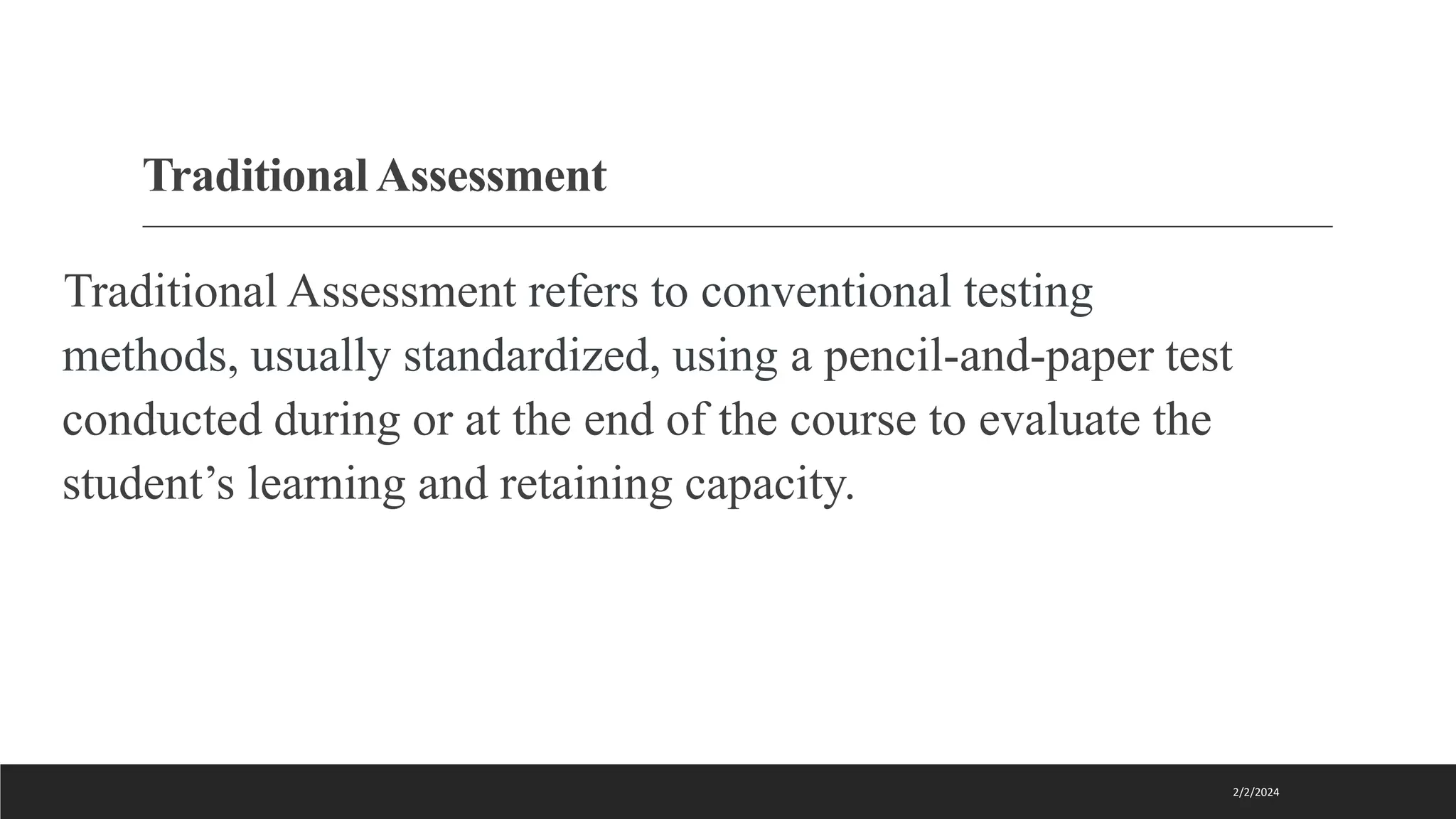
Traditional Assessment refers to conventional testing
methods, usually standardized, using a pencil-and-paper test
conducted during or at the end of the course to evaluate the
student’s learning and retaining capacity.
Alternative Assessment
2/2/2024
An alternative assessment is a student-centered approach
and it focuses on the level of the application of knowledge
and skills to real life, taking the individual features of the
students into consideration.
Alternative assessment tools include Projects, interviews,
self and peer assessment, journals, observations, essays,
presentations, etc.
Previous Studies
 Bernardo (2011), conducted a study at 22 different colleges and universities in the Philippines,
the researcher examined the 'communicativeness' of 22 English language tests designed and
administered by 22 English instructors. The results showed that:
Most of the test items were focused on language accuracy rather than on the use of language in
actual or real-life contexts.
The language examinations that the teacher-respondents considered communicative still use
discrete-point, paper and pencil, and decontextualized test items.
2/2/2024
Previous Studies
 Lustgarten (2022), explored the impact of different assessment procedures on students’
achievement in a high school physical science classroom in Fostoria City Schools in Ohio with a
mixed-method research approach. The results revealed:
Most students either agreed or strongly agreed that they preferred to complete an alternative
assessment, felt less pressure while completing an alternative assessment, and felt as if they
learned more from it.
2/2/2024
Previous Studies
 In Waters, Smeaton and Burns’s study (2004), students' attitudes to alternative assessments in a
secondary science classroom were analyzed by looking at their responses to a Likert-Scale survey
and an open-ended questionnaire. The results indicated:
Students were receptive to alternative forms of assessment. However, some students preferred
the traditional assessment route.
Students also believed studying before the test would promote learning and enable them to
apply that knowledge to answer a multiple-choice test.
2/2/2024
Statement of the Problem
Most of the formative or summative assessment practices in Libyan EFL
classrooms are confined to traditional assessment, solely introduced to students
in a form of pencil and paper tests.
 None of the alternative assessment practices have been deployed by teachers
when assessing their students, which means little to no is known about such
deployment, particularly its effects on students’ learning.
2/2/2024
Aims of the Study
 Explore different assessment procedures’ effects on students’
learning outcomes in Libyan EFL classes.
 Seek students’ attitudes towards using Traditional and Alternative
assessment tools.
2/2/2024
Research Questions
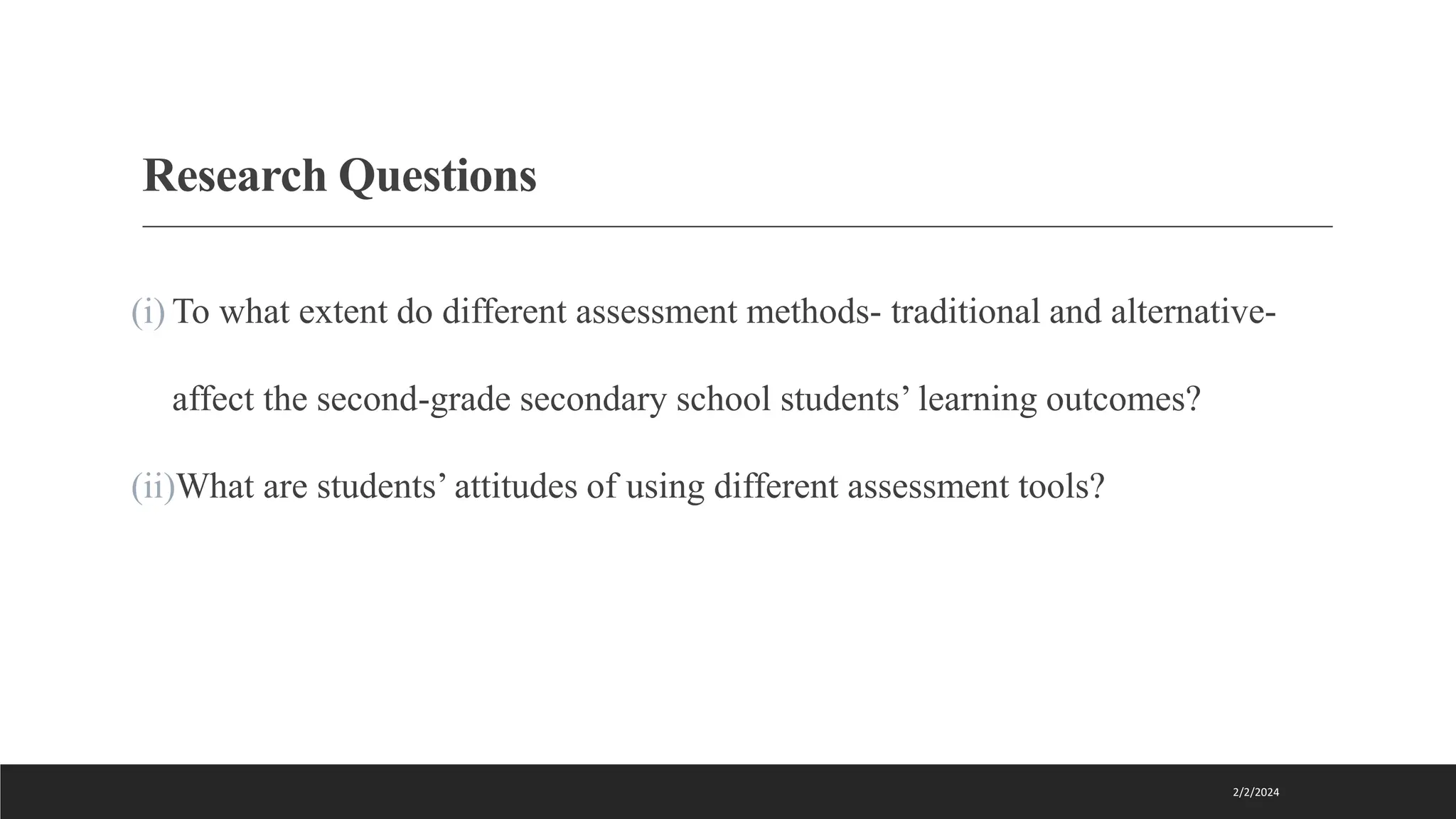
(i) To what extent do different assessment methods- traditional and alternative-
affect the second-grade secondary school students’ learning outcomes?
(ii)What are students’ attitudes of using different assessment tools?
2/2/2024
Scope of the Study
 Second-grade science section students in one of Misurata’s
secondary schools.
 Focuses on traditional and alternative assessment methods' impact
on EFL students' language learning.
2/2/2024
Research Design
 Employ a quantitative research design.
 This research design is both quasi-experiment and descriptive in
nature.
2/2/2024
Participants and Settings
Second-year male students in the science section at Misurata’s
secondary school.
Sample size 30 male students.
2/2/2024
 A quasi-experiment and a questionnaire will be used to gather data.
A random class will be chosen.
The class will be taught and assessed according to the different
assessment methods.
Tests and assessment tools will be marked and evaluated.
Data will be analyzed.
Scores will be compared.
2/2/2024
Research Instruments and procedures
Procedures
 A questionnaire will be handed to students at the end of the course.
 The data will be analyzed using an SPSS software program.
2/2/2024
Writing an
Essay Task
Sample
2/2/2024
A rubric
Sample for
Scoring an
Essay
2/2/2024
Traditional
Test Sample
2/2/2024
Traditional
Test Sample
2/2/2024
Traditional
Test Sample
2/2/2024
Conclusion
The study is based on the investigations that have shown that there
are two different types of assessment. It is believed that a wide range
of outcomes will be achieved when students are assessed using
different assessment methods.
2/2/2024
References
Bernardo, A. S. (2011). The Empirical Dimension of Communicative Language Tests: The Case of Selected Philippine
Universities. Journal on English Language Teaching, 1(1), 31-50. http://www.imanagerpublications.com
Brown, H. D. (2004). Language assessment principles and classroom practices. Longman.
Lustgarten, B. (2022). Impact of Traditional Versus Alternative Assessment on Student Achievement. (Honors Projects.
Bowling Green State University).
Waters, F. H., Smeaton, P. S., & Burns, T. G. (2004). Action research in the secondary science classroom: Student response
to differentiated, alternative assessment. American Secondary Education, 33(1), 89.
2/2/2024
References
USING DICTOGLOSS TECHNIQUE TO IMPROVE STUDENTS’ WRITING SKILL - Scientific
Figure on ResearchGate. Available from: https://www.researchgate.net/figure/Scoring-rubric-for-
writing-assessment_tbl1_334606305 [accessed 24 Dec, 2022]
2/2/2024

Traditional Assessment versus Alternative Assessment.pptx

  • 1.
    TraditionalAssessment versusAlternative Assessment: A CaseStudy on Exploring DifferentAssessment Procedures on Second Grade Students’Learning Outcomes in a Secondary School in Misurata Department of English, School of Languages, The LibyanAcademy- Misurata YASMINE FARID ABUDAGGA SUPERVISOR: DR. ABDULHAMID MUSTAFA ONAIBA
  • 2.
    Content  Assessment Definition TraditionalAssessment  Alternative Assessment  Previous Studies  Statement of the Problem Aims of the Study Research Questions  Scope of the Study  Research Design  Participants and Settings  Research Instrument and Procedures  Traditional Testing Sample  Alternative Assessment Task Sample Rubric Scoring Sample  Conclusion References 2/2/2024
  • 3.
    Assessment “an ongoing processthat encompasses a much wider domain. Whenever a student responds to a question, offers a comment, or tries out a new word or structure, the teacher subconsciously assesses the student’s performance.” BROWN (2004)
  • 4.
    TraditionalAssessment 2/2/2024 Traditional Assessment refersto conventional testing methods, usually standardized, using a pencil-and-paper test conducted during or at the end of the course to evaluate the student’s learning and retaining capacity.
  • 5.
    Alternative Assessment 2/2/2024 An alternativeassessment is a student-centered approach and it focuses on the level of the application of knowledge and skills to real life, taking the individual features of the students into consideration. Alternative assessment tools include Projects, interviews, self and peer assessment, journals, observations, essays, presentations, etc.
  • 6.
    Previous Studies  Bernardo(2011), conducted a study at 22 different colleges and universities in the Philippines, the researcher examined the 'communicativeness' of 22 English language tests designed and administered by 22 English instructors. The results showed that: Most of the test items were focused on language accuracy rather than on the use of language in actual or real-life contexts. The language examinations that the teacher-respondents considered communicative still use discrete-point, paper and pencil, and decontextualized test items. 2/2/2024
  • 7.
    Previous Studies  Lustgarten(2022), explored the impact of different assessment procedures on students’ achievement in a high school physical science classroom in Fostoria City Schools in Ohio with a mixed-method research approach. The results revealed: Most students either agreed or strongly agreed that they preferred to complete an alternative assessment, felt less pressure while completing an alternative assessment, and felt as if they learned more from it. 2/2/2024
  • 8.
    Previous Studies  InWaters, Smeaton and Burns’s study (2004), students' attitudes to alternative assessments in a secondary science classroom were analyzed by looking at their responses to a Likert-Scale survey and an open-ended questionnaire. The results indicated: Students were receptive to alternative forms of assessment. However, some students preferred the traditional assessment route. Students also believed studying before the test would promote learning and enable them to apply that knowledge to answer a multiple-choice test. 2/2/2024
  • 9.
    Statement of theProblem Most of the formative or summative assessment practices in Libyan EFL classrooms are confined to traditional assessment, solely introduced to students in a form of pencil and paper tests.  None of the alternative assessment practices have been deployed by teachers when assessing their students, which means little to no is known about such deployment, particularly its effects on students’ learning. 2/2/2024
  • 10.
    Aims of theStudy  Explore different assessment procedures’ effects on students’ learning outcomes in Libyan EFL classes.  Seek students’ attitudes towards using Traditional and Alternative assessment tools. 2/2/2024
  • 11.
    Research Questions (i) Towhat extent do different assessment methods- traditional and alternative- affect the second-grade secondary school students’ learning outcomes? (ii)What are students’ attitudes of using different assessment tools? 2/2/2024
  • 12.
    Scope of theStudy  Second-grade science section students in one of Misurata’s secondary schools.  Focuses on traditional and alternative assessment methods' impact on EFL students' language learning. 2/2/2024
  • 13.
    Research Design  Employa quantitative research design.  This research design is both quasi-experiment and descriptive in nature. 2/2/2024
  • 14.
    Participants and Settings Second-yearmale students in the science section at Misurata’s secondary school. Sample size 30 male students. 2/2/2024
  • 15.
     A quasi-experimentand a questionnaire will be used to gather data. A random class will be chosen. The class will be taught and assessed according to the different assessment methods. Tests and assessment tools will be marked and evaluated. Data will be analyzed. Scores will be compared. 2/2/2024 Research Instruments and procedures
  • 16.
    Procedures  A questionnairewill be handed to students at the end of the course.  The data will be analyzed using an SPSS software program. 2/2/2024
  • 17.
  • 18.
    A rubric Sample for Scoringan Essay 2/2/2024
  • 19.
  • 20.
  • 21.
  • 22.
    Conclusion The study isbased on the investigations that have shown that there are two different types of assessment. It is believed that a wide range of outcomes will be achieved when students are assessed using different assessment methods. 2/2/2024
  • 23.
    References Bernardo, A. S.(2011). The Empirical Dimension of Communicative Language Tests: The Case of Selected Philippine Universities. Journal on English Language Teaching, 1(1), 31-50. http://www.imanagerpublications.com Brown, H. D. (2004). Language assessment principles and classroom practices. Longman. Lustgarten, B. (2022). Impact of Traditional Versus Alternative Assessment on Student Achievement. (Honors Projects. Bowling Green State University). Waters, F. H., Smeaton, P. S., & Burns, T. G. (2004). Action research in the secondary science classroom: Student response to differentiated, alternative assessment. American Secondary Education, 33(1), 89. 2/2/2024
  • 24.
    References USING DICTOGLOSS TECHNIQUETO IMPROVE STUDENTS’ WRITING SKILL - Scientific Figure on ResearchGate. Available from: https://www.researchgate.net/figure/Scoring-rubric-for- writing-assessment_tbl1_334606305 [accessed 24 Dec, 2022] 2/2/2024

Editor's Notes

  • #3 In the context of EFL teaching, testing can have serious washback effect on teaching practices and on improving students learning progress
  • #4 Assessment is a crucial component of classroom learning and teaching, involving various methods and techniques to gather information about students understanding knowledge and motivation then used to make informed decisions
  • #5 One assessment format that provide teachers and administrators with different methods to analyze students performance is traditional assessment
  • #6 However some researchers noted that traditional assessment tools might trigger negative feelings perceptions and memories resulting in under or poor performance as sources of anexity, stress and bournout for students. As a result, there had been a concensus among researchers to create alternative assessment tools to meet student’s expectations, reduce their test anexitey and increase their performance
  • #9 Despite the studies conducted regarding this issue, there has yet to be any previous research on the effects of traditional and alternative tools on students learning outcome in this context using a quasi experiment method and a questionnaire