Trading The Cloud – Part Four

Welcome to Part Four of my ichimoku mentoring course 'Trading the
Cloud'. This will be the final lesson covering the basic Kumo Cloud
trading before I move on to part five where I will be teaching you the
Chikou Span and what part this indicator plays in the ichimoku jigsaw.


Kumo Sentiment

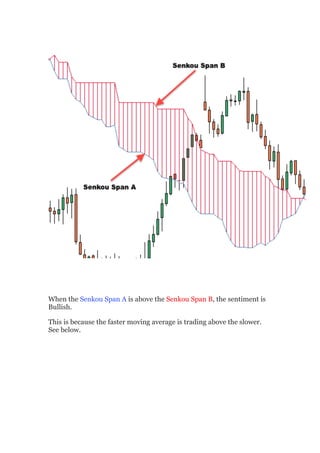
The Kumo cloud is made up from essentially two moving averages

The Senkou Span A - Fastest average

The Senkou Span B - Slowest average
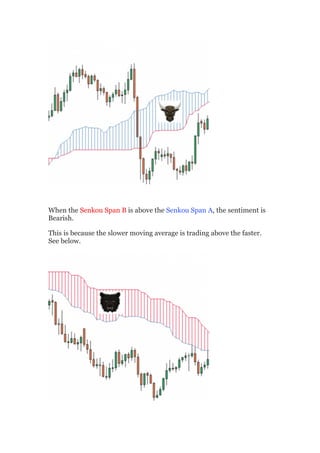
When the Senkou Span A is above the Senkou Span B, the sentiment is
Bullish.

This is because the faster moving average is trading above the slower.
See below.
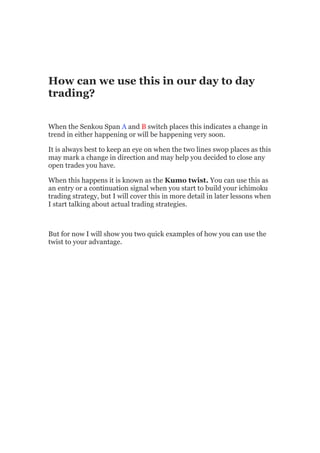
When the Senkou Span B is above the Senkou Span A, the sentiment is
Bearish.

This is because the slower moving average is trading above the faster.
See below.
How can we use this in our day to day
trading?


When the Senkou Span A and B switch places this indicates a change in
trend in either happening or will be happening very soon.

It is always best to keep an eye on when the two lines swop places as this
may mark a change in direction and may help you decided to close any
open trades you have.

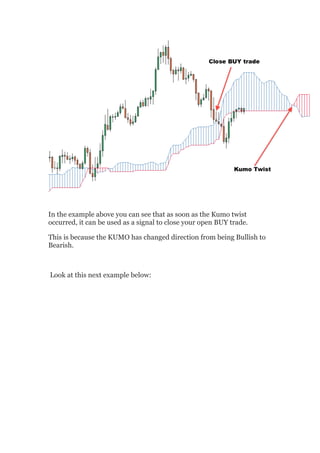
When this happens it is known as the Kumo twist. You can use this as
an entry or a continuation signal when you start to build your ichimoku
trading strategy, but I will cover this in more detail in later lessons when
I start talking about actual trading strategies.


But for now I will show you two quick examples of how you can use the
twist to your advantage.
In the example above you can see that as soon as the Kumo twist
occurred, it can be used as a signal to close your open BUY trade.

This is because the KUMO has changed direction from being Bullish to
Bearish.


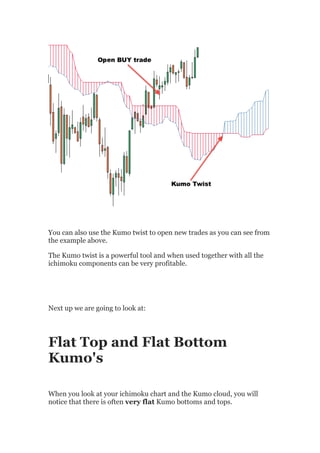
Look at this next example below:
You can also use the Kumo twist to open new trades as you can see from
the example above.

The Kumo twist is a powerful tool and when used together with all the
ichimoku components can be very profitable.


Next up we are going to look at:


Flat Top and Flat Bottom
Kumo's

When you look at your ichimoku chart and the Kumo cloud, you will
notice that there is often very flat Kumo bottoms and tops.
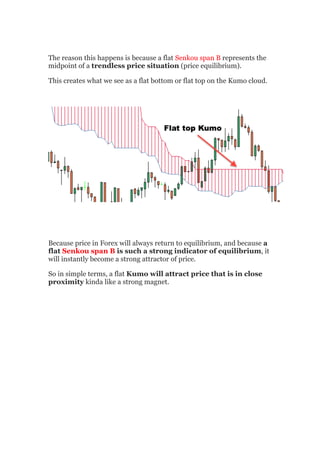
The reason this happens is because a flat Senkou span B represents the
midpoint of a trendless price situation (price equilibrium).

This creates what we see as a flat bottom or flat top on the Kumo cloud.


Because price in Forex will always return to equilibrium, and because a
flat Senkou span B is such a strong indicator of equilibrium, it
will instantly become a strong attractor of price.

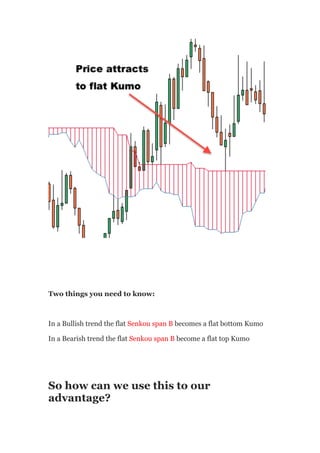
So in simple terms, a flat Kumo will attract price that is in close
proximity kinda like a strong magnet.
Two things you need to know:


In a Bullish trend the flat Senkou span B becomes a flat bottom Kumo

In a Bearish trend the flat Senkou span B become a flat top Kumo


So how can we use this to our
advantage?
As an ichimoku trader, we can use our new found knowledge of the Flat
Senkou span B to be more cautious about when price exits from the
Kumo.

For example.

When exiting a flat bottom (bullish) kumo from the bottom, you
wouldn't treat this like a normal Kumo breakout, instead of entering a
trade on the breakout, you need to take into account the flat Senkou
Span B.

The way I deal with this is to wait for price to have moved about 10-15
then opening the trade, this way we know price has moved out of the
gravity pull of the flat Kumo.


I will of course explain all this again when I cover the various
trading strategies in future updates, but for now I need you to
understand this theory and how price reacts around the flat Kumo tops
and bottoms.


Check you chart now and find examples of flat Kumo tops/bottoms see
how price reacts.

How often does price break out from a flat Kumo and then pulls back
like an elastic band?


If you have any questions about any aspect of the Kumo cloud, please
leave a comment below, I promise to respond to each and every
comment.


Ok so thats the final lesson in the beginners guide to the Kumo, I hope
you have enjoyed the lessons so far.


Next lesson I will be covering the Chikou span in Part five of my
ichimoku training course - Trading the Cloud
I look forward to your comments below.


Chris(Admin)	
  

Trading The Cloud – Part Four

  • 1.
    Trading The Cloud– Part Four Welcome to Part Four of my ichimoku mentoring course 'Trading the Cloud'. This will be the final lesson covering the basic Kumo Cloud trading before I move on to part five where I will be teaching you the Chikou Span and what part this indicator plays in the ichimoku jigsaw. Kumo Sentiment The Kumo cloud is made up from essentially two moving averages The Senkou Span A - Fastest average The Senkou Span B - Slowest average
  • 2.
    When the SenkouSpan A is above the Senkou Span B, the sentiment is Bullish. This is because the faster moving average is trading above the slower. See below.
  • 3.
    When the SenkouSpan B is above the Senkou Span A, the sentiment is Bearish. This is because the slower moving average is trading above the faster. See below.
  • 4.
    How can weuse this in our day to day trading? When the Senkou Span A and B switch places this indicates a change in trend in either happening or will be happening very soon. It is always best to keep an eye on when the two lines swop places as this may mark a change in direction and may help you decided to close any open trades you have. When this happens it is known as the Kumo twist. You can use this as an entry or a continuation signal when you start to build your ichimoku trading strategy, but I will cover this in more detail in later lessons when I start talking about actual trading strategies. But for now I will show you two quick examples of how you can use the twist to your advantage.
  • 5.
    In the exampleabove you can see that as soon as the Kumo twist occurred, it can be used as a signal to close your open BUY trade. This is because the KUMO has changed direction from being Bullish to Bearish. Look at this next example below:
  • 6.
    You can alsouse the Kumo twist to open new trades as you can see from the example above. The Kumo twist is a powerful tool and when used together with all the ichimoku components can be very profitable. Next up we are going to look at: Flat Top and Flat Bottom Kumo's When you look at your ichimoku chart and the Kumo cloud, you will notice that there is often very flat Kumo bottoms and tops.
  • 7.
    The reason thishappens is because a flat Senkou span B represents the midpoint of a trendless price situation (price equilibrium). This creates what we see as a flat bottom or flat top on the Kumo cloud. Because price in Forex will always return to equilibrium, and because a flat Senkou span B is such a strong indicator of equilibrium, it will instantly become a strong attractor of price. So in simple terms, a flat Kumo will attract price that is in close proximity kinda like a strong magnet.
  • 8.
    Two things youneed to know: In a Bullish trend the flat Senkou span B becomes a flat bottom Kumo In a Bearish trend the flat Senkou span B become a flat top Kumo So how can we use this to our advantage?
  • 9.
    As an ichimokutrader, we can use our new found knowledge of the Flat Senkou span B to be more cautious about when price exits from the Kumo. For example. When exiting a flat bottom (bullish) kumo from the bottom, you wouldn't treat this like a normal Kumo breakout, instead of entering a trade on the breakout, you need to take into account the flat Senkou Span B. The way I deal with this is to wait for price to have moved about 10-15 then opening the trade, this way we know price has moved out of the gravity pull of the flat Kumo. I will of course explain all this again when I cover the various trading strategies in future updates, but for now I need you to understand this theory and how price reacts around the flat Kumo tops and bottoms. Check you chart now and find examples of flat Kumo tops/bottoms see how price reacts. How often does price break out from a flat Kumo and then pulls back like an elastic band? If you have any questions about any aspect of the Kumo cloud, please leave a comment below, I promise to respond to each and every comment. Ok so thats the final lesson in the beginners guide to the Kumo, I hope you have enjoyed the lessons so far. Next lesson I will be covering the Chikou span in Part five of my ichimoku training course - Trading the Cloud
  • 10.
    I look forwardto your comments below. Chris(Admin)