Unit - 2
Definition:
“A trademark is any sign that individualizes the
goods of a given enterprise and distinguishes them
from the goods of its competitors.”
A trademark is a type of intellectual property,
and typically a name, word, phrase, logo,
symbol, design, image, or a combination of these
elements.
● Words:
● This category includes company names, surnames,
forenames, geographical names and any other words or sets
of words, whether invented or not, and slogans.
● Letters and Numerals:
● Examples are one or more letters, one or more numerals or
any combination thereof.
● Devices:
● This category includes fancy devices, drawings and
symbols and also twodimensional representations of goods
or containers.
●Colored Marks:
●This category includes words, devices and any
combinations thereof in color.
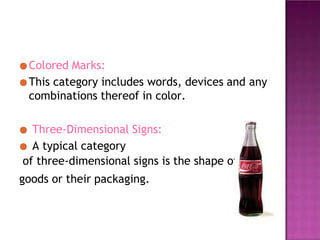
● Three-Dimensional Signs:
● A typical category
of three-dimensional signs is the shape of the
goods or their packaging.
●To identify the goods and their origin.
●To serve as a guarantee of unchanged quality
of the goods.
●It acts as a marketing and advertising device.
●It creates an image of product in minds of
consumers.
● It should be distinctive
● TM should preferably be an invented word. Eg: ZEN
● It should be easy to pronounce and remember if it is word mark.
● In case of a device mark -should be capable of being described by a single
word.
● It was be easy to spell correctly and write legibly.
● It should not be descriptive.
● It should be short.
● It should not belong to the class of marks prohibited for registration.
● It should satisfy the requirements of registration.
SERVICE MARKS:
Where a trademark is used in connection with
services, it may be called “service mark”.
Service marks are used by hotels Service marks
are used by hotels, restaurants, airlines,
tourist agencies,
A Trade mark distinguishing the goods or services
of members of an association of persons not
being partnership firm from those of others”
The proprietor of the mark is the
association.
The goods and services of a company or
group of companies like GODREJ
or
HINDUSTAN UNILEVER LTD. may be the Subject
matterof collective Trade mark.
There is a species of trade mark called as
Certification Trade mark.
Its function is to indicate that the proprietor of the
mark has certified the goods bearing the mark as to
certain characteristics of the goods.
e.g. Geographical origin, ingredients and so on
such as ISI, AGMARK, FPO
INTRODUCTION
Patents, designs and copyright are protected
only for a limited period. On the other hand, in
general, a registered trade mark can be
protected in perpetuity subject only to the
following conditions:
✓ It is used and renewed periodically and
✓ The registered proprietor takes prompt
action against infringers.
The present Trade Marks Act, 1999 has replaced
the Trade and Merchandise Marks Act, 1958. And
the Trade Marks Act, 1999 has been brought into
force only on 15th September 2003.
The Trade Mark Rules, 2002 are passed under the
Trade Marks Act, 1999.
✓ Developments in trading and commercial
practices
✓ Increasing globalization of trade and industry
✓ The need to encourage investment flows and
transfer of technology
✓ Need for simplification & harmonization of trade
mark management systems and
✓ To give effect to important judicial decisions
To provide for registration of trade mark for
services, in addition to goods;
Registration of trade marks, which are
imitation of well known trade marks, not to be
permitted, besides enlarging the grounds for
refusal of registration;
Amplification of factors to be considered for
defining a well known mark;
To provide only a single register with
simplified procedure for registration and with
equal rights;
Providing for registration of “collective marks”
owned by associations;
Providing an disposal
of
applications;
Appellate Board for speedy
appeals ad rectification
Providing enhanced punishment for the
offences relating to trade marks;
Prohibiting someone else’s trademark as
part of corporate names, or name of
business concern;
Provision for filing a single application for
registration in more than one class;
Increasing the period of registration and
renewal from 7 to 10 years;
Trade mark search:
A Trademark search is the first step in determining the
uniqueness of your mark, and its similarity to other, pre-existing
marks.
Without a search there may be a greater risk of being sued for
Trademark infringement, the rejection of your Trademark
application, and a third-party challenging your Trademark
application.
Application for Registration:
● Applications for registration of a trademark are to be filed with the
competent government authority, which in most countries is the
same as the authority competent for processing patent applications.
Usually, it is called “Industrial Property Office” or “Patent and
Trademark Office” or “Trademark Office.”
Trademark Registry, Mumbai (Head Office),
Trademark Jurisdiction: State of Maharashtra, Madhya Pradesh, Chhattisgarh
and Goa.
Trademark Registry, Delhi
Trademark Jurisdiction: State of Jammu & Kashmir, Punjab, Haryana, Uttar
Pradesh, Uttarakhand, Himachal Pradesh, Delhi and Chandigarh.
Trademark Registry, Kolkata,
Trademark Jurisdiction: State of Arunachal Pradesh, Assam, Bihar, Orissa,
West Bengal, Manipur, Mizoram, Meghalaya, Sikkim, Tripura and Union
Territory of Nagaland, Andamar & Nicobar Island.
Trademark Registry, Ahmedabad,
Trademark Jurisdiction: The state of Gujarat and Rajasthan and Union
Territory of Damman, Diu, Dadra and Nagar Haveli.
Trademark Registry, Chennai,
Trademark Jurisdiction: The state of Andhra Pradesh, Kerala, Tamil Nadu,
Karnataka and Union Territory of Pondicherry and Lakshadweep Island.
. Appointment of Registrar and other officers
(1) The Central Government may, by notification in the
Official Gazette, appoint a person to be known as the
Controller-General of Patents, Designs and Trade Marks,
who shall be the Registrar of Trade Marks for the purposes
of this Act.
(2) The Central Government may appoint such other
officers with such designations fit for the purpose of
discharging functions, under the superintendence and
direction of the Registrar
Trade marks register is kept at the head office of trade marks
registry
Contents: trademarks with names and addresses and
descriptions proprietors, notifications of
assignments,transmissions
A copy of registrar is maintained at each branch office, along
with the documents notified by govt in official gazzette
CLASSIFICATION OF GOODS:
registrar publish an alphabetical index of classification of goods
and services for the information of applicants
The sign(trademark) filed for registration must appear in
the application form. If it is intended that the sign should
be registered in color, the colors must be claimed and a
specimen in color or the description of the color(s) must
be submitted.
If a three-dimensional sign is filed for registration, it is
necessary to claim protection of the sign in its three-
dimensional form.
The applicant has also to list the goods for which the sign
is to be registered.In some countries a separate
application has to be made for each class, while in others
one application is sufficient for several classes.
Acceptance of application or refusal to accept
an application for registration of a trademark is accepted only
if the formal requirements are fulfilled.
Before issuing a total or partial refusal of the application, the
office should give the applicant an opportunity to make
corrections.
Advertisement of application
When an application is absolutely accepted or subject to some
conditions,the registrar should advertise the application.
Purpose: for oppositions of interested persons with in time.
●
●
Opposition to registration
With in three months from date of advertisement with prescribed fee
in prescribed manner.
● Registration
Final step in the Trademark registration procedure is the issuance of
Trademark registration certificate. After the application for Registration
of Trademark is accepted by the Registrar, the Registrar shall issue to the
applicant a Certificate of Registration under the seal of the Trademark
Registry.
Time Duration:
If there is no objection and /or opposition raised, the process of Registration of
Trademark usually takes 15 to 18 months
A trademark is designated by the following symbols:
™(for an unregistered trade mark)
℠ (for an unregistered service mark)
® (for a registered trademark)
Trademark Infringement
Under the Trademarks Act 1999 a person infringes a registered
trademark if the person “uses as a trademark” a sign which is:-
“substantially identical” with or “deceptively similar” to the
registered trademark on goods or services covered by the trademark
registration;
substantially identical with or deceptively similar to the registered
trademark on goods or services of the same description as, or closely
related to, the goods or services of the registration, where such use is
likely to deceive or to cause confusion;
Which may be detrimental to proprietor
There are two types of remedies available for the infringement of Trademark. These
remedies are:-
1. Infringement Action: An action for infringement, which is a statutory right, is
dependent on the validity of the registration of the mark.
Infringement of a Trademark is a violation of property rights. Trademark registration is
prima facie proof of ownership of the mark.
The jurisdiction and procedure, in infringement suit, is governed by the Civil Procedure
Code.
The period of limitation for filing the suit for infringement is three years from the date of
infringement. The relief and remedy in infringement proceedings include:-
Injunction;
Restraining the future use of the mark; Damages or on account of profits;
Order for delivery of the infringing labels and marks for destruction; Seizure and
confiscation of the infringing goods by the police department; Arrest of the infringers;
Fines and penalties.
2. Passing Off: An action of passing off is a
direct subject matter of or common law of
right.
Passing off is not defined in The Trade and
Merchandise Marks Act, but it provides the
rules of procedure and the remedies available.
In the case of unregistered yet well known marks,
the owner of the mark can initiate a passing off
action in the appropriate Court of law.
There are many international agreements
pertaining to trade marks.some of them are:
Madrid agreement concerning international
registration of marks
Agreement of madrid for the prevention of false
or misleading indications of source on goods and
the additional act of stockholm
Lisbon agreement for the protection of
appelations of origin and international
registration
Trade law treaty and regulations(TLT)
Madrid agreement concerning international registration of marks:
Purpose: to simplify the procedures for the filing of trademaks &
services in different countries.
Agreement of madrid for the prevention of false or misleading
indications of source on goods and the additional act of stockholm:
Purpose: to protect consumers against persons using false indications
of source of goods.
Lisbon agreement for the protection of appelations of origin and
international registration:
Purpose: to protect “appelations of origin”,defined as geographical
name of a country,region or locality.which serves to designate a
product originating therein having quality and characteristics
exclusively or essentially due to the geographical environment.
Trade law treaty and regulations(TLT):
Purpose: to simplify and harmonise the trade mark registration
systems of the member countries.
trademarks-140930004541-phpapp01.pptx

trademarks-140930004541-phpapp01.pptx

  • 1.
  • 2.
    Definition: “A trademark isany sign that individualizes the goods of a given enterprise and distinguishes them from the goods of its competitors.” A trademark is a type of intellectual property, and typically a name, word, phrase, logo, symbol, design, image, or a combination of these elements.
  • 3.
    ● Words: ● Thiscategory includes company names, surnames, forenames, geographical names and any other words or sets of words, whether invented or not, and slogans. ● Letters and Numerals: ● Examples are one or more letters, one or more numerals or any combination thereof. ● Devices: ● This category includes fancy devices, drawings and symbols and also twodimensional representations of goods or containers.
  • 4.
    ●Colored Marks: ●This categoryincludes words, devices and any combinations thereof in color. ● Three-Dimensional Signs: ● A typical category of three-dimensional signs is the shape of the goods or their packaging.
  • 7.
    ●To identify thegoods and their origin. ●To serve as a guarantee of unchanged quality of the goods. ●It acts as a marketing and advertising device. ●It creates an image of product in minds of consumers.
  • 8.
    ● It shouldbe distinctive ● TM should preferably be an invented word. Eg: ZEN ● It should be easy to pronounce and remember if it is word mark. ● In case of a device mark -should be capable of being described by a single word. ● It was be easy to spell correctly and write legibly. ● It should not be descriptive. ● It should be short. ● It should not belong to the class of marks prohibited for registration. ● It should satisfy the requirements of registration.
  • 9.
    SERVICE MARKS: Where atrademark is used in connection with services, it may be called “service mark”. Service marks are used by hotels Service marks are used by hotels, restaurants, airlines, tourist agencies,
  • 10.
    A Trade markdistinguishing the goods or services of members of an association of persons not being partnership firm from those of others” The proprietor of the mark is the association. The goods and services of a company or group of companies like GODREJ or HINDUSTAN UNILEVER LTD. may be the Subject matterof collective Trade mark.
  • 11.
    There is aspecies of trade mark called as Certification Trade mark. Its function is to indicate that the proprietor of the mark has certified the goods bearing the mark as to certain characteristics of the goods. e.g. Geographical origin, ingredients and so on such as ISI, AGMARK, FPO
  • 12.
    INTRODUCTION Patents, designs andcopyright are protected only for a limited period. On the other hand, in general, a registered trade mark can be protected in perpetuity subject only to the following conditions: ✓ It is used and renewed periodically and ✓ The registered proprietor takes prompt action against infringers.
  • 13.
    The present TradeMarks Act, 1999 has replaced the Trade and Merchandise Marks Act, 1958. And the Trade Marks Act, 1999 has been brought into force only on 15th September 2003. The Trade Mark Rules, 2002 are passed under the Trade Marks Act, 1999.
  • 14.
    ✓ Developments intrading and commercial practices ✓ Increasing globalization of trade and industry ✓ The need to encourage investment flows and transfer of technology ✓ Need for simplification & harmonization of trade mark management systems and ✓ To give effect to important judicial decisions
  • 15.
    To provide forregistration of trade mark for services, in addition to goods; Registration of trade marks, which are imitation of well known trade marks, not to be permitted, besides enlarging the grounds for refusal of registration; Amplification of factors to be considered for defining a well known mark; To provide only a single register with simplified procedure for registration and with equal rights;
  • 16.
    Providing for registrationof “collective marks” owned by associations; Providing an disposal of applications; Appellate Board for speedy appeals ad rectification Providing enhanced punishment for the offences relating to trade marks;
  • 17.
    Prohibiting someone else’strademark as part of corporate names, or name of business concern; Provision for filing a single application for registration in more than one class; Increasing the period of registration and renewal from 7 to 10 years;
  • 18.
    Trade mark search: ATrademark search is the first step in determining the uniqueness of your mark, and its similarity to other, pre-existing marks. Without a search there may be a greater risk of being sued for Trademark infringement, the rejection of your Trademark application, and a third-party challenging your Trademark application. Application for Registration: ● Applications for registration of a trademark are to be filed with the competent government authority, which in most countries is the same as the authority competent for processing patent applications. Usually, it is called “Industrial Property Office” or “Patent and Trademark Office” or “Trademark Office.”
  • 19.
    Trademark Registry, Mumbai(Head Office), Trademark Jurisdiction: State of Maharashtra, Madhya Pradesh, Chhattisgarh and Goa. Trademark Registry, Delhi Trademark Jurisdiction: State of Jammu & Kashmir, Punjab, Haryana, Uttar Pradesh, Uttarakhand, Himachal Pradesh, Delhi and Chandigarh. Trademark Registry, Kolkata, Trademark Jurisdiction: State of Arunachal Pradesh, Assam, Bihar, Orissa, West Bengal, Manipur, Mizoram, Meghalaya, Sikkim, Tripura and Union Territory of Nagaland, Andamar & Nicobar Island. Trademark Registry, Ahmedabad, Trademark Jurisdiction: The state of Gujarat and Rajasthan and Union Territory of Damman, Diu, Dadra and Nagar Haveli. Trademark Registry, Chennai, Trademark Jurisdiction: The state of Andhra Pradesh, Kerala, Tamil Nadu, Karnataka and Union Territory of Pondicherry and Lakshadweep Island.
  • 20.
    . Appointment ofRegistrar and other officers (1) The Central Government may, by notification in the Official Gazette, appoint a person to be known as the Controller-General of Patents, Designs and Trade Marks, who shall be the Registrar of Trade Marks for the purposes of this Act. (2) The Central Government may appoint such other officers with such designations fit for the purpose of discharging functions, under the superintendence and direction of the Registrar
  • 21.
    Trade marks registeris kept at the head office of trade marks registry Contents: trademarks with names and addresses and descriptions proprietors, notifications of assignments,transmissions A copy of registrar is maintained at each branch office, along with the documents notified by govt in official gazzette CLASSIFICATION OF GOODS: registrar publish an alphabetical index of classification of goods and services for the information of applicants
  • 22.
    The sign(trademark) filedfor registration must appear in the application form. If it is intended that the sign should be registered in color, the colors must be claimed and a specimen in color or the description of the color(s) must be submitted. If a three-dimensional sign is filed for registration, it is necessary to claim protection of the sign in its three- dimensional form. The applicant has also to list the goods for which the sign is to be registered.In some countries a separate application has to be made for each class, while in others one application is sufficient for several classes.
  • 23.
    Acceptance of applicationor refusal to accept an application for registration of a trademark is accepted only if the formal requirements are fulfilled. Before issuing a total or partial refusal of the application, the office should give the applicant an opportunity to make corrections. Advertisement of application When an application is absolutely accepted or subject to some conditions,the registrar should advertise the application. Purpose: for oppositions of interested persons with in time.
  • 24.
    ● ● Opposition to registration Within three months from date of advertisement with prescribed fee in prescribed manner. ● Registration Final step in the Trademark registration procedure is the issuance of Trademark registration certificate. After the application for Registration of Trademark is accepted by the Registrar, the Registrar shall issue to the applicant a Certificate of Registration under the seal of the Trademark Registry. Time Duration: If there is no objection and /or opposition raised, the process of Registration of Trademark usually takes 15 to 18 months A trademark is designated by the following symbols: ™(for an unregistered trade mark) ℠ (for an unregistered service mark) ® (for a registered trademark)
  • 25.
    Trademark Infringement Under theTrademarks Act 1999 a person infringes a registered trademark if the person “uses as a trademark” a sign which is:- “substantially identical” with or “deceptively similar” to the registered trademark on goods or services covered by the trademark registration; substantially identical with or deceptively similar to the registered trademark on goods or services of the same description as, or closely related to, the goods or services of the registration, where such use is likely to deceive or to cause confusion; Which may be detrimental to proprietor
  • 26.
    There are twotypes of remedies available for the infringement of Trademark. These remedies are:- 1. Infringement Action: An action for infringement, which is a statutory right, is dependent on the validity of the registration of the mark. Infringement of a Trademark is a violation of property rights. Trademark registration is prima facie proof of ownership of the mark. The jurisdiction and procedure, in infringement suit, is governed by the Civil Procedure Code. The period of limitation for filing the suit for infringement is three years from the date of infringement. The relief and remedy in infringement proceedings include:- Injunction; Restraining the future use of the mark; Damages or on account of profits; Order for delivery of the infringing labels and marks for destruction; Seizure and confiscation of the infringing goods by the police department; Arrest of the infringers; Fines and penalties.
  • 27.
    2. Passing Off:An action of passing off is a direct subject matter of or common law of right. Passing off is not defined in The Trade and Merchandise Marks Act, but it provides the rules of procedure and the remedies available. In the case of unregistered yet well known marks, the owner of the mark can initiate a passing off action in the appropriate Court of law.
  • 28.
    There are manyinternational agreements pertaining to trade marks.some of them are: Madrid agreement concerning international registration of marks Agreement of madrid for the prevention of false or misleading indications of source on goods and the additional act of stockholm Lisbon agreement for the protection of appelations of origin and international registration Trade law treaty and regulations(TLT)
  • 29.
    Madrid agreement concerninginternational registration of marks: Purpose: to simplify the procedures for the filing of trademaks & services in different countries. Agreement of madrid for the prevention of false or misleading indications of source on goods and the additional act of stockholm: Purpose: to protect consumers against persons using false indications of source of goods. Lisbon agreement for the protection of appelations of origin and international registration: Purpose: to protect “appelations of origin”,defined as geographical name of a country,region or locality.which serves to designate a product originating therein having quality and characteristics exclusively or essentially due to the geographical environment. Trade law treaty and regulations(TLT): Purpose: to simplify and harmonise the trade mark registration systems of the member countries.