Meaning
• A Trademark is a recognizable sign, design or
expression which identifies products or
services of a particular source from those of
others. The trademark owner can be an
individual, business organization, or any legal
entity. A trademark may be located on
a package, a label, a voucher or on the
product itself. For the sake of corporate
identity trademarks are also being displayed
on company buildings.
Statutory definition of trade mark-
section 2(1) of the 1999 act
• Trade mark must be a mark which includes a device, brand, shape of
goods, packaging or combination of colors or any combination thereof— s.
2(1) (m).
• The mark must be capable of being represented graphically.
• It must be capable of distinguishing the goods or services of one person
from those of others.
• It may include shape of goods, their packaging and combination of
colours.
• It must be used or proposed to be used in relation to goods or services.
• The use must be for the purpose of indicating a connection in the course
of trade between the goods or services and some persons having the right
as proprietor to use the mark.
• The right to proprietorship of a trade mark may be acquired by registration
under the Act or by use in relation to particular goods or services.
• The right of proprietorship acquired by registration is a statutory right
which requires no actual user but only an intention to use the mark.
• Word
• Symbol
• Slogan
• Design
TRADEMARKS ACT, 1999
• First TM registered in UK under No. 1 of 1876
consisting of red equilateral triangle in respect
of alcoholic beverage is still in force.
• The present Trade Marks Act, 1999 has
replaced the Trade and Merchandise Marks
Act, 1958. And the Trade Marks Act, 1999 has
been brought into force only on 15th
September 2003. The Trade Mark Rules, 2002
are passed under the Trade Marks Act, 1999.
A trademark may be designated by the
following symbols
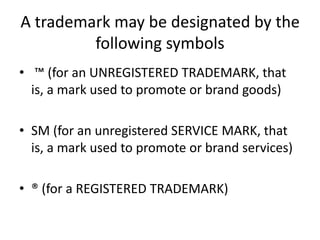
• ™ (for an UNREGISTERED TRADEMARK, that
is, a mark used to promote or brand goods)
• SM (for an unregistered SERVICE MARK, that
is, a mark used to promote or brand services)
• ® (for a REGISTERED TRADEMARK)
Function of a trade mark
• It identifies the goods / or services and its
origin.
• It guarantees its unchanged quality.
• It advertises the goods/services.
• It creates an image for the goods/ services
What is the procedure for registration?
Step 1: Making the trademark application
Along with the application, you will need to
submit a couple of supporting documents:
• A Business registration concern: Depending on
what type of a registered business you have, say
sole proprietorship, etc. you will need to submit
an identity proof of the directors of the
company and an address proof.
• An image of your brand logo in a standard size
of 9 x 5 cms
• If applicable, proof of claim of the proposed mark
being used before in another country.
Step 2: Filling the brand name registration
application
There are 2 ways to file the registration
manual filing or e-filling.
Step 3: Examining the brand name registration
application
After receiving the application, the
Registrar checks whether the brand name
complies with the law and does not conflict or
dispute with other existing registered or
pending brands.
Step 4: Publication in the Indian Trade Mark
Journals
After examination, the logo or brand
name is published in the Indian Trade Mark
Journal. If no one raises an opposition within 3
months i.e. 90 days or in some cases 120 days,
from the date of publication, the brand name
proceeds to acceptance.
Step 5: Issuance of the trademark registration
certificate
If no one raises any opposition, within
the stipulated 90 days period, the Registrar
accepts the trademark application And issues a
Certificate of Registration under the seal of
Trademark Registry.
Terms of Trade Mark
• A unique feature of trade mark is its perpetual
life.
• Though initially the registration of a trade
mark shall be for a period of 10 years, it can
be periodically renewed and can be used for
indefinite period unless it is removed from
register or prohibited by court order.
Terms of Trademarks
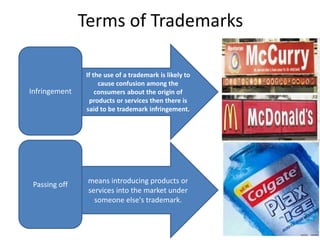
Infringement
Passing off
If the use of a trademark is likely to
cause confusion among the
consumers about the origin of
products or services then there is
said to be trademark infringement.
means introducing products or
services into the market under
someone else's trademark.
THANK YOU®

trademark-141209073601-conversion-gate01.pdf

  • 2.
    Meaning • A Trademarkis a recognizable sign, design or expression which identifies products or services of a particular source from those of others. The trademark owner can be an individual, business organization, or any legal entity. A trademark may be located on a package, a label, a voucher or on the product itself. For the sake of corporate identity trademarks are also being displayed on company buildings.
  • 3.
    Statutory definition oftrade mark- section 2(1) of the 1999 act • Trade mark must be a mark which includes a device, brand, shape of goods, packaging or combination of colors or any combination thereof— s. 2(1) (m). • The mark must be capable of being represented graphically. • It must be capable of distinguishing the goods or services of one person from those of others. • It may include shape of goods, their packaging and combination of colours. • It must be used or proposed to be used in relation to goods or services. • The use must be for the purpose of indicating a connection in the course of trade between the goods or services and some persons having the right as proprietor to use the mark. • The right to proprietorship of a trade mark may be acquired by registration under the Act or by use in relation to particular goods or services. • The right of proprietorship acquired by registration is a statutory right which requires no actual user but only an intention to use the mark.
  • 5.
    • Word • Symbol •Slogan • Design
  • 6.
    TRADEMARKS ACT, 1999 •First TM registered in UK under No. 1 of 1876 consisting of red equilateral triangle in respect of alcoholic beverage is still in force. • The present Trade Marks Act, 1999 has replaced the Trade and Merchandise Marks Act, 1958. And the Trade Marks Act, 1999 has been brought into force only on 15th September 2003. The Trade Mark Rules, 2002 are passed under the Trade Marks Act, 1999.
  • 7.
    A trademark maybe designated by the following symbols • ™ (for an UNREGISTERED TRADEMARK, that is, a mark used to promote or brand goods) • SM (for an unregistered SERVICE MARK, that is, a mark used to promote or brand services) • ® (for a REGISTERED TRADEMARK)
  • 8.
    Function of atrade mark • It identifies the goods / or services and its origin. • It guarantees its unchanged quality. • It advertises the goods/services. • It creates an image for the goods/ services
  • 9.
    What is theprocedure for registration? Step 1: Making the trademark application Along with the application, you will need to submit a couple of supporting documents: • A Business registration concern: Depending on what type of a registered business you have, say sole proprietorship, etc. you will need to submit an identity proof of the directors of the company and an address proof. • An image of your brand logo in a standard size of 9 x 5 cms • If applicable, proof of claim of the proposed mark being used before in another country.
  • 10.
    Step 2: Fillingthe brand name registration application There are 2 ways to file the registration manual filing or e-filling. Step 3: Examining the brand name registration application After receiving the application, the Registrar checks whether the brand name complies with the law and does not conflict or dispute with other existing registered or pending brands.
  • 11.
    Step 4: Publicationin the Indian Trade Mark Journals After examination, the logo or brand name is published in the Indian Trade Mark Journal. If no one raises an opposition within 3 months i.e. 90 days or in some cases 120 days, from the date of publication, the brand name proceeds to acceptance. Step 5: Issuance of the trademark registration certificate If no one raises any opposition, within the stipulated 90 days period, the Registrar accepts the trademark application And issues a Certificate of Registration under the seal of Trademark Registry.
  • 12.
    Terms of TradeMark • A unique feature of trade mark is its perpetual life. • Though initially the registration of a trade mark shall be for a period of 10 years, it can be periodically renewed and can be used for indefinite period unless it is removed from register or prohibited by court order.
  • 13.
    Terms of Trademarks Infringement Passingoff If the use of a trademark is likely to cause confusion among the consumers about the origin of products or services then there is said to be trademark infringement. means introducing products or services into the market under someone else's trademark.
  • 14.