PSI as personal data:
moving towards pragmatism


Hans Graux, ICT Lawyer
Personal data and data subjects

 Definition:

      “any information relating to an identified or identifiable
 natural person ('data subject'); an identifiable person is one
 who can be identified, directly or indirectly, in particular by
 reference to an identification number or to one or more
 factors specific to his physical, physiological, mental, economic,
 cultural or social identity”


                                                                   2
Not so easy…

 Recital 26:
      “to determine whether a person is identifiable, account
 should be taken of all the means likely reasonably to be
 used either by the controller or by any other person to
 identify the said person”

 Opinion WP136 on the Concept of Personal Data (2007):
      “One should consider costs, intended purpose, modalities
      of processing, incentives, interests for the individuals, and
      organisational/technical risks”
                                                                3
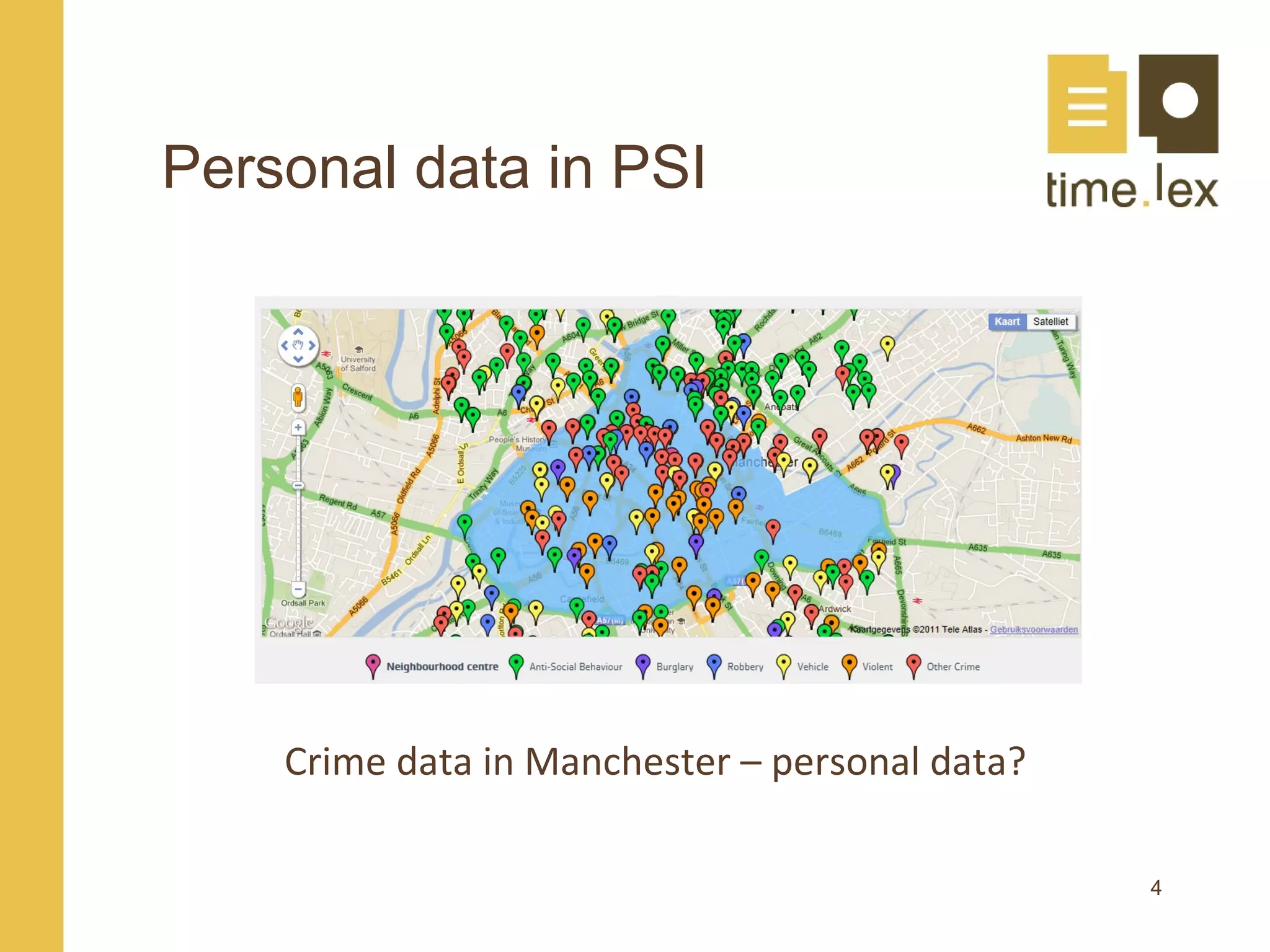
Personal data in PSI


    Crime data in Manchester – personal data?

                                                4
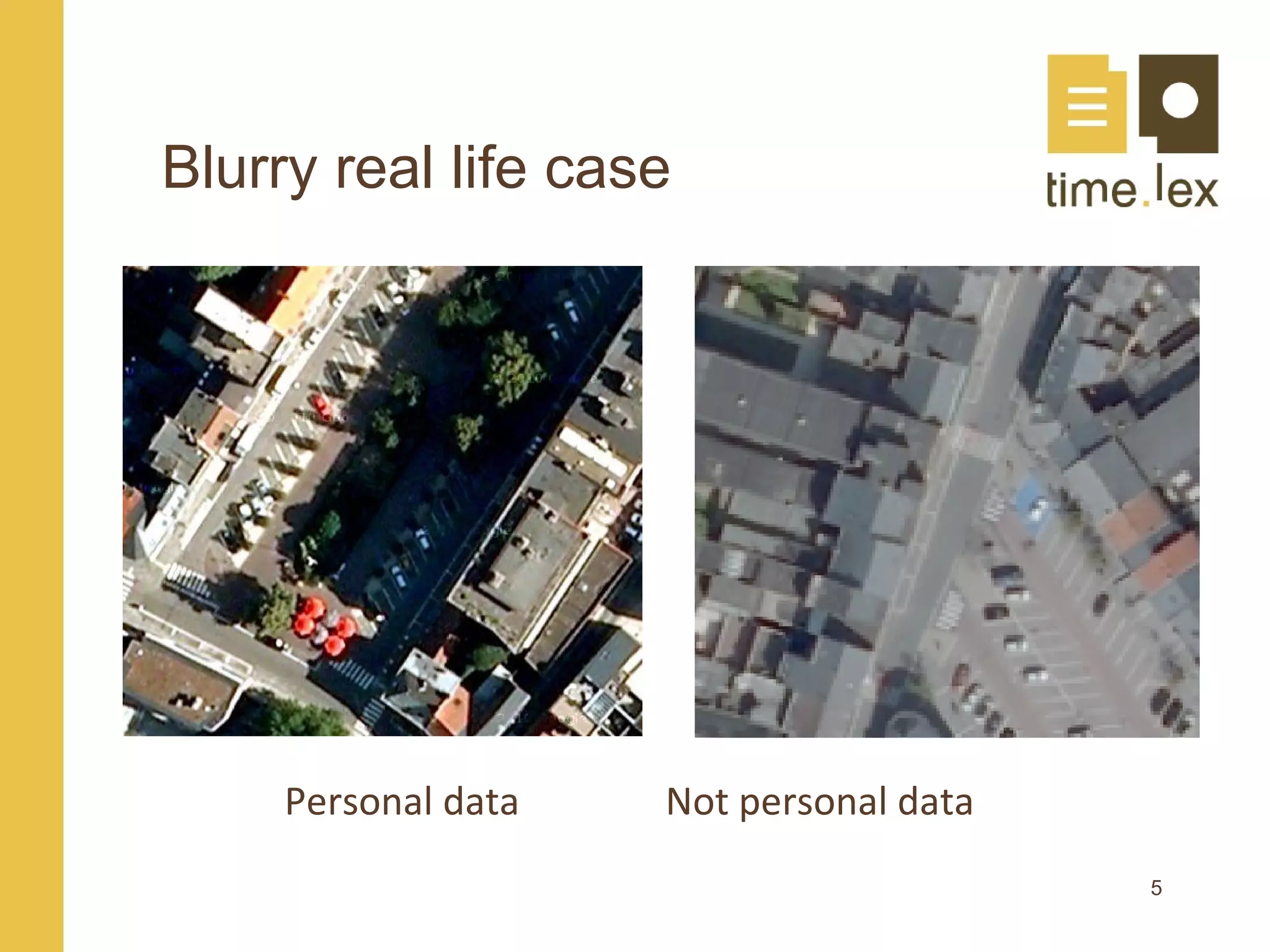
Blurry real life case


     Personal data   Not personal data
                                         5
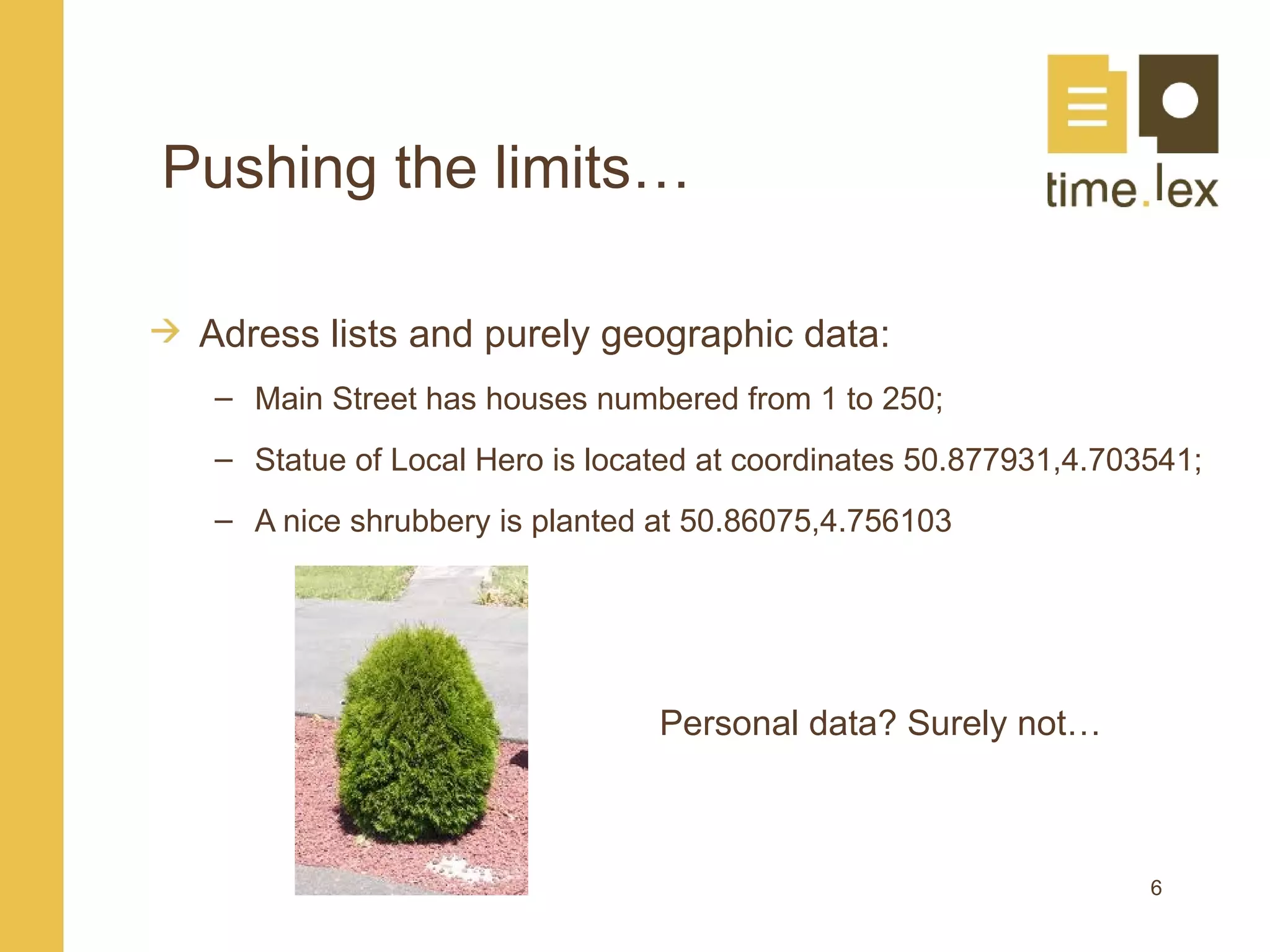
Pushing the limits…

 Adress lists and purely geographic data:
 – Main Street has houses numbered from 1 to 250;
 – Statue of Local Hero is located at coordinates 50.877931,4.703541;
 – A nice shrubbery is planted at 50.86075,4.756103


                               Personal data? Surely not…


                                                                 6
Seeking reason…

 Pragmatic approach: distiction between:
 – Personal data from its nature: contact data, health data,
    pictures of persons,… : law clearly applies
 – Personal data from its contextual use: geolocation, pictures
    of environments, object data, …: only become personal data
    when their use implies a linking to natural persons. If
    identifiability (whether intended or not) is not a foreseeable
    result of normal use, then data protection laws do not apply.

 Not so much based on law, but on realism
                                                                7

Track H Hans Graux

  • 1.
    PSI as personaldata: moving towards pragmatism Hans Graux, ICT Lawyer
  • 2.
    Personal data anddata subjects Definition: “any information relating to an identified or identifiable natural person ('data subject'); an identifiable person is one who can be identified, directly or indirectly, in particular by reference to an identification number or to one or more factors specific to his physical, physiological, mental, economic, cultural or social identity” 2
  • 3.
    Not so easy… Recital 26: “to determine whether a person is identifiable, account should be taken of all the means likely reasonably to be used either by the controller or by any other person to identify the said person” Opinion WP136 on the Concept of Personal Data (2007): “One should consider costs, intended purpose, modalities of processing, incentives, interests for the individuals, and organisational/technical risks” 3
  • 4.
    Personal data inPSI Crime data in Manchester – personal data? 4
  • 5.
    Blurry real lifecase Personal data Not personal data 5
  • 6.
    Pushing the limits… Adress lists and purely geographic data: – Main Street has houses numbered from 1 to 250; – Statue of Local Hero is located at coordinates 50.877931,4.703541; – A nice shrubbery is planted at 50.86075,4.756103 Personal data? Surely not… 6
  • 7.
    Seeking reason… Pragmaticapproach: distiction between: – Personal data from its nature: contact data, health data, pictures of persons,… : law clearly applies – Personal data from its contextual use: geolocation, pictures of environments, object data, …: only become personal data when their use implies a linking to natural persons. If identifiability (whether intended or not) is not a foreseeable result of normal use, then data protection laws do not apply. Not so much based on law, but on realism 7

Editor's Notes

  • #5 UKCrimeStats. the UK Information Commissioner (ICO), who monitors compliance with data protection laws in the UK, has issued specific guidelines on crime maps and data protection compliance. The ICO noted that relevant factors for assessing compliance would include:   the granularity of the crime-map the regularity of data uploads the sensitivity of the crime the information recorded on the map, and the availability of other sources of information   The guidelines require those who publish crime maps to implement appropriate procedures to address the concerns of victims of crime who fear that the maps reveal their identity, or the objections of house owners whose property value diminishes as a result of incorrectly attributed data. The ICO also explicitly warned against any practices that would allow a specific household to be linked to a particular crime, noting that this would likely constitute an unfair processing of personal data. Thus, the recommendation is to clearly avoid making the information needlessly specific. Crime-mapping, privacy and transparency: advice from the Information Commissioner’s Office, published on 24 November 2010; see http://www.ico.gov.uk/~/media/documents/library/Data_Protection/Detailed_specialist_guides/crime_mapping_advice.ashx
  • #6 Not personal data: scale 1:2.000