




the mystery of the genome
                                                                  worldmags
                                              p40    br ie fing
                                                    The sMarT
                                                      grId
                                                        p65


Published by MIT


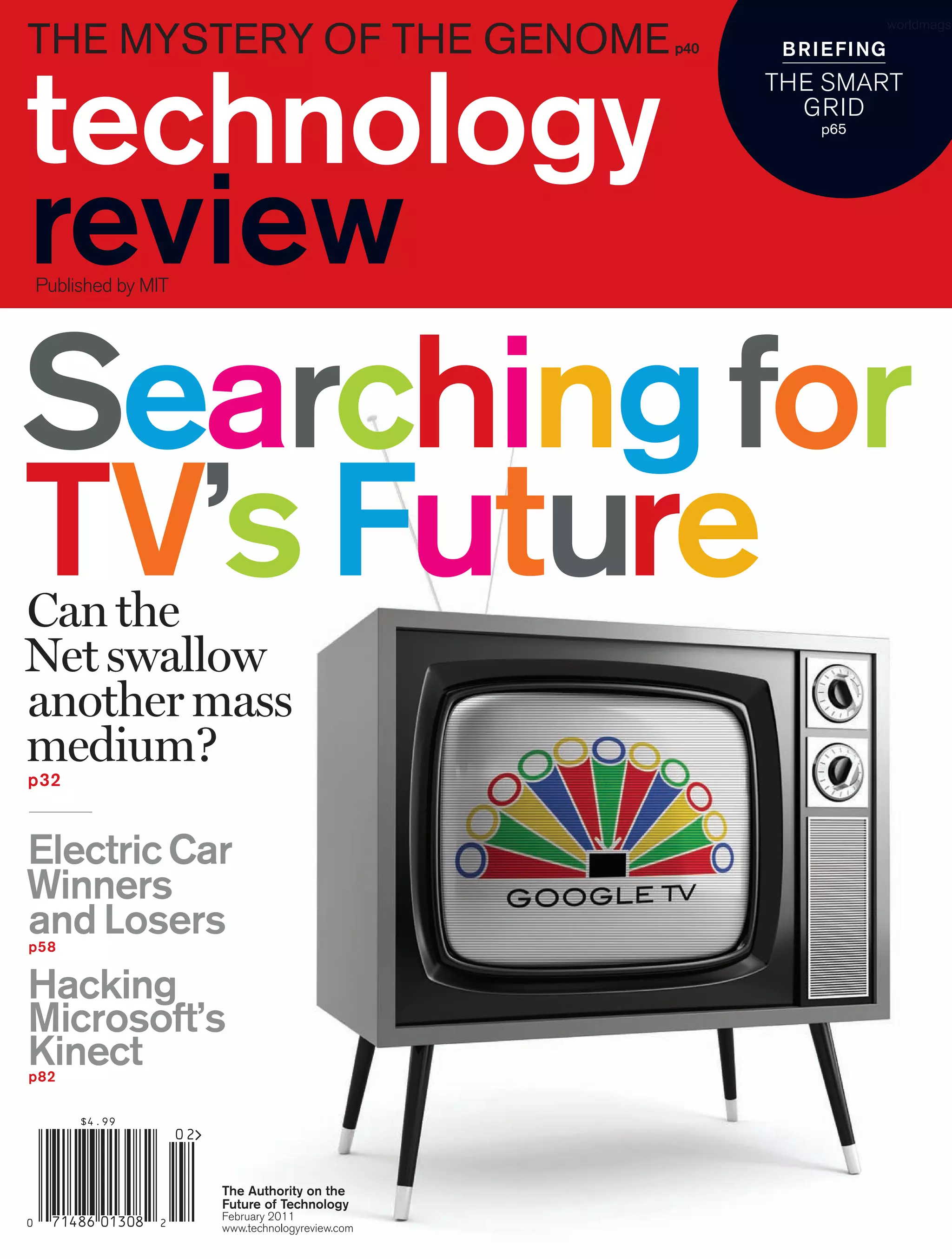
Searching for
TV’s future
Can the
Net swallow
another mass
medium?
p32


electric Car
Winners
and Losers
p58


Hacking
Microsoft’s
Kinect
p82


                   The Authority on the
                   future of Technology
                   February 2011
                   www.technologyreview.com
worldmags


            LOTS OF POINTS.


worldmags
©2010 General Motors. Cadillac® CTS®
                                                                                                                 worldmags


        NONE OF REFERENCE.
        FROm EvERy aNglE, thE CtS-v COupE
        bREakS NEw gROuNd, whilE thE
        bRakE light dOublES aS a SpOilER
        tO makE SuRE it NEvER lEavES it.


              THE NEW STANDARD OF THE WORLD


                                              CADILLAC CTS-V COUPE / cadillac.com


worldmags
worldmags


worldmags
worldmags
   contents            Volu me 114, NumBeR 1


                                      32 Searching for the Future                                                    g raph iti

                                                                                                                    20 Making Friends
                                      of Television                                                                 Facebook still has lots of
                                      Google and the geeks from Silicon Valley aim                                  room to grow.
                                      to revolutionize the 70-year-old TV industry.                                 By Tommy McCall
                                                                                                                    and Matt Mahoney
                                      Conquering the Internet was easy by comparison.
                                      B y RoBeRT D. Hof


                                      Special Section

        coVe r
        retro google tV logo by       The Human Genome,
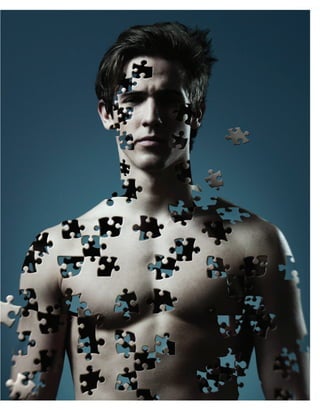
        the heads of State            a Decade Later
                                      40 Ten years after scientists finished mapping our
                                      DNA, they have a far more complex picture of what
                                      determines our genetic fate.
                                      B y JoN CoHeN

                                      46 The cancer genome could provide clues to
                                      treating the disease.
                                      B y e mIly SING e R

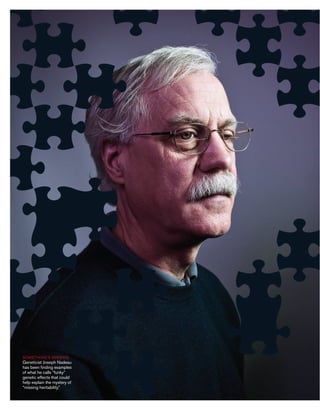
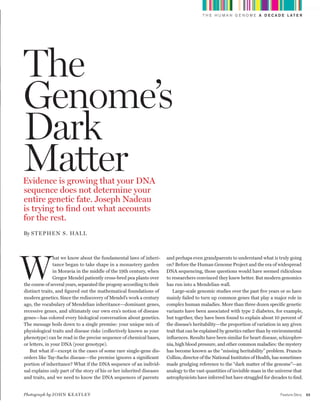
                                      52 Joseph Nadeau is searching for the genome’s
                                      dark matter.
                                      By STepHeN S. HAll                                                             Q&a

                                                                                                                    22 Paul Sagan
                                                                                                                    the ceo of a company that
                                      58 Will Electric Vehicles                                                     delivers a large portion of Web
                                                                                                                    traffic isn’t worried that the
                                      Finally Succeed?                                                              internet is running out of capacity.
                                                                                                                    By Brian Bergstein
                                      The success of new plug-in hybrids and
                                      all-electric vehicles will depend on overcoming
                                      a familiar nemesis: battery costs.
                                                                                                                     photo eSSay
                                      B y peTeR fA IRl ey
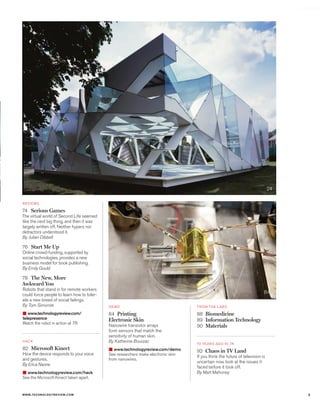
                                                                                                                    24 Rebuilding
                                                                                                                    Architecture
                                                                                                                    Software is allowing architects
                                      6 Letters                           11 Disease Decoded                        to design buildings in radically
                                      8 From the Editor                   Sequencing the human genome               new ways.
                                                                          has profoundly changed our                By Katherine Bourzac
                                                                          understanding of biology and
                                      note B ookS                         disease.
                                                                          By David Altshuler                         B r i e Fi ng
                                      10 Watching Viewers
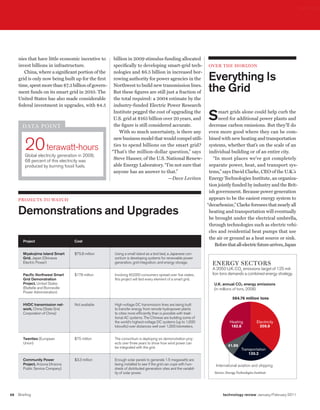
                                      Making television smarter           to Mar ket                                 65–73 The Smart Grid
                                      requires understanding why                                                    adding intelligence to the elec-
                                                                          13–18 Technology                          tric grid will reduce carbon emis-
                                      it is our favorite gadget.
                                                                          Commercialized                            sions and make power more
                                      By Genevieve Bell and
                                                                          Sony internet tV, pocket ultra-           reliable—if we’re willing to foot
                                      Brian David Johnson
                                                                          sound scanner, medical exoskel-           the bill.
                                      10 Electric Dreams                  etons, robotic surgical assistant,
                                      Success for vehicles with a plug,   digital dashboard, and more.               ■ www.technologyreview.com/
                                                                                                                     smartgrid
                                      not a gas cap, rests on more                                                   explore the technologies behind
                                      than just technology.                                                          the smart grid.
                                      By Dan Sperling


    2                                                                                                          technology review January/February 2011

worldmags
worldmags


                                                                                                                                               24

            r eVi eWS

            74 Serious Games
            the virtual world of Second life seemed
            like the next big thing, and then it was
            largely written off. neither hypers nor
            detractors understood it.
            By Julian Dibbell

            76 Start Me Up
            online crowd-funding, supported by
            social technologies, provides a new
            business model for book publishing.
            By Emily Gould

            78 The New, More
            Awkward You
            robots that stand in for remote workers
            could force people to learn how to toler-
                                                                                                                                           84
            ate a new breed of social failings.
            By Tom Simonite                                  De Mo                                  FroM th e laB S

            ■ www.technologyreview.com/                      84 Printing                            88 Biomedicine
            telepresence                                     Electronic Skin                        89 Information Technology
            Watch the robot in action at TR.
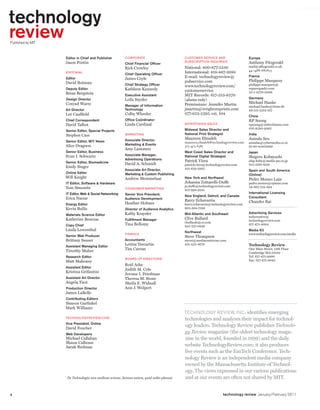
                                                             nanowire transistor arrays             90 Materials
                                                             form sensors that match the
                                                             sensitivity of human skin.
            hack                                             By Katherine Bourzac
                                                                                                    70 year S ag o i n TR
            82 Microsoft Kinect                              ■ www.technologyreview.com/demo        92 Chaos in TV Land
            how the device responds to your voice            See researchers make electronic skin
                                                                                                    if you think the future of television is
            and gestures.                                    from nanowires.
                                                                                                    uncertain now, look at the issues it
            By Erica Naone
                                                                                                    faced before it took off.
            ■ www.technologyreview.com/hack                                                         By Matt Mahoney
            See the Microsoft kinect taken apart.


            w w w . t e ch n o l o g y r e v i e w . c o m                                                                                             3

worldmags
worldmags


    Published by MiT


                       Editor in Chief and Publisher        Cor porate                       Custom e r se rviCe an d                Europe
                       Jason Pontin                                                          su b sCr i ption i nqu i r i es         Anthony Fitzgerald
                                                            Chief Financial Officer
                                                                                             National: 800-877-5230                  mail@afitzgerald.co.uk
                                                            Rick Crowley
                                                                                                                                     44-1488-680623
                       e ditor ial
                                                            Chief Operating Officer
                                                                                             International: 818-487-2088
                                                                                             E-mail: technologyreview@               France
                       Editor                               James Coyle
                                                                                             pubservice.com                          Philippe Marquezy
                       David Rotman                         Chief Strategy Officer                                                   philippe.marquezy@
                                                                                             www.technologyreview.com/
                       Deputy Editor                        Kathleen Kennedy                                                         espacequadri.com
                                                                                             customerservice                         33-1-4270-0008
                       Brian Bergstein                      Executive Assistant              MIT Records: 617-253-8270
                       Design Director                      Leila Snyder                                                             Germany
                                                                                             (alums only)
                       Conrad Warre                                                          Permissions: Jennifer Martin            Michael Hanke
                                                            Manager of Information                                                   michael.hanke@heise.de
                       Art Director                         Technology                       jmartin@wrightsreprints.com             49-511-5352-167
                       Lee Caulfield                        Colby Wheeler                    877-652-5295, ext. 104
                                                                                                                                     China
                       Chief Correspondent                  Office Coördinator                                                       RP Soong
                       David Talbot                         Linda Cardinal                   adve rtisi ng sales                     rpsoong@mittrchinese.com
                                                                                             Midwest Sales Director and              010-8280-9083
                       Senior Editor, Special Projects
                       Stephen Cass                         mar keti ng                      National Print Strategist               India
                                                            Associate Director,              Maureen Elmaleh                         Aninda Sen
                       Senior Editor, MIT News                                               maureen.elmaleh@technologyreview.com    anindas@cybermedia.co.in
                       Alice Dragoon                        Marketing & Events               303-975-6381                            91-80-43412000
                                                            Amy Lammers
                       Senior Editor, Business                                               West Coast Sales Director and           Japan
                       Evan I. Schwartz                     Associate Manager,               National Digital Strategist             Shigeru Kobayashi
                                                            Advertising Operations           Patrick Viera                           shig-koby@media-jac.co.jp
                       Senior Editor, Biomedicine           David A. Schmidt                 patrick.viera@technologyreview.com      813-3261-4591
                       Emily Singer                                                          415-659-2982
                                                            Associate Art Director,                                                  Spain and South America
                       Online Editor                        Marketing & Custom Publishing                                            (Online)
                       Will Knight                          Andrew Memmelaar                 New York and Northeast                  Pedro Moneo Laín
                       IT Editor, Software & Hardware                                        Johanna Zottarelli-Duffe                pedro.moneo@opinno.com
                                                                                             jo.duffe@technologyreview.com           34-667-732-894
                       Tom Simonite                         Consu m e r mar keti ng
                                                                                             857-998-9241
                       IT Editor, Web & Social Networking   Senior Vice President,                                                   International Licensing
                                                                                             New England, Detroit, and Canada        Consultant
                       Erica Naone                          Audience Development
                                                                                             Barry Echavarria                        Chander Rai
                       Energy Editor                        Heather Holmes                   barry.echavarria@technologyreview.com
                       Kevin Bullis                         Director of Audience Analytics   603-924-7586
                                                            Kathy Kraysler                   Mid-Atlantic and Southeast              Advertising Services
                       Materials Science Editor
                                                                                                                                     webcreative@
                       Katherine Bourzac                    Fulfillment Manager              Clive Bullard                           technologyreview.com
                                                                                             cbullards@cs.com
                       Copy Chief                           Tina Bellomy                     845-231-0846
                                                                                                                                     617-475-8004
                       Linda Lowenthal                                                                                               Media Kit
                                                                                             Northwest
                                                            Fi nanCe                                                                 www.technologyreview.com/media
                       Senior Web Producer                                                   Steve Thompson
                       Brittany Sauser                      Accountants                      stevet@mediacentricinc.com
                       Assistant Managing Editor
                                                            Letitia Trecartin                415-435-4678                            Technology Review
                       Timothy Maher                        Tim Curran                                                               One Main Street, 13th Floor
                                                                                                                                     Cambridge MA 02142
                       Research Editor                                                                                               Tel: 617-475-8000
                                                            b oar d oF di r eCtor s
                       Matt Mahoney                                                                                                  Fax: 617-475-8043
                                                            Reid Ashe
                       Assistant Editor
                                                            Judith M. Cole
                       Kristina Grifantini
                                                            Jerome I. Friedman
                       Assistant Art Director               Theresa M. Stone
                       Angela Tieri                         Sheila E. Widnall
                       Production Director                  Ann J. Wolpert
                       James LaBelle
                       Contributing Editors
                       Simson Garfinkel
                       Mark Williams
                                                                                             Technology Review, inc., identifies emerging
                       teCh nologyr evi ew.Com
                                                                                             technologies and analyzes their impact for technol-
                       Vice President, Online
                       David Foucher
                                                                                             ogy leaders. Technology Review publishes Technolo-
                       Web Developers
                                                                                             gy Review magazine (the oldest technology maga-
                       Michael Callahan                                                      zine in the world, founded in 1899) and the daily
                       Shaun Calhoun
                       Sarah Redman                                                          website TechnologyReview.com; it also produces
                                                                                             live events such as the EmTech Conference. Tech-
                                                                                             nology Review is an independent media company
                                                                                             owned by the Massachusetts Institute of Technol-
                                                                                             ogy. The views expressed in our various publications
                       De Technologia non multum scimus. Scimus autem, quid nobis placeat.   and at our events are often not shared by MIT.


    4                                                                                                                   technology review January/February 2011

worldmags
worldmags


worldmags
worldmags
    Letters and Comments


        Don’t DisregarD nuclear                          in the form of loan guarantees. These are      google Vs. Facebook
        That nuclear power is at least somewhat not handouts but, rather, insurance poli-               In “Google Misses You” (November/
        more expensive than fossil fuels was never cies to cover the unforeseen. The renais-            December 2010), Paul Boutin calls Face-
        in question (“Giant Holes in the Ground,” sance will happen because there is simply             book’s user interface “a pain in the ass” and
        November/December 2010).                                        no alternative.                 claims it’s in conflict with 40 years of UI
        The question is whether we                                         Ulrich Decher                research. Do Google products, desktop or
        are going to do anything to                                        Granby, Connecticut          mobile, shine in their UIs? Google’s prod-
        move away from fossil fuels,                                                                    ucts may be cleaner and more stable than
        and how nuclear power                                          The dismissal of China as “a     some others’, but they seem to be built by
        compares economically with                                      tiny player” in nuclear power   and for geeks. Designing Web and social
        other non-emitting options.                                     is cavalier to say the least.   UIs, I rarely meet people craving the
        Nuclear is stalling because                                    The build rate for new reac-     Google Calendar experience or the Picasa
        current policies give it no sig-                                tors in China is beginning to   experience.
        nificant advantage over fos-                                   approach what it was in the         Edo Elan
        sil fuels, while renewables          November/December ’10     U.S. in the heyday of nuclear       San Francisco, California
        are being built by government mandate, plant construction. And contrary to our
        essentially regardless of cost. I disagree experience here, China has been complet-             the MeMex
        with Matthew Wald’s characterization of ing projects ahead of schedule and under                I was 13 when Vannevar Bush described
        nuclear’s loan guarantees as a significant budget. The agonizing in the U.S. over the           the Memex in 1945, which you reflect on
        subsidy. This support is tiny compared with future of nuclear power grows increasingly          in “Future Perfect” (November/Decem-
        the massive subsidies given to renewables. irrelevant.                                          ber 2010). The Memex, a technology that
        For a fraction of what the government has           Roger Arnold                                promised to give individuals access to the
        spent supporting renewables in just the last        Sunnyvale, California                       world’s collection of information, inspired
        few years, it could provide loan guarantees                                                     my dreams of what might be. Over the
        for all reactors built from this day forward. What the Web really neeDs                         years, science and the marketplace have
        In any fair competition among non-emit- Without detracting from HTML5, I have                   given us increasingly powerful computers,
        ting sources, nuclear would do very well. to object to the title “The Web Is Reborn”            software, and networking.
        Fortunately, there is a movement afoot to (November/December 2010). Rather                         In the eighth decade of my life I work
        pass a Clean Energy Standard that includes than more optimal displays of video, the             with a company that specializes in docu-
        both nuclear and renewables. Such a policy Web needs an architectural solution to its           ment management software with artificial-
        would solve all the “problems” nuclear is nearly fatal security issues. The resources           intelligence assistants. These tools enable
        having right now.                                that are wasted on professional security       me to construct my own little “Memex,”
           James Hopf                                    services, firewalls, and antivirus software    which holds collections totaling hundreds
           San Jose, California                          and its maintenance are far more than a        of thousands of documents that interest
                                                         minor inconvenience.                           me. The cost of the devices that let me do
        Wald’s conclusion that the nuclear renais-          David Korenstein                            this today is far less than would have been
        sance has failed is premature. The financial        Wayne, Pennsylvania                         required to construct Bush’s Memex. My
        hurdles are real but not insurmountable.                                                        computer and scanner total ten pounds, less
        The renaissance requires government help It seems that the Web’s future is being                than Bush’s vision of a bulky device.
                                                         driven by technical arguments and com-            My Memex operates at speeds that would
                                                         panies beholden to their customers. What       have delighted Bush, but we are still in early
        join the Discussion, or contact us               about the public interest? The Web has         stages of what could be done. The author is
        ■ technologyreview.com/community                 emerged as the major place where the           correct in stating that looking back at the
        e-mail letters@technologyreview.com
                                                         discourse necessary for democracy takes        present from the perspective of 77 years
        Write Technology Review, One Main Street,
                                                         place—akin to the new radio and TV air-        in the future would probably elicit pity for
        13th Floor, Cambridge, MA 02142
        Fax 617-475-8043                                 waves. Don’t we need regulations to guar-      the primitive state in which we live and
        Please include your address, telephone number,   antee access and fairness?                     work today.
        and e-mail address. Letters and comments may      John Fisher                                     William DeVille
        be edited for both clarity and length.            New York, New York                              Nashville, Indiana


    6   Letters and Comments                                                                                   technology review January/February 2011

worldmags
worldmags


            Your gatewaY to an
            MIt educatIonal experIence
               As MIT’s training and education portal for scientists, engineers and technical
               professionals, we help you access cutting edge research and knowledge


                                                                                                              Massachusetts Institute of Technology
               at MIT, acquire new skills and take innovative ideas back to work.

               To learn more about what MIT Professional Education can offer you and
               your company, visit us today at http://professionaleducation.mit.edu/techreview
               or email us at professionaleducation@mit.edu.


              our prograMs Include:
              short programs                                advanced study program
              Register for a 2 – 5 day intensive course     Enroll in regular MIT courses for one or
              and gain critical knowledge to help advance   more semesters, on a full or part-time basis,
               your career and impact your company’s        while still working and contributing to your
              success. Each year approximately              company. Earn grades, MIT credit, new
              50 courses are offered in a variety of        knowledge and new skills.
              subject areas (partial listing below):
                 Biotechnology / Pharmaceutical             career reengineering program
                 Computing / Networks / Communications      Enroll in a unique, 12-month, part-time program
                 Data Modeling & Analysis                   that offers experienced professionals the
                                                            knowledge and skills to enable career reentry
                 Energy / Transportation
                                                            or retooling for new work or a new workplace.
                 Engineering Systems
                 High-Speed Imaging                         custom programs
                 Leadership & Teaching for Faculty
                                                            Enhance your organization’s capabilities and
                 Lean Enterprise / Healthcare               expertise through customized programs tailored
                 Mechanical Design & Engineering            to meet your specific needs and priorities.
                 Nanotechnology
                 Supply Chain / Marketing                   International programs
                 Systems Design & Engineering               Find out about regionally relevant MIT short
                 Technology / Organizations                 courses being offered in various locations
                                                            around the world.
              Save 10% on Short Programs
              when you register & pay by
              April 15 using code MITPE-03.


              http://professionaleducation.mit.edu/ techreview
worldmags
worldmags
    From the Editor


        A Decade of Genomics
        on the 10th anniversary of the Human Genome Project, we ask:
        where are the therapies?


        T    he Human Genome Project, whose results were announced
             in June of 2000 and published in full 10 years ago, took 13
        years and $3 billion to complete. For biology, it was unprec-
                                                                               which gene expression can be influenced by mechanisms other
                                                                               than changes in the underlying DNA sequence (dubbed “epi-
                                                                               genetics,” because the field studies mechanisms above—“epi”—
        edented in scale: it determined the sequence of three billion          the genome); and whether we have extra or missing copies of
        units, or base pairs, of human DNA. What life scientists wanted        genes (copy-number variation).
        from the project was equally ambitious: they hoped sequencing             This “missing heritability” problem—the fact that individual
        our DNA would reveal the genetic causes of disease and lead to         genes cannot account for much of a disease’s heritability—has
        diagnoses, treatments, and cures for intractable illnesses like        significant implications for medicine. It turns out (as Hall
        many forms of cancer.                                                  explains) that “a person’s susceptibility to disease may depend
           In this issue of Technology Review, we explore what happened        more on the combined effect of all the genes in the background
        to those hopes.                                                        than on the disease genes in the foreground.” Therefore, mapping
           Over the last 10 years, many advances in genomics have been         this complex nest of genetic relationships offers the best hope for
        made. As Jon Cohen explains in the introduction to our pack-           turning genomics into therapies or cures.
        age of stories on the topic, which begins on page 40, “The price          Consider cancer. In “Cancer’s Genome,” starting on page 46,
        of sequencing DNA has dropped … to mere thousands [of dol-             Emily Singer, Technology Review’s biomedicine editor, describes
        lars per person]. The number of single-gene aberrations known          how research has proved that cancer genomics are “even more
        to cause disease … has jumped from 100 to nearly 3,000. The            complicated than scientists had supposed.” We now understand
        growing list of common diseases that have been traced to mul-          that five to as many as 20 mutations are needed to trigger can-
        tiple genetic variants includes everything from types of blindness     cer’s cellular proliferation. But cheaper, faster sequencing tech-
        to autoimmune diseases and metabolic disorders like diabetes.          nologies may, in the not-too-distant future, make personalized
        Studies have linked more than 200 genes to cancer.”                    cancer medicine a real possibility. Singer reports on Foundation
           But taken as a whole, it was a long, hard decade for genomics.      Medicine in Cambridge, Massachusetts, which wants to create
        Researchers and clinicians will disagree about how quickly they        clinical tests that reveal which mutations have caused a patient’s
        imagined the Human Genome Project would bear fruit, but no             particular cancer, how severe that cancer is, and what drugs
        one will contest that the genome has turned out to be bafflingly       will affect it. According to Singer, early results from Founda-
        complex and that genomic information has yielded few new               tion “suggest that about half the patient tissue samples analyzed
        cures. Cohen describes some of the difficulties in his introduction,   would yield plausibly ‘usable’ information, meaning that the
        and Stephen Hall provides more detail in “The Genome’s Dark            analysis might suggest a particular class of drugs or better define
        Matter,” beginning on page 52: “Large-scale genomic studies …          the type of cancer.” If readers are looking for hope that genomics
        have mainly failed to turn up common genes that play a major           can lead to cures for intractable diseases, companies like this are
        role in complex human maladies. More than three dozen specific         appropriate inspiration.
        genetic variants have been associated with type 2 diabetes … but          In Cohen’s introduction, Eric Lander, who was one of the lead-
        together they have been found to explain about 10 percent of           ers of the Human Genome Project and now directs the Broad
        the disease’s heritability … Results have been similar for heart       Institute (and who is also a founder of Foundation Medicine), says
        disease, schizophrenia, high blood pressure, and other common          we should not be surprised that the genome is so complicated.
        maladies.”                                                             He counsels a historically informed patience as we work on new
           In short, we have expended enormous energy on search-               genomic medicines: after all, 60 years passed between the devel-
        ing for disease genes, but it has become clearer that a variety of     opment of germ theory and the creation of antibiotics. Genomics
        other factors, once thought minor, are in fact as important to         is harder. Lander asks, “How simple did you think it would be?”
                                                                                                                                                        mar k o stow


        our health as genes themselves. These include how much or how             Write and tell me what you think at jason.pontin@
        little of a protein is produced (gene expression); the degree to       technologyreview.com —Jason Pontin


    8   From the Editor                                                                                      technology review January/February 2011

worldmags
worldmags


                                                                      Fail Faster.
                                                                    Succeed Sooner.


               Prototype Your Ideas Faster with NI Graphical System Design.
                                                                                                                                                       PRODUCT PLATFORM
               Through the large number of prototypes he created to get the first working
               light bulb, Thomas Edison taught engineers and scientists that building a                                                               NI LabVIEW
               functional prototype is fundamental in bringing ideas to life. NI LabVIEW                                                               NI CompactRIO
               graphical programming tools and NI customizable off-the-shelf hardware
                                                                                                                                                       NI Single-Board RIO
               can transform an idea into a functional prototype in weeks, versus months,
                                                                                                                                                       NI C Series I/O Modules
               and lower the risk of your next project.


        >>    Get to market faster with prototyping tools at ni.com/succeed                                                                                   888 279 9833


  ©2010 National Instruments. All rights reserved. CompactRIO, LabVIEW, National Instruments, NI, and ni.com are trademarks of National Instruments.
  Other product and company names listed are trademarks or trade names of their respective companies. 2410

worldmags
worldmags


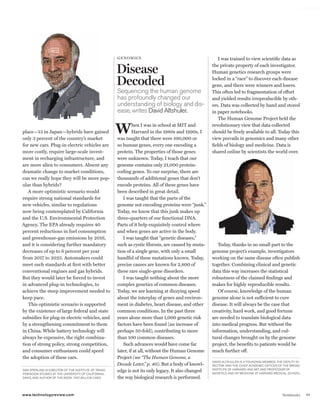
         notebooks                                         In 2005, our group at Intel took a fresh           E nEr g y

                                                        approach. Instead of trying to build a
                                                        television with PC-like features, we asked            Electric Dreams
                                                        people how their TV experience could                  success for vehicles with a plug,
                                                        be improved. Instead of starting with                 not a gas cap, rests on more than
                                                        assumptions about how TV had to change,               technology, says dan sperling.
                                                        we began by finding out what people
                                                        loved about it.
                                                           Our ethnographers visited India, Japan,
                                                        the U.K., and the United States, some-
                                                                                                              T      he history of alternative transporta-
                                                                                                                     tion fuels is a history of failure. It is a
                                                                                                               story of one fuel du jour after another—a
                                                        times watching people watch TV, some-                  frustrating cycle of media and political
                                                        times watching with them. We wanted to                 hype followed by disillusionment and
                                                        understand how people lived with their                 abandonment.
                                                        TVs and the other people around them.                     The cycle is all too familiar, from syn-
                                                        The results directly informed the design of            fuels in the late 1970s to methanol in the
                                                        the processors at the heart of new devices            ’80s, and then electric vehicles, hydrogen,
                                                        like those running Google’s TV software                and ethanol. Only corn ethanol has sur-
                                                        and D-link’s Boxee Box (see “Searching for             vived in the United States, but it would be
         ME di a                                        the Future of Television,” p. 32).                     a stretch to call it a success, given its big

         Watching                                          The first thing we learned was that
                                                        people love TV just as it is. They love their
                                                                                                               carbon footprint and relatively high cost
                                                                                                               (subsidized at about $6 billion per year in
         Viewers                                        shows and they love its simplicity. TV is
                                                        always there and doesn’t ask too much of
                                                                                                               the United States today). A new wave of
                                                                                                               electric vehicles are now at risk of enter-
         Making television smarter requires             them. A story they care about is always                ing the cycle again.
         understanding why it is our favor-             just one button away. When we asked                       Replacing petroleum will be difficult
         ite gadget, Genevieve Bell and
                                                        people what they would want from a TV                  and slow. Its hegemony creates huge bar-
         Brian david Johnson argue.
                                                        with computing power, they didn’t talk                 riers for new fuels, in terms of econom-
                                                        about computing. They talked about TV.                 ics, legal liability, public skepticism, and

         D     o you want a Web browser on your
               TV? If history is any indication, your
         answer is probably a resounding no. We
                                                        Their top three answers were that they
                                                        want access to their regular broadcast
                                                        TV, want access to broadcasts they have
                                                                                                               media sensationalism. Our three best
                                                                                                               hopes—hydrogen, electricity, and biofu-
                                                                                                               els—all face large challenges.
         don’t blame you.                               missed, and want to know what shows                       Hydrogen would require us to trans-
            In the past few decades, the technol-       their friends recommend.                               form our fuel supply system. Electricity
         ogy industry has labored under the delu-          Delivering on all three requests does               must overcome the shortcomings of bat-
         sion that consumers would love their           require computing. Giving viewers the                  teries (see “Will Electric Vehicles Finally
         TV sets to behave like computers. Many         shows they missed takes a combination                  Succeed?” p. 58). Advanced biofuels need
         tombstones now stand in place of devices       of DVR and Web services. Telling them                  a lot of land and leave a large carbon foot-
         built by very smart people, with incred-       what friends enjoy is a mix of social net-             print. However, no other green energy
         ibly smart technology inside, that made        working and automatic recommendations.                 technologies will come into being easily
         no impact. Our own company, Intel, had         But it doesn’t require building a TV that              or quickly. At least one of these three—
         multiple failed attempts.                      behaves and feels like a computer. Recog-              and probably all—must eventually thrive
            Even today, with more consumer elec-        nizing that, using social science to inform            if we are to change the kind of energy we
         tronics to choose from than ever before,       computer science, has given us a new gen-              use for transportation.
         the TV remains the most-used electronic        eration of smart TV devices like nothing                  For plug-in hybrid and all-electric
         device in the home. It is often at the cen-    that has come before. Let’s hope they fare             vehicles, I see two possible scenarios.
         ter of our living rooms and bedrooms. It       better than their predecessors.                        The most likely, judging by failed fuels
                                                                                                                                                                    N i c k r e d dyh o F F


         is where we go to relax and to gather with                                                            of the past and recent experiences with
         friends and family. For many, watching         GeNevieve Bell is director oF iNteractioN aNd expe-    hybrid cars like the Prius, is slow invest-
                                                        rieNce research at iNtel; BriaN david JohNsoN is a
         TV defines being at home.                      Futurist aNd director oF Future castiNG.               ment. After 10 years in the U.S. market-


    10   Notebooks                                                                                                    technology review January/February 2011

worldmags
worldmags


                                                                  gE noM ic s                                        I was trained to view scientific data as

                                                                  Disease                                        the private property of each investigator.
                                                                                                                 Human genetics research groups were

                                                                  Decoded                                        locked in a “race” to discover each disease
                                                                                                                 gene, and there were winners and losers.
                                                                  sequencing the human genome                    This often led to fragmentation of effort
                                                                  has profoundly changed our                     and yielded results irreproducible by oth-
                                                                  understanding of biology and dis-              ers. Data was collected by hand and stored
                                                                  ease, writes david altshuler.                  in paper notebooks.
                                                                                                                     The Human Genome Project held the

            place—13 in Japan—hybrids have gained
            only 3 percent of the country’s market
                                                                  W        hen I was in school at MIT and
                                                                           Harvard in the 1980s and 1990s, I
                                                                  was taught that there were 100,000 or
                                                                                                                 revolutionary view that data collected
                                                                                                                 should be freely available to all. Today this
                                                                                                                 view prevails in genomics and many other
            for new cars. Plug-in electric vehicles are           so human genes, every one encoding a           fields of biology and medicine. Data is
            more costly, require large-scale invest-              protein. The properties of those genes         shared online by scientists the world over.
            ment in recharging infrastructure, and                were unknown. Today, I teach that our
            are more alien to consumers. Absent any               genome contains only 21,000 protein-
            dramatic change to market conditions,                 coding genes. To our surprise, there are
            can we really hope they will be more pop-             thousands of additional genes that don’t
            ular than hybrids?                                    encode proteins. All of these genes have
               A more optimistic scenario would                   been described in great detail.
            require strong national standards for                    I was taught that the parts of the
            new vehicles, similar to regulations                  genome not encoding proteins were “junk.”
            now being contemplated by California                  Today, we know that this junk makes up
            and the U.S. Environmental Protection                 three-quarters of our functional DNA.
            Agency. The EPA already requires 40                   Parts of it help exquisitely control where
            percent reductions in fuel consumption                and when genes are active in the body.
            and greenhouse-gas emissions by 2016,                    I was taught that “genetic diseases,”
            and it is considering further mandatory               such as cystic fibrosis, are caused by muta-      Today, thanks in no small part to the
            decreases of up to 6 percent per year                 tion of a single gene, with only a small       genome project’s example, investigators
            from 2017 to 2025. Automakers could                   handful of these mutations known. Today,       working on the same disease often publish
            meet such standards at first with better              precise causes are known for 2,800 of          together. Combining clinical and genetic
            conventional engines and gas hybrids.                 these rare single-gene disorders.              data this way increases the statistical
            But they would later be forced to invest                 I was taught nothing about the more         robustness of the claimed findings and
            in advanced plug-in technologies, to                  complex genetics of common diseases.           makes for highly reproducible results.
            achieve the steep improvement needed to               Today, we are learning at dizzying speed          Of course, knowledge of the human
            keep pace.                                            about the interplay of genes and environ-      genome alone is not sufficient to cure
               This optimistic scenario is supported              ment in diabetes, heart disease, and other     disease. It will always be the case that
            by the existence of large federal and state           common conditions. In the past three           creativity, hard work, and good fortune
            subsidies for plug-in electric vehicles, and          years alone more than 1,000 genetic risk       are needed to translate biological data
            by a strengthening commitment to them                 factors have been found (an increase of        into medical progress. But without the
            in China. While battery technology will               perhaps 50-fold), contributing to more         information, understanding, and cul-
            always be expensive, the right combina-               than 100 common diseases.                      tural changes brought on by the genome
            tion of strong policy, strong competition,               Such advances would have come far           project, the benefits to patients would be
            and consumer enthusiasm could speed                   later, if at all, without the Human Genome     much further off.
            the adoption of these cars.                           Project (see “The Human Genome, a
                                                                                                                 david altshuler is a FouNdiNG MeMBer, the deputy di-
                                                                  Decade Later,” p. 40). But a body of knowl-    rector, aNd the chieF acadeMic oFFicer oF the Broad
                                                                                                                 iNstitute oF harvard aNd Mit, aNd proFessor oF
            daN sperliNG is director oF the iNstitute oF traNs-   edge is not its only legacy. It also changed   GeNetics aNd oF MediciNe at harvard Medical school.
            portatioN studies at the uNiversity oF caliForNia,
            davis, aNd author oF the Book Two Billion Cars.       the way biological research is performed.


            www.technologyreview.com                                                                                                                      Notebooks     11

worldmags
worldmags
                                                                                                                                     Special Ad Section


       S                                                                                                A TECHNOLOGY REVIEW CUSTOM SERIES


      A
      Point the camera of a tablet computer
                                                R                                                     R                  W
                                                                                                      athletes, striding among them as they
      or phone at a landmark, and watch as                                                            execute a variety of plays. This system was
      information about the building appears                                                          used during the 2010 World Cup, allowing
      on the screen. Bat at bugs on a table to                                                        analysts to break down and explain plays
      rehabilitate arm and shoulder movement:                                                         and formations in a virtual environment.
      the bugs actually appear only on a head-
      mounted display.                                                                                Museums Spring to Life
         Augmented reality programs are                                                               E2I Creative Studio, a lab that bridges the
      rapidly being adopted in a wide variety of                                                      academic and commercial worlds, has
      sectors, from military and civilian training                                                    brought a new sense of reality to Florida
      programs to online product marketing                                                            museum exhibits. At the Orlando Sci-
      to museum exhibits. The market intel-                                                           ence Center, the bones of prehistoric sea
      ligence firm ABI Research estimates that                                                         creatures were failing to captivate visitors.
      revenue associated with augmented                                                               So researchers at the University of Central
      reality–for handheld devices alone–will                                                         Florida’s Media Convergence Lab (the
      have increased from $6 million in 2008                                                          precursor of E2I) created a portal that
      to more than $350 million by 2014.                                                              resembled a science fiction time-travel
                                                                                                      device. Visitors stepped up to the portal
      Drivers Ed for the Military                     be manipulated to clear explosive devices;      and through it viewed an exhibit that had
      In the past, military drivers often had to      the virtual trainer has a system just like it   suddenly been “flooded” with water,
      travel to learn to operate complicated,         that the drivers can operate, then view the     bringing the bones to life. Virtual creatures
      hefty vehicles—such as the armored              results on its monitors.                        slithered through the water and peered
      Stryker or the mine-protected Buffalo—on                                                        out from behind the real museum’s sup-
      large immovable simulators. Those mas-          Commerce and Entertainment                      port pillars.
      sive systems, complete with augmented           Stephen Barker, founder and president of           E2I Creative is now developing a series
      reality tools, helped drivers feel as if they   Sarasota-based Digital Frontiers Media,         of exhibits for the Fort Lauderdale Mu-
      were moving genuine tank and truck con-         has received national attention for the         seum of Discovery and Science, includ-
      trols and operating the machinery. Today,       company’s eye-catching interactive web-         ing an augmented otter habitat display.
      researchers at the international company        sites. He notes that advances in cameras        Says Eileen Smith, the lab’s director,
      SAIC, working at their Orlando office,           and computer speeds and smart phones            “We decided to go with stylized virtual
      have reengineered the architecture of the       have dramatically enlarged the possibili-       creatures, instead of attempting to make
      system from the ground up, so that entire       ties for augmented experiences. Barker          them look exactly like the real thing. ”
      virtual systems, complete with the appro-       describes a scenario where “for fashion,        The point, she continues, is to offer just
      priate hardware to create the necessary         you’ll want to know what a particular           enough verisimilitude to let the user’s
      effects, can be shrunk down to fit into one      piece of clothing will look like. So you’ll     imagination take over.
      trailer. These systems can also easily be       stand in front of the webcam and interact
      reconfigured for different vehicles.             with the camera, change the clothing that         Download the Augmented
          “We’ve taken the entire system and          you’re checking out, so you can get a feel-       Reality in the Real World white
      made it mobile, says David Rees, senior
                       ”                              ing of what it will look like on you.
                                                                                          ”             paper to learn more about
      vice president. “We’ve already built 13 or         At ESPN’s Innovation Lab, in Orlando,          • augmented reality games for
      14 trailers for the Army, and they can now      Florida, the engineers have developed               rehabilitation;
      take those trailers to wherever the troops      virtual team members for many different           • new tools for movie-making; and
      are located. ”                                  sports. The on-air sportscaster appears           • military training.
         The vehicles have external arms that can     to interact with the computer-generated


      Download the full story and more at www.technologyreview.com/spotlight
worldmags
worldmags


                                                                                    to market


                                          WEB


                                          Search Screen
                                          THE FIRST high-definition set to have Google TV software built in,
                                          the Sony Internet TV lets viewers search for content on both television
                                          channels and the Internet (see “Searching for the Future of Television,”
                                          p. 32). It also provides a platform for third-party Android-based appli-
                                          cations. The downside is a monster of a remote control, with 80 buttons.

                                          W Product: Sony Internet TV Cost: $600 to $1,400 Availability: Now
                                          Source: www.sonystyle.com Companies: Google, Sony
      S O NY


               www.technologyreview.com                                                                        To Market   13

worldmags
worldmags
    to market


             b iome di Ci ne


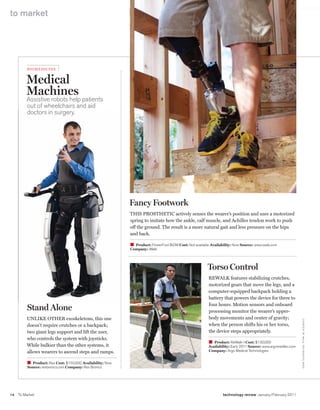
             Medical
             Machines
             Assistive robots help patients
             out of wheelchairs and aid
             doctors in surgery.


                                                                Fancy Footwork
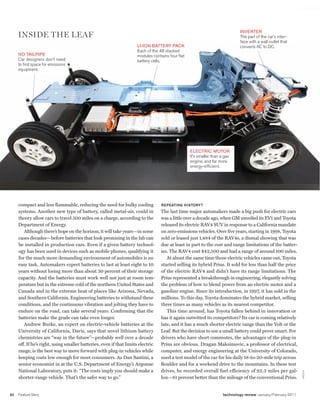
                                                                ThIs ProsTheTIC actively senses the wearer’s position and uses a motorized
                                                                spring to imitate how the ankle, calf muscle, and achilles tendon work to push
                                                                off the ground. The result is a more natural gait and less pressure on the hips
                                                                and back.

                                                                W Product: PowerFoot bioM Cost: Not available Availability: Now Source: www.iwalk.com
                                                                Company: iWalk


                                                                                                            Torso Control
                                                                                                             rewalK features stabilizing crutches,
                                                                                                             motorized gears that move the legs, and a
                                                                                                             computer-equipped backpack holding a
                                                                                                             battery that powers the device for three to
                                                                                                             four hours. Motion sensors and onboard
             Stand Alone                                                                                     processing monitor the wearer’s upper-
             UNlIKe oTher exoskeletons, this one                                                             body movements and center of gravity;
                                                                                                                                                                    C o U rTe Sy o F iWAlK, r e X b I o N I C S, Ar G o


             doesn’t require crutches or a backpack;                                                         when the person shifts his or her torso,
             two giant legs support and lift the user,                                                       the device steps appropriately.
             who controls the system with joysticks.
                                                                                                             W Product: reWalk-I Cost: $130,000
             while bulkier than the other systems, it                                                        Availability: early 2011 Source: www.argomedtec.com
             allows wearers to ascend steps and ramps.                                                       Company: Argo Medical Technologies


              W Product: rex Cost: $150,000 Availability: Now
              Source: rexbionics.com Company: rex bionics


    14   To Market                                                                                                   technology review January/February 2011

worldmags
worldmags


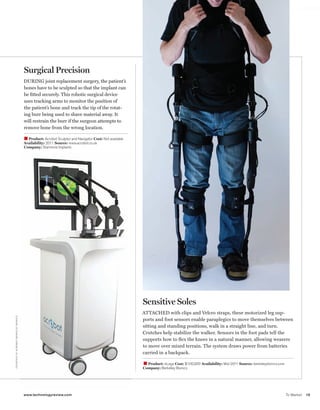
                                                                  Surgical Precision
                                                                  DURING joint replacement surgery, the patient’s
                                                                  bones have to be sculpted so that the implant can
                                                                  be fitted securely. This robotic surgical device
                                                                  uses tracking arms to monitor the position of
                                                                  the patient’s bone and track the tip of the rotat-
                                                                  ing burr being used to shave material away. It
                                                                  will restrain the burr if the surgeon attempts to
                                                                  remove bone from the wrong location.

                                                                  W Product: Acrobot Sculptor and Navigator Cost: Not available
                                                                  Availability: 2011 Source: www.acrobot.co.uk
                                                                  Company: Stanmore Implants


                                                                                                                                  Sensitive Soles
                                                                                                                                  ATTACHED with clips and Velcro straps, these motorized leg sup-
      C O U RTE SY O F AC R O B OT, B E R K E LEY B I O N I C S


                                                                                                                                  ports and foot sensors enable paraplegics to move themselves between
                                                                                                                                  sitting and standing positions, walk in a straight line, and turn.
                                                                                                                                  Crutches help stabilize the walker. Sensors in the foot pads tell the
                                                                                                                                  supports how to flex the knees in a natural manner, allowing wearers
                                                                                                                                  to move over mixed terrain. The system draws power from batteries
                                                                                                                                  carried in a backpack.

                                                                                                                                  W Product: eLegs Cost: $100,000 Availability: Mid-2011 Source: berkeleybionics.com
                                                                                                                                  Company: Berkeley Bionics


                                                                  www.technologyreview.com                                                                                                                             To Market   15

worldmags
worldmags
    to market


                                                                                                  Com P utin G

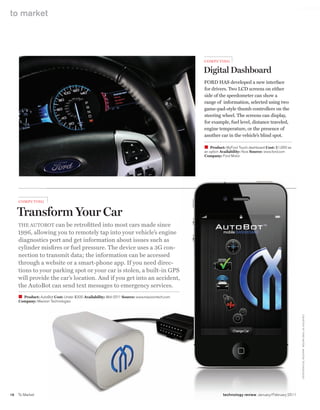
                                                                                                  Digital Dashboard
                                                                                                  Ford has developed a new interface
                                                                                                  for drivers. Two lCd screens on either
                                                                                                  side of the speedometer can show a
                                                                                                  range of information, selected using two
                                                                                                  game-pad-style thumb controllers on the
                                                                                                  steering wheel. The screens can display,
                                                                                                  for example, fuel level, distance traveled,
                                                                                                  engine temperature, or the presence of
                                                                                                  another car in the vehicle’s blind spot.

                                                                                                  W Product: MyFord Touch dashboard Cost: $1,000 as
                                                                                                  an option Availability: Now Source: www.ford.com
                                                                                                  Company: Ford Motor


         ComPut i n G


         Transform Your Car
         The aUToBoT can be retrofitted into most cars made since
         1996, allowing you to remotely tap into your vehicle’s engine
         diagnostics port and get information about issues such as
         cylinder misfires or fuel pressure. The device uses a 3g con-
         nection to transmit data; the information can be accessed
         through a website or a smart-phone app. If you need direc-
         tions to your parking spot or your car is stolen, a built-in gPs
         will provide the car’s location. and if you get into an accident,
         the autoBot can send text messages to emergency services.
         W Product: Autobot Cost: Under $300 Availability: Mid-2011 Source: www.mavizontech.com
         Company: Mavizon Technologies                                                                                                                 C o U rTe Sy o F Fo r D M oTo r; MAVI Z o N Te C H N o lo G I e S


    16   To Market                                                                                          technology review January/February 2011

worldmags
worldmags


                                                                                                                                   Network details and coverage maps at vzw.com. © 2011 Verizon Wireless.

            MAKE INFORMED IMPROMPTU DECISIONS.
            Be completely prepared for client consultations with mobile solutions on the Verizon
            network. Have instant access to large presentations, reference libraries, databases, and
            corporate applications onsite with clients. And be able to change and upload documents
            to share with the team. With the largest high-speed wireless network in America, you
            can deliver polished, professional results from more places than ever before.

            VERIZONWIRELESS.COM/PROSERVICES                                         1.800.VZW.4BIZ


            UNIFIED COMMUNICATIONS     MOBILE OFFICE    SALES FORCE AUTOMATION      BUSINESS CONTINUITY   FIELD FORCE MANAGEMENT


worldmags
worldmags
    to market


                                                                                                                   biom ed iCin e


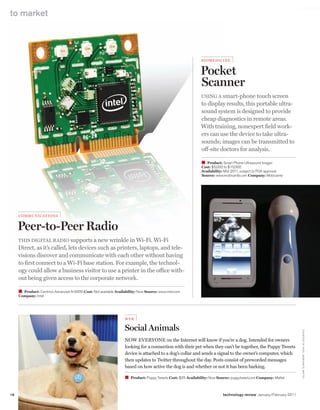
                                                                                                                   Pocket
                                                                                                                   Scanner
                                                                                                                   UsINg a smart-phone touch screen
                                                                                                                   to display results, this portable ultra-
                                                                                                                   sound system is designed to provide
                                                                                                                   cheap diagnostics in remote areas.
                                                                                                                   with training, nonexpert field work-
                                                                                                                   ers can use the device to take ultra-
                                                                                                                   sounds; images can be transmitted to
                                                                                                                   off-site doctors for analysis.

                                                                                                                   W Product: Smart Phone Ultrasound Imager
                                                                                                                   Cost: $5,000 to $10,000
                                                                                                                   Availability: Mid-2011, subject to FDA approval
                                                                                                                   Source: www.mobisante.com Company: Mobisante


         Commun i C ati o n s


         Peer-to-Peer Radio
         ThIs dIgITal radIo supports a new wrinkle in wi-Fi. wi-Fi
         direct, as it’s called, lets devices such as printers, laptops, and tele-
         visions discover and communicate with each other without having
         to first connect to a wi-Fi base station. For example, the technol-
         ogy could allow a business visitor to use a printer in the office with-
         out being given access to the corporate network.

         W Product: Centrino Advanced-N 6000 Cost: Not available Availability: Now Source: www.intel.com
         Company: Intel


                                                                       Web

                                                                       Social Animals
                                                                                                                                                                          C o U rTe Sy o F I NTe l; M o b I SANTe; MATTe l


                                                                       Now everyoNe on the Internet will know if you’re a dog. Intended for owners
                                                                       looking for a connection with their pet when they can’t be together, the Puppy Tweets
                                                                       device is attached to a dog’s collar and sends a signal to the owner’s computer, which
                                                                       then updates to Twitter throughout the day. Posts consist of preworded messages
                                                                       based on how active the dog is and whether or not it has been barking.

                                                                       W   Product: Puppy Tweets Cost: $25 Availability: Now Source: puppytweet.com Company: Mattel


    18   To Market                                                                                                             technology review January/February 2011

worldmags
worldmags


            Access daily news, watch award-winning videos, listen to audio
            playlists and much more. Get it today.
            Download for free at www.technologyreview.com/apps

worldmags
worldmags


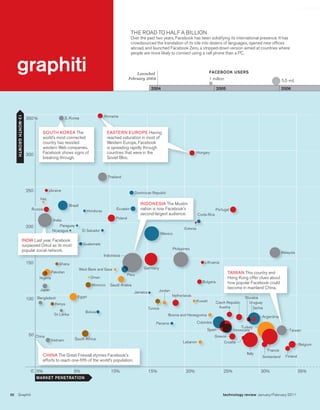
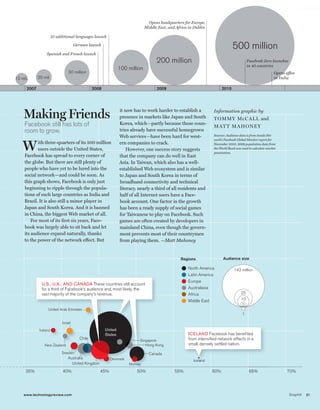
                                                                                                   THE ROAD TO HALF A BILLION
                                                                                                   Over the past two years, Facebook has been solidifying its international presence. It has
                                                                                                   crowdsourced the translation of its site into dozens of languages, opened new offices
                                                                                                   abroad, and launched Facebook Zero, a stripped-down version aimed at countries where
                                                                                                   people are more likely to connect using a cell phone than a PC.


         graphiti                                                                                    Launched
                                                                                                 February 2004
                                                                                                                                                       FACEBOOK USERS
                                                                                                                                                       1 million                                      5.5 mil.
                                                                                                               2004                                         2005                                      2006


                                                                                  Romania
         12-MONTH GROWTH


                           350 %                       S. Korea


                                     SOUTH KOREA The                                EASTERN EUROPE Having
                                     world’s most connected                         reached saturation in most of
                                     country has resisted                           Western Europe, Facebook
                                     western Web companies.                         is spreading rapidly through
                           300       Facebook shows signs of                        countries that were in the                                Hungary
                                     breaking through.                              Soviet Bloc.


                                                                                    Thailand


                           250            Ukraine
                                                                                                     Dominican Republic
                                   Iraq
                                                          Brazil                                        INDONESIA The Muslim
                             Russia                                    Honduras
                                                                                         Ecuador        nation is now Facebook’s                           Portugal
                                                                                                        second-largest audience.              Costa Rica
                                                                                        Poland
                                              India
                           200                   Paraguay
                                                                                                                                    Estonia
                                             Nicaragua              El Salvador
                                                                                                                        Mexico
                     INDIA Last year, Facebook
                     surpassed Orkut as its most                     Guatemala
                     popular social network.                                                                                 Philippines
                                                                                                                                                                                                      Malaysia
                                                                                  Indonesia
                           150                   Ghana                                                                                            Lithuania
                                                                   West Bank and Gaza                     Germany
                                             Pakistan                                                                                                              TAIWAN This country and
                                                                                                 Peru
                                   Nigeria                               Oman                                                                                      Hong Kong offer clues about
                                                                                                                                                 Bulgaria          how popular Facebook could
                                                                          Morocco    Saudi Arabia
                                   Japan
                                                                                                                                                                   become in mainland China.
                                                                                                    Jamaica         Jordan
                                                               Egypt                                                         Netherlands
                           100 Bangladesh                                                                                                                                     Slovakia
                                                                                                                                              Kuwait        Czech Republic       Uruguay
                                               Kenya
                                                                                                              Tunisia                                         Austria              Serbia
                                                                      Bolivia
                                              Sri Lanka                                                                    Bosnia and Herzegovina                                       Argentina
                                                                                                                   Panama                     Colombia
                                                                                                                                                                             Turkey
                                                                                                                                                    Spain             Venezuela                           Taiwan
                            50 China                                                                                                                      Greece
                                             Vietnam         South Africa
                                                                                                                                   Lebanon                      Croatia
                                                                                                                                                                                                                  Belgium
                                                                                                                                                                                            France
                                     CHINA The Great Firewall stymies Facebook’s                                                                                               Italy
                                                                                                                                                                                        Switzerland     Finland
                                     efforts to reach one-fifth of the world’s population.

                             0 0%                            5%                       10%                     15%                    20%                        25%                    30%                        35%
                                 MARKET PENETRATION


    20    Graphiti                                                                                                                                              technology review January/February 2011

worldmags
worldmags


                                                                                        Opens headquarters for Europe,
                                                                                      Middle East, and Africa in Dublin

                               21 additional languages launch

                                              German launch
                                                                                                                                       500 million
                         Spanish and French launch
                                                                                            200 million                                           Facebook Zero launches
                                                                                                                                                  in 45 countries
                                                                        100 million
                                         50 million                                                                                                                 Opens o ce
      12 mil.       20 mil.                                                                                                                                         in India

             2007                                       2008                                2009                                2010


            Making Friends                                              it now has to work harder to establish a
                                                                        presence in markets like Japan and South
                                                                                                                           Information graphic by
                                                                                                                           TOMM Y McCA LL and
            Facebook still has lots of                                  Korea, which—partly because those coun-
                                                                                                                           MAT T M A HONEY
            room to grow.                                               tries already have successful homegrown
                                                                        Web services—have been hard for west-              Sources: Audience data is from Inside Net-


            W
                                                                                                                           work’s Facebook Global Monitor report for
                   ith three-quarters of its 500 million                ern companies to crack.                            November 2010; 2009 population data from
                   users outside the United States,                         However, one success story suggests            the World Bank was used to calculate market
                                                                                                                           penetration.
            Facebook has spread to every corner of                      that the company can do well in East
            the globe. But there are still plenty of                    Asia. In Taiwan, which also has a well-
            people who have yet to be lured into the                    established Web ecosystem and is similar
            social network—and could be soon. As                        to Japan and South Korea in terms of
            this graph shows, Facebook is only just                     broadband connectivity and technical
            beginning to ripple through the popula-                     literacy, nearly a third of all residents and
            tions of such large countries as India and                  half of all Internet users have a Face-
            Brazil. It is also still a minor player in                  book account. One factor in the growth
            Japan and South Korea. And it is banned                     has been a ready supply of social games
            in China, the biggest Web market of all.                    for Taiwanese to play on Facebook. Such
                For most of its first six years, Face-                   games are often created by developers in
            book was largely able to sit back and let                   mainland China, even though the govern-
            its audience expand naturally, thanks                       ment prevents most of their countrymen
            to the power of the network e ect. But                      from playing them. —Matt Mahoney


                                                                                                         Regions                 Audience size

                                                                                                             North America              143 million
                                                                                                             Latin America
                                                                                                             Europe
                      U.S., U.K., AND CANADA These countries still account
                      for a third of Facebook’s audience and, most likely, the                               Australasia
                      vast majority of the company’s revenue.                                                Africa                          25
                                                                                                             Middle East                     10
                                                                                                                                             2
                          United Arab Emirates
                                                                                                                                              1

                                     Israel
                     Ireland                                   United
                                                               States                                        ICELAND Facebook has benefited
                                                Chile                             Singapore                  from intensified network effects in a
                        New Zealand                                                  Hong Kong               small, densely settled nation.
                                    Sweden                                              Canada
                                         Australia                Denmark                                       Iceland
                                           United Kingdom                   Norway
            35%                      40%                    45%                  50%                  55%                 60%                      65%                    70%


            www.technologyreview.com                                                                                                                                       Graphiti   21

worldmags
worldmags


         Q&A
                                                         TR: What’s a good way to describe just         ting huge investments in the last-mile
                                                         how much Internet traffic has exploded?        networks. Why? There’s huge money to
                                                            Sagan: This year, in one week we deliv-     be made in both. If you’re in the middle,
                                                         ered as much data as we did in all of 2005.    there’s not a lot of money to be made, and
                                                         Why do you think there’s still room for so     so as we’ve seen Internet traffic skyrocket
                                                         much more?                                     for 15 years, the middle always lags what’s
                                                            If you think of the capacity as the sum     going on at the first and the last mile, and

         Paul Sagan                                      of the last miles, rather than wherever        that’s not going to change. [But] our view
                                                         the narrowest point is at any given time,      is, if you can skip the middle, the Internet
                                                         capacity is much greater. If you said, “I’m    will continue to scale along.
         The CEO of a company that
         plays a crucial role in delivering              going to use one data center to deliver
                                                                                                        We’ve heard dire claims about the state
         Web traffic tells us not to worry               [online video streams of ] the World           of the Internet for a long time.
         about the Internet’s capacity.                  Cup”—several terabits a second of simul-          Predictions that the Internet is going
                                                         taneous traffic for over a million users—      to crash are not new. They’ve been around
                                                         you simply can’t get that much capacity        as long as we’ve been here, and even back
                                                         out the door, let alone through all the net-   to dial-up. And there are many good
                                                         works that make up the Internet, to the        business opportunities that people have

         Y    ou could be excused for doubting that
              the Internet can keep up with the rap-
         idly increasing demands on it. In addition
                                                         edges. We were able to do it because we
                                                         were delivering it from the edges, where
                                                         people connect to.
                                                                                                        found by investing to make sure that that
                                                                                                        doesn’t happen. And I think it’s going
                                                                                                        to continue to happen. I don’t think the
         to all the e-mails, songs, Skype calls, and
                                                         You’re making copies of videos and other       Internet is just going to crash and burn
         Web pages flitting about, the amount of
                                                         Web content and distributing them from         because there’s too much video.
         video online is mushrooming. By 2014,           strategic points, on the fly.
         video will account for roughly half of             Or routes that are picked on the fly, to    And it’s not all or nothing with video,
         consumer Internet traffic, up from just 12                                                     right? Services like yours can adjust the
                                                         route around problematic conditions in
         percent in 2006, according to Cisco Sys-                                                       quality of a video stream to make it take
                                                         real time. You could use Boston [as an         up less bandwidth if needed.
         tems. If the Internet’s ability to handle all   analogy]. How do you want to cross the             People in fact have that experience
         that traffic can’t keep scaling, the result-    Charles to, say, go to Fenway from Cam-        today and they don’t even know. They’re
         ing congestion will slow all kinds of appli-    bridge? There are a lot of bridges you         watching on a big screen, the bandwidth
         cations for everyone.                           can take. The Internet protocol, though,       is varying a little bit in the background,
             But Paul Sagan, CEO of Akamai Tech-         would probably always tell you to take         and we’re delivering an uninterrupted
         nologies, says that people underestimate        the Mass. Ave. bridge, or the BU Bridge,       picture. There’s almost the equivalent of a
         how much capacity there is. He’s in a           which is under construction right now          power brownout in the background, but
         position to know, because Akamai ushers         and is the wrong answer. But it would just     it’s not affecting their experience.
         along 15 to 30 percent of Web traffic. The      keep trying. The Internet can’t ever figure
         company, which was founded by an MIT            that out—it doesn’t. And we do.                Isn’t the problem of getting bits across
         mathematician and graduate students in                                                         the last mile much thornier for wireless?
         1998, has ingenious methods for speed-          But there must be an increase in demand            There is a challenge in wireless, which
                                                         that the architecture couldn’t handle.         is: as new as that infrastructure is, it was
         ing the delivery of Web content. One such
                                                            Sure.                                       built for voice, not for data. These net-
         trick is to make sure popular pieces of
         content don’t get trapped in bottlenecks;       Couldn’t that be caused by millions of         works don’t even speak IP as the protocol
         Akamai’s technology makes highly sought         hours of high-definition video?                of the tower. So they’re taking Internet
         files available from 75,000 servers it has         I think what would happen, if it gets       traffic and then converting it to propri-
         stashed inside the networks of Internet         ahead of itself, is that people would have     etary protocols. That’s changing with 4G
         service providers. From there, the files        a less than good experience, and they’d        and probably what will follow that. And
         have an easier time going the “last mile”       stop watching some of it, and it would         as that happens, it gets easier for Akamai
         to end users. Sagan described his view          drop down, and the buildout would catch        to extend farther. There will be new
         of the Internet’s future to Technology          up. People are putting huge investments        things we’ll do in wireless over the next
         Review’s deputy editor, Brian Bergstein.        in data center capacity. And they’re put-      five years.


    22   Q&A                                                                                                   Photograph by po rt e r g if f or d

worldmags
worldmags


            www.technologyreview.com   Q&A   23

worldmags
worldmags


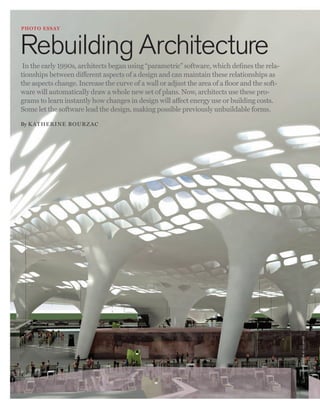
          p hoto e ssay


          Rebuilding Architecture
           In the early 1990s, architects began using “parametric” software, which defines the rela-
          tionships between different aspects of a design and can maintain these relationships as
          the aspects change. Increase the curve of a wall or adjust the area of a floor and the soft-
          ware will automatically draw a whole new set of plans. Now, architects use these pro-
          grams to learn instantly how changes in design will affect energy use or building costs.
          Some let the software lead the design, making possible previously unbuildable forms.

          By Katherin e Bourzac


                                                                                                                           c o u rte sy o f r e i s e r + u m e m oto


    24   Photo Essay                                                           technology review November/December 2010

worldmags
worldmags


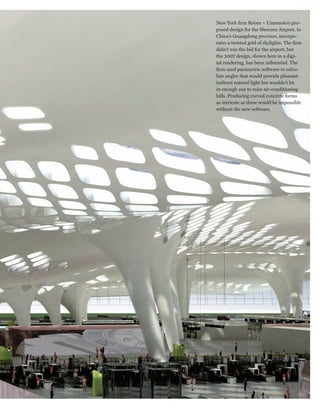
                                       New York firm Reiser + Umemoto’s pro-
                                       posed design for the Shenzen Airport, in
                                       China’s Guangdong province, incorpo-
                                       rates a twisted grid of skylights. The firm
                                       didn’t win the bid for the airport, but
                                       the 2007 design, shown here in a digi-
                                       tal rendering, has been influential. The
                                       firm used parametric software to calcu-
                                       late angles that would provide pleasant
                                       indirect natural light but wouldn’t let
                                       in enough sun to raise air-conditioning
                                       bills. Producing curved concrete forms
                                       as intricate as these would be impossible
                                       without the new software.


            www.technologyreview.com                                     Photo Essay   25

worldmags
worldmags


    26   Photo Essay   technology review November/December 2010

worldmags
worldmags


                                                                                                                                         Frank Gehry, whose firm
                                                                                                                                         designed the 2004 Stata Cen-
                                                                                                                                         ter at MIT (above), was an
                                                                                                                                         early pioneer in software that
                                                                                                                                         went beyond conventional
                                                                                                                                         computer-aided design (CAD).
                                                                                                                                         Unlike earlier CAD programs,
                                                                                                                                         parametric design programs
                                                                                                                                         calculate changes to the entire
                                                                                                                                         structure necessitated by, for
                                                                                                                                         example, changing the slope
                                                                                                                                         of a wall. Architects are now
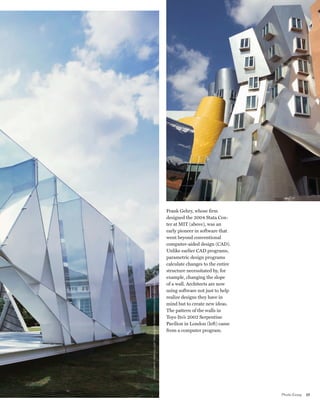
                                       R i c haR d Waite /aR cai d/c o R b i s( s e R p e nti n e); J e f f titc o m b / alamy (stata)


                                                                                                                                         using software not just to help
                                                                                                                                         realize designs they have in
                                                                                                                                         mind but to create new ideas.
                                                                                                                                         The pattern of the walls in
                                                                                                                                         Toyo Ito’s 2002 Serpentine
                                                                                                                                         Pavilion in London (left) came
                                                                                                                                         from a computer program.


            www.technologyreview.com                                                                                                                                       Photo Essay   27

worldmags
worldmags


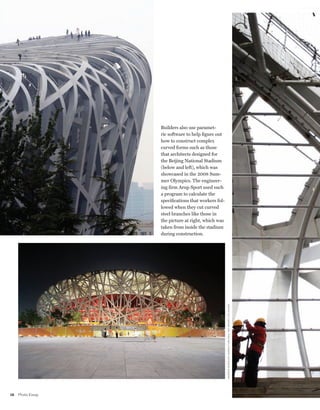
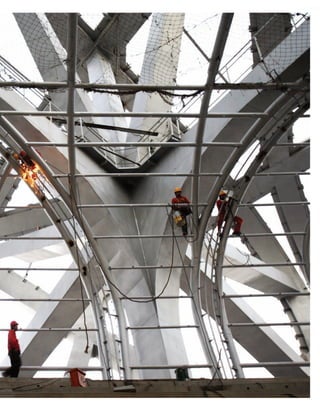
                       Builders also use paramet-
                       ric software to help figure out
                       how to construct complex
                       curved forms such as those
                       that architects designed for
                       the Beijing National Stadium
                       (below and left), which was
                       showcased in the 2008 Sum-
                       mer Olympics. The engineer-
                       ing firm Arup Sport used such
                       a program to calculate the
                       specifications that workers fol-
                       lowed when they cut curved
                       steel branches like those in
                       the picture at right, which was
                       taken from inside the stadium
                       during construction.
                                                          AN D R Ew wh E E lE R; S E R g i u Tu R cAN u; TAO i mAg E S lTD./AlAmy


    28   Photo Essay

worldmags
worldmags


            www.technologyreview.com   Photo Essay   29

worldmags
worldmags


    30   Photo Essay   technology review November/December 2010

worldmags
worldmags


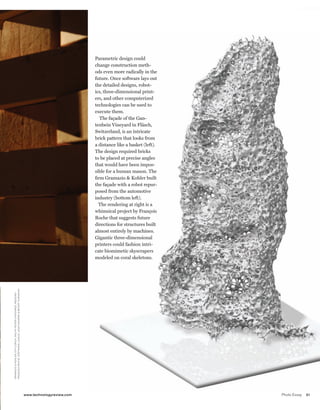
                                                                                                                                                                                                                    Parametric design could
                                                                                                                                                                                                                    change construction meth-
                                                                                                                                                                                                                    ods even more radically in the
                                                                                                                                                                                                                    future. Once software lays out
                                                                                                                                                                                                                    the detailed designs, robot-
                                                                                                                                                                                                                    ics, three-dimensional print-
                                                                                                                                                                                                                    ers, and other computerized
                                                                                                                                                                                                                    technologies can be used to
                                                                                                                                                                                                                    execute them.
                                                                                                                                                                                                                       The façade of the Gan-
                                                                                                                                                                                                                    tenbein Vineyard in Fläsch,
                                                                                                                                                                                                                    Switzerland, is an intricate
                                                                                                                                                                                                                    brick pattern that looks from
                                                                                                                                                                                                                    a distance like a basket (left).
                                                                                                                                                                                                                    The design required bricks
                                                                                                                                                                                                                    to be placed at precise angles
                                                                                                                                                                                                                    that would have been impos-
                                                                                                                                                                                                                    sible for a human mason. The
                                                                                                                                                                                                                    firm Gramazio & Kohler built
                                                                                                                                                                                                                    the façade with a robot repur-
                                                                                                                                                                                                                    posed from the automotive
                                                                                                                                                                                                                    industry (bottom left).
                                                                                                                                                                                                                      The rendering at right is a
                                                                                                                                                                                                                    whimsical project by François
                                                                                                                                                                                                                    Roche that suggests future
                                                                                                                                                                                                                    directions for structures built
                                                                                                                                                                                                                    almost entirely by machines.
                                                                                                                                                                                                                    Gigantic three-dimensional
                                                                                                                                                                                                                    printers could fashion intri-
                                                                                                                                                                                                                    cate biomimetic skyscrapers
                                                                                                                                                                                                                    modeled on coral skeletons.
                                                                                                F ranço i S r o c h E, STéP han i E lavau x, J Ean navar r o & B E n oîT d u ran d i n
     G rama z i o & Ko h lE r, ETh z u r i c h, ralP h F E i n E r (vi n Eyar d); r&S i E(n)/


                                                                                                                                                                                         www.technologyreview.com                                      Photo Essay   31

worldmags
worldmags


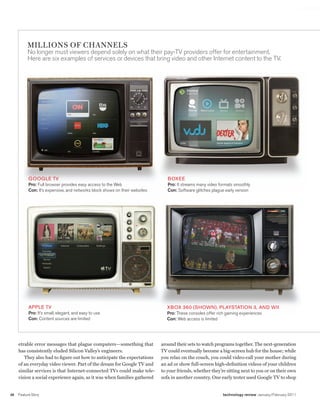
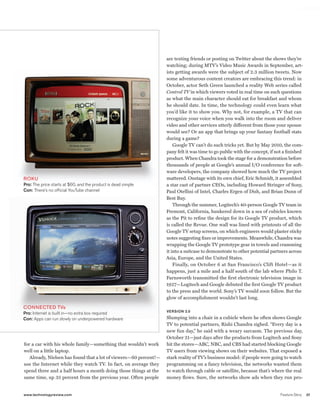
         Searching for
         the Future
         of Television
         Google and the geeks from Silicon Valley aim
         to revolutionize the 70-year-old TV industry.
         Conquering the Internet was easy in comparison.

         By R oBeRT D. Hof


         N
                       early every week from last February until mid-May,         try out countless variations on everything from the look of the
                       Google trotted wide-eyed visitors into a small room        search results to the background colors for the screen, hoping to
                       at its colorful headquarters in Mountain View, Cali-       learn what worked best.
                       fornia. Inside were a comfy couch and easy chairs, a          Google had good reason to sweat the details. Since the mid-
          tall fabric houseplant in a corner, and a large high-definition tele-   1990s, several costly efforts to bring the Web to the TV have fallen
          vision set atop a credenza. Under the watchful eyes of engineers        flat. Hybrids such as WebTV Networks, which disappeared into


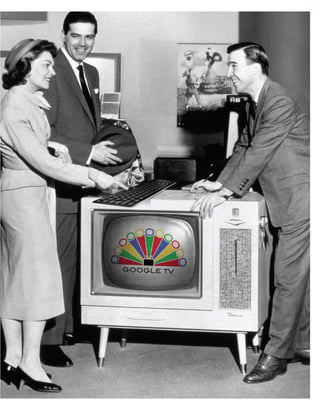
                                                                                                                                                           CAM E R I Q U E /C lAS S I C Sto C k/C o R b I S (p h oto); th E h EAd S o F StAtE (g o o g lE tv lo g o)
          and product managers on the other side of a mirrored window,            Microsoft in the late 1990s, suffered from myriad problems,
          the visitors would settle in with a wireless keyboard. They would       including poky network connections, underpowered hardware,
          search for and tune in to All My Children on ABC, catch a Glee          and clunky user interfaces. But even if they had worked better,
          episode on the Web, watch a recording of The Daily Show from            these earlier endeavors would still have suffered from a bigger
          a digital video recorder, or surf over to those witty Old Spice ads     problem: their developers seemed to forget that most people
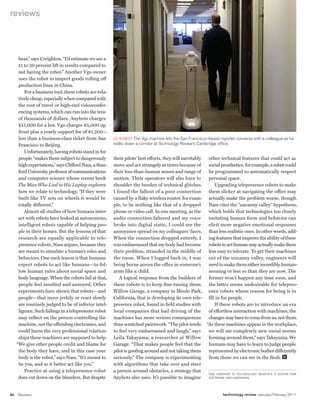
          on YouTube—all on that nice big TV screen.                              hadn’t bought their televisions to browse the Web. They just
             The company was testing one of the boldest bets in its 12-year       wanted to watch TV.
          history: Google TV. It is software that aims to give people an easy        They still do. But now new technologies and an increase in TV-
          way to access everything available on regular television channels       friendly Web content are swelling the variety of programming
          and the vast sea of content on the Internet, all on the biggest         choices well beyond what’s available through their coaxial cable,
          screen in the house—a bid to reinvent television for the Internet       satellite dish, or DVD player. As the Internet makes inroads into
          age. The initiative was set for its first public demonstration on       the last great mass medium, millions of people are starting to pro-
          May 20, and Google’s geeks had to make sure the product would           gram their own niche television experiences. For as little as $60,
          appeal to the average viewer, who watches about five hours of           new devices and software from TV makers, startups such as Roku
          television a day. So week after week, the Google TV team would          and Boxee, and giants such as Apple have made it a snap to deliver


    32   Feature Story                                                                                          technology review January/February 2011

worldmags
worldmags


            www.technologyreview.com   Feature Story   33

worldmags
worldmags


          online content to any set. In addition to what’s available online at       In theory, Google might offer a better business model to the
          no charge, programming can be streamed to TV sets from Netflix          television industry, but it has revealed few clues as to its plans
          for $8 a month or from Amazon Video on Demand starting at $1            for advertising on Google TV. In the absence of definitive plans,
          per episode.                                                            the networks have tended to imagine the worst: they fear that the
              The Google TV software, which is available on Sony’s line of        company is out to steal their advertising or disrupt their deals with
         “Internet TVs,” on a $400 Blu-ray player, and on a $300 set-top          cable operators. Neither of those things seems likely to happen in
          box and keyboard controller from the peripherals maker Logi-            the near future, and millions of people already view TV shows on
          tech, goes further than most other technologies on the market.          their PCs. But if the TV industry’s fears seem excessive, they’re also
          For now, Google TV is essentially a way to find and view video in       understandable given the travails of publishing in the Google age.
          a setting that’s more comfortable than sitting at a computer. But       As the Internet company tries to please consumers and navigate
          it also offers a full-fledged Web browser so viewers can reach any      the TV industry, Google TV could suggest how the battle for the
          website. “All of a sudden, all that content out on the Web, all those   soul of television will play out in 2011 and beyond.
          millions of channels, are now on your TV,” says Rishi Chandra,
          lead product manager for Google TV.                                     BEYOND A HOBBY
              Even without Google’s contribution, the consumer electron-          Google TV began with a vision Vincent Dureau had when he
          ics industry has already transformed the TV set into a computer         joined Google in August 2006 from OpenTV, a maker of set-top-
          that can be connected to the Internet. That means the future of         box software, where he had been chief technology officer. His
          television is now up for grabs: the screen, the industry, even the      new job was to help run Google TV Ads. That’s an initiative, still
          meaning of the word. Just as the Internet tore through newspa-          active, to bring to TV the self-service, auction-style system used
          pers, magazines, and music, it’s now poised to make television          in Google’s AdSense program, which places ads on mostly smaller
          the media battleground of the coming decade. That’s why Google          websites. For now, the TV Ads system isn’t generating substantial
          knows it has to be involved. If it wants to protect its leading role    revenue for Google or doing much to change mainstream TV; it
          on the Internet, maintain its prime position in online advertis-        mainly allows small advertisers to place ads in unsold time slots,
          ing, and grow into emerging markets, then it can’t risk letting         such as late at night, or on less popular stations. But Dureau also
          other companies control the online experience on the living-room        wanted to fulfill a longtime dream of creating a TV platform that
          TV. But getting the technology right is only part of what Google        could be improved faster, like a PC or a mobile phone. That would
          needs to do.                                                            require bringing Web applications and services to the TV. Prob-
              The company’s rise online was easier in some ways, because the      lem was, the Web and the TV still weren’t ready for each other.
          Internet is a completely open platform. Television is not. More-        Even when the first Apple TV device launched in March 2007, for
          over, television is run by executives who are loath to change lucra-    instance, it was mainly for playing video and music from iTunes
          tive business models built over decades. U.S. cable and broadcast       or a networked computer: it was a “hobby” for Apple, as CEO
          networks, local broadcast affiliate stations, and cable and satellite   Steve Jobs called it.
          operators take in more than $60 billion a year from advertising.           By mid-2007, Dureau saw that this situation would soon change.
          In addition, millions of monthly cable and satellite TV bills deliver   Home broadband speeds had improved sufficiently to handle video,
          $80 billion a year in revenue in the United States to operators such    and wireless home networks were becoming more common, pro-
          as Comcast and DirecTV, according to analysts at the Diffusion          viding Internet connections throughout a house. There was more
          Group. Those companies turn around and pay about $23 billion            to watch on the Web, too. ABC had just started streaming some
          annually in fees to cable networks like ESPN and HBO, which is          high-definition episodes of shows such as Lost and Grey’s Anatomy
          why pay TV is the largest profit engine for media companies such        online. And YouTube, since bought by Google, was a phenomenon,
          as Walt Disney, Time Warner, Viacom, and News Corp. Increas-            with visitors watching about 2.5 billion amateur videos and clips
          ingly, the Big Four broadcast networks—ABC, NBC, CBS, and               of TV shows, some of them illicitly uploaded, every month.
          Fox—are demanding, and getting, such fees as well.                         So Dureau, a soft-spoken but intense Frenchman whose palms
              Both revenue streams—the one from advertisers and the one           bear black calluses from propelling his wheelchair, decided to
          from viewers—could be threatened if the medium is fully opened          go for it. In October 2007, he made a pitch for Google TV to the
          to the Internet. The ability to scour the Web for programming           company’s operating committee, or OC. That’s the group of about
          to suit any interest could fracture the audience further, and that      a dozen executives, including CEO Eric Schmidt and cofounders
          would diminish the main attraction TV has for advertisers: its          Larry Page and Sergey Brin, who decide which major projects
          enormous reach. And the more content that is available free, the        Google will pursue. Dureau pointed out that there are four bil-
          less incentive viewers have to pay for cable.                           lion TV watchers worldwide—a billion more than the number of


    34   Feature Story                                                                                           technology review January/February 2011

worldmags
worldmags


            Web and cell-phone users combined. Reaching them had obvious           the company released its Android operating system, which lets
            potential for Google’s search ads or YouTube’s video ads. The OC       anyone offer applications for mobile phones and other consumer
            gave a thumbs-up. Dureau immediately began recruiting engi-            electronic devices. The ability to piggyback on Android makes
            neers, and the project got under way in earnest in early 2008.         Google TV more promising than many other Web TV schemes
                Since most standard Web pages look awful when viewed on a          that would bust open television to be remixed, reprogrammed,
            TV from 10 feet away, Dureau and his team initially assumed they       and remade.
            would need to create a “walled garden”: TVs would show a subset           Google made yet another key decision that would set its product
            of the Web tweaked through a custom interface or through curated       apart and get the attention of TV industry leaders. The devices
            apps like those offered by previous Web-TV hybrids. In late 2008,      offered by Roku, Boxee, Apple, and others are often described
            about a year into the project, Dureau changed his mind. He had         as “over the top,” because they offer content over and above what
            his Apple MacBook connected to a projection screen in a Google         people can get on pay TV. These devices connect to a TV with an
            conference room before a meeting, and the group started watch-         HDMI cable, and in order to get the extra content, viewers must
            ing YouTube videos. The picture quality was so decent, he recalls,     switch from the cable feed to a different input. By contrast, Google
            that “we started thinking, ‘How is that not television?’ ” That con-   TV runs right on the television, if you have the Sony model; oth-
            vinced him: a good chunk of the Web was ready for prime time.          erwise, it runs on devices that plug into both a cable or satellite
            So he reversed course and decided to offer the option of using a       feed and the TV. That allows viewers to search for and access TV
            full Web browser.                                                      and Web content at once. “We didn’t want users to have to choose
                                                                                   between the Web and TV content,” says Dureau. Google touts this

            even without Google’s                                                  design as an example of its effort to place the Web within the TV
                                                                                   experience. But it could also wrest control of the main TV screen
            contribution, the consumer                                             from cable operators.

            electronics industry has                                                  By early 2009, using generic Intel desktop computers and full-
                                                                                   size keyboards from Best Buy, Google began producing prototypes
            already transformed the TV                                             to show prospective electronics manufacturers. It also worked

            set into a computer that can                                           out a partnership with Dish Network—its first and, so far, only
                                                                                   deal with a satellite or cable distributor. That was a breakthrough,
            be connected to the Internet.                                          because it lets Google TV provide a more comprehensive and
                                                                                   personalized TV experience. Dish customers can use the Google
            That means the future of TV                                            product to seamlessly search for content on TV, the Net, and their
            is now up for grabs: the screen,                                       own DVRs.
                                                                                      Other partnerships came about with the help of Intel, which
            the industry, even the meaning                                         ended up becoming the microprocessor supplier for Google TV

            of the word.                                                           devices; the company had been touting “smart TV” for years in
                                                                                   hopes of getting its chips into new kinds of electronic gear. Logi-
                                                                                   tech, in the midst of a big push into universal TV remote controls,
                                                                                   was already talking to Intel about a video-calling device for the
                As luck would have it, the company was working on one, which       television. Executives at Intel, realizing that they might coördi-
            it launched as Chrome in September 2008. That gave Google              nate efforts with Google TV, set up meetings between the two
            TV a ready-made way to access the Web. It wouldn’t be perfect          companies in mid-2009, and Logitech soon signed on to create
            for many Web pages, which can still be hard to read and navi-          a Google TV set-top box. Intel also connected Google with Sony,
            gate from the distance of the couch—but then, neither was the          which became Google TV’s other electronics partner. In Septem-
            iPhone’s version of the Safari Web browser. Yet the prospect of        ber, as Sony and Logitech began hiring more engineers to work
            using a mobile device to go anywhere on the Web was so appeal-         on their products, Chandra joined the Google TV team to accel-
            ing that iPhone users didn’t mind the limitations, and Apple had       erate the push to the finish line.
            a runaway hit. Google hopes the same will happen on the TV—a
            typically Googley long shot.                                           GIVE PEOPLE WHAT THEY WANT
                At the same time, Dureau knew Google TV would need a lot of        Now it was time to turn Google TV into something tangible. That
            apps, to provide couch-friendly, one-click experiences. Another        meant Google and its partners had to design a user interface that
            stroke of luck: just a month after he got the okay for Google TV,      would work for the TV, without any of the glitches and impen-


            www.technologyreview.com                                                                                                       Feature Story   35

worldmags
worldmags


              MILLIONS OF CHANNELS
              no longer must viewers depend solely on what their pay-tV providers offer for entertainment.
              Here are six examples of services or devices that bring video and other Internet content to the tV.


               GooGLe tV                                                            BoXee
               Pro: Full browser provides easy access to the web                    Pro: It streams many video formats smoothly
               Con: It’s expensive, and networks block shows on their websites      Con: Software glitches plague early version


               APPLe tV                                                             XBoX 360 (SHoWn), PLAYStAtIon 3, And WII
               Pro: It’s small, elegant, and easy to use                            Pro: these consoles offer rich gaming experiences
               Con: Content sources are limited                                     Con: web access is limited


         etrable error messages that plague computers—something that             around their sets to watch programs together. The next-generation
         has consistently eluded Silicon Valley’s engineers.                     TV could eventually become a big-screen hub for the house; while
            They also had to figure out how to anticipate the expectations       you relax on the couch, you could video-call your mother during
         of an everyday video viewer. Part of the dream for Google TV and        an ad or show full-screen high-definition videos of your children
         similar services is that Internet-connected TVs could make tele-        to your friends, whether they’re sitting next to you or on their own
         vision a social experience again, as it was when families gathered      sofa in another country. One early tester used Google TV to shop


    36   Feature Story                                                                                          technology review January/February 2011

worldmags
worldmags


                                                                               are texting friends or posting on Twitter about the shows they’re
                                                                               watching; during MTV’s Video Music Awards in September, art-
                                                                               ists getting awards were the subject of 2.3 million tweets. Now
                                                                               some adventurous content creators are embracing this trend: in
                                                                               October, actor Seth Green launched a reality Web series called
                                                                               Control TV in which viewers voted in real time on such questions
                                                                               as what the main character should eat for breakfast and whom
                                                                               he should date. In time, the technology could even learn what
                                                                               you’d like it to show you. Why not, for example, a TV that can
                                                                               recognize your voice when you walk into the room and deliver
                                                                               video and other services utterly different from those your spouse
                                                                               would see? Or an app that brings up your fantasy football stats
                                                                               during a game?
                                                                                   Google TV can’t do such tricks yet. But by May 2010, the com-
                                                                               pany felt it was time to go public with the concept, if not a finished
                                                                               product. When Chandra took the stage for a demonstration before
                                                                               thousands of people at Google’s annual I/O conference for soft-
                                                                               ware developers, the company showed how much the TV project
            Roku                                                               mattered. Onstage with its own chief, Eric Schmidt, it assembled
            Pro: the price starts at $60, and the product is dead simple       a star cast of partner CEOs, including Howard Stringer of Sony,
            Con: there’s no official Youtube channel                           Paul Otellini of Intel, Charles Ergen of Dish, and Brian Dunn of
                                                                               Best Buy.
                                                                                   Through the summer, Logitech’s 40-person Google TV team in
                                                                               Fremont, California, hunkered down in a sea of cubicles known
                                                                               as the Pit to refine the design for its Google TV product, which
                                                                               is called the Revue. One wall was lined with printouts of all the
                                                                               Google TV setup screens, on which engineers would plaster sticky
                                                                               notes suggesting fixes or improvements. Meanwhile, Chandra was
                                                                               wrapping the Google TV prototype gear in towels and cramming
                                                                               it into a suitcase to demonstrate to other potential partners across
                                                                               Asia, Europe, and the United States.
                                                                                   Finally, on October 6 at San Francisco’s Clift Hotel—as it
                                                                               happens, just a mile and a half south of the lab where Philo T.
                                                                               Farnsworth transmitted the first electronic television image in
                                                                               1927—Logitech and Google debuted the first Google TV product
                                                                               to the press and the world. Sony’s TV would soon follow. But the
                                                                               glow of accomplishment wouldn’t last long.

            ConneCted tVs
                                                                               VERSION 2.0
            Pro: Internet is built in—no extra box required
            Con: Apps can run slowly on underpowered hardware                  Slumping into a chair in a cubicle where he often shows Google
                                                                               TV to potential partners, Rishi Chandra sighed. “Every day is a
                                                                               new fun day,” he said with a weary sarcasm. The previous day,
                                                                               October 21—just days after the products from Logitech and Sony
            for a car with his whole family—something that wouldn’t work       hit the stores—ABC, NBC, and CBS had started blocking Google
            well on a little laptop.                                           TV users from viewing shows on their websites. That exposed a
               Already, Nielsen has found that a lot of viewers—60 percent!—   stark reality of TV’s business model: if people were going to watch
            use the Internet while they watch TV. In fact, on average they     programming on a fancy television, the networks wanted them
            spend three and a half hours a month doing those things at the     to watch through cable or satellite, because that’s where the real
            same time, up 35 percent from the previous year. Often people      money flows. Sure, the networks show ads when they run pro-


            www.technologyreview.com                                                                                                     Feature Story   37

worldmags
worldmags


         grams on their websites, but online ads aren’t yet as lucrative as            Bypassing pay TV is precisely what more than a few people
         TV ads, because they can’t promise the massive audience reach             seem to be doing. U.S. cable and satellite TV companies together
         of TV. Even more important, cable operators might rethink those           lost 119,000 subscribers in the third quarter of 2010, according
         juicy fees they pay to run the networks’ shows if they’re available       to the market research firm SNL Kagan. That’s a minuscule drop
         free on Google TV. “There’s no constitutional right to get NCIS: LA       compared with the approximately 100 million subscribers overall,
         through the Google TV box,” Zander Lurie, senior vice president           and no doubt it was chiefly because of the poor economy. But it
         of strategic development at CBS, told a TV conference this fall.          was the second drop in a row, after a first-ever decline in the sec-
            It was a big blow. Without access to the latest shows—which            ond quarter. Meanwhile, Netflix added 4.7 million new customers
         often appear on the networks’ websites exclusively as soon as a day       in the first nine months of 2010.
         after being broadcast—Google TV might look crippled to prospec-               These subscriber losses may not be over for cable and satellite
         tive buyers. And the company had few options for fixing the situa-        companies, either. A September survey of 2,000 Americans by
         tion on its own. It could go the same route as Netflix and pay the        the market researcher Strategy Analytics found that 13 percent
         networks for the rights to their online content, but then Google          of them planned to drop their cable in the next 12 months. “My
         would become a provider of shows, not an independent conduit.             kids think I’m crazy for being in the pay-TV business, because
         Chandra had to deal with the fallout. Google TV respects TV’s             they don’t pay for TV, and [they] watch a lot of TV and movies
         established business dynamic, he insisted. It was a statement he          [online],” Dish Network’s Ergen complained during a conference
         had clearly recited many times—and one that might sound famil-            call with financial analysts in November.
         iar to publishers struggling to contend with Google’s impact on               Even customers who still have cable are rapidly altering their
                                                                                   behavior in a way that represents a fundamental challenge to the

         Many viewers prefer to pull in                                            television business. Already, with help from DVDs and the DVR,
                                                                                   many viewers have decided they’d prefer to pull in content when
         content when they want it,                                                they want it, where they want it, rather than glue themselves to

         rather than glue themselves to                                            the couch for appointment TV. As Internet TV devices give viewers
                                                                                   even more choices, says W. Russell Neuman, a professor of media
         the couch for appointment TV.                                             technology at the University of Michigan, “push technology is shift-

         Yet the TV advertising model                                              ing completely to pull.” Yet the TV advertising model still assumes
                                                                                   that people are watching live content and ads pushed out to them.
         still assumes that people are                                                 Through Google and other players, interactive TV, like the
                                                                                   Internet, could offer better targeting for advertisers. People could
         watching live content and com-                                            be shown an ad that their viewing habits indicate is probably rele-
         mercials pushed out to them.                                              vant to them—and networks could thus command higher ad prices
                                                                                   for smaller audiences. (In the advertising industry, this is called
                                                                                  “efficiency.”) Hulu, a joint venture of the parent companies of NBC,
         print media. “Our product is designed assuming you have cable,”           Fox, and ABC that streams episodes of many network shows online
         he said. “The best content is on cable. People are relatively sat-        without charge, boasts that Nielsen research finds people much
         isfied. What we’re trying to do is take that experience today and         more likely to recall the messages they’ve seen through targeted
         enhance it with a whole lot of other content you just can’t deliver       ads on its service than they are when the same ads air on prime-
         through cable technology.”                                                time broadcast TV. “We’re charging higher rates for more targeted
             Some cable networks—such as Time Warner’s stable, which               ads,” Hulu CEO Jason Kilar said recently.
         includes TBS, TNT, and HBO—are at least tentatively embracing                 But Google has offered no specific plans of its own yet, and ad
         Google TV. “We don’t want to be in the device-blocking business,”         buyers and ad sellers each have reasons to be suspicious of targeted
         says Jeremy Legg, senior vice president of business development           advertising. Brands that do the most TV advertising doubt that
         and multiplatform distribution for TBS. “We don’t think that’s            targeted ads will reach a big enough audience to be effective—the
         what the Internet is about.” However, HBO has a measure of pro-           key reason they’re continuing to spend on television. Networks
         tection: to reach HBO’s shows online, Google TV users have to             worry that the Internet’s emerging method of targeting people
         log in and “authenticate” themselves as cable subscribers. In other       according to their interests or online activity—a growing alter-
         words, Google is asking its users to prove that they are still putting    native to the traditional media model of buying space on sites or
         money into one of TV’s main revenue streams rather than getting           shows that promise a particular audience—could turn their ad
         most of their video online and cutting the cable cord.                    slots into lower-priced commodities.


    38   Feature Story                                                                                           technology review January/February 2011

worldmags
worldmags


                                                     Having observed the effects of more efficient advertising in      vice president of customer technology, “it’s definitely not a prod-
                                                  media like magazines and newspapers, networks and pay-TV             uct that I can market with a tag line.” Google’s Chandra concedes,
                                                  companies are experimenting with new business models, mostly “This is very clearly a Version 1.0 product.” Google and Logitech
                                                  subscription-based. Hulu has blocked access from Boxee—and           are working on 2.0, which is likely to come out in 2011, although
                                                  now from Google TV. It’s rolling out an $8-a-month service in        neither company will disclose its plans.
                                                  hopes of creating a new revenue stream beyond ads. Cable net-           But in the meantime, it might be easy for TV’s beleaguered
                                                  works are also exploring versions of the authentication model that   leaders to lose sight of the bigger picture. Disruptive technologies
                                                  HBO requires on Google TV. The cable companies call their ver- nearly always beget new ways to profit, sometimes even for the
                                                  sion TV Everywhere, but the point is the same: it will let viewers   incumbent players whose business model is being upended. Some
                                                  get shows online once they prove they already subscribe to cable. of them do recognize that potential. “This is a terrific time in the
                                                     Such efforts may well keep most people watching conventional      living room,” says CBS’s Lurie. “People are consuming more video.
                                                  cable and broadcast TV for some time to come—especially if prod- So there’s more opportunity for content providers to get paid.”
                                                  ucts such as Google TV fail to appeal to the mass audience. And         The upshot, says Chandra, is this: “Your TV is going to get bet-
                                                  initial reviews have been mixed: for all Google’s research and user  ter every day.” Google TV and its ilk may look like threats to the
      H. AR M StR o n g R o b E RtS/C o R b I S


                                                  testing, critics say it’s still too much like a computer. Moreover, TV business right now, but odds are that ultimately—one way or
                                                  Google TV and its rivals have few made-for-TV apps to offer, and     another—they will help make television an even more pervasive
                                                  there’s only one killer app for interactive TV so far: Netflix. More part of our lives.
                                                  could come in the first half of 2011, when Google will invite out-
                                                  side developers to create Google TV apps and offer them on its       RobERt D. HoF, FoRMER SIlICon VAllEY bUREAU CHIEF FoR BusinessWeek, IS A FREE-
                                                                                                                       lAnCE wRItER In PAlo Alto, CAlIFoRnIA. HE blogS AboUt tHE IntERnEt, MEDIA, AnD nEw
                                                  Android app marketplace. For now, says Vivek Khemka, Dish’s          tECHnologIES At RobHoF.CoM.


                                                  www.technologyreview.com                                                                                                                  Feature Story   39

worldmags
worldmags
         T H E H U M A N G E N O M E A D E C A D E L AT E R


     The
     Human
     Genome,
     a Decade
     Later
         Ten years after scientists
                                                              On June 13, 2010, the New York Times ran a front-page story about the
                                                              hyping of genomics. Headlined “A Decade Later, Gene Map Yields Few new
                                                              Cures,” the article asserted that the Human Genome Project, the results of
                                                              which were announced at a White House press conference in June 2000 and
                                                              published in detail in February 2001, had yet to deliver on its promise to find
                                                              the root causes of many common diseases. The genome, the story argued,

         finished mapping our                                 held more complexity than many scientists had imagined, making it difficult
                                                              to isolate the functions of the three billion DnA units, or base pairs, whose
         DNA, they have many                                  sequence the project had determined. Other journalists, and bloggers, soon
                                                              weighed in somberly on the dearth of results from the project, which had
         unanswered questions.                                taken 13 years and $3 billion to complete.
                                                                 The coverage outraged eric Lander, who was one of the leaders of the
         By JoN CoheN                                         Human Genome Project and now directs the Broad Institute, a leading
                                                              biomedical-research center that is a collaboration of Harvard university and
                                                              MIT. “I’d like to see a quote where I ever hyped it,” says Lander. “I’m on record
                                                              saying this is going to take a long time, and that the next step is to find the
                                                              basis of disease, and then you have to make drugs. I said this is going to help
                                                              our children’s children. Going from the germ theory of disease to antibiotics
                                                              that saved people’s lives took 60 years. We might beat that. But anybody who
                                                              thought in the year 2000 that we’d see cures in 2010 was smoking something.”
                                                                 Lander cites a long list of technological advances and scientific insights
                                                              that have come in the project’s wake. The price of sequencing DnA has
                                                              dropped from hundreds of millions of dollars per person to mere thousands.
                                                              The number of single-gene aberrations known to cause disease—illnesses


    40   Feature Story                                                                                  Illustration by pe T e r C r o w Th e r

worldmags
worldmags


    41
            www.technologyreview.com   Feature Story   41

worldmags
worldmags


         that are invariably rare and follow a simple Mendelian pattern of       and other mobile genetic elements that can cause mutations,
         inheritance—has jumped from around 100 to nearly 3,000. The             sticking themselves inside genes or deleting them altogether.
         growing list of common diseases that have been traced to mul-              none of these factors are newly discovered, Lander stresses. But
         tiple genetic variants includes everything from types of blindness      during the past 10 years, features once considered bit players have
         to autoimmune diseases and metabolic disorders like diabetes. taken on the status of lead actors, now often commanding as much
         Studies have linked more than 200 genes to cancer—nearly three          attention as genes themselves. So indeed, the genome contains far
         times the number that had been known of before.                         more inconvenient truths than was supposed a decade ago. The
             Lander concedes that many features of the human genome              very idea of what we inherit and what we pass on has changed.
         have only recently come into clear focus—features suggesting that          Yet it is “the height of silliness,” Lander contends, to suggest
         it’s more of a moving target than was previously thought. Genes, that this complexity makes it more difficult to develop diagnostics,
         traditionally described as regions of DnA that code for proteins, treatments, and cures. He gives the example of recent studies that
         have long been a main focus of researchers, of course. Recent           have linked nearly 100 genes to lipid metabolism. One of these,
         studies, however, have emphasized the extraordinary power of            which has a tiny effect by itself, is the target of the statin drugs
         DnA regions that do not hold the code for a protein itself but, that many people take to lower cholesterol. That dozens of genes
         rather, control the on/off switches that direct gene “expression,” are involved in a problem, then, does not mean you need dozens
         or the extent to which that protein is actually produced. An entire     of drugs to attack it; rather, he says, it reveals that there are doz-
         world of microRnAs has moved to center stage because of their           ens of ways to intervene. “All biological science works by collecting
         ability to silence genes.                                               the complexity and recognizing it is part of a limited repertoire of
             The fledgling field of epigenetics is showing how two organisms     events,” he says. “What’s exciting about the genome is it’s gotten
         with identical genetic sequences can have different characteristics     us the big picture and allowed us to see the simplicity.”
            DISEASE/
         because of heritable non-DnA factors HERITABILITY                   PERCENTAGE OF OVERALL
                                                     like methyl groups, which      The main challenge today isNUMBER OFIDENTIFIED order to
                                                                                                                                GENETIC
                                                                                                                     to catalogue and bring
            TRAIT                         OVERALL                            HERITABILITY EXPLAINED                 LOCATIONS
         are common reactive chemical entities that alter the behavior of        what often looks like chaos—a task that is hardly surprising to
            AMD*                          45% to 70%                         50%                                    12
         genes. Many diseases have now been linked to extra or missing           those who have worked on the genome for years. As Marc Vidal,
            Crohn's disease               50% to 60%                         23%                                    71
         copies of genes, a phenomenon called copy-number variation. a geneticist at the Dana-Farber Cancer Institute in Boston, says,
            Type 2 diabetes               30% to 70%                         10%                                    38
         Researchers are also paying increased attention to transposons “From the mid-1990s, there was a strong sense that just sequenc-
            Height                        60% to 80%                         15%                                    180
                                                                                 ing the genome wasn’t going to be enough.”
            Note: *Age-related macular degeneration
            Sources: Wei Chen et al., PNAS, 2010 (AMD); Andre Franke et al., Nature Genetics, 2010 (Crohn's disease);
            Benjamin F. Voight et al., Nature Genetics, 2010 (type 2 diabetes); Hana Lango Allen et al., Nature Genetics, 2010 (height)
                                                                                                                 ShortcutS
             Sequencing on the cheap                                                                            The increased understanding of the human genome has been
             The cost per million DNA base pairs
                                                                                                                driven largely by rapid advances in technology. And the single most
             has plummeted in recent years.
                                                                                                                profound advance has been in the cost and the speed of sequencing.
            Cost to sequence DNA                           Cost per million base pairs, log scale              “The cost dropped by a factor of 10 every year for the last five to
                                                                                      $10,000,000               six years, so it’s a truly amazing exponential decrease compared to
            $2,000,000                                                                                          the computer industry,” says Harvard university geneticist George
               in 2002                                                                   1,000,000
                                                                                                                Church, who helped develop many key sequencing technologies.
                                                                                           100,000                  even with the advances in technology, however, it still costs in the
                                                                                                                neighborhood of $20,000 to sequence a complete human genome—
                                                                                             10,000
                                                                                                                a lot less than $3 billion, but still a high price tag. And the field’s main
                                                                                               1,000            strategy for connecting genetic makeup to observable traits—geno-
                                                                                                                type to phenotype—is to compare large numbers of individuals in
                                                                                                 100            hopes of identifying the differences that might explain, for example,
                                                                                                   10           why one group develops schizophrenia and another does not.
                                                                                                                    During the past decade, genome-wide association studies, which
                                                                                        83¢       1             screen many individuals in order to identify genetic variations
                                                                                        in 2009
                                                                                                                                                                                                c hArTS by To m my mccAll


                                                                                                0.1             shared by people with a particular disease, became the standard
                            ’02     ’03    ’04     ’05     ’06     ’07    ’08     ’09                           technique for comparing DnA from large groups of people with-
            Source: Peter A. Carr and George M. Church, Nature Biotechnology, 2009                              out the need for complete sequences. These studies have received
                                                                                                                intense scrutiny: they were the focus of the New York Times article
                                                                                                                Landers assailed and of many critiques in the scientific literature.


    42   Feature Story                                                                                                                            technology review January/February 2011

worldmags
worldmags
                                                                                                      T H E H U M A N G E N O M E A D E C A D E L AT E R


            “All biological science works                                           Goldstein about the role of rare variants in disease, and they fur-
                                                                                    ther argued that the same mutation might cause different illnesses
             by collecting the complexity                                           in different people, while different mutations might all cause the

             and recognizing it is part of                                          same illness. Moreover, they wrote, if a mutation is so rare that
                                                                                    it’s found only in a few individuals and their immediate families,
             a limited repertoire of events.                                        analyzing thousands of unrelated people will miss the genetic roots
                                                                                    of disease. They concluded that the number of genetic pathways
             what’s exciting about the                                              to disease is “far greater than previously appreciated.”
             genome is it’s gotten us the                                               Such criticisms miss the point, according to geneticist David
                                                                                    Altshuler of Massachusetts General Hospital in Boston, who says
             big picture and allowed us to                                          the attacks on genome-wide association studies ignore abundant
             see the simplicity.”                                                   evidence that these studies have uncovered important links to dis-
                                                                                    ease. Some studies that tried to tie common variants to common
                                                                                    traits found very weak associations, he concedes, but he points to
                The first round of these studies attempted to discover disease      several that revealed relatively large genetic factors in diabetes,
            genes by focusing on mutations involving variations in a single         heart disease in South Asians, kidney failure in African-Americans,
            DnA base pair—mutations that were relatively common, affect-            and sickle-cell anemia in europeans, among other illnesses.
            ing more than 5 percent of the population. The idea is that these           Altshuler acknowledges that genome-wide association studies
            common variants, called single-nucleotide polymorphisms (SnPs),         have their deficiencies, but he says that given the cost of sequencing,
            tend to occur in certain patterns within the genome and get passed      this shortcut has been a great boon to science. “In 10, 20 years, will
            down together. Thus, they serve as markers for surrounding DnA:         you put a drop of blood in a machine and get a perfect sequence,
            people who share sets of SnPs, which are known as haplotype             and that’s all you do? Yes,” he says. “In 2010, is that all you should
            blocks, should turn out to share the same versions of specific genes.   do? not unless you’re rigid. It costs a lot more to sequence.”
            A study called the HapMap project, which looked at more than 200            even the complete DnA sequence assembled by the Human
            people from four different populations, established a catalogue of      Genome Project had a critical limitation: each individual harbors
            human variation that researchers hoped would allow genome-wide          much more variation than it detected. We have a diploid genome,
            association studies to find everything from genetic factors that        with one chromosome inherited from each of our parents. Thus, we
            make people sick to evolutionary traits in populations. The asso-       have two copies each of 23 different chromosomes, but the Human
            ciations between specific haplotypes and traits did not pinpoint        Genome Project simply sequenced 23 chromosomes—a compos-
            genetic causes but spotlighted small regions on chromosomes—            ite set assembled from several individuals. In 2007, Craig Venter,
            regions that were thought to hold the answers.                          who led a private sequencing effort that was a leading competitor
                But it turned out, as Duke university geneticist David Goldstein    to the Human Genome Project, worked with Stephen Scherer, a
            argued in a critique published in the April 23, 2009, issue of the      medical geneticist at the Hospital for Sick Children in Toronto, to
            New England Journal of Medicine, that “common variation is              sequence his complete diploid genome and found more than four
            packing much less of a phenotypic punch than expected.” A study         million differences between the chromosomes he inherited from
            on height, Goldstein noted, had found 20 variants that together         his mother and his father. extrapolating from this finding sug-
            explained only about 3 percent of the variation found in humans.        gested that the amount of variation between humans was not 0.1
            These sorts of results have led some researchers to scratch their       percent, as the Human Genome Project had estimated, but more
            heads about “missing heritability” and the “dark matter” of the         like 0.5 percent. “For all studies, you should look at the genome
            genome. A key problem in using genome-wide association stud-            in a diploid context,” says Scherer. “That’s where we need to go.”
            ies to search for the genetic roots of disease, Goldstein contended,
            is that many common diseases might be attributable to a number          the cell
            of rare variants rather than to a few common ones. He also rea-         Over the last decade, researchers have charted many nuanced
            soned that these studies will have little relevance in cases where      features of the genome, and they are now fine-tuning sequencing
            large numbers of genes each make a small contribution to a disease,     methods and other technologies that will expand their under-
            because “in pointing at everything, genetics would point at nothing.”   standing of the genomic landscape. But by and large, the dream
                An essay in Cell a year later by Mary-Claire King and Jon           of applying that knowledge to benefit human health remains just
            McClellan of the university of Washington in Seattle fired another      that. Finding usable medical information amid the huge amount
            salvo at the genome-wide association studies. They agreed with          of genomic data is an immense challenge.


            www.technologyreview.com                                                                                                           Feature Story   43

worldmags
worldmags
         T H E H U M A N G E N O M E A D E C A D E L AT E R


              The Gene FacTor
              researchers have found only a fraction of the genetic component to common diseases and traits.
               DISEASE/                                                                                     PERCENTAGE OF OVERALL                        NUMBER OF GENETIC
               TRAIT                                     OVERALL HERITABILITY                               HERITABILITY EXPLAINED                       LOCATIONS IDENTIFIED
               AMD*                                      45% to 70%                                         50%                                          12
               Crohn's disease                           50% to 60%                                         23%                                          71
               Type 2 diabetes                           30% to 70%                                         10%                                          38
               Height                                    60% to 80%                                         15%                                          180

               Note: *Age-related macular degeneration
               Sources: Wei Chen et al., PNAS, 2010 (AMD); Andre Franke et al., Nature Genetics, 2010 (Crohn's disease);
               Benjamin F. Voight et al., Nature Genetics, 2010 (type 2 diabetes); Hana Lango Allen et al., Nature Genetics, 2010 (height)


             A variety of different schemes now attempt to make sense of                                       work is the unquestioned faith that everything can be learned in
          these mountains of data, aiming to catalogue all proteins (the                                       reductionist approaches and model systems. We need them, but
                Cost to sequence DNA                          Cost per million base pairs, log scale
          proteome), RNA molecules (the transcriptome), metabolites                    $10,000,000
                                                                                                               we need substantial investment in studying the human being.”
          (the $2,000,000
                metabolome), and interactions (the interactome). But some                                         Harvard’s Church agrees that not enough has been done to link
          researchers argue that it’s crucial to put this vast collection of data
                     in 2002                                                              1,000,000            genomic data to observable traits. In 2004, he launched a Per-
          in biological context. Sydney Brenner, a scientist at the Salk Insti-                                sonal Genome Project that ultimately aims to sequence the DNA
                                                                                            100,000
          tute for Biological Studies in La Jolla, California, and the University                              of 100,000 people who voluntarily share their medical records
          of Cambridge in England, takes a particularly harsh view.10,000                     “This            and facts about their lifestyles. Without that information, under-
         ‘omic’ science has corrupted us,” says Brenner, who won a Nobel                                       standing how an individual’s DNA sequence causes or is linked to
                                                                                              1,000
          Prize in 2002 for leading a project that four years earlier completed                                diseases is problematic, says Church: “It’s a barrier to interpreta-
          the first entire sequence of a multicelled organism, the worm 100                     Cae-           tion. It ends up oversimplifying what has to be one of the most
          norhabditis elegans. “It has created the idea that if you just collect                               complicated biological problems—how humans work.”
                                                                                                 10
          a lot of data, it will all work out.”                                                                   Daunting as the challenge has been to uncover the genetic basis
             Brenner contends that the organizing principle for thinking                83¢        1           of diseases, Altshuler says great strides have been made over the
          about the genome can be found in the cell, the basic unit of life.            in 2009                past decade. “The era of mapping genes for diseases is going to be
                                                                                                 0.1
          In an essay he published ’04 the January ’07 2010, ’09 of Philo-
                                 ’02 ’03 in ’05 ’06                   12, ’08 issue                            over very soon,” he predicts. “I’m not sure whether it will be five
          sophical Transactions of the Royal Society B, Brenner outlined a                                     years or 10 years—and I don’t mean we’ll explain all the herita-
                Source: Peter A. Carr and George M. Church, Nature Biotechnology, 2009
          project called CellMap, which would catalogue every type of cell                                     bility. But once we’ve sequenced a hundred thousand people or a
          in the body and detail how different genetic regions (not genes)                                     million, we’ll know what there is to know.”
          behave in each cellular environment. He compared it to a city map                                       A decade after the completion of the Human Genome Proj-
          that identifies each house, the people who live inside it, and the                                   ect, scientists are still finding fundamental surprises in the way
          interactions within and between the houses. “I think we should be                                    we inherit diseases (see “The Genome’s Dark Matter,” p. 52). Still,
          doing genetics, not genomics,” says Brenner. “When you do genet-                                     despite the unknowns, researchers are beginning to use genome
          ics, you are focusing on function. When you do genomics, these are                                   data to unravel one of medicine’s greatest mysteries: how and why a
          just letters and numbers. Nobody bothers about the connections.”                                     cell turns cancerous (see “Cancer’s Genome” p. 46). The gap between
             A cell-centric approach is only one possible route to under-                                      the promise of the Human Genome Project and the realization of
          standing genomic data. But the conviction that DNA sequences                                         that promise in the clinic will surely narrow as researchers discern
          and other genetic information won’t be medically useful until they                                   the complex and subtle details of the genomic landscape and the
          are better connected to biology is a common one among scientists.                                    conditions that shape it. That this is taking time should come as
          Instead of starting with DNA and hoping to determine how it leads                                    no surprise. As Lander says, “When people say the genome is so
          to complex diseases, they say, the focus needs to be on patients                                     much more complicated than we thought, you have to step back
          and what, biologically speaking, has gone wrong; then research-                                      and say, ‘How simple did you think it would be?’ ”
          ers can try to understand the underlying genetics. “Let’s start with
          the patient and work backward,” says Altshuler. “Something that                                      Jon Cohen iS an author and SCienCe JournaliSt baSed in San diego. hiS lateSt book
                                                                                                               iS Almost ChimpAnzee: seArChing for WhAt mAkes Us hUmAn, in rAinforests, lAbs,
          has profoundly diminished the biomedical impact of [genomic]                                         sAnCtUAries, And zoos .


    44   Feature Story                                                                                                                              technology review January/February 2011

worldmags
worldmags


                                15th Annual       MITX Interactive Awards
                                                             The MITX Interactive Awards program celebrates the
                                                             most creative and innovative web applications and
                                                             marketing strategies that move brands and build busi-
                                                             nesses around the globe. We applaud the accomplish-
                                                             ments of the companies who entered our 15th annual
                                                             competition and all of the finalists and winners who
                                                             continue to push the envelope of innovation in the
                                                             digital world.


            A special thank you to our 2010 sponsors:
            Platinum Sponsors

                                                             The 2010 MITX Interactive Awards “Best of”
                                                             winners include:
            Gold Sponsors
                                                             People’s Choice for Interactive Agency of the Year:
                                                             Overdrive Interactive
                                                             Best Engagement: Mullen with Total Immersion for
                                                             Olympus Imaging America Inc.
            Silver Sponsors                                  Best of Show:
                                                             SapientNitro for Unilever, Walls Ice Cream
                                                             Best User Experience:
                                                             PARTNERS+simons, Digital for Emerson Hospital
                                                             Congratulations to all the 2010 winners:
                                                             Almighty / Carat / Conover Tuttle Pace / Digalicious / Hill
                                                             Holliday / Imagemark / Lightfin Studios / Mullen / Mullen
                                                             mediahub / Overdrive Interactive / PARTNERS+simons /
                                                             PARTNERS+simons, Digital / Pod Digital Design / Prospec-
                                                             tiv / Proximity Lab / Putnam Investments / SapientNitro /
                                                             Smarter Travel Media / Studiocom / Studiocom in partner-
                                                             ship with Charles River Interactive / The New England Jour-
                                                             nal of Medicine / Visual Dialogue / VPG Integrated Media

                                                             Coming Up: The 2011 MITX Technology Awards will be
            Media Sponsor                                    held next June. We open the call for entries in February!

                                                             For additional information about finalists, winners,
            Contributors                                     sponsorship opportunities or to plan your next entry
                                                             to either the MITX Interactive Awards, or the MITX
                                                             Technology Awards programs, visit: mitxawards.org or
                                                             call 617.871.2155

            If you’d like to become a sponsor for the 2011
            Technology Awards, contact Kara Boudreau at                        www.mitxawards.org
            kara@mitx.org or 617.871.2155 x202.               info@mitx.org          617.871.2155             : @MITX


worldmags
worldmags
         T H E H U M A N G E N O M E A D E C A D E L AT E R


         Cancer’s
         Genome
         For the first time, scientists can track
         the precise genetic changes behind an
         individual case of cancer. Such informa-
         tion provides a picture of how tumor
         cells originate and evolve. And it could
         change the way we treat the disease.

         By emily Sin g er


         W
                         hen the patient—a retired physician—walked into      the DNA, and feed it through the sequencing machines, searching
                         oncologist Janessa Laskin’s office at the British    for clues that might advise them on how to treat it. They spent the
                         Columbia Cancer Agency in October of 2008, both      next three weeks working around the clock. After sequencing the
                         of them knew he was dying. He had a rare type of     DNA, they used the genetic mistakes they had identified, along with
         cancer, adenocarcinoma of the tongue, which had metastasized         their knowledge of the molecular pathways that have been impli-
         to his lungs. Laskin had two choices for treatment. Traditional      cated in cancer, to create a model of what might be going wrong in
         chemotherapy could prove dangerous to the 77-year-old man and        this patient’s body. They painstakingly narrowed the search until
         carried little chance of success. Targeted therapies had been devel- they hit on a genetic defect that increases the activity of a molecular
         oped to attack genetic dysfunctions found in some other types of     pathway that has been linked to the growth of cancer cells.
         cancer, but they had never been tested in his variety.                  Laskin began treating her patient with a drug that inhibits the
            Meanwhile, across the street at the agency’s Genome Sciences      activity of the defective gene, and “within a month we saw 20 per-
         Centre, bioinformatics director Steven Jones and his collabora- cent shrinkage of his cancer, whereas the previous six weeks it had
         tors happened to be finishing a herculean task. They had used        undergone 20 percent growth,” she says. The cancer stabilized for
         the center’s bank of sequencing machines to read the entire DNA      six months, but then it started to grow again. The physicians tried a
         sequence of a series of ovarian tumor cells, one base, or letter, at second set of drugs, again chosen with the guidance of the genome
         a time. The researchers hoped that comparing the order of these      model. For another four months, the cancer stayed under control.
         chemical units in the DNA of the cancer cells and the patients’ Then once again it began to spread, with new tumors sprouting in
         healthy cells would reveal the genetic anomalies that gave the can- the patient’s lungs and neck. Laskin performed a biopsy on these
         cer its destructive powers of growth and invasion.                   tumors and had their DNA sequenced “to see if we could explain
            The patient asked Laskin’s colleagues at the Genome Sciences      what had changed and predict the next round of drugs,” she says.
         Centre if there was anything they could do to help him, and Jones “But unfortunately, the cancer was growing really fast.” Unable
         and his team suggested a plan, which the patient and Laskin decided  to wait another three weeks for the results, she treated him with
         to follow. The researchers would take a sample of his tumor, isolate standard chemotherapy. The patient died in November of 2009.


    46   Feature Story                                                                                        Photograph by k e n r i c h A r d S on

worldmags
worldmags


            Defining cancer Patholo-
            gist Matthew Meyerson hopes
            that broad genetic testing
            of tumors will better match
            patients to treatments.


            www.technologyreview.com      Feature Story   47

worldmags
worldmags


            The case, the first in which scientists used the entire DNA            are available, no one will be able to answer the crucial question:
         sequence of a tumor to help choose drugs for a cancer patient, whether a detailed map of a patient’s cancer will actually help that
         provides a peek at both the great promise and the difficulties of         person live longer.
         using our increasingly detailed knowledge of cancer genetics to
         inform treatment. In many ways, cancer cells are rapidly evolving         Map Making
         genetic mistakes. They originate from normal cells in the body, About seven years ago, Matthew Meyerson, a pathologist at the
         starting with the same genetic makeup as any other cell. But every        Dana-Farber Cancer Institute in Boston, began getting desperate
         time a cell divides and copies its DNA, it has the potential to make      calls and letters. Meyerson had recently discovered that lung cancer
         errors. Accumulate the wrong assortment of these mistakes—in              patients with a mutation in a gene for the epidermal growth fac-
         genes that influence cell growth and survival, for example—and            tor receptor (EGFR) were likely to respond to specific drugs, and
         you get a cell that can outgrow and outlive its healthy neighbors. patients wanted to find out where they could get tested for the
         Cancer cells continue to mutate through the course of the disease, mutant gene. But no such test existed yet (one was introduced in
         some ultimately acquiring the ability to break free of the tissue in      2005). Over the next few years, Meyerson made similar findings
         which they originated and enter the bloodstream. Until recently, about more and more mutations. “Patients and physicians were
         physicians have lacked the information to understand this process, both writing to us for help in getting these diagnostic tests,” he says.
         let alone to make calculated attacks against its most dangerous “But with few exceptions, they were not available.”
         aspect: metastasis, the spread of cancer from one part of the body           Despite the huge volume of knowledge generated by research
         to another. “A patient’s tumor is a living thing, changing all the time,” labs over the last few years, only a handful of genetic tests are cur-
         says Matthew Ellis, an oncologist at Washington University School         rently available to most cancer patients, and those typically test
         of Medicine. “We have never been able to track that completely.”          only one or two genes. So about five years ago, Meyerson and Levi
            By using DNA sequencing to decipher the precise nature of              Garraway, an oncologist and scientist at Dana-Farber, set out to
         these changes, scientists hope to understand the ever-evolving            create a more comprehensive test for cancer-linked mutations. The
         cells. The results could lead to better diagnostic tests and more         goal was to identify genetic signatures, encompassing hundreds
         accurate prognoses, distinguishing patients whose cancer will prob- of mutations, that would help physicians diagnose cancers on the
         ably not grow further from those whose disease is likely to spread        basis of molecular traits rather than the way cells look under a
         and who would benefit from more aggressive treatment. And as              microscope. Some genetic classification was already under way—
         scientists accumulate a list of mutations linked to cancer, they can      breast cancer patients are routinely tested for markers such as the
         map them against the complex molecular networks in the cell and           HER2 protein, which predicts who will respond to the drug Her-
         begin to delineate the specific pathways that play a central role in      ceptin. But as scientists began discovering a much broader array
         the disease. With this map in hand, they will be able to tell when        of genetic mutations linked to cancer, oncologists needed a way to
         superficially similar types of cancer, such as two lung cancers, have     screen individual patients for numerous mutations.
         different molecular causes. Then they’ll be able to design safer             This type of screen is necessarily expensive. Because scientists
         and more effective medicines and target them specifically to the          want to pin down how cancer cells differ genetically from normal
         patients who are most likely to respond. “In the next few years, ones, they must sequence the DNA from both healthy tissue and
         we’ll create an essentially complete catalogue of mutations linked        tumor tissue, doubling the cost of sequencing. To make matters
         to each different type of cancer,” says Michael Stratton, who heads       even more complicated, tumor tissue itself is often a mix of normal
         the Cancer Genome Project at the Wellcome Trust Sanger Insti- cells and cancer cells. Scientists typically run healthy DNA through
         tute, in the United Kingdom. “We will understand all the genes            the machine 10 to 40 times to make sure they can piece together
         that can generate cancer and have a list of mutated genes that may        an accurate sequence, but Gordon Mills, chair of the department
         be potential drug targets.”                                               of molecular therapeutics at M. D. Anderson Cancer Center, in
            This vision epitomizes the promise of personalized medicine— Houston, estimates that DNA from cancer tissue may need to be
         treatment based on a patient’s individual genetics and other molec- sequenced a thousand times in order to detect rare mutations that
         ular factors. But it also suggests its challenges. It’s now clear that    could make tumors resistant to drugs.
         thousands, perhaps millions, of genetic mutations are capable                When Meyerson and Garraway began developing their test, in
         of triggering cancer. Capturing that information is feasible with         2005, it cost more than a million dollars to sequence a human
         existing technology. But understanding it is a different matter. “We      genome. So the researchers chose to limit their test to certain “hot
         really don’t have the tools to take advantage of this information         spots”—regions in the genome that were known to harbor a high
         today,” says Tyler Jacks, director of the David H. Koch Institute         concentration of cancer-causing mutations. They also chose a rela-
         for Integrative Cancer Research at MIT. And until those tools             tively cheap technology, called mass spectrometry, to analyze DNA.


    48   Feature Story                                                                                            technology review January/February 2011

worldmags
worldmags
                                                                                                        T H E H U M A N G E N O M E A D E C A D E L AT E R


            It could detect mutations that had been previously identified, but           It’s not yet possible to analyze and interpret cancer genomes
            it couldn’t uncover new ones. By 2008, however, a revolution in           on a scale large enough to make this approach a routine part of
            DNA sequencing technology had made it possible to read entire             treatment. But Foundation Medicine aims to take a step in that
            cancer genomes affordably, and cancer researchers quickly began           direction: the company will focus on a subset of genes, a somewhat
            such experiments. As the cost of the technology continues to plum-        easier task. Part of the company’s product will be a database that
            met (sequencing a human genome now costs about $10,000 to                 compiles the rapidly evolving scientific literature on a number of
            $20,000), hundreds of cancer genomes are being sequenced in               specific mutations and the way they affect a patient’s response to
            labs around the world, adding to the database of cancer-linked            different drugs. The software will need to predict which muta-
            mutations.                                                                tions in a tumor cell’s DNA actually drive the cancer, and which
                The picture emerging from sequencing studies suggests that the        are genetic mistakes of little consequence. And it will need to cope
            genomics of cancer are even more complicated than scientists had          with mutations so rare or novel that at most a handful of studies
            supposed. A few years ago, researchers thought that about five to         offer any basis for predictions. (In such cases, researchers typically
            seven mutations were needed to trigger the uncontrolled cellular          try to predict the impact of a mutation by looking at how it affects
            proliferation that defines the disease. But recent estimates are as       the structure and function of the protein the gene produces, and
            high as 20 in some cancers, and on average scientists are finding         then examining the role this protein plays in the cell’s various sig-
            five to 15 mutations involved. And the vast majority of newly dis-        naling networks.) Along with the database, Foundation Medicine is
            covered mutations are rare, occurring in fewer than 5 percent of          building a user interface to help oncologists interpret information.
            specific cancers. Indeed, each newly sequenced cancer genome                 Alexis Borisy, a partner at Third Rock and Foundation’s act-
            reveals mutations that have never before been seen.                       ing chief executive officer, is careful to say that the software won’t


            “We really don’t have the tools to take advantage of this information
            today,” says one researcher. Until those tools are available, no one
            will be able to answer the most crucial question: whether a detailed
            map of a patient’s cancer will actually help that person live longer.
            Building a Foundation                                                     tell physicians what to do. Rather, it will provide layers of infor-
            Early in 2010, Garraway, Meyerson, and two colleagues from the            mation to help them make choices about which drugs and other
            Broad Institute—its director, genomics pioneer Eric Lander, and           treatments to try. Only a handful of genetically targeted cancer
            Todd Golub, an expert on cancer genomics—started Foundation               drugs are widely available to patients today, but Borisy contends
            Medicine with funding from a Boston-based venture capital group           that Foundation’s test will be useful even when it doesn’t point to
            called Third Rock Ventures. The startup’s goal is to create a real-       any of those medications. Hundreds of targeted drugs are now in
            world, clinical-grade test that will help physicians determine not        human testing, so patients who test positive for certain mutations
            only whether someone has one of the growing number of mutations           could be directed toward appropriate clinical trials. In addition,
            implicated in specific cancers but how severe that patient’s cancer       some more traditional cancer drugs, which are currently prescribed
            is and which drugs it is likely to respond to. Foundation’s test will     without genetic testing, are known to act on specific molecular
            use sequencing technology to identify all the mutations in hun-           pathways. Physicians who find that their patients’ cancers involve
            dreds of genes that have been linked to cancer in previous studies.       these pathways could suggest trying these drugs.
                Because the test encompasses so many genes, Foundation’s prod-           Still, not everyone will benefit. According to Borisy, Founda-
            uct will be entirely different from the single-gene tests in use today.   tion researchers who have begun evaluating an early version of the
            These are fairly simple to interpret: if a patient has a particular       company’s test say their results suggest that about half the patient
            mutation, he or she will probably respond to a certain drug. But          tissue samples analyzed would yield plausibly “usable” informa-
            analyzing the meaning of hundreds of mutations simultaneously             tion, meaning that the analysis might suggest a particular class
            is orders of magnitude more complex. To go through the genome             of drugs or better define the type of cancer. (The proportion will
            of Laskin’s cancer patient, Steven Jones needed a large team with         grow as pharmaceutical companies develop new targeted drugs.)
            diverse expertise in medicine, oncology, genomics, and informa-           The company plans to begin testing patients early next year, in
            tion technology, and the process took three weeks.                        collaboration with academic medical centers and pharmaceuti-


            www.technologyreview.com                                                                                                            Feature Story   49

worldmags
worldmags
         T H E H U M A N G E N O M E A D E C A D E L AT E R


         cal companies. As evidence builds that the test improves patient              But many of the questions that have plagued personalized medi-
         care, “we expect it to spread to the broader oncology community,”          cine for the last 20 years remain unanswered. No one yet knows
         Borisy says.                                                               whether developing complex genetic profiles will help patients live
            Foundation Medicine’s test will initially read the DNA sequences        longer, healthier lives. The answer depends on a number of fac-
         of a limited set of cancer-linked genes, but the company expects to        tors: whether drugs exist to target an individual’s genetic quirks
         sequence the entire genome of patients’ tumor cells as soon as the         and whether such drugs work better than ones that aim at more
         technology becomes cheap enough. The cost of sequencing is quickly         widespread cancer-causing mechanisms. It may turn out to be
         coming into line with that of other medical tests and cancer treat-        practical to develop only drugs that tackle the more common muta-
         ments; an MRI scan, for example, costs about $6,000, and cancer            tions—say, those present in 5 percent or more of certain cancers.
         patients typically have several. Still, if experts like Gordon Mills are   In that case, patients with rare mutations might be left behind.
         correct, it will take hundreds of sequencing runs to analyze a patient’s   Or perhaps the most successful treatments will target molecular
         cancer DNA accurately enough for medical decision making. In that          mechanisms common to many cancers, making comprehensive
         case, genome-wide sequencing of patients is at least several years off.    genetic testing meaningless.
                                                                                       By its very nature, personalized medicine is difficult to assess.
         the Burden oF prooF                                                        In the case of Janessa Laskin’s patient, it is impossible to know
          In 2001, entrepreneur Mark Levin, an early proponent of person-           whether the genomic information that guided her selection of
          alized medicine, made a grand prediction to Technology Review:            drugs helped him live any longer than he would have otherwise.
         “Over the next five to 10 years, we’re going to see an explosion of        Scientists typically test new drugs and diagnostics by comparing


         By its very nature, personalized medicine is difficult to assess.
         researchers and regulators will need to invent an entirely new
         way to evaluate treatment targeted at cancer patients whose
         genetic malfunctions may be unique.
          not only [diagnostic] tests, but the integration of tests and ther-       the outcomes for patients who get these interventions and those
          apy for personalized medicine” (see “Medicine’s New Millennium,”          who do not, but Laskin may never come across another patient
          December 2001).                                                           with the same set of rare mutations.
              Levin had bet big on that idea, founding Millennium Phar-                Researchers and regulators will need to invent an entirely new
          maceuticals in the early 1990s; the drug development company              way to evaluate treatments targeted at patients whose genetic mal-
          wanted to create personalized therapies based on knowledge of             functions may be unique. “We’re not measuring an individual gene
          the genome. The predicted explosion has so far been more of a             or one specific algorithm,” says Borisy. “We’re asking the broader
          trickle, but Levin, who went on to cofound Third Rock Ventures,           question of how this set of information supports physician deci-
          is optimistic that the time is finally right. “When we founded Mil-       sion making. That requires a different approach to clinical trials.”
          lennium, the technology was still primitive; there was not enough            As an example, Borisy cites the small number of ovarian can-
          data, and not enough people in the industry believed in it at the         cer patients who have mutations in the gene for EGFR, the same
          time,” he says. “It’s been 20 years since this really all started, but    genetic mistake Meyerson linked to drug response in lung cancer
          it’s just now coming together where we can do this cost-effectively       several years ago. While several clinical trials have shown that
          and make a big difference for patients.” (Millennium was acquired         specific drugs, known as EGFR inhibitors, work best in lung can-
          by Takeda Pharmaceuticals, Japan’s largest pharmaceutical com-            cer patients with these mutations, similar trials would be impos-
          pany, for $8.8 billion in 2008.)                                          sible to conduct with ovarian cancer patients. “There are maybe
              Levin believes that Foundation Medicine will finally realize          only a thousand women in the U.S. in this situation. It would be
          his vision of personalized medicine in cancer treatment. Indeed,          decades before you could collect enough patients to have a typi-
          oncology is already more personalized than most areas of medicine.        cal clinical trial,” he says. “But if you are the patient, you want
         “Cancer treatment, more than other diseases, has been based on             access to this drug.”
          a molecular understanding of the disease,” says Michael Stratton.
         “And that is increasing all the time.”                                     Emily SingEr iS thE biomEdicinE Editor oF Technology Review.


    50   Feature Story                                                                                                  technology review January/February 2011

worldmags
worldmags


        Who are the technology
                         visionaries
                           about to change the world?


        Find Out with Technology Review.                                             BILL GATES ON ENERGY
                                                                                     p30
                                                                                                                  BRIEFING
                                                                                                                 THE FUTURE
                                                                                                                  OF FUELS
                                                                                                                       p87


        And find out first. Our writers and editors have uncommon access and
        expertise. Join them as they identify tomorrow’s stars and explore the
        possibilities their technologies will bring.
                                                                                       THE NEXT
        Technology Review is the authority on the future of technology.
                                                                                      GENERATION
                                                                                       OF TECHNOLOGY
        Subscribe                                                                    Say Hello to
                                                                                     35 Innovators
                                                                                     Under 35
                                                                                     p43


        Start your subscription to Technology Review at the exclusive low rate       4chan’s
                                                                                     Radical
                                                                                     Opacity
        of just $24.95 for one full year (6 issues), a 36% savings off the regular   p82


                                                                                     Discovering the
        price. With your paid subscription, you will have complete Web access to     Genes Behind
                                                                                     Diseases
        all magazine stories – over a decade of content. If you decide to cancel     p76
                                                                                                                PLUS
                                                                                                                How to
        your subscription, simply write “Cancel” on the invoice, return it and owe   The Authority on the
                                                                                                                Hack a Car
                                                                                                                p106


        nothing. No matter what you decide, the free trial issue is yours to keep.
                                                                                     Future of Technology
                                                                                     October 2010
                                                                                     www.technologyreview.com


            Call 1 800 877 5230 to start your subscription now—or subscribe at http:/www.trsub.com/jan11
worldmags
worldmags


            Something’S miSSing
            geneticist Joseph nadeau
            has been finding examples
            of what he calls “funky”
            genetic effects that could
            help explain the mystery of
            “missing heritability.”
    52   Feature Story                    technology review January/February 2011

worldmags
worldmags
                                                                                                      T H E H U M A N G E N O M E A D E C A D E L AT E R


            The
            Genome’s
            Dark
            Matter
            Evidence is growing that your DNA
            sequence does not determine your
            entire genetic fate. Joseph Nadeau
            is trying to find out what accounts
            for the rest.
            By stEphE N s. hAll


        W
                            hat we know about the fundamental laws of inheri-       and perhaps even grandparents to understand what is truly going
                            tance began to take shape in a monastery garden         on? Before the Human Genome Project and the era of widespread
                            in Moravia in the middle of the 19th century, when      DNA sequencing, those questions would have seemed ridiculous
                            Gregor Mendel patiently cross-bred pea plants over      to researchers convinced they knew better. But modern genomics
            the course of several years, separated the progeny according to their   has run into a Mendelian wall.
            distinct traits, and figured out the mathematical foundations of           Large-scale genomic studies over the past five years or so have
            modern genetics. Since the rediscovery of Mendel’s work a century       mainly failed to turn up common genes that play a major role in
            ago, the vocabulary of Mendelian inheritance—dominant genes,            complex human maladies. More than three dozen specific genetic
            recessive genes, and ultimately our own era’s notion of disease         variants have been associated with type 2 diabetes, for example,
            genes—has colored every biological conversation about genetics.         but together, they have been found to explain about 10 percent of
            The message boils down to a single premise: your unique mix of          the disease’s heritability—the proportion of variation in any given
            physiological traits and disease risks (collectively known as your      trait that can be explained by genetics rather than by environmental
            phenotype) can be read in the precise sequence of chemical bases,       influences. Results have been similar for heart disease, schizophre-
            or letters, in your DNA (your genotype).                                nia, high blood pressure, and other common maladies: the mystery
               But what if—except in the cases of some rare single-gene dis-        has become known as the “missing heritability” problem. Francis
            orders like Tay-Sachs disease—the premise ignores a significant         Collins, director of the National Institutes of Health, has sometimes
            portion of inheritance? What if the DNA sequence of an individ-         made grudging reference to the “dark matter of the genome”—an
            ual explains only part of the story of his or her inherited diseases    analogy to the vast quantities of invisible mass in the universe that
            and traits, and we need to know the DNA sequences of parents            astrophysicists have inferred but have struggled for decades to find.


            Photograph by J oh N kE At l E y                                                                                                 Feature Story   53

worldmags
worldmags


            Joseph H. Nadeau has been on a quest to uncover mechanisms        entists unprecedentedly precise tools for dissecting these “situ-
         that might account for the missing components of heritability. And   ational genetics” to show how the variants in a gene’s molecular
         he is finding previously unsuspected modes of inheritance almost     neighborhood affect the way it behaves.
         everywhere he looks.                                                     Findings like these, taken together, could shed light on the
            Nadeau, who until recently was chair of genetics at Case West- missing-heritability problem, but at the cost of upending the domi-
         ern Reserve University in Cleveland and is now director of research  nance of traditional Mendelian ideas about how inheritance works.
         and academic affairs at the Institute for Systems Biology in Seat- Sitting on the outside deck of the Institute for Systems Biology one
         tle, has done studies showing that certain traits in mice are influ- recent afternoon, munching on a sandwich as seaplanes descended
         enced by specific stretches of variant DNA that appeared on their    toward the skyline of Seattle, Nadeau recalled giving a talk about
         parents’ or grandparents’ chromosomes but do not appear on their     all this at a conference several years ago and discovering afterward
         own. “Transgenerational” genetics, as he calls these unusual pat- that a prominent Ivy League geneticist in attendance, whom he
         terns of inheritance, fit partly under the umbrella of traditional   declined to name, simply couldn’t get the heretical ideas out of his
         epigenetics—the idea that chemical changes wrought by environ- head. “He came up to me after the talk,” Nadeau recalled, “and said,
         mental exposures and experiences can modify DNA in ways that ‘This can’t be true in humans.’ I ran into him at breakfast the next
         either muffle a normally vocal gene or restore the voice of a gene   day and he said, ‘This can’t be true in humans.’ And then when
         that had been silenced. Researchers have begun to find that these    the meeting was over, I ran into him at the airport, and he came
         changes are heritable even though they alter only the pattern of     up to me and said, ‘This can’t be true in humans.’ ” Or as another
         gene expression, not the actual genetic code. Yet it’s both more     leading genome scientist once told Nadeau at a meeting in Europe,
         disconcerting and more profound to suggest, as he does, that genes “If transgenerational effects happen in humans, we’re screwed.”


         Gene-gene interactions could hold significant implications for
         medicine. Understanding the biology of protective genetic
         variants could offer new routes to disease prevention and
         treatment. the mechanisms could even lead to new drugs.
         an ancestor carried but didn’t pass down can influence traits and          That is to say, discovering that his findings apply to humans
         diseases in subsequent generations.                                     would decouple a person’s DNA sequence from her or his traits,
            Consider the results of an experiment Nadeau and his colleague       calling into question much of the work scientists have done to find
         Vicki R. Nelson published last August. They created an inbred           the genetic sources of complex diseases and develop drugs that
         strain of mice and then compared two sets of females that were          target them. At a time when companies are analyzing customers’
         genetically identical except for one small difference: one set had a    DNA for a fee, these ideas would make the results much more dif-
         father whose Y chromosome came from another strain of mouse             ficult to interpret medically and much more complicated to assess
         and contained a different set of genetic variants. That shouldn’t       when trying to make a diagnosis or calculate disease risk.
         have affected the daughter mice at all, because females don’t inherit      Eric J. Topol, who heads genomic research at the Scripps
         the Y chromosome. But the presence of that uninherited DNA in           Research Institute in La Jolla, California, agrees that genomics
         the previous generation exerted a profound effect on many of the        has suddenly gotten a lot more complicated. “There’s a lot of non-
         more than 100 traits tested in the two sets of female offspring,        Mendelian stuff going on,” he says, “and there’s a lot that we’re
         whose own DNA was exactly the same. These results, Nelson and           going to have to sort out that doesn’t have anything to do with
         Nadeau concluded, suggest that “transgenerational genetic effects       the DNA sequence.”
         rival conventional genetics in frequency and strength.”
            In a separate but similarly unsettling line of experiments,          Ruining genetics
         Nadeau and his collaborators are finding that the impact of any         In 2009, a group of researchers based in the Netherlands pub-
         given gene depends on all the other genes surrounding it. Nadeau        lished a stunning study on the genetics of human height—stun-
         is hardly the only scientist to identify these complex gene-gene        ning because it failed to find much of a genetic component in one
         interactions, but he and his colleagues have created a unique set       of the most obvious of inherited human traits. The group analyzed
         of genetically engineered mice that is giving them and other sci-       54 recently identified genetic locations that statistical analysis sug-


    54   Feature Story                                                                                           technology review January/February 2011

worldmags
worldmags
                                                                                                      T H E H U M A N G E N O M E A D E C A D E L AT E R


            suggested were the main contributors to height and discovered           cally significant increase in their risk for testicular cancer, simply
            that all of them together accounted for only 4 to 6 percent of the      because the parents possessed a particular genetic variant. The
            height variance in thousands of subjects.                               results suggested that there could be patches of DNA in parents
               The “missing heritability” in the height study typifies many         that affected the traits of children, even if the children did not
            recent research reports in which large-scale genetic screens, known     inherit this bit of parental DNA.
            as genome-wide association studies, have identified a multitude            Even before publication in 2007, Nadeau began describing the
            of genes (or at least genetic neighborhoods) that are statistically     findings—to decidedly mixed reviews. He says, “If they were geneti-
            associated with a biological trait like height or a disease like obe-   cists, there were all sorts of technical [objections] or ‘It’s not fair
            sity, yet account for mystifyingly little of its propensity to run in   to talk about this in public. This is just too complicating, too—it’s
            families. What is interesting about Nadeau’s findings is that even      too everything!’ One even said, ‘Are you trying to ruin genetics?’ ”
            though they diminish the significance of single genes and the DNA
            sequences of individuals, the research preserves—and in some ways       “Completely Crazy”
            increases—the significance of family history, since even the genetic    Nadeau isn’t trying to ruin genetics, of course, but the other main
            variants that parents and grandparents don’t pass down through          focus of his research, involving gene-gene interactions in geneti-
            DNA seem to influence the traits of their children or grandchildren.    cally engineered mice, also challenges the assumptions of modern
               Nadeau, who is silver-haired and cheerful, has been investi-         Mendelians. Whereas conventional genomic studies assume that
            gating what he sometimes calls “funky” genetic results ever since       a number of individual genes contribute independently to com-
            sophisticated sequencing technologies became available about 10         plex diseases, Nadeau’s group has been investigating how genes
            years ago. Some of those results have been hinted at by traditional     can work in concert to produce illness or, surprisingly, suppress
            epigenetics, which has begun to trace changes that are transmit-        it. Certain genetic variants neutralize other disease genes, so that
            ted from one generation to the next in animals even though the          a person’s susceptibility to disease may depend more on the com-
            basic DNA sequence remains the same. (For example, researchers          bined effect of all the genes in the background than on the disease
            have found that rats whose cognitive performance was improved           genes in the foreground.
            through environmental factors can pass those improvements down              If this phenomenon is widespread, it holds significant impli-
            to offspring.) But where that field has typically focused on chemi-     cations for medicine. While enormous resources are routinely
            cal modifications of DNA, Nadeau’s work expands the notion of           devoted to the search for disease genes, the research on gene-gene
            epigenetics to include genetic effects that may be transmitted by       interactions—mostly in mice but increasingly in humans—suggests
            different molecular players: ribonucleic acids (or RNAs), which         it may be at least as productive to identify protective and neutral-
            exert powerful regulatory effects on DNA.                               izing genetic variants that counteract the effects of pathological
               Key evidence for Nadeau’s general views on unconventional            variants. Understanding the biology of these protective variants
            modes of inheritance grew out of a dissertation project that one of     could offer new routes to disease prevention and treatment. The
            his students began around 2001. In the long tradition of misguided      mechanisms through which they exert their effects could even
            doctoral advice, everyone told Man-Yee Lam that her project was         form the basis for new drugs.
            boring, derivative, and hardly worth doing; for five or six years,          To conduct his experiments, Nadeau and his collabora-
            nothing in her results suggested otherwise. The focus of the project    tor, genomic pioneer Eric Lander, engineered 22 substrains of
            was testicular germ-cell tumors. It didn’t become clear until much      a commonly studied mouse strain called Black 6 by systemati-
            later that the experiment represented the first rigorous demonstra-     cally replacing a different chromosome in each mouse with the
            tion of a transgenerational effect, showing that genetic variations     corresponding chromosome from another strain, known as A/J.
            in a parent—even though they were not passed along to offspring—        The idea of all this mixing and matching was to create a highly
            could dramatically change disease risks in those offspring.             controlled system for studying gene-gene interactions, in part to
               Lam set out to see if she could identify interactions between        determine how much a given gene contributes to the heritability
            several “modifier” genes—interactions that would increase sus-          of a disease or trait. By dropping in a “foreign” chromosome while
            ceptibility to testicular cancer in mice. She found lots of these       holding everything else constant, the researchers could calcu-
            interactions (some quite strong), completed her thesis, and grad-       late the influence of each newly introduced gene. As Nadeau and
            uated. Then, when the group started to write up the results for         his colleagues inserted one chromosome after another against
            publication, they noticed something very peculiar: the effects          the otherwise stable background and then measured the genetic
            had also occurred in some of the control animals bred from the          effects, they discovered that the extent to which any gene affected
            same original population. In other words, males that had been           the heritability of a given trait was dramatically larger than what
            bred so as not to inherit the disease mutations still had a statisti-   more conventional genomic studies would have predicted. The


            www.technologyreview.com                                                                                                           Feature Story   55

worldmags
worldmags
         T H E H U M A N G E N O M E A D E C A D E L AT E R


         implication is that the potency—and, Nadeau would discover, the             Several years ago, Eric Topol launched a systematic attempt to
         action—of disease genes must change with the context created by         study the genetics of elderly people who were in particularly good
         other genes on other chromosomes.                                       health. The researchers sought out subjects who met a series of
            To illustrate how complicated this idea is, Nadeau hops out of       stringent criteria: they had to be 80 or older, free of chronic dis-
         his chair and rushes over to the whiteboard in his office, where        eases, and not taking any long-term medications.
         he quickly sketches out how these “completely crazy” context-               Topol initially suspected a Mendelian explanation for their med-
         dependent effects can act even within a single chromosome. The          ical good fortune: he figured that they’d managed to avoid inherit-
         experiments focus on a genetic variant they have identified on          ing variant genes, or alleles, known to be associated with disease.
         chromosome 6 in the A/J mice that completely protects the ani-          Nadeau thought otherwise. He predicted, in fact, that people in the
         mal against obesity. When they drop the chromosome into Black           study would possess disease-related mutant genes like everyone
         6 mice, they too are protected against obesity. But it’s not that       else; what conferred their unusual health, he suspected, was the
         simple. When researchers stitch a bit of the DNA from the A/J           complex gene-gene interactions he’d seen in mice, where certain
         strain into a large section of chromosome 6 in the Black 6 mice,        genetic variants in the background could neutralize the effects of
         the resulting mice are obese. When they trim away some of the           pathological mutations. “The original premise—and Eric and I had
         Black 6 DNA and replace it with more A/J DNA, the resistance            a little bet on this—is that when they sequenced them, they would
         gene becomes active and the mice are lean. But when they add            be free of disease-causing genes,” Nadeau recalls. “My argument
         even more A/J DNA to this hybrid chromosome, the resistance             was, they’ve got the same load of disease-causing mutations as any-
         gene turns off again. This on-off genetics continues even when the      body else, but they also have variants that suppress those diseases.”


         topol’s results indicate that you can’t gauge the impact of any
         given disease variant unless you know the identity of other
         variants in the background, including some that either modify
         disease genes or protect against them.
         researchers add or subtract extremely small portions of chromo-             The study is still going on, and it turns out, as Nadeau predicted,
         some 6. In fact, no matter how small the patch of DNA, nibbling          that hundreds of the test subjects possess just as many disease-
         away at it alternately confers and erases resistance to obesity. The     causing genes as members of the control group, which in this case
         reason is not known, but the larger message is that the effect of        consists of people who died more than a decade ago. According to
         any variant seems to depend on its genetic surroundings. “We see         conventional Mendelian genetics, people who harbor these “risk
         that effect all the time,” Nadeau says. “All the time! Everywhere,       alleles” should be more susceptible to disease. And indeed, conven-
         in every trait we look at.”                                              tional genetic testing would point to a heightened risk for diseases
            Nadeau’s group has also begun using these genetically engi-           they never developed. But Topol’s results indicate that you can’t
         neered mice to explore transgenerational effects related to obe-         gauge the impact of any given disease variant unless you know
         sity. In research published several months ago, David Buchner, a         what other variants are in the background, potentially including
         researcher at Case Western Reserve, showed that one of the strains,      some that either modify disease genes or protect against them. So
         which possesses a genetic variant that confers resistance to obesity,    Nadeau and Topol have advocated a systematic search for “modi-
         can pass this resistance to offspring that don’t inherit the variant.    fier genes” and “protective alleles” that neutralize the deleterious
         The presence of the resistance gene in the paternal line of ances-       effects of the disease-associated variants that everyone else has
         try—either in the father or in the grandfather—was sufficient to         been looking for.
         inhibit diet-induced obesity and reduce appetite in mice that were          It may sound like a dramatic break, but Nadeau says these excep-
         otherwise genetically predisposed to getting fat.                        tions to Mendelian patterns should come as no surprise. “Mendel
                                                                                  picked the traits where he would get simple genetics,” he explains.
         HealtHy genes                                                           “What Mendel said is true. But it’s not the whole truth.”
         Could humans also experience non-Mendelian forms of inheri-
                                                                                 Stephen S. hall iS a new York–baSed writer whoSe recent bookS include Wisdom:
         tance, particularly the complex gene-gene interplay that Nadeau         From PhilosoPhy to NeuroscieNce and size matters, which explainS the geneticS
                                                                                 and biologY oF height.
         keeps finding in mice?


    56   Feature Story                                                                                              technology review January/February 2011

worldmags
worldmags


            8th annual mit sloan cio symposium

            What will be the evolving CIO role
            in the digital business world?
            Wednesday, May 18, 2011 | 8:30 a.m. to 6:00 p.m. | MIT Kresge Auditorium | Cambridge, MA


            This year’s theme will focus on the evolving CIO’s role and how the CIO can create
            strategic value for organizations in a digital business world.

            ≥   Look beyond the day-to-day issues to focus on a spectrum of solutions that
                will impact your business now and just over the horizon.
            ≥   Learn how a CIO can enable a top performing organization.
            ≥   Hear panel discussions by CEOs, CIOs, industry thought-leaders and academic
                researchers.
            ≥   Network with your peers throughout the day.
            ≥   Explore the latest technologies and business processes at the
                Innovation Showcase.

            To register and for updated information on speakers, sessions, the innovation
            showcase, nominations for the CIO Innovation Award, and sponsorship
            opportunities, visit:


                                                                                www.mitcio.com
worldmags
worldmags


         Will
         Electric
         Vehicles
         Finally
         Succeed?
         A new wave of plug-in hybrids
         and all-electric vehicles will have
         to overcome a familiar nemesis:
         battery costs.
         By Peter FAirley


         A
                    t the end of 2010, GM and Nissan each began selling
                    cars that run on electricity most or all the time. The
                    Volt and the Leaf are only the first of dozens of new elec-
                    tric vehicles and plug-in hybrids to come: every major
         automaker has promised to start selling such cars over the next
         few years. Toyota, which has led the world in its development of
         gas-electric hybrid technology, plans next year to introduce a new
         version of its Prius that will be able to run on electricity alone for   the internal-combustion engine. GM, just emerging from bank-
         short distances. Meanwhile, startups such as Coda Automotive are         ruptcy, is counting on the Volt to change its image from purveyor
         trying to break into the auto industry with plug-in hybrids and          of the Hummer and other large SUVs to leader in innovation and
         all-electric cars—following the lead of Tesla Motors, whose elec-        energy efficiency. For its part, Nissan is staking much of its future
         tric sports car may have helped set the new wave in motion when          on electric vehicles; over the next few years it plans to ramp up
         it was introduced in 2006.                                               production to sell hundreds of thousands of them annually, far
            If these cars become popular with buyers, it will mark the begin-     more than any other automaker.
         ning of the biggest shift the auto industry has seen for decades:           The new cars are a departure from conventional hybrids, which
         a shift away from an almost exclusive reliance on petroleum and          use batteries mainly to supplement the gasoline engine and store


    58   Feature Story                                                                                           technology review January/February 2011

worldmags
worldmags


                                                                                                                                                     LeaF meetS worLd
                                                                                                                                                     Nissan executives
                                                                                                                                                     and guests give
                                                                                                                                                     the automaker’s all-
                                                                                                                                                     electric car an enthu-
                                                                                                                                                     siastic introduction.


                                  energy recovered from braking. In those cars, the batteries are          all are limited, ultimately, by one thing: despite many technological
                                  recharged by a generator that draws its energy not from a wall outlet    advances in recent years, the batteries remain expensive. The fate
                                  but from either the gas engine or the regenerative brakes. Battery       of the new electric cars will depend above all on automakers’ abil-
                                  power alone can take them only short distances at low speeds. In         ity to bring down battery cost, or find ways to engineer around it.
                                  contrast, the new generation of electric cars can run at least tens of       Take the Leaf. Its battery weighs 300 kilograms and is thought
                                  miles without gas, and they can be recharged by plugging them in.        to cost as much as $18,000. Even at that considerable size and
      aS S o c iate d p r e S S


                                  Some, such as the Leaf, are totally dependent on the battery. Oth-       price, it gives the car a range of just 73 miles. That’s enough for
                                  ers, such as the Volt, use a combination of batteries and a gasoline     most commutes, but not for longer trips. And the range varies so
                                  engine. Each configuration has its own benefits and problems, but        much with weather and driving conditions that for many drivers


                                  www.technologyreview.com                                                                                                           Feature Story   59

worldmags
worldmags


         it will prove too short even for commuting. If you drive at a steady,         one that best understands battery technologies and the innova-
         low speed on a pleasantly warm day, you could go well over 100                tions that are likely over the next decade.
         miles. If you’re stuck in traffic on a cold day using the heater, the
         Leaf might travel less than 60 miles on a charge.                             Battery Bets
            The GM Volt has different problems. It can travel 35 miles on a            Carlos Ghosn, the CEO of both Nissan and Renault and one of the
         charge and keep going for hundreds more using electricity gener-              biggest proponents of electric vehicles, is betting that manufactur-
         ated by a gasoline engine. But pairing the battery pack with a gas            ing large numbers of them will lower the cost of batteries enough
         engine and transmission is expensive. The car retails for $41,000—            to make all-electric vehicles competitive with conventional ones.
         significantly more than the Leaf, which sells for around $32,780              One million cars, says Ghosn, is the point at which the production
         and has a bigger battery pack. Meanwhile, Toyota’s plug-in ver-               volume will make batteries affordable, and he hopes to approach
         sion of the Prius makes still other trade-offs. It costs thousands            that total fairly soon. Nissan and Renault will have global capacity
         of dollars less to build than the Volt. But its electric motor is not         to produce 200,000 electric vehicles by 2012 and half a million
         designed for traveling much faster than 60 miles per hour without             by 2014, he predicts.
         help from the gasoline engine, while the Volt’s can hit 100 miles                Automakers don’t disclose exactly how much they’re paying for
         per hour. The most important difference is that the plug-in Prius             batteries, but independent studies suggest that the cost is between
         has a much smaller battery pack. It stores just a third as much               $600 and $850 per kilowatt-hour. To make the Leaf profitable, Nis-
         energy as the one in the Volt, so the car’s electric range is com-            san representatives have said, the company plans to push battery
                                                                                       costs down to $370 per kilowatt-hour—a level that many experts
                                                                                       predict isn’t achievable for a decade, though Nissan seems confi-
                                                                                       dent of hitting it sooner. To give the Leaf a range that’s more com-
                                                                                       petitive with that of a gasoline vehicle—say, 300 miles—battery
                                                                                       costs would have to come down much more, since the car would
                                                                                       need batteries about four times as big as those in the current car. It
                                                                                       will take equally aggressive cost reductions to make plug-in hybrids
                                                                                       such as the Volt economically viable, according to the U.S. Depart-
                                                                                       ment of Energy. It estimates that plug-in hybrids with a range of
                                                                                       40 miles won’t be cost-competitive with conventional cars, even
                                                                                       when fuel savings are taken into account, until battery costs drop
                                                                                       to between $168 and $280 per kilowatt-hour.
                                                                                          Despite Ghosn’s expectations, merely increasing the volume of
                                                                                       battery production may not bring prices low enough. The new elec-
                                                                                       tric vehicles and plug-in hybrids use lithium-ion batteries, which
                                                                                       are more compact and lightweight than the nickel–metal hydride
                                                                                       batteries used in previous electric cars and in the conventional
                                                                                       hybrid Prius. Many battery experts, including some at GM, argue
         Hybrid update a demonstration version of toyota’s new plug-in hybrid
         prius tops off at a special charging station. the car can also be charged     that high-volume production of lithium-ion batteries for use in
         from an ordinary wall outlet.                                                 laptops and mobile phones has already squeezed out much of the
                                                                                       excess cost. What’s more, increasing production enough to meet
                                                                                       the needs of the auto industry could drive up the cost of battery
         paratively short—just 13 or 14 miles. (Unlike the Leaf but like the           materials such as manganese, at least in the short term.
         Volt, the Prius has a gasoline engine, so it can keep going after its            If increasing production volume doesn’t do the trick, the
         battery is depleted.)                                                         remaining hope is innovation. New kinds of batteries that use
             It’s not yet clear which strategy, if any, will yield electric vehicles   cheaper materials and store more energy could greatly reduce
         that sell in high volume. Manufacturers haven’t figured out which             costs, mainly by decreasing the number of cells needed to power
         combination of price, range, and power consumers will prefer.                 a car. Researchers are developing several battery technologies in
         Demand could also depend on how high gas prices rise and how                  laboratories around the world. Nanostructured silicon electrodes
         worried the public gets about greenhouse-gas emissions and depen-             have been used to make prototype batteries that store twice as
         dence on foreign oil. Yet despite such difficult-to-predict variables,        much energy as conventional lithium-ion batteries. Solid-state
                                                                                                                                                                 toyota


         it is almost certain that the most successful company will be the             batteries replace liquid electrolytes with solid ones that are more


    60   Feature Story                                                                                                technology review January/February 2011

worldmags
worldmags


                          ThE PricE oF BATTEriES
                          Although costs are uncertain, they will be key to the success of electric cars.


                         Expert guesses at present and future                             Plug-in hybrids with modest electric                     The share of battery-powered vehicles
                         battery costs vary widely.                                       range will remain far more affordable                    will grow but will remain small through
                                                                                          than those that go farther on a charge.                  2020, largely because of high costs.

                          Estimates of electric-vehicle battery costs                     Additional cost of a plug-in hybrid electric             Market share of hybrid and electric vehicles
                          $ per kilowatt-hour                                             vehicle (PHEV) over a conventional vehicle*              2007–2020, estimated
                          $1,105                          ESTIMATES                       $14,100                              PHEV–40                                                  2020 estimates
                                                            Highest                                                            PHEV–10                                                      5.5%
                                                            Lowest                                                                                                                          Hybrid electric
                                                                                                                                                                                            vehicles
                                                                Individual                                                                                                                  and plug-in
                                                                                                                                                                                            hybrid electric
                                                                                                                                                                                            vehicles
                                                                                            9,600

                              600

                              500                                                                                                                                                           1.9%
                                                                                                                                                                                            Battery electric
                                                                                                                                                                                            vehicles
                                                                                                                                                   1.1%
                                                                                            5,500

                              225                                                           4,100                                                   0%
                                     ’10                  ’15                   ’20                  ’11               ’15                  ’20       ’07 ’10            ’15          ’20
                         Sources: Advanced Automotive Batteries, Boston Con-                Note: *Low estimates for cars with 40- or 10-mile      Source: J. D. Power & Associates
                         sulting Group, Deutsche Bank, Electrification Coalition,           electric range. Source: National Research Council
                         National Research Council, and Pike Research


                          The size of the battery packs greatly influences the price of new electric cars and plug-in                              High costs could promote small bat-
                          hybrids. The range automakers expect to get per kilowatt-hour varies because of differ-                                  tery packs, which would help limit car-
                          ences in vehicle weight, expectations about driving patterns, and capacity kept in reserve                               bon dioxide emissions. Today, hybrids
                          to hedge against battery deterioration.                                                                                  emit less than plug-ins in most places.


                         Important new plug-in hybrids and all-electric vehicles                                                                   Greenhouse-gas emissions
                                                             ESTIMATED                                      BATTERY                                                         CO2 EMITTED
                         MAKE/                               PRODUCTION           TOTAL ELECTRIC            CAPACITY         PROJECTED              TYPE OF                 (kilograms per mile driven)
                         MODEL                    TYPE*      DATE                 RANGE (miles)             (kWh)            PRICE                  VEHICLE                 0 0.1 0.2 0.3 0.4 0.5
                         Chevrolet Volt            PHEV         In production       35                      16               $41,000                                  ’10
                                                                                                                                                     Conventional
                         Mitsubishi iMiEV          EV           In production       80                      16               $40,000                                  ’50
                         Nissan Leaf               EV           In production       73                      24               $32,780                                  ’10
                                                                                                                                                     Hybrid
                         Aptera 2e                 EV           2011                20                      21               $25,000–$45,000                          ’50
                         BYD e6                    EV           2011                250                     48 or 72         $650/mo. lease          Plug-in hybrid (by source of electricity)
                         Ford Focus                EV           2011                100                     23               N/A                                      ’10
                                                                                                                                                     Coal
                         Smart ED                  EV           2012                85                      16.5             N/A                                      ’50
                         Tesla Model S             EV           2012                160/230/300             42/65/85         $56,500 and up
                                                                                                                                                                      ’10
                         Toyota Prius              PHEV         2012                13                      5.2              N/A                     Natural gas
                                                                                                                                                                      ’50
                         Volvo C30                 EV           2012                90                      24               N/A                                                        CO2 SOURCE
                                                                                                                                                                      ’10               Gasoline
                                                                                                                                                     Nuclear                               Well to tank
                          Notes (vehicles table): *EV= electric vehicle (battery), PHEV= plug-in hybrid electric vehicle                                              ’50
                          Sources: Sentech and manufacturers                                                                                                                               Tank to wheels
                                                                                                                                                                      ’10               Electricity
                          Notes (emissions chart): Coal figures are based on highest-emitting coal plants in 2010; natural-gas figures are based     Renewable
      to m my mccAll


                          on new combined cycle plants in 2010. Source: Electric Power Research Institute, 2007
                                                                                                                                                                      ’50                  Well to wheels


                       www.technologyreview.com                                                                                                                                                   Feature Story   61

worldmags
worldmags


                                                                                                                                INVERTER
         iNSiDE ThE LEAF                                                                                                        the part of the car’s inter-
                                                                                                                                face with a wall outlet that
                                                                        LI-ION BATTERY PACK                                     converts ac to dc.
                                                                        each of the 48 stacked
         NO TAILPIPE                                                    modules contains four flat
         car designers don’t need                                       battery cells.
         to find space for emissions
         equipment.


                                                                                                    ELECTRIC MOTOR
                                                                                                    it’s smaller than a gas
                                                                                                    engine, and far more
                                                                                                    energy-efficient.


         compact and less flammable, reducing the need for bulky cooling             rePeatING HIstOry?
         systems. Another new type of battery, called metal-air, could in            The last time major automakers made a big push for electric cars
         theory allow cars to travel 500 miles on a charge, according to the         was a little over a decade ago, when GM unveiled its EV1 and Toyota
         Department of Energy.                                                       released its electric RAV4 SUV in response to a California mandate
            Although there’s hope on the horizon, it will take years—in some         on zero-emissions vehicles. Over five years, starting in 1998, Toyota
         cases decades—before batteries that look promising in the lab can           sold or leased just 1,484 of the RAV4s, a dismal showing that was
         be installed in production cars. Even if a given battery technol-           due at least in part to the cost and range limitations of the batter-
         ogy has been used in devices such as mobile phones, qualifying it           ies. The RAV4 cost $42,500 and had a range of around 100 miles.
         for the much more demanding environment of automobiles is no                   At about the same time those electric vehicles came out, Toyota
         easy task. Automakers expect batteries to last at least eight to 10         started selling its hybrid Prius. It sold for less than half the price
         years without losing more than about 30 percent of their storage            of the electric RAV4 and didn’t have its range limitations. The
         capacity. And the batteries must work well not just at room tem-            Prius represented a breakthrough in engineering, elegantly solving
         perature but in the extreme cold of the northern United States and          the problem of how to blend power from an electric motor and a
         Canada and in the extreme heat of places like Arizona, Nevada,              gasoline engine. Since its introduction, in 1997, it has sold in the
         and Southern California. Engineering batteries to withstand these           millions. To this day, Toyota dominates the hybrid market, selling
         conditions, and the continuous vibration and jolting they have to           three times as many vehicles as its nearest competitor.
         endure on the road, can take several years. Confirming that the                This time around, has Toyota fallen behind in innovation or
         batteries make the grade can take even longer.                              has it again outwitted its competitors? Its car is coming relatively
            Andrew Burke, an expert on electric-vehicle batteries at the             late, and it has a much shorter electric range than the Volt or the
         University of California, Davis, says that novel lithium battery            Leaf. But the decision to use a small battery could prove smart. For
         chemistries are “way in the future”—probably well over a decade             drivers who have short commutes, the advantages of the plug-in
         off. If he’s right, using smaller batteries, even if that limits electric   Prius are obvious. Dragan Maksimovic, a professor of electrical,
         range, is the best way to move forward with plug-in vehicles while          computer, and energy engineering at the University of Colorado,
         keeping costs low enough for most consumers. As Dan Santini, a              used a test model of the car for his daily 18-to-20-mile trip across
         senior economist in at the U.S. Department of Energy’s Argonne              Boulder and for a weekend drive to the mountains. In these test
         National Laboratory, puts it: “The costs imply you should make a            drives, he recorded overall fuel efficiency of 92.3 miles per gal-
                                                                                                                                                                  N i S SaN


         shorter-range vehicle. That’s the safer way to go.”                         lon—81 percent better than the mileage of the conventional Prius.


    62   Feature Story                                                                                                 technology review January/February 2011

worldmags
worldmags


             Argonne researchers who analyzed the potential impact of plug-in
         hybrids on gas consumption nationwide found that while big bat-                            1-800-728-6999 • www.scientificsonline.com
         teries and longer range yield bigger fuel savings, the cost is dispro-
         portionately high. With a vehicle like the plug-in Prius, roughly 25
                                                                                               Celestron NexStar 60GT-SA
         percent of miles traveled by car in the United States could be pow-
                                                                                               This Nexstar GT's “quick align” feature allows
         ered by electricity. For cars with a 40-mile electric range, that num-                users to track bright objects like the moon
         ber jumps to 32 percent—promising about one-third more potential                      and planets right away, just orient the
                                                                                               scope to two bright alignment stars. It's
         fuel savings. But the batteries could cost three times as much.                       very easy. Students of the night sky from
             All-electric vehicles like the Leaf, the researchers argue, will have             middle school on up find the Nexstar 60GT
                                                                                               just the right size. It's affordable, it's light           Save
                                                                                                                                                            4%
         little impact on fuel consumption because relatively few of them                      and portable, and it's an easy introduction                   5
                                                                                               to the world of computerized telescopes.                     Closeout
         will be sold: consumers will want gasoline backup for longer trips.
                                                                                               #30824-98 Was $279.00            Now $129.00
        “The all-electric vehicle has a limited niche and thus a limited abil-
         ity to save fuel compared to the plug-in hybrid,” Santini says. “The                  Calabi-Yau Manifold Crystal
         plug-in hybrid with a 20-mile range will be a better bet than the                     According to string theory, space-time is not
         one with 40. A very large fraction of the United States’ population                   four-dimensional as you might expect, but actu-
                                                                                               ally 10-dimensional. The extra six dimensions
         can cost-e ectively use these vehicles.”                                              are believed to be compactified or rolled up
             If manufacturers can make their case to that chunk of the pub-                    into such a small space that they are unobserv-
                                                                                               able at human scales of sight. Their size and
         lic, sales of cars with limited electric range could surge, says Lew                  six dimensions make Calabi-Yau spaces diffi-
                                                                                               cult to draw. This model shows a three-dimen-
         Fulton, a senior transport energy specialist at the International                     sional cross-section of this likely space to reveal          Shown with LED Lighted Base
                                                                                                                                                            (not included) #30850-68 . . . $29.95
         Energy Agency in Paris. Toyota, with its lead in hybrid technol-                      its structure and shape.
         ogy, could do especially well. “There’s going to be a big pile of other               #31515-44 . . . . . . . . . $99.95

         manufacturers who are cursing in about three years or so,” Fulton                     Swinging Sticks
         says. “Toyota’s going to come out smelling like roses.”                               Superhero approved, this model was featured in
             Whether his prediction proves correct will depend on a number                     Iron Man II. Never ceasing, always swinging, this
                                                                                               moving stick model appears to defy gravity and
         of things. Drivers might be willing to pay more for longer range                      turn logic on its head. The perpetual motion illu-
         than researchers at Argonne assume. That would favor the Volt. The                    sion was created by an electrical engineer and
                                                                                               designer to baffle and amaze all onlookers. Ideal
         market for all-electric cars might be bigger than it was a decade                     for conference rooms, medical offices, exhibition
         ago—20,000 people have put down $100 deposits on the Leaf,                            areas, waiting rooms, display windows, and foy-
                                                                                               ers, this display provides sophisticated style and unmatched entertainment.
         enough potential customers to overwhelm the sales figures for the                      #30850-66 . . . . . . . . $289.00
         EV1 and the electric RAV4. Government subsidies could also shift
         the balance: in the United States, a federal tax credit program gives                 Galileoscope Kit
                                                                                               View the sky and celestial bodies just
         bigger rebates for plug-in hybrid and electric cars with larger battery               as Galileo did 400 years ago. This high-
         packs, shrinking the price di erence consumers will see. (The cred-                   quality telescope kit was developed by
                                                                                               leading astronomers, optical engineers,
         its will be phased out after the 200,000th car sold by a manufac-                     and science educators to showcase
         turer.) Finally, battery costs could come down faster than expected.                  how early astronomers made their dis-
                                                                                               coveries. Once assembled, the tele-
         The Department of Energy is pouring billions into new U.S. battery                    scope will offer views of lunar craters            Use with adult supervision only.
                                                                                                                                                  Do not look at the Sun with the Galileoscope;

         plants and hundreds of millions into research and development.                        and mountains, four moons circling                 severe eye damage will occur.


                                                                                               Jupiter, the phases of Venus, Saturn’s rings, and countless stars invisible to the
             Yet with all the uncertainty, the best strategy could be the one                  unaided eye. Easy-to-assemble, this 50mm diameter telescope fits any standard
         that’s the most flexible. And here is where Toyota’s approach might                    tripod. Standard 1" focuser also accepts a wide variety of additional eyepieces.
                                                                                               Magnification: 25X to 50X.
         really pay o . If batteries become cheaper, Toyota could expand                       #31522-62 . . . . . . . . . $49.95
         the battery pack in its plug-in Prius to increase the vehicle’s elec-
         tric range. And it could adapt the technology to the six new hybrid                   RFID Experimenters Kit
                                                                                               This kit includes the RDID RedBee Reader, the
         models it plans to introduce in 2012.                                                 only hobby unit capable of being used as a
            “They all could be plug-ins,” says Justin Ward, manager of the                     tethered device to a PC or microcontrollers OR
                                                                                               as a preprogrammed stand alone device. It
         advanced power train program at Toyota’s technical center in Pasa-                    comes equipped with USB and TTL serial with
         dena, California. “Whether that makes sense or not, the market                        the ability to add Xbee for wireless commu-
                                                                                               nitcation. Thirteen RFID tags are also supplied
         will decide.” And so, he might add, will the batteries.                               — use them to create keyless entry that
                                                                                               brings your home into the 21st century, create
                                                                                               a computer log in that only you can access, build a safe that no one can crack,
            PETER FAIRLEY IS A FREELANCE SCIENCE WRITER BASED IN VICTORIA, BRITISH COLUMBIA.   and so many more projects. A CD with five suggested projects is also included.
                                                                                               #31522-30 . . . . . . . . $109.95

            www.technologyreview.com

worldmags
worldmags


        FEATURED     WEBCAST


        The Smart Grid
        and Sustainability
        W     hat is the current state of the “smart grid” in the United States? What technological
              innovations, tools, and approaches are needed to guide us forward to a smarter grid
        and a sustainable energy future? What challenges and opportunities does a full-scale smart
        grid present?

        Join Technology Review’s publisher and editor in chief, Jason Pontin, as he explores the
        path to a smarter grid with Stephen Connors of the MIT Energy Initiative and Technology
        Review Senior Editor Stephen Cass. This webcast looks at the newest technologies and
        innovations that are driving America toward an electric system that is cleaner and more
        efficient, reliable, and responsive.


            Watch the on-demand webcast at www.technologyreview.com/thesmartgrid.
                                                                                   Available until 01/31/2011.

      SPEAKERS
      STEPHEN CASS
      Senior Editor, Special Projects
      Technology Review

      STEPHEN R. CONNORS
      Director, Analysis Group for
      Regional Energy Alternatives
      MIT Energy Initiative

      JASON PONTIN
      Publisher and Editor in Chief
      Technology Review


      Sponsored by


worldmags
worldmags

                                                                                                                        66   TECHNOLOGY OVERVIEW             69   CASE STUDY
                                                                                                                        67   INDUSTRY CHALLENGES             70   MAP
                                                                                                                        68   PROJECTS TO WATCH               71   MARKET WATCH


                                                BRIEFING                                                                68
                                                                                                                        69
                                                                                                                             OVER THE HORIZON
                                                                                                                             RESEARCH TO WATCH
                                                                                                                                                             72   THE BIG PICTURE


                                                The smart Grid
                                              IntroduCtIon


                                              Smart meters
                                              must be backed
                                              up by new
                                              transmission
                                              infrastructure

                                              E    lectrical grids, the interconnected sys-
                                                   tems that transmit and distribute power,
                                              are at the heart of how we use energy. Yet
                                              despite their importance, in many places
                                              around the world these grids are falling
                                              apart. In the United States, while electric-
                                              ity demand increased by about 25 percent
                                              between 1990 and 1999, construction of
                                              transmission infrastructure decreased by
                                              30 percent. Since then, annual investment
                                              in transmission has increased again, but
                                              much of the grid remains antiquated and
                                              overloaded.                                       TUrBUlENcE ahEaD without systematic upgrades to electrical grids, it will be difficult to integrate
                                                 Aging grids mean an unreliable electricity     large amounts of power from intermittent renewable sources such as the wind and sun.
                                              supply. They are also an obstacle to the use
                                              of renewable power sources such as wind           tying them together with new communica-             tion infrastructure to go along with these
                                              and solar. It is estimated that generating        tions systems. This will increase the grid’s        meters, the smart grid will fall short of
                                              electricity creates 11.4 billion tons of carbon   stability, making it easier to integrate renew-     its promise to curb our appetite for fos-
                                              emissions worldwide each year—nearly 40           ables (see “Managing Renewables,” p. 66.)           sil fuels and increase the reliability of the
                                              percent of all energy-related carbon emis-           Smart-grid demonstration projects are            electricity supply.
                                              sions. Renewable sources could reduce those       under way around the world, the most visi-              Making these infrastructure improve-
                                              emissions, but grids that were designed for       ble aspect of which has been the installation       ments is proving difficult (see “Paying the
      r I c har D c U m m I N s/c o r B I s


                                              a steady flow of power from fossil-fuel and       of smart meters in homes and businesses.            Utility Bill,” p. 67), in large part because of
                                              nuclear plants have trouble dealing with          By giving customers a financial incentive           the staggering expense—hundreds of bil-
                                              the variable nature of wind and solar power.      to limit their usage at peak times, smart           lions of dollars will be needed worldwide.
                                                  Smart-grid technology aims to put control     meters can lessen demands on the grid.              But the cost of not upgrading will be even
                                              and monitoring devices throughout the grid,       But without new transmission and genera-            steeper. —Stephen Cass


                                              www.technologyreview.com                                                                                                                        Briefing   65

worldmags
worldmags


                                                                                                                             BIG BoarD This wall dis-
                                                                                                                             play is used to help manage
                                                                                                                             the New Jersey grid and
                                                                                                                             reflects its relatively static
                                                                                                                             configuration. Smart grids
                                                                                                                             will enable more flexibility.


                                                                                                         for a utility to be unaware of a transmission
         teChnology overvIeW                                                                             problem until a customer calls to complain
                                                                                                         that the power is out.
         Managing Renewables                                                                                Control over the grid has also been
                                                                                                         improved by new and upgraded supervisory
                                                                                                         control centers and data acquisition centers.
                                                                                                         These centers have relied on the telephone
                                                                                                         network to communicate with substations,

         C    reating smart grids will require new
              technologies along the entire chain
                                                        exchange information between many loca-
                                                        tions. Faster communication is crucial for
                                                                                                         but new systems use Ethernet-based networks
                                                                                                         or other modern technologies. Information
                                                                                                                                                              ar I sTI D E E c o N o m o P o U lo s/sTar lE D G E r /c o r B I s


         of electricity generation, distribution, and   one of the most important new technologies:      gathered from all over a local transmission
         consumption. These systems will let opera-     units that measure, many times per second,       network makes it possible to respond to prob-
         tors know exactly how electricity is flowing   the waveform of the alternating current flow-    lems—a downed power line or a lightning
         through the grid from moment to moment,        ing through the line. Changing waveforms         strike—within fractions of a second.
         and they will make it possible to control      can alert operators to problems on the grid;        Being able to control the flow of electricity
         that flow quickly and precisely.               the information is relayed back to central-      in close to real time is essential if unpredict-
            At the heart of smart grids is communi-     ized control units and then to utilities. This   able energy sources, such as solar and wind,
         cation. Grid operators are moving toward       technology represents a huge step forward        are to provide a significant fraction of our
         Internet-based protocols that can rapidly      from the old system, in which it’s not unusual   electricity. Left unchecked, a sudden variation


    66   Briefing                                                                                               technology review January/February 2011

worldmags
worldmags


                                    windy forecast                                     Industry Challenges
                                    Grids will need to absorb sharply increased
                                    amounts of renewable power.
                                                                                       Paying the Utility Bill
                                     U.S. wind and solar power capacity                  Federal stimulus investments by country                Storage technology energy densities
                                                                                         (in millions of dollars, 2010)                         (kilowatt-hours per ton)
                                     77.3 GWatts
                                                                               Solar         China                                $7,323        Li-ion batteries        low-hi range     89–167
                                     64.4
                                                                               Wind            U.S.*                              $7,092

                                                                                       U
                                     52.8                                                     tilities around the world are busy                  NaS batteries              100-158
                                                                                                                                                 An even bigger problem is that upgrading
                                                                                             Japan          $849
                                     41.7                                                     installing smart meters that will tell          grid infrastructure is expensive. For exam-
                                                                                                                                                Ni-Cd batteries        25-53
                                                                                           S. Korea         $824
                                                                                       customers the price of the electricity they            ple, in the northwestern United States, the
                                                                                                                                                  Flow batteries   19-28
                                                                                               Spain        $807
                                                                                       use throughout the day. Appliance manu-                Bonneville Power Administration, a federal
                                                                                          Germany
                                                                                       facturers are$397   building refrigerators, wash-         E.C. capacitors  12-20
                                                                                                                                              agency that generates and sells hydroelectric
                                        0
                                                                                       ingAustralia $360 air conditioners that can
                                                                                            machines, and                                     power,Flywheels more than 350 kilometers
                                                                                                                                                       is adding 10-12
                                                                                                U.K. $290
                                              ’10            ’15         ’20           automatically go into low- or no-power mode            of transmission lines to the grid at a cost of
                                                                                                                                                Source: Energy Storage Association
                                                                                             France $265
                                                                                       when demand spikes. Renewable-energy
                                     Source: EIA
                                                                                               Brazil are
                                                                                       companies $204 selling solar, wind, and
                                                                                       even geothermal power to in increased But all
                                                                                          Note: *Does not include $6.5 billion the grid.
                                                                                                                                               feeding the meter
                                                                                          borrowing authority. Source: Zpyrme
                                                                                                                                               Governments have pumped billions into grid
                                  in power output from, say, a wind farm could         this activity will not significantly improve            projects, but even more will be needed.
                                  destabilize a grid. Today, grids can absorb          the reliability of grids, or curb the appe-
                                  such fluctuations because wind is responsible        tite for coal-fired power capacity unless it
                                                                                          U.S. wind and solar power plants,                     Federal stimulus investments by country                             Stor
                                                                                                                                                (in millions of dollars, 2010)                                      (kilow
                                  for only a small amount of power—about 2             is accompanied by major improvements
                                                                                          77.3 GWatts
                                                                                                                                      Solar         China                                  $7,323                   Li-io
                                  percent of electricity generated in the United       in64.4 infrastructure used to generate and
                                                                                          the
                                                                                                                                      Wind           U.S.*
                                  States. But once wind power accounts for a           transmit electricity.                                                                              $7,092                     NaS
                                                                                          52.8
                                  significant percentage of electricity, we’ll need       Around the world, obsolete and over-                     Japan          $849
                                                                                          41.7                                                                                                                      Ni-C
                                  a better way to manage the grid.                     loaded transmission networks are the norm.               S. Korea          $824
                                     Besides large-scale energy storage tech-          In the United States, power supply prob-                     Spain         $807                                               Flow

                                  nologies (see “Better Storage,” p. 69), another      lems such as outages and voltage sags cost               Germany        $397                                                 E.C.
                                  thing that could makes renewable sources             businesses more than $100 billion a year,                Australia      $360
                                  more manageable is an existing technology                   0
                                                                                       and the threat remains of another massive                      U.K.     $290
                                                                                                   ’10           ’15             ’20
                                  called flexible AC transmission systems, or          blackout, like the one that affected more than             France      $265
                                                                                                                                                                                                                    Sourc
                                                                                          Source: EIA
                                  FACTS. These systems generally use semi-             50 million North Americans in 2003. But                      Brazil    $204
                                  conductor components specifically designed           despite near-unanimous agreement that the
                                                                                                                                                Note: *Does not include $6.5 billion in increased
                                  to handle high voltage and current in a way          infrastructure needs to be improved, little              borrowing authority. Source: Zpyrme
                                  that stabilizes power flow. They can be added        progress has been made.
                                  to substations or set up as stand-alone units            One problem is that building grid infra-
                                  where a wind or solar installation connects          structure often requires permits that, largely         about $1 billion, or roughly $2.8 million per
                                  to the grid. —Dave Levitan
                                     Global smart-appliance market                     because of localenergy emissions difficult
                                                                                          U.K. annual CO2 opposition, are                     kilometer. The Bonneville project received
                                                                                                                                                 U.K. annual CO2 Emissions
                                     (in billions of dollars, 2010)                    and costly to tons, 2008) April 2010 report
                                                                                          (in millions of obtain. An                          federal funding, but generally it’s difficult to
                                                                                                                                                 (millions of tons)
                                                                                       on smart grids by the EU-supported Euro-               find money to build new infrastructure. In
                                                                                                                                                                Total
                                     $15.2 billion                                                     564.76 million tons
                                    data poIn t                                        pean Electricity Grid Initiative lists public          China, among other countries, utilities are
                                                                                                                                                         667.2 mil. tons
                                      12.0                                             opposition to grid improvements as one of              state-owned,42.0 money must come from
                                                                                                                                                                 so the    International


                                     76 million                                        the biggest obstacles to progress. In the                                           aviation and
                                                                                                                                              government budgets. The EU is developing
                                                                                                                                                             Transport     shipping
                                        7.8                                            United States, a transmission line intended
                                                                                                      Heating            Electricity          a scheme in which subsidies for smart-grid
                                                                                                                                                                89.8
                                                                                                       182.6                209.9
      c harTs By To m my mccall


                                     The number of smart meters in use                 to bring solar, wind, and geothermal power             upgrades will be funneled to one centralized
                                       5.6                                                                                                                     Power
                                     worldwide in 2009. The projected                  to San Diego from the California desert                organization. But in much of the rest of the
                                                                                                                                                               233.9
                                       3.1
                                     number of smart meters to be deployed             was delayed for years by litigation and pro-                                           Overall
                                                                                                                                              world, the majority of the infrastructure
                                     by 2014: 212 million.                                           41.96                                                    Heating          Target
                                                                                       tests. Construction finally began a few
                                                                                                              Transportation                  for generating and transmitting electricity
                                                                                                                                                               301.5            125
                                                                                       months ago.                 130.3                      belongs to investor-owned utility compa-
                                                                                                                                                               2008                        2050
                                               ‘11     ‘12         ‘13   ‘14     ‘15
                                                                                           International aviation and shipping                  Source: Energy Technologies Institute.
                                     Source: Zpryme
                                  www.technologyreview.com                                Source: Energy Technologies Institute                                                                     Briefing   67

worldmags
worldmags


         nies that have little economic incentive to      billion in 2009 stimulus funding allocated
         invest billions in infrastructure.               specifically anddeveloping capacity
                                                             U.S. wind to solar power smart-grid tech-                Federal stimulus investments by country
                                                                                                                    over the horIzon                                              Storag
                                                                                                                        (in millions of dollars, 2010)                            (kilowa

                                                                                                                    Everything Is
            China, where a significant portion of the     nologies and $6.5 billion in increased bor-
                                                              77.3 GWatts
         grid is only now being built up for the first                                          Solar
                                                          rowing authority for power agencies in the                       China                                $7,323            Li-ion b
                                                             64.4
         time, spent more than $7.3 billion of govern-
         ment funds on its smart grid in 2010. The           52.8
                                                                                                Wind
                                                          Northwest to build new transmission lines.
                                                          But these figures are still just a fraction of            the Grid U.S.*
                                                                                                                           Japan         $849
                                                                                                                                                                $7,092             NaS b

                                                                                                                                                                                  Ni-Cd b
         United States has also made considerable         the41.7 required: a 2004 estimate by the
                                                               total                                                     S. Korea        $824
         federal investment in upgrades, with $4.5        industry-funded Electric Power Research                          Spain         $807                                      Flow b
                                                          Institute pegged the cost of upgrading the
                                                          U.S. grid at $165 billion over 20 years, and
                                                          the figure is still considered accurate.
                                                                 0
                                                                                                                    S   Germany grids alone could help curb the
                                                                                                                          mart $397
                                                                                                                          need for$360
                                                                                                                        Australia      additional power plants and
                                                                                                                     decrease carbon emissions. But they’ll do
                                                                                                                                                                                  E.C. ca

                                                                                                                                                                                        Fl
            data poInt                                                                                                        U.K. $290
                                                                      ’10       ’15      ’20
                                                             With so much uncertainty, is there any                  evenFrance good where they can be com-
                                                                                                                            more                                                  Source: E
                                                                                                                                     $265


             20 terawatt-hours
                                                          new business model that would compel utili-
                                                              Source: EIA                                            bined with new heating and transportation
                                                                                                                            Brazil $204
                                                          ties to spend billions on the smart grid?                  systems, whether that’s on the scale of an
                                                         “That’s the million-dollar question,” says                  individual not include $6.5 billion in increased city.
                                                                                                                        Note: *Does
                                                                                                                                    building or of an entire
                                                                                                                        borrowing authority. Source: Zpyrme
             Global electricity generation in 2008;
             68 percent of this electricity was
                                                          Steve Hauser, of the U.S. National Renew-                    “In most places we’ve got completely
             produced by burning fossil fuels.            able Energy Laboratory. “I’m not sure that                 separate power, heat, and transport sys-
                                                          anyone has an answer to that.”                             tems,” says David Clarke, CEO of the U.K.’s
                                                                                       —Dave Levitan                 Energy Technologies Institute, an organiza-
                                                                                                                     tion jointly funded by industry and the Brit-
                                                                                                                     ish government. Because power generation
         proJeCts to WatCh                                                                                           appears to be the easiest energy system to
                                                                                                                    “decarbonize,” Clarke foresees that nearly all
         Demonstrations and Upgrades                                                                                 heating and transportation will eventually
                                                                                                                     be brought under the electrical umbrella,
                                                                                                                     through technologies such as electric vehi-
                                                                                                                     cles and residential heat pumps that use
                                                                                                                     the air or ground as a heat source or sink.
            Project                     Cost
                                                                                                                        Before that all-electric future arrives, Japan
            Miyakojima Island Smart     $75.8 million     Using a small island as a test bed, a Japanese con-
            Grid, Japan (okinawa                          sortium is developing systems for renewable power
            Electric Power)                               generation, grid integration, and energy storage.            energy sectors
                                                                                                                       a 2050 U.K. co2 emissions target of 125 mil-
            Pacific Northwest Smart     $178 million      Involving 60,000 consumers spread over five states,          lion tons demands a combined energy strategy.
            Grid Demonstration                            this project will test every element of a smart grid.
            Project, United states                           Global smart-appliance market                              U.K. annual CO2 energy emissions                          U.K. an
            (Battelle and Bonneville                         (in billions of dollars, 2010)                             (in millions of tons, 2008)                               (million
            Power administration)
                                                             $15.2 billion                                                            564.76 million tons
            HVDC transmission net-      Not available     high-voltage Dc transmission lines are being built
            work, china (state Grid                       to transfer energy from remote hydropower plants
                                                                12.0
            corporation of china)                         to cities more efficiently than is possible with tradi-
                                                          tional ac systems. The chinese are building some of
                                                          the world’s highest-voltage Dc systems (up to 1,000
                                                                  7.8                                                                Heating          Electricity
                                                          kilovolts) over distances well over 1,000 kilometers.                       182.6             209.9
                                                                5.6
            Twenties (European          $75 million       The consortium is deploying six demonstration proj-
                                                                 3.1
            Union)                                        ects over three years to show how wind power can
                                                          be integrated with the grid.                                           41.96
                                                                                                                                           Transportation
                                                                                                                                               130.3
            Community Power             $3.3 million      Enough solar panels ‘12
                                                                        ‘11     to generate 1.5 megawatts‘15
                                                                                           ‘13      ‘14      are
            Project, arizona (arizona                     being installed to see if the grid can cope with hun-          International aviation and shipping                      Source: E
            Public service company)                       dreds of distributed generation sites and the variabil-
                                                              Source: Zpryme
                                                          ity of solar power.                                           Source: Energy Technologies Institute


    68   Briefing                                                                                                             technology review January/February 2011

worldmags
worldmags


                                                     is testing other technologies to reduce urban       relatively expensive and short-lived. To try
                                                     energy demand by better integrating power           to overcome these drawbacks, startup Seeo               Power ratings
                                                     and heating systems. It is spending a billion       (see TR35, September/October 2010) is                   Low-density technologies store less energy by
                                                                                                                                                                 weight but can be cheaper or charge faster.
                                                     dollars in four cities over five years to develop   replacing the batteries’ usual liquid elec-
                                                     and deploy technologies such as residential
                                                         U.S. wind and solar power capacity              trolyte with solid polymers. As well as last-
                                                                                                             Federal stimulus investments by country              Energy density of storage technologies
                                                     natural-gas fuel cells: the cells reduce the        ing longer, dollars, 2010)
                                                                                                             (in millions of solid polymers allow the             (kilowatt-hours per ton)
                                                         77.3 GWatts
                                                     amount of power the grid must supply, while
                                                                                              Solar      batteries to store more energy, giving more
                                                                                                                 China                       $7,323               Li-ion batteries    low-high range       89–167
                                                         64.4
                                                     waste heat from the fuel cell is used Wind
                                                                                              to warm    bang for the buck.
                                                                                                                  U.S.*                     $7,092                  NaS batteries                          100-158
                                                     the52.8
                                                          house. When electricity and heat are both          Liquid metal batteries, developed at MIT
                                                                                                                 Japan        $849
                                                     generated on-site in this way, a house requires
                                                         41.7                                            (seeS. KoreaSeptember/October 2010), employ
                                                                                                               TR35,                                               NiCd batteries               25-53
                                                                                                                              $824
                                                     less total energy than it would if warmed and       a liquid electrolyte made from metals such as
                                                                                                                 Spain                                             Flow batteries          19-28
                                                                                                                              $807
                                                     powered separately. —Stephen Cass                   magnesium and antimony. They are heated
                                                                                                             Germany $397                                          E.C. capacitors       12-20
                                                                                                         to 700 °C to keep the electrolyte molten.
                                                                                                              Australia $360
                                                                                                         The result is a battery that can handle the                    Flywheels       10-12
                                                           0
                                                                                                                   U.K. $290
                                                           ’10    ’15
                                                     ReseaRch to Watch                ’20                very high current that utility-scale storage             Source: Energy Storage Association
                                                                                                                France $265

                                                     Better Storage
                                                        Source: EIA                                      entails. —Kirsten Korosec
                                                                                                                Brazil    $204

                                                                                                            Note: *Does not include $6.5 billion in increased
                                                                                                            borrowing authority. Source: Zpyrme
                                                                                                         case study


                                                                                                         Gluing the Grid Together
                                                     E    lectricity, unlike fuel, cannot be stock-
                                                          piled. For the most part, it must be cre-
                                                     ated at almost the instant it is consumed.
                                                     This means that generating plants must be
                                                     able to accommodate the largest possible
                                                     spike in demand, even if such a spike occurs
                                                     only once or twice a year. And much elec-
                                                                                                         S     ilver Spring Networks, one of the earli-
                                                                                                               est smart-grid companies, was founded
                                                                                                         in 2002 by software engineers who saw a
                                                                                                                                                                    Silver Spring raised $100 million in ven-
                                                                                                                                                                ture capital in December 2009, bringing its
                                                                                                                                                                total funding to around $250 million. And it
                                                     trical energy goes to waste, as when wind           need for standardized technology that would            has been broadening its scope beyond meter
                                                                                                         enable systems throughout the grid to com-             networking and into software, which has a
                                                                                                         municate with each other. “You want a secure           higher profit margin. This expansion has the
                                                                                                         network infrastructure that can be connected           potential to cause problems. “There’s a risk
                                                                                                         to an arbitrary number of devices—thermo-              that they are growing faster than they can
                                                                                                         stats, displays, electric vehicles, anything that      support,” says Steven Minnihan, an analyst
                                                                                                         plugs into the grid,” says Silver Spring’s chief       at Lux Research.
                                                                                                         technology officer, Raj Vaswani.                           But failing to grow would be risky as
                                                                                                            So the company developed devices, ser-              well. Heavyweights like GE and Cisco are
                                                                                                         vices, and software to help monitor and man-           entering the smart-grid market with the
                                                         Global smart-appliance market
                                                     smoothing the fLow this sodium-sulfur bat-          ageU.K. annual CO2 and useemissionsconsumers
                                                                                                             energy supply energy for both                      advantages of name recognition and, in the
                                                                                                                                                                   U.K. annual CO2 Emissions
                                                     tery, developed dollars, 2010)
                                                         (in billions of by Xcel energy, can store 7.2   and utilities.of tons, 2008)
                                                                                                            (in millions Today, its products can be found          (millions of tons)
                                                                                                                                                                case of GE, an already established foothold
                                                     megawatt-hours of electricity and is designed to    in a number564.76 million tonsUnited States
                                                                                                                         of projects in the                     in the global Total
                                                                                                                                                                                  energy market. Vaswani, how-
                                                         $15.2 billion
                                                     compensate for wind power fluctuations.                                                                               667.2 mil. tons
                                                                                                         and Australia. Oklahoma Gas and Electric,              ever, describes the business scenario for
                                                          12.0
                                                     farms are taken offline because they are            for example, has built its communication               Silver Spring42.0one of “coöpetition” rather
                                                                                                                                                                                   as          International
                                                                                                                                                                                               aviation and
                                                     producing more electricity than is needed.          chips into smart meters and uses its software          than competition. Fixing the grid will take
      e Le ctr i c ity sto rag e as s o c iati o n


                                                                                                                                                                               Transport       shipping
                                                        Industrial and academic researchers are
                                                           7.8                                                         Heating        Electricity
                                                                                                         to read them. Consumers can monitor their              a great deal of infrastructure, he says: “No
                                                                                                                                                                                  89.8
                                                                                                                        182.6           209.9
                                                     trying to solve these problems with new
                                                           5.6                                           energy use by way of a Web portal that Silver          one company is going to be able to build
                                                                                                                                                                                 Power
                                                     large-scale energy storage technologies.            Spring provides. The utility now manages               all of it.” He233.9 that Silver Spring and
                                                                                                                                                                                   adds
                                                           3.1                                                                                                                                    Overall
                                                     Notable contenders include scaled-up                demand so much better that it has been able
                                                                                                                      41.96
                                                                                                                                                                GE already do a lot of business together
                                                                                                                                                                                                   Target
                                                                                                                                                                                Heating
                                                     lithium-ion batteries and liquid metal bat-                             Transportation
                                                                                                         to shelve plans for two new power plants,              as partners. 301.5                  125
                                                                                                                                 130.3
                                                     teries. To date, lithium batteries have been        which would have cost up to $320 million.                               2008     —Katherine Bourzac
                                                                                                                                                                                                   2050
                                                                 ‘11     ‘12   ‘13     ‘14    ‘15
                                                                                                             International aviation and shipping                  Source: Energy Technologies Institute.
                                                        Source: Zpryme
                                                     www.technologyreview.com                               Source: Energy Technologies Institute                                                                    Briefing   69

worldmags
worldmags


                    –– ac 765 kV components


         Planned high-capacity
         transmission lines
         –– ac 400 kV components
         –– ac 330 kV components
         –– ac 225 kV components
         –– ac 150 kV components
         –– ac 150 kV components
         –– Dc components


                             1
                                 4
                         2


         MaP                                  A   ssembled piecemeal over the last 100
                                                  years or so, power-grid networks now
                                                                                           to share power over larger areas. Because
                                                                                           Europe has a more uniform population

         Joining the Dots                     span entire continents, with regional dis-
                                              tribution grids stitched together through
                                                                                           density than the United States, fewer long-
                                                                                           distance lines are required. In the United
                                              interconnects. Improving the ability of      States, these lines are necessary to transfer
                                              operators to balance variations in supply    renewable power from the windy heart-
                                              and demand will require the construction     land and sunny Southwest to the heavily
                                              of new high-capacity transmission lines      populated coasts. —Stephen Cass


    70   Briefing                                                                                 technology review January/february 2011

worldmags
worldmags


                                                                                                                                                 charGE ’Er UP a public recharging station for
                                                                                                                                                 electric windplug-in vehicles in london. manag-
                                                                                                                                                    U.S. and and solar power capacity                        Fed
                                                                                                                                                 ing electric vehicles so that they don’t stress the         (in m
                                                                                                                                                 electric GWatts require new software.
                                                                                                                                                     77.3 grid will
                                                                                                                                                                                          Solar                 C
                                                                                                                                                    64.4
                                                                                                                                              system for Duke Energy’s $1 billion smart- Wind
                                                                                                                                                  52.8
                                                                                                                                              grid infrastructure project, which will con-                      J
                                                                                                                                              nect the utility to four million customers in a
                                                                                                                                                  41.7
                                                                                                                                                                                                             S. K
                                                                                                                                              five-state service area. And it has developed
                                                                                                                                              a touch-screen-based system that can con-                      Ger
                                                                                                                                              nect with smart appliances to let residential
                                                                                                                                                                                                             Aus
                                                                                                                                              customers manage their energy use.
                                                                                                                                                      0
                                                                                                                                                  Startups, which’15 the past found it dif-
                                                                                                                                                            ’10            in       ’20
                                                                                                                                                                                                               F
                                                                                                                                              ficult enter the utility grid market because
                                                                                                                                                  Source: EIA

                                                                                                                                              of high capital costs, have discovered
                                                                                                                                              exploitable niches in smart-grid technology.                   Note
                                                                                                                                                                                                             borr
                                                                                                                                              Among those attracting venture capital are
                                               MarKet WatCh                                                                                   GridPoint and Silver Spring Networks (see
                                                                                                                                             “Gluing the Grid Together,” p. 69), which have
                                               Utility Market Opens to                                                                        partnered with utilities to deploy new energy

                                               New Competitors
                                                                                                                                              management systems, and Tendril, AlertMe,
                                                                                                                                              and EnergyHub, which are developing home
                                                                                                                                              area networks that enable appliances and
                                                                                                                                              smart-grid devices to communicate. The
                                                                                                                                              coming wave of plug-in hybrids and all-

                                               I  nnovation in distributing electricity has
                                                  traditionally been the preserve of corpo-
                                               rate behemoths like General Electric and
                                                                                               distribution, using technologies that improve
                                                                                               the flow of power through the transmission
                                                                                                                                              electric vehicles should create additional
                                                                                                                                              opportunities (see “Everything Is the Grid,” p.
                                                                                               network (see “Managing Renewables,” p. 66). 68), such as developing software to optimize
                                               Siemens, which sell equipment to utilities.        In the distribution automation sec- the schedule on which cars are recharged.
                                               But smart-grid technology has allowed IT        tor, established firms such as GE, ABB,                                           —Kirsten Korosec
                                               companies and startups to enter the market.     Schneider Electric, and Siemens are find-
                                                   Currently, most smart-grid money is going   ing themselves competing against new play-
                                               toward the rollout of systems that connect      ers, including large IT firms like Cisco and      home front
                                               smart meters in consumers’ homes to util-       IBM and telecom companies like AT&T and           soon, appliances such as refrigerators and air
                                                                                                                                                 conditioners will network with smart meters.
                                               ities by means of various communication         Verizon. The new entrants are attracted to
                                               technologies. But by 2015, the smart-meter      the smart grid because energy is one of the        Global smart-appliance market                              U.K
                                               market will peak at $5 billion, according to    last sectors to incorporate IT and they see a      (in billions of dollars, 2010)                             (in m

                                               Bob Gohn of the clean-technology analy-         new opportunity to profit from their tech-         $15.2 billion
                                               sis firm Pike Research, and utility capital     nology and customer bases.
                                               expenditures will be aimed at automating           Cisco has made a particularly aggressive          12.0
                                                                                               entry into the smart grid, moving to com-
                                                data po In t                                   pete in nearly every subsector—including               7.8
                                                                                               advanced metering networks, distribution               5.6


                                                   42,100 km
                                                                                               automation, data storage, and even home
      NaN cy h o N Ey/c U lTU ra/c o r B I s


                                                                                                                                                      3.1
                                                                                               energy management. In the past year, Cisco
                                                                                               has purchased the wireless network startup
                                                   Total length of new and upgraded            Arch Rock and partnered with Itron to work
                                                   power lines that will be installed in                                                                      ‘11     ‘12     ‘13    ‘14   ‘15
                                                   Europe over the next 10 years.              on a grid communication platform based                                                                         Int
                                                                                               on Internet standards. Cisco is developing         Source: Zpryme
                                                                                                                                                                                                             Sour
                                                                                               an Internet-protocol-based communication


                                               www.technologyreview.com                                                                                                                      Briefing   71

worldmags
worldmags


                                                                                                                                 FOSSIL-FUEL PLANT
                                                                                                                                 fewer such plants will have
         the BIG PIctuRe                                                                                                         to be built, but they will still be

         Power Control
                                                                                                                                 required for the foreseeable
                                                                                                                                 future as a source of predict-
                                                                                                                                 able, on-demand power.


         S    mart grids use communication tech-
              nologies (red lines) to tie together the
         transmission network (blue lines), power
         sources, and control systems. This reduces
         the need for additional power plants, allows
         renewable energy to replace fossil-fuel
         power plants, and makes the grid more
         resistant to blackouts and brownouts.
                                                           SOLAR PANELS
            New substations that will react to com-
                                                           Distributed sources of energy, such
         mands or problems within a fraction of            as residential solar installations, will
         a second will make it possible to change          reduce the need for more central-
         from a traditional system, where electricity      ized power plants by contributing
                                                           power to the local grid.
         flows in one direction only, to one in which
         electricity can flow in multiple directions.
         Through smart meters in homes and busi-
         nesses (one is shown here connected wire-
         lessly to a substation), utilities will be able
         to alert customers when the spot price of
         electricity rises because of peaking demand.
         That will give them an incentive to reduce
         their electricity use, thereby lessening the
         load on the grid. Smart appliances such
         as air conditioners and refrigerators will
         be able to take these prices into account,
         shifting into low-power modes as needed.
            Drivers of plug-in hybrids and all-electric                                                                                SMART METER
                                                                                                                                       communicating with the
         vehicles, meanwhile, will be able to auto-                                                                                    utility, the smart meter will
         matically adjust battery charging to use the                                                                                  track the price of electricity
         cheapest electricity available. Ultimately,                                                  ELECTRIC VEHICLE                 throughout the day.
         the batteries in these vehicles will act as a                                                charging of car batter-
                                                                                                      ies will be scheduled to
         backup power supply: when the capacity of                                                    smooth demand.
         power plants becomes strained, car owners
         will be able to sell some of the electricity
         stored in the battery back to the utility.
         Similarly, homeowners will be able to sell
         surplus power generated by residential            AIR CONDITIONER
         wind or solar-panel installations.                smart appliances will auto-
                                                           matically go into low-power
                                       —Stephen Cass
                                                                                                                                                                       B ryan c h r i sti e D e s i g n


                                                           mode for a few minutes
                                                           during spikes in demand.


    72   Briefing                                                                                                   technology review January/february 2011

worldmags
worldmags


                                    SENSORS
                                    transmission lines will be
                                    equipped with monitor-
                                    ing devices that will alert
                                    operators to problems.


                                                                                                                  WIND FARM
                                                                                                                  Located in remote
                                                                                                                  regions, turbines will
                                                                                                                  send power through
                                                                                                                  new transmission
                                                                                                                  lines, and variations
                                                                                                                  in output will be com-
                                                                                                                  municated immedi-
                                                                                                                  ately to utilities.


                                                                  THE UTILITY
                                                                  operators will be able to
             COMMUNICATIONS                                       monitor and control the
             wired or wireless systems                            grid to anticipate and
             will let substations com-                            smooth electrical supply
             municate with local smart                            and demand.
             meters and sensors.


                                                                                      SWITCHING
                                                                                      Power electronics will allow substa-
                                                                                      tions to constantly adjust the flow of
                                                                                      power from distributed sources and
                                                                                      multiple power plants, adapting to
                                                                                      rapidly changing conditions.


                                                                     CONTROL
                                                                     Upgraded control systems
                                                                     will eliminate manual adjust-
                                                                     ments, allowing remote control
                                                                     of substations and automated
                                                                     responses to problems.


            www.technologyreview.com                                                                                             Briefing   73

worldmags
worldmags
    reviews


         reviews

         v I rt ua l rea lI ty                                                                                  selling it to users at up to $15 per virtual

         Serious Games                                                                                          square kilometer—seemed to be in trouble
                                                                                                                too, as Linden cut staff and shuffled CEOs.
         The online world of Second Life seemed like the next big thing, only                                   Seekers of the next big thing had moved on
         to be largely written off. Neither hypers nor detractors understood it.                                to the richer fields of Facebook and Twitter
         By J u l I an D IBBe ll                                                                                and Apple i-gadgets.
                                                                                                                   But what if Second Life deserves a second
                                                                                                                look? After all, it didn’t die when the hype
                                                                                                                did. The traffic and revenue that remain

         I  f you had to say exactly when the wave break it down for them the way Dwight did
            of media hype about the online virtual for his office nemesis, Jim Halpert: “Second
         world Second Life crested, you could prob- Life is not a game. It is a multi-user virtual
                                                                                                                (800,000 monthly active users who gen-
                                                                                                                erate more than $80 million a year, by the
                                                                                                                latest estimates) suggest that it will be with
         ably point to the night America got a good environment. It doesn’t have points or scores.              us for a while—maybe even long enough for
         look at Dwight Schrute’s avatar.                    It doesn’t have winners or losers.”                those who have written it off to realize that
            The October 2007 episode of NBC’s hit                “Oh, it has losers,” replied Jim, deadpan.     what Second Life does best has never been
         comedy The Office in which the insuffer- And three years later, the score is clear: Sec-               and never will be what everyone seemed to
         able, bad-tie-wearing lead salesman Dwight          ond Life and the company behind it—San             want it to do.
         was revealed to be a longtime Second Life Francisco–based Linden Lab—haven’t come                         Behind the fascination with Second
         “resident”—complete with an                                      close to meeting the expectations     Life’s economic productivity lurked an
                                                Second Life
         elaborate virtual sales office he      www.secondlife.com        produced by the buzz. “By 2011,       almost transcendental vision of what Sec-
         had built there and a bad-tie-         Life 2.0                  four of every five people who use     ond Life was ultimately about. The essence
                                                PalmStar Entertainment
         wearing little 3-D-graphical ver-      and Andrew Lauren         the Internet will actively partici-   of that vision was a sci-fi concept that had
         sion of himself—topped a year          Productions, 2010         pate in Second Life or some simi-     inspired Linden Lab almost from the start:
         and a half of steadily increasing                                lar medium,” the 2007 Newsweek        the “metaverse.” The name came from Neal
         Second Life buzz. With its vast, user-crafted story declared, citing a study by the market             Stephenson’s 1992 novel Snow Crash, but
         environment of floating mansions and fly- research firm Gartner. But even then, many                   the idea was all over science fiction in the
         ing avatars, population growth of a million of the major brands that had flocked to Sec-               decades before Second Life’s 2003 launch. It
         new accounts a month, and bustling virtual ond Life as a cutting-edge marketing space                  could be found in William Gibson’s “cyber-
         markets fueled by a robust currency (the            (among them American Apparel, Toyota,              space” novels, in the Wachowski brothers’
         Linden dollar, readily convertible to U.S.          and Coca-Cola) were running up against an          Matrix movies, in the ethereal comput-
         dollars at about 260 to 1), Second Life had awkward fact: of the millions of Second Life               erized realms of the 1982 Disney classic
         been on the covers of BusinessWeek and account holders they were there to reach,                       Tron. For many virtual-world developers,
         Newsweek. Its virtual economy had been only a fraction bothered to log in much. By                     both within and outside Linden Lab, it had
         hailed as fertile ground for small-time entre- the end of 2008, the corporations’ lavish vir-          become a given that one day we’d all experi-
         preneurs and big-brand marketers alike, tual storefronts were largely abandoned, and                   ence the networked digital universe much
         and its “more intuitive” 3-D interface had Second Life’s growth slowed. By mid-2010                    the way the characters in these fictions do:
         been tipped as a potential replacement for the respectable profits Linden Lab had long                 as, literally, a universe. “Metaverse,” more
         the Web browser itself. If people still didn’t enjoyed—by the ingenious means of keep-                 precisely, referred to a parallel, immersive
         get it, all you could do was sigh and wearily       ing Second Life land in scarce supply and          world of concrete data in which our bod-


    74   Reviews                                                                                                       technology review January/February 2011

worldmags
worldmags


            NEVER MIND American Apparel closed a virtual   Second Life. “And if they’re simulated on a        the United States meet in Second Life, have
            store it had in Second Life.                   digital computer versus sort of simulated by       a passionate affair by way of walks in vir-
                                                           atoms and molecules, it doesn’t make any           tual forests and avatar sex, and end up leav-
            ies would move with the speed of thought       difference to us.”                                 ing their marriages for an ultimately failed
            and where much of our productive activity         This, in its purest form, is the Second Life    attempt at living together. In the second, a
            would take place.                              that blew the media’s mind: not an escape          young man engaged to be married spends
               By the time Second Life was booming, its    from or even an imitation of reality but an        several months in Second Life obsessed with
            more or less official long-range plan was to   expansion of it, potentially suitable for almost   playing the role of a little-girl DJ, for reasons
            become the metaverse—the dominant por-         any human purpose. But as Life 2.0 testi-          he struggles to understand. And in the third,
            tal to a brave new 3-D Internet. The radi-     fies, the Second Life that blew the media’s        we meet a woman who lives with her parents
            cal efficiencies made possible by logging in   mind turns out not to be the Second Life its       in working-class Detroit and makes a real if
            to virtual worlds rather than traveling to     inhabitants have made. This Second Life—           unreliable living selling impossibly luxurious
            physical places—offices, classrooms, shop-     documented in the film’s three in-depth por-       houses and fashion in Second Life. However
            ping malls—became the central selling point    traits of more or less typical users—is less       serious the stakes in these pursuits, there
            for Linden Lab. For the company’s charis-      transcendent but no less profound. And it’s        is no escaping the element of play in all of
            matic founder, Philip Rosedale, erasing dis-   something that can’t really be recognized          them—of fantasy and make-believe—and
            tinctions between the real and the virtual     without understanding Second Life to be            the ways in which the dollhouse world of
            was almost a form of enlightenment, a way      precisely what we’ve so often been told it’s       Second Life is uniquely suited to it.
            of understanding life on its deepest level.    not: a game.                                           The warts-and-all intimacy of these pro-
            “Things are real because they’re there with       To be sure, the activities we see in Life       files is discomfiting at times, and it’s no sur-
            us and we believe in them,” Rosedale says in   2.0 aren’t games by any standard definition        prise other Second Lifers have complained
            a remarkable moment early in Life 2.0, Jason   of the term. In the first portrait, a married      about Spingarn-Koff ’s choice of stories.
            Spingarn-Koff ’s 2010 documentary about        man in Canada and a married woman in               Could he not, perhaps, have interviewed


            www.technologyreview.com                                                                                                                   Reviews    75

worldmags
worldmags
    reviews


         some of the many now happily married                  SocIa l m e DIa

         couples who met in Second Life? Or how
         about some role players who aren’t skirt-
                                                               Start Me Up
         ing the edge of pedophilia? Or some of the            Online crowd-funding, supported by social technologies, provides
         many creative artists who use Second Life             a new business model for book publishing.
         as a canvas, or the even greater number of            By e mIly G ou lD
         Second Life “fashionistas,” whose blogging
         about in-world fashions and endless buy-
         ing and selling of virtual styles turns out,
         apparently, to be the single most popular
         activity in Second Life?
            He could have. But the common thread
                                                               t    he first literary agent that Meaghan
                                                                   O’Connell and Melissa Gira Grant
                                                               approached about their idea for an anthol-
                                                                                                                     funding goal, and within six weeks they’d
                                                                                                                    exceeded it by $14,242.
                                                                                                                         Suddenly, the writers realized that in
         running through almost any configuration              ogy of sex-themed stories told them it               order to keep their promise to their 651 spon-
         of Second Life stories would have been the            would be very difficult to sell. The blog- sors, they’d have to learn not only how to
         same: Dressing up. Flirting. Philandering.            gers didn’t yet have well-known contrib- edit but how to design, print, market, sell,
         Playing records. Playing house. Building cas-         uting writers, and neither woman had                 and distribute a printed book. (No e-book or
         tles and curiosities out of endlessly editable        published or edited much. But rather than            other online edition of Coming and Crying
         virtual objects (“like the building blocks you        look for another, more sympathetic agent             was to be made available—the whole point
         had as a kid,” one Life 2.0 protagonist tells         (or get frustrated and give up),                                  for the blogger contributors was
         us). Second Life as it is really lived doesn’t        they decided to create the book          Kickstarter              the exotic opportunity to see
                                                                                                        www.kickstarter.com
         even gesture toward the broad utility its             themselves, with funding raised          Coming and Crying        their names on a physical page.)
         creators aimed for. It’s not the promise of           through the micropatronage               Edited by Meaghan        In effect, Grant and O’Connell
                                                                                                        O’Connell and
         the metaverse. It’s just a lot of people giv-         service Kickstarter.                     Melissa Gira Grant       had become publishers.
                                                                                                        comingandcrying.com
         ing rein to one form or another of a basic               Founded in April 2009 by                                           Self-publishing is not new;
         human impulse: playing.                               Perry Chen, Yancey Strickler,                                     online publishing is not that new.
            To insist in the face of all this that Sec-        and Charles Adler, the “crowd-funding” site          Even publishing by subscription has a prece-
         ond Life is not a game is to miss out on the          helps launch projects that meet a threshold          dent: many now-famous 19th-century books
         way it illuminates what’s becoming of that            pledge goal, which is established by the people      were first published in small numbers and
         impulse. Yes, Second Life lacks points, built-        who are seeking cash. The service has raised          presented to a circle of subscribers. But the
         in goals, and other features we have long             over $20 million for everything from films            way Grant and O’Connell published Com-
         thought definitive of games. But ever since           to books to music to design startups. Kick- ing and Crying through Kickstarter really
         Dungeons and Dragons introduced us to                 starter’s model combines investment and               is unprecedented. Using their social and
         the hitherto unheard-of concept of a game             charity: typically, donors get some benefit           blogging networks to spark initial interest,
         that never ends, we have been living in an            in return for their gifts, such as copies of          the authors offered people who came to their
         era that requires us to constantly revise our         the movies or music produced, shares in a            Kickstarter home page the opportunity to
         definitions. The evolution of video games             rooftop farm, or contact with artists.               contribute at a variety of different levels,
         has been a furious and ceaseless reinven-                For their Kickstarter home page, Grant, which in turn permitted the donors differ-
         tion of the form. We have games now being             who has written provocatively about sex and          ent degrees of access to the book-making
         woven into otherwise utilitarian aspects of           technology for Slate and Gawker Media’s               process. Anyone who pledged a dollar or
         social life, like Foursquare, and games like          Valleywag, and O’Connell, who until recently          more got to read the authors’ semiprivate
         FarmVille that straddle the line between              was director of outreach for the blogging             blog about the book, $15 guaranteed you a
         work and play. The future of play has never           service Tumblr, created and posted a video           copy of the book, and donations above that
         looked more open-ended, protean, and com-             trailer. They’d decided to title the book Com- level earned donors even more connection
         plex—or, to put it another way, more like             ing and Crying, and the trailer featured             and intimacy: instant-messaging chats, pri-
         Second Life.                                          voice-over excerpts from the stories play- vate readings (in public places), and custom-
                                                               ing over shots of writers typing on a laptop         written stories. Using this support, the two
         JuLIAN DIbbELL IS A FREELANcE wRITER LIVINg IN TOu-
         LOuSE, FRANcE. HIS wORk HAS APPEARED IN THE Best
                                                               in a café or gazing pensively out the sub- created a book that has sold 1,000 copies
         technology Writing SERIES, AND HE IS THE AuTHOR OF    way window while scribbling in a notebook. to date. Unless you’ve worked in publish-
         Play Money: or, hoW i Quit My Day JoB anD MaDe Mil-
         lions traDing Virtual loot (bASIc bOOkS, 2006).       Within a few hours, they’d met their $3,000           ing, this number probably sounds tiny, but


    76   Reviews                                                                                                          technology review January/February 2011

worldmags
worldmags
                                                                                                                                                                        reviews


                                  many literary novels and “quality” nonfic-          Perversely, traditional publishing is also     this trend will enrich our cultural conversa-
                                  tion works from big publishers—the kind of       the only organizing body that systematically      tion. “Mostly we’ll hear from the ‘Look what
                                  book you read about in the New York Times        discovers new literary talent—especially the      I can do!’ types—they tend to be the ones
                                  Book Review and the New Yorker—sell only         kind of talent that first manifests offline.      who the mainstream has no use for anyway,”
                                  three or four times this sum.                   “Gatekeeping, tastemaking, editing—that’s          he says. “I hope they enjoy their moment.
                                      The tale of two young women who used         why people like books published by legiti-        It will probably be the only one they have.”
                                  micropatronage to create a book that a main- mate publishers,” says the venerable liter-               The other troubling aspect of self-
                                  stream publisher in all likelihood would         ary agent Ira Silverberg. Obviously, most         publishing through patronage is the prec-
                                  never have published or would have botched       agents—whose business is gatekeeping—             edent it establishes for authors to become
                                  seems like a feel-good success story—and it is, tend to dislike trends that threaten to make       beholden to donors. The idea of paying for
                                  mostly. In addition to giving a niche audience   their jobs obsolete. But Silverberg, whose        the privilege of instant-messaging with
                                  a book that it unequivocally wanted, Grant                                                         O’Connell and Grant squicks me out, as
                                  and O’Connell sidestepped the inefficiencies                                                       does the recent post I read online about
                                  and inequities of the book industry—the                                                            how a young writer named Emma Straub
                                  problems that hundreds if not thousands of                                                         was selling shares in the publication of her
                                  writers, online and off, have lately expended                                                      first novella: for $10 you could buy a signed
                                  novels’ worth of literary energy enumerating.                                                      and numbered copy with a letterpress cover,
                                      Complaining about the publishing indus-                                                        and if you wrote to her and told her you’d
                                  try is a genre unto itself, and the complaints                                                     bought a share, she responded, “I will send
                                  are mostly valid. Publishing behemoths are                                                         you a thank you note. It may even come
                                  great at cranking out best-sellers and terrible                                                    with chocolate chip cookies. I’m serious.”
                                  at uniting books that don’t have mass appeal                                                       (“What’s next, authors will send you a lock
                                  with their small (but not inconsequential)                                                         of their hair?” a friend joked.)
                                  audiences. The years when publishers over-                                                             Literary fame, even in the microscopic
                                  stocked their lists in order to fill massive                                                       or hard-to-quantify doses available on the
                                  chain stores with inventory are over, but                                                          Internet, is a powerful intoxicant. Sometimes
                                  even as the chains shrivel, the overstock-                                                         I wonder whether young writers, especially
                                  ing continues. Many millions of dollars are                                                        young women, realize what they’re getting
                                  wasted every year printing and shipping                                                            into when they establish a relationship with
                                  books that are then returned, unsold, by the                                                       online donors. Having patrons can be at odds
                                  bookstores and eventually pulped.                                                                  with unfettered self-expression. It might
                                      Most galling of all is the sense that now    DON’T cRy FOR ME Melissa gira grant used the      also create inappropriate expectations on
                                  more than ever, publishers are interested        micropatronage website kickstarter to publish a   the part of those patrons—although this has
                                                                                   book with a small but ardent audience.
                                  only in the work of authors and “authors”                                                          not been the experience of O’Connell, who
                                  who have established fans—the dreaded                                                              feels that Kickstarter actually helped her
                                  phenomenon known as “platform-based” list features both mainstream heavy hitters                   avoid sending the wrong message to people
                                  publishing. (The phrase is meant to sug- and quirky indie darlings, doesn’t oppose                 whose gifts she accepted. “One person said
                                  gest a politician’s platform, not a computer     self-publishing, through Kickstarter or other     to me that he wanted to support me as a
                                  operating system.) Someone looking for an        means, for literature that is “community-         writer, but it would be awkward for him to
                                  example of the industry’s folly needn’t search   based and important only to a limited             write me a $100 check, and the Kickstarter
                                  far: at your nearest Barnes & Noble, if it       number of readers”: translations, poetry,         thing made it less awkward—because there
                                  isn’t one of the stores that the corporation     culturally high-minded work. He finds             was a social convention for it, basically,” she
                                  has shuttered in the last year, you might        that to be “a wonderful use of technology.”       told me recently when we met for coffee to
                                  find a copy of Shannen Doherty’s new large- He’s just suspicious of what he calls “van-            discuss Coming and Crying.
                                  format, four-color inspirational life-guide/ ity publishing cheaply wrapped in some-                   O’Connell relished the process of cre-
                                  autobiography on a table near the front of       thing that pretends to be legitimate.” And        ating the book with Grant from scratch,
      N I kO LA TAM I N D z I c


                                  the store (hot territory that publishers pay     as more people discover that it’s possible        even though some aspects were unexpect-
                                  for the privilege of populating with their       to turn online audiences into book readers        edly difficult. The designer they hired had
                                  titles, a practice known as “co-op”).            without a publisher, Silverberg doesn’t think     never made a book before, so they pulled


                                  www.technologyreview.com                                                                                                                  Reviews    77

worldmags
worldmags
    reviews


          books from their shelves to figure out what          tel ePreSe nce

          they liked. Writers whose work didn’t make
          it into the anthology felt snubbed by the            The New, More Awkward You
          women’s Kickstarter blog, which described            Robots that stand in for remote workers could force people to learn
          sorting through and rejecting submissions.           how to tolerate a new breed of social failings.
          O’Connell’s foray into the permanency of             By t o m S Im onIte
          print after years of writing exclusively for
          the Web made her queasy: “If I wrote a blog
          post I could always go back and edit it …
          but [for the book] I felt like I had to be
          better than I am on my blog. The hardest
          part was seeing it in the book and knowing
                                                               W       hen you become a robot, everyone
                                                                       smiles at you. That’s what happened
                                                               when I appeared in Technology Review’s
                                                                                                                    My robot body, a loan from Vgo Com-
                                                                                                                munications, could do some of the basic
                                                                                                                things I would do in person: move around
          I couldn’t change anything.”                         office in Cambridge, Massachusetts, in the       the office to talk and listen, see and be seen.
              As a business, publishing hasn’t been a          form of a four-foot-high wheeled robot           But it couldn’t do enough. In a group con-
          super-lucrative hobby for O’Connell and              with a small screen, speakers, camera, and       versation, I would clumsily spin around
          Grant. Still, they haven’t done so badly, and        microphones on top. The screen                               attempting to take in the voices
          unlike many publishers, they haven’t actu-           and speakers let my distant            Vgo telepresence      and body language outside my
                                                                                                      robot
          ally lost money. Through Kickstarter, they           coworkers see and hear me at my                              narrow range of vision. When I
                                                                                                      Anybots
          broke even, making enough money to pay               desk in San Francisco, and the         telepresence          walked alongside people, I some-
                                                                                                      robot
          their designer, printer, copy editor, and cover      camera and microphones sent                                  times blundered into furniture,
          photographer. After funders received copies          their images and voices back to                              or neglected to turn when they
          from the initial print run, they consigned           me. While I sat at my computer, I could roll     did. Coworkers were tolerant at first, but
          100 copies to a local independent bookstore,         the robot into meetings or seek people out       they got frustrated with my mistakes—much
          at a cover price of $24, which constituted           in their cubicles 3,000 miles away. But the      as they would if I struggled to keep up or
          pure profit, and the remaining books were            smiles directed at the other me were rarely      smacked into a chair during a professional
          reserved for online buyers. After the 24 con-        the kind I would want to receive in person. conversation in person. And my embarrass-
          tributors’ royalties are paid, O’Connell says,       They were more like those directed at a cute     ment after such errors burned no less than
          she and Grant will each make $2 a book,              but annoying toddler.                            if I had been there in the flesh.
          with $8 earmarked for “the future endeav-
          ors of the company.”
              At one point they thought those endeavors
          might include devoting themselves full-time
          to the small press they founded, but that
          ambition has now receded, partly because
          O’Connell has realized how hard she worked
          for relatively little money. “If we had to make
          a living on this, it would be less fun,” she says.
         “It would kind of take the magic out of it.” Her
          ambition is to someday publish a book on
          her own, and to do that she wouldn’t con-
          sider using Kickstarter. “For an anthology,
          coedited, it made sense to publish collab-
          oratively,” she says. “If I was writing my own
          book, there’s no way in hell I’d want to go
          through this. I wouldn’t have the objectivity,
                                                                                                                                       bEINg THERE A Vgo
          the perspective. I would need an editor.”                                                                                    telepresence robot
                                                                                                                                       roams the halls at
         LONgTIME bLOggER EMILy gOuLD IS THE AuTHOR OF anD                                                                             technology review.
         the heart says WhateVer (FREE PRESS). SHE REVIEwED
         MATcH.cOM IN THE JANuARy/FEbRuARy 2010 ISSuE.


    78   Reviews                                                                                                        technology review January/February 2011

worldmags
worldmags


                                                                             Can new uses for phaser
               Vgo’s and other telepresence robots just
            appearing on the market are embarking on
                                                                             data measurements
            the first real-world test of what happens
            when humans attempt to use machines as
                                                                             prevent blackouts?
            their physical stand-ins. An office near you
            may well be part of this experiment, because,
            imperfect though these body doubles are,
            they address a need unmet by other com-
            munication tools. Increasingly we work at
            a distance from our colleagues, heavily reli-
            ant on phone calls, instant messages, video-
            conferencing, and e-mail. But face-to-face
            contact in the same office is still considered
            the gold standard for collaboration. That’s
            not just a gut feeling. It’s backed by research
            showing that trust is harder to build, and
            more brittle, when we use telecommunica-
            tion technology than when we interact in
            person. Telepresence robots are the first
            technology that attempts to replicate in-
            person contact and the benefits of being
                                                                                                      Find the latest power and energy
            physically near people.                                                                   research in IEEE Xplore
               Rather than humanoids, these are
            wheeled robotic stick figures—and yet they                                                Wherever you find the most advanced power and
            can be more human than any other tech-                                                    energy technology, chances are you’ll find the IEEE
            nology in use today. The physical footprint
                                                                                                      Xplore digital library. That’s because IEEE Xplore is filled
            they occupy is similar to a person’s, and
                                                                                                      with the latest research on everything from energy
            users guiding the machines can try to act
            as they themselves would if they were there.                                              conversion to superconductors—to building fail-safe
            That encourages people interacting with                                                   power grids.
            the robot to behave as if it were a person.
            Users on both sides report better recall of                                               When it comes to power and energy, the research
            situations and meetings relative to video-                                                that matters is in IEEE Xplore.
            conferencing or phone calls.
               Some of the earliest adopters are bosses                                               See for yourself. Read “Wanted: A More Intelligent
            who want to see and be seen by their under-                                               Grid” only in IEEE Xplore.
            lings at any given time. “One of our clients is
            CEO of a 40-person tech company in Silicon
            Valley that has half its engineers in Russia,”                                            Try IEEE Xplore free—
            says Trevor Blackwell, founder of Vgo’s com-                                              visit www.ieee.org/bettergrid
            petitor Anybots, which began selling its tele-
            presence robot in late 2010. Similarly, one of
            Vgo’s first users is Neal Creighton, CEO of
            the Web startup RatePoint. Creighton and
            his sales manager are often on the road and
            need to keep their sales force of 25 people
            motivated. “It’s possible to roll around, be                     IEEE Xplore® Digital Library
            seen to be listening to the calls going on,                      Information driving innovation
            and provide coaching based on what we


            www.technologyreview.com
                                                              09-CRS-0223j-Power-4.625x9.625-Final-2010.indd 1                                               11/23/09 2:11:10 PM
worldmags
worldmags
    reviews


          hear,” says Creighton. “I’d estimate we see a
          15 to 20 percent lift in results compared to
          not having the robot.” Another Vgo owner
          uses the robot to inspect goods rolling off
          production lines in China.
             For a business tool, these robots are rela-
          tively cheap, especially when compared with
          the cost of travel or high-end videoconfer-
          encing systems, which can run into the tens
          of thousands of dollars. Anybots charges
          $15,000 for a bot. Vgo charges $5,000 up
          front plus a yearly support fee of $1,200—
          less than a business-class ticket from San        HI, RObOT The Vgo machine lets the San Francisco–based reporter converse with a colleague as he
          Francisco to Beijing.                             walks down a corridor at technology review’s cambridge office.
             Unfortunately, having robots stand in for
          people “makes them subject to dangerously         their pilots’ best efforts, they will inevitably other technical features that could act as
          high expectations,” says Clifford Nass, a Stan-   move and act strangely at times because of       social prosthetics; for example, a robot could
          ford University professor of communications       their less-than-human senses and range of        be programmed to automatically respect
          and computer science whose recent book            motion. Their operators will also have to        personal space.
          The Man Who Lied to His Laptop explores           shoulder the burden of technical glitches.          Upgrading telepresence robots to make
          how we relate to technology. “If they were        I found the fallout of a poor connection         them slicker at navigating the office may
          built like TV sets on wheels it would be          caused by a flaky wireless router, for exam- actually make the problem worse, though.
          totally different.”                               ple, to be nothing like that of a dropped        Nass cites the “uncanny valley” hypothesis,
             Almost all studies of how humans inter-        phone or video call. In one meeting, as the      which holds that technologies too closely
          act with robots have looked at autonomous,        audio connection faltered and my voice           imitating human form and behavior can
          intelligent robots capable of helping peo-        broke into digital static, I could see the       elicit more negative emotional responses
          ple in their homes. But the lessons of that       annoyance spread on my colleagues’ faces. than less realistic ones. In other words, add-
          research are equally applicable to tele-          When the connection dropped entirely, I          ing features that improve the ability of these
          presence robots, Nass argues, because they        was embarrassed that my body had become          robots to act human may actually make them
          are meant to simulate a human’s roles and         their problem, stranded in the middle of         less easy to tolerate. To get their machines
          behaviors. One such lesson is that humans         the room. When I logged back in, I was           out of the uncanny valley, engineers will
          expect robots to act like humans—to fol-          being borne across the office in someone’s       need to make them either incredibly human-
          low human rules about social space and            arms like a child.                               seeming or less so than they are now. The
          body language. When the robots fail at that,         A logical response from the builders of       former won’t happen any time soon, and
          people feel insulted and annoyed. Other           these robots is to keep fine-tuning them. the latter seems undesirable for telepres-
          experiments have shown that robots—and            Willow Garage, a company in Menlo Park, ence robots whose reason for being is to
          people—that move jerkily or react slowly          California, that is developing its own tele- fill in for people.
          are routinely judged to be of inferior intel-     presence robot, found in field studies with         If these robots are to introduce an era
          ligence. Such failings in a telepresence robot    local companies that bad driving of the          of effortless interaction with machines, the
          may reflect on the person controlling the         machines has more serious consequences           changes may have to come from us, not them.
          machine, not the offending electronics, and       than scratched paintwork. “The pilot tends “As these machines appear in the workplace,
          could harm the very professional relation-        to feel very embarrassed and laugh,” says        we will see completely new social norms
          ships these machines are supposed to help.        Leila Takayama, a researcher at Willow           forming around them,” says Takayama. We
         “We give other people credit and blame for         Garage. “That makes people feel that the         humans may have to learn to judge people
          the body they have, and in this case your         pilot is goofing around and not taking them      represented by electronic bodies differently
          body is the robot,” says Nass. “It’s meant to     seriously.” The company is experimenting         from those we can see in the flesh.
          be you, and so it better act like you.”           with algorithms that take over and steer
             Practice at using a telepresence robot         a person around obstacles, a strategy that
                                                                                                             TOM SIMONITE IS Technology reVieW’S IT EDITOR FOR
          does cut down on the blunders. But despite        Anybots also uses. It’s possible to imagine      SOFTwARE AND HARDwARE.


    80   Reviews                                                                                                      technology review January/February 2011

worldmags
worldmags


        IMAGES OF
        INNOVATION
            In this limited-edition work, the editors of Technology Review show you
            the emerging technologies of tomorrow through riveting imagery. The
            spellbinding photography provides the kind of insight that is often possible
            only through pictures. This special collection of recent photo essays will
            provide you with an increased understanding and appreciation of the
            complex ways technologies work, and how they affect our lives.
            Buy your copy today.


                                                Only $9.95 + Shipping and Handling


        Order online at www.technologyreview.com/ioi
        or call 1.800.877.5230 (8am to 8pm et)
worldmags
worldmags


         hack
                                                                        A   iNfrarEd
                                                                       An infrared projector and camera
                                                                       give the Kinect its depth perception.
                                                                       By measuring how long the emitted
                                                                       infrared light takes to reflect back
                                                                       from objects it encounters, the device
                                                                       can figure out the room’s layout.


                                                                                                                              A


         Microsoft                                                                                                                             B

         Kinect
         How the device can respond
         to your voice and gestures
         By E ri c a Nao N E


         The MicrosofT KinecT is
         the first consumer product           B   camEra
         that lets people control an         Another camera picks up the normal
         interface using gesture and         human visual spectrum. In addition to
                                             helping the device determine a user’s
         voice alone. An add-on for          position, it takes photos of people play-
         Microsoft’s Xbox 360 video-         ing games. Users can share these pho-
                                             tos through Xbox Live.
         game console, the sensor-
         packed device can determine
         your position and interpret
         vocal commands, all without
         requiring you to hold any spe-
         cial controllers or wear special
         clothing. At $150 retail, it is a                                         C     logic
         relatively inexpensive way to                                            The brains of the Kinect are split
         try a next-generation inter-                                             across three circuit boards. One
                                                                                  board contains chips that process
         face. You might, for example,                                            audio input, another has an acceler-
         play Dance central, a move-                                              ometer that monitors the device’s tilt,
                                                                                  and the third has a chip that handles
         ment game made by harmo-                                                 the image processing.
         nix that teaches dance moves,
         watches how well you perform
         them, and tracks how many
         calories you burn during a
         play session.

    82   Hack                                                                                              technology review January/February 2011

worldmags
worldmags


                                                                                                C


                                       E


                                                                      E
                                                                                                                            C

                                                                                    D


                                           C


                                                                                                                 E


                                                                                                                                                E
                  A


                                                                                                     E   microphoNEs
                                                                                                    The Kinect picks up voice commands by means
                                                                                                    of four downward-facing built-in microphones.
                                                                                                    By comparing its visual sense of the user’s posi-
                                                                                                    tion with the sounds it detects in the room, it can
                                                                                                    judge whether a sound is coming from the user
                                                                                                    or, say, from television speakers or side conversa-
                                                                                                    tions. Then it can filter out this background noise
                                                                                                    and zero in on the commands.


                                                D   motor
                                               A motor in the base controls a set of plastic
                                               gears that automatically position the device’s
                                               webcam and depth sensor so that the Kinect
                                               gets the best view of the person using it. If
                                               the room is rearranged significantly after the
                                               user turns on the device, or if the system has
                                                                                                                                                             c H r I STO p H e r HArTI n g


                                               trouble picking up the player, the motor read-
                                               justs the sensor’s position.
                                                                                                             See the Kinect in depth:
                                                                                                    www
                                                                                                             technologyreview.com/hack


            www.technologyreview.com                                                                                                                  Hack   83

worldmags
worldmags
    demo


         demo


                 1


         Printing Electronic Skin
         University of California researchers are making sheets                           2
         of speedy, low-power transistor arrays for sensors that
         match human skin’s sensitivity.
         By K atheri ne Bourzac
                                                                                                            produce high-performance flexible devices
                                                                                                            have proposed making them from conven-
                                                                                                            tional chip materials in the form of nano-

         A     li Javey rolls a glass cylinder coated
              with nanowires over a thin plastic
         film. With a single motion, he lays down a
                                                         made to cover large areas, and it requires
                                                         very little power. Sheets of the skin could
                                                         bring a sense of touch to prosthetics, and
                                                                                                            wires, because nanowires don’t break when
                                                                                                            arrayed on flexible surfaces. But it’s been
                                                                                                            difficult to put together arrays of nanowires
         dense array made up of millions of silicon-     they could be incorporated into probes used        that perform up to their potential in elec-
         germanium nanowires arranged in paral-          in minimally invasive surgical procedures,         tronics. Javey’s technique at last provides
         lel. Flexible sheets like this one will form    providing tactile feedback that would help         a way to do this.
         the basis for the largest arrays of high-       doctors navigate better.
         performance nanowire transistors ever              Javey also plans to use the basic fab-          Painting with nanowires
         made: seven by seven centimeters.               rication method to achieve a larger goal:          The first step in the process is loading up
            Javey, a professor of electrical engineer-   using nanowires to make speedy, flexible           the roller with nanowires. Javey uses estab-
         ing and computer science at the Univer-         low-power electronics for displays. Conven-        lished techniques to grow the nanowires on
         sity of California, Berkeley, has turned the    tional chips are made of brittle materials,        the surface of the roller, which is simply a
         sheets into pressure sensors that are as sen-   so they can’t be used for applications that        glass test tube. Graduate student Toshitake
         sitive as human skin, which can detect even     require flexibility; flexible organic materials,   Takahashi coats the outside of the tube with
                                                                                                                                                              J e n s i s ka


         the tiny force exerted by a fly when it lands   on the other hand, typically don’t perform         a red liquid containing gold nanoparticles
         on your arm. His “electronic skin” can be       well. Many chemists looking for a way to           in suspension. Each particle will act as a


    84   Demo                                                                                                      technology review January/February 2011

worldmags
worldmags


                                                                                                                                                                   3


            seed to catalyze the growth of an individ-         Javey built the printer, a tiny steel table      University of California professor ali Javey has
                                                                                                                developed a new way to make nanowire-based
            ual nanowire, whose diameter depends on         that supports the printing surface and the          electronics. His first application is electronic skin
            the particle’s size. Takahashi fits the tube    roller, in the Berkeley machine shop. The           (top left). each small square on this plastic sheet is
            inside a chemical-vapor deposition appa-        nanowire-coated glass tube fits between             a nanowire-based transistor that can sense pres-
                                                                                                                sures as slight as a fly alighting on a surface.
            ratus. He then closes the chamber, raises       two wheels that move along tracks on either         1. The process begins with a suspension of gold
            the temperature inside to several hundred       side of the device, helping to keep the rolling     nanoparticles (red liquid in jar). each particle will
                                                                                                                catalyze the growth of a single nanowire.
            degrees Celsius, and flows in silane and ger-   motion uniform and prevent any wobbling
                                                                                                                2. after a glass tube is coated with the nanoparti-
            mane gases, which will provide the ingredi-     that might misalign the nanowires.                  cles, it’s placed inside a chemical-vapor deposition
            ents for the silicon-germanium nanowires.           He pushes the roller across a square of         apparatus, where it will be exposed to silane and
                                                                                                                germane gases.
            The wires sprout up at a rate of about one      polyimide plastic; when the nanowires               3. The tube, black with nanowires after emerging
            to five micrometers per minute, reaching        touch its surface, their tips stick to it. As the   from the machine, is mounted onto a roller printer,
            their full length in 10 minutes or less.        roller moves forward, these clinging nano-          which deposits straight rows of nanowires to form
                                                                                                                well-ordered arrays.
               When the tube is taken out of the            wires are pulled in the same direction and
            machine, nanowires coat its surface like        finally detach from the cylinder, all oriented      but this requires painstaking techniques
            nanoscopic brush bristles, making it appear     the same way. The process continues until           that can’t be used for manufacturing. Oth-
            matte black. Now it’s ready to be used in       all the nanowires have been transferred to          ers have used simpler techniques to make
            the printing process, which Javey says orig-    the plastic. To make transistors, Javey uses        transistors from groups of tangled nano-
            inated by accident. “I noticed that rubbing     conventional processes to deposit nickel            wires without trying to align them. But if
            an array of nanowires onto a surface, even      electrodes and aluminum gates on top of             the nanowires are in disarray like a pile of
            by hand, transferred aligned nanowires, as      the nanowire arrays.                                pick-up sticks, electrons moving through
            long as you rubbed directionally,” he says.         The uniform orientation of the wires            them take much longer paths and leak out
            He started transferring the nanowires with      is critical to the performance of nanowire          where the wires cross, reducing the current
            a cylindrical roller so that he could print     electronics. Researchers have made high-            that flows through the transistor and wast-
            larger arrays at one time.                      quality transistors from single nanowires,          ing electricity. If the nanowires are all lined


            www.technologyreview.com                                                                                                                            Demo      85

worldmags
worldmags
    demo


            4                                                                                                                                                     5


         up, electrons take a straight path through       4. Working in a clean room, where the light is yellow to protect photosensitive materials, researcher
                                                          kuniharu Takei uses conventional photolithography to add electrical connections to the nanowires, forming
         them and move easily from the tip of one         transistors. inside this machine, he exposes the nanowire array to a lithographic mask to create a template
         into the next. Javey’s transistors match the     that will guide the placement of metal sources, drains, and gates.
         performance of single-nanowire transis-          5. The completed electronic skin, shown here, has been laminated with a transparent pressure-sensitive
                                                          material. The final step is to test the skin’s performance when flexed. The metal arm on the left of this
         tors but are much easier to produce. “We’re      device bends the sheet while probes monitor its electrical output.
         essentially painting wires down,” he says.

         thin-skinned                                     and thus the power consumption, is par-                flexible low-power devices that have yet to
         To turn the nanowire array into a pres-          ticularly important for applications such              be designed. But first, Javey must scale up
         sure sensor, Javey tops it with a sheet of       as prosthetics.                                        the technology.
         specially treated rubber whose electri-              Low-power flexible transistor arrays                  “Right now we’re limited by the size of
         cal resistance changes when pressure is          would also be promising for use in dis-                our tools,” he says. Another problem is that
         applied. That causes an abrupt change in         plays, says Javey; they could take the place           the quality of the nanowire arrays can be
         the current flowing through the nanowire         of the heavy, fragile glass-backed arrays of           inconsistent because the actual printing is
         transistor under that spot; this change can      silicon transistors that control the pixels in         done outside a clean room, using “home-
         be detected and used to measure the pres-        today’s displays. Future devices could use             built” equipment. “We want to make the
         sure there. The seven-centimeter-square          stacked nanowire arrays, one layer acting as           process better controlled and get more uni-
         array contains a total of 342 such pressure-     a pressure sensor for a touch screen while             formity with the printing,” says Javey. “If
         sensitive points. The material is so resilient   another provided electronic controls for               we can improve the process, we’ll transfer
         that it can be bent thousands of times with-     display pixels.                                        it to industry.” Then the technology can be
         out degrading its performance.                       Javey’s printing method works with any             incorporated into commercial products.
            In addition to being extremely sensi-         type of inorganic nanowires, and he’s used                “For nanowire devices, this printing
         tive, the device requires relatively little      it to print active materials for solar cells and       approach is the best in town,” says John
         power. Pressure sensors have been made           light sensors. The ability to generate power,          Rogers, a professor of materials science
         with transistors before, but those devices       sense light and pressure, and display infor-           and engineering at the University of Illinois
         are based on lower-performance organic           mation might be integrated into lightweight,           at Urbana-Champaign. “It offers unprec-
         materials that impose much higher volt-                                                                 edented capability at building nanowires
         age requirements—10 volts, whereas the                        Watch a demonstration of electronic       into sophisticated devices over areas and at
         Berkeley devices can be powered by just            www        skin being printed:                       yields that look interesting from a practical
                                                                       technologyreview.com/demo
         two to three volts. Decreasing the voltage,                                                             perspective.”


    86   Demo                                                                                                             technology review January/February 2011

worldmags
worldmags

        How does technology impact your business?


                                          BUSINESS IMPACT
            New technology sends shock waves through the business world. What does it
            mean for your company and your job?
            Introducing Technology Review’s premier publication, BUSINESS IMPACT.
            Each month we report on an urgent business topic. Purchase a special report
            or subscribe for the year.

            With BUSINESS IMPACT,                October Topic: Digital Marketing
            we’re broadening our cover-          Marketing is the #1 area of corporate invest-
            age of innovation, by following      ment, and companies need to fish where the
            technology beyond the labs           fish are: online. What are the new strategies
            and into your hands—where            for reaching customers through the many
            an innovation can become a           screens in their daily lives?
            strategic tool for transforming
            your company, disrupting your        Purchase Digital Marketing:
            market, or creating an entirely      www.trsub.com/octbi
            new industry.
                                                 November Topic: The Mobile Enterprise
            BUSINESS IMPACT will tell
                                                 The marketplace of mobile devices and apps is
            big stories. The daily features      exploding and new business models are emerg-
            are free and the complete            ing. How are corporations using mobile tech-
            package, with bonus material,        nology to manage workflow, sell products, and
            will be available for purchase       reduce costs?
            at the end of each month.
                                                 Purchase The Mobile Enterprise:
                                                 www.trsub.com/novbi


                                                 December Topic: Predictive Modeling
                                                 More and more companies are using sophis-
                                                 ticated software to model future probabilities.
                                                 They’re trying to forecast twists in their indus-
                    Subscribe to                 tries and things they can’t control, from natu-
                BUSINESS                         ral disasters to economic trends, in hopes of
                                                 maintaining an edge.
                 IMPACT                          Purchase Predictive Modeling:
                        today.
                                                 www.trsub.com/decbi


            Join us daily at www.technologyreview.com/business and sign up for our free weekly BUSINESS IMPACT update.
worldmags
worldmags
    from the labs


         from the labs                                                     lost or damaged by disease.
                                                                           The most common repro-           Stroke
                                                                           gramming technique involves
                                                                           inserting four genes into an
                                                                                                            Therapy
                                                                           adult cell. But this type of     A drug that blocks
                                                                           genetic engineering might        inhibitory nerve signals
                                                                           increase cancer risk, so the     improves recovery
                                                                           resulting cells cannot be used
                                                                                                             Source: “reducing exceSSive
                                                                           in human therapies. The           gABA-mediAted tonic inhiBition
                                                                           new method is one of several      promoteS functionAl recovery
         b i o med i c i n e             to “reprogram” adult cells        DNA-free approaches now           After Stroke”
                                                                                                             S. Thomas Carmichael et al.
         Stem Cells                      so that they behaved like         under development.
                                                                                                            Nature 468(7321): 305–309
                                         embryonic stem cells, which          MeThoDs: The research-

         Made with                       are capable of turning into
                                         any cell type. Then they used
                                                                           ers created synthetic RNA
                                                                           molecules, adding chemical       ResulTs: Researchers found

         RNA                             them to create muscle cells.
                                         The new method is 100 times
                                                                           modifications that enabled
                                                                           the molecules to escape
                                                                                                            that after a stroke, neurons
                                                                                                            near the damaged part of the
         A new technique could           as efficient as conventional      immune attack when intro-        brain are blocked from firing,
         provide safer cells for         cell reprogramming methods,       duced into a cell.               which makes it more difficult
         human therapies                 which use DNA rather than            NexT sTeps: Additional        for the brain to incorporate
                                         RNA.                              molecular testing must con-      them into new circuits that
         Source: “highly efficient re-
         progrAmming to pluripotency        Why iT MATTeRs: scien-         firm that the cells created      might compensate for the
         And directed differentiAtion    tists would like to be able to    from these reprogrammed          damage. The problem stems
         of humAn cellS with Synthetic   create personalized replace-      cells closely resemble normal    from the buildup of a mol-
         modified mrnA”
                                         ment tissue by turning a          adult versions. Derrick Rossi,   ecule that inhibits the neu-
         Derrick J. Rossi et al.
         Cell Stem Cell 7(5): 618–630    patient’s own cells into stem     the harvard researcher who       rons’ signaling functions. By
                                         cells and then coaxing those      developed the technology, has    treating stroke-damaged mice
         ResulTs: Researchers used       cells to differentiate into the   started a company to com-        with an existing compound
         four types of RNA molecules     type of tissue that has been      mercialize it.                   three days after inducing the


                                                                                                                                                    p h i L mAn o s/c e LL p r e s s


                                                                                                                  RebiRTh
                                                                                                                  Stem cells reprogrammed
                                                                                                                  with RNA can develop
                                                                                                                  into different cell types.


    88   From the Labs                                                                                  technology review January/February 2011

worldmags
worldmags
                                                                                                                               from the labs


                                                                                                                   Fast
         stroke, the researchers were        information technology             ing how spammers are using
         able to block the effects of
         this buildup. The treatment         Tracking                           Facebook is important to
                                                                                developing defenses against
                                                                                                                   Processing
         boosted recovery of motor
         function by 30 to 50 percent.       Social                             them as the network con-
                                                                                tinues to grow and as attack       A new algorithm could
            Why iT MATTeRs: The
         brain has some ability to
                                             Spam                               strategies evolve. Academics
                                                                                say that publicly reporting
                                                                                                                   speed image process-
                                                                                                                   ing, recommendation
        “rewire” itself after a stroke,      hacked Facebook                    spam also encourages Face-         systems, and more
         in which a blood clot blocks        accounts produce most              book to be more forthcom-
         blood flow to a part of the
                                             of the spam on the                 ing about its efforts to protect
                                                                                                                   Source: “ApproAching opti-

         brain and deprives it of oxy-
                                             world’s largest social             users from this activity.
                                                                                                                   mAlity for Solving Sdd lineAr
                                                                                                                   SyStemS”
         gen. even with intensive
                                             network                               MeThoDs: Facebook is            ioannis Koutis et al.
         rehabilitative therapy, how-                                           built around the concept of        ieee symposium on Foundations
                                             Source: “detecting And
                                                                                                                   of computer science, october
         ever, most patients never fully     chArActerizing SociAl SpAm         letting you share informa-         23–26, 2010, Las Vegas, nevada
         recover lost movement or lan-       cAmpAignS”                         tion only with other users you
         guage skills. existing drugs for    hongyu Gao et al.                  have chosen to connect with.       ResulTs: A new algorithm
                                             Acm internet measurement
         stroke prevent the blood clot       conference, november 1–3, 2010,    But until late 2009, most          offers a significantly faster way
         from doing additional dam-          melbourne, Australia               users were part of regional        to solve certain systems of lin-
         age, but they do not enhance                                          “networks” that allowed all         ear equations. The Carnegie
         the brain’s ability to rewire. in   ResulTs: in the first large-       the people in, say, a given        Mellon researchers who cre-
         addition, the drugs must be         scale study of spam activ-         city or university to access       ated the algorithm say it could
         taken within a few hours of         ity on Facebook, researchers       one another’s profiles. The        enable an ordinary desktop
         the stroke, and not all victims     at Northwestern university         researchers made use of that       computer to solve billion-
         can get help in time.                                                                                     variable systems in seconds.
            MeThoDs: After inducing                                                                                   Why iT MATTeRs: The
         a stroke in mice, researchers                                                                             equations that this algorithm
         found that a transporter mol-                                                                             can solve have a wide variety
         ecule normally responsible                                                                                of practical applications. For
         for removing the inhibitory                                                                               example, Netflix uses them
         chemical from brain tissue                                                                                to factor in myriad variables
         was no longer functioning                                                                                 in making movie recommen-
         properly. But giving the mice       and the university of Califor-    feature and joined several          dations. in image processing,
         an experimental drug known          nia, santa Barbara, showed        large regional networks. They       they are used to identify dif-
         to suppress the action of this      that most of these messages       then downloaded the pro-            ferent parts of a picture and
         chemical improved their             originate from compromised        files and public messages of        remove blurry spots. They are
         motor function.                     accounts rather than from         roughly 3.5 million users. The      also used to optimize sys-
            NexT sTeps: The research-        phony profiles. spammers          public messages obtained            tems—calculating, for exam-
         ers now plan to test whether        use those accounts to send        were analyzed for traces of         ple, the maximum number of
         the same treatment works            messages to a victim’s friends.   spam activity.                      vehicles that can run through
         for different types of strokes      Typically, the messages con-          NexT sTeps: The research-       a network of highways.
         in different parts of the brain.    tain links to pharmacy sites      ers plan to share their results        MeThoDs: To solve a
         The experimental drug used          or pages that attempt to steal    with Facebook to help the           complex set of equations,
         in the study is not approved        more account details.             company reduce spam and             researchers typically start by
         for human use, so the team             Why iT MATTeRs: With           identify telltale patterns that     producing a simplified ver-
         wants to work with pharma-          more than half a billion users,   could be used to spot accounts      sion that is easily solved. This
         ceutical companies to encour-       Facebook is a tempting target     taken over by spammers. They        version can guide them in
         age clinical testing of this        for spammers but one that is      will also continue to run simi-     tuning the steps to solving the
         compound or others that have        much more difficult to exploit    lar analyses to track how spam      full system of equations. in
         a similar effect.                   than e-mail. understand-          activity and strategies change.     the new study, the researchers


            www.technologyreview.com                                                                                                       From the Labs   89

worldmags
worldmags
    from the labs


         used a combination of graph       solar cells convert only one
         theory techniques to come         wavelength of light efficiently;
         up with a much better way to      either they fail to absorb other
         simplify the system.              wavelengths of light or they
            NexT sTeps: The algo-          throw away extra energy as
         rithm can be used to create       heat. The researchers have
         new “solvers”—series of algo-     shown that it’s possible to cap-
         rithms that can solve for the     ture some of this extra energy,
         variables in a given system of    by transferring the energy in
         linear equations. The research-   each high-energy photon to
         ers are working to extend their   more than one electron. The         Three-Way                           tripLe time this single-transistor
                                                                                                                   amplifier, a strip of graphene crossed


                                                                               Transistors
         methods to different types        approach could be used to pro-                                          by metal electrodes, does with one
                                                                                                                   transistor what now requires many.
         of linear-equation systems,       duce ultraefficient yet inexpen-
         which would allow them to         sive solar cells.                   A single graphene tran-            chips for wireless telecommu-
         solve more types of real-world        MeThoDs: Although other         sistor can do the work             nication devices, such as RFiD
         problems more efficiently.        researchers had confirmed           of multiple conventional           tags and Bluetooth headsets.
                                           that a photon’s energy can be       ones                                  MeThoDs: Researchers at
         m at eri a ls                     transferred to more than one                                           Rice university hypothesized
                                                                               Source: “triple-mode Single-

         More
                                           electron, no one had directly                                          that a graphene transistor
                                                                               trAnSiStor grAphene Amplifier
                                           measured this phenomenon in                                            with three electrical terminals,
                                                                               And itS ApplicAtionS”

         Power per                         a solar cell because the extra
                                           electrons are too short-lived.
                                                                               Kartik Mohanram et al.
                                                                               ACS Nano 4: 5532–5538
                                                                                                                  the structures that control and
                                                                                                                  conduct current flow, could

         Photon                            in this case, however, the
                                           researchers used semiconduct-       ResulTs: Researchers built
                                                                                                                  be operated in such a way that
                                                                                                                  the transistor would switch
         researchers demon-                ing nanocrystals called quan-       a single-stage graphene tran-      between states where it con-
         strate a way to convert           tum dots as the active solar-cell   sistor amplifier and demon-        ducts positive charge, negative
         more of the energy in             material, modifying their           strated that it can perform        charge, and both. using stan-
         light into electricity            surface chemistry to create a       three functions in one: it can     dard techniques for making
                                           strong bond between them and        conduct positive charge, nega-     graphene circuits, researchers
         Source: “multiple exciton col-
         lection in A SenSitized photo-
                                           a semiconducting oxide crystal      tive charge, or both simultane-    at the university of Califor-
         voltAic SyStem”                   substrate. The bond allowed         ously. The device can encode       nia, Riverside, fabricated the
         bruce Parkinson et al.            the electrons to move quickly       a data stream by changing          circuits, adding metal elec-
         Science 330: 63–66                from the quantum dots into          the frequency or the phase of      trodes and an off-chip resistor
         ResulTs: Researchers cre-         the semiconductor, where they       a signal—a task that usually       to a small piece of single-
         ated a solar cell capable of      were measured as current.           requires multiple transistors      layer graphene. Tests dem-
         collecting multiple electrons         NexT sTeps: The active          in a circuit.                      onstrated that the resulting
         for each high-energy photon       material in the quantum-dot             Why iT MATTeRs: previ-         single-stage amplifier behaved
         absorbed, and they managed        test cells is so thin that almost   ous research on graphene has       as predicted, switching states
         to directly measure the elec-     all light passes through it         focused largely on how fast        when different voltages were
         tron output.                      unabsorbed. The researchers         it conducts electrical charge;     applied. The device could also
            Why iT MATTeRs:                suggest solving this problem        graphene transistors are 10 or     act as an amplifier in common
                                                                                                                                                             ALe xAn d e r A. BALAn d i n An d G uAn x i o n G Li u


         Although researchers have         by adding a thin layer of it to     more times as fast as silicon      methods of transmitting data
         steadily increased the amount     an extremely porous material        ones. The new work demon-          through digital modulation of
         of electricity that solar cells   with a large surface area. The      strates that they have other       a reference signal.
         can produce, they face funda-     researchers are also working        advantages as well. Because a         NexT sTeps: The research-
         mental limits imposed by the      with different types of quan-       single graphene transistor can     ers are now attempting to
         physics of converting photons     tum dots that have the poten-       do the work of multiple silicon    integrate multiple graphene
         to electrons in semiconduc-       tial to absorb and convert          transistors, graphene could be     transistors into a circuit for
         tor materials. Conventional       more light.                         integrated into more compact       more complex applications.


    90   From the Labs                                                                                        technology review January/February 2011

worldmags
worldmags


                                                                   Alumni-to-Alumni
                                                                Directory & Classifieds


            India 2011
                         INDIA
                         March 22-23, 2011
                         Bengaluru, India
                                                                       Edelman & Associates
                                                               Insight and Innovation in Executive Search
                                                                        and Technical Recruiting

                                                               Finding technical and management talent
                                                                  for software, financial services, and
                                                                  other technology-driven companies

                         Discover the                                       Paul Edelman ’78

                         technology                                        paul@edeltech.com
                                                                             508-947-5300
                         before the heaDline


            n
                                                                   To see a listing of current searches,
                         Join CXOs, innovators, scientists,       please visit us at www.edeltech.com.
                         investors, and policy makers from
                                                                For confidential consideration, send your
                         across India at EmTech India 2011.          résumé to paul@edeltech.com.

                         EmTech India spotlights


            n
                         technological innovations that are         Upcoming Events
                         changing the face of business and
                         driving the global economy.                 South by Southwest (SXSW)
                                                                         Interactive Festival
                                                                           March 11-15, 2011


            o
                         Discover the latest innovations in:                 Austin, TX
                         • Energy                                             http://sxsw.com

                         • Biomedicine
                         • Web                                                 TR35 Italy
                                                                              March 17, 2011
                         • Computing                                          Padova, Italy


            v
                         • Communications                                www.technologyreview.it

                         • Manufacturing
                                                                             EmTech India
                         • Materials
                                                                            March 22-23, 2011
                         • Aerospace                                        Bengaluru, India
                         • Infrastructure                                  www.emtechindia.in


            a
                                                                      MIT Sloan CIO Symposium
                                                                             May 18, 2011
                                                                           Cambridge, MA
                                                                             www.mitcio.com


                                                                               TR35 Spain


            t
                                                                                June 2011
                         Register online at                                   Madrid, Spain
                                                                      www.technologyreview.com/es
                         www.emtechindia.in
                                                                             EmTech China
                                                                              Summer 2011


            e
                                                                          www.emtechchina.com


                                                                           EmTech@MIT 2011
                                                                            September 2011
                                                                            Cambridge, MA
                                                                    www.technologyreview.com/emtech


            s
                                                                       For a complete list of events
                                                                  or to list your event, please visit us at
                                                                  www.technologyreview.com/events
                                                                                 or contact
                                                                 amy.lammers@technologyreview.com


worldmags
worldmags
    70 Years Ago in TR


         Chaos in TV Land
         If you think the future of television is uncertain now, look
         at the issues the medium faced before it took off.
         B y mAt t mAhoney


         A
                  s more and more Internet-­ onnected­
                                             c              With­no­official­standards­in­place,­the­ STATE OF THE ART The FCC hoped that this
                  televisions­hit­the­market,­they­can­ industry­was­preparing­to­launch­commer- 1939 GE television would be useful “indefinitely.”
                  be­expected­to­bring­the­chaos­of­the­ cial­television­using­whatever­standards­it­
         Web­to­the­relatively­well-ordered­world­of­ desired.­The­industry­was­in­agreement­ espoused­the­principle­that­any­radios­or­
         TV.­For­decades,­until­recently,­the­question­ on­most­of­the­standards­advocated­by­the­ TVs­sold­to­the­public­should­retain­their­
         of­what­any­television­could­be­expected­to­ Radio­Manufacturers­Association;­hence­ “original­degree­of­usefulness”­indefinitely,­
         do­was­settled.­A­TV­displays­content—more­ these­were­the­logical­choice.­But­then­the­ which­led­the­government­to­delay­the­
         or­less­of­it­depending­on­the­viewer’s­cable­ government­realized­that­simply­putting­ launch­of­commercial­television­until­the­
         subscription,­and­with­a­picture­of­greater­ receivers­designed­for­these­standards­into­ members­of­the­newly­established­National­
         or­lesser­quality­depending­on­the­technol- the­hands­of­the­public­was,­in­effect,­mak- Television­System­Committee­agreed­on­
         ogy­behind­the­screen.­But­now­consumers­ ing­the­standards­official.                         basic­standards.
         are­being­presented­with­devices­that­offer­       Action followed swiftly on this realiza-       That­committee,­composed­of­indus-
         new­ways­to­find,­view,­and­interact­with­ tion. The public was warned against buy- try,­academic,­and­government­engineers,­
         content­on­their­televisions—devices­backed­ ing receivers, and the industry was publicly     dealt­with­mostly­technical­issues,­like­
         by­companies­with­radically­different­mod- chastised for usurpation of a government           how­wide­the­broadcast­frequency­band­
         els­of­what­a­TV­ought­to­do­(see “Searching    function.                                     for­each­channel­should­be,­and­how­many­
         for the Future of Television,” p. 32).­            This­turn­of­events­smothered­the­fledg- frames­of­video­should­be­broadcast­per­
             The­early­years­of­television­broadcast- ling­ market­ for­ television.­ Consumers­ second.­ But­ all­ the­ issues­ centered­ on­
         ing­were­marked­by­similar­uncertainty.­ didn’t­want­to­buy­an­expensive­new­device­ what­the­infant­technology­could­do­and,­
         Donald­ G.­ Fink,­ an­ early­ authority­ on­ with­such­an­uncertain­future.                   more­important,­what­the­audience­would­
         TV­engineering,­who­would­later­become­            It is doubtful that the lay reader real- want­it­to­do.­Would­it­be­better­to­sacri-
         director­of­research­at­Philco,­described­in­ ized what was behind the stories. Rather, he    fice­a­clear­picture­for­less­flickering­in­the­
         a­January­1941­report­for­TR­how­the­devel- became confused, sure only that he would          broadcast?­Should­allowances­be­made­for­
         opment­of­commercial­television­had­been­ put off buying a television receiver until          color­television?­The­fundamental­task­of­
         stopped­dead.                                   the government and the industry had com- the­committee­was­to­ensure­that­decisions­


                                                                                                                                                                                                                                                         S C H E N E CTADY M U S E U M; HALL O F E LE CTR I CAL H I STO RY FO U N DATI O N /C O R B I S
             It was on Easter morning, 1940, that the    posed their differences. Sales of television  informed­by­the­limitations­of­current­
         radio industry woke to find on the front pages  receivers fell almost to the vanishing point. technology­did­not­inhibit­better­versions­
         of the newspapers the startling announcement ... The owners of television receivers in New    down­the­line.
         that the Federal Communications Commis- York, variously estimated at between 2,000               As­ manufacturers­ introduce­ interac-
         sion had decided to withdraw its promise of     and 3,000 in number, found the quality        tive­TV­technology­on­a­large­scale,­they­
         early commercialization of television broad- and the frequency of programs declining.         face­a­similar­challenge.­They­must­avoid­
         casting. The reason given by the F.C.C. was        People­ today­ know­ the­ risks­ and­ changing­ the­ viewing­ experience­ more­
         that commercial activity in marketing tele- rewards­of­being­an­early­adopter,­and­ than­today’s­audience­will­tolerate,­but­they­
         vision receivers was in effect establishing a   they’re­familiar­with­the­idea­that­a­device­ must­also­make­sure­not­to­delay­a­future­in­
         set of television-transmission standards to     they­buy­now­might­be­obsolete­in­a­few­ which­the­distinction­between­TV­and­Web­
         which the government had not given assent … years.­But­in­the­1930s­and­1940s,­the­FCC­ content­no­longer­exists.­

         Technology Review (ISSN 1099-274X), Reg. U.S. Patent Office, is published bimonthly by the Massachusetts Institute of Technology. Entire contents ©2011. The editors seek diverse views, and authors’ opinions do not represent the official
         policies of their institutions or those of MIT. Printed by Brown Printing Company, Waseca, MN. Periodicals postage paid at Boston, MA, and additional mailing offices. Postmaster: send address changes to Technology Review, Subscriber
         Services Dept., PO Box 16327, North Hollywood, CA 91615, or via the Internet at www.technologyreview.com/customerservice. Basic subscription rates: $39 per year within the United States; in all other countries, US$52. Publication Mail
         Agreement Number 40621028. Send undeliverable Canadian copies to PO Box 1051 Fort Erie, ON L2A 6C7. Printed in U.S.A.                                                                                                        ABC audited


    92    70 Years Ago                                                                                                                                                                technology review January/February 2011

worldmags
worldmags


             2011 AAAS Annual Meeting
                                     Washington, DC
                  17-21 February 2011 • Walter E. Washington Convention Center


                      Attention Readers! If you enjoy reading
                      Technology Review, you will really enjoy
                      attending the 2011 AAAS Annual Meeting.
                      Why? Just like Technology Review, the AAAS
                      Annual Meeting provides:
                              • Access to the most current thinking and
                                research findings in science, technology,
                                and policy.
                              • Disciplinary and multidisciplinary content, so
                                you receive a great picture of cutting-edge
                                research across all fields of science.
                      Plus:
                              • Opportunities to interact with other science
                                enthusiasts and a rare opportunity to meet
                                and speak with eminent scientists.


            As a reader of Technology Review, this is a Meeting you should not miss!
                            Register now at www.aaas.org/meetings


worldmags
worldmags


worldmags

TR

  • 1.
    the mystery ofthe genome worldmags p40 br ie fing The sMarT grId p65 Published by MIT Searching for TV’s future Can the Net swallow another mass medium? p32 electric Car Winners and Losers p58 Hacking Microsoft’s Kinect p82 The Authority on the future of Technology February 2011 www.technologyreview.com
  • 2.
    worldmags LOTS OF POINTS. worldmags
  • 3.
    ©2010 General Motors.Cadillac® CTS® worldmags NONE OF REFERENCE. FROm EvERy aNglE, thE CtS-v COupE bREakS NEw gROuNd, whilE thE bRakE light dOublES aS a SpOilER tO makE SuRE it NEvER lEavES it. THE NEW STANDARD OF THE WORLD CADILLAC CTS-V COUPE / cadillac.com worldmags
  • 4.
  • 5.
    worldmags contents Volu me 114, NumBeR 1 32 Searching for the Future g raph iti 20 Making Friends of Television Facebook still has lots of Google and the geeks from Silicon Valley aim room to grow. to revolutionize the 70-year-old TV industry. By Tommy McCall and Matt Mahoney Conquering the Internet was easy by comparison. B y RoBeRT D. Hof Special Section coVe r retro google tV logo by The Human Genome, the heads of State a Decade Later 40 Ten years after scientists finished mapping our DNA, they have a far more complex picture of what determines our genetic fate. B y JoN CoHeN 46 The cancer genome could provide clues to treating the disease. B y e mIly SING e R 52 Joseph Nadeau is searching for the genome’s dark matter. By STepHeN S. HAll Q&a 22 Paul Sagan the ceo of a company that 58 Will Electric Vehicles delivers a large portion of Web traffic isn’t worried that the Finally Succeed? internet is running out of capacity. By Brian Bergstein The success of new plug-in hybrids and all-electric vehicles will depend on overcoming a familiar nemesis: battery costs. photo eSSay B y peTeR fA IRl ey 24 Rebuilding Architecture Software is allowing architects 6 Letters 11 Disease Decoded to design buildings in radically 8 From the Editor Sequencing the human genome new ways. has profoundly changed our By Katherine Bourzac understanding of biology and note B ookS disease. By David Altshuler B r i e Fi ng 10 Watching Viewers Making television smarter to Mar ket 65–73 The Smart Grid requires understanding why adding intelligence to the elec- 13–18 Technology tric grid will reduce carbon emis- it is our favorite gadget. Commercialized sions and make power more By Genevieve Bell and Sony internet tV, pocket ultra- reliable—if we’re willing to foot Brian David Johnson sound scanner, medical exoskel- the bill. 10 Electric Dreams etons, robotic surgical assistant, Success for vehicles with a plug, digital dashboard, and more. ■ www.technologyreview.com/ smartgrid not a gas cap, rests on more explore the technologies behind than just technology. the smart grid. By Dan Sperling 2 technology review January/February 2011 worldmags
  • 6.
    worldmags 24 r eVi eWS 74 Serious Games the virtual world of Second life seemed like the next big thing, and then it was largely written off. neither hypers nor detractors understood it. By Julian Dibbell 76 Start Me Up online crowd-funding, supported by social technologies, provides a new business model for book publishing. By Emily Gould 78 The New, More Awkward You robots that stand in for remote workers could force people to learn how to toler- 84 ate a new breed of social failings. By Tom Simonite De Mo FroM th e laB S ■ www.technologyreview.com/ 84 Printing 88 Biomedicine telepresence Electronic Skin 89 Information Technology Watch the robot in action at TR. nanowire transistor arrays 90 Materials form sensors that match the sensitivity of human skin. hack By Katherine Bourzac 70 year S ag o i n TR 82 Microsoft Kinect ■ www.technologyreview.com/demo 92 Chaos in TV Land how the device responds to your voice See researchers make electronic skin if you think the future of television is and gestures. from nanowires. uncertain now, look at the issues it By Erica Naone faced before it took off. ■ www.technologyreview.com/hack By Matt Mahoney See the Microsoft kinect taken apart. w w w . t e ch n o l o g y r e v i e w . c o m 3 worldmags
  • 7.
    worldmags Published by MiT Editor in Chief and Publisher Cor porate Custom e r se rviCe an d Europe Jason Pontin su b sCr i ption i nqu i r i es Anthony Fitzgerald Chief Financial Officer National: 800-877-5230 mail@afitzgerald.co.uk Rick Crowley 44-1488-680623 e ditor ial Chief Operating Officer International: 818-487-2088 E-mail: technologyreview@ France Editor James Coyle pubservice.com Philippe Marquezy David Rotman Chief Strategy Officer philippe.marquezy@ www.technologyreview.com/ Deputy Editor Kathleen Kennedy espacequadri.com customerservice 33-1-4270-0008 Brian Bergstein Executive Assistant MIT Records: 617-253-8270 Design Director Leila Snyder Germany (alums only) Conrad Warre Permissions: Jennifer Martin Michael Hanke Manager of Information michael.hanke@heise.de Art Director Technology jmartin@wrightsreprints.com 49-511-5352-167 Lee Caulfield Colby Wheeler 877-652-5295, ext. 104 China Chief Correspondent Office Coördinator RP Soong David Talbot Linda Cardinal adve rtisi ng sales rpsoong@mittrchinese.com Midwest Sales Director and 010-8280-9083 Senior Editor, Special Projects Stephen Cass mar keti ng National Print Strategist India Associate Director, Maureen Elmaleh Aninda Sen Senior Editor, MIT News maureen.elmaleh@technologyreview.com anindas@cybermedia.co.in Alice Dragoon Marketing & Events 303-975-6381 91-80-43412000 Amy Lammers Senior Editor, Business West Coast Sales Director and Japan Evan I. Schwartz Associate Manager, National Digital Strategist Shigeru Kobayashi Advertising Operations Patrick Viera shig-koby@media-jac.co.jp Senior Editor, Biomedicine David A. Schmidt patrick.viera@technologyreview.com 813-3261-4591 Emily Singer 415-659-2982 Associate Art Director, Spain and South America Online Editor Marketing & Custom Publishing (Online) Will Knight Andrew Memmelaar New York and Northeast Pedro Moneo Laín IT Editor, Software & Hardware Johanna Zottarelli-Duffe pedro.moneo@opinno.com jo.duffe@technologyreview.com 34-667-732-894 Tom Simonite Consu m e r mar keti ng 857-998-9241 IT Editor, Web & Social Networking Senior Vice President, International Licensing New England, Detroit, and Canada Consultant Erica Naone Audience Development Barry Echavarria Chander Rai Energy Editor Heather Holmes barry.echavarria@technologyreview.com Kevin Bullis Director of Audience Analytics 603-924-7586 Kathy Kraysler Mid-Atlantic and Southeast Advertising Services Materials Science Editor webcreative@ Katherine Bourzac Fulfillment Manager Clive Bullard technologyreview.com cbullards@cs.com Copy Chief Tina Bellomy 845-231-0846 617-475-8004 Linda Lowenthal Media Kit Northwest Fi nanCe www.technologyreview.com/media Senior Web Producer Steve Thompson Brittany Sauser Accountants stevet@mediacentricinc.com Assistant Managing Editor Letitia Trecartin 415-435-4678 Technology Review Timothy Maher Tim Curran One Main Street, 13th Floor Cambridge MA 02142 Research Editor Tel: 617-475-8000 b oar d oF di r eCtor s Matt Mahoney Fax: 617-475-8043 Reid Ashe Assistant Editor Judith M. Cole Kristina Grifantini Jerome I. Friedman Assistant Art Director Theresa M. Stone Angela Tieri Sheila E. Widnall Production Director Ann J. Wolpert James LaBelle Contributing Editors Simson Garfinkel Mark Williams Technology Review, inc., identifies emerging teCh nologyr evi ew.Com technologies and analyzes their impact for technol- Vice President, Online David Foucher ogy leaders. Technology Review publishes Technolo- Web Developers gy Review magazine (the oldest technology maga- Michael Callahan zine in the world, founded in 1899) and the daily Shaun Calhoun Sarah Redman website TechnologyReview.com; it also produces live events such as the EmTech Conference. Tech- nology Review is an independent media company owned by the Massachusetts Institute of Technol- ogy. The views expressed in our various publications De Technologia non multum scimus. Scimus autem, quid nobis placeat. and at our events are often not shared by MIT. 4 technology review January/February 2011 worldmags
  • 8.
  • 9.
    worldmags Letters and Comments Don’t DisregarD nuclear in the form of loan guarantees. These are google Vs. Facebook That nuclear power is at least somewhat not handouts but, rather, insurance poli- In “Google Misses You” (November/ more expensive than fossil fuels was never cies to cover the unforeseen. The renais- December 2010), Paul Boutin calls Face- in question (“Giant Holes in the Ground,” sance will happen because there is simply book’s user interface “a pain in the ass” and November/December 2010). no alternative. claims it’s in conflict with 40 years of UI The question is whether we Ulrich Decher research. Do Google products, desktop or are going to do anything to Granby, Connecticut mobile, shine in their UIs? Google’s prod- move away from fossil fuels, ucts may be cleaner and more stable than and how nuclear power The dismissal of China as “a some others’, but they seem to be built by compares economically with tiny player” in nuclear power and for geeks. Designing Web and social other non-emitting options. is cavalier to say the least. UIs, I rarely meet people craving the Nuclear is stalling because The build rate for new reac- Google Calendar experience or the Picasa current policies give it no sig- tors in China is beginning to experience. nificant advantage over fos- approach what it was in the Edo Elan sil fuels, while renewables November/December ’10 U.S. in the heyday of nuclear San Francisco, California are being built by government mandate, plant construction. And contrary to our essentially regardless of cost. I disagree experience here, China has been complet- the MeMex with Matthew Wald’s characterization of ing projects ahead of schedule and under I was 13 when Vannevar Bush described nuclear’s loan guarantees as a significant budget. The agonizing in the U.S. over the the Memex in 1945, which you reflect on subsidy. This support is tiny compared with future of nuclear power grows increasingly in “Future Perfect” (November/Decem- the massive subsidies given to renewables. irrelevant. ber 2010). The Memex, a technology that For a fraction of what the government has Roger Arnold promised to give individuals access to the spent supporting renewables in just the last Sunnyvale, California world’s collection of information, inspired few years, it could provide loan guarantees my dreams of what might be. Over the for all reactors built from this day forward. What the Web really neeDs years, science and the marketplace have In any fair competition among non-emit- Without detracting from HTML5, I have given us increasingly powerful computers, ting sources, nuclear would do very well. to object to the title “The Web Is Reborn” software, and networking. Fortunately, there is a movement afoot to (November/December 2010). Rather In the eighth decade of my life I work pass a Clean Energy Standard that includes than more optimal displays of video, the with a company that specializes in docu- both nuclear and renewables. Such a policy Web needs an architectural solution to its ment management software with artificial- would solve all the “problems” nuclear is nearly fatal security issues. The resources intelligence assistants. These tools enable having right now. that are wasted on professional security me to construct my own little “Memex,” James Hopf services, firewalls, and antivirus software which holds collections totaling hundreds San Jose, California and its maintenance are far more than a of thousands of documents that interest minor inconvenience. me. The cost of the devices that let me do Wald’s conclusion that the nuclear renais- David Korenstein this today is far less than would have been sance has failed is premature. The financial Wayne, Pennsylvania required to construct Bush’s Memex. My hurdles are real but not insurmountable. computer and scanner total ten pounds, less The renaissance requires government help It seems that the Web’s future is being than Bush’s vision of a bulky device. driven by technical arguments and com- My Memex operates at speeds that would panies beholden to their customers. What have delighted Bush, but we are still in early join the Discussion, or contact us about the public interest? The Web has stages of what could be done. The author is ■ technologyreview.com/community emerged as the major place where the correct in stating that looking back at the e-mail letters@technologyreview.com discourse necessary for democracy takes present from the perspective of 77 years Write Technology Review, One Main Street, place—akin to the new radio and TV air- in the future would probably elicit pity for 13th Floor, Cambridge, MA 02142 Fax 617-475-8043 waves. Don’t we need regulations to guar- the primitive state in which we live and Please include your address, telephone number, antee access and fairness? work today. and e-mail address. Letters and comments may John Fisher William DeVille be edited for both clarity and length. New York, New York Nashville, Indiana 6 Letters and Comments technology review January/February 2011 worldmags
  • 10.
    worldmags Your gatewaY to an MIt educatIonal experIence As MIT’s training and education portal for scientists, engineers and technical professionals, we help you access cutting edge research and knowledge Massachusetts Institute of Technology at MIT, acquire new skills and take innovative ideas back to work. To learn more about what MIT Professional Education can offer you and your company, visit us today at http://professionaleducation.mit.edu/techreview or email us at professionaleducation@mit.edu. our prograMs Include: short programs advanced study program Register for a 2 – 5 day intensive course Enroll in regular MIT courses for one or and gain critical knowledge to help advance more semesters, on a full or part-time basis, your career and impact your company’s while still working and contributing to your success. Each year approximately company. Earn grades, MIT credit, new 50 courses are offered in a variety of knowledge and new skills. subject areas (partial listing below): Biotechnology / Pharmaceutical career reengineering program Computing / Networks / Communications Enroll in a unique, 12-month, part-time program Data Modeling & Analysis that offers experienced professionals the knowledge and skills to enable career reentry Energy / Transportation or retooling for new work or a new workplace. Engineering Systems High-Speed Imaging custom programs Leadership & Teaching for Faculty Enhance your organization’s capabilities and Lean Enterprise / Healthcare expertise through customized programs tailored Mechanical Design & Engineering to meet your specific needs and priorities. Nanotechnology Supply Chain / Marketing International programs Systems Design & Engineering Find out about regionally relevant MIT short Technology / Organizations courses being offered in various locations around the world. Save 10% on Short Programs when you register & pay by April 15 using code MITPE-03. http://professionaleducation.mit.edu/ techreview worldmags
  • 11.
    worldmags From the Editor A Decade of Genomics on the 10th anniversary of the Human Genome Project, we ask: where are the therapies? T he Human Genome Project, whose results were announced in June of 2000 and published in full 10 years ago, took 13 years and $3 billion to complete. For biology, it was unprec- which gene expression can be influenced by mechanisms other than changes in the underlying DNA sequence (dubbed “epi- genetics,” because the field studies mechanisms above—“epi”— edented in scale: it determined the sequence of three billion the genome); and whether we have extra or missing copies of units, or base pairs, of human DNA. What life scientists wanted genes (copy-number variation). from the project was equally ambitious: they hoped sequencing This “missing heritability” problem—the fact that individual our DNA would reveal the genetic causes of disease and lead to genes cannot account for much of a disease’s heritability—has diagnoses, treatments, and cures for intractable illnesses like significant implications for medicine. It turns out (as Hall many forms of cancer. explains) that “a person’s susceptibility to disease may depend In this issue of Technology Review, we explore what happened more on the combined effect of all the genes in the background to those hopes. than on the disease genes in the foreground.” Therefore, mapping Over the last 10 years, many advances in genomics have been this complex nest of genetic relationships offers the best hope for made. As Jon Cohen explains in the introduction to our pack- turning genomics into therapies or cures. age of stories on the topic, which begins on page 40, “The price Consider cancer. In “Cancer’s Genome,” starting on page 46, of sequencing DNA has dropped … to mere thousands [of dol- Emily Singer, Technology Review’s biomedicine editor, describes lars per person]. The number of single-gene aberrations known how research has proved that cancer genomics are “even more to cause disease … has jumped from 100 to nearly 3,000. The complicated than scientists had supposed.” We now understand growing list of common diseases that have been traced to mul- that five to as many as 20 mutations are needed to trigger can- tiple genetic variants includes everything from types of blindness cer’s cellular proliferation. But cheaper, faster sequencing tech- to autoimmune diseases and metabolic disorders like diabetes. nologies may, in the not-too-distant future, make personalized Studies have linked more than 200 genes to cancer.” cancer medicine a real possibility. Singer reports on Foundation But taken as a whole, it was a long, hard decade for genomics. Medicine in Cambridge, Massachusetts, which wants to create Researchers and clinicians will disagree about how quickly they clinical tests that reveal which mutations have caused a patient’s imagined the Human Genome Project would bear fruit, but no particular cancer, how severe that cancer is, and what drugs one will contest that the genome has turned out to be bafflingly will affect it. According to Singer, early results from Founda- complex and that genomic information has yielded few new tion “suggest that about half the patient tissue samples analyzed cures. Cohen describes some of the difficulties in his introduction, would yield plausibly ‘usable’ information, meaning that the and Stephen Hall provides more detail in “The Genome’s Dark analysis might suggest a particular class of drugs or better define Matter,” beginning on page 52: “Large-scale genomic studies … the type of cancer.” If readers are looking for hope that genomics have mainly failed to turn up common genes that play a major can lead to cures for intractable diseases, companies like this are role in complex human maladies. More than three dozen specific appropriate inspiration. genetic variants have been associated with type 2 diabetes … but In Cohen’s introduction, Eric Lander, who was one of the lead- together they have been found to explain about 10 percent of ers of the Human Genome Project and now directs the Broad the disease’s heritability … Results have been similar for heart Institute (and who is also a founder of Foundation Medicine), says disease, schizophrenia, high blood pressure, and other common we should not be surprised that the genome is so complicated. maladies.” He counsels a historically informed patience as we work on new In short, we have expended enormous energy on search- genomic medicines: after all, 60 years passed between the devel- ing for disease genes, but it has become clearer that a variety of opment of germ theory and the creation of antibiotics. Genomics other factors, once thought minor, are in fact as important to is harder. Lander asks, “How simple did you think it would be?” mar k o stow our health as genes themselves. These include how much or how Write and tell me what you think at jason.pontin@ little of a protein is produced (gene expression); the degree to technologyreview.com —Jason Pontin 8 From the Editor technology review January/February 2011 worldmags
  • 12.
    worldmags Fail Faster. Succeed Sooner. Prototype Your Ideas Faster with NI Graphical System Design. PRODUCT PLATFORM Through the large number of prototypes he created to get the first working light bulb, Thomas Edison taught engineers and scientists that building a NI LabVIEW functional prototype is fundamental in bringing ideas to life. NI LabVIEW NI CompactRIO graphical programming tools and NI customizable off-the-shelf hardware NI Single-Board RIO can transform an idea into a functional prototype in weeks, versus months, NI C Series I/O Modules and lower the risk of your next project. >> Get to market faster with prototyping tools at ni.com/succeed 888 279 9833 ©2010 National Instruments. All rights reserved. CompactRIO, LabVIEW, National Instruments, NI, and ni.com are trademarks of National Instruments. Other product and company names listed are trademarks or trade names of their respective companies. 2410 worldmags
  • 13.
    worldmags notebooks In 2005, our group at Intel took a fresh E nEr g y approach. Instead of trying to build a television with PC-like features, we asked Electric Dreams people how their TV experience could success for vehicles with a plug, be improved. Instead of starting with not a gas cap, rests on more than assumptions about how TV had to change, technology, says dan sperling. we began by finding out what people loved about it. Our ethnographers visited India, Japan, the U.K., and the United States, some- T he history of alternative transporta- tion fuels is a history of failure. It is a story of one fuel du jour after another—a times watching people watch TV, some- frustrating cycle of media and political times watching with them. We wanted to hype followed by disillusionment and understand how people lived with their abandonment. TVs and the other people around them. The cycle is all too familiar, from syn- The results directly informed the design of fuels in the late 1970s to methanol in the the processors at the heart of new devices ’80s, and then electric vehicles, hydrogen, like those running Google’s TV software and ethanol. Only corn ethanol has sur- and D-link’s Boxee Box (see “Searching for vived in the United States, but it would be ME di a the Future of Television,” p. 32). a stretch to call it a success, given its big Watching The first thing we learned was that people love TV just as it is. They love their carbon footprint and relatively high cost (subsidized at about $6 billion per year in Viewers shows and they love its simplicity. TV is always there and doesn’t ask too much of the United States today). A new wave of electric vehicles are now at risk of enter- Making television smarter requires them. A story they care about is always ing the cycle again. understanding why it is our favor- just one button away. When we asked Replacing petroleum will be difficult ite gadget, Genevieve Bell and people what they would want from a TV and slow. Its hegemony creates huge bar- Brian david Johnson argue. with computing power, they didn’t talk riers for new fuels, in terms of econom- about computing. They talked about TV. ics, legal liability, public skepticism, and D o you want a Web browser on your TV? If history is any indication, your answer is probably a resounding no. We Their top three answers were that they want access to their regular broadcast TV, want access to broadcasts they have media sensationalism. Our three best hopes—hydrogen, electricity, and biofu- els—all face large challenges. don’t blame you. missed, and want to know what shows Hydrogen would require us to trans- In the past few decades, the technol- their friends recommend. form our fuel supply system. Electricity ogy industry has labored under the delu- Delivering on all three requests does must overcome the shortcomings of bat- sion that consumers would love their require computing. Giving viewers the teries (see “Will Electric Vehicles Finally TV sets to behave like computers. Many shows they missed takes a combination Succeed?” p. 58). Advanced biofuels need tombstones now stand in place of devices of DVR and Web services. Telling them a lot of land and leave a large carbon foot- built by very smart people, with incred- what friends enjoy is a mix of social net- print. However, no other green energy ibly smart technology inside, that made working and automatic recommendations. technologies will come into being easily no impact. Our own company, Intel, had But it doesn’t require building a TV that or quickly. At least one of these three— multiple failed attempts. behaves and feels like a computer. Recog- and probably all—must eventually thrive Even today, with more consumer elec- nizing that, using social science to inform if we are to change the kind of energy we tronics to choose from than ever before, computer science, has given us a new gen- use for transportation. the TV remains the most-used electronic eration of smart TV devices like nothing For plug-in hybrid and all-electric device in the home. It is often at the cen- that has come before. Let’s hope they fare vehicles, I see two possible scenarios. ter of our living rooms and bedrooms. It better than their predecessors. The most likely, judging by failed fuels N i c k r e d dyh o F F is where we go to relax and to gather with of the past and recent experiences with friends and family. For many, watching GeNevieve Bell is director oF iNteractioN aNd expe- hybrid cars like the Prius, is slow invest- rieNce research at iNtel; BriaN david JohNsoN is a TV defines being at home. Futurist aNd director oF Future castiNG. ment. After 10 years in the U.S. market- 10 Notebooks technology review January/February 2011 worldmags
  • 14.
    worldmags gE noM ic s I was trained to view scientific data as Disease the private property of each investigator. Human genetics research groups were Decoded locked in a “race” to discover each disease gene, and there were winners and losers. sequencing the human genome This often led to fragmentation of effort has profoundly changed our and yielded results irreproducible by oth- understanding of biology and dis- ers. Data was collected by hand and stored ease, writes david altshuler. in paper notebooks. The Human Genome Project held the place—13 in Japan—hybrids have gained only 3 percent of the country’s market W hen I was in school at MIT and Harvard in the 1980s and 1990s, I was taught that there were 100,000 or revolutionary view that data collected should be freely available to all. Today this view prevails in genomics and many other for new cars. Plug-in electric vehicles are so human genes, every one encoding a fields of biology and medicine. Data is more costly, require large-scale invest- protein. The properties of those genes shared online by scientists the world over. ment in recharging infrastructure, and were unknown. Today, I teach that our are more alien to consumers. Absent any genome contains only 21,000 protein- dramatic change to market conditions, coding genes. To our surprise, there are can we really hope they will be more pop- thousands of additional genes that don’t ular than hybrids? encode proteins. All of these genes have A more optimistic scenario would been described in great detail. require strong national standards for I was taught that the parts of the new vehicles, similar to regulations genome not encoding proteins were “junk.” now being contemplated by California Today, we know that this junk makes up and the U.S. Environmental Protection three-quarters of our functional DNA. Agency. The EPA already requires 40 Parts of it help exquisitely control where percent reductions in fuel consumption and when genes are active in the body. and greenhouse-gas emissions by 2016, I was taught that “genetic diseases,” and it is considering further mandatory such as cystic fibrosis, are caused by muta- Today, thanks in no small part to the decreases of up to 6 percent per year tion of a single gene, with only a small genome project’s example, investigators from 2017 to 2025. Automakers could handful of these mutations known. Today, working on the same disease often publish meet such standards at first with better precise causes are known for 2,800 of together. Combining clinical and genetic conventional engines and gas hybrids. these rare single-gene disorders. data this way increases the statistical But they would later be forced to invest I was taught nothing about the more robustness of the claimed findings and in advanced plug-in technologies, to complex genetics of common diseases. makes for highly reproducible results. achieve the steep improvement needed to Today, we are learning at dizzying speed Of course, knowledge of the human keep pace. about the interplay of genes and environ- genome alone is not sufficient to cure This optimistic scenario is supported ment in diabetes, heart disease, and other disease. It will always be the case that by the existence of large federal and state common conditions. In the past three creativity, hard work, and good fortune subsidies for plug-in electric vehicles, and years alone more than 1,000 genetic risk are needed to translate biological data by a strengthening commitment to them factors have been found (an increase of into medical progress. But without the in China. While battery technology will perhaps 50-fold), contributing to more information, understanding, and cul- always be expensive, the right combina- than 100 common diseases. tural changes brought on by the genome tion of strong policy, strong competition, Such advances would have come far project, the benefits to patients would be and consumer enthusiasm could speed later, if at all, without the Human Genome much further off. the adoption of these cars. Project (see “The Human Genome, a david altshuler is a FouNdiNG MeMBer, the deputy di- Decade Later,” p. 40). But a body of knowl- rector, aNd the chieF acadeMic oFFicer oF the Broad iNstitute oF harvard aNd Mit, aNd proFessor oF daN sperliNG is director oF the iNstitute oF traNs- edge is not its only legacy. It also changed GeNetics aNd oF MediciNe at harvard Medical school. portatioN studies at the uNiversity oF caliForNia, davis, aNd author oF the Book Two Billion Cars. the way biological research is performed. www.technologyreview.com Notebooks 11 worldmags
  • 15.
    worldmags Special Ad Section S A TECHNOLOGY REVIEW CUSTOM SERIES A Point the camera of a tablet computer R R W athletes, striding among them as they or phone at a landmark, and watch as execute a variety of plays. This system was information about the building appears used during the 2010 World Cup, allowing on the screen. Bat at bugs on a table to analysts to break down and explain plays rehabilitate arm and shoulder movement: and formations in a virtual environment. the bugs actually appear only on a head- mounted display. Museums Spring to Life Augmented reality programs are E2I Creative Studio, a lab that bridges the rapidly being adopted in a wide variety of academic and commercial worlds, has sectors, from military and civilian training brought a new sense of reality to Florida programs to online product marketing museum exhibits. At the Orlando Sci- to museum exhibits. The market intel- ence Center, the bones of prehistoric sea ligence firm ABI Research estimates that creatures were failing to captivate visitors. revenue associated with augmented So researchers at the University of Central reality–for handheld devices alone–will Florida’s Media Convergence Lab (the have increased from $6 million in 2008 precursor of E2I) created a portal that to more than $350 million by 2014. resembled a science fiction time-travel device. Visitors stepped up to the portal Drivers Ed for the Military be manipulated to clear explosive devices; and through it viewed an exhibit that had In the past, military drivers often had to the virtual trainer has a system just like it suddenly been “flooded” with water, travel to learn to operate complicated, that the drivers can operate, then view the bringing the bones to life. Virtual creatures hefty vehicles—such as the armored results on its monitors. slithered through the water and peered Stryker or the mine-protected Buffalo—on out from behind the real museum’s sup- large immovable simulators. Those mas- Commerce and Entertainment port pillars. sive systems, complete with augmented Stephen Barker, founder and president of E2I Creative is now developing a series reality tools, helped drivers feel as if they Sarasota-based Digital Frontiers Media, of exhibits for the Fort Lauderdale Mu- were moving genuine tank and truck con- has received national attention for the seum of Discovery and Science, includ- trols and operating the machinery. Today, company’s eye-catching interactive web- ing an augmented otter habitat display. researchers at the international company sites. He notes that advances in cameras Says Eileen Smith, the lab’s director, SAIC, working at their Orlando office, and computer speeds and smart phones “We decided to go with stylized virtual have reengineered the architecture of the have dramatically enlarged the possibili- creatures, instead of attempting to make system from the ground up, so that entire ties for augmented experiences. Barker them look exactly like the real thing. ” virtual systems, complete with the appro- describes a scenario where “for fashion, The point, she continues, is to offer just priate hardware to create the necessary you’ll want to know what a particular enough verisimilitude to let the user’s effects, can be shrunk down to fit into one piece of clothing will look like. So you’ll imagination take over. trailer. These systems can also easily be stand in front of the webcam and interact reconfigured for different vehicles. with the camera, change the clothing that Download the Augmented “We’ve taken the entire system and you’re checking out, so you can get a feel- Reality in the Real World white made it mobile, says David Rees, senior ” ing of what it will look like on you. ” paper to learn more about vice president. “We’ve already built 13 or At ESPN’s Innovation Lab, in Orlando, • augmented reality games for 14 trailers for the Army, and they can now Florida, the engineers have developed rehabilitation; take those trailers to wherever the troops virtual team members for many different • new tools for movie-making; and are located. ” sports. The on-air sportscaster appears • military training. The vehicles have external arms that can to interact with the computer-generated Download the full story and more at www.technologyreview.com/spotlight worldmags
  • 16.
    worldmags to market WEB Search Screen THE FIRST high-definition set to have Google TV software built in, the Sony Internet TV lets viewers search for content on both television channels and the Internet (see “Searching for the Future of Television,” p. 32). It also provides a platform for third-party Android-based appli- cations. The downside is a monster of a remote control, with 80 buttons. W Product: Sony Internet TV Cost: $600 to $1,400 Availability: Now Source: www.sonystyle.com Companies: Google, Sony S O NY www.technologyreview.com To Market 13 worldmags
  • 17.
    worldmags to market b iome di Ci ne Medical Machines Assistive robots help patients out of wheelchairs and aid doctors in surgery. Fancy Footwork ThIs ProsTheTIC actively senses the wearer’s position and uses a motorized spring to imitate how the ankle, calf muscle, and achilles tendon work to push off the ground. The result is a more natural gait and less pressure on the hips and back. W Product: PowerFoot bioM Cost: Not available Availability: Now Source: www.iwalk.com Company: iWalk Torso Control rewalK features stabilizing crutches, motorized gears that move the legs, and a computer-equipped backpack holding a battery that powers the device for three to four hours. Motion sensors and onboard Stand Alone processing monitor the wearer’s upper- UNlIKe oTher exoskeletons, this one body movements and center of gravity; C o U rTe Sy o F iWAlK, r e X b I o N I C S, Ar G o doesn’t require crutches or a backpack; when the person shifts his or her torso, two giant legs support and lift the user, the device steps appropriately. who controls the system with joysticks. W Product: reWalk-I Cost: $130,000 while bulkier than the other systems, it Availability: early 2011 Source: www.argomedtec.com allows wearers to ascend steps and ramps. Company: Argo Medical Technologies W Product: rex Cost: $150,000 Availability: Now Source: rexbionics.com Company: rex bionics 14 To Market technology review January/February 2011 worldmags
  • 18.
    worldmags Surgical Precision DURING joint replacement surgery, the patient’s bones have to be sculpted so that the implant can be fitted securely. This robotic surgical device uses tracking arms to monitor the position of the patient’s bone and track the tip of the rotat- ing burr being used to shave material away. It will restrain the burr if the surgeon attempts to remove bone from the wrong location. W Product: Acrobot Sculptor and Navigator Cost: Not available Availability: 2011 Source: www.acrobot.co.uk Company: Stanmore Implants Sensitive Soles ATTACHED with clips and Velcro straps, these motorized leg sup- C O U RTE SY O F AC R O B OT, B E R K E LEY B I O N I C S ports and foot sensors enable paraplegics to move themselves between sitting and standing positions, walk in a straight line, and turn. Crutches help stabilize the walker. Sensors in the foot pads tell the supports how to flex the knees in a natural manner, allowing wearers to move over mixed terrain. The system draws power from batteries carried in a backpack. W Product: eLegs Cost: $100,000 Availability: Mid-2011 Source: berkeleybionics.com Company: Berkeley Bionics www.technologyreview.com To Market 15 worldmags
  • 19.
    worldmags to market Com P utin G Digital Dashboard Ford has developed a new interface for drivers. Two lCd screens on either side of the speedometer can show a range of information, selected using two game-pad-style thumb controllers on the steering wheel. The screens can display, for example, fuel level, distance traveled, engine temperature, or the presence of another car in the vehicle’s blind spot. W Product: MyFord Touch dashboard Cost: $1,000 as an option Availability: Now Source: www.ford.com Company: Ford Motor ComPut i n G Transform Your Car The aUToBoT can be retrofitted into most cars made since 1996, allowing you to remotely tap into your vehicle’s engine diagnostics port and get information about issues such as cylinder misfires or fuel pressure. The device uses a 3g con- nection to transmit data; the information can be accessed through a website or a smart-phone app. If you need direc- tions to your parking spot or your car is stolen, a built-in gPs will provide the car’s location. and if you get into an accident, the autoBot can send text messages to emergency services. W Product: Autobot Cost: Under $300 Availability: Mid-2011 Source: www.mavizontech.com Company: Mavizon Technologies C o U rTe Sy o F Fo r D M oTo r; MAVI Z o N Te C H N o lo G I e S 16 To Market technology review January/February 2011 worldmags
  • 20.
    worldmags Network details and coverage maps at vzw.com. © 2011 Verizon Wireless. MAKE INFORMED IMPROMPTU DECISIONS. Be completely prepared for client consultations with mobile solutions on the Verizon network. Have instant access to large presentations, reference libraries, databases, and corporate applications onsite with clients. And be able to change and upload documents to share with the team. With the largest high-speed wireless network in America, you can deliver polished, professional results from more places than ever before. VERIZONWIRELESS.COM/PROSERVICES 1.800.VZW.4BIZ UNIFIED COMMUNICATIONS MOBILE OFFICE SALES FORCE AUTOMATION BUSINESS CONTINUITY FIELD FORCE MANAGEMENT worldmags
  • 21.
    worldmags to market biom ed iCin e Pocket Scanner UsINg a smart-phone touch screen to display results, this portable ultra- sound system is designed to provide cheap diagnostics in remote areas. with training, nonexpert field work- ers can use the device to take ultra- sounds; images can be transmitted to off-site doctors for analysis. W Product: Smart Phone Ultrasound Imager Cost: $5,000 to $10,000 Availability: Mid-2011, subject to FDA approval Source: www.mobisante.com Company: Mobisante Commun i C ati o n s Peer-to-Peer Radio ThIs dIgITal radIo supports a new wrinkle in wi-Fi. wi-Fi direct, as it’s called, lets devices such as printers, laptops, and tele- visions discover and communicate with each other without having to first connect to a wi-Fi base station. For example, the technol- ogy could allow a business visitor to use a printer in the office with- out being given access to the corporate network. W Product: Centrino Advanced-N 6000 Cost: Not available Availability: Now Source: www.intel.com Company: Intel Web Social Animals C o U rTe Sy o F I NTe l; M o b I SANTe; MATTe l Now everyoNe on the Internet will know if you’re a dog. Intended for owners looking for a connection with their pet when they can’t be together, the Puppy Tweets device is attached to a dog’s collar and sends a signal to the owner’s computer, which then updates to Twitter throughout the day. Posts consist of preworded messages based on how active the dog is and whether or not it has been barking. W Product: Puppy Tweets Cost: $25 Availability: Now Source: puppytweet.com Company: Mattel 18 To Market technology review January/February 2011 worldmags
  • 22.
    worldmags Access daily news, watch award-winning videos, listen to audio playlists and much more. Get it today. Download for free at www.technologyreview.com/apps worldmags
  • 23.
    worldmags THE ROAD TO HALF A BILLION Over the past two years, Facebook has been solidifying its international presence. It has crowdsourced the translation of its site into dozens of languages, opened new offices abroad, and launched Facebook Zero, a stripped-down version aimed at countries where people are more likely to connect using a cell phone than a PC. graphiti Launched February 2004 FACEBOOK USERS 1 million 5.5 mil. 2004 2005 2006 Romania 12-MONTH GROWTH 350 % S. Korea SOUTH KOREA The EASTERN EUROPE Having world’s most connected reached saturation in most of country has resisted Western Europe, Facebook western Web companies. is spreading rapidly through 300 Facebook shows signs of countries that were in the Hungary breaking through. Soviet Bloc. Thailand 250 Ukraine Dominican Republic Iraq Brazil INDONESIA The Muslim Russia Honduras Ecuador nation is now Facebook’s Portugal second-largest audience. Costa Rica Poland India 200 Paraguay Estonia Nicaragua El Salvador Mexico INDIA Last year, Facebook surpassed Orkut as its most Guatemala popular social network. Philippines Malaysia Indonesia 150 Ghana Lithuania West Bank and Gaza Germany Pakistan TAIWAN This country and Peru Nigeria Oman Hong Kong offer clues about Bulgaria how popular Facebook could Morocco Saudi Arabia Japan become in mainland China. Jamaica Jordan Egypt Netherlands 100 Bangladesh Slovakia Kuwait Czech Republic Uruguay Kenya Tunisia Austria Serbia Bolivia Sri Lanka Bosnia and Herzegovina Argentina Panama Colombia Turkey Spain Venezuela Taiwan 50 China Greece Vietnam South Africa Lebanon Croatia Belgium France CHINA The Great Firewall stymies Facebook’s Italy Switzerland Finland efforts to reach one-fifth of the world’s population. 0 0% 5% 10% 15% 20% 25% 30% 35% MARKET PENETRATION 20 Graphiti technology review January/February 2011 worldmags
  • 24.
    worldmags Opens headquarters for Europe, Middle East, and Africa in Dublin 21 additional languages launch German launch 500 million Spanish and French launch 200 million Facebook Zero launches in 45 countries 100 million 50 million Opens o ce 12 mil. 20 mil. in India 2007 2008 2009 2010 Making Friends it now has to work harder to establish a presence in markets like Japan and South Information graphic by TOMM Y McCA LL and Facebook still has lots of Korea, which—partly because those coun- MAT T M A HONEY room to grow. tries already have successful homegrown Web services—have been hard for west- Sources: Audience data is from Inside Net- W work’s Facebook Global Monitor report for ith three-quarters of its 500 million ern companies to crack. November 2010; 2009 population data from users outside the United States, However, one success story suggests the World Bank was used to calculate market penetration. Facebook has spread to every corner of that the company can do well in East the globe. But there are still plenty of Asia. In Taiwan, which also has a well- people who have yet to be lured into the established Web ecosystem and is similar social network—and could be soon. As to Japan and South Korea in terms of this graph shows, Facebook is only just broadband connectivity and technical beginning to ripple through the popula- literacy, nearly a third of all residents and tions of such large countries as India and half of all Internet users have a Face- Brazil. It is also still a minor player in book account. One factor in the growth Japan and South Korea. And it is banned has been a ready supply of social games in China, the biggest Web market of all. for Taiwanese to play on Facebook. Such For most of its first six years, Face- games are often created by developers in book was largely able to sit back and let mainland China, even though the govern- its audience expand naturally, thanks ment prevents most of their countrymen to the power of the network e ect. But from playing them. —Matt Mahoney Regions Audience size North America 143 million Latin America Europe U.S., U.K., AND CANADA These countries still account for a third of Facebook’s audience and, most likely, the Australasia vast majority of the company’s revenue. Africa 25 Middle East 10 2 United Arab Emirates 1 Israel Ireland United States ICELAND Facebook has benefited Chile Singapore from intensified network effects in a New Zealand Hong Kong small, densely settled nation. Sweden Canada Australia Denmark Iceland United Kingdom Norway 35% 40% 45% 50% 55% 60% 65% 70% www.technologyreview.com Graphiti 21 worldmags
  • 25.
    worldmags Q&A TR: What’s a good way to describe just ting huge investments in the last-mile how much Internet traffic has exploded? networks. Why? There’s huge money to Sagan: This year, in one week we deliv- be made in both. If you’re in the middle, ered as much data as we did in all of 2005. there’s not a lot of money to be made, and Why do you think there’s still room for so so as we’ve seen Internet traffic skyrocket much more? for 15 years, the middle always lags what’s If you think of the capacity as the sum going on at the first and the last mile, and Paul Sagan of the last miles, rather than wherever that’s not going to change. [But] our view the narrowest point is at any given time, is, if you can skip the middle, the Internet capacity is much greater. If you said, “I’m will continue to scale along. The CEO of a company that plays a crucial role in delivering going to use one data center to deliver We’ve heard dire claims about the state Web traffic tells us not to worry [online video streams of ] the World of the Internet for a long time. about the Internet’s capacity. Cup”—several terabits a second of simul- Predictions that the Internet is going taneous traffic for over a million users— to crash are not new. They’ve been around you simply can’t get that much capacity as long as we’ve been here, and even back out the door, let alone through all the net- to dial-up. And there are many good works that make up the Internet, to the business opportunities that people have Y ou could be excused for doubting that the Internet can keep up with the rap- idly increasing demands on it. In addition edges. We were able to do it because we were delivering it from the edges, where people connect to. found by investing to make sure that that doesn’t happen. And I think it’s going to continue to happen. I don’t think the to all the e-mails, songs, Skype calls, and You’re making copies of videos and other Internet is just going to crash and burn Web pages flitting about, the amount of Web content and distributing them from because there’s too much video. video online is mushrooming. By 2014, strategic points, on the fly. video will account for roughly half of Or routes that are picked on the fly, to And it’s not all or nothing with video, consumer Internet traffic, up from just 12 right? Services like yours can adjust the route around problematic conditions in percent in 2006, according to Cisco Sys- quality of a video stream to make it take real time. You could use Boston [as an up less bandwidth if needed. tems. If the Internet’s ability to handle all analogy]. How do you want to cross the People in fact have that experience that traffic can’t keep scaling, the result- Charles to, say, go to Fenway from Cam- today and they don’t even know. They’re ing congestion will slow all kinds of appli- bridge? There are a lot of bridges you watching on a big screen, the bandwidth cations for everyone. can take. The Internet protocol, though, is varying a little bit in the background, But Paul Sagan, CEO of Akamai Tech- would probably always tell you to take and we’re delivering an uninterrupted nologies, says that people underestimate the Mass. Ave. bridge, or the BU Bridge, picture. There’s almost the equivalent of a how much capacity there is. He’s in a which is under construction right now power brownout in the background, but position to know, because Akamai ushers and is the wrong answer. But it would just it’s not affecting their experience. along 15 to 30 percent of Web traffic. The keep trying. The Internet can’t ever figure company, which was founded by an MIT that out—it doesn’t. And we do. Isn’t the problem of getting bits across mathematician and graduate students in the last mile much thornier for wireless? 1998, has ingenious methods for speed- But there must be an increase in demand There is a challenge in wireless, which that the architecture couldn’t handle. is: as new as that infrastructure is, it was ing the delivery of Web content. One such Sure. built for voice, not for data. These net- trick is to make sure popular pieces of content don’t get trapped in bottlenecks; Couldn’t that be caused by millions of works don’t even speak IP as the protocol Akamai’s technology makes highly sought hours of high-definition video? of the tower. So they’re taking Internet files available from 75,000 servers it has I think what would happen, if it gets traffic and then converting it to propri- stashed inside the networks of Internet ahead of itself, is that people would have etary protocols. That’s changing with 4G service providers. From there, the files a less than good experience, and they’d and probably what will follow that. And have an easier time going the “last mile” stop watching some of it, and it would as that happens, it gets easier for Akamai to end users. Sagan described his view drop down, and the buildout would catch to extend farther. There will be new of the Internet’s future to Technology up. People are putting huge investments things we’ll do in wireless over the next Review’s deputy editor, Brian Bergstein. in data center capacity. And they’re put- five years. 22 Q&A Photograph by po rt e r g if f or d worldmags
  • 26.
    worldmags www.technologyreview.com Q&A 23 worldmags
  • 27.
    worldmags p hoto e ssay Rebuilding Architecture In the early 1990s, architects began using “parametric” software, which defines the rela- tionships between different aspects of a design and can maintain these relationships as the aspects change. Increase the curve of a wall or adjust the area of a floor and the soft- ware will automatically draw a whole new set of plans. Now, architects use these pro- grams to learn instantly how changes in design will affect energy use or building costs. Some let the software lead the design, making possible previously unbuildable forms. By Katherin e Bourzac c o u rte sy o f r e i s e r + u m e m oto 24 Photo Essay technology review November/December 2010 worldmags
  • 28.
    worldmags New York firm Reiser + Umemoto’s pro- posed design for the Shenzen Airport, in China’s Guangdong province, incorpo- rates a twisted grid of skylights. The firm didn’t win the bid for the airport, but the 2007 design, shown here in a digi- tal rendering, has been influential. The firm used parametric software to calcu- late angles that would provide pleasant indirect natural light but wouldn’t let in enough sun to raise air-conditioning bills. Producing curved concrete forms as intricate as these would be impossible without the new software. www.technologyreview.com Photo Essay 25 worldmags
  • 29.
    worldmags 26 Photo Essay technology review November/December 2010 worldmags
  • 30.
    worldmags Frank Gehry, whose firm designed the 2004 Stata Cen- ter at MIT (above), was an early pioneer in software that went beyond conventional computer-aided design (CAD). Unlike earlier CAD programs, parametric design programs calculate changes to the entire structure necessitated by, for example, changing the slope of a wall. Architects are now R i c haR d Waite /aR cai d/c o R b i s( s e R p e nti n e); J e f f titc o m b / alamy (stata) using software not just to help realize designs they have in mind but to create new ideas. The pattern of the walls in Toyo Ito’s 2002 Serpentine Pavilion in London (left) came from a computer program. www.technologyreview.com Photo Essay 27 worldmags
  • 31.
    worldmags Builders also use paramet- ric software to help figure out how to construct complex curved forms such as those that architects designed for the Beijing National Stadium (below and left), which was showcased in the 2008 Sum- mer Olympics. The engineer- ing firm Arup Sport used such a program to calculate the specifications that workers fol- lowed when they cut curved steel branches like those in the picture at right, which was taken from inside the stadium during construction. AN D R Ew wh E E lE R; S E R g i u Tu R cAN u; TAO i mAg E S lTD./AlAmy 28 Photo Essay worldmags
  • 32.
    worldmags www.technologyreview.com Photo Essay 29 worldmags
  • 33.
    worldmags 30 Photo Essay technology review November/December 2010 worldmags
  • 34.
    worldmags Parametric design could change construction meth- ods even more radically in the future. Once software lays out the detailed designs, robot- ics, three-dimensional print- ers, and other computerized technologies can be used to execute them. The façade of the Gan- tenbein Vineyard in Fläsch, Switzerland, is an intricate brick pattern that looks from a distance like a basket (left). The design required bricks to be placed at precise angles that would have been impos- sible for a human mason. The firm Gramazio & Kohler built the façade with a robot repur- posed from the automotive industry (bottom left). The rendering at right is a whimsical project by François Roche that suggests future directions for structures built almost entirely by machines. Gigantic three-dimensional printers could fashion intri- cate biomimetic skyscrapers modeled on coral skeletons. F ranço i S r o c h E, STéP han i E lavau x, J Ean navar r o & B E n oîT d u ran d i n G rama z i o & Ko h lE r, ETh z u r i c h, ralP h F E i n E r (vi n Eyar d); r&S i E(n)/ www.technologyreview.com Photo Essay 31 worldmags
  • 35.
    worldmags Searching for the Future of Television Google and the geeks from Silicon Valley aim to revolutionize the 70-year-old TV industry. Conquering the Internet was easy in comparison. By R oBeRT D. Hof N early every week from last February until mid-May, try out countless variations on everything from the look of the Google trotted wide-eyed visitors into a small room search results to the background colors for the screen, hoping to at its colorful headquarters in Mountain View, Cali- learn what worked best. fornia. Inside were a comfy couch and easy chairs, a Google had good reason to sweat the details. Since the mid- tall fabric houseplant in a corner, and a large high-definition tele- 1990s, several costly efforts to bring the Web to the TV have fallen vision set atop a credenza. Under the watchful eyes of engineers flat. Hybrids such as WebTV Networks, which disappeared into CAM E R I Q U E /C lAS S I C Sto C k/C o R b I S (p h oto); th E h EAd S o F StAtE (g o o g lE tv lo g o) and product managers on the other side of a mirrored window, Microsoft in the late 1990s, suffered from myriad problems, the visitors would settle in with a wireless keyboard. They would including poky network connections, underpowered hardware, search for and tune in to All My Children on ABC, catch a Glee and clunky user interfaces. But even if they had worked better, episode on the Web, watch a recording of The Daily Show from these earlier endeavors would still have suffered from a bigger a digital video recorder, or surf over to those witty Old Spice ads problem: their developers seemed to forget that most people on YouTube—all on that nice big TV screen. hadn’t bought their televisions to browse the Web. They just The company was testing one of the boldest bets in its 12-year wanted to watch TV. history: Google TV. It is software that aims to give people an easy They still do. But now new technologies and an increase in TV- way to access everything available on regular television channels friendly Web content are swelling the variety of programming and the vast sea of content on the Internet, all on the biggest choices well beyond what’s available through their coaxial cable, screen in the house—a bid to reinvent television for the Internet satellite dish, or DVD player. As the Internet makes inroads into age. The initiative was set for its first public demonstration on the last great mass medium, millions of people are starting to pro- May 20, and Google’s geeks had to make sure the product would gram their own niche television experiences. For as little as $60, appeal to the average viewer, who watches about five hours of new devices and software from TV makers, startups such as Roku television a day. So week after week, the Google TV team would and Boxee, and giants such as Apple have made it a snap to deliver 32 Feature Story technology review January/February 2011 worldmags
  • 36.
    worldmags www.technologyreview.com Feature Story 33 worldmags
  • 37.
    worldmags online content to any set. In addition to what’s available online at In theory, Google might offer a better business model to the no charge, programming can be streamed to TV sets from Netflix television industry, but it has revealed few clues as to its plans for $8 a month or from Amazon Video on Demand starting at $1 for advertising on Google TV. In the absence of definitive plans, per episode. the networks have tended to imagine the worst: they fear that the The Google TV software, which is available on Sony’s line of company is out to steal their advertising or disrupt their deals with “Internet TVs,” on a $400 Blu-ray player, and on a $300 set-top cable operators. Neither of those things seems likely to happen in box and keyboard controller from the peripherals maker Logi- the near future, and millions of people already view TV shows on tech, goes further than most other technologies on the market. their PCs. But if the TV industry’s fears seem excessive, they’re also For now, Google TV is essentially a way to find and view video in understandable given the travails of publishing in the Google age. a setting that’s more comfortable than sitting at a computer. But As the Internet company tries to please consumers and navigate it also offers a full-fledged Web browser so viewers can reach any the TV industry, Google TV could suggest how the battle for the website. “All of a sudden, all that content out on the Web, all those soul of television will play out in 2011 and beyond. millions of channels, are now on your TV,” says Rishi Chandra, lead product manager for Google TV. BEYOND A HOBBY Even without Google’s contribution, the consumer electron- Google TV began with a vision Vincent Dureau had when he ics industry has already transformed the TV set into a computer joined Google in August 2006 from OpenTV, a maker of set-top- that can be connected to the Internet. That means the future of box software, where he had been chief technology officer. His television is now up for grabs: the screen, the industry, even the new job was to help run Google TV Ads. That’s an initiative, still meaning of the word. Just as the Internet tore through newspa- active, to bring to TV the self-service, auction-style system used pers, magazines, and music, it’s now poised to make television in Google’s AdSense program, which places ads on mostly smaller the media battleground of the coming decade. That’s why Google websites. For now, the TV Ads system isn’t generating substantial knows it has to be involved. If it wants to protect its leading role revenue for Google or doing much to change mainstream TV; it on the Internet, maintain its prime position in online advertis- mainly allows small advertisers to place ads in unsold time slots, ing, and grow into emerging markets, then it can’t risk letting such as late at night, or on less popular stations. But Dureau also other companies control the online experience on the living-room wanted to fulfill a longtime dream of creating a TV platform that TV. But getting the technology right is only part of what Google could be improved faster, like a PC or a mobile phone. That would needs to do. require bringing Web applications and services to the TV. Prob- The company’s rise online was easier in some ways, because the lem was, the Web and the TV still weren’t ready for each other. Internet is a completely open platform. Television is not. More- Even when the first Apple TV device launched in March 2007, for over, television is run by executives who are loath to change lucra- instance, it was mainly for playing video and music from iTunes tive business models built over decades. U.S. cable and broadcast or a networked computer: it was a “hobby” for Apple, as CEO networks, local broadcast affiliate stations, and cable and satellite Steve Jobs called it. operators take in more than $60 billion a year from advertising. By mid-2007, Dureau saw that this situation would soon change. In addition, millions of monthly cable and satellite TV bills deliver Home broadband speeds had improved sufficiently to handle video, $80 billion a year in revenue in the United States to operators such and wireless home networks were becoming more common, pro- as Comcast and DirecTV, according to analysts at the Diffusion viding Internet connections throughout a house. There was more Group. Those companies turn around and pay about $23 billion to watch on the Web, too. ABC had just started streaming some annually in fees to cable networks like ESPN and HBO, which is high-definition episodes of shows such as Lost and Grey’s Anatomy why pay TV is the largest profit engine for media companies such online. And YouTube, since bought by Google, was a phenomenon, as Walt Disney, Time Warner, Viacom, and News Corp. Increas- with visitors watching about 2.5 billion amateur videos and clips ingly, the Big Four broadcast networks—ABC, NBC, CBS, and of TV shows, some of them illicitly uploaded, every month. Fox—are demanding, and getting, such fees as well. So Dureau, a soft-spoken but intense Frenchman whose palms Both revenue streams—the one from advertisers and the one bear black calluses from propelling his wheelchair, decided to from viewers—could be threatened if the medium is fully opened go for it. In October 2007, he made a pitch for Google TV to the to the Internet. The ability to scour the Web for programming company’s operating committee, or OC. That’s the group of about to suit any interest could fracture the audience further, and that a dozen executives, including CEO Eric Schmidt and cofounders would diminish the main attraction TV has for advertisers: its Larry Page and Sergey Brin, who decide which major projects enormous reach. And the more content that is available free, the Google will pursue. Dureau pointed out that there are four bil- less incentive viewers have to pay for cable. lion TV watchers worldwide—a billion more than the number of 34 Feature Story technology review January/February 2011 worldmags
  • 38.
    worldmags Web and cell-phone users combined. Reaching them had obvious the company released its Android operating system, which lets potential for Google’s search ads or YouTube’s video ads. The OC anyone offer applications for mobile phones and other consumer gave a thumbs-up. Dureau immediately began recruiting engi- electronic devices. The ability to piggyback on Android makes neers, and the project got under way in earnest in early 2008. Google TV more promising than many other Web TV schemes Since most standard Web pages look awful when viewed on a that would bust open television to be remixed, reprogrammed, TV from 10 feet away, Dureau and his team initially assumed they and remade. would need to create a “walled garden”: TVs would show a subset Google made yet another key decision that would set its product of the Web tweaked through a custom interface or through curated apart and get the attention of TV industry leaders. The devices apps like those offered by previous Web-TV hybrids. In late 2008, offered by Roku, Boxee, Apple, and others are often described about a year into the project, Dureau changed his mind. He had as “over the top,” because they offer content over and above what his Apple MacBook connected to a projection screen in a Google people can get on pay TV. These devices connect to a TV with an conference room before a meeting, and the group started watch- HDMI cable, and in order to get the extra content, viewers must ing YouTube videos. The picture quality was so decent, he recalls, switch from the cable feed to a different input. By contrast, Google that “we started thinking, ‘How is that not television?’ ” That con- TV runs right on the television, if you have the Sony model; oth- vinced him: a good chunk of the Web was ready for prime time. erwise, it runs on devices that plug into both a cable or satellite So he reversed course and decided to offer the option of using a feed and the TV. That allows viewers to search for and access TV full Web browser. and Web content at once. “We didn’t want users to have to choose between the Web and TV content,” says Dureau. Google touts this even without Google’s design as an example of its effort to place the Web within the TV experience. But it could also wrest control of the main TV screen contribution, the consumer from cable operators. electronics industry has By early 2009, using generic Intel desktop computers and full- size keyboards from Best Buy, Google began producing prototypes already transformed the TV to show prospective electronics manufacturers. It also worked set into a computer that can out a partnership with Dish Network—its first and, so far, only deal with a satellite or cable distributor. That was a breakthrough, be connected to the Internet. because it lets Google TV provide a more comprehensive and personalized TV experience. Dish customers can use the Google That means the future of TV product to seamlessly search for content on TV, the Net, and their is now up for grabs: the screen, own DVRs. Other partnerships came about with the help of Intel, which the industry, even the meaning ended up becoming the microprocessor supplier for Google TV of the word. devices; the company had been touting “smart TV” for years in hopes of getting its chips into new kinds of electronic gear. Logi- tech, in the midst of a big push into universal TV remote controls, was already talking to Intel about a video-calling device for the As luck would have it, the company was working on one, which television. Executives at Intel, realizing that they might coördi- it launched as Chrome in September 2008. That gave Google nate efforts with Google TV, set up meetings between the two TV a ready-made way to access the Web. It wouldn’t be perfect companies in mid-2009, and Logitech soon signed on to create for many Web pages, which can still be hard to read and navi- a Google TV set-top box. Intel also connected Google with Sony, gate from the distance of the couch—but then, neither was the which became Google TV’s other electronics partner. In Septem- iPhone’s version of the Safari Web browser. Yet the prospect of ber, as Sony and Logitech began hiring more engineers to work using a mobile device to go anywhere on the Web was so appeal- on their products, Chandra joined the Google TV team to accel- ing that iPhone users didn’t mind the limitations, and Apple had erate the push to the finish line. a runaway hit. Google hopes the same will happen on the TV—a typically Googley long shot. GIVE PEOPLE WHAT THEY WANT At the same time, Dureau knew Google TV would need a lot of Now it was time to turn Google TV into something tangible. That apps, to provide couch-friendly, one-click experiences. Another meant Google and its partners had to design a user interface that stroke of luck: just a month after he got the okay for Google TV, would work for the TV, without any of the glitches and impen- www.technologyreview.com Feature Story 35 worldmags
  • 39.
    worldmags MILLIONS OF CHANNELS no longer must viewers depend solely on what their pay-tV providers offer for entertainment. Here are six examples of services or devices that bring video and other Internet content to the tV. GooGLe tV BoXee Pro: Full browser provides easy access to the web Pro: It streams many video formats smoothly Con: It’s expensive, and networks block shows on their websites Con: Software glitches plague early version APPLe tV XBoX 360 (SHoWn), PLAYStAtIon 3, And WII Pro: It’s small, elegant, and easy to use Pro: these consoles offer rich gaming experiences Con: Content sources are limited Con: web access is limited etrable error messages that plague computers—something that around their sets to watch programs together. The next-generation has consistently eluded Silicon Valley’s engineers. TV could eventually become a big-screen hub for the house; while They also had to figure out how to anticipate the expectations you relax on the couch, you could video-call your mother during of an everyday video viewer. Part of the dream for Google TV and an ad or show full-screen high-definition videos of your children similar services is that Internet-connected TVs could make tele- to your friends, whether they’re sitting next to you or on their own vision a social experience again, as it was when families gathered sofa in another country. One early tester used Google TV to shop 36 Feature Story technology review January/February 2011 worldmags
  • 40.
    worldmags are texting friends or posting on Twitter about the shows they’re watching; during MTV’s Video Music Awards in September, art- ists getting awards were the subject of 2.3 million tweets. Now some adventurous content creators are embracing this trend: in October, actor Seth Green launched a reality Web series called Control TV in which viewers voted in real time on such questions as what the main character should eat for breakfast and whom he should date. In time, the technology could even learn what you’d like it to show you. Why not, for example, a TV that can recognize your voice when you walk into the room and deliver video and other services utterly different from those your spouse would see? Or an app that brings up your fantasy football stats during a game? Google TV can’t do such tricks yet. But by May 2010, the com- pany felt it was time to go public with the concept, if not a finished product. When Chandra took the stage for a demonstration before thousands of people at Google’s annual I/O conference for soft- ware developers, the company showed how much the TV project Roku mattered. Onstage with its own chief, Eric Schmidt, it assembled Pro: the price starts at $60, and the product is dead simple a star cast of partner CEOs, including Howard Stringer of Sony, Con: there’s no official Youtube channel Paul Otellini of Intel, Charles Ergen of Dish, and Brian Dunn of Best Buy. Through the summer, Logitech’s 40-person Google TV team in Fremont, California, hunkered down in a sea of cubicles known as the Pit to refine the design for its Google TV product, which is called the Revue. One wall was lined with printouts of all the Google TV setup screens, on which engineers would plaster sticky notes suggesting fixes or improvements. Meanwhile, Chandra was wrapping the Google TV prototype gear in towels and cramming it into a suitcase to demonstrate to other potential partners across Asia, Europe, and the United States. Finally, on October 6 at San Francisco’s Clift Hotel—as it happens, just a mile and a half south of the lab where Philo T. Farnsworth transmitted the first electronic television image in 1927—Logitech and Google debuted the first Google TV product to the press and the world. Sony’s TV would soon follow. But the glow of accomplishment wouldn’t last long. ConneCted tVs VERSION 2.0 Pro: Internet is built in—no extra box required Con: Apps can run slowly on underpowered hardware Slumping into a chair in a cubicle where he often shows Google TV to potential partners, Rishi Chandra sighed. “Every day is a new fun day,” he said with a weary sarcasm. The previous day, October 21—just days after the products from Logitech and Sony for a car with his whole family—something that wouldn’t work hit the stores—ABC, NBC, and CBS had started blocking Google well on a little laptop. TV users from viewing shows on their websites. That exposed a Already, Nielsen has found that a lot of viewers—60 percent!— stark reality of TV’s business model: if people were going to watch use the Internet while they watch TV. In fact, on average they programming on a fancy television, the networks wanted them spend three and a half hours a month doing those things at the to watch through cable or satellite, because that’s where the real same time, up 35 percent from the previous year. Often people money flows. Sure, the networks show ads when they run pro- www.technologyreview.com Feature Story 37 worldmags
  • 41.
    worldmags grams on their websites, but online ads aren’t yet as lucrative as Bypassing pay TV is precisely what more than a few people TV ads, because they can’t promise the massive audience reach seem to be doing. U.S. cable and satellite TV companies together of TV. Even more important, cable operators might rethink those lost 119,000 subscribers in the third quarter of 2010, according juicy fees they pay to run the networks’ shows if they’re available to the market research firm SNL Kagan. That’s a minuscule drop free on Google TV. “There’s no constitutional right to get NCIS: LA compared with the approximately 100 million subscribers overall, through the Google TV box,” Zander Lurie, senior vice president and no doubt it was chiefly because of the poor economy. But it of strategic development at CBS, told a TV conference this fall. was the second drop in a row, after a first-ever decline in the sec- It was a big blow. Without access to the latest shows—which ond quarter. Meanwhile, Netflix added 4.7 million new customers often appear on the networks’ websites exclusively as soon as a day in the first nine months of 2010. after being broadcast—Google TV might look crippled to prospec- These subscriber losses may not be over for cable and satellite tive buyers. And the company had few options for fixing the situa- companies, either. A September survey of 2,000 Americans by tion on its own. It could go the same route as Netflix and pay the the market researcher Strategy Analytics found that 13 percent networks for the rights to their online content, but then Google of them planned to drop their cable in the next 12 months. “My would become a provider of shows, not an independent conduit. kids think I’m crazy for being in the pay-TV business, because Chandra had to deal with the fallout. Google TV respects TV’s they don’t pay for TV, and [they] watch a lot of TV and movies established business dynamic, he insisted. It was a statement he [online],” Dish Network’s Ergen complained during a conference had clearly recited many times—and one that might sound famil- call with financial analysts in November. iar to publishers struggling to contend with Google’s impact on Even customers who still have cable are rapidly altering their behavior in a way that represents a fundamental challenge to the Many viewers prefer to pull in television business. Already, with help from DVDs and the DVR, many viewers have decided they’d prefer to pull in content when content when they want it, they want it, where they want it, rather than glue themselves to rather than glue themselves to the couch for appointment TV. As Internet TV devices give viewers even more choices, says W. Russell Neuman, a professor of media the couch for appointment TV. technology at the University of Michigan, “push technology is shift- Yet the TV advertising model ing completely to pull.” Yet the TV advertising model still assumes that people are watching live content and ads pushed out to them. still assumes that people are Through Google and other players, interactive TV, like the Internet, could offer better targeting for advertisers. People could watching live content and com- be shown an ad that their viewing habits indicate is probably rele- mercials pushed out to them. vant to them—and networks could thus command higher ad prices for smaller audiences. (In the advertising industry, this is called “efficiency.”) Hulu, a joint venture of the parent companies of NBC, print media. “Our product is designed assuming you have cable,” Fox, and ABC that streams episodes of many network shows online he said. “The best content is on cable. People are relatively sat- without charge, boasts that Nielsen research finds people much isfied. What we’re trying to do is take that experience today and more likely to recall the messages they’ve seen through targeted enhance it with a whole lot of other content you just can’t deliver ads on its service than they are when the same ads air on prime- through cable technology.” time broadcast TV. “We’re charging higher rates for more targeted Some cable networks—such as Time Warner’s stable, which ads,” Hulu CEO Jason Kilar said recently. includes TBS, TNT, and HBO—are at least tentatively embracing But Google has offered no specific plans of its own yet, and ad Google TV. “We don’t want to be in the device-blocking business,” buyers and ad sellers each have reasons to be suspicious of targeted says Jeremy Legg, senior vice president of business development advertising. Brands that do the most TV advertising doubt that and multiplatform distribution for TBS. “We don’t think that’s targeted ads will reach a big enough audience to be effective—the what the Internet is about.” However, HBO has a measure of pro- key reason they’re continuing to spend on television. Networks tection: to reach HBO’s shows online, Google TV users have to worry that the Internet’s emerging method of targeting people log in and “authenticate” themselves as cable subscribers. In other according to their interests or online activity—a growing alter- words, Google is asking its users to prove that they are still putting native to the traditional media model of buying space on sites or money into one of TV’s main revenue streams rather than getting shows that promise a particular audience—could turn their ad most of their video online and cutting the cable cord. slots into lower-priced commodities. 38 Feature Story technology review January/February 2011 worldmags
  • 42.
    worldmags Having observed the effects of more efficient advertising in vice president of customer technology, “it’s definitely not a prod- media like magazines and newspapers, networks and pay-TV uct that I can market with a tag line.” Google’s Chandra concedes, companies are experimenting with new business models, mostly “This is very clearly a Version 1.0 product.” Google and Logitech subscription-based. Hulu has blocked access from Boxee—and are working on 2.0, which is likely to come out in 2011, although now from Google TV. It’s rolling out an $8-a-month service in neither company will disclose its plans. hopes of creating a new revenue stream beyond ads. Cable net- But in the meantime, it might be easy for TV’s beleaguered works are also exploring versions of the authentication model that leaders to lose sight of the bigger picture. Disruptive technologies HBO requires on Google TV. The cable companies call their ver- nearly always beget new ways to profit, sometimes even for the sion TV Everywhere, but the point is the same: it will let viewers incumbent players whose business model is being upended. Some get shows online once they prove they already subscribe to cable. of them do recognize that potential. “This is a terrific time in the Such efforts may well keep most people watching conventional living room,” says CBS’s Lurie. “People are consuming more video. cable and broadcast TV for some time to come—especially if prod- So there’s more opportunity for content providers to get paid.” ucts such as Google TV fail to appeal to the mass audience. And The upshot, says Chandra, is this: “Your TV is going to get bet- initial reviews have been mixed: for all Google’s research and user ter every day.” Google TV and its ilk may look like threats to the H. AR M StR o n g R o b E RtS/C o R b I S testing, critics say it’s still too much like a computer. Moreover, TV business right now, but odds are that ultimately—one way or Google TV and its rivals have few made-for-TV apps to offer, and another—they will help make television an even more pervasive there’s only one killer app for interactive TV so far: Netflix. More part of our lives. could come in the first half of 2011, when Google will invite out- side developers to create Google TV apps and offer them on its RobERt D. HoF, FoRMER SIlICon VAllEY bUREAU CHIEF FoR BusinessWeek, IS A FREE- lAnCE wRItER In PAlo Alto, CAlIFoRnIA. HE blogS AboUt tHE IntERnEt, MEDIA, AnD nEw Android app marketplace. For now, says Vivek Khemka, Dish’s tECHnologIES At RobHoF.CoM. www.technologyreview.com Feature Story 39 worldmags
  • 43.
    worldmags T H E H U M A N G E N O M E A D E C A D E L AT E R The Human Genome, a Decade Later Ten years after scientists On June 13, 2010, the New York Times ran a front-page story about the hyping of genomics. Headlined “A Decade Later, Gene Map Yields Few new Cures,” the article asserted that the Human Genome Project, the results of which were announced at a White House press conference in June 2000 and published in detail in February 2001, had yet to deliver on its promise to find the root causes of many common diseases. The genome, the story argued, finished mapping our held more complexity than many scientists had imagined, making it difficult to isolate the functions of the three billion DnA units, or base pairs, whose DNA, they have many sequence the project had determined. Other journalists, and bloggers, soon weighed in somberly on the dearth of results from the project, which had unanswered questions. taken 13 years and $3 billion to complete. The coverage outraged eric Lander, who was one of the leaders of the By JoN CoheN Human Genome Project and now directs the Broad Institute, a leading biomedical-research center that is a collaboration of Harvard university and MIT. “I’d like to see a quote where I ever hyped it,” says Lander. “I’m on record saying this is going to take a long time, and that the next step is to find the basis of disease, and then you have to make drugs. I said this is going to help our children’s children. Going from the germ theory of disease to antibiotics that saved people’s lives took 60 years. We might beat that. But anybody who thought in the year 2000 that we’d see cures in 2010 was smoking something.” Lander cites a long list of technological advances and scientific insights that have come in the project’s wake. The price of sequencing DnA has dropped from hundreds of millions of dollars per person to mere thousands. The number of single-gene aberrations known to cause disease—illnesses 40 Feature Story Illustration by pe T e r C r o w Th e r worldmags
  • 44.
    worldmags 41 www.technologyreview.com Feature Story 41 worldmags
  • 45.
    worldmags that are invariably rare and follow a simple Mendelian pattern of and other mobile genetic elements that can cause mutations, inheritance—has jumped from around 100 to nearly 3,000. The sticking themselves inside genes or deleting them altogether. growing list of common diseases that have been traced to mul- none of these factors are newly discovered, Lander stresses. But tiple genetic variants includes everything from types of blindness during the past 10 years, features once considered bit players have to autoimmune diseases and metabolic disorders like diabetes. taken on the status of lead actors, now often commanding as much Studies have linked more than 200 genes to cancer—nearly three attention as genes themselves. So indeed, the genome contains far times the number that had been known of before. more inconvenient truths than was supposed a decade ago. The Lander concedes that many features of the human genome very idea of what we inherit and what we pass on has changed. have only recently come into clear focus—features suggesting that Yet it is “the height of silliness,” Lander contends, to suggest it’s more of a moving target than was previously thought. Genes, that this complexity makes it more difficult to develop diagnostics, traditionally described as regions of DnA that code for proteins, treatments, and cures. He gives the example of recent studies that have long been a main focus of researchers, of course. Recent have linked nearly 100 genes to lipid metabolism. One of these, studies, however, have emphasized the extraordinary power of which has a tiny effect by itself, is the target of the statin drugs DnA regions that do not hold the code for a protein itself but, that many people take to lower cholesterol. That dozens of genes rather, control the on/off switches that direct gene “expression,” are involved in a problem, then, does not mean you need dozens or the extent to which that protein is actually produced. An entire of drugs to attack it; rather, he says, it reveals that there are doz- world of microRnAs has moved to center stage because of their ens of ways to intervene. “All biological science works by collecting ability to silence genes. the complexity and recognizing it is part of a limited repertoire of The fledgling field of epigenetics is showing how two organisms events,” he says. “What’s exciting about the genome is it’s gotten with identical genetic sequences can have different characteristics us the big picture and allowed us to see the simplicity.” DISEASE/ because of heritable non-DnA factors HERITABILITY PERCENTAGE OF OVERALL like methyl groups, which The main challenge today isNUMBER OFIDENTIFIED order to GENETIC to catalogue and bring TRAIT OVERALL HERITABILITY EXPLAINED LOCATIONS are common reactive chemical entities that alter the behavior of what often looks like chaos—a task that is hardly surprising to AMD* 45% to 70% 50% 12 genes. Many diseases have now been linked to extra or missing those who have worked on the genome for years. As Marc Vidal, Crohn's disease 50% to 60% 23% 71 copies of genes, a phenomenon called copy-number variation. a geneticist at the Dana-Farber Cancer Institute in Boston, says, Type 2 diabetes 30% to 70% 10% 38 Researchers are also paying increased attention to transposons “From the mid-1990s, there was a strong sense that just sequenc- Height 60% to 80% 15% 180 ing the genome wasn’t going to be enough.” Note: *Age-related macular degeneration Sources: Wei Chen et al., PNAS, 2010 (AMD); Andre Franke et al., Nature Genetics, 2010 (Crohn's disease); Benjamin F. Voight et al., Nature Genetics, 2010 (type 2 diabetes); Hana Lango Allen et al., Nature Genetics, 2010 (height) ShortcutS Sequencing on the cheap The increased understanding of the human genome has been The cost per million DNA base pairs driven largely by rapid advances in technology. And the single most has plummeted in recent years. profound advance has been in the cost and the speed of sequencing. Cost to sequence DNA Cost per million base pairs, log scale “The cost dropped by a factor of 10 every year for the last five to $10,000,000 six years, so it’s a truly amazing exponential decrease compared to $2,000,000 the computer industry,” says Harvard university geneticist George in 2002 1,000,000 Church, who helped develop many key sequencing technologies. 100,000 even with the advances in technology, however, it still costs in the neighborhood of $20,000 to sequence a complete human genome— 10,000 a lot less than $3 billion, but still a high price tag. And the field’s main 1,000 strategy for connecting genetic makeup to observable traits—geno- type to phenotype—is to compare large numbers of individuals in 100 hopes of identifying the differences that might explain, for example, 10 why one group develops schizophrenia and another does not. During the past decade, genome-wide association studies, which 83¢ 1 screen many individuals in order to identify genetic variations in 2009 c hArTS by To m my mccAll 0.1 shared by people with a particular disease, became the standard ’02 ’03 ’04 ’05 ’06 ’07 ’08 ’09 technique for comparing DnA from large groups of people with- Source: Peter A. Carr and George M. Church, Nature Biotechnology, 2009 out the need for complete sequences. These studies have received intense scrutiny: they were the focus of the New York Times article Landers assailed and of many critiques in the scientific literature. 42 Feature Story technology review January/February 2011 worldmags
  • 46.
    worldmags T H E H U M A N G E N O M E A D E C A D E L AT E R “All biological science works Goldstein about the role of rare variants in disease, and they fur- ther argued that the same mutation might cause different illnesses by collecting the complexity in different people, while different mutations might all cause the and recognizing it is part of same illness. Moreover, they wrote, if a mutation is so rare that it’s found only in a few individuals and their immediate families, a limited repertoire of events. analyzing thousands of unrelated people will miss the genetic roots of disease. They concluded that the number of genetic pathways what’s exciting about the to disease is “far greater than previously appreciated.” genome is it’s gotten us the Such criticisms miss the point, according to geneticist David Altshuler of Massachusetts General Hospital in Boston, who says big picture and allowed us to the attacks on genome-wide association studies ignore abundant see the simplicity.” evidence that these studies have uncovered important links to dis- ease. Some studies that tried to tie common variants to common traits found very weak associations, he concedes, but he points to The first round of these studies attempted to discover disease several that revealed relatively large genetic factors in diabetes, genes by focusing on mutations involving variations in a single heart disease in South Asians, kidney failure in African-Americans, DnA base pair—mutations that were relatively common, affect- and sickle-cell anemia in europeans, among other illnesses. ing more than 5 percent of the population. The idea is that these Altshuler acknowledges that genome-wide association studies common variants, called single-nucleotide polymorphisms (SnPs), have their deficiencies, but he says that given the cost of sequencing, tend to occur in certain patterns within the genome and get passed this shortcut has been a great boon to science. “In 10, 20 years, will down together. Thus, they serve as markers for surrounding DnA: you put a drop of blood in a machine and get a perfect sequence, people who share sets of SnPs, which are known as haplotype and that’s all you do? Yes,” he says. “In 2010, is that all you should blocks, should turn out to share the same versions of specific genes. do? not unless you’re rigid. It costs a lot more to sequence.” A study called the HapMap project, which looked at more than 200 even the complete DnA sequence assembled by the Human people from four different populations, established a catalogue of Genome Project had a critical limitation: each individual harbors human variation that researchers hoped would allow genome-wide much more variation than it detected. We have a diploid genome, association studies to find everything from genetic factors that with one chromosome inherited from each of our parents. Thus, we make people sick to evolutionary traits in populations. The asso- have two copies each of 23 different chromosomes, but the Human ciations between specific haplotypes and traits did not pinpoint Genome Project simply sequenced 23 chromosomes—a compos- genetic causes but spotlighted small regions on chromosomes— ite set assembled from several individuals. In 2007, Craig Venter, regions that were thought to hold the answers. who led a private sequencing effort that was a leading competitor But it turned out, as Duke university geneticist David Goldstein to the Human Genome Project, worked with Stephen Scherer, a argued in a critique published in the April 23, 2009, issue of the medical geneticist at the Hospital for Sick Children in Toronto, to New England Journal of Medicine, that “common variation is sequence his complete diploid genome and found more than four packing much less of a phenotypic punch than expected.” A study million differences between the chromosomes he inherited from on height, Goldstein noted, had found 20 variants that together his mother and his father. extrapolating from this finding sug- explained only about 3 percent of the variation found in humans. gested that the amount of variation between humans was not 0.1 These sorts of results have led some researchers to scratch their percent, as the Human Genome Project had estimated, but more heads about “missing heritability” and the “dark matter” of the like 0.5 percent. “For all studies, you should look at the genome genome. A key problem in using genome-wide association stud- in a diploid context,” says Scherer. “That’s where we need to go.” ies to search for the genetic roots of disease, Goldstein contended, is that many common diseases might be attributable to a number the cell of rare variants rather than to a few common ones. He also rea- Over the last decade, researchers have charted many nuanced soned that these studies will have little relevance in cases where features of the genome, and they are now fine-tuning sequencing large numbers of genes each make a small contribution to a disease, methods and other technologies that will expand their under- because “in pointing at everything, genetics would point at nothing.” standing of the genomic landscape. But by and large, the dream An essay in Cell a year later by Mary-Claire King and Jon of applying that knowledge to benefit human health remains just McClellan of the university of Washington in Seattle fired another that. Finding usable medical information amid the huge amount salvo at the genome-wide association studies. They agreed with of genomic data is an immense challenge. www.technologyreview.com Feature Story 43 worldmags
  • 47.
    worldmags T H E H U M A N G E N O M E A D E C A D E L AT E R The Gene FacTor researchers have found only a fraction of the genetic component to common diseases and traits. DISEASE/ PERCENTAGE OF OVERALL NUMBER OF GENETIC TRAIT OVERALL HERITABILITY HERITABILITY EXPLAINED LOCATIONS IDENTIFIED AMD* 45% to 70% 50% 12 Crohn's disease 50% to 60% 23% 71 Type 2 diabetes 30% to 70% 10% 38 Height 60% to 80% 15% 180 Note: *Age-related macular degeneration Sources: Wei Chen et al., PNAS, 2010 (AMD); Andre Franke et al., Nature Genetics, 2010 (Crohn's disease); Benjamin F. Voight et al., Nature Genetics, 2010 (type 2 diabetes); Hana Lango Allen et al., Nature Genetics, 2010 (height) A variety of different schemes now attempt to make sense of work is the unquestioned faith that everything can be learned in these mountains of data, aiming to catalogue all proteins (the reductionist approaches and model systems. We need them, but Cost to sequence DNA Cost per million base pairs, log scale proteome), RNA molecules (the transcriptome), metabolites $10,000,000 we need substantial investment in studying the human being.” (the $2,000,000 metabolome), and interactions (the interactome). But some Harvard’s Church agrees that not enough has been done to link researchers argue that it’s crucial to put this vast collection of data in 2002 1,000,000 genomic data to observable traits. In 2004, he launched a Per- in biological context. Sydney Brenner, a scientist at the Salk Insti- sonal Genome Project that ultimately aims to sequence the DNA 100,000 tute for Biological Studies in La Jolla, California, and the University of 100,000 people who voluntarily share their medical records of Cambridge in England, takes a particularly harsh view.10,000 “This and facts about their lifestyles. Without that information, under- ‘omic’ science has corrupted us,” says Brenner, who won a Nobel standing how an individual’s DNA sequence causes or is linked to 1,000 Prize in 2002 for leading a project that four years earlier completed diseases is problematic, says Church: “It’s a barrier to interpreta- the first entire sequence of a multicelled organism, the worm 100 Cae- tion. It ends up oversimplifying what has to be one of the most norhabditis elegans. “It has created the idea that if you just collect complicated biological problems—how humans work.” 10 a lot of data, it will all work out.” Daunting as the challenge has been to uncover the genetic basis Brenner contends that the organizing principle for thinking 83¢ 1 of diseases, Altshuler says great strides have been made over the about the genome can be found in the cell, the basic unit of life. in 2009 past decade. “The era of mapping genes for diseases is going to be 0.1 In an essay he published ’04 the January ’07 2010, ’09 of Philo- ’02 ’03 in ’05 ’06 12, ’08 issue over very soon,” he predicts. “I’m not sure whether it will be five sophical Transactions of the Royal Society B, Brenner outlined a years or 10 years—and I don’t mean we’ll explain all the herita- Source: Peter A. Carr and George M. Church, Nature Biotechnology, 2009 project called CellMap, which would catalogue every type of cell bility. But once we’ve sequenced a hundred thousand people or a in the body and detail how different genetic regions (not genes) million, we’ll know what there is to know.” behave in each cellular environment. He compared it to a city map A decade after the completion of the Human Genome Proj- that identifies each house, the people who live inside it, and the ect, scientists are still finding fundamental surprises in the way interactions within and between the houses. “I think we should be we inherit diseases (see “The Genome’s Dark Matter,” p. 52). Still, doing genetics, not genomics,” says Brenner. “When you do genet- despite the unknowns, researchers are beginning to use genome ics, you are focusing on function. When you do genomics, these are data to unravel one of medicine’s greatest mysteries: how and why a just letters and numbers. Nobody bothers about the connections.” cell turns cancerous (see “Cancer’s Genome” p. 46). The gap between A cell-centric approach is only one possible route to under- the promise of the Human Genome Project and the realization of standing genomic data. But the conviction that DNA sequences that promise in the clinic will surely narrow as researchers discern and other genetic information won’t be medically useful until they the complex and subtle details of the genomic landscape and the are better connected to biology is a common one among scientists. conditions that shape it. That this is taking time should come as Instead of starting with DNA and hoping to determine how it leads no surprise. As Lander says, “When people say the genome is so to complex diseases, they say, the focus needs to be on patients much more complicated than we thought, you have to step back and what, biologically speaking, has gone wrong; then research- and say, ‘How simple did you think it would be?’ ” ers can try to understand the underlying genetics. “Let’s start with the patient and work backward,” says Altshuler. “Something that Jon Cohen iS an author and SCienCe JournaliSt baSed in San diego. hiS lateSt book iS Almost ChimpAnzee: seArChing for WhAt mAkes Us hUmAn, in rAinforests, lAbs, has profoundly diminished the biomedical impact of [genomic] sAnCtUAries, And zoos . 44 Feature Story technology review January/February 2011 worldmags
  • 48.
    worldmags 15th Annual MITX Interactive Awards The MITX Interactive Awards program celebrates the most creative and innovative web applications and marketing strategies that move brands and build busi- nesses around the globe. We applaud the accomplish- ments of the companies who entered our 15th annual competition and all of the finalists and winners who continue to push the envelope of innovation in the digital world. A special thank you to our 2010 sponsors: Platinum Sponsors The 2010 MITX Interactive Awards “Best of” winners include: Gold Sponsors People’s Choice for Interactive Agency of the Year: Overdrive Interactive Best Engagement: Mullen with Total Immersion for Olympus Imaging America Inc. Silver Sponsors Best of Show: SapientNitro for Unilever, Walls Ice Cream Best User Experience: PARTNERS+simons, Digital for Emerson Hospital Congratulations to all the 2010 winners: Almighty / Carat / Conover Tuttle Pace / Digalicious / Hill Holliday / Imagemark / Lightfin Studios / Mullen / Mullen mediahub / Overdrive Interactive / PARTNERS+simons / PARTNERS+simons, Digital / Pod Digital Design / Prospec- tiv / Proximity Lab / Putnam Investments / SapientNitro / Smarter Travel Media / Studiocom / Studiocom in partner- ship with Charles River Interactive / The New England Jour- nal of Medicine / Visual Dialogue / VPG Integrated Media Coming Up: The 2011 MITX Technology Awards will be Media Sponsor held next June. We open the call for entries in February! For additional information about finalists, winners, Contributors sponsorship opportunities or to plan your next entry to either the MITX Interactive Awards, or the MITX Technology Awards programs, visit: mitxawards.org or call 617.871.2155 If you’d like to become a sponsor for the 2011 Technology Awards, contact Kara Boudreau at www.mitxawards.org kara@mitx.org or 617.871.2155 x202. info@mitx.org 617.871.2155 : @MITX worldmags
  • 49.
    worldmags T H E H U M A N G E N O M E A D E C A D E L AT E R Cancer’s Genome For the first time, scientists can track the precise genetic changes behind an individual case of cancer. Such informa- tion provides a picture of how tumor cells originate and evolve. And it could change the way we treat the disease. By emily Sin g er W hen the patient—a retired physician—walked into the DNA, and feed it through the sequencing machines, searching oncologist Janessa Laskin’s office at the British for clues that might advise them on how to treat it. They spent the Columbia Cancer Agency in October of 2008, both next three weeks working around the clock. After sequencing the of them knew he was dying. He had a rare type of DNA, they used the genetic mistakes they had identified, along with cancer, adenocarcinoma of the tongue, which had metastasized their knowledge of the molecular pathways that have been impli- to his lungs. Laskin had two choices for treatment. Traditional cated in cancer, to create a model of what might be going wrong in chemotherapy could prove dangerous to the 77-year-old man and this patient’s body. They painstakingly narrowed the search until carried little chance of success. Targeted therapies had been devel- they hit on a genetic defect that increases the activity of a molecular oped to attack genetic dysfunctions found in some other types of pathway that has been linked to the growth of cancer cells. cancer, but they had never been tested in his variety. Laskin began treating her patient with a drug that inhibits the Meanwhile, across the street at the agency’s Genome Sciences activity of the defective gene, and “within a month we saw 20 per- Centre, bioinformatics director Steven Jones and his collabora- cent shrinkage of his cancer, whereas the previous six weeks it had tors happened to be finishing a herculean task. They had used undergone 20 percent growth,” she says. The cancer stabilized for the center’s bank of sequencing machines to read the entire DNA six months, but then it started to grow again. The physicians tried a sequence of a series of ovarian tumor cells, one base, or letter, at second set of drugs, again chosen with the guidance of the genome a time. The researchers hoped that comparing the order of these model. For another four months, the cancer stayed under control. chemical units in the DNA of the cancer cells and the patients’ Then once again it began to spread, with new tumors sprouting in healthy cells would reveal the genetic anomalies that gave the can- the patient’s lungs and neck. Laskin performed a biopsy on these cer its destructive powers of growth and invasion. tumors and had their DNA sequenced “to see if we could explain The patient asked Laskin’s colleagues at the Genome Sciences what had changed and predict the next round of drugs,” she says. Centre if there was anything they could do to help him, and Jones “But unfortunately, the cancer was growing really fast.” Unable and his team suggested a plan, which the patient and Laskin decided to wait another three weeks for the results, she treated him with to follow. The researchers would take a sample of his tumor, isolate standard chemotherapy. The patient died in November of 2009. 46 Feature Story Photograph by k e n r i c h A r d S on worldmags
  • 50.
    worldmags Defining cancer Patholo- gist Matthew Meyerson hopes that broad genetic testing of tumors will better match patients to treatments. www.technologyreview.com Feature Story 47 worldmags
  • 51.
    worldmags The case, the first in which scientists used the entire DNA are available, no one will be able to answer the crucial question: sequence of a tumor to help choose drugs for a cancer patient, whether a detailed map of a patient’s cancer will actually help that provides a peek at both the great promise and the difficulties of person live longer. using our increasingly detailed knowledge of cancer genetics to inform treatment. In many ways, cancer cells are rapidly evolving Map Making genetic mistakes. They originate from normal cells in the body, About seven years ago, Matthew Meyerson, a pathologist at the starting with the same genetic makeup as any other cell. But every Dana-Farber Cancer Institute in Boston, began getting desperate time a cell divides and copies its DNA, it has the potential to make calls and letters. Meyerson had recently discovered that lung cancer errors. Accumulate the wrong assortment of these mistakes—in patients with a mutation in a gene for the epidermal growth fac- genes that influence cell growth and survival, for example—and tor receptor (EGFR) were likely to respond to specific drugs, and you get a cell that can outgrow and outlive its healthy neighbors. patients wanted to find out where they could get tested for the Cancer cells continue to mutate through the course of the disease, mutant gene. But no such test existed yet (one was introduced in some ultimately acquiring the ability to break free of the tissue in 2005). Over the next few years, Meyerson made similar findings which they originated and enter the bloodstream. Until recently, about more and more mutations. “Patients and physicians were physicians have lacked the information to understand this process, both writing to us for help in getting these diagnostic tests,” he says. let alone to make calculated attacks against its most dangerous “But with few exceptions, they were not available.” aspect: metastasis, the spread of cancer from one part of the body Despite the huge volume of knowledge generated by research to another. “A patient’s tumor is a living thing, changing all the time,” labs over the last few years, only a handful of genetic tests are cur- says Matthew Ellis, an oncologist at Washington University School rently available to most cancer patients, and those typically test of Medicine. “We have never been able to track that completely.” only one or two genes. So about five years ago, Meyerson and Levi By using DNA sequencing to decipher the precise nature of Garraway, an oncologist and scientist at Dana-Farber, set out to these changes, scientists hope to understand the ever-evolving create a more comprehensive test for cancer-linked mutations. The cells. The results could lead to better diagnostic tests and more goal was to identify genetic signatures, encompassing hundreds accurate prognoses, distinguishing patients whose cancer will prob- of mutations, that would help physicians diagnose cancers on the ably not grow further from those whose disease is likely to spread basis of molecular traits rather than the way cells look under a and who would benefit from more aggressive treatment. And as microscope. Some genetic classification was already under way— scientists accumulate a list of mutations linked to cancer, they can breast cancer patients are routinely tested for markers such as the map them against the complex molecular networks in the cell and HER2 protein, which predicts who will respond to the drug Her- begin to delineate the specific pathways that play a central role in ceptin. But as scientists began discovering a much broader array the disease. With this map in hand, they will be able to tell when of genetic mutations linked to cancer, oncologists needed a way to superficially similar types of cancer, such as two lung cancers, have screen individual patients for numerous mutations. different molecular causes. Then they’ll be able to design safer This type of screen is necessarily expensive. Because scientists and more effective medicines and target them specifically to the want to pin down how cancer cells differ genetically from normal patients who are most likely to respond. “In the next few years, ones, they must sequence the DNA from both healthy tissue and we’ll create an essentially complete catalogue of mutations linked tumor tissue, doubling the cost of sequencing. To make matters to each different type of cancer,” says Michael Stratton, who heads even more complicated, tumor tissue itself is often a mix of normal the Cancer Genome Project at the Wellcome Trust Sanger Insti- cells and cancer cells. Scientists typically run healthy DNA through tute, in the United Kingdom. “We will understand all the genes the machine 10 to 40 times to make sure they can piece together that can generate cancer and have a list of mutated genes that may an accurate sequence, but Gordon Mills, chair of the department be potential drug targets.” of molecular therapeutics at M. D. Anderson Cancer Center, in This vision epitomizes the promise of personalized medicine— Houston, estimates that DNA from cancer tissue may need to be treatment based on a patient’s individual genetics and other molec- sequenced a thousand times in order to detect rare mutations that ular factors. But it also suggests its challenges. It’s now clear that could make tumors resistant to drugs. thousands, perhaps millions, of genetic mutations are capable When Meyerson and Garraway began developing their test, in of triggering cancer. Capturing that information is feasible with 2005, it cost more than a million dollars to sequence a human existing technology. But understanding it is a different matter. “We genome. So the researchers chose to limit their test to certain “hot really don’t have the tools to take advantage of this information spots”—regions in the genome that were known to harbor a high today,” says Tyler Jacks, director of the David H. Koch Institute concentration of cancer-causing mutations. They also chose a rela- for Integrative Cancer Research at MIT. And until those tools tively cheap technology, called mass spectrometry, to analyze DNA. 48 Feature Story technology review January/February 2011 worldmags
  • 52.
    worldmags T H E H U M A N G E N O M E A D E C A D E L AT E R It could detect mutations that had been previously identified, but It’s not yet possible to analyze and interpret cancer genomes it couldn’t uncover new ones. By 2008, however, a revolution in on a scale large enough to make this approach a routine part of DNA sequencing technology had made it possible to read entire treatment. But Foundation Medicine aims to take a step in that cancer genomes affordably, and cancer researchers quickly began direction: the company will focus on a subset of genes, a somewhat such experiments. As the cost of the technology continues to plum- easier task. Part of the company’s product will be a database that met (sequencing a human genome now costs about $10,000 to compiles the rapidly evolving scientific literature on a number of $20,000), hundreds of cancer genomes are being sequenced in specific mutations and the way they affect a patient’s response to labs around the world, adding to the database of cancer-linked different drugs. The software will need to predict which muta- mutations. tions in a tumor cell’s DNA actually drive the cancer, and which The picture emerging from sequencing studies suggests that the are genetic mistakes of little consequence. And it will need to cope genomics of cancer are even more complicated than scientists had with mutations so rare or novel that at most a handful of studies supposed. A few years ago, researchers thought that about five to offer any basis for predictions. (In such cases, researchers typically seven mutations were needed to trigger the uncontrolled cellular try to predict the impact of a mutation by looking at how it affects proliferation that defines the disease. But recent estimates are as the structure and function of the protein the gene produces, and high as 20 in some cancers, and on average scientists are finding then examining the role this protein plays in the cell’s various sig- five to 15 mutations involved. And the vast majority of newly dis- naling networks.) Along with the database, Foundation Medicine is covered mutations are rare, occurring in fewer than 5 percent of building a user interface to help oncologists interpret information. specific cancers. Indeed, each newly sequenced cancer genome Alexis Borisy, a partner at Third Rock and Foundation’s act- reveals mutations that have never before been seen. ing chief executive officer, is careful to say that the software won’t “We really don’t have the tools to take advantage of this information today,” says one researcher. Until those tools are available, no one will be able to answer the most crucial question: whether a detailed map of a patient’s cancer will actually help that person live longer. Building a Foundation tell physicians what to do. Rather, it will provide layers of infor- Early in 2010, Garraway, Meyerson, and two colleagues from the mation to help them make choices about which drugs and other Broad Institute—its director, genomics pioneer Eric Lander, and treatments to try. Only a handful of genetically targeted cancer Todd Golub, an expert on cancer genomics—started Foundation drugs are widely available to patients today, but Borisy contends Medicine with funding from a Boston-based venture capital group that Foundation’s test will be useful even when it doesn’t point to called Third Rock Ventures. The startup’s goal is to create a real- any of those medications. Hundreds of targeted drugs are now in world, clinical-grade test that will help physicians determine not human testing, so patients who test positive for certain mutations only whether someone has one of the growing number of mutations could be directed toward appropriate clinical trials. In addition, implicated in specific cancers but how severe that patient’s cancer some more traditional cancer drugs, which are currently prescribed is and which drugs it is likely to respond to. Foundation’s test will without genetic testing, are known to act on specific molecular use sequencing technology to identify all the mutations in hun- pathways. Physicians who find that their patients’ cancers involve dreds of genes that have been linked to cancer in previous studies. these pathways could suggest trying these drugs. Because the test encompasses so many genes, Foundation’s prod- Still, not everyone will benefit. According to Borisy, Founda- uct will be entirely different from the single-gene tests in use today. tion researchers who have begun evaluating an early version of the These are fairly simple to interpret: if a patient has a particular company’s test say their results suggest that about half the patient mutation, he or she will probably respond to a certain drug. But tissue samples analyzed would yield plausibly “usable” informa- analyzing the meaning of hundreds of mutations simultaneously tion, meaning that the analysis might suggest a particular class is orders of magnitude more complex. To go through the genome of drugs or better define the type of cancer. (The proportion will of Laskin’s cancer patient, Steven Jones needed a large team with grow as pharmaceutical companies develop new targeted drugs.) diverse expertise in medicine, oncology, genomics, and informa- The company plans to begin testing patients early next year, in tion technology, and the process took three weeks. collaboration with academic medical centers and pharmaceuti- www.technologyreview.com Feature Story 49 worldmags
  • 53.
    worldmags T H E H U M A N G E N O M E A D E C A D E L AT E R cal companies. As evidence builds that the test improves patient But many of the questions that have plagued personalized medi- care, “we expect it to spread to the broader oncology community,” cine for the last 20 years remain unanswered. No one yet knows Borisy says. whether developing complex genetic profiles will help patients live Foundation Medicine’s test will initially read the DNA sequences longer, healthier lives. The answer depends on a number of fac- of a limited set of cancer-linked genes, but the company expects to tors: whether drugs exist to target an individual’s genetic quirks sequence the entire genome of patients’ tumor cells as soon as the and whether such drugs work better than ones that aim at more technology becomes cheap enough. The cost of sequencing is quickly widespread cancer-causing mechanisms. It may turn out to be coming into line with that of other medical tests and cancer treat- practical to develop only drugs that tackle the more common muta- ments; an MRI scan, for example, costs about $6,000, and cancer tions—say, those present in 5 percent or more of certain cancers. patients typically have several. Still, if experts like Gordon Mills are In that case, patients with rare mutations might be left behind. correct, it will take hundreds of sequencing runs to analyze a patient’s Or perhaps the most successful treatments will target molecular cancer DNA accurately enough for medical decision making. In that mechanisms common to many cancers, making comprehensive case, genome-wide sequencing of patients is at least several years off. genetic testing meaningless. By its very nature, personalized medicine is difficult to assess. the Burden oF prooF In the case of Janessa Laskin’s patient, it is impossible to know In 2001, entrepreneur Mark Levin, an early proponent of person- whether the genomic information that guided her selection of alized medicine, made a grand prediction to Technology Review: drugs helped him live any longer than he would have otherwise. “Over the next five to 10 years, we’re going to see an explosion of Scientists typically test new drugs and diagnostics by comparing By its very nature, personalized medicine is difficult to assess. researchers and regulators will need to invent an entirely new way to evaluate treatment targeted at cancer patients whose genetic malfunctions may be unique. not only [diagnostic] tests, but the integration of tests and ther- the outcomes for patients who get these interventions and those apy for personalized medicine” (see “Medicine’s New Millennium,” who do not, but Laskin may never come across another patient December 2001). with the same set of rare mutations. Levin had bet big on that idea, founding Millennium Phar- Researchers and regulators will need to invent an entirely new maceuticals in the early 1990s; the drug development company way to evaluate treatments targeted at patients whose genetic mal- wanted to create personalized therapies based on knowledge of functions may be unique. “We’re not measuring an individual gene the genome. The predicted explosion has so far been more of a or one specific algorithm,” says Borisy. “We’re asking the broader trickle, but Levin, who went on to cofound Third Rock Ventures, question of how this set of information supports physician deci- is optimistic that the time is finally right. “When we founded Mil- sion making. That requires a different approach to clinical trials.” lennium, the technology was still primitive; there was not enough As an example, Borisy cites the small number of ovarian can- data, and not enough people in the industry believed in it at the cer patients who have mutations in the gene for EGFR, the same time,” he says. “It’s been 20 years since this really all started, but genetic mistake Meyerson linked to drug response in lung cancer it’s just now coming together where we can do this cost-effectively several years ago. While several clinical trials have shown that and make a big difference for patients.” (Millennium was acquired specific drugs, known as EGFR inhibitors, work best in lung can- by Takeda Pharmaceuticals, Japan’s largest pharmaceutical com- cer patients with these mutations, similar trials would be impos- pany, for $8.8 billion in 2008.) sible to conduct with ovarian cancer patients. “There are maybe Levin believes that Foundation Medicine will finally realize only a thousand women in the U.S. in this situation. It would be his vision of personalized medicine in cancer treatment. Indeed, decades before you could collect enough patients to have a typi- oncology is already more personalized than most areas of medicine. cal clinical trial,” he says. “But if you are the patient, you want “Cancer treatment, more than other diseases, has been based on access to this drug.” a molecular understanding of the disease,” says Michael Stratton. “And that is increasing all the time.” Emily SingEr iS thE biomEdicinE Editor oF Technology Review. 50 Feature Story technology review January/February 2011 worldmags
  • 54.
    worldmags Who are the technology visionaries about to change the world? Find Out with Technology Review. BILL GATES ON ENERGY p30 BRIEFING THE FUTURE OF FUELS p87 And find out first. Our writers and editors have uncommon access and expertise. Join them as they identify tomorrow’s stars and explore the possibilities their technologies will bring. THE NEXT Technology Review is the authority on the future of technology. GENERATION OF TECHNOLOGY Subscribe Say Hello to 35 Innovators Under 35 p43 Start your subscription to Technology Review at the exclusive low rate 4chan’s Radical Opacity of just $24.95 for one full year (6 issues), a 36% savings off the regular p82 Discovering the price. With your paid subscription, you will have complete Web access to Genes Behind Diseases all magazine stories – over a decade of content. If you decide to cancel p76 PLUS How to your subscription, simply write “Cancel” on the invoice, return it and owe The Authority on the Hack a Car p106 nothing. No matter what you decide, the free trial issue is yours to keep. Future of Technology October 2010 www.technologyreview.com Call 1 800 877 5230 to start your subscription now—or subscribe at http:/www.trsub.com/jan11 worldmags
  • 55.
    worldmags Something’S miSSing geneticist Joseph nadeau has been finding examples of what he calls “funky” genetic effects that could help explain the mystery of “missing heritability.” 52 Feature Story technology review January/February 2011 worldmags
  • 56.
    worldmags T H E H U M A N G E N O M E A D E C A D E L AT E R The Genome’s Dark Matter Evidence is growing that your DNA sequence does not determine your entire genetic fate. Joseph Nadeau is trying to find out what accounts for the rest. By stEphE N s. hAll W hat we know about the fundamental laws of inheri- and perhaps even grandparents to understand what is truly going tance began to take shape in a monastery garden on? Before the Human Genome Project and the era of widespread in Moravia in the middle of the 19th century, when DNA sequencing, those questions would have seemed ridiculous Gregor Mendel patiently cross-bred pea plants over to researchers convinced they knew better. But modern genomics the course of several years, separated the progeny according to their has run into a Mendelian wall. distinct traits, and figured out the mathematical foundations of Large-scale genomic studies over the past five years or so have modern genetics. Since the rediscovery of Mendel’s work a century mainly failed to turn up common genes that play a major role in ago, the vocabulary of Mendelian inheritance—dominant genes, complex human maladies. More than three dozen specific genetic recessive genes, and ultimately our own era’s notion of disease variants have been associated with type 2 diabetes, for example, genes—has colored every biological conversation about genetics. but together, they have been found to explain about 10 percent of The message boils down to a single premise: your unique mix of the disease’s heritability—the proportion of variation in any given physiological traits and disease risks (collectively known as your trait that can be explained by genetics rather than by environmental phenotype) can be read in the precise sequence of chemical bases, influences. Results have been similar for heart disease, schizophre- or letters, in your DNA (your genotype). nia, high blood pressure, and other common maladies: the mystery But what if—except in the cases of some rare single-gene dis- has become known as the “missing heritability” problem. Francis orders like Tay-Sachs disease—the premise ignores a significant Collins, director of the National Institutes of Health, has sometimes portion of inheritance? What if the DNA sequence of an individ- made grudging reference to the “dark matter of the genome”—an ual explains only part of the story of his or her inherited diseases analogy to the vast quantities of invisible mass in the universe that and traits, and we need to know the DNA sequences of parents astrophysicists have inferred but have struggled for decades to find. Photograph by J oh N kE At l E y Feature Story 53 worldmags
  • 57.
    worldmags Joseph H. Nadeau has been on a quest to uncover mechanisms entists unprecedentedly precise tools for dissecting these “situ- that might account for the missing components of heritability. And ational genetics” to show how the variants in a gene’s molecular he is finding previously unsuspected modes of inheritance almost neighborhood affect the way it behaves. everywhere he looks. Findings like these, taken together, could shed light on the Nadeau, who until recently was chair of genetics at Case West- missing-heritability problem, but at the cost of upending the domi- ern Reserve University in Cleveland and is now director of research nance of traditional Mendelian ideas about how inheritance works. and academic affairs at the Institute for Systems Biology in Seat- Sitting on the outside deck of the Institute for Systems Biology one tle, has done studies showing that certain traits in mice are influ- recent afternoon, munching on a sandwich as seaplanes descended enced by specific stretches of variant DNA that appeared on their toward the skyline of Seattle, Nadeau recalled giving a talk about parents’ or grandparents’ chromosomes but do not appear on their all this at a conference several years ago and discovering afterward own. “Transgenerational” genetics, as he calls these unusual pat- that a prominent Ivy League geneticist in attendance, whom he terns of inheritance, fit partly under the umbrella of traditional declined to name, simply couldn’t get the heretical ideas out of his epigenetics—the idea that chemical changes wrought by environ- head. “He came up to me after the talk,” Nadeau recalled, “and said, mental exposures and experiences can modify DNA in ways that ‘This can’t be true in humans.’ I ran into him at breakfast the next either muffle a normally vocal gene or restore the voice of a gene day and he said, ‘This can’t be true in humans.’ And then when that had been silenced. Researchers have begun to find that these the meeting was over, I ran into him at the airport, and he came changes are heritable even though they alter only the pattern of up to me and said, ‘This can’t be true in humans.’ ” Or as another gene expression, not the actual genetic code. Yet it’s both more leading genome scientist once told Nadeau at a meeting in Europe, disconcerting and more profound to suggest, as he does, that genes “If transgenerational effects happen in humans, we’re screwed.” Gene-gene interactions could hold significant implications for medicine. Understanding the biology of protective genetic variants could offer new routes to disease prevention and treatment. the mechanisms could even lead to new drugs. an ancestor carried but didn’t pass down can influence traits and That is to say, discovering that his findings apply to humans diseases in subsequent generations. would decouple a person’s DNA sequence from her or his traits, Consider the results of an experiment Nadeau and his colleague calling into question much of the work scientists have done to find Vicki R. Nelson published last August. They created an inbred the genetic sources of complex diseases and develop drugs that strain of mice and then compared two sets of females that were target them. At a time when companies are analyzing customers’ genetically identical except for one small difference: one set had a DNA for a fee, these ideas would make the results much more dif- father whose Y chromosome came from another strain of mouse ficult to interpret medically and much more complicated to assess and contained a different set of genetic variants. That shouldn’t when trying to make a diagnosis or calculate disease risk. have affected the daughter mice at all, because females don’t inherit Eric J. Topol, who heads genomic research at the Scripps the Y chromosome. But the presence of that uninherited DNA in Research Institute in La Jolla, California, agrees that genomics the previous generation exerted a profound effect on many of the has suddenly gotten a lot more complicated. “There’s a lot of non- more than 100 traits tested in the two sets of female offspring, Mendelian stuff going on,” he says, “and there’s a lot that we’re whose own DNA was exactly the same. These results, Nelson and going to have to sort out that doesn’t have anything to do with Nadeau concluded, suggest that “transgenerational genetic effects the DNA sequence.” rival conventional genetics in frequency and strength.” In a separate but similarly unsettling line of experiments, Ruining genetics Nadeau and his collaborators are finding that the impact of any In 2009, a group of researchers based in the Netherlands pub- given gene depends on all the other genes surrounding it. Nadeau lished a stunning study on the genetics of human height—stun- is hardly the only scientist to identify these complex gene-gene ning because it failed to find much of a genetic component in one interactions, but he and his colleagues have created a unique set of the most obvious of inherited human traits. The group analyzed of genetically engineered mice that is giving them and other sci- 54 recently identified genetic locations that statistical analysis sug- 54 Feature Story technology review January/February 2011 worldmags
  • 58.
    worldmags T H E H U M A N G E N O M E A D E C A D E L AT E R suggested were the main contributors to height and discovered cally significant increase in their risk for testicular cancer, simply that all of them together accounted for only 4 to 6 percent of the because the parents possessed a particular genetic variant. The height variance in thousands of subjects. results suggested that there could be patches of DNA in parents The “missing heritability” in the height study typifies many that affected the traits of children, even if the children did not recent research reports in which large-scale genetic screens, known inherit this bit of parental DNA. as genome-wide association studies, have identified a multitude Even before publication in 2007, Nadeau began describing the of genes (or at least genetic neighborhoods) that are statistically findings—to decidedly mixed reviews. He says, “If they were geneti- associated with a biological trait like height or a disease like obe- cists, there were all sorts of technical [objections] or ‘It’s not fair sity, yet account for mystifyingly little of its propensity to run in to talk about this in public. This is just too complicating, too—it’s families. What is interesting about Nadeau’s findings is that even too everything!’ One even said, ‘Are you trying to ruin genetics?’ ” though they diminish the significance of single genes and the DNA sequences of individuals, the research preserves—and in some ways “Completely Crazy” increases—the significance of family history, since even the genetic Nadeau isn’t trying to ruin genetics, of course, but the other main variants that parents and grandparents don’t pass down through focus of his research, involving gene-gene interactions in geneti- DNA seem to influence the traits of their children or grandchildren. cally engineered mice, also challenges the assumptions of modern Nadeau, who is silver-haired and cheerful, has been investi- Mendelians. Whereas conventional genomic studies assume that gating what he sometimes calls “funky” genetic results ever since a number of individual genes contribute independently to com- sophisticated sequencing technologies became available about 10 plex diseases, Nadeau’s group has been investigating how genes years ago. Some of those results have been hinted at by traditional can work in concert to produce illness or, surprisingly, suppress epigenetics, which has begun to trace changes that are transmit- it. Certain genetic variants neutralize other disease genes, so that ted from one generation to the next in animals even though the a person’s susceptibility to disease may depend more on the com- basic DNA sequence remains the same. (For example, researchers bined effect of all the genes in the background than on the disease have found that rats whose cognitive performance was improved genes in the foreground. through environmental factors can pass those improvements down If this phenomenon is widespread, it holds significant impli- to offspring.) But where that field has typically focused on chemi- cations for medicine. While enormous resources are routinely cal modifications of DNA, Nadeau’s work expands the notion of devoted to the search for disease genes, the research on gene-gene epigenetics to include genetic effects that may be transmitted by interactions—mostly in mice but increasingly in humans—suggests different molecular players: ribonucleic acids (or RNAs), which it may be at least as productive to identify protective and neutral- exert powerful regulatory effects on DNA. izing genetic variants that counteract the effects of pathological Key evidence for Nadeau’s general views on unconventional variants. Understanding the biology of these protective variants modes of inheritance grew out of a dissertation project that one of could offer new routes to disease prevention and treatment. The his students began around 2001. In the long tradition of misguided mechanisms through which they exert their effects could even doctoral advice, everyone told Man-Yee Lam that her project was form the basis for new drugs. boring, derivative, and hardly worth doing; for five or six years, To conduct his experiments, Nadeau and his collabora- nothing in her results suggested otherwise. The focus of the project tor, genomic pioneer Eric Lander, engineered 22 substrains of was testicular germ-cell tumors. It didn’t become clear until much a commonly studied mouse strain called Black 6 by systemati- later that the experiment represented the first rigorous demonstra- cally replacing a different chromosome in each mouse with the tion of a transgenerational effect, showing that genetic variations corresponding chromosome from another strain, known as A/J. in a parent—even though they were not passed along to offspring— The idea of all this mixing and matching was to create a highly could dramatically change disease risks in those offspring. controlled system for studying gene-gene interactions, in part to Lam set out to see if she could identify interactions between determine how much a given gene contributes to the heritability several “modifier” genes—interactions that would increase sus- of a disease or trait. By dropping in a “foreign” chromosome while ceptibility to testicular cancer in mice. She found lots of these holding everything else constant, the researchers could calcu- interactions (some quite strong), completed her thesis, and grad- late the influence of each newly introduced gene. As Nadeau and uated. Then, when the group started to write up the results for his colleagues inserted one chromosome after another against publication, they noticed something very peculiar: the effects the otherwise stable background and then measured the genetic had also occurred in some of the control animals bred from the effects, they discovered that the extent to which any gene affected same original population. In other words, males that had been the heritability of a given trait was dramatically larger than what bred so as not to inherit the disease mutations still had a statisti- more conventional genomic studies would have predicted. The www.technologyreview.com Feature Story 55 worldmags
  • 59.
    worldmags T H E H U M A N G E N O M E A D E C A D E L AT E R implication is that the potency—and, Nadeau would discover, the Several years ago, Eric Topol launched a systematic attempt to action—of disease genes must change with the context created by study the genetics of elderly people who were in particularly good other genes on other chromosomes. health. The researchers sought out subjects who met a series of To illustrate how complicated this idea is, Nadeau hops out of stringent criteria: they had to be 80 or older, free of chronic dis- his chair and rushes over to the whiteboard in his office, where eases, and not taking any long-term medications. he quickly sketches out how these “completely crazy” context- Topol initially suspected a Mendelian explanation for their med- dependent effects can act even within a single chromosome. The ical good fortune: he figured that they’d managed to avoid inherit- experiments focus on a genetic variant they have identified on ing variant genes, or alleles, known to be associated with disease. chromosome 6 in the A/J mice that completely protects the ani- Nadeau thought otherwise. He predicted, in fact, that people in the mal against obesity. When they drop the chromosome into Black study would possess disease-related mutant genes like everyone 6 mice, they too are protected against obesity. But it’s not that else; what conferred their unusual health, he suspected, was the simple. When researchers stitch a bit of the DNA from the A/J complex gene-gene interactions he’d seen in mice, where certain strain into a large section of chromosome 6 in the Black 6 mice, genetic variants in the background could neutralize the effects of the resulting mice are obese. When they trim away some of the pathological mutations. “The original premise—and Eric and I had Black 6 DNA and replace it with more A/J DNA, the resistance a little bet on this—is that when they sequenced them, they would gene becomes active and the mice are lean. But when they add be free of disease-causing genes,” Nadeau recalls. “My argument even more A/J DNA to this hybrid chromosome, the resistance was, they’ve got the same load of disease-causing mutations as any- gene turns off again. This on-off genetics continues even when the body else, but they also have variants that suppress those diseases.” topol’s results indicate that you can’t gauge the impact of any given disease variant unless you know the identity of other variants in the background, including some that either modify disease genes or protect against them. researchers add or subtract extremely small portions of chromo- The study is still going on, and it turns out, as Nadeau predicted, some 6. In fact, no matter how small the patch of DNA, nibbling that hundreds of the test subjects possess just as many disease- away at it alternately confers and erases resistance to obesity. The causing genes as members of the control group, which in this case reason is not known, but the larger message is that the effect of consists of people who died more than a decade ago. According to any variant seems to depend on its genetic surroundings. “We see conventional Mendelian genetics, people who harbor these “risk that effect all the time,” Nadeau says. “All the time! Everywhere, alleles” should be more susceptible to disease. And indeed, conven- in every trait we look at.” tional genetic testing would point to a heightened risk for diseases Nadeau’s group has also begun using these genetically engi- they never developed. But Topol’s results indicate that you can’t neered mice to explore transgenerational effects related to obe- gauge the impact of any given disease variant unless you know sity. In research published several months ago, David Buchner, a what other variants are in the background, potentially including researcher at Case Western Reserve, showed that one of the strains, some that either modify disease genes or protect against them. So which possesses a genetic variant that confers resistance to obesity, Nadeau and Topol have advocated a systematic search for “modi- can pass this resistance to offspring that don’t inherit the variant. fier genes” and “protective alleles” that neutralize the deleterious The presence of the resistance gene in the paternal line of ances- effects of the disease-associated variants that everyone else has try—either in the father or in the grandfather—was sufficient to been looking for. inhibit diet-induced obesity and reduce appetite in mice that were It may sound like a dramatic break, but Nadeau says these excep- otherwise genetically predisposed to getting fat. tions to Mendelian patterns should come as no surprise. “Mendel picked the traits where he would get simple genetics,” he explains. HealtHy genes “What Mendel said is true. But it’s not the whole truth.” Could humans also experience non-Mendelian forms of inheri- Stephen S. hall iS a new York–baSed writer whoSe recent bookS include Wisdom: tance, particularly the complex gene-gene interplay that Nadeau From PhilosoPhy to NeuroscieNce and size matters, which explainS the geneticS and biologY oF height. keeps finding in mice? 56 Feature Story technology review January/February 2011 worldmags
  • 60.
    worldmags 8th annual mit sloan cio symposium What will be the evolving CIO role in the digital business world? Wednesday, May 18, 2011 | 8:30 a.m. to 6:00 p.m. | MIT Kresge Auditorium | Cambridge, MA This year’s theme will focus on the evolving CIO’s role and how the CIO can create strategic value for organizations in a digital business world. ≥ Look beyond the day-to-day issues to focus on a spectrum of solutions that will impact your business now and just over the horizon. ≥ Learn how a CIO can enable a top performing organization. ≥ Hear panel discussions by CEOs, CIOs, industry thought-leaders and academic researchers. ≥ Network with your peers throughout the day. ≥ Explore the latest technologies and business processes at the Innovation Showcase. To register and for updated information on speakers, sessions, the innovation showcase, nominations for the CIO Innovation Award, and sponsorship opportunities, visit: www.mitcio.com worldmags
  • 61.
    worldmags Will Electric Vehicles Finally Succeed? A new wave of plug-in hybrids and all-electric vehicles will have to overcome a familiar nemesis: battery costs. By Peter FAirley A t the end of 2010, GM and Nissan each began selling cars that run on electricity most or all the time. The Volt and the Leaf are only the first of dozens of new elec- tric vehicles and plug-in hybrids to come: every major automaker has promised to start selling such cars over the next few years. Toyota, which has led the world in its development of gas-electric hybrid technology, plans next year to introduce a new version of its Prius that will be able to run on electricity alone for the internal-combustion engine. GM, just emerging from bank- short distances. Meanwhile, startups such as Coda Automotive are ruptcy, is counting on the Volt to change its image from purveyor trying to break into the auto industry with plug-in hybrids and of the Hummer and other large SUVs to leader in innovation and all-electric cars—following the lead of Tesla Motors, whose elec- energy efficiency. For its part, Nissan is staking much of its future tric sports car may have helped set the new wave in motion when on electric vehicles; over the next few years it plans to ramp up it was introduced in 2006. production to sell hundreds of thousands of them annually, far If these cars become popular with buyers, it will mark the begin- more than any other automaker. ning of the biggest shift the auto industry has seen for decades: The new cars are a departure from conventional hybrids, which a shift away from an almost exclusive reliance on petroleum and use batteries mainly to supplement the gasoline engine and store 58 Feature Story technology review January/February 2011 worldmags
  • 62.
    worldmags LeaF meetS worLd Nissan executives and guests give the automaker’s all- electric car an enthu- siastic introduction. energy recovered from braking. In those cars, the batteries are all are limited, ultimately, by one thing: despite many technological recharged by a generator that draws its energy not from a wall outlet advances in recent years, the batteries remain expensive. The fate but from either the gas engine or the regenerative brakes. Battery of the new electric cars will depend above all on automakers’ abil- power alone can take them only short distances at low speeds. In ity to bring down battery cost, or find ways to engineer around it. contrast, the new generation of electric cars can run at least tens of Take the Leaf. Its battery weighs 300 kilograms and is thought miles without gas, and they can be recharged by plugging them in. to cost as much as $18,000. Even at that considerable size and aS S o c iate d p r e S S Some, such as the Leaf, are totally dependent on the battery. Oth- price, it gives the car a range of just 73 miles. That’s enough for ers, such as the Volt, use a combination of batteries and a gasoline most commutes, but not for longer trips. And the range varies so engine. Each configuration has its own benefits and problems, but much with weather and driving conditions that for many drivers www.technologyreview.com Feature Story 59 worldmags
  • 63.
    worldmags it will prove too short even for commuting. If you drive at a steady, one that best understands battery technologies and the innova- low speed on a pleasantly warm day, you could go well over 100 tions that are likely over the next decade. miles. If you’re stuck in traffic on a cold day using the heater, the Leaf might travel less than 60 miles on a charge. Battery Bets The GM Volt has different problems. It can travel 35 miles on a Carlos Ghosn, the CEO of both Nissan and Renault and one of the charge and keep going for hundreds more using electricity gener- biggest proponents of electric vehicles, is betting that manufactur- ated by a gasoline engine. But pairing the battery pack with a gas ing large numbers of them will lower the cost of batteries enough engine and transmission is expensive. The car retails for $41,000— to make all-electric vehicles competitive with conventional ones. significantly more than the Leaf, which sells for around $32,780 One million cars, says Ghosn, is the point at which the production and has a bigger battery pack. Meanwhile, Toyota’s plug-in ver- volume will make batteries affordable, and he hopes to approach sion of the Prius makes still other trade-offs. It costs thousands that total fairly soon. Nissan and Renault will have global capacity of dollars less to build than the Volt. But its electric motor is not to produce 200,000 electric vehicles by 2012 and half a million designed for traveling much faster than 60 miles per hour without by 2014, he predicts. help from the gasoline engine, while the Volt’s can hit 100 miles Automakers don’t disclose exactly how much they’re paying for per hour. The most important difference is that the plug-in Prius batteries, but independent studies suggest that the cost is between has a much smaller battery pack. It stores just a third as much $600 and $850 per kilowatt-hour. To make the Leaf profitable, Nis- energy as the one in the Volt, so the car’s electric range is com- san representatives have said, the company plans to push battery costs down to $370 per kilowatt-hour—a level that many experts predict isn’t achievable for a decade, though Nissan seems confi- dent of hitting it sooner. To give the Leaf a range that’s more com- petitive with that of a gasoline vehicle—say, 300 miles—battery costs would have to come down much more, since the car would need batteries about four times as big as those in the current car. It will take equally aggressive cost reductions to make plug-in hybrids such as the Volt economically viable, according to the U.S. Depart- ment of Energy. It estimates that plug-in hybrids with a range of 40 miles won’t be cost-competitive with conventional cars, even when fuel savings are taken into account, until battery costs drop to between $168 and $280 per kilowatt-hour. Despite Ghosn’s expectations, merely increasing the volume of battery production may not bring prices low enough. The new elec- tric vehicles and plug-in hybrids use lithium-ion batteries, which are more compact and lightweight than the nickel–metal hydride batteries used in previous electric cars and in the conventional hybrid Prius. Many battery experts, including some at GM, argue Hybrid update a demonstration version of toyota’s new plug-in hybrid prius tops off at a special charging station. the car can also be charged that high-volume production of lithium-ion batteries for use in from an ordinary wall outlet. laptops and mobile phones has already squeezed out much of the excess cost. What’s more, increasing production enough to meet the needs of the auto industry could drive up the cost of battery paratively short—just 13 or 14 miles. (Unlike the Leaf but like the materials such as manganese, at least in the short term. Volt, the Prius has a gasoline engine, so it can keep going after its If increasing production volume doesn’t do the trick, the battery is depleted.) remaining hope is innovation. New kinds of batteries that use It’s not yet clear which strategy, if any, will yield electric vehicles cheaper materials and store more energy could greatly reduce that sell in high volume. Manufacturers haven’t figured out which costs, mainly by decreasing the number of cells needed to power combination of price, range, and power consumers will prefer. a car. Researchers are developing several battery technologies in Demand could also depend on how high gas prices rise and how laboratories around the world. Nanostructured silicon electrodes worried the public gets about greenhouse-gas emissions and depen- have been used to make prototype batteries that store twice as dence on foreign oil. Yet despite such difficult-to-predict variables, much energy as conventional lithium-ion batteries. Solid-state toyota it is almost certain that the most successful company will be the batteries replace liquid electrolytes with solid ones that are more 60 Feature Story technology review January/February 2011 worldmags
  • 64.
    worldmags ThE PricE oF BATTEriES Although costs are uncertain, they will be key to the success of electric cars. Expert guesses at present and future Plug-in hybrids with modest electric The share of battery-powered vehicles battery costs vary widely. range will remain far more affordable will grow but will remain small through than those that go farther on a charge. 2020, largely because of high costs. Estimates of electric-vehicle battery costs Additional cost of a plug-in hybrid electric Market share of hybrid and electric vehicles $ per kilowatt-hour vehicle (PHEV) over a conventional vehicle* 2007–2020, estimated $1,105 ESTIMATES $14,100 PHEV–40 2020 estimates Highest PHEV–10 5.5% Lowest Hybrid electric vehicles Individual and plug-in hybrid electric vehicles 9,600 600 500 1.9% Battery electric vehicles 1.1% 5,500 225 4,100 0% ’10 ’15 ’20 ’11 ’15 ’20 ’07 ’10 ’15 ’20 Sources: Advanced Automotive Batteries, Boston Con- Note: *Low estimates for cars with 40- or 10-mile Source: J. D. Power & Associates sulting Group, Deutsche Bank, Electrification Coalition, electric range. Source: National Research Council National Research Council, and Pike Research The size of the battery packs greatly influences the price of new electric cars and plug-in High costs could promote small bat- hybrids. The range automakers expect to get per kilowatt-hour varies because of differ- tery packs, which would help limit car- ences in vehicle weight, expectations about driving patterns, and capacity kept in reserve bon dioxide emissions. Today, hybrids to hedge against battery deterioration. emit less than plug-ins in most places. Important new plug-in hybrids and all-electric vehicles Greenhouse-gas emissions ESTIMATED BATTERY CO2 EMITTED MAKE/ PRODUCTION TOTAL ELECTRIC CAPACITY PROJECTED TYPE OF (kilograms per mile driven) MODEL TYPE* DATE RANGE (miles) (kWh) PRICE VEHICLE 0 0.1 0.2 0.3 0.4 0.5 Chevrolet Volt PHEV In production 35 16 $41,000 ’10 Conventional Mitsubishi iMiEV EV In production 80 16 $40,000 ’50 Nissan Leaf EV In production 73 24 $32,780 ’10 Hybrid Aptera 2e EV 2011 20 21 $25,000–$45,000 ’50 BYD e6 EV 2011 250 48 or 72 $650/mo. lease Plug-in hybrid (by source of electricity) Ford Focus EV 2011 100 23 N/A ’10 Coal Smart ED EV 2012 85 16.5 N/A ’50 Tesla Model S EV 2012 160/230/300 42/65/85 $56,500 and up ’10 Toyota Prius PHEV 2012 13 5.2 N/A Natural gas ’50 Volvo C30 EV 2012 90 24 N/A CO2 SOURCE ’10 Gasoline Nuclear Well to tank Notes (vehicles table): *EV= electric vehicle (battery), PHEV= plug-in hybrid electric vehicle ’50 Sources: Sentech and manufacturers Tank to wheels ’10 Electricity Notes (emissions chart): Coal figures are based on highest-emitting coal plants in 2010; natural-gas figures are based Renewable to m my mccAll on new combined cycle plants in 2010. Source: Electric Power Research Institute, 2007 ’50 Well to wheels www.technologyreview.com Feature Story 61 worldmags
  • 65.
    worldmags INVERTER iNSiDE ThE LEAF the part of the car’s inter- face with a wall outlet that LI-ION BATTERY PACK converts ac to dc. each of the 48 stacked NO TAILPIPE modules contains four flat car designers don’t need battery cells. to find space for emissions equipment. ELECTRIC MOTOR it’s smaller than a gas engine, and far more energy-efficient. compact and less flammable, reducing the need for bulky cooling rePeatING HIstOry? systems. Another new type of battery, called metal-air, could in The last time major automakers made a big push for electric cars theory allow cars to travel 500 miles on a charge, according to the was a little over a decade ago, when GM unveiled its EV1 and Toyota Department of Energy. released its electric RAV4 SUV in response to a California mandate Although there’s hope on the horizon, it will take years—in some on zero-emissions vehicles. Over five years, starting in 1998, Toyota cases decades—before batteries that look promising in the lab can sold or leased just 1,484 of the RAV4s, a dismal showing that was be installed in production cars. Even if a given battery technol- due at least in part to the cost and range limitations of the batter- ogy has been used in devices such as mobile phones, qualifying it ies. The RAV4 cost $42,500 and had a range of around 100 miles. for the much more demanding environment of automobiles is no At about the same time those electric vehicles came out, Toyota easy task. Automakers expect batteries to last at least eight to 10 started selling its hybrid Prius. It sold for less than half the price years without losing more than about 30 percent of their storage of the electric RAV4 and didn’t have its range limitations. The capacity. And the batteries must work well not just at room tem- Prius represented a breakthrough in engineering, elegantly solving perature but in the extreme cold of the northern United States and the problem of how to blend power from an electric motor and a Canada and in the extreme heat of places like Arizona, Nevada, gasoline engine. Since its introduction, in 1997, it has sold in the and Southern California. Engineering batteries to withstand these millions. To this day, Toyota dominates the hybrid market, selling conditions, and the continuous vibration and jolting they have to three times as many vehicles as its nearest competitor. endure on the road, can take several years. Confirming that the This time around, has Toyota fallen behind in innovation or batteries make the grade can take even longer. has it again outwitted its competitors? Its car is coming relatively Andrew Burke, an expert on electric-vehicle batteries at the late, and it has a much shorter electric range than the Volt or the University of California, Davis, says that novel lithium battery Leaf. But the decision to use a small battery could prove smart. For chemistries are “way in the future”—probably well over a decade drivers who have short commutes, the advantages of the plug-in off. If he’s right, using smaller batteries, even if that limits electric Prius are obvious. Dragan Maksimovic, a professor of electrical, range, is the best way to move forward with plug-in vehicles while computer, and energy engineering at the University of Colorado, keeping costs low enough for most consumers. As Dan Santini, a used a test model of the car for his daily 18-to-20-mile trip across senior economist in at the U.S. Department of Energy’s Argonne Boulder and for a weekend drive to the mountains. In these test National Laboratory, puts it: “The costs imply you should make a drives, he recorded overall fuel efficiency of 92.3 miles per gal- N i S SaN shorter-range vehicle. That’s the safer way to go.” lon—81 percent better than the mileage of the conventional Prius. 62 Feature Story technology review January/February 2011 worldmags
  • 66.
    worldmags Argonne researchers who analyzed the potential impact of plug-in hybrids on gas consumption nationwide found that while big bat- 1-800-728-6999 • www.scientificsonline.com teries and longer range yield bigger fuel savings, the cost is dispro- portionately high. With a vehicle like the plug-in Prius, roughly 25 Celestron NexStar 60GT-SA percent of miles traveled by car in the United States could be pow- This Nexstar GT's “quick align” feature allows ered by electricity. For cars with a 40-mile electric range, that num- users to track bright objects like the moon ber jumps to 32 percent—promising about one-third more potential and planets right away, just orient the scope to two bright alignment stars. It's fuel savings. But the batteries could cost three times as much. very easy. Students of the night sky from All-electric vehicles like the Leaf, the researchers argue, will have middle school on up find the Nexstar 60GT just the right size. It's affordable, it's light Save 4% little impact on fuel consumption because relatively few of them and portable, and it's an easy introduction 5 to the world of computerized telescopes. Closeout will be sold: consumers will want gasoline backup for longer trips. #30824-98 Was $279.00 Now $129.00 “The all-electric vehicle has a limited niche and thus a limited abil- ity to save fuel compared to the plug-in hybrid,” Santini says. “The Calabi-Yau Manifold Crystal plug-in hybrid with a 20-mile range will be a better bet than the According to string theory, space-time is not one with 40. A very large fraction of the United States’ population four-dimensional as you might expect, but actu- ally 10-dimensional. The extra six dimensions can cost-e ectively use these vehicles.” are believed to be compactified or rolled up If manufacturers can make their case to that chunk of the pub- into such a small space that they are unobserv- able at human scales of sight. Their size and lic, sales of cars with limited electric range could surge, says Lew six dimensions make Calabi-Yau spaces diffi- cult to draw. This model shows a three-dimen- Fulton, a senior transport energy specialist at the International sional cross-section of this likely space to reveal Shown with LED Lighted Base (not included) #30850-68 . . . $29.95 Energy Agency in Paris. Toyota, with its lead in hybrid technol- its structure and shape. ogy, could do especially well. “There’s going to be a big pile of other #31515-44 . . . . . . . . . $99.95 manufacturers who are cursing in about three years or so,” Fulton Swinging Sticks says. “Toyota’s going to come out smelling like roses.” Superhero approved, this model was featured in Whether his prediction proves correct will depend on a number Iron Man II. Never ceasing, always swinging, this moving stick model appears to defy gravity and of things. Drivers might be willing to pay more for longer range turn logic on its head. The perpetual motion illu- than researchers at Argonne assume. That would favor the Volt. The sion was created by an electrical engineer and designer to baffle and amaze all onlookers. Ideal market for all-electric cars might be bigger than it was a decade for conference rooms, medical offices, exhibition ago—20,000 people have put down $100 deposits on the Leaf, areas, waiting rooms, display windows, and foy- ers, this display provides sophisticated style and unmatched entertainment. enough potential customers to overwhelm the sales figures for the #30850-66 . . . . . . . . $289.00 EV1 and the electric RAV4. Government subsidies could also shift the balance: in the United States, a federal tax credit program gives Galileoscope Kit View the sky and celestial bodies just bigger rebates for plug-in hybrid and electric cars with larger battery as Galileo did 400 years ago. This high- packs, shrinking the price di erence consumers will see. (The cred- quality telescope kit was developed by leading astronomers, optical engineers, its will be phased out after the 200,000th car sold by a manufac- and science educators to showcase turer.) Finally, battery costs could come down faster than expected. how early astronomers made their dis- coveries. Once assembled, the tele- The Department of Energy is pouring billions into new U.S. battery scope will offer views of lunar craters Use with adult supervision only. Do not look at the Sun with the Galileoscope; plants and hundreds of millions into research and development. and mountains, four moons circling severe eye damage will occur. Jupiter, the phases of Venus, Saturn’s rings, and countless stars invisible to the Yet with all the uncertainty, the best strategy could be the one unaided eye. Easy-to-assemble, this 50mm diameter telescope fits any standard that’s the most flexible. And here is where Toyota’s approach might tripod. Standard 1" focuser also accepts a wide variety of additional eyepieces. Magnification: 25X to 50X. really pay o . If batteries become cheaper, Toyota could expand #31522-62 . . . . . . . . . $49.95 the battery pack in its plug-in Prius to increase the vehicle’s elec- tric range. And it could adapt the technology to the six new hybrid RFID Experimenters Kit This kit includes the RDID RedBee Reader, the models it plans to introduce in 2012. only hobby unit capable of being used as a “They all could be plug-ins,” says Justin Ward, manager of the tethered device to a PC or microcontrollers OR as a preprogrammed stand alone device. It advanced power train program at Toyota’s technical center in Pasa- comes equipped with USB and TTL serial with dena, California. “Whether that makes sense or not, the market the ability to add Xbee for wireless commu- nitcation. Thirteen RFID tags are also supplied will decide.” And so, he might add, will the batteries. — use them to create keyless entry that brings your home into the 21st century, create a computer log in that only you can access, build a safe that no one can crack, PETER FAIRLEY IS A FREELANCE SCIENCE WRITER BASED IN VICTORIA, BRITISH COLUMBIA. and so many more projects. A CD with five suggested projects is also included. #31522-30 . . . . . . . . $109.95 www.technologyreview.com worldmags
  • 67.
    worldmags FEATURED WEBCAST The Smart Grid and Sustainability W hat is the current state of the “smart grid” in the United States? What technological innovations, tools, and approaches are needed to guide us forward to a smarter grid and a sustainable energy future? What challenges and opportunities does a full-scale smart grid present? Join Technology Review’s publisher and editor in chief, Jason Pontin, as he explores the path to a smarter grid with Stephen Connors of the MIT Energy Initiative and Technology Review Senior Editor Stephen Cass. This webcast looks at the newest technologies and innovations that are driving America toward an electric system that is cleaner and more efficient, reliable, and responsive. Watch the on-demand webcast at www.technologyreview.com/thesmartgrid. Available until 01/31/2011. SPEAKERS STEPHEN CASS Senior Editor, Special Projects Technology Review STEPHEN R. CONNORS Director, Analysis Group for Regional Energy Alternatives MIT Energy Initiative JASON PONTIN Publisher and Editor in Chief Technology Review Sponsored by worldmags
  • 68.
    worldmags 66 TECHNOLOGY OVERVIEW 69 CASE STUDY 67 INDUSTRY CHALLENGES 70 MAP 68 PROJECTS TO WATCH 71 MARKET WATCH BRIEFING 68 69 OVER THE HORIZON RESEARCH TO WATCH 72 THE BIG PICTURE The smart Grid IntroduCtIon Smart meters must be backed up by new transmission infrastructure E lectrical grids, the interconnected sys- tems that transmit and distribute power, are at the heart of how we use energy. Yet despite their importance, in many places around the world these grids are falling apart. In the United States, while electric- ity demand increased by about 25 percent between 1990 and 1999, construction of transmission infrastructure decreased by 30 percent. Since then, annual investment in transmission has increased again, but much of the grid remains antiquated and overloaded. TUrBUlENcE ahEaD without systematic upgrades to electrical grids, it will be difficult to integrate Aging grids mean an unreliable electricity large amounts of power from intermittent renewable sources such as the wind and sun. supply. They are also an obstacle to the use of renewable power sources such as wind tying them together with new communica- tion infrastructure to go along with these and solar. It is estimated that generating tions systems. This will increase the grid’s meters, the smart grid will fall short of electricity creates 11.4 billion tons of carbon stability, making it easier to integrate renew- its promise to curb our appetite for fos- emissions worldwide each year—nearly 40 ables (see “Managing Renewables,” p. 66.) sil fuels and increase the reliability of the percent of all energy-related carbon emis- Smart-grid demonstration projects are electricity supply. sions. Renewable sources could reduce those under way around the world, the most visi- Making these infrastructure improve- emissions, but grids that were designed for ble aspect of which has been the installation ments is proving difficult (see “Paying the r I c har D c U m m I N s/c o r B I s a steady flow of power from fossil-fuel and of smart meters in homes and businesses. Utility Bill,” p. 67), in large part because of nuclear plants have trouble dealing with By giving customers a financial incentive the staggering expense—hundreds of bil- the variable nature of wind and solar power. to limit their usage at peak times, smart lions of dollars will be needed worldwide. Smart-grid technology aims to put control meters can lessen demands on the grid. But the cost of not upgrading will be even and monitoring devices throughout the grid, But without new transmission and genera- steeper. —Stephen Cass www.technologyreview.com Briefing 65 worldmags
  • 69.
    worldmags BIG BoarD This wall dis- play is used to help manage the New Jersey grid and reflects its relatively static configuration. Smart grids will enable more flexibility. for a utility to be unaware of a transmission teChnology overvIeW problem until a customer calls to complain that the power is out. Managing Renewables Control over the grid has also been improved by new and upgraded supervisory control centers and data acquisition centers. These centers have relied on the telephone network to communicate with substations, C reating smart grids will require new technologies along the entire chain exchange information between many loca- tions. Faster communication is crucial for but new systems use Ethernet-based networks or other modern technologies. Information ar I sTI D E E c o N o m o P o U lo s/sTar lE D G E r /c o r B I s of electricity generation, distribution, and one of the most important new technologies: gathered from all over a local transmission consumption. These systems will let opera- units that measure, many times per second, network makes it possible to respond to prob- tors know exactly how electricity is flowing the waveform of the alternating current flow- lems—a downed power line or a lightning through the grid from moment to moment, ing through the line. Changing waveforms strike—within fractions of a second. and they will make it possible to control can alert operators to problems on the grid; Being able to control the flow of electricity that flow quickly and precisely. the information is relayed back to central- in close to real time is essential if unpredict- At the heart of smart grids is communi- ized control units and then to utilities. This able energy sources, such as solar and wind, cation. Grid operators are moving toward technology represents a huge step forward are to provide a significant fraction of our Internet-based protocols that can rapidly from the old system, in which it’s not unusual electricity. Left unchecked, a sudden variation 66 Briefing technology review January/February 2011 worldmags
  • 70.
    worldmags windy forecast Industry Challenges Grids will need to absorb sharply increased amounts of renewable power. Paying the Utility Bill U.S. wind and solar power capacity Federal stimulus investments by country Storage technology energy densities (in millions of dollars, 2010) (kilowatt-hours per ton) 77.3 GWatts Solar China $7,323 Li-ion batteries low-hi range 89–167 64.4 Wind U.S.* $7,092 U 52.8 tilities around the world are busy NaS batteries 100-158 An even bigger problem is that upgrading Japan $849 41.7 installing smart meters that will tell grid infrastructure is expensive. For exam- Ni-Cd batteries 25-53 S. Korea $824 customers the price of the electricity they ple, in the northwestern United States, the Flow batteries 19-28 Spain $807 use throughout the day. Appliance manu- Bonneville Power Administration, a federal Germany facturers are$397 building refrigerators, wash- E.C. capacitors 12-20 agency that generates and sells hydroelectric 0 ingAustralia $360 air conditioners that can machines, and power,Flywheels more than 350 kilometers is adding 10-12 U.K. $290 ’10 ’15 ’20 automatically go into low- or no-power mode of transmission lines to the grid at a cost of Source: Energy Storage Association France $265 when demand spikes. Renewable-energy Source: EIA Brazil are companies $204 selling solar, wind, and even geothermal power to in increased But all Note: *Does not include $6.5 billion the grid. feeding the meter borrowing authority. Source: Zpyrme Governments have pumped billions into grid in power output from, say, a wind farm could this activity will not significantly improve projects, but even more will be needed. destabilize a grid. Today, grids can absorb the reliability of grids, or curb the appe- such fluctuations because wind is responsible tite for coal-fired power capacity unless it U.S. wind and solar power plants, Federal stimulus investments by country Stor (in millions of dollars, 2010) (kilow for only a small amount of power—about 2 is accompanied by major improvements 77.3 GWatts Solar China $7,323 Li-io percent of electricity generated in the United in64.4 infrastructure used to generate and the Wind U.S.* States. But once wind power accounts for a transmit electricity. $7,092 NaS 52.8 significant percentage of electricity, we’ll need Around the world, obsolete and over- Japan $849 41.7 Ni-C a better way to manage the grid. loaded transmission networks are the norm. S. Korea $824 Besides large-scale energy storage tech- In the United States, power supply prob- Spain $807 Flow nologies (see “Better Storage,” p. 69), another lems such as outages and voltage sags cost Germany $397 E.C. thing that could makes renewable sources businesses more than $100 billion a year, Australia $360 more manageable is an existing technology 0 and the threat remains of another massive U.K. $290 ’10 ’15 ’20 called flexible AC transmission systems, or blackout, like the one that affected more than France $265 Sourc Source: EIA FACTS. These systems generally use semi- 50 million North Americans in 2003. But Brazil $204 conductor components specifically designed despite near-unanimous agreement that the Note: *Does not include $6.5 billion in increased to handle high voltage and current in a way infrastructure needs to be improved, little borrowing authority. Source: Zpyrme that stabilizes power flow. They can be added progress has been made. to substations or set up as stand-alone units One problem is that building grid infra- where a wind or solar installation connects structure often requires permits that, largely about $1 billion, or roughly $2.8 million per to the grid. —Dave Levitan Global smart-appliance market because of localenergy emissions difficult U.K. annual CO2 opposition, are kilometer. The Bonneville project received U.K. annual CO2 Emissions (in billions of dollars, 2010) and costly to tons, 2008) April 2010 report (in millions of obtain. An federal funding, but generally it’s difficult to (millions of tons) on smart grids by the EU-supported Euro- find money to build new infrastructure. In Total $15.2 billion 564.76 million tons data poIn t pean Electricity Grid Initiative lists public China, among other countries, utilities are 667.2 mil. tons 12.0 opposition to grid improvements as one of state-owned,42.0 money must come from so the International 76 million the biggest obstacles to progress. In the aviation and government budgets. The EU is developing Transport shipping 7.8 United States, a transmission line intended Heating Electricity a scheme in which subsidies for smart-grid 89.8 182.6 209.9 c harTs By To m my mccall The number of smart meters in use to bring solar, wind, and geothermal power upgrades will be funneled to one centralized 5.6 Power worldwide in 2009. The projected to San Diego from the California desert organization. But in much of the rest of the 233.9 3.1 number of smart meters to be deployed was delayed for years by litigation and pro- Overall world, the majority of the infrastructure by 2014: 212 million. 41.96 Heating Target tests. Construction finally began a few Transportation for generating and transmitting electricity 301.5 125 months ago. 130.3 belongs to investor-owned utility compa- 2008 2050 ‘11 ‘12 ‘13 ‘14 ‘15 International aviation and shipping Source: Energy Technologies Institute. Source: Zpryme www.technologyreview.com Source: Energy Technologies Institute Briefing 67 worldmags
  • 71.
    worldmags nies that have little economic incentive to billion in 2009 stimulus funding allocated invest billions in infrastructure. specifically anddeveloping capacity U.S. wind to solar power smart-grid tech- Federal stimulus investments by country over the horIzon Storag (in millions of dollars, 2010) (kilowa Everything Is China, where a significant portion of the nologies and $6.5 billion in increased bor- 77.3 GWatts grid is only now being built up for the first Solar rowing authority for power agencies in the China $7,323 Li-ion b 64.4 time, spent more than $7.3 billion of govern- ment funds on its smart grid in 2010. The 52.8 Wind Northwest to build new transmission lines. But these figures are still just a fraction of the Grid U.S.* Japan $849 $7,092 NaS b Ni-Cd b United States has also made considerable the41.7 required: a 2004 estimate by the total S. Korea $824 federal investment in upgrades, with $4.5 industry-funded Electric Power Research Spain $807 Flow b Institute pegged the cost of upgrading the U.S. grid at $165 billion over 20 years, and the figure is still considered accurate. 0 S Germany grids alone could help curb the mart $397 need for$360 Australia additional power plants and decrease carbon emissions. But they’ll do E.C. ca Fl data poInt U.K. $290 ’10 ’15 ’20 With so much uncertainty, is there any evenFrance good where they can be com- more Source: E $265 20 terawatt-hours new business model that would compel utili- Source: EIA bined with new heating and transportation Brazil $204 ties to spend billions on the smart grid? systems, whether that’s on the scale of an “That’s the million-dollar question,” says individual not include $6.5 billion in increased city. Note: *Does building or of an entire borrowing authority. Source: Zpyrme Global electricity generation in 2008; 68 percent of this electricity was Steve Hauser, of the U.S. National Renew- “In most places we’ve got completely produced by burning fossil fuels. able Energy Laboratory. “I’m not sure that separate power, heat, and transport sys- anyone has an answer to that.” tems,” says David Clarke, CEO of the U.K.’s —Dave Levitan Energy Technologies Institute, an organiza- tion jointly funded by industry and the Brit- ish government. Because power generation proJeCts to WatCh appears to be the easiest energy system to “decarbonize,” Clarke foresees that nearly all Demonstrations and Upgrades heating and transportation will eventually be brought under the electrical umbrella, through technologies such as electric vehi- cles and residential heat pumps that use the air or ground as a heat source or sink. Project Cost Before that all-electric future arrives, Japan Miyakojima Island Smart $75.8 million Using a small island as a test bed, a Japanese con- Grid, Japan (okinawa sortium is developing systems for renewable power Electric Power) generation, grid integration, and energy storage. energy sectors a 2050 U.K. co2 emissions target of 125 mil- Pacific Northwest Smart $178 million Involving 60,000 consumers spread over five states, lion tons demands a combined energy strategy. Grid Demonstration this project will test every element of a smart grid. Project, United states Global smart-appliance market U.K. annual CO2 energy emissions U.K. an (Battelle and Bonneville (in billions of dollars, 2010) (in millions of tons, 2008) (million Power administration) $15.2 billion 564.76 million tons HVDC transmission net- Not available high-voltage Dc transmission lines are being built work, china (state Grid to transfer energy from remote hydropower plants 12.0 corporation of china) to cities more efficiently than is possible with tradi- tional ac systems. The chinese are building some of the world’s highest-voltage Dc systems (up to 1,000 7.8 Heating Electricity kilovolts) over distances well over 1,000 kilometers. 182.6 209.9 5.6 Twenties (European $75 million The consortium is deploying six demonstration proj- 3.1 Union) ects over three years to show how wind power can be integrated with the grid. 41.96 Transportation 130.3 Community Power $3.3 million Enough solar panels ‘12 ‘11 to generate 1.5 megawatts‘15 ‘13 ‘14 are Project, arizona (arizona being installed to see if the grid can cope with hun- International aviation and shipping Source: E Public service company) dreds of distributed generation sites and the variabil- Source: Zpryme ity of solar power. Source: Energy Technologies Institute 68 Briefing technology review January/February 2011 worldmags
  • 72.
    worldmags is testing other technologies to reduce urban relatively expensive and short-lived. To try energy demand by better integrating power to overcome these drawbacks, startup Seeo Power ratings and heating systems. It is spending a billion (see TR35, September/October 2010) is Low-density technologies store less energy by weight but can be cheaper or charge faster. dollars in four cities over five years to develop replacing the batteries’ usual liquid elec- and deploy technologies such as residential U.S. wind and solar power capacity trolyte with solid polymers. As well as last- Federal stimulus investments by country Energy density of storage technologies natural-gas fuel cells: the cells reduce the ing longer, dollars, 2010) (in millions of solid polymers allow the (kilowatt-hours per ton) 77.3 GWatts amount of power the grid must supply, while Solar batteries to store more energy, giving more China $7,323 Li-ion batteries low-high range 89–167 64.4 waste heat from the fuel cell is used Wind to warm bang for the buck. U.S.* $7,092 NaS batteries 100-158 the52.8 house. When electricity and heat are both Liquid metal batteries, developed at MIT Japan $849 generated on-site in this way, a house requires 41.7 (seeS. KoreaSeptember/October 2010), employ TR35, NiCd batteries 25-53 $824 less total energy than it would if warmed and a liquid electrolyte made from metals such as Spain Flow batteries 19-28 $807 powered separately. —Stephen Cass magnesium and antimony. They are heated Germany $397 E.C. capacitors 12-20 to 700 °C to keep the electrolyte molten. Australia $360 The result is a battery that can handle the Flywheels 10-12 0 U.K. $290 ’10 ’15 ReseaRch to Watch ’20 very high current that utility-scale storage Source: Energy Storage Association France $265 Better Storage Source: EIA entails. —Kirsten Korosec Brazil $204 Note: *Does not include $6.5 billion in increased borrowing authority. Source: Zpyrme case study Gluing the Grid Together E lectricity, unlike fuel, cannot be stock- piled. For the most part, it must be cre- ated at almost the instant it is consumed. This means that generating plants must be able to accommodate the largest possible spike in demand, even if such a spike occurs only once or twice a year. And much elec- S ilver Spring Networks, one of the earli- est smart-grid companies, was founded in 2002 by software engineers who saw a Silver Spring raised $100 million in ven- ture capital in December 2009, bringing its total funding to around $250 million. And it trical energy goes to waste, as when wind need for standardized technology that would has been broadening its scope beyond meter enable systems throughout the grid to com- networking and into software, which has a municate with each other. “You want a secure higher profit margin. This expansion has the network infrastructure that can be connected potential to cause problems. “There’s a risk to an arbitrary number of devices—thermo- that they are growing faster than they can stats, displays, electric vehicles, anything that support,” says Steven Minnihan, an analyst plugs into the grid,” says Silver Spring’s chief at Lux Research. technology officer, Raj Vaswani. But failing to grow would be risky as So the company developed devices, ser- well. Heavyweights like GE and Cisco are vices, and software to help monitor and man- entering the smart-grid market with the Global smart-appliance market smoothing the fLow this sodium-sulfur bat- ageU.K. annual CO2 and useemissionsconsumers energy supply energy for both advantages of name recognition and, in the U.K. annual CO2 Emissions tery, developed dollars, 2010) (in billions of by Xcel energy, can store 7.2 and utilities.of tons, 2008) (in millions Today, its products can be found (millions of tons) case of GE, an already established foothold megawatt-hours of electricity and is designed to in a number564.76 million tonsUnited States of projects in the in the global Total energy market. Vaswani, how- $15.2 billion compensate for wind power fluctuations. 667.2 mil. tons and Australia. Oklahoma Gas and Electric, ever, describes the business scenario for 12.0 farms are taken offline because they are for example, has built its communication Silver Spring42.0one of “coöpetition” rather as International aviation and producing more electricity than is needed. chips into smart meters and uses its software than competition. Fixing the grid will take e Le ctr i c ity sto rag e as s o c iati o n Transport shipping Industrial and academic researchers are 7.8 Heating Electricity to read them. Consumers can monitor their a great deal of infrastructure, he says: “No 89.8 182.6 209.9 trying to solve these problems with new 5.6 energy use by way of a Web portal that Silver one company is going to be able to build Power large-scale energy storage technologies. Spring provides. The utility now manages all of it.” He233.9 that Silver Spring and adds 3.1 Overall Notable contenders include scaled-up demand so much better that it has been able 41.96 GE already do a lot of business together Target Heating lithium-ion batteries and liquid metal bat- Transportation to shelve plans for two new power plants, as partners. 301.5 125 130.3 teries. To date, lithium batteries have been which would have cost up to $320 million. 2008 —Katherine Bourzac 2050 ‘11 ‘12 ‘13 ‘14 ‘15 International aviation and shipping Source: Energy Technologies Institute. Source: Zpryme www.technologyreview.com Source: Energy Technologies Institute Briefing 69 worldmags
  • 73.
    worldmags –– ac 765 kV components Planned high-capacity transmission lines –– ac 400 kV components –– ac 330 kV components –– ac 225 kV components –– ac 150 kV components –– ac 150 kV components –– Dc components 1 4 2 MaP A ssembled piecemeal over the last 100 years or so, power-grid networks now to share power over larger areas. Because Europe has a more uniform population Joining the Dots span entire continents, with regional dis- tribution grids stitched together through density than the United States, fewer long- distance lines are required. In the United interconnects. Improving the ability of States, these lines are necessary to transfer operators to balance variations in supply renewable power from the windy heart- and demand will require the construction land and sunny Southwest to the heavily of new high-capacity transmission lines populated coasts. —Stephen Cass 70 Briefing technology review January/february 2011 worldmags
  • 74.
    worldmags charGE ’Er UP a public recharging station for electric windplug-in vehicles in london. manag- U.S. and and solar power capacity Fed ing electric vehicles so that they don’t stress the (in m electric GWatts require new software. 77.3 grid will Solar C 64.4 system for Duke Energy’s $1 billion smart- Wind 52.8 grid infrastructure project, which will con- J nect the utility to four million customers in a 41.7 S. K five-state service area. And it has developed a touch-screen-based system that can con- Ger nect with smart appliances to let residential Aus customers manage their energy use. 0 Startups, which’15 the past found it dif- ’10 in ’20 F ficult enter the utility grid market because Source: EIA of high capital costs, have discovered exploitable niches in smart-grid technology. Note borr Among those attracting venture capital are MarKet WatCh GridPoint and Silver Spring Networks (see “Gluing the Grid Together,” p. 69), which have Utility Market Opens to partnered with utilities to deploy new energy New Competitors management systems, and Tendril, AlertMe, and EnergyHub, which are developing home area networks that enable appliances and smart-grid devices to communicate. The coming wave of plug-in hybrids and all- I nnovation in distributing electricity has traditionally been the preserve of corpo- rate behemoths like General Electric and distribution, using technologies that improve the flow of power through the transmission electric vehicles should create additional opportunities (see “Everything Is the Grid,” p. network (see “Managing Renewables,” p. 66). 68), such as developing software to optimize Siemens, which sell equipment to utilities. In the distribution automation sec- the schedule on which cars are recharged. But smart-grid technology has allowed IT tor, established firms such as GE, ABB, —Kirsten Korosec companies and startups to enter the market. Schneider Electric, and Siemens are find- Currently, most smart-grid money is going ing themselves competing against new play- toward the rollout of systems that connect ers, including large IT firms like Cisco and home front smart meters in consumers’ homes to util- IBM and telecom companies like AT&T and soon, appliances such as refrigerators and air conditioners will network with smart meters. ities by means of various communication Verizon. The new entrants are attracted to technologies. But by 2015, the smart-meter the smart grid because energy is one of the Global smart-appliance market U.K market will peak at $5 billion, according to last sectors to incorporate IT and they see a (in billions of dollars, 2010) (in m Bob Gohn of the clean-technology analy- new opportunity to profit from their tech- $15.2 billion sis firm Pike Research, and utility capital nology and customer bases. expenditures will be aimed at automating Cisco has made a particularly aggressive 12.0 entry into the smart grid, moving to com- data po In t pete in nearly every subsector—including 7.8 advanced metering networks, distribution 5.6 42,100 km automation, data storage, and even home NaN cy h o N Ey/c U lTU ra/c o r B I s 3.1 energy management. In the past year, Cisco has purchased the wireless network startup Total length of new and upgraded Arch Rock and partnered with Itron to work power lines that will be installed in ‘11 ‘12 ‘13 ‘14 ‘15 Europe over the next 10 years. on a grid communication platform based Int on Internet standards. Cisco is developing Source: Zpryme Sour an Internet-protocol-based communication www.technologyreview.com Briefing 71 worldmags
  • 75.
    worldmags FOSSIL-FUEL PLANT fewer such plants will have the BIG PIctuRe to be built, but they will still be Power Control required for the foreseeable future as a source of predict- able, on-demand power. S mart grids use communication tech- nologies (red lines) to tie together the transmission network (blue lines), power sources, and control systems. This reduces the need for additional power plants, allows renewable energy to replace fossil-fuel power plants, and makes the grid more resistant to blackouts and brownouts. SOLAR PANELS New substations that will react to com- Distributed sources of energy, such mands or problems within a fraction of as residential solar installations, will a second will make it possible to change reduce the need for more central- from a traditional system, where electricity ized power plants by contributing power to the local grid. flows in one direction only, to one in which electricity can flow in multiple directions. Through smart meters in homes and busi- nesses (one is shown here connected wire- lessly to a substation), utilities will be able to alert customers when the spot price of electricity rises because of peaking demand. That will give them an incentive to reduce their electricity use, thereby lessening the load on the grid. Smart appliances such as air conditioners and refrigerators will be able to take these prices into account, shifting into low-power modes as needed. Drivers of plug-in hybrids and all-electric SMART METER communicating with the vehicles, meanwhile, will be able to auto- utility, the smart meter will matically adjust battery charging to use the track the price of electricity cheapest electricity available. Ultimately, ELECTRIC VEHICLE throughout the day. the batteries in these vehicles will act as a charging of car batter- ies will be scheduled to backup power supply: when the capacity of smooth demand. power plants becomes strained, car owners will be able to sell some of the electricity stored in the battery back to the utility. Similarly, homeowners will be able to sell surplus power generated by residential AIR CONDITIONER wind or solar-panel installations. smart appliances will auto- matically go into low-power —Stephen Cass B ryan c h r i sti e D e s i g n mode for a few minutes during spikes in demand. 72 Briefing technology review January/february 2011 worldmags
  • 76.
    worldmags SENSORS transmission lines will be equipped with monitor- ing devices that will alert operators to problems. WIND FARM Located in remote regions, turbines will send power through new transmission lines, and variations in output will be com- municated immedi- ately to utilities. THE UTILITY operators will be able to COMMUNICATIONS monitor and control the wired or wireless systems grid to anticipate and will let substations com- smooth electrical supply municate with local smart and demand. meters and sensors. SWITCHING Power electronics will allow substa- tions to constantly adjust the flow of power from distributed sources and multiple power plants, adapting to rapidly changing conditions. CONTROL Upgraded control systems will eliminate manual adjust- ments, allowing remote control of substations and automated responses to problems. www.technologyreview.com Briefing 73 worldmags
  • 77.
    worldmags reviews reviews v I rt ua l rea lI ty selling it to users at up to $15 per virtual Serious Games square kilometer—seemed to be in trouble too, as Linden cut staff and shuffled CEOs. The online world of Second Life seemed like the next big thing, only Seekers of the next big thing had moved on to be largely written off. Neither hypers nor detractors understood it. to the richer fields of Facebook and Twitter By J u l I an D IBBe ll and Apple i-gadgets. But what if Second Life deserves a second look? After all, it didn’t die when the hype did. The traffic and revenue that remain I f you had to say exactly when the wave break it down for them the way Dwight did of media hype about the online virtual for his office nemesis, Jim Halpert: “Second world Second Life crested, you could prob- Life is not a game. It is a multi-user virtual (800,000 monthly active users who gen- erate more than $80 million a year, by the latest estimates) suggest that it will be with ably point to the night America got a good environment. It doesn’t have points or scores. us for a while—maybe even long enough for look at Dwight Schrute’s avatar. It doesn’t have winners or losers.” those who have written it off to realize that The October 2007 episode of NBC’s hit “Oh, it has losers,” replied Jim, deadpan. what Second Life does best has never been comedy The Office in which the insuffer- And three years later, the score is clear: Sec- and never will be what everyone seemed to able, bad-tie-wearing lead salesman Dwight ond Life and the company behind it—San want it to do. was revealed to be a longtime Second Life Francisco–based Linden Lab—haven’t come Behind the fascination with Second “resident”—complete with an close to meeting the expectations Life’s economic productivity lurked an Second Life elaborate virtual sales office he www.secondlife.com produced by the buzz. “By 2011, almost transcendental vision of what Sec- had built there and a bad-tie- Life 2.0 four of every five people who use ond Life was ultimately about. The essence PalmStar Entertainment wearing little 3-D-graphical ver- and Andrew Lauren the Internet will actively partici- of that vision was a sci-fi concept that had sion of himself—topped a year Productions, 2010 pate in Second Life or some simi- inspired Linden Lab almost from the start: and a half of steadily increasing lar medium,” the 2007 Newsweek the “metaverse.” The name came from Neal Second Life buzz. With its vast, user-crafted story declared, citing a study by the market Stephenson’s 1992 novel Snow Crash, but environment of floating mansions and fly- research firm Gartner. But even then, many the idea was all over science fiction in the ing avatars, population growth of a million of the major brands that had flocked to Sec- decades before Second Life’s 2003 launch. It new accounts a month, and bustling virtual ond Life as a cutting-edge marketing space could be found in William Gibson’s “cyber- markets fueled by a robust currency (the (among them American Apparel, Toyota, space” novels, in the Wachowski brothers’ Linden dollar, readily convertible to U.S. and Coca-Cola) were running up against an Matrix movies, in the ethereal comput- dollars at about 260 to 1), Second Life had awkward fact: of the millions of Second Life erized realms of the 1982 Disney classic been on the covers of BusinessWeek and account holders they were there to reach, Tron. For many virtual-world developers, Newsweek. Its virtual economy had been only a fraction bothered to log in much. By both within and outside Linden Lab, it had hailed as fertile ground for small-time entre- the end of 2008, the corporations’ lavish vir- become a given that one day we’d all experi- preneurs and big-brand marketers alike, tual storefronts were largely abandoned, and ence the networked digital universe much and its “more intuitive” 3-D interface had Second Life’s growth slowed. By mid-2010 the way the characters in these fictions do: been tipped as a potential replacement for the respectable profits Linden Lab had long as, literally, a universe. “Metaverse,” more the Web browser itself. If people still didn’t enjoyed—by the ingenious means of keep- precisely, referred to a parallel, immersive get it, all you could do was sigh and wearily ing Second Life land in scarce supply and world of concrete data in which our bod- 74 Reviews technology review January/February 2011 worldmags
  • 78.
    worldmags NEVER MIND American Apparel closed a virtual Second Life. “And if they’re simulated on a the United States meet in Second Life, have store it had in Second Life. digital computer versus sort of simulated by a passionate affair by way of walks in vir- atoms and molecules, it doesn’t make any tual forests and avatar sex, and end up leav- ies would move with the speed of thought difference to us.” ing their marriages for an ultimately failed and where much of our productive activity This, in its purest form, is the Second Life attempt at living together. In the second, a would take place. that blew the media’s mind: not an escape young man engaged to be married spends By the time Second Life was booming, its from or even an imitation of reality but an several months in Second Life obsessed with more or less official long-range plan was to expansion of it, potentially suitable for almost playing the role of a little-girl DJ, for reasons become the metaverse—the dominant por- any human purpose. But as Life 2.0 testi- he struggles to understand. And in the third, tal to a brave new 3-D Internet. The radi- fies, the Second Life that blew the media’s we meet a woman who lives with her parents cal efficiencies made possible by logging in mind turns out not to be the Second Life its in working-class Detroit and makes a real if to virtual worlds rather than traveling to inhabitants have made. This Second Life— unreliable living selling impossibly luxurious physical places—offices, classrooms, shop- documented in the film’s three in-depth por- houses and fashion in Second Life. However ping malls—became the central selling point traits of more or less typical users—is less serious the stakes in these pursuits, there for Linden Lab. For the company’s charis- transcendent but no less profound. And it’s is no escaping the element of play in all of matic founder, Philip Rosedale, erasing dis- something that can’t really be recognized them—of fantasy and make-believe—and tinctions between the real and the virtual without understanding Second Life to be the ways in which the dollhouse world of was almost a form of enlightenment, a way precisely what we’ve so often been told it’s Second Life is uniquely suited to it. of understanding life on its deepest level. not: a game. The warts-and-all intimacy of these pro- “Things are real because they’re there with To be sure, the activities we see in Life files is discomfiting at times, and it’s no sur- us and we believe in them,” Rosedale says in 2.0 aren’t games by any standard definition prise other Second Lifers have complained a remarkable moment early in Life 2.0, Jason of the term. In the first portrait, a married about Spingarn-Koff ’s choice of stories. Spingarn-Koff ’s 2010 documentary about man in Canada and a married woman in Could he not, perhaps, have interviewed www.technologyreview.com Reviews 75 worldmags
  • 79.
    worldmags reviews some of the many now happily married SocIa l m e DIa couples who met in Second Life? Or how about some role players who aren’t skirt- Start Me Up ing the edge of pedophilia? Or some of the Online crowd-funding, supported by social technologies, provides many creative artists who use Second Life a new business model for book publishing. as a canvas, or the even greater number of By e mIly G ou lD Second Life “fashionistas,” whose blogging about in-world fashions and endless buy- ing and selling of virtual styles turns out, apparently, to be the single most popular activity in Second Life? He could have. But the common thread t he first literary agent that Meaghan O’Connell and Melissa Gira Grant approached about their idea for an anthol- funding goal, and within six weeks they’d exceeded it by $14,242. Suddenly, the writers realized that in running through almost any configuration ogy of sex-themed stories told them it order to keep their promise to their 651 spon- of Second Life stories would have been the would be very difficult to sell. The blog- sors, they’d have to learn not only how to same: Dressing up. Flirting. Philandering. gers didn’t yet have well-known contrib- edit but how to design, print, market, sell, Playing records. Playing house. Building cas- uting writers, and neither woman had and distribute a printed book. (No e-book or tles and curiosities out of endlessly editable published or edited much. But rather than other online edition of Coming and Crying virtual objects (“like the building blocks you look for another, more sympathetic agent was to be made available—the whole point had as a kid,” one Life 2.0 protagonist tells (or get frustrated and give up), for the blogger contributors was us). Second Life as it is really lived doesn’t they decided to create the book Kickstarter the exotic opportunity to see www.kickstarter.com even gesture toward the broad utility its themselves, with funding raised Coming and Crying their names on a physical page.) creators aimed for. It’s not the promise of through the micropatronage Edited by Meaghan In effect, Grant and O’Connell O’Connell and the metaverse. It’s just a lot of people giv- service Kickstarter. Melissa Gira Grant had become publishers. comingandcrying.com ing rein to one form or another of a basic Founded in April 2009 by Self-publishing is not new; human impulse: playing. Perry Chen, Yancey Strickler, online publishing is not that new. To insist in the face of all this that Sec- and Charles Adler, the “crowd-funding” site Even publishing by subscription has a prece- ond Life is not a game is to miss out on the helps launch projects that meet a threshold dent: many now-famous 19th-century books way it illuminates what’s becoming of that pledge goal, which is established by the people were first published in small numbers and impulse. Yes, Second Life lacks points, built- who are seeking cash. The service has raised presented to a circle of subscribers. But the in goals, and other features we have long over $20 million for everything from films way Grant and O’Connell published Com- thought definitive of games. But ever since to books to music to design startups. Kick- ing and Crying through Kickstarter really Dungeons and Dragons introduced us to starter’s model combines investment and is unprecedented. Using their social and the hitherto unheard-of concept of a game charity: typically, donors get some benefit blogging networks to spark initial interest, that never ends, we have been living in an in return for their gifts, such as copies of the authors offered people who came to their era that requires us to constantly revise our the movies or music produced, shares in a Kickstarter home page the opportunity to definitions. The evolution of video games rooftop farm, or contact with artists. contribute at a variety of different levels, has been a furious and ceaseless reinven- For their Kickstarter home page, Grant, which in turn permitted the donors differ- tion of the form. We have games now being who has written provocatively about sex and ent degrees of access to the book-making woven into otherwise utilitarian aspects of technology for Slate and Gawker Media’s process. Anyone who pledged a dollar or social life, like Foursquare, and games like Valleywag, and O’Connell, who until recently more got to read the authors’ semiprivate FarmVille that straddle the line between was director of outreach for the blogging blog about the book, $15 guaranteed you a work and play. The future of play has never service Tumblr, created and posted a video copy of the book, and donations above that looked more open-ended, protean, and com- trailer. They’d decided to title the book Com- level earned donors even more connection plex—or, to put it another way, more like ing and Crying, and the trailer featured and intimacy: instant-messaging chats, pri- Second Life. voice-over excerpts from the stories play- vate readings (in public places), and custom- ing over shots of writers typing on a laptop written stories. Using this support, the two JuLIAN DIbbELL IS A FREELANcE wRITER LIVINg IN TOu- LOuSE, FRANcE. HIS wORk HAS APPEARED IN THE Best in a café or gazing pensively out the sub- created a book that has sold 1,000 copies technology Writing SERIES, AND HE IS THE AuTHOR OF way window while scribbling in a notebook. to date. Unless you’ve worked in publish- Play Money: or, hoW i Quit My Day JoB anD MaDe Mil- lions traDing Virtual loot (bASIc bOOkS, 2006). Within a few hours, they’d met their $3,000 ing, this number probably sounds tiny, but 76 Reviews technology review January/February 2011 worldmags
  • 80.
    worldmags reviews many literary novels and “quality” nonfic- Perversely, traditional publishing is also this trend will enrich our cultural conversa- tion works from big publishers—the kind of the only organizing body that systematically tion. “Mostly we’ll hear from the ‘Look what book you read about in the New York Times discovers new literary talent—especially the I can do!’ types—they tend to be the ones Book Review and the New Yorker—sell only kind of talent that first manifests offline. who the mainstream has no use for anyway,” three or four times this sum. “Gatekeeping, tastemaking, editing—that’s he says. “I hope they enjoy their moment. The tale of two young women who used why people like books published by legiti- It will probably be the only one they have.” micropatronage to create a book that a main- mate publishers,” says the venerable liter- The other troubling aspect of self- stream publisher in all likelihood would ary agent Ira Silverberg. Obviously, most publishing through patronage is the prec- never have published or would have botched agents—whose business is gatekeeping— edent it establishes for authors to become seems like a feel-good success story—and it is, tend to dislike trends that threaten to make beholden to donors. The idea of paying for mostly. In addition to giving a niche audience their jobs obsolete. But Silverberg, whose the privilege of instant-messaging with a book that it unequivocally wanted, Grant O’Connell and Grant squicks me out, as and O’Connell sidestepped the inefficiencies does the recent post I read online about and inequities of the book industry—the how a young writer named Emma Straub problems that hundreds if not thousands of was selling shares in the publication of her writers, online and off, have lately expended first novella: for $10 you could buy a signed novels’ worth of literary energy enumerating. and numbered copy with a letterpress cover, Complaining about the publishing indus- and if you wrote to her and told her you’d try is a genre unto itself, and the complaints bought a share, she responded, “I will send are mostly valid. Publishing behemoths are you a thank you note. It may even come great at cranking out best-sellers and terrible with chocolate chip cookies. I’m serious.” at uniting books that don’t have mass appeal (“What’s next, authors will send you a lock with their small (but not inconsequential) of their hair?” a friend joked.) audiences. The years when publishers over- Literary fame, even in the microscopic stocked their lists in order to fill massive or hard-to-quantify doses available on the chain stores with inventory are over, but Internet, is a powerful intoxicant. Sometimes even as the chains shrivel, the overstock- I wonder whether young writers, especially ing continues. Many millions of dollars are young women, realize what they’re getting wasted every year printing and shipping into when they establish a relationship with books that are then returned, unsold, by the online donors. Having patrons can be at odds bookstores and eventually pulped. with unfettered self-expression. It might Most galling of all is the sense that now DON’T cRy FOR ME Melissa gira grant used the also create inappropriate expectations on more than ever, publishers are interested micropatronage website kickstarter to publish a the part of those patrons—although this has book with a small but ardent audience. only in the work of authors and “authors” not been the experience of O’Connell, who who have established fans—the dreaded feels that Kickstarter actually helped her phenomenon known as “platform-based” list features both mainstream heavy hitters avoid sending the wrong message to people publishing. (The phrase is meant to sug- and quirky indie darlings, doesn’t oppose whose gifts she accepted. “One person said gest a politician’s platform, not a computer self-publishing, through Kickstarter or other to me that he wanted to support me as a operating system.) Someone looking for an means, for literature that is “community- writer, but it would be awkward for him to example of the industry’s folly needn’t search based and important only to a limited write me a $100 check, and the Kickstarter far: at your nearest Barnes & Noble, if it number of readers”: translations, poetry, thing made it less awkward—because there isn’t one of the stores that the corporation culturally high-minded work. He finds was a social convention for it, basically,” she has shuttered in the last year, you might that to be “a wonderful use of technology.” told me recently when we met for coffee to find a copy of Shannen Doherty’s new large- He’s just suspicious of what he calls “van- discuss Coming and Crying. format, four-color inspirational life-guide/ ity publishing cheaply wrapped in some- O’Connell relished the process of cre- autobiography on a table near the front of thing that pretends to be legitimate.” And ating the book with Grant from scratch, N I kO LA TAM I N D z I c the store (hot territory that publishers pay as more people discover that it’s possible even though some aspects were unexpect- for the privilege of populating with their to turn online audiences into book readers edly difficult. The designer they hired had titles, a practice known as “co-op”). without a publisher, Silverberg doesn’t think never made a book before, so they pulled www.technologyreview.com Reviews 77 worldmags
  • 81.
    worldmags reviews books from their shelves to figure out what tel ePreSe nce they liked. Writers whose work didn’t make it into the anthology felt snubbed by the The New, More Awkward You women’s Kickstarter blog, which described Robots that stand in for remote workers could force people to learn sorting through and rejecting submissions. how to tolerate a new breed of social failings. O’Connell’s foray into the permanency of By t o m S Im onIte print after years of writing exclusively for the Web made her queasy: “If I wrote a blog post I could always go back and edit it … but [for the book] I felt like I had to be better than I am on my blog. The hardest part was seeing it in the book and knowing W hen you become a robot, everyone smiles at you. That’s what happened when I appeared in Technology Review’s My robot body, a loan from Vgo Com- munications, could do some of the basic things I would do in person: move around I couldn’t change anything.” office in Cambridge, Massachusetts, in the the office to talk and listen, see and be seen. As a business, publishing hasn’t been a form of a four-foot-high wheeled robot But it couldn’t do enough. In a group con- super-lucrative hobby for O’Connell and with a small screen, speakers, camera, and versation, I would clumsily spin around Grant. Still, they haven’t done so badly, and microphones on top. The screen attempting to take in the voices unlike many publishers, they haven’t actu- and speakers let my distant Vgo telepresence and body language outside my robot ally lost money. Through Kickstarter, they coworkers see and hear me at my narrow range of vision. When I Anybots broke even, making enough money to pay desk in San Francisco, and the telepresence walked alongside people, I some- robot their designer, printer, copy editor, and cover camera and microphones sent times blundered into furniture, photographer. After funders received copies their images and voices back to or neglected to turn when they from the initial print run, they consigned me. While I sat at my computer, I could roll did. Coworkers were tolerant at first, but 100 copies to a local independent bookstore, the robot into meetings or seek people out they got frustrated with my mistakes—much at a cover price of $24, which constituted in their cubicles 3,000 miles away. But the as they would if I struggled to keep up or pure profit, and the remaining books were smiles directed at the other me were rarely smacked into a chair during a professional reserved for online buyers. After the 24 con- the kind I would want to receive in person. conversation in person. And my embarrass- tributors’ royalties are paid, O’Connell says, They were more like those directed at a cute ment after such errors burned no less than she and Grant will each make $2 a book, but annoying toddler. if I had been there in the flesh. with $8 earmarked for “the future endeav- ors of the company.” At one point they thought those endeavors might include devoting themselves full-time to the small press they founded, but that ambition has now receded, partly because O’Connell has realized how hard she worked for relatively little money. “If we had to make a living on this, it would be less fun,” she says. “It would kind of take the magic out of it.” Her ambition is to someday publish a book on her own, and to do that she wouldn’t con- sider using Kickstarter. “For an anthology, coedited, it made sense to publish collab- oratively,” she says. “If I was writing my own book, there’s no way in hell I’d want to go through this. I wouldn’t have the objectivity, bEINg THERE A Vgo the perspective. I would need an editor.” telepresence robot roams the halls at LONgTIME bLOggER EMILy gOuLD IS THE AuTHOR OF anD technology review. the heart says WhateVer (FREE PRESS). SHE REVIEwED MATcH.cOM IN THE JANuARy/FEbRuARy 2010 ISSuE. 78 Reviews technology review January/February 2011 worldmags
  • 82.
    worldmags Can new uses for phaser Vgo’s and other telepresence robots just appearing on the market are embarking on data measurements the first real-world test of what happens when humans attempt to use machines as prevent blackouts? their physical stand-ins. An office near you may well be part of this experiment, because, imperfect though these body doubles are, they address a need unmet by other com- munication tools. Increasingly we work at a distance from our colleagues, heavily reli- ant on phone calls, instant messages, video- conferencing, and e-mail. But face-to-face contact in the same office is still considered the gold standard for collaboration. That’s not just a gut feeling. It’s backed by research showing that trust is harder to build, and more brittle, when we use telecommunica- tion technology than when we interact in person. Telepresence robots are the first technology that attempts to replicate in- person contact and the benefits of being Find the latest power and energy physically near people. research in IEEE Xplore Rather than humanoids, these are wheeled robotic stick figures—and yet they Wherever you find the most advanced power and can be more human than any other tech- energy technology, chances are you’ll find the IEEE nology in use today. The physical footprint Xplore digital library. That’s because IEEE Xplore is filled they occupy is similar to a person’s, and with the latest research on everything from energy users guiding the machines can try to act as they themselves would if they were there. conversion to superconductors—to building fail-safe That encourages people interacting with power grids. the robot to behave as if it were a person. Users on both sides report better recall of When it comes to power and energy, the research situations and meetings relative to video- that matters is in IEEE Xplore. conferencing or phone calls. Some of the earliest adopters are bosses See for yourself. Read “Wanted: A More Intelligent who want to see and be seen by their under- Grid” only in IEEE Xplore. lings at any given time. “One of our clients is CEO of a 40-person tech company in Silicon Valley that has half its engineers in Russia,” Try IEEE Xplore free— says Trevor Blackwell, founder of Vgo’s com- visit www.ieee.org/bettergrid petitor Anybots, which began selling its tele- presence robot in late 2010. Similarly, one of Vgo’s first users is Neal Creighton, CEO of the Web startup RatePoint. Creighton and his sales manager are often on the road and need to keep their sales force of 25 people motivated. “It’s possible to roll around, be IEEE Xplore® Digital Library seen to be listening to the calls going on, Information driving innovation and provide coaching based on what we www.technologyreview.com 09-CRS-0223j-Power-4.625x9.625-Final-2010.indd 1 11/23/09 2:11:10 PM worldmags
  • 83.
    worldmags reviews hear,” says Creighton. “I’d estimate we see a 15 to 20 percent lift in results compared to not having the robot.” Another Vgo owner uses the robot to inspect goods rolling off production lines in China. For a business tool, these robots are rela- tively cheap, especially when compared with the cost of travel or high-end videoconfer- encing systems, which can run into the tens of thousands of dollars. Anybots charges $15,000 for a bot. Vgo charges $5,000 up front plus a yearly support fee of $1,200— less than a business-class ticket from San HI, RObOT The Vgo machine lets the San Francisco–based reporter converse with a colleague as he Francisco to Beijing. walks down a corridor at technology review’s cambridge office. Unfortunately, having robots stand in for people “makes them subject to dangerously their pilots’ best efforts, they will inevitably other technical features that could act as high expectations,” says Clifford Nass, a Stan- move and act strangely at times because of social prosthetics; for example, a robot could ford University professor of communications their less-than-human senses and range of be programmed to automatically respect and computer science whose recent book motion. Their operators will also have to personal space. The Man Who Lied to His Laptop explores shoulder the burden of technical glitches. Upgrading telepresence robots to make how we relate to technology. “If they were I found the fallout of a poor connection them slicker at navigating the office may built like TV sets on wheels it would be caused by a flaky wireless router, for exam- actually make the problem worse, though. totally different.” ple, to be nothing like that of a dropped Nass cites the “uncanny valley” hypothesis, Almost all studies of how humans inter- phone or video call. In one meeting, as the which holds that technologies too closely act with robots have looked at autonomous, audio connection faltered and my voice imitating human form and behavior can intelligent robots capable of helping peo- broke into digital static, I could see the elicit more negative emotional responses ple in their homes. But the lessons of that annoyance spread on my colleagues’ faces. than less realistic ones. In other words, add- research are equally applicable to tele- When the connection dropped entirely, I ing features that improve the ability of these presence robots, Nass argues, because they was embarrassed that my body had become robots to act human may actually make them are meant to simulate a human’s roles and their problem, stranded in the middle of less easy to tolerate. To get their machines behaviors. One such lesson is that humans the room. When I logged back in, I was out of the uncanny valley, engineers will expect robots to act like humans—to fol- being borne across the office in someone’s need to make them either incredibly human- low human rules about social space and arms like a child. seeming or less so than they are now. The body language. When the robots fail at that, A logical response from the builders of former won’t happen any time soon, and people feel insulted and annoyed. Other these robots is to keep fine-tuning them. the latter seems undesirable for telepres- experiments have shown that robots—and Willow Garage, a company in Menlo Park, ence robots whose reason for being is to people—that move jerkily or react slowly California, that is developing its own tele- fill in for people. are routinely judged to be of inferior intel- presence robot, found in field studies with If these robots are to introduce an era ligence. Such failings in a telepresence robot local companies that bad driving of the of effortless interaction with machines, the may reflect on the person controlling the machines has more serious consequences changes may have to come from us, not them. machine, not the offending electronics, and than scratched paintwork. “The pilot tends “As these machines appear in the workplace, could harm the very professional relation- to feel very embarrassed and laugh,” says we will see completely new social norms ships these machines are supposed to help. Leila Takayama, a researcher at Willow forming around them,” says Takayama. We “We give other people credit and blame for Garage. “That makes people feel that the humans may have to learn to judge people the body they have, and in this case your pilot is goofing around and not taking them represented by electronic bodies differently body is the robot,” says Nass. “It’s meant to seriously.” The company is experimenting from those we can see in the flesh. be you, and so it better act like you.” with algorithms that take over and steer Practice at using a telepresence robot a person around obstacles, a strategy that TOM SIMONITE IS Technology reVieW’S IT EDITOR FOR does cut down on the blunders. But despite Anybots also uses. It’s possible to imagine SOFTwARE AND HARDwARE. 80 Reviews technology review January/February 2011 worldmags
  • 84.
    worldmags IMAGES OF INNOVATION In this limited-edition work, the editors of Technology Review show you the emerging technologies of tomorrow through riveting imagery. The spellbinding photography provides the kind of insight that is often possible only through pictures. This special collection of recent photo essays will provide you with an increased understanding and appreciation of the complex ways technologies work, and how they affect our lives. Buy your copy today. Only $9.95 + Shipping and Handling Order online at www.technologyreview.com/ioi or call 1.800.877.5230 (8am to 8pm et) worldmags
  • 85.
    worldmags hack A iNfrarEd An infrared projector and camera give the Kinect its depth perception. By measuring how long the emitted infrared light takes to reflect back from objects it encounters, the device can figure out the room’s layout. A Microsoft B Kinect How the device can respond to your voice and gestures By E ri c a Nao N E The MicrosofT KinecT is the first consumer product B camEra that lets people control an Another camera picks up the normal interface using gesture and human visual spectrum. In addition to helping the device determine a user’s voice alone. An add-on for position, it takes photos of people play- Microsoft’s Xbox 360 video- ing games. Users can share these pho- tos through Xbox Live. game console, the sensor- packed device can determine your position and interpret vocal commands, all without requiring you to hold any spe- cial controllers or wear special clothing. At $150 retail, it is a C logic relatively inexpensive way to The brains of the Kinect are split try a next-generation inter- across three circuit boards. One board contains chips that process face. You might, for example, audio input, another has an acceler- play Dance central, a move- ometer that monitors the device’s tilt, and the third has a chip that handles ment game made by harmo- the image processing. nix that teaches dance moves, watches how well you perform them, and tracks how many calories you burn during a play session. 82 Hack technology review January/February 2011 worldmags
  • 86.
    worldmags C E E C D C E E A E microphoNEs The Kinect picks up voice commands by means of four downward-facing built-in microphones. By comparing its visual sense of the user’s posi- tion with the sounds it detects in the room, it can judge whether a sound is coming from the user or, say, from television speakers or side conversa- tions. Then it can filter out this background noise and zero in on the commands. D motor A motor in the base controls a set of plastic gears that automatically position the device’s webcam and depth sensor so that the Kinect gets the best view of the person using it. If the room is rearranged significantly after the user turns on the device, or if the system has c H r I STO p H e r HArTI n g trouble picking up the player, the motor read- justs the sensor’s position. See the Kinect in depth: www technologyreview.com/hack www.technologyreview.com Hack 83 worldmags
  • 87.
    worldmags demo demo 1 Printing Electronic Skin University of California researchers are making sheets 2 of speedy, low-power transistor arrays for sensors that match human skin’s sensitivity. By K atheri ne Bourzac produce high-performance flexible devices have proposed making them from conven- tional chip materials in the form of nano- A li Javey rolls a glass cylinder coated with nanowires over a thin plastic film. With a single motion, he lays down a made to cover large areas, and it requires very little power. Sheets of the skin could bring a sense of touch to prosthetics, and wires, because nanowires don’t break when arrayed on flexible surfaces. But it’s been difficult to put together arrays of nanowires dense array made up of millions of silicon- they could be incorporated into probes used that perform up to their potential in elec- germanium nanowires arranged in paral- in minimally invasive surgical procedures, tronics. Javey’s technique at last provides lel. Flexible sheets like this one will form providing tactile feedback that would help a way to do this. the basis for the largest arrays of high- doctors navigate better. performance nanowire transistors ever Javey also plans to use the basic fab- Painting with nanowires made: seven by seven centimeters. rication method to achieve a larger goal: The first step in the process is loading up Javey, a professor of electrical engineer- using nanowires to make speedy, flexible the roller with nanowires. Javey uses estab- ing and computer science at the Univer- low-power electronics for displays. Conven- lished techniques to grow the nanowires on sity of California, Berkeley, has turned the tional chips are made of brittle materials, the surface of the roller, which is simply a sheets into pressure sensors that are as sen- so they can’t be used for applications that glass test tube. Graduate student Toshitake sitive as human skin, which can detect even require flexibility; flexible organic materials, Takahashi coats the outside of the tube with J e n s i s ka the tiny force exerted by a fly when it lands on the other hand, typically don’t perform a red liquid containing gold nanoparticles on your arm. His “electronic skin” can be well. Many chemists looking for a way to in suspension. Each particle will act as a 84 Demo technology review January/February 2011 worldmags
  • 88.
    worldmags 3 seed to catalyze the growth of an individ- Javey built the printer, a tiny steel table University of California professor ali Javey has developed a new way to make nanowire-based ual nanowire, whose diameter depends on that supports the printing surface and the electronics. His first application is electronic skin the particle’s size. Takahashi fits the tube roller, in the Berkeley machine shop. The (top left). each small square on this plastic sheet is inside a chemical-vapor deposition appa- nanowire-coated glass tube fits between a nanowire-based transistor that can sense pres- sures as slight as a fly alighting on a surface. ratus. He then closes the chamber, raises two wheels that move along tracks on either 1. The process begins with a suspension of gold the temperature inside to several hundred side of the device, helping to keep the rolling nanoparticles (red liquid in jar). each particle will catalyze the growth of a single nanowire. degrees Celsius, and flows in silane and ger- motion uniform and prevent any wobbling 2. after a glass tube is coated with the nanoparti- mane gases, which will provide the ingredi- that might misalign the nanowires. cles, it’s placed inside a chemical-vapor deposition ents for the silicon-germanium nanowires. He pushes the roller across a square of apparatus, where it will be exposed to silane and germane gases. The wires sprout up at a rate of about one polyimide plastic; when the nanowires 3. The tube, black with nanowires after emerging to five micrometers per minute, reaching touch its surface, their tips stick to it. As the from the machine, is mounted onto a roller printer, their full length in 10 minutes or less. roller moves forward, these clinging nano- which deposits straight rows of nanowires to form well-ordered arrays. When the tube is taken out of the wires are pulled in the same direction and machine, nanowires coat its surface like finally detach from the cylinder, all oriented but this requires painstaking techniques nanoscopic brush bristles, making it appear the same way. The process continues until that can’t be used for manufacturing. Oth- matte black. Now it’s ready to be used in all the nanowires have been transferred to ers have used simpler techniques to make the printing process, which Javey says orig- the plastic. To make transistors, Javey uses transistors from groups of tangled nano- inated by accident. “I noticed that rubbing conventional processes to deposit nickel wires without trying to align them. But if an array of nanowires onto a surface, even electrodes and aluminum gates on top of the nanowires are in disarray like a pile of by hand, transferred aligned nanowires, as the nanowire arrays. pick-up sticks, electrons moving through long as you rubbed directionally,” he says. The uniform orientation of the wires them take much longer paths and leak out He started transferring the nanowires with is critical to the performance of nanowire where the wires cross, reducing the current a cylindrical roller so that he could print electronics. Researchers have made high- that flows through the transistor and wast- larger arrays at one time. quality transistors from single nanowires, ing electricity. If the nanowires are all lined www.technologyreview.com Demo 85 worldmags
  • 89.
    worldmags demo 4 5 up, electrons take a straight path through 4. Working in a clean room, where the light is yellow to protect photosensitive materials, researcher kuniharu Takei uses conventional photolithography to add electrical connections to the nanowires, forming them and move easily from the tip of one transistors. inside this machine, he exposes the nanowire array to a lithographic mask to create a template into the next. Javey’s transistors match the that will guide the placement of metal sources, drains, and gates. performance of single-nanowire transis- 5. The completed electronic skin, shown here, has been laminated with a transparent pressure-sensitive material. The final step is to test the skin’s performance when flexed. The metal arm on the left of this tors but are much easier to produce. “We’re device bends the sheet while probes monitor its electrical output. essentially painting wires down,” he says. thin-skinned and thus the power consumption, is par- flexible low-power devices that have yet to To turn the nanowire array into a pres- ticularly important for applications such be designed. But first, Javey must scale up sure sensor, Javey tops it with a sheet of as prosthetics. the technology. specially treated rubber whose electri- Low-power flexible transistor arrays “Right now we’re limited by the size of cal resistance changes when pressure is would also be promising for use in dis- our tools,” he says. Another problem is that applied. That causes an abrupt change in plays, says Javey; they could take the place the quality of the nanowire arrays can be the current flowing through the nanowire of the heavy, fragile glass-backed arrays of inconsistent because the actual printing is transistor under that spot; this change can silicon transistors that control the pixels in done outside a clean room, using “home- be detected and used to measure the pres- today’s displays. Future devices could use built” equipment. “We want to make the sure there. The seven-centimeter-square stacked nanowire arrays, one layer acting as process better controlled and get more uni- array contains a total of 342 such pressure- a pressure sensor for a touch screen while formity with the printing,” says Javey. “If sensitive points. The material is so resilient another provided electronic controls for we can improve the process, we’ll transfer that it can be bent thousands of times with- display pixels. it to industry.” Then the technology can be out degrading its performance. Javey’s printing method works with any incorporated into commercial products. In addition to being extremely sensi- type of inorganic nanowires, and he’s used “For nanowire devices, this printing tive, the device requires relatively little it to print active materials for solar cells and approach is the best in town,” says John power. Pressure sensors have been made light sensors. The ability to generate power, Rogers, a professor of materials science with transistors before, but those devices sense light and pressure, and display infor- and engineering at the University of Illinois are based on lower-performance organic mation might be integrated into lightweight, at Urbana-Champaign. “It offers unprec- materials that impose much higher volt- edented capability at building nanowires age requirements—10 volts, whereas the Watch a demonstration of electronic into sophisticated devices over areas and at Berkeley devices can be powered by just www skin being printed: yields that look interesting from a practical technologyreview.com/demo two to three volts. Decreasing the voltage, perspective.” 86 Demo technology review January/February 2011 worldmags
  • 90.
    worldmags How does technology impact your business? BUSINESS IMPACT New technology sends shock waves through the business world. What does it mean for your company and your job? Introducing Technology Review’s premier publication, BUSINESS IMPACT. Each month we report on an urgent business topic. Purchase a special report or subscribe for the year. With BUSINESS IMPACT, October Topic: Digital Marketing we’re broadening our cover- Marketing is the #1 area of corporate invest- age of innovation, by following ment, and companies need to fish where the technology beyond the labs fish are: online. What are the new strategies and into your hands—where for reaching customers through the many an innovation can become a screens in their daily lives? strategic tool for transforming your company, disrupting your Purchase Digital Marketing: market, or creating an entirely www.trsub.com/octbi new industry. November Topic: The Mobile Enterprise BUSINESS IMPACT will tell The marketplace of mobile devices and apps is big stories. The daily features exploding and new business models are emerg- are free and the complete ing. How are corporations using mobile tech- package, with bonus material, nology to manage workflow, sell products, and will be available for purchase reduce costs? at the end of each month. Purchase The Mobile Enterprise: www.trsub.com/novbi December Topic: Predictive Modeling More and more companies are using sophis- ticated software to model future probabilities. They’re trying to forecast twists in their indus- Subscribe to tries and things they can’t control, from natu- BUSINESS ral disasters to economic trends, in hopes of maintaining an edge. IMPACT Purchase Predictive Modeling: today. www.trsub.com/decbi Join us daily at www.technologyreview.com/business and sign up for our free weekly BUSINESS IMPACT update. worldmags
  • 91.
    worldmags from the labs from the labs lost or damaged by disease. The most common repro- Stroke gramming technique involves inserting four genes into an Therapy adult cell. But this type of A drug that blocks genetic engineering might inhibitory nerve signals increase cancer risk, so the improves recovery resulting cells cannot be used Source: “reducing exceSSive in human therapies. The gABA-mediAted tonic inhiBition new method is one of several promoteS functionAl recovery b i o med i c i n e to “reprogram” adult cells DNA-free approaches now After Stroke” S. Thomas Carmichael et al. Stem Cells so that they behaved like under development. Nature 468(7321): 305–309 embryonic stem cells, which MeThoDs: The research- Made with are capable of turning into any cell type. Then they used ers created synthetic RNA molecules, adding chemical ResulTs: Researchers found RNA them to create muscle cells. The new method is 100 times modifications that enabled the molecules to escape that after a stroke, neurons near the damaged part of the A new technique could as efficient as conventional immune attack when intro- brain are blocked from firing, provide safer cells for cell reprogramming methods, duced into a cell. which makes it more difficult human therapies which use DNA rather than NexT sTeps: Additional for the brain to incorporate RNA. molecular testing must con- them into new circuits that Source: “highly efficient re- progrAmming to pluripotency Why iT MATTeRs: scien- firm that the cells created might compensate for the And directed differentiAtion tists would like to be able to from these reprogrammed damage. The problem stems of humAn cellS with Synthetic create personalized replace- cells closely resemble normal from the buildup of a mol- modified mrnA” ment tissue by turning a adult versions. Derrick Rossi, ecule that inhibits the neu- Derrick J. Rossi et al. Cell Stem Cell 7(5): 618–630 patient’s own cells into stem the harvard researcher who rons’ signaling functions. By cells and then coaxing those developed the technology, has treating stroke-damaged mice ResulTs: Researchers used cells to differentiate into the started a company to com- with an existing compound four types of RNA molecules type of tissue that has been mercialize it. three days after inducing the p h i L mAn o s/c e LL p r e s s RebiRTh Stem cells reprogrammed with RNA can develop into different cell types. 88 From the Labs technology review January/February 2011 worldmags
  • 92.
    worldmags from the labs Fast stroke, the researchers were information technology ing how spammers are using able to block the effects of this buildup. The treatment Tracking Facebook is important to developing defenses against Processing boosted recovery of motor function by 30 to 50 percent. Social them as the network con- tinues to grow and as attack A new algorithm could Why iT MATTeRs: The brain has some ability to Spam strategies evolve. Academics say that publicly reporting speed image process- ing, recommendation “rewire” itself after a stroke, hacked Facebook spam also encourages Face- systems, and more in which a blood clot blocks accounts produce most book to be more forthcom- blood flow to a part of the of the spam on the ing about its efforts to protect Source: “ApproAching opti- brain and deprives it of oxy- world’s largest social users from this activity. mAlity for Solving Sdd lineAr SyStemS” gen. even with intensive network MeThoDs: Facebook is ioannis Koutis et al. rehabilitative therapy, how- built around the concept of ieee symposium on Foundations Source: “detecting And of computer science, october ever, most patients never fully chArActerizing SociAl SpAm letting you share informa- 23–26, 2010, Las Vegas, nevada recover lost movement or lan- cAmpAignS” tion only with other users you guage skills. existing drugs for hongyu Gao et al. have chosen to connect with. ResulTs: A new algorithm Acm internet measurement stroke prevent the blood clot conference, november 1–3, 2010, But until late 2009, most offers a significantly faster way from doing additional dam- melbourne, Australia users were part of regional to solve certain systems of lin- age, but they do not enhance “networks” that allowed all ear equations. The Carnegie the brain’s ability to rewire. in ResulTs: in the first large- the people in, say, a given Mellon researchers who cre- addition, the drugs must be scale study of spam activ- city or university to access ated the algorithm say it could taken within a few hours of ity on Facebook, researchers one another’s profiles. The enable an ordinary desktop the stroke, and not all victims at Northwestern university researchers made use of that computer to solve billion- can get help in time. variable systems in seconds. MeThoDs: After inducing Why iT MATTeRs: The a stroke in mice, researchers equations that this algorithm found that a transporter mol- can solve have a wide variety ecule normally responsible of practical applications. For for removing the inhibitory example, Netflix uses them chemical from brain tissue to factor in myriad variables was no longer functioning in making movie recommen- properly. But giving the mice and the university of Califor- feature and joined several dations. in image processing, an experimental drug known nia, santa Barbara, showed large regional networks. They they are used to identify dif- to suppress the action of this that most of these messages then downloaded the pro- ferent parts of a picture and chemical improved their originate from compromised files and public messages of remove blurry spots. They are motor function. accounts rather than from roughly 3.5 million users. The also used to optimize sys- NexT sTeps: The research- phony profiles. spammers public messages obtained tems—calculating, for exam- ers now plan to test whether use those accounts to send were analyzed for traces of ple, the maximum number of the same treatment works messages to a victim’s friends. spam activity. vehicles that can run through for different types of strokes Typically, the messages con- NexT sTeps: The research- a network of highways. in different parts of the brain. tain links to pharmacy sites ers plan to share their results MeThoDs: To solve a The experimental drug used or pages that attempt to steal with Facebook to help the complex set of equations, in the study is not approved more account details. company reduce spam and researchers typically start by for human use, so the team Why iT MATTeRs: With identify telltale patterns that producing a simplified ver- wants to work with pharma- more than half a billion users, could be used to spot accounts sion that is easily solved. This ceutical companies to encour- Facebook is a tempting target taken over by spammers. They version can guide them in age clinical testing of this for spammers but one that is will also continue to run simi- tuning the steps to solving the compound or others that have much more difficult to exploit lar analyses to track how spam full system of equations. in a similar effect. than e-mail. understand- activity and strategies change. the new study, the researchers www.technologyreview.com From the Labs 89 worldmags
  • 93.
    worldmags from the labs used a combination of graph solar cells convert only one theory techniques to come wavelength of light efficiently; up with a much better way to either they fail to absorb other simplify the system. wavelengths of light or they NexT sTeps: The algo- throw away extra energy as rithm can be used to create heat. The researchers have new “solvers”—series of algo- shown that it’s possible to cap- rithms that can solve for the ture some of this extra energy, variables in a given system of by transferring the energy in linear equations. The research- each high-energy photon to ers are working to extend their more than one electron. The Three-Way tripLe time this single-transistor amplifier, a strip of graphene crossed Transistors methods to different types approach could be used to pro- by metal electrodes, does with one transistor what now requires many. of linear-equation systems, duce ultraefficient yet inexpen- which would allow them to sive solar cells. A single graphene tran- chips for wireless telecommu- solve more types of real-world MeThoDs: Although other sistor can do the work nication devices, such as RFiD problems more efficiently. researchers had confirmed of multiple conventional tags and Bluetooth headsets. that a photon’s energy can be ones MeThoDs: Researchers at m at eri a ls transferred to more than one Rice university hypothesized Source: “triple-mode Single- More electron, no one had directly that a graphene transistor trAnSiStor grAphene Amplifier measured this phenomenon in with three electrical terminals, And itS ApplicAtionS” Power per a solar cell because the extra electrons are too short-lived. Kartik Mohanram et al. ACS Nano 4: 5532–5538 the structures that control and conduct current flow, could Photon in this case, however, the researchers used semiconduct- ResulTs: Researchers built be operated in such a way that the transistor would switch researchers demon- ing nanocrystals called quan- a single-stage graphene tran- between states where it con- strate a way to convert tum dots as the active solar-cell sistor amplifier and demon- ducts positive charge, negative more of the energy in material, modifying their strated that it can perform charge, and both. using stan- light into electricity surface chemistry to create a three functions in one: it can dard techniques for making strong bond between them and conduct positive charge, nega- graphene circuits, researchers Source: “multiple exciton col- lection in A SenSitized photo- a semiconducting oxide crystal tive charge, or both simultane- at the university of Califor- voltAic SyStem” substrate. The bond allowed ously. The device can encode nia, Riverside, fabricated the bruce Parkinson et al. the electrons to move quickly a data stream by changing circuits, adding metal elec- Science 330: 63–66 from the quantum dots into the frequency or the phase of trodes and an off-chip resistor ResulTs: Researchers cre- the semiconductor, where they a signal—a task that usually to a small piece of single- ated a solar cell capable of were measured as current. requires multiple transistors layer graphene. Tests dem- collecting multiple electrons NexT sTeps: The active in a circuit. onstrated that the resulting for each high-energy photon material in the quantum-dot Why iT MATTeRs: previ- single-stage amplifier behaved absorbed, and they managed test cells is so thin that almost ous research on graphene has as predicted, switching states to directly measure the elec- all light passes through it focused largely on how fast when different voltages were tron output. unabsorbed. The researchers it conducts electrical charge; applied. The device could also Why iT MATTeRs: suggest solving this problem graphene transistors are 10 or act as an amplifier in common ALe xAn d e r A. BALAn d i n An d G uAn x i o n G Li u Although researchers have by adding a thin layer of it to more times as fast as silicon methods of transmitting data steadily increased the amount an extremely porous material ones. The new work demon- through digital modulation of of electricity that solar cells with a large surface area. The strates that they have other a reference signal. can produce, they face funda- researchers are also working advantages as well. Because a NexT sTeps: The research- mental limits imposed by the with different types of quan- single graphene transistor can ers are now attempting to physics of converting photons tum dots that have the poten- do the work of multiple silicon integrate multiple graphene to electrons in semiconduc- tial to absorb and convert transistors, graphene could be transistors into a circuit for tor materials. Conventional more light. integrated into more compact more complex applications. 90 From the Labs technology review January/February 2011 worldmags
  • 94.
    worldmags Alumni-to-Alumni Directory & Classifieds India 2011 INDIA March 22-23, 2011 Bengaluru, India Edelman & Associates Insight and Innovation in Executive Search and Technical Recruiting Finding technical and management talent for software, financial services, and other technology-driven companies Discover the Paul Edelman ’78 technology paul@edeltech.com 508-947-5300 before the heaDline n To see a listing of current searches, Join CXOs, innovators, scientists, please visit us at www.edeltech.com. investors, and policy makers from For confidential consideration, send your across India at EmTech India 2011. résumé to paul@edeltech.com. EmTech India spotlights n technological innovations that are Upcoming Events changing the face of business and driving the global economy. South by Southwest (SXSW) Interactive Festival March 11-15, 2011 o Discover the latest innovations in: Austin, TX • Energy http://sxsw.com • Biomedicine • Web TR35 Italy March 17, 2011 • Computing Padova, Italy v • Communications www.technologyreview.it • Manufacturing EmTech India • Materials March 22-23, 2011 • Aerospace Bengaluru, India • Infrastructure www.emtechindia.in a MIT Sloan CIO Symposium May 18, 2011 Cambridge, MA www.mitcio.com TR35 Spain t June 2011 Register online at Madrid, Spain www.technologyreview.com/es www.emtechindia.in EmTech China Summer 2011 e www.emtechchina.com EmTech@MIT 2011 September 2011 Cambridge, MA www.technologyreview.com/emtech s For a complete list of events or to list your event, please visit us at www.technologyreview.com/events or contact amy.lammers@technologyreview.com worldmags
  • 95.
    worldmags 70 Years Ago in TR Chaos in TV Land If you think the future of television is uncertain now, look at the issues the medium faced before it took off. B y mAt t mAhoney A s more and more Internet-­ onnected­ c With­no­official­standards­in­place,­the­ STATE OF THE ART The FCC hoped that this televisions­hit­the­market,­they­can­ industry­was­preparing­to­launch­commer- 1939 GE television would be useful “indefinitely.” be­expected­to­bring­the­chaos­of­the­ cial­television­using­whatever­standards­it­ Web­to­the­relatively­well-ordered­world­of­ desired.­The­industry­was­in­agreement­ espoused­the­principle­that­any­radios­or­ TV.­For­decades,­until­recently,­the­question­ on­most­of­the­standards­advocated­by­the­ TVs­sold­to­the­public­should­retain­their­ of­what­any­television­could­be­expected­to­ Radio­Manufacturers­Association;­hence­ “original­degree­of­usefulness”­indefinitely,­ do­was­settled.­A­TV­displays­content—more­ these­were­the­logical­choice.­But­then­the­ which­led­the­government­to­delay­the­ or­less­of­it­depending­on­the­viewer’s­cable­ government­realized­that­simply­putting­ launch­of­commercial­television­until­the­ subscription,­and­with­a­picture­of­greater­ receivers­designed­for­these­standards­into­ members­of­the­newly­established­National­ or­lesser­quality­depending­on­the­technol- the­hands­of­the­public­was,­in­effect,­mak- Television­System­Committee­agreed­on­ ogy­behind­the­screen.­But­now­consumers­ ing­the­standards­official. basic­standards. are­being­presented­with­devices­that­offer­ Action followed swiftly on this realiza- That­committee,­composed­of­indus- new­ways­to­find,­view,­and­interact­with­ tion. The public was warned against buy- try,­academic,­and­government­engineers,­ content­on­their­televisions—devices­backed­ ing receivers, and the industry was publicly dealt­with­mostly­technical­issues,­like­ by­companies­with­radically­different­mod- chastised for usurpation of a government how­wide­the­broadcast­frequency­band­ els­of­what­a­TV­ought­to­do­(see “Searching function. for­each­channel­should­be,­and­how­many­ for the Future of Television,” p. 32).­ This­turn­of­events­smothered­the­fledg- frames­of­video­should­be­broadcast­per­ The­early­years­of­television­broadcast- ling­ market­ for­ television.­ Consumers­ second.­ But­ all­ the­ issues­ centered­ on­ ing­were­marked­by­similar­uncertainty.­ didn’t­want­to­buy­an­expensive­new­device­ what­the­infant­technology­could­do­and,­ Donald­ G.­ Fink,­ an­ early­ authority­ on­ with­such­an­uncertain­future. more­important,­what­the­audience­would­ TV­engineering,­who­would­later­become­ It is doubtful that the lay reader real- want­it­to­do.­Would­it­be­better­to­sacri- director­of­research­at­Philco,­described­in­ ized what was behind the stories. Rather, he fice­a­clear­picture­for­less­flickering­in­the­ a­January­1941­report­for­TR­how­the­devel- became confused, sure only that he would broadcast?­Should­allowances­be­made­for­ opment­of­commercial­television­had­been­ put off buying a television receiver until color­television?­The­fundamental­task­of­ stopped­dead. the government and the industry had com- the­committee­was­to­ensure­that­decisions­ S C H E N E CTADY M U S E U M; HALL O F E LE CTR I CAL H I STO RY FO U N DATI O N /C O R B I S It was on Easter morning, 1940, that the posed their differences. Sales of television informed­by­the­limitations­of­current­ radio industry woke to find on the front pages receivers fell almost to the vanishing point. technology­did­not­inhibit­better­versions­ of the newspapers the startling announcement ... The owners of television receivers in New down­the­line. that the Federal Communications Commis- York, variously estimated at between 2,000 As­ manufacturers­ introduce­ interac- sion had decided to withdraw its promise of and 3,000 in number, found the quality tive­TV­technology­on­a­large­scale,­they­ early commercialization of television broad- and the frequency of programs declining. face­a­similar­challenge.­They­must­avoid­ casting. The reason given by the F.C.C. was People­ today­ know­ the­ risks­ and­ changing­ the­ viewing­ experience­ more­ that commercial activity in marketing tele- rewards­of­being­an­early­adopter,­and­ than­today’s­audience­will­tolerate,­but­they­ vision receivers was in effect establishing a they’re­familiar­with­the­idea­that­a­device­ must­also­make­sure­not­to­delay­a­future­in­ set of television-transmission standards to they­buy­now­might­be­obsolete­in­a­few­ which­the­distinction­between­TV­and­Web­ which the government had not given assent … years.­But­in­the­1930s­and­1940s,­the­FCC­ content­no­longer­exists.­ Technology Review (ISSN 1099-274X), Reg. U.S. Patent Office, is published bimonthly by the Massachusetts Institute of Technology. Entire contents ©2011. The editors seek diverse views, and authors’ opinions do not represent the official policies of their institutions or those of MIT. Printed by Brown Printing Company, Waseca, MN. Periodicals postage paid at Boston, MA, and additional mailing offices. Postmaster: send address changes to Technology Review, Subscriber Services Dept., PO Box 16327, North Hollywood, CA 91615, or via the Internet at www.technologyreview.com/customerservice. Basic subscription rates: $39 per year within the United States; in all other countries, US$52. Publication Mail Agreement Number 40621028. Send undeliverable Canadian copies to PO Box 1051 Fort Erie, ON L2A 6C7. Printed in U.S.A. ABC audited 92 70 Years Ago technology review January/February 2011 worldmags
  • 96.
    worldmags 2011 AAAS Annual Meeting Washington, DC 17-21 February 2011 • Walter E. Washington Convention Center Attention Readers! If you enjoy reading Technology Review, you will really enjoy attending the 2011 AAAS Annual Meeting. Why? Just like Technology Review, the AAAS Annual Meeting provides: • Access to the most current thinking and research findings in science, technology, and policy. • Disciplinary and multidisciplinary content, so you receive a great picture of cutting-edge research across all fields of science. Plus: • Opportunities to interact with other science enthusiasts and a rare opportunity to meet and speak with eminent scientists. As a reader of Technology Review, this is a Meeting you should not miss! Register now at www.aaas.org/meetings worldmags
  • 97.