TPS62230, TPS62231, TPS62232, TPS62233, TPS62234
                                                                     TPS62235, TPS62236, TPS62237, TPS62238, TPS62239
                                                                TPS622310, TPS622311, TPS622312, TPS622313, TPS622314
www.ti.com                                                                                            SLVS941C – APRIL 2009 – REVISED APRIL 2010


                    2 MHz / 3 MHz Ultra Small Step Down Converter in 1x1.5 SON Package
1FEATURES
•     2 MHz / 3 MHz Switch Frequency                                          DESCRIPTION
•     Up to 94% Efficiency                                                    The TPS6223X device family is a high frequency
•     Output Peak Current up to 500mA                                         synchronous step down DC-DC converter optimized
                                                                              for battery powered portable applications. It supports
•     Excellent AC and Transient Load Regulation                              up to 500mA output current and allows the use of tiny
•     High PSRR (up to 90dB)                                                  and low cost chip inductors and capacitors.
•     Small External Output Filter Components 1mH/                            With a wide input voltage range of 2.05V to 6V the
      4.7mF                                                                   device supports applications powered by Li-Ion
•     VIN range from 2.05V to 6V                                              batteries with extended voltage range. The minimum
•     Optimized Power Save Mode For Low Output                                input voltage of 2.05V allows as well the operation
                                                                              from Li-primary or two alkaline batteries. Different
      Ripple Voltage
                                                                              fixed output voltage versions are available from 1.0V
•     Forced PWM Mode Operation                                               to 3.3V.
•     Typ. 22 mA Quiescent Current                                            The TPS6223X series features switch frequency up
•     100% Duty Cycle for Lowest Dropout                                      to 3.8MHz. At medium to heavy loads, the converter
•     Small 1 × 1.5 × 0.6mm3 SON Package                                      operates in PWM mode and automatically enters
                                                                              Power Save Mode operation at light load currents to
•     12 mm2 Minimum Solution Size
                                                                              maintain high efficiency over the entire load current
•     Supports 0.6 mm Maximum Solution Height                                 range.
•     Soft Start with typ. 100ms Start Up Time                                Because of its excellent PSRR and AC load
                                                                              regulation performance, the device is also suitable to
APPLICATIONS                                                                  replace linear regulators to obtain better power
•     LDO Replacement                                                         conversion efficiency.
•     Portable Audio, Portable Media                                          The Power Save Mode in TPS6223X reduces the
•     Cell Phones                                                             quiescent current consumption down to 22mA during
•     Low Power Wireless                                                      light load operation. It is optimized to achieve very
•     Low Power DSP Core Supply                                               low output voltage ripple even with small external
                                                                              component and features excellent ac load regulation.
•     Digital Cameras
                                                                              For very noise sensitive applications, the device can
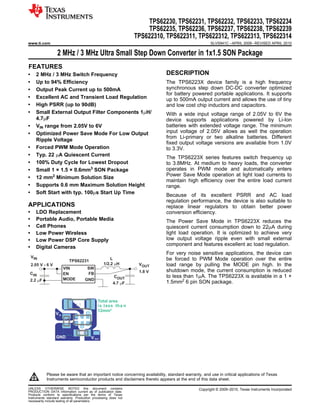
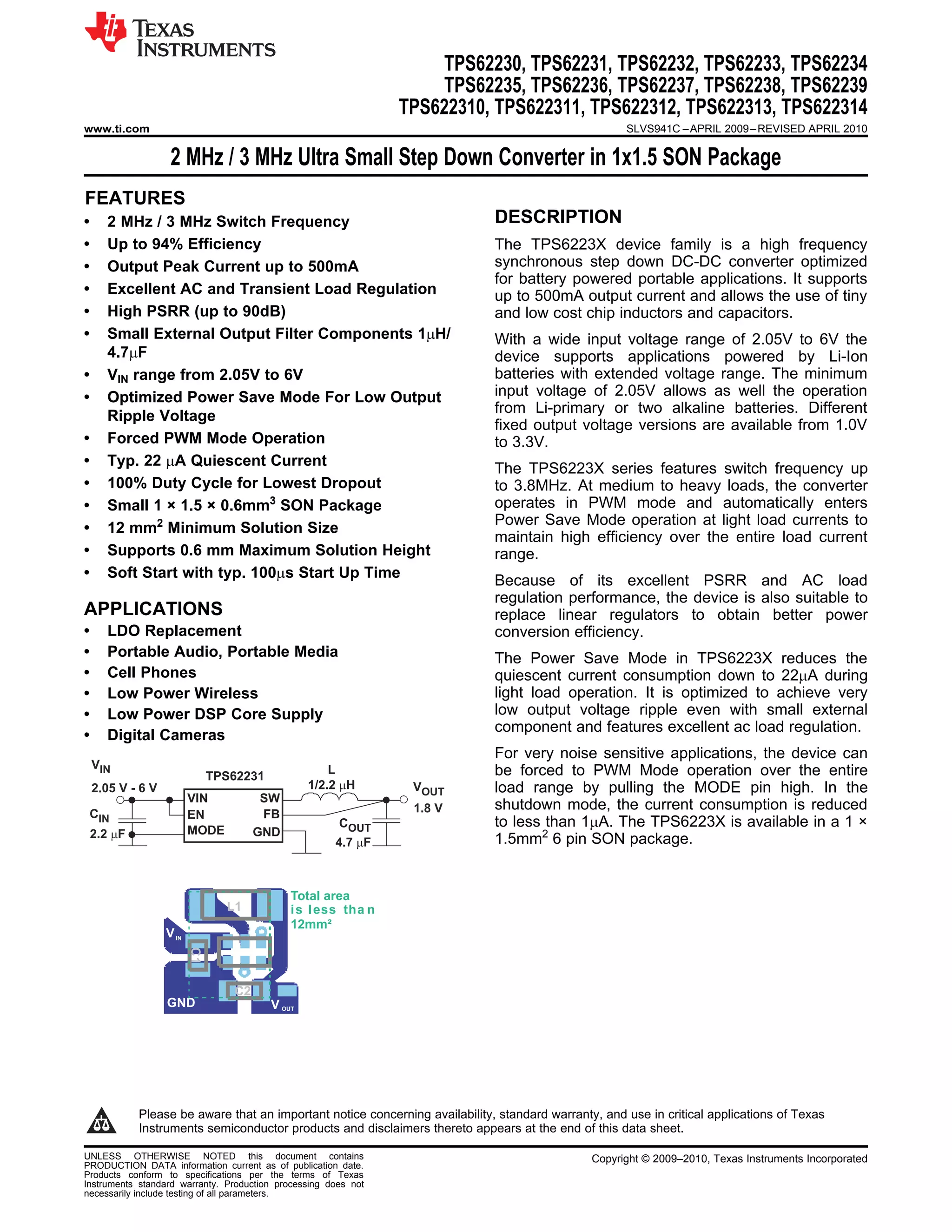
    VIN
                               TPS62231
                                                      L                       be forced to PWM Mode operation over the entire
    2.05 V - 6 V                                  1/2.2 mH       VOUT         load range by pulling the MODE pin high. In the
                          VIN           SW
                                                                 1.8 V        shutdown mode, the current consumption is reduced
    CIN                   EN            FB
                                                       COUT                   to less than 1mA. The TPS6223X is available in a 1 ×
    2.2 mF                MODE         GND
                                                      4.7 mF                  1.5mm2 6 pin SON package.


                                              Total area
                                 L1
                                              12mm²
                   V IN
                          C1


                                  C2
                   GND                    V OUT


1


             Please be aware that an important notice concerning availability, standard warranty, and use in critical applications of Texas
             Instruments semiconductor products and disclaimers thereto appears at the end of this data sheet.

UNLESS OTHERWISE NOTED this document contains                                                   Copyright © 2009–2010, Texas Instruments Incorporated
PRODUCTION DATA information current as of publication date.
Products conform to specifications per the terms of Texas
Instruments standard warranty. Production processing does not
necessarily include testing of all parameters.
TPS62230, TPS62231, TPS62232, TPS62233, TPS62234
TPS62235, TPS62236, TPS62237, TPS62238, TPS62239
TPS622310, TPS622311, TPS622312, TPS622313, TPS622314
SLVS941C – APRIL 2009 – REVISED APRIL 2010                                                                                              www.ti.com


              These devices have limited built-in ESD protection. The leads should be shorted together or the device placed in conductive foam
              during storage or handling to prevent electrostatic damage to the MOS gates.


                                                         ORDERING INFORMATION
                                           (1)                            FREQUENCY           PACKAGE                                  PACKAGE
         TA           PART NUMBER                OUTPUT VOLTAGE (2)                                                ORDERING
                                                                             [MHz]           DESIGNATOR                                MARKING
                     TPS62230                          2.5 V                     3                DRY            TPS62230DRY                GV
                     TPS62231                          1.8 V                     3                DRY            TPS62231DRY                GW
                     TPS62232                          1.2 V                     3                DRY            TPS62232DRY                GX
                     TPS62239                          1.0 V                     3                DRY            TPS62239DRY                OP
                     TPS622311                          1.1V                     2                DRY            TPS622311DRY               PA
                     TPS62235                           1.2V                     2                DRY            TPS62235DRY                OQ
                     TPS622313                         1.3 V                     3                DRY            TPS62213DRY                QG
                     TPS622314                         1.5 V                     3                DRY            TPS622314DRY               QF
 –40°C to 85°C TPS62236                                1.85V                     2                DRY            TPS62236DRY                OR
                     TPS622312                         2.0 V                     3                DRY            TPS622312DRY               QE
                     TPS62234                          2.1 V                     3                DRY            TPS62234DRY                OH
                     TPS62238                          2.25 V                    3                DRY            TPS62238DRY                ON
                     TPS622310                         2.3 V                     3                DRY            TPS622310DRY               OT
                                     (3)
                     TPS6223-2.7                       2.7 V                     3                DRY
                     TPS6223-2.9 (3)                   2.9 V                     3                DRY
                     TPS62233                          3.0 V                     3                DRY            TPS62233DRY                OG
                     TPS62237                           3.3V                     2                DRY            TPS62237DRY                OS

(1)    The DRY package is available in tape on reel. Add R suffix to order quantities of 3000 parts per reel, T suffix for 250 parts per reel.
(2)    Contact TI for other fixed output voltage options
(3)    Device status is product preview, contact TI for more details


ABSOLUTE MAXIMUM RATINGS
                                                                                (1)
over operating free-air temperature range (unless otherwise noted)
                                                                                                                      VALUE                  UNIT
           Voltage at VIN and SW Pin (2)                                                                              –0.3 to 7                  V
VI         Voltage at EN, MODE Pin (2)                                                                          –0.3 to VIN +0.3, ≤7             V
                               (2)
           Voltage at FB Pin                                                                                         –0.3 to 3.6                 V
           Peak output current                                                                                    internally limited             A
                                 HBM Human body model                                                                     2
                                                                                                                                                 kV
           ESD rating (3)        CDM Charge device model                                                                  1
                                 Machine model                                                                          200                      V
           Power dissipation                                                                                           Internally limited
TJ         Maximum operating junction temperature                                                                    –40 to 125                  °C
Tstg       Storage temperature range                                                                                 –65 to 150                  °C

(1)    Stresses beyond those listed under absolute maximum ratings may cause permanent damage to the device. These are stress ratings
       only and functional operation of the device at these or any other conditions beyond those indicated under recommended operating
       conditions is not implied. Exposure to absolute–maximum–rated conditions for extended periods may affect device reliability.
(2)    All voltage values are with respect to network ground terminal.
(3)    The human body model is a 100-pF capacitor discharged through a 1.5-kΩ resistor into each pin. The machine model is a 200-pF
       capacitor discharged directly into each pin.


2         Submit Documentation Feedback                                                         Copyright © 2009–2010, Texas Instruments Incorporated
TPS62230, TPS62231, TPS62232, TPS62233, TPS62234
                                                                    TPS62235, TPS62236, TPS62237, TPS62238, TPS62239
                                                               TPS622310, TPS622311, TPS622312, TPS622313, TPS622314
www.ti.com                                                                                           SLVS941C – APRIL 2009 – REVISED APRIL 2010


DISSIPATION RATINGS (1)
                                                                                 POWER RATING                      DERATING FACTOR
             PACKAGE                                    RqJA
                                                                                  FOR TA ≤ 25°C                     ABOVE TA = 25°C
            1 × 1.5 SON                             234°C/W (2)                       420 mW                            4.2 mW/°C

(1)   Maximum power dissipation is a function of TJ(max), qJA and TA. The maximum allowable power dissipation at any allowable ambient
      temperature is PD = [TJ(max) – TA] /qJA.
(2)   This thermal data is measured with high-K board (4 layers board according to JESD51-7 JEDEC standard).

RECOMMENDED OPERATING CONDITIONS
operating ambient temperature TA = –40 to 85°C (unless otherwise noted) (1)
                                                                                                               MIN     NOM     MAX      UNIT
                     (2)
Supply voltage VIN                                                                                             2.05                 6    V
Effective inductance                                                                                                     2.2            mH
Effective capacitance                                                                                           2.0      4.7            mF
                              VOUT ≤ VIN -1 V (3)                 500 mA maximum IOUT   (4)
                                                                                                                         3.0     3.6
Recommended minimum                                                                     (5)
                                                                  350mA maximum IOUT                                     2.5     2.7     V
supply voltage
                              VOUT ≤ 1.8V                         60 mA maximum output current (5)                              2.05
Operating virtual junction temperature range, TJ                                                                –40             125      °C

(1)   In applications where high power dissipation and/or poor package thermal resistance is present, the maximum ambient temperature may
      have to be derated. Maximum ambient temperature (TA(max)) is dependent on the maximum operating junction temperature (TJ(max)), the
      maximum power dissipation of the device in the application (PD(max)), and the junction-to-ambient thermal resistance of the part/package
      in the application (qJA), as given by the following equation: TA(max) = TJ(max) – (qJA × PD(max)).
(2)   The minimum required supply voltage for startup is 2.05 V. The part is functional down to the falling UVL (Under Voltage Lockout)
      threshold.
(3)   For a voltage difference between minimum VIN and VOUT of ≥ 1 V
(4)   Typical value applies for TA = 25°C, maximum value applies for TA = 70°C with TJ ≤ 125°C, PCB layout needs to support proper thermal
      performance.
(5)   Typical value applies for TA = 25°C, maximum value applies for TA = 85°C with TJ ≤ 125°C, PCB layout needs to support proper thermal
      performance.


Copyright © 2009–2010, Texas Instruments Incorporated                                                 Submit Documentation Feedback            3
TPS62230, TPS62231, TPS62232, TPS62233, TPS62234
TPS62235, TPS62236, TPS62237, TPS62238, TPS62239
TPS622310, TPS622311, TPS622312, TPS622313, TPS622314
SLVS941C – APRIL 2009 – REVISED APRIL 2010                                                                                           www.ti.com


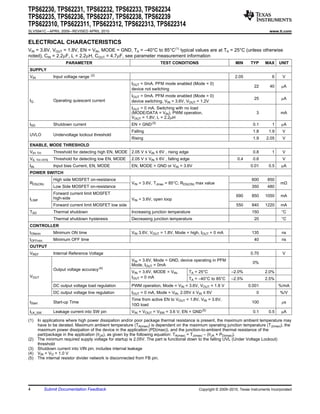
ELECTRICAL CHARACTERISTICS
VIN = 3.6V, VOUT = 1.8V, EN = VIN, MODE = GND, TA = –40°C to 85°C (1) typical values are at TA = 25°C (unless otherwise
noted), CIN = 2.2mF, L = 2.2mH, COUT = 4.7mF, see parameter measurement information
                       PARAMETER                                        TEST CONDITIONS                          MIN      TYP     MAX     UNIT
SUPPLY
                                       (2)
VIN              Input voltage range                                                                             2.05                 6     V
                                                         IOUT = 0mA. PFM mode enabled (Mode = 0)
                                                                                                                            22       40     mA
                                                         device not switching
                                                         IOUT = 0mA. PFM mode enabled (Mode = 0)
IQ               Operating quiescent current                                                                                25              mA
                                                         device switching, VIN = 3.6V, VOUT = 1.2V
                                                         IOUT = 0 mA. Switching with no load
                                                         (MODE/DATA = VIN), PWM operation,                                   3             mA
                                                         VOUT = 1.8V, L = 2.2mH
ISD              Shutdown current                        EN = GND (3)                                                      0.1        1     mA
                                                         Falling                                                           1.8      1.9     V
UVLO             Undervoltage lockout threshold
                                                         Rising                                                            1.9     2.05     V
ENABLE, MODE THRESHOLD
VIH   TH         Threshold for detecting high EN, MODE 2.05 V ≤ VIN ≤ 6V , rising edge                                     0.8        1     V
VIL TH HYS       Threshold for detecting low EN, MODE    2.05 V ≤ VIN ≤ 6V , falling edge                         0.4      0.6              V
IIN              Input bias Current, EN, MODE            EN, MODE = GND or VIN = 3.6V                                     0.01      0.5     mA
POWER SWITCH
                 High side MOSFET on-resistance                                                                            600      850
RDS(ON)                                                  VIN = 3.6V, TJmax = 85°C; RDS(ON) max value                                       mΩ
                 Low Side MOSFET on-resistance                                                                             350      480
                 Forward current limit MOSFET
                                                                                                                  690      850    1050     mA
ILIMF            high-side                               VIN = 3.6V, open loop
                 Forward current limit MOSFET low side                                                            550      840    1220     mA
TSD              Thermal shutdown                        Increasing junction temperature                                   150              °C
                 Thermal shutdown hysteresis             Decreasing junction temperature                                    20              °C
CONTROLLER
tONmin           Minimum ON time                         VIN 3.6V, VOUT = 1.8V, Mode = high, IOUT = 0 mA                   135              ns
tOFFmin          Minimum OFF time                                                                                           40              ns
OUTPUT
VREF             Internal Reference Voltage                                                                               0.70              V
                                                         VIN = 3.6V, Mode = GND, device operating in PFM
                                                                                                                           0%
                                                         Mode, IOUT = 0mA
                                             (4)
                 Output voltage accuracy
                                                         VIN = 3.6V, MODE = VIN,         TA = 25°C             –2.0%              2.0%
VOUT                                                     IOUT = 0 mA                     TA = –40°C to 85°C    –2.5%              2.5%
                 DC output voltage load regulation       PWM operation, Mode = VIN = 3.6V, VOUT = 1.8 V                  0.001            %/mA
                 DC output voltage line regulation       IOUT = 0 mA, Mode = VIN, 2.05V ≤ VIN ≤ 6V                           0             %/V
                                                         Time from active EN to VOUT = 1.8V, VIN = 3.6V,
tStart           Start-up Time                                                                                             100              ms
                                                         10Ω load
                                                                                               (5)
ILK_SW           Leakage current into SW pin             VIN = VOUT = VSW = 3.6 V, EN = GND                                0.1      0.5     mA

(1)      In applications where high power dissipation and/or poor package thermal resistance is present, the maximum ambient temperature may
         have to be derated. Maximum ambient temperature (TA(max)) is dependent on the maximum operating junction temperature (TJ(max)), the
         maximum power dissipation of the device in the application (PD(max)), and the junction-to-ambient thermal resistance of the
         part/package in the application (qJA), as given by the following equation: TA(max) = TJ(max) – (qJA × PD(max)).
(2)      The minimum required supply voltage for startup is 2.05V. The part is functional down to the falling UVL (Under Voltage Lockout)
         threshold
(3)      Shutdown current into VIN pin, includes internal leakage
(4)      VIN = VO + 1.0 V
(5)      The internal resistor divider network is disconnected from FB pin.


4           Submit Documentation Feedback                                                    Copyright © 2009–2010, Texas Instruments Incorporated
TPS62230, TPS62231, TPS62232, TPS62233, TPS62234
                                                                  TPS62235, TPS62236, TPS62237, TPS62238, TPS62239
                                                             TPS622310, TPS622311, TPS622312, TPS622313, TPS622314
www.ti.com                                                                                              SLVS941C – APRIL 2009 – REVISED APRIL 2010

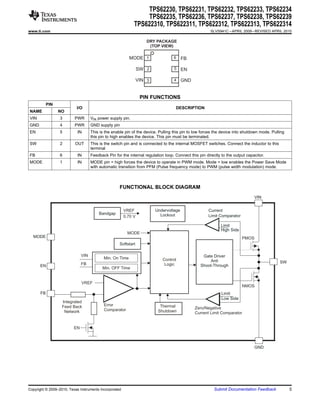
                                                                     DRY PACKAGE
                                                                      (TOP VIEW)

                                                           MODE 1                  6    FB

                                                                 SW 2              5 EN

                                                                 VIN 3             4    GND


                                                                  PIN FUNCTIONS
           PIN
                           I/O                                                      DESCRIPTION
NAME             NO
VIN               3       PWR        VIN power supply pin.
GND               4       PWR        GND supply pin
EN                5         IN       This is the enable pin of the device. Pulling this pin to low forces the device into shutdown mode. Pulling
                                     this pin to high enables the device. This pin must be terminated.
SW                2       OUT        This is the switch pin and is connected to the internal MOSFET switches. Connect the inductor to this
                                     terminal
FB                6         IN       Feedback Pin for the internal regulation loop. Connect this pin directly to the output capacitor.
MODE              1         IN       MODE pin = high forces the device to operate in PWM mode. Mode = low enables the Power Save Mode
                                     with automatic transition from PFM (Pulse frequency mode) to PWM (pulse width modulation) mode.


                                                     FUNCTIONAL BLOCK DIAGRAM
                                                                                                                                 VIN


                                                        VREF             Undervoltage                 Current
                                         Bandgap                           Lockout
                                                        0.70 V                                        Limit Comparator

                                                                                                             Limit
                                                                                                             High Side
                                                         MODE
  MODE                                                                                                                    PMOS
                                                     Softstart

                               VIN                                                                 Gate Driver
                                            Min. On Time                     Control                  Anti                                   SW
      EN                       FB                                             Logic               Shoot-Through
                                           Min. OFF Time


                               VREF
                                                                                                                          NMOS
      FB                                                                                                      Limit
                                                                                                              Low Side
                   Integrated
                   Feed Back                Error                          Thermal
                                            Comparator                                         Zero/Negative
                    Network                                               Shutdown             Current Limit Comparator


                          EN


                                                                                                                                 GND


Copyright © 2009–2010, Texas Instruments Incorporated                                                    Submit Documentation Feedback             5
TPS62230, TPS62231, TPS62232, TPS62233, TPS62234
TPS62235, TPS62236, TPS62237, TPS62238, TPS62239
TPS622310, TPS622311, TPS622312, TPS622313, TPS622314
SLVS941C – APRIL 2009 – REVISED APRIL 2010                                                                                         www.ti.com


PARAMETER MEASUREMENT INFORMATION
                                                       TPS6223X             L = 1/2.2 mH
                                 VIN = 2.05 V to 6 V
                                                                                                        VOUT
                                                       VIN         SW
                                     CIN               EN           FB                             COUT
                                  2.2 mF               MODE       GND                              4.7 mF


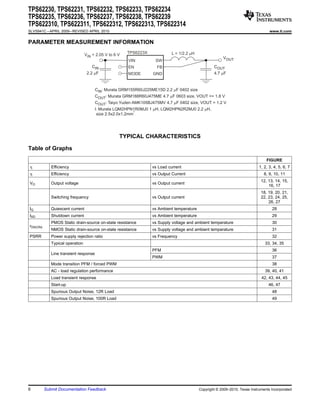
                                       CIN: Murata GRM155R60J225ME15D 2.2 mF 0402 size
                                       COUT: Murata GRM188R60J475ME 4.7 mF 0603 size, VOUT >= 1.8 V
                                       COUT: Taiyo Yuden AMK105BJ475MV 4.7 mF 0402 size, VOUT = 1.2 V
                                       l: Murata LQM2HPN1R0MJ0 1 mH, LQM2HPN2R2MJ0 2.2 mH,
                                                           3
                                        size 2.5x2.0x1.2mm


                                                   TYPICAL CHARACTERISTICS

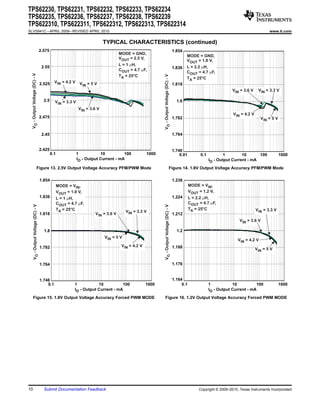
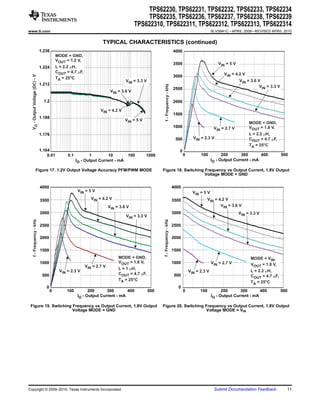
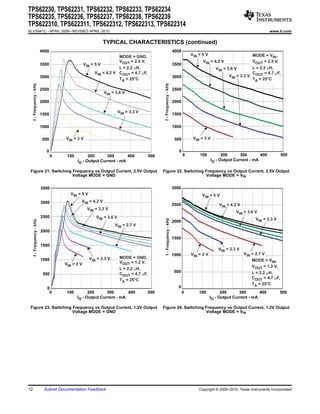
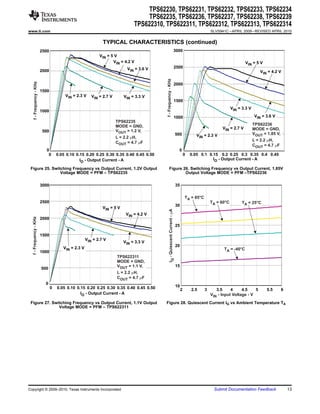
Table of Graphs
                                                                                                                                 FIGURE
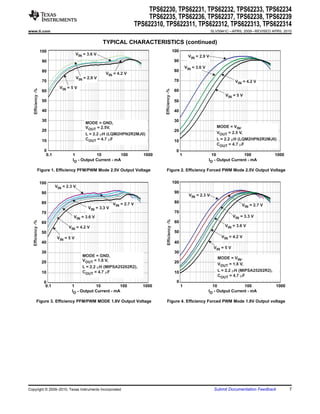
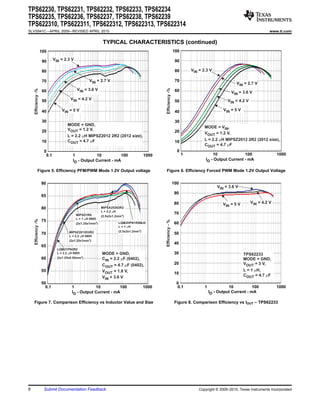
h            Efficiency                                           vs Load current                                            1, 2, 3, 4, 5, 6, 7
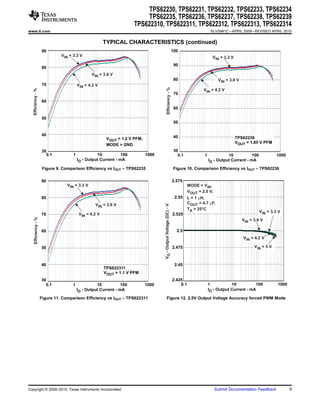
h            Efficiency                                           vs Output Current                                             8, 9, 10, 11
                                                                                                                              12, 13, 14, 15,
VO           Output voltage                                       vs Output current
                                                                                                                                  16, 17
                                                                                                                              18, 19, 20, 21,
             Switching frequency                                  vs Output current                                           22, 23, 24, 25,
                                                                                                                                  26, 27
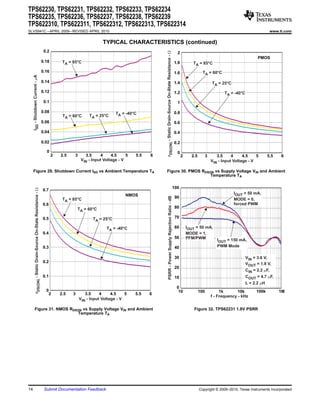
IQ           Quiescent current                                    vs Ambient temperature                                             28
ISD          Shutdown current                                     vs Ambient temperature                                             29
             PMOS Static drain-source on-state resistance         vs Supply voltage and ambient temperature                          30
rDS(ON)
             NMOS Static drain-source on-state resistance         vs Supply voltage and ambient temperature                          31
PSRR         Power supply rejection ratio                         vs Frequency                                                       32
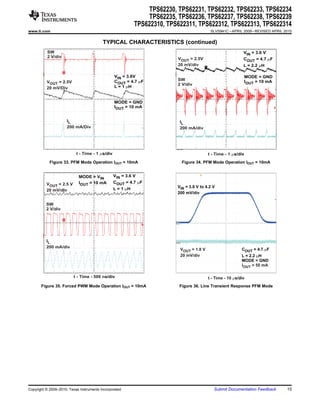
             Typical operation                                                                                                  33, 34, 35
                                                                  PFM                                                                36
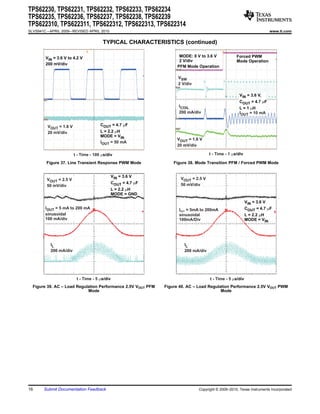
             Line transient response
                                                                  PWM                                                                37
             Mode transition PFM / forced PWM                                                                                        38
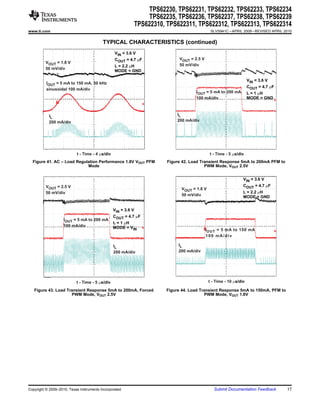
             AC - load regulation performance                                                                                   39, 40, 41
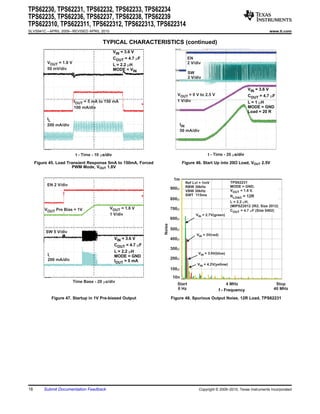
             Load transient response                                                                                          42, 43, 44, 45
             Start-up                                                                                                             46, 47
             Spurious Output Noise, 12R Load                                                                                         48
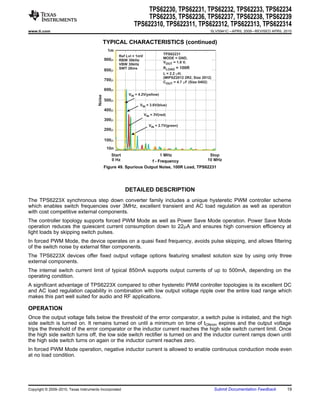
             Spurious Output Noise, 100R Load                                                                                        49


6         Submit Documentation Feedback                                                    Copyright © 2009–2010, Texas Instruments Incorporated
TPS62230, TPS62231, TPS62232, TPS62233, TPS62234
                                                                                 TPS62235, TPS62236, TPS62237, TPS62238, TPS62239
                                                                            TPS622310, TPS622311, TPS622312, TPS622313, TPS622314
www.ti.com                                                                                                                         SLVS941C – APRIL 2009 – REVISED APRIL 2010


                                                        TYPICAL CHARACTERISTICS (continued)
                    100                                                                                  100
                                          VIN = 3.6 V
                                                                                                                     VIN = 2.9 V
                     90                                                                                   90
                                                                                                                   VIN = 3.6 V
                     80                                                                                   80
                                                         VIN = 4.2 V
                                          VIN = 2.9 V
                     70                                                                                   70                                     VIN = 4.2 V
                               VIN = 5 V
    Efficiency -%


                                                                                      Efficiency -%
                     60                                                                                   60
                                                                                                                                          VIN = 5 V
                     50                                                                                   50

                     40                                                                                   40

                     30                                                                                   30
                                               MODE = GND,
                                               VOUT = 2.5V,                                                                           MODE = VIN,
                     20                                                                                   20
                                               L = 2.2 mH (LQM2HPN2R2MJ0)                                                             VOUT = 2.5 V,
                     10                        COUT = 4.7 mF                                              10                          L = 2.2 mH (LQM2HPN2R2MJ0)
                                                                                                                                      COUT = 4.7 mF
                      0                                                                                    0
                       0.1            1           10          100              1000                            1                   10              100              1000
                                      IO - Output Current - mA                                                                   IO - Output Current - mA

                   Figure 1. Efficiency PFM/PWM Mode 2.5V Output Voltage                Figure 2. Efficiency Forced PWM Mode 2.5V Output Voltage


                    100                                                                                  100
                             VIN = 2.3 V
                     90                                                                                   90
                                                                                                                     VIN = 2.3 V
                     80                                       VIN = 2.7 V                                 80
                                                                                                                                                    VIN = 2.7 V
                                                VIN = 3.3 V
                     70                                                                                   70
                                      VIN = 3.6 V                                                                                               VIN = 3.3 V
                                                                                         Efficiency -%
   Efficiency -%


                     60                                                                                   60
                                    VIN = 4.2 V                                                                                           VIN = 3.6 V
                     50                                                                                   50
                              VIN = 5 V                                                                                                 VIN = 4.2 V
                     40                                                                                   40
                                                                                                                                    VIN = 5 V
                     30                                                                                   30
                                             MODE = GND,
                                                                                                                                      MODE = VIN,
                     20                      VOUT = 1.8 V,                                                20                          VOUT = 1.8 V,
                                             L = 2.2 mH (MIPSA25202R2),
                     10                      COUT = 4.7 mF                                                10                          L = 2.2 mH (MIPSA25202R2),
                                                                                                                                      COUT = 4.7 mF
                      0                                                                                    0
                       0.1           1           10          100              1000                             1                   10              100              1000
                                     IO - Output Current - mA                                                                    IO - Output Current - mA

             Figure 3. Efficiency PFM/PWM MODE 1.8V Output Voltage                       Figure 4. Efficiency Forced PWM Mode 1.8V Output voltage


Copyright © 2009–2010, Texas Instruments Incorporated                                                                               Submit Documentation Feedback          7
TPS62230, TPS62231, TPS62232, TPS62233, TPS62234
TPS62235, TPS62236, TPS62237, TPS62238, TPS62239
TPS622310, TPS622311, TPS622312, TPS622313, TPS622314
SLVS941C – APRIL 2009 – REVISED APRIL 2010                                                                                                                      www.ti.com


                                                            TYPICAL CHARACTERISTICS (continued)
                    100                                                                                   100

                     90      VIN = 2.3 V                                                                   90

                     80                                                                                    80       VIN = 2.3 V

                     70                           VIN = 2.7 V                                              70
                                                                                                                                             VIN = 2.7 V
                                           VIN = 3.6 V


                                                                                         Efficiency -%
    Efficiency -%


                     60                                                                                    60                              VIN = 3.6 V

                     50                VIN = 4.2 V                                                                                      VIN = 4.2 V
                                                                                                           50

                     40          VIN = 5 V                                                                 40                         VIN = 5 V

                     30                                                                                    30
                                     MODE = GND,
                                                                                                                           MODE = VIN,
                     20              VOUT = 1.2 V,                                                         20              VOUT = 1.2 V,
                                     L = 2.2 mH MIPSZ2012 2R2 (2012 size),
                     10              COUT = 4.7 mF                                                         10              L = 2.2 mH MIPSZ2012 2R2 (2012 size),
                                                                                                                           COUT = 4.7 mF
                      0                                                                                     0
                       0.1              1           10          100               1000                          1              10              100                  1000
                                        IO - Output Current - mA                                                           IO - Output Current - mA

                Figure 5. Efficiency PFM/PWM Mode 1.2V Output voltage                     Figure 6. Efficiency Forced PWM Mode 1.2V Output Voltage


                    90                                                                                    100
                                                                                                                                   VIN = 3.6 V
                                                                                                           90
                    85
                                                                                                           80                         VIN = 5 V       VIN = 4.2 V
                    80                                     MIPSA25202R2
                                                           L = 2.2 mH
                                           MIPSD1R0                                                        70
                                                           (2.5x2x1.2mm3)
                                           L = 1 mH 0805
                    75
    Efficiency -%


                                                                                         Efficiency - %


                                           (2x1.25x1mm3)             LQM2HPN1R0MJ0                         60
                                                                     L = 1 mH
                                      MIPSZ2012D2R2                  (2.5x2x1.2mm3)
                    70                                                                                     50
                                      L = 2.2 mH 0805
                                      (2x1.25x1mm3)
                                                                                                           40
                    65
                               LQM21PN2R2
                               L = 2.2 mH 0805             MODE = GND,                                     30                                     TPS62233
                    60         (2x1.25x0.55mm3)            CIN = 2.2 mF (0402),                                                                   MODE = GND,
                                                           COUT = 4.7 mF (0402),                           20                                     VOUT = 3 V,
                    55                                     VOUT = 1.8 V,                                                                          L = 1 mH,
                                                                                                           10                                     COUT = 4.7 mF
                                                           VIN = 3.6 V
                    50                                                                                      0
                      0.1              1           10          100                1000                       0.1           1             10           100           1000
                                       IO - Output Current - mA                                                                IO - Output Current - mA

    Figure 7. Comparison Efficiency vs Inductor Value and Size                                             Figure 8. Comparison Efficiency vs IOUT – TPS62233


8                    Submit Documentation Feedback                                                                      Copyright © 2009–2010, Texas Instruments Incorporated
TPS62230, TPS62231, TPS62232, TPS62233, TPS62234
                                                                          TPS62235, TPS62236, TPS62237, TPS62238, TPS62239
                                                                     TPS622310, TPS622311, TPS622312, TPS622313, TPS622314
www.ti.com                                                                                                                               SLVS941C – APRIL 2009 – REVISED APRIL 2010


                                                       TYPICAL CHARACTERISTICS (continued)
                    90                                                                                            100
                              VIN = 3.3 V                                                                                                 VIN = 3.3 V
                                                                                                                   90
                    80
                                               VIN = 3.6 V
                                                                                                                   80                        VIN = 3.6 V
                    70                  VIN = 4.2 V


                                                                                        Efficiency - %
  Efficiency - %


                                                                                                                                    VIN = 4.2 V
                                                                                                                   70
                    60
                                                                                                                   60

                    50
                                                                                                                   50


                    40                                                                                             40
                                                        VOUT = 1.2 V PFM,                                                                               TPS62236
                                                                                                                                                        VOUT = 1.85 V PFM
                                                        MODE = GND
                    30                                                                                             30
                      0.1           1             10           100          1000                                     0.1            1             10           100            1000
                                        IO - Output Current - mA                                                                        IO - Output Current - mA

                     Figure 9. Comparison Efficiency vs IOUT – TPS62235                                           Figure 10. Comparison Efficiency vs IOUT – TPS62236

                    90                                                                                            2.575
                                 VIN = 3.3 V                                                                                MODE = VIN,
                                                                                                                            VOUT = 2.5 V,
                    80                                                                                             2.55     L = 1 mH,
                                                 VIN = 3.6 V                                                                COUT = 4.7 mF,
                                                                                   VO - Output Voltage (DC) - V


                                                                                                                            TA = 25°C
                                                                                                                                                                     VIN = 3.3 V
                    70                   VIN = 4.2 V                                                              2.525
   Efficiency - %


                                                                                                                                                           VIN = 3.6 V

                    60                                                                                              2.5
                                                                                                                                                           VIN = 4.2 V

                    50                                                                                            2.475                                          VIN = 5 V


                    40                                                                                             2.45
                                                       TPS622311
                                                       VOUT = 1.1 V PFM
                    30                                                                                            2.425
                      0.1           1             10           100          1000                                      0.1               1           10          100           1000
                                        IO - Output Current - mA                                                                        IO - Output Current - mA

                    Figure 11. Comparison Efficiency vs IOUT – TPS622311                 Figure 12. 2.5V Output Voltage Accuracy forced PWM Mode


Copyright © 2009–2010, Texas Instruments Incorporated                                                                                       Submit Documentation Feedback            9
TPS62230, TPS62231, TPS62232, TPS62233, TPS62234
TPS62235, TPS62236, TPS62237, TPS62238, TPS62239
TPS622310, TPS622311, TPS622312, TPS622313, TPS622314
SLVS941C – APRIL 2009 – REVISED APRIL 2010                                                                                                                                                        www.ti.com


                                                                            TYPICAL CHARACTERISTICS (continued)
                                     2.575                                                                                                1.854
                                                                                    MODE = GND,
                                                                                                                                                  MODE = GND,
                                                                                    VOUT = 2.5 V,
                                                                                                                                                  VOUT = 1.8 V,
                                                                                    L = 1 mH,
                                      2.55                                                                                                1.836   L = 2.2 mH,
                                                                                    COUT = 4.7 mF,
                                                                                                                                                  COUT = 4.7 mF,
  VO - Output Voltage (DC) - V


                                                                                                          VO - Output Voltage (DC) - V
                                                                                    TA = 25°C
                                                                                                                                                  TA = 25°C
                                     2.525     VIN = 4.2 V    VIN = 5 V                                                                   1.818
                                                                                                                                                                             VIN = 3.6 V    VIN = 3.3 V

                                       2.5     VIN = 3.3 V                                                                                  1.8
                                                              VIN = 3.6 V
                                                                                                                                                                             VIN = 4.2 V
                                     2.475                                                                                                1.782                                               VIN = 5 V


                                      2.45                                                                                                1.764


                                     2.425                                                                                                1.746
                                             0.1             1           10          100           1000                                       0.01         0.1           1        10      100             1000
                                                             IO - Output Current - mA                                                                            IO - Output Current - mA
                       Figure 13. 2.5V Output Voltage Accuracy PFM/PWM Mode                                                  Figure 14. 1.8V Output Voltage Accuracy PFM/PWM Mode

                                     1.854                                                                                                1.236
                                                   MODE = VIN,                                                                                       MODE = VIN,
                                                   VOUT = 1.8 V,                                                                                     VOUT = 1.2 V,
                                     1.836         L = 1 mH,                                                                              1.224      L = 2.2 mH,
                                                   COUT = 4.7 mF,                                                                                    COUT = 4.7 mF,
      VO - Output Voltage (DC) - V


                                                                                                           VO - Output Voltage (DC) - V


                                                   TA = 25°C                                                                                         TA = 25°C                             VIN = 3.3 V
                                                                                        VIN = 3.3 V
                                     1.818                            VIN = 3.6 V                                                         1.212
                                                                                                                                                                                 VIN = 3.6 V

                                       1.8                                                                                                  1.2
                                                                            VIN = 5 V
                                                                                                                                                                                VIN = 4.2 V
                                     1.782                                           VIN = 4.2 V                                          1.188                                            VIN = 5 V


                                     1.764                                                                                                1.176


                                     1.746                                                                                                1.164
                                         0.1                1           10          100            1000                                        0.1               1           10          100              1000
                                                            IO - Output Current - mA                                                                             IO - Output Current - mA
     Figure 15. 1.8V Output Voltage Accuracy Forced PWM MODE                                               Figure 16. 1.2V Output Voltage Accuracy Forced PWM MODE


10                                     Submit Documentation Feedback                                                                                      Copyright © 2009–2010, Texas Instruments Incorporated
TPS62230, TPS62231, TPS62232, TPS62233, TPS62234
                                                                                               TPS62235, TPS62236, TPS62237, TPS62238, TPS62239
                                                                                          TPS622310, TPS622311, TPS622312, TPS622313, TPS622314
www.ti.com                                                                                                                                                SLVS941C – APRIL 2009 – REVISED APRIL 2010


                                                                      TYPICAL CHARACTERISTICS (continued)
                                 1.236                                                                                           4000
                                            MODE = GND,
                                            VOUT = 1.2 V,
                                                                                                                                 3500                        VIN = 5 V
                                 1.224      L = 2.2 mH,
                                            COUT = 4.7 mF,
                                                                                                                                                                 VIN = 4.2 V
  VO - Output Voltage (DC) - V


                                            TA = 25°C                                                                            3000
                                                                                    VIN = 3.3 V                                                                          VIN = 3.6 V
                                 1.212


                                                                                                           f - Frequency - kHz
                                                                                                                                                                                    VIN = 3.3 V
                                                                                                                                 2500
                                                                            VIN = 3.6 V

                                   1.2                                                                                           2000

                                                                     VIN = 4.2 V
                                                                                                                                 1500
                                 1.188
                                                                                   VIN = 5 V
                                                                                                                                                                               MODE = GND,
                                                                                                                                 1000                      VIN = 2.7 V         VOUT = 1.8 V,
                                 1.176                                                                                                                                         L = 2.2 mH,
                                                                                                                                  500         VIN = 2.3 V                      COUT = 4.7 mF,
                                                                                                                                                                               TA = 25°C
                                 1.164                                                                                              0
                                     0.01         0.1          1         10          100       1000                                     0         100           200      300       400            500
                                                        IO - Output Current - mA                                                                          IO - Output Current - mA

                   Figure 17. 1.2V Output Voltage Accuracy PFM/PWM MODE                                 Figure 18. Switching Frequency vs Output Current, 1.8V Output
                                                                                                                             Voltage MODE = GND


                                 4000                                                                                            4000
                                                        VIN = 5 V                                                                             VIN = 5 V
                                 3500                           VIN = 4.2 V                                                      3500                VIN = 4.2 V
                                                                           VIN = 3.6 V                                                                      VIN = 3.6 V
                                 3000                                                                                            3000                                    VIN = 3.3 V
                                                                                    VIN = 3.3 V
                                                                                                        f - Frequency - kHz
   f - Frequency - kHz


                                 2500                                                                                            2500

                                 2000                                                                                            2000


                                 1500                                                                                            1500
                                                                                MODE = GND,                                                                                    MODE = VIN,
                                 1000                                           VOUT = 1.8 V,                                    1000                     VIN = 2.7 V
                                                             VIN = 2.7 V                                                                                                       VOUT = 1.8 V,
                                                                                L = 1 mH,
                                             VIN = 2.3 V                                                                                    VIN = 2.3 V                        L = 2.2 mH,
                                  500                                           COUT = 4.7 mF,                                    500                                          COUT = 4.7 mF,
                                                                                TA = 25°C
                                                                                                                                                                               TA = 25°C
                                    0                                                                                               0
                                        0        100          200      300       400              500                                   0         100           200      300       400            500
                                                        IO - Output Current - mA                                                                          IO - Output Current - mA

 Figure 19. Switching Frequency vs Output Current, 1.8V Output                                          Figure 20. Switching Frequency vs Output Current, 1.8V Output
                      Voltage MODE = GND                                                                                     Voltage MODE = VIN


Copyright © 2009–2010, Texas Instruments Incorporated                                                                                                      Submit Documentation Feedback            11
TPS62230, TPS62231, TPS62232, TPS62233, TPS62234
TPS62235, TPS62236, TPS62237, TPS62238, TPS62239
TPS622310, TPS622311, TPS622312, TPS622313, TPS622314
SLVS941C – APRIL 2009 – REVISED APRIL 2010                                                                                                                                      www.ti.com


                                                               TYPICAL CHARACTERISTICS (continued)
                            4000                                                                                         4000
                                                                       MODE = GND,                                                  VIN = 5 V                          MODE = VIN,
                                                                       VOUT = 2.5 V,                                                      VIN = 4.2 V                  VOUT = 2.5 V,
                            3500                   VIN = 5 V                                                             3500
                                                                    L = 2.2 mH,                                                                   VIN = 3.6 V          L = 2.2 mH,
                                                        VIN = 4.2 V COUT = 4.7 mF,                                                                                     COUT = 4.7 mF,
                            3000                                                                                         3000                            VIN = 3.3 V
                                                                    TA = 25°C                                                                                          TA = 25°C


                                                                                                f - Frequency - kHz
     f - Frequency - kHz


                            2500                                                                                         2500
                                                               VIN = 3.6 V

                            2000                                                                                         2000

                                                                       VIN = 3.3 V
                            1500                                                                                         1500


                            1000                                                                                         1000


                             500       VIN = 3 V                                                                          500        VIN = 3 V


                               0                                                                                            0
                                   0    100         200      300       400               500                                    0       100           200      300       400            500
                                              IO - Output Current - mA                                                                          IO - Output Current - mA

 Figure 21. Switching Frequency vs Output Current, 2.5V Output                                 Figure 22. Switching Frequency vs Output Current, 2.5V Output
                      Voltage MODE = GND                                                                            Voltage MODE = VIN


                            3500                                                                                         3000
                                          VIN = 5 V                                                                                      VIN = 5 V
                            3000                VIN = 4.2 V
                                                                                                                         2500                       VIN = 4.2 V
                                                     VIN = 3.3 V
                                                                                                                                                             VIN = 3.6 V
                            2500                         VIN = 3.6 V                                                                                                    VIN = 3.3 V
                                                                                                   f - Frequency - kHz
      f - Frequency - kHz


                                                                                                                         2000
                                                                    VIN = 2.7 V
                            2000
                                                                                                                         1500
                            1500
                                                                                                                                                    VIN = 2.3 V
                                                                                                                         1000       VIN = 2 V                     VIN = 2.7 V
                            1000                      VIN = 2.3 V       MODE = GND,
                                                                        VOUT = 1.2 V,                                                                                  MODE = VIN,
                                       VIN = 2 V
                                                                                                                                                                       VOUT = 1.2 V,
                                                                        L = 2.2 mH,
                                                                                                                          500                                          L = 2.2 mH,
                             500                                        COUT = 4.7 mF,
                                                                        TA = 25°C                                                                                      COUT = 4.7 mF,
                                                                                                                                                                       TA = 25°C
                               0                                                                                            0
                                0       100         200      300       400              500                                     0       100           200      300       400           500
                                              IO - Output Current - mA                                                                          IO - Output Current - mA

 Figure 23. Switching Frequency vs Output Current, 1.2V Output                                 Figure 24. Switching Frequency vs Output Current, 1.2V Output
                      Voltage MODE = GND                                                                            Voltage MODE = VIN


12                           Submit Documentation Feedback                                                                              Copyright © 2009–2010, Texas Instruments Incorporated
TPS62230, TPS62231, TPS62232, TPS62233, TPS62234
                                                                                     TPS62235, TPS62236, TPS62237, TPS62238, TPS62239
                                                                                TPS622310, TPS622311, TPS622312, TPS622313, TPS622314
www.ti.com                                                                                                                                               SLVS941C – APRIL 2009 – REVISED APRIL 2010


                                                               TYPICAL CHARACTERISTICS (continued)
                          2500                                                                                             3000
                                                             VIN = 5 V
                                                                    VIN = 4.2 V                                                                                              VIN = 5 V
                                                                             VIN = 3.6 V                                    2500
                          2000                                                                                                                                                        VIN = 4.2 V


                                                                                           f - Frequency - KHz
    f - Frequency - KHz


                                                                                                                            2000
                          1500
                                         VIN = 2.3 V     VIN = 2.7 V       VIN = 3.3 V
                                                                                                                            1500
                                                                                                                                                                     VIN = 3.3 V
                          1000
                                                                                                                            1000                                                   VIN = 3.6 V
                                                                       TPS62235
                                                                       MODE = GND,                                                                                                 TPS62236
                                                                                                                                                               VIN = 2.7 V         MODE = GND,
                           500                                         VOUT = 1.2 V,
                                                                                                                                500            VIN = 2.3 V                         VOUT = 1.85 V,
                                                                       L = 2.2 mH,
                                                                                                                                                                                   L = 2.2 mH,
                                                                       COUT = 4.7 mF
                                                                                                                                                                                   COUT = 4.7 mF
                             0                                                                                                   0
                              0      0.05 0.10 0.15 0.20 0.25 0.30 0.35 0.40 0.45 0.50                                                   0   0.05 0.1 0.15 0.2 0.25 0.3 0.35 0.4 0.45
                                                 IO - Output Current - A                                                                                IO - Output Current - A

 Figure 25. Switching Frequency vs Output Current, 1.2V Output                                    Figure 26. Switching Frequency vs Output Current, 1.85V
                Voltage MODE = PFM – TPS62235                                                             Output Voltage MODE = PFM –TPS62236


                          3000                                                                                                  35

                                                                                                                                         TA = 85°C
                          2500                                                                                                                           TA = 60°C         TA = 25°C
                                                                                                                                30
                                                               VIN = 5 V
                                                                                                  IQ - Quiescent Current - mA


                                                                            VIN = 4.2 V
  f - Frequency - KHz


                          2000
                                                                                                                                25

                          1500
                                                      VIN = 2.7 V
                                                                           VIN = 3.3 V
                                                                                                                                20
                                        VIN = 2.3 V                                                                                                             TA = -40°C
                          1000
                                                                       TPS622311
                                                                       MODE = GND,
                                                                       VOUT = 1.1 V,                                            15
                          500
                                                                       L = 2.2 mH,
                                                                       COUT = 4.7 mF
                            0
                                 0   0.05 0.10 0.15 0.20 0.25 0.30 0.35 0.40 0.45 0.50                                          10
                                                                                                                                     2       2.5     3      3.5     4     4.5    5        5.5       6
                                                 IO - Output Current - A                                                                                 VIN - Input Voltage - V
 Figure 27. Switching Frequency vs Output Current, 1.1V Output                             Figure 28. Quiescent Current IQ vs Ambient Temperature TA
               Voltage MODE = PFM – TPS622311


Copyright © 2009–2010, Texas Instruments Incorporated                                                                                                     Submit Documentation Feedback                 13
TPS62230, TPS62231, TPS62232, TPS62233, TPS62234
TPS62235, TPS62236, TPS62237, TPS62238, TPS62239
TPS622310, TPS622311, TPS622312, TPS622313, TPS622314
SLVS941C – APRIL 2009 – REVISED APRIL 2010                                                                                                                                                                                                               www.ti.com


                                                                                                      TYPICAL CHARACTERISTICS (continued)
                                                                     0.2


                                                                                                                                 rDS(ON) - Static Drain-Source On-State Resistance - W
                                                                                                                                                                                           2
                                                                                                                                                                                                                                               PMOS
                                                                    0.18        TA = 85°C                                                                                                1.8          TA = 85°C
                                                                    0.16                                                                                                                 1.6                 TA = 60°C
     ISD - Shutdown Current - mA


                                                                    0.14                                                                                                                 1.4                         TA = 25°C
                                                                    0.12                                                                                                                 1.2                                TA = -40°C

                                                                     0.1                                                                                                                   1

                                                                    0.08                                     TA = -40°C                                                                  0.8
                                                                                TA = 60°C      TA = 25°C
                                                                    0.06                                                                                                                 0.6

                                                                    0.04                                                                                                                 0.4

                                                                    0.02                                                                                                                 0.2

                                                                      0                                                                                                                    0
                                                                           2   2.5    3      3.5     4     4.5     5   5.5   6                                                                 2     2.5         3      3.5     4     4.5    5        5.5     6
                                                                                           VIN - Input Voltage - V                                                                                                   VIN - Input Voltage - V

     Figure 29. Shutdown Current ISD vs Ambient Temperature TA                                                                   Figure 30. PMOS RDSON vs Supply Voltage VIN and Ambient
                                                                                                                                                     Temperature TA

                                                                                                                                                                                         100
            rDS(ON) - Static Drain-Source On-State Resistance - W


                                                                    0.7
                                                                                                                  NMOS                                                                                                           IOUT = 50 mA,
                                                                                                                                                                                          90
                                                                                                                                        PSRR - Power Supply Rejection Ratio - dB


                                                                                TA = 85°C                                                                                                                                        MODE = 0,
                                                                    0.6                                                                                                                                                          forced PWM
                                                                                         TA = 60°C                                                                                        80

                                                                    0.5                          TA = 25°C                                                                                70

                                                                                                        TA = -40°C                                                                        60       IOUT = 50 mA,
                                                                    0.4                                                                                                                            MODE = 1,
                                                                                                                                                                                          50       PFM/PWM       IOUT = 150 mA,
                                                                    0.3                                                                                                                   40                     PWM Mode

                                                                                                                                                                                          30                                             VIN = 3.6 V,
                                                                    0.2                                                                                                                                                                  VOUT = 1.8 V,
                                                                                                                                                                                          20
                                                                                                                                                                                                                                         CIN = 2.2 mF,
                                                                    0.1                                                                                                                   10                                             COUT = 4.7 mF,
                                                                                                                                                                                                                                         L = 2.2 mH
                                                                                                                                                                                           0
                                                                      0                                                                                                                     10             100            1k       10k        100k           1M
                                                                       2       2.5   3       3.5     4     4.5    5    5.5   6
                                                                                                                                                                                                                     f - Frequency - kHz
                                                                                          VIN - Input Voltage - V

           Figure 31. NMOS RDSON vs Supply Voltage VIN and Ambient                                                                                                                                    Figure 32. TPS62231 1.8V PSRR
                              Temperature TA


14                                                                   Submit Documentation Feedback                                                                                                         Copyright © 2009–2010, Texas Instruments Incorporated
TPS62230, TPS62231, TPS62232, TPS62233, TPS62234
                                                                 TPS62235, TPS62236, TPS62237, TPS62238, TPS62239
                                                            TPS622310, TPS622311, TPS622312, TPS622313, TPS622314
www.ti.com                                                                                 SLVS941C – APRIL 2009 – REVISED APRIL 2010


                                          TYPICAL CHARACTERISTICS (continued)
          SW                                                                                                 VIN = 3.6 V
          2 V/div                                                         VOUT = 2.5V                        COUT = 4.7 mF
                                                                          20 mV/div                          L = 2.2 mH

                                                 VIN = 3.6V                                                  MODE = GND
                                                 COUT = 4.7 mF            SW                                 IOUT = 10 mA
          VOUT = 2.5V
                                                                          2 V/div
          20 mV/Div                              L = 1 mH


                                                 MODE = GND
                                                 IOUT = 10 mA


                      IL                                                   IL
                      200 mA/Div                                           200 mA/div


                           t - Time - 1 ms/div                                            t - Time - 1 ms/div
            Figure 33. PFM Mode Operation IOUT = 10mA                       Figure 34. PFM Mode Operation IOUT = 10mA


                            MODE = VIN           VIN = 3.6 V
          VOUT = 2.5 V      IOUT = 10 mA         COUT = 4.7 mF
                                                 L = 1 mH                 VIN = 3.6 V to 4.2 V
          20 mV/div
                                                                          200 mV/div

          SW
          2 V/div


          IL
          200 mA/div
                                                                           VOUT = 1.8 V                     COUT = 4.7 mF
                                                                           20 mV/div                        L = 2.2 mH
                                                                                                            MODE = GND
                                                                                                            IOUT = 50 mA

                         t - Time - 500 ns/div                                            t - Time - 10 ms/div
       Figure 35. Forced PWM Mode Operation IOUT = 10mA                    Figure 36. Line Transient Response PFM Mode


Copyright © 2009–2010, Texas Instruments Incorporated                                        Submit Documentation Feedback        15
TPS62230, TPS62231, TPS62232, TPS62233, TPS62234
TPS62235, TPS62236, TPS62237, TPS62238, TPS62239
TPS622310, TPS622311, TPS622312, TPS622313, TPS622314
SLVS941C – APRIL 2009 – REVISED APRIL 2010                                                                                www.ti.com


                                        TYPICAL CHARACTERISTICS (continued)

        VIN = 3.6 V to 4.2 V                                           MODE: 0 V to 3.6 V            Forced PWM
                                                                       2 V/div                       Mode Operation
        200 mV/div
                                                                      PFM Mode Operation

                                                                      VSW
                                                                      2 V/div

                                                                                                       VIN = 3.6 V,
                                                                                                       COUT = 4.7 mF
                                                                      ICOIL                            L = 1 mH
                                                                      200 mA/div                       IOUT = 10 mA


          VOUT = 1.8 V                 COUT = 4.7 mF
          20 mV/div                    L = 2.2 mH
                                       MODE = VIN
                                                                     VOUT = 1.8 V
                                       IOUT = 50 mA
                                                                     20 mV/div

                         t - Time - 100 ms/div                                        t - Time - 1 ms/div

         Figure 37. Line Transient Response PWM Mode                Figure 38. Mode Transition PFM / Forced PWM Mode


                                                VIN = 3.6 V
         VOUT = 2.5 V                                                  VOUT = 2.5 V
                                                COUT = 4.7 mF          50 mV/div
         50 mV/div
                                                L = 2.2 mH
                                                MODE = GND
                                                                                                            VIN = 3.6 V
        IOUT = 5 mA to 200 mA                                         IOUT = 5mA to 200mA                   COUT = 4.7 mF
        sinusoidal                                                    sinusoidal                            L = 2.2 mH
        100 mA/div                                                    100mA/Div                             MODE = VIN


           IL                                                            IL
           200 mA/div                                                    200 mA/div


                          t - Time - 5 ms/div                                         t - Time - 5 ms/div
  Figure 39. AC – Load Regulation Performance 2.5V VOUT PFM     Figure 40. AC – Load Regulation Performance 2.5V VOUT PWM
                            Mode                                                           Mode


16      Submit Documentation Feedback                                           Copyright © 2009–2010, Texas Instruments Incorporated
TPS62230, TPS62231, TPS62232, TPS62233, TPS62234
                                                                    TPS62235, TPS62236, TPS62237, TPS62238, TPS62239
                                                               TPS622310, TPS622311, TPS622312, TPS622313, TPS622314
www.ti.com                                                                                      SLVS941C – APRIL 2009 – REVISED APRIL 2010


                                          TYPICAL CHARACTERISTICS (continued)
                                                 VIN = 3.6 V
                                                 COUT = 4.7 mF                 VOUT = 2.5 V
         VOUT = 1.8 V
                                                 L = 2.2 mH                    50 mV/div
         50 mV/div
                                                 MODE = GND

                                                                                                                      VIN = 3.6 V
          IOUT = 5 mA to 150 mA, 50 kHz
                                                                                                                      COUT = 4.7 mF
          sinusoidal 100 mA/div
                                                                                       IOUT = 5 mA to 200 mA          L = 1 mH
                                                                                       100 mA/div                     MODE = GND


           IL                                                                 IL
           200 mA/div                                                         200 mA/div


                           t - Time - 4 ms/div                                                  t - Time - 5 ms/div
  Figure 41. AC – Load Regulation Performance 1.8V VOUT PFM               Figure 42. Load Transient Response 5mA to 200mA PFM to
                            Mode                                                            PWM Mode, VOUT 2.5V


                                                                                                                  VIN = 3.6 V
          VOUT = 2.5 V                                                                                            COUT = 4.7 mF
                                                                                VOUT = 1.8 V
          50 mV/div                                                                                               L = 2.2 mH
                                                                                50 mV/div                         MODE = GND


                                                 VIN = 3.6 V
                                                 COUT = 4.7 mF
                    IOUT = 5 mA to 200 mA
                                                 L = 1 mH
                    100 mA/div                   MODE = VIN
                                                                                              I OUT = 5 mA to 150 mA
                                                                                              100 mA/div

                                                 IL                            IL
                                                 200 mA/div                    200 mA/div


                           t - Time - 5 ms/div                                                 t - Time - 10 ms/div

   Figure 43. Load Transient Response 5mA to 200mA, Forced               Figure 44. Load Transient Response 5mA to 150mA, PFM to
                     PWM Mode, VOUT 2.5V                                                   PWM Mode, VOUT 1.8V


Copyright © 2009–2010, Texas Instruments Incorporated                                             Submit Documentation Feedback        17
TPS62230, TPS62231, TPS62232, TPS62233, TPS62234
TPS62235, TPS62236, TPS62237, TPS62238, TPS62239
TPS622310, TPS622311, TPS622312, TPS622313, TPS622314
SLVS941C – APRIL 2009 – REVISED APRIL 2010                                                                                             www.ti.com


                                          TYPICAL CHARACTERISTICS (continued)
                                                  VIN = 3.6 V
                                                  COUT = 4.7 mF                      EN
           VOUT = 1.8 V                                                              2 V/div
                                                  L = 2.2 mH
           50 mV/div                              MODE = VIN
                                                                                     SW
                                                                                     2 V/div

                                                                                                                         VIN = 3.6 V
                                                                             VOUT = 0 V to 2.5 V                         COUT = 4.7 mF
                          IOUT = 5 mA to 150 mA                              1 V/div                                     L = 1 mH
                          100 mA/div                                                                                     MODE = GND
                                                                                                                         Load = 20 R
          IL
          200 mA/div                                                             IIN
                                                                                 50 mA/div


                           t - Time - 10 ms/div                                                 t - Time - 20 ms/div
     Figure 45. Load Transient Response 5mA to 150mA, Forced                     Figure 46. Start Up into 20Ω Load, VOUT 2.5V
                       PWM Mode, VOUT 1.8V

                                                                           1m
                                                                                   Ref Lvl = 1mV               TPS62231
           EN 2 V/div                                                              RBW 30kHz                   MODE = GND,
                                                                          900m
                                                                                   VBW 30kHz                   VOUT = 1.8 V,
                                                                                   SWT ´115ms                  RLOAD = 12R
                                                                          800m
                                                                                                               L = 2.2 mH,
                                                                                                               (MIPSZ2012 2R2, Size 2012)
         VOUT Pre Bias = 1V                  VOUT = 1.8 V                 700m                                 COUT = 4.7 mF (Size 0402)
                                             1 V/div                                     VIN = 2.7V(green)
                                                                          600m
                                                                  Noise


                                                                          500m
          SW 5 V/div
                                                                                         VIN = 3V(red)
                                                  VIN = 3.6 V             400m
                                                  COUT = 4.7 mF
                                                                          300m
                                                  L = 2.2 mH                              VIN = 3.6V(blue)
           IL                                     MODE = GND
           200 mA/div                                                     200m
                                                  IOUT = 0 mA
                                                                                          VIN = 4.2V(yellow)
                                                                          100m
                                                                           10n
                          Time Base - 20 ms/div
                                                                             Start                            4 MHz                      Stop
                                                                             0 Hz                        f - Frequency                  40 MHz

             Figure 47. Startup in 1V Pre-biased Output                   Figure 48. Spurious Output Noise, 12R Load, TPS62231


18       Submit Documentation Feedback                                                     Copyright © 2009–2010, Texas Instruments Incorporated
TPS62230, TPS62231, TPS62232, TPS62233, TPS62234
                                                                    TPS62235, TPS62236, TPS62237, TPS62238, TPS62239
                                                               TPS622310, TPS622311, TPS622312, TPS622313, TPS622314
www.ti.com                                                                                                 SLVS941C – APRIL 2009 – REVISED APRIL 2010


                                                TYPICAL CHARACTERISTICS (continued)
                                                 1m
                                                                                  TPS62231
                                                       Ref Lvl = 1mV
                                                900m                              MODE = GND,
                                                       RBW 30kHz
                                                                                  VOUT = 1.8 V,
                                                       VBW 30kHz
                                                       SWT 28ms                   RLOAD = 100R
                                                800m
                                                                                  L = 2.2 mH,
                                                                                  (MIPSZ2012 2R2, Size 2012)
                                                700m
                                                                                  COUT = 4.7 mF (Size 0402)

                                                600m
                                                            VIN = 4.2V(yellow)
                                        Noise   500m
                                                                  VIN = 3.6V(blue)
                                                400m
                                                                       VIN = 3V(red)
                                                300m
                                                                         VIN = 2.7V(green)
                                                200m

                                                100m
                                                 10n
                                                   Start                    1 MHz                 Stop
                                                   0 Hz                f - Frequency             10 MHz
                                                Figure 49. Spurious Output Noise, 100R Load, TPS62231


                                                           DETAILED DESCRIPTION
The TPS6223X synchronous step down converter family includes a unique hysteretic PWM controller scheme
which enables switch frequencies over 3MHz, excellent transient and AC load regulation as well as operation
with cost competitive external components.
The controller topology supports forced PWM Mode as well as Power Save Mode operation. Power Save Mode
operation reduces the quiescent current consumption down to 22mA and ensures high conversion efficiency at
light loads by skipping switch pulses.
In forced PWM Mode, the device operates on a quasi fixed frequency, avoids pulse skipping, and allows filtering
of the switch noise by external filter components.
The TPS6223X devices offer fixed output voltage options featuring smallest solution size by using only three
external components.
The internal switch current limit of typical 850mA supports output currents of up to 500mA, depending on the
operating condition.
A significant advantage of TPS6223X compared to other hysteretic PWM controller topologies is its excellent DC
and AC load regulation capability in combination with low output voltage ripple over the entire load range which
makes this part well suited for audio and RF applications.

OPERATION
Once the output voltage falls below the threshold of the error comparator, a switch pulse is initiated, and the high
side switch is turned on. It remains turned on until a minimum on time of tONmin expires and the output voltage
trips the threshold of the error comparator or the inductor current reaches the high side switch current limit. Once
the high side switch turns off, the low side switch rectifier is turned on and the inductor current ramps down until
the high side switch turns on again or the inductor current reaches zero.
In forced PWM Mode operation, negative inductor current is allowed to enable continuous conduction mode even
at no load condition.


Copyright © 2009–2010, Texas Instruments Incorporated                                                          Submit Documentation Feedback      19
TPS62230, TPS62231, TPS62232, TPS62233, TPS62234
TPS62235, TPS62236, TPS62237, TPS62238, TPS62239
TPS622310, TPS622311, TPS622312, TPS622313, TPS622314
SLVS941C – APRIL 2009 – REVISED APRIL 2010                                                                         www.ti.com


POWER SAVE MODE
Connecting the MODE pin to GND enables the automatic PWM and power-save mode operation. The converter
operates in quasi fixed frequency PWM mode at moderate to heavy loads and in the PFM (Pulse Frequency
Modulation) mode during light loads, which maintains high efficiency over a wide load current range.
In PFM Mode, the device starts to skip switch pulses and generates only single pulses with an on time of tONmin.
The PFM Mode frequency depends on the load current and the external inductor and output capacitor values.
The PFM Mode of TPS6223X is optimized for low output voltage ripple if small external components are used.
Even at low output currents, the PFM frequency is above the audible noise spectrum and makes this operation
mode suitable for audio applications.
The on time tONmin can be estimated to:
               V
     t ONmin = OUT ´ 260 ns
                VIN                                                                                                         (1)
Therefore, the peak inductor current in PFM mode is approximately:
                 (V - VOUT )
     ILPFMpeak = IN             ´ t ONmin
                       L                                                                                                    (2)
With
    tON: High side switch on time [ns]
    VIN: Input voltage [V]
    VOUT: Output voltage [V]
    L : Inductance [mH]
    ILPFMpeak : PFM inductor peak current [mA]

FORCED PWM MODE
Pulling the MODE pin high forces the converter to operate in a continuous conduction PWM mode even at light
load currents. The advantage is that the converter operates with a quasi fixed frequency that allows simple
filtering of the switching frequency for noise-sensitive applications. In this mode, the efficiency is lower compared
to the power-save mode during light loads.
For additional flexibility, it is possible to switch from power-save mode to forced PWM mode during operation.
This allows efficient power management by adjusting the operation of the converter to the specific system
requirements.

100% DUTY CYCLE LOW DROPOUT OPERATION
The device starts to enter 100% duty cycle mode once the input voltage comes close to the nominal output
voltage. In order to maintain the output voltage, the High Side switch is turned on 100% for one or more cycles.
With further decreasing VIN the High Side MOSFET switch is turned on completely. In this case the converter
offers a low input-to-output voltage difference. This is particularly useful in battery-powered applications to
achieve longest operation time by taking full advantage of the whole battery voltage range.
The minimum input voltage to maintain regulation depends on the load current and output voltage, and can be
calculated as:
      VINmin = VOUT max + IOUT max ´ RDS(on)max+ RL
                                             (           )                                                                  (3)
With:
    IOUTmax = maximum output current plus inductor ripple current
    RDS(on)max = maximum P-channel switch RDSon.
    RL = DC resistance of the inductor
    VOUTmax = nominal output voltage plus maximum output voltage tolerance


20      Submit Documentation Feedback                                      Copyright © 2009–2010, Texas Instruments Incorporated
TPS62230, TPS62231, TPS62232, TPS62233, TPS62234
                                                             TPS62235, TPS62236, TPS62237, TPS62238, TPS62239
                                                        TPS622310, TPS622311, TPS622312, TPS622313, TPS622314
www.ti.com                                                                       SLVS941C – APRIL 2009 – REVISED APRIL 2010


UNDER VOLTAGE LOCKOUT
The under voltage lockout circuit prevents the device from misoperation at low input voltages. It prevents the
converter from turning on the switch or rectifier MOSFET under undefined conditions. The TPS6223X devices
have a UVLO threshold set to 1.8V (typical). Fully functional operation is permitted for input voltage down to the
falling UVLO threshold level. The converter starts operation again once the input voltage trips the rising UVLO
threshold level.

SOFT START
The TPS6223X has an internal soft-start circuit that controls the ramp up of the output voltage and limits the
inrush current during start-up. This limits input voltage drops when a battery or a high-impedance power source
is connected to the input of the converter.
The soft-start system generates a monotonic ramp up of the output voltage and reaches the nominal output
voltage typically 100ms after EN pin was pulled high.
Should the output voltage not have reached its target value by this time, such as in the case of heavy load, the
converter then operates in a current limit mode set by its switch current limits.
TPS6223X is able to start into a pre-biased output capacitor. The converter starts with the applied bias voltage
and ramps the output voltage to its nominal value.

ENABLE / SHUTDOWN
The device starts operation when EN is set high and starts up with the soft start as previously described. For
proper operation, the EN pin must be terminated and must not be left floating.
Pulling the EN pin low forces the device into shutdown, with a shutdown quiescent current of typically 0.1mA. In
this mode, the P and N-channel MOSFETs are turned off, the internal resistor feedback divider is disconnected,
and the entire internal-control circuitry is switched off.
The EN input can be used to control power sequencing in a system with various DC/DC converters. The EN pin
can be connected to the output of another converter, to drive the EN pin high and getting a sequencing of supply
rails.

SHORT-CIRCUIT PROTECTION
The TPS6223X integrates a High Side and Low Side MOSFET current limit to protect the device against heavy
load or short circuit. The current in the switches is monitored by current limit comparators. When the current in
the P-channel MOSFET reaches its current limit, the P-channel MOSFET is turned off and the N-channel
MOSFET is turned on to ramp down the current in the inductor. The High Side MOSFET switch can only turn on
again, once the current in the Low Side MOSFET switch has decreased below the threshold of its current limit
comparator.

THERMAL SHUTDOWN
As soon as the junction temperature, TJ, exceeds 150°C (typical) the device goes into thermal shutdown. In this
mode, the High Side and Low Side MOSFETs are turned-off. The device continues its operation when the
junction temperature falls below the thermal shutdown hysteresis.


Copyright © 2009–2010, Texas Instruments Incorporated                             Submit Documentation Feedback         21
TPS62230, TPS62231, TPS62232, TPS62233, TPS62234
TPS62235, TPS62236, TPS62237, TPS62238, TPS62239
TPS622310, TPS622311, TPS622312, TPS622313, TPS622314
SLVS941C – APRIL 2009 – REVISED APRIL 2010                                                                                     www.ti.com


                                                  APPLICATION INFORMATION

                                                                               L
                                   VIN
                                                            TPS62230        1/2.2 mH
                                  2.7 V - 6 V                                                    VOUT
                                                     VIN            SW
                                                                                                 2.5 V
                                                     EN             FB
                                  CIN                                             COUT
                                                     MODE          GND
                                  2.2 mF                                         4.7 mF


                                                  Figure 50. TPS62230 2.5V Output


                                   VIN                                          L
                                                            TPS62231        1/2.2 mH
                                   2.05 V - 6 V                                                   VOUT
                                                      VIN              SW
                                                                                                  1.8 V
                                     CIN              EN               FB          COUT
                                  2.2 mF              MODE         GND            4.7 mF


                                                  Figure 51. TPS62231 1.8V Output


                                   VIN                                          L
                                                            TPS62232        1/2.2 mH
                                   2.05 V - 6 V                                                   VOUT
                                                      VIN              SW
                                                                                                  1.2 V
                                     CIN              EN               FB          COUT
                                  2.2 mF              MODE         GND            4.7 mF


                                                  Figure 52. TPS62232 1.2V Output


OUTPUT FILTER DESIGN (INDUCTOR AND OUTPUT CAPACITOR)
The TPS6223X is optimized to operate with effective inductance values in the range of 0.7mH to 4.3mH and with
effective output capacitance in the range of 2.0mF to 15mF. The internal compensation is optimized to operate
with an output filter of L = 1.0mH/2.2mH and COUT = 4.7mF. Larger or smaller inductor/capacitor values can be
used to optimize the performance of the device for specific operation conditions. For more details, see the
CHECKING LOOP STABILITY section.

INDUCTOR SELECTION
The inductor value affects its peak-to-peak ripple current, the PWM-to-PFM transition point, the output voltage
ripple and the efficiency. The selected inductor has to be rated for its dc resistance and saturation current. The
inductor ripple current (ΔIL) decreases with higher inductance and increases with higher VI N or VO UT. Equation 4
calculates the maximum inductor current under static load conditions. The saturation current of the inductor
should be rated higher than the maximum inductor current as calculated with Equation 5. This is recommended
because during heavy load transient the inductor current will rise above the calculated value.
                        Vout
                     1-
      D IL = Vout ´      Vin
                      L ´ ¦                                                                                     (4)
                            DIL
        ILmax = Ioutmax +
                             2                                                                                                          (5)
With:
f = Switching Frequency
L = Inductor Value
ΔIL= Peak to Peak inductor ripple current
ILmax = Maximum Inductor current

22       Submit Documentation Feedback                                                 Copyright © 2009–2010, Texas Instruments Incorporated
TPS62230, TPS62231, TPS62232, TPS62233, TPS62234
                                                                    TPS62235, TPS62236, TPS62237, TPS62238, TPS62239
                                                               TPS622310, TPS622311, TPS622312, TPS622313, TPS622314
www.ti.com                                                                                        SLVS941C – APRIL 2009 – REVISED APRIL 2010


In high-frequency converter applications, the efficiency is essentially affected by the inductor AC resistance (i.e.,
quality factor) and to a smaller extent by the inductor DCR value. To achieve high efficiency operation, care
should be taken in selecting inductors featuring a quality factor above 25 at the switching frequency. Increasing
the inductor value produces lower RMS currents, but degrades transient response. For a given physical inductor
size, increased inductance usually results in an inductor with lower saturation current.
The total losses of the coil consist of both the losses in the DC resistance, R(DC), and the following
frequency-dependent components:
• The losses in the core material (magnetic hysteresis loss, especially at high switching frequencies)
• Additional losses in the conductor from the skin effect (current displacement at high frequencies)
• Magnetic field losses of the neighboring windings (proximity effect)
• Radiation losses
The following inductor series from different suppliers have been used with the TPS6223X converters.

                                                            Table 1. List of inductors
                        INDUCTANCE                      DIMENSIONS              INDUCTOR TYPE            SUPPLIER
                            [mH]                           [mm3]
                            1.0/2.2                     2.5 × 2.0 × 1.2        LQM2HPN1R0MJ0               Murata
                              2.2                   2.0 × 1.2 × 0.55             LQM21PN2R2                Murata
                            1.0/2.2                     2.0 × 1.2 × 1.0           MIPSZ2012                 FDK
                            1.0/2.2                     2.0 × 2.5 × 1.2           MIPSA2520                 FDK
                            1.0/2.2                     2.0 × 1.2 × 1.0         KSLI2012 series         Hitachi Metal


OUTPUT CAPACITOR SELECTION
The unique hysteretic PWM control scheme of the TPS62230 allows the use of tiny ceramic capacitors. Ceramic
capacitors with low ESR values have the lowest output voltage ripple and are recommended. The output
capacitor requires either an X7R or X5R dielectric. Y5V and Z5U dielectric capacitors, aside from their wide
variation in capacitance over temperature, become resistive at high frequencies.
At light load currents the converter operate in Power Save Mode and the output voltage ripple is dependent on
the output capacitor value and the PFM peak inductor current. Higher output capacitor values minimize the
voltage ripple in PFM Mode and tighten DC output accuracy in PFM Mode.

INPUT CAPACITOR SELECTION
Because of the nature of the buck converter having a pulsating input current, a low ESR input capacitor is
required for best input voltage filtering and minimizing the interference with other circuits caused by high input
voltage spikes. For most applications a 2.2mF to 4.7mF ceramic capacitor is recommended. The input capacitor
can be increased without any limit for better input voltage filtering. Because ceramic capacitor loses up to 80% of
its initial capacitance at 5V, it is recommended to use 4.7mF input capacitors for input voltages > 4.5V.
Take care when using only small ceramic input capacitors. When a ceramic capacitor is used at the input and the
power is being supplied through long wires, such as from a wall adapter, a load step at the output or VIN step on
the input can induce ringing at the VIN pin. This ringing can couple to the output and be mistaken as loop
instability or could even damage the part by exceeding the maximum ratings.
Table 2 shows a list of tested input/output capacitors.

                                                            Table 2. List of Capacitor
                    CAPACITANCE [mF]                SIZE                  CAPACITOR TYPE               SUPPLIER
                              2.2                   0402                   GRM155R60J225                 Murata
                              4.7                   0402                   AMK105BJ475MV               Taiyo Yuden
                              4.7                   0402                   GRM155R60J475                 Murata
                              4.7                   0402                  CL05A475MQ5NRNC               Samsung
                              4.7                   0603                   GRM188R60J475                 Murata


Copyright © 2009–2010, Texas Instruments Incorporated                                              Submit Documentation Feedback         23
TPS62230, TPS62231, TPS62232, TPS62233, TPS62234
TPS62235, TPS62236, TPS62237, TPS62238, TPS62239
TPS622310, TPS622311, TPS622312, TPS622313, TPS622314
SLVS941C – APRIL 2009 – REVISED APRIL 2010                                                                            www.ti.com


CHECKING LOOP STABILITY
The first step of circuit and stability evaluation is to look from a steady-state perspective at the following signals:
• Switching node, SW
• Inductor current, IL
• Output ripple voltage, VOUT(AC)
These are the basic signals that need to be measured when evaluating a switching converter. When the
switching waveform shows large duty cycle jitter or the output voltage or inductor current shows oscillations, the
regulation loop may be unstable. This is often a result of board layout and/or L-C combination.
As a next step in the evaluation of the regulation loop, the load transient response is tested. The time between
the application of the load transient and the turn on of the P-channel MOSFET, the output capacitor must supply
all of the current required by the load. VOUT immediately shifts by an amount equal to ΔI(LOAD) x ESR, where ESR
is the effective series resistance of COUT. ΔI(LOAD) begins to charge or discharge CO generating a feedback error
signal used by the regulator to return VOUT to its steady-state value. The results are most easily interpreted when
the device operates in PWM mode.
During this recovery time, VOUT can be monitored for settling time, overshoot or ringing that helps judge the
converter’s stability. Without any ringing, the loop has usually more than 45° of phase margin.
Because the damping factor of the circuitry is directly related to several resistive parameters (e.g., MOSFET
rDS(on)) that are temperature dependant, the loop stability analysis has to be done over the input voltage range,
load current range, and temperature range.

LAYOUT CONSIDERATIONS
As for all switching power supplies, the layout is an important step in the design. Proper function of the device
demands careful attention to PCB layout. Care must be taken in board layout to get the specified performance. If
the layout is not carefully done, the regulator could show poor line and/or load regulation, stability issues as well
as EMI problems. It is critical to provide a low inductance, impedance ground path. Therefore, use wide and
short traces for the main current paths. The input capacitor should be placed as close as possible to the IC pins
as well as the inductor and output capacitor.
Use a common Power GND node and a different node for the Signal GND to minimize the effects of ground
noise. Keep the common path to the GND PIN, which returns the small signal components and the high current
of the output capacitors as short as possible to avoid ground noise. The FB line should be connected to the
output capacitor and routed away from noisy components and traces (e.g. SW line).

                                                                   Total area
                                                         L1        is less than
                                                                   12mm²
                                             V IN
                                                    C1


                                                         C2
                                             GND              V OUT
                                  Figure 53. Recommended PCB Layout for TPS6223X


24      Submit Documentation Feedback                                         Copyright © 2009–2010, Texas Instruments Incorporated
TPS62230, TPS62231, TPS62232, TPS62233, TPS62234
                                                                              TPS62235, TPS62236, TPS62237, TPS62238, TPS62239
                                                                         TPS622310, TPS622311, TPS622312, TPS622313, TPS622314
www.ti.com                                                                                                                      SLVS941C – APRIL 2009 – REVISED APRIL 2010


                                                                        REVISION HISTORY
Note: Page numbers of current version may differ from previous versions.

Changes from Original (April 2009) to Revision A                                                                                                                                  Page

•   Added device numbers TPS62233, TPS62234, TPS62238, TPS62239, and TPS622310 to the data sheet ...................... 1


Changes from Revision A (August 2009) to Revision B                                                                                                                              Page

•   Added device numbers TPS62235, TPS62236, TPS62237, TPS622311 ............................................................................ 1
•   Changed the Title From: 3 MHz Ultra Small Step Down Converter in 1x1.5 SON Package To: 2 MHz / 3 MHz Ultra
    Small Step Down Converter in 1x1.5 SON Package ............................................................................................................ 1
•   Changed Feature: From: 3 MHz switch frequency To: 2 MHz / 3 MHz switch frequency .................................................... 1
•   Added Figure 8 ..................................................................................................................................................................... 8
•   Added Figure 9 ..................................................................................................................................................................... 8
•   Added Figure 10 ................................................................................................................................................................... 8
•   Added Figure 11 ................................................................................................................................................................... 9
•   Added Figure 25 ................................................................................................................................................................. 12
•   Added Figure 26 ................................................................................................................................................................. 12
•   Added Figure 27 ................................................................................................................................................................. 13
•   Added Figure 48 ................................................................................................................................................................. 18
•   Added Figure 49 ................................................................................................................................................................. 18


Changes from Revision B (December 2009) to Revision C                                                                                                                            Page

•   Added device numbers TPS622312, TPS622313, and TPS622314 .................................................................................... 1
•   Added ordering information for devices TPS622312, TPS622313, and TPS622314 ........................................................... 2


Copyright © 2009–2010, Texas Instruments Incorporated                                                                             Submit Documentation Feedback                       25
PACKAGE OPTION ADDENDUM

www.ti.com                                                                                                         22-Apr-2010


PACKAGING INFORMATION

     Orderable Device   Status (1)   Package   Package   Pins Package Eco Plan (2)    Lead/Ball Finish    MSL Peak Temp (3)
                                      Type     Drawing          Qty
     TPS62230DRYR       ACTIVE        SON       DRY       6    5000 Green (RoHS &       CU NIPDAU        Level-1-260C-UNLIM
                                                                       no Sb/Br)
     TPS62230DRYT       ACTIVE        SON       DRY       6     250   Green (RoHS &     CU NIPDAU        Level-1-260C-UNLIM
                                                                         no Sb/Br)
     TPS622310DRYR      ACTIVE        SON       DRY       6    5000 Green (RoHS &       CU NIPDAU        Level-1-260C-UNLIM
                                                                       no Sb/Br)
     TPS622310DRYT      ACTIVE        SON       DRY       6     250   Green (RoHS &     CU NIPDAU        Level-1-260C-UNLIM
                                                                         no Sb/Br)
     TPS622311DRYR      ACTIVE        SON       DRY       6    5000 Green (RoHS &       CU NIPDAU        Level-1-260C-UNLIM
                                                                       no Sb/Br)
     TPS622311DRYT      ACTIVE        SON       DRY       6     250   Green (RoHS &     CU NIPDAU        Level-1-260C-UNLIM
                                                                         no Sb/Br)
     TPS622312DRYR      ACTIVE        SON       DRY       6    5000 Green (RoHS &       CU NIPDAU        Level-1-260C-UNLIM
                                                                       no Sb/Br)
     TPS622312DRYT      ACTIVE        SON       DRY       6     250   Green (RoHS &     CU NIPDAU        Level-1-260C-UNLIM
                                                                         no Sb/Br)
     TPS622313DRYR      ACTIVE        SON       DRY       6    5000 Green (RoHS &       CU NIPDAU        Level-1-260C-UNLIM
                                                                       no Sb/Br)
     TPS622313DRYT      ACTIVE        SON       DRY       6     250   Green (RoHS &     CU NIPDAU        Level-1-260C-UNLIM
                                                                         no Sb/Br)
     TPS622314DRYR      ACTIVE        SON       DRY       6    5000 Green (RoHS &       CU NIPDAU        Level-1-260C-UNLIM
                                                                       no Sb/Br)
     TPS622314DRYT      ACTIVE        SON       DRY       6     250   Green (RoHS &     CU NIPDAU        Level-1-260C-UNLIM
                                                                         no Sb/Br)
     TPS62231DRYR       ACTIVE        SON       DRY       6    5000 Green (RoHS &       CU NIPDAU        Level-1-260C-UNLIM
                                                                       no Sb/Br)
     TPS62231DRYT       ACTIVE        SON       DRY       6     250   Green (RoHS &     CU NIPDAU        Level-1-260C-UNLIM
                                                                         no Sb/Br)
     TPS62232DRYR       ACTIVE        SON       DRY       6    5000 Green (RoHS &       CU NIPDAU        Level-1-260C-UNLIM
                                                                       no Sb/Br)
     TPS62232DRYT       ACTIVE        SON       DRY       6     250   Green (RoHS &     CU NIPDAU        Level-1-260C-UNLIM
                                                                         no Sb/Br)
     TPS62233DRYR       ACTIVE        SON       DRY       6    5000 Green (RoHS &       CU NIPDAU        Level-1-260C-UNLIM
                                                                       no Sb/Br)
     TPS62233DRYT       ACTIVE        SON       DRY       6     250   Green (RoHS &     CU NIPDAU        Level-1-260C-UNLIM
                                                                         no Sb/Br)
     TPS62234DRYR       ACTIVE        SON       DRY       6    5000 Green (RoHS &       CU NIPDAU        Level-1-260C-UNLIM
                                                                       no Sb/Br)
     TPS62234DRYT       ACTIVE        SON       DRY       6     250   Green (RoHS &     CU NIPDAU        Level-1-260C-UNLIM
                                                                         no Sb/Br)
     TPS62235DRYR       ACTIVE        SON       DRY       6    5000 Green (RoHS &       CU NIPDAU        Level-1-260C-UNLIM
                                                                       no Sb/Br)
     TPS62235DRYT       ACTIVE        SON       DRY       6     250   Green (RoHS &     CU NIPDAU        Level-1-260C-UNLIM
                                                                         no Sb/Br)
     TPS62236DRYR       ACTIVE        SON       DRY       6    5000 Green (RoHS &       CU NIPDAU        Level-1-260C-UNLIM
                                                                       no Sb/Br)
     TPS62236DRYT       ACTIVE        SON       DRY       6     250   Green (RoHS &     CU NIPDAU        Level-1-260C-UNLIM
                                                                         no Sb/Br)
     TPS62237DRYR       ACTIVE        SON       DRY       6    5000 Green (RoHS &       CU NIPDAU        Level-1-260C-UNLIM
                                                                       no Sb/Br)


                                                   Addendum-Page 1
PACKAGE OPTION ADDENDUM

www.ti.com                                                                                                                                 22-Apr-2010


      Orderable Device           Status (1)    Package      Package       Pins Package Eco Plan (2)        Lead/Ball Finish    MSL Peak Temp (3)
                                                Type        Drawing              Qty
      TPS62237DRYT                ACTIVE         SON          DRY           6      250   Green (RoHS &       CU NIPDAU        Level-1-260C-UNLIM
                                                                                            no Sb/Br)
      TPS62238DRYR                ACTIVE         SON          DRY           6     5000 Green (RoHS &         CU NIPDAU        Level-1-260C-UNLIM
                                                                                          no Sb/Br)
      TPS62238DRYT                ACTIVE         SON          DRY           6      250   Green (RoHS &       CU NIPDAU        Level-1-260C-UNLIM
                                                                                            no Sb/Br)
      TPS62239DRYR                ACTIVE         SON          DRY           6     5000 Green (RoHS &         CU NIPDAU        Level-1-260C-UNLIM
                                                                                          no Sb/Br)
      TPS62239DRYT                ACTIVE         SON          DRY           6      250   Green (RoHS &       CU NIPDAU        Level-1-260C-UNLIM
                                                                                            no Sb/Br)
(1)
   The marketing status values are defined as follows:
ACTIVE: Product device recommended for new designs.
LIFEBUY: TI has announced that the device will be discontinued, and a lifetime-buy period is in effect.
NRND: Not recommended for new designs. Device is in production to support existing customers, but TI does not recommend using this part in
a new design.
PREVIEW: Device has been announced but is not in production. Samples may or may not be available.
OBSOLETE: TI has discontinued the production of the device.

(2)
   Eco Plan - The planned eco-friendly classification: Pb-Free (RoHS), Pb-Free (RoHS Exempt), or Green (RoHS & no Sb/Br) - please check
http://www.ti.com/productcontent for the latest availability information and additional product content details.
TBD: The Pb-Free/Green conversion plan has not been defined.
Pb-Free (RoHS): TI's terms "Lead-Free" or "Pb-Free" mean semiconductor products that are compatible with the current RoHS requirements
for all 6 substances, including the requirement that lead not exceed 0.1% by weight in homogeneous materials. Where designed to be soldered
at high temperatures, TI Pb-Free products are suitable for use in specified lead-free processes.
Pb-Free (RoHS Exempt): This component has a RoHS exemption for either 1) lead-based flip-chip solder bumps used between the die and
package, or 2) lead-based die adhesive used between the die and leadframe. The component is otherwise considered Pb-Free (RoHS
compatible) as defined above.
Green (RoHS & no Sb/Br): TI defines "Green" to mean Pb-Free (RoHS compatible), and free of Bromine (Br) and Antimony (Sb) based flame
retardants (Br or Sb do not exceed 0.1% by weight in homogeneous material)

(3)
   MSL, Peak Temp. -- The Moisture Sensitivity Level rating according to the JEDEC industry standard classifications, and peak solder
temperature.

Important Information and Disclaimer:The information provided on this page represents TI's knowledge and belief as of the date that it is
provided. TI bases its knowledge and belief on information provided by third parties, and makes no representation or warranty as to the
accuracy of such information. Efforts are underway to better integrate information from third parties. TI has taken and continues to take
reasonable steps to provide representative and accurate information but may not have conducted destructive testing or chemical analysis on
incoming materials and chemicals. TI and TI suppliers consider certain information to be proprietary, and thus CAS numbers and other limited
information may not be available for release.

In no event shall TI's liability arising out of such information exceed the total purchase price of the TI part(s) at issue in this document sold by TI
to Customer on an annual basis.


                                                                   Addendum-Page 2
IMPORTANT NOTICE
Texas Instruments Incorporated and its subsidiaries (TI) reserve the right to make corrections, modifications, enhancements, improvements,
and other changes to its products and services at any time and to discontinue any product or service without notice. Customers should
obtain the latest relevant information before placing orders and should verify that such information is current and complete. All products are
sold subject to TI’s terms and conditions of sale supplied at the time of order acknowledgment.
TI warrants performance of its hardware products to the specifications applicable at the time of sale in accordance with TI’s standard
warranty. Testing and other quality control techniques are used to the extent TI deems necessary to support this warranty. Except where
mandated by government requirements, testing of all parameters of each product is not necessarily performed.
TI assumes no liability for applications assistance or customer product design. Customers are responsible for their products and
applications using TI components. To minimize the risks associated with customer products and applications, customers should provide
adequate design and operating safeguards.
TI does not warrant or represent that any license, either express or implied, is granted under any TI patent right, copyright, mask work right,
or other TI intellectual property right relating to any combination, machine, or process in which TI products or services are used. Information
published by TI regarding third-party products or services does not constitute a license from TI to use such products or services or a
warranty or endorsement thereof. Use of such information may require a license from a third party under the patents or other intellectual
property of the third party, or a license from TI under the patents or other intellectual property of TI.
Reproduction of TI information in TI data books or data sheets is permissible only if reproduction is without alteration and is accompanied
by all associated warranties, conditions, limitations, and notices. Reproduction of this information with alteration is an unfair and deceptive
business practice. TI is not responsible or liable for such altered documentation. Information of third parties may be subject to additional
restrictions.
Resale of TI products or services with statements different from or beyond the parameters stated by TI for that product or service voids all
express and any implied warranties for the associated TI product or service and is an unfair and deceptive business practice. TI is not
responsible or liable for any such statements.
TI products are not authorized for use in safety-critical applications (such as life support) where a failure of the TI product would reasonably
be expected to cause severe personal injury or death, unless officers of the parties have executed an agreement specifically governing
such use. Buyers represent that they have all necessary expertise in the safety and regulatory ramifications of their applications, and
acknowledge and agree that they are solely responsible for all legal, regulatory and safety-related requirements concerning their products
and any use of TI products in such safety-critical applications, notwithstanding any applications-related information or support that may be
provided by TI. Further, Buyers must fully indemnify TI and its representatives against any damages arising out of the use of TI products in
such safety-critical applications.
TI products are neither designed nor intended for use in military/aerospace applications or environments unless the TI products are
specifically designated by TI as military-grade or "enhanced plastic." Only products designated by TI as military-grade meet military
specifications. Buyers acknowledge and agree that any such use of TI products which TI has not designated as military-grade is solely at
the Buyer's risk, and that they are solely responsible for compliance with all legal and regulatory requirements in connection with such use.
TI products are neither designed nor intended for use in automotive applications or environments unless the specific TI products are
designated by TI as compliant with ISO/TS 16949 requirements. Buyers acknowledge and agree that, if they use any non-designated
products in automotive applications, TI will not be responsible for any failure to meet such requirements.
Following are URLs where you can obtain information on other Texas Instruments products and application solutions:

Products                                                               Applications
Amplifiers                      amplifier.ti.com                       Audio                         www.ti.com/audio
Data Converters                 dataconverter.ti.com                   Automotive                    www.ti.com/automotive
DLP® Products                   www.dlp.com                            Communications and            www.ti.com/communications
                                                                       Telecom
DSP                             dsp.ti.com                             Computers and                 www.ti.com/computers
                                                                       Peripherals
Clocks and Timers               www.ti.com/clocks                      Consumer Electronics          www.ti.com/consumer-apps
Interface                       interface.ti.com                       Energy                        www.ti.com/energy
Logic                           logic.ti.com                           Industrial                    www.ti.com/industrial
Power Mgmt                      power.ti.com                           Medical                       www.ti.com/medical
Microcontrollers                microcontroller.ti.com                 Security                      www.ti.com/security
RFID                            www.ti-rfid.com                        Space, Avionics &             www.ti.com/space-avionics-defense
                                                                       Defense
RF/IF and ZigBee® Solutions www.ti.com/lprf                            Video and Imaging             www.ti.com/video
                                                                       Wireless                      www.ti.com/wireless-apps


                                  Mailing Address: Texas Instruments, Post Office Box 655303, Dallas, Texas 75265
                                                 Copyright © 2010, Texas Instruments Incorporated

Datasheet of TPS62230

  • 1.
    TPS62230, TPS62231, TPS62232,TPS62233, TPS62234 TPS62235, TPS62236, TPS62237, TPS62238, TPS62239 TPS622310, TPS622311, TPS622312, TPS622313, TPS622314 www.ti.com SLVS941C – APRIL 2009 – REVISED APRIL 2010 2 MHz / 3 MHz Ultra Small Step Down Converter in 1x1.5 SON Package 1FEATURES • 2 MHz / 3 MHz Switch Frequency DESCRIPTION • Up to 94% Efficiency The TPS6223X device family is a high frequency • Output Peak Current up to 500mA synchronous step down DC-DC converter optimized for battery powered portable applications. It supports • Excellent AC and Transient Load Regulation up to 500mA output current and allows the use of tiny • High PSRR (up to 90dB) and low cost chip inductors and capacitors. • Small External Output Filter Components 1mH/ With a wide input voltage range of 2.05V to 6V the 4.7mF device supports applications powered by Li-Ion • VIN range from 2.05V to 6V batteries with extended voltage range. The minimum • Optimized Power Save Mode For Low Output input voltage of 2.05V allows as well the operation from Li-primary or two alkaline batteries. Different Ripple Voltage fixed output voltage versions are available from 1.0V • Forced PWM Mode Operation to 3.3V. • Typ. 22 mA Quiescent Current The TPS6223X series features switch frequency up • 100% Duty Cycle for Lowest Dropout to 3.8MHz. At medium to heavy loads, the converter • Small 1 × 1.5 × 0.6mm3 SON Package operates in PWM mode and automatically enters Power Save Mode operation at light load currents to • 12 mm2 Minimum Solution Size maintain high efficiency over the entire load current • Supports 0.6 mm Maximum Solution Height range. • Soft Start with typ. 100ms Start Up Time Because of its excellent PSRR and AC load regulation performance, the device is also suitable to APPLICATIONS replace linear regulators to obtain better power • LDO Replacement conversion efficiency. • Portable Audio, Portable Media The Power Save Mode in TPS6223X reduces the • Cell Phones quiescent current consumption down to 22mA during • Low Power Wireless light load operation. It is optimized to achieve very • Low Power DSP Core Supply low output voltage ripple even with small external component and features excellent ac load regulation. • Digital Cameras For very noise sensitive applications, the device can VIN TPS62231 L be forced to PWM Mode operation over the entire 2.05 V - 6 V 1/2.2 mH VOUT load range by pulling the MODE pin high. In the VIN SW 1.8 V shutdown mode, the current consumption is reduced CIN EN FB COUT to less than 1mA. The TPS6223X is available in a 1 × 2.2 mF MODE GND 4.7 mF 1.5mm2 6 pin SON package. Total area L1 12mm² V IN C1 C2 GND V OUT 1 Please be aware that an important notice concerning availability, standard warranty, and use in critical applications of Texas Instruments semiconductor products and disclaimers thereto appears at the end of this data sheet. UNLESS OTHERWISE NOTED this document contains Copyright © 2009–2010, Texas Instruments Incorporated PRODUCTION DATA information current as of publication date. Products conform to specifications per the terms of Texas Instruments standard warranty. Production processing does not necessarily include testing of all parameters.
  • 2.
    TPS62230, TPS62231, TPS62232,TPS62233, TPS62234 TPS62235, TPS62236, TPS62237, TPS62238, TPS62239 TPS622310, TPS622311, TPS622312, TPS622313, TPS622314 SLVS941C – APRIL 2009 – REVISED APRIL 2010 www.ti.com These devices have limited built-in ESD protection. The leads should be shorted together or the device placed in conductive foam during storage or handling to prevent electrostatic damage to the MOS gates. ORDERING INFORMATION (1) FREQUENCY PACKAGE PACKAGE TA PART NUMBER OUTPUT VOLTAGE (2) ORDERING [MHz] DESIGNATOR MARKING TPS62230 2.5 V 3 DRY TPS62230DRY GV TPS62231 1.8 V 3 DRY TPS62231DRY GW TPS62232 1.2 V 3 DRY TPS62232DRY GX TPS62239 1.0 V 3 DRY TPS62239DRY OP TPS622311 1.1V 2 DRY TPS622311DRY PA TPS62235 1.2V 2 DRY TPS62235DRY OQ TPS622313 1.3 V 3 DRY TPS62213DRY QG TPS622314 1.5 V 3 DRY TPS622314DRY QF –40°C to 85°C TPS62236 1.85V 2 DRY TPS62236DRY OR TPS622312 2.0 V 3 DRY TPS622312DRY QE TPS62234 2.1 V 3 DRY TPS62234DRY OH TPS62238 2.25 V 3 DRY TPS62238DRY ON TPS622310 2.3 V 3 DRY TPS622310DRY OT (3) TPS6223-2.7 2.7 V 3 DRY TPS6223-2.9 (3) 2.9 V 3 DRY TPS62233 3.0 V 3 DRY TPS62233DRY OG TPS62237 3.3V 2 DRY TPS62237DRY OS (1) The DRY package is available in tape on reel. Add R suffix to order quantities of 3000 parts per reel, T suffix for 250 parts per reel. (2) Contact TI for other fixed output voltage options (3) Device status is product preview, contact TI for more details ABSOLUTE MAXIMUM RATINGS (1) over operating free-air temperature range (unless otherwise noted) VALUE UNIT Voltage at VIN and SW Pin (2) –0.3 to 7 V VI Voltage at EN, MODE Pin (2) –0.3 to VIN +0.3, ≤7 V (2) Voltage at FB Pin –0.3 to 3.6 V Peak output current internally limited A HBM Human body model 2 kV ESD rating (3) CDM Charge device model 1 Machine model 200 V Power dissipation Internally limited TJ Maximum operating junction temperature –40 to 125 °C Tstg Storage temperature range –65 to 150 °C (1) Stresses beyond those listed under absolute maximum ratings may cause permanent damage to the device. These are stress ratings only and functional operation of the device at these or any other conditions beyond those indicated under recommended operating conditions is not implied. Exposure to absolute–maximum–rated conditions for extended periods may affect device reliability. (2) All voltage values are with respect to network ground terminal. (3) The human body model is a 100-pF capacitor discharged through a 1.5-kΩ resistor into each pin. The machine model is a 200-pF capacitor discharged directly into each pin. 2 Submit Documentation Feedback Copyright © 2009–2010, Texas Instruments Incorporated
  • 3.
    TPS62230, TPS62231, TPS62232,TPS62233, TPS62234 TPS62235, TPS62236, TPS62237, TPS62238, TPS62239 TPS622310, TPS622311, TPS622312, TPS622313, TPS622314 www.ti.com SLVS941C – APRIL 2009 – REVISED APRIL 2010 DISSIPATION RATINGS (1) POWER RATING DERATING FACTOR PACKAGE RqJA FOR TA ≤ 25°C ABOVE TA = 25°C 1 × 1.5 SON 234°C/W (2) 420 mW 4.2 mW/°C (1) Maximum power dissipation is a function of TJ(max), qJA and TA. The maximum allowable power dissipation at any allowable ambient temperature is PD = [TJ(max) – TA] /qJA. (2) This thermal data is measured with high-K board (4 layers board according to JESD51-7 JEDEC standard). RECOMMENDED OPERATING CONDITIONS operating ambient temperature TA = –40 to 85°C (unless otherwise noted) (1) MIN NOM MAX UNIT (2) Supply voltage VIN 2.05 6 V Effective inductance 2.2 mH Effective capacitance 2.0 4.7 mF VOUT ≤ VIN -1 V (3) 500 mA maximum IOUT (4) 3.0 3.6 Recommended minimum (5) 350mA maximum IOUT 2.5 2.7 V supply voltage VOUT ≤ 1.8V 60 mA maximum output current (5) 2.05 Operating virtual junction temperature range, TJ –40 125 °C (1) In applications where high power dissipation and/or poor package thermal resistance is present, the maximum ambient temperature may have to be derated. Maximum ambient temperature (TA(max)) is dependent on the maximum operating junction temperature (TJ(max)), the maximum power dissipation of the device in the application (PD(max)), and the junction-to-ambient thermal resistance of the part/package in the application (qJA), as given by the following equation: TA(max) = TJ(max) – (qJA × PD(max)). (2) The minimum required supply voltage for startup is 2.05 V. The part is functional down to the falling UVL (Under Voltage Lockout) threshold. (3) For a voltage difference between minimum VIN and VOUT of ≥ 1 V (4) Typical value applies for TA = 25°C, maximum value applies for TA = 70°C with TJ ≤ 125°C, PCB layout needs to support proper thermal performance. (5) Typical value applies for TA = 25°C, maximum value applies for TA = 85°C with TJ ≤ 125°C, PCB layout needs to support proper thermal performance. Copyright © 2009–2010, Texas Instruments Incorporated Submit Documentation Feedback 3
  • 4.
    TPS62230, TPS62231, TPS62232,TPS62233, TPS62234 TPS62235, TPS62236, TPS62237, TPS62238, TPS62239 TPS622310, TPS622311, TPS622312, TPS622313, TPS622314 SLVS941C – APRIL 2009 – REVISED APRIL 2010 www.ti.com ELECTRICAL CHARACTERISTICS VIN = 3.6V, VOUT = 1.8V, EN = VIN, MODE = GND, TA = –40°C to 85°C (1) typical values are at TA = 25°C (unless otherwise noted), CIN = 2.2mF, L = 2.2mH, COUT = 4.7mF, see parameter measurement information PARAMETER TEST CONDITIONS MIN TYP MAX UNIT SUPPLY (2) VIN Input voltage range 2.05 6 V IOUT = 0mA. PFM mode enabled (Mode = 0) 22 40 mA device not switching IOUT = 0mA. PFM mode enabled (Mode = 0) IQ Operating quiescent current 25 mA device switching, VIN = 3.6V, VOUT = 1.2V IOUT = 0 mA. Switching with no load (MODE/DATA = VIN), PWM operation, 3 mA VOUT = 1.8V, L = 2.2mH ISD Shutdown current EN = GND (3) 0.1 1 mA Falling 1.8 1.9 V UVLO Undervoltage lockout threshold Rising 1.9 2.05 V ENABLE, MODE THRESHOLD VIH TH Threshold for detecting high EN, MODE 2.05 V ≤ VIN ≤ 6V , rising edge 0.8 1 V VIL TH HYS Threshold for detecting low EN, MODE 2.05 V ≤ VIN ≤ 6V , falling edge 0.4 0.6 V IIN Input bias Current, EN, MODE EN, MODE = GND or VIN = 3.6V 0.01 0.5 mA POWER SWITCH High side MOSFET on-resistance 600 850 RDS(ON) VIN = 3.6V, TJmax = 85°C; RDS(ON) max value mΩ Low Side MOSFET on-resistance 350 480 Forward current limit MOSFET 690 850 1050 mA ILIMF high-side VIN = 3.6V, open loop Forward current limit MOSFET low side 550 840 1220 mA TSD Thermal shutdown Increasing junction temperature 150 °C Thermal shutdown hysteresis Decreasing junction temperature 20 °C CONTROLLER tONmin Minimum ON time VIN 3.6V, VOUT = 1.8V, Mode = high, IOUT = 0 mA 135 ns tOFFmin Minimum OFF time 40 ns OUTPUT VREF Internal Reference Voltage 0.70 V VIN = 3.6V, Mode = GND, device operating in PFM 0% Mode, IOUT = 0mA (4) Output voltage accuracy VIN = 3.6V, MODE = VIN, TA = 25°C –2.0% 2.0% VOUT IOUT = 0 mA TA = –40°C to 85°C –2.5% 2.5% DC output voltage load regulation PWM operation, Mode = VIN = 3.6V, VOUT = 1.8 V 0.001 %/mA DC output voltage line regulation IOUT = 0 mA, Mode = VIN, 2.05V ≤ VIN ≤ 6V 0 %/V Time from active EN to VOUT = 1.8V, VIN = 3.6V, tStart Start-up Time 100 ms 10Ω load (5) ILK_SW Leakage current into SW pin VIN = VOUT = VSW = 3.6 V, EN = GND 0.1 0.5 mA (1) In applications where high power dissipation and/or poor package thermal resistance is present, the maximum ambient temperature may have to be derated. Maximum ambient temperature (TA(max)) is dependent on the maximum operating junction temperature (TJ(max)), the maximum power dissipation of the device in the application (PD(max)), and the junction-to-ambient thermal resistance of the part/package in the application (qJA), as given by the following equation: TA(max) = TJ(max) – (qJA × PD(max)). (2) The minimum required supply voltage for startup is 2.05V. The part is functional down to the falling UVL (Under Voltage Lockout) threshold (3) Shutdown current into VIN pin, includes internal leakage (4) VIN = VO + 1.0 V (5) The internal resistor divider network is disconnected from FB pin. 4 Submit Documentation Feedback Copyright © 2009–2010, Texas Instruments Incorporated
  • 5.
    TPS62230, TPS62231, TPS62232,TPS62233, TPS62234 TPS62235, TPS62236, TPS62237, TPS62238, TPS62239 TPS622310, TPS622311, TPS622312, TPS622313, TPS622314 www.ti.com SLVS941C – APRIL 2009 – REVISED APRIL 2010 DRY PACKAGE (TOP VIEW) MODE 1 6 FB SW 2 5 EN VIN 3 4 GND PIN FUNCTIONS PIN I/O DESCRIPTION NAME NO VIN 3 PWR VIN power supply pin. GND 4 PWR GND supply pin EN 5 IN This is the enable pin of the device. Pulling this pin to low forces the device into shutdown mode. Pulling this pin to high enables the device. This pin must be terminated. SW 2 OUT This is the switch pin and is connected to the internal MOSFET switches. Connect the inductor to this terminal FB 6 IN Feedback Pin for the internal regulation loop. Connect this pin directly to the output capacitor. MODE 1 IN MODE pin = high forces the device to operate in PWM mode. Mode = low enables the Power Save Mode with automatic transition from PFM (Pulse frequency mode) to PWM (pulse width modulation) mode. FUNCTIONAL BLOCK DIAGRAM VIN VREF Undervoltage Current Bandgap Lockout 0.70 V Limit Comparator Limit High Side MODE MODE PMOS Softstart VIN Gate Driver Min. On Time Control Anti SW EN FB Logic Shoot-Through Min. OFF Time VREF NMOS FB Limit Low Side Integrated Feed Back Error Thermal Comparator Zero/Negative Network Shutdown Current Limit Comparator EN GND Copyright © 2009–2010, Texas Instruments Incorporated Submit Documentation Feedback 5
  • 6.
    TPS62230, TPS62231, TPS62232,TPS62233, TPS62234 TPS62235, TPS62236, TPS62237, TPS62238, TPS62239 TPS622310, TPS622311, TPS622312, TPS622313, TPS622314 SLVS941C – APRIL 2009 – REVISED APRIL 2010 www.ti.com PARAMETER MEASUREMENT INFORMATION TPS6223X L = 1/2.2 mH VIN = 2.05 V to 6 V VOUT VIN SW CIN EN FB COUT 2.2 mF MODE GND 4.7 mF CIN: Murata GRM155R60J225ME15D 2.2 mF 0402 size COUT: Murata GRM188R60J475ME 4.7 mF 0603 size, VOUT >= 1.8 V COUT: Taiyo Yuden AMK105BJ475MV 4.7 mF 0402 size, VOUT = 1.2 V l: Murata LQM2HPN1R0MJ0 1 mH, LQM2HPN2R2MJ0 2.2 mH, 3 size 2.5x2.0x1.2mm TYPICAL CHARACTERISTICS Table of Graphs FIGURE h Efficiency vs Load current 1, 2, 3, 4, 5, 6, 7 h Efficiency vs Output Current 8, 9, 10, 11 12, 13, 14, 15, VO Output voltage vs Output current 16, 17 18, 19, 20, 21, Switching frequency vs Output current 22, 23, 24, 25, 26, 27 IQ Quiescent current vs Ambient temperature 28 ISD Shutdown current vs Ambient temperature 29 PMOS Static drain-source on-state resistance vs Supply voltage and ambient temperature 30 rDS(ON) NMOS Static drain-source on-state resistance vs Supply voltage and ambient temperature 31 PSRR Power supply rejection ratio vs Frequency 32 Typical operation 33, 34, 35 PFM 36 Line transient response PWM 37 Mode transition PFM / forced PWM 38 AC - load regulation performance 39, 40, 41 Load transient response 42, 43, 44, 45 Start-up 46, 47 Spurious Output Noise, 12R Load 48 Spurious Output Noise, 100R Load 49 6 Submit Documentation Feedback Copyright © 2009–2010, Texas Instruments Incorporated
  • 7.
    TPS62230, TPS62231, TPS62232,TPS62233, TPS62234 TPS62235, TPS62236, TPS62237, TPS62238, TPS62239 TPS622310, TPS622311, TPS622312, TPS622313, TPS622314 www.ti.com SLVS941C – APRIL 2009 – REVISED APRIL 2010 TYPICAL CHARACTERISTICS (continued) 100 100 VIN = 3.6 V VIN = 2.9 V 90 90 VIN = 3.6 V 80 80 VIN = 4.2 V VIN = 2.9 V 70 70 VIN = 4.2 V VIN = 5 V Efficiency -% Efficiency -% 60 60 VIN = 5 V 50 50 40 40 30 30 MODE = GND, VOUT = 2.5V, MODE = VIN, 20 20 L = 2.2 mH (LQM2HPN2R2MJ0) VOUT = 2.5 V, 10 COUT = 4.7 mF 10 L = 2.2 mH (LQM2HPN2R2MJ0) COUT = 4.7 mF 0 0 0.1 1 10 100 1000 1 10 100 1000 IO - Output Current - mA IO - Output Current - mA Figure 1. Efficiency PFM/PWM Mode 2.5V Output Voltage Figure 2. Efficiency Forced PWM Mode 2.5V Output Voltage 100 100 VIN = 2.3 V 90 90 VIN = 2.3 V 80 VIN = 2.7 V 80 VIN = 2.7 V VIN = 3.3 V 70 70 VIN = 3.6 V VIN = 3.3 V Efficiency -% Efficiency -% 60 60 VIN = 4.2 V VIN = 3.6 V 50 50 VIN = 5 V VIN = 4.2 V 40 40 VIN = 5 V 30 30 MODE = GND, MODE = VIN, 20 VOUT = 1.8 V, 20 VOUT = 1.8 V, L = 2.2 mH (MIPSA25202R2), 10 COUT = 4.7 mF 10 L = 2.2 mH (MIPSA25202R2), COUT = 4.7 mF 0 0 0.1 1 10 100 1000 1 10 100 1000 IO - Output Current - mA IO - Output Current - mA Figure 3. Efficiency PFM/PWM MODE 1.8V Output Voltage Figure 4. Efficiency Forced PWM Mode 1.8V Output voltage Copyright © 2009–2010, Texas Instruments Incorporated Submit Documentation Feedback 7
  • 8.
    TPS62230, TPS62231, TPS62232,TPS62233, TPS62234 TPS62235, TPS62236, TPS62237, TPS62238, TPS62239 TPS622310, TPS622311, TPS622312, TPS622313, TPS622314 SLVS941C – APRIL 2009 – REVISED APRIL 2010 www.ti.com TYPICAL CHARACTERISTICS (continued) 100 100 90 VIN = 2.3 V 90 80 80 VIN = 2.3 V 70 VIN = 2.7 V 70 VIN = 2.7 V VIN = 3.6 V Efficiency -% Efficiency -% 60 60 VIN = 3.6 V 50 VIN = 4.2 V VIN = 4.2 V 50 40 VIN = 5 V 40 VIN = 5 V 30 30 MODE = GND, MODE = VIN, 20 VOUT = 1.2 V, 20 VOUT = 1.2 V, L = 2.2 mH MIPSZ2012 2R2 (2012 size), 10 COUT = 4.7 mF 10 L = 2.2 mH MIPSZ2012 2R2 (2012 size), COUT = 4.7 mF 0 0 0.1 1 10 100 1000 1 10 100 1000 IO - Output Current - mA IO - Output Current - mA Figure 5. Efficiency PFM/PWM Mode 1.2V Output voltage Figure 6. Efficiency Forced PWM Mode 1.2V Output Voltage 90 100 VIN = 3.6 V 90 85 80 VIN = 5 V VIN = 4.2 V 80 MIPSA25202R2 L = 2.2 mH MIPSD1R0 70 (2.5x2x1.2mm3) L = 1 mH 0805 75 Efficiency -% Efficiency - % (2x1.25x1mm3) LQM2HPN1R0MJ0 60 L = 1 mH MIPSZ2012D2R2 (2.5x2x1.2mm3) 70 50 L = 2.2 mH 0805 (2x1.25x1mm3) 40 65 LQM21PN2R2 L = 2.2 mH 0805 MODE = GND, 30 TPS62233 60 (2x1.25x0.55mm3) CIN = 2.2 mF (0402), MODE = GND, COUT = 4.7 mF (0402), 20 VOUT = 3 V, 55 VOUT = 1.8 V, L = 1 mH, 10 COUT = 4.7 mF VIN = 3.6 V 50 0 0.1 1 10 100 1000 0.1 1 10 100 1000 IO - Output Current - mA IO - Output Current - mA Figure 7. Comparison Efficiency vs Inductor Value and Size Figure 8. Comparison Efficiency vs IOUT – TPS62233 8 Submit Documentation Feedback Copyright © 2009–2010, Texas Instruments Incorporated
  • 9.
    TPS62230, TPS62231, TPS62232,TPS62233, TPS62234 TPS62235, TPS62236, TPS62237, TPS62238, TPS62239 TPS622310, TPS622311, TPS622312, TPS622313, TPS622314 www.ti.com SLVS941C – APRIL 2009 – REVISED APRIL 2010 TYPICAL CHARACTERISTICS (continued) 90 100 VIN = 3.3 V VIN = 3.3 V 90 80 VIN = 3.6 V 80 VIN = 3.6 V 70 VIN = 4.2 V Efficiency - % Efficiency - % VIN = 4.2 V 70 60 60 50 50 40 40 VOUT = 1.2 V PFM, TPS62236 VOUT = 1.85 V PFM MODE = GND 30 30 0.1 1 10 100 1000 0.1 1 10 100 1000 IO - Output Current - mA IO - Output Current - mA Figure 9. Comparison Efficiency vs IOUT – TPS62235 Figure 10. Comparison Efficiency vs IOUT – TPS62236 90 2.575 VIN = 3.3 V MODE = VIN, VOUT = 2.5 V, 80 2.55 L = 1 mH, VIN = 3.6 V COUT = 4.7 mF, VO - Output Voltage (DC) - V TA = 25°C VIN = 3.3 V 70 VIN = 4.2 V 2.525 Efficiency - % VIN = 3.6 V 60 2.5 VIN = 4.2 V 50 2.475 VIN = 5 V 40 2.45 TPS622311 VOUT = 1.1 V PFM 30 2.425 0.1 1 10 100 1000 0.1 1 10 100 1000 IO - Output Current - mA IO - Output Current - mA Figure 11. Comparison Efficiency vs IOUT – TPS622311 Figure 12. 2.5V Output Voltage Accuracy forced PWM Mode Copyright © 2009–2010, Texas Instruments Incorporated Submit Documentation Feedback 9
  • 10.
    TPS62230, TPS62231, TPS62232,TPS62233, TPS62234 TPS62235, TPS62236, TPS62237, TPS62238, TPS62239 TPS622310, TPS622311, TPS622312, TPS622313, TPS622314 SLVS941C – APRIL 2009 – REVISED APRIL 2010 www.ti.com TYPICAL CHARACTERISTICS (continued) 2.575 1.854 MODE = GND, MODE = GND, VOUT = 2.5 V, VOUT = 1.8 V, L = 1 mH, 2.55 1.836 L = 2.2 mH, COUT = 4.7 mF, COUT = 4.7 mF, VO - Output Voltage (DC) - V VO - Output Voltage (DC) - V TA = 25°C TA = 25°C 2.525 VIN = 4.2 V VIN = 5 V 1.818 VIN = 3.6 V VIN = 3.3 V 2.5 VIN = 3.3 V 1.8 VIN = 3.6 V VIN = 4.2 V 2.475 1.782 VIN = 5 V 2.45 1.764 2.425 1.746 0.1 1 10 100 1000 0.01 0.1 1 10 100 1000 IO - Output Current - mA IO - Output Current - mA Figure 13. 2.5V Output Voltage Accuracy PFM/PWM Mode Figure 14. 1.8V Output Voltage Accuracy PFM/PWM Mode 1.854 1.236 MODE = VIN, MODE = VIN, VOUT = 1.8 V, VOUT = 1.2 V, 1.836 L = 1 mH, 1.224 L = 2.2 mH, COUT = 4.7 mF, COUT = 4.7 mF, VO - Output Voltage (DC) - V VO - Output Voltage (DC) - V TA = 25°C TA = 25°C VIN = 3.3 V VIN = 3.3 V 1.818 VIN = 3.6 V 1.212 VIN = 3.6 V 1.8 1.2 VIN = 5 V VIN = 4.2 V 1.782 VIN = 4.2 V 1.188 VIN = 5 V 1.764 1.176 1.746 1.164 0.1 1 10 100 1000 0.1 1 10 100 1000 IO - Output Current - mA IO - Output Current - mA Figure 15. 1.8V Output Voltage Accuracy Forced PWM MODE Figure 16. 1.2V Output Voltage Accuracy Forced PWM MODE 10 Submit Documentation Feedback Copyright © 2009–2010, Texas Instruments Incorporated
  • 11.
    TPS62230, TPS62231, TPS62232,TPS62233, TPS62234 TPS62235, TPS62236, TPS62237, TPS62238, TPS62239 TPS622310, TPS622311, TPS622312, TPS622313, TPS622314 www.ti.com SLVS941C – APRIL 2009 – REVISED APRIL 2010 TYPICAL CHARACTERISTICS (continued) 1.236 4000 MODE = GND, VOUT = 1.2 V, 3500 VIN = 5 V 1.224 L = 2.2 mH, COUT = 4.7 mF, VIN = 4.2 V VO - Output Voltage (DC) - V TA = 25°C 3000 VIN = 3.3 V VIN = 3.6 V 1.212 f - Frequency - kHz VIN = 3.3 V 2500 VIN = 3.6 V 1.2 2000 VIN = 4.2 V 1500 1.188 VIN = 5 V MODE = GND, 1000 VIN = 2.7 V VOUT = 1.8 V, 1.176 L = 2.2 mH, 500 VIN = 2.3 V COUT = 4.7 mF, TA = 25°C 1.164 0 0.01 0.1 1 10 100 1000 0 100 200 300 400 500 IO - Output Current - mA IO - Output Current - mA Figure 17. 1.2V Output Voltage Accuracy PFM/PWM MODE Figure 18. Switching Frequency vs Output Current, 1.8V Output Voltage MODE = GND 4000 4000 VIN = 5 V VIN = 5 V 3500 VIN = 4.2 V 3500 VIN = 4.2 V VIN = 3.6 V VIN = 3.6 V 3000 3000 VIN = 3.3 V VIN = 3.3 V f - Frequency - kHz f - Frequency - kHz 2500 2500 2000 2000 1500 1500 MODE = GND, MODE = VIN, 1000 VOUT = 1.8 V, 1000 VIN = 2.7 V VIN = 2.7 V VOUT = 1.8 V, L = 1 mH, VIN = 2.3 V VIN = 2.3 V L = 2.2 mH, 500 COUT = 4.7 mF, 500 COUT = 4.7 mF, TA = 25°C TA = 25°C 0 0 0 100 200 300 400 500 0 100 200 300 400 500 IO - Output Current - mA IO - Output Current - mA Figure 19. Switching Frequency vs Output Current, 1.8V Output Figure 20. Switching Frequency vs Output Current, 1.8V Output Voltage MODE = GND Voltage MODE = VIN Copyright © 2009–2010, Texas Instruments Incorporated Submit Documentation Feedback 11
  • 12.
    TPS62230, TPS62231, TPS62232,TPS62233, TPS62234 TPS62235, TPS62236, TPS62237, TPS62238, TPS62239 TPS622310, TPS622311, TPS622312, TPS622313, TPS622314 SLVS941C – APRIL 2009 – REVISED APRIL 2010 www.ti.com TYPICAL CHARACTERISTICS (continued) 4000 4000 MODE = GND, VIN = 5 V MODE = VIN, VOUT = 2.5 V, VIN = 4.2 V VOUT = 2.5 V, 3500 VIN = 5 V 3500 L = 2.2 mH, VIN = 3.6 V L = 2.2 mH, VIN = 4.2 V COUT = 4.7 mF, COUT = 4.7 mF, 3000 3000 VIN = 3.3 V TA = 25°C TA = 25°C f - Frequency - kHz f - Frequency - kHz 2500 2500 VIN = 3.6 V 2000 2000 VIN = 3.3 V 1500 1500 1000 1000 500 VIN = 3 V 500 VIN = 3 V 0 0 0 100 200 300 400 500 0 100 200 300 400 500 IO - Output Current - mA IO - Output Current - mA Figure 21. Switching Frequency vs Output Current, 2.5V Output Figure 22. Switching Frequency vs Output Current, 2.5V Output Voltage MODE = GND Voltage MODE = VIN 3500 3000 VIN = 5 V VIN = 5 V 3000 VIN = 4.2 V 2500 VIN = 4.2 V VIN = 3.3 V VIN = 3.6 V 2500 VIN = 3.6 V VIN = 3.3 V f - Frequency - kHz f - Frequency - kHz 2000 VIN = 2.7 V 2000 1500 1500 VIN = 2.3 V 1000 VIN = 2 V VIN = 2.7 V 1000 VIN = 2.3 V MODE = GND, VOUT = 1.2 V, MODE = VIN, VIN = 2 V VOUT = 1.2 V, L = 2.2 mH, 500 L = 2.2 mH, 500 COUT = 4.7 mF, TA = 25°C COUT = 4.7 mF, TA = 25°C 0 0 0 100 200 300 400 500 0 100 200 300 400 500 IO - Output Current - mA IO - Output Current - mA Figure 23. Switching Frequency vs Output Current, 1.2V Output Figure 24. Switching Frequency vs Output Current, 1.2V Output Voltage MODE = GND Voltage MODE = VIN 12 Submit Documentation Feedback Copyright © 2009–2010, Texas Instruments Incorporated
  • 13.
    TPS62230, TPS62231, TPS62232,TPS62233, TPS62234 TPS62235, TPS62236, TPS62237, TPS62238, TPS62239 TPS622310, TPS622311, TPS622312, TPS622313, TPS622314 www.ti.com SLVS941C – APRIL 2009 – REVISED APRIL 2010 TYPICAL CHARACTERISTICS (continued) 2500 3000 VIN = 5 V VIN = 4.2 V VIN = 5 V VIN = 3.6 V 2500 2000 VIN = 4.2 V f - Frequency - KHz f - Frequency - KHz 2000 1500 VIN = 2.3 V VIN = 2.7 V VIN = 3.3 V 1500 VIN = 3.3 V 1000 1000 VIN = 3.6 V TPS62235 MODE = GND, TPS62236 VIN = 2.7 V MODE = GND, 500 VOUT = 1.2 V, 500 VIN = 2.3 V VOUT = 1.85 V, L = 2.2 mH, L = 2.2 mH, COUT = 4.7 mF COUT = 4.7 mF 0 0 0 0.05 0.10 0.15 0.20 0.25 0.30 0.35 0.40 0.45 0.50 0 0.05 0.1 0.15 0.2 0.25 0.3 0.35 0.4 0.45 IO - Output Current - A IO - Output Current - A Figure 25. Switching Frequency vs Output Current, 1.2V Output Figure 26. Switching Frequency vs Output Current, 1.85V Voltage MODE = PFM – TPS62235 Output Voltage MODE = PFM –TPS62236 3000 35 TA = 85°C 2500 TA = 60°C TA = 25°C 30 VIN = 5 V IQ - Quiescent Current - mA VIN = 4.2 V f - Frequency - KHz 2000 25 1500 VIN = 2.7 V VIN = 3.3 V 20 VIN = 2.3 V TA = -40°C 1000 TPS622311 MODE = GND, VOUT = 1.1 V, 15 500 L = 2.2 mH, COUT = 4.7 mF 0 0 0.05 0.10 0.15 0.20 0.25 0.30 0.35 0.40 0.45 0.50 10 2 2.5 3 3.5 4 4.5 5 5.5 6 IO - Output Current - A VIN - Input Voltage - V Figure 27. Switching Frequency vs Output Current, 1.1V Output Figure 28. Quiescent Current IQ vs Ambient Temperature TA Voltage MODE = PFM – TPS622311 Copyright © 2009–2010, Texas Instruments Incorporated Submit Documentation Feedback 13
  • 14.
    TPS62230, TPS62231, TPS62232,TPS62233, TPS62234 TPS62235, TPS62236, TPS62237, TPS62238, TPS62239 TPS622310, TPS622311, TPS622312, TPS622313, TPS622314 SLVS941C – APRIL 2009 – REVISED APRIL 2010 www.ti.com TYPICAL CHARACTERISTICS (continued) 0.2 rDS(ON) - Static Drain-Source On-State Resistance - W 2 PMOS 0.18 TA = 85°C 1.8 TA = 85°C 0.16 1.6 TA = 60°C ISD - Shutdown Current - mA 0.14 1.4 TA = 25°C 0.12 1.2 TA = -40°C 0.1 1 0.08 TA = -40°C 0.8 TA = 60°C TA = 25°C 0.06 0.6 0.04 0.4 0.02 0.2 0 0 2 2.5 3 3.5 4 4.5 5 5.5 6 2 2.5 3 3.5 4 4.5 5 5.5 6 VIN - Input Voltage - V VIN - Input Voltage - V Figure 29. Shutdown Current ISD vs Ambient Temperature TA Figure 30. PMOS RDSON vs Supply Voltage VIN and Ambient Temperature TA 100 rDS(ON) - Static Drain-Source On-State Resistance - W 0.7 NMOS IOUT = 50 mA, 90 PSRR - Power Supply Rejection Ratio - dB TA = 85°C MODE = 0, 0.6 forced PWM TA = 60°C 80 0.5 TA = 25°C 70 TA = -40°C 60 IOUT = 50 mA, 0.4 MODE = 1, 50 PFM/PWM IOUT = 150 mA, 0.3 40 PWM Mode 30 VIN = 3.6 V, 0.2 VOUT = 1.8 V, 20 CIN = 2.2 mF, 0.1 10 COUT = 4.7 mF, L = 2.2 mH 0 0 10 100 1k 10k 100k 1M 2 2.5 3 3.5 4 4.5 5 5.5 6 f - Frequency - kHz VIN - Input Voltage - V Figure 31. NMOS RDSON vs Supply Voltage VIN and Ambient Figure 32. TPS62231 1.8V PSRR Temperature TA 14 Submit Documentation Feedback Copyright © 2009–2010, Texas Instruments Incorporated
  • 15.
    TPS62230, TPS62231, TPS62232,TPS62233, TPS62234 TPS62235, TPS62236, TPS62237, TPS62238, TPS62239 TPS622310, TPS622311, TPS622312, TPS622313, TPS622314 www.ti.com SLVS941C – APRIL 2009 – REVISED APRIL 2010 TYPICAL CHARACTERISTICS (continued) SW VIN = 3.6 V 2 V/div VOUT = 2.5V COUT = 4.7 mF 20 mV/div L = 2.2 mH VIN = 3.6V MODE = GND COUT = 4.7 mF SW IOUT = 10 mA VOUT = 2.5V 2 V/div 20 mV/Div L = 1 mH MODE = GND IOUT = 10 mA IL IL 200 mA/Div 200 mA/div t - Time - 1 ms/div t - Time - 1 ms/div Figure 33. PFM Mode Operation IOUT = 10mA Figure 34. PFM Mode Operation IOUT = 10mA MODE = VIN VIN = 3.6 V VOUT = 2.5 V IOUT = 10 mA COUT = 4.7 mF L = 1 mH VIN = 3.6 V to 4.2 V 20 mV/div 200 mV/div SW 2 V/div IL 200 mA/div VOUT = 1.8 V COUT = 4.7 mF 20 mV/div L = 2.2 mH MODE = GND IOUT = 50 mA t - Time - 500 ns/div t - Time - 10 ms/div Figure 35. Forced PWM Mode Operation IOUT = 10mA Figure 36. Line Transient Response PFM Mode Copyright © 2009–2010, Texas Instruments Incorporated Submit Documentation Feedback 15
  • 16.
    TPS62230, TPS62231, TPS62232,TPS62233, TPS62234 TPS62235, TPS62236, TPS62237, TPS62238, TPS62239 TPS622310, TPS622311, TPS622312, TPS622313, TPS622314 SLVS941C – APRIL 2009 – REVISED APRIL 2010 www.ti.com TYPICAL CHARACTERISTICS (continued) VIN = 3.6 V to 4.2 V MODE: 0 V to 3.6 V Forced PWM 2 V/div Mode Operation 200 mV/div PFM Mode Operation VSW 2 V/div VIN = 3.6 V, COUT = 4.7 mF ICOIL L = 1 mH 200 mA/div IOUT = 10 mA VOUT = 1.8 V COUT = 4.7 mF 20 mV/div L = 2.2 mH MODE = VIN VOUT = 1.8 V IOUT = 50 mA 20 mV/div t - Time - 100 ms/div t - Time - 1 ms/div Figure 37. Line Transient Response PWM Mode Figure 38. Mode Transition PFM / Forced PWM Mode VIN = 3.6 V VOUT = 2.5 V VOUT = 2.5 V COUT = 4.7 mF 50 mV/div 50 mV/div L = 2.2 mH MODE = GND VIN = 3.6 V IOUT = 5 mA to 200 mA IOUT = 5mA to 200mA COUT = 4.7 mF sinusoidal sinusoidal L = 2.2 mH 100 mA/div 100mA/Div MODE = VIN IL IL 200 mA/div 200 mA/div t - Time - 5 ms/div t - Time - 5 ms/div Figure 39. AC – Load Regulation Performance 2.5V VOUT PFM Figure 40. AC – Load Regulation Performance 2.5V VOUT PWM Mode Mode 16 Submit Documentation Feedback Copyright © 2009–2010, Texas Instruments Incorporated
  • 17.
    TPS62230, TPS62231, TPS62232,TPS62233, TPS62234 TPS62235, TPS62236, TPS62237, TPS62238, TPS62239 TPS622310, TPS622311, TPS622312, TPS622313, TPS622314 www.ti.com SLVS941C – APRIL 2009 – REVISED APRIL 2010 TYPICAL CHARACTERISTICS (continued) VIN = 3.6 V COUT = 4.7 mF VOUT = 2.5 V VOUT = 1.8 V L = 2.2 mH 50 mV/div 50 mV/div MODE = GND VIN = 3.6 V IOUT = 5 mA to 150 mA, 50 kHz COUT = 4.7 mF sinusoidal 100 mA/div IOUT = 5 mA to 200 mA L = 1 mH 100 mA/div MODE = GND IL IL 200 mA/div 200 mA/div t - Time - 4 ms/div t - Time - 5 ms/div Figure 41. AC – Load Regulation Performance 1.8V VOUT PFM Figure 42. Load Transient Response 5mA to 200mA PFM to Mode PWM Mode, VOUT 2.5V VIN = 3.6 V VOUT = 2.5 V COUT = 4.7 mF VOUT = 1.8 V 50 mV/div L = 2.2 mH 50 mV/div MODE = GND VIN = 3.6 V COUT = 4.7 mF IOUT = 5 mA to 200 mA L = 1 mH 100 mA/div MODE = VIN I OUT = 5 mA to 150 mA 100 mA/div IL IL 200 mA/div 200 mA/div t - Time - 5 ms/div t - Time - 10 ms/div Figure 43. Load Transient Response 5mA to 200mA, Forced Figure 44. Load Transient Response 5mA to 150mA, PFM to PWM Mode, VOUT 2.5V PWM Mode, VOUT 1.8V Copyright © 2009–2010, Texas Instruments Incorporated Submit Documentation Feedback 17
  • 18.
    TPS62230, TPS62231, TPS62232,TPS62233, TPS62234 TPS62235, TPS62236, TPS62237, TPS62238, TPS62239 TPS622310, TPS622311, TPS622312, TPS622313, TPS622314 SLVS941C – APRIL 2009 – REVISED APRIL 2010 www.ti.com TYPICAL CHARACTERISTICS (continued) VIN = 3.6 V COUT = 4.7 mF EN VOUT = 1.8 V 2 V/div L = 2.2 mH 50 mV/div MODE = VIN SW 2 V/div VIN = 3.6 V VOUT = 0 V to 2.5 V COUT = 4.7 mF IOUT = 5 mA to 150 mA 1 V/div L = 1 mH 100 mA/div MODE = GND Load = 20 R IL 200 mA/div IIN 50 mA/div t - Time - 10 ms/div t - Time - 20 ms/div Figure 45. Load Transient Response 5mA to 150mA, Forced Figure 46. Start Up into 20Ω Load, VOUT 2.5V PWM Mode, VOUT 1.8V 1m Ref Lvl = 1mV TPS62231 EN 2 V/div RBW 30kHz MODE = GND, 900m VBW 30kHz VOUT = 1.8 V, SWT ´115ms RLOAD = 12R 800m L = 2.2 mH, (MIPSZ2012 2R2, Size 2012) VOUT Pre Bias = 1V VOUT = 1.8 V 700m COUT = 4.7 mF (Size 0402) 1 V/div VIN = 2.7V(green) 600m Noise 500m SW 5 V/div VIN = 3V(red) VIN = 3.6 V 400m COUT = 4.7 mF 300m L = 2.2 mH VIN = 3.6V(blue) IL MODE = GND 200 mA/div 200m IOUT = 0 mA VIN = 4.2V(yellow) 100m 10n Time Base - 20 ms/div Start 4 MHz Stop 0 Hz f - Frequency 40 MHz Figure 47. Startup in 1V Pre-biased Output Figure 48. Spurious Output Noise, 12R Load, TPS62231 18 Submit Documentation Feedback Copyright © 2009–2010, Texas Instruments Incorporated
  • 19.
    TPS62230, TPS62231, TPS62232,TPS62233, TPS62234 TPS62235, TPS62236, TPS62237, TPS62238, TPS62239 TPS622310, TPS622311, TPS622312, TPS622313, TPS622314 www.ti.com SLVS941C – APRIL 2009 – REVISED APRIL 2010 TYPICAL CHARACTERISTICS (continued) 1m TPS62231 Ref Lvl = 1mV 900m MODE = GND, RBW 30kHz VOUT = 1.8 V, VBW 30kHz SWT 28ms RLOAD = 100R 800m L = 2.2 mH, (MIPSZ2012 2R2, Size 2012) 700m COUT = 4.7 mF (Size 0402) 600m VIN = 4.2V(yellow) Noise 500m VIN = 3.6V(blue) 400m VIN = 3V(red) 300m VIN = 2.7V(green) 200m 100m 10n Start 1 MHz Stop 0 Hz f - Frequency 10 MHz Figure 49. Spurious Output Noise, 100R Load, TPS62231 DETAILED DESCRIPTION The TPS6223X synchronous step down converter family includes a unique hysteretic PWM controller scheme which enables switch frequencies over 3MHz, excellent transient and AC load regulation as well as operation with cost competitive external components. The controller topology supports forced PWM Mode as well as Power Save Mode operation. Power Save Mode operation reduces the quiescent current consumption down to 22mA and ensures high conversion efficiency at light loads by skipping switch pulses. In forced PWM Mode, the device operates on a quasi fixed frequency, avoids pulse skipping, and allows filtering of the switch noise by external filter components. The TPS6223X devices offer fixed output voltage options featuring smallest solution size by using only three external components. The internal switch current limit of typical 850mA supports output currents of up to 500mA, depending on the operating condition. A significant advantage of TPS6223X compared to other hysteretic PWM controller topologies is its excellent DC and AC load regulation capability in combination with low output voltage ripple over the entire load range which makes this part well suited for audio and RF applications. OPERATION Once the output voltage falls below the threshold of the error comparator, a switch pulse is initiated, and the high side switch is turned on. It remains turned on until a minimum on time of tONmin expires and the output voltage trips the threshold of the error comparator or the inductor current reaches the high side switch current limit. Once the high side switch turns off, the low side switch rectifier is turned on and the inductor current ramps down until the high side switch turns on again or the inductor current reaches zero. In forced PWM Mode operation, negative inductor current is allowed to enable continuous conduction mode even at no load condition. Copyright © 2009–2010, Texas Instruments Incorporated Submit Documentation Feedback 19
  • 20.
    TPS62230, TPS62231, TPS62232,TPS62233, TPS62234 TPS62235, TPS62236, TPS62237, TPS62238, TPS62239 TPS622310, TPS622311, TPS622312, TPS622313, TPS622314 SLVS941C – APRIL 2009 – REVISED APRIL 2010 www.ti.com POWER SAVE MODE Connecting the MODE pin to GND enables the automatic PWM and power-save mode operation. The converter operates in quasi fixed frequency PWM mode at moderate to heavy loads and in the PFM (Pulse Frequency Modulation) mode during light loads, which maintains high efficiency over a wide load current range. In PFM Mode, the device starts to skip switch pulses and generates only single pulses with an on time of tONmin. The PFM Mode frequency depends on the load current and the external inductor and output capacitor values. The PFM Mode of TPS6223X is optimized for low output voltage ripple if small external components are used. Even at low output currents, the PFM frequency is above the audible noise spectrum and makes this operation mode suitable for audio applications. The on time tONmin can be estimated to: V t ONmin = OUT ´ 260 ns VIN (1) Therefore, the peak inductor current in PFM mode is approximately: (V - VOUT ) ILPFMpeak = IN ´ t ONmin L (2) With tON: High side switch on time [ns] VIN: Input voltage [V] VOUT: Output voltage [V] L : Inductance [mH] ILPFMpeak : PFM inductor peak current [mA] FORCED PWM MODE Pulling the MODE pin high forces the converter to operate in a continuous conduction PWM mode even at light load currents. The advantage is that the converter operates with a quasi fixed frequency that allows simple filtering of the switching frequency for noise-sensitive applications. In this mode, the efficiency is lower compared to the power-save mode during light loads. For additional flexibility, it is possible to switch from power-save mode to forced PWM mode during operation. This allows efficient power management by adjusting the operation of the converter to the specific system requirements. 100% DUTY CYCLE LOW DROPOUT OPERATION The device starts to enter 100% duty cycle mode once the input voltage comes close to the nominal output voltage. In order to maintain the output voltage, the High Side switch is turned on 100% for one or more cycles. With further decreasing VIN the High Side MOSFET switch is turned on completely. In this case the converter offers a low input-to-output voltage difference. This is particularly useful in battery-powered applications to achieve longest operation time by taking full advantage of the whole battery voltage range. The minimum input voltage to maintain regulation depends on the load current and output voltage, and can be calculated as: VINmin = VOUT max + IOUT max ´ RDS(on)max+ RL ( ) (3) With: IOUTmax = maximum output current plus inductor ripple current RDS(on)max = maximum P-channel switch RDSon. RL = DC resistance of the inductor VOUTmax = nominal output voltage plus maximum output voltage tolerance 20 Submit Documentation Feedback Copyright © 2009–2010, Texas Instruments Incorporated
  • 21.
    TPS62230, TPS62231, TPS62232,TPS62233, TPS62234 TPS62235, TPS62236, TPS62237, TPS62238, TPS62239 TPS622310, TPS622311, TPS622312, TPS622313, TPS622314 www.ti.com SLVS941C – APRIL 2009 – REVISED APRIL 2010 UNDER VOLTAGE LOCKOUT The under voltage lockout circuit prevents the device from misoperation at low input voltages. It prevents the converter from turning on the switch or rectifier MOSFET under undefined conditions. The TPS6223X devices have a UVLO threshold set to 1.8V (typical). Fully functional operation is permitted for input voltage down to the falling UVLO threshold level. The converter starts operation again once the input voltage trips the rising UVLO threshold level. SOFT START The TPS6223X has an internal soft-start circuit that controls the ramp up of the output voltage and limits the inrush current during start-up. This limits input voltage drops when a battery or a high-impedance power source is connected to the input of the converter. The soft-start system generates a monotonic ramp up of the output voltage and reaches the nominal output voltage typically 100ms after EN pin was pulled high. Should the output voltage not have reached its target value by this time, such as in the case of heavy load, the converter then operates in a current limit mode set by its switch current limits. TPS6223X is able to start into a pre-biased output capacitor. The converter starts with the applied bias voltage and ramps the output voltage to its nominal value. ENABLE / SHUTDOWN The device starts operation when EN is set high and starts up with the soft start as previously described. For proper operation, the EN pin must be terminated and must not be left floating. Pulling the EN pin low forces the device into shutdown, with a shutdown quiescent current of typically 0.1mA. In this mode, the P and N-channel MOSFETs are turned off, the internal resistor feedback divider is disconnected, and the entire internal-control circuitry is switched off. The EN input can be used to control power sequencing in a system with various DC/DC converters. The EN pin can be connected to the output of another converter, to drive the EN pin high and getting a sequencing of supply rails. SHORT-CIRCUIT PROTECTION The TPS6223X integrates a High Side and Low Side MOSFET current limit to protect the device against heavy load or short circuit. The current in the switches is monitored by current limit comparators. When the current in the P-channel MOSFET reaches its current limit, the P-channel MOSFET is turned off and the N-channel MOSFET is turned on to ramp down the current in the inductor. The High Side MOSFET switch can only turn on again, once the current in the Low Side MOSFET switch has decreased below the threshold of its current limit comparator. THERMAL SHUTDOWN As soon as the junction temperature, TJ, exceeds 150°C (typical) the device goes into thermal shutdown. In this mode, the High Side and Low Side MOSFETs are turned-off. The device continues its operation when the junction temperature falls below the thermal shutdown hysteresis. Copyright © 2009–2010, Texas Instruments Incorporated Submit Documentation Feedback 21
  • 22.
    TPS62230, TPS62231, TPS62232,TPS62233, TPS62234 TPS62235, TPS62236, TPS62237, TPS62238, TPS62239 TPS622310, TPS622311, TPS622312, TPS622313, TPS622314 SLVS941C – APRIL 2009 – REVISED APRIL 2010 www.ti.com APPLICATION INFORMATION L VIN TPS62230 1/2.2 mH 2.7 V - 6 V VOUT VIN SW 2.5 V EN FB CIN COUT MODE GND 2.2 mF 4.7 mF Figure 50. TPS62230 2.5V Output VIN L TPS62231 1/2.2 mH 2.05 V - 6 V VOUT VIN SW 1.8 V CIN EN FB COUT 2.2 mF MODE GND 4.7 mF Figure 51. TPS62231 1.8V Output VIN L TPS62232 1/2.2 mH 2.05 V - 6 V VOUT VIN SW 1.2 V CIN EN FB COUT 2.2 mF MODE GND 4.7 mF Figure 52. TPS62232 1.2V Output OUTPUT FILTER DESIGN (INDUCTOR AND OUTPUT CAPACITOR) The TPS6223X is optimized to operate with effective inductance values in the range of 0.7mH to 4.3mH and with effective output capacitance in the range of 2.0mF to 15mF. The internal compensation is optimized to operate with an output filter of L = 1.0mH/2.2mH and COUT = 4.7mF. Larger or smaller inductor/capacitor values can be used to optimize the performance of the device for specific operation conditions. For more details, see the CHECKING LOOP STABILITY section. INDUCTOR SELECTION The inductor value affects its peak-to-peak ripple current, the PWM-to-PFM transition point, the output voltage ripple and the efficiency. The selected inductor has to be rated for its dc resistance and saturation current. The inductor ripple current (ΔIL) decreases with higher inductance and increases with higher VI N or VO UT. Equation 4 calculates the maximum inductor current under static load conditions. The saturation current of the inductor should be rated higher than the maximum inductor current as calculated with Equation 5. This is recommended because during heavy load transient the inductor current will rise above the calculated value. Vout 1- D IL = Vout ´ Vin L ´ ¦ (4) DIL ILmax = Ioutmax + 2 (5) With: f = Switching Frequency L = Inductor Value ΔIL= Peak to Peak inductor ripple current ILmax = Maximum Inductor current 22 Submit Documentation Feedback Copyright © 2009–2010, Texas Instruments Incorporated
  • 23.
    TPS62230, TPS62231, TPS62232,TPS62233, TPS62234 TPS62235, TPS62236, TPS62237, TPS62238, TPS62239 TPS622310, TPS622311, TPS622312, TPS622313, TPS622314 www.ti.com SLVS941C – APRIL 2009 – REVISED APRIL 2010 In high-frequency converter applications, the efficiency is essentially affected by the inductor AC resistance (i.e., quality factor) and to a smaller extent by the inductor DCR value. To achieve high efficiency operation, care should be taken in selecting inductors featuring a quality factor above 25 at the switching frequency. Increasing the inductor value produces lower RMS currents, but degrades transient response. For a given physical inductor size, increased inductance usually results in an inductor with lower saturation current. The total losses of the coil consist of both the losses in the DC resistance, R(DC), and the following frequency-dependent components: • The losses in the core material (magnetic hysteresis loss, especially at high switching frequencies) • Additional losses in the conductor from the skin effect (current displacement at high frequencies) • Magnetic field losses of the neighboring windings (proximity effect) • Radiation losses The following inductor series from different suppliers have been used with the TPS6223X converters. Table 1. List of inductors INDUCTANCE DIMENSIONS INDUCTOR TYPE SUPPLIER [mH] [mm3] 1.0/2.2 2.5 × 2.0 × 1.2 LQM2HPN1R0MJ0 Murata 2.2 2.0 × 1.2 × 0.55 LQM21PN2R2 Murata 1.0/2.2 2.0 × 1.2 × 1.0 MIPSZ2012 FDK 1.0/2.2 2.0 × 2.5 × 1.2 MIPSA2520 FDK 1.0/2.2 2.0 × 1.2 × 1.0 KSLI2012 series Hitachi Metal OUTPUT CAPACITOR SELECTION The unique hysteretic PWM control scheme of the TPS62230 allows the use of tiny ceramic capacitors. Ceramic capacitors with low ESR values have the lowest output voltage ripple and are recommended. The output capacitor requires either an X7R or X5R dielectric. Y5V and Z5U dielectric capacitors, aside from their wide variation in capacitance over temperature, become resistive at high frequencies. At light load currents the converter operate in Power Save Mode and the output voltage ripple is dependent on the output capacitor value and the PFM peak inductor current. Higher output capacitor values minimize the voltage ripple in PFM Mode and tighten DC output accuracy in PFM Mode. INPUT CAPACITOR SELECTION Because of the nature of the buck converter having a pulsating input current, a low ESR input capacitor is required for best input voltage filtering and minimizing the interference with other circuits caused by high input voltage spikes. For most applications a 2.2mF to 4.7mF ceramic capacitor is recommended. The input capacitor can be increased without any limit for better input voltage filtering. Because ceramic capacitor loses up to 80% of its initial capacitance at 5V, it is recommended to use 4.7mF input capacitors for input voltages > 4.5V. Take care when using only small ceramic input capacitors. When a ceramic capacitor is used at the input and the power is being supplied through long wires, such as from a wall adapter, a load step at the output or VIN step on the input can induce ringing at the VIN pin. This ringing can couple to the output and be mistaken as loop instability or could even damage the part by exceeding the maximum ratings. Table 2 shows a list of tested input/output capacitors. Table 2. List of Capacitor CAPACITANCE [mF] SIZE CAPACITOR TYPE SUPPLIER 2.2 0402 GRM155R60J225 Murata 4.7 0402 AMK105BJ475MV Taiyo Yuden 4.7 0402 GRM155R60J475 Murata 4.7 0402 CL05A475MQ5NRNC Samsung 4.7 0603 GRM188R60J475 Murata Copyright © 2009–2010, Texas Instruments Incorporated Submit Documentation Feedback 23
  • 24.
    TPS62230, TPS62231, TPS62232,TPS62233, TPS62234 TPS62235, TPS62236, TPS62237, TPS62238, TPS62239 TPS622310, TPS622311, TPS622312, TPS622313, TPS622314 SLVS941C – APRIL 2009 – REVISED APRIL 2010 www.ti.com CHECKING LOOP STABILITY The first step of circuit and stability evaluation is to look from a steady-state perspective at the following signals: • Switching node, SW • Inductor current, IL • Output ripple voltage, VOUT(AC) These are the basic signals that need to be measured when evaluating a switching converter. When the switching waveform shows large duty cycle jitter or the output voltage or inductor current shows oscillations, the regulation loop may be unstable. This is often a result of board layout and/or L-C combination. As a next step in the evaluation of the regulation loop, the load transient response is tested. The time between the application of the load transient and the turn on of the P-channel MOSFET, the output capacitor must supply all of the current required by the load. VOUT immediately shifts by an amount equal to ΔI(LOAD) x ESR, where ESR is the effective series resistance of COUT. ΔI(LOAD) begins to charge or discharge CO generating a feedback error signal used by the regulator to return VOUT to its steady-state value. The results are most easily interpreted when the device operates in PWM mode. During this recovery time, VOUT can be monitored for settling time, overshoot or ringing that helps judge the converter’s stability. Without any ringing, the loop has usually more than 45° of phase margin. Because the damping factor of the circuitry is directly related to several resistive parameters (e.g., MOSFET rDS(on)) that are temperature dependant, the loop stability analysis has to be done over the input voltage range, load current range, and temperature range. LAYOUT CONSIDERATIONS As for all switching power supplies, the layout is an important step in the design. Proper function of the device demands careful attention to PCB layout. Care must be taken in board layout to get the specified performance. If the layout is not carefully done, the regulator could show poor line and/or load regulation, stability issues as well as EMI problems. It is critical to provide a low inductance, impedance ground path. Therefore, use wide and short traces for the main current paths. The input capacitor should be placed as close as possible to the IC pins as well as the inductor and output capacitor. Use a common Power GND node and a different node for the Signal GND to minimize the effects of ground noise. Keep the common path to the GND PIN, which returns the small signal components and the high current of the output capacitors as short as possible to avoid ground noise. The FB line should be connected to the output capacitor and routed away from noisy components and traces (e.g. SW line). Total area L1 is less than 12mm² V IN C1 C2 GND V OUT Figure 53. Recommended PCB Layout for TPS6223X 24 Submit Documentation Feedback Copyright © 2009–2010, Texas Instruments Incorporated
  • 25.
    TPS62230, TPS62231, TPS62232,TPS62233, TPS62234 TPS62235, TPS62236, TPS62237, TPS62238, TPS62239 TPS622310, TPS622311, TPS622312, TPS622313, TPS622314 www.ti.com SLVS941C – APRIL 2009 – REVISED APRIL 2010 REVISION HISTORY Note: Page numbers of current version may differ from previous versions. Changes from Original (April 2009) to Revision A Page • Added device numbers TPS62233, TPS62234, TPS62238, TPS62239, and TPS622310 to the data sheet ...................... 1 Changes from Revision A (August 2009) to Revision B Page • Added device numbers TPS62235, TPS62236, TPS62237, TPS622311 ............................................................................ 1 • Changed the Title From: 3 MHz Ultra Small Step Down Converter in 1x1.5 SON Package To: 2 MHz / 3 MHz Ultra Small Step Down Converter in 1x1.5 SON Package ............................................................................................................ 1 • Changed Feature: From: 3 MHz switch frequency To: 2 MHz / 3 MHz switch frequency .................................................... 1 • Added Figure 8 ..................................................................................................................................................................... 8 • Added Figure 9 ..................................................................................................................................................................... 8 • Added Figure 10 ................................................................................................................................................................... 8 • Added Figure 11 ................................................................................................................................................................... 9 • Added Figure 25 ................................................................................................................................................................. 12 • Added Figure 26 ................................................................................................................................................................. 12 • Added Figure 27 ................................................................................................................................................................. 13 • Added Figure 48 ................................................................................................................................................................. 18 • Added Figure 49 ................................................................................................................................................................. 18 Changes from Revision B (December 2009) to Revision C Page • Added device numbers TPS622312, TPS622313, and TPS622314 .................................................................................... 1 • Added ordering information for devices TPS622312, TPS622313, and TPS622314 ........................................................... 2 Copyright © 2009–2010, Texas Instruments Incorporated Submit Documentation Feedback 25
  • 27.
    PACKAGE OPTION ADDENDUM www.ti.com 22-Apr-2010 PACKAGING INFORMATION Orderable Device Status (1) Package Package Pins Package Eco Plan (2) Lead/Ball Finish MSL Peak Temp (3) Type Drawing Qty TPS62230DRYR ACTIVE SON DRY 6 5000 Green (RoHS & CU NIPDAU Level-1-260C-UNLIM no Sb/Br) TPS62230DRYT ACTIVE SON DRY 6 250 Green (RoHS & CU NIPDAU Level-1-260C-UNLIM no Sb/Br) TPS622310DRYR ACTIVE SON DRY 6 5000 Green (RoHS & CU NIPDAU Level-1-260C-UNLIM no Sb/Br) TPS622310DRYT ACTIVE SON DRY 6 250 Green (RoHS & CU NIPDAU Level-1-260C-UNLIM no Sb/Br) TPS622311DRYR ACTIVE SON DRY 6 5000 Green (RoHS & CU NIPDAU Level-1-260C-UNLIM no Sb/Br) TPS622311DRYT ACTIVE SON DRY 6 250 Green (RoHS & CU NIPDAU Level-1-260C-UNLIM no Sb/Br) TPS622312DRYR ACTIVE SON DRY 6 5000 Green (RoHS & CU NIPDAU Level-1-260C-UNLIM no Sb/Br) TPS622312DRYT ACTIVE SON DRY 6 250 Green (RoHS & CU NIPDAU Level-1-260C-UNLIM no Sb/Br) TPS622313DRYR ACTIVE SON DRY 6 5000 Green (RoHS & CU NIPDAU Level-1-260C-UNLIM no Sb/Br) TPS622313DRYT ACTIVE SON DRY 6 250 Green (RoHS & CU NIPDAU Level-1-260C-UNLIM no Sb/Br) TPS622314DRYR ACTIVE SON DRY 6 5000 Green (RoHS & CU NIPDAU Level-1-260C-UNLIM no Sb/Br) TPS622314DRYT ACTIVE SON DRY 6 250 Green (RoHS & CU NIPDAU Level-1-260C-UNLIM no Sb/Br) TPS62231DRYR ACTIVE SON DRY 6 5000 Green (RoHS & CU NIPDAU Level-1-260C-UNLIM no Sb/Br) TPS62231DRYT ACTIVE SON DRY 6 250 Green (RoHS & CU NIPDAU Level-1-260C-UNLIM no Sb/Br) TPS62232DRYR ACTIVE SON DRY 6 5000 Green (RoHS & CU NIPDAU Level-1-260C-UNLIM no Sb/Br) TPS62232DRYT ACTIVE SON DRY 6 250 Green (RoHS & CU NIPDAU Level-1-260C-UNLIM no Sb/Br) TPS62233DRYR ACTIVE SON DRY 6 5000 Green (RoHS & CU NIPDAU Level-1-260C-UNLIM no Sb/Br) TPS62233DRYT ACTIVE SON DRY 6 250 Green (RoHS & CU NIPDAU Level-1-260C-UNLIM no Sb/Br) TPS62234DRYR ACTIVE SON DRY 6 5000 Green (RoHS & CU NIPDAU Level-1-260C-UNLIM no Sb/Br) TPS62234DRYT ACTIVE SON DRY 6 250 Green (RoHS & CU NIPDAU Level-1-260C-UNLIM no Sb/Br) TPS62235DRYR ACTIVE SON DRY 6 5000 Green (RoHS & CU NIPDAU Level-1-260C-UNLIM no Sb/Br) TPS62235DRYT ACTIVE SON DRY 6 250 Green (RoHS & CU NIPDAU Level-1-260C-UNLIM no Sb/Br) TPS62236DRYR ACTIVE SON DRY 6 5000 Green (RoHS & CU NIPDAU Level-1-260C-UNLIM no Sb/Br) TPS62236DRYT ACTIVE SON DRY 6 250 Green (RoHS & CU NIPDAU Level-1-260C-UNLIM no Sb/Br) TPS62237DRYR ACTIVE SON DRY 6 5000 Green (RoHS & CU NIPDAU Level-1-260C-UNLIM no Sb/Br) Addendum-Page 1
  • 28.
    PACKAGE OPTION ADDENDUM www.ti.com 22-Apr-2010 Orderable Device Status (1) Package Package Pins Package Eco Plan (2) Lead/Ball Finish MSL Peak Temp (3) Type Drawing Qty TPS62237DRYT ACTIVE SON DRY 6 250 Green (RoHS & CU NIPDAU Level-1-260C-UNLIM no Sb/Br) TPS62238DRYR ACTIVE SON DRY 6 5000 Green (RoHS & CU NIPDAU Level-1-260C-UNLIM no Sb/Br) TPS62238DRYT ACTIVE SON DRY 6 250 Green (RoHS & CU NIPDAU Level-1-260C-UNLIM no Sb/Br) TPS62239DRYR ACTIVE SON DRY 6 5000 Green (RoHS & CU NIPDAU Level-1-260C-UNLIM no Sb/Br) TPS62239DRYT ACTIVE SON DRY 6 250 Green (RoHS & CU NIPDAU Level-1-260C-UNLIM no Sb/Br) (1) The marketing status values are defined as follows: ACTIVE: Product device recommended for new designs. LIFEBUY: TI has announced that the device will be discontinued, and a lifetime-buy period is in effect. NRND: Not recommended for new designs. Device is in production to support existing customers, but TI does not recommend using this part in a new design. PREVIEW: Device has been announced but is not in production. Samples may or may not be available. OBSOLETE: TI has discontinued the production of the device. (2) Eco Plan - The planned eco-friendly classification: Pb-Free (RoHS), Pb-Free (RoHS Exempt), or Green (RoHS & no Sb/Br) - please check http://www.ti.com/productcontent for the latest availability information and additional product content details. TBD: The Pb-Free/Green conversion plan has not been defined. Pb-Free (RoHS): TI's terms "Lead-Free" or "Pb-Free" mean semiconductor products that are compatible with the current RoHS requirements for all 6 substances, including the requirement that lead not exceed 0.1% by weight in homogeneous materials. Where designed to be soldered at high temperatures, TI Pb-Free products are suitable for use in specified lead-free processes. Pb-Free (RoHS Exempt): This component has a RoHS exemption for either 1) lead-based flip-chip solder bumps used between the die and package, or 2) lead-based die adhesive used between the die and leadframe. The component is otherwise considered Pb-Free (RoHS compatible) as defined above. Green (RoHS & no Sb/Br): TI defines "Green" to mean Pb-Free (RoHS compatible), and free of Bromine (Br) and Antimony (Sb) based flame retardants (Br or Sb do not exceed 0.1% by weight in homogeneous material) (3) MSL, Peak Temp. -- The Moisture Sensitivity Level rating according to the JEDEC industry standard classifications, and peak solder temperature. Important Information and Disclaimer:The information provided on this page represents TI's knowledge and belief as of the date that it is provided. TI bases its knowledge and belief on information provided by third parties, and makes no representation or warranty as to the accuracy of such information. Efforts are underway to better integrate information from third parties. TI has taken and continues to take reasonable steps to provide representative and accurate information but may not have conducted destructive testing or chemical analysis on incoming materials and chemicals. TI and TI suppliers consider certain information to be proprietary, and thus CAS numbers and other limited information may not be available for release. In no event shall TI's liability arising out of such information exceed the total purchase price of the TI part(s) at issue in this document sold by TI to Customer on an annual basis. Addendum-Page 2
  • 30.
    IMPORTANT NOTICE Texas InstrumentsIncorporated and its subsidiaries (TI) reserve the right to make corrections, modifications, enhancements, improvements, and other changes to its products and services at any time and to discontinue any product or service without notice. Customers should obtain the latest relevant information before placing orders and should verify that such information is current and complete. All products are sold subject to TI’s terms and conditions of sale supplied at the time of order acknowledgment. TI warrants performance of its hardware products to the specifications applicable at the time of sale in accordance with TI’s standard warranty. Testing and other quality control techniques are used to the extent TI deems necessary to support this warranty. Except where mandated by government requirements, testing of all parameters of each product is not necessarily performed. TI assumes no liability for applications assistance or customer product design. Customers are responsible for their products and applications using TI components. To minimize the risks associated with customer products and applications, customers should provide adequate design and operating safeguards. TI does not warrant or represent that any license, either express or implied, is granted under any TI patent right, copyright, mask work right, or other TI intellectual property right relating to any combination, machine, or process in which TI products or services are used. Information published by TI regarding third-party products or services does not constitute a license from TI to use such products or services or a warranty or endorsement thereof. Use of such information may require a license from a third party under the patents or other intellectual property of the third party, or a license from TI under the patents or other intellectual property of TI. Reproduction of TI information in TI data books or data sheets is permissible only if reproduction is without alteration and is accompanied by all associated warranties, conditions, limitations, and notices. Reproduction of this information with alteration is an unfair and deceptive business practice. TI is not responsible or liable for such altered documentation. Information of third parties may be subject to additional restrictions. Resale of TI products or services with statements different from or beyond the parameters stated by TI for that product or service voids all express and any implied warranties for the associated TI product or service and is an unfair and deceptive business practice. TI is not responsible or liable for any such statements. TI products are not authorized for use in safety-critical applications (such as life support) where a failure of the TI product would reasonably be expected to cause severe personal injury or death, unless officers of the parties have executed an agreement specifically governing such use. Buyers represent that they have all necessary expertise in the safety and regulatory ramifications of their applications, and acknowledge and agree that they are solely responsible for all legal, regulatory and safety-related requirements concerning their products and any use of TI products in such safety-critical applications, notwithstanding any applications-related information or support that may be provided by TI. Further, Buyers must fully indemnify TI and its representatives against any damages arising out of the use of TI products in such safety-critical applications. TI products are neither designed nor intended for use in military/aerospace applications or environments unless the TI products are specifically designated by TI as military-grade or "enhanced plastic." Only products designated by TI as military-grade meet military specifications. Buyers acknowledge and agree that any such use of TI products which TI has not designated as military-grade is solely at the Buyer's risk, and that they are solely responsible for compliance with all legal and regulatory requirements in connection with such use. TI products are neither designed nor intended for use in automotive applications or environments unless the specific TI products are designated by TI as compliant with ISO/TS 16949 requirements. Buyers acknowledge and agree that, if they use any non-designated products in automotive applications, TI will not be responsible for any failure to meet such requirements. Following are URLs where you can obtain information on other Texas Instruments products and application solutions: Products Applications Amplifiers amplifier.ti.com Audio www.ti.com/audio Data Converters dataconverter.ti.com Automotive www.ti.com/automotive DLP® Products www.dlp.com Communications and www.ti.com/communications Telecom DSP dsp.ti.com Computers and www.ti.com/computers Peripherals Clocks and Timers www.ti.com/clocks Consumer Electronics www.ti.com/consumer-apps Interface interface.ti.com Energy www.ti.com/energy Logic logic.ti.com Industrial www.ti.com/industrial Power Mgmt power.ti.com Medical www.ti.com/medical Microcontrollers microcontroller.ti.com Security www.ti.com/security RFID www.ti-rfid.com Space, Avionics & www.ti.com/space-avionics-defense Defense RF/IF and ZigBee® Solutions www.ti.com/lprf Video and Imaging www.ti.com/video Wireless www.ti.com/wireless-apps Mailing Address: Texas Instruments, Post Office Box 655303, Dallas, Texas 75265 Copyright © 2010, Texas Instruments Incorporated