ABRAHAM GULKOWITZ
abe@gulkowitz.com
917-402-9039
2017 issue 14July, 27 2017
Narratives and Numbers . . .
One of the biggest surprises on the global scene has been the surprising pickup in growth, despite serious risk headwinds. On the upside,
an uptick in growth has become more obvious in the EU, with numerous political and economic concerns overshadowed by the reality of
current growth momentum. The growth outlook for the U.S. has been reduced with concerns that the U.S. is losing the immediacy of its new
fiscal policy optimism. A serious challenge remains for commodity exporters who struggle to adjust to lower revenues, while many have not
yet found ways to diversify their sources of growth. Indeed, financial stability risks need close monitoring in many emerging economies. In
China, strong credit growth continues to support growth, but such extraordinary debt comes with its own downside risks. These pages have
heralded the need for monetary policy normalization in several advanced economies, notably the United States. However, this path also is
challenging as the long delay has created a whole new world of easy money dependencies, “junkies,” and the path to normalcy might
trigger some turbulence in global financial conditions. This is especially an issue as both equity and credit markets have performed
amazingly well and volatility measures have been squashed to extraordinary levels, that raise concerns of their own. As we have seen in
the past, rich market valuations and very low volatility in an environment of high policy uncertainties raise the likelihood of a market flare up.
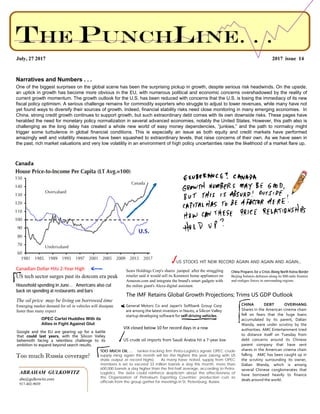
US tech sector surges past its dotcom era peak
Sears Holdings Corp's shares jumped after the struggling
retailer said it would sell its Kenmore home appliances on
Amazon.com and integrate the brand's smart gadgets with
the online giant's Alexa digital assistant.
The oil price may be living on borrowed time
Emerging market demand for oil in vehicles will dissipate
faster than many expect
General Motors Co and Japan's Softbank Group Corp
are among the latest investors in Nauto, a Silicon Valley
startup developing software for self‐driving vehicles.
CHINA DEBT OVERHANG
Shares in the American cinema chain
fell on fears that the huge loans
accumulated by its parent, Dalian
Wanda, were under scrutiny by the
authorities. AMC Entertainment tried
to distance itself on Tuesday from
debt concerns around its Chinese
parent company that have sent
shares in the American cinema chain
falling. AMC has been caught up in
the scrutiny surrounding its owner,
Dalian Wanda, which is among
several Chinese conglomerates that
have borrowed heavily to finance
deals around the world.
Household spending in June… Americans also cut
back on spending at restaurants and bars
Google and the EU are gearing up for a battle
that could last years, with the Silicon Valley
behemoth facing a relentless challenge to its
ambition to expand beyond search results.
US crude oil imports from Saudi Arabia hit a 7-year low
The IMF Retains Global Growth Projections; Trims US GDP Outlook 
Too much Russia coverage?
TOO MUCH OIL … tanker-tracking firm Petro-Logistics signals OPEC crude
supply rising again this month will be the highest this year (along with US
shale output at record highs). As many have noted, supply from OPEC
members is set to exceed 33 million barrels a day this month, more than
600,000 barrels a day higher than the first-half average, according to Petro-
Logistics. The data could reinforce skepticism about the effectiveness of
the Organization of Petroleum Exporting Countries’ production cuts as
officials from the group gather for meetings in St. Petersburg, Russia.
VIX closed below 10 for record days in a row 
OPEC Cartel Huddles With its
Allies in Fight Against Glut
Canadian Dollar Hits 2‐Year High 
China Prepares for a Crisis Along North Korea Border
Beijing bolsters defenses along its 880-mile frontier
and realigns forces in surrounding regions
US STOCKS HIT NEW RECORD AGAIN AND AGAIN AND AGAIN...
The PunchLine...
2
July 27, 2017
In This Issue
Headlines and data appearing in The Punch Line came from widely available publications including
national and international newspapers, trade journals, economic and industrial bulletins and news websites.
• Select U.S. Signals (pg 4)
• Alternative Facts (pg 5)
• Households… (pg 6)
• Dislocation, Dislocation… (pg 7)
• The Future Ain’t… (pg 8)
• The Likelihood of Unlikely Events... (pg 9)
• Credit (pg 10)
• The DNA of Business… (pg 11)
• Real Estate and Construction… (pg 12)
• Will Life Ever be the Same? (pg 13)
• Narratives and Numbers . . .
One of the biggest surprises on the global scene has been the surprising
pickup in growth, despite serious risk headwinds. On the upside, an uptick in
growth has become more obvious in the EU, with numerous political and
economic concerns overshadowed by the reality of current growth
momentum. The growth outlook for the U.S. has been reduced with concerns
that the U.S. is losing the immediacy of its new fiscal policy optimism. A
serious challenge remains for commodity exporters who struggle to adjust to
lower revenues, while many have not yet found ways to diversify their sources
of growth. Indeed, financial stability risks need close monitoring in many
emerging economies. In China, strong credit growth continues to support
growth, but such extraordinary debt comes with its own downside risks. These
pages have heralded the need for monetary policy normalization in several
advanced economies, notably the United States. However, this path also is
challenging as the long delay has created a whole new world of easy money
dependencies, “junkies,” and the path to normalcy might trigger some
turbulence in global financial conditions. This is especially an issue as both
equity and credit markets have performed amazingly well and volatility
measures have been squashed to extraordinary levels, that raise concerns of
their own. As we have seen in the past, rich market valuations and very low
volatility in an environment of high policy uncertainties raise the likelihood of a
market flare up. (pg 1)
• In This Issue (pg 2)
• Engines of Growth
Despite a run of global statistics offering economic relief, confusing stress
signals are still emanating from around the globe . Uncertainties --
particularly from terror and geopolitical concerns here and abroad, Brexit,
dangerous issues regarding N Korea, China, Russia, Iran and others - -
continue to confound investors and may contribute to intermittent bouts of
volatility. Despite extensive and massive easing, most of the global economy
still faces woefully inadequate growth prospects and difficult policy options.
The U.S. stands alone in its ability to breakout of its growth doldrums, if only it
can move forward on reform… But let’s not forget that many of the
challenges are not fleeting, and many cannot be resolved easily or quickly…
(pg 3)
Contact information:
Abraham Gulkowitz
phone: 917‐402‐9039 email:   abe@gulkowitz.com
The PunchLine...
3
July 27, 2017
Engines of Growth… 
► The Industrial Entrepreneur Confidence Index in Brazil fell again
to 50.6 in July of 2017 from 51.9 in June, reaching the lowest since
January. Encouragingly, anticipations of softer cost inflationary
pressures are forecast to lead to slower increases in prices charged.
► The 5yr local bond yield is now at the “pre-scandal” lows while the
real’s rally continues
For more than 20 years, the German auto industry has 
been operating like a cartel, according to a new 
"bombshell" report, which has sent the shares of 
Germany's biggest automakers reeling.
Der Spiegel is reporting that the big three German car companies –
Volkswagen, Daimler and BMW ‐ have been holding secret “working
groups” since the 1990s, where they would discuss, production costs,
suppliers, strategy and – importantly – emissions purification. The
meetings were initially reported to regulators by Volkswagen in a filing with
German competition authorities. The magazine described the meetings as
“one of the biggest cartel cases in German economic history.” It was at
these meetings that the companies agreed on the appropriate gas
purification standards for their diesel vehicles, thus laying the groundwork
for the diesel scandal that has resulted in massive fines for these companies
both in Germany and the US. The working groups also selected suppliers,
helping to set costs for vehicle components. The ongoing discussions
allegedly involved more than 200 employees in 60 working groups in areas
including auto development, gasoline and diesel motors, brakes and
transmissions. The allegations are guaranteed to result in more fines for the
automakers, which were just beginning to move on from the diesel emission
scandal that rocked the industry.
US cities must unlock the value of the land they sit on
There may be an answer to local governments’ pension obligations and
under-investment
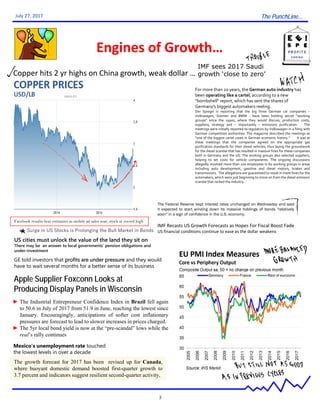
Copper hits 2 yr highs on China growth, weak dollar …
GE told investors that profits are under pressure and they would
have to wait several months for a better sense of its business
IMF sees 2017 Saudi
growth ‘close to zero’
Apple Supplier Foxconn Looks at
Producing Display Panels in Wisconsin
Mexico’s unemployment rate touched
the lowest levels in over a decade
IMF Recasts US Growth Forecasts as Hopes For Fiscal Boost Fade
US financial conditions continue to ease as the dollar weakensSurge in US Stocks is Prolonging the Bull Market in Bonds
The growth forecast for 2017 has been revised up for Canada,
where buoyant domestic demand boosted first-quarter growth to
3.7 percent and indicators suggest resilient second-quarter activity,
The Federal Reserve kept interest rates unchanged on Wednesday and said
it expected to start winding down its massive holdings of bonds "relatively
soon" in a sign of confidence in the U.S. economy.
Facebook results beat estimates as mobile ad sales soar, stock at record high
The PunchLine...
4
July 27, 2017
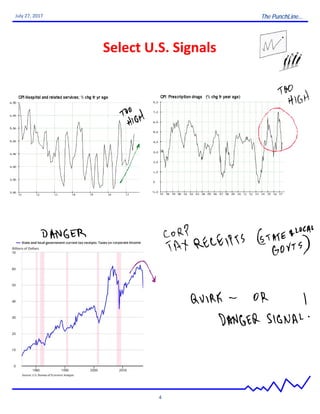
Select U.S. Signals  
The PunchLine...
5
June 28, 2007
Alternative Facts- Careful Reading
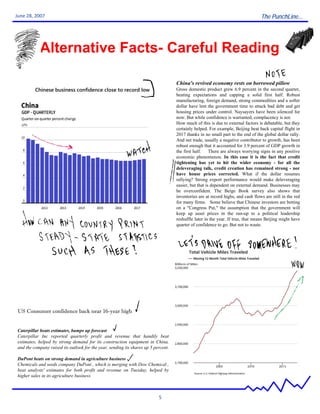
China's revived economy rests on borrowed pillow
Gross domestic product grew 6.9 percent in the second quarter,
beating expectations and capping a solid first half. Robust
manufacturing, foreign demand, strong commodities and a softer
dollar have lent the government time to attack bad debt and get
housing prices under control. Naysayers have been silenced for
now. But while confidence is warranted, complacency is not.
How much of this is due to external factors is debatable, but they
certainly helped. For example, Beijing beat back capital flight in
2017 thanks in no small part to the end of the global dollar rally.
And net trade, usually a negative contributor to growth, has been
robust enough that it accounted for 3.9 percent of GDP growth in
the first half. There are always worrying signs in any positive
economic phenomenon. In this case it is the fact that credit
tightening has yet to hit the wider economy - for all the
deleveraging talk, credit creation has remained strong - nor
have house prices corrected. What if the dollar resumes
rallying? Strong export performance would make deleveraging
easier, but that is dependent on external demand. Businesses may
be overconfident. The Beige Book survey also shows that
inventories are at record highs, and cash flows are still in the red
for many firms. Some believe that Chinese investors are betting
on a "Congress Put," the assumption that the government will
keep up asset prices in the run-up to a political leadership
reshuffle later in the year. If true, that means Beijing might have
quarter of confidence to go. But not to waste.
Chinese business confidence close to record low
Caterpillar beats estimates, bumps up forecast
Caterpillar Inc reported quarterly profit and revenue that handily beat
estimates, helped by strong demand for its construction equipment in China,
and the company raised its outlook for the year, sending its shares up 5 percent.
DuPont beats on strong demand in agriculture business
Chemicals and seeds company DuPont , which is merging with Dow Chemical ,
beat analysts' estimates for both profit and revenue on Tuesday, helped by
higher sales in its agriculture business.
US Consumer confidence back near 16-year high
The PunchLine...
6
July 27, 2017
Households – Brave New World
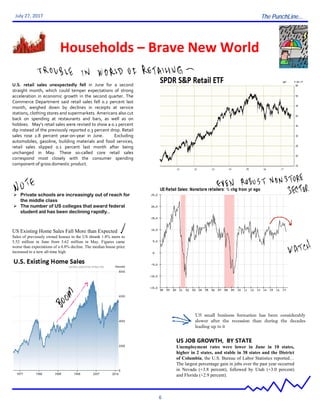
U.S. retail sales unexpectedly fell in June for a second
straight month, which could temper expectations of strong
acceleration in economic growth in the second quarter. The
Commerce Department said retail sales fell 0.2 percent last
month, weighed down by declines in receipts at service
stations, clothing stores and supermarkets. Americans also cut
back on spending at restaurants and bars, as well as on
hobbies. May's retail sales were revised to show a 0.1 percent
dip instead of the previously reported 0.3 percent drop. Retail
sales rose 2.8 percent year‐on‐year in June. Excluding
automobiles, gasoline, building materials and food services,
retail sales slipped 0.1 percent last month after being
unchanged in May. These so‐called core retail sales
correspond most closely with the consumer spending
component of gross domestic product.
USJOBGROWTH,BYSTATE
Unemployment rates were lower in June in 10 states,
higher in 2 states, and stable in 38 states and the District
of Columbia, the U.S. Bureau of Labor Statistics reported…
The largest percentage gain in jobs over the past year occurred
in Nevada (+3.8 percent), followed by Utah (+3.0 percent)
and Florida (+2.9 percent).
 Private schools are increasingly out of reach for
the middle class
 The number of US colleges that award federal
student aid has been declining rapidly..
US Existing Home Sales Fall More than Expected
Sales of previously owned houses in the US shrank 1.8% mom to
5.52 million in June from 5.62 million in May. Figures came
worse than expectations of a 0.8% decline. The median house price
increased to a new all-time high
US small business formation has been considerably
slower after the recession than during the decades
leading up to it
The PunchLine...
7
July 27, 2017
Dislocation, Dislocation, Dislocation
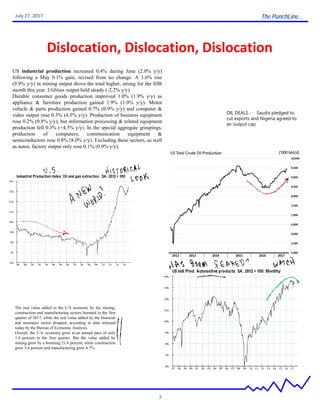
US industrial production increased 0.4% during June (2.0% y/y)
following a May 0.1% gain, revised from no change. A 1.6% rise
(9.9% y/y) in mining output drove the total higher, strong for the fifth
month this year. Utilities output held steady (-2.2% y/y).
Durable consumer goods production improved 1.0% (1.9% y/y) as
appliance & furniture production gained 1.9% (1.0% y/y). Motor
vehicle & parts production gained 0.7% (0.9% y/y) and computer &
video output rose 0.3% (4.5% y/y). Production of business equipment
rose 0.2% (0.8% y/y), but information processing & related equipment
production fell 0.3% (+4.5% y/y). In the special aggregate groupings,
production of computers, communication equipment &
semiconductors rose 0.8% (8.0% y/y). Excluding these sectors, as well
as autos, factory output only rose 0.1% (0.9% y/y).
The real value added to the U.S economy by the mining,
construction and manufacturing sectors boomed in the first
quarter of 2017, while the real value added by the financial
and insurance sector dropped, according to data released
today by the Bureau of Economic Analysis.
Overall, the U.S. economy grew at an annual pace of only
1.4 percent in the first quarter. But the value added by
mining grew by a booming 21.6 percent, while construction
grew 5.6 percent and manufacturing grew 4.7%.
OIL DEALS… Saudis pledged to
cut exports and Nigeria agreed to
an output cap
The PunchLine...
8
July 27, 2017
The Future Ain’t What It Used To Be
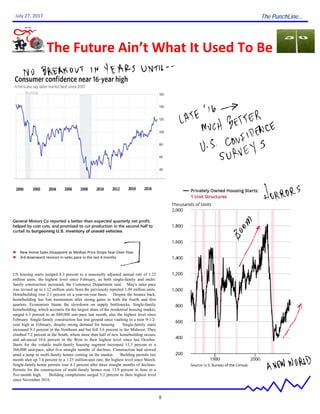
US housing starts jumped 8.3 percent to a seasonally adjusted annual rate of 1.22
million units, the highest level since February, as both single-family and multi-
family construction increased, the Commerce Department said. May's sales pace
was revised up to 1.12 million units from the previously reported 1.09 million units.
Homebuilding rose 2.1 percent on a year-on-year basis. Despite the bounce back,
homebuilding has lost momentum after strong gains in both the fourth and first
quarters. Economists blame the slowdown on supply bottlenecks. Single-family
homebuilding, which accounts for the largest share of the residential housing market,
surged 6.3 percent to an 849,000 unit-pace last month, also the highest level since
February. Single-family construction has lost ground since vaulting to a near 9-1/2-
year high in February, despite strong demand for housing. Single-family starts
increased 9.3 percent in the Northeast and but fell 3.6 percent in the Midwest. They
climbed 7.2 percent in the South, where more than half of new homebuilding occurs,
and advanced 10.6 percent in the West to their highest level since last October.
Starts for the volatile multi-family housing segment increased 13.3 percent to a
366,000 unit-pace, after five straight months of declines. Construction had slowed
amid a jump in multi-family homes coming on the market. Building permits last
month shot up 7.4 percent to a 1.25 million-unit rate, the highest level since March.
Single-family home permits rose 4.1 percent after three straight months of declines.
Permits for the construction of multi-family homes rose 13.9 percent in June to a
five-month high. Building completions surged 5.2 percent to their highest level
since November 2016.
► New Home Sales Disappoint as Median Price Drops Year‐Over‐Year
► 3rd downward revision in sales pace in the last 4 months
General Motors Co reported a better-than-expected quarterly net profit,
helped by cost cuts, and promised to cut production in the second half to
curtail its burgeoning U.S. inventory of unsold vehicles
The PunchLine...
9
July 27, 2017
The Likelihood of Unlikely Events
Global Disorder
Saudi – Qatar differences are 
important…  
Commentary: Europe’s Brexit envy
Britain’s intention to leave the European Union - Brexit - will greatly affect the rest
of the world. It’s not confined to the effect it will have on the British economy,
even if that is likely to be major, nor on the adjustments the remaining 27 EU states
must make.
Most Western countries now face, in differing degrees of intensity, the same issues
that impelled a narrow majority to vote for Brexit last year. These are closely tied
together: immigration, fear of terrorism, the sovereignty of national parliaments,
embattled ethnic identity, and lack of community cohesion. They were summed up
by the pro-Brexit camp as “Taking back control!” That concept doesn’t stop at the
English Channel. Expect, in the next year, more pressure on the EU and national
administrations fuelled by the same discontent that motivated Brexit. And in
democracies, sooner or later, such discontent must take political forms.
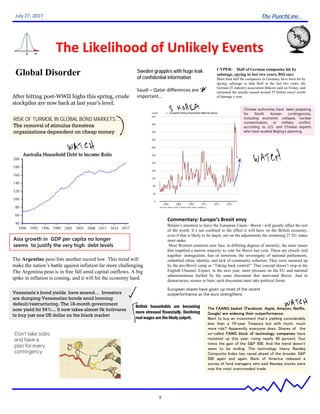
After hitting post-WWII highs this spring, crude
stockpiles are now back at last year’s level.
The Argentine peso hits another record low. This trend will
make the nation’s battle against inflation far more challenging.
The Argentina peso is in free fall amid capital outflows. A big
spike in inflation is coming, and it will hit the economy hard.
CYPER: Half of German companies hit by
sabotage, spying in last two years, BSI says
More than half the companies in Germany have been hit by
spying, sabotage or data theft in the last two years, the
German IT industry association Bitkom said on Friday, and
estimated the attacks caused around 55 billion euros' worth
of damage a year.
Venezuela’s bond yields have soared… Investors
are dumping Venezuelan bonds amid looming
default/restructuring. The 18-month government
note yield hit 54%... It now takes almost 9k bolivares
to buy just one US dollar on the black market
The FAANG basket (Facebook, Apple, Amazon, Netflix,
Google) are widening their outperformance.
Want to buy an investment that's yielding considerably
less than a 10-year Treasury but with much, much
more risk? Apparently everyone does. Shares of the
so-called FANG block of technology companies have
rocketed up this year, rising nearly 40 percent, four
times the gain of the S&P 500. And the trend doesn't
seem to be ending. The technology heavy Nasdaq
Composite Index has raced ahead of the broader S&P
500 again and again. Bank of America released a
survey of fund managers who said Nasdaq stocks were
now the most overcrowded trade.
RISK OF TURMOIL IN GLOBAL BOND MARKETS…
The removal of stimulus threatens
organizations dependent on cheap money
Sweden grapples with huge leak
of confidential information
Chinese authorities have been preparing
for North Korean contingencies,
including economic collapse, nuclear
contamination, or military conflict,
according to U.S. and Chinese experts
who have studied Beijing’s planning.
British households are becoming
more stressed financially. Declining
real wages are the likely culprit.
European shares have given up most of the recent
outperformance as the euro strengthens.
Asia growth in GDP per capita no longer
seems to justify the very high debt levels
The PunchLine...
10
July 27, 2017
Credit Matters ‐ Know Risk
Many Excel in Strategy, Few in the Management of Risk
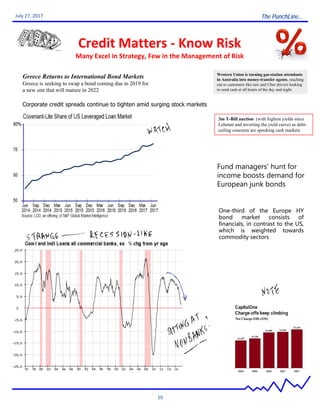
Corporate credit spreads continue to tighten amid surging stock markets
Fund managers’ hunt for
income boosts demand for
European junk bonds
Western Union is turning gas-station attendants
in Australia into money-transfer agents, reaching
out to customers like taxi and Uber drivers looking
to send cash at all hours of the day and night.
3m T-Bill auction (with highest yields since
Lehman and inverting the yield curve) as debt-
ceiling concerns are spooking cash markets
One-third of the Europe HY
bond market consists of
financials, in contrast to the US,
which is weighted towards
commodity sectors
Greece Returns to International Bond Markets
Greece is seeking to swap a bond coming due in 2019 for
a new one that will mature in 2022
The PunchLine...
11
July 27, 2017
The DNA of Business
Reconfiguring Industries to Define Growth
Frontier Airlines is Adding Service to 21 New Cities
With Flights Starting at $39
IT'S WAR: United Airlines president slams Frontier after $39 ticket 
announcement and vows 'United will win'"
Tower Operator to Buy Fiber Network
Crown Castle International, which has been looking to diversify, said
it would buy Lightower Fiber Networks for about $7.1 billion in cash
to expand its fiber footprint in the cities of the U.S. Northeast.
The influence of digital viewing is very
much being felt in the cable industry
Discovery Communications and Scripps Networks Interactive
are discussing a merger that they hope could help them fend
off competition from streaming services, If they join forces,
they could strengthen their negotiations with cable providers
like Charter Communications and Time Warner Cable, which
have been squeezing network owners after their own round
of consolidation. Discovery, which owns the Discovery
Channel and Animal Planet, is worth about $15 billion.
Scripps, worth about $8.8 billion, also specializes in factual
cable programming, with brands including HGTV and Food
Network.
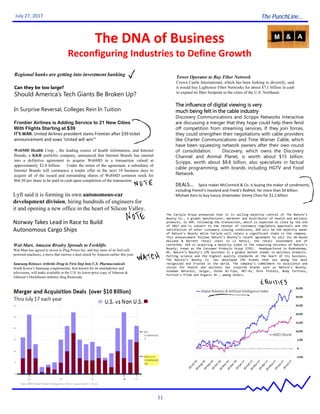
DEALS…    Spice maker McCormick & Co. is buying the maker of condiments, 
including French's mustard and Frank's RedHot, for more than $4 billion.
Michael Kors to buy luxury shoemaker Jimmy Choo for $1.2 billion 
Can they be too large?
Should America’s Tech Giants Be Broken Up?
Lyft said it is forming its own autonomous-car
development division, hiring hundreds of engineers for
it and opening a new office in the heart of Silicon Valley.
Wal-Mart, Amazon Rivalry Spreads to Forklifts
Wal-Mart has agreed to invest in Plug Power Inc. and buy more of its fuel-cell-
powered machines, a move that mirrors a deal struck by Amazon earlier this year.
Norway Takes Lead in Race to Build 
Autonomous Cargo Ships
In Surprise Reversal, Colleges Rein In Tuition
WebMD Health Corp. , the leading source of health information, and Internet
Brands, a KKR portfolio company, announced that Internet Brands has entered
into a definitive agreement to acquire WebMD in a transaction valued at
approximately $2.8 billion. Under the terms of the agreement, a subsidiary of
Internet Brands will commence a tender offer in the next 10 business days to
acquire all of the issued and outstanding shares of WebMD common stock for
$66.50 per share to be paid in cash upon completion of the transaction.
The Carlyle Group announced that it is selling majority control of The Nature’s
Bounty Co., a global manufacturer, marketer and distributor of health and wellness
products, to KKR. Following the transaction, which is expected to close by the end
of 2017 and is subject to the receipt of customary regulatory approvals and the
satisfaction of other customary closing conditions, KKR will be the majority owner
of Nature’s Bounty while Carlyle will retain a significant stake in the company.
This announcement follows Nature’s Bounty’s recent agreement to sell its UK‐based
Holland & Barrett retail chain to L1 Retail, the retail investment arm of
LetterOne. KKR is acquiring a majority stake in the remaining business of Nature’s
Bounty, known as the Consumer Products Group (CPG). Headquartered in Ronkonkoma,
NY, Nature’s Bounty’s CPG business is a global market leader in wellness products.
Putting science and the highest quality standards at the heart of its business,
The Nature’s Bounty Co. has developed CPG brands that are among the most
recognized and trusted in the world. The company’s commitment to excellence and
vision for health and wellness has inspired brands such as Nature’s Bounty,
Sundown Naturals, Solgar, Osteo Bi‐Flex, MET‐Rx, Pure Protein, Body Fortress,
Puritan’s Pride and Organic Dr., among others.
Samsung Releases Arthritis Drug in First Step Into U.S. Pharmaceuticals
South Korea’s Samsung conglomerate, best known for its smartphones and
televisions, will make available in the U.S. its lower-price copy of Johnson &
Johnson’s blockbuster arthritis drug Remicade.
Regional banks are getting into investment banking
The PunchLine...
12
July 27, 2017
Real Estate and Construction Outlook
Funds hunt for cracks in most-prized
US shopping malls
Investors begin to doubt the highest-rated
properties will escape online disruption
Apartment Construction Seen Reaching 20-Year High in 2017
More than 345,000 apartment units are expected to be delivered this year, according to Yardi
Matrix. That would be a 20-year high and a 21 percent increase from last year's 285,000 additions.
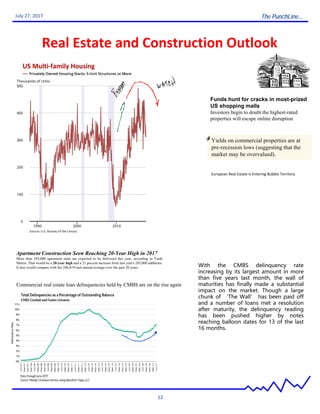
It also would compare with the 206,819-unit annual average over the past 20 years. With the CMBS delinquency rate
increasing by its largest amount in more
than five years last month, the wall of
maturities has finally made a substantial
impact on the market. Though a large
chunk of ‘The Wall’ has been paid off
and a number of loans met a resolution
after maturity, the delinquency reading
has been pushed higher by notes
reaching balloon dates for 13 of the last
16 months.
European Real Estate is Entering Bubble Territory
Yields on commercial properties are at
pre-recession lows (suggesting that the
market may be overvalued).
Commercial real estate loan delinquencies held by CMBS are on the rise again
The PunchLine...
13
July 27, 2017
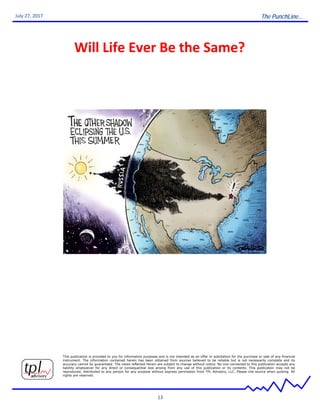
Will Life Ever Be the Same?
This publication is provided to you for information purposes and is not intended as an offer or solicitation for the purchase or sale of any financial
instrument. The information contained herein has been obtained from sources believed to be reliable but is not necessarily complete and its
accuracy cannot by guaranteed. The views reflected herein are subject to change without notice. No one connected to this publication accepts any
liability whatsoever for any direct or consequential loss arising from any use of this publication or its contents. This publication may not be
reproduced, distributed to any person for any purpose without express permission from TPL Advisory, LLC. Please cite source when quoting. All
rights are reserved.

TPL July 27 17

  • 1.
    ABRAHAM GULKOWITZ abe@gulkowitz.com 917-402-9039 2017 issue14July, 27 2017 Narratives and Numbers . . . One of the biggest surprises on the global scene has been the surprising pickup in growth, despite serious risk headwinds. On the upside, an uptick in growth has become more obvious in the EU, with numerous political and economic concerns overshadowed by the reality of current growth momentum. The growth outlook for the U.S. has been reduced with concerns that the U.S. is losing the immediacy of its new fiscal policy optimism. A serious challenge remains for commodity exporters who struggle to adjust to lower revenues, while many have not yet found ways to diversify their sources of growth. Indeed, financial stability risks need close monitoring in many emerging economies. In China, strong credit growth continues to support growth, but such extraordinary debt comes with its own downside risks. These pages have heralded the need for monetary policy normalization in several advanced economies, notably the United States. However, this path also is challenging as the long delay has created a whole new world of easy money dependencies, “junkies,” and the path to normalcy might trigger some turbulence in global financial conditions. This is especially an issue as both equity and credit markets have performed amazingly well and volatility measures have been squashed to extraordinary levels, that raise concerns of their own. As we have seen in the past, rich market valuations and very low volatility in an environment of high policy uncertainties raise the likelihood of a market flare up. US tech sector surges past its dotcom era peak Sears Holdings Corp's shares jumped after the struggling retailer said it would sell its Kenmore home appliances on Amazon.com and integrate the brand's smart gadgets with the online giant's Alexa digital assistant. The oil price may be living on borrowed time Emerging market demand for oil in vehicles will dissipate faster than many expect General Motors Co and Japan's Softbank Group Corp are among the latest investors in Nauto, a Silicon Valley startup developing software for self‐driving vehicles. CHINA DEBT OVERHANG Shares in the American cinema chain fell on fears that the huge loans accumulated by its parent, Dalian Wanda, were under scrutiny by the authorities. AMC Entertainment tried to distance itself on Tuesday from debt concerns around its Chinese parent company that have sent shares in the American cinema chain falling. AMC has been caught up in the scrutiny surrounding its owner, Dalian Wanda, which is among several Chinese conglomerates that have borrowed heavily to finance deals around the world. Household spending in June… Americans also cut back on spending at restaurants and bars Google and the EU are gearing up for a battle that could last years, with the Silicon Valley behemoth facing a relentless challenge to its ambition to expand beyond search results. US crude oil imports from Saudi Arabia hit a 7-year low The IMF Retains Global Growth Projections; Trims US GDP Outlook  Too much Russia coverage? TOO MUCH OIL … tanker-tracking firm Petro-Logistics signals OPEC crude supply rising again this month will be the highest this year (along with US shale output at record highs). As many have noted, supply from OPEC members is set to exceed 33 million barrels a day this month, more than 600,000 barrels a day higher than the first-half average, according to Petro- Logistics. The data could reinforce skepticism about the effectiveness of the Organization of Petroleum Exporting Countries’ production cuts as officials from the group gather for meetings in St. Petersburg, Russia. VIX closed below 10 for record days in a row  OPEC Cartel Huddles With its Allies in Fight Against Glut Canadian Dollar Hits 2‐Year High  China Prepares for a Crisis Along North Korea Border Beijing bolsters defenses along its 880-mile frontier and realigns forces in surrounding regions US STOCKS HIT NEW RECORD AGAIN AND AGAIN AND AGAIN...
  • 2.
    The PunchLine... 2 July 27, 2017 In This Issue Headlines anddata appearing in The Punch Line came from widely available publications including national and international newspapers, trade journals, economic and industrial bulletins and news websites. • Select U.S. Signals (pg 4) • Alternative Facts (pg 5) • Households… (pg 6) • Dislocation, Dislocation… (pg 7) • The Future Ain’t… (pg 8) • The Likelihood of Unlikely Events... (pg 9) • Credit (pg 10) • The DNA of Business… (pg 11) • Real Estate and Construction… (pg 12) • Will Life Ever be the Same? (pg 13) • Narratives and Numbers . . . One of the biggest surprises on the global scene has been the surprising pickup in growth, despite serious risk headwinds. On the upside, an uptick in growth has become more obvious in the EU, with numerous political and economic concerns overshadowed by the reality of current growth momentum. The growth outlook for the U.S. has been reduced with concerns that the U.S. is losing the immediacy of its new fiscal policy optimism. A serious challenge remains for commodity exporters who struggle to adjust to lower revenues, while many have not yet found ways to diversify their sources of growth. Indeed, financial stability risks need close monitoring in many emerging economies. In China, strong credit growth continues to support growth, but such extraordinary debt comes with its own downside risks. These pages have heralded the need for monetary policy normalization in several advanced economies, notably the United States. However, this path also is challenging as the long delay has created a whole new world of easy money dependencies, “junkies,” and the path to normalcy might trigger some turbulence in global financial conditions. This is especially an issue as both equity and credit markets have performed amazingly well and volatility measures have been squashed to extraordinary levels, that raise concerns of their own. As we have seen in the past, rich market valuations and very low volatility in an environment of high policy uncertainties raise the likelihood of a market flare up. (pg 1) • In This Issue (pg 2) • Engines of Growth Despite a run of global statistics offering economic relief, confusing stress signals are still emanating from around the globe . Uncertainties -- particularly from terror and geopolitical concerns here and abroad, Brexit, dangerous issues regarding N Korea, China, Russia, Iran and others - - continue to confound investors and may contribute to intermittent bouts of volatility. Despite extensive and massive easing, most of the global economy still faces woefully inadequate growth prospects and difficult policy options. The U.S. stands alone in its ability to breakout of its growth doldrums, if only it can move forward on reform… But let’s not forget that many of the challenges are not fleeting, and many cannot be resolved easily or quickly… (pg 3) Contact information: Abraham Gulkowitz phone: 917‐402‐9039 email:   abe@gulkowitz.com
  • 3.
    The PunchLine... 3 July 27, 2017 Engines of Growth…  ► TheIndustrial Entrepreneur Confidence Index in Brazil fell again to 50.6 in July of 2017 from 51.9 in June, reaching the lowest since January. Encouragingly, anticipations of softer cost inflationary pressures are forecast to lead to slower increases in prices charged. ► The 5yr local bond yield is now at the “pre-scandal” lows while the real’s rally continues For more than 20 years, the German auto industry has  been operating like a cartel, according to a new  "bombshell" report, which has sent the shares of  Germany's biggest automakers reeling. Der Spiegel is reporting that the big three German car companies – Volkswagen, Daimler and BMW ‐ have been holding secret “working groups” since the 1990s, where they would discuss, production costs, suppliers, strategy and – importantly – emissions purification. The meetings were initially reported to regulators by Volkswagen in a filing with German competition authorities. The magazine described the meetings as “one of the biggest cartel cases in German economic history.” It was at these meetings that the companies agreed on the appropriate gas purification standards for their diesel vehicles, thus laying the groundwork for the diesel scandal that has resulted in massive fines for these companies both in Germany and the US. The working groups also selected suppliers, helping to set costs for vehicle components. The ongoing discussions allegedly involved more than 200 employees in 60 working groups in areas including auto development, gasoline and diesel motors, brakes and transmissions. The allegations are guaranteed to result in more fines for the automakers, which were just beginning to move on from the diesel emission scandal that rocked the industry. US cities must unlock the value of the land they sit on There may be an answer to local governments’ pension obligations and under-investment Copper hits 2 yr highs on China growth, weak dollar … GE told investors that profits are under pressure and they would have to wait several months for a better sense of its business IMF sees 2017 Saudi growth ‘close to zero’ Apple Supplier Foxconn Looks at Producing Display Panels in Wisconsin Mexico’s unemployment rate touched the lowest levels in over a decade IMF Recasts US Growth Forecasts as Hopes For Fiscal Boost Fade US financial conditions continue to ease as the dollar weakensSurge in US Stocks is Prolonging the Bull Market in Bonds The growth forecast for 2017 has been revised up for Canada, where buoyant domestic demand boosted first-quarter growth to 3.7 percent and indicators suggest resilient second-quarter activity, The Federal Reserve kept interest rates unchanged on Wednesday and said it expected to start winding down its massive holdings of bonds "relatively soon" in a sign of confidence in the U.S. economy. Facebook results beat estimates as mobile ad sales soar, stock at record high
  • 4.
  • 5.
    The PunchLine... 5 June 28, 2007 Alternative Facts-Careful Reading China's revived economy rests on borrowed pillow Gross domestic product grew 6.9 percent in the second quarter, beating expectations and capping a solid first half. Robust manufacturing, foreign demand, strong commodities and a softer dollar have lent the government time to attack bad debt and get housing prices under control. Naysayers have been silenced for now. But while confidence is warranted, complacency is not. How much of this is due to external factors is debatable, but they certainly helped. For example, Beijing beat back capital flight in 2017 thanks in no small part to the end of the global dollar rally. And net trade, usually a negative contributor to growth, has been robust enough that it accounted for 3.9 percent of GDP growth in the first half. There are always worrying signs in any positive economic phenomenon. In this case it is the fact that credit tightening has yet to hit the wider economy - for all the deleveraging talk, credit creation has remained strong - nor have house prices corrected. What if the dollar resumes rallying? Strong export performance would make deleveraging easier, but that is dependent on external demand. Businesses may be overconfident. The Beige Book survey also shows that inventories are at record highs, and cash flows are still in the red for many firms. Some believe that Chinese investors are betting on a "Congress Put," the assumption that the government will keep up asset prices in the run-up to a political leadership reshuffle later in the year. If true, that means Beijing might have quarter of confidence to go. But not to waste. Chinese business confidence close to record low Caterpillar beats estimates, bumps up forecast Caterpillar Inc reported quarterly profit and revenue that handily beat estimates, helped by strong demand for its construction equipment in China, and the company raised its outlook for the year, sending its shares up 5 percent. DuPont beats on strong demand in agriculture business Chemicals and seeds company DuPont , which is merging with Dow Chemical , beat analysts' estimates for both profit and revenue on Tuesday, helped by higher sales in its agriculture business. US Consumer confidence back near 16-year high
  • 6.
    The PunchLine... 6 July 27, 2017 Households – Brave New World U.S.retail sales unexpectedly fell in June for a second straight month, which could temper expectations of strong acceleration in economic growth in the second quarter. The Commerce Department said retail sales fell 0.2 percent last month, weighed down by declines in receipts at service stations, clothing stores and supermarkets. Americans also cut back on spending at restaurants and bars, as well as on hobbies. May's retail sales were revised to show a 0.1 percent dip instead of the previously reported 0.3 percent drop. Retail sales rose 2.8 percent year‐on‐year in June. Excluding automobiles, gasoline, building materials and food services, retail sales slipped 0.1 percent last month after being unchanged in May. These so‐called core retail sales correspond most closely with the consumer spending component of gross domestic product. USJOBGROWTH,BYSTATE Unemployment rates were lower in June in 10 states, higher in 2 states, and stable in 38 states and the District of Columbia, the U.S. Bureau of Labor Statistics reported… The largest percentage gain in jobs over the past year occurred in Nevada (+3.8 percent), followed by Utah (+3.0 percent) and Florida (+2.9 percent).  Private schools are increasingly out of reach for the middle class  The number of US colleges that award federal student aid has been declining rapidly.. US Existing Home Sales Fall More than Expected Sales of previously owned houses in the US shrank 1.8% mom to 5.52 million in June from 5.62 million in May. Figures came worse than expectations of a 0.8% decline. The median house price increased to a new all-time high US small business formation has been considerably slower after the recession than during the decades leading up to it
  • 7.
    The PunchLine... 7 July 27, 2017 Dislocation, Dislocation, Dislocation US industrialproduction increased 0.4% during June (2.0% y/y) following a May 0.1% gain, revised from no change. A 1.6% rise (9.9% y/y) in mining output drove the total higher, strong for the fifth month this year. Utilities output held steady (-2.2% y/y). Durable consumer goods production improved 1.0% (1.9% y/y) as appliance & furniture production gained 1.9% (1.0% y/y). Motor vehicle & parts production gained 0.7% (0.9% y/y) and computer & video output rose 0.3% (4.5% y/y). Production of business equipment rose 0.2% (0.8% y/y), but information processing & related equipment production fell 0.3% (+4.5% y/y). In the special aggregate groupings, production of computers, communication equipment & semiconductors rose 0.8% (8.0% y/y). Excluding these sectors, as well as autos, factory output only rose 0.1% (0.9% y/y). The real value added to the U.S economy by the mining, construction and manufacturing sectors boomed in the first quarter of 2017, while the real value added by the financial and insurance sector dropped, according to data released today by the Bureau of Economic Analysis. Overall, the U.S. economy grew at an annual pace of only 1.4 percent in the first quarter. But the value added by mining grew by a booming 21.6 percent, while construction grew 5.6 percent and manufacturing grew 4.7%. OIL DEALS… Saudis pledged to cut exports and Nigeria agreed to an output cap
  • 8.
    The PunchLine... 8 July 27, 2017 The Future Ain’t What It Used To Be US housingstarts jumped 8.3 percent to a seasonally adjusted annual rate of 1.22 million units, the highest level since February, as both single-family and multi- family construction increased, the Commerce Department said. May's sales pace was revised up to 1.12 million units from the previously reported 1.09 million units. Homebuilding rose 2.1 percent on a year-on-year basis. Despite the bounce back, homebuilding has lost momentum after strong gains in both the fourth and first quarters. Economists blame the slowdown on supply bottlenecks. Single-family homebuilding, which accounts for the largest share of the residential housing market, surged 6.3 percent to an 849,000 unit-pace last month, also the highest level since February. Single-family construction has lost ground since vaulting to a near 9-1/2- year high in February, despite strong demand for housing. Single-family starts increased 9.3 percent in the Northeast and but fell 3.6 percent in the Midwest. They climbed 7.2 percent in the South, where more than half of new homebuilding occurs, and advanced 10.6 percent in the West to their highest level since last October. Starts for the volatile multi-family housing segment increased 13.3 percent to a 366,000 unit-pace, after five straight months of declines. Construction had slowed amid a jump in multi-family homes coming on the market. Building permits last month shot up 7.4 percent to a 1.25 million-unit rate, the highest level since March. Single-family home permits rose 4.1 percent after three straight months of declines. Permits for the construction of multi-family homes rose 13.9 percent in June to a five-month high. Building completions surged 5.2 percent to their highest level since November 2016. ► New Home Sales Disappoint as Median Price Drops Year‐Over‐Year ► 3rd downward revision in sales pace in the last 4 months General Motors Co reported a better-than-expected quarterly net profit, helped by cost cuts, and promised to cut production in the second half to curtail its burgeoning U.S. inventory of unsold vehicles
  • 9.
    The PunchLine... 9 July 27, 2017 The Likelihood of Unlikely Events Global Disorder Saudi –Qatar differences are  important…   Commentary: Europe’s Brexit envy Britain’s intention to leave the European Union - Brexit - will greatly affect the rest of the world. It’s not confined to the effect it will have on the British economy, even if that is likely to be major, nor on the adjustments the remaining 27 EU states must make. Most Western countries now face, in differing degrees of intensity, the same issues that impelled a narrow majority to vote for Brexit last year. These are closely tied together: immigration, fear of terrorism, the sovereignty of national parliaments, embattled ethnic identity, and lack of community cohesion. They were summed up by the pro-Brexit camp as “Taking back control!” That concept doesn’t stop at the English Channel. Expect, in the next year, more pressure on the EU and national administrations fuelled by the same discontent that motivated Brexit. And in democracies, sooner or later, such discontent must take political forms. After hitting post-WWII highs this spring, crude stockpiles are now back at last year’s level. The Argentine peso hits another record low. This trend will make the nation’s battle against inflation far more challenging. The Argentina peso is in free fall amid capital outflows. A big spike in inflation is coming, and it will hit the economy hard. CYPER: Half of German companies hit by sabotage, spying in last two years, BSI says More than half the companies in Germany have been hit by spying, sabotage or data theft in the last two years, the German IT industry association Bitkom said on Friday, and estimated the attacks caused around 55 billion euros' worth of damage a year. Venezuela’s bond yields have soared… Investors are dumping Venezuelan bonds amid looming default/restructuring. The 18-month government note yield hit 54%... It now takes almost 9k bolivares to buy just one US dollar on the black market The FAANG basket (Facebook, Apple, Amazon, Netflix, Google) are widening their outperformance. Want to buy an investment that's yielding considerably less than a 10-year Treasury but with much, much more risk? Apparently everyone does. Shares of the so-called FANG block of technology companies have rocketed up this year, rising nearly 40 percent, four times the gain of the S&P 500. And the trend doesn't seem to be ending. The technology heavy Nasdaq Composite Index has raced ahead of the broader S&P 500 again and again. Bank of America released a survey of fund managers who said Nasdaq stocks were now the most overcrowded trade. RISK OF TURMOIL IN GLOBAL BOND MARKETS… The removal of stimulus threatens organizations dependent on cheap money Sweden grapples with huge leak of confidential information Chinese authorities have been preparing for North Korean contingencies, including economic collapse, nuclear contamination, or military conflict, according to U.S. and Chinese experts who have studied Beijing’s planning. British households are becoming more stressed financially. Declining real wages are the likely culprit. European shares have given up most of the recent outperformance as the euro strengthens. Asia growth in GDP per capita no longer seems to justify the very high debt levels
  • 10.
    The PunchLine... 10 July 27, 2017 Credit Matters ‐ Know Risk Many Excel in Strategy, Few in the Management of Risk Corporatecredit spreads continue to tighten amid surging stock markets Fund managers’ hunt for income boosts demand for European junk bonds Western Union is turning gas-station attendants in Australia into money-transfer agents, reaching out to customers like taxi and Uber drivers looking to send cash at all hours of the day and night. 3m T-Bill auction (with highest yields since Lehman and inverting the yield curve) as debt- ceiling concerns are spooking cash markets One-third of the Europe HY bond market consists of financials, in contrast to the US, which is weighted towards commodity sectors Greece Returns to International Bond Markets Greece is seeking to swap a bond coming due in 2019 for a new one that will mature in 2022
  • 11.
    The PunchLine... 11 July 27, 2017 The DNA of Business Reconfiguring Industries to Define Growth Frontier Airlinesis Adding Service to 21 New Cities With Flights Starting at $39 IT'S WAR: United Airlines president slams Frontier after $39 ticket  announcement and vows 'United will win'" Tower Operator to Buy Fiber Network Crown Castle International, which has been looking to diversify, said it would buy Lightower Fiber Networks for about $7.1 billion in cash to expand its fiber footprint in the cities of the U.S. Northeast. The influence of digital viewing is very much being felt in the cable industry Discovery Communications and Scripps Networks Interactive are discussing a merger that they hope could help them fend off competition from streaming services, If they join forces, they could strengthen their negotiations with cable providers like Charter Communications and Time Warner Cable, which have been squeezing network owners after their own round of consolidation. Discovery, which owns the Discovery Channel and Animal Planet, is worth about $15 billion. Scripps, worth about $8.8 billion, also specializes in factual cable programming, with brands including HGTV and Food Network. DEALS…    Spice maker McCormick & Co. is buying the maker of condiments,  including French's mustard and Frank's RedHot, for more than $4 billion. Michael Kors to buy luxury shoemaker Jimmy Choo for $1.2 billion  Can they be too large? Should America’s Tech Giants Be Broken Up? Lyft said it is forming its own autonomous-car development division, hiring hundreds of engineers for it and opening a new office in the heart of Silicon Valley. Wal-Mart, Amazon Rivalry Spreads to Forklifts Wal-Mart has agreed to invest in Plug Power Inc. and buy more of its fuel-cell- powered machines, a move that mirrors a deal struck by Amazon earlier this year. Norway Takes Lead in Race to Build  Autonomous Cargo Ships In Surprise Reversal, Colleges Rein In Tuition WebMD Health Corp. , the leading source of health information, and Internet Brands, a KKR portfolio company, announced that Internet Brands has entered into a definitive agreement to acquire WebMD in a transaction valued at approximately $2.8 billion. Under the terms of the agreement, a subsidiary of Internet Brands will commence a tender offer in the next 10 business days to acquire all of the issued and outstanding shares of WebMD common stock for $66.50 per share to be paid in cash upon completion of the transaction. The Carlyle Group announced that it is selling majority control of The Nature’s Bounty Co., a global manufacturer, marketer and distributor of health and wellness products, to KKR. Following the transaction, which is expected to close by the end of 2017 and is subject to the receipt of customary regulatory approvals and the satisfaction of other customary closing conditions, KKR will be the majority owner of Nature’s Bounty while Carlyle will retain a significant stake in the company. This announcement follows Nature’s Bounty’s recent agreement to sell its UK‐based Holland & Barrett retail chain to L1 Retail, the retail investment arm of LetterOne. KKR is acquiring a majority stake in the remaining business of Nature’s Bounty, known as the Consumer Products Group (CPG). Headquartered in Ronkonkoma, NY, Nature’s Bounty’s CPG business is a global market leader in wellness products. Putting science and the highest quality standards at the heart of its business, The Nature’s Bounty Co. has developed CPG brands that are among the most recognized and trusted in the world. The company’s commitment to excellence and vision for health and wellness has inspired brands such as Nature’s Bounty, Sundown Naturals, Solgar, Osteo Bi‐Flex, MET‐Rx, Pure Protein, Body Fortress, Puritan’s Pride and Organic Dr., among others. Samsung Releases Arthritis Drug in First Step Into U.S. Pharmaceuticals South Korea’s Samsung conglomerate, best known for its smartphones and televisions, will make available in the U.S. its lower-price copy of Johnson & Johnson’s blockbuster arthritis drug Remicade. Regional banks are getting into investment banking
  • 12.
    The PunchLine... 12 July 27, 2017 Real Estate and Construction Outlook Funds huntfor cracks in most-prized US shopping malls Investors begin to doubt the highest-rated properties will escape online disruption Apartment Construction Seen Reaching 20-Year High in 2017 More than 345,000 apartment units are expected to be delivered this year, according to Yardi Matrix. That would be a 20-year high and a 21 percent increase from last year's 285,000 additions. It also would compare with the 206,819-unit annual average over the past 20 years. With the CMBS delinquency rate increasing by its largest amount in more than five years last month, the wall of maturities has finally made a substantial impact on the market. Though a large chunk of ‘The Wall’ has been paid off and a number of loans met a resolution after maturity, the delinquency reading has been pushed higher by notes reaching balloon dates for 13 of the last 16 months. European Real Estate is Entering Bubble Territory Yields on commercial properties are at pre-recession lows (suggesting that the market may be overvalued). Commercial real estate loan delinquencies held by CMBS are on the rise again
  • 13.
    The PunchLine... 13 July 27, 2017 Will Life Ever Be the Same? This publicationis provided to you for information purposes and is not intended as an offer or solicitation for the purchase or sale of any financial instrument. The information contained herein has been obtained from sources believed to be reliable but is not necessarily complete and its accuracy cannot by guaranteed. The views reflected herein are subject to change without notice. No one connected to this publication accepts any liability whatsoever for any direct or consequential loss arising from any use of this publication or its contents. This publication may not be reproduced, distributed to any person for any purpose without express permission from TPL Advisory, LLC. Please cite source when quoting. All rights are reserved.