

TPACK Introduction Kelly Schermerhorn August 23, 2010
Macs Introduction to new Macs Look at Student Use Presentation and edit  Settings that will help you “ Safari” is your browser The open, minimize and green “extend” button Spend 10 minutes with your Mac
Essential Question of the Day : How does incorporating technology improve the  achievement of my students?
Spencer in 1859 asked, “ What knowledge is of most worth when designing instruction”? In 2006, in the midst of the fast paced technological changes, the knowledge of most worth is TPACK.. An ability to draw from an integrate knowledge of technology, and content (and their relationship to each other into your curriculum  and instructional practices. Mishra & Koehler, 2006
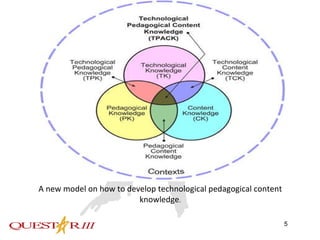
A new model on how to develop technological pedagogical content knowledge .
So, what can TPACK do for me? Learning  how to  use the technology  is much different  than knowing what to do with it for instructional purposes. Redesigning instruction requires an understanding of how knowledge about content, pedagogy and technology  overlap,  to inform your choices for curriculum and instruction. http://vimeo.com/14182460
Findings in a SITES 2006 IEA Second Information Technology in Education Study 9,000 Schools involved 35,000 Math & Science teachers from 22 countries The question posed: “ How are teachers using technology in their instruction”? Some findings were that… Increased technology does not lead to student learning. Rather,  effectiveness of technology use depended on teacher approaches used in conjunction with the technology. How you integrate, not the technology alone. Needs to be about learning , not just technology. Make sure to choose the right tool. As long as we see content, technology and pedagogy as separate, technology will always just be an “add on”.
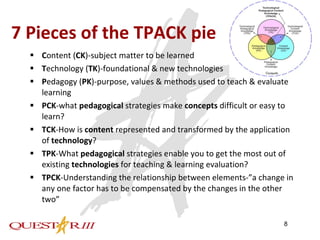
7 Pieces of the TPACK pie  C ontent ( CK )-subject matter to be learned T echnology ( TK )-foundational & new technologies P edagogy ( PK )-purpose, values & methods used to teach & evaluate learning PCK -what  pedagogical  strategies make  concepts  difficult or easy to learn? TCK -How is  content  represented and transformed by the application of  technology ? TPK -What  pedagogical  strategies enable you to get the most out of existing  technologies  for teaching & learning evaluation? TPCK -Understanding the relationship between elements-”a change in any one factor has to be compensated by the changes in the other two”
Pedagogical Knowledge (PK) General knowledge and skills related to teaching. This includes:  knowledge of general teaching methods (discovery learning, collaborative learning, problem-based learning, etc) Knowledge of learners including developmental issues for children Classroom management skills and motivation
Content Knowledge (CK) Knowledge of the facts, concepts and skills that exist in a particular domain. This knowledge is independent of pedagogical knowledge. Example: Scientists or Historian may know their domain, but don’t know how to teach others.
Technological Knowledge (TK) Knowledge required to understand and use the various technologies.  Any technologies, we will call “tools”-specifically digital tools (hardware and software) This information can be as basic as the use of different programs or file formats. More advanced use could be knowledge in different operating systems . Even more advanced using could be programming.
Pedagogical Content Knowledge (PCK) Describe what teacher know about teaching in a particular content area.  It is unique to teachers! Examples of PCK: Knowing how to use methods of Guided Inquiry to teach Science Knowing how to use the methods of Balanced Literacy to teach elementary students how to read and write. Might also include knowledge of analogies, examples that are effective in teaching a particular subject matter.
Technological Content Knowledge (TCK) Comes from integration of TK and CK Knowing technologies that are relevant to a particular domain & how to use them within the domain Examples of TCK: Scientist using a scanning electron microscope to analyze insects Mathematician using  3-D graphing software Note: having the knowledge does not mean that they know how to use as instructional tools
Technological Pedagogical Knowledge (TPK) Knowledge of how technologies can be used in a general (non-content specific) teaching context Support teaching strategies and methods to be used in any content area  Examples of TPK: Presenting information-know basic rules for how to present information clearly using presentation software like MS PowerPoint Motivation & engagement-know how & when to use multimedia & emerging technologies to engage an audience
Technological Pedagogical & Content Knowledge (TPACK) Knowledge of how to use technology to support content-specific pedagogical methods and strategies. How to support content-specific methods: content-domain oriented tools and pedagogy oriented tools Content-domain oriented tools are tools of the trade; learners use tech tools that were created for use by practitioners in the content domain (desktop publishing like an author uses) Pedagogy oriented tool are tools created for a pedagogical purpose (simulation of a frog dissection)
According to Clay Shirky… Four scaffolding stages to mastering the connected  world: SHARING COOPERATE (CONNECT) COLLABORATE COLLECTIVE ACTION
80% of teachers K-8 do not teach with inquiry. WHY? Pressure of high stakes testing. Few experiences. Can you name at least one or more?
Essential Question of the Day revisited How does incorporating technology improve the  achievement of my students?
Learning activity types function as conceptual planning tools for teachers; they comprise a methodological shorthand that can be used to both build and describe plans for standards-based learning experiences. Each activity type captures what is most essential about the structure of a particular kind of learning action as it relates to  what   students do  when engaged in that particular learning-related activity (e.g., “group discussion;” “role play;” “fieldtrip”) .  Activity types are combined to create lesson plans, projects and units. They can also serve as efficient communication tools for educators wanting to share their plans for students’ learning with each other, as science education lesson study research in Japan has shown (Linn, Lewis, Tsuchida, & Songer 2000). After teachers are familiar with a complete set of technology-enriched learning activity types in a particular curriculum area, they can effectively choose among, combine, and use them in standards-based learning situations, building their TPACK in practical ways while doing so.
TPACK integration How do teachers learn to integrate educational tech tools into their teaching? Usually, we look at what the tech tool can give us then we develop curriculum With TPACK, curriculum based goals and activities are devised first, then select the tech tool. Why? Students learning & technology use are assured to happen.
Why are we here? What is the EETT grant about? The first choice was to use TPACK. SCALE is the second choice, which we will work on tomorrow. Let’s discussion a plan of attack. What do you need to have at the end of today? (answer to the Essential ? of the day)
Game Break www.fitbrains.com 15 minutes for gaming break Sign up for a free account and try “Uber brains”
Video http://vimeo.com/13362508
History of TPACK TPCK is not a brand new idea. A range of other scholars have argued that that knowledge about technology cannot be treated as context-free, and that good teaching requires an understanding of how technology relates to the pedagogy and content. The TPACK framework is gaining popularity amongst researchers and scholars. This makes tracking the progress of TPACK difficult but here is a relatively comprehensive list of  References to TPACK  in the research literature (going back to 1998). The definitive description of TPACK can be found in  Mishra & Koehler, 2006  (PDF download) and Koehler & Mishra, in press). If you have any other references to add to this please send an email to punya@msu.edu.  The TPACK framework represented here is the result of an on-going  design experiment  being conducted by Matt Koehler & Punya Mishra and has involved many other people as well (co-conspirators include Kathryn Hershey, Lisa Peruski, Aman Yadav, Kurnia Yahya, and Yong Zhao).
History (continued) Based on Shulman’s idea of Pedagogical Content Knowledge (1986). True technology integration  is understanding and negotiating the relationships between these three concepts.  Shulman states teachers should master two types knowledge:   content and curriculum development
Shulman’s  Major talking points Several cycles of activities that teachers should complete for good teaching: Comprehension Transformation Instruction Evaluation Reflection New comprehension
Compare/contrast Create a Venn diagram with a partner on the two methods discussed so far. Title one side “Shulman” and the other side  “  Mishap/Koehler”. Have at least 5 on each side and 5 in the middle. When you are done, get up and share your diagram with another group. Each person tell me one thing that you can take away from this exercise .
Google the following… TPACK Read one article, blog post, etc. and be able to share something that you did not hear yet today. Time limit-15 minutes. If you finish early, read through some more of TPACK related materials.
Did you answer your Essential question of the day? How does incorporating technology improve the  achievement of my students? If not, how will you be able to?
Resources http://opne.byu.edu/ipt287/tpack-framework/ www.tpck.org Vimeo videos from Punya Mishra from ISTE 2010 www.amte.net http://www.intime.uni.edu/model/teacher/teac2summary.html

Tpack intro

  • 1.
    TPACK Introduction KellySchermerhorn August 23, 2010
  • 2.
    Macs Introduction tonew Macs Look at Student Use Presentation and edit Settings that will help you “ Safari” is your browser The open, minimize and green “extend” button Spend 10 minutes with your Mac
  • 3.
    Essential Question ofthe Day : How does incorporating technology improve the achievement of my students?
  • 4.
    Spencer in 1859asked, “ What knowledge is of most worth when designing instruction”? In 2006, in the midst of the fast paced technological changes, the knowledge of most worth is TPACK.. An ability to draw from an integrate knowledge of technology, and content (and their relationship to each other into your curriculum and instructional practices. Mishra & Koehler, 2006
  • 5.
    A new modelon how to develop technological pedagogical content knowledge .
  • 6.
    So, what canTPACK do for me? Learning how to use the technology is much different than knowing what to do with it for instructional purposes. Redesigning instruction requires an understanding of how knowledge about content, pedagogy and technology overlap, to inform your choices for curriculum and instruction. http://vimeo.com/14182460
  • 7.
    Findings in aSITES 2006 IEA Second Information Technology in Education Study 9,000 Schools involved 35,000 Math & Science teachers from 22 countries The question posed: “ How are teachers using technology in their instruction”? Some findings were that… Increased technology does not lead to student learning. Rather, effectiveness of technology use depended on teacher approaches used in conjunction with the technology. How you integrate, not the technology alone. Needs to be about learning , not just technology. Make sure to choose the right tool. As long as we see content, technology and pedagogy as separate, technology will always just be an “add on”.
  • 8.
    7 Pieces ofthe TPACK pie C ontent ( CK )-subject matter to be learned T echnology ( TK )-foundational & new technologies P edagogy ( PK )-purpose, values & methods used to teach & evaluate learning PCK -what pedagogical strategies make concepts difficult or easy to learn? TCK -How is content represented and transformed by the application of technology ? TPK -What pedagogical strategies enable you to get the most out of existing technologies for teaching & learning evaluation? TPCK -Understanding the relationship between elements-”a change in any one factor has to be compensated by the changes in the other two”
  • 9.
    Pedagogical Knowledge (PK)General knowledge and skills related to teaching. This includes: knowledge of general teaching methods (discovery learning, collaborative learning, problem-based learning, etc) Knowledge of learners including developmental issues for children Classroom management skills and motivation
  • 10.
    Content Knowledge (CK)Knowledge of the facts, concepts and skills that exist in a particular domain. This knowledge is independent of pedagogical knowledge. Example: Scientists or Historian may know their domain, but don’t know how to teach others.
  • 11.
    Technological Knowledge (TK)Knowledge required to understand and use the various technologies. Any technologies, we will call “tools”-specifically digital tools (hardware and software) This information can be as basic as the use of different programs or file formats. More advanced use could be knowledge in different operating systems . Even more advanced using could be programming.
  • 12.
    Pedagogical Content Knowledge(PCK) Describe what teacher know about teaching in a particular content area. It is unique to teachers! Examples of PCK: Knowing how to use methods of Guided Inquiry to teach Science Knowing how to use the methods of Balanced Literacy to teach elementary students how to read and write. Might also include knowledge of analogies, examples that are effective in teaching a particular subject matter.
  • 13.
    Technological Content Knowledge(TCK) Comes from integration of TK and CK Knowing technologies that are relevant to a particular domain & how to use them within the domain Examples of TCK: Scientist using a scanning electron microscope to analyze insects Mathematician using 3-D graphing software Note: having the knowledge does not mean that they know how to use as instructional tools
  • 14.
    Technological Pedagogical Knowledge(TPK) Knowledge of how technologies can be used in a general (non-content specific) teaching context Support teaching strategies and methods to be used in any content area Examples of TPK: Presenting information-know basic rules for how to present information clearly using presentation software like MS PowerPoint Motivation & engagement-know how & when to use multimedia & emerging technologies to engage an audience
  • 15.
    Technological Pedagogical &Content Knowledge (TPACK) Knowledge of how to use technology to support content-specific pedagogical methods and strategies. How to support content-specific methods: content-domain oriented tools and pedagogy oriented tools Content-domain oriented tools are tools of the trade; learners use tech tools that were created for use by practitioners in the content domain (desktop publishing like an author uses) Pedagogy oriented tool are tools created for a pedagogical purpose (simulation of a frog dissection)
  • 16.
    According to ClayShirky… Four scaffolding stages to mastering the connected world: SHARING COOPERATE (CONNECT) COLLABORATE COLLECTIVE ACTION
  • 17.
    80% of teachersK-8 do not teach with inquiry. WHY? Pressure of high stakes testing. Few experiences. Can you name at least one or more?
  • 18.
    Essential Question ofthe Day revisited How does incorporating technology improve the achievement of my students?
  • 19.
    Learning activity typesfunction as conceptual planning tools for teachers; they comprise a methodological shorthand that can be used to both build and describe plans for standards-based learning experiences. Each activity type captures what is most essential about the structure of a particular kind of learning action as it relates to what students do when engaged in that particular learning-related activity (e.g., “group discussion;” “role play;” “fieldtrip”) . Activity types are combined to create lesson plans, projects and units. They can also serve as efficient communication tools for educators wanting to share their plans for students’ learning with each other, as science education lesson study research in Japan has shown (Linn, Lewis, Tsuchida, & Songer 2000). After teachers are familiar with a complete set of technology-enriched learning activity types in a particular curriculum area, they can effectively choose among, combine, and use them in standards-based learning situations, building their TPACK in practical ways while doing so.
  • 20.
    TPACK integration Howdo teachers learn to integrate educational tech tools into their teaching? Usually, we look at what the tech tool can give us then we develop curriculum With TPACK, curriculum based goals and activities are devised first, then select the tech tool. Why? Students learning & technology use are assured to happen.
  • 21.
    Why are wehere? What is the EETT grant about? The first choice was to use TPACK. SCALE is the second choice, which we will work on tomorrow. Let’s discussion a plan of attack. What do you need to have at the end of today? (answer to the Essential ? of the day)
  • 22.
    Game Break www.fitbrains.com15 minutes for gaming break Sign up for a free account and try “Uber brains”
  • 23.
  • 24.
    History of TPACKTPCK is not a brand new idea. A range of other scholars have argued that that knowledge about technology cannot be treated as context-free, and that good teaching requires an understanding of how technology relates to the pedagogy and content. The TPACK framework is gaining popularity amongst researchers and scholars. This makes tracking the progress of TPACK difficult but here is a relatively comprehensive list of References to TPACK in the research literature (going back to 1998). The definitive description of TPACK can be found in Mishra & Koehler, 2006 (PDF download) and Koehler & Mishra, in press). If you have any other references to add to this please send an email to punya@msu.edu. The TPACK framework represented here is the result of an on-going design experiment being conducted by Matt Koehler & Punya Mishra and has involved many other people as well (co-conspirators include Kathryn Hershey, Lisa Peruski, Aman Yadav, Kurnia Yahya, and Yong Zhao).
  • 25.
    History (continued) Basedon Shulman’s idea of Pedagogical Content Knowledge (1986). True technology integration is understanding and negotiating the relationships between these three concepts. Shulman states teachers should master two types knowledge: content and curriculum development
  • 26.
    Shulman’s Majortalking points Several cycles of activities that teachers should complete for good teaching: Comprehension Transformation Instruction Evaluation Reflection New comprehension
  • 27.
    Compare/contrast Create aVenn diagram with a partner on the two methods discussed so far. Title one side “Shulman” and the other side “ Mishap/Koehler”. Have at least 5 on each side and 5 in the middle. When you are done, get up and share your diagram with another group. Each person tell me one thing that you can take away from this exercise .
  • 28.
    Google the following…TPACK Read one article, blog post, etc. and be able to share something that you did not hear yet today. Time limit-15 minutes. If you finish early, read through some more of TPACK related materials.
  • 29.
    Did you answeryour Essential question of the day? How does incorporating technology improve the achievement of my students? If not, how will you be able to?
  • 30.
    Resources http://opne.byu.edu/ipt287/tpack-framework/ www.tpck.orgVimeo videos from Punya Mishra from ISTE 2010 www.amte.net http://www.intime.uni.edu/model/teacher/teac2summary.html

Editor's Notes

  • #8 SITES-Second information technology in Education study in 2006 IEA-International Association for the Evaluation of Educational Achievement SITES 2006 was an ambitious and demanding study, involving complex procedures for drawing samples, collecting data, and analyzing and reporting findings. The technical implementation of SITES 2006 resembles, to a large extent, the procedures used in IEA's past and present student achievement studies, such as TIMSS and PIRLS. However, the adult target populations, for instance, imply certain operational consequences and necessities.