ASSIGNMENT 
EDU 10.8 TECHNO-PEDAGOGIC CONTENT KNOWLEDGE ANALYSIS –PHYSICAL SCIENCE 
Submitted to: Simi Miss Submitted by, 
MEKHA MATHEW 
PHYSICAL SCIENCE OPTION 
Candidate code: 13352012 
FMTC, Kollam
PEDAGOGICAL CONTENT KNOWLEDGE (PCK)e 
PCK includes “the most useful form of representation of the most powerful analogies, illustrations, examples, explanation and 
demonstration in a word, the ways of representing and formulating the subject that make it comprehensible to others PCK is an accumulation 
of common elements. 
 Knowledge of subject matter 
 Knowledge of students and possible misconceptions 
 Knowledge of curriculum 
 knowledge of general pedagogy 
PCK is know what, when, why and how to teach using a reservoir of knowledge of good teaching practice and experience. 
TECHNOLOGICAL PEDAGOGICAL CONTENT KNOWLEDGE (TPACK) 
TPACK frame work 
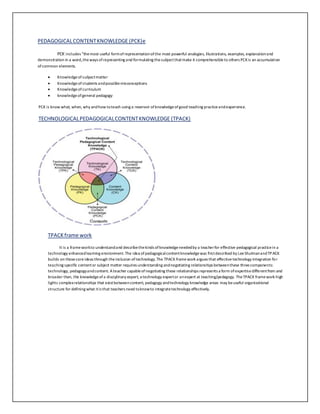
It is a frame work to understand and describe the kinds of knowledge needed by a teacher for effective pedagogical practice in a 
technology enhanced learning environment. The idea of pedagogical content knowledge was first described by Lee Shulman and TPACK 
builds on those core ideas through the inclusion of technology. The TPACK frame work argues that effective technology integration for 
teaching specific content or subject matter requires understanding and negotiating relationships between these three components: 
technology, pedagogy and content. A teacher capable of negotiating these relationships represents a form of expertise different from and 
broader than, the knowledge of a disciplinary expert, a technology expert or an expert at teaching/pedagogy. The TPACK frame work high 
lights complex relationships that exist between content, pedagogy and technology knowledge areas may be useful organizational 
structure for defining what it is that teachers need to know to integrate technology effectively.
TPACK knowledge areas 
TPACK consists of 7 different areas. 
CK, PK, TK, PCK, TCK, TPK, TPCK. All of these knowledge areas are considered with in a particular contextual frame work. 
1) Technology knowledge (TK) 
It refers to an understanding of the way that technologies are used in a specific content domain. For example, for physics teacher, it can 
understand of the range of technologies that physicists use in science and industry. Within the context of technology integration in schools, it 
appears to most often refer to digital technologies such as laptops, the internet and software applications. TK does however go beyond digital 
purpose of existing technologies. So that they can be used in a technology 
2) Content Knowledge (CK) 
It may be defined as “a through grounding in college level subject matter or a command of the subject “. It may also include knowledge of 
concepts, theories, conceptual frame works as well as knowledge about accepted ways of developing knowledge. 
3) Pedagogical knowledge (PK) 
Pedagogical knowledge includes generic knowledge about how students learn, teaching approach methods of assessment and knowledge 
of different theories about learning. This knowledge alone is necessary but in sufficient for teaching purposes. In addiction a teacher 
requires content knowledge. 
4) Pedagogical content knowledge (PCK) 
It is the knowledge about how to combine pedagogy and content effectively. This is knowledge about how to make a subject 
understandable to learners. 
5) Technological content knowledge (TCK) 
It refers to knowledge about how technology may be used to provide new ways of teaching content. For example: digital animation makes 
it possible for students to conceptualize how electrons are shared between atoms when chemical compound are formed. 
6) Technological pedagogical knowledge (TPK) 
It refers to the affordances and constraints of technology as an enabler of different teaching approaches. For example: online 
collaboration tools may facilitate social learning for geographically separated learners. 
7) Technological pedagogical content knowledge (TPCK 
It refers to the knowledge and understanding of the interplay between CK, TK and PK when using technology for teaching and learning. It 
includes an understanding of the complexity of relationships between students, teacher ’s content, practices and technologies.
GENERATION AND TRANSACTION OF PHYSICAL SCIENCE IN THE LIGHT OF TPCK PARADIAGRAM 
There are several elements that teachers must consider when creating lesson plans and one frame work for describing these 
elements in referred to as TPCK: technology, pedagogy, content and knowledge. Essentially this frame work is graphically representing 
using incorporate all elements in order to meet the expectation of the TPCK model. Simply the TPCK model centers on the instruction of 
the three most important elements of teaching in 21st century. 
Using computers, in education students consciously employed in TPCK model as they created lessons for their virtual class room. IN 
addition to creating lessons and resources or virtual of or future students, this class imparted constructivist activities up on its students. 
The intersection of content knowledge, technology knowledge and pedagogical knowledge is essential when developing lesson plans 
in order to ensure that the student are receiving quality education that fosters critical and creating thinking skills. 
CONCLUSION 
In the modern society one of the major changes in education can be described as a general shift from teaching to learning the 
teacher role is increasingly to assist students to become good learners. At the same time, teacher must help create stronger relationship 
between the subjects of study and create reality, putting them in a more relevant context for student. 
REFERENCES 
 Hares j. Mishra and Koehler M.(2009)-Teachers technological pedagogical content knowledge and learning activities types, 
curriculum based technology integration reframed. 
 Shulman L.S. (1986)-Those who understand knowledge growth in teaching. Educated Researcher.

M1 (2)

  • 1.
    ASSIGNMENT EDU 10.8TECHNO-PEDAGOGIC CONTENT KNOWLEDGE ANALYSIS –PHYSICAL SCIENCE Submitted to: Simi Miss Submitted by, MEKHA MATHEW PHYSICAL SCIENCE OPTION Candidate code: 13352012 FMTC, Kollam
  • 2.
    PEDAGOGICAL CONTENT KNOWLEDGE(PCK)e PCK includes “the most useful form of representation of the most powerful analogies, illustrations, examples, explanation and demonstration in a word, the ways of representing and formulating the subject that make it comprehensible to others PCK is an accumulation of common elements.  Knowledge of subject matter  Knowledge of students and possible misconceptions  Knowledge of curriculum  knowledge of general pedagogy PCK is know what, when, why and how to teach using a reservoir of knowledge of good teaching practice and experience. TECHNOLOGICAL PEDAGOGICAL CONTENT KNOWLEDGE (TPACK) TPACK frame work It is a frame work to understand and describe the kinds of knowledge needed by a teacher for effective pedagogical practice in a technology enhanced learning environment. The idea of pedagogical content knowledge was first described by Lee Shulman and TPACK builds on those core ideas through the inclusion of technology. The TPACK frame work argues that effective technology integration for teaching specific content or subject matter requires understanding and negotiating relationships between these three components: technology, pedagogy and content. A teacher capable of negotiating these relationships represents a form of expertise different from and broader than, the knowledge of a disciplinary expert, a technology expert or an expert at teaching/pedagogy. The TPACK frame work high lights complex relationships that exist between content, pedagogy and technology knowledge areas may be useful organizational structure for defining what it is that teachers need to know to integrate technology effectively.
  • 3.
    TPACK knowledge areas TPACK consists of 7 different areas. CK, PK, TK, PCK, TCK, TPK, TPCK. All of these knowledge areas are considered with in a particular contextual frame work. 1) Technology knowledge (TK) It refers to an understanding of the way that technologies are used in a specific content domain. For example, for physics teacher, it can understand of the range of technologies that physicists use in science and industry. Within the context of technology integration in schools, it appears to most often refer to digital technologies such as laptops, the internet and software applications. TK does however go beyond digital purpose of existing technologies. So that they can be used in a technology 2) Content Knowledge (CK) It may be defined as “a through grounding in college level subject matter or a command of the subject “. It may also include knowledge of concepts, theories, conceptual frame works as well as knowledge about accepted ways of developing knowledge. 3) Pedagogical knowledge (PK) Pedagogical knowledge includes generic knowledge about how students learn, teaching approach methods of assessment and knowledge of different theories about learning. This knowledge alone is necessary but in sufficient for teaching purposes. In addiction a teacher requires content knowledge. 4) Pedagogical content knowledge (PCK) It is the knowledge about how to combine pedagogy and content effectively. This is knowledge about how to make a subject understandable to learners. 5) Technological content knowledge (TCK) It refers to knowledge about how technology may be used to provide new ways of teaching content. For example: digital animation makes it possible for students to conceptualize how electrons are shared between atoms when chemical compound are formed. 6) Technological pedagogical knowledge (TPK) It refers to the affordances and constraints of technology as an enabler of different teaching approaches. For example: online collaboration tools may facilitate social learning for geographically separated learners. 7) Technological pedagogical content knowledge (TPCK It refers to the knowledge and understanding of the interplay between CK, TK and PK when using technology for teaching and learning. It includes an understanding of the complexity of relationships between students, teacher ’s content, practices and technologies.
  • 4.
    GENERATION AND TRANSACTIONOF PHYSICAL SCIENCE IN THE LIGHT OF TPCK PARADIAGRAM There are several elements that teachers must consider when creating lesson plans and one frame work for describing these elements in referred to as TPCK: technology, pedagogy, content and knowledge. Essentially this frame work is graphically representing using incorporate all elements in order to meet the expectation of the TPCK model. Simply the TPCK model centers on the instruction of the three most important elements of teaching in 21st century. Using computers, in education students consciously employed in TPCK model as they created lessons for their virtual class room. IN addition to creating lessons and resources or virtual of or future students, this class imparted constructivist activities up on its students. The intersection of content knowledge, technology knowledge and pedagogical knowledge is essential when developing lesson plans in order to ensure that the student are receiving quality education that fosters critical and creating thinking skills. CONCLUSION In the modern society one of the major changes in education can be described as a general shift from teaching to learning the teacher role is increasingly to assist students to become good learners. At the same time, teacher must help create stronger relationship between the subjects of study and create reality, putting them in a more relevant context for student. REFERENCES  Hares j. Mishra and Koehler M.(2009)-Teachers technological pedagogical content knowledge and learning activities types, curriculum based technology integration reframed.  Shulman L.S. (1986)-Those who understand knowledge growth in teaching. Educated Researcher.