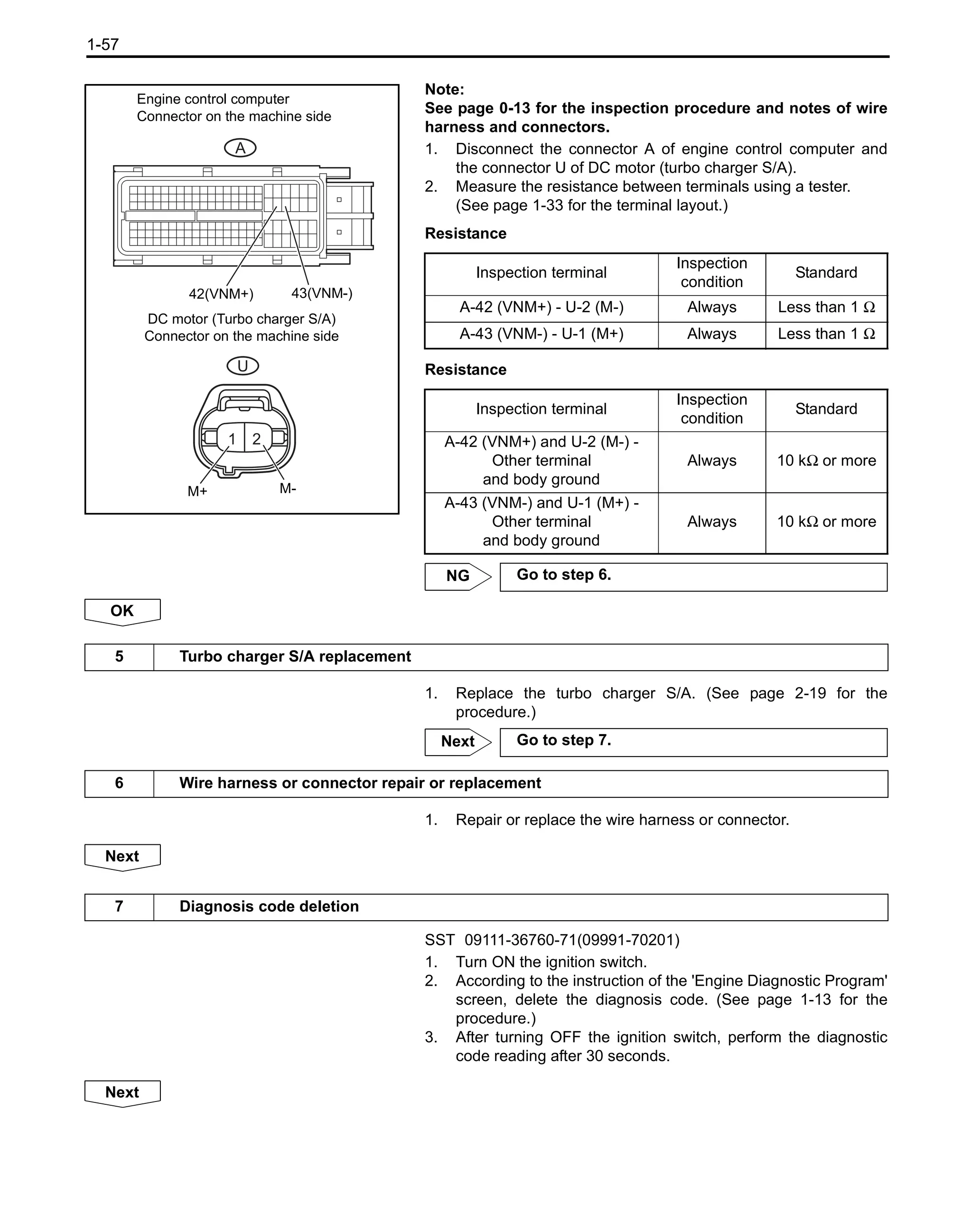
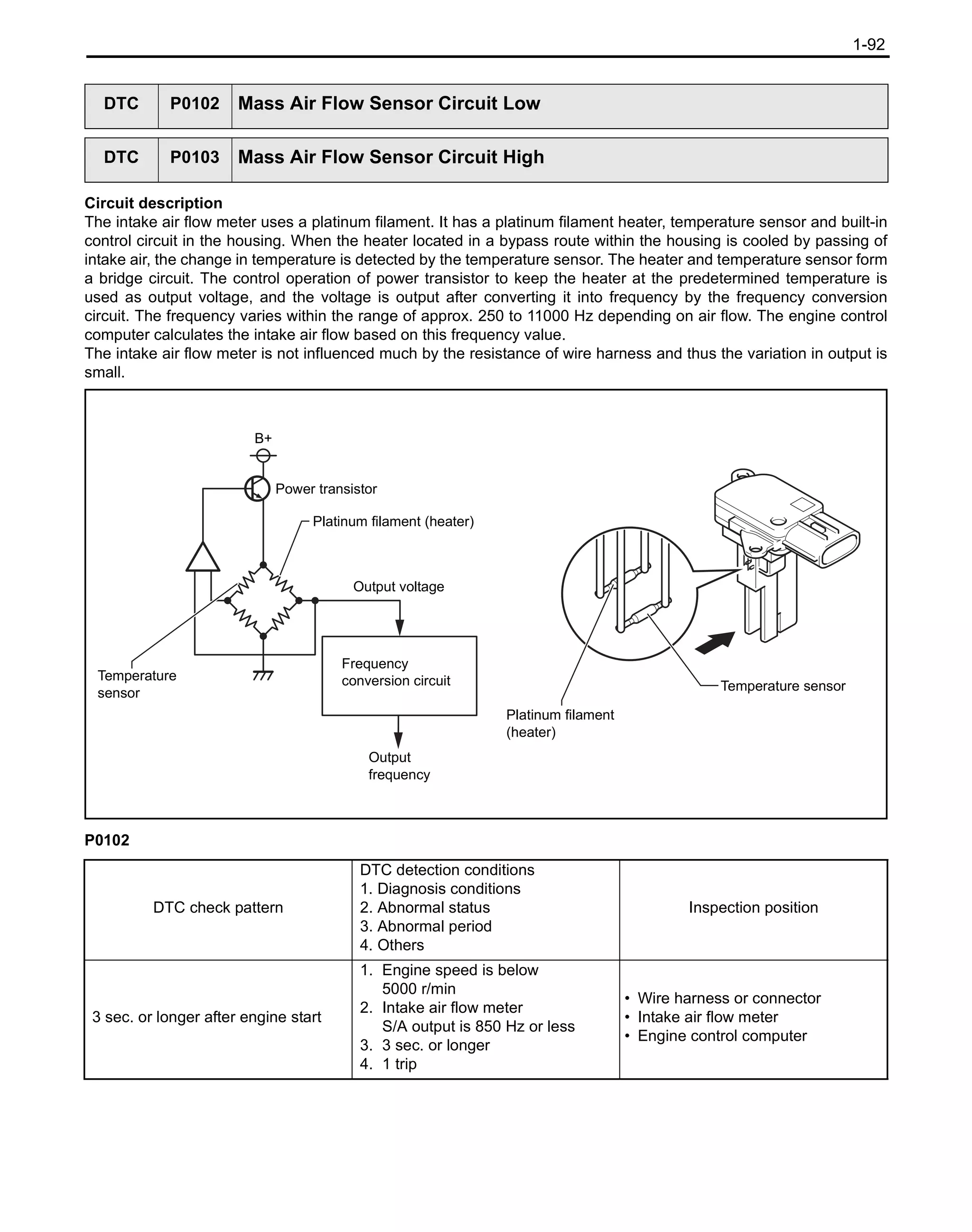
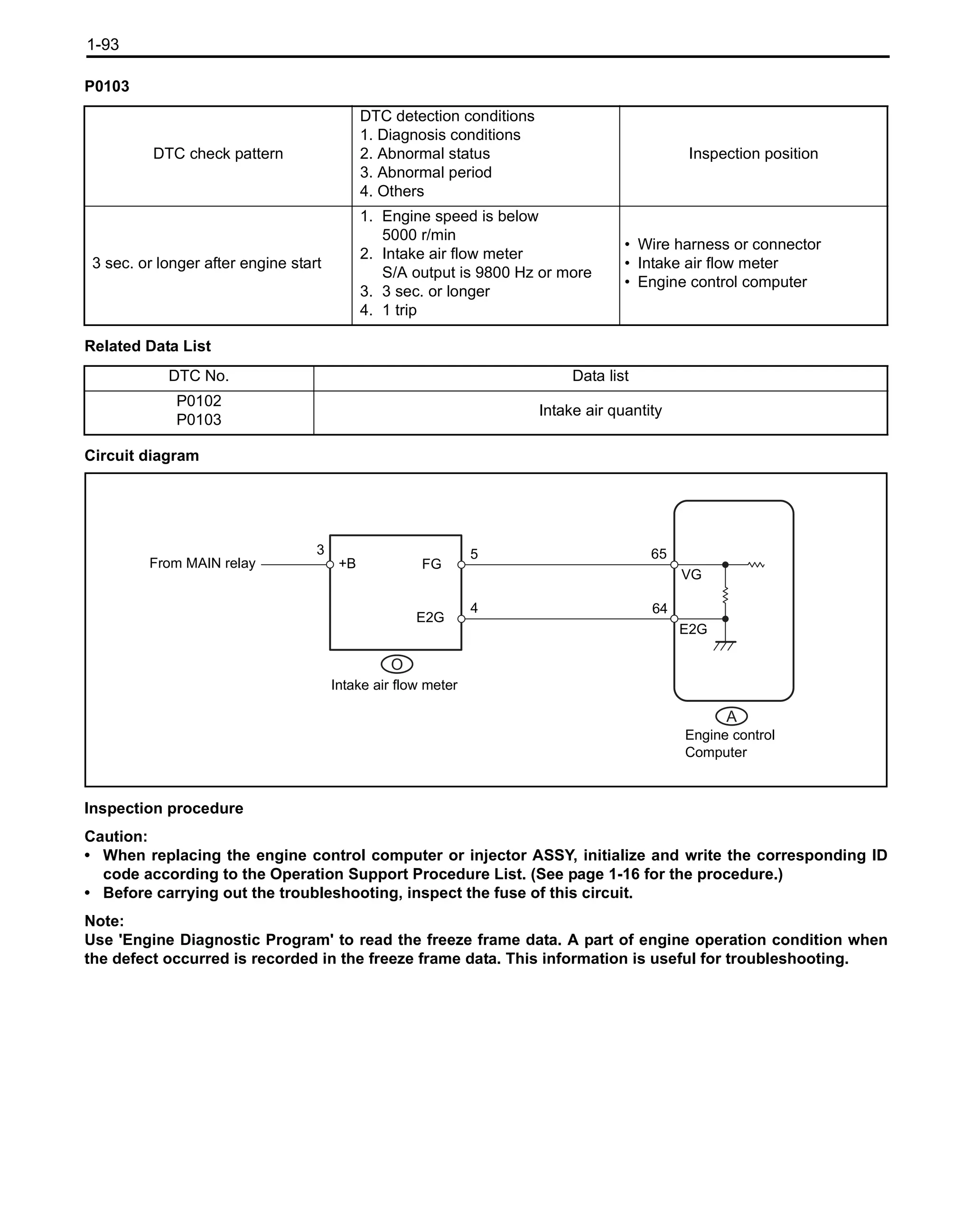
1-1
0
1
2
3
4
5
6
7
8
9
10
11
12
13
14
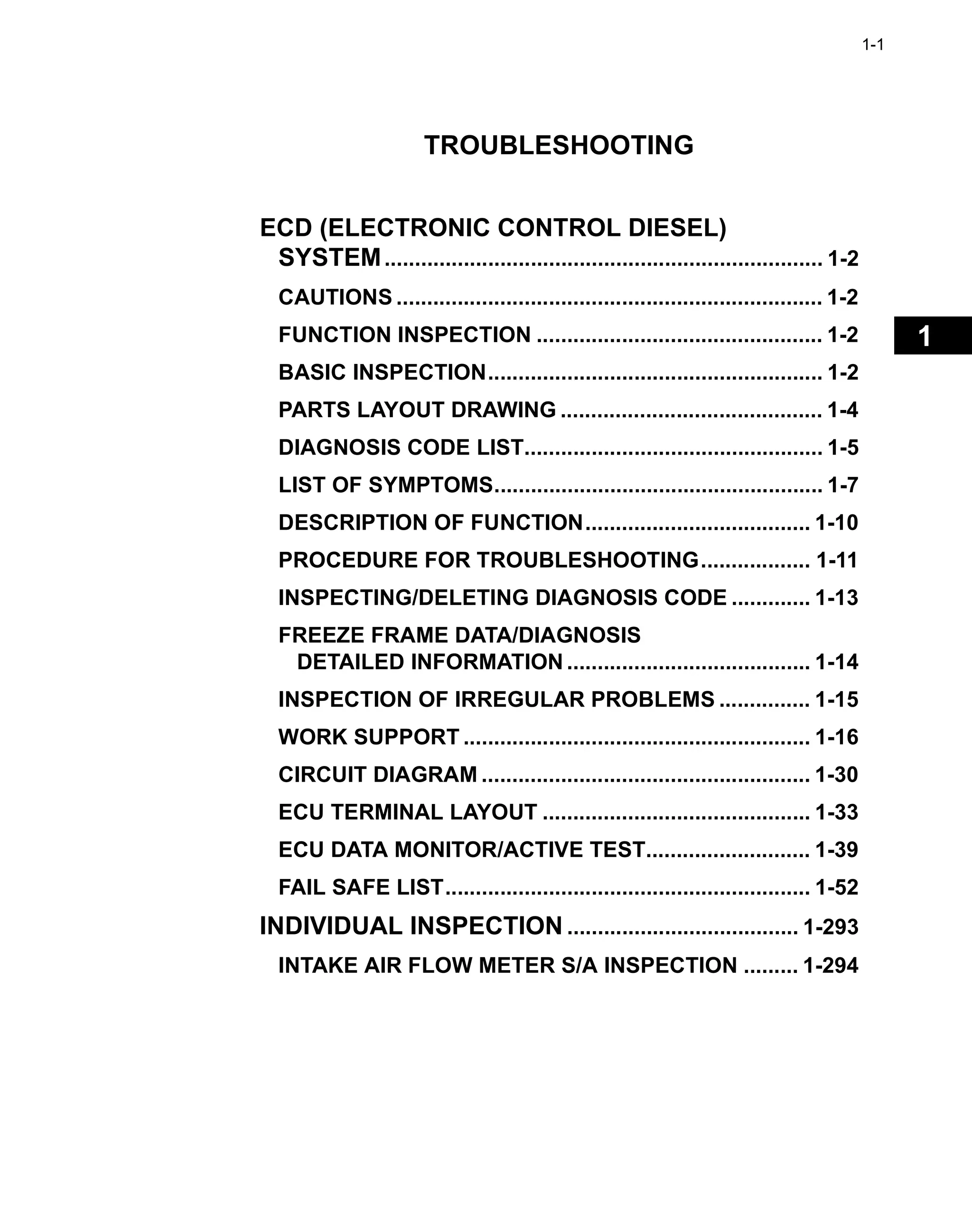
TROUBLESHOOTING
ECD (ELECTRONIC CONTROL DIESEL)
SYSTEM........................................................................ 1-2
CAUTIONS ...................................................................... 1-2
FUNCTION INSPECTION ............................................... 1-2
BASIC INSPECTION....................................................... 1-2
PARTS LAYOUT DRAWING ........................................... 1-4
DIAGNOSIS CODE LIST................................................. 1-5
LIST OF SYMPTOMS...................................................... 1-7
DESCRIPTION OF FUNCTION..................................... 1-10
PROCEDURE FOR TROUBLESHOOTING.................. 1-11
INSPECTING/DELETING DIAGNOSIS CODE ............. 1-13
FREEZE FRAME DATA/DIAGNOSIS
DETAILED INFORMATION ........................................ 1-14
INSPECTION OF IRREGULAR PROBLEMS ............... 1-15
WORK SUPPORT ......................................................... 1-16
CIRCUIT DIAGRAM ...................................................... 1-30
ECU TERMINAL LAYOUT ............................................ 1-33
ECU DATA MONITOR/ACTIVE TEST........................... 1-39
FAIL SAFE LIST............................................................ 1-52
INDIVIDUAL INSPECTION ...................................... 1-293
INTAKE AIR FLOW METER S/A INSPECTION ......... 1-294
1KD_RM.book 1 ページ 2013年9月27日 金曜日 午後12時47分
1-2
1KD_RM.book 2 ページ 2013年9月27日 金曜日 午後12時47分
1-2
ECD (ELECTRONIC CONTROL DIESEL) SYSTEM
CAUTIONS
1. Precautions for using the 'Engine Diagnostic Program'
WARNING:
• Read the 'Engine Diagnostic Program' instruction manual before using it.
• In operating the machine with the 'Engine Diagnostic Program' connected, be careful of handling so that
the cable of the 'Engine Diagnostic Program' does not hang on the pedal, the shift lever, or the steering
wheel.
• In operating the machine using the tool (such as performing a simulation test), to avoid operations while
controlling the tool, two operators should always work and observe work rules.
FUNCTION INSPECTION
1. Accelerator position sensor (potentiometer) (See the lift truck repair manual for the procedure.)
2. Intake air flow meter
Caution:
• Follow the procedure below to inspect the intake air flow meter S/A.
• With the engine stopped, when a value of [MAF] from [Data monitor] does not meet the standard or when
foreign matter is found in the platinum filament (heater) portion of the intake air flow meter S/A, the meter
should be replaced.
(1) Intake air quantity inspection
SST 09111-36760-71 (09991-70201)
Caution:
• With the engine stopped, keep the machine horizontal and inspect these functions indoors.
• Perform inspection with the intake air flow meter S/A mounted on the intake pipe (with the machine
installed).
• Do not suck air from the exhaust tail pipe in the exhaust duct.
(a) Turn the ignition key switch on and wait for 30 seconds.
(with the engine stopped)
(b) According to the instruction of the 'Engine Diagnostic Program' screen, press [Data monitor] and monitor
[MAF] and read a numerical value.
Reference 1.2 g/sec (0.16 lb/min) or less
(2) Sensor foreign matter adhesion inspection
(a) Visually check the platinum filament (heater) portion in flow paths.
Standard No foreign matter that can be visually checked
Note:
After checking that no foreign matter is found, return the intake air flow meter S/A to the machine.
BASIC INSPECTION
Note:
When the location of a defect cannot be identified even after troubleshooting, it can be pinpointed through
the basic inspection below.
1. Battery inspection (See the machine repair manual for the procedure.)
2. Cranking operation inspection
(1) Inspect if the engine cranks.
Note:
If it does not crank, inspect relevant portions, referring to the LIST OF SYMPTOMS
(See page 1-7 for the procedure.)
1KD_RM.book 2 ページ 2013年9月27日 金曜日 午後12時47分
1-3
3. Engine start inspection
(1) Inspect if the engine starts.
NOTICE:
• Engine should be cranked by two rotations at minimum when engine starting because ECD system
electrically detects the fuel injected cylinder.
• If it does not start, inspect relevant portions, referring to the LIST OF
SYMPTOMS (See page 1-8 for the procedure.)
4. Air filter inspection (See the machine repair manual for the procedure.)
5. Idle speed inspection
(1) Inspect idling.
Reference: Refer to repair manual of the vehicle (after warm-up, during idling)
6. Fuel pressure inspection
SST: 09240-36770-71
(1) According to the instruction of the screen, press [Data monitor] and monitor [Fuel Press] and measure fuel
pressure.
Reference: 30000 to 50000 kPa (after warm-up, during idling)
7. Fuel property
Inspect if a proper fuel is used as described in the Operator's Manual.
Diesel fuel
For 8FD35U to 8FD80U model
Use only ultra low-sulfur fuel defined by ASTM D0975 No.2-D S15.
Refer to the following table for details.
Detailed Requirement for ASTM D0975 No.2-D S15
Property Unit Value
Distillation Temperature °C 90 % 282 to 338
Kinematic Viscosity mm2/s at 40 °C 1.9 to 4.1
Sulfur ppm (μ g/g) max 15
Cetane index -, min 40
Aromaticity %vol, max 35
Lubricity, HFRR μm, max 520
NOTICE:
• Do not use bio-diesel fuel. Damage to engine will occur.
• In cold weather, use winter diesel fuel to prevent clogging of the fuel filter caused by paraffin precipitation.
In hot weather, do not use winter diesel fuel. Damage to engine will occur.
• Do not use deteriorated fuel which has been stored for a long period of time or impure fuel in which
foreign material, water and etc. is included.
• If fuel is frozen or becomes wax-like substance in winter season, engine may be hard starting, rough idle
after starting or engine rotation is impossible to increase. In that case, fuel for winter use should be used.
Melt the wax generated in the fuel filter by warming.
1-4
PARTS LAYOUT DRAWING
Fuel pressure sensor
Diesel turbo
pressure sensor
Common rail ASSY
Intake air flow meter
Glow plug ASSY
Injector ASSY
Water temperature sensor
Inlet air
temperature sensor
Crank position
sensor No. 2
Electric EGR
control valve
Oil pressure
switch ASSY
Crank position sensor
Turbo charger S/A
Suction control valve ASSY
Fuel temperature
sensor
Pressure limiter
1KD_RM.book 4 ページ 2013年9月27日 金曜日 午後12時47分
1-5
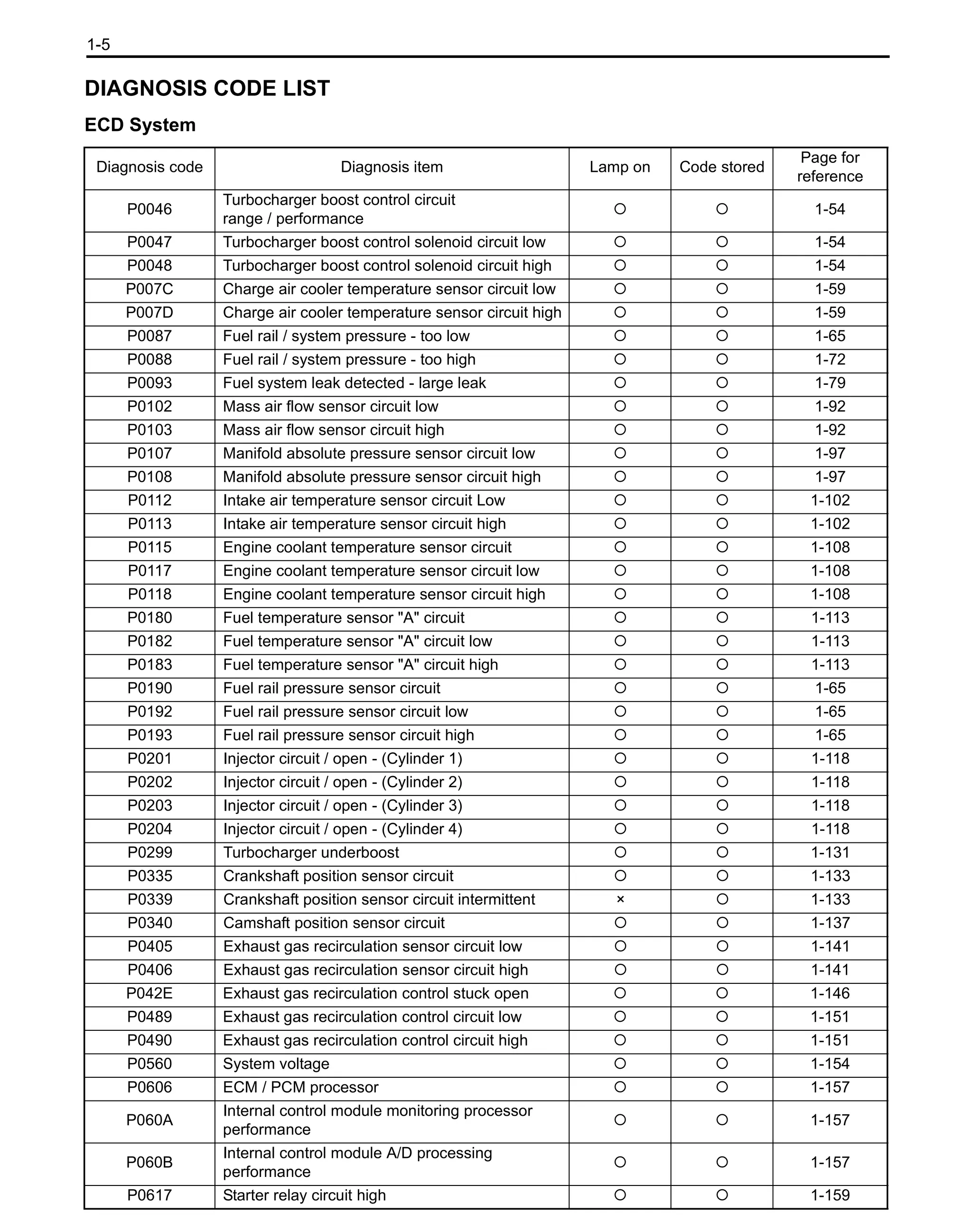
DIAGNOSIS CODE LIST
ECD System
Diagnosis code Diagnosis item Lamp on Code stored
Page for
reference
P0046
Turbocharger boost control circuit
range / performance
  1-54
P0047 Turbocharger boost control solenoid circuit low   1-54
P0048 Turbocharger boost control solenoid circuit high   1-54
P007C Charge air cooler temperature sensor circuit low   1-59
P007D Charge air cooler temperature sensor circuit high   1-59
P0087 Fuel rail / system pressure - too low   1-65
P0088 Fuel rail / system pressure - too high   1-72
P0093 Fuel system leak detected - large leak   1-79
P0102 Mass air flow sensor circuit low   1-92
P0103 Mass air flow sensor circuit high   1-92
P0107 Manifold absolute pressure sensor circuit low   1-97
P0108 Manifold absolute pressure sensor circuit high   1-97
P0112 Intake air temperature sensor circuit Low   1-102
P0113 Intake air temperature sensor circuit high   1-102
P0115 Engine coolant temperature sensor circuit   1-108
P0117 Engine coolant temperature sensor circuit low   1-108
P0118 Engine coolant temperature sensor circuit high   1-108
P0180 Fuel temperature sensor "A" circuit   1-113
P0182 Fuel temperature sensor "A" circuit low   1-113
P0183 Fuel temperature sensor "A" circuit high   1-113
P0190 Fuel rail pressure sensor circuit   1-65
P0192 Fuel rail pressure sensor circuit low   1-65
P0193 Fuel rail pressure sensor circuit high   1-65
P0201 Injector circuit / open - (Cylinder 1)   1-118
P0202 Injector circuit / open - (Cylinder 2)   1-118
P0203 Injector circuit / open - (Cylinder 3)   1-118
P0204 Injector circuit / open - (Cylinder 4)   1-118
P0299 Turbocharger underboost   1-131
P0335 Crankshaft position sensor circuit   1-133
P0339 Crankshaft position sensor circuit intermittent ×  1-133
P0340 Camshaft position sensor circuit   1-137
P0405 Exhaust gas recirculation sensor circuit low   1-141
P0406 Exhaust gas recirculation sensor circuit high   1-141
P042E Exhaust gas recirculation control stuck open   1-146
P0489 Exhaust gas recirculation control circuit low   1-151
P0490 Exhaust gas recirculation control circuit high   1-151
P0560 System voltage   1-154
P0606 ECM / PCM processor   1-157
P060A
Internal control module monitoring processor
performance
  1-157
P060B
Internal control module A/D processing
performance
  1-157
P0617 Starter relay circuit high   1-159
1KD_RM.book 5 ページ 2013年9月27日 金曜日 午後12時47分
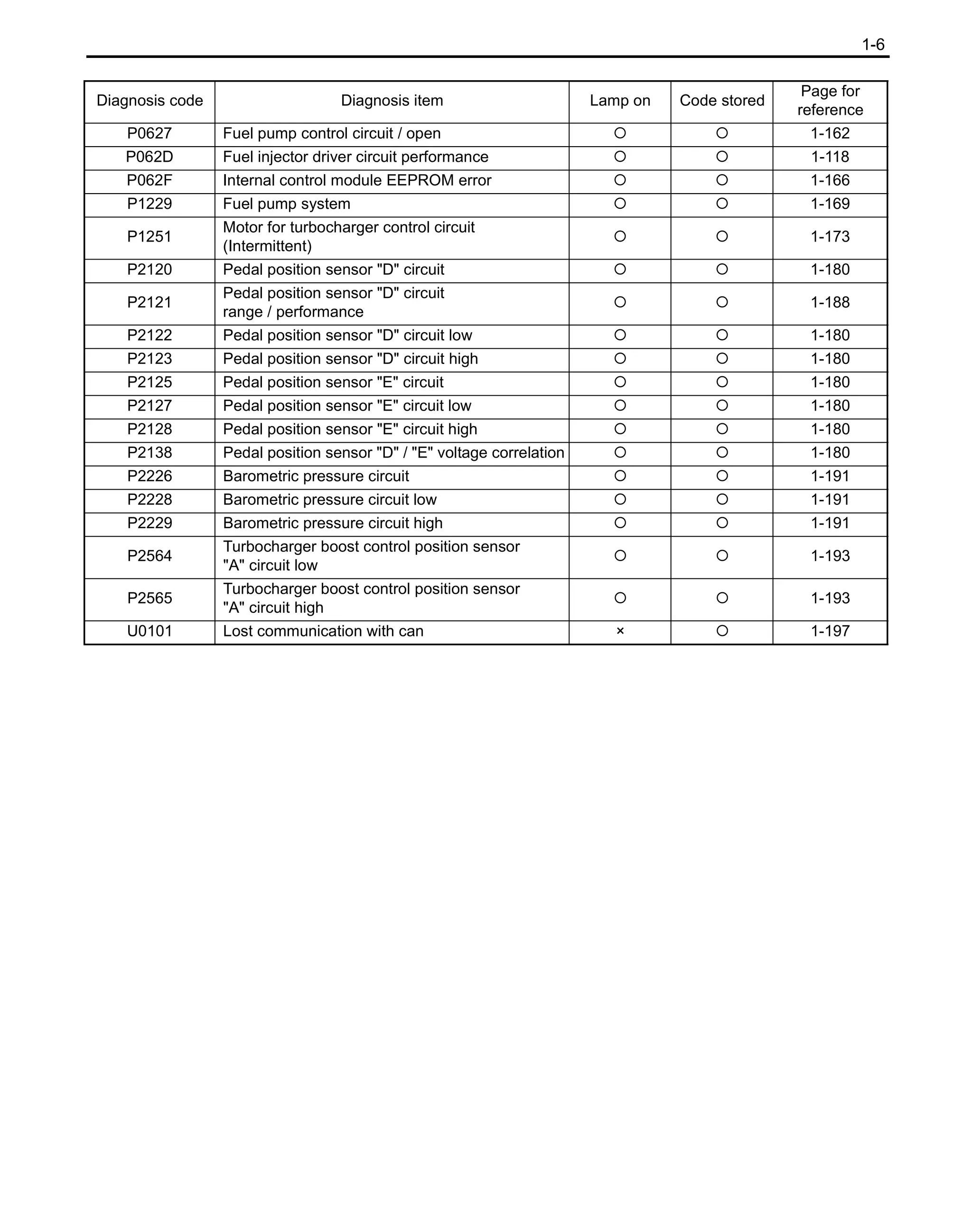
1-6
P0627 Fuel pump control circuit / open   1-162
P062D Fuel injector driver circuit performance   1-118
P062F Internal control module EEPROM error   1-166
P1229 Fuel pump system   1-169
P1251
Motor for turbocharger control circuit
(Intermittent)
  1-173
P2120 Pedal position sensor "D" circuit   1-180
P2121
Pedal position sensor "D" circuit
range / performance
  1-188
P2122 Pedal position sensor "D" circuit low   1-180
P2123 Pedal position sensor "D" circuit high   1-180
P2125 Pedal position sensor "E" circuit   1-180
P2127 Pedal position sensor "E" circuit low   1-180
P2128 Pedal position sensor "E" circuit high   1-180
P2138 Pedal position sensor "D" / "E" voltage correlation   1-180
P2226 Barometric pressure circuit   1-191
P2228 Barometric pressure circuit low   1-191
P2229 Barometric pressure circuit high   1-191
P2564
Turbocharger boost control position sensor
"A" circuit low
  1-193
P2565
Turbocharger boost control position sensor
"A" circuit high
  1-193
U0101 Lost communication with can ×  1-197
Diagnosis code Diagnosis item Lamp on Code stored
Page for
reference
1KD_RM.book 6 ページ 2013年9月27日 金曜日 午後12時47分
1-7
LIST OF SYMPTOMS
ECD System
Symptom Portion to be inspected
Page for
reference
Does not crank
Battery -
Starter 5-2
Starting relay -
Shift lever position -
Fast idling rough
Fuel filter -
Injector ASSY 1-118
Starter system 1-199
Engine control computer -
Suction control valve ASSY 1-296
Fuel pressure sensor 1-296
Intake air flow meter 1-294
Fuel property 1-3
Water temperature sensor 1-295
Fuel piping
(blocking from the tank to the supply pump)
-
Idle speed high
Troubleshooting of rough idle and large vibration 1-270
Injector ASSY 1-118
Starter system 1-199
Engine control computer -
Suction control valve ASSY 1-296
Fuel pressure sensor 1-296
Water temperature sensor 1-295
Accelerator position sensor (potentiometer) -
Idle speed low
Troubleshooting of rough idle and large vibration 1-270
Injector ASSY 1-118
Electric EGR control valve 1-296
Compression 2-79
Valve clearance 2-78
Fuel piping -
Engine control computer -
Suction control valve ASSY 1-296
Fuel pressure sensor 1-296
Idle unstable
Troubleshooting of rough idle and large vibration 1-270
Injector ASSY 1-118
Fuel piping -
Electric EGR control valve 1-296
Compression 2-79
Valve clearance 2-78
Engine control computer -
Suction control valve ASSY 1-296
Fuel pressure sensor 1-296
Fuel property 1-3
Power steering system -
Alternator ASSY (external accessory) 7-4
1KD_RM.book 7 ページ 2013年9月27日 金曜日 午後12時47分
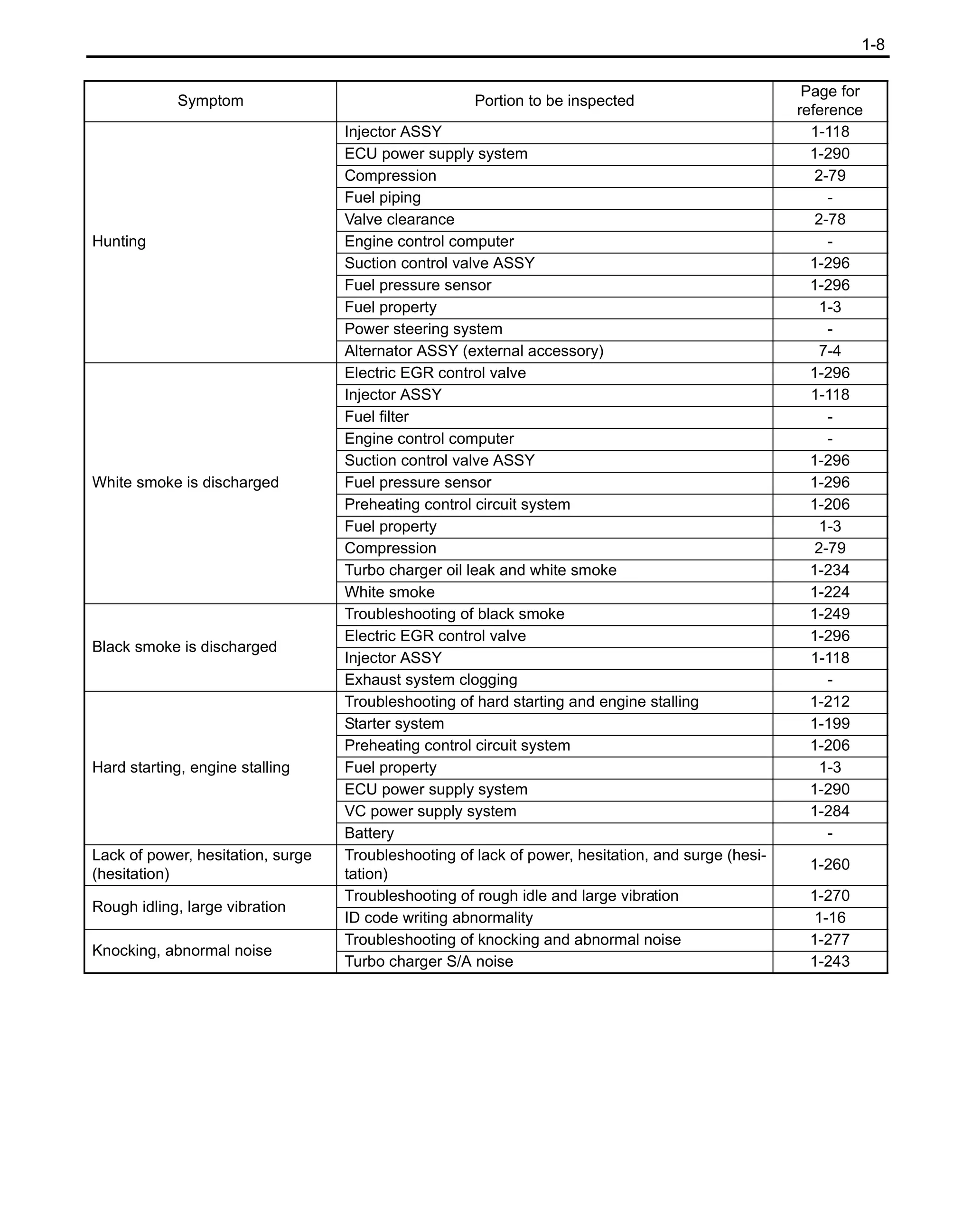
1-8
Hunting
Injector ASSY 1-118
ECU power supply system 1-290
Compression 2-79
Fuel piping -
Valve clearance 2-78
Engine control computer -
Suction control valve ASSY 1-296
Fuel pressure sensor 1-296
Fuel property 1-3
Power steering system -
Alternator ASSY (external accessory) 7-4
White smoke is discharged
Electric EGR control valve 1-296
Injector ASSY 1-118
Fuel filter -
Engine control computer -
Suction control valve ASSY 1-296
Fuel pressure sensor 1-296
Preheating control circuit system 1-206
Fuel property 1-3
Compression 2-79
Turbo charger oil leak and white smoke 1-234
White smoke 1-224
Black smoke is discharged
Troubleshooting of black smoke 1-249
Electric EGR control valve 1-296
Injector ASSY 1-118
Exhaust system clogging -
Hard starting, engine stalling
Troubleshooting of hard starting and engine stalling 1-212
Starter system 1-199
Preheating control circuit system 1-206
Fuel property 1-3
ECU power supply system 1-290
VC power supply system 1-284
Battery -
Lack of power, hesitation, surge
(hesitation)
Troubleshooting of lack of power, hesitation, and surge (hesi-
tation)
1-260
Rough idling, large vibration
Troubleshooting of rough idle and large vibration 1-270
ID code writing abnormality 1-16
Knocking, abnormal noise
Troubleshooting of knocking and abnormal noise 1-277
Turbo charger S/A noise 1-243
Symptom Portion to be inspected
Page for
reference
1KD_RM.book 8 ページ 2013年9月27日 金曜日 午後12時47分
1-9
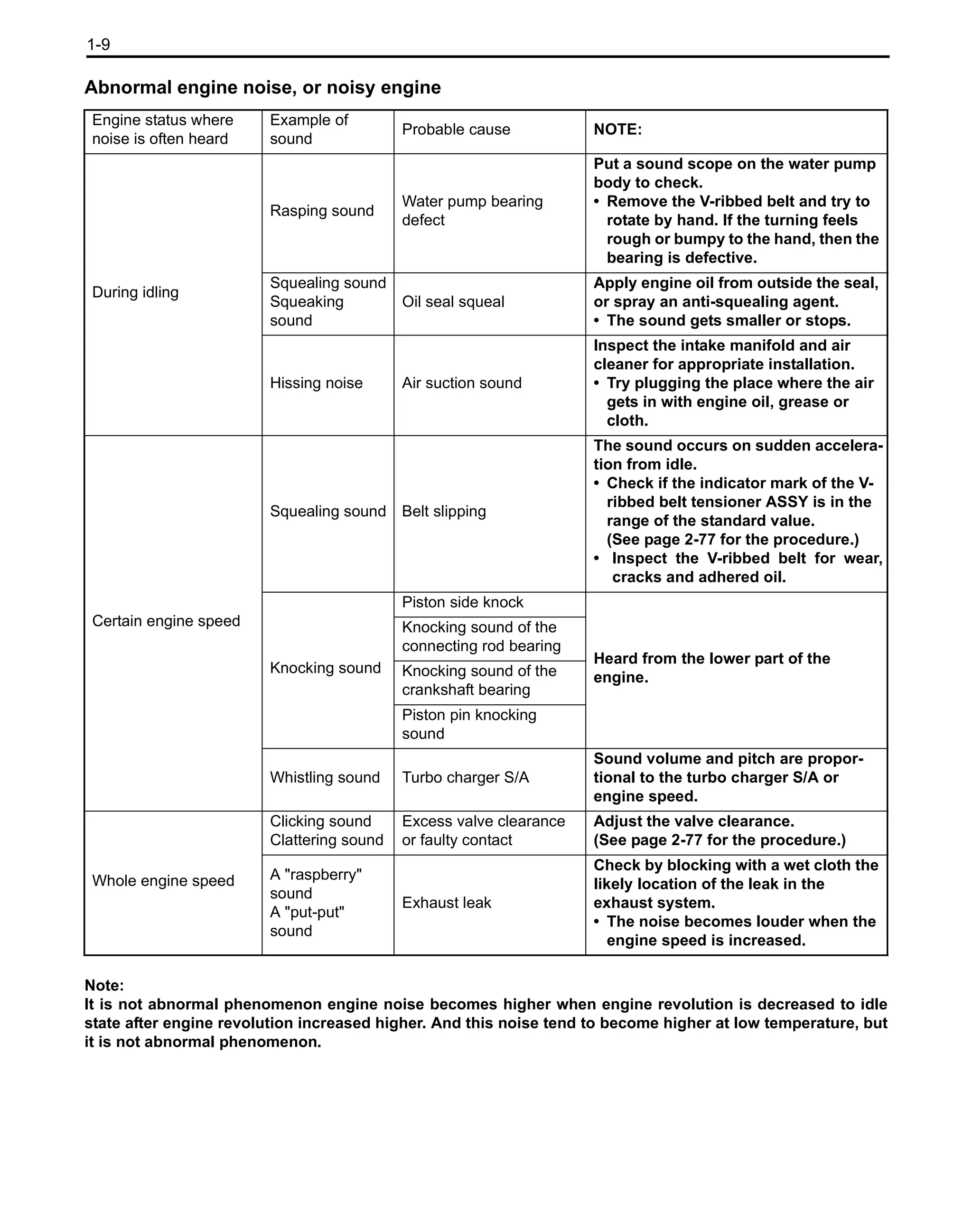
Abnormal engine noise, or noisy engine
Note:
It is not abnormal phenomenon engine noise becomes higher when engine revolution is decreased to idle
state after engine revolution increased higher. And this noise tend to become higher at low temperature, but
it is not abnormal phenomenon.
Engine status where
noise is often heard
Example of
sound
Probable cause NOTE:
During idling
Rasping sound
Water pump bearing
defect
Put a sound scope on the water pump
body to check.
• Remove the V-ribbed belt and try to
rotate by hand. If the turning feels
rough or bumpy to the hand, then the
bearing is defective.
Squealing sound
Squeaking
sound
Oil seal squeal
Apply engine oil from outside the seal,
or spray an anti-squealing agent.
• The sound gets smaller or stops.
Hissing noise Air suction sound
Inspect the intake manifold and air
cleaner for appropriate installation.
• Try plugging the place where the air
gets in with engine oil, grease or
cloth.
Certain engine speed
Squealing sound Belt slipping
The sound occurs on sudden accelera-
tion from idle.
• Check if the indicator mark of the V-
ribbed belt tensioner ASSY is in the
range of the standard value.
(See page 2-77 for the procedure.)
• Inspect the V-ribbed belt for wear,
cracks and adhered oil.
Knocking sound
Piston side knock
Heard from the lower part of the
engine.
Knocking sound of the
connecting rod bearing
Knocking sound of the
crankshaft bearing
Piston pin knocking
sound
Whistling sound Turbo charger S/A
Sound volume and pitch are propor-
tional to the turbo charger S/A or
engine speed.
Whole engine speed
Clicking sound
Clattering sound
Excess valve clearance
or faulty contact
Adjust the valve clearance.
(See page 2-77 for the procedure.)
A "raspberry"
sound
A "put-put"
sound
Exhaust leak
Check by blocking with a wet cloth the
likely location of the leak in the
exhaust system.
• The noise becomes louder when the
engine speed is increased.
1KD_RM.book 9 ページ 2013年9月27日 金曜日 午後12時47分
1-10
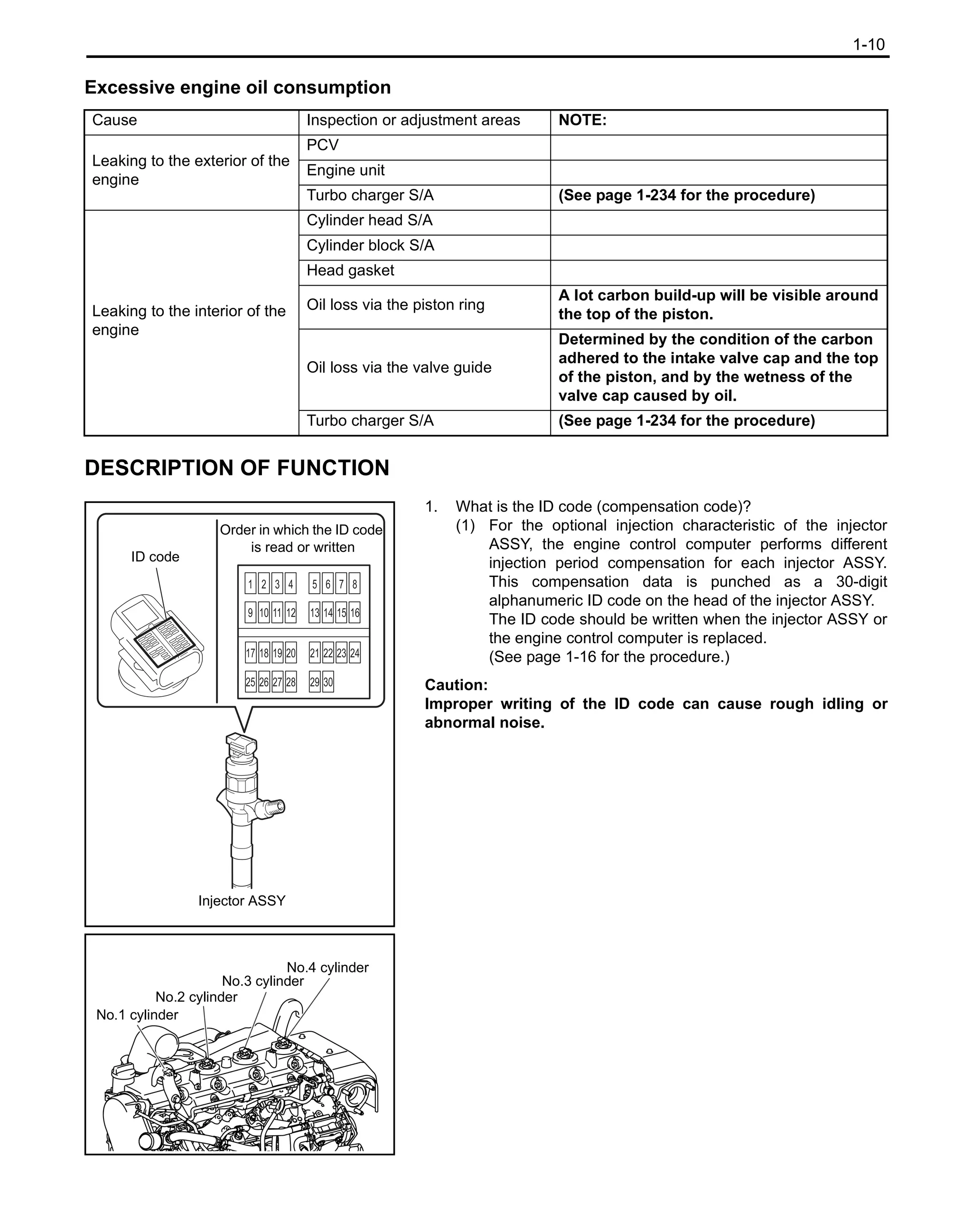
Excessive engine oil consumption
DESCRIPTION OF FUNCTION
1. What is the ID code (compensation code)?
(1) For the optional injection characteristic of the injector
ASSY, the engine control computer performs different
injection period compensation for each injector ASSY.
This compensation data is punched as a 30-digit
alphanumeric ID code on the head of the injector ASSY.
The ID code should be written when the injector ASSY or
the engine control computer is replaced.
(See page 1-16 for the procedure.)
Caution:
Improper writing of the ID code can cause rough idling or
abnormal noise.
Cause Inspection or adjustment areas NOTE:
Leaking to the exterior of the
engine
PCV
Engine unit
Turbo charger S/A (See page 1-234 for the procedure)
Leaking to the interior of the
engine
Cylinder head S/A
Cylinder block S/A
Head gasket
Oil loss via the piston ring
A lot carbon build-up will be visible around
the top of the piston.
Oil loss via the valve guide
Determined by the condition of the carbon
adhered to the intake valve cap and the top
of the piston, and by the wetness of the
valve cap caused by oil.
Turbo charger S/A (See page 1-234 for the procedure)
Injector ASSY
ID code
Order in which the ID code
is read or written
No.1 cylinder
No.2 cylinder
No.3 cylinder
No.4 cylinder
1KD_RM.book 10 ページ 2013年9月27日 金曜日 午後12時47分
1-11
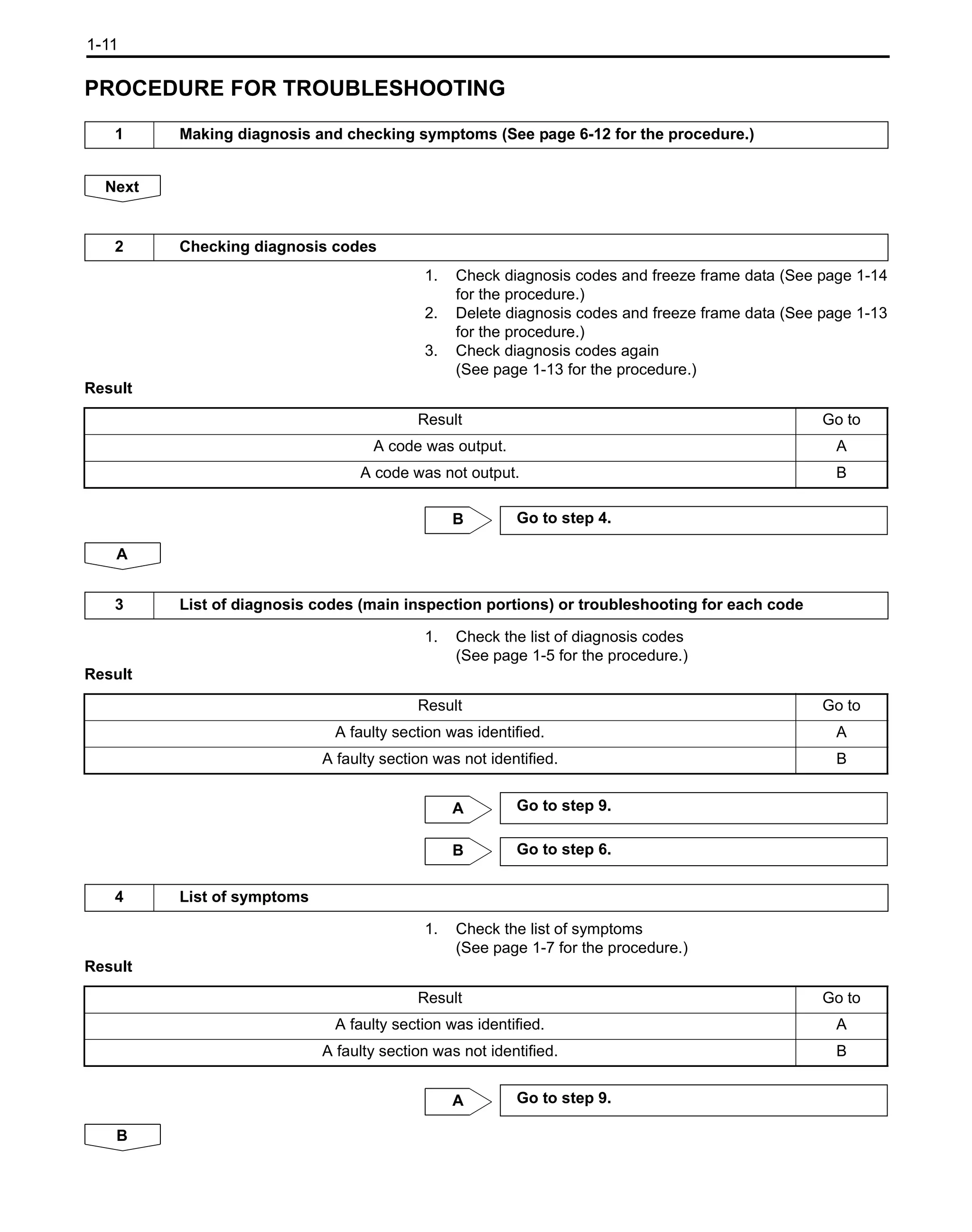
PROCEDURE FOR TROUBLESHOOTING
Next
1. Check diagnosis codes and freeze frame data (See page 1-14
for the procedure.)
2. Delete diagnosis codes and freeze frame data (See page 1-13
for the procedure.)
3. Check diagnosis codes again
(See page 1-13 for the procedure.)
Result
A
1. Check the list of diagnosis codes
(See page 1-5 for the procedure.)
Result
1. Check the list of symptoms
(See page 1-7 for the procedure.)
Result
B
1 Making diagnosis and checking symptoms (See page 6-12 for the procedure.)
2 Checking diagnosis codes
Result Go to
A code was output. A
A code was not output. B
B Go to step 4.
3 List of diagnosis codes (main inspection portions) or troubleshooting for each code
Result Go to
A faulty section was identified. A
A faulty section was not identified. B
A Go to step 9.
B Go to step 6.
4 List of symptoms
Result Go to
A faulty section was identified. A
A faulty section was not identified. B
A Go to step 9.
1KD_RM.book 11 ページ 2013年9月27日 金曜日 午後12時47分
1-12
Result
B
1. Perform [Data monitor] and [Active test]
Result
B
Next
Next
Next
Next
5 Basic inspection (See page 1-2 for the procedure.)
Result Go to
A faulty section was identified. A
A faulty section was not identified. B
A Go to step 9.
6 Inspecting with 'Engine Diagnostic Program'
Result Go to
A faulty section was identified. A
A faulty section was not identified. B
A Go to step 9.
7
Inspecting ECU terminal voltage and circuits
(See page 1-33 for the procedure.)
8 INSPECTION OF IRREGULAR PROBLEMS (See page 1-15 for the procedure)
9 Repairing defective parts
10 Checking diagnosis codes (See page 1-5 for the procedure.)
End
1KD_RM.book 12 ページ 2013年9月27日 金曜日 午後12時47分
1-13
INSPECTING/DELETING DIAGNOSIS CODE
Note:
• Read the 'Engine Diagnostic Program' instruction manual before using it.
• 'Engine Diagnostic Program' enables you to select not only the normal mode but the check mode. In the
check mode, abnormality detection sensitivity can be improved, compared to the normal mode.
• Perform inspection in the check mode when normal codes are output in the normal mode despite of
possible abnormalities in a signal system of each sensor.
1. Preparation before inspection
(1) Put the shift position to N.
(2) Disable all of outside loads.
2. Inspecting diagnosis codes (reading with 'Engine Diagnostic Program')
(1) To Use check mode, according to the instruction of the 'Engine Diagnostic Program', press [Utility]  select
[Check mode].
(2) According to the instruction of the 'Engine Diagnostic Program' screen, press [Trouble code] and check the
diagnosis code.
3. Deleting diagnosis code memory (using 'Engine Diagnostic Program')
(1) According to the instruction of the 'Engine Diagnostic Program' screen, press [Trouble code]  press
[Clear], to delete the diagnosis code.
SST 09111-36760-71 (09991-70201)
Caution:
• If it cannot be deleted, turn the ignition key switch OFF and then delete it again.
• Do not delete diagnosis codes with 'Engine Diagnostic Program' before making diagnosis and checking
symptoms.
4. Deleting diagnosis codes (by removing fuse)
(1) Remove the EFI2 fuse (10 A), and in 15 seconds or more
connect the fuse.
Caution:
• Be sure to delete diagnosis code memory after inspecting
and repairing the ECD system. Then, check that normal
codes are output.
• Do not delete diagnosis codes by clearing the battery
(removing the fuse) before making diagnosis and checking
symptoms.
5. Checking diagnosis results (using 'Engine Diagnostic Program')
SST 09111-36760-71 (09991-70201)
Note:
After repairing the faulty system with the output diagnosis code or when performing a recreation test after
deleting the diagnosis code, check output diagnosis codes.
(1) Use 'Engine Diagnostic Program' to delete the diagnosis code.
(2) Perform a test for checking diagnosis results.
(3) According to the instruction of the 'Engine Diagnostic Program' screen, press [Trouble code].
(4) Check diagnosis code results.
1
2
Engine room relay block
EFI2 fuse
1KD_RM.book 13 ページ 2013年9月27日 金曜日 午後12時47分
1-14
FREEZE FRAME DATA/DIAGNOSIS DETAILED INFORMATION
1. Checking freeze frame data (reading with 'Engine Diagnostic Program')
With 'Engine Diagnostic Program', according to the instruction of the screen, press [Trouble code].
Indicates existance of freeze frame data with a mark in [FED], press the mark.
SST 09111-36760-71 (09991-70201)
(1) Turn the ignition key switch ON.
(2) Press [Trouble code].
Indicates existance of freeze frame data with a mark in [FED], press the mark.
(3) In the screen displaying the diagnosis code, detected diagnosis codes appear.
(4) Select a diagnosis code for which freeze frame data is checked.
2. Checking chronological freeze frame data
(1) In the screen displaying freeze data, select an item for
which chronological freeze frame data is checked.
Note:
• Chronological freeze frame data also includes ECU data
recorded at the occurrence of a diagnosis code and around
that point.
• Chronological freeze frame data can be checked when
press a mark in [FED], ' '.
• For chronological freeze frame data, a total number of five
points (including a diagnosis detection point, three points
before detection, one point after detection) can be
displayed.
3. List of freeze frame data
DTC detection point
Freeze frame data recording point
0.5 sec. 0.5 sec. 0.5 sec.
1 2 3 4
Item name
Engine Speed Actual VN Position
Calculate Load VN Position Sensor Out
MAF VN Motor Duty
Atmosphere Pressure VN Close Learn Value
MAP VN Close Learn Status
Coolant Temp Initial Engine Coolant Temp
Intake Air Initial Intake Air Temp
Engine Run Time Engine Start Time
Starter Signal Engine Speed (Starter Off)
Injection Volume Starter Count
Pilot 1 Injection Period Electric Duty Feedback Value
Pilot 2 Injection Period Intake Air Temp (Turbo)
Main Injection Period Battery Voltage
After Injection Period Engine Speed of Cyl #1
Pilot 1 Injection Timing Engine Speed of Cyl #2
Pilot 2 Injection Timing Engine Speed of Cyl #3
Main Injection Timing Engine Speed of Cyl #4
After Injection Timing Av Engine Speed of All Cyl
1KD_RM.book 14 ページ 2013年9月27日 金曜日 午後12時47分
1-15
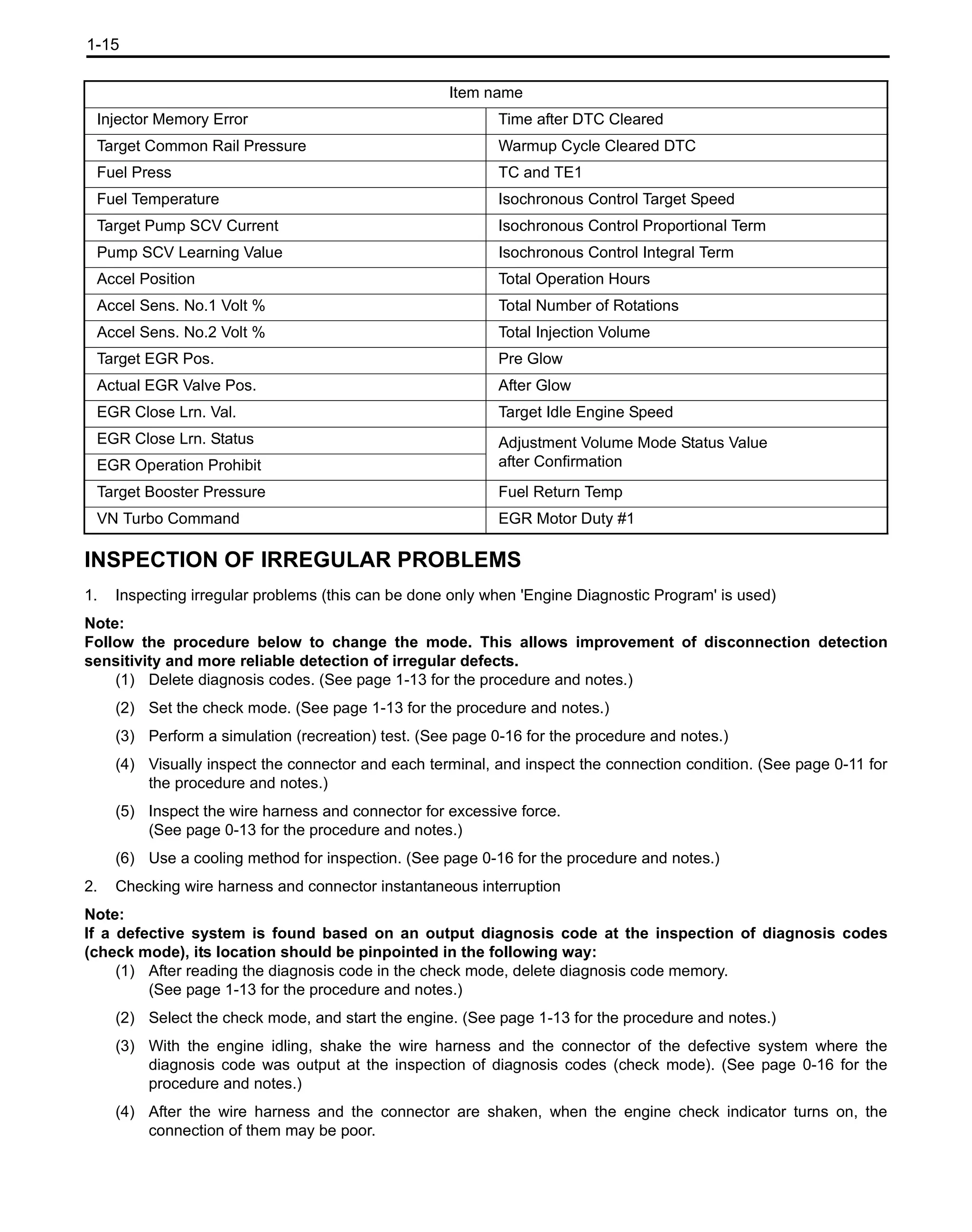
INSPECTION OF IRREGULAR PROBLEMS
1. Inspecting irregular problems (this can be done only when 'Engine Diagnostic Program' is used)
Note:
Follow the procedure below to change the mode. This allows improvement of disconnection detection
sensitivity and more reliable detection of irregular defects.
(1) Delete diagnosis codes. (See page 1-13 for the procedure and notes.)
(2) Set the check mode. (See page 1-13 for the procedure and notes.)
(3) Perform a simulation (recreation) test. (See page 0-16 for the procedure and notes.)
(4) Visually inspect the connector and each terminal, and inspect the connection condition. (See page 0-11 for
the procedure and notes.)
(5) Inspect the wire harness and connector for excessive force.
(See page 0-13 for the procedure and notes.)
(6) Use a cooling method for inspection. (See page 0-16 for the procedure and notes.)
2. Checking wire harness and connector instantaneous interruption
Note:
If a defective system is found based on an output diagnosis code at the inspection of diagnosis codes
(check mode), its location should be pinpointed in the following way:
(1) After reading the diagnosis code in the check mode, delete diagnosis code memory.
(See page 1-13 for the procedure and notes.)
(2) Select the check mode, and start the engine. (See page 1-13 for the procedure and notes.)
(3) With the engine idling, shake the wire harness and the connector of the defective system where the
diagnosis code was output at the inspection of diagnosis codes (check mode). (See page 0-16 for the
procedure and notes.)
(4) After the wire harness and the connector are shaken, when the engine check indicator turns on, the
connection of them may be poor.
Injector Memory Error Time after DTC Cleared
Target Common Rail Pressure Warmup Cycle Cleared DTC
Fuel Press TC and TE1
Fuel Temperature Isochronous Control Target Speed
Target Pump SCV Current Isochronous Control Proportional Term
Pump SCV Learning Value Isochronous Control Integral Term
Accel Position Total Operation Hours
Accel Sens. No.1 Volt % Total Number of Rotations
Accel Sens. No.2 Volt % Total Injection Volume
Target EGR Pos. Pre Glow
Actual EGR Valve Pos. After Glow
EGR Close Lrn. Val. Target Idle Engine Speed
EGR Close Lrn. Status Adjustment Volume Mode Status Value
after Confirmation
EGR Operation Prohibit
Target Booster Pressure Fuel Return Temp
VN Turbo Command EGR Motor Duty #1
Item name
1KD_RM.book 15 ページ 2013年9月27日 金曜日 午後12時47分
1-16
WORK SUPPORT
1. List of work support steps
When parts requiring initialization and writing have been replaced, initialize and write them by following the steps in
the list below in numerical order.
Note:
The ID code represents 'Engine Diagnostic Program' saved in the engine control computer (injector
compensation code).
2. Initializing the supply pump ASSY learned value
Caution:
Be sure to perform this precedure (initialization) after replacing the pump ASSY or the engine control
computer.
Note:
If an error occurs during the initialization, do it again from <Procedure 1/4>.
Work support item
Replacement
Reading and Saving the
injector compensation code
Initializing the supply
pump ASSY leaned value
Writing the injector
compensation code
Supply pump ASSY (1)
Engine ASSY (1)
Injector ASSY (1)
Supply pump ASSY +
engine ECU
(1) (2) (3)
Injector ASSY +
engine ECU
(1) (2) (3)
Engine ASSY +
engine ECU
(1) (2) (3)
Engine ECU
(with old data)
(1) (2) (3)
Engine ECU
(without old data)
(1) (2)
<Procedure 1/4>
Select [Supply Pump Initialization]
Initialization
Cancel
<Procedure 2/4>
Press [Next] to proceed
<Procedure 3/4>
Check the initial conditions, then press [Next]
<Procedure 4/4>
Supply Pump Initialization is complete, press [Exit]
1KD_RM.book 16 ページ 2013年9月27日 金曜日 午後12時47分
1-17
(1) Turn the ignition key switch ON.
According to the instruction of the 'Engine Diagnostic
Program', press [Utility].
Caution:
Do not start the engine.
(2) <Procedure 1/4>
Select [Supplt Pump Initialization], then press [Select].
(3) <Procedure 2/4>
Press [Next] to proceed.
(4) <Procedure 3/4>
After check the initial conditions, then press [Next].
Caution:
Preform this procedure, the ignition key switch turned on and
the engine stopped.
1KD_RM.book 17 ページ 2013年9月27日 金曜日 午後12時47分
1-18
(5) <Procedure 4/4>
Supply Pump Initialization is complete, press [Exit].
(6) Start up the engine for warm up.
Caution:
Do not perform racing immediately after the engine is started.
Note:
• If the Engine does not start, do it again <procedure 1/4>.
• The engine warm-up state shall be acondition water temperature is 60 °C (140 °F) or more and fuel
temperature is 20 °C (68 °F) or more.
(a) To check water temperature, in the 'Engine Diagnostic Program' select [Data monitor] and monitor
[Coolant Temp]
Reference 60 °C (140 °F) or more
(b) To check fuel temperature, in the 'Engine Diagnostic Program' Select [Data monitor] and monitor [Fuel
Temperature]
Reference 20 °C (68 °F) or more
• When fuel temperature does not increase due toan environment to be measured, increase engine speed
litlle by little until it reaches NMR (No load Maximum Revolution), make it the steady state, and then
increase the temperature. Do not perform racing rapidly.
(7) Run at idle for one minute or more in the state after engine warm-up.
(8) The initializatin is now completed.
1KD_RM.book 18 ページ 2013年9月27日 金曜日 午後12時47分
1-19
3. Reading and Saving the injector compensation code
In this procedure, read codes (injector compensation codes) from the engine control computer, and save compensation
codes to the 'Engine Diagnostic Program'.
Note:
• Due to the defective engine control computer or wire harness, or poor connection of the diagnostic
connector, a writing abnormally may occur. Inspect and check the connection of the wire harness or the
diagnostic connector. When they are normal, the engine control computer may be defective.
• For replacement ECU, need to write the compensation codes of each cylinder. Use this saving
compensation codes function to avoid error, writing incorrect compensation code, install another cylinder
No.
• This saving function can save one latest data of each cylinder.
• If using saved data, confirm the saved compensation code and cylinder number, and compensation code
of the top of the injector ASSY are right.
<Procedure 1/6>
Select [Injector compensation]
Cancel
Read Compensation Code
In case of reading
another cylinder compensation code
Save Replace
<Procedure 2/6>
<Procedure 3/6>
Select a function [Read Compensation Code]
<Procedure 4/6>
Select a Cylinder number
<Procedure 5/6>
Appears Cylinder No and Compensation Code
<Procedure 6/6>
Press [Replace] or [Save]
(In case of there is no
compensation code)
(In case of there is
previous compensation code)
Next
1KD_RM.book 19 ページ 2013年9月27日 金曜日 午後12時47分
1-20
(1) Turn the ignition key switch ON.
According to the instruction of the 'Engine Diagnostic
Program', press [Utility].
Caution:
Do not start the engine.
(2) <Procedure 1/6>
Select [Injector Compensation], then press [Select].
(3) <Procedure 2/6>
Press [Next] to proceed, read <NOTICE> message, then press [Next].
(4) <Procedure 3/6>
Select a function [Read Compensation Code], then press
[Next].
1KD_RM.book 20 ページ 2013年9月27日 金曜日 午後12時47分
1-21
(5) <Procedure 4/6>
Select a Cylinder number from No.1 to 4, then press
[Next].
(6) <Procedure 5/6>
Note:
Appears selected cylinder No. and compensation code.
To save the compensation code, press [Save].
If there is previous saved data, and need to save new compensation data, press [Replace].
If there is no previous saved data, and need to save new
compensation data, press [Save].
Caution:
This saving function can save one latest data of each cylinder.
Confirm the cylinder number, and saved date and time to use
this saved data, in case of writing a compensation code to
replaced engine control computer.
If you need all cylinder compensation codes, repeat this
procedure same times as cilynder numbers.
1KD_RM.book 21 ページ 2013年9月27日 金曜日 午後12時47分
1-22
(7) <Procedure 6/6>
To read another Cylinder’s injector compensation code, press [Next] and repeat this procedure from
<Procedure 4/6>.
To exit this function, press [Cancel].
1KD_RM.book 22 ページ 2013年9月27日 金曜日 午後12時47分
1-23
4. Writing the injector compensation code
In this procedure, write codes (injector compensation codes) to the engine control computer.
• Use saved compensation codes in the 'Engine Diagnostic Program'.
• Input manual compensation codes.
Note:
• Due to the defective engine control computer or wire harness, or poor connection of the diagnostic
connector, a writing abnormally may occur. Inspect and check the connection of the wire harness or the
diagnostic connector. When they are normal, the engine control computer may be defective.
• In case of replacement ECU, need to write the compensation codes of each cylinder. Use saved codes or
input manually.
If using saved data, confirm the saved compensation code and cylinder number, and compensation
code of the top of the injector ASSY are right.
Program can save one latest data of each cylinder.
• In case of replacement ECU, injector ASSY, or engine, need to write the compensation codes of each
cylinder. Input the compensation codes manually.
Confirm the cylinder number and compensation code of the top of the injector ASSY are right.
<Procedure 1/6>
Select [Injector compensation]
Cancel
Replacement
1)engine control computer
Use saved
compensation codes
Input manual
compensation codes
<Procedure 2/6>
<Procedure 3/6>
Select a function [Set Compensation Code]
<Procedure 4/6>
Select a Cylinder number
<Procedure 5-a/6>
Press [Open]
<Procedure 6/6>
Writing is complete
Writing
compensation codes
<Procedure 5-b/6>
Press [Input]
Writing
compensation codes
Replacement
1)engine control computer
2)injector ASSY
3)engine
1KD_RM.book 23 ページ 2013年9月27日 金曜日 午後12時47分
1-24
Note:
If you use the directly read the compensation code, read the
code (30-digit alphanumerical characters) punched on the
head of the injector ASSY.
(1) Turn the ignition key switch ON.
According to the instruction of the 'Engine Diagnostic
Program', press [Utility].
Caution:
Do not start the engine.
(2) Select [Supplt Pump Initialization], then press [Select].
(3) <Procedure 1/6>
Select [Injector Compensation], then press [Select].
(4) <Procedure 2/6>
Press [Next] to proceed, read <NOTICE> message, then press [Next].

Code
Injector ASSY
1KD_RM.book 24 ページ 2013年9月27日 金曜日 午後12時47分
1-25
(5) <Procedure 3/6>
Select a function [Set Compensation Code], then press
[Next].
(6) <Procedure 4/6>
Select a Cylinder number from No.1 to 4, then press
[Next].
Use a saved compensation code: go to (8)
Input a manual compensation code: go to (9)
(7) <Procedure 5-a/6>
Use a saved compensation code, press [Open]  Confirm [Cylinder Number] and [Saved Date], then press
[Open]  press [Next] to write the saved data.
Caution:
Confirm the saved compensation code, cylinder number, and compensation code of the top of the injector
ASSY are right.
Program can save one latest data of each cylinder.
If the compensation code writing error occurs, write again.
 go to (9)
1KD_RM.book 25 ページ 2013年9月27日 金曜日 午後12時47分
1-26
(8) <Procedure 5-b/6>
Input a manual compensation code, press [Input]  Using a key to input the code, then press [OK]  press
[Next] to write the data.
Caution:
Confirm the cylinder number, compensation code of the top of the injector ASSY, input compensation code
are right.
If the compensation code writing error occurs, write again.
If the inputted code is incorrect, 'Error Injector Compensation' occurs, input compensation code correctly.
 go to (9)
(9) <Procedure 6/6>
Injector compensation writing is complete.
Press [Next] to continue writing code of the other cylinder,
press [Cancel] to exit this function.
(10) After completing writing, delete the diagnosis code.
1KD_RM.book 26 ページ 2013年9月27日 金曜日 午後12時47分
1-27
5. Fuel System inspection
Perform this procedure, to air bleeding after fuel system parts replacement, or to check fuel system malfunction.
Note:
• Engine revolution rises, confirm the vehicle not moving.
• Operate acceleration pedal according to the 'Engine Diagnostic Program' screen.
<Procedure 1/8>
Select [Fuel System Check]
Cancel
<Procedure 2/8>
Start the engine
<Procedure 3/8>
Warm up the engine
<Procedure 4/8>
Rise the engine revolution over 1400rpm
<Procedure 5/8>
Check completed
<Procedure 6/8>
Save data (in case of fuel system malfunction check)
<Procedure 7/8>
Repeat 5 times the procedure
<Procedure 8-a/8>
Keep Idling
<Procedure 8-b/8>
Data analysis
Checking the Fuel System
Fuel system parts replacement Fuel system malfunction check
1KD_RM.book 27 ページ 2013年9月27日 金曜日 午後12時47分
1-28
(1) Turn the ignition key switch ON.
According to the instruction of 'Engine Diagnostic
Program', press [Utility].
(2) <Procedure 1/8>
Select [Fuel System Check], then press [Select]
Until the water temperature becomes 70degC (158degF) or higher, can not proceed.
(3) <Procedure 2/8>
Read the message, and start the engine, keep idling, then
press [Next]
(4) <Procedure 3/8>
Warm up the engine.
The water temperature (engine coolant temperature) is
70 °C (158 °F) or higher, then press [Next].
Note:
Until the water temperature becomes 70 °C (158 °F) or higher,
can not proceed.
1KD_RM.book 28 ページ 2013年9月27日 金曜日 午後12時47分
1-29
(5) <Procedure 4/8>
Open the acceleration pedal, rise the engine revolution
over 1400rpm, then press [Next].
Fuel system check starts automatically, needs 15sec,
check is completed.
Caution:
Open the acceleration pedal until the check is completed.
Note:
Fuel system check can proceed under the condition that the
engine revolution is over 1400rpm.
If the condition is not satisfied, the check stops.
The engine revolution automatically keep 1400rpm while the
check is proceeding.
The combustion noise becomes louder while the check is
proceeding, this phenomena is not malfunction.
(6) <Procedure 5/8>
Fuel System Check is completed, close the acceleration
pedal, press [Exit].
(7) <Procedure 6/8>
In case of fuel system malfunction check, press [Save].
Input the file name if necessary.
(8) <Procedure 7/8>
Repeat 5 times from <Procedure 1/8>.
Fuel system parts replacement: go to (9)
Fuel system malfunction check: go to (10)
(9) <Procedure 8-a/8>
Keep idling over 3min.
(10) <Procedure 8-b/8>
At <Procedure 1/8> screen, press [Proj info].
Select the saved data in 'Fuel System Check' folder, in
Individual data list window.
Display and confirm the graph from saved data.
1KD_RM.book 29 ページ 2013年9月27日 金曜日 午後12時47分
1-30
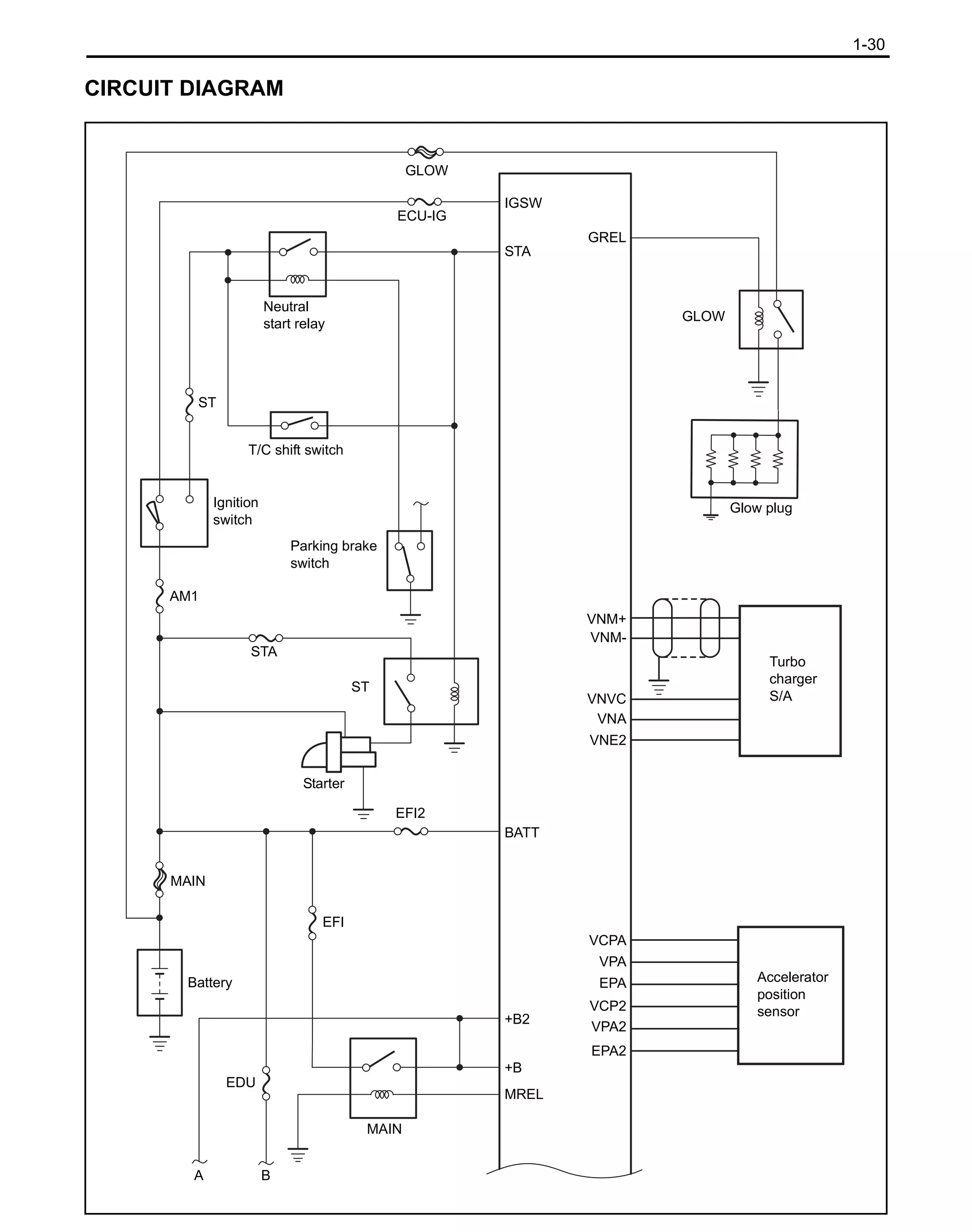
CIRCUIT DIAGRAM
Ignition
switch
Glow plug
Turbo
charger
S/A
Starter
Accelerator
position
sensor
Battery
GLOW
GLOW
GREL
AM1
IGSW
STA
ST
STA
EFI2
EFI
BATT
VNM+
VNM-
EDU
VNVC
MAIN
VNA
VNE2
+B2
+B
MREL
VCPA
VPA
EPA
VCP2
VPA2
EPA2
A B
Parking brake
switch
ECU-IG
Neutral
start relay
ST
T/C shift switch
MAIN
1KD_RM.book 30 ページ 2013年9月27日 金曜日 午後12時47分
1-31
Fuel pressure sensor
Suction control
valve ASSY
Injector driver
Injector ASSY (No.1)
Injector ASSY (No.2)
Injector ASSY (No.3)
Injector ASSY (No.4)
Intake air flow meter
Fuel filter pool switch
Crank position sensor
Crank position
sensor No.2
Electric EGR
control valve
A B
EDU
IJ1+
IJ1-
IJ2-
IJ2+
IJ3-
IJ3+
IJ4-
IJ4+
GND
+B
#10
#20
#30
#40
INJF
VCS1
PCR1
E2S1
PCV+
PCV-
EGM+
EGM-
VCEG
EGRA
EEGL
NE+
NE-
G+
G-
IREL
#1
#3
#2
INJ1
#4
E2G
VG
THA
ETHA
P
1KD_RM.book 31 ページ 2013年9月27日 金曜日 午後12時47分
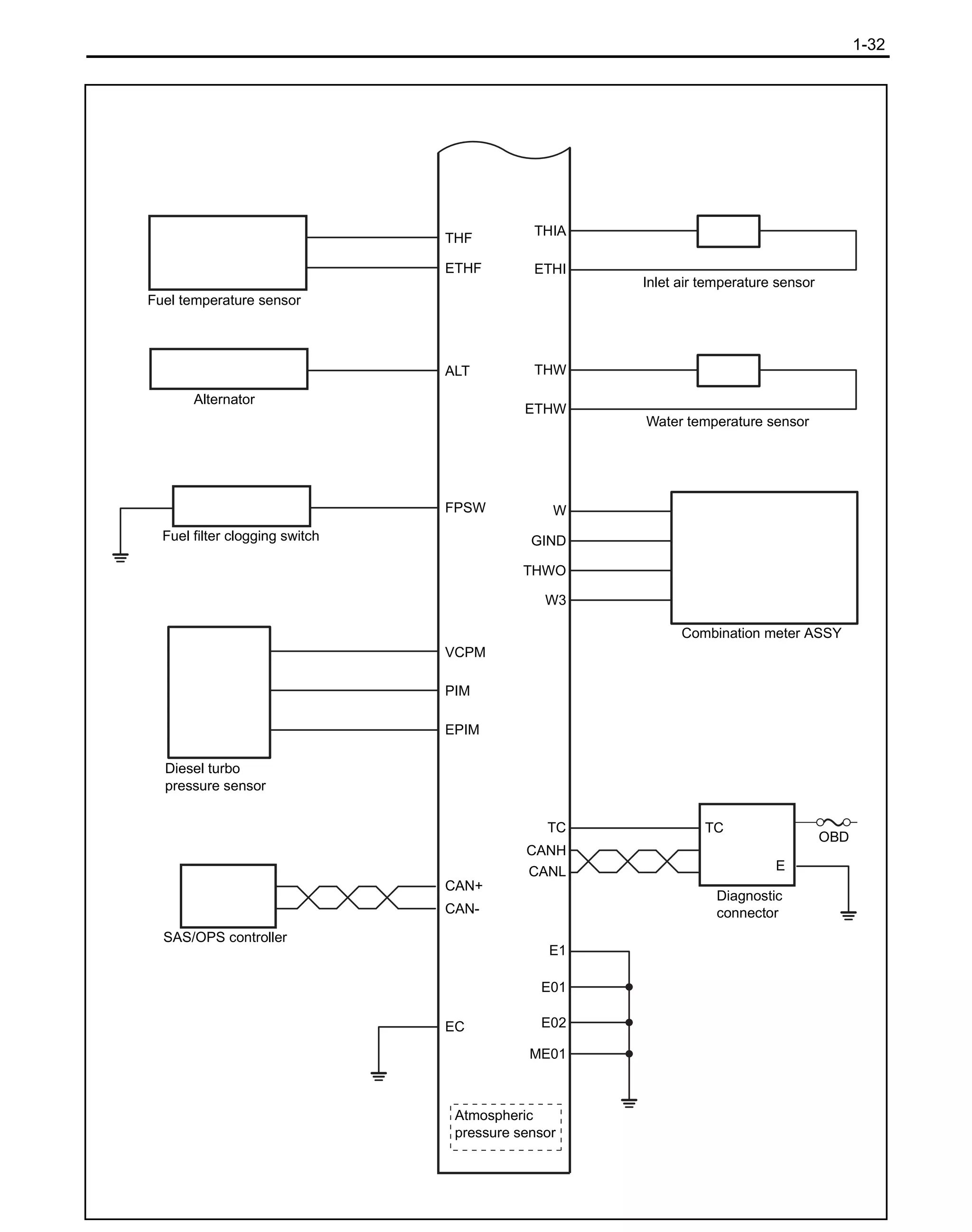
1-32
Inlet air temperature sensor
Water temperature sensor
Fuel filter clogging switch
Alternator
Fuel temperature sensor
Diesel turbo
pressure sensor
Combination meter ASSY
SAS/OPS controller
Atmospheric
pressure sensor
THF
ALT
ETHF
CAN+
FPSW
PIM
VCPM
EPIM
EC
CAN-
THIA
ETHI
THW
ETHW
W
GIND
THWO
W3
TC
CANH
CANL
E02
E01
E1
ME01
OBD
Diagnostic
connector
TC
E
1KD_RM.book 32 ページ 2013年9月27日 金曜日 午後12時47分
1-33
ECU TERMINAL LAYOUT
Reference
Terminal number
[Terminal symbol]
Input
Output
Measurement condition Reference value
B53 - B56 [VPA - EPA] Input
Accelerator fully closed 0.5 to 1.1 V
Accelerator fully opened 2.6 to 4.5 V
B54 - B58 [VPA2 - EPA2] Input
Accelerator fully closed 1.2 to 2.0 V
Accelerator fully opened 3.4 to 5.0 V
B43 - A109 [STA - E1] Input During cranking 6 V or more
B32 [EC] - Engine ground Ground Always Less than 1 Ω
B12 - A109 [W - E1] Output
When the engine check indicator turns
on (Ignition key switch ON)
0 to 3 V
During idling
(When the engine check indicator does
not turn on)
11 to 14 V
A B
A
B
1
2
3
20
21
22
4
5
6
12
13
14
23
24
25
7
8
9
15
16
17
26
27
28
11 10
18
19
29
30
4
5
6
7
8
9
11 10
12
13
14
15
16
17
18
19 1
2
3
24
25
26
27
28
29
30
20
21
22
23
55
37 36 35 34 33 32 31
53 52 51 50 49 48 47
54
39 38
61 60 59 58 57 56
63 62
40
41
42
43
44
45
46
31
32
33
50
51
52
34
35
36
42
43
44
53
54
55
37
38
39
45
46
47
56
57
58
41 40
48
49
59
60
67
68
69
70
71
72
74 73
75
76
77
78
79
80 64
65
66
87
88
89
90
91
92
93
118
100 99 98 97 96 95 94
116 115 114 113 112 111 110
117
102101
124123122121120119
126125
103
81
82
83
84
85
86
104
105
106
107
108
109
#4
#3
#2
#1
INJ1
ALT P
GREL
FPSW
CAN+
CAN-
E01 E02 VNM- VNM+ PCV+
VCS1
THIA
ETHI
E2S1
THF
ETHF
PCR1
THW
ETHW
VG
THA
ETHA
E2G
VCEG
VNE2
EPIM
PIM
VNVC
VNA
VCPM
EGRA
EEGL
PCV-
NE+ NE-
G+ G-
E1
EGM+ EGM- ME01
+B
EC
BATT
+B2
EPA
MREL
VCPA
IREL
VPA2
STA
VPA
TC IGSW
W3 CANH CANL
W
EPA2 VCP2
THWO
GIND
1KD_RM.book 33 ページ 2013年9月27日 金曜日 午後12時47分
1-34
B2 - A109 [BATT - E1] Input Always 11 to 14 V
B1 - A109 [+B - E1] Input
Engine stop
Ignition key switch ON
11 to 14 V
B20 - A109 [+B2 - E1] Input
Engine stop
Ignition key switch ON
11 to 14 V
B55 - B56 [VCPA - EPA] Output
Engine stop
Ignition key switch ON
4.5 to 5.5 V
B57 - B58 [VCP2 - EPA2] Output
Engine stop
Ignition key switch ON
4.5 to 5.5 V
B45 - A109 [MREL - E1] Output
Engine stop
Ignition key switch ON
11 to 14 V
Engine stop
10 seconds or more elapsed after igni-
tion key switch turns off
0 to 1.5 V
B44 - A109 [IREL - E1] Output During idling 0 to 1.5 V
B38 - A109 [THWO - E1] Output During idling
Pulse generation
(Waveform 1)
B30 - A109 [GIND - E1] Output
Ignition key switch ON, While the glow
indicator turns on
0 to 3 V
After warm-up, during idling 11 to 14 V
B26 - A109 [TC - E1] Input
Ignition key switch ON 11 to 14 V
Short-circuit between the terminals TC
and E of the diagnostic connector
0 to 1.5 V
B25 - A109 [IGSW - E1] Input
Engine stop
Ignition key switch ON
11 to 14 V
B7 - A109 [CANH - E1]
Input and
output
Engine stop
Ignition key switch ON
Pulse generation
(Waveform 2)
B6 - A109 [CANL - E1]
Input and
output
Engine stop
Ignition key switch ON
Pulse generation
(Waveform 3)
A113 - A90 [THIA - ETHI] Input
Intake temperature 0 to 80 °C
(32 to 176 °F) (during warm-up)
0.5 to 3.4 V
A112 - A89 [THF - ETHF] Input
Ignition key switch ON (when cool) 0.5 to 3.4 V
Fuel temperature 20 °C (68 °F) 2.0 to 2.7 V
A111 - A88 [THW - ETHW] Input
Cooling water temperature 60 to 120 °C
(140 to 248 °F) (during warm-up)
0.2 to 1.0 V
A110 - A87 [THA - ETHA] Input
Intake temperature 0 to 80 °C
(32 to 176 °F) (during warm-up)
0.5 to 3.4 V
A67 [E2S1] - Engine ground Ground Always Less than 1 Ω
A68 - A67 [VCS1 - E2S1] Output
Engine stop
Ignition key switch ON
4.5 to 5.5 V
A66 - A67 [PCR1 - E2S1] Input After warm-up, during idling 1.7 to 2.2 V
A65 - A64 [VG - E2G] Input After warm-up, during idling Pulse generation
A64 [E2G] - Engine ground Ground Always Less than 1 Ω
A51 - A109 [INJ1 - E1] Input After warm-up, during racing
Pulse generation
(Waveform 4)
A50 - A109 [#1 - E1] Output After warm-up, during idling
Pulse generation
(Waveform 5)
A49 - A109 [#2 - E1] Output After warm-up, during idling
Pulse generation
(Waveform 5)
A48 - A109 [#3 - E1] Output After warm-up, during idling
Pulse generation
(Waveform 5)
A47 - A109 [#4 - E1] Output After warm-up, during idling
Pulse generation
(Waveform 5)
Terminal number
[Terminal symbol]
Input
Output
Measurement condition Reference value
1KD_RM.book 34 ページ 2013年9月27日 金曜日 午後12時47分
1-35
Terminal number
[Terminal symbol]
Input
Output
Measurement condition Reference value
B2 - A109 [BATT - E1] Input Always 11 to 14 V
B1 - A109 [+B - E1] Input
Engine stop
Ignition key switch ON
11 to 14 V
B20 - A109 [+B2 - E1] Input
Engine stop
Ignition key switch ON
11 to 14 V
B55 - B56 [VCPA - EPA] Output
Engine stop
Ignition key switch ON
4.5 to 5.5 V
B57 - B58 [VCP2 - EPA2] Output
Engine stop
Ignition key switch ON
4.5 to 5.5 V
B45 - A109 [MREL - E1] Output
Engine stop
Ignition key switch ON
11 to 14 V
Engine stop
10 seconds or more elapsed after
ignition key switch turns off
0 to 1.5 V
B44 - A109 [IREL - E1] Output During idling 0 to 1.5 V
B38 - A109 [THWO - E1] Output During idling
Pulse Generation
(Waveform 1)
B30 - A109 [GIND - E1] Output
Ignition key switch ON, While the glow
indicator turns on
0 to 3 V
After warm-up, during idling 11 to 14 V
B26 - A109 [TC - E1] Input
Ignition key switch ON 11 to 14 V
Short-circuit between the terminals TC
and E of the diagnostic connector
0 to 1.5 V
B25 - A109 [IGSW - E1] Input
Engine stop
Ignition key switch ON
11 to 14 V
B7 - A109 [CANH - E1]
Input and
output
Engine stop
Ignition key switch ON
Pulse generation
(Waveform 2)
B6 - A109 [CANL - E1]
Input and
output
Engine stop
Ignition key switch ON
Pulse generation
(Waveform 3)
A113 - A90 [THIA - ETHI] Input
Intake temperature 0 to 80 °C
(32 to 176 °F)
0.5 to 3.4 V
A112 - A89 [THF - ETHF] Input
Ignition key switch ON (when cool) 0.5 to 3.4 V
Fuel temperature 20 °C (68 °F) 2.0 to 2.7 V
A111 - A88 [THW - ETHW] Input
Cooling water temperature 60 to 120 °C
(140 to 248 °F)
0.2 to 1.0 V
A110 - A87 [THA - ETHA] Input
Intake temperature 0 to 80 °C
(32 to 176 °F)
0.5 to 3.4 V
A67 [E2S1] - Engine ground Ground Always Less than 1 Ω
A68 - A67 [VCS1 - E2S1] Output
Engine stop
Ignition key switch ON
4.5 to 5.5 V
A66 - A67 [PCR1 - E2S1] Input After warm-up, during idling 1.7 to 2.2 V
A65 - A64 [VG - E2G] Input After warm-up, during idling Pulse Generation
A64 [E2G] - Engine ground Ground Always Less than 1 Ω
A51 - A109 [INJ1 - E1] Input After warm-up, during racing
Pulse Generation
(Waveform 4)
A50 - A109 [#1 - E1] Output After warm-up, during idling
Pulse Generation
(Waveform 5)
A49 - A109 [#2 - E1] Output After warm-up, during idling
Pulse generation
(Waveform 5)
A48 - A109 [#3 - E1] Output After warm-up, during idling
Pulse generation
(Waveform 5)
A47 - A109 [#4 - E1] Output After warm-up, during idling
Pulse generation
(Waveform 5)
1-36
1. Oscilloscope waveform
(1) Waveform 1
Note:
Depending on cooling water temperature, A changes.
(2) Waveform 2
(3) Waveform 3
(4) Waveform 4
Note:
As the engine speed increases, the waveform cycle gets
shorter.
GND
A
A
Item Description
Measurement
terminals
THWO - E1
Gauge set 5 V/DIV, 100 ms/DIV
Conditions During idling
Water temperature A
30 °C (86 °F) 16 ms
90 °C (194 °F) 278.5 ms
120 °C (248 °F) or
more
385 ms
GND
Item Description
Measurement
terminals
CANH - E1
CAN+ - E1
Gauge set 1 V/DIV, 10 ms/DIV
Conditions
Engine stop
Ignition key switch ON
GND
Item Description
Measurement
terminals
CANL - E1
CAN- - E1
Gauge set 1 V/DIV, 10 ms/DIV
Conditions
Engine stop
Ignition key switch ON
GND
Item Description
Measurement
terminals
CH1: INJ1 - E1
Gauge set 2 V/DIV, 1 ms/DIV
Conditions After warm-up, during racing
1KD_RM.book 36 ページ 2013年9月27日 金曜日 午後12時47分
1-37
(5) Waveform 5
Note:
As the engine speed increases, the waveform cycle gets
shorter.
(6) Waveform 6
(7) Waveform 7
Note:
• As the engine speed increases, each amplitude becomes
larger.
• As the engine speed increases, the waveform cycle gets
shorter.
(8) Waveform 8
GND
GND
GND
GND
CH1
CH3
CH4
CH2
Item Description
Measurement
terminals
CH1: #1 - E1
CH2: #2 - E1
CH3: #3 - E1
CH4: #4 - E1
Gauge set 5 V/DIV, 20 ms/DIV
Conditions After warm-up, during idling
GND
Item Description
Measurement
terminals
ALT - E1
Gauge set 5 V/DIV, 5 ms/DIV
Conditions During idling
GND
GND
CH1
CH2
Item Description
Measurement
terminals
CH1: NE+ - NE-
CH2: G+ - G-
Gauge set 5 V/DIV, 20 ms/DIV
Conditions After warm-up, during idling
GND
GND
CH1
CH2
Item Description
Measurement
terminals
CH1: PCV+ - E1
CH2: PCV- - E1
Gauge set
CH1: 10 V/DIV, 5 ms/DIV
CH2: 500 mv/DIV, 5 ms/DIV
Conditions After warm-up, during idling
1KD_RM.book 37 ページ 2013年9月27日 金曜日 午後12時47分
1-38
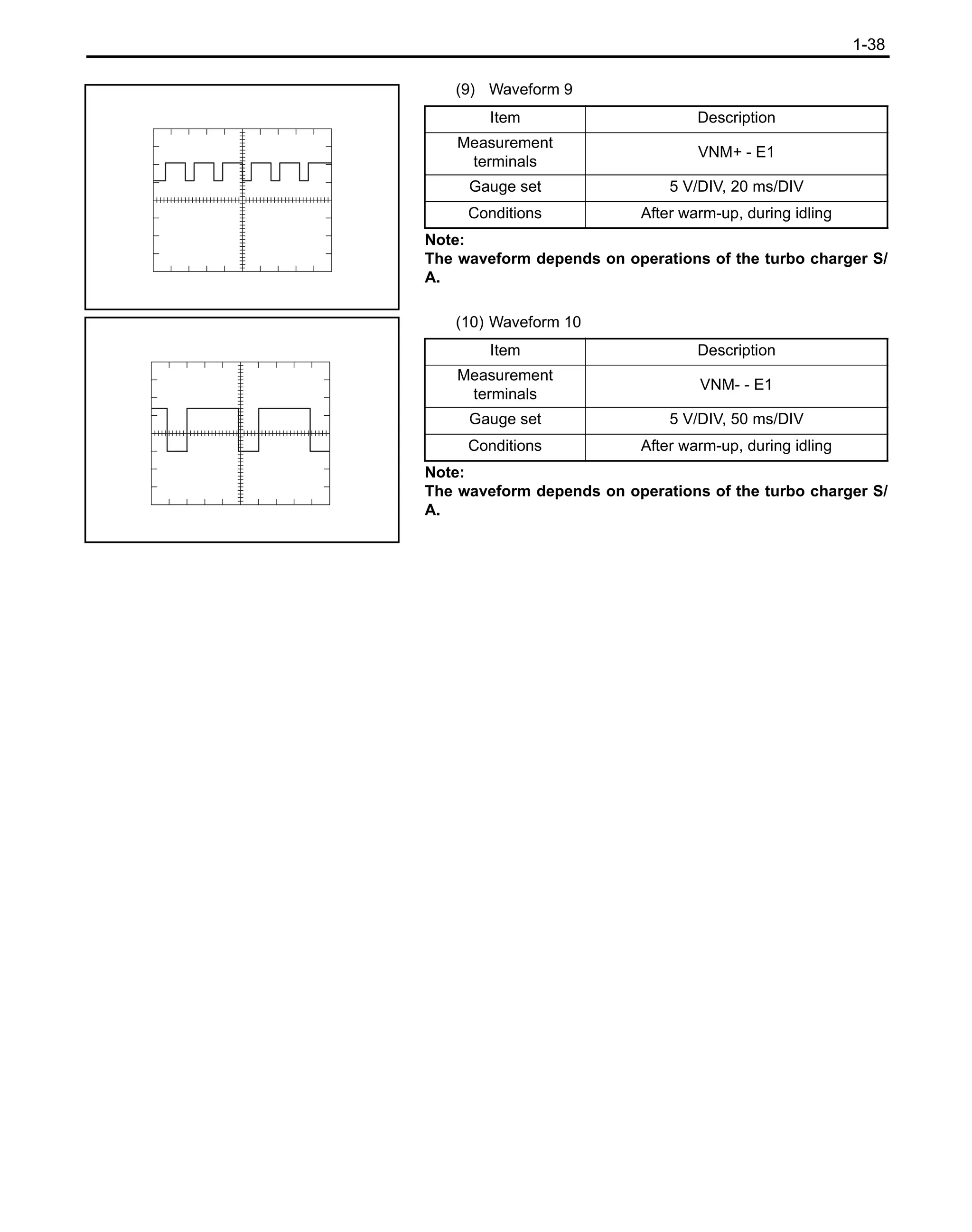
(9) Waveform 9
Note:
The waveform depends on operations of the turbo charger S/
A.
(10) Waveform 10
Note:
The waveform depends on operations of the turbo charger S/
A.
Item Description
Measurement
terminals
VNM+ - E1
Gauge set 5 V/DIV, 20 ms/DIV
Conditions After warm-up, during idling
Item Description
Measurement
terminals
VNM- - E1
Gauge set 5 V/DIV, 50 ms/DIV
Conditions After warm-up, during idling
1KD_RM.book 38 ページ 2013年9月27日 金曜日 午後12時47分
1-39
ECU DATA MONITOR/ACTIVE TEST
1. List of ECU data monitor
(1) With SST, according to the instruction of the screen, display [Data monitor] to inspect computer data.
Note:
• To check the standard, unless otherwise specified, completely warm up the engine, disable all of outside
loads, select the N range, and power off each accessory.
• Results of the inspection in the actual machine are reference values, so actual values may be different
depending on regions or weather.
SST 09111-36760-71(09991-70201)
Item name
Description/
Display range
Reference Remarks
Engine Speed
• Indicates engine
speed.
• Display range:
0 to 6000 r/min
• 50 to 400 r/min:
During cranking
• 700 to 800 r/min:
After engine warm-
up, during idling
• It displays a value output from the crank position
sensor No.2.
• If the crank position sensor No.2 does not oper-
ate properly, the engine speed becomes about 0
r/min or is remarkably different from the actual
engine speed.
Calculate
Load
• Indicates engine
load.
• Display range:
0 to 100%
13 to 25%:
After engine warm-up,
during idling (Disable
all of outside loads, N
range)
• It displays a value calculated by the engine con-
trol computer.
• Engine load value =
(Actual fuel injection amount/Maximum fuel injec-
tion amount in the current engine speed) x 100
MAF
• Indicates intake air
quantity.
• Display range:
0 to 655.35 g/sec
(0 to 86.69 lb/min)
• 16 to 24 g/sec (2.12
to 3.17 lb/min):
After engine warm-
up, during idling
• 40 to 65 g/sec (5.29
to 8.60 lb/min):
For engine speed
NMR (No Load Max-
imum Revolution)
Note:
It changes depend-
ing on the amount of
EGR.
• It displays a value output from the intake air flow
meter S/A.
• Based on intake air quantity, the engine control
computer controls fuel injection amount, injection
timing, EGR, and others.
• When intake air quantity is always about 0 g/sec
(0 lb/min):
- The power circuit of the intake air flow meter S/
A is disconnected.
- The VG circuit is disconnected or short-cir-
cuited.
- The EVG circuit is disconnected.
Symptoms when outside the reference:
Rough idling
Atmosphere
Pressure
• Atmospheric pres-
sure value.
• Display range:
0 to 250 kPa
Actual atmospheric
pressure
• With ignition key switch turned on, when a differ-
ence between a value of the atmospheric pres-
sure sensor and that of the intake manifold
pressure sensor is 10 kPa or more, either sensor
has an abnormality.
• With ignition key switch turned on, when atmo-
spheric pressure is 0 kPa or 140 kPa, the sensor
circuit is abnormal.
• Standard atmospheric pressure: 101 kPa
• Atmospheric pressure decreases by 1 kPa with
each lifting of 100 m (328 ft). This changes
depending on weather (high or low atmospheric
pressure).
• The atmospheric pressure sensor is contained in
the engine control computer.
1KD_RM.book 39 ページ 2013年9月27日 金曜日 午後12時47分
1-40
ECU DATA MONITOR/ACTIVE TEST
1. List of ECU data monitor
(1) With 'Engine Diagnostic Program', according to the instruction of the screen, display [Data monitor] to
inspect computer data.
NOTICE:
• To check the reference, unless otherwise specified, completely warm up the engine, disable all of outside
loads, select the N range, and power off each accessory.
• Results of the inspection in the actual machine are reference values, so actual values may be different
depending on regions or weather.
SST: 09240-36770-71
Item Name
Description/
Display Range
Reference Remarks
Engine
Speed
• Indicates engine speed
• Display range:
0 to 6000 rpm
• 50 to 400 rpm: During
cranking
• Refer to repair manual of
the vehicle: After engine
warm-up, during idling
• It displays a value output from the
crank position sensor No. 2.
• If the crank position sensor No. 2 does
not operate properly, the engine
speed becomes about 0 rpm or is
remarkably different from the actual
engine speed.
Calculate
Load
• Indicates engine load.
• Display range:
0 to 100%
10 to 30%:
After engine warm-up, during
idling (disable all of outside
loads, N range)
• It displays a value calculated by the
engine control computer.
• Engine load value =
(Actual fuel injection
amount/Maximum fuel injection
amount in the current engine speed) x
100
MAF • Indicates intake air
quantity.
• Display range: 0 to
655.35 g/sec (0 to
86.69 lb/min)
• 6 to 25 g/sec (0.79 to 3.17
lb/min): After engine warm-
up, during idling
• 30 to 80 g/sec (3.96 to 10.6
lb/min): For engine speed
NMR
NOTE:
It changes depending on
the amount of EGR.
• It displays a value output from the
intake air flow meter S/A.
• Based on intake air quantity, the
engine control computer controls fuel
injection amount, injection timing,
EGR, and others.
• When intake air quantity is always
about 0 g/sec (0 lb/min):
-The power circuit of the intake air
flow meter S/A is disconnected.
-The VG circuit is disconnected or
short-circuited.
-The EVG circuit is disconnected.
Symptoms when outside the reference:
-Rough Idling
Atmosphere
Pressure
• Atmospheric pressure
value.
• Display range: 0 to 255
kPa
Actual atmospheric pressure • With ignition key switch turned on,
when a difference between a value of
the atmospheric pressure sensor and
that of the intake manifold pressure
sensor is 10kPa or more, either
sensor has an abnormality.
• With ignition key switch turned on,
when atmospheric pressure is 0kPa or
140 kPa, the sensor circuit is
abnormal.
• Standard atmospheric pressure: 101
kPa
• Atmospheric pressure decreases by 1
kPa with each lifting of 100 m (328 ft).
This changes depending on weather
(high or low atmospheric pressure).
• The atmospheric pressure sensor is
contained in the engine control
computer.
1-41
Item name
Description/
Display range
Reference Remarks
MAP • Indicates absolute
pressure of the
internal intake
manifold.
• Display range:
0 to 255 kPa
• 90 to 110 kPa
(depending on
atmospheric
pressure): During
idling
• 115 to 160 kPa: For
engine speed NMR
• With ignition key switch turned on or during idling,
intake manifold pressure and atmospheric
pressure are almost the same (standard
atmospheric pressure = 101 kPa).
• With the accelerator fully opened, when intake
manifold pressure is 20 kPa lower than target
supercharging pressure for five seconds or more,
you may feel insufficient output.
• It displays a value output from the diesel turbo
pressure sensor.
Symptoms when outside the reference:
Insufficient output
Coolant Temp • Indicates engine
cooling water tem-
perature.
• Display range:
-40 to 140 °C
(-40 to 284 °F)
70 to 90 °C
(158 to 194 °F):
After engine
warm-up
• When engine cooling water temperature is -40 °C
(-40 °F) or 140 °C (284 °F), the sensor circuit is
disconnected or short-circuited.
• After it is left for a long time, engine cooling water
temperature, intake air temperature, and ambient
temperature become almost the same.
• It displays a value output from the water temper-
ature sensor.
Symptoms when outside the reference: Difficulty in
starting the engine when cool, rough idling, black
smoke, insufficient output
Intake Air • Indicates intake air
temperature.
• Display range:
-40 to 140 °C
(-40 to 284 °F)
A value equal to tem-
perature in the posi-
tion where the intake
air flow meter S/A is
mounted
• After it is left for a long time, engine cooling water
temperature, intake air temperature, and ambient
temperature become almost the same.
• When intake air temperature is -40 °C
(-40 °F) or 140 °C (284 °F), the sensor circuit is
disconnected or short-circuited.
• It displays a value output from the inlet air tem-
perature sensor contained in the intake air flow
meter S/A.
Engine Run
Time
• Indicates rotating
time after the
engine starts.
• Display range:
0 to 65535 sec
Rotating time after the
engine starts
• Indicates elapsed time after the engine starts.
Starter Signal • Indicates starter
signals.
• Display range: ON/
OFF
ON: During cranking Ignition switch (STA) output:
• ON: Indicates that the engine is cranking.
• OFF: Indicates that the engine is not cranking
Although STA is turned off, the starter continues to
operate.
The STA signal abnormality (P0617) is stored.
Injection
Volume
• Indicates fuel injec-
tion amount.
• Display range:
0 to 1279.98 mm3/
st
5 to 15 mm3/st:
During idling (Disable
all of outside loads, N
range)
• It displays fuel injection amount for each combus-
tion.
• For the injector ASSY clogging, low fuel quality,
fuel filter element clogging, or increased engine
friction, fuel injection amount will increase.
• For abnormalities such as low intake manifold
pressure or a small quantity of intake air, fuel
injection amount is limited, which causes insuffi-
cient output.
• It displays a value calculated by the engine con-
trol computer.
1-42
Item Name Description/Display
Range
Reference Remarks
Pilot 1
Injection
Period
 Indicates pilot 1
injection period.
 Display range: 0
to 65535 µs
200 to 300 µs: During idling
(water temperature is less
than 60 °C (140 °F), disable
all of outside loads, N range)
 For symptoms such as knocking, poor
drivability, or white smoke, check pilot 1
injection period. (with or without pilot injection)
 It displays a value calculated by the engine
control computer
Symptoms when outside the reference:
knocking, poor drivability, white smoke
Pilot 2
Injection
Period
 Indicates pilot 2
injection period.
 Display Range: 0
to 65535 µs
200 to 350 µs: During idling
(complete warm-up, disable
all of outside loads, N range)
 For symptoms such as knocking, poor
drivability, or white smoke, check pilot 2
injection period. (with or without pilot injection)
 It displays a value calculated by the engine
control computer.
Symptoms when outside the reference:
knocking, poor drivability, white smoke
Main
Injection
Period
 Indicates main
injection period.
 Display range: 0
to 65535 µs
300 to 600 µs: During idling
(complete warm-up, disable
all of outside loads, N range)
 When fuel pressure becomes 15000 kPa or
less, main injection period becomes 0 µs.
 For engine hard starting, check main injection
period. (with or without injection)
 When P0093, P0627 or P062D is output, the
engine stop request is output. In this case,
main injection period becomes 0 µs.
NOTICE:
After the engine check indicator turns on, in
about one minute the engine stops.
Therefore, inspection cannot be performed
with freeze frame data.
 It displays a value calculated by the engine
control computer
After
Injection
Period
 Indicates after
injection period.
 Display range: 0
to 65535 µs
0 to 400 µs: During idling
(complete warm-up, disable
all of outside loads, N range)
 For symptoms such as black smoke and poor
drivability, check after injection period. (with or
without after injection)
 It displays a value calculated by the engine
control computer.
Pilot 1
Injection
Timing
 Indicates pilot 1
injection timing.
 Display range: -70
to 20 °CA
-14 to -5 °CA: Water
temperature is less than 60 °C
(140 °F), during idling, and the
machine is in the range of
usual atmospheric pressure
 It displays a value calculated by the engine
control computer.
Pilot 2
Injection
Timing
 Indicates pilot 2
injection timing.
 Display range: -50
to 20 °CA
-10 to -2 °CA: After engine
warm-up, during idling, and
the machine is in the range of
usual atmospheric pressure.
 It displays a value calculated by the engine
control computer.
Main
Injection
Timing
 Indicates main
injection timing.
 Display range: -90
to 90 °CA
-3 to 1 °CA: After engine
warm-up, during idling, and
the machine is in the range of
usual atmospheric pressure.
 For symptoms such as poor drivability, black
smoke, or white smoke, check main injection
timing.
 It displays a value calculated by the engine
control computer.
After
Injection
Timing
 Indicates after
injection timing.
 Display range: -10
to 50 °CA
 It displays a value calculated by the engine
control computer.
1-43
1-44
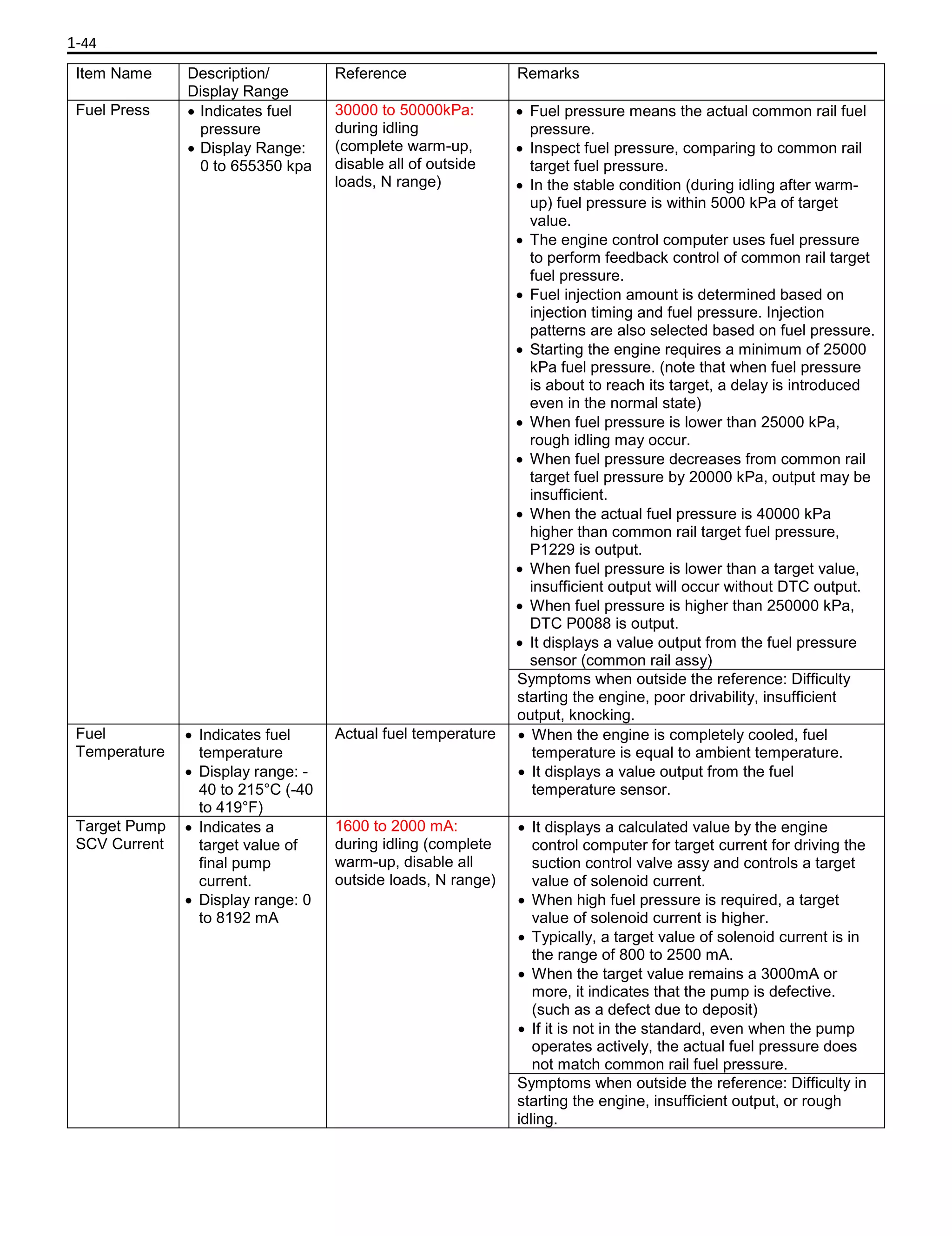
Item Name Description/
Display Range
Reference Remarks
Fuel Press  Indicates fuel
pressure
 Display Range:
0 to 655350 kpa
30000 to 50000kPa:
during idling
(complete warm-up,
disable all of outside
loads, N range)
 Fuel pressure means the actual common rail fuel
pressure.
 Inspect fuel pressure, comparing to common rail
target fuel pressure.
 In the stable condition (during idling after warm-
up) fuel pressure is within 5000 kPa of target
value.
 The engine control computer uses fuel pressure
to perform feedback control of common rail target
fuel pressure.
 Fuel injection amount is determined based on
injection timing and fuel pressure. Injection
patterns are also selected based on fuel pressure.
 Starting the engine requires a minimum of 25000
kPa fuel pressure. (note that when fuel pressure
is about to reach its target, a delay is introduced
even in the normal state)
 When fuel pressure is lower than 25000 kPa,
rough idling may occur.
 When fuel pressure decreases from common rail
target fuel pressure by 20000 kPa, output may be
insufficient.
 When the actual fuel pressure is 40000 kPa
higher than common rail target fuel pressure,
P1229 is output.
 When fuel pressure is lower than a target value,
insufficient output will occur without DTC output.
 When fuel pressure is higher than 250000 kPa,
DTC P0088 is output.
 It displays a value output from the fuel pressure
sensor (common rail assy)
Symptoms when outside the reference: Difficulty
starting the engine, poor drivability, insufficient
output, knocking.
Fuel
Temperature
 Indicates fuel
temperature
 Display range: -
40 to 215°C (-40
to 419°F)
Actual fuel temperature  When the engine is completely cooled, fuel
temperature is equal to ambient temperature.
 It displays a value output from the fuel
temperature sensor.
Target Pump
SCV Current
 Indicates a
target value of
final pump
current.
 Display range: 0
to 8192 mA
1600 to 2000 mA:
during idling (complete
warm-up, disable all
outside loads, N range)
 It displays a calculated value by the engine
control computer for target current for driving the
suction control valve assy and controls a target
value of solenoid current.
 When high fuel pressure is required, a target
value of solenoid current is higher.
 Typically, a target value of solenoid current is in
the range of 800 to 2500 mA.
 When the target value remains a 3000mA or
more, it indicates that the pump is defective.
(such as a defect due to deposit)
 If it is not in the standard, even when the pump
operates actively, the actual fuel pressure does
not match common rail fuel pressure.
Symptoms when outside the reference: Difficulty in
starting the engine, insufficient output, or rough
idling.
1-45
Target EGR
Pos.
Indicates EGR valve
target opening
degree.
Display range:
0 to 100%
0 to 90%:
After engine warm-up,
during idling (com-
plete warm-up, dis-
able all of outside
loads,
N range)
• EGR valve fully opened: 100%
• EGR valve fully closed: 0%
• Inspect it comparing to the actual EGR opening
degree #1.
• EGR target opening degree displays a calculated
value by the engine control computer based on
sensor output values (such as the intake air flow
meter S/A, inlet air temperature sensor (con-
tained in the intake air flow meter S/A), diesel
turbo pressure sensor).
Symptoms when outside the reference:
• When EGR target opening degree is not in the
standard and near 0%, the intake air flow meter
S/A may be abnormal, or an intake or exhaust
system may get clogged.
• When EGR target opening degree is not in the
standard and near 100%, the EGR pipe may get
clogged.
Actual EGR
Valve Pos.
• Indicates EGR
valve actual open-
ing degree.
• Display range:
0 to 100%
0 to 90%:
After engine
warm-up, during idling
(complete warm-up,
disable all of outside
loads,
N range)
• EGR valve fully opened: 100%
• EGR valve fully closed: 0%
• It is effective to judge if the EGR valve is stuck.
• Inspect it comparing to EGR target opening
degree.
• In the active test, check operations of the EGR
valve.
• When the EGR valve becomes abnormal around
a certain temperature, refer to engine cooling
water temperature and outside temperature
which are reference in case of an abnormality.
• The valve position displays a calculated value
output from the EGR valve position sensor.
Symptoms when outside the reference:
• EGR valve stuck open: Hard starting (no engine
stalling), black smoke, white smoke, insufficient
output
• EGR valve stuck close: Increase of turbo super-
charging sound
EGR Close
Lrn. Val.
• Indicates an EGR
fully-closed posi-
tion learned value.
• Display range:
0 to 5.00 V
0 to 1 V
• An EGR fully-closed position learned value is
output voltage from the EGR valve position sen-
sor.
• When the EGR fully-closed position learned
value becomes the upper or lower limit of the nor-
mal range, foreign matter may be involved in the
EGR valve.
• The lower limit of the EGR fully-closed position
learned value is 0 V, and the upper 1 V. When
this value is fixed to either limit, the valve position
sensor may be abnormal, or the valve position
may be misplaced (with foreign matter).
Item name
Description/
Display range
Reference Remarks
1KD_RM.book 45 ページ 2013年9月27日 金曜日 午後12時47分
1-46
EGR Close
Lrn. Status
• Indicates a state of
EGR fully-closed
position learning.
• Display range:
Completed/Not
completed
Completed
• Completed: It means that fully-closed position
learning is normally completed.
• Not completed: It means that the learned fully-
closed position may not in the correct range.
• When it is not completed, foreign matter may be
involved in the EGR valve.
Note:
After the battery cable is disconnected and
then connected, when the ignition key switch is
never turned off, learning may not be com-
pleted.
Results of inspection in the actual machine:
Ignition key switch ON: Completed
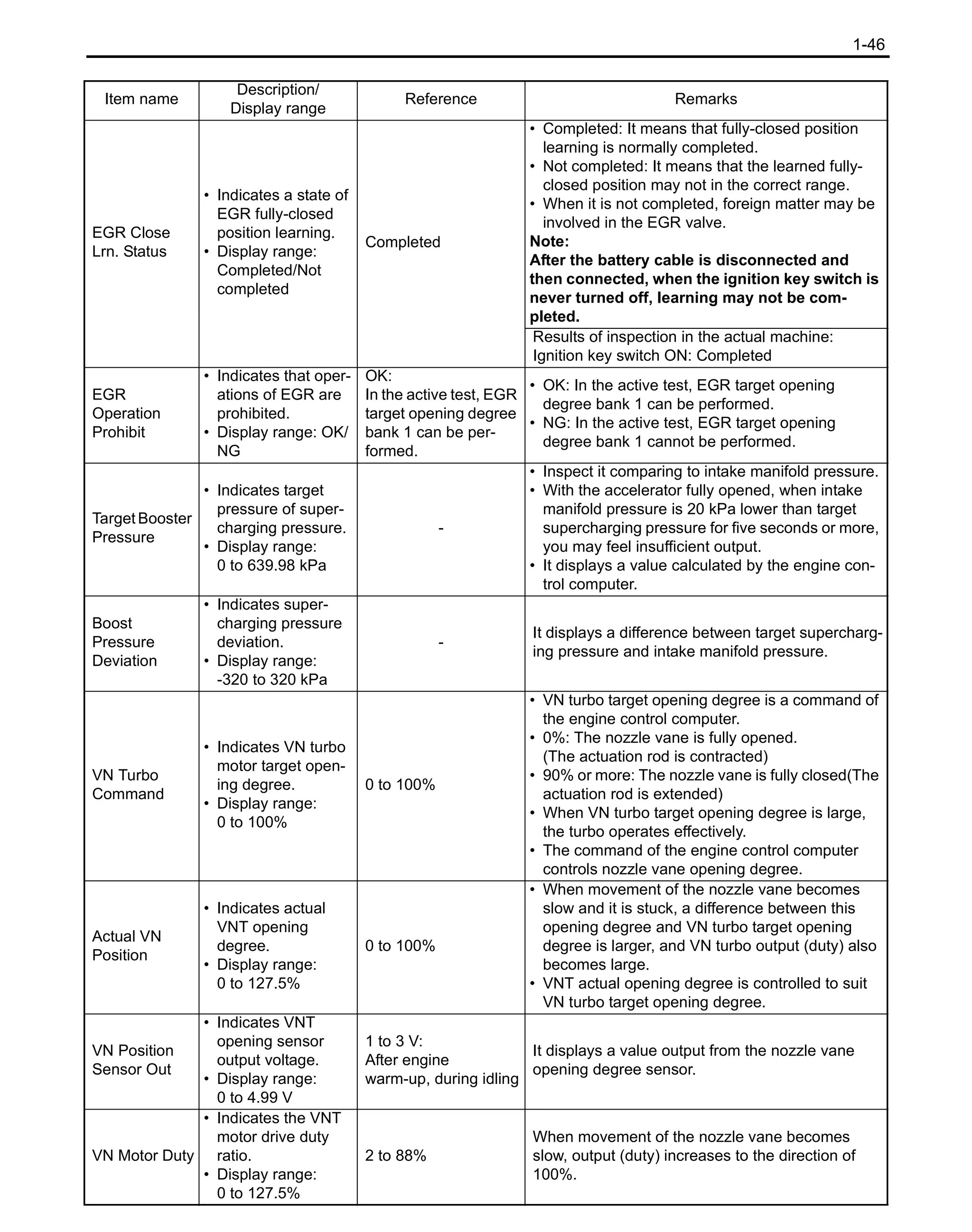
EGR
Operation
Prohibit
• Indicates that oper-
ations of EGR are
prohibited.
• Display range: OK/
NG
OK:
In the active test, EGR
target opening degree
bank 1 can be per-
formed.
• OK: In the active test, EGR target opening
degree bank 1 can be performed.
• NG: In the active test, EGR target opening
degree bank 1 cannot be performed.
Target Booster
Pressure
• Indicates target
pressure of super-
charging pressure.
• Display range:
0 to 639.98 kPa
-
• Inspect it comparing to intake manifold pressure.
• With the accelerator fully opened, when intake
manifold pressure is 20 kPa lower than target
supercharging pressure for five seconds or more,
you may feel insufficient output.
• It displays a value calculated by the engine con-
trol computer.
Boost
Pressure
Deviation
• Indicates super-
charging pressure
deviation.
• Display range:
-320 to 320 kPa
-
It displays a difference between target supercharg-
ing pressure and intake manifold pressure.
VN Turbo
Command
• Indicates VN turbo
motor target open-
ing degree.
• Display range:
0 to 100%
0 to 100%
• VN turbo target opening degree is a command of
the engine control computer.
• 0%: The nozzle vane is fully opened.
(The actuation rod is contracted)
• 90% or more: The nozzle vane is fully closed(The
actuation rod is extended)
• When VN turbo target opening degree is large,
the turbo operates effectively.
• The command of the engine control computer
controls nozzle vane opening degree.
Actual VN
Position
• Indicates actual
VNT opening
degree.
• Display range:
0 to 127.5%
0 to 100%
• When movement of the nozzle vane becomes
slow and it is stuck, a difference between this
opening degree and VN turbo target opening
degree is larger, and VN turbo output (duty) also
becomes large.
• VNT actual opening degree is controlled to suit
VN turbo target opening degree.
VN Position
Sensor Out
• Indicates VNT
opening sensor
output voltage.
• Display range:
0 to 4.99 V
1 to 3 V:
After engine
warm-up, during idling
It displays a value output from the nozzle vane
opening degree sensor.
VN Motor Duty
• Indicates the VNT
motor drive duty
ratio.
• Display range:
0 to 127.5%
2 to 88%
When movement of the nozzle vane becomes
slow, output (duty) increases to the direction of
100%.
Item name
Description/
Display range
Reference Remarks
1KD_RM.book 46 ページ 2013年9月27日 金曜日 午後12時47分
1-47
VN Close
Learn Value
• Indicates a VNT
fully-closed learn-
ing voltage value.
• Display range:
0 to 4.99 V
1.0 to 2.0 V -
VN Close
Learn Status
• Indicates a VNT
fully-closed posi-
tion learning his-
tory.
• Display range: ON/
OFF
ON
When VN Close Learning is not completed, the
performance of the machine may decrease. (low
engine output)
VN Turbo
Operation
Prohibit
• Indicates that the
VN turbo active test
is prohibited.
• Display range:
Allowed/Prohibited
Allowed:
VN turbo opening
degree can be per-
formed in the active
test.
When it is prohibited, the engine control computer
does not allow performing the active test for VN
turbo opening degree.
Initial Engine
Coolant Temp
• Indicates engine
cooling water tem-
perature at start-
up.
• Display range:
-40 to 120 °C
(-40 to 248 °F)
Engine cooling water
temperature at start-
up
• With freeze frame data, you can determine if an
abnormality occurred at start-up when cool, or
after the engine warm-up.
• It displays a value output from the water temper-
ature sensor at engine start-up.
Initial Intake
Air Temp
• Indicates initial
intake air tempera-
ture.
• Display range:
-40 to 120 °C
(-40 to 248 °F)
Intake air tempera-
ture at engine start-up
It displays a value output from the intake air flow
meter S/A (intake temperature sensor) at engine
start-up.
Engine Start
Time
• Indicates engine
start time.
• Display range:
0 to 267386 ms
- It displays the time required by engine start-up.
Engine Speed
(Starter Off)
• Indicates engine
speed when the
starter is turned off.
• Display range:
0 to 1593 rpm
-
It displays engine speed immediately after the
engine starts.
Starter Count
• Indicates how
many times the
starter has been
turned on.
• Display range:
0 to 255
-
It displays how many times the starter has been
turned on since ignition key switch was turned on.
Electric Duty
Feedback
Value
• Indicates an electri-
cal load feedback
value.
• Display range:
0 to 39.8 mm3
/st
0 to 5 mm3
/st
After electrical load is turned off and then on, ISC
electrical load correction amount increases.
Item name
Description/
Display range
Reference Remarks
1KD_RM.book 47 ページ 2013年9月27日 金曜日 午後12時47分
1-48
Intake Air
Temp (Turbo)
• Indicates intake air
temperature after
the inter cooler is
passed.
• Display range:
-40 to 190 °C (-40
to 374 °F)
During idling
70 °C (158 °F) or less
• Indicates intake air temperature of the intake
manifold (after the inter cooler ASSY is passed).
• Intake air temperature after turbo charging is set
to 170 °C (338 °F) while the fail safe function is
operating.
• When intake air temperature after turbo charging
becomes high, turbo supercharging pressure is
suppressed, which may cause insufficient output.
• It displays a value output from the inlet air tem-
perature sensor.
Check Mode
• Indicates the check
mode state.
• Display range:
Check/Normal
Check mode state:
Check
Check mode: A particular DTC can be easily
detected at a high sensitivity.
Battery
Voltage
• Indicates battery
voltage.
• Display range:
0 to 15 V
11 to 14 V:
Ignition key switch ON
When it is 11 V or less, characteristics of electronic
parts will be changed.
Symptoms when outside the reference:
When it is 5 V or less, it is difficult to start the
engine.
Alternate Duty
Ratio
• Indicates the alter-
nator power gener-
ation duty ratio.
• Display range:
0 to 100%
-
• It is used to output alternator power generation
duty and to decide electrical load.
• When injection amount during idling is larger than
normal, it is used to determine if there are electri-
cal load or other causes.
• In the state where Alternate Duty Ratio is not
high (low electrical load), when idling injection
amount is large, injection amount of the injector
ASSY may decrease, or engine friction may be
large.
• It is used to judge a power generation request
state due to an abnormal electrical system.
• Whether or not accessories (such as A/C or the
heater) operate, when Alternate Duty Ratio is
always the maximum value, an abnormality
occurs in the electrical system (such as battery
deterioration).
• It displays a duty value from the ALT terminal.
Engine Speed
of Cyl #1
Engine Speed
of Cyl #2
Engine Speed
of Cyl #3
Engine Speed
of Cyl #4
• Indicates cylinder
engine speed.
• Display range:
0 to 51199 rpm
The engine speed of
all cylinders are
almost the same:
Normal
• It is output only when the engine speed is mea-
sured for each cylinder in the active test.
• Indicates engine speed for each cylinder during
cranking.
Example:
- When compression of the No.1 cylinder is low,
Engine Speed of Cyl #1 is about 300 rpm, Engine
Speed of Cyl #2, #3, and #4 is about 200 rpm.
- When compression of the No.2 cylinder is low,
Engine Speed of Cyl #2 is about 300 rpm, Engine
Speed of Cyl #1, #3, and #4 is about 200 rpm.
- When compression of the No.3 cylinder is low,
Engine Speed of Cyl #3 is about 300 rpm, Engine
Speed of Cyl #1, #2, and #4 is about 200 rpm.
- When compression of the No.4 cylinder is low,
Engine Speed of Cyl #4 is about 300 rpm, Engine
Speed of Cyl #1, #2, and #3 is about 200 rpm.
Symptoms when outside the reference:
When the engine speed of all cylinders is not the
same, idling is not stable.
Item name
Description/
Display range
Reference Remarks
1KD_RM.book 48 ページ 2013年9月27日 金曜日 午後12時47分
1-49
Av Engine
Speed of All
Cyl
• Indicates the aver-
age engine speed
of all cylinders.
• Display range:
0 to 51199 rpm
-
• It is output only when the engine speed is mea-
sured for each cylinder in the active test.
• Indicates the average engine speed of all cylin-
ders during cranking.
Time after
DTC Cleared
• Indicates elapsed
time after DTC is
deleted.
• Display range:
0 to 65535 min
Time after DTC is
deleted
It displays elapsed time after DTC is deleted (or
shipped from the factory).
Warm-up
Cycle Cleared
DTC
• Indicates warm-up
count after DTC is
deleted.
• Display range:
0 to 255
-
• It displays engine warm-up count after DTC is
deleted.
• (Warm-up Cycle Cleared DTC of data list is
deleted) - (Warm-up Cycle Cleared DTC of
freeze frame data is deleted) = Warm-up count
after an abnormality occurs
TC and TE1
• Indicates the con-
nection condition
between TC and
TE1 in the active
test.
• Display range: ON/
OFF
-
When the TE1/TC terminals are turned on in the
active test, the system operates as if the TC termi-
nal and E terminal of the diagnostic connector are
connected.
Isochronous
Control Target
Speed
• Indicates the Isoch-
ronous Control Tar-
get Speed.
• Display range:
0 to 12800 r/min
700 to 800 r/min:
After engine warm-up,
during idling
It displays a value calculated by the engine control
computer.
Isochronous
Control
Proportional
Term
• Indicates the Isoch-
ronous Control
Proportional Term.
• Display range:
-50 to 120 mm3
/st
-
It displays a value calculated by the engine control
computer.
Isochronous
Control
Integral Term
• Indicates the Isoch-
ronous Control
Integral Term.
• Display range:
-80 to 79.997 mm3
/
st
-
It displays a value calculated by the engine control
computer.
Total
Operation
Hours
• Indicates the Total
Operation Hours.
• Display range:
0 to 4500000000
sec
-
It displays a value calculated by the engine control
computer.
Total Number
of Rotations
• Indicates the Total
Number of Rota-
tions.
• Display range:
0 to 4290000000
Rotations
-
It displays a value calculated by the engine control
computer.
Total Injection
Volume
• Indicates the Total
Injection Volume.
• Display range:
0 to 33554432 L
(0 to 8864147 gal)
-
It displays a value calculated by the engine control
computer.
Item name
Description/
Display range
Reference Remarks
1KD_RM.book 49 ページ 2013年9月27日 金曜日 午後12時47分
1-50
Item name
Description/
Display range
Reference Remarks
Av Engine
Speed of All
Cyl
• Indicates the aver-
age engine speed
of all cylinders.
• Display range:
0 to 51199 rpm
- • It is output only when the engine speed is mea-
sured for each cylinder in the active test.
• Indicates the average engine speed of all cylin-
ders during cranking.
Time after
DTC Cleared
• Indicates elapsed
time after DTC is
deleted.
• Display range:
0 to 65535 min
Time after DTC is
deleted
• It displays elapsed time after DTC is deleted (or
shipped from the factory).
Warm-up
Cycle Cleared
DTC
• Indicates warm-up
count after DTC is
deleted.
• Display range:
0 to 255
- • It displays engine warm-up count after DTC is
deleted.
• (Warm-up Cycle Cleared DTC of data list is
deleted) - (Warm-up Cycle Cleared DTC of
freeze frame data is deleted) = Warm-up count
after an abnormality occurs
TC and TE1 • Indicates the con-
nection condition
between TC and
TE1 in the active
test.
• Display range: ON/
OFF
- • When the TE1/TC terminals are turned on in the
active test, the system operates as if the TC ter-
minal and E terminal of the diagnostic connector
are connected.
Isochronous
Control Tar-
get Speed
• Indicates the Isoch-
ronous Control Tar-
get Speed.
• Display range:
0 to 12800 r/min
• It displays a target engine speed with the re-
quest of vehicle is taken.
Refer to repair manual
of the vehicle After
engine warm-up,
during idling
Isochronous
Control
Proportional
Term
• Indicates the Isoch-
ronous Control
Proportional Term.
• Display range:
-50 to 120 mm3/st
- • It displays a value calculated by the engine con-
trol computer.
Isochronous
Control
Integral Term
• Indicates the Isoch-
ronous Control
Integral Term.
• Display range:
-80 to 79.997 mm3/
st
- • It displays a value calculated by the engine con-
trol computer.
Total
Operation
Hours
• Indicates the Total
Operation Hours.
• Display range:
0 to 4500000000
sec
- • It displays a value calculated by the engine con-
trol computer.
Total Number
of Rotations
• Indicates the Total
Number of Rota-
tions.
• Display range:
0 to 4290000000
Rotations
- • It displays a value calculated by the engine con-
trol computer.
Total Injection
Volume
• Indicates the Total
Injection Volume.
• Display range:
0 to 33554432 L
(0 to 8864147 gal)
- • It displays a value calculated by the engine con-
trol computer.
1-51
Item name
Description/
Display range
Reference Remarks
Accel Sensor
Out No.1
(Accurate)
• Indicates the Accel
Sensor Out No.1
(Accurate).
• Display range:
0 to 5.000 V
IG-ON:
0.75 to 0.95 V
(Accel pedal: Close)
-
Accel Sensor
Out No.2
(Accurate)
• Indicates the Accel
Sensor Out No.2
(Accurate).
• Display range:
0 to 5.000 V
IG-ON:
1.35 to 1.55 V
(Accel pedal: Close)
-
Pre Glow • Indicates the Pre
Glow.
• Display range:
ON/OFF
- Pre Glow demand: ON
After Glow • Indicates the After
Glow.
• Display range:
ON/OFF
- After Glow demand: ON
Target Idle
Engine Speed
• Indicates the Tar-
get Idle Engine
Speed.
• Display range:
0 to 10000 r/min
• It displays a target value of the engine individual
• Check "Isochronous Control Target Speed" because it
is not sometimes match with engine speed, while still
installed on the vehicle.
Fuel Return
Temp
• Indicates the Fuel
Return Temp.
• Display range:
-40 to 215 °C
(-40 to 419 °F)
- • It displays a value calculated by the engine con-
trol computer.
EGR Motor
Duty #1
• Indicates the EGR
Motor Duty #1
• Display range:
0 to 127.5 %
0 to 100% • It displays a value calculated by the engine con-
trol computer.
2. Active test
(1) With 'Engine Diagnostic Program', according to the instruction of the screen, display the [Active test] screen
to perform the active test.
SST: 09240-36770-71
Item name Description Constraint condition
Control the Select
Cylinder Fuel Cut
Stop fuel injection of each cylinder #1/
#2/#3/#4 (Injection of multiple cylinders
cannot be stopped.)
With the machine stopped, during engine
rotating
Check the Cylinder
Compression
Stop fuel injection of all cylinders.
Measure engine speed during cranking.
With the machine stopped, when the crank
position sensor and sensor No.2 are in the
normal state
Control the EGR Step
Position
Increase or decrease EGR opening
degree.
When the test is started, opening
degree shall be 0. It can be increased or
decreased in the range of 0 to 100% by
1%.
With the machine stopped, Ignition key
switch ON (Engine stop)
Activate the EGR Valve
Close
Forced closed of the EGR valve With the machine stopped, during engine
rotating after warm-up
1-52
FAIL SAFE LIST
1. Fail safe list
(1) When the codes listed below are recorded in the engine control computer, the machine enters the fail safe
mode.
Diagnosis code Fail safe operation Condition for canceling the fail safe mode
P0046 Limit the engine output. Ignition switch OFF.
P0047 Limit the engine output. Ignition switch OFF.
P0048 Limit the engine output. Ignition switch OFF.
P007C
Intake temperature (after turbo charging) is fixed
to 170 °C (338 °F).
Restore the normal condition.
P007D
Intake temperature (after turbo charging) is fixed
to 170 °C (338 °F).
Restore the normal condition.
P0087 Limit the engine output. Ignition switch OFF.
P0088 Limit the engine output. Ignition switch OFF.
P0093 Limit the engine output. Ignition switch OFF.
P0102 Limit the engine output. Ignition switch OFF.
P0103 Limit the engine output. Ignition switch OFF.
P0107 Intake manifold pressure is fixed to 101.3 kPa. Restore the normal condition.
P0108 Intake manifold pressure is fixed to 101.3 kPa. Restore the normal condition.
P0112 Intake temperature is fixed to 60 °C (140 °F). Restore the normal condition.
P0113 Intake temperature is fixed to 60 °C (140 °F). Restore the normal condition.
P0115
Temperature is fixed to 119 °C (246 °F) when the
fuel temperature sensor is abnormal.
When fuel temperature is 15 °C (59 °F) or less:
Substitute a value of the fuel temperature sensor.
When fuel temperature is 15 °C (59 °F) or more: It
is fixed to 119 °C (246 °F).
Restore the normal condition.
P0117
Temperature is fixed to 119 °C (246 °F) when the
fuel temperature sensor is abnormal.
When fuel temperature is 15 °C (59 °F) or less:
Substitute a value of the fuel temperature sensor.
When fuel temperature is 15 °C (59 °F) or more: It
is fixed to 119 °C (246 °F).
Restore the normal condition.
P0118
Temperature is fixed to 119 °C (246 °F) when the
fuel temperature sensor is abnormal.
When fuel temperature is 15 °C (59 °F) or less:
Substitute a value of the fuel temperature sensor.
Restore the normal condition.
P0180 Fuel temperature is fixed to 50 °C (122 °F). Restore the normal condition.
P0182 Fuel temperature is fixed to 50 °C (122 °F). Restore the normal condition.
P0183 Fuel temperature is fixed to 50 °C (122 °F). Restore the normal condition.
P0190 Limit the engine output. Ignition switch OFF.
P0192 Limit the engine output. Ignition switch OFF.
P0193 Limit the engine output. Ignition switch OFF.
P0201 Limit the engine output.
Turn the ignition switch OFF and then ON.
Alternatively, turn STA ON.
P0202 Limit the engine output.
Turn the ignition switch OFF and then ON.
Alternatively, turn STA ON.
P0203 Limit the engine output.
Turn the ignition switch OFF and then ON.
Alternatively, turn STA ON.
1KD_RM.book 52 ページ 2013年9月27日 金曜日 午後12時47分
1-53
P0204 Limit the engine output.
Turn the ignition switch OFF and then ON.
Alternatively, turn STA ON.
P0299 Limit the engine output. Restore the normal condition.
P0335 Limit the engine output. Restore the normal condition.
P0339 Limit the engine output. Restore the normal condition.
P0340 Limit the engine output. Restore the normal condition.
P0405 Limit the engine output. Ignition switch OFF.
P0406 Limit the engine output. Ignition switch OFF.
P042E Limit the engine output. Ignition switch OFF.
P0489 Limit the engine output. Ignition switch OFF.
P0490 Limit the engine output. Ignition switch OFF.
P0606 Limit the engine output. Restore the normal condition.
P060A Limit the engine output. Restore the normal condition.
P060B Limit the engine output. Restore the normal condition.
P0627 Limit the engine output. Restore the normal condition.
P062D
When only one cylinder is abnormal, engine out-
put is limited.
When two or more cylinders are abnormal, the
engine stalls.
Ignition switch OFF.
P1229 Limit the engine output. Ignition switch OFF.
P1251 Limit the engine output. Ignition switch OFF.
P2120 Limit the engine output. Restore the normal condition.
P2121 Limit the engine output. Restore the normal condition.
P2122 Limit the engine output. Restore the normal condition.
P2123 Limit the engine output. Restore the normal condition.
P2125 Limit the engine output. Restore the normal condition.
P2127 Limit the engine output. Restore the normal condition.
P2128 Limit the engine output. Restore the normal condition.
P2138 Limit the engine output. Restore the normal condition.
P2226 Atmospheric pressure is fixed to 70 kPa. Restore the normal condition.
P2228 Atmospheric pressure is fixed to 70 kPa. Restore the normal condition.
P2229 Atmospheric pressure is fixed to 70 kPa. Restore the normal condition.
P2564 Limit the engine output. Ignition switch OFF.
P2565 Limit the engine output. Ignition switch OFF.
U0101 Limit the engine output. Restore the normal condition.
Diagnosis code Fail safe operation Condition for canceling the fail safe mode
1KD_RM.book 53 ページ 2013年9月27日 金曜日 午後12時47分
1-54
Circuit description
The VN turbo charger system consists of the VN turbo charger actuator and the engine control computer. The VN
turbo charger has a variable nozzle vane. When the vane is opened and closed, the area of the turbine inlet will be
changed. This allows adjustment of pressure and speed of exhaust gas entering the turbine. When the vane is
closed, supercharging pressure gets higher. When it is opened, supercharging pressure gets lower.
The VN turbo charger actuator consists of the DC motor and the nozzle opening degree sensor. The nozzle opening
degree sensor detects opening degree of the variable nozzle vane. The DC motor controls the variable nozzle vane.
When the engine control computer opens and closes the variable nozzle vane through the DC motor based on the
traveling state, flow speed of exhaust gas is changed, allowing the control of supercharging pressure.
When detecting a disconnection or short-circuit in the DC motor circuit, the engine control computer stores a
diagnosis code and turns on the engine check indicator.
When the variable nozzle vane is stuck close, engine torque when the throttle is opened will be significantly limited.
When the variable nozzle vane is stuck open, a response becomes slow and torque decreases when the throttle is
opened. However, power reduction during high rotation is smaller than that in the stuck close.
P0046
P0047
DTC P0046 Turbocharger Boost Control Circuit Range / Performance
DTC P0047 Turbocharger Boost Control Solenoid Circuit Low
DTC P0048 Turbocharger Boost Control Solenoid Circuit High
DTC check pattern
DTC detection conditions
1. Diagnosis conditions
2. Abnormal status
3. Abnormal period
4. Others
Inspection position
In [Active the VN Turbo Open] of the
activsxe test, keep the open (fully
opened) and OFF (fully closed)
states for five seconds or more.
1. Ignition key switch ON
2. A current of the DC motor is 2.2 A
or more.
3. 5 sec. or longer
4. 1 trip
• Disconnection, short-circuit, and
poor connection of the nozzle
opening degree sensor (turbo
charger S/A).
• DC motor (Turbo charger S/A)
• Wire harness or connector
• Stuck and slow movement of the
nozzle vane
(turbo charger S/A)
• Engine control computer
DTC check pattern
DTC detection conditions
1. Diagnosis conditions
2. Abnormal status
3. Abnormal period
4. Others
Inspection position
In [Active the VN Turbo Open] of the
active test, keep the open (fully
opened) and OFF (fully closed)
states for five seconds or more.
1. Ignition key switch ON
2. A duty ratio of the DC motor is
80% or more, and a current value
is 0.5 A or less.
3. Three seconds or more
4. 1 trip
• DC motor (Turbo charger S/A)
• Wire harness or connector
• Engine control computer
1KD_RM.book 54 ページ 2013年9月27日 金曜日 午後12時47分
1-55
P0048
Note:
• The following symptoms may occur when the nozzle vane is stuck close and then DTC P0046, P0047, and
P0048 are stored.
- Hunting where a recovery operation from power reduction is repeated every a few seconds during high-
load traveling.
• The following symptoms may occur when the nozzle vane is stuck open and then DTC P0046, P0047, and
P0048 are stored.
- Insufficient output
- Rising of the engine torque when the accelerator is depressed becomes slow.
Circuit diagram
Inspection procedure
Caution:
When replacing the engine control computer or injector ASSY, initialize and write the corresponding ID code
according to the Operation Support Procedure List. (See page 1-16 for the procedure.)
Note:
Use 'Engine Diagnostic Program' to read the freeze frame data. A part of engine operation condition when
the defect occurred is recorded in the freeze frame data. This information is useful for troubleshooting.
SST 09111-36760-71(09991-70201)
1. Turn the ignition key switch ON. According to the instruction of
the 'Engine Diagnostic Program' screen, read the diagnosis
code. (See page 1-13 for the procedure.)
Result
DTC check pattern
DTC detection conditions
1. Diagnosis conditions
2. Abnormal status
3. Abnormal period
4. Others
Inspection position
In [Active the VN Turbo Open]
of the active test, keep the open
(fully opened) and OFF (fully closed)
states for five seconds or more.
1. Ignition key switch ON
2. DC motor overcurrent
3. 25 times or more
(about 0.4 second or more)
4. 1 trip
• DC motor (Turbo charger S/A)
• Wire harness or connector
• Engine control computer
A
U
DC motor (Turbo charger S/A) Engine control
Computer
Shield cable
2
1
42
43
VNM+
VNM-
1 Diagnosis code reading
Result Go to
P0046, P0047, or P0048 is output. A
P0046, P0047, P0048, and other diagnosis codes are output. B
1KD_RM.book 55 ページ 2013年9月27日 金曜日 午後12時47分
1-56
A
1. Turn ON the ignition switch.
2. Press [Active test] and select [Test the Turbo Charger Motor]
on the 'Engine Diagnostic Program'.
3. Monitor [VNT Command] and [Actual VN Position] from the
data list items.
4. Implement the active test.
Result
A
1. Disconnect the DC motor (turbo charger S/A) connector.
2. Measure the resistance between terminals.
Resistance
OK
B Go to the related diagnosis code chart
(See page 1-5 for the procedure.)
2 Active test implementation (Test the Turbo Charger Motor)
Result Go to
The value of the [Actual VN Position] follows that of the [VNT Command]. A
The value of the [Actual VN Position] does not follow that of the [VNT Command]. B
B Go to step 3.
INSPECTION OF IRREGULAR PROBLEMS (See page 1-15 for the procedure)
3 Turbo charger S/A inspection (individual inspection)
1
2
DC motor (Turbo charger S/A)
M+ M-
Inspection terminal Inspection condition Standard
2 (M+) - 1 (M-) Always 1 to100 Ω
NG Go to step 6.
4
Wire harness and connector inspection
(DC motor (Turbo charger S/A) - Engine control computer)
1KD_RM.book 56 ページ 2013年9月27日 金曜日 午後12時47分
1-57
Note:
See page 0-13 for the inspection procedure and notes of wire
harness and connectors.
1. Disconnect the connector A of engine control computer and
the connector U of DC motor (turbo charger S/A).
2. Measure the resistance between terminals using a tester.
(See page 1-33 for the terminal layout.)
Resistance
Resistance
OK
1. Replace the turbo charger S/A. (See page 2-19 for the
procedure.)
1. Repair or replace the wire harness or connector.
Next
SST 09111-36760-71(09991-70201)
1. Turn ON the ignition switch.
2. According to the instruction of the 'Engine Diagnostic Program'
screen, delete the diagnosis code. (See page 1-13 for the
procedure.)
3. After turning OFF the ignition switch, perform the diagnostic
code reading after 30 seconds.
Next
A
U
1 2
Engine control computer
Connector on the machine side
DC motor (Turbo charger S/A)
Connector on the machine side
42(VNM+) 43(VNM-)
M+ M-
Inspection terminal
Inspection
condition
Standard
A-42 (VNM+) - U-2 (M-) Always Less than 1 Ω
A-43 (VNM-) - U-1 (M+) Always Less than 1 Ω
Inspection terminal
Inspection
condition
Standard
A-42 (VNM+) and U-2 (M-) -
Other terminal
and body ground
Always 10 kΩ or more
A-43 (VNM-) and U-1 (M+) -
Other terminal
and body ground
Always 10 kΩ or more
NG Go to step 6.
5 Turbo charger S/A replacement
Next Go to step 7.
6 Wire harness or connector repair or replacement
7 Diagnosis code deletion
1KD_RM.book 57 ページ 2013年9月27日 金曜日 午後12時47分
1-58
SST 09111-36760-71(09991-70201)
1. Turn ON the ignition switch.
2. Press [Active test]  select [Activate the VN Turbo Open] on
the 'Engine Diagnostic Program'.
3. Perform the active test and keep the open (fully opened) and
OFF (fully closed) states for 5 seconds or more.
4. According to the instruction of the 'Engine Diagnostic Program'
screen, check that no diagnosis code is output. (See page 1-
13 for the procedure.)
Next
8 Diagnosis code reading
End
1KD_RM.book 58 ページ 2013年9月27日 金曜日 午後12時47分
1-59
Circuit description
The inlet air temperature sensor is attached to the intake pipe to measure the intake air temperature. The resistance
value of thermistor included in the inlet air temperature sensor varies with the change in intake air temperature. The
resistance value of thermistor increases as the intake air temperature falls, or decreases as the intake air
temperature rises. The inlet air temperature sensor is connected to the engine control computer, and 5 V power
supply voltage is supplied to the sensor from the THIA terminal of engine control computer via the resistor R. Since
the resistor R and inlet air temperature sensor are connected in series, the resistance value varies with the change in
intake air temperature and also the THIA terminal potential changes. According to this signal, the engine control
computer increases the fuel injection amount or advance the injection timing when the intake air temperature is low
to improve the drivability.
P007C
DTC P007C Charge Air Cooler Temperature Sensor Circuit Low
DTC P007D Charge Air Cooler Temperature Sensor Circuit High
DTC check pattern
DTC detection conditions
1. Diagnosis conditions
2. Abnormal status
3. Abnormal period
4. Others
Inspection position
1 sec. with ignition key switch ON
1. Ignition key switch ON
2. Shorting of inlet air temperature
sensor circuit
3. 0.5 sec. or longer
4. 1 trip
• Wire harness or connector
• Inlet air temperature sensor (for
intake manifold)
• Engine control computer
Resistance
[kΩ]
Temperature [°C]
30
20
10
5
3
2
1
0.5
0.3
0.2
0.1
-20 0 20 40 60 80 100
1KD_RM.book 59 ページ 2013年9月27日 金曜日 午後12時47分
1-60
P007D
Related Data List
Circuit diagram
Inspection procedure
Caution:
When replacing the engine control computer or injector ASSY, initialize and write the corresponding ID code
according the Operation Support Procedure List.
(See page 1-16 for the procedure.)
Note:
Use 'Engine Diagnostic Program' to read the freeze frame data. A part of engine operation condition when
the defect occurred is recorded in the freeze frame data. This information is useful for troubleshooting.
DTC check pattern
DTC detection conditions
1. Diagnosis conditions
2. Abnormal status
3. Abnormal period
4. Others
Inspection position
1 sec. with ignition key switch ON
1. Ignition key switch ON
2. Disconnection of inlet air temper-
ature sensor circuit
3. 0.5 sec. or longer
4. 1 trip
• Wire harness or connector
• Inlet air temperature sensor (for
intake manifold)
• Engine control computer
DTC No. Data list
P007C
P007D
Intake air temperature after turbocharging
A
P
Inlet air temperature
sensor (for intake manifold) Engine control computer
2
1
113
90
THIA
ETHI
1KD_RM.book 60 ページ 2013年9月27日 金曜日 午後12時47分
1-61
SST 09111-36760-71(09991-70201)
1. Turn the ignition key switch ON and read [Intake Air Temp
(Turbo)] displayed on the 'Engine Diagnostic Program' while
the engine is stopped.
Result
Note:
*: The result is normal at the moment but should be checked
if the defect reappears.
(See page 1-15 for Inspection of irregular problems)
A
SST(1) 09111-36760-71(09991-70201)
SST(2) 09160-36760-71(09843-18040)
1. Disconnect the connector P of inlet air temperature sensor.
2. Using 'diagnosis check wire No.2', short circuit the terminals
between the terminal 1 and 2 of inlet air temperature sensor
connector of the truck side.
3. Turn the ignition key switch ON.
4. Read [Intake Air Temp (Turbo)] displayed on the 'Engine
Diagnostic Program'.
Standard Display temperature 190 °C (374 °F)
NG
1 'Engine Diagnostic Program' data reading (intake air temperature after turbocharging)
Result Go to
-40 °C (-40 °F) (disconnection) A
190 °C (374 °F) (short circuit) B
Same as temperature around intake manifold* C
B Go to step 4.
C Go to step 9.
2 'Engine Diagnostic Program' data reading (wire harness disconnection check)
1 2
P
Inlet air temperature
sensor (for intake manifold)
Connector on the machine side
Inlet air
temperature
Sensor
Engine
control
Computer
OK Go to step 7.
1KD_RM.book 61 ページ 2013年9月27日 金曜日 午後12時47分
1-62
Note:
See page 0-13 for the inspection procedure and notes of wire
harness and connectors.
1. Disconnect the connector A of engine control computer and
the connector P of inlet air temperature sensor.
2. Measure the resistance between terminals using a tester.
(See page 1-33 for the terminal layout.)
Resistance
Resistance
SST 09111-36760-71(09991-70201)
1. Disconnect the inlet air temperature sensor connector.
2. Turn the ignition key switch ON.
3. Read [Intake Air Temp (Turbo)] displayed on the 'Engine
Diagnostic Program'
Standard Display temperature -40 °C (-40 °F)
NG
Note:
See page 0-13 for the inspection procedure and notes of wire
harness and connectors.
3
Wire harness and connector inspection
(Engine control computer - Inlet air temperature sensor)
1 2
A
P
Inlet air temperature sensor
(for intake manifold)
Connector on the machine side
Engine control computer
Connector on the machine side
113(THIA) 90(ETHI)
Inspection terminal
Inspection
condition
Standard
A-113 (THIA) - P-2 Always Less than 1 Ω
A-90 (ETHI) - P-1 Always Less than 1 Ω
Inspection terminal
Inspection
condition
Standard
A-113 (THIA) or P-2 -
Other terminal
and body ground
Always 10 kΩ or more
A-90 (ETHI) or P-1 -
Other terminal
and body ground
Always 10 kΩ or more
OK Go to step 6.
NG Go to step 8.
4 'Engine Diagnostic Program' data reading (wire harness short circuit check)
Inlet air
temperature
Sensor
Engine control
Computer
THIA
ETHI OK Go to step 7.
5
Wire harness and connector inspection
(Engine control computer - Inlet air temperature sensor)
1KD_RM.book 62 ページ 2013年9月27日 金曜日 午後12時47分
1-63
1. Disconnect the connector A of engine control computer and
the connector P of inlet air temperature sensor.
2. Measure the resistance between terminals using a tester.
(See page 1-33 for the terminal layout.)
Resistance
Resistance
OK
1. Replace the engine control computer.
1. Replace the inlet air temperature sensor.
(See page 2-12 for the procedure.)
1. Repair or replace the wire harness or connector.
Next
SST 09111-36760-71(09991-70201)
1. Turn ON the ignition switch.
2. According to the instruction of the 'Engine Diagnostic Program'
screen, delete the diagnosis code. (See page 1-13 for the
procedure.)
3. After turning OFF the ignition switch, perform the diagnostic
code reading after 30 seconds.
Next
1 2
A
P
Inlet air temperature sensor
(for intake manifold)
Connector on the machine side
Engine control computer
Connector on the machine side
113(THIA) 90(ETHI)
Inspection terminal
Inspection
condition
Standard
A-113 (THIA) - P-2 Always Less than 1 Ω
A-90 (ETHI) - P-1 Always Less than 1 Ω
Inspection terminal
Inspection
condition
Standard
A-113 (THIA) or P-2 -
Other terminal and
body ground
Always 10 kΩ or more
A-90 (ETHI) or P-1 -
Other terminal and
body ground
Always 10 kΩ or more
NG Go to step 8.
6 Engine control computer replacement
Next Go to step 9.
7 Inlet air temperature sensor replacement (for intake manifold)
Next Go to step 9.
8 Wire harness or connector repair or replacement
9 Diagnosis code deletion
1KD_RM.book 63 ページ 2013年9月27日 金曜日 午後12時47分
1-64
SST 09111-36760-71(09991-70201)
1. Turn ON the ignition switch.
2. Turn ON the ignition switch and wait for 1 second or longer.
3. According to the instruction of the 'Engine Diagnostic Program'
screen, check that no diagnosis code is output.
(See page 1-13 for the procedure.)
Next
10 Diagnosis code check
End
1KD_RM.book 64 ページ 2013年9月27日 金曜日 午後12時47分
1-65
Circuit description
The fuel pressure sensor is attached to the common rail ASSY to output the fuel pressure after converting it into an
electric signal to the engine control computer. The engine control computer controls the supply pump ASSY (intake
adjustment valve) according to the signal sent from the fuel pressure sensor to maintain the target fuel pressure in
the common rail ASSY. The fuel pressure sensor uses a semiconductor. Since it changes the internal resistance in
accordance with the fuel pressure, the output voltage becomes proportional to the fuel pressure.
P0087
DTC P0087 Fuel Rail / System Pressure - Too Low
DTC P0190 Fuel Rail Pressure Sensor Circuit
DTC P0192 Fuel Rail Pressure Sensor Circuit Low
DTC P0193 Fuel Rail Pressure Sensor Circuit High
DTC check pattern
DTC detection conditions
1. Diagnosis conditions
2. Abnormal status
3. Abnormal period
4. Others
Inspection position
After running at idle for 60 seconds,
perform racing from idle to NMR for
30 seconds.
1. Engine speed 650r/min or more,
8 V or more, injection amount
5mm3
/st or more
2. Fuel pressure change is smaller
than threshold
3. Specified frequency
(Time wise, 0.1 sec. or more)
4. 1 trip
• Wire harness or connector
• Common rail ASSY
(fuel pressure sensor)
• Engine control computer
Output voltage characteristic
(with 5 V VC power supply) Fuel pressure sensor internal circuit
Output voltage
(V)
Fuel pressure (kPa)
4.08
1.00
0 220000
VC
PR
E2
1KD_RM.book 65 ページ 2013年9月27日 金曜日 午後12時47分
1-66
P0190
P0192
P0193
Related Data List
DTC check pattern
DTC detection conditions
1. Diagnosis conditions
2. Abnormal status
3. Abnormal period
4. Others
Inspection position
1 sec. or longer with ignition key
switch ON
1. Ignition key switch ON
2. Common rail ASSY (fuel pressure
sensor) output is 0.55 V or less,
or 4.9 V or more
3. 0.5 sec. or longer
4. 1 trip
• Wire harness or connector
• Common rail ASSY
(fuel pressure sensor)
• Engine control computer
DTC check pattern
DTC detection conditions
1. Diagnosis conditions
2. Abnormal status
3. Abnormal period
4. Others
Inspection position
1 sec. or longer with ignition key
switch ON
1. Ignition key switch ON
2. Common rail ASSY (pressure
sensor) output is 0.55 V or less
3. 0.5 sec. or longer
4. 1 trip
• Wire harness or connector
• Common rail ASSY
(fuel pressure sensor)
• Engine control computer
DTC check pattern
DTC detection conditions
1. Diagnosis conditions
2. Abnormal status
3. Abnormal period
4. Others
Inspection position
1 sec. or longer with ignition key
switch ON
1. Ignition key switch ON
2. Common rail ASSY (pressure
sensor) output is 4.9 V or more
3. 0.5 sec. or longer
4. 1 trip
• Wire harness or connector
• Common rail ASSY (fuel pressure
sensor)
• Engine control computer
DTC No. Data list
P0087
P0190
P0192
P0193
• Common rail target fuel pressure
• Fuel pressure
1KD_RM.book 66 ページ 2013年9月27日 金曜日 午後12時47分
1-67
Note:
• Compare [Fuel Press] with [Target Common Rail Pressure] on the data list. Under stable conditions, the
difference between [Fuel Press] and [Target Common Rail Pressure] is 5000 kPa or less.
• If DTC P0087 is stored, the following symptom may occur.
- Black smoke
- Poor drivability
- Insufficient output
- Insufficient output due to acceleration limit caused by activated fail-safe function
• If DTC P0190, P0192 or P0193 is stored, the following symptom may occur.
- Insufficient output due to acceleration limit caused by activated fail-safe function
• If DTC P0190, P0192 or P0193 is stored, [Fuel Press] always shows [Target Common Rail Pressure].
• If the truck runs out of fuel, the engine control computer may detect it as a drop in fuel pressure and DTC
P0190 or P0192 may be stored.
• After checking DTC P0087, P0190, P0191, P0192 or P0193 output, read [Fuel Press] from [Data monitor]
using 'Engine Diagnostic Program'.
Detection overview
• P0087 (constant output from fuel pressure sensor):
- Under normal conditions, the fuel pressure varies by around 1000 to 2000 kPa even in a constant
traveling state. If the fuel pressure does not vary, a diagnosis code is stored. The fuel pressure at idle is
around 30000 to 40000 kPa. The fuel pressure at NMR of engine speed is around 95000 to 115000 kPa.
When a diagnosis code is stored, the engine control computer enters the fail-safe mode and restricts the
engine output. The engine control computer maintains the fail-safe mode until the ignition key switch is
turned OFF.
- The following illustration shows the relation between the engine speed and fuel pressure. When P0087 is
stored, the fuel pressure does not rise with the increase of engine speed.
• P0190, P0192 or P0193 (fuel pressure sensor circuit disconnected or shorted):
A diagnosis code is stored when the fuel pressure sensor output voltage deviates from the standard
range due to disconnection or shorting of the fuel pressure sensor circuit.
When a diagnosis code is stored, the engine control computer enters the fail-safe mode and restricts the
engine output. The engine control computer maintains the fail-safe mode until the ignition key switch is
turned OFF.
Engine speed Fuel pressure
At idle Approx. 30000 to 40000 kPa
NMR (no-load) Approx. 95000 to 115000 kPa
P0087:
Abnormality detection
Fuel pressure
Engine speed
Normal
Abnormal
Time
1KD_RM.book 67 ページ 2013年9月27日 金曜日 午後12時47分
1-68
NOTICE:
• Compare [Fuel Press] with [Target Common Rail Pressure] on the data list. Under stable conditions, the
difference between [Fuel Press] and [Target Common Rail Pressure] is 5000 kPa or less.
• If DTC P0087 is stored, the following symptom may occur.
- Black smoke
- Poor drivability
- Insufficient output
- Insufficient output due to acceleration limit caused by activated fail-safe function
• If DTC P0190, P0192 or P0193 is stored, the following symptom may occur.
- Insufficient output due to acceleration limit caused by activated fail-safe function
• If DTC P0190, P0192 or P0193 is stored, [Fuel Press] always shows [Target Common Rail Pressure].
• If the truck runs out of fuel, the engine control computer may detect it as a drop in fuel pressure and DTC
P0190 or P0192 may be stored.
• After checking DTC P0087, P0190, P0191, P0192 or P0193 output, read [Fuel Press] from [Data monitor]
using 'Engine Diagnostic Program'.
Engine speed Fuel pressure
At idle 30000 to 50000 kPa
NMR (no-load) 90000 to 150000 kPa
Detection overview
• P0087 (constant output from fuel pressure sensor):
- Under normal conditions, the fuel pressure varies by around 1000 to 2000 kPa even in a constant
traveling state. If the fuel pressure does not vary, a diagnosis code is stored. The fuel pressure at idle is
around 30000 to 50000 kPa. The fuel pressure at NMR of engine speed is around 90000 to 150000 kPa.
When a diagnosis code is stored, the engine control computer enters the fail-safe mode and restricts the
engine output. The engine control computer maintains the fail-safe mode until the ignition key switch is
turned OFF.
- The following illustration shows the relation between the engine speed and fuel pressure. When P0087
is stored, the fuel pressure does not rise with the increase of engine speed.
P0087:
Abnormality detection
Fuel pressure
Engine speed
Normal
Abnormal
Time
• P0190, P0192 or P0193 (fuel pressure sensor circuit disconnected or shorted):
A diagnosis code is stored when the fuel pressure sensor output voltage deviates from the standard
range due to disconnection or shorting of the fuel pressure sensor circuit.
When a diagnosis code is stored, the engine control computer enters the fail-safe mode and restricts the
engine output. The engine control computer maintains the fail-safe mode until the ignition key switch is
turned OFF.
1-69
Note:
See page 0-13 for the inspection procedure and notes of wire
harness and connectors.
1. Disconnect the connector A of engine control computer and
the connector L of common rail ASSY (fuel pressure sensor).
2. Measure the resistance between terminals using a tester.
(See page 1-33 for the terminal layout.)
Resistance
Resistance
OK
Note:
See page 0-13 for the inspection procedure and notes of wire
harness and connectors.
1. Disconnect the connector L of common rail ASSY (fuel
pressure sensor).
2. Measure the voltage between terminals using a tester.
Voltage value
OK
2
Wire harness and connector inspection
(Engine control computer - Fuel pressure sensor)
1 2 3
A
L
Engine control computer
Connector on the machine side
Fuel pressure sensor
Connector on the machine side
66 (PCR1) 67 (E2S1) 68(VCS1)
VC
PR
E2
Inspection terminal
Inspection
condition
Standard
A-68 (VCS1) - L-1 (VC) Always Less than 1 Ω
A-66 (PCR1) - L-2 (PR) Always Less than 1 Ω
A-67 (E2S1) - L-3 (E2) Always Less than 1 Ω
Inspection terminal
Inspection
condition
Standard
A-68 (VCS1) or L-1 (VC) -
Other terminal and
body ground
Always 10 kΩ or more
A-66 (PCR1) or L-2 (PR) -
Other terminal and
body ground
Always 10 kΩ or more
A-67 (E2S1) or L-3 (E2) -
Other terminal and
body ground
Always 10 kΩ or more
NG Go to step 9.
3 Engine control computer inspection (power supply voltage)
1 2 3
L
Fuel pressure sensor
Connector on the machine side
VC E2
Inspection terminal
Inspection
condition
Standard
L-1 (VC) - L-3 (E2)
Ignition key
switch ON
4.5 to 5.5 V
NG Go to step 8.
1KD_RM.book 69 ページ 2013年9月27日 金曜日 午後12時47分
1-70
1. Replace the common rail ASSY.
(See page 3-3 for the procedure.)
Next
1. Perform the air bleeding of fuel system.
Next
SST 09111-36760-71(09991-70201)
1. Turn ON the ignition switch.
2. According to the instruction of the 'Engine Diagnostic Program'
screen, delete the diagnosis code.
(See page 1-13 for the procedure.)
3. After turning OFF the ignition switch, perform the diagnostic
code reading after 30 seconds.
Next
SST 09111-36760-71(09991-70201)
1. Start the engine.
2. After running at idle for 60 seconds, perform racing from idle to
NMR for 30 seconds.
3. According to the instruction of the 'Engine Diagnostic Program'
screen, press [Trouble Code]
4. Enter P0087, P0190, P0192 or P0193 on the next screen and
confirm the normal state.
Result
Note:
If the diagnosis result check is in process or diagnosis cannot
be made, perform racing again from idle to NMR for 30
seconds.
A
4 Common rail ASSY replacement
5 Air bleeding of the fuel system
6 Diagnosis code deletion
7 Diagnosis code reading
Tester item Result Go to
Diagnosis result
P0087, P0190, P0192 or P0193
is output.
A
Normal B
Abnormal A
B End
1KD_RM.book 70 ページ 2013年9月27日 金曜日 午後12時47分
1-71
1. Replace the engine control computer.
1. Repair or replace the wire harness or connector.
Next
SST 09111-36760-71(09991-70201)
1. Turn ON the ignition switch.
2. According to the instruction of the 'Engine Diagnostic Program'
screen, delete the diagnosis code. (See page 1-13 for the
procedure.)
3. After turning OFF the ignition switch, perform the diagnostic
code reading after 30 seconds.
Next
SST 09111-36760-71(09991-70201)
1. Start the engine.
2. After running at idle for 60 seconds, perform racing from idle to
NMR for 30 seconds.
3. According to the instruction of the 'Engine Diagnostic Program'
screen, press [Trouble Code].
(See page 1-13 for the procedure.)
Note:
If the diagnosis result check is in process or diagnosis cannot
be made, perform racing again from idle to NMR for 30
seconds.
Next
8 Engine control computer replacement
Next Go to step 10.
9 Wire harness or connector repair or replacement
10 Diagnosis code deletion
11 Diagnosis code reading
End
1KD_RM.book 71 ページ 2013年9月27日 金曜日 午後12時47分
1-72
Circuit description
The supply pump ASSY is a single type pump having a circuit suitable for suctioning of fuel and force feed processes
that realize a force feed of fuel at high pressure and reduction of drive torque. This circuit controls the suction control
valve ASSY that performs suctioning of fuel by plunger in the suction process.
When this DTC is output, the engine control computer enters the fail-safe mode and restricts the engine output. The
engine control computer maintains the fail-safe mode until the ignition key switch is turned OFF.
P0088
Related Data List
Note:
• When DTC P0088 is output, check [Fuel Press] in the data list using 'Engine Diagnostic Program'.
Reference value
• Check the freeze frame data of [Fuel Press], [Target Common Rail Pressure] and [Target Pump SCV
Current] using 'Engine Diagnostic Program'.
DTC P0088 Fuel Rail / System Pressure - Too High
DTC check pattern
DTC detection conditions
1. Diagnosis conditions
2. Abnormal status
3. Abnormal period
4. Others
Inspection position
After running at idle for 60 seconds,
perform racing from idle to NMR for
30 seconds.
1. Ignition key switch ON
2. Rail pressure is 250000 kPa or
more
3. -
4. 1 trip
• Common rail ASSY (fuel pressure
sensor)
• Suction control valve ASSY
• Fuel pressure sensor circuit dis-
connection
• Disconnection or shorting of suc-
tion control valve ASSY circuit
• Engine control computer
DTC No. Data list
P0088
• Fuel pressure
• Common rail target fuel pressure
• Target pump current
Engine speed Fuel pressure
At idle Approx. 30000 to 40000 kPa
NMR (no-load) Approx. 90000 to 150000 kPa
1KD_RM.book 72 ページ 2013年9月27日 金曜日 午後12時47分
1-73
DTC P0088 Fuel Rail / System Pressure - Too High
Circuit description
The supply pump ASSY is a single type pump having a circuit suitable for suctioning of fuel and force feed processes
that realize a force feed of fuel at high pressure and reduction of drive torque. This circuit controls the suction control
valve ASSY that performs suctioning of fuel by plunger in the suction process.
When this DTC is output, the engine control computer enters the fail-safe mode and restricts the engine output. The
engine control computer maintains the fail-safe mode until the ignition key switch is turned OFF.
P0088
DTC check pattern
DTC detection conditions
1. Diagnosis conditions
2. Abnormal status
3. Abnormal period
4. Others
Inspection position
After running at idle for 60 seconds,
perform racing from idle to NMR for
30 seconds.
1.Ignition key switch ON
2.Rail pressure is 250000 kPa or
more
3.-
4.1 trip
Common rail ASSY (fuel pressure
sensor)
Suction control valve ASSY
Fuel pressure sensor circuit discon-
nection
Disconnection or shorting of suction
control valve ASSY circuit
Engine control computer
Related Data List
DTC No. Data list
P0088
• Fuel pressure
• Common rail target fuel pressure
• Target pump current
NOTICE:
• When DTC P0088 is output, check [Fuel Press] in the data list using 'Engine Diagnostic Program'.
Reference value
Engine speed Fuel pressure
At idle 30000 to 50000 kPa
NMR (no-load) 90000 to 150000 kPa
• Check the freeze frame data of [Fuel Press], [Target Common Rail Pressure] and [Target Pump SCV
Current] using 'Engine Diagnostic Program'.
1-74
Result
Note:
Freeze frame data could be below 250000kPa depend on the
timing to detect the data.
A
SST 09111-36760-71(09991-70201)
1. Turn the ignition key switch ON .
2. According to the instruction of the 'Engine Diagnostic Program'
screen, press [Data monitor] and monitor [Fuel Press].
3. Start up the engine.
4. Excite the wire harness between the sensor and engine
control computer to see if it causes the fuel pressure value to
vary or the engine check indicator to light up.
Note:
Delete a diagnosis code if it has been detected.
Standard Fuel pressure value does not fluctuate due to
excitation and the engine check indicator does
not light.
Result
Result Go to
[Fuel press] values of the 3rd and 4th time-series freeze frame data are 250000 kPa or more. B
Other than the above A
B Go to step 4.
3 Engine control computer inspection (fuel pressure sensor output voltage)
Excitation method (reference):
Engine wire
Engine wire Fuel pressure sensor
(common rail ASSY)
Wire to wire Engine control
Computer
Result Go to
Fuel pressure value fluctuates due to excitation or the engine check indicator lights up. B
Fuel pressure value does not fluctuate due to excitation and the engine check indicator does not
light.
A
1KD_RM.book 74 ページ 2013年9月27日 金曜日 午後12時47分
1-75
A
Note:
See page 0-13 for the inspection procedure and notes of wire
harness and connectors.
1. Disconnect the connector A of engine control computer and
the connector J of suction control valve ASSY.
2. Measure the resistance between terminals using a tester.
(See page 1-33 for the terminal layout.)
Resistance
Resistance
OK
1. Replace the suction control valve ASSY and common rail
ASSY.
(See page 3-3 for the procedure.)(See page 3-11 for the
procedure.)
2. Replace the common rail ASSY.
(See page 3-3 for the procedure.)
Next
1. Perform the air bleeding of fuel system.
Next
B Go to step 11.
4
Wire harness and connector inspection
(Suction control valve ASSY - Engine control computer)
A
J
1 2
Engine control computer
Connector on the machine side
Suction control valve ASSY
Connector on the machine side
41(PCV+) 81(PCV-)
Inspection terminal
Inspection
condition
Standard
A-41 (PCV+) - J-1 Always Less than 1 Ω
A-81 (PCV-) - J-2 Always Less than 1 Ω
Inspection terminal
Inspection
condition
Standard
A-41 (PCV+) and J-1 - Other
terminal and
body ground
Always 10 kΩ or more
A-81 (PCV-) and J-2 - Other
terminal and
body ground
Always 10 kΩ or more
NG Go to step 11.
5 Suction control valve ASSY & Common rail ASSY replacement
6 Air bleeding of the fuel system
1KD_RM.book 75 ページ 2013年9月27日 金曜日 午後12時47分
1-76
SST 09111-36760-71(09991-70201)
1. Turn the ignition key switch ON.
2. press [Trouble Code] on the 'Engine Diagnostic Program' and
delete the detected diagnosis code.
3. Perform "Initializing the supply pump ASSY leaned value".
Note:
• Clear the diagnosis code before performing the learned
value initialization.
• See page 1-16 for the procedure of "Initializing the supply
pump ASSY leaned value".
Next
SST 09111-36760-71(09991-70201)
1. Turn ON the ignition switch.
2. According to the instruction of the 'Engine Diagnostic Program'
screen, delete the diagnosis code.
(See page 1-13 for the procedure.)
3. After turning OFF the ignition switch, perform the diagnostic
code reading after 30 seconds.
Next
SST 09111-36760-71(09991-70201)
1. Start the engine.
2. After running at idle for 60 seconds, perform racing from idle to
NMR for 30 seconds.
3. According to the instruction of the 'Engine Diagnostic Program'
screen, press [Trouble Code].
(See page 1-13 for the procedure.)
Result
Note:
If the diagnosis result check is in process or diagnosis cannot
be made, perform racing again from idle to NMR for 30
seconds.
A
1. Replace the engine control computer.
7 Supply pump learned value initialization
8 Diagnosis code deletion
9 Diagnosis code reading
Tester item Result Go to
Diagnosis result
P0088 is output. A
Normal B
Abnormal A
B End
10 Engine control computer replacement
Next Go to step 15.
1KD_RM.book 76 ページ 2013年9月27日 金曜日 午後12時47分
1-77
1. Repair or replace the wire harness or connector.
Next
SST 09111-36760-71(09991-70201)
1. Turn the ignition key switch ON.
2. According to the instruction of the 'Engine Diagnostic Program'
screen, press [Data monitor] and monitor [Fuel Press].
3. Start up the engine.
4. Excite the wire harness between the sensor and engine
control computer to see if it causes the fuel pressure value to
vary or the engine check indicator to light up.
Note:
Delete a diagnosis code if it has been detected.
Standard Fuel pressure value does not fluctuate due to
excitation and the engine check indicator does
not light.
Result
A
1. Replace the common rail ASSY.
(See page 3-3 for the procedure.)
Next
1. Perform the air bleeding of fuel system.
Next
SST 09111-36760-71(09991-70201)
1. Turn ON the ignition switch.
2. According to the instruction of the 'Engine Diagnostic Program'
screen, delete the diagnosis code. (See page 1-13 for the
procedure.)
3. After turning OFF the ignition switch, perform the diagnostic
code reading after 30 seconds.
Next
11 Wire harness or connector repair or replacement
12 Engine control computer inspection (fuel pressure sensor output voltage)
Result Go to
Fuel pressure value fluctuates due to excitation or the engine check indicator lights up. A
Fuel pressure value does not fluctuate due to excitation and the engine check indicator does not light. B
B Go to step 15.
13 Common rail ASSY replacement
14 Air bleeding of the fuel system
15 Diagnosis code deletion
1KD_RM.book 77 ページ 2013年9月27日 金曜日 午後12時47分
1-78
SST 09111-36760-71(09991-70201)
1. Start the engine.
2. After running at idle for 60 seconds, perform racing from idle to
NMR for 30 seconds.
3. According to the instruction of the 'Engine Diagnostic Program'
screen, press [Trouble Code].
(See page 1-13 for the procedure.)
Note:
If the diagnosis result check is in process or diagnosis cannot
be made, perform racing again from idle to NMR for 30
seconds.
Next
16 Diagnosis code reading
End
1KD_RM.book 78 ページ 2013年9月27日 金曜日 午後12時47分
1-79
Circuit description
The fuel pressure sensor is attached to the common rail ASSY to output the fuel pressure after converting it into an
electric signal to the engine control computer. The engine control computer controls the supply pump ASSY (intake
adjustment valve) according to the signal sent from the fuel pressure sensor to maintain the target fuel pressure in
the common rail ASSY.
This diagnosis code indicates a fuel leakage in the high pressure area within the common rail system. After the
engine is started, the engine control computer monitors the fuel pressure within the common rail constantly. The
engine control computer stores this diagnosis code when the fuel pressure drops significantly at fuel injection.
In the common rail system, high pressure fuel is constantly supplied to the supply pump ASSY, common rail ASSY,
injector ASSY and high pressure area within the pipe. The engine control computer adjusts the aperture of the
suction control valve ASSY to maintain the target fuel pressure.
When this diagnosis code is stored, the engine control computer enters the fail-safe mode. In the fail-safe mode, the
engine will be stopped eventually by temporary stop of fuel injection and operation of supply pump ASSY; however,
retreat traveling may be allowed for 1 minute before the engine is stopped. The engine control computer maintains
the fail-safe mode until the ignition key switch is turned OFF.
P0093
Related Data List
Note:
When DTC P0093 is output, check [Fuel Press] in the data list using 'Engine Diagnostic Program'.
Reference value
Circuit diagram
See page 1-123 for P0201 circuit diagram.
See page 1-68 for P0087 circuit diagram.
DTC P0093 Fuel System Leak Detected - Large Leak
DTC check pattern
DTC detection conditions
1. Diagnosis conditions
2. Abnormal status
3. Abnormal period
4. Others
Inspection position
Start up and warm up the engine.
Keep the accelerator pedal fully
open for 5 seconds and then release
the pedal. (*A)
Make the accelerator pedal fully
open and release the pedal when
NMR is reached. (*B)
Perform above (*A) and (*B) 5 times.
1. Engine speed 650 r/min or more
2. Fuel pressure drop before/after
fuel injection is larger than thresh-
old
3. -
4. 1 trip
• Common rail ASSY
(fuel pressure sensor)
• Injector ASSY
• Fuel temperature sensor
• Crank position sensor
• High pressure fuel pipe
• Disconnection or shorting of injec-
tor driver wiring
• Disconnection or shorting of injec-
tor circuit
• Fuel filter element ASSY
• Injector driver
• Engine control computer
DTC No. Data list
P0093
• Fuel pressure
• Common rail target fuel pressure
Engine speed Fuel pressure
At idle Approx. 30000 to 40000 kPa
NMR (no-load) Approx. 90000 to 150000 kPa
1KD_RM.book 79 ページ 2013年9月27日 金曜日 午後12時47分
1-80
DTC P0093 Fuel System Leak Detected - Large Leak
Circuit description
The fuel pressure sensor is attached to the common rail ASSY to output the fuel pressure after converting it into an
electric signal to the engine control computer. The engine control computer controls the supply pump ASSY (intake
adjustment valve) according to the signal sent from the fuel pressure sensor to maintain the target fuel pressure in
the common rail ASSY.
This diagnosis code indicates a fuel leakage in the high pressure area within the common rail system. After the engine
is started, the engine control computer monitors the fuel pressure within the common rail constantly. The engine
control computer stores this diagnosis code when the fuel pressure drops significantly at fuel injection.
In the common rail system, high pressure fuel is constantly supplied to the supply pump ASSY, common rail ASSY,
injector ASSY and high pressure area within the pipe. The engine control computer adjusts the aperture of the
suction control valve ASSY to maintain the target fuel pressure.
When this diagnosis code is stored, the engine control computer enters the fail-safe mode. In the fail-safe mode, the
engine will be stopped eventually by temporary stop of fuel injection and operation of supply pump ASSY; however,
retreat traveling may be allowed for 1 minute before the engine is stopped. The engine control computer maintains
the fail-safe mode until the ignition key switch is turned OFF.
P0093
DTC check pattern
DTC detection conditions
1. Diagnosis conditions
2. Abnormal status
3. Abnormal period
4. Others
Inspection position
Start up and warm up the engine.
Keep the accelerator pedal fully
open for 5 seconds and then release
the pedal. (*A)
Make the accelerator pedal fully
open and release the pedal when
NMR is reached. (*B)
Perform above (*A) and (*B) 5 times.
1. Engine speed 650 r/min or more
2. Fuel pressure drop before/after
fuel injection is larger than thresh-
old
3. Specified number of times
4. 1 trip
• Common rail ASSY
(fuel pressure sensor)
• Injector ASSY
• Fuel temperature sensor
• Crank position sensor
• High pressure fuel pipe
• Disconnection or shorting of injec-
tor driver wiring
• Disconnection or shorting of injec-
tor circuit
• Fuel filter element ASSY
• Injector driver
• Engine control computer
Related Data List
DTC No. Data list
P0093
• Fuel pressure
• Common rail target fuel pressure
NOTICE:
When DTC P0093 is output, check [Fuel Press] in the data list using 'Engine Diagnostic Program'.
Reference value
Engine speed Fuel pressure
At idle 30000 to 50000 kPa
NMR (no-load) 90000 to 150000 kPa
Circuit diagram
See page 1-124 for P0201 circuit diagram.
See page 1-69 for P0087 circuit diagram.
1-81
1. Add the fuel.
Next
SST 09111-36760-71(09991-70201)
1. Perform air bleeding of the fuel system using the priming pump
located in the fuel filter cap ASSY. Pump it continuously until
the movement of priming pump knob becomes stiff.
Caution:
• Priming pump operation speed: 2 times/sec. or less
• Operate the priming pump with full stroke.
• The priming pump becomes stiff when the pressure at the
entrance of supply pump ASSY becomes saturated.
• If pumping is stopped during air bleeding, the fuel in the
pipe may return to the tank. Keep pumping until the priming
pump becomes stiff.
• If the priming pump does not become stiff after 200 times or
more of continuous pumping, leakage from the pipe
between the fuel tank and fuel filter or running out of gas
may have occurred.
• If a large amount of air is left in the fuel system, the
common rail fuel pressure cannot be raised to the normal
use level and thus the engine cannot be started.
2. Start up the engine.
Caution:
• If a large amount of air is left in the fuel system, it may take
10 seconds or more to start up the engine.
• Do not turn the starter ON continuously for 30 seconds or
more.
• Be careful of running out of battery. (Use a fully charged
battery.)
3. Turn the ignition key switch OFF.
4. Turn the ignition key switch ON.
5. Press [Trouble Code] on the 'Engine Diagnostic Program' and
delete the detected diagnosis code.
6. Implement the fuel system check (fuel system parts
replacement). (See page 1-16 for the procedure.)
4 Refuel
5 Diagnosis code reading
Fuel system check
1st time 2nd time 5th time
3 min idle
Time
ON
OFF
1KD_RM.book 81 ページ 2013年9月27日 金曜日 午後12時47分
1-82
7. Press [Trouble Code] on the 'Engine Diagnostic Program' and
read the detected diagnosis code.
(1) When no diagnosis code is output, air bleeding is
completed.
(2) Perform the following work if a diagnosis code is output.
8. Implement the fuel system check (fuel system parts
replacement). (See page 1-16 for the procedure.)
9. Press [Trouble Code] and [Clear] on the 'Engine Diagnostic
Program' and delete the detected diagnosis code.
10. Start up and warm up the engine.
11. Keep the accelerator pedal fully open for 5 seconds and then
release the pedal. (*E)
12. Make the accelerator pedal fully open and release the pedal
when NMR is reached. (*F)
13. Perform above (*E) and (*F) 5 times.
14. Press [Trouble Code] on the 'Engine Diagnostic Program' and
read the detected diagnosis code.
Result
A
Result Go to
Diagnosis code is output. A
Diagnosis code is not output. B
Fuel pressure
Engine speed
Accelerator pedal
Full open
Full open
5 sec. Time
100
0
0
MPa
NMR
*E *F
Repeat *
E and *
F 5 times.
B Diagnosis code is detected due to running out of
fuel, not failure of parts.
1KD_RM.book 82 ページ 2013年9月27日 金曜日 午後12時47分
1-83
SST 09111-36760-71(09991-70201)
1. Turn the ignition key switch ON.
2. According to the instruction of the 'Engine Diagnostic Program'
screen, press [Data monitor] and monitor [Fuel Press].
3. Start up the engine.
4. Check [Fuel Press] value in cranking and idling.
Result
A
1. Clean the fuel filter case sub ASSY and replace the fuel filter
element ASSY.
Note:
If fuel filter element ASSY is replaced and installed while
foreign bodies are still left in the fuel filter case sub ASSY, the
injector may not function properly. Therefore, when replacing
the fuel filter element ASSY, make sure to clean inside the fuel
filter case sub ASSY.
Next
SST 09111-36760-71(09991-70201)
1. Perform air bleeding of the fuel system using the priming pump
located in the fuel filter cap ASSY. Pump it continuously until
the movement of priming pump knob becomes stiff.
Caution:
• Priming pump operation speed: 2 times/sec. or less
• Operate the priming pump with full stroke.
• The priming pump becomes stiff when the pressure at the
entrance of supply pump ASSY becomes saturated.
• If pumping is stopped during air bleeding, the fuel in the
pipe may return to the tank. Keep pumping until the priming
pump becomes stiff.
• If the priming pump does not become stiff after 200 times or
more of continuous pumping, leakage from the pipe
between the fuel tank and fuel filter or running out of gas
may have occurred.
• If a large amount of air is left in the fuel system, the
common rail fuel pressure cannot be raised to the normal
use level and thus the engine cannot be started.
6 'Engine Diagnostic Program' data reading (fuel pressure)
Result Go to
Engine does not start, or engine starts but [Fuel Press] value 2 seconds after switching of starter sig-
nal from OFF to ON is less than 20000 kPa.
B
Other than the above A
B Go to step 12.
7 Fuel filter element ASSY replacement (fuel filter case sub ASSY cleaning)
8 Air bleeding of the fuel system
1KD_RM.book 83 ページ 2013年9月27日 金曜日 午後12時47分
1-84
2. Start up the engine.
Caution:
• If a large amount of air is left in the fuel system, it may take
10 seconds or more to start up the engine.
• Do not turn the starter ON continuously for 30 seconds or
more.
• Be careful of running out of battery. (Use a fully charged
battery.)
3. Turn the ignition key switch OFF.
4. Turn the ignition key switch ON.
5. Press [Trouble Code] on the 'Engine Diagnostic Program' and
delete the detected diagnosis code.
6. Start up the engine. (*A)
7. Press [Utillity]  [Fuel System Check] on the 'Engine
Diagnostic Program'. (*B)
8. Implement the fuel system check (fuel system parts
replacement). (See page 1-16 for the procedure.)
9. Press [Trouble Code] on the 'Engine Diagnostic Program' and
read the detected diagnosis code.
(1) When no diagnosis code is output, air bleeding is
completed.
(2) Perform the following work if a diagnosis code is output.
10. Implement the fuel system check (fuel system parts
replacement).
(See page 1-16 for the procedure.)
Next
1. Implement the fuel system check.
(See page 1-16 for the procedure.)
2. Measure the difference between the [Fuel Press] and [Target
Common Rail Pressure] obtained in the fuel system check.
2nd time 5th time
10 sec.
Time
ON
OFF
Fuel system check
1st time
3 min idle
9 Work support implementation (Fuel system check / fuel system parts replacement)
1KD_RM.book 84 ページ 2013年9月27日 金曜日 午後12時47分
1-85
Standard Difference between the target fuel pressure and
the actual fuel pressure two seconds after the
start of fuel system check is less than 10000
kPa.
Note:
• [Target Common Rail Pressure] indicates the target control
fuel pressure of the engine control computer.
• [Fuel Press] indicates the actual fuel pressure in the
common rail.
• When the suction control valve ASSY installed in the supply
pump ASSY is defective, the actual fuel pressure changes
as fuel pressure under the defective conditions in the
illustration.
• Pressure limiter functions to release fuel pressure when the
internal pressure of common rail becomes abnormally high.
Result
A
Engine speed
Fuel system check
Fuel pressure
Check start Check stop
Fuel pressure
under normal
conditions Target fuel pressure
Below
10000 kPa
2 sec.
Time
Fuel pressure
under abnormal
conditions
Fuel pressure when the pressure limiter is defective
2800
1400
ON
OFF
rpm
Result Go to
Difference between the target fuel pressure and the actual fuel pressure two seconds after the start
of active test is less than 10000 kPa
A
Other than the above B
B Go to step 11.
1KD_RM.book 85 ページ 2013年9月27日 金曜日 午後12時47分
1-86
SST 09111-36760-71(09991-70201)
Note:
Conduct the following inspection to identify the defective
cylinder.
1. Start the engine.
2. Press [Active test]  [Control the Select Cylinder Fuel Cut] on
the 'Engine Diagnostic Program'.
3. Perform control the select cylinder fuel cut active test for each
cylinder to identify the defective cylinder.
Note:
• The defective cylinder produces a small change in idle
speed or idle vibration when a fuel cut is performed during
the engine idling.
• With a normal cylinder, when fuel cut is performed, the
engine falls into rough idle.
1. Remove the glow plug ASSY.
(See page 2-10 for the procedure.)
2. Visually check if fuel is attached to the glow plug ASSY.
Result
Note:
• If fuel is attached to the glow plug ASSY, fuel may be
leaking from the injector ASSY. Replace the injector ASSY.
• After replacing the injector ASSY, check that [Fuel Press]
during cranking is within 5000 kPa of [Target Common Rail
Pressure].
• If fuel is attached to the glow plug ASSY, fuel may be mixed
with engine oil. Check the engine oil level and check if the
engine oil smells like gas oil. When the oil level is above
FULL and the engine oil smells like gas oil, replace the
engine oil.
A
10 'Engine Diagnostic Program' active test implementation (control the select cylinder fuel cut)
Next Go to step 12.
11 Injector ASSY inspection (closing failure inspection)
Result Go to
Fuel is attached to the glow plug ASSY. A
Other than the above B
B Go to step 15.
1KD_RM.book 86 ページ 2013年9月27日 金曜日 午後12時47分
1-87
1. Replace the injector ASSY of defective cylinder.
(See page 3-6 for the procedure.)
Note:
• For the cylinder, with which the injector is replaced, make
sure to use a new injection pipe.
• After assembling the injection pipe and leakage pipe
temporarily and positioning the injector according to the
repair manual, tighten the injector to the specified torque.
• If not assembled in the proper order, injector may be
misaligned and become deteriorated, possibly causing a
failure.
• When the injector is deteriorated and causes a failure, this
may result in knocking, rough idling, and other problems.
• Misalignment may degrade the seal-ability between the
injector and injection pipe, possibly resulting in fuel
leakage.
OK
1. Perform the air bleeding of fuel system.
Next
1. Implement the writing the injector compensation code
(Write to the input manual compensation codes.).
(See page 1-16 for the procedure.)
SST 09111-36760-71(09991-70201)
1. Turn the ignition key switch ON.
2. Press [Data monitor] and monitor [Engine Speed]
on the 'Engine Diagnostic Program'.
3. Read the value in cranking and idling after engine warm-up.
Result
Note:
The value that corresponds to the actual engine speed should
be displayed constantly.
OK
12 Injector ASSY replacement (defective cylinder)
13 Air bleeding of the fuel system
14 Work support implementation (Writing the injector compensation code)
Next Go to step 25.
15 'Engine Diagnostic Program' data reading (engine speed)
Data list item Engine status Reference
Engine Speed
Cranking 50 to 400 r/min
Idling (after warm-up) 720 to 780 r/min
NG Go to step 19.
1KD_RM.book 87 ページ 2013年9月27日 金曜日 午後12時47分
1-88
12 Injector ASSY replacement (defective cylinder)
1. Replace the injector ASSY of defective cylinder.
(See page 3-6 for the procedure.)
NOTICE:
• For the cylinder, with which the injector is replaced, make
sure to use a new injection pipe.
• After assembling the injection pipe and leakage pipe
temporarily and positioning the injector according to the
repair manual, tighten the injector to the specified torque.
• If not assembled in the proper order, injector may be
misaligned and become deteriorated, possibly causing a
failure.
• When the injector is deteriorated and causes a failure, this
may result in knocking, rough idling, and other problems.
• Misalignment may degrade the seal-ability between the
injector and injection pipe, possibly resulting in fuel leakage.
OK
13 Air bleeding of the fuel system
1. Perform the air bleeding of fuel system.
Next
14 Work support implementation (Writing the injector compensation code)
1. Implement the writing the injector compensation code
(Write to the input manual compensation codes.).
(See page 1-17 for the procedure.)
Next Go to step 25.
15 'Engine Diagnostic Program' data reading (engine speed)
Result
SST 09111-36760-71
1. Turn the ignition key switch ON.
2. Press [Data monitor] and monitor [Engine Speed]
on the 'Engine Diagnostic Program'.
3. Read the value in cranking and idling after engine warm-up.
Data list item Engine status Reference
Engine Speed
Cranking 50 to 400 r/min
Idling (after warm-up) Refer to repair manual of the vehicle
NOTICE:
The value that corresponds to the actual engine speed should
be displayed constantly.
NG Go to step 19.
OK
1-89
SST 09111-36760-71(09991-70201)
1. Turn the ignition key switch ON.
2. While the engine is stopped, according to the instruction of the
'Engine Diagnostic Program' screen, press [Data monitor] and
read [Fuel Temperature].
Reference [Fuel Temperature] value is roughly the same
as the actual fuel temperature.
Note:
The data monitor [Fuel Temperature] value is roughly the
same as the ambient temperature on the truck that has been
left with the engine stopped overnight.
OK
Note:
See page 1-15 for inspection of irregular problems.
1. Replace the crank position sensor No. 2.
(See page 2-41 for the procedure.)
1. Repair or replace the wire harness or connector.
Next
SST 09111-36760-71(09991-70201)
1. Turn the ignition key switch ON.
2. According to the instruction of the 'Engine Diagnostic Program'
screen, press [Data monitor] and monitor [Fuel Press].
3. Start up the engine.
4. Excite the wire harness between the sensor and engine
control computer to see if it causes the engine check indicator
to light up.
17 Fuel temperature sensor inspection (sensor output)
NG Go to step 24.
18 Inspection of irregular problems
Next Go to step 25.
19 Crank position sensor No. 2 replacement
Next Go to step 25.
20
Wire harness or connector repair/replacement
(Engine control computer - Fuel pressure sensor)
21 Engine control computer inspection (fuel pressure sensor output voltage)
1KD_RM.book 89 ページ 2013年9月27日 金曜日 午後12時47分
1-90
Note:
Delete a diagnosis code if it has been detected.
Standard Fuel pressure value does not fluctuate due to
excitation and the engine check indicator does
not light.
Result
A
1. Replace the common rail ASSY.
(See page 3-3 for the procedure.)
Next
1. Perform the air bleeding of fuel system.
1. Replace the fuel temperature sensor.
(See page 3-11 for the procedure.)
Next
Excitation method (reference):
Engine wire
Engine wire Fuel pressure sensor
(common rail ASSY)
Wire to wire Engine control
Computer
Result Go to
Fuel pressure value fluctuates due to excitation or the engine check indicator lights up. A
Fuel pressure value does not fluctuate due to excitation and the engine check indicator does not
light.
B
B Go to step 25.
22 Common rail ASSY replacement
23 Air bleeding of the fuel system
Next Go to step 25.
24 Fuel temperature sensor replacement
1KD_RM.book 90 ページ 2013年9月27日 金曜日 午後12時47分
1-91
SST 09111-36760-71(09991-70201)
1. Turn ON the ignition switch.
2. According to the instruction of the 'Engine Diagnostic Program'
screen, delete the diagnosis code.
(See page 1-13 for the procedure.)
3. After turning OFF the ignition switch, perform the diagnostic
code reading after 30 seconds.
Next
SST 09111-36760-71(09991-70201)
1. Turn the ignition key switch ON.
2. Press [Trouble Code] on the 'Engine Diagnostic Program' and
delete the detected diagnosis code.
3. Start up and warm up the engine.
4. Keep the accelerator pedal fully open for 5 seconds and then
release the pedal. (*A)
5. Make the accelerator pedal fully open and release the pedal
when NMR is reached. (*B)
6. Perform above (*A) and (*B) 5 times.
7. Press [Trouble Code] on the 'Engine Diagnostic Program' and
read the detected diagnosis code.
Standard Diagnosis code is not detected.
Next
25 Diagnosis code deletion
26 Diagnosis code reading
Fuel pressure
Engine speed
Accelerator pedal
Full open
Full open
5 sec. Time
100
0
5000
0
MPa
rpm
*A *B
Repeat *A and *B 5 times.
End
1KD_RM.book 91 ページ 2013年9月27日 金曜日 午後12時47分
1-92
Circuit description
The intake air flow meter uses a platinum filament. It has a platinum filament heater, temperature sensor and built-in
control circuit in the housing. When the heater located in a bypass route within the housing is cooled by passing of
intake air, the change in temperature is detected by the temperature sensor. The heater and temperature sensor form
a bridge circuit. The control operation of power transistor to keep the heater at the predetermined temperature is
used as output voltage, and the voltage is output after converting it into frequency by the frequency conversion
circuit. The frequency varies within the range of approx. 250 to 11000 Hz depending on air flow. The engine control
computer calculates the intake air flow based on this frequency value.
The intake air flow meter is not influenced much by the resistance of wire harness and thus the variation in output is
small.
P0102
DTC P0102 Mass Air Flow Sensor Circuit Low
DTC P0103 Mass Air Flow Sensor Circuit High
DTC check pattern
DTC detection conditions
1. Diagnosis conditions
2. Abnormal status
3. Abnormal period
4. Others
Inspection position
3 sec. or longer after engine start
1. Engine speed is below
5000 r/min
2. Intake air flow meter
S/A output is 850 Hz or less
3. 3 sec. or longer
4. 1 trip
• Wire harness or connector
• Intake air flow meter
• Engine control computer
Power transistor
Platinum filament (heater)
Platinum filament
(heater)
Temperature sensor
Temperature
sensor
Output voltage
Output
frequency
Frequency
conversion circuit
B+
1KD_RM.book 92 ページ 2013年9月27日 金曜日 午後12時47分
1-93
P0103
Related Data List
Circuit diagram
Inspection procedure
Caution:
• When replacing the engine control computer or injector ASSY, initialize and write the corresponding ID
code according to the Operation Support Procedure List. (See page 1-16 for the procedure.)
• Before carrying out the troubleshooting, inspect the fuse of this circuit.
Note:
Use 'Engine Diagnostic Program' to read the freeze frame data. A part of engine operation condition when
the defect occurred is recorded in the freeze frame data. This information is useful for troubleshooting.
DTC check pattern
DTC detection conditions
1. Diagnosis conditions
2. Abnormal status
3. Abnormal period
4. Others
Inspection position
3 sec. or longer after engine start
1. Engine speed is below
5000 r/min
2. Intake air flow meter
S/A output is 9800 Hz or more
3. 3 sec. or longer
4. 1 trip
• Wire harness or connector
• Intake air flow meter
• Engine control computer
DTC No. Data list
P0102
P0103
Intake air quantity
O
A
From MAIN relay
Intake air flow meter
Engine control
Computer
3 5
4
+B FG
E2G
65
64
VG
E2G
1KD_RM.book 93 ページ 2013年9月27日 金曜日 午後12時47分
1-94
Note:
See page 0-13 for the inspection procedure and notes of wire
harness and connectors.
1. Disconnect the connector O of intake air flow meter S/A.
2. Turn the ignition key switch ON.
3. Measure the voltage between terminals using a tester.
Voltage value
OK
Note:
See page 0-13 for the inspection procedure and notes of wire
harness and connectors.
1. Disconnect the connector A of engine control computer and
the connector O of intake air flow meter S/A.
2. Measure the resistance between terminals using a tester. (See
page 1-33 for the terminal layout.)
Resistance
Resistance
NG
1
Wire harness and connector inspection
(intake air flow meter S/A power supply voltage inspection)
2
O
1 3 4 5
Intake air flow meter
Connector on the machine side
+B
Inspection terminal
Inspection
condition
Standard
O-3 (+B) - Body ground
Ignition key
switch ON
11 to 14 V
NG Go to step 4.
2
Wire harness and connector inspection
(Engine control computer - Intake air flow meter S/A)
A
O
1 2 5
4
3
Intake air flow meter
Connector on the machine side
Engine control computer
Connector on the machine side
64 (E2G)
65 (VG)
E2G FG
Inspection terminal
Inspection
condition
Standard
A-65 (VG) - O-5 (FG) Always Less than 1 Ω
A-64 (E2G) - O-4 (E2G) Always Less than 1 Ω
Inspection terminal
Inspection
condition
Standard
A-65 (VG) and O-5 (FG) -
Other terminal and
body ground
Always 10 kΩ or more
A-64 (E2G) and O-4 (E2G) -
Other terminal and
body ground
Always 10 kΩ or more
OK Go to step 5.
1KD_RM.book 94 ページ 2013年9月27日 金曜日 午後12時47分
1-95
1. Repair or replace the wire harness or connector.
1. Inspect and repair the power supply circuit.
(See page 1-290 for the procedure.)
1. Replace the intake air flow meter S/A.
(See page 2-17 for the procedure.)
Next
SST 09111-36760-71(09991-70201)
1. Turn ON the ignition switch.
2. According to the instruction of the 'Engine Diagnostic Program'
screen, delete the diagnosis code. (See page 1-13 for the
procedure.)
3. After turning OFF the ignition switch, perform the diagnostic
code reading after 30 seconds.
Next
SST 09111-36760-71(09991-70201)
1. Start up the engine and run at idle for 3 sec. or longer.
2. According to the instruction of the 'Engine Diagnostic Program'
screen, read the diagnosis code. (See page 1-13 for the
procedure.)
Result
A
1. Replace the engine control computer.
Next
3 Wire harness or connector repair or replacement
Next Go to step 9.
4 Inspection and repair of power supply circuit
Next Go to step 9.
5 Intake air flow meter S/A replacement
6 Diagnosis code deletion
7 Diagnosis code reading
Result Go to
Either P0102 or P0103 is output. A
Diagnosis code is not output. B
B End
8 Engine control computer replacement
1KD_RM.book 95 ページ 2013年9月27日 金曜日 午後12時47分
1-96
SST 09111-36760-71(09991-70201)
1. Turn ON the ignition switch.
2. According to the instruction of the 'Engine Diagnostic Program'
screen, delete the diagnosis code. (See page 1-13 for the
procedure.)
3. After turning OFF the ignition switch, perform the diagnostic
code reading after 30 seconds.
Next
SST 09111-36760-71(09991-70201)
1. Start the engine.
2. Perform idling for three sec. or longer
3. According to the instruction of the 'Engine Diagnostic Program'
screen, check that no diagnosis code is output. (See page 1-
13 for the procedure.)
Next
9 Diagnosis code deletion
10 Diagnosis code reading
End
1KD_RM.book 96 ページ 2013年9月27日 金曜日 午後12時47分
1-97
Circuit description
The diesel turbo pressure sensor (vacuum sensor) detects the absolute pressure within the intake manifold as a
voltage value by the built-in sensor. The engine control computer determines the basic pilot injection amount and
timing based on this voltage value for turbocharging delays or various elevations.
P0107
P0108
DTC P0107 Manifold Absolute Pressure Sensor Circuit Low
DTC P0108 Manifold Absolute Pressure Sensor Circuit High
DTC check pattern
DTC detection conditions
1. Diagnosis conditions
2. Abnormal status
3. Abnormal period
4. Others
Inspection position
Start up the engine and wait at least
2 seconds and then perform racing
for 1 second or longer.
1. 2 sec. or longer after engine start
2. Diesel turbo pressure sensor out-
put is 0.1 V or less
3. 0.5 sec. or longer
4. 1 trip
• Wire harness and connector
• Diesel turbo pressure sensor
• Engine control computer
DTC check pattern
DTC detection conditions
1. Diagnosis conditions
2. Abnormal status
3. Abnormal period
4. Others
Inspection position
Start up the engine and wait at least
2 seconds and then perform racing
for 1 second or longer.
1. 2 sec. or longer after engine start
2. Diesel turbo pressure sensor out-
put is 4.8 V or more
3. 0.5 sec. or longer
4. 1 trip
• Wire harness and connector
• Diesel turbo pressure sensor
• Engine control computer
Voltage (V)
Intake manifold pressure
3.586
0.386
40 320
kPa
1KD_RM.book 97 ページ 2013年9月27日 金曜日 午後12時47分
1-98
Related Data List
Note:
After checking DTC P0107 or P0108 output, read [MAP] on the ECU data monitor screen using 'Engine
Diagnostic Program'.
Circuit diagram
Inspection procedure
Caution:
When replacing the engine control computer or injector ASSY, initialize and write the corresponding ID code
according to the Operation Support Procedure List. (See page 1-15 for the procedure.)
Note:
Use 'Engine Diagnostic Program' to read the freeze frame data. A part of engine operation condition when
the defect occurred is recorded in the freeze frame data. This information is useful for troubleshooting.
DTC No. Data list
P0107
P0108
Intake manifold pressure
Intake manifold absolute pressure Defects
Approx. 15 kPa or less
(113 mmHg)
• Shorting with PIM circuit ground system
• VC circuit disconnection
426 kPa or more
(3200 mmHg)
• Shorting with PIM circuit of VC circuit
• PIM circuit disconnection
• E2 circuit disconnection
A
R
Diesel turbo pressure sensor
(vacuum sensor)
Engine control computer
3
2
1
VC
PIM
E
93
117
72
VCPM
PIM
EPIM
1KD_RM.book 98 ページ 2013年9月27日 金曜日 午後12時47分
1-99
SST 09111-36760-71(09991-70201)
1. Turn the ignition key switch ON and according to the
instruction of the 'Engine Diagnostic Program' screen, press
[Data monitor] screen while the engine is stopped, and then
read [MAP].
Standard Same as the atmospheric pressure
Result
Note:
*: The result is normal at the moment but should be checked
if the defect reappears.
(See page 1-15 for Inspection of irregular problems)
A
Note:
See page 0-13 for the inspection procedure and notes of wire
harness and connectors.
1. Disconnect the connector A of engine control computer and
the connector R of diesel turbo pressure sensor.
2. Measure the resistance between terminals using a tester. (See
page 1-33 for the terminal layout.)
Resistance
Resistance
OK
1 'Engine Diagnostic Program' data reading (intake manifold pressure)
Result Go to
Abnormal A
Normal* B
B Go to step 9.
2 Wire harness and connector inspection
(Engine control computer - Diesel turbo pressure sensor)
A
R
1 2 3
Engine control computer
Connector on the machine side
Diesel turbo pressure sensor
Connector on the machine side
72(EPIM) 117(PIM) 93(VCPM)
E PIM
VC
Inspection terminal
Inspection
condition
Standard
A-93 (VCPM) - R-3 (VC) Always Less than 1 Ω
A-117 (PIM) - R-2 (PIM) Always Less than 1 Ω
A-72 (EPIM) - R-1 (E) Always Less than 1 Ω
Inspection terminal
Inspection
condition
Standard
A-93 (VCPM) and R-3 (VC) -
Other terminal and
body ground
Always 10 kΩ or more
A-117 (PIM) and R-2 (PIM) -
Other terminal and
body ground
Always 10 kΩ or more
A-72 (EPIM) and R-1 (E) -
Other terminal
Always 10 kΩ or more
NG Go to step 8.
1KD_RM.book 99 ページ 2013年9月27日 金曜日 午後12時47分
1-100
Note:
See page 0-13 for the inspection procedure and notes of wire
harness and connectors.
1. Turn the ignition key switch ON.
2. Disconnect the connector R of diesel turbo pressure sensor.
3. Measure the voltage between terminals using a tester.
Voltage value
OK
1. Replace the diesel turbo pressure sensor.
Next
SST 09111-36760-71(09991-70201)
1. Turn ON the ignition switch.
2. According to the instruction of the 'Engine Diagnostic Program'
screen, delete the diagnosis code. (See page 1-13 for the
procedure.)
3. After turning OFF the ignition switch, perform the diagnostic
code reading after 30 seconds.
Next
SST 09111-36760-71(09991-70201)
1. Start the engine.
2. Start up the engine and wait at least 2 seconds and then
perform racing for 1 second or longer.
3. According to the instruction of the 'Engine Diagnostic Program'
screen, read the diagnosis code. (See page 1-13 for the
procedure.)
Result
d
A
3 Engine control computer inspection (voltage inspection)
1 2 3
R
Diesel turbo pressure sensor
Connector on the machine side
E VC
Inspection terminal
Inspection
condition
Standard
R-3 (VC) - R-1 (E)
Ignition key
switch ON
4.5 to 5.5 V
NG Go to step 7.
4 Diesel turbo pressure sensor replacement
5 Diagnosis code deletion
6 Diagnosis code reading
Result Go to
Either P0107 or P0108 is output. A
Diagnosis code is not output. B
B End
1KD_RM.book 100 ページ 2013年9月27日 金曜日 午後12時47分
1-101
1. Replace the engine control computer.
1. Repair or replace the wire harness or connector.
Next
SST 09111-36760-71(09991-70201)
1. Turn ON the ignition switch.
2. According to the instruction of the 'Engine Diagnostic Program'
screen, delete the diagnosis code. (See page 1-13 for the
procedure.)
3. After turning OFF the ignition switch, perform the diagnostic
code reading after 30 seconds.
Next
SST 09111-36760-71(09991-70201)
1. Start the engine.
2. Start up the engine and wait at least 2 seconds and then
perform racing for 1 second or longer.
3. According to the instruction of the 'Engine Diagnostic Program'
screen, check that no diagnosis code is output. (See page 1-
13 for the procedure.)
Next
7 Engine control computer replacement
Next Go to step 9.
8 Wire harness or connector repair or replacement
9 Diagnosis code deletion
10 Diagnosis code reading
End
1KD_RM.book 101 ページ 2013年9月27日 金曜日 午後12時47分
1-102
Circuit description
The inlet air temperature sensor is installed in the intake air flow meter S/A to measure the intake air temperature.
The resistance value of thermistor included in the inlet air temperature sensor varies with the change in intake air
temperature. The resistance value of thermistor increases as the intake air temperature falls, or decreases as the
intake air temperature rises. The inlet air temperature sensor is connected to the engine control computer, and 5 V
power supply voltage is supplied to the sensor from the THA terminal of engine control computer via the resistor R.
Since the resistor R and inlet air temperature sensor are connected in series, the resistance value varies with the
change in intake air temperature and also the THA terminal potential changes. According to this signal, the engine
control computer increases the fuel injection amount when cool, in order to improve the drivability.
P-0112
DTC P0112 Intake Air Temperature Sensor Circuit Low
DTC P0113 Intake Air Temperature Sensor Circuit High
DTC check pattern
DTC detection conditions
1. Diagnosis conditions
2. Abnormal status
3. Abnormal period
4. Others
Inspection position
0.5 sec. or longer with ignition key
switch ON
1. Ignition key switch ON
2. Shorting of inlet air temperature
sensor circuit
3. 0.5 sec. or longer
4. 1 trip
• Wire harness or connector
• Intake air flow meter
• Engine control computer
Resistance
[kΩ]
Temperature [°C]
30
20
10
5
3
2
1
0.5
0.3
0.2
0.1
-20 0 20 40 60 80 100
1KD_RM.book 102 ページ 2013年9月27日 金曜日 午後12時47分
1-103
P0113
Related Data List
Note:
When P0112 and P0113 are stored, the following symptoms may occur.
- Misfire
- Knocking
- Black smoke
- White smoke
- Insufficient output
Circuit diagram
Inspection procedure
Caution:
When replacing the engine control computer or injector ASSY, initialize and write the corresponding ID code
according to the Operation Support Procedure List. (See page 1-16 for the procedure.)
Note:
Use 'Engine Diagnostic Program' to read the freeze frame data. A part of engine operation condition when
the defect occurred is recorded in the freeze frame data. This information is useful for troubleshooting.
DTC check pattern
DTC detection conditions
1. Diagnosis conditions
2. Abnormal status
3. Abnormal period
4. Others
Inspection position
0.5 sec. or longer with ignition key
switch ON
1. Ignition key switch ON
2. Disconnection of inlet air temper-
ature sensor circuit
3. 0.5 sec. or longer
4. 1 trip
• Wire harness or connector
• Intake air flow meter
• Engine control computer
DTC No. Data list
P0112
P0113
Intake air temperature
O
A
Intake air flow meter
(inlet air temperature sensor) Engine control computer
1
2
THA
E2
110
87
THA
ETHA
1KD_RM.book 103 ページ 2013年9月27日 金曜日 午後12時47分
1-104
SST 09111-36760-71(09991-70201)
1. Turn the ignition key switch ON and read [Intake Air] displayed
on the 'Engine Diagnostic Program' while the engine is
stopped.
Result
Note:
*: The result is normal at the moment but should be checked
if the defect reappears.
(See page 1-15 for Inspection of irregular problems)
A
SST 1 09111-36760-71 (09991-70201)
SST 2 09160-36760-71 (09843-18040)
1. Disconnect the connector O of intake air flow meter S/A.
2. Using "Diagnosis check wire No.2", short circuit the terminals
between the terminal O-1 (THA) and O-2 (E2) of the intake air
flow meter S/A connector of the truck side.
3. Turn the ignition key switch ON.
4. Read [Intake Air] displayed on the 'Engine Diagnostic Program'.
Standard display temperature 140 °C (284 °F)
NG
Note:
See page 0-13 for the inspection procedure and notes of wire
harness and connectors.
1 'Engine Diagnostic Program' data reading (intake air temperature)
Result Go to
-40 °C (-40 °F) (disconnection) A
140 °C (284 °F) (short circuit) B
Same as ambient temperature*
C
B Go to step 4.
C Go to step 9.
2 'Engine Diagnostic Program' data reading (wire harness disconnection check)
1 2 3 4 5
O
Intake air flow meter
Connector on the machine side
E2
THA
OK Go to step 7.
3 Wire harness and connector inspection
(Intake air flow meter S/A - Engine control computer)
1KD_RM.book 104 ページ 2013年9月27日 金曜日 午後12時47分
1-105
1. Disconnect the connector A of engine control computer and
the connector O of intake air flow meter S/A.
2. Measure the resistance between terminals using a tester. (See
page 1-33 for the terminal layout.)
Resistance
SST 09111-36760-71(09991-70201)
1. Disconnect the connector of intake air flow meter S/A.
2. Turn the ignition key switch ON.
3. Read [Intake Air] displayed on the 'Engine Diagnostic Program'.
Standard display temperature -40 °C (-40 °F)
NG
Note:
See page 0-13 for the inspection procedure and notes of wire
harness and connectors.
A
O
5
4
3
2
1
Engine control computer
Connector on the machine side
Intake air flow meter
Connector on the machine side
110 (THA) 87 (ETHA)
THA
E2
Inspection terminal
Inspection
condition
Standard
A-110 (THA) - O-1 (THA) Always Less than 1 Ω
A-87 (ETHA) - O-2 (E2) Always Less than 1 Ω
OK Go to step 6.
NG Go to step 8.
4 'Engine Diagnostic Program' data reading (wire harness short circuit check)
OK Go to step 7.
5 Wire harness and connector inspection
(Intake air flow meter S/A - Engine control computer)
1KD_RM.book 105 ページ 2013年9月27日 金曜日 午後12時47分
1-106
1. Disconnect the connector A of engine control computer and
the connector O of intake air flow meter S/A.
2. Measure the resistance between terminals using a tester. (See
page 1-33 for the terminal layout.)
Resistance
OK
1. Replace the engine control computer.
1. Replace the intake air flow meter S/A.
(See page 2-17 for the procedure.)
1. Repair or replace the wire harness or connector.
Next
SST 09111-36760-71(09991-70201)
1. Turn ON the ignition switch.
2. According to the instruction of the 'Engine Diagnostic Program'
screen, delete the diagnosis code. (See page 1-13 for the
procedure.)
3. After turning OFF the ignition switch, perform the diagnostic
code reading after 30 seconds.
Next
A
O
5
4
3
2
1
Engine control computer
Connector on the machine side
Intake air flow meter
Connector on the machine side
110 (THA)
THA
Inspection terminal
Inspection
condition
Standard
A-110 (THA) and O-1 (THA) -
Body ground
Always 10 kΩ or more
NG Go to step 8.
6 Engine control computer replacement
Next Go to step 9.
7 Intake air flow meter S/A replacement
Next Go to step 9.
8 Wire harness or connector repair or replacement
9 Diagnosis code deletion
1KD_RM.book 106 ページ 2013年9月27日 金曜日 午後12時47分
1-107
SST 09111-36760-71(09991-70201)
1. Turn ON the ignition switch.
2. Turn ON the ignition switch and wait for 1 second or longer.
3. According to the instruction of the 'Engine Diagnostic Program'
screen, check that no diagnosis code is output. (See page 1-
13 for the procedure.)
Next
10 Diagnosis code reading
End
1KD_RM.book 107 ページ 2013年9月27日 金曜日 午後12時47分
1-108
Circuit description
The resistance value of thermistor included in the water temperature sensor varies with the change in water
temperature. The water temperature sensor is connected to the engine control computer in the same manner as the
inlet air temperature sensor. Even if a disconnection or short circuit occurs in the water temperature sensor while the
engine is cool and thus the water and supply pump fuel temperatures are low, the engine can be started or warmed
with the supply pump fuel temperature taken as water temperature.
P0115
P0117
P0118
Related Data List
DTC P0115 Engine Coolant Temperature Sensor Circuit
DTC P0117 Engine Coolant Temperature Sensor Circuit Low
DTC P0118 Engine Coolant Temperature Sensor Circuit High
DTC check pattern
DTC detection conditions
1. Diagnosis conditions
2. Abnormal status
3. Abnormal period
4. Others
Inspection position
0.5 sec. or longer with ignition key
switch ON
1. Ignition key switch ON
2. Disconnection or shorting of
water temperature sensor circuit
3. 0.5 sec. or longer
4. 1 trip
• Wire harness or connector
• Water temperature sensor
• Engine control computer
DTC check pattern
DTC detection conditions
1. Diagnosis conditions
2. Abnormal status
3. Abnormal period
4. Others
Inspection position
0.5 sec. or longer with ignition key
switch ON
1. Ignition key switch ON
2. Shorting of water temperature
sensor circuit
3. 0.5 sec. or longer
4. 1 trip
• Wire harness or connector
• Water temperature sensor
• Engine control computer
DTC check pattern
DTC detection conditions
1. Diagnosis conditions
2. Abnormal status
3. Abnormal period
4. Others
Inspection position
0.5 sec. or longer with ignition key
switch ON
1. Ignition key switch ON
2. Disconnection of water tempera-
ture sensor circuit
3. 0.5 sec. or longer
4. 1 trip
• Wire harness or connector
• Water temperature sensor
• Engine control computer
DTC No. Data list
P0115
P0117
P0118
Engine cooling water temperature
1KD_RM.book 108 ページ 2013年9月27日 金曜日 午後12時47分
1-109
Note:
When P0115, P0117 and P0118 are stored, the following symptoms may occur.
- Misfire
- Knocking
- Black smoke
- White smoke
- Insufficient output
Circuit diagram
Inspection procedure
Caution:
When replacing the engine control computer or injector ASSY, initialize and write the corresponding ID code
according to the Operation Support Procedure List. (See page 1-16 for the procedure.)
Note:
Use 'Engine Diagnostic Program' to read the freeze frame data. A part of engine operation condition when
the defect occurred is recorded in the freeze frame data. This information is useful for troubleshooting.
SST 09111-36760-71(09991-70201)
1. Turn the ignition key switch ON and read [Coolant Temp]
displayed on the 'Engine Diagnostic Program' while the engine
is stopped.
Result
Note:
*: The result is normal at the moment but should be checked
if the defect reappears.
(See page 1-15 for Inspection of irregular problems)
A
A
Q
Water temperature sensor
Engine control computer
2
1
111
88
THW
ETHW
1 'Engine Diagnostic Program' data reading (engine cooling water temperature)
Result Go to
-40 °C (-40 °F) (disconnection) A
140 °C (284 °F) (short circuit) B
Same as actual water temperature*
C
B Go to step 4.
C Go to step 9.
1KD_RM.book 109 ページ 2013年9月27日 金曜日 午後12時47分
1-110
SST 1 09111-36760-71 (09991-70201)
SST 2 09160-36760-71 (09843-18040)
Åv
1. Disconnect the connector Q of water temperature sensor.
2. Using "Diagnosis check wire No.2", short circuit the terminals
between the terminal Q-2 and Q-1 of diesel engine water
temperature connector.
3. Turn the ignition key switch ON.
4. Read [Coolant Temp] displayed on the 'Engine Diagnostic
Program'.
Reference: display temperature 140 °C (284 °F)
Result
B
Note:
See page 0-13 for the inspection procedure and notes of wire
harness and connectors.
1. Disconnect the connector A of engine control computer and
the connector Q of water temperature sensor.
2. Measure the resistance between terminals using a tester. (See
page 1-33 for the terminal layout.)
Resistance
2 'Engine Diagnostic Program' data reading (wire harness disconnection check)
1 2
Q
Water temperature
Sensor
Engine control
Computer
Water temperature sensor
Connector on the machine side
THW
ETHW
Result Go to
Normal A
Abnormal B
A Go to step 7.
3 Wire harness and connector inspection
(Water temperature sensor - Engine control computer)
1 2
A
Q
Engine control computer
Connector on the machine side
Water temperature sensor
Connector on the machine side
111 (THW) 88 (ETHW)
Inspection terminal
Inspection
condition
Standard
A-111 (THW) - Q-2 Always Less than 1 Ω
A-88 (ETHW) - Q-1 Always Less than 1 Ω
OK Go to step 6.
NG Go to step 8.
1KD_RM.book 110 ページ 2013年9月27日 金曜日 午後12時47分
1-111
SST 09111-36760-71(09991-70201)
1. Disconnect the connector of water temperature sensor.
2. Turn the ignition key switch ON.
3. Read [Coolant Temp] displayed on the 'Engine Diagnostic
Program'.
Reference display temperature -40 °C (-40 °F)
Result
B
Note:
See page 0-13 for the inspection procedure and notes of wire
harness and connectors.
1. Disconnect the connector A of engine control computer and
the connector Q of water temperature sensor.
2. Measure the resistance between terminals using a tester. (See
page 1-33 for the terminal layout.)
Resistance
OK
1. Replace the engine control computer.
4 'Engine Diagnostic Program' data reading (wire harness short circuit check)
Water temperature
Sensor
Engine control
Computer
THW
ETHW
Result Go to
Normal A
Abnormal B
A Go to step 7.
5 Wire harness and connector inspection
(Water temperature sensor - Engine control computer)
1 2
A
Q
Engine control computer
Connector on the machine side
Water temperature sensor
Connector on the machine side
111 (THW) 88 (ETHW)
Inspection terminal
Inspection
condition
Standard
A-111 (THW) and Q-2 -
Other terminal and
body ground
Always 10 kΩ or more
A-88 (ETHW) and Q-1 -
Other terminal and
body ground
Always 10 kΩ or more
NG Go to step 8.
6 Engine control computer replacement
Next Go to step 9.
1KD_RM.book 111 ページ 2013年9月27日 金曜日 午後12時47分
1-112
1. Replace the water temperature sensor.
(See page 2-23 for the procedure.)
1. Repair or replace the wire harness or connector.
Next
SST 09111-36760-71(09991-70201)
1. Turn ON the ignition switch.
2. According to the instruction of the 'Engine Diagnostic Program'
screen, delete the diagnosis code. (See page 1-13 for the
procedure.)
3. After turning OFF the ignition switch, perform the diagnostic
code reading after 30 seconds.
Next
SST 09111-36760-71(09991-70201)
1. Turn ON the ignition switch.
2. Turn ON the ignition switch and wait for 1 second or longer.
3. According to the instruction of the 'Engine Diagnostic Program'
screen, check that no diagnosis code is output. (See page 1-
13 for the procedure.)
Next
7 Water temperature sensor replacement
Next Go to step 9.
8 Wire harness or connector repair or replacement
9 Diagnosis code deletion
10 Diagnosis code reading
End
1KD_RM.book 112 ページ 2013年9月27日 金曜日 午後12時47分
1-113
Circuit description
The fuel temperature sensor is attached to the supply pump ASSY to detect the fuel temperature. The resistance
value of thermistor included in the fuel temperature sensor varies with the change in fuel temperature. The fuel
temperature sensor is connected to the engine control computer in the same manner as the inlet air temperature
sensor.
P0180
P0182
P0183
Related Data List
DTC P0180 Fuel Temperature Sensor "A" Circuit
DTC P0182 Fuel Temperature Sensor "A" Circuit Low
DTC P0183 Fuel Temperature Sensor "A" Circuit High
DTC check pattern
DTC detection conditions
1. Diagnosis conditions
2. Abnormal status
3. Abnormal period
4. Others
Inspection position
0.5 sec. or longer with ignition key
switch ON
1.Ignition key switch ON
2.Disconnection or shorting of fuel
temperature sensor circuit
3.0.5 sec. or longer
4.1 trip
• Wire harness or connector
• Fuel temperature sensor
• Engine control computer
DTC check pattern
DTC detection conditions
1. Diagnosis conditions
2. Abnormal status
3. Abnormal period
4. Others
Inspection position
0.5 sec. or longer with ignition key
switch ON
1. Ignition key switch ON
2. Shorting of fuel temperature sen-
sor circuit
3. 0.5 sec. or longer
4. 1 trip
• Wire harness or connector
• Fuel temperature sensor
• Engine control computer
DTC check pattern
DTC detection conditions
1. Diagnosis conditions
2. Abnormal status
3. Abnormal period
4. Others
Inspection position
0.5 sec. or longer with ignition key
switch ON
1.Ignition key switch ON
2.Disconnection of fuel temperature
sensor circuit
3.0.5 sec. or longer
4.1 trip
• Wire harness or connector
• Fuel temperature sensor
• Engine control computer
DTC No. Data list
P0180
P0182
P0183
Fuel temperature
1KD_RM.book 113 ページ 2013年9月27日 金曜日 午後12時47分
1-114
Note:
When P0180, P0182 and P0183 are stored, the following symptoms may occur.
- Misfire
- Knocking
- Black smoke
- Insufficient output
Circuit diagram
Inspection procedure
Caution:
When replacing the engine control computer or injector ASSY, initialize and write the corresponding ID code
according to the Operation Support Procedure List.
(See page 1-16 for the procedure.)
Note:
Use 'Engine Diagnostic Program' to read the freeze frame data. A part of engine operation condition when
the defect occurred is recorded in the freeze frame data. This information is useful for troubleshooting.
SST 09111-36760-71(09991-70201)
1. Turn the ignition key switch ON.
2. While the engine is stopped, according to the instruction of the
'Engine Diagnostic Program' screen, press [Data monitor] and
read [Fuel Temperature].
Result
Note:
*: The result is normal at the moment but should be checked
if the defect reappears.
(See page 1-15 for Inspection of irregular problems)
A
A
K
Fuel temperature sensor
Engine control computer
2
1
112
89
THF
ETHF
1 'Engine Diagnostic Program' data reading (fuel temperature)
Result Go to
-40 °C (-40 °F) (disconnection) A
140 °C (284 °F) (short circuit) B
Same as actual fuel temperature*
C
B Go to step 4.
C Go to step 10.
1KD_RM.book 114 ページ 2013年9月27日 金曜日 午後12時47分
1-115
SST 1 09111-36760-71 (09991-70201)
SST 2 09160-36760-71 (09843-18040)
1. Disconnect the connector K of fuel temperature sensor.
2. Using "Diagnosis check wire No.2", short circuit the terminals
of fuel temperature sensor connector of the truck side.
3. Turn the ignition key switch ON.
4. While the engine is stopped, according to the instruction of the
'Engine Diagnostic Program' screen, press [Data monitor] and
read [Fuel Temperature].
Standard display temperature 140 °C (284 °F) or more
NG
Note:
See page 0-13 for the inspection procedure and notes of wire
harness and connector.
1. Disconnect the connector A of engine control computer and
the connector K of fuel temperature sensor.
2. Measure the resistance between terminals using a tester. (See
page 1-33 for the terminal layout.)
Resistance
SST 09111-36760-71(09991-70201)
1. Disconnect the connector of fuel temperature sensor.
2. Turn the ignition key switch ON.
3. While the engine is stopped, according to the instruction of the
'Engine Diagnostic Program' screen, press [Data monitor] and
read [Fuel Temperature].
Standard display temperature -40 °C (-40 °F)
OK
2 'Engine Diagnostic Program' data reading (wire harness disconnection check)
1 2
K
Fuel temperature sensor
Connector on the machine side
OK Go to step 5.
3 Wire harness and connector inspection
(Engine control computer - Fuel temperature sensor)
1 2
A
K
Fuel temperature sensor
Connector on the machine side
Engine control computer
Connector on the machine side
112 (THF) 89 (ETHF)
Inspection terminal
Inspection
condition
Standard
A-112 (THF) - K-2 Always Less than 1 Ω
A-89 (ETHF) - K-1 Always Less than 1 Ω
OK Go to step 7.
NG Go to step 8.
4 'Engine Diagnostic Program' data reading (wire harness short circuit check)
NG Go to step 6.
1KD_RM.book 115 ページ 2013年9月27日 金曜日 午後12時47分
1-116
1. Replace the fuel temperature sensor.
(See page 3-11 for the procedure.)
Note:
See page 0-13 for the inspection procedure and notes of wire
harness and connector.
1. Disconnect the connector A of engine control computer and
the connector K of fuel temperature sensor.
2. Measure the resistance between terminals using a tester. (See
page 1-33 for the terminal layout.)
Resistance
OK
1. Replace the engine control computer.
1. Repair or replace the wire harness or connector.
1. Perform the air bleeding of fuel system.
Next
5 Fuel temperature sensor replacement
Next Go to step 9.
6 Wire harness and connector inspection
(Engine control computer - Fuel temperature sensor)
1 2
A
K
Fuel temperature sensor
Connector on the machine side
Engine control computer
Connector on the machine side
112 (THF) 89 (ETHF)
Inspection terminal
Inspection
condition
Standard
A-112 (THF) and K-2 -
Other terminal and
body ground
Always 10 kΩ or more
A-89 (ETHF) and K-1 -
Other terminal and
body ground
Always 10 kΩ or more
NG Go to step 8.
7 Engine control computer replacement
Next Go to step 10.
8 Wire harness or connector repair or replacement
Next Go to step 10.
9 Air bleeding of the fuel system
1KD_RM.book 116 ページ 2013年9月27日 金曜日 午後12時47分
1-117
SST 09111-36760-71(09991-70201)
1. Turn ON the ignition switch.
2. According to the instruction of the 'Engine Diagnostic Program'
screen, delete the diagnosis code. (See page 1-13 for the
procedure.)
3. After turning OFF the ignition switch, perform the diagnostic
code reading after 30 seconds.
Next
SST 09111-36760-71(09991-70201)
1. Turn ON the ignition switch.
2. Turn ON the ignition switch and wait for 1 second or longer.
3. According to the instruction of the 'Engine Diagnostic Program'
screen, check that no diagnosis code is output. (See page 1-
13 for the procedure.)
Next
10 Diagnosis code deletion
11 Diagnosis code reading
End
1KD_RM.book 117 ページ 2013年9月27日 金曜日 午後12時47分
1-118
Circuit description
The injector driver has been adopted to drive the injector at high speed. The injector driver realizes high speed drive
under high fuel pressure conditions by employing the high voltage, fast charging system that uses DC/DC converter.
When the injector driver receives a fuel injection command (IJT) from the engine control computer, it outputs a drive
signal to the fuel injector. When the drive signal is passed to the fuel injector, the injector driver sends an injection
confirmation (IJF) signal of the fuel injector to the engine control computer.
The engine control computer monitors the injector driver constantly, and it causes cylinder cut off or engine stop if an
abnormal state is detected.
DTC P0201 Injector Circuit / Open - (Cylinder 1)
DTC P0202 Injector Circuit / Open - (Cylinder 2)
DTC P0203 Injector Circuit / Open - (Cylinder 3)
DTC P0204 Injector Circuit / Open - (Cylinder 4)
DTC P062D Fuel Injector Driver Circuit Performance
1KD_RM.book 118 ページ 2013年9月27日 金曜日 午後12時47分
1-119
B
A
C
D
E
R
F
G
J
M
I
L
O S
N
B
D E
C R
F
P
A H
K T
C D E
G
P
S
O
N
M
L
H
I
J
K
T
Injector driver circuit diagram:
Injector driver (EDU)
Command
signal
*: Fuel injector
From battery
Engine
control
Computer
Confirmation
signal
EDU connector
Be careful of high voltage: H, I, J, K, L, M, N, O, S and T terminals
High
voltage
generation
circuit
Control
circuit
IJt1
IJt4
IJt2
IJt3
IJf
GND
INJ+3
INJ+2
INJ+4
INJ+1
INJ-1
INJ-4
INJ-2
INJ-3
1KD_RM.book 119 ページ 2013年9月27日 金曜日 午後12時47分
1-120
P0201
P0202
P0203
DTC check pattern
DTC detection conditions
1. Diagnosis conditions
2. Abnormal status
3. Abnormal period
4. Others
Inspection position
Perform idling for 5 sec. or longer.
1. Battery voltage is 11 V or more
with the engine running except
the case of deceleration fuel cut
2. Disconnection or shorting of
injector ASSY (No.1) circuit
3. Specified number of times
(approx. 0.5 sec.)
4. 1 trip
• Wire harness or connector
• Injector driver
• Injector ASSY
• Engine control computer
DTC check pattern
DTC detection conditions
1. Diagnosis conditions
2. Abnormal status
3. Abnormal period
4. Others
Inspection position
Perform idling for 5 sec. or longer.
1. Battery voltage is 11 V or more
with the engine running except
the case of deceleration fuel cut
2. Disconnection or shorting of
injector ASSY (No.2) circuit
3. Specified number of times
(approx.0.5 sec.)
4. 1 trip
• Wire harness or connector
• Injector driver
• Injector ASSY
• Engine control computer
DTC check pattern
DTC detection conditions
1. Diagnosis conditions
2. Abnormal status
3. Abnormal period
4. Others
Inspection position
Perform idling for 5 sec. or longer.
1. Battery voltage is 11 V or more
with the engine running except
the case of deceleration fuel cut
2. Disconnection or shorting of
injector ASSY (No.3) circuit
3. Specified number of times
(approx. 0.5 sec.)
4. 1 trip
• Wire harness or connector
• Injector driver
• Injector ASSY
• Engine control computer
1KD_RM.book 120 ページ 2013年9月27日 金曜日 午後12時47分
1-121
P0204
P062D
Detection overview
• P0201, P0202, P0203 and P0204:
The engine control computer compares the injection command (IJT) signal and injection confirmation
(IJF) signal for each cylinder. When the engine control computer detects a defect of particular cylinder,
DTC P0201, P0202, P0203 or P0204 is output.
• P062D:
The engine control computer monitors the injection command (IJT) and injection confirmation (IJF)
signals constantly. If the number of IJT signals does not match that of IJF signals, the engine control
computer outputs a diagnosis code.
The injector ASSY is grounded by the field effect transistor (FET) and series resistor, and the resistor
causes voltage drop. The injector driver monitors the voltage drop caused by the resistor and the current
drawn by the injector ASSY. When the injector ASSY current becomes high, the voltage drop caused via
the resistor exceeds the standard level and the IJF signal for the corresponding cylinder is not sent to the
engine control computer.
If an injection confirmation (IJF) signal is not sent from the injector driver to the engine control computer
even though the engine control computer has sent an injection command (IJT) signal to the injector driver
after an engine start, DTC P062D will be output.
When this diagnosis code is output, the engine control computer enters the fail-safe mode, and restricts
the engine output or stops the engine. The fail-safe mode is maintained until the ignition key switch is
turned OFF.
DTC check pattern
DTC detection conditions
1. Diagnosis conditions
2. Abnormal status
3. Abnormal period
4. Others
Inspection position
Perform idling for 5 sec. or longer.
1. Battery voltage is 11 V or more
with the engine running except
the case of deceleration fuel cut
2. Disconnection or shorting of
injector ASSY (No.4) circuit
3. Specified number of times
(approx. 0.5 sec.)
4. 1 trip
• Wire harness or connector
• Injector driver
• Injector ASSY
• Engine control computer
DTC check pattern
DTC detection conditions
1. Diagnosis conditions
2. Abnormal status
3. Abnormal period
4. Others
Inspection position
Perform idling for 5 sec. or longer.
1. Engine speed 500 r/min or more,
11 V or more
2. Mismatch of drive waveform of
injection between engine control
computer and injector driver
3. Specified number of times
(approx. 0.5 sec.)
4. 1 trip
• Wire harness or connector
• Injector driver
• Injector ASSY
• Engine control computer
1KD_RM.book 121 ページ 2013年9月27日 金曜日 午後12時47分
1-122
Abnormality detection:
Engine control computer Injector driver
Injection command signal (IJT)
Injection confirmation
signal
Injection confirmation signal (IJF)
Abnormal
Injection command
signal
Normal
IJT
IJF
1KD_RM.book 122 ページ 2013年9月27日 金曜日 午後12時47分
1-123
Circuit diagram
A
A
A
A
A
E
E
E
E
E
C
D
C
D
C
D
D
D
F
I
H
G
Injector ASSY (No.1)
Injector ASSY (No.2)
Injector ASSY (No.3)
Injector ASSY (No.4)
INJF
#10
#20
#30
#40
IJ1+
IJ1-
IJ2+
IJ2-
IJ3+
IJ3-
IJ4+
IJ4-
5
4
8
7
3
1
6
6
4
5
2
3
5
1 2
1 2
1 2
1 2
51
50
49
48
47
INJF
#1
#2
#3
#4
1KD_RM.book 123 ページ 2013年9月27日 金曜日 午後12時47分
1-124
Inspection procedure
Caution:
• Turn the ignition key switch OFF before working for the high voltage circuit.
• When replacing the engine control computer or injector ASSY, initialize and write the corresponding ID
code according to the Operation Support Procedure List. (See page 1-16 for the procedure.)
• Before carrying out the troubleshooting, inspect the fuse of this circuit.
Note:
Use 'Engine Diagnostic Program' to read the freeze frame data. A part of engine operation condition when
the defect occurred is recorded in the freeze frame data. This information is useful for troubleshooting.
B
B
B
B
B
C
C
C E
D B
A
Injector
driver (EDU)
Battery
Engine control
Computer
+B
GND
2
3
EDU
EFI
MAIN
EFI2
EDU
IREL
+B2
+B
MREL
BATT
44
20
1
45
2
1KD_RM.book 124 ページ 2013年9月27日 金曜日 午後12時47分
1-125
1. Start up the engine.
Result
Note:
• *1: P062D is stored.
• *1: If the engine does not start due to a failure of injector
driver after deleting DTC of P062D, P062D will not be stored.
When a failure of injector driver prevents the engine from
starting, [Fuel Press] shows a value higher than [Target
Common Rail Pressure].
• *2: P0201, P0202, P0203 or P0204 is stored.
A
Note:
See page 0-13 for the inspection procedure and notes of wire
harness and connectors.
1. Disconnect the connector C of injector driver.
2. Turn the ignition key switch ON.
3. Measure the voltage between terminals using a tester.
Voltage value
OK
Note:
See page 0-13 for the inspection procedure and notes of wire
harness and connectors.
1 Engine start inspection
Result Go to
Engine does not start.*1 A
Engine starts but idles rough.*2 B
Other than the above C
B Go to step 4.
C Inspection of irregular problems
(See page 1-15 for the procedure)
2 Injector driver power supply circuit inspection
1 2 3
4
C
6
5
Injector driver
Connector on the machine side
+B GND
Inspection terminal
Inspection
condition
Reference
C-2 (+B) - C-3 (GND)
Ignition key
switch ON
11 to 14 V
NG Go to step 15.
3 Wire harness and connector inspection (Engine control computer - Injector driver)
1KD_RM.book 125 ページ 2013年9月27日 金曜日 午後12時47分
1-126
1. Disconnect the connector A of engine control computer and
the connector E of injector driver.
2. Measure the resistance between terminals using a tester. (See
page 1-33 for the terminal layout.)
Resistance
Resistance
SST 09111-36760-71(09991-70201)
1. Turn ON the ignition switch.
2. According to the instruction of the 'Engine Diagnostic Program'
screen, delete the diagnosis code. (See page 1-13 for the
procedure.)
3. After turning OFF the ignition switch, perform the diagnostic
code reading after 30 seconds.
Next
A
1
8
7
6
5
4
3
2
E
Engine control computer
Connector on the machine side
Injector driver
Connector on the machine side
47 (#4)
48 (#3)
49 (#2)
50 (#1)
51 (INJ1)
#40 #10
#20
#30
INJF
Inspection terminal
Inspection
condition
Standard
A-50 (#1) - E-4 (#10) Always Less than 1 Ω
A-49 (#2) - E-8 (#20) Always Less than 1 Ω
A-48 (#3) - E-7 (#30) Always Less than 1 Ω
A-47 (#4) - E-3 (#40) Always Less than 1 Ω
A-51 (INJ1) - E-5 (INJF) Always Less than 1 Ω
Inspection terminal
Inspection
condition
Standard
A-50 (#1) and E-4
(#10) - Other termi-
nal and
body ground
Always 10 kΩ or more
A-49 (#2) and E-8
(#20) - Other termi-
nal and
body ground
Always 10 kΩ or more
A-48 (#3) and E-7
(#30) - Other termi-
nal and
body ground
Always 10 kΩ or more
A-47 (#4) and E-3
(#40) - Other termi-
nal and
body ground
Always 10 kΩ or more
A-51 (INJ1) and
E-5 (INJF) - Other
terminal
and body ground
Always 10 kΩ or more
OK Go to step 6.
NG Go to step 15.
4 Diagnosis code deletion
1KD_RM.book 126 ページ 2013年9月27日 金曜日 午後12時47分
1-127
SST 09111-36760-71(09991-70201)
1. Start the engine.
2. Run at idle for 5 sec. or longer.
3. According to the instruction of the 'Engine Diagnostic Program'
screen, check the diagnosis code. (See page 1-13 for the
procedure.)
Note:
• When the diagnosis code P0201 is displayed, inspect the
injector ASSY (No.1) circuit.
• When the diagnosis code P0202 is displayed, inspect the
injector ASSY (No.2) circuit.
• When the diagnosis code P0203 is displayed, inspect the
injector ASSY (No.3) circuit.
• When the diagnosis code P0204 is displayed, inspect the
injector ASSY (No.4) circuit.
Next
1. Disconnect the injector ASSY connector.
2. Measure the resistance between terminals using a tester.
Resistance
OK
Note:
See page 0-13 for the inspection procedure and notes of wire
harness and connectors.
1. Disconnect the connector F, G, H and I of injector ASSY
(No.1), (No.2), (No.3) and (No.4).
2. Disconnect the connector C and D of injector driver.
5 Diagnosis code reading
6 Injector ASSY inspection
1
2 Inspection terminal
Inspection
condition
Reference
1 - 2 20 °C (68 °F) 0.85 to 1.05 Ω
NG Go to step 11.
7 Wire harness and connector inspection (Injector driver - Injector ASSY)
1KD_RM.book 127 ページ 2013年9月27日 金曜日 午後12時47分
1-128
5 Diagnosis code reading
SST 09111-36760-71
1. Start the engine.
2. Run at idle for 5 sec. or longer.
3. According to the instruction of the 'Engine Diagnostic Program'
screen, check the diagnosis code. (See page 1-14 for the
procedure.)
NOTICE:
• When the diagnosis code P0201 is displayed, inspect the
injector ASSY (No.1) circuit.
• When the diagnosis code P0202 is displayed, inspect the
injector ASSY (No.2) circuit.
• When the diagnosis code P0203 is displayed, inspect the
injector ASSY (No.3) circuit.
• When the diagnosis code P0204 is displayed, inspect the
injector ASSY (No.4) circuit.
Next
6 Injector ASSY inspection
1. Disconnect the injector ASSY connector.
2. Measure the resistance between the terminals using a tester.
Resistance
NG Go To Step 11
OK
7 Wire harness and connector inspection (Injector driver – Injector ASSY)
NOTICE:
See page 0-13 for the inspection procedure and notes of wire harness and
connectors.
1. Disconnect the connector F, G, H and I of injector ASSY (No.1), (No. 2), (No. 3) and
(No. 4)
2. Disconnect the connector C and D of injector driver.
Inspection Terminal Inspection
Condition
Reference
1-2 Always Less than 5Ω
2 1
1-129
SST 09111-36760-71(09991-70201)
1. Turn ON the ignition switch.
2. According to the instruction of the 'Engine Diagnostic Program'
screen, delete the diagnosis code. (See page 1-13 for the
procedure.)
3. After turning OFF the ignition switch, perform the diagnostic
code reading after 30 seconds.
Next
SST 09111-36760-71(09991-70201)
1. Start the engine.
2. Run at idle for 5 sec. or longer.
3. Turning OFF the ignition swich, and after 30 seconds, start the
engine.
4. According to the instruction of the 'Engine Diagnostic Program'
screen, check that no diagnosis code is output. (See page 1-
13 for the procedure.)
OK
1. Replace the injector ASSY of the target cylinder indicated by
the individual inspection of injector ASSY or diagnosis code.
(See page 3-6 for the procedure.)
Caution:
• For the cylinder, with which the injector ASSY is replaced,
make sure to use a new injection pipe.
• After assembling the injection pipe and leakage pipe
temporarily and positioning the injector according to the
repair manual, tighten the injector to the specified torque.
• If not assembled in the proper order, injector ASSY may be
misaligned and become deteriorated, possibly causing a
failure.
• When the injector ASSY is deteriorated and causes a
failure, this may result in knocking, rough idling, and other
problems.
• Misalignment may degrade the seal-ability between the
injector ASSY and injection pipe, possibly resulting in fuel
leak.
Next
1. Perform the air bleeding of fuel system.
Next
9 Diagnosis code deletion
10 Diagnosis code reading
NG Go to step 14.
End
11 Injector ASSY replacement (target cylinder)
12 Air bleeding of the fuel system
1KD_RM.book 129 ページ 2013年9月27日 金曜日 午後12時47分
1-130
1. Implement the writing the injector compensation code
(Write to the input manual compensation codes.).
(See page 1-16 for the procedure.)
1. Replace the engine control computer.
1. Repair or replace the wire harness or connector.
Next
SST 09111-36760-71(09991-70201)
1. Turn the ignition key switch ON.
2. According to the instruction of the 'Engine Diagnostic Program'
screen, delete the diagnosis code. (See page 1-13 for the
procedure)
3. After turning OFF the ignition switch, perform the diagnostic
code reading after 30 seconds.
Next
SST 09111-36760-71(09991-70201)
1. Start the engine.
2. Run at idle for 5 sec. or longer.
3. Turning OFF the ignition swich, and after 30 seconds, start the
engine.
4. According to the instruction of the 'Engine Diagnostic Program'
screen, check that no diagnosis code is output. (See page 1-
13 for the procedure)
Next
13 Work support implementation (Writing the injector compensation code)
Next Go to step 16.
14 Engine control computer replacement
Next Go to step 16.
15 Wire harness and connector repair or replacement
16 Diagnosis code deletion
17 Diagnosis code reading
End
1KD_RM.book 130 ページ 2013年9月27日 金曜日 午後12時47分
1-131
Circuit description
See page 1-54 for P0046 circuit description.
P0299
Related Data List
Note:
The following symptoms may occur when the variable nozzle is stuck open and DTC P0299 is stored.
• Insufficient output
• Surge or hesitation under light or middle load condition
Circuit diagram
See page 1-123 for P0046 circuit diagram.
Inspection procedure
Caution:
When replacing the engine control computer or injector ASSY, initialize and write the corresponding ID code
according to the Operation Support Procedure List. (See page 1-16 for the procedure.)
Note:
• Use 'Engine Diagnostic Program' to read the freeze frame data. A part of engine operation condition when
the defect occurred is recorded in the freeze frame data. This information is useful for troubleshooting.
• Compare the data lists of [MAP] and [Target Booster Pressure] during acceleration at medium or high
rotation rate to determine the defect condition.
DTC P0299 Turbocharger Underboost
DTC check pattern
DTC detection conditions
1. Diagnosis conditions
2. Abnormal status
3. Abnormal period
4. Others
Inspection position
-
1. After warm-up, engine speed is
800 r/min or more
2. Supercharging pressure deviation
is the specified value or more
3. 80 sec.
4. 1 trip
Turbo charger S/A
Low battery voltage (P0560 detected
simultaneously)
Disconnection of the pipe between
the turbo charger S/A and intake
manifold
Disconnection of the diesel turbo
pressure sensor hose
Diesel turbo pressure sensor
Electric EGR control valve ASSY
Modification or clogging of the intake
and exhaust system
Injection system (reduction of fuel
injection amount)
Engine control computer
DTC No. Data list
P0299
• Target supercharging pressure
• Intake manifold pressure
1KD_RM.book 131 ページ 2013年9月27日 金曜日 午後12時47分
1-132
SST 09111-36760-71(09991-70201)
1. Turn the ignition key switch ON.
2. According to the instruction of the 'Engine Diagnostic Program'
screen, read the diagnosis code. (See page 1-13 for the
procedure.)
Result
A
1 Diagnosis code reading
Result Go to
P0299 is output. A
P0299 and another diagnosis code are output. B
B Go to the related diagnosis code chart
(See page 1-5 for the procedure.)
Go to troubleshooting of lack of power, hesitation, and surge (hesitation)
(See page 1-260 for the procedure)
1KD_RM.book 132 ページ 2013年9月27日 金曜日 午後12時47分
1-133
Circuit description
The crank position sensor system consists of the crank angle sensor plate and pickup coil. The crank angle sensor
plate has 34 projections with 2 lost teeth for a top dead center detection, and it is installed to the crankshaft. The
pickup coil outputs a signal 34 times per engine rotation. The engine control computer determines the cylinder and
the phase or angle of camshaft based on G signal, and detects the crankshaft angle and engine speed based on NE
signal.
P0335
P0339
Related Data List
Note:
If P0335 and P0339 are stored, the following symptoms may occur.
- Hard starting
- Misfire
- Knocking
- Black smoke
- White smoke
- Insufficient output
- Engine stalling
DTC P0335 Crankshaft Position Sensor Circuit
DTC P0339 Crankshaft Position Sensor Circuit Intermittent
DTC check pattern
DTC detection conditions
1. Diagnosis conditions
2. Abnormal status
3. Abnormal period
4. Others
Inspection position
Cranking or engine start
1. During cranking
2. NE signal is not input
3. 4.7 sec. or longer
4. 1 trip • Wire harness or connector
• Crank position sensor No. 2
• Crank angle sensor plate
• Engine control computer
3 sec. or longer after engine start
1. After the engine start (600 r/min
or more)
2. NE signal is not input
3. 3 sec. or longer
4. 1 trip
DTC check pattern
DTC detection conditions
1. Diagnosis conditions
2. Abnormal status
3. Abnormal period
4. Others
Inspection position
5 sec. or more with a minimum
engine speed of 1000 r/min
1. Engine speed 1000 r/min or more
3 seconds after STA ON  OFF
2. NE signal is not input.
3. 0.05 sec. or more
4. 1 trip
• Wire harness or connector
• Crank position sensor No. 2
• Crank angle sensor plate
• Engine control computer
DTC No. Data list
P0335
P0339
Engine speed
1KD_RM.book 133 ページ 2013年9月27日 金曜日 午後12時47分
1-134
Circuit diagram
Inspection procedure
Caution:
When replacing the engine control computer or injector ASSY, initialize and write the corresponding ID code
according to the Operation Support Procedure List. (See page 1-16 for the procedure.)
Note:
• Use 'Engine Diagnostic Program' to read the freeze data. A part of engine operation condition when the
defect occurred is recorded in the freeze data. This information is useful for troubleshooting.
• Perform troubleshooting of DTC P0335 and P0339 first. If no defect is found, the mechanical system may
be defective.
1. Inspect the crank position sensor No. 2.
(See page 1-294 for the procedure.)
OK
Note:
See page 0-13 for the inspection procedure and notes of wire
harness and connectors.
1 Crank position sensor No. 2 individual inspection
M
N A
Crank position sensor No. 2
Crank position sensor Engine control
Computer
Shield cable
Shield cable
1
2
3
1
2
NE+
NE-
G+
G-
103
102
80
79
NG Go to step 7.
2 Inspection of wire harness and connector
(Engine control computer - Crank position sensor No. 2)
1KD_RM.book 134 ページ 2013年9月27日 金曜日 午後12時47分
1-135
1. Disconnect the connector A of the engine control computer
and the connector M of the crank position sensor No. 2.
2. Measure the resistance between terminals using a tester. (See
page 1-33 for the terminal layout.)
Resistance
Resistance
OK
1. Inspect the tightening and installation conditions of the crank
position sensor No. 2 bolt.
OK
1. Inspect the uneven portion and installation condition of the
crankshaft crank angle sensor plate.
OK
1. Inspect the uneven portion and installation condition of the
pump drive shaft pulley.
OK
1. Replace the engine control computer.
A
M
1 2
3
Engine control computer
Connector on the machine side
Crank position sensor No. 2
Connector on the machine side
102(NE-) 103(NE+)
Inspection terminal
Inspection
condition
Standard
A-103 (NE+) - M-1 Always Less than 1 Ω
A-102 (NE-) - M-2 Always Less than 1 Ω
M-3 - Body ground Always Less than 1 Ω
Inspection terminal
Inspection
condition
Standard
A-103 or M-1 -
Other terminal and
body ground
Always 10 kΩ or more
A-102 or M-2 -
Other terminal and
body ground
Always 10 kΩ or more
NG Go to step 8.
3 Inspection of sensor installation position
NG Go to step 9.
4 Crank angle sensor plate individual inspection
NG Go to step 10.
5 Inspection of pump drive shaft pulley
NG Go to step 11.
6 Engine control computer replacement
Next Go to step 12.
1KD_RM.book 135 ページ 2013年9月27日 金曜日 午後12時47分
1-136
1. Replace the crank position sensor No. 2.
(See page 2-41 for the procedure.)
1. Repair or replace the wire harness or connector.
1. Repair or replace the sensor installation position.
1. Replace the crank angle sensor plate.
(See page 2-41 for the procedure.)
1. Replace the pump drive shaft pulley.
(See page 3-11 for the procedure.)
Next
SST 09111-36760-71(09991-70201)
1. Turn ON the ignition switch.
2. According to the instruction of the 'Engine Diagnostic Program'
screen, delete the diagnosis code. (See page 1-13 for the
procedure.)
3. After turning OFF the ignition switch, perform the diagnostic
code reading after 30 seconds.
Next
SST 09111-36760-71(09991-70201)
1. Start the engine.
2. Run the engine at 1000 r/min or more for 5 sec. or longer.
3. According to the instruction of the 'Engine Diagnostic Program'
screen, check that no diagnosis code is output. (See page 1-
13 for the procedure.)
Next
7 Replacement of crank position sensor No. 2
Next Go to step 12.
8 Wire harness or connector repair or replacement
Next Go to step 12.
9 Repair or replacement of sensor installation position
Next Go to step 12.
10 Replacement of crank angle sensor plate No. 1
Next Go to step 12.
11 Replacement of pump drive shaft pulley
12 Diagnosis code deletion
13 Diagnosis code reading
End
1KD_RM.book 136 ページ 2013年9月27日 金曜日 午後12時47分
1-137
Circuit description
A crank position sensor (G signal) consists of a magnet, iron core and pickup coil. The G signal plate has 1 tooth on
its outer circumference and is mounted on the pump drive shaft pulley. When the pump drive shaft pulley rotates, the
protrusion on the G signal plate and the pickup coil air gap change, causing fluctuations in the magnetic field
(magnetic intensity) and generating an electromotive force in the pickup coil. The NE signal plate has 34 teeth and is
mounted on the crank angle sensor plate. The NE signal sensor generates 34 signals at every engine revolution. The
engine control computer detects the standard (reference) crankshaft angle based on G signal, actual crankshaft
angle and engine speed by NE signal.
P0340
Note:
If P0340 is stored, the following symptoms may occur.
- Hard starting
- Misfire
- Knocking
- Black smoke
- White smoke
- Insufficient output
Circuit diagram
See page 1-134 for P0335 circuit diagram.
Inspection procedure
Caution:
When replacing the engine control computer or injector ASSY, initialize and write the corresponding ID code
according to the Operation Support Procedure List. (See page 1-16 for the procedure.)
DTC P0340 Camshaft Position Sensor Circuit
DTC check pattern
DTC detection conditions
1. Diagnosis conditions
2. Abnormal status
3. Abnormal period
4. Others
Inspection position
Run at idle for 5 sec. or longer.
At STA OFF
1. After the engine start
(650 r/min or more)
2. G signal is not input although NE
signal is input.
3. Specified number of times
4. 1 trip
• Wire harness or connector
• Crank position sensor
• Pump drive shaft pulley
• Crank position sensor No. 2
• Engine control computer
At STA OFF
1. When the engine is running
2. NE signal and G signal phases
are not aligned.
3. Specified number of times
4. 1 trip
Perform cranking for 4 sec. or longer.
At STA ON
1. During cranking
(+B voltage 11 V)
2. G signal is not input.
3. 4 sec. or longer
4. 1 trip
1KD_RM.book 137 ページ 2013年9月27日 金曜日 午後12時47分
1-138
Note:
• Perform troubleshooting of the crank position sensor first. If no defect is found, the crank position sensor
No. 2 may be defective. Perform the following inspections.
- Inspection of crank position sensor No. 2 installation condition
- Inspection of the crank angle sensor plate
- Inspection of crank position sensor No. 2 connector installation condition
- Inspection of the crank position sensor No. 2 circuit
• Use 'Engine Diagnostic Program' to read the freeze frame data. A part of engine operation condition when
the defect occurred is recorded in the freeze frame data. This information is useful for troubleshooting.
1. Inspect the crank position sensor.
(See page 1-293 for the procedure.)
OK
Note:
See page 0-13 for the inspection procedure and notes of wire
harness and connectors.
1. Disconnect the connector A of the engine control computer
and the connector N of the crank position sensor.
2. Measure the resistance between terminals using a tester. (See
page 1-33 for the terminal layout.)
Resistance
Resistance
OK
1 Crank position sensor individual inspection
NG Go to step 8.
2 Inspection of wire harness and connector
(Engine control computer - Crank position sensor)
A
N
1 2
Engine control computer
Connector on the machine side
Crank position sensor
Connector on the machine side
79 (G-) 80 (G+)
Inspection terminal
Inspection
condition
Standard
A-80 (G+) - N-1 Always Less than 1 Ω
A-79 (G-) - N-2 Always Less than 1 Ω
Inspection terminal
Inspection
condition
Standard
A-80 (G+) or N-1 -
Other terminal and
body ground
Always 10 kΩ or more
A-79 (G-) or N-2 -
Other terminal and
body ground
Always 10 kΩ or more
NG Go to step 9.
1KD_RM.book 138 ページ 2013年9月27日 金曜日 午後12時47分
1-139
1. Inspect the tightening and installation conditions of the crank
position sensor bolt.
OK
1. Inspect the uneven portion and installation condition of the
pump drive shaft pulley.
OK
SST 09111-36760-71 (09991-70201)
1. Turn ON the ignition switch.
2. According to the instruction of the 'Engine Diagnostic Program'
screen, delete the diagnosis code. (See page 1-13 for the
procedure.)
3. After turning OFF the ignition switch, perform the diagnostic
code reading after 30 seconds.
Next
SST 09111-36760-71 (09991-70201)
1. Start the engine.
2. Run at idle for 5 sec. or longer.
3. During idling, check the engine condition when the crankshaft
position sensor No. 2 wire harness is shaken for 5 sec. or
longer.
4. According to the instruction of the 'Engine Diagnostic Program'
screen, read the diagnosis code. (See page 1-13 for the
procedure.)
Result
Note:
*: A diagnosis code was stored due to the contact resistance
change of the connector. Repair or replace the wire
harness or connector.
(See page 0-13 for the procedure.)
B
3 Inspection of sensor installation position
NG Go to step 10.
4 Pump drive shaft pulley individual inspection
NG Go to step 11.
5 Diagnosis code deletion
6 Inspection of wire harness and connector (Crank position sensor No. 2 circuit)
Result Go to
When the wire harness is shaken, a defect such as rough idle or engine stalling occurs or a diagno-
sis code is output.*
A
Other than the above B
A Go to step 12.
1KD_RM.book 139 ページ 2013年9月27日 金曜日 午後12時47分
1-140
1. Replace the engine control computer.
1. Replace the crank position sensor.
(See page 2-41 for the procedure.)
1. Repair or replace the wire harness or connector.
1. Repair or replace the sensor installation position.
1. Replace the pump drive shaft pulley.
(See page 3-11 for the procedure.)
Next
SST 09111-36760-71 (09991-70201)
1. Turn ON the ignition switch.
2. According to the instruction of the 'Engine Diagnostic Program'
screen, delete the diagnosis code. (See page 1-13 for the
procedure.)
3. After turning OFF the ignition switch, perform the diagnostic
code reading after 30 seconds.
Next
SST 09111-36760-71 (09991-70201)
1. Start the engine.
2. Run at idle for 5 sec. or longer.
3. According to the instruction of the 'Engine Diagnostic Program'
screen, check that no diagnosis code is output. (See page 1-
13 for the procedure.)
Next
7 Engine control computer replacement
Next Go to step 12.
8 Replacement of crank position sensor
Next Go to step 12.
9 Wire harness or connector repair or replacement
Next Go to step 12.
10 Repair or replacement of sensor installation position
Next Go to step 12.
11 Replacement of pump drive shaft pulley
12 Diagnosis code deletion
13 Diagnosis code reading
End
1KD_RM.book 140 ページ 2013年9月27日 金曜日 午後12時47分
1-141
Circuit description
The EGR valve position sensor is mounted on the EGR valve to detect EGR valve opening degree. The EGR valve
opening degree detected by the EGR valve position sensor is fed back to the engine control computer to control the
EGR valve opening degree according to engine operation.
P0405
P0406
Detection overview
If the output voltage of the EGR valve position sensor is out of the normal range for 5 sec. or longer, the engine
control computer detects it as abnormality and turns on the engine check indicator.
DTC P0405 Exhaust Gas Recirculation Sensor Circuit Low
DTC P0406 Exhaust Gas Recirculation Sensor Circuit High
DTC check pattern
DTC detection conditions
1. Diagnosis conditions
2. Abnormal status
3. Abnormal period
4. Others
Inspection position
5 sec. or longer with ignition key
switch ON
1. Ignition key switch ON
2. The output of the EGR valve
position sensor is 0.2 V or less.
3. 2 sec. or longer
4. 1 trip
• Wire harness or connector
• Electric EGR control valve ASSY
(EGR valve position sensor)
• Engine control computer
DTC check pattern
DTC detection conditions
1. Diagnosis conditions
2. Abnormal status
3. Abnormal period
4. Others
Inspection position
5 sec. or longer with ignition key
switch ON
1. Ignition key switch ON
2. The output of the EGR valve
position sensor is 4.8 V or more.
3. 2 sec. or longer
4. 1 trip
• Wire harness or connector
• Electric EGR control valve ASSY
(EGR valve position sensor)
• Engine control computer
1KD_RM.book 141 ページ 2013年9月27日 金曜日 午後12時47分
1-142
Circuit diagram
Inspection procedure
Caution:
When replacing the engine control computer or injector ASSY, initialize and write the corresponding ID code
according to the Operation Support Procedure List.
(See page 1-16 for the procedure.)
Note:
Use 'Engine Diagnostic Program' to read the freeze frame data. A part of engine operation condition when
the defect occurred is recorded in the freeze frame data. This information is useful for troubleshooting.
A
S
Electric EGR
Control valve ASSY
Engine control
Computer
Shield cable
VC
VTA
E2
M+
M-
3
2
1
4
5
75
115
92
86
85
VCEG
EGRA
EEGL
EGM+
EGM-
1KD_RM.book 142 ページ 2013年9月27日 金曜日 午後12時47分
1-143
Note:
See page 0-13 for the inspection procedure and notes of wire
harness and connector.
1. Disconnect the connector A of the engine control computer
and the connector S of the electric EGR control valve ASSY.
2. Measure the resistance between terminals using a tester. (See
page 1-33 for the terminal layout.)
Resistance
Resistance
OK
Note:
See page 0-13 for the inspection procedure and notes of wire
harness and connector.
1. Disconnect the connector S of the electric EGR control valve
ASSY.
2. Turn the ignition key switch ON.
3. Measure the voltage between terminals using a tester.
Voltage value
OK
1 Inspection of wire harness and connector
(Engine control computer - EGR valve position sensor (Electric EGR control valve))
A
S
1 5
4
3
2
Engine control computer
Connector on the machine side
Electric EGR
Control valve ASSY
Connector on the machine side
92 (EEGL) 115 (EGRA) 75(VCEG)
E2 VTA VC
Inspection terminal
Inspection
condition
Standard
A-75 (VCEG) - S-3 (VC) Always Less than 1 Ω
A-115 (EGRA) - S-2 (VTA) Always Less than 1 Ω
A-92 (EEGL) - S-1 (E2) Always Less than 1 Ω
Inspection terminal
Inspection
condition
Standard
A-75 (VCEG) and S-3 (VC) -
Other terminal and body
ground
Always 10 kΩ or more
A-115 (EGRA) and S-2 (VTA)
- Other terminal and body
ground
Always 10 kΩ or more
A-92 (EEGL) and S-1 (E2) -
Other terminal
Always 10 kΩ or more
NG Go to step 7.
2 Inspection of wire harness and connector
(EGR valve position sensor (electric EGR control valve ASSY) power supply voltage
inspection)
1 2 5
4
3
S
Electric EGR
Control valve ASSY
Connector on the machine side
VC
E2
Inspection terminal
Inspection
condition
Reference
S-3 (VC) - S-1 (E2)
Ignition key
switch ON
4.5 to 5.5 V
NG Go to step 6.
1KD_RM.book 143 ページ 2013年9月27日 金曜日 午後12時47分
1-144
1. Replace the electric EGR control valve ASSY.
(See page 2-12 for the procedure.)
Next
SST 09111-36760-71 (09991-70201)
1. Turn ON the ignition switch.
2. According to the instruction of the 'Engine Diagnostic Program'
screen, delete the diagnosis code. (See page 1-13 for the
procedure.)
3. After turning OFF the ignition switch, perform the diagnostic
code reading after 30 seconds.
Next
SST 09111-36760-71 (09991-70201)
1. Turn ON the ignition switch.
2. Turn ON the ignition key switch and wait for 5 sec. or longer.
3. According to the instruction of the 'Engine Diagnostic Program'
screen, read the diagnosis code. (See page 1-13 for the
procedure.)
Reference Diagnosis code is not output
OK
1. Replace the engine control computer.
1. Repair or replace the wire harness or connector.
Next
SST 09111-36760-71 (09991-70201)
1. Turn ON the ignition switch.
2. According to the instruction of the 'Engine Diagnostic Program'
screen, delete the diagnosis code. (See page 1-13 for the
procedure.)
3. After turning OFF the ignition switch, perform the diagnostic
code reading after 30 seconds.
Next
3 Replacement of electric EGR control valve ASSY
4 Diagnosis code deletion
5 Diagnosis code reading
NG Go to step 6.
End
6 Engine control computer replacement
Next Go to step 8.
7 Wire harness or connector repair or replacement
8 Diagnosis code deletion
1KD_RM.book 144 ページ 2013年9月27日 金曜日 午後12時47分
1-145
SST 09111-36760-71 (09991-70201)
1. Turn ON the ignition switch.
2. Turn ON the ignition key switch and wait for 5 sec. or longer.
3. According to the instruction of the 'Engine Diagnostic Program'
screen, check that no diagnosis code is output. (See page 1-
13 for the procedure.)
Next
9 Diagnosis code reading
End
1KD_RM.book 145 ページ 2013年9月27日 金曜日 午後12時47分
1-146
Circuit description
The EGR system recirculates exhaust gas to mix it with intake air so that combustion speed can be delayed. This
keeps combustion temperature low, which is useful for NOX emission reduction.
To control EGR gas amount, the engine control computer controls EGR valve opening degree and throttle valve
opening degree.
P042E
Related Data List
Note:
• Actual EGR valve opening rate: Fully closed = 0%, Fully open = 100%
• If DTC P042E is stored, the following symptoms may occur.
Stuck closed abnormality
- Intake air booming noise
- Minor knocking
Stuck open abnormality
- Black smoke
- Insufficient output
- Vibration at engine stop
- Misfire
- White smoke
- Engine stalling
DTC P042E Exhaust Gas Recirculation Control Stuck Open
DTC check pattern
DTC detection conditions
1. Diagnosis conditions
2. Abnormal status
3. Abnormal period
4. Others
Inspection position
Warm up the engine and run at idle
for 60 sec. Then, run the engine
maintaining the engine speed at
NMR for 40 sec. Then, fully close the
accelerator with the engine speed at
NMR to decelerate by engine brake.
1. When the engine is running
2. The EGR valve target opening
degree and actual opening
degree are different to each
other.
3. 22 sec. or longer
4. 1 trip
• Electric EGR control valve ASSY
sticking
• Non-smooth electric EGR control
valve ASSY operation
• Electric EGR control valve ASSY
deposit formation
• Engine control computer
1. When the engine is running
2. The EGR drive duty exceeds the
threshold for 0.5 sec.
3. Specified number of times
(40 sec. or longer)
4. 1 trip
DTC No. Data list
P042E
• Intake air quantity
• Intake manifold pressure
• EGR fully-closed position learned value
• EGR fully-closed position learning history
• EGR target opening degree
• EGR actual opening degree #1
1KD_RM.book 146 ページ 2013年9月27日 金曜日 午後12時47分
1-147
Detection overview
If the EGR valve target opening degree and actual opening degree are different to each other, the engine control
computer detects it as EGR valve abnormality and turns on the engine check indicator.
Note:
• If there is a large volume of carbon deposits on the electric EGR control valve ASSY, the parts related to
the intake manifold, EGR with cooler pipe S/A and exhaust gas system may also have carbon deposits
inside.
• Use 'Engine Diagnostic Program' to read the freeze frame data. A part of engine operation condition when
the defect occurred is recorded in the freeze frame data. This information is useful for troubleshooting.
• Carefully check the [Actual EGR Valve Pos.], [Target EGR Pos.] and [MAF] of the freeze frame data.
Error detection:
Open
EGR valve target opening degree
EGR valve actual opening degree
Abnormality counter
Closed
Open
Closed
Time
Abnormal
(movement defect)
Abnormality
judgment value
Normal
Abnormal (stuck)
Detection of P042E
1KD_RM.book 147 ページ 2013年9月27日 金曜日 午後12時47分
1-148
Circuit diagram
Inspection procedure
Caution:
When cleaning the EGR valve, use a cloth moistened with detergent solvent. If these parts are directly
sprayed with or soaked in detergent solvent, they may be damaged.
Note:
Use 'Engine Diagnostic Program' to read the freeze frame data. A part of engine operation condition when
the defect occurred is recorded in the freeze frame data. This information is useful for troubleshooting.
SST 09111-36760-71 (09991-70201)
1. Turn ON the ignition switch.
2. According to the instruction of the 'Engine Diagnostic Program'
screen, read the diagnosis code. (See page 1-13 for the
procedure.)
Result
A
1 Diagnosis code reading
A
S
Electric EGR
Control valve ASSY
Engine control
Computer
Shield cable
VC
VTA
E2
M+
M-
3
2
1
4
5
75
115
92
86
85
VCEG
EGRA
EEGL
EGM+
EGM-
Result Go to
P042E is output. A
P042E and another diagnosis code are output. B
B To the "DIAGNOSIS CODE LIST"
(See page 1-5 for the procedure).
1KD_RM.book 148 ページ 2013年9月27日 金曜日 午後12時47分
1-149
SST 09111-36760-71 (09991-70201)
1. Turn ON the ignition switch.
2. Press [Active test], select [EGR taget opening degree bank1]
on the 'Engine Diagnostic Program'.
3. Select [Target EGR Pos.] and [Actual EGR Valve Pos.] from
the data list item, then press [Start].
4. Implement the active test.
Reference The value of [Actual EGR Valve Pos.] must
follow that of [Target EGR Pos.].
OK
SST 09111-36760-71 (09991-70201)
1. Remove the electric EGR control valve ASSY.
(See page 2-12 for the procedure.)
2. After removing the electric EGR control valve ASSY, connect
the connector.
3. Turn ON the ignition switch.
4. Press [Active test], select [EGR taget opening degree bank1]
on the 'Engine Diagnostic Program'.
5. When performing the active test, check if the valve of the
electric EGR control valve ASSY opens and closes.
Reference The valve opens and closes.
6. Check that the electric EGR control valve ASSY is fully closed.
Reference The electric EGR control valve ASSY is fully
closed.
Note:
• Hold the electric EGR control valve ASSY against the light
to confirm that the valve completely contacts with the valve
seat.
• If light leaks from the valve, the electric EGR control valve
ASSY is not fully closed.
• If there is a large volume of deposits on the electric EGR
control valve ASSY or intake manifold, remove them.
7. Install the electric EGR control valve ASSY.
(See page 2-12 for the procedure.)
NG
1. Replace the electric EGR control valve ASSY.
(See page 2-12 for the procedure.)
Note:
Before replacing the electric EGR control valve ASSY, inspect
the connecting condition of the wire harness and connector. If
abnormal, replace or repair the wire harness or connector.
2 'Engine Diagnostic Program' active test implementation (EGR target opening degree bank 1)
NG Go to step 4.
3 'Engine Diagnostic Program' active test implementation (EGR target opening degree bank 1)
OK Go to step 5.
4 Replacement of electric EGR control valve ASSY
Next Go to step 6.
1KD_RM.book 149 ページ 2013年9月27日 金曜日 午後12時47分
1-150
1. Remove the electric EGR control valve ASSY.
(See page 2-12 for the procedure.)
2. Visually check the inside of the electric EGR control valve
ASSY and EGR pipe for deposits. If deposits are found, clean
the electric EGR control valve ASSY.
Note:
• If the EGR valve is stuck closed or the EGR with cooler pipe
S/A is clogged, intake air quantity increases, which may
result in engine vibration and larger knocking.
• If the EGR valve is stuck open, the cylinder pressure
increases when the engine is stopped, which may result in
heavier vibration when stopped.
• If the EGR valve does not close properly or is stuck open,
EGR quantity may become excessive and combustion may
become unstable. Or it may result in insufficient output.
3. Install the electric EGR control valve ASSY.
(See page 2-12 for the procedure.)
Next
SST 09111-36760-71 (09991-70201)
1. Turn ON the ignition switch.
2. According to the instruction of the 'Engine Diagnostic Program'
screen, delete the diagnosis code. (See page 1-13 for the
procedure.)
3. After turning OFF the ignition switch, perform the diagnostic
code reading after 30 seconds.
Next
SST 009120-36760-71 (09991-70201)
1. Start the engine.
2. Warm up the engine and run at idle for 60 sec. Then, maintain
the engine speed at NMR for 40 sec. Run the vehicle and fully
close the accelerator with the engine speed at NMR to
decelerate by engine brake.
3. According to the instruction of the 'Engine Diagnostic Program'
screen, check that no diagnosis code is output. (See page 1-
13 for the procedure.)
Next
5 Electric EGR control valve ASSY cleaning
6 Diagnosis code deletion
7 Diagnosis code reading
End
1KD_RM.book 150 ページ 2013年9月27日 金曜日 午後12時47分
1-151
Circuit description
The electric EGR control valve ASSY opens and closes the EGR valve through the control of the engine control
computer. The EGR position sensor installed on the electric EGR control valve ASSY detects EGR valve opening
degree.
P0489
P0490
Related Data List
Circuit diagram
See page 1-142 for P0405 circuit diagram.
Inspection procedure
Caution:
When replacing the engine control computer or injector ASSY, initialize and write the corresponding ID code
according to the Operation Support Procedure List. (See page 1-16 for the procedure.)
Note:
Use 'Engine Diagnostic Program' to read the freeze frame data. A part of engine operation condition when
the defect occurred is recorded in the freeze frame data. This information is useful for troubleshooting.
DTC P0489 Exhaust Gas Recirculation Control Circuit Low
DTC P0490 Exhaust Gas Recirculation Control Circuit High
DTC check pattern
DTC detection conditions
1. Diagnosis conditions
2. Abnormal status
3. Abnormal period
4. Others
Inspection position
Perform idling for 5 sec. or longer.
1. When the EGR valve is operating
2. The EGR actuator current is less
than 0.5 A
3. 2 sec. or longer
4. 1 trip
• Wire harness or connector
• Electric EGR control valve ASSY
• Engine control computer
DTC check pattern
DTC detection conditions
1. Diagnosis conditions
2. Abnormal status
3. Abnormal period
4. Others
Inspection position
Perform idling for 5 sec. or longer.
1. When the EGR valve is operating
2. The EGR actuator current is 8 A
or more or the hall IC tempera-
ture is 150 °C (302 °F) or more.
3. 2 sec. or longer
4. 1 trip
• Wire harness or connector
• Electric EGR control valve ASSY
• Engine control computer
DTC No. Data list
P0489
P0490
• EGR target opening degree
• EGR actual opening degree #1
1KD_RM.book 151 ページ 2013年9月27日 金曜日 午後12時47分
1-152
1. Inspect the electric EGR control valve ASSY.
(See page 1-296 for the procedure.)
OK
Note:
See page 0-13 for the inspection procedure and notes of wire
harness and connector.
1. Disconnect the connector A of the engine control computer
and the connector S of the electric EGR control valve.
2. Measure the resistance between terminals using a tester. (See
page 0-13 for the terminal layout.)
Resistance
Resistance
OK
1. Replace the engine control computer.
1. Replace the electric EGR control valve ASSY.
(See page 2-12 for the procedure.)
1. Repair or replace the wire harness or connector.
Next
1 Inspection of electric EGR control valve ASSY
NG Go to step 4.
2 Inspection of wire harness and connector
(Engine control computer - Electric EGR control valve ASSY)
A
S
1 5
4
3
2
Engine control computer
Connector on the machine side
Electric EGR
Control valve ASSY
Connector on the machine side
85 (EGM-) 86 (EGM+)
M+ M-
Inspection terminal
Inspection
condition
Standard
S-4 (M+) - A-86 (EGM+) Always Less than 1 Ω
S-5 (M-) - A-85 (EGM-) Always Less than 1 Ω
Inspection terminal
Inspection
condition
Standard
S-4 (M+) or A-86 (EGM+) -
Body ground
Always 10 kΩ or more
S-5 (M-) or A-85 (EGM-) -
Body ground
Always 10 kΩ or more
NG Go to step 5.
3 Engine control computer replacement
Next Go to step 6.
4 Replacement of electric EGR control valve ASSY
Next Go to step 6.
5 Wire harness or connector repair or replacement
1KD_RM.book 152 ページ 2013年9月27日 金曜日 午後12時47分
1-153
SST 09111-36760-71 (09991-70201)
1. Turn ON the ignition switch.
2. According to the instruction of the 'Engine Diagnostic Program'
screen, delete the diagnosis code. (See page 1-13 for the
procedure.)
3. After turning OFF the ignition switch, perform the diagnostic
code reading after 30 seconds.
Next
SST 09111-36760-71 (09991-70201)
1. Start the engine.
2. Run at idle for 5 sec. or longer.
3. According to the instruction of the 'Engine Diagnostic Program'
screen, check that no diagnosis code is output. (See page 1-
13 for the procedure.)
Next
6 Diagnosis code deletion
7 Diagnosis code reading
End
1KD_RM.book 153 ページ 2013年9月27日 金曜日 午後12時47分
1-154
Circuit description
Battery power is constantly supplied to the BATT terminal. It is used for diagnosis code storage and freeze frame
data storage, etc. If an error occurs in the BATT terminal system, the engine control computer detects a diagnosis
code.
Circuit diagram
Inspection procedure
Caution:
When replacing the engine control computer or injector ASSY, initialize and write the corresponding ID code
according to the Operation Support Procedure List. (See page 1-16 for the procedure.)
SST 09111-36760-71 (09991-70201)
1. Turn the ignition key switch ON.
2. According to the instruction of the 'Engine Diagnostic Program'
screen, press [Data monitor] and [Battery Voltage].
DTC P0560 System Voltage
DTC check pattern
DTC detection conditions
1. Diagnosis conditions
2. Abnormal status
3. Abnormal period
4. Others
Inspection position
-
1. Always
2. Disconnection or short circuit of
the BATT terminal system
3. 3 sec. or longer
4. 1 trip
• EFI2 fuse
• Battery
• Wire harness or connector
A
B
Battery
MAIN
EFI2
2
1
BATT
E1
2
109
1 'Engine Diagnostic Program' data reading (Accessory battery voltage)
Item name Description/Display range Reference
Battery Voltage
• Indicates battery voltage.
• Display range: 0 to 65.5 V
11 to 14 V
Ignition key switch ON
1KD_RM.book 154 ページ 2013年9月27日 金曜日 午後12時47分
1-155
3. Read the [Battery Voltage] displayed on the 'Engine Diagnostic
Program'.
Voltage 11 to 14 V
Result
A
Note:
See page 0-13 for the inspection procedure and notes of wire
harness and connectors.
1. Disconnect the connector A and B in the engine control
computer.
2. Measure the voltage between terminals using a tester. (See
page 1-33 for the terminal layout.)
Resistance
Voltage value
OK
1. Fluid level inspection
Reference Fluid level must be in the specified range.
Result Go to
Abnormal A
Normal B
B Go to step 4.
2 Inspection of wire harness and connector
(Inspection of ECU earth and battery voltage)
A
Engine control computer
Connector on the machine side
109(E1)
Inspection terminal
Inspection
condition
Reference
A-109 (E1) - Body ground Always Less than 1 Ω
B
Engine control computer
Connector on the machine side
B-2(BATT)
Inspection terminal
Inspection
condition
Standard
B-2 (BATT) - Body ground Always 11 to 14 V
NG Repair or replacement of wire harness or connec-
tor (Engine control computer - Battery, Body
Earth)
3 Battery individual inspection
1KD_RM.book 155 ページ 2013年9月27日 金曜日 午後12時47分
1-156
2. Specific gravity inspection
(1) Inspect the specific gravity of each cell.
Reference 1.25 to 1.29 (fluid temperature 20 °C (68 °F))
Note:
If the measured value does not meet the reference, charge the
battery.
3. Voltage inspection
(1) To eliminate surface charge voltage, stop the engine after
running and turn the ignition key switch ON (within 20
sec.). Then, turn the headlight switch ON.
(2) Turn the ignition key switch OFF and turn the headlight
switch OFF.
(3) Using a tester, measure the battery voltage between the
terminals.
Voltage 12.5 to 12.9 V (fluid temperature 20 °C (68 °F))
Note:
If the measured value does not meet the reference, charge the
battery.
(4) Measure the battery voltage during cranking.
Voltage Approx 9.6 V or more
OK
1. Fluid level inspection
Reference Fluid level must be in the specified range.
2. Specific gravity inspection
(1) Inspect the specific gravity of each cell.
Reference 1.25 to 1.29 (fluid temperature 20 °C (68 °F))
Note:
If the measured value does not meet the reference, charge the
battery.
3. Voltage inspection
(1) To eliminate surface charge voltage, stop the engine after
running and turn the ignition key switch ON (within 20
sec.). Then, turn the headlight switch ON.
(2) Turn the ignition key switch OFF and turn the headlight
switch OFF.
(3) Using a tester, measure the battery voltage between the
terminals.
Voltage 12.5 to 12.9 V (fluid temperature 20 °C (68 °F))
Note:
If the measured value does not meet the reference, charge the
battery.
(4) Measure the battery voltage during cranking.
Voltage Approx 9.6 V or more
OK
V
NG Battery replacement
Engine control computer replacement
4 Battery individual inspection
V
NG Battery replacement
Engine control computer replacement
1KD_RM.book 156 ページ 2013年9月27日 金曜日 午後12時47分
1-157
Circuit description
P0606, P060A, P060B
Inspection procedure
Caution:
When replacing the engine control computer or injector ASSY, initialize and write the corresponding ID code
according to the Operation Support Procedure List. (See page 1-16 for the procedure.)
SST 09111-36760-71 (09991-70201)
1. Turn ON the ignition switch.
2. According to the instruction of the 'Engine Diagnostic Program'
screen, delete the diagnosis code. (See page 1-13 for the
procedure.)
3. After turning OFF the ignition switch, perform the diagnostic
code reading after 30 seconds.
Next
SST 09111-36760-71 (09991-70201)
1. Turn ON the ignition switch.
2. Turn ON the ignition switch and wait for 1 second or longer.
3. According to the instruction of the 'Engine Diagnostic Program'
screen, check the diagnosis code. (See page 1-13 for the
procedure.)
Result
A
DTC P0606 ECM / PCM Processor
DTC P060A Internal Control Module Monitoring Processor Performance
DTC P060B Internal Control Module A/D Processing Performance
DTC check pattern
DTC detection conditions
1. Diagnosis conditions
2. Abnormal status
3. Abnormal period
4. Others
Inspection position
1 sec. or longer with ignition key
switch ON
1. Ignition key switch ON
2. Engine control computer internal
abnormality
3. -
4. 1 trip
Engine control computer
1 Diagnosis code deletion
2 Diagnosis code reading
Result Go to
Diagnosis code is displayed again. A
Diagnosis code is not displayed again. B
B Inspection of irregular problems
(See page 1-15 for the procedure)
1KD_RM.book 157 ページ 2013年9月27日 金曜日 午後12時47分
1-158
1. Replace the engine control computer.
Next
SST 09111-36760-71 (09991-70201)
1. Turn ON the ignition switch.
2. According to the instruction of the 'Engine Diagnostic Program'
screen, delete the diagnosis code. (See page 1-13 for the
procedure.)
3. After turning OFF the ignition switch, perform the diagnostic
code reading after 30 seconds.
Next
SST 09111-36760-71 (09991-70201)
1. Turn ON the ignition switch.
2. Turn ON the ignition switch and wait for 1 second or longer.
3. According to the instruction of the 'Engine Diagnostic Program'
screen, check that no diagnosis code is output. (See page 1-
13 for the procedure.)
Next
3 Engine control computer replacement
4 Diagnosis code deletion
5 Diagnosis code reading
End
1KD_RM.book 158 ページ 2013年9月27日 金曜日 午後12時47分
1-159
Circuit description
While cranking the engine, starter start signal is transferred to the engine control computer STA terminal, too. Starter
start signal is used to increase the fuel injection amount mainly at the engine start time. A diagnosis code is detected
when a starter start signal (STA) is input to the engine control computer after the engine start.
Circuit diagram
DTC P0617 Starter Relay Circuit High
DTC check pattern
DTC detection conditions
1. Diagnosis conditions
2. Abnormal status
3. Abnormal period
4. Others
Inspection position
After the engine start, perform racing
for 30 sec.
1. After the engine start
(1000 r/min or more)
2. STA signal is input.
3. 20 sec. or longer
4. 1 trip
• Wire harness or connector
• Engine control computer
• Ignition (starter) switch ASSY
B
Ignition (starter)
switch ASSY
Engine control
Computer
Battery
Starter ASSY
AM1
ST
STA
43
ST
T/C shift
switch *1
Neutral start
relay *2
Parking brake
switch *2
*1 Shift lever type
*2 EZ pedal type
MAIN
STA
AM1 ST1
2 3
3
1
2
4
1KD_RM.book 159 ページ 2013年9月27日 金曜日 午後12時47分
1-160
Inspection procedure
Caution:
When replacing the engine control computer or injector ASSY, initialize and write the corresponding ID code
according to the Operation Support Procedure List. (See page 1-16 for the procedure.)
Note:
Use 'Engine Diagnostic Program' to read the freeze frame data. A part of engine operation condition when
the defect occurred is recorded in the freeze frame data. This information is useful for troubleshooting.
SST 09111-36760-71 (09991-70201)
1. Turn the ignition key switch ON.
2. According to the instruction of the 'Engine Diagnostic Program'
screen, press [Data monitor] and monitor [Starter Signal].
Standard
OK
1. Inspect the ignition (starter) switch ASSY.
NG
1. Replace the ignition (starter) switch ASSY.
Next
SST 09111-36760-71 (09991-70201)
1. Turn the ignition key switch ON.
2. According to the instruction of the 'Engine Diagnostic Program'
screen, press [Data monitor] and monitor [Starter Signal].
Standard
NG
1 'Engine Diagnostic Program' data reading (Starter signal)
Ignition switch position Starter signal
ON OFF
START ON
NG Go to step 2.
Inspection of irregular problems (See page 1-15 for the procedure)
2 Ignition (starter) switch ASSY individual inspection
OK Go to step 4.
3 Replacement of ignition (starter) switch ASSY
4 'Engine Diagnostic Program' data reading (Starter signal)
Ignition switch position Starter signal
ON OFF
START ON
OK End
1KD_RM.book 160 ページ 2013年9月27日 金曜日 午後12時47分
1-161
Note:
See page 0-13 for the inspection procedure and notes of wire
harness and connectors.
1. Disconnect the connector B in the engine control computer.
2. Measure the voltage between terminals using a tester. (See
page 1-33 for the procedure.)
Voltage value
Note:
Check that the ignition key switch is not at the START position
and the STA terminal is receiving no voltage.
3. Measure the resistance between terminals using a tester.
Resistance
OK
SST 09111-36760-71 (09991-70201)
1. Turn the ignition key switch ON and according to the
instruction of the 'Engine Diagnostic Program' screen, delete
the diagnosis code. (See page 1-13 for the procedure.)
Next
SST 09111-36760-71 (09991-70201)
1. After the engine start, perform racing for 30 sec.
2. Turn the ignition key switch ON and according to the
instruction of the 'Engine Diagnostic Program' screen, delete
the diagnosis code. (See page 1-13 for the procedure.)
Result
A
5 Inspection of wire harness and connector (Engine control computer)
B
Engine control computer
Connector on the machine side
43 (STA)
Inspection terminal Inspection condition Standard
B-43 (STA) - Body
ground
Ignition switch
position ON
Less than 1 V
B-43 (STA) - Body
ground
Ignition switch
position START
6 V or more
Inspection terminal
Inspection
condition
Standard
B-43 (STA) - Other terminal Always 10 kΩ or more
NG Wire harness or connector repair or replacement
6 Diagnosis code deletion
7 Diagnosis code reading
Result Go to
P0617 is output. A
Diagnosis code is not output. B
B End
Engine control computer replacement
1KD_RM.book 161 ページ 2013年9月27日 金曜日 午後12時47分
1-162
Circuit description
See page 1-72 for P0088 circuit description.
P0627
Related Data List
Note:
When DTC P0627 is output, check that the difference between [Fuel Press] and [Target Common Rail
Pressure] in the data list during idling is less than 5000 kPa, using 'Engine Diagnostic Program'.
Circuit diagram
See page 1-73 for P0088 circuit diagram.
Inspection procedure
Caution:
• When replacing the supply pump ASSY or suction control valve ASSY, perform the learned value
initialization every time after the replacement. (See page 1-16 for the procedure.)
• When replacing the engine control computer or injector ASSY, initialize and write the corresponding ID
code according to the Operation Support Procedure List. (See page 1-16 for the procedure.)
Note:
Use 'Engine Diagnostic Program' to read the freeze frame data. A part of engine operation condition when
the defect occurred is recorded in the freeze frame data. This information is useful for troubleshooting.
DTC P0627 Fuel Pump Control Circuit / Open
DTC check pattern
DTC detection conditions
1. Diagnosis conditions
2. Abnormal status
3. Abnormal period
4. Others
Inspection position
Repeat engine stopping operation
three times after engine starts and
keep its state for 5 seconds at least.
1. Ignition key switch ON
2. Disconnection or short circuit of
the suction control valve ASSY
circuit
3. 0.5 sec.
4. 1 trip
• Suction control valve ASSY
• Wire harness or connector
• Engine control computer
DTC No. Data list
P0627
• Fuel pressure
• Common rail target value
1KD_RM.book 162 ページ 2013年9月27日 金曜日 午後12時47分
1-163
1. Inspect the suction control valve ASSY.
(See page 1-296 for the procedure.)
OK
Note:
See page 0-13 for the inspection procedure and notes of wire
harness and connectors.
1. Disconnect the connector A of the engine control computer
and the connector J of the suction control valve ASSY.
2. Measure the resistance between terminals using a tester. (See
page 1-33 for the terminal layout.)
Resistance
Resistance
OK
SST 09111-36760-71 (09991-70201)
1. Turn ON the ignition switch.
2. According to the instruction of the 'Engine Diagnostic Program'
screen, delete the diagnosis code. (See page 1-13 for the
procedure.)
3. After turning OFF the ignition switch, perform the diagnostic
code reading after 30 seconds.
Next
1 Inspection of suction control valve ASSY
NG Go to step 5.
2 Inspection of wire harness and connector
(Suction control valve ASSY - Engine control computer)
A
J
1 2
Engine control computer
Connector on the machine side
Suction control valve ASSY
Connector on the machine side
41(PCV+) 81(PCV-)
Inspection terminal
Inspection
condition
Standard
A-41 (PCV+) - J-1 Always Less than 1 Ω
A-81 (PCV-) - J-2 Always Less than 1 Ω
Inspection terminal
Inspection
condition
Standard
A-41 (PCV+) and J-1 - Other
terminal and
Body ground
Always 10 kΩ or more
A-81 (PCV-) and J-2 - Other
terminal and
Body ground
Always 10 kΩ or more
NG Go to step 9.
3 Diagnosis code deletion
1KD_RM.book 163 ページ 2013年9月27日 金曜日 午後12時47分
1-164
SST 09111-36760-71 (09991-70201)
1. Start the engine.
2. Repeat engine stopping operation three times after continuing
idling state for more than 5 seconds.
3. According to the instruction of the 'Engine Diagnostic Program'
screen, read the diagnosis code. (See page 1-13 for the
procedure.)
Result
A
1. Replace the suction control valve ASSY.
(See page 3-11 for the procedure.)
Next
1. Perform the air bleeding of fuel system.
Next
SST 09111-36760-71 (09991-70201)
1. Turn the ignition key switch ON.
2. Press [Trouble code] on the 'Engine Diagnostic Program' and
delete the detected diagnosis code.
3. Perform the supply pump learned value initialization.
Note:
• Clear the diagnosis code before performing the learned
value initialization.
• See page 1-16 for the procedure of supply pump learned
value initialization.
1. Replace the engine control computer.
4 Diagnosis code reading
Result Go to
Diagnosis code is not output. A
P0627 is output or engine start is impossible. B
B Go to step 8.
End
5 Suction control valve ASSY replacement
6 Air bleeding of the fuel system
7 Supply pump learned value initialization
Next Go to step 10.
8 Engine control computer replacement
Next Go to step 10.
1KD_RM.book 164 ページ 2013年9月27日 金曜日 午後12時47分
1-165
1. Repair or replace the wire harness or connector.
SST 09111-36760-71 (09991-70201)
1. Turn ON the ignition switch.
2. According to the instruction of the 'Engine Diagnostic Program'
screen, delete the diagnosis code. (See page 1-13 for the
procedure.)
3. After turning OFF the ignition switch, perform the diagnostic
code reading after 30 seconds.
Next
SST 09111-36760-71 (09991-70201)
1. Start the engine.
2. Run at idle for 1 sec. or longer.
3. According to the instruction of the 'Engine Diagnostic Program'
screen, check that no diagnosis code is output. (See page 1-
13 for the procedure.)
Next
9 Wire harness or connector repair or replacement
Next Go to step 10.
10 Diagnosis code deletion
11 Diagnosis code reading
End
1KD_RM.book 165 ページ 2013年9月27日 金曜日 午後12時47分
1-166
Circuit description
P062F
Note:
When replacing with a new engine control computer, if no injector compensation code is input, DTC P062F is
stored.
4. When replacing with a new engine control computer, input all learned values and codes to the new engine
control computer following the procedure below.
(1) Before replacing the engine control computer, read and save each learned value and code from the original
engine control computer, using 'Engine Diagnostic Program'. (See page 1-16 for the procedure.)
(2) After installing a new engine control computer, input the learned values and codes saved using 'Engine
Diagnostic Program' to the new engine control computer. (See page 1-16 for the procedure.)
(3) Turn the ignition key switch OFF and then 'Engine Diagnostic Program' OFF.
(4) Wait for 30 sec. or longer.
(5) Turn the ignition key switch ON and then 'Engine Diagnostic Program' ON.
(6) Using 'Engine Diagnostic Program', delete DTC P062F stored in the engine control computer. (See page 1-
13 for the procedure.)
Note:
• Each injector ASSY has different fuel injection characteristics. To optimize fuel injection, the engine control
computer uses compensation codes to balance the fuel injection which is different among injector ASSY.
• After replacing the engine control computer and 1 or more other parts, DTC P062F is stored when the ignition key
switch is turned ON for the first time. After writing the compensation codes, delete this DTC.
DTC P062F Internal Control Module EEPROM Error
DTC check pattern
DTC detection conditions
1. Diagnosis conditions
2. Abnormal status
3. Abnormal period
4. Others
Inspection position
1 sec. or longer with ignition key
switch ON
1. -
2. Any of the conditions is met.
- No injector compensation code
is written.
- A wrong injector compensation
code is written.
3. -
4. 1 trip
• ID code writing
• Engine control computer
Replacement Work support item
Engine control computer
• Reading and Saving the injector compensation code
(See page 1-16 for the procedure.)
• Writing the injector compensation code
(Write to the use saved compensation codes)
(See page 1-16 for the procedure.)
Injector ASSY
• Writing the injector compensation code
(Write to the input manual compensation codes)
(See page 1-16 for the procedure.)
1KD_RM.book 166 ページ 2013年9月27日 金曜日 午後12時47分
1-167
Caution:
• When replacing the fuel injector, write the ID code of a new fuel injector.
• When replacing the engine control computer, save the fuel injector ID codes of all cylinders before the
replacement, and save them to a new engine control computer after the replacement.
• A new injector ASSY has an ID code (30-digit alphanumeric code) on its head. writing of a wrong ID code
causes rough idling and engine vibration, which may shorten engine life.
Note:
• When replacing with new injector ASSY, install the right injector ASSY to the right cylinder because the ID
code is input to the 'Engine Diagnostic Program' for each cylinder once.
• After replacing the engine control computer or fuel injector, DTC P062F is detected when the ignition key
switch is turned ON for the first time.
Inspection procedure
Caution:
When replacing the engine control computer or injector ASSY, initialize and write the corresponding ID code
according to the Operation Support Procedure List. (See page 1-16 for the procedure.)
SST 09111-36760-71 (09991-70201)
1. Turn the ignition key switch ON.
Caution:
Do not start up the engine.
2. According to the instruction of the 'Engine Diagnostic Program'
screen, press [Utility] and select [Injector Compensation].
(See page 1-16 for the procedure.)
Result
A
SST 09111-36760-71 (09991-70201)
1. Implement the writing the injector compensation code
(Write to the input manual compensation codes.).
(See page 1-16 for the procedure.)
Next
SST 09111-36760-71 (09991-70201)
1. Turn ON the ignition switch.
2. According to the instruction of the 'Engine Diagnostic Program'
screen, delete the diagnosis code. (See page 1-13 for the
procedure.)
3. After turning OFF the ignition switch, perform the diagnostic
code reading after 30 seconds.
Next
1 Implementation of work support (ID code check)
Result Go to
No injector compensation code has been input.
A
The injector compensation code written in the engine control computer is different from that marked
on the injector ASSY.
Other than the above B
B Go to step 3.
2 Implementation of work support (Writing the injector compensation code)
3 Diagnosis code deletion
1KD_RM.book 167 ページ 2013年9月27日 金曜日 午後12時47分
1-168
SST 09111-36760-71 (09991-70201)
1. Turn ON the ignition switch.
2. Turn ON the ignition switch and wait for 1 second or longer.
3. According to the instruction of the 'Engine Diagnostic Program'
screen, read the diagnosis code. (See page 1-13 for the
procedure.)
Result
A
1. Replace the engine control computer.
Next
SST 09111-36760-71 (09991-70201)
1. Turn ON the ignition switch.
2. According to the instruction of the 'Engine Diagnostic Program'
screen, delete the diagnosis code. (See page 1-13 for the
procedure.)
3. After turning OFF the ignition switch, perform the diagnostic
code reading after 30 seconds.
Next
SST 09111-36760-71 (09991-70201)
1. Turn ON the ignition switch.
2. Turn ON the ignition switch and wait for 1 second or longer.
3. According to the instruction of the 'Engine Diagnostic Program'
screen, check that no diagnosis code is output. (See page 1-
13 for the procedure.)
Next
4 Diagnosis code reading
Result Go to
DTC is not output. A
P062F is output. B
B Go to step 5.
End
5 Engine control computer replacement
6 Diagnosis code deletion
7 Diagnosis code reading
End
1KD_RM.book 168 ページ 2013年9月27日 金曜日 午後12時47分
1-169
Circuit description
This diagnosis code is output when the actual fuel pressure in the common rail is higher than the target although the
engine control computer has output a suction control valve ASSY closing signal. This diagnosis code indicates that
the control valve ASSY may be stuck open or the circuit may be disconnected or short-circuit. When this diagnosis
code is output, the engine control computer enters the fail-safe mode and restricts the engine output. The engine
control computer maintains the fail-safe mode until the ignition key switch is turned OFF.
P1229
Related Data List
Note:
• When DTC P1229 is output, check [Fuel Press] and [Target Common Rail Pressure] in the data list using
'Engine Diagnostic Program'. After warm-up, [Fuel Press] is within 4000 kPa of [Target Common Rail
Pressure] during idling under normal conditions.
• If supply pump ASSY operation is defective ([Fuel Press] exceeds [Target Common Rail Pressure]
because the suction control valve ASSY is not easily closed), the value of [Target Pump SCV Current]
uppers.
Circuit diagram
See page 1-73 for P0088 circuit diagram.
Inspection procedure
Caution:
• When replacing the supply pump ASSY or suction control valve ASSY, perform the learned value
initialization every time after the replacement. (See page 1-16 for the procedure.)
• When replacing the engine control computer or injector ASSY, initialize and write the corresponding ID
code according to the Operation Support Procedure List. (See page 1-16 for the procedure.)
Note:
• Use 'Engine Diagnostic Program' to read the freeze frame data. A part of engine operation condition when
the defect occurred is recorded in the freeze frame data. This information is useful for troubleshooting.
• If this diagnosis code is output, carefully check the [Fuel Press] [Target Common Rail Pressure] and
[Target Pump SCV Current] in the freeze frame data.
DTC P1229 Fuel Pump System
DTC check pattern
DTC detection conditions
1. Diagnosis conditions
2. Abnormal status
3. Abnormal period
4. Others
Inspection position
After running at idle for 60 sec., per-
form racing from idle to NMR for 30
sec.
1. After the engine start
2. An actual fuel pressure is higher
than the target fuel pressure by
40000 kPa or more.
3. 30 sec.
4. 1 trip
• Suction control valve ASSY
• Disconnection or short circuit of the
suction control valve ASSY circuit
• Engine control computer
DTC No. Data list
P1229
• Fuel pressure
• Common rail target fuel pressure
• Target pump current
1KD_RM.book 169 ページ 2013年9月27日 金曜日 午後12時47分
1-170
SST 09111-36760-71 (09991-70201)
1. Turn the ignition key switch ON.
2. According to the instruction of the 'Engine Diagnostic Program'
screen, read the diagnosis code. (See page 1-13 for the
procedure.)
Result
A
SST 09111-36760-71 (09991-70201)
1. Start the engine.
2. According to the instruction of the 'Engine Diagnostic Program'
screen, press [Data monitor] and monitor [Fuel Press] and
[Target Common Rail Pressure].
Standard: After warm-up, [Fuel Press] is within 4000 kPa
of [Target Common Rail Pressure] during
idling.
OK
NG
1. Repair or replace the wire harness or connector.
Next
1 Diagnosis code reading
Result Go to
Only P1229 is output or P1229 and P0088 are output. A
Besides P1229, P0190, P0191, P0192 or P0193 is output. B
B Inspection of fuel pressure sensor system (DTC
P0190, P0191, P0192 and P0193) (See page 1-65
for the procedure.)
2 'Engine Diagnostic Program' data reading (Fuel pressure and common rail target value)
NG Go to step 3.
INSPECTION OF IRREGULAR PROBLEMS (See page 1-15 for the procedure)
3 Inspection of wire harness and connector (Suction control valve ASSY - Engine control com-
puter) (See page 1-163 for the procedure.)
OK Go to step 6.
4 Wire harness or connector repair or replacement
1KD_RM.book 170 ページ 2013年9月27日 金曜日 午後12時47分
1-171
1. Implement the fuel system check. (See page 1-16 for the
procedure.)
2. Measure the difference between the [Fuel Press] and [Target
Common Rail Pressure] obtained in the fuel system check.
Standard Actual fuel pressure keeps higher than target
fuel pressure, fuel system malfunction occurs.
Note:
• [Target Common Rail Pressure] indicates the target control
fuel pressure of the engine control computer.
• [Fuel Press] indicates the actual fuel pressure in the
common rail.
• When the suction control valve ASSY installed in the supply
pump ASSY is defective, the actual fuel pressure changes
as fuel pressure under the defective conditions in the
illustration.
• Pressure limiter functions to release fuel pressure when the
internal pressure of common rail becomes abnormally high.
NG
1. Replace the suction control valve ASSY.
(See page 3-11 for the procedure.)
Next
5 Work support implementation (Fuel system check / fuel system malfunction check)
Engine speed
Fuel system check
Fuel pressure
Check start Check stop
Fuel pressure
under normal
conditions Target fuel pressure
Below
10000 kPa
2 sec.
Time
Fuel pressure
under abnormal
conditions
Fuel pressure when the pressure limiter is defective
2800
1400
ON
OFF
rpm
OK Go to step 9.
6 Replacement of suction control valve ASSY
1KD_RM.book 171 ページ 2013年9月27日 金曜日 午後12時47分
1-172
1. Perform the air bleeding of fuel system.
Next
SST 09111-36760-71 (09991-70201)
1. Turn the ignition key switch ON.
2. Press [Trouble code] the 'Engine Diagnostic Program' and
delete the detected diagnosis code.
3. Perform the supply pump learned value initialization.
Note:
• Clear the diagnosis code before performing the learned
value initialization.
• See page 1-16 for the procedure of supply pump learned
value initialization.
Next
SST 09111-36760-71 (09991-70201)
1. Turn ON the ignition switch.
2. According to the instruction of the 'Engine Diagnostic Program'
screen, delete the diagnosis code. (See page 1-13 for the
procedure.)
3. After turning OFF the ignition switch, perform the diagnostic
code reading after 30 seconds.
Next
SST 09111-36760-71 (09991-70201)
1. Start the engine.
2. After running at idle for 60 sec., perform racing from idle to
NMR for 30 sec.
3. According to the instruction of the 'Engine Diagnostic Program'
screen, press [Trouble code]. (See page 1-13 for the
procedure.)
Note:
If the diagnosis result check is in process or diagnosis cannot
be made, perform racing again from idle to NMR for 30 sec.
Next
7 Air bleeding of the fuel system
8 Supply pump learned value initialization
9 Diagnosis code deletion
10 Diagnosis code reading
End
1KD_RM.book 172 ページ 2013年9月27日 金曜日 午後12時47分
1-173
Circuit description
See page 1-54 for P0046 circuit description.
P1251
Note:
*: Specified value varies according to engine speed, atmospheric pressure and engine cooling water
temperature.
Related Data List
Note:
The following symptoms may occur when the VN turbo vane is stuck closed and DTC P1251 is stored.
• Surge during full-load running
• Insufficient output due to output limit
Circuit diagram
See page 1-123 for P0046 circuit diagram.
Inspection procedure
Caution:
When replacing the engine control computer or injector ASSY, initialize and write the corresponding ID code
according to the Operation Support Procedure List. (See page 1-16 for the procedure.)
Note:
Use 'Engine Diagnostic Program' to read the freeze frame data. A part of engine operation condition when
the defect occurred is recorded in the freeze frame data. This information is useful for troubleshooting.
DTC P1251 Motor for Turbocharger Control Circuit (Intermittent)
DTC check pattern
DTC detection conditions
1. Diagnosis conditions
2. Abnormal status
3. Abnormal period
4. Others
Inspection position
During running
1. After warm-up, engine speed is
800 r/min or more.
2. Supercharging pressure is the
specified value *
or more
3. 5 sec. or longer
4. 1 trip
• Turbo charger S/A
• VN turbo link sticking abnormality
• Low battery voltage (P0560
detected simultaneously)
• Inlet air temperature sensor
• Intake air flow meter S/A
• Electric EGR control valve ASSY
• Modification or clogging of the
intake and exhaust system
• Wire harness or connector
• Engine control computer
DTC No. Data list
P1251
• Intake manifold pressure
• Target supercharging pressure
• Intake air quantity
• EGR target opening degree
• EGR actual opening degree #1
• VN turbo target opening degree
• VNT actual opening degree
• Atmospheric pressure
1KD_RM.book 173 ページ 2013年9月27日 金曜日 午後12時47分
1-174
SST 09111-36760-71 (09991-70201)
1. Turn the ignition key switch ON.
2. Press [Trouble code] on the 'Engine Diagnostic Program', read
the diagnosis code and record the freeze frame data. (See
page 1-14 for the procedure.)
Result
Note:
• DC motor system DTC: P0046, P0047 and P0048
(See page 1-54 for the procedure.)
• Nozzle vane position sensor system DTC: P2564 and
P2565(See page 1-193 for the procedure.)
A
1. Inspect that there is no leakage or clogging between the air
cleaner case and the turbo charger S/A and between the turbo
charger S/A and the intake manifold.
Result
Note:
• Especially, inspect the hoses and pipes between the air
cleaner and turbo charger S/A.
• Disconnection of the hose or pipe may result in overboost.
Check the hose and pipe between the air cleaner and
compressor for disconnection. Check the high pressure
hose for disconnection due to overboost.
• Check for abnormal disconnection, pipe and hose collapse
and damage inside the intake system.
• Check if the pipes and hoses in the intake system are
connected securely by touching them.
• To check air leak from the intake system, apply soap water
to the intake system and increase engine speed. Check if
bubbles are formed.
• Check the hose between the diesel turbo pressure sensor
and intake manifold for looseness and disconnection.
• Check if the diesel turbo pressure sensor output and wire
harness are normal.
• Check that no alteration is made to the intake system.
A
1 Diagnosis code and freeze frame data check
Result Go to
P1251 is output. A
P1251 and another diagnosis code are output. B
B Go to the related diagnosis code chart
(See page 1-5 for the procedure.)
2 Intake system inspection
Result Go to
Leak or clogging A
No leak or clogging B
B Go to step 4.
1KD_RM.book 174 ページ 2013年9月27日 金曜日 午後12時47分
1-175
1. Repair or replace the defective parts of the intake system.
Next
1. Turn the ignition key switch ON.
2. Check the behavior of the DC motor when IG is switched from
ON to OFF.
Standard: When IG is turned OFF, the operation link
should move from A to C as shown in the
illustration and touch the stopper bolt.
The move of the operation link from A to B and
B to C and the move of the motor rod should be
smooth.
OK
3 Repair or replacement of intake system
4 Inspection of turbo charger S/A (DC motor behavior)
Motor rod operation amount
IG switch
(mm (in.))
ON
OFF
Ignition key switch
OFF time
(sec)
Stopper bolt contact point
Stopper bolt
Lock nut
Operation link
A B C
5
9
0
0 1 1.5
NG Go to step 13.
1KD_RM.book 175 ページ 2013年9月27日 金曜日 午後12時47分
1-176
SST 09111-36760-71 (09991-70201)
1. Turn ON the ignition switch.
2. Press [Active test] [Target EGR Position] and [Actual EGR
Valve Pos.] on the 'Engine Diagnostic Program'.
3. Select [Target EGR Position] and [Actual EGR Valve Pos.]
from the data list items.
4. Implement the active test.
Result
A
1. Replace the electric EGR control valve ASSY and clean the
EGR with cooler pipe S/A.
(1) Remove the electric EGR control valve ASSY and the
EGR with cooler pipe S/A.
(See page 2-12 for the procedure.)
(2) Visually check if there is any deposit in the EGR with
cooler pipe S/A and in the EGR passage. If any deposit is
detected, clean each part.
Caution:
• When cleaning the EGR with cooler pipe S/A, use an air
blow. Pay attention not to push dirt into the pipe.
• Do not wash with water to avoid rust and corrosion.
Note:
• If the EGR valve is stuck closed or the EGR with cooler pipe
S/A is clogged, intake air quantity increases, which may
result in engine vibration and larger knocking.
• If the EGR valve does not close properly or is stuck open,
EGR quantity may become excessive and combustion may
become unstable. Or it may result in insufficient output.
2. Install a new electric EGR control valve ASSY and EGR with
cooler pipe S/A.
(See page 2-12 for the procedure.)
5 Implementation of the 'Engine Diagnostic Program' active test (control the EGR step position)
Result Go to
The value of the [Actual EGR Valve Pos.] does not follow that of the [Target EGR Position]. A
The value of the [Actual EGR Valve Pos.] follows that of the [Target EGR Position]. B
B Go to step 7.
6 Replacement of electric EGR control valve ASSY and cleaning of EGR with cooler pipe S/A
Next Go to step 11.
1KD_RM.book 176 ページ 2013年9月27日 金曜日 午後12時47分
1-177
SST 09111-36760-71 (09991-70201)
1. Turn the ignition key switch ON.
2. According to the instruction of the 'Engine Diagnostic Program'
screen, press [Data monitor] and monitor [Injection Volume].
3. Start up the engine and warm up until engine cooling water
temperature reaches 70 °C (158 °F) or more.
4. After warm-up, check the value of the [Injection Volume] at
NMR.
Note:
Turn OFF the outside load and check when [Coolant Temp] is
70 °C (158 °F) or more.
Result
A
1. Replace the injector ASSY. (See page 3-6 for the procedure.)
Caution:
• For the cylinder, with which the injector is replaced, make
sure to use a new injection pipe.
• After assembling the injection pipe and leakage pipe
temporarily and positioning the injector according to the
repair manual, tighten the injector to the specified torque.
• If not assembled in the proper order, injector may be
misaligned and become deteriorated, possibly causing a
failure.
• When the injector is deteriorated and causes a failure, this
may result in knocking, rough idling, and other problems.
• Misalignment may degrade the seal-ability between the
injector and injection pipe, possibly resulting in fuel
leakage.
Next
1. Perform the air bleeding of fuel system.
Next
1. Implement the writing the injector compensation code (Write to
the input manual compensation codes.). (See page 1-16 for
the procedure.)
Next
7 'Engine Diagnostic Program' data reading (Fuel injection amount)
Result Go to
[Injection Volume] is less than 7.0 mm3/st. A
Other than the above B
B Go to step 11.
8 Replacement of injector ASSY (All cylinders)
9 Air bleeding of the fuel system
10 Implementation of work support (Writing the injector compensation code)
1KD_RM.book 177 ページ 2013年9月27日 金曜日 午後12時47分
1-178
SST 09111-36760-71 (09991-70201)
1. Turn ON the ignition key switch.
2. According to the instruction of the 'Engine Diagnostic Program'
screen, delete the diagnosis code. (See page 1-13 for the
procedure.)
3. After turning OFF the ignition switch, perform the diagnostic
code reading after 30 seconds.
Next
SST 09111-36760-71 (09991-70201)
1. Turn ON the ignition switch.
2. Check the engine speed from the freeze frame data previously
recorded. Run the vehicle according to the engine speed.
Note:
During running, take snapshots of [MAP] and [Target Boost
Pressure] using 'Engine Diagnostic Program'.
3. According to the instruction of the 'Engine Diagnostic Program'
screen, check that no diagnosis code is output. (See page 1-
13 for the procedure.)
Result
Note:
*: Go back to the intake system inspection step and inspect
portions not yet inspected.
A
11 Diagnosis code deletion
12 Diagnosis code reading
Result Go to
P1251 is not output and the intake manifold pressure exceeds
the target supercharging pressure by 20 kPa or less.
A
Other than the above B*
B Go to step 2.
End
1KD_RM.book 178 ページ 2013年9月27日 金曜日 午後12時47分
1-179
Note:
See page 0-13 for the inspection procedure and notes of wire
harness and connectors.
1. Disconnect the connector A of the engine control computer
and the connector U of the DC motor (turbo charger S/A).
2. Measure the resistance between terminals using a tester. (See
page 1-33 for the terminal layout.)
Resistance
Resistance
OK
13 Inspection of wire harness and connector
(Engine control computer - DC motor (Turbo charger S/A))
A
U
1 2
Engine control computer
Connector on the machine side
DC motor (Turbo charger S/A)
Connector on the machine side
42(VNM+) 43(VNM-)
Inspection terminal
Inspection
condition
Standard
A-42 (VNM+) - U-2 Always Less than 1 Ω
A-43 (VNM-) - U-1 Always Less than 1 Ω
Inspection terminal
Inspection
condition
Standard
A-42 (VNM+) and U-2 -
Other terminal and
Body ground
Always 10 kΩ or more
A-43 (VNM-) and U-1 -
Other terminal and
Body ground
Always 10 kΩ or more
NG Repair or replacement of wire harness or connec-
tor (DC motor (Turbo charger S/A) - Engine con-
trol computer)
Inspection of turbo charger S/A (DC motor individual inspection)
(See page 1-295 for the procedure.)
1KD_RM.book 179 ページ 2013年9月27日 金曜日 午後12時47分
1-180
Circuit description
The accelerator position sensor is mounted on the accelerator pedal to detect accelerator pedal opening degree.
Because this sensor is electrically controlled by the potentiometer, precise control and reliability can be obtained. The
sensor has 2 types, one for detecting accelerator position and the other one for detecting accelerator position sensor
abnormality. The accelerator position sensor applies voltage that changes from 0 to 5 V to the engine control
computer VPA and VPA2 pedal terminals according to accelerator pedal opening degree. VPA is a signal that
indicates the actual accelerator pedal opening degree used for engine control. VPA2 is a signal that indicates the
information related to the accelerator pedal opening degree that is necessary for abnormality detection. The engine
control computer calculates the current accelerator pedal opening degree according to the input signals from the
VPA and VPA2 terminals. Fuel injection amount is controlled based on accelerator opening degree and engine speed
signals.
DTC P2120 Pedal Position Sensor "D" Circuit
DTC P2122 Pedal Position Sensor "D" Circuit Low
DTC P2123 Pedal Position Sensor "D" Circuit High
DTC P2125 Pedal Position Sensor "E" Circuit
DTC P2127 Pedal Position Sensor "E" Circuit Low
DTC P2128 Pedal Position Sensor "E" Circuit High
DTC P2138 Pedal Position Sensor "D" / "E" Voltage Correlation
Accelerator position
Sensor
Engine control
Computer
*: Accelerator position sensor output voltage (V)
Full open Full open
Pedal operation
angle
Accelerator opening
degree
(°)
VCPA
VPA
EPA
VCP2
VPA2
EPA2
VPA2
VPA
5
4.7 to 5.0
4.1 to 4.4
1.25 to 1.55
0.65 to 0.95
0 69
(*)
1KD_RM.book 180 ページ 2013年9月27日 金曜日 午後12時47分
1-181
P2120
P2122
P2123
DTC check pattern
DTC detection conditions
1. Diagnosis conditions
2. Abnormal status
3. Abnormal period
4. Others
Inspection position
• For 3 sec. or longer with ignition
key switch ON and accelerator fully
open
• For 3 sec. or longer with ignition
key switch ON and accelerator
pedal half depressed
• For 3 sec. or longer with ignition
key switch ON and accelerator fully
open
1. Ignition key switch ON
2. VPA voltage is 4.8 V or more, or
VPA voltage is 0.2 V or less and
VPA2 opening degree is 2.7 ° or
more (VPA circuit abnormality).
3. 0.5 sec. or longer
4. 1 trip
• Accelerator position sensor (poten-
tiometer)
• Wire harness or connector
• Engine control computer
DTC check pattern
DTC detection conditions
1. Diagnosis conditions
2. Abnormal status
3. Abnormal period
4. Others
Inspection position
• For 3 sec. or longer with ignition
key switch ON and accelerator fully
open
• For 3 sec. or longer with ignition
key switch ON and accelerator
pedal half depressed
• For 3 sec. or longer with ignition
key switch ON and accelerator fully
open
1. Ignition key switch ON
2. VPA voltage is 0.2 V or less and
VPA2 opening degree is 2.7 ° or
more (VPA circuit disconnection).
3. 0.5 sec. or longer
4. 1 trip
• Accelerator position sensor (poten-
tiometer)
• Wire harness or connector
• Engine control computer
DTC check pattern
DTC detection conditions
1. Diagnosis conditions
2. Abnormal status
3. Abnormal period
4. Others
Inspection position
• For 3 sec. or longer with ignition
key switch ON and accelerator fully
open
• For 3 sec. or longer with ignition
key switch ON and accelerator
pedal half depressed
• For 3 sec. or longer with ignition
key switch ON and accelerator fully
open
1. Ignition key switch ON
2. VPA voltage is 4.8 V or more
(VPA short circuit).
3. 2 sec. or longer
4. 1 trip
• Accelerator position sensor (poten-
tiometer)
• Wire harness or connector
• Engine control computer
1KD_RM.book 181 ページ 2013年9月27日 金曜日 午後12時47分
1-182
P2125
P2127
P2128
DTC check pattern
DTC detection conditions
1. Diagnosis conditions
2. Abnormal status
3. Abnormal period
4. Others
Inspection position
• For 3 sec. or longer with ignition
key switch ON and accelerator fully
open
• For 3 sec. or longer with ignition
key switch ON and accelerator
pedal half depressed
• For 3 sec. or longer with ignition
key switch ON and accelerator fully
open
1. Ignition key switch ON
2. VPA2 voltage is 1.2 V or less and
VPA opening degree is 2.7 ° or
more, or VPA2 voltage is 4.8 V or
more and VPA voltage is 0.4 V or
more and 3.45 V or less (VPA2
circuit abnormality).
3. 0.5 sec. or longer
4. 1 trip
• Accelerator position sensor (poten-
tiometer)
• Wire harness or connector
• Engine control computer
DTC check pattern
DTC detection conditions
1. Diagnosis conditions
2. Abnormal status
3. Abnormal period
4. Others
Inspection position
• For 3 sec. or longer with ignition
key switch ON and accelerator fully
open
• For 3 sec. or longer with ignition
key switch ON and accelerator
pedal half depressed
• For 3 sec. or longer with ignition
key switch ON and accelerator fully
open
1. Ignition key switch ON
2. VPA2 voltage is 1.2 V or less and
VPA opening degree is 0.97° or
more (VPA2 circuit disconnec-
tion).
3. 0.5 sec. or longer
4. 1 trip
• Accelerator position sensor (poten-
tiometer)
• Wire harness or connector
• Engine control computer
DTC check pattern
DTC detection conditions
1. Diagnosis conditions
2. Abnormal status
3. Abnormal period
4. Others
Inspection position
• For 3 sec. or longer with ignition
key switch ON and accelerator fully
open
• For 3 sec. or longer with ignition
key switch ON and accelerator
pedal half depressed
• For 3 sec. or longer with ignition
key switch ON and accelerator fully
open
1. Ignition key switch ON
2. VPA2 voltage is 4.8 V or more
and VPA voltage is 0.4 to 3.45 V
or less (VPA2 short circuit).
3. 2 sec. or longer
4. 1 trip
• Accelerator position sensor (poten-
tiometer)
• Wire harness or connector
• Engine control computer
1KD_RM.book 182 ページ 2013年9月27日 金曜日 午後12時47分
1-183
P2138
Related Data List
Note:
After checking the diagnosis code output, check the accelerator pedal opening degree and accelerator
closing position using SST.
DTC check pattern
DTC detection conditions
1. Diagnosis conditions
2. Abnormal status
3. Abnormal period
4. Others
Inspection position
• For 3 sec. or longer with ignition
key switch ON and accelerator fully
open
• For 3 sec. or longer with ignition
key switch ON and accelerator
pedal half depressed
• For 3 sec. or longer with ignition
key switch ON and accelerator fully
open
1. Ignition key switch ON
2. The difference between VPA and
VPA2 voltages is 0.02 V or less,
or VPA voltage is 0.4 V or less
and VPA2 voltage is 1.2 V or less
(disconnection or short circuit of
the VPA and VPA2 circuit).
3. 2 sec. or longer
4. 1 trip
• Accelerator position sensor (poten-
tiometer)
• Wire harness or connector
• Engine control computer
DTC No. Data list
P2120
P2122
P2123
P2125
P2127
P2128
P2138
• Accelerator pedal opening degree
• Accelerator No. 1 sensor voltage
• Accelerator No. 2 sensor voltage
Accelerator pedal
Fully closed (VPA)
Accelerator pedal
Fully open (VPA)
Accelerator pedal
Fully closed (VPA2)
Accelerator pedal
Fully open (VPA2)
Trouble area
0.5 to 1.1 V 2.6 to 4.5 V 1.2 to 2.0 V 3.4 to 5.0 V
System in normal
state
0 to 0.2 V 0 to 0.2 V 0 to 0.2 V 0 to 0.2 V
VCPA or VCP2 circuit
disconnection
4.5 to 5.0 V 4.5 to 5.0 V 4.5 to 5.0 V 4.5 to 5.0 V
EPA or EPA2 circuit
disconnection
0 to 0.2 V 0 to 0.2 V 1.2 to 2.0 V 3.4 to 5.0 V
VPA circuit discon-
nection or short cir-
cuit
0.5 to 1.1 V 2.6 to 4.5 V 0 to 0.2 V 0 to 0.2 V
VPA2 circuit discon-
nection or short cir-
cuit
1KD_RM.book 183 ページ 2013年9月27日 金曜日 午後12時47分
1-184
Circuit diagram
Inspection procedure
Caution:
When replacing the engine control computer or injector ASSY, initialize and write the corresponding ID code
according to the Operation Support Procedure List. (See page 1-16 for the procedure.)
Note:
Use 'Engine Diagnostic Program' to read the freeze frame data. A part of engine operation condition when
the defect occurred is recorded in the freeze frame data. This information is useful for troubleshooting.
SST 09111-36760-71 (09991-70201)
1. Turn the ignition key switch ON.
2. According to the instruction of the 'Engine Diagnostic Program'
screen, press [Data monitor].
3. Read [Accel Sensor Out No.1] and [Accel Sensor Out No.2] on
the 'Engine Diagnostic Program'.
Voltage value
Result
A
B
T
Accelerator position sensor
(potentiometer)
Engine control
Computer
VCPA
VPA
EPA
VCP2
VPA2
EPA2
VCPA
VPA
EPA
VCP2
VPA2
EPA2
5 V
5 V
4
6
5
1
3
2
55
53
56
57
54
58
1 'Engine Diagnostic Program' data reading (Accelerator No. 1 sensor voltage/accelerator No. 2
sensor voltage)
Full open Full close
Pedal status
Accelerator No. 1
sensor voltage
Accelerator No. 2
sensor voltage
Full closed 0.5 to 1.1 V 1.2 to 2.0 V
Full open 2.6 to 4.5 V 3.4 to 5.0 V
Fully closed 
Fully open 
Fully closed
Voltage must
change without
interruption.
Voltage must
change without
interruption.
Result Go to
NG A
OK B
B Go to step 7.
1KD_RM.book 184 ページ 2013年9月27日 金曜日 午後12時47分
1-185
Note:
See page 0-13 for the inspection procedure and notes of wire
harness and connectors.
1. Disconnect the connector B of the engine control computer
and the connector T of the accelerator position sensor
(potentiometer).
2. Measure the resistance between terminals using a tester. (See
page 1-33 for the terminal layout.)
Resistance
Resistance
OK
2 Inspection of wire harness and connector (Engine control computer - Accelerator position
sensor (Potentiometer))
1 2 3 4 5 6
B
T
Engine control computer
Connector on the machine side
Accelerator position sensor
(potentiometer)
Connector on the machine side
53 (VPA)
54 (VPA2)
55(VCPA) 57(VCP2)
56 (EPA) 58 (EPA2)
VPA2
VCP2
EPA2
EPA
VCPA VPA
Inspection terminal
Inspection
condition
Standard
B-54 (VPA2) - T-3 (VPA2) Always Less than 1 Ω
B-53 (VPA) - T-6 (VPA) Always Less than 1 Ω
B-58 (EPA2) - T-2 (EPA2) Always Less than 1 Ω
B-57 (VCP2) - T-1 (VCP2) Always Less than 1 Ω
B-56 (EPA) - T-5 (EPA) Always Less than 1 Ω
B-55 (VCPA) - T-4 (VCPA) Always Less than 1 Ω
Inspection terminal
Inspection
condition
Standard
B-54 (VPA2) or
T-3 (VPA2) - Other terminal
and body ground
Always 10 kΩ or more
B-53 (VPA) or
T-6 (VPA) - Other terminal
and body ground
Always 10 kΩ or more
B-58 (EPA2) or
T-2 (EPA2) - Other terminal
and body ground
Always 10 kΩ or more
B-57 (VCP2) or
T-1 (VCP2) - Other terminal
and body ground
Always 10 kΩ or more
B-56 (EPA) or
T-5 (EPA) - Other terminal
and body ground
Always 10 kΩ or more
B-55 (VCPA) or
T-4 (VCPA) - Other terminal
and body ground
Always 10 kΩ or more
NG Go to step 6.
1KD_RM.book 185 ページ 2013年9月27日 金曜日 午後12時47分
1-186
Note:
See page 0-13 for the inspection procedure and notes of wire
harness and connectors.
1. Install the connector B of the engine control computer.
2. Disconnect the connector T of the accelerator position sensor
(potentiometer).
3. Turn the ignition key switch ON.
4. Measure the voltage between terminals using a tester.
Voltage value
OK
1. Replace and adjust the accelerator position sensor
(potentiometer).
1. Replace the engine control computer.
1. Repair or replace the wire harness or connector.
Next
SST 09111-36760-71 (09991-70201)
1. Turn ON the ignition switch.
2. According to the instruction of the 'Engine Diagnostic Program'
screen, delete the diagnosis code.
(See page 1-13 for the procedure.)
3. After turning OFF the ignition switch, perform the diagnostic
code reading after 30 seconds.
Next
3 Inspection of engine control computer (Voltage inspection)
T
1 2 3 4 5 6
VCP2
EPA
VCPA
EPA2
Accelerator position sensor
(potentiometer)
Connector on the machine side
Inspection terminal
Inspection
condition
Reference
T-4 (VCPA) - T-5 (EPA)
Ignition key
switch ON
4.5 to 5.5 V
T-1 (VCP2) - T-2 (EPA2)
Ignition key
switch ON
4.5 to 5.5 V
NG Go to step 5.
4 Replacement and adjustment of accelerator position sensor (potentiometer)
Next Go to step 7.
5 Engine control computer replacement
Next Go to step 7.
6 Wire harness or connector repair or replacement
7 Diagnosis code deletion
1KD_RM.book 186 ページ 2013年9月27日 金曜日 午後12時47分
1-187
SST 09111-36760-71 (09991-70201)
1. Turn ON the ignition switch.
2. Leave the accelerator pedal fully closed for 3 sec. or longer.
3. Depress the accelerator pedal to the middle for 3 sec. or
longer.
4. Leave the accelerator pedal fully open for 3 sec. or longer.
5. According to the instruction of tne 'Engine Diagnostic Program'
screen, check that no diagnosis code is output.
(See page 1-13 for the procedure.)
Next
8 Diagnosis code reading
End
1KD_RM.book 187 ページ 2013年9月27日 金曜日 午後12時47分
1-188
Circuit description
See page 1-180 for P2120 circuit description.
P2121
Circuit diagram
See page 1-68 for P2120 circuit diagram.
Inspection procedure
Caution:
When replacing the engine control computer or injector ASSY, initialize and write the corresponding ID code
according to the Operation Support Procedure List. (See page 1-16 for the procedure.)
Note:
Use 'Engine Diagnostic Program' to read the freeze frame data. A part of engine operation condition when
the defect occurred is recorded in the freeze frame data. This information is useful for troubleshooting.
SST 09111-36760-71 (09991-70201)
1. Turn the ignition key switch ON.
2. According to the instruction of the 'Engine Diagnostic Program'
screen, check the diagnosis code.
(See page 1-13 for the procedure.)
Result
A
DTC P2121 Pedal Position Sensor "D" Circuit Range / Performance
DTC check pattern
DTC detection conditions
1. Diagnosis conditions
2. Abnormal status
3. Abnormal period
4. Others
Inspection position
• For 3 sec. or longer with ignition
key switch ON and accelerator fully
open
• For 3 sec. or longer with ignition
key switch ON and accelerator
pedal half depressed
• For 3 sec. or longer with ignition
key switch ON and accelerator fully
open
1. Ignition key switch ON
2. VPA and VPA2 sensor character-
istic abnormality
3. 2 sec. or longer
4.1 trip
• Accelerator position sensor (poten-
tiometer)
• Engine control computer
1 Diagnosis code reading
Result Go to
P2121 is output. A
Another diagnosis code is output. B
B Go to the related diagnosis code chart
(See page 1-5 for the procedure.)
1KD_RM.book 188 ページ 2013年9月27日 金曜日 午後12時47分
1-189
SST 09111-36760-71 (09991-70201)
1. Turn the ignition key switch ON.
2. According to the instruction of the 'Engine Diagnostic Program'
screen, press [Data monitor].
3. Read [Accel Sensor Out No.1] and [Accel Sensor Out No.2] on
the 'Engine Diagnostic Program'.
Voltage value
OK
1. Replace and adjust the accelerator position sensor
(potentiometer).
Next
SST 09111-36760-71 (09991-70201)
1. Turn ON the ignition switch.
2. According to the instruction of the 'Engine Diagnostic Program'
screen, delete the diagnosis code.
(See page 1-13 for the procedure.)
3. After turning OFF the ignition switch, perform the diagnostic
code reading after 30 seconds.
Next
2 'Engine Diagnostic Program' data reading
(Accelerator No. 1 sensor voltage/accelerator No. 2 sensor voltage)
Full open Full close
Pedal status
Accelerator No. 1
sensor voltage
Accelerator No. 2
sensor voltage
Full close 0.5 to 1.1 V 1.2 to 2.0 V
Full open 2.6 to 4.5 V 3.4 to 5.0 V
Fully closed  Fully
open  Fully closed
Voltage must
change without inter-
ruption.
Voltage must
change without inter-
ruption.
NG Go to step 3.
Inspection of irregular problems (See page 1-15 for the procedure)
3 Replacement and adjustment of accelerator position sensor (potentiometer)
4 Diagnosis code deletion
1KD_RM.book 189 ページ 2013年9月27日 金曜日 午後12時47分
1-190
SST 09111-36760-71 (09991-70201)
1. Turn ON the ignition switch.
2. Leave the accelerator pedal fully closed for 3 sec. or longer.
3. Depress the accelerator pedal to the middle for 3 sec. or
longer.
4. Leave the accelerator pedal fully open for 3 sec. or longer.
5. According to the instruction of the 'Engine Diagnostic Program'
screen, check the diagnosis code.
(See page 1-13 for the procedure.)
Result
A
1. Replace the engine control computer.
Next
SST 09111-36760-71 (09991-70201)
1. Turn ON the ignition switch.
2. According to the instruction of the 'Engine Diagnostic Program'
screen, delete the diagnosis code.
(See page 1-13 for the procedure.)
3. After turning OFF the ignition switch, perform the diagnostic
code reading after 30 seconds.
Next
SST 09111-36760-71 (09991-70201)
1. Turn ON the ignition switch.
2. Leave the accelerator pedal fully closed for 3 sec. or longer.
3. Depress the accelerator pedal to the middle for 3 sec. or
longer.
4. Leave the accelerator pedal fully open for 3 sec. or longer.
5. According to the instruction of the 'Engine Diagnostic Program'
screen, check that no diagnosis code is output.
(See page 1-13 for the procedure.)
Next
5 Diagnosis code check
Result Go to
P2121 is output. A
Diagnosis code is not output. B
B End
6 Engine control computer replacement
7 Diagnosis code deletion
8 Diagnosis code reading
End
1KD_RM.book 190 ページ 2013年9月27日 金曜日 午後12時47分
1-191
Circuit description
The atmospheric pressure sensor used for the common rail system is built in the engine control computer. The
engine control computer controls fuel injection amount, fuel injection timing, fuel injection period and common rail
pressure so that they maintain optimal conditions according to atmospheric pressure change.
P2226
P2228
P2229
DTC P2226 Barometric Pressure Circuit
DTC P2228 Barometric Pressure Circuit Low
DTC P2229 Barometric Pressure Circuit High
DTC check pattern
DTC detection conditions
1. Diagnosis conditions
2. Abnormal status
3. Abnormal period
4. Others
Inspection position
1 sec. or longer with ignition key
switch ON
1. Ignition key switch ON
2. Disconnection or short circuit of
the atmospheric pressure sensor
circuit (engine control computer
internal abnormality)
3. 0.5 sec. or longer
4. 1 trip
Engine control computer
DTC check pattern
DTC detection conditions
1. Diagnosis conditions
2. Abnormal status
3. Abnormal period
4. Others
Inspection position
1 sec. or longer with ignition key
switch ON
1. Ignition key switch ON
2. Short circuit of the atmospheric
pressure sensor circuit (engine
control computer internal abnor-
mality)
3. 0.5 sec. or longer
4. 1 trip
Engine control computer
DTC check pattern
DTC detection conditions
1. Diagnosis conditions
2. Abnormal status
3. Abnormal period
4. Others
Inspection position
1 sec. or longer with ignition key
switch ON
1. Ignition key switch ON
2. Disconnection of the atmo-
spheric pressure sensor circuit
(engine control computer internal
abnormality)
3. 0.5 sec. or longer
4. 1 trip
Engine control computer
1KD_RM.book 191 ページ 2013年9月27日 金曜日 午後12時47分
1-192
Related Data List
Note:
• When the ignition ON, [MAP] is almost equivalent to [Atmosphere Pressure].
• Under reference atmospheric pressure, the output of the atmospheric pressure sensor is 101 kPa. For
every 100 m (328 feet) altitude ascending, atmospheric pressure decreases by 1 kPa. This varies
according to weather (high pressure or low pressure).
• If P2226, P2228 and P2229 are stored, the following symptoms may occur.
- Misfire
- Knocking
- Black smoke
- White smoke
Inspection procedure
Caution:
When replacing the engine control computer or injector ASSY, initialize and write the corresponding ID code
according to the Operation Support Procedure3 List. (See page 1-16 for the procedure.)
1. Replace the engine control computer.
Next
SST 09111-36760-71 (09991-70201)
1. Turn ON the ignition switch.
2. Turn ON the ignition switch and wait for 1 second or longer.
3. According to the instruction of the 'Engine Diagnostic Program'
screen, check that no diagnosis code is output.
(See page 1-13 for the procedure.)
Next
DTC No. Data list
P2226
P2228
P2229
• Atmospheric pressure
• Intake manifold pressure
1 Engine control computer replacement
2 Diagnosis code reading
End
1KD_RM.book 192 ページ 2013年9月27日 金曜日 午後12時47分
1-193
Circuit description
The VN turbo charger system mainly consists of a compressor wheel, turbine wheel, nozzle vane, unison ring, DC
motor and nozzle opening degree sensor. The nozzle opening degree sensor consists of a hall element and magnets
connected to the DC motor output shaft. The flux changed by DC motor rotation is converted to electric signal and
sent to the engine control computer.
Through this signal, the engine control computer performs feedback control to adjust the actual nozzle vane position
to the target opening degree.
P2564
P2565
Note:
The following symptoms may occur when the nozzle vane is stuck open and P2564 and P2565 are stored.
- Insufficient output
- Surge or hesitation under light or middle load condition
DTC P2564 Turbocharger Boost Control Position Sensor "A" Circuit Low
DTC P2565 Turbocharger Boost Control Position Sensor "A" Circuit High
DTC check pattern
DTC detection conditions
1. Diagnosis conditions
2. Abnormal status
3. Abnormal period
4. Others
Inspection position
3 sec. or longer with ignition key
switch ON
1. Ignition key switch ON
2. VTA1 voltage is 0.1 V or less.
3. 2.1 sec.
4. 1 trip
• Wire harness or connector
• Nozzle opening degree sensor
(turbo charger S/A)
• Engine control computer
DTC check pattern
DTC detection conditions
1. Diagnosis conditions
2. Abnormal status
3. Abnormal period
4. Others
Inspection position
3 sec. or longer with ignition key
switch ON
1. Ignition key switch ON
2. VTA1 voltage is 4.9 V or more.
3. 2.1 sec.
4.1 trip
• Wire harness or connector
• Nozzle opening degree sensor
(turbo charger S/A)
• Engine control computer
Hall element
Magnet
Magnet
Nozzle opening degree sensor
(turbo charger S/A)
Engine control
Computer
Output
voltage
(V)
Nozzle vane
position
Closed Open
VNVC
VNA
VNE2
4.5
0.5
1KD_RM.book 193 ページ 2013年9月27日 金曜日 午後12時47分
1-194
Circuit diagram
Inspection procedure
Caution:
When replacing the engine control computer or injector ASSY, initialize and write the corresponding ID code
according to the Operation Support Procedure List. (See page 1-16 for the procedure.)
Note:
Use 'Engine Diagnostic Program' to read the freeze frame data. A part of engine operation condition when
the defect occurred is recorded in the freeze frame data. This information is useful for troubleshooting.
SST 09111-36760-71 (09991-70201)
1. Turn the ignition key switch ON.
2. According to the instruction of the 'Engine Diagnostic Program'
screen, read the diagnosis code.
(See page 1-13 for the procedure.)
Result
A
A
V
Nozzle opening degree sensor
(turbo charger S/A)
Engine control computer
VNVC
VTA1
VNE2
94
116
95
3
1
2
VNVC
VNA
VNE2
1 Diagnosis code reading
Result Go to
P2564 or P2565 is output. A
P2564, P2565 and another diagnosis code are output. B
B Go to the related diagnosis code chart
(See page 1-5 for the procedure.)
1KD_RM.book 194 ページ 2013年9月27日 金曜日 午後12時47分
1-195
Note:
See page 0-13 for the inspection procedure and notes of wire
harness and connectors.
1. Disconnect the connector A of the engine control computer
and the connector V of the nozzle opening degree sensor
(turbo charger S/A).
2. Measure the resistance between terminals using a tester. (See
page 1-33 for the terminal layout.)
Resistance
Resistance
OK
Note:
See page 0-13 for the inspection procedure and notes of wire
harness and connectors.
1. Disconnect the connector V of the nozzle opening degree
sensor (turbo charger S/A).
2. Turn the ignition key switch ON.
3. Measure the voltage between terminals using a tester.
Voltage value
OK
2 Inspection of wire harness and connector (Engine control computer - Nozzle opening degree
sensor (Turbo charger S/A))
1 6
5
4
3
2
A
V
Engine control computer
Connector on the machine side
Nozzle opening degree sensor
(turbo charger S/A)
Connector on the machine side
116 (VNA) 94(VNVC) 95 (VNE2)
VTA1
VNE2 VNVC
Inspection terminal
Inspection
condition
Standard
V-1 (VTA1) - A-116 (VNA) Always Less than 1 Ω
V-2 (VNE2) - A-95 (VNE2) Always Less than 1 Ω
V-3 (VNVC) - A-94 (VNVC) Always Less than 1 Ω
Inspection terminal
Inspection
condition
Standard
V-1 (VTA1) and A-116 (VNA) -
Other terminal and Body
ground
Always 10 kΩ or more
V-2 (VNE2) and A-95 (VNE2)
- Other terminal and Body
ground
Always 10 kΩ or more
V-3 (VNVC) and A-94 (VNVC)
- Other terminal and Body
ground
Always 10 kΩ or more
NG Go to step 6.
3 Inspection of engine control computer
(Nozzle opening degree sensor power supply voltage)
1 6
5
4
3
2
V
Nozzle opening degree sensor
(turbo charger S/A)
Connector on the machine side
VNE2 VNVC
Inspection terminal
Inspection
condition
Reference
V-3 (VNVC) - V-2 (VNE2)
Ignition key
switch ON
4.5 to 5.5 V
NG Go to step 5.
1KD_RM.book 195 ページ 2013年9月27日 金曜日 午後12時47分
1-196
1. Replace the turbo charger S/A.
(See page 2-17 for the procedure.)
1. Replace the engine control computer.
1. Repair or replace the wire harness or connector.
Next
SST 09111-36760-71 (09991-70201)
1. Turn ON the ignition switch.
2. According to the instruction of the 'Engine Diagnostic Program'
screen, delete the diagnosis code.
(See page 1-13 for the procedure.)
3. After turning OFF the ignition switch, perform the diagnostic
code reading after 30 seconds.
Next
SST 09111-36760-71 (09991-70201)
1. Turn ON the ignition switch.
2. Turn ON the ignition key switch and wait for 3 sec. or longer.
3. According to the instruction of the 'Engine Diagnostic Program'
screen, check that no diagnosis code is output.
(See page 1-13 for the procedure.)
Next
4 Replacement of turbo charger S/A (Nozzle opening degree sensor)
Next Go to step 7.
5 Engine control computer replacement
Next Go to step 7.
6 Wire harness or connector repair or replacement
7 Diagnosis code deletion
8 Diagnosis code check
End
1KD_RM.book 196 ページ 2013年9月27日 金曜日 午後12時47分
1-197
Circuit description
SAS/OPS ECU receives the engine speed, accelerator pedal position, accelerator pedal voltage, high water
temperature condition, fuel filter clogging information, fuel filter water clogging information, and abnormal code from
the engine control computer. It sends the engine speed limitation information, torque limitation information, and
engine stop request to the engine control computer.
U0101
Circuit diagram
Inspection procedure
Caution:
• When replacing the engine control computer or injector ASSY, initialize and write the corresponding ID
code according to the Operation Support Procedure List. (See page 1-16 for the procedure.)
• Before carrying out the troubleshooting, inspect the fuse of this circuit.
DTC U0101 Lost Communication with CAN
DTC check pattern
DTC detection conditions
1. Diagnosis conditions
2. Abnormal status
3. Abnormal period
4. Other
Inspection position
3 sec. or longer with ignition key
switch ON
1. Ignition key switch ON
2. Communication disruption
between the engine control com-
puter and machine side controller
3. 1.25 sec. or longer
4. 1 trip
• Wire harness or connector
• Engine control computer
• SAS/OPS ECU
b
a
A
a
b
b
a b
Engine control
Computer
SAS/OPS ECU
ECU-IG (SAS-IG)*
CANH
CANL
IG
IG2
E11
40
63
12
13
1
2
3
CAN+
CAN-
* Vehicle with option installed
1KD_RM.book 197 ページ 2013年9月27日 金曜日 午後12時47分
1-198
SST 09111-36760-71 (09991-70201)
1. Turn ON the ignition switch.
2. According to the instruction of the 'Engine Diagnostic Program'
screen, delete the diagnosis code.
(See page 1-13 for the procedure.)
3. After turning OFF the ignition switch, perform the diagnostic
code reading after 30 seconds.
Next
SST 09111-36760-71 (09991-70201)
1. Turn ON the ignition switch
2. Turn on the ignition key switch and wait for 3 sec. or longer.
3. According to the instruction of the 'Engine Diagnostic Program'
screen, check the diagnosis code.
(See page 1-13 for the procedure.)
Result
A
Note:
See page 0-13 for the inspection procedure and notes of wire
harness and connectors.
1. Disconnect the connector b of SAS/OPS ECU
2. Turn the ignition key switch ON.
3. Measure the voltage between terminals using a tester.
Voltage value
4. Measure the resistance between terminals using a tester.
Resistance
OK
1 Diagnosis code deletion
2 Diagnosis code reading
Result Go to
U0101 is output. A
Diagnosis code is not output. B
B Inspection of irregular problems
(See page 1-15 for the procedure)
3 SAS/OPS ECU inspection
b
1
15
6 7
10 11 14
8 1213
4
9
3 5
2
16 171819
2021 25 2627
2829 30 31 3233 3435
24
23
22
SAS/OPS ECU machine side connector
IG IG2 E11
Inspection terminal
Inspection
condition
Reference
b-1 (IG) - Body ground
Ignition key
switch ON
11 to14 V
b-2 (IG2) - Body ground
Ignition key
switch ON
11 to 14 V
Inspection terminal
Inspection
condition
Standard
b-3 (E11) - Body ground Always Less than 1 Ω
NG Wire harness or connector repair or replacement
1KD_RM.book 198 ページ 2013年9月27日 金曜日 午後12時47分
1-199
Note:
See page 0-13 for the inspection procedure and notes of wire
harness and connectors.
1. Disconnect the connector A of engine control computer and
the connector a of SAS/OPS ECU.
2. Measure the resistance between terminals using a tester. (See
page 1-33 for the terminal layout.)
Resistance
OK
1. Replace the engine control computer.
Next
SST 09111-36760-71 (09991-70201)
1. Turn ON the ignition switch.
2. According to the instruction of the 'Engine Diagnostic Program'
screen, delete the diagnosis code.
(See page 1-13 for the procedure.)
3. After turning OFF the ignition switch, perform the diagnostic
code reading after 30 seconds.
Next
4 Wire harness and connector inspection (Engine control computer - SAS/OPS ECU)
a
1
15
6 7
10 11 14
8 1213
4
9
3 5
2
16 171819
2021 25 2627
2829 30 31 3233 3435
24
23
22
A
Engine control computer
Connector on the machine side
SAS/OPS ECU machine side connector
CANH CANL
63(CAN-)
40(CAN+)
Inspection terminal
Inspection
condition
Standard
A-40 (CAN+) - a-12 (CANH) Always Less than 1 Ω
A-63 (CAN-) - a-13 (CANL) Always Less than 1 Ω
NG Wire harness or connector repair or replacement
5 Engine control computer replacement
6 Diagnosis code deletion
1KD_RM.book 199 ページ 2013年9月27日 金曜日 午後12時47分
1-200
SST 09111-36760-71 (09991-70201)
1. Turn ON the ignition switch.
2. Turn on the ignition key switch and wait for 3 sec. or longer.
3. According to the instruction of the 'Engine Diagnostic Program'
screen, check that no diagnosis code is output. (See page 1-
13 for the procedure.)
Result
A
7 Diagnosis code reading
Result Go to
U0101 is output. A
Diagnosis code is not output. B
B End
8 SAS/OPS ECU replacement
1KD_RM.book 200 ページ 2013年9月27日 金曜日 午後12時47分
1-201
Circuit description
While cranking the engine, starter start signal is transferred to the engine control computer STA terminal, too. Starter
start signal is used to increase the fuel injection amount mainly at the engine start up.
Circuit diagram
Inspection procedure
Caution:
Before carrying out the troubleshooting, inspect the fuse of this circuit.
Note:
This diagnostic procedure assumes that the engine is in a normal condition and can be crank started by a
starter. If the engine cannot be crank started, perform the inspection of corresponding part according to the
LIST OF SYMPTOMS first (See page 1-7 for the procedure).
STARTER SYSTEM
B
Ignition (starter)
switch ASSY
Engine control
Computer
Battery
Starter ASSY
AM1
ST
STA
43
ST
T/C shift
switch *1
Neutral start
relay *2
Parking brake
switch *2
*1 Shift lever type
*2 EZ pedal type
MAIN
STA
AM1 ST1
2 3
3
1
2
4
1KD_RM.book 201 ページ 2013年9月27日 金曜日 午後12時47分
1-202
SST 09111-36760-71 (09991-70201)
1. Turn the ignition key switch ON.
2. According to the instruction of the 'Engine Diagnostic Program'
screen, press [Data monitor] and select [Starter Signal]. Read
[Starter Signal] when the starter is started.
Standard
OK
Note:
See page 0-13 for the inspection procedure and notes of wire
harness and connector.
1. Disconnect the connector B in the engine control computer.
2. Remove the ST relay from the LH STEP relay block.
3. Measure the resistance between the machine side connector
of engine control computer and the ST relay installation relay
block holder terminal with a circuit tester.
(See page 1-33 for the terminal layout.)
Resistance
Resistance
Caution:
When performing measurement by applying a tester stick to a
holder, do not put the tester stick too hard against the holder.
It may damage the holder.
OK
1 'Engine Diagnostic Program' data reading (starter signal)
Ignition switch position Inspection condition Starter Signal
ON position
P, N range
OFF
STA position ON
NG Go to step 2.
Go to the inspection of related circuit according to the LIST OF SYMPTOMS.
2 Wire harness and connector inspection (Engine control computer - ST relay)
B
1
2
3
4
Engine control computer
Connector on the machine side
43 (STA)
LH STEP relay block
ST
Inspection terminal
Inspection
condition
Standard
B-43 (STA) -
ST relay holder 1 terminal
Always Less than 1 Ω
Inspection terminal
Inspection
condition
Standard
B-43 (STA) or ST relay holder
1 terminal - Other terminal
and body ground
Always 10 kΩ or more
NG Wire harness or connector repair
or replacement
Engine control computer replacement
1KD_RM.book 202 ページ 2013年9月27日 金曜日 午後12時47分
1-203
Circuit description
Engine check indicator is used to display the defect of machine, which was detected by the engine control computer.
When the ignition switch is turned on, power is supplied to the engine check indicator circuit. By grounding inside of
the engine control computer, the engine check indicator lights up. Operation of engine check indicator can be visually
checked. When the ignition switch is turned on, the engine check indicator lights up. It turns off after the engine start.
When the engine check indicator remains on or off, troubleshoot as follows.
Circuit diagram
Inspection procedure
Caution:
• When replacing the engine control computer or injector ASSY, initialize and write the corresponding ID
code according to the Operation Support Procedure List. (See page 1-16 for the procedure.)
• Before carrying out the troubleshooting, inspect the fuse of this circuit.
1. Turn the ignition key switch ON. Check that the engine check
indicator lights up. Check that it turns off after the engine start.
Result
A
ENGINE CHECK INDICATOR CIRCUIT
B
Engine control
Computer
Combination meter ASSY
From AM2 relay
GAUGE IG+
1 16
EFI
12
W
1 Engine check indicator lighting inspection
Result Go to
With ignition key switch ON, the indicator lights up and it remains on after the engine start.
A
With ignition key switch ON, the indicator lights up. The engine cannot be started.
With ignition key switch ON, the indicator does not light up. The engine can be started. B
With ignition key switch ON, the indicator does not light up. The engine cannot be started. C
With ignition key switch ON, the indicator lights up. It turns off after the engine start. D
B Go to step 5.
C Go to the inspection of VC power supply circuit
(See page 1-284 for the procedure)
D End
1KD_RM.book 203 ページ 2013年9月27日 金曜日 午後12時47分
1-204
SST 09111-36760-71 (09991-70201)
1. Turn the ignition key switch ON.
2. According to the instruction of the 'Engine Diagnostic Program'
screen, read the diagnosis code.
(See page 1-13 for the procedure.)
Result
Note:
When a diagnosis code is not output and the engine cannot be
started, it can be some other problem than that with the engine
check indicator circuit.
A
1. Disconnect the connector B in the engine control computer.
2. Turn the ignition key switch ON.
3. Check that the engine check indicator in the combination
meter ASSY does not light up.
Standard Engine check indicator does not light up
OK
2 Diagnosis code reading
Result Go to
Diagnosis code is not output. A
Diagnosis code is output. B
B Go to the related diagnosis code chart
(See page 1-5 for the procedure.)
3 Wire harness and connector inspection (short-circuit inspection)
NG Go to step 4.
Engine control computer replacement
1KD_RM.book 204 ページ 2013年9月27日 金曜日 午後12時47分
1-205
Note:
See page 0-13 for the inspection procedure and notes of wire
harness and connectors.
1. Disconnect the connector B of engine control computer and
the connector of combination meter ASSY.
2. Measure the resistance between terminals using a tester. (See
page 1-33 for the terminal layout.)
Resistance
OK
Note:
See page 0-13 for the inspection procedure and notes of wire
harness and connectors.
1. Disconnect the connector B of engine control computer and
the connector of combination meter ASSY.
2. Measure the resistance between terminals using a tester.
(See page 1-33 for the terminal layout.)
Resistance
OK
4 Wire harness and connector inspection
(Engine control computer - Combination meter ASSY)
B
1 2 3 4 5 6 7 8
9 10111213141516
Engine control computer
Connector on the machine side
Combination meter ASSY
Connector on the machine side
12 (W)
EFI
Inspection terminal
Inspection
condition
Standard
B-12 (W) and 16 (EFI) -
Other terminal and
body ground
Always 10 kΩ or more
NG Wire harness or connector repair
or replacement
Combination meter ASSY repair or replacement
5 Wire harness and connector inspection (Engine control computer - Combination meter ASSY)
B
1 2 3 4 5 6 7 8
9 10111213141516
Engine control computer
Connector on the machine side
Combination meter ASSY
Connector on the machine side
12 (W)
EFI
Inspection terminal
Inspection
condition
Standard
B-12 (W) - 16 (EFI) Always Less than 1 Ω
NG Wire harness or connector repair
or replacement
Combination meter ASSY repair or replacement
1KD_RM.book 205 ページ 2013年9月27日 金曜日 午後12時47分
1-206
Circuit description
When the ignition switch is turned on, the circuit turns on the glow indicator light according to the coolant
temperature. Glow plug relay turns on and battery voltage is applied to the heating coil of glow plug.
*: This may vary slightly depending on the atmospheric pressure.
Circuit diagram
PREHEATING CONTROL CIRCUIT SYSTEM
Indicator
lamp
lighting time
[sec.]
After glow time
[sec.]
12
1
0
Engine water temperature [°C] Engine water temperature [°C]
*When atmospheric pressure = 100 kPa
120
1
0
0 20
10 30 40 50
-10 0 40
6
B
A
B
A
Engine control
Computer
Glow plug ASSY
Glow plug relay
Battery
GLOW
MAIN
AM1
AM2
Ignition switch AM2
Combination meter ASSY
(Glow indicator lamp)
ECU-IG
1 2
3
5
GAUGE
1 12
30
58
1
3
2
4
GIND
GREL
1KD_RM.book 206 ページ 2013年9月27日 金曜日 午後12時47分
1-207
Inspection procedure
Caution:
• When replacing the engine control computer, make sure to perform the supply pump ASSY learned value
initialization and injector ID writing. (See page 1-16 for the procedure.)
• When replacing the engine control computer, perform the initialization and writing of ID code.
(See page 1-16 for the procedure.)
1. Turn the ignition key switch ON and check if the glow indicator
lamp light up.
Result
A
Note:
See page 0-13 for the inspection procedure and notes of wire
harness and connectors.
1. Disconnect the connector B in the engine control computer.
2. Turn the ignition key switch ON.
3. Measure the voltage between terminals using a tester. (See
page 1-33 for the terminal layout.)
Voltage value
OK
1 Does the glow indicator lamp light up?
Result Go to
Glow indicator plug does not light up. A
Glow indicator lamp lights up for 0.5 sec. or longer. B
B Go to step 4.
2 Engine control computer inspection (voltage inspection)
B
Engine control computer
Connector on the machine side
30(GIND)
Inspection terminal
Inspection
condition
Reference
B-30 (GIND) - Body ground
Ignition key
switch ON
11 to 14 V
NG Go to step 3.
Engine control computer replacement
1KD_RM.book 207 ページ 2013年9月27日 金曜日 午後12時47分
1-208
Note:
See page 0-13 for the inspection procedure and notes of wire
harness and connector.
1. Disconnect the connector B of engine control computer and
the connector of combination meter ASSY.
2. Measure the resistance between terminals using a tester. (See
page 1-33 for the terminal layout.)
Resistance
Resistance
OK
1. Glow indicator lighting time inspection
(1) Turn the ignition key switch ON and measure the lighting
time of glow indicator.
Reference The measured value changes according to the
graph.
2. After glow time inspection
(1) Turn the ignition key switch ON and measure the period
of time the battery voltage flows to the A-58 (GREL)
terminal of engine control computer.
Reference The measured value changes according to the
graph *(when atmospheric pressure is 100
kPa).
3 Wire harness and connector inspection
(Engine control computer - Combination meter ASSY)
B
1 2 3 4 5 6 7 8
9 10111213141516
Engine control computer
Connector on the machine side
Combination meter ASSY
Connector on the machine side
30(GIND)
GLW-
Inspection terminal
Inspection
condition
Standard
B-30 (GIND) - 12 (GLW-) Always Less than 1 Ω
Inspection terminal
Inspection
condition
Standard
B-30 (GIND) and 12 (GLW-) -
Other terminal and body ground
Always 10 kΩ or more
NG Wire harness or connector repair
or replacement
Combination meter ASSY replacement
4 Glow indicator lighting time and after glow time inspection
1KD_RM.book 208 ページ 2013年9月27日 金曜日 午後12時47分
1-209
*: This may vary slightly depending on the atmospheric pressure.
OK
SST 09111-36760-71 (09991-70201)
1. Turn the ignition key switch ON.
2. According to the instruction of the 'Engine Diagnostic Program'
screen, read the diagnosis code. (See page 1-13 for the
procedure.)
Result
A
1. Inspect the glow plug relay.
OK
Indicator
lamp
lighting
time
[sec.]
After glow time
[sec.]
12
1
0
Engine water temperature [°C] Engine water temperature [°C]
*When atmospheric pressure = 100 kPa
120
1
0
0 20
10 30 40 50
-10 0 40
6
NG Engine control computer replacement
5 Diagnosis code reading
Result Go to
Diagnosis code is not output. A
Diagnosis code is output. B
B Go to the related diagnosis code chart
(See page 1-5 for the procedure.)
6 Glow plug relay ASSY individual inspection
NG Glow plug relay ASSY replacement
1KD_RM.book 209 ページ 2013年9月27日 金曜日 午後12時47分
1-210
Note:
See page 0-13 for the inspection procedure and notes of wire
harness and connectors.
1. Disconnect the connector A of engine control computer.
2. Remove the glow plug relay.
3. Measure the resistance between terminals using a tester. (See
page 1-33 for the terminal layout.)
Resistance
Resistance
Caution:
When performing measurement by applying a tester stick to a
holder, do not put the tester stick too hard against the holder.
It may damage the holder.
4. Measure the resistance between terminals using a tester.
Resistance
Caution:
When performing measurement by applying a tester stick to a
holder, do not put the tester stick too hard against the holder.
It may damage the holder.
OK
7 Wire harness and connector inspection
(Engine control computer - Glow plug relay, Glow plug relay - Body ground)
A
1 2
3 4
Engine control computer
Connector on the machine side
Glow plug relay holder
58 (GREL)
Inspection terminal
Inspection
condition
Standard
A-58 (GREL) - Glow plug relay
holder 3 terminal
Always Less than 1 Ω
Inspection terminal
Inspection
condition
Standard
A-58 (GREL) and glow plug
relay holder 3 terminal - Other
terminal and body ground
Always 10 kΩ or more
Inspection terminal
Inspection
condition
Standard
Glow plug relay holder 4 termi-
nal - Body ground
Always Less than 1 Ω
NG Wire harness or connector repair
or replacement
1KD_RM.book 210 ページ 2013年9月27日 金曜日 午後12時47分
1-211
1. Measure the resistance between terminals using a tester.
Resistance
OK
1. Check that the glow plug ASSY is installed securely.
OK
1. Remove the glow plug relay from the relay block ASSY.
2. Measure the resistance between terminals using a tester.
Resistance
Caution:
When performing measurement by applying a tester stick to a
holder, do not put the tester stick too hard against the holder.
It may damage the holder.
OK
8 Glow plug ASSY inspection (resistance inspection)
Inspection terminal
Inspection
condition
Reference
Glow plug ASSY -
Body ground
20 °C
(68 °F)
2.7 to 3.5 Ω
NG Glow plug ASSY replacement
(See page 2-10 for the procedure)
9 Glow plug ASSY inspection (installation condition inspection)
NG Install the glow plug ASSY securely.
10 Wire harness and connector inspection (Glow plug relay - Glow plug ASSY)
1 2
3 4
Glow plug relay holder
Glow plug wire
Inspection terminal
Inspection
condition
Standard
Glow plug relay
Holder 2 terminal - Glow
plug wire
Always Less than 1 Ω
NG Wire harness or connector repair
or replacement
Engine control computer replacement
1KD_RM.book 211 ページ 2013年9月27日 金曜日 午後12時47分
1-212
Inspection procedure
Caution:
• Before starting the troubleshooting, check if each ID code (injector compensation code) is normal. (See
page 1-16 for the procedure.)
• When replacing the supply pump ASSY or suction control valve ASSY, perform the learned value
initialization every time after the replacement. (See page 1-16 for the procedure.)
• When replacing the engine control computer or injector ASSY, initialize and write the corresponding ID
code according to the Operation Support Procedure List. (See page 1-16 for the procedure.)
• Conduct the air bleeding of fuel line and perform the troubleshooting.
1. Inspect if the engine cranks.
Result
A
SST 09111-36760-71 (09991-70201)
1. Turn the ignition key switch ON.
2. Check if the normal start up screen is displayed. (Check if the
communication with the engine control computer is possible.)
Note:
Use 'Engine Diagnostic Program', which can communicate
with other vehicle.
Reference communication is possible
(Vehicle can be recognized)
OK
SST 09111-36760-71 (09991-70201)
1. Turn the ignition key switch ON.
TROUBLESHOOTING OF HARD STARTING AND ENGINE STALLING
1 Cranking inspection
Result Go to
Engine cranks A
Slow cranking
Note:
When the cranking speed is slow and especially when the temperature is low, check if the
grade of engine oil corresponds the recommended grade.
B
Does not crank C
B Battery inspection
C Go to step 32.
2 Inspection of communication state between 'Engine Diagnostic Program' and engine control
computer.
NG Go to the inspection of VC
power source system
3 Diagnosis code reading
1KD_RM.book 212 ページ 2013年9月27日 金曜日 午後12時47分
1-213
2. According to the instruction of the 'Engine Diagnostic Program'
screen, read the diagnosis code.
(See page 1-13 for the procedure.)
Result
A
SST 09111-36760-71 (09991-70201)
1. Turn the ignition key switch ON.
2. According to the instruction of the 'Engine Diagnostic Program'
screen, press [Data monitor] and select [Fuel Press], [Target
Common Rail Pressure], [Engine Speed], [Coolant Temp],
[Injection Volume].
3. Perform ignition key switch ON (5 sec. or longer)  Cranking
 Idling (10 sec. or longer) and save data with the 'Engine
Diagnostic Program'.
Note:
• Stored data can be used to compare the machine data in
abnormal time and that in normal time. This is helpful in
diagnosis.
• If hard starting occurs when cool, save data when cool and
then warm the engine (Engine coolant temperature is 70 °C
(158 °F) or above and other electric load is off), and save the
idling data after 1 minute for 15 seconds or longer.
Next
1. Read the data of [Fuel Press] at the engine start up which was
saved in step 4.
Result
Note:
• At cranking, when [Coolant Temp] is 0 °C (32 °F) or above,
[Fuel Press] is approx. 30000 to 40000 kPa.
• [Fuel Press] increases drastically during cranking.
Result Go to
Diagnosis code is not output. A
Diagnosis code is output. B
B Go to the related diagnosis code chart
(See page 1-5 for the procedure.)
4 'Engine Diagnostic Program' data reading (saving data at the engine start up and during idling)
5 'Engine Diagnostic Program' data reading (stored data reading)
Result Go to
Fuel pressure value is less than 25000 kPa. A
Fuel pressure value exceeds the common rail target fuel pressure value greatly.
(Initial ignition does not occur and the engine cannot be started.)
B
Fuel pressure value exceeds the common rail target fuel pressure value greatly.
(Initial ignition occurs or the engine can be started.)
C
Other than the above D
1KD_RM.book 213 ページ 2013年9月27日 金曜日 午後12時47分
1-214
A
1. Remove the inlet hose of supply pump ASSY.
2. Perform priming to check if fuel is there.
Standard Fuel is there
Note:
• If fuel is insufficient, fuel pressure drops.
• Inspect the fuel filter element ASSY for clogging. (Check if
the fuel filter element ASSY is not clogged.)
• At a low temperature, fuel filter element ASSY may become
clogged because fuel turns into wax state.
• If fuel turns into wax state, warm the fuel filter element
ASSY to fuel turns liquid state.
OK
Note:
See page 0-13 for the inspection procedure and notes of wire
harness and connectors.
1. Disconnect the connector A of engine control computer and
the connector J of suction control valve ASSY.
2. Measure the resistance between terminals using a tester. (See
page 1-33 for the terminal layout.)
Resistance
Resistance
OK
B Go to step 13.
C Go to step 14.
D Go to step 18.
6 Check if the fuel reaches the pump.
NG Go to step 36.
7 Wire harness or connector inspection
(Suction control valve ASSY - Engine control computer)
A
J
1 2
Engine control computer
Connector on the machine side
Suction control valve ASSY
Connector on the machine side
41(PCV+) 81(PCV-)
Inspection terminal
Inspection
condition
Standard
A-41 (PCV+) - J-1 Always Less than 1 Ω
A-81 (PCV-) - J-2 Always Less than 1 Ω
Inspection terminal
Inspection
condition
Standard
A-41 (PCV+) and J-1 - Other
terminal and body ground
Always 10 kΩ or more
A-81 (PCV+) and J-2 - Other
terminal and body ground
Always 10 kΩ or more
NG Go to step 37.
1KD_RM.book 214 ページ 2013年9月27日 金曜日 午後12時47分
1-215
1. Replace the supply pump ASSY.
(See page 3-11 for the procedure.)
Next
1. Perform the air bleeding of fuel system.
Next
SST 09111-36760-71 (09991-70201)
1. Turn the ignition key switch ON.
2. Press [Trouble Code] and [Clear] on the 'Engine Diagnostic
Program' and delete the detected diagnosis code.
3. Perform the supply pump learned value initialization.
Note:
• Clear the diagnosis code before performing the learned
value initialization.
• See page 1-16 for the procedure of supply pump learned
value initialization.
Next
1. Check if the defect was eliminated.
OK
1. Remove the glow plug ASSY. (See page 2-10 for the
procedure.)
2. Visually check the glow plug ASSY for fuel spots.
Note:
• If the glow plug ASSY has fuel spots, fuel may be leaking
from the injector ASSY. Replace the injector ASSY.
• After replacing the injector ASSY, check if the [Fuel Press]
during cranking is within 5000 kPa above or below of the
[Target Common Rail Pressure].
• If the glow plug ASSY has fuel spots, engine oil may be
contaminated with fuel. Check the engine oil level and
check if the engine oil smells like gas oil. When the oil level
is above FULL line and the engine oil smells like gas oil,
change the engine oil.
8 Supply pump ASSY replacement
9 Air bleeding of the fuel system
10 Supply pump learned value initialization
11 Checking work after defect repair
NG Go to step 12.
End
12 Injector ASSY inspection (closing failure inspection)
Next Go to step 28.
1KD_RM.book 215 ページ 2013年9月27日 金曜日 午後12時47分
1-216
1. Even when DTC P062D is not output at hard starting, perform
the diagnosis of DTC P062D (injector driver circuit).
(See page 1-118 for the procedure.)
Note:
• When performing the diagnosis of injector driver circuit,
inspect the following points, which may be the cause of
defect.
- Injector driver power supply circuit
- Injector ASSY circuit
- Injector driver
- Engine control computer
• If DTC had been deleted, when the engine does not start
due to the failure of injector driver circuit, DTC P062D
cannot be detected even if the reproduction check shows
the hard starting.
Since DTC P062D cannot be detected at the engine start up,
although the fuel injection signal is output from the engine
control computer, fuel injection is not performed. If you
check the data at the hard starting time using the tool, the
fuel pressure indicates higher value than the common rail
target fuel pressure. This is because an excessive amount
of fuel is supplied to the common rail by the fuel supply
pump.
• If no defect is found by DTC P062D (injector driver circuit)
diagnosis and the fuel pressure at the engine start up is
higher than the common rail target fuel pressure, perform
the following procedure.
OK
13 Injector driver inspection
NG Go to step 38.
1KD_RM.book 216 ページ 2013年9月27日 金曜日 午後12時47分
1-217
Note:
See page 0-13 for the inspection procedure and notes of wire
harness and connectors.
1. Disconnect the connector A of engine control computer and
the connector J of suction control valve ASSY.
2. Measure the resistance between terminals using a tester. (See
page 1-33 for the terminal layout.)
Resistance
Resistance
OK
1. Replace the suction control valve ASSY.
(See page 3-11 for the procedure.)
Next
1. Perform the air bleeding of fuel system.
Next
SST 09111-36760-71 (09991-70201)
1. Turn the ignition key switch ON.
2. Press [Trouble Code] and [Clear] on the 'Engine Diagnostic
Program' and delete the detected diagnosis code.
3. Perform the supply pump learned value initialization.
Note:
• Clear the diagnosis code before performing the learned
value initialization.
• See page 1-16 for the procedure of supply pump learned
value initialization.
14 Wire harness or connector inspection
(Suction control valve ASSY - Engine control computer)
A
J
1 2
Engine control computer
Connector on the machine side
Suction control valve ASSY
Connector on the machine side
41(PCV+) 81(PCV-)
Inspection terminal
Inspection
condition
Standard
A-41 (PCV+) - J-1 Always Less than 1 Ω
A-81 (PCV-) - J-2 Always Less than 1 Ω
Inspection terminal
Inspection
condition
Standard
A-41 (PCV+) and J-1 - Other
terminal and Body ground
Always 10 kΩ or more
A-81 (PCV-) and J-2 - Other
terminal and Body ground
Always 10 kΩ or more
NG Go to step 37.
15 Suction control valve ASSY replacement
16 Air bleeding of the fuel system
17 Supply pump learned value initialization
Next Go to step 42.
1KD_RM.book 217 ページ 2013年9月27日 金曜日 午後12時47分
1-218
1. Check the condition of engine coolant temperature at the hard
starting.
Result
A
SST 09111-36760-71 (09991-70201)
1. When the engine is warm, leave it for a long time until it is
cooled.
2. Turn the ignition key switch ON.
3. According to the instruction of the 'Engine Diagnostic Program'
screen, press [Data monitor] and monitor [Coolant Temp].
4. Read the engine coolant temperature displayed on the 'Engine
Diagnostic Program'.
Reference [Coolant Temp] is same as the ambient
temperature.
Note:
When [Coolant Temp] is low, although the engine is
sufficiently warmed up or when [Coolant Temp] is high,
although when cool, inspect the sensor.
OK
1. Inspect the glow plug ASSY. (See page 5-16 for the
procedure.)
1. Since air may have been introduced to the fuel line because of
fuel shortage, etc., conduct air bleeding of fuel line.
Next
18 Check of engine coolant temperature at the hard starting
Result Go to
Engine does not start only when cool. A
Engine does not start both when cool and warm. B
B Go to step 21.
19 'Engine Diagnostic Program' data reading (Engine coolant temperature)
NG Go to step 39.
20 Glow plug ASSY inspection
OK Go to step 41.
NG Go to step 40.
21 Air bleeding of the fuel system
1KD_RM.book 218 ページ 2013年9月27日 金曜日 午後12時47分
1-219
1. Check if the defect was eliminated.
OK
SST 09111-36760-71 (09991-70201)
1. Read the data of [Injection Volume] during idling after warm
up, which was saved in step 4.
Result
A
1. Replace the injector ASSY. (See page 3-6 for the procedure.)
Caution:
• For the cylinder, with which the injector ASSY is replaced,
make sure to use a new injection pipe.
• After assembling the injection pipe and leakage pipe
temporarily and positioning the injector according to the
repair manual, tighten the injector ASSY to the specified
torque.
• If not assembled in the proper order, injector ASSY may be
misaligned and become deteriorated, possibly causing a
failure.
• When the injector ASSY is deteriorated and causes a
failure, this may result in knocking, rough idling, and other
problems.
• Misalignment may degrade the seal-ability between the
injector ASSY and injection pipe, possibly resulting in fuel
leak.
SST 09111-36760-71 (09991-70201)
1. Start the engine.
2. Press [Active test]  select [Control the Select Cylinder Fuel
Cut] on the 'Engine Diagnostic Program'.
3. Perform the control the select cylinder fuel cut using active test
for each cylinder and check if there is any defect in a specific
cylinder.
22 Checking work after defect repair
NG Go to step 23.
End
23 'Engine Diagnostic Program' data reading (stored data reading)
Result Go to
The value of [Injection Volume] exceeds 15 mm3
/st. A
Other than the above B
B Go to step 25.
24 Injector ASSY replacement
Next Go to step 29.
25 'Engine Diagnostic Program' active test implementation (Control the Select Cylinder Fuel Cut)
1KD_RM.book 219 ページ 2013年9月27日 金曜日 午後12時47分
1-220
Result
Note:
• The defective cylinder, which has less output than other
cylinders, produces a small change in idle speed or idle
vibration when a fuel cut (control the select cylinder fuel
cut) is performed during the engine idling.
• If the idle speed or idle vibration fluctuates largely when
fuel cut (control the select cylinder fuel cut) is performed
during the engine idling, it is a defective cylinder which has
larger output than other cylinders.
• With a normal cylinder, when fuel cut (control the select
cylinder fuel cut) is performed, the engine falls into rough
idle.
A
SST 09111-36760-71 (09991-70201)
1. Turn the ignition key switch ON.
2. According to the instruction of the 'Engine Diagnostic Program'
screen, press [Active test]  select [Check the Cylinder
Copmpression] and check the engine rotation.
3. Monitor [Engine Speed of Cyl #1], [Engine Speed of Cyl #2],
[Engine Speed of Cyl #3], [Engine Speed of Cyl #4].
Result
Note:
When the rotation of one cylinder is higher than that of others
by 100 rpm during cranking, the cylinder may have decrease
in compression.
A
1. Check the compression of engine.
(See page 2-78 for the procedure.)
OK
Result Go to
Idle vibration fluctuates differently in a specific cylinder. A
Fluctuates in all cylinders in a similar manner B
B Go to step 41.
26 'Engine Diagnostic Program' active test implementation (Check the Cylinder Copmpression)
Result Go to
Other than the followings A
The values of [Engine Speed of Cyl #1] - [Engine Speed of Cyl #4] are not different by more than 10
rpm from each other.
B
B Go to step 28.
27 Compression inspection
NG Engine unit inspection, repair
1KD_RM.book 220 ページ 2013年9月27日 金曜日 午後12時47分
1-221
1. Replace only the injector ASSY of defective cylinder. (See
page 3-6 for the procedure.)
Caution:
• For the cylinder, with which the injector ASSY is replaced,
make sure to use a new injection pipe.
• After assembling the injection pipe and leakage pipe
temporarily and positioning the injector ASSY according to
the repair manual, tighten the injector to the specified
torque.
• If not assembled in the proper order, injector ASSY may be
misaligned and become deteriorated, possibly causing a
failure.
• When the injector ASSY is deteriorated and causes a
failure, this may result in knocking, rough idling, and other
problems.
• Misalignment may degrade the seal-ability between the
injector ASSY and injection pipe, possibly resulting in fuel
leak.
Next
1. Clean the fuel filter case sub ASSY. When the fuel filter is
noticeably dirty or clogged, replace the fuel filter element
ASSY.
Note:
If fuel filter element ASSY is replaced and installed while
foreign bodies are still left in the fuel filter case sub ASSY, the
injector may not function properly. Therefore, when replacing
the fuel filter element ASSY, make sure to clean inside the fuel
filter case sub ASSY.
Next
1. Perform the air bleeding of fuel system.
Next
1. Implement the writing the injector compensation code.
2. Write to the input manual compensation codes.
(See page 1-16 for the procedure.)
28 Replacement of injector ASSY of defective cylinder only
29 Fuel filter element ASSY replacement (fuel filter case sub ASSY cleaning)
30 Air bleeding of the fuel system
31 Work support implementation (Writing the injector compensation code)
Next Go to step 42.
1KD_RM.book 221 ページ 2013年9月27日 金曜日 午後12時47分
1-222
SST 09111-36760-71 (09991-70201)
1. Turn the ignition key switch ON.
2. Check if the normal start up screen is displayed. (Check if the
communication with the engine control computer is possible.)
Note:
Use 'Engine Diagnostic Program', which can communicate
with other vehicle.
Standard Communication is possible (Machine can be
recognized).
OK
SST 09111-36760-71 (09991-70201)
1. Turn the ignition key switch ON.
2. According to the instruction of the 'Engine Diagnostic Program'
screen, read the diagnosis code
(See page 1-13 for the procedure.)
Result
A
SST 09111-36760-71 (09991-70201)
1. Turn the ignition key switch ON.
2. According to the instruction of the 'Engine Diagnostic Program'
screen, press [Data monitor] and monitor [Starter Signal].
3. Read the [Starter Signal] displayed on the 'Engine Diagnostic
Program'.
Standard
OK
32 Inspection of communication state between 'Engine Diagnostic Program' and engine control
computer.
NG Go to the inspection of VC power supply system
(See page 1-284 for the procedure)
33 Diagnosis code reading
Result Go to
Diagnosis code is not output. A
Diagnosis code is output. B
B Go to the related diagnosis code chart
(See page 1-5 for the procedure.)
34 'Engine Diagnostic Program' data reading (starter signal)
Item name Conditions Standard
Starter Signal During cranking ON
NG Starter signal inspection
(See page 1-199 for the procedure)
1KD_RM.book 222 ページ 2013年9月27日 金曜日 午後12時47分
1-223
1. Inspect the starter system.
(1) Inspect the starter relay.
(2) Inspect the starter.
1. Inspect and repair the clogging of fuel system (including
freezing).
Note:
If fuel freezes or turns into wax state, warm the fuel filter
element ASSY to fuel turns liquid state.
1. Repair or replace the wire harness or connector.
1. Repair or replace the defective parts.
1. Replace the water temperature sensor.
(See page 2-23 for the procedure.)
1. Replace the glow plug ASSY.
(See page 2-10 for the procedure.)
1. Check if gasoline was not filled in for a long time by inquiry.
2. Inspect if fuel, which is obtained from the fuel filter element
ASSY, is not contaminated with water, etc.
Next
1. Check if the defect was eliminated.
Next
35 Starter system individual inspection
Next Go to step 42.
36 Inspection and repair of the clogging of fuel system (including freezing)
Next Go to step 42.
37 Wire harness or connector repair or replacement
Next Go to step 42.
38 Defective parts repair or replacement
Next Go to step 42.
39 Water temperature sensor replacement
Next Go to step 42.
40 Glow plug ASSY replacement
Next Go to step 42.
41 Fuel quality inspection
42 Checking work after defect repair
End
1KD_RM.book 223 ページ 2013年9月27日 金曜日 午後12時47分
1-224
Description of function
1. Defect and symptoms of common rail diesel components
(1) Engine control
Turbo charger S/A system
Glow system
Engine
(2) Gas oil injection
Injector ASSY
Note:
When the sliding friction of internal parts of injector ASSY (Ex. armature shaft, command piston and plunger)
increases due to the internal dirt, injection amount decreases due to the delay in injector ASSY opening and
insufficient lift amount.
Injector driver
Non-standard fuel
WHITE SMOKE
Main defects
Turbo charger S/A (Seal ring on the compressor side, seal ring on the turbine side, shaft,
oil drain)
Symptom
White smoke
Oil consumption increase
Main defects Circuit disconnection and glow plug ASSY defect
Symptom Hard starting, rough idling, knocking, white smoke (when cool)
Data list Check the glow plug indicator lamp.
Diagnosis point Measure the resistance of glow plug ASSY.
Main defects Decrease in compression
Symptom Rough idling (Insufficient output at all times)
Data list
Engine speed by cylinders (#1) to (#4)
• When cranking during the engine speed measurement by cylinders in the active test, if
there is a cylinder which rotates approximately 100 rpm faster than other cylinders, the
cylinder may have lower compression.
Main defects Clogging
Symptom Rough idling, insufficient output, black smoke, white smoke, knocking
Data list -
Main defects Defect in circuit: Injector ASSY does not open.
Symptom Hard starting, rough idling, insufficient output, black smoke, white smoke, knocking
Data list -
Diagnosis code When injector driver is defective, DTC may be stored.
Main defects -
Symptom Hard starting, rough idling (especially when cool)
1KD_RM.book 224 ページ 2013年9月27日 金曜日 午後12時47分
1-225
(3) Diesel EGR
EGR system
Inspection procedure
Caution:
• When replacing the supply pump ASSY or suction control valve ASSY, perform the learned value
initialization every time after the replacement. (See page 1-16 for the procedure.)
• When replacing the engine control computer or injector ASSY, initialize and writing the corresponding ID
code according to the Operation Support Procedure List. (See page 1-16 for the procedure.)
1. Description of symptom
1. Ask the customer about the condition when white smoke was
discharged.
• How was the driving condition when white smoke was
generated?
• Was white smoke discharged continuously or occasionally?
• Was white smoke generated only when cool or both when
cool and warm?
• Was white smoke generated only after the engine start or
also during idling?
2. Examine the defect phenomena and narrow down the possible
causes.
Next
Main defects
• Does not operate smoothly.
• Does not open fully.
Symptom
• Rough idling
• EGR valve stuck closed: Turbo charger S/A sound is loud.
• EGR valve stuck open: Hard starting (no engine stalling), black smoke, insufficient out-
put (In case of too much EGR amount and heavy load, insufficient output is experi-
enced when the machine starts to move.)
Data list
EGR actual opening degree #1 and EGR target opening degree
• Normally, EGR actual opening degree #1 = EGR target opening degree +/-5% (Fully
closed: 0%, Fully open: 100%)
• Using the active test of EGR valve, check if the EGR actual opening degree #1 follows
the EGR target opening degree. (If abnormality occurs, consider the engine coolant
temperature and intake air temperature.)
• When the ignition switch turns on in the engine stop state, EGR valve opens fully.
• When EGR valve does not close, intake air amount decreases when the machine is in
full-open throttle. Intake manifold pressure decreases compared to the target super-
charging pressure, too, but the difference is not too big.
EGR fully-closed position learned value and EGR fully-closed position learning history
• When the machine is left in idling state, if the EGR fully-closed position learning history
is completed, the normal range of EGR fully-closed position learned value is 0 to 1 V.
• When the EGR fully-closed position learning history is not completed or the EGR fully-
closed position learned value is outside of the normal range (0 to 1 V), EGR valve may
not become fully closed.
White smoke
When engine misfires, fuel which was injected but remained unburned is discharged as
white smoke.
Oil leak inside of the turbo charger S/A
In case of oil leak from the seal on the turbine side, a large amount of white smoke is
discharged from the exhaust pipe.
Internal oil leak cannot be seen from outside of the turbo charger S/A.
1 Inquiry (Ask the customer about the condition when white smoke was generated.)
1KD_RM.book 225 ページ 2013年9月27日 金曜日 午後12時47分
1-226
SST 09111-36760-71 (09991-70201)
1. Turn ON the ignition switch.
2. According to the instruction of the 'Engine Diagnostic Program'
screen, read the diagnosis code
(See page 1-13 for the procedure).
Result
A
1. Start up the engine.
2. Press the accelerator pedal fully and release it.
3. Check if white smoke is discharged when revving up the
engine.
Caution:
Do not check white smoke indoors.
Note:
• When white smoke is discharged only directly after the
engine start and it disappears later, white smoke does not
come from the turbo charger S/A.
• Whether when cool or warm, when turbo charger S/A is the
cause of abnormality, so much white smoke is generated
that you cannot see beyond several meters.
• With fuel contaminated with oil and with unburnt fuel,
exhaust gas smells differently. When fuel is contaminated
with oil, exhaust gas smells burnt.
• When driving under a close-to-idling condition, unburnt fuel
accumulates in the catalytic converter and generates white
smoke during acceleration.
Result
A
2 Diagnosis code reading
Result Go to
Diagnosis code is not output. A
Diagnosis code is output. B
B To the "DIAGNOSIS CODE LIST"
(See page 1-5 for the procedure).
3 White smoke inspection (Check when white smoke is discharged)
Result Go to
White smoke is discharged only directly after the engine start. A
White smoke is discharged continuously at all times. B
Oil adhesion in the exhaust pipe, etc. C
B Go to step 23.
C Go to step 24.
1KD_RM.book 226 ページ 2013年9月27日 金曜日 午後12時47分
1-227
1. Check if white smoke is discharged only when the engine
coolant temperature is less than 0 °C (32 °F).
Note:
• When white smoke is generated when the engine coolant
temperature is less than 0 °C (32 °F), the white smoke might
not come from the turbo charger S/A but from unburnt fuel.
• When misfire occurs, unburnt fuel is discharged.
Result
A
1. Inspect the glow plug ASSY.
(See page 5-16 for the procedure.)
OK
SST 09111-36760-71 (09991-70201)
1. Start the engine.
2. According to the instruction of the 'Engine Diagnostic Program'
screen, press [Data monitor] and monitor [Fuel Press] and
[Target Common Rail Pressure].
3. Selsect [Start].
Note:
Using 'Engine Diagnostic Program', check the result.
4. Measure the difference between [Target Common Rail
Pressure] and [Fuel Press] during idling after engine warm-up.
Result
A
4 White smoke inspection (Check the temperature when white smoke is discharged)
Result Go to
White smoke is discharged when the water temperature is less than 0 °C (32 °F). A
White smoke is discharged independent from the water temperature. B
B Go to step 6.
5 Glow plug ASSY individual inspection
NG Glow plug ASSY replacement
(See page 2-10 for the procedure)
6 'Engine Diagnostic Program' data reading (Fuel pressure and target common rail pressure)
Result Go to
[Fuel Press] is within 5000 kPa above or below of the [Target Common Rail Pressure]. A
Other than the above B
B Go to step 16.
1KD_RM.book 227 ページ 2013年9月27日 金曜日 午後12時47分
1-228
SST 09111-36760-71 (09991-70201)
1. According to the instruction of the 'Engine Diagnostic Program'
screen, check the injector compensation code (ID code).
(See page 1-16 for the procedure.)
Standard The compensation code which is stored in the
engine control computer matches the
compensation code of injector ASSY which is
installed.
OK
SST 09111-36760-71 (09991-70201)
1. Start the engine.
2. Press [Active test]  select [Control the Select Cylinder Fuel
Cut] on the 'Engine Diagnostic Program'.
3. Perform the control the select cylinder fuel cut using active test
for each cylinder and check if there is any defect in a specific
cylinder.
Result
Note:
• The defective cylinder, which has less output than other
cylinders, produces a small change in idle speed or idle
vibration when a fuel cut (control the select cylinder fuel
cut) is performed during the engine idling.
• If the idle speed or idle vibration fluctuates largely when
fuel cut (control the select cylinder fuel cut) is performed
during the engine idling, it is a defective cylinder which has
larger output than other cylinders.
• With a normal cylinder, when fuel cut (control the select
cylinder fuel cut) is performed, the engine falls into rough
idle.
A
7 Work support implementation (Injector compensation code check)
NG Work support implementation
(Writing the injector compensation code (select
the input manual compensation codes.).
(See page 1-16 for the procedure)
8 'Engine Diagnostic Program' active test implementation (control the select cylinder fuel cut)
Result Go to
Idle vibration fluctuates differently in a specific cylinder. A
Fluctuates in all cylinders in a similar manner B
B Go to step 21.
1KD_RM.book 228 ページ 2013年9月27日 金曜日 午後12時47分
1-229
SST 09111-36760-71 (09991-70201)
1. Turn the ignition key switch ON.
2. According to the instruction of the 'Engine Diagnostic Program'
screen, press [Active test]  select [Check the Cylinder
Compression] and check the engine rotation.
3. Monitor [Engine Speed of Cyl #1], [Engine Speed of Cyl #2],
[Engine Speed of Cyl #3], [Engine Speed of Cyl #4].
Result
Note:
When the rotation of one cylinder is higher than that of others
by 100 rpm during cranking, the cylinder may have decrease
in compression.
A
1. Check the compression of engine.
(See page 2-78 for the procedure.)
OK
Note:
Since compression does not decrease despite of defective
cylinder, this can be judged as defect of injector ASSY.
1. Replace the injector ASSY of defective cylinder.
(See page 3-6 for the procedure.)
Caution:
• For the cylinder, with which the injector ASSY is replaced,
make sure to use a new injection pipe.
• After assembling the injection pipe and leakage pipe
temporarily and positioning the injector ASSY according to
the repair manual, tighten the injector ASSY to the specified
torque.
• If not assembled in the proper order, injector ASSY may be
misaligned and become deteriorated, possibly causing a
failure.
• When the injector ASSY is deteriorated and causes a
failure, this may result in knocking, rough idling, and other
problems.
• Misalignment may degrade the seal-ability between the
injector ASSY and injection pipe, possibly resulting in fuel
leak.
Next
9 'Engine Diagnostic Program' active test implementation (check the cylinder copmpression)
Result Go to
Other than the followings A
The values of [Engine Speed of Cyl #1] to [Engine Speed of Cyl #4] are not different by more than 10
rpm from each other.
B
B Go to step 11.
10 Compression inspection
NG Engine ASSY repair
11 Injector ASSY replacement (Defective cylinder)
1KD_RM.book 229 ページ 2013年9月27日 金曜日 午後12時47分
1-230
1. Perform the air bleeding of fuel system.
Next
SST 09111-36760-71 (09991-70201)
1. Implement the writing the injector compensation code.
2. Write to the input manual compensation codes.
(See page 1-16 for the procedure.)
Next
1. Check if white smoke is eliminated.
OK
1. Check if gasoline was not filled in for a long time by inquiry.
2. Inspect if fuel, which is obtained from the fuel filter element
ASSY, is not contaminated with water, etc.
Next
1. Remove the inlet hose of supply pump ASSY.
2. Perform priming to check if fuel is there.
Standard Fuel is there
Note:
• If fuel is insufficient, fuel pressure drops.
• When fuel does not flow smoothly because of clogging of
fuel filter element ASSY or when clogging is fixed, fuel
pressure regulation ability deteriorates. (Check if the fuel
filter element ASSY is not clogged.)
• At a low temperature, fuel filter element ASSY may become
clogged because fuel can turn into wax state.
Next
12 Air bleeding of the fuel system
13 Work support implementation (Writing the injector compensation code)
14 Checking work after defect repair
NG Go to step 15.
End
15 Fuel quality inspection
End
16 Check if fuel reaches the pump.
1KD_RM.book 230 ページ 2013年9月27日 金曜日 午後12時47分
1-231
1. Clean the fuel filter case sub ASSY. When the fuel filter is
noticeably dirty or clogged, replace the fuel filter element
ASSY.
Note:
If fuel filter element ASSY is replaced and installed while
foreign bodies are still left in the fuel filter case sub ASSY, the
injector ASSY may not function properly. Therefore, when
replacing the fuel filter element ASSY, make sure to clean
inside of the fuel filter case sub ASSY.
Next
1. Inspect and repair the clogging of fuel system (including
freezing).
Next
Note:
When fuel filter element S/A or fuel pipe is replaced, bleed air
from the system.
1. Perform the air bleeding of fuel system.
Next
1. Check if white smoke is eliminated.
Next
1. Turn ON the ignition switch.
2. Press [Active test] and select [Control the EGR Step Position]
on the 'Engine Diagnostic Program'.
3. Monitor [Target EGR Position] and [Actual EGR Valve Pos.]
from the data list items.
4. Implement the active test.
Result
A
17 Fuel filter element ASSY replacement (fuel filter case sub ASSY cleaning)
18 Inspection and repair of the clogging of fuel system (including freezing)
19 Air bleeding of the fuel system
20 Checking work after defect repair
End
21 'Engine Diagnostic Program' active test implementation (control the EGR step position)
Result Go to
The value of the [Actual EGR Valve Pos.] follows that of the [Target EGR Position]. A
The value of the [Actual EGR Valve Pos.] does not follow that of the [Target EGR Position]. B
B Go to step 25.
1KD_RM.book 231 ページ 2013年9月27日 金曜日 午後12時47分
1-232
1. Inspect the engine and check if white smoke is discharged due
to defect of the engine itself.
(1) Check oil leak into the combustion chamber due to oil
seal defect of valve system.
(2) Check oil leak into the combustion chamber due to nozzle
seat defect of injector ASSY.
(3) Check low compression.
Note:
When detecting an abnormality, repair it, and check that defect
phenomenon does not occur.
Next
1. Start up the engine.
2. Check the condition of idling.
Result
B
1. Remove oil from inside of the front exhaust pipe ASSY.
Note:
Oil adhesion inside of the exhaust pipe generates white
smoke.
2. When oil is leaking, repair the leak.
Next
22 Engine ASSY inspection
End
23 Idling condition inspection
Result Go to
Abnormalities, such as rough idling and engine stall, are observed and white smoke is discharged. A
Engine rotates smoothly when idling but white smoke is discharged. B
A Engine ASSY repair
Inspection of oil leak in turbo charger and white smoke (See page 1-234 for the procedure)
24 Oil leak inspection
End
1KD_RM.book 232 ページ 2013年9月27日 金曜日 午後12時47分
1-233
1. Replace the electric EGR control valve ASSY and clean the
EGR with cooler pipe S/A.
(1) Remove the electric EGR control valve ASSY and the
EGR with cooler pipe S/A.
(See page 2-12 for the procedure.)
(2) Visually check if there is any deposit in the EGR with
cooler pipe S/A and in the EGR passage. If any deposit is
detected, clean each part.
Caution:
• When cleaning the EGR with cooler pipe S/A, use an air
blow. Pay attention not to push dirt into the pipe.
• Do not wash with water to avoid rust and corrosion.
Note:
• If the EGR valve is stuck closed or the EGR with cooler pipe
S/A is clogged, intake air quantity may increase and result
in larger engine vibration and knocking.
• If the EGR valve does not close properly or is stuck open,
EGR quantity may become excessive and combustion may
become unstable. Or it may result in insufficient output.
(3) Install a new electric EGR control valve ASSY and EGR
with cooler pipe S/A.
(See page 2-12 for the procedure.)
Next
25 Electric EGR control valve ASSY replacement and EGR with cooler pipe S/A cleaning
End
1KD_RM.book 233 ページ 2013年9月27日 金曜日 午後12時47分
1-234
Description of function
Overview
TURBO CHARGER OIL LEAK AND WHITE SMOKE
Type of oil leak Overview Major defect points
Internal oil leak
(White smoke)
• Oil leak, which flows from the bear-
ing housing, through the sealing of
compressor housing (intake side)
or turbine housing (exhaust side).
• Internal oil leak cannot be seen
from outside of the turbo charger S/
A.
• In case of oil leak from the seal on
the turbine side, a large amount of
white smoke is discharged from the
exhaust pipe.
• Seal ring on the compressor side
• Seal ring on the turbine side
• Clogging of oil drain
• Damage of shaft
• Burning of shaft and bearing
• Damage of compressor impeller
• Low-quality fuel
External oil leak
• Oil leak from inside of turbo
charger S/A to the outside(Ex.
FIPG seal, oil pipe flange or oil pipe
union).
• Including oil leak which can be
seen from outside of turbo charger
S/A.
• FIPG seal part
• Oil pipe flange
• Oil pipe union
• Hose connection of intake pipe
1KD_RM.book 234 ページ 2013年9月27日 金曜日 午後12時47分
1-235
Note:
• Oil leak of turbo charger S/A can be classified into two types. One is internal oil leak and the other is
external oil leak.
• The following illustration shows each part of turbo charger S/A.
• When oil leak and white smoke occur, turbo charger S/A may be replaced by mistake, although it is not the
cause of abnormality.
• When there are traces of oil on the surface of compressor housing or oil spots at the inlet and outlet of
compressor, it may be mistakenly determined that oil leak of turbo charger S/A is the cause of
abnormality.
Oil leak inside of the
compressor housing
Bearing housing
Turbine housing
Compressor
housing
Oil leak inside of the
turbine housing
Compressor
inlet
Seal ring
Compressor
impeller
FIPG seal part
Oil drain
Turbine shaft
Turbine wheel
1KD_RM.book 235 ページ 2013年9月27日 金曜日 午後12時47分
1-236
Note:
• This illustration is different from the turbo charger S/A of 1KD engine.
• In case of oil stain as shown in illustration 1, this may be because of oil scattered from the peripheral
components of turbo charger S/A or because of oil leak from the air cleaner hose. Oil stain on the outer
surface of turbo charger S/A is not oil leak from the turbo charger S/A (external oil leak). This is not related
to white smoke, either. To identify the actual oil leak which occurs outside of the turbo charger S/A, check
only the seal part shown in the illustration below.
Note:
• This illustration is different from the turbo charger S/A of 1KD engine.
• Since blowby gas, including oil mist, is returned to the intake system by PCV, certain quantity of oil is
introduced into the intake system. Oil level at the compressor inlet (shown in illustration 2) is normal. This
is not oil leak (internal oil leak) from the turbo charger S/A. Oil level at the compressor outlet (shown in
illustration 3) is also normal.
• Surface of compressor impeller may sometimes become black due to blowby gas, but this is not
abnormal.
Illustration 1
Illustration 2 Illustration 3
Oil spot at the inlet of compressor
(Maximum 5 cm2)
Oil spot at the outlet of
compressor
1KD_RM.book 236 ページ 2013年9月27日 金曜日 午後12時47分
1-237
Note:
• This illustration is different from the turbo charger S/A of 1KD engine.
• Illustration 4 shows the air leak inspection, performed by putting soapy water at the oil leak position.
Bubbles indicate the leak position.
1. Defects and symptoms of turbo charger S/A parts
Seal Ring on the Compressor Side
Seal ring on the turbine side
Bearing Housing (Oil Drain Clogging)
Note:
• Oil coking is caused by poor oil management
• When oil drain is clogged because of oil coking, oil cannot be removed smoothly. Oil spills from the
bearing housing to the compressor housing and turbine housing, causing a large amount of smoke
generated from the exhaust pipe.
Main defects Seal ring damage
Symptom
• Oil leak into the compressor housing
• Oil consumption increase
Remarks
• In case of compressor seal ring defect, a large amount of oil leak may be found
between compressor outlet and inter cooler and between inter cooler and intake mani-
fold.
• If there is a large amount of oil leak at the compressor inlet, this is not from the turbo
charger S/A. This may indicate an abnormality of PCV system.
Main defects Seal ring damage
Symptom
• Oil leak into turbine housing
• A large amount of white smoke from the exhaust pipe
• Oil consumption increase
Remarks
• In case of turbine seal ring defect, a large amount of white smoke is discharged contin-
uously.
• When white smoke is discharged only directly after the engine start (and disappears
later) or only a small amount of white smoke is discharged intermittently, this is not
from the turbo charger S/A. This is due to the defect of some other parts.
• If there is wet oil at the turbine inlet, this is not from the turbo charger S/A. This is due
to the defect of some other parts.
Main defects Oil drain clogging due to oil coking
Symptom A large amount of white smoke from the exhaust pipe
Illustration 4
In case of actual oil leak, oil leaks from the seal
part of FIPG.
1KD_RM.book 237 ページ 2013年9月27日 金曜日 午後12時47分
1-238
Note:
This illustration is different from the turbo charger S/A of 1KD engine.
Turbine shaft
Compressor Impeller
Compressor Housing FIPG Seal Part
Main defects
• Damage
• Burning
Symptom
• Shaft does not rotate.
• Oil leak into the compressor housing
• A large amount of white smoke from the exhaust pipe
• Insufficient output
• Sound of turbo charger S/A changes
Remarks
• In case of turbine shaft defect, insufficient output is experienced due to insufficient
supercharging pressure.
• Shaft rotation is felt heavy due to oil viscosity at a low temperature. Do not interpret this
as shaft not rotating smoothly.
Main defects Damage
Symptom
• Shaft does not rotate.
• Oil leak into the compressor housing
• Insufficient output
Remarks
• In case of compressor impeller defect, a large amount of oil may be found between
compressor outlet and inter cooler and between inter cooler and intake manifold.
• Due to supercharging pressure, oil may stop at the compressor seal ring part. When
supercharging pressure does not increase due to the damage of compressor impeller,
oil flows out into the compressor housing.
Symptom Oil leak from the FIPG seal part
Remarks
• When oil stain is different from that of FIPG seal part, it can be determined as oil scat-
tered from the peripheral components of turbo charger S/A.
• When oil stain reaches the hose connecting part, it can be determined as poor hose
connection.
Oil drain is clogged due to oil coking
Oil coking
Oil coking
Oil drain
Oil drain
1KD_RM.book 238 ページ 2013年9月27日 金曜日 午後12時47分
1-239
Note:
This illustration is different from the turbo charger S/A of 1KD engine.
Intake Hose
Note:
This illustration is different from the turbo charger S/A of 1KD engine.
Symptom Oil leak from the hose connecting part between the hose and compressor housing
Remarks
When there is oil stain at the hose connecting part, it can be determined as poor hose
connection.
Compressor back plate
FIPG seal part
Compressor housing
Oil leak from the FIPG seal part
Compressor outlet
Compressor housing
Oil leak from the hose connecting part
1KD_RM.book 239 ページ 2013年9月27日 金曜日 午後12時47分
1-240
Inspection procedure
1. Check if oil leak is internal or external.
Note:
White smoke is not related with external oil leak.
Result
A
1. Replace the parts which have oil leak.
Next
1. Press the accelerator pedal fully and release it.
2. Check if white smoke is discharged when revving up the
engine.
WARNING:
Do not check white smoke indoors.
Result
1 Oil leak inspection (Oil leak type check)
Type of oil leak Overview
Internal oil leak
(White smoke)
Oil leak, which flows from the bearing housing, through the sealing of compressor
housing (intake side) or turbine housing (exhaust side) cannot be seen from out-
side of the turbo charger S/A.
In case of oil leak from the seal on the turbine side, a large amount of white
smoke is discharged from the exhaust pipe.
External oil leak
Oil leak from inside of turbo charger S/A to outside
(Ex. FIPG seal, oil pipe flange, or oil pipe union).
Including oil leak which can be seen from outside
of the turbo charger S/A.
Result Go to
External oil leak A
Internal oil leak B
B Go to step 3.
2 Defective parts replacement (Replacement of parts with oil leak)
End
3 Defect reproduction test implementation (White smoke)
Result Go to
White smoke is discharged. A
White smoke is not discharged. B
1KD_RM.book 240 ページ 2013年9月27日 金曜日 午後12時47分
1-241
Caution:
• When white smoke is discharged only for a short time
directly after the engine start, the white smoke does not
come from the turbo charger S/A.
• Whether when cool or warm, when turbo charger S/A is the
cause of abnormality, so much white smoke is generated
that you cannot see beyond several meters.
• With fuel contaminated with oil and with unburnt fuel,
exhaust gas smells different. When fuel is contaminated
with oil, exhaust gas smells burnt.
B
1. Remove the air cleaner hose from the compressor inlet.
2. Check if there is an excessive amount of oil or oil deposits at
the compressor impeller.
Note:
• Since a certain amount of oil mist is included in PCV gas
and oil gathers immediately before the compressor inlet,
there may be a certain amount of oil as shown in illustration
2.
• When there is an excessive amount of oil at the compressor
inlet, PCV system may be defective.
3. Install the air cleaner hose.
Next
1. Remove the air hose from the compressor outlet.
2. Check if there is an excessive amount of oil or oil deposit at the
compressor outlet.
Note:
Since a certain amount of oil mist is included in PCV gas,
there may be a certain amount of oil as shown in illustration 3.
Result
3. Install the air hose.
C
A Go to the troubleshooting of white smoke
(See page 1-224 for the procedure.)
4 Turbo charger S/A individual inspection (Compressor inlet)
5 Turbo charger S/A individual inspection (Compressor outlet)
Result Go to
There is an excessive amount of oil both at the compressor inlet and outlet. A
There is an excessive amount of oil only at the compressor outlet. B
There is not an excessive amount of oil either at the compressor inlet or outlet. C
A Air induction system (PCV system) inspection
B Go to step 8.
1KD_RM.book 241 ページ 2013年9月27日 金曜日 午後12時47分
1-242
1. Remove the turbo charger S/A from the engine.
2. Check if there is an excessive amount of wet oil or oil deposit
at the turbine inlet.
Note:
Do not confuse carbon soot with oil.
Next
1. Check if there is an excessive amount of wet oil or oil deposit
at the turbine outlet.
Note:
• Do not confuse carbon soot with oil.
• When the shaft of turbo charger S/A is tilted, some quantity
of oil flows out of the bearing housing.
• Do not confuse the oil, which flowed out of the bearing
housing when or after removing the turbo charger S/A, with
the oil which had been there before removing the turbo
charger S/A.
• When an excessive amount of oil or oil deposit is found at
the turbine inlet, oil must have come from the exhaust port
of cylinders. This means that more than one cylinders may
be defective.
Result
B
1. Replace the turbo charger S/A.
(See page 2-19 for the procedure.)
Next
Next
6 Turbine housing individual inspection (turbine inlet)
7 Turbine housing individual inspection (turbine outlet)
Result Go to
There is an excessive amount of oil both at the turbine inlet and outlet. A
There is an excessive amount of oil only at the turbine outlet. B
A Engine unit inspection, repair
8 Turbo charger S/A replacement
9 Checking work after defect repair
End
1KD_RM.book 242 ページ 2013年9月27日 金曜日 午後12時47分
1-243
Description of function
Note:
Turbo charger S/A noise can be classified into two types. One is whistling noise and the other is chattering
noise. When troubleshooting, determine the type of noise at first.
Overview
1. Defect and symptoms of diesel engine components
Turbo Charger System
Intake system
Transmission Gear
TURBO CHARGER S/A NOISE
Type of noise Description of noise Major defect points
Whistling noise
Volume and pitch of whistling noise is in
proportion to the speed of turbo charger
S/A or engine speed. When the engine
speed increases, noise level becomes
clear.
• Turbo charger S/A (Ex. shaft unstable)
• Transmission Gear
• Leakage of intake system
• Defect of intake system
Chattering noise
Chattering noise has lower pitch than
whistling noise. This is generated when
engine speed is between 1500 to 2500
rpm. Pitch is relatively stable and is inde-
pendent from the engine speed and vehi-
cle speed.
Turbo charger S/A
Note:
• Vibration of turbo charger S/A is trans-
mitted to the exhaust pipe and gener-
ates resonance and noise.
• Vibration of turbo charger S/A is trans-
mitted to the body (floor) via exhaust
pipe, and vibrates the body, while gen-
erating noise.
Main defects Turbine shaft of turbo charger S/A is unstable.
Symptom
High-pitched whistling noise
Note:
Pitch and volume is in proportion to the speed of turbo charger S/A.
Main defects Leak
Symptom Noise at the time of intake air leakage
Symptom
Abnormal noise of gear
Note:
Pitch and volume are in proportion to the speed of transmission gear.
1KD_RM.book 243 ページ 2013年9月27日 金曜日 午後12時47分
1-244
Inspection procedure
1. Ask the customer about the condition when abnormal noise
occurred.
Note:
Following table is helpful to understand the condition when
abnormal noise occurred.
Next
1. Check if abnormal noise explained by the customer can be
heard.
Note:
If abnormal noise is heard, check if it matches the explanation
by the customer.
Result
A
1 Inquiry (Check the condition of abnormal noise)
Item Remarks
Engine speed Engine speed range
Accelerator pedal position When accelerating or when decelerating
Temperature
• Outside temperature
• Engine temperature (When cool, warm, etc.)
Road condition Up hill or down hill
Abnormal noise level
• Did the abnormal noise occur suddenly or gradually?
• Did the volume of abnormal noise go up gradually?
Other symptoms
• Insufficient power
• High fuel consumption
Abnormal noise recognition
What made the customer determine it as abnormal
noise?
2 Defect reproduction test implementation
Result Go to
Abnormal noise, which matches the explanation by the customer, was confirmed. A
Abnormal noise, which matches the explanation by the customer, was not confirmed. B
B Go to step 10.
1KD_RM.book 244 ページ 2013年9月27日 金曜日 午後12時47分
1-245
1. Inspect that there is no leakage or clogging between the air
cleaner case and the turbo charger S/A and between the turbo
charger S/A and the intake manifold.
Result
Note:
• Especially, inspect the hoses and pipes between the air
cleaner and turbo charger S/A.
• Check for abnormal disconnection, pipe and hose collapse
and damage in the intake system.
• Check if the pipes and hoses in the intake system are
connected securely by touching them.
• To check air leak from the intake system, apply soapy water
to the intake system, increase engine speed and check if
bubbles are formed.
• Check the hose between the diesel turbo pressure sensor
and intake manifold for looseness and disconnection.
• Check if the diesel turbo pressure sensor output and wire
harness are normal.
• Check that no alteration is made to the intake system.
A
3 Intake system inspection
Result Go to
No leak or clogging detected A
Leak or clogging detected B
B Defective parts repair or replacement
1KD_RM.book 245 ページ 2013年9月27日 金曜日 午後12時47分
1-246
SST 09111-36760-71 (09991-70201)
1. Start up and warm up the engine.
2. Turn on the power of SST.
3. Press [Active test]  select [Activate the VN Turbo Open] on
the 'Engine Diagnostic Program'.
4. Compare the abnormal noise which is heard under the
condition, which the customer described in the complaints of
abnormal noise* with the abnormal noise, which is heard when
active test is not performed. Check if the abnormal noise
decreases.
Note:
*: Examples are during idling, when racing, and when
driving with throttle fully open.
Result
Note:
• When [Activate the VN Turbo Open] is performed in the
active test, variable nozzle of turbo charger S/A becomes
fully open regardless of the engine state, and the speed of
turbo charger S/A does not increase.
• When turbo charger S/A is the cause of abnormal noise,
turbo charger speed does not increase when [Activate the
VN Turbo Open] is performed in the active test. Therefore,
abnormal noise decreases.
A
1. Check if abnormal noise can be heard when the engine speed
is at NMR and if abnormal noise becomes louder as the engine
speed increases.
Note:
When abnormal noise becomes louder, it is most likely
whistling noise, and when not, it is most likely chattering
noise.
Result
A
4 Defect reproduction test implementation
(Check if the abnormal noise is from the turbo charger S/A.)
Result Go to
Abnormal noise decreased (or disappeared). A
Abnormal noise is same as in step 2 (Abnormal noise has not changed). B
B Go to step 7.
5 Defect reproduction test implementation (Abnormal noise type check)
Result Go to
Abnormal noise becomes gradually louder as the engine speed increases.
(Abnormal noise is most likely whistling noise.)
A
Abnormal noise does not become gradually louder as the engine speed increases.
(Abnormal noise is most likely chattering noise.)
B
B Go to step 6.
Turbo charger S/A replacement (See page 2-19 for the procedure)
1KD_RM.book 246 ページ 2013年9月27日 金曜日 午後12時47分
1-247
1. Disconnect the front exhaust pipe ASSY from the ball joint part
and each exhaust pipe support. Adjust the position of exhaust
pipe and reconnect each exhaust pipe support and ball joint
part.
2. Check if abnormal noise defect is eliminated.
Note:
Positioning of exhaust pipe affects chattering noise.
Result
A
1. Check if there is the source of abnormal sound.
(1) Start up the engine.
(2) Perform racing and check if abnormal noise decreases as
the engine speed decreases.
Note:
• When abnormal noise decreases as the engine speed
decreases, it is gear noise.
• When abnormal noise decreases a while after the engine
speed decreases, it is turbo charger S/A noise.
Next
1. Replace the parts, which were identified as the source of
abnormal noise in step 7.
Next
1. Check if abnormal noise is eliminated.
Next
6 Exhaust pipe ASSY inspection
(Positioning implementation and abnormal noise check)
Result Go to
Abnormal noise is eliminated. A
Abnormal noise is generated as before. B
B Turbo charger S/A replacement
(See page 2-19 for the procedure)
End
7 Defect reproduction test implementation inspection
(Check other source of abnormal noises than turbo charger S/A)
8 Defective parts replacement
9 Checking work after defect repair
End
1KD_RM.book 247 ページ 2013年9月27日 金曜日 午後12時47分
1-248
1. Explain the customer that the sound which the customer
reported is not abnormal.
Note:
To facilitate the understanding of the customer, it is helpful to
drive another vehicle with the customer.
Next
10 Explaining the customer that the sound is normal
End
1KD_RM.book 248 ページ 2013年9月27日 金曜日 午後12時47分
1-249
Inspection procedure
Caution:
• Before starting the troubleshooting, check if each ID code (injector compensation code) is normal. (See
page 1-16 for the procedure.)
• When replacing the supply pump ASSY or suction control valve ASSY, perform the learned value
initialization every time after the replacement. (See page 1-16 for the procedure.)
• When replacing the engine control computer or injector ASSY, initialize and write the corresponding ID
code according to the Operation Support Procedure List. (See page 1-16 for the procedure.)
Note:
• When knocking also occurs, perform the diagnosis of knocking first.
• The value shown in the flow chart of troubleshooting is just for reference. Depending on the measuring
condition and machine condition, the value of data list may change. Also when the data list value is within
the standard range, there may be a hidden defect factor.
SST 09111-36760-71 (09991-70201)
1. Turn the ignition key switch ON.
2. According to the instruction of the 'Engine Diagnostic Program'
screen, read the diagnosis code. (See page 1-13 for the
procedure.)
Result
A
1. Start up and warm up the engine.
2. Perform racing from idle to NMR ten times or more and check
if black smoke is discharged.
Standard Black smoke is discharged less than five times.
Note:
• Even when black smoke is quite thin, as long as it is visible,
it is counted as one time.
• When racing is performed ten times or more and black
smoke is not discharged any more, it is probably because
of soot which accumulated temporarily and it is not a
failure.
OK
TROUBLESHOOTING OF BLACK SMOKE
1 Diagnosis code reading
Result Go to
Diagnosis code is not output. A
Diagnosis code is output. B
B Go to the related diagnosis code chart
(See page 1-5 for the procedure.)
2 Exhaust gas inspection (Black smoke)
NG Go to step 3.
End
1KD_RM.book 249 ページ 2013年9月27日 金曜日 午後12時47分
1-250
1. Inspect that there is no leakage or clogging between the air
cleaner case and the turbo charger S/A and between the turbo
charger S/A and the intake manifold.
Note:
• Inspect the air cleaner for clogging and the intake and
exhaust system hoses for dislocation.
• Check that inter cooler is not clogged with foreign matters.
• Check that hose or pipe is not disconnected, pinched in, or
leaking.
• Check that no alteration is made to the intake system.
Standard No air leak or clogging
OK
1. Check the connecting condition of wire harness and connector,
which are connected to various sensor and actuator, such as
intake air flow meter S/A and diesel turbo pressure sensor.
2. Check the connecting condition of wire harness and connector,
which are connected to the parts of high fuel system such as
injector and common rail S/A.
Standard Wire harnesses and connectors are securely
connected.
S/A
OK
SST 09111-36760-71 (09991-70201)
1. According to the instruction of the 'Engine Diagnostic Program'
screen, check the injector compensation code (ID code). (See
page 1-16 for the procedure.)
Standard The compensation code which is stored in the
engine control computer matches the
compensation code of injector ASSY which is
installed.
OK
SST 09111-36760-71 (09991-70201)
1. Turn the ignition key switch ON.
2. According to the instruction of the 'Engine Diagnostic Program'
screen, press [Data monitor] and select [MAP], [MAF],
[Atomosphere Pressure] [Engine Speed], [Coolant Temp],
[Intake Air] and [Intake Air temp (Turbo)].
3. Perform the data monitoring to press [Start].
3 Intake system inspection
NG Defective parts repair, replacement
4 Wire harness or connector connecting condition check
NG Go to step 33.
5 Work support implementation (Injector compensation code check)
NG Go to step 16.
6 'Engine Diagnostic Program' data reading (Saving data of during idling and at NMR)
1KD_RM.book 250 ページ 2013年9月27日 金曜日 午後12時47分
1-251
4. Perform the data storage to press [Stop] and [Save].
Note:
• Stored data can be used to compare the machine data in
abnormal time and that in normal time. This is helpful in
diagnosis.
• Save the data list of during idling after warm up and at NMR.
Next
SST 09111-36760-71 (09991-70201)
1. Read the data of [MAP] and [MAF] at NMR, which was saved
in step 6.
Result
Note:
Data above was measured under the standard atmospheric
pressure. The values may be affected by various factors, such
as altitude and weather.
Standard atmospheric pressure is 101 kPa. For every 100 m
(328 feet) ascending, atmospheric pressure decreases by 1
kPa. Atmospheric pressure changes by weather.
B
SST 09111-36760-71 (09991-70201)
1. Turn ON the ignition switch.
2. Press [Active test] and select [Control the EGR Step Position]
on the 'Engine Diagnostic Program'.
3. Monitor [Target EGR Position] and [Actual EGR Valve Pos.].
4. Implement the active test.
Result
B
7 'Engine Diagnostic Program' data reading (manifold air pressure and mass air flow)
Result Go to
[MAF] is 40 g/sec. (5.29 lb/min) or more and [MAP] is 105 kPa or more. A
Other than the above B
A Go to step 10.
8 'Engine Diagnostic Program' active test implementation (control the EGR step position)
Result Go to
The value of the [Actual EGR Valve Pos.] follows that of the [Target EGR Position]. A
The value of the [Actual EGR Valve Pos.] does not follow that of the [Target EGR Position]. B
A Go to step 10.
1KD_RM.book 251 ページ 2013年9月27日 金曜日 午後12時47分
1-252
1. Replace the electric EGR control valve ASSY and clean the
EGR with cooler pipe S/A.
(1) Remove the electric EGR control valve ASSY and the
EGR with cooler pipe S/A.
(See page 2-12 for the procedure.)
(2) Visually check if there is any deposit in the EGR with
cooler pipe S/A and in the EGR passage. If any deposit is
detected, clean each part.
Caution:
• When cleaning the EGR with cooler pipe S/A, use an air
blow. Pay attention not to push dirt into the pipe.
• Do not wash with water to avoid rust and corrosion.
Note:
• If the EGR valve is stuck closed or the EGR with cooler pipe
S/A is clogged, intake air quantity may increase and result
in larger engine vibration and knocking.
• If the EGR valve does not close properly or is stuck open,
EGR quantity may become excessive and combustion may
become unstable. Or it may result in insufficient output.
(3) Install a new electric EGR control valve ASSY and EGR
with cooler pipe S/A. (See page 2-12 for the procedure.)
1. Start the engine.
2. Press [Active test]  select [Control the Select Cylinder Fuel
Cut] on the 'Engine Diagnostic Program'.
3. Perform the control the select cylinder fuel cut using active test
for each cylinder and check if there is any defect in a specific
cylinder.
Result
Note:
• The defective cylinder, which has less output than other
cylinders, produces a small change in idle speed or idle
vibration when a fuel cut (control the select cylinder fuel
cut) is performed during the engine idling.
• If the idle speed or idle vibration fluctuates largely when
fuel cut (control the select cylinder fuel cut) is performed
during the engine idling, it is a defective cylinder which has
larger output than other cylinders.
• With a normal cylinder, when fuel cut (control the select
cylinder fuel cut) is performed, the engine falls into rough
idle.
A
9 Electric EGR control valve ASSY replacement and EGR with cooler pipe S/A cleaning
Next Go to step 17.
10 'Engine Diagnostic Program' active test implementation (Control the Select Cylinder Fuel Cut)
Result Go to
Idle vibration fluctuates differently in a specific cylinder. A
Fluctuates in all cylinders in a similar manner B
B Go to step 18.
1KD_RM.book 252 ページ 2013年9月27日 金曜日 午後12時47分
1-253
4. Perform the data storage to press [Stop] and [Save].
NOTICE:
• Stored data can be used to compare the machine data in
abnormal time and that in normal time. This is helpful in
diagnosis.
• Save the data list of during idling after warm up and at NMR.
Next
7 'Engine Diagnostic Program' data reading (manifold air pressure and mass air flow)
Result
SST 09111-36760-71
1. Read the data of [MAP] and [MAF] at NMR, which was saved
in step 6.
Result Go to
[MAF] is 20 g/sec. (2.65 lb/min) or more and [MAP] is 105 kPa or more. A
Other than the above B
NOTICE:
Data above was measured under the standard atmospheric
pressure. The values may be affected by various factors, such
as altitude and weather.
Standard atmospheric pressure is 101 kPa. For every 100 m
(328 feet) ascending, atmospheric pressure decreases by 1
kPa. Atmospheric pressure changes by weather.
A Go to step 10.
B
8 'Engine Diagnostic Program' active test implementation (control the EGR step position)
Result
SST 09111-36760-71
1. Turn ON the ignition switch.
2. Press [Active test] and select [Control the EGR Step Position]
on the 'Engine Diagnostic Program'.
3. Monitor [Target EGR Position] and [Actual EGR Valve Pos.].
4. Implement the active test.
Result Go to
The value of the [Actual EGR Valve Pos.] follows that of the [Target EGR Position]. A
The value of the [Actual EGR Valve Pos.] does not follow that of the [Target EGR Position]. B
A Go to step 10.
B
1-254
1. Clean the fuel filter case sub ASSY. When the fuel filter is
noticeably dirty or clogged, replace the fuel filter element
ASSY.
Note:
If fuel filter element ASSY is replaced and installed while
foreign bodies are still left in the fuel filter case sub ASSY, the
injector may not function properly. Therefore, when replacing
the fuel filter element ASSY, make sure to clean inside the fuel
filter case sub ASSY.
Next
1. Perform the air bleeding of fuel system.
Next
1. Implement the writing the injector compensation code.
2. Write to the input manual compensation codes.
(See page 1-16 for the procedure.)
Next
1. Start up and warm up the engine.
2. Perform racing from idle to NMR ten times and check if black
smoke is discharged.
Standard Black smoke is discharged less than five times.
Note:
Even when black smoke is quite thin, as long as it is visible, it
is counted as one time.
Next
SST 09111-36760-71 (09991-70201)
1. Read the data of [Injection Volume] at NMR, which was saved
in step 6.
Result
A
14 Fuel filter element ASSY replacement (fuel filter case sub ASSY cleaning)
15 Air bleeding of the fuel system
16 Work support implementation (Writing the injector compensation code)
17 Exhaust gas inspection (Black smoke)
End
18 'Engine Diagnostic Program' data reading (stored data reading)
Result Go to
[Injection Volume] at NMR is less than 7.0 mm3
/st. A
Other than the above B
B Go to step 20.
1KD_RM.book 254 ページ 2013年9月27日 金曜日 午後12時47分
1-255
1. Replace the injector ASSY. (See page 3-6 for the procedure.)
Caution:
• For the cylinder, with which the injector is replaced, make
sure to use a new injection pipe.
• After assembling the injection pipe and leakage pipe
temporarily and positioning the injector according to the
repair manual, tighten the injector to the specified torque.
• If not assembled in the proper order, injector may be
misaligned and become deteriorated, possibly causing a
failure.
• When the injector is deteriorated and causes a failure, this
may result in knocking, rough idling, and other problems.
• Misalignment may degrade the seal-ability between the
injector and injection pipe, possibly resulting in fuel
leakage
.
SST 09111-36760-71 (09991-70201)
1. Start the engine.
2. According to the instruction of the 'Engine Diagnostic Program'
screen, press [Data monitor] and monitor [MAP],
[Atomosphere Pressure].
3. Compare the values of [MAP] and [Atomosphere Pressure] at
engine stop.
Reference Difference between [MAP] and [Atomosphere
Pressure] is less than 8 kPa.
Note:
• When the values of [MAP] and [Atomosphere Pressure] are
same, they are both normal. When the difference is 10 kPa
or more, compare them with the actual atmospheric
pressure. The sensor with the biggest difference is
defective.
• Standard atmospheric pressure is 101 kPa. For every 100 m
(328 feet) ascending, atmospheric pressure decreases by 1
kPa. Atmospheric pressure changes by weather.
Result
C
19 Injector ASSY replacement (All cylinders)
Next Go to step 14.
20 'Engine Diagnostic Program' data reading (manifold air pressure and atmosphere pressure)
Result Go to
The value of [Atomosphere Pressure] and the actual atmospheric pressure are different. A
The value of [MAP] and the actual atmospheric pressure are different. B
The values of [MAP] and [Atomosphere Pressure] are same. C
A Go to step 29.
B Go to step 30.
1KD_RM.book 255 ページ 2013年9月27日 金曜日 午後12時47分
1-256
1. Implement the fuel system check. (See page 1-16 for the
procedure.)
2. Measure the difference between the [Fuel Press] and [Target
Common Rail Pressure] obtained in the fuel system check.
Standard Difference between the target fuel pressure and
the actual fuel pressure two seconds after the
start of fuel system check is less than 10000
kPa.
Note:
• [Target Common Rail Pressure] indicates the target control
fuel pressure of the engine control computer.
• [Fuel Press] indicates the actual fuel pressure in the
common rail.
• When the suction control valve ASSY installed in the supply
pump ASSY is defective, the actual fuel pressure changes
as fuel pressure under the defective conditions in the
illustration.
• Pressure limiter functions to release fuel pressure when the
internal pressure of common rail becomes abnormally high.
OK
SST 09111-36760-71 (09991-70201)
1. When the engine is warm, leave it for a long time until it is
cooled.
2. Turn the ignition key switch ON.
21 Work support implementation (Fuel system check / fuel system malfunction check)
Engine speed
Fuel system check
Fuel pressure
Check start Check stop
Fuel pressure
under normal
conditions Target fuel pressure
Below
10000 kPa
2 sec.
Time
Fuel pressure
under abnormal
conditions
Fuel pressure when the pressure limiter is defective
2800
1400
ON
OFF
rpm
NG Go to step 24.
22 'Engine Diagnostic Program' data reading (Engine coolant temperature)
1KD_RM.book 256 ページ 2013年9月27日 金曜日 午後12時47分
1-257
3. According to the instruction of the 'Engine Diagnostic Program'
screen, press [Data monitor] and monitor [Coolant Temp].
4. Read the engine coolant temperature displayed on the 'Engine
Diagnostic Program'.
Standard [Coolant Temp] is same as the ambient
temperature.
Note:
When [Coolant Temp] is low, although the engine is
sufficiently warm or when [Coolant Temp] is high, although
when cool, inspect the sensor.
OK
SST 09111-36760-71 (09991-70201)
1. When the engine is warm,wait until the engine is cooled down.
Note:
When reading data of [Intake Air] and [Intake Air temp (Turbo)]
while the engine is warm, the value may contain error even
under a normal condition. Therefore, read data when the
engine is cool.
2. Turn the ignition key switch ON.
3. According to the instruction of the 'Engine Diagnostic Program'
screen, press [Data monitor] and monitor[Intake Air] and
[Intake Air temp (Turbo)].
4. Read [Intake Air] and [Intake Air temp (Turbo)] , which are
displayed on the 'Engine Diagnostic Program'.
Standard The values of [Intake Air] and [Intake Air temp
(Turbo)] are same.
OK
OK
1. Remove the inlet hose of supply pump ASSY.
2. Perform priming to check if fuel is there.
Standard Fuel is there
Note:
• If fuel is insufficient, fuel pressure drops.
• When fuel does not flow smoothly because of clogging of
fuel filter element ASSY or when clogging is fixed, fuel
NG Go to step 31.
23 'Engine Diagnostic Program' data reading (Intake air temperature and intake air temperature
after turbo)
NG Go to step 32.
End
24 Wire harness or connector inspection (Suction control valve ASSY - Engine control computer)
(See page 1-163 for the procedure)
NG Go to step 33.
25 Check if the fuel reaches the pump.
1KD_RM.book 257 ページ 2013年9月27日 金曜日 午後12時47分
1-258
pressure regulation ability deteriorates. (Check if the fuel
filter element ASSY is not clogged.)
• At a low temperature, fuel filter element ASSY may become
clogged because fuel turns into wax state.
• If fuel turns into wax state, warm the fuel filter element
ASSY to fuel turns liquid state.
OK
1. Replace the suction control valve ASSY.
(See page 3-11 for the procedure.)
Next
1. Perform the air bleeding of fuel system.
Next
SST 09111-36760-71 (09991-70201)
1. Turn the ignition key switch ON.
2. Press [Trouble code] and [Clear] on the 'Engine Diagnostic
Program' and delete the detected diagnosis code.
3. Perform the supply pump learned value initialization.
Note:
• Clear the diagnosis code before performing the learned
value initialization.
• See page 1-16 for the procedure of supply pump learned
value initialization.
1. Replace the engine control computer.
1. Replace the diesel turbo pressure sensor.
1. Inspect the water temperature sensor.
(See page 1-295 for the procedure.)
NG Go to step 34.
26 Suction control valve ASSY replacement
27 Air bleeding of the fuel system
28 Supply pump learned value initialization
Next Go to step 36.
29 Engine control computer replacement
Next Go to step 36.
30 Diesel turbo pressure sensor replacement
Next Go to step 36.
31 Water temperature sensor inspection and replacement
1KD_RM.book 258 ページ 2013年9月27日 金曜日 午後12時47分
1-259
2. Replace the water temperature sensor.
(See page 2-23 for the procedure.)
Note:
Replace it only when the inspection result is NG.
1. Inspect the intake air flow meter S/A.
(See page 1-294 for the procedure.)
2. Inspect the inlet air temperature sensor (for intake manifold).
(See page 1-293 for the procedure.)
3. Replace the intake air flow meter S/A.
(See page 2-12 for the procedure.)
Note:
Replace it only when the inspection result is NG.
4. Replace the inlet air temperature sensor (for intake manifold).
(See page 2-12 for the procedure.)
Note:
Replace it only when the inspection result is NG.
1. Repair or replace the wire harness or connector.
1. Inspect and repair the clogging of fuel system (including
freezing).
Next
1. Perform the air bleeding of fuel system.
Next
1. Start up and warm up the engine.
2. Perform racing from idle to NMR ten times and check if black
smoke is discharged.
Standard Black smoke is discharged less than five times.
Note:
Even when black smoke is quite thin, as long as it is visible, it
is counted as one time.
Next
Next Go to step 36.
32 Defective parts inspection and replacement
Next Go to step 36.
33 Wire harness or connector repair or replacement
Next Go to step 36.
34 Inspection and repair of the clogging of fuel system (including freezing)
35 Air bleeding of the fuel system
36 Exhaust gas inspection (Black smoke)
End
1KD_RM.book 259 ページ 2013年9月27日 金曜日 午後12時47分
1-260
Inspection procedure
Caution:
• Before starting the troubleshooting, check if each ID code (injector compensation code) is normal. (See
page 1-16 for the procedure.)
• When replacing the supply pump ASSY or suction control valve ASSY, perform the learned value
initialization every time after the replacement. (See page 1-16 for the procedure.)
• When replacing the engine control computer or injector ASSY, initialize and write the corresponding ID
code according to the Operation Support Procedure List. (See page 1-16 for the procedure.)
Note:
Even when rough idling occurs at the same time, perform the diagnosis of insufficient power first.
SST 09111-36760-71 (09991-70201)
1. Turn the ignition key switch ON.
2. According to the instruction of the 'Engine Diagnostic Program'
screen, read the diagnosis code. (See page 1-13 for the
procedure.)
Result
A
SST 09111-36760-71 (09991-70201)
1. Turn the ignition key switch ON.
2. According to the instruction of the 'Engine Diagnostic Program'
screen, press [Data monitor] and select [MAP], [MAF],
[Atomosphere Pressure], [Fuel Press], [Target Common Rail
Pressure], [Engine Speed].
3. Perform the data monitoring to press [Start].
4. Perform the data storage to press [Stop] and [Save].
Note:
• Stored data can be used to compare the machine data in
abnormal time and that in normal time. This is helpful in
diagnosis.
• Save the data list of during idling after warm up and at NMR.
Next
TROUBLESHOOTING OF LACK OF POWER, HESITATION, AND SURGE
(HESITATION)
1 Diagnosis code reading
Result Go to
Diagnosis code is P0299 or not output. A
Other than the above B
B Go to the related diagnosis code chart
(See page 1-5 for the procedure.)
2 'Engine Diagnostic Program' data reading (Saving data of during idling and at NMR)
1KD_RM.book 260 ページ 2013年9月27日 金曜日 午後12時47分
1-261
1. Read the data of [MAP] and [MAF] at NMR, which was saved
in step 2.
Result
Note:
Data above was measured under the standard atmospheric
pressure. The values may be affected by various factors, such
as altitude and weather.
Standard atmospheric pressure is 101 kPa. For every 100 m
(328 feet) ascending, atmospheric pressure decreases by 1
kPa. Atmospheric pressure changes by weather.
*1: The fuel system may be defective.
*2: The turbo charger S/A system may be defective.
*3: The intake system may be defective or EGR valve may be
defective (valve stuck open or does not close).
A
1. Read the data of [Fuel Press], [Target Common Rail Pressure]
and [MAP] at NMR, which was saved in step 2.
Result
Note:
• Data above was measured under the standard atmospheric
pressure. The values may be affected by various factors,
such as altitude and weather.
• Standard atmospheric pressure is 101 kPa. For every 100 m
(328 feet) ascending, atmospheric pressure decreases by 1
kPa. Atmospheric pressure changes by weather.
• When the operation of turbo charger S/A is not smooth, the
value of [MAP] saved at an insufficient power time does not
reach the target. When the accelerator pedal is pressed fully
and [Engine Speed] is at NMR, [MAP] is 160 kPa or more.
A
3 'Engine Diagnostic Program' data reading (stored data reading)
Result Go to
[MAF] is 40 g/sec. (5.29 lb/min) or more and [MAP] is 105 kPa or more.*1 A
[MAP] is less than 90 kPa.*2 B
Other than the above *3 C
B Go to step 11.
C Go to step 24.
4 'Engine Diagnostic Program' data reading (stored data reading)
Result Go to
[MAP] at NMR is less than 160 kPa. A
Difference between [Fuel Press] and [Target Common Rail Pressure] is 20000 kPa or more. B
Other than the above C
B Go to step 18.
C Go to step 24.
1KD_RM.book 261 ページ 2013年9月27日 金曜日 午後12時47分
1-262
1. nspect that there is no leakage or clogging between the air
cleaner case and the turbo charger S/A and between the turbo
charger S/A and the intake manifold.
Note:
• Especially, inspect the hoses and pipes between the air
cleaner and turbo charger S/A.
• Check for abnormal breakage, damage and collapse in the
pipes and hoses of intake system.
• Check if the pipes and hoses in the intake system are
connected securely by touching them.
• To check air leak from the intake system, apply soapy water
to the intake system, increase engine speed and check if
bubbles are formed.
• Check that no alteration is made to the intake system.
OK
1. Clean the fuel filter case sub ASSY. When the fuel filter is
noticeably dirty or clogged, replace the fuel filter element
ASSY.
Note:
If fuel filter element ASSY is replaced and installed while
foreign bodies are still left in the fuel filter case sub ASSY, the
injector may not function properly. Therefore, when replacing
the fuel filter element ASSY, make sure to clean inside the fuel
filter case sub ASSY.
Next
1. Replace the injector ASSY.
(See page 3-6 for the procedure.)
Caution:
• For the cylinder, with which the injector is replaced, make
sure to use a new injection pipe.
• After assembling the injection pipe and leakage pipe
temporarily and positioning the injector according to the
repair manual, tighten the injector to the specified torque.
• If not assembled in the proper order, injector may be
misaligned and become deteriorated, possibly causing a
failure.
• When the injector is deteriorated and causes a failure, this
may result in knocking, rough idling, and other problems.
• Misalignment may degrade the seal-ability between the
injector and injection pipe, possibly resulting in fuel
leakage.
Next
5 Intake system inspection
NG Go to step 16.
6 Fuel filter element ASSY replacement (fuel filter case sub ASSY cleaning)
7 Injector ASSY replacement (All cylinders)
1KD_RM.book 262 ページ 2013年9月27日 金曜日 午後12時47分
1-263
3 'Engine Diagnostic Program' data reading (stored data reading)
Result
1. Read the data of [MAP] and [MAF] at NMR, which was saved
in step 2.
Result Go to
[MAF] is 20 g/sec. (2.65 lb/min) or more and [MAP] is 105 kPa or more.*1 A
[MAP] is less than 90 kPa.*2 B
Other than the above *3 C
NOTICE:
Data above was measured under the standard atmospheric
pressure. The values may be affected by various factors, such
as altitude and weather.
Standard atmospheric pressure is 101 kPa. For every 100 m
(328 feet) ascending, atmospheric pressure decreases by 1
kPa. Atmospheric pressure changes by weather.
*1: The fuel system may be defective.
*2: The turbo charger S/A system may be defective.
*3: The intake system may be defective or EGR valve may be
defective (valve stuck open or does not close).
B Go to step 11.
C Go to step 24.
A
4 'Engine Diagnostic Program' data reading (stored data reading)
Result
1. Read the data of [Fuel Press], [Target Common Rail Pressure]
and [MAP] at NMR, which was saved in step 2.
Result Go to
[MAP] at NMR is less than 115 kPa. A
Difference between [Fuel Press] and [Target Common Rail Pressure] is 20000 kPa or more. B
Other than the above C
NOTICE:
• Data above was measured under the standard atmospheric
pressure. The values may be affected by various factors,
such as altitude and weather.
• Standard atmospheric pressure is 101 kPa. For every 100 m
(328 feet) ascending, atmospheric pressure decreases by 1
kPa. Atmospheric pressure changes by weather.
• When the operation of turbo charger S/A is not smooth, the
value of [MAP] saved at an insufficient power time does not
reach the target. When the accelerator pedal is pressed fully
and [Engine Speed] is at NMR, [MAP] is 115 kPa or more.
B Go to step 18.
C Go to step 24.
A
1-264
1. Inspect that there is no leakage or clogging between the air
cleaner case and the turbo charger S/A and between the turbo
charger S/A and the intake manifold.
Result
Note:
• Especially, inspect the hoses and pipes between the air
cleaner and turbo charger S/A.
• Check for abnormal disconnection, pipe and hose collapse
and damage in the intake system.
• Check if the pipes and hoses in the intake system are
connected securely by touching them.
• When inspecting the intake system for clogging (due to low
[MAP]), inspect the following items.
- Air cleaner clogging
- Intake hose clogging
• Check that no alteration is made to the intake system.
1. Replace the turbo charger S/A
(See page 2-19 for the procedure.)
1. Replace the diesel turbo pressure sensor.
1. Replace the engine control computer.
1. Repair or replace the defective parts of the intake system.
Next
12 Intake system inspection
Result Go to
No leak or clogging detected A
Leak or clogging detected B
Next Go to step 16.
13 Replacement of turbo charger S/A
Next Go to step 17.
14 Diesel turbo pressure sensor replacement
Next Go to step 17.
15 Engine control computer replacement
Next Go to step 17.
16 Repairing defective parts
Next Go to step 17.
17 Checking work after defect repair
End
1KD_RM.book 264 ページ 2013年9月27日 金曜日 午後12時47分
1-265
1. Remove the inlet hose of supply pump ASSY.
2. Perform priming to check if fuel is there.
Standard Fuel is there
Note:
• If fuel is insufficient, fuel pressure drops.
• When fuel does not flow smoothly because of clogging of
fuel filter element ASSY or when clogging is fixed, fuel
pressure regulation ability deteriorates. (Check if the fuel
filter element ASSY is not clogged.)
• At a low temperature, fuel filter element ASSY may become
clogged because fuel turns into wax state.
OK
1. Replace the suction control valve ASSY.
(See page 3-11 for the procedure.)
1. Inspect and repair the clogging of fuel system (including
freezing).
Next
1. Perform the air bleeding of fuel system.
Next
SST 09111-36760-71 (09991-70201)
1. Turn the ignition key switch ON.
2. Press [Trouble code] and [Clear] on the 'Engine Diagnostic
Program' and delete the detected diagnosis code.
3. Perform the supply pump learned value initialization.
Note:
• Clear the diagnosis code before performing the learned
value initialization.
• See page 1-16 for the procedure of supply pump learned
value initialization.
Next
1. Implement the fuel system check (fuel system malfunction
check). (See page 1-16 for the procedure.)
18 Check if the fuel reaches the pump.
NG Go to step 20.
19 Suction control valve ASSY replacement
Next Go to step 21.
20 Inspection and repair of the clogging of fuel system (including freezing)
21 Air bleeding of the fuel system
22 Supply pump learned value initialization
23 Checking work after defect repair
1KD_RM.book 265 ページ 2013年9月27日 金曜日 午後12時47分
1-266
2. Measure the difference between the [Fuel Press] and [Target
Common Rail Pressure] obtained in the fuel system check.
Standard Difference between the target fuel pressure and
the actual fuel pressure two seconds after the
start of fuel system check is less than 10000
kPa.
Note:
• [Target Common Rail Pressure] indicates the target control
fuel pressure of the engine control computer.
• [Fuel Press] indicates the actual fuel pressure in the
common rail.
• When the suction control valve ASSY installed in the supply
pump ASSY is defective, the actual fuel pressure changes
as fuel pressure under the defective conditions in the
illustration.
• Pressure limiter functions to release fuel pressure when the
internal pressure of common rail becomes abnormally high.
Next
Engine speed
Fuel system check
Fuel pressure
Check start Check stop
Fuel pressure
under normal
conditions Target fuel pressure
Below
10000 kPa
2 sec.
Time
Fuel pressure
under abnormal
conditions
Fuel pressure when the pressure limiter is defective
2800
1400
ON
OFF
rpm
End
1KD_RM.book 266 ページ 2013年9月27日 金曜日 午後12時47分
1-267
1. Inspect that there is no leakage or clogging between the air
cleaner case and the turbo charger S/A and between the turbo
charger S/A and the intake manifold.
Result
Note:
• Especially, inspect the hoses and pipes between the air
cleaner and turbo charger S/A.
• Check for abnormal disconnection, pipe and hose collapse
and damage in the intake system.
• Check if the pipes and hoses in the intake system are
connected securely by touching them.
• To check air leak from the intake system, apply soapy water
to the intake system, increase engine speed and check if
bubbles are formed.
• Check the hose between the diesel turbo pressure sensor
and intake manifold for looseness and disconnection.
• Check if the diesel turbo pressure sensor output and wire
harness are normal.
• Check that no alteration is made to the intake system.
A
SST 09111-36760-71 (09991-70201)
1. Turn ON the ignition switch.
2. Press [Active test] and select [Control The EGR Step Position]
on the 'Engine Diagnostic Program'.
3. Monitor [Target EGR Position] and [Actual EGR Valve Pos.]
from the data list items.
4. Implement the active test.
Result
B
24 Intake system inspection
Result Go to
No leak or clogging detected A
Leak or clogging detected B
B Go to step 27.
25 'Engine Diagnostic Program' active test implementation (control the EGR step position)
Result Go to
The value of the [Actual EGR Valve Pos.] follows that of the [Target EGR Position]. A
The value of the [Actual EGR Valve Pos.] does not follow that of the [Target EGR Position]. B
A Go to step 29.
1KD_RM.book 267 ページ 2013年9月27日 金曜日 午後12時47分
1-268
1. Replace the electric EGR control valve ASSY and clean the
EGR with cooler pipe S/A.
(1) Remove the electric EGR control valve ASSY and the
EGR with cooler pipe S/A.
(See page 2-12 for the procedure.)
(2) Visually check if there is any deposit in the EGR with
cooler pipe S/A and in the EGR passage. If any deposit is
detected, clean each part.
Caution:
• When cleaning the EGR with cooler pipe S/A, use an air
blow. Pay attention not to push dirt into the pipe.
• Do not wash with water to avoid rust and corrosion.
Note:
• If the EGR valve is stuck closed or the EGR with cooler pipe
S/A is clogged, intake air quantity may increase and result
in larger engine vibration and knocking.
• If the EGR valve does not close properly or is stuck open,
EGR quantity may become excessive and combustion may
become unstable. Or it may result in insufficient output.
(3) Install the electric EGR control valve ASSY. (See page 2-
12 for the procedure.)
1. Repair or replace the defective parts of the intake system.
Next
OK
1. Remove the exhaust pipe ASSY FR.
2. Visually check the internal wall of catalyst upstream exhaust
pipe for carbon deposit build up and catalyst clogging.
Standard Clogged cell is less than 10%.
3. Install the exhaust pipe ASSY FR.
OK
26 Electric EGR control valve ASSY replacement and EGR with cooler pipe S/A cleaning
Next Go to step 28.
27 Repairing defective parts
28 Checking work after defect repair
NG Go to step 29.
End
29 Exhaust pipe ASSY FR individual inspection
NG Go to step 31.
1KD_RM.book 268 ページ 2013年9月27日 金曜日 午後12時47分
1-269
1. Replace the turbo charger S/A
(See page 2-19 for the procedure.)
1. Replace the exhaust pipe ASSY FR.
Next
30 Replacement of turbo charger S/A
Next Go to step 32.
31 Exhaust pipe ASSY FR replacement
Next Go to step 32.
32 Checking work after defect repair
End
1KD_RM.book 269 ページ 2013年9月27日 金曜日 午後12時47分
1-270
Inspection procedure
Caution:
• Before starting the troubleshooting, check if each ID code (injector compensation code) is normal. (See
page 1-16 for the procedure.)
• When replacing the supply pump ASSY or suction control valve ASSY, perform the learned value
initialization every time after the replacement. (See page 1-16 for the procedure.)
• When replacing the engine control computer or injector ASSY, initialize and write the corresponding ID
code according to the Operation Support Procedure List. (See page 1-16 for the procedure.)
Note:
• When knocking and black smoke discharge also occurs, perform the diagnosis of knocking first.
• When insufficient power is experienced at the same time, perform the diagnosis of insufficient power first.
1. Check the connecting condition of wire harness and connector,
which are connected to the parts of high fuel system such as
injector and common rail S/A.
Standard Wire harnesses and connectors are securely
connected.
OK
SST 09111-36760-71 (09991-70201)
1. Turn the ignition key switch ON.
2. According to the instruction of the 'Engine Diagnostic Program'
screen, read the diagnosis code. (See page 1-13 for the
procedure.)
Result
Note:
After diagnosis code was output and repair and replacement
work were performed, if defect is still not eliminated, go to
step 3.
A
TROUBLESHOOTING OF ROUGH IDLE AND LARGE VIBRATION
1 Wire harness or connector connecting condition check
NG Go to step 12.
2 Diagnosis code reading
Result Go to
Diagnosis code is not output. A
Diagnosis code is output. B
B Go to the related diagnosis code chart
(See page 1-5 for the procedure.)
1KD_RM.book 270 ページ 2013年9月27日 金曜日 午後12時47分
1-271
SST 09111-36760-71 (09991-70201)
1. Turn the ignition key switch ON.
2. According to the instruction of the 'Engine Diagnostic Program'
screen, press [Data monitor] and select [Fuel Press], [Target
Common Rail Pressure], [Engine Speed].
3. Perform the data monitoring to press [Start].
4. Perform the data storage to press [Stop] and [Save].
Note:
• Stored data can be used to compare the machine data in
abnormal time and that in normal time. This is helpful in
diagnosis.
• Save the data list of during idling after warm-up.
Next
1. Start up the engine.
2. Perform racing from idle to NMR and check if white smoke is
discharged.
Caution:
Do not check white smoke indoors.
Note:
Whether the fuel is contaminated with oil or the fuel is unburnt
is determined by the smell of exhaust gas. When the fuel is
contaminated with oil, exhaust gas smells like burnt oil.
Result
A
SST 09111-36760-71 (09991-70201)
1. Check the injector compensation code (ID code). (See page 1-
16 for the procedure.)
Standard The compensation code which is stored in the
engine control computer matches the
compensation code of injector ASSY which is
installed.
OK
3 'Engine Diagnostic Program' data reading (Saving data of during idling)
4 Exhaust gas inspection (White smoke)
Result Go to
White smoke is not discharged. A
White smoke is discharged. B
B Go to step 13.
5 Work support implementation (Injector compensation code check)
NG Go to step 11.
1KD_RM.book 271 ページ 2013年9月27日 金曜日 午後12時47分
1-272
SST 09111-36760-71 (09991-70201)
Note:
Conduct the following inspection to identify the defective
cylinder.
1. Start the engine.
2. Press [Active test]  select [Control the Select Cylinder Fuel
Cut] on the 'Engine Diagnostic Program'.
3. Perform the control the select cylinder fuel cut using active test
for each cylinder to identify the defective cylinder.
Result
Note:
• The defective cylinder produces a small change in idle
speed or idle vibration when a fuel cut (control the select
cylinder fuel cut) is performed during the engine idling.
• If the idle speed or idle vibration fluctuates largely when
fuel cut (control the select cylinder fuel cut) is performed
during the engine idling, it is a defective cylinder which has
larger output than other cylinders.
• With a normal cylinder, when fuel cut (control the select
cylinder fuel cut) is performed, the engine falls into rough
idle.
A
SST 09111-36760-71 (09991-70201)
1. Turn the ignition key switch ON.
2. According to the instruction of the 'Engine Diagnostic Program'
screen, press [Active test]  select [Check the Cylinder
Copmpression] and check the engine rotation.
3. Monitor [Engine Speed of Cyl #1], [Engine Speed of Cyl #2],
[Engine Speed of Cyl #3], [Engine Speed of Cyl #4].
Result
Note:
When the rotation of one cylinder is higher than that of others
by 100 rpm during cranking, the cylinder may have decrease
in compression.
A
6 'Engine Diagnostic Program' active test implementation (control the select cylinder fuel cut)
Result Go to
Idle vibration fluctuates differently in a specific cylinder. A
Fluctuates in all cylinders in a similar manner B
B Go to step 14.
7 'Engine Diagnostic Program' active test implementation (Check the Cylinder Copmpression)
Result Go to
The values of [Engine Speed of Cyl #1] to [Engine Speed of Cyl #4] are not different by more than 10
rpm from each other.
A
Other than the above B
B Go to step 13.
1KD_RM.book 272 ページ 2013年9月27日 金曜日 午後12時47分
1-273
1. Replace the injector ASSY of defective cylinder.
(See page 3-6 for the procedure.)
Caution:
• For the cylinder, with which the injector is replaced, make
sure to use a new injection pipe.
• After assembling the injection pipe and leakage pipe
temporarily and positioning the injector according to the
repair manual, tighten the injector to the specified torque.
• If not assembled in the proper order, injector may be
misaligned and become deteriorated, possibly causing a
failure.
• When the injector is deteriorated and causes a failure, this
may result in knocking, rough idling, and other problems.
• Misalignment may degrade the seal-ability between the
injector and injection pipe, possibly resulting in fuel
leakage.
Next
1. Clean the fuel filter case sub ASSY and replace the fuel filter
element ASSY.
Note:
If fuel filter element ASSY is replaced and installed while
foreign bodies are still left in the fuel filter case sub ASSY, the
injector may not function properly. Therefore, when replacing
the fuel filter element ASSY, make sure to clean inside the fuel
filter case sub ASSY.
Next
1. Perform the air bleeding of fuel system.
Next
1. Implement the writing the injector compensation code.
2. Write to the input manual compensation codes.
(See page 1-16 for the procedure.)
1. Repair or replace the wire harness or connector.
8 Replacement of injector ASSY of defective cylinder only
9 Fuel filter element ASSY replacement (fuel filter case sub ASSY cleaning)
10 Air bleeding of the fuel system
11 Work support implementation (Writing the injector compensation code)
Next Go to step 24.
12 Wire harness or connector repair or replacement
Next Go to step 24.
1KD_RM.book 273 ページ 2013年9月27日 金曜日 午後12時47分
1-274
1. Inspect the writing the injector compensation code.
(1) Check the compression of engine.
(See page 2-78 for the procedure.)
(2) Inspect the glow plug ASSY.
(See page 5-16 for the procedure.)
1. Read the data of [Fuel Press] and [Target Common Rail
Pressure] during idling, which was saved in step 3.
Result
A
1. Remove the inlet hose of supply pump ASSY.
2. Perform priming to check if fuel is there.
Standard Fuel is there
Note:
• If fuel is insufficient, fuel pressure drops.
• Inspect the fuel filter element ASSY for clogging. (Check if
the fuel filter element ASSY is not clogged.)
• At a low temperature, fuel filter element ASSY may become
clogged because fuel turns into wax state.
OK
1. Replace the suction control valve ASSY.
(See page 3-11 for the procedure.)
Next
1. Perform the air bleeding of fuel system.
Next
13 Engine ASSY inspection and replacement
Next Go to step 24.
14 'Engine Diagnostic Program' data reading (stored data reading)
Result Go to
[Fuel Press] exceeds ±5000 kPa of the [Target Common Rail Pressure]. A
Other than the above B
B Go to step 21.
15 Check if the fuel reaches the pump.
NG Go to step 19.
16 Suction control valve ASSY replacement
17 Air bleeding of the fuel system
1KD_RM.book 274 ページ 2013年9月27日 金曜日 午後12時47分
1-275
SST 09111-36760-71 (09991-70201)
1. Turn the ignition key switch ON.
2. Press [Trouble code] and [Clear] on the 'Engine Diagnostic
Program' and delete the detected diagnosis code.
3. Perform the supply pump learned value initialization.
Note:
• Clear the diagnosis code before performing the learned
value initialization.
• See page 1-16 for the procedure of supply pump learned
value initialization.
1. Inspect and repair the clogging of fuel system (including
freezing).
Next
1. Perform the air bleeding of fuel system.
SST 09111-36760-71 (09991-70201)
1. Turn ON the ignition switch.
2. Press [Active test] and select [Control the EGR Step Position]
on the 'Engine Diagnostic Program'.
3. Monitor [Target EGR Position] and [Actual EGR Valve Pos.]
from the data list items.
4. Implement the active test.
Result
B
18 Supply pump learned value initialization
Next Go to step 24.
19 Inspection and repair of the clogging of fuel system (including freezing)
20 Air bleeding of the fuel system
Next Go to step 24.
21 'Engine Diagnostic Program' active test implementation (control the EGR step position)
Result Go to
The value of the [Actual EGR Valve Pos.] follows that of the [Target EGR Position]. A
The value of the [Actual EGR Valve Pos.] does not follow that of the [Target EGR Position]. B
A Go to step 23.
1KD_RM.book 275 ページ 2013年9月27日 金曜日 午後12時47分
1-276
1. Replace the electric EGR control valve ASSY and clean the
EGR with cooler pipe S/A.
(1) Remove the electric EGR control valve ASSY and the
EGR with cooler pipe S/A.
(See page 2-12 for the procedure.)
(2) Visually check if there is any deposit in the EGR with
cooler pipe S/A and in the EGR passage. If any deposit is
detected, clean each part.
Caution:
• When cleaning the EGR with cooler pipe S/A, use an air
blow. Pay attention not to push dirt into the pipe.
• Do not wash with water to avoid rust and corrosion.
Note:
• If the EGR valve is stuck closed or the EGR with cooler pipe
S/A is clogged, intake air quantity may increase and result
in larger engine vibration and knocking.
• If the EGR valve does not close properly or is stuck open,
EGR quantity may become excessive and combustion may
become unstable. Or it may result in insufficient output.
(3) Install a new electric EGR control valve ASSY and EGR
with cooler pipe S/A.
(See page 2-12 for the procedure.)
1. Visually inspect each engine mounting.
(1) Inspect the engine mounting for installation condition,
running-on interference, twist, and crack in rubber.
Note:
Repair or replace if defective.
Next
Next
22 Electric EGR control valve ASSY replacement and EGR with cooler pipe S/A cleaning
Next Go to step 24.
23 Engine mounting inspection (Cause of engine mounting system)
24 Checking work after defect repair
End
1KD_RM.book 276 ページ 2013年9月27日 金曜日 午後12時47分
1-277
Inspection procedure
Caution:
• Before starting the troubleshooting, check if each ID code (injector compensation code) is normal. (See
page 1-16 for the procedure.)
• When replacing the supply pump ASSY or suction control valve ASSY, perform the learned value
initialization every time after the replacement. (See page 1-16 for the procedure.)
• When replacing the engine control computer or injector ASSY, initialize and write the corresponding ID
code according to the Operation Support Procedure List. (See page 1-16 for the procedure.)
1. Check the source of abnormal noise by using a sound scope.
Result
A
SST 09111-36760-71 (09991-70201)
1. Turn the ignition key switch ON.
2. According to the instruction of the 'Engine Diagnostic Program'
screen, read the diagnosis code. (See page 1-13 for the
procedure.)
Result
A
SST 09111-36760-71 (09991-70201)
1. According to the instruction of the 'Engine Diagnostic Program'
screen, check the injector compensation code (ID code). (See
page 1-16 for the procedure.)
Standard The compensation code which is stored in the
engine control computer matches the
compensation code of injector ASSY which is
installed.
OK
TROUBLESHOOTING OF KNOCKING AND ABNORMAL NOISE
1 Check of abnormal noise
Result Go to
Combustion sound A
Other than the above (Engine mechanical abnormality, etc.) B
B Repairing defective parts
2 Diagnosis code reading
Result Go to
Diagnosis code is not output. A
Diagnosis code is output. B
B To the "DIAGNOSIS CODE LIST"
3 Work support implementation (Injector compensation code check)
NG Go to step 16.
1KD_RM.book 277 ページ 2013年9月27日 金曜日 午後12時47分
1-278
SST 09111-36760-71 (09991-70201)
1. Turn the ignition key switch ON.
2. According to the instruction of the 'Engine Diagnostic Program'
screen, press [Data monitor] and select [injection Volume],
[MAP], [Atomosphere Pressure], [Fuel Press], [Target
Common Rail Pressure], [Engine Speed].
3. Perform the data monitoring to press [Start].
4. Perform the data storage to press [Stop] and [Save].
Note:
• Stored data can be used to compare the machine data in
abnormal time and that in normal time. This is helpful in
diagnosis.
• Save the data list of during idling after warm up and at NMR.
Next
1. Read the data of [injection Volume] at NMR, which was saved
in step 4.
Result
B
1. Read the data of [Fuel Press] and [Target Common Rail
Pressure] during idling, which was saved in step 4.
Result
B
1. Check the condition of engine coolant temperature at the
knocking time.
Result
4 'Engine Diagnostic Program' data reading (Saving data of during idling and at NMR)
5 'Engine Diagnostic Program' data reading (stored data reading)
Result Go to
[injection Volume] at NMR is less than 7.0 mm3
/st. A
Other than the above B
A Go to step 9.
6 'Engine Diagnostic Program' data reading (stored data reading)
Result Go to
[Fuel Press] exceeds ±5000 kPa of the [Target Common Rail Pressure]. A
Other than the above B
A Go to step 18.
7 Check of engine coolant temperature at knocking time
Result Go to
Knocking only when cool A
Knocking both when cool and after warm B
1KD_RM.book 278 ページ 2013年9月27日 金曜日 午後12時47分
1-279
A
1. Inspect the glow plug ASSY.
(See page 5-16 for the procedure.)
NG
1. Replace the injector ASSY.
(See page 3-6 for the procedure.)
Caution:
• For the cylinder, with which the injector ASSY is replaced,
make sure to use a new injection pipe.
• After assembling the injection pipe and leakage pipe
temporarily and positioning the injector ASSY according to
the repair manual, tighten the injector to the specified
torque.
• If not assembled in the proper order, injector ASSY may be
misaligned and become deteriorated, possibly causing a
failure.
• When the injector ASSY is deteriorated and causes a
failure, this may result in knocking, rough idling, and other
problems.
• Misalignment may degrade the seal-ability between the
injector ASSY and injection pipe, possibly resulting in fuel
leak.
SST 09111-36760-71 (09991-70201)
Note:
Conduct the following inspection to identify the defective
cylinder.
1. Start the engine.
2. Press [Active test]  select [Control the Select Cylinder Fuel
Cut] on the 'Engine Diagnostic Program'.
3. Perform the control the select cylinder fuel cut using active test
for each cylinder to identify the defective cylinder.
B Go to step 25.
8 Glow plug ASSY inspection
OK Go to step 10.
Glow plug ASSY replacement (See page 2-10 for the procedure)
9 Injector ASSY replacement
Next Go to step 14.
10 'Engine Diagnostic Program' active test implementation (control the select cylinder fuel cut)
1KD_RM.book 279 ページ 2013年9月27日 金曜日 午後12時47分
1-280
Result
Note:
• The defective cylinder produces a small change in idle
speed or idle vibration when a fuel cut (control the select
cylinder fuel cut) is performed during the engine idling.
• If the idle speed or idle vibration fluctuates largely when
fuel cut (control the select cylinder fuel cut) is performed
during the engine idling, it is a defective cylinder which has
larger output than other cylinders.
• With a normal cylinder, when fuel cut (control the select
cylinder fuel cut) is performed, the engine falls into rough
idle.
A
SST 09111-36760-71 (09991-70201)
1. Turn the ignition key switch ON.
2. According to the instruction of the 'Engine Diagnostic Program'
screen, press [Active test]  select [Check the Cylinder
Copmpression] and check the engine rotation.
3. Monitor [Engine Speed of Cyl #1], [Engine Speed of Cyl #2],
[Engine Speed of Cyl #3], [Engine Speed of Cyl #4].
Result
Note:
When the rotation of one cylinder is higher than that of others
by 100 rpm during cranking, the cylinder may have decrease
in compression.
A
1. Check the compression of engine.
(See page 2-78 for the procedure.)
OK
Result Go to
Idle vibration fluctuates differently in a specific cylinder. A
Fluctuates in all cylinders in a similar manner B
B Go to step 25.
11 'Engine Diagnostic Program' active test implementation (Check the Cylinder Copmpression)
Result Go to
Other than the followings A
The values of [Engine Speed of Cyl #1] to [Engine Speed of Cyl #4] are not different by more than 10
rpm from each other.
B
B Go to step 13.
12 Compression inspection
NG Engine unit inspection, repair
1KD_RM.book 280 ページ 2013年9月27日 金曜日 午後12時47分
1-281
1. Replace the injector ASSY of defective cylinder.
(See page 3-6 for the procedure.)
Caution:
• For the cylinder, with which the injector is replaced, make
sure to use a new injection pipe.
• After assembling the injection pipe and leakage pipe
temporarily and positioning the injector according to the
repair manual, tighten the injector to the specified torque.
• If not assembled in the proper order, injector may be
misaligned and become deteriorated, possibly causing a
failure.
• When the injector is deteriorated and causes a failure, this
may result in knocking, rough idling, and other problems.
• Misalignment may degrade the seal-ability between the
injector and injection pipe, possibly resulting in fuel
leakage.
Next
1. Clean the fuel filter case sub ASSY. When the fuel filter is
noticeably dirty or clogged, replace the fuel filter element
ASSY.
Note:
If fuel filter element ASSY is replaced and installed while
foreign bodies are still left in the fuel filter case sub ASSY, the
injector may not function properly. Therefore, when replacing
the fuel filter element ASSY, make sure to clean inside the fuel
filter case sub ASSY.
Next
1. Perform the air bleeding of fuel system.
Next
1. Implement the writing the injector compensation code.
2. Write to the input manual compensation codes.
(See page 1-16 for the procedure.)
Next
Next
13 Replacement of injector ASSY of defective cylinder only
14 Fuel filter element ASSY replacement (fuel filter case sub ASSY cleaning)
15 Air bleeding of the fuel system
16 Work support implementation (Writing the injector compensation code)
17 Checking work after defect repair
End
1KD_RM.book 281 ページ 2013年9月27日 金曜日 午後12時47分
1-282
1. Remove the inlet hose of supply pump ASSY.
2. Perform priming to check if fuel is there.
Standard Fuel is there
Note:
• If fuel is insufficient, fuel pressure drops.
• Inspect the fuel filter element ASSY for clogging. (Check if
the fuel filter element ASSY is not clogged.)
• At a low temperature, fuel filter element may become
clogged because fuel turns into wax state.
OK
1. Replace the suction control valve ASSY.
(See page 3-11 for the procedure.)
Next
1. Perform the air bleeding of fuel system.
Next
SST 09111-36760-71 (09991-70201)
1. Turn the ignition key switch ON.
2. Press [Trouble code] and [Clear] on the 'Engine Diagnostic
Program' and delete the detected diagnosis code.
3. Perform the supply pump learned value initialization.
Note:
• Clear the diagnosis code before performing the learned
value initialization.
• See page 1-16 for the procedure of supply pump learned
value initialization.
Next
Next
1. Inspect and repair the clogging of fuel system (including
freezing).
Next
18 Check if the fuel reaches the pump.
NG Go to step 23.
19 Suction control valve ASSY replacement
20 Air bleeding of the fuel system
21 Supply pump learned value initialization
22 Checking work after defect repair
End
23 Inspection and repair of the clogging of fuel system (including freezing)
1KD_RM.book 282 ページ 2013年9月27日 金曜日 午後12時47分
1-283
Next
SST 09111-36760-71 (09991-70201)
1. Turn the ignition key switch ON.
2. According to the instruction of the 'Engine Diagnostic Program'
screen, press [Data monitor] and monitor [MAP],
[Atomosphere Pressure].
3. Compare the values of [MAP] and [Atomosphere Pressure] at
engine stop.
Reference Difference between [MAP] and [Atomosphere
Pressure] is less than 8 kPa.
Note:
• When the values of [MAP] and [Atomosphere Pressure] are
same, they are both normal. When the difference is 10 kPa
or more, compare them with the actual atmospheric
pressure. The sensor with the biggest difference is
defective.
• Standard atmospheric pressure is 101 kPa. For every 100 m
(328 feet) ascending, atmospheric pressure decreases by 1
kPa. Atmospheric pressure changes by weather.
Result
A
1. Inspect the quality of fuel.
2. Inspect that fuel system is not clogged.
3. Inspect the air cleaner.
4. Inspect the engine oil.
5. Inspect the coolant.
6. Inspect the idle speed and the maximum engine speed.
7. Inspect the fuel pressure.
Next
24 Checking work after defect repair
End
25 'Engine Diagnostic Program' data reading (manifold air pressure and atmosphere pressure)
Result Go to
The values of [MAP] and [Atomosphere Pressure] are same. A
The value of [MAP] and the actual atmospheric pressure are different. B
The value of [Atomosphere Pressure] and the actual atmospheric pressure are different. C
B Diesel turbo pressure sensor replacement
C Engine control computer replacement
26 Basic inspection
End
1KD_RM.book 283 ページ 2013年9月27日 金曜日 午後12時47分
1-284
Circuit description
Engine control computer always generates 5 V from the battery voltage applied to the +B (BATT) terminal to operate
CPU. The engine control computer also supplies this power to the sensor via VC output circuit.
When short-circuit occurs in VC circuit, power is not supplied from the VC circuit. Therefore, the CPU in the engine
control computer and the sensor which is power-supplied via VC circuit stop. In this state, the system does not start
up. Even when the system is defective, the engine check indicator does not light up.
Note:
Normally, when the ignition switch is turned on, the engine check indicator lights up. When the engine starts,
the engine check indicator turns off.
VC POWER SUPPLY SYSTEM
From battery
From MAIN relay
Fuel pressure sensor,
accelerator position sensor, etc.
Water temperature, intake
air flow meter S/A, etc.
Constant-voltage power
supply circuit
Micro
Computer
Engine control computer
Resistance
BATT
+B
VC
1KD_RM.book 284 ページ 2013年9月27日 金曜日 午後12時47分
1-285
Circuit diagram
T
L
S
R
V
A
A
A
A
A
A
A
A
A
A
A
A
A
A
B
B
B
B
B
B
A B
Common rail ASSY
(Fuel pressure sensor)
Turbo charger S/A
(Nozzle opening degree sensor)
Electric EGR
Control valve ASSY
Diesel turbo pressure sensor
Accelerator position sensor
(Potentiometer)
VCEG
VCS1
PCR1
E2S1
VNVC
VNA
VNE2
EGRA
EEGL
EGM+
EGM-
VCPM
PIM
EPIM
VCPA
VCP2
VPA
VPA2
EPA
EPA2
Engine control
Computer
1
2
3
3
2
1
2
3
1
4
5
3
2
1
4
1
6
3
5
2
VC
PR
E2
VNVC
VNA
VNE2
VC
VTA
E2
M+
M-
VC
PIM
E
VCPA
VCP2
VPA
VPA2
EPA2
EPA
68
66
67
94
116
95
75
115
92
85
86
117
93
72
55
57
53
54
56
58
1KD_RM.book 285 ページ 2013年9月27日 金曜日 午後12時47分
1-286
Inspection procedure
Caution:
When replacing the engine control computer or injector ASSY, initialize and write the corresponding ID code
according to the Operation Support Procedure List. (See page 1-16 for the procedure.)
1. Turn the ignition key switch ON.
2. Check that the engine check indicator in the combination
meter ASSY lights up.
Result
A
SST 09111-36760-71 (09991-70201)
1. Turn the ignition key switch ON.
2. Check that the 'Engine Diagnostic Program' communicates
with the engine control computer.
Note:
ECU data monitor of ECD system can be checked.
Result
A
1 Engine check indicator lighting inspection
Result Go to
Engine check indicator does not light up. A
Engine check indicator lights up. B
B End
2 'Engine Diagnostic Program' data reading
Result Go to
It does not communicate. A
It communicates. B
B Go to the engine check indicator circuit inspec-
tion (See page 1-203 for the procedure.)
1KD_RM.book 286 ページ 2013年9月27日 金曜日 午後12時47分
1-287
1. Disconnect the connector of accelerator position sensor
(potentiometer).
2. Turn the ignition key switch ON.
3. Inspect the engine check indicator inside the combination
meter ASSY.
Result
A
1. Disconnect the connector of common rail ASSY (fuel pressure
sensor).
2. Turn the ignition key switch ON.
3. Inspect the engine check indicator inside the combination
meter ASSY.
Result
A
1. Disconnect the connector of turbo pressure sensor.
2. Turn the ignition key switch ON.
3. Inspect the engine check indicator inside the combination
meter ASSY.
Result
A
3
Wire harness and connector inspection (Short circuit inspection between Engine control com-
puter - Accelerator position sensor (potentiometer))
Result Go to
Not lit A
Lit B
B Accelerator position sensor (potentiometer)
replacement
4
Wire harness and connector inspection
(Engine control computer - Common rail ASSY (fuel pressure sensor))
Result Go to
Not lit A
Lit B
B Common rail ASSY replacement
(See page 3-3 for the procedure)
5
Wire harness and connector inspection
(Engine control computer - Turbo pressure sensor)
Result Go to
Not lit A
Lit B
B Diesel turbo pressure sensor replacement
1KD_RM.book 287 ページ 2013年9月27日 金曜日 午後12時47分
1-288
1. Disconnect the connector of electric EGR valve ASSY (EGR
valve position sensor).
2. Turn the ignition key switch ON.
3. Inspect the engine check indicator inside the combination
meter ASSY.
Result
A
1. Disconnect the connector of nozzle opening degree sensor of
turbo charger S/A.
2. Turn the ignition key switch ON.
3. Inspect the engine check indicator inside the combination
meter ASSY.
Result
A
6
Wire harness and connector inspection
(Engine control computer - Electric EGR valve ASSY (EGR valve position sensor))
Result Go to
Not lit A
Lit B
B Electric EGR control valve ASSY
replacement (EGR valve position sensor)
(See page 2-11 for the procedure.)
7
Wire harness and connector inspection
(Engine control computer - Turbo charger S/A (Nozzle opening degree sensor))
Result Go to
Not lit A
Lit B
B Turbo charger S/A replacement
(See page 2-16 for the procedure)
1KD_RM.book 288 ページ 2013年9月27日 金曜日 午後12時47分
1-289
Note:
See page 0-10 for the inspection procedure and notes of wire
harness and connectors.
1. Disconnect the connector of common rail ASSY (fuel pressure
sensor).
2. Disconnect the connector of diesel turbo pressure sensor.
3. Disconnect the connector of electric EGR control valve ASSY
(EGR valve position sensor).
4. Disconnect the connector of accelerator position sensor
(potentiometer).
5. Disconnect the connector of turbo charger S/A (nozzle
opening degree).
6. Disconnect the connectors A and B of engine control
computer.
7. Measure the resistance between terminals using a tester. (See
page 1-33 for the terminal layout.)
Resistance
OK
8
Wire harness and connector inspection
(Engine control computer machine side connector - Each connector)
B
A
Engine control computer
Connector on the machine side
Engine control computer
Connector on the machine side
55(VCPA) 57(VCP2)
68(VCS1) 93(VCPM) 94(VNVC) 75(VCEG)
Inspection terminal
Inspection
condition
Standard
A-75 (VCEG) -
Other terminals
and body ground
Always 10 kΩ or more
A-93 (VCPM) -
Other terminals
and body ground
Always 10 kΩ or more
A-68 (VCS1) -
Other terminals
and body ground
Always 10 kΩ or more
A-94 (VNVC) -
Other terminals
and body ground
Always 10 kΩ or more
B-57 (VCP2) -
Other terminals
and body ground
Always 10 kΩ or more
B-55 (VCPA) -
Other terminals
and body ground
Always 10 kΩ or more
NG Wire harness or connector repair or replacement
Engine control computer replacement
1KD_RM.book 289 ページ 2013年9月27日 金曜日 午後12時47分
1-290
Circuit description
When ignition switch turns ON, current from the MREL terminal of engine control computer flows to the MAIN relay.
This closes the contact of MAIN replay and supplies current to +B and +B2 terminals of engine control computer.
Circuit diagram
Inspection procedure
Caution:
When replacing the engine control computer or injector ASSY, initialize and write the corresponding ID code
according to the Operation Support Procedure List. (See page 1-16 for the procedure.)
1. Inspect the EFI MAIN relay.
OK
1. Remove the EFI MAIN relay from the LH STEP relay block.
2. Measure the voltage between terminals using a tester.
Voltage value
ECU POWER SUPPLY SYSTEM
A
B
B
B
B
A B
Engine control
Computer
Ignition (starter)
switch ASSY
Battery
EFI MAIN
MAIN
AM1 ECU-IG
EFI
IGSW
+B2
+B
MREL
E1
AM1 IG1
1 2 2 4 1 2
25
20
1
45
109
1 2 5
2
3
1
1 EFI MAIN relay individual inspection
NG EFI MAIN relay replacement
2 Wire harness and connector inspection (EFI MAIN relay - Engine control computer)
1
2
3
5
LH STEP relay block
EFI MAIN
Inspection terminal
Inspection
condition
Reference
EFI MAIN relay holder
5 terminal - Body ground
Always 11 to 14 V
1KD_RM.book 290 ページ 2013年9月27日 金曜日 午後12時47分
1-291
3. Measure the resistance between terminals using a tester.
Resistance
OK
1. Remove the EFI relay from the LH STEP relay block.
2. Disconnect the connectors A and B of the engine control
computer.
3. Measure the resistance between terminals with a circuit tester.
(See page 1-33 for the terminal layout.)
Resistance
Resistance
OK
Inspection terminal
Inspection
condition
Standard
EFI MAIN relay holder
2 terminal - Body ground
Always Less than 1 Ω
NG Wire harness or connector repair or
replacement (Battery - EFI MAIN relay, EFI MAIN
relay - Body ground)
3 Wire harness and connector inspection (EFI MAIN relay - Engine control computer)
B
1
2
3
5
A
Engine control computer
Connector on the machine side
LH STEP relay block
109(E1)
1(+B) 20(+B2)
45(MREL)
EFI MAIN
Inspection terminal
Inspection
condition
Standard
EFI MAIN relay holder
3 terminal - B-20 (+B2)
Always Less than 1 Ω
EFI MAIN relay holder
3 terminal - B-1 (+B)
Always Less than 1 Ω
EFI MAIN relay holder
1 terminal - B-45 (MREL)
Always Less than 1 Ω
A-109 (E1) - Body ground Always Less than 1 Ω
Inspection terminal
Inspection
condition
Standard
EFI MAIN relay holder
3 terminal and B-20 (+B2) -
Other terminal and body ground
Always 10 kΩ or more
EFI MAIN relay holder
3 terminal and B-1 (+B) -
Other terminal and body ground
Always 10 kΩ or more
EFI MAIN relay holder
1 terminal and B-45 (MREL) -
Other terminal and body ground
Always 10 kΩ or more
NG Wire harness and connector repair or replace-
ment (EFI MAIN relay - Engine control computer)
1KD_RM.book 291 ページ 2013年9月27日 金曜日 午後12時47分
1-292
Note:
See page 0-10 for the inspection procedure and notes of wire
harness and connectors.
1. Turn the ignition key switch ON.
2. Measure the voltage between the connector terminals of
engine control computer with a circuit tester. (See page 1-33
for the terminal layout.)
Voltage value
OK
1. Inspect the ignition (starter) switch ASSY.
OK
4 Engine control computer inspection (IGSW voltage inspection)
B
A
109(E1)
25(IGSW)
Engine control computer
Connector on the machine side
Inspection terminal
Inspection
condition
Reference
B-25 (IGSW) -
A-109 (E1)
Ignition key switch
ON
11 to 14 V
NG Go to step 5.
Engine control computer replacement
5 Ignition (starter) switch ASSY inspection
NG Ignition (starter) switch ASSY replacement
Wire harness or connector repair or replacement
(Battery - Ignition (starter) switch ASSY, Ignition (starter) switch ASSY - Engine control computer)
1KD_RM.book 292 ページ 2013年9月27日 金曜日 午後12時47分
1-293
INDIVIDUAL INSPECTION
INLET AIR TEMPERATURE SENSOR
INSPECTION
Note:
See page 2-11 for the installation and removal procedure.
1. Resistance inspection
(1) Measure the resistance between terminals using a tester.
Resistance
Caution:
When immersing the sensor into water for inspection, be
careful not to let water enter the terminal. Also, wipe off water
drops from the sensor after inspection.
CRANK POSITION SENSOR INSPECTION
Note:
See page 2-41 for the installation and removal procedure.
1. Resistance inspection
(1) Measure the resistance between terminals using a tester.
Resistance
2 1
Temperature °C (°F)
-20 0 20 40 60 80 100
Resistance
kΩ
30
20
10
5
3
2
1
0.5
0.3
0.2
0.1
Inspection terminal
Inspection
condition
Reference
1 - 2 20 °C (68 °F) 2.21 to 2.65 kΩ
1 - 2 60 °C (140 °F) 0.545 to 0.615 kΩ
1
2
G- G+
Inspection terminal
Inspection
condition
Reference
1 (G+) - 2 (G-)
When cool
(-10 to 50 °C)
(14 to 122 °F)
1630 to 2740 Ω
1 (G+) - 2 (G-)
When warm
(50 to 100 °C)
(122 to 212 °F)
2065 to 3225 Ω
1KD_RM.book 293 ページ 2013年9月27日 金曜日 午後12時47分
1-294
CRANK POSITION SENSOR NO.2
INSPECTION
Note:
See page 2-41 for the installation and removal procedure.
1. Resistance inspection
(1) Measure the resistance between terminals using a tester.
Resistance
INTAKE AIR FLOW METER S/A INSPECTION
1. Intake air quantity inspection
Caution:
• With the engine stopped, keep the machine horizontal and inspect these functions indoors.
• Perform inspection with the intake air flow meter S/A mounted on the intake pipe (with the machine
installed).
• Do not suck air from the exhaust tail pipe in the exhaust duct.
SST 09111-36760-71 (09991-70201)
(1) Turn the ignition key switch ON and wait for 30 seconds. (Engine is in stop condition)
(2) According to the instruction of the 'Engine Diagnostic Program' screen, press [Data monitor] and monitor
[MAF] and read a numerical value.
Standard 1.2 g/sec. (0.0027 lb/sec.) or less
2. Sensor foreign matter adhesion inspection
Note:
See page 2-16 for the installation and removal procedure.
(1) Visually check the platinum filament (heater) portion in
flow paths.
Standard No foreign matter that can be visually checked
3. Resistance inspection
(1) Measure the resistance between terminals using a tester.
Resistance
1
3
2
NE- NE+
Inspection terminal
Inspection
condition
Reference
1 (NE+) - 2 (NE-)
When cool
(-10 to 50 °C)
(14 to 122 °F)
1630 to 2740 Ω
1 (NE+) - 2 (NE-)
When warm
(50 to 100 °C)
(122 to 212 °F)
2065 to 3225 Ω
Platinum filament (heater)
1
5 4 3 2
E2 THA Inspection terminal Inspection condition Reference
1 (THA) - 2 (E2) -20 °C (-4 °F) 13.6 to 18.4 kΩ
1 (THA) - 2 (E2) 20 °C (68 °F) 2.21 to 2.69 kΩ
1 (THA) - 2 (E2) 60 °C (140 °F) 0.49 to 0.67 kΩ
1KD_RM.book 294 ページ 2013年9月27日 金曜日 午後12時47分
1-295
WATER TEMPERATURE SENSOR
INSPECTION
Note:
See page 2-22 for the installation and removal procedure.
1. Resistance inspection
(1) Measure the resistance between terminals using a tester.
Resistance
Caution:
When immersing the sensor into water for inspection, be
careful not to let water enter the terminal. Also, wipe off water
drops from the sensor after inspection.
TURBO CHARGER S/A INSPECTION
Note:
See page 2-16 for the installation and removal procedure.
1. DC motor resistance inspection
(1) Measure the resistance between terminals using a tester.
Resistance
2 1
Resistance
kΩ
Temperature °C (°F)
E2
THW
30
20
10
5
3
2
1
0.5
0.3
0.2
0.1
-20 0 20 40 60 80 100
Inspection terminal
Inspection
condition
Reference
1 (E2) - 2 (THW) 20 °C (68 °F) 2.32 to 2.59 kΩ
1 (E2) - 2 (THW) 60 °C (140 °F) 0.310 to 0.326 kΩ
1
2
M+ M-
Inspection terminal
Inspection
condition
Reference
2 (M+) - 1 (M-) 20 °C (68 °F) 1 to 100 Ω
1KD_RM.book 295 ページ 2013年9月27日 金曜日 午後12時47分
1-296
SUPPLY PUMP ASSY INSPECTION
1. Suction control valve ASSY resistance inspection
(1) Measure the resistance between terminals using a tester.
Resistance
COMMON RAIL ASSY INSPECTION
Note:
See page 3-3 for the installation and removal procedure.
1. Fuel pressure sensor resistance inspection
(1) Measure the resistance between terminals using a tester.
Resistance
ELECTRIC EGR CONTROL VALVE
INSPECTION
Note:
See page 2-11 for the installation and removal procedure.
1. Resistance inspection
(1) Measure the resistance between terminals using a tester.
Resistance
2. Electric EGR control valve ASSY visual inspection
(1) Visually check the electric EGR control valve ASSY for carbon deposit, etc. If carbon deposit builds up,
clean the electric EGR control valve ASSY.
Caution:
• When cleaning the electric EGR control valve ASSY, keep the valve fully open.
• Do not force the control valve open. Otherwise, the electric EGR control valve ASSY is damaged or
deformed.
• When cleaning the electric EGR control valve ASSY, use cloth applied with brake cleaner, etc. Do not
spray brake cleaner directly on the control valve or immerse the control valve into solvent. This may
damage the control valve.
1
2
Suction control
valve ASSY
Inspection terminal
Inspection
condition
Reference
1 - 2 20 °C (68 °F) 1.9 to 2.3 Ω
1 2 3
VC PR E2
Inspection terminal
Inspection
condition
Reference
1 (VC) - 2 (PR) 25 °C (77 °F) 3 kΩ or less
2 (PR) - 3 (E2) 25 °C (77 °F) 16.4 kΩ or less
5 4 3 2 1
M- M+
Inspection terminal
Inspection
condition
Reference
5 (M-) - 4 (M+) 25 °C (77 °F) 0.3 to 100 Ω
1KD_RM.book 296 ページ 2013年9月27日 金曜日 午後12時47分
1-297
(2) Visually check that there is no clearance between the
valve and body. Hold the electric EGR control valve ASSY
against light from the direction shown in the illustration.
Standard If there is no valve clearance as shown in the
illustration of control valve, it is normal. If there
is clearance, replace the electric EGR control
valve ASSY.
Note:
Even when the valve is fully closed, light shines through
position A shown in the illustration. This is not abnormal.
A
Clearance
Clearance
OK NG
1KD_RM.book 297 ページ 2013年9月27日 金曜日 午後12時47分
SERVICE INFORMATION BULLETIN
Subject: Repair Manual CE302-1 Update (Engine Troubleshooting Specifications) Page 1 of 32
MODEL APPLICATION:
8FD35U-8FD80U
GENERAL INFORMATION:
Multiple specifications for engine troubleshooting have changed. This bulletin contains the updated
pages for the CE302-1 repair manual.
REPAIR INFORMATION:
Remove and discard the current pages and replace them with the pages supplied with this bulletin.
Pages with updated information:
Section 1
Pages:
1-3
1-35
1-40
1-41
1-42
1-44
1-50
1-51
1-68
1-73
1-80
1-88
1-128
1-253
1-263
Section 2
Pages:
2-82
Maintenance
MA17-002
March 31, 2017
Repair Manual CE302-1 Update
8FD35U-8FD80U
Subject: Repair Manual CE302-1 Update (Engine Troubleshooting Specifications) Page 2 of 32
Page Left Blank on Purpose
1-3
3. Engine start inspection
(1) Inspect if the engine starts.
NOTICE:
• Engine should be cranked by two rotations at minimum when engine starting because ECD system
electrically detects the fuel injected cylinder.
• If it does not start, inspect relevant portions, referring to the LIST OF
SYMPTOMS (See page 1-8 for the procedure.)
4. Air filter inspection (See the machine repair manual for the procedure.)
5. Idle speed inspection
(1) Inspect idling.
Reference: Refer to repair manual of the vehicle (after warm-up, during idling)
6. Fuel pressure inspection
SST: 09240-36770-71
(1) According to the instruction of the screen, press [Data monitor] and monitor [Fuel Press] and measure fuel
pressure.
Reference: 30000 to 50000 kPa (after warm-up, during idling)
7. Fuel property
Inspect if a proper fuel is used as described in the Operator's Manual.
Diesel fuel
For 8FD35U to 8FD80U model
Use only ultra low-sulfur fuel defined by ASTM D0975 No.2-D S15.
Refer to the following table for details.
Detailed Requirement for ASTM D0975 No.2-D S15
Property Unit Value
Distillation Temperature °C 90 % 282 to 338
Kinematic Viscosity mm2/s at 40 °C 1.9 to 4.1
Sulfur ppm (μ g/g) max 15
Cetane index -, min 40
Aromaticity %vol, max 35
Lubricity, HFRR μm, max 520
NOTICE:
• Do not use bio-diesel fuel. Damage to engine will occur.
• In cold weather, use winter diesel fuel to prevent clogging of the fuel filter caused by paraffin precipitation.
In hot weather, do not use winter diesel fuel. Damage to engine will occur.
• Do not use deteriorated fuel which has been stored for a long period of time or impure fuel in which
foreign material, water and etc. is included.
• If fuel is frozen or becomes wax-like substance in winter season, engine may be hard starting, rough idle
after starting or engine rotation is impossible to increase. In that case, fuel for winter use should be used.
Melt the wax generated in the fuel filter by warming.
1-4
1-35
Terminal number
[Terminal symbol]
Input
Output
Measurement condition Reference value
B2 - A109 [BATT - E1] Input Always 11 to 14 V
B1 - A109 [+B - E1] Input
Engine stop
Ignition key switch ON
11 to 14 V
B20 - A109 [+B2 - E1] Input
Engine stop
Ignition key switch ON
11 to 14 V
B55 - B56 [VCPA - EPA] Output
Engine stop
Ignition key switch ON
4.5 to 5.5 V
B57 - B58 [VCP2 - EPA2] Output
Engine stop
Ignition key switch ON
4.5 to 5.5 V
B45 - A109 [MREL - E1] Output
Engine stop
Ignition key switch ON
11 to 14 V
Engine stop
10 seconds or more elapsed after
ignition key switch turns off
0 to 1.5 V
B44 - A109 [IREL - E1] Output During idling 0 to 1.5 V
B38 - A109 [THWO - E1] Output During idling
Pulse Generation
(Waveform 1)
B30 - A109 [GIND - E1] Output
Ignition key switch ON, While the glow
indicator turns on
0 to 3 V
After warm-up, during idling 11 to 14 V
B26 - A109 [TC - E1] Input
Ignition key switch ON 11 to 14 V
Short-circuit between the terminals TC
and E of the diagnostic connector
0 to 1.5 V
B25 - A109 [IGSW - E1] Input
Engine stop
Ignition key switch ON
11 to 14 V
B7 - A109 [CANH - E1]
Input and
output
Engine stop
Ignition key switch ON
Pulse generation
(Waveform 2)
B6 - A109 [CANL - E1]
Input and
output
Engine stop
Ignition key switch ON
Pulse generation
(Waveform 3)
A113 - A90 [THIA - ETHI] Input
Intake temperature 0 to 80 °C
(32 to 176 °F)
0.5 to 3.4 V
A112 - A89 [THF - ETHF] Input
Ignition key switch ON (when cool) 0.5 to 3.4 V
Fuel temperature 20 °C (68 °F) 2.0 to 2.7 V
A111 - A88 [THW - ETHW] Input
Cooling water temperature 60 to 120 °C
(140 to 248 °F)
0.2 to 1.0 V
A110 - A87 [THA - ETHA] Input
Intake temperature 0 to 80 °C
(32 to 176 °F)
0.5 to 3.4 V
A67 [E2S1] - Engine ground Ground Always Less than 1 Ω
A68 - A67 [VCS1 - E2S1] Output
Engine stop
Ignition key switch ON
4.5 to 5.5 V
A66 - A67 [PCR1 - E2S1] Input After warm-up, during idling 1.7 to 2.2 V
A65 - A64 [VG - E2G] Input After warm-up, during idling Pulse Generation
A64 [E2G] - Engine ground Ground Always Less than 1 Ω
A51 - A109 [INJ1 - E1] Input After warm-up, during racing
Pulse Generation
(Waveform 4)
A50 - A109 [#1 - E1] Output After warm-up, during idling
Pulse Generation
(Waveform 5)
A49 - A109 [#2 - E1] Output After warm-up, during idling
Pulse generation
(Waveform 5)
A48 - A109 [#3 - E1] Output After warm-up, during idling
Pulse generation
(Waveform 5)
A47 - A109 [#4 - E1] Output After warm-up, during idling
Pulse generation
(Waveform 5)
1-36
1-39
1-40
ECU DATA MONITOR/ACTIVE TEST
1. List of ECU data monitor
(1) With 'Engine Diagnostic Program', according to the instruction of the screen, display [Data monitor] to
inspect computer data.
NOTICE:
• To check the reference, unless otherwise specified, completely warm up the engine, disable all of outside
loads, select the N range, and power off each accessory.
• Results of the inspection in the actual machine are reference values, so actual values may be different
depending on regions or weather.
SST: 09240-36770-71
Item Name
Description/
Display Range
Reference Remarks
Engine
Speed
• Indicates engine speed
• Display range:
0 to 6000 rpm
• 50 to 400 rpm: During
cranking
• Refer to repair manual of
the vehicle: After engine
warm-up, during idling
• It displays a value output from the
crank position sensor No. 2.
• If the crank position sensor No. 2 does
not operate properly, the engine
speed becomes about 0 rpm or is
remarkably different from the actual
engine speed.
Calculate
Load
• Indicates engine load.
• Display range:
0 to 100%
10 to 30%:
After engine warm-up, during
idling (disable all of outside
loads, N range)
• It displays a value calculated by the
engine control computer.
• Engine load value =
(Actual fuel injection
amount/Maximum fuel injection
amount in the current engine speed) x
100
MAF • Indicates intake air
quantity.
• Display range: 0 to
655.35 g/sec (0 to
86.69 lb/min)
• 6 to 25 g/sec (0.79 to 3.17
lb/min): After engine warm-
up, during idling
• 30 to 80 g/sec (3.96 to 10.6
lb/min): For engine speed
NMR
NOTE:
It changes depending on
the amount of EGR.
• It displays a value output from the
intake air flow meter S/A.
• Based on intake air quantity, the
engine control computer controls fuel
injection amount, injection timing,
EGR, and others.
• When intake air quantity is always
about 0 g/sec (0 lb/min):
-The power circuit of the intake air
flow meter S/A is disconnected.
-The VG circuit is disconnected or
short-circuited.
-The EVG circuit is disconnected.
Symptoms when outside the reference:
-Rough Idling
Atmosphere
Pressure
• Atmospheric pressure
value.
• Display range: 0 to 255
kPa
Actual atmospheric pressure • With ignition key switch turned on,
when a difference between a value of
the atmospheric pressure sensor and
that of the intake manifold pressure
sensor is 10kPa or more, either
sensor has an abnormality.
• With ignition key switch turned on,
when atmospheric pressure is 0kPa or
140 kPa, the sensor circuit is
abnormal.
• Standard atmospheric pressure: 101
kPa
• Atmospheric pressure decreases by 1
kPa with each lifting of 100 m (328 ft).
This changes depending on weather
(high or low atmospheric pressure).
• The atmospheric pressure sensor is
contained in the engine control
computer.
1-41
Item name
Description/
Display range
Reference Remarks
MAP • Indicates absolute
pressure of the
internal intake
manifold.
• Display range:
0 to 255 kPa
• 90 to 110 kPa
(depending on
atmospheric
pressure): During
idling
• 115 to 160 kPa: For
engine speed NMR
• With ignition key switch turned on or during idling,
intake manifold pressure and atmospheric
pressure are almost the same (standard
atmospheric pressure = 101 kPa).
• With the accelerator fully opened, when intake
manifold pressure is 20 kPa lower than target
supercharging pressure for five seconds or more,
you may feel insufficient output.
• It displays a value output from the diesel turbo
pressure sensor.
Symptoms when outside the reference:
Insufficient output
Coolant Temp • Indicates engine
cooling water tem-
perature.
• Display range:
-40 to 140 °C
(-40 to 284 °F)
70 to 90 °C
(158 to 194 °F):
After engine
warm-up
• When engine cooling water temperature is -40 °C
(-40 °F) or 140 °C (284 °F), the sensor circuit is
disconnected or short-circuited.
• After it is left for a long time, engine cooling water
temperature, intake air temperature, and ambient
temperature become almost the same.
• It displays a value output from the water temper-
ature sensor.
Symptoms when outside the reference: Difficulty in
starting the engine when cool, rough idling, black
smoke, insufficient output
Intake Air • Indicates intake air
temperature.
• Display range:
-40 to 140 °C
(-40 to 284 °F)
A value equal to tem-
perature in the posi-
tion where the intake
air flow meter S/A is
mounted
• After it is left for a long time, engine cooling water
temperature, intake air temperature, and ambient
temperature become almost the same.
• When intake air temperature is -40 °C
(-40 °F) or 140 °C (284 °F), the sensor circuit is
disconnected or short-circuited.
• It displays a value output from the inlet air tem-
perature sensor contained in the intake air flow
meter S/A.
Engine Run
Time
• Indicates rotating
time after the
engine starts.
• Display range:
0 to 65535 sec
Rotating time after the
engine starts
• Indicates elapsed time after the engine starts.
Starter Signal • Indicates starter
signals.
• Display range: ON/
OFF
ON: During cranking Ignition switch (STA) output:
• ON: Indicates that the engine is cranking.
• OFF: Indicates that the engine is not cranking
Although STA is turned off, the starter continues to
operate.
The STA signal abnormality (P0617) is stored.
Injection
Volume
• Indicates fuel injec-
tion amount.
• Display range:
0 to 1279.98 mm3/
st
5 to 15 mm3/st:
During idling (Disable
all of outside loads, N
range)
• It displays fuel injection amount for each combus-
tion.
• For the injector ASSY clogging, low fuel quality,
fuel filter element clogging, or increased engine
friction, fuel injection amount will increase.
• For abnormalities such as low intake manifold
pressure or a small quantity of intake air, fuel
injection amount is limited, which causes insuffi-
cient output.
• It displays a value calculated by the engine con-
trol computer.
1-42
Item Name Description/Display
Range
Reference Remarks
Pilot 1
Injection
Period
 Indicates pilot 1
injection period.
 Display range: 0
to 65535 µs
200 to 300 µs: During idling
(water temperature is less
than 60 °C (140 °F), disable
all of outside loads, N range)
 For symptoms such as knocking, poor
drivability, or white smoke, check pilot 1
injection period. (with or without pilot injection)
 It displays a value calculated by the engine
control computer
Symptoms when outside the reference:
knocking, poor drivability, white smoke
Pilot 2
Injection
Period
 Indicates pilot 2
injection period.
 Display Range: 0
to 65535 µs
200 to 350 µs: During idling
(complete warm-up, disable
all of outside loads, N range)
 For symptoms such as knocking, poor
drivability, or white smoke, check pilot 2
injection period. (with or without pilot injection)
 It displays a value calculated by the engine
control computer.
Symptoms when outside the reference:
knocking, poor drivability, white smoke
Main
Injection
Period
 Indicates main
injection period.
 Display range: 0
to 65535 µs
300 to 600 µs: During idling
(complete warm-up, disable
all of outside loads, N range)
 When fuel pressure becomes 15000 kPa or
less, main injection period becomes 0 µs.
 For engine hard starting, check main injection
period. (with or without injection)
 When P0093, P0627 or P062D is output, the
engine stop request is output. In this case,
main injection period becomes 0 µs.
NOTICE:
After the engine check indicator turns on, in
about one minute the engine stops.
Therefore, inspection cannot be performed
with freeze frame data.
 It displays a value calculated by the engine
control computer
After
Injection
Period
 Indicates after
injection period.
 Display range: 0
to 65535 µs
0 to 400 µs: During idling
(complete warm-up, disable
all of outside loads, N range)
 For symptoms such as black smoke and poor
drivability, check after injection period. (with or
without after injection)
 It displays a value calculated by the engine
control computer.
Pilot 1
Injection
Timing
 Indicates pilot 1
injection timing.
 Display range: -70
to 20 °CA
-14 to -5 °CA: Water
temperature is less than 60 °C
(140 °F), during idling, and the
machine is in the range of
usual atmospheric pressure
 It displays a value calculated by the engine
control computer.
Pilot 2
Injection
Timing
 Indicates pilot 2
injection timing.
 Display range: -50
to 20 °CA
-10 to -2 °CA: After engine
warm-up, during idling, and
the machine is in the range of
usual atmospheric pressure.
 It displays a value calculated by the engine
control computer.
Main
Injection
Timing
 Indicates main
injection timing.
 Display range: -90
to 90 °CA
-3 to 1 °CA: After engine
warm-up, during idling, and
the machine is in the range of
usual atmospheric pressure.
 For symptoms such as poor drivability, black
smoke, or white smoke, check main injection
timing.
 It displays a value calculated by the engine
control computer.
After
Injection
Timing
 Indicates after
injection timing.
 Display range: -10
to 50 °CA
 It displays a value calculated by the engine
control computer.
1-43
1-44
Item Name Description/
Display Range
Reference Remarks
Fuel Press  Indicates fuel
pressure
 Display Range:
0 to 655350 kpa
30000 to 50000kPa:
during idling
(complete warm-up,
disable all of outside
loads, N range)
 Fuel pressure means the actual common rail fuel
pressure.
 Inspect fuel pressure, comparing to common rail
target fuel pressure.
 In the stable condition (during idling after warm-
up) fuel pressure is within 5000 kPa of target
value.
 The engine control computer uses fuel pressure
to perform feedback control of common rail target
fuel pressure.
 Fuel injection amount is determined based on
injection timing and fuel pressure. Injection
patterns are also selected based on fuel pressure.
 Starting the engine requires a minimum of 25000
kPa fuel pressure. (note that when fuel pressure
is about to reach its target, a delay is introduced
even in the normal state)
 When fuel pressure is lower than 25000 kPa,
rough idling may occur.
 When fuel pressure decreases from common rail
target fuel pressure by 20000 kPa, output may be
insufficient.
 When the actual fuel pressure is 40000 kPa
higher than common rail target fuel pressure,
P1229 is output.
 When fuel pressure is lower than a target value,
insufficient output will occur without DTC output.
 When fuel pressure is higher than 250000 kPa,
DTC P0088 is output.
 It displays a value output from the fuel pressure
sensor (common rail assy)
Symptoms when outside the reference: Difficulty
starting the engine, poor drivability, insufficient
output, knocking.
Fuel
Temperature
 Indicates fuel
temperature
 Display range: -
40 to 215°C (-40
to 419°F)
Actual fuel temperature  When the engine is completely cooled, fuel
temperature is equal to ambient temperature.
 It displays a value output from the fuel
temperature sensor.
Target Pump
SCV Current
 Indicates a
target value of
final pump
current.
 Display range: 0
to 8192 mA
1600 to 2000 mA:
during idling (complete
warm-up, disable all
outside loads, N range)
 It displays a calculated value by the engine
control computer for target current for driving the
suction control valve assy and controls a target
value of solenoid current.
 When high fuel pressure is required, a target
value of solenoid current is higher.
 Typically, a target value of solenoid current is in
the range of 800 to 2500 mA.
 When the target value remains a 3000mA or
more, it indicates that the pump is defective.
(such as a defect due to deposit)
 If it is not in the standard, even when the pump
operates actively, the actual fuel pressure does
not match common rail fuel pressure.
Symptoms when outside the reference: Difficulty in
starting the engine, insufficient output, or rough
idling.
1-49
1-50
Item name
Description/
Display range
Reference Remarks
Av Engine
Speed of All
Cyl
• Indicates the aver-
age engine speed
of all cylinders.
• Display range:
0 to 51199 rpm
- • It is output only when the engine speed is mea-
sured for each cylinder in the active test.
• Indicates the average engine speed of all cylin-
ders during cranking.
Time after
DTC Cleared
• Indicates elapsed
time after DTC is
deleted.
• Display range:
0 to 65535 min
Time after DTC is
deleted
• It displays elapsed time after DTC is deleted (or
shipped from the factory).
Warm-up
Cycle Cleared
DTC
• Indicates warm-up
count after DTC is
deleted.
• Display range:
0 to 255
- • It displays engine warm-up count after DTC is
deleted.
• (Warm-up Cycle Cleared DTC of data list is
deleted) - (Warm-up Cycle Cleared DTC of
freeze frame data is deleted) = Warm-up count
after an abnormality occurs
TC and TE1 • Indicates the con-
nection condition
between TC and
TE1 in the active
test.
• Display range: ON/
OFF
- • When the TE1/TC terminals are turned on in the
active test, the system operates as if the TC ter-
minal and E terminal of the diagnostic connector
are connected.
Isochronous
Control Tar-
get Speed
• Indicates the Isoch-
ronous Control Tar-
get Speed.
• Display range:
0 to 12800 r/min
• It displays a target engine speed with the re-
quest of vehicle is taken.
Refer to repair manual
of the vehicle After
engine warm-up,
during idling
Isochronous
Control
Proportional
Term
• Indicates the Isoch-
ronous Control
Proportional Term.
• Display range:
-50 to 120 mm3/st
- • It displays a value calculated by the engine con-
trol computer.
Isochronous
Control
Integral Term
• Indicates the Isoch-
ronous Control
Integral Term.
• Display range:
-80 to 79.997 mm3/
st
- • It displays a value calculated by the engine con-
trol computer.
Total
Operation
Hours
• Indicates the Total
Operation Hours.
• Display range:
0 to 4500000000
sec
- • It displays a value calculated by the engine con-
trol computer.
Total Number
of Rotations
• Indicates the Total
Number of Rota-
tions.
• Display range:
0 to 4290000000
Rotations
- • It displays a value calculated by the engine con-
trol computer.
Total Injection
Volume
• Indicates the Total
Injection Volume.
• Display range:
0 to 33554432 L
(0 to 8864147 gal)
- • It displays a value calculated by the engine con-
trol computer.
1-51
Item name
Description/
Display range
Reference Remarks
Accel Sensor
Out No.1
(Accurate)
• Indicates the Accel
Sensor Out No.1
(Accurate).
• Display range:
0 to 5.000 V
IG-ON:
0.75 to 0.95 V
(Accel pedal: Close)
-
Accel Sensor
Out No.2
(Accurate)
• Indicates the Accel
Sensor Out No.2
(Accurate).
• Display range:
0 to 5.000 V
IG-ON:
1.35 to 1.55 V
(Accel pedal: Close)
-
Pre Glow • Indicates the Pre
Glow.
• Display range:
ON/OFF
- Pre Glow demand: ON
After Glow • Indicates the After
Glow.
• Display range:
ON/OFF
- After Glow demand: ON
Target Idle
Engine Speed
• Indicates the Tar-
get Idle Engine
Speed.
• Display range:
0 to 10000 r/min
• It displays a target value of the engine individual
• Check "Isochronous Control Target Speed" because it
is not sometimes match with engine speed, while still
installed on the vehicle.
Fuel Return
Temp
• Indicates the Fuel
Return Temp.
• Display range:
-40 to 215 °C
(-40 to 419 °F)
- • It displays a value calculated by the engine con-
trol computer.
EGR Motor
Duty #1
• Indicates the EGR
Motor Duty #1
• Display range:
0 to 127.5 %
0 to 100% • It displays a value calculated by the engine con-
trol computer.
2. Active test
(1) With 'Engine Diagnostic Program', according to the instruction of the screen, display the [Active test] screen
to perform the active test.
SST: 09240-36770-71
Item name Description Constraint condition
Control the Select
Cylinder Fuel Cut
Stop fuel injection of each cylinder #1/
#2/#3/#4 (Injection of multiple cylinders
cannot be stopped.)
With the machine stopped, during engine
rotating
Check the Cylinder
Compression
Stop fuel injection of all cylinders.
Measure engine speed during cranking.
With the machine stopped, when the crank
position sensor and sensor No.2 are in the
normal state
Control the EGR Step
Position
Increase or decrease EGR opening
degree.
When the test is started, opening
degree shall be 0. It can be increased or
decreased in the range of 0 to 100% by
1%.
With the machine stopped, Ignition key
switch ON (Engine stop)
Activate the EGR Valve
Close
Forced closed of the EGR valve With the machine stopped, during engine
rotating after warm-up
1-52
1-67
1-68
NOTICE:
• Compare [Fuel Press] with [Target Common Rail Pressure] on the data list. Under stable conditions, the
difference between [Fuel Press] and [Target Common Rail Pressure] is 5000 kPa or less.
• If DTC P0087 is stored, the following symptom may occur.
- Black smoke
- Poor drivability
- Insufficient output
- Insufficient output due to acceleration limit caused by activated fail-safe function
• If DTC P0190, P0192 or P0193 is stored, the following symptom may occur.
- Insufficient output due to acceleration limit caused by activated fail-safe function
• If DTC P0190, P0192 or P0193 is stored, [Fuel Press] always shows [Target Common Rail Pressure].
• If the truck runs out of fuel, the engine control computer may detect it as a drop in fuel pressure and DTC
P0190 or P0192 may be stored.
• After checking DTC P0087, P0190, P0191, P0192 or P0193 output, read [Fuel Press] from [Data monitor]
using 'Engine Diagnostic Program'.
Engine speed Fuel pressure
At idle 30000 to 50000 kPa
NMR (no-load) 90000 to 150000 kPa
Detection overview
• P0087 (constant output from fuel pressure sensor):
- Under normal conditions, the fuel pressure varies by around 1000 to 2000 kPa even in a constant
traveling state. If the fuel pressure does not vary, a diagnosis code is stored. The fuel pressure at idle is
around 30000 to 50000 kPa. The fuel pressure at NMR of engine speed is around 90000 to 150000 kPa.
When a diagnosis code is stored, the engine control computer enters the fail-safe mode and restricts the
engine output. The engine control computer maintains the fail-safe mode until the ignition key switch is
turned OFF.
- The following illustration shows the relation between the engine speed and fuel pressure. When P0087
is stored, the fuel pressure does not rise with the increase of engine speed.
P0087:
Abnormality detection
Fuel pressure
Engine speed
Normal
Abnormal
Time
• P0190, P0192 or P0193 (fuel pressure sensor circuit disconnected or shorted):
A diagnosis code is stored when the fuel pressure sensor output voltage deviates from the standard
range due to disconnection or shorting of the fuel pressure sensor circuit.
When a diagnosis code is stored, the engine control computer enters the fail-safe mode and restricts the
engine output. The engine control computer maintains the fail-safe mode until the ignition key switch is
turned OFF.
1-73
DTC P0088 Fuel Rail / System Pressure - Too High
Circuit description
The supply pump ASSY is a single type pump having a circuit suitable for suctioning of fuel and force feed processes
that realize a force feed of fuel at high pressure and reduction of drive torque. This circuit controls the suction control
valve ASSY that performs suctioning of fuel by plunger in the suction process.
When this DTC is output, the engine control computer enters the fail-safe mode and restricts the engine output. The
engine control computer maintains the fail-safe mode until the ignition key switch is turned OFF.
P0088
DTC check pattern
DTC detection conditions
1. Diagnosis conditions
2. Abnormal status
3. Abnormal period
4. Others
Inspection position
After running at idle for 60 seconds,
perform racing from idle to NMR for
30 seconds.
1.Ignition key switch ON
2.Rail pressure is 250000 kPa or
more
3.-
4.1 trip
Common rail ASSY (fuel pressure
sensor)
Suction control valve ASSY
Fuel pressure sensor circuit discon-
nection
Disconnection or shorting of suction
control valve ASSY circuit
Engine control computer
Related Data List
DTC No. Data list
P0088
• Fuel pressure
• Common rail target fuel pressure
• Target pump current
NOTICE:
• When DTC P0088 is output, check [Fuel Press] in the data list using 'Engine Diagnostic Program'.
Reference value
Engine speed Fuel pressure
At idle 30000 to 50000 kPa
NMR (no-load) 90000 to 150000 kPa
• Check the freeze frame data of [Fuel Press], [Target Common Rail Pressure] and [Target Pump SCV
Current] using 'Engine Diagnostic Program'.
1-74
1-79
1-80
DTC P0093 Fuel System Leak Detected - Large Leak
Circuit description
The fuel pressure sensor is attached to the common rail ASSY to output the fuel pressure after converting it into an
electric signal to the engine control computer. The engine control computer controls the supply pump ASSY (intake
adjustment valve) according to the signal sent from the fuel pressure sensor to maintain the target fuel pressure in
the common rail ASSY.
This diagnosis code indicates a fuel leakage in the high pressure area within the common rail system. After the engine
is started, the engine control computer monitors the fuel pressure within the common rail constantly. The engine
control computer stores this diagnosis code when the fuel pressure drops significantly at fuel injection.
In the common rail system, high pressure fuel is constantly supplied to the supply pump ASSY, common rail ASSY,
injector ASSY and high pressure area within the pipe. The engine control computer adjusts the aperture of the
suction control valve ASSY to maintain the target fuel pressure.
When this diagnosis code is stored, the engine control computer enters the fail-safe mode. In the fail-safe mode, the
engine will be stopped eventually by temporary stop of fuel injection and operation of supply pump ASSY; however,
retreat traveling may be allowed for 1 minute before the engine is stopped. The engine control computer maintains
the fail-safe mode until the ignition key switch is turned OFF.
P0093
DTC check pattern
DTC detection conditions
1. Diagnosis conditions
2. Abnormal status
3. Abnormal period
4. Others
Inspection position
Start up and warm up the engine.
Keep the accelerator pedal fully
open for 5 seconds and then release
the pedal. (*A)
Make the accelerator pedal fully
open and release the pedal when
NMR is reached. (*B)
Perform above (*A) and (*B) 5 times.
1. Engine speed 650 r/min or more
2. Fuel pressure drop before/after
fuel injection is larger than thresh-
old
3. Specified number of times
4. 1 trip
• Common rail ASSY
(fuel pressure sensor)
• Injector ASSY
• Fuel temperature sensor
• Crank position sensor
• High pressure fuel pipe
• Disconnection or shorting of injec-
tor driver wiring
• Disconnection or shorting of injec-
tor circuit
• Fuel filter element ASSY
• Injector driver
• Engine control computer
Related Data List
DTC No. Data list
P0093
• Fuel pressure
• Common rail target fuel pressure
NOTICE:
When DTC P0093 is output, check [Fuel Press] in the data list using 'Engine Diagnostic Program'.
Reference value
Engine speed Fuel pressure
At idle 30000 to 50000 kPa
NMR (no-load) 90000 to 150000 kPa
Circuit diagram
See page 1-124 for P0201 circuit diagram.
See page 1-69 for P0087 circuit diagram.
1-87
1-88
12 Injector ASSY replacement (defective cylinder)
1. Replace the injector ASSY of defective cylinder.
(See page 3-6 for the procedure.)
NOTICE:
• For the cylinder, with which the injector is replaced, make
sure to use a new injection pipe.
• After assembling the injection pipe and leakage pipe
temporarily and positioning the injector according to the
repair manual, tighten the injector to the specified torque.
• If not assembled in the proper order, injector may be
misaligned and become deteriorated, possibly causing a
failure.
• When the injector is deteriorated and causes a failure, this
may result in knocking, rough idling, and other problems.
• Misalignment may degrade the seal-ability between the
injector and injection pipe, possibly resulting in fuel leakage.
OK
13 Air bleeding of the fuel system
1. Perform the air bleeding of fuel system.
Next
14 Work support implementation (Writing the injector compensation code)
1. Implement the writing the injector compensation code
(Write to the input manual compensation codes.).
(See page 1-17 for the procedure.)
Next Go to step 25.
15 'Engine Diagnostic Program' data reading (engine speed)
Result
SST 09111-36760-71
1. Turn the ignition key switch ON.
2. Press [Data monitor] and monitor [Engine Speed]
on the 'Engine Diagnostic Program'.
3. Read the value in cranking and idling after engine warm-up.
Data list item Engine status Reference
Engine Speed
Cranking 50 to 400 r/min
Idling (after warm-up) Refer to repair manual of the vehicle
NOTICE:
The value that corresponds to the actual engine speed should
be displayed constantly.
NG Go to step 19.
OK
1-127
1-128
5 Diagnosis code reading
SST 09111-36760-71
1. Start the engine.
2. Run at idle for 5 sec. or longer.
3. According to the instruction of the 'Engine Diagnostic Program'
screen, check the diagnosis code. (See page 1-14 for the
procedure.)
NOTICE:
• When the diagnosis code P0201 is displayed, inspect the
injector ASSY (No.1) circuit.
• When the diagnosis code P0202 is displayed, inspect the
injector ASSY (No.2) circuit.
• When the diagnosis code P0203 is displayed, inspect the
injector ASSY (No.3) circuit.
• When the diagnosis code P0204 is displayed, inspect the
injector ASSY (No.4) circuit.
Next
6 Injector ASSY inspection
1. Disconnect the injector ASSY connector.
2. Measure the resistance between the terminals using a tester.
Resistance
NG Go To Step 11
OK
7 Wire harness and connector inspection (Injector driver – Injector ASSY)
NOTICE:
See page 0-13 for the inspection procedure and notes of wire harness and
connectors.
1. Disconnect the connector F, G, H and I of injector ASSY (No.1), (No. 2), (No. 3) and
(No. 4)
2. Disconnect the connector C and D of injector driver.
Inspection Terminal Inspection
Condition
Reference
1-2 Always Less than 5Ω
2 1
1-253
4. Perform the data storage to press [Stop] and [Save].
NOTICE:
• Stored data can be used to compare the machine data in
abnormal time and that in normal time. This is helpful in
diagnosis.
• Save the data list of during idling after warm up and at NMR.
Next
7 'Engine Diagnostic Program' data reading (manifold air pressure and mass air flow)
Result
SST 09111-36760-71
1. Read the data of [MAP] and [MAF] at NMR, which was saved
in step 6.
Result Go to
[MAF] is 20 g/sec. (2.65 lb/min) or more and [MAP] is 105 kPa or more. A
Other than the above B
NOTICE:
Data above was measured under the standard atmospheric
pressure. The values may be affected by various factors, such
as altitude and weather.
Standard atmospheric pressure is 101 kPa. For every 100 m
(328 feet) ascending, atmospheric pressure decreases by 1
kPa. Atmospheric pressure changes by weather.
A Go to step 10.
B
8 'Engine Diagnostic Program' active test implementation (control the EGR step position)
Result
SST 09111-36760-71
1. Turn ON the ignition switch.
2. Press [Active test] and select [Control the EGR Step Position]
on the 'Engine Diagnostic Program'.
3. Monitor [Target EGR Position] and [Actual EGR Valve Pos.].
4. Implement the active test.
Result Go to
The value of the [Actual EGR Valve Pos.] follows that of the [Target EGR Position]. A
The value of the [Actual EGR Valve Pos.] does not follow that of the [Target EGR Position]. B
A Go to step 10.
B
1-254
1-263
3 'Engine Diagnostic Program' data reading (stored data reading)
Result
1. Read the data of [MAP] and [MAF] at NMR, which was saved
in step 2.
Result Go to
[MAF] is 20 g/sec. (2.65 lb/min) or more and [MAP] is 105 kPa or more.*1 A
[MAP] is less than 90 kPa.*2 B
Other than the above *3 C
NOTICE:
Data above was measured under the standard atmospheric
pressure. The values may be affected by various factors, such
as altitude and weather.
Standard atmospheric pressure is 101 kPa. For every 100 m
(328 feet) ascending, atmospheric pressure decreases by 1
kPa. Atmospheric pressure changes by weather.
*1: The fuel system may be defective.
*2: The turbo charger S/A system may be defective.
*3: The intake system may be defective or EGR valve may be
defective (valve stuck open or does not close).
B Go to step 11.
C Go to step 24.
A
4 'Engine Diagnostic Program' data reading (stored data reading)
Result
1. Read the data of [Fuel Press], [Target Common Rail Pressure]
and [MAP] at NMR, which was saved in step 2.
Result Go to
[MAP] at NMR is less than 115 kPa. A
Difference between [Fuel Press] and [Target Common Rail Pressure] is 20000 kPa or more. B
Other than the above C
NOTICE:
• Data above was measured under the standard atmospheric
pressure. The values may be affected by various factors,
such as altitude and weather.
• Standard atmospheric pressure is 101 kPa. For every 100 m
(328 feet) ascending, atmospheric pressure decreases by 1
kPa. Atmospheric pressure changes by weather.
• When the operation of turbo charger S/A is not smooth, the
value of [MAP] saved at an insufficient power time does not
reach the target. When the accelerator pedal is pressed fully
and [Engine Speed] is at NMR, [MAP] is 115 kPa or more.
B Go to step 18.
C Go to step 24.
A
1-264
2-81
2-82
3. Adjust the valve clearance.
(1) Remove the camshaft S/A and No. 2 camshaft S/A. (See
page 2-29 for the procedure.)
(2) Remove the valve lifter.
(3) Measure the thickness of removed valve lifter.
(4) Calculate the thickness of valve lifter so that the valve
lifter clearance becomes a standard value.
A Selection valve lifter
B Thickness of removed valve lifter
C Measured valve clearance
Valve Clearance
Intake: A = B + (C - 0.25 mm (0.0098 in.)) (When cold)
Exhaust: A = B + (C - 0.40 mm (0.0157 in.)) (When cold)
(5) Select the valve lifter.
NOTICE:
There are 55 types of supply for valve lifer in a range of 5.06 to 5.74 mm (0.1992 to 0.2260 in.)
(6) Install the selected valve lifter.
(7) Install the camshaft S/A and No. 2 camshaft S/A. (See page 2-41 for the procedure.)
IDLE SPEED INSPECTION
1. Measure the idle speed with the engine warmed up.
Engine speed
Inspection conditions Standard
N range Refer to repair manual of the vehicle
NO-LOAD MAXIMUM SPEED INSPECTION
1. Start the engine and measure the speed when the accelerator pedal is fully depressed.
No-load Maximum Speed
Inspection conditions Standard
Accelerator fully opened Refer to repair manual of the vehicle
COMPRESSION PRESSURE INSPECTION
1. Remove the glow plug ASSY. (See page 2-13 for the procedure.)
2. Disconnect the connector of each injector ASSY.
3. Connect the minus terminal of battery.
CAUTION:
To prevent short-circuiting, wrap a vinyl tape around the power supply system wiring.

Toyota 1KD Engine Repair Manual

  • 1.
    1-1 0 1 2 3 4 5 6 7 8 9 10 11 12 13 14 TROUBLESHOOTING ECD (ELECTRONIC CONTROLDIESEL) SYSTEM........................................................................ 1-2 CAUTIONS ...................................................................... 1-2 FUNCTION INSPECTION ............................................... 1-2 BASIC INSPECTION....................................................... 1-2 PARTS LAYOUT DRAWING ........................................... 1-4 DIAGNOSIS CODE LIST................................................. 1-5 LIST OF SYMPTOMS...................................................... 1-7 DESCRIPTION OF FUNCTION..................................... 1-10 PROCEDURE FOR TROUBLESHOOTING.................. 1-11 INSPECTING/DELETING DIAGNOSIS CODE ............. 1-13 FREEZE FRAME DATA/DIAGNOSIS DETAILED INFORMATION ........................................ 1-14 INSPECTION OF IRREGULAR PROBLEMS ............... 1-15 WORK SUPPORT ......................................................... 1-16 CIRCUIT DIAGRAM ...................................................... 1-30 ECU TERMINAL LAYOUT ............................................ 1-33 ECU DATA MONITOR/ACTIVE TEST........................... 1-39 FAIL SAFE LIST............................................................ 1-52 INDIVIDUAL INSPECTION ...................................... 1-293 INTAKE AIR FLOW METER S/A INSPECTION ......... 1-294 1KD_RM.book 1 ページ 2013年9月27日 金曜日 午後12時47分
  • 2.
    1-2 1KD_RM.book 2 ページ2013年9月27日 金曜日 午後12時47分
  • 3.
    1-2 ECD (ELECTRONIC CONTROLDIESEL) SYSTEM CAUTIONS 1. Precautions for using the 'Engine Diagnostic Program' WARNING: • Read the 'Engine Diagnostic Program' instruction manual before using it. • In operating the machine with the 'Engine Diagnostic Program' connected, be careful of handling so that the cable of the 'Engine Diagnostic Program' does not hang on the pedal, the shift lever, or the steering wheel. • In operating the machine using the tool (such as performing a simulation test), to avoid operations while controlling the tool, two operators should always work and observe work rules. FUNCTION INSPECTION 1. Accelerator position sensor (potentiometer) (See the lift truck repair manual for the procedure.) 2. Intake air flow meter Caution: • Follow the procedure below to inspect the intake air flow meter S/A. • With the engine stopped, when a value of [MAF] from [Data monitor] does not meet the standard or when foreign matter is found in the platinum filament (heater) portion of the intake air flow meter S/A, the meter should be replaced. (1) Intake air quantity inspection SST 09111-36760-71 (09991-70201) Caution: • With the engine stopped, keep the machine horizontal and inspect these functions indoors. • Perform inspection with the intake air flow meter S/A mounted on the intake pipe (with the machine installed). • Do not suck air from the exhaust tail pipe in the exhaust duct. (a) Turn the ignition key switch on and wait for 30 seconds. (with the engine stopped) (b) According to the instruction of the 'Engine Diagnostic Program' screen, press [Data monitor] and monitor [MAF] and read a numerical value. Reference 1.2 g/sec (0.16 lb/min) or less (2) Sensor foreign matter adhesion inspection (a) Visually check the platinum filament (heater) portion in flow paths. Standard No foreign matter that can be visually checked Note: After checking that no foreign matter is found, return the intake air flow meter S/A to the machine. BASIC INSPECTION Note: When the location of a defect cannot be identified even after troubleshooting, it can be pinpointed through the basic inspection below. 1. Battery inspection (See the machine repair manual for the procedure.) 2. Cranking operation inspection (1) Inspect if the engine cranks. Note: If it does not crank, inspect relevant portions, referring to the LIST OF SYMPTOMS (See page 1-7 for the procedure.) 1KD_RM.book 2 ページ 2013年9月27日 金曜日 午後12時47分
  • 4.
    1-3 3. Engine startinspection (1) Inspect if the engine starts. NOTICE: • Engine should be cranked by two rotations at minimum when engine starting because ECD system electrically detects the fuel injected cylinder. • If it does not start, inspect relevant portions, referring to the LIST OF SYMPTOMS (See page 1-8 for the procedure.) 4. Air filter inspection (See the machine repair manual for the procedure.) 5. Idle speed inspection (1) Inspect idling. Reference: Refer to repair manual of the vehicle (after warm-up, during idling) 6. Fuel pressure inspection SST: 09240-36770-71 (1) According to the instruction of the screen, press [Data monitor] and monitor [Fuel Press] and measure fuel pressure. Reference: 30000 to 50000 kPa (after warm-up, during idling) 7. Fuel property Inspect if a proper fuel is used as described in the Operator's Manual. Diesel fuel For 8FD35U to 8FD80U model Use only ultra low-sulfur fuel defined by ASTM D0975 No.2-D S15. Refer to the following table for details. Detailed Requirement for ASTM D0975 No.2-D S15 Property Unit Value Distillation Temperature °C 90 % 282 to 338 Kinematic Viscosity mm2/s at 40 °C 1.9 to 4.1 Sulfur ppm (μ g/g) max 15 Cetane index -, min 40 Aromaticity %vol, max 35 Lubricity, HFRR μm, max 520 NOTICE: • Do not use bio-diesel fuel. Damage to engine will occur. • In cold weather, use winter diesel fuel to prevent clogging of the fuel filter caused by paraffin precipitation. In hot weather, do not use winter diesel fuel. Damage to engine will occur. • Do not use deteriorated fuel which has been stored for a long period of time or impure fuel in which foreign material, water and etc. is included. • If fuel is frozen or becomes wax-like substance in winter season, engine may be hard starting, rough idle after starting or engine rotation is impossible to increase. In that case, fuel for winter use should be used. Melt the wax generated in the fuel filter by warming.
  • 5.
    1-4 PARTS LAYOUT DRAWING Fuelpressure sensor Diesel turbo pressure sensor Common rail ASSY Intake air flow meter Glow plug ASSY Injector ASSY Water temperature sensor Inlet air temperature sensor Crank position sensor No. 2 Electric EGR control valve Oil pressure switch ASSY Crank position sensor Turbo charger S/A Suction control valve ASSY Fuel temperature sensor Pressure limiter 1KD_RM.book 4 ページ 2013年9月27日 金曜日 午後12時47分
  • 6.
    1-5 DIAGNOSIS CODE LIST ECDSystem Diagnosis code Diagnosis item Lamp on Code stored Page for reference P0046 Turbocharger boost control circuit range / performance   1-54 P0047 Turbocharger boost control solenoid circuit low   1-54 P0048 Turbocharger boost control solenoid circuit high   1-54 P007C Charge air cooler temperature sensor circuit low   1-59 P007D Charge air cooler temperature sensor circuit high   1-59 P0087 Fuel rail / system pressure - too low   1-65 P0088 Fuel rail / system pressure - too high   1-72 P0093 Fuel system leak detected - large leak   1-79 P0102 Mass air flow sensor circuit low   1-92 P0103 Mass air flow sensor circuit high   1-92 P0107 Manifold absolute pressure sensor circuit low   1-97 P0108 Manifold absolute pressure sensor circuit high   1-97 P0112 Intake air temperature sensor circuit Low   1-102 P0113 Intake air temperature sensor circuit high   1-102 P0115 Engine coolant temperature sensor circuit   1-108 P0117 Engine coolant temperature sensor circuit low   1-108 P0118 Engine coolant temperature sensor circuit high   1-108 P0180 Fuel temperature sensor "A" circuit   1-113 P0182 Fuel temperature sensor "A" circuit low   1-113 P0183 Fuel temperature sensor "A" circuit high   1-113 P0190 Fuel rail pressure sensor circuit   1-65 P0192 Fuel rail pressure sensor circuit low   1-65 P0193 Fuel rail pressure sensor circuit high   1-65 P0201 Injector circuit / open - (Cylinder 1)   1-118 P0202 Injector circuit / open - (Cylinder 2)   1-118 P0203 Injector circuit / open - (Cylinder 3)   1-118 P0204 Injector circuit / open - (Cylinder 4)   1-118 P0299 Turbocharger underboost   1-131 P0335 Crankshaft position sensor circuit   1-133 P0339 Crankshaft position sensor circuit intermittent ×  1-133 P0340 Camshaft position sensor circuit   1-137 P0405 Exhaust gas recirculation sensor circuit low   1-141 P0406 Exhaust gas recirculation sensor circuit high   1-141 P042E Exhaust gas recirculation control stuck open   1-146 P0489 Exhaust gas recirculation control circuit low   1-151 P0490 Exhaust gas recirculation control circuit high   1-151 P0560 System voltage   1-154 P0606 ECM / PCM processor   1-157 P060A Internal control module monitoring processor performance   1-157 P060B Internal control module A/D processing performance   1-157 P0617 Starter relay circuit high   1-159 1KD_RM.book 5 ページ 2013年9月27日 金曜日 午後12時47分
  • 7.
    1-6 P0627 Fuel pumpcontrol circuit / open   1-162 P062D Fuel injector driver circuit performance   1-118 P062F Internal control module EEPROM error   1-166 P1229 Fuel pump system   1-169 P1251 Motor for turbocharger control circuit (Intermittent)   1-173 P2120 Pedal position sensor "D" circuit   1-180 P2121 Pedal position sensor "D" circuit range / performance   1-188 P2122 Pedal position sensor "D" circuit low   1-180 P2123 Pedal position sensor "D" circuit high   1-180 P2125 Pedal position sensor "E" circuit   1-180 P2127 Pedal position sensor "E" circuit low   1-180 P2128 Pedal position sensor "E" circuit high   1-180 P2138 Pedal position sensor "D" / "E" voltage correlation   1-180 P2226 Barometric pressure circuit   1-191 P2228 Barometric pressure circuit low   1-191 P2229 Barometric pressure circuit high   1-191 P2564 Turbocharger boost control position sensor "A" circuit low   1-193 P2565 Turbocharger boost control position sensor "A" circuit high   1-193 U0101 Lost communication with can ×  1-197 Diagnosis code Diagnosis item Lamp on Code stored Page for reference 1KD_RM.book 6 ページ 2013年9月27日 金曜日 午後12時47分
  • 8.
    1-7 LIST OF SYMPTOMS ECDSystem Symptom Portion to be inspected Page for reference Does not crank Battery - Starter 5-2 Starting relay - Shift lever position - Fast idling rough Fuel filter - Injector ASSY 1-118 Starter system 1-199 Engine control computer - Suction control valve ASSY 1-296 Fuel pressure sensor 1-296 Intake air flow meter 1-294 Fuel property 1-3 Water temperature sensor 1-295 Fuel piping (blocking from the tank to the supply pump) - Idle speed high Troubleshooting of rough idle and large vibration 1-270 Injector ASSY 1-118 Starter system 1-199 Engine control computer - Suction control valve ASSY 1-296 Fuel pressure sensor 1-296 Water temperature sensor 1-295 Accelerator position sensor (potentiometer) - Idle speed low Troubleshooting of rough idle and large vibration 1-270 Injector ASSY 1-118 Electric EGR control valve 1-296 Compression 2-79 Valve clearance 2-78 Fuel piping - Engine control computer - Suction control valve ASSY 1-296 Fuel pressure sensor 1-296 Idle unstable Troubleshooting of rough idle and large vibration 1-270 Injector ASSY 1-118 Fuel piping - Electric EGR control valve 1-296 Compression 2-79 Valve clearance 2-78 Engine control computer - Suction control valve ASSY 1-296 Fuel pressure sensor 1-296 Fuel property 1-3 Power steering system - Alternator ASSY (external accessory) 7-4 1KD_RM.book 7 ページ 2013年9月27日 金曜日 午後12時47分
  • 9.
    1-8 Hunting Injector ASSY 1-118 ECUpower supply system 1-290 Compression 2-79 Fuel piping - Valve clearance 2-78 Engine control computer - Suction control valve ASSY 1-296 Fuel pressure sensor 1-296 Fuel property 1-3 Power steering system - Alternator ASSY (external accessory) 7-4 White smoke is discharged Electric EGR control valve 1-296 Injector ASSY 1-118 Fuel filter - Engine control computer - Suction control valve ASSY 1-296 Fuel pressure sensor 1-296 Preheating control circuit system 1-206 Fuel property 1-3 Compression 2-79 Turbo charger oil leak and white smoke 1-234 White smoke 1-224 Black smoke is discharged Troubleshooting of black smoke 1-249 Electric EGR control valve 1-296 Injector ASSY 1-118 Exhaust system clogging - Hard starting, engine stalling Troubleshooting of hard starting and engine stalling 1-212 Starter system 1-199 Preheating control circuit system 1-206 Fuel property 1-3 ECU power supply system 1-290 VC power supply system 1-284 Battery - Lack of power, hesitation, surge (hesitation) Troubleshooting of lack of power, hesitation, and surge (hesi- tation) 1-260 Rough idling, large vibration Troubleshooting of rough idle and large vibration 1-270 ID code writing abnormality 1-16 Knocking, abnormal noise Troubleshooting of knocking and abnormal noise 1-277 Turbo charger S/A noise 1-243 Symptom Portion to be inspected Page for reference 1KD_RM.book 8 ページ 2013年9月27日 金曜日 午後12時47分
  • 10.
    1-9 Abnormal engine noise,or noisy engine Note: It is not abnormal phenomenon engine noise becomes higher when engine revolution is decreased to idle state after engine revolution increased higher. And this noise tend to become higher at low temperature, but it is not abnormal phenomenon. Engine status where noise is often heard Example of sound Probable cause NOTE: During idling Rasping sound Water pump bearing defect Put a sound scope on the water pump body to check. • Remove the V-ribbed belt and try to rotate by hand. If the turning feels rough or bumpy to the hand, then the bearing is defective. Squealing sound Squeaking sound Oil seal squeal Apply engine oil from outside the seal, or spray an anti-squealing agent. • The sound gets smaller or stops. Hissing noise Air suction sound Inspect the intake manifold and air cleaner for appropriate installation. • Try plugging the place where the air gets in with engine oil, grease or cloth. Certain engine speed Squealing sound Belt slipping The sound occurs on sudden accelera- tion from idle. • Check if the indicator mark of the V- ribbed belt tensioner ASSY is in the range of the standard value. (See page 2-77 for the procedure.) • Inspect the V-ribbed belt for wear, cracks and adhered oil. Knocking sound Piston side knock Heard from the lower part of the engine. Knocking sound of the connecting rod bearing Knocking sound of the crankshaft bearing Piston pin knocking sound Whistling sound Turbo charger S/A Sound volume and pitch are propor- tional to the turbo charger S/A or engine speed. Whole engine speed Clicking sound Clattering sound Excess valve clearance or faulty contact Adjust the valve clearance. (See page 2-77 for the procedure.) A "raspberry" sound A "put-put" sound Exhaust leak Check by blocking with a wet cloth the likely location of the leak in the exhaust system. • The noise becomes louder when the engine speed is increased. 1KD_RM.book 9 ページ 2013年9月27日 金曜日 午後12時47分
  • 11.
    1-10 Excessive engine oilconsumption DESCRIPTION OF FUNCTION 1. What is the ID code (compensation code)? (1) For the optional injection characteristic of the injector ASSY, the engine control computer performs different injection period compensation for each injector ASSY. This compensation data is punched as a 30-digit alphanumeric ID code on the head of the injector ASSY. The ID code should be written when the injector ASSY or the engine control computer is replaced. (See page 1-16 for the procedure.) Caution: Improper writing of the ID code can cause rough idling or abnormal noise. Cause Inspection or adjustment areas NOTE: Leaking to the exterior of the engine PCV Engine unit Turbo charger S/A (See page 1-234 for the procedure) Leaking to the interior of the engine Cylinder head S/A Cylinder block S/A Head gasket Oil loss via the piston ring A lot carbon build-up will be visible around the top of the piston. Oil loss via the valve guide Determined by the condition of the carbon adhered to the intake valve cap and the top of the piston, and by the wetness of the valve cap caused by oil. Turbo charger S/A (See page 1-234 for the procedure) Injector ASSY ID code Order in which the ID code is read or written No.1 cylinder No.2 cylinder No.3 cylinder No.4 cylinder 1KD_RM.book 10 ページ 2013年9月27日 金曜日 午後12時47分
  • 12.
    1-11 PROCEDURE FOR TROUBLESHOOTING Next 1.Check diagnosis codes and freeze frame data (See page 1-14 for the procedure.) 2. Delete diagnosis codes and freeze frame data (See page 1-13 for the procedure.) 3. Check diagnosis codes again (See page 1-13 for the procedure.) Result A 1. Check the list of diagnosis codes (See page 1-5 for the procedure.) Result 1. Check the list of symptoms (See page 1-7 for the procedure.) Result B 1 Making diagnosis and checking symptoms (See page 6-12 for the procedure.) 2 Checking diagnosis codes Result Go to A code was output. A A code was not output. B B Go to step 4. 3 List of diagnosis codes (main inspection portions) or troubleshooting for each code Result Go to A faulty section was identified. A A faulty section was not identified. B A Go to step 9. B Go to step 6. 4 List of symptoms Result Go to A faulty section was identified. A A faulty section was not identified. B A Go to step 9. 1KD_RM.book 11 ページ 2013年9月27日 金曜日 午後12時47分
  • 13.
    1-12 Result B 1. Perform [Datamonitor] and [Active test] Result B Next Next Next Next 5 Basic inspection (See page 1-2 for the procedure.) Result Go to A faulty section was identified. A A faulty section was not identified. B A Go to step 9. 6 Inspecting with 'Engine Diagnostic Program' Result Go to A faulty section was identified. A A faulty section was not identified. B A Go to step 9. 7 Inspecting ECU terminal voltage and circuits (See page 1-33 for the procedure.) 8 INSPECTION OF IRREGULAR PROBLEMS (See page 1-15 for the procedure) 9 Repairing defective parts 10 Checking diagnosis codes (See page 1-5 for the procedure.) End 1KD_RM.book 12 ページ 2013年9月27日 金曜日 午後12時47分
  • 14.
    1-13 INSPECTING/DELETING DIAGNOSIS CODE Note: •Read the 'Engine Diagnostic Program' instruction manual before using it. • 'Engine Diagnostic Program' enables you to select not only the normal mode but the check mode. In the check mode, abnormality detection sensitivity can be improved, compared to the normal mode. • Perform inspection in the check mode when normal codes are output in the normal mode despite of possible abnormalities in a signal system of each sensor. 1. Preparation before inspection (1) Put the shift position to N. (2) Disable all of outside loads. 2. Inspecting diagnosis codes (reading with 'Engine Diagnostic Program') (1) To Use check mode, according to the instruction of the 'Engine Diagnostic Program', press [Utility]  select [Check mode]. (2) According to the instruction of the 'Engine Diagnostic Program' screen, press [Trouble code] and check the diagnosis code. 3. Deleting diagnosis code memory (using 'Engine Diagnostic Program') (1) According to the instruction of the 'Engine Diagnostic Program' screen, press [Trouble code]  press [Clear], to delete the diagnosis code. SST 09111-36760-71 (09991-70201) Caution: • If it cannot be deleted, turn the ignition key switch OFF and then delete it again. • Do not delete diagnosis codes with 'Engine Diagnostic Program' before making diagnosis and checking symptoms. 4. Deleting diagnosis codes (by removing fuse) (1) Remove the EFI2 fuse (10 A), and in 15 seconds or more connect the fuse. Caution: • Be sure to delete diagnosis code memory after inspecting and repairing the ECD system. Then, check that normal codes are output. • Do not delete diagnosis codes by clearing the battery (removing the fuse) before making diagnosis and checking symptoms. 5. Checking diagnosis results (using 'Engine Diagnostic Program') SST 09111-36760-71 (09991-70201) Note: After repairing the faulty system with the output diagnosis code or when performing a recreation test after deleting the diagnosis code, check output diagnosis codes. (1) Use 'Engine Diagnostic Program' to delete the diagnosis code. (2) Perform a test for checking diagnosis results. (3) According to the instruction of the 'Engine Diagnostic Program' screen, press [Trouble code]. (4) Check diagnosis code results. 1 2 Engine room relay block EFI2 fuse 1KD_RM.book 13 ページ 2013年9月27日 金曜日 午後12時47分
  • 15.
    1-14 FREEZE FRAME DATA/DIAGNOSISDETAILED INFORMATION 1. Checking freeze frame data (reading with 'Engine Diagnostic Program') With 'Engine Diagnostic Program', according to the instruction of the screen, press [Trouble code]. Indicates existance of freeze frame data with a mark in [FED], press the mark. SST 09111-36760-71 (09991-70201) (1) Turn the ignition key switch ON. (2) Press [Trouble code]. Indicates existance of freeze frame data with a mark in [FED], press the mark. (3) In the screen displaying the diagnosis code, detected diagnosis codes appear. (4) Select a diagnosis code for which freeze frame data is checked. 2. Checking chronological freeze frame data (1) In the screen displaying freeze data, select an item for which chronological freeze frame data is checked. Note: • Chronological freeze frame data also includes ECU data recorded at the occurrence of a diagnosis code and around that point. • Chronological freeze frame data can be checked when press a mark in [FED], ' '. • For chronological freeze frame data, a total number of five points (including a diagnosis detection point, three points before detection, one point after detection) can be displayed. 3. List of freeze frame data DTC detection point Freeze frame data recording point 0.5 sec. 0.5 sec. 0.5 sec. 1 2 3 4 Item name Engine Speed Actual VN Position Calculate Load VN Position Sensor Out MAF VN Motor Duty Atmosphere Pressure VN Close Learn Value MAP VN Close Learn Status Coolant Temp Initial Engine Coolant Temp Intake Air Initial Intake Air Temp Engine Run Time Engine Start Time Starter Signal Engine Speed (Starter Off) Injection Volume Starter Count Pilot 1 Injection Period Electric Duty Feedback Value Pilot 2 Injection Period Intake Air Temp (Turbo) Main Injection Period Battery Voltage After Injection Period Engine Speed of Cyl #1 Pilot 1 Injection Timing Engine Speed of Cyl #2 Pilot 2 Injection Timing Engine Speed of Cyl #3 Main Injection Timing Engine Speed of Cyl #4 After Injection Timing Av Engine Speed of All Cyl 1KD_RM.book 14 ページ 2013年9月27日 金曜日 午後12時47分
  • 16.
    1-15 INSPECTION OF IRREGULARPROBLEMS 1. Inspecting irregular problems (this can be done only when 'Engine Diagnostic Program' is used) Note: Follow the procedure below to change the mode. This allows improvement of disconnection detection sensitivity and more reliable detection of irregular defects. (1) Delete diagnosis codes. (See page 1-13 for the procedure and notes.) (2) Set the check mode. (See page 1-13 for the procedure and notes.) (3) Perform a simulation (recreation) test. (See page 0-16 for the procedure and notes.) (4) Visually inspect the connector and each terminal, and inspect the connection condition. (See page 0-11 for the procedure and notes.) (5) Inspect the wire harness and connector for excessive force. (See page 0-13 for the procedure and notes.) (6) Use a cooling method for inspection. (See page 0-16 for the procedure and notes.) 2. Checking wire harness and connector instantaneous interruption Note: If a defective system is found based on an output diagnosis code at the inspection of diagnosis codes (check mode), its location should be pinpointed in the following way: (1) After reading the diagnosis code in the check mode, delete diagnosis code memory. (See page 1-13 for the procedure and notes.) (2) Select the check mode, and start the engine. (See page 1-13 for the procedure and notes.) (3) With the engine idling, shake the wire harness and the connector of the defective system where the diagnosis code was output at the inspection of diagnosis codes (check mode). (See page 0-16 for the procedure and notes.) (4) After the wire harness and the connector are shaken, when the engine check indicator turns on, the connection of them may be poor. Injector Memory Error Time after DTC Cleared Target Common Rail Pressure Warmup Cycle Cleared DTC Fuel Press TC and TE1 Fuel Temperature Isochronous Control Target Speed Target Pump SCV Current Isochronous Control Proportional Term Pump SCV Learning Value Isochronous Control Integral Term Accel Position Total Operation Hours Accel Sens. No.1 Volt % Total Number of Rotations Accel Sens. No.2 Volt % Total Injection Volume Target EGR Pos. Pre Glow Actual EGR Valve Pos. After Glow EGR Close Lrn. Val. Target Idle Engine Speed EGR Close Lrn. Status Adjustment Volume Mode Status Value after Confirmation EGR Operation Prohibit Target Booster Pressure Fuel Return Temp VN Turbo Command EGR Motor Duty #1 Item name 1KD_RM.book 15 ページ 2013年9月27日 金曜日 午後12時47分
  • 17.
    1-16 WORK SUPPORT 1. Listof work support steps When parts requiring initialization and writing have been replaced, initialize and write them by following the steps in the list below in numerical order. Note: The ID code represents 'Engine Diagnostic Program' saved in the engine control computer (injector compensation code). 2. Initializing the supply pump ASSY learned value Caution: Be sure to perform this precedure (initialization) after replacing the pump ASSY or the engine control computer. Note: If an error occurs during the initialization, do it again from <Procedure 1/4>. Work support item Replacement Reading and Saving the injector compensation code Initializing the supply pump ASSY leaned value Writing the injector compensation code Supply pump ASSY (1) Engine ASSY (1) Injector ASSY (1) Supply pump ASSY + engine ECU (1) (2) (3) Injector ASSY + engine ECU (1) (2) (3) Engine ASSY + engine ECU (1) (2) (3) Engine ECU (with old data) (1) (2) (3) Engine ECU (without old data) (1) (2) <Procedure 1/4> Select [Supply Pump Initialization] Initialization Cancel <Procedure 2/4> Press [Next] to proceed <Procedure 3/4> Check the initial conditions, then press [Next] <Procedure 4/4> Supply Pump Initialization is complete, press [Exit] 1KD_RM.book 16 ページ 2013年9月27日 金曜日 午後12時47分
  • 18.
    1-17 (1) Turn theignition key switch ON. According to the instruction of the 'Engine Diagnostic Program', press [Utility]. Caution: Do not start the engine. (2) <Procedure 1/4> Select [Supplt Pump Initialization], then press [Select]. (3) <Procedure 2/4> Press [Next] to proceed. (4) <Procedure 3/4> After check the initial conditions, then press [Next]. Caution: Preform this procedure, the ignition key switch turned on and the engine stopped. 1KD_RM.book 17 ページ 2013年9月27日 金曜日 午後12時47分
  • 19.
    1-18 (5) <Procedure 4/4> SupplyPump Initialization is complete, press [Exit]. (6) Start up the engine for warm up. Caution: Do not perform racing immediately after the engine is started. Note: • If the Engine does not start, do it again <procedure 1/4>. • The engine warm-up state shall be acondition water temperature is 60 °C (140 °F) or more and fuel temperature is 20 °C (68 °F) or more. (a) To check water temperature, in the 'Engine Diagnostic Program' select [Data monitor] and monitor [Coolant Temp] Reference 60 °C (140 °F) or more (b) To check fuel temperature, in the 'Engine Diagnostic Program' Select [Data monitor] and monitor [Fuel Temperature] Reference 20 °C (68 °F) or more • When fuel temperature does not increase due toan environment to be measured, increase engine speed litlle by little until it reaches NMR (No load Maximum Revolution), make it the steady state, and then increase the temperature. Do not perform racing rapidly. (7) Run at idle for one minute or more in the state after engine warm-up. (8) The initializatin is now completed. 1KD_RM.book 18 ページ 2013年9月27日 金曜日 午後12時47分
  • 20.
    1-19 3. Reading andSaving the injector compensation code In this procedure, read codes (injector compensation codes) from the engine control computer, and save compensation codes to the 'Engine Diagnostic Program'. Note: • Due to the defective engine control computer or wire harness, or poor connection of the diagnostic connector, a writing abnormally may occur. Inspect and check the connection of the wire harness or the diagnostic connector. When they are normal, the engine control computer may be defective. • For replacement ECU, need to write the compensation codes of each cylinder. Use this saving compensation codes function to avoid error, writing incorrect compensation code, install another cylinder No. • This saving function can save one latest data of each cylinder. • If using saved data, confirm the saved compensation code and cylinder number, and compensation code of the top of the injector ASSY are right. <Procedure 1/6> Select [Injector compensation] Cancel Read Compensation Code In case of reading another cylinder compensation code Save Replace <Procedure 2/6> <Procedure 3/6> Select a function [Read Compensation Code] <Procedure 4/6> Select a Cylinder number <Procedure 5/6> Appears Cylinder No and Compensation Code <Procedure 6/6> Press [Replace] or [Save] (In case of there is no compensation code) (In case of there is previous compensation code) Next 1KD_RM.book 19 ページ 2013年9月27日 金曜日 午後12時47分
  • 21.
    1-20 (1) Turn theignition key switch ON. According to the instruction of the 'Engine Diagnostic Program', press [Utility]. Caution: Do not start the engine. (2) <Procedure 1/6> Select [Injector Compensation], then press [Select]. (3) <Procedure 2/6> Press [Next] to proceed, read <NOTICE> message, then press [Next]. (4) <Procedure 3/6> Select a function [Read Compensation Code], then press [Next]. 1KD_RM.book 20 ページ 2013年9月27日 金曜日 午後12時47分
  • 22.
    1-21 (5) <Procedure 4/6> Selecta Cylinder number from No.1 to 4, then press [Next]. (6) <Procedure 5/6> Note: Appears selected cylinder No. and compensation code. To save the compensation code, press [Save]. If there is previous saved data, and need to save new compensation data, press [Replace]. If there is no previous saved data, and need to save new compensation data, press [Save]. Caution: This saving function can save one latest data of each cylinder. Confirm the cylinder number, and saved date and time to use this saved data, in case of writing a compensation code to replaced engine control computer. If you need all cylinder compensation codes, repeat this procedure same times as cilynder numbers. 1KD_RM.book 21 ページ 2013年9月27日 金曜日 午後12時47分
  • 23.
    1-22 (7) <Procedure 6/6> Toread another Cylinder’s injector compensation code, press [Next] and repeat this procedure from <Procedure 4/6>. To exit this function, press [Cancel]. 1KD_RM.book 22 ページ 2013年9月27日 金曜日 午後12時47分
  • 24.
    1-23 4. Writing theinjector compensation code In this procedure, write codes (injector compensation codes) to the engine control computer. • Use saved compensation codes in the 'Engine Diagnostic Program'. • Input manual compensation codes. Note: • Due to the defective engine control computer or wire harness, or poor connection of the diagnostic connector, a writing abnormally may occur. Inspect and check the connection of the wire harness or the diagnostic connector. When they are normal, the engine control computer may be defective. • In case of replacement ECU, need to write the compensation codes of each cylinder. Use saved codes or input manually. If using saved data, confirm the saved compensation code and cylinder number, and compensation code of the top of the injector ASSY are right. Program can save one latest data of each cylinder. • In case of replacement ECU, injector ASSY, or engine, need to write the compensation codes of each cylinder. Input the compensation codes manually. Confirm the cylinder number and compensation code of the top of the injector ASSY are right. <Procedure 1/6> Select [Injector compensation] Cancel Replacement 1)engine control computer Use saved compensation codes Input manual compensation codes <Procedure 2/6> <Procedure 3/6> Select a function [Set Compensation Code] <Procedure 4/6> Select a Cylinder number <Procedure 5-a/6> Press [Open] <Procedure 6/6> Writing is complete Writing compensation codes <Procedure 5-b/6> Press [Input] Writing compensation codes Replacement 1)engine control computer 2)injector ASSY 3)engine 1KD_RM.book 23 ページ 2013年9月27日 金曜日 午後12時47分
  • 25.
    1-24 Note: If you usethe directly read the compensation code, read the code (30-digit alphanumerical characters) punched on the head of the injector ASSY. (1) Turn the ignition key switch ON. According to the instruction of the 'Engine Diagnostic Program', press [Utility]. Caution: Do not start the engine. (2) Select [Supplt Pump Initialization], then press [Select]. (3) <Procedure 1/6> Select [Injector Compensation], then press [Select]. (4) <Procedure 2/6> Press [Next] to proceed, read <NOTICE> message, then press [Next]. Code Injector ASSY 1KD_RM.book 24 ページ 2013年9月27日 金曜日 午後12時47分
  • 26.
    1-25 (5) <Procedure 3/6> Selecta function [Set Compensation Code], then press [Next]. (6) <Procedure 4/6> Select a Cylinder number from No.1 to 4, then press [Next]. Use a saved compensation code: go to (8) Input a manual compensation code: go to (9) (7) <Procedure 5-a/6> Use a saved compensation code, press [Open]  Confirm [Cylinder Number] and [Saved Date], then press [Open]  press [Next] to write the saved data. Caution: Confirm the saved compensation code, cylinder number, and compensation code of the top of the injector ASSY are right. Program can save one latest data of each cylinder. If the compensation code writing error occurs, write again.  go to (9) 1KD_RM.book 25 ページ 2013年9月27日 金曜日 午後12時47分
  • 27.
    1-26 (8) <Procedure 5-b/6> Inputa manual compensation code, press [Input]  Using a key to input the code, then press [OK]  press [Next] to write the data. Caution: Confirm the cylinder number, compensation code of the top of the injector ASSY, input compensation code are right. If the compensation code writing error occurs, write again. If the inputted code is incorrect, 'Error Injector Compensation' occurs, input compensation code correctly.  go to (9) (9) <Procedure 6/6> Injector compensation writing is complete. Press [Next] to continue writing code of the other cylinder, press [Cancel] to exit this function. (10) After completing writing, delete the diagnosis code. 1KD_RM.book 26 ページ 2013年9月27日 金曜日 午後12時47分
  • 28.
    1-27 5. Fuel Systeminspection Perform this procedure, to air bleeding after fuel system parts replacement, or to check fuel system malfunction. Note: • Engine revolution rises, confirm the vehicle not moving. • Operate acceleration pedal according to the 'Engine Diagnostic Program' screen. <Procedure 1/8> Select [Fuel System Check] Cancel <Procedure 2/8> Start the engine <Procedure 3/8> Warm up the engine <Procedure 4/8> Rise the engine revolution over 1400rpm <Procedure 5/8> Check completed <Procedure 6/8> Save data (in case of fuel system malfunction check) <Procedure 7/8> Repeat 5 times the procedure <Procedure 8-a/8> Keep Idling <Procedure 8-b/8> Data analysis Checking the Fuel System Fuel system parts replacement Fuel system malfunction check 1KD_RM.book 27 ページ 2013年9月27日 金曜日 午後12時47分
  • 29.
    1-28 (1) Turn theignition key switch ON. According to the instruction of 'Engine Diagnostic Program', press [Utility]. (2) <Procedure 1/8> Select [Fuel System Check], then press [Select] Until the water temperature becomes 70degC (158degF) or higher, can not proceed. (3) <Procedure 2/8> Read the message, and start the engine, keep idling, then press [Next] (4) <Procedure 3/8> Warm up the engine. The water temperature (engine coolant temperature) is 70 °C (158 °F) or higher, then press [Next]. Note: Until the water temperature becomes 70 °C (158 °F) or higher, can not proceed. 1KD_RM.book 28 ページ 2013年9月27日 金曜日 午後12時47分
  • 30.
    1-29 (5) <Procedure 4/8> Openthe acceleration pedal, rise the engine revolution over 1400rpm, then press [Next]. Fuel system check starts automatically, needs 15sec, check is completed. Caution: Open the acceleration pedal until the check is completed. Note: Fuel system check can proceed under the condition that the engine revolution is over 1400rpm. If the condition is not satisfied, the check stops. The engine revolution automatically keep 1400rpm while the check is proceeding. The combustion noise becomes louder while the check is proceeding, this phenomena is not malfunction. (6) <Procedure 5/8> Fuel System Check is completed, close the acceleration pedal, press [Exit]. (7) <Procedure 6/8> In case of fuel system malfunction check, press [Save]. Input the file name if necessary. (8) <Procedure 7/8> Repeat 5 times from <Procedure 1/8>. Fuel system parts replacement: go to (9) Fuel system malfunction check: go to (10) (9) <Procedure 8-a/8> Keep idling over 3min. (10) <Procedure 8-b/8> At <Procedure 1/8> screen, press [Proj info]. Select the saved data in 'Fuel System Check' folder, in Individual data list window. Display and confirm the graph from saved data. 1KD_RM.book 29 ページ 2013年9月27日 金曜日 午後12時47分
  • 31.
    1-30 CIRCUIT DIAGRAM Ignition switch Glow plug Turbo charger S/A Starter Accelerator position sensor Battery GLOW GLOW GREL AM1 IGSW STA ST STA EFI2 EFI BATT VNM+ VNM- EDU VNVC MAIN VNA VNE2 +B2 +B MREL VCPA VPA EPA VCP2 VPA2 EPA2 AB Parking brake switch ECU-IG Neutral start relay ST T/C shift switch MAIN 1KD_RM.book 30 ページ 2013年9月27日 金曜日 午後12時47分
  • 32.
    1-31 Fuel pressure sensor Suctioncontrol valve ASSY Injector driver Injector ASSY (No.1) Injector ASSY (No.2) Injector ASSY (No.3) Injector ASSY (No.4) Intake air flow meter Fuel filter pool switch Crank position sensor Crank position sensor No.2 Electric EGR control valve A B EDU IJ1+ IJ1- IJ2- IJ2+ IJ3- IJ3+ IJ4- IJ4+ GND +B #10 #20 #30 #40 INJF VCS1 PCR1 E2S1 PCV+ PCV- EGM+ EGM- VCEG EGRA EEGL NE+ NE- G+ G- IREL #1 #3 #2 INJ1 #4 E2G VG THA ETHA P 1KD_RM.book 31 ページ 2013年9月27日 金曜日 午後12時47分
  • 33.
    1-32 Inlet air temperaturesensor Water temperature sensor Fuel filter clogging switch Alternator Fuel temperature sensor Diesel turbo pressure sensor Combination meter ASSY SAS/OPS controller Atmospheric pressure sensor THF ALT ETHF CAN+ FPSW PIM VCPM EPIM EC CAN- THIA ETHI THW ETHW W GIND THWO W3 TC CANH CANL E02 E01 E1 ME01 OBD Diagnostic connector TC E 1KD_RM.book 32 ページ 2013年9月27日 金曜日 午後12時47分
  • 34.
    1-33 ECU TERMINAL LAYOUT Reference Terminalnumber [Terminal symbol] Input Output Measurement condition Reference value B53 - B56 [VPA - EPA] Input Accelerator fully closed 0.5 to 1.1 V Accelerator fully opened 2.6 to 4.5 V B54 - B58 [VPA2 - EPA2] Input Accelerator fully closed 1.2 to 2.0 V Accelerator fully opened 3.4 to 5.0 V B43 - A109 [STA - E1] Input During cranking 6 V or more B32 [EC] - Engine ground Ground Always Less than 1 Ω B12 - A109 [W - E1] Output When the engine check indicator turns on (Ignition key switch ON) 0 to 3 V During idling (When the engine check indicator does not turn on) 11 to 14 V A B A B 1 2 3 20 21 22 4 5 6 12 13 14 23 24 25 7 8 9 15 16 17 26 27 28 11 10 18 19 29 30 4 5 6 7 8 9 11 10 12 13 14 15 16 17 18 19 1 2 3 24 25 26 27 28 29 30 20 21 22 23 55 37 36 35 34 33 32 31 53 52 51 50 49 48 47 54 39 38 61 60 59 58 57 56 63 62 40 41 42 43 44 45 46 31 32 33 50 51 52 34 35 36 42 43 44 53 54 55 37 38 39 45 46 47 56 57 58 41 40 48 49 59 60 67 68 69 70 71 72 74 73 75 76 77 78 79 80 64 65 66 87 88 89 90 91 92 93 118 100 99 98 97 96 95 94 116 115 114 113 112 111 110 117 102101 124123122121120119 126125 103 81 82 83 84 85 86 104 105 106 107 108 109 #4 #3 #2 #1 INJ1 ALT P GREL FPSW CAN+ CAN- E01 E02 VNM- VNM+ PCV+ VCS1 THIA ETHI E2S1 THF ETHF PCR1 THW ETHW VG THA ETHA E2G VCEG VNE2 EPIM PIM VNVC VNA VCPM EGRA EEGL PCV- NE+ NE- G+ G- E1 EGM+ EGM- ME01 +B EC BATT +B2 EPA MREL VCPA IREL VPA2 STA VPA TC IGSW W3 CANH CANL W EPA2 VCP2 THWO GIND 1KD_RM.book 33 ページ 2013年9月27日 金曜日 午後12時47分
  • 35.
    1-34 B2 - A109[BATT - E1] Input Always 11 to 14 V B1 - A109 [+B - E1] Input Engine stop Ignition key switch ON 11 to 14 V B20 - A109 [+B2 - E1] Input Engine stop Ignition key switch ON 11 to 14 V B55 - B56 [VCPA - EPA] Output Engine stop Ignition key switch ON 4.5 to 5.5 V B57 - B58 [VCP2 - EPA2] Output Engine stop Ignition key switch ON 4.5 to 5.5 V B45 - A109 [MREL - E1] Output Engine stop Ignition key switch ON 11 to 14 V Engine stop 10 seconds or more elapsed after igni- tion key switch turns off 0 to 1.5 V B44 - A109 [IREL - E1] Output During idling 0 to 1.5 V B38 - A109 [THWO - E1] Output During idling Pulse generation (Waveform 1) B30 - A109 [GIND - E1] Output Ignition key switch ON, While the glow indicator turns on 0 to 3 V After warm-up, during idling 11 to 14 V B26 - A109 [TC - E1] Input Ignition key switch ON 11 to 14 V Short-circuit between the terminals TC and E of the diagnostic connector 0 to 1.5 V B25 - A109 [IGSW - E1] Input Engine stop Ignition key switch ON 11 to 14 V B7 - A109 [CANH - E1] Input and output Engine stop Ignition key switch ON Pulse generation (Waveform 2) B6 - A109 [CANL - E1] Input and output Engine stop Ignition key switch ON Pulse generation (Waveform 3) A113 - A90 [THIA - ETHI] Input Intake temperature 0 to 80 °C (32 to 176 °F) (during warm-up) 0.5 to 3.4 V A112 - A89 [THF - ETHF] Input Ignition key switch ON (when cool) 0.5 to 3.4 V Fuel temperature 20 °C (68 °F) 2.0 to 2.7 V A111 - A88 [THW - ETHW] Input Cooling water temperature 60 to 120 °C (140 to 248 °F) (during warm-up) 0.2 to 1.0 V A110 - A87 [THA - ETHA] Input Intake temperature 0 to 80 °C (32 to 176 °F) (during warm-up) 0.5 to 3.4 V A67 [E2S1] - Engine ground Ground Always Less than 1 Ω A68 - A67 [VCS1 - E2S1] Output Engine stop Ignition key switch ON 4.5 to 5.5 V A66 - A67 [PCR1 - E2S1] Input After warm-up, during idling 1.7 to 2.2 V A65 - A64 [VG - E2G] Input After warm-up, during idling Pulse generation A64 [E2G] - Engine ground Ground Always Less than 1 Ω A51 - A109 [INJ1 - E1] Input After warm-up, during racing Pulse generation (Waveform 4) A50 - A109 [#1 - E1] Output After warm-up, during idling Pulse generation (Waveform 5) A49 - A109 [#2 - E1] Output After warm-up, during idling Pulse generation (Waveform 5) A48 - A109 [#3 - E1] Output After warm-up, during idling Pulse generation (Waveform 5) A47 - A109 [#4 - E1] Output After warm-up, during idling Pulse generation (Waveform 5) Terminal number [Terminal symbol] Input Output Measurement condition Reference value 1KD_RM.book 34 ページ 2013年9月27日 金曜日 午後12時47分
  • 36.
    1-35 Terminal number [Terminal symbol] Input Output Measurementcondition Reference value B2 - A109 [BATT - E1] Input Always 11 to 14 V B1 - A109 [+B - E1] Input Engine stop Ignition key switch ON 11 to 14 V B20 - A109 [+B2 - E1] Input Engine stop Ignition key switch ON 11 to 14 V B55 - B56 [VCPA - EPA] Output Engine stop Ignition key switch ON 4.5 to 5.5 V B57 - B58 [VCP2 - EPA2] Output Engine stop Ignition key switch ON 4.5 to 5.5 V B45 - A109 [MREL - E1] Output Engine stop Ignition key switch ON 11 to 14 V Engine stop 10 seconds or more elapsed after ignition key switch turns off 0 to 1.5 V B44 - A109 [IREL - E1] Output During idling 0 to 1.5 V B38 - A109 [THWO - E1] Output During idling Pulse Generation (Waveform 1) B30 - A109 [GIND - E1] Output Ignition key switch ON, While the glow indicator turns on 0 to 3 V After warm-up, during idling 11 to 14 V B26 - A109 [TC - E1] Input Ignition key switch ON 11 to 14 V Short-circuit between the terminals TC and E of the diagnostic connector 0 to 1.5 V B25 - A109 [IGSW - E1] Input Engine stop Ignition key switch ON 11 to 14 V B7 - A109 [CANH - E1] Input and output Engine stop Ignition key switch ON Pulse generation (Waveform 2) B6 - A109 [CANL - E1] Input and output Engine stop Ignition key switch ON Pulse generation (Waveform 3) A113 - A90 [THIA - ETHI] Input Intake temperature 0 to 80 °C (32 to 176 °F) 0.5 to 3.4 V A112 - A89 [THF - ETHF] Input Ignition key switch ON (when cool) 0.5 to 3.4 V Fuel temperature 20 °C (68 °F) 2.0 to 2.7 V A111 - A88 [THW - ETHW] Input Cooling water temperature 60 to 120 °C (140 to 248 °F) 0.2 to 1.0 V A110 - A87 [THA - ETHA] Input Intake temperature 0 to 80 °C (32 to 176 °F) 0.5 to 3.4 V A67 [E2S1] - Engine ground Ground Always Less than 1 Ω A68 - A67 [VCS1 - E2S1] Output Engine stop Ignition key switch ON 4.5 to 5.5 V A66 - A67 [PCR1 - E2S1] Input After warm-up, during idling 1.7 to 2.2 V A65 - A64 [VG - E2G] Input After warm-up, during idling Pulse Generation A64 [E2G] - Engine ground Ground Always Less than 1 Ω A51 - A109 [INJ1 - E1] Input After warm-up, during racing Pulse Generation (Waveform 4) A50 - A109 [#1 - E1] Output After warm-up, during idling Pulse Generation (Waveform 5) A49 - A109 [#2 - E1] Output After warm-up, during idling Pulse generation (Waveform 5) A48 - A109 [#3 - E1] Output After warm-up, during idling Pulse generation (Waveform 5) A47 - A109 [#4 - E1] Output After warm-up, during idling Pulse generation (Waveform 5)
  • 37.
    1-36 1. Oscilloscope waveform (1)Waveform 1 Note: Depending on cooling water temperature, A changes. (2) Waveform 2 (3) Waveform 3 (4) Waveform 4 Note: As the engine speed increases, the waveform cycle gets shorter. GND A A Item Description Measurement terminals THWO - E1 Gauge set 5 V/DIV, 100 ms/DIV Conditions During idling Water temperature A 30 °C (86 °F) 16 ms 90 °C (194 °F) 278.5 ms 120 °C (248 °F) or more 385 ms GND Item Description Measurement terminals CANH - E1 CAN+ - E1 Gauge set 1 V/DIV, 10 ms/DIV Conditions Engine stop Ignition key switch ON GND Item Description Measurement terminals CANL - E1 CAN- - E1 Gauge set 1 V/DIV, 10 ms/DIV Conditions Engine stop Ignition key switch ON GND Item Description Measurement terminals CH1: INJ1 - E1 Gauge set 2 V/DIV, 1 ms/DIV Conditions After warm-up, during racing 1KD_RM.book 36 ページ 2013年9月27日 金曜日 午後12時47分
  • 38.
    1-37 (5) Waveform 5 Note: Asthe engine speed increases, the waveform cycle gets shorter. (6) Waveform 6 (7) Waveform 7 Note: • As the engine speed increases, each amplitude becomes larger. • As the engine speed increases, the waveform cycle gets shorter. (8) Waveform 8 GND GND GND GND CH1 CH3 CH4 CH2 Item Description Measurement terminals CH1: #1 - E1 CH2: #2 - E1 CH3: #3 - E1 CH4: #4 - E1 Gauge set 5 V/DIV, 20 ms/DIV Conditions After warm-up, during idling GND Item Description Measurement terminals ALT - E1 Gauge set 5 V/DIV, 5 ms/DIV Conditions During idling GND GND CH1 CH2 Item Description Measurement terminals CH1: NE+ - NE- CH2: G+ - G- Gauge set 5 V/DIV, 20 ms/DIV Conditions After warm-up, during idling GND GND CH1 CH2 Item Description Measurement terminals CH1: PCV+ - E1 CH2: PCV- - E1 Gauge set CH1: 10 V/DIV, 5 ms/DIV CH2: 500 mv/DIV, 5 ms/DIV Conditions After warm-up, during idling 1KD_RM.book 37 ページ 2013年9月27日 金曜日 午後12時47分
  • 39.
    1-38 (9) Waveform 9 Note: Thewaveform depends on operations of the turbo charger S/ A. (10) Waveform 10 Note: The waveform depends on operations of the turbo charger S/ A. Item Description Measurement terminals VNM+ - E1 Gauge set 5 V/DIV, 20 ms/DIV Conditions After warm-up, during idling Item Description Measurement terminals VNM- - E1 Gauge set 5 V/DIV, 50 ms/DIV Conditions After warm-up, during idling 1KD_RM.book 38 ページ 2013年9月27日 金曜日 午後12時47分
  • 40.
    1-39 ECU DATA MONITOR/ACTIVETEST 1. List of ECU data monitor (1) With SST, according to the instruction of the screen, display [Data monitor] to inspect computer data. Note: • To check the standard, unless otherwise specified, completely warm up the engine, disable all of outside loads, select the N range, and power off each accessory. • Results of the inspection in the actual machine are reference values, so actual values may be different depending on regions or weather. SST 09111-36760-71(09991-70201) Item name Description/ Display range Reference Remarks Engine Speed • Indicates engine speed. • Display range: 0 to 6000 r/min • 50 to 400 r/min: During cranking • 700 to 800 r/min: After engine warm- up, during idling • It displays a value output from the crank position sensor No.2. • If the crank position sensor No.2 does not oper- ate properly, the engine speed becomes about 0 r/min or is remarkably different from the actual engine speed. Calculate Load • Indicates engine load. • Display range: 0 to 100% 13 to 25%: After engine warm-up, during idling (Disable all of outside loads, N range) • It displays a value calculated by the engine con- trol computer. • Engine load value = (Actual fuel injection amount/Maximum fuel injec- tion amount in the current engine speed) x 100 MAF • Indicates intake air quantity. • Display range: 0 to 655.35 g/sec (0 to 86.69 lb/min) • 16 to 24 g/sec (2.12 to 3.17 lb/min): After engine warm- up, during idling • 40 to 65 g/sec (5.29 to 8.60 lb/min): For engine speed NMR (No Load Max- imum Revolution) Note: It changes depend- ing on the amount of EGR. • It displays a value output from the intake air flow meter S/A. • Based on intake air quantity, the engine control computer controls fuel injection amount, injection timing, EGR, and others. • When intake air quantity is always about 0 g/sec (0 lb/min): - The power circuit of the intake air flow meter S/ A is disconnected. - The VG circuit is disconnected or short-cir- cuited. - The EVG circuit is disconnected. Symptoms when outside the reference: Rough idling Atmosphere Pressure • Atmospheric pres- sure value. • Display range: 0 to 250 kPa Actual atmospheric pressure • With ignition key switch turned on, when a differ- ence between a value of the atmospheric pres- sure sensor and that of the intake manifold pressure sensor is 10 kPa or more, either sensor has an abnormality. • With ignition key switch turned on, when atmo- spheric pressure is 0 kPa or 140 kPa, the sensor circuit is abnormal. • Standard atmospheric pressure: 101 kPa • Atmospheric pressure decreases by 1 kPa with each lifting of 100 m (328 ft). This changes depending on weather (high or low atmospheric pressure). • The atmospheric pressure sensor is contained in the engine control computer. 1KD_RM.book 39 ページ 2013年9月27日 金曜日 午後12時47分
  • 41.
    1-40 ECU DATA MONITOR/ACTIVETEST 1. List of ECU data monitor (1) With 'Engine Diagnostic Program', according to the instruction of the screen, display [Data monitor] to inspect computer data. NOTICE: • To check the reference, unless otherwise specified, completely warm up the engine, disable all of outside loads, select the N range, and power off each accessory. • Results of the inspection in the actual machine are reference values, so actual values may be different depending on regions or weather. SST: 09240-36770-71 Item Name Description/ Display Range Reference Remarks Engine Speed • Indicates engine speed • Display range: 0 to 6000 rpm • 50 to 400 rpm: During cranking • Refer to repair manual of the vehicle: After engine warm-up, during idling • It displays a value output from the crank position sensor No. 2. • If the crank position sensor No. 2 does not operate properly, the engine speed becomes about 0 rpm or is remarkably different from the actual engine speed. Calculate Load • Indicates engine load. • Display range: 0 to 100% 10 to 30%: After engine warm-up, during idling (disable all of outside loads, N range) • It displays a value calculated by the engine control computer. • Engine load value = (Actual fuel injection amount/Maximum fuel injection amount in the current engine speed) x 100 MAF • Indicates intake air quantity. • Display range: 0 to 655.35 g/sec (0 to 86.69 lb/min) • 6 to 25 g/sec (0.79 to 3.17 lb/min): After engine warm- up, during idling • 30 to 80 g/sec (3.96 to 10.6 lb/min): For engine speed NMR NOTE: It changes depending on the amount of EGR. • It displays a value output from the intake air flow meter S/A. • Based on intake air quantity, the engine control computer controls fuel injection amount, injection timing, EGR, and others. • When intake air quantity is always about 0 g/sec (0 lb/min): -The power circuit of the intake air flow meter S/A is disconnected. -The VG circuit is disconnected or short-circuited. -The EVG circuit is disconnected. Symptoms when outside the reference: -Rough Idling Atmosphere Pressure • Atmospheric pressure value. • Display range: 0 to 255 kPa Actual atmospheric pressure • With ignition key switch turned on, when a difference between a value of the atmospheric pressure sensor and that of the intake manifold pressure sensor is 10kPa or more, either sensor has an abnormality. • With ignition key switch turned on, when atmospheric pressure is 0kPa or 140 kPa, the sensor circuit is abnormal. • Standard atmospheric pressure: 101 kPa • Atmospheric pressure decreases by 1 kPa with each lifting of 100 m (328 ft). This changes depending on weather (high or low atmospheric pressure). • The atmospheric pressure sensor is contained in the engine control computer.
  • 42.
    1-41 Item name Description/ Display range ReferenceRemarks MAP • Indicates absolute pressure of the internal intake manifold. • Display range: 0 to 255 kPa • 90 to 110 kPa (depending on atmospheric pressure): During idling • 115 to 160 kPa: For engine speed NMR • With ignition key switch turned on or during idling, intake manifold pressure and atmospheric pressure are almost the same (standard atmospheric pressure = 101 kPa). • With the accelerator fully opened, when intake manifold pressure is 20 kPa lower than target supercharging pressure for five seconds or more, you may feel insufficient output. • It displays a value output from the diesel turbo pressure sensor. Symptoms when outside the reference: Insufficient output Coolant Temp • Indicates engine cooling water tem- perature. • Display range: -40 to 140 °C (-40 to 284 °F) 70 to 90 °C (158 to 194 °F): After engine warm-up • When engine cooling water temperature is -40 °C (-40 °F) or 140 °C (284 °F), the sensor circuit is disconnected or short-circuited. • After it is left for a long time, engine cooling water temperature, intake air temperature, and ambient temperature become almost the same. • It displays a value output from the water temper- ature sensor. Symptoms when outside the reference: Difficulty in starting the engine when cool, rough idling, black smoke, insufficient output Intake Air • Indicates intake air temperature. • Display range: -40 to 140 °C (-40 to 284 °F) A value equal to tem- perature in the posi- tion where the intake air flow meter S/A is mounted • After it is left for a long time, engine cooling water temperature, intake air temperature, and ambient temperature become almost the same. • When intake air temperature is -40 °C (-40 °F) or 140 °C (284 °F), the sensor circuit is disconnected or short-circuited. • It displays a value output from the inlet air tem- perature sensor contained in the intake air flow meter S/A. Engine Run Time • Indicates rotating time after the engine starts. • Display range: 0 to 65535 sec Rotating time after the engine starts • Indicates elapsed time after the engine starts. Starter Signal • Indicates starter signals. • Display range: ON/ OFF ON: During cranking Ignition switch (STA) output: • ON: Indicates that the engine is cranking. • OFF: Indicates that the engine is not cranking Although STA is turned off, the starter continues to operate. The STA signal abnormality (P0617) is stored. Injection Volume • Indicates fuel injec- tion amount. • Display range: 0 to 1279.98 mm3/ st 5 to 15 mm3/st: During idling (Disable all of outside loads, N range) • It displays fuel injection amount for each combus- tion. • For the injector ASSY clogging, low fuel quality, fuel filter element clogging, or increased engine friction, fuel injection amount will increase. • For abnormalities such as low intake manifold pressure or a small quantity of intake air, fuel injection amount is limited, which causes insuffi- cient output. • It displays a value calculated by the engine con- trol computer.
  • 43.
    1-42 Item Name Description/Display Range ReferenceRemarks Pilot 1 Injection Period  Indicates pilot 1 injection period.  Display range: 0 to 65535 µs 200 to 300 µs: During idling (water temperature is less than 60 °C (140 °F), disable all of outside loads, N range)  For symptoms such as knocking, poor drivability, or white smoke, check pilot 1 injection period. (with or without pilot injection)  It displays a value calculated by the engine control computer Symptoms when outside the reference: knocking, poor drivability, white smoke Pilot 2 Injection Period  Indicates pilot 2 injection period.  Display Range: 0 to 65535 µs 200 to 350 µs: During idling (complete warm-up, disable all of outside loads, N range)  For symptoms such as knocking, poor drivability, or white smoke, check pilot 2 injection period. (with or without pilot injection)  It displays a value calculated by the engine control computer. Symptoms when outside the reference: knocking, poor drivability, white smoke Main Injection Period  Indicates main injection period.  Display range: 0 to 65535 µs 300 to 600 µs: During idling (complete warm-up, disable all of outside loads, N range)  When fuel pressure becomes 15000 kPa or less, main injection period becomes 0 µs.  For engine hard starting, check main injection period. (with or without injection)  When P0093, P0627 or P062D is output, the engine stop request is output. In this case, main injection period becomes 0 µs. NOTICE: After the engine check indicator turns on, in about one minute the engine stops. Therefore, inspection cannot be performed with freeze frame data.  It displays a value calculated by the engine control computer After Injection Period  Indicates after injection period.  Display range: 0 to 65535 µs 0 to 400 µs: During idling (complete warm-up, disable all of outside loads, N range)  For symptoms such as black smoke and poor drivability, check after injection period. (with or without after injection)  It displays a value calculated by the engine control computer. Pilot 1 Injection Timing  Indicates pilot 1 injection timing.  Display range: -70 to 20 °CA -14 to -5 °CA: Water temperature is less than 60 °C (140 °F), during idling, and the machine is in the range of usual atmospheric pressure  It displays a value calculated by the engine control computer. Pilot 2 Injection Timing  Indicates pilot 2 injection timing.  Display range: -50 to 20 °CA -10 to -2 °CA: After engine warm-up, during idling, and the machine is in the range of usual atmospheric pressure.  It displays a value calculated by the engine control computer. Main Injection Timing  Indicates main injection timing.  Display range: -90 to 90 °CA -3 to 1 °CA: After engine warm-up, during idling, and the machine is in the range of usual atmospheric pressure.  For symptoms such as poor drivability, black smoke, or white smoke, check main injection timing.  It displays a value calculated by the engine control computer. After Injection Timing  Indicates after injection timing.  Display range: -10 to 50 °CA  It displays a value calculated by the engine control computer.
  • 44.
  • 45.
    1-44 Item Name Description/ DisplayRange Reference Remarks Fuel Press  Indicates fuel pressure  Display Range: 0 to 655350 kpa 30000 to 50000kPa: during idling (complete warm-up, disable all of outside loads, N range)  Fuel pressure means the actual common rail fuel pressure.  Inspect fuel pressure, comparing to common rail target fuel pressure.  In the stable condition (during idling after warm- up) fuel pressure is within 5000 kPa of target value.  The engine control computer uses fuel pressure to perform feedback control of common rail target fuel pressure.  Fuel injection amount is determined based on injection timing and fuel pressure. Injection patterns are also selected based on fuel pressure.  Starting the engine requires a minimum of 25000 kPa fuel pressure. (note that when fuel pressure is about to reach its target, a delay is introduced even in the normal state)  When fuel pressure is lower than 25000 kPa, rough idling may occur.  When fuel pressure decreases from common rail target fuel pressure by 20000 kPa, output may be insufficient.  When the actual fuel pressure is 40000 kPa higher than common rail target fuel pressure, P1229 is output.  When fuel pressure is lower than a target value, insufficient output will occur without DTC output.  When fuel pressure is higher than 250000 kPa, DTC P0088 is output.  It displays a value output from the fuel pressure sensor (common rail assy) Symptoms when outside the reference: Difficulty starting the engine, poor drivability, insufficient output, knocking. Fuel Temperature  Indicates fuel temperature  Display range: - 40 to 215°C (-40 to 419°F) Actual fuel temperature  When the engine is completely cooled, fuel temperature is equal to ambient temperature.  It displays a value output from the fuel temperature sensor. Target Pump SCV Current  Indicates a target value of final pump current.  Display range: 0 to 8192 mA 1600 to 2000 mA: during idling (complete warm-up, disable all outside loads, N range)  It displays a calculated value by the engine control computer for target current for driving the suction control valve assy and controls a target value of solenoid current.  When high fuel pressure is required, a target value of solenoid current is higher.  Typically, a target value of solenoid current is in the range of 800 to 2500 mA.  When the target value remains a 3000mA or more, it indicates that the pump is defective. (such as a defect due to deposit)  If it is not in the standard, even when the pump operates actively, the actual fuel pressure does not match common rail fuel pressure. Symptoms when outside the reference: Difficulty in starting the engine, insufficient output, or rough idling.
  • 46.
    1-45 Target EGR Pos. Indicates EGRvalve target opening degree. Display range: 0 to 100% 0 to 90%: After engine warm-up, during idling (com- plete warm-up, dis- able all of outside loads, N range) • EGR valve fully opened: 100% • EGR valve fully closed: 0% • Inspect it comparing to the actual EGR opening degree #1. • EGR target opening degree displays a calculated value by the engine control computer based on sensor output values (such as the intake air flow meter S/A, inlet air temperature sensor (con- tained in the intake air flow meter S/A), diesel turbo pressure sensor). Symptoms when outside the reference: • When EGR target opening degree is not in the standard and near 0%, the intake air flow meter S/A may be abnormal, or an intake or exhaust system may get clogged. • When EGR target opening degree is not in the standard and near 100%, the EGR pipe may get clogged. Actual EGR Valve Pos. • Indicates EGR valve actual open- ing degree. • Display range: 0 to 100% 0 to 90%: After engine warm-up, during idling (complete warm-up, disable all of outside loads, N range) • EGR valve fully opened: 100% • EGR valve fully closed: 0% • It is effective to judge if the EGR valve is stuck. • Inspect it comparing to EGR target opening degree. • In the active test, check operations of the EGR valve. • When the EGR valve becomes abnormal around a certain temperature, refer to engine cooling water temperature and outside temperature which are reference in case of an abnormality. • The valve position displays a calculated value output from the EGR valve position sensor. Symptoms when outside the reference: • EGR valve stuck open: Hard starting (no engine stalling), black smoke, white smoke, insufficient output • EGR valve stuck close: Increase of turbo super- charging sound EGR Close Lrn. Val. • Indicates an EGR fully-closed posi- tion learned value. • Display range: 0 to 5.00 V 0 to 1 V • An EGR fully-closed position learned value is output voltage from the EGR valve position sen- sor. • When the EGR fully-closed position learned value becomes the upper or lower limit of the nor- mal range, foreign matter may be involved in the EGR valve. • The lower limit of the EGR fully-closed position learned value is 0 V, and the upper 1 V. When this value is fixed to either limit, the valve position sensor may be abnormal, or the valve position may be misplaced (with foreign matter). Item name Description/ Display range Reference Remarks 1KD_RM.book 45 ページ 2013年9月27日 金曜日 午後12時47分
  • 47.
    1-46 EGR Close Lrn. Status •Indicates a state of EGR fully-closed position learning. • Display range: Completed/Not completed Completed • Completed: It means that fully-closed position learning is normally completed. • Not completed: It means that the learned fully- closed position may not in the correct range. • When it is not completed, foreign matter may be involved in the EGR valve. Note: After the battery cable is disconnected and then connected, when the ignition key switch is never turned off, learning may not be com- pleted. Results of inspection in the actual machine: Ignition key switch ON: Completed EGR Operation Prohibit • Indicates that oper- ations of EGR are prohibited. • Display range: OK/ NG OK: In the active test, EGR target opening degree bank 1 can be per- formed. • OK: In the active test, EGR target opening degree bank 1 can be performed. • NG: In the active test, EGR target opening degree bank 1 cannot be performed. Target Booster Pressure • Indicates target pressure of super- charging pressure. • Display range: 0 to 639.98 kPa - • Inspect it comparing to intake manifold pressure. • With the accelerator fully opened, when intake manifold pressure is 20 kPa lower than target supercharging pressure for five seconds or more, you may feel insufficient output. • It displays a value calculated by the engine con- trol computer. Boost Pressure Deviation • Indicates super- charging pressure deviation. • Display range: -320 to 320 kPa - It displays a difference between target supercharg- ing pressure and intake manifold pressure. VN Turbo Command • Indicates VN turbo motor target open- ing degree. • Display range: 0 to 100% 0 to 100% • VN turbo target opening degree is a command of the engine control computer. • 0%: The nozzle vane is fully opened. (The actuation rod is contracted) • 90% or more: The nozzle vane is fully closed(The actuation rod is extended) • When VN turbo target opening degree is large, the turbo operates effectively. • The command of the engine control computer controls nozzle vane opening degree. Actual VN Position • Indicates actual VNT opening degree. • Display range: 0 to 127.5% 0 to 100% • When movement of the nozzle vane becomes slow and it is stuck, a difference between this opening degree and VN turbo target opening degree is larger, and VN turbo output (duty) also becomes large. • VNT actual opening degree is controlled to suit VN turbo target opening degree. VN Position Sensor Out • Indicates VNT opening sensor output voltage. • Display range: 0 to 4.99 V 1 to 3 V: After engine warm-up, during idling It displays a value output from the nozzle vane opening degree sensor. VN Motor Duty • Indicates the VNT motor drive duty ratio. • Display range: 0 to 127.5% 2 to 88% When movement of the nozzle vane becomes slow, output (duty) increases to the direction of 100%. Item name Description/ Display range Reference Remarks 1KD_RM.book 46 ページ 2013年9月27日 金曜日 午後12時47分
  • 48.
    1-47 VN Close Learn Value •Indicates a VNT fully-closed learn- ing voltage value. • Display range: 0 to 4.99 V 1.0 to 2.0 V - VN Close Learn Status • Indicates a VNT fully-closed posi- tion learning his- tory. • Display range: ON/ OFF ON When VN Close Learning is not completed, the performance of the machine may decrease. (low engine output) VN Turbo Operation Prohibit • Indicates that the VN turbo active test is prohibited. • Display range: Allowed/Prohibited Allowed: VN turbo opening degree can be per- formed in the active test. When it is prohibited, the engine control computer does not allow performing the active test for VN turbo opening degree. Initial Engine Coolant Temp • Indicates engine cooling water tem- perature at start- up. • Display range: -40 to 120 °C (-40 to 248 °F) Engine cooling water temperature at start- up • With freeze frame data, you can determine if an abnormality occurred at start-up when cool, or after the engine warm-up. • It displays a value output from the water temper- ature sensor at engine start-up. Initial Intake Air Temp • Indicates initial intake air tempera- ture. • Display range: -40 to 120 °C (-40 to 248 °F) Intake air tempera- ture at engine start-up It displays a value output from the intake air flow meter S/A (intake temperature sensor) at engine start-up. Engine Start Time • Indicates engine start time. • Display range: 0 to 267386 ms - It displays the time required by engine start-up. Engine Speed (Starter Off) • Indicates engine speed when the starter is turned off. • Display range: 0 to 1593 rpm - It displays engine speed immediately after the engine starts. Starter Count • Indicates how many times the starter has been turned on. • Display range: 0 to 255 - It displays how many times the starter has been turned on since ignition key switch was turned on. Electric Duty Feedback Value • Indicates an electri- cal load feedback value. • Display range: 0 to 39.8 mm3 /st 0 to 5 mm3 /st After electrical load is turned off and then on, ISC electrical load correction amount increases. Item name Description/ Display range Reference Remarks 1KD_RM.book 47 ページ 2013年9月27日 金曜日 午後12時47分
  • 49.
    1-48 Intake Air Temp (Turbo) •Indicates intake air temperature after the inter cooler is passed. • Display range: -40 to 190 °C (-40 to 374 °F) During idling 70 °C (158 °F) or less • Indicates intake air temperature of the intake manifold (after the inter cooler ASSY is passed). • Intake air temperature after turbo charging is set to 170 °C (338 °F) while the fail safe function is operating. • When intake air temperature after turbo charging becomes high, turbo supercharging pressure is suppressed, which may cause insufficient output. • It displays a value output from the inlet air tem- perature sensor. Check Mode • Indicates the check mode state. • Display range: Check/Normal Check mode state: Check Check mode: A particular DTC can be easily detected at a high sensitivity. Battery Voltage • Indicates battery voltage. • Display range: 0 to 15 V 11 to 14 V: Ignition key switch ON When it is 11 V or less, characteristics of electronic parts will be changed. Symptoms when outside the reference: When it is 5 V or less, it is difficult to start the engine. Alternate Duty Ratio • Indicates the alter- nator power gener- ation duty ratio. • Display range: 0 to 100% - • It is used to output alternator power generation duty and to decide electrical load. • When injection amount during idling is larger than normal, it is used to determine if there are electri- cal load or other causes. • In the state where Alternate Duty Ratio is not high (low electrical load), when idling injection amount is large, injection amount of the injector ASSY may decrease, or engine friction may be large. • It is used to judge a power generation request state due to an abnormal electrical system. • Whether or not accessories (such as A/C or the heater) operate, when Alternate Duty Ratio is always the maximum value, an abnormality occurs in the electrical system (such as battery deterioration). • It displays a duty value from the ALT terminal. Engine Speed of Cyl #1 Engine Speed of Cyl #2 Engine Speed of Cyl #3 Engine Speed of Cyl #4 • Indicates cylinder engine speed. • Display range: 0 to 51199 rpm The engine speed of all cylinders are almost the same: Normal • It is output only when the engine speed is mea- sured for each cylinder in the active test. • Indicates engine speed for each cylinder during cranking. Example: - When compression of the No.1 cylinder is low, Engine Speed of Cyl #1 is about 300 rpm, Engine Speed of Cyl #2, #3, and #4 is about 200 rpm. - When compression of the No.2 cylinder is low, Engine Speed of Cyl #2 is about 300 rpm, Engine Speed of Cyl #1, #3, and #4 is about 200 rpm. - When compression of the No.3 cylinder is low, Engine Speed of Cyl #3 is about 300 rpm, Engine Speed of Cyl #1, #2, and #4 is about 200 rpm. - When compression of the No.4 cylinder is low, Engine Speed of Cyl #4 is about 300 rpm, Engine Speed of Cyl #1, #2, and #3 is about 200 rpm. Symptoms when outside the reference: When the engine speed of all cylinders is not the same, idling is not stable. Item name Description/ Display range Reference Remarks 1KD_RM.book 48 ページ 2013年9月27日 金曜日 午後12時47分
  • 50.
    1-49 Av Engine Speed ofAll Cyl • Indicates the aver- age engine speed of all cylinders. • Display range: 0 to 51199 rpm - • It is output only when the engine speed is mea- sured for each cylinder in the active test. • Indicates the average engine speed of all cylin- ders during cranking. Time after DTC Cleared • Indicates elapsed time after DTC is deleted. • Display range: 0 to 65535 min Time after DTC is deleted It displays elapsed time after DTC is deleted (or shipped from the factory). Warm-up Cycle Cleared DTC • Indicates warm-up count after DTC is deleted. • Display range: 0 to 255 - • It displays engine warm-up count after DTC is deleted. • (Warm-up Cycle Cleared DTC of data list is deleted) - (Warm-up Cycle Cleared DTC of freeze frame data is deleted) = Warm-up count after an abnormality occurs TC and TE1 • Indicates the con- nection condition between TC and TE1 in the active test. • Display range: ON/ OFF - When the TE1/TC terminals are turned on in the active test, the system operates as if the TC termi- nal and E terminal of the diagnostic connector are connected. Isochronous Control Target Speed • Indicates the Isoch- ronous Control Tar- get Speed. • Display range: 0 to 12800 r/min 700 to 800 r/min: After engine warm-up, during idling It displays a value calculated by the engine control computer. Isochronous Control Proportional Term • Indicates the Isoch- ronous Control Proportional Term. • Display range: -50 to 120 mm3 /st - It displays a value calculated by the engine control computer. Isochronous Control Integral Term • Indicates the Isoch- ronous Control Integral Term. • Display range: -80 to 79.997 mm3 / st - It displays a value calculated by the engine control computer. Total Operation Hours • Indicates the Total Operation Hours. • Display range: 0 to 4500000000 sec - It displays a value calculated by the engine control computer. Total Number of Rotations • Indicates the Total Number of Rota- tions. • Display range: 0 to 4290000000 Rotations - It displays a value calculated by the engine control computer. Total Injection Volume • Indicates the Total Injection Volume. • Display range: 0 to 33554432 L (0 to 8864147 gal) - It displays a value calculated by the engine control computer. Item name Description/ Display range Reference Remarks 1KD_RM.book 49 ページ 2013年9月27日 金曜日 午後12時47分
  • 51.
    1-50 Item name Description/ Display range ReferenceRemarks Av Engine Speed of All Cyl • Indicates the aver- age engine speed of all cylinders. • Display range: 0 to 51199 rpm - • It is output only when the engine speed is mea- sured for each cylinder in the active test. • Indicates the average engine speed of all cylin- ders during cranking. Time after DTC Cleared • Indicates elapsed time after DTC is deleted. • Display range: 0 to 65535 min Time after DTC is deleted • It displays elapsed time after DTC is deleted (or shipped from the factory). Warm-up Cycle Cleared DTC • Indicates warm-up count after DTC is deleted. • Display range: 0 to 255 - • It displays engine warm-up count after DTC is deleted. • (Warm-up Cycle Cleared DTC of data list is deleted) - (Warm-up Cycle Cleared DTC of freeze frame data is deleted) = Warm-up count after an abnormality occurs TC and TE1 • Indicates the con- nection condition between TC and TE1 in the active test. • Display range: ON/ OFF - • When the TE1/TC terminals are turned on in the active test, the system operates as if the TC ter- minal and E terminal of the diagnostic connector are connected. Isochronous Control Tar- get Speed • Indicates the Isoch- ronous Control Tar- get Speed. • Display range: 0 to 12800 r/min • It displays a target engine speed with the re- quest of vehicle is taken. Refer to repair manual of the vehicle After engine warm-up, during idling Isochronous Control Proportional Term • Indicates the Isoch- ronous Control Proportional Term. • Display range: -50 to 120 mm3/st - • It displays a value calculated by the engine con- trol computer. Isochronous Control Integral Term • Indicates the Isoch- ronous Control Integral Term. • Display range: -80 to 79.997 mm3/ st - • It displays a value calculated by the engine con- trol computer. Total Operation Hours • Indicates the Total Operation Hours. • Display range: 0 to 4500000000 sec - • It displays a value calculated by the engine con- trol computer. Total Number of Rotations • Indicates the Total Number of Rota- tions. • Display range: 0 to 4290000000 Rotations - • It displays a value calculated by the engine con- trol computer. Total Injection Volume • Indicates the Total Injection Volume. • Display range: 0 to 33554432 L (0 to 8864147 gal) - • It displays a value calculated by the engine con- trol computer.
  • 52.
    1-51 Item name Description/ Display range ReferenceRemarks Accel Sensor Out No.1 (Accurate) • Indicates the Accel Sensor Out No.1 (Accurate). • Display range: 0 to 5.000 V IG-ON: 0.75 to 0.95 V (Accel pedal: Close) - Accel Sensor Out No.2 (Accurate) • Indicates the Accel Sensor Out No.2 (Accurate). • Display range: 0 to 5.000 V IG-ON: 1.35 to 1.55 V (Accel pedal: Close) - Pre Glow • Indicates the Pre Glow. • Display range: ON/OFF - Pre Glow demand: ON After Glow • Indicates the After Glow. • Display range: ON/OFF - After Glow demand: ON Target Idle Engine Speed • Indicates the Tar- get Idle Engine Speed. • Display range: 0 to 10000 r/min • It displays a target value of the engine individual • Check "Isochronous Control Target Speed" because it is not sometimes match with engine speed, while still installed on the vehicle. Fuel Return Temp • Indicates the Fuel Return Temp. • Display range: -40 to 215 °C (-40 to 419 °F) - • It displays a value calculated by the engine con- trol computer. EGR Motor Duty #1 • Indicates the EGR Motor Duty #1 • Display range: 0 to 127.5 % 0 to 100% • It displays a value calculated by the engine con- trol computer. 2. Active test (1) With 'Engine Diagnostic Program', according to the instruction of the screen, display the [Active test] screen to perform the active test. SST: 09240-36770-71 Item name Description Constraint condition Control the Select Cylinder Fuel Cut Stop fuel injection of each cylinder #1/ #2/#3/#4 (Injection of multiple cylinders cannot be stopped.) With the machine stopped, during engine rotating Check the Cylinder Compression Stop fuel injection of all cylinders. Measure engine speed during cranking. With the machine stopped, when the crank position sensor and sensor No.2 are in the normal state Control the EGR Step Position Increase or decrease EGR opening degree. When the test is started, opening degree shall be 0. It can be increased or decreased in the range of 0 to 100% by 1%. With the machine stopped, Ignition key switch ON (Engine stop) Activate the EGR Valve Close Forced closed of the EGR valve With the machine stopped, during engine rotating after warm-up
  • 53.
    1-52 FAIL SAFE LIST 1.Fail safe list (1) When the codes listed below are recorded in the engine control computer, the machine enters the fail safe mode. Diagnosis code Fail safe operation Condition for canceling the fail safe mode P0046 Limit the engine output. Ignition switch OFF. P0047 Limit the engine output. Ignition switch OFF. P0048 Limit the engine output. Ignition switch OFF. P007C Intake temperature (after turbo charging) is fixed to 170 °C (338 °F). Restore the normal condition. P007D Intake temperature (after turbo charging) is fixed to 170 °C (338 °F). Restore the normal condition. P0087 Limit the engine output. Ignition switch OFF. P0088 Limit the engine output. Ignition switch OFF. P0093 Limit the engine output. Ignition switch OFF. P0102 Limit the engine output. Ignition switch OFF. P0103 Limit the engine output. Ignition switch OFF. P0107 Intake manifold pressure is fixed to 101.3 kPa. Restore the normal condition. P0108 Intake manifold pressure is fixed to 101.3 kPa. Restore the normal condition. P0112 Intake temperature is fixed to 60 °C (140 °F). Restore the normal condition. P0113 Intake temperature is fixed to 60 °C (140 °F). Restore the normal condition. P0115 Temperature is fixed to 119 °C (246 °F) when the fuel temperature sensor is abnormal. When fuel temperature is 15 °C (59 °F) or less: Substitute a value of the fuel temperature sensor. When fuel temperature is 15 °C (59 °F) or more: It is fixed to 119 °C (246 °F). Restore the normal condition. P0117 Temperature is fixed to 119 °C (246 °F) when the fuel temperature sensor is abnormal. When fuel temperature is 15 °C (59 °F) or less: Substitute a value of the fuel temperature sensor. When fuel temperature is 15 °C (59 °F) or more: It is fixed to 119 °C (246 °F). Restore the normal condition. P0118 Temperature is fixed to 119 °C (246 °F) when the fuel temperature sensor is abnormal. When fuel temperature is 15 °C (59 °F) or less: Substitute a value of the fuel temperature sensor. Restore the normal condition. P0180 Fuel temperature is fixed to 50 °C (122 °F). Restore the normal condition. P0182 Fuel temperature is fixed to 50 °C (122 °F). Restore the normal condition. P0183 Fuel temperature is fixed to 50 °C (122 °F). Restore the normal condition. P0190 Limit the engine output. Ignition switch OFF. P0192 Limit the engine output. Ignition switch OFF. P0193 Limit the engine output. Ignition switch OFF. P0201 Limit the engine output. Turn the ignition switch OFF and then ON. Alternatively, turn STA ON. P0202 Limit the engine output. Turn the ignition switch OFF and then ON. Alternatively, turn STA ON. P0203 Limit the engine output. Turn the ignition switch OFF and then ON. Alternatively, turn STA ON. 1KD_RM.book 52 ページ 2013年9月27日 金曜日 午後12時47分
  • 54.
    1-53 P0204 Limit theengine output. Turn the ignition switch OFF and then ON. Alternatively, turn STA ON. P0299 Limit the engine output. Restore the normal condition. P0335 Limit the engine output. Restore the normal condition. P0339 Limit the engine output. Restore the normal condition. P0340 Limit the engine output. Restore the normal condition. P0405 Limit the engine output. Ignition switch OFF. P0406 Limit the engine output. Ignition switch OFF. P042E Limit the engine output. Ignition switch OFF. P0489 Limit the engine output. Ignition switch OFF. P0490 Limit the engine output. Ignition switch OFF. P0606 Limit the engine output. Restore the normal condition. P060A Limit the engine output. Restore the normal condition. P060B Limit the engine output. Restore the normal condition. P0627 Limit the engine output. Restore the normal condition. P062D When only one cylinder is abnormal, engine out- put is limited. When two or more cylinders are abnormal, the engine stalls. Ignition switch OFF. P1229 Limit the engine output. Ignition switch OFF. P1251 Limit the engine output. Ignition switch OFF. P2120 Limit the engine output. Restore the normal condition. P2121 Limit the engine output. Restore the normal condition. P2122 Limit the engine output. Restore the normal condition. P2123 Limit the engine output. Restore the normal condition. P2125 Limit the engine output. Restore the normal condition. P2127 Limit the engine output. Restore the normal condition. P2128 Limit the engine output. Restore the normal condition. P2138 Limit the engine output. Restore the normal condition. P2226 Atmospheric pressure is fixed to 70 kPa. Restore the normal condition. P2228 Atmospheric pressure is fixed to 70 kPa. Restore the normal condition. P2229 Atmospheric pressure is fixed to 70 kPa. Restore the normal condition. P2564 Limit the engine output. Ignition switch OFF. P2565 Limit the engine output. Ignition switch OFF. U0101 Limit the engine output. Restore the normal condition. Diagnosis code Fail safe operation Condition for canceling the fail safe mode 1KD_RM.book 53 ページ 2013年9月27日 金曜日 午後12時47分
  • 55.
    1-54 Circuit description The VNturbo charger system consists of the VN turbo charger actuator and the engine control computer. The VN turbo charger has a variable nozzle vane. When the vane is opened and closed, the area of the turbine inlet will be changed. This allows adjustment of pressure and speed of exhaust gas entering the turbine. When the vane is closed, supercharging pressure gets higher. When it is opened, supercharging pressure gets lower. The VN turbo charger actuator consists of the DC motor and the nozzle opening degree sensor. The nozzle opening degree sensor detects opening degree of the variable nozzle vane. The DC motor controls the variable nozzle vane. When the engine control computer opens and closes the variable nozzle vane through the DC motor based on the traveling state, flow speed of exhaust gas is changed, allowing the control of supercharging pressure. When detecting a disconnection or short-circuit in the DC motor circuit, the engine control computer stores a diagnosis code and turns on the engine check indicator. When the variable nozzle vane is stuck close, engine torque when the throttle is opened will be significantly limited. When the variable nozzle vane is stuck open, a response becomes slow and torque decreases when the throttle is opened. However, power reduction during high rotation is smaller than that in the stuck close. P0046 P0047 DTC P0046 Turbocharger Boost Control Circuit Range / Performance DTC P0047 Turbocharger Boost Control Solenoid Circuit Low DTC P0048 Turbocharger Boost Control Solenoid Circuit High DTC check pattern DTC detection conditions 1. Diagnosis conditions 2. Abnormal status 3. Abnormal period 4. Others Inspection position In [Active the VN Turbo Open] of the activsxe test, keep the open (fully opened) and OFF (fully closed) states for five seconds or more. 1. Ignition key switch ON 2. A current of the DC motor is 2.2 A or more. 3. 5 sec. or longer 4. 1 trip • Disconnection, short-circuit, and poor connection of the nozzle opening degree sensor (turbo charger S/A). • DC motor (Turbo charger S/A) • Wire harness or connector • Stuck and slow movement of the nozzle vane (turbo charger S/A) • Engine control computer DTC check pattern DTC detection conditions 1. Diagnosis conditions 2. Abnormal status 3. Abnormal period 4. Others Inspection position In [Active the VN Turbo Open] of the active test, keep the open (fully opened) and OFF (fully closed) states for five seconds or more. 1. Ignition key switch ON 2. A duty ratio of the DC motor is 80% or more, and a current value is 0.5 A or less. 3. Three seconds or more 4. 1 trip • DC motor (Turbo charger S/A) • Wire harness or connector • Engine control computer 1KD_RM.book 54 ページ 2013年9月27日 金曜日 午後12時47分
  • 56.
    1-55 P0048 Note: • The followingsymptoms may occur when the nozzle vane is stuck close and then DTC P0046, P0047, and P0048 are stored. - Hunting where a recovery operation from power reduction is repeated every a few seconds during high- load traveling. • The following symptoms may occur when the nozzle vane is stuck open and then DTC P0046, P0047, and P0048 are stored. - Insufficient output - Rising of the engine torque when the accelerator is depressed becomes slow. Circuit diagram Inspection procedure Caution: When replacing the engine control computer or injector ASSY, initialize and write the corresponding ID code according to the Operation Support Procedure List. (See page 1-16 for the procedure.) Note: Use 'Engine Diagnostic Program' to read the freeze frame data. A part of engine operation condition when the defect occurred is recorded in the freeze frame data. This information is useful for troubleshooting. SST 09111-36760-71(09991-70201) 1. Turn the ignition key switch ON. According to the instruction of the 'Engine Diagnostic Program' screen, read the diagnosis code. (See page 1-13 for the procedure.) Result DTC check pattern DTC detection conditions 1. Diagnosis conditions 2. Abnormal status 3. Abnormal period 4. Others Inspection position In [Active the VN Turbo Open] of the active test, keep the open (fully opened) and OFF (fully closed) states for five seconds or more. 1. Ignition key switch ON 2. DC motor overcurrent 3. 25 times or more (about 0.4 second or more) 4. 1 trip • DC motor (Turbo charger S/A) • Wire harness or connector • Engine control computer A U DC motor (Turbo charger S/A) Engine control Computer Shield cable 2 1 42 43 VNM+ VNM- 1 Diagnosis code reading Result Go to P0046, P0047, or P0048 is output. A P0046, P0047, P0048, and other diagnosis codes are output. B 1KD_RM.book 55 ページ 2013年9月27日 金曜日 午後12時47分
  • 57.
    1-56 A 1. Turn ONthe ignition switch. 2. Press [Active test] and select [Test the Turbo Charger Motor] on the 'Engine Diagnostic Program'. 3. Monitor [VNT Command] and [Actual VN Position] from the data list items. 4. Implement the active test. Result A 1. Disconnect the DC motor (turbo charger S/A) connector. 2. Measure the resistance between terminals. Resistance OK B Go to the related diagnosis code chart (See page 1-5 for the procedure.) 2 Active test implementation (Test the Turbo Charger Motor) Result Go to The value of the [Actual VN Position] follows that of the [VNT Command]. A The value of the [Actual VN Position] does not follow that of the [VNT Command]. B B Go to step 3. INSPECTION OF IRREGULAR PROBLEMS (See page 1-15 for the procedure) 3 Turbo charger S/A inspection (individual inspection) 1 2 DC motor (Turbo charger S/A) M+ M- Inspection terminal Inspection condition Standard 2 (M+) - 1 (M-) Always 1 to100 Ω NG Go to step 6. 4 Wire harness and connector inspection (DC motor (Turbo charger S/A) - Engine control computer) 1KD_RM.book 56 ページ 2013年9月27日 金曜日 午後12時47分
  • 58.
    1-57 Note: See page 0-13for the inspection procedure and notes of wire harness and connectors. 1. Disconnect the connector A of engine control computer and the connector U of DC motor (turbo charger S/A). 2. Measure the resistance between terminals using a tester. (See page 1-33 for the terminal layout.) Resistance Resistance OK 1. Replace the turbo charger S/A. (See page 2-19 for the procedure.) 1. Repair or replace the wire harness or connector. Next SST 09111-36760-71(09991-70201) 1. Turn ON the ignition switch. 2. According to the instruction of the 'Engine Diagnostic Program' screen, delete the diagnosis code. (See page 1-13 for the procedure.) 3. After turning OFF the ignition switch, perform the diagnostic code reading after 30 seconds. Next A U 1 2 Engine control computer Connector on the machine side DC motor (Turbo charger S/A) Connector on the machine side 42(VNM+) 43(VNM-) M+ M- Inspection terminal Inspection condition Standard A-42 (VNM+) - U-2 (M-) Always Less than 1 Ω A-43 (VNM-) - U-1 (M+) Always Less than 1 Ω Inspection terminal Inspection condition Standard A-42 (VNM+) and U-2 (M-) - Other terminal and body ground Always 10 kΩ or more A-43 (VNM-) and U-1 (M+) - Other terminal and body ground Always 10 kΩ or more NG Go to step 6. 5 Turbo charger S/A replacement Next Go to step 7. 6 Wire harness or connector repair or replacement 7 Diagnosis code deletion 1KD_RM.book 57 ページ 2013年9月27日 金曜日 午後12時47分
  • 59.
    1-58 SST 09111-36760-71(09991-70201) 1. TurnON the ignition switch. 2. Press [Active test]  select [Activate the VN Turbo Open] on the 'Engine Diagnostic Program'. 3. Perform the active test and keep the open (fully opened) and OFF (fully closed) states for 5 seconds or more. 4. According to the instruction of the 'Engine Diagnostic Program' screen, check that no diagnosis code is output. (See page 1- 13 for the procedure.) Next 8 Diagnosis code reading End 1KD_RM.book 58 ページ 2013年9月27日 金曜日 午後12時47分
  • 60.
    1-59 Circuit description The inletair temperature sensor is attached to the intake pipe to measure the intake air temperature. The resistance value of thermistor included in the inlet air temperature sensor varies with the change in intake air temperature. The resistance value of thermistor increases as the intake air temperature falls, or decreases as the intake air temperature rises. The inlet air temperature sensor is connected to the engine control computer, and 5 V power supply voltage is supplied to the sensor from the THIA terminal of engine control computer via the resistor R. Since the resistor R and inlet air temperature sensor are connected in series, the resistance value varies with the change in intake air temperature and also the THIA terminal potential changes. According to this signal, the engine control computer increases the fuel injection amount or advance the injection timing when the intake air temperature is low to improve the drivability. P007C DTC P007C Charge Air Cooler Temperature Sensor Circuit Low DTC P007D Charge Air Cooler Temperature Sensor Circuit High DTC check pattern DTC detection conditions 1. Diagnosis conditions 2. Abnormal status 3. Abnormal period 4. Others Inspection position 1 sec. with ignition key switch ON 1. Ignition key switch ON 2. Shorting of inlet air temperature sensor circuit 3. 0.5 sec. or longer 4. 1 trip • Wire harness or connector • Inlet air temperature sensor (for intake manifold) • Engine control computer Resistance [kΩ] Temperature [°C] 30 20 10 5 3 2 1 0.5 0.3 0.2 0.1 -20 0 20 40 60 80 100 1KD_RM.book 59 ページ 2013年9月27日 金曜日 午後12時47分
  • 61.
    1-60 P007D Related Data List Circuitdiagram Inspection procedure Caution: When replacing the engine control computer or injector ASSY, initialize and write the corresponding ID code according the Operation Support Procedure List. (See page 1-16 for the procedure.) Note: Use 'Engine Diagnostic Program' to read the freeze frame data. A part of engine operation condition when the defect occurred is recorded in the freeze frame data. This information is useful for troubleshooting. DTC check pattern DTC detection conditions 1. Diagnosis conditions 2. Abnormal status 3. Abnormal period 4. Others Inspection position 1 sec. with ignition key switch ON 1. Ignition key switch ON 2. Disconnection of inlet air temper- ature sensor circuit 3. 0.5 sec. or longer 4. 1 trip • Wire harness or connector • Inlet air temperature sensor (for intake manifold) • Engine control computer DTC No. Data list P007C P007D Intake air temperature after turbocharging A P Inlet air temperature sensor (for intake manifold) Engine control computer 2 1 113 90 THIA ETHI 1KD_RM.book 60 ページ 2013年9月27日 金曜日 午後12時47分
  • 62.
    1-61 SST 09111-36760-71(09991-70201) 1. Turnthe ignition key switch ON and read [Intake Air Temp (Turbo)] displayed on the 'Engine Diagnostic Program' while the engine is stopped. Result Note: *: The result is normal at the moment but should be checked if the defect reappears. (See page 1-15 for Inspection of irregular problems) A SST(1) 09111-36760-71(09991-70201) SST(2) 09160-36760-71(09843-18040) 1. Disconnect the connector P of inlet air temperature sensor. 2. Using 'diagnosis check wire No.2', short circuit the terminals between the terminal 1 and 2 of inlet air temperature sensor connector of the truck side. 3. Turn the ignition key switch ON. 4. Read [Intake Air Temp (Turbo)] displayed on the 'Engine Diagnostic Program'. Standard Display temperature 190 °C (374 °F) NG 1 'Engine Diagnostic Program' data reading (intake air temperature after turbocharging) Result Go to -40 °C (-40 °F) (disconnection) A 190 °C (374 °F) (short circuit) B Same as temperature around intake manifold* C B Go to step 4. C Go to step 9. 2 'Engine Diagnostic Program' data reading (wire harness disconnection check) 1 2 P Inlet air temperature sensor (for intake manifold) Connector on the machine side Inlet air temperature Sensor Engine control Computer OK Go to step 7. 1KD_RM.book 61 ページ 2013年9月27日 金曜日 午後12時47分
  • 63.
    1-62 Note: See page 0-13for the inspection procedure and notes of wire harness and connectors. 1. Disconnect the connector A of engine control computer and the connector P of inlet air temperature sensor. 2. Measure the resistance between terminals using a tester. (See page 1-33 for the terminal layout.) Resistance Resistance SST 09111-36760-71(09991-70201) 1. Disconnect the inlet air temperature sensor connector. 2. Turn the ignition key switch ON. 3. Read [Intake Air Temp (Turbo)] displayed on the 'Engine Diagnostic Program' Standard Display temperature -40 °C (-40 °F) NG Note: See page 0-13 for the inspection procedure and notes of wire harness and connectors. 3 Wire harness and connector inspection (Engine control computer - Inlet air temperature sensor) 1 2 A P Inlet air temperature sensor (for intake manifold) Connector on the machine side Engine control computer Connector on the machine side 113(THIA) 90(ETHI) Inspection terminal Inspection condition Standard A-113 (THIA) - P-2 Always Less than 1 Ω A-90 (ETHI) - P-1 Always Less than 1 Ω Inspection terminal Inspection condition Standard A-113 (THIA) or P-2 - Other terminal and body ground Always 10 kΩ or more A-90 (ETHI) or P-1 - Other terminal and body ground Always 10 kΩ or more OK Go to step 6. NG Go to step 8. 4 'Engine Diagnostic Program' data reading (wire harness short circuit check) Inlet air temperature Sensor Engine control Computer THIA ETHI OK Go to step 7. 5 Wire harness and connector inspection (Engine control computer - Inlet air temperature sensor) 1KD_RM.book 62 ページ 2013年9月27日 金曜日 午後12時47分
  • 64.
    1-63 1. Disconnect theconnector A of engine control computer and the connector P of inlet air temperature sensor. 2. Measure the resistance between terminals using a tester. (See page 1-33 for the terminal layout.) Resistance Resistance OK 1. Replace the engine control computer. 1. Replace the inlet air temperature sensor. (See page 2-12 for the procedure.) 1. Repair or replace the wire harness or connector. Next SST 09111-36760-71(09991-70201) 1. Turn ON the ignition switch. 2. According to the instruction of the 'Engine Diagnostic Program' screen, delete the diagnosis code. (See page 1-13 for the procedure.) 3. After turning OFF the ignition switch, perform the diagnostic code reading after 30 seconds. Next 1 2 A P Inlet air temperature sensor (for intake manifold) Connector on the machine side Engine control computer Connector on the machine side 113(THIA) 90(ETHI) Inspection terminal Inspection condition Standard A-113 (THIA) - P-2 Always Less than 1 Ω A-90 (ETHI) - P-1 Always Less than 1 Ω Inspection terminal Inspection condition Standard A-113 (THIA) or P-2 - Other terminal and body ground Always 10 kΩ or more A-90 (ETHI) or P-1 - Other terminal and body ground Always 10 kΩ or more NG Go to step 8. 6 Engine control computer replacement Next Go to step 9. 7 Inlet air temperature sensor replacement (for intake manifold) Next Go to step 9. 8 Wire harness or connector repair or replacement 9 Diagnosis code deletion 1KD_RM.book 63 ページ 2013年9月27日 金曜日 午後12時47分
  • 65.
    1-64 SST 09111-36760-71(09991-70201) 1. TurnON the ignition switch. 2. Turn ON the ignition switch and wait for 1 second or longer. 3. According to the instruction of the 'Engine Diagnostic Program' screen, check that no diagnosis code is output. (See page 1-13 for the procedure.) Next 10 Diagnosis code check End 1KD_RM.book 64 ページ 2013年9月27日 金曜日 午後12時47分
  • 66.
    1-65 Circuit description The fuelpressure sensor is attached to the common rail ASSY to output the fuel pressure after converting it into an electric signal to the engine control computer. The engine control computer controls the supply pump ASSY (intake adjustment valve) according to the signal sent from the fuel pressure sensor to maintain the target fuel pressure in the common rail ASSY. The fuel pressure sensor uses a semiconductor. Since it changes the internal resistance in accordance with the fuel pressure, the output voltage becomes proportional to the fuel pressure. P0087 DTC P0087 Fuel Rail / System Pressure - Too Low DTC P0190 Fuel Rail Pressure Sensor Circuit DTC P0192 Fuel Rail Pressure Sensor Circuit Low DTC P0193 Fuel Rail Pressure Sensor Circuit High DTC check pattern DTC detection conditions 1. Diagnosis conditions 2. Abnormal status 3. Abnormal period 4. Others Inspection position After running at idle for 60 seconds, perform racing from idle to NMR for 30 seconds. 1. Engine speed 650r/min or more, 8 V or more, injection amount 5mm3 /st or more 2. Fuel pressure change is smaller than threshold 3. Specified frequency (Time wise, 0.1 sec. or more) 4. 1 trip • Wire harness or connector • Common rail ASSY (fuel pressure sensor) • Engine control computer Output voltage characteristic (with 5 V VC power supply) Fuel pressure sensor internal circuit Output voltage (V) Fuel pressure (kPa) 4.08 1.00 0 220000 VC PR E2 1KD_RM.book 65 ページ 2013年9月27日 金曜日 午後12時47分
  • 67.
    1-66 P0190 P0192 P0193 Related Data List DTCcheck pattern DTC detection conditions 1. Diagnosis conditions 2. Abnormal status 3. Abnormal period 4. Others Inspection position 1 sec. or longer with ignition key switch ON 1. Ignition key switch ON 2. Common rail ASSY (fuel pressure sensor) output is 0.55 V or less, or 4.9 V or more 3. 0.5 sec. or longer 4. 1 trip • Wire harness or connector • Common rail ASSY (fuel pressure sensor) • Engine control computer DTC check pattern DTC detection conditions 1. Diagnosis conditions 2. Abnormal status 3. Abnormal period 4. Others Inspection position 1 sec. or longer with ignition key switch ON 1. Ignition key switch ON 2. Common rail ASSY (pressure sensor) output is 0.55 V or less 3. 0.5 sec. or longer 4. 1 trip • Wire harness or connector • Common rail ASSY (fuel pressure sensor) • Engine control computer DTC check pattern DTC detection conditions 1. Diagnosis conditions 2. Abnormal status 3. Abnormal period 4. Others Inspection position 1 sec. or longer with ignition key switch ON 1. Ignition key switch ON 2. Common rail ASSY (pressure sensor) output is 4.9 V or more 3. 0.5 sec. or longer 4. 1 trip • Wire harness or connector • Common rail ASSY (fuel pressure sensor) • Engine control computer DTC No. Data list P0087 P0190 P0192 P0193 • Common rail target fuel pressure • Fuel pressure 1KD_RM.book 66 ページ 2013年9月27日 金曜日 午後12時47分
  • 68.
    1-67 Note: • Compare [FuelPress] with [Target Common Rail Pressure] on the data list. Under stable conditions, the difference between [Fuel Press] and [Target Common Rail Pressure] is 5000 kPa or less. • If DTC P0087 is stored, the following symptom may occur. - Black smoke - Poor drivability - Insufficient output - Insufficient output due to acceleration limit caused by activated fail-safe function • If DTC P0190, P0192 or P0193 is stored, the following symptom may occur. - Insufficient output due to acceleration limit caused by activated fail-safe function • If DTC P0190, P0192 or P0193 is stored, [Fuel Press] always shows [Target Common Rail Pressure]. • If the truck runs out of fuel, the engine control computer may detect it as a drop in fuel pressure and DTC P0190 or P0192 may be stored. • After checking DTC P0087, P0190, P0191, P0192 or P0193 output, read [Fuel Press] from [Data monitor] using 'Engine Diagnostic Program'. Detection overview • P0087 (constant output from fuel pressure sensor): - Under normal conditions, the fuel pressure varies by around 1000 to 2000 kPa even in a constant traveling state. If the fuel pressure does not vary, a diagnosis code is stored. The fuel pressure at idle is around 30000 to 40000 kPa. The fuel pressure at NMR of engine speed is around 95000 to 115000 kPa. When a diagnosis code is stored, the engine control computer enters the fail-safe mode and restricts the engine output. The engine control computer maintains the fail-safe mode until the ignition key switch is turned OFF. - The following illustration shows the relation between the engine speed and fuel pressure. When P0087 is stored, the fuel pressure does not rise with the increase of engine speed. • P0190, P0192 or P0193 (fuel pressure sensor circuit disconnected or shorted): A diagnosis code is stored when the fuel pressure sensor output voltage deviates from the standard range due to disconnection or shorting of the fuel pressure sensor circuit. When a diagnosis code is stored, the engine control computer enters the fail-safe mode and restricts the engine output. The engine control computer maintains the fail-safe mode until the ignition key switch is turned OFF. Engine speed Fuel pressure At idle Approx. 30000 to 40000 kPa NMR (no-load) Approx. 95000 to 115000 kPa P0087: Abnormality detection Fuel pressure Engine speed Normal Abnormal Time 1KD_RM.book 67 ページ 2013年9月27日 金曜日 午後12時47分
  • 69.
    1-68 NOTICE: • Compare [FuelPress] with [Target Common Rail Pressure] on the data list. Under stable conditions, the difference between [Fuel Press] and [Target Common Rail Pressure] is 5000 kPa or less. • If DTC P0087 is stored, the following symptom may occur. - Black smoke - Poor drivability - Insufficient output - Insufficient output due to acceleration limit caused by activated fail-safe function • If DTC P0190, P0192 or P0193 is stored, the following symptom may occur. - Insufficient output due to acceleration limit caused by activated fail-safe function • If DTC P0190, P0192 or P0193 is stored, [Fuel Press] always shows [Target Common Rail Pressure]. • If the truck runs out of fuel, the engine control computer may detect it as a drop in fuel pressure and DTC P0190 or P0192 may be stored. • After checking DTC P0087, P0190, P0191, P0192 or P0193 output, read [Fuel Press] from [Data monitor] using 'Engine Diagnostic Program'. Engine speed Fuel pressure At idle 30000 to 50000 kPa NMR (no-load) 90000 to 150000 kPa Detection overview • P0087 (constant output from fuel pressure sensor): - Under normal conditions, the fuel pressure varies by around 1000 to 2000 kPa even in a constant traveling state. If the fuel pressure does not vary, a diagnosis code is stored. The fuel pressure at idle is around 30000 to 50000 kPa. The fuel pressure at NMR of engine speed is around 90000 to 150000 kPa. When a diagnosis code is stored, the engine control computer enters the fail-safe mode and restricts the engine output. The engine control computer maintains the fail-safe mode until the ignition key switch is turned OFF. - The following illustration shows the relation between the engine speed and fuel pressure. When P0087 is stored, the fuel pressure does not rise with the increase of engine speed. P0087: Abnormality detection Fuel pressure Engine speed Normal Abnormal Time • P0190, P0192 or P0193 (fuel pressure sensor circuit disconnected or shorted): A diagnosis code is stored when the fuel pressure sensor output voltage deviates from the standard range due to disconnection or shorting of the fuel pressure sensor circuit. When a diagnosis code is stored, the engine control computer enters the fail-safe mode and restricts the engine output. The engine control computer maintains the fail-safe mode until the ignition key switch is turned OFF.
  • 70.
    1-69 Note: See page 0-13for the inspection procedure and notes of wire harness and connectors. 1. Disconnect the connector A of engine control computer and the connector L of common rail ASSY (fuel pressure sensor). 2. Measure the resistance between terminals using a tester. (See page 1-33 for the terminal layout.) Resistance Resistance OK Note: See page 0-13 for the inspection procedure and notes of wire harness and connectors. 1. Disconnect the connector L of common rail ASSY (fuel pressure sensor). 2. Measure the voltage between terminals using a tester. Voltage value OK 2 Wire harness and connector inspection (Engine control computer - Fuel pressure sensor) 1 2 3 A L Engine control computer Connector on the machine side Fuel pressure sensor Connector on the machine side 66 (PCR1) 67 (E2S1) 68(VCS1) VC PR E2 Inspection terminal Inspection condition Standard A-68 (VCS1) - L-1 (VC) Always Less than 1 Ω A-66 (PCR1) - L-2 (PR) Always Less than 1 Ω A-67 (E2S1) - L-3 (E2) Always Less than 1 Ω Inspection terminal Inspection condition Standard A-68 (VCS1) or L-1 (VC) - Other terminal and body ground Always 10 kΩ or more A-66 (PCR1) or L-2 (PR) - Other terminal and body ground Always 10 kΩ or more A-67 (E2S1) or L-3 (E2) - Other terminal and body ground Always 10 kΩ or more NG Go to step 9. 3 Engine control computer inspection (power supply voltage) 1 2 3 L Fuel pressure sensor Connector on the machine side VC E2 Inspection terminal Inspection condition Standard L-1 (VC) - L-3 (E2) Ignition key switch ON 4.5 to 5.5 V NG Go to step 8. 1KD_RM.book 69 ページ 2013年9月27日 金曜日 午後12時47分
  • 71.
    1-70 1. Replace thecommon rail ASSY. (See page 3-3 for the procedure.) Next 1. Perform the air bleeding of fuel system. Next SST 09111-36760-71(09991-70201) 1. Turn ON the ignition switch. 2. According to the instruction of the 'Engine Diagnostic Program' screen, delete the diagnosis code. (See page 1-13 for the procedure.) 3. After turning OFF the ignition switch, perform the diagnostic code reading after 30 seconds. Next SST 09111-36760-71(09991-70201) 1. Start the engine. 2. After running at idle for 60 seconds, perform racing from idle to NMR for 30 seconds. 3. According to the instruction of the 'Engine Diagnostic Program' screen, press [Trouble Code] 4. Enter P0087, P0190, P0192 or P0193 on the next screen and confirm the normal state. Result Note: If the diagnosis result check is in process or diagnosis cannot be made, perform racing again from idle to NMR for 30 seconds. A 4 Common rail ASSY replacement 5 Air bleeding of the fuel system 6 Diagnosis code deletion 7 Diagnosis code reading Tester item Result Go to Diagnosis result P0087, P0190, P0192 or P0193 is output. A Normal B Abnormal A B End 1KD_RM.book 70 ページ 2013年9月27日 金曜日 午後12時47分
  • 72.
    1-71 1. Replace theengine control computer. 1. Repair or replace the wire harness or connector. Next SST 09111-36760-71(09991-70201) 1. Turn ON the ignition switch. 2. According to the instruction of the 'Engine Diagnostic Program' screen, delete the diagnosis code. (See page 1-13 for the procedure.) 3. After turning OFF the ignition switch, perform the diagnostic code reading after 30 seconds. Next SST 09111-36760-71(09991-70201) 1. Start the engine. 2. After running at idle for 60 seconds, perform racing from idle to NMR for 30 seconds. 3. According to the instruction of the 'Engine Diagnostic Program' screen, press [Trouble Code]. (See page 1-13 for the procedure.) Note: If the diagnosis result check is in process or diagnosis cannot be made, perform racing again from idle to NMR for 30 seconds. Next 8 Engine control computer replacement Next Go to step 10. 9 Wire harness or connector repair or replacement 10 Diagnosis code deletion 11 Diagnosis code reading End 1KD_RM.book 71 ページ 2013年9月27日 金曜日 午後12時47分
  • 73.
    1-72 Circuit description The supplypump ASSY is a single type pump having a circuit suitable for suctioning of fuel and force feed processes that realize a force feed of fuel at high pressure and reduction of drive torque. This circuit controls the suction control valve ASSY that performs suctioning of fuel by plunger in the suction process. When this DTC is output, the engine control computer enters the fail-safe mode and restricts the engine output. The engine control computer maintains the fail-safe mode until the ignition key switch is turned OFF. P0088 Related Data List Note: • When DTC P0088 is output, check [Fuel Press] in the data list using 'Engine Diagnostic Program'. Reference value • Check the freeze frame data of [Fuel Press], [Target Common Rail Pressure] and [Target Pump SCV Current] using 'Engine Diagnostic Program'. DTC P0088 Fuel Rail / System Pressure - Too High DTC check pattern DTC detection conditions 1. Diagnosis conditions 2. Abnormal status 3. Abnormal period 4. Others Inspection position After running at idle for 60 seconds, perform racing from idle to NMR for 30 seconds. 1. Ignition key switch ON 2. Rail pressure is 250000 kPa or more 3. - 4. 1 trip • Common rail ASSY (fuel pressure sensor) • Suction control valve ASSY • Fuel pressure sensor circuit dis- connection • Disconnection or shorting of suc- tion control valve ASSY circuit • Engine control computer DTC No. Data list P0088 • Fuel pressure • Common rail target fuel pressure • Target pump current Engine speed Fuel pressure At idle Approx. 30000 to 40000 kPa NMR (no-load) Approx. 90000 to 150000 kPa 1KD_RM.book 72 ページ 2013年9月27日 金曜日 午後12時47分
  • 74.
    1-73 DTC P0088 FuelRail / System Pressure - Too High Circuit description The supply pump ASSY is a single type pump having a circuit suitable for suctioning of fuel and force feed processes that realize a force feed of fuel at high pressure and reduction of drive torque. This circuit controls the suction control valve ASSY that performs suctioning of fuel by plunger in the suction process. When this DTC is output, the engine control computer enters the fail-safe mode and restricts the engine output. The engine control computer maintains the fail-safe mode until the ignition key switch is turned OFF. P0088 DTC check pattern DTC detection conditions 1. Diagnosis conditions 2. Abnormal status 3. Abnormal period 4. Others Inspection position After running at idle for 60 seconds, perform racing from idle to NMR for 30 seconds. 1.Ignition key switch ON 2.Rail pressure is 250000 kPa or more 3.- 4.1 trip Common rail ASSY (fuel pressure sensor) Suction control valve ASSY Fuel pressure sensor circuit discon- nection Disconnection or shorting of suction control valve ASSY circuit Engine control computer Related Data List DTC No. Data list P0088 • Fuel pressure • Common rail target fuel pressure • Target pump current NOTICE: • When DTC P0088 is output, check [Fuel Press] in the data list using 'Engine Diagnostic Program'. Reference value Engine speed Fuel pressure At idle 30000 to 50000 kPa NMR (no-load) 90000 to 150000 kPa • Check the freeze frame data of [Fuel Press], [Target Common Rail Pressure] and [Target Pump SCV Current] using 'Engine Diagnostic Program'.
  • 75.
    1-74 Result Note: Freeze frame datacould be below 250000kPa depend on the timing to detect the data. A SST 09111-36760-71(09991-70201) 1. Turn the ignition key switch ON . 2. According to the instruction of the 'Engine Diagnostic Program' screen, press [Data monitor] and monitor [Fuel Press]. 3. Start up the engine. 4. Excite the wire harness between the sensor and engine control computer to see if it causes the fuel pressure value to vary or the engine check indicator to light up. Note: Delete a diagnosis code if it has been detected. Standard Fuel pressure value does not fluctuate due to excitation and the engine check indicator does not light. Result Result Go to [Fuel press] values of the 3rd and 4th time-series freeze frame data are 250000 kPa or more. B Other than the above A B Go to step 4. 3 Engine control computer inspection (fuel pressure sensor output voltage) Excitation method (reference): Engine wire Engine wire Fuel pressure sensor (common rail ASSY) Wire to wire Engine control Computer Result Go to Fuel pressure value fluctuates due to excitation or the engine check indicator lights up. B Fuel pressure value does not fluctuate due to excitation and the engine check indicator does not light. A 1KD_RM.book 74 ページ 2013年9月27日 金曜日 午後12時47分
  • 76.
    1-75 A Note: See page 0-13for the inspection procedure and notes of wire harness and connectors. 1. Disconnect the connector A of engine control computer and the connector J of suction control valve ASSY. 2. Measure the resistance between terminals using a tester. (See page 1-33 for the terminal layout.) Resistance Resistance OK 1. Replace the suction control valve ASSY and common rail ASSY. (See page 3-3 for the procedure.)(See page 3-11 for the procedure.) 2. Replace the common rail ASSY. (See page 3-3 for the procedure.) Next 1. Perform the air bleeding of fuel system. Next B Go to step 11. 4 Wire harness and connector inspection (Suction control valve ASSY - Engine control computer) A J 1 2 Engine control computer Connector on the machine side Suction control valve ASSY Connector on the machine side 41(PCV+) 81(PCV-) Inspection terminal Inspection condition Standard A-41 (PCV+) - J-1 Always Less than 1 Ω A-81 (PCV-) - J-2 Always Less than 1 Ω Inspection terminal Inspection condition Standard A-41 (PCV+) and J-1 - Other terminal and body ground Always 10 kΩ or more A-81 (PCV-) and J-2 - Other terminal and body ground Always 10 kΩ or more NG Go to step 11. 5 Suction control valve ASSY & Common rail ASSY replacement 6 Air bleeding of the fuel system 1KD_RM.book 75 ページ 2013年9月27日 金曜日 午後12時47分
  • 77.
    1-76 SST 09111-36760-71(09991-70201) 1. Turnthe ignition key switch ON. 2. press [Trouble Code] on the 'Engine Diagnostic Program' and delete the detected diagnosis code. 3. Perform "Initializing the supply pump ASSY leaned value". Note: • Clear the diagnosis code before performing the learned value initialization. • See page 1-16 for the procedure of "Initializing the supply pump ASSY leaned value". Next SST 09111-36760-71(09991-70201) 1. Turn ON the ignition switch. 2. According to the instruction of the 'Engine Diagnostic Program' screen, delete the diagnosis code. (See page 1-13 for the procedure.) 3. After turning OFF the ignition switch, perform the diagnostic code reading after 30 seconds. Next SST 09111-36760-71(09991-70201) 1. Start the engine. 2. After running at idle for 60 seconds, perform racing from idle to NMR for 30 seconds. 3. According to the instruction of the 'Engine Diagnostic Program' screen, press [Trouble Code]. (See page 1-13 for the procedure.) Result Note: If the diagnosis result check is in process or diagnosis cannot be made, perform racing again from idle to NMR for 30 seconds. A 1. Replace the engine control computer. 7 Supply pump learned value initialization 8 Diagnosis code deletion 9 Diagnosis code reading Tester item Result Go to Diagnosis result P0088 is output. A Normal B Abnormal A B End 10 Engine control computer replacement Next Go to step 15. 1KD_RM.book 76 ページ 2013年9月27日 金曜日 午後12時47分
  • 78.
    1-77 1. Repair orreplace the wire harness or connector. Next SST 09111-36760-71(09991-70201) 1. Turn the ignition key switch ON. 2. According to the instruction of the 'Engine Diagnostic Program' screen, press [Data monitor] and monitor [Fuel Press]. 3. Start up the engine. 4. Excite the wire harness between the sensor and engine control computer to see if it causes the fuel pressure value to vary or the engine check indicator to light up. Note: Delete a diagnosis code if it has been detected. Standard Fuel pressure value does not fluctuate due to excitation and the engine check indicator does not light. Result A 1. Replace the common rail ASSY. (See page 3-3 for the procedure.) Next 1. Perform the air bleeding of fuel system. Next SST 09111-36760-71(09991-70201) 1. Turn ON the ignition switch. 2. According to the instruction of the 'Engine Diagnostic Program' screen, delete the diagnosis code. (See page 1-13 for the procedure.) 3. After turning OFF the ignition switch, perform the diagnostic code reading after 30 seconds. Next 11 Wire harness or connector repair or replacement 12 Engine control computer inspection (fuel pressure sensor output voltage) Result Go to Fuel pressure value fluctuates due to excitation or the engine check indicator lights up. A Fuel pressure value does not fluctuate due to excitation and the engine check indicator does not light. B B Go to step 15. 13 Common rail ASSY replacement 14 Air bleeding of the fuel system 15 Diagnosis code deletion 1KD_RM.book 77 ページ 2013年9月27日 金曜日 午後12時47分
  • 79.
    1-78 SST 09111-36760-71(09991-70201) 1. Startthe engine. 2. After running at idle for 60 seconds, perform racing from idle to NMR for 30 seconds. 3. According to the instruction of the 'Engine Diagnostic Program' screen, press [Trouble Code]. (See page 1-13 for the procedure.) Note: If the diagnosis result check is in process or diagnosis cannot be made, perform racing again from idle to NMR for 30 seconds. Next 16 Diagnosis code reading End 1KD_RM.book 78 ページ 2013年9月27日 金曜日 午後12時47分
  • 80.
    1-79 Circuit description The fuelpressure sensor is attached to the common rail ASSY to output the fuel pressure after converting it into an electric signal to the engine control computer. The engine control computer controls the supply pump ASSY (intake adjustment valve) according to the signal sent from the fuel pressure sensor to maintain the target fuel pressure in the common rail ASSY. This diagnosis code indicates a fuel leakage in the high pressure area within the common rail system. After the engine is started, the engine control computer monitors the fuel pressure within the common rail constantly. The engine control computer stores this diagnosis code when the fuel pressure drops significantly at fuel injection. In the common rail system, high pressure fuel is constantly supplied to the supply pump ASSY, common rail ASSY, injector ASSY and high pressure area within the pipe. The engine control computer adjusts the aperture of the suction control valve ASSY to maintain the target fuel pressure. When this diagnosis code is stored, the engine control computer enters the fail-safe mode. In the fail-safe mode, the engine will be stopped eventually by temporary stop of fuel injection and operation of supply pump ASSY; however, retreat traveling may be allowed for 1 minute before the engine is stopped. The engine control computer maintains the fail-safe mode until the ignition key switch is turned OFF. P0093 Related Data List Note: When DTC P0093 is output, check [Fuel Press] in the data list using 'Engine Diagnostic Program'. Reference value Circuit diagram See page 1-123 for P0201 circuit diagram. See page 1-68 for P0087 circuit diagram. DTC P0093 Fuel System Leak Detected - Large Leak DTC check pattern DTC detection conditions 1. Diagnosis conditions 2. Abnormal status 3. Abnormal period 4. Others Inspection position Start up and warm up the engine. Keep the accelerator pedal fully open for 5 seconds and then release the pedal. (*A) Make the accelerator pedal fully open and release the pedal when NMR is reached. (*B) Perform above (*A) and (*B) 5 times. 1. Engine speed 650 r/min or more 2. Fuel pressure drop before/after fuel injection is larger than thresh- old 3. - 4. 1 trip • Common rail ASSY (fuel pressure sensor) • Injector ASSY • Fuel temperature sensor • Crank position sensor • High pressure fuel pipe • Disconnection or shorting of injec- tor driver wiring • Disconnection or shorting of injec- tor circuit • Fuel filter element ASSY • Injector driver • Engine control computer DTC No. Data list P0093 • Fuel pressure • Common rail target fuel pressure Engine speed Fuel pressure At idle Approx. 30000 to 40000 kPa NMR (no-load) Approx. 90000 to 150000 kPa 1KD_RM.book 79 ページ 2013年9月27日 金曜日 午後12時47分
  • 81.
    1-80 DTC P0093 FuelSystem Leak Detected - Large Leak Circuit description The fuel pressure sensor is attached to the common rail ASSY to output the fuel pressure after converting it into an electric signal to the engine control computer. The engine control computer controls the supply pump ASSY (intake adjustment valve) according to the signal sent from the fuel pressure sensor to maintain the target fuel pressure in the common rail ASSY. This diagnosis code indicates a fuel leakage in the high pressure area within the common rail system. After the engine is started, the engine control computer monitors the fuel pressure within the common rail constantly. The engine control computer stores this diagnosis code when the fuel pressure drops significantly at fuel injection. In the common rail system, high pressure fuel is constantly supplied to the supply pump ASSY, common rail ASSY, injector ASSY and high pressure area within the pipe. The engine control computer adjusts the aperture of the suction control valve ASSY to maintain the target fuel pressure. When this diagnosis code is stored, the engine control computer enters the fail-safe mode. In the fail-safe mode, the engine will be stopped eventually by temporary stop of fuel injection and operation of supply pump ASSY; however, retreat traveling may be allowed for 1 minute before the engine is stopped. The engine control computer maintains the fail-safe mode until the ignition key switch is turned OFF. P0093 DTC check pattern DTC detection conditions 1. Diagnosis conditions 2. Abnormal status 3. Abnormal period 4. Others Inspection position Start up and warm up the engine. Keep the accelerator pedal fully open for 5 seconds and then release the pedal. (*A) Make the accelerator pedal fully open and release the pedal when NMR is reached. (*B) Perform above (*A) and (*B) 5 times. 1. Engine speed 650 r/min or more 2. Fuel pressure drop before/after fuel injection is larger than thresh- old 3. Specified number of times 4. 1 trip • Common rail ASSY (fuel pressure sensor) • Injector ASSY • Fuel temperature sensor • Crank position sensor • High pressure fuel pipe • Disconnection or shorting of injec- tor driver wiring • Disconnection or shorting of injec- tor circuit • Fuel filter element ASSY • Injector driver • Engine control computer Related Data List DTC No. Data list P0093 • Fuel pressure • Common rail target fuel pressure NOTICE: When DTC P0093 is output, check [Fuel Press] in the data list using 'Engine Diagnostic Program'. Reference value Engine speed Fuel pressure At idle 30000 to 50000 kPa NMR (no-load) 90000 to 150000 kPa Circuit diagram See page 1-124 for P0201 circuit diagram. See page 1-69 for P0087 circuit diagram.
  • 82.
    1-81 1. Add thefuel. Next SST 09111-36760-71(09991-70201) 1. Perform air bleeding of the fuel system using the priming pump located in the fuel filter cap ASSY. Pump it continuously until the movement of priming pump knob becomes stiff. Caution: • Priming pump operation speed: 2 times/sec. or less • Operate the priming pump with full stroke. • The priming pump becomes stiff when the pressure at the entrance of supply pump ASSY becomes saturated. • If pumping is stopped during air bleeding, the fuel in the pipe may return to the tank. Keep pumping until the priming pump becomes stiff. • If the priming pump does not become stiff after 200 times or more of continuous pumping, leakage from the pipe between the fuel tank and fuel filter or running out of gas may have occurred. • If a large amount of air is left in the fuel system, the common rail fuel pressure cannot be raised to the normal use level and thus the engine cannot be started. 2. Start up the engine. Caution: • If a large amount of air is left in the fuel system, it may take 10 seconds or more to start up the engine. • Do not turn the starter ON continuously for 30 seconds or more. • Be careful of running out of battery. (Use a fully charged battery.) 3. Turn the ignition key switch OFF. 4. Turn the ignition key switch ON. 5. Press [Trouble Code] on the 'Engine Diagnostic Program' and delete the detected diagnosis code. 6. Implement the fuel system check (fuel system parts replacement). (See page 1-16 for the procedure.) 4 Refuel 5 Diagnosis code reading Fuel system check 1st time 2nd time 5th time 3 min idle Time ON OFF 1KD_RM.book 81 ページ 2013年9月27日 金曜日 午後12時47分
  • 83.
    1-82 7. Press [TroubleCode] on the 'Engine Diagnostic Program' and read the detected diagnosis code. (1) When no diagnosis code is output, air bleeding is completed. (2) Perform the following work if a diagnosis code is output. 8. Implement the fuel system check (fuel system parts replacement). (See page 1-16 for the procedure.) 9. Press [Trouble Code] and [Clear] on the 'Engine Diagnostic Program' and delete the detected diagnosis code. 10. Start up and warm up the engine. 11. Keep the accelerator pedal fully open for 5 seconds and then release the pedal. (*E) 12. Make the accelerator pedal fully open and release the pedal when NMR is reached. (*F) 13. Perform above (*E) and (*F) 5 times. 14. Press [Trouble Code] on the 'Engine Diagnostic Program' and read the detected diagnosis code. Result A Result Go to Diagnosis code is output. A Diagnosis code is not output. B Fuel pressure Engine speed Accelerator pedal Full open Full open 5 sec. Time 100 0 0 MPa NMR *E *F Repeat * E and * F 5 times. B Diagnosis code is detected due to running out of fuel, not failure of parts. 1KD_RM.book 82 ページ 2013年9月27日 金曜日 午後12時47分
  • 84.
    1-83 SST 09111-36760-71(09991-70201) 1. Turnthe ignition key switch ON. 2. According to the instruction of the 'Engine Diagnostic Program' screen, press [Data monitor] and monitor [Fuel Press]. 3. Start up the engine. 4. Check [Fuel Press] value in cranking and idling. Result A 1. Clean the fuel filter case sub ASSY and replace the fuel filter element ASSY. Note: If fuel filter element ASSY is replaced and installed while foreign bodies are still left in the fuel filter case sub ASSY, the injector may not function properly. Therefore, when replacing the fuel filter element ASSY, make sure to clean inside the fuel filter case sub ASSY. Next SST 09111-36760-71(09991-70201) 1. Perform air bleeding of the fuel system using the priming pump located in the fuel filter cap ASSY. Pump it continuously until the movement of priming pump knob becomes stiff. Caution: • Priming pump operation speed: 2 times/sec. or less • Operate the priming pump with full stroke. • The priming pump becomes stiff when the pressure at the entrance of supply pump ASSY becomes saturated. • If pumping is stopped during air bleeding, the fuel in the pipe may return to the tank. Keep pumping until the priming pump becomes stiff. • If the priming pump does not become stiff after 200 times or more of continuous pumping, leakage from the pipe between the fuel tank and fuel filter or running out of gas may have occurred. • If a large amount of air is left in the fuel system, the common rail fuel pressure cannot be raised to the normal use level and thus the engine cannot be started. 6 'Engine Diagnostic Program' data reading (fuel pressure) Result Go to Engine does not start, or engine starts but [Fuel Press] value 2 seconds after switching of starter sig- nal from OFF to ON is less than 20000 kPa. B Other than the above A B Go to step 12. 7 Fuel filter element ASSY replacement (fuel filter case sub ASSY cleaning) 8 Air bleeding of the fuel system 1KD_RM.book 83 ページ 2013年9月27日 金曜日 午後12時47分
  • 85.
    1-84 2. Start upthe engine. Caution: • If a large amount of air is left in the fuel system, it may take 10 seconds or more to start up the engine. • Do not turn the starter ON continuously for 30 seconds or more. • Be careful of running out of battery. (Use a fully charged battery.) 3. Turn the ignition key switch OFF. 4. Turn the ignition key switch ON. 5. Press [Trouble Code] on the 'Engine Diagnostic Program' and delete the detected diagnosis code. 6. Start up the engine. (*A) 7. Press [Utillity]  [Fuel System Check] on the 'Engine Diagnostic Program'. (*B) 8. Implement the fuel system check (fuel system parts replacement). (See page 1-16 for the procedure.) 9. Press [Trouble Code] on the 'Engine Diagnostic Program' and read the detected diagnosis code. (1) When no diagnosis code is output, air bleeding is completed. (2) Perform the following work if a diagnosis code is output. 10. Implement the fuel system check (fuel system parts replacement). (See page 1-16 for the procedure.) Next 1. Implement the fuel system check. (See page 1-16 for the procedure.) 2. Measure the difference between the [Fuel Press] and [Target Common Rail Pressure] obtained in the fuel system check. 2nd time 5th time 10 sec. Time ON OFF Fuel system check 1st time 3 min idle 9 Work support implementation (Fuel system check / fuel system parts replacement) 1KD_RM.book 84 ページ 2013年9月27日 金曜日 午後12時47分
  • 86.
    1-85 Standard Difference betweenthe target fuel pressure and the actual fuel pressure two seconds after the start of fuel system check is less than 10000 kPa. Note: • [Target Common Rail Pressure] indicates the target control fuel pressure of the engine control computer. • [Fuel Press] indicates the actual fuel pressure in the common rail. • When the suction control valve ASSY installed in the supply pump ASSY is defective, the actual fuel pressure changes as fuel pressure under the defective conditions in the illustration. • Pressure limiter functions to release fuel pressure when the internal pressure of common rail becomes abnormally high. Result A Engine speed Fuel system check Fuel pressure Check start Check stop Fuel pressure under normal conditions Target fuel pressure Below 10000 kPa 2 sec. Time Fuel pressure under abnormal conditions Fuel pressure when the pressure limiter is defective 2800 1400 ON OFF rpm Result Go to Difference between the target fuel pressure and the actual fuel pressure two seconds after the start of active test is less than 10000 kPa A Other than the above B B Go to step 11. 1KD_RM.book 85 ページ 2013年9月27日 金曜日 午後12時47分
  • 87.
    1-86 SST 09111-36760-71(09991-70201) Note: Conduct thefollowing inspection to identify the defective cylinder. 1. Start the engine. 2. Press [Active test]  [Control the Select Cylinder Fuel Cut] on the 'Engine Diagnostic Program'. 3. Perform control the select cylinder fuel cut active test for each cylinder to identify the defective cylinder. Note: • The defective cylinder produces a small change in idle speed or idle vibration when a fuel cut is performed during the engine idling. • With a normal cylinder, when fuel cut is performed, the engine falls into rough idle. 1. Remove the glow plug ASSY. (See page 2-10 for the procedure.) 2. Visually check if fuel is attached to the glow plug ASSY. Result Note: • If fuel is attached to the glow plug ASSY, fuel may be leaking from the injector ASSY. Replace the injector ASSY. • After replacing the injector ASSY, check that [Fuel Press] during cranking is within 5000 kPa of [Target Common Rail Pressure]. • If fuel is attached to the glow plug ASSY, fuel may be mixed with engine oil. Check the engine oil level and check if the engine oil smells like gas oil. When the oil level is above FULL and the engine oil smells like gas oil, replace the engine oil. A 10 'Engine Diagnostic Program' active test implementation (control the select cylinder fuel cut) Next Go to step 12. 11 Injector ASSY inspection (closing failure inspection) Result Go to Fuel is attached to the glow plug ASSY. A Other than the above B B Go to step 15. 1KD_RM.book 86 ページ 2013年9月27日 金曜日 午後12時47分
  • 88.
    1-87 1. Replace theinjector ASSY of defective cylinder. (See page 3-6 for the procedure.) Note: • For the cylinder, with which the injector is replaced, make sure to use a new injection pipe. • After assembling the injection pipe and leakage pipe temporarily and positioning the injector according to the repair manual, tighten the injector to the specified torque. • If not assembled in the proper order, injector may be misaligned and become deteriorated, possibly causing a failure. • When the injector is deteriorated and causes a failure, this may result in knocking, rough idling, and other problems. • Misalignment may degrade the seal-ability between the injector and injection pipe, possibly resulting in fuel leakage. OK 1. Perform the air bleeding of fuel system. Next 1. Implement the writing the injector compensation code (Write to the input manual compensation codes.). (See page 1-16 for the procedure.) SST 09111-36760-71(09991-70201) 1. Turn the ignition key switch ON. 2. Press [Data monitor] and monitor [Engine Speed] on the 'Engine Diagnostic Program'. 3. Read the value in cranking and idling after engine warm-up. Result Note: The value that corresponds to the actual engine speed should be displayed constantly. OK 12 Injector ASSY replacement (defective cylinder) 13 Air bleeding of the fuel system 14 Work support implementation (Writing the injector compensation code) Next Go to step 25. 15 'Engine Diagnostic Program' data reading (engine speed) Data list item Engine status Reference Engine Speed Cranking 50 to 400 r/min Idling (after warm-up) 720 to 780 r/min NG Go to step 19. 1KD_RM.book 87 ページ 2013年9月27日 金曜日 午後12時47分
  • 89.
    1-88 12 Injector ASSYreplacement (defective cylinder) 1. Replace the injector ASSY of defective cylinder. (See page 3-6 for the procedure.) NOTICE: • For the cylinder, with which the injector is replaced, make sure to use a new injection pipe. • After assembling the injection pipe and leakage pipe temporarily and positioning the injector according to the repair manual, tighten the injector to the specified torque. • If not assembled in the proper order, injector may be misaligned and become deteriorated, possibly causing a failure. • When the injector is deteriorated and causes a failure, this may result in knocking, rough idling, and other problems. • Misalignment may degrade the seal-ability between the injector and injection pipe, possibly resulting in fuel leakage. OK 13 Air bleeding of the fuel system 1. Perform the air bleeding of fuel system. Next 14 Work support implementation (Writing the injector compensation code) 1. Implement the writing the injector compensation code (Write to the input manual compensation codes.). (See page 1-17 for the procedure.) Next Go to step 25. 15 'Engine Diagnostic Program' data reading (engine speed) Result SST 09111-36760-71 1. Turn the ignition key switch ON. 2. Press [Data monitor] and monitor [Engine Speed] on the 'Engine Diagnostic Program'. 3. Read the value in cranking and idling after engine warm-up. Data list item Engine status Reference Engine Speed Cranking 50 to 400 r/min Idling (after warm-up) Refer to repair manual of the vehicle NOTICE: The value that corresponds to the actual engine speed should be displayed constantly. NG Go to step 19. OK
  • 90.
    1-89 SST 09111-36760-71(09991-70201) 1. Turnthe ignition key switch ON. 2. While the engine is stopped, according to the instruction of the 'Engine Diagnostic Program' screen, press [Data monitor] and read [Fuel Temperature]. Reference [Fuel Temperature] value is roughly the same as the actual fuel temperature. Note: The data monitor [Fuel Temperature] value is roughly the same as the ambient temperature on the truck that has been left with the engine stopped overnight. OK Note: See page 1-15 for inspection of irregular problems. 1. Replace the crank position sensor No. 2. (See page 2-41 for the procedure.) 1. Repair or replace the wire harness or connector. Next SST 09111-36760-71(09991-70201) 1. Turn the ignition key switch ON. 2. According to the instruction of the 'Engine Diagnostic Program' screen, press [Data monitor] and monitor [Fuel Press]. 3. Start up the engine. 4. Excite the wire harness between the sensor and engine control computer to see if it causes the engine check indicator to light up. 17 Fuel temperature sensor inspection (sensor output) NG Go to step 24. 18 Inspection of irregular problems Next Go to step 25. 19 Crank position sensor No. 2 replacement Next Go to step 25. 20 Wire harness or connector repair/replacement (Engine control computer - Fuel pressure sensor) 21 Engine control computer inspection (fuel pressure sensor output voltage) 1KD_RM.book 89 ページ 2013年9月27日 金曜日 午後12時47分
  • 91.
    1-90 Note: Delete a diagnosiscode if it has been detected. Standard Fuel pressure value does not fluctuate due to excitation and the engine check indicator does not light. Result A 1. Replace the common rail ASSY. (See page 3-3 for the procedure.) Next 1. Perform the air bleeding of fuel system. 1. Replace the fuel temperature sensor. (See page 3-11 for the procedure.) Next Excitation method (reference): Engine wire Engine wire Fuel pressure sensor (common rail ASSY) Wire to wire Engine control Computer Result Go to Fuel pressure value fluctuates due to excitation or the engine check indicator lights up. A Fuel pressure value does not fluctuate due to excitation and the engine check indicator does not light. B B Go to step 25. 22 Common rail ASSY replacement 23 Air bleeding of the fuel system Next Go to step 25. 24 Fuel temperature sensor replacement 1KD_RM.book 90 ページ 2013年9月27日 金曜日 午後12時47分
  • 92.
    1-91 SST 09111-36760-71(09991-70201) 1. TurnON the ignition switch. 2. According to the instruction of the 'Engine Diagnostic Program' screen, delete the diagnosis code. (See page 1-13 for the procedure.) 3. After turning OFF the ignition switch, perform the diagnostic code reading after 30 seconds. Next SST 09111-36760-71(09991-70201) 1. Turn the ignition key switch ON. 2. Press [Trouble Code] on the 'Engine Diagnostic Program' and delete the detected diagnosis code. 3. Start up and warm up the engine. 4. Keep the accelerator pedal fully open for 5 seconds and then release the pedal. (*A) 5. Make the accelerator pedal fully open and release the pedal when NMR is reached. (*B) 6. Perform above (*A) and (*B) 5 times. 7. Press [Trouble Code] on the 'Engine Diagnostic Program' and read the detected diagnosis code. Standard Diagnosis code is not detected. Next 25 Diagnosis code deletion 26 Diagnosis code reading Fuel pressure Engine speed Accelerator pedal Full open Full open 5 sec. Time 100 0 5000 0 MPa rpm *A *B Repeat *A and *B 5 times. End 1KD_RM.book 91 ページ 2013年9月27日 金曜日 午後12時47分
  • 93.
    1-92 Circuit description The intakeair flow meter uses a platinum filament. It has a platinum filament heater, temperature sensor and built-in control circuit in the housing. When the heater located in a bypass route within the housing is cooled by passing of intake air, the change in temperature is detected by the temperature sensor. The heater and temperature sensor form a bridge circuit. The control operation of power transistor to keep the heater at the predetermined temperature is used as output voltage, and the voltage is output after converting it into frequency by the frequency conversion circuit. The frequency varies within the range of approx. 250 to 11000 Hz depending on air flow. The engine control computer calculates the intake air flow based on this frequency value. The intake air flow meter is not influenced much by the resistance of wire harness and thus the variation in output is small. P0102 DTC P0102 Mass Air Flow Sensor Circuit Low DTC P0103 Mass Air Flow Sensor Circuit High DTC check pattern DTC detection conditions 1. Diagnosis conditions 2. Abnormal status 3. Abnormal period 4. Others Inspection position 3 sec. or longer after engine start 1. Engine speed is below 5000 r/min 2. Intake air flow meter S/A output is 850 Hz or less 3. 3 sec. or longer 4. 1 trip • Wire harness or connector • Intake air flow meter • Engine control computer Power transistor Platinum filament (heater) Platinum filament (heater) Temperature sensor Temperature sensor Output voltage Output frequency Frequency conversion circuit B+ 1KD_RM.book 92 ページ 2013年9月27日 金曜日 午後12時47分
  • 94.
    1-93 P0103 Related Data List Circuitdiagram Inspection procedure Caution: • When replacing the engine control computer or injector ASSY, initialize and write the corresponding ID code according to the Operation Support Procedure List. (See page 1-16 for the procedure.) • Before carrying out the troubleshooting, inspect the fuse of this circuit. Note: Use 'Engine Diagnostic Program' to read the freeze frame data. A part of engine operation condition when the defect occurred is recorded in the freeze frame data. This information is useful for troubleshooting. DTC check pattern DTC detection conditions 1. Diagnosis conditions 2. Abnormal status 3. Abnormal period 4. Others Inspection position 3 sec. or longer after engine start 1. Engine speed is below 5000 r/min 2. Intake air flow meter S/A output is 9800 Hz or more 3. 3 sec. or longer 4. 1 trip • Wire harness or connector • Intake air flow meter • Engine control computer DTC No. Data list P0102 P0103 Intake air quantity O A From MAIN relay Intake air flow meter Engine control Computer 3 5 4 +B FG E2G 65 64 VG E2G 1KD_RM.book 93 ページ 2013年9月27日 金曜日 午後12時47分
  • 95.
    1-94 Note: See page 0-13for the inspection procedure and notes of wire harness and connectors. 1. Disconnect the connector O of intake air flow meter S/A. 2. Turn the ignition key switch ON. 3. Measure the voltage between terminals using a tester. Voltage value OK Note: See page 0-13 for the inspection procedure and notes of wire harness and connectors. 1. Disconnect the connector A of engine control computer and the connector O of intake air flow meter S/A. 2. Measure the resistance between terminals using a tester. (See page 1-33 for the terminal layout.) Resistance Resistance NG 1 Wire harness and connector inspection (intake air flow meter S/A power supply voltage inspection) 2 O 1 3 4 5 Intake air flow meter Connector on the machine side +B Inspection terminal Inspection condition Standard O-3 (+B) - Body ground Ignition key switch ON 11 to 14 V NG Go to step 4. 2 Wire harness and connector inspection (Engine control computer - Intake air flow meter S/A) A O 1 2 5 4 3 Intake air flow meter Connector on the machine side Engine control computer Connector on the machine side 64 (E2G) 65 (VG) E2G FG Inspection terminal Inspection condition Standard A-65 (VG) - O-5 (FG) Always Less than 1 Ω A-64 (E2G) - O-4 (E2G) Always Less than 1 Ω Inspection terminal Inspection condition Standard A-65 (VG) and O-5 (FG) - Other terminal and body ground Always 10 kΩ or more A-64 (E2G) and O-4 (E2G) - Other terminal and body ground Always 10 kΩ or more OK Go to step 5. 1KD_RM.book 94 ページ 2013年9月27日 金曜日 午後12時47分
  • 96.
    1-95 1. Repair orreplace the wire harness or connector. 1. Inspect and repair the power supply circuit. (See page 1-290 for the procedure.) 1. Replace the intake air flow meter S/A. (See page 2-17 for the procedure.) Next SST 09111-36760-71(09991-70201) 1. Turn ON the ignition switch. 2. According to the instruction of the 'Engine Diagnostic Program' screen, delete the diagnosis code. (See page 1-13 for the procedure.) 3. After turning OFF the ignition switch, perform the diagnostic code reading after 30 seconds. Next SST 09111-36760-71(09991-70201) 1. Start up the engine and run at idle for 3 sec. or longer. 2. According to the instruction of the 'Engine Diagnostic Program' screen, read the diagnosis code. (See page 1-13 for the procedure.) Result A 1. Replace the engine control computer. Next 3 Wire harness or connector repair or replacement Next Go to step 9. 4 Inspection and repair of power supply circuit Next Go to step 9. 5 Intake air flow meter S/A replacement 6 Diagnosis code deletion 7 Diagnosis code reading Result Go to Either P0102 or P0103 is output. A Diagnosis code is not output. B B End 8 Engine control computer replacement 1KD_RM.book 95 ページ 2013年9月27日 金曜日 午後12時47分
  • 97.
    1-96 SST 09111-36760-71(09991-70201) 1. TurnON the ignition switch. 2. According to the instruction of the 'Engine Diagnostic Program' screen, delete the diagnosis code. (See page 1-13 for the procedure.) 3. After turning OFF the ignition switch, perform the diagnostic code reading after 30 seconds. Next SST 09111-36760-71(09991-70201) 1. Start the engine. 2. Perform idling for three sec. or longer 3. According to the instruction of the 'Engine Diagnostic Program' screen, check that no diagnosis code is output. (See page 1- 13 for the procedure.) Next 9 Diagnosis code deletion 10 Diagnosis code reading End 1KD_RM.book 96 ページ 2013年9月27日 金曜日 午後12時47分
  • 98.
    1-97 Circuit description The dieselturbo pressure sensor (vacuum sensor) detects the absolute pressure within the intake manifold as a voltage value by the built-in sensor. The engine control computer determines the basic pilot injection amount and timing based on this voltage value for turbocharging delays or various elevations. P0107 P0108 DTC P0107 Manifold Absolute Pressure Sensor Circuit Low DTC P0108 Manifold Absolute Pressure Sensor Circuit High DTC check pattern DTC detection conditions 1. Diagnosis conditions 2. Abnormal status 3. Abnormal period 4. Others Inspection position Start up the engine and wait at least 2 seconds and then perform racing for 1 second or longer. 1. 2 sec. or longer after engine start 2. Diesel turbo pressure sensor out- put is 0.1 V or less 3. 0.5 sec. or longer 4. 1 trip • Wire harness and connector • Diesel turbo pressure sensor • Engine control computer DTC check pattern DTC detection conditions 1. Diagnosis conditions 2. Abnormal status 3. Abnormal period 4. Others Inspection position Start up the engine and wait at least 2 seconds and then perform racing for 1 second or longer. 1. 2 sec. or longer after engine start 2. Diesel turbo pressure sensor out- put is 4.8 V or more 3. 0.5 sec. or longer 4. 1 trip • Wire harness and connector • Diesel turbo pressure sensor • Engine control computer Voltage (V) Intake manifold pressure 3.586 0.386 40 320 kPa 1KD_RM.book 97 ページ 2013年9月27日 金曜日 午後12時47分
  • 99.
    1-98 Related Data List Note: Afterchecking DTC P0107 or P0108 output, read [MAP] on the ECU data monitor screen using 'Engine Diagnostic Program'. Circuit diagram Inspection procedure Caution: When replacing the engine control computer or injector ASSY, initialize and write the corresponding ID code according to the Operation Support Procedure List. (See page 1-15 for the procedure.) Note: Use 'Engine Diagnostic Program' to read the freeze frame data. A part of engine operation condition when the defect occurred is recorded in the freeze frame data. This information is useful for troubleshooting. DTC No. Data list P0107 P0108 Intake manifold pressure Intake manifold absolute pressure Defects Approx. 15 kPa or less (113 mmHg) • Shorting with PIM circuit ground system • VC circuit disconnection 426 kPa or more (3200 mmHg) • Shorting with PIM circuit of VC circuit • PIM circuit disconnection • E2 circuit disconnection A R Diesel turbo pressure sensor (vacuum sensor) Engine control computer 3 2 1 VC PIM E 93 117 72 VCPM PIM EPIM 1KD_RM.book 98 ページ 2013年9月27日 金曜日 午後12時47分
  • 100.
    1-99 SST 09111-36760-71(09991-70201) 1. Turnthe ignition key switch ON and according to the instruction of the 'Engine Diagnostic Program' screen, press [Data monitor] screen while the engine is stopped, and then read [MAP]. Standard Same as the atmospheric pressure Result Note: *: The result is normal at the moment but should be checked if the defect reappears. (See page 1-15 for Inspection of irregular problems) A Note: See page 0-13 for the inspection procedure and notes of wire harness and connectors. 1. Disconnect the connector A of engine control computer and the connector R of diesel turbo pressure sensor. 2. Measure the resistance between terminals using a tester. (See page 1-33 for the terminal layout.) Resistance Resistance OK 1 'Engine Diagnostic Program' data reading (intake manifold pressure) Result Go to Abnormal A Normal* B B Go to step 9. 2 Wire harness and connector inspection (Engine control computer - Diesel turbo pressure sensor) A R 1 2 3 Engine control computer Connector on the machine side Diesel turbo pressure sensor Connector on the machine side 72(EPIM) 117(PIM) 93(VCPM) E PIM VC Inspection terminal Inspection condition Standard A-93 (VCPM) - R-3 (VC) Always Less than 1 Ω A-117 (PIM) - R-2 (PIM) Always Less than 1 Ω A-72 (EPIM) - R-1 (E) Always Less than 1 Ω Inspection terminal Inspection condition Standard A-93 (VCPM) and R-3 (VC) - Other terminal and body ground Always 10 kΩ or more A-117 (PIM) and R-2 (PIM) - Other terminal and body ground Always 10 kΩ or more A-72 (EPIM) and R-1 (E) - Other terminal Always 10 kΩ or more NG Go to step 8. 1KD_RM.book 99 ページ 2013年9月27日 金曜日 午後12時47分
  • 101.
    1-100 Note: See page 0-13for the inspection procedure and notes of wire harness and connectors. 1. Turn the ignition key switch ON. 2. Disconnect the connector R of diesel turbo pressure sensor. 3. Measure the voltage between terminals using a tester. Voltage value OK 1. Replace the diesel turbo pressure sensor. Next SST 09111-36760-71(09991-70201) 1. Turn ON the ignition switch. 2. According to the instruction of the 'Engine Diagnostic Program' screen, delete the diagnosis code. (See page 1-13 for the procedure.) 3. After turning OFF the ignition switch, perform the diagnostic code reading after 30 seconds. Next SST 09111-36760-71(09991-70201) 1. Start the engine. 2. Start up the engine and wait at least 2 seconds and then perform racing for 1 second or longer. 3. According to the instruction of the 'Engine Diagnostic Program' screen, read the diagnosis code. (See page 1-13 for the procedure.) Result d A 3 Engine control computer inspection (voltage inspection) 1 2 3 R Diesel turbo pressure sensor Connector on the machine side E VC Inspection terminal Inspection condition Standard R-3 (VC) - R-1 (E) Ignition key switch ON 4.5 to 5.5 V NG Go to step 7. 4 Diesel turbo pressure sensor replacement 5 Diagnosis code deletion 6 Diagnosis code reading Result Go to Either P0107 or P0108 is output. A Diagnosis code is not output. B B End 1KD_RM.book 100 ページ 2013年9月27日 金曜日 午後12時47分
  • 102.
    1-101 1. Replace theengine control computer. 1. Repair or replace the wire harness or connector. Next SST 09111-36760-71(09991-70201) 1. Turn ON the ignition switch. 2. According to the instruction of the 'Engine Diagnostic Program' screen, delete the diagnosis code. (See page 1-13 for the procedure.) 3. After turning OFF the ignition switch, perform the diagnostic code reading after 30 seconds. Next SST 09111-36760-71(09991-70201) 1. Start the engine. 2. Start up the engine and wait at least 2 seconds and then perform racing for 1 second or longer. 3. According to the instruction of the 'Engine Diagnostic Program' screen, check that no diagnosis code is output. (See page 1- 13 for the procedure.) Next 7 Engine control computer replacement Next Go to step 9. 8 Wire harness or connector repair or replacement 9 Diagnosis code deletion 10 Diagnosis code reading End 1KD_RM.book 101 ページ 2013年9月27日 金曜日 午後12時47分
  • 103.
    1-102 Circuit description The inletair temperature sensor is installed in the intake air flow meter S/A to measure the intake air temperature. The resistance value of thermistor included in the inlet air temperature sensor varies with the change in intake air temperature. The resistance value of thermistor increases as the intake air temperature falls, or decreases as the intake air temperature rises. The inlet air temperature sensor is connected to the engine control computer, and 5 V power supply voltage is supplied to the sensor from the THA terminal of engine control computer via the resistor R. Since the resistor R and inlet air temperature sensor are connected in series, the resistance value varies with the change in intake air temperature and also the THA terminal potential changes. According to this signal, the engine control computer increases the fuel injection amount when cool, in order to improve the drivability. P-0112 DTC P0112 Intake Air Temperature Sensor Circuit Low DTC P0113 Intake Air Temperature Sensor Circuit High DTC check pattern DTC detection conditions 1. Diagnosis conditions 2. Abnormal status 3. Abnormal period 4. Others Inspection position 0.5 sec. or longer with ignition key switch ON 1. Ignition key switch ON 2. Shorting of inlet air temperature sensor circuit 3. 0.5 sec. or longer 4. 1 trip • Wire harness or connector • Intake air flow meter • Engine control computer Resistance [kΩ] Temperature [°C] 30 20 10 5 3 2 1 0.5 0.3 0.2 0.1 -20 0 20 40 60 80 100 1KD_RM.book 102 ページ 2013年9月27日 金曜日 午後12時47分
  • 104.
    1-103 P0113 Related Data List Note: WhenP0112 and P0113 are stored, the following symptoms may occur. - Misfire - Knocking - Black smoke - White smoke - Insufficient output Circuit diagram Inspection procedure Caution: When replacing the engine control computer or injector ASSY, initialize and write the corresponding ID code according to the Operation Support Procedure List. (See page 1-16 for the procedure.) Note: Use 'Engine Diagnostic Program' to read the freeze frame data. A part of engine operation condition when the defect occurred is recorded in the freeze frame data. This information is useful for troubleshooting. DTC check pattern DTC detection conditions 1. Diagnosis conditions 2. Abnormal status 3. Abnormal period 4. Others Inspection position 0.5 sec. or longer with ignition key switch ON 1. Ignition key switch ON 2. Disconnection of inlet air temper- ature sensor circuit 3. 0.5 sec. or longer 4. 1 trip • Wire harness or connector • Intake air flow meter • Engine control computer DTC No. Data list P0112 P0113 Intake air temperature O A Intake air flow meter (inlet air temperature sensor) Engine control computer 1 2 THA E2 110 87 THA ETHA 1KD_RM.book 103 ページ 2013年9月27日 金曜日 午後12時47分
  • 105.
    1-104 SST 09111-36760-71(09991-70201) 1. Turnthe ignition key switch ON and read [Intake Air] displayed on the 'Engine Diagnostic Program' while the engine is stopped. Result Note: *: The result is normal at the moment but should be checked if the defect reappears. (See page 1-15 for Inspection of irregular problems) A SST 1 09111-36760-71 (09991-70201) SST 2 09160-36760-71 (09843-18040) 1. Disconnect the connector O of intake air flow meter S/A. 2. Using "Diagnosis check wire No.2", short circuit the terminals between the terminal O-1 (THA) and O-2 (E2) of the intake air flow meter S/A connector of the truck side. 3. Turn the ignition key switch ON. 4. Read [Intake Air] displayed on the 'Engine Diagnostic Program'. Standard display temperature 140 °C (284 °F) NG Note: See page 0-13 for the inspection procedure and notes of wire harness and connectors. 1 'Engine Diagnostic Program' data reading (intake air temperature) Result Go to -40 °C (-40 °F) (disconnection) A 140 °C (284 °F) (short circuit) B Same as ambient temperature* C B Go to step 4. C Go to step 9. 2 'Engine Diagnostic Program' data reading (wire harness disconnection check) 1 2 3 4 5 O Intake air flow meter Connector on the machine side E2 THA OK Go to step 7. 3 Wire harness and connector inspection (Intake air flow meter S/A - Engine control computer) 1KD_RM.book 104 ページ 2013年9月27日 金曜日 午後12時47分
  • 106.
    1-105 1. Disconnect theconnector A of engine control computer and the connector O of intake air flow meter S/A. 2. Measure the resistance between terminals using a tester. (See page 1-33 for the terminal layout.) Resistance SST 09111-36760-71(09991-70201) 1. Disconnect the connector of intake air flow meter S/A. 2. Turn the ignition key switch ON. 3. Read [Intake Air] displayed on the 'Engine Diagnostic Program'. Standard display temperature -40 °C (-40 °F) NG Note: See page 0-13 for the inspection procedure and notes of wire harness and connectors. A O 5 4 3 2 1 Engine control computer Connector on the machine side Intake air flow meter Connector on the machine side 110 (THA) 87 (ETHA) THA E2 Inspection terminal Inspection condition Standard A-110 (THA) - O-1 (THA) Always Less than 1 Ω A-87 (ETHA) - O-2 (E2) Always Less than 1 Ω OK Go to step 6. NG Go to step 8. 4 'Engine Diagnostic Program' data reading (wire harness short circuit check) OK Go to step 7. 5 Wire harness and connector inspection (Intake air flow meter S/A - Engine control computer) 1KD_RM.book 105 ページ 2013年9月27日 金曜日 午後12時47分
  • 107.
    1-106 1. Disconnect theconnector A of engine control computer and the connector O of intake air flow meter S/A. 2. Measure the resistance between terminals using a tester. (See page 1-33 for the terminal layout.) Resistance OK 1. Replace the engine control computer. 1. Replace the intake air flow meter S/A. (See page 2-17 for the procedure.) 1. Repair or replace the wire harness or connector. Next SST 09111-36760-71(09991-70201) 1. Turn ON the ignition switch. 2. According to the instruction of the 'Engine Diagnostic Program' screen, delete the diagnosis code. (See page 1-13 for the procedure.) 3. After turning OFF the ignition switch, perform the diagnostic code reading after 30 seconds. Next A O 5 4 3 2 1 Engine control computer Connector on the machine side Intake air flow meter Connector on the machine side 110 (THA) THA Inspection terminal Inspection condition Standard A-110 (THA) and O-1 (THA) - Body ground Always 10 kΩ or more NG Go to step 8. 6 Engine control computer replacement Next Go to step 9. 7 Intake air flow meter S/A replacement Next Go to step 9. 8 Wire harness or connector repair or replacement 9 Diagnosis code deletion 1KD_RM.book 106 ページ 2013年9月27日 金曜日 午後12時47分
  • 108.
    1-107 SST 09111-36760-71(09991-70201) 1. TurnON the ignition switch. 2. Turn ON the ignition switch and wait for 1 second or longer. 3. According to the instruction of the 'Engine Diagnostic Program' screen, check that no diagnosis code is output. (See page 1- 13 for the procedure.) Next 10 Diagnosis code reading End 1KD_RM.book 107 ページ 2013年9月27日 金曜日 午後12時47分
  • 109.
    1-108 Circuit description The resistancevalue of thermistor included in the water temperature sensor varies with the change in water temperature. The water temperature sensor is connected to the engine control computer in the same manner as the inlet air temperature sensor. Even if a disconnection or short circuit occurs in the water temperature sensor while the engine is cool and thus the water and supply pump fuel temperatures are low, the engine can be started or warmed with the supply pump fuel temperature taken as water temperature. P0115 P0117 P0118 Related Data List DTC P0115 Engine Coolant Temperature Sensor Circuit DTC P0117 Engine Coolant Temperature Sensor Circuit Low DTC P0118 Engine Coolant Temperature Sensor Circuit High DTC check pattern DTC detection conditions 1. Diagnosis conditions 2. Abnormal status 3. Abnormal period 4. Others Inspection position 0.5 sec. or longer with ignition key switch ON 1. Ignition key switch ON 2. Disconnection or shorting of water temperature sensor circuit 3. 0.5 sec. or longer 4. 1 trip • Wire harness or connector • Water temperature sensor • Engine control computer DTC check pattern DTC detection conditions 1. Diagnosis conditions 2. Abnormal status 3. Abnormal period 4. Others Inspection position 0.5 sec. or longer with ignition key switch ON 1. Ignition key switch ON 2. Shorting of water temperature sensor circuit 3. 0.5 sec. or longer 4. 1 trip • Wire harness or connector • Water temperature sensor • Engine control computer DTC check pattern DTC detection conditions 1. Diagnosis conditions 2. Abnormal status 3. Abnormal period 4. Others Inspection position 0.5 sec. or longer with ignition key switch ON 1. Ignition key switch ON 2. Disconnection of water tempera- ture sensor circuit 3. 0.5 sec. or longer 4. 1 trip • Wire harness or connector • Water temperature sensor • Engine control computer DTC No. Data list P0115 P0117 P0118 Engine cooling water temperature 1KD_RM.book 108 ページ 2013年9月27日 金曜日 午後12時47分
  • 110.
    1-109 Note: When P0115, P0117and P0118 are stored, the following symptoms may occur. - Misfire - Knocking - Black smoke - White smoke - Insufficient output Circuit diagram Inspection procedure Caution: When replacing the engine control computer or injector ASSY, initialize and write the corresponding ID code according to the Operation Support Procedure List. (See page 1-16 for the procedure.) Note: Use 'Engine Diagnostic Program' to read the freeze frame data. A part of engine operation condition when the defect occurred is recorded in the freeze frame data. This information is useful for troubleshooting. SST 09111-36760-71(09991-70201) 1. Turn the ignition key switch ON and read [Coolant Temp] displayed on the 'Engine Diagnostic Program' while the engine is stopped. Result Note: *: The result is normal at the moment but should be checked if the defect reappears. (See page 1-15 for Inspection of irregular problems) A A Q Water temperature sensor Engine control computer 2 1 111 88 THW ETHW 1 'Engine Diagnostic Program' data reading (engine cooling water temperature) Result Go to -40 °C (-40 °F) (disconnection) A 140 °C (284 °F) (short circuit) B Same as actual water temperature* C B Go to step 4. C Go to step 9. 1KD_RM.book 109 ページ 2013年9月27日 金曜日 午後12時47分
  • 111.
    1-110 SST 1 09111-36760-71(09991-70201) SST 2 09160-36760-71 (09843-18040) Åv 1. Disconnect the connector Q of water temperature sensor. 2. Using "Diagnosis check wire No.2", short circuit the terminals between the terminal Q-2 and Q-1 of diesel engine water temperature connector. 3. Turn the ignition key switch ON. 4. Read [Coolant Temp] displayed on the 'Engine Diagnostic Program'. Reference: display temperature 140 °C (284 °F) Result B Note: See page 0-13 for the inspection procedure and notes of wire harness and connectors. 1. Disconnect the connector A of engine control computer and the connector Q of water temperature sensor. 2. Measure the resistance between terminals using a tester. (See page 1-33 for the terminal layout.) Resistance 2 'Engine Diagnostic Program' data reading (wire harness disconnection check) 1 2 Q Water temperature Sensor Engine control Computer Water temperature sensor Connector on the machine side THW ETHW Result Go to Normal A Abnormal B A Go to step 7. 3 Wire harness and connector inspection (Water temperature sensor - Engine control computer) 1 2 A Q Engine control computer Connector on the machine side Water temperature sensor Connector on the machine side 111 (THW) 88 (ETHW) Inspection terminal Inspection condition Standard A-111 (THW) - Q-2 Always Less than 1 Ω A-88 (ETHW) - Q-1 Always Less than 1 Ω OK Go to step 6. NG Go to step 8. 1KD_RM.book 110 ページ 2013年9月27日 金曜日 午後12時47分
  • 112.
    1-111 SST 09111-36760-71(09991-70201) 1. Disconnectthe connector of water temperature sensor. 2. Turn the ignition key switch ON. 3. Read [Coolant Temp] displayed on the 'Engine Diagnostic Program'. Reference display temperature -40 °C (-40 °F) Result B Note: See page 0-13 for the inspection procedure and notes of wire harness and connectors. 1. Disconnect the connector A of engine control computer and the connector Q of water temperature sensor. 2. Measure the resistance between terminals using a tester. (See page 1-33 for the terminal layout.) Resistance OK 1. Replace the engine control computer. 4 'Engine Diagnostic Program' data reading (wire harness short circuit check) Water temperature Sensor Engine control Computer THW ETHW Result Go to Normal A Abnormal B A Go to step 7. 5 Wire harness and connector inspection (Water temperature sensor - Engine control computer) 1 2 A Q Engine control computer Connector on the machine side Water temperature sensor Connector on the machine side 111 (THW) 88 (ETHW) Inspection terminal Inspection condition Standard A-111 (THW) and Q-2 - Other terminal and body ground Always 10 kΩ or more A-88 (ETHW) and Q-1 - Other terminal and body ground Always 10 kΩ or more NG Go to step 8. 6 Engine control computer replacement Next Go to step 9. 1KD_RM.book 111 ページ 2013年9月27日 金曜日 午後12時47分
  • 113.
    1-112 1. Replace thewater temperature sensor. (See page 2-23 for the procedure.) 1. Repair or replace the wire harness or connector. Next SST 09111-36760-71(09991-70201) 1. Turn ON the ignition switch. 2. According to the instruction of the 'Engine Diagnostic Program' screen, delete the diagnosis code. (See page 1-13 for the procedure.) 3. After turning OFF the ignition switch, perform the diagnostic code reading after 30 seconds. Next SST 09111-36760-71(09991-70201) 1. Turn ON the ignition switch. 2. Turn ON the ignition switch and wait for 1 second or longer. 3. According to the instruction of the 'Engine Diagnostic Program' screen, check that no diagnosis code is output. (See page 1- 13 for the procedure.) Next 7 Water temperature sensor replacement Next Go to step 9. 8 Wire harness or connector repair or replacement 9 Diagnosis code deletion 10 Diagnosis code reading End 1KD_RM.book 112 ページ 2013年9月27日 金曜日 午後12時47分
  • 114.
    1-113 Circuit description The fueltemperature sensor is attached to the supply pump ASSY to detect the fuel temperature. The resistance value of thermistor included in the fuel temperature sensor varies with the change in fuel temperature. The fuel temperature sensor is connected to the engine control computer in the same manner as the inlet air temperature sensor. P0180 P0182 P0183 Related Data List DTC P0180 Fuel Temperature Sensor "A" Circuit DTC P0182 Fuel Temperature Sensor "A" Circuit Low DTC P0183 Fuel Temperature Sensor "A" Circuit High DTC check pattern DTC detection conditions 1. Diagnosis conditions 2. Abnormal status 3. Abnormal period 4. Others Inspection position 0.5 sec. or longer with ignition key switch ON 1.Ignition key switch ON 2.Disconnection or shorting of fuel temperature sensor circuit 3.0.5 sec. or longer 4.1 trip • Wire harness or connector • Fuel temperature sensor • Engine control computer DTC check pattern DTC detection conditions 1. Diagnosis conditions 2. Abnormal status 3. Abnormal period 4. Others Inspection position 0.5 sec. or longer with ignition key switch ON 1. Ignition key switch ON 2. Shorting of fuel temperature sen- sor circuit 3. 0.5 sec. or longer 4. 1 trip • Wire harness or connector • Fuel temperature sensor • Engine control computer DTC check pattern DTC detection conditions 1. Diagnosis conditions 2. Abnormal status 3. Abnormal period 4. Others Inspection position 0.5 sec. or longer with ignition key switch ON 1.Ignition key switch ON 2.Disconnection of fuel temperature sensor circuit 3.0.5 sec. or longer 4.1 trip • Wire harness or connector • Fuel temperature sensor • Engine control computer DTC No. Data list P0180 P0182 P0183 Fuel temperature 1KD_RM.book 113 ページ 2013年9月27日 金曜日 午後12時47分
  • 115.
    1-114 Note: When P0180, P0182and P0183 are stored, the following symptoms may occur. - Misfire - Knocking - Black smoke - Insufficient output Circuit diagram Inspection procedure Caution: When replacing the engine control computer or injector ASSY, initialize and write the corresponding ID code according to the Operation Support Procedure List. (See page 1-16 for the procedure.) Note: Use 'Engine Diagnostic Program' to read the freeze frame data. A part of engine operation condition when the defect occurred is recorded in the freeze frame data. This information is useful for troubleshooting. SST 09111-36760-71(09991-70201) 1. Turn the ignition key switch ON. 2. While the engine is stopped, according to the instruction of the 'Engine Diagnostic Program' screen, press [Data monitor] and read [Fuel Temperature]. Result Note: *: The result is normal at the moment but should be checked if the defect reappears. (See page 1-15 for Inspection of irregular problems) A A K Fuel temperature sensor Engine control computer 2 1 112 89 THF ETHF 1 'Engine Diagnostic Program' data reading (fuel temperature) Result Go to -40 °C (-40 °F) (disconnection) A 140 °C (284 °F) (short circuit) B Same as actual fuel temperature* C B Go to step 4. C Go to step 10. 1KD_RM.book 114 ページ 2013年9月27日 金曜日 午後12時47分
  • 116.
    1-115 SST 1 09111-36760-71(09991-70201) SST 2 09160-36760-71 (09843-18040) 1. Disconnect the connector K of fuel temperature sensor. 2. Using "Diagnosis check wire No.2", short circuit the terminals of fuel temperature sensor connector of the truck side. 3. Turn the ignition key switch ON. 4. While the engine is stopped, according to the instruction of the 'Engine Diagnostic Program' screen, press [Data monitor] and read [Fuel Temperature]. Standard display temperature 140 °C (284 °F) or more NG Note: See page 0-13 for the inspection procedure and notes of wire harness and connector. 1. Disconnect the connector A of engine control computer and the connector K of fuel temperature sensor. 2. Measure the resistance between terminals using a tester. (See page 1-33 for the terminal layout.) Resistance SST 09111-36760-71(09991-70201) 1. Disconnect the connector of fuel temperature sensor. 2. Turn the ignition key switch ON. 3. While the engine is stopped, according to the instruction of the 'Engine Diagnostic Program' screen, press [Data monitor] and read [Fuel Temperature]. Standard display temperature -40 °C (-40 °F) OK 2 'Engine Diagnostic Program' data reading (wire harness disconnection check) 1 2 K Fuel temperature sensor Connector on the machine side OK Go to step 5. 3 Wire harness and connector inspection (Engine control computer - Fuel temperature sensor) 1 2 A K Fuel temperature sensor Connector on the machine side Engine control computer Connector on the machine side 112 (THF) 89 (ETHF) Inspection terminal Inspection condition Standard A-112 (THF) - K-2 Always Less than 1 Ω A-89 (ETHF) - K-1 Always Less than 1 Ω OK Go to step 7. NG Go to step 8. 4 'Engine Diagnostic Program' data reading (wire harness short circuit check) NG Go to step 6. 1KD_RM.book 115 ページ 2013年9月27日 金曜日 午後12時47分
  • 117.
    1-116 1. Replace thefuel temperature sensor. (See page 3-11 for the procedure.) Note: See page 0-13 for the inspection procedure and notes of wire harness and connector. 1. Disconnect the connector A of engine control computer and the connector K of fuel temperature sensor. 2. Measure the resistance between terminals using a tester. (See page 1-33 for the terminal layout.) Resistance OK 1. Replace the engine control computer. 1. Repair or replace the wire harness or connector. 1. Perform the air bleeding of fuel system. Next 5 Fuel temperature sensor replacement Next Go to step 9. 6 Wire harness and connector inspection (Engine control computer - Fuel temperature sensor) 1 2 A K Fuel temperature sensor Connector on the machine side Engine control computer Connector on the machine side 112 (THF) 89 (ETHF) Inspection terminal Inspection condition Standard A-112 (THF) and K-2 - Other terminal and body ground Always 10 kΩ or more A-89 (ETHF) and K-1 - Other terminal and body ground Always 10 kΩ or more NG Go to step 8. 7 Engine control computer replacement Next Go to step 10. 8 Wire harness or connector repair or replacement Next Go to step 10. 9 Air bleeding of the fuel system 1KD_RM.book 116 ページ 2013年9月27日 金曜日 午後12時47分
  • 118.
    1-117 SST 09111-36760-71(09991-70201) 1. TurnON the ignition switch. 2. According to the instruction of the 'Engine Diagnostic Program' screen, delete the diagnosis code. (See page 1-13 for the procedure.) 3. After turning OFF the ignition switch, perform the diagnostic code reading after 30 seconds. Next SST 09111-36760-71(09991-70201) 1. Turn ON the ignition switch. 2. Turn ON the ignition switch and wait for 1 second or longer. 3. According to the instruction of the 'Engine Diagnostic Program' screen, check that no diagnosis code is output. (See page 1- 13 for the procedure.) Next 10 Diagnosis code deletion 11 Diagnosis code reading End 1KD_RM.book 117 ページ 2013年9月27日 金曜日 午後12時47分
  • 119.
    1-118 Circuit description The injectordriver has been adopted to drive the injector at high speed. The injector driver realizes high speed drive under high fuel pressure conditions by employing the high voltage, fast charging system that uses DC/DC converter. When the injector driver receives a fuel injection command (IJT) from the engine control computer, it outputs a drive signal to the fuel injector. When the drive signal is passed to the fuel injector, the injector driver sends an injection confirmation (IJF) signal of the fuel injector to the engine control computer. The engine control computer monitors the injector driver constantly, and it causes cylinder cut off or engine stop if an abnormal state is detected. DTC P0201 Injector Circuit / Open - (Cylinder 1) DTC P0202 Injector Circuit / Open - (Cylinder 2) DTC P0203 Injector Circuit / Open - (Cylinder 3) DTC P0204 Injector Circuit / Open - (Cylinder 4) DTC P062D Fuel Injector Driver Circuit Performance 1KD_RM.book 118 ページ 2013年9月27日 金曜日 午後12時47分
  • 120.
    1-119 B A C D E R F G J M I L O S N B D E CR F P A H K T C D E G P S O N M L H I J K T Injector driver circuit diagram: Injector driver (EDU) Command signal *: Fuel injector From battery Engine control Computer Confirmation signal EDU connector Be careful of high voltage: H, I, J, K, L, M, N, O, S and T terminals High voltage generation circuit Control circuit IJt1 IJt4 IJt2 IJt3 IJf GND INJ+3 INJ+2 INJ+4 INJ+1 INJ-1 INJ-4 INJ-2 INJ-3 1KD_RM.book 119 ページ 2013年9月27日 金曜日 午後12時47分
  • 121.
    1-120 P0201 P0202 P0203 DTC check pattern DTCdetection conditions 1. Diagnosis conditions 2. Abnormal status 3. Abnormal period 4. Others Inspection position Perform idling for 5 sec. or longer. 1. Battery voltage is 11 V or more with the engine running except the case of deceleration fuel cut 2. Disconnection or shorting of injector ASSY (No.1) circuit 3. Specified number of times (approx. 0.5 sec.) 4. 1 trip • Wire harness or connector • Injector driver • Injector ASSY • Engine control computer DTC check pattern DTC detection conditions 1. Diagnosis conditions 2. Abnormal status 3. Abnormal period 4. Others Inspection position Perform idling for 5 sec. or longer. 1. Battery voltage is 11 V or more with the engine running except the case of deceleration fuel cut 2. Disconnection or shorting of injector ASSY (No.2) circuit 3. Specified number of times (approx.0.5 sec.) 4. 1 trip • Wire harness or connector • Injector driver • Injector ASSY • Engine control computer DTC check pattern DTC detection conditions 1. Diagnosis conditions 2. Abnormal status 3. Abnormal period 4. Others Inspection position Perform idling for 5 sec. or longer. 1. Battery voltage is 11 V or more with the engine running except the case of deceleration fuel cut 2. Disconnection or shorting of injector ASSY (No.3) circuit 3. Specified number of times (approx. 0.5 sec.) 4. 1 trip • Wire harness or connector • Injector driver • Injector ASSY • Engine control computer 1KD_RM.book 120 ページ 2013年9月27日 金曜日 午後12時47分
  • 122.
    1-121 P0204 P062D Detection overview • P0201,P0202, P0203 and P0204: The engine control computer compares the injection command (IJT) signal and injection confirmation (IJF) signal for each cylinder. When the engine control computer detects a defect of particular cylinder, DTC P0201, P0202, P0203 or P0204 is output. • P062D: The engine control computer monitors the injection command (IJT) and injection confirmation (IJF) signals constantly. If the number of IJT signals does not match that of IJF signals, the engine control computer outputs a diagnosis code. The injector ASSY is grounded by the field effect transistor (FET) and series resistor, and the resistor causes voltage drop. The injector driver monitors the voltage drop caused by the resistor and the current drawn by the injector ASSY. When the injector ASSY current becomes high, the voltage drop caused via the resistor exceeds the standard level and the IJF signal for the corresponding cylinder is not sent to the engine control computer. If an injection confirmation (IJF) signal is not sent from the injector driver to the engine control computer even though the engine control computer has sent an injection command (IJT) signal to the injector driver after an engine start, DTC P062D will be output. When this diagnosis code is output, the engine control computer enters the fail-safe mode, and restricts the engine output or stops the engine. The fail-safe mode is maintained until the ignition key switch is turned OFF. DTC check pattern DTC detection conditions 1. Diagnosis conditions 2. Abnormal status 3. Abnormal period 4. Others Inspection position Perform idling for 5 sec. or longer. 1. Battery voltage is 11 V or more with the engine running except the case of deceleration fuel cut 2. Disconnection or shorting of injector ASSY (No.4) circuit 3. Specified number of times (approx. 0.5 sec.) 4. 1 trip • Wire harness or connector • Injector driver • Injector ASSY • Engine control computer DTC check pattern DTC detection conditions 1. Diagnosis conditions 2. Abnormal status 3. Abnormal period 4. Others Inspection position Perform idling for 5 sec. or longer. 1. Engine speed 500 r/min or more, 11 V or more 2. Mismatch of drive waveform of injection between engine control computer and injector driver 3. Specified number of times (approx. 0.5 sec.) 4. 1 trip • Wire harness or connector • Injector driver • Injector ASSY • Engine control computer 1KD_RM.book 121 ページ 2013年9月27日 金曜日 午後12時47分
  • 123.
    1-122 Abnormality detection: Engine controlcomputer Injector driver Injection command signal (IJT) Injection confirmation signal Injection confirmation signal (IJF) Abnormal Injection command signal Normal IJT IJF 1KD_RM.book 122 ページ 2013年9月27日 金曜日 午後12時47分
  • 124.
    1-123 Circuit diagram A A A A A E E E E E C D C D C D D D F I H G Injector ASSY(No.1) Injector ASSY (No.2) Injector ASSY (No.3) Injector ASSY (No.4) INJF #10 #20 #30 #40 IJ1+ IJ1- IJ2+ IJ2- IJ3+ IJ3- IJ4+ IJ4- 5 4 8 7 3 1 6 6 4 5 2 3 5 1 2 1 2 1 2 1 2 51 50 49 48 47 INJF #1 #2 #3 #4 1KD_RM.book 123 ページ 2013年9月27日 金曜日 午後12時47分
  • 125.
    1-124 Inspection procedure Caution: • Turnthe ignition key switch OFF before working for the high voltage circuit. • When replacing the engine control computer or injector ASSY, initialize and write the corresponding ID code according to the Operation Support Procedure List. (See page 1-16 for the procedure.) • Before carrying out the troubleshooting, inspect the fuse of this circuit. Note: Use 'Engine Diagnostic Program' to read the freeze frame data. A part of engine operation condition when the defect occurred is recorded in the freeze frame data. This information is useful for troubleshooting. B B B B B C C C E D B A Injector driver (EDU) Battery Engine control Computer +B GND 2 3 EDU EFI MAIN EFI2 EDU IREL +B2 +B MREL BATT 44 20 1 45 2 1KD_RM.book 124 ページ 2013年9月27日 金曜日 午後12時47分
  • 126.
    1-125 1. Start upthe engine. Result Note: • *1: P062D is stored. • *1: If the engine does not start due to a failure of injector driver after deleting DTC of P062D, P062D will not be stored. When a failure of injector driver prevents the engine from starting, [Fuel Press] shows a value higher than [Target Common Rail Pressure]. • *2: P0201, P0202, P0203 or P0204 is stored. A Note: See page 0-13 for the inspection procedure and notes of wire harness and connectors. 1. Disconnect the connector C of injector driver. 2. Turn the ignition key switch ON. 3. Measure the voltage between terminals using a tester. Voltage value OK Note: See page 0-13 for the inspection procedure and notes of wire harness and connectors. 1 Engine start inspection Result Go to Engine does not start.*1 A Engine starts but idles rough.*2 B Other than the above C B Go to step 4. C Inspection of irregular problems (See page 1-15 for the procedure) 2 Injector driver power supply circuit inspection 1 2 3 4 C 6 5 Injector driver Connector on the machine side +B GND Inspection terminal Inspection condition Reference C-2 (+B) - C-3 (GND) Ignition key switch ON 11 to 14 V NG Go to step 15. 3 Wire harness and connector inspection (Engine control computer - Injector driver) 1KD_RM.book 125 ページ 2013年9月27日 金曜日 午後12時47分
  • 127.
    1-126 1. Disconnect theconnector A of engine control computer and the connector E of injector driver. 2. Measure the resistance between terminals using a tester. (See page 1-33 for the terminal layout.) Resistance Resistance SST 09111-36760-71(09991-70201) 1. Turn ON the ignition switch. 2. According to the instruction of the 'Engine Diagnostic Program' screen, delete the diagnosis code. (See page 1-13 for the procedure.) 3. After turning OFF the ignition switch, perform the diagnostic code reading after 30 seconds. Next A 1 8 7 6 5 4 3 2 E Engine control computer Connector on the machine side Injector driver Connector on the machine side 47 (#4) 48 (#3) 49 (#2) 50 (#1) 51 (INJ1) #40 #10 #20 #30 INJF Inspection terminal Inspection condition Standard A-50 (#1) - E-4 (#10) Always Less than 1 Ω A-49 (#2) - E-8 (#20) Always Less than 1 Ω A-48 (#3) - E-7 (#30) Always Less than 1 Ω A-47 (#4) - E-3 (#40) Always Less than 1 Ω A-51 (INJ1) - E-5 (INJF) Always Less than 1 Ω Inspection terminal Inspection condition Standard A-50 (#1) and E-4 (#10) - Other termi- nal and body ground Always 10 kΩ or more A-49 (#2) and E-8 (#20) - Other termi- nal and body ground Always 10 kΩ or more A-48 (#3) and E-7 (#30) - Other termi- nal and body ground Always 10 kΩ or more A-47 (#4) and E-3 (#40) - Other termi- nal and body ground Always 10 kΩ or more A-51 (INJ1) and E-5 (INJF) - Other terminal and body ground Always 10 kΩ or more OK Go to step 6. NG Go to step 15. 4 Diagnosis code deletion 1KD_RM.book 126 ページ 2013年9月27日 金曜日 午後12時47分
  • 128.
    1-127 SST 09111-36760-71(09991-70201) 1. Startthe engine. 2. Run at idle for 5 sec. or longer. 3. According to the instruction of the 'Engine Diagnostic Program' screen, check the diagnosis code. (See page 1-13 for the procedure.) Note: • When the diagnosis code P0201 is displayed, inspect the injector ASSY (No.1) circuit. • When the diagnosis code P0202 is displayed, inspect the injector ASSY (No.2) circuit. • When the diagnosis code P0203 is displayed, inspect the injector ASSY (No.3) circuit. • When the diagnosis code P0204 is displayed, inspect the injector ASSY (No.4) circuit. Next 1. Disconnect the injector ASSY connector. 2. Measure the resistance between terminals using a tester. Resistance OK Note: See page 0-13 for the inspection procedure and notes of wire harness and connectors. 1. Disconnect the connector F, G, H and I of injector ASSY (No.1), (No.2), (No.3) and (No.4). 2. Disconnect the connector C and D of injector driver. 5 Diagnosis code reading 6 Injector ASSY inspection 1 2 Inspection terminal Inspection condition Reference 1 - 2 20 °C (68 °F) 0.85 to 1.05 Ω NG Go to step 11. 7 Wire harness and connector inspection (Injector driver - Injector ASSY) 1KD_RM.book 127 ページ 2013年9月27日 金曜日 午後12時47分
  • 129.
    1-128 5 Diagnosis codereading SST 09111-36760-71 1. Start the engine. 2. Run at idle for 5 sec. or longer. 3. According to the instruction of the 'Engine Diagnostic Program' screen, check the diagnosis code. (See page 1-14 for the procedure.) NOTICE: • When the diagnosis code P0201 is displayed, inspect the injector ASSY (No.1) circuit. • When the diagnosis code P0202 is displayed, inspect the injector ASSY (No.2) circuit. • When the diagnosis code P0203 is displayed, inspect the injector ASSY (No.3) circuit. • When the diagnosis code P0204 is displayed, inspect the injector ASSY (No.4) circuit. Next 6 Injector ASSY inspection 1. Disconnect the injector ASSY connector. 2. Measure the resistance between the terminals using a tester. Resistance NG Go To Step 11 OK 7 Wire harness and connector inspection (Injector driver – Injector ASSY) NOTICE: See page 0-13 for the inspection procedure and notes of wire harness and connectors. 1. Disconnect the connector F, G, H and I of injector ASSY (No.1), (No. 2), (No. 3) and (No. 4) 2. Disconnect the connector C and D of injector driver. Inspection Terminal Inspection Condition Reference 1-2 Always Less than 5Ω 2 1
  • 130.
    1-129 SST 09111-36760-71(09991-70201) 1. TurnON the ignition switch. 2. According to the instruction of the 'Engine Diagnostic Program' screen, delete the diagnosis code. (See page 1-13 for the procedure.) 3. After turning OFF the ignition switch, perform the diagnostic code reading after 30 seconds. Next SST 09111-36760-71(09991-70201) 1. Start the engine. 2. Run at idle for 5 sec. or longer. 3. Turning OFF the ignition swich, and after 30 seconds, start the engine. 4. According to the instruction of the 'Engine Diagnostic Program' screen, check that no diagnosis code is output. (See page 1- 13 for the procedure.) OK 1. Replace the injector ASSY of the target cylinder indicated by the individual inspection of injector ASSY or diagnosis code. (See page 3-6 for the procedure.) Caution: • For the cylinder, with which the injector ASSY is replaced, make sure to use a new injection pipe. • After assembling the injection pipe and leakage pipe temporarily and positioning the injector according to the repair manual, tighten the injector to the specified torque. • If not assembled in the proper order, injector ASSY may be misaligned and become deteriorated, possibly causing a failure. • When the injector ASSY is deteriorated and causes a failure, this may result in knocking, rough idling, and other problems. • Misalignment may degrade the seal-ability between the injector ASSY and injection pipe, possibly resulting in fuel leak. Next 1. Perform the air bleeding of fuel system. Next 9 Diagnosis code deletion 10 Diagnosis code reading NG Go to step 14. End 11 Injector ASSY replacement (target cylinder) 12 Air bleeding of the fuel system 1KD_RM.book 129 ページ 2013年9月27日 金曜日 午後12時47分
  • 131.
    1-130 1. Implement thewriting the injector compensation code (Write to the input manual compensation codes.). (See page 1-16 for the procedure.) 1. Replace the engine control computer. 1. Repair or replace the wire harness or connector. Next SST 09111-36760-71(09991-70201) 1. Turn the ignition key switch ON. 2. According to the instruction of the 'Engine Diagnostic Program' screen, delete the diagnosis code. (See page 1-13 for the procedure) 3. After turning OFF the ignition switch, perform the diagnostic code reading after 30 seconds. Next SST 09111-36760-71(09991-70201) 1. Start the engine. 2. Run at idle for 5 sec. or longer. 3. Turning OFF the ignition swich, and after 30 seconds, start the engine. 4. According to the instruction of the 'Engine Diagnostic Program' screen, check that no diagnosis code is output. (See page 1- 13 for the procedure) Next 13 Work support implementation (Writing the injector compensation code) Next Go to step 16. 14 Engine control computer replacement Next Go to step 16. 15 Wire harness and connector repair or replacement 16 Diagnosis code deletion 17 Diagnosis code reading End 1KD_RM.book 130 ページ 2013年9月27日 金曜日 午後12時47分
  • 132.
    1-131 Circuit description See page1-54 for P0046 circuit description. P0299 Related Data List Note: The following symptoms may occur when the variable nozzle is stuck open and DTC P0299 is stored. • Insufficient output • Surge or hesitation under light or middle load condition Circuit diagram See page 1-123 for P0046 circuit diagram. Inspection procedure Caution: When replacing the engine control computer or injector ASSY, initialize and write the corresponding ID code according to the Operation Support Procedure List. (See page 1-16 for the procedure.) Note: • Use 'Engine Diagnostic Program' to read the freeze frame data. A part of engine operation condition when the defect occurred is recorded in the freeze frame data. This information is useful for troubleshooting. • Compare the data lists of [MAP] and [Target Booster Pressure] during acceleration at medium or high rotation rate to determine the defect condition. DTC P0299 Turbocharger Underboost DTC check pattern DTC detection conditions 1. Diagnosis conditions 2. Abnormal status 3. Abnormal period 4. Others Inspection position - 1. After warm-up, engine speed is 800 r/min or more 2. Supercharging pressure deviation is the specified value or more 3. 80 sec. 4. 1 trip Turbo charger S/A Low battery voltage (P0560 detected simultaneously) Disconnection of the pipe between the turbo charger S/A and intake manifold Disconnection of the diesel turbo pressure sensor hose Diesel turbo pressure sensor Electric EGR control valve ASSY Modification or clogging of the intake and exhaust system Injection system (reduction of fuel injection amount) Engine control computer DTC No. Data list P0299 • Target supercharging pressure • Intake manifold pressure 1KD_RM.book 131 ページ 2013年9月27日 金曜日 午後12時47分
  • 133.
    1-132 SST 09111-36760-71(09991-70201) 1. Turnthe ignition key switch ON. 2. According to the instruction of the 'Engine Diagnostic Program' screen, read the diagnosis code. (See page 1-13 for the procedure.) Result A 1 Diagnosis code reading Result Go to P0299 is output. A P0299 and another diagnosis code are output. B B Go to the related diagnosis code chart (See page 1-5 for the procedure.) Go to troubleshooting of lack of power, hesitation, and surge (hesitation) (See page 1-260 for the procedure) 1KD_RM.book 132 ページ 2013年9月27日 金曜日 午後12時47分
  • 134.
    1-133 Circuit description The crankposition sensor system consists of the crank angle sensor plate and pickup coil. The crank angle sensor plate has 34 projections with 2 lost teeth for a top dead center detection, and it is installed to the crankshaft. The pickup coil outputs a signal 34 times per engine rotation. The engine control computer determines the cylinder and the phase or angle of camshaft based on G signal, and detects the crankshaft angle and engine speed based on NE signal. P0335 P0339 Related Data List Note: If P0335 and P0339 are stored, the following symptoms may occur. - Hard starting - Misfire - Knocking - Black smoke - White smoke - Insufficient output - Engine stalling DTC P0335 Crankshaft Position Sensor Circuit DTC P0339 Crankshaft Position Sensor Circuit Intermittent DTC check pattern DTC detection conditions 1. Diagnosis conditions 2. Abnormal status 3. Abnormal period 4. Others Inspection position Cranking or engine start 1. During cranking 2. NE signal is not input 3. 4.7 sec. or longer 4. 1 trip • Wire harness or connector • Crank position sensor No. 2 • Crank angle sensor plate • Engine control computer 3 sec. or longer after engine start 1. After the engine start (600 r/min or more) 2. NE signal is not input 3. 3 sec. or longer 4. 1 trip DTC check pattern DTC detection conditions 1. Diagnosis conditions 2. Abnormal status 3. Abnormal period 4. Others Inspection position 5 sec. or more with a minimum engine speed of 1000 r/min 1. Engine speed 1000 r/min or more 3 seconds after STA ON  OFF 2. NE signal is not input. 3. 0.05 sec. or more 4. 1 trip • Wire harness or connector • Crank position sensor No. 2 • Crank angle sensor plate • Engine control computer DTC No. Data list P0335 P0339 Engine speed 1KD_RM.book 133 ページ 2013年9月27日 金曜日 午後12時47分
  • 135.
    1-134 Circuit diagram Inspection procedure Caution: Whenreplacing the engine control computer or injector ASSY, initialize and write the corresponding ID code according to the Operation Support Procedure List. (See page 1-16 for the procedure.) Note: • Use 'Engine Diagnostic Program' to read the freeze data. A part of engine operation condition when the defect occurred is recorded in the freeze data. This information is useful for troubleshooting. • Perform troubleshooting of DTC P0335 and P0339 first. If no defect is found, the mechanical system may be defective. 1. Inspect the crank position sensor No. 2. (See page 1-294 for the procedure.) OK Note: See page 0-13 for the inspection procedure and notes of wire harness and connectors. 1 Crank position sensor No. 2 individual inspection M N A Crank position sensor No. 2 Crank position sensor Engine control Computer Shield cable Shield cable 1 2 3 1 2 NE+ NE- G+ G- 103 102 80 79 NG Go to step 7. 2 Inspection of wire harness and connector (Engine control computer - Crank position sensor No. 2) 1KD_RM.book 134 ページ 2013年9月27日 金曜日 午後12時47分
  • 136.
    1-135 1. Disconnect theconnector A of the engine control computer and the connector M of the crank position sensor No. 2. 2. Measure the resistance between terminals using a tester. (See page 1-33 for the terminal layout.) Resistance Resistance OK 1. Inspect the tightening and installation conditions of the crank position sensor No. 2 bolt. OK 1. Inspect the uneven portion and installation condition of the crankshaft crank angle sensor plate. OK 1. Inspect the uneven portion and installation condition of the pump drive shaft pulley. OK 1. Replace the engine control computer. A M 1 2 3 Engine control computer Connector on the machine side Crank position sensor No. 2 Connector on the machine side 102(NE-) 103(NE+) Inspection terminal Inspection condition Standard A-103 (NE+) - M-1 Always Less than 1 Ω A-102 (NE-) - M-2 Always Less than 1 Ω M-3 - Body ground Always Less than 1 Ω Inspection terminal Inspection condition Standard A-103 or M-1 - Other terminal and body ground Always 10 kΩ or more A-102 or M-2 - Other terminal and body ground Always 10 kΩ or more NG Go to step 8. 3 Inspection of sensor installation position NG Go to step 9. 4 Crank angle sensor plate individual inspection NG Go to step 10. 5 Inspection of pump drive shaft pulley NG Go to step 11. 6 Engine control computer replacement Next Go to step 12. 1KD_RM.book 135 ページ 2013年9月27日 金曜日 午後12時47分
  • 137.
    1-136 1. Replace thecrank position sensor No. 2. (See page 2-41 for the procedure.) 1. Repair or replace the wire harness or connector. 1. Repair or replace the sensor installation position. 1. Replace the crank angle sensor plate. (See page 2-41 for the procedure.) 1. Replace the pump drive shaft pulley. (See page 3-11 for the procedure.) Next SST 09111-36760-71(09991-70201) 1. Turn ON the ignition switch. 2. According to the instruction of the 'Engine Diagnostic Program' screen, delete the diagnosis code. (See page 1-13 for the procedure.) 3. After turning OFF the ignition switch, perform the diagnostic code reading after 30 seconds. Next SST 09111-36760-71(09991-70201) 1. Start the engine. 2. Run the engine at 1000 r/min or more for 5 sec. or longer. 3. According to the instruction of the 'Engine Diagnostic Program' screen, check that no diagnosis code is output. (See page 1- 13 for the procedure.) Next 7 Replacement of crank position sensor No. 2 Next Go to step 12. 8 Wire harness or connector repair or replacement Next Go to step 12. 9 Repair or replacement of sensor installation position Next Go to step 12. 10 Replacement of crank angle sensor plate No. 1 Next Go to step 12. 11 Replacement of pump drive shaft pulley 12 Diagnosis code deletion 13 Diagnosis code reading End 1KD_RM.book 136 ページ 2013年9月27日 金曜日 午後12時47分
  • 138.
    1-137 Circuit description A crankposition sensor (G signal) consists of a magnet, iron core and pickup coil. The G signal plate has 1 tooth on its outer circumference and is mounted on the pump drive shaft pulley. When the pump drive shaft pulley rotates, the protrusion on the G signal plate and the pickup coil air gap change, causing fluctuations in the magnetic field (magnetic intensity) and generating an electromotive force in the pickup coil. The NE signal plate has 34 teeth and is mounted on the crank angle sensor plate. The NE signal sensor generates 34 signals at every engine revolution. The engine control computer detects the standard (reference) crankshaft angle based on G signal, actual crankshaft angle and engine speed by NE signal. P0340 Note: If P0340 is stored, the following symptoms may occur. - Hard starting - Misfire - Knocking - Black smoke - White smoke - Insufficient output Circuit diagram See page 1-134 for P0335 circuit diagram. Inspection procedure Caution: When replacing the engine control computer or injector ASSY, initialize and write the corresponding ID code according to the Operation Support Procedure List. (See page 1-16 for the procedure.) DTC P0340 Camshaft Position Sensor Circuit DTC check pattern DTC detection conditions 1. Diagnosis conditions 2. Abnormal status 3. Abnormal period 4. Others Inspection position Run at idle for 5 sec. or longer. At STA OFF 1. After the engine start (650 r/min or more) 2. G signal is not input although NE signal is input. 3. Specified number of times 4. 1 trip • Wire harness or connector • Crank position sensor • Pump drive shaft pulley • Crank position sensor No. 2 • Engine control computer At STA OFF 1. When the engine is running 2. NE signal and G signal phases are not aligned. 3. Specified number of times 4. 1 trip Perform cranking for 4 sec. or longer. At STA ON 1. During cranking (+B voltage 11 V) 2. G signal is not input. 3. 4 sec. or longer 4. 1 trip 1KD_RM.book 137 ページ 2013年9月27日 金曜日 午後12時47分
  • 139.
    1-138 Note: • Perform troubleshootingof the crank position sensor first. If no defect is found, the crank position sensor No. 2 may be defective. Perform the following inspections. - Inspection of crank position sensor No. 2 installation condition - Inspection of the crank angle sensor plate - Inspection of crank position sensor No. 2 connector installation condition - Inspection of the crank position sensor No. 2 circuit • Use 'Engine Diagnostic Program' to read the freeze frame data. A part of engine operation condition when the defect occurred is recorded in the freeze frame data. This information is useful for troubleshooting. 1. Inspect the crank position sensor. (See page 1-293 for the procedure.) OK Note: See page 0-13 for the inspection procedure and notes of wire harness and connectors. 1. Disconnect the connector A of the engine control computer and the connector N of the crank position sensor. 2. Measure the resistance between terminals using a tester. (See page 1-33 for the terminal layout.) Resistance Resistance OK 1 Crank position sensor individual inspection NG Go to step 8. 2 Inspection of wire harness and connector (Engine control computer - Crank position sensor) A N 1 2 Engine control computer Connector on the machine side Crank position sensor Connector on the machine side 79 (G-) 80 (G+) Inspection terminal Inspection condition Standard A-80 (G+) - N-1 Always Less than 1 Ω A-79 (G-) - N-2 Always Less than 1 Ω Inspection terminal Inspection condition Standard A-80 (G+) or N-1 - Other terminal and body ground Always 10 kΩ or more A-79 (G-) or N-2 - Other terminal and body ground Always 10 kΩ or more NG Go to step 9. 1KD_RM.book 138 ページ 2013年9月27日 金曜日 午後12時47分
  • 140.
    1-139 1. Inspect thetightening and installation conditions of the crank position sensor bolt. OK 1. Inspect the uneven portion and installation condition of the pump drive shaft pulley. OK SST 09111-36760-71 (09991-70201) 1. Turn ON the ignition switch. 2. According to the instruction of the 'Engine Diagnostic Program' screen, delete the diagnosis code. (See page 1-13 for the procedure.) 3. After turning OFF the ignition switch, perform the diagnostic code reading after 30 seconds. Next SST 09111-36760-71 (09991-70201) 1. Start the engine. 2. Run at idle for 5 sec. or longer. 3. During idling, check the engine condition when the crankshaft position sensor No. 2 wire harness is shaken for 5 sec. or longer. 4. According to the instruction of the 'Engine Diagnostic Program' screen, read the diagnosis code. (See page 1-13 for the procedure.) Result Note: *: A diagnosis code was stored due to the contact resistance change of the connector. Repair or replace the wire harness or connector. (See page 0-13 for the procedure.) B 3 Inspection of sensor installation position NG Go to step 10. 4 Pump drive shaft pulley individual inspection NG Go to step 11. 5 Diagnosis code deletion 6 Inspection of wire harness and connector (Crank position sensor No. 2 circuit) Result Go to When the wire harness is shaken, a defect such as rough idle or engine stalling occurs or a diagno- sis code is output.* A Other than the above B A Go to step 12. 1KD_RM.book 139 ページ 2013年9月27日 金曜日 午後12時47分
  • 141.
    1-140 1. Replace theengine control computer. 1. Replace the crank position sensor. (See page 2-41 for the procedure.) 1. Repair or replace the wire harness or connector. 1. Repair or replace the sensor installation position. 1. Replace the pump drive shaft pulley. (See page 3-11 for the procedure.) Next SST 09111-36760-71 (09991-70201) 1. Turn ON the ignition switch. 2. According to the instruction of the 'Engine Diagnostic Program' screen, delete the diagnosis code. (See page 1-13 for the procedure.) 3. After turning OFF the ignition switch, perform the diagnostic code reading after 30 seconds. Next SST 09111-36760-71 (09991-70201) 1. Start the engine. 2. Run at idle for 5 sec. or longer. 3. According to the instruction of the 'Engine Diagnostic Program' screen, check that no diagnosis code is output. (See page 1- 13 for the procedure.) Next 7 Engine control computer replacement Next Go to step 12. 8 Replacement of crank position sensor Next Go to step 12. 9 Wire harness or connector repair or replacement Next Go to step 12. 10 Repair or replacement of sensor installation position Next Go to step 12. 11 Replacement of pump drive shaft pulley 12 Diagnosis code deletion 13 Diagnosis code reading End 1KD_RM.book 140 ページ 2013年9月27日 金曜日 午後12時47分
  • 142.
    1-141 Circuit description The EGRvalve position sensor is mounted on the EGR valve to detect EGR valve opening degree. The EGR valve opening degree detected by the EGR valve position sensor is fed back to the engine control computer to control the EGR valve opening degree according to engine operation. P0405 P0406 Detection overview If the output voltage of the EGR valve position sensor is out of the normal range for 5 sec. or longer, the engine control computer detects it as abnormality and turns on the engine check indicator. DTC P0405 Exhaust Gas Recirculation Sensor Circuit Low DTC P0406 Exhaust Gas Recirculation Sensor Circuit High DTC check pattern DTC detection conditions 1. Diagnosis conditions 2. Abnormal status 3. Abnormal period 4. Others Inspection position 5 sec. or longer with ignition key switch ON 1. Ignition key switch ON 2. The output of the EGR valve position sensor is 0.2 V or less. 3. 2 sec. or longer 4. 1 trip • Wire harness or connector • Electric EGR control valve ASSY (EGR valve position sensor) • Engine control computer DTC check pattern DTC detection conditions 1. Diagnosis conditions 2. Abnormal status 3. Abnormal period 4. Others Inspection position 5 sec. or longer with ignition key switch ON 1. Ignition key switch ON 2. The output of the EGR valve position sensor is 4.8 V or more. 3. 2 sec. or longer 4. 1 trip • Wire harness or connector • Electric EGR control valve ASSY (EGR valve position sensor) • Engine control computer 1KD_RM.book 141 ページ 2013年9月27日 金曜日 午後12時47分
  • 143.
    1-142 Circuit diagram Inspection procedure Caution: Whenreplacing the engine control computer or injector ASSY, initialize and write the corresponding ID code according to the Operation Support Procedure List. (See page 1-16 for the procedure.) Note: Use 'Engine Diagnostic Program' to read the freeze frame data. A part of engine operation condition when the defect occurred is recorded in the freeze frame data. This information is useful for troubleshooting. A S Electric EGR Control valve ASSY Engine control Computer Shield cable VC VTA E2 M+ M- 3 2 1 4 5 75 115 92 86 85 VCEG EGRA EEGL EGM+ EGM- 1KD_RM.book 142 ページ 2013年9月27日 金曜日 午後12時47分
  • 144.
    1-143 Note: See page 0-13for the inspection procedure and notes of wire harness and connector. 1. Disconnect the connector A of the engine control computer and the connector S of the electric EGR control valve ASSY. 2. Measure the resistance between terminals using a tester. (See page 1-33 for the terminal layout.) Resistance Resistance OK Note: See page 0-13 for the inspection procedure and notes of wire harness and connector. 1. Disconnect the connector S of the electric EGR control valve ASSY. 2. Turn the ignition key switch ON. 3. Measure the voltage between terminals using a tester. Voltage value OK 1 Inspection of wire harness and connector (Engine control computer - EGR valve position sensor (Electric EGR control valve)) A S 1 5 4 3 2 Engine control computer Connector on the machine side Electric EGR Control valve ASSY Connector on the machine side 92 (EEGL) 115 (EGRA) 75(VCEG) E2 VTA VC Inspection terminal Inspection condition Standard A-75 (VCEG) - S-3 (VC) Always Less than 1 Ω A-115 (EGRA) - S-2 (VTA) Always Less than 1 Ω A-92 (EEGL) - S-1 (E2) Always Less than 1 Ω Inspection terminal Inspection condition Standard A-75 (VCEG) and S-3 (VC) - Other terminal and body ground Always 10 kΩ or more A-115 (EGRA) and S-2 (VTA) - Other terminal and body ground Always 10 kΩ or more A-92 (EEGL) and S-1 (E2) - Other terminal Always 10 kΩ or more NG Go to step 7. 2 Inspection of wire harness and connector (EGR valve position sensor (electric EGR control valve ASSY) power supply voltage inspection) 1 2 5 4 3 S Electric EGR Control valve ASSY Connector on the machine side VC E2 Inspection terminal Inspection condition Reference S-3 (VC) - S-1 (E2) Ignition key switch ON 4.5 to 5.5 V NG Go to step 6. 1KD_RM.book 143 ページ 2013年9月27日 金曜日 午後12時47分
  • 145.
    1-144 1. Replace theelectric EGR control valve ASSY. (See page 2-12 for the procedure.) Next SST 09111-36760-71 (09991-70201) 1. Turn ON the ignition switch. 2. According to the instruction of the 'Engine Diagnostic Program' screen, delete the diagnosis code. (See page 1-13 for the procedure.) 3. After turning OFF the ignition switch, perform the diagnostic code reading after 30 seconds. Next SST 09111-36760-71 (09991-70201) 1. Turn ON the ignition switch. 2. Turn ON the ignition key switch and wait for 5 sec. or longer. 3. According to the instruction of the 'Engine Diagnostic Program' screen, read the diagnosis code. (See page 1-13 for the procedure.) Reference Diagnosis code is not output OK 1. Replace the engine control computer. 1. Repair or replace the wire harness or connector. Next SST 09111-36760-71 (09991-70201) 1. Turn ON the ignition switch. 2. According to the instruction of the 'Engine Diagnostic Program' screen, delete the diagnosis code. (See page 1-13 for the procedure.) 3. After turning OFF the ignition switch, perform the diagnostic code reading after 30 seconds. Next 3 Replacement of electric EGR control valve ASSY 4 Diagnosis code deletion 5 Diagnosis code reading NG Go to step 6. End 6 Engine control computer replacement Next Go to step 8. 7 Wire harness or connector repair or replacement 8 Diagnosis code deletion 1KD_RM.book 144 ページ 2013年9月27日 金曜日 午後12時47分
  • 146.
    1-145 SST 09111-36760-71 (09991-70201) 1.Turn ON the ignition switch. 2. Turn ON the ignition key switch and wait for 5 sec. or longer. 3. According to the instruction of the 'Engine Diagnostic Program' screen, check that no diagnosis code is output. (See page 1- 13 for the procedure.) Next 9 Diagnosis code reading End 1KD_RM.book 145 ページ 2013年9月27日 金曜日 午後12時47分
  • 147.
    1-146 Circuit description The EGRsystem recirculates exhaust gas to mix it with intake air so that combustion speed can be delayed. This keeps combustion temperature low, which is useful for NOX emission reduction. To control EGR gas amount, the engine control computer controls EGR valve opening degree and throttle valve opening degree. P042E Related Data List Note: • Actual EGR valve opening rate: Fully closed = 0%, Fully open = 100% • If DTC P042E is stored, the following symptoms may occur. Stuck closed abnormality - Intake air booming noise - Minor knocking Stuck open abnormality - Black smoke - Insufficient output - Vibration at engine stop - Misfire - White smoke - Engine stalling DTC P042E Exhaust Gas Recirculation Control Stuck Open DTC check pattern DTC detection conditions 1. Diagnosis conditions 2. Abnormal status 3. Abnormal period 4. Others Inspection position Warm up the engine and run at idle for 60 sec. Then, run the engine maintaining the engine speed at NMR for 40 sec. Then, fully close the accelerator with the engine speed at NMR to decelerate by engine brake. 1. When the engine is running 2. The EGR valve target opening degree and actual opening degree are different to each other. 3. 22 sec. or longer 4. 1 trip • Electric EGR control valve ASSY sticking • Non-smooth electric EGR control valve ASSY operation • Electric EGR control valve ASSY deposit formation • Engine control computer 1. When the engine is running 2. The EGR drive duty exceeds the threshold for 0.5 sec. 3. Specified number of times (40 sec. or longer) 4. 1 trip DTC No. Data list P042E • Intake air quantity • Intake manifold pressure • EGR fully-closed position learned value • EGR fully-closed position learning history • EGR target opening degree • EGR actual opening degree #1 1KD_RM.book 146 ページ 2013年9月27日 金曜日 午後12時47分
  • 148.
    1-147 Detection overview If theEGR valve target opening degree and actual opening degree are different to each other, the engine control computer detects it as EGR valve abnormality and turns on the engine check indicator. Note: • If there is a large volume of carbon deposits on the electric EGR control valve ASSY, the parts related to the intake manifold, EGR with cooler pipe S/A and exhaust gas system may also have carbon deposits inside. • Use 'Engine Diagnostic Program' to read the freeze frame data. A part of engine operation condition when the defect occurred is recorded in the freeze frame data. This information is useful for troubleshooting. • Carefully check the [Actual EGR Valve Pos.], [Target EGR Pos.] and [MAF] of the freeze frame data. Error detection: Open EGR valve target opening degree EGR valve actual opening degree Abnormality counter Closed Open Closed Time Abnormal (movement defect) Abnormality judgment value Normal Abnormal (stuck) Detection of P042E 1KD_RM.book 147 ページ 2013年9月27日 金曜日 午後12時47分
  • 149.
    1-148 Circuit diagram Inspection procedure Caution: Whencleaning the EGR valve, use a cloth moistened with detergent solvent. If these parts are directly sprayed with or soaked in detergent solvent, they may be damaged. Note: Use 'Engine Diagnostic Program' to read the freeze frame data. A part of engine operation condition when the defect occurred is recorded in the freeze frame data. This information is useful for troubleshooting. SST 09111-36760-71 (09991-70201) 1. Turn ON the ignition switch. 2. According to the instruction of the 'Engine Diagnostic Program' screen, read the diagnosis code. (See page 1-13 for the procedure.) Result A 1 Diagnosis code reading A S Electric EGR Control valve ASSY Engine control Computer Shield cable VC VTA E2 M+ M- 3 2 1 4 5 75 115 92 86 85 VCEG EGRA EEGL EGM+ EGM- Result Go to P042E is output. A P042E and another diagnosis code are output. B B To the "DIAGNOSIS CODE LIST" (See page 1-5 for the procedure). 1KD_RM.book 148 ページ 2013年9月27日 金曜日 午後12時47分
  • 150.
    1-149 SST 09111-36760-71 (09991-70201) 1.Turn ON the ignition switch. 2. Press [Active test], select [EGR taget opening degree bank1] on the 'Engine Diagnostic Program'. 3. Select [Target EGR Pos.] and [Actual EGR Valve Pos.] from the data list item, then press [Start]. 4. Implement the active test. Reference The value of [Actual EGR Valve Pos.] must follow that of [Target EGR Pos.]. OK SST 09111-36760-71 (09991-70201) 1. Remove the electric EGR control valve ASSY. (See page 2-12 for the procedure.) 2. After removing the electric EGR control valve ASSY, connect the connector. 3. Turn ON the ignition switch. 4. Press [Active test], select [EGR taget opening degree bank1] on the 'Engine Diagnostic Program'. 5. When performing the active test, check if the valve of the electric EGR control valve ASSY opens and closes. Reference The valve opens and closes. 6. Check that the electric EGR control valve ASSY is fully closed. Reference The electric EGR control valve ASSY is fully closed. Note: • Hold the electric EGR control valve ASSY against the light to confirm that the valve completely contacts with the valve seat. • If light leaks from the valve, the electric EGR control valve ASSY is not fully closed. • If there is a large volume of deposits on the electric EGR control valve ASSY or intake manifold, remove them. 7. Install the electric EGR control valve ASSY. (See page 2-12 for the procedure.) NG 1. Replace the electric EGR control valve ASSY. (See page 2-12 for the procedure.) Note: Before replacing the electric EGR control valve ASSY, inspect the connecting condition of the wire harness and connector. If abnormal, replace or repair the wire harness or connector. 2 'Engine Diagnostic Program' active test implementation (EGR target opening degree bank 1) NG Go to step 4. 3 'Engine Diagnostic Program' active test implementation (EGR target opening degree bank 1) OK Go to step 5. 4 Replacement of electric EGR control valve ASSY Next Go to step 6. 1KD_RM.book 149 ページ 2013年9月27日 金曜日 午後12時47分
  • 151.
    1-150 1. Remove theelectric EGR control valve ASSY. (See page 2-12 for the procedure.) 2. Visually check the inside of the electric EGR control valve ASSY and EGR pipe for deposits. If deposits are found, clean the electric EGR control valve ASSY. Note: • If the EGR valve is stuck closed or the EGR with cooler pipe S/A is clogged, intake air quantity increases, which may result in engine vibration and larger knocking. • If the EGR valve is stuck open, the cylinder pressure increases when the engine is stopped, which may result in heavier vibration when stopped. • If the EGR valve does not close properly or is stuck open, EGR quantity may become excessive and combustion may become unstable. Or it may result in insufficient output. 3. Install the electric EGR control valve ASSY. (See page 2-12 for the procedure.) Next SST 09111-36760-71 (09991-70201) 1. Turn ON the ignition switch. 2. According to the instruction of the 'Engine Diagnostic Program' screen, delete the diagnosis code. (See page 1-13 for the procedure.) 3. After turning OFF the ignition switch, perform the diagnostic code reading after 30 seconds. Next SST 009120-36760-71 (09991-70201) 1. Start the engine. 2. Warm up the engine and run at idle for 60 sec. Then, maintain the engine speed at NMR for 40 sec. Run the vehicle and fully close the accelerator with the engine speed at NMR to decelerate by engine brake. 3. According to the instruction of the 'Engine Diagnostic Program' screen, check that no diagnosis code is output. (See page 1- 13 for the procedure.) Next 5 Electric EGR control valve ASSY cleaning 6 Diagnosis code deletion 7 Diagnosis code reading End 1KD_RM.book 150 ページ 2013年9月27日 金曜日 午後12時47分
  • 152.
    1-151 Circuit description The electricEGR control valve ASSY opens and closes the EGR valve through the control of the engine control computer. The EGR position sensor installed on the electric EGR control valve ASSY detects EGR valve opening degree. P0489 P0490 Related Data List Circuit diagram See page 1-142 for P0405 circuit diagram. Inspection procedure Caution: When replacing the engine control computer or injector ASSY, initialize and write the corresponding ID code according to the Operation Support Procedure List. (See page 1-16 for the procedure.) Note: Use 'Engine Diagnostic Program' to read the freeze frame data. A part of engine operation condition when the defect occurred is recorded in the freeze frame data. This information is useful for troubleshooting. DTC P0489 Exhaust Gas Recirculation Control Circuit Low DTC P0490 Exhaust Gas Recirculation Control Circuit High DTC check pattern DTC detection conditions 1. Diagnosis conditions 2. Abnormal status 3. Abnormal period 4. Others Inspection position Perform idling for 5 sec. or longer. 1. When the EGR valve is operating 2. The EGR actuator current is less than 0.5 A 3. 2 sec. or longer 4. 1 trip • Wire harness or connector • Electric EGR control valve ASSY • Engine control computer DTC check pattern DTC detection conditions 1. Diagnosis conditions 2. Abnormal status 3. Abnormal period 4. Others Inspection position Perform idling for 5 sec. or longer. 1. When the EGR valve is operating 2. The EGR actuator current is 8 A or more or the hall IC tempera- ture is 150 °C (302 °F) or more. 3. 2 sec. or longer 4. 1 trip • Wire harness or connector • Electric EGR control valve ASSY • Engine control computer DTC No. Data list P0489 P0490 • EGR target opening degree • EGR actual opening degree #1 1KD_RM.book 151 ページ 2013年9月27日 金曜日 午後12時47分
  • 153.
    1-152 1. Inspect theelectric EGR control valve ASSY. (See page 1-296 for the procedure.) OK Note: See page 0-13 for the inspection procedure and notes of wire harness and connector. 1. Disconnect the connector A of the engine control computer and the connector S of the electric EGR control valve. 2. Measure the resistance between terminals using a tester. (See page 0-13 for the terminal layout.) Resistance Resistance OK 1. Replace the engine control computer. 1. Replace the electric EGR control valve ASSY. (See page 2-12 for the procedure.) 1. Repair or replace the wire harness or connector. Next 1 Inspection of electric EGR control valve ASSY NG Go to step 4. 2 Inspection of wire harness and connector (Engine control computer - Electric EGR control valve ASSY) A S 1 5 4 3 2 Engine control computer Connector on the machine side Electric EGR Control valve ASSY Connector on the machine side 85 (EGM-) 86 (EGM+) M+ M- Inspection terminal Inspection condition Standard S-4 (M+) - A-86 (EGM+) Always Less than 1 Ω S-5 (M-) - A-85 (EGM-) Always Less than 1 Ω Inspection terminal Inspection condition Standard S-4 (M+) or A-86 (EGM+) - Body ground Always 10 kΩ or more S-5 (M-) or A-85 (EGM-) - Body ground Always 10 kΩ or more NG Go to step 5. 3 Engine control computer replacement Next Go to step 6. 4 Replacement of electric EGR control valve ASSY Next Go to step 6. 5 Wire harness or connector repair or replacement 1KD_RM.book 152 ページ 2013年9月27日 金曜日 午後12時47分
  • 154.
    1-153 SST 09111-36760-71 (09991-70201) 1.Turn ON the ignition switch. 2. According to the instruction of the 'Engine Diagnostic Program' screen, delete the diagnosis code. (See page 1-13 for the procedure.) 3. After turning OFF the ignition switch, perform the diagnostic code reading after 30 seconds. Next SST 09111-36760-71 (09991-70201) 1. Start the engine. 2. Run at idle for 5 sec. or longer. 3. According to the instruction of the 'Engine Diagnostic Program' screen, check that no diagnosis code is output. (See page 1- 13 for the procedure.) Next 6 Diagnosis code deletion 7 Diagnosis code reading End 1KD_RM.book 153 ページ 2013年9月27日 金曜日 午後12時47分
  • 155.
    1-154 Circuit description Battery poweris constantly supplied to the BATT terminal. It is used for diagnosis code storage and freeze frame data storage, etc. If an error occurs in the BATT terminal system, the engine control computer detects a diagnosis code. Circuit diagram Inspection procedure Caution: When replacing the engine control computer or injector ASSY, initialize and write the corresponding ID code according to the Operation Support Procedure List. (See page 1-16 for the procedure.) SST 09111-36760-71 (09991-70201) 1. Turn the ignition key switch ON. 2. According to the instruction of the 'Engine Diagnostic Program' screen, press [Data monitor] and [Battery Voltage]. DTC P0560 System Voltage DTC check pattern DTC detection conditions 1. Diagnosis conditions 2. Abnormal status 3. Abnormal period 4. Others Inspection position - 1. Always 2. Disconnection or short circuit of the BATT terminal system 3. 3 sec. or longer 4. 1 trip • EFI2 fuse • Battery • Wire harness or connector A B Battery MAIN EFI2 2 1 BATT E1 2 109 1 'Engine Diagnostic Program' data reading (Accessory battery voltage) Item name Description/Display range Reference Battery Voltage • Indicates battery voltage. • Display range: 0 to 65.5 V 11 to 14 V Ignition key switch ON 1KD_RM.book 154 ページ 2013年9月27日 金曜日 午後12時47分
  • 156.
    1-155 3. Read the[Battery Voltage] displayed on the 'Engine Diagnostic Program'. Voltage 11 to 14 V Result A Note: See page 0-13 for the inspection procedure and notes of wire harness and connectors. 1. Disconnect the connector A and B in the engine control computer. 2. Measure the voltage between terminals using a tester. (See page 1-33 for the terminal layout.) Resistance Voltage value OK 1. Fluid level inspection Reference Fluid level must be in the specified range. Result Go to Abnormal A Normal B B Go to step 4. 2 Inspection of wire harness and connector (Inspection of ECU earth and battery voltage) A Engine control computer Connector on the machine side 109(E1) Inspection terminal Inspection condition Reference A-109 (E1) - Body ground Always Less than 1 Ω B Engine control computer Connector on the machine side B-2(BATT) Inspection terminal Inspection condition Standard B-2 (BATT) - Body ground Always 11 to 14 V NG Repair or replacement of wire harness or connec- tor (Engine control computer - Battery, Body Earth) 3 Battery individual inspection 1KD_RM.book 155 ページ 2013年9月27日 金曜日 午後12時47分
  • 157.
    1-156 2. Specific gravityinspection (1) Inspect the specific gravity of each cell. Reference 1.25 to 1.29 (fluid temperature 20 °C (68 °F)) Note: If the measured value does not meet the reference, charge the battery. 3. Voltage inspection (1) To eliminate surface charge voltage, stop the engine after running and turn the ignition key switch ON (within 20 sec.). Then, turn the headlight switch ON. (2) Turn the ignition key switch OFF and turn the headlight switch OFF. (3) Using a tester, measure the battery voltage between the terminals. Voltage 12.5 to 12.9 V (fluid temperature 20 °C (68 °F)) Note: If the measured value does not meet the reference, charge the battery. (4) Measure the battery voltage during cranking. Voltage Approx 9.6 V or more OK 1. Fluid level inspection Reference Fluid level must be in the specified range. 2. Specific gravity inspection (1) Inspect the specific gravity of each cell. Reference 1.25 to 1.29 (fluid temperature 20 °C (68 °F)) Note: If the measured value does not meet the reference, charge the battery. 3. Voltage inspection (1) To eliminate surface charge voltage, stop the engine after running and turn the ignition key switch ON (within 20 sec.). Then, turn the headlight switch ON. (2) Turn the ignition key switch OFF and turn the headlight switch OFF. (3) Using a tester, measure the battery voltage between the terminals. Voltage 12.5 to 12.9 V (fluid temperature 20 °C (68 °F)) Note: If the measured value does not meet the reference, charge the battery. (4) Measure the battery voltage during cranking. Voltage Approx 9.6 V or more OK V NG Battery replacement Engine control computer replacement 4 Battery individual inspection V NG Battery replacement Engine control computer replacement 1KD_RM.book 156 ページ 2013年9月27日 金曜日 午後12時47分
  • 158.
    1-157 Circuit description P0606, P060A,P060B Inspection procedure Caution: When replacing the engine control computer or injector ASSY, initialize and write the corresponding ID code according to the Operation Support Procedure List. (See page 1-16 for the procedure.) SST 09111-36760-71 (09991-70201) 1. Turn ON the ignition switch. 2. According to the instruction of the 'Engine Diagnostic Program' screen, delete the diagnosis code. (See page 1-13 for the procedure.) 3. After turning OFF the ignition switch, perform the diagnostic code reading after 30 seconds. Next SST 09111-36760-71 (09991-70201) 1. Turn ON the ignition switch. 2. Turn ON the ignition switch and wait for 1 second or longer. 3. According to the instruction of the 'Engine Diagnostic Program' screen, check the diagnosis code. (See page 1-13 for the procedure.) Result A DTC P0606 ECM / PCM Processor DTC P060A Internal Control Module Monitoring Processor Performance DTC P060B Internal Control Module A/D Processing Performance DTC check pattern DTC detection conditions 1. Diagnosis conditions 2. Abnormal status 3. Abnormal period 4. Others Inspection position 1 sec. or longer with ignition key switch ON 1. Ignition key switch ON 2. Engine control computer internal abnormality 3. - 4. 1 trip Engine control computer 1 Diagnosis code deletion 2 Diagnosis code reading Result Go to Diagnosis code is displayed again. A Diagnosis code is not displayed again. B B Inspection of irregular problems (See page 1-15 for the procedure) 1KD_RM.book 157 ページ 2013年9月27日 金曜日 午後12時47分
  • 159.
    1-158 1. Replace theengine control computer. Next SST 09111-36760-71 (09991-70201) 1. Turn ON the ignition switch. 2. According to the instruction of the 'Engine Diagnostic Program' screen, delete the diagnosis code. (See page 1-13 for the procedure.) 3. After turning OFF the ignition switch, perform the diagnostic code reading after 30 seconds. Next SST 09111-36760-71 (09991-70201) 1. Turn ON the ignition switch. 2. Turn ON the ignition switch and wait for 1 second or longer. 3. According to the instruction of the 'Engine Diagnostic Program' screen, check that no diagnosis code is output. (See page 1- 13 for the procedure.) Next 3 Engine control computer replacement 4 Diagnosis code deletion 5 Diagnosis code reading End 1KD_RM.book 158 ページ 2013年9月27日 金曜日 午後12時47分
  • 160.
    1-159 Circuit description While crankingthe engine, starter start signal is transferred to the engine control computer STA terminal, too. Starter start signal is used to increase the fuel injection amount mainly at the engine start time. A diagnosis code is detected when a starter start signal (STA) is input to the engine control computer after the engine start. Circuit diagram DTC P0617 Starter Relay Circuit High DTC check pattern DTC detection conditions 1. Diagnosis conditions 2. Abnormal status 3. Abnormal period 4. Others Inspection position After the engine start, perform racing for 30 sec. 1. After the engine start (1000 r/min or more) 2. STA signal is input. 3. 20 sec. or longer 4. 1 trip • Wire harness or connector • Engine control computer • Ignition (starter) switch ASSY B Ignition (starter) switch ASSY Engine control Computer Battery Starter ASSY AM1 ST STA 43 ST T/C shift switch *1 Neutral start relay *2 Parking brake switch *2 *1 Shift lever type *2 EZ pedal type MAIN STA AM1 ST1 2 3 3 1 2 4 1KD_RM.book 159 ページ 2013年9月27日 金曜日 午後12時47分
  • 161.
    1-160 Inspection procedure Caution: When replacingthe engine control computer or injector ASSY, initialize and write the corresponding ID code according to the Operation Support Procedure List. (See page 1-16 for the procedure.) Note: Use 'Engine Diagnostic Program' to read the freeze frame data. A part of engine operation condition when the defect occurred is recorded in the freeze frame data. This information is useful for troubleshooting. SST 09111-36760-71 (09991-70201) 1. Turn the ignition key switch ON. 2. According to the instruction of the 'Engine Diagnostic Program' screen, press [Data monitor] and monitor [Starter Signal]. Standard OK 1. Inspect the ignition (starter) switch ASSY. NG 1. Replace the ignition (starter) switch ASSY. Next SST 09111-36760-71 (09991-70201) 1. Turn the ignition key switch ON. 2. According to the instruction of the 'Engine Diagnostic Program' screen, press [Data monitor] and monitor [Starter Signal]. Standard NG 1 'Engine Diagnostic Program' data reading (Starter signal) Ignition switch position Starter signal ON OFF START ON NG Go to step 2. Inspection of irregular problems (See page 1-15 for the procedure) 2 Ignition (starter) switch ASSY individual inspection OK Go to step 4. 3 Replacement of ignition (starter) switch ASSY 4 'Engine Diagnostic Program' data reading (Starter signal) Ignition switch position Starter signal ON OFF START ON OK End 1KD_RM.book 160 ページ 2013年9月27日 金曜日 午後12時47分
  • 162.
    1-161 Note: See page 0-13for the inspection procedure and notes of wire harness and connectors. 1. Disconnect the connector B in the engine control computer. 2. Measure the voltage between terminals using a tester. (See page 1-33 for the procedure.) Voltage value Note: Check that the ignition key switch is not at the START position and the STA terminal is receiving no voltage. 3. Measure the resistance between terminals using a tester. Resistance OK SST 09111-36760-71 (09991-70201) 1. Turn the ignition key switch ON and according to the instruction of the 'Engine Diagnostic Program' screen, delete the diagnosis code. (See page 1-13 for the procedure.) Next SST 09111-36760-71 (09991-70201) 1. After the engine start, perform racing for 30 sec. 2. Turn the ignition key switch ON and according to the instruction of the 'Engine Diagnostic Program' screen, delete the diagnosis code. (See page 1-13 for the procedure.) Result A 5 Inspection of wire harness and connector (Engine control computer) B Engine control computer Connector on the machine side 43 (STA) Inspection terminal Inspection condition Standard B-43 (STA) - Body ground Ignition switch position ON Less than 1 V B-43 (STA) - Body ground Ignition switch position START 6 V or more Inspection terminal Inspection condition Standard B-43 (STA) - Other terminal Always 10 kΩ or more NG Wire harness or connector repair or replacement 6 Diagnosis code deletion 7 Diagnosis code reading Result Go to P0617 is output. A Diagnosis code is not output. B B End Engine control computer replacement 1KD_RM.book 161 ページ 2013年9月27日 金曜日 午後12時47分
  • 163.
    1-162 Circuit description See page1-72 for P0088 circuit description. P0627 Related Data List Note: When DTC P0627 is output, check that the difference between [Fuel Press] and [Target Common Rail Pressure] in the data list during idling is less than 5000 kPa, using 'Engine Diagnostic Program'. Circuit diagram See page 1-73 for P0088 circuit diagram. Inspection procedure Caution: • When replacing the supply pump ASSY or suction control valve ASSY, perform the learned value initialization every time after the replacement. (See page 1-16 for the procedure.) • When replacing the engine control computer or injector ASSY, initialize and write the corresponding ID code according to the Operation Support Procedure List. (See page 1-16 for the procedure.) Note: Use 'Engine Diagnostic Program' to read the freeze frame data. A part of engine operation condition when the defect occurred is recorded in the freeze frame data. This information is useful for troubleshooting. DTC P0627 Fuel Pump Control Circuit / Open DTC check pattern DTC detection conditions 1. Diagnosis conditions 2. Abnormal status 3. Abnormal period 4. Others Inspection position Repeat engine stopping operation three times after engine starts and keep its state for 5 seconds at least. 1. Ignition key switch ON 2. Disconnection or short circuit of the suction control valve ASSY circuit 3. 0.5 sec. 4. 1 trip • Suction control valve ASSY • Wire harness or connector • Engine control computer DTC No. Data list P0627 • Fuel pressure • Common rail target value 1KD_RM.book 162 ページ 2013年9月27日 金曜日 午後12時47分
  • 164.
    1-163 1. Inspect thesuction control valve ASSY. (See page 1-296 for the procedure.) OK Note: See page 0-13 for the inspection procedure and notes of wire harness and connectors. 1. Disconnect the connector A of the engine control computer and the connector J of the suction control valve ASSY. 2. Measure the resistance between terminals using a tester. (See page 1-33 for the terminal layout.) Resistance Resistance OK SST 09111-36760-71 (09991-70201) 1. Turn ON the ignition switch. 2. According to the instruction of the 'Engine Diagnostic Program' screen, delete the diagnosis code. (See page 1-13 for the procedure.) 3. After turning OFF the ignition switch, perform the diagnostic code reading after 30 seconds. Next 1 Inspection of suction control valve ASSY NG Go to step 5. 2 Inspection of wire harness and connector (Suction control valve ASSY - Engine control computer) A J 1 2 Engine control computer Connector on the machine side Suction control valve ASSY Connector on the machine side 41(PCV+) 81(PCV-) Inspection terminal Inspection condition Standard A-41 (PCV+) - J-1 Always Less than 1 Ω A-81 (PCV-) - J-2 Always Less than 1 Ω Inspection terminal Inspection condition Standard A-41 (PCV+) and J-1 - Other terminal and Body ground Always 10 kΩ or more A-81 (PCV-) and J-2 - Other terminal and Body ground Always 10 kΩ or more NG Go to step 9. 3 Diagnosis code deletion 1KD_RM.book 163 ページ 2013年9月27日 金曜日 午後12時47分
  • 165.
    1-164 SST 09111-36760-71 (09991-70201) 1.Start the engine. 2. Repeat engine stopping operation three times after continuing idling state for more than 5 seconds. 3. According to the instruction of the 'Engine Diagnostic Program' screen, read the diagnosis code. (See page 1-13 for the procedure.) Result A 1. Replace the suction control valve ASSY. (See page 3-11 for the procedure.) Next 1. Perform the air bleeding of fuel system. Next SST 09111-36760-71 (09991-70201) 1. Turn the ignition key switch ON. 2. Press [Trouble code] on the 'Engine Diagnostic Program' and delete the detected diagnosis code. 3. Perform the supply pump learned value initialization. Note: • Clear the diagnosis code before performing the learned value initialization. • See page 1-16 for the procedure of supply pump learned value initialization. 1. Replace the engine control computer. 4 Diagnosis code reading Result Go to Diagnosis code is not output. A P0627 is output or engine start is impossible. B B Go to step 8. End 5 Suction control valve ASSY replacement 6 Air bleeding of the fuel system 7 Supply pump learned value initialization Next Go to step 10. 8 Engine control computer replacement Next Go to step 10. 1KD_RM.book 164 ページ 2013年9月27日 金曜日 午後12時47分
  • 166.
    1-165 1. Repair orreplace the wire harness or connector. SST 09111-36760-71 (09991-70201) 1. Turn ON the ignition switch. 2. According to the instruction of the 'Engine Diagnostic Program' screen, delete the diagnosis code. (See page 1-13 for the procedure.) 3. After turning OFF the ignition switch, perform the diagnostic code reading after 30 seconds. Next SST 09111-36760-71 (09991-70201) 1. Start the engine. 2. Run at idle for 1 sec. or longer. 3. According to the instruction of the 'Engine Diagnostic Program' screen, check that no diagnosis code is output. (See page 1- 13 for the procedure.) Next 9 Wire harness or connector repair or replacement Next Go to step 10. 10 Diagnosis code deletion 11 Diagnosis code reading End 1KD_RM.book 165 ページ 2013年9月27日 金曜日 午後12時47分
  • 167.
    1-166 Circuit description P062F Note: When replacingwith a new engine control computer, if no injector compensation code is input, DTC P062F is stored. 4. When replacing with a new engine control computer, input all learned values and codes to the new engine control computer following the procedure below. (1) Before replacing the engine control computer, read and save each learned value and code from the original engine control computer, using 'Engine Diagnostic Program'. (See page 1-16 for the procedure.) (2) After installing a new engine control computer, input the learned values and codes saved using 'Engine Diagnostic Program' to the new engine control computer. (See page 1-16 for the procedure.) (3) Turn the ignition key switch OFF and then 'Engine Diagnostic Program' OFF. (4) Wait for 30 sec. or longer. (5) Turn the ignition key switch ON and then 'Engine Diagnostic Program' ON. (6) Using 'Engine Diagnostic Program', delete DTC P062F stored in the engine control computer. (See page 1- 13 for the procedure.) Note: • Each injector ASSY has different fuel injection characteristics. To optimize fuel injection, the engine control computer uses compensation codes to balance the fuel injection which is different among injector ASSY. • After replacing the engine control computer and 1 or more other parts, DTC P062F is stored when the ignition key switch is turned ON for the first time. After writing the compensation codes, delete this DTC. DTC P062F Internal Control Module EEPROM Error DTC check pattern DTC detection conditions 1. Diagnosis conditions 2. Abnormal status 3. Abnormal period 4. Others Inspection position 1 sec. or longer with ignition key switch ON 1. - 2. Any of the conditions is met. - No injector compensation code is written. - A wrong injector compensation code is written. 3. - 4. 1 trip • ID code writing • Engine control computer Replacement Work support item Engine control computer • Reading and Saving the injector compensation code (See page 1-16 for the procedure.) • Writing the injector compensation code (Write to the use saved compensation codes) (See page 1-16 for the procedure.) Injector ASSY • Writing the injector compensation code (Write to the input manual compensation codes) (See page 1-16 for the procedure.) 1KD_RM.book 166 ページ 2013年9月27日 金曜日 午後12時47分
  • 168.
    1-167 Caution: • When replacingthe fuel injector, write the ID code of a new fuel injector. • When replacing the engine control computer, save the fuel injector ID codes of all cylinders before the replacement, and save them to a new engine control computer after the replacement. • A new injector ASSY has an ID code (30-digit alphanumeric code) on its head. writing of a wrong ID code causes rough idling and engine vibration, which may shorten engine life. Note: • When replacing with new injector ASSY, install the right injector ASSY to the right cylinder because the ID code is input to the 'Engine Diagnostic Program' for each cylinder once. • After replacing the engine control computer or fuel injector, DTC P062F is detected when the ignition key switch is turned ON for the first time. Inspection procedure Caution: When replacing the engine control computer or injector ASSY, initialize and write the corresponding ID code according to the Operation Support Procedure List. (See page 1-16 for the procedure.) SST 09111-36760-71 (09991-70201) 1. Turn the ignition key switch ON. Caution: Do not start up the engine. 2. According to the instruction of the 'Engine Diagnostic Program' screen, press [Utility] and select [Injector Compensation]. (See page 1-16 for the procedure.) Result A SST 09111-36760-71 (09991-70201) 1. Implement the writing the injector compensation code (Write to the input manual compensation codes.). (See page 1-16 for the procedure.) Next SST 09111-36760-71 (09991-70201) 1. Turn ON the ignition switch. 2. According to the instruction of the 'Engine Diagnostic Program' screen, delete the diagnosis code. (See page 1-13 for the procedure.) 3. After turning OFF the ignition switch, perform the diagnostic code reading after 30 seconds. Next 1 Implementation of work support (ID code check) Result Go to No injector compensation code has been input. A The injector compensation code written in the engine control computer is different from that marked on the injector ASSY. Other than the above B B Go to step 3. 2 Implementation of work support (Writing the injector compensation code) 3 Diagnosis code deletion 1KD_RM.book 167 ページ 2013年9月27日 金曜日 午後12時47分
  • 169.
    1-168 SST 09111-36760-71 (09991-70201) 1.Turn ON the ignition switch. 2. Turn ON the ignition switch and wait for 1 second or longer. 3. According to the instruction of the 'Engine Diagnostic Program' screen, read the diagnosis code. (See page 1-13 for the procedure.) Result A 1. Replace the engine control computer. Next SST 09111-36760-71 (09991-70201) 1. Turn ON the ignition switch. 2. According to the instruction of the 'Engine Diagnostic Program' screen, delete the diagnosis code. (See page 1-13 for the procedure.) 3. After turning OFF the ignition switch, perform the diagnostic code reading after 30 seconds. Next SST 09111-36760-71 (09991-70201) 1. Turn ON the ignition switch. 2. Turn ON the ignition switch and wait for 1 second or longer. 3. According to the instruction of the 'Engine Diagnostic Program' screen, check that no diagnosis code is output. (See page 1- 13 for the procedure.) Next 4 Diagnosis code reading Result Go to DTC is not output. A P062F is output. B B Go to step 5. End 5 Engine control computer replacement 6 Diagnosis code deletion 7 Diagnosis code reading End 1KD_RM.book 168 ページ 2013年9月27日 金曜日 午後12時47分
  • 170.
    1-169 Circuit description This diagnosiscode is output when the actual fuel pressure in the common rail is higher than the target although the engine control computer has output a suction control valve ASSY closing signal. This diagnosis code indicates that the control valve ASSY may be stuck open or the circuit may be disconnected or short-circuit. When this diagnosis code is output, the engine control computer enters the fail-safe mode and restricts the engine output. The engine control computer maintains the fail-safe mode until the ignition key switch is turned OFF. P1229 Related Data List Note: • When DTC P1229 is output, check [Fuel Press] and [Target Common Rail Pressure] in the data list using 'Engine Diagnostic Program'. After warm-up, [Fuel Press] is within 4000 kPa of [Target Common Rail Pressure] during idling under normal conditions. • If supply pump ASSY operation is defective ([Fuel Press] exceeds [Target Common Rail Pressure] because the suction control valve ASSY is not easily closed), the value of [Target Pump SCV Current] uppers. Circuit diagram See page 1-73 for P0088 circuit diagram. Inspection procedure Caution: • When replacing the supply pump ASSY or suction control valve ASSY, perform the learned value initialization every time after the replacement. (See page 1-16 for the procedure.) • When replacing the engine control computer or injector ASSY, initialize and write the corresponding ID code according to the Operation Support Procedure List. (See page 1-16 for the procedure.) Note: • Use 'Engine Diagnostic Program' to read the freeze frame data. A part of engine operation condition when the defect occurred is recorded in the freeze frame data. This information is useful for troubleshooting. • If this diagnosis code is output, carefully check the [Fuel Press] [Target Common Rail Pressure] and [Target Pump SCV Current] in the freeze frame data. DTC P1229 Fuel Pump System DTC check pattern DTC detection conditions 1. Diagnosis conditions 2. Abnormal status 3. Abnormal period 4. Others Inspection position After running at idle for 60 sec., per- form racing from idle to NMR for 30 sec. 1. After the engine start 2. An actual fuel pressure is higher than the target fuel pressure by 40000 kPa or more. 3. 30 sec. 4. 1 trip • Suction control valve ASSY • Disconnection or short circuit of the suction control valve ASSY circuit • Engine control computer DTC No. Data list P1229 • Fuel pressure • Common rail target fuel pressure • Target pump current 1KD_RM.book 169 ページ 2013年9月27日 金曜日 午後12時47分
  • 171.
    1-170 SST 09111-36760-71 (09991-70201) 1.Turn the ignition key switch ON. 2. According to the instruction of the 'Engine Diagnostic Program' screen, read the diagnosis code. (See page 1-13 for the procedure.) Result A SST 09111-36760-71 (09991-70201) 1. Start the engine. 2. According to the instruction of the 'Engine Diagnostic Program' screen, press [Data monitor] and monitor [Fuel Press] and [Target Common Rail Pressure]. Standard: After warm-up, [Fuel Press] is within 4000 kPa of [Target Common Rail Pressure] during idling. OK NG 1. Repair or replace the wire harness or connector. Next 1 Diagnosis code reading Result Go to Only P1229 is output or P1229 and P0088 are output. A Besides P1229, P0190, P0191, P0192 or P0193 is output. B B Inspection of fuel pressure sensor system (DTC P0190, P0191, P0192 and P0193) (See page 1-65 for the procedure.) 2 'Engine Diagnostic Program' data reading (Fuel pressure and common rail target value) NG Go to step 3. INSPECTION OF IRREGULAR PROBLEMS (See page 1-15 for the procedure) 3 Inspection of wire harness and connector (Suction control valve ASSY - Engine control com- puter) (See page 1-163 for the procedure.) OK Go to step 6. 4 Wire harness or connector repair or replacement 1KD_RM.book 170 ページ 2013年9月27日 金曜日 午後12時47分
  • 172.
    1-171 1. Implement thefuel system check. (See page 1-16 for the procedure.) 2. Measure the difference between the [Fuel Press] and [Target Common Rail Pressure] obtained in the fuel system check. Standard Actual fuel pressure keeps higher than target fuel pressure, fuel system malfunction occurs. Note: • [Target Common Rail Pressure] indicates the target control fuel pressure of the engine control computer. • [Fuel Press] indicates the actual fuel pressure in the common rail. • When the suction control valve ASSY installed in the supply pump ASSY is defective, the actual fuel pressure changes as fuel pressure under the defective conditions in the illustration. • Pressure limiter functions to release fuel pressure when the internal pressure of common rail becomes abnormally high. NG 1. Replace the suction control valve ASSY. (See page 3-11 for the procedure.) Next 5 Work support implementation (Fuel system check / fuel system malfunction check) Engine speed Fuel system check Fuel pressure Check start Check stop Fuel pressure under normal conditions Target fuel pressure Below 10000 kPa 2 sec. Time Fuel pressure under abnormal conditions Fuel pressure when the pressure limiter is defective 2800 1400 ON OFF rpm OK Go to step 9. 6 Replacement of suction control valve ASSY 1KD_RM.book 171 ページ 2013年9月27日 金曜日 午後12時47分
  • 173.
    1-172 1. Perform theair bleeding of fuel system. Next SST 09111-36760-71 (09991-70201) 1. Turn the ignition key switch ON. 2. Press [Trouble code] the 'Engine Diagnostic Program' and delete the detected diagnosis code. 3. Perform the supply pump learned value initialization. Note: • Clear the diagnosis code before performing the learned value initialization. • See page 1-16 for the procedure of supply pump learned value initialization. Next SST 09111-36760-71 (09991-70201) 1. Turn ON the ignition switch. 2. According to the instruction of the 'Engine Diagnostic Program' screen, delete the diagnosis code. (See page 1-13 for the procedure.) 3. After turning OFF the ignition switch, perform the diagnostic code reading after 30 seconds. Next SST 09111-36760-71 (09991-70201) 1. Start the engine. 2. After running at idle for 60 sec., perform racing from idle to NMR for 30 sec. 3. According to the instruction of the 'Engine Diagnostic Program' screen, press [Trouble code]. (See page 1-13 for the procedure.) Note: If the diagnosis result check is in process or diagnosis cannot be made, perform racing again from idle to NMR for 30 sec. Next 7 Air bleeding of the fuel system 8 Supply pump learned value initialization 9 Diagnosis code deletion 10 Diagnosis code reading End 1KD_RM.book 172 ページ 2013年9月27日 金曜日 午後12時47分
  • 174.
    1-173 Circuit description See page1-54 for P0046 circuit description. P1251 Note: *: Specified value varies according to engine speed, atmospheric pressure and engine cooling water temperature. Related Data List Note: The following symptoms may occur when the VN turbo vane is stuck closed and DTC P1251 is stored. • Surge during full-load running • Insufficient output due to output limit Circuit diagram See page 1-123 for P0046 circuit diagram. Inspection procedure Caution: When replacing the engine control computer or injector ASSY, initialize and write the corresponding ID code according to the Operation Support Procedure List. (See page 1-16 for the procedure.) Note: Use 'Engine Diagnostic Program' to read the freeze frame data. A part of engine operation condition when the defect occurred is recorded in the freeze frame data. This information is useful for troubleshooting. DTC P1251 Motor for Turbocharger Control Circuit (Intermittent) DTC check pattern DTC detection conditions 1. Diagnosis conditions 2. Abnormal status 3. Abnormal period 4. Others Inspection position During running 1. After warm-up, engine speed is 800 r/min or more. 2. Supercharging pressure is the specified value * or more 3. 5 sec. or longer 4. 1 trip • Turbo charger S/A • VN turbo link sticking abnormality • Low battery voltage (P0560 detected simultaneously) • Inlet air temperature sensor • Intake air flow meter S/A • Electric EGR control valve ASSY • Modification or clogging of the intake and exhaust system • Wire harness or connector • Engine control computer DTC No. Data list P1251 • Intake manifold pressure • Target supercharging pressure • Intake air quantity • EGR target opening degree • EGR actual opening degree #1 • VN turbo target opening degree • VNT actual opening degree • Atmospheric pressure 1KD_RM.book 173 ページ 2013年9月27日 金曜日 午後12時47分
  • 175.
    1-174 SST 09111-36760-71 (09991-70201) 1.Turn the ignition key switch ON. 2. Press [Trouble code] on the 'Engine Diagnostic Program', read the diagnosis code and record the freeze frame data. (See page 1-14 for the procedure.) Result Note: • DC motor system DTC: P0046, P0047 and P0048 (See page 1-54 for the procedure.) • Nozzle vane position sensor system DTC: P2564 and P2565(See page 1-193 for the procedure.) A 1. Inspect that there is no leakage or clogging between the air cleaner case and the turbo charger S/A and between the turbo charger S/A and the intake manifold. Result Note: • Especially, inspect the hoses and pipes between the air cleaner and turbo charger S/A. • Disconnection of the hose or pipe may result in overboost. Check the hose and pipe between the air cleaner and compressor for disconnection. Check the high pressure hose for disconnection due to overboost. • Check for abnormal disconnection, pipe and hose collapse and damage inside the intake system. • Check if the pipes and hoses in the intake system are connected securely by touching them. • To check air leak from the intake system, apply soap water to the intake system and increase engine speed. Check if bubbles are formed. • Check the hose between the diesel turbo pressure sensor and intake manifold for looseness and disconnection. • Check if the diesel turbo pressure sensor output and wire harness are normal. • Check that no alteration is made to the intake system. A 1 Diagnosis code and freeze frame data check Result Go to P1251 is output. A P1251 and another diagnosis code are output. B B Go to the related diagnosis code chart (See page 1-5 for the procedure.) 2 Intake system inspection Result Go to Leak or clogging A No leak or clogging B B Go to step 4. 1KD_RM.book 174 ページ 2013年9月27日 金曜日 午後12時47分
  • 176.
    1-175 1. Repair orreplace the defective parts of the intake system. Next 1. Turn the ignition key switch ON. 2. Check the behavior of the DC motor when IG is switched from ON to OFF. Standard: When IG is turned OFF, the operation link should move from A to C as shown in the illustration and touch the stopper bolt. The move of the operation link from A to B and B to C and the move of the motor rod should be smooth. OK 3 Repair or replacement of intake system 4 Inspection of turbo charger S/A (DC motor behavior) Motor rod operation amount IG switch (mm (in.)) ON OFF Ignition key switch OFF time (sec) Stopper bolt contact point Stopper bolt Lock nut Operation link A B C 5 9 0 0 1 1.5 NG Go to step 13. 1KD_RM.book 175 ページ 2013年9月27日 金曜日 午後12時47分
  • 177.
    1-176 SST 09111-36760-71 (09991-70201) 1.Turn ON the ignition switch. 2. Press [Active test] [Target EGR Position] and [Actual EGR Valve Pos.] on the 'Engine Diagnostic Program'. 3. Select [Target EGR Position] and [Actual EGR Valve Pos.] from the data list items. 4. Implement the active test. Result A 1. Replace the electric EGR control valve ASSY and clean the EGR with cooler pipe S/A. (1) Remove the electric EGR control valve ASSY and the EGR with cooler pipe S/A. (See page 2-12 for the procedure.) (2) Visually check if there is any deposit in the EGR with cooler pipe S/A and in the EGR passage. If any deposit is detected, clean each part. Caution: • When cleaning the EGR with cooler pipe S/A, use an air blow. Pay attention not to push dirt into the pipe. • Do not wash with water to avoid rust and corrosion. Note: • If the EGR valve is stuck closed or the EGR with cooler pipe S/A is clogged, intake air quantity increases, which may result in engine vibration and larger knocking. • If the EGR valve does not close properly or is stuck open, EGR quantity may become excessive and combustion may become unstable. Or it may result in insufficient output. 2. Install a new electric EGR control valve ASSY and EGR with cooler pipe S/A. (See page 2-12 for the procedure.) 5 Implementation of the 'Engine Diagnostic Program' active test (control the EGR step position) Result Go to The value of the [Actual EGR Valve Pos.] does not follow that of the [Target EGR Position]. A The value of the [Actual EGR Valve Pos.] follows that of the [Target EGR Position]. B B Go to step 7. 6 Replacement of electric EGR control valve ASSY and cleaning of EGR with cooler pipe S/A Next Go to step 11. 1KD_RM.book 176 ページ 2013年9月27日 金曜日 午後12時47分
  • 178.
    1-177 SST 09111-36760-71 (09991-70201) 1.Turn the ignition key switch ON. 2. According to the instruction of the 'Engine Diagnostic Program' screen, press [Data monitor] and monitor [Injection Volume]. 3. Start up the engine and warm up until engine cooling water temperature reaches 70 °C (158 °F) or more. 4. After warm-up, check the value of the [Injection Volume] at NMR. Note: Turn OFF the outside load and check when [Coolant Temp] is 70 °C (158 °F) or more. Result A 1. Replace the injector ASSY. (See page 3-6 for the procedure.) Caution: • For the cylinder, with which the injector is replaced, make sure to use a new injection pipe. • After assembling the injection pipe and leakage pipe temporarily and positioning the injector according to the repair manual, tighten the injector to the specified torque. • If not assembled in the proper order, injector may be misaligned and become deteriorated, possibly causing a failure. • When the injector is deteriorated and causes a failure, this may result in knocking, rough idling, and other problems. • Misalignment may degrade the seal-ability between the injector and injection pipe, possibly resulting in fuel leakage. Next 1. Perform the air bleeding of fuel system. Next 1. Implement the writing the injector compensation code (Write to the input manual compensation codes.). (See page 1-16 for the procedure.) Next 7 'Engine Diagnostic Program' data reading (Fuel injection amount) Result Go to [Injection Volume] is less than 7.0 mm3/st. A Other than the above B B Go to step 11. 8 Replacement of injector ASSY (All cylinders) 9 Air bleeding of the fuel system 10 Implementation of work support (Writing the injector compensation code) 1KD_RM.book 177 ページ 2013年9月27日 金曜日 午後12時47分
  • 179.
    1-178 SST 09111-36760-71 (09991-70201) 1.Turn ON the ignition key switch. 2. According to the instruction of the 'Engine Diagnostic Program' screen, delete the diagnosis code. (See page 1-13 for the procedure.) 3. After turning OFF the ignition switch, perform the diagnostic code reading after 30 seconds. Next SST 09111-36760-71 (09991-70201) 1. Turn ON the ignition switch. 2. Check the engine speed from the freeze frame data previously recorded. Run the vehicle according to the engine speed. Note: During running, take snapshots of [MAP] and [Target Boost Pressure] using 'Engine Diagnostic Program'. 3. According to the instruction of the 'Engine Diagnostic Program' screen, check that no diagnosis code is output. (See page 1- 13 for the procedure.) Result Note: *: Go back to the intake system inspection step and inspect portions not yet inspected. A 11 Diagnosis code deletion 12 Diagnosis code reading Result Go to P1251 is not output and the intake manifold pressure exceeds the target supercharging pressure by 20 kPa or less. A Other than the above B* B Go to step 2. End 1KD_RM.book 178 ページ 2013年9月27日 金曜日 午後12時47分
  • 180.
    1-179 Note: See page 0-13for the inspection procedure and notes of wire harness and connectors. 1. Disconnect the connector A of the engine control computer and the connector U of the DC motor (turbo charger S/A). 2. Measure the resistance between terminals using a tester. (See page 1-33 for the terminal layout.) Resistance Resistance OK 13 Inspection of wire harness and connector (Engine control computer - DC motor (Turbo charger S/A)) A U 1 2 Engine control computer Connector on the machine side DC motor (Turbo charger S/A) Connector on the machine side 42(VNM+) 43(VNM-) Inspection terminal Inspection condition Standard A-42 (VNM+) - U-2 Always Less than 1 Ω A-43 (VNM-) - U-1 Always Less than 1 Ω Inspection terminal Inspection condition Standard A-42 (VNM+) and U-2 - Other terminal and Body ground Always 10 kΩ or more A-43 (VNM-) and U-1 - Other terminal and Body ground Always 10 kΩ or more NG Repair or replacement of wire harness or connec- tor (DC motor (Turbo charger S/A) - Engine con- trol computer) Inspection of turbo charger S/A (DC motor individual inspection) (See page 1-295 for the procedure.) 1KD_RM.book 179 ページ 2013年9月27日 金曜日 午後12時47分
  • 181.
    1-180 Circuit description The acceleratorposition sensor is mounted on the accelerator pedal to detect accelerator pedal opening degree. Because this sensor is electrically controlled by the potentiometer, precise control and reliability can be obtained. The sensor has 2 types, one for detecting accelerator position and the other one for detecting accelerator position sensor abnormality. The accelerator position sensor applies voltage that changes from 0 to 5 V to the engine control computer VPA and VPA2 pedal terminals according to accelerator pedal opening degree. VPA is a signal that indicates the actual accelerator pedal opening degree used for engine control. VPA2 is a signal that indicates the information related to the accelerator pedal opening degree that is necessary for abnormality detection. The engine control computer calculates the current accelerator pedal opening degree according to the input signals from the VPA and VPA2 terminals. Fuel injection amount is controlled based on accelerator opening degree and engine speed signals. DTC P2120 Pedal Position Sensor "D" Circuit DTC P2122 Pedal Position Sensor "D" Circuit Low DTC P2123 Pedal Position Sensor "D" Circuit High DTC P2125 Pedal Position Sensor "E" Circuit DTC P2127 Pedal Position Sensor "E" Circuit Low DTC P2128 Pedal Position Sensor "E" Circuit High DTC P2138 Pedal Position Sensor "D" / "E" Voltage Correlation Accelerator position Sensor Engine control Computer *: Accelerator position sensor output voltage (V) Full open Full open Pedal operation angle Accelerator opening degree (°) VCPA VPA EPA VCP2 VPA2 EPA2 VPA2 VPA 5 4.7 to 5.0 4.1 to 4.4 1.25 to 1.55 0.65 to 0.95 0 69 (*) 1KD_RM.book 180 ページ 2013年9月27日 金曜日 午後12時47分
  • 182.
    1-181 P2120 P2122 P2123 DTC check pattern DTCdetection conditions 1. Diagnosis conditions 2. Abnormal status 3. Abnormal period 4. Others Inspection position • For 3 sec. or longer with ignition key switch ON and accelerator fully open • For 3 sec. or longer with ignition key switch ON and accelerator pedal half depressed • For 3 sec. or longer with ignition key switch ON and accelerator fully open 1. Ignition key switch ON 2. VPA voltage is 4.8 V or more, or VPA voltage is 0.2 V or less and VPA2 opening degree is 2.7 ° or more (VPA circuit abnormality). 3. 0.5 sec. or longer 4. 1 trip • Accelerator position sensor (poten- tiometer) • Wire harness or connector • Engine control computer DTC check pattern DTC detection conditions 1. Diagnosis conditions 2. Abnormal status 3. Abnormal period 4. Others Inspection position • For 3 sec. or longer with ignition key switch ON and accelerator fully open • For 3 sec. or longer with ignition key switch ON and accelerator pedal half depressed • For 3 sec. or longer with ignition key switch ON and accelerator fully open 1. Ignition key switch ON 2. VPA voltage is 0.2 V or less and VPA2 opening degree is 2.7 ° or more (VPA circuit disconnection). 3. 0.5 sec. or longer 4. 1 trip • Accelerator position sensor (poten- tiometer) • Wire harness or connector • Engine control computer DTC check pattern DTC detection conditions 1. Diagnosis conditions 2. Abnormal status 3. Abnormal period 4. Others Inspection position • For 3 sec. or longer with ignition key switch ON and accelerator fully open • For 3 sec. or longer with ignition key switch ON and accelerator pedal half depressed • For 3 sec. or longer with ignition key switch ON and accelerator fully open 1. Ignition key switch ON 2. VPA voltage is 4.8 V or more (VPA short circuit). 3. 2 sec. or longer 4. 1 trip • Accelerator position sensor (poten- tiometer) • Wire harness or connector • Engine control computer 1KD_RM.book 181 ページ 2013年9月27日 金曜日 午後12時47分
  • 183.
    1-182 P2125 P2127 P2128 DTC check pattern DTCdetection conditions 1. Diagnosis conditions 2. Abnormal status 3. Abnormal period 4. Others Inspection position • For 3 sec. or longer with ignition key switch ON and accelerator fully open • For 3 sec. or longer with ignition key switch ON and accelerator pedal half depressed • For 3 sec. or longer with ignition key switch ON and accelerator fully open 1. Ignition key switch ON 2. VPA2 voltage is 1.2 V or less and VPA opening degree is 2.7 ° or more, or VPA2 voltage is 4.8 V or more and VPA voltage is 0.4 V or more and 3.45 V or less (VPA2 circuit abnormality). 3. 0.5 sec. or longer 4. 1 trip • Accelerator position sensor (poten- tiometer) • Wire harness or connector • Engine control computer DTC check pattern DTC detection conditions 1. Diagnosis conditions 2. Abnormal status 3. Abnormal period 4. Others Inspection position • For 3 sec. or longer with ignition key switch ON and accelerator fully open • For 3 sec. or longer with ignition key switch ON and accelerator pedal half depressed • For 3 sec. or longer with ignition key switch ON and accelerator fully open 1. Ignition key switch ON 2. VPA2 voltage is 1.2 V or less and VPA opening degree is 0.97° or more (VPA2 circuit disconnec- tion). 3. 0.5 sec. or longer 4. 1 trip • Accelerator position sensor (poten- tiometer) • Wire harness or connector • Engine control computer DTC check pattern DTC detection conditions 1. Diagnosis conditions 2. Abnormal status 3. Abnormal period 4. Others Inspection position • For 3 sec. or longer with ignition key switch ON and accelerator fully open • For 3 sec. or longer with ignition key switch ON and accelerator pedal half depressed • For 3 sec. or longer with ignition key switch ON and accelerator fully open 1. Ignition key switch ON 2. VPA2 voltage is 4.8 V or more and VPA voltage is 0.4 to 3.45 V or less (VPA2 short circuit). 3. 2 sec. or longer 4. 1 trip • Accelerator position sensor (poten- tiometer) • Wire harness or connector • Engine control computer 1KD_RM.book 182 ページ 2013年9月27日 金曜日 午後12時47分
  • 184.
    1-183 P2138 Related Data List Note: Afterchecking the diagnosis code output, check the accelerator pedal opening degree and accelerator closing position using SST. DTC check pattern DTC detection conditions 1. Diagnosis conditions 2. Abnormal status 3. Abnormal period 4. Others Inspection position • For 3 sec. or longer with ignition key switch ON and accelerator fully open • For 3 sec. or longer with ignition key switch ON and accelerator pedal half depressed • For 3 sec. or longer with ignition key switch ON and accelerator fully open 1. Ignition key switch ON 2. The difference between VPA and VPA2 voltages is 0.02 V or less, or VPA voltage is 0.4 V or less and VPA2 voltage is 1.2 V or less (disconnection or short circuit of the VPA and VPA2 circuit). 3. 2 sec. or longer 4. 1 trip • Accelerator position sensor (poten- tiometer) • Wire harness or connector • Engine control computer DTC No. Data list P2120 P2122 P2123 P2125 P2127 P2128 P2138 • Accelerator pedal opening degree • Accelerator No. 1 sensor voltage • Accelerator No. 2 sensor voltage Accelerator pedal Fully closed (VPA) Accelerator pedal Fully open (VPA) Accelerator pedal Fully closed (VPA2) Accelerator pedal Fully open (VPA2) Trouble area 0.5 to 1.1 V 2.6 to 4.5 V 1.2 to 2.0 V 3.4 to 5.0 V System in normal state 0 to 0.2 V 0 to 0.2 V 0 to 0.2 V 0 to 0.2 V VCPA or VCP2 circuit disconnection 4.5 to 5.0 V 4.5 to 5.0 V 4.5 to 5.0 V 4.5 to 5.0 V EPA or EPA2 circuit disconnection 0 to 0.2 V 0 to 0.2 V 1.2 to 2.0 V 3.4 to 5.0 V VPA circuit discon- nection or short cir- cuit 0.5 to 1.1 V 2.6 to 4.5 V 0 to 0.2 V 0 to 0.2 V VPA2 circuit discon- nection or short cir- cuit 1KD_RM.book 183 ページ 2013年9月27日 金曜日 午後12時47分
  • 185.
    1-184 Circuit diagram Inspection procedure Caution: Whenreplacing the engine control computer or injector ASSY, initialize and write the corresponding ID code according to the Operation Support Procedure List. (See page 1-16 for the procedure.) Note: Use 'Engine Diagnostic Program' to read the freeze frame data. A part of engine operation condition when the defect occurred is recorded in the freeze frame data. This information is useful for troubleshooting. SST 09111-36760-71 (09991-70201) 1. Turn the ignition key switch ON. 2. According to the instruction of the 'Engine Diagnostic Program' screen, press [Data monitor]. 3. Read [Accel Sensor Out No.1] and [Accel Sensor Out No.2] on the 'Engine Diagnostic Program'. Voltage value Result A B T Accelerator position sensor (potentiometer) Engine control Computer VCPA VPA EPA VCP2 VPA2 EPA2 VCPA VPA EPA VCP2 VPA2 EPA2 5 V 5 V 4 6 5 1 3 2 55 53 56 57 54 58 1 'Engine Diagnostic Program' data reading (Accelerator No. 1 sensor voltage/accelerator No. 2 sensor voltage) Full open Full close Pedal status Accelerator No. 1 sensor voltage Accelerator No. 2 sensor voltage Full closed 0.5 to 1.1 V 1.2 to 2.0 V Full open 2.6 to 4.5 V 3.4 to 5.0 V Fully closed  Fully open  Fully closed Voltage must change without interruption. Voltage must change without interruption. Result Go to NG A OK B B Go to step 7. 1KD_RM.book 184 ページ 2013年9月27日 金曜日 午後12時47分
  • 186.
    1-185 Note: See page 0-13for the inspection procedure and notes of wire harness and connectors. 1. Disconnect the connector B of the engine control computer and the connector T of the accelerator position sensor (potentiometer). 2. Measure the resistance between terminals using a tester. (See page 1-33 for the terminal layout.) Resistance Resistance OK 2 Inspection of wire harness and connector (Engine control computer - Accelerator position sensor (Potentiometer)) 1 2 3 4 5 6 B T Engine control computer Connector on the machine side Accelerator position sensor (potentiometer) Connector on the machine side 53 (VPA) 54 (VPA2) 55(VCPA) 57(VCP2) 56 (EPA) 58 (EPA2) VPA2 VCP2 EPA2 EPA VCPA VPA Inspection terminal Inspection condition Standard B-54 (VPA2) - T-3 (VPA2) Always Less than 1 Ω B-53 (VPA) - T-6 (VPA) Always Less than 1 Ω B-58 (EPA2) - T-2 (EPA2) Always Less than 1 Ω B-57 (VCP2) - T-1 (VCP2) Always Less than 1 Ω B-56 (EPA) - T-5 (EPA) Always Less than 1 Ω B-55 (VCPA) - T-4 (VCPA) Always Less than 1 Ω Inspection terminal Inspection condition Standard B-54 (VPA2) or T-3 (VPA2) - Other terminal and body ground Always 10 kΩ or more B-53 (VPA) or T-6 (VPA) - Other terminal and body ground Always 10 kΩ or more B-58 (EPA2) or T-2 (EPA2) - Other terminal and body ground Always 10 kΩ or more B-57 (VCP2) or T-1 (VCP2) - Other terminal and body ground Always 10 kΩ or more B-56 (EPA) or T-5 (EPA) - Other terminal and body ground Always 10 kΩ or more B-55 (VCPA) or T-4 (VCPA) - Other terminal and body ground Always 10 kΩ or more NG Go to step 6. 1KD_RM.book 185 ページ 2013年9月27日 金曜日 午後12時47分
  • 187.
    1-186 Note: See page 0-13for the inspection procedure and notes of wire harness and connectors. 1. Install the connector B of the engine control computer. 2. Disconnect the connector T of the accelerator position sensor (potentiometer). 3. Turn the ignition key switch ON. 4. Measure the voltage between terminals using a tester. Voltage value OK 1. Replace and adjust the accelerator position sensor (potentiometer). 1. Replace the engine control computer. 1. Repair or replace the wire harness or connector. Next SST 09111-36760-71 (09991-70201) 1. Turn ON the ignition switch. 2. According to the instruction of the 'Engine Diagnostic Program' screen, delete the diagnosis code. (See page 1-13 for the procedure.) 3. After turning OFF the ignition switch, perform the diagnostic code reading after 30 seconds. Next 3 Inspection of engine control computer (Voltage inspection) T 1 2 3 4 5 6 VCP2 EPA VCPA EPA2 Accelerator position sensor (potentiometer) Connector on the machine side Inspection terminal Inspection condition Reference T-4 (VCPA) - T-5 (EPA) Ignition key switch ON 4.5 to 5.5 V T-1 (VCP2) - T-2 (EPA2) Ignition key switch ON 4.5 to 5.5 V NG Go to step 5. 4 Replacement and adjustment of accelerator position sensor (potentiometer) Next Go to step 7. 5 Engine control computer replacement Next Go to step 7. 6 Wire harness or connector repair or replacement 7 Diagnosis code deletion 1KD_RM.book 186 ページ 2013年9月27日 金曜日 午後12時47分
  • 188.
    1-187 SST 09111-36760-71 (09991-70201) 1.Turn ON the ignition switch. 2. Leave the accelerator pedal fully closed for 3 sec. or longer. 3. Depress the accelerator pedal to the middle for 3 sec. or longer. 4. Leave the accelerator pedal fully open for 3 sec. or longer. 5. According to the instruction of tne 'Engine Diagnostic Program' screen, check that no diagnosis code is output. (See page 1-13 for the procedure.) Next 8 Diagnosis code reading End 1KD_RM.book 187 ページ 2013年9月27日 金曜日 午後12時47分
  • 189.
    1-188 Circuit description See page1-180 for P2120 circuit description. P2121 Circuit diagram See page 1-68 for P2120 circuit diagram. Inspection procedure Caution: When replacing the engine control computer or injector ASSY, initialize and write the corresponding ID code according to the Operation Support Procedure List. (See page 1-16 for the procedure.) Note: Use 'Engine Diagnostic Program' to read the freeze frame data. A part of engine operation condition when the defect occurred is recorded in the freeze frame data. This information is useful for troubleshooting. SST 09111-36760-71 (09991-70201) 1. Turn the ignition key switch ON. 2. According to the instruction of the 'Engine Diagnostic Program' screen, check the diagnosis code. (See page 1-13 for the procedure.) Result A DTC P2121 Pedal Position Sensor "D" Circuit Range / Performance DTC check pattern DTC detection conditions 1. Diagnosis conditions 2. Abnormal status 3. Abnormal period 4. Others Inspection position • For 3 sec. or longer with ignition key switch ON and accelerator fully open • For 3 sec. or longer with ignition key switch ON and accelerator pedal half depressed • For 3 sec. or longer with ignition key switch ON and accelerator fully open 1. Ignition key switch ON 2. VPA and VPA2 sensor character- istic abnormality 3. 2 sec. or longer 4.1 trip • Accelerator position sensor (poten- tiometer) • Engine control computer 1 Diagnosis code reading Result Go to P2121 is output. A Another diagnosis code is output. B B Go to the related diagnosis code chart (See page 1-5 for the procedure.) 1KD_RM.book 188 ページ 2013年9月27日 金曜日 午後12時47分
  • 190.
    1-189 SST 09111-36760-71 (09991-70201) 1.Turn the ignition key switch ON. 2. According to the instruction of the 'Engine Diagnostic Program' screen, press [Data monitor]. 3. Read [Accel Sensor Out No.1] and [Accel Sensor Out No.2] on the 'Engine Diagnostic Program'. Voltage value OK 1. Replace and adjust the accelerator position sensor (potentiometer). Next SST 09111-36760-71 (09991-70201) 1. Turn ON the ignition switch. 2. According to the instruction of the 'Engine Diagnostic Program' screen, delete the diagnosis code. (See page 1-13 for the procedure.) 3. After turning OFF the ignition switch, perform the diagnostic code reading after 30 seconds. Next 2 'Engine Diagnostic Program' data reading (Accelerator No. 1 sensor voltage/accelerator No. 2 sensor voltage) Full open Full close Pedal status Accelerator No. 1 sensor voltage Accelerator No. 2 sensor voltage Full close 0.5 to 1.1 V 1.2 to 2.0 V Full open 2.6 to 4.5 V 3.4 to 5.0 V Fully closed  Fully open  Fully closed Voltage must change without inter- ruption. Voltage must change without inter- ruption. NG Go to step 3. Inspection of irregular problems (See page 1-15 for the procedure) 3 Replacement and adjustment of accelerator position sensor (potentiometer) 4 Diagnosis code deletion 1KD_RM.book 189 ページ 2013年9月27日 金曜日 午後12時47分
  • 191.
    1-190 SST 09111-36760-71 (09991-70201) 1.Turn ON the ignition switch. 2. Leave the accelerator pedal fully closed for 3 sec. or longer. 3. Depress the accelerator pedal to the middle for 3 sec. or longer. 4. Leave the accelerator pedal fully open for 3 sec. or longer. 5. According to the instruction of the 'Engine Diagnostic Program' screen, check the diagnosis code. (See page 1-13 for the procedure.) Result A 1. Replace the engine control computer. Next SST 09111-36760-71 (09991-70201) 1. Turn ON the ignition switch. 2. According to the instruction of the 'Engine Diagnostic Program' screen, delete the diagnosis code. (See page 1-13 for the procedure.) 3. After turning OFF the ignition switch, perform the diagnostic code reading after 30 seconds. Next SST 09111-36760-71 (09991-70201) 1. Turn ON the ignition switch. 2. Leave the accelerator pedal fully closed for 3 sec. or longer. 3. Depress the accelerator pedal to the middle for 3 sec. or longer. 4. Leave the accelerator pedal fully open for 3 sec. or longer. 5. According to the instruction of the 'Engine Diagnostic Program' screen, check that no diagnosis code is output. (See page 1-13 for the procedure.) Next 5 Diagnosis code check Result Go to P2121 is output. A Diagnosis code is not output. B B End 6 Engine control computer replacement 7 Diagnosis code deletion 8 Diagnosis code reading End 1KD_RM.book 190 ページ 2013年9月27日 金曜日 午後12時47分
  • 192.
    1-191 Circuit description The atmosphericpressure sensor used for the common rail system is built in the engine control computer. The engine control computer controls fuel injection amount, fuel injection timing, fuel injection period and common rail pressure so that they maintain optimal conditions according to atmospheric pressure change. P2226 P2228 P2229 DTC P2226 Barometric Pressure Circuit DTC P2228 Barometric Pressure Circuit Low DTC P2229 Barometric Pressure Circuit High DTC check pattern DTC detection conditions 1. Diagnosis conditions 2. Abnormal status 3. Abnormal period 4. Others Inspection position 1 sec. or longer with ignition key switch ON 1. Ignition key switch ON 2. Disconnection or short circuit of the atmospheric pressure sensor circuit (engine control computer internal abnormality) 3. 0.5 sec. or longer 4. 1 trip Engine control computer DTC check pattern DTC detection conditions 1. Diagnosis conditions 2. Abnormal status 3. Abnormal period 4. Others Inspection position 1 sec. or longer with ignition key switch ON 1. Ignition key switch ON 2. Short circuit of the atmospheric pressure sensor circuit (engine control computer internal abnor- mality) 3. 0.5 sec. or longer 4. 1 trip Engine control computer DTC check pattern DTC detection conditions 1. Diagnosis conditions 2. Abnormal status 3. Abnormal period 4. Others Inspection position 1 sec. or longer with ignition key switch ON 1. Ignition key switch ON 2. Disconnection of the atmo- spheric pressure sensor circuit (engine control computer internal abnormality) 3. 0.5 sec. or longer 4. 1 trip Engine control computer 1KD_RM.book 191 ページ 2013年9月27日 金曜日 午後12時47分
  • 193.
    1-192 Related Data List Note: •When the ignition ON, [MAP] is almost equivalent to [Atmosphere Pressure]. • Under reference atmospheric pressure, the output of the atmospheric pressure sensor is 101 kPa. For every 100 m (328 feet) altitude ascending, atmospheric pressure decreases by 1 kPa. This varies according to weather (high pressure or low pressure). • If P2226, P2228 and P2229 are stored, the following symptoms may occur. - Misfire - Knocking - Black smoke - White smoke Inspection procedure Caution: When replacing the engine control computer or injector ASSY, initialize and write the corresponding ID code according to the Operation Support Procedure3 List. (See page 1-16 for the procedure.) 1. Replace the engine control computer. Next SST 09111-36760-71 (09991-70201) 1. Turn ON the ignition switch. 2. Turn ON the ignition switch and wait for 1 second or longer. 3. According to the instruction of the 'Engine Diagnostic Program' screen, check that no diagnosis code is output. (See page 1-13 for the procedure.) Next DTC No. Data list P2226 P2228 P2229 • Atmospheric pressure • Intake manifold pressure 1 Engine control computer replacement 2 Diagnosis code reading End 1KD_RM.book 192 ページ 2013年9月27日 金曜日 午後12時47分
  • 194.
    1-193 Circuit description The VNturbo charger system mainly consists of a compressor wheel, turbine wheel, nozzle vane, unison ring, DC motor and nozzle opening degree sensor. The nozzle opening degree sensor consists of a hall element and magnets connected to the DC motor output shaft. The flux changed by DC motor rotation is converted to electric signal and sent to the engine control computer. Through this signal, the engine control computer performs feedback control to adjust the actual nozzle vane position to the target opening degree. P2564 P2565 Note: The following symptoms may occur when the nozzle vane is stuck open and P2564 and P2565 are stored. - Insufficient output - Surge or hesitation under light or middle load condition DTC P2564 Turbocharger Boost Control Position Sensor "A" Circuit Low DTC P2565 Turbocharger Boost Control Position Sensor "A" Circuit High DTC check pattern DTC detection conditions 1. Diagnosis conditions 2. Abnormal status 3. Abnormal period 4. Others Inspection position 3 sec. or longer with ignition key switch ON 1. Ignition key switch ON 2. VTA1 voltage is 0.1 V or less. 3. 2.1 sec. 4. 1 trip • Wire harness or connector • Nozzle opening degree sensor (turbo charger S/A) • Engine control computer DTC check pattern DTC detection conditions 1. Diagnosis conditions 2. Abnormal status 3. Abnormal period 4. Others Inspection position 3 sec. or longer with ignition key switch ON 1. Ignition key switch ON 2. VTA1 voltage is 4.9 V or more. 3. 2.1 sec. 4.1 trip • Wire harness or connector • Nozzle opening degree sensor (turbo charger S/A) • Engine control computer Hall element Magnet Magnet Nozzle opening degree sensor (turbo charger S/A) Engine control Computer Output voltage (V) Nozzle vane position Closed Open VNVC VNA VNE2 4.5 0.5 1KD_RM.book 193 ページ 2013年9月27日 金曜日 午後12時47分
  • 195.
    1-194 Circuit diagram Inspection procedure Caution: Whenreplacing the engine control computer or injector ASSY, initialize and write the corresponding ID code according to the Operation Support Procedure List. (See page 1-16 for the procedure.) Note: Use 'Engine Diagnostic Program' to read the freeze frame data. A part of engine operation condition when the defect occurred is recorded in the freeze frame data. This information is useful for troubleshooting. SST 09111-36760-71 (09991-70201) 1. Turn the ignition key switch ON. 2. According to the instruction of the 'Engine Diagnostic Program' screen, read the diagnosis code. (See page 1-13 for the procedure.) Result A A V Nozzle opening degree sensor (turbo charger S/A) Engine control computer VNVC VTA1 VNE2 94 116 95 3 1 2 VNVC VNA VNE2 1 Diagnosis code reading Result Go to P2564 or P2565 is output. A P2564, P2565 and another diagnosis code are output. B B Go to the related diagnosis code chart (See page 1-5 for the procedure.) 1KD_RM.book 194 ページ 2013年9月27日 金曜日 午後12時47分
  • 196.
    1-195 Note: See page 0-13for the inspection procedure and notes of wire harness and connectors. 1. Disconnect the connector A of the engine control computer and the connector V of the nozzle opening degree sensor (turbo charger S/A). 2. Measure the resistance between terminals using a tester. (See page 1-33 for the terminal layout.) Resistance Resistance OK Note: See page 0-13 for the inspection procedure and notes of wire harness and connectors. 1. Disconnect the connector V of the nozzle opening degree sensor (turbo charger S/A). 2. Turn the ignition key switch ON. 3. Measure the voltage between terminals using a tester. Voltage value OK 2 Inspection of wire harness and connector (Engine control computer - Nozzle opening degree sensor (Turbo charger S/A)) 1 6 5 4 3 2 A V Engine control computer Connector on the machine side Nozzle opening degree sensor (turbo charger S/A) Connector on the machine side 116 (VNA) 94(VNVC) 95 (VNE2) VTA1 VNE2 VNVC Inspection terminal Inspection condition Standard V-1 (VTA1) - A-116 (VNA) Always Less than 1 Ω V-2 (VNE2) - A-95 (VNE2) Always Less than 1 Ω V-3 (VNVC) - A-94 (VNVC) Always Less than 1 Ω Inspection terminal Inspection condition Standard V-1 (VTA1) and A-116 (VNA) - Other terminal and Body ground Always 10 kΩ or more V-2 (VNE2) and A-95 (VNE2) - Other terminal and Body ground Always 10 kΩ or more V-3 (VNVC) and A-94 (VNVC) - Other terminal and Body ground Always 10 kΩ or more NG Go to step 6. 3 Inspection of engine control computer (Nozzle opening degree sensor power supply voltage) 1 6 5 4 3 2 V Nozzle opening degree sensor (turbo charger S/A) Connector on the machine side VNE2 VNVC Inspection terminal Inspection condition Reference V-3 (VNVC) - V-2 (VNE2) Ignition key switch ON 4.5 to 5.5 V NG Go to step 5. 1KD_RM.book 195 ページ 2013年9月27日 金曜日 午後12時47分
  • 197.
    1-196 1. Replace theturbo charger S/A. (See page 2-17 for the procedure.) 1. Replace the engine control computer. 1. Repair or replace the wire harness or connector. Next SST 09111-36760-71 (09991-70201) 1. Turn ON the ignition switch. 2. According to the instruction of the 'Engine Diagnostic Program' screen, delete the diagnosis code. (See page 1-13 for the procedure.) 3. After turning OFF the ignition switch, perform the diagnostic code reading after 30 seconds. Next SST 09111-36760-71 (09991-70201) 1. Turn ON the ignition switch. 2. Turn ON the ignition key switch and wait for 3 sec. or longer. 3. According to the instruction of the 'Engine Diagnostic Program' screen, check that no diagnosis code is output. (See page 1-13 for the procedure.) Next 4 Replacement of turbo charger S/A (Nozzle opening degree sensor) Next Go to step 7. 5 Engine control computer replacement Next Go to step 7. 6 Wire harness or connector repair or replacement 7 Diagnosis code deletion 8 Diagnosis code check End 1KD_RM.book 196 ページ 2013年9月27日 金曜日 午後12時47分
  • 198.
    1-197 Circuit description SAS/OPS ECUreceives the engine speed, accelerator pedal position, accelerator pedal voltage, high water temperature condition, fuel filter clogging information, fuel filter water clogging information, and abnormal code from the engine control computer. It sends the engine speed limitation information, torque limitation information, and engine stop request to the engine control computer. U0101 Circuit diagram Inspection procedure Caution: • When replacing the engine control computer or injector ASSY, initialize and write the corresponding ID code according to the Operation Support Procedure List. (See page 1-16 for the procedure.) • Before carrying out the troubleshooting, inspect the fuse of this circuit. DTC U0101 Lost Communication with CAN DTC check pattern DTC detection conditions 1. Diagnosis conditions 2. Abnormal status 3. Abnormal period 4. Other Inspection position 3 sec. or longer with ignition key switch ON 1. Ignition key switch ON 2. Communication disruption between the engine control com- puter and machine side controller 3. 1.25 sec. or longer 4. 1 trip • Wire harness or connector • Engine control computer • SAS/OPS ECU b a A a b b a b Engine control Computer SAS/OPS ECU ECU-IG (SAS-IG)* CANH CANL IG IG2 E11 40 63 12 13 1 2 3 CAN+ CAN- * Vehicle with option installed 1KD_RM.book 197 ページ 2013年9月27日 金曜日 午後12時47分
  • 199.
    1-198 SST 09111-36760-71 (09991-70201) 1.Turn ON the ignition switch. 2. According to the instruction of the 'Engine Diagnostic Program' screen, delete the diagnosis code. (See page 1-13 for the procedure.) 3. After turning OFF the ignition switch, perform the diagnostic code reading after 30 seconds. Next SST 09111-36760-71 (09991-70201) 1. Turn ON the ignition switch 2. Turn on the ignition key switch and wait for 3 sec. or longer. 3. According to the instruction of the 'Engine Diagnostic Program' screen, check the diagnosis code. (See page 1-13 for the procedure.) Result A Note: See page 0-13 for the inspection procedure and notes of wire harness and connectors. 1. Disconnect the connector b of SAS/OPS ECU 2. Turn the ignition key switch ON. 3. Measure the voltage between terminals using a tester. Voltage value 4. Measure the resistance between terminals using a tester. Resistance OK 1 Diagnosis code deletion 2 Diagnosis code reading Result Go to U0101 is output. A Diagnosis code is not output. B B Inspection of irregular problems (See page 1-15 for the procedure) 3 SAS/OPS ECU inspection b 1 15 6 7 10 11 14 8 1213 4 9 3 5 2 16 171819 2021 25 2627 2829 30 31 3233 3435 24 23 22 SAS/OPS ECU machine side connector IG IG2 E11 Inspection terminal Inspection condition Reference b-1 (IG) - Body ground Ignition key switch ON 11 to14 V b-2 (IG2) - Body ground Ignition key switch ON 11 to 14 V Inspection terminal Inspection condition Standard b-3 (E11) - Body ground Always Less than 1 Ω NG Wire harness or connector repair or replacement 1KD_RM.book 198 ページ 2013年9月27日 金曜日 午後12時47分
  • 200.
    1-199 Note: See page 0-13for the inspection procedure and notes of wire harness and connectors. 1. Disconnect the connector A of engine control computer and the connector a of SAS/OPS ECU. 2. Measure the resistance between terminals using a tester. (See page 1-33 for the terminal layout.) Resistance OK 1. Replace the engine control computer. Next SST 09111-36760-71 (09991-70201) 1. Turn ON the ignition switch. 2. According to the instruction of the 'Engine Diagnostic Program' screen, delete the diagnosis code. (See page 1-13 for the procedure.) 3. After turning OFF the ignition switch, perform the diagnostic code reading after 30 seconds. Next 4 Wire harness and connector inspection (Engine control computer - SAS/OPS ECU) a 1 15 6 7 10 11 14 8 1213 4 9 3 5 2 16 171819 2021 25 2627 2829 30 31 3233 3435 24 23 22 A Engine control computer Connector on the machine side SAS/OPS ECU machine side connector CANH CANL 63(CAN-) 40(CAN+) Inspection terminal Inspection condition Standard A-40 (CAN+) - a-12 (CANH) Always Less than 1 Ω A-63 (CAN-) - a-13 (CANL) Always Less than 1 Ω NG Wire harness or connector repair or replacement 5 Engine control computer replacement 6 Diagnosis code deletion 1KD_RM.book 199 ページ 2013年9月27日 金曜日 午後12時47分
  • 201.
    1-200 SST 09111-36760-71 (09991-70201) 1.Turn ON the ignition switch. 2. Turn on the ignition key switch and wait for 3 sec. or longer. 3. According to the instruction of the 'Engine Diagnostic Program' screen, check that no diagnosis code is output. (See page 1- 13 for the procedure.) Result A 7 Diagnosis code reading Result Go to U0101 is output. A Diagnosis code is not output. B B End 8 SAS/OPS ECU replacement 1KD_RM.book 200 ページ 2013年9月27日 金曜日 午後12時47分
  • 202.
    1-201 Circuit description While crankingthe engine, starter start signal is transferred to the engine control computer STA terminal, too. Starter start signal is used to increase the fuel injection amount mainly at the engine start up. Circuit diagram Inspection procedure Caution: Before carrying out the troubleshooting, inspect the fuse of this circuit. Note: This diagnostic procedure assumes that the engine is in a normal condition and can be crank started by a starter. If the engine cannot be crank started, perform the inspection of corresponding part according to the LIST OF SYMPTOMS first (See page 1-7 for the procedure). STARTER SYSTEM B Ignition (starter) switch ASSY Engine control Computer Battery Starter ASSY AM1 ST STA 43 ST T/C shift switch *1 Neutral start relay *2 Parking brake switch *2 *1 Shift lever type *2 EZ pedal type MAIN STA AM1 ST1 2 3 3 1 2 4 1KD_RM.book 201 ページ 2013年9月27日 金曜日 午後12時47分
  • 203.
    1-202 SST 09111-36760-71 (09991-70201) 1.Turn the ignition key switch ON. 2. According to the instruction of the 'Engine Diagnostic Program' screen, press [Data monitor] and select [Starter Signal]. Read [Starter Signal] when the starter is started. Standard OK Note: See page 0-13 for the inspection procedure and notes of wire harness and connector. 1. Disconnect the connector B in the engine control computer. 2. Remove the ST relay from the LH STEP relay block. 3. Measure the resistance between the machine side connector of engine control computer and the ST relay installation relay block holder terminal with a circuit tester. (See page 1-33 for the terminal layout.) Resistance Resistance Caution: When performing measurement by applying a tester stick to a holder, do not put the tester stick too hard against the holder. It may damage the holder. OK 1 'Engine Diagnostic Program' data reading (starter signal) Ignition switch position Inspection condition Starter Signal ON position P, N range OFF STA position ON NG Go to step 2. Go to the inspection of related circuit according to the LIST OF SYMPTOMS. 2 Wire harness and connector inspection (Engine control computer - ST relay) B 1 2 3 4 Engine control computer Connector on the machine side 43 (STA) LH STEP relay block ST Inspection terminal Inspection condition Standard B-43 (STA) - ST relay holder 1 terminal Always Less than 1 Ω Inspection terminal Inspection condition Standard B-43 (STA) or ST relay holder 1 terminal - Other terminal and body ground Always 10 kΩ or more NG Wire harness or connector repair or replacement Engine control computer replacement 1KD_RM.book 202 ページ 2013年9月27日 金曜日 午後12時47分
  • 204.
    1-203 Circuit description Engine checkindicator is used to display the defect of machine, which was detected by the engine control computer. When the ignition switch is turned on, power is supplied to the engine check indicator circuit. By grounding inside of the engine control computer, the engine check indicator lights up. Operation of engine check indicator can be visually checked. When the ignition switch is turned on, the engine check indicator lights up. It turns off after the engine start. When the engine check indicator remains on or off, troubleshoot as follows. Circuit diagram Inspection procedure Caution: • When replacing the engine control computer or injector ASSY, initialize and write the corresponding ID code according to the Operation Support Procedure List. (See page 1-16 for the procedure.) • Before carrying out the troubleshooting, inspect the fuse of this circuit. 1. Turn the ignition key switch ON. Check that the engine check indicator lights up. Check that it turns off after the engine start. Result A ENGINE CHECK INDICATOR CIRCUIT B Engine control Computer Combination meter ASSY From AM2 relay GAUGE IG+ 1 16 EFI 12 W 1 Engine check indicator lighting inspection Result Go to With ignition key switch ON, the indicator lights up and it remains on after the engine start. A With ignition key switch ON, the indicator lights up. The engine cannot be started. With ignition key switch ON, the indicator does not light up. The engine can be started. B With ignition key switch ON, the indicator does not light up. The engine cannot be started. C With ignition key switch ON, the indicator lights up. It turns off after the engine start. D B Go to step 5. C Go to the inspection of VC power supply circuit (See page 1-284 for the procedure) D End 1KD_RM.book 203 ページ 2013年9月27日 金曜日 午後12時47分
  • 205.
    1-204 SST 09111-36760-71 (09991-70201) 1.Turn the ignition key switch ON. 2. According to the instruction of the 'Engine Diagnostic Program' screen, read the diagnosis code. (See page 1-13 for the procedure.) Result Note: When a diagnosis code is not output and the engine cannot be started, it can be some other problem than that with the engine check indicator circuit. A 1. Disconnect the connector B in the engine control computer. 2. Turn the ignition key switch ON. 3. Check that the engine check indicator in the combination meter ASSY does not light up. Standard Engine check indicator does not light up OK 2 Diagnosis code reading Result Go to Diagnosis code is not output. A Diagnosis code is output. B B Go to the related diagnosis code chart (See page 1-5 for the procedure.) 3 Wire harness and connector inspection (short-circuit inspection) NG Go to step 4. Engine control computer replacement 1KD_RM.book 204 ページ 2013年9月27日 金曜日 午後12時47分
  • 206.
    1-205 Note: See page 0-13for the inspection procedure and notes of wire harness and connectors. 1. Disconnect the connector B of engine control computer and the connector of combination meter ASSY. 2. Measure the resistance between terminals using a tester. (See page 1-33 for the terminal layout.) Resistance OK Note: See page 0-13 for the inspection procedure and notes of wire harness and connectors. 1. Disconnect the connector B of engine control computer and the connector of combination meter ASSY. 2. Measure the resistance between terminals using a tester. (See page 1-33 for the terminal layout.) Resistance OK 4 Wire harness and connector inspection (Engine control computer - Combination meter ASSY) B 1 2 3 4 5 6 7 8 9 10111213141516 Engine control computer Connector on the machine side Combination meter ASSY Connector on the machine side 12 (W) EFI Inspection terminal Inspection condition Standard B-12 (W) and 16 (EFI) - Other terminal and body ground Always 10 kΩ or more NG Wire harness or connector repair or replacement Combination meter ASSY repair or replacement 5 Wire harness and connector inspection (Engine control computer - Combination meter ASSY) B 1 2 3 4 5 6 7 8 9 10111213141516 Engine control computer Connector on the machine side Combination meter ASSY Connector on the machine side 12 (W) EFI Inspection terminal Inspection condition Standard B-12 (W) - 16 (EFI) Always Less than 1 Ω NG Wire harness or connector repair or replacement Combination meter ASSY repair or replacement 1KD_RM.book 205 ページ 2013年9月27日 金曜日 午後12時47分
  • 207.
    1-206 Circuit description When theignition switch is turned on, the circuit turns on the glow indicator light according to the coolant temperature. Glow plug relay turns on and battery voltage is applied to the heating coil of glow plug. *: This may vary slightly depending on the atmospheric pressure. Circuit diagram PREHEATING CONTROL CIRCUIT SYSTEM Indicator lamp lighting time [sec.] After glow time [sec.] 12 1 0 Engine water temperature [°C] Engine water temperature [°C] *When atmospheric pressure = 100 kPa 120 1 0 0 20 10 30 40 50 -10 0 40 6 B A B A Engine control Computer Glow plug ASSY Glow plug relay Battery GLOW MAIN AM1 AM2 Ignition switch AM2 Combination meter ASSY (Glow indicator lamp) ECU-IG 1 2 3 5 GAUGE 1 12 30 58 1 3 2 4 GIND GREL 1KD_RM.book 206 ページ 2013年9月27日 金曜日 午後12時47分
  • 208.
    1-207 Inspection procedure Caution: • Whenreplacing the engine control computer, make sure to perform the supply pump ASSY learned value initialization and injector ID writing. (See page 1-16 for the procedure.) • When replacing the engine control computer, perform the initialization and writing of ID code. (See page 1-16 for the procedure.) 1. Turn the ignition key switch ON and check if the glow indicator lamp light up. Result A Note: See page 0-13 for the inspection procedure and notes of wire harness and connectors. 1. Disconnect the connector B in the engine control computer. 2. Turn the ignition key switch ON. 3. Measure the voltage between terminals using a tester. (See page 1-33 for the terminal layout.) Voltage value OK 1 Does the glow indicator lamp light up? Result Go to Glow indicator plug does not light up. A Glow indicator lamp lights up for 0.5 sec. or longer. B B Go to step 4. 2 Engine control computer inspection (voltage inspection) B Engine control computer Connector on the machine side 30(GIND) Inspection terminal Inspection condition Reference B-30 (GIND) - Body ground Ignition key switch ON 11 to 14 V NG Go to step 3. Engine control computer replacement 1KD_RM.book 207 ページ 2013年9月27日 金曜日 午後12時47分
  • 209.
    1-208 Note: See page 0-13for the inspection procedure and notes of wire harness and connector. 1. Disconnect the connector B of engine control computer and the connector of combination meter ASSY. 2. Measure the resistance between terminals using a tester. (See page 1-33 for the terminal layout.) Resistance Resistance OK 1. Glow indicator lighting time inspection (1) Turn the ignition key switch ON and measure the lighting time of glow indicator. Reference The measured value changes according to the graph. 2. After glow time inspection (1) Turn the ignition key switch ON and measure the period of time the battery voltage flows to the A-58 (GREL) terminal of engine control computer. Reference The measured value changes according to the graph *(when atmospheric pressure is 100 kPa). 3 Wire harness and connector inspection (Engine control computer - Combination meter ASSY) B 1 2 3 4 5 6 7 8 9 10111213141516 Engine control computer Connector on the machine side Combination meter ASSY Connector on the machine side 30(GIND) GLW- Inspection terminal Inspection condition Standard B-30 (GIND) - 12 (GLW-) Always Less than 1 Ω Inspection terminal Inspection condition Standard B-30 (GIND) and 12 (GLW-) - Other terminal and body ground Always 10 kΩ or more NG Wire harness or connector repair or replacement Combination meter ASSY replacement 4 Glow indicator lighting time and after glow time inspection 1KD_RM.book 208 ページ 2013年9月27日 金曜日 午後12時47分
  • 210.
    1-209 *: This mayvary slightly depending on the atmospheric pressure. OK SST 09111-36760-71 (09991-70201) 1. Turn the ignition key switch ON. 2. According to the instruction of the 'Engine Diagnostic Program' screen, read the diagnosis code. (See page 1-13 for the procedure.) Result A 1. Inspect the glow plug relay. OK Indicator lamp lighting time [sec.] After glow time [sec.] 12 1 0 Engine water temperature [°C] Engine water temperature [°C] *When atmospheric pressure = 100 kPa 120 1 0 0 20 10 30 40 50 -10 0 40 6 NG Engine control computer replacement 5 Diagnosis code reading Result Go to Diagnosis code is not output. A Diagnosis code is output. B B Go to the related diagnosis code chart (See page 1-5 for the procedure.) 6 Glow plug relay ASSY individual inspection NG Glow plug relay ASSY replacement 1KD_RM.book 209 ページ 2013年9月27日 金曜日 午後12時47分
  • 211.
    1-210 Note: See page 0-13for the inspection procedure and notes of wire harness and connectors. 1. Disconnect the connector A of engine control computer. 2. Remove the glow plug relay. 3. Measure the resistance between terminals using a tester. (See page 1-33 for the terminal layout.) Resistance Resistance Caution: When performing measurement by applying a tester stick to a holder, do not put the tester stick too hard against the holder. It may damage the holder. 4. Measure the resistance between terminals using a tester. Resistance Caution: When performing measurement by applying a tester stick to a holder, do not put the tester stick too hard against the holder. It may damage the holder. OK 7 Wire harness and connector inspection (Engine control computer - Glow plug relay, Glow plug relay - Body ground) A 1 2 3 4 Engine control computer Connector on the machine side Glow plug relay holder 58 (GREL) Inspection terminal Inspection condition Standard A-58 (GREL) - Glow plug relay holder 3 terminal Always Less than 1 Ω Inspection terminal Inspection condition Standard A-58 (GREL) and glow plug relay holder 3 terminal - Other terminal and body ground Always 10 kΩ or more Inspection terminal Inspection condition Standard Glow plug relay holder 4 termi- nal - Body ground Always Less than 1 Ω NG Wire harness or connector repair or replacement 1KD_RM.book 210 ページ 2013年9月27日 金曜日 午後12時47分
  • 212.
    1-211 1. Measure theresistance between terminals using a tester. Resistance OK 1. Check that the glow plug ASSY is installed securely. OK 1. Remove the glow plug relay from the relay block ASSY. 2. Measure the resistance between terminals using a tester. Resistance Caution: When performing measurement by applying a tester stick to a holder, do not put the tester stick too hard against the holder. It may damage the holder. OK 8 Glow plug ASSY inspection (resistance inspection) Inspection terminal Inspection condition Reference Glow plug ASSY - Body ground 20 °C (68 °F) 2.7 to 3.5 Ω NG Glow plug ASSY replacement (See page 2-10 for the procedure) 9 Glow plug ASSY inspection (installation condition inspection) NG Install the glow plug ASSY securely. 10 Wire harness and connector inspection (Glow plug relay - Glow plug ASSY) 1 2 3 4 Glow plug relay holder Glow plug wire Inspection terminal Inspection condition Standard Glow plug relay Holder 2 terminal - Glow plug wire Always Less than 1 Ω NG Wire harness or connector repair or replacement Engine control computer replacement 1KD_RM.book 211 ページ 2013年9月27日 金曜日 午後12時47分
  • 213.
    1-212 Inspection procedure Caution: • Beforestarting the troubleshooting, check if each ID code (injector compensation code) is normal. (See page 1-16 for the procedure.) • When replacing the supply pump ASSY or suction control valve ASSY, perform the learned value initialization every time after the replacement. (See page 1-16 for the procedure.) • When replacing the engine control computer or injector ASSY, initialize and write the corresponding ID code according to the Operation Support Procedure List. (See page 1-16 for the procedure.) • Conduct the air bleeding of fuel line and perform the troubleshooting. 1. Inspect if the engine cranks. Result A SST 09111-36760-71 (09991-70201) 1. Turn the ignition key switch ON. 2. Check if the normal start up screen is displayed. (Check if the communication with the engine control computer is possible.) Note: Use 'Engine Diagnostic Program', which can communicate with other vehicle. Reference communication is possible (Vehicle can be recognized) OK SST 09111-36760-71 (09991-70201) 1. Turn the ignition key switch ON. TROUBLESHOOTING OF HARD STARTING AND ENGINE STALLING 1 Cranking inspection Result Go to Engine cranks A Slow cranking Note: When the cranking speed is slow and especially when the temperature is low, check if the grade of engine oil corresponds the recommended grade. B Does not crank C B Battery inspection C Go to step 32. 2 Inspection of communication state between 'Engine Diagnostic Program' and engine control computer. NG Go to the inspection of VC power source system 3 Diagnosis code reading 1KD_RM.book 212 ページ 2013年9月27日 金曜日 午後12時47分
  • 214.
    1-213 2. According tothe instruction of the 'Engine Diagnostic Program' screen, read the diagnosis code. (See page 1-13 for the procedure.) Result A SST 09111-36760-71 (09991-70201) 1. Turn the ignition key switch ON. 2. According to the instruction of the 'Engine Diagnostic Program' screen, press [Data monitor] and select [Fuel Press], [Target Common Rail Pressure], [Engine Speed], [Coolant Temp], [Injection Volume]. 3. Perform ignition key switch ON (5 sec. or longer)  Cranking  Idling (10 sec. or longer) and save data with the 'Engine Diagnostic Program'. Note: • Stored data can be used to compare the machine data in abnormal time and that in normal time. This is helpful in diagnosis. • If hard starting occurs when cool, save data when cool and then warm the engine (Engine coolant temperature is 70 °C (158 °F) or above and other electric load is off), and save the idling data after 1 minute for 15 seconds or longer. Next 1. Read the data of [Fuel Press] at the engine start up which was saved in step 4. Result Note: • At cranking, when [Coolant Temp] is 0 °C (32 °F) or above, [Fuel Press] is approx. 30000 to 40000 kPa. • [Fuel Press] increases drastically during cranking. Result Go to Diagnosis code is not output. A Diagnosis code is output. B B Go to the related diagnosis code chart (See page 1-5 for the procedure.) 4 'Engine Diagnostic Program' data reading (saving data at the engine start up and during idling) 5 'Engine Diagnostic Program' data reading (stored data reading) Result Go to Fuel pressure value is less than 25000 kPa. A Fuel pressure value exceeds the common rail target fuel pressure value greatly. (Initial ignition does not occur and the engine cannot be started.) B Fuel pressure value exceeds the common rail target fuel pressure value greatly. (Initial ignition occurs or the engine can be started.) C Other than the above D 1KD_RM.book 213 ページ 2013年9月27日 金曜日 午後12時47分
  • 215.
    1-214 A 1. Remove theinlet hose of supply pump ASSY. 2. Perform priming to check if fuel is there. Standard Fuel is there Note: • If fuel is insufficient, fuel pressure drops. • Inspect the fuel filter element ASSY for clogging. (Check if the fuel filter element ASSY is not clogged.) • At a low temperature, fuel filter element ASSY may become clogged because fuel turns into wax state. • If fuel turns into wax state, warm the fuel filter element ASSY to fuel turns liquid state. OK Note: See page 0-13 for the inspection procedure and notes of wire harness and connectors. 1. Disconnect the connector A of engine control computer and the connector J of suction control valve ASSY. 2. Measure the resistance between terminals using a tester. (See page 1-33 for the terminal layout.) Resistance Resistance OK B Go to step 13. C Go to step 14. D Go to step 18. 6 Check if the fuel reaches the pump. NG Go to step 36. 7 Wire harness or connector inspection (Suction control valve ASSY - Engine control computer) A J 1 2 Engine control computer Connector on the machine side Suction control valve ASSY Connector on the machine side 41(PCV+) 81(PCV-) Inspection terminal Inspection condition Standard A-41 (PCV+) - J-1 Always Less than 1 Ω A-81 (PCV-) - J-2 Always Less than 1 Ω Inspection terminal Inspection condition Standard A-41 (PCV+) and J-1 - Other terminal and body ground Always 10 kΩ or more A-81 (PCV+) and J-2 - Other terminal and body ground Always 10 kΩ or more NG Go to step 37. 1KD_RM.book 214 ページ 2013年9月27日 金曜日 午後12時47分
  • 216.
    1-215 1. Replace thesupply pump ASSY. (See page 3-11 for the procedure.) Next 1. Perform the air bleeding of fuel system. Next SST 09111-36760-71 (09991-70201) 1. Turn the ignition key switch ON. 2. Press [Trouble Code] and [Clear] on the 'Engine Diagnostic Program' and delete the detected diagnosis code. 3. Perform the supply pump learned value initialization. Note: • Clear the diagnosis code before performing the learned value initialization. • See page 1-16 for the procedure of supply pump learned value initialization. Next 1. Check if the defect was eliminated. OK 1. Remove the glow plug ASSY. (See page 2-10 for the procedure.) 2. Visually check the glow plug ASSY for fuel spots. Note: • If the glow plug ASSY has fuel spots, fuel may be leaking from the injector ASSY. Replace the injector ASSY. • After replacing the injector ASSY, check if the [Fuel Press] during cranking is within 5000 kPa above or below of the [Target Common Rail Pressure]. • If the glow plug ASSY has fuel spots, engine oil may be contaminated with fuel. Check the engine oil level and check if the engine oil smells like gas oil. When the oil level is above FULL line and the engine oil smells like gas oil, change the engine oil. 8 Supply pump ASSY replacement 9 Air bleeding of the fuel system 10 Supply pump learned value initialization 11 Checking work after defect repair NG Go to step 12. End 12 Injector ASSY inspection (closing failure inspection) Next Go to step 28. 1KD_RM.book 215 ページ 2013年9月27日 金曜日 午後12時47分
  • 217.
    1-216 1. Even whenDTC P062D is not output at hard starting, perform the diagnosis of DTC P062D (injector driver circuit). (See page 1-118 for the procedure.) Note: • When performing the diagnosis of injector driver circuit, inspect the following points, which may be the cause of defect. - Injector driver power supply circuit - Injector ASSY circuit - Injector driver - Engine control computer • If DTC had been deleted, when the engine does not start due to the failure of injector driver circuit, DTC P062D cannot be detected even if the reproduction check shows the hard starting. Since DTC P062D cannot be detected at the engine start up, although the fuel injection signal is output from the engine control computer, fuel injection is not performed. If you check the data at the hard starting time using the tool, the fuel pressure indicates higher value than the common rail target fuel pressure. This is because an excessive amount of fuel is supplied to the common rail by the fuel supply pump. • If no defect is found by DTC P062D (injector driver circuit) diagnosis and the fuel pressure at the engine start up is higher than the common rail target fuel pressure, perform the following procedure. OK 13 Injector driver inspection NG Go to step 38. 1KD_RM.book 216 ページ 2013年9月27日 金曜日 午後12時47分
  • 218.
    1-217 Note: See page 0-13for the inspection procedure and notes of wire harness and connectors. 1. Disconnect the connector A of engine control computer and the connector J of suction control valve ASSY. 2. Measure the resistance between terminals using a tester. (See page 1-33 for the terminal layout.) Resistance Resistance OK 1. Replace the suction control valve ASSY. (See page 3-11 for the procedure.) Next 1. Perform the air bleeding of fuel system. Next SST 09111-36760-71 (09991-70201) 1. Turn the ignition key switch ON. 2. Press [Trouble Code] and [Clear] on the 'Engine Diagnostic Program' and delete the detected diagnosis code. 3. Perform the supply pump learned value initialization. Note: • Clear the diagnosis code before performing the learned value initialization. • See page 1-16 for the procedure of supply pump learned value initialization. 14 Wire harness or connector inspection (Suction control valve ASSY - Engine control computer) A J 1 2 Engine control computer Connector on the machine side Suction control valve ASSY Connector on the machine side 41(PCV+) 81(PCV-) Inspection terminal Inspection condition Standard A-41 (PCV+) - J-1 Always Less than 1 Ω A-81 (PCV-) - J-2 Always Less than 1 Ω Inspection terminal Inspection condition Standard A-41 (PCV+) and J-1 - Other terminal and Body ground Always 10 kΩ or more A-81 (PCV-) and J-2 - Other terminal and Body ground Always 10 kΩ or more NG Go to step 37. 15 Suction control valve ASSY replacement 16 Air bleeding of the fuel system 17 Supply pump learned value initialization Next Go to step 42. 1KD_RM.book 217 ページ 2013年9月27日 金曜日 午後12時47分
  • 219.
    1-218 1. Check thecondition of engine coolant temperature at the hard starting. Result A SST 09111-36760-71 (09991-70201) 1. When the engine is warm, leave it for a long time until it is cooled. 2. Turn the ignition key switch ON. 3. According to the instruction of the 'Engine Diagnostic Program' screen, press [Data monitor] and monitor [Coolant Temp]. 4. Read the engine coolant temperature displayed on the 'Engine Diagnostic Program'. Reference [Coolant Temp] is same as the ambient temperature. Note: When [Coolant Temp] is low, although the engine is sufficiently warmed up or when [Coolant Temp] is high, although when cool, inspect the sensor. OK 1. Inspect the glow plug ASSY. (See page 5-16 for the procedure.) 1. Since air may have been introduced to the fuel line because of fuel shortage, etc., conduct air bleeding of fuel line. Next 18 Check of engine coolant temperature at the hard starting Result Go to Engine does not start only when cool. A Engine does not start both when cool and warm. B B Go to step 21. 19 'Engine Diagnostic Program' data reading (Engine coolant temperature) NG Go to step 39. 20 Glow plug ASSY inspection OK Go to step 41. NG Go to step 40. 21 Air bleeding of the fuel system 1KD_RM.book 218 ページ 2013年9月27日 金曜日 午後12時47分
  • 220.
    1-219 1. Check ifthe defect was eliminated. OK SST 09111-36760-71 (09991-70201) 1. Read the data of [Injection Volume] during idling after warm up, which was saved in step 4. Result A 1. Replace the injector ASSY. (See page 3-6 for the procedure.) Caution: • For the cylinder, with which the injector ASSY is replaced, make sure to use a new injection pipe. • After assembling the injection pipe and leakage pipe temporarily and positioning the injector according to the repair manual, tighten the injector ASSY to the specified torque. • If not assembled in the proper order, injector ASSY may be misaligned and become deteriorated, possibly causing a failure. • When the injector ASSY is deteriorated and causes a failure, this may result in knocking, rough idling, and other problems. • Misalignment may degrade the seal-ability between the injector ASSY and injection pipe, possibly resulting in fuel leak. SST 09111-36760-71 (09991-70201) 1. Start the engine. 2. Press [Active test]  select [Control the Select Cylinder Fuel Cut] on the 'Engine Diagnostic Program'. 3. Perform the control the select cylinder fuel cut using active test for each cylinder and check if there is any defect in a specific cylinder. 22 Checking work after defect repair NG Go to step 23. End 23 'Engine Diagnostic Program' data reading (stored data reading) Result Go to The value of [Injection Volume] exceeds 15 mm3 /st. A Other than the above B B Go to step 25. 24 Injector ASSY replacement Next Go to step 29. 25 'Engine Diagnostic Program' active test implementation (Control the Select Cylinder Fuel Cut) 1KD_RM.book 219 ページ 2013年9月27日 金曜日 午後12時47分
  • 221.
    1-220 Result Note: • The defectivecylinder, which has less output than other cylinders, produces a small change in idle speed or idle vibration when a fuel cut (control the select cylinder fuel cut) is performed during the engine idling. • If the idle speed or idle vibration fluctuates largely when fuel cut (control the select cylinder fuel cut) is performed during the engine idling, it is a defective cylinder which has larger output than other cylinders. • With a normal cylinder, when fuel cut (control the select cylinder fuel cut) is performed, the engine falls into rough idle. A SST 09111-36760-71 (09991-70201) 1. Turn the ignition key switch ON. 2. According to the instruction of the 'Engine Diagnostic Program' screen, press [Active test]  select [Check the Cylinder Copmpression] and check the engine rotation. 3. Monitor [Engine Speed of Cyl #1], [Engine Speed of Cyl #2], [Engine Speed of Cyl #3], [Engine Speed of Cyl #4]. Result Note: When the rotation of one cylinder is higher than that of others by 100 rpm during cranking, the cylinder may have decrease in compression. A 1. Check the compression of engine. (See page 2-78 for the procedure.) OK Result Go to Idle vibration fluctuates differently in a specific cylinder. A Fluctuates in all cylinders in a similar manner B B Go to step 41. 26 'Engine Diagnostic Program' active test implementation (Check the Cylinder Copmpression) Result Go to Other than the followings A The values of [Engine Speed of Cyl #1] - [Engine Speed of Cyl #4] are not different by more than 10 rpm from each other. B B Go to step 28. 27 Compression inspection NG Engine unit inspection, repair 1KD_RM.book 220 ページ 2013年9月27日 金曜日 午後12時47分
  • 222.
    1-221 1. Replace onlythe injector ASSY of defective cylinder. (See page 3-6 for the procedure.) Caution: • For the cylinder, with which the injector ASSY is replaced, make sure to use a new injection pipe. • After assembling the injection pipe and leakage pipe temporarily and positioning the injector ASSY according to the repair manual, tighten the injector to the specified torque. • If not assembled in the proper order, injector ASSY may be misaligned and become deteriorated, possibly causing a failure. • When the injector ASSY is deteriorated and causes a failure, this may result in knocking, rough idling, and other problems. • Misalignment may degrade the seal-ability between the injector ASSY and injection pipe, possibly resulting in fuel leak. Next 1. Clean the fuel filter case sub ASSY. When the fuel filter is noticeably dirty or clogged, replace the fuel filter element ASSY. Note: If fuel filter element ASSY is replaced and installed while foreign bodies are still left in the fuel filter case sub ASSY, the injector may not function properly. Therefore, when replacing the fuel filter element ASSY, make sure to clean inside the fuel filter case sub ASSY. Next 1. Perform the air bleeding of fuel system. Next 1. Implement the writing the injector compensation code. 2. Write to the input manual compensation codes. (See page 1-16 for the procedure.) 28 Replacement of injector ASSY of defective cylinder only 29 Fuel filter element ASSY replacement (fuel filter case sub ASSY cleaning) 30 Air bleeding of the fuel system 31 Work support implementation (Writing the injector compensation code) Next Go to step 42. 1KD_RM.book 221 ページ 2013年9月27日 金曜日 午後12時47分
  • 223.
    1-222 SST 09111-36760-71 (09991-70201) 1.Turn the ignition key switch ON. 2. Check if the normal start up screen is displayed. (Check if the communication with the engine control computer is possible.) Note: Use 'Engine Diagnostic Program', which can communicate with other vehicle. Standard Communication is possible (Machine can be recognized). OK SST 09111-36760-71 (09991-70201) 1. Turn the ignition key switch ON. 2. According to the instruction of the 'Engine Diagnostic Program' screen, read the diagnosis code (See page 1-13 for the procedure.) Result A SST 09111-36760-71 (09991-70201) 1. Turn the ignition key switch ON. 2. According to the instruction of the 'Engine Diagnostic Program' screen, press [Data monitor] and monitor [Starter Signal]. 3. Read the [Starter Signal] displayed on the 'Engine Diagnostic Program'. Standard OK 32 Inspection of communication state between 'Engine Diagnostic Program' and engine control computer. NG Go to the inspection of VC power supply system (See page 1-284 for the procedure) 33 Diagnosis code reading Result Go to Diagnosis code is not output. A Diagnosis code is output. B B Go to the related diagnosis code chart (See page 1-5 for the procedure.) 34 'Engine Diagnostic Program' data reading (starter signal) Item name Conditions Standard Starter Signal During cranking ON NG Starter signal inspection (See page 1-199 for the procedure) 1KD_RM.book 222 ページ 2013年9月27日 金曜日 午後12時47分
  • 224.
    1-223 1. Inspect thestarter system. (1) Inspect the starter relay. (2) Inspect the starter. 1. Inspect and repair the clogging of fuel system (including freezing). Note: If fuel freezes or turns into wax state, warm the fuel filter element ASSY to fuel turns liquid state. 1. Repair or replace the wire harness or connector. 1. Repair or replace the defective parts. 1. Replace the water temperature sensor. (See page 2-23 for the procedure.) 1. Replace the glow plug ASSY. (See page 2-10 for the procedure.) 1. Check if gasoline was not filled in for a long time by inquiry. 2. Inspect if fuel, which is obtained from the fuel filter element ASSY, is not contaminated with water, etc. Next 1. Check if the defect was eliminated. Next 35 Starter system individual inspection Next Go to step 42. 36 Inspection and repair of the clogging of fuel system (including freezing) Next Go to step 42. 37 Wire harness or connector repair or replacement Next Go to step 42. 38 Defective parts repair or replacement Next Go to step 42. 39 Water temperature sensor replacement Next Go to step 42. 40 Glow plug ASSY replacement Next Go to step 42. 41 Fuel quality inspection 42 Checking work after defect repair End 1KD_RM.book 223 ページ 2013年9月27日 金曜日 午後12時47分
  • 225.
    1-224 Description of function 1.Defect and symptoms of common rail diesel components (1) Engine control Turbo charger S/A system Glow system Engine (2) Gas oil injection Injector ASSY Note: When the sliding friction of internal parts of injector ASSY (Ex. armature shaft, command piston and plunger) increases due to the internal dirt, injection amount decreases due to the delay in injector ASSY opening and insufficient lift amount. Injector driver Non-standard fuel WHITE SMOKE Main defects Turbo charger S/A (Seal ring on the compressor side, seal ring on the turbine side, shaft, oil drain) Symptom White smoke Oil consumption increase Main defects Circuit disconnection and glow plug ASSY defect Symptom Hard starting, rough idling, knocking, white smoke (when cool) Data list Check the glow plug indicator lamp. Diagnosis point Measure the resistance of glow plug ASSY. Main defects Decrease in compression Symptom Rough idling (Insufficient output at all times) Data list Engine speed by cylinders (#1) to (#4) • When cranking during the engine speed measurement by cylinders in the active test, if there is a cylinder which rotates approximately 100 rpm faster than other cylinders, the cylinder may have lower compression. Main defects Clogging Symptom Rough idling, insufficient output, black smoke, white smoke, knocking Data list - Main defects Defect in circuit: Injector ASSY does not open. Symptom Hard starting, rough idling, insufficient output, black smoke, white smoke, knocking Data list - Diagnosis code When injector driver is defective, DTC may be stored. Main defects - Symptom Hard starting, rough idling (especially when cool) 1KD_RM.book 224 ページ 2013年9月27日 金曜日 午後12時47分
  • 226.
    1-225 (3) Diesel EGR EGRsystem Inspection procedure Caution: • When replacing the supply pump ASSY or suction control valve ASSY, perform the learned value initialization every time after the replacement. (See page 1-16 for the procedure.) • When replacing the engine control computer or injector ASSY, initialize and writing the corresponding ID code according to the Operation Support Procedure List. (See page 1-16 for the procedure.) 1. Description of symptom 1. Ask the customer about the condition when white smoke was discharged. • How was the driving condition when white smoke was generated? • Was white smoke discharged continuously or occasionally? • Was white smoke generated only when cool or both when cool and warm? • Was white smoke generated only after the engine start or also during idling? 2. Examine the defect phenomena and narrow down the possible causes. Next Main defects • Does not operate smoothly. • Does not open fully. Symptom • Rough idling • EGR valve stuck closed: Turbo charger S/A sound is loud. • EGR valve stuck open: Hard starting (no engine stalling), black smoke, insufficient out- put (In case of too much EGR amount and heavy load, insufficient output is experi- enced when the machine starts to move.) Data list EGR actual opening degree #1 and EGR target opening degree • Normally, EGR actual opening degree #1 = EGR target opening degree +/-5% (Fully closed: 0%, Fully open: 100%) • Using the active test of EGR valve, check if the EGR actual opening degree #1 follows the EGR target opening degree. (If abnormality occurs, consider the engine coolant temperature and intake air temperature.) • When the ignition switch turns on in the engine stop state, EGR valve opens fully. • When EGR valve does not close, intake air amount decreases when the machine is in full-open throttle. Intake manifold pressure decreases compared to the target super- charging pressure, too, but the difference is not too big. EGR fully-closed position learned value and EGR fully-closed position learning history • When the machine is left in idling state, if the EGR fully-closed position learning history is completed, the normal range of EGR fully-closed position learned value is 0 to 1 V. • When the EGR fully-closed position learning history is not completed or the EGR fully- closed position learned value is outside of the normal range (0 to 1 V), EGR valve may not become fully closed. White smoke When engine misfires, fuel which was injected but remained unburned is discharged as white smoke. Oil leak inside of the turbo charger S/A In case of oil leak from the seal on the turbine side, a large amount of white smoke is discharged from the exhaust pipe. Internal oil leak cannot be seen from outside of the turbo charger S/A. 1 Inquiry (Ask the customer about the condition when white smoke was generated.) 1KD_RM.book 225 ページ 2013年9月27日 金曜日 午後12時47分
  • 227.
    1-226 SST 09111-36760-71 (09991-70201) 1.Turn ON the ignition switch. 2. According to the instruction of the 'Engine Diagnostic Program' screen, read the diagnosis code (See page 1-13 for the procedure). Result A 1. Start up the engine. 2. Press the accelerator pedal fully and release it. 3. Check if white smoke is discharged when revving up the engine. Caution: Do not check white smoke indoors. Note: • When white smoke is discharged only directly after the engine start and it disappears later, white smoke does not come from the turbo charger S/A. • Whether when cool or warm, when turbo charger S/A is the cause of abnormality, so much white smoke is generated that you cannot see beyond several meters. • With fuel contaminated with oil and with unburnt fuel, exhaust gas smells differently. When fuel is contaminated with oil, exhaust gas smells burnt. • When driving under a close-to-idling condition, unburnt fuel accumulates in the catalytic converter and generates white smoke during acceleration. Result A 2 Diagnosis code reading Result Go to Diagnosis code is not output. A Diagnosis code is output. B B To the "DIAGNOSIS CODE LIST" (See page 1-5 for the procedure). 3 White smoke inspection (Check when white smoke is discharged) Result Go to White smoke is discharged only directly after the engine start. A White smoke is discharged continuously at all times. B Oil adhesion in the exhaust pipe, etc. C B Go to step 23. C Go to step 24. 1KD_RM.book 226 ページ 2013年9月27日 金曜日 午後12時47分
  • 228.
    1-227 1. Check ifwhite smoke is discharged only when the engine coolant temperature is less than 0 °C (32 °F). Note: • When white smoke is generated when the engine coolant temperature is less than 0 °C (32 °F), the white smoke might not come from the turbo charger S/A but from unburnt fuel. • When misfire occurs, unburnt fuel is discharged. Result A 1. Inspect the glow plug ASSY. (See page 5-16 for the procedure.) OK SST 09111-36760-71 (09991-70201) 1. Start the engine. 2. According to the instruction of the 'Engine Diagnostic Program' screen, press [Data monitor] and monitor [Fuel Press] and [Target Common Rail Pressure]. 3. Selsect [Start]. Note: Using 'Engine Diagnostic Program', check the result. 4. Measure the difference between [Target Common Rail Pressure] and [Fuel Press] during idling after engine warm-up. Result A 4 White smoke inspection (Check the temperature when white smoke is discharged) Result Go to White smoke is discharged when the water temperature is less than 0 °C (32 °F). A White smoke is discharged independent from the water temperature. B B Go to step 6. 5 Glow plug ASSY individual inspection NG Glow plug ASSY replacement (See page 2-10 for the procedure) 6 'Engine Diagnostic Program' data reading (Fuel pressure and target common rail pressure) Result Go to [Fuel Press] is within 5000 kPa above or below of the [Target Common Rail Pressure]. A Other than the above B B Go to step 16. 1KD_RM.book 227 ページ 2013年9月27日 金曜日 午後12時47分
  • 229.
    1-228 SST 09111-36760-71 (09991-70201) 1.According to the instruction of the 'Engine Diagnostic Program' screen, check the injector compensation code (ID code). (See page 1-16 for the procedure.) Standard The compensation code which is stored in the engine control computer matches the compensation code of injector ASSY which is installed. OK SST 09111-36760-71 (09991-70201) 1. Start the engine. 2. Press [Active test]  select [Control the Select Cylinder Fuel Cut] on the 'Engine Diagnostic Program'. 3. Perform the control the select cylinder fuel cut using active test for each cylinder and check if there is any defect in a specific cylinder. Result Note: • The defective cylinder, which has less output than other cylinders, produces a small change in idle speed or idle vibration when a fuel cut (control the select cylinder fuel cut) is performed during the engine idling. • If the idle speed or idle vibration fluctuates largely when fuel cut (control the select cylinder fuel cut) is performed during the engine idling, it is a defective cylinder which has larger output than other cylinders. • With a normal cylinder, when fuel cut (control the select cylinder fuel cut) is performed, the engine falls into rough idle. A 7 Work support implementation (Injector compensation code check) NG Work support implementation (Writing the injector compensation code (select the input manual compensation codes.). (See page 1-16 for the procedure) 8 'Engine Diagnostic Program' active test implementation (control the select cylinder fuel cut) Result Go to Idle vibration fluctuates differently in a specific cylinder. A Fluctuates in all cylinders in a similar manner B B Go to step 21. 1KD_RM.book 228 ページ 2013年9月27日 金曜日 午後12時47分
  • 230.
    1-229 SST 09111-36760-71 (09991-70201) 1.Turn the ignition key switch ON. 2. According to the instruction of the 'Engine Diagnostic Program' screen, press [Active test]  select [Check the Cylinder Compression] and check the engine rotation. 3. Monitor [Engine Speed of Cyl #1], [Engine Speed of Cyl #2], [Engine Speed of Cyl #3], [Engine Speed of Cyl #4]. Result Note: When the rotation of one cylinder is higher than that of others by 100 rpm during cranking, the cylinder may have decrease in compression. A 1. Check the compression of engine. (See page 2-78 for the procedure.) OK Note: Since compression does not decrease despite of defective cylinder, this can be judged as defect of injector ASSY. 1. Replace the injector ASSY of defective cylinder. (See page 3-6 for the procedure.) Caution: • For the cylinder, with which the injector ASSY is replaced, make sure to use a new injection pipe. • After assembling the injection pipe and leakage pipe temporarily and positioning the injector ASSY according to the repair manual, tighten the injector ASSY to the specified torque. • If not assembled in the proper order, injector ASSY may be misaligned and become deteriorated, possibly causing a failure. • When the injector ASSY is deteriorated and causes a failure, this may result in knocking, rough idling, and other problems. • Misalignment may degrade the seal-ability between the injector ASSY and injection pipe, possibly resulting in fuel leak. Next 9 'Engine Diagnostic Program' active test implementation (check the cylinder copmpression) Result Go to Other than the followings A The values of [Engine Speed of Cyl #1] to [Engine Speed of Cyl #4] are not different by more than 10 rpm from each other. B B Go to step 11. 10 Compression inspection NG Engine ASSY repair 11 Injector ASSY replacement (Defective cylinder) 1KD_RM.book 229 ページ 2013年9月27日 金曜日 午後12時47分
  • 231.
    1-230 1. Perform theair bleeding of fuel system. Next SST 09111-36760-71 (09991-70201) 1. Implement the writing the injector compensation code. 2. Write to the input manual compensation codes. (See page 1-16 for the procedure.) Next 1. Check if white smoke is eliminated. OK 1. Check if gasoline was not filled in for a long time by inquiry. 2. Inspect if fuel, which is obtained from the fuel filter element ASSY, is not contaminated with water, etc. Next 1. Remove the inlet hose of supply pump ASSY. 2. Perform priming to check if fuel is there. Standard Fuel is there Note: • If fuel is insufficient, fuel pressure drops. • When fuel does not flow smoothly because of clogging of fuel filter element ASSY or when clogging is fixed, fuel pressure regulation ability deteriorates. (Check if the fuel filter element ASSY is not clogged.) • At a low temperature, fuel filter element ASSY may become clogged because fuel can turn into wax state. Next 12 Air bleeding of the fuel system 13 Work support implementation (Writing the injector compensation code) 14 Checking work after defect repair NG Go to step 15. End 15 Fuel quality inspection End 16 Check if fuel reaches the pump. 1KD_RM.book 230 ページ 2013年9月27日 金曜日 午後12時47分
  • 232.
    1-231 1. Clean thefuel filter case sub ASSY. When the fuel filter is noticeably dirty or clogged, replace the fuel filter element ASSY. Note: If fuel filter element ASSY is replaced and installed while foreign bodies are still left in the fuel filter case sub ASSY, the injector ASSY may not function properly. Therefore, when replacing the fuel filter element ASSY, make sure to clean inside of the fuel filter case sub ASSY. Next 1. Inspect and repair the clogging of fuel system (including freezing). Next Note: When fuel filter element S/A or fuel pipe is replaced, bleed air from the system. 1. Perform the air bleeding of fuel system. Next 1. Check if white smoke is eliminated. Next 1. Turn ON the ignition switch. 2. Press [Active test] and select [Control the EGR Step Position] on the 'Engine Diagnostic Program'. 3. Monitor [Target EGR Position] and [Actual EGR Valve Pos.] from the data list items. 4. Implement the active test. Result A 17 Fuel filter element ASSY replacement (fuel filter case sub ASSY cleaning) 18 Inspection and repair of the clogging of fuel system (including freezing) 19 Air bleeding of the fuel system 20 Checking work after defect repair End 21 'Engine Diagnostic Program' active test implementation (control the EGR step position) Result Go to The value of the [Actual EGR Valve Pos.] follows that of the [Target EGR Position]. A The value of the [Actual EGR Valve Pos.] does not follow that of the [Target EGR Position]. B B Go to step 25. 1KD_RM.book 231 ページ 2013年9月27日 金曜日 午後12時47分
  • 233.
    1-232 1. Inspect theengine and check if white smoke is discharged due to defect of the engine itself. (1) Check oil leak into the combustion chamber due to oil seal defect of valve system. (2) Check oil leak into the combustion chamber due to nozzle seat defect of injector ASSY. (3) Check low compression. Note: When detecting an abnormality, repair it, and check that defect phenomenon does not occur. Next 1. Start up the engine. 2. Check the condition of idling. Result B 1. Remove oil from inside of the front exhaust pipe ASSY. Note: Oil adhesion inside of the exhaust pipe generates white smoke. 2. When oil is leaking, repair the leak. Next 22 Engine ASSY inspection End 23 Idling condition inspection Result Go to Abnormalities, such as rough idling and engine stall, are observed and white smoke is discharged. A Engine rotates smoothly when idling but white smoke is discharged. B A Engine ASSY repair Inspection of oil leak in turbo charger and white smoke (See page 1-234 for the procedure) 24 Oil leak inspection End 1KD_RM.book 232 ページ 2013年9月27日 金曜日 午後12時47分
  • 234.
    1-233 1. Replace theelectric EGR control valve ASSY and clean the EGR with cooler pipe S/A. (1) Remove the electric EGR control valve ASSY and the EGR with cooler pipe S/A. (See page 2-12 for the procedure.) (2) Visually check if there is any deposit in the EGR with cooler pipe S/A and in the EGR passage. If any deposit is detected, clean each part. Caution: • When cleaning the EGR with cooler pipe S/A, use an air blow. Pay attention not to push dirt into the pipe. • Do not wash with water to avoid rust and corrosion. Note: • If the EGR valve is stuck closed or the EGR with cooler pipe S/A is clogged, intake air quantity may increase and result in larger engine vibration and knocking. • If the EGR valve does not close properly or is stuck open, EGR quantity may become excessive and combustion may become unstable. Or it may result in insufficient output. (3) Install a new electric EGR control valve ASSY and EGR with cooler pipe S/A. (See page 2-12 for the procedure.) Next 25 Electric EGR control valve ASSY replacement and EGR with cooler pipe S/A cleaning End 1KD_RM.book 233 ページ 2013年9月27日 金曜日 午後12時47分
  • 235.
    1-234 Description of function Overview TURBOCHARGER OIL LEAK AND WHITE SMOKE Type of oil leak Overview Major defect points Internal oil leak (White smoke) • Oil leak, which flows from the bear- ing housing, through the sealing of compressor housing (intake side) or turbine housing (exhaust side). • Internal oil leak cannot be seen from outside of the turbo charger S/ A. • In case of oil leak from the seal on the turbine side, a large amount of white smoke is discharged from the exhaust pipe. • Seal ring on the compressor side • Seal ring on the turbine side • Clogging of oil drain • Damage of shaft • Burning of shaft and bearing • Damage of compressor impeller • Low-quality fuel External oil leak • Oil leak from inside of turbo charger S/A to the outside(Ex. FIPG seal, oil pipe flange or oil pipe union). • Including oil leak which can be seen from outside of turbo charger S/A. • FIPG seal part • Oil pipe flange • Oil pipe union • Hose connection of intake pipe 1KD_RM.book 234 ページ 2013年9月27日 金曜日 午後12時47分
  • 236.
    1-235 Note: • Oil leakof turbo charger S/A can be classified into two types. One is internal oil leak and the other is external oil leak. • The following illustration shows each part of turbo charger S/A. • When oil leak and white smoke occur, turbo charger S/A may be replaced by mistake, although it is not the cause of abnormality. • When there are traces of oil on the surface of compressor housing or oil spots at the inlet and outlet of compressor, it may be mistakenly determined that oil leak of turbo charger S/A is the cause of abnormality. Oil leak inside of the compressor housing Bearing housing Turbine housing Compressor housing Oil leak inside of the turbine housing Compressor inlet Seal ring Compressor impeller FIPG seal part Oil drain Turbine shaft Turbine wheel 1KD_RM.book 235 ページ 2013年9月27日 金曜日 午後12時47分
  • 237.
    1-236 Note: • This illustrationis different from the turbo charger S/A of 1KD engine. • In case of oil stain as shown in illustration 1, this may be because of oil scattered from the peripheral components of turbo charger S/A or because of oil leak from the air cleaner hose. Oil stain on the outer surface of turbo charger S/A is not oil leak from the turbo charger S/A (external oil leak). This is not related to white smoke, either. To identify the actual oil leak which occurs outside of the turbo charger S/A, check only the seal part shown in the illustration below. Note: • This illustration is different from the turbo charger S/A of 1KD engine. • Since blowby gas, including oil mist, is returned to the intake system by PCV, certain quantity of oil is introduced into the intake system. Oil level at the compressor inlet (shown in illustration 2) is normal. This is not oil leak (internal oil leak) from the turbo charger S/A. Oil level at the compressor outlet (shown in illustration 3) is also normal. • Surface of compressor impeller may sometimes become black due to blowby gas, but this is not abnormal. Illustration 1 Illustration 2 Illustration 3 Oil spot at the inlet of compressor (Maximum 5 cm2) Oil spot at the outlet of compressor 1KD_RM.book 236 ページ 2013年9月27日 金曜日 午後12時47分
  • 238.
    1-237 Note: • This illustrationis different from the turbo charger S/A of 1KD engine. • Illustration 4 shows the air leak inspection, performed by putting soapy water at the oil leak position. Bubbles indicate the leak position. 1. Defects and symptoms of turbo charger S/A parts Seal Ring on the Compressor Side Seal ring on the turbine side Bearing Housing (Oil Drain Clogging) Note: • Oil coking is caused by poor oil management • When oil drain is clogged because of oil coking, oil cannot be removed smoothly. Oil spills from the bearing housing to the compressor housing and turbine housing, causing a large amount of smoke generated from the exhaust pipe. Main defects Seal ring damage Symptom • Oil leak into the compressor housing • Oil consumption increase Remarks • In case of compressor seal ring defect, a large amount of oil leak may be found between compressor outlet and inter cooler and between inter cooler and intake mani- fold. • If there is a large amount of oil leak at the compressor inlet, this is not from the turbo charger S/A. This may indicate an abnormality of PCV system. Main defects Seal ring damage Symptom • Oil leak into turbine housing • A large amount of white smoke from the exhaust pipe • Oil consumption increase Remarks • In case of turbine seal ring defect, a large amount of white smoke is discharged contin- uously. • When white smoke is discharged only directly after the engine start (and disappears later) or only a small amount of white smoke is discharged intermittently, this is not from the turbo charger S/A. This is due to the defect of some other parts. • If there is wet oil at the turbine inlet, this is not from the turbo charger S/A. This is due to the defect of some other parts. Main defects Oil drain clogging due to oil coking Symptom A large amount of white smoke from the exhaust pipe Illustration 4 In case of actual oil leak, oil leaks from the seal part of FIPG. 1KD_RM.book 237 ページ 2013年9月27日 金曜日 午後12時47分
  • 239.
    1-238 Note: This illustration isdifferent from the turbo charger S/A of 1KD engine. Turbine shaft Compressor Impeller Compressor Housing FIPG Seal Part Main defects • Damage • Burning Symptom • Shaft does not rotate. • Oil leak into the compressor housing • A large amount of white smoke from the exhaust pipe • Insufficient output • Sound of turbo charger S/A changes Remarks • In case of turbine shaft defect, insufficient output is experienced due to insufficient supercharging pressure. • Shaft rotation is felt heavy due to oil viscosity at a low temperature. Do not interpret this as shaft not rotating smoothly. Main defects Damage Symptom • Shaft does not rotate. • Oil leak into the compressor housing • Insufficient output Remarks • In case of compressor impeller defect, a large amount of oil may be found between compressor outlet and inter cooler and between inter cooler and intake manifold. • Due to supercharging pressure, oil may stop at the compressor seal ring part. When supercharging pressure does not increase due to the damage of compressor impeller, oil flows out into the compressor housing. Symptom Oil leak from the FIPG seal part Remarks • When oil stain is different from that of FIPG seal part, it can be determined as oil scat- tered from the peripheral components of turbo charger S/A. • When oil stain reaches the hose connecting part, it can be determined as poor hose connection. Oil drain is clogged due to oil coking Oil coking Oil coking Oil drain Oil drain 1KD_RM.book 238 ページ 2013年9月27日 金曜日 午後12時47分
  • 240.
    1-239 Note: This illustration isdifferent from the turbo charger S/A of 1KD engine. Intake Hose Note: This illustration is different from the turbo charger S/A of 1KD engine. Symptom Oil leak from the hose connecting part between the hose and compressor housing Remarks When there is oil stain at the hose connecting part, it can be determined as poor hose connection. Compressor back plate FIPG seal part Compressor housing Oil leak from the FIPG seal part Compressor outlet Compressor housing Oil leak from the hose connecting part 1KD_RM.book 239 ページ 2013年9月27日 金曜日 午後12時47分
  • 241.
    1-240 Inspection procedure 1. Checkif oil leak is internal or external. Note: White smoke is not related with external oil leak. Result A 1. Replace the parts which have oil leak. Next 1. Press the accelerator pedal fully and release it. 2. Check if white smoke is discharged when revving up the engine. WARNING: Do not check white smoke indoors. Result 1 Oil leak inspection (Oil leak type check) Type of oil leak Overview Internal oil leak (White smoke) Oil leak, which flows from the bearing housing, through the sealing of compressor housing (intake side) or turbine housing (exhaust side) cannot be seen from out- side of the turbo charger S/A. In case of oil leak from the seal on the turbine side, a large amount of white smoke is discharged from the exhaust pipe. External oil leak Oil leak from inside of turbo charger S/A to outside (Ex. FIPG seal, oil pipe flange, or oil pipe union). Including oil leak which can be seen from outside of the turbo charger S/A. Result Go to External oil leak A Internal oil leak B B Go to step 3. 2 Defective parts replacement (Replacement of parts with oil leak) End 3 Defect reproduction test implementation (White smoke) Result Go to White smoke is discharged. A White smoke is not discharged. B 1KD_RM.book 240 ページ 2013年9月27日 金曜日 午後12時47分
  • 242.
    1-241 Caution: • When whitesmoke is discharged only for a short time directly after the engine start, the white smoke does not come from the turbo charger S/A. • Whether when cool or warm, when turbo charger S/A is the cause of abnormality, so much white smoke is generated that you cannot see beyond several meters. • With fuel contaminated with oil and with unburnt fuel, exhaust gas smells different. When fuel is contaminated with oil, exhaust gas smells burnt. B 1. Remove the air cleaner hose from the compressor inlet. 2. Check if there is an excessive amount of oil or oil deposits at the compressor impeller. Note: • Since a certain amount of oil mist is included in PCV gas and oil gathers immediately before the compressor inlet, there may be a certain amount of oil as shown in illustration 2. • When there is an excessive amount of oil at the compressor inlet, PCV system may be defective. 3. Install the air cleaner hose. Next 1. Remove the air hose from the compressor outlet. 2. Check if there is an excessive amount of oil or oil deposit at the compressor outlet. Note: Since a certain amount of oil mist is included in PCV gas, there may be a certain amount of oil as shown in illustration 3. Result 3. Install the air hose. C A Go to the troubleshooting of white smoke (See page 1-224 for the procedure.) 4 Turbo charger S/A individual inspection (Compressor inlet) 5 Turbo charger S/A individual inspection (Compressor outlet) Result Go to There is an excessive amount of oil both at the compressor inlet and outlet. A There is an excessive amount of oil only at the compressor outlet. B There is not an excessive amount of oil either at the compressor inlet or outlet. C A Air induction system (PCV system) inspection B Go to step 8. 1KD_RM.book 241 ページ 2013年9月27日 金曜日 午後12時47分
  • 243.
    1-242 1. Remove theturbo charger S/A from the engine. 2. Check if there is an excessive amount of wet oil or oil deposit at the turbine inlet. Note: Do not confuse carbon soot with oil. Next 1. Check if there is an excessive amount of wet oil or oil deposit at the turbine outlet. Note: • Do not confuse carbon soot with oil. • When the shaft of turbo charger S/A is tilted, some quantity of oil flows out of the bearing housing. • Do not confuse the oil, which flowed out of the bearing housing when or after removing the turbo charger S/A, with the oil which had been there before removing the turbo charger S/A. • When an excessive amount of oil or oil deposit is found at the turbine inlet, oil must have come from the exhaust port of cylinders. This means that more than one cylinders may be defective. Result B 1. Replace the turbo charger S/A. (See page 2-19 for the procedure.) Next Next 6 Turbine housing individual inspection (turbine inlet) 7 Turbine housing individual inspection (turbine outlet) Result Go to There is an excessive amount of oil both at the turbine inlet and outlet. A There is an excessive amount of oil only at the turbine outlet. B A Engine unit inspection, repair 8 Turbo charger S/A replacement 9 Checking work after defect repair End 1KD_RM.book 242 ページ 2013年9月27日 金曜日 午後12時47分
  • 244.
    1-243 Description of function Note: Turbocharger S/A noise can be classified into two types. One is whistling noise and the other is chattering noise. When troubleshooting, determine the type of noise at first. Overview 1. Defect and symptoms of diesel engine components Turbo Charger System Intake system Transmission Gear TURBO CHARGER S/A NOISE Type of noise Description of noise Major defect points Whistling noise Volume and pitch of whistling noise is in proportion to the speed of turbo charger S/A or engine speed. When the engine speed increases, noise level becomes clear. • Turbo charger S/A (Ex. shaft unstable) • Transmission Gear • Leakage of intake system • Defect of intake system Chattering noise Chattering noise has lower pitch than whistling noise. This is generated when engine speed is between 1500 to 2500 rpm. Pitch is relatively stable and is inde- pendent from the engine speed and vehi- cle speed. Turbo charger S/A Note: • Vibration of turbo charger S/A is trans- mitted to the exhaust pipe and gener- ates resonance and noise. • Vibration of turbo charger S/A is trans- mitted to the body (floor) via exhaust pipe, and vibrates the body, while gen- erating noise. Main defects Turbine shaft of turbo charger S/A is unstable. Symptom High-pitched whistling noise Note: Pitch and volume is in proportion to the speed of turbo charger S/A. Main defects Leak Symptom Noise at the time of intake air leakage Symptom Abnormal noise of gear Note: Pitch and volume are in proportion to the speed of transmission gear. 1KD_RM.book 243 ページ 2013年9月27日 金曜日 午後12時47分
  • 245.
    1-244 Inspection procedure 1. Askthe customer about the condition when abnormal noise occurred. Note: Following table is helpful to understand the condition when abnormal noise occurred. Next 1. Check if abnormal noise explained by the customer can be heard. Note: If abnormal noise is heard, check if it matches the explanation by the customer. Result A 1 Inquiry (Check the condition of abnormal noise) Item Remarks Engine speed Engine speed range Accelerator pedal position When accelerating or when decelerating Temperature • Outside temperature • Engine temperature (When cool, warm, etc.) Road condition Up hill or down hill Abnormal noise level • Did the abnormal noise occur suddenly or gradually? • Did the volume of abnormal noise go up gradually? Other symptoms • Insufficient power • High fuel consumption Abnormal noise recognition What made the customer determine it as abnormal noise? 2 Defect reproduction test implementation Result Go to Abnormal noise, which matches the explanation by the customer, was confirmed. A Abnormal noise, which matches the explanation by the customer, was not confirmed. B B Go to step 10. 1KD_RM.book 244 ページ 2013年9月27日 金曜日 午後12時47分
  • 246.
    1-245 1. Inspect thatthere is no leakage or clogging between the air cleaner case and the turbo charger S/A and between the turbo charger S/A and the intake manifold. Result Note: • Especially, inspect the hoses and pipes between the air cleaner and turbo charger S/A. • Check for abnormal disconnection, pipe and hose collapse and damage in the intake system. • Check if the pipes and hoses in the intake system are connected securely by touching them. • To check air leak from the intake system, apply soapy water to the intake system, increase engine speed and check if bubbles are formed. • Check the hose between the diesel turbo pressure sensor and intake manifold for looseness and disconnection. • Check if the diesel turbo pressure sensor output and wire harness are normal. • Check that no alteration is made to the intake system. A 3 Intake system inspection Result Go to No leak or clogging detected A Leak or clogging detected B B Defective parts repair or replacement 1KD_RM.book 245 ページ 2013年9月27日 金曜日 午後12時47分
  • 247.
    1-246 SST 09111-36760-71 (09991-70201) 1.Start up and warm up the engine. 2. Turn on the power of SST. 3. Press [Active test]  select [Activate the VN Turbo Open] on the 'Engine Diagnostic Program'. 4. Compare the abnormal noise which is heard under the condition, which the customer described in the complaints of abnormal noise* with the abnormal noise, which is heard when active test is not performed. Check if the abnormal noise decreases. Note: *: Examples are during idling, when racing, and when driving with throttle fully open. Result Note: • When [Activate the VN Turbo Open] is performed in the active test, variable nozzle of turbo charger S/A becomes fully open regardless of the engine state, and the speed of turbo charger S/A does not increase. • When turbo charger S/A is the cause of abnormal noise, turbo charger speed does not increase when [Activate the VN Turbo Open] is performed in the active test. Therefore, abnormal noise decreases. A 1. Check if abnormal noise can be heard when the engine speed is at NMR and if abnormal noise becomes louder as the engine speed increases. Note: When abnormal noise becomes louder, it is most likely whistling noise, and when not, it is most likely chattering noise. Result A 4 Defect reproduction test implementation (Check if the abnormal noise is from the turbo charger S/A.) Result Go to Abnormal noise decreased (or disappeared). A Abnormal noise is same as in step 2 (Abnormal noise has not changed). B B Go to step 7. 5 Defect reproduction test implementation (Abnormal noise type check) Result Go to Abnormal noise becomes gradually louder as the engine speed increases. (Abnormal noise is most likely whistling noise.) A Abnormal noise does not become gradually louder as the engine speed increases. (Abnormal noise is most likely chattering noise.) B B Go to step 6. Turbo charger S/A replacement (See page 2-19 for the procedure) 1KD_RM.book 246 ページ 2013年9月27日 金曜日 午後12時47分
  • 248.
    1-247 1. Disconnect thefront exhaust pipe ASSY from the ball joint part and each exhaust pipe support. Adjust the position of exhaust pipe and reconnect each exhaust pipe support and ball joint part. 2. Check if abnormal noise defect is eliminated. Note: Positioning of exhaust pipe affects chattering noise. Result A 1. Check if there is the source of abnormal sound. (1) Start up the engine. (2) Perform racing and check if abnormal noise decreases as the engine speed decreases. Note: • When abnormal noise decreases as the engine speed decreases, it is gear noise. • When abnormal noise decreases a while after the engine speed decreases, it is turbo charger S/A noise. Next 1. Replace the parts, which were identified as the source of abnormal noise in step 7. Next 1. Check if abnormal noise is eliminated. Next 6 Exhaust pipe ASSY inspection (Positioning implementation and abnormal noise check) Result Go to Abnormal noise is eliminated. A Abnormal noise is generated as before. B B Turbo charger S/A replacement (See page 2-19 for the procedure) End 7 Defect reproduction test implementation inspection (Check other source of abnormal noises than turbo charger S/A) 8 Defective parts replacement 9 Checking work after defect repair End 1KD_RM.book 247 ページ 2013年9月27日 金曜日 午後12時47分
  • 249.
    1-248 1. Explain thecustomer that the sound which the customer reported is not abnormal. Note: To facilitate the understanding of the customer, it is helpful to drive another vehicle with the customer. Next 10 Explaining the customer that the sound is normal End 1KD_RM.book 248 ページ 2013年9月27日 金曜日 午後12時47分
  • 250.
    1-249 Inspection procedure Caution: • Beforestarting the troubleshooting, check if each ID code (injector compensation code) is normal. (See page 1-16 for the procedure.) • When replacing the supply pump ASSY or suction control valve ASSY, perform the learned value initialization every time after the replacement. (See page 1-16 for the procedure.) • When replacing the engine control computer or injector ASSY, initialize and write the corresponding ID code according to the Operation Support Procedure List. (See page 1-16 for the procedure.) Note: • When knocking also occurs, perform the diagnosis of knocking first. • The value shown in the flow chart of troubleshooting is just for reference. Depending on the measuring condition and machine condition, the value of data list may change. Also when the data list value is within the standard range, there may be a hidden defect factor. SST 09111-36760-71 (09991-70201) 1. Turn the ignition key switch ON. 2. According to the instruction of the 'Engine Diagnostic Program' screen, read the diagnosis code. (See page 1-13 for the procedure.) Result A 1. Start up and warm up the engine. 2. Perform racing from idle to NMR ten times or more and check if black smoke is discharged. Standard Black smoke is discharged less than five times. Note: • Even when black smoke is quite thin, as long as it is visible, it is counted as one time. • When racing is performed ten times or more and black smoke is not discharged any more, it is probably because of soot which accumulated temporarily and it is not a failure. OK TROUBLESHOOTING OF BLACK SMOKE 1 Diagnosis code reading Result Go to Diagnosis code is not output. A Diagnosis code is output. B B Go to the related diagnosis code chart (See page 1-5 for the procedure.) 2 Exhaust gas inspection (Black smoke) NG Go to step 3. End 1KD_RM.book 249 ページ 2013年9月27日 金曜日 午後12時47分
  • 251.
    1-250 1. Inspect thatthere is no leakage or clogging between the air cleaner case and the turbo charger S/A and between the turbo charger S/A and the intake manifold. Note: • Inspect the air cleaner for clogging and the intake and exhaust system hoses for dislocation. • Check that inter cooler is not clogged with foreign matters. • Check that hose or pipe is not disconnected, pinched in, or leaking. • Check that no alteration is made to the intake system. Standard No air leak or clogging OK 1. Check the connecting condition of wire harness and connector, which are connected to various sensor and actuator, such as intake air flow meter S/A and diesel turbo pressure sensor. 2. Check the connecting condition of wire harness and connector, which are connected to the parts of high fuel system such as injector and common rail S/A. Standard Wire harnesses and connectors are securely connected. S/A OK SST 09111-36760-71 (09991-70201) 1. According to the instruction of the 'Engine Diagnostic Program' screen, check the injector compensation code (ID code). (See page 1-16 for the procedure.) Standard The compensation code which is stored in the engine control computer matches the compensation code of injector ASSY which is installed. OK SST 09111-36760-71 (09991-70201) 1. Turn the ignition key switch ON. 2. According to the instruction of the 'Engine Diagnostic Program' screen, press [Data monitor] and select [MAP], [MAF], [Atomosphere Pressure] [Engine Speed], [Coolant Temp], [Intake Air] and [Intake Air temp (Turbo)]. 3. Perform the data monitoring to press [Start]. 3 Intake system inspection NG Defective parts repair, replacement 4 Wire harness or connector connecting condition check NG Go to step 33. 5 Work support implementation (Injector compensation code check) NG Go to step 16. 6 'Engine Diagnostic Program' data reading (Saving data of during idling and at NMR) 1KD_RM.book 250 ページ 2013年9月27日 金曜日 午後12時47分
  • 252.
    1-251 4. Perform thedata storage to press [Stop] and [Save]. Note: • Stored data can be used to compare the machine data in abnormal time and that in normal time. This is helpful in diagnosis. • Save the data list of during idling after warm up and at NMR. Next SST 09111-36760-71 (09991-70201) 1. Read the data of [MAP] and [MAF] at NMR, which was saved in step 6. Result Note: Data above was measured under the standard atmospheric pressure. The values may be affected by various factors, such as altitude and weather. Standard atmospheric pressure is 101 kPa. For every 100 m (328 feet) ascending, atmospheric pressure decreases by 1 kPa. Atmospheric pressure changes by weather. B SST 09111-36760-71 (09991-70201) 1. Turn ON the ignition switch. 2. Press [Active test] and select [Control the EGR Step Position] on the 'Engine Diagnostic Program'. 3. Monitor [Target EGR Position] and [Actual EGR Valve Pos.]. 4. Implement the active test. Result B 7 'Engine Diagnostic Program' data reading (manifold air pressure and mass air flow) Result Go to [MAF] is 40 g/sec. (5.29 lb/min) or more and [MAP] is 105 kPa or more. A Other than the above B A Go to step 10. 8 'Engine Diagnostic Program' active test implementation (control the EGR step position) Result Go to The value of the [Actual EGR Valve Pos.] follows that of the [Target EGR Position]. A The value of the [Actual EGR Valve Pos.] does not follow that of the [Target EGR Position]. B A Go to step 10. 1KD_RM.book 251 ページ 2013年9月27日 金曜日 午後12時47分
  • 253.
    1-252 1. Replace theelectric EGR control valve ASSY and clean the EGR with cooler pipe S/A. (1) Remove the electric EGR control valve ASSY and the EGR with cooler pipe S/A. (See page 2-12 for the procedure.) (2) Visually check if there is any deposit in the EGR with cooler pipe S/A and in the EGR passage. If any deposit is detected, clean each part. Caution: • When cleaning the EGR with cooler pipe S/A, use an air blow. Pay attention not to push dirt into the pipe. • Do not wash with water to avoid rust and corrosion. Note: • If the EGR valve is stuck closed or the EGR with cooler pipe S/A is clogged, intake air quantity may increase and result in larger engine vibration and knocking. • If the EGR valve does not close properly or is stuck open, EGR quantity may become excessive and combustion may become unstable. Or it may result in insufficient output. (3) Install a new electric EGR control valve ASSY and EGR with cooler pipe S/A. (See page 2-12 for the procedure.) 1. Start the engine. 2. Press [Active test]  select [Control the Select Cylinder Fuel Cut] on the 'Engine Diagnostic Program'. 3. Perform the control the select cylinder fuel cut using active test for each cylinder and check if there is any defect in a specific cylinder. Result Note: • The defective cylinder, which has less output than other cylinders, produces a small change in idle speed or idle vibration when a fuel cut (control the select cylinder fuel cut) is performed during the engine idling. • If the idle speed or idle vibration fluctuates largely when fuel cut (control the select cylinder fuel cut) is performed during the engine idling, it is a defective cylinder which has larger output than other cylinders. • With a normal cylinder, when fuel cut (control the select cylinder fuel cut) is performed, the engine falls into rough idle. A 9 Electric EGR control valve ASSY replacement and EGR with cooler pipe S/A cleaning Next Go to step 17. 10 'Engine Diagnostic Program' active test implementation (Control the Select Cylinder Fuel Cut) Result Go to Idle vibration fluctuates differently in a specific cylinder. A Fluctuates in all cylinders in a similar manner B B Go to step 18. 1KD_RM.book 252 ページ 2013年9月27日 金曜日 午後12時47分
  • 254.
    1-253 4. Perform thedata storage to press [Stop] and [Save]. NOTICE: • Stored data can be used to compare the machine data in abnormal time and that in normal time. This is helpful in diagnosis. • Save the data list of during idling after warm up and at NMR. Next 7 'Engine Diagnostic Program' data reading (manifold air pressure and mass air flow) Result SST 09111-36760-71 1. Read the data of [MAP] and [MAF] at NMR, which was saved in step 6. Result Go to [MAF] is 20 g/sec. (2.65 lb/min) or more and [MAP] is 105 kPa or more. A Other than the above B NOTICE: Data above was measured under the standard atmospheric pressure. The values may be affected by various factors, such as altitude and weather. Standard atmospheric pressure is 101 kPa. For every 100 m (328 feet) ascending, atmospheric pressure decreases by 1 kPa. Atmospheric pressure changes by weather. A Go to step 10. B 8 'Engine Diagnostic Program' active test implementation (control the EGR step position) Result SST 09111-36760-71 1. Turn ON the ignition switch. 2. Press [Active test] and select [Control the EGR Step Position] on the 'Engine Diagnostic Program'. 3. Monitor [Target EGR Position] and [Actual EGR Valve Pos.]. 4. Implement the active test. Result Go to The value of the [Actual EGR Valve Pos.] follows that of the [Target EGR Position]. A The value of the [Actual EGR Valve Pos.] does not follow that of the [Target EGR Position]. B A Go to step 10. B
  • 255.
    1-254 1. Clean thefuel filter case sub ASSY. When the fuel filter is noticeably dirty or clogged, replace the fuel filter element ASSY. Note: If fuel filter element ASSY is replaced and installed while foreign bodies are still left in the fuel filter case sub ASSY, the injector may not function properly. Therefore, when replacing the fuel filter element ASSY, make sure to clean inside the fuel filter case sub ASSY. Next 1. Perform the air bleeding of fuel system. Next 1. Implement the writing the injector compensation code. 2. Write to the input manual compensation codes. (See page 1-16 for the procedure.) Next 1. Start up and warm up the engine. 2. Perform racing from idle to NMR ten times and check if black smoke is discharged. Standard Black smoke is discharged less than five times. Note: Even when black smoke is quite thin, as long as it is visible, it is counted as one time. Next SST 09111-36760-71 (09991-70201) 1. Read the data of [Injection Volume] at NMR, which was saved in step 6. Result A 14 Fuel filter element ASSY replacement (fuel filter case sub ASSY cleaning) 15 Air bleeding of the fuel system 16 Work support implementation (Writing the injector compensation code) 17 Exhaust gas inspection (Black smoke) End 18 'Engine Diagnostic Program' data reading (stored data reading) Result Go to [Injection Volume] at NMR is less than 7.0 mm3 /st. A Other than the above B B Go to step 20. 1KD_RM.book 254 ページ 2013年9月27日 金曜日 午後12時47分
  • 256.
    1-255 1. Replace theinjector ASSY. (See page 3-6 for the procedure.) Caution: • For the cylinder, with which the injector is replaced, make sure to use a new injection pipe. • After assembling the injection pipe and leakage pipe temporarily and positioning the injector according to the repair manual, tighten the injector to the specified torque. • If not assembled in the proper order, injector may be misaligned and become deteriorated, possibly causing a failure. • When the injector is deteriorated and causes a failure, this may result in knocking, rough idling, and other problems. • Misalignment may degrade the seal-ability between the injector and injection pipe, possibly resulting in fuel leakage . SST 09111-36760-71 (09991-70201) 1. Start the engine. 2. According to the instruction of the 'Engine Diagnostic Program' screen, press [Data monitor] and monitor [MAP], [Atomosphere Pressure]. 3. Compare the values of [MAP] and [Atomosphere Pressure] at engine stop. Reference Difference between [MAP] and [Atomosphere Pressure] is less than 8 kPa. Note: • When the values of [MAP] and [Atomosphere Pressure] are same, they are both normal. When the difference is 10 kPa or more, compare them with the actual atmospheric pressure. The sensor with the biggest difference is defective. • Standard atmospheric pressure is 101 kPa. For every 100 m (328 feet) ascending, atmospheric pressure decreases by 1 kPa. Atmospheric pressure changes by weather. Result C 19 Injector ASSY replacement (All cylinders) Next Go to step 14. 20 'Engine Diagnostic Program' data reading (manifold air pressure and atmosphere pressure) Result Go to The value of [Atomosphere Pressure] and the actual atmospheric pressure are different. A The value of [MAP] and the actual atmospheric pressure are different. B The values of [MAP] and [Atomosphere Pressure] are same. C A Go to step 29. B Go to step 30. 1KD_RM.book 255 ページ 2013年9月27日 金曜日 午後12時47分
  • 257.
    1-256 1. Implement thefuel system check. (See page 1-16 for the procedure.) 2. Measure the difference between the [Fuel Press] and [Target Common Rail Pressure] obtained in the fuel system check. Standard Difference between the target fuel pressure and the actual fuel pressure two seconds after the start of fuel system check is less than 10000 kPa. Note: • [Target Common Rail Pressure] indicates the target control fuel pressure of the engine control computer. • [Fuel Press] indicates the actual fuel pressure in the common rail. • When the suction control valve ASSY installed in the supply pump ASSY is defective, the actual fuel pressure changes as fuel pressure under the defective conditions in the illustration. • Pressure limiter functions to release fuel pressure when the internal pressure of common rail becomes abnormally high. OK SST 09111-36760-71 (09991-70201) 1. When the engine is warm, leave it for a long time until it is cooled. 2. Turn the ignition key switch ON. 21 Work support implementation (Fuel system check / fuel system malfunction check) Engine speed Fuel system check Fuel pressure Check start Check stop Fuel pressure under normal conditions Target fuel pressure Below 10000 kPa 2 sec. Time Fuel pressure under abnormal conditions Fuel pressure when the pressure limiter is defective 2800 1400 ON OFF rpm NG Go to step 24. 22 'Engine Diagnostic Program' data reading (Engine coolant temperature) 1KD_RM.book 256 ページ 2013年9月27日 金曜日 午後12時47分
  • 258.
    1-257 3. According tothe instruction of the 'Engine Diagnostic Program' screen, press [Data monitor] and monitor [Coolant Temp]. 4. Read the engine coolant temperature displayed on the 'Engine Diagnostic Program'. Standard [Coolant Temp] is same as the ambient temperature. Note: When [Coolant Temp] is low, although the engine is sufficiently warm or when [Coolant Temp] is high, although when cool, inspect the sensor. OK SST 09111-36760-71 (09991-70201) 1. When the engine is warm,wait until the engine is cooled down. Note: When reading data of [Intake Air] and [Intake Air temp (Turbo)] while the engine is warm, the value may contain error even under a normal condition. Therefore, read data when the engine is cool. 2. Turn the ignition key switch ON. 3. According to the instruction of the 'Engine Diagnostic Program' screen, press [Data monitor] and monitor[Intake Air] and [Intake Air temp (Turbo)]. 4. Read [Intake Air] and [Intake Air temp (Turbo)] , which are displayed on the 'Engine Diagnostic Program'. Standard The values of [Intake Air] and [Intake Air temp (Turbo)] are same. OK OK 1. Remove the inlet hose of supply pump ASSY. 2. Perform priming to check if fuel is there. Standard Fuel is there Note: • If fuel is insufficient, fuel pressure drops. • When fuel does not flow smoothly because of clogging of fuel filter element ASSY or when clogging is fixed, fuel NG Go to step 31. 23 'Engine Diagnostic Program' data reading (Intake air temperature and intake air temperature after turbo) NG Go to step 32. End 24 Wire harness or connector inspection (Suction control valve ASSY - Engine control computer) (See page 1-163 for the procedure) NG Go to step 33. 25 Check if the fuel reaches the pump. 1KD_RM.book 257 ページ 2013年9月27日 金曜日 午後12時47分
  • 259.
    1-258 pressure regulation abilitydeteriorates. (Check if the fuel filter element ASSY is not clogged.) • At a low temperature, fuel filter element ASSY may become clogged because fuel turns into wax state. • If fuel turns into wax state, warm the fuel filter element ASSY to fuel turns liquid state. OK 1. Replace the suction control valve ASSY. (See page 3-11 for the procedure.) Next 1. Perform the air bleeding of fuel system. Next SST 09111-36760-71 (09991-70201) 1. Turn the ignition key switch ON. 2. Press [Trouble code] and [Clear] on the 'Engine Diagnostic Program' and delete the detected diagnosis code. 3. Perform the supply pump learned value initialization. Note: • Clear the diagnosis code before performing the learned value initialization. • See page 1-16 for the procedure of supply pump learned value initialization. 1. Replace the engine control computer. 1. Replace the diesel turbo pressure sensor. 1. Inspect the water temperature sensor. (See page 1-295 for the procedure.) NG Go to step 34. 26 Suction control valve ASSY replacement 27 Air bleeding of the fuel system 28 Supply pump learned value initialization Next Go to step 36. 29 Engine control computer replacement Next Go to step 36. 30 Diesel turbo pressure sensor replacement Next Go to step 36. 31 Water temperature sensor inspection and replacement 1KD_RM.book 258 ページ 2013年9月27日 金曜日 午後12時47分
  • 260.
    1-259 2. Replace thewater temperature sensor. (See page 2-23 for the procedure.) Note: Replace it only when the inspection result is NG. 1. Inspect the intake air flow meter S/A. (See page 1-294 for the procedure.) 2. Inspect the inlet air temperature sensor (for intake manifold). (See page 1-293 for the procedure.) 3. Replace the intake air flow meter S/A. (See page 2-12 for the procedure.) Note: Replace it only when the inspection result is NG. 4. Replace the inlet air temperature sensor (for intake manifold). (See page 2-12 for the procedure.) Note: Replace it only when the inspection result is NG. 1. Repair or replace the wire harness or connector. 1. Inspect and repair the clogging of fuel system (including freezing). Next 1. Perform the air bleeding of fuel system. Next 1. Start up and warm up the engine. 2. Perform racing from idle to NMR ten times and check if black smoke is discharged. Standard Black smoke is discharged less than five times. Note: Even when black smoke is quite thin, as long as it is visible, it is counted as one time. Next Next Go to step 36. 32 Defective parts inspection and replacement Next Go to step 36. 33 Wire harness or connector repair or replacement Next Go to step 36. 34 Inspection and repair of the clogging of fuel system (including freezing) 35 Air bleeding of the fuel system 36 Exhaust gas inspection (Black smoke) End 1KD_RM.book 259 ページ 2013年9月27日 金曜日 午後12時47分
  • 261.
    1-260 Inspection procedure Caution: • Beforestarting the troubleshooting, check if each ID code (injector compensation code) is normal. (See page 1-16 for the procedure.) • When replacing the supply pump ASSY or suction control valve ASSY, perform the learned value initialization every time after the replacement. (See page 1-16 for the procedure.) • When replacing the engine control computer or injector ASSY, initialize and write the corresponding ID code according to the Operation Support Procedure List. (See page 1-16 for the procedure.) Note: Even when rough idling occurs at the same time, perform the diagnosis of insufficient power first. SST 09111-36760-71 (09991-70201) 1. Turn the ignition key switch ON. 2. According to the instruction of the 'Engine Diagnostic Program' screen, read the diagnosis code. (See page 1-13 for the procedure.) Result A SST 09111-36760-71 (09991-70201) 1. Turn the ignition key switch ON. 2. According to the instruction of the 'Engine Diagnostic Program' screen, press [Data monitor] and select [MAP], [MAF], [Atomosphere Pressure], [Fuel Press], [Target Common Rail Pressure], [Engine Speed]. 3. Perform the data monitoring to press [Start]. 4. Perform the data storage to press [Stop] and [Save]. Note: • Stored data can be used to compare the machine data in abnormal time and that in normal time. This is helpful in diagnosis. • Save the data list of during idling after warm up and at NMR. Next TROUBLESHOOTING OF LACK OF POWER, HESITATION, AND SURGE (HESITATION) 1 Diagnosis code reading Result Go to Diagnosis code is P0299 or not output. A Other than the above B B Go to the related diagnosis code chart (See page 1-5 for the procedure.) 2 'Engine Diagnostic Program' data reading (Saving data of during idling and at NMR) 1KD_RM.book 260 ページ 2013年9月27日 金曜日 午後12時47分
  • 262.
    1-261 1. Read thedata of [MAP] and [MAF] at NMR, which was saved in step 2. Result Note: Data above was measured under the standard atmospheric pressure. The values may be affected by various factors, such as altitude and weather. Standard atmospheric pressure is 101 kPa. For every 100 m (328 feet) ascending, atmospheric pressure decreases by 1 kPa. Atmospheric pressure changes by weather. *1: The fuel system may be defective. *2: The turbo charger S/A system may be defective. *3: The intake system may be defective or EGR valve may be defective (valve stuck open or does not close). A 1. Read the data of [Fuel Press], [Target Common Rail Pressure] and [MAP] at NMR, which was saved in step 2. Result Note: • Data above was measured under the standard atmospheric pressure. The values may be affected by various factors, such as altitude and weather. • Standard atmospheric pressure is 101 kPa. For every 100 m (328 feet) ascending, atmospheric pressure decreases by 1 kPa. Atmospheric pressure changes by weather. • When the operation of turbo charger S/A is not smooth, the value of [MAP] saved at an insufficient power time does not reach the target. When the accelerator pedal is pressed fully and [Engine Speed] is at NMR, [MAP] is 160 kPa or more. A 3 'Engine Diagnostic Program' data reading (stored data reading) Result Go to [MAF] is 40 g/sec. (5.29 lb/min) or more and [MAP] is 105 kPa or more.*1 A [MAP] is less than 90 kPa.*2 B Other than the above *3 C B Go to step 11. C Go to step 24. 4 'Engine Diagnostic Program' data reading (stored data reading) Result Go to [MAP] at NMR is less than 160 kPa. A Difference between [Fuel Press] and [Target Common Rail Pressure] is 20000 kPa or more. B Other than the above C B Go to step 18. C Go to step 24. 1KD_RM.book 261 ページ 2013年9月27日 金曜日 午後12時47分
  • 263.
    1-262 1. nspect thatthere is no leakage or clogging between the air cleaner case and the turbo charger S/A and between the turbo charger S/A and the intake manifold. Note: • Especially, inspect the hoses and pipes between the air cleaner and turbo charger S/A. • Check for abnormal breakage, damage and collapse in the pipes and hoses of intake system. • Check if the pipes and hoses in the intake system are connected securely by touching them. • To check air leak from the intake system, apply soapy water to the intake system, increase engine speed and check if bubbles are formed. • Check that no alteration is made to the intake system. OK 1. Clean the fuel filter case sub ASSY. When the fuel filter is noticeably dirty or clogged, replace the fuel filter element ASSY. Note: If fuel filter element ASSY is replaced and installed while foreign bodies are still left in the fuel filter case sub ASSY, the injector may not function properly. Therefore, when replacing the fuel filter element ASSY, make sure to clean inside the fuel filter case sub ASSY. Next 1. Replace the injector ASSY. (See page 3-6 for the procedure.) Caution: • For the cylinder, with which the injector is replaced, make sure to use a new injection pipe. • After assembling the injection pipe and leakage pipe temporarily and positioning the injector according to the repair manual, tighten the injector to the specified torque. • If not assembled in the proper order, injector may be misaligned and become deteriorated, possibly causing a failure. • When the injector is deteriorated and causes a failure, this may result in knocking, rough idling, and other problems. • Misalignment may degrade the seal-ability between the injector and injection pipe, possibly resulting in fuel leakage. Next 5 Intake system inspection NG Go to step 16. 6 Fuel filter element ASSY replacement (fuel filter case sub ASSY cleaning) 7 Injector ASSY replacement (All cylinders) 1KD_RM.book 262 ページ 2013年9月27日 金曜日 午後12時47分
  • 264.
    1-263 3 'Engine DiagnosticProgram' data reading (stored data reading) Result 1. Read the data of [MAP] and [MAF] at NMR, which was saved in step 2. Result Go to [MAF] is 20 g/sec. (2.65 lb/min) or more and [MAP] is 105 kPa or more.*1 A [MAP] is less than 90 kPa.*2 B Other than the above *3 C NOTICE: Data above was measured under the standard atmospheric pressure. The values may be affected by various factors, such as altitude and weather. Standard atmospheric pressure is 101 kPa. For every 100 m (328 feet) ascending, atmospheric pressure decreases by 1 kPa. Atmospheric pressure changes by weather. *1: The fuel system may be defective. *2: The turbo charger S/A system may be defective. *3: The intake system may be defective or EGR valve may be defective (valve stuck open or does not close). B Go to step 11. C Go to step 24. A 4 'Engine Diagnostic Program' data reading (stored data reading) Result 1. Read the data of [Fuel Press], [Target Common Rail Pressure] and [MAP] at NMR, which was saved in step 2. Result Go to [MAP] at NMR is less than 115 kPa. A Difference between [Fuel Press] and [Target Common Rail Pressure] is 20000 kPa or more. B Other than the above C NOTICE: • Data above was measured under the standard atmospheric pressure. The values may be affected by various factors, such as altitude and weather. • Standard atmospheric pressure is 101 kPa. For every 100 m (328 feet) ascending, atmospheric pressure decreases by 1 kPa. Atmospheric pressure changes by weather. • When the operation of turbo charger S/A is not smooth, the value of [MAP] saved at an insufficient power time does not reach the target. When the accelerator pedal is pressed fully and [Engine Speed] is at NMR, [MAP] is 115 kPa or more. B Go to step 18. C Go to step 24. A
  • 265.
    1-264 1. Inspect thatthere is no leakage or clogging between the air cleaner case and the turbo charger S/A and between the turbo charger S/A and the intake manifold. Result Note: • Especially, inspect the hoses and pipes between the air cleaner and turbo charger S/A. • Check for abnormal disconnection, pipe and hose collapse and damage in the intake system. • Check if the pipes and hoses in the intake system are connected securely by touching them. • When inspecting the intake system for clogging (due to low [MAP]), inspect the following items. - Air cleaner clogging - Intake hose clogging • Check that no alteration is made to the intake system. 1. Replace the turbo charger S/A (See page 2-19 for the procedure.) 1. Replace the diesel turbo pressure sensor. 1. Replace the engine control computer. 1. Repair or replace the defective parts of the intake system. Next 12 Intake system inspection Result Go to No leak or clogging detected A Leak or clogging detected B Next Go to step 16. 13 Replacement of turbo charger S/A Next Go to step 17. 14 Diesel turbo pressure sensor replacement Next Go to step 17. 15 Engine control computer replacement Next Go to step 17. 16 Repairing defective parts Next Go to step 17. 17 Checking work after defect repair End 1KD_RM.book 264 ページ 2013年9月27日 金曜日 午後12時47分
  • 266.
    1-265 1. Remove theinlet hose of supply pump ASSY. 2. Perform priming to check if fuel is there. Standard Fuel is there Note: • If fuel is insufficient, fuel pressure drops. • When fuel does not flow smoothly because of clogging of fuel filter element ASSY or when clogging is fixed, fuel pressure regulation ability deteriorates. (Check if the fuel filter element ASSY is not clogged.) • At a low temperature, fuel filter element ASSY may become clogged because fuel turns into wax state. OK 1. Replace the suction control valve ASSY. (See page 3-11 for the procedure.) 1. Inspect and repair the clogging of fuel system (including freezing). Next 1. Perform the air bleeding of fuel system. Next SST 09111-36760-71 (09991-70201) 1. Turn the ignition key switch ON. 2. Press [Trouble code] and [Clear] on the 'Engine Diagnostic Program' and delete the detected diagnosis code. 3. Perform the supply pump learned value initialization. Note: • Clear the diagnosis code before performing the learned value initialization. • See page 1-16 for the procedure of supply pump learned value initialization. Next 1. Implement the fuel system check (fuel system malfunction check). (See page 1-16 for the procedure.) 18 Check if the fuel reaches the pump. NG Go to step 20. 19 Suction control valve ASSY replacement Next Go to step 21. 20 Inspection and repair of the clogging of fuel system (including freezing) 21 Air bleeding of the fuel system 22 Supply pump learned value initialization 23 Checking work after defect repair 1KD_RM.book 265 ページ 2013年9月27日 金曜日 午後12時47分
  • 267.
    1-266 2. Measure thedifference between the [Fuel Press] and [Target Common Rail Pressure] obtained in the fuel system check. Standard Difference between the target fuel pressure and the actual fuel pressure two seconds after the start of fuel system check is less than 10000 kPa. Note: • [Target Common Rail Pressure] indicates the target control fuel pressure of the engine control computer. • [Fuel Press] indicates the actual fuel pressure in the common rail. • When the suction control valve ASSY installed in the supply pump ASSY is defective, the actual fuel pressure changes as fuel pressure under the defective conditions in the illustration. • Pressure limiter functions to release fuel pressure when the internal pressure of common rail becomes abnormally high. Next Engine speed Fuel system check Fuel pressure Check start Check stop Fuel pressure under normal conditions Target fuel pressure Below 10000 kPa 2 sec. Time Fuel pressure under abnormal conditions Fuel pressure when the pressure limiter is defective 2800 1400 ON OFF rpm End 1KD_RM.book 266 ページ 2013年9月27日 金曜日 午後12時47分
  • 268.
    1-267 1. Inspect thatthere is no leakage or clogging between the air cleaner case and the turbo charger S/A and between the turbo charger S/A and the intake manifold. Result Note: • Especially, inspect the hoses and pipes between the air cleaner and turbo charger S/A. • Check for abnormal disconnection, pipe and hose collapse and damage in the intake system. • Check if the pipes and hoses in the intake system are connected securely by touching them. • To check air leak from the intake system, apply soapy water to the intake system, increase engine speed and check if bubbles are formed. • Check the hose between the diesel turbo pressure sensor and intake manifold for looseness and disconnection. • Check if the diesel turbo pressure sensor output and wire harness are normal. • Check that no alteration is made to the intake system. A SST 09111-36760-71 (09991-70201) 1. Turn ON the ignition switch. 2. Press [Active test] and select [Control The EGR Step Position] on the 'Engine Diagnostic Program'. 3. Monitor [Target EGR Position] and [Actual EGR Valve Pos.] from the data list items. 4. Implement the active test. Result B 24 Intake system inspection Result Go to No leak or clogging detected A Leak or clogging detected B B Go to step 27. 25 'Engine Diagnostic Program' active test implementation (control the EGR step position) Result Go to The value of the [Actual EGR Valve Pos.] follows that of the [Target EGR Position]. A The value of the [Actual EGR Valve Pos.] does not follow that of the [Target EGR Position]. B A Go to step 29. 1KD_RM.book 267 ページ 2013年9月27日 金曜日 午後12時47分
  • 269.
    1-268 1. Replace theelectric EGR control valve ASSY and clean the EGR with cooler pipe S/A. (1) Remove the electric EGR control valve ASSY and the EGR with cooler pipe S/A. (See page 2-12 for the procedure.) (2) Visually check if there is any deposit in the EGR with cooler pipe S/A and in the EGR passage. If any deposit is detected, clean each part. Caution: • When cleaning the EGR with cooler pipe S/A, use an air blow. Pay attention not to push dirt into the pipe. • Do not wash with water to avoid rust and corrosion. Note: • If the EGR valve is stuck closed or the EGR with cooler pipe S/A is clogged, intake air quantity may increase and result in larger engine vibration and knocking. • If the EGR valve does not close properly or is stuck open, EGR quantity may become excessive and combustion may become unstable. Or it may result in insufficient output. (3) Install the electric EGR control valve ASSY. (See page 2- 12 for the procedure.) 1. Repair or replace the defective parts of the intake system. Next OK 1. Remove the exhaust pipe ASSY FR. 2. Visually check the internal wall of catalyst upstream exhaust pipe for carbon deposit build up and catalyst clogging. Standard Clogged cell is less than 10%. 3. Install the exhaust pipe ASSY FR. OK 26 Electric EGR control valve ASSY replacement and EGR with cooler pipe S/A cleaning Next Go to step 28. 27 Repairing defective parts 28 Checking work after defect repair NG Go to step 29. End 29 Exhaust pipe ASSY FR individual inspection NG Go to step 31. 1KD_RM.book 268 ページ 2013年9月27日 金曜日 午後12時47分
  • 270.
    1-269 1. Replace theturbo charger S/A (See page 2-19 for the procedure.) 1. Replace the exhaust pipe ASSY FR. Next 30 Replacement of turbo charger S/A Next Go to step 32. 31 Exhaust pipe ASSY FR replacement Next Go to step 32. 32 Checking work after defect repair End 1KD_RM.book 269 ページ 2013年9月27日 金曜日 午後12時47分
  • 271.
    1-270 Inspection procedure Caution: • Beforestarting the troubleshooting, check if each ID code (injector compensation code) is normal. (See page 1-16 for the procedure.) • When replacing the supply pump ASSY or suction control valve ASSY, perform the learned value initialization every time after the replacement. (See page 1-16 for the procedure.) • When replacing the engine control computer or injector ASSY, initialize and write the corresponding ID code according to the Operation Support Procedure List. (See page 1-16 for the procedure.) Note: • When knocking and black smoke discharge also occurs, perform the diagnosis of knocking first. • When insufficient power is experienced at the same time, perform the diagnosis of insufficient power first. 1. Check the connecting condition of wire harness and connector, which are connected to the parts of high fuel system such as injector and common rail S/A. Standard Wire harnesses and connectors are securely connected. OK SST 09111-36760-71 (09991-70201) 1. Turn the ignition key switch ON. 2. According to the instruction of the 'Engine Diagnostic Program' screen, read the diagnosis code. (See page 1-13 for the procedure.) Result Note: After diagnosis code was output and repair and replacement work were performed, if defect is still not eliminated, go to step 3. A TROUBLESHOOTING OF ROUGH IDLE AND LARGE VIBRATION 1 Wire harness or connector connecting condition check NG Go to step 12. 2 Diagnosis code reading Result Go to Diagnosis code is not output. A Diagnosis code is output. B B Go to the related diagnosis code chart (See page 1-5 for the procedure.) 1KD_RM.book 270 ページ 2013年9月27日 金曜日 午後12時47分
  • 272.
    1-271 SST 09111-36760-71 (09991-70201) 1.Turn the ignition key switch ON. 2. According to the instruction of the 'Engine Diagnostic Program' screen, press [Data monitor] and select [Fuel Press], [Target Common Rail Pressure], [Engine Speed]. 3. Perform the data monitoring to press [Start]. 4. Perform the data storage to press [Stop] and [Save]. Note: • Stored data can be used to compare the machine data in abnormal time and that in normal time. This is helpful in diagnosis. • Save the data list of during idling after warm-up. Next 1. Start up the engine. 2. Perform racing from idle to NMR and check if white smoke is discharged. Caution: Do not check white smoke indoors. Note: Whether the fuel is contaminated with oil or the fuel is unburnt is determined by the smell of exhaust gas. When the fuel is contaminated with oil, exhaust gas smells like burnt oil. Result A SST 09111-36760-71 (09991-70201) 1. Check the injector compensation code (ID code). (See page 1- 16 for the procedure.) Standard The compensation code which is stored in the engine control computer matches the compensation code of injector ASSY which is installed. OK 3 'Engine Diagnostic Program' data reading (Saving data of during idling) 4 Exhaust gas inspection (White smoke) Result Go to White smoke is not discharged. A White smoke is discharged. B B Go to step 13. 5 Work support implementation (Injector compensation code check) NG Go to step 11. 1KD_RM.book 271 ページ 2013年9月27日 金曜日 午後12時47分
  • 273.
    1-272 SST 09111-36760-71 (09991-70201) Note: Conductthe following inspection to identify the defective cylinder. 1. Start the engine. 2. Press [Active test]  select [Control the Select Cylinder Fuel Cut] on the 'Engine Diagnostic Program'. 3. Perform the control the select cylinder fuel cut using active test for each cylinder to identify the defective cylinder. Result Note: • The defective cylinder produces a small change in idle speed or idle vibration when a fuel cut (control the select cylinder fuel cut) is performed during the engine idling. • If the idle speed or idle vibration fluctuates largely when fuel cut (control the select cylinder fuel cut) is performed during the engine idling, it is a defective cylinder which has larger output than other cylinders. • With a normal cylinder, when fuel cut (control the select cylinder fuel cut) is performed, the engine falls into rough idle. A SST 09111-36760-71 (09991-70201) 1. Turn the ignition key switch ON. 2. According to the instruction of the 'Engine Diagnostic Program' screen, press [Active test]  select [Check the Cylinder Copmpression] and check the engine rotation. 3. Monitor [Engine Speed of Cyl #1], [Engine Speed of Cyl #2], [Engine Speed of Cyl #3], [Engine Speed of Cyl #4]. Result Note: When the rotation of one cylinder is higher than that of others by 100 rpm during cranking, the cylinder may have decrease in compression. A 6 'Engine Diagnostic Program' active test implementation (control the select cylinder fuel cut) Result Go to Idle vibration fluctuates differently in a specific cylinder. A Fluctuates in all cylinders in a similar manner B B Go to step 14. 7 'Engine Diagnostic Program' active test implementation (Check the Cylinder Copmpression) Result Go to The values of [Engine Speed of Cyl #1] to [Engine Speed of Cyl #4] are not different by more than 10 rpm from each other. A Other than the above B B Go to step 13. 1KD_RM.book 272 ページ 2013年9月27日 金曜日 午後12時47分
  • 274.
    1-273 1. Replace theinjector ASSY of defective cylinder. (See page 3-6 for the procedure.) Caution: • For the cylinder, with which the injector is replaced, make sure to use a new injection pipe. • After assembling the injection pipe and leakage pipe temporarily and positioning the injector according to the repair manual, tighten the injector to the specified torque. • If not assembled in the proper order, injector may be misaligned and become deteriorated, possibly causing a failure. • When the injector is deteriorated and causes a failure, this may result in knocking, rough idling, and other problems. • Misalignment may degrade the seal-ability between the injector and injection pipe, possibly resulting in fuel leakage. Next 1. Clean the fuel filter case sub ASSY and replace the fuel filter element ASSY. Note: If fuel filter element ASSY is replaced and installed while foreign bodies are still left in the fuel filter case sub ASSY, the injector may not function properly. Therefore, when replacing the fuel filter element ASSY, make sure to clean inside the fuel filter case sub ASSY. Next 1. Perform the air bleeding of fuel system. Next 1. Implement the writing the injector compensation code. 2. Write to the input manual compensation codes. (See page 1-16 for the procedure.) 1. Repair or replace the wire harness or connector. 8 Replacement of injector ASSY of defective cylinder only 9 Fuel filter element ASSY replacement (fuel filter case sub ASSY cleaning) 10 Air bleeding of the fuel system 11 Work support implementation (Writing the injector compensation code) Next Go to step 24. 12 Wire harness or connector repair or replacement Next Go to step 24. 1KD_RM.book 273 ページ 2013年9月27日 金曜日 午後12時47分
  • 275.
    1-274 1. Inspect thewriting the injector compensation code. (1) Check the compression of engine. (See page 2-78 for the procedure.) (2) Inspect the glow plug ASSY. (See page 5-16 for the procedure.) 1. Read the data of [Fuel Press] and [Target Common Rail Pressure] during idling, which was saved in step 3. Result A 1. Remove the inlet hose of supply pump ASSY. 2. Perform priming to check if fuel is there. Standard Fuel is there Note: • If fuel is insufficient, fuel pressure drops. • Inspect the fuel filter element ASSY for clogging. (Check if the fuel filter element ASSY is not clogged.) • At a low temperature, fuel filter element ASSY may become clogged because fuel turns into wax state. OK 1. Replace the suction control valve ASSY. (See page 3-11 for the procedure.) Next 1. Perform the air bleeding of fuel system. Next 13 Engine ASSY inspection and replacement Next Go to step 24. 14 'Engine Diagnostic Program' data reading (stored data reading) Result Go to [Fuel Press] exceeds ±5000 kPa of the [Target Common Rail Pressure]. A Other than the above B B Go to step 21. 15 Check if the fuel reaches the pump. NG Go to step 19. 16 Suction control valve ASSY replacement 17 Air bleeding of the fuel system 1KD_RM.book 274 ページ 2013年9月27日 金曜日 午後12時47分
  • 276.
    1-275 SST 09111-36760-71 (09991-70201) 1.Turn the ignition key switch ON. 2. Press [Trouble code] and [Clear] on the 'Engine Diagnostic Program' and delete the detected diagnosis code. 3. Perform the supply pump learned value initialization. Note: • Clear the diagnosis code before performing the learned value initialization. • See page 1-16 for the procedure of supply pump learned value initialization. 1. Inspect and repair the clogging of fuel system (including freezing). Next 1. Perform the air bleeding of fuel system. SST 09111-36760-71 (09991-70201) 1. Turn ON the ignition switch. 2. Press [Active test] and select [Control the EGR Step Position] on the 'Engine Diagnostic Program'. 3. Monitor [Target EGR Position] and [Actual EGR Valve Pos.] from the data list items. 4. Implement the active test. Result B 18 Supply pump learned value initialization Next Go to step 24. 19 Inspection and repair of the clogging of fuel system (including freezing) 20 Air bleeding of the fuel system Next Go to step 24. 21 'Engine Diagnostic Program' active test implementation (control the EGR step position) Result Go to The value of the [Actual EGR Valve Pos.] follows that of the [Target EGR Position]. A The value of the [Actual EGR Valve Pos.] does not follow that of the [Target EGR Position]. B A Go to step 23. 1KD_RM.book 275 ページ 2013年9月27日 金曜日 午後12時47分
  • 277.
    1-276 1. Replace theelectric EGR control valve ASSY and clean the EGR with cooler pipe S/A. (1) Remove the electric EGR control valve ASSY and the EGR with cooler pipe S/A. (See page 2-12 for the procedure.) (2) Visually check if there is any deposit in the EGR with cooler pipe S/A and in the EGR passage. If any deposit is detected, clean each part. Caution: • When cleaning the EGR with cooler pipe S/A, use an air blow. Pay attention not to push dirt into the pipe. • Do not wash with water to avoid rust and corrosion. Note: • If the EGR valve is stuck closed or the EGR with cooler pipe S/A is clogged, intake air quantity may increase and result in larger engine vibration and knocking. • If the EGR valve does not close properly or is stuck open, EGR quantity may become excessive and combustion may become unstable. Or it may result in insufficient output. (3) Install a new electric EGR control valve ASSY and EGR with cooler pipe S/A. (See page 2-12 for the procedure.) 1. Visually inspect each engine mounting. (1) Inspect the engine mounting for installation condition, running-on interference, twist, and crack in rubber. Note: Repair or replace if defective. Next Next 22 Electric EGR control valve ASSY replacement and EGR with cooler pipe S/A cleaning Next Go to step 24. 23 Engine mounting inspection (Cause of engine mounting system) 24 Checking work after defect repair End 1KD_RM.book 276 ページ 2013年9月27日 金曜日 午後12時47分
  • 278.
    1-277 Inspection procedure Caution: • Beforestarting the troubleshooting, check if each ID code (injector compensation code) is normal. (See page 1-16 for the procedure.) • When replacing the supply pump ASSY or suction control valve ASSY, perform the learned value initialization every time after the replacement. (See page 1-16 for the procedure.) • When replacing the engine control computer or injector ASSY, initialize and write the corresponding ID code according to the Operation Support Procedure List. (See page 1-16 for the procedure.) 1. Check the source of abnormal noise by using a sound scope. Result A SST 09111-36760-71 (09991-70201) 1. Turn the ignition key switch ON. 2. According to the instruction of the 'Engine Diagnostic Program' screen, read the diagnosis code. (See page 1-13 for the procedure.) Result A SST 09111-36760-71 (09991-70201) 1. According to the instruction of the 'Engine Diagnostic Program' screen, check the injector compensation code (ID code). (See page 1-16 for the procedure.) Standard The compensation code which is stored in the engine control computer matches the compensation code of injector ASSY which is installed. OK TROUBLESHOOTING OF KNOCKING AND ABNORMAL NOISE 1 Check of abnormal noise Result Go to Combustion sound A Other than the above (Engine mechanical abnormality, etc.) B B Repairing defective parts 2 Diagnosis code reading Result Go to Diagnosis code is not output. A Diagnosis code is output. B B To the "DIAGNOSIS CODE LIST" 3 Work support implementation (Injector compensation code check) NG Go to step 16. 1KD_RM.book 277 ページ 2013年9月27日 金曜日 午後12時47分
  • 279.
    1-278 SST 09111-36760-71 (09991-70201) 1.Turn the ignition key switch ON. 2. According to the instruction of the 'Engine Diagnostic Program' screen, press [Data monitor] and select [injection Volume], [MAP], [Atomosphere Pressure], [Fuel Press], [Target Common Rail Pressure], [Engine Speed]. 3. Perform the data monitoring to press [Start]. 4. Perform the data storage to press [Stop] and [Save]. Note: • Stored data can be used to compare the machine data in abnormal time and that in normal time. This is helpful in diagnosis. • Save the data list of during idling after warm up and at NMR. Next 1. Read the data of [injection Volume] at NMR, which was saved in step 4. Result B 1. Read the data of [Fuel Press] and [Target Common Rail Pressure] during idling, which was saved in step 4. Result B 1. Check the condition of engine coolant temperature at the knocking time. Result 4 'Engine Diagnostic Program' data reading (Saving data of during idling and at NMR) 5 'Engine Diagnostic Program' data reading (stored data reading) Result Go to [injection Volume] at NMR is less than 7.0 mm3 /st. A Other than the above B A Go to step 9. 6 'Engine Diagnostic Program' data reading (stored data reading) Result Go to [Fuel Press] exceeds ±5000 kPa of the [Target Common Rail Pressure]. A Other than the above B A Go to step 18. 7 Check of engine coolant temperature at knocking time Result Go to Knocking only when cool A Knocking both when cool and after warm B 1KD_RM.book 278 ページ 2013年9月27日 金曜日 午後12時47分
  • 280.
    1-279 A 1. Inspect theglow plug ASSY. (See page 5-16 for the procedure.) NG 1. Replace the injector ASSY. (See page 3-6 for the procedure.) Caution: • For the cylinder, with which the injector ASSY is replaced, make sure to use a new injection pipe. • After assembling the injection pipe and leakage pipe temporarily and positioning the injector ASSY according to the repair manual, tighten the injector to the specified torque. • If not assembled in the proper order, injector ASSY may be misaligned and become deteriorated, possibly causing a failure. • When the injector ASSY is deteriorated and causes a failure, this may result in knocking, rough idling, and other problems. • Misalignment may degrade the seal-ability between the injector ASSY and injection pipe, possibly resulting in fuel leak. SST 09111-36760-71 (09991-70201) Note: Conduct the following inspection to identify the defective cylinder. 1. Start the engine. 2. Press [Active test]  select [Control the Select Cylinder Fuel Cut] on the 'Engine Diagnostic Program'. 3. Perform the control the select cylinder fuel cut using active test for each cylinder to identify the defective cylinder. B Go to step 25. 8 Glow plug ASSY inspection OK Go to step 10. Glow plug ASSY replacement (See page 2-10 for the procedure) 9 Injector ASSY replacement Next Go to step 14. 10 'Engine Diagnostic Program' active test implementation (control the select cylinder fuel cut) 1KD_RM.book 279 ページ 2013年9月27日 金曜日 午後12時47分
  • 281.
    1-280 Result Note: • The defectivecylinder produces a small change in idle speed or idle vibration when a fuel cut (control the select cylinder fuel cut) is performed during the engine idling. • If the idle speed or idle vibration fluctuates largely when fuel cut (control the select cylinder fuel cut) is performed during the engine idling, it is a defective cylinder which has larger output than other cylinders. • With a normal cylinder, when fuel cut (control the select cylinder fuel cut) is performed, the engine falls into rough idle. A SST 09111-36760-71 (09991-70201) 1. Turn the ignition key switch ON. 2. According to the instruction of the 'Engine Diagnostic Program' screen, press [Active test]  select [Check the Cylinder Copmpression] and check the engine rotation. 3. Monitor [Engine Speed of Cyl #1], [Engine Speed of Cyl #2], [Engine Speed of Cyl #3], [Engine Speed of Cyl #4]. Result Note: When the rotation of one cylinder is higher than that of others by 100 rpm during cranking, the cylinder may have decrease in compression. A 1. Check the compression of engine. (See page 2-78 for the procedure.) OK Result Go to Idle vibration fluctuates differently in a specific cylinder. A Fluctuates in all cylinders in a similar manner B B Go to step 25. 11 'Engine Diagnostic Program' active test implementation (Check the Cylinder Copmpression) Result Go to Other than the followings A The values of [Engine Speed of Cyl #1] to [Engine Speed of Cyl #4] are not different by more than 10 rpm from each other. B B Go to step 13. 12 Compression inspection NG Engine unit inspection, repair 1KD_RM.book 280 ページ 2013年9月27日 金曜日 午後12時47分
  • 282.
    1-281 1. Replace theinjector ASSY of defective cylinder. (See page 3-6 for the procedure.) Caution: • For the cylinder, with which the injector is replaced, make sure to use a new injection pipe. • After assembling the injection pipe and leakage pipe temporarily and positioning the injector according to the repair manual, tighten the injector to the specified torque. • If not assembled in the proper order, injector may be misaligned and become deteriorated, possibly causing a failure. • When the injector is deteriorated and causes a failure, this may result in knocking, rough idling, and other problems. • Misalignment may degrade the seal-ability between the injector and injection pipe, possibly resulting in fuel leakage. Next 1. Clean the fuel filter case sub ASSY. When the fuel filter is noticeably dirty or clogged, replace the fuel filter element ASSY. Note: If fuel filter element ASSY is replaced and installed while foreign bodies are still left in the fuel filter case sub ASSY, the injector may not function properly. Therefore, when replacing the fuel filter element ASSY, make sure to clean inside the fuel filter case sub ASSY. Next 1. Perform the air bleeding of fuel system. Next 1. Implement the writing the injector compensation code. 2. Write to the input manual compensation codes. (See page 1-16 for the procedure.) Next Next 13 Replacement of injector ASSY of defective cylinder only 14 Fuel filter element ASSY replacement (fuel filter case sub ASSY cleaning) 15 Air bleeding of the fuel system 16 Work support implementation (Writing the injector compensation code) 17 Checking work after defect repair End 1KD_RM.book 281 ページ 2013年9月27日 金曜日 午後12時47分
  • 283.
    1-282 1. Remove theinlet hose of supply pump ASSY. 2. Perform priming to check if fuel is there. Standard Fuel is there Note: • If fuel is insufficient, fuel pressure drops. • Inspect the fuel filter element ASSY for clogging. (Check if the fuel filter element ASSY is not clogged.) • At a low temperature, fuel filter element may become clogged because fuel turns into wax state. OK 1. Replace the suction control valve ASSY. (See page 3-11 for the procedure.) Next 1. Perform the air bleeding of fuel system. Next SST 09111-36760-71 (09991-70201) 1. Turn the ignition key switch ON. 2. Press [Trouble code] and [Clear] on the 'Engine Diagnostic Program' and delete the detected diagnosis code. 3. Perform the supply pump learned value initialization. Note: • Clear the diagnosis code before performing the learned value initialization. • See page 1-16 for the procedure of supply pump learned value initialization. Next Next 1. Inspect and repair the clogging of fuel system (including freezing). Next 18 Check if the fuel reaches the pump. NG Go to step 23. 19 Suction control valve ASSY replacement 20 Air bleeding of the fuel system 21 Supply pump learned value initialization 22 Checking work after defect repair End 23 Inspection and repair of the clogging of fuel system (including freezing) 1KD_RM.book 282 ページ 2013年9月27日 金曜日 午後12時47分
  • 284.
    1-283 Next SST 09111-36760-71 (09991-70201) 1.Turn the ignition key switch ON. 2. According to the instruction of the 'Engine Diagnostic Program' screen, press [Data monitor] and monitor [MAP], [Atomosphere Pressure]. 3. Compare the values of [MAP] and [Atomosphere Pressure] at engine stop. Reference Difference between [MAP] and [Atomosphere Pressure] is less than 8 kPa. Note: • When the values of [MAP] and [Atomosphere Pressure] are same, they are both normal. When the difference is 10 kPa or more, compare them with the actual atmospheric pressure. The sensor with the biggest difference is defective. • Standard atmospheric pressure is 101 kPa. For every 100 m (328 feet) ascending, atmospheric pressure decreases by 1 kPa. Atmospheric pressure changes by weather. Result A 1. Inspect the quality of fuel. 2. Inspect that fuel system is not clogged. 3. Inspect the air cleaner. 4. Inspect the engine oil. 5. Inspect the coolant. 6. Inspect the idle speed and the maximum engine speed. 7. Inspect the fuel pressure. Next 24 Checking work after defect repair End 25 'Engine Diagnostic Program' data reading (manifold air pressure and atmosphere pressure) Result Go to The values of [MAP] and [Atomosphere Pressure] are same. A The value of [MAP] and the actual atmospheric pressure are different. B The value of [Atomosphere Pressure] and the actual atmospheric pressure are different. C B Diesel turbo pressure sensor replacement C Engine control computer replacement 26 Basic inspection End 1KD_RM.book 283 ページ 2013年9月27日 金曜日 午後12時47分
  • 285.
    1-284 Circuit description Engine controlcomputer always generates 5 V from the battery voltage applied to the +B (BATT) terminal to operate CPU. The engine control computer also supplies this power to the sensor via VC output circuit. When short-circuit occurs in VC circuit, power is not supplied from the VC circuit. Therefore, the CPU in the engine control computer and the sensor which is power-supplied via VC circuit stop. In this state, the system does not start up. Even when the system is defective, the engine check indicator does not light up. Note: Normally, when the ignition switch is turned on, the engine check indicator lights up. When the engine starts, the engine check indicator turns off. VC POWER SUPPLY SYSTEM From battery From MAIN relay Fuel pressure sensor, accelerator position sensor, etc. Water temperature, intake air flow meter S/A, etc. Constant-voltage power supply circuit Micro Computer Engine control computer Resistance BATT +B VC 1KD_RM.book 284 ページ 2013年9月27日 金曜日 午後12時47分
  • 286.
    1-285 Circuit diagram T L S R V A A A A A A A A A A A A A A B B B B B B A B Commonrail ASSY (Fuel pressure sensor) Turbo charger S/A (Nozzle opening degree sensor) Electric EGR Control valve ASSY Diesel turbo pressure sensor Accelerator position sensor (Potentiometer) VCEG VCS1 PCR1 E2S1 VNVC VNA VNE2 EGRA EEGL EGM+ EGM- VCPM PIM EPIM VCPA VCP2 VPA VPA2 EPA EPA2 Engine control Computer 1 2 3 3 2 1 2 3 1 4 5 3 2 1 4 1 6 3 5 2 VC PR E2 VNVC VNA VNE2 VC VTA E2 M+ M- VC PIM E VCPA VCP2 VPA VPA2 EPA2 EPA 68 66 67 94 116 95 75 115 92 85 86 117 93 72 55 57 53 54 56 58 1KD_RM.book 285 ページ 2013年9月27日 金曜日 午後12時47分
  • 287.
    1-286 Inspection procedure Caution: When replacingthe engine control computer or injector ASSY, initialize and write the corresponding ID code according to the Operation Support Procedure List. (See page 1-16 for the procedure.) 1. Turn the ignition key switch ON. 2. Check that the engine check indicator in the combination meter ASSY lights up. Result A SST 09111-36760-71 (09991-70201) 1. Turn the ignition key switch ON. 2. Check that the 'Engine Diagnostic Program' communicates with the engine control computer. Note: ECU data monitor of ECD system can be checked. Result A 1 Engine check indicator lighting inspection Result Go to Engine check indicator does not light up. A Engine check indicator lights up. B B End 2 'Engine Diagnostic Program' data reading Result Go to It does not communicate. A It communicates. B B Go to the engine check indicator circuit inspec- tion (See page 1-203 for the procedure.) 1KD_RM.book 286 ページ 2013年9月27日 金曜日 午後12時47分
  • 288.
    1-287 1. Disconnect theconnector of accelerator position sensor (potentiometer). 2. Turn the ignition key switch ON. 3. Inspect the engine check indicator inside the combination meter ASSY. Result A 1. Disconnect the connector of common rail ASSY (fuel pressure sensor). 2. Turn the ignition key switch ON. 3. Inspect the engine check indicator inside the combination meter ASSY. Result A 1. Disconnect the connector of turbo pressure sensor. 2. Turn the ignition key switch ON. 3. Inspect the engine check indicator inside the combination meter ASSY. Result A 3 Wire harness and connector inspection (Short circuit inspection between Engine control com- puter - Accelerator position sensor (potentiometer)) Result Go to Not lit A Lit B B Accelerator position sensor (potentiometer) replacement 4 Wire harness and connector inspection (Engine control computer - Common rail ASSY (fuel pressure sensor)) Result Go to Not lit A Lit B B Common rail ASSY replacement (See page 3-3 for the procedure) 5 Wire harness and connector inspection (Engine control computer - Turbo pressure sensor) Result Go to Not lit A Lit B B Diesel turbo pressure sensor replacement 1KD_RM.book 287 ページ 2013年9月27日 金曜日 午後12時47分
  • 289.
    1-288 1. Disconnect theconnector of electric EGR valve ASSY (EGR valve position sensor). 2. Turn the ignition key switch ON. 3. Inspect the engine check indicator inside the combination meter ASSY. Result A 1. Disconnect the connector of nozzle opening degree sensor of turbo charger S/A. 2. Turn the ignition key switch ON. 3. Inspect the engine check indicator inside the combination meter ASSY. Result A 6 Wire harness and connector inspection (Engine control computer - Electric EGR valve ASSY (EGR valve position sensor)) Result Go to Not lit A Lit B B Electric EGR control valve ASSY replacement (EGR valve position sensor) (See page 2-11 for the procedure.) 7 Wire harness and connector inspection (Engine control computer - Turbo charger S/A (Nozzle opening degree sensor)) Result Go to Not lit A Lit B B Turbo charger S/A replacement (See page 2-16 for the procedure) 1KD_RM.book 288 ページ 2013年9月27日 金曜日 午後12時47分
  • 290.
    1-289 Note: See page 0-10for the inspection procedure and notes of wire harness and connectors. 1. Disconnect the connector of common rail ASSY (fuel pressure sensor). 2. Disconnect the connector of diesel turbo pressure sensor. 3. Disconnect the connector of electric EGR control valve ASSY (EGR valve position sensor). 4. Disconnect the connector of accelerator position sensor (potentiometer). 5. Disconnect the connector of turbo charger S/A (nozzle opening degree). 6. Disconnect the connectors A and B of engine control computer. 7. Measure the resistance between terminals using a tester. (See page 1-33 for the terminal layout.) Resistance OK 8 Wire harness and connector inspection (Engine control computer machine side connector - Each connector) B A Engine control computer Connector on the machine side Engine control computer Connector on the machine side 55(VCPA) 57(VCP2) 68(VCS1) 93(VCPM) 94(VNVC) 75(VCEG) Inspection terminal Inspection condition Standard A-75 (VCEG) - Other terminals and body ground Always 10 kΩ or more A-93 (VCPM) - Other terminals and body ground Always 10 kΩ or more A-68 (VCS1) - Other terminals and body ground Always 10 kΩ or more A-94 (VNVC) - Other terminals and body ground Always 10 kΩ or more B-57 (VCP2) - Other terminals and body ground Always 10 kΩ or more B-55 (VCPA) - Other terminals and body ground Always 10 kΩ or more NG Wire harness or connector repair or replacement Engine control computer replacement 1KD_RM.book 289 ページ 2013年9月27日 金曜日 午後12時47分
  • 291.
    1-290 Circuit description When ignitionswitch turns ON, current from the MREL terminal of engine control computer flows to the MAIN relay. This closes the contact of MAIN replay and supplies current to +B and +B2 terminals of engine control computer. Circuit diagram Inspection procedure Caution: When replacing the engine control computer or injector ASSY, initialize and write the corresponding ID code according to the Operation Support Procedure List. (See page 1-16 for the procedure.) 1. Inspect the EFI MAIN relay. OK 1. Remove the EFI MAIN relay from the LH STEP relay block. 2. Measure the voltage between terminals using a tester. Voltage value ECU POWER SUPPLY SYSTEM A B B B B A B Engine control Computer Ignition (starter) switch ASSY Battery EFI MAIN MAIN AM1 ECU-IG EFI IGSW +B2 +B MREL E1 AM1 IG1 1 2 2 4 1 2 25 20 1 45 109 1 2 5 2 3 1 1 EFI MAIN relay individual inspection NG EFI MAIN relay replacement 2 Wire harness and connector inspection (EFI MAIN relay - Engine control computer) 1 2 3 5 LH STEP relay block EFI MAIN Inspection terminal Inspection condition Reference EFI MAIN relay holder 5 terminal - Body ground Always 11 to 14 V 1KD_RM.book 290 ページ 2013年9月27日 金曜日 午後12時47分
  • 292.
    1-291 3. Measure theresistance between terminals using a tester. Resistance OK 1. Remove the EFI relay from the LH STEP relay block. 2. Disconnect the connectors A and B of the engine control computer. 3. Measure the resistance between terminals with a circuit tester. (See page 1-33 for the terminal layout.) Resistance Resistance OK Inspection terminal Inspection condition Standard EFI MAIN relay holder 2 terminal - Body ground Always Less than 1 Ω NG Wire harness or connector repair or replacement (Battery - EFI MAIN relay, EFI MAIN relay - Body ground) 3 Wire harness and connector inspection (EFI MAIN relay - Engine control computer) B 1 2 3 5 A Engine control computer Connector on the machine side LH STEP relay block 109(E1) 1(+B) 20(+B2) 45(MREL) EFI MAIN Inspection terminal Inspection condition Standard EFI MAIN relay holder 3 terminal - B-20 (+B2) Always Less than 1 Ω EFI MAIN relay holder 3 terminal - B-1 (+B) Always Less than 1 Ω EFI MAIN relay holder 1 terminal - B-45 (MREL) Always Less than 1 Ω A-109 (E1) - Body ground Always Less than 1 Ω Inspection terminal Inspection condition Standard EFI MAIN relay holder 3 terminal and B-20 (+B2) - Other terminal and body ground Always 10 kΩ or more EFI MAIN relay holder 3 terminal and B-1 (+B) - Other terminal and body ground Always 10 kΩ or more EFI MAIN relay holder 1 terminal and B-45 (MREL) - Other terminal and body ground Always 10 kΩ or more NG Wire harness and connector repair or replace- ment (EFI MAIN relay - Engine control computer) 1KD_RM.book 291 ページ 2013年9月27日 金曜日 午後12時47分
  • 293.
    1-292 Note: See page 0-10for the inspection procedure and notes of wire harness and connectors. 1. Turn the ignition key switch ON. 2. Measure the voltage between the connector terminals of engine control computer with a circuit tester. (See page 1-33 for the terminal layout.) Voltage value OK 1. Inspect the ignition (starter) switch ASSY. OK 4 Engine control computer inspection (IGSW voltage inspection) B A 109(E1) 25(IGSW) Engine control computer Connector on the machine side Inspection terminal Inspection condition Reference B-25 (IGSW) - A-109 (E1) Ignition key switch ON 11 to 14 V NG Go to step 5. Engine control computer replacement 5 Ignition (starter) switch ASSY inspection NG Ignition (starter) switch ASSY replacement Wire harness or connector repair or replacement (Battery - Ignition (starter) switch ASSY, Ignition (starter) switch ASSY - Engine control computer) 1KD_RM.book 292 ページ 2013年9月27日 金曜日 午後12時47分
  • 294.
    1-293 INDIVIDUAL INSPECTION INLET AIRTEMPERATURE SENSOR INSPECTION Note: See page 2-11 for the installation and removal procedure. 1. Resistance inspection (1) Measure the resistance between terminals using a tester. Resistance Caution: When immersing the sensor into water for inspection, be careful not to let water enter the terminal. Also, wipe off water drops from the sensor after inspection. CRANK POSITION SENSOR INSPECTION Note: See page 2-41 for the installation and removal procedure. 1. Resistance inspection (1) Measure the resistance between terminals using a tester. Resistance 2 1 Temperature °C (°F) -20 0 20 40 60 80 100 Resistance kΩ 30 20 10 5 3 2 1 0.5 0.3 0.2 0.1 Inspection terminal Inspection condition Reference 1 - 2 20 °C (68 °F) 2.21 to 2.65 kΩ 1 - 2 60 °C (140 °F) 0.545 to 0.615 kΩ 1 2 G- G+ Inspection terminal Inspection condition Reference 1 (G+) - 2 (G-) When cool (-10 to 50 °C) (14 to 122 °F) 1630 to 2740 Ω 1 (G+) - 2 (G-) When warm (50 to 100 °C) (122 to 212 °F) 2065 to 3225 Ω 1KD_RM.book 293 ページ 2013年9月27日 金曜日 午後12時47分
  • 295.
    1-294 CRANK POSITION SENSORNO.2 INSPECTION Note: See page 2-41 for the installation and removal procedure. 1. Resistance inspection (1) Measure the resistance between terminals using a tester. Resistance INTAKE AIR FLOW METER S/A INSPECTION 1. Intake air quantity inspection Caution: • With the engine stopped, keep the machine horizontal and inspect these functions indoors. • Perform inspection with the intake air flow meter S/A mounted on the intake pipe (with the machine installed). • Do not suck air from the exhaust tail pipe in the exhaust duct. SST 09111-36760-71 (09991-70201) (1) Turn the ignition key switch ON and wait for 30 seconds. (Engine is in stop condition) (2) According to the instruction of the 'Engine Diagnostic Program' screen, press [Data monitor] and monitor [MAF] and read a numerical value. Standard 1.2 g/sec. (0.0027 lb/sec.) or less 2. Sensor foreign matter adhesion inspection Note: See page 2-16 for the installation and removal procedure. (1) Visually check the platinum filament (heater) portion in flow paths. Standard No foreign matter that can be visually checked 3. Resistance inspection (1) Measure the resistance between terminals using a tester. Resistance 1 3 2 NE- NE+ Inspection terminal Inspection condition Reference 1 (NE+) - 2 (NE-) When cool (-10 to 50 °C) (14 to 122 °F) 1630 to 2740 Ω 1 (NE+) - 2 (NE-) When warm (50 to 100 °C) (122 to 212 °F) 2065 to 3225 Ω Platinum filament (heater) 1 5 4 3 2 E2 THA Inspection terminal Inspection condition Reference 1 (THA) - 2 (E2) -20 °C (-4 °F) 13.6 to 18.4 kΩ 1 (THA) - 2 (E2) 20 °C (68 °F) 2.21 to 2.69 kΩ 1 (THA) - 2 (E2) 60 °C (140 °F) 0.49 to 0.67 kΩ 1KD_RM.book 294 ページ 2013年9月27日 金曜日 午後12時47分
  • 296.
    1-295 WATER TEMPERATURE SENSOR INSPECTION Note: Seepage 2-22 for the installation and removal procedure. 1. Resistance inspection (1) Measure the resistance between terminals using a tester. Resistance Caution: When immersing the sensor into water for inspection, be careful not to let water enter the terminal. Also, wipe off water drops from the sensor after inspection. TURBO CHARGER S/A INSPECTION Note: See page 2-16 for the installation and removal procedure. 1. DC motor resistance inspection (1) Measure the resistance between terminals using a tester. Resistance 2 1 Resistance kΩ Temperature °C (°F) E2 THW 30 20 10 5 3 2 1 0.5 0.3 0.2 0.1 -20 0 20 40 60 80 100 Inspection terminal Inspection condition Reference 1 (E2) - 2 (THW) 20 °C (68 °F) 2.32 to 2.59 kΩ 1 (E2) - 2 (THW) 60 °C (140 °F) 0.310 to 0.326 kΩ 1 2 M+ M- Inspection terminal Inspection condition Reference 2 (M+) - 1 (M-) 20 °C (68 °F) 1 to 100 Ω 1KD_RM.book 295 ページ 2013年9月27日 金曜日 午後12時47分
  • 297.
    1-296 SUPPLY PUMP ASSYINSPECTION 1. Suction control valve ASSY resistance inspection (1) Measure the resistance between terminals using a tester. Resistance COMMON RAIL ASSY INSPECTION Note: See page 3-3 for the installation and removal procedure. 1. Fuel pressure sensor resistance inspection (1) Measure the resistance between terminals using a tester. Resistance ELECTRIC EGR CONTROL VALVE INSPECTION Note: See page 2-11 for the installation and removal procedure. 1. Resistance inspection (1) Measure the resistance between terminals using a tester. Resistance 2. Electric EGR control valve ASSY visual inspection (1) Visually check the electric EGR control valve ASSY for carbon deposit, etc. If carbon deposit builds up, clean the electric EGR control valve ASSY. Caution: • When cleaning the electric EGR control valve ASSY, keep the valve fully open. • Do not force the control valve open. Otherwise, the electric EGR control valve ASSY is damaged or deformed. • When cleaning the electric EGR control valve ASSY, use cloth applied with brake cleaner, etc. Do not spray brake cleaner directly on the control valve or immerse the control valve into solvent. This may damage the control valve. 1 2 Suction control valve ASSY Inspection terminal Inspection condition Reference 1 - 2 20 °C (68 °F) 1.9 to 2.3 Ω 1 2 3 VC PR E2 Inspection terminal Inspection condition Reference 1 (VC) - 2 (PR) 25 °C (77 °F) 3 kΩ or less 2 (PR) - 3 (E2) 25 °C (77 °F) 16.4 kΩ or less 5 4 3 2 1 M- M+ Inspection terminal Inspection condition Reference 5 (M-) - 4 (M+) 25 °C (77 °F) 0.3 to 100 Ω 1KD_RM.book 296 ページ 2013年9月27日 金曜日 午後12時47分
  • 298.
    1-297 (2) Visually checkthat there is no clearance between the valve and body. Hold the electric EGR control valve ASSY against light from the direction shown in the illustration. Standard If there is no valve clearance as shown in the illustration of control valve, it is normal. If there is clearance, replace the electric EGR control valve ASSY. Note: Even when the valve is fully closed, light shines through position A shown in the illustration. This is not abnormal. A Clearance Clearance OK NG 1KD_RM.book 297 ページ 2013年9月27日 金曜日 午後12時47分
  • 299.
    SERVICE INFORMATION BULLETIN Subject:Repair Manual CE302-1 Update (Engine Troubleshooting Specifications) Page 1 of 32 MODEL APPLICATION: 8FD35U-8FD80U GENERAL INFORMATION: Multiple specifications for engine troubleshooting have changed. This bulletin contains the updated pages for the CE302-1 repair manual. REPAIR INFORMATION: Remove and discard the current pages and replace them with the pages supplied with this bulletin. Pages with updated information: Section 1 Pages: 1-3 1-35 1-40 1-41 1-42 1-44 1-50 1-51 1-68 1-73 1-80 1-88 1-128 1-253 1-263 Section 2 Pages: 2-82 Maintenance MA17-002 March 31, 2017 Repair Manual CE302-1 Update 8FD35U-8FD80U
  • 300.
    Subject: Repair ManualCE302-1 Update (Engine Troubleshooting Specifications) Page 2 of 32 Page Left Blank on Purpose
  • 301.
    1-3 3. Engine startinspection (1) Inspect if the engine starts. NOTICE: • Engine should be cranked by two rotations at minimum when engine starting because ECD system electrically detects the fuel injected cylinder. • If it does not start, inspect relevant portions, referring to the LIST OF SYMPTOMS (See page 1-8 for the procedure.) 4. Air filter inspection (See the machine repair manual for the procedure.) 5. Idle speed inspection (1) Inspect idling. Reference: Refer to repair manual of the vehicle (after warm-up, during idling) 6. Fuel pressure inspection SST: 09240-36770-71 (1) According to the instruction of the screen, press [Data monitor] and monitor [Fuel Press] and measure fuel pressure. Reference: 30000 to 50000 kPa (after warm-up, during idling) 7. Fuel property Inspect if a proper fuel is used as described in the Operator's Manual. Diesel fuel For 8FD35U to 8FD80U model Use only ultra low-sulfur fuel defined by ASTM D0975 No.2-D S15. Refer to the following table for details. Detailed Requirement for ASTM D0975 No.2-D S15 Property Unit Value Distillation Temperature °C 90 % 282 to 338 Kinematic Viscosity mm2/s at 40 °C 1.9 to 4.1 Sulfur ppm (μ g/g) max 15 Cetane index -, min 40 Aromaticity %vol, max 35 Lubricity, HFRR μm, max 520 NOTICE: • Do not use bio-diesel fuel. Damage to engine will occur. • In cold weather, use winter diesel fuel to prevent clogging of the fuel filter caused by paraffin precipitation. In hot weather, do not use winter diesel fuel. Damage to engine will occur. • Do not use deteriorated fuel which has been stored for a long period of time or impure fuel in which foreign material, water and etc. is included. • If fuel is frozen or becomes wax-like substance in winter season, engine may be hard starting, rough idle after starting or engine rotation is impossible to increase. In that case, fuel for winter use should be used. Melt the wax generated in the fuel filter by warming.
  • 302.
  • 303.
    1-35 Terminal number [Terminal symbol] Input Output Measurementcondition Reference value B2 - A109 [BATT - E1] Input Always 11 to 14 V B1 - A109 [+B - E1] Input Engine stop Ignition key switch ON 11 to 14 V B20 - A109 [+B2 - E1] Input Engine stop Ignition key switch ON 11 to 14 V B55 - B56 [VCPA - EPA] Output Engine stop Ignition key switch ON 4.5 to 5.5 V B57 - B58 [VCP2 - EPA2] Output Engine stop Ignition key switch ON 4.5 to 5.5 V B45 - A109 [MREL - E1] Output Engine stop Ignition key switch ON 11 to 14 V Engine stop 10 seconds or more elapsed after ignition key switch turns off 0 to 1.5 V B44 - A109 [IREL - E1] Output During idling 0 to 1.5 V B38 - A109 [THWO - E1] Output During idling Pulse Generation (Waveform 1) B30 - A109 [GIND - E1] Output Ignition key switch ON, While the glow indicator turns on 0 to 3 V After warm-up, during idling 11 to 14 V B26 - A109 [TC - E1] Input Ignition key switch ON 11 to 14 V Short-circuit between the terminals TC and E of the diagnostic connector 0 to 1.5 V B25 - A109 [IGSW - E1] Input Engine stop Ignition key switch ON 11 to 14 V B7 - A109 [CANH - E1] Input and output Engine stop Ignition key switch ON Pulse generation (Waveform 2) B6 - A109 [CANL - E1] Input and output Engine stop Ignition key switch ON Pulse generation (Waveform 3) A113 - A90 [THIA - ETHI] Input Intake temperature 0 to 80 °C (32 to 176 °F) 0.5 to 3.4 V A112 - A89 [THF - ETHF] Input Ignition key switch ON (when cool) 0.5 to 3.4 V Fuel temperature 20 °C (68 °F) 2.0 to 2.7 V A111 - A88 [THW - ETHW] Input Cooling water temperature 60 to 120 °C (140 to 248 °F) 0.2 to 1.0 V A110 - A87 [THA - ETHA] Input Intake temperature 0 to 80 °C (32 to 176 °F) 0.5 to 3.4 V A67 [E2S1] - Engine ground Ground Always Less than 1 Ω A68 - A67 [VCS1 - E2S1] Output Engine stop Ignition key switch ON 4.5 to 5.5 V A66 - A67 [PCR1 - E2S1] Input After warm-up, during idling 1.7 to 2.2 V A65 - A64 [VG - E2G] Input After warm-up, during idling Pulse Generation A64 [E2G] - Engine ground Ground Always Less than 1 Ω A51 - A109 [INJ1 - E1] Input After warm-up, during racing Pulse Generation (Waveform 4) A50 - A109 [#1 - E1] Output After warm-up, during idling Pulse Generation (Waveform 5) A49 - A109 [#2 - E1] Output After warm-up, during idling Pulse generation (Waveform 5) A48 - A109 [#3 - E1] Output After warm-up, during idling Pulse generation (Waveform 5) A47 - A109 [#4 - E1] Output After warm-up, during idling Pulse generation (Waveform 5)
  • 304.
  • 305.
  • 306.
    1-40 ECU DATA MONITOR/ACTIVETEST 1. List of ECU data monitor (1) With 'Engine Diagnostic Program', according to the instruction of the screen, display [Data monitor] to inspect computer data. NOTICE: • To check the reference, unless otherwise specified, completely warm up the engine, disable all of outside loads, select the N range, and power off each accessory. • Results of the inspection in the actual machine are reference values, so actual values may be different depending on regions or weather. SST: 09240-36770-71 Item Name Description/ Display Range Reference Remarks Engine Speed • Indicates engine speed • Display range: 0 to 6000 rpm • 50 to 400 rpm: During cranking • Refer to repair manual of the vehicle: After engine warm-up, during idling • It displays a value output from the crank position sensor No. 2. • If the crank position sensor No. 2 does not operate properly, the engine speed becomes about 0 rpm or is remarkably different from the actual engine speed. Calculate Load • Indicates engine load. • Display range: 0 to 100% 10 to 30%: After engine warm-up, during idling (disable all of outside loads, N range) • It displays a value calculated by the engine control computer. • Engine load value = (Actual fuel injection amount/Maximum fuel injection amount in the current engine speed) x 100 MAF • Indicates intake air quantity. • Display range: 0 to 655.35 g/sec (0 to 86.69 lb/min) • 6 to 25 g/sec (0.79 to 3.17 lb/min): After engine warm- up, during idling • 30 to 80 g/sec (3.96 to 10.6 lb/min): For engine speed NMR NOTE: It changes depending on the amount of EGR. • It displays a value output from the intake air flow meter S/A. • Based on intake air quantity, the engine control computer controls fuel injection amount, injection timing, EGR, and others. • When intake air quantity is always about 0 g/sec (0 lb/min): -The power circuit of the intake air flow meter S/A is disconnected. -The VG circuit is disconnected or short-circuited. -The EVG circuit is disconnected. Symptoms when outside the reference: -Rough Idling Atmosphere Pressure • Atmospheric pressure value. • Display range: 0 to 255 kPa Actual atmospheric pressure • With ignition key switch turned on, when a difference between a value of the atmospheric pressure sensor and that of the intake manifold pressure sensor is 10kPa or more, either sensor has an abnormality. • With ignition key switch turned on, when atmospheric pressure is 0kPa or 140 kPa, the sensor circuit is abnormal. • Standard atmospheric pressure: 101 kPa • Atmospheric pressure decreases by 1 kPa with each lifting of 100 m (328 ft). This changes depending on weather (high or low atmospheric pressure). • The atmospheric pressure sensor is contained in the engine control computer.
  • 307.
    1-41 Item name Description/ Display range ReferenceRemarks MAP • Indicates absolute pressure of the internal intake manifold. • Display range: 0 to 255 kPa • 90 to 110 kPa (depending on atmospheric pressure): During idling • 115 to 160 kPa: For engine speed NMR • With ignition key switch turned on or during idling, intake manifold pressure and atmospheric pressure are almost the same (standard atmospheric pressure = 101 kPa). • With the accelerator fully opened, when intake manifold pressure is 20 kPa lower than target supercharging pressure for five seconds or more, you may feel insufficient output. • It displays a value output from the diesel turbo pressure sensor. Symptoms when outside the reference: Insufficient output Coolant Temp • Indicates engine cooling water tem- perature. • Display range: -40 to 140 °C (-40 to 284 °F) 70 to 90 °C (158 to 194 °F): After engine warm-up • When engine cooling water temperature is -40 °C (-40 °F) or 140 °C (284 °F), the sensor circuit is disconnected or short-circuited. • After it is left for a long time, engine cooling water temperature, intake air temperature, and ambient temperature become almost the same. • It displays a value output from the water temper- ature sensor. Symptoms when outside the reference: Difficulty in starting the engine when cool, rough idling, black smoke, insufficient output Intake Air • Indicates intake air temperature. • Display range: -40 to 140 °C (-40 to 284 °F) A value equal to tem- perature in the posi- tion where the intake air flow meter S/A is mounted • After it is left for a long time, engine cooling water temperature, intake air temperature, and ambient temperature become almost the same. • When intake air temperature is -40 °C (-40 °F) or 140 °C (284 °F), the sensor circuit is disconnected or short-circuited. • It displays a value output from the inlet air tem- perature sensor contained in the intake air flow meter S/A. Engine Run Time • Indicates rotating time after the engine starts. • Display range: 0 to 65535 sec Rotating time after the engine starts • Indicates elapsed time after the engine starts. Starter Signal • Indicates starter signals. • Display range: ON/ OFF ON: During cranking Ignition switch (STA) output: • ON: Indicates that the engine is cranking. • OFF: Indicates that the engine is not cranking Although STA is turned off, the starter continues to operate. The STA signal abnormality (P0617) is stored. Injection Volume • Indicates fuel injec- tion amount. • Display range: 0 to 1279.98 mm3/ st 5 to 15 mm3/st: During idling (Disable all of outside loads, N range) • It displays fuel injection amount for each combus- tion. • For the injector ASSY clogging, low fuel quality, fuel filter element clogging, or increased engine friction, fuel injection amount will increase. • For abnormalities such as low intake manifold pressure or a small quantity of intake air, fuel injection amount is limited, which causes insuffi- cient output. • It displays a value calculated by the engine con- trol computer.
  • 308.
    1-42 Item Name Description/Display Range ReferenceRemarks Pilot 1 Injection Period  Indicates pilot 1 injection period.  Display range: 0 to 65535 µs 200 to 300 µs: During idling (water temperature is less than 60 °C (140 °F), disable all of outside loads, N range)  For symptoms such as knocking, poor drivability, or white smoke, check pilot 1 injection period. (with or without pilot injection)  It displays a value calculated by the engine control computer Symptoms when outside the reference: knocking, poor drivability, white smoke Pilot 2 Injection Period  Indicates pilot 2 injection period.  Display Range: 0 to 65535 µs 200 to 350 µs: During idling (complete warm-up, disable all of outside loads, N range)  For symptoms such as knocking, poor drivability, or white smoke, check pilot 2 injection period. (with or without pilot injection)  It displays a value calculated by the engine control computer. Symptoms when outside the reference: knocking, poor drivability, white smoke Main Injection Period  Indicates main injection period.  Display range: 0 to 65535 µs 300 to 600 µs: During idling (complete warm-up, disable all of outside loads, N range)  When fuel pressure becomes 15000 kPa or less, main injection period becomes 0 µs.  For engine hard starting, check main injection period. (with or without injection)  When P0093, P0627 or P062D is output, the engine stop request is output. In this case, main injection period becomes 0 µs. NOTICE: After the engine check indicator turns on, in about one minute the engine stops. Therefore, inspection cannot be performed with freeze frame data.  It displays a value calculated by the engine control computer After Injection Period  Indicates after injection period.  Display range: 0 to 65535 µs 0 to 400 µs: During idling (complete warm-up, disable all of outside loads, N range)  For symptoms such as black smoke and poor drivability, check after injection period. (with or without after injection)  It displays a value calculated by the engine control computer. Pilot 1 Injection Timing  Indicates pilot 1 injection timing.  Display range: -70 to 20 °CA -14 to -5 °CA: Water temperature is less than 60 °C (140 °F), during idling, and the machine is in the range of usual atmospheric pressure  It displays a value calculated by the engine control computer. Pilot 2 Injection Timing  Indicates pilot 2 injection timing.  Display range: -50 to 20 °CA -10 to -2 °CA: After engine warm-up, during idling, and the machine is in the range of usual atmospheric pressure.  It displays a value calculated by the engine control computer. Main Injection Timing  Indicates main injection timing.  Display range: -90 to 90 °CA -3 to 1 °CA: After engine warm-up, during idling, and the machine is in the range of usual atmospheric pressure.  For symptoms such as poor drivability, black smoke, or white smoke, check main injection timing.  It displays a value calculated by the engine control computer. After Injection Timing  Indicates after injection timing.  Display range: -10 to 50 °CA  It displays a value calculated by the engine control computer.
  • 309.
  • 310.
    1-44 Item Name Description/ DisplayRange Reference Remarks Fuel Press  Indicates fuel pressure  Display Range: 0 to 655350 kpa 30000 to 50000kPa: during idling (complete warm-up, disable all of outside loads, N range)  Fuel pressure means the actual common rail fuel pressure.  Inspect fuel pressure, comparing to common rail target fuel pressure.  In the stable condition (during idling after warm- up) fuel pressure is within 5000 kPa of target value.  The engine control computer uses fuel pressure to perform feedback control of common rail target fuel pressure.  Fuel injection amount is determined based on injection timing and fuel pressure. Injection patterns are also selected based on fuel pressure.  Starting the engine requires a minimum of 25000 kPa fuel pressure. (note that when fuel pressure is about to reach its target, a delay is introduced even in the normal state)  When fuel pressure is lower than 25000 kPa, rough idling may occur.  When fuel pressure decreases from common rail target fuel pressure by 20000 kPa, output may be insufficient.  When the actual fuel pressure is 40000 kPa higher than common rail target fuel pressure, P1229 is output.  When fuel pressure is lower than a target value, insufficient output will occur without DTC output.  When fuel pressure is higher than 250000 kPa, DTC P0088 is output.  It displays a value output from the fuel pressure sensor (common rail assy) Symptoms when outside the reference: Difficulty starting the engine, poor drivability, insufficient output, knocking. Fuel Temperature  Indicates fuel temperature  Display range: - 40 to 215°C (-40 to 419°F) Actual fuel temperature  When the engine is completely cooled, fuel temperature is equal to ambient temperature.  It displays a value output from the fuel temperature sensor. Target Pump SCV Current  Indicates a target value of final pump current.  Display range: 0 to 8192 mA 1600 to 2000 mA: during idling (complete warm-up, disable all outside loads, N range)  It displays a calculated value by the engine control computer for target current for driving the suction control valve assy and controls a target value of solenoid current.  When high fuel pressure is required, a target value of solenoid current is higher.  Typically, a target value of solenoid current is in the range of 800 to 2500 mA.  When the target value remains a 3000mA or more, it indicates that the pump is defective. (such as a defect due to deposit)  If it is not in the standard, even when the pump operates actively, the actual fuel pressure does not match common rail fuel pressure. Symptoms when outside the reference: Difficulty in starting the engine, insufficient output, or rough idling.
  • 311.
  • 312.
    1-50 Item name Description/ Display range ReferenceRemarks Av Engine Speed of All Cyl • Indicates the aver- age engine speed of all cylinders. • Display range: 0 to 51199 rpm - • It is output only when the engine speed is mea- sured for each cylinder in the active test. • Indicates the average engine speed of all cylin- ders during cranking. Time after DTC Cleared • Indicates elapsed time after DTC is deleted. • Display range: 0 to 65535 min Time after DTC is deleted • It displays elapsed time after DTC is deleted (or shipped from the factory). Warm-up Cycle Cleared DTC • Indicates warm-up count after DTC is deleted. • Display range: 0 to 255 - • It displays engine warm-up count after DTC is deleted. • (Warm-up Cycle Cleared DTC of data list is deleted) - (Warm-up Cycle Cleared DTC of freeze frame data is deleted) = Warm-up count after an abnormality occurs TC and TE1 • Indicates the con- nection condition between TC and TE1 in the active test. • Display range: ON/ OFF - • When the TE1/TC terminals are turned on in the active test, the system operates as if the TC ter- minal and E terminal of the diagnostic connector are connected. Isochronous Control Tar- get Speed • Indicates the Isoch- ronous Control Tar- get Speed. • Display range: 0 to 12800 r/min • It displays a target engine speed with the re- quest of vehicle is taken. Refer to repair manual of the vehicle After engine warm-up, during idling Isochronous Control Proportional Term • Indicates the Isoch- ronous Control Proportional Term. • Display range: -50 to 120 mm3/st - • It displays a value calculated by the engine con- trol computer. Isochronous Control Integral Term • Indicates the Isoch- ronous Control Integral Term. • Display range: -80 to 79.997 mm3/ st - • It displays a value calculated by the engine con- trol computer. Total Operation Hours • Indicates the Total Operation Hours. • Display range: 0 to 4500000000 sec - • It displays a value calculated by the engine con- trol computer. Total Number of Rotations • Indicates the Total Number of Rota- tions. • Display range: 0 to 4290000000 Rotations - • It displays a value calculated by the engine con- trol computer. Total Injection Volume • Indicates the Total Injection Volume. • Display range: 0 to 33554432 L (0 to 8864147 gal) - • It displays a value calculated by the engine con- trol computer.
  • 313.
    1-51 Item name Description/ Display range ReferenceRemarks Accel Sensor Out No.1 (Accurate) • Indicates the Accel Sensor Out No.1 (Accurate). • Display range: 0 to 5.000 V IG-ON: 0.75 to 0.95 V (Accel pedal: Close) - Accel Sensor Out No.2 (Accurate) • Indicates the Accel Sensor Out No.2 (Accurate). • Display range: 0 to 5.000 V IG-ON: 1.35 to 1.55 V (Accel pedal: Close) - Pre Glow • Indicates the Pre Glow. • Display range: ON/OFF - Pre Glow demand: ON After Glow • Indicates the After Glow. • Display range: ON/OFF - After Glow demand: ON Target Idle Engine Speed • Indicates the Tar- get Idle Engine Speed. • Display range: 0 to 10000 r/min • It displays a target value of the engine individual • Check "Isochronous Control Target Speed" because it is not sometimes match with engine speed, while still installed on the vehicle. Fuel Return Temp • Indicates the Fuel Return Temp. • Display range: -40 to 215 °C (-40 to 419 °F) - • It displays a value calculated by the engine con- trol computer. EGR Motor Duty #1 • Indicates the EGR Motor Duty #1 • Display range: 0 to 127.5 % 0 to 100% • It displays a value calculated by the engine con- trol computer. 2. Active test (1) With 'Engine Diagnostic Program', according to the instruction of the screen, display the [Active test] screen to perform the active test. SST: 09240-36770-71 Item name Description Constraint condition Control the Select Cylinder Fuel Cut Stop fuel injection of each cylinder #1/ #2/#3/#4 (Injection of multiple cylinders cannot be stopped.) With the machine stopped, during engine rotating Check the Cylinder Compression Stop fuel injection of all cylinders. Measure engine speed during cranking. With the machine stopped, when the crank position sensor and sensor No.2 are in the normal state Control the EGR Step Position Increase or decrease EGR opening degree. When the test is started, opening degree shall be 0. It can be increased or decreased in the range of 0 to 100% by 1%. With the machine stopped, Ignition key switch ON (Engine stop) Activate the EGR Valve Close Forced closed of the EGR valve With the machine stopped, during engine rotating after warm-up
  • 314.
  • 315.
  • 316.
    1-68 NOTICE: • Compare [FuelPress] with [Target Common Rail Pressure] on the data list. Under stable conditions, the difference between [Fuel Press] and [Target Common Rail Pressure] is 5000 kPa or less. • If DTC P0087 is stored, the following symptom may occur. - Black smoke - Poor drivability - Insufficient output - Insufficient output due to acceleration limit caused by activated fail-safe function • If DTC P0190, P0192 or P0193 is stored, the following symptom may occur. - Insufficient output due to acceleration limit caused by activated fail-safe function • If DTC P0190, P0192 or P0193 is stored, [Fuel Press] always shows [Target Common Rail Pressure]. • If the truck runs out of fuel, the engine control computer may detect it as a drop in fuel pressure and DTC P0190 or P0192 may be stored. • After checking DTC P0087, P0190, P0191, P0192 or P0193 output, read [Fuel Press] from [Data monitor] using 'Engine Diagnostic Program'. Engine speed Fuel pressure At idle 30000 to 50000 kPa NMR (no-load) 90000 to 150000 kPa Detection overview • P0087 (constant output from fuel pressure sensor): - Under normal conditions, the fuel pressure varies by around 1000 to 2000 kPa even in a constant traveling state. If the fuel pressure does not vary, a diagnosis code is stored. The fuel pressure at idle is around 30000 to 50000 kPa. The fuel pressure at NMR of engine speed is around 90000 to 150000 kPa. When a diagnosis code is stored, the engine control computer enters the fail-safe mode and restricts the engine output. The engine control computer maintains the fail-safe mode until the ignition key switch is turned OFF. - The following illustration shows the relation between the engine speed and fuel pressure. When P0087 is stored, the fuel pressure does not rise with the increase of engine speed. P0087: Abnormality detection Fuel pressure Engine speed Normal Abnormal Time • P0190, P0192 or P0193 (fuel pressure sensor circuit disconnected or shorted): A diagnosis code is stored when the fuel pressure sensor output voltage deviates from the standard range due to disconnection or shorting of the fuel pressure sensor circuit. When a diagnosis code is stored, the engine control computer enters the fail-safe mode and restricts the engine output. The engine control computer maintains the fail-safe mode until the ignition key switch is turned OFF.
  • 317.
    1-73 DTC P0088 FuelRail / System Pressure - Too High Circuit description The supply pump ASSY is a single type pump having a circuit suitable for suctioning of fuel and force feed processes that realize a force feed of fuel at high pressure and reduction of drive torque. This circuit controls the suction control valve ASSY that performs suctioning of fuel by plunger in the suction process. When this DTC is output, the engine control computer enters the fail-safe mode and restricts the engine output. The engine control computer maintains the fail-safe mode until the ignition key switch is turned OFF. P0088 DTC check pattern DTC detection conditions 1. Diagnosis conditions 2. Abnormal status 3. Abnormal period 4. Others Inspection position After running at idle for 60 seconds, perform racing from idle to NMR for 30 seconds. 1.Ignition key switch ON 2.Rail pressure is 250000 kPa or more 3.- 4.1 trip Common rail ASSY (fuel pressure sensor) Suction control valve ASSY Fuel pressure sensor circuit discon- nection Disconnection or shorting of suction control valve ASSY circuit Engine control computer Related Data List DTC No. Data list P0088 • Fuel pressure • Common rail target fuel pressure • Target pump current NOTICE: • When DTC P0088 is output, check [Fuel Press] in the data list using 'Engine Diagnostic Program'. Reference value Engine speed Fuel pressure At idle 30000 to 50000 kPa NMR (no-load) 90000 to 150000 kPa • Check the freeze frame data of [Fuel Press], [Target Common Rail Pressure] and [Target Pump SCV Current] using 'Engine Diagnostic Program'.
  • 318.
  • 319.
  • 320.
    1-80 DTC P0093 FuelSystem Leak Detected - Large Leak Circuit description The fuel pressure sensor is attached to the common rail ASSY to output the fuel pressure after converting it into an electric signal to the engine control computer. The engine control computer controls the supply pump ASSY (intake adjustment valve) according to the signal sent from the fuel pressure sensor to maintain the target fuel pressure in the common rail ASSY. This diagnosis code indicates a fuel leakage in the high pressure area within the common rail system. After the engine is started, the engine control computer monitors the fuel pressure within the common rail constantly. The engine control computer stores this diagnosis code when the fuel pressure drops significantly at fuel injection. In the common rail system, high pressure fuel is constantly supplied to the supply pump ASSY, common rail ASSY, injector ASSY and high pressure area within the pipe. The engine control computer adjusts the aperture of the suction control valve ASSY to maintain the target fuel pressure. When this diagnosis code is stored, the engine control computer enters the fail-safe mode. In the fail-safe mode, the engine will be stopped eventually by temporary stop of fuel injection and operation of supply pump ASSY; however, retreat traveling may be allowed for 1 minute before the engine is stopped. The engine control computer maintains the fail-safe mode until the ignition key switch is turned OFF. P0093 DTC check pattern DTC detection conditions 1. Diagnosis conditions 2. Abnormal status 3. Abnormal period 4. Others Inspection position Start up and warm up the engine. Keep the accelerator pedal fully open for 5 seconds and then release the pedal. (*A) Make the accelerator pedal fully open and release the pedal when NMR is reached. (*B) Perform above (*A) and (*B) 5 times. 1. Engine speed 650 r/min or more 2. Fuel pressure drop before/after fuel injection is larger than thresh- old 3. Specified number of times 4. 1 trip • Common rail ASSY (fuel pressure sensor) • Injector ASSY • Fuel temperature sensor • Crank position sensor • High pressure fuel pipe • Disconnection or shorting of injec- tor driver wiring • Disconnection or shorting of injec- tor circuit • Fuel filter element ASSY • Injector driver • Engine control computer Related Data List DTC No. Data list P0093 • Fuel pressure • Common rail target fuel pressure NOTICE: When DTC P0093 is output, check [Fuel Press] in the data list using 'Engine Diagnostic Program'. Reference value Engine speed Fuel pressure At idle 30000 to 50000 kPa NMR (no-load) 90000 to 150000 kPa Circuit diagram See page 1-124 for P0201 circuit diagram. See page 1-69 for P0087 circuit diagram.
  • 321.
  • 322.
    1-88 12 Injector ASSYreplacement (defective cylinder) 1. Replace the injector ASSY of defective cylinder. (See page 3-6 for the procedure.) NOTICE: • For the cylinder, with which the injector is replaced, make sure to use a new injection pipe. • After assembling the injection pipe and leakage pipe temporarily and positioning the injector according to the repair manual, tighten the injector to the specified torque. • If not assembled in the proper order, injector may be misaligned and become deteriorated, possibly causing a failure. • When the injector is deteriorated and causes a failure, this may result in knocking, rough idling, and other problems. • Misalignment may degrade the seal-ability between the injector and injection pipe, possibly resulting in fuel leakage. OK 13 Air bleeding of the fuel system 1. Perform the air bleeding of fuel system. Next 14 Work support implementation (Writing the injector compensation code) 1. Implement the writing the injector compensation code (Write to the input manual compensation codes.). (See page 1-17 for the procedure.) Next Go to step 25. 15 'Engine Diagnostic Program' data reading (engine speed) Result SST 09111-36760-71 1. Turn the ignition key switch ON. 2. Press [Data monitor] and monitor [Engine Speed] on the 'Engine Diagnostic Program'. 3. Read the value in cranking and idling after engine warm-up. Data list item Engine status Reference Engine Speed Cranking 50 to 400 r/min Idling (after warm-up) Refer to repair manual of the vehicle NOTICE: The value that corresponds to the actual engine speed should be displayed constantly. NG Go to step 19. OK
  • 323.
  • 324.
    1-128 5 Diagnosis codereading SST 09111-36760-71 1. Start the engine. 2. Run at idle for 5 sec. or longer. 3. According to the instruction of the 'Engine Diagnostic Program' screen, check the diagnosis code. (See page 1-14 for the procedure.) NOTICE: • When the diagnosis code P0201 is displayed, inspect the injector ASSY (No.1) circuit. • When the diagnosis code P0202 is displayed, inspect the injector ASSY (No.2) circuit. • When the diagnosis code P0203 is displayed, inspect the injector ASSY (No.3) circuit. • When the diagnosis code P0204 is displayed, inspect the injector ASSY (No.4) circuit. Next 6 Injector ASSY inspection 1. Disconnect the injector ASSY connector. 2. Measure the resistance between the terminals using a tester. Resistance NG Go To Step 11 OK 7 Wire harness and connector inspection (Injector driver – Injector ASSY) NOTICE: See page 0-13 for the inspection procedure and notes of wire harness and connectors. 1. Disconnect the connector F, G, H and I of injector ASSY (No.1), (No. 2), (No. 3) and (No. 4) 2. Disconnect the connector C and D of injector driver. Inspection Terminal Inspection Condition Reference 1-2 Always Less than 5Ω 2 1
  • 325.
    1-253 4. Perform thedata storage to press [Stop] and [Save]. NOTICE: • Stored data can be used to compare the machine data in abnormal time and that in normal time. This is helpful in diagnosis. • Save the data list of during idling after warm up and at NMR. Next 7 'Engine Diagnostic Program' data reading (manifold air pressure and mass air flow) Result SST 09111-36760-71 1. Read the data of [MAP] and [MAF] at NMR, which was saved in step 6. Result Go to [MAF] is 20 g/sec. (2.65 lb/min) or more and [MAP] is 105 kPa or more. A Other than the above B NOTICE: Data above was measured under the standard atmospheric pressure. The values may be affected by various factors, such as altitude and weather. Standard atmospheric pressure is 101 kPa. For every 100 m (328 feet) ascending, atmospheric pressure decreases by 1 kPa. Atmospheric pressure changes by weather. A Go to step 10. B 8 'Engine Diagnostic Program' active test implementation (control the EGR step position) Result SST 09111-36760-71 1. Turn ON the ignition switch. 2. Press [Active test] and select [Control the EGR Step Position] on the 'Engine Diagnostic Program'. 3. Monitor [Target EGR Position] and [Actual EGR Valve Pos.]. 4. Implement the active test. Result Go to The value of the [Actual EGR Valve Pos.] follows that of the [Target EGR Position]. A The value of the [Actual EGR Valve Pos.] does not follow that of the [Target EGR Position]. B A Go to step 10. B
  • 326.
  • 327.
    1-263 3 'Engine DiagnosticProgram' data reading (stored data reading) Result 1. Read the data of [MAP] and [MAF] at NMR, which was saved in step 2. Result Go to [MAF] is 20 g/sec. (2.65 lb/min) or more and [MAP] is 105 kPa or more.*1 A [MAP] is less than 90 kPa.*2 B Other than the above *3 C NOTICE: Data above was measured under the standard atmospheric pressure. The values may be affected by various factors, such as altitude and weather. Standard atmospheric pressure is 101 kPa. For every 100 m (328 feet) ascending, atmospheric pressure decreases by 1 kPa. Atmospheric pressure changes by weather. *1: The fuel system may be defective. *2: The turbo charger S/A system may be defective. *3: The intake system may be defective or EGR valve may be defective (valve stuck open or does not close). B Go to step 11. C Go to step 24. A 4 'Engine Diagnostic Program' data reading (stored data reading) Result 1. Read the data of [Fuel Press], [Target Common Rail Pressure] and [MAP] at NMR, which was saved in step 2. Result Go to [MAP] at NMR is less than 115 kPa. A Difference between [Fuel Press] and [Target Common Rail Pressure] is 20000 kPa or more. B Other than the above C NOTICE: • Data above was measured under the standard atmospheric pressure. The values may be affected by various factors, such as altitude and weather. • Standard atmospheric pressure is 101 kPa. For every 100 m (328 feet) ascending, atmospheric pressure decreases by 1 kPa. Atmospheric pressure changes by weather. • When the operation of turbo charger S/A is not smooth, the value of [MAP] saved at an insufficient power time does not reach the target. When the accelerator pedal is pressed fully and [Engine Speed] is at NMR, [MAP] is 115 kPa or more. B Go to step 18. C Go to step 24. A
  • 328.
  • 329.
  • 330.
    2-82 3. Adjust thevalve clearance. (1) Remove the camshaft S/A and No. 2 camshaft S/A. (See page 2-29 for the procedure.) (2) Remove the valve lifter. (3) Measure the thickness of removed valve lifter. (4) Calculate the thickness of valve lifter so that the valve lifter clearance becomes a standard value. A Selection valve lifter B Thickness of removed valve lifter C Measured valve clearance Valve Clearance Intake: A = B + (C - 0.25 mm (0.0098 in.)) (When cold) Exhaust: A = B + (C - 0.40 mm (0.0157 in.)) (When cold) (5) Select the valve lifter. NOTICE: There are 55 types of supply for valve lifer in a range of 5.06 to 5.74 mm (0.1992 to 0.2260 in.) (6) Install the selected valve lifter. (7) Install the camshaft S/A and No. 2 camshaft S/A. (See page 2-41 for the procedure.) IDLE SPEED INSPECTION 1. Measure the idle speed with the engine warmed up. Engine speed Inspection conditions Standard N range Refer to repair manual of the vehicle NO-LOAD MAXIMUM SPEED INSPECTION 1. Start the engine and measure the speed when the accelerator pedal is fully depressed. No-load Maximum Speed Inspection conditions Standard Accelerator fully opened Refer to repair manual of the vehicle COMPRESSION PRESSURE INSPECTION 1. Remove the glow plug ASSY. (See page 2-13 for the procedure.) 2. Disconnect the connector of each injector ASSY. 3. Connect the minus terminal of battery. CAUTION: To prevent short-circuiting, wrap a vinyl tape around the power supply system wiring.