DK 1
Dhanashree G.
Kolhekar
T. Y.
B.PHARMACY
Roll No. 25
Presented by-
Sanjivani Rural Education Society’s
Sanjivani College of Pharmaceutical
Education and Research, Kopargaon
DK 2
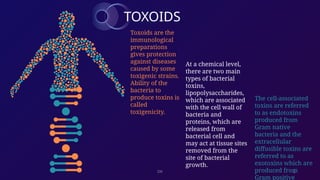
TOXOIDS
Toxoids are the
immunological
preparations
gives protection
against diseases
caused by some
toxigenic strains.
Ability of the
bacteria to
produce toxins is
called
toxigenicity.
At a chemical level,
there are two main
types of bacterial
toxins,
lipopolysaccharides,
which are associated
with the cell wall of
bacteria and
proteins, which are
released from
bacterial cell and
may act at tissue sites
removed from the
site of bacterial
growth.
The cell-associated
toxins are referred
to as endotoxins
produced from
Gram native
bacteria and the
extracellular
diffusible toxins are
referred to as
exotoxins which are
produced from
Gram positive
DK 3
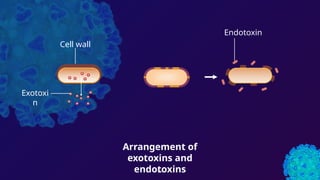
Cell wall
Exotoxi
n
Endotoxin
Arrangement of
exotoxins and
endotoxins
DK 4
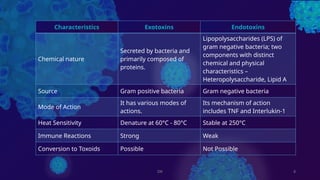
Characteristics Exotoxins Endotoxins
Chemical nature
Secreted by bacteria and
primarily composed of
proteins.
Lipopolysaccharides (LPS) of
gram negative bacteria; two
components with distinct
chemical and physical
characteristics –
Heteropolysaccharide, Lipid A
Source Gram positive bacteria Gram negative bacteria
Mode of Action
It has various modes of
actions.
Its mechanism of action
includes TNF and Interlukin-1
Heat Sensitivity Denature at 60°C - 80°C Stable at 250°C
Immune Reactions Strong Weak
Conversion to Toxoids Possible Not Possible
DK 5
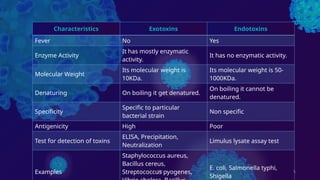
Characteristics Exotoxins Endotoxins
Fever No Yes
Enzyme Activity
It has mostly enzymatic
activity.
It has no enzymatic activity.
Molecular Weight
Its molecular weight is
10KDa.
Its molecular weight is 50-
1000KDa.
Denaturing On boiling it get denatured.
On boiling it cannot be
denatured.
Specificity
Specific to particular
bacterial strain
Non specific
Antigenicity High Poor
Test for detection of toxins
ELISA, Precipitation,
Neutralization
Limulus lysate assay test
Examples
Staphylococcus aureus,
Bacillus cereus,
Streptococcus pyogenes,
E. coli, Salmonella typhi,
Shigella
DK 6
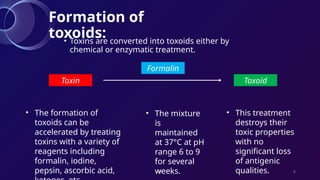
Formation of
toxoids:
• Toxins are converted into toxoids either by
chemical or enzymatic treatment.
• The formation of
toxoids can be
accelerated by treating
toxins with a variety of
reagents including
formalin, iodine,
pepsin, ascorbic acid,
Toxin
Formalin
Toxoid
• The mixture
is
maintained
at 37°C at pH
range 6 to 9
for several
weeks.
• This treatment
destroys their
toxic properties
with no
significant loss
of antigenic
qualities.
DK 7
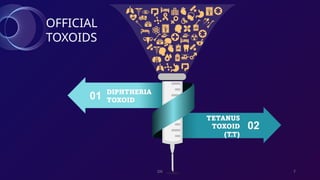
OFFICIAL
TOXOIDS
DK 8
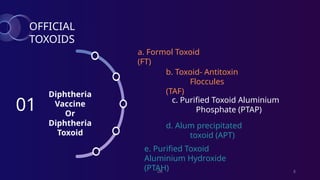
Diphtheria
Vaccine
Or
Diphtheria
Toxoid
a. Formol Toxoid
(FT)
d. Alum precipitated
toxoid (APT)
c. Purified Toxoid Aluminium
Phosphate (PTAP)
e. Purified Toxoid
Aluminium Hydroxide
(PTAH)
OFFICIAL
TOXOIDS
b. Toxoid- Antitoxin
Floccules
(TAF)
01
DK 9
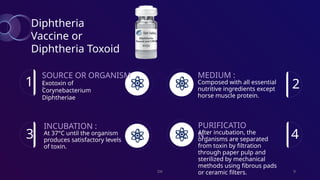
Diphtheria
Vaccine or
Diphtheria Toxoid
4
PURIFICATIO
N :
After incubation, the
organisms are separated
from toxin by filtration
through paper pulp and
sterilized by mechanical
methods using fibrous pads
or ceramic filters.
3
INCUBATION :
At 37°C until the organism
produces satisfactory levels
of toxin.
2
Composed with all essential
nutritive ingredients except
horse muscle protein.
MEDIUM :
1
SOURCE OR ORGANISM
:
Exotoxin of
Corynebacterium
Diphtheriae
DK 10
Formol
Toxoid
(FT)
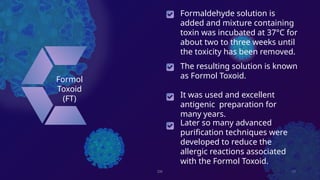
The resulting solution is known
as Formol Toxoid.
It was used and excellent
antigenic preparation for
many years.
Later so many advanced
purification techniques were
developed to reduce the
allergic reactions associated
with the Formol Toxoid.
Formaldehyde solution is
added and mixture containing
toxin was incubated at 37°C for
about two to three weeks until
the toxicity has been removed.
DK 11
Toxoid –
Antitoxin
Floccules
(TAF)
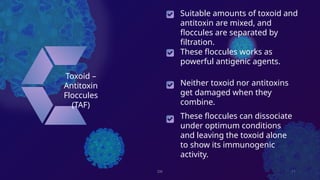
These floccules works as
powerful antigenic agents.
Neither toxoid nor antitoxins
get damaged when they
combine.
These floccules can dissociate
under optimum conditions
and leaving the toxoid alone
to show its immunogenic
activity.
Suitable amounts of toxoid and
antitoxin are mixed, and
floccules are separated by
filtration.
DK 12
Alum
Precipitated
Toxoid
(APT)
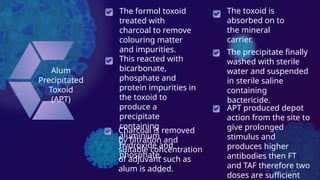
Charcoal is removed
by filtration and
suitable concentration
of adjuvant such as
alum is added.
This reacted with
bicarbonate,
phosphate and
protein impurities in
the toxoid to
produce a
precipitate
containing
aluminium
hydroxide and
phosphate.
The toxoid is
absorbed on to
the mineral
carrier.
The formol toxoid
treated with
charcoal to remove
colouring matter
and impurities. The precipitate finally
washed with sterile
water and suspended
in sterile saline
containing
bactericide.
APT produced depot
action from the site to
give prolonged
stimulus and
produces higher
antibodies then FT
and TAF therefore two
doses are sufficient
DK 13
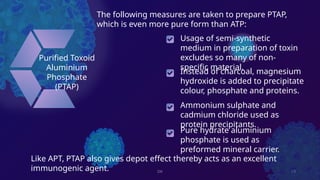
Purified Toxoid
Aluminium
Phosphate
(PTAP)
Instead of charcoal, magnesium
hydroxide is added to precipitate
colour, phosphate and proteins.
Ammonium sulphate and
cadmium chloride used as
protein precipitants.
Pure hydrate aluminium
phosphate is used as
preformed mineral carrier.
Usage of semi-synthetic
medium in preparation of toxin
excludes so many of non-
specific material.
The following measures are taken to prepare PTAP,
which is even more pure form than ATP:
Like APT, PTAP also gives depot effect thereby acts as an excellent
immunogenic agent.
DK 14
Purified Toxoid
Aluminium
Hydroxide
(PTAH)
Aluminium hydroxide
gel is used in place of
aluminium phosphate
as mineral carrier.
DK 15
TETANUS TOXOID
(T.T)
02
OFFICIAL
TOXOIDS
DK 16
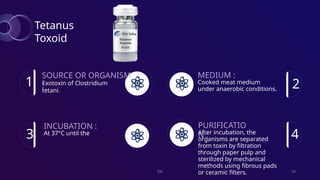
Tetanus
Toxoid
4
PURIFICATIO
N :
After incubation, the
organisms are separated
from toxin by filtration
through paper pulp and
sterilized by mechanical
methods using fibrous pads
or ceramic filters.
3
INCUBATION :
At 37°C until the
2
Cooked meat medium
under anaerobic conditions.
MEDIUM :
1
SOURCE OR ORGANISM
:
Exotoxin of Clostridium
tetani.
DK 17
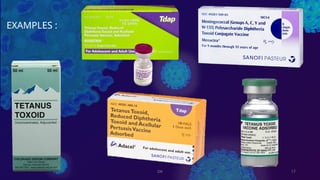
EXAMPLES :
18
DHANASHREE KOLHEKAR
THANK
YOU

TOXOIDS-DHANASHREE KOLHEKAR-3rd Year.pptx

  • 1.
    DK 1 Dhanashree G. Kolhekar T.Y. B.PHARMACY Roll No. 25 Presented by- Sanjivani Rural Education Society’s Sanjivani College of Pharmaceutical Education and Research, Kopargaon
  • 2.
    DK 2 TOXOIDS Toxoids arethe immunological preparations gives protection against diseases caused by some toxigenic strains. Ability of the bacteria to produce toxins is called toxigenicity. At a chemical level, there are two main types of bacterial toxins, lipopolysaccharides, which are associated with the cell wall of bacteria and proteins, which are released from bacterial cell and may act at tissue sites removed from the site of bacterial growth. The cell-associated toxins are referred to as endotoxins produced from Gram native bacteria and the extracellular diffusible toxins are referred to as exotoxins which are produced from Gram positive
  • 3.
  • 4.
    DK 4 Characteristics ExotoxinsEndotoxins Chemical nature Secreted by bacteria and primarily composed of proteins. Lipopolysaccharides (LPS) of gram negative bacteria; two components with distinct chemical and physical characteristics – Heteropolysaccharide, Lipid A Source Gram positive bacteria Gram negative bacteria Mode of Action It has various modes of actions. Its mechanism of action includes TNF and Interlukin-1 Heat Sensitivity Denature at 60°C - 80°C Stable at 250°C Immune Reactions Strong Weak Conversion to Toxoids Possible Not Possible
  • 5.
    DK 5 Characteristics ExotoxinsEndotoxins Fever No Yes Enzyme Activity It has mostly enzymatic activity. It has no enzymatic activity. Molecular Weight Its molecular weight is 10KDa. Its molecular weight is 50- 1000KDa. Denaturing On boiling it get denatured. On boiling it cannot be denatured. Specificity Specific to particular bacterial strain Non specific Antigenicity High Poor Test for detection of toxins ELISA, Precipitation, Neutralization Limulus lysate assay test Examples Staphylococcus aureus, Bacillus cereus, Streptococcus pyogenes, E. coli, Salmonella typhi, Shigella
  • 6.
    DK 6 Formation of toxoids: •Toxins are converted into toxoids either by chemical or enzymatic treatment. • The formation of toxoids can be accelerated by treating toxins with a variety of reagents including formalin, iodine, pepsin, ascorbic acid, Toxin Formalin Toxoid • The mixture is maintained at 37°C at pH range 6 to 9 for several weeks. • This treatment destroys their toxic properties with no significant loss of antigenic qualities.
  • 7.
  • 8.
    DK 8 Diphtheria Vaccine Or Diphtheria Toxoid a. FormolToxoid (FT) d. Alum precipitated toxoid (APT) c. Purified Toxoid Aluminium Phosphate (PTAP) e. Purified Toxoid Aluminium Hydroxide (PTAH) OFFICIAL TOXOIDS b. Toxoid- Antitoxin Floccules (TAF) 01
  • 9.
    DK 9 Diphtheria Vaccine or DiphtheriaToxoid 4 PURIFICATIO N : After incubation, the organisms are separated from toxin by filtration through paper pulp and sterilized by mechanical methods using fibrous pads or ceramic filters. 3 INCUBATION : At 37°C until the organism produces satisfactory levels of toxin. 2 Composed with all essential nutritive ingredients except horse muscle protein. MEDIUM : 1 SOURCE OR ORGANISM : Exotoxin of Corynebacterium Diphtheriae
  • 10.
    DK 10 Formol Toxoid (FT) The resultingsolution is known as Formol Toxoid. It was used and excellent antigenic preparation for many years. Later so many advanced purification techniques were developed to reduce the allergic reactions associated with the Formol Toxoid. Formaldehyde solution is added and mixture containing toxin was incubated at 37°C for about two to three weeks until the toxicity has been removed.
  • 11.
    DK 11 Toxoid – Antitoxin Floccules (TAF) Thesefloccules works as powerful antigenic agents. Neither toxoid nor antitoxins get damaged when they combine. These floccules can dissociate under optimum conditions and leaving the toxoid alone to show its immunogenic activity. Suitable amounts of toxoid and antitoxin are mixed, and floccules are separated by filtration.
  • 12.
    DK 12 Alum Precipitated Toxoid (APT) Charcoal isremoved by filtration and suitable concentration of adjuvant such as alum is added. This reacted with bicarbonate, phosphate and protein impurities in the toxoid to produce a precipitate containing aluminium hydroxide and phosphate. The toxoid is absorbed on to the mineral carrier. The formol toxoid treated with charcoal to remove colouring matter and impurities. The precipitate finally washed with sterile water and suspended in sterile saline containing bactericide. APT produced depot action from the site to give prolonged stimulus and produces higher antibodies then FT and TAF therefore two doses are sufficient
  • 13.
    DK 13 Purified Toxoid Aluminium Phosphate (PTAP) Insteadof charcoal, magnesium hydroxide is added to precipitate colour, phosphate and proteins. Ammonium sulphate and cadmium chloride used as protein precipitants. Pure hydrate aluminium phosphate is used as preformed mineral carrier. Usage of semi-synthetic medium in preparation of toxin excludes so many of non- specific material. The following measures are taken to prepare PTAP, which is even more pure form than ATP: Like APT, PTAP also gives depot effect thereby acts as an excellent immunogenic agent.
  • 14.
    DK 14 Purified Toxoid Aluminium Hydroxide (PTAH) Aluminiumhydroxide gel is used in place of aluminium phosphate as mineral carrier.
  • 15.
  • 16.
    DK 16 Tetanus Toxoid 4 PURIFICATIO N : Afterincubation, the organisms are separated from toxin by filtration through paper pulp and sterilized by mechanical methods using fibrous pads or ceramic filters. 3 INCUBATION : At 37°C until the 2 Cooked meat medium under anaerobic conditions. MEDIUM : 1 SOURCE OR ORGANISM : Exotoxin of Clostridium tetani.
  • 17.
  • 18.