Toshnil Salam
Bacs
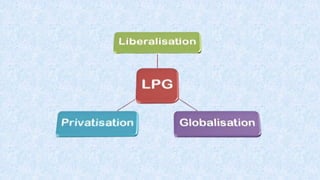
Topic : lpg reforms
 Liberalization, the loosening of
government controls. Although
sometimes associated with the
relaxation of laws relating to social
matters such as abortion and divorce,
liberalization is most often used as an
economic term. In particular, it refers
to reductions in restrictions on
international trade and capital.
 Privatization occurs when a
government-owned business,
operation, or property becomes
owned by a private, non-
government party. Privatization
also may describe a transition
that takes a company from being
publicly traded to becoming
privately held.
 Globalization is a term used to
describe how trade and technology
have made the world into a more
connected and interdependent
place. Globalization also captures
in its scope the economic and
social changes that have come
about as a result.
About
02
03
04
The LPG Reforms were introduced at a time when the Indian
economy was facing a balance of payment crisis. These reforms
were introduced to promote economic growth and improve
India's foreign exchange situation.
01
02
01
03
04
05
1991
India made LPG reforms in 1991. LPG reforms are also
known as liberalization, privatization and globalization
reforms. They have transformed the way India as an
economy works and opened the country up to the world
for trade and commerce.
When
03
02
04
05
These reforms were introduced by our Former Prime
Minister, Shri P V Narasimha Rao, and former
Finance Minister, Dr Manmohan Singh
By Whom
06
04
03
05
The pre-LPG Reform era in India had an obsolete,
colonial economic policy that involved high state
interference in the market. India was a closed economy
with little to no foreign trade and very little private
ownership. The LPG Policy aimed to place India in the
global economy by aligning its economic goals with
global economic goals.
WHY
06
07
05
04
06
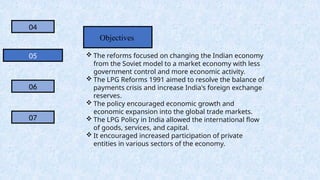
 The reforms focused on changing the Indian economy
from the Soviet model to a market economy with less
government control and more economic activity.
 The LPG Reforms 1991 aimed to resolve the balance of
payments crisis and increase India's foreign exchange
reserves.
 The policy encouraged economic growth and
economic expansion into the global trade markets.
 The LPG Policy in India allowed the international flow
of goods, services, and capital.
 It encouraged increased participation of private
entities in various sectors of the economy.
Objectives
07
06
05
07
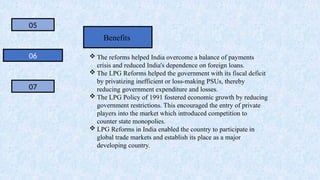
 The reforms helped India overcome a balance of payments
crisis and reduced India's dependence on foreign loans.
 The LPG Reforms helped the government with its fiscal deficit
by privatizing inefficient or loss-making PSUs, thereby
reducing government expenditure and losses.
 The LPG Policy of 1991 fostered economic growth by reducing
government restrictions. This encouraged the entry of private
players into the market which introduced competition to
counter state monopolies.
 LPG Reforms in India enabled the country to participate in
global trade markets and establish its place as a major
developing country.
Benefits
07
06
Thank you

Toshnil GS presentation.pptx LPG reforms

  • 1.
  • 3.
     Liberalization, theloosening of government controls. Although sometimes associated with the relaxation of laws relating to social matters such as abortion and divorce, liberalization is most often used as an economic term. In particular, it refers to reductions in restrictions on international trade and capital.
  • 4.
     Privatization occurswhen a government-owned business, operation, or property becomes owned by a private, non- government party. Privatization also may describe a transition that takes a company from being publicly traded to becoming privately held.
  • 5.
     Globalization isa term used to describe how trade and technology have made the world into a more connected and interdependent place. Globalization also captures in its scope the economic and social changes that have come about as a result.
  • 6.
    About 02 03 04 The LPG Reformswere introduced at a time when the Indian economy was facing a balance of payment crisis. These reforms were introduced to promote economic growth and improve India's foreign exchange situation. 01
  • 7.
    02 01 03 04 05 1991 India made LPGreforms in 1991. LPG reforms are also known as liberalization, privatization and globalization reforms. They have transformed the way India as an economy works and opened the country up to the world for trade and commerce. When
  • 8.
    03 02 04 05 These reforms wereintroduced by our Former Prime Minister, Shri P V Narasimha Rao, and former Finance Minister, Dr Manmohan Singh By Whom 06
  • 9.
    04 03 05 The pre-LPG Reformera in India had an obsolete, colonial economic policy that involved high state interference in the market. India was a closed economy with little to no foreign trade and very little private ownership. The LPG Policy aimed to place India in the global economy by aligning its economic goals with global economic goals. WHY 06 07
  • 10.
    05 04 06  The reformsfocused on changing the Indian economy from the Soviet model to a market economy with less government control and more economic activity.  The LPG Reforms 1991 aimed to resolve the balance of payments crisis and increase India's foreign exchange reserves.  The policy encouraged economic growth and economic expansion into the global trade markets.  The LPG Policy in India allowed the international flow of goods, services, and capital.  It encouraged increased participation of private entities in various sectors of the economy. Objectives 07
  • 11.
    06 05 07  The reformshelped India overcome a balance of payments crisis and reduced India's dependence on foreign loans.  The LPG Reforms helped the government with its fiscal deficit by privatizing inefficient or loss-making PSUs, thereby reducing government expenditure and losses.  The LPG Policy of 1991 fostered economic growth by reducing government restrictions. This encouraged the entry of private players into the market which introduced competition to counter state monopolies.  LPG Reforms in India enabled the country to participate in global trade markets and establish its place as a major developing country. Benefits
  • 12.