BEST Water & Nature
Implementing a groundwater decision support system in Denmark
Torben Bach (torb@niras.dk), Lonnie Frøjk (lof@niras.dk), Morten Westergaard
(mow@niras.dk)
14-10-2019
BEST Water & Nature
Implementing a groundwater decision support system in Denmark
AGENDA
• Background and situation
• 4 steps for building a DSS
• Summing up
2
Background
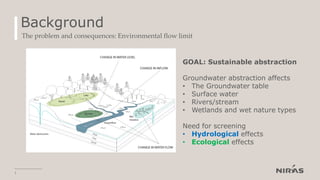
The problem and consequences: Environmental flow limit
3
GOAL: Sustainable abstraction
Groundwater abstraction affects
• The Groundwater table
• Surface water
• Rivers/stream
• Wetlands and wet nature types
Need for screening
• Hydrological effects
• Ecological effects
Background
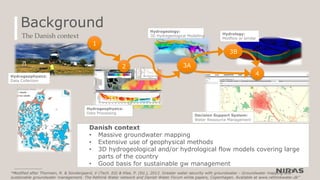
The Danish context
4
Hydrogeology:
3D Hydrogeological Modelling
Decision Support System:
Water Ressource Management
Danish context
• Massive groundwater mapping
• Extensive use of geophysical methods
• 3D hydrogeological and/or hydrological flow models covering large
parts of the country
• Good basis for sustainable gw management
1
3A
3B
2
Hydrogeophysics:
Data Processing
Hydrogeophysics:
Data Collection
4
Hydrology:
Modflow or similar
*Modified after Thomsen, R. & Sondergaard, V (Tech. Ed) & Klee, P. (Ed.), 2013. Greater water security with groundwater - Groundwater mapping and
sustainable groundwater management. The Rethink Water network and Danish Water Forum white papers, Copenhagen. Available at www.rethinkwater.dk”
Background
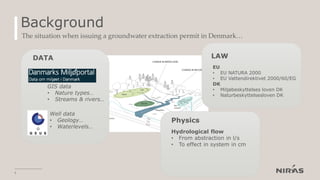
The situation when issuing a groundwater extraction permit in Denmark…
5
DATA
GIS data
• Nature types…
• Streams & rivers…
Well data
• Geology…
• Waterlevels…
LAW
EU
• EU NATURA 2000
• EU Vattendirektivet 2000/60/EG
DK
• Miljøbeskyttelses loven DK
• Naturbeskyttelsesloven DK
Physics
Hydrological flow
• From abstraction in l/s
• To effect in system in cm
Background
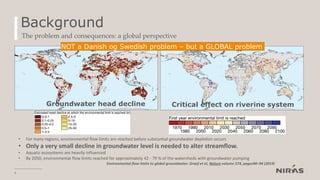
The problem and consequences: a global perspective
6
Environmental flow limits to global groundwater. Graaf et al, Nature volume 574, pages90–94 (2019)
• For many regions, environmental flow limits are reached before substantial groundwater depletion occurs
• Only a very small decline in groundwater level is needed to alter streamflow.
• Aquatic ecosystems are heavily influenced
• By 2050, environmental flow limits reached for approximately 42 - 79 % of the watersheds with groundwater pumping
NOT a Danish og Swedish problem – but a GLOBAL problem
Groundwater head decline Critical effect on riverine system
Background
7
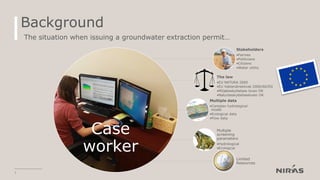
The situation when issuing a groundwater extraction permit…
Case
worker
Stakeholders
•Farmes
•Politicians
•Citizens
•Water utility
The law
•EU NATURA 2000
•EU Vattendirektivet 2000/60/EG
•Miljøbeskyttelses loven DK
•Naturbeskyttelsesloven DK
Multiple data
•Complex hydrological
model
•Ecological data
•Flow data
Multiple
screening
parameters
•Hydrological
•Ecological
Limited
Resources
The situation
8
Geologist@municipality
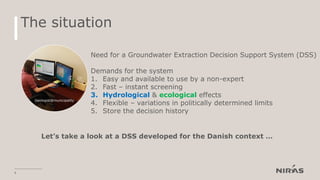
Need for a Groundwater Extraction Decision Support System (DSS)
Demands for the system
1. Easy and available to use by a non-expert
2. Fast – instant screening
3. Hydrological & ecological effects
4. Flexible – variations in politically determined limits
5. Store the decision history
Let’s take a look at a DSS developed for the Danish context …
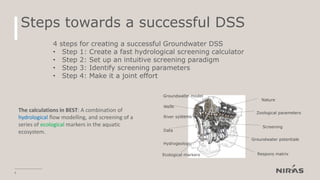
Steps towards a successful DSS
9
Wells
Data
River systems
Ecological markers
Groundwater potentiale
Zoological parameters
Screening
Nature
Respons matrix
Groundwater model
Hydrogeology
4 steps for creating a successful Groundwater DSS
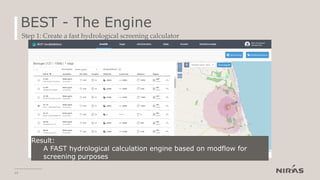
• Step 1: Create a fast hydrological screening calculator
• Step 2: Set up an intuitive screening paradigm
• Step 3: Identify screening parameters
• Step 4: Make it a joint effort
The calculations in BEST: A combination of
hydrological flow modelling, and screening of a
series of ecological markers in the aquatic
ecosystem.
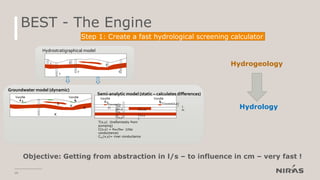
BEST - The Engine
10
Vandlø
b
Vandlø
b
K
K
K
K
T T
T
TT
T
Hydrostratigraphical model
Groundwater model (dynamic)
Vandlø
b
Vandlø
b
T(x,
y)T(x,y
)T(x,
y)
T(x,y
)
C(x,y)
C(x,y
)
CVandløb(x,y)
T(x,y) (transmissity from
pumping)
C(x,y) = Kler/bler (clay
conductance)
CVL(x,y)= river conductance
1
m
CVandløb(x,
y)
Semi-analytic model (static – calculates differences)
Step 1: Create a fast hydrological screening calculator
Hydrogeology
Hydrology
Objective: Getting from abstraction in l/s – to influence in cm – very fast !
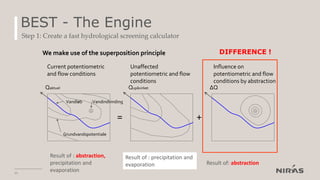
BEST - The Engine
Step 1: Create a fast hydrological screening calculator
11
Current potentiometric
and flow conditions
=
Qupåvirket ΔQQaktuel
+
Grundvandspotentiale
Vandløb Vandindvinding
Unaffected
potentiometric and flow
conditions
Influence on
potentiometric and flow
conditions by abstraction
Result of : precipitation and
evaporation Result of: abstraction
Result of : abstraction,
precipitation and
evaporation
We make use of the superposition principle DIFFERENCE !
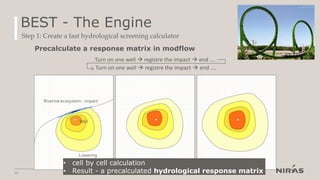
BEST - The Engine
12
Riverine ecosystem - impact
Well
Lowering
Turn on one well → registre the impact → end ….
Step 1: Create a fast hydrological screening calculator
Precalculate a response matrix in modflow
• cell by cell calculation
• Result - a precalculated hydrological response matrix
BEST - The Engine
13
Step 1: Create a fast hydrological screening calculator
Result:
A FAST hydrological calculation engine based on modflow for
screening purposes
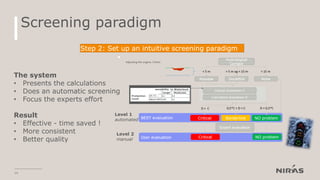
Screening paradigm
14
Step 2: Set up an intuitive screening paradigm
The system
• Presents the calculations
• Does an automatic screening
• Focus the experts effort
Result
• Effective - time saved !
• More consistent
• Better quality
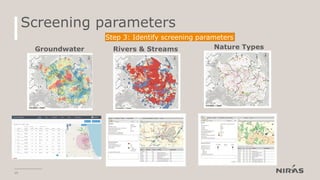
Screening parameters
15
Step 3: Identify screening parameters
Groundwater Rivers & Streams Nature Types
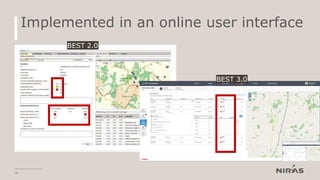
Implemented in an online user interface
16
BEST 3.0
BEST 2.0
17
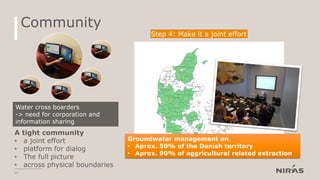
Groundwater management on
• Aprox. 50% of the Danish territory
• Aprox. 90% of aggricultural related extraction
A tight community
• a joint effort
• platform for dialog
• The full picture
• across physical boundaries
Community
Step 4: Make it a joint effort
Water cross boarders
-> need for corporation and
information sharing
The result of having a DSS
18
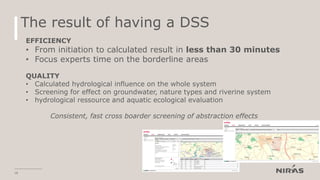
EFFICIENCY
• From initiation to calculated result in less than 30 minutes
• Focus experts time on the borderline areas
QUALITY
• Calculated hydrological influence on the whole system
• Screening for effect on groundwater, nature types and riverine system
• hydrological ressource and aquatic ecological evaluation
Consistent, fast cross boarder screening of abstraction effects
What’s next in the BEST community…
19
• 2-6 months
• Release of brand new version of BEST
• Include lessons from 10 years of daily BEST usage in DK
• New technological platform
• New front end
• Multiple language support
• 12-24 months
• New calculation prototype targeting other usages, e.g. climate
adaption and monitoring.
• IoT water level sensors incorporation in platform
• Development on machine learning based calculation engines, for
other types of usages.
• +24 months
• New calculation engine build into BEST
Summary
20
We have shown
• A holistic approach is necessary when managing the groundwater resource,
integrating both hydrological and ecological markers
• Even small levels of groundwater extraction can have a deep impact on the aquatic
ecological system
• A complex and time consuming task for the average case worker issuing well
permits
• A decision support system is required, minimizing error, improving efficiency and
providing an overview for the case worker
• A look for inspiration at the steps going into the creation of BEST, the Danish Decision
support system
Sweden is NOT Denmark and practice and traditions are different…
…but there is inspiration to get and lessons to learn in both directions
Let’s begin learning !

Torben Bach-Best-Water-and-Nature-implementing-a-groundwater-decision-support-system-in-denmark

  • 1.
    BEST Water &Nature Implementing a groundwater decision support system in Denmark Torben Bach (torb@niras.dk), Lonnie Frøjk (lof@niras.dk), Morten Westergaard (mow@niras.dk) 14-10-2019
  • 2.
    BEST Water &Nature Implementing a groundwater decision support system in Denmark AGENDA • Background and situation • 4 steps for building a DSS • Summing up 2
  • 3.
    Background The problem andconsequences: Environmental flow limit 3 GOAL: Sustainable abstraction Groundwater abstraction affects • The Groundwater table • Surface water • Rivers/stream • Wetlands and wet nature types Need for screening • Hydrological effects • Ecological effects
  • 4.
    Background The Danish context 4 Hydrogeology: 3DHydrogeological Modelling Decision Support System: Water Ressource Management Danish context • Massive groundwater mapping • Extensive use of geophysical methods • 3D hydrogeological and/or hydrological flow models covering large parts of the country • Good basis for sustainable gw management 1 3A 3B 2 Hydrogeophysics: Data Processing Hydrogeophysics: Data Collection 4 Hydrology: Modflow or similar *Modified after Thomsen, R. & Sondergaard, V (Tech. Ed) & Klee, P. (Ed.), 2013. Greater water security with groundwater - Groundwater mapping and sustainable groundwater management. The Rethink Water network and Danish Water Forum white papers, Copenhagen. Available at www.rethinkwater.dk”
  • 5.
    Background The situation whenissuing a groundwater extraction permit in Denmark… 5 DATA GIS data • Nature types… • Streams & rivers… Well data • Geology… • Waterlevels… LAW EU • EU NATURA 2000 • EU Vattendirektivet 2000/60/EG DK • Miljøbeskyttelses loven DK • Naturbeskyttelsesloven DK Physics Hydrological flow • From abstraction in l/s • To effect in system in cm
  • 6.
    Background The problem andconsequences: a global perspective 6 Environmental flow limits to global groundwater. Graaf et al, Nature volume 574, pages90–94 (2019) • For many regions, environmental flow limits are reached before substantial groundwater depletion occurs • Only a very small decline in groundwater level is needed to alter streamflow. • Aquatic ecosystems are heavily influenced • By 2050, environmental flow limits reached for approximately 42 - 79 % of the watersheds with groundwater pumping NOT a Danish og Swedish problem – but a GLOBAL problem Groundwater head decline Critical effect on riverine system
  • 7.
    Background 7 The situation whenissuing a groundwater extraction permit… Case worker Stakeholders •Farmes •Politicians •Citizens •Water utility The law •EU NATURA 2000 •EU Vattendirektivet 2000/60/EG •Miljøbeskyttelses loven DK •Naturbeskyttelsesloven DK Multiple data •Complex hydrological model •Ecological data •Flow data Multiple screening parameters •Hydrological •Ecological Limited Resources
  • 8.
    The situation 8 Geologist@municipality Need fora Groundwater Extraction Decision Support System (DSS) Demands for the system 1. Easy and available to use by a non-expert 2. Fast – instant screening 3. Hydrological & ecological effects 4. Flexible – variations in politically determined limits 5. Store the decision history Let’s take a look at a DSS developed for the Danish context …
  • 9.
    Steps towards asuccessful DSS 9 Wells Data River systems Ecological markers Groundwater potentiale Zoological parameters Screening Nature Respons matrix Groundwater model Hydrogeology 4 steps for creating a successful Groundwater DSS • Step 1: Create a fast hydrological screening calculator • Step 2: Set up an intuitive screening paradigm • Step 3: Identify screening parameters • Step 4: Make it a joint effort The calculations in BEST: A combination of hydrological flow modelling, and screening of a series of ecological markers in the aquatic ecosystem.
  • 10.
    BEST - TheEngine 10 Vandlø b Vandlø b K K K K T T T TT T Hydrostratigraphical model Groundwater model (dynamic) Vandlø b Vandlø b T(x, y)T(x,y )T(x, y) T(x,y ) C(x,y) C(x,y ) CVandløb(x,y) T(x,y) (transmissity from pumping) C(x,y) = Kler/bler (clay conductance) CVL(x,y)= river conductance 1 m CVandløb(x, y) Semi-analytic model (static – calculates differences) Step 1: Create a fast hydrological screening calculator Hydrogeology Hydrology Objective: Getting from abstraction in l/s – to influence in cm – very fast !
  • 11.
    BEST - TheEngine Step 1: Create a fast hydrological screening calculator 11 Current potentiometric and flow conditions = Qupåvirket ΔQQaktuel + Grundvandspotentiale Vandløb Vandindvinding Unaffected potentiometric and flow conditions Influence on potentiometric and flow conditions by abstraction Result of : precipitation and evaporation Result of: abstraction Result of : abstraction, precipitation and evaporation We make use of the superposition principle DIFFERENCE !
  • 12.
    BEST - TheEngine 12 Riverine ecosystem - impact Well Lowering Turn on one well → registre the impact → end …. Turn on one well → registre the impact → end …. Step 1: Create a fast hydrological screening calculator Precalculate a response matrix in modflow • cell by cell calculation • Result - a precalculated hydrological response matrix
  • 13.
    BEST - TheEngine 13 Step 1: Create a fast hydrological screening calculator Result: A FAST hydrological calculation engine based on modflow for screening purposes
  • 14.
    Screening paradigm 14 Step 2:Set up an intuitive screening paradigm The system • Presents the calculations • Does an automatic screening • Focus the experts effort Result • Effective - time saved ! • More consistent • Better quality
  • 15.
    Screening parameters 15 Step 3:Identify screening parameters Groundwater Rivers & Streams Nature Types
  • 16.
    Implemented in anonline user interface 16 BEST 3.0 BEST 2.0
  • 17.
    17 Groundwater management on •Aprox. 50% of the Danish territory • Aprox. 90% of aggricultural related extraction A tight community • a joint effort • platform for dialog • The full picture • across physical boundaries Community Step 4: Make it a joint effort Water cross boarders -> need for corporation and information sharing
  • 18.
    The result ofhaving a DSS 18 EFFICIENCY • From initiation to calculated result in less than 30 minutes • Focus experts time on the borderline areas QUALITY • Calculated hydrological influence on the whole system • Screening for effect on groundwater, nature types and riverine system • hydrological ressource and aquatic ecological evaluation Consistent, fast cross boarder screening of abstraction effects
  • 19.
    What’s next inthe BEST community… 19 • 2-6 months • Release of brand new version of BEST • Include lessons from 10 years of daily BEST usage in DK • New technological platform • New front end • Multiple language support • 12-24 months • New calculation prototype targeting other usages, e.g. climate adaption and monitoring. • IoT water level sensors incorporation in platform • Development on machine learning based calculation engines, for other types of usages. • +24 months • New calculation engine build into BEST
  • 20.
    Summary 20 We have shown •A holistic approach is necessary when managing the groundwater resource, integrating both hydrological and ecological markers • Even small levels of groundwater extraction can have a deep impact on the aquatic ecological system • A complex and time consuming task for the average case worker issuing well permits • A decision support system is required, minimizing error, improving efficiency and providing an overview for the case worker • A look for inspiration at the steps going into the creation of BEST, the Danish Decision support system Sweden is NOT Denmark and practice and traditions are different… …but there is inspiration to get and lessons to learn in both directions Let’s begin learning !