Emergency Preparedness and Response Plan (EPRP)
Topic 8 : Hazardous Material Incident, Decontamination & Control Zone
Objectives
Define what is the
Hazardous Material
Describe what is
the Hazardous
Material Respond
State 3 types of
common
Hazardous Material
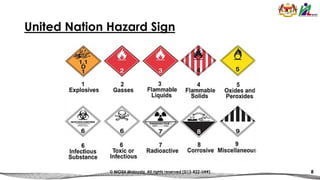
Incident
Explain steps in
decontaminations
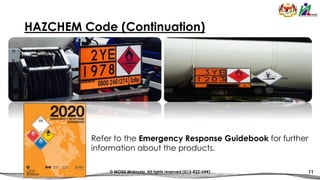
procedure
© NIOSH Malaysia. All rights reserved (D13-R22-U##) 2
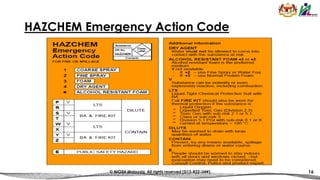
At the end of the session, participant will be able to;
Contents
© NIOSH Malaysia. All rights reserved (D13-R22-U##) 3
What is Hazardous Materials?
Identification of Hazmat
Definitions of RECCO
HAZMAT Incident Command System
Spill Kit and Containment Tools
Biological Hazard
Procedure for Spills of Human Blood or Other Potentially Infectious
Materials (OPIMs)
Decontamination
• HAZMAT is an abbreviation for “hazardous materials”—substances in
quantities or forms that may pose a reasonable risk to health,
property, or the environment.
• HAZMATs include such substances as toxic chemicals, fuels, nuclear
waste products, and biological, chemical, and radiological agents.
• HAZMATs may be released as liquids, solids, gases, or a combination
or form of all three, including dust, fumes, gas, vapor, mist, and smoke.
Source : NOAA, US
© NIOSH Malaysia. All rights reserved (D13-R22-U##) 4
What is Hazardous Materials?
HAZMAT Definition (OSHA US)
• The Occupational Safety and Health Administration (OSHA) defines a
hazardous material as any substance or chemical which is a “health
hazard” or “physical hazard,” including:
• chemicals which are carcinogens, toxic agents, irritants, corrosives,
sensitizers;
• agents which act on the hematopoietic system;
• agents which damage the lungs, skin, eyes, or mucous membranes;
• chemicals which are combustible, explosive, flammable, oxidizers,
pyrophorics, unstable-reactive or water-reactive; and
© NIOSH Malaysia. All rights reserved (D13-R22-U##) 5
• Chemicals which in the course of normal handling, use, or storage
may produce or release dusts, gases, fumes, vapors, mists or smoke
which may have any of the previously mentioned characteristics.
• The EPA incorporates the OSHA hazardous material definition, and
adds:
• any item or chemical which can cause harm to people, plants, or
animals when released by spilling, leaking, pumping, pouring,
emitting, emptying, discharging, injecting, escaping, leaching,
dumping or disposing into the environment.
© NIOSH Malaysia. All rights reserved (D13-R22-U##) 6
HAZMAT Definition (OSHA US) (Continuation)
HAZMAT Definition (EPA US)
The Department of Transportation (DOT) defines a hazardous
material as a substance or material that is capable of posing an
unreasonable risk to health, safety, and property when
transported in commerce, and has been designated as
hazardous under the federal hazardous materials transportation
law.
© NIOSH Malaysia. All rights reserved (D13-R22-U##) 7
A material in any form or quantity
which poses an unreasonable risk to
the health and safety of people and
the environment if it is not properly
controlled
Hazardous Material Definition
4
© NIOSH Malaysia. All rights reserved (D13-R22-U##)
Production
Transportation
Storage
Use
Disposal
Occupancy and location:
The potential locations can be
categorized into 5 basic areas:
© NIOSH Malaysia. All rights reserved (D13-R22-U##)
Identification of Hazmat
5
Bulk
Non Bulk
(Single Packaging)
© NIOSH Malaysia. All rights reserved (D13-R22-U##) 10
Hazardous Material Basic Packaging Form
DOT or IATA hazard class of the material:
Class Hazard
1.1 – 1.6 Explosives ordered by severity and sensitivity
2.1 – 2.3 Compressed gas
3 Flammable liquid
4.1 – 4.3
Flammable solid, spontaneously combustible,
or dangerous when wet
5.1 – 5.2 Oxidizers or organic peroxides
6.1 – 6.2 Toxic or infectious substances
7 Radioactive
8 Corrosive
9 Miscellaneous
Classification of Hazmat
© NIOSH Malaysia. All rights reserved (D13-R22-U##) 7
© NIOSH Malaysia. All rights reserved (D13-R22-U##)
United Nation Hazard Sign
8
NFPA 704 Hazard Sign
© NIOSH Malaysia. All rights reserved (D13-R22-U##) 9
HAZCHEM Emergency
Action Code
Hazard Warning
Diamond
UN Substance
Identification Number
Contact Telephone
Number or
Specialist Advice
Company Logo
© NIOSH Malaysia. All rights reserved (D13-R22-U##) 14
HAZCHEM Code
Refer to the Emergency Response Guidebook for further
information about the products.
HAZCHEM Code (Continuation)
© NIOSH Malaysia. All rights reserved (D13-R22-U##) 11
© NIOSH Malaysia. All rights reserved (D13-R22-U##) 16
HAZCHEM Emergency Action Code
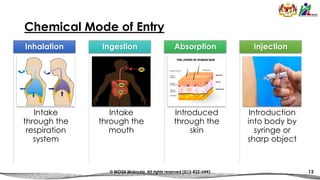
Intake
through the
respiration
system
Inhalation
Intake
through the
mouth
Ingestion
Introduced
through the
skin
Absorption
Introduction
into body by
syringe or
sharp object
Injection
© NIOSH Malaysia. All rights reserved (D13-R22-U##)
Chemical Mode of Entry
13
R - Rescue
E - Exposure Control
C - Confinement
C - Containment
O - Overhaul
© NIOSH Malaysia. All rights reserved (D13-R22-U##)
Hazardous Material Respond
14
Rescue
•Any action or techniques used to safe casualty (life).
Exposure Control
• Any action or techniques used to mitigate the incident, including confinement, containment
& extinguishment.
Confinement (Defensive mode)
• Action taken to keep released product to a specific area. This actions is carried out away
from the leak area and is therefore DEFENSIVE in nature.
Containment (Offensive mode)
• Action taken to keep product inside its container and carried out in the HOT ZONE at the
point of leak and is therefore OFFENSIVE in nature.
Overhaul
• Action taken to determine no hazard can build up before TERMINATE the incident.
Definitions
15
© NIOSH Malaysia. All rights reserved (D13-R22-U##)
Incident Commander
Planning Operation Finance Logistic
Liaison/ Information
Officer
SHO
Emergency Medical Technicians (EMT) :
© NIOSH Malaysia. All rights reserved (D13-R22-U##) 20
HAZMAT Incident Command System
© NIOSH Malaysia. All rights reserved (D13-R22-U##) 21
HAZMAT Incident Command System (Continuation)
HAZMAT Commander
Recognition/ Entry Decontamination Medical
Safety Officer Process Control
Communication Staging
Emergency Response Team (ERT) :
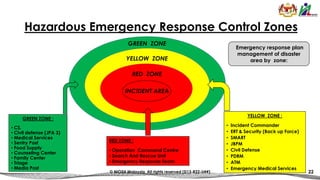
GREEN ZONE :
• CS.
• Civil defense (JPA 3)
• Medical Services
• Sentry Post
• Food Supply
• Counseling Center
• Family Center
• Triage
• Media Post
22
Emergency response plan
management of disaster
area by zone:
GREEN ZONE
YELLOW ZONE
RED ZONE
INCIDENT AREA
RED ZONE :
• Operation Command Centre
• Search And Rescue Unit
• Emergency Response Team
YELLOW ZONE :
• Incident Commander
• ERT & Security (Back up Force)
• SMART
• JBPM
• Civil Defense
• PDRM
• ATM
• Emergency Medical Services
© NIOSH Malaysia. All rights reserved (D13-R22-U##)
Hazardous Emergency Response Control Zones
Spill Kit
Containment Tools
© NIOSH Malaysia. All rights reserved (D13-R22-U##) 23
Spill Kit and Containment Tools
24
1) A chemical spill is any spillage of a chemical
that is considered harmful, such as hydrochloric
acid or methanol.
2) The chemicals have a common factor in that
they tend to be:
• Corrosive (HCl or NaOH).
• Flammable (methanol, acetonitrile).
• Toxic (cyanide, mercury).
• Irritants (solid sodium carbonate).
• Environmental poisons (any soluble zinc salt,
mercury and its compounds).
• Smelly (mercaptans, sulfide gases).
© NIOSH Malaysia. All rights reserved (D13-R22-U##)
Chemical Spillage
• Hazmat Incident : Leakage of gas
or release of chemicals, radioactive
materials, or biological materials
inside a building or in the
environment.
• Control measure : Breathing
apparatus, atmospheric testing
equipment, scrubber, water curtain,
fault water spray.
Gas Leakage Incident
25
© NIOSH Malaysia. All rights reserved (D13-R22-U##)
• Bio-hazardous materials are infectious agents
or biologically-derived infectious materials
that present a risk or potential risk to the
health of humans, animals, plants, or the
environment. The risk can be direct through
infection or indirect through damage to the
environment.
• Biohazard Spill Kits are equipped with spill
control material along with instructions for
use. ERT personnel are to use these materials
to clean up small to medium size bio-
hazardous spills within their work area.
26
© NIOSH Malaysia. All rights reserved (D13-R22-U##)
Biological Spills
Biological Hazard
• A biological hazard, or biohazard, is a biological substance that
poses a threat to the health of living organisms, primarily
humans. This could include a sample of a microorganism, virus,
toxin or human body fluid that can adversely affect
human health.
• A biohazard could also be a substance harmful to other animals.
© NIOSH Malaysia. All rights reserved (D13-R22-U##) 27
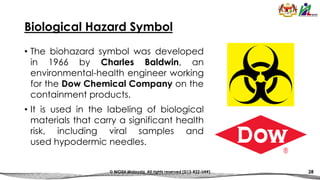
Biological Hazard Symbol
• The biohazard symbol was developed
in 1966 by Charles Baldwin, an
environmental-health engineer working
for the Dow Chemical Company on the
containment products.
• It is used in the labeling of biological
materials that carry a significant health
risk, including viral samples and
used hypodermic needles.
© NIOSH Malaysia. All rights reserved (D13-R22-U##) 28
• Category A, UN 2814 – Infectious substance, affecting
humans: An infectious substance in a form capable of
causing permanent disability or life-threatening or fatal
disease in otherwise healthy humans or animals when
exposure to it occurs.
• Category A, UN 2900 – Infectious substance, affecting
animals (only): An infectious substance that is not in a form
generally capable of causing permanent disability or life-
threatening or fatal disease in otherwise healthy humans
and animals when exposure to themselves occurs.
• Category B, UN 3373 – Biological substance transported for
diagnostic or investigative purposes.
• Regulated Medical Waste, UN 3291 – Waste or reusable
material derived from medical treatment of an animal or
human, or from biomedical research, which includes the
production and testing.
© NIOSH Malaysia. All rights reserved (D13-R22-U##) 29
Biological Hazard – UN Classification
COVID-19
• Biohazard Level 1: Bacteria and viruses including E.
coli, Bacillus and Varicella (chicken pox).
• Biohazard Level 2: Bacteria and viruses that cause
only mild disease to humans, or are difficult to
contract via aerosol such as Hepatitis A,B,C virus,
Salmonella, Dengue fever virus and HIV.
• Biohazard Level 3: Bacteria and viruses that can
cause severe to fatal disease in humans, but for
which vaccines or other treatments exist, such SARS
virus, MERS-CoV, Tuberculosis and COVID-19.
• Biohazard Level 4: Viruses that cause severe to fatal
disease in humans, and for which vaccines or other
treatments are not available such as Ebola virus,
Nipah virus and Lassa fever virus.
Ebola Virus
Salmonella
Bacillus Subtilis
© NIOSH Malaysia. All rights reserved (D13-R22-U##) 30
Biological Hazard – CDC Classification
• Endemic - describes a disease that is present permanently in a region or
population for example Dengue Fever in Malaysia and Malaria Fever in
African Nation.
• Epidemic - is an outbreak that affects many people at one time and can
spread through one or several communities for example MERS-CoV in the
Middle East and Ebola Hemorrhagic Fever in West Africa.
• Pandemic - is the term used to describe an epidemic when the spread is
global such as COVID-19.
© NIOSH Malaysia. All rights reserved (D13-R22-U##) 31
Endemics, Epidemics and Pandemics
Endmic Epidemic Pandemic
Notable Pandemic Events
Year Agent Mortality
1899 - 1923 - Cholera pandemic Vibrio cholera More than 800,000
1939 - 1945 - Typhus fever Rickettsia prowazekii 5.7 million
2000 - Measles Measles virus Almost 777,000
2009 - 2010 - Swine flu H1N1 virus Almost 500,000
2019 – 20** - COVID-19 Coronavirus 645,000 and counting
© NIOSH Malaysia. All rights reserved (D13-R22-U##) 32
PPE to Handle Contagious Diseases Such as COVID-19
© NIOSH Malaysia. All rights reserved (D13-R22-U##) 33
© NIOSH Malaysia. All rights reserved (D13-R22-U##) 34
COVID-19 Prevention
© NIOSH Malaysia. All rights reserved (D13-R22-U##) 35
COVID-19 Prevention (Continuation)
The First Line of Defense
© NIOSH Malaysia. All rights reserved (D13-R22-U##) 36
To contain the spread of illness. These are common health care practices to
control the spread of a contagious disease by limiting people's exposure to it.
1.) Isolation :
• Isolation is used to separate ill persons who have a communicable disease from
those who are healthy.
• Applies to persons who are known to be ill with a contagious disease.
2.) Quarantine :
• Quarantine is used to separate and restrict the movement of well persons who may
have been exposed to a communicable disease to see if they become ill.
• Applies to those who have been exposed to a contagious disease but who may or
may not become ill.
© NIOSH Malaysia. All rights reserved (D13-R22-U##) 37
Quarantine and Isolation
1) Biological spillages can fall within 2 types:
• Infectious material which has been handled or generated
within a laboratory (e.g. liquid cultures of micro-organisms).
• Involving human or animal bodily fluids or materials such as
blood, urine, vomit or feces either accidentally or
maliciously spilled.
2) The use of Biohazard Spill Kits is vital to absorb any
spillage quickly and at the same time to sanitize the
area.
3) Biohazard Spill Kits are equipped with spill control
material along with instructions for use. ERT personnel
are to use these materials to clean up small to medium
size bio hazardous spills within their work area.
© NIOSH Malaysia. All rights reserved (D13-R22-U##) 38
Biological Hazard Spillage
• Concentrated disinfectant (e.g. bleach).
• Paper towels and absorbent pads.
• Spray bottle (for mixing 10% bleach).
• Biohazard/Autoclave bags.
• Sharps container (for contaminated
broken glass or needles).
• PPE (gloves, goggles, lab coat).
• Forceps, tongs or dust pan and broom to
pick up broken glass.
© NIOSH Malaysia. All rights reserved (D13-R22-U##) 39
Bio Spillage Kit – What in it?
• Wear gloves, eye protection and a lab coat (or
Tyvek).
• Cover the spill with paper towels or absorbent
pads and flood with an appropriate
disinfectant, or place disinfectant-soaked
paper towels over the spill.
• Allow for appropriate contact time.
• Gather absorbent materials and place into a
biohazard bag. Collect any sharp objects with
a mechanical device and place in a sharps
container.
© NIOSH Malaysia. All rights reserved (D13-R22-U##) 40
Procedure for Spills of Human Blood or Other
Potentially Infectious Materials (OPIMs)
• Wipe down the spill area with disinfectant
solution, removing all visible blood or OPIMs.
• Spray the spill site with disinfectant and allow
for appropriate contact time.
• After the contact time, wipe the area down
with disinfectant-soaked paper towels. Discard
all disposable materials used to decontaminate
the spill and any containment PPE into a
biohazard bag and autoclave appropriately.
Decontaminate any reusable items with
disinfectant.
• Wash your hands.
© NIOSH Malaysia. All rights reserved (D13-R22-U##) 41
Procedure for Spills of Human Blood or Other
Potentially Infectious Materials (OPIMs) (Continuation)
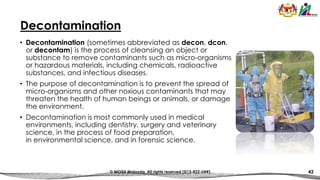
• Decontamination (sometimes abbreviated as decon, dcon,
or decontam) is the process of cleansing an object or
substance to remove contaminants such as micro-organisms
or hazardous materials, including chemicals, radioactive
substances, and infectious diseases.
• The purpose of decontamination is to prevent the spread of
micro-organisms and other noxious contaminants that may
threaten the health of human beings or animals, or damage
the environment.
• Decontamination is most commonly used in medical
environments, including dentistry, surgery and veterinary
science, in the process of food preparation,
in environmental science, and in forensic science.
© NIOSH Malaysia. All rights reserved (D13-R22-U##) 42
Decontamination
DRESS UNDRESS RINSING WASHING WAITING
At least 30
meters
• At least 30m upwind.
• At least 60m downwind.
• In the case of explosion danger 500m.
• These distance is a guideline and not
a fixed rule.
Set up at the border between the
area of direct hazard and isolation
area :
© NIOSH Malaysia. All rights reserved (D13-R22-U##) 43
Decontamination (Continuation)
44
© NIOSH Malaysia. All rights reserved (D13-R22-U##)
Decontamination Scene
45
Visual
Observation
Monitoring
Devices
Wipe Sampling
© NIOSH Malaysia. All rights reserved (D13-R22-U##)
Assessing the Effectiveness of Decontamination
46
Decontamination corridor established between hot zone and
warm zone
All personnel leaving the hot zone must be decontaminated
Proper decontamination reduces the possibility of injury or death
from exposure to hazardous substances
Decontamination is the physical or chemical process of reducing
and preventing the spread of hazardous materials by persons
and equipment
© NIOSH Malaysia. All rights reserved (D13-R22-U##)
Precaution
© NIOSH Malaysia. All rights reserved (D13-R22-U##) 47
Conclusion
What is the Hazardous Material
What is the Hazardous Material Respond
3 types of common Hazardous Material Incident
Steps in decontaminations procedure
Participant must able to explain:
Thank you
general@niosh.com.my
NIOSH MALAYSIA
03 8769 2100 / 8911 3800
National Institute of Occupational Safety and Health (NIOSH)
WhatsApp (Training): https://wa.me/60132224966
WhatsApp (Exam): https://wa.me/60196668599

Topic_8_-_Hazardous_Material_Incident_Decontamination_and_Control_Zone.pdf

  • 1.
    Emergency Preparedness andResponse Plan (EPRP) Topic 8 : Hazardous Material Incident, Decontamination & Control Zone
  • 2.
    Objectives Define what isthe Hazardous Material Describe what is the Hazardous Material Respond State 3 types of common Hazardous Material Incident Explain steps in decontaminations procedure © NIOSH Malaysia. All rights reserved (D13-R22-U##) 2 At the end of the session, participant will be able to;
  • 3.
    Contents © NIOSH Malaysia.All rights reserved (D13-R22-U##) 3 What is Hazardous Materials? Identification of Hazmat Definitions of RECCO HAZMAT Incident Command System Spill Kit and Containment Tools Biological Hazard Procedure for Spills of Human Blood or Other Potentially Infectious Materials (OPIMs) Decontamination
  • 4.
    • HAZMAT isan abbreviation for “hazardous materials”—substances in quantities or forms that may pose a reasonable risk to health, property, or the environment. • HAZMATs include such substances as toxic chemicals, fuels, nuclear waste products, and biological, chemical, and radiological agents. • HAZMATs may be released as liquids, solids, gases, or a combination or form of all three, including dust, fumes, gas, vapor, mist, and smoke. Source : NOAA, US © NIOSH Malaysia. All rights reserved (D13-R22-U##) 4 What is Hazardous Materials?
  • 5.
    HAZMAT Definition (OSHAUS) • The Occupational Safety and Health Administration (OSHA) defines a hazardous material as any substance or chemical which is a “health hazard” or “physical hazard,” including: • chemicals which are carcinogens, toxic agents, irritants, corrosives, sensitizers; • agents which act on the hematopoietic system; • agents which damage the lungs, skin, eyes, or mucous membranes; • chemicals which are combustible, explosive, flammable, oxidizers, pyrophorics, unstable-reactive or water-reactive; and © NIOSH Malaysia. All rights reserved (D13-R22-U##) 5
  • 6.
    • Chemicals whichin the course of normal handling, use, or storage may produce or release dusts, gases, fumes, vapors, mists or smoke which may have any of the previously mentioned characteristics. • The EPA incorporates the OSHA hazardous material definition, and adds: • any item or chemical which can cause harm to people, plants, or animals when released by spilling, leaking, pumping, pouring, emitting, emptying, discharging, injecting, escaping, leaching, dumping or disposing into the environment. © NIOSH Malaysia. All rights reserved (D13-R22-U##) 6 HAZMAT Definition (OSHA US) (Continuation)
  • 7.
    HAZMAT Definition (EPAUS) The Department of Transportation (DOT) defines a hazardous material as a substance or material that is capable of posing an unreasonable risk to health, safety, and property when transported in commerce, and has been designated as hazardous under the federal hazardous materials transportation law. © NIOSH Malaysia. All rights reserved (D13-R22-U##) 7
  • 8.
    A material inany form or quantity which poses an unreasonable risk to the health and safety of people and the environment if it is not properly controlled Hazardous Material Definition 4 © NIOSH Malaysia. All rights reserved (D13-R22-U##)
  • 9.
    Production Transportation Storage Use Disposal Occupancy and location: Thepotential locations can be categorized into 5 basic areas: © NIOSH Malaysia. All rights reserved (D13-R22-U##) Identification of Hazmat 5
  • 10.
    Bulk Non Bulk (Single Packaging) ©NIOSH Malaysia. All rights reserved (D13-R22-U##) 10 Hazardous Material Basic Packaging Form
  • 11.
    DOT or IATAhazard class of the material: Class Hazard 1.1 – 1.6 Explosives ordered by severity and sensitivity 2.1 – 2.3 Compressed gas 3 Flammable liquid 4.1 – 4.3 Flammable solid, spontaneously combustible, or dangerous when wet 5.1 – 5.2 Oxidizers or organic peroxides 6.1 – 6.2 Toxic or infectious substances 7 Radioactive 8 Corrosive 9 Miscellaneous Classification of Hazmat © NIOSH Malaysia. All rights reserved (D13-R22-U##) 7
  • 12.
    © NIOSH Malaysia.All rights reserved (D13-R22-U##) United Nation Hazard Sign 8
  • 13.
    NFPA 704 HazardSign © NIOSH Malaysia. All rights reserved (D13-R22-U##) 9
  • 14.
    HAZCHEM Emergency Action Code HazardWarning Diamond UN Substance Identification Number Contact Telephone Number or Specialist Advice Company Logo © NIOSH Malaysia. All rights reserved (D13-R22-U##) 14 HAZCHEM Code
  • 15.
    Refer to theEmergency Response Guidebook for further information about the products. HAZCHEM Code (Continuation) © NIOSH Malaysia. All rights reserved (D13-R22-U##) 11
  • 16.
    © NIOSH Malaysia.All rights reserved (D13-R22-U##) 16 HAZCHEM Emergency Action Code
  • 17.
    Intake through the respiration system Inhalation Intake through the mouth Ingestion Introduced throughthe skin Absorption Introduction into body by syringe or sharp object Injection © NIOSH Malaysia. All rights reserved (D13-R22-U##) Chemical Mode of Entry 13
  • 18.
    R - Rescue E- Exposure Control C - Confinement C - Containment O - Overhaul © NIOSH Malaysia. All rights reserved (D13-R22-U##) Hazardous Material Respond 14
  • 19.
    Rescue •Any action ortechniques used to safe casualty (life). Exposure Control • Any action or techniques used to mitigate the incident, including confinement, containment & extinguishment. Confinement (Defensive mode) • Action taken to keep released product to a specific area. This actions is carried out away from the leak area and is therefore DEFENSIVE in nature. Containment (Offensive mode) • Action taken to keep product inside its container and carried out in the HOT ZONE at the point of leak and is therefore OFFENSIVE in nature. Overhaul • Action taken to determine no hazard can build up before TERMINATE the incident. Definitions 15 © NIOSH Malaysia. All rights reserved (D13-R22-U##)
  • 20.
    Incident Commander Planning OperationFinance Logistic Liaison/ Information Officer SHO Emergency Medical Technicians (EMT) : © NIOSH Malaysia. All rights reserved (D13-R22-U##) 20 HAZMAT Incident Command System
  • 21.
    © NIOSH Malaysia.All rights reserved (D13-R22-U##) 21 HAZMAT Incident Command System (Continuation) HAZMAT Commander Recognition/ Entry Decontamination Medical Safety Officer Process Control Communication Staging Emergency Response Team (ERT) :
  • 22.
    GREEN ZONE : •CS. • Civil defense (JPA 3) • Medical Services • Sentry Post • Food Supply • Counseling Center • Family Center • Triage • Media Post 22 Emergency response plan management of disaster area by zone: GREEN ZONE YELLOW ZONE RED ZONE INCIDENT AREA RED ZONE : • Operation Command Centre • Search And Rescue Unit • Emergency Response Team YELLOW ZONE : • Incident Commander • ERT & Security (Back up Force) • SMART • JBPM • Civil Defense • PDRM • ATM • Emergency Medical Services © NIOSH Malaysia. All rights reserved (D13-R22-U##) Hazardous Emergency Response Control Zones
  • 23.
    Spill Kit Containment Tools ©NIOSH Malaysia. All rights reserved (D13-R22-U##) 23 Spill Kit and Containment Tools
  • 24.
    24 1) A chemicalspill is any spillage of a chemical that is considered harmful, such as hydrochloric acid or methanol. 2) The chemicals have a common factor in that they tend to be: • Corrosive (HCl or NaOH). • Flammable (methanol, acetonitrile). • Toxic (cyanide, mercury). • Irritants (solid sodium carbonate). • Environmental poisons (any soluble zinc salt, mercury and its compounds). • Smelly (mercaptans, sulfide gases). © NIOSH Malaysia. All rights reserved (D13-R22-U##) Chemical Spillage
  • 25.
    • Hazmat Incident: Leakage of gas or release of chemicals, radioactive materials, or biological materials inside a building or in the environment. • Control measure : Breathing apparatus, atmospheric testing equipment, scrubber, water curtain, fault water spray. Gas Leakage Incident 25 © NIOSH Malaysia. All rights reserved (D13-R22-U##)
  • 26.
    • Bio-hazardous materialsare infectious agents or biologically-derived infectious materials that present a risk or potential risk to the health of humans, animals, plants, or the environment. The risk can be direct through infection or indirect through damage to the environment. • Biohazard Spill Kits are equipped with spill control material along with instructions for use. ERT personnel are to use these materials to clean up small to medium size bio- hazardous spills within their work area. 26 © NIOSH Malaysia. All rights reserved (D13-R22-U##) Biological Spills
  • 27.
    Biological Hazard • Abiological hazard, or biohazard, is a biological substance that poses a threat to the health of living organisms, primarily humans. This could include a sample of a microorganism, virus, toxin or human body fluid that can adversely affect human health. • A biohazard could also be a substance harmful to other animals. © NIOSH Malaysia. All rights reserved (D13-R22-U##) 27
  • 28.
    Biological Hazard Symbol •The biohazard symbol was developed in 1966 by Charles Baldwin, an environmental-health engineer working for the Dow Chemical Company on the containment products. • It is used in the labeling of biological materials that carry a significant health risk, including viral samples and used hypodermic needles. © NIOSH Malaysia. All rights reserved (D13-R22-U##) 28
  • 29.
    • Category A,UN 2814 – Infectious substance, affecting humans: An infectious substance in a form capable of causing permanent disability or life-threatening or fatal disease in otherwise healthy humans or animals when exposure to it occurs. • Category A, UN 2900 – Infectious substance, affecting animals (only): An infectious substance that is not in a form generally capable of causing permanent disability or life- threatening or fatal disease in otherwise healthy humans and animals when exposure to themselves occurs. • Category B, UN 3373 – Biological substance transported for diagnostic or investigative purposes. • Regulated Medical Waste, UN 3291 – Waste or reusable material derived from medical treatment of an animal or human, or from biomedical research, which includes the production and testing. © NIOSH Malaysia. All rights reserved (D13-R22-U##) 29 Biological Hazard – UN Classification
  • 30.
    COVID-19 • Biohazard Level1: Bacteria and viruses including E. coli, Bacillus and Varicella (chicken pox). • Biohazard Level 2: Bacteria and viruses that cause only mild disease to humans, or are difficult to contract via aerosol such as Hepatitis A,B,C virus, Salmonella, Dengue fever virus and HIV. • Biohazard Level 3: Bacteria and viruses that can cause severe to fatal disease in humans, but for which vaccines or other treatments exist, such SARS virus, MERS-CoV, Tuberculosis and COVID-19. • Biohazard Level 4: Viruses that cause severe to fatal disease in humans, and for which vaccines or other treatments are not available such as Ebola virus, Nipah virus and Lassa fever virus. Ebola Virus Salmonella Bacillus Subtilis © NIOSH Malaysia. All rights reserved (D13-R22-U##) 30 Biological Hazard – CDC Classification
  • 31.
    • Endemic -describes a disease that is present permanently in a region or population for example Dengue Fever in Malaysia and Malaria Fever in African Nation. • Epidemic - is an outbreak that affects many people at one time and can spread through one or several communities for example MERS-CoV in the Middle East and Ebola Hemorrhagic Fever in West Africa. • Pandemic - is the term used to describe an epidemic when the spread is global such as COVID-19. © NIOSH Malaysia. All rights reserved (D13-R22-U##) 31 Endemics, Epidemics and Pandemics Endmic Epidemic Pandemic
  • 32.
    Notable Pandemic Events YearAgent Mortality 1899 - 1923 - Cholera pandemic Vibrio cholera More than 800,000 1939 - 1945 - Typhus fever Rickettsia prowazekii 5.7 million 2000 - Measles Measles virus Almost 777,000 2009 - 2010 - Swine flu H1N1 virus Almost 500,000 2019 – 20** - COVID-19 Coronavirus 645,000 and counting © NIOSH Malaysia. All rights reserved (D13-R22-U##) 32
  • 33.
    PPE to HandleContagious Diseases Such as COVID-19 © NIOSH Malaysia. All rights reserved (D13-R22-U##) 33
  • 34.
    © NIOSH Malaysia.All rights reserved (D13-R22-U##) 34 COVID-19 Prevention
  • 35.
    © NIOSH Malaysia.All rights reserved (D13-R22-U##) 35 COVID-19 Prevention (Continuation)
  • 36.
    The First Lineof Defense © NIOSH Malaysia. All rights reserved (D13-R22-U##) 36
  • 37.
    To contain thespread of illness. These are common health care practices to control the spread of a contagious disease by limiting people's exposure to it. 1.) Isolation : • Isolation is used to separate ill persons who have a communicable disease from those who are healthy. • Applies to persons who are known to be ill with a contagious disease. 2.) Quarantine : • Quarantine is used to separate and restrict the movement of well persons who may have been exposed to a communicable disease to see if they become ill. • Applies to those who have been exposed to a contagious disease but who may or may not become ill. © NIOSH Malaysia. All rights reserved (D13-R22-U##) 37 Quarantine and Isolation
  • 38.
    1) Biological spillagescan fall within 2 types: • Infectious material which has been handled or generated within a laboratory (e.g. liquid cultures of micro-organisms). • Involving human or animal bodily fluids or materials such as blood, urine, vomit or feces either accidentally or maliciously spilled. 2) The use of Biohazard Spill Kits is vital to absorb any spillage quickly and at the same time to sanitize the area. 3) Biohazard Spill Kits are equipped with spill control material along with instructions for use. ERT personnel are to use these materials to clean up small to medium size bio hazardous spills within their work area. © NIOSH Malaysia. All rights reserved (D13-R22-U##) 38 Biological Hazard Spillage
  • 39.
    • Concentrated disinfectant(e.g. bleach). • Paper towels and absorbent pads. • Spray bottle (for mixing 10% bleach). • Biohazard/Autoclave bags. • Sharps container (for contaminated broken glass or needles). • PPE (gloves, goggles, lab coat). • Forceps, tongs or dust pan and broom to pick up broken glass. © NIOSH Malaysia. All rights reserved (D13-R22-U##) 39 Bio Spillage Kit – What in it?
  • 40.
    • Wear gloves,eye protection and a lab coat (or Tyvek). • Cover the spill with paper towels or absorbent pads and flood with an appropriate disinfectant, or place disinfectant-soaked paper towels over the spill. • Allow for appropriate contact time. • Gather absorbent materials and place into a biohazard bag. Collect any sharp objects with a mechanical device and place in a sharps container. © NIOSH Malaysia. All rights reserved (D13-R22-U##) 40 Procedure for Spills of Human Blood or Other Potentially Infectious Materials (OPIMs)
  • 41.
    • Wipe downthe spill area with disinfectant solution, removing all visible blood or OPIMs. • Spray the spill site with disinfectant and allow for appropriate contact time. • After the contact time, wipe the area down with disinfectant-soaked paper towels. Discard all disposable materials used to decontaminate the spill and any containment PPE into a biohazard bag and autoclave appropriately. Decontaminate any reusable items with disinfectant. • Wash your hands. © NIOSH Malaysia. All rights reserved (D13-R22-U##) 41 Procedure for Spills of Human Blood or Other Potentially Infectious Materials (OPIMs) (Continuation)
  • 42.
    • Decontamination (sometimesabbreviated as decon, dcon, or decontam) is the process of cleansing an object or substance to remove contaminants such as micro-organisms or hazardous materials, including chemicals, radioactive substances, and infectious diseases. • The purpose of decontamination is to prevent the spread of micro-organisms and other noxious contaminants that may threaten the health of human beings or animals, or damage the environment. • Decontamination is most commonly used in medical environments, including dentistry, surgery and veterinary science, in the process of food preparation, in environmental science, and in forensic science. © NIOSH Malaysia. All rights reserved (D13-R22-U##) 42 Decontamination
  • 43.
    DRESS UNDRESS RINSINGWASHING WAITING At least 30 meters • At least 30m upwind. • At least 60m downwind. • In the case of explosion danger 500m. • These distance is a guideline and not a fixed rule. Set up at the border between the area of direct hazard and isolation area : © NIOSH Malaysia. All rights reserved (D13-R22-U##) 43 Decontamination (Continuation)
  • 44.
    44 © NIOSH Malaysia.All rights reserved (D13-R22-U##) Decontamination Scene
  • 45.
    45 Visual Observation Monitoring Devices Wipe Sampling © NIOSHMalaysia. All rights reserved (D13-R22-U##) Assessing the Effectiveness of Decontamination
  • 46.
    46 Decontamination corridor establishedbetween hot zone and warm zone All personnel leaving the hot zone must be decontaminated Proper decontamination reduces the possibility of injury or death from exposure to hazardous substances Decontamination is the physical or chemical process of reducing and preventing the spread of hazardous materials by persons and equipment © NIOSH Malaysia. All rights reserved (D13-R22-U##) Precaution
  • 47.
    © NIOSH Malaysia.All rights reserved (D13-R22-U##) 47 Conclusion What is the Hazardous Material What is the Hazardous Material Respond 3 types of common Hazardous Material Incident Steps in decontaminations procedure Participant must able to explain:
  • 48.
    Thank you general@niosh.com.my NIOSH MALAYSIA 038769 2100 / 8911 3800 National Institute of Occupational Safety and Health (NIOSH) WhatsApp (Training): https://wa.me/60132224966 WhatsApp (Exam): https://wa.me/60196668599