1
TOPIC THREE: TENSES
Tense is the term used to indicate
the time of the action or event.
Tense is divided into three main
classes names:
10/19/18
2
….Tenses…..
1. Present tense
2. Past tense
3. Future tense
10/19/18
3
1. Present Tense:
i. Simple Present Tense
ii. Present Continuous Tense
iii. Present Perfect Tense
iv. Present Perfect Continuous
Tense
10/19/18
4
2. Past Tense
i. Simple Past Tense
ii. Past Continuous Tense
iii. Past Perfect Tense
iv. Past Perfect Continuous
Tense
10/19/18
5
3. Future Tense
i. Simple Future Tense
ii. Future Continuous Tense
iii. Future Perfect Tense
iv. Future Perfect Continuous
Tense
10/19/18
6
Note:
Verb1=plain form; eg. Want, take,
etc
Verb2 = ed form eg. Wanted,
waited, etc
Verb3 = en form eg taken, eaten,
etc
10/19/18
7
3.1: Simple Present Tense or
Present Indefinite
Simple present tense is used to
express repeated or
(routine)customary action.
10/19/18
8
….simple present…….
a) Affirmative sentence:
Sub + Verb1 +Object
She reads books always.
He goes to school everyday
They want something
The cat drinks milk.10/19/18
NOTE:
• The subject (Sub) names what the
sentence is about or about the actor in the
sentence.
• The verb tells what the subject does or is
• The object receives the action of the verb
10/19/18 9
10
…simple present…
b) Negative sentence:
Sub + do/does + not Verb1
+Object
She does not read books.
They do not want anything.
10/19/18
11
…simple present…
c) Interrogative sentence:
do/does + Sub + Verb1 +Object + ?
Does she read books?
Do they want something?
10/19/18
12
…simple present ….
d) Interrogative negative sentence:
do/does +Sub +not +Verb1 +Object + ?
Does she not read books?
Do they not want something
?
10/19/18
13
3.2: Present Continuous or
Present Progressive Tense
Present continuous tense is
used to show that an action is
in progress and is incomplete
at the moment of speaking or
writing.
10/19/18
14
… Present Continuous …
a) Affirmative sentence:
Sub + is/am/are + Verb1 + ing +Object
She is reading a book.
They are eating some food.
10/19/18
15
… Present Continuous …
b) Negative sentence:
Sub + is/am/are + not + Verb1 +
ing +Object.
She is not reading books.
They are not eating anything.
10/19/18
16
… Present Continuous …
c) Interrogative sentence:
i. is/am/are + Sub + Verb1+ ing +Object + ?
Is she reading books?
Are they eating some food?
10/19/18
17
… Present Continuous …
ii. What/When/how + is/am/are + Sub +
Verb1 + ing +?
• What is she doing?
• How are they doing?
10/19/18
18
… Present Continuous …
d) Interrogative negative
sentence:
i. is/am/are + Sub + not + Verb1 +
ing +Object + ?
Is she not reading books?
Are they not eating some food?
10/19/18
19
… Present Continuous …
• ii. What/When/how + is/am/are
+ Sub + not Verb1 + ing +?
• What is she not + doing?
• How are they + doing?
10/19/18
20
3.3: Present Perfect Tense:
Present Perfect tense is used to
indicate completed activities in
the immediate past.
10/19/18
21
… Present Perfect …
a) Affirmative sentence:
Sub + has/have + Verb3 +Object
She has read the books.
They have eaten some food.
10/19/18
22
… Present Perfect …
b) Negative sentence:
Sub + has/have + not + Verb3 +Object.
She has not read the books.
They have not eaten some
food.
10/19/18
23
… Present Perfect …
c) Interrogative sentence:
has/have + sub + Verb3+Object+....+?
Has she read the books?
Have they eaten some food?
10/19/18
24
… Present Perfect …
d) Interrogative negative sentence:
i. have/has + Sub + not +Verb3 + Object +?
Has she not read the books?
Have they not eaten some food?
10/19/18
25
… Present Perfect …
ii. What/When/how + have/has + Sub +
+not +Verb3 + Object +…+ ?
Why has Salma not read the
books?
Why have I not gone to the market?
10/19/18
26
3.4: Present Perfect
Continuous Tense:
Present perfect continuous
tense is used to express an
action which began in the past
but still continuing.
10/19/18
27
.. Present Perfect Cont ..
a) Affirmative sentence:
Sub + has/have + been + Verb1 +ing
+Object+ since/for + time phase.
She has been reading the books for
two hours.
They have been eating some food
for ten minutes.
10/19/18
28
.. Present Perfect
Continuous ..
b) Negative sentence:
Sub + has/have + not + been + Verb1
+ing+Object+ since/for + time phase.
She has not been reading the
books for two hours.
They have not been eating some
food for ten minutes.10/19/18
29
.. Present Perfect Continuous
c) Interrogative sentence:
has/have + sub + been + Verb1 +ing +
Object+ since/for + time phase +....+?
Has she been reading the
books for ten minutes?
Have they been eating some
food since morning?10/19/18
30
.. Present Perfect Continuous
d) Interrogative negative sentence:
has/have + sub + not + been +Verb1 +
ing+Object+ since/for + time phase+....+?
Has she not been reading the
books for ten minutes?
Have they not been eating some
food since morning?10/19/18
31
3.5: Simple Past Tense or
Past Indefinite
Simple past tense is used to
express repeated, customary
or normal action in the past.
10/19/18
32
… Simple Past Tense …
a) Affirmative sentence:
Sub + Verb2 +Object
She wrote a letter
You went to the market.
10/19/18
33
… Simple Past Tense …
b) Negative sentence:
Sub + did + not Verb1 +Object
She did not write a letter
You did not go the market.
10/19/18
34
… Simple Past Tense …
c) Interrogative sentence:
Did + Sub + Verb1 +Object +….+ ?
Did she write a letter?
Did you go to the market?
10/19/18
35
… Simple Past Tense …
d) Interrogative negative sentence:
Did + Sub + not +Verb1 +Object +
…+ ?
Did she not write a letter?
Did you not go to the market?
10/19/18
36
3.6: Past Continuous or Past
Progressive Tense
Past continuous tense is used
to denote an action going on at
sometime in the past. The time
of the action may or may not
be indicated.
10/19/18
37
… Past Continuous …
a) Affirmative sentence:
Sub + was/were + Verb1 + ing +Object
She was reading books.
They were eating some food.
10/19/18
38
… Past Continuous …
b) Negative sentence:
Sub + was/were+not + Verb1 + ing +Object.
She was not reading books.
They were not eating something.
10/19/18
39
… Past Continuous …
c) Interrogative sentence:
i. was/were+ Sub + Verb1 + ing +Object + ?
Was she reading books?
Were they eating some food?
10/19/18
40
… Past Continuous …
ii. What/When/how + was/were + Sub
+ Verb1 + ing +?
What was she doing?
How were they doing?
10/19/18
41
… Past Continuous …
d) Interrogative negative sentence:
i. was/were + Sub + not + Verb1 + ing
+Object + ?
Was she not reading books?
Were they not eating some food?
10/19/18
42
… Past Continuous …
ii. What/When/how + was/were
+ Sub + Verb1 + ing +?
What was she doing?
How were they doing?
10/19/18
43
3.7: Past Perfect Tense:
Past Perfect tense is used to
show an action that had been
completed before a given time
in the past.
10/19/18
44
… Past Perfect …
a) Affirmative sentence:
Sub + had + Verb3 +Object
She had read the books.
They had eaten some food.
10/19/18
45
… Past Perfect …
b) Negative sentence:
Sub + had + not + Verb3 +Object.
She had not read the books.
They had not eaten some food.
10/19/18
46
… Past Perfect …
c) Interrogative sentence:
had + Sub +Verb3 +Object + …+?
Had she read the books?
Had they eaten some food?
10/19/18
47
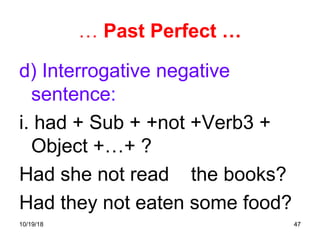
… Past Perfect …
d) Interrogative negative
sentence:
i. had + Sub + +not +Verb3 +
Object +…+ ?
Had she not read the books?
Had they not eaten some food?
10/19/18
48
… Past Perfect …
ii. What/When/how + had + Sub + +not
+Verb3 + Object +…+ ?
Why had Sam not read the books?
Why had I not gone to the market?
10/19/18
49
3.8: Past Perfect Continuous
Tense:
Past perfect continuous tense is
used to express an action
which had been going on
before another action in the
part;
10/19/18
50
… Past Perfect Continuous …
a) Affirmative sentence:
Sub + had + been +Verb1 +ing+Object
+since/for + time + object.
She had been reading the books for
two hours when he arrived.
They had been eating some food
for ten minutes when their mother
arrived.10/19/18
51
… Past Perfect Continuous …
b) Negative sentence:
Sub + had + not + been +Verb1+ing
+Object+ since/for + time +object.
She had not been reading the books for
two hours when he arrived.
They had not been eating some food for
ten minutes when their mother arrived.
10/19/18
52
… Past Perfect Continuous …
c) Interrogative sentence:
had + sub + been +Verb1+ing+Object+
since/for + time +Object +....+?
had she been reading the books
for two hours when he arrived?
had they been eating some food
for ten minutes when their mother
arrived?10/19/18
53
… Past Perfect Continuous …
d) Interrogative negative sentence:
had + sub + not been
+Verb1+ing+Object+ since/for + time
+Object +....+?
had she not been reading the books
for two hours when he arrived?
had they not been eating some food for
ten minutes when their mother10/19/18
54
3.9: Simple Future Tense or
Future Indefinite
Simple future tense is used for
an action that has still to take
place.
10/19/18
55
…Simple Future Tense …
a) Affirmative sentence:
Sub + will/shall + Verb1 +Object
He will go to Mombasa
I shall see the President during
the coming holidays.
10/19/18
56
…Simple Future Tense …
b) Negative sentence:
Sub + will/shall + not Verb1 +
Object.
He will not go to Mombasa
I shall not see the President during
the coming holidays.
10/19/18
57
…Simple Future Tense …
c) Interrogative sentence:
will/shall+Sub+Verb1+Object+ ?
Will he go to Mombasa?
Shall I see the President during
the coming holidays?
10/19/18
58
…Simple Future Tense …
d) Interrogative negative
sentence:
shall/will + Sub+not +Verb1 +Object + ?
Will he not go to Mombasa?
Shall I not see the President
during the coming holidays?
10/19/18
59
3.10: Future Continuous or
Future Progressive Tense
Future continuous tense is used
to show that an action is going
on at sometime in the future.
10/19/18
60
… Future Continuous …
a) Affirmative sentence:
Sub + will/shall+be+Verb1+ ing +Object
She will be going to Mombasa
I shall be meeting the President
during the coming holidays.
10/19/18
61
… Future Continuous …
b) Negative sentence:
Sub+will/shall+not be+Verb1+ing +Object
She will not be going to Mombasa
I shall not be meeting the President
during the coming holidays.
10/19/18
62
… Future Continuous …
c) Interrogative sentence:
will/shall+Sub+not be+Verb1 + ing
+Object + ?
will she be going to Mombasa?
Shall I be meeting the President
during the coming holidays?10/19/18
63
… Future Continuous …
d) Interrogative negative sentence:
will/shall + Sub+ not be +Verb1 +
ing +Object + ?
Will she not be going to Mombasa?
Shall I not be meeting the President
during the coming holidays?
10/19/18
64
3.11: Future Perfect Tense:
Future Perfect tense is used to
show an action that will have
been completed at a future
time.
10/19/18
65
… Future Perfect …
a) Affirmative sentence:
Sub + will/shall have + Verb3 +Object
I shall have eaten the food.
The train will have left before he
reaches the station.
10/19/18
66
… Future Perfect …
b) Negative sentence:
Sub + will/shall not have + Verb3 +Object
I shall not have eaten the food.
The train will not have left before
he reaches the station.
10/19/18
67
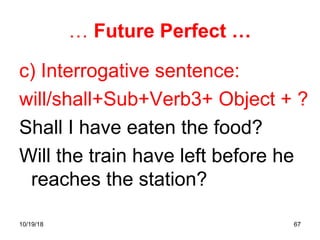
… Future Perfect …
c) Interrogative sentence:
will/shall+Sub+Verb3+ Object + ?
Shall I have eaten the food?
Will the train have left before he
reaches the station?
10/19/18
68
… Future Perfect …
d) Interrogative negative sentence:
will/shall+Sub+not have+Verb3+Object + ?
Shall I not have eaten the food?
Will the train not have left before he
reaches the station?
10/19/18
69
3.12: Future Perfect
Continuous Tense:
Present perfect continuous
tense is used to show an
action that will be going on
over a period of time and will
end in the future.
10/19/18
70
..Future Perfect Continuous..
a) Affirmative sentence:
Sub+will/shall have been+Verb+ing+ Object.
She will have been reading the
books.
They will have been eating some
food.
10/19/18
71
..Future Perfect Continuous..
b) Negative sentence:
Sub+will/shall not have been +Verb1+ing+
Object.
She will have not been reading the
books.
They will have not been eating
some food.10/19/18
72
..Future Perfect Continuous..
c) Interrogative sentence:
will/shall + Sub+ not have been
+Verb1+ing+Object+?
will she have been reading the
books?
will they have been eating some
food for ten minutes10/19/18
73
..Future Perfect Continuous..
d) Interrogative negative sentence:
will/shall + Sub+ not have been
+Verb1+ing+Object.
She will have not been reading the
books.
They will have not been eating
some food.10/19/18

Topic three tenses

  • 1.
    1 TOPIC THREE: TENSES Tenseis the term used to indicate the time of the action or event. Tense is divided into three main classes names: 10/19/18
  • 2.
    2 ….Tenses….. 1. Present tense 2.Past tense 3. Future tense 10/19/18
  • 3.
    3 1. Present Tense: i.Simple Present Tense ii. Present Continuous Tense iii. Present Perfect Tense iv. Present Perfect Continuous Tense 10/19/18
  • 4.
    4 2. Past Tense i.Simple Past Tense ii. Past Continuous Tense iii. Past Perfect Tense iv. Past Perfect Continuous Tense 10/19/18
  • 5.
    5 3. Future Tense i.Simple Future Tense ii. Future Continuous Tense iii. Future Perfect Tense iv. Future Perfect Continuous Tense 10/19/18
  • 6.
    6 Note: Verb1=plain form; eg.Want, take, etc Verb2 = ed form eg. Wanted, waited, etc Verb3 = en form eg taken, eaten, etc 10/19/18
  • 7.
    7 3.1: Simple PresentTense or Present Indefinite Simple present tense is used to express repeated or (routine)customary action. 10/19/18
  • 8.
    8 ….simple present……. a) Affirmativesentence: Sub + Verb1 +Object She reads books always. He goes to school everyday They want something The cat drinks milk.10/19/18
  • 9.
    NOTE: • The subject(Sub) names what the sentence is about or about the actor in the sentence. • The verb tells what the subject does or is • The object receives the action of the verb 10/19/18 9
  • 10.
    10 …simple present… b) Negativesentence: Sub + do/does + not Verb1 +Object She does not read books. They do not want anything. 10/19/18
  • 11.
    11 …simple present… c) Interrogativesentence: do/does + Sub + Verb1 +Object + ? Does she read books? Do they want something? 10/19/18
  • 12.
    12 …simple present …. d)Interrogative negative sentence: do/does +Sub +not +Verb1 +Object + ? Does she not read books? Do they not want something ? 10/19/18
  • 13.
    13 3.2: Present Continuousor Present Progressive Tense Present continuous tense is used to show that an action is in progress and is incomplete at the moment of speaking or writing. 10/19/18
  • 14.
    14 … Present Continuous… a) Affirmative sentence: Sub + is/am/are + Verb1 + ing +Object She is reading a book. They are eating some food. 10/19/18
  • 15.
    15 … Present Continuous… b) Negative sentence: Sub + is/am/are + not + Verb1 + ing +Object. She is not reading books. They are not eating anything. 10/19/18
  • 16.
    16 … Present Continuous… c) Interrogative sentence: i. is/am/are + Sub + Verb1+ ing +Object + ? Is she reading books? Are they eating some food? 10/19/18
  • 17.
    17 … Present Continuous… ii. What/When/how + is/am/are + Sub + Verb1 + ing +? • What is she doing? • How are they doing? 10/19/18
  • 18.
    18 … Present Continuous… d) Interrogative negative sentence: i. is/am/are + Sub + not + Verb1 + ing +Object + ? Is she not reading books? Are they not eating some food? 10/19/18
  • 19.
    19 … Present Continuous… • ii. What/When/how + is/am/are + Sub + not Verb1 + ing +? • What is she not + doing? • How are they + doing? 10/19/18
  • 20.
    20 3.3: Present PerfectTense: Present Perfect tense is used to indicate completed activities in the immediate past. 10/19/18
  • 21.
    21 … Present Perfect… a) Affirmative sentence: Sub + has/have + Verb3 +Object She has read the books. They have eaten some food. 10/19/18
  • 22.
    22 … Present Perfect… b) Negative sentence: Sub + has/have + not + Verb3 +Object. She has not read the books. They have not eaten some food. 10/19/18
  • 23.
    23 … Present Perfect… c) Interrogative sentence: has/have + sub + Verb3+Object+....+? Has she read the books? Have they eaten some food? 10/19/18
  • 24.
    24 … Present Perfect… d) Interrogative negative sentence: i. have/has + Sub + not +Verb3 + Object +? Has she not read the books? Have they not eaten some food? 10/19/18
  • 25.
    25 … Present Perfect… ii. What/When/how + have/has + Sub + +not +Verb3 + Object +…+ ? Why has Salma not read the books? Why have I not gone to the market? 10/19/18
  • 26.
    26 3.4: Present Perfect ContinuousTense: Present perfect continuous tense is used to express an action which began in the past but still continuing. 10/19/18
  • 27.
    27 .. Present PerfectCont .. a) Affirmative sentence: Sub + has/have + been + Verb1 +ing +Object+ since/for + time phase. She has been reading the books for two hours. They have been eating some food for ten minutes. 10/19/18
  • 28.
    28 .. Present Perfect Continuous.. b) Negative sentence: Sub + has/have + not + been + Verb1 +ing+Object+ since/for + time phase. She has not been reading the books for two hours. They have not been eating some food for ten minutes.10/19/18
  • 29.
    29 .. Present PerfectContinuous c) Interrogative sentence: has/have + sub + been + Verb1 +ing + Object+ since/for + time phase +....+? Has she been reading the books for ten minutes? Have they been eating some food since morning?10/19/18
  • 30.
    30 .. Present PerfectContinuous d) Interrogative negative sentence: has/have + sub + not + been +Verb1 + ing+Object+ since/for + time phase+....+? Has she not been reading the books for ten minutes? Have they not been eating some food since morning?10/19/18
  • 31.
    31 3.5: Simple PastTense or Past Indefinite Simple past tense is used to express repeated, customary or normal action in the past. 10/19/18
  • 32.
    32 … Simple PastTense … a) Affirmative sentence: Sub + Verb2 +Object She wrote a letter You went to the market. 10/19/18
  • 33.
    33 … Simple PastTense … b) Negative sentence: Sub + did + not Verb1 +Object She did not write a letter You did not go the market. 10/19/18
  • 34.
    34 … Simple PastTense … c) Interrogative sentence: Did + Sub + Verb1 +Object +….+ ? Did she write a letter? Did you go to the market? 10/19/18
  • 35.
    35 … Simple PastTense … d) Interrogative negative sentence: Did + Sub + not +Verb1 +Object + …+ ? Did she not write a letter? Did you not go to the market? 10/19/18
  • 36.
    36 3.6: Past Continuousor Past Progressive Tense Past continuous tense is used to denote an action going on at sometime in the past. The time of the action may or may not be indicated. 10/19/18
  • 37.
    37 … Past Continuous… a) Affirmative sentence: Sub + was/were + Verb1 + ing +Object She was reading books. They were eating some food. 10/19/18
  • 38.
    38 … Past Continuous… b) Negative sentence: Sub + was/were+not + Verb1 + ing +Object. She was not reading books. They were not eating something. 10/19/18
  • 39.
    39 … Past Continuous… c) Interrogative sentence: i. was/were+ Sub + Verb1 + ing +Object + ? Was she reading books? Were they eating some food? 10/19/18
  • 40.
    40 … Past Continuous… ii. What/When/how + was/were + Sub + Verb1 + ing +? What was she doing? How were they doing? 10/19/18
  • 41.
    41 … Past Continuous… d) Interrogative negative sentence: i. was/were + Sub + not + Verb1 + ing +Object + ? Was she not reading books? Were they not eating some food? 10/19/18
  • 42.
    42 … Past Continuous… ii. What/When/how + was/were + Sub + Verb1 + ing +? What was she doing? How were they doing? 10/19/18
  • 43.
    43 3.7: Past PerfectTense: Past Perfect tense is used to show an action that had been completed before a given time in the past. 10/19/18
  • 44.
    44 … Past Perfect… a) Affirmative sentence: Sub + had + Verb3 +Object She had read the books. They had eaten some food. 10/19/18
  • 45.
    45 … Past Perfect… b) Negative sentence: Sub + had + not + Verb3 +Object. She had not read the books. They had not eaten some food. 10/19/18
  • 46.
    46 … Past Perfect… c) Interrogative sentence: had + Sub +Verb3 +Object + …+? Had she read the books? Had they eaten some food? 10/19/18
  • 47.
    47 … Past Perfect… d) Interrogative negative sentence: i. had + Sub + +not +Verb3 + Object +…+ ? Had she not read the books? Had they not eaten some food? 10/19/18
  • 48.
    48 … Past Perfect… ii. What/When/how + had + Sub + +not +Verb3 + Object +…+ ? Why had Sam not read the books? Why had I not gone to the market? 10/19/18
  • 49.
    49 3.8: Past PerfectContinuous Tense: Past perfect continuous tense is used to express an action which had been going on before another action in the part; 10/19/18
  • 50.
    50 … Past PerfectContinuous … a) Affirmative sentence: Sub + had + been +Verb1 +ing+Object +since/for + time + object. She had been reading the books for two hours when he arrived. They had been eating some food for ten minutes when their mother arrived.10/19/18
  • 51.
    51 … Past PerfectContinuous … b) Negative sentence: Sub + had + not + been +Verb1+ing +Object+ since/for + time +object. She had not been reading the books for two hours when he arrived. They had not been eating some food for ten minutes when their mother arrived. 10/19/18
  • 52.
    52 … Past PerfectContinuous … c) Interrogative sentence: had + sub + been +Verb1+ing+Object+ since/for + time +Object +....+? had she been reading the books for two hours when he arrived? had they been eating some food for ten minutes when their mother arrived?10/19/18
  • 53.
    53 … Past PerfectContinuous … d) Interrogative negative sentence: had + sub + not been +Verb1+ing+Object+ since/for + time +Object +....+? had she not been reading the books for two hours when he arrived? had they not been eating some food for ten minutes when their mother10/19/18
  • 54.
    54 3.9: Simple FutureTense or Future Indefinite Simple future tense is used for an action that has still to take place. 10/19/18
  • 55.
    55 …Simple Future Tense… a) Affirmative sentence: Sub + will/shall + Verb1 +Object He will go to Mombasa I shall see the President during the coming holidays. 10/19/18
  • 56.
    56 …Simple Future Tense… b) Negative sentence: Sub + will/shall + not Verb1 + Object. He will not go to Mombasa I shall not see the President during the coming holidays. 10/19/18
  • 57.
    57 …Simple Future Tense… c) Interrogative sentence: will/shall+Sub+Verb1+Object+ ? Will he go to Mombasa? Shall I see the President during the coming holidays? 10/19/18
  • 58.
    58 …Simple Future Tense… d) Interrogative negative sentence: shall/will + Sub+not +Verb1 +Object + ? Will he not go to Mombasa? Shall I not see the President during the coming holidays? 10/19/18
  • 59.
    59 3.10: Future Continuousor Future Progressive Tense Future continuous tense is used to show that an action is going on at sometime in the future. 10/19/18
  • 60.
    60 … Future Continuous… a) Affirmative sentence: Sub + will/shall+be+Verb1+ ing +Object She will be going to Mombasa I shall be meeting the President during the coming holidays. 10/19/18
  • 61.
    61 … Future Continuous… b) Negative sentence: Sub+will/shall+not be+Verb1+ing +Object She will not be going to Mombasa I shall not be meeting the President during the coming holidays. 10/19/18
  • 62.
    62 … Future Continuous… c) Interrogative sentence: will/shall+Sub+not be+Verb1 + ing +Object + ? will she be going to Mombasa? Shall I be meeting the President during the coming holidays?10/19/18
  • 63.
    63 … Future Continuous… d) Interrogative negative sentence: will/shall + Sub+ not be +Verb1 + ing +Object + ? Will she not be going to Mombasa? Shall I not be meeting the President during the coming holidays? 10/19/18
  • 64.
    64 3.11: Future PerfectTense: Future Perfect tense is used to show an action that will have been completed at a future time. 10/19/18
  • 65.
    65 … Future Perfect… a) Affirmative sentence: Sub + will/shall have + Verb3 +Object I shall have eaten the food. The train will have left before he reaches the station. 10/19/18
  • 66.
    66 … Future Perfect… b) Negative sentence: Sub + will/shall not have + Verb3 +Object I shall not have eaten the food. The train will not have left before he reaches the station. 10/19/18
  • 67.
    67 … Future Perfect… c) Interrogative sentence: will/shall+Sub+Verb3+ Object + ? Shall I have eaten the food? Will the train have left before he reaches the station? 10/19/18
  • 68.
    68 … Future Perfect… d) Interrogative negative sentence: will/shall+Sub+not have+Verb3+Object + ? Shall I not have eaten the food? Will the train not have left before he reaches the station? 10/19/18
  • 69.
    69 3.12: Future Perfect ContinuousTense: Present perfect continuous tense is used to show an action that will be going on over a period of time and will end in the future. 10/19/18
  • 70.
    70 ..Future Perfect Continuous.. a)Affirmative sentence: Sub+will/shall have been+Verb+ing+ Object. She will have been reading the books. They will have been eating some food. 10/19/18
  • 71.
    71 ..Future Perfect Continuous.. b)Negative sentence: Sub+will/shall not have been +Verb1+ing+ Object. She will have not been reading the books. They will have not been eating some food.10/19/18
  • 72.
    72 ..Future Perfect Continuous.. c)Interrogative sentence: will/shall + Sub+ not have been +Verb1+ing+Object+? will she have been reading the books? will they have been eating some food for ten minutes10/19/18
  • 73.
    73 ..Future Perfect Continuous.. d)Interrogative negative sentence: will/shall + Sub+ not have been +Verb1+ing+Object. She will have not been reading the books. They will have not been eating some food.10/19/18