CT2221
TOPIC 5: DECISION MAKING &
PROBLEM SOLVING SKILLS
MS SHAMINI
Kolej Perdana
CT2221
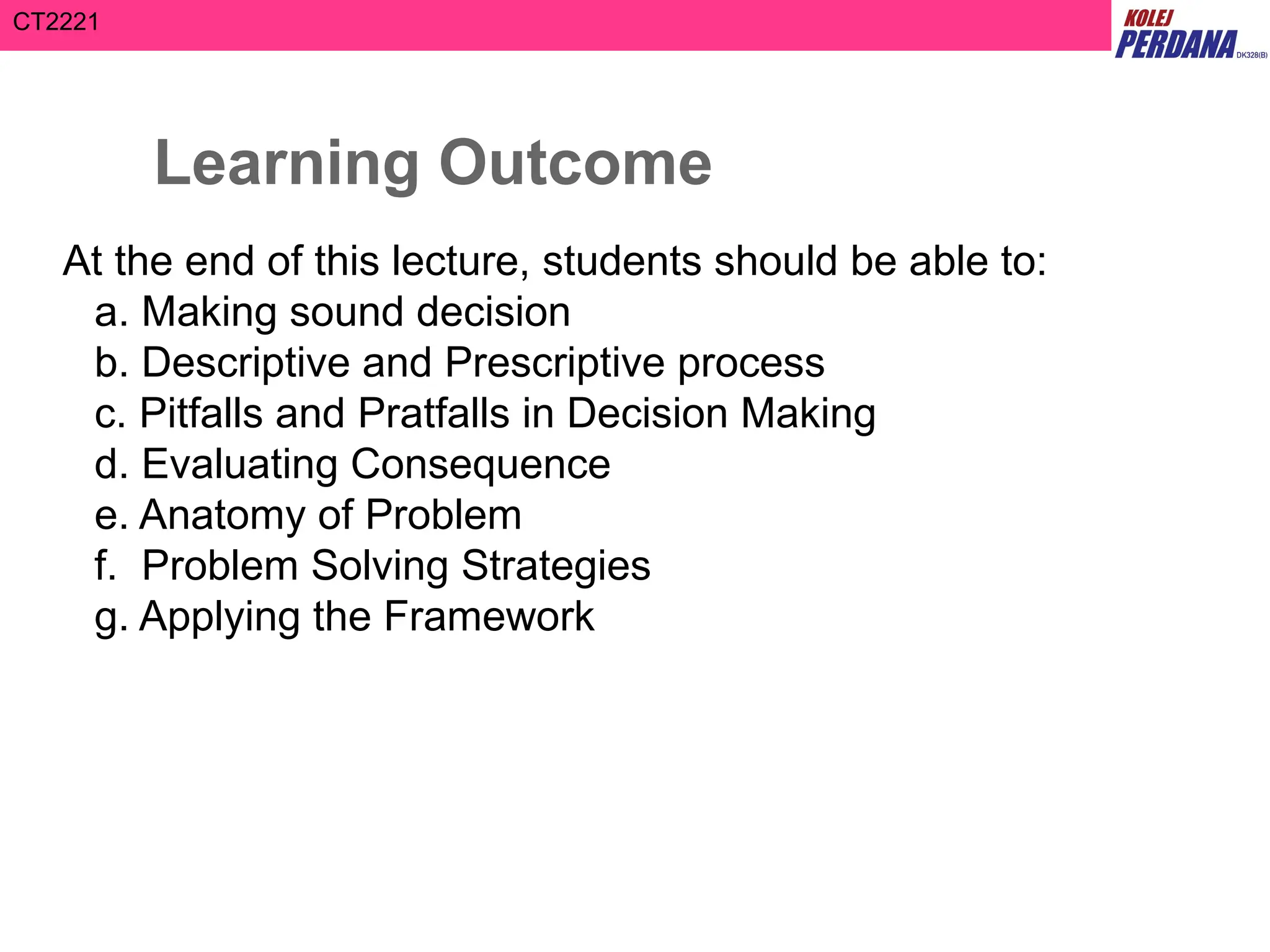
Learning Outcome
At the end of this lecture, students should be able to:
a. Making sound decision
b. Descriptive and Prescriptive process
c. Pitfalls and Pratfalls in Decision Making
d. Evaluating Consequence
e. Anatomy of Problem
f. Problem Solving Strategies
g. Applying the Framework
CT2221
PROBLEM SOLVING
• Problems are obstacles thrown in front of us to
hamper our progress.
• These problems must be solved and overcome.
• Problems can arise in personal, professional and
social contexts.
• Some problems can be solved alone, some can be
by collective thought and some by using computers.
• Problem solving refers to any activity or group of
activities that seek to resolve problems or find a
solution to solve the problems, by proceeding in an
orderly fashion.
CT2221
Steps in Problem Solving
• There is a problem solving cycle which has been identified by
Bransford and Stein and is known as the IDEAL model.
• The steps in IDEAL model are,
1. Identification of Problems and Opportunities
2. Definition of Goals
3. Exploration of Possible Strategies
4. Anticipation of Outcomes and Action
5. Learning through Retrospection
CT2221
Identification of Problems and Opportunities
• This is the first step which involves actively looking to the
problems and not just responding to them.
• The problems must be stated clearly so that the
subsequent steps are easier.
CT2221
Definition of Goals
• Defining the goals of the solution is
important to decide the direction of
the problem solving process.
• There must be clear understanding of
what the requirement is.
• The constraints, various interests, etc
must be taken for consideration in
this step.
CT2221
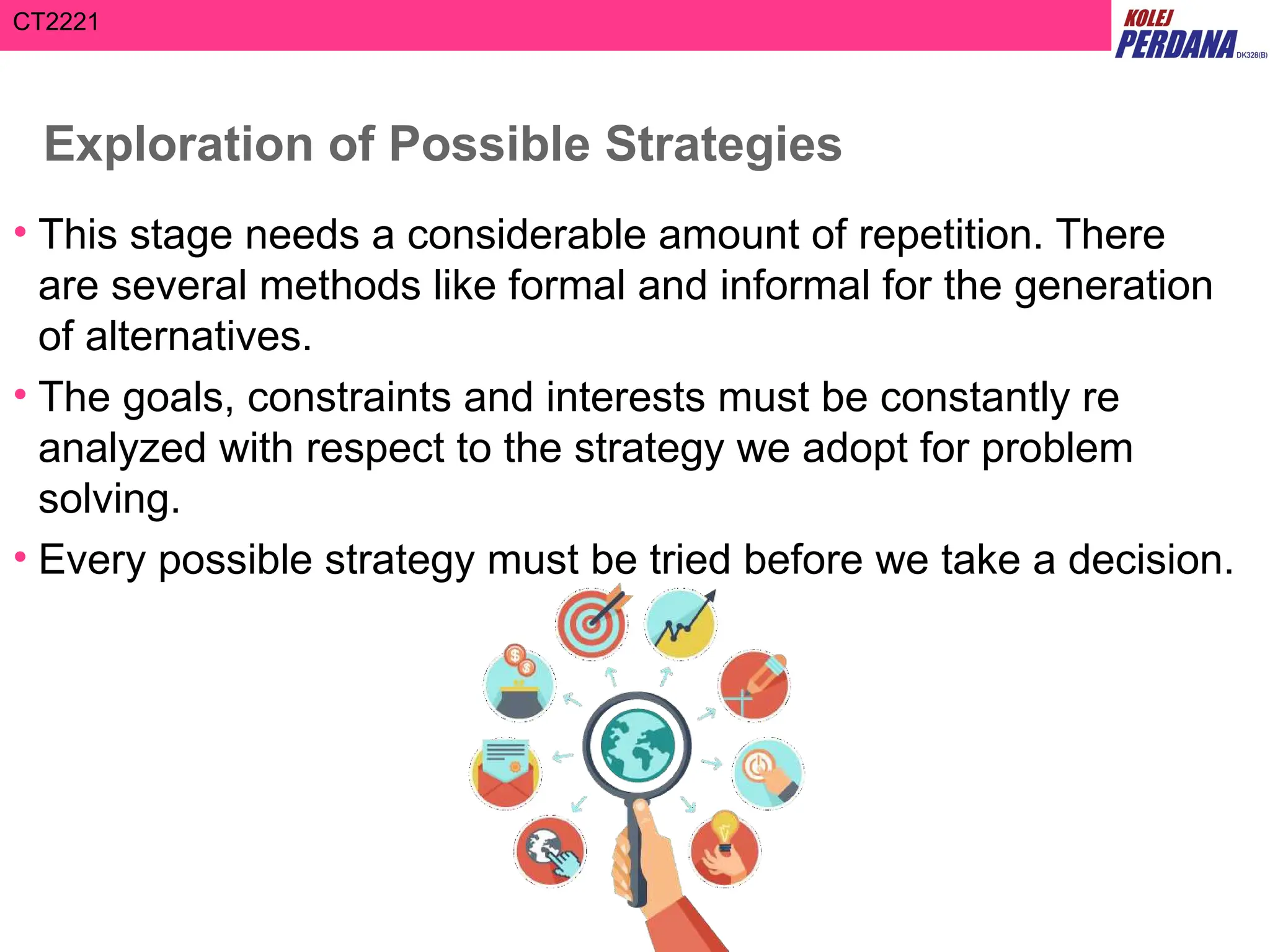
Exploration of Possible Strategies
• This stage needs a considerable amount of repetition. There
are several methods like formal and informal for the generation
of alternatives.
• The goals, constraints and interests must be constantly re
analyzed with respect to the strategy we adopt for problem
solving.
• Every possible strategy must be tried before we take a decision.
CT2221
Anticipation of Outcomes and
Action
• Every possible outcome must be analyzed after deciding
a strategy.
• The already fixed strategy may have to be modified or
even discarded.
• Inappropriate assumptions which were made earlier can
be rectified in this stage.
CT2221
Learning through Retrospection
• This is the key for all the possible and further progress.
• It helps to understand the mistake we made and learn
from the past experiences.
• This helps in adopting the most suitable strategy in future.
CT2221
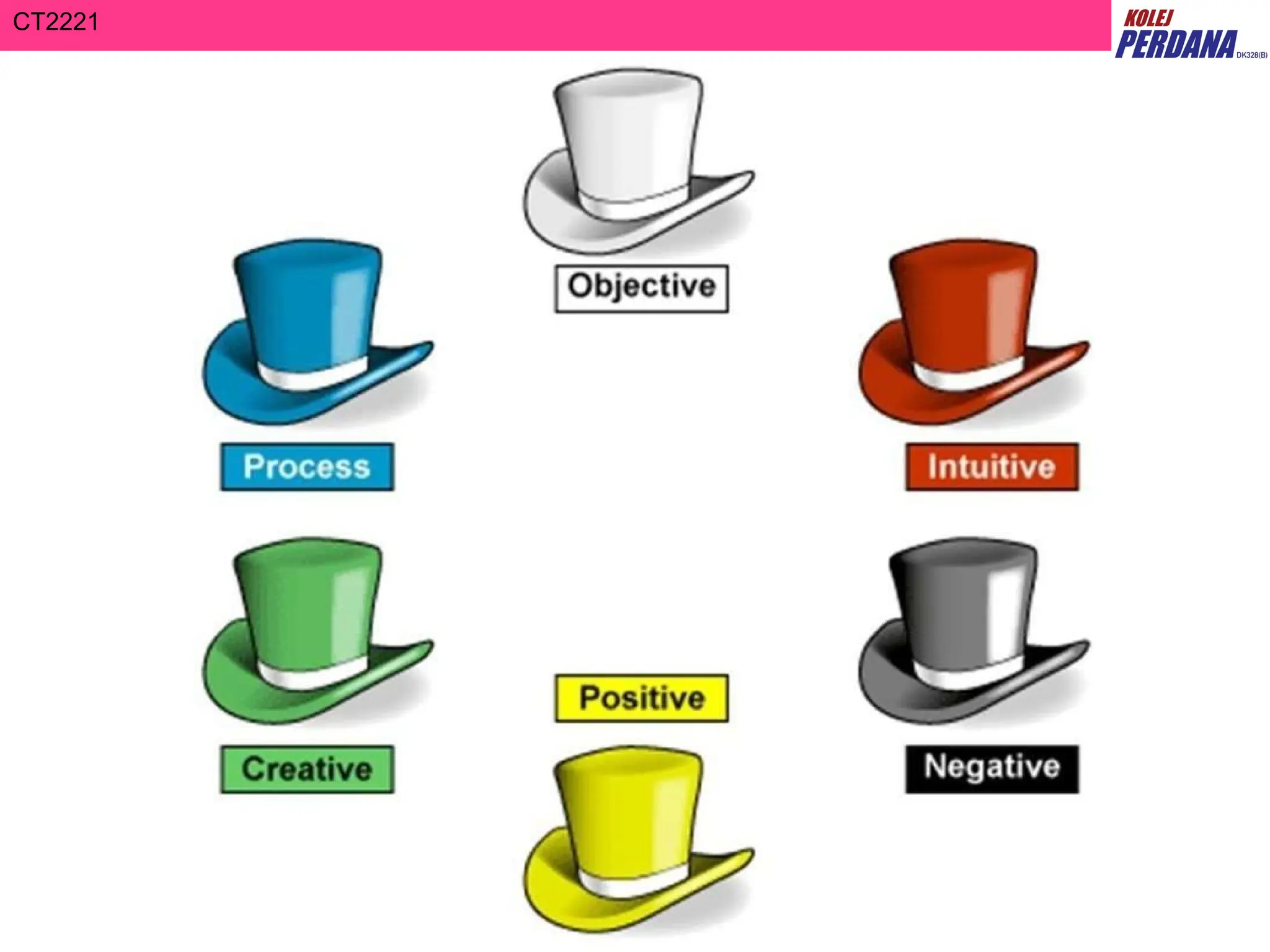
Problem Solving through Six Thinking Hats
• The Six Thinking Hats method was put forward by Edward de
Bono.
• This method helps us analyze and structure our thought process.
• According to de Bono, we are capable of different thinking styles.
These styles are represented by imaginary hats, each hat with
different color. By mentally wearing and switching hats, it is
easier to move from one thinking style to another. The six
thinking hats are given below.
• The White Hat
• The Red Hat.
• The Blue Hat
• The Yellow Hat
• The Green Hat
• The Black Hat
CT2221
CT2221
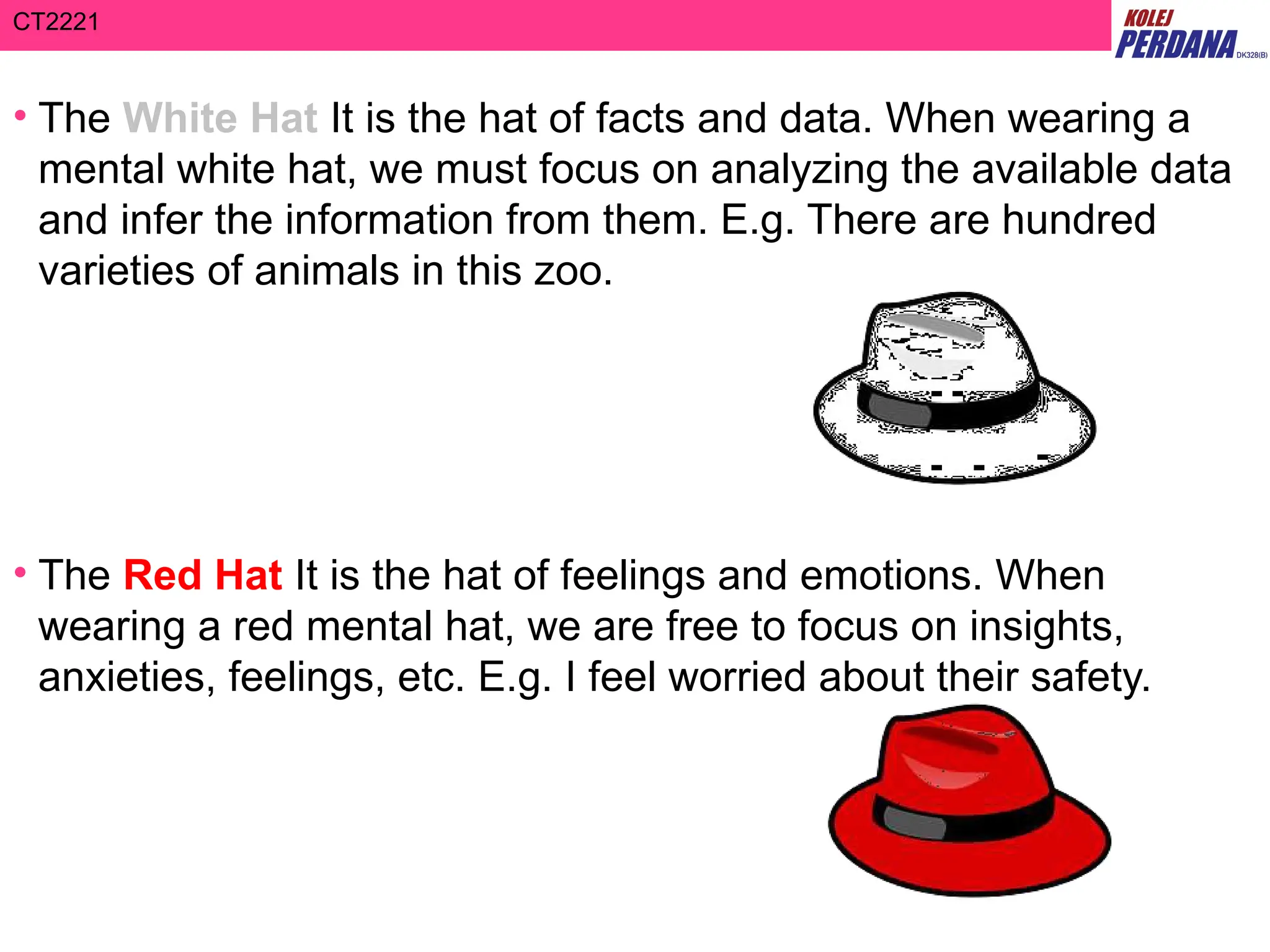
• The White Hat It is the hat of facts and data. When wearing a
mental white hat, we must focus on analyzing the available data
and infer the information from them. E.g. There are hundred
varieties of animals in this zoo.
• The Red Hat It is the hat of feelings and emotions. When
wearing a red mental hat, we are free to focus on insights,
anxieties, feelings, etc. E.g. I feel worried about their safety.
CT2221
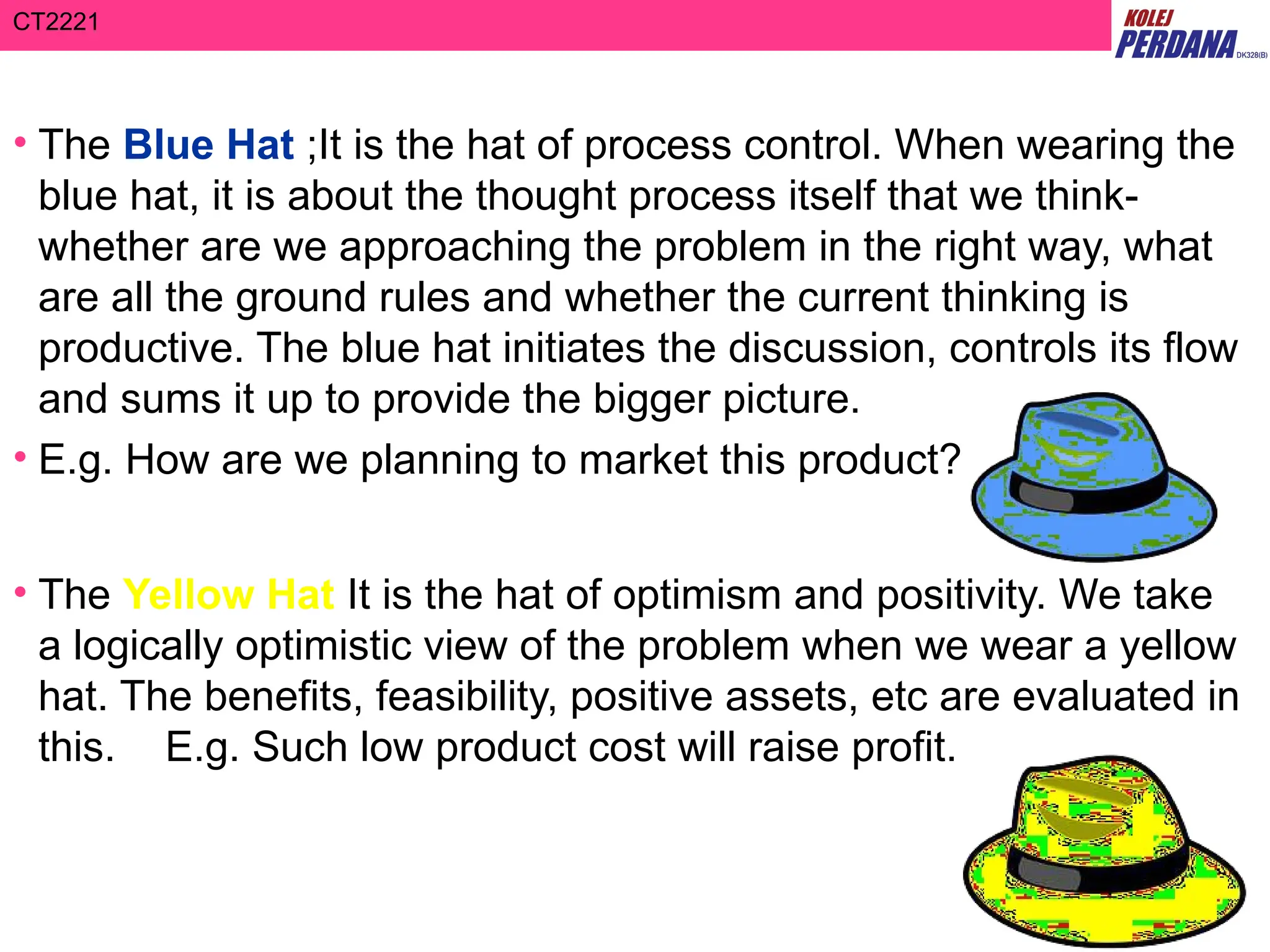
• The Blue Hat ;It is the hat of process control. When wearing the
blue hat, it is about the thought process itself that we think-
whether are we approaching the problem in the right way, what
are all the ground rules and whether the current thinking is
productive. The blue hat initiates the discussion, controls its flow
and sums it up to provide the bigger picture.
• E.g. How are we planning to market this product?
• The Yellow Hat It is the hat of optimism and positivity. We take
a logically optimistic view of the problem when we wear a yellow
hat. The benefits, feasibility, positive assets, etc are evaluated in
this. E.g. Such low product cost will raise profit.
CT2221
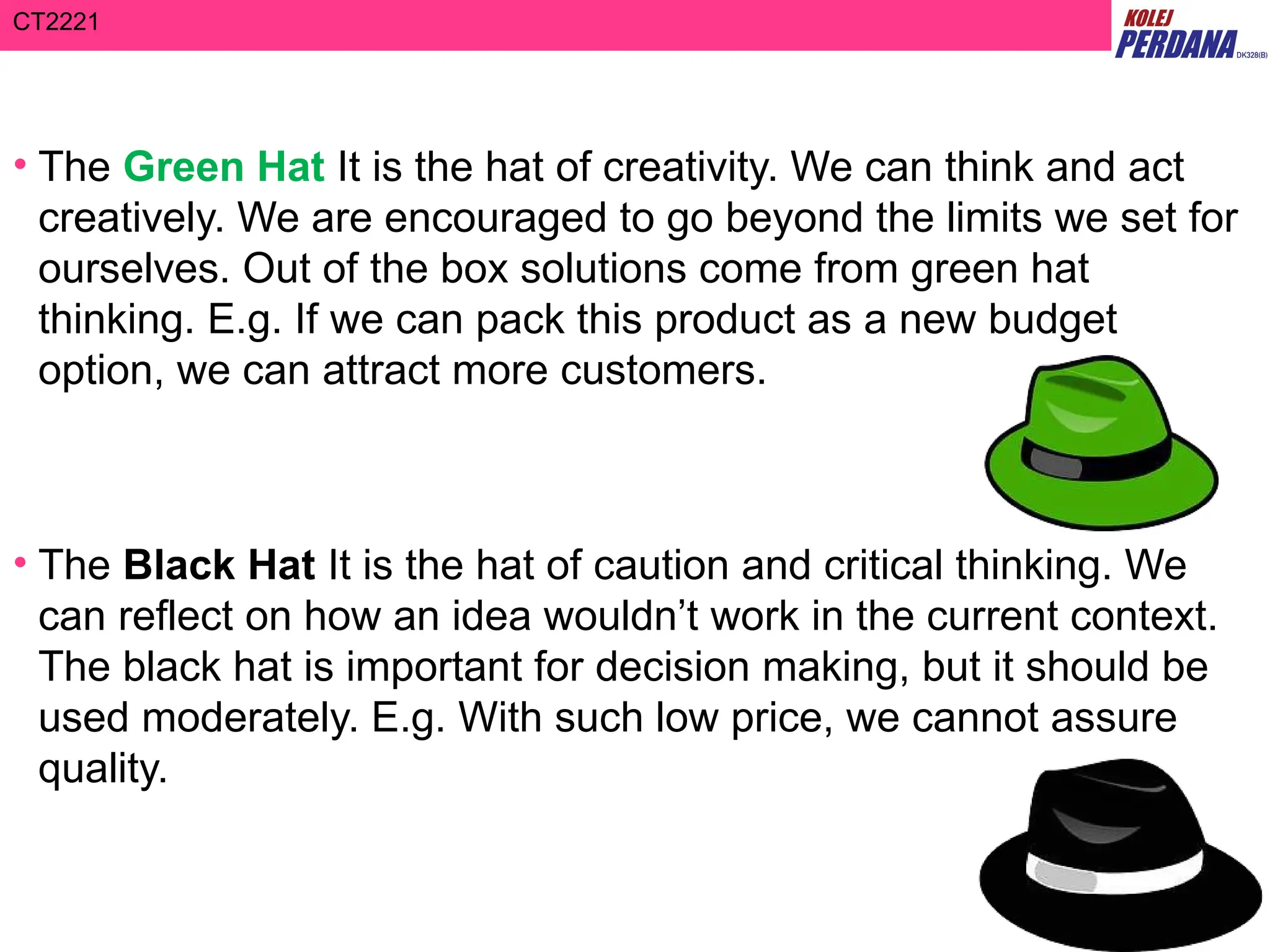
• The Green Hat It is the hat of creativity. We can think and act
creatively. We are encouraged to go beyond the limits we set for
ourselves. Out of the box solutions come from green hat
thinking. E.g. If we can pack this product as a new budget
option, we can attract more customers.
• The Black Hat It is the hat of caution and critical thinking. We
can reflect on how an idea wouldn’t work in the current context.
The black hat is important for decision making, but it should be
used moderately. E.g. With such low price, we cannot assure
quality.
CT2221
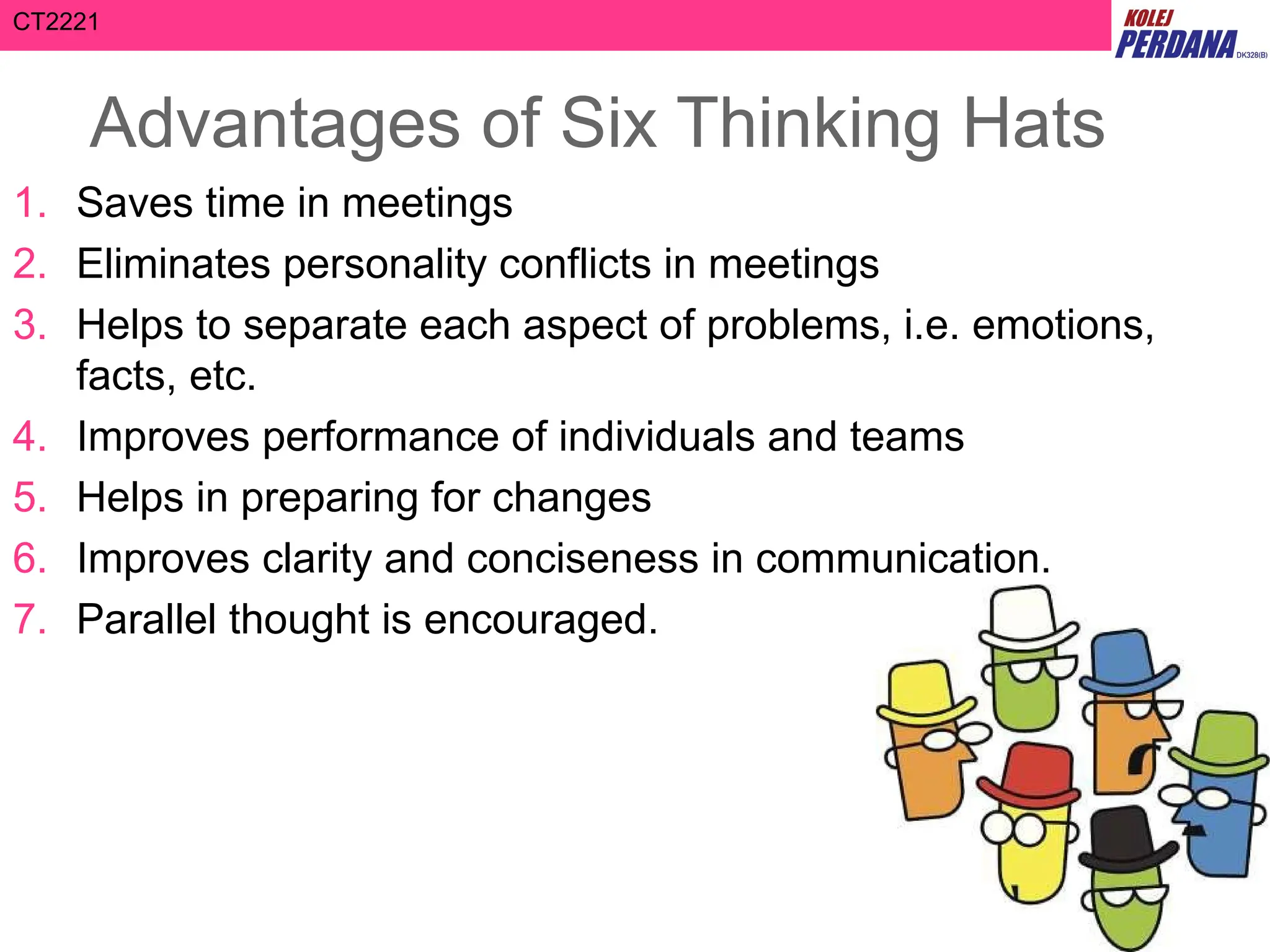
Advantages of Six Thinking Hats
1. Saves time in meetings
2. Eliminates personality conflicts in meetings
3. Helps to separate each aspect of problems, i.e. emotions,
facts, etc.
4. Improves performance of individuals and teams
5. Helps in preparing for changes
6. Improves clarity and conciseness in communication.
7. Parallel thought is encouraged.
CT2221
Problem-Solving Strategies
1. Algorithms
2. Heuristics
3. Trial-and-Error
4. Insight
CT2221
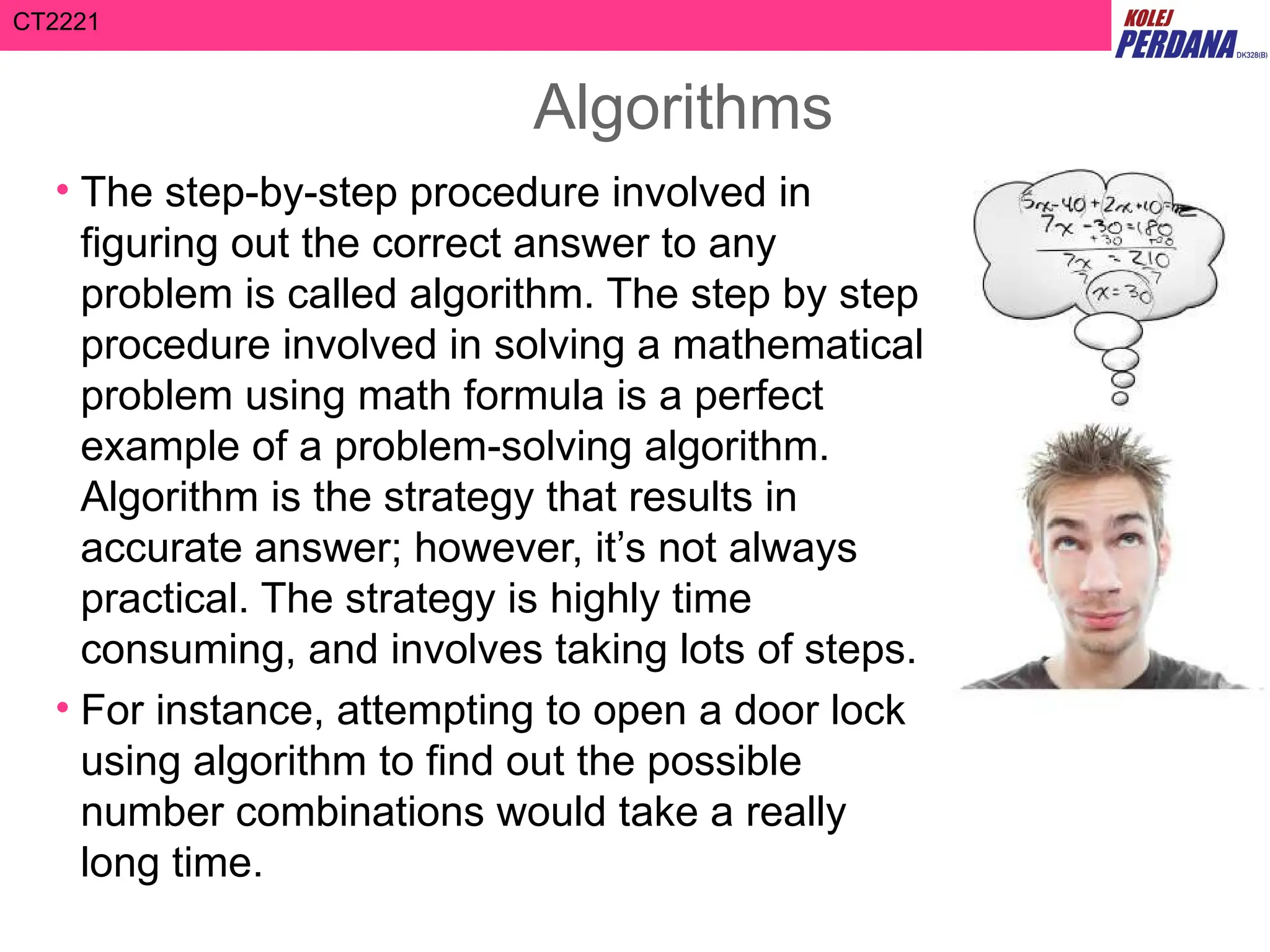
Algorithms
• The step-by-step procedure involved in
figuring out the correct answer to any
problem is called algorithm. The step by step
procedure involved in solving a mathematical
problem using math formula is a perfect
example of a problem-solving algorithm.
Algorithm is the strategy that results in
accurate answer; however, it’s not always
practical. The strategy is highly time
consuming, and involves taking lots of steps.
• For instance, attempting to open a door lock
using algorithm to find out the possible
number combinations would take a really
long time.
CT2221
Heuristics
• Heuristics refers to mental strategy based on rule-of thumb.
There is no guarantee that it will always work out to produce
the best solution. However, the rule of thumb strategy does
help to simplify complex problems by narrowing the possible
solutions. It makes it easier to reach the correct solution using
other strategies.
• Heuristic strategy of problem solving can also be referred to
as the mental shortcut. For instance, you need to reach the
other part of the city in a limited amount of time. You’ll
obviously seek for the shortest route and means of
transportation. The rule of thumb allows you to make up your
mind about the fastest route depending on your past
commutes. You might choose subway instead of hiring a cab.
CT2221
Trial-and-Error
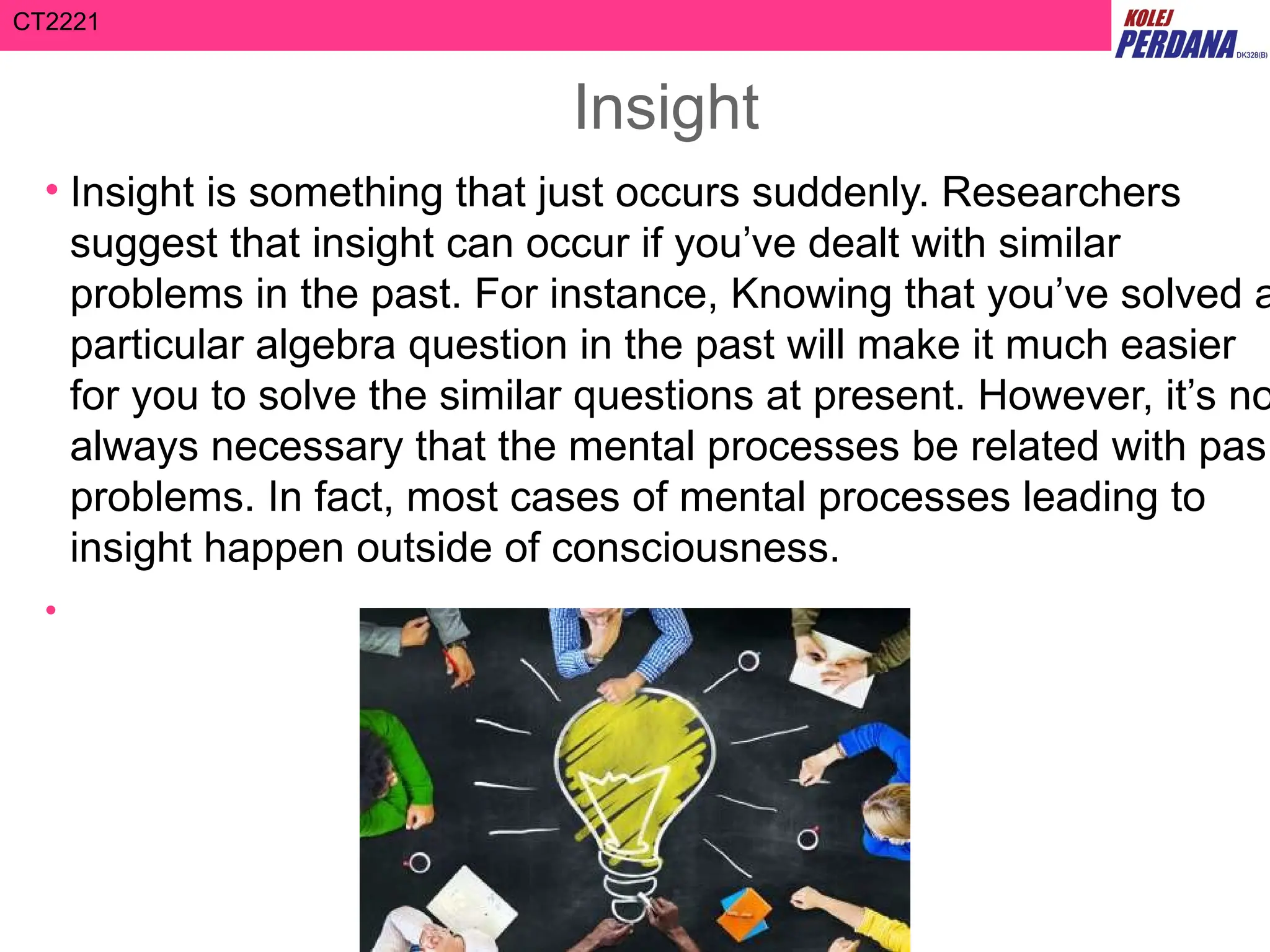
• Trial and error strategy is the approach that deals with
trying a number of different solutions and ruling out the
ones that do not work. Approaching this strategy as the first
method in an attempt to solve any problem can be highly
time-consuming. So, it’s best to use this strategy as a
follow up to figure out the best possible solution, after you
have narrowed down the possible number of solutions
using other techniques.
CT2221
Insight
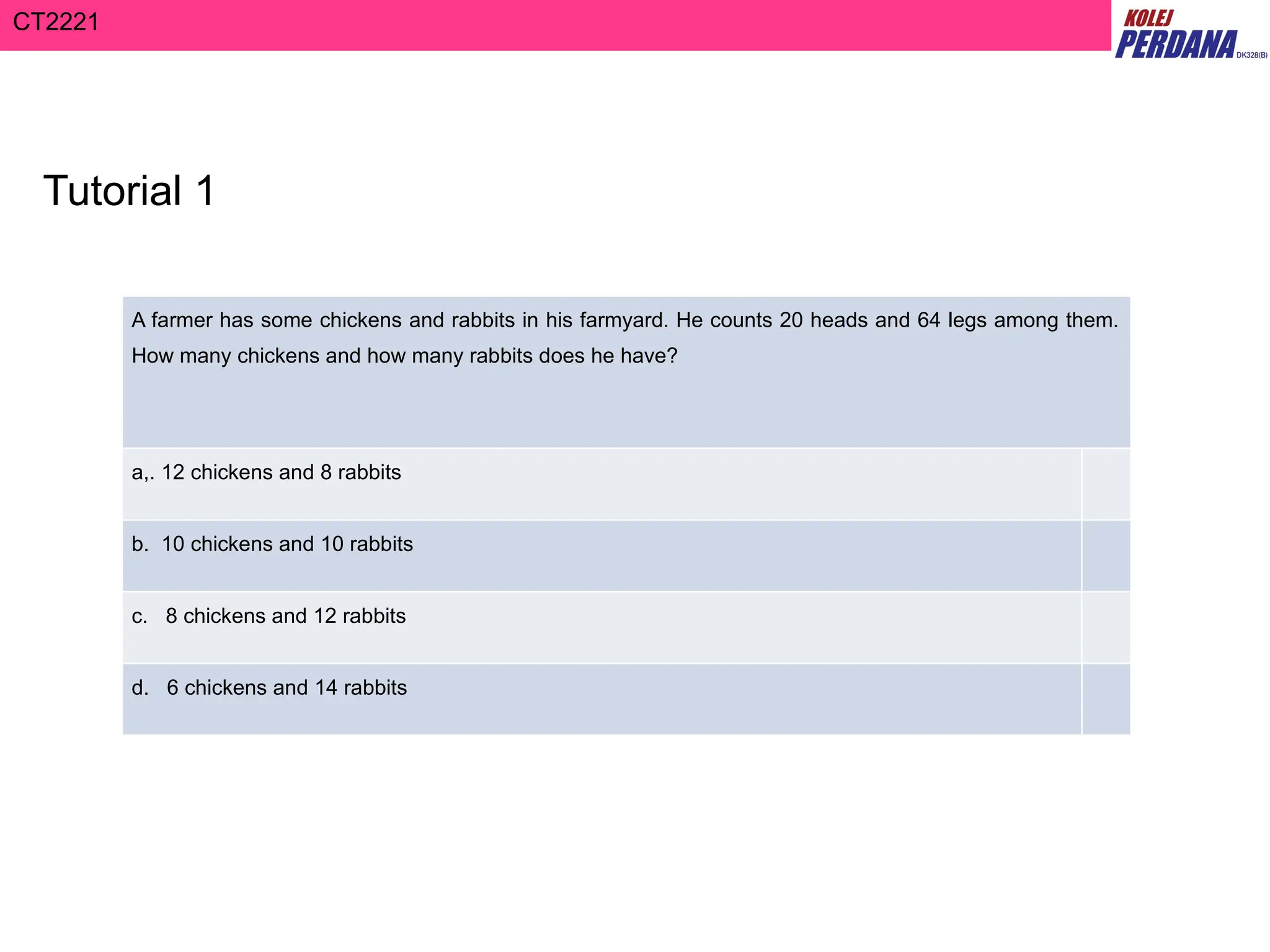
• Insight is something that just occurs suddenly. Researchers
suggest that insight can occur if you’ve dealt with similar
problems in the past. For instance, Knowing that you’ve solved a
particular algebra question in the past will make it much easier
for you to solve the similar questions at present. However, it’s no
always necessary that the mental processes be related with pas
problems. In fact, most cases of mental processes leading to
insight happen outside of consciousness.
•
CT2221
Tutorial 1
A farmer has some chickens and rabbits in his farmyard. He counts 20 heads and 64 legs among them.
How many chickens and how many rabbits does he have?
a,. 12 chickens and 8 rabbits
b. 10 chickens and 10 rabbits
c. 8 chickens and 12 rabbits
d. 6 chickens and 14 rabbits
CT2221
References
Paul, R., & Elder, L. (2020). Critical Thinking: Tools for Taking
Charge of Your Professional and Personal Life. Foundation
for Critical Thinking.
TOPIC 5. SOLVING PROBLEM IN CRITICAL THINKING

  • 1.
    CT2221 TOPIC 5: DECISIONMAKING & PROBLEM SOLVING SKILLS MS SHAMINI Kolej Perdana
  • 2.
    CT2221 Learning Outcome At theend of this lecture, students should be able to: a. Making sound decision b. Descriptive and Prescriptive process c. Pitfalls and Pratfalls in Decision Making d. Evaluating Consequence e. Anatomy of Problem f. Problem Solving Strategies g. Applying the Framework
  • 3.
    CT2221 PROBLEM SOLVING • Problemsare obstacles thrown in front of us to hamper our progress. • These problems must be solved and overcome. • Problems can arise in personal, professional and social contexts. • Some problems can be solved alone, some can be by collective thought and some by using computers. • Problem solving refers to any activity or group of activities that seek to resolve problems or find a solution to solve the problems, by proceeding in an orderly fashion.
  • 4.
    CT2221 Steps in ProblemSolving • There is a problem solving cycle which has been identified by Bransford and Stein and is known as the IDEAL model. • The steps in IDEAL model are, 1. Identification of Problems and Opportunities 2. Definition of Goals 3. Exploration of Possible Strategies 4. Anticipation of Outcomes and Action 5. Learning through Retrospection
  • 5.
    CT2221 Identification of Problemsand Opportunities • This is the first step which involves actively looking to the problems and not just responding to them. • The problems must be stated clearly so that the subsequent steps are easier.
  • 6.
    CT2221 Definition of Goals •Defining the goals of the solution is important to decide the direction of the problem solving process. • There must be clear understanding of what the requirement is. • The constraints, various interests, etc must be taken for consideration in this step.
  • 7.
    CT2221 Exploration of PossibleStrategies • This stage needs a considerable amount of repetition. There are several methods like formal and informal for the generation of alternatives. • The goals, constraints and interests must be constantly re analyzed with respect to the strategy we adopt for problem solving. • Every possible strategy must be tried before we take a decision.
  • 8.
    CT2221 Anticipation of Outcomesand Action • Every possible outcome must be analyzed after deciding a strategy. • The already fixed strategy may have to be modified or even discarded. • Inappropriate assumptions which were made earlier can be rectified in this stage.
  • 9.
    CT2221 Learning through Retrospection •This is the key for all the possible and further progress. • It helps to understand the mistake we made and learn from the past experiences. • This helps in adopting the most suitable strategy in future.
  • 10.
    CT2221 Problem Solving throughSix Thinking Hats • The Six Thinking Hats method was put forward by Edward de Bono. • This method helps us analyze and structure our thought process. • According to de Bono, we are capable of different thinking styles. These styles are represented by imaginary hats, each hat with different color. By mentally wearing and switching hats, it is easier to move from one thinking style to another. The six thinking hats are given below. • The White Hat • The Red Hat. • The Blue Hat • The Yellow Hat • The Green Hat • The Black Hat
  • 11.
  • 12.
    CT2221 • The WhiteHat It is the hat of facts and data. When wearing a mental white hat, we must focus on analyzing the available data and infer the information from them. E.g. There are hundred varieties of animals in this zoo. • The Red Hat It is the hat of feelings and emotions. When wearing a red mental hat, we are free to focus on insights, anxieties, feelings, etc. E.g. I feel worried about their safety.
  • 13.
    CT2221 • The BlueHat ;It is the hat of process control. When wearing the blue hat, it is about the thought process itself that we think- whether are we approaching the problem in the right way, what are all the ground rules and whether the current thinking is productive. The blue hat initiates the discussion, controls its flow and sums it up to provide the bigger picture. • E.g. How are we planning to market this product? • The Yellow Hat It is the hat of optimism and positivity. We take a logically optimistic view of the problem when we wear a yellow hat. The benefits, feasibility, positive assets, etc are evaluated in this. E.g. Such low product cost will raise profit.
  • 14.
    CT2221 • The GreenHat It is the hat of creativity. We can think and act creatively. We are encouraged to go beyond the limits we set for ourselves. Out of the box solutions come from green hat thinking. E.g. If we can pack this product as a new budget option, we can attract more customers. • The Black Hat It is the hat of caution and critical thinking. We can reflect on how an idea wouldn’t work in the current context. The black hat is important for decision making, but it should be used moderately. E.g. With such low price, we cannot assure quality.
  • 15.
    CT2221 Advantages of SixThinking Hats 1. Saves time in meetings 2. Eliminates personality conflicts in meetings 3. Helps to separate each aspect of problems, i.e. emotions, facts, etc. 4. Improves performance of individuals and teams 5. Helps in preparing for changes 6. Improves clarity and conciseness in communication. 7. Parallel thought is encouraged.
  • 16.
    CT2221 Problem-Solving Strategies 1. Algorithms 2.Heuristics 3. Trial-and-Error 4. Insight
  • 17.
    CT2221 Algorithms • The step-by-stepprocedure involved in figuring out the correct answer to any problem is called algorithm. The step by step procedure involved in solving a mathematical problem using math formula is a perfect example of a problem-solving algorithm. Algorithm is the strategy that results in accurate answer; however, it’s not always practical. The strategy is highly time consuming, and involves taking lots of steps. • For instance, attempting to open a door lock using algorithm to find out the possible number combinations would take a really long time.
  • 18.
    CT2221 Heuristics • Heuristics refersto mental strategy based on rule-of thumb. There is no guarantee that it will always work out to produce the best solution. However, the rule of thumb strategy does help to simplify complex problems by narrowing the possible solutions. It makes it easier to reach the correct solution using other strategies. • Heuristic strategy of problem solving can also be referred to as the mental shortcut. For instance, you need to reach the other part of the city in a limited amount of time. You’ll obviously seek for the shortest route and means of transportation. The rule of thumb allows you to make up your mind about the fastest route depending on your past commutes. You might choose subway instead of hiring a cab.
  • 19.
    CT2221 Trial-and-Error • Trial anderror strategy is the approach that deals with trying a number of different solutions and ruling out the ones that do not work. Approaching this strategy as the first method in an attempt to solve any problem can be highly time-consuming. So, it’s best to use this strategy as a follow up to figure out the best possible solution, after you have narrowed down the possible number of solutions using other techniques.
  • 20.
    CT2221 Insight • Insight issomething that just occurs suddenly. Researchers suggest that insight can occur if you’ve dealt with similar problems in the past. For instance, Knowing that you’ve solved a particular algebra question in the past will make it much easier for you to solve the similar questions at present. However, it’s no always necessary that the mental processes be related with pas problems. In fact, most cases of mental processes leading to insight happen outside of consciousness. •
  • 21.
    CT2221 Tutorial 1 A farmerhas some chickens and rabbits in his farmyard. He counts 20 heads and 64 legs among them. How many chickens and how many rabbits does he have? a,. 12 chickens and 8 rabbits b. 10 chickens and 10 rabbits c. 8 chickens and 12 rabbits d. 6 chickens and 14 rabbits
  • 22.
    CT2221 References Paul, R., &Elder, L. (2020). Critical Thinking: Tools for Taking Charge of Your Professional and Personal Life. Foundation for Critical Thinking.