FravoGetCertified
&
Secure
yourFuture
IT Certification leaders in simulated
test engines & guides
Certified Associate Business Analyst
Exam: CABA
Demo Edition
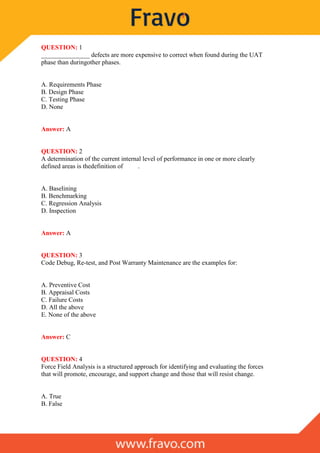
QUESTION: 1
_______________ defects are more expensive to correct when found during the UAT
phase than duringother phases.
A. Requirements Phase
B. Design Phase
C. Testing Phase
D. None
Answer: A
QUESTION: 2
A determination of the current internal level of performance in one or more clearly
defined areas is thedefinition of .
A. Baselining
B. Benchmarking
C. Regression Analysis
D. Inspection
Answer: A
QUESTION: 3
Code Debug, Re-test, and Post Warranty Maintenance are the examples for:
A. Preventive Cost
B. Appraisal Costs
C. Failure Costs
D. All the above
E. None of the above
Answer: C
QUESTION: 4
Force Field Analysis is a structured approach for identifying and evaluating the forces
that will promote, encourage, and support change and those that will resist change.
A. True
B. False
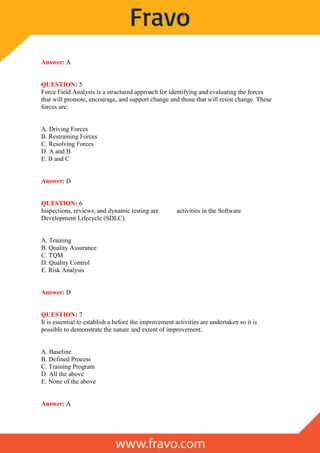
Answer: A
QUESTION: 5
Force Field Analysis is a structured approach for identifying and evaluating the forces
that will promote, encourage, and support change and those that will resist change. These
forces are:
A. Driving Forces
B. Restraining Forces
C. Resolving Forces
D. A and B
E. B and C
Answer: D
QUESTION: 6
Inspections, reviews, and dynamic testing are activities in the Software
Development Lifecycle (SDLC).
A. Training
B. Quality Assurance
C. TQM
D. Quality Control
E. Risk Analysis
Answer: D
QUESTION: 7
It is essential to establish a before the improvement activities are undertaken so it is
possible to demonstrate the nature and extent of improvement.
A. Baseline
B. Defined Process
C. Training Program
D. All the above
E. None of the above
Answer: A
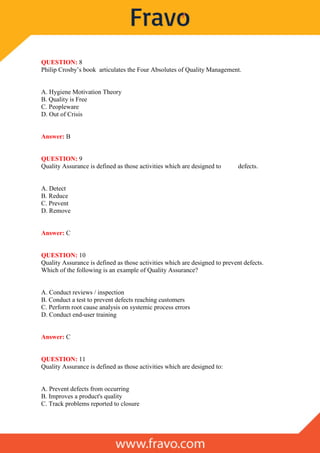
QUESTION: 8
Philip Crosby’s book articulates the Four Absolutes of Quality Management.
A. Hygiene Motivation Theory
B. Quality is Free
C. Peopleware
D. Out of Crisis
Answer: B
QUESTION: 9
Quality Assurance is defined as those activities which are designed to defects.
A. Detect
B. Reduce
C. Prevent
D. Remove
Answer: C
QUESTION: 10
Quality Assurance is defined as those activities which are designed to prevent defects.
Which of the following is an example of Quality Assurance?
A. Conduct reviews / inspection
B. Conduct a test to prevent defects reaching customers
C. Perform root cause analysis on systemic process errors
D. Conduct end-user training
Answer: C
QUESTION: 11
Quality Assurance is defined as those activities which are designed to:
A. Prevent defects from occurring
B. Improves a product's quality
C. Track problems reported to closure
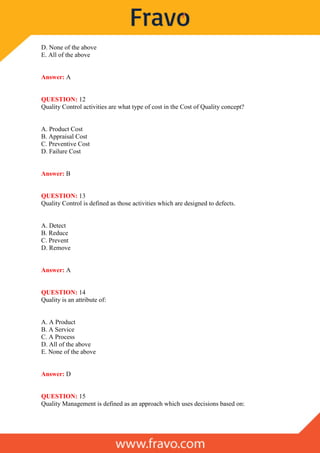
D. None of the above
E. All of the above
Answer: A
QUESTION: 12
Quality Control activities are what type of cost in the Cost of Quality concept?
A. Product Cost
B. Appraisal Cost
C. Preventive Cost
D. Failure Cost
Answer: B
QUESTION: 13
Quality Control is defined as those activities which are designed to defects.
A. Detect
B. Reduce
C. Prevent
D. Remove
Answer: A
QUESTION: 14
Quality is an attribute of:
A. A Product
B. A Service
C. A Process
D. All of the above
E. None of the above
Answer: D
QUESTION: 15
Quality Management is defined as an approach which uses decisions based on:
A. Budget, Schedule, Information
B. Logic, Facts, Schedule
C. Facts, Data, Logic
D. None of the above
Answer: C
QUESTION: 16
The is used to organize large quantities of suggestions, ideas, and comments into
groupings for later analysis.
A. Affinity Diagram
B. Cause-and-Effect Diagram
C. Control Chart
D. Regression Analysis
E. Bar Chart
Answer: A
QUESTION: 17
The “Cause and Effect Diagram” is used to:
A. Enhance Customer Satisfaction
B. Perform Root Cause Analysis
C. Reducing Product Costs
D. None of the above
Answer: B
QUESTION: 18
The advantage of the Earned Value approach is that it allows the early detection of
slippage by using an industry standard approach to:
A. Measure a project’s actual progress
B. Forecast both project completion date and final cost
C. Track schedule and budget throughout the project life cycle
D. All of the above
E. None of the above
Answer: D
QUESTION: 19
The application of the Pareto Principle helps to focus an organization’s attention on the
critical few issues or activities that will result in the greatest benefit. What percentage are
typically referred to as the "critical few"?
A. 20%
B. 40%
C. 60%
D. 80%
Answer: A
QUESTION: 20
The components that make up the cost-of-quality are:
A. Preventive, Appraisal, and Failure Costs
B. Preventive, Dynamic Testing, and Static Testing
C. Productivity, Efficiency, Effectiveness, and Reliability
D. Run Chart, Pareto Chart, Scatter Plot, and Histogram
E. None of the above
Answer: A
Fravo
Thank You
http://www.fravo.com/CABA-exams.html
Purchase This Exam on 15% discount
Use our Discount voucher "fravo15off" to get 15% discount on this Product.
For more details and 24/7 help please visit our Website
http://www.fravo.com/
For Choosing our Quality Product CABA PDF Demo
For our CABA Exam Material as PDF and Simulated Test Engine Please visit our Website

Top Software Certifications CABA Exam Questions

  • 1.
    FravoGetCertified & Secure yourFuture IT Certification leadersin simulated test engines & guides Certified Associate Business Analyst Exam: CABA Demo Edition
  • 2.
    QUESTION: 1 _______________ defectsare more expensive to correct when found during the UAT phase than duringother phases. A. Requirements Phase B. Design Phase C. Testing Phase D. None Answer: A QUESTION: 2 A determination of the current internal level of performance in one or more clearly defined areas is thedefinition of . A. Baselining B. Benchmarking C. Regression Analysis D. Inspection Answer: A QUESTION: 3 Code Debug, Re-test, and Post Warranty Maintenance are the examples for: A. Preventive Cost B. Appraisal Costs C. Failure Costs D. All the above E. None of the above Answer: C QUESTION: 4 Force Field Analysis is a structured approach for identifying and evaluating the forces that will promote, encourage, and support change and those that will resist change. A. True B. False
  • 3.
    Answer: A QUESTION: 5 ForceField Analysis is a structured approach for identifying and evaluating the forces that will promote, encourage, and support change and those that will resist change. These forces are: A. Driving Forces B. Restraining Forces C. Resolving Forces D. A and B E. B and C Answer: D QUESTION: 6 Inspections, reviews, and dynamic testing are activities in the Software Development Lifecycle (SDLC). A. Training B. Quality Assurance C. TQM D. Quality Control E. Risk Analysis Answer: D QUESTION: 7 It is essential to establish a before the improvement activities are undertaken so it is possible to demonstrate the nature and extent of improvement. A. Baseline B. Defined Process C. Training Program D. All the above E. None of the above Answer: A
  • 4.
    QUESTION: 8 Philip Crosby’sbook articulates the Four Absolutes of Quality Management. A. Hygiene Motivation Theory B. Quality is Free C. Peopleware D. Out of Crisis Answer: B QUESTION: 9 Quality Assurance is defined as those activities which are designed to defects. A. Detect B. Reduce C. Prevent D. Remove Answer: C QUESTION: 10 Quality Assurance is defined as those activities which are designed to prevent defects. Which of the following is an example of Quality Assurance? A. Conduct reviews / inspection B. Conduct a test to prevent defects reaching customers C. Perform root cause analysis on systemic process errors D. Conduct end-user training Answer: C QUESTION: 11 Quality Assurance is defined as those activities which are designed to: A. Prevent defects from occurring B. Improves a product's quality C. Track problems reported to closure
  • 5.
    D. None ofthe above E. All of the above Answer: A QUESTION: 12 Quality Control activities are what type of cost in the Cost of Quality concept? A. Product Cost B. Appraisal Cost C. Preventive Cost D. Failure Cost Answer: B QUESTION: 13 Quality Control is defined as those activities which are designed to defects. A. Detect B. Reduce C. Prevent D. Remove Answer: A QUESTION: 14 Quality is an attribute of: A. A Product B. A Service C. A Process D. All of the above E. None of the above Answer: D QUESTION: 15 Quality Management is defined as an approach which uses decisions based on:
  • 6.
    A. Budget, Schedule,Information B. Logic, Facts, Schedule C. Facts, Data, Logic D. None of the above Answer: C QUESTION: 16 The is used to organize large quantities of suggestions, ideas, and comments into groupings for later analysis. A. Affinity Diagram B. Cause-and-Effect Diagram C. Control Chart D. Regression Analysis E. Bar Chart Answer: A QUESTION: 17 The “Cause and Effect Diagram” is used to: A. Enhance Customer Satisfaction B. Perform Root Cause Analysis C. Reducing Product Costs D. None of the above Answer: B QUESTION: 18 The advantage of the Earned Value approach is that it allows the early detection of slippage by using an industry standard approach to: A. Measure a project’s actual progress B. Forecast both project completion date and final cost C. Track schedule and budget throughout the project life cycle D. All of the above E. None of the above
  • 7.
    Answer: D QUESTION: 19 Theapplication of the Pareto Principle helps to focus an organization’s attention on the critical few issues or activities that will result in the greatest benefit. What percentage are typically referred to as the "critical few"? A. 20% B. 40% C. 60% D. 80% Answer: A QUESTION: 20 The components that make up the cost-of-quality are: A. Preventive, Appraisal, and Failure Costs B. Preventive, Dynamic Testing, and Static Testing C. Productivity, Efficiency, Effectiveness, and Reliability D. Run Chart, Pareto Chart, Scatter Plot, and Histogram E. None of the above Answer: A
  • 8.
    Fravo Thank You http://www.fravo.com/CABA-exams.html Purchase ThisExam on 15% discount Use our Discount voucher "fravo15off" to get 15% discount on this Product. For more details and 24/7 help please visit our Website http://www.fravo.com/ For Choosing our Quality Product CABA PDF Demo For our CABA Exam Material as PDF and Simulated Test Engine Please visit our Website