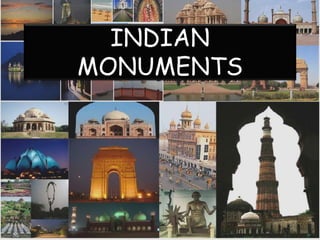
INDIAN
MONUMENTS
Introduction
• Indian monuments are popular worldwide for
its beauty
• Human imagination and thoughts
• Kings and emperors expressed their ideas in
bricks, marble, stone and mortars
• Lot of history and the culture in the bygone
age.
• monuments are centuries old and have been
examples of philosophies in the world
Taj Mahal
• Location: Agra, Uttar
Pradesh.
• Best time to
travel: October to March.
• Architectural
style: Mughal architecture.
• Famous As: One among
the 7 Wonders of the world
Taj Mahal
• Built by a 3rd Mughal Emperor called
Shahajahan in the memory of his beloved wife.
• It took 12 years of hard labour and 20,000
labourers to build the mausoleum
• Combination of elements of person, Indian and
Islamic
• The most fascinating feature -water channels,
lotus pools and colourful flowerbeds and trees.
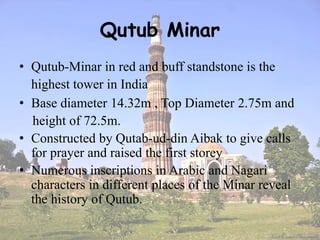
Qutub Minar
• Location: Mehrauli, New
Delhi.
• Built in the year: 12th
century.
• Best time to
travel: February to April.
• Architecture:Afghan
Architecture
Qutub Minar
• Qutub-Minar in red and buff standstone is the
highest tower in India
• Base diameter 14.32m , Top Diameter 2.75m and
height of 72.5m.
• Constructed by Qutab-ud-din Aibak to give calls
for prayer and raised the first storey
• Numerous inscriptions in Arabic and Nagari
characters in different places of the Minar reveal
the history of Qutub.
India Gate
• Location: Rajpath, New
Delhi.
• Famous for: All India
War Memorial
• The monument was
built in the
year: February , 1921.
• Designed by: Edwin
Lutyens.
• Height: 42m.
India Gate
• The gate was built in memory to the of the
90,000 Indian soldiers who laid down their
lives during World War I
• The names of all the soldiers who died during
the World War I are inscribed on the walls of
the Gate
• Amar Jawan Jyoti, an eternal flame, burns 24
hours
Red Fort(Lal Qila)
• Location: Chandni
Chowk, New Delhi.
• Built in the year: 17th
century
• Built By: Mughal
emperor Shah Jahan
• Best time to
travel: October and
March.
Red Fort(Lal Qila)
• In 1638 when the emperor moved the capital
of India from Agra to Delhi
• The royal palace is made of white marble and
decorated in gold and precious stones
• Diwan-i-khas –Audience Hall , Shah Burj -
secret Meetings
Khajuraho Temples
• Location of the site:
Khajuharo, Madhya
Pradesh
• Famous For:erotic art
sculptures and carved
temples and Dance
Festival
• Significance:World
Heritage Site
• Nearby
attractions:Panna
Wildlife Sanctuary
Khajuraho Temples
• These temples were built by the Chandella
ruler between AD 900 and 1130
• Out of 85 temples of Khajuraho only 25
temples are surviving after various stages of
preservation and care
• Festival of Dances is celebrated at a time when
the hardness of winter begins to fade
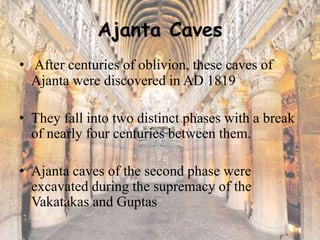
Ajanta Caves
• Location of the site:
• 99-km From Aurangabad,
Maharashtra
• Significance:World
Heritage Site
• Total Caves:30
• Built During : 2nd
Century BC To 6th
Century AD
Ajanta Caves
• After centuries of oblivion, these caves of
Ajanta were discovered in AD 1819
• They fall into two distinct phases with a break
of nearly four centuries between them.
• Ajanta caves of the second phase were
excavated during the supremacy of the
Vakatakas and Guptas
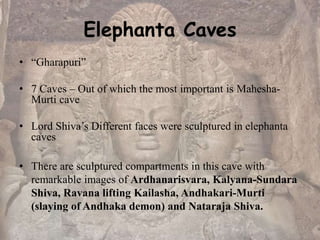
Elephanta Caves
• Location:Near Mumbai
• Carved Between:9th
And 12th Centuries AD
• Designated As:World
Heritage Site
• Famous For:Lord
Shiva temple
Elephanta Caves
• “Gharapuri”
• 7 Caves – Out of which the most important is Mahesha-
Murti cave
• Lord Shiva’s Different faces were sculptured in elephanta
caves
• There are sculptured compartments in this cave with
remarkable images of Ardhanarisvara, Kalyana-Sundara
Shiva, Ravana lifting Kailasha, Andhakari-Murti
(slaying of Andhaka demon) and Nataraja Shiva.
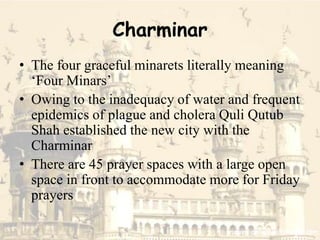
Charminar
• Location: Hyderabad,
Andhra Pradesh.
• Best time to
travel: October to
February.
• The monument was
built in the year: 1591
AD.
• Built by: Mohammad
Quli Qutub Shah.
• Architecture
Style:Islamic
Charminar
• The four graceful minarets literally meaning
‘Four Minars’
• Owing to the inadequacy of water and frequent
epidemics of plague and cholera Quli Qutub
Shah established the new city with the
Charminar
• There are 45 prayer spaces with a large open
space in front to accommodate more for Friday
prayers
Agra Fort
• Location: Agra City.
• Built in the year: AD
1565-75
• Built By: emperors
Akbar , Jahangir , Shah
Jahan
Agra Fort
• Stone fortifications were used to replace the older
brick foot
• The architectural styles of the three emperors who
ruled from the Agra Fort.
• Multi-storeyed Jahangiri Mahal - Built by Akbar for
his wife, Jodha Bai, the Mahal is reached through
an impressive gateway.
• Agra fort is the second most attractive monument of
Agra city
Lotus Temple
• Location : Kalkaji in
New Delhi
• Famous for : Bahai
religion
• Opened to the public in
1986 after 10 years of
construction
• Designed by: Persian
architect Fariborz Sahba
from Canada
Lotus Temple
• The lotus is regarded as a symbol of peace,
purity, love and immortality.
• 27 freestanding petals made of marble.
• Over 800 engineers, technicians, workers and
artisans worked on the construction of the
Lotus Temple.
• Bahai religion -Baha-ullah.
• open to people from all religions.
Conclusion
• India has a rich heritage which includes a
repository of archaeological treasures and
incredible monuments.
• It is the responsibility of the civil society to
transfer that heritage to the next generation.
• Avoid inscribe their initials, names, places,
addresses or messages on these national
treasures
Indian monuments
Indian monuments

Indian monuments

  • 1.
  • 2.
    Introduction • Indian monumentsare popular worldwide for its beauty • Human imagination and thoughts • Kings and emperors expressed their ideas in bricks, marble, stone and mortars • Lot of history and the culture in the bygone age. • monuments are centuries old and have been examples of philosophies in the world
  • 3.
    Taj Mahal • Location:Agra, Uttar Pradesh. • Best time to travel: October to March. • Architectural style: Mughal architecture. • Famous As: One among the 7 Wonders of the world
  • 4.
    Taj Mahal • Builtby a 3rd Mughal Emperor called Shahajahan in the memory of his beloved wife. • It took 12 years of hard labour and 20,000 labourers to build the mausoleum • Combination of elements of person, Indian and Islamic • The most fascinating feature -water channels, lotus pools and colourful flowerbeds and trees.
  • 5.
    Qutub Minar • Location:Mehrauli, New Delhi. • Built in the year: 12th century. • Best time to travel: February to April. • Architecture:Afghan Architecture
  • 6.
    Qutub Minar • Qutub-Minarin red and buff standstone is the highest tower in India • Base diameter 14.32m , Top Diameter 2.75m and height of 72.5m. • Constructed by Qutab-ud-din Aibak to give calls for prayer and raised the first storey • Numerous inscriptions in Arabic and Nagari characters in different places of the Minar reveal the history of Qutub.
  • 7.
    India Gate • Location:Rajpath, New Delhi. • Famous for: All India War Memorial • The monument was built in the year: February , 1921. • Designed by: Edwin Lutyens. • Height: 42m.
  • 8.
    India Gate • Thegate was built in memory to the of the 90,000 Indian soldiers who laid down their lives during World War I • The names of all the soldiers who died during the World War I are inscribed on the walls of the Gate • Amar Jawan Jyoti, an eternal flame, burns 24 hours
  • 9.
    Red Fort(Lal Qila) •Location: Chandni Chowk, New Delhi. • Built in the year: 17th century • Built By: Mughal emperor Shah Jahan • Best time to travel: October and March.
  • 10.
    Red Fort(Lal Qila) •In 1638 when the emperor moved the capital of India from Agra to Delhi • The royal palace is made of white marble and decorated in gold and precious stones • Diwan-i-khas –Audience Hall , Shah Burj - secret Meetings
  • 11.
    Khajuraho Temples • Locationof the site: Khajuharo, Madhya Pradesh • Famous For:erotic art sculptures and carved temples and Dance Festival • Significance:World Heritage Site • Nearby attractions:Panna Wildlife Sanctuary
  • 12.
    Khajuraho Temples • Thesetemples were built by the Chandella ruler between AD 900 and 1130 • Out of 85 temples of Khajuraho only 25 temples are surviving after various stages of preservation and care • Festival of Dances is celebrated at a time when the hardness of winter begins to fade
  • 13.
    Ajanta Caves • Locationof the site: • 99-km From Aurangabad, Maharashtra • Significance:World Heritage Site • Total Caves:30 • Built During : 2nd Century BC To 6th Century AD
  • 14.
    Ajanta Caves • Aftercenturies of oblivion, these caves of Ajanta were discovered in AD 1819 • They fall into two distinct phases with a break of nearly four centuries between them. • Ajanta caves of the second phase were excavated during the supremacy of the Vakatakas and Guptas
  • 15.
    Elephanta Caves • Location:NearMumbai • Carved Between:9th And 12th Centuries AD • Designated As:World Heritage Site • Famous For:Lord Shiva temple
  • 16.
    Elephanta Caves • “Gharapuri” •7 Caves – Out of which the most important is Mahesha- Murti cave • Lord Shiva’s Different faces were sculptured in elephanta caves • There are sculptured compartments in this cave with remarkable images of Ardhanarisvara, Kalyana-Sundara Shiva, Ravana lifting Kailasha, Andhakari-Murti (slaying of Andhaka demon) and Nataraja Shiva.
  • 17.
    Charminar • Location: Hyderabad, AndhraPradesh. • Best time to travel: October to February. • The monument was built in the year: 1591 AD. • Built by: Mohammad Quli Qutub Shah. • Architecture Style:Islamic
  • 18.
    Charminar • The fourgraceful minarets literally meaning ‘Four Minars’ • Owing to the inadequacy of water and frequent epidemics of plague and cholera Quli Qutub Shah established the new city with the Charminar • There are 45 prayer spaces with a large open space in front to accommodate more for Friday prayers
  • 19.
    Agra Fort • Location:Agra City. • Built in the year: AD 1565-75 • Built By: emperors Akbar , Jahangir , Shah Jahan
  • 20.
    Agra Fort • Stonefortifications were used to replace the older brick foot • The architectural styles of the three emperors who ruled from the Agra Fort. • Multi-storeyed Jahangiri Mahal - Built by Akbar for his wife, Jodha Bai, the Mahal is reached through an impressive gateway. • Agra fort is the second most attractive monument of Agra city
  • 21.
    Lotus Temple • Location: Kalkaji in New Delhi • Famous for : Bahai religion • Opened to the public in 1986 after 10 years of construction • Designed by: Persian architect Fariborz Sahba from Canada
  • 22.
    Lotus Temple • Thelotus is regarded as a symbol of peace, purity, love and immortality. • 27 freestanding petals made of marble. • Over 800 engineers, technicians, workers and artisans worked on the construction of the Lotus Temple. • Bahai religion -Baha-ullah. • open to people from all religions.
  • 23.
    Conclusion • India hasa rich heritage which includes a repository of archaeological treasures and incredible monuments. • It is the responsibility of the civil society to transfer that heritage to the next generation. • Avoid inscribe their initials, names, places, addresses or messages on these national treasures