1
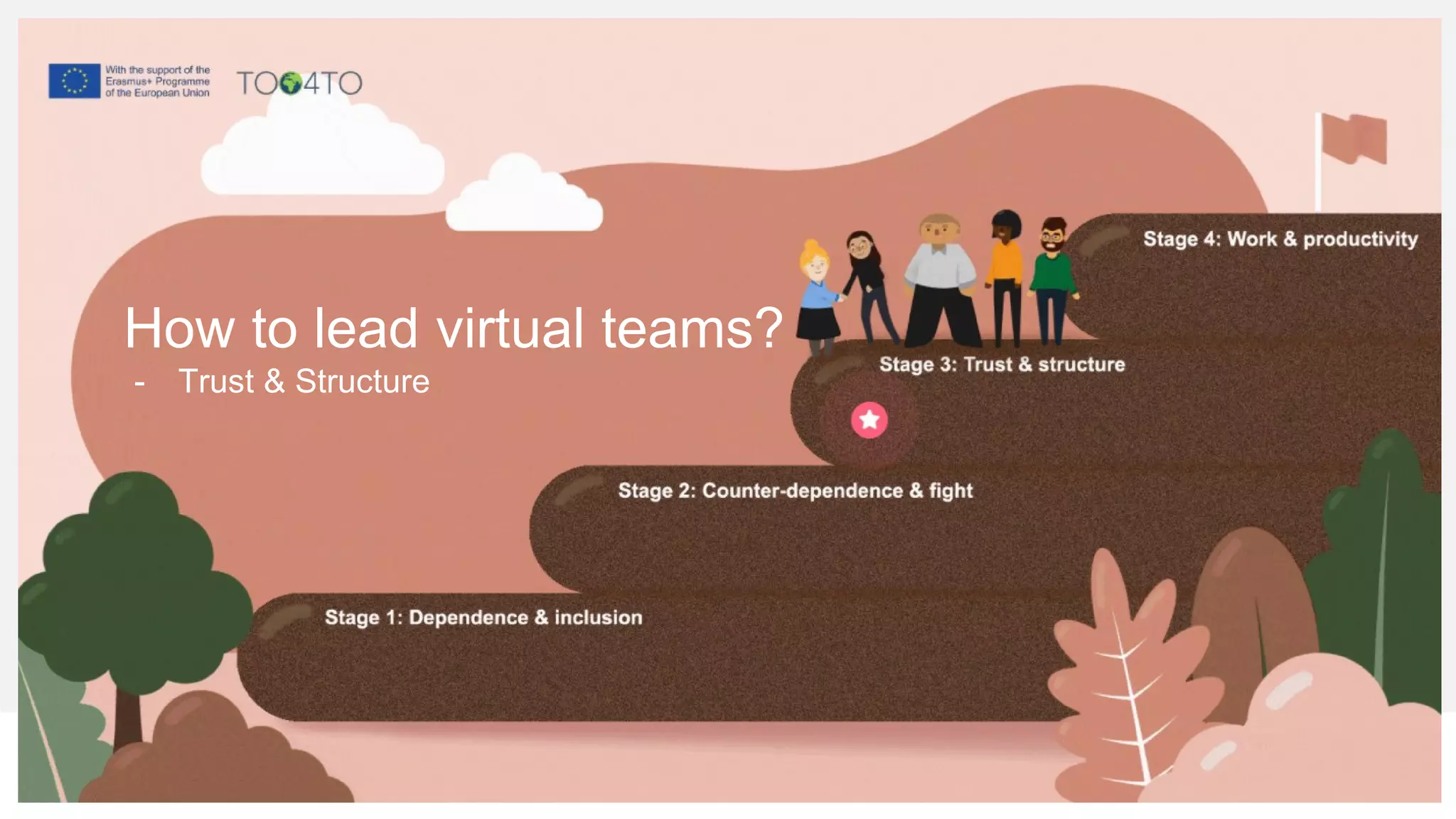
How to lead virtual teams?
- Trust & Structure
CONTENT
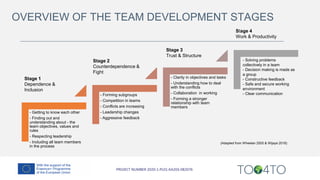
Overview of the Team development stages
Facilitate your team!
• Facilitating and motivating the teams
○ intrinsic motivation
• Engaging in learning and knowledge creation
• Minimizing the risks of social isolation
Recommendations for the virtual team leaders at stage 3
References & Suggested readings
2
- Getting to know each other
- Finding out and
understanding about - the
team objectives, values and
rules
- Respecting leadership
- Including all team members
in the process
- Forming subgroups
- Competition in teams
- Conflicts are increasing
- Leadership changes
- Aggressive feedback
- Clarity in objectives and tasks
- Understanding how to deal
with the conflicts
- Collaboration in working
- Forming a stronger
relationship with team
members
- Solving problems
collectively in a team
- Decision making is made as
a group
- Constructive feedback
- Safe and secure working
environment
- Clear communication
Stage 1
Dependence &
Inclusion
Stage 2
Counterdependence &
Fight
Stage 3
Trust & Structure
Stage 4
Work & Productivity
OVERVIEW OF THE TEAM DEVELOPMENT STAGES
(Adapted from Wheelan 2005 & Wijaya 2018)
FACILITATE YOUR TEAM!
Stage 3 is called Trust and Structure
At this stage communication becomes more open and flexible, and
information sharing increases. Positive relationships between
members allow the team to carry out more mature negotiations about
their goals and procedures and the team is working with efficiency.
The leader´s role is shifting from advisory towards guidance and
egalitarianism is preferred in the decision-making. (Vaida & Serban
2021, 105).
Critical factors for the virtual team success at this stage are:
• Facilitating and motivating the teams (intrinsic motivation)
• Engaging in learning and knowledge creation
• Minimizing the risks of social isolation
4
MOTIVATE YOUR VIRTUAL TEAM
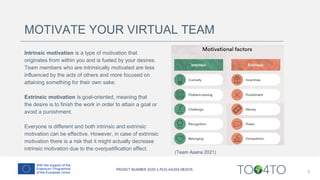
Intrinsic motivation is a type of motivation that
originates from within you and is fueled by your desires.
Team members who are intrinsically motivated are less
influenced by the acts of others and more focused on
attaining something for their own sake.
Extrinsic motivation is goal-oriented, meaning that
the desire is to finish the work in order to attain a goal or
avoid a punishment.
Everyone is different and both intrinsic and extrinsic
motivation can be effective. However, in case of extrinsic
motivation there is a risk that it might actually decrease
intrinsic motivation due to the overjustification effect.
5
(Team Asana 2021)
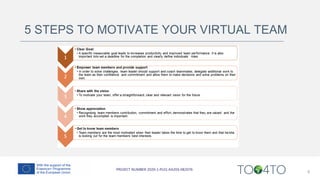
5 STEPS TO MOTIVATE YOUR VIRTUAL TEAM
6
TEAM LEARNING
● involves the interaction amongst team members
related to gathering, sharing, processing, and acting
on knowledge
● requires a level of agreement among team
members about acceptable patterns of behavior for
knowledge sharing
● improvement (or deterioration) for the team as a
result of this interaction
(Kayes & Burnett 2006)
8
ENGAGE IN LEARNING AND KNOWLEDGE CREATION
TIPS to the VT leaders and members
● create the environment where team members are
encouraged to speak freely and share their even
crazy ideas/thoughts (e.g. common virtual space
where brainstorming can be carried out, etc.)
● encourage others to share what they know and
make sure that there is time for common learning
within the team
● be open to new, extraordinary ideas, as well as
constructive criticism
● do not be too critical towards the ideas of
others - it may discourage them from sharing
their knowledge
9
● make the knowledge possessed by team members
easily accessible, e.g. in a shared folder; with the use
of a communication tool, during informal meetings and
knowledge sharing, etc.
● keep the record of the progress in tasks realization
and solve all the problematic issues at once
● let the knowledge flow freely between members - it
will also allow to achieve the synergy effect and support
the creation of new knowledge.
● learn from mistakes!
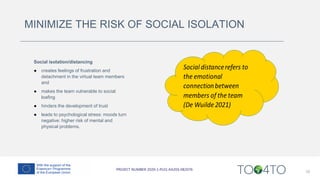
MINIMIZE THE RISK OF SOCIAL ISOLATION
Social isolation/distancing
● creates feelings of frustration and
detachment in the virtual team members
and
● makes the team vulnerable to social
loafing
● hinders the development of trust
● leads to psychological stress: moods turn
negative: higher risk of mental and
physical problems.
10
RECOMMENDATIONS FOR THE LEADER
11
• listen and be present
• allow to form subgroups
• organize informal meetings
• stay in regular touch
• assign buddies and peer coaches to add a layer of
mutual support
• continually gauge stress and engagement levels
(emotional intelligence needed)
• model optimism and drain the team of fear
• support continued learning (Clarc 2020).
REFERENCES & SUGGESTED READINGS
12
• Clark, T.R. (2020) 8 Ways to Manage Your Team While Social Distancing. HBR https://hbr.org/2020/03/8-ways-to-
manage-your-team-while-social-distancing
• Kayes, D. C., & Burnett, G. (2006). G.: Team learning in organizations A review and integration. In In: OLKC 2006
Conference .warwick.ac.uk/fac/soc/wbs/conf/olkc/archive/olkc1/papers/177_kayes.pdf
• Team Asana (2021). What is intrinsic motivation and how does it work? What Is Intrinsic Motivation and How Does It
Work?
• Vaida, S. & Șerban, D. (2021). Group Development Stages. A Brief Comparative Analysis of Various Models. Studia
Universitatis Babeș-Bolyai. Psychologia-Paedagogia, 66(1), 91-110.
• Wheelan, S. (2005). Group Processes: A Developmental Perspective. Boston, MA, USA: Allyn Bacon.
• De Wilde, A, (2021). Successfully managing social distance in your global team with a SPLIT framework.
https://totalent.eu/successfully-managing-social-distance-in-your-global-team-with-a-split-framework/
13
THANK YOU!
Visit our interactive guide “How to Lead Virtual Teams” to learn
more!
The guide is available at too4to.eu
This presentation is part of TOO4TO-project. This project has been funded with
support from the European Commission. This content reflects the views only of the
authors, and the Commission cannot be held responsible for any use which may be
made of the information contained therein.

TOO4TO_ virtual guide theories stage 3 .pdf

  • 1.
    1 How to leadvirtual teams? - Trust & Structure
  • 2.
    CONTENT Overview of theTeam development stages Facilitate your team! • Facilitating and motivating the teams ○ intrinsic motivation • Engaging in learning and knowledge creation • Minimizing the risks of social isolation Recommendations for the virtual team leaders at stage 3 References & Suggested readings 2
  • 3.
    - Getting toknow each other - Finding out and understanding about - the team objectives, values and rules - Respecting leadership - Including all team members in the process - Forming subgroups - Competition in teams - Conflicts are increasing - Leadership changes - Aggressive feedback - Clarity in objectives and tasks - Understanding how to deal with the conflicts - Collaboration in working - Forming a stronger relationship with team members - Solving problems collectively in a team - Decision making is made as a group - Constructive feedback - Safe and secure working environment - Clear communication Stage 1 Dependence & Inclusion Stage 2 Counterdependence & Fight Stage 3 Trust & Structure Stage 4 Work & Productivity OVERVIEW OF THE TEAM DEVELOPMENT STAGES (Adapted from Wheelan 2005 & Wijaya 2018)
  • 4.
    FACILITATE YOUR TEAM! Stage3 is called Trust and Structure At this stage communication becomes more open and flexible, and information sharing increases. Positive relationships between members allow the team to carry out more mature negotiations about their goals and procedures and the team is working with efficiency. The leader´s role is shifting from advisory towards guidance and egalitarianism is preferred in the decision-making. (Vaida & Serban 2021, 105). Critical factors for the virtual team success at this stage are: • Facilitating and motivating the teams (intrinsic motivation) • Engaging in learning and knowledge creation • Minimizing the risks of social isolation 4
  • 5.
    MOTIVATE YOUR VIRTUALTEAM Intrinsic motivation is a type of motivation that originates from within you and is fueled by your desires. Team members who are intrinsically motivated are less influenced by the acts of others and more focused on attaining something for their own sake. Extrinsic motivation is goal-oriented, meaning that the desire is to finish the work in order to attain a goal or avoid a punishment. Everyone is different and both intrinsic and extrinsic motivation can be effective. However, in case of extrinsic motivation there is a risk that it might actually decrease intrinsic motivation due to the overjustification effect. 5 (Team Asana 2021)
  • 6.
    5 STEPS TOMOTIVATE YOUR VIRTUAL TEAM 6
  • 7.
    TEAM LEARNING ● involvesthe interaction amongst team members related to gathering, sharing, processing, and acting on knowledge ● requires a level of agreement among team members about acceptable patterns of behavior for knowledge sharing ● improvement (or deterioration) for the team as a result of this interaction (Kayes & Burnett 2006) 8
  • 8.
    ENGAGE IN LEARNINGAND KNOWLEDGE CREATION TIPS to the VT leaders and members ● create the environment where team members are encouraged to speak freely and share their even crazy ideas/thoughts (e.g. common virtual space where brainstorming can be carried out, etc.) ● encourage others to share what they know and make sure that there is time for common learning within the team ● be open to new, extraordinary ideas, as well as constructive criticism ● do not be too critical towards the ideas of others - it may discourage them from sharing their knowledge 9 ● make the knowledge possessed by team members easily accessible, e.g. in a shared folder; with the use of a communication tool, during informal meetings and knowledge sharing, etc. ● keep the record of the progress in tasks realization and solve all the problematic issues at once ● let the knowledge flow freely between members - it will also allow to achieve the synergy effect and support the creation of new knowledge. ● learn from mistakes!
  • 9.
    MINIMIZE THE RISKOF SOCIAL ISOLATION Social isolation/distancing ● creates feelings of frustration and detachment in the virtual team members and ● makes the team vulnerable to social loafing ● hinders the development of trust ● leads to psychological stress: moods turn negative: higher risk of mental and physical problems. 10
  • 10.
    RECOMMENDATIONS FOR THELEADER 11 • listen and be present • allow to form subgroups • organize informal meetings • stay in regular touch • assign buddies and peer coaches to add a layer of mutual support • continually gauge stress and engagement levels (emotional intelligence needed) • model optimism and drain the team of fear • support continued learning (Clarc 2020).
  • 11.
    REFERENCES & SUGGESTEDREADINGS 12 • Clark, T.R. (2020) 8 Ways to Manage Your Team While Social Distancing. HBR https://hbr.org/2020/03/8-ways-to- manage-your-team-while-social-distancing • Kayes, D. C., & Burnett, G. (2006). G.: Team learning in organizations A review and integration. In In: OLKC 2006 Conference .warwick.ac.uk/fac/soc/wbs/conf/olkc/archive/olkc1/papers/177_kayes.pdf • Team Asana (2021). What is intrinsic motivation and how does it work? What Is Intrinsic Motivation and How Does It Work? • Vaida, S. & Șerban, D. (2021). Group Development Stages. A Brief Comparative Analysis of Various Models. Studia Universitatis Babeș-Bolyai. Psychologia-Paedagogia, 66(1), 91-110. • Wheelan, S. (2005). Group Processes: A Developmental Perspective. Boston, MA, USA: Allyn Bacon. • De Wilde, A, (2021). Successfully managing social distance in your global team with a SPLIT framework. https://totalent.eu/successfully-managing-social-distance-in-your-global-team-with-a-split-framework/
  • 12.
    13 THANK YOU! Visit ourinteractive guide “How to Lead Virtual Teams” to learn more! The guide is available at too4to.eu This presentation is part of TOO4TO-project. This project has been funded with support from the European Commission. This content reflects the views only of the authors, and the Commission cannot be held responsible for any use which may be made of the information contained therein.