Tonality


GCSE Listening
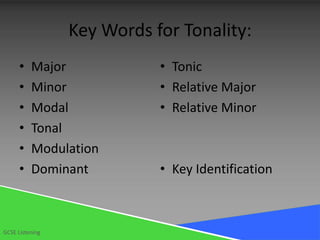
Key Words for Tonality:
      •   Major             • Tonic
      •   Minor             • Relative Major
      •   Modal             • Relative Minor
      •   Tonal
      •   Modulation
      •   Dominant          • Key Identification


GCSE Listening
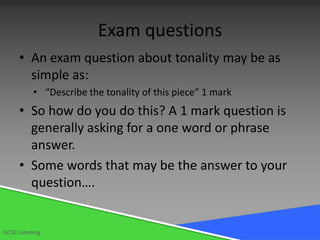
Exam questions
      • An exam question about tonality may be as
        simple as:
           • “Describe the tonality of this piece” 1 mark
      • So how do you do this? A 1 mark question is
        generally asking for a one word or phrase
        answer.
      • Some words that may be the answer to your
        question….


GCSE Listening
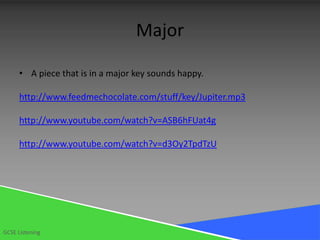
Major

      • A piece that is in a major key sounds happy.

      http://www.feedmechocolate.com/stuff/key/Jupiter.mp3

      http://www.youtube.com/watch?v=ASB6hFUat4g

      http://www.youtube.com/watch?v=d3Oy2TpdTzU


GCSE Listening
Minor
      • A piece in a minor sounds sad

      • http://www.youtube.com/watch?v=whhAMSS
        exQ8


GCSE Listening
Modal
      • Modal music is in a mode. Modes are 7 note
        scales. They sound as if notes have been
        missed out of the scale.
      • Modal music is hard to spot so be careful!
        Listen carefully. It’s often found in jazz, folk
        and pop music.


GCSE Listening
Modulation
      • Modulation means that you change the key of the piece. This
        happens a lot in pop songs, near the end, normally for a
        repeated chorus.

      • The 3 most closely related keys are the relative major, the
        relative minor or the dominant. It is usually one of these that
        piece modulate into (especially in popular music).


GCSE Listening
Dominant Key
      • Changing to the dominant key

      • If it was major before and major still it will
        most probably have modulated to the
        dominant key


GCSE Listening
Modulation
      • http://www.youtube.com/watch?v=_1_MydgRFZw&feature=r
        elmfu


      • http://www.youtube.com/watch?v=PivWY9wn5ps&ob=av3e


GCSE Listening

Tonality

  • 1.
  • 2.
    Key Words forTonality: • Major • Tonic • Minor • Relative Major • Modal • Relative Minor • Tonal • Modulation • Dominant • Key Identification GCSE Listening
  • 3.
    Exam questions • An exam question about tonality may be as simple as: • “Describe the tonality of this piece” 1 mark • So how do you do this? A 1 mark question is generally asking for a one word or phrase answer. • Some words that may be the answer to your question…. GCSE Listening
  • 4.
    Major • A piece that is in a major key sounds happy. http://www.feedmechocolate.com/stuff/key/Jupiter.mp3 http://www.youtube.com/watch?v=ASB6hFUat4g http://www.youtube.com/watch?v=d3Oy2TpdTzU GCSE Listening
  • 5.
    Minor • A piece in a minor sounds sad • http://www.youtube.com/watch?v=whhAMSS exQ8 GCSE Listening
  • 6.
    Modal • Modal music is in a mode. Modes are 7 note scales. They sound as if notes have been missed out of the scale. • Modal music is hard to spot so be careful! Listen carefully. It’s often found in jazz, folk and pop music. GCSE Listening
  • 7.
    Modulation • Modulation means that you change the key of the piece. This happens a lot in pop songs, near the end, normally for a repeated chorus. • The 3 most closely related keys are the relative major, the relative minor or the dominant. It is usually one of these that piece modulate into (especially in popular music). GCSE Listening
  • 8.
    Dominant Key • Changing to the dominant key • If it was major before and major still it will most probably have modulated to the dominant key GCSE Listening
  • 9.
    Modulation • http://www.youtube.com/watch?v=_1_MydgRFZw&feature=r elmfu • http://www.youtube.com/watch?v=PivWY9wn5ps&ob=av3e GCSE Listening