













Building Natural
Language Generation
(NLG) Systems
Ross Turner
Tomorrow’s Language Technology, Berlin 17/09/15
Agenda
1.  Brief introduction
2.  NLG in 10 minutes
3.  Case study: NLG in Weather Services
4.  Statistical approaches to NLG
5.  Where next?
2
Who am I?
My Profile
•  Current: Principal Engineer, Arria NLG plc
•  Formerly:
–  Senior Software Engineer, Nokia Berlin
–  Post-doctoral Research Fellow, Universities of Edinburgh and
Aberdeen
•  PhD in Applied NLG systems in 2009
4
What is

Natural Language Generation (NLG)
exactly?
NLG Synopsis

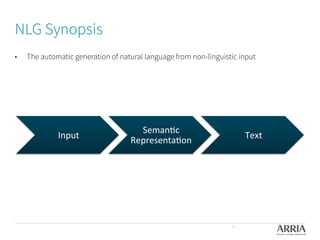
•  The automatic generation of natural language from non-linguistic input
6
Input	
  
Seman+c	
  
Representa+on	
  
Text	
  
Example
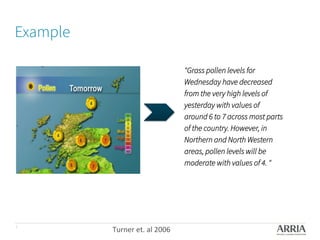
"Grass pollen levels for
Wednesday have decreased
from the very high levels of
yesterday with values of
around 6 to 7 across most parts
of the country. However, in
Northern and North Western
areas, pollen levels will be
moderate with values of 4. " 

7
Turner	
  et.	
  al	
  2006	
  
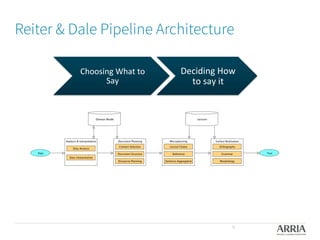
Reiter & Dale Pipeline Architecture

8
Choosing	
  What	
  to	
  
Say	
  
Deciding	
  How	
  
to	
  say	
  it	
  
System Building

•  Development requires example input data and corresponding output text
•  Systems are usually knowledge-based and domain-specific, but statistical
approaches are becoming more commonplace
•  Evaluations typically use:
–  Automated metrics against a gold standard
–  Human ratings
–  Task-based evaluations
9
What about applications?
Commercial Applications
•  NLG Commercialisation has been relatively recent
•  Many systems developed in Healthcare, Meteorology, Finance etc. 
•  Most common applications are so called “data-to-text” systems that
provide decision support
11
Benefits
•  Scalability, cost-efficiencies, automation of routine reporting etc. 
•  Task-based evaluations have highlighted the benefits of textual
presentations of data:
–  Medical staff made better decisions (Law et al. 2005)
–  Mobile phone users exhibited superior task performance (Langan-Fox
et al. 2006)
12
Can NLG produce high quality texts?
Output Variation and Quality
•  NLG systems have been developed to generate:
–  Narrative Prose (Callaway 2002) 
–  Poetry (Manurung 2003)
–  Jokes (Binsted and Ritchie 1994, Manurung et al. 2008)
•  SumTime-Mousam wind forecasts were judged better than those written
by human experts (Reiter et al. 2005)
14
Case Study: Weather Services
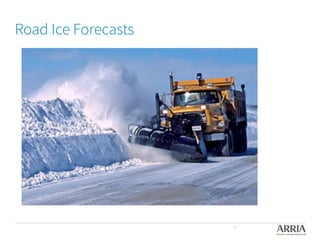
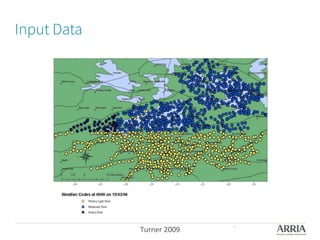
Road Ice Forecasts
16
Input Data
Turner	
  2009	
   17
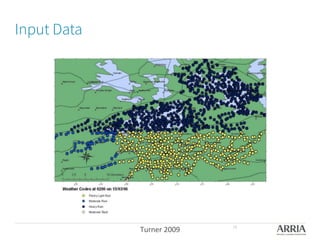
Input Data
Turner	
  2009	
   18
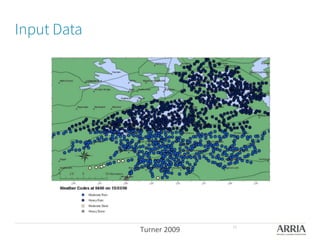
Input Data
Turner	
  2009	
   19
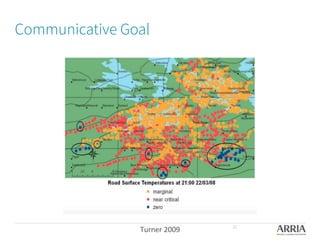
Communicative Goal
Turner	
  2009	
   20
System Output
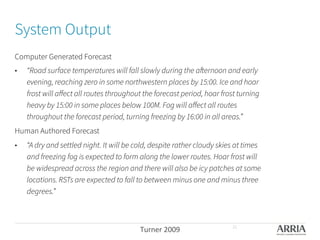
Computer Generated Forecast
•  “Road surface temperatures will fall slowly during the afternoon and early
evening, reaching zero in some northwestern places by 15:00. Ice and hoar
frost will affect all routes throughout the forecast period, hoar frost turning
heavy by 15:00 in some places below 100M. Fog will affect all routes
throughout the forecast period, turning freezing by 16:00 in all areas.” 
Human Authored Forecast
•  “A dry and settled night. It will be cold, despite rather cloudy skies at times
and freezing fog is expected to form along the lower routes. Hoar frost will
be widespread across the region and there will also be icy patches at some
locations. RSTs are expected to fall to between minus one and minus three
degrees.” 
Turner	
  2009	
   21
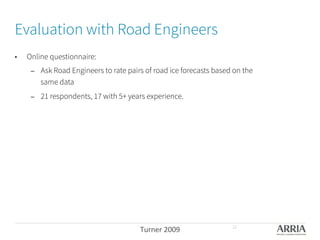
Evaluation with Road Engineers
•  Online questionnaire:
–  Ask Road Engineers to rate pairs of road ice forecasts based on the
same data
–  21 respondents, 17 with 5+ years experience. 

Turner	
  2009	
   22
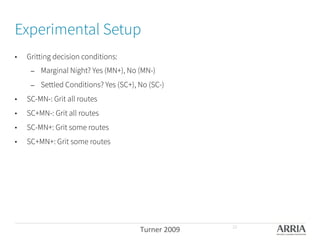
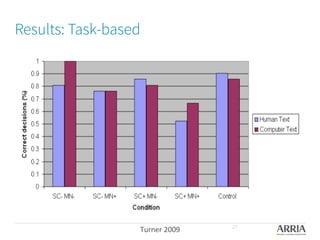
Experimental Setup
•  Gritting decision conditions:
–  Marginal Night? Yes (MN+), No (MN-) 
–  Settled Conditions? Yes (SC+), No (SC-) 
•  SC-MN-: Grit all routes
•  SC+MN-: Grit all routes
•  SC-MN+: Grit some routes 
•  SC+MN+: Grit some routes 
Turner	
  2009	
   23
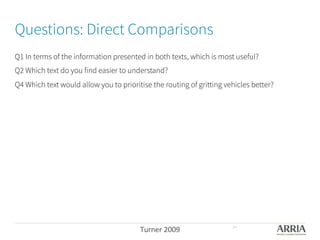
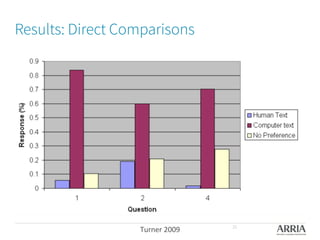
Questions: Direct Comparisons
Q1 In terms of the information presented in both texts, which is most useful? 
Q2 Which text do you find easier to understand? 
Q4 Which text would allow you to prioritise the routing of gritting vehicles better? 
Turner	
  2009	
   24
Results: Direct Comparisons
Turner	
  2009	
   25
Questions: Task-based
Q3 Please indicate for both texts roughly how many routes you would treat 
(all, some or none)?
Turner	
  2009	
   26
Results: Task-based 
Turner	
  2009	
   27
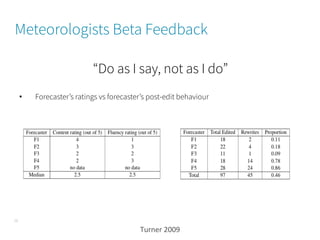
Meteorologists Beta Feedback
Turner	
  2009	
  
28
•  Forecaster’s ratings vs forecaster’s post-edit behaviour
“Do as I say, not as I do”
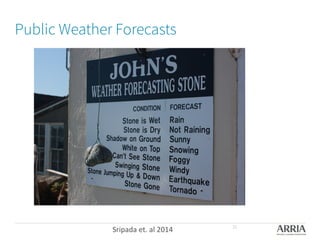
Public Weather Forecasts
Sripada	
  et.	
  al	
  2014	
   29
Business Use Case
•  UK Met Office produces forecast data for 1000s of sites every 3 hours
•  Manpower dictates written forecasts can only be produced at the area
level
•  Solution: develop a NLG system to generate site-specific weather
forecasts
Sripada	
  et.	
  al	
  2014	
   30
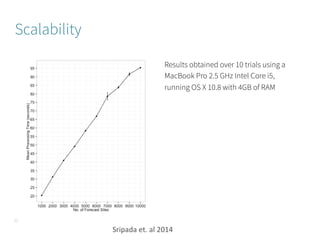
Results obtained over 10 trials using a
MacBook Pro 2.5 GHz Intel Core i5,
running OS X 10.8 with 4GB of RAM
Sripada	
  et.	
  al	
  2014	
  
31
Scalability
Output Quality
35 @metoffice followers:
1.  Did you find the text helped you to understand the forecast better?
–  Yes 97%, No 3%
2.  How did you find the text used?
–  About right 74%, Too short/long 20%, Unsure 6%
3.  Would you recommend this feature?
–  Yes 91%, No 9%
Sripada	
  et.	
  al	
  2014	
   32
Statistical Approaches To NLG
NLG Is All About Choice

•  Choosing what to say and how to say it:
–  Content
–  Words
–  Syntactic structure
•  Many of these choices can be learnt:
–  Overgeneration and ranking
–  Word choice classifiers
–  Word ordering
Evaluating System Building Cost
•  Belz and Kow (2010) evaluated implementations of SumTime-Mousam
–  The original handcrafted version
–  Probabilistic Context Free Grammars (PCFG)
–  Statistical Machine Translation
•  Human ratings favoured the original handcrafted system while metrics
favoured automated systems 

35
Some Discussion of Statistical Approaches

•  Statistical approaches can replicate a corpus well and reduce system
building cost
•  Hybrid statistical approaches have the potential to support domain
adaptability (Kondadadi et al. 2013)
•  Uncertain how to refine the output of model based systems
•  Large amounts of aligned training data is normally required

36
Recap
The Story So Far…
•  NLG systems can produce high quality texts
•  NLG systems solve business problems 
•  Statistical NLG approaches are still evolving 
38
Where Next?
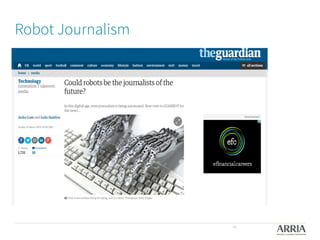
Robot Journalism
40
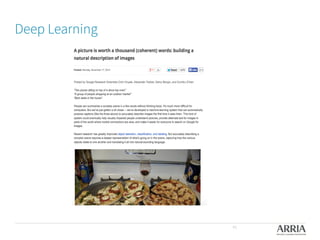
Deep Learning

41
The Future?

•  New learning and statistical models 
•  Domain independence
•  Multilinguality 
•  Targeted web content
•  Big data analysis
42
Thank you
References
•  Belz A. and Kow E. (2010), Assessing the Trade-Off between System Building Cost and Output Quality in Data-to-Text Generation. In
Krahmer, E., Theune, M. (eds.) Empirical Methods in Natural Language Generation, Vol. 5980 of Lecture Notes in Computer Science,
Springer, pp. 180-200.
•  Binsted K. and Ritchie G. (1994) An Implemented Model of Punning riddles. In Proceedings of the Twelfth National Conference on
Artificial Intelligence (AAAI-94). 
•  Callaway, C. B. and Lester, J. C. (2002). Narrative prose generation. Artificial Intelligence, 139(2):213–252. 
•  Kondadadi R., Howald B. and Schilder F. (2013) A Statistical NLG Framework for Aggregated Planning and Realization. In ACL (1),
1406-1415
•  Law A., Freer Y., Hunter J., Logie R., McIntosh N. and Quinn J. (2005). A Comparison of Graphical and Textual Presentations of Time
Series Data to Support Medical Decision Making in the Neonatal Intensive Care Unit. Journal of Clinical Monitoring and Computing 19
(3): 183–94
•  Langan-Fox, J., Platania-Phung, C. and Waycott, J. (2006). Effects of advance organizers, mental models and abilities on task and
recall performance using a mobile phone network. Applied Cognitive Psychology, 20(9):1143-1165
•  Manurung, R., Ritchie, G., Pain, H., Waller, A., O’Mara, D., and Black, R. (2008). The construction of a pun generator for language skills
development. Applied Artificial Intelligence, 22(9):841–869.
•  Reiter, E., Sripada, S., Hunter, J., Yu, J., and Davy, I. (2005). Choosing words in computer- generated weather forecasts. In Artificial
Intelligence, volume 67, pages 137–169
•  Sripada S. Burnett N., Turner R., Mastin J. and Evans D. (2014). A Case Study: NLG meeting Weather Industry Demand for Quality and
Quantity of Textual Weather Forecasts. In proceedings of INLG-2014, Philadelphia, PA, USA, 19-21.
•  Turner R., Sripada S., Reiter E. and Davy I. (2006). Generating Spatio-Temporal Descriptions in Pollen Forecasts. EACL-06proceedings,
Trento, Italy, April 3-7. 
•  Turner, R. (2009) Georeferenced data-to-text : techniques and application. Ph.D Thesis, University of Aberdeen.
http://ethos.bl.uk/OrderDetails.do?uin=uk.bl.ethos.509142

44
Images
•  “Snowwiper near Toronto, Canada”, by Jkransen, CC BY-SA 2.5 – Slide 15
•  "John's Weather Forecasting Stone”, by Tim Rogers, CC BY-NC-SA 2.0 – Slide 28
•  http://googleresearch.blogspot.de/2014/11/a-picture-is-worth-thousand-coherent.html - Slide
36
•  http://www.theguardian.com/media/shortcuts/2014/mar/16/could-robots-be-journalist-of-
future - Slide 40

45
London
ARRIA NLG CORPORATE HQ 
Space One, 1 Beadon Road
Hammersmith 
London W6 0EA 
United Kingdom
+44-20-7100-4540
Aberdeen
ARRIA RESEARCH & DEVELOPMENT 
Meston Building G05E 
University of Aberdeen 
Aberdeen AB24 3FX
United Kingdom
+44-1224-466-740
ARRIA GLOBAL HEADQUARTERS & ARRIA EMEA
ARRIA.COM
ARRIA NLG plc is a company registered in England and Wales having its registered office at Space One, 1 Beadon Road, Hammersmith, London W6 0EA, United Kingdom with registered number 07812686
Company names and company logos are trademarks of their respective owners. Entire contents © 2015 by ARRIA NLG plc with all rights reserved.
Americas | EMEA | Asia Pacific
New York
ARRIA NLG (USA)
80 Broad Street,
6th Floor
New York, NY 1004 
United States
+1-212-252-2185
Auckland 
ARRIA NLG (NZ) 
Unit 16
150 Beaumont Street 
Westhaven, Auckland 1010 
New Zealand
+64-9-801-0035
ARRIA AMERICAS
 ARRIA ASIA-PACIFIC

Tomorrows language technology

  • 1.
    Building Natural Language Generation (NLG)Systems Ross Turner Tomorrow’s Language Technology, Berlin 17/09/15
  • 2.
    Agenda 1.  Brief introduction 2. NLG in 10 minutes 3.  Case study: NLG in Weather Services 4.  Statistical approaches to NLG 5.  Where next? 2
  • 3.
  • 4.
    My Profile •  Current:Principal Engineer, Arria NLG plc •  Formerly: –  Senior Software Engineer, Nokia Berlin –  Post-doctoral Research Fellow, Universities of Edinburgh and Aberdeen •  PhD in Applied NLG systems in 2009 4
  • 5.
    What is Natural LanguageGeneration (NLG) exactly?
  • 6.
    NLG Synopsis •  Theautomatic generation of natural language from non-linguistic input 6 Input   Seman+c   Representa+on   Text  
  • 7.
    Example "Grass pollen levelsfor Wednesday have decreased from the very high levels of yesterday with values of around 6 to 7 across most parts of the country. However, in Northern and North Western areas, pollen levels will be moderate with values of 4. " 7 Turner  et.  al  2006  
  • 8.
    Reiter & DalePipeline Architecture 8 Choosing  What  to   Say   Deciding  How   to  say  it  
  • 9.
    System Building •  Developmentrequires example input data and corresponding output text •  Systems are usually knowledge-based and domain-specific, but statistical approaches are becoming more commonplace •  Evaluations typically use: –  Automated metrics against a gold standard –  Human ratings –  Task-based evaluations 9
  • 10.
  • 11.
    Commercial Applications •  NLGCommercialisation has been relatively recent •  Many systems developed in Healthcare, Meteorology, Finance etc. •  Most common applications are so called “data-to-text” systems that provide decision support 11
  • 12.
    Benefits •  Scalability, cost-efficiencies,automation of routine reporting etc. •  Task-based evaluations have highlighted the benefits of textual presentations of data: –  Medical staff made better decisions (Law et al. 2005) –  Mobile phone users exhibited superior task performance (Langan-Fox et al. 2006) 12
  • 13.
    Can NLG producehigh quality texts?
  • 14.
    Output Variation andQuality •  NLG systems have been developed to generate: –  Narrative Prose (Callaway 2002) –  Poetry (Manurung 2003) –  Jokes (Binsted and Ritchie 1994, Manurung et al. 2008) •  SumTime-Mousam wind forecasts were judged better than those written by human experts (Reiter et al. 2005) 14
  • 15.
  • 16.
  • 17.
  • 18.
  • 19.
  • 20.
  • 21.
    System Output Computer GeneratedForecast •  “Road surface temperatures will fall slowly during the afternoon and early evening, reaching zero in some northwestern places by 15:00. Ice and hoar frost will affect all routes throughout the forecast period, hoar frost turning heavy by 15:00 in some places below 100M. Fog will affect all routes throughout the forecast period, turning freezing by 16:00 in all areas.” Human Authored Forecast •  “A dry and settled night. It will be cold, despite rather cloudy skies at times and freezing fog is expected to form along the lower routes. Hoar frost will be widespread across the region and there will also be icy patches at some locations. RSTs are expected to fall to between minus one and minus three degrees.” Turner  2009   21
  • 22.
    Evaluation with RoadEngineers •  Online questionnaire: –  Ask Road Engineers to rate pairs of road ice forecasts based on the same data –  21 respondents, 17 with 5+ years experience. Turner  2009   22
  • 23.
    Experimental Setup •  Grittingdecision conditions: –  Marginal Night? Yes (MN+), No (MN-) –  Settled Conditions? Yes (SC+), No (SC-) •  SC-MN-: Grit all routes •  SC+MN-: Grit all routes •  SC-MN+: Grit some routes •  SC+MN+: Grit some routes Turner  2009   23
  • 24.
    Questions: Direct Comparisons Q1In terms of the information presented in both texts, which is most useful? Q2 Which text do you find easier to understand? Q4 Which text would allow you to prioritise the routing of gritting vehicles better? Turner  2009   24
  • 25.
  • 26.
    Questions: Task-based Q3 Pleaseindicate for both texts roughly how many routes you would treat (all, some or none)? Turner  2009   26
  • 27.
  • 28.
    Meteorologists Beta Feedback Turner  2009   28 •  Forecaster’s ratings vs forecaster’s post-edit behaviour “Do as I say, not as I do”
  • 29.
    Public Weather Forecasts Sripada  et.  al  2014   29
  • 30.
    Business Use Case • UK Met Office produces forecast data for 1000s of sites every 3 hours •  Manpower dictates written forecasts can only be produced at the area level •  Solution: develop a NLG system to generate site-specific weather forecasts Sripada  et.  al  2014   30
  • 31.
    Results obtained over10 trials using a MacBook Pro 2.5 GHz Intel Core i5, running OS X 10.8 with 4GB of RAM Sripada  et.  al  2014   31 Scalability
  • 32.
    Output Quality 35 @metofficefollowers: 1.  Did you find the text helped you to understand the forecast better? –  Yes 97%, No 3% 2.  How did you find the text used? –  About right 74%, Too short/long 20%, Unsure 6% 3.  Would you recommend this feature? –  Yes 91%, No 9% Sripada  et.  al  2014   32
  • 33.
  • 34.
    NLG Is AllAbout Choice •  Choosing what to say and how to say it: –  Content –  Words –  Syntactic structure •  Many of these choices can be learnt: –  Overgeneration and ranking –  Word choice classifiers –  Word ordering
  • 35.
    Evaluating System BuildingCost •  Belz and Kow (2010) evaluated implementations of SumTime-Mousam –  The original handcrafted version –  Probabilistic Context Free Grammars (PCFG) –  Statistical Machine Translation •  Human ratings favoured the original handcrafted system while metrics favoured automated systems 35
  • 36.
    Some Discussion ofStatistical Approaches •  Statistical approaches can replicate a corpus well and reduce system building cost •  Hybrid statistical approaches have the potential to support domain adaptability (Kondadadi et al. 2013) •  Uncertain how to refine the output of model based systems •  Large amounts of aligned training data is normally required 36
  • 37.
  • 38.
    The Story SoFar… •  NLG systems can produce high quality texts •  NLG systems solve business problems •  Statistical NLG approaches are still evolving 38
  • 39.
  • 40.
  • 41.
  • 42.
    The Future? •  Newlearning and statistical models •  Domain independence •  Multilinguality •  Targeted web content •  Big data analysis 42
  • 43.
  • 44.
    References •  Belz A.and Kow E. (2010), Assessing the Trade-Off between System Building Cost and Output Quality in Data-to-Text Generation. In Krahmer, E., Theune, M. (eds.) Empirical Methods in Natural Language Generation, Vol. 5980 of Lecture Notes in Computer Science, Springer, pp. 180-200. •  Binsted K. and Ritchie G. (1994) An Implemented Model of Punning riddles. In Proceedings of the Twelfth National Conference on Artificial Intelligence (AAAI-94). •  Callaway, C. B. and Lester, J. C. (2002). Narrative prose generation. Artificial Intelligence, 139(2):213–252. •  Kondadadi R., Howald B. and Schilder F. (2013) A Statistical NLG Framework for Aggregated Planning and Realization. In ACL (1), 1406-1415 •  Law A., Freer Y., Hunter J., Logie R., McIntosh N. and Quinn J. (2005). A Comparison of Graphical and Textual Presentations of Time Series Data to Support Medical Decision Making in the Neonatal Intensive Care Unit. Journal of Clinical Monitoring and Computing 19 (3): 183–94 •  Langan-Fox, J., Platania-Phung, C. and Waycott, J. (2006). Effects of advance organizers, mental models and abilities on task and recall performance using a mobile phone network. Applied Cognitive Psychology, 20(9):1143-1165 •  Manurung, R., Ritchie, G., Pain, H., Waller, A., O’Mara, D., and Black, R. (2008). The construction of a pun generator for language skills development. Applied Artificial Intelligence, 22(9):841–869. •  Reiter, E., Sripada, S., Hunter, J., Yu, J., and Davy, I. (2005). Choosing words in computer- generated weather forecasts. In Artificial Intelligence, volume 67, pages 137–169 •  Sripada S. Burnett N., Turner R., Mastin J. and Evans D. (2014). A Case Study: NLG meeting Weather Industry Demand for Quality and Quantity of Textual Weather Forecasts. In proceedings of INLG-2014, Philadelphia, PA, USA, 19-21. •  Turner R., Sripada S., Reiter E. and Davy I. (2006). Generating Spatio-Temporal Descriptions in Pollen Forecasts. EACL-06proceedings, Trento, Italy, April 3-7. •  Turner, R. (2009) Georeferenced data-to-text : techniques and application. Ph.D Thesis, University of Aberdeen. http://ethos.bl.uk/OrderDetails.do?uin=uk.bl.ethos.509142 44
  • 45.
    Images •  “Snowwiper nearToronto, Canada”, by Jkransen, CC BY-SA 2.5 – Slide 15 •  "John's Weather Forecasting Stone”, by Tim Rogers, CC BY-NC-SA 2.0 – Slide 28 •  http://googleresearch.blogspot.de/2014/11/a-picture-is-worth-thousand-coherent.html - Slide 36 •  http://www.theguardian.com/media/shortcuts/2014/mar/16/could-robots-be-journalist-of- future - Slide 40 45
  • 46.
    London ARRIA NLG CORPORATEHQ Space One, 1 Beadon Road Hammersmith London W6 0EA United Kingdom +44-20-7100-4540 Aberdeen ARRIA RESEARCH & DEVELOPMENT Meston Building G05E University of Aberdeen Aberdeen AB24 3FX United Kingdom +44-1224-466-740 ARRIA GLOBAL HEADQUARTERS & ARRIA EMEA ARRIA.COM ARRIA NLG plc is a company registered in England and Wales having its registered office at Space One, 1 Beadon Road, Hammersmith, London W6 0EA, United Kingdom with registered number 07812686 Company names and company logos are trademarks of their respective owners. Entire contents © 2015 by ARRIA NLG plc with all rights reserved. Americas | EMEA | Asia Pacific New York ARRIA NLG (USA) 80 Broad Street, 6th Floor New York, NY 1004 United States +1-212-252-2185 Auckland ARRIA NLG (NZ) Unit 16 150 Beaumont Street Westhaven, Auckland 1010 New Zealand +64-9-801-0035 ARRIA AMERICAS ARRIA ASIA-PACIFIC