Innovation
         and the Circular Economy
                 Rob Weterings
                   12-12-12
                  The Hague


oktober 2011
Outline

Some words about TNO

Key requirements for a circular economy

Towards new business cases

What to do?
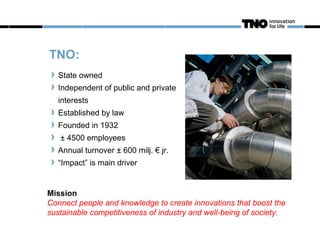
TNO:
   State owned
   Independent of public and private
   interests
   Established by law
   Founded in 1932
   ± 4500 employees
   Annual turnover ± 600 milj. € jr.
   “Impact” is main driver


Mission
Connect people and knowledge to create innovations that boost the
sustainable competitiveness of industry and well-being of society.
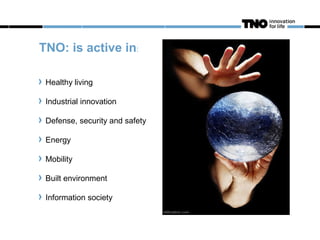
TNO: is active in:

 Healthy living

 Industrial innovation

 Defense, security and safety

 Energy

 Mobility

 Built environment

 Information society
TNO is very active in the European arena
 Member of High level Group of ETP Sustainable Minerals and Resources (ETP-
 SMR)
 Co-development of EIP Raw Materials for a Modern Society:
      Member of the High Level Steering Group
      Member of the EIP WG 3 (regulations) and WG 5 (Internat. framework)
      Participating in WP 1 (SMR) and WP2 (SusChem)
      Proposing pilots (Ramintech)
 Dutch Geological Survey is part of TNO
 President of EuroGeoSurveys in 2013
 Participant in SPIRE
      From process industry/chemistry side
 Active in EIT KIC-Climate, KIC-Energy, KIC ICT-Labs, organising up-coming
 KIC Raw Materials consortium
 Portfolio of European projects
Key requirements for a circular economy

 Distinguish between resources

 Cooperation in value chains

 Add facts
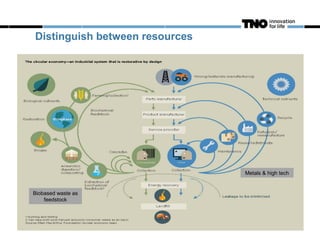
Distinguish between resources


                                Metals & high tech


Biobased waste as
    feedstock
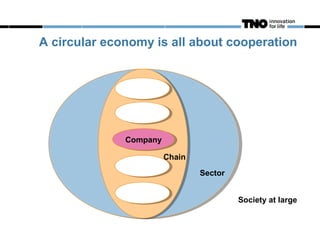
A circular economy is all about cooperation


              Company
              Company

                    Chain

                            Sector


                                     Society at large
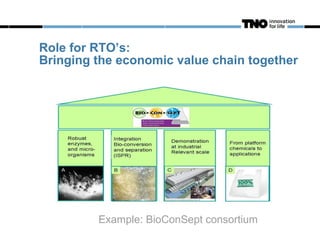
Role for RTO’s:
Bringing the economic value chain together


         Example: BioConSept consortium
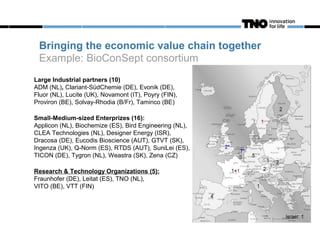
Bringing the economic value chain together
 Example: BioConSept consortium
Large Industrial partners (10)
ADM (NL), Clariant-SüdChemie (DE), Evonik (DE),
Fluor (NL), Lucite (UK), Novamont (IT), Poyry (FIN),
Proviron (BE), Solvay-Rhodia (B/Fr), Taminco (BE)

Small-Medium-sized Enterprizes (16):
Applicon (NL), Biochemize (ES), Bird Engineering (NL),
CLEA Technologies (NL), Designer Energy (ISR),
Dracosa (DE), Eucodis Bioscience (AUT), GTVT (SK),
Ingenza (UK), Q-Norm (ES), RTDS (AUT), SuniLei (ES),
TICON (DE), Tygron (NL), Weastra (SK), Zena (CZ)

Research & Technology Organizations (5):
Fraunhofer (DE), Leitat (ES), TNO (NL),
VITO (BE), VTT (FIN)
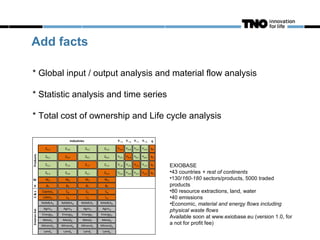
Add facts

* Global input / output analysis and material flow analysis

* Statistic analysis and time series

* Total cost of ownership and Life cycle analysis

                                 Industries                     Y*,A   Y*,B Y*,C     Y*,D   q

                ZA,A       ZA,B               ZA,C     ZA,D     YA,A YA,B YA,C       YA,D   qA
Products


                ZB,A       ZB,B               ZB,C     ZB,D     YB,A   YB,B YB,C     YB,D   qD

                ZC,A       ZC,B               ZC,C     ZC,D     YC,A   YC,B   YC,C   YC,D   qC   EXIOBASE
                ZD,A       ZD,B               ZD,C     ZD,D     YD,A YD,B YD,C YD,D         qD   •43 countries + rest of continents
W               WA         WB                 WC       WD                                        •130/160-180 sectors/products, 5000 traded
   g             gA         gB                gC       gD                                        products
              CapitalA     CB                 CC       CD                                        •80 resource extractions, land, water
C&L


              LaborA        LB                LC        LD                                       •40 emissions
              NAMEAA     NAMEA B         NAMEAC      NAMEAD                                      •Economic, material and energy flows including
               AgricA     AgricB          AgricC      AgricD
                                                                                                 physical waste flows
Environ Ext


              EnergyA    EnergyB         EnergyC     EnergyD
              MetalA     MetalB           MetalC     MetalD
                                                                                                 Available soon at www.exiobase.eu (version 1.0, for
              MineralA   MineralB        MineralC    MineralD
                                                                                                 a not for profit fee)
               LandA      LandB           LandC       LandD
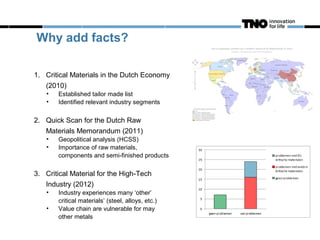
Why add facts?

1. Critical Materials in the Dutch Economy
   (2010)
    •   Established tailor made list
    •   Identified relevant industry segments

2. Quick Scan for the Dutch Raw
   Materials Memorandum (2011)
    •   Geopolitical analysis (HCSS)
    •   Importance of raw materials,
        components and semi-finished products

3. Critical Material for the High-Tech
   Industry (2012)
    •   Industry experiences many ‘other’
        critical materials’ (steel, alloys, etc.)
    •   Value chain are vulnerable for may
        other metals
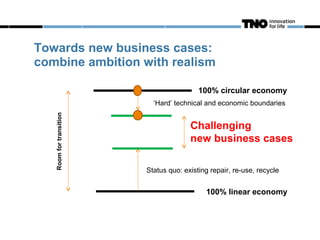
Towards new business cases:
combine ambition with realism

                                          100% circular economy
                           ‘Hard’ technical and economic boundaries
   Room for transition


                                       Challenging
                                       new business cases

                         Status quo: existing repair, re-use, recycle


                                            100% linear economy
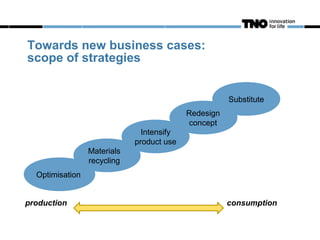
Towards new business cases:
scope of strategies


                                                      Substitute
                                           Redesign
                                            concept
                               Intensify
                             product use
                 Materials
                 recycling
  Optimisation


production                                            consumption
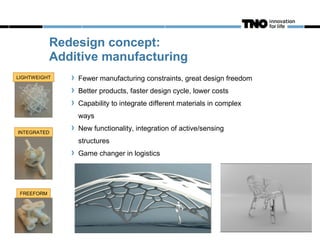
Redesign concept:
            Additive manufacturing
LIGHTWEIGHT     Fewer manufacturing constraints, great design freedom
                Better products, faster design cycle, lower costs
                Capability to integrate different materials in complex
                ways

INTEGRATED
                New functionality, integration of active/sensing
                structures
                Game changer in logistics


 FREEFORM
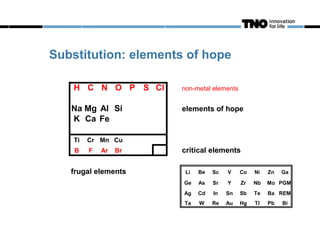
Substitution: elements of hope

    H C N O P S Cl     non-metal elements


   Na Mg Al Si         elements of hope
   K Ca Fe

    Ti   Cr Mn Cu
    B    F   Ar   Br   critical elements

   frugal elements      Li   Be   Sc   V    Co   Ni   Zn   Ga

                       Ge    As   Sr   Y    Zr   Nb   Mo PGM
                       Ag    Cd   In   Sn   Sb   Te   Ba REM
                       Ta    W    Re   Au   Hg   Tl   Pb   Bi
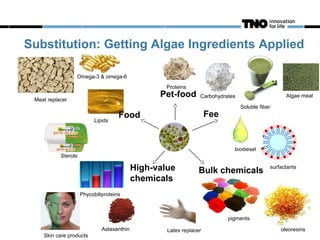
Substitution: Getting Algae Ingredients Applied

                 Omega-3 & omega-6
                                                    Proteins
                                                  Pet-food       Carbohydrates                     Algae meal
 Meat replacer
                                                                                 Soluble fiber
                                     Food                            Feed
                           Lipids


                                                                              biodiesel
           Sterols

                                            High-value           Bulk chemicals              surfactants

                                            chemicals
                     Phycobiliproteins


                                                                            pigments

                              Astaxanthin           Latex replacer                               oleoresins
    Skin care products
Some observations for discussion
 Companies:
    Seek for innovative business model
    Reconsider your position in value chains


 RTO
    Bring value chains together
    Help companies to innovate


 Government:
    Remove limitations (legislation)
    Impose standards for stimulating the circular economy

Tno innovation

  • 1.
    Innovation and the Circular Economy Rob Weterings 12-12-12 The Hague oktober 2011
  • 2.
    Outline Some words aboutTNO Key requirements for a circular economy Towards new business cases What to do?
  • 3.
    TNO: State owned Independent of public and private interests Established by law Founded in 1932 ± 4500 employees Annual turnover ± 600 milj. € jr. “Impact” is main driver Mission Connect people and knowledge to create innovations that boost the sustainable competitiveness of industry and well-being of society.
  • 4.
    TNO: is activein: Healthy living Industrial innovation Defense, security and safety Energy Mobility Built environment Information society
  • 5.
    TNO is veryactive in the European arena Member of High level Group of ETP Sustainable Minerals and Resources (ETP- SMR) Co-development of EIP Raw Materials for a Modern Society: Member of the High Level Steering Group Member of the EIP WG 3 (regulations) and WG 5 (Internat. framework) Participating in WP 1 (SMR) and WP2 (SusChem) Proposing pilots (Ramintech) Dutch Geological Survey is part of TNO President of EuroGeoSurveys in 2013 Participant in SPIRE From process industry/chemistry side Active in EIT KIC-Climate, KIC-Energy, KIC ICT-Labs, organising up-coming KIC Raw Materials consortium Portfolio of European projects
  • 6.
    Key requirements fora circular economy Distinguish between resources Cooperation in value chains Add facts
  • 7.
    Distinguish between resources Metals & high tech Biobased waste as feedstock
  • 8.
    A circular economyis all about cooperation Company Company Chain Sector Society at large
  • 9.
    Role for RTO’s: Bringingthe economic value chain together Example: BioConSept consortium
  • 10.
    Bringing the economicvalue chain together Example: BioConSept consortium Large Industrial partners (10) ADM (NL), Clariant-SüdChemie (DE), Evonik (DE), Fluor (NL), Lucite (UK), Novamont (IT), Poyry (FIN), Proviron (BE), Solvay-Rhodia (B/Fr), Taminco (BE) Small-Medium-sized Enterprizes (16): Applicon (NL), Biochemize (ES), Bird Engineering (NL), CLEA Technologies (NL), Designer Energy (ISR), Dracosa (DE), Eucodis Bioscience (AUT), GTVT (SK), Ingenza (UK), Q-Norm (ES), RTDS (AUT), SuniLei (ES), TICON (DE), Tygron (NL), Weastra (SK), Zena (CZ) Research & Technology Organizations (5): Fraunhofer (DE), Leitat (ES), TNO (NL), VITO (BE), VTT (FIN)
  • 11.
    Add facts * Globalinput / output analysis and material flow analysis * Statistic analysis and time series * Total cost of ownership and Life cycle analysis Industries Y*,A Y*,B Y*,C Y*,D q ZA,A ZA,B ZA,C ZA,D YA,A YA,B YA,C YA,D qA Products ZB,A ZB,B ZB,C ZB,D YB,A YB,B YB,C YB,D qD ZC,A ZC,B ZC,C ZC,D YC,A YC,B YC,C YC,D qC EXIOBASE ZD,A ZD,B ZD,C ZD,D YD,A YD,B YD,C YD,D qD •43 countries + rest of continents W WA WB WC WD •130/160-180 sectors/products, 5000 traded g gA gB gC gD products CapitalA CB CC CD •80 resource extractions, land, water C&L LaborA LB LC LD •40 emissions NAMEAA NAMEA B NAMEAC NAMEAD •Economic, material and energy flows including AgricA AgricB AgricC AgricD physical waste flows Environ Ext EnergyA EnergyB EnergyC EnergyD MetalA MetalB MetalC MetalD Available soon at www.exiobase.eu (version 1.0, for MineralA MineralB MineralC MineralD a not for profit fee) LandA LandB LandC LandD
  • 12.
    Why add facts? 1.Critical Materials in the Dutch Economy (2010) • Established tailor made list • Identified relevant industry segments 2. Quick Scan for the Dutch Raw Materials Memorandum (2011) • Geopolitical analysis (HCSS) • Importance of raw materials, components and semi-finished products 3. Critical Material for the High-Tech Industry (2012) • Industry experiences many ‘other’ critical materials’ (steel, alloys, etc.) • Value chain are vulnerable for may other metals
  • 13.
    Towards new businesscases: combine ambition with realism 100% circular economy ‘Hard’ technical and economic boundaries Room for transition Challenging new business cases Status quo: existing repair, re-use, recycle 100% linear economy
  • 14.
    Towards new businesscases: scope of strategies Substitute Redesign concept Intensify product use Materials recycling Optimisation production consumption
  • 15.
    Redesign concept: Additive manufacturing LIGHTWEIGHT Fewer manufacturing constraints, great design freedom Better products, faster design cycle, lower costs Capability to integrate different materials in complex ways INTEGRATED New functionality, integration of active/sensing structures Game changer in logistics FREEFORM
  • 16.
    Substitution: elements ofhope H C N O P S Cl non-metal elements Na Mg Al Si elements of hope K Ca Fe Ti Cr Mn Cu B F Ar Br critical elements frugal elements Li Be Sc V Co Ni Zn Ga Ge As Sr Y Zr Nb Mo PGM Ag Cd In Sn Sb Te Ba REM Ta W Re Au Hg Tl Pb Bi
  • 17.
    Substitution: Getting AlgaeIngredients Applied Omega-3 & omega-6 Proteins Pet-food Carbohydrates Algae meal Meat replacer Soluble fiber Food Feed Lipids biodiesel Sterols High-value Bulk chemicals surfactants chemicals Phycobiliproteins pigments Astaxanthin Latex replacer oleoresins Skin care products
  • 18.
    Some observations fordiscussion Companies: Seek for innovative business model Reconsider your position in value chains RTO Bring value chains together Help companies to innovate Government: Remove limitations (legislation) Impose standards for stimulating the circular economy

Editor's Notes

  • #2 Business review thema Energie, 26 oktober 2011 28-01-13 12:57