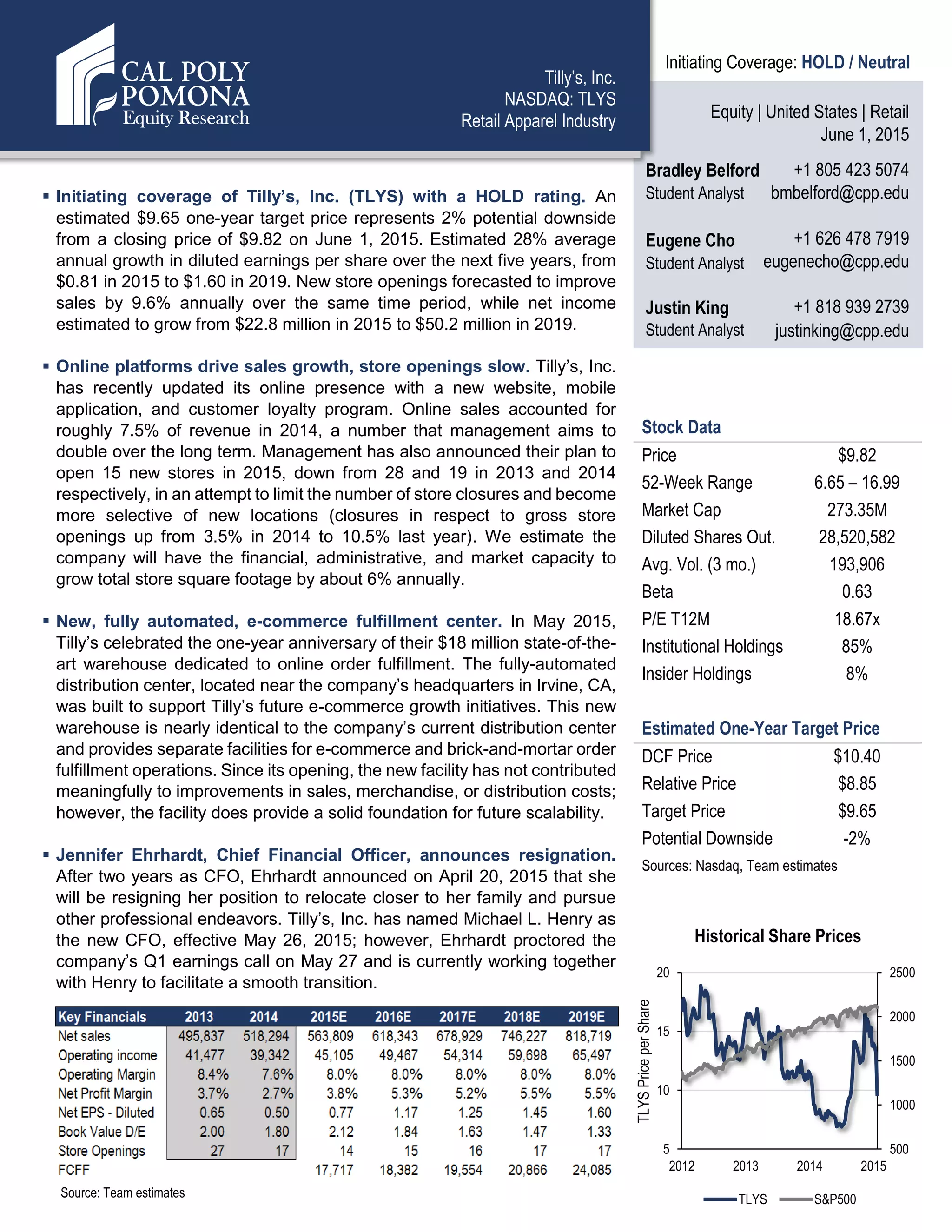
 Initiating coverage of Tilly’s, Inc. (TLYS) with a HOLD rating. An
estimated $9.65 one-year target price represents 2% potential downside
from a closing price of $9.82 on June 1, 2015. Estimated 28% average
annual growth in diluted earnings per share over the next five years, from
$0.81 in 2015 to $1.60 in 2019. New store openings forecasted to improve
sales by 9.6% annually over the same time period, while net income
estimated to grow from $22.8 million in 2015 to $50.2 million in 2019.
 Online platforms drive sales growth, store openings slow. Tilly’s, Inc.
has recently updated its online presence with a new website, mobile
application, and customer loyalty program. Online sales accounted for
roughly 7.5% of revenue in 2014, a number that management aims to
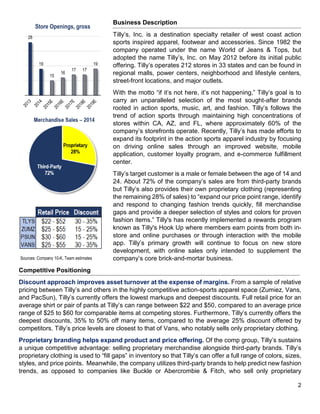
double over the long term. Management has also announced their plan to
open 15 new stores in 2015, down from 28 and 19 in 2013 and 2014
respectively, in an attempt to limit the number of store closures and become
more selective of new locations (closures in respect to gross store
openings up from 3.5% in 2014 to 10.5% last year). We estimate the
company will have the financial, administrative, and market capacity to
grow total store square footage by about 6% annually.
 New, fully automated, e-commerce fulfillment center. In May 2015,
Tilly’s celebrated the one-year anniversary of their $18 million state-of-the-
art warehouse dedicated to online order fulfillment. The fully-automated
distribution center, located near the company’s headquarters in Irvine, CA,
was built to support Tilly’s future e-commerce growth initiatives. This new
warehouse is nearly identical to the company’s current distribution center
and provides separate facilities for e-commerce and brick-and-mortar order
fulfillment operations. Since its opening, the new facility has not contributed
meaningfully to improvements in sales, merchandise, or distribution costs;
however, the facility does provide a solid foundation for future scalability.
 Jennifer Ehrhardt, Chief Financial Officer, announces resignation.
After two years as CFO, Ehrhardt announced on April 20, 2015 that she
will be resigning her position to relocate closer to her family and pursue
other professional endeavors. Tilly’s, Inc. has named Michael L. Henry as
the new CFO, effective May 26, 2015; however, Ehrhardt proctored the
company’s Q1 earnings call on May 27 and is currently working together
with Henry to facilitate a smooth transition.
Stock Data
Price $9.82
52-Week Range 6.65 – 16.99
Market Cap 273.35M
Diluted Shares Out. 28,520,582
Avg. Vol. (3 mo.) 193,906
Beta 0.63
P/E T12M 18.67x
Institutional Holdings 85%
Insider Holdings 8%
Estimated One-Year Target Price
DCF Price $10.40
Relative Price $8.85
Target Price $9.65
Potential Downside -2%
Sources: Nasdaq, Team estimates
Equity | United States | Retail
June 1, 2015
+1 805 423 5074
bmbelford@cpp.edu
+1 626 478 7919
eugenecho@cpp.edu
+1 818 939 2739
justinking@cpp.edu
Bradley Belford
Student Analyst
Eugene Cho
Student Analyst
Justin King
Student Analyst
Initiating Coverage: HOLD / Neutral
Tilly’s, Inc.
NASDAQ: TLYS
Retail Apparel Industry
500
1000
1500
2000
2500
5
10
15
20
2012 2013 2014 2015
TLYSPriceperShare
Historical Share Prices
TLYS S&P500Source: Team estimates
2
Business Description
Tilly’s, Inc. is a destination specialty retailer of west coast action
sports inspired apparel, footwear and accessories. Since 1982 the
company operated under the name World of Jeans & Tops, but
adopted the name Tilly’s, Inc. on May 2012 before its initial public
offering. Tilly’s operates 212 stores in 33 states and can be found in
regional malls, power centers, neighborhood and lifestyle centers,
street-front locations, and major outlets.
With the motto “if it’s not here, it’s not happening,” Tilly’s goal is to
carry an unparalleled selection of the most sought-after brands
rooted in action sports, music, art, and fashion. Tilly’s follows the
trend of action sports through maintaining high concentrations of
stores within CA, AZ, and FL, where approximately 60% of the
company’s storefronts operate. Recently, Tilly’s has made efforts to
expand its footprint in the action sports apparel industry by focusing
on driving online sales through an improved website, mobile
application, customer loyalty program, and e-commerce fulfillment
center.
Tilly’s target customer is a male or female between the age of 14 and
24. About 72% of the company’s sales are from third-party brands
but Tilly’s also provides their own proprietary clothing (representing
the remaining 28% of sales) to “expand our price point range, identify
and respond to changing fashion trends quickly, fill merchandise
gaps and provide a deeper selection of styles and colors for proven
fashion items.” Tilly's has recently implemented a rewards program
known as Tilly's Hook Up where members earn points from both in-
store and online purchases or through interaction with the mobile
app. Tilly’s primary growth will continue to focus on new store
development, with online sales only intended to supplement the
company’s core brick-and-mortar business.
Competitive Positioning
Discount approach improves asset turnover at the expense of margins. From a sample of relative
pricing between Tilly’s and others in the highly competitive action-sports apparel space (Zumiez, Vans,
and PacSun), Tilly’s currently offers the lowest markups and deepest discounts. Full retail price for an
average shirt or pair of pants at Tilly’s can range between $22 and $50, compared to an average price
range of $25 to $60 for comparable items at competing stores. Furthermore, Tilly’s currently offers the
deepest discounts, 35% to 50% off many items, compared to the average 25% discount offered by
competitors. Tilly’s price levels are closest to that of Vans, who notably sells only proprietary clothing.
Proprietary branding helps expand product and price offering. Of the comp group, Tilly’s sustains
a unique competitive advantage: selling proprietary merchandise alongside third-party brands. Tilly’s
proprietary clothing is used to “fill gaps” in inventory so that Tilly’s can offer a full range of colors, sizes,
styles, and price points. Meanwhile, the company utilizes third-party brands to help predict new fashion
trends, as opposed to companies like Buckle or Abercrombie & Fitch, who sell only proprietary
28
19
15
16
17 17
19
Store Openings, gross
Sources: Company 10-K, Team estimates
3
merchandise and must actively forecast consumer tastes. Any inability to do so can severely damage
brands in this industry, as demonstrated by the recent poor performance of Abercrombie and PacSun.
Of total revenue, 8% is earned in states where Tilly’s has no physical presence, instead converting
customers through online sales channels. To increase this figure, Tilly’s has developed an updated
website, new mobile phone app, and rewards program to create incentives for new and returning
customers through both online and brick-and-mortar channels.
Industry Analysis
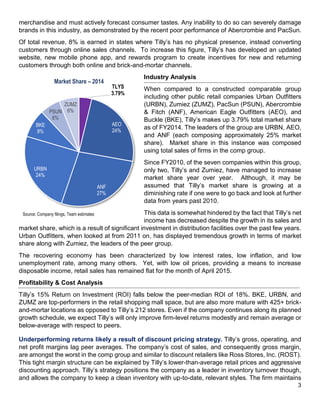
When compared to a constructed comparable group
including other public retail companies Urban Outfitters
(URBN), Zumiez (ZUMZ), PacSun (PSUN), Abercrombie
& Fitch (ANF), American Eagle Outfitters (AEO), and
Buckle (BKE), Tilly’s makes up 3.79% total market share
as of FY2014. The leaders of the group are URBN, AEO,
and ANF (each composing approximately 25% market
share). Market share in this instance was composed
using total sales of firms in the comp group.
Since FY2010, of the seven companies within this group,
only two, Tilly’s and Zumiez, have managed to increase
market share year over year. Although, it may be
assumed that Tilly’s market share is growing at a
diminishing rate if one were to go back and look at further
data from years past 2010.
This data is somewhat hindered by the fact that Tilly’s net
income has decreased despite the growth in its sales and
market share, which is a result of significant investment in distribution facilities over the past few years.
Urban Outfitters, when looked at from 2011 on, has displayed tremendous growth in terms of market
share along with Zumiez, the leaders of the peer group.
The recovering economy has been characterized by low interest rates, low inflation, and low
unemployment rate, among many others. Yet, with low oil prices, providing a means to increase
disposable income, retail sales has remained flat for the month of April 2015.
Profitability & Cost Analysis
Tilly’s 15% Return on Investment (ROI) falls below the peer-median ROI of 18%. BKE, URBN, and
ZUMZ are top-performers in the retail shopping mall space, but are also more mature with 425+ brick-
and-mortar locations as opposed to Tilly’s 212 stores. Even if the company continues along its planned
growth schedule, we expect Tilly’s will only improve firm-level returns modestly and remain average or
below-average with respect to peers.
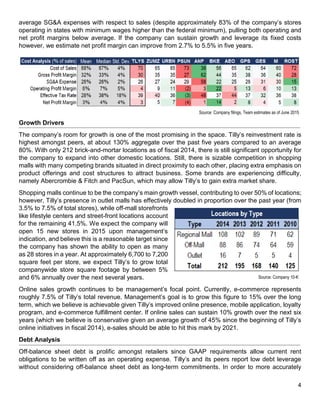
Underperforming returns likely a result of discount pricing strategy. Tilly’s gross, operating, and
net profit margins lag peer averages. The company’s cost of sales, and consequently gross margin,
are amongst the worst in the comp group and similar to discount retailers like Ross Stores, Inc. (ROST).
This tight margin structure can be explained by Tilly’s lower-than-average retail prices and aggressive
discounting approach. Tilly’s strategy positions the company as a leader in inventory turnover though,
and allows the company to keep a clean inventory with up-to-date, relevant styles. The firm maintains
TLYS
3.79%
AEO
24%
ANF
27%
URBN
24%
BKE
8%
PSUN
6%
ZUMZ
6%
Market Share – 2014
Source: Company filings, Team estimates
4
average SG&A expenses with respect to sales (despite approximately 83% of the company’s stores
operating in states with minimum wages higher than the federal minimum), pulling both operating and
net profit margins below average. If the company can sustain growth and leverage its fixed costs
however, we estimate net profit margin can improve from 2.7% to 5.5% in five years.
Growth Drivers
The company’s room for growth is one of the most promising in the space. Tilly’s reinvestment rate is
highest amongst peers, at about 130% aggregate over the past five years compared to an average
80%. With only 212 brick-and-mortar locations as of fiscal 2014, there is still significant opportunity for
the company to expand into other domestic locations. Still, there is sizable competition in shopping
malls with many competing brands situated in direct proximity to each other, placing extra emphasis on
product offerings and cost structures to attract business. Some brands are experiencing difficulty,
namely Abercrombie & Fitch and PacSun, which may allow Tilly’s to gain extra market share.
Shopping malls continue to be the company’s main growth vessel, contributing to over 50% of locations;
however, Tilly’s presence in outlet malls has effectively doubled in proportion over the past year (from
3.5% to 7.5% of total stores), while off-mall storefronts
like lifestyle centers and street-front locations account
for the remaining 41.5%. We expect the company will
open 15 new stores in 2015 upon management’s
indication, and believe this is a reasonable target since
the company has shown the ability to open as many
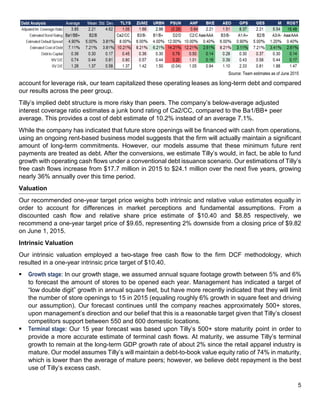
as 28 stores in a year. At approximately 6,700 to 7,200
square feet per store, we expect Tilly’s to grow total
companywide store square footage by between 5%
and 6% annually over the next several years.
Online sales growth continues to be management’s focal point. Currently, e-commerce represents
roughly 7.5% of Tilly’s total revenue. Management’s goal is to grow this figure to 15% over the long
term, which we believe is achievable given Tilly’s improved online presence, mobile application, loyalty
program, and e-commerce fulfillment center. If online sales can sustain 10% growth over the next six
years (which we believe is conservative given an average growth of 45% since the beginning of Tilly’s
online initiatives in fiscal 2014), e-sales should be able to hit this mark by 2021.
Debt Analysis
Off-balance sheet debt is prolific amongst retailers since GAAP requirements allow current rent
obligations to be written off as an operating expense. Tilly’s and its peers report low debt leverage
without considering off-balance sheet debt as long-term commitments. In order to more accurately
Source: Company filings, Team estimates as of June 2015
Source: Company 10-K
5
account for leverage risk, our team capitalized these operating leases as long-term debt and compared
our results across the peer group.
Tilly’s implied debt structure is more risky than peers. The company’s below-average adjusted
interest coverage ratio estimates a junk bond rating of Ca2/CC, compared to the Ba1/BB+ peer
average. This provides a cost of debt estimate of 10.2% instead of an average 7.1%.
While the company has indicated that future store openings will be financed with cash from operations,
using an ongoing rent-based business model suggests that the firm will actually maintain a significant
amount of long-term commitments. However, our models assume that these minimum future rent
payments are treated as debt. After the conversions, we estimate Tilly’s would, in fact, be able to fund
growth with operating cash flows under a conventional debt issuance scenario. Our estimations of Tilly’s
free cash flows increase from $17.7 million in 2015 to $24.1 million over the next five years, growing
nearly 36% annually over this time period.
Valuation
Our recommended one-year target price weighs both intrinsic and relative value estimates equally in
order to account for differences in market perceptions and fundamental assumptions. From a
discounted cash flow and relative share price estimate of $10.40 and $8.85 respectively, we
recommend a one-year target price of $9.65, representing 2% downside from a closing price of $9.82
on June 1, 2015.
Intrinsic Valuation
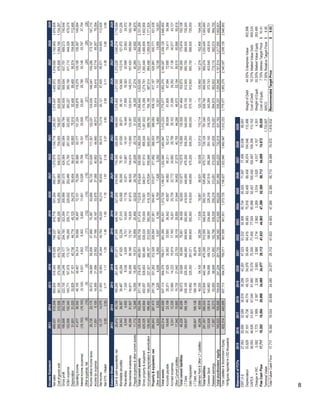
Our intrinsic valuation employed a two-stage free cash flow to the firm DCF methodology, which
resulted in a one-year intrinsic price target of $10.40.
 Growth stage: In our growth stage, we assumed annual square footage growth between 5% and 6%
to forecast the amount of stores to be opened each year. Management has indicated a target of
“low double digit” growth in annual square feet, but have more recently indicated that they will limit
the number of store openings to 15 in 2015 (equaling roughly 6% growth in square feet and driving
our assumption). Our forecast continues until the company reaches approximately 500+ stores,
upon management’s direction and our belief that this is a reasonable target given that Tilly’s closest
competitors support between 550 and 600 domestic locations.
 Terminal stage: Our 15 year forecast was based upon Tilly’s 500+ store maturity point in order to
provide a more accurate estimate of terminal cash flows. At maturity, we assume Tilly’s terminal
growth to remain at the long-term GDP growth rate of about 2% since the retail apparel industry is
mature. Our model assumes Tilly’s will maintain a debt-to-book value equity ratio of 74% in maturity,
which is lower than the average of mature peers; however, we believe debt repayment is the best
use of Tilly’s excess cash.
Source: Team estimates as of June 2015
6
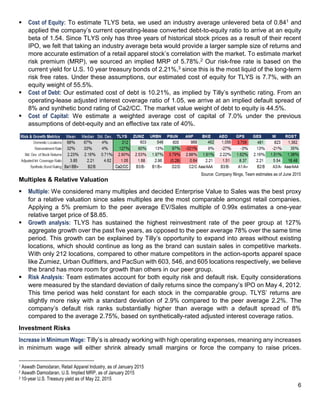
 Cost of Equity: To estimate TLYS beta, we used an industry average unlevered beta of 0.841 and
applied the company’s current operating-lease converted debt-to-equity ratio to arrive at an equity
beta of 1.54. Since TLYS only has three years of historical stock prices as a result of their recent
IPO, we felt that taking an industry average beta would provide a larger sample size of returns and
more accurate estimation of a retail apparel stock’s correlation with the market. To estimate market
risk premium (MRP), we sourced an implied MRP of 5.78%.2 Our risk-free rate is based on the
current yield for U.S. 10 year treasury bonds of 2.21%,3 since this is the most liquid of the long-term
risk free rates. Under these assumptions, our estimated cost of equity for TLYS is 7.7%, with an
equity weight of 55.5%.
 Cost of Debt: Our estimated cost of debt is 10.21%, as implied by Tilly’s synthetic rating. From an
operating-lease adjusted interest coverage ratio of 1.05, we arrive at an implied default spread of
8% and synthetic bond rating of Ca2/CC. The market value weight of debt to equity is 44.5%.
 Cost of Capital: We estimate a weighted average cost of capital of 7.0% under the previous
assumptions of debt-equity and an effective tax rate of 40%.
Multiples & Relative Valuation
 Multiple: We considered many multiples and decided Enterprise Value to Sales was the best proxy
for a relative valuation since sales multiples are the most comparable amongst retail companies.
Applying a 5% premium to the peer average EV/Sales multiple of 0.99x estimates a one-year
relative target price of $8.85.
 Growth analysis: TLYS has sustained the highest reinvestment rate of the peer group at 127%
aggregate growth over the past five years, as opposed to the peer average 78% over the same time
period. This growth can be explained by Tilly’s opportunity to expand into areas without existing
locations, which should continue as long as the brand can sustain sales in competitive markets.
With only 212 locations, compared to other mature competitors in the action-sports apparel space
like Zumiez, Urban Outfitters, and PacSun with 603, 546, and 605 locations respectively, we believe
the brand has more room for growth than others in our peer group.
 Risk Analysis: Team estimates account for both equity risk and default risk. Equity considerations
were measured by the standard deviation of daily returns since the company’s IPO on May 4, 2012.
This time period was held constant for each stock in the comparable group. TLYS’ returns are
slightly more risky with a standard deviation of 2.9% compared to the peer average 2.2%. The
company’s default risk ranks substantially higher than average with a default spread of 8%
compared to the average 2.75%, based on synthetically-rated adjusted interest coverage ratios.
Investment Risks
Increase in Minimum Wage: Tilly’s is already working with high operating expenses, meaning any increases
in minimum wage will either shrink already small margins or force the company to raise prices.
1 Aswath Damodaran, Retail Apparel Industry, as of January 2015
2 Aswath Damodaran, U.S. Implied MRP, as of January 2015
3 10-year U.S. Treasury yield as of May 22, 2015
Source: Company filings, Team estimates as of June 2015
7
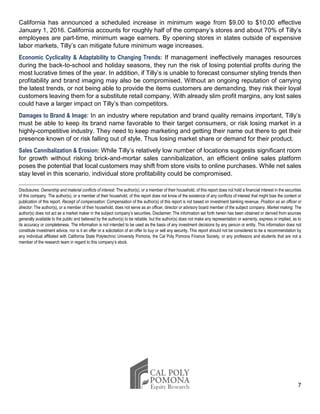
California has announced a scheduled increase in minimum wage from $9.00 to $10.00 effective
January 1, 2016. California accounts for roughly half of the company’s stores and about 70% of Tilly’s
employees are part-time, minimum wage earners. By opening stores in states outside of expensive
labor markets, Tilly’s can mitigate future minimum wage increases.
Economic Cyclicality & Adaptability to Changing Trends: If management ineffectively manages resources
during the back-to-school and holiday seasons, they run the risk of losing potential profits during the
most lucrative times of the year. In addition, if Tilly’s is unable to forecast consumer styling trends then
profitability and brand imaging may also be compromised. Without an ongoing reputation of carrying
the latest trends, or not being able to provide the items customers are demanding, they risk their loyal
customers leaving them for a substitute retail company. With already slim profit margins, any lost sales
could have a larger impact on Tilly’s than competitors.
Damages to Brand & Image: In an industry where reputation and brand quality remains important, Tilly’s
must be able to keep its brand name favorable to their target consumers, or risk losing market in a
highly-competitive industry. They need to keep marketing and getting their name out there to get their
presence known of or risk falling out of style. Thus losing market share or demand for their product.
Sales Cannibalization & Erosion: While Tilly’s relatively low number of locations suggests significant room
for growth without risking brick-and-mortar sales cannibalization, an efficient online sales platform
poses the potential that local customers may shift from store visits to online purchases. While net sales
stay level in this scenario, individual store profitability could be compromised.
Disclosures: Ownership and material conflicts of interest: The author(s), or a member of their household, of this report does not hold a financial interest in the securities
of this company. The author(s), or a member of their household, of this report does not know of the existence of any conflicts of interest that might bias the content or
publication of this report. Receipt of compensation: Compensation of the author(s) of this report is not based on investment banking revenue. Position as an officer or
director: The author(s), or a member of their household, does not serve as an officer, director or advisory board member of the subject company. Market making: The
author(s) does not act as a market maker in the subject company’s securities. Disclaimer: The information set forth herein has been obtained or derived from sources
generally available to the public and believed by the author(s) to be reliable, but the author(s) does not make any representation or warranty, express or implied, as to
its accuracy or completeness. The information is not intended to be used as the basis of any investment decisions by any person or entity. This information does not
constitute investment advice, nor is it an offer or a solicitation of an offer to buy or sell any security. This report should not be considered to be a recommendation by
any individual affiliated with California State Polytechnic University Pomona, the Cal Poly Pomona Finance Society, or any professors and students that are not a
member of the research team in regard to this company’s stock.
8

TLYS - Equity Valuation - FRL 499

  • 1.
     Initiating coverageof Tilly’s, Inc. (TLYS) with a HOLD rating. An estimated $9.65 one-year target price represents 2% potential downside from a closing price of $9.82 on June 1, 2015. Estimated 28% average annual growth in diluted earnings per share over the next five years, from $0.81 in 2015 to $1.60 in 2019. New store openings forecasted to improve sales by 9.6% annually over the same time period, while net income estimated to grow from $22.8 million in 2015 to $50.2 million in 2019.  Online platforms drive sales growth, store openings slow. Tilly’s, Inc. has recently updated its online presence with a new website, mobile application, and customer loyalty program. Online sales accounted for roughly 7.5% of revenue in 2014, a number that management aims to double over the long term. Management has also announced their plan to open 15 new stores in 2015, down from 28 and 19 in 2013 and 2014 respectively, in an attempt to limit the number of store closures and become more selective of new locations (closures in respect to gross store openings up from 3.5% in 2014 to 10.5% last year). We estimate the company will have the financial, administrative, and market capacity to grow total store square footage by about 6% annually.  New, fully automated, e-commerce fulfillment center. In May 2015, Tilly’s celebrated the one-year anniversary of their $18 million state-of-the- art warehouse dedicated to online order fulfillment. The fully-automated distribution center, located near the company’s headquarters in Irvine, CA, was built to support Tilly’s future e-commerce growth initiatives. This new warehouse is nearly identical to the company’s current distribution center and provides separate facilities for e-commerce and brick-and-mortar order fulfillment operations. Since its opening, the new facility has not contributed meaningfully to improvements in sales, merchandise, or distribution costs; however, the facility does provide a solid foundation for future scalability.  Jennifer Ehrhardt, Chief Financial Officer, announces resignation. After two years as CFO, Ehrhardt announced on April 20, 2015 that she will be resigning her position to relocate closer to her family and pursue other professional endeavors. Tilly’s, Inc. has named Michael L. Henry as the new CFO, effective May 26, 2015; however, Ehrhardt proctored the company’s Q1 earnings call on May 27 and is currently working together with Henry to facilitate a smooth transition. Stock Data Price $9.82 52-Week Range 6.65 – 16.99 Market Cap 273.35M Diluted Shares Out. 28,520,582 Avg. Vol. (3 mo.) 193,906 Beta 0.63 P/E T12M 18.67x Institutional Holdings 85% Insider Holdings 8% Estimated One-Year Target Price DCF Price $10.40 Relative Price $8.85 Target Price $9.65 Potential Downside -2% Sources: Nasdaq, Team estimates Equity | United States | Retail June 1, 2015 +1 805 423 5074 bmbelford@cpp.edu +1 626 478 7919 eugenecho@cpp.edu +1 818 939 2739 justinking@cpp.edu Bradley Belford Student Analyst Eugene Cho Student Analyst Justin King Student Analyst Initiating Coverage: HOLD / Neutral Tilly’s, Inc. NASDAQ: TLYS Retail Apparel Industry 500 1000 1500 2000 2500 5 10 15 20 2012 2013 2014 2015 TLYSPriceperShare Historical Share Prices TLYS S&P500Source: Team estimates
  • 2.
    2 Business Description Tilly’s, Inc.is a destination specialty retailer of west coast action sports inspired apparel, footwear and accessories. Since 1982 the company operated under the name World of Jeans & Tops, but adopted the name Tilly’s, Inc. on May 2012 before its initial public offering. Tilly’s operates 212 stores in 33 states and can be found in regional malls, power centers, neighborhood and lifestyle centers, street-front locations, and major outlets. With the motto “if it’s not here, it’s not happening,” Tilly’s goal is to carry an unparalleled selection of the most sought-after brands rooted in action sports, music, art, and fashion. Tilly’s follows the trend of action sports through maintaining high concentrations of stores within CA, AZ, and FL, where approximately 60% of the company’s storefronts operate. Recently, Tilly’s has made efforts to expand its footprint in the action sports apparel industry by focusing on driving online sales through an improved website, mobile application, customer loyalty program, and e-commerce fulfillment center. Tilly’s target customer is a male or female between the age of 14 and 24. About 72% of the company’s sales are from third-party brands but Tilly’s also provides their own proprietary clothing (representing the remaining 28% of sales) to “expand our price point range, identify and respond to changing fashion trends quickly, fill merchandise gaps and provide a deeper selection of styles and colors for proven fashion items.” Tilly's has recently implemented a rewards program known as Tilly's Hook Up where members earn points from both in- store and online purchases or through interaction with the mobile app. Tilly’s primary growth will continue to focus on new store development, with online sales only intended to supplement the company’s core brick-and-mortar business. Competitive Positioning Discount approach improves asset turnover at the expense of margins. From a sample of relative pricing between Tilly’s and others in the highly competitive action-sports apparel space (Zumiez, Vans, and PacSun), Tilly’s currently offers the lowest markups and deepest discounts. Full retail price for an average shirt or pair of pants at Tilly’s can range between $22 and $50, compared to an average price range of $25 to $60 for comparable items at competing stores. Furthermore, Tilly’s currently offers the deepest discounts, 35% to 50% off many items, compared to the average 25% discount offered by competitors. Tilly’s price levels are closest to that of Vans, who notably sells only proprietary clothing. Proprietary branding helps expand product and price offering. Of the comp group, Tilly’s sustains a unique competitive advantage: selling proprietary merchandise alongside third-party brands. Tilly’s proprietary clothing is used to “fill gaps” in inventory so that Tilly’s can offer a full range of colors, sizes, styles, and price points. Meanwhile, the company utilizes third-party brands to help predict new fashion trends, as opposed to companies like Buckle or Abercrombie & Fitch, who sell only proprietary 28 19 15 16 17 17 19 Store Openings, gross Sources: Company 10-K, Team estimates
  • 3.
    3 merchandise and mustactively forecast consumer tastes. Any inability to do so can severely damage brands in this industry, as demonstrated by the recent poor performance of Abercrombie and PacSun. Of total revenue, 8% is earned in states where Tilly’s has no physical presence, instead converting customers through online sales channels. To increase this figure, Tilly’s has developed an updated website, new mobile phone app, and rewards program to create incentives for new and returning customers through both online and brick-and-mortar channels. Industry Analysis When compared to a constructed comparable group including other public retail companies Urban Outfitters (URBN), Zumiez (ZUMZ), PacSun (PSUN), Abercrombie & Fitch (ANF), American Eagle Outfitters (AEO), and Buckle (BKE), Tilly’s makes up 3.79% total market share as of FY2014. The leaders of the group are URBN, AEO, and ANF (each composing approximately 25% market share). Market share in this instance was composed using total sales of firms in the comp group. Since FY2010, of the seven companies within this group, only two, Tilly’s and Zumiez, have managed to increase market share year over year. Although, it may be assumed that Tilly’s market share is growing at a diminishing rate if one were to go back and look at further data from years past 2010. This data is somewhat hindered by the fact that Tilly’s net income has decreased despite the growth in its sales and market share, which is a result of significant investment in distribution facilities over the past few years. Urban Outfitters, when looked at from 2011 on, has displayed tremendous growth in terms of market share along with Zumiez, the leaders of the peer group. The recovering economy has been characterized by low interest rates, low inflation, and low unemployment rate, among many others. Yet, with low oil prices, providing a means to increase disposable income, retail sales has remained flat for the month of April 2015. Profitability & Cost Analysis Tilly’s 15% Return on Investment (ROI) falls below the peer-median ROI of 18%. BKE, URBN, and ZUMZ are top-performers in the retail shopping mall space, but are also more mature with 425+ brick- and-mortar locations as opposed to Tilly’s 212 stores. Even if the company continues along its planned growth schedule, we expect Tilly’s will only improve firm-level returns modestly and remain average or below-average with respect to peers. Underperforming returns likely a result of discount pricing strategy. Tilly’s gross, operating, and net profit margins lag peer averages. The company’s cost of sales, and consequently gross margin, are amongst the worst in the comp group and similar to discount retailers like Ross Stores, Inc. (ROST). This tight margin structure can be explained by Tilly’s lower-than-average retail prices and aggressive discounting approach. Tilly’s strategy positions the company as a leader in inventory turnover though, and allows the company to keep a clean inventory with up-to-date, relevant styles. The firm maintains TLYS 3.79% AEO 24% ANF 27% URBN 24% BKE 8% PSUN 6% ZUMZ 6% Market Share – 2014 Source: Company filings, Team estimates
  • 4.
    4 average SG&A expenseswith respect to sales (despite approximately 83% of the company’s stores operating in states with minimum wages higher than the federal minimum), pulling both operating and net profit margins below average. If the company can sustain growth and leverage its fixed costs however, we estimate net profit margin can improve from 2.7% to 5.5% in five years. Growth Drivers The company’s room for growth is one of the most promising in the space. Tilly’s reinvestment rate is highest amongst peers, at about 130% aggregate over the past five years compared to an average 80%. With only 212 brick-and-mortar locations as of fiscal 2014, there is still significant opportunity for the company to expand into other domestic locations. Still, there is sizable competition in shopping malls with many competing brands situated in direct proximity to each other, placing extra emphasis on product offerings and cost structures to attract business. Some brands are experiencing difficulty, namely Abercrombie & Fitch and PacSun, which may allow Tilly’s to gain extra market share. Shopping malls continue to be the company’s main growth vessel, contributing to over 50% of locations; however, Tilly’s presence in outlet malls has effectively doubled in proportion over the past year (from 3.5% to 7.5% of total stores), while off-mall storefronts like lifestyle centers and street-front locations account for the remaining 41.5%. We expect the company will open 15 new stores in 2015 upon management’s indication, and believe this is a reasonable target since the company has shown the ability to open as many as 28 stores in a year. At approximately 6,700 to 7,200 square feet per store, we expect Tilly’s to grow total companywide store square footage by between 5% and 6% annually over the next several years. Online sales growth continues to be management’s focal point. Currently, e-commerce represents roughly 7.5% of Tilly’s total revenue. Management’s goal is to grow this figure to 15% over the long term, which we believe is achievable given Tilly’s improved online presence, mobile application, loyalty program, and e-commerce fulfillment center. If online sales can sustain 10% growth over the next six years (which we believe is conservative given an average growth of 45% since the beginning of Tilly’s online initiatives in fiscal 2014), e-sales should be able to hit this mark by 2021. Debt Analysis Off-balance sheet debt is prolific amongst retailers since GAAP requirements allow current rent obligations to be written off as an operating expense. Tilly’s and its peers report low debt leverage without considering off-balance sheet debt as long-term commitments. In order to more accurately Source: Company filings, Team estimates as of June 2015 Source: Company 10-K
  • 5.
    5 account for leveragerisk, our team capitalized these operating leases as long-term debt and compared our results across the peer group. Tilly’s implied debt structure is more risky than peers. The company’s below-average adjusted interest coverage ratio estimates a junk bond rating of Ca2/CC, compared to the Ba1/BB+ peer average. This provides a cost of debt estimate of 10.2% instead of an average 7.1%. While the company has indicated that future store openings will be financed with cash from operations, using an ongoing rent-based business model suggests that the firm will actually maintain a significant amount of long-term commitments. However, our models assume that these minimum future rent payments are treated as debt. After the conversions, we estimate Tilly’s would, in fact, be able to fund growth with operating cash flows under a conventional debt issuance scenario. Our estimations of Tilly’s free cash flows increase from $17.7 million in 2015 to $24.1 million over the next five years, growing nearly 36% annually over this time period. Valuation Our recommended one-year target price weighs both intrinsic and relative value estimates equally in order to account for differences in market perceptions and fundamental assumptions. From a discounted cash flow and relative share price estimate of $10.40 and $8.85 respectively, we recommend a one-year target price of $9.65, representing 2% downside from a closing price of $9.82 on June 1, 2015. Intrinsic Valuation Our intrinsic valuation employed a two-stage free cash flow to the firm DCF methodology, which resulted in a one-year intrinsic price target of $10.40.  Growth stage: In our growth stage, we assumed annual square footage growth between 5% and 6% to forecast the amount of stores to be opened each year. Management has indicated a target of “low double digit” growth in annual square feet, but have more recently indicated that they will limit the number of store openings to 15 in 2015 (equaling roughly 6% growth in square feet and driving our assumption). Our forecast continues until the company reaches approximately 500+ stores, upon management’s direction and our belief that this is a reasonable target given that Tilly’s closest competitors support between 550 and 600 domestic locations.  Terminal stage: Our 15 year forecast was based upon Tilly’s 500+ store maturity point in order to provide a more accurate estimate of terminal cash flows. At maturity, we assume Tilly’s terminal growth to remain at the long-term GDP growth rate of about 2% since the retail apparel industry is mature. Our model assumes Tilly’s will maintain a debt-to-book value equity ratio of 74% in maturity, which is lower than the average of mature peers; however, we believe debt repayment is the best use of Tilly’s excess cash. Source: Team estimates as of June 2015
  • 6.
    6  Cost ofEquity: To estimate TLYS beta, we used an industry average unlevered beta of 0.841 and applied the company’s current operating-lease converted debt-to-equity ratio to arrive at an equity beta of 1.54. Since TLYS only has three years of historical stock prices as a result of their recent IPO, we felt that taking an industry average beta would provide a larger sample size of returns and more accurate estimation of a retail apparel stock’s correlation with the market. To estimate market risk premium (MRP), we sourced an implied MRP of 5.78%.2 Our risk-free rate is based on the current yield for U.S. 10 year treasury bonds of 2.21%,3 since this is the most liquid of the long-term risk free rates. Under these assumptions, our estimated cost of equity for TLYS is 7.7%, with an equity weight of 55.5%.  Cost of Debt: Our estimated cost of debt is 10.21%, as implied by Tilly’s synthetic rating. From an operating-lease adjusted interest coverage ratio of 1.05, we arrive at an implied default spread of 8% and synthetic bond rating of Ca2/CC. The market value weight of debt to equity is 44.5%.  Cost of Capital: We estimate a weighted average cost of capital of 7.0% under the previous assumptions of debt-equity and an effective tax rate of 40%. Multiples & Relative Valuation  Multiple: We considered many multiples and decided Enterprise Value to Sales was the best proxy for a relative valuation since sales multiples are the most comparable amongst retail companies. Applying a 5% premium to the peer average EV/Sales multiple of 0.99x estimates a one-year relative target price of $8.85.  Growth analysis: TLYS has sustained the highest reinvestment rate of the peer group at 127% aggregate growth over the past five years, as opposed to the peer average 78% over the same time period. This growth can be explained by Tilly’s opportunity to expand into areas without existing locations, which should continue as long as the brand can sustain sales in competitive markets. With only 212 locations, compared to other mature competitors in the action-sports apparel space like Zumiez, Urban Outfitters, and PacSun with 603, 546, and 605 locations respectively, we believe the brand has more room for growth than others in our peer group.  Risk Analysis: Team estimates account for both equity risk and default risk. Equity considerations were measured by the standard deviation of daily returns since the company’s IPO on May 4, 2012. This time period was held constant for each stock in the comparable group. TLYS’ returns are slightly more risky with a standard deviation of 2.9% compared to the peer average 2.2%. The company’s default risk ranks substantially higher than average with a default spread of 8% compared to the average 2.75%, based on synthetically-rated adjusted interest coverage ratios. Investment Risks Increase in Minimum Wage: Tilly’s is already working with high operating expenses, meaning any increases in minimum wage will either shrink already small margins or force the company to raise prices. 1 Aswath Damodaran, Retail Apparel Industry, as of January 2015 2 Aswath Damodaran, U.S. Implied MRP, as of January 2015 3 10-year U.S. Treasury yield as of May 22, 2015 Source: Company filings, Team estimates as of June 2015
  • 7.
    7 California has announceda scheduled increase in minimum wage from $9.00 to $10.00 effective January 1, 2016. California accounts for roughly half of the company’s stores and about 70% of Tilly’s employees are part-time, minimum wage earners. By opening stores in states outside of expensive labor markets, Tilly’s can mitigate future minimum wage increases. Economic Cyclicality & Adaptability to Changing Trends: If management ineffectively manages resources during the back-to-school and holiday seasons, they run the risk of losing potential profits during the most lucrative times of the year. In addition, if Tilly’s is unable to forecast consumer styling trends then profitability and brand imaging may also be compromised. Without an ongoing reputation of carrying the latest trends, or not being able to provide the items customers are demanding, they risk their loyal customers leaving them for a substitute retail company. With already slim profit margins, any lost sales could have a larger impact on Tilly’s than competitors. Damages to Brand & Image: In an industry where reputation and brand quality remains important, Tilly’s must be able to keep its brand name favorable to their target consumers, or risk losing market in a highly-competitive industry. They need to keep marketing and getting their name out there to get their presence known of or risk falling out of style. Thus losing market share or demand for their product. Sales Cannibalization & Erosion: While Tilly’s relatively low number of locations suggests significant room for growth without risking brick-and-mortar sales cannibalization, an efficient online sales platform poses the potential that local customers may shift from store visits to online purchases. While net sales stay level in this scenario, individual store profitability could be compromised. Disclosures: Ownership and material conflicts of interest: The author(s), or a member of their household, of this report does not hold a financial interest in the securities of this company. The author(s), or a member of their household, of this report does not know of the existence of any conflicts of interest that might bias the content or publication of this report. Receipt of compensation: Compensation of the author(s) of this report is not based on investment banking revenue. Position as an officer or director: The author(s), or a member of their household, does not serve as an officer, director or advisory board member of the subject company. Market making: The author(s) does not act as a market maker in the subject company’s securities. Disclaimer: The information set forth herein has been obtained or derived from sources generally available to the public and believed by the author(s) to be reliable, but the author(s) does not make any representation or warranty, express or implied, as to its accuracy or completeness. The information is not intended to be used as the basis of any investment decisions by any person or entity. This information does not constitute investment advice, nor is it an offer or a solicitation of an offer to buy or sell any security. This report should not be considered to be a recommendation by any individual affiliated with California State Polytechnic University Pomona, the Cal Poly Pomona Finance Society, or any professors and students that are not a member of the research team in regard to this company’s stock.
  • 8.