Digital data and professional
practices: New
accountabilities, stewardship,
and literacies
Terrie Lynn Thompson Jan 2018
datafication: “ways of seeing
and engaging with the world
by means of digital data”
(Gray, 2016)
wearable physical activity tracker
learning analytics: the
measurement, collection,
analysis and reporting of
data about learners and
their contexts, for purposes
of understanding and
optimizing learning and the
environments in which it
occurs
(Long & Siemens, 2011)
datafication of teaching
& research practices
changing how expertise of specialists is
made available in society
(Susskind & Susskind, 2016)
• algorithms to write earnings
reports and sports commentary
• eBay and online dispute
resolution software to replace
the lawyer
• tax preparation software rather
than accountants
• robotic pharmacists
why does this matter?
• the way the digital can “strip down complex phenomena into binary form
so that they can be manipulated more easily” (Savage, 2015). issues can
be made simpler
• datafication is “taking a process or activity that was previously invisible
and turning it into data”: data that can then be “tracked, monitored, and
optimized” (Sylvester, 2013). “dark data” and also “dark activities” are
now being made visible
• outsourcing to algorithms creates a significant shift in responsibility and
control (Marsden, 2015)
• powerful discourse that encourages professionals to view digital
technologies as a “natural and naturalised part of their work” (Edwards &
Fenwick, 2016)
platform capitalism: the intersection
of
commercial technological
infrastructures
and the new currency of data
Players like Google and Facebook enable
access while serving a set of global
commercial purposes as they harvest and
monetise data generated through everyday
work-learning-living activities. Operate in
gray areas of accountability and governance
around data practices.
How do we live with and trust the
algorithms and data analysis used
to shape key features of our
lives?
Digital data as the raw material
for much of what is unfolding in
people’s everyday work,
learning, and living. Most days,
most people will generate,
interact with, and interpret some
kind of digitally-rendered data:
some knowable and accessible
by the person and much that
churns quietly in the
background.
think about the data implicated in your own work-
learning-living activities
1. What data do you use to make decisions about what
you or others should do? about policies or processes?
2. What data is used to make decisions that impact
your work-learning-living activities?
3. What data would you like to have to help with things
you need to do: work – learning – living?
4. Have you ever been affected by a “data disaster”?
how the use of learning analytics,
coupled with social network analysis
and visualization software, worked in
and on the research and teaching
practices in an online post-graduate
course
the oPEN project (online
professional education network)
• posthumanism
• a posthuman sociomaterial analysis of
datafication practices (aka learning
analytics)
• implications vis a vis re-distribution of
labour: accountabilities, stewardship &
literacies/fluencies
today
theory and methodology
when computational
“solutions” come from an
“instrumentalising humanistic
perspective which sees the
technology as in service to
social ‘need’, resistance to such
methods also takes humanistic
forms positing essentialism”
(such as the human “touch”) as
the “main locus for resistance
to cold technocratic
imperative” (Bayne, 2015)
Badminton 2000
Braidotti 2013
Barad 2003
Graham 2002
Hayles 1999
Wolfe 2010
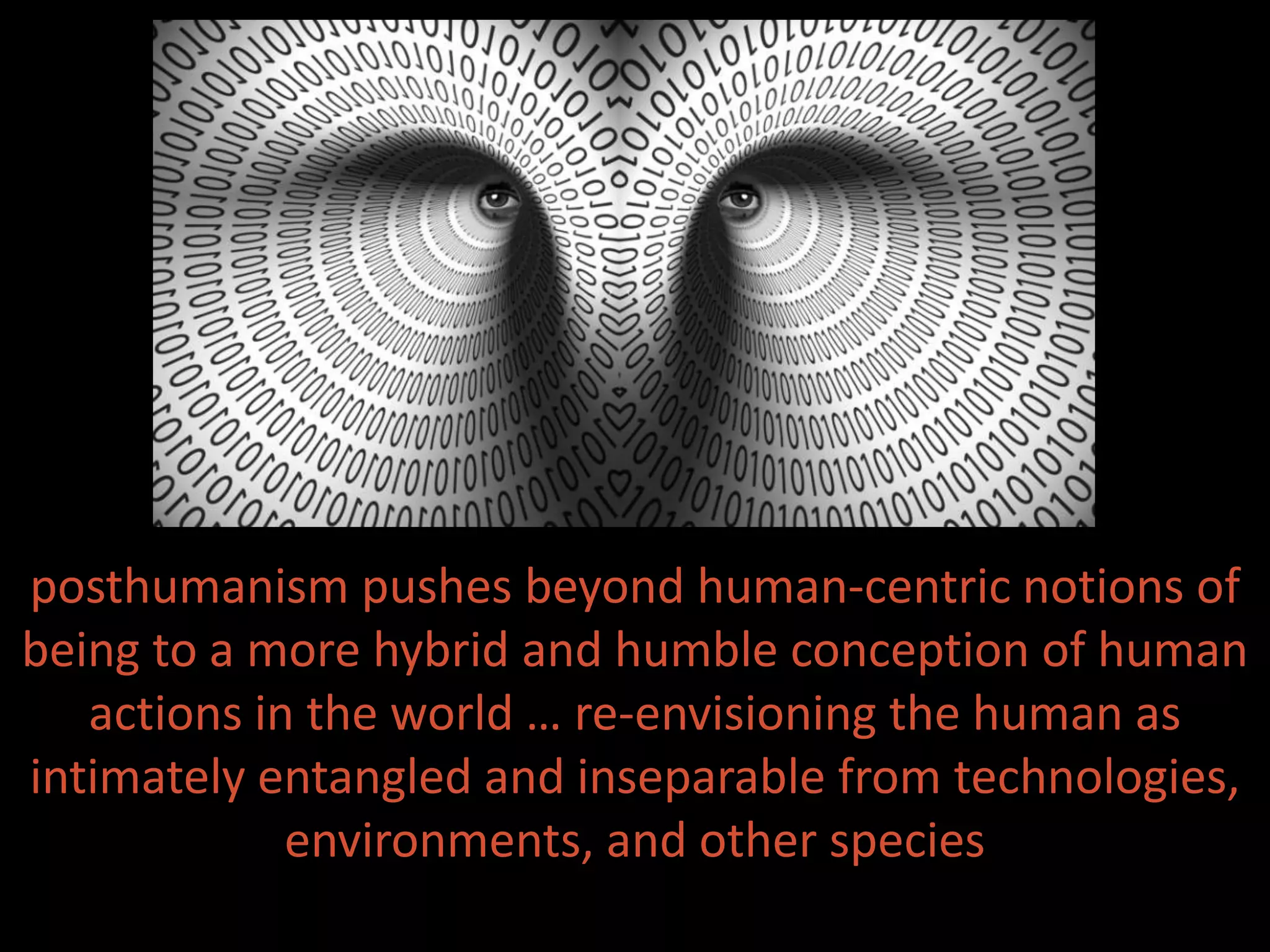
posthumanism pushes beyond human-centric notions of
being to a more hybrid and humble conception of human
actions in the world … re-envisioning the human as
intimately entangled and inseparable from technologies,
environments, and other species
sofas that
shout ‘sit!’
calling into question the
givenness of the differential
categories of “human” and
“nonhuman” (Barad, 2003)
beyond who or what to
who-what
One does not have to fix one’s gaze on a
material world from which all traces of
humanity have been expunged; or on its residue
– a social world from which the material world
has been magically whisked away by linguistic
conjuring tricks. … One can try seeing double:
seeing the human and the nonhuman at once,
without trying to strip either away. This shift in
the unit of analysis is the move to a
posthumanist perspective (Pickering, 2005)
Seeing Double
Attending to objects, attuning to things
• gathering anecdotes
• following the actors
• listening for the invitational quality of things
• studying breakdowns, accidents & anomalies
Loosening the meshwork, analyzing digital
materialities
• discerning the spectrum of human-technology
relations
• applying the Laws of Media
• unraveling translations
• tracing responses and passages
Researching a posthuman world: Interviews with
digital objects (Adams & Thompson, 2016 )
8 Heuristics
to Interview
Things
the oPEN project
• 16-week masters level online course
• 43 practicing professionals, 2 university tutors, and 5
Critical Colleagues (senior teachers recruited from the
partner local authorities)
• students required to actively engage with a range of online
artefacts, post in discussion forums and blogs, and use
wikis for group work in order to advance the learning of the
collective
• examined the digital traces of student activity in the online
space: relationship to learning?
Learning Analytics
measure learning efforts
predict learning outcomes
recommend learning
pathways & strategies
data detours
Adams, C., & Thompson, T. L. (2016). Researching a posthuman
world: Interviews with digital objects. London: Palgrave Macmillan.
Wilson, A., Watson, C., Thompson, T. L., Drew, V. and Doyle, S.
(2017). Learning analytics: Challenges and limitations. Teaching in
Higher Education.
Thompson, T. L. (June, 2017). Digital data and professional practices: A posthuman
exploration of new responsibilities and tensions. Paper to be presented at 3rd ProPEL
International Conference (Linköping, Sweden).
Wilson, A., Thompson, T. L., Watson, C., Drew, V., & Doyle, S. (2017). Big data and
learning analytics: Singular or plural? First Monday, 22(4).
Watson, C., Wilson, A., Drew, V., & Thompson, T. L. (2016a). Criticality and the exercise
of politeness in online spaces for professional learning. The Internet and Higher
Education, 31, 43-51.
Watson, C., Wilson, A., Drew, V., & Thompson, T. L. (2016b). Small data, online learning
and assessment practices in higher education: a case study of failure?. Assessment &
Evaluation in Higher Education, 1-16.
student—instructor—
device—network—
LMS—digital resource
Visualizations
• re-present patterns of interactions
• may inform professional decisions
• are implicated in changes in
professional practices
We tell ourselves that we live in an
era of aggregation and automation.
From this perspective, raw data
patiently await assembly….Click.
Shuttled from data storage to a
computing center, the analytical
engines of the twenty-first century
assemble statistics, graphs, and
ever more clever visualizations in
response to these and many other
questions we have not yet thought
to ask. (Ribes & Jackson, 2015)
imagining data as:
temperamental and
delicate creatures, whose
existence and fraternity
with one another depend
on a complex assemblage
of people, instruments,
and practices dedicated to
their production,
management, and care
(Ribes & Jackson, 2015)
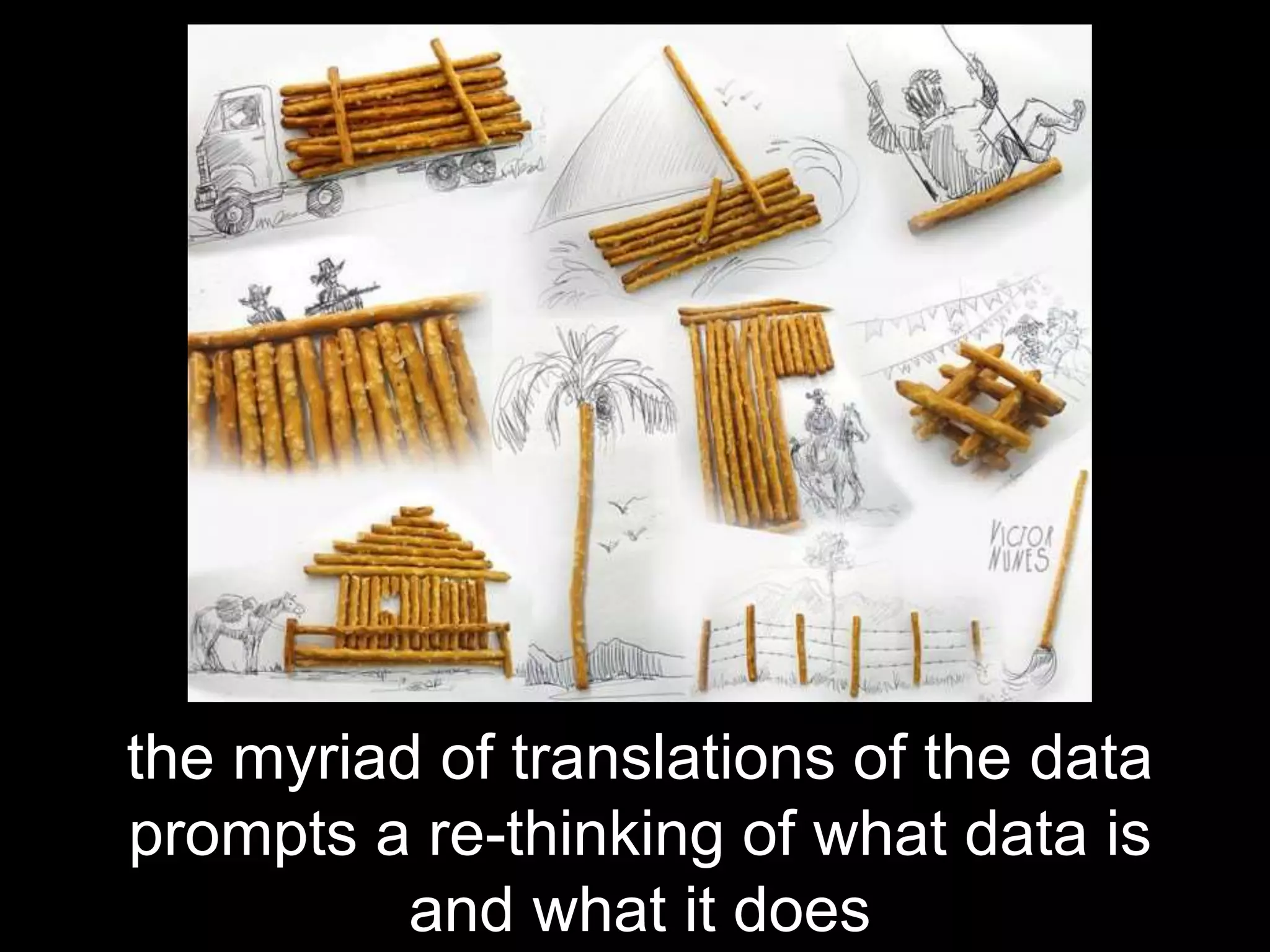
the myriad of translations of the data
prompts a re-thinking of what data is
and what it does
data visualizations are not
neutral: they come with
particular “ways of seeing”:
particular analytic, mediation,
and narrative regimes (Gray et al.,
2016)
datafication as messy process: re-distribution of
labour between human actors and digital
counterparts
So …
• Who-what is being datafied? Who-what is doing this work?
• Is it the work of the professional to “tame” masses of potentially
unruly data? Or perhaps it is to avoid getting run over by these
rabbles of data?
• How is the availability of expertise changing?
• How do we open the black-box of “automated, algocratic systems”
(Prinsloo, 2017)?
• How do we continue to value (professional) work “within an
algorithmic culture defined by the new potentials of computation
and digital data” (Bayne, 2015)?
what “we” knew and how we knew it?
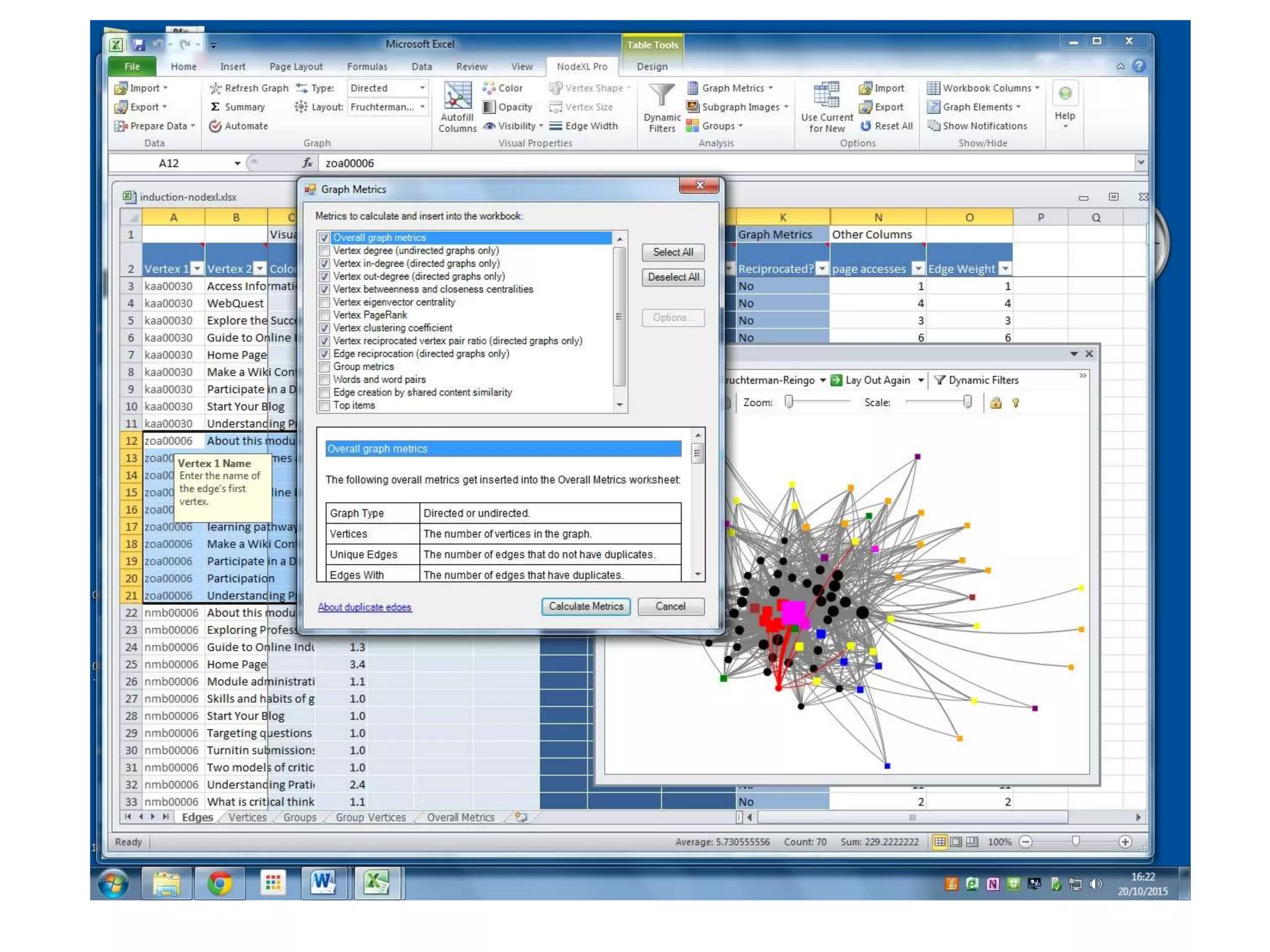
NodeXL, along with its charts and graphics, classified the student
learning activities in ways that have an array of consequences.
The relationships between patterns of interaction are not simply and
rigidly correlated with final performance.
The many anomalies and contradictions: student-resource
interaction data generated from this course—and illustrated through
visualizations—are a powerful reminder of the diversity of
approaches to online study.
Professionals in these spaces should “look beyond the average of all
outcomes” and instead to the “best outcome for each student”.
Wilson et al. (2017)
data controversies
workers are dealing with
datafication and
increasing demands to
make decisions, be
accountable, work with,
and care for the digital
data moving in and out of
their day-to-day work
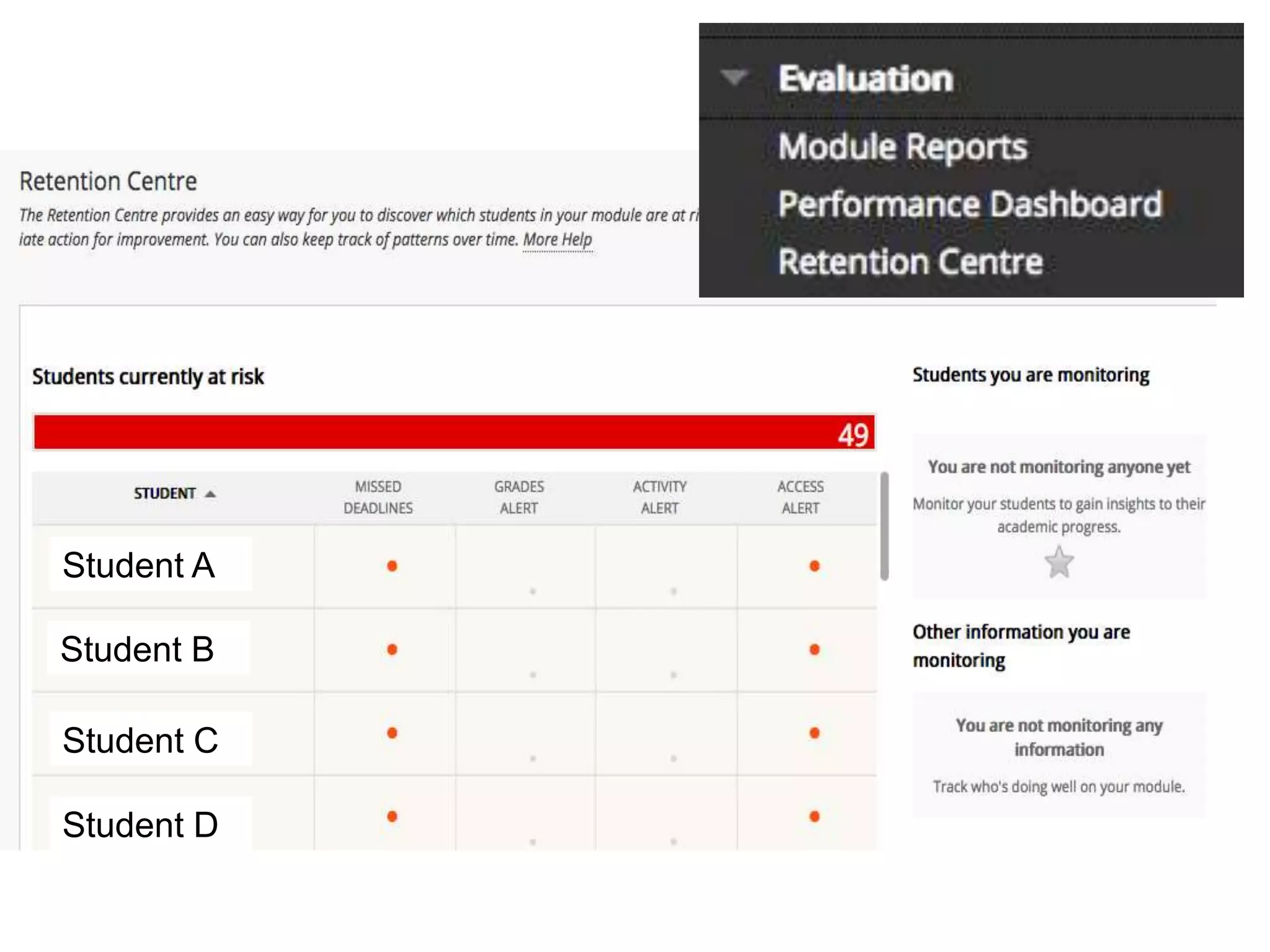
There is no easy way for the average digitally
literate instructor to see, question, or change
the algorithms that generate the data in the
LMS and its assemblages of charts, tables, and
warnings.
Student A
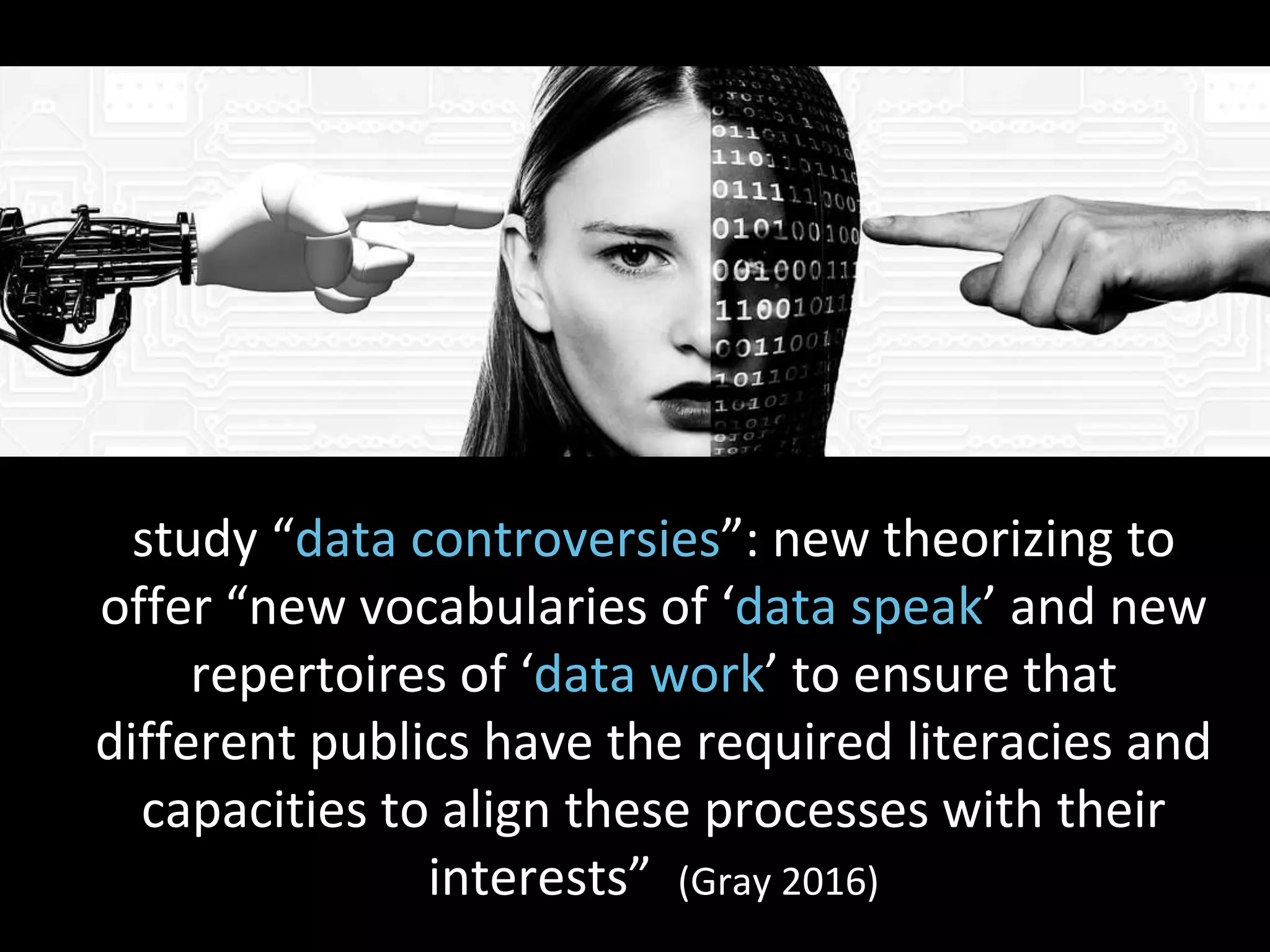
study “data controversies”: new theorizing to
offer “new vocabularies of ‘data speak’ and new
repertoires of ‘data work’ to ensure that
different publics have the required literacies and
capacities to align these processes with their
interests” (Gray 2016)
posthuman fluencies (Adams &
Thompson, 2016)
fluencies: confluence of digital
expertise, responsibility /
citizenship, criticality, innovation &
well-being in human-technology
interactions
Student A
Student B
Student C
Student D
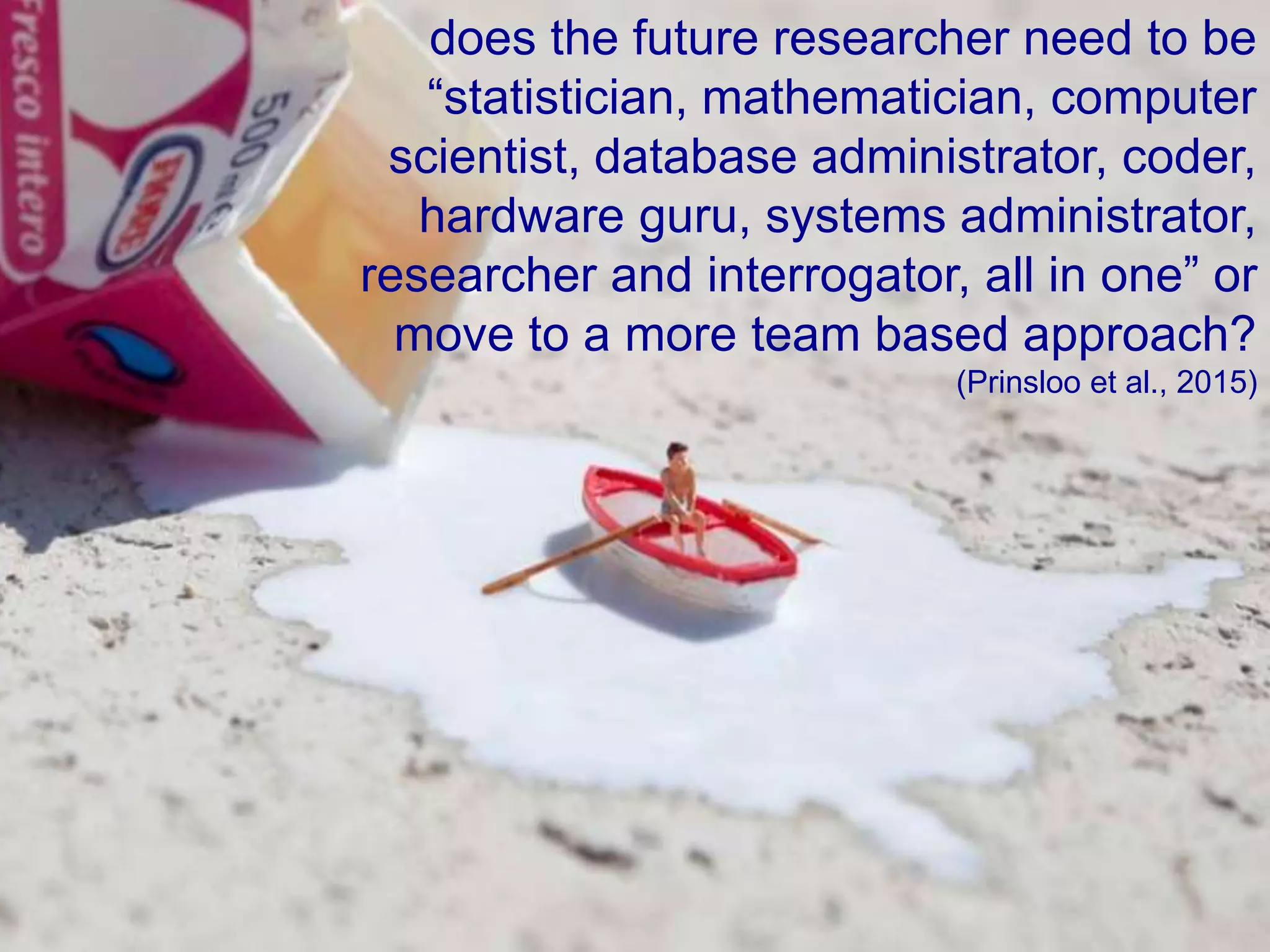
does the future researcher need to be
“statistician, mathematician, computer
scientist, database administrator, coder,
hardware guru, systems administrator,
researcher and interrogator, all in one” or
move to a more team based approach?
(Prinsloo et al., 2015)
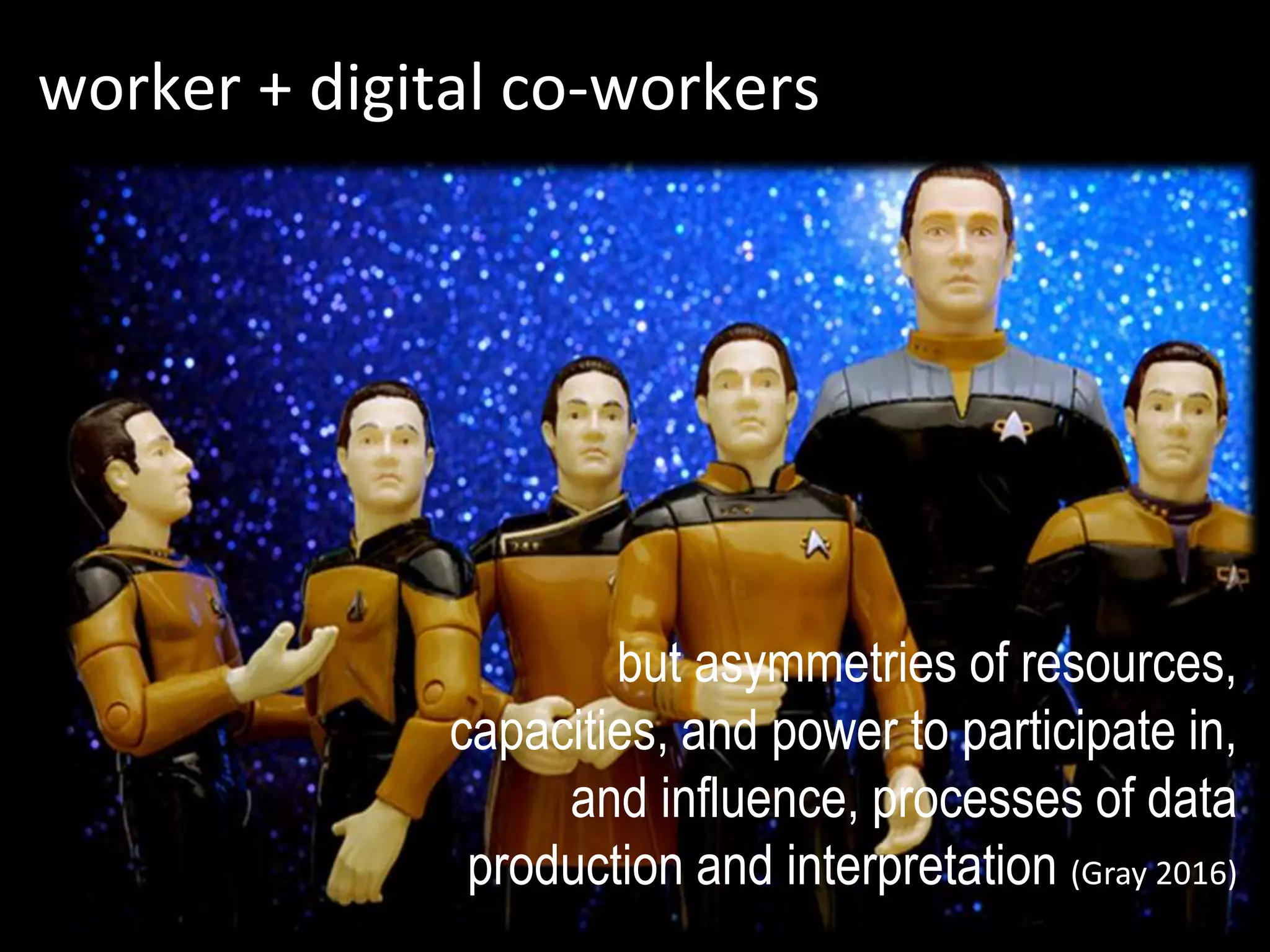
worker + digital co-workers
but asymmetries of resources,
capacities, and power to participate in,
and influence, processes of data
production and interpretation (Gray 2016)
1 The moral relational duty of learning analytics
2 Defining student success in the nexus of student,
institution and macro-societal agencies and context
3 Understanding data as framed and framing
4 Student data sovereignty
5 Accountability
6 Transparency
7 Co-responsibility
Guidelines on the Ethical Use of Student Data: A
Draft Narrative Framework (Prinsloo, 2017)
How do worker-learners, work
organizations, and educational
institutions understand their
choices, decisions, responsibilities,
accountability, compromises,
influence, and leadership
capacities as they engage with
differently powerful digital actors,
and especially data?
Yates et al. (2017) raise several pressing
issues:
• How do we wrestle with the power and
accountability for data and algorithms?
• What are the new data literacies required
by citizens and organizations?
• How well do we understand how people
are interacting with data and algorithms?
• What new forms of digital inclusion and
exclusion are emerging?
more questions
What new spaces of public dialogue can be created? “Data activism”
and its push for “data from below”?
Data itself is at the centre of storm around ownership, sovereignty, and
stewardship. How do worker-learners understand the value of their
digital data and the role it plays in their life activities?
What new critical digital and data fluencies (and leadership) are
needed in the face of the growing datafication and digital automation
of work, learning, and living?
How are governance practices and regulatory environments dealing
with the melee of data issues? In light of increasing platform capitalism
who is accountable for what WRT data practices?
• Identify the digital tools, systems, and services
at play in a particular practice and then ask:
Who created these and why?
• What data do these digital tools, systems, and
services render?
• What hidden limitations might there be to the
data rendered via these digital tools, systems,
and services? (Lynch & Gerber, 2017)
Diamante Murru
terrielynn.thompson@stir.ac.uk
propelmatters.stir.ac.uk

TL_Thompson.pptx.ppt

  • 1.
    Digital data andprofessional practices: New accountabilities, stewardship, and literacies Terrie Lynn Thompson Jan 2018
  • 2.
    datafication: “ways ofseeing and engaging with the world by means of digital data” (Gray, 2016)
  • 3.
  • 5.
    learning analytics: the measurement,collection, analysis and reporting of data about learners and their contexts, for purposes of understanding and optimizing learning and the environments in which it occurs (Long & Siemens, 2011) datafication of teaching & research practices
  • 6.
    changing how expertiseof specialists is made available in society (Susskind & Susskind, 2016) • algorithms to write earnings reports and sports commentary • eBay and online dispute resolution software to replace the lawyer • tax preparation software rather than accountants • robotic pharmacists
  • 8.
    why does thismatter? • the way the digital can “strip down complex phenomena into binary form so that they can be manipulated more easily” (Savage, 2015). issues can be made simpler • datafication is “taking a process or activity that was previously invisible and turning it into data”: data that can then be “tracked, monitored, and optimized” (Sylvester, 2013). “dark data” and also “dark activities” are now being made visible • outsourcing to algorithms creates a significant shift in responsibility and control (Marsden, 2015) • powerful discourse that encourages professionals to view digital technologies as a “natural and naturalised part of their work” (Edwards & Fenwick, 2016)
  • 9.
    platform capitalism: theintersection of commercial technological infrastructures and the new currency of data Players like Google and Facebook enable access while serving a set of global commercial purposes as they harvest and monetise data generated through everyday work-learning-living activities. Operate in gray areas of accountability and governance around data practices.
  • 10.
    How do welive with and trust the algorithms and data analysis used to shape key features of our lives?
  • 11.
    Digital data asthe raw material for much of what is unfolding in people’s everyday work, learning, and living. Most days, most people will generate, interact with, and interpret some kind of digitally-rendered data: some knowable and accessible by the person and much that churns quietly in the background.
  • 12.
    think about thedata implicated in your own work- learning-living activities 1. What data do you use to make decisions about what you or others should do? about policies or processes? 2. What data is used to make decisions that impact your work-learning-living activities? 3. What data would you like to have to help with things you need to do: work – learning – living? 4. Have you ever been affected by a “data disaster”?
  • 13.
    how the useof learning analytics, coupled with social network analysis and visualization software, worked in and on the research and teaching practices in an online post-graduate course the oPEN project (online professional education network)
  • 15.
    • posthumanism • aposthuman sociomaterial analysis of datafication practices (aka learning analytics) • implications vis a vis re-distribution of labour: accountabilities, stewardship & literacies/fluencies today
  • 16.
  • 17.
    when computational “solutions” comefrom an “instrumentalising humanistic perspective which sees the technology as in service to social ‘need’, resistance to such methods also takes humanistic forms positing essentialism” (such as the human “touch”) as the “main locus for resistance to cold technocratic imperative” (Bayne, 2015)
  • 18.
    Badminton 2000 Braidotti 2013 Barad2003 Graham 2002 Hayles 1999 Wolfe 2010
  • 19.
    posthumanism pushes beyondhuman-centric notions of being to a more hybrid and humble conception of human actions in the world … re-envisioning the human as intimately entangled and inseparable from technologies, environments, and other species
  • 20.
  • 21.
    calling into questionthe givenness of the differential categories of “human” and “nonhuman” (Barad, 2003) beyond who or what to who-what
  • 22.
    One does nothave to fix one’s gaze on a material world from which all traces of humanity have been expunged; or on its residue – a social world from which the material world has been magically whisked away by linguistic conjuring tricks. … One can try seeing double: seeing the human and the nonhuman at once, without trying to strip either away. This shift in the unit of analysis is the move to a posthumanist perspective (Pickering, 2005) Seeing Double
  • 23.
    Attending to objects,attuning to things • gathering anecdotes • following the actors • listening for the invitational quality of things • studying breakdowns, accidents & anomalies Loosening the meshwork, analyzing digital materialities • discerning the spectrum of human-technology relations • applying the Laws of Media • unraveling translations • tracing responses and passages Researching a posthuman world: Interviews with digital objects (Adams & Thompson, 2016 ) 8 Heuristics to Interview Things
  • 24.
    the oPEN project •16-week masters level online course • 43 practicing professionals, 2 university tutors, and 5 Critical Colleagues (senior teachers recruited from the partner local authorities) • students required to actively engage with a range of online artefacts, post in discussion forums and blogs, and use wikis for group work in order to advance the learning of the collective • examined the digital traces of student activity in the online space: relationship to learning?
  • 25.
    Learning Analytics measure learningefforts predict learning outcomes recommend learning pathways & strategies
  • 26.
  • 27.
    Adams, C., &Thompson, T. L. (2016). Researching a posthuman world: Interviews with digital objects. London: Palgrave Macmillan. Wilson, A., Watson, C., Thompson, T. L., Drew, V. and Doyle, S. (2017). Learning analytics: Challenges and limitations. Teaching in Higher Education. Thompson, T. L. (June, 2017). Digital data and professional practices: A posthuman exploration of new responsibilities and tensions. Paper to be presented at 3rd ProPEL International Conference (Linköping, Sweden). Wilson, A., Thompson, T. L., Watson, C., Drew, V., & Doyle, S. (2017). Big data and learning analytics: Singular or plural? First Monday, 22(4). Watson, C., Wilson, A., Drew, V., & Thompson, T. L. (2016a). Criticality and the exercise of politeness in online spaces for professional learning. The Internet and Higher Education, 31, 43-51. Watson, C., Wilson, A., Drew, V., & Thompson, T. L. (2016b). Small data, online learning and assessment practices in higher education: a case study of failure?. Assessment & Evaluation in Higher Education, 1-16.
  • 28.
  • 32.
    Visualizations • re-present patternsof interactions • may inform professional decisions • are implicated in changes in professional practices
  • 35.
    We tell ourselvesthat we live in an era of aggregation and automation. From this perspective, raw data patiently await assembly….Click. Shuttled from data storage to a computing center, the analytical engines of the twenty-first century assemble statistics, graphs, and ever more clever visualizations in response to these and many other questions we have not yet thought to ask. (Ribes & Jackson, 2015)
  • 36.
    imagining data as: temperamentaland delicate creatures, whose existence and fraternity with one another depend on a complex assemblage of people, instruments, and practices dedicated to their production, management, and care (Ribes & Jackson, 2015)
  • 38.
    the myriad oftranslations of the data prompts a re-thinking of what data is and what it does
  • 39.
    data visualizations arenot neutral: they come with particular “ways of seeing”: particular analytic, mediation, and narrative regimes (Gray et al., 2016)
  • 40.
    datafication as messyprocess: re-distribution of labour between human actors and digital counterparts
  • 41.
    So … • Who-whatis being datafied? Who-what is doing this work? • Is it the work of the professional to “tame” masses of potentially unruly data? Or perhaps it is to avoid getting run over by these rabbles of data? • How is the availability of expertise changing? • How do we open the black-box of “automated, algocratic systems” (Prinsloo, 2017)? • How do we continue to value (professional) work “within an algorithmic culture defined by the new potentials of computation and digital data” (Bayne, 2015)?
  • 42.
    what “we” knewand how we knew it? NodeXL, along with its charts and graphics, classified the student learning activities in ways that have an array of consequences. The relationships between patterns of interaction are not simply and rigidly correlated with final performance. The many anomalies and contradictions: student-resource interaction data generated from this course—and illustrated through visualizations—are a powerful reminder of the diversity of approaches to online study. Professionals in these spaces should “look beyond the average of all outcomes” and instead to the “best outcome for each student”. Wilson et al. (2017)
  • 44.
  • 45.
    workers are dealingwith datafication and increasing demands to make decisions, be accountable, work with, and care for the digital data moving in and out of their day-to-day work
  • 46.
    There is noeasy way for the average digitally literate instructor to see, question, or change the algorithms that generate the data in the LMS and its assemblages of charts, tables, and warnings. Student A
  • 47.
    study “data controversies”:new theorizing to offer “new vocabularies of ‘data speak’ and new repertoires of ‘data work’ to ensure that different publics have the required literacies and capacities to align these processes with their interests” (Gray 2016)
  • 48.
    posthuman fluencies (Adams& Thompson, 2016) fluencies: confluence of digital expertise, responsibility / citizenship, criticality, innovation & well-being in human-technology interactions
  • 49.
  • 50.
    does the futureresearcher need to be “statistician, mathematician, computer scientist, database administrator, coder, hardware guru, systems administrator, researcher and interrogator, all in one” or move to a more team based approach? (Prinsloo et al., 2015)
  • 51.
    worker + digitalco-workers but asymmetries of resources, capacities, and power to participate in, and influence, processes of data production and interpretation (Gray 2016)
  • 52.
    1 The moralrelational duty of learning analytics 2 Defining student success in the nexus of student, institution and macro-societal agencies and context 3 Understanding data as framed and framing 4 Student data sovereignty 5 Accountability 6 Transparency 7 Co-responsibility Guidelines on the Ethical Use of Student Data: A Draft Narrative Framework (Prinsloo, 2017)
  • 53.
    How do worker-learners,work organizations, and educational institutions understand their choices, decisions, responsibilities, accountability, compromises, influence, and leadership capacities as they engage with differently powerful digital actors, and especially data?
  • 54.
    Yates et al.(2017) raise several pressing issues: • How do we wrestle with the power and accountability for data and algorithms? • What are the new data literacies required by citizens and organizations? • How well do we understand how people are interacting with data and algorithms? • What new forms of digital inclusion and exclusion are emerging?
  • 55.
    more questions What newspaces of public dialogue can be created? “Data activism” and its push for “data from below”? Data itself is at the centre of storm around ownership, sovereignty, and stewardship. How do worker-learners understand the value of their digital data and the role it plays in their life activities? What new critical digital and data fluencies (and leadership) are needed in the face of the growing datafication and digital automation of work, learning, and living? How are governance practices and regulatory environments dealing with the melee of data issues? In light of increasing platform capitalism who is accountable for what WRT data practices?
  • 56.
    • Identify thedigital tools, systems, and services at play in a particular practice and then ask: Who created these and why? • What data do these digital tools, systems, and services render? • What hidden limitations might there be to the data rendered via these digital tools, systems, and services? (Lynch & Gerber, 2017)
  • 57.