TLE 07–
TEACHING COMMON COMPETENCIES
IN ICT
BTVTED 3 - 1ST SEMESTER
REQUIREMENTS
FOLLOW THE
SCHEDULE
(DEADLINE IS A
DEALDINE)
STAY AT HOME
AND STUDY
TO WRITE IS TO
REMEMBER
BE PREPARED AT
ALL TIMES
2
TOPIC 01: INTRODUCTION
TO ICT COMPETENCY
OBJECTIVES:
•determine the use and means of ICT;
•criticize the use of ICT; and
•create a signage which will show the ethical /
legal issues using the information technology.
What is ICT?
ICT or Information Communication Technology, it can be
defined as the umbrella that includes for the communication of
information. The use of hardware and software that are used to
transmit, store, create share or exchange particular task.
What is ICT? (cont.)
ICT improves the life of every individual in terms of automated
processes. An example: the transaction in any stores are now using
the ICT, the cashier will not use the manual counting instead, and
system will automatically generate computation for a client/customer.
ICT takes a second to process data that minimize time process of
every individual.
ICT Boon or Bane?
Technology is a blessing in every
individual. With technology there is a lot
that, we can do that we never do.
ICT Boon or Bane?
• Cellphones and webcams are used to get closer to someone miles away.
• Teaching and Learning can be more exciting and engaging with the use of
multimedia in the classroom.
• Television used to watch events globally.
• Learners made to accept the gospel truth information through the internet.
• Surf the internet for pornography.
• Through internet people to do character, assassinate whom they are hardly like.
• The over use and abuse of internet to kill time.
ICT LITERACY COMPETENCY
Literacy is the set of skills, which allows an individual
to engage fully in society and in learning, through the
different forms of language which society values and finds
useful.
ICT Literacy is the ability to use
tools of ICT:
Define ones information problem clearly
Access information efficiently
Evaluate the reliability, authority, and bias of sources
Organize and synthesize ones information with the best ICT tools
available in order to use it effectively and responsibly
Communicate ones new ideas effectively and ethically with the
appropriate ICT tools available
ELEMENTS OF DIGITAL LITERACY
ELEMENTS
• Access
• Manage
COMPETENCY
• Search, find, and retrieve
information in digital
environments.
• Conduct a rudimentary and
preliminary organization of
accessed information for
retrieval and future
application.
ELEMENTS OF DIGITAL LITERACY
ELEMENTS
• Integrate
• Evaluate
COMPETENCY
• Interpret and represent information by
using ICT tools to synthesize, summarize,
compare, and contrast information from
multiple sources.
• Judge the currency, appropriateness, and
adequacy of information and information
sources for a specific purpose (including
determining authority, bias, and timelines
of materials).
ELEMENTS OF DIGITAL LITERACY
ELEMENTS
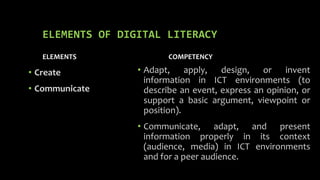
• Create
• Communicate
COMPETENCY
• Adapt, apply, design, or invent
information in ICT environments (to
describe an event, express an opinion, or
support a basic argument, viewpoint or
position).
• Communicate, adapt, and present
information properly in its context
(audience, media) in ICT environments
and for a peer audience.
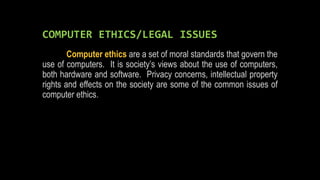
COMPUTER ETHICS/LEGAL ISSUES
Computer ethics are a set of moral standards that govern the
use of computers. It is society’s views about the use of computers,
both hardware and software. Privacy concerns, intellectual property
rights and effects on the society are some of the common issues of
computer ethics.
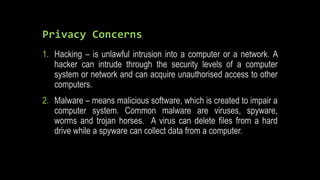
Privacy Concerns
1. Hacking – is unlawful intrusion into a computer or a network. A
hacker can intrude through the security levels of a computer
system or network and can acquire unauthorised access to other
computers.
2. Malware – means malicious software, which is created to impair a
computer system. Common malware are viruses, spyware,
worms and trojan horses. A virus can delete files from a hard
drive while a spyware can collect data from a computer.
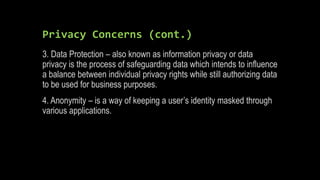
Privacy Concerns (cont.)
3. Data Protection – also known as information privacy or data
privacy is the process of safeguarding data which intends to influence
a balance between individual privacy rights while still authorizing data
to be used for business purposes.
4. Anonymity – is a way of keeping a user’s identity masked through
various applications.
Effects on Society
•Jobs
•Environmental Impact
•Social Impact
TOPIC 02:
COMPETENCIES REQUIRED IN
TEACHING AND LEARNING
OBJECTIVES
• breakdown the new trends in teaching and learning;
• differentiate the difference competencies and skills
required in teaching; and
• explain the ICT improvement in teaching and learning.
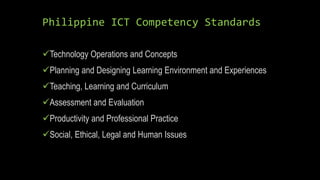
Philippine ICT Competency Standards
Technology Operations and Concepts
Planning and Designing Learning Environment and Experiences
Teaching, Learning and Curriculum
Assessment and Evaluation
Productivity and Professional Practice
Social, Ethical, Legal and Human Issues
Competencies are defined as “the set of knowledge,
skills, and experience necessary for future, which manifests
in activities” (Katane et.al. 44). Gupta defines competencies
as “knowledge, skills, attitudes, values, motivations and
beliefs people need in order to be successful in a job.”
New trends
• Mobile learning (m ‐learning) as a form of e ‐learning is a rising
trend where the education has outgrown the physical constraints of
the classrooms and acquired mobility.
• Open Education Resources (OER ) are teaching, learning and
research materials in any medium – digital or otherwise – that
reside in the public domain or have been released under an open
license that permits no-cost access, use, adaptation and
redistribution by others with no or limited restrictions.
New trends (cont.)
• Social Networking -many teachers find social networking a great
way to expand their personal learning network and to discover
resources. Just about all students rely on social media of some
kind as a part of their daily routine.
• Collaboration – promotes the peer relationship, interaction and by
involving students in different discussion.it helps learners to boost
confidence to share ideas and to help find their own potentials.
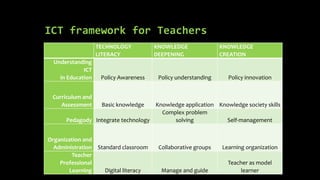
ICT framework for Teachers
TECHNOLOGY
LITERACY
KNOWLEDGE
DEEPENING
KNOWLEDGE
CREATION
Understanding
ICT
in Education Policy Awareness Policy understanding Policy innovation
Curriculum and
Assessment Basic knowledge Knowledge application Knowledge society skills
Pedagody Integrate technology
Complex problem
solving Self-management
Organization and
Administration Standard classroom Collaborative groups Learning organization
Teacher
Professional
Learning Digital literacy Manage and guide
Teacher as model
learner
BASIC TECHNOLOGY COMPETENCIES
Fundamental skills come first - like managing
electronic files, using computerized databases and
spreadsheets, sending and receiving e-mail messages, and
creating documents with graphics. The competencies are
organized into five aspects: productivity, communication,
research, media and presentation.
Skills need for 21st century
Psychoeducational skills
• Psychoeducation is a form of education that is specifically offered
to individuals who are suffering from any one of several distinct
mental health conditions impairing their ability to lead their lives.
Vocational and Leadership skills
• Vocational skills refers to occupations that you can learn with some
basic training or on-the-job in lieu of a college degree.
Skills need for 21st century
Collaborative and cooperative skills
• Having a communicative attitude and perspective in relations with peers or
colleagues for the purposes of an open sharing of information and knowledge in
order to improve learning processes based on the main features of ICTs
Critical thinking
• Types of reasoning making judgements, making decisions based on the assessment
of evidence and arguments and problem solving.
Creative thinking
• Skills of creating new ideas and the ability to refine one own ideas.
Skills need for 21st century
Communication
• Skills of communicating clearly and effectively.
Collaboration
• Skills of working effectively and flexibility in various teams and with different people.
PRELIM EXAM

TLE 07–prelim.ppsx,.......................

  • 1.
    TLE 07– TEACHING COMMONCOMPETENCIES IN ICT BTVTED 3 - 1ST SEMESTER
  • 2.
    REQUIREMENTS FOLLOW THE SCHEDULE (DEADLINE ISA DEALDINE) STAY AT HOME AND STUDY TO WRITE IS TO REMEMBER BE PREPARED AT ALL TIMES 2
  • 3.
  • 4.
    OBJECTIVES: •determine the useand means of ICT; •criticize the use of ICT; and •create a signage which will show the ethical / legal issues using the information technology.
  • 5.
    What is ICT? ICTor Information Communication Technology, it can be defined as the umbrella that includes for the communication of information. The use of hardware and software that are used to transmit, store, create share or exchange particular task.
  • 6.
    What is ICT?(cont.) ICT improves the life of every individual in terms of automated processes. An example: the transaction in any stores are now using the ICT, the cashier will not use the manual counting instead, and system will automatically generate computation for a client/customer. ICT takes a second to process data that minimize time process of every individual.
  • 7.
    ICT Boon orBane? Technology is a blessing in every individual. With technology there is a lot that, we can do that we never do.
  • 8.
    ICT Boon orBane? • Cellphones and webcams are used to get closer to someone miles away. • Teaching and Learning can be more exciting and engaging with the use of multimedia in the classroom. • Television used to watch events globally. • Learners made to accept the gospel truth information through the internet. • Surf the internet for pornography. • Through internet people to do character, assassinate whom they are hardly like. • The over use and abuse of internet to kill time.
  • 9.
    ICT LITERACY COMPETENCY Literacyis the set of skills, which allows an individual to engage fully in society and in learning, through the different forms of language which society values and finds useful.
  • 10.
    ICT Literacy isthe ability to use tools of ICT: Define ones information problem clearly Access information efficiently Evaluate the reliability, authority, and bias of sources Organize and synthesize ones information with the best ICT tools available in order to use it effectively and responsibly Communicate ones new ideas effectively and ethically with the appropriate ICT tools available
  • 11.
    ELEMENTS OF DIGITALLITERACY ELEMENTS • Access • Manage COMPETENCY • Search, find, and retrieve information in digital environments. • Conduct a rudimentary and preliminary organization of accessed information for retrieval and future application.
  • 12.
    ELEMENTS OF DIGITALLITERACY ELEMENTS • Integrate • Evaluate COMPETENCY • Interpret and represent information by using ICT tools to synthesize, summarize, compare, and contrast information from multiple sources. • Judge the currency, appropriateness, and adequacy of information and information sources for a specific purpose (including determining authority, bias, and timelines of materials).
  • 13.
    ELEMENTS OF DIGITALLITERACY ELEMENTS • Create • Communicate COMPETENCY • Adapt, apply, design, or invent information in ICT environments (to describe an event, express an opinion, or support a basic argument, viewpoint or position). • Communicate, adapt, and present information properly in its context (audience, media) in ICT environments and for a peer audience.
  • 14.
    COMPUTER ETHICS/LEGAL ISSUES Computerethics are a set of moral standards that govern the use of computers. It is society’s views about the use of computers, both hardware and software. Privacy concerns, intellectual property rights and effects on the society are some of the common issues of computer ethics.
  • 15.
    Privacy Concerns 1. Hacking– is unlawful intrusion into a computer or a network. A hacker can intrude through the security levels of a computer system or network and can acquire unauthorised access to other computers. 2. Malware – means malicious software, which is created to impair a computer system. Common malware are viruses, spyware, worms and trojan horses. A virus can delete files from a hard drive while a spyware can collect data from a computer.
  • 16.
    Privacy Concerns (cont.) 3.Data Protection – also known as information privacy or data privacy is the process of safeguarding data which intends to influence a balance between individual privacy rights while still authorizing data to be used for business purposes. 4. Anonymity – is a way of keeping a user’s identity masked through various applications.
  • 17.
  • 18.
    TOPIC 02: COMPETENCIES REQUIREDIN TEACHING AND LEARNING
  • 19.
    OBJECTIVES • breakdown thenew trends in teaching and learning; • differentiate the difference competencies and skills required in teaching; and • explain the ICT improvement in teaching and learning.
  • 20.
    Philippine ICT CompetencyStandards Technology Operations and Concepts Planning and Designing Learning Environment and Experiences Teaching, Learning and Curriculum Assessment and Evaluation Productivity and Professional Practice Social, Ethical, Legal and Human Issues
  • 21.
    Competencies are definedas “the set of knowledge, skills, and experience necessary for future, which manifests in activities” (Katane et.al. 44). Gupta defines competencies as “knowledge, skills, attitudes, values, motivations and beliefs people need in order to be successful in a job.”
  • 22.
    New trends • Mobilelearning (m ‐learning) as a form of e ‐learning is a rising trend where the education has outgrown the physical constraints of the classrooms and acquired mobility. • Open Education Resources (OER ) are teaching, learning and research materials in any medium – digital or otherwise – that reside in the public domain or have been released under an open license that permits no-cost access, use, adaptation and redistribution by others with no or limited restrictions.
  • 23.
    New trends (cont.) •Social Networking -many teachers find social networking a great way to expand their personal learning network and to discover resources. Just about all students rely on social media of some kind as a part of their daily routine. • Collaboration – promotes the peer relationship, interaction and by involving students in different discussion.it helps learners to boost confidence to share ideas and to help find their own potentials.
  • 24.
    ICT framework forTeachers TECHNOLOGY LITERACY KNOWLEDGE DEEPENING KNOWLEDGE CREATION Understanding ICT in Education Policy Awareness Policy understanding Policy innovation Curriculum and Assessment Basic knowledge Knowledge application Knowledge society skills Pedagody Integrate technology Complex problem solving Self-management Organization and Administration Standard classroom Collaborative groups Learning organization Teacher Professional Learning Digital literacy Manage and guide Teacher as model learner
  • 25.
    BASIC TECHNOLOGY COMPETENCIES Fundamentalskills come first - like managing electronic files, using computerized databases and spreadsheets, sending and receiving e-mail messages, and creating documents with graphics. The competencies are organized into five aspects: productivity, communication, research, media and presentation.
  • 26.
    Skills need for21st century Psychoeducational skills • Psychoeducation is a form of education that is specifically offered to individuals who are suffering from any one of several distinct mental health conditions impairing their ability to lead their lives. Vocational and Leadership skills • Vocational skills refers to occupations that you can learn with some basic training or on-the-job in lieu of a college degree.
  • 27.
    Skills need for21st century Collaborative and cooperative skills • Having a communicative attitude and perspective in relations with peers or colleagues for the purposes of an open sharing of information and knowledge in order to improve learning processes based on the main features of ICTs Critical thinking • Types of reasoning making judgements, making decisions based on the assessment of evidence and arguments and problem solving. Creative thinking • Skills of creating new ideas and the ability to refine one own ideas.
  • 28.
    Skills need for21st century Communication • Skills of communicating clearly and effectively. Collaboration • Skills of working effectively and flexibility in various teams and with different people.
  • 29.