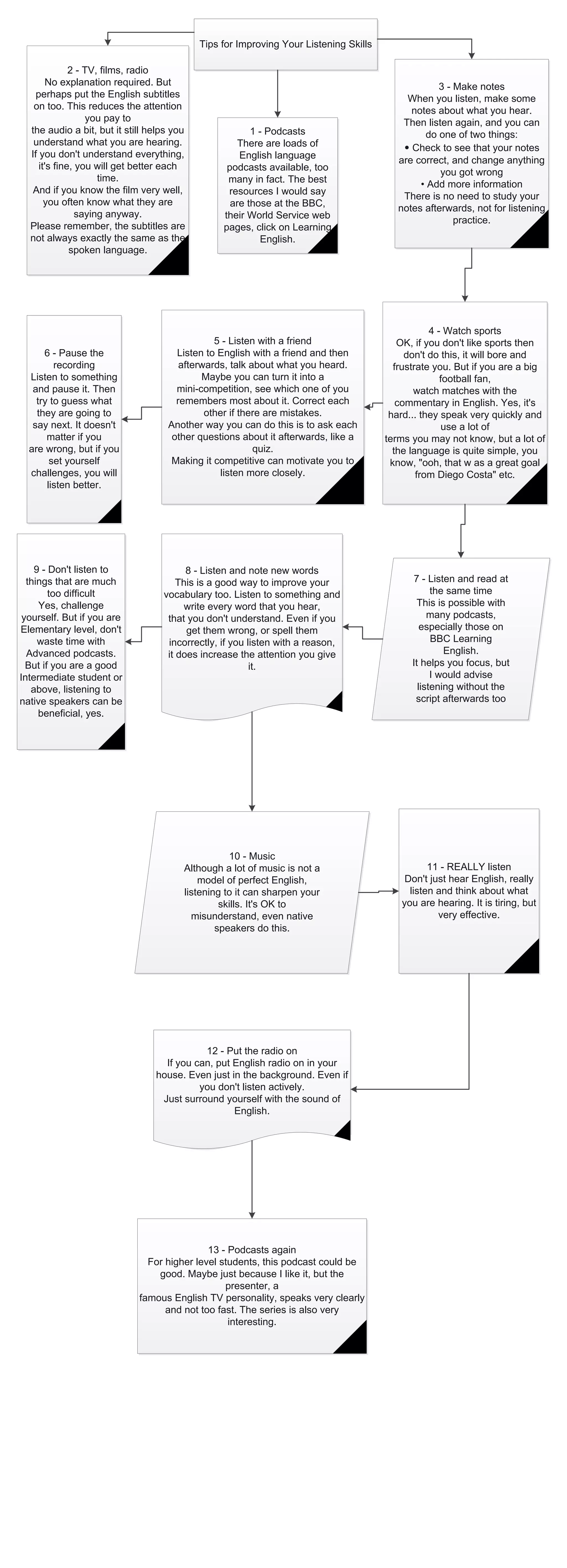
Tips for Improving Your Listening Skills
1 - Podcasts
There are loads of
English language
podcasts available, too
many in fact. The best
resources I would say
are those at the BBC,
their World Service web
pages, click on Learning
English.
2 - TV, films, radio
No explanation required. But
perhaps put the English subtitles
on too. This reduces the attention
you pay to
the audio a bit, but it still helps you
understand what you are hearing.
If you don't understand everything,
it's fine, you will get better each
time.
And if you know the film very well,
you often know what they are
saying anyway.
Please remember, the subtitles are
not always exactly the same as the
spoken language.
3 - Make notes
When you listen, make some
notes about what you hear.
Then listen again, and you can
do one of two things:
• Check to see that your notes
are correct, and change anything
you got wrong
• Add more information
There is no need to study your
notes afterwards, not for listening
practice.
4 - Watch sports
OK, if you don't like sports then
don't do this, it will bore and
frustrate you. But if you are a big
football fan,
watch matches with the
commentary in English. Yes, it's
hard... they speak very quickly and
use a lot of
terms you may not know, but a lot of
the language is quite simple, you
know, "ooh, that w as a great goal
from Diego Costa" etc.
5 - Listen with a friend
Listen to English with a friend and then
afterwards, talk about what you heard.
Maybe you can turn it into a
mini-competition, see which one of you
remembers most about it. Correct each
other if there are mistakes.
Another way you can do this is to ask each
other questions about it afterwards, like a
quiz.
Making it competitive can motivate you to
listen more closely.
6 - Pause the
recording
Listen to something
and pause it. Then
try to guess what
they are going to
say next. It doesn't
matter if you
are wrong, but if you
set yourself
challenges, you will
listen better.
7 - Listen and read at
the same time
This is possible with
many podcasts,
especially those on
BBC Learning
English.
It helps you focus, but
I would advise
listening without the
script afterwards too
8 - Listen and note new words
This is a good way to improve your
vocabulary too. Listen to something and
write every word that you hear,
that you don't understand. Even if you
get them wrong, or spell them
incorrectly, if you listen with a reason,
it does increase the attention you give
it.
9 - Don't listen to
things that are much
too difficult
Yes, challenge
yourself. But if you are
Elementary level, don't
waste time with
Advanced podcasts.
But if you are a good
Intermediate student or
above, listening to
native speakers can be
beneficial, yes.
10 - Music
Although a lot of music is not a
model of perfect English,
listening to it can sharpen your
skills. It's OK to
misunderstand, even native
speakers do this.
11 - REALLY listen
Don't just hear English, really
listen and think about what
you are hearing. It is tiring, but
very effective.
12 - Put the radio on
If you can, put English radio on in your
house. Even just in the background. Even if
you don't listen actively.
Just surround yourself with the sound of
English.
13 - Podcasts again
For higher level students, this podcast could be
good. Maybe just because I like it, but the
presenter, a
famous English TV personality, speaks very clearly
and not too fast. The series is also very
interesting.

Tips for improving listening skill

  • 1.
    Tips for ImprovingYour Listening Skills 1 - Podcasts There are loads of English language podcasts available, too many in fact. The best resources I would say are those at the BBC, their World Service web pages, click on Learning English. 2 - TV, films, radio No explanation required. But perhaps put the English subtitles on too. This reduces the attention you pay to the audio a bit, but it still helps you understand what you are hearing. If you don't understand everything, it's fine, you will get better each time. And if you know the film very well, you often know what they are saying anyway. Please remember, the subtitles are not always exactly the same as the spoken language. 3 - Make notes When you listen, make some notes about what you hear. Then listen again, and you can do one of two things: • Check to see that your notes are correct, and change anything you got wrong • Add more information There is no need to study your notes afterwards, not for listening practice. 4 - Watch sports OK, if you don't like sports then don't do this, it will bore and frustrate you. But if you are a big football fan, watch matches with the commentary in English. Yes, it's hard... they speak very quickly and use a lot of terms you may not know, but a lot of the language is quite simple, you know, "ooh, that w as a great goal from Diego Costa" etc. 5 - Listen with a friend Listen to English with a friend and then afterwards, talk about what you heard. Maybe you can turn it into a mini-competition, see which one of you remembers most about it. Correct each other if there are mistakes. Another way you can do this is to ask each other questions about it afterwards, like a quiz. Making it competitive can motivate you to listen more closely. 6 - Pause the recording Listen to something and pause it. Then try to guess what they are going to say next. It doesn't matter if you are wrong, but if you set yourself challenges, you will listen better. 7 - Listen and read at the same time This is possible with many podcasts, especially those on BBC Learning English. It helps you focus, but I would advise listening without the script afterwards too 8 - Listen and note new words This is a good way to improve your vocabulary too. Listen to something and write every word that you hear, that you don't understand. Even if you get them wrong, or spell them incorrectly, if you listen with a reason, it does increase the attention you give it. 9 - Don't listen to things that are much too difficult Yes, challenge yourself. But if you are Elementary level, don't waste time with Advanced podcasts. But if you are a good Intermediate student or above, listening to native speakers can be beneficial, yes. 10 - Music Although a lot of music is not a model of perfect English, listening to it can sharpen your skills. It's OK to misunderstand, even native speakers do this. 11 - REALLY listen Don't just hear English, really listen and think about what you are hearing. It is tiring, but very effective. 12 - Put the radio on If you can, put English radio on in your house. Even just in the background. Even if you don't listen actively. Just surround yourself with the sound of English. 13 - Podcasts again For higher level students, this podcast could be good. Maybe just because I like it, but the presenter, a famous English TV personality, speaks very clearly and not too fast. The series is also very interesting.